

Submitted:
03 July 2025
Posted:
04 July 2025
You are already at the latest version
Abstract
Discrimination and harassment (DH) against women are topics of broad concern to gender equality advocates. This study aimed to investigate the prevalence of DH among women in Nigeria, based on seven specific forms of DH captured in the 2021 Nigeria Multiple Indicator Cluster Survey (MICS), and to identify key socio-demographic factors associated with an aggregated DH outcome variable. Drawing upon data from 38,806 women aged 15-49, we used descriptive statistics to summarize the prevalence of DH across seven reasons and the socio-demographic characteristics of respondents, followed by chi-square analysis to test bivariate associations and binary logistic regression to identify predictors. Results showed that DH prevalence among Nigerian women (18.9%) was significantly associated with socio-demographic factors such as age, education level, wealth index, marital status, and ethnicity. At the individual level, women who felt very unhappy had higher odds of experiencing DH (OR = 3.101, 95% CI: 2.393–4.018, p < 0.001) compared to those who felt very happy. In contrast, women with higher/tertiary education (OR = 0.686, 95% CI: 0.560–0.842, p < 0.001) were 31.4% less likely to face DH than those with no education. Regionally, respondents living in Zamfara (OR = 5.045, 95% CI: 3.072–8.288, p < 0.001) were over five times more likely to experience DH than those in Kano state. The findings underscore the need for policy interventions and support systems to address DH among women in Nigeria.
Keywords:
discrimination
; harassment
; women aged 15-49
; Nigeria
; MICS
1. Introduction
“Being born and growing up as a girl in a developing society like Nigeria is almost like a curse due to contempt and ignominy treatment received from the family, the school and the society at large” [1].
Nigeria, Africa’s largest economy and most populous country, is home to more than 250 ethnic groups and 500 languages that shape its sociopolitical structures [2]. Long before the establishment of the modern Nigerian state, the region was inhabited by diverse Indigenous communities who engaged in extensive intergroup interactions shaped by regional and trans-Saharan trade networks [3,4]. However, British colonial rule in the 19th century disrupted these systems. In 1914, the British forcibly amalgamated three distinct regions — the Northern Protectorate, the Southern Protectorate, and the Colony of Lagos — into a single political entity, laying the groundwork for enduring institutional hierarchies [2]. Although Nigeria gained independence in 1960, the colonial legacy of Eurocentric governance structures, knowledge systems, and social norms constantly shapes contemporary society. These influences have perpetuated rigid gender roles and entrenched social inequalities that disadvantage women in Nigeria.
In alignment with global commitments under Sustainable Development Goals (SDG) 5 and 10, governments worldwide have pursued gender equality through legislative reforms, gender-responsive policies, and educational initiatives [5,6]. Despite these efforts, women continue to be victims of both overt and subtle discrimination and harassment (DH). Discrimination generally falls into two forms: direct and indirect [7,8]. Direct discrimination involves the intentional differential treatment of individuals based on their membership in socially salient groups [7]. In contrast, indirect discrimination arises when ostensibly neutral rules or practices disproportionately disadvantage individuals with protected characteristics, such as gender [9]. Harassment, defined as “unwanted, unwelcome or uninvited behaviour that makes a person feel humiliated, intimated or offended”[10], is prevalent in multiple spheres, such as education, science and sports, housing, public media, and employment [11]. DH against women not only undermines their rights but also poses serious threats to their health and well-being. Evidence shows that discrimination against women in the workplace, such as their being denied promotions, can lead to heightened psychological distress, including depression, anxiety, and psychosomatic symptoms [12]. Likewise, women subjected to sexual harassment often report symptoms of post-traumatic stress disorder, along with deteriorating mental and physical health [13]. Such impacts can severely limit women’s ability to play an active role in shaping their communities and contributing to broader societal development.
Recent global evidence highlights that women’s discrimination is widespread, with race (38%), gender (33%), and ethnicity (20%) identified as the most commonly reported grounds [14]. Based on data from 154,000 households, the World Justice Project identifies Afghanistan, Sudan, and Nicaragua as countries with the highest levels of discrimination, where persistent gender segregation, weak institutional frameworks, and political instability exacerbate systemic inequalities [15]. Conversely, countries such as Finland, Singapore, and Estonia report the lowest levels, attributed to strong anti-discrimination legislation and effective enforcement mechanisms. It is important to note that high-income nations such as the United States and Hungary constantly show significant levels of reported discrimination, indicating that economic development alone is insufficient to eliminate entrenched discrimination. Harassment, a pervasive manifestation of gender-based discrimination, remains prevalent across both public and private occasions. According to the International Labour Organization (ILO), 17.6% of women report having experienced psychological harassment in the workplace [6]. Moreover, women report experiencing sexual harassment in public places at alarming rates across various countries, including Egypt (99%), Vietnam (87%), India (79%), Cambodia (77%), the US (65%), and the UK (64%) [16].
If we look into Nigeria, its low ranking on the World Economic Forum’s Global Gender Gap Index (118th out of 142 in 2014, with a disparity score of 0.639) highlights the severity of gender inequality nationally. Women in Nigeria face significant discrimination across various domains, particularly in political representation, economic participation, and educational attainment. Despite making up nearly half of the national population, women were significantly underrepresented in political leadership, holding only 6.7% of parliamentary seats in 2014 and 5.6% in 2015 [17]. Gender-based inequalities also persist in the labour market where women hold just 11% of formal sector jobs compared to 30% for men [18]. This disparity is further reflected in the agricultural sector, where women contribute up to 80% of total production—accounting for roughly 41% of the country’s GDP—yet control only 1% of farming assets due to gender discriminatory practices around land ownership [17]. Given the prevalence of a traditional masculine culture in Nigerian higher education institutions, only 10.4% of women had received higher education by 2019 [19,20].
Furthermore, sexual harassment is a significant issue for Nigerian women, particularly in academic and professional settings. Research by Bako and Syed [17] found that 20%-30% of female students at Nigerian universities experience sexual harassment from male staff and lecturers, with common forms including inappropriate comments, unwanted physical contact, and pressure for sexual favours in exchange for academic benefits. Despite formal complaints, little action is often taken to address these incidents, reflecting a lack of institutional response. Similarly, in the workplace, female junior employees frequently face sexual harassment from male supervisors [21]. However, many choose not to report the abuse due to fears of retaliation or job loss, thereby fostering a culture of silence that perpetuates the problem.
These DH phenomena are embedded in the complex interplay of religious ideologies, cultural norms, and legal systems. Customary and religious laws, rooted in Igbo tradition and Sharia law, reinforce patriarchal structures that legitimize DH [17]. Dominant religions like Christianity and Islam contribute to a culture of impunity of such practices through doctrines that promote female submission and gender segregation [22]. In many tribal and ethnic communities, women are subjected to genital mutilation, child marriage, and widowhood practices — through which they are treated as property to be inherited by male relatives. These forms of discrimination are often accompanied by harassment, both verbal and physical, which create hostile environments that endanger and marginalize women [17]. Although Nigeria is a signatory to the Convention on the Elimination of All Forms of Discrimination Against Women (CEDAW) since 1985, the effectiveness of this legal protection is limited by the country’s dualist legal system which requires international treaties to be enacted into domestic law before they become enforceable [23]. As such, many women remain unprotected from DH, particularly in communities where customary practices take precedence over statutory law. This legal gap reinforces the continuation of harmful traditional and religious practices, rendering women vulnerable to lifelong inequality and abuse.
To date, while there have been at least three studies on intimate partner violence (IPV) among women in Nigeria [24,25,26], limited research has sought to investigate DH issues. While previous studies have focused on workplace DH [12,27], its prevalence and patterns in everyday social contexts have been under-researched. Although some have examined women’s attitudes and coping strategies in relation to DH [6,28], few have systematically investigated how socio-demographic characteristics shape women’s exposure to DH. Seeking to address these gaps, this research examined the prevalence of DH among women in Nigeria, utilizing seven distinct DH indicators from the 2021 Nigeria Multiple Indicator Cluster Survey (MICS), and investigated key socio-demographic factors associated with a composite DH outcome variable. Findings have the potential to identify key risk factors and inform evidence-based policy and intervention strategies to reduce DH against women in Nigeria, thus, enhancing the safety and wellbeing of women nationwide. Additionally, it may contribute to the achievement of SDGs with respect to gender equality and human rights.
Nigeria offers a particularly critical context for this study due to several key reasons. First, its large population and economic dominance exert substantial influence across low-middle-income countries. Second, long-standing cultural and religious traditions have shaped gender norms that often restrict women’s rights and increase their vulnerability to DH. Third, a rising awareness among Nigerian women about issues of DH has prompted growing demands for legal protection and social change. The amalgamation of these factors necessitates the exploration of issues of DH among women in this developing country.
2. Materials and Methods
2.1. Data Source
Data were obtained from the sixth round of the 2021 Multiple Indicator Cluster Survey (MICS) conducted in Nigeria. The MICS is designed to produce statistically robust and internationally comparable data on key indicators pertaining to education, health, and the protection of children and women, while also serving as a key tool for monitoring the progress toward the SDGs and for strengthening national statistical capacity. The survey was implemented by the National Bureau of Statistics (NBS) of Nigeria, with technical assistance from UNICEF and financial support from the government and international partners. The survey findings and datasets are publicly available on the official UNICEF website (https://mics.unicef.org/surveys).
The MICS sample was designed to generate estimates for various indicators regarding the situation of children and women at the national level, across urban/rural areas, by state (including the FCT), and by geo-political zone in Nigeria. A two-stage probability sampling design was employed. In the first stage, 1850 census enumeration areas were systematically selected within each stratum using probability proportional to size, followed by a household listing operation within each selected area. In the second stage, a systematic random sample of 20 households was selected from each enumeration area. Notably, some areas, particularly in Borno State, were excluded from the data collection process because of security concerns. For this study, the final analytic sample included 38,806 women aged 15-49 after eliminating cases with “Missing values,” “No responses” and “DK” (Don’t know).
Although the MICS survey employed five types of questionnaires, this study specifically draws on data from the household questionnaire (basic demographic information) and the women’s questionnaire (administered to all women aged 15–49 in each household). Data were collected using Computer-Assisted Personal Interviewing (CAPI) on tablets, supported by the Census and Survey Processing System (CSPro) software. Data quality was ensured through re-interviews, daily supervision, and regular review visits by management and external monitors.
2.2. Outcome Variables
The outcome variable was discrimination and harassment (DH) experienced by women aged 15–49. It reflected whether a respondent (woman) had faced DH in the past 12 months in Nigeria. The 2021 MICS survey asked women seven distinct binary (yes/no) questions about whether they had personally experienced DH on the basis of: 1) ethnic or immigration origin; 2) gender identity; 3) sexual orientation; 4) age; 5) religion or belief; 6) disability; or 7) any unspecified reason. For this study, responses were aggregated to construct a binary outcome variable where coded “yes” if the respondent answered “yes” to any of the seven questions, indicating they experienced at least one form of discrimination or harassment in the past 12 months and coded “no” if the respondent answered “no” to all questions, indicating no experience of DH. This aggregation approach enabled the analysis of overall DH prevalence, regardless of the specific reason for the experience.
2.3. Independent Variables
A set of covariates related to women’s feelings of DH were considered for analysis. All selected covariates are classified into individual-level factors and community-level factors. At the individual level, this study considered women’s age, which was recorded to have three categories (in years) (15–24, 25–34, 35–49). Women’s education had five categories (none, primary, junior secondary, senior secondary, higher/tertiary). The study also categorized respondents into five socioeconomic collectives according to their wealth status: poorest, second, middle, fourth, and richest. Marital status was also divided into three categories (currently, formerly, and never married). They were also placed in one of nine ethnicity categories: Hausa, Igbo, Fulani, Kanuri, Ijaw, Tiv, Ibibio, Edo, and other ethnicity. The variable “feeling safe at home alone after dark” had five categories (very safe, safe, unsafe, very unsafe, never alone after dark). Both “ever circumcised” and “ability to get pregnant” were treated as separate binary variables coded as “yes” or “no.” Respondents were classified into five groups based on happiness extent: very happy, somewhat happy, neither happy nor unhappy, somewhat unhappy, and very unhappy. In this study, a community was defined as a census enumeration cluster or block. To account for community characteristics, the place of residence (urban or rural) was added as a proxy measure. The region variable was also considered by including 36 states and the FCT in the analysis.
2.4. Statistical Analysis
In this study, we used descriptive statistics to show the prevalence of DH for any of seven reasons and portray the overview of participants’ socio-demographic characteristics, which were presented as counts and percentages. We utilized the chi-square test to ascertain the differences in DH and sociodemographic characteristics among women. Furthermore, a binary logistic regression model was employed to examine the association between outcome and exposure variables. The results were reported in the form of odds ratios (OR), along with their respective 95% confidence intervals (CI). Statistical significance for the relationship between various factors and the likelihood of ever having experienced DH was defined as p < 0.05. All analyses were conducted using Statistical Package for Social Sciences (SPSS) version 28, including both descriptive and inferential methods.
2.5. Ethics
This study utilizes de-identified data obtained from the Nigerian MICS. The survey protocol was approved by the Steering and Review Committees in August 2021. Prior to data collection, all participants gave informed consent, and for minors (15–17), both parental approval and their own assent were obtained. Confidentiality of all data was maintained through measures established during the original survey. Given that this study is based on secondary data, ethical clearance is therefore not required.
3. Results
3.1. Prevalence and Sociodemographic Reasons for Discrimination and Harassment
A total of 38,806 women aged 15–49 years who responded to the DH module in the survey were included in the analysis. Overall, 18.90% of respondents experienced DH due to at least one of the seven reasons in the past 12 months (Figure 1). Age appeared to be the most common reason (7.20%), followed by gender (6.00%) and ethnic or immigration origin (5.90%). Additionally, 5.40% of women reported DH based on religion or belief, while 5.60% attributed such incidents to reasons not specified in the listed categories. Comparatively lower proportions were observed for sexual orientation (3.60%) and disability (2.10%).
3.2. Sociodemographic and Health-Related Characteristics of Women
Table 1 presents the background characteristics of the respondents. The majority of women were aged between 15 and 24 years (38.2%), with relatively smaller proportions in the 25–34 (29.0%) and 35–49 (32.8%) age groups. Approximately two-thirds of the women (59.8%) had completed secondary and higher/tertiary education, yet 26.6% lacked formal schooling. A relatively balanced distribution was observed across the wealth index quintiles, though a slightly higher proportion of respondents fell into the fourth (21.4%) and richest (22.7%) categories. In terms of marital/union status, the percentage of women who were currently married or in union (61.7%) was nearly twice as high as that of their never married counterparts (32.9%). Ethnically, women identifying as Hausa accounted for the largest percentage (25.5%), followed by Igbo (15.5%) and Fulani (6.5%). Regarding perceptions of personal safety, over half (50.6%) of women reported feeling safe when alone at home after dark, while 18.9% expressed feeling unsafe or very unsafe. With respect to reproductive health, 15.1% of respondents had undergone female circumcision, while the majority (59.4%) indicated they were able to get pregnant. Subjective happiness was high among respondents, with 42.4% feeling “very happy” and 36.6% considering themselves “somewhat happy”. At the community level, the sample was slightly skewed toward rural residents (54.1%) and represented all 37 regions with particularly large proportions drawn from Lagos (7.3%), Kano (6.7%), Katsina (4.1%), and Kaduna (4.0%).
3.3. Chi-Square Analysis of Sociodemographic Characteristics of Discrimination and Harassment
Table 2 reveals statistically significant associations (p < 0.001 for most variables) between diverse sociodemographic factors and DH experienced by Nigerian women. These factors include individual-level characteristics such as age, education level, marital status, ethnicity, wealth quintile, circumcision status, perceptions of personal safety, and self-reported happiness. Furthermore, factors at the community level, such as residential setting and geographic region, also showed significant associations with women’s experience of DH.
It was observed that prevalence of DH declined with women’s increasing age. Women aged 15–24 (20.0%) experienced more DH than those aged 35–49 (17.2%). Women with no formal education (21.3%) encountered a higher prevalence compared to those who completed higher or tertiary education (16.5%). A clear wealth gradient was also observed, with women from the second poorest household (21.5%) more likely to experience DH than the rich (15.8%). In this study, a high prevalence of DH was also observed among formerly married women (20.9%), Edo women (31.9%), uncircumcised women (20.2%), and those unable to get pregnant (20.3%).
Perceptions of personal safety were strongly associated with the risk of experiencing DH. Women who felt very unsafe at home after dark reported the highest prevalence (43.0%), nearly three times higher than those who felt very safe (15.3%). Similarly, self-reported happiness showed an inverse relationship, with prevalence increasing from 15.2% among women who described themselves as “very happy” to 33.1% among those who were “very unhappy”. At the community level, the prevalence of DH against women was higher in rural areas (20.9%) in comparison with their urban counterparts (16.5%). Prevalence varied significantly across regions, with Yobe showing the highest rate (45.1%) and Ogun (4.6%) the lowest.
For a visual representation of the extent of DH experienced by women at the regional level in Nigeria, the prevalence estimates were plotted against the predictor variable “Regions,” as shown in Figure 2. Kano, where 23.6% of women reported experiencing DH, was selected as the reference for comparison. The prevalence rates span from 4.6% to 45.1% across the regions. Based on the standard deviation from the national mean as a classification benchmark, the regions were grouped into color-coded categories: dark green for significantly below average, light green for average, light brown for moderately above average, and dark brown for exceptionally high prevalence (over 2.5 standard deviations above the national mean). The spatial distribution reveals stark regional inequalities. Zamfara (dark brown), a socioeconomically disadvantaged region, exhibited an alarmingly high prevalence, while regions shaded in green reported lower levels of DH.
3.4. Predictors of Discrimination and Harassment Against Women in Nigeria
Table 3 presents factors that contribute to the likelihood of women experiencing DH as identified through logistic regression analysis. The study found that younger women were more likely to face any form of DH. Specifically, compared to women aged 35–49, those aged 25–34 (OR = 1.331, 95% CI: 1.180–1.502, p < 0.001) had higher odds of experiencing DH. Concerning level of education, women with higher or tertiary education (OR = 0.686, 95% CI: 0.560–0.842, p < 0.001) were 31.4% less likely to experience DH than those without formal education. Unmarried women (OR = 1.367, 95% CI: 1.196–1.562, p < 0.001) were 36.7% more likely to be exposed to DH compared to those who were currently married/in union. The results did not indicate a statistically significant correlation between household wealth and women’s likelihood of experiencing DH, as the odds ratios across all categories were close to 1.
In terms of the ethnicity of the household head, Kanuri women (OR = 0.523, 95% CI: 0.331–0.826, p = 0.005) were 47.7% less likely to experience DH than the Fulani. Compared to women who felt very safe at home alone after dark, those who felt very unsafe (OR =2.120, 95% CI: 1.554–2.891, p < 0.001) were significantly more likely to feel discriminated against and harassed. Although women who had never been circumcised (OR = 0.949, 95% CI: 0.843–1.068, p = 0.385) were slightly less likely to experience DH than those who had, the difference was not statistically significant. A discernible association was observed between women’s inability to get pregnant and their likelihood of experiencing DH. Specifically, women who could not become pregnant (OR = 1.20, 95% CI: 1.04–1.39) were 20% more likely to have DH than those who could. Similarly, self-reported happiness was negatively associated with the odds of experiencing DH. Women who reported feeling very unhappy were 3.101 times more likely to experience DH compared to those who felt very happy.
Women residing in rural areas (OR = 1.140, 95% CI:1.006–1.292, p = 0.040) were 14% more likely to face DH than those in urban areas. Compared to women in the region of Kano, those in Zamfara were over five times more likely to experience DH (OR = 5.045, 95% CI: 3.072–8.288, p < 0.001). Conversely, women in southern states such as Ondo (OR = 0.176, 95% CI: 0.104–0.298, p < 0.001), Ogun (OR = 0.300, 95% CI: 0.189–0.476, p < 0.001), and Osun (OR = 0.335, 95% CI: 0.213–0.528, p < 0.001) were significantly less likely to experience DH.
Figure 3 visually presents the adjusted odds ratios (AORs) for self-reported experiences of DH among women across the 36 Nigerian states and the FCT. The AORs are categorized into six categories, with the range of 0.76–1.25 indicating no statistically significant difference from the reference state, Kano. States shaded in darker green (e.g., Oyo, Kwara, Ogun) had significantly lower odds (AOR < 0.50), indicating that women in these areas were less likely to report experiencing DH compared to Kano. In contrast, states shaded in darker brown (e.g., Zamfara, Katsina) had AORs above 1.5, indicating a significantly higher likelihood of women experiencing DH. States shaded in beige or grey-brown tones, as well as those with black labels, did not differ significantly from the reference category (Kano). Notably, states such as Gombe, Taraba, and Kogi — highlighted with blue labels — had AORs that were statistically significant and deviate from the reference category.
4. Discussion
Discrimination and harassment (DH), deeply rooted in entrenched societal norms, constantly marginalize women across sub-Saharan Africa. In Nigeria, despite the existence of legislative protections and policy initiatives aimed at promoting gender equality, DH remains a persistent issue among women. Findings from the 2021 MICS indicate that 18.9% of women of reproductive age have experienced at least one form of DH. This enduring prevalence underscores the urgent need for collaborative action among policymakers, civil society, and community leaders to eliminate DH in all its forms.
This study reveals several key insights into the prevalence of DH among women aged 15–49 based on seven possible grounds. Notably, age emerged as the most common reason in Nigeria, which parallels the findings from a study conducted in the United States [29]. However, this contrasts with a recent study that identified sex as the primary cause of DH in the United Kingdom [30]. This discrepancy may reflect contextual differences in socio-cultural expectations, legal enforcement effectiveness, and community-level perceptions of DH.
Employing both bivariate and multivariate analyses, our findings demonstrate that the risk of DH cannot be attributed to isolated factors but rather emerges from the interplay between individual and community characteristics. At the individual level, age was a significant indicator, with younger women facing higher risks of DH than those aged 35–49. This finding coheres with Bangladeshi research by Haq et al. [31] and Roscigno [32]. A possible explanation for this could be that entrenched gender norms and stereotypes often portray younger women as less authoritative or more submissive, making them more susceptible to control, coercion, and harassment [22].
The likelihood of experiencing DH has been found to decrease with higher levels of education in previous research, since education equips women with greater awareness of their rights and improved access to formal reporting mechanisms to challenge DH [8,33]. In the current study, however, women with secondary education were surprisingly more vulnerable than those with only primary education. This may be because their increased participation in social or economic activities makes them more exposed [32], and they may lack the institutional or social support available to highly educated peers, though they possess sufficient awareness to recognize DH.
Several studies have revealed that women who had never been married/in union are more likely to be discriminated and harassed than those currently married [8,31], which concurs with the findings of this study. While intimate partner violence remains highly prevalent among women in Nigeria, being married/in union may lower their exposure to public DH [25]. In patriarchal communities, marital status confers women’s social identity and respectability, which can deter unsolicited attention [5,17]. On the contrary, unmarried women may face greater scrutiny and social judgment due to prevailing norms that portray them as more independent or less protected [25].
It should, however, be noted that wealth status did not significantly predict the likelihood of experiencing DH among women. This study confirms that ethnicity highly shapes women’s exposure to DH, which echoes the observation of a Nigerian workplace research that highlights ethnicity-driven DH [12]. Women from the Edo group had higher odds of reporting such experiences compared to Fulani women. It may be that cultural norms in Edo society, which celebrate female beauty while also prescribing modesty, create conflicting expectations that increase women’s exposure to DH [5,6,17]. Kanuri women, by contrast, had significantly lower odds, possibly because their culture is strongly influenced by Islam, which emphasizes gender segregation and restricts women’s public visibility and interaction [22]. Women who felt “unsafe” or “very unsafe” when alone at night were more likely to face DH, which is supported by studies in the UK and Australia [34,35]. Women who were unable to conceive were more likely to be discriminated against and harassed. This may be because, in Nigerian culture, where fertility is highly valued, childlessness is often stigmatized, leading to social exclusion and heightened vulnerability to DH [36]. Lower levels of happiness were associated with higher odds of experiencing DH among women. This association may be bidirectional: lower happiness levels may reflect underlying social isolation or mental health challenges that increase vulnerability to DH, while persistent DH experiences may significantly diminish women’s overall wellbeing.
At the community level, women in rural areas had higher odds of experiencing DH than their urban counterparts, contradicting the finding of Alam, Sultana and Sultana [8]. It is possible that isolation and community pressures to conform in rural areas may discourage women from resisting DH treatment. Significant regional disparities were observed, with women in Zamfara and Katsina being more likely to experience DH. These regions have been affected by armed conflict, rural banditry, and spillover from the Boko Haram insurgency. This prolonged insecurity has heightened women’s exposure to DH, especially in displacement settings, while weak law enforcement allows perpetrators to act with impunity [37].
Based on these findings, we recommend multifaceted approaches to effectively combat DH in Nigeria. It is crucial to strengthen the enforcement of existing laws while implementing community-based interventions that empower local leaders to challenge harmful social norms and support help-seeking women. Tailored awareness campaigns, leveraging local media and community platforms, should emphasize educating both men and women on the significance of gender equality and the detrimental effects of DH. Moreover, economic and educational support initiatives are vital in reducing women’s vulnerability to DH, with a particular focus on vocational training and skills development. Mental health support should be integrated into interventions to help women overcome isolation and improve their resilience. Finally, promoting rural-urban parity in access to resources and support systems is critical to ensure women in rural settings are not left behind.
5. Strengths and Limitations
This study has a number of strengths and certain limitations. One of the advantages of this study is its use of the MICS, which offers a large sample size and nationally representative data, thereby ensuring that the findings can be both replicable and generalizable across Nigeria. Another strength is the comprehensive use of advanced statistical methods, incorporating covariates at both the individual and community levels, which enhances the robustness of the findings and reinforces their relevance for national-level policy and program development. Nevertheless, the data used were self-reported, which introduces potential recall bias. Additionally, the cross-sectional design of the MICS prevents the establishment of causal relationships between variables and observed outcomes. Moreover, a substantial amount of missing data resulted in considerable data loss, which may have affected the accuracy of the estimates. The cultural stigma surrounding DH in Nigeria likely contributed to underreporting and missing responses.
6. Conclusion
DH remains a significant public health and human rights concern for women aged 15–49 in Nigeria. In addition to causing immediate psychological and physical harm, DH results in broader social and economic inequalities, underscoring the urgency of addressing its root causes. This study revealed that factors such as age, education, marital/union status, ethnicity of household head, perceived safe at home alone after dark, fertility status, subjective happiness, area of residence, and region were significantly associated with the prevalence of DH against women aged 15-49 in Nigeria. To mitigate the prevalence of DH, we recommend targeted interventions that address legal, community, cultural drivers of DH, fostering equitable and supportive environments for women in Nigeria.
Author Contributions
Conceptualization, Y.Z., P.N., and T.S.; methodology, Y.Z. and T.S.; software, Y.Z. and T.S.; validation, Y.Z., and P.N.; formal analysis, Y.Z.; investigation, Y.Z.; resources, P.N.; data curation, Y.Z. and T.S.; writing—original draft preparation, Y.Z.; writing—review and editing, T.S. and P.N.; visualization, Y.Z. and T.S.; supervision, P.N. and T.S. All authors have read and agreed to the published version of the manuscript.
Funding
This research received no external funding.
Institutional Review Board Statement
Not applicable. The data used in this paper were obtained from publicly available UNICEF survey datasets, which adhered to ethical approval standards and included informed consent procedures. Please refer to the following ethics approval statement in the 2021 Nigeria Multiple Indicator Cluster Survey (MICS) report, Section 2 Survey Organization and Methodology, Sub-section 2.4 Ethical Protocol: “The survey protocol was approved by the Steering Committee and a Review Committee constituted from the Technical Committee in August 2021. The protocol included a Protection Protocol which outlines the potential risks during the life cycle of the survey and management strategies to mitigate these. Verbal consent was obtained for each respondent participating and, for children age 15-17 years individually interviewed, adult consent was obtained in advance of the child’s assent. All respondents were informed of the voluntary nature of participation and the confidentiality and anonymity of information. Additionally, respondents were informed of their right to refuse answering all or particular questions, as well as to stop the interview at any time”.
Informed Consent Statement
Not applicable.
Data Availability Statement
Data can be accessed through the official UNICEF MICS website.
Acknowledgments
We would like to express our sincere gratitude to all those who contributed to the completion of this research. We especially thank UNICEF and the government of Nigeria for granting access to the MICS, which provided the essential data for our analysis. We are also thankful to the Canadian Hub for Applied and Social Research (CHASR) for their valuable assistance with geospatial modelling. Finally, we appreciate the insightful feedback and support from our fellow researchers and students who helped shape the direction of this study.
Conflicts of Interest
The authors declare no conflicts of interest.
References
- Alabi, T.; Bahah, M.; Alabi, S. The girl-child: A sociological view on the problems of girl-child education in Nigeria. European Scientific Journal 2014, 10. [Google Scholar]
- Soroosh, G. , Ninalowo, H., Hutchens, A., Khan, S. Nigeria country report, 2015. [Google Scholar]
- Heaton, M.M. History of Nigeria. In Oxford Research Encyclopedia of African History; 2024.
- Nnama-Okechukwu, C.U.; McLaughlin, H. Indigenous knowledge and social work education in Nigeria: made in Nigeria or made in the West? Social Work Education 2023, 42, 1476–1493. [Google Scholar] [CrossRef]
- Maheshwari, G.; Gonzalez-Tamayo, L.A.; Olarewaju, A.D. An exploratory study on barriers and enablers for women leaders in higher education institutions in Mexico. Educational Management Administration & Leadership 2025, 53, 141–157. [Google Scholar]
- Okongwu, O.C. The need for a national legislation for the protection of women from workplace discrimination in Nigeria: Lessons from the existing UK legal framework. International Journal of Discrimination and the Law 2024, 13582291251322180. [Google Scholar] [CrossRef]
- Owen, D. The value of the concept of discrimination in contexts of migration: the case of structural discrimination. Ethics & Global Politics 2024, 17, 9–26. [Google Scholar]
- Alam, M.I.; Sultana, N.; Sultana, H. Prevalence and determinants of discrimination or harassment of women: Analysis of cross-sectional data from Bangladesh. PLoS One 2024, 19, e0302059. [Google Scholar] [CrossRef] [PubMed]
- Khanna, V. The development of indirect discrimination law in India: Slow, uncertain, and unsteady. Indian Law Review 2024, 8, 306–330. [Google Scholar] [CrossRef]
- Huang, Y.; Chua, T.C.; Saw, R.P.M.; Young, C.J. Discrimination, Bullying and Harassment in Surgery: A Systematic Review and Meta-analysis. World J Surg 2018, 42, 3867–3873. [Google Scholar] [CrossRef]
- Devis-Devis, J.; Pereira-Garcia, S.; Valencia-Peris, A.; Fuentes-Miguel, J.; Lopez-Canada, E.; Perez-Samaniego, V. Harassment Patterns and Risk Profile in Spanish Trans Persons. J Homosex 2017, 64, 239–255. [Google Scholar] [CrossRef]
- Douglas, K.; Harcourt, P.; Harcourt, P. Prevalence and pattern of workplace violence and ethnic discrimination among workers in a tertiary institution in Southern Nigeria. Open Access Library Journal 2017, 4, 1. [Google Scholar] [CrossRef]
- Gianakos, A.L.; Freischlag, J.A.; Mercurio, A.M.; Haring, R.S.; LaPorte, D.M.; Mulcahey, M.K.; Cannada, L.K.; Kennedy, J.G. Bullying, Discrimination, Harassment, Sexual Harassment, and the Fear of Retaliation During Surgical Residency Training: A Systematic Review. World J Surg 2022, 46, 1587–1599. [Google Scholar] [CrossRef] [PubMed]
- UNESCO. UNESCO launches the Global Alliance on Racism and Discriminations after the 4th edition of the Global Forum. Available online: https://www.unesco.org/en/articles/unesco-launches-global-alliance-racism-and-discriminations-after-4th-edition-global-forum (accessed on April 22).
- World Justice, P. Discrimination is Getting Worse Globally. World Justice Project 2023. [Google Scholar]
- Senthilingam, M.; Mankarious, S.-G. Sexual harassment: How it stands around the globe. CNN, 2017. [Google Scholar]
- Bako, M.J.; Syed, J. Women’s marginalization in Nigeria and the way forward. Human Resource Development International 2018, 21, 425–443. [Google Scholar] [CrossRef]
- Olonade, O.Y.; Oyibode, B.O.; Idowu, B.O.; George, T.O.; Iwelumor, O.S.; Ozoya, M.I.; Egharevba, M.E.; Adetunde, C.O. Understanding gender issues in Nigeria: the imperative for sustainable development. Heliyon 2021, 7, e07622. [Google Scholar] [CrossRef]
- Adeliyi, T.; Oyewusi, L.; Epizitone, A.; Oyewusi, D. Analysing factors influencing women unemployment using a random forest model. Hong Kong Journal of Social Sciences; Vol. 60, Issue Autumn/Winter 2022.
- Bakari, S.; Leach, F. Hijacking equal opportunity policies in a Nigerian college of education: The micropolitics of gender. In Proceedings of the Women's Studies International Forum; 2007; pp. 85–96. [Google Scholar]
- Yusuf, N. Experience of sexual harassment at work by female employees in a Nigerian work environment. Journal of Human Ecology 2010, 30, 179–186. [Google Scholar] [CrossRef]
- Para-Mallam, F.J. Promoting gender equality in the context of Nigerian cultural and religious expression: beyond increasing female access to education. Compare 2010, 40, 459–477. [Google Scholar] [CrossRef]
- Udu, E.A.; Uwadiegwu, A.; Eseni, J.N. Evaluating the enforcement of the rights of Women under the convention on the elimination of all forms of discrimination against Women (CEDAW) 1979: The Nigerian experience. Beijing L. Rev. 2023, 14, 764. [Google Scholar] [CrossRef]
- Bolarinwa, O.A.; Ahinkorah, B.O.; Frimpong, J.B.; Seidu, A.A.; Tessema, Z.T. Spatial distribution and predictors of intimate partner violence among women in Nigeria. BMC Womens Health 2022, 22, 245. [Google Scholar] [CrossRef]
- Benebo, F.O.; Schumann, B.; Vaezghasemi, M. Intimate partner violence against women in Nigeria: a multilevel study investigating the effect of women's status and community norms. BMC Womens Health 2018, 18, 136. [Google Scholar] [CrossRef]
- Okenwa-Emegwa, L.; Lawoko, S.; Jansson, B. Attitudes toward physical intimate partner violence against women in Nigeria. Sage Open 2016, 6, 2158244016667993. [Google Scholar] [CrossRef]
- Oyewunmi, A. The promotion of sexual equality and non-discrimination in the workplace: A Nigerian perspective. International Journal of Discrimination and the Law 2013, 13, 324–347. [Google Scholar] [CrossRef]
- Aborisade, R.A. “At your service”: Sexual harassment of female bartenders and its acceptance as “norm” in Lagos metropolis, Nigeria. Journal of Interpersonal Violence 2022, 37, NP6557–NP6581. [Google Scholar] [CrossRef] [PubMed]
- Clarke, L. Sexual Harassment Law in the United States, the United Kingdom and the European Union: Discriminatory Wrongs and Dignitary Harms. Common Law World Review 2007, 36, 79–105. [Google Scholar] [CrossRef]
- Bayrakdar, S.; King, A. LGBT discrimination, harassment and violence in Germany, Portugal and the UK: A quantitative comparative approach. Current Sociology 2023, 71, 152–172. [Google Scholar] [CrossRef]
- Haq, I.; Sarker, M.M.R.; Chakma, S. Individual and community-level factors associated with discrimination among women aged 15-49 years in Bangladesh: Evidence based on multiple indicator cluster survey. PLoS One 2023, 18, e0289008. [Google Scholar] [CrossRef] [PubMed]
- Roscigno, V.J. Discrimination, sexual harassment, and the impact of workplace power. Socius 2019, 5, 2378023119853894. [Google Scholar] [CrossRef]
- Assari, S. Social Epidemiology of Perceived Discrimination in the United States: Role of Race, Educational Attainment, and Income. Int J Epidemiol Res 2020, 7, 136–141. [Google Scholar] [CrossRef]
- Arnull, E.; Kanjilal, M.; Khasteganan, N. Safer Street 4: Violence against women and girls and the night-time economy in Telford and Wrekin. 2024.
- Bastomski, S.; Smith, P. Gender, fear, and public places: How negative encounters with strangers harm women. Sex Roles 2017, 76, 73–88. [Google Scholar] [CrossRef]
- Orpin, J.; Papadopoulos, C.; Puthussery, S. The prevalence of domestic violence among pregnant women in Nigeria: a systematic review. Trauma, Violence, & Abuse 2020, 21, 3–15. [Google Scholar]
- AMINU, T.; IBRAHIM, A. Instigators in Radicalisation of the Upsurge Trends of Armed Banditry in Zamfara State, 2019-2024. International Journal of Social Science Research and Anthropology 2024. [Google Scholar]
Figure 1.
Prevalence of discrimination or harassment that women aged 15-49 years felt across various dimensions in Nigeria, 2021 [n (%)].
Figure 1.
Prevalence of discrimination or harassment that women aged 15-49 years felt across various dimensions in Nigeria, 2021 [n (%)].
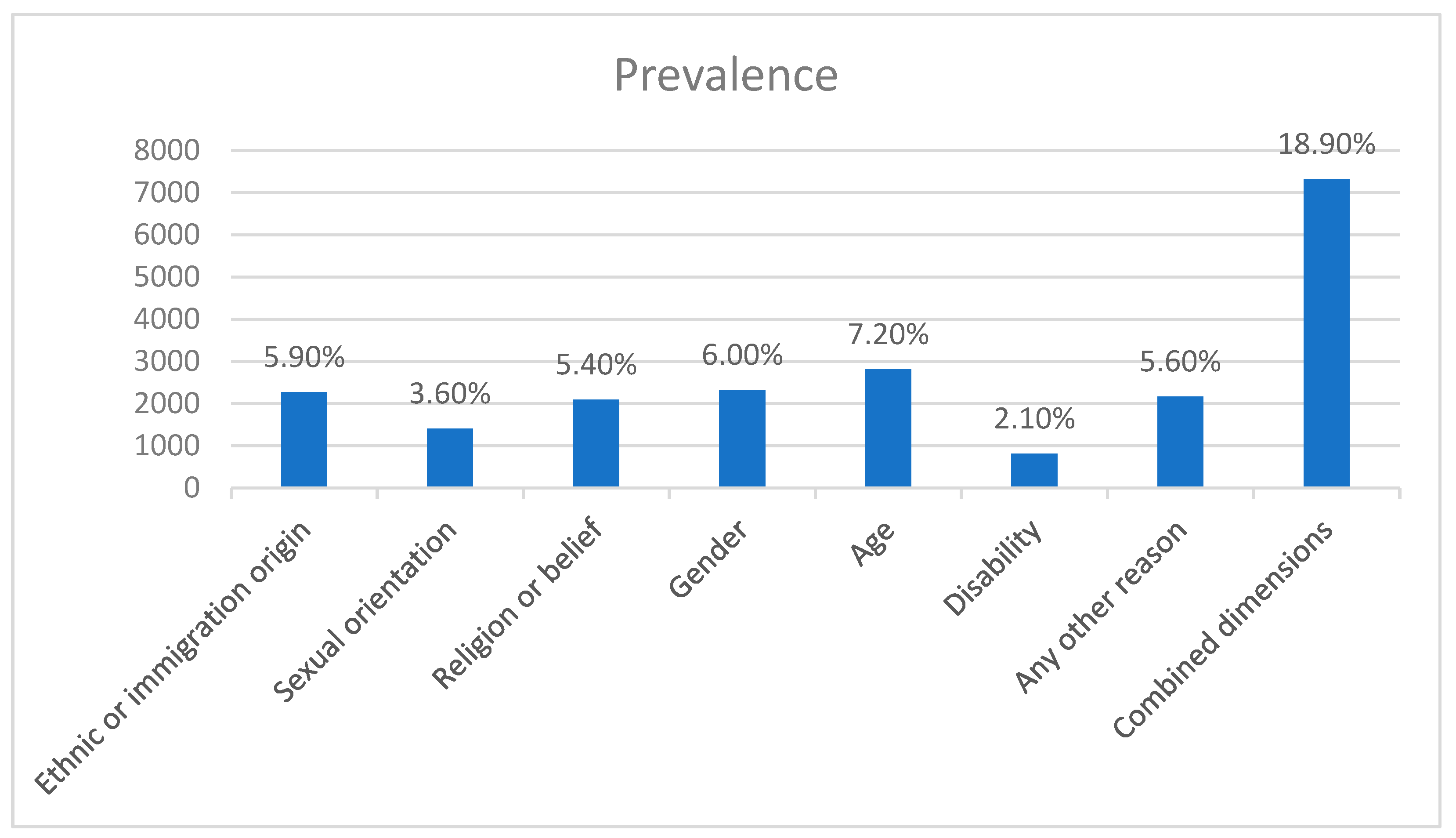
Figure 2.
Prevalence of discrimination and harassment against women in Nigeria.
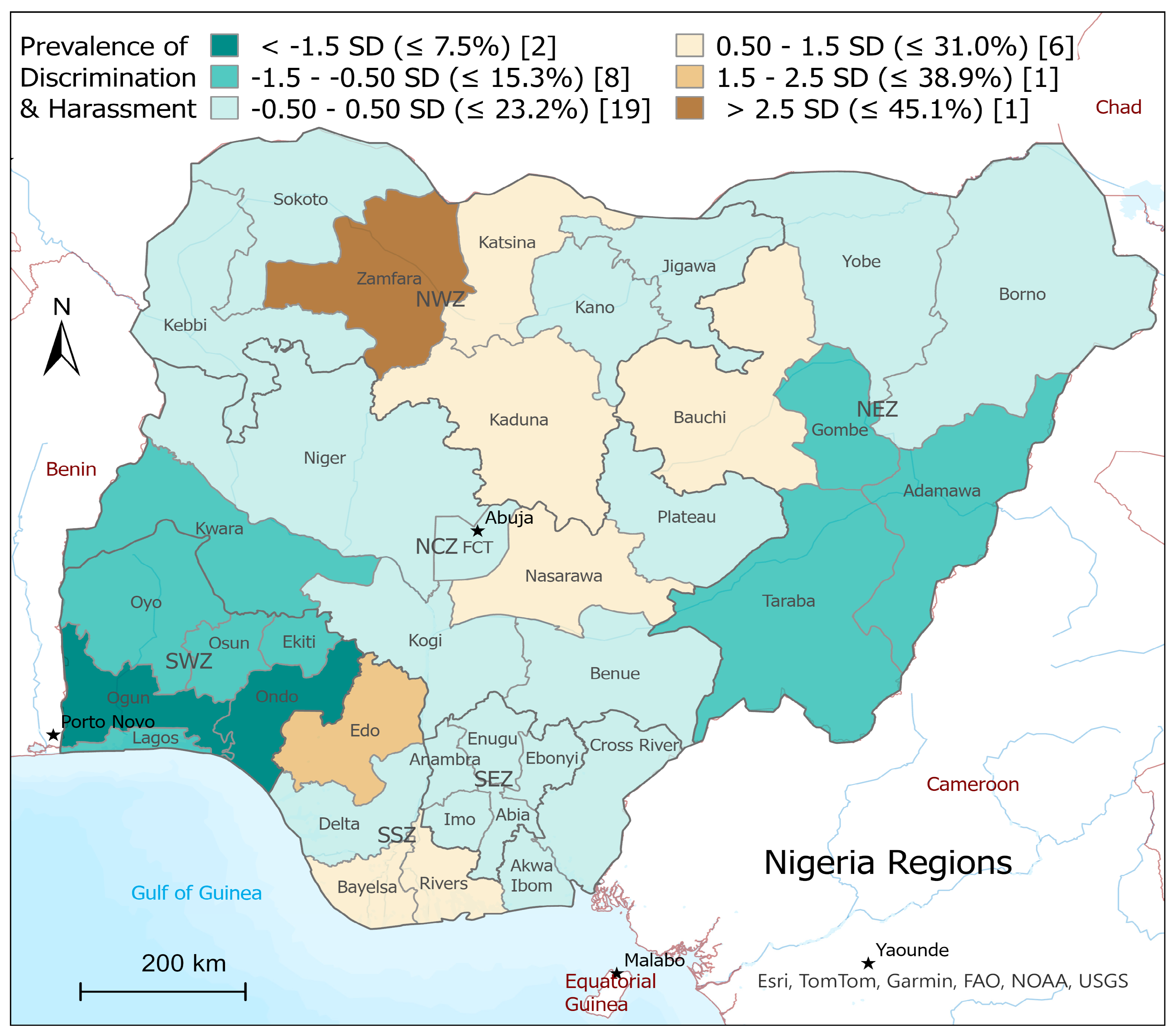
Figure 3.
Regional distribution of odds ratios for discrimination and harassment.
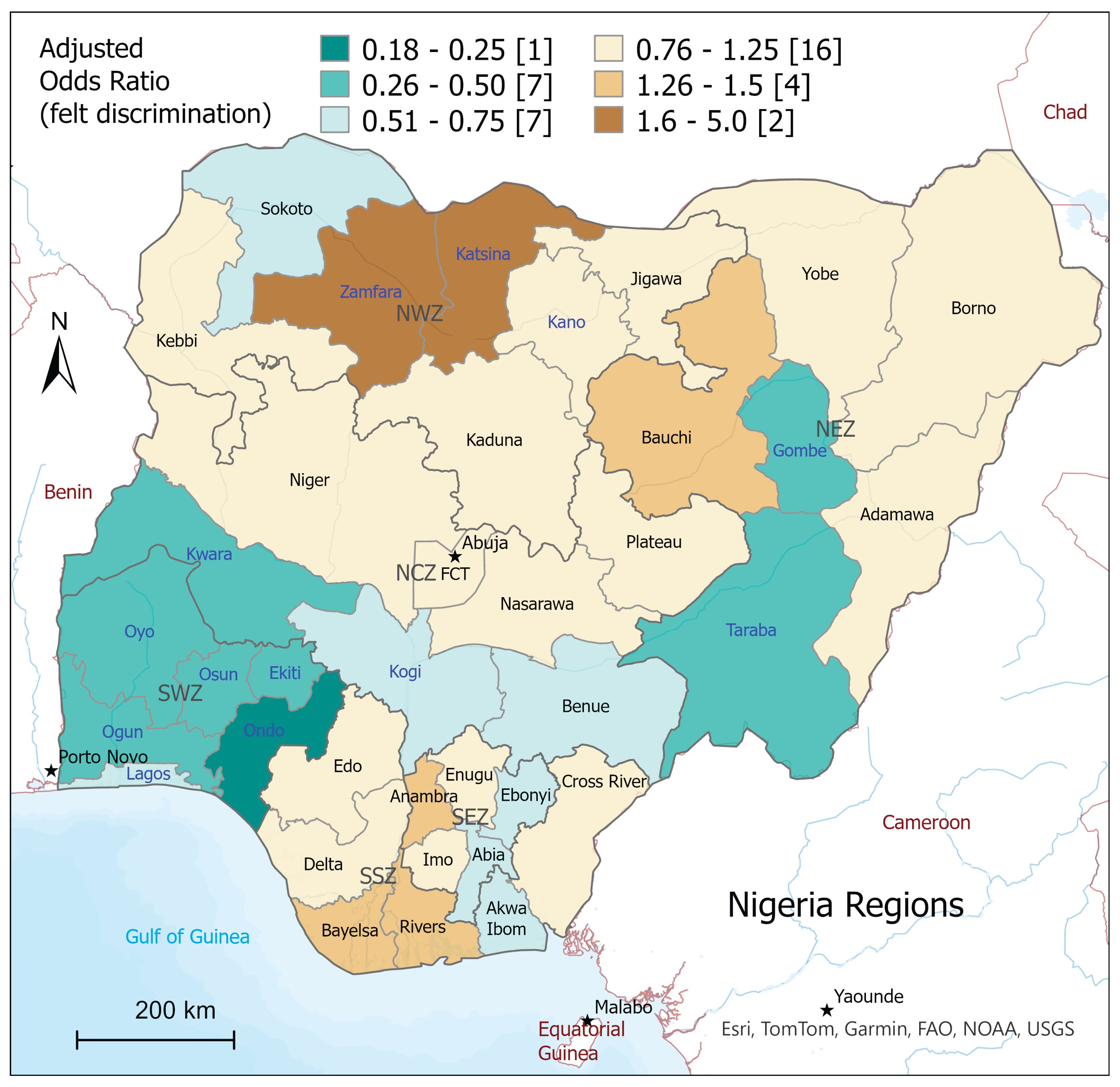

Table 1.
Background characteristics of the respondents in Nigeria, 2021 [ n (%)].
| Variables | Frequency | Percentage |
| Individual-level factors | ||
| Age | ||
| 15-24 | 14821 | 38.2 |
| 25-34 | 11264 | 29.0 |
| 35-49 | 12722 | 32.8 |
| Education | ||
| None | 10303 | 26.6 |
| Primary | 5300 | 13.7 |
| Junior secondary | 3386 | 8.7 |
| Senior secondary | 14164 | 36.5 |
| Higher/tertiary | 5647 | 14.6 |
| Missing/DK | 5 | 0.0 |
| Wealth index | ||
| Poorest | 6870 | 17.7 |
| Second | 7239 | 18.7 |
| Middle | 7562 | 19.5 |
| Fourth | 8308 | 21.4 |
| Richest | 8828 | 22.7 |
| Marital/Union status of woman | ||
| Currently married/in union | 23928 | 61.7 |
| Formerly married/in union | 2068 | 5.3 |
| Never married/in union | 12785 | 32.9 |
| Missing/DK | 24 | 0.1 |
| Ethnicity of household head | ||
| Hausa Igbo |
9891 | 25.5 |
| 6010 | 15.5 | |
| Fulani | 2520 | 6.5 |
| Kanuri | 748 | 1.9 |
| Ijaw | 658 | 1.7 |
| Tiv | 922 | 2.4 |
| Ibibio | 814 | 2.1 |
| Edo | 700 | 1.8 |
| Other | 9808 | 25.3 |
| Feeling safe at home alone after dark | ||
| Very safe | 10772 | 27.8 |
| Safe | 19639 | 50.6 |
| Unsafe | 6138 | 15.8 |
| Very unsafe | 1216 | 3.1 |
| Never alone after dark | 1035 | 2.7 |
| No response | 5 | 0.0 |
| Ever circumcised | ||
| Yes | 5863 | 15.1 |
| No | 15903 | 41.0 |
| DK | 1486 | 3.8 |
| No response | 11 | 0.0 |
| Missing System | 15543 | 40.1 |
| Able to get pregnant | ||
| Yes | 23058 | 59.4 |
| No | 3009 | 7.8 |
| DK | 1350 | 3.5 |
| No response | 148 | 0.4 |
| Missing system | 11241 | 29.0 |
| Estimation of overall happiness | ||
| Very happy | 16451 | 42.4 |
| Somewhat happy | 14215 | 36.6 |
| Neither happy nor unhappy | 5335 | 13.7 |
| Somewhat unhappy | 1913 | 4.9 |
| Very unhappy | 837 | 2.2 |
| No response | 55 | 0.1 |
| Community-level factors | ||
| Area | ||
| Urban | 17805 | 45.9 |
| Rural | 21001 | 54.1 |
| Region | ||
| Abia | 708 | 1.8 |
| Adamawa | 886 | 2.3 |
| Akwa Ibom | 885 | 2.3 |
| Anambra | 1259 | 3.2 |
| Bauchi | 1350 | 3.5 |
| Bayelsa | 462 | 1.2 |
| Benue | 1149 | 3.0 |
| Borno | 1027 | 2.6 |
| Cross River | 827 | 2.1 |
| Delta | 1036 | 2.7 |
| Ebonyi | 684 | 1.8 |
| Edo | 932 | 2.4 |
| Ekiti | 598 | 1.5 |
| Enugu | 944 | 2.4 |
| Gombe | 648 | 1.7 |
| Imo | 934 | 2.4 |
| Jigawa | 1064 | 2.7 |
| Kaduna | 1564 | 4.0 |
| Kano | 2592 | 6.7 |
| Katsina | 1608 | 4.1 |
| Kebbi | 897 | 2.3 |
| Kogi | 841 | 2.2 |
| Kwara | 620 | 1.6 |
| Lagos | 2824 | 7.3 |
| Nasarawa | 546 | 1.4 |
| Niger | 1217 | 3.1 |
| Ogun | 1194 | 3.1 |
| Ondo | 1032 | 2.7 |
| Osun | 828 | 2.1 |
| Oyo | 1428 | 3.7 |
| Plateau | 850 | 2.2 |
| Rivers | 1521 | 3.9 |
| Sokoto | 1094 | 2.8 |
| Taraba | 626 | 1.6 |
| Yobe | 574 | 1.5 |
| Zamfara | 923 | 2.4 |
| FCT | 636 | 1.6 |
Table 2.
Chi-square analysis between the socio-demographic characteristics and the prevalence of women discrimination and harassment [n (%)].
Table 2.
Chi-square analysis between the socio-demographic characteristics and the prevalence of women discrimination and harassment [n (%)].
| Variables | Discrimination and harassment | ||
| Yes [ n (%)] | No [ n (%)] | Χ2 value (p-value) | |
| Individual-level factors | |||
| Age | 39.047 (< 0.001) | ||
| 15-24 | 2970 (20.0%) | 11821 (80.0%) | |
| 25-34 | 2178 (19.4%) | 9063 (80.6%) | |
| 35-49 | 2173 (17.2%) | 10466 (82.8%) | |
| Education | 63.615 (< 0.001) | ||
| None | 2189 (21.3%) | 8106 (78.7%) | |
| Primary | 938 (17.8%) | 4336 (82.2%) | |
| Junior secondary | 613 (18.1%) | 2770 (81.9%) | |
| Senior secondary | 2649 (18.8%) | 11447 (81.2%) | |
| Higher/tertiary | 929 (16.5%) | 4689 (83.5%) | |
| Wealth index | 95.048 (<0.001) | ||
| Poorest | 1347 (19.6%) | 5516 (80.4%) | |
| Second | 1558 (21.5%) | 5676 (78.5%) | |
| Middle | 1491 (19.7%) | 6065 (80.3%) | |
| Fourth | 1541 (18.7) | 6702 (81.3%) | |
| Richest | 1383 (15.8%) | 7391 (84.2%) | |
| Marital/union status of woman | 32.422 (< 0.001) | ||
| Currently married/in union | 4303 (18.0%) | 19537 (82.0%) | |
| Formerly married/in union | 428 (20.9%) | 1621 (79.1%) | |
| Never married/in union | 2588 (20.3%) | 10170 (79.7%) | |
| Ethnicity of household head | 509.697 (< 0.001) | ||
| Hausa | 2158 (21.8%) | 7728 (78.2%) | |
| Igbo | 1177 (20.0%) | 4713 (80.0%) | |
| Yoruba | 667 (9.9%) | 6063 (90.1%) | |
| Kanuri | 139 (18.6%) | 609 (81.4%) | |
| Ijaw | 144 (21.9%) | 514 (78.1%) | |
| Tiv | 174 (18.9%) | 748 (81.1%) | |
| Ibibio | 157 (19.3%) | 657 (80.7%) | |
| Edo | 223 (31.9%) | 477 (68.1%) | |
| Other | 2003 (20.4%) | 7800 (79.6%) | |
| Fulani | 477 (18.9%) | 2042 (81.1%) | |
| Feeling safe at home alone after dark | 956.160 (< 0.001) | ||
| Very safe | 1649 (15.3%) | 9121 | |
| Safe | 3242 (16.6%) | 16267 (83.4%) | |
| Unsafe | 1724 (28.1%) | 4412 (71.9%) | |
| Very unsafe | 523 (43.0%) | 693 (57.0%) | |
| Never alone after dark | 183 (17.7%) | 852 (82.3%) | |
| Ever circumcised | 20.146 (< 0.001) | ||
| Yes | 1019 (17.4%) | 4826 (82.6%) | |
| No | 3183 (20.2%) | 12612 (79.8%) | |
| Able to get pregnant | 9.138 (0.003) | ||
| Yes | 4152 (18.0%) | 18856 (82.0%) | |
| No | 611 (20.3%) | 2397 (79.7%) | |
| Estimation of overall happiness | 545.138 (< 0.001) | ||
| Very happy | 2496 (15.2%) | 13946 (84.8%) | |
| Somewhat happy | 2652 (18.7%) | 11528 (81.3%) | |
| Neither happy nor unhappy | 1318 (25.1%) | 3937 (74.9%) | |
| Somewhat unhappy | 576 (30.1%) | 1336 (69.9%) | |
| Very unhappy | 274 (33.1%) | 553 (66.9%) | |
| Community-level factors | |||
| Area | 120.673 (< 0.001) | ||
| Urban | 2927 (16.5%) | 14761 (83.5%) | |
| Rural | 4394 (20.9%) | 16589 (79.1%) | |
| Region | 1512.709 (< 0.001) | ||
| Abia | 156 (22.0%) | 552 (78.0%) | |
| Adamawa | 123 (13.9%) | 762 (86.1%) | |
| Akwa Ibom | 148 (16.7%) | 737 (83.3%) | |
| Anambra | 248 (21.8%) | 892 (78.2%) | |
| Bauchi | 341 (25.3%) | 1009 (74.7%) | |
| Bayelsa | 133 (28.8%) | 329 (71.2%) | |
| Benue | 182 (15.8%) | 967 (84.2%) | |
| Borno | 208 (20.3%) | 817 (79.7%) | |
| Cross River | 191 (23.1%) | 636 (76.9%) | |
| Delta | 237 (22.9%) | 799 (77.1%) | |
| Ebonyi | 114 (16.7%) | 570 (83.3%) | |
| Edo | 315 (33.8%) | 616 (66.2%) | |
| Ekiti | 55 (9.2%) | 544 (90.8%) | |
| Enugu | 209 (22.1%) | 735 (77.9%) | |
| Gombe | 60 (9.3%) | 588 (90.7%) | |
| Imo | 185 (19.8%) | 748 (80.2%) | |
| Jigawa | 174 (16.4%) | 890 (83.6%) | |
| Kaduna | 404 (25.8%) | 1160 (74.2%) | |
| Kano | 379 (23.6%) | 1229 (76.4%) | |
| Katsina | 188 (21.0%) | 709 (79.0%) | |
| Kebbi | 138 (16.4%) | 701 (83.6%) | |
| Kogi | 74 (11.9%) | 546 (88.1%) | |
| Kwara | 276 (9.8%) | 2548 (90.2%) | |
| Lagos | 146 (26.7%) | 400 (73.3%) | |
| Nasarawa | 268 (22.1%) | 946 (77.9%) | |
| Niger | 83 (7.0%) | 1111 (93.0%) | |
| Ogun | 47 (4.6%) | 980 (95.4%) | |
| Ondo | 67 (8.1%) | 761 (91.9%) | |
| Osun | 143 (10.0%) | 1285 (90.0%) | |
| Oyo | 184 (21.7%) | 665 (78.3%) | |
| Plateau | 417 (27.4%) | 1104 (72.6%) | |
| Rivers | 193 (17.6%) | 901 (82.4%) | |
| Sokoto | 95 (15.2%) | 529 (84.8%) | |
| Taraba | 120 (20.9%) | 453 (79.1%) | |
| Yobe | 416 (45.1%) | 506 (54.9%) | |
| Zamfara | 136 (21.4%) | 500 (78.6%) | |
| FCT | 467 (18.0%) | 2125 (82.0%) | |
Table 3.
Binary logistic regression between socio-demographic characteristics and prevalence of women discrimination and harassment.
Table 3.
Binary logistic regression between socio-demographic characteristics and prevalence of women discrimination and harassment.
| Variables (with reference) | Odd ratio (OR) | 95% C.I. for OR | Sig. | |
| Lower | Upper | |||
| Individual-level factors | ||||
| Age (ref: 35-49 years old) | ||||
| 15-24 | 1.270 | 1.095 | 1.473 | 0.002 |
| 25-34 | 1.331 | 1.180 | 1.502 | <.001 |
| Education (ref: None) | ||||
| Primary | 0.825 | 0.687 | 0.990 | 0.038 |
| Junior secondary | 0.692 | 0.557 | 0.860 | 0.001 |
| Senior secondary | 0.753 | 0.633 | 0.897 | 0.001 |
| Higher/tertiary | 0.686 | 0.560 | 0.842 | <.001 |
| Wealth index (ref: Poorest) | ||||
| Second | 0.961 | 0.804 | 1.149 | 0.665 |
| Middle | 0.941 | 0.782 | 1.132 | 0.521 |
| Fourth | 0.950 | 0.777 | 1.162 | 0.616 |
| Richest | 0.943 | 0.756 | 1.176 | 0.602 |
| Marital/union status of woman (ref: Currently married/in union) | ||||
| Formerly married/in union | 0.998 | 0.828 | 1.203 | 0.985 |
| Never married/in union | 1.367 | 1.196 | 1.562 | <.001 |
| Ethnicity of household head (ref: Fulani) | ||||
| Hausa | 1.251 | 0.972 | 1.610 | 0.082 |
| Igbo | 1.390 | 0.976 | 1.981 | 0.068 |
| Yoruba | 1.477 | 1.035 | 2.109 | 0.032 |
| Kanuri | 0.523 | 0.331 | 0.826 | 0.005 |
| Ijaw | 0.982 | 0.620 | 1.555 | 0.937 |
| Tiv | 1.611 | 0.959 | 2.707 | 0.072 |
| Ibibio | 1.229 | 0.779 | 1.938 | 0.375 |
| Edo | 2.336 | 1.501 | 3.637 | <.001 |
| Other ethnicity | 1.335 | 1.006 | 1.772 | 0.045 |
| Feeling safe at home alone after dark (ref: Very safe) | ||||
| Safe | 0.959 | 0.856 | 1.074 | 0.467 |
| Unsafe | 1.739 | 1.496 | 2.021 | <.001 |
| Very unsafe | 2.120 | 1.554 | 2.891 | <.001 |
| Never alone after dark | 0.988 | 0.698 | 1.399 | 0.946 |
| Ever circumcised (ref: Yes) | ||||
| No | 0.949 | 0.843 | 1.068 | 0.385 |
| Able to get pregnant (ref: Yes) | ||||
| No | 1.202 | 1.040 | 1.388 | 0.013 |
| Estimation of overall happiness (ref: Very happy) | ||||
| Somewhat happy | 1.422 | 1.277 | 1.583 | <.001 |
| Neither happy nor unhappy | 1.799 | 1.561 | 2.074 | <.001 |
| Somewhat unhappy | 1.847 | 1.513 | 2.256 | <.001 |
| Very unhappy | 3.101 | 2.393 | 4.018 | <.001 |
| Community-level factors | ||||
| Area (ref: Urban) | ||||
| Rural | 1.140 | 1.006 | 1.292 | 0.040 |
| Region (ref: Kano) | ||||
| Abia | 0.745 | 0.481 | 1.154 | 0.188 |
| Adamawa | 0.843 | 0.551 | 1.289 | 0.431 |
| Akwa Ibom | 0.742 | 0.476 | 1.158 | 0.188 |
| Anambra | 1.400 | 0.927 | 2.115 | 0.109 |
| Bauchi | 1.350 | 0.976 | 1.868 | 0.070 |
| Bayelsa | 1.466 | 0.910 | 2.362 | 0.116 |
| Benue | 0.648 | 0.404 | 1.040 | 0.072 |
| Borno | 1.005 | 0.688 | 1.468 | 0.979 |
| Cross River | 0.916 | 0.626 | 1.339 | 0.649 |
| Delta | 1.193 | 0.845 | 1.684 | 0.316 |
| Ebonyi | 0.668 | 0.427 | 1.046 | 0.078 |
| Edo | 1.185 | 0.786 | 1.788 | 0.417 |
| Ekiti | 0.362 | 0.215 | 0.609 | <.001 |
| Enugu | 0.863 | 0.577 | 1.291 | 0.472 |
| FCT | 0.864 | 0.558 | 1.338 | 0.513 |
| Gombe | 0.450 | 0.263 | 0.770 | 0.004 |
| Imo | 0.943 | 0.621 | 1.430 | 0.781 |
| Jigawa | 0.791 | 0.430 | 1.455 | 0.451 |
| Kaduna | 0.977 | 0.720 | 1.324 | 0.880 |
| Katsina | 1.518 | 1.071 | 2.151 | 0.019 |
| Kebbi | 1.128 | 0.696 | 1.826 | 0.625 |
| Kogi | 0.507 | 0.290 | 0.886 | 0.017 |
| Kwara | 0.450 | 0.279 | 0.726 | 0.001 |
| Lagos | 0.505 | 0.349 | 0.730 | <.001 |
| Nasarawa | 0.851 | 0.558 | 1.300 | 0.456 |
| Niger | 1.080 | 0.746 | 1.563 | 0.684 |
| Ogun | 0.300 | 0.189 | 0.476 | <.001 |
| Ondo | 0.176 | 0.104 | 0.298 | <.001 |
| Osun | 0.335 | 0.213 | 0.528 | <.001 |
| Oyo | 0.492 | 0.321 | 0.753 | 0.001 |
| Plateau | 1.123 | 0.690 | 1.830 | 0.641 |
| Rivers | 1.318 | 0.947 | 1.833 | 0.102 |
| Sokoto | 0.628 | 0.344 | 1.144 | 0.129 |
| Taraba | 0.418 | 0.230 | 0.758 | 0.004 |
| Yobe | 0.994 | 0.599 | 1.647 | 0.980 |
| Zamfara | 5.045 | 3.072 | 8.288 | <.001 |
Disclaimer/Publisher’s Note: The statements, opinions and data contained in all publications are solely those of the individual author(s) and contributor(s) and not of MDPI and/or the editor(s). MDPI and/or the editor(s) disclaim responsibility for any injury to people or property resulting from any ideas, methods, instructions or products referred to in the content. |
© 2025 by the authors. Licensee MDPI, Basel, Switzerland. This article is an open access article distributed under the terms and conditions of the Creative Commons Attribution (CC BY) license (https://creativecommons.org/licenses/by/4.0/).
Copyright: This open access article is published under a Creative Commons CC BY 4.0 license, which permit the free download, distribution, and reuse, provided that the author and preprint are cited in any reuse.


