

Submitted:
14 October 2023
Posted:
17 October 2023
You are already at the latest version
Abstract
Women's attitudes towards domestic violence play an important role in shaping the social acceptance of domestic violence, acting as both a known predictor of victimization and an indicator of disclosure and help-seeking behavior. Therefore, the study objectives were 1) to conduct a nationwide analysis to explore the factors associated with the acceptance of domestic violence among Iraqi women according to the social-ecological framework, and 2) to identify the most vulnerable women according to the spatial distribution of Iraqi governorates. This cross-sectional study was conducted using secondary data analysis from the 2018 Iraq Multiple Indicator Cluster Survey (MICS 6), which included 19,443 married Iraqi women. Logistic regression was employed to examine the factors associated with acceptance of domestic violence. In this study, the analyses were performed according to the Social Ecological Model (SEM). This study revealed that 48.4% of married Iraqi women accepted domestic violence. Yet, women living in South/Central regions of Iraq showed a higher prevalence of domestic violence acceptance namely Anbar, Salahaddin Thiqar, and Misan where the prevalence was (62%-73%). Several factors across the social-ecological model were associated with a higher likelihood of women accepting such behavior, including experiencing functional difficulty, having lower educational attainment, being married to a blood-related husband, and being married to a husband who has multiple wives/partners, living in poverty, residing in rural areas, living in the south and central regions of Iraq, and feeling unsafe in the neighborhood. Conversely, factors that were associated with a lower likelihood of women accepting such behavior were owning a mobile phone and using a computer or tablet. This study provides policymakers with valuable insights to comprehensively assess indicators of attitudes toward domestic violence against women. It also addresses the scarcity of information on the acceptance of domestic violence in Iraq on national and governorate levels, emphasizing the need for urgent national-level policy discussions to achieve key Sustainable Development Goals related to gender equity and good health and well-being.
Keywords:
Gender-Based Violence
; Iraq
; Married women
; Safety
; Women Empowerment
; Social Factors
1. Introduction
1.1. Background
For many decades, Iraq has suffered from social, economic, and political instability [1,2,3,4,5]. The recent war against the Islamic State of Iraq and Syria (ISIS) resulted in wide destruction of the infrastructure and displacement of many families that further weakened the social fabric of this country. This has intensified the existing socioeconomic challenges, including high poverty rates, unemployment, and limited access to essential healthcare services, leading to neglect and abuse of human rights [6,7].
One of the major examples of human rights abuse in Iraq is domestic violence against women [8]. There are more than one million Iraqi women who are at risk of being exposed to domestic violence [8]. Iraq agreed to the United Nations (UN) Sustainable Development Goals (SDGs), including Target 5.2: Eliminate all forms of violence against all women and girls in public and private spheres. Also, Iraq agreed to measure SDG indicators, such as 5.2.1: The proportion of ever-partnered women and girls aged 15 years and older subjected to physical, sexual, or psychological violence by a current or former intimate partner [9]. Yet, the country is plagued with domestic violence and the data about domestic violence from Iraq is limited [10].
The absence of national statistics on domestic violence against women in Iraq is highlighted on the United Nations Women website [11]. However, data from the United Nations Population Fund (UNFPA) reveals that approximately half of Iraqi women have experienced domestic violence and 80% of Iraqi women face some form of sexual harassment [12]. A study conducted by the Iraqi Ministry of Planning in 2021 showed that 29% of Iraqi women experienced domestic violence [13]. Yet, the sporadic studies that explored the prevalence of domestic violence in Iraq reported a wide range between 32%-59% of Iraqi women being exposed to domestic violence. But these studies were mainly in Kurdistan [14,15,16] or Iraqi refugees in Syria [17]. This considerable variation in the prevalence of domestic violence reflects the lack of a reliable national database capable of effectively capturing and monitoring domestic violence incidents.
Many Iraqi women might justify, accept, and be reluctant to report domestic violence incidents to Iraqi authorities or discuss this issue openly for various reasons, including social stigma, fear of family and tribe retaliation, limited education and employment opportunities, inadequate legal protection for abused women’s rights, feelings of hopelessness and fear arising from political, social and economic instability, and the submissive and accepting behavior of the women themselves [15,18,19]. Moreover, many Iraqi women might justify and accept domestic abuse due to their economic dependence on their partners, lack of education, limited exposure to empowerment opportunities, and lack of support from society and the legal system. Consequently, these circumstances lead to violations of human rights in the form of domestic violence, which may tragically culminate in so-called “honor crimes”.
It is important to highlight that Iraq lacks legal protections for survivors of domestic violence. For instance, “Article 41 of the Penal Code (No.111 of 1969) gives a husband a legal right to punish his wife within certain limits prescribed by law or custom” [20,21]. Efforts by Iraqi legislators to pass a draft law against domestic violence were suspended by Iraqi parliament members themselves throughout 2019 and 2020 [21]. The absence of a law that protects the rights of abused women means that domestic violence victims cannot report these incidents and expose the perpetrators. Furthermore, Iraq lacks proper shelters that can provide protection for domestic violence victims, often resulting in their temporary housing in female prisons [22].
However, the prevalence and determinants of domestic violence acceptance among women varies across and within different countries. For example, a global study showed that the prevalence of women acceptance to domestic violence varied from 2% in Argentina to 90% in Afghanistan [23]. Also, a study in Bangladesh revealed that one quarter of Bengali women accepted domestic violence and the prevalence varied geographically from 2% to 57% in Pirojpur vs Kurigram districts, respectively [24].
Women attitudes towards domestic violence play a pivotal role in shaping the social acceptance of domestic violence, acting as both a known predictor of victimization and an indicator of disclosure and help-seeking behavior [25,26].Studies showed that victims of domestic violence suffer from a plethora of negative health outcomes including mental problems like anxiety, depression, and post-traumatic stress disorder (PTSD) [27,28].
Many factors have been investigated in predicting domestic violence acceptance among women, including sociodemographic factors. Also, studies showed that women empowerment initiatives, such as improved access to education, mass media, and employment opportunities have promising outcomes [29,30,31]. Yet, there is lack of studies exploring the role of society crime and violence in predicting women acceptance to domestic violence. Iraqi society might contribute to women’s exposure to violence and harassment both in public spaces and within their own homes [32,33]. This adds another layer of insecurity where women might justify domestic violence as means of survival and coping with challenging circumstances.
Therefore, it is crucial to understand the factors associated with domestic violence acceptance, using a social ecological perspective, within the Iraqi society. Therefore, the objectives of this study were to 1) conduct a nationwide analysis to explore the factors associated with acceptance of domestic violence among Iraqi women according to social ecological framework, 2) to identify the most vulnerable women according to the spatial distribution of Iraqi governorates. This study will provide valuable insights for advocates and policymakers, enabling them to develop targeted interventions that address the factors associated with this crucial problem.
1.2. Theoretical framework
The study used the social ecological model (SEM) as the basis for data analysis. SEM provides a theory-based framework that aids in the understanding of how individual and environmental factors interact to shape attitudes and behaviors. This model considers factor interplay across four levels. It investigates the complex interplay among these four levels: the individual, interpersonal, community, and society [34]. Previous studies utilized this framework to understand the risk factors and protective factors of domestic violence [35,36,37].
The model views violence against women as an outcome that arises from the interplay of factors at each level within the social environment. According to SEM, there is no single factor that leads to domestic violence. It views domestic violence as the result of factors that interact across the four levels mentioned above [35]. Building upon prior research, this study employs the SEM to explore the risk and protective factors associated with women's acceptance of domestic violence. Figure 1 shows the proposed study variables predicting women’s acceptance of domestic violence aligned with the SEM's four levels.
2. Materials and Methods
The objectives of this study were 1) to conduct a nationwide analysis to explore the factors associated with acceptance of domestic violence among Iraqi women according to social ecological framework, 2) to identify the most vulnerable women according to the spatial distribution of Iraqi governorates.
2.1. The Survey
This study used the Iraq Multiple Indicator Cluster Survey (MICS). Developed in the 1990s, MICS is an international multipurpose household survey that aims to support countries in collecting internationally comparable data on a wide range of indicators regarding the situation of children and women. MICS measures key indicators that allow countries to generate data for use in policies, programs, and national development plans. More recently, the MICS has been used to monitor progress toward Sustainable Development Goals (SDGs) and other internationally agreed upon commitments.
By the end of 2018, with assistance from United Nations Children's Fund (UNICEF), the Iraqi Government introduced the result of a Multiple Indicator Cluster Survey (MICS 6) [38].. These survey metrics are crucial for motoring the country’s progress toward the SDG targets. Iraq MICS 2018 sampling strategy was developed to generate estimates for a broad spectrum of indicators covering the well-being of children and women at various levels: national, regional, and governorate-specific, encompassing urban and rural sectors. The survey included a total of 1710 sampled Enumeration Areas (EAs), with 12 households randomly selected within each EA, accumulating to a total of 20,520 sampled households. Estimates are produced for two regions – Kurdistan and South/Central Iraq, and across the 18 governorates – namely, Dohuk, Nainawa, Sulaimaniya, Kirkuk, Erbil, Diala, Anbar, Baghdad, Bab il, Karbalah, Wasit, Salahaddin, Najaf, Qadisyah, Muthana, Thiqar, Musan, and Basrah [38].
The categorization of urban and rural sectors within each governorate served as the primary sampling strata, and the household sample was selected through a two-stage process. Within each stratum, a predetermined number of census enumeration areas were systematically selected with probabilities proportional to their sizes. Subsequent to listing households in the chosen enumeration areas, a systematic sample of 12 households was drawn within each sampled enumeration area.
Our study focuses on 19,443 married women. Both the household data file and the women’s data file were merged using the unique identifiers HH1(cluster number) and HH2 (household number) and LN (women’s line number). Complete details of the sample and sampling strategy can be found in the UNICEF (2019) Iraq Multiple Cluster Survey 2018: Survey Findings Report.
2.2. Study Variables
In this study, the outcome variable was domestic violence acceptance among women, which was a binary variable with two responses (yes) indicating acceptance and (no) indicating opposition. Domestic violence acceptance among women was assessed using a set of fixed response yes/no questions related to different circumstances in which a husband might be perceived justified in hitting or beating his wife. These circumstances included (1) the wife going out without informing the husband, (2) neglecting the children, (3) engaging in arguments with the husband, (4) refusing to have sex with the husband, (5) burning the food, (6) the husband feeling that she is wasteful, and (7) exposing household secrets. These survey questions were included in MICS 2018 questionnaire under the section ‘Attitude Toward Domestic Violence’, and women provided their opinions during the data collection phase. Domestic violence acceptance among women was categorized as (yes) if at least one of the seven situations was endorsed with an affirmative answer and as (no) if none of the situations were endorsed. This categorization was introduced by other researchers [39,40].Direct exposure to domestic questions is not included in MICS. However, evidence indicates that cultural attitudes toward domestic violence have a significant impact on violence levels and women who accept domestic violence are at higher risk of being victims of domestic violence [41,42].
The variables were selected to align with the four levels of the SEM. Individual level factors were age (15–19, 20–24, 25–29, 30–34, 35–39, 40–44, 45–49), education (preprimary or none, primary, lower secondary, upper secondary and higher), ownership of a phone (yes vs no), ownership of computer /tablet (yes vs no), and functional difficulty. This was determined using a set of questions focused on six domains: seeing, hearing, walking, self-care, communication, and remembering. If a woman experienced any of these difficulties, it was classified as (yes) for functional difficulties; Otherwise, it was classified as (no) [43]. Additionally, Exposure to mass media had been created based on reading a newspaper, listening to the radio, or watching television. If any of these media avenues was used at least once a week by a woman, mass media was (yes). Otherwise, it was (no) [24]. Interpersonal level factors were, whether the first husband is blood related to the woman (yes vs no), and whether the husband has multiple wives/partners (yes vs no). Community level factors were. Area (urban, rural), region (Kurdistan, South/Central Iraq), wealth index (poorest, poorest, middle, richer, richest), and perceived home safety, especially the feeling of safety at home after dark. Society level variable was perceived safety in the neighborhood, specifically the feeling of safety while walking alone in the neighborhood after dark. The response options included (1) very safe, (2) safe, (3) unsafe, (4) very unsafe, and (7) never do this. In alignment with previous research, both safety variables responses were recoded into a binary variable [41]. Very safe and safe were coded as “safe” and unsafe, very unsafe, and never do this were coded as “unsafe”.
2.3. Statistical Analysis
This study utilized a complex survey design, and therefore, sample weight and cluster adjustments were considered in the analysis. The first step of the analysis was done by conducting a descriptive analysis to estimate the prevalence of domestic violence acceptance. Initially, a bivariate analysis was conducted to examine the association between domestic violence acceptance among married women and various study variables mentioned above. Weighted associations were tested using the Chi-square test.
Subsequently, multivariate logistic regression was built adjusting for the study variables according to the four levels of SEM. The model was built including only the variables that showed significant association with the outcome in the descriptive analysis. (See Table 1 and Table 2). Survey clusters, strata, and weights were accounted for. The data compilations and analyses were conducted using IBM® SPSS® Statistics version 27. The significance level was set at (P<0.05). The adjusted odds ratios (aOR) and the 95% confidence intervals (95% CI) were reported for each independent variable. (See Table 2)
To investigate the spatial distribution of the important study variables R software was used to create maps showing the 18 Iraqi governorates. The mapped variables including domestic violence acceptance, neighborhood safety, ownership of a phone, ownership of a computer /tablet, functional difficulty, home safety, whether the first husband is blood related to the woman, and whether the husband has multiple wives or partners. (See Figure 2)
3. Results
3.1. Descriptive Analysis
Table 1 presents the weighted descriptive characteristics of the study sample, stratified by domestic violence acceptance. The percentage of women accepting domestic violence was 48.4%. Regarding functional difficulty, 5% of women experienced functional difficulty. Approximately, two-thirds of the women were younger than 34 years old. In terms of education, 70% of the women had either no education/pre-primary education or primary education. More than half of the women (56.3%) were married to a blood related first husband. Urban areas were the residence for the majority of the women (65.5%). Regarding mass media exposure 91.3% of the women were exposed to mass media on a weekly basis. Furthermore, 10% used a computer or tablet, and 72% owned a mobile phone. Around half of the women reported feeling unsafe walking in their neighborhood after dark. For the detailed breakdown of sociodemographic characteristics stratified by domestic violence acceptance, please refer to Table 1.
Figure 2 shows the spatial distribution of some study variables according to 18 Iraqi governorates. The prevalence of domestic violence acceptance was higher in the South/Central region of the country, especially in Anbar, Salahaddin Thiqar, and Misan governorates, and overall lower in Kurdistan region namely Dohuk, Sulaimaniya, and Erbil governorates. The same pattern was observed for the distribution of unsafe neighborhoods, a blood related first partner, and a husband having multiple wives/partners. On the other hand, ownership of mobile and usage of computer/tablet were higher in Kurdistan vs South/Central Iraq. (See Figure 2).
3.2. Logistic Regression Analyses
Table 2 presents the findings of the logistic regression analysis, examining the association between the study variables, according to SEM, and acceptance of domestic violence. Several individual level factors including education, functional difficulty, ownership of mobile, and usage of computer/tablet were significantly associated with acceptance of domestic violence. Both interpersonal level factors marriage to a blood related husband (AOR = 1.45, 95% CI: 1.36, 1.54), and marriage to a husband having multiple wives/partners (AOR = 1.51, 95% CI: 1.33, 1.72), were significantly associated with domestic violence acceptance. Some community level factors were also associated with domestic violence acceptance including wealth index, region (AOR = 2.00, 95% CI: 1.77, 2.27), and area (AOR = 1.20, 95% CI: 1.15, 1.33). Finally, the societal level indicator “neighborhood safety” was significantly associated with domestic violence acceptance (AOR = 1.22, 95% CI: 1.13, 1.31). For more detailed information, please refer to Table 2.
4. Discussion
The objectives of this study were 1) to conduct a nationwide analysis to explore the factors associated with acceptance of domestic violence among Iraqi women according to social ecological framework, 2) to identify the most vulnerable women according to the spatial distribution of Iraqi governorates. The study revealed that nationwide 48.4% of married Iraqi women accepted domestic violence. Yet, women living in South/Central regions of Iraq showed higher prevalence of domestic violence acceptance namely Anbar, Salahaddin Thiqar, and Misan where the prevalence was (62%-73%). Similar patterns were observed for some study factors like neighborhood safety, being married with blood related husband, and being married to a husband who has multiple wives/partners.
Several factors aligned with SEM were associated with higher likelihood of women accepting such behavior, including individual level factors like experiencing functional difficulty, having lower educational attainment. Some other individual level factors were associated with lower likelihood of accepting domestic violence including the ownership of a mobile or the usage of computer/tablet. For the interpersonal level factors being with a husband who has multiple wives/partners and being married to blood related husband were associated with higher likelihood of accepting domestic violence. Community level factors like living in South/Central Iraq, living in rural areas, and living in poor household were associated with higher likelihood of accepting domestic violence. Society level factor “living in unsafe neighborhoods” was associated with higher likelihood of domestic violence acceptance as compared to living in safe neighborhoods.
For the individual level factors, married women with functional difficulty were found to have a higher likelihood of accepting domestic violence. This finding aligns with previous literature [44,45,46] emphasizing the double vulnerability of women with functional difficulty and their acceptance to domestic violence. It is important to note that approximately 10% of the Iraqi population live with one or more disabilities, with nearly two million of them being women of reproductive age [47]. Consequently, there is an urgent need to provide better opportunities and improve access to integrated gender-based violence and reproductive health services for Iraqi women with functional difficulties. The study also revealed that women with lower status, characterized by limited education, had a higher likelihood of domestic violence acceptance. This finding is consistent with previous literature underscoring the association between women’s empowerment and acceptance of domestic violence [24,48,49].
On the other hand, women who own a mobile phone or use a computer/tablet were found to have a lower likelihood of domestic violence acceptance. This association can be explained by the fact that married women who possess these devices may have better access to online information, support networks, resources, and job opportunities, enabling them to achieve better financial independence and therefore have less tolerance and acceptance of domestic violence [18,19]. Although three-quarters of the married women in the study owned a mobile phone, only 10% reported using a computer or tablet. This highlights the need to improve technology access for women as means of empowering them against accepting domestic violence. It is worth noting that exposure to mass media was not found to be associated with the likelihood of domestic violence acceptance among women in the study.
For interpersonal level factors, this study revealed that both women married to blood related relative, and women married to a husband having multiple wives were associated with higher likelihood of women accepting domestic violence. Previous literature has consistently identified those two factors as key determinants of domestic violence [50,51,52,53,54].Women who are married to blood related relatives may face a greater likelihood of exposure to and acceptance of domestic violence, as they may be expected to be submissive to men in order to uphold family honor. Similarly, women married to husband who has multiple wives places women in subordinate role where men have greater power over their lives. These practices are linked to traditional patriarchal values that perpetuate gender inequality and normalize violence against women [50,54]. Therefore, addressing domestic violence in Iraq should include efforts focused on challenging socio-cultural norms and tribal traditions surrounding marriage and family structures.
For community level factors, the study confirmed the expectation that domestic violence acceptance would be higher in rural areas compared to urban areas, reflecting the influence of patriarchal norms and limited women empowerment in rural areas [24,55,56]. While some studies have shown contrary findings, this highlights the importance of further investigating the dynamics of rural societies and attitudes toward accepting domestic violence [57]. Furthermore, women living in South/Central regions of Iraq demonstrated a higher likelihood of domestic violence acceptance as compared to those in the Kurdistan region. This discrepancy can be attributed to the more conservative tribal culture prevalent in the South/Central regions, where more women have limited access to financial and employment opportunities in comparison to Kurdistan region [58]. Moreover, Kurdistan enjoys greater stability, leading to safer neighborhoods and greater economic development, which may have contributed to higher levels of womens’ empowerment compared to other regions of Iraq [58].
For the society level factor “unsafe neighborhood”, there is limited research on the association between domestic violence acceptance and neighborhood safety [59]. While one study did not find significant association between unsafe societies and domestic violence [60], in general, there is a positive association between perceptions of safety and domestic violence [61,62]. This finding is particularly important given the widespread conflict and political instability that Iraq has experienced for the past several years. It highlights how the external social and ecological conditions of communities can shape peoples’ perceptions regarding domestic violence acceptance.
Although this paper adds significant scientific knowledge to understanding socio-ecological factors associated with domestic violence acceptance from diverse and not previously studied contexts, it has several limitations. Firstly, as a cross sectional study, it is unable to establish causal relationships between the dependent and independent variables [63]. The nature of the data collected also relies on self-reports, which may introduce biases, particularly when sensitive topics like domestic violence are involved. Further research should focus on exploring the influence of culture and patriarchy in committing domestic violence in Iraq, expanding the data collection efforts in this area. The study’s population only included married Iraqi women aged 15 and 49 years, which limits the generalizability of the study to the broader population of women. Additionally, the MICS 2018 survey solely assessed attitudes toward physical abuse, omitting other forms of violence such as emotional and psychological abuse, thereby limiting the scope of the study to physical domestic violence [24]. Future studies should use socio-ecological models that can incorporate alternative data, such as women’s employment, social support, personal financial status, and participation in family budget spending. Finally, Binary coding for domestic violence acceptance results in a distinction of domestic violence acceptance that does not account for frequency. We are therefore unable to explore whether, for example, women justify domestic violence when she refuses to have sex with her husband vs when she goes out without telling the husband. However, binary outcomes are particularly useful in establishing whether women are at an increased likelihood of accepting domestic violence. Future studies might conceptualize measures based on continuums and count measures, in addition to binary measures.
5. Conclusions
In conclusion, this study highlights significant associations of various social ecological factors with domestic violence acceptance among married Iraqi women. Recognizing domestic violence acceptance as a crucial risk factor is essential for preventing physical violence against Iraqi women. The findings of this study provide policymakers with valuable insights to comprehensively assess indicators of domestic violence against women. Moreover, this study contributes to addressing the scarcity of information on the acceptance of domestic violence in Iraq, emphasizing the need for urgent national-level policy discussions to achieve key Sustainable Development Goals related to gender equity and good health and well-being.
Supplementary Materials
N/A
Author Contributions
Conceptualization, R.AJ.; Methodology, R.AJ.; Software, R.AJ.; Validation, R.AJ.; Formal Analysis, R.AJ.; Writing—Original Draft Preparation, R.AJ.; Writing—Review and Editing, R.AJ.; Visualization, R.AJ. The author has read and agreed to the published version of the manuscript.
Funding
This research received no external funding.
Institutional Review Board Statement
Not applicable
Acknowledgments
I thank the United Nations Children's Fund (UNICEF) for providing the access to Iraq Multiple Indicator Cluster Survey (MICS) data. Also, I thank Dr. Neva Agarwala for her guidance throughout the writing process.
Conflicts of Interest
The author declares no conflict of interest.
References
- Emberti Gialloreti, L.; et al. Supporting Iraqi Kurdistan Health Authorities in Post-conflict Recovery: The Development of a Health Monitoring System. Front Public Health 2020, 8, 7. [Google Scholar] [CrossRef]
- World Health Organization, W. Social Determinants of Health in Countries in Conflict: A Perspective From the Eastern Mediterranean. 2008; Available from: https://applications.emro.who.int/dsaf/dsa955.pdf.
- Murthy, R.S.; Lakshminarayana, R. Mental health consequences of war: a brief review of research findings. World Psychiatry 2006, 5, 25–30. [Google Scholar]
- Green, P.; Ward, T. The Transformation of Violence in Iraq. British journal of criminology 2009, 49, 609–627. [Google Scholar] [CrossRef]
- Kaiser, J.; Hagan, J. , Crimes of Terror, Counterterrorism, and the Unanticipated Consequences of a Militarized Incapacitation Strategy in Iraq. Social Forces 2018, 97, 309–346. [Google Scholar] [CrossRef]
- Congressional Research Service, C. Iraq: Politics, Governance, and Human Rights. 2012; Available from: https://apps.dtic.mil/sti/pdfs/ADA584675.pdf.
- Cordesman, A.H.; et al. , Iraq in crisis. 2014, Center for Strategic and International Studies ; Rowman & Littlefield: Washington, DC, Lanham, MD.
- World Health Organization, W. First gender-based violence strategic plan launched in Iraq. 2022; Available from: https://www.emro.who.int/fr/iraq/news/first-gender-based-violence-strategic-plan-launched-in-iraq.html.
- United Nations, U. Transforming our world: the 2030 agenda for sustainable development. Resolution adopted by the United Nations general assembly on . 2015; Available from: https://sdgs.un.org/2030agenda. 25 September.
- United Nations, U. Transforming our world: the 2030 Agenda for Sustainable Development.. 2015; Available from: https://sdgs.un.org/2030agenda.
- United Nations, U. Iraq: Prevalence Data on Different Forms of Violence against Women:. 2023.
- United Nations Population Fund, U. , IRAQ Scorecard on Gender-based violence. n.d.
- Iraq Ministry of Planning, I. Planning publishes new statistics and percentages for (11) files related to women and the family in Iraq. 2021; Available from: https://www.ina.iq/144902--11-.html.
- Al-Tawil, N.G. , Association of violence against women with religion and culture in Erbil Iraq: a cross-sectional study. BMC Public Health 2012, 12, 800. [Google Scholar] [CrossRef]
- Al-Atrushi, H.H.; et al. , Intimate partner violence against women in the Erbil city of the Kurdistan region, Iraq. BMC Womens Health 2013, 13, 37. [Google Scholar] [CrossRef] [PubMed]
- Elghossain, T.; et al. Prevalence of intimate partner violence against women in the Arab world: a systematic review. BMC Int Health Hum Rights 2019, 19, 29. [Google Scholar] [CrossRef] [PubMed]
- Tappis, H.; et al. Domestic violence among Iraqi refugees in Syria. Health Care Women Int 2012, 33, 285–97. [Google Scholar] [CrossRef] [PubMed]
- Kaur, R.; Garg, S. Addressing domestic violence against women: an unfinished agenda. Indian J Community Med, 2008, 33, 73–6. [Google Scholar] [CrossRef] [PubMed]
- Rakovec-Felser, Z. Domestic Violence and Abuse in Intimate Relationship from Public Health Perspective. Health Psychol Res 2014, 2, 1821. [Google Scholar] [CrossRef] [PubMed]
- International Labour Organization, I. Database of national labour, social security and related human rights legislation: raq (232) > Criminal and penal law (5). 2012; Available from: https://www.ilo.org/dyn/natlex/natlex4.detail?p_lang=en&p_isn=57206&p_country=IRQ&p_count=232&p_classification=01.04&p_classcount=5.
- Equity Now, E. Discriminatory Laws: Iraq – Penal Code No. 111 Of 1969. 2021; Available from: https://www.equalitynow.org/discriminatory_law/iraq_-_penal_code_no_111_of_1969/#:~:text=The%20Law%3A-,Article%2041%20of%20the%20Iraqi%20Penal%20Code%20No.,while%20exercising%20a%20legal%20right.
- Rueve, M.E.; Welton, R.S. Violence and mental illness. Psychiatry (Edgmont) 2008, 5, 34–48. [Google Scholar]
- Garcia-Moreno, C.; et al. Prevalence of intimate partner violence: findings from the WHO multi-country study on women's health and domestic violence. Lancet 2006, 368, 1260–9. [Google Scholar] [CrossRef]
- Bhowmik, J.; Biswas, R.K. Married Women's Attitude toward Intimate Partner Violence Is Influenced by Exposure to Media: A Population-Based Spatial Study in Bangladesh. Int J Environ Res Public Health 2022, 19. [Google Scholar] [CrossRef]
- Sardinha, L.; Catalán, H.E.N. Attitudes towards domestic violence in 49 low- and middle-income countries: A gendered analysis of prevalence and country-level correlates. PLOS ONE 2018, 13, e0206101. [Google Scholar] [CrossRef]
- Banerjee, A.; La Ferrara, E.; Orozco, V. Entertainment, Education, and Attitudes Toward Domestic Violence. AEA papers and proceedings 2019, 109, 133–137. [Google Scholar] [CrossRef]
- Delara, M. Mental Health Consequences and Risk Factors of Physical Intimate Partner Violence. Mental Health in Family Medicine 2016, 12. [Google Scholar] [CrossRef]
- Golding, J.M. , Intimate Partner Violence as a Risk Factor for Mental Disorders: A Meta-Analysis. Journal of Family Violence 1999, 14, 99–132. [Google Scholar] [CrossRef]
- Bayeh, E. The role of empowering women and achieving gender equality to the sustainable development of Ethiopia. Pacific Science Review B: Humanities and Social Sciences 2016, 2, 37–42. [Google Scholar] [CrossRef]
- Lwamba, E.; et al. Strengthening women's empowerment and gender equality in fragile contexts towards peaceful and inclusive societies: A systematic review and meta-analysis. Campbell Syst Rev 2022, 18, e1214. [Google Scholar] [CrossRef] [PubMed]
- Seidu, A.A.; et al. Mass Media Exposure and Women's Household Decision-Making Capacity in 30 Sub-Saharan African Countries: Analysis of Demographic and Health Surveys. Front Psychol 2020, 11, 581614. [Google Scholar] [CrossRef] [PubMed]
- Green, P.; Ward, T. The Transformation of Violence in Iraq. British Journal of Criminology 2009, 49. [Google Scholar] [CrossRef]
- Wilson Center, W. Violence Against Women Permeates All Aspects of Life in Iraq. 2022 [cited 2023; Available from: https://www.wilsoncenter.org/blog-post/violence-against-women-permeates-all-aspects-life-iraq.
- Bronfenbrenner, U.; Morris, P.A. The ecology of developmental processes. 1998.
- Tekkas Kerman, K.; Betrus, P. Violence Against Women in Turkey: A Social Ecological Framework of Determinants and Prevention Strategies. Trauma Violence Abuse 2020, 21, 510–526. [Google Scholar] [CrossRef]
- Mamdouh, H.M.; et al. Prevalence and risk factors for spousal violence among women attending health care centres in Alexandria, Egypt. East Mediterr Health J 2012, 18, 1118–26. [Google Scholar] [CrossRef]
- Ranganathan, M.; et al. Cross-disciplinary intersections between public health and economics in intimate partner violence research. SSM Popul Health 2021, 14, 100822. [Google Scholar] [CrossRef] [PubMed]
- United Nations Children’s Fund, U. , Iraq: Monitoring the situation of children and women: Multiple Indicator Cluster Survey 2018, 2019. 2019.
- Lansford, J.E.; et al. Attitudes justifying domestic violence predict endorsement of corporal punishment and physical and psychological aggression towards children: a study in 25 low- and middle-income countries. J Pediatr 2014, 164, 1208–13. [Google Scholar] [CrossRef]
- Bhowmik, J.; Biswas, R.K. , Married Women’s Attitude toward Intimate Partner Violence Is Influenced by Exposure to Media: A Population-Based Spatial Study in Bangladesh. International Journal of Environmental Research and Public Health 2022, 19, 3447. [Google Scholar]
- Emerson, E.; Llewellyn, G. Exposure of Women With and Without Disabilities to Violence and Discrimination: Evidence from Cross-sectional National Surveys in 29 Middle- and Low-Income Countries. J Interpers Violence 2023, 38, 7215–7241. [Google Scholar] [CrossRef]
- Cools, S.; Kotsadam, A. Resources and domestic violence in sub-Saharan Africa. Unpublished manuscript, 2013.
- Riley, A.; et al. Intimate partner violence against women with disability and associated mental health concerns: a cross-sectional survey in Mumbai. India. BMJ Open 2022, 12, e056475. [Google Scholar] [CrossRef] [PubMed]
- Andrew, R.; et al. Intimate partner violence against women with disability and associated mental health concerns: a cross-sectional survey in Mumbai. India. BMJ Open 2022, 12, e056475. [Google Scholar]
- Hasan, T.; et al. Prevalence and Experiences of Intimate Partner Violence Against Women With Disabilities in Bangladesh: Results of an Explanatory Sequential Mixed-Method Study. Journal of interpersonal violence 2014, 29, 3105–3126. [Google Scholar] [CrossRef]
- Riley, A.; et al. Intimate partner violence against women with disability and associated mental health concerns: a cross-sectional survey in Mumbai, India. BMJ open 2022, 12, e056475–e056475. [Google Scholar] [CrossRef]
- United Nations Population Fund, U. Snapshot | Women with disabilities in Iraq. 2021; Available from: https://iraq.unfpa.org/en/resources/snapshot-women-disabilities-iraq#:~:text=In%20Iraq%2C%2010%25%20of%20the,violence%20and%20reproductive%20health%20services.
- Arënliu, A.; Kelmendi, K.; Bërxulli, D. Socio-demographic associates of tolerant attitudes toward intimate partner violence against women in Kosovo. The Social Science Journal 2021, 58, 91–105. [Google Scholar] [CrossRef]
- Zainiddinov, H. Contextual Factors Associated With Women's Attitudes Toward Intimate Partner Violence in Tajikistan: Findings From the 2012 and 2017 Demographic and Health Surveys. Violence Against Women 2023, 29, 112–133. [Google Scholar] [CrossRef]
- Ahinkorah, B.O. Polygyny and intimate partner violence in sub-Saharan Africa: Evidence from 16 cross-sectional demographic and health surveys. SSM - Population Health 2021, 13, 100729. [Google Scholar] [CrossRef]
- Rahaman, M.; et al. Is consanguineous marriage related to spousal violence in India? Evidence from the National Family Health Survey, 2015-16. J Biosoc Sci 2022, 54, 959–974. [Google Scholar] [CrossRef]
- Rahaman, M.; et al. Is consanguineous marriage related to spousal violence in India? Evidence from the National Family Health Survey, 2015–16. Journal of Biosocial Science 2022, 54, 959–974. [Google Scholar] [CrossRef]
- Jansen, N.; Agadjanian, V. Polygyny and Intimate Partner Violence in Mozambique. Journal of Family Issues 2020, 41, 338–358. [Google Scholar] [CrossRef]
- Ebrahim, N.B.; Atteraya, M.S. , Polygyny and intimate partner violence (IPV) among Ethiopian women. Global Social Welfare 2021, 8, 213–220. [Google Scholar] [CrossRef]
- Arënliu, A.; Kelmendi, K.; Bërxulli, D. Socio-demographic associates of tolerant attitudes toward intimate partner violence against women in Kosovo. The Social Science Journal 2019, 58. [Google Scholar] [CrossRef]
- Zainiddinov, H. Contextual Factors Associated With Women's Attitudes Toward Intimate Partner Violence in Tajikistan: Findings From the 2012 and 2017 Demographic and Health Surveys. Violence Against Women 2022, 29, 112–133. [Google Scholar] [CrossRef]
- Tenkorang, E.Y.; et al. Factors Influencing Domestic and Marital Violence against Women in Ghana. Journal of Family Violence 2013, 28, 771–781. [Google Scholar] [CrossRef]
- Wilson Center, W. How the Kurds Got Their Way. 2023; Available from: https://www.wilsoncenter.org/article/how-the-kurds-got-their-way.
- Pinchevsky, G.M.; Wright, E.M. The Impact of Neighborhoods on Intimate Partner Violence and Victimization. Trauma, Violence, & Abuse 2012, 13, 112–132. [Google Scholar]
- Creating Safe And Healthy Neighborhoods With Place-Based Violence Interventions. Health Affairs 2019, 38, 1687–1694. [CrossRef] [PubMed]
- Libertun de Duren, N.R. Erratum to "Investigating the links between violence in public and private spaces: A qualitative study of neighborhood upgrading programs and domestic violence in La Paz, Bolivia" [World Development Perspectives 19 (2020) 100231]. World Dev Perspect 2021, 22, 100321. [Google Scholar] [CrossRef]
- Perlman, J. Favela: Four decades of living on the edge in Rio de Janeiro. 2010: Oxford University Press.
- Capili, B. Cross-Sectional Studies. Am J Nurs 2021, 121, 59–62. [Google Scholar] [CrossRef]
Figure 1.
Study variables predicting domestic violence acceptance according to the social ecological framework.
Figure 1.
Study variables predicting domestic violence acceptance according to the social ecological framework.
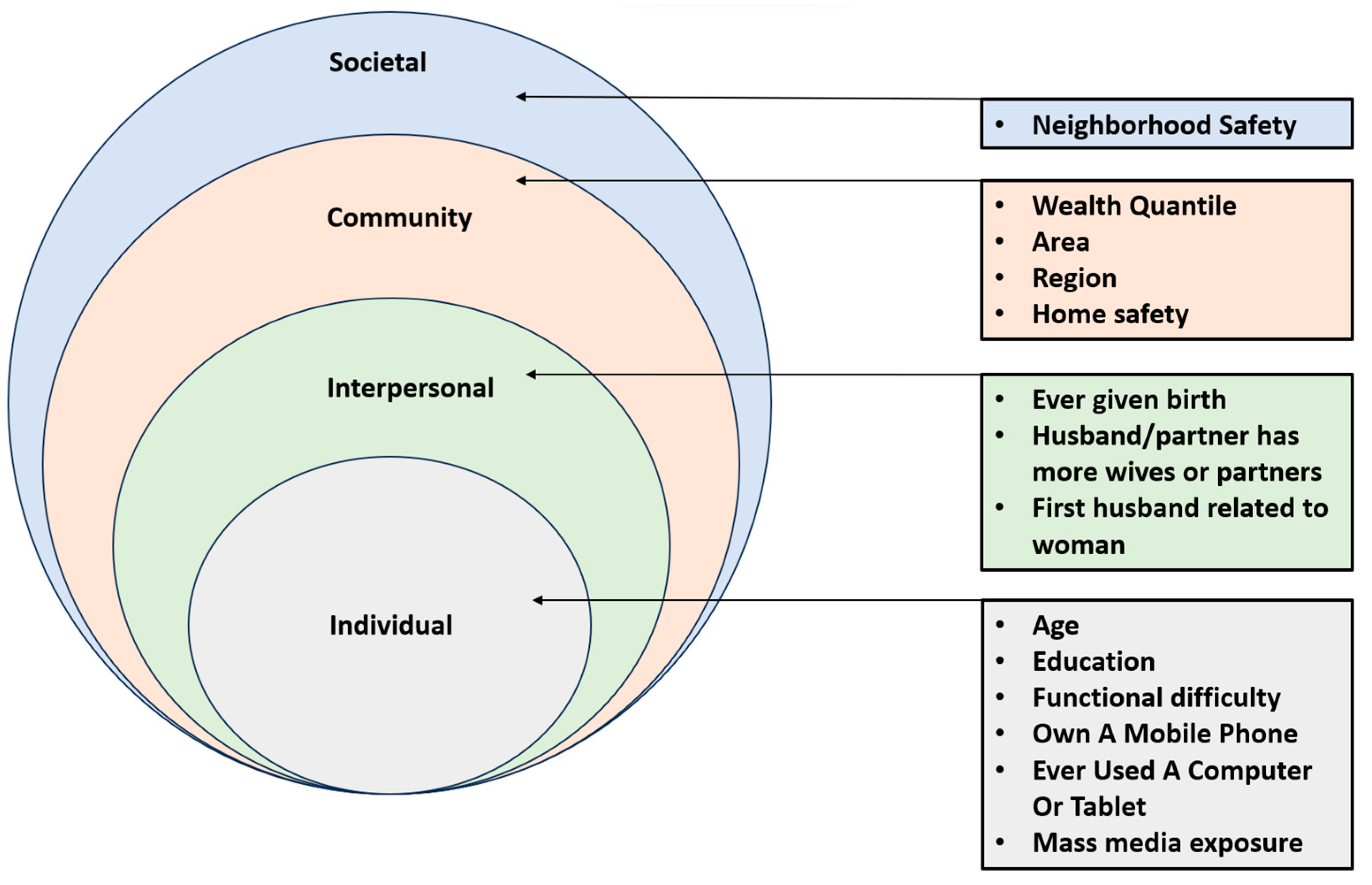
Figure 2.
The spatial distribution of study variables according to 18 Iraqi governorates.
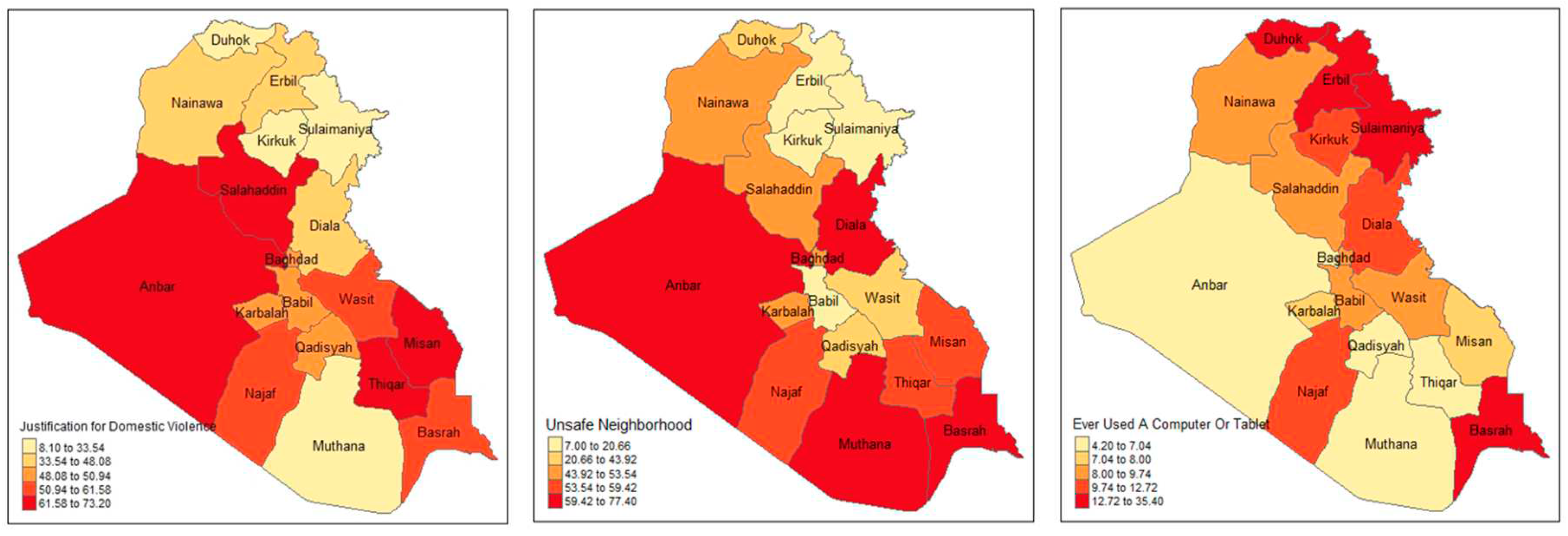
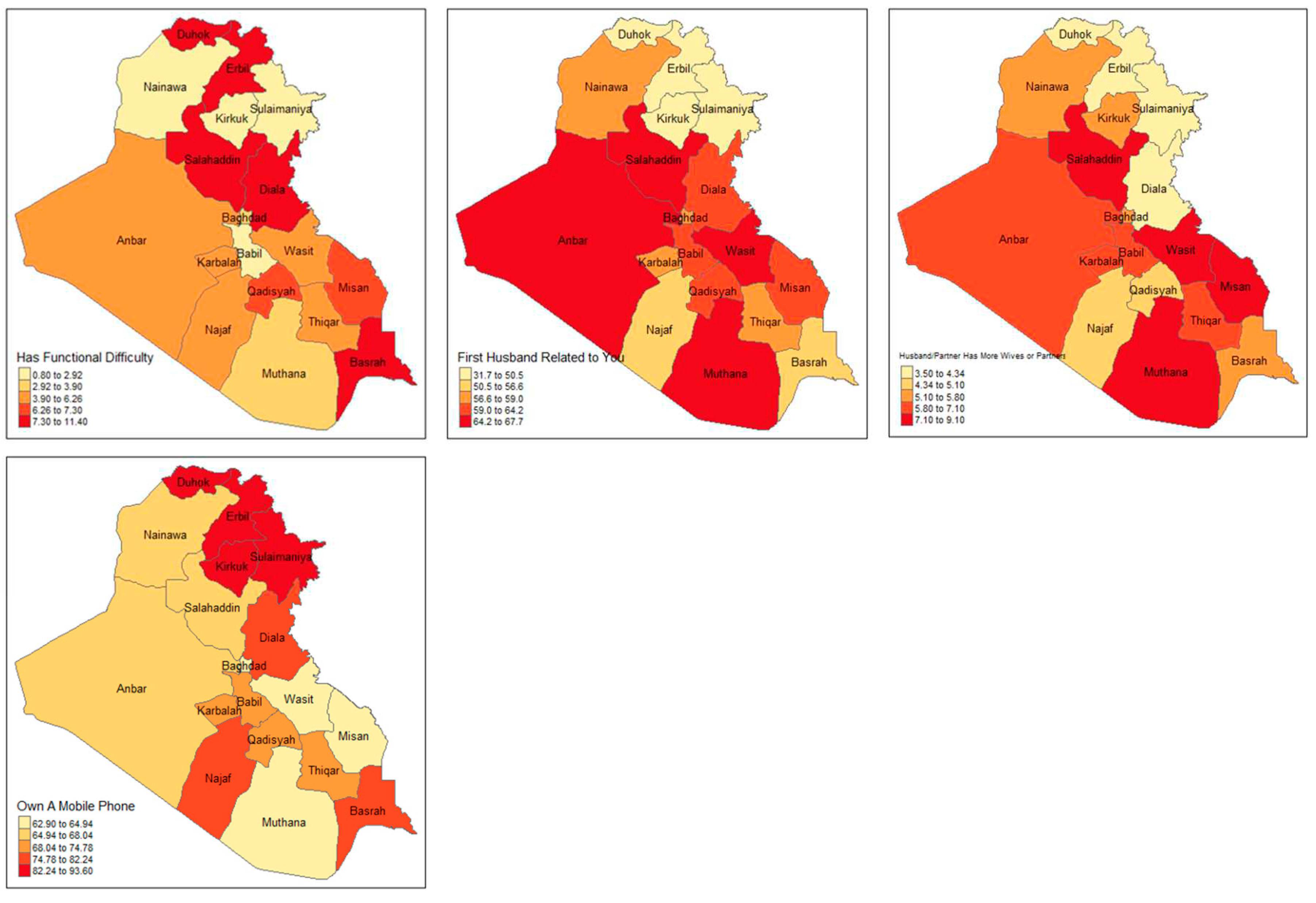

Table 1.
Characteristics of the weighted sample stratified by domestic violence acceptance, N=19443.
Table 1.
Characteristics of the weighted sample stratified by domestic violence acceptance, N=19443.
| Domestic violence acceptance |
Domestic violence acceptance | ||||||||
|---|---|---|---|---|---|---|---|---|---|
| No | Yes | Total | |||||||
| N | % | N | % | N | % | P-Value | |||
| 10029 | 51.6% | 9414 | 48.4% | 19443 | 100% | ||||
| Individual | Age | 15-19 | 533 | 5.31% | 641 | 7% | 1174 | 6.0% | <0.001 |
| 20-24 | 1406 | 14.02% | 1424 | 15% | 2830 | 14.6% | |||
| 25-29 | 1933 | 19.27% | 1721 | 18% | 3654 | 18.8% | |||
| 30-34 | 1774 | 17.69% | 1662 | 18% | 3436 | 17.7% | |||
| 35-39 | 1719 | 17.14% | 1561 | 17% | 3280 | 16.9% | |||
| 40-44 | 1457 | 14.53% | 1323 | 14% | 2780 | 14.3% | |||
| 45-49 | 1207 | 12.04% | 1082 | 11% | 2289 | 11.8% | |||
| Education | Pre-primary or none | 1268 | 12.64% | 2151 | 22.8% | 3419 | 17.46% | <0.001 | |
| Primary | 3893 | 38.82% | 4822 | 51.2% | 8715 | 44.51% | |||
| Lower secondary | 1995 | 19.89% | 1479 | 15.7% | 3474 | 17.74% | |||
| Upper secondary + | 2873 | 28.65% | 962 | 10.2% | 3835 | 19.59% | |||
| Ever used a computer or a tablet | Yes | 1578 | 15.73% | 430 | 4.57% | 2008 | 10.26% | <0.001 | |
| No | 8432 | 84.08% | 8984 | 95.43% | 17416 | 88.95% | |||
| Own a mobile phone | Yes | 8134 | 81.10% | 5953 | 63.24% | 14087 | 71.95% | <0.001 | |
| No | 1892 | 18.87% | 3460 | 36.75% | 5352 | 27.34% | |||
| Functional difficulties | Yes | 400 | 3.99% | 605 | 6.43% | 1005 | 5.13% | <0.001 | |
| No | 9424 | 93.97% | 8563 | 90.96% | 17987 | 91.87% | |||
| Mass Media Exposure | Yes | 9172 | 91.5% | 8576 | 91.1% | 17886 | 91.3% | .415 | |
| No | 854 | 8.5% | 833 | 8.9% | 1702 | 8.7% | |||
| Interpersonal | Ever given birth | Yes | 8980 | 89.54% | 8473 | 90.00% | 17453 | 89.14% | 0.286 |
| No | 1049 | 10.46% | 941 | 10.00% | 1990 | 10.16% | |||
| First husband related to you | Yes | 5078 | 50.63% | 5944 | 63.14% | 11022 | 56.30% | <0.001 | |
| No | 4945 | 49.31% | 3468 | 36.84% | 8413 | 42.97% | |||
| Husband/Partner Has More Wives or Partners | Yes | 448 | 4.47% | 668 | 7.10% | 1116 | 5.70% | <0.001 | |
| No | 9563 | 95.35% | 8737 | 92.81% | 18300 | 93.47% | |||
| Community | Wealth Quantile | Poorest | 1511 | 15.07% | 3052 | 32.42% | 4563 | 23.31% | <0.001 |
| Second | 1809 | 18.04% | 2350 | 24.96% | 4159 | 21.24% | |||
| Middle | 2035 | 20.29% | 1846 | 19.61% | 3881 | 19.82% | |||
| Fourth | 2247 | 22.41% | 1348 | 14.32% | 3595 | 18.36% | |||
| Richest | 2427 | 24.20% | 818 | 8.69% | 3245 | 16.57% | |||
| Area | Urban | 7463 | 74.41% | 5352 | 56.85% | 12815 | 65.45% | <0.001 | |
| Rural | 2566 | 25.59% | 4062 | 43.15% | 6628 | 33.85% | |||
| Region | Kurdistan | 1841 | 18.36% | 573 | 6.09% | 2414 | 12.33% | <0.001 | |
| South/Central Iraq | 8188 | 81.64% | 8841 | 93.91% | 17029 | 86.98% | |||
| Home Safety | Yes | 7107 | 70.9% | 6156 | 65.4% | 13364 | 68.2% | <0.001 | |
| No | 2920 | 29.1% | 3256 | 34.6% | 6229 | 31.8% | |||
| Societal | Neighborhood Safety | Yes | 5716 | 56.99% | 4621 | 49.09% | 10337 | 52.80% | <0.001 |
| No | 4313 | 43.01% | 4793 | 50.91% | 9106 | 46.51% | |||
Table 2.
Adjusted logistic regression (weighted) between women’s acceptance to domestic violence and selected covariates, N=19443.
Table 2.
Adjusted logistic regression (weighted) between women’s acceptance to domestic violence and selected covariates, N=19443.
| 95% CI | P value | ||||
|---|---|---|---|---|---|
| Variables | aOR | Lower | Upper | ||
| Individual | Age Ref= (15-19) | 0.19 | |||
| 20-24 | 0.97 | 0.81 | 1.15 | ||
| 25-29 | 0.88 | 0.75 | 1.05 | ||
| 30-34 | 0.92 | 0.78 | 1.09 | ||
| 35-39 | 0.86 | 0.71 | 1.02 | ||
| 40-44 | 0.87 | 0.73 | 1.03 | ||
| 45-49 | 0.87 | 0.74 | 1.04 | ||
| Education (ref=Preprimary or non) | <0.001 | ||||
| Primary | 0.86 | 0.79 | 0.94 | ||
| Lower Secondary | 0.62 | 0.55 | 0.69 | ||
| Upper Secondary+ | 0.39 | 0.35 | 0.45 | ||
| Own A Mobile Phone (ref=no) | 0.47 | 0.44 | 0.50 | <0.001 | |
| Ever Used A Computer Or Tablet (ref=no) | 0.34 | 0.30 | 0.38 | <0.001 | |
| Functional difficulty (ref=no) | 1.60 | 1.40 | 1.83 | <0.001 | |
| Interpersonal | Husband/partner has more wives or partners (ref=no) | 1.51 | 1.33 | 1.72 | <0.001 |
| First husband related to the women (ref=no) | 1.45 | 1.36 | 1.54 | <0.001 | |
| Community | Wealth Quantile (ref=poorest) | <0.001 | |||
| Second | 0.83 | 0.75 | 0.91 | ||
| Middle | 0.68 | 0.62 | 0.75 | ||
| Fourth | 0.54 | 0.48 | 0.60 | ||
| Richest | 0.47 | 0.42 | 0.54 | ||
| Region south central Iraq (ref= Kurdistan) | 2.00 | 1.77 | 2.27 | <0.001 | |
| Area Rural (ref=Urban) | 1.20 | 1.15 | 1.33 | <0.001 | |
| Home Safety (ref=yes) | 0.93 | 0.86 | 1.01 | 0.075 | |
| Societal | Neighborhood Safety (ref=yes) | 1.22 | 1.13 | 1.31 | <0.001 |
Note: Bolded means significant at p<0.05, AOR =Adjusted Odds Ratio, 95% CI=95% Confidence Interval.
Disclaimer/Publisher’s Note: The statements, opinions and data contained in all publications are solely those of the individual author(s) and contributor(s) and not of MDPI and/or the editor(s). MDPI and/or the editor(s) disclaim responsibility for any injury to people or property resulting from any ideas, methods, instructions or products referred to in the content. |
© 2023 by the authors. Licensee MDPI, Basel, Switzerland. This article is an open access article distributed under the terms and conditions of the Creative Commons Attribution (CC BY) license (http://creativecommons.org/licenses/by/4.0/).
Copyright: This open access article is published under a Creative Commons CC BY 4.0 license, which permit the free download, distribution, and reuse, provided that the author and preprint are cited in any reuse.


