
Submitted:
30 June 2025
Posted:
03 July 2025
Read the latest preprint version here
Abstract
This study examines the flows of evidence that inform urban policy in three rapidly urbanizing East African countries: Tanzania, Kenya, and Ethiopia. Using a broad definition of evidence that encompasses data, scientific knowledge, experiential insights, and contextual understanding, the research traces how different types of evidence move between local, national, and regional policy actors through three critical urban policy themes: multi-level governance and fiscal devolution, industrial strategy, and informality. The methodology employed a mixed approach combining grey literature review of policy documents (2020-2025), analysis of the inaugural Africa Urban Forum (2024), and analysis of dialogues at a meeting of the Tanzania Urbanisation Laboratory (TULab) in 2025. This multi-phase approach enabled examination of evidence flows across different scales and institutional contexts.The findings reveal significant disconnects between evidence generation and policy formulation. While substantial evidence exists on urban informality, local governance innovations, and appropriate industrial strategies, much of this knowledge fails to influence policy due to institutional barriers and misaligned evidentiary pathways. National governments predominantly rely on evidence from international consultancies and multilateral agencies that favour quantitative, macro-economic data suitable for large-scale infrastructure projects. Meanwhile, rich qualitative evidence from NGOs, universities, and urban communities—often more relevant to the lived realities of urban residents—struggles to penetrate policy processes.The research concludes that realizing Africa's urban potential requires not just better data, but fundamentally reformed evidentiary processes that enable bottom-up knowledge to inform top-down planning. This includes new platforms for multi-level evidence exchange, embedded urban policy advisors, and enhanced regional capacity for evidence synthesis. Without addressing these evidentiary biases, East African cities risk missing opportunities to harness urbanization for inclusive economic transformation.
Keywords:
urban policy
; evidence-informed policy
; East Africa
; urbanization
; multi-level governance
; industrial strategy
; informality
; policy networks
; knowledge systems
1. Introduction
Urbanisation on the African continent is taking place late, fast and at low levels of per capita income (Lall et al., 2017). Exactly what these attributes confer on the outcome of Africa’s urbanisation is currently indeterminant. The African Union’s (AU) Agenda 2063: The Africa we Want identifies the demographic megatrend as an, “Opportunity….[for a] positive turn around” (AU, 2015), an idea supported by academics and multilateral agencies on the continent and reiterated at the inaugural Africa Urban Forum in Addis Ababa in 2024 (Parnell and Pieterse, 2014; AU, 2024; UNECA, 2024). Others have framed rapidly evolving African cities as a source of social and environmental risks (Adam and Madell, 2013; Dodman et al., 2017; Lall et al., 2027; IPCC WG2, Ch.9, 2023) and as “unproductive” (Collier, 2016).
Aided by technological innovation, the generation and movement of data and information has advanced rapidly around the world over the past decade. New technologies have enhanced the quantity and quality of data from African countries and enabled citizen science in Africa’s cities (Allen, 2021; Elias et al., 2023; Turok and Visagie, 2025). The emergence of these data has enabled programmes such as the African Contact Group on Enhancing Collaboration to Improve Statistics for the Post 2015 Development Agenda (Mo Ibrahim Foundation, 2024), and the Good Governance Africa publication Africa in Fact (GGA, 2025). Despite these advances, the paucity of sub-national data frustrates coordinated planning within cities and makes it difficult to discern between optimistic and gloomy prognoses for these cities (Potts, 2018; Lopes 2024; Robinson et al., 2025).
Applying a broad definition of “evidence” that includes data as well as scientific, experiential and contextual knowledge (Adams and Sandbrook, 2013; Oliver and De Vocht, 2017), this study set out to trace what evidence is used, and by who, in the formulation of urban policy in three East African countries. The research is matched by papers from Benin (Thoto et al., 2025) and South Sudan (Ali et al., 2025). The broader effort traces ‘evidence informed policy’ (EIP) in multilateral systems, from the United Nations General Assembly to the African Union with a view to identifying transferable lessons for international policy networks (Espey et al., 2025).
The recognition that evidence is seldom determinant of policy in the ‘evidence based policy’ (EBP) sense, but that it can enrich policy formulation processes through EIP, calls for research on the processes that enable this enriching and informing in specific contexts (Espey et al., 2025).
2. Methodology
The study focused on qualitative and qualitative evidence from the three rapidly urbanizing East African countries that contribute most to the regional economy: Tanzania, Ethiopia and Kenya. Urbanism and urban policy span an increasingly broad remit, but the research focused on three particular aspects of urban policy identified by the literature as being important to sustainable urbanization in Africa: multi-level governance, industrial strategy and informality.
- Multi-level governance and fiscal devolution. In June 2014, the African Union declared the Charter on the Values and Principles of Decentralisation, Local Governance and Local Development, a charter that entered into force in January 2019. Orderly and predictable budget transfers and the devolution of specific fiscal and administrative responsibilities to local government enable the effective supply of infrastructure and services, but are not possible where local authorities lack institutional capacity, are highly contested or are not trusted by national governments (Cartwright et al., 2018; Lameck et al., 2019). More recent policy literature has emphasised the fiscal mechanisms that would allow larger and more mature cities to increase their dependence on “own revenue”, most obviously land tax (Amani et al., 2019; African Union, 2024; Haas et al., 2024) and the co-ordination of respective state agencies at the urban scale (Lameck, 2023).
- Industrialisation. Industrial strategy remains the flagship policy in most African countries (ECA/AfDB, 2022). History suggests that the concentration of infrastructure, capital, entrepreneurship, labour and technology in urban spaces in Africa, should be conducive to industrial progress (Henderson, 2005; Goodfellow and Huang, 2022; Kyule and Wang, 2024) and that rapidly growing cities provide markets for industrial sector outputs (Cloete et al., 2019). Despite this, most African cities operate as places of commodity extraction and not diverse manufacturing or industrial hubs, a design relic of structural adjustment programmes (Mkandewire and Soludo, 1999; Lopes et al., 2016; Pieterse, 2023). Changing this by linking industrialisation and urbanisation is complicated by China’s emergence as a global manufacturing superpower at the same time as Africa has been urbanising, but holds the key to drawing benefits from urbanisation (Goodfellow and Huang, 2022).
- Informality. That “informal” work is the predominant form of economic activity in many African cities is well documented (Jaglin, 2014; Parnell and Pieterse, 2014; Brown and McGranahan, 2016). However, data on African economies tend to under-report informal economic activity and service delivery and conflate “informality”, the “hustle” and “makeshift” economic activities (Thieme, 2018). The same is true for informal shelter provision and slums that arise when urbanisation rates outpace the ability of governments to provide serviced land and housing (Morrison, 2017). More generally, there is a seeming lack of government capacity to engage the lived-reality of informal settlements or to discern those aspects of the informal economy and shelter provision that are innovative and worthy of replication.
The first phase of research reviewed policy documents between 2020 and 2025 in the three countries for references to the three themes in what amounted to a grey literature review. The intention was to identify references to the three urbanisation themes and to identify the institutions that were generating the evidence that was being assimilated in urban policy.
The second phase of the research took advantage of the inaugural Africa Urban Forum convened by the African Union and hosted by the Federal Democratic Republic of Ethiopia in September 2024. Through a review of the planning documents, the three-day programme and the various drafts of the final declaration it was possible to appraise both the evidence being applied and the institutions supplying it, in the compilation of the Declaration on Sustainable Urbanisation for Africa’s Transformation (AU, 2024).
The third stage of the research included a reprisal of the Tanzanian Urbanisation Laboratory (TULab) - a “citylab” focused on National Urban Policy in Tanzania - for the first time since 2020 (Culwick et al., 2016; Cartwright, 2024). At the reconvened TULab in Dar es Salaam in February 2025, members were asked to describe how the evidence generated by the TULab between 2017-2020 had impacted policy and their day-to-day work in the intervening period. The insights yielded by the reconvened TULab enabled a deeper interrogation of the same themes - for example changing perceptions of informality and uncoordinated service delivery at the local level in Tanzania - in the urban policy literature in Kenya and Ethiopia.
3. Landscape Analysis: Urbanisation and Urban Policy in Tanzania, Kenya Ethiopia
The East African countries of Tanzania, Kenya and Ethiopia contribute 67% of the regional GDP (13 countries) and are central to the region’s recent development (World Bank Data, 2025). The three countries all experienced rapid urbanisation and doubling of per capita income (adjusted for purchasing power of parity) between 2010 and 2020.

Table 1.
Key demographic data Tanzania, Kenya, Ethiopia.
| Independ. year | Pop. (2023) million |
Urban % (2023) | Urbanstn. rate % (2024) | Life expectancy at birth | % pop living in informal settlement (2020) | |
|---|---|---|---|---|---|---|
| Tanzania | 1961 | 67.5 | 31 - 37 | 6.2 | 67 | 41 |
| Kenya | 1963 | 55.1 | 30 | 4.2 | 62 | 51 |
| Ethiopia | 1947 | 126.5 | 22.5 | 4.8 | 66 | 64 |
Source: UNDESA (2025), World Bank Data (2025).
Table 2.
Key economic indicators Tanzania, Kenya, Ethiopia.
| GDP billions (PPP) 2024 | GDP billns nominal (2024) | GDP growth rate 2024 | GDP/ capita (nominal) 2024 |
Dominant economic sector | Poverty headcount ($2.15 PPP) 2015 |
|
|---|---|---|---|---|---|---|
| Tanzania | 270 | 116 | 5.5% | 413,000 | Services | 44.9 |
| Kenya | 375 | 80 | 5% | 716,000 | Services | 36.1 |
| Ethiopia | 434 | 145 | 6.2% | 405,000 | Agriculture | 27.0 |
Source: World Bank Data (2025) based on World Bank Urbanisation Prospects 2018.
3.1. Tanzania
Multi-level governance: The Arusha Declaration (1967), Tanzania’s hallmark policy framework after independence, reflected concerns about an “urban bias” and neglect for the agricultural sector. The Arusha Declaration’s legacy has seen an enduring reticence towards rapidly growing cities (UNCTAD, 2022). In 2015, Tanzania’s new administration undertook an aggressive centralization of revenue and planning into the President’s Office (PO) and the Ministry of Finance and Planning (MoFP) as part of an anti-corruption drive that included the censoring of data in the National Bureau of Statistics (Lameck, 2023). A “Population and Housing Census” in 2022, the sixth census since 1964, reported a five percentage point increase in Tanzania’s urban population to 34.9% (21.5 million people) over the decade prior to 2022, and 76% of this urban population as being under 35 years of age (MoFP/ TNBS, 2022). The Census reported the population of Tanzania’s primary city, Dar es Salaam, at 5.4 million in 2022 although other estimates place it as high as 8.5 million in 2025 (World Population Review, 2025). The World Bank rates Tanzania’s “Overall Statistical Performance” (OSP) at 69.9% (World Bank, 2025) but centralisation renders urban data difficult to come by in Tanzania and definitions of ‘urban’ and estimates of the urban population are disputed ( Worral et al., 2017; Cartwright, 2019; Peter and Yang, 2019).
Tanzania has had a draft National Urban Policy that has been iteratively updated since 2010 but never tabled for approval. The ministries officially charged with urban development and implementation of Master Plans, Presidents Office - Regional Administration and Local Government (PO-RALG continues to advocate for a balance between rural and urban development despite rapid urbanisation. The lack of an effective multilevel governance policy to serve rapidly growing cities, and Dar es Salaam in particular, combined with the centralization of revenue collection, investment and planning, undermines coordinated service delivery and frustrates integrated urban development (TULab, 2019; World Bank, 2021; Lameck, 2023). Academics, civil servants and policy advisers complain about untimely and unreliable transfer of funds to local authorities and the duplication and uncoordinated service delivery activities of different national ministries and state-owned utilities (Lameck et al., 2019; Economy Watch, 2024; TULab, 2025), and there is a growing realization that cities cannot be developed through top-down “sector plans” (Hante, 2025, personal communication).
The World Bank funded a programme that is overseen by PO-RALG to generate city and town-based data on population and the economy that was used in the Urbanization Review document drafted by the World Bank for the Ministry of Finance and Planning in 2017. The Urbanization Review was never officially adopted, but the draft in circulation comprised quantitative data on the formal economy and guidelines for urban development some of which were drawn from the TULab’s work on local government revenue (World Bank, 2021). Much of the evidence in the draft Urbanization Review is tailored towards the requirements of financing nationally coordinated infrastructure and transport systems such as Dar es Salaam’s Bus Rapid Transit system, but together with the TULab’s Roadmap for an Urban Development Policy (Cartwright, 2019) it ushered in some legislative reform. In 2021 policies were developed to give local governments in Tanzania more autonomy and the ability to recruit personnel through local government employment boards (URT 2021, 2022). The enactment of the new policy was followed by the review of the public service regulation to allow local governments to (URT 2022). Nevertheless, the experiential evidence shows that the local government recruitment boards are not yet functional and this reform has not produced any tangible evidence showing a move towards administrative autonomy of urban local councils (URT 2025). Finally, the recent empirical evidence shows that urban local councils still heavily rely on central government for funding local government priorities but also there is a lack of a mechanisms for effective accountability and transparent decision making in urban local councils ().
Industrial strategy: In Tanzania, as in many African countries, industrial strategy provides the core of national economic strategy (MoFP, 2025). Industry comprised 28% of Tanzania’s GDP in 2023, a contribution that is boosted by the construction sector; manufacturing’s share of the economy has remained at just 8% since the 1990s (AfDB, 2024). Between 2015 and 2017, the United Kingdom’s Overseas Development Institute (ODI), with support from the World Bank and Dar es Salaam based consultants, advocated for Special Economic Zones and Export Processing Zones as the core of Tanzania’s industrial strategy (Kweka, 2018). The country’s Third Five Year Development Plan (FYDP III), released in 2025, drew from TULab evidence to shift from traditional SEZs towards “urban industrial hubs” in cities such as Dar es Salaam and Mwanza (MoFP, 2025). Attempts to link cities and manufacturing stands in contrast to the traditional focus on commodity exports, and cities such as Mwanza remain dependent on gold mining exports, while the discovery of offshore gas near Songo Songo continues to dominate the industrial focus in that region.
Tanzania’s Integrated Industrial Development Strategy (IIDS), updated in 2025 by the Department of Trade and Industry, does not have a reference list making origins of evidence used in the strategy difficult to establish. The IIDS does draw from an UNCTAD publication in 2022, compiled using research by the AfDB and an array of UN agencies (UNU-WIDER, World Trade Organisation, UNWomen, UNCTAD, World Bank) as well as the World Economic Forum and consultancy reports from Boston Consulting Group and the International Growth Centre. To the extent that the IIDS relied on evidence that was generated within Tanzania, this evidence came from the Bank of Tanzania, National Ministries and Councils and energy and water utilities. The IIDS cites the need to increase agricultural productivity to “reduce living costs of urban dwellers” (DTI, 2025, p.23), but links between urbanisation and industrialization are not expressly established.
Informality: Tanzania’s industrial strategy has little bearing on urban citizens operating in the informal sector and looking for improved service delivery and economic opportunity (Diao et al., 2016)1. For these citizens, many of whom operate unregistered enterprises, Tanzania’s community-based NGOs, donor organisations and neighbourhood associations (mtaas) tend to provide an easier point of engagement and a better institutional fit (Kyessi, 2005; Diao et al., 2016; Mcgranahan et al., 2016). Within the NGO and donor network, Economic and Social Research Foundation (ESRF), Shack/Slum Dwellers International (SDI) and its country-based affiliate the Centre for Community Initiatives (CCI) and the Tanzanian Urban Poor Federation (TUPF), UN-Habitat and the World Resources Institute generated qualitative and quantitative evidence on informality for the TULab 2017-2019. Similarly, WaterAid Tanzania has used digital technology to gather real-time data on water access and infrastructure failures (WaterAid Tanzania, 2023). Mzumbe, Ardhi and Dodoma Universities have a growing number of urbanists and urban studies units working on informality, some in collaboration with Global North universities (Robinson et al., 2025). The evidence generated by these actors holds the potential to link top-down infrastructure provision to bottom-up research reflecting the needs and affordability of urban residents, (Jenkins et al., 2015; Jean-Baptiste et al., 2019; Lameck et al., 2019). In a rare collaboration with the State the Dar es Salaam Metropolitan Development Project (DMDP) gathered water and sanitation data in the city’s extensive informal settlements as part of donor funded research (URT, 2023).
3.2. Ethiopia
Multi-level governance: Ethiopia adopted a federal structure in the mid-1990s as it emerged from a civil war. The designation of nine regional states sought to accommodate Ethiopia’s 93 mother tongues and 98 ethnicities and created a more devolved system of governance and development planning than is the norm in African countries. National government retains nominal control of all Ethiopia’s land, but in practice the centralized tenure governance co-exists with the “ethnic federalism” and “neo-customary tenure” that relies heavily on local authorities (Lavers, 2018). Ethiopia’s third Growth and Transformation Plan (GTP III – 2021 to 2025) resonates with the African Union Charter or 2014 by emphasizing local government’s role in urban management and infrastructure development. Devolution through federalism has been credited with sustained economic growth and human development – most notably through the health and education sectors – and in 2015 Ethiopia boasted one of the highest rates of public investment in infrastructure (public investment as a % of GDP) in the world (World Bank, 2015).
Both decentralization and devolution have been challenged by the emergence of Addis Ababa, with a population 10 times larger than Ethiopia’s next biggest city. The capital city’s development serves as the flagship of Prime Minister Abiy Ahmed’s (elected in 2018) pledge to transform the country’s cities into places that are, “Clean, green and conducive to residents’ well-being” and has been driven by the Federal Government (African Business, 2024; Ethiopian Ministry of Foreign Affairs, 2024). Tensions between centralized development planning, the aggressive investment in infrastructure and devolved tenure systems have been the source of ongoing land conflicts, most notably in the Tigray Region but also in regions adjacent to Addis Ababa (Kefale 2010; Adugna, 2011; Alem, 2021; Faguet et al., 2021).
Ethiopia’s history of one-party state and Derg military rule, followed by what officials call the “Home-grown Economic Reform Agenda” (FDRE, 2020) initially restricted the flow of evidence from foreign institutions into urban policy. The presence of UNECA and African Union headquarters in Addis Ababa has, however, provided a platform for international agencies. In 2008 the World Bank funded the Urban Local Government Development Project with performance based “matching funding” to 19 secondary cities and IGC now has a bespoke Ethiopian office. Reliance on Ethiopia’s Central Statistical Agency represents a weakness for urban policy in Ethiopia. The Agency has not conducted a Census since 2007 due to conflicts and concerns about safety, and The World Bank’s “Overall Statistical Performance Indicator” scored Ethiopia at 60.7% in 2023, the lowest of the three countries (World Bank, 2025). The paucity of Ethiopia’s internal urban policy agenda was exposed when the Federal Government agreed to host the inaugural Africa Urban Forum in 2024. The hosting had to be supported by UN-Habitat and a makeshift organizing committee after it emerged that the Federal Ethiopian Government did not have a team of urbanists to curate the appropriate content or programme.
Industrial strategy: Industrial policy in Ethiopia is led by Ministry of Industry (MoI) and relies heavily on UNCTAD and AfDB support (Oqubay, 2018). The policy takes advantage of China’s Belt and Road Initiative and the formation of Industrial Parks that are managed either by the national Industrial Parks Development Corporation or private companies (Gebrehiwot, 2020; Goodfellow and Huang, 2021). The industrial sector contributes 28% of the countries’ GDP, behind the agriculture and services sectors, but manufacturing in Ethiopia has remained at around 8% of GDP (UNCTAD, 2022). A presentation by Ministry officials ahead of the launch of the revised industrial strategy in 2025, lamented the “lack of information among different stakeholders (firms, civil servants)….lack of coordination among the different government institutions” (MoI, 2022, p. 4). The presentation itself was compiled by the global advisory Dalberg and contained references to a Harvard Business School tool (the “Atlas Model of Economic Complexity”) for assessing analyzing trade patterns and identifying manufacturing opportunities. Whilst technical and thorough in their planning, Industrial Parks have not been integrated into urban development (Gebre-Egziahber and Yemeru, 2019).
Informality: The Derg regime suppressed civil society in Ethiopia until 1991, and the sector remains regulated and smaller than in Kenya and Tanzania. The focus of academic and civil society research has historically been on the majority rural population’s struggle with droughts and famines and supported by the UN Food and Agriculture Organization and the Stockholm Environment Institute. Urban research is emerging, supported by the UN-Habitat office, an EU-funded Ethiopian Cities Association, the Ethiopian Institute for Architecture, Building Construction and City Development at Addis Ababa University, and the Ross Centre for Sustainable Cities (part of the World Resources Institute) which has advocated for links between urbanisation, climate resilience and industrial strategy. Smaller, more independent NGOs such as The Urban Centre in Addis Ababa produce a range of propositional material and the Urban Centre has its own radio station dedicated to airing a range of urban issues.
The Federal Government has engaged ‘slum upgrading’ since the 1970s, predominantly through the provision of housing and with little regard for local practice. Addis Ababa’s authorities have used GIS and drone technology to map informal settlements but have struggled to integrate the bottom-up evidence emerging from NGOs and incidences of slum housing remain high (79%) (UNCTAD, 2023; Orbital Africa, 2024). In Addis Ababa, the Prime Minister’s modernization vision is manifest in the eye-catching “Corridor Development” and “Riverside” projects that has seen the creation of an upmarket boulevard linking the airport to the CBD (Haile, 2024). The projects draw heavily from Global North transport economic theory (Venables, 2007; Girma and Mulatu, 2025) and boast safe pedestrianization, electrically powered public transport, upgraded sanitation systems and high-tech buildings. Urban civil society has been galvanized by rapid top-down infrastructure roll outs and the fact that over 70% of the Ethiopian population continue to live in “slums” according to UN-Habitat data. Financing for the Federal Government’s projects in Addis Ababa is deemed “untransparent” by civil society organizations and has required increasing reliance on property taxes and leasing land to private investors (AfDB, 2022). The “Corridor” project required the forceful relocation of 11,000 inner-city residents to the urban periphery. The Federal government described these as “short term…disruptions” but there is no timeframe for the reintroduction of displaced citizens or a commitment to take their hard-won livelihoods into account (Ethiopian News Agency, 2014). A United Kingdom funded appraisal of the Addis Ababa “Corridors” project warned against the focus on “maps and numbers in long PDFs and not … places and real people who are the most affected when undesired impacts happen” as well as the “poor application of existing best practice guidance in development corridors results in poorer outcomes for people and nature” (Juffe Bignoli et al., 2024).
3.3. Kenya
Multi-level governance: Following electoral violence in 2007-2008, Kenya’s Constitution was revised in 2010 to recognize 47 autonomous County Governments, 43 Municipal Councils, 62 Town Councils and three City Councils. The decentralization was in recognition that the rigged election that sparked the violence, was itself a function of longstanding centralization under the “bureaucratic and executive state” that had prevailed during and subsequent to colonization (Branch et al., 2006, p.13). The Constitutional revision was explicit on the process of transitioning to devolved government and provides the legal framework that has overseen effective fiscal devolution and the smooth transition of power in three subsequent elections. Whilst precipitated by a domestic crisis, once Kenyans decided they wanted devolved government and effective multi-level government arrangements the international community was quick to support them. The World Bank managed a multi-donor trust fund supported by Denmark, European Union, Finland, Sweden, United Kingdom and the United States. Unsurprisingly, given the chance to develop urban policy from first principle and drawing on the available thinking within the international community at the time, Kenya’s urban policy aligns closely with the World Bank’s notion of international best practice at the time (Khaunya et al., 2015, World Bank, 2016). Two independent constitutional bodies were created, the Commission on Revenue Allocation and the Intergovernmental Budget and Economic Council to oversee “Equitable Share” transfers to counties, making these transfers more predictable and less prone to political interference.
Kenya’s National Urban Policy (NUP) released in 2016, was similarly bolstered by World Bank’s Kenya Integrated Devolution and Urban Support Program and the Kenya Urban Support Program (KUSP) (2018-2023). The KUSP was focused on tenure formalization required to support the revenue generation by county governments. The programme delivered 25,105 land titles in 80 informal settlements across 15 urban areas, provided 1.6 million women with access to improved water resources, prepared 57 Urban Integrated Development Plans and 49 Spatial Development Plans and undertook capacity building across all counties (World Bank, 2024a).
Industrial strategy: Kenya’s Vision 2030 sought to transform the country to “newly industrializing, middle income” status by “moving the economy up the value chain” (Republic of Kenya, 2018). Industry contributed 16.8% of Kenya’s GDP in 2023. The construction sector has supported a nominal growth in industry, but the industrial sector contributes less to Kenya’s growth than either agriculture or services (World Bank, 2016). In line with the continental trend, the manufacturing sector’s share of GDP declined from 9.3% in 2016 to 7.6% in 2023. This was despite Government strategies aiming for 20% by 2030 (SDIP, 2024)2. Much of the State Department for Investment Promotion material on industry and manufacturing continues to be focused on “Special Economic Zones” and “Export Processing Zones” (61 in total) some of which have received acclaim: Nairobi Gate Industrial Park, Athi River, while Konza Techno City represents a new “ultra-modernist” town to “escape the chaos of city life” 60km south of Nairobi. These plans say little on the potential to focus manufacturing sector work on the needs of rapidly growing urban spaces (Kyule and Wang, 2024). County Aggregation and Industrial Parks (CAIP), launched in 2024, seek to add value to existing value agricultural chains but do not mention urban markets.
Informality: Kenya has a vibrant NGO sector and is headquarters to UNEP and UN-Habitat. Both the technical and social implications of devolution have received support and critiques from civil society and the academy. Strathmore University academics analyze the fiscal implications of devolution cautioning about the implications for the salary bill, while others have highlighted the marginalization of minority ethnic groups in the devolution process (Mamdani, 2025). Kenya has a long history of engaging urban informality and a mature NGO sector working in informal settlements. Organisations such as Kounkuey Design Initiative (KDI) and Shining Hope for Communities (SHOFCO) have been central to community-based data collection in Kibera and the advancement of appropriate sanitation technologies in informal settlements. The work of civil society organisations in Kenya has tended to engage urban informality, whether in the labour market or human settlements, as a given feature of urban life. The evidence emerging from this work has been quantitative, qualitative and richly ethnographic. It has, however, proven difficult to integrate with government programmes focusing on modernization, land titling for tenure security and “improved water sources” that see informality as something to be eradicated through formalization (McGranahan et al., 2016; World Bank, 2024).
Table 3.
Status of three urbanisation themes in the three East African countries.
| Mult-level governance | Urban-industrial-climate | Informality and innovation | |
| Tanzania | Progress through policies that enable LGAs to raise their own revenue, but stalled National Urban Policy and continued centralization of revenue and budget allocation and large infrastructure projects. | Shift away from export oriented SEZs for everything but oil and gas in favour of “urban industrial hubs” for manufacturing. University and think tank involvement in evidence formulation. | Growing recognition of informality in state-sanctioned NGO activity. Emerging ability of the state to engage informal water provision in Arusha and involve informal communities in enumeration. |
| Ethiopia | Long-standing commitment to federalism and cities, but little capacity to resolve land conflicts generated by expanding cities with anything other than top-down decrees. National focus on Addis Ababa has challenged devolution. Centralised investment in infrastructure has been impressive but generated land conflicts. Hosting of the AU’s inaugural Africa Urban Forum in 2024. | Commitment to modernization of Addis Ababa and Industrial Parks for manufacturing and work creation, but declining manufacturing and no alignment of urban needs with industrial output. Low levels of university and think tank involvement in evidence formulation. | State efforts to upgrade and remove urban informality rather than collaborate with informal service providers. Limited capacity to integrate formal and customary tenure regimes in expanding cites. |
| Kenya | Effective MLG since 2010 with ongoing efforts to strengthen local revenue generation and accountable transfers of national budgets. | Declining manufacturing and continued industrial focus on exports as opposed to cities. University and think tank involvement in evidence formulation. | Longstanding NGO engagement with urban informality but difficult to insert qualitative data into urban planning. Focus on tenure upgrades in informal settlements and extensive NGO support for informal dwellers. |
3.4. Urban Policy Evidence Actors in East Africa
Much of the EIP literature on Africa laments the quality of the data, citing a lack of granularity, temporal lags, standardization and definitional issues and the absence of data for sub-national governments as impediments to the adoption of evidence in urban policy (Seddon, 2015; Jones et al., 2014; Haas et al., 2024; Jana, 2025). Less is known about the origins of the evidence that informs urban policy in Africa, or why the evidence that is available does, or does not, get used in policy. There have been critiques of “policy mobility” (Ward and Cochrane, 2012) and “travelling ideas” (the adoption of urban planning theories from the Global North) and their “generally disastrous effects” (Watson, 2014) but little consideration has been given to why these ideas have landed so easily and consistently in urban policy formulation on the continent or why it has proven so difficult to apply the available data on informality, for example, in the allocation of budgets for slum upgrading.
To consider the pathways through which evidence does, or does not, move into policy it is first necessary identify “knowledge actors and policy makers” at three different tiers (Espey et al., 2025).
- Regional actors
At the regional (East African) scale, evidence regarding infrastructure and the economic opportunity that accompanies urbanisation tends to be circulated by the multi-lateral institutions operating in the region - UN Habitat, UNECA, the African Union, the East African Community (EAC) and the AfDB. UNECA, the AU, EAC and the AfDB do not have dedicated teams looking at urbanisation but draw on African researchers, consultants and NGOs in gathering evidence.
The urban evidence gathered by multi-lateral agencies in the region has influenced the themes adopted by the regional actors but has struggled to influence the investments made by AfDB or the allocation of budgets by national governments. In both cases the allocation of capital reflects the predominance of national governments over the governance of urban development.
The ICLEI (Local Governments for Sustainability) network has, similarly, been instrumental in raising awareness and occasionally conducting research on environmental issues in its member cities, but has not been particularly influential over the themes adopted by UNECA or the investments made by AfDB. In contrast, UN Habitat has a storied history of leading regional evidence on shelter and human settlements, often applying bottom-up case study material for advocacy on regional platforms such as the Africa Urban Forum in 2024. UN Habitat has been able to leverage its multi-level span to generate evidence and raise awareness of the human settlement issues.
Together with the East African Economic Community, the African Union has largely been a consumer and sometimes distributor of urban policy evidence but is not actively involved in generating evidence. The African Union’s single contracted staff member working on urbanisation is conspicuous against the backdrop of the regional demographic megatrend.
Given the nationalist-turn within the countries that have historically funded research on the continent, the role of regional actors should take on new importance in generating EIP. Both UNECA and the African Development Bank are seeking to fill this gap, and have commissioned research on urbanisation in recent years. However, there is a particular need for regional actors to standardise the ways in which evidence is gathered and reported – including the way in which sectors are defined, the definition of a ‘city’ (in terms of density and population size) and ‘informal settlements’ and the manner in which greenhouse gas emissions are measured. In addition, the evidence from cities is still largely “missing” and bottom-up evidence struggles to find its way into regional policy in anything other than anecdotal examples (Jean-Baptiste et al., 2019), while the national ministries overseeing urban development in the three countries tend not to take the evidence circulated by the regional actors into budget allocations or governance innovations.
- National actors
At the national scale the bulk of the evidence in circulation is provided by international consultancies that have been established to meet this need. The International Growth Centre (IGC), Dalberg, Boston Consulting Group, Adam Smith Institute and Price Waterhouse Coopers, sometimes working in partnership with in-country consultants and occasionally with academics operating on short-term contracts, offer evidence services designed to meet the needs of Presidencies and Finance Ministries responsible for macro-economic policy and national infrastructure programmes. The evidence they produce is tailored towards this audience and its needs and it is unsurprising that this evidence discounts data from sub-national entities and NGOs, let alone the informal sector. When invited by national governments, Cities Alliance has played a very specific role in supporting the formation of National Urban Policies across the region. In addition, the World Bank’s Urbanisation Reviews were crucial in diagnosing urban challenges and outlining the investment case for urban infrastructure such as Bus Rapid Transit systems. Both international consultancies and the World Bank rely heavily on the data held by national statistical agencies. Kenya and Tanzania’s national statistical agencies have significantly more capacity than Ethiopia’s, but Tanzania’s National Bureau of Statistics is still vulnerable to political interference according to World Bank appraisal (World Bank, 2025) and census data in Ethiopia and Tanzania tends to under-estimate the scale of urbanisation.
In theory State Owned Entities are meant to collaborate with both national ministries and local governments in sharing evidence and devising the most appropriate plans. SOEs also have an important role in gathering and applying household data on the consumption of, and willingness to pay for, services. In practice, SOE decision making is often autonomous, based on data that is internal to their operations such as cost of capital and internal rates of return, rather than gathered from their customers (Lameck et al., 2019). In-country donor programmes such as GIZ, JICA and SIDA, tend to be staffed by sector specialists and have played important roles in commissioning evidence and in translating research on local revenue collection and the strengthening of local authorities for example, into training programmes. The increasing prevalence of bilateral infrastructure deals between the three countries and China have not been characterised by publicly available evidence and warrant further research (Goodfellow and Huang, 2022).
- Local actors
At the local scale evidence generation and use is spread more diversely across government entities, private companies, NGOs and universities. In Tanzania Jean-Baptiste et al. identified the role of local experts (“fundis”) in guiding the adoption of water and sanitation technologies (Jean-Baptiste et al., 2019). Local authorities in the three countries, however, tend to generate conspicuously little evidence of their own, unless supported by donors or one of the ‘organised local government’ groups such as C40, UCLG and ICLEI. In these instances, it is typically consultants and local academics that generate the research. Research projects tend to focus on health, food, non-grid energy feedstocks and informal income generating activities and accordingly produce data that are not easily translated into financialised budget allocations and investment decisions. In Tanzania and Kenya researchers, often in collaboration with government departments and better-resourced Global North Universities and NGOs, generate urban evidence of both ethnographic and quantitative nature. These actors report a struggle inserting this evidence into the urban policy deliberations taking place in national government (Croese et al., 2016; TULab, 2025). In Ethiopia, government-academy partnerships are less common, despite a 1993 National Science and Technology Policy calling for a “triple helix” of partnerships between public, private sector and academic actors and associated support from the Swedish-based International Organisation for Knowledge Economy and Enterprise Development (IKED).
4. Results and Discussion: Tracing Flows of Thematic Information
4.1. Multi-Level Governance and Fiscal Devolution
The devolution of budgets and planning to capacitated local authorities has long been advocated as a means of harnessing the benefits of urbanisation. It is an idea that is echoed in the AU Charter of 2014 (AU, 2014) and the Addis Ababa Declaration (AU, 2024). It runs counter, however, to the centralizing trends that have shaped African governance under colonial and post-independence rule (Jaglin, 2014; Bekker et al., 2021; Haas et al., 2024) and the evidence that currently finds its way into urban policy reflects this centralisation.
One of the consequences of this evidentiary bias introduced by centralisation is the inability of national governments to frame urbanisation as an opportunity, or to validate and support the multiple bottom-up initiatives that keep cities functioning despite a lack of investment. Nowhere is this more evident than in the inaugural African Urban Forum’s Addis Ababa Declaration (AU, 2024) which calls on African states to “Encourage national governments to put in place transparent mechanisms for sharing public financial resources in order to ensure that investment and operations costs of managing urban development are met” …. but then offsets this call with the phrase, “Ensure that the impact of inward cities migration is mitigated through appropriate interventions at City, Region and Country level.” (1.vii).
This study offers insights into why devolution has proven so difficult: centralised urban policy has co-evolved with flows of evidence and the evidence actors that serve national governments. National governments have engaged the agencies adept at engaging nation states - the World Bank, global organisations such as Cities Alliance and international advisories geared to supporting finance ministries and presidencies. In their support for national governments, these actors tend to focus on large-scale infrastructure provision and centralised urban planning with an emphasis on macro-economic impacts, budget allocations and attracting foreign direct investment. In parallel to these efforts NGOs have expounded appropriate technologies and the lived reality of urban populations in informal settlements. The evidence from these efforts, often granular, highly context specific, more qualitative than quantitative and central to the economic aspirations and capabilities of urban Africans, has proven difficult to assimilate into national plans. Seen in this context, the thrust towards NUPs between 2015 and 2019 was the symptom of national governments looking to signal alignment with global discourses on urbanisation but reticent about local authority. The same national governments were unwilling to invest systemically in devolution and people-centred urban development and ill-equipped to assimilate bottom-up data regarding the lived-realities or urban people working and living under informality.
4.2. Industrial Strategy
Headline data reveal that the three East African countries are urbanizing but struggling with declining industrial productivity and competitiveness and stagnant manufacturing sectors, despite numerous programmes aimed at value addition (AfDB, 2024). The emergence of China as the global manufacturing hub provides a partial explanation, but it is also true that Tanzania, Kenya and Ethiopia lack the transport and energy infrastructure required to sustain a growing manufacturing sector. Instead, they have defaulted to exporting low-value raw commodities as a function of weak bargaining power and convenience (Kaboub, 2024; UNCTAD, 2024). For national governments the ring-fenced construction of Special Economic Zones (SEZs), ports, airports and new towns has been perceived easier than the provision of clean energy, water and sanitation and inner-city mobility that would enable urban citizens, many of them residing informally, to pursue manufacturing enterprises (Kihiko, 2018; Cloete et al., 2019).
This default mode of industrialization has not been good for socio-economic progress in East African countries, but its persistence should be understood as a product of the evidentiary flows that shape industrial strategy in the region. Centrally coordinated industrial strategy tends to rely on a distinct set of evidence to that informing national urban policy. The Addis Ababa Declaration did not mention manufacturing, barring a tangential reference to the “potential of housing sector (job creation, industrial development, revenue generation) embedded in a green industrialization and economy framework” (AU, 2024, 3,iii). Industrial strategies that do not receive, and cannot impute, evidence generated by rapidly evolving cities and National Urban Policies that draw on a distinct set evidence to that informing industrial strategy pass up the potential to add value to existing value chains and supply to urban markets and fail to connect the enterprise of urban residents with industrial development. The irony is that centrally co-ordinated urban policy should make links with industrial strategy easier. However, national governments are easy landing pads for evidence that advocates for large commodity extraction projects and the associated mega infrastructure and trade deals that tend to bypass cities. The same commodities provide the resource taxes on which many African governments, and incumbent political parties, still depend. This is difficult outcome to counter, but the local authority in Tanga City, Tanzania, claims to have drawn from the TULab (2017-2020) by encouraging greater collaboration between the Ministry of Lands and PO-RALG and supporting “integrated industry in every region” rather than SEZs (Mshinda, 2025, personal communication).
4.3. Informality
With regards to informality, work by NGOs and academic institutions has generated evidence on informal service delivery, make-shift work and the varied nature of this work in all three East African countries. NGOs and academics working on and with informality have called on national and local governments and development partners to pay closer attention to the informal sector and develop the ability to discern those aspects of this sector with which collaborations would be developmental and complementing of state efforts. UN-Habitat has supported these NGOs and provided an important conduit for this work into global policy discourses. It was UN-Habitat’s role that resulted in the UN-Assembly of June 2023 (Nairobi, Kenya) adopting the Global Action Plan for Slum Transformation.
Various efforts have sought to take this discourse back to national and local governments in the three African countries. Slum Dwellers International’s (SDI’s) Know Your City website, has collected data from slums in 15 African countries (including 13 slums in Kenya, the most for a single SDI country), and pointed out the imperative of using data from informal settlements in urban plans (SDI, 2025). SDI has been explicit in their pursuit of “Strengthened collaboration between slum dwellers and government in the planning and implementation of citywide development” and in looking for “improved evidence of impact generated by community-led learning, monitoring and evaluation” (SDI, 2025). The type of information emerging from this work is often qualitative, contradictory and inconsistent and does not make for easy policy inference. Urbanization comprised of rural–urban migrants who cannot afford formal housing or secure employment, not only presents a challenge to national governments seeking “regimented and orderly in a geometric sense” cities (McGranagh et al., 2016) but is often perceived as a threatening to officials charged with urban policy (Ramakrishnan, 2013; Morrison, 2017).
Almost by definition formal public authorities have struggled to assimilate this evidence into planning and budget allocation decisions that depend on conventional data metrics of (for example) a home address, a tax number or a utility bill. For national government in East Africa, it is seemingly too difficult to reconcile notions of ‘citizenry’ and ‘rights to the city’ that are advanced by NGOs and academics engaging informal residents, with the interests of finance ministries and local authorities concerned with secure tenure and land value capture (Ramakrishnan, 2013). The result is evidence “…[that] simply hangs in the ether” (Seddon, 2011).
Unable to decipher and assimilate the evidence on informality, national governments and their agencies default to phrases such as “upgrade”, “appropriate technology” and “pro-poor” or “inclusive” development without engaging the qualitative content of the evidence or the lived reality of informal urban residents (Croese et al., 2016; UNECA, 2023). Tanzania’s Urbanization Review, intended for the Ministry of Finance and Planning, is typical of national level policy on informality in the region in calling for “More … done to formalize and foster the informal sector [and ]…. support the growth and formalization of the informal sector” (World Bank, 2021).
Unsurprisingly, “formalization” without engaging the evidence on the causes and the modalities of urban informality tends to fail. Both urban entrepreneurs and informal settlement services providers lament the difficulty in accessing state and financial sector support, and many people in the informal sector, especially where they have carved out hard-won livelihoods, are reluctant to engage government programmes (Kaika, 2017; Jean-Baptiste et al., 2019; TULab, 2019). The Addis Ababa Declaration of 2024 calls on the finance sector to extend its investment to “low income groups” for housing (AU, 2024, 3.ii), but unless this call addresses the disconnect between the types of evidence that financiers value and require – the “evidentiary bar” set by financiers (Committeri and Spadafora, 2013) - and the evidence emerging from informal communities, it too will fail.
The disconnect between nationally formulated urban policy and the available evidence on informality misses the chance to harness what has become the lifeblood of urban livelihoods for the majority of the urban population. Among other things, it explains why it has proven so difficult to collect revenue from the urban economy which in turn undermines the ability to provide services in an perpetuates informality (Haas et al., 2024).
Local authorities could, in theory, take advantage of their proximity to forge partnerships with informal sector NGOs and community groups. Kenya, the country with the highest extent of fiscal devolution and administrative decentralization, is also the country with the most vibrant informal sector. The process of engaging is, however, expensive and politically risky for local authorities with a limited mandate and budget, and the available examples depend on individuals or institutions that can skillfully reconcile the evidence incompatibilities. The Arusha Sustainable Urban Water and Sanitation Delivery Program (2020-2025) was supported by the African Development Bank through Tanzania’s MoFP. This effort drew from research advocating for the adoption of the above-ground piped reticulation used by informal service providers (Jean-Baptiste et al., 2019; AfDB, 2024); a rare example of local level evidence on informality finding its way into formal national and regional decision making. The efforts of researchers at Ardhi University were significant in promoting their evidence and advocating for this approach. While supported by growing government insight into the origins and nature of informal service provision and informality that emerged during the TULab 2017-2020, the ability of the Arusha Sustainable Urban Water and Sanitation Delivery Program to connect local data with national and regional finance was still dependent on informal networks and personal agency rather than institutionalised evidence networks linking the local, national and regional (ESRF, 2025).
5. Conclusion
The study traced evidentiary flows between urban policy actors at the local, national and regional level. The focus was on three rapidly urbanizing East African countries and three particular themes of urban policy: multi-level governance, industrial strategy and informality. The research offers insights into why certain modes of urban development prevail while others struggle to gain traction, regardless of their intrinsic merit.
Figure 1 highlights some of the predominant flows (and no-flows) of urban policy evidence between actors at different scales in the three countries. Given that national governments and SOEs retain a significant role in urban development, the generally low levels of collaboration and evidence sharing between urbanists at universities and national ministries and SOEs, is remarkable. The positive role of cities in national economies is often attributed to the innovative capacity of cities and agglomeration effects (Glaeser, 2011; Pieterse, 2014). “Triple helix” notions of innovation draw on collaborations between tertiary education centres, government and business but such collaborations rest on the sharing of evidence (Saad et al., 2008; Singh et al., 2021). This study detected a dearth of the type of evidence or evidence sharing that might drive context specific urban evidence.
Urban development, especially if it is to be linked to industrial strategies and regional value chains, relies on evidence and evidence sharing across the region. In this sense, the African Union’s very low level of evidence generation or sharing when it comes to urban policy is conspicuous, and the void of evidence emerging from the East African Community (EAC) is problematic. The AU’s 2024 Africa Urban Forum should be seen as an effort to reform this, however the inaugural event relied heavily on UN-Habitat and the evidence of urban NGOs and researchers and was almost void of evidence on industrialisation. The planning process for the inaugural Urban Forum revealed the African Union’s limited capacity to generate and systematically cohere the evidence that regional development requires, in the manner of economic unions elsewhere in the world.
A growing flow of evidence between international consultancies and global NGOs working on urban policy and national governments and regional development finance agencies was revealed. It was clear, however, that this evidence is tailored to the views and priorities of Presidencies and Finance Ministries, with a bias towards the quantitative and financial information required for mega-infrastructure projects are commodicty extraction.
In addition there appear to be long-standing flows of evidence between NGOs working at the local level, donor agencies and academic institutions, some of which find their way into policy briefs of international organisations such as SDI and UN Habitat. Conspicuous by their absence, were evidentiary flows from towns and cities themselves into policy, and from NGOs, academics and donor-funded research programmes focused at the urban scale into National Urban Policy.
It was clear that flows in the three countries mirror the flows of political power. Despite policies to the contrary, urban development in Tanzania and Ethiopia remains centralized. In these countries the institutions equipped to provide the type of evidence that national governments can easily assimilate are also the principal generators of urban policy influence. This tends to be highly quantitative evidence focused on large scale infrastructure. It is this observation that explains the proliferation of Bus Rapid Transit systems rather than the more complex task of upgrading existing taxi operations, the demarcation of new towns and green field developments over the more complex task of informal settlement upgrading, and the construction of SEZs rather than urban networks of energy, transport and water infrastructure that would enable manufacturing. It is easier for national governments to raise finance, allocate public expenditure and set attainable timeframes for these developments, than to engage the evidence from established urban communities, many of which have emerged beyond the reach of formal planning processes.
Kenya has, since 2010, had a more devolved and decentralized urban development framework than either Tanzania or Ethiopia. Despite this, and one of the most vibrant NGO sectors on the continent, investment flows into Kenyan towns and cities are shaped by the same information disconnects as Ethiopia and Tanzania. Fiscal responsibility, whether at national or local level introduces biases towards standardized, easily costed, financial data at the expense of ethnographic data and grounded theory that explains how urban residents format their livelihoods or even how they generate revenue. As such, an abundance of seemingly important evidence on urban livelihoods in informal settlements, ecological buffers, service delivery innovations and construction materials, is largely lost to urban policy formulation.
While this is not a new lament, the tracing of evidentiary bias onto the problematic institutional architecture that governs urban policy in Africa helps to explain the obduracy of urban development modalities and outcomes that are deemed by many to be problematic (Bekker et al., 2021; Oates and Sudmant, 2024). The proliferation of SEZs, ports and airports, BRTs and new towns is not simply the product of co-incidental evidence-institution misalignment, but the result of co-evolved power, money and reciprocity dynamics driven by profit seeking companies interacting with public institutions over time.
Given the prominence of national authorities in urban development, the types of urban development that occurs can be understood as the logical manifestation of the type of evidence that national governments can easily assimilate and the types of evidence that a very specific set of evidence actors is able to provide.
Is this a novel insight? Economic development has long been understood as the product of a narrow set of ideas - a “dumbing down” – in order to accommodate the type of information (void of complexity and nuance) that bureaucracies can process (Vatn and Bromley, 1994; Kahneman, 2003; Wachsmuth et al., 2016; Chambers, 2018). The truncation of evidentiary flows becomes a particular problem when, for example, it leads to misguided outcomes from formula-based budget transfers, the allocation of scarce investment capital into the wrong region of a city or an inappropriate technology (Seddon, 2015). In this sense, truncated evidentiary flows should be seen as an underlying cause of the inability of East Africa’s cities to unlock the full extent of urban potential – the full urban dividend in which cities are valued not just as zones of commodity exports and mega-infrastructure projects, but as economically, culturally and ecologically diverse spaces.
Whilst descriptive in nature, the analysis points to readily available options through which evidentiary processes could be enhanced. These include:
- New platforms that transcend governance divides and integrate evidence from a variety of sources in order to create richer narratives around Africa’s urban spaces. Platforms that allow in-country academics, NGOs, local authority leaders and national government officials to interact and exchange ideas would elicit new types of evidence to inform the allocation of public and private investment. Similarly, two-way flows of evidence between local and national government would address the biases introduced by top-down and oxymoronic National Urban Policies in their current format (Bekker et al., 2021). The experiences of the TULab, a multi-level interdisciplinary platform for urban policy have been described for Tanzania (Cartwright, 2024), but there is a growing awareness of the need not just for the date required by EIP, but a deliberate process to ensure a diversity of evidence and the institutional capacity to assimilate this evidence. The African Mayoral Leadership Initiative (AMALI) links city political leads with each other and with academic evidence in pursuit of more sustainable urban development (ACC, 2025); the Association of African Planning Schools set out to disseminate academic evidence across urban practitioners in ways that overcame the academy-bureaucracy; citizen science holds untapped potential to enrich urban policy and ensure more effective allocations of resources; the work of the Rift Valley Institute in bringing “local knowledge to bear on social, political and economic development” in East and Central Africa (RFI, 2025); the Africa Evidence Summit, co-hosted by Network of Impact Evaluation Researchers in Africa (NIERA) and the Center for Effective Global Action (CEGA will hold its 13th gathering in Nairobi in 2025 focused on “better data for decision making” all speak to this need. Collectively, they could shore-up the frailties of Agenda 2063’s Africa Economic Platform aimed at bringing national leaders, academics, business people and youth entrepreneurs together, a platform that has convened just once since inception in 2016 (Nepad, 2025).
- Urban policy advisors could be in situ to the urban spaces they aim to improve, to enable links between top down quantitative evidence and bottom up qualitative evidence. In Tanzania, specifically, the Swiss Agency for Development and Cooperation has chosen to work “in cities” rather than “on cities” as a means of gathering new data and enhancing the efficacy of their programmes in an innovation that holds potential for new evidentiary flows (Steinlin, 2022).
- Regional actors could draw on evidence from a greater variety of sources and from the local scale. Regional actors such as the World Bank, AfDB, the African Union and Cities Alliance have tended to engage national governments exclusively. In the process they have missed important evidence from the constituencies they purport to serve with their urban interventions. The exception to this is UN-Habitat that, through its local affiliates, has retained access to local evidence and which plays an important role in linking the evidence from a variety of sources and scales. The collaboration between UN-Habitat and Shelter Afrique and UNWomen, for example, has begun addressing the investment biases that emerge from existing configurations of evidentiary flows. UN-Habitat is unusual in UN family in that it has a regional and global mandate but is grounded by its local affiliates. It has been successful in bringing the experiences of informality into regional discourses but continues to struggle to insert its evidence and propositions into local and national government planning.
- Regional actors headquartered on the continent could counter the national bias against local governance and urban development by developing their own evidence, drawing on a wider variety of evidence providers and showcasing the existing evidence required to support urbanisation. The outgoing president of the African Development Bank has committed to increasing the money the Bank spends in cities and towns (Adesina, 2024). However, the evidence base through which to do this could be enhanced (Haas et al., 2024). This is required if regional value chains are to be harnessed to provide the goods and services that rapidly growing urban centres will demand, and if the previously distinct priorities of climate change, industrialization and urbanization are to be integrated. The Economic Communities under the African Continental Free Trade Area have a particularly important role to play in both generating and assimilating new evidence to this ends.
- In 2025 the African Union will vote in a new chair. Under current arrangements the Chair answers to and implements the decisions of the African Union Assembly composed of the heads of the 55 member states and has little power to challenge heads of state on the sensitive politics of devolution, decentralisation or the transition from urban centres serving as landing pads for commodity extraction with all the associated corruption to the diverse economic hubs envisaged in Agenda 2063 (AU, 2015). Underpinning this challenge are the meagre contributions of African Union member states to the operations of the African Union – just a third of the African Union’s budget is provided by member states - reiterating the dependence on international contributions. For an institution intended to assert Africa’s independence from foreign powers, the funding of the African Union has entrenched many existing dependencies and evidentiary pathways. If the African Union’s evidentiary base informing urban policy is to be re-enlivened by regional evidence actors in order to meet the challenges and opportunities associated with urbanisation, this will have to be demanded by the AU Assembly. If not, the regional responsibility is likely to fall to UNECA and the AfDB.
More effective urban policy in the region depends not just on improvements in the quality of sub-national data and evidence, but better circulation and adoption of the evidence that is available. Specific attention is required to the ways in which evidence travels both vertically and horizontally between local, national and regional evidence actors, with emphasis on new assimilations of bottom-up information. This will require investment in platforms and processes that can draw on, and make sense of, a wider canon of quantitative and qualitative evidence and deliberate efforts to ensure that this expanded canon flows more easily between regional urban policy actors. The focus on this aspect of EIP is a prerequisite for addressing the evidentiary biases and evidence truncations that impede African countries from realizing the full benefits of urbanization.
Conflicts of Interest
Anton Cartwright is an independent economist and associate of the African Centre for Cities, University of Cape Town. This report was produced with gratefully received input from Mussa Martine, Prof Wilfred Lameck, Reshian Kanyatila and Dr Mukuki Hante, Dr Jessica Espey, Qiujie Shi and Dr Zhengli Huang. All expressed views (and mistakes) are the responsibility of the author.
| 1 | The Urbanization Review, citing 2019 World Bank data, suggests that 47% of household heads in Dar es Salaam work in the “low-value-added services” sector (World Bank, 2021). |
| 2 |
References
- Acemoglu, D., Johnson, S., and Robinson, J. (2004). INSTITUTIONS AS THE FUNDAMENTAL CAUSE OF LONG-RUN GROWTH.
- Adam, A., and Madell, C. (2013). The State of Planning in Africa - an overview. Addis Ababa, Ethiopia. https://unhabitat.org/sites/default/files/2024/08/auf2024_background_document.pdf.
- Adams, W., and Sandbrook, C. (2013). Conservation, evidence and policy. Oryx 47. [CrossRef]
- AfDB (2024) Tanzania: Arusha Sustainable Water and Sanitation Delivery Project – Project 2025/26. Ministry of Water. https://www.maji.go.tz/uploads/publications/sw1664866566WSDP%20III%20FINAL%20FINAL%202022%20(1).pdf.
- AfDB (2024). African Economic Outlook 2024 African Development Bank Group. African Dev. Bank. Available at: https://www.afdb.org/en/documents/african-economic-outlook-2024.
- AfDB (2024). African Economic Outlook 2024 African Development Bank Group. African Dev. Bank. Available at: https://www.afdb.org/en/documents/african-economic-outlook-2024.
- AfDB (African Development Bank) (2022) Ethiopia: Country Strategy Paper 2023-2027 and 2022 Country Portfolio Performance Review. East Africa Regional Development Business Delivery Office, Country Economics Department, Ethiopia Country Office.
- African Business (2024) Prime Minister Abiy Ahmed’s Vision for Clean and Comfortable Cities: A Renewed Commitment to Urban Sanitation https://african.business/2024/04/apo-newsfeed/prime-minister-abiy-ahmeds-vision-for-clean-and-comfortable-cities-a-renewed-commitment-to-urban-sanitation.
- African Union (AU), (2024) Sustainable Urbanization for Africa’s Transformation: Agenda 2063.
- Alem, G. (2021). Urban plans and conflicting interests in sustainable cross-boundary land governance, the case of national urban and regional plans in Ethiopia. Sustain. 13. [CrossRef]
- Allen, N. (2021) The promises and perils of Africa’s digital revolution. Brookings Commentary https://www.brookings.edu/articles/the-promises-and-perils-of-africas-digital-revolution/.
- Amani, H; Makene, F; Ngowi, D; Matinyi, Y; Martine, M and Tunguhole, J (2018) Understanding the scope for urban infrastructure and services finance in Tanzanian cities. Background paper for the Coalition for Urban Transitions, ESRF (October) .
- Bekker, S., Croese, S., and Pieterse, E. (2021). Refractions of the National, the Popular and the Global in African Cities.
- Branch, D., Cheeseman, N., Branch, D., and Cheeseman, N. (2006). The Politics of Control in Kenya : Understanding the Bureaucratic-Executive State, 1952-78 Linked references are available on JSTOR for this article : The Politics of Control in Kenya : Understanding the Bureaucratic- executive State, 1952-78. Taylor Fr. Ltd 33, 11–31. [CrossRef]
- Brown, D., and McGranahan, G. (2016). The urban informal economy, local inclusion and achieving a global green transformation. Habitat Int. 53, 97–105. [CrossRef]
- Caria, S. (2019). Industrialization on a Knife’s Edge: Productivity, Labor Costs and the Rise of Manufacturing in Ethiopi. Ind. a Knife’s Edge Product. Labor Costs Rise Manuf. Ethiop. [CrossRef]
- Cash, D., and Belloy, P. (2020). Salience, Credibility and Legitimacy in a Rapidly Shifting World of Knowledge and Action. Sustainability 12. [CrossRef]
- Castán Broto, V., and Bulkeley, H. (2013). A survey of urban climate change experiments in 100 cities. Glob. Environ. Chang. 23, 92–102. [CrossRef]
- Change, C. (2023). Climate Change 2022 - Mitigation of Climate Change. [CrossRef]
- Cloete B, Kazibon L, and Ramkolowan Y, 2019. The Macro-economic Impact of Two Different Industrial Pathways in Tanzania. Background Paper produced for Tanzania Urbanisation.
- Cochrane, A and Ward, K (2012) Guest Editorial: Researching the geographies of.
- Collier, P (2016) African Urbanisation: an analytical policy guide. IGC Policy Brief (May).
- Committeri, M., and Spadafora, F. (2013). You Never Give Me Your Money? Sovereign Debt Crises, Collective Action Problems, and IMF Lending. IMF Work. Pap. 13, 1. [CrossRef]
- Croese, S., Cirolia, L. R., and Graham, N. (2016). Towards Habitat III: Confronting the disjuncture between global policy and local practice on Africa’s ‘challenge of slums.’ Habitat Int. 53, 237–242. [CrossRef]
- Decentralization for Improved Public Services and Socio-Economic Development.
- Design Initiative. https://www.kounkuey.org/projects/realising_urban_NbS.
- Diao, X., Kweka, J., Mcmillan, M., and Qureshi, Z. (2016). Economic Transformation in Africa from the Bottom Up : Macro and Micro Evidence from Tanzania. NBER Work. Pap. Ser., 1–65. [CrossRef]
- Dodman, D., Colenbrander, S., and Archer, D. (2017). “Conclusion,” in Responding to climate change in Asian cities: Governance for a more resilient urban future, eds. D. Archer, S. Colenbrander, and D. Dodman (Abingdon, UK: Routledge Earthscan).
- ECA/AfDB (2022). Africa ’ s Urbanisation Dynamics 2022. Available at: https://www.oecd-ilibrary.org/development/africa-s-urbanisation-dynamics-2022_3834ed5b-en.
- Elias, P., Shonowo, A., de Sherbinin, A., Hultquist, C., Danielsen, F., Cooper, C., et al. (2023). Mapping the Landscape of Citizen Science in Africa: Assessing its Potential Contributions to Sustainable Development Goals 6 and 11 on Access to Clean Water and Sanitation and Sustainable Cities. Citiz. Sci. Theory Pract. 8, 1–13. [CrossRef]
- Economic and Social Research Foundation (ESRF) (2025) Proceedings at the 2025 hosting of the TULab.
- Economy Watch (2024) Path to Fiscal Independence: Achieving Revenue Self Sufficiency for Tanzania local Governments.
- Faguet, J.-P., Khan, Q., and Kanth, D. P. (2021). Decentralization’s Effects on Education and Health: Evidence from Ethiopia. Publius J. Fed. 51, 79–103. [CrossRef]
- Federal Democratic Republic of Ethiopia (FDRE) (2020) A Homegrown Economic Reform Agenda: A Pathway to Prosperity. Ministry of Finance, March. https://www.mofed.gov.et/media/filer_public/38/78/3878265a-1565-4be4-8ac9-dee9ea1f4f1a/a_homegrown_economic_reform_agenda-_a_pathway_to_prosperity_-_public_version_-_march_2020-.pdf .
- Gebre-Egziabher T and Yemeru EA (2019) Urba- nization and industrial development in Ethio- pia. In: Cheru F, Cramer C and Oqubay A (eds) The Oxford Handbook of the Ethiopian Economy. Oxford: Oxford University Press, pp. 785–804.
- Gebrehiwot, A. B. (2020). Boosting Ethiopia’s Industrialization: What can be learned from China.
- Gebrehiwot, A. B. (2020). Boosting Ethiopia’s Industrialization: What can be learned from China.
- Girma, M., and Mulatu, Z. (2025). Evaluating corridor development initiatives and their effects in Addis Ababa, Ethiopia. Urban, Plan. Transp. Res. 13. [CrossRef]
- Glaeser, E. (2011). Triumph of the City. Penguin Publishing Group.
- Good Governance Africa (GGA) (2025) https://africainfact.com/.
- Goodfellow, T., and Huang, Z. (2021). Contingent infrastructure and the dilution of ‘Chineseness’: Reframing roads and rail in Kampala and Addis Ababa. Environ. Plan. A 53, 655–674. [CrossRef]
- Goodfellow, T., and Huang, Z. (2022). Manufacturing urbanism: Improvising the urban–industrial nexus through Chinese economic zones in Africa. Urban Stud. 59, 1459–1480. [CrossRef]
- Haile, F. (2024). Displaced for housing: analysing the uneven outcomes of the Addis Ababa Integrated Housing Development Program. Urban Geogr. 45, 6–12. [CrossRef]
- Hante, M. (2025) Director of Rural and Urban Development, PO-RALG. Commentary at at the 2025 TULab, hosted by ESRF in Dar es Salaam.
- Jana, A. (2025) Background Paper for South Africa’s hosting of the G20.
- Jasanoff, S. ed. (2006). States of knowledge. The co-production of science and social order. London and New York: Routledge.
- Jean-Baptiste N, Limbumba M, Ndezi, T, Njavike E, Schaechter E, Stephen S, Walnycki A, and Jenkins, M. W., Cumming, O., and Cairncross, S. (2015). Pit latrine emptying behavior and demand for sanitation services in Dar Es Salaam, Tanzania. Int. J. Environ. Res. Public Health 12, 2588–2611. [CrossRef]
- Jean-Baptiste, N; Limbumba M; Ndezi, T; N, Wernstedt, K (2019). Documenting Everyday Lives of Urban Tanzania. TULab Background Paper.
- Juffe Bignoli (2024) Eight reasons why development corridors might not be delivering positive outcomes for people and nature. Based on Juffe Bignoli, D., Burgess, N., Wijesinghe, A., Thorn, J. P. R., Brown, M., Gannon, K. E., et al. (2024). Towards more sustainable and inclusive development corridors in Africa. Environ. Res. Infrastruct. Sustain. [CrossRef]
- Kabeer, N., Milward, K., and Sudarshan, R. (2013). Organising women workers in the informal economy. Gend. Dev. 21, 249–263. [CrossRef]
- Kaboub, F. (2024). Address to the UN Human Rights Council 2024 Social Forum, Geneva. https://www.youtube.com/watch?v=Digwnj1DoWI.
- Kahneman, D. (2003). A perspective on judgment and choice: Mapping bounded rationality. Am. Psychol. 58, 697–720. [CrossRef]
- Kahneman, D. (2003). A perspective on judgment and choice: Mapping bounded rationality. Am. Psychol. 58, 697–720. [CrossRef]
- Kaika, M. (2017). “Don’t call me Resilient Again!” The New Urban Agenda as Immunology… or... what happens when communities refuse to be vaccinated with “Smart Cities” and Indicators. Environ. Urban. 29, 89–102. [CrossRef]
- Kaika, M. (2017). “Don’t call me Resilient Again!” The New Urban Agenda as Immunology… or... what happens when communities refuse to be vaccinated with “Smart Cities” and Indicators. Environ. Urban. 29, 89–102. [CrossRef]
- KDI (Kounkuey Design Initiative), n.d. Realizing urban nature-based solutions. Kounkuey.
- Kefale, A (2010) ‘Federal restructuring in Ethiopia: Renegotiating identity and borders along the Oromo–Somali ethnic frontiers’, Development and Change 41, 4 (2010), pp. 615–35;
- Khaunya, M. F., Wawire, B. P., and Chepng, V. (2015). Devolved Governance in Kenya ; Is it a False Start in Democratic Decentralization for Development ? Int. J. Econ. Financ. Manag. 4, 27–37. Available at: http://www.ejournalofbusiness.org/archive/vol4no1/vol4no1_4.pdf.
- Kihiko, M. K. (2018). “Industrial Parks as a Solution to Expanding Urbanization: A Case of Sub-Saharan Africa. IGI Global Scientific Publishing. https://doi.,” in Urbanization and Its Impact on Socio-Economic Growth in Developing Regions, 327–45.
- KoTDA (Konza Technopolis Development Authority) (2021) Strategic Plan 2021-2025. Retrieved.
- Kweka, J. (2018). Harnessing Special Economic Zones to Support Implementation of Tanzania’s Five-Year Development Plan 2016/17–2020/21.
- Kyessi, A. G. (2005). Community-based urban water management in fringe neighbourhoods : the case of Dar es Salaam, Tanzania. 29, 1–25. [CrossRef]
- Kyessi, A. G. (2005). Community-based urban water management in fringe neighbourhoods : the case of Dar es Salaam, Tanzania. 29, 1–25. [CrossRef]
- Kyule, B. M., and Wang, X. (2024). Quantifying the link between industrialization, urbanization, and economic growth over Kenya. Front. Archit. Res. 13, 799–808. [CrossRef]
- Kyule, B. M., and Wang, X. (2024). Quantifying the link between industrialization, urbanization, and economic growth over Kenya. Front. Archit. Res. 13, 799–808. [CrossRef]
- Lall, S. V., Henderson, J. V., and Venables, A. J. (2017). Africa’s Cities: Opening Doors to the World. [CrossRef]
- Lameck, W. U. (2023). Political decentralisation and political-administrative relation in the local councils in Tanzania. Public Adm. Policy 26, 335–344. [CrossRef]
- Lavers, T. (2018). Responding to land-based conflict in Ethiopia: The land rights of Ethnic minorities under federalism. Afr. Aff. (Lond). 117, 462–484. [CrossRef]
- Lopes, C., Hamdock, A., and Elhiraika, A. (2016). Macroeconomic policy and structural transformation of economies.
- Lopes, C. (2024). The self-deception trap: exploriong the economic dimensions of chairty dependency within Africa-Europe relations. Palgrave Macmillan UK.
- Mamdani, Mahmood. “Beyond Settler and Native as Political Identities: Overcoming the Political Legacy of Colonialism.” Comparative Studies in Society and History, vol. 43, no. 4, 2001, pp. 651–64. JSTOR. https://www.jstor.org/stable/2696665. Accessed 3 Apr. 2025.
- McGranahan, G., Schensul, D., and Singh, G. (2016). Inclusive urbanization: Can the 2030 Agenda be delivered without it? Environ. Urban. 28, 13–34. [CrossRef]
- Mcgranahan, G., Walnycki, A., Dominick, F., Kombe, W., Kyessi, A., Limbumba, T. M., et al. (2016). Universalising water and sanitation coverage in urban areas realities in Dar es Salaam, About the authors.
- Mcgranahan, G., Walnycki, A., Dominick, F., Kombe, W., Kyessi, A., Limbumba, T. M., et al. (2016). Universalising water and sanitation coverage in urban areas realities in Dar es Salaam, About the authors.
- Ministry of Finance and Planning (MoFP), Tanzania National Bureau of Statistics (TNBS) and President’s Office – Finance and Planning, Office of the Chief Government Statistician, Zanzibar (2022) The 2022 Population and Housing Census: Age and Sex Distribution Report, Key Findings, Tanzania, December.
- Ministry of Industry (MoI) (2021) What is New in Ethiopia’s New Industrial Policy: Policy Direction and Sectoral Priorities (3 March). https://unctad.org/system/files/non-official-document/aldc_2022_pdsd_eth_pdw_3-4_mar_ppt_worku_gebeyehu_eng.pdf.
- Mkandawire, T and Soludo, C (1999) Our Continent, Our Future: African Perspectives on Structural Adjustment. Dakar: CODESRIA.
- Mo Ibrahim Foundation (MIF) (2024). The Power of Data for Long-lasting Change. 13.
- Mo Ibrahim Foundation (MIF) (2024). The Power of Data for Long-lasting Change. 13.
- Morrison, N. (2017). Playing by the rules ? New institutionalism, path dependency and informal settlements in Sub-Saharan Africa. [CrossRef]
- Morrison, N. (2017). Playing by the rules ? New institutionalism, path dependency and informal settlements in Sub-Saharan Africa. [CrossRef]
- Mshinda, H. (2025) Former Director General of Tanzania Commission for Science and Technology in Tanzania. Commentary at at the 2025 TULab, hosted by ESRF in Dar es Salaam.
- Nationally Determined Contribution. UN Climate Change Learning Partnership,.
- NCCG (Nairobi City County Government), 2022. NMS Officially Hands Back to City Hall All ndcsp-kenya-ndc-finance-strategy.pdf.
- Nepad (2025) Agenda 2063: flagship projects. The African Economic Platform. https://www.nepad.org/agenda-2063/flagship-project/african-economic-platform.
- Oates, L., and Sudmant, A. (2024). Infrastructure Transitions in Southern Cities: Organising Urban Service Delivery for Climate and Development. 12, 1–17.
- Oqubay, A. (2018). and Late Industrialisation in Ethiopia. Ind. Africa, 28. Available at: https://www.afdb.org/fileadmin/uploads/afdb/Documents/Publications/WPS_No_303__Industrial_Policy_and_Late_Industrialization_in_Ethiopia_B.pdf.
- Parnell, S., and Pieterse, E. (2014). “Africa’s Urban Revolution,” in (JUTA).
- Peter, L. L., and Yang, Y. (2019). Urban planning historical review of master plans and the way towards a sustainable city: Dar es Salaam, Tanzania. Front. Archit. Res. 8, 359–377. [CrossRef]
- Pieterse, E. (2014). Integrated Urban Development Framework. 0, 1–62.
- Planning.
- policy mobility: confronting the methodological challenges. Environment and Planning A, 44(1) pp. 5–12.
- Potts, D. (2018). Urban data and definitions in sub-Saharan Africa: Mismatches between the pace of urbanisation and employment and livelihood change. Urban Stud. 55, 965–986. [CrossRef]
- President’s Office Regional Administration and Local Government.
- Rift Valley Institute (RFI) (2025) https://riftvalley.net/.
- Robinson, J., Harrison, P., Croese, S., Sheburah Essien, R., Kombe, W., Lane, M., et al. (2024). Reframing urban development politics: Transcalarity in sovereign, developmental and private circuits. Urban Stud. 62, 3–30. [CrossRef]
- Saad, M., Zawdie, G., and Malairaja, C. (2008). The triple helix strategy for universities in developing countries: The experiences in Malaysia and Algeria. Sci. Public Policy 35, 431–443. [CrossRef]
- Scope for Urban Infrastructure and Services Finance in Tanzanian Cities. Background.
- Seddon, J. (2015) Tedx Bonn.
- Singh, C., Madhavan, M., Arvind, J., and Bazaz, A. B. (2021). Climate change adaptation in Indian cities: a review of existing actions and spaces for triple wins (submitted). Urban Clim. 36, 100783. [CrossRef]
- Slum Dwellers International (SDI) “Know your city” https://sdinet.org/video/the-know-your-city-campaign/.
- Social Management Framework (ESMF). President’s Office - Regional Administration and Local Government (PO - RALG).
- Social Management Framework (ESMF). President’s Office - Regional Administration and Local Government (PO - RALG).
- Steinlin, M. (2023) The Urbanisation Dimension.
- Strategic-Plan-2021-2025.pdf.
- Thieme, T. A. (2018). The hustle economy: Informality, uncertainty and the geographies of getting by. Prog. Hum. Geogr. 42, 529–548. [CrossRef]
- Thieme, T. A. (2018). The hustle economy: Informality, uncertainty and the geographies of getting by. Prog. Hum. Geogr. 42, 529–548. [CrossRef]
- Trade and Development. Retrieved October 6, 2024, from.
- TULab (Tanzania Urbanisation Laboratory) (2019) Harnessing Urbanisation for Development: Roadmap for Tanzania’s Urban Development Policy. Paper for the Coalition for Urban Transitions.
- TULab (Tanzania Urbanisation Laboratory) (2025) ESRF report detailing the proceedings of the TULab on .
- Turok, I. (2014). “Linking urbanisation and development in Africa ’ s economic revival,” in Africa’s Urban Revolution, eds. S. Parnell and E. Pieterse (London and New York: Zed Books).
- UCLGA (United Cities and Local Governments of Africa) (2023). African Decentralisation Day will be celebrated at a national level on 10 August 2023. Retrieved from https://www.uclga.org/wp-content/uploads/2023/07/En-African-Decentralisation-Day-will-be-.
- UNCDF (United Nations Capital Development Fund), 2024. Tanga UWASA Issues Historic.
- UNCTAD (UN Trade and Development) (2023) Ensuring Safe Water and Sanitation for All: A https://unctad.org/system/files/official-document/dtltikd2022d1_en.pdf.
- UNCTAD (2024) Handbook of Statistics 2024. https://unctad.org/publication/handbook-statistics-2024.
- UNECA (United Nations. Economic Commission for Africa) (2023). Informal Cross-Border Trade in the Economic Community of West African States (ECOWAS) region 2023. https://hdl.handle.net/10855/50209.
- UNECA (United Nations. Economic Commission for Africa) (2024). State of urbanization in Africa: digital transformation for inclusive, resilient and sustainable urbanization November 2024.
- United Republic of Tanzania (URT) (2021) Local Government Decentralization Policy in Tanzania.
- United Republic of Tanzania (URT) (2022) The Public Service Regulation, 2022 GN No. 444.
- United Republic of Tanzania (URT) (2023) Dar es Salaam Metropolitan Development Project – Phase 2: Environmental and.
- Vatn, A., and Bromley, D. (1994). Choices wihtout apologies without prices. J. Environ. Econ. Manage. 26, 129–148.
- Venables, A. J. (2007). Evaluating urban transport improvements: Cost-benefit analysis in the presence of agglomeration and income taxation. Journal of Transport Economics and Policy, 41(2), 173–188.
- Wachsmuth, D., Cohen, D. A., and Angelo, H. (2016). Expand the frontiers of urban sustainability. Nature 536, 391–393. [CrossRef]
- Wachsmuth, D., Cohen, D. A., and Angelo, H. (2016). Expand the frontiers of urban sustainability. Nature 536, 391–393. [CrossRef]
- Water Global Practice: Eastern and Southern Africa Region.
- Water Infrastructure Green Bond Valued at TZS 53.12 Billion. Retrieved from https://www.uncdf.org/article/8664/tanga-uwasa-issues-historic-water-infrastructure-.
- WaterAid Tanzania, 2023. WaterAid Tanzania Country Programme Strategy 2023-2028.
- Watson, V. (2014). “Seeing from the South,” in LEARNING PLANNING FROM THE SOUTH Ideas from the new urban frontiers in Routledge Handbook on Cities of the Global South.
- World Bank (2015) Ethiopia’s Great Run: Growth acceleration and how to pace it https://www.worldbank.org/en/country/ethiopia/publication/ethiopia-great-run-growth-acceleration-how-to-pace-it.
- World Bank (2021) Transforming Tanzania’s Cities: harnessing urbanization for competitiveness, resilience and livability. Urbanization Review (Unpublished by Tanzanian Government) https://documents1.worldbank.org/curated/en/811221624876806983/pdf/Transforming-Tanzania-s-Cities-Harnessing-Urbanization-for-Competitiveness-Resilience-and-Livability.pdf .
- World Bank (2025) Statistical Performance Indicators, Overall Score. World Bank Database. https://datacatalog.worldbank.org/dataset/statistical-performance-indicators.
- World Bank, (2021) Urban Local Government Strengthening Program. Report No: ICR00005350.
- World Bank, (2024a) Kenya Urban Support Program. Report No: ICR00006535. Urban,.
- World Bank, (2024b) Second Urban Water Supply and Sanitation Project. Report No: PAD5636.
- Worral, L., Colenbrander, S., Palmer, I., Makene, F., Mushi, D., Kida, T., et al. (2017). Better Urban Growth in Tanzania.
- Wyborn, C.; Datta, A.; Montana, J.; Ryan, M.; Leith, P.; Chaffin, B.; Miller, C.; van Kerkhoff, L. (2019). Co-Producing Sustainability: Reordering the Governance of Science, Policy, and Practice. Annu. Rev. Environ. Resour. 44, 319–346.
- Ziervogel, G., Archer van Garderen, E., and Price, P. (2016). Strengthening the knowledge – policy interface through co-production of a climate adaptation plan: leveraging opportunities in Bergrivier Municipality, South Africa. Environ. Urban. 28, 455–474. [CrossRef]
Figure 1.
Stylised flow of evidence between urban policy actors in East Africa, depicting the predominant flows and barriers created by the institutional and political nature of urban policy development in the region. Source: Author
Figure 1.
Stylised flow of evidence between urban policy actors in East Africa, depicting the predominant flows and barriers created by the institutional and political nature of urban policy development in the region. Source: Author
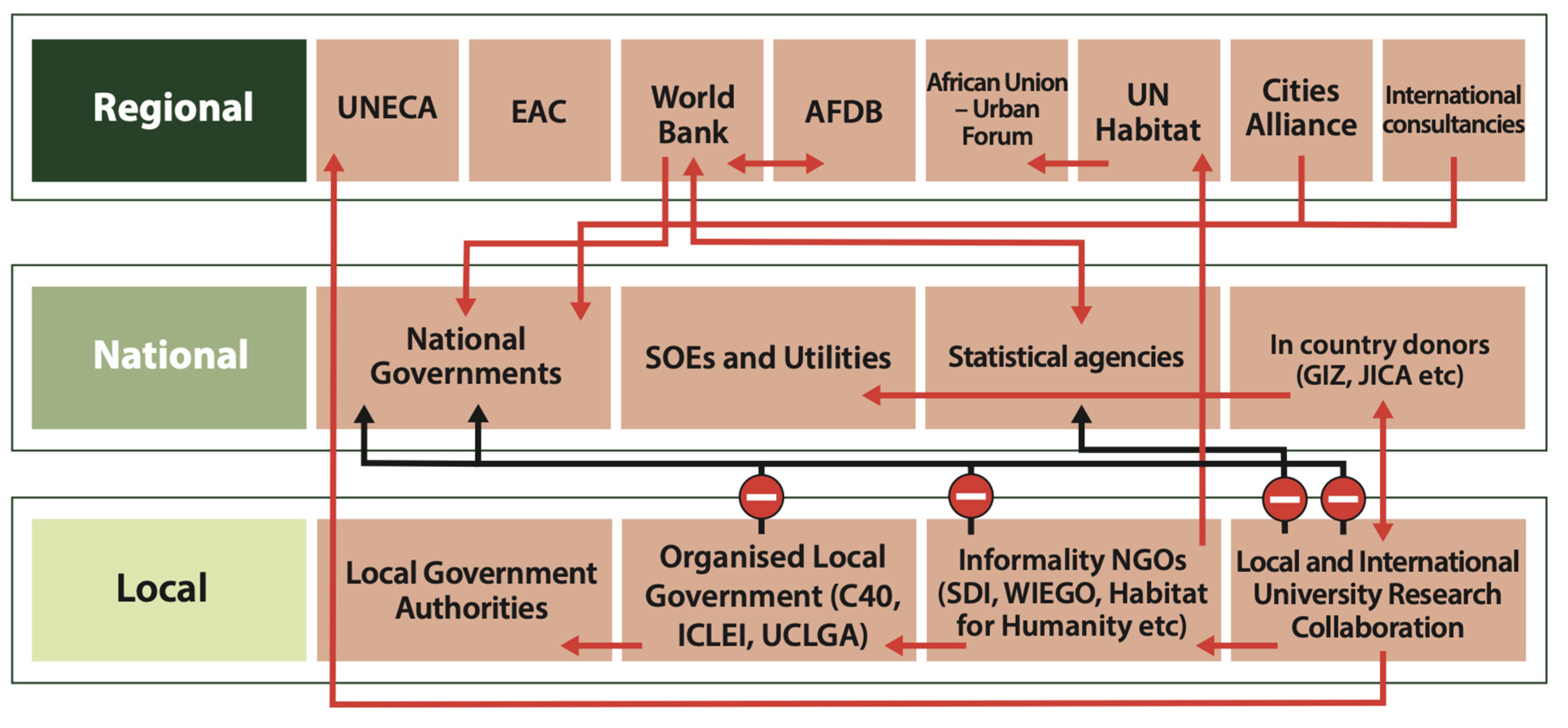
Disclaimer/Publisher’s Note: The statements, opinions and data contained in all publications are solely those of the individual author(s) and contributor(s) and not of MDPI and/or the editor(s). MDPI and/or the editor(s) disclaim responsibility for any injury to people or property resulting from any ideas, methods, instructions or products referred to in the content. |
© 2025 by the authors. Licensee MDPI, Basel, Switzerland. This article is an open access article distributed under the terms and conditions of the Creative Commons Attribution (CC BY) license (http://creativecommons.org/licenses/by/4.0/).
Copyright: This open access article is published under a Creative Commons CC BY 4.0 license, which permit the free download, distribution, and reuse, provided that the author and preprint are cited in any reuse.


