
Submitted:
01 July 2025
Posted:
02 July 2025
You are already at the latest version
Abstract
Hydrogen energy, as an important green energy source, is a crucial guarantee for achieving carbon neutrality and peak carbon emissions. The anion exchange membrane electrolysis cell combines the advantages of alkaline electrolysis cell and proton exchange membrane electrolysis cell, and can use non precious metal catalysts combined with renewable energy, which is expected to break through the bottleneck of high production cost of green hydrogen. Anion exchange membrane electrolysis of water for hydrogen production combines the advantages of alkaline electrolysis of water and proton exchange membrane electrolysis of water for hydrogen production. It has the characteristics of high electrolysis efficiency, fast response rates, and low cost, and is considered one of the most promising renewable green energy hydrogen production technologies at present. Anion exchange membrane (AEM) is a key component that provides OH– ion conduction and blocks gas crossover, which directly affects the performance and service life of the anion exchange membrane electrolysis water system. However, current AEM membranes face issues of low ion conductivity and poor stability. This review introduces the role of AEM in electrolytic cells, the performance requirements and evaluation parameters that high-performance AEM should meet, and focuses on the transport mechanism and influencing factors of OH– in AEM. Furthermore, this review provides an overview of the structural composition of AEM, as well as common cationic groups and polymer backbone types; The degradation mechanism of different cationic groups and the characteristics of polymer main chains were elaborated, with a focus on the strategies for designing the stability of cationic functional groups, the methods for modifying and preparing polymer main chains, and the performance of AEM. Finally, the future challenges and potential research directions of AEM membranes were discussed, and it was pointed out that high-performance AEM membranes that meet practical application needs should be constructed and prepared through strategies such as crosslinking, block copolymerization, side chain grafting, and composite membrane technology based on the design of alkali resistant and stable AEM membranes, providing reference and guidance for the further development of AEM.
Keywords:
hydrogen production by green electricity
; anion exchange membrane water electrolysis
; ionic conduction mechanism
; ion conductivity
1. Introduction
With the rapid consumption of global fossil fuels, the greenhouse effect and environmental pollution are becoming increasingly severe, and reducing dependence on carbon-based fossil fuels is facing unprecedented urgency. However, due to the intermittent and regional nature of green renewable energy sources such as solar, wind, and tidal energy, large-scale energy storage and transmission capabilities are required. Hydrogen has the advantages of high energy density, zero carbon emissions, and non-toxicity, making it an ideal energy carrier for building a global renewable energy system. However, as a secondary energy source, over 95% of H2 in the world is produced through high-temperature reforming of natural gas [1,2,3,4,5]. This is a non-renewable high carbon emission process that produces at least 5.5 kg CO2 for every 1.0 kg of H2 produced [3,4,5,6]. Electrolyzing water to produce hydrogen not only solves the intermittent problem of solar and wind energy, but also improves the utilization rate of renewable energy, making it one of the most promising solutions currently available.
According to the type of membrane used, the current hydrogen production technology through electrolysis of water can be divided into alkaline water electrolysis (AWE) technology, proton exchange membrane water electrolysis (PEMWE) technology, and anion exchange membrane water electrolysis (AEMWE) technology (Table 1) [7,8,9]. AWE technology uses nickel-based alloys as electrodes, KOH solution as electrolytes, and polyphenylene sulfide woven fabric as separators, which has the advantages of low cost and high technological maturity. However, the energy efficiency of this technology is low (70% to 80%), the purity of hydrogen production is low (> 99.5%, 3 MPa), the current density is low, and the dynamic response capability is poor, resulting in poor compatibility with renewable energy [10,11,12,13,14,15]. PEMWE technology uses perfluorosulfonic acid proton exchange membranes (such as Nafion membranes) as separators, reducing ion conductivity resistance and improving electrolysis efficiency, and can operate at high current densities (> 2 A/cm2). At the same time, PEMWE also has fast dynamic response capability and high compatibility with renewable energy [16,17,18,19,20,21]. However, PEMWE requires the use of precious metal electrocatalysts, such as platinum-based electrocatalysts for hydrogen evolution reactions at the cathode and iridium or ruthenium based electrocatalysts for oxygen evolution reactions at the anode [22,23,24,25,26,27]. Moreover, the higher the working current density, the higher the required loading of precious metal catalysts [26,27,28]. Due to the influence of device costs such as precious metal catalysts, Nafion membranes, and porous transport layers, the cost of PEMWE stacks is higher than that of AW E stacks, which seriously hinders the large-scale application of PEMWE. AEMWE technology combines the advantages of AWE and PEMWE while overcoming their limitations [27,28,29,30,31,32,33]. AEMWE uses anion exchange membrane (AEM) as the membrane, which can achieve high working current density and high electrolysis efficiency (> 90%), with the ability to respond quickly and minimize the mechanical compression requirements for storing hydrogen gas. Meanwhile, this technology can operate in weakly alkaline environments and can use low-cost and resource rich metals such as nickel as electrocatalysts. The characteristics possessed by AEMWE have shown great application prospects in large-scale sustainable hydrogen production, and have also attracted the attention and investment of more scholars and entrepreneurs [38,39,40,41]. However, the main challenges currently faced by AEMWE technology are the poor stability and low ionic conductivity of AEM in alkaline environments [39]. Therefore, how to develop high-performance AEM is crucial for fully leveraging the application of AEMWE technology in large-scale, safe, efficient, and green ecological hydrogen production.
This work provides a review of the research progress of AEM, first briefly outlining the composition, working mechanism, and performance requirements of AEM. Secondly, the types of AEM cationic groups, degradation mechanisms, and modification design strategies were discussed; The types, structural design, and modification preparation methods of polymer main chain structures were also discussed. Finally, the challenges faced by current AEM research were summarized, and potential future research directions were proposed to provide reference for future researchers.
2. Working Principle and Performance Requirements of Anion Exchange Membrane
2.1. Working Principle of Anion Exchange Membrane
AEM is one of the main core components of AEMWE electrolytic cells. In the electrode reaction process, in addition to separating the cathode and anode, blocking electron shuttle and gas diffusion, AEM mainly undertakes the task of transferring OH– anions and water molecules. The transport mechanism of OH– in AEM is generally believed to be similar to the proton conduction mechanism in proton exchange membranes (PEM), mainly including Grothuss mechanism, diffusion and migration mechanism, and convection mechanism (Figure 1) [10]. The Grotes mechanism involves the formation of hydrated OH– ion clusters through hydrogen bonding between OH– and water molecules in a solution. When in close proximity to surrounding water molecules, hydrogen bonding breaks and rearranges, and then continues to form hydrated OH– ion clusters with other water molecules. As hydrogen bonds continue to form and break, OH– completes its transport in the electrolyte. The diffusion and migration mechanism is the movement of OH– in aqueous solutions driven by concentration/potential gradients. The convection mechanism is due to the binding of OH– ions with water molecules during transport, causing directional movement of water molecules and creating a water pressure gradient, resulting in convection phenomena. Under actual operating conditions, the OH– transport behavior is the result of multiple transport mechanisms working together. As for which transport mechanism dominates, it is not only highly related to the molecular structure within the AEM ion conduction channel, but also largely depends on the amount of water in the membrane or the hydration number (λ) of the ion groups [11,40,41,42,43]. Meanwhile, it is also influenced by experimental conditions such as temperature, relative humidity, and pressure.
Scheme 1.
Representation of the membrane electrode assembly (MEA) of an anion exchange membrane fuel cell (AEMFC), showing the operating principle.
Scheme 1.
Representation of the membrane electrode assembly (MEA) of an anion exchange membrane fuel cell (AEMFC), showing the operating principle.

Figure 1.
Schematic illustration of OH− transport mechanisms in anion exchange membrane (AEM)[10].
Figure 1.
Schematic illustration of OH− transport mechanisms in anion exchange membrane (AEM)[10].
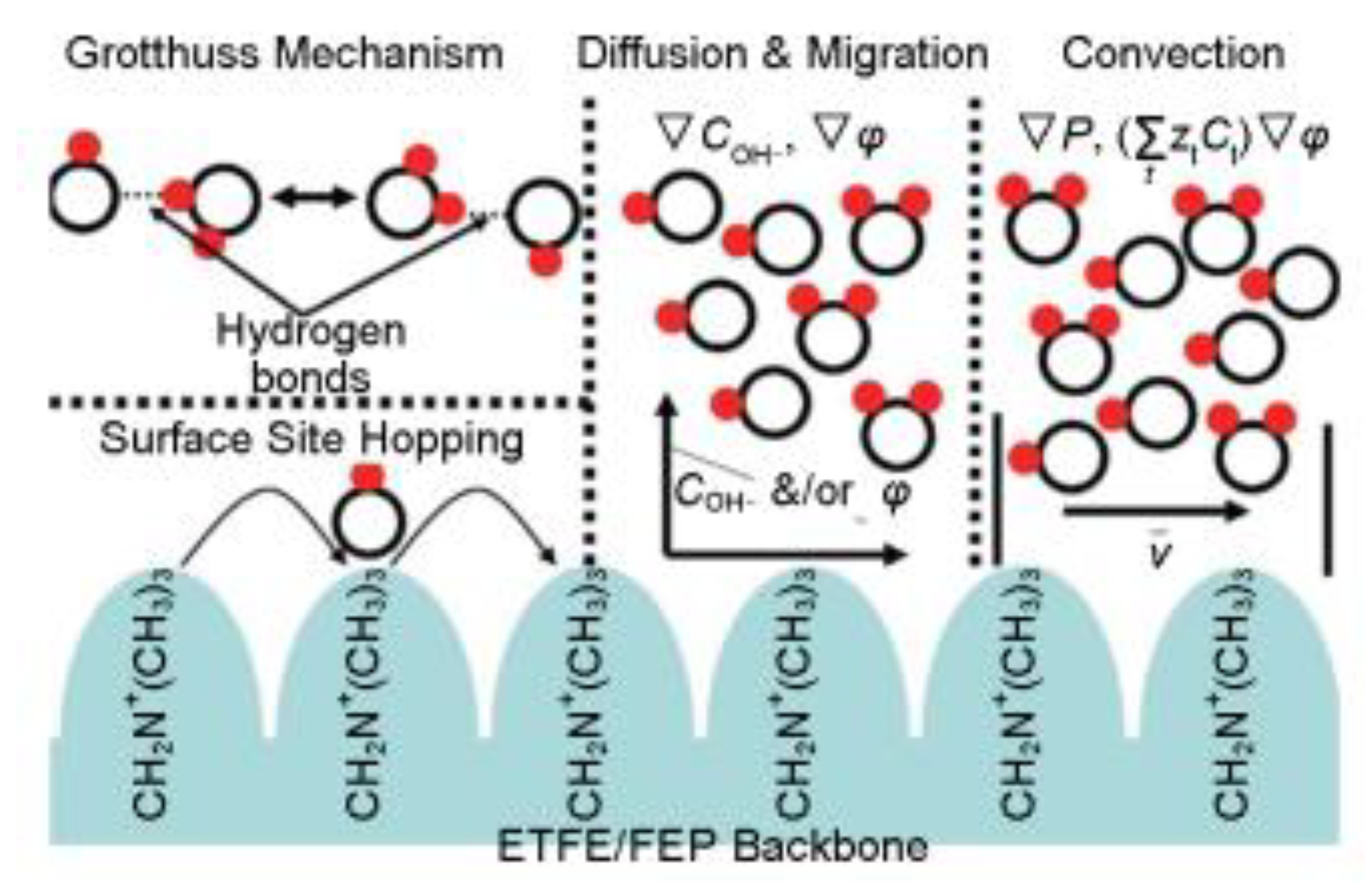
In order to further clarify the transport mechanism of OH– in AEM, researchers have employed various technical methods to explore the kinetic process of OH– in AEM. For example, Chen et al. [11] constructed a multi-scale reaction molecular dynamics model using polyvinyl benzyl trimethylammonium (PVBTMA) as the research object. From the perspective of theoretical chemistry, the solvation structure and ion transport kinetics of OH– ions in PVBTMA membranes were studied. The research results indicate that in the fully hydrated state of PVBTMA, OH– is mainly transported from the overlapping regions between PVBTMA side chains, indicating that the transport mechanism plays a dominant role. Furthermore, it was confirmed that the activation energy of OH– diffusion in AEM is greater than that of proton diffusion in PEM, and increasing the temperature is more conducive to the transport of OH– in AEM. Dong et al. [12] investigated the OH– transport mechanism in non-block polymer poly (p-phenylene ether) AEM using active and inactive polarized molecular dynamics simulations. Research has shown that OH– mainly shuttles along sub nanometer wide water channels, and its mobility is significantly affected by “bottlenecks (narrow nodes)”. When OH– is transported through these narrow nodes, if it is a transport mechanism, partial dehydration of OH– is required, which requires higher activation energy and is thermodynamically disadvantageous; If it is the Grotes jump mechanism, OH– moves from one side of the bottleneck to the other, the loss of hydration structure can be ignored, and the activation energy is very small. The balance between the size distribution of the rich water area and the bottleneck is a key factor determining the dominant role of the transport mechanism or Grotes mechanism. Foglia et al. [13] used quasi-elastic neutron scattering technology to investigate the water, polymer relaxation, and OH– diffusion kinetics in commercially available Fumatech FAD-55 AEM, as well as their synergistic effects (Figure 2). Research has shown that water is unevenly distributed between the cathode and anode of an electrolytic cell, and the transport mechanism of OH– is largely determined by λ. Under the condition of complete hydration (λ = 13), the OH– shuttle process is mainly dominated by the transport mechanism, with the Grotes mechanism accounting for about 15% of the entire process, and the self-diffusion coefficient of moving particles in the solution is equivalent to the total diffusion coefficient of the membrane. When the degree of hydration decreases to λ = 7, due to the interaction between water and the polymer matrix, the self-diffusion coefficient is about 50% slower than when λ = 13. When λ ≤ 4 (at high current densities, λ can decrease to 1), the transport behavior of OH– mainly follows the Grotes mechanism. These research results not only contribute to a deeper understanding of the transport behavior of OH– in AEMs, but also provide guidance for the structural design of high-performance AEMs.
2.2. Performance Requirements for Anion Exchange Membranes
The electrolytic performance of AEMWE largely depends on the performance of AEM, therefore high-performance AEM should meet the following conditions [43,44,45,46,47]: (1) High OH− ion conductivity helps to reduce the ohmic resistance of the electrolytic cell and improve battery efficiency; (2) Good alkali resistance stability ensures that the membrane material can operate for a long time without degradation under high temperature and strong alkali conditions; (3) Excellent dimensional stability, thermal stability, and mechanical strength enable the membrane to withstand higher pressure differentials; (4) Good gas barrier to avoid cross permeation of H2 and O2, which can cause battery performance degradation and safety issues; (5) Appropriate water absorption and swelling degree ensure the formation of continuous hydroxide ion transfer channels within the membrane, avoiding excessive swelling and loss of dimensional stability caused by excessive water content; (6) The cost of membrane raw materials is low, easy to process, and easy to prepare on a large scale. Among all the performance requirements mentioned above, stability is a prerequisite for AEM applications, and sufficiently high ion conductivity is the key to achieving high electrolysis performance [45,47,48,49,50,51].
The main parameters for evaluating AEM performance include ion exchange capacity (IEC), water absorption, swelling ratio λ, Ionic conductivity, alkali stability, H2/O2 gas permeability, and single-cell testing. Introducing more cationic groups into the AEM main chain is beneficial for improving IEC and ionic conductivity, but it can lead to an increase in water absorption and swelling ratio, affecting the size and mechanical stability of the membrane; highly stable cationic groups and polymer main chains can enhance the alkali stability of the membrane.
3. Research Progress on Anion Exchange Membranes
AEM is usually composed of two parts: cationic groups and polymer main chains. Cationic groups are functional groups connected to the polymer main chain, responsible for the conduction of OH− and determining the ion conductivity, water absorption, and swelling rate of AEM; The polymer backbone, as the main supporting material of the membrane, determines the dimensional stability and mechanical strength of the membrane [14]. Common cationic groups include quaternary ammonium cations, imidazole cations, quaternary guanidine cations, quaternary cations, and metal cations; The main chains of polymers include polyarylethers (such as polyphenylene ether, polysulfone, polyetheretherketone, etc.), and polyaryls without ether oxygen bonds (such as polyphenylene, polybenzimidazole, etc.). Arylimidazoles, polyfluorenes, etc.), polyolefins (such as polyethylene and cyclic olefin polymers), etc. (Figure 3) [15]. In recent years, researchers have done a lot of research work to develop high-performance AEMs. The main research progress of AEMs is explained below from the design of cationic groups and polymer backbones.
3.1. Cationic Group Structure Design
3.1.1. Quaternary Ammonium Cation
Quaternary ammonium cations have the advantages of simple preparation, low cost, and high ionic conductivity, making them the most widely used cations in AEM. However, quaternary ammonium cations are prone to degradation in high-temperature and high alkaline environments, and the main degradation pathways are shown in Figure 4 [16]: (1) α - C is easily attacked by OH−, undergoes nucleophilic substitution reactions, and degrades into tertiary amines and alcohol by-products; (2) β - H is attacked by OH− and undergoes. Hofmann eliminates the reaction and degrades it into olefins and tertiary amine by-products; (3) After being attacked by OH−, α - H forms an N-ylide intermediate, which then undergoes rearrangement (Sommelet Hauser and/or Stevens rearrangement) to produce more stable tertiary amines. In order to improve the alkali stability of quaternary ammonium cations, researchers usually introduce substituents with greater steric hindrance on the quaternary ammonium cations, which can effectively reduce the attack of OH− and improve the alkali stability of AEM. For example, Li et al. [17] introduced alkyl chains of different lengths onto quaternary ammonium ions using the Menshutkin reaction, which increased the steric hindrance effect around the quaternary ammonium ions, effectively weakened the attack of OH−, and inhibited the Hofmann elimination reaction. After soaking in 80 °C and 1 mol/L NaOH for 2000 h, the series of membranes still maintained acceptable mechanical properties. Marino and Kreuer [18] further investigated the alkali stability of quaternary ammonium cations containing different types of substituents at 160 °C and 10 mol/L NaOH solution. The results indicate that the stability of quaternary ammonium ions modified with electron donating groups is higher than that of quaternary ammonium ions modified with electron withdrawing groups. Quaternary ammonium ions with benzyl groups are more susceptible to attack by nucleophiles and have poorer stability. Meanwhile, heterocyclic substituted quaternary ammonium cationic groups such as N, N-dimethylpiperidine (hexagonal ring) and N, N-dimethylpyrrolidine (pentagonal ring) exhibit higher stability in alkaline solutions. Zhang et al. [19] also obtained similar results by combining experiments and density functional theory (DFT) calculations, that is, the contribution of substituents to the stability of quaternary ammonium cations from high to low is: electron donating groups, unsubstituted groups, and electron withdrawing groups. In addition, if β - C does not contain hydrogen atoms, it can effectively avoid the occurrence of Hofmann elimination reaction, which is beneficial for the stability of quaternary ammonium cation groups. For example, Wu et al. [20] prepared a bis quaternary ammonium cationic group AEM without β - H through Cu (I) catalyzed azide alkynyl click chemistry reaction. After being immersed in a 2 mol/L NaOH solution (80 °C) for 480 h, the membrane exhibited excellent alkaline stability and high conductivity retention rate ( > 92%).
3.1.2. Imidazole Type Cations
The imidazole cationic group has attracted widespread attention from researchers due to its simple synthesis method and strong structural designability [21]. Under alkaline conditions, imidazole cations are usually degraded through four pathways, which are closely related to the properties of the substituents (Figure 5) [22]: (1) When the C2 position is H, it is easy to degrade through ring opening reactions; (2) When H is present at positions C4 and C5, degradation occurs through heterocyclic deprotonation reaction; (3) When methyl or benzyl groups are attached to N1 and N3, degradation occurs through nucleophilic substitution reaction mechanism; (4) When N1 is benzyl, it is degraded through deprotonation reaction with substituents. Based on the degradation mechanism of imidazole cations, researchers can effectively prevent the reaction between reactive ions in solution and imidazole cations by adding suitable substituents or modifying functional groups at different sites of imidazole cations, thereby enhancing the alkali stability of imidazole cations. Lin et al. [23] studied the effect of introducing methyl, isopropyl, and phenyl groups at the C2 position on the stability of imidazole cations using NMR. The results indicate that imidazole cations with substituents at the C2 position exhibit better chemical stability than those without substituents. This may be due to the steric hindrance effect and γ - π hyperconjugation effect of the substituted imidazole cation, which inhibits the attack of OH−. The results of DFT simulation calculations indicate that imidazole cations with the lowest unoccupied molecular orbital energy level have high chemical stability. Wang et al. [24] studied the effect of introducing methyl groups at C4 and C5 positions on imidazole cations. Due to the effects of electron supply and steric hindrance, the ionic conductivity and stability of imidazole cations have been improved. In addition to C4 and C5 substitution of imidazole rings, the alkali stability of imidazole cations may also be affected by N3 substitution. By introducing alkyl substituents at the N3 position, such as Methyl, ethyl, and isopropyl groups were studied by Gu et al. [25] using DFT simulations to investigate the effects of different alkyl groups on imidazole cations. Compared with traditional quaternary ammonium cations, imidazole cations substituted at the N3 position exhibit higher chemical stability, with isopropyl substituted imidazole cations showing the best stability and displaying the highest lowest unoccupied molecular orbital energy level. This is related to the increase in electron density of imidazole cations caused by the formation of hyperconjugation and electron donating effect after alkyl substitution, as well as the increase in steric hindrance of imidazole cations. Fan et al. [26] reported several imidazole cationic compounds with higher steric hindrance and conducted half-life tests in a 3 mol/L NaOD/D2O/CD3OD solution at 80 °C. The results showed that the half-lives of four highly hindered imidazole cations were all greater than 10000 h, and their stability was much higher than that of common quaternary ammonium cations and small-hindered imidazole cations. Although introducing substituents on imidazole cations can improve their stability in high-temperature alkaline solutions, the preparation process of this modification is complex and can affect the film-forming ability and mechanical strength of AEM, which has certain limitations.
3.1.3. Quaternary Guanidine Cation
Quaternary guanidine cation was first applied in AEM in 2010 [27]. Research has found that under alkaline conditions, quaternary guanidine cations are mainly degraded through nucleophilic addition elimination (Figure 6), where the central C atom is attacked by OH− and undergoes an addition reaction to form an intermediate, followed by protonation of the N atom and elimination reaction to form degradation products urea and amine [28]. Therefore, introducing different substituents and increasing steric hindrance effect can enhance the stability of quaternary guanidine cations. Xue et al. [28] used 1H NMR to study the alkaline stability of a series of guanidine cations containing different N-substituted groups. They found that the contribution order of substituents to the stability of guanidine cations was: isopropyl > ethyl > benzyl > phenyl, ethyl > methyl > cyclobutyl. Quaternary guanidine cationic polysulfone AEM with this functionalization was prepared by Suzuki Miyaura reaction. After soaking the membrane in a 1 mol/L NaOH solution at 60 °C for 30 days, no degradation was observed, indicating that the quaternary guanidine cation AEM with large steric hindrance has excellent alkali stability. Subsequently, the author used brominated poly (2,6-dimethyl) p-phenylene oxide and biguanide crosslinking agent to prepare AEM containing biguanide cation through Menshutkin reaction. The test results indicate that the AEM crosslinked with biguanide also has good tolerance to alkaline solutions and can effectively control the swelling of the membrane [27].
3.1.4. Quaternary Cations
As a member of the same group of elements as N, P element has similar chemical properties to N element, so the quaternary cation AEM has long been of interest to researchers [29]. However, under alkaline conditions, quaternary cations are prone to undergo the phosphorite reaction, leading to the decay of AEM (Figure 7) [30]. In order to solve the problem of poor stability, researchers have conducted modification studies on quaternary cations using electron donating groups or large steric hindrance groups. For example, Noonan et al. [31] prepared AEMs with large steric hindrance of quaternary cations. After soaking the AEM in a 15 mol/L KOH solution at 22 °C for 20 weeks, there was no significant decrease in the ion conductivity of the membrane. After soaking in a 1 mol/L KOH solution at 80 °C for 3 days, the ion conductivity of AEM decreased from 22 mS/cm to 18 mS/cm, but no decrease was observed in the ion conductivity of the membrane after 19 days. Zhang et al. [32] prepared AEM by attaching 2, 4, 6-trimethoxyphenyl to quaternary cations. The membrane was immersed in a 1 mol/L KOH solution at room temperature for 30 days, with an ion conductivity of 27 mS/cm. After soaking in a 1 mol/L KOH/(CD3OD+D2O) solution at 80 °C for 5000 h, the ion conductivity of the membrane decreased by about 20%, demonstrating good alkali stability.
3.1.5. Metal Cations
Due to the absence of nucleophilic substitution of organic cation groups, Hofmann elimination reaction, and Yehead reaction degradation pathways in metal cations, researchers have studied AEM based on metal-based cations [33]. The metal cations formed by transition metals and complexes, such as ruthenium triphenylpyridine [34], nickel triphenylpyridine [35], and cobalt ferrocene [36], exhibit excellent alkaline stability and ionic conductivity. Liu et al. [37] reported a ferrocene functionalized AEM, which showed no significant decrease in ion conductivity after soaking in a 1 mol/L NaOH solution at 95 °C for 4320 h. However, considering the redox stability of transition metal cations, metal cations formed by the coordination of main group metals and ligands are applied in AEM. Chen et al. [38] prepared AEM containing sodium metal cations based on Na+ and ligand benzo-15-crown-5. After soaking the membrane in 4 mol/L NaOH at 60 °C for 10 days, the decay rate of ion conductivity was only 2.5%, demonstrating good alkali stability. Zhang et al. [39] studied AEM based on ligand [2.2.2] ether complexation with metal Ba2+. The test results showed that the AEM did not show significant degradation after soaking in a 15 mol/L KOH strong alkaline solution at 60 °C for 1500 h, demonstrating excellent alkaline stability. However, due to the complex preparation process, difficult grafting, and high cost of metal cations, their application in AEM is limited.
3.2. Polymer Main Chain Design
3.2.1. Polyarylether Based Main Chain
The main chain of polyarylene ether polymers has strong hydrophobicity, which can reduce the probability of degradation when in contact with OH− and exhibit strong alkali stability. This type of polymer backbone also has the advantages of excellent thermal stability, good mechanical properties, and low preparation cost, and has received widespread attention from AEM researchers. At present, the strategies for modifying the main chain of poly (arylene ether) include cationic functionalization, crosslinking, copolymerization, etc.
Due to the presence of benzene rings and ether bonds on the main chains of polyphenylene ether, polyether sulfone, and polyether ether ketone, it is easy to prepare AEMs containing different cations by introducing halide sites through alkylating reagents. As Zhu et al. [40] used the bromination reagent N-bromosuccinimide to undergo a free radical reaction with polyphenylene ether, introducing bromination sites at the benzyl group. Then, a series of quaternary ammonium functionalized polyphenylene ether AEMs were prepared by Menshutkin reaction with trimethylamine or imidazole. Liu and Wang [41] prepared a quaternary ammonium ion AEM membrane based on polyether sulfone by reacting the phenyl ring of polyether sulfone with triethylamine and introducing a quaternary ammonium cation. They found that the degree of chloromethylation was closely related to the physical and chemical properties of the membrane.
The use of crosslinking agents to crosslink the main chain of polyarylether polymers through side chains can effectively improve the water absorption, ion conductivity, dimensional stability, and mechanical strength of AEM. However, excessive crosslinking can lead to a decrease in membrane flexibility. Bai et al. [42] introduced N, N-dimethylallylamine and N-allylmethylamine containing unsaturated double bonds as side chains onto the main chain of polysulfone, and then prepared polysulfone based AEM by heating induced crosslinking. The research results confirm that the membrane not only improves mechanical/dimensional stability, but also enhances ion conductivity. Sung et al. [43] reported a series of hydrophilic crosslinking agents such as dimethylaminoethyl ether.
Block copolymerization is a new method that can effectively improve ion conductivity. By connecting polyphenylene ether, polyether sulfone, and polyether ether ketone with other monomers through chemical bonds to form block copolymers, the ion conductivity and dimensional stability of the membrane can be effectively regulated. Choi et al. [45] synthesized a copolymer AEM membrane using polyphenylene ether and hydrogenated styrene butadiene, and investigated the effect of triazole on the membrane. The results of X-ray diffraction and atomic force microscopy show that compared with the copolymer film without triazoles, the copolymer AEM film prepared with triazoles has better OH− conductivity, mechanical stability, and alkali resistance due to rapid phase separation, and exhibits higher current density at 1.8 V. These changes may be related to the strong hydrogen bonding between triazoles and water/OH− Within the block copolymer, due to the presence of hydrophilic/hydrophobic microphase separation morphology, ion transport channels can be formed, which is beneficial for improving ion conductivity.
Preparation of quaternized AEM based on polyphenylene ether crosslinking (Figure 8). The test results showed that the series of membranes achieved the highest ion conductivity of 131.96 mS/cm in 80 °C water, and the peak power density of the single cell was 444 mW/cm2 (677 mA)/cm2@0.6 V) However, while hydrophilic crosslinking agents provide high water absorption capacity to improve the conductivity of AEM, they also lead to the formation of polymer film crystals, reducing the alkali stability of AEM. In order to further investigate the effect of crosslinking agent content on membrane properties, Kumari et al. [44] used ethylene glycol (PEG) as a crosslinking agent to prepare quaternized polyetherketone based (QPPEEK) AEMs with different crosslinking agent contents. The research results show that the mechanical properties and ion conductivity of the membrane can be adjusted by the mass fraction of QPPEEK and PEG components. When the mass ratio of QPPEEK to PEG is 80:20, the membrane exhibits the best performance with an ion conductivity of 102 mS/cm (80 °C) and a tensile strength of 13.7 MPa. After being treated in a 1 mol/L KOH solution at 80 °C for 400 h, the AEM still maintained 85% of its initial conductivity.
Figure 8.
Structure of the AEM crosslinked with polyphenylene oxide [43].
Figure 8.
Structure of the AEM crosslinked with polyphenylene oxide [43].
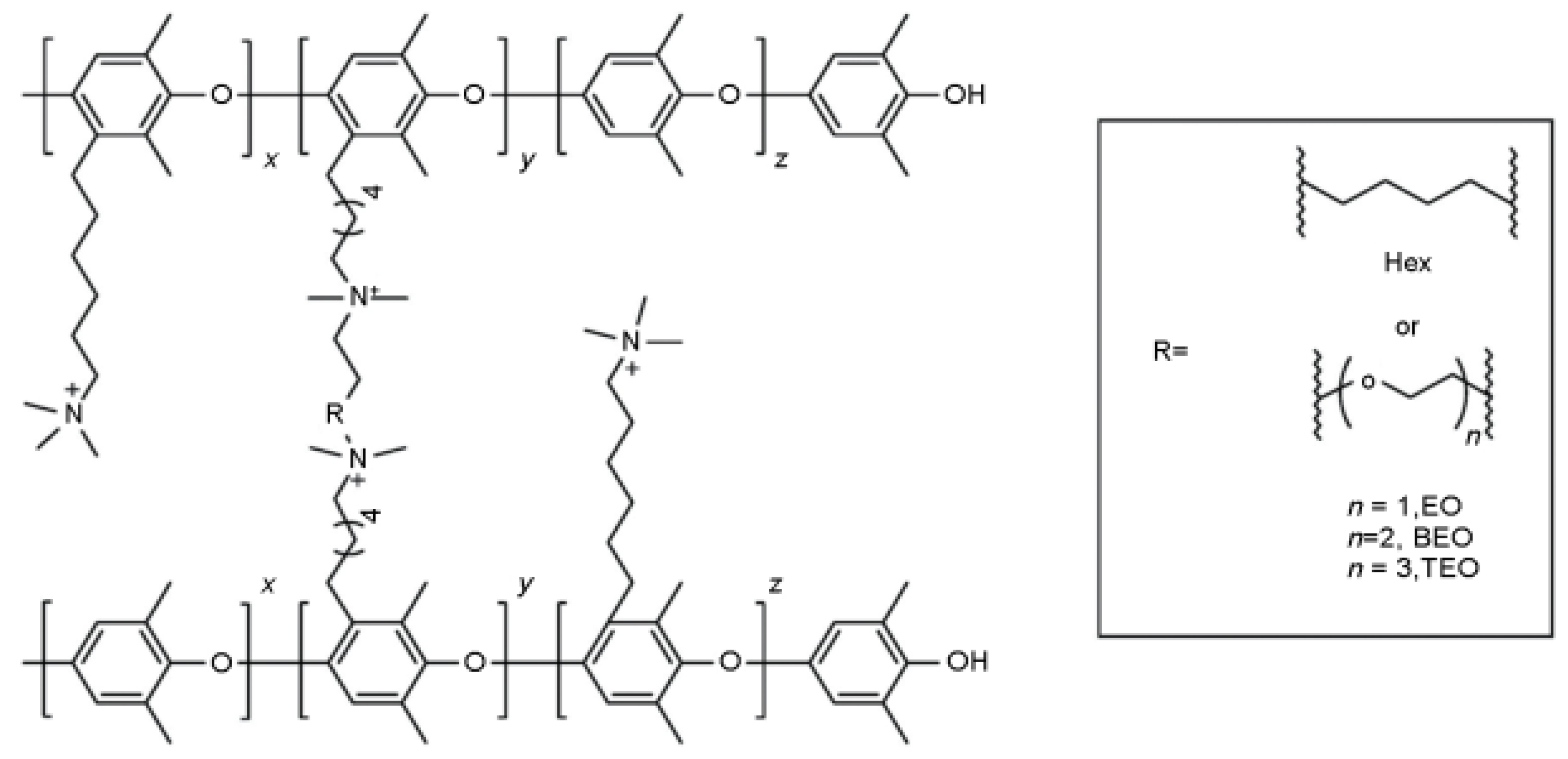
Figure 9.
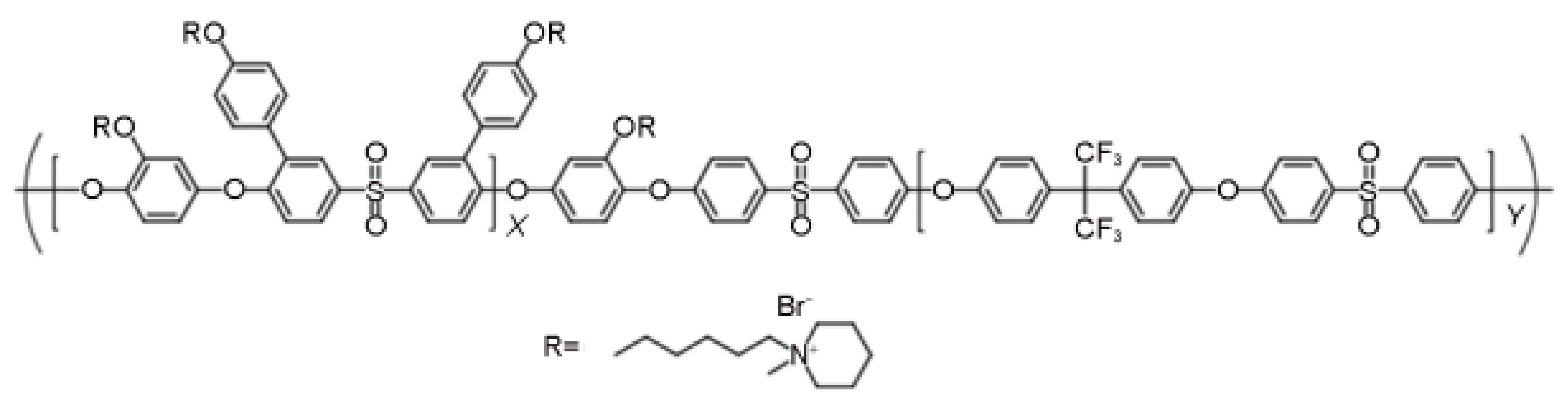
The structure of multi-block poly (ether sulfone) AEM [46].
Figure 9.
The structure of multi-block poly (ether sulfone) AEM [46].
Although polyarylether based main chains exhibit excellent performance in terms of preparation cost, alkali/thermal stability, and mechanical strength, and some of their properties can be further improved through modification, the presence of aromatic ether bonds in the polymer skeleton makes it easy for the main chain to degrade under alkaline conditions when attacked by OH−, resulting in a decrease in mechanical strength [47]. In addition, if the main chain of polyaryletheric ether contains electron withdrawing cationic groups, it can accelerate the degradation of the main chain [48]. Therefore, researchers have begun to focus on the development of ether oxygen bond free polymer main chains.
3.2.2. Non Ether Oxygen Bonded Aromatic Main Chain
The main chain of aromatic polymers without ether oxygen bonds has the advantages of good alkali stability, high structural rigidity, excellent dimensional stability, and high thermal stability. Polymers containing non-ether oxygen bonded aromatic main chains mainly include polyphenylene, polybenzimidazole, polyarylimidazole, and polyfluoranthene. Park et al. [49] prepared quaternized polyphenyl AEM via Diels Alder reaction and investigated the effect of different side chain lengths on alkali stability. The research results indicate that quaternary ammonium polyphenyl AEM, which is separated from the main chain by 6 methylene groups, exhibits better alkali stability in a 4 mol/L KOH solution at 80 °C.
Sana et al. [50] converted three different types of polybenzimidazole polymers into their iodide forms through the reaction of imidazole ring and alkyl iodide reagents (such as methyl iodide, butyl iodide, and isobutyl iodide), and then immersed them in KOH solution to obtain polybenzimidazole based AEM (Figure 10). The effects of different alkyl side chains on the IEC, ionic conductivity, thermal, mechanical, and alkaline stability of the obtained polybenzimidazole based AEM membrane were investigated. finding. This indicates that AEM with alkyl side chains has good alkaline stability and higher ion conductivity. Among them, the AEM membrane with butyl iodide as the alkyl side linking branch showed the highest ion conductivity of 128.6 mS/cm at a temperature of 80 °C. All polybenzimidazole based AEMs containing isobutyl and butyl side chains exhibit excellent alkali stability in a 5 mol/L KOH aqueous solution at 60 °C. This is mainly due to the presence of alkyl side chains, which prevent OH− from attacking the pyridine and imidazole ion groups.
With the use of superacid catalyzed condensation reactions for the preparation of ether free aromatic AEMs, it has received widespread attention from researchers. This reaction is catalyzed by superacids, where the carbonyl group is protonated and then used as an electrophilic reagent to attack the aromatic ring, leading to alkylation and the formation of ether free aromatic polymers. Chen et al. [51] synthesized a series of poly (fluorene co terphenyl N, N’- dimethylpiperidinium) PFTP-x copolymers using superacid catalyzed condensation reaction at -3 °C, with AEM (where x is the molar ratio of fluorenylpiperidine segments in the copolymer). PFTP-x membrane not only has a simple synthesis process, but also has excellent ion conductivity, mechanical/dimensional stability, dimensional stability, and excellent film-forming ability, among which PFTP-13 has the best comprehensive performance. The mechanical/dimensional stability of PFTP-13 AEM is excellent, with a tensile strength of up to 84.6 MPa, a Young’s modulus of 1580 MPa, and a fracture elongation of only 25.6%. It is also easy to produce films with a thickness of 7-20 μm. After soaking in 1 mol/L NaOH at 80 °C for 2000 h, the PFTP-13 membrane still maintains transparency and good mechanical toughness, with a loss rate of only 3% of the ion conducting group piperidinium, and its ion conductivity is as high as 208 mS/cm. Further research results indicate that the fluorene chain segment can improve the water channel and microphase separation morphology of PFTP-x, which is beneficial for enhancing the size stability and conductivity of the membrane. Hu et al. [52] prepared a series of poly (arylpyridine) (PTP) materials as AEMs for electrolytic cells using triphenylene, N-methyl-4-piperidone, and indigo carmine as raw materials, catalyzed by superacid trifluoromethanesulfonic acid (TFSA) and quaternized with methyl iodide (Figure 11). The polymer skeleton of this PTP material exhibits excellent alkali stability and strong mechanical properties (tensile strength reaches 29.2-36.5 MPa). The highest ion conductivity of PTP-90 membrane material obtained at 80 °C was 128.9 mS/cm; After treatment in a 1 mol/L NaOH solution at 80 °C for 934 h, the ion conductivity retention rate was 60%. Using an electrolytic cell equipped with PTP-90 membrane for testing, it was confirmed that the current density of the battery at 55 °C and 75 °C reached 910 mA/cm2 and 1000 mA/cm2, respectively, at a voltage of 2.2 V. Further durability testing revealed significant chemical degradation of the PTP-90 membrane after continuous electrolysis at 400 mA/cm2 and 55 °C for 120 h. This is mainly related to the degradation of quaternary ammonium cationic groups through Hofmann elimination reaction and nucleophilic substitution reaction, as well as the possible acceleration of the degradation of cationic groups in AEM by the working environment of the electrolytic cell. From this, it can be seen that further research is needed on the durability of AEM in electrolytic cells under actual operating conditions.
With the use of superacid catalyzed condensation reactions for the preparation of ether free aromatic AEMs, it has received widespread attention from researchers. This reaction is catalyzed by superacids, where the carbonyl group is protonated and then used as an electrophilic reagent to attack the aromatic ring, leading to alkylation and the formation of ether free aromatic polymers.
4. Conclusions and Prospect
AEMWE technology combines the advantages of AWE and PEMWE technologies, such as lower catalyst costs, high working current density, and wider load operating range, and has great application prospects in large-scale green electrolysis of water for hydrogen production. As one of the core components of the AEMWE electrolysis water device, high-performance AEM, which has high OH− conductivity, good alkali stability, excellent chemical and mechanical stability, good gas barrier performance, and low preparation cost, is the key to achieving efficient hydrogen production and long-term operation of the electrolysis water device. This work provides an overview of recent studies by domestic and foreign researchers on the transport mechanism of OH−, as well as the degradation of cationic groups and main chains; summarized the modification design of different cation types and polymer skeleton structures, as well as their application progress in the field of AEMWE, providing insights for future researchers. At present, significant progress has been made in the research of AEM materials, but there are still many challenges to overcome in order to achieve the industrial application of AEM membranes in AEMWE:
- (1)
- The issue of balancing OH− conductivity with mechanical/dimensional stability. Compared to H+, OH− has a larger size and lower diffusion rate, with a diffusion rate only about half that of H+. This inherent difference itself determines that preparing AEM with high ion conductivity is more challenging compared to PEM membranes. Secondly, when AEM operates in an air environment, OH− may react with CO2 in the air, producing carbonates or bicarbonates that can also affect ion conduction. In addition, most AEMs rely on increasing IEC to improve ion conductivity, but this inevitably sacrifices size/mechanical stability, leading to excessive membrane expansion under fully humidified conditions.
- (2)
- Alkali stability issue. Due to the long-term operation of AEMWE electrolysis cells under high temperature and strong alkali conditions (60-80 °C), the presence of strong nucleophilic OH− poses higher requirements for the alkali resistance and electrochemical stability of cationic groups and polymer main chains. By modifying the cation and polymer backbone, the alkali stability of AEM has been improved to a certain extent. However, the stability of AEM under actual working conditions still faces challenges.
- (3)
- The issue of preparation cost. Although high-performance AEMs can be prepared through functionalization, cross-linking, and copolymerization, the complexity of raw materials and synthesis processes results in high preparation costs, limiting their applications.
Therefore, future research on AEM can be carried out from the following aspects: designing new alkali resistant and stable cationic groups and polymer backbones, and exploring the intrinsic mechanism of the influence of polymer backbones on the stability of cationic groups; Explore various strategies such as crosslinking, block copolymerization, side chain grafting, and composite membrane technology to construct efficient ion transport channels and further enhance the ion conductivity of AEM; Explore the degradation mechanism of AEM materials under actual working conditions, and provide theoretical guidance for designing AEM membranes that meet practical application needs.
Author Contributions
A. Emin: Writing-original draft preparation, research work curation, formal analysis, investigation, supervision. The author have read and agreed to the published version of the manuscript.
Acknowledgments
I express my gratitude to the anonymous referee for the careful review of this work and his/her valuable comments, which has led to a significant improvement in the quality of my manuscript. I would like to thank Prof. H. Jiang and Dr. S. Ali for their helpful discussions. I would also like to express my gratitude to my family for their selfless support and care, love and understanding, which has enabled me to devote my full attention to my research and academic pursuits.
Conflicts of Interest
The authors declare no competing financial interest.
References
- D. Aili, M.R. Kraglund, M.R. Kraglund, S.C. Rajappan, D. Serhiichuk, Y. Xia, V. Deimede, J. Kallitsis, C. Bae, P. Jannasch, D. Henkensmeier, J.O. Jensen, Electrode Separators for the Next-Generation Alkaline Water Electrolyzers, ACS Energy Lett., 2023, 8, 4, 1900–1910. [CrossRef]
- Steele, B.C.H., Heinzel, A.: Materials for fuel-cell technologies, Nature 414, 345–352 (2001). [CrossRef]
- R. Vinodh, S.S. Kalanur, S.K. Natarajan, S.K. Natarajan, Recent Advancements of Polymeric Membranes in Anion Exchange Membrane Water Electrolyzer (AEMWE): A Critical Review, Polymers 2023, 15(9), 2144. [CrossRef]
- Q. Xu, L. Zhang, J. Zhang, J. Wang, Y. Hu, H. Jiang, C. Li, Anion Exchange Membrane Water Electrolyzer: Electrode Design, Lab-Scaled Testing System and Performance Evaluation, EnergyChem, 2022, 4(5): 100087. [CrossRef]
- W. Lei, X.Zi’ang, W.P. Can, X. Qin, W. Bao, Progress of alkaline-resistant ion membranes for hydrogen production by water electrolysis, Chemical Industry and Engineering Progress, 2022, 41(3): 1556-1568. [CrossRef]
- Cheng, J., He, G.H., Zhang, F. X.: A mini-review on anion exchange membranes for fuel cell applications: stability issue and addressing strategies. Int. J. Hydro. Energy 40, 7348–7360 (2015). [CrossRef]
- Emin, D. A, S. Ali, J. Sayed, M. Chhattal, S. Muntaha, A. Parkash, Q. Li, Facile electrodeposition of CoMn2O4 nanoparticles on nickel foam as an electrode material for supercapacitors, Electrochim. Acta, 501 (2024) 144766. [CrossRef]
- Emin, J. Li, Y. Dong, Y. Fu, D. He, Y. Li, Facilely prepared nickel-manganese layered double hydroxide-supported manganese dioxide on nickel foam for aqueous supercapacitors with high performance, J. Energy Storage, 65 (2023) 107340. [CrossRef]
- Emin, J. Li, Y. Dong, S. Shen, D. Li, Y. Chen, J. Hu, Y. Fu, D. He, Y. L, Flexible free-standing electrode of nickel-manganese oxide with a cracked-bark shape composited with aggregated nanoparticles on carbon cloth for high-performance aqueous asymmetric supercapacitors, ACS Appl. Energy Mater., 6 (2023) 9637–9645. [CrossRef]
- K.N. Grew, W.K.S. Chiu, A Dusty Fluid Model for Predicting Hydroxyl Anion Conductivity in Alkaline Anion Exchange Membranes, Journal of the Electrochemical Society, 2010, 157(3): B327. [CrossRef]
- S. Gottesfeld, D.R. Dekel, M. Page, C. Bae,Y. Yan, P. Zelenay, Y.S. Kim, Anion exchange membrane fuel cells: Current status and remaining challenges, J. Power Sources, 75, 2018, 170-184. [CrossRef]
- Q. Li, A.M. Villarino, C.R. Peltier, A.J. Macbeth, Y. Yang, M-J. Kim, Z. Shi, M.R. Krumov, C. Lei, G.G. Rodríguez-Calero, J. SotoSeung-Ho, Y.F. Mutolo, L. Xiao, L. Zhuang, D.A. Muller, G.W. Coates, P. Zelenay, H.D. Abruña, J. Phys. Chem. C 2023, 127, 17, 7901–7912.
- F. Foglia, Q. Berrod, A.J. Clancy, K. Smith, G. Gebel, V.G. Sakai, M. Appel, J-M. Zanotti, M. Tyagi, N. Mahmoudi, T.S. Miller, J.R. Varcoe, A.P. Periasamy, D.J. L. Brett, P.R. Shearing, S.L. Yonnard, P.F. McMillan, Disentangling water, ion and polymer dynamics in an anion exchange membrane, Nature Materials, 2022, 21(5): 555–563. [CrossRef]
- K.J.T. NoonanKristina, M.H. Henry, A. Kostalik, I.B. Lobkovsky, H.D. Abruña, G.W. Coates, Phosphonium-functionalized polyethylene: A new class of basestable alkaline anion exchange membranes, J. Am. Chem. Soc., 2012, 134, 44, 18161–18164. [CrossRef]
- Emin, B. Gong, H. Jiang, Fish-scale-like NiMn-based layered double hydroxides for high-energy aqueous supercapacitors, Rare Metals. [CrossRef]
- J. Xue, J. Zhang, X. Liu, T. Huang, H. Jiang, Y. Yin, Y. Qin, M.D. Guiver, Toward alkaline-stable anion exchange membranes in fuel cells: cycloaliphatic quaternary ammonium-based anion conductors, Electrochemical Energy Reviews, 2022, 5(2): 348-400. [CrossRef]
- Emin, Y. Li, G. Zhe, Y. Dong, S. Shen, D. Li, Y. Chen, Y. Fu, D. He, J. Li, Facile synthesis of NiMn2S4 nanoflakes on nickel foam for high-performance aqueous asymmetric supercapacitors, Sci. China Technol. Sci., 67 (2024) 499–508. [CrossRef]
- J. Gao, H. Zhang, X. Zhao, Y. Wang, H. Zhu, X. Kong, Y. Liang, T. Ou, R. Ren, Y. Gu, Y. Su, J. Zhang, Recent advances in anion exchange membranes, Chinese J. Structural Chemistry, 44, 5, 2025, 100563. [CrossRef]
- L. Liu, H. Ma, M. Khan, B.S. Hsiao, Recent advances and challenges in anion exchange membranes development/application for water electrolysis: A review. Membranes, 2024, 14(4): 85. [CrossRef]
- Emin, W. Xie, X. Long, X. Wang, X. Song, Y. Chen, Y. Fu, J. Li, Y. Li, D. He, High-performance aqueous asymmetric supercapacitors based on the cathode of one-step electrodeposited cracked bark-shaped nickel manganese sulfides on activated carbon cloth, Sci. China Technol. Sci., 65 (2022) 293–301. [CrossRef]
- Salama. U, Shalahin. N, A mini-review on alkaline stability of imidazolium cations and imidazolium-based anion exchange membranes. Results in Materials, 2023, 17: 100366. [CrossRef]
- K.M. Hugar, H.A. Kostalik, I.W. Coates, Imidazolium Cations with Exceptional Alkaline Stability: A Systematic Study of Structure-Stability Relationships, J. Am. Chem. Soc. 2015, 137, 27, 8730–8737. [CrossRef]
- Musker, W.K., Stevens, R.R.: Nitrogen ylides. IV. The role of the methyl hydrogen atoms in the decomposition of tetramethylammonium alkoxides. J. Am. Chem. Soc. 90, 3515–3521 (1968). [CrossRef]
- Hibbs, M.R., Alkaline stability of poly(phenylene)-based anion exchange membranes with various cations. J. Polym Sci. Part B Polym Phys., 51, 1736–1742 (2013). [CrossRef]
- J. Pereira, R. Souza, A. Moita, A Review of Ionic Liquids and Their Composites with Nanoparticles for Electrochemical Applications, Inorganics 2024, 12(7), 186. [CrossRef]
- Zhu. T.Y, Sha. Y, Firouzjaie. H.A, Rational synthesis of metallo-cations toward redox- and alkaline-stable metallopolyelectrolytes, J. Am. Chem. Soc., 2020, 142(2): 1083–1089. [CrossRef]
- F. Scarpelli,N. Godbert,A. Crispini, I. Aiello, Nanostructured Iridium Oxide: State of the Art, Inorganics 2022, 10(8), 115. [CrossRef]
- N. Chen, H.H. Wang, S.P. Kim, H.M. Kim, W.H. Lee, C. Hu, J.Y. Bae, E.S. Sim,Y.C. Chung, J-H. Jang, S.J. Yoo, Y. Zhuang, Y.M. Lee, Poly(fluorenyl aryl piperidinium) membranes and ionomers for anion exchange membrane fuel cells. Nat. Commun., 2021, 12: 2367. [CrossRef]
- Z. Shi, X. Zhang, X. Lin, G. Liu, C. Ling, S. Xi, B. Chen, Y. Ge, C. Tan, Z. Lai, Z. Huang, Xi. Ruan, L. Zhai, L. Li, Z. Li, X. Wang, G-H. Nam, J. Liu, Q. He, Z. Guan, J. Wang, C.S. Lee, Anthony R.J. Kucernak, H. Zhang, Phase-dependent growth of Pt on MoS2 for highly efficient H2 evolution, Nature 621, 300–305 (2023). [CrossRef]
- S. Gottesfeld, D.R. Dekel, M. Page, C. Bae, Y. Yan, P. Zelenay, Y.S. Kim, Anion exchange membrane fuel cells: Current status and remaining challenges, J. Power Sources, 2018, 375: 170-184. [CrossRef]
- Emin, J. Li, X. Song, Y. Fu, D. He, Y. Li, A flexible cathode of nickel-manganese sulfide microparticles on carbon cloth for aqueous asymmetric supercapacitors with high comprehensive performance, J. Power Sources, 551 (2022) 232185. [CrossRef]
- H. Xie, Z. Zhao, T. Liu, Y. Wu, C. Lan, W. Jiang, L. Zhu, Y. Wang, D. Yang, Z, Shao, A membrane-based seawater electrolyser for hydrogen generation, Nature 612, 673–678 (2022). [CrossRef]
- T. Sun, Z. Tang, W. Zang, Z. Li, J. Li, Z. Li, L. Cao, J.S.D. Rodriguez, C.O.M. Mariano, H. Xu, P. Lyu, X. Hai, H. Lin, X. Sheng, J. Shi, Y. Zheng, Y.R. Lu, Q. He, J. Chen, K.S. Novoselov, C.H. Chuang, S. Xi, X. Luo, J. Lu, Ferromagnetic single-atom spin catalyst for boosting water splitting, Nat. Nanotechnol. 18, 763–771 (2023). [CrossRef]
- Liu. X, Xie. N, Xue. J.D, Magnetic-field-oriented mixedvalence-stabilized ferrocenium anion-exchange membranes for fuel cells, Nature Energy, 2022, 7: 329–339. [CrossRef]
- M. Ronovský, O. Dunseath, T. Hrbek, P. KúšMatija, G. Shlomi, P.K. Daniel, G. Nedumkulam, A.S. Enrico, P. Francisco, R.Z. Nejc, H. Alex, M. Bonastre, P. Strasser, J. Drnec, Origins of Nanoalloy Catalysts Degradation during Membrane Electrode Assembly Fabrication, ACS Energy Lett. 2024, 9, 10, 5251–5258. [CrossRef]
- Y. Zhou, X. Fu, Ib. Chorkendor, J.K. Nørskov, Electrochemical Ammonia Synthesis: The Energy Efficiency Challenge, ACS Energy Lett. 2025, 10, 1, 128–132. [CrossRef]
- Y. He, L. Jia, X. Lu, C. Wang, X. Liu, G. Chen, D. Wu, Z. Wen, N. Zhang, Y. Yamauchi, T. Sasaki, R. Ma, Molecular-Scale Manipulation of Layer Sequence in Heteroassembled Nanosheet Films toward Oxygen Evolution Electrocatalysts, ACS Nano, 2022, 16, 3, 4028–4040. [CrossRef]
- S. Gnaim, A. Bauer, H.J. Zhang, L. Chen, C. Gannett, C.A. Malapit, D.E. Hill, D. Vogt, T. Tang, R.A. Daley, W. Hao, R. Zeng, M. Quertenmont, W.D. Beck, E. Kandahari, J.C. Vantourout, P.G. Echeverria, H.D. Abruna, D.G. Blackmond, S.D. Minteer, S.E. Reisman, M.S. Sigman, P.S. Baran, Cobalt-electrocatalytic HAT for functionalization of unsaturated C-C bonds, Nature 605, 687–695 (2022). [CrossRef]
- M. Khalil, I. Dincer, Experimental investigation of newly designed 3D-printed electrodes for hydrogen evolution reaction in alkaline media, Energy, 304, 30, 2024, 132017. [CrossRef]
- S.G. Peera, S-W. Kim, S. Ashmath, T-G. Lee, Sustainable Fe3C/Fe-Nx-C Cathode Catalyst from Biomass for an Oxygen Reduction Reaction in Alkaline Electrolytes and Zinc-Air Battery Application, Inorganics 2025, 13(5), 143. [CrossRef]
- W.H. Lee, C.W. Lee, G.D. Cha, B.H. Lee, J.H. Jeong, H. Park, J. Heo, M.S. Bootharaju, S.H. Sunwoo, J.H. Kim, K.H. Ahn, D.H. Kim, T. Hyeon, Floatable photocatalytic hydrogel nanocomposites for large-scale solar hydrogen production, Nat.Nanotechnol., 18, 754–762 (2023). [CrossRef]
- J. Zhao, Y. Guo, Z. Zhang, X. Zhang, Q. Ji, H. Zhang, Z. Song, D. Liu, J. Zeng, C. Chuang, E. Zhang, Y. Wang, G. Hu, M.A. Mushtaq, W. Raza, X. Cai, F. Ciucci, Out-of-plane coordination of iridium single atoms with organic molecules and cobalt–iron hydroxides to boost oxygen evolution reaction, Nat. Nanotechnol., 20, 57–66 (2025). [CrossRef]
- S. Sung, T.S. Mayadevi, K. Min, J. Lee, J.E. Chae, T-H. Kim, Crosslinked PPO-based anion exchange membranes: The effect of crystallinity versus hydrophilicity by oxygen-containing crosslinker chain length, J. Membrane Science, 2021, 619: 118774. [CrossRef]
- J. Zhao, Y. Guo, Z. Zhang, X. Zhang, Q. Ji, H. Zhang, Z. Song, D. Liu, J. Zeng, C. Chuang, E. Zhang, Y. Wang, G. Hu, M.A. Mushtaq, W. Raza, X. Cai, F. Ciucci, Electrocatalytic activity, phase kinetics, spectroscopic advancements, and photocorrosion behaviour in tantalum nitride phases, Nat. Nanotechnol. 20, 57–66 (2025). [CrossRef]
- Emin, A. Ding, M. Mateen, S.T. Muntaha, A. Parkash, S. Ali, Q. Li, An efficient electrodeposition approach for preparing CoMn-hydroxide on nickel foam as high-performance electrodes in aqueous hybrid supercapacitors, Fuel, 381 (2025) 133335. [CrossRef]
- Shen, B. Sana, H. Pu, Multi-block poly(ether sulfone) for anion exchange membranes with long side chains densely terminated by piperidinium, J. Membrane Science, 2020, 615: 118537. [CrossRef]
- S.A. Mousavi, M. Mehrpooya, Fabrication of copper centered metal organic framework and nitrogen, sulfur dual doped graphene oxide composite as a novel electrocatalyst for oxygen reduction reaction, Energy, 214, 2021, 119053. [CrossRef]
- G. Ma, J. Ye, M. Qin, T. Sun, W. Tan, Z. Fan, L. Huang, X. Xin, Mn-doped NiCoP nanopin arrays as high-performance bifunctional electrocatalysts for sustainable hydrogen production via overall water splitting, Nano Energy, 115, 2023, 108679. [CrossRef]
- E.J. Park, S.M. Michael, R. HibbsCy, H. Fujimoto, K-D. Kreuer, Y.S. Kim, Alkaline stability of quaternized Diels-Alder polyphenylenes. Macromolecules, 2019, 52(14): 5419-5428. [CrossRef]
- B.S. Anupam, D. Sharma, Tu. Jana, Alkaline anion exchange membrane from alkylated polybenzimidazole, ACS Applied Energy Materials, 2021, 4(9): 9792-9805. [CrossRef]
- N. Chen, H.H. Wang, S.P. Kim, H.M. Kim, W.H. Lee, C. Hu, J.Y. Bae, E.S. Sim, Y-C. Chung, J-H. Jang, S.J. Yoo, Y. Zhuang, Y.M. Lee, Poly (fluorenyl arylpiperidinium) membranes and ionomers for anion exchange membrane fuel cells. Nat. Commun., 2021, 12: 2367. [CrossRef]
- X. Hu, Y. Huang, L. Liu, Q. Ju, X. Zhou, X. Qiao, Z. Zheng, N. Li, Piperidinium functionalized arylether-free polyaromatics as anion exchange membrane for water electrolysers: Performance and durability. J. Membrane Science, 2021, 621: 118964. [CrossRef]
Figure 2.
Schematic illustration of the main modes of OH−/H2O transport in different hydration regions of FAD-55 membrane [13].
Figure 2.
Schematic illustration of the main modes of OH−/H2O transport in different hydration regions of FAD-55 membrane [13].
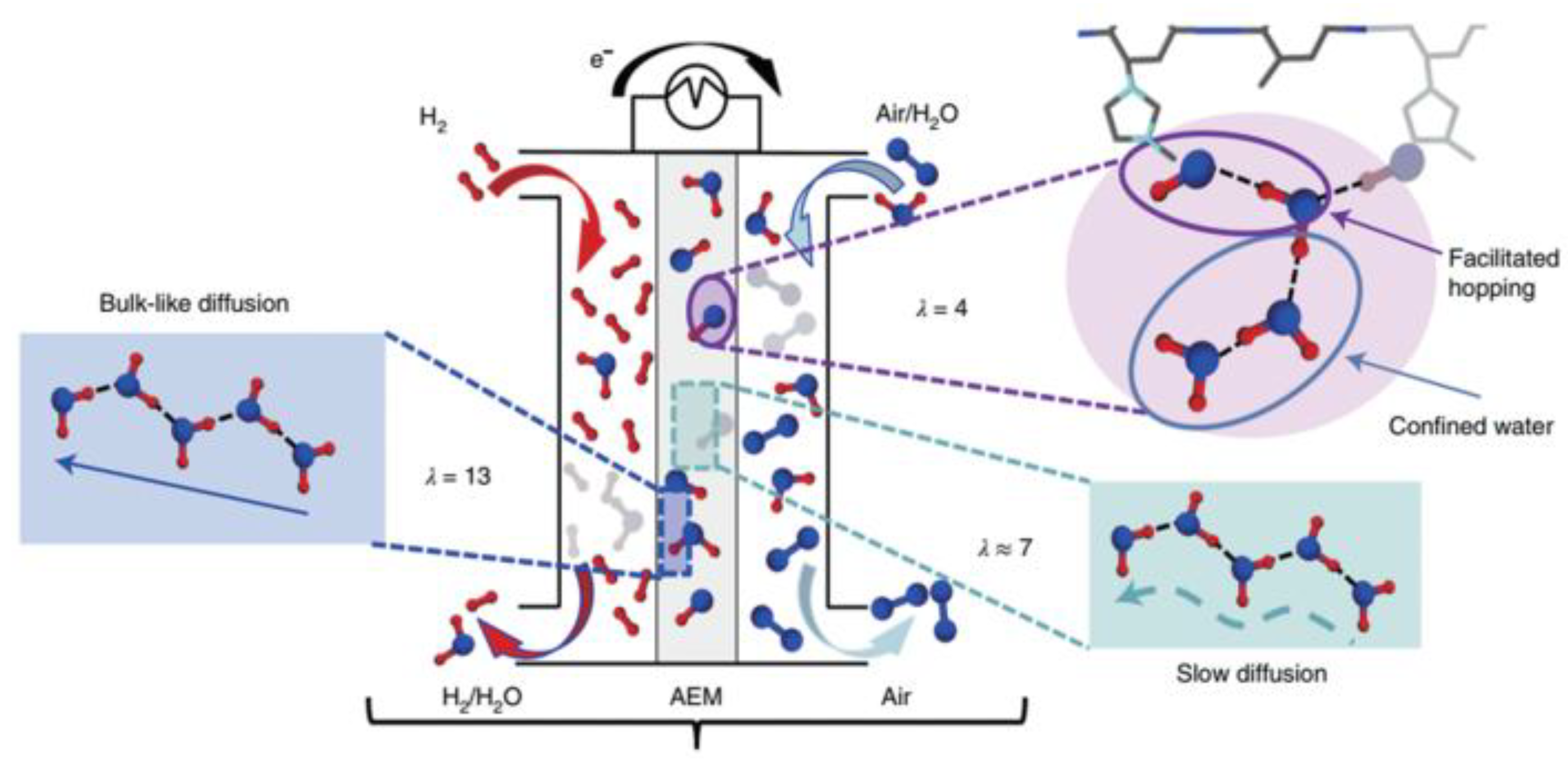
Figure 3.
Structure of AEM, including the cation groups and polymer chains.
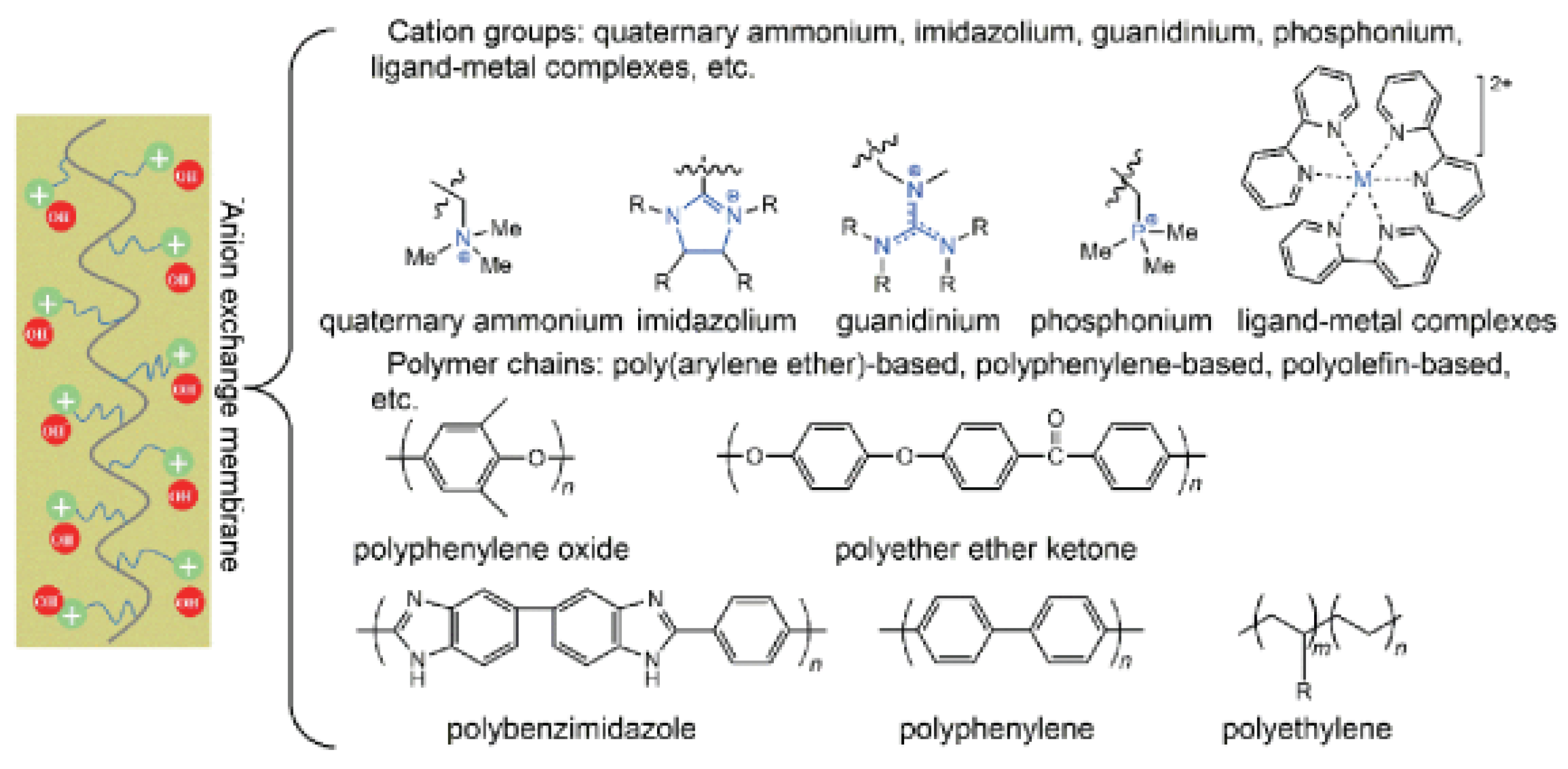
Figure 4.
Degradation mechanisms of quaternary ammonium cation group [16].
Figure 4.
Degradation mechanisms of quaternary ammonium cation group [16].
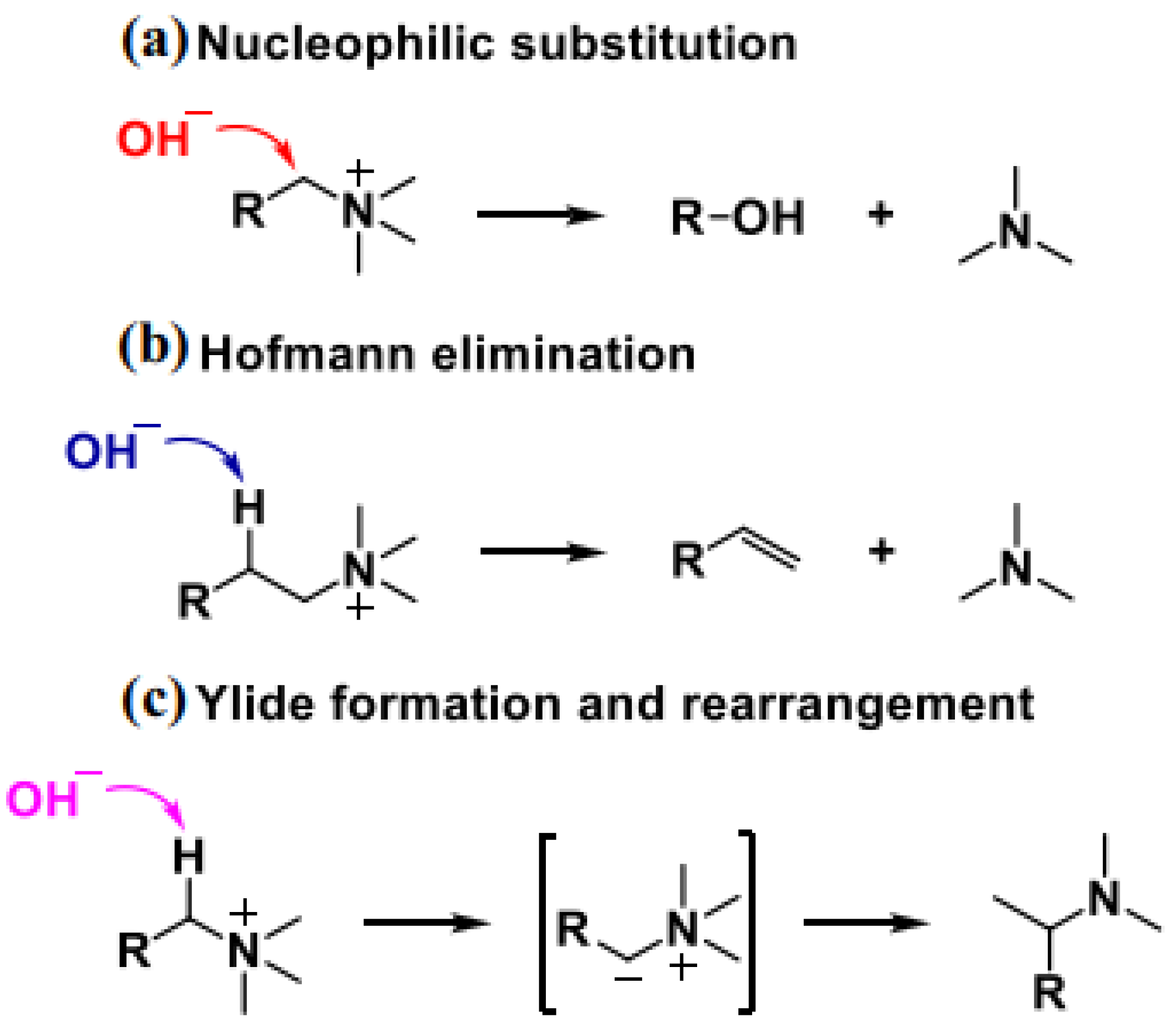
Figure 7.
Degradation routes of quaternary phosphonium cation group [30].
Figure 7.
Degradation routes of quaternary phosphonium cation group [30].
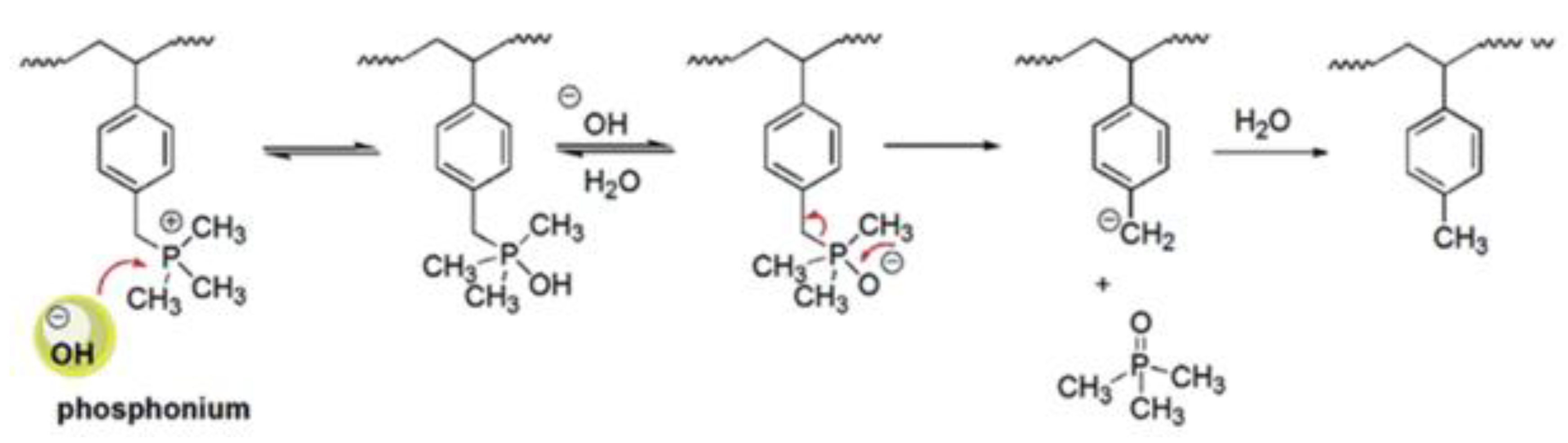
Figure 10.
Synthesis of polybenzimidazole AEM [50].
Figure 10.
Synthesis of polybenzimidazole AEM [50].
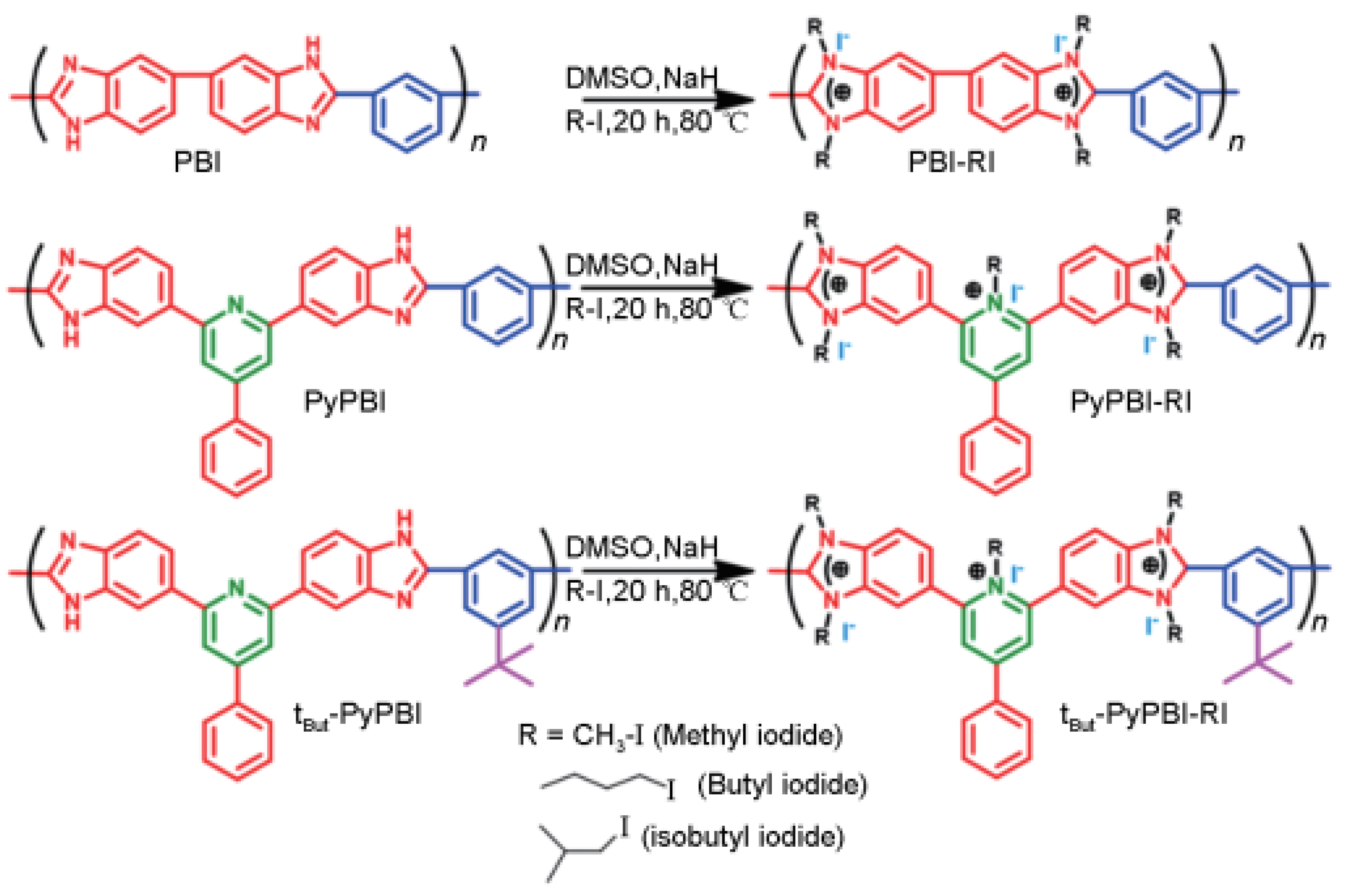
Figure 11.
Synthesis of poly [(terphenyl piperidinium)-co-(oxindole terphenylylene)](PTP) AEM [52].
Figure 11.
Synthesis of poly [(terphenyl piperidinium)-co-(oxindole terphenylylene)](PTP) AEM [52].
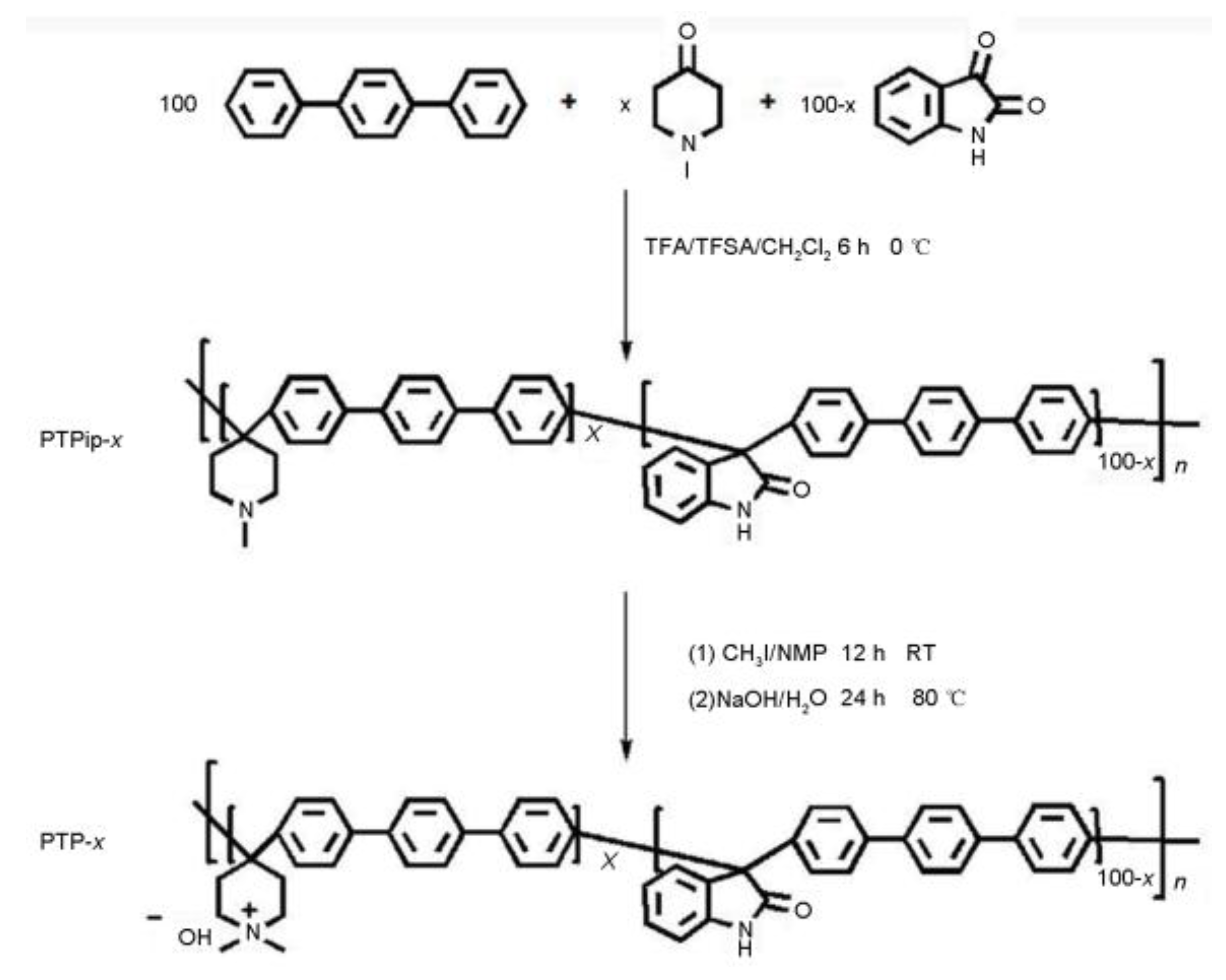

Table 1.
Illustration of the main technical parameters and characteristics for alkaline water electrolysis, proton exchange membrane water electrolysis, and anion exchange membrane water electrolysis [3,4,5,33,34,35,36,37,38].
| Comparison terms | Alkaline electrolytic water for hydrogen production | Hydrogen production by electrolysis of water with proton exchange membrane | Hydrogen production by water electrolysis with anion exchange membrane |
|---|---|---|---|
| diaphragms | Porous diaphragms (e.g., PPS woven) | Proton exchange membranes (e.g., Nafion) | Anion exchange membrane |
| Cathodes | NiMo alloy | Platinum group metals | transition metal |
| Anodes | NiCo alloy | RuOx, IrOx | transition metal |
| Polarized | Stainless Steel Ni Plated | Graphite or titanium sheet | Nickel or stainless steel plate |
| Electrolytes | KOH solution | Purified water | Alkaline solution or purified water |
| Current density/(A/cm2) | < 0.5 | 1~2 | 1~2 |
| Operating temperature/°C | 60~90 | 50~90 | 40~80 |
| Gas purity | > 99.5% | > 99.99% | > 99.99% |
| Lifespan/h | ≈100000 | <10000 | < 2000 |
| Costs | lower | High | − |
| Technology maturity | Maturity | Small-scale commercialization | Under development |
| Vantage | High technological maturity; low cost using non-precious metal catalysts | High energy efficiency; high gas purity; high current density ;rapid response | High energy efficiency; fast response; low costnon-precious metal catalysts; high gas purity |
| Drawbacks | Low energy efficiency; low current density; low gaspurity; poor responsiveness | Precious metal catalysts and Nafion membranes, high cost; poor stability | Low technological. maturity; short lifespan |
Disclaimer/Publisher’s Note: The statements, opinions and data contained in all publications are solely those of the individual author(s) and contributor(s) and not of MDPI and/or the editor(s). MDPI and/or the editor(s) disclaim responsibility for any injury to people or property resulting from any ideas, methods, instructions or products referred to in the content. |
© 2025 by the authors. Licensee MDPI, Basel, Switzerland. This article is an open access article distributed under the terms and conditions of the Creative Commons Attribution (CC BY) license (http://creativecommons.org/licenses/by/4.0/).
Copyright: This open access article is published under a Creative Commons CC BY 4.0 license, which permit the free download, distribution, and reuse, provided that the author and preprint are cited in any reuse.


