

Submitted:
25 June 2025
Posted:
25 June 2025
You are already at the latest version
Abstract
This research investigates the influence of environmental awareness on green purchase behaviour, considering the mediating effect of financial attitude and the moderating roles of price sensitivity and greenwashing. Utilising the Value-Belief-Norm theory (VBN), a conceptual framework is developed to examine the complex relationships between these variables. The study employs a cross-sectional questionnaire using a Likert scale to measure environmental consciousness, financial attitudes, price sensitivity, greenwashing perceptions and green purchasing behaviour among consumers in Egypt and Jordan. Structural Equation Modelling is conducted to analyse the relationships. The findings reveal that financial attitude significantly mediates the relationship between environmental consciousness and green purchase behaviour, while price sensitivity and greenwashing significantly moderate the indirect relationship between environmental consciousness and green purchase behaviour through financial attitude. The study extends VBN through contextualising its abstract ideas by the research variables and testing it in two developing economies. In addition, it enhances the understanding of the barriers and enablers of green purchase behaviour and offers actionable recommendations for businesses to improve transparency and affordability of green products, while guiding policymakers on designing targeted incentives and regulations to foster sustainable consumption.
Keywords:
environmental consciousness
; green purchase behaviour
; financial attitude
; price sensitivity
; greenwashing
; structural equation modelling (SEM)
; sustainable supply chain management
1. Introduction
The rapid degradation of the global environment, driven by economic growth and population expansion, has placed immense pressure on natural resources and ecosystems. In addition to resource depletion, unsustainable consumption patterns significantly contribute to environmental harm [1]. As awareness of climate change grows, consumers and businesses are increasingly motivated to adopt sustainable practices. A major barrier to genuine sustainability is greenwashing—where companies falsely market products as eco-friendly—leading to consumer mistrust and undermining environmental efforts [2,3,4].
Understanding consumer behaviour in the context of green purchasing is essential for addressing environmental challenges. Green products enable individuals to express their commitment to sustainability through everyday decisions [5]. Yet, greenwashing continues to obstruct consumer trust, particularly in countries with weak environmental infrastructure, such as Egypt and Jordan [6]. Ineffective waste management, limited recycling and poor regulatory frameworks intensify the environmental impact in these regions. This study investigates how greenwashing, distrust, environmental awareness and financial attitudes interact to shape green purchase behaviour in developing contexts.
To explore these dynamics, the study applies Value-Belief-Norm (VBN) Theory [7] in order to provide a theoretical foundation to test how individuals’ consciousness can assign responsibility and act on sustainability values in developing economies [8,9]. This will help in extending the theory as the research is testing how financial attitude act as a mediator and the moderator role of price sensitivity and greenwashing on this indirect relationship. In addition, the dynamic relationship is investigated in two emerging economies (Egypt and Jordan), especially that the literature on sustainable consumption is growing, but it mostly focuses on Western economies, leaving a gap in developing regions [3,10]. In Egypt and Jordan, environmental issues are compounded by underdeveloped infrastructure and weak policy enforcement. By analysing the effects of greenwashing on trust, awareness and purchase decisions, the study contributes context-specific knowledge to the global sustainability discourse.
Achieving the research aim will help in answering three key questions: (1) How does environmental consciousness influence green purchasing? (2) What is the mediating role of financial attitude between environmental consciousness and green purchasing? (3) What is the moderating role of greenwashing and price sensitivity on the indirect association between environmental consciousness and green purchasing through financial attitudes? Answering these research questions will offer actionable guidance for businesses to build transparency and for policymakers to counter greenwashing and promote authentic sustainability. Ultimately, this research supports the transition toward sustainable consumption and green economic development in emerging markets. In addition, it will help in promoting social welfare through decreasing waste and emission, which eventually affects human life positively [11].
2. Theoretical Background and Hypotheses Development
This study uses VBN to create a full picture of how people make green purchases. VBN are commonly used to look at goals and personal norms; however, it typically does not take into account economic restrictions [12]. To solve this problem, financial attitude is used as a mediator to see how possible it is to act on pro-environmental beliefs, especially in Egypt and Jordan, where resources are limited. Also, price sensitivity and greenwashing are included as moderators to show that there are typical problems in the market that might make the link between intentions and actual behaviour weaker [3,9,10,13].
Recent studies have also validated the critical role of economic and contextual factors in shaping green behaviour. For instance, Hua and Pang [14] found that rural residents’ green consumption is strongly influenced by income level and policy trust, reinforcing our inclusion of financial attitude and greenwashing in this study’s framework. This aligns with Yue, et al. [15], who also confirmed that environmental awareness must be supported by economic feasibility for intentions to appear into action.
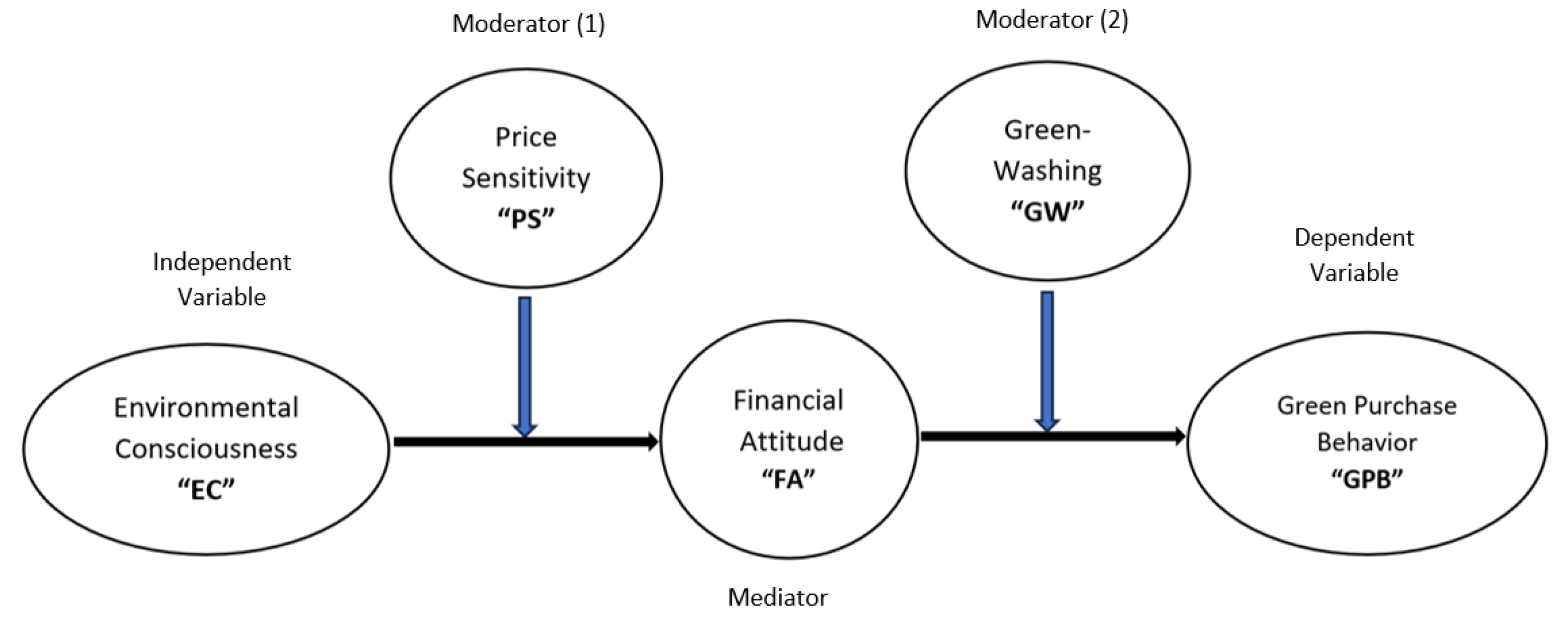
Even if these ideas have been looked at on their own, it is still uncommon to use them all together in a single moderated mediation framework, especially in the MENA region. This work fills this gap by utilising structural equation modelling (SEM) to examine these associations in real life, which gives us a better knowledge of how people buy green products in various situations. Figure 1 shows the proposed research model.
Figure 1.
Research variables and framework (Source: Own research).
2.1. The Environmental Consciousness and Green Purchase Behaviour: Mediating Role of Financial Attitude
Environmental consciousness is increasingly recognised as a key driver of sustainability, influencing both consumer awareness and demand for green products [16,17]. As individuals become more aware of environmental issues [18], they are more likely to adopt eco-friendly behaviours, including purchasing green products [19,20]. This growing sense of responsibility motivates consumers to align their actions with environmental values, such as choosing green alternatives over conventional options [21].
According to Laheri, Lim, Arya and Kumar [21], environmental values—a core element of environmental consciousness—exert a stronger influence on green purchase intentions than general concern or knowledge. Consumers who adopt these values are more likely to act on them through their purchasing choices [22]. Additionally, subjective norms, attitudes and perceived behavioural control significantly contribute to shaping green purchase intentions and reinforcing behaviour..
The role of financial attitudes in the relationship between environmental awareness and green purchasing has also been widely explored [23]. Financial attitudes, particularly the willingness to pay for eco-friendly options, can mediate this relationship [24], indicating that awareness alone may not lead directly to action but operates through financial disposition. This is supported by findings showing financial attitudes as key predictors of green purchases, particularly among groups such as young females [25]. Ali, et al. [26] demonstrate that both environmental knowledge and financial self-efficacy significantly predict green purchasing intentions in Egypt, with demographic factors moderating these relationships. Thus, based upon the previous discussion, the first hypothesis outlined below is developed as follows:
H1.
Financial attitude mediates the relationship between environmental consciousness and green purchase behaviour.
2.2. Moderating effects of Price Sensitivity
Price sensitivity is a key moderator in the relationship between environmental consciousness and green purchase behaviour [27]. Although rising environmental awareness encourages eco-friendly choices, high prices can deter action, especially among price-sensitive consumers [28,29]. The perceived high cost of green products weakens the influence of environmental consciousness on purchase behaviour when price sensitivity is elevated [10,13].
Recognising this moderating effect is critical for businesses and policymakers seeking to promote green consumption [27]. When price sensitivity is low, consumers with strong environmental consciousness and favourable financial attitudes are more inclined to purchase green products. Measures such as subsidies, discounts or value-added features that justify the cost can help offset price concerns [30]. Furthermore, raising awareness about the long-term economic benefits of green products [31]—such as energy efficiency and durability—can reduce perceived cost barriers [31,32]. Accordingly, the following second hypothesis could be proposed:
H2.
Price sensitivity moderates the indirect relationship between environmental consciousness and green purchase behaviour through financial attitude.
2.3. Moderating effects of Greenwashing
Greenwashing—the act of misleading consumers about a product’s or company’s environmental performance—undermines consumer trust and brand credibility [9,33]. Despite rising interest in eco-friendly products, many consumers struggle to differentiate between genuine and deceptive environmental claims. This uncertainty weakens trust in green labels and lowers the likelihood of purchase, even among environmentally conscious consumers [3,34].
Alarmingly, greenwashing is evident even among firms claiming adherence to ESG (Environmental, Social and Governance) standards and sustainability reporting. Some companies fail to disclose essential details about product origins, production practices or supply chain ethics. This highlights the need for stronger supply chain transparency and corporate sustainability due diligence (CS3D). Many products sold in Western markets but produced in developing countries lack adequate disclosure about sourcing, labour conditions or human rights compliance—whether due to intentional deception or poor documentation. This complexity increases consumer uncertainty and complicates sustainable decision-making.
The interplay between financial attitudes, greenwashing and green behaviour is especially nuanced. Financially conscious consumers who prioritize responsibility tend to scrutinise environmental claims [35]. When exposed to greenwashing, their trust diminishes, reducing both purchase intent and brand confidence. This underscores the need for companies to ensure transparency and integrity in their sustainability communications to retain trust among environmentally and financially aware consumers [9]. This aligns with Eid, et al. [36,37], who found that transparency—like our greenwashing construct—critically alters the strength of awareness-driven intentions in airport environmental behaviours, reinforcing the importance of external credibility. Accordingly, the following third hypothesis could be proposed:
H3.
Greenwashing moderates the indirect relationship between environmental consciousness and green purchase behaviour through financial attitude.
Numerous studies have explored the interconnections between environmental consciousness, green purchase attitude, intention, perceived consumer effectiveness and behaviour. Mishal, et al. [38] found that environmental consciousness shapes green purchase attitudes and perceived consumer effectiveness, both of which influence green purchase behaviour. Similarly, [39] investigated how anticipated pride, guilt and environmental consciousness jointly impact green purchase intention, highlighting the complex interplay between emotional and cognitive factors. [40] also examined how environmental consciousness, recycling intentions and advertisement credibility affect green purchase intentions, underscoring the importance of perceived consumer effectiveness and green product knowledge.
3. Materials and Methods
3.1. Study Context
This research examines green consumer purchase behaviour within the socio-economic and environmental contexts of Egypt and Jordan—two MENA countries grappling with mounting environmental pressures. Rapid population growth, urbanisation and industrialisation in both nations have strained natural resources and contributed to issues such as air and water pollution, deforestation and climate vulnerability [41]. In response, Jordan’s Ministry of Environment has prioritised reducing industrial pollutants and advancing green technologies [42].
Egypt is similarly promoting sustainability through initiatives like the Decent Life Initiative (Hayah Karima), which integrates sustainable practices into rural development [43]. Hosting COP27 in Sharm El-Sheikh further demonstrates Egypt’s commitment to climate resilience. Nonetheless, the country faces persistent challenges, including weak recycling infrastructure, high industrial emissions and significant levels of uncollected waste [6].
Economically, high poverty rates in both Egypt and Jordan constrain consumers’ ability to purchase green products, which are often viewed as costly. Jordan’s rising poverty and Egypt’s currency devaluation have heightened price sensitivity, reducing willingness to invest in eco-friendly goods [44]. To support green economic transitions, both countries are promoting sustainable industries, renewable energy and green jobs—evident in Jordan’s solar energy projects and Egypt’s Green Energy Corridor.
Despite growing environmental awareness, greenwashing remains a serious concern, weakening consumer trust. In Jordan, the National Green Growth Plan (NGGP) offers a strategic framework for aligning green policies with broader national goals, including Vision 2025 and Nationally Determined Contributions [45].
This study explores how environmental consciousness, financial attitudes, price sensitivity and greenwashing influence green purchase behaviour in Egypt and Jordan. By delivering context-specific insights, it aims to support businesses and policymakers in addressing barriers, such as affordability, product availability and credibility—ultimately fostering more authentic sustainable consumption in the region.
3.2. Sample and procedures
A snowball sampling technique was employed to collect data for both the pilot and main studies in Egypt and Jordan. Focusing on developing countries, such as Egypt and Jordan, enhances the generalisability of findings within similar emerging market contexts [46]. A self-administered questionnaire was distributed via email to residents across various cities in both countries, specifically targeting individuals with prior experience or interest in green products. Participant relevance was ensured through screening questions assessing their awareness, knowledge and previous engagement with sustainable consumption.
A pre-test was conducted to evaluate the clarity, structure, completeness and appropriateness of the measurement items. Table 1 presents the demographic and sample characteristics for the main study.
The data demonstrate a balanced representation of gender, age groups and education levels, ensuring a comprehensive analysis of green purchase behaviour.
3.3. Research instrument
This study investigates the influence of environmental consciousness (EC) as an antecedent of green purchase behaviour (GPB), while examining the mediating role of financial attitude (FA) and the moderating effects of price sensitivity (PS) and greenwashing [38]. To enhance validity and reliability, measurement scales were adapted from previous studies. Questionnaire items were assessed using a 7-point Likert scale, ranging from strongly disagree (1) to strongly agree (7), which supports measurement precision [47] and reliability [48].
The study employs a consumer-level sample to test the conceptual framework and hypotheses. A cross-sectional survey was conducted to collect quantitative data on EC, FA, PS, GW and GPB. The questionnaire includes six sections: five covering the study variables and a final section on demographic information, such as age, income/expenditure, marital status, education level and nationality. EC and GW were each measured using 5 items, FA and PS with 3 items each and GPB—the dependent variable—with 4 items.
All questionnaire items were derived from validated scales in prior research, with minor modifications to ensure contextual relevance and clarity. Detailed information on the constructs and corresponding items is presented in Table 2.
3.4. Pre Test and Pilot study
The research variables identified through the literature review underwent a pre-test with experts—two practitioners and two academics from each country—specialised in green product supply chains, to ensure face validity [52]. All experts held senior roles with over ten years of experience. Participants completed the questionnaire and provided feedback on its clarity and construct accuracy. Given the bilingual nature of the study, the survey was distributed in English and Arabic, with a back-translation process used to ensure linguistic accuracy and conceptual consistency.
The pre-test was followed by pilot studies in Egypt and Jordan. During the pilot study in Egypt, 280 surveys were distributed, yielding 262 responses, with 254 valid responses, after excluding 8 incomplete ones—resulting in a 90.71% response rate. In Jordan, 250 surveys produced 231 responses, with 227 valid responses, after excluding 4 incomplete ones, resulting in a 90.80% response rate. These high response rates reflect strong participant engagement and provide a sound basis for further analysis. Table 3 shows the summary of response rates for the pilot study and the main study.
Confirmatory factor analysis (CFA) results demonstrated strong model fit. In Egypt, the chi-square value was 300.004 (df = 160, p = 0.000), with a CMIN/DF ratio of 1.875. The RMSEA was 0.059 (90% CI: 0.048–0.069), the GFI was 0.897, AGFI 0.865, CFI 0.954, NFI 0.907 and TLI 0.945—all indicating excellent fit [53,54,55,56].
Similarly, the Jordan CFA showed strong fit: chi-square = 285.753 (df = 160, p = 0.000), CMIN/DF = 1.786, RMSEA = 0.059 (90% CI: 0.048–0.070), GFI = 0.890, AGFI = 0.856, CFI = 0.950, NFI = 0.893 and TLI = 0.940. Though GFI was slightly below 0.90, all indices fell within acceptable thresholds [56].
Overall, the consistent model fit across both countries—CMIN/DF < 3, RMSEA ≈ 0.059, and CFI > 0.950—supports the reliability and validity of the constructs. These results affirm the robustness of the measurement model and its applicability in cross-cultural contexts [57,58].
The pilot study conducted in Egypt and Jordan demonstrated strong construct validity and reliability, with most factor loadings exceeding the 0.70 threshold, indicating robust associations between observed variables and latent constructs [59]. In both countries, the Environmental Consciousness construct exhibited loadings ranging from 0.73 to 0.88, reflecting strong convergent validity [53].
For Financial Attitude, factor loadings ranged from 0.76 to 0.87, confirming the reliability and validity of this construct in both contexts [60]. Similarly, Green Purchase Behaviour items showed loadings between 0.74 and 0.84, further supporting their construct validity in Egypt and Jordan [58]. Additionally, the Price Sensitivity and Greenwashing constructs demonstrated loadings between 0.72 and 0.84, affirming their reliability across both samples.
The consistency of these results across both pilot studies indicates that the measurement instruments are valid and reliable for assessing the key constructs in the context of green purchase behaviour in Egypt and Jordan.
Reliability and validity of the constructs used in the pilot studies conducted in Egypt and Jordan were strictly assessed to ensure the robustness of the measurement model. Confirmatory factor analysis (CFA) was performed using AMOS to compute factor loadings, composite reliability (CR) and average variance extracted (AVE), which together measure the instrument’s reliability and validity [57]. The CFA results in Table 4 confirm construct validity by demonstrating the strength of relationships between observed items and their respective latent constructs. As established by Fornell and Larcker [61], factor loadings of 0.70 or higher provide strong evidence of convergent validity, while values between 0.50 and 0.70 may be considered acceptable in exploratory research contexts [62].
Following the presentation of the pilot study results, specific item-level loadings further illustrate the measurement quality and contextual nuances observed across both countries:
- Price Sensitivity (PS) showed strong agreement, with PS1 in Jordan loading at 0.932 and PS3 in Egypt at 0.951;
- Greenwashing demonstrated stronger loadings in Egypt, particularly GW1 (0.914) compared to Jordan’s GW1 (0.790);
- Financial Attitude (FA), Egypt’s FA1 reached 0.931, slightly higher than Jordan’s FA1 (0.906), while Jordan displayed more consistent item loadings, such as FA3;
- Green Purchase Behaviour items loaded highly in both contexts, with Jordan’s GPB3 achieving a loading of 0.873;
- Environmental Consciousness was comparable between countries, with Egypt’s EC4 at 0.866 and Jordan’s EC5 at 0.840;
These minor variations suggest possible cultural or contextual influences on how respondents perceive specific items. Feedback collected during the pre-test phase contributed to refining item wording, enhancing clarity and ensuring that the measurement instrument remains reliable and relevant across both cultural settings.
3.5. Main study
The details of the main study response rates are shown in Table 3 above. For the main study of Egypt, the same steps of the pilot study have been followed: 922 questionnaires were distributed to the targeted sample. The authors collected 865 responses, and the incomplete questionnaires were 37. Number of valid questionnaires was 828. This means that the response rate is 89.80%.
For Jordan’s main study, the same steps have been followed: 847 questionnaires were distributed to the targeted sample. The authors collected 820 responses, and the incomplete questionnaires were 44. Number of valid questionnaires was 776. This means that the response rate is 91.62%.
The Structural Equation Modelling (SEM) results for the Egypt and Jordan main studies indicate strong model fit, confirming the adequacy of the proposed structural models. For Egypt’s main study, the chi-square (CMIN) was 969.452 with 242 degrees of freedom (p-value = 0.000), and the CMIN/DF ratio was 4.006, reflecting a moderate fit. The Root Mean Square Error of Approximation (RMSEA) was 0.060, with a 90% confidence interval of 0.056–0.064, meeting the recommended threshold of ≤ 0.08. Additional fit indices also supported the model’s adequacy, with a Goodness of Fit Index (GFI) of 0.916, an Adjusted Goodness of Fit Index (AGFI) of 0.887 and a Comparative Fit Index (CFI) of 0.933, all exceeding the recommended cutoff values of 0.90. The Normed Fit Index (NFI) was 0.913, and the Parsimony Normed Fit Index (PNFI) was 0.737. Hoelter’s Critical N was 239 (at p = 0.05), further confirming the model’s suitability for the sample size.
Similarly, Jordan’s main study demonstrated strong model fit, with a chi-square (CMIN) of 924.891 and 242 degrees of freedom (p-value = 0.000). The CMIN/DF ratio was slightly lower at 3.822, indicating a good fit. The RMSEA for Jordan’s study was also 0.060, with a 90% confidence interval of 0.056–0.064, mirroring the Egypt results and meeting the recommended threshold. The GFI was 0.915, the AGFI was 0.886 and the CFI was 0.932, all indicative of excellent fit. Additional indices, such as the NFI (0.911) and PNFI (0.735), supported the model’s adequacy, while Hoelter’s Critical N of 235 confirmed the adequacy of the sample size for testing the structural model.
The empirical findings for both Egypt and Jordan indicate a satisfactory model fit, with all primary goodness-of-fit indices falling within the recommended thresholds. This confirms the adequacy of the structural model and contributes empirical support to the hypothesised relationships among the study constructs. These results stress the robustness and generalisability of the proposed model across culturally distinct contexts.
Moreover, the measurement model demonstrated satisfactory levels of reliability and validity. As shown in Table 5, all constructs exhibited adequate internal consistency and convergent validity, with item loadings and composite reliability values meeting established benchmarks. Discriminant validity was evaluated using the Fornell and Larcker [61] criterion, which involves comparing the square root of the Average Variance Extracted (AVE) for each construct with its inter-construct correlations. The results, presented in Table 6, indicate that all constructs are empirically distinct, thereby affirming the discriminant validity and overall adequacy of the measurement model [63].
3.5.1. Non-response Bias and Common Method Bias
To assess non-response bias, the study compared early and late respondents, using Levene’s test for equality of variances. The results revealed a non-significant p-value, indicating no substantial difference in variance between the two groups and suggesting that non-response bias was not a concern [64].
To address common method bias, Harman’s single-factor test was conducted by loading all questionnaire items into a single factor. The analysis showed that no single factor accounted for more than 50% of the total variance, confirming that common method variance was not a significant issue [65]. These tests collectively support the robustness of the study’s findings and minimise concerns related to the data collection method.
3.5.2. Hypothesis testing
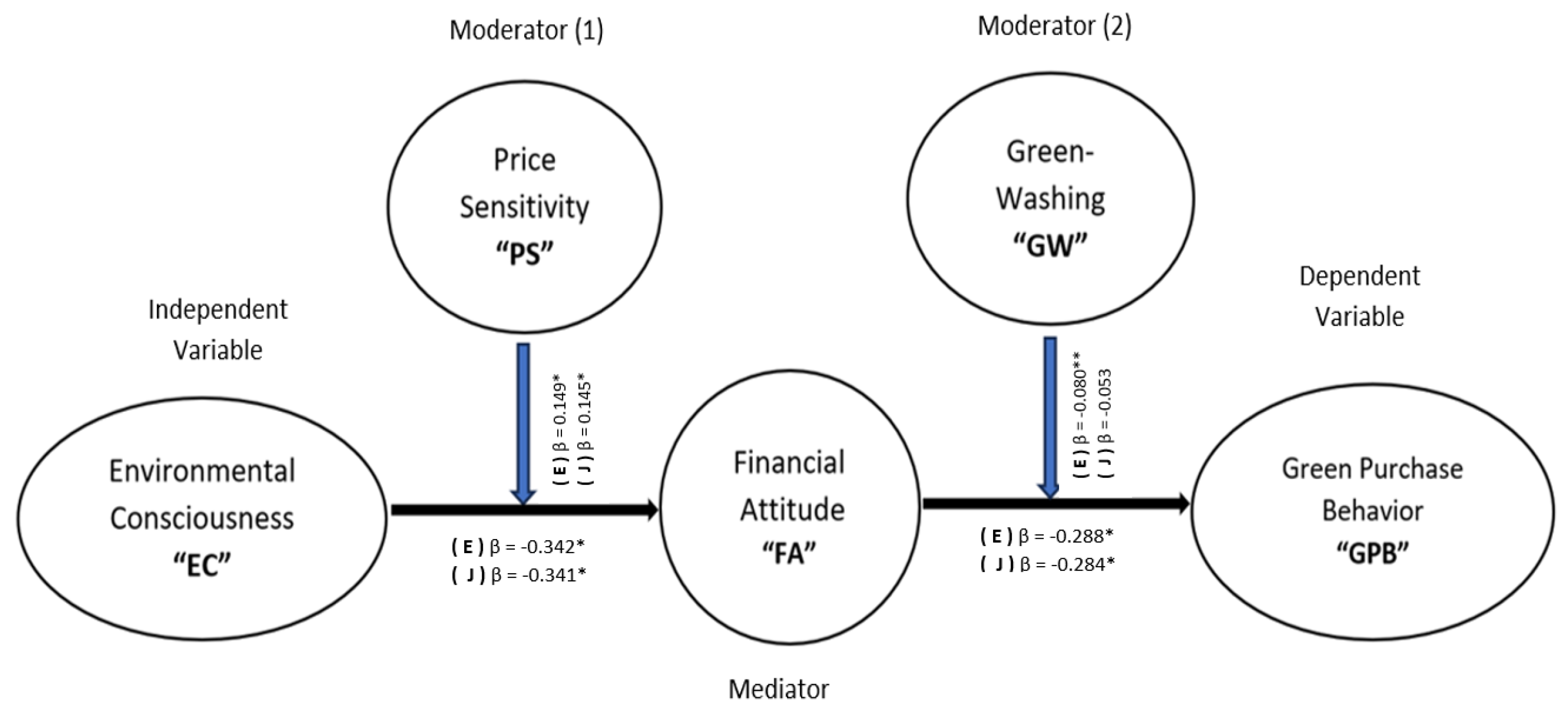
The results of the structural equation modelling (SEM) analysis illustrate the relationships between the constructs and the hypothesised direct and indirect effects as shown in Figure 2 for Egypt and Jordan. The mediating role of Financial Attitude (FA) was assessed using a two-step approach that involved calculating path coefficients for both direct and indirect effects. The indirect effect of Price Sensitivity (PS) on Green Purchase Behaviour (GPB) through Financial Attitude was found to be significant, suggesting that shifts in financial attitudes can influence purchasing behaviours when price considerations are prominent. This aligns with findings in prior studies that highlight the influence of financial perceptions on consumer behaviour [19,66,67,68].
Figure 2.
Results of the hypothesis testing of Egypt (E) & Jordan (J) using SEM, showing the direct and indirect effect.(Source: Own research). Notes: * indicates significance at the 1% level, ** indicates significance at the 5% level
Figure 2.
Results of the hypothesis testing of Egypt (E) & Jordan (J) using SEM, showing the direct and indirect effect.(Source: Own research). Notes: * indicates significance at the 1% level, ** indicates significance at the 5% level
H1.
Financial attitude mediates the relationship between environmental consciousness and green purchase behaviour.
The analysis confirmed that environmental consciousness significantly influences financial attitude in both Jordan (β = −0.341, p = 0.002 < 0.01) and Egypt (β = −0.342, p = 0.005 < 0.01). Similarly, financial attitude has a significant negative impact on green purchase behaviour in Jordan (β = −0.284, p = 0.002 < 0.01) and Egypt (β = −0.288, p = 0.002 < 0.01). The mediation effect was significant in both countries (Jordan: MedFA = 0.072, p = 0.001 < 0.01; Egypt: MedFA = 0.073, p = 0.001 < 0.01), indicating that financial attitude mediates the relationship between environmental consciousness and green purchase behaviour. Individuals with higher environmental awareness might adopt more critical or cautious financial attitudes. This finding is consistent with the literature, which often associates environmental awareness with heightened scrutiny and discernment in financial decision-making [55].
H2.
Price sensitivity moderates the indirect relationship between environmental consciousness and green purchase behaviour through financial attitude.
The moderation effect of price sensitivity on the mediation pathway was significant in both contexts (Jordan: IndModMedPS = −0.052, p = 0.001 < 0.01; Egypt: IndModMedPS = −0.057, p = 0.002 < 0.01). Moreover, the indirect effects at low and medium levels of price sensitivity were significant, confirming the moderating role of price sensitivity. For Jordan, these effects were lowCIEPS = 0.149 (p = 0.002 < 0.01) and medCIEPS = 0.072 (p = 0.001 < 0.01), while for Egypt, they were lowCIEPS = 0.158 (p = 0.002 < 0.01) and medCIEPS = 0.073 (p = 0.001 < 0.01). This suggests that price considerations shape financial attitudes, subsequently affecting purchasing decisions. The mediating role of financial attitudes in consumer behaviour has been well-documented in similar contexts [53].
H3.
Greenwashing moderates the indirect relationship between environmental consciousness and green purchase behaviour through financial attitude.
Greenwashing’s moderating effect on the mediation pathway between environmental consciousness, financial attitude and green purchase behaviour was significant in both Egypt and Jordan. In Jordan, the indirect moderated mediation effect (IndModMedGW) was −0.036 (p = 0.027 < 0.05), while in Egypt, it was −0.039 (p = 0.010 < 0.01). These results indicate that greenwashing significantly weakens the indirect relationship between environmental consciousness and green purchase behaviour through financial attitude in both countries.
The indirect effects under different levels of greenwashing varied significantly across both contexts. In Jordan, the low-level conditional indirect effect (lowCIEGW) was 0.126 (p = 0.003 < 0.01), and the medium-level conditional indirect effect (medCIEGW) was 0.072 (p = 0.001 < 0.01). In Egypt, the low-level conditional indirect effect (lowCIEGW) was 0.132 (p = 0.004 < 0.01), and the medium-level conditional indirect effect (medCIEGW) was 0.073 (p = 0.001 < 0.01). These findings indicate that greenwashing weakens consumers’ trust in green products, even among individuals with strong environmental consciousness.
However, when examining the direct effect of greenwashing on green purchase behaviour, the results differed across the two countries. In Jordan, the relationship between greenwashing and green purchase behaviour was non-significant, with an estimate of −0.053 and a p-value of 0.120 > 0.05. This suggests that greenwashing does not directly impact green purchase behaviour in Jordan, meaning that consumers’ purchasing decisions are less influenced by greenwashing in this context. Although greenwashing affects consumer trust, it does not significantly discourage consumers from buying green products. In Egypt, the relationship between greenwashing and green purchase behaviour was significant, with an estimate of −0.080 and a p-value of 0.029 < 0.05. This indicates that greenwashing has a direct negative impact on green purchase behaviour in Egypt. Consumers in Egypt are more sensitive to deceptive environmental claims, and the presence of greenwashing significantly reduces their willingness to purchase green products.
These findings highlight important contextual differences between Egypt and Jordan. While greenwashing has a stronger direct impact in Egypt, it appears to have a weaker direct influence on purchasing behaviour in Jordan. However, in both countries, greenwashing significantly moderates the indirect relationship between environmental consciousness and green purchase behaviour, emphasising the importance of transparent and true sustainability claims in fostering consumer trust and promoting sustainable consumption.
This difference may reflect contextual and cultural factors that influence consumer sensitivity to perceived deceptive marketing [58]. The mediation analysis further revealed that Financial Attitude moderated the effects of Greenwashing, highlighting the complexity and variability of consumer responses to green marketing tactics.
4. Discussion
4.1. Discussion of the Research Findings
The findings of this study offer important insights into the drivers and barriers of green purchase behaviour in developing countries, particularly Egypt and Jordan. By utilising the Value-Belief-Norm theory [7], this research presents a comprehensive framework capturing how cognitive, moral and contextual factors interact to influence green purchasing decisions. This offers a more nuanced perspective compared to research conducted in developed contexts.
In Egypt and Jordan, green consumer behaviour reflects both constraints and emerging opportunities. Economically, both countries face high poverty rates and inflation—especially in Egypt—limiting the affordability of green products. This reinforces the perception that sustainable consumption is a luxury rather than a necessity.
The findings highlight the mediating role of financial attitude, supporting prior research that emphasises the influence of economic feasibility in turning environmental intentions into actions [19,23]. This reinforces the work of Elbarky, Elgamal, Hamdi and Barakat [5], who noted that financial attitude acts as a key bridge between awareness and behaviour.
Price sensitivity significantly weakens the positive effect of environmental consciousness on green purchase behaviour. This finding aligns with Bhutto, Tariq, Azhar, Ahmed, Khuwaja and Han [13] and Lavuri [10], who highlighted cost as a major barrier in low-income settings. Barbu, Catană, Deselnicu, Cioca and Ioanid [31] suggested that long-term cost awareness and consumer education could reduce this barrier and increase willingness to pay for sustainability.
Greenwashing emerged as a significant inhibitor by eroding consumer trust—supporting the arguments of Nguyen, Yang, Nguyen, Johnson and Cao [3] and Hameed, Hyder, Imran and Shafiq [9]. The results underscore the need for stronger marketing regulation and transparent ESG reporting, especially in Jordan, where initiatives like “Future Green” aim to rebuild trust. The findings highlight the need for stricter regulations and greater supply chain transparency, especially for ESG-aligned firms. This is critical in addressing global value chain opacity that often misleads consumers regarding the environmental impact of their choices.
Structural and institutional challenges, including weak recycling infrastructure and limited product availability, further restrict green consumption. These findings align with Abdel-Shafy and Mansour [6], who emphasised infrastructure’s role in environmental degradation. In response, political initiatives, such as Egypt’s COP27 and “Decent Life Initiative (Hayah Karima)” [43] and Jordan’s National Green Growth Plan [36], show potential to create enabling environments, though current barriers remain significant. While these initiatives may not yet resolve trust and affordability challenges, they provide a roadmap for long-term progress.
This study extends existing literature by applying a moderated mediation framework based on VBN theory in developing country context. While previous research (e.g., Mishal, Dubey, Gupta and Luo [38] and Ahmed, Arshad, Anwar ul Haq and Akram [40]) explored perceived efficacy and trust, it did not test financial attitude as a mediator or examine the moderating roles of price sensitivity and greenwashing. This study fills that gap by demonstrating how financial feasibility and perceived corporate honesty shape the translation of values into behaviour. Similarly, Bhutto, Tariq, Azhar, Ahmed, Khuwaja and Han [13] and Lavuri [10] addressed pricing impacts but did not model indirect effects via financial attitudes.
4.2. Theoretical Implications
This study enhances the theoretical framework of sustainable consumer behaviour by synthesising three established behavioural models, effectively addressing significant limitations in their application to developing economies The study extends VBN, through illustrating that traditional explanations of the conversion of intentions into purchases necessitate refinement when considering financial feasibility and market trust in two emerging economies. This is particularly important in Egypt and Jordan, where affordability is a persistent constraint. This study demonstrates that an individual’s sense of behavioural control does not guarantee action unless it is accompanied by a positive financial attitude [5,19]. Moral norms and personal values can foster environmental responsibility; however, these beliefs frequently encounter practical challenges, such as elevated costs and inconsistent marketing claims, which undermine their influence on behaviour [10,13].
The introduction of greenwashing as a moderating variable in the model highlights the impact of perceived dishonesty in environmental claims on trust erosion and the weakening of established theoretical pathways [3,9,33]. This insight is essential as it aligns attributional reasoning with internal motivations and norms, offering a deeper perspective for understanding purchasing decisions in contexts of information uncertainty.
This research illustrates that the interactions among cognitive, moral, economic and external attribution factors are significantly influenced by context, extending the scope of each individual theory. This study empirically validates the interplay through a moderated mediation design in two developing country contexts, addressing a regional gap and indicating that behavioural models must be adapted to account for institutional realities and cultural nuances influencing consumer priorities [12,68]. The framework examined in this study elucidates the reasons why awareness and positive intentions do not reliably lead to sustainable actions. Additionally, it provides a systematic approach for future research to investigate analogous dynamics in other emerging markets. This approach offers a more flexible and realistic theoretical framework that transcends the static assumptions of single-theory models, prompting researchers to develop context-sensitive explanations for green behaviour that consider economic constraints and trust deficits prevalent in under-explored areas.
4.3. Practical Contributions
This study makes relevant, context-specific contributions to increase sustainable consumption in Egypt and Jordan. Managerially, it emphasises that businesses must focus on affordability and trust-building to encourage green purchasing. This fits Egypt’s national target of increasing green public investments to 50% by 2024/2025, in line with a larger $40 billion commitment to Suez Canal Economic Zone renewable energy projects [69]. In both countries, businesses are recommended to prevent greenwashing and instead embrace transparent sustainability practices to engage increasingly environmentally conscious yet financially constrained consumers. Alongside this, recent public–private investments, totalling EGP 1.2 billion in plastic recycling, signal an encouraging move toward circular economy models [70].
At the policy level, governments are responding with concrete measures. Egypt’s Ministry of Environment unveiled a nationwide guide for environmental sustainability criteria and started an LE 250 million advanced waste recycling plant in Assiut [71]. These initiatives support Jordan’s National Green Growth Plan, which combines sustainability with long-term economic goals. Socially, encouraging genuine green behaviour improves public health improvements, shown by Egypt’s attempts to control industrial emissions and lower plastic use, as well as enhancing environmental knowledge. This study underlines how important it is for policy backing, business integrity and consumer education to combine to produce significant green behaviour in emerging economies.
4.4. Limitations and Recommendations for Future Research
This study is subject to several limitations that warrant further investigation. The cross-sectional design restricts the ability to establish causality, suggesting that future research should adopt longitudinal designs to examine changes in consumer behaviour over time. Additionally, the geographical scope is limited to Egypt and Jordan, potentially limiting the generalisability of the findings. Expanding this research to other developing countries with varying socio-economic contexts could enhance its broader applicability. Furthermore, the reliance on self-reported data may introduce social desirability bias; incorporating objective behavioural measures or experimental designs could address this concern. Future studies could also explore additional moderators or mediators, such as cultural norms, perceived social influence or consumer effectiveness, to provide a more comprehensive understanding of green purchase behaviour. Sector-specific analyses could yield valuable insights, particularly in industries where greenwashing is prevalent.
5. Conclusions
This study provides valuable insights into the factors influencing green purchase behaviour in Egypt and Jordan, emphasising the roles of financial attitude, price sensitivity and greenwashing. The findings indicate that financial attitude significantly mediates the relationship between environmental consciousness and green purchase behaviour in both countries. Moreover, price sensitivity and greenwashing act as significant moderators, highlighting the complexity of consumer decision-making in these contexts.
This research offers a comprehensive framework that enhances the understanding of green purchase behaviour. The study underscores the importance of affordability and authenticity in promoting sustainable consumption and highlights the need for localised interventions tailored to the socio-economic and cultural dynamics of developing regions. The findings have practical implications for businesses aiming to build consumer trust and for policymakers striving to create supportive environments for sustainable consumption.
Future research should focus on longitudinal studies to establish causality, expanding the geographical scope to other developing regions and examining additional moderators and mediators that may influence green purchasing. Moreover, sector-specific analyses could provide deeper insights into the dynamics of green behaviour across various industries. Addressing these limitations will contribute to a more comprehensive understanding of green purchase behaviour and support the development of effective strategies for promoting sustainable consumption.
Author Contributions
Conceptualization, E.A. and M.B.; methodology, E.A., M.B.; empirical analysis and findings, E.A. and M.B.; conclusion and recommendations, E.A.; supervision, M.O. and M.B.; project administration, M.O. and M.B. All authors have read and agreed to the published version of the manuscript.
Funding
This research received no external funding.
Institutional Review Board Statement
Not applicable.
Informed Consent Statement
Not applicable.
Data Availability Statement
Data available upon request from corresponding authors.
Conflicts of Interest
The authors declare no conflict of interest.
References
- Wu, S.-W.; Chiang, P.-Y. Exploring the Mediating Effects of the Theory of Planned Behavior on the Relationships between Environmental Awareness, Green Advocacy, and Green Self-Efficacy on the Green Word-of-Mouth Intention. Sustainability 2023, 15, 12127. [Google Scholar] [CrossRef]
- Leonidou, C.N.; Skarmeas, D. Gray shades of green: Causes and consequences of green skepticism. Journal of business ethics 2017, 144, 401–415. [Google Scholar] [CrossRef]
- Nguyen, T.T.H.; Yang, Z.; Nguyen, N.; Johnson, L.W.; Cao, T.K. Greenwash and green purchase intention: The mediating role of green skepticism. Sustainability 2019, 11, 2653. [Google Scholar] [CrossRef]
- Sun, Y.; Shi, B. Impact of greenwashing perception on consumers’ green purchasing intentions: A moderated mediation model. Sustainability 2022, 14, 12119. [Google Scholar] [CrossRef]
- Elbarky, S.; Elgamal, S.; Hamdi, R.; Barakat, M.R. Green supply chain: the impact of environmental knowledge on green purchasing intention. Supply Chain Forum: An International Journal 2023, 1–13. [Google Scholar] [CrossRef]
- Abdel-Shafy, H.I.; Mansour, M.S. Solid waste issue: Sources, composition, disposal, recycling, and valorization. Egyptian journal of petroleum 2018, 27, 1275–1290. [Google Scholar] [CrossRef]
- Stern, P.C.; Dietz, T.; Abel, T.; Guagnano, G.A.; Kalof, L. A value-belief-norm theory of support for social movements: The case of environmentalism. Human ecology review 1999, 81–97. [Google Scholar]
- Chuah, S.H.-W.; El-Manstrly, D.; Tseng, M.-L.; Ramayah, T. Sustaining customer engagement behavior through corporate social responsibility: The roles of environmental concern and green trust. Journal of Cleaner Production 2020, 262, 121348. [Google Scholar] [CrossRef]
- Hameed, I.; Hyder, Z.; Imran, M.; Shafiq, K. Greenwash and green purchase behavior: An environmentally sustainable perspective. Environment, Development and Sustainability 2021, 1–22. [Google Scholar] [CrossRef]
- Lavuri, R. Organic green purchasing: Moderation of environmental protection emotion and price sensitivity. Journal of Cleaner Production 2022, 368, 133113. [Google Scholar] [CrossRef]
- Dabees, A.; Lisec, A.; Elbarky, S.; Barakat, M. The role of organizational performance in sustaining competitive advantage through reverse logistics activities. Business Process Management Journal 2024, 30, 2025–2046. [Google Scholar] [CrossRef]
- Alzubaidi, H.; Slade, E.L.; Dwivedi, Y.K. Examining antecedents of consumers’ pro-environmental behaviours: TPB extended with materialism and innovativeness. Journal of Business Research 2021, 122, 685–699. [Google Scholar] [CrossRef]
- Bhutto, M.H.; Tariq, B.; Azhar, S.; Ahmed, K.; Khuwaja, F.M.; Han, H. Predicting consumer purchase intention toward hybrid vehicles: testing the moderating role of price sensitivity. European Business Review 2022, 34, 62–84. [Google Scholar] [CrossRef]
- Hua, K.; Pang, X. Investigation into the factors affecting the green consumption behavior of China rural residents in the context of dual carbon. Sustainability 2024, 16, 5797. [Google Scholar] [CrossRef]
- Yue, B.; Sheng, G.; She, S.; Xu, J. Impact of consumer environmental responsibility on green consumption behavior in China: The role of environmental concern and price sensitivity. Sustainability 2020, 12, 2074. [Google Scholar] [CrossRef]
- ElHaffar, G.; Durif, F.; Dubé, L. Towards closing the attitude-intention-behavior gap in green consumption: A narrative review of the literature and an overview of future research directions. Journal of cleaner production 2020, 275, 122556. [Google Scholar] [CrossRef]
- Kennedy, F.; Adhikari, A. Antecedents affecting consumers’ green purchase intention towards green products. American Journal of Interdisciplinary Research and Innovation 2023, 1, 47–52. [Google Scholar] [CrossRef]
- Ali, A.H.; El-Rouby, H.S.; El-Gamal, S.Y.; Zaghloul, A.S. The Tendency Toward Producing Ecologically Friendly Products at Toshiba in the Middle East. In Cases on International Business Logistics in the Middle East. In Cases on International Business Logistics in the Middle East, Abdelbary, I., Haddad, S., Elkady, G., Eds.; IGI Global: Hershey, PA, USA, 2023; pp. 281–296. [Google Scholar]
- Cam, L.N.T. A rising trend in eco-friendly products: A health-conscious approach to green buying. Heliyon 2023, 9. [Google Scholar] [CrossRef]
- Thompson, A.; Tong, X. Factors influencing college students’ purchase intention towards Bamboo textile and apparel products. International Journal of Fashion Design, Technology and Education 2016, 9, 62–70. [Google Scholar] [CrossRef]
- Laheri, V.K.; Lim, W.M.; Arya, P.K.; Kumar, S. A multidimensional lens of environmental consciousness: towards an environmentally conscious theory of planned behavior. Journal of Consumer Marketing 2024, 41, 281–297. [Google Scholar] [CrossRef]
- Rahma, B.; Kramberger, T.; Barakat, M.; Ali, A.H. Investigating customers’ purchase intentions for electric vehicles with linkage of theory of reasoned action and self-image congruence. Business Process Management Journal 2024, ahead-of-print. [Google Scholar] [CrossRef]
- Visschers, V.H.; Wickli, N.; Siegrist, M. Sorting out food waste behaviour: A survey on the motivators and barriers of self-reported amounts of food waste in households. Journal of Environmental Psychology 2016, 45, 66–78. [Google Scholar] [CrossRef]
- Lim, V.K.; Teo, T.S. Sex, money and financial hardship: An empirical study of attitudes towards money among undergraduates in Singapore. journal of Economic Psychology 1997, 18, 369–386. [Google Scholar] [CrossRef]
- Jhanji, H.; Sarin, V. Relationship between environmental consciousness and green purchase behaviour among youth. International Journal of Green Economics 2018, 12, 171–181. [Google Scholar] [CrossRef]
- Ali, A.H.M.; Barky, S.S.S.E.; Barakat, M.R. Exploring Egyptian Consumers’ Drive for Sustainable Purchases through Financial Empowerment and Environmental Awareness: The Moderating Role of Demographic Characteristics. Journal of Sustainability Research 2025, 7, e250011. [Google Scholar] [CrossRef]
- AKBAR, N.; GHUTAI, G.; YOUSAFZAI, M.T.; AHMAD, S. Pricing the Green Path: Unveiling the role of Price Sensitivity as a Moderator in Environmental Attitude and Green Purchase Intentions. International Review of Management and Business Research 2023, 12. [Google Scholar]
- Guath, M.; Stikvoort, B.; Juslin, P. Nudging for eco-friendly online shopping–Attraction effect curbs price sensitivity. Journal of environmental psychology 2022, 81, 101821. [Google Scholar] [CrossRef]
- Karatu, V.M.H.; Mat, N.K.N. Predictors of green purchase intention in Nigeria: The mediating role of environmental consciousness. American journal of economics 2015, 5, 291–302. [Google Scholar]
- Barakat, M.; Ali, A.; Madkour, T.; Eid, A. Enhancing operational performance through supply chain integration: the mediating role of resilience capabilities under COVID-19 pandemic. International Journal of Logistics Systems and Management 2024, 47. [Google Scholar] [CrossRef]
- Barbu, A.; Catană, Ș.-A.; Deselnicu, D.C.; Cioca, L.-I.; Ioanid, A. Factors influencing consumer behavior toward green products: A systematic literature review. International journal of environmental research and public health 2022, 19, 16568. [Google Scholar] [CrossRef]
- Sultan, M.A.; Kramberger, T.; Barakat, M.; Ali, A.H. Barriers to Applying Last-Mile Logistics in the Egyptian Market: An Extension of the Technology Acceptance Model. Sustainability 2023, 15, 12748. [Google Scholar] [CrossRef]
- Tarabieh, S. The impact of greenwash practices over green purchase intention: The mediating effects of green confusion, Green perceived risk, and green trust. Management Science Letters 2021, 11, 451–464. [Google Scholar] [CrossRef]
- Ioannou, I.; Kassinis, G.; Papagiannakis, G. The impact of perceived greenwashing on customer satisfaction and the contingent role of capability reputation. Journal of Business Ethics 2023, 185, 333–347. [Google Scholar] [CrossRef]
- Deshmukh, P.; Tare, H. Green marketing and corporate social responsibility: A review of business practices. Multidisciplinary Reviews 2024, 7, 2024059–2024059. [Google Scholar] [CrossRef]
- Eid, A.; Obrecht, M.; Ali, A.H.; Barakat, M. Does environmental knowledge and performance engender environmental behavior at airports? A moderated mediation effect. Business Process Management Journal 2024, 30, 671–698. [Google Scholar] [CrossRef]
- Eid, A.; Salah, M.; Barakat, M.; Obrecht, M. Airport Sustainability Awareness: A Theoretical Framework. Sustainability 2022, 14. [Google Scholar] [CrossRef]
- Mishal, A.; Dubey, R.; Gupta, O.K.; Luo, Z. Dynamics of environmental consciousness and green purchase behaviour: an empirical study. International Journal of Climate Change Strategies and Management 2017, 9, 682–706. [Google Scholar] [CrossRef]
- Haj-Salem, N.; Ishaq, M.I.; Raza, A. How anticipated pride and guilt influence green consumption in the Middle East: The moderating role of environmental consciousness. Journal of Retailing and Consumer Services 2022, 68, 103062. [Google Scholar] [CrossRef]
- Ahmed, M.A.; Arshad, A.; Anwar ul Haq, M.; Akram, B. Role of environmentalism in the development of green purchase intentions: a moderating role of green product knowledge. International Journal of Sustainable Development and Planning 2020, 15, 1101–1111. [Google Scholar] [CrossRef]
- Hassanin, I.; Serra, P.; Iskander, J.; Gamboa-Zamora, S.; Shen, L.; Liu, Y.; Knez, M. Is the inland waterways system primed for mitigating road transport in Egypt? International Business Logistics 2024, 4. [Google Scholar] [CrossRef]
- Environment, J.M.o. Waste Sector Green Growth National Action Plan 2021-2025; the Hashemite Kingdom of Jordan Amman: 2020.
- Azab, S.; Rabie, A.E.; Hafez, F.; Mostafa, A.H.; El Rayes, A.H.; Awad, M.M. Decent Life Initiative and Sustainable Development Goals: A systems thinking approach. Systems 2023, 11, 446. [Google Scholar] [CrossRef]
- Emara, N. Financing Sustainable Development in Egypt Report; 2022.
- organization, L.I. The Green Economy in Jordan: Sustainability Leading the Way for Growth. Available online: https://leadersinternational.org/results-insights/the-green-economy-in-jordan-sustainability-leading-the-way-for-growth/?utm_source=chatgpt.com (accessed on 7/5/2025).
- Lis, A.M.; Rozkwitalska, M. Technological capability dynamics through cluster organizations. Baltic Journal of Management 2020, 15, 587–606. [Google Scholar] [CrossRef]
- Hair Jr, J.; Page, M.; Brunsveld, N. Essentials of business research methods; Routledge: 2019.
- Dawes, J. Do data characteristics change according to the number of scale points used? An experiment using 5-point, 7-point and 10-point scales. International journal of market research 2008, 50, 61–104. [Google Scholar] [CrossRef]
- Bisschoff, C.; Liebenberg, P. Identifying factors that influence green purchasing behavior in South Africa. Society for Marketing Advances 2016, 174–189. [Google Scholar]
- Yadav, S.S.; Kar, S.K.; Rai, P.K. Why do consumers buy recycled shoes? An amalgamation of the theory of reasoned action and the theory of planned behaviour. Frontiers in Environmental Science 2022, 10, 1007959. [Google Scholar] [CrossRef]
- Akturan, U. How does greenwashing affect green branding equity and purchase intention? An empirical research. Marketing Intelligence & Planning 2018, 36, 809–824. [Google Scholar] [CrossRef]
- Hardesty, D.M.; Bearden, W.O. The use of expert judges in scale development: Implications for improving face validity of measures of unobservable constructs. Journal of business research 2004, 57, 98–107. [Google Scholar] [CrossRef]
- Kline, R.B. Principles and practice of structural equation modeling; Guilford publications: 2023.
- MacCallum, R.C.; Browne, M.W.; Sugawara, H.M. Power analysis and determination of sample size for covariance structure modeling. Psychological methods 1996, 1, 130. [Google Scholar] [CrossRef]
- Jöreskog, K.G.; Sörbom, D. LISREL 8: Structural equation modeling with the SIMPLIS command language; Scientific software international: 1993.
- Bentler, P.M. Comparative fit indexes in structural models. Psychological bulletin 1990, 107, 238. [Google Scholar] [CrossRef]
- Hair Jr, J.F.; Hult, G.T.M.; Ringle, C.M.; Sarstedt, M.; Danks, N.P.; Ray, S. Partial least squares structural equation modeling (PLS-SEM) using R: A workbook; Springer Nature: 2021.
- Hu, L.t.; Bentler, P.M. Cutoff criteria for fit indexes in covariance structure analysis: Conventional criteria versus new alternatives. Structural equation modeling: a multidisciplinary journal 1999, 6, 1–55. [Google Scholar] [CrossRef]
- Murtagh, F.; Heck, A. Multivariate data analysis; Springer Science & Business Media: 2012; Volume 131.
- Byrne, B.M. Structural equation modeling with AMOS: basic concepts, applications, and programming (multivariate applications series). New York: Taylor & Francis Group 2010, 396, 7384. [Google Scholar]
- Fornell, C.; Larcker, D.F. Evaluating structural equation models with unobservable variables and measurement error. Journal of marketing research 1981, 18, 39–50. [Google Scholar] [CrossRef]
- Henseler, J.; Ringle, C.M.; Sarstedt, M. A new criterion for assessing discriminant validity in variance-based structural equation modeling. Journal of the academy of marketing science 2015, 43, 115–135. [Google Scholar] [CrossRef]
- Nunnally, J.C. An overview of psychological measurement. Clinical diagnosis of mental disorders: A handbook 1978, 97–146. [Google Scholar]
- Han, Z.; Huo, B. The impact of green supply chain integration on sustainable performance. Industrial Management & Data Systems 2020, 120, 657–674. [Google Scholar] [CrossRef]
- Zhang, M.; Merchant, H. A causal analysis of the role of institutions and organizational proficiencies on the innovation capability of Chinese SMEs. International Business Review 2020, 29, 101638. [Google Scholar] [CrossRef]
- Ajzen, I. The theory of planned behavior. Organizational behavior and human decision processes 1991, 50, 179–211. [Google Scholar] [CrossRef]
- Moser, A.K. Consumers’ purchasing decisions regarding environmentally friendly products: An empirical analysis of German consumers. Journal of Retailing and Consumer Services 2016, 31, 389–397. [Google Scholar] [CrossRef]
- Paul, J.; Modi, A.; Patel, J. Predicting green product consumption using theory of planned behavior and reasoned action. Journal of retailing and consumer services 2016, 29, 123–134. [Google Scholar] [CrossRef]
- Egypt-Today. Egypt targets green investments to 50% of public spending in 24/25 economic, social development plan. Available online: https://www.egypttoday.com/Article/3/137364/Egypt-targets-green-investments-to-50-of-public-spending-in?utm_source=chatgpt.com (accessed on 29 May 2025).
- CSREGYPT. Available online: https://www.csregypt.com/en/idsc-report-egypts-public-private-investments-in-plastic-recycling-hit-egp-1-2bn-in-2022-2023/?utm_source=chatgpt.com (accessed on 29 May 2025).
- State-Information-Service. Ministry of Environment: LE 250M investment to launch advanced waste recycling plant in Assiut. Available online: https://www.sis.gov.eg/Story/202578/Ministry-of-Environment-LE-250M-investment-to-launch-advanced-waste-recycling-plant-in-Assiut?utm_source=chatgpt.

Table 1.
Sample Characteristics.
| Egypt (n=828) | Jordan (n=776) | |||||
|---|---|---|---|---|---|---|
| Demographic | Specifications | Frequency | Percentage | Specifications | Frequency | Percentage |
| City | Cairo Alexandria Giza Other |
292 252 215 69 |
35.3 30.4 26 8.3 |
Amman Zarqa Irbid Other |
298 226 199 53 |
38.4 29.1 25.6 6.8 |
| Gender | Male Female |
440 388 |
53.1 46.9 |
Male Female |
428 348 |
55.2 44.8 |
| Age | 18-29 30-40 41-50 |
318 333 177 |
38.4 40.2 21.4 |
18-29 30-40 41-50 |
292 333 151 |
37.6 42.9 19.5 |
| Education | Undergraduate Graduated Postgraduate |
169 566 93 |
20.4 68.4 11.2 |
Undergraduate Graduated Postgraduate |
143 555 78 |
18.4 71.5 10.1 |
Source: Own research.
Table 2.
Research Constructs’ Implementation and Measurements.
| Construct | Code | Measurements | Supporting Literature |
|---|---|---|---|
| Environmental Consciousness | EC1 | I can do a lot to protect the environment in my community. | [49] |
| EC2 | I am willing to pay more environmental taxes to protect the environment. | ||
| EC3 | I think the government should reallocate existing money to protect the environment. | ||
| EC4 | I am very concerned about environmental issues in my community. | ||
| EC5 | I will make personal sacrifices if I could help protect the environment. | ||
| Green Purchase Behaviour | GPB1 | I try to buy green products. | [1] |
| GPB2 | I’ve turned to buying green products because of the benefits of environmental conservation. | ||
| GPB3 | When deciding between identical products, I choose the one that presents to have lower environmental impact. | ||
| GPB4 | Even though green products are somewhat more expensive than non-green ones, I prefer to buy green products. | ||
| Financial Attitude | FA1 | I check prices for every product I purchase. | [1,50] |
| FA2 | I notice when products I regularly buy change prices or are discounted. | ||
| FA3 | I compare prices between similar products to get the best value for money. | ||
| Price Sensitivity | PS1 | For me, it is acceptable to pay more for green products than for non-green products. | [13] |
| PS2 | I am willing to pay more for green products than for non-green products. | ||
| PS3 | I can afford to spend extra money to buy green products. | ||
| Greenwashing | GW1 | I can recognise that the product is clearly misleading regarding its environmental features. | [51] |
| GW2 | Products that display misleading environmental imagery or “green labels” can be easily recognised. | ||
| GW3 | I am able to identify that the product makes a confusing or subjective claim about being green. | ||
| GW4 | It is clear that the product exaggerates how green it is. | ||
| GW5 | It’s evident that the product leaves out or hides essential information in order to exaggerate its green claims. |
Table 3.
Study Response Rates.
| Country | Study Type | Distributed | Collected | Incomplete | Valid Responses | Response Rate (%) |
|---|---|---|---|---|---|---|
| Egypt | Pilot | 280 | 262 | 8 | 254 | 90.71 |
| Main | 922 | 865 | 27 | 828 | 89.80 | |
| Jordan | Pilot | 250 | 231 | 4 | 227 | 90.80 |
| Main | 847 | 820 | 44 | 776 | 91.62 |
Source: Own research.
Table 4.
Pilot study reliability and validity.
| Construct | Item | Egypt | Jordan | ||||
|---|---|---|---|---|---|---|---|
| Factor Loading | CR | AVE | Factor Loading | CR | AVE | ||
| Price Sensitivity | PS1 | 0.867 | 0.887 | 0.725 | 0.932 | 0.887 | 0.726 |
| PS2 | 0.721 | 0.710 | |||||
| PS3 | 0.951 | 0.897 | |||||
| Greenwashing | GW1 | 0.914 | 0.875 | 0.587 | 0.790 | 0.859 | 0.551 |
| GW2 | 0.713 | 0.775 | |||||
| GW3 | 0.788 | 0.762 | |||||
| GW4 | 0.610 | 0.651 | |||||
| GW5 | 0.775 | 0.726 | |||||
| Financial Attitude | FA1 | 0.931 | 0.889 | 0.73 | 0.906 | 0.869 | 0.690 |
| FA2 | 0.923 | 0.866 | |||||
| FA3 | 0.687 | 0.707 | |||||
| Green Purchase Behaviour | GPB1 | 0.766 | 0.88 | 0.648 | 0.792 | 0.895 | 0.682 |
| GPB2 | 0.890 | 0.854 | |||||
| GPB3 | 0.749 | 0.873 | |||||
| GPB4 | 0.807 | 0.780 | |||||
| Environmental Consciousness | EC1 | 0.674 | 0.899 | 0.641 | 0.686 | 0.889 | 0.616 |
| EC2 | 0.841 | 0.773 | |||||
| EC3 | 0.751 | 0.782 | |||||
| EC4 | 0.866 | 0.833 | |||||
| EC5 | 0.855 | 0.840 | |||||
Source: Own research.
Table 5.
Main study reliability and validity.
| Construct | Item | Egypt | Jordan | ||||
|---|---|---|---|---|---|---|---|
| Factor Loading | CR | AVE | Factor Loading | CR | AVE | ||
| Price Sensitivity | PS1 | 0.867 | 0.881 | 0.712 | 0.874 | 0.878 | 0.708 |
| PS2 | 0.779 | 0.773 | |||||
| PS3 | 0.882 | 0.873 | |||||
| Greenwashing | GW1 | 0.848 | 0.888 | 0.615 | 0.841 | 0.889 | 0.617 |
| GW2 | 0.793 | 0.795 | |||||
| GW3 | 0.769 | 0.762 | |||||
| GW4 | 0.688 | 0.694 | |||||
| GW5 | 0.813 | 0.827 | |||||
| Financial Attitude | FA1 | 0.911 | 0.897 | 0.746 | 0.911 | 0.898 | 0.747 |
| FA2 | 0.890 | 0.889 | |||||
| FA3 | 0.784 | 0.787 | |||||
| Green Purchase Behaviour | GPB1 | 0.784 | 0.896 | 0.683 | 0.781 | 0.895 | 0.682 |
| GPB2 | 0.850 | 0.85 | |||||
| GPB3 | 0.818 | 0.816 | |||||
| GPB4 | 0.853 | 0.854 | |||||
| Environmental Consciousness | EC1 | 0.712 | 0.893 | 0.625 | 0.712 | 0.893 | 0.627 |
| EC2 | 0.809 | 0.811 | |||||
| EC3 | 0.780 | 0.776 | |||||
| EC4 | 0.806 | 0.808 | |||||
| EC5 | 0.840 | 0.846 | |||||
Source: Own research.
Table 6.
Square root of AVE and correlations between constructs in main study.
| Egypt Main Study | Jordan Main Study | ||||||||||
|---|---|---|---|---|---|---|---|---|---|---|---|
| PS | GW | FA | EC | GPB | PS | GW | FA | EC | GPB | ||
| PS | (0.790) | (0.791) | |||||||||
| GW | 0.027 | (0.863) | 0.022 | (0.864) | |||||||
| FA | 0.126 | -0.060 | (0.784) | 0.115 | -0.065 | (0.785) | |||||
| EC | 0.119 | 0.062 | -0.314 | (0.843) | 0.124 | 0.088 | -0.310 | (0.841) | |||
| GPB | -0.303 | 0.006 | -0.258 | 0.172 | (0.826) | -0.310 | 0.023 | -0.253 | 0.157 | (0.825) | |
Source: Own research. Note: Numbers on the diagonal (in brackets) are the square roots of the AVEs
Disclaimer/Publisher’s Note: The statements, opinions and data contained in all publications are solely those of the individual author(s) and contributor(s) and not of MDPI and/or the editor(s). MDPI and/or the editor(s) disclaim responsibility for any injury to people or property resulting from any ideas, methods, instructions or products referred to in the content. |
© 2025 by the authors. Licensee MDPI, Basel, Switzerland. This article is an open access article distributed under the terms and conditions of the Creative Commons Attribution (CC BY) license (http://creativecommons.org/licenses/by/4.0/).
Copyright: This open access article is published under a Creative Commons CC BY 4.0 license, which permit the free download, distribution, and reuse, provided that the author and preprint are cited in any reuse.


