
Submitted:
09 June 2025
Posted:
10 June 2025
You are already at the latest version
Abstract
Garlic industry was the pillar industry of agricultural economy and farmers’ main income in Qi County, Henan Province, China,which is of great significance to the comprehensive implementation of the rural revitalization strategy. However, at present, garlic in Qi County is faced with increasing soil pests year by year, unclear pest types and lagging prevention and control, which has become an important factor restricting the development of garlic industry, and a set of safe and effective prevention and control measures are urgently needed in production. Garlic maggots are the main pest of garlic. Garlic root maggots mainly harm the stem of garlic seedlings, resulting in yellow leaves, small plants, fragile, small plants rot, heavy and even dead, in the old garlic area, seriously affected the output of garlic. Diptera traditional identification mainly based on morphology, but for similar species, especially the larvae and eggs on morphological identification has great limitations, therefore need to find accurate, rapid identification method, so to quickly identify garlic root maggots, is very important to develop precise control strategy. In this study, through DNA barcode technology and morphological identification, the root maggots from Qi county in Henan province were quickly identified were :Delia platura, Bradysia odoriphaga,Delia antiqua,Muscina angustifrons, Lucilia sericata and Gonolabis marginalis. D. platura, was dominant species,and accounted for 98%. And further, Gonolabis distincta in garlic field was also trapped by bait. The predation ability of each stage of G. distincta on the larvae and pupae of D. platura was also determined. Our results showed that G. distincta at different developmental stages not only preyed on the complete pupae of the flies, but also has strong prey on the larvae. Among them, female adults had the strongest predation ability and the largest daily predation on 1st instar larvae of gray D. platura (71.25±0.66).1st instar nymphs of G. distincta also had a certain of predation ability, and the daily predation of 1 instar larvae was (1.85±0.13). The predation ability of G. distincta at different instars on the larvae of the same instar of D. platura increased with the increasing of the instar. For the 1 - 2 instar larvae of D. platura, the female adult of G. distincta had the strongest predation ability, followed by the male adult of G. distincta, and then the 5th instar nymph of G. distincta. There was no significant difference in the predation ability between the male and female adults of G. distincta, but it was significantly higher than that of the 5th instar nymph of G. distincta. The capacity of 5th instar nymph of G. distincta was significantly higher than the 4th instar nymph of G. distincta, the 4th instar nymph of G. distincta was significantly higher than the 1-3 instar nymphs, and there was no significant difference in the predation amount among the 1-3 instar nymphs. The predation selection experiment indicated that the 5th instar nymphs and the male and female adults of G. distincta showed a positive preference for the 1-3 instar larvae of D. platura and a negative preference for the pupae of D. platura.Our study provided a preliminary scientific basis for the pollution-free precision control of garlic root maggot.
Keywords:
Garlic field
; Root maggot
; DNA barcode
; Gonolabis distincta
; predation ability
1. introduction
Garlic (Allium sativum L.) is a lily family herb and a spicy vegetable. It has been cultivated for more than 2 000 years in China. It is loved by consumers as a traditional medicine for food and the treatment of various diseases[1].With the improvement of people's living standards, health is being paid more and more attention. As a health food, garlic and its products are becoming more and more popular among people all over the world. Garlic is not only a condiment, but also can sterilize, but also has the effect of lowering blood fat, fighting cancer and so on, is a traditional agricultural product in China. China is one of the largest producer in the world, consumer and exporter of garlic, accounting for more than half of the worlds total exports. With the increase of garlic demand at home and abroad, the planting area and output of garlic in China are increasing continuously. In 2021, Chinese garlic planting area was 9×10⁹ m2. Chinese garlic output was 21.625 million tons.
Qi County, Henan province is rich in agricultural resources, known as the "granary of the Central Plains", and is famous at home and abroad as "the hometown of Garlic in China".The planting area has remained stable at over 700,000 mu for 15 consecutive years, with an annual output exceeding 900,000 tons. The planting scale and total output have firmly ranked first among counties nationwide, forming a complete industrial chain system covering planting, processing, cold chain logistics, and trade. In 2024, the direct export volume reached 515 million US dollars, and the products are sold far to more than 50 countries including the European Union and Southeast Asia. It has been rated as a national-level export garlic quality and safety demonstration area. In 2023, the brand value was evaluated at 5.612 billion yuan, becoming an important reference for global garlic pricing[2]. It is one of the three core producing areas for the development of garlic industry in China, and its planting area and annual output rank first in counties in China. Qi County is a national demonstration area for exporting garlic quality and safety and an advantage area of agricultural products with Chinese characteristics. It has built a modern agricultural industrial park in Henan Province with garlic characteristics and the only provincial quality supervision and inspection center for garlic and garlic products in Henan Province."Qi County garlic" is the "The Ministry of Agriculture and Rural Affairs agricultural products geographical indication registration products", "Chinese 100 geographical indications" products, the national "geographical indication certification trademark". It is the pillar industry of the countys agricultural economy and farmers income. Therefore, the green and efficient planting of garlic in Qi County has become a major measure to promote the high-quality development of agriculture in Qi County and fully implement the rural revitalization strategy.
In recent years, the incidence of garlic soil-borne diseases and insect pests has become increasingly severe, posing the main technical challenges that hinder the agricultural product safety.Diseases and insect pests are important factors restricting the production and quality of garlic [3]. The garlic fields of Qi County are facing increasingly serious challenges. In recent years, plant diseases and insect pests have spread in the garlic soil. Effective control of these diseases and pests is crucial for achieving high-quality and high-yield garlic. With changes in planting structures and farming systems in recent years, coupled with poor varietal resistance and favorable cultivation conditions, the comprehensive impact of climate change has accelerated.
The root maggot is a significant type of soil-borne pest that damages garlic. Also known as garlic maggots or onion maggots, the larvae infest and decay the underground roots. The root maggots begin feeding at the base of the bulb, creating holes in the garlic cloves, and in severe cases, the garlic's flesh is consumed entirely. Particularly serious is when the roots are completely eaten, causing the plant to perish. The annual rate of plants affected can reach 20% to 50%, with a mortality rate of 10% to 20%[4]. This significantly affects the yield and quality of garlic, thereby reducing the income of garlic farmers. Currently, soil-borne diseases and insect pests have become the primary technical barriers to strengthening the production foundation and ensuring the safety of agricultural products.
There are over 1000 species of maggots. Traditional identification of insect species primarily relies on morphological characteristics, but this method has significant limitations, especially when distinguishing between similar species, such as larvae and eggs. Currently, DNA barcoding has been widely adopted for species identification and is regarded as an effective method for discrimination between closely related species. By analyzing specific DNA sequences, researchers can accurately identify insects even at the larval stage, overcoming the challenges posed by morphological similarity. In our study, we employed DNA barcode identification as a crucial step to distinguish between various species of root maggots, enhancing the precision and reliability of our findings[5,6]. This study identified garlic root maggots collected from garlic fields and earwigs trapped in the same using DNA barcoding technology and a morphological observation. The predatory ability of main species of earwig against the dominate garlic root maggots were determined under laboratory conditions.
2. Materials and Methods
2.1. Insects
From 1st December 2023 to 9st June 2025, 80 survey sites in Qi county were randomly selected in the garlic field of Qi County by satellite remote sensing, and the larvae, pupae and adults were collected for experiments.
From March to June 2024, male and female adults were collected from Caotun village garlic field, Pei Cundian Town, Kaifeng County, Henan Province, the adult were lured by traps and bait [7]. with temperature (27.2 ± 0.5) ℃, relative humidity (80 ± 5)%, photoperiod L / / D=16 h / / 8 h. The predator was starved for 24 hours prior to the experiment.
2.2. Morphological Identification
Different developmental stages of garlic root maggots and G. distincta were taken pictures using the super-depth of field 3D microscope (Keenz VHX-500F, Keenz Limited, Japan) to observe and record the main external morphological characteristics of larvae, pupae, and adults.
2.3. DNA Barcode Identification
2.3.1. Extraction of the Sample for Genomic DNA
Garlic root maggots were collected from 80 randomly selected sample points in the county using satellite remote sensing. The DNA extraction was performed using the Tissue DNA Kit (50) Omega D3396-01. The larvae and pupa were rinsed with distilled water, transferred to the grinding appliance, and appropriate amount liquid nitrogen was added. The samples were fully ground and then transferred into a 1.5ml centrifuge tube. Following the kit's instructions, 350 μL of CTL buffer and 25 μL of proteinase K solution were mixed in the centrifuge tube and incubated at 60℃ for 30 minutes until the entire sample was dissolved. Subsequently, 350 μL of chloroform: isoamyl alcohol (24:1) was added and thoroughly mixed before centrifuging at 10,000xg for 2 minutes at room temperature. The upper aqueous phase was carefully transferred to a clean 1.5-ml microcentrifuge tube, taking care to avoid the milky white interfaces that contain contaminants and inhibitors. One volume of CBL buffer and 2 μL of RNase were added, followed by vortexing for 15 seconds. The mixture was then incubated at 70℃ for 10 minutes, after which 100% ethanol was added and vortexed at maximum speed for 15 seconds. Carefully, 750 μL of the cleared lysate, including any potential precipitate, was aspirated into the HiBind® DNA mini column. The HiBind® DNA mini column was then inserted into a 2 mL collection tube and centrifuged for 1 minute, after which the filtrate was discarded. The collection tube was reused, and this step was repeated until all remaining samples were transferred to the HiBind® DNA mini column. The HiBind® DNA mini-column was transferred to a new 2 mL collection tube, and 250 μL of HB buffer was added. The mixture was centrifuged at 10,000xg for 30 seconds, the filtrate was discarded, and the collection tube was reused. This step was repeated twice. Next, 350 μL of DNA wash buffer was added, and the mixture was centrifuged at 10,000g for 1 minute. The filtrate was discarded, and the collection tube was reused. This step was repeated four times. The empty HiBind® DNA mini column was centrifuged at maximum speed for 2 minutes to dry the column matrix. The HiBind® DNA mini column was then transferred to a clean 1.5 mL microcentrifuge tube, and 20 μL of sterile, deionized water, heated to 70℃, was directly added to the center of the column membrane. The tube was left at room temperature for 2 minutes and then centrifuged at 10,000g for 1 minute. This step was repeated twice. Finally, the samples were clearly marked and stored at -20℃.
2.3.2. Polymerase Chain Reaction (PCR) and Sequence Determination
The COI gene fragments were procured using PCR amplification. The primer sequences used were LCO1490: 5′-GGTCAACAAATCATAAAGATATTGG-3′ and HCO2198: 5′-TAAACTTCAGGGTGACCAAAAAATCA-3′[8]. The PCR reaction mixture totaled 25 μL, including ddH2O 18.3 μL, 10X Ex Taq buffer (with Mg2+) 2.5 μL, dNTPMix 2 μL, 1 μL of DNA template, 0.5 μL of each primer (20 μM), Taq DNA Polymerase (5U/μL), and 0.2 μL. The PCR conditions were: initial denaturation at 95℃ for 3 minutes; followed by 34 cycles of 94℃ for 30 seconds, 95℃ for 30 seconds, 55℃ for 30 seconds; with a final extension at 72℃ for 5 minutes and storage at 12℃. The resulting PCR products, after amplification with the primers, were purified and sequenced by Bioengineering (Shanghai) Co., Ltd.
2.3.3. Sequence Analysis
Upon obtaining the sequencing results, the sequencing peak map was examined to ascertain the accuracy of the sequencing process. The DNASTAR software was utilized for sequence assembly, during which the primer sequence was excised[9], and a COI gene sequence fragment of approximately 700 bp was acquired and saved in FASTA format. Sequence alignment was performed by using Standard Nucleotide BLAST (https://blast.ncbi.nlm.nih.gov/Blast.cgi? PROGRAM=blastn&PAGE_ TYPE= BlastSearch&BLAST _SPEC = &LINK_LOC=blasttab&LAST_PAGE=blastn). Sequence divergences were evaluated by using the Kimura two-parameter (K2P) distance model. Bootstrapping was executed in MEGA12with 1000 replications .The COI sequence was then cross-referenced with the GenBank and BOLD databases to identify related species sequences (Table 1).
2.4. Predation Behavior of Dominant Root Maggots
The dominant species of garlic root maggots was identified according to 2.3.1. under laboratory conditions, 1st to 5st instar nymphs emerging on the same day and male and female adults before mating were starved in a circular breeding box (upper diameter =15 cm 17 cm 9 cm, the same below) for 24 h. During the starvation period. Sterilized distilled water was used to moisten cotton balls, which were then added to replenish the water for the test worms. Simultaneously, D. platura larvae were provided with garlic bulb to ensure they had sufficient food.Based on the results of the pilot experiment. 60 first to third instar D. platura larvae were placed into each box. Each treatment set included a control. The predator control box contained only distilled water and a cotton ball, while the prey control box had only first to third instar D. platura larvae with artificial feed. Each was repeated 20 times, and the number of naturally deceased insects was recorded. Using a video microscope (3DM-micro, HD202WF, Shenzhen Co., Ltd.), the number of surviving D. platura larvae under different treatments was recorded after 24 hours. Each treatment included only the corresponding density of D. platura larvae as a negative control, and survival was assessed after 24 hours. All experimental conditions were kept consistent throughout.
2.4.1. Determination of Predation Preferences of Larva and Pupa by Nymph and Adults
Robust 5th instar nymphs, male and female adults of both prey and predators, were selected and starved overnight in the previously described box for 24 hours. Based on the results of a pilot experiment, 10 larvae (including a bulb of garlic), pupae, male and female adults (including a honeypot filled with adult nutrient solution), were combined in a box (length, width, and height = 250 mm, 180 mm, 100 mm). Then, one individual was placed into the box with hungry predators. The housing was in an artificial climate box with a temperature of (27.2 ± 0.5) ℃, a photoperiod of L/D = 16 h/8 h, and a relative humidity of (80 ± 5)%. Experiments were conducted from 8:00 to 12:00, with 20 repetitions per treatment. The control treatment was the same as that described in section
2.4.2. The Preference of Different States of G. distincta Was Determined by the Predator-Prey Preference Index Ci
The formula is: Ci = (Qi - Fi) / (Qi + Fi). In this formula, Ci represents the predator-to-prey preference index, Qi indicates the proportion of predators feeding on the prey of ith , and Fi represents the proportion of the ith prey in the environment. Ni represents the number of ith-species prey in the environment, and Nai represents the number of ith prey for predators. Then, Fi = Ni / ∑Ni, and Qi = Nai / ∑Nai. If Ci values greater than 0 indicates that predators have a positive preference for the ith prey, while the Ci value is less than -1 indicates that predators have a negative preference for the ith prey.
2.5. Data Analysis
The original data were processed by using comma-separated values ( CSVs ), and then variance analysis (ANOVA ) and paired comparison methods were used to test the significant differences in the average predation under different treatment conditions, using R-4.4.2 software to complete. The processed group data were presented in the form of mean ± standard error ( SE ). Multiple comparisons were performed using Duncan 's new multiple range test.
3. Results and Analysis
3.1. Observation Point Setting and Garlic Root Maggot Sampling
Through satellite positioning, the 80 sampling points selected in 21 towns in the county (excluding villages roads and ditches) (Figure 1), about 2000 root roots were brought back to the laboratory each time. After sorting in the laboratory and taking photos under the microscope, young roots could not be accurately classified and were raised in artificial climate chamber.
3.2. Identification of Root Maggots
From 2023 to 2025, Root maggots collected from 80 sample sites in 21 townships of Qi County, Henan Province was observed by microscope.Genomic DNAused were extracted as a template for Polymerase Chain Reaction(PCR). Mitochondrial COI (Cytochrome Oxidase I) of the target sample was obtained by PCR amplification, The DNA sequences were obtained by PCR sequencing, The results of comparing the sequence with GenBank and BOLD databases Blast showed that the root maggots collected in garlic fields were flies and mosquitoes, The dominant species was the gray ground species D. platura, posessed the highest proportion, accounting for 67 % among the total county sampling sites.The second was B. odoriphaga, posess 10% of the whole county sampling sites.The other was D. antiqua, M. angustifrons,L. sericata posessed 7%, 5 flies and 5% and 6%, respectively, and 5% of the unknown species.
D. platura, posessed the highest proportion, accounting for 67 % among the total county sampling sites(blue color).The second was B. odoriphaga, posess 10% of the whole county sampling sites(green color).The other was D. antiqua(yellow color), M. angustifrons(black color),L. sericata(purplish blue) posessed 7%, 5 flies and 5% and 6%, respectively, and 5% of the unknown species.
3.3. Species of Root Maggots in Garlic Field
The dominate species of root maggots were collected from the garlic field and reared with garlic bulb in the artificial climate box under the temperature of (27.2 ± 0.5) ℃, the photoperiod of L/D = 16 h/8 h, and the relative humidity of (80 ± 5)%.Through multi-generational feeding, we observed that the eggs are oval or long oval, milky white to pale yellow, with a smooth surface(Figure 3a). The eggs hatch into larvae after three days. Female adults lay eggs at the junction of the garlic head and stem. The mature eggs measure 1.0 ± 0.35 mm in length, are oblong, and slightly curved. Mature larvae have a body length of 4-6 mm, are light white to light yellow, and have a degraded head. They possess only one pair of black hooks(Figure 3b). The front end of the insect body is thin, while the back end is thick, and there are seven pairs of fleshy protrusions at the tail end. The pupae are 4 to 5 mm in length, reddish brown or yellowish brown, oval, slightly flattened at the front end, and rounded at the back end with several protrusions(Figure 3c,d).
The adult body length is 4-6 mm. The male is dark brown, with compound eyes nearly touching each other. The antennae are black and awn-shaped. There is a black longitudinal stripe in the center of the abdomen's back, and a black transverse stripe in each abdominal internode, with black feet. The inner side of the hind tibia has rows of dense, end-curved, equal-length hairs, and three long hairs on the outer side. The female's body color is slightly lighter, yellow or yellowish brown, and the distance between the abdomen and the eye is wide, approximately 1/3 of the head width. There are three brown longitudinal stripes on the back, and the central longitudinal stripes on the abdomen are not obvious. There is only one seta on the anterolateral side of the middle tibia of the middle foot(Figure 3e,f)
3.4. Predation Behavior and Feeding Ability of Gray Ground Species Flies
3.4.1. Predation Behavior of Gonolabis Marginalis
Under laboratory conditions, nymphs from the 1st to 5th instar and both male and female adults of a certain species were observed to prey on the 1st to 3rd instar larvae and pupae of D. platura, demonstrating a strong capacity for control. During the predation process, they exhibited a four-stage sequence: rapid crawling, followed by an up-and-down jittering search with their antennae, then testing with their mouthparts and feet, and finally securing the prey with a tail clamp before biting. After consuming an entire larva body, they would proceed to seek out additional D. platura larvae. For third instar larvae, they would first avoid one side, then gently probe before quickly securing a tail clamp. They would avoid the hard head of the D. platura larvae and use their chewing apparatus to first tear the prey's skin, then chew the body, and subsequently search for more D. platura larvae. In observing the predation behavior, no significant difference was noted between male and female adults (Figure 5).
During the experiment, it was observed that when satiated, male and female adults would consume only a small portion of the prey after biting through the body wall, until the larvae ceased to struggle. They would then abandon the prey and proceed to search for additional prey to continue their hunt.
3.4.2. Predation Ability of Gonolabis Distincta Against Larvae and Pupae of Delia Platura
Our findings indicated that G. distincta at all developmental stages can feed on various stages of larvae and pupae of the D. platura. The predation rate on larvae at different developmental stages of D. platura decreased as the instar increaseing. Female adults exhibited the strongest predatory ability, with a maximum daily predation of (71.25±0.66) individuals, which was 38.52 times greater than that of the 1st instar larvae. Male adults followed with a daily predation of (63.85±0.41). The 1st instar larvae of G. distincta also possessed predatory capabilities, with an average daily predation of (1.85±0.13). Our results suggested that G. distincta can effectively controlled D. platura at various developmental stages, particularly the younger larvae. The predation rate on D. platura increased with the instar stage of the larvae. There was no significant difference in the predation rate among the 1st to 3rd instar nymphs, with daily averages ranging between 1.85, 2.05, and 2.45, respectively.The predation preference of G. distincta at various developmental stages was significantly higher for the younger larvae (1st - 2nd instars) than for the older larvae and pupae (difference in lowercase letters in the same row). For example, the amount of 1st instar larvae preyed upon by female adults (71.25) is 2.27 times that of pupae (31.40), indicating that the hardening of the prey's cuticle or morphological changes may reduce the risk of predation (Table 2).
The predation amount of female adults is significantly higher than that of males at all prey stages (for example, for predating 3rd instar larvae: female 57.70 ± 0.54 vs male 42.75 ± 0.41).The 4th instar nymph shows a significant increase in predation ability (the predation amount is 15 - 20 times higher than that of the 3rd instar), suggesting that this stage was a critical developmental threshold for G. distincta from inefficient predation to efficient predation. However, when preying on D. platura younger than the fourth instar, there was no significant difference between the predation rates of male and female adults (Table 2).
3.4.3. Predatory Preference of 5th Instar Nymphs and Male and Female Adults Against Different Developmental Stage of D. platura
The feeding selection results showed that both 5th instar nymphs and male and female adults were fed with honey water. For the first to 2nd instar larvae, the whole body can be eaten. After biting the fourth to sixth instar larvae of D. platura, absorbing the body fluids to the old larvae and adults mainly chew the body fluids to leave the epidermis empty shell. In the experiment, it was observed that the 5th instar nymphs were sometimes surrounded by D. platura larvae, but they were quickly frightened by the shaking of the tail clip and the release of unpleasant gas.After multiple experiments, both the 5th instar nymphs and males and females did not feed the complete pupal body of the flies. Fifth instar nymphs are most likely to prey on the first instar larvae of D. platura, with the predation (9.60 ± 0.28). Among the mixed prey composed of different developmental stages, it was significantly higher than other grey ground fly species (P <0.05), and 14.77 times the predation of the sixth D. platura. For female adults from the first to second instars, 11.11% and 11.11.05% of the prey species, respectively, which is 5.62 and 5.59 times the predation of male D. platura. The fertile male and female adults are similar, are the most popular feeding pair 1 to 2 instar ground D. platura larvae, in all the different stages of development of the prey combinations, 10.94% and 10.67%, 6.35 times and 6.19 times more than the adult flies.
Our findings revealed a distinct predation preference among third-instar larvae, female, and male adults of G. distincta for various developmental stages of D. platura. Notably, all stages of G. distincta showed the highest predation preference for third-instar larvae of D. platura, as indicated by the highest daily predatory number (PN) and preference index (Ci). The predation preference decreased sequentially from third-instar larvae to pupae, with the lowest PN and Ci recorded for pupae.
4. Discussion
An accurate and rapid method for identifying crop pests is essential for timely control measures. The first method is morphological identification, However, the garlic root maggot species complex is often mixed, and the high similarity between larvae and eggs makes identification difficult.If waiting until insects reach adulthood leads to a prolonged cycle, it becomes difficult to identify them when their bodies are incomplete. Therefore, DNA barcoding technology can be used to quickly and accurately identify the species of pests, which can not only shorten the identification time, but also improve the accuracy of identification. At present, DNA barcoding technology has played an important role in the identification of insect pests in China, such as Ma et al(2025)[10] ,Use this technology to identify the harmful pomegranate mite mite Tenuipalpus hornotinus, Sun Xingxing et al (2024)[11], Using this technology to identify the peach aphid wasp, CAI Bo et al (2024)[12]. In this study, the species of garlic root maggots were identified using DNA barcoding technology, which aligns with the results of morphological identification. This provides a technical reference for pest prevention and treatment in China and helps to mitigate the damage caused by root maggots to garlic. By integrating traditional morphological methods with DNA barcoding technology, a more precise judgment will greatly facilitate the rapid identification and control of pests in the future.
Furthermore, the application of DNA barcoding technology in this study underscores its potential as a supplementary tool to morphological identification, particularly when dealing with complex species groups or when the insects are in various developmental stages. The integration of these two methods not only enhances the accuracy of identification but also expands the scope of pest management strategies. This comprehensive approach ensures a timely and effective response to pest infestations, ultimately safeguarding crop yields and quality. Future research could further explore the optimization of DNA barcoding protocols for different pest species, as well as the development of user-friendly diagnostic kits for on-site identification, thereby accelerating the adoption of this technology in practical agricultural settings.
Garlic is a geographical indication product of Qi County, Henan Province. It is the pillar industry of agricultural economy and farmers income in Qi County. It is of great significance to the comprehensive implementation of the rural revitalization strategy.D. platura was a major catastrophic pest of garlic in Qi County. Due to the change of planting structure, the food web structure of arthropods in the farmland ecosystem was complicated. Field investigation found that the natural enemy was the leading factor causing the death of young larvae and eggs in the case of pesticide reduction. G. distincta, as a widespread predatory insects in huang-huai-hai region, was still in the undeveloped state, This study examines the predatory relationship between insects in the garlic field and D. platura, under the influence of landscape patterns and intensive agricultural planting methods, to provide an early foundation for the biological control.
Additionally, this study reveals that G. distincta in the garlic field exhibits a significant predatory preference for the larvae and pupae of D. antiqua , which may be closely linked to their feeding habits and prey availability. In garlic field ecosystems, the larvae and pupae of D. antiqua constituted the primary food source for G. distincta, and the predatory activity of G. distincta contributes to reducing pest populations, thereby mitigating damage to garlic crops. Future research could further explore the predatory efficiency and ecological functions of G. distincta under varying environmental conditions, as well as its potential application in biological pest control. By delving deeper into the biological characteristics and predatory behaviors of G. distincta, we may more effectively utilize this natural enemy resource, offering innovative strategies and methods for pest management in garlic fields.
In this study, we found that the 3rd generation related G. distincta nymphs and adults raised by garlic root maggots still had good predation ability for gray ground D. platura larvae and adults full with honey water, indicating that the worm can be used as a suitable insect source for natural enemies. We found that adults of G. distincta can make the larvae of D. platura die immediately , the predation characteristics is better than parasitic natural enemies and microbial pesticide agents, because using the latter for control, the pests could still activity, continue to harm the corp for a period of time. If using G. distincta as a natural insecticide, it has the characteristic of quick action[13].Further research is needed to determine the ability to hunt D. platura in garlic fields.
In this study, we found that G. distincta nymphs and adults showed good predation ability on 1st to 3rd instar larvae of D. platura. The larvae of pests such as D. platura were usually harmful in the ground, but mostly on the ground and underground[14] .Both have similar ecological niches. This insect was recognized as a broad-spectrum night predator as early as 1959, feeding from 10 to 20 cotton moth Prodenia litura Fabricius larvae in a cotton field[15]. The field experiment by Price et al showed that each day, 37.9 instar larvae and 4.5 instar larvae[16], This insect can also prey on cotton aphid, oblique night moth larvae and eggs, with a broad spectrum of prey range[17], Therefore, G. distincta can not only serve as the natural enemy of gray flies, but also prey on other pests in the garlic field. In the future, this kind of insect can be used as a natural enemy resource in the garlic field ecosystem and as an effective part of the ecological control of garlic field pests.
This study found that with the increase of the instar of prey flies, the amount of predation gradually decreased, but in the case of satiety, they still searched for prey. After tearing the prey body wall, they only ate a small amount of the body wall content, that is, to look for other prey larvae and continue to fix and bite with the tail clip. In feeding on grey ground D. platura larvae, fertility test for many times, after fierce prey, the prey make fierce resistance, young nymphs quickly escape to avoid prey backcatch, 5 nymphs and male and female adults spray bad gas for defense, then to use tail clip quickly fixed prey skin bite its contents. This shows that even when encountering individuals larger than oneself, it is similar to most predatory insects[18-20].The chemical defense is the main defense skill of the G. distincta, when stimulated by the outside world, releases the defense gas and then overfeeds the opponent, which indicates that the ability to adapt to the environment and predation are strong.
The forcing experiment in this study found that G. distincta could prey the intact pupal body of D. platura, and the feeding selection experiment also found that G. distincta preferred the active prey. Under the forced situation, Labidura riparia did not feed on the pupa of armyworm[21,22], Our experiments found that the colonial G. distincta can feed on the pupae.Similar results was also found in Chelisoches morio (Fabricius),which can also prey on Brontispa longissima (Gestro)[23], The pupae of D. platura is smaller than that of armyworm, which is beneficial to bite the breeding fertilizer. Further research is necessary to determine in the garlic field.
Central China has more people and less land, and land use and agricultural intensification simultaneously affect the natural enemy community and its related ecosystem services. The diversity of earwigs in garlic fields and their role in the food web remain poorly understood. This study provides a preliminary reference for the in-depth study of its ecological service function. Some predators are important natural enemies of pests in agricultural production, but there are some omnivorous and herbivorous individuals who also eat seeds, seedlings, flowers or fruits of crops, and become agricultural or storage pests[24-26].
Author Contributions
C.T., L.Y. and H.F.: conceptualization. C.T. J.L. Y Z.,J.Z., and X. G. : experiment. C.T. and J.Z.: data processing and graphing.C.T.: writing the original draft. L.Y and H.F.: review and editing. All authors contributed to the article and approved the submitted version. All authors have read and agreed to the published version of the manuscript.
Funding
This work is financially supported by Independent Innovation Project of Henan Academy of Agricultural Sciences(2025ZC52);Scientific and technological breakthrough foundation of Henan Province (232103810016; 222102240057),Project of Central Plains scholars(254000510002).
Institutional Review Board Statement
Not applicable.
Informed Consent Statement
Not applicable.
Acknowledgments
We thank the editors and reviewers for their careful reading and valuable comments.
Conflicts of Interest
The authors declare no conflicts of interest.
References
- El-Saber B.G.Beshbishy, A.M.;Wasef, L.G.;Elewa, Y.H.A.;Al-Sagan, A.A.;Abd El-Hack M.E.;Taha, A.E.;Abd-Elhakim, Y.M.;Devkota, H.P.Chemical Constituents and Pharmacological Activities of Garlic (Allium sativum L.): A Review . Nutrients. 2020, 12,872.
- Jing, L.;Zhang, L.;Wang, J.;Du, T.;Zhang, X. Analysis on the High-quality Development Path of Rural Characteristic Advantageous Industries - - Taking Garlic in Qixian County of Henan Province as an Example. Rural Areas, Agriculture & Farmers.2024,19,30-33.
- Testen, A.L.; Mamiro, D.P.; Meulia T.; Subedi, N.;Islam, M.; Baysal-Gurel, F.; Miller, S.A. First Report of Leek yellow stripe virus in Garlic in Ohio. Plant Dis. 2014, 98, 574.
- Wang, H.P.; Wu, Y.H.; , Liu, X.H.;Du, Z.Z.;Qiu, Y.;Song, J.P.;Zhang, X.H.;Li, X.X. Resistance and clonal selection among Allium sativum L. germplasm resources to Delia antiqua M. and its correlation with allicin content. Pest Manage. Sci. 2019, 75,2830-2839.
- Ebach, M.C.; Holdrege C. DNA barcoding is no substitute for taxonomy. Nature. 2005, 434, 697.
- Schindel, D.E.; Miller, S.E. DNA barcoding: a useful tool for taxonomists. Nature. 2005, 435, 17.
- Tian, C.H.; Feng, H.Q.; Yang, L.R.; Zhang, J.; Li, G.P.; Huang, J.R.; Feng, H.Y. An adult garlic root maggot trap. Patent No.: ZL 2024 2 1222735.4. Date of Authorization Announcement: January 14, 2025.
- Bastin, S.; Percy, D.M.; Siverio, F. Establishing reliable DNA barcoding primers for jumping plant lice (Psylloidea, Hemiptera). BMC. Res. Notes. 2023, 16, 322.
- Burland, T.G. DNASTAR's Lasergene sequence analysis software. Methods in molecular biology (Clifton, N.J.).2000,132,71-91.
- Ma, Y.L.; Liu, D.; Guo, L.J.; Li, Y.; Rapid and accurate identification of Tenuipalpus hornotinus based on morphology and DNA barcode technology. Journal of Environmental Entomology. 2025, 47, 630-640.
- Sun, X.X.; Chen, Y.C.; Wang, F.;Jiang, Y.J.;Wang, K.;Hu, J.X.;Gao, B.;Li, H.Y.;Gu, H.L.;Zhang, L.S. Application of DNA barcoding in identification of parasitoids on Myzus persicae. Journal of Zhejiang Agricultural Sciences. 2024, 65, 2147-2151.
- Cai, B.; Zhao, C.Y.; Li, F.; Chen, S.M.; Jia, J.; Liu, F.X.; Wu, S.Y. Application of DNA barcoding in rapid identification of Contarinia maculipennis Felt infesting Dendrobium nobile. Journal of Tropical Biology. 2024, 15, 493-498.
- Li, H.; Wu, K. Bidirectional Predation Between Larvae of the Hoverfly Episyrphus balteatus (Diptera: Syrphidae) and the Fall Armyworm Spodoptera frugiperda (Lepidoptera: Noctuidae). J. Econ. Entomol. 2022, 115, 545-555.
- Dosdall, L.M.; Clayton, G.W.; Harker, K.N.; O'Donovan, J.T.; Stevenson, F.C. Effects of fall and spring seeding date and other agronomic factors on infestations of root maggots, Delia spp. (Diptera: Anthomyiidae), in canola,J. Econ. Entomol. 2006, 99, 1665-74.
- Schlinger E.I , Vandenbosch R.; Dietrick E.J. Biological Notes on the Predaceous Earwig Labidura riparia (Pallas), a Recent Immigrant to California [Dermaptera: Labiduridae]. J. Econ. Entomol. 1959, 52,247-249.
- Price J.F,; Shepard M. Calosoma sayi and Labidura riparia Predation on Noctuid Prey in Soybeans and Locomotor Activity. Environ. Entomol. 1978, 7,653-656.
- Orpet, R.J.; Goldberger, J.R.; Crowder, D.W.; Jones, V.P. Field evidence and grower perceptions on the roles of an omnivore, European earwig, in apple orchards. Biol. Control. 2019, 132, 189-198.
- Holliday, A.E.; Mattingly, T.M.; Toro, A.A.; Donald, L.J.; Holliday, N.J. Age and sex-related variation in defensive secretions of adult Chlaenius cordicollis and evidence for their role in sexual communication. Chemoecology. 2016, 26, 107-119.
- Rork, A.M.; Renner, T. Carabidae semiochemistry: current and future directions. J. Chem. Ecol. 2018, 44, 1069-1083.
- Xu, S.H.; Errabeli, R.; Will, K.; Arias, E.; Attygalle, A.B. 3-Methyl-1-(methylthio)-2-butene: a component in the foul-smelling defensive secretion of two ceroglossus species (Coleoptera: Carabidae). Chemoecology. 2019, 29, 171-178.
- Tian, C.H.; Cao, H.Y.; Zhang, J.Y.; Liu, X.G.; Cai C, T.; Li, G.P.; Huang, J.R.; Feng, H.Q. Behavioral and Functional Responses of Labidura riparia Pallas Preying on Spodoptera frugiperda. Chinese Journal of Biological Control. 2021, 37, 1160-1165.
- Tian, C.H.; Zhang, J.Y.; Li, G.P.; Huang, J.R.; Yin, X.M.; Feng, H.Q. Biological characteristics of riparian earwig Labidura riparia and its predatory capacity against fall armyworm Spodoptera frugiperda. Journal of Plant Protection. 2022,49, 1499-1504.
- Lv, B.Q.; Zhu, W.J.; Jin, Q.A.; Wen, H.B.; Peng, Z.Q.; Du, Y.Z. Biology of Chelisoches morio as an enemy of Brontispa longissima. Chinese Journal of Applied Entomology. 2012, 49, 1268-1273.
- Zhang, Z.X. A new pest of maize - Ladiidae sp. Plant protection technology and extension. 1996, 2, 36.
- Ren, Q.L.; Shi, J.L. Research on the Occurrence and Harm of the Earwig Pest on Eustoma grandiflorum. Yunnan Agricultural Science and Technology. 2011,2, 47-48.
- Yao, X.Q.; Qiu, J.Z. Occurrence and Prevention of the Earwig Pest on Bagged Apples. Northwest Horticulture (Fruit Trees Special Issue), 2008, 8, 50.
Figure 1.
Satellite remote sensing identified 80 survey sites across 21 townships in Qi County, Henan Province, China. The green triangular symbols represented garlic sampling spots, while the red triangular symbols represented wheat sampling spots.
Figure 1.
Satellite remote sensing identified 80 survey sites across 21 townships in Qi County, Henan Province, China. The green triangular symbols represented garlic sampling spots, while the red triangular symbols represented wheat sampling spots.
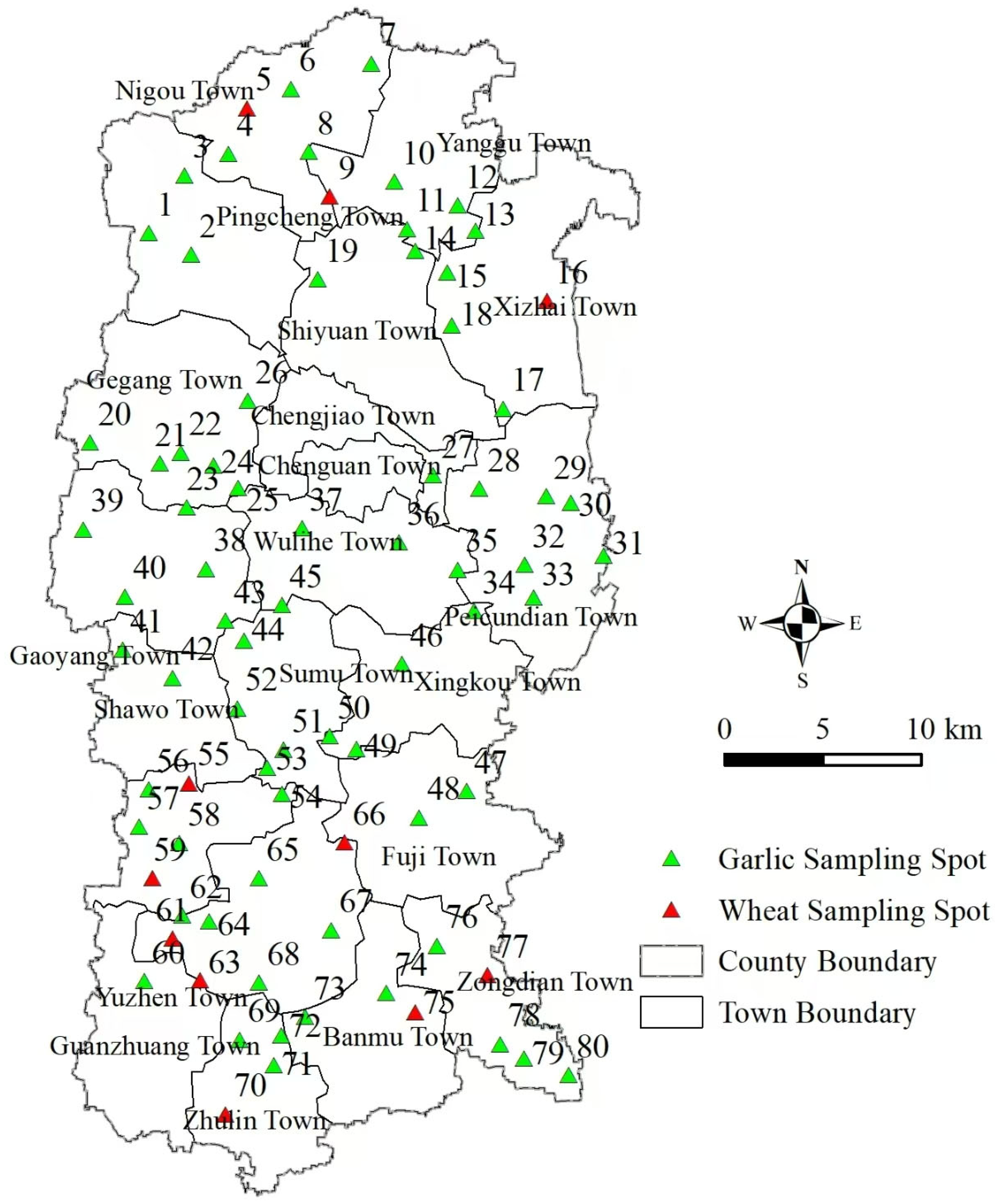
Figure 2.
Occurrence types and percentage of garlic root maggots in Qixian County.
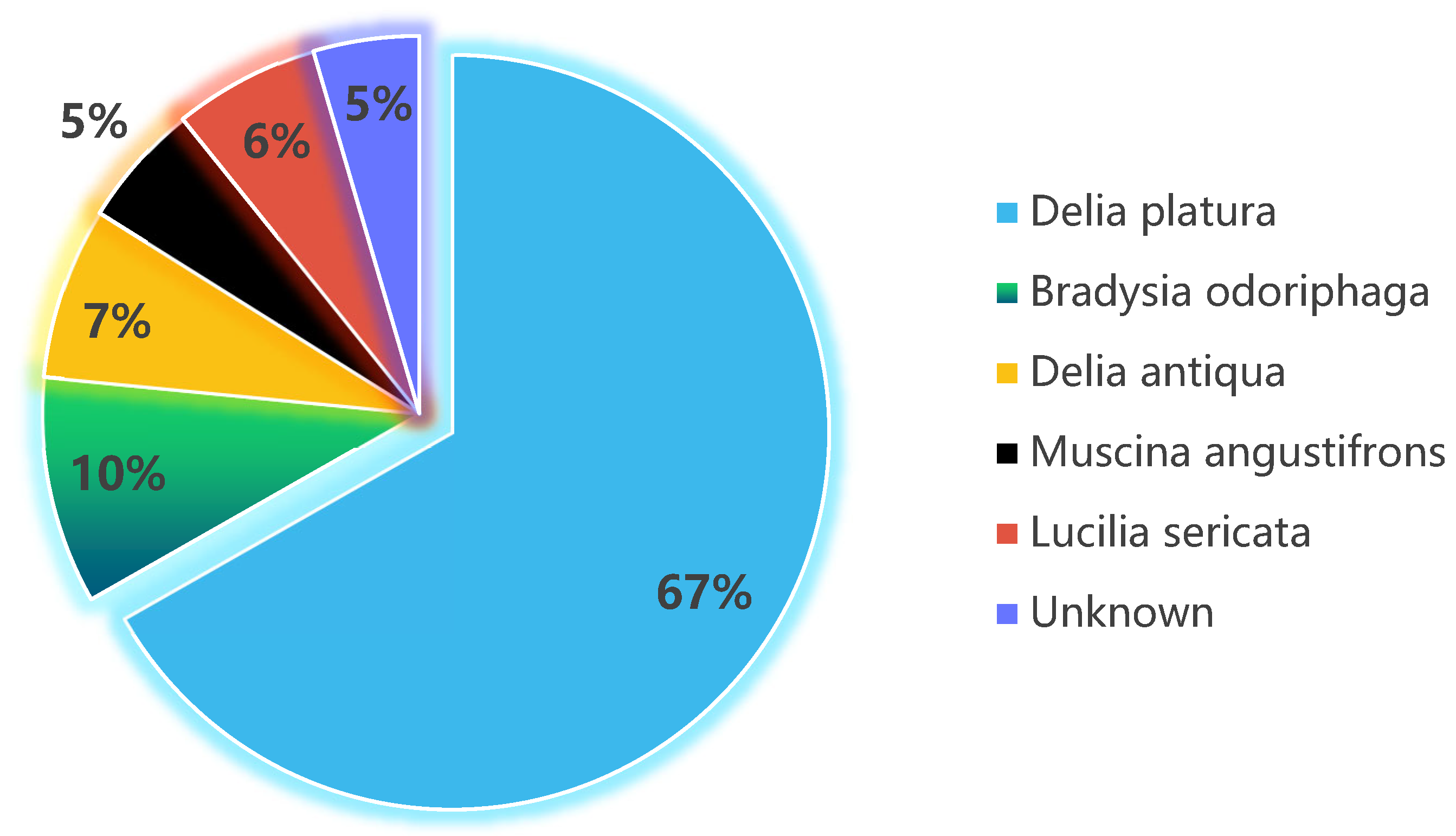
Figure 3.
The life cycle of Delia platura. a:egg. b :arvae. c:prepupa. d:pupa.e:female adult. f:male adult.
Figure 3.
The life cycle of Delia platura. a:egg. b :arvae. c:prepupa. d:pupa.e:female adult. f:male adult.
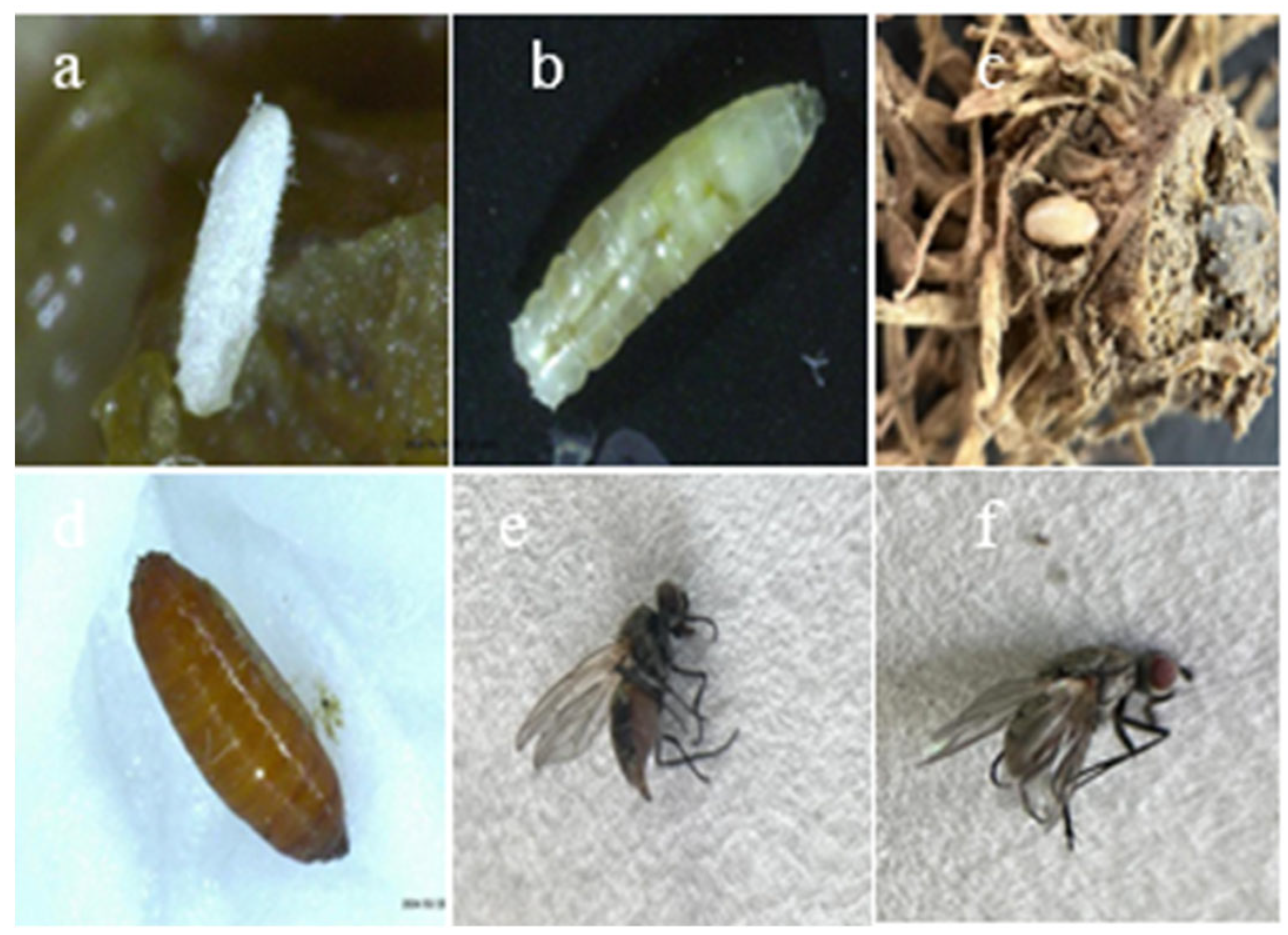
Figure 4.
Non-dominant species in galic field. a: M. angustifrons; b: D. antiqua ;c: L. sericata; d : B. odoriphaga
Figure 4.
Non-dominant species in galic field. a: M. angustifrons; b: D. antiqua ;c: L. sericata; d : B. odoriphaga
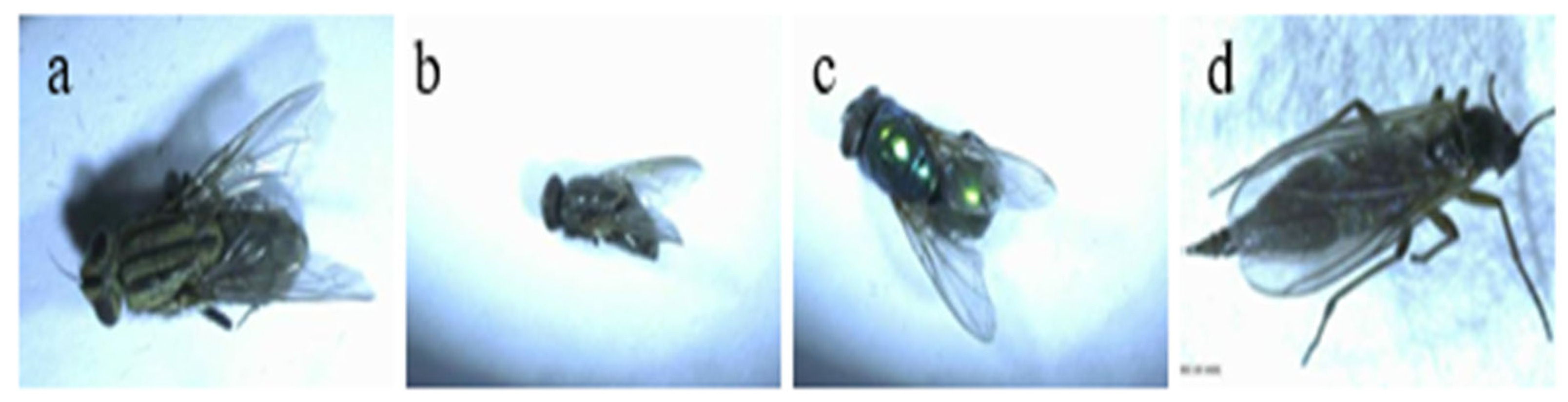
Figure 5.
The male and female adults of Gonolabis distincta prey on the 3rd instar larvae of Delia platura. a: Male adult of G. distincta was preying on the 3rd instar larvae of D. platura; b:Female adult of G. distincta was preying on the 3rd instar larvae of D. platura; Bar=1mm.
Figure 5.
The male and female adults of Gonolabis distincta prey on the 3rd instar larvae of Delia platura. a: Male adult of G. distincta was preying on the 3rd instar larvae of D. platura; b:Female adult of G. distincta was preying on the 3rd instar larvae of D. platura; Bar=1mm.
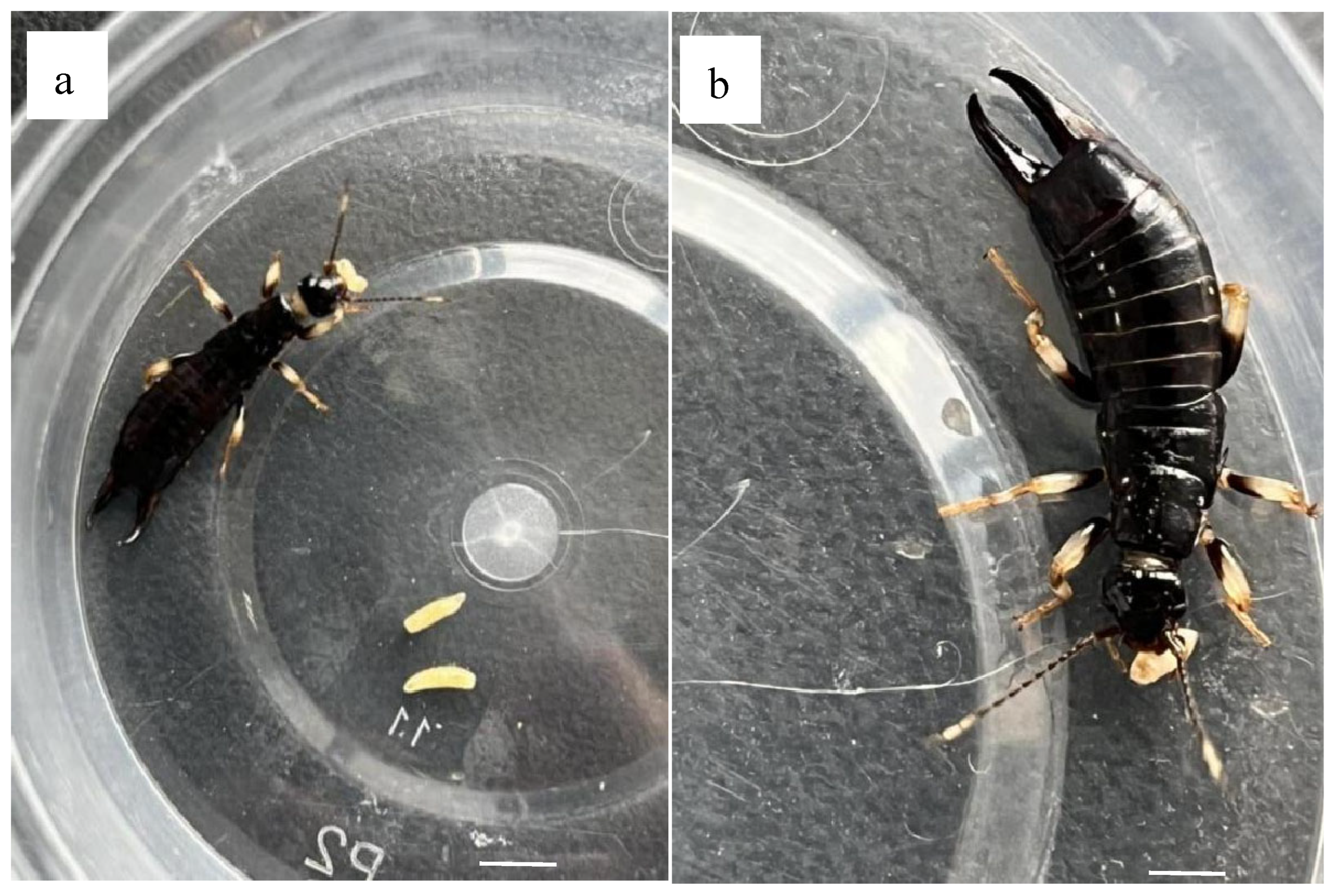

Table 1.
COI gene information of root maggot samples collected from garlic field.
| Root maggots and earwig samples collected from garlic field | GenBank/BOLD number | Gene CDS/bp | Name of insect species |
| 1 | NC_085745.1 | 681 | Delia platura |
| 2 | NC_061662.1 | 688 | Bradysia odoriphaga |
| 3 | NC_028226.1 | 684 | Delia antiqua |
| 4 | NC_034805.1 | 680 | Muscina angustifrons |
| 5 | NW_023995419.1 | 686 | Lucilia sericata |
| 6 | LC767867.1 | 658 | Gonolabis marginalis |
Root root and species in Qi County, Henan Province, based on COI gene sequence.
Table 2.
Daily predation ability of G. distincta on larvae, pupae and adults of D. platura.
| D. platura | ||||
| G. distincta | 1st instar larva | 2nd instar larva | 3rd instar larva | Pupa |
| 1st instar nymph | (1.85±0.13)Da | (1.75±0.20)Ca | (1.0±0.16) D b | (0.95±0.09)Db |
| 2nd instar nymph | (2.05±0.15)Da | (1.95±0.15)Ca | (1.35±0.17) D b | (1.30±0.18)Dd |
| 3rd instar nymph | (2.45±0.18)Da | (2.15±0.24)Ca | (1.60±0.13) D b | (1.45±0.18)Db |
| 4th instar nymph | (24.00±0.57)Ca | (21.05±0.43)Bb | (20.65±0.31)Cc | (17.30±0.51)Cc |
| 5th instar nymph | (36.00±0.57)Ba | (28.85±0.29)Bb | (24.80±0.21)C c | (14.25±0.55)Cd |
| Female adults | (71.25±0.66)Aa | (67.60±0.38)Aa | (57.70±0.54)Ab | (31.40±0.48)ABd |
| Male adults | (63.85±0.41)ABa | (53.45±0.26)Ab | (42.75±0.41)ABc | (41.40±0.18)Ac |
Different uppercase letters in the same column and different lowercase letters in the same row indicated significant differences in the predatory numbers of G. distincta in the same developmental stage preying on D. platura in different developmental stages and significant differences in the predatory numbers of G. distincta in different developmental stages feeding on D. platura in the same developmental stages, respectively (P<0.05, Duncan's Multiple Range Test).
Table 3.
Predation preference of third-instar larvae , female and male adults of Gonolabis distincta Nishikawa for larvae and pupae of Delia platura Meigen per day.
Table 3.
Predation preference of third-instar larvae , female and male adults of Gonolabis distincta Nishikawa for larvae and pupae of Delia platura Meigen per day.
| G. distincta | D. platura | |||||||
| 1st instar larva | 2nd instar larva | 3rd instar larva | Pupae |
|||||
| 5th instar nymph | PN | Ci | PN | Ci | PN | Ci | PN | Ci |
| (27.75±0.27)Aa | 0.097Ba | (22.75±0.48)Bb | 0.14Aa | (22.50±0.3)Bb | 0.13ABa | (18.40±0.2)Cc | -0.11Bb | |
|
Female adults |
(28.80±2.24)Aa | 0.24Ab | (28.40 ± 0.75)Aa | 0.37Aa | (27.45± 2.14)Aa | 0.35Bb | (21.35±1.14)Ab | 0.09 Aa |
|
Male adults |
(28.6±0.34)Aa | 0.06Ab | ( 27.7±0.15)Aa | 0.38ABb | (27.3±0.16)Aa | 0.18Bb | (19.9±0.37)Bb | -0.14Ba |
The data in the table are presented as mean ± SE, Different capital letters followed the same row indicated the significant difference among predatory number (preference index) of same developmental G. distincta preyed on different development stages of D. platura (P<0.05), and different lowercase letters followed the same column indicated the significant difference among predatory number (preference index) of different developmental G. distincta feeding on same development stages of D. platura(P<0.05)(Duncan's Multiple comparisons). PN: Daily predatory number; Ci, Preference index.
Disclaimer/Publisher’s Note: The statements, opinions and data contained in all publications are solely those of the individual author(s) and contributor(s) and not of MDPI and/or the editor(s). MDPI and/or the editor(s) disclaim responsibility for any injury to people or property resulting from any ideas, methods, instructions or products referred to in the content. |
© 2025 by the authors. Licensee MDPI, Basel, Switzerland. This article is an open access article distributed under the terms and conditions of the Creative Commons Attribution (CC BY) license (http://creativecommons.org/licenses/by/4.0/).
Copyright: This open access article is published under a Creative Commons CC BY 4.0 license, which permit the free download, distribution, and reuse, provided that the author and preprint are cited in any reuse.


