
Submitted:
31 August 2023
Posted:
31 August 2023
You are already at the latest version
Abstract
Macadamia Felted Coccid (MFC), Acanthococcus ironsidei (Williams) (Hemiptera: Eriococcidae) was first discovered in 2005 on the Island of Hawaii. Host plants are restricted to Macadamia species, with Macadamia integrifolia Maiden & Betche (Proteaceae) being grown in Hawaii for nut production. Approximately 16,900 acres of macadamia nuts are harvested in Hawaii with estimated farm value of $ 48.8 million (2019 - 2020 records). MFC has become a problem in macadamia orchards where heavy infestations cause the death of young seedlings, reduction in nut production, and severe damage can eventually kill affected trees. Chemical control and extant natural enemies have not suppressed the population of MFC to a manageable level. Exploration in Australia started in November 2013 for the evaluation of potential parasitoids being host specific for introduction into Hawaii. A dominant solitary endoparasitoid of MFC from New South Wales was discovered and described as Metaphycus macadamiae Polaszek & Noyes sp. n (Hymenoptera: Encyrtidae: Encyrtinae). Biology and host specificity testing were conducted at the Hawaii Department of Agriculture, Insect Containment Facility on nine Hemipteran and three Lepidopteran eggs. Results indicated that M. macadamiae is host specific to MFC. There has been no evidence of parasitism or host feeding on any of the non-target insect hosts that were tested. Parasitoid emergence from the control (MFC) averaged 30.2% compared to 0% on non-target hosts. Low rate of parasitoid emergence in the laboratory (average 30.2 %), and increased rate of MFC nymphal mortality was due to adult feeding. Percent field parasitism reached up to 32.7% emergence in the NSW Alstonville, Australia. We report on the parasitoid performance in native Australia, rearing biology, host specificity testing, and the extant natural enemies associated with MFC in Hawaii. A petition to release this parasitoid for the biocontrol of MFC in Hawaii is pending. Once permitted for release, the colony will be shared with South African Mac Nut Association for their biocontrol program of this invasive pest. They will conduct their own testing before approval for release.
Keywords:
Macadamia
; Acanthococcus ironsidei
; Metaphycus macadamiae
; Encyrtidae
; Hawaii
1. Introduction
The Macadamia genera is native to Australia and has been used for the commercial production of macadamia nuts in Hawaii for more than 80 years [1]. Two species of Macadamia have been used, primarily the smooth-shell variety, M. integrifolia Maiden & Betche and the rough-shell variety, M. tetraphylla L.A.S. Johnson (Proteaceae) [2].
Commercial production of macadamia in Hawaii began in the 1930’s [1] and has grown exponentially to be the third most valuable crop ranked commodity in Hawaii after coffee production, Coffea arabica L. (Rubiaceae) and seed corn, Zea mays L. (Poaceae) [3]. Typically, approximately 16,000 acres of macadamia nuts are harvested annually on the Island of Hawaii with the farm value for the 2017-2018 crop is estimated at $53.9 million [4].
Macadamia felted coccid was first intercepted in 1954 on macadamia species imported into Hawaii [5]. But establishment did not occur until MFC was found infesting macadamia trees in South Kona, Hawaii Island, in February 2005 [6]. The MFC is a native Australian insect with plant hosts restricted to Macadamia varieties used for commercial production [2, 5]. It infests all above-ground parts of trees and causes yellow spots on the leaves, die back on young seedling and reduction in nut production [7 - 9]. Heavy infestation causes severe damage and eventual death of affected trees [10] (Figure 1).
Macadamia felted coccid is established and has already spread across the Hawaii Island. In 2023, a survey was conducted by the Hawaii Department of Agriculture and no infestation was found on the other major Hawaiian Islands (Kauai, Maui, Oahu Islands) (HDOA- PPC, survey reports, 2023). Natural dispersal rates of this pest are very low, and distribution tends to occur primarily within infested trees [11]. Tree mortality is rare, but persistent MFC infestation has resulted in substantial decline in nut production [12]. The anticipated impact of the pest on the macadamia industry if not mitigated in a timely fashion was expressed in the “Big Island Weekly”, a local newsprint. It stated that, “The legislature fears that the MFC will spread to other regions and counties of Hawaii if uncontrolled and could devastate the macadamia nut industry which is among the Hawaii five top-grossing agricultural commodities”. MFC has the potential to impact more than 750 macadamia farms, the industry employs some 3,000 workers statewide. In 2014, estimates on one farm indicated that as much as half a million pounds of wet in-shell macadamia nuts was damaged by MFC. Farm value fluctuates in Hawaii according to USDA National Agricultural Statistics Service reached highest of 17,000 acres of macadamia nuts are harvested in Hawaii and the farm value for the 2017-2018 crop is estimated at $53.9 million [4,13].
MFC belongs to Family Eriococcidae with members that resembles mealybugs. The adult female is white to yellow brown and averages 0.7 x 1.0 mm in size [9], Figure 2 A&B). Adult females are immobile and lay their eggs within felted sacs that enclosed their abdomens. A female lays 18 - 97 eggs during lifetime of ≥ 50 days [14,15]. When the eggs hatch, the tiny crawlers move about thus, spreading by wind or by hitchhiking. Long distance dispersal is mainly by passive transport of infested propagative material such as grafting budwood, scion wood cuttings and potted nursery trees [9]. The life cycle takes six weeks in the summer (23.8 – 29.4 °C) and many overlapping generations are produced [16]. The female feeds by inserting its needle-like mouth parts into plant tissues and ingesting the sap (Figure 2 B). Adult males are smaller in size, have wings and do not feed, their sole purpose is to mate with the females (Figure 2 C).
In November 2013, the Hawaii Department of Agriculture, Plant Pest Control Branch (HDOA-PPC) initiated a foreign exploration to Australia to search for natural enemies of MFC. The host plants, Macadamia species are native to Australia therefore, it was the most likely place for potential natural enemies to be located. The HDOA-PPC believed that classical biological control may offer a long-term option for suppression of MFC. An encyrtid wasp, Metaphycus sp. (Hymenoptera: Encyrtidae), was collected as the dominant parasitoid and shipped to Hawaii in November 2013, propagated, and evaluated in the HDOA Insect Containment Facility (ICF). No other parasitoids emerged from this Australian collection. Many species of the genus Metaphycus have been used successfully in biological control programs against hemipteran pests with some great success in controlling the scale insects [17,18], therefore the evaluation of the unknown wasp species of Metaphycus seemed like a potential biocontrol agent to control MFC.
Preserved specimens were sent to Dr. Andrew Polaszek and Dr. John S. Noyes of the Natural History of Museum, London, United Kingdom, for identification and description of this new species [19]. The wasp was identified by British taxonomists in 2020 and named as the new species, Metaphycus macadamiae Polaszek & Noyes sp. n. (Hymenoptera: Encyrtidae: Encyrtinae). The parasitoid is a tiny solitary endoparasitoid. The female is light yellowish in color and is about 0.8 mm in length (Figure 3 A&B). The male is dark in color and is approximately 0.6 mm in length (Figure 3 D). Female lays a single egg inside each host where it hatches and the larva grows and develops thus, killing the host in the process (Figure 2 D). Females also host feed on MFC immatures [19]. No information was available on the host range of M. macadamiae in the scientific literature because it was a species not known to science. Host information of M. macadamiae from Australia is provided only by collections from A. ironsidei on M. integrifolia during the 2013 HDOA survey for MFC natural enemies.
In order to evaluate M. macadamiae as a prospective biological control agent for the biocontrol of MFC in Hawaii, the biology such as life history, longevity, and fecundity was studied since this is a newly identified species. Also host specificity testing was conducted to see the host range of M. macadamiae and identify potential non-target insect hosts closely related to MFC. The objective was to determine whether M. macadamiae would have any negative impact on non-target insects in Hawaii either by feeding and or by ovipositing in the absence of its natural host MFC. Here we report these findings: parasitoid performance in the native region, and extant natural enemies of MFC in Hawaii. Also, for permitting purposes by state officials and USDA-APHIS the Environmental Assessment for M. macadamiae has been drafted and is currently under evaluation to be approved.
2. Material and Methods
2.1. Insect containment facility settings and rearing conditions
All biology and host specificity testing for M. macadamiae was conducted in the HDOA Insect Containment Facility. Wasps were reared for 10 generations before testing began. Insect Containment Facility 22.0 ± 1.0 °C at night and 34.0 ± 2 °C during the day, 60–80% RH, and 13L: 11D photoperiod. The purpose was to determine if this parasitoid would have any negative impact on other non-target insects in Hawaii.
Older nuts of macadamia were collected from the field and propagated in 2-liter black plastic pots with drainage holes and saucer (17 cm top Ø, 12 cm base Ø, 13 cm height). Pots were held under 75% shade and germinated within 6 - 7 weeks. Seedlings were held until they acquired their 3rd or 4th set of leaves before they were ready to be exposed to MFC infestation. Infested macadamia branches were brought back from the field (South Kona 19° 08’ 06.64” N, 155° 50’ 39.5” W, 516 m) and placed on pots between seedlings. Infested seedlings took 7-8 weeks to get enough MFC infestation after which they were exposed to the parasitoid. Two to three pots of infested macadamia seedlings were placed in collapsible lightweight aluminum cages (30x30x60 cm) with clear vinyl doors and 70 mesh chiffon covered rear and top sides.
2.2. Insect host (MFC) and parasitoid rearing (M. macadamiae)
Initial cohorts originated from infested macadamia from NSW Australia. Founder cohorts were 55 wasp colony established in the Containment Facility, Honolulu, Oahu Island (21° 17’ 56.00” N, 157° 50’ 19.69” W, 6 m). Twenty newly emerged females and ten males were released in each cage for oviposition. A few drops of honey (Bradshaws Spun Honey Premiumere, USA, https://www.greenchoicenow.com/p/bradshaws-spun-honey-premium) smeared on top and sides of each cage for adult feeding. Water was provided in a cup (Deli container with lid, and a cotton wick, 470 ml). After 15 days, newly emerged parasitoids were collected and used for exposure to new MFC infested seedlings. Parasitoids were reared continuously in the HDOA Insect Containment Facility 22.0 ± 1.0 °C at night and 34.0 ± 2 °C during the day, 60–80% RH, and 13L: 11D photoperiod, under fluorescent light plus natural sunlight through window glass panels to facilitate mating of parasitoids [20]. Colony was reared for 10 generations before host testing was conducted.
2.3. Life history, longevity, and fecundity of M. macadamiae
2.3.1. Life history
Oviposition was examined by placing excised MFC infested macadamia foliage inside a Petri dish (14.5 cm Ø x 2.0 cm height plastic Petri dishes) with M. macadamiae adults and observing them under a dissecting microscope (Trinocular Stereo Microscope with Top & Bottom Lights). Wet paper was added to keep the leaf moist. Information on the duration of the life cycle was determined by keeping track of the first day of exposure to MFC and the first day of parasitoids’ emergence.
2.3.2. Longevity
Adult longevity was determined by collecting newly emerged M. macadamiae parasitoids and placing them in 10 ml vials. Vial covers were modified to include a 5 mm Ø hole in the center, covered with a fine mesh cloth. Honey was dotted on the cloth for adult parasitoids to feed. Parasitoids were examined daily for mortality. A total of 20 males and 25 females were collected and held in such vials at 5 parasitoids per vial separated by gender.
2.3.3. Fecundity
Fecundity studies were based on the female potential fecundity, potential reproductive output of an individual female over its lifetime. Newly emerged females were collected and held in 10 ml vials and were fed honey. Ten females at each desired age (<1 – 5-week-old) were dissected in saline solution and their mature eggs were counted. Mature ovarian eggs are recognized as characteristic ovarian encyrtid egg with double bodied in shape, consisting of two ovoid bulbs connected by a narrow tube [21], Figure 4). The counts reflect the potential fecundity because they are mature ovarian eggs parasitoids can produce.
2.4. Host specificity testing
Two genera in the family Eriococcidae are listed in the Hawaiian Terrestrial Arthropod Checklist has all adventive members [22]. The genus Acanthococcus in Hawaii with one listed member, Acanthococcus araucariae (Maskell), a pest found on needles of Araucaria spp. (Araucariaceae). The second genus Eriococcus has only one listed species, Eriococcus coccineus (Cockerell) = (Acanthococcus coccineus (Cockerell) new name by Miller and Gimpel 2000 [10]) a pest on cactus spine (Cactaceae) that was reported only from Kauai Island. A recent addition to the Eriococcid family in Hawaii is Tectococcus ovatus Hempel, a weed biological control agent released in 2012 to control Strawberry Guava, Psidium cattleianum Sabine, (Myrtaceae), Table 1, has been added for host specificity testing.
A total of twelve insect species were tested against M. macadamiae of which nine are economically important and endemic members of the Hemiptera: Sternorrhyncha (Aleyrodidae, Coccidae, Dactylopiidae, Eriococcidae, Halimococcidae, Pseudococcidae, Triozidae). Some members of these families are reported hosts of Metaphycus spp. [23]. Additionally, it has been recorded that some encyrtids may attack lepidopteran eggs [24], therefore we included three representatives of the Order Lepidoptera in our tests; one endemic Vanessa tameamea (Eschscholtz), one naturalized nymphalid, Danaus plexipus (Linnaeus), and one beneficial arctiid moth, Secusio extensa (Butler), released in Hawaii to control the fireweed, Senecio madgascariensis Poir., and Delairea odorata Lem. (Table 1).
Infested branch cuttings collected from the field or on infested plant seedlings reared at the HDOA Insectary containing non-target insects were exposed to M. macadamiae for host specificity testing. A plant or plant cutting infested with one of the non-targets was placed in a (30 x30x60 cm) collapsible metal cage and exposed to naïve newly eclosed ten females and five males of M. macadamiae in each cage and held until parasitoids died. In another cage, a MFC infested macadamia seedling was placed and the same number of M. macadamiae were released inside the cage. Host specificity evaluations were based on no-choice tests. All host plants contained all various stages nymphs and pupae of non-target insects. After one-month, non-target insects were dissected and examined for evidence of parasitism. Three infested leaves were randomly picked from each control and the number of MFC on each leaf was tallied and examined for parasitism. Parasitism was determined by the presence of parasitoid circular exit holes (Figure 3 C), unemerged parasitoid cadavers and dead MFC due to parasitoid probing marks. Parasitism in the control replicates was determined by adult parasitoid emergence and parasitoid circular exit holes. In the case of the lepidopteran eggs tested, plant parts containing eggs were collected and placed in Petri dishes (2.0 cm height x 14.5 cm Ø). Five females and five males of M. macadamiae were released inside each Petri dish. Unhatched eggs were examined under a dissecting microscope for evidence of probing or oviposition which left traces of recognizable blacken melanized oviposition scars. All tests were replicated three times.
2.5. Parasitoid field performance in Australia
M. macadamiae was dissected from MFC on infested leaves of Macadamia integrifolia collected in Alstonville, NSW, Australia. Two batches of infested macadamia leaves were collected from different trees that were not known to be sprayed with insecticides, and subsequently shipped to HDOA ICF. One consignment on November 19, 2013 (n = 150 infested leaves, 28°51’ 20.14” S, 153°26’31.40” E, 136 m), Alstonville NSW Australia, and Department of Primary Industry of Australia and another batch of (n = 130 infested leaves, on November 25, 2013, from the same locality, 28° 49’ 13.51” S, 153° 23’ 44.65” E, 168 m). MFC individuals collected on the infested macadamia leaves yielded only adult M. macadamiae wasps. Mean numbers of MFC/leaf, % parasitism by M. macadamiae, and % predation were recorded from leaves and petioles (n = 30) of infested leaves. Dominant predators on the trees were photographed and one species was identified using keys of Australian Lady Beetles [25]. Parasitism was determined by counting the MFC with circular holes of parasitoid emergence (Figure 3 C, white arrows) and predation was determined by the larger oblong irregular holes on scales (Figure 3 C).
2.6. Extant natural enemies in Hawaii
Relative abundance of local natural enemies of MFC on three orchards on the Hawaii Island; Pahala, South Hilo (19° 08’ 08.35” N, 155° 50’ 44.78” W, 503 m); Honokaa, North Hawaii (20° 04’ 5.07” N, 155° 28’ 19.92” W, 476 m); and Honomalino, South Kona (19° 08’ 06.64” N, 155° 50’ 39.5” W, 516 m) were studied by mean count of parasitoids and predators on sticky traps. Ten randomly selected infested trees per orchard were designated. Yellow sticky traps set for flying insects (5 cm wide x 15 cm length) with glue on one side were placed one per tree on infested branches hanged ≤ 2 m above ground. Traps were replaced every month and numbers of parasitoids and predators stuck on traps were microscopically tallied as means ± SEM of parasitoids and five Coccinellids /trap/month/orchard during twelve months of 2015. Encarsia lounsburyi (Berlese & Paoli) (Hymenoptera: Aphelinidae) a parasitoid of male MFC, and Curinus coeruleus Mulsant (Coleoptera: Coccinellidae) were the dominant parasitoid and ladybeetle on Macadamia fields during this survey [12]. Our results indicated in figure 6.
2.7. Statistical analysis and vouchers
An analysis of variance was used to assess the potential significance of differences in the number of parasitoids produced by the M. macadamiae parasitism, % parasitism, and predation. Means were separated by Tukey’s standardized range honestly significant difference test and T-test at P=0.05 level [26]. Percentage data were transformed arcsine √ proportion before analysis. Voucher specimens and paratypes of M. macadamiae were placed in the insect reference collection of the HDOA, the Bernice P. Bishop Museum, Honolulu, Hawaii., and the Department Life Science Collections Natural History Museum London SW7 5BD, England. Vouchers specimens are deposited in Australian National Insect Collection, CSIRO, Canberra, Australia., Natural History Museum, London, UK., United States National Museum, Washington D.C., USA, and the Hawaii Department of Agriculture insect collection [19].
3. Results
3.1. Life history, longevity, and fecundity of M. macadamiae
3.1.1. Life history and longevity
Adult emergence ranged from 12 - 21 days after parasitoid exposure to MFC depending on temperature. In the summer, June – August, maximum temperature ranged 30 – 31 °C, when days are warmer males are seen emerging as early as 12 days after exposure. M. macadamiae can have multiple generations per year under this laboratory conditions.
Results of longevity revealed that M. macadamiae females have on average longer longevity compared to the short living males. Mean ± SEM female longevity was 32.9 ± 3.1 d and male longevity was significantly shorter 8.3 ± 1.4 days (t = 7.1679, df = 32.57, P <0.0001).
3.1.2. Fecundity
Number of mature ovarian eggs in ≤1 week-old females ranged 3-10 eggs with a mean ± SEM 5.3 ± 0.73 mature eggs. Maximum egg production peaked at 14 ovarian eggs at one week old with a mean 10.4 ± 0.8 mature eggs per female and declined thereafter to 7.8 ± 0.4 and 4.1 ± 0.2 as the female aged at 2–5-week-old (Figure 4). This indicated that M. macadamiae is a synovigenic species produce mature eggs throughout their adult lives and resorb eggs in older ages (F3,36 = 1.823; P <0.0001).
3.2. Host specificity testing
Host specificity study proved that M. macadamiae is specific to MFC. There was no parasitoid emergence from any of the twelve non-targets tested. Moreover, dissections revealed no evidence of parasitism nor host feeding on non-targets. Although parasitism rates varied between controls, all had some degree of emerged parasitoids ranged 6.7 – 62.5% compared to the non-target with no parasitoid emergence or evidence of feeding (Table 1).
3.3. Field parasitism evaluation of M. macadamiae in Australia
Mean field parasitism, and predation in Australia showed M. macadamiae rate of parasitism ranged 21.2 – 32.7 % in Alstonville, during November 2013 sampling. Predation reached mean of ≥ 5% with two recognized predators. Mean infestation ranged 16.7 – 19.9 MFC/infested leaf during November 2013. Parasitoid performs better on leaves showing higher parasitism rate on leaves than petioles (Figure 5).
3.4. Extant natural enemies of MFC in Hawaii
Several coccinellid predators and the aphelinid parasitoid, Encarsia lounsburyi, are known natural enemies of MFC in Hawaii, but their impacts alone are insufficient to suppress MFC populations. Average count of trap catches per month in three Macadamia orchards on Hawaii Island during 2015 showed the parasitoid E. lounsburyi is thriving especially in Honokaa Orchards. This compared to predation with coccinellid counts (Figure 6).
The Pahala site had no significant differences between the densities of E. lounsburyi and C. coeruleus whereas Honomalino had mean count differences of 25 to 5 to their respective natural enemy. Honokaa had no incidence of C. coeruleus and was outright E. lounsburyi presence with mean counts above 300 (Figure 6).
4. Discussion
MFC is established and has spread throughout all macadamia growing areas on the Hawaii Island. It has economically damaging impacts on macadamia farms with persistent, high-density infestations of bearing trees, resulting in substantial decline in nut production, with up to 60% yield losses in some macadamia nut varieties [11, 27]. With the current control methods and the recurring population outbreaks, it is anticipated that MFC will eventually spread to other fields and islands in the Hawaiian archipelago. Fortunately, surveys in 2023 showed no infestations on other islands at present (2023 HDOA survey).
Insect growth regulators (IGR) and horticultural oils insecticides are currently used to help control MFC in Hawaii. Some of these insecticides have negative impacts on natural enemies that are present in orchards, such as Coccinellidae and parasitoids. Based on studies by Gutierrez-Coarite et al. 2017 [15], insecticide treatments with IGR compounds are appropriate when MFC populations are high, whereas horticultural oils combined with natural enemies are most effective when populations are low. Macadamia trees are large, making insecticide applications challenging and costly [1]. The use of chemicals to control MFC would continue at current levels of infestation would negatively impact the extant natural enemies in macadamia orchards and honeybees. Honeybees are essential for pollination in Macadamia fields. Therefore, a specific parasitoid like M. macadamiae is desirable.
Cultural control is an essential component of the Integrated Pest Management system utilized by macadamia orchards in Hawaii. Keeping macadamia nut trees healthy by maintaining the right soil moisture, fertilizing, cleaning, and pruning helps defend them against MFC infestation. Stressed plants are often the first to be colonized heavily by the scale insects [11]. In addition, MFC infestation is heaviest in shaded sites within the orchards and on trees with sucker shoots [7, 28] hence trees need to be pruned and cleaned regularly to prevent build-up of MFC populations. However, cultural management alone is insufficient to reduce MFC impacts. However, effective pruning encourages resident predators of MFC within orchards to utilize trees as a habitat more frequently [28].
Field surveys of natural enemies in macadamia nut orchards on Hawaii island revealed the presence of several predatory coccinellid beetles (Halmus chalybeus (Boisduval), Rhyzobius forestieri (Mulsant), Sticholotis ruficeps Weise, and Telsimia nitida Chapin), and the parasitic wasp Encarsia lounsburyi, associated with MFC [15]. The parasitic wasp, E. lounsburyi was first found associated with MFC infestations on Hawaii Island in 2005 [29]. E. lounsburyi is recorded to parasitize a range of diaspidid scale insects and is not host specific to MFC like the Australian M. macadamiae [30]. All species of Diaspididae are adventive in Hawaii [22].
Local natural enemies in Hawaii may play a minor part in reducing numbers of MFC, but do not prevent populations from reaching damagingly high densities. They are considered generalists and their impacts on high MFC infestations are inadequate to reduce the pest populations below economically injurious levels. With the high MFC populations that are typical in Hawaii macadamia nut orchards biocontrol is hopeless without an effective specialized agent [27]. Our laboratory studies show that MFC parasitism rate by M. macadamiae can range 11– 62% parasitism (Table 1). Even greater than estimates from field parasitism in Australia (21 – 33% parasitism). In addition, female wasps host-feed on MFC nymphs, thereby adding to the mortality rate of MFC attributable to the wasp. The addition of M. macadamiae to the assembly of natural enemies exploiting MFC will exert adequate pressure on pest populations and hopefully decrease pest population levels so densities of MFC are reduced to tolerable levels.
Metaphycus macadamiae is a newly described species with no records exist in the scientific literature. Other members of this genus are known as primary endoparasitoids of scale insects, and a few species of the Encyrtidae family are recorded to parasitize eggs of some lepidopterans [31].
Historically, three species of Metaphycus were released in Hawaii from previous biological control introductions: Metaphycus clauseni (Timberlake), M. helvolus (Compere), and M. luteolus (Timberlake) were purposefully released as biological control agents of soft scale insects and mealybugs in the period 1934 – 1964. The parasitoids were originated from California, but establishment is unknown for the three species [22, 32]. Additionally, seven Metaphycus species were accidently introduced to Hawaii recorded as natural enemies of scale insect pests on major Hawaiian Islands: M. alberti (Howard), M. anneckei Guerrieri & Noyes, M. claviger (Timberlake), M. eruptor (Howard), M. flavus (Howard), M. portoricensis (Dozier), and M. stanleyi Compere. All seven species were established on various islands [22, 32]. No non-target parasitism of native insects in Hawaii was recorded by Metaphycus species since their first introduction in 1934 [32].
In 2017, MFC was found severely infesting macadamia nut trees in Barberton valley, Mpumalanga province, South Africa [33] where it is also a devastating pest to the country’s macadamia nut producing industry, due to the rapid spread within a month to White River Macadamia orchards, presumably through infested plant material [34]. South Africa has been the world's largest suppliers of the macadamia since the 2010s. South Africa, Australia, and Kenya are the dominant producers of macadamia nuts, while China is on the rise, according to the agriculture research firm. South Africa (34%), Australia (26.7%), Kenya (12.3%), China (5.1%), of exported macadamia nuts (https://www.worldstopexports.com/top-macadamia-nuts-exports-imports-by-country-plus-average-prices/, [35, 36].
A starter colony of M. macadamiae (200 wasps) was hand-carried from Hawaii to South African quarantine facility for propagation The colony arrived in good condition (Dr. Mark Wright, University of Hawaii at Manoa, unpublished). Unfortunately, this culture was lost before any permission to release in the field. Beside this information on host testing, South Africa may need to consider study specificity on other introduced eriococcid species of South Africa (i.e., E. coccineus Cockerell, E. araucariae Maskell and E. leptospermi (Maskell) and the native species Calycicoccus merwei Brain [37].
In Australia, MFC is only a problem in newly infested localities until natural enemies catch up to exert adequate control [9]. The infestation and rate of parasitism from the sampled leaves indicated that M. macadamiae is the dominant natural enemy. M. macadamiae seems to perform better on leaves showing higher rates of parasitism than on petioles and stems. Infested leaves may be more attractive to the parasitoids because of higher MFC density and presence of honeydew drops on leaves (Figure 5).
The genus Metaphycus comprises 466 described species of which many considered as important biocontrol agents of scale insects in a range of cropping systems worldwide [19]. Species of this genus are typically arrhenotokous primary endoparasitoids (solitary or gregarious) of the scale insect families Coccidae and Diaspididae (Hemiptera: Coccoidea) [18, 23]. About 30 Metaphycus species have been purposefully released around the world as biocontrol agents to control soft (Coccidae) and armored (Diaspididae) scale pests. None were reported to have any adverse effect on non-targets in released lands. The newly parasitoid proposed for release in Hawaii, M. macadamiae, is a solitary endoparasitoid where females oviposit a single egg into a newly molted MFC adult (Figure 3A). The immature larval-pupal stages of the M. macadamiae develop within the host MFC, killing it in the process (Figure 2 D).
The longevity of the adults of Metaphycus species is known to be influenced by available food source of insect hosts and sucrose availability of adult diet. Non-fed adults did not survive past the second day, while honey-fed individuals lived more than six days in some species [38]. In our laboratory experiment the MFC infested leaves would provide a sugar diet content to the parasitoid, this may also happen in the field without dependance on flowering plants for nectar (Figure 2 C). Still, female M. macadamiae are observed to partake in insect host feeding. They were observed to penetrate the young hosts by ovipositor then turn to feed on oozing fluid in immature MFC. Females do not use these young, shriveled individuals for oviposition. Host feeding increases parasitoid longevity and their potential fecundity in naïve wasps [38]. Similar results of longevity of Metacphycus spp. indicate non-oviposited females lived on average about eight days, whereas ovipositing females lived on average about five days [39].
5. Conclusion
Like several other Metaphycus species released in the past biological control programs, this endoparasite wasp is highly unlikely to produce any adverse effect on the fauna of Hawaii, both native and beneficial introduced species including the lepidopteran eggs. Being a monophagous species, M. macadamiae females will exclusively seek MFC nymphs for host feeding, and young adult MFC for oviposition. MFC will be the only organism in Hawaii that will be affected by the release of this parasitoid. Observations in the native region indicate that M. macadamiae is restricted to MFC hosts reaching up to 33% parasitism in Australian fields which making MFC a minor pest of Macadamia. Host specificity testing in the HDOA-PPC Insect Containment Facility demonstrated that M. macadamiae will only attack the target pest A. ironsidei. There are few immigrant pest species closely related to MFC existing in Hawaii, which further minimizing any potential for unexpected impacts in Hawaii once M. macadamiae is released. This report of host specificity and parasitoid performance should support decision making for release permits in Hawaii or infested regions in South Africa. In not one single case was the parasitoid able to successfully emerge or feed on any tested non-target species.
Acknowledgments
Bonnie Self, Hawaiian Macadamia Nut Services, LLC Hilo, Hawaii, for contributing financial support to identify the parasitoid species in British Museum. Dexter Cho, HDOA-PPC for field support. Dr. Andy Polaszek for identifying and publish information on the new wasp. Photos are credited to M. Ramadan and Ron Heu (HDOA). MMR appreciate logistics and research permits during the survey conducted in November 2013 provided by Dr. Ruth Huwer and Mr. Craig Maddox (NSW Agriculture Department of Primary Industries, Alstonville, NSW Department of Primary Industries, Agriculture Centre for Tropical Horticulture, Alstonville, Australia).
References
- Bennell, M.R. 1984. Aspects of the biology and culture of the macadamia. Master Thesis. University of Sydney. 143 pp.
- Jones, V.P. 2002. Macadamia felted coccid. In: Macadamia Integrated Pest Management: IPM of Insects and Mites Attacking Macadamia Nuts in Hawaii. Honolulu: University of Hawaii. 98 pp.
- USDA National Agricultural Statics Service (NASS). 2017. Top 20 Commodities State of Hawaii. Available online at: https://www.nass.usda.gov/Statistics_by_State/Hawaii/Publications/Miscellaneous/2017HawaiiTop20Commodities.pdf.
- NASS. 2018. Pacific Region - Hawaii Macadamia Nuts Final Season Estimates. https://www.nass.usda.gov/Statistics_by_State/Hawaii/Publications/Fruits_and_Nuts/072020MacNutFinal.pdf.
- Williams, D.J. 1973. Scale insects (Homoptera: Coccoidea) on macadamia. Journal of the Australian Entomological Society 12 (2): 81-91. [CrossRef]
- Conant, P., D.M. Tsuda, R.A. Heu, and K.K. Teramoto. 2005. Macadamia felted coccid, Eriococcus ironsidei Williams. New Pest Advisory. Hawaii Department of Agriculture No. 05-01.
- Ironside, D.A. 1970. The macadamia felted coccid. Queensland Agricultural Journal 96 (9): 613-616.
- Ironside, D.A. 1973. Insect pests of macadamia. Queensland Agricultural Journal 99: 241–250.
- Ironside, D.A. 1978. The macadamia felted coccid. Queensland Agricultural Journal 104(5): 25-28.
- Miller, D.R. and Gimpel, M.E. 2000. A Systematic Catalogue of the Eriococcidae (Felt Scales) (Hemiptera: Coccoidea) of the World. Intercept Ltd., Andover, U.K. 589 pp.
- Wright, M.G. and Conant, P. 2009. Pest status and management of macadamia felted coccid (Hemiptera: Eriococcidae) in Hawaii. Yearbook of the Southern African Macadamia Growers Association 17: 72–75. International Macadamia Nut Symposium, 2009 At: Skukuza, South Africa, Southern African Macadamia Growers Association Yearbook 17: 72-75.
- Pulakkatu-thodi, I., Dzurisin, J. and Follett, P. 2022. Evaluation of macadamia felted coccid (Hemiptera: Eriococcidae) damage and cultivar susceptibility using imagery from a small unmanned aerial vehicle (sUAV), combined with ground truthing. Pest Manag Sci, 78: 4533-4543. [CrossRef]
- Anonymous. 2014. The Kaʻū Calendar News Briefs, Hawaiʻi Island. 2014. http://kaunewsbriefs.blogspot.com/2014_01_05_archive.html?m=1.
- Zarders, D.R. and M.G. Wright. 2016. Macadamaia felted coccid, Eriococcus ironsidei: Biology and Life Cycle in Hawaii. Proceedings of the Hawaiian Entomological Society 48: 51-55.
- Gutierrez-Coarite, Rosemary, Ishakh Pulakkatu-Thodi, Dominique Zarders, Javier Mollinedo, Juliana Yalemar, Mark G. Wright, and Alyssa Cho. 2017. Macadamia Felted Coccid Eriococcus ironsidei (Hemiptera: Eriococidae) Description, Monitoring, and Control. College of Tropical Agriculture and Human Resources University of Hawai'i at Manoa. Insect Pests. November 2017, IP-43.
- Swaine, G., D.A. Ironside, and W.H.T. Yarrow. 1985. Macadamia felted coccid. In: Insect Pests of fruits and vegetables. Brisbane: Queensland Department of Primary Industries, Information Series Q183021.
- Pfeiffer Douglas G. 1997. 3.3.8 Deciduous Fruit Trees. in World Crop Pests, 1997, Soft Scale Insects their Biology, Natural Enemies and Control. Yair Ben-Dov and Chris J. Hodgson (Editors), Volume 7 B, Pages 3-442. Elsevier Science B.V. 293. [CrossRef]
- Lotfalizadeh, H. 2010. The genus Metaphycus Mercet (Hymenoptera: Encyrtidae) of the Iranian fauna with description of a new species. North-Western Journal of Zoology 6 (2): 255-26.
- Polaszek, A., J.S. Noyes, S. Russell, and M.M. Ramadan. 2020. Metaphycus macadamiae (Hymenoptera: Encyrtidae) – a biological control agent of macadamia felted coccid Acanthococcus ironsidei (Hemiptera: Eriococcidae) in Hawaii. PLOS ONE 15(4): e0230944. http://doi.org/10.1371/journal.pone.0230944.
- Zilahi-Balogh G.M.G., J. L. Shipp, C. Cloutier, and J. Brodeur. 2006. Influence of Light Intensity, Photoperiod, and Temperature on the Efficacy of Two Aphelinid Parasitoids of the Greenhouse Whitefly, Environmental Entomology, 35 (3): 581–589. [CrossRef]
- Prinsloo Gerhard L. 1997. Chapter 2.3 Parasitoids 2.3.1 Encyrtidae. In: Soft Scale Insects - Their Biology, Natural Enemies and Control (7B). Y. Ben-Dov and C.J. Hodgson (Editors), 1997 Elsevier Science B.V. etal intext.
- Nishida, G.M. 2002. Hawaiian Terrestrial Arthropod Checklist: Fourth Edition. Hawaiian Biological Survey, Bishop Museum Technical Report 22. Honolulu: Bishop Museum Press. 313 pp.
- Noyes, J.S. 2019. Universal Chalcidoidea Database. World Wide Web electronic publication. Available at: http://www.nhm.ac.uk/chalcidoids.
- Triapitsyn S.V, Andreason S.A, Power N, Ganjisaffar F, Fusu L, Dominguez C, Perring T.M. 2020. Two new species of Ooencyrtus (Hymenoptera, Encyrtidae), egg parasitoids of the bagrada bug Bagrada hilaris (Hemiptera, Pentatomidae), with taxonomic notes on Ooencyrtus telenomicida. Journal of Hymenoptera Research 76: 57-98. [CrossRef]
- Slipinski Adam. 2007. Australian Ladybird Beetles (Coleoptera: Coccinellidae), Their Biology and Classification, Australian Biological Resources Study, Canberra, pp 286.
- JMP Version II. 2023. SAS Institute Inc., Cary, NC, 1989–2023. https://www.jmp.com/en_us/home.html.
- Gutierrez-Coarite, R., A.H. Cho, J. Mollenido, I. Pulakkatu-Thodi, and M.G. Wright. 2021. Macadamia felted coccid impact on macadamia nut yield in the absence of a specialized natural enemy, and economic injury levels. Crop Protection 139: 105378. [CrossRef]
- Gutierrez-Coarite, R., I. Pulakkatu-Thodi, and M.G. Wright. 2019. Binomial sequential sampling plans for macadamia felted coccid (Hemiptera: Eriococcidae) infesting Hawaii macadamia orchards. Environmental Entomology 48(1): 219-226. [CrossRef]
- Conant, P., and C. Hirayama. 2005. Natural enemies of macadamia felted coccid (Eriococcus ironsidei Williams, (Homoptera: Eriococcidae) in Hawaii. 45th Annual Conference Proceedings, Hawaii Macadamia Nut Association. p. 30–34.
- Viggiani, G. 1987. La specie italiane del genre Encarsia Foerster (Hymenoptera: Aphelinidae). Bollettino del Laboratorio di Entomologia Agraria 'Filippo Silvestri', Portici 44 pp. 121-179.
- Liu Houping, Jason Mottern. 2017. An Old Remedy for a New Problem? Identification of Ooencyrtus kuvanae (Hymenoptera: Encyrtidae), an Egg Parasitoid of Lycorma delicatula (Hemiptera: Fulgoridae) in North America. Journal of Insect Science 17 (1) 18. [CrossRef]
- Beardsley, John W. 1976. Synopsis of the Encyrtidae of the Hawaiian Islands with Keys to General and Species (Hymenoptera: Chalcidoidae), Proceedings of the Hawaiian Entomological Society, 12: (2) 181 – 195.
- Schoeman, P.S., and I.M. Millar. 2018. First report of Eriococcus ironsidei Williams (Hemiptera: Coccomorpha: Eriococcidae) on macadamia (Macadamia integrifolia Maiden & Betche and Macadamia tetraphylla Johnson: Proteaceae) in South Africa. African Entomology 26(1): 247-249. [CrossRef]
- Anonymous. 2019. The Macadamia Magazine, Beware the Felted Coccid. https://themacadamia.co.za/2019/02/19/beware-the-felted-coccid/.
- Yerton, Stewart. 2022. Hawaii Farmers Struggle as Worldwide Macadamia Market Goes Nuts. Honolulu Civil Beat. Available at: https://www.civilbeat.org/2022/11/hawaii-farmers-struggle-as-worldwide-macadamia-market-goes-nuts/. Accessed 12/2/2022.
- Workman Daniel. 2023. Top Macadamia Nuts Exports & Imports by Country Plus Average Prices. https://www.worldstopexports.com/top-macadamia-nuts-exports-imports-by-country-plus-average (accessed August 2023).
- Gullan, P.J., Giliomee, J.H., Hodgson, C.J. and Cook, L.G. 2006. The systematics and biology of the South African gall-inducing scale insect, Calycicoccus merwei Brain (Hemiptera: Coccoidea: Eriococcidae). African Entomology 14: 13–33.
- Kapranas, Apostolos, and Robert F. Luck. 2008. Egg maturation, host feeding, and longevity in two Metaphycus parasitoids of soft scale insects, Biological Control, Volume 47, Issue 2, 2008, Pages 147-153. [CrossRef]
- Dorys T Chirinos, Takumasa Kondo. 2020. Description and Biological Studies of a New Species of Metaphycus Mercet, 1917 (Hymenoptera: Encyrtidae), A Parasitoid of Capulinia linarosae Kondo & Gullan. International J. of Insect Science, 11(1): (2020). [CrossRef]
Figure 1.
A) Australian Macadamia orchard (NSW), November 2013 with MFC is a minor pest, B) Hawaii Macadamia orchard 2005 severe infestation, C) MFC infestation on leaves and nuts in Hawaii, D) infestation of stems in Hawaii.
Figure 1.
A) Australian Macadamia orchard (NSW), November 2013 with MFC is a minor pest, B) Hawaii Macadamia orchard 2005 severe infestation, C) MFC infestation on leaves and nuts in Hawaii, D) infestation of stems in Hawaii.
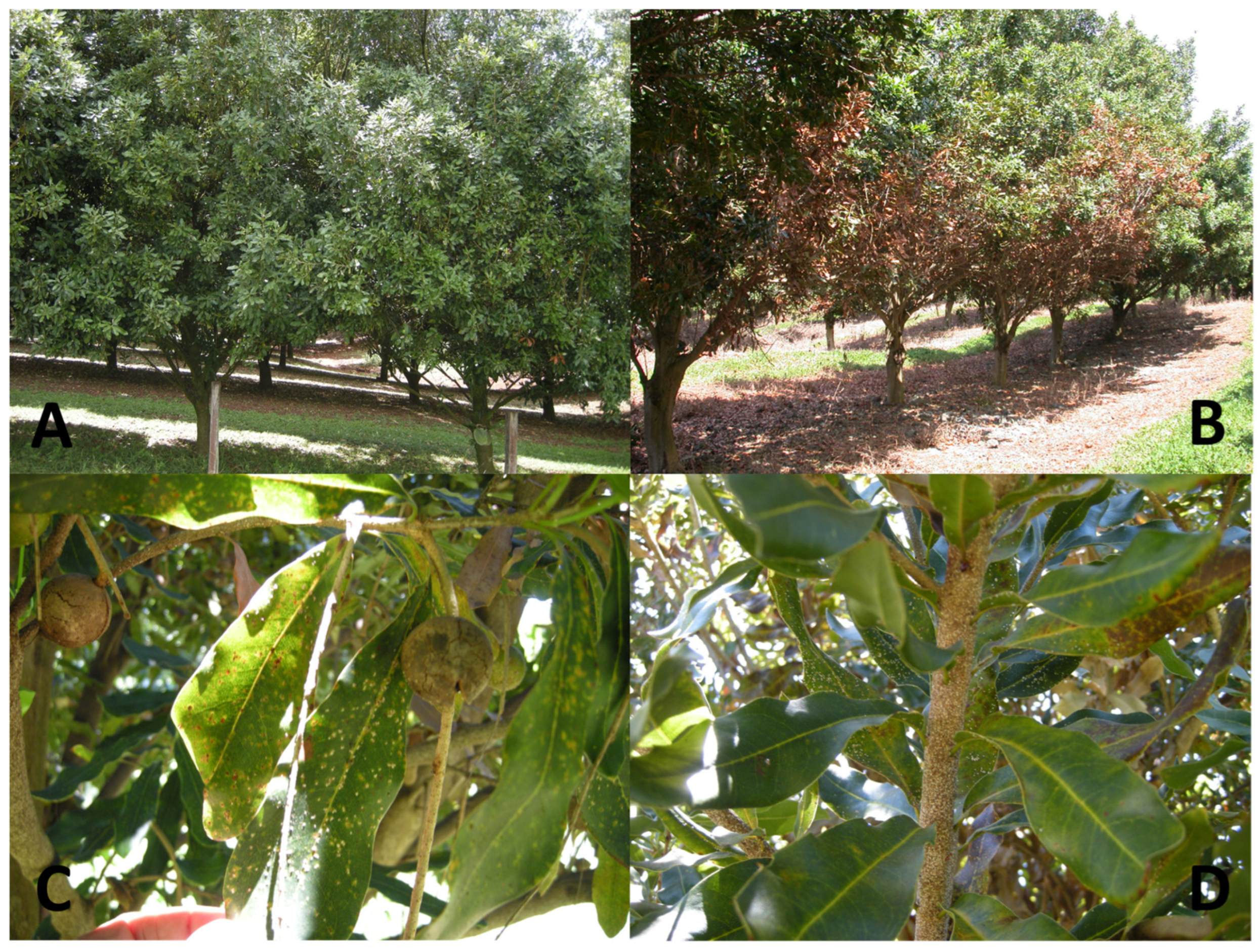
Figure 2.
A) MFC mature female scale, dirty white to pale yellow, about 1.5 mm in length, with a raised circular opening at the posterior end, B) Female MFC orange in color, showing long stylet mouth parts (arrow), C) honeydew produced on leaves by the nymphs of MFC (arrows honeydew and male white nymphs), D) Metaphychus macadamiae larval stage dissected from female MFC.
Figure 2.
A) MFC mature female scale, dirty white to pale yellow, about 1.5 mm in length, with a raised circular opening at the posterior end, B) Female MFC orange in color, showing long stylet mouth parts (arrow), C) honeydew produced on leaves by the nymphs of MFC (arrows honeydew and male white nymphs), D) Metaphychus macadamiae larval stage dissected from female MFC.
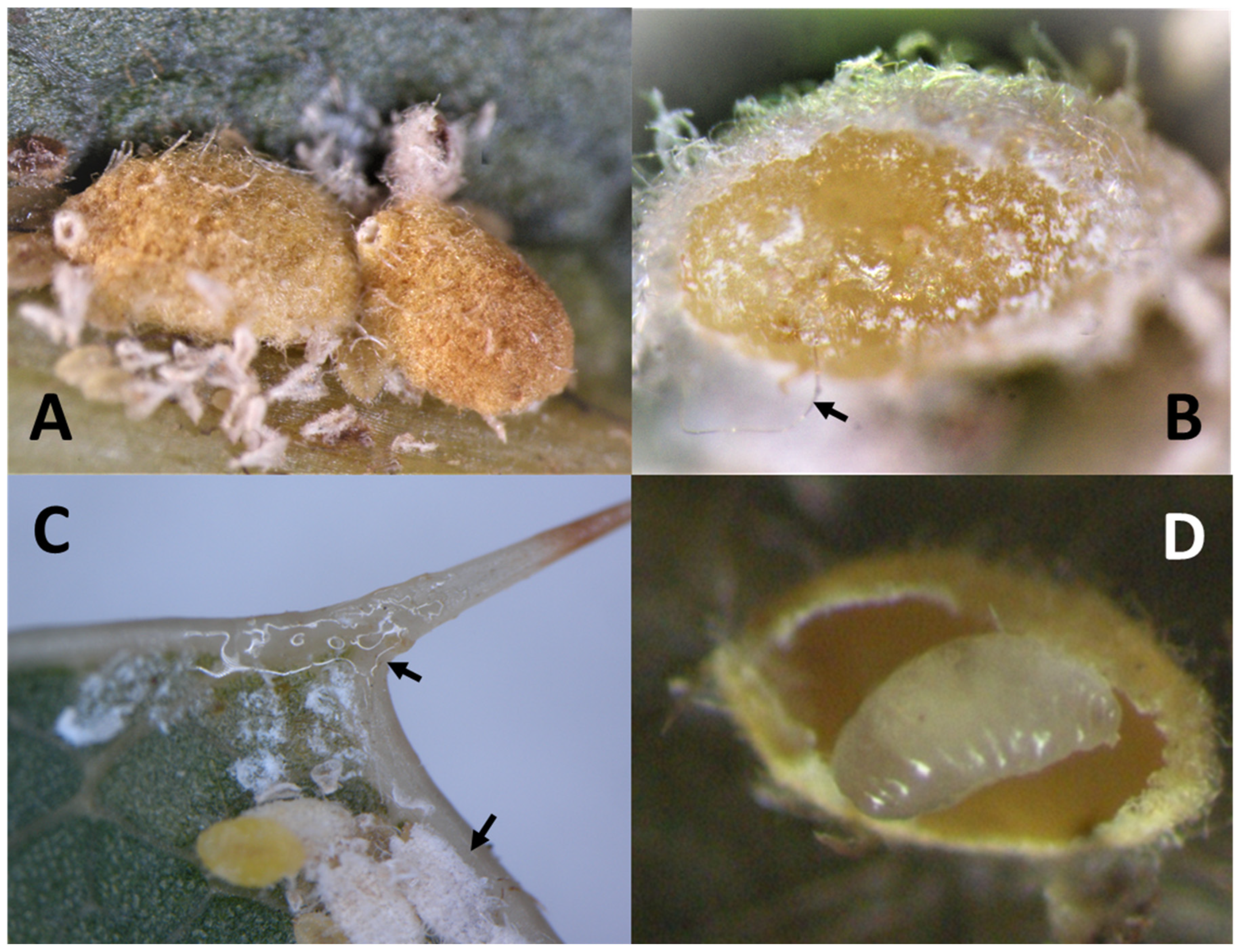
Figure 3.
A) Female M. macadamiae probing the host for oviposition (arrow showing ovipositor), B) habitus of female M. macadamiae, 0.63 - 0.78 mm in length, C) MFC with circular parasitoid exit holes versus predation chewing holes (arrows), D) habitus of darker male M. macadamiae smaller in size 0.46 - 0.66 mm in length.
Figure 3.
A) Female M. macadamiae probing the host for oviposition (arrow showing ovipositor), B) habitus of female M. macadamiae, 0.63 - 0.78 mm in length, C) MFC with circular parasitoid exit holes versus predation chewing holes (arrows), D) habitus of darker male M. macadamiae smaller in size 0.46 - 0.66 mm in length.

Figure 4.
M. macadamiae potential fecundity, ovarian maturation peaked at one-week old female. Image is a mature stalked egg typical of Encyrtiform ovarian egg is two-bodied, and stalk tube between the two pulps. Comparison for all pairs using Tukey-Kramer HSD. (ANOVA: F 3,36 = 21.8233, P <0.0001).
Figure 4.
M. macadamiae potential fecundity, ovarian maturation peaked at one-week old female. Image is a mature stalked egg typical of Encyrtiform ovarian egg is two-bodied, and stalk tube between the two pulps. Comparison for all pairs using Tukey-Kramer HSD. (ANOVA: F 3,36 = 21.8233, P <0.0001).
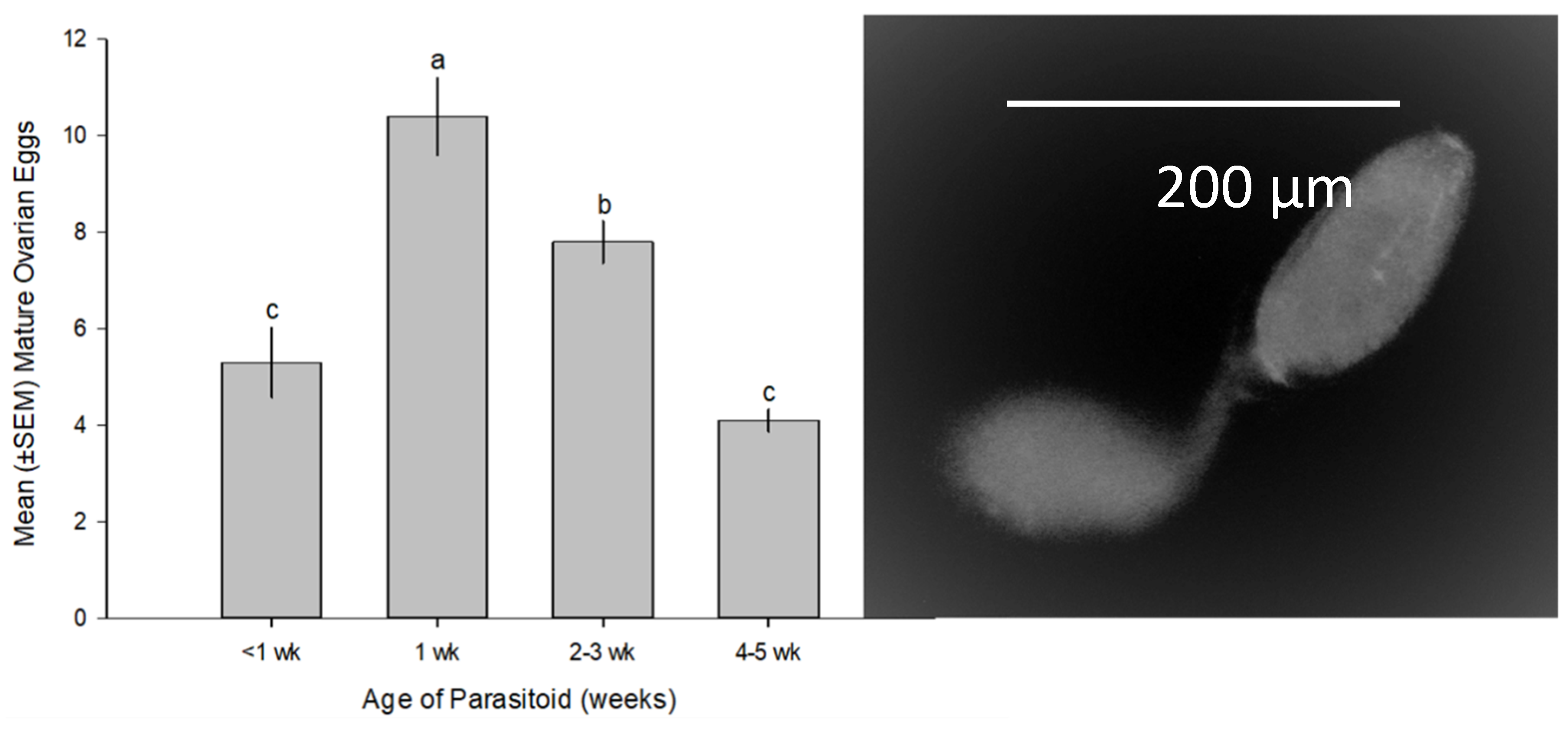
Figure 5.
Field infestation by MFC, M. macadamiae performance % parasitism, and % predation during November 2013, Alstonville, NSW Australia. Two dominant predators, inset bottom is Rhyzobius ventralis (Erichson).
Figure 5.
Field infestation by MFC, M. macadamiae performance % parasitism, and % predation during November 2013, Alstonville, NSW Australia. Two dominant predators, inset bottom is Rhyzobius ventralis (Erichson).

Figure 6.
Relative abundance of extant natural enemies of Macadamia felted coccid (MFC) on three orchards on Hawaii Island during 2015. Values are means ± SEM of parasitoids and five Coccinellids per sticky trap per month placed on infested macadamia trees. A) Encarsia lounsburyi (Hymenoptera: Aphelinidae) on MFC male scale is white about 1.0 mm long., B) Curinus coeruleus (Coleoptera: Coccinellidae) a dominant ladybeetle on Macadamia fields.
Figure 6.
Relative abundance of extant natural enemies of Macadamia felted coccid (MFC) on three orchards on Hawaii Island during 2015. Values are means ± SEM of parasitoids and five Coccinellids per sticky trap per month placed on infested macadamia trees. A) Encarsia lounsburyi (Hymenoptera: Aphelinidae) on MFC male scale is white about 1.0 mm long., B) Curinus coeruleus (Coleoptera: Coccinellidae) a dominant ladybeetle on Macadamia fields.
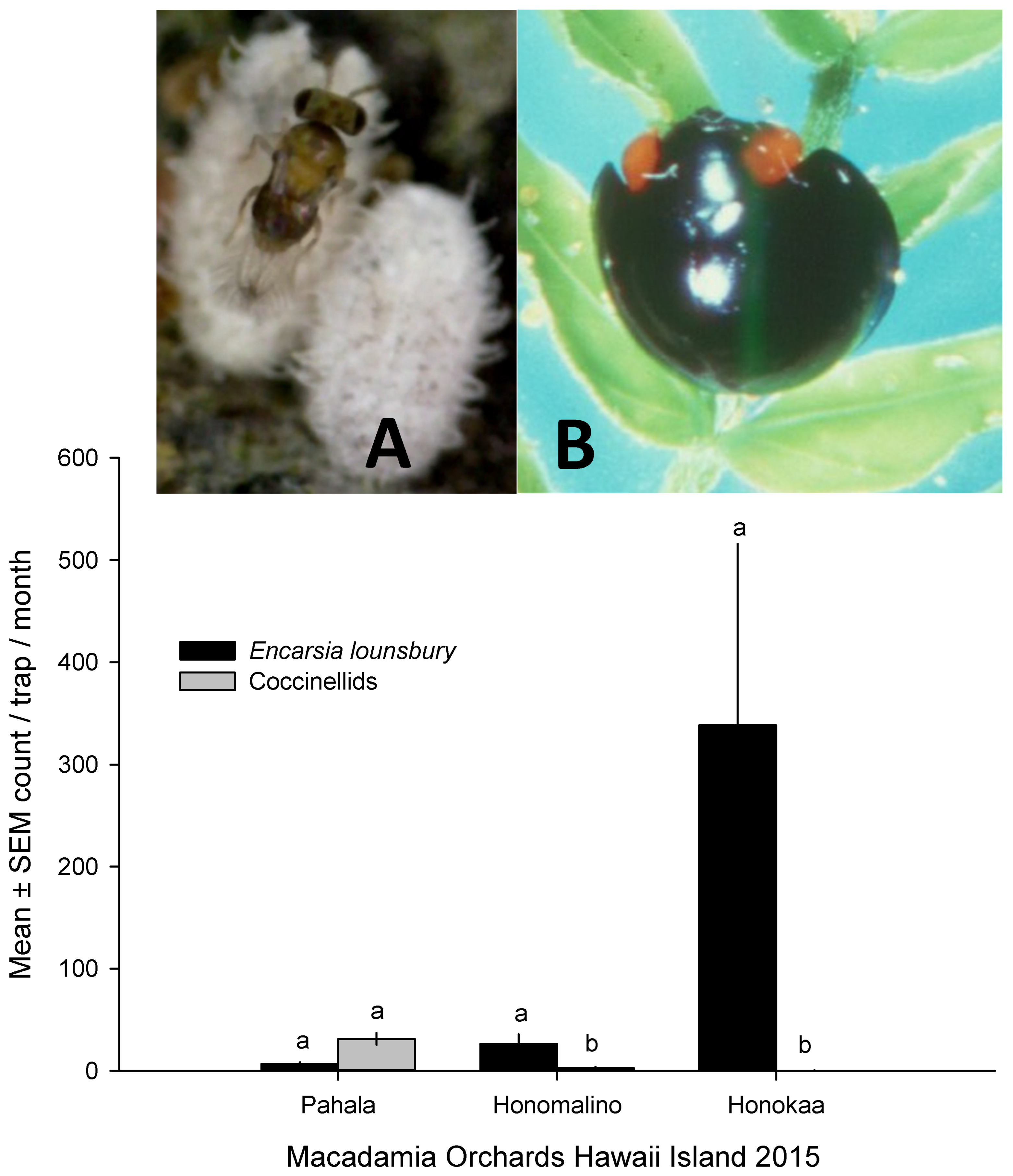

Table 1.
Metaphycus macadamiae (Hymenoptera: Encyrtidae) host specificity study with non-target insects and Macadamia Felted Coccid (MFC), Acanthococcus ironsidei, as the control .
Table 1.
Metaphycus macadamiae (Hymenoptera: Encyrtidae) host specificity study with non-target insects and Macadamia Felted Coccid (MFC), Acanthococcus ironsidei, as the control .
|
Non-target insect hosts and host plants |
Mean % Parasitism based on Metaphycus emergence and non-target dissections (n=3) |
|||||||
|---|---|---|---|---|---|---|---|---|
| MFC (control) % M. macadamiae emergence |
Mean non-target insects dissected | Non-target insects % Parasitism |
||||||
| Scientific name, order, and family | Stage tested | Status | Source | Host plant and Infested plant part used | ||||
|
Tectococcus ovatus (Hempel) Hemiptera: Eriococcidae |
Adult & Nymph | Biocontrol agent | Lab reared HDOA, Oahu |
Psidium cattleianum Whole plants, seedlings |
6.7 | 50.0 | 0 | |
|
Acanthococcus araucariae (Maskell) Hemiptera: Eriococcidae |
Adult & Nymph | Immigrant | Field collected, Molokai |
Araucaria sp. Cuttings |
17.5 | 140.0 | 0 | |
|
Thysanococcus pandani (Stickney) Hemiptera: Halimococcidae |
Adult & Nymph | Immigrant | Field collected, Maui |
Pandanus tectorius Whole plants |
21.7 | 100.0 | 0 | |
|
Colobopyga pritchardiae (Stickney) Hemiptera: Halimococcidae |
Adult & Nymph | Endemic | Field collected, Hawaii |
Pritchardia sp. Cuttings |
15.2 | 100..0 | 0 | |
|
Dactylopius opuntiae (Cockerell) Hemiptera: Dactylopiidae |
Adult & Nymph | Biocontrol agent | Field collected, Oahu |
Opuntia ficus-indica Cuttings |
11.7 | 366.7 | 0 | |
|
Saissetia oleae (Oliver) Hemiptera: Coccidae |
Adult & Nymph | Immigrant | Lab reared HDOA, Oahu |
Erythrina variegata Whole plants, seedlings |
30.6 | 547.3 | 0 | |
|
Pseudococcid montanus (Erhorn) Hemiptera: Pseudococcidae |
Adult & Nymph | Endemic | Field collected, Oahu |
Freycetia arborea Cuttings |
62.5 | 110.7 | 0 | |
|
Pariaconus ohiacola (Crawford) Hemiptera: Triozidae |
Nymphs & pupae | Endemic | Field collected, Oahu |
Metrosideros sp. Cuttings |
54.3 | 100.0 | 0 | |
|
Tetraleurodes acaciae (Quaintance) Hemiptera: Aleyrodidae |
Nymphs & pupae | Immigrant | Field collected, Oahu |
Erythrina variegata, Seedling |
38.3 | 100.0 | 0 | |
|
Vanessa tameamea (Eschscholtz) Lepidoptera: Nymphalidae |
Egg | Endemic | Lab reared PEPS, UHM |
Pipturus albidus Eggs placed on filter paper |
57.3 | 10.0 | 0 | |
|
Danaus plexipus (L.) Lepidoptera: Nymphalidae |
Egg | Naturalized | Field collected, Oahu |
Colotropis gigantea foliage |
19.4 | 18.3 | 0 | |
|
Secusio extensa (Butler) Lepidoptera: Erebidae |
Egg | Biocontrol agent | Lab reared HDOA, Oahu |
Senecio madgascariensis foliage |
26.7 | 199.0 | 0 | |
Disclaimer/Publisher’s Note: The statements, opinions and data contained in all publications are solely those of the individual author(s) and contributor(s) and not of MDPI and/or the editor(s). MDPI and/or the editor(s) disclaim responsibility for any injury to people or property resulting from any ideas, methods, instructions or products referred to in the content. |
© 2023 by the authors. Licensee MDPI, Basel, Switzerland. This article is an open access article distributed under the terms and conditions of the Creative Commons Attribution (CC BY) license (http://creativecommons.org/licenses/by/4.0/).
Copyright: This open access article is published under a Creative Commons CC BY 4.0 license, which permit the free download, distribution, and reuse, provided that the author and preprint are cited in any reuse.


