
Submitted:
28 February 2025
Posted:
03 March 2025
You are already at the latest version
Abstract
This work documents the first official occurrence of Etiella zinckenella (Lepidoptera: Pyralidae) infestations in soybean crops in Greece, and in particular within the Regional Unit of Drama. Larvae of this pest inflict direct damage by feeding on seeds and cause indirect damage by reducing crop marketability, resulting in significant yield and financial losses. Additionally, this report introduces Dolichogenidea appellator (Hymenoptera: Braconidae), a parasitoid of E. zinckenella, that has been identified using DNA barcoding and is documented for the first time in Greece. Given the substantial economic implications and the necessity for effective integrated pest management practices, further research is essential to elucidate the interactions between environmental conditions, pest dynamics, and agricultural practices in the region. This study provides a critical foundation for future investigations into soybean pest management in Greece.
Keywords:
soybean pod borer
; Mediterranean Basin
; pest management strategies
; Greece
1. Introduction
Numerous significant agricultural pests are represented in the subfamily Phycitinae (Lepidoptera, Pyraloidea, Pyralidae), distinguished by the diverse feeding behaviors of their larvae. Among the most notable species within this subfamily are several well-known pests of stored products, such as the tobacco moth, Ephestia elutella (Hübner), the flour moth, Anagasta kuehniella (Zeller),the fig moth, Cadra cautella (Walker), and the mealworm moth, Plodia interpunctella (Hübner) [1,2]. Additionally, the locust bean moth, Apomyelois ceratoniae (Zeller), which infests carob and pomegranate [3], the honeydew moth, Cryptoblabes gnidiella Millière, a pest of grapevines [4], and the quince moth, Euzophera bigella (Zeller), which infests olive trees [5], further illustrate the economic impact of this subfamily.
Within the diverse species of the Phycitinae subfamily, the pulse pod borer moth, E. zinckenella (Treitschke), is particularly prominent as one of the most widespread and economically damaging insect pests affecting soybean, lentil, and various pulse crops throughout Asia and beyond [6,7]. This species has garnered significant attention due to its potential to inflict substantial damage on these vital agricultural commodities, leading to considerable economic losses for farmers and impacting food security in the region [8]. The larvae of E. zinckenella are known to bore into the pods of pulses, disrupting seed development and ultimately reducing both yield and quality [9,10].
In Europe, E. zinckenella is recognized as a primary pest of soybean crops, particularly in Ukraine, where its occurrence poses a serious threat to the burgeoning soybean industry [11,6]. The economic implications of this pest are profound, as it does not only affect the quantity but also the marketability of the harvested crops [8]. Consequently, effective management strategies are essential to mitigate the impact of E. zinckenella on soybean and pulse production, ensuring the sustainability of these critical agricultural sectors in both Asia and Europe.
This brief communication reports the first observation of soybean infestation by E. zinckenella in Greece. This finding marks an addition to the understanding of the pest's geographical distribution and highlights the potential threat it poses to soybean cultivation in the region.
2. Materials and Methods
2.1. Location of Infestation and Sampling
The study area is located in the Regional Unit of Drama, Greece. Specifically, two soybean fields were identified as infested with the pest, one in the Kalamonas area of the Municipality of Doxato (41°0.6102'N, 24°10.7385'E) and the other in the vicinity of Agia Paraskevi, also in the Municipality of Doxato (41°1.2926'N, 24°8.8582'E) (Figure 1). Both fields experienced water stress due to elevated temperatures and limited irrigation water availability during the summer of 2024. The mean, minimum and maximum air temperature was obtained from the meteorological station owned by the National Observatory of Athens (www.noa.gr) that is located in Kalampaki (Drama, Greece) (41°3.3143'N 24°10.6159'E), approximately 5 km away from the two fields. Samples of infested soybean pods from the aforementioned plots were collected manually and transferred to the laboratory of the Department of Quality and Phytosanitary Inspections (Rural Economy and Veterinary Directorate, Drama, Greece) for further examination.
2.2. Species Identification
Species identification was based both on morphological traits and DNA barcoding. For E. zinckenella, morphological traits were examined on adults collected directly from the field and adults obtained after rearing larvae in the laboratory, using species-specific taxonomic identification keys [12,13]. However, as only pupae of the parasitoid species were retrieved from soybean pods, its identification was based solely on DNA barcoding.
DNA barcoding protocol was performed on larvae of the pest and pupae of the parasitoid collected from infested soybean pods which were immediately stored in 95% alcohol. In total, DNA was extracted from the body of three (3) larvae and one (1) pupa using PureLine® Genomic DNA kit (Invitrogen, Waltham, MA, USA), following the manufacturer’s protocol. Polymerase chain reaction was run in 25μl volumes with LCO-HCO primers [14] that amplify a 658bp long locus of the mitochondrial cytochrome oxidase subunit I (COI) gene. Precise concentrations of PCR reagents and thermocycling conditions are provided in Avtzis et al. [15]. PCR products were then cleaned up enzymatically using the ExoSAP-IT TM PCR Product Cleanup Reagent (ThermoFisher Scientific), and subsequently shipped to Cemia Company (Larissa, Greece) where they were sequenced in an ABI3730XL automated sequencer using the both PCR primers. Finally, sequences were visualized with Chromas Lite version 2.6.6software and then used in a nucleotide Blast query in the NCBI GenBank database.
2.3. Assessment of the Damage Extent
The level of damage caused by the pest was evaluated through a random sampling of pods from the infested fields. A minimum of 500 pods per field were collected from at least 100 plants, which were evenly distributed across the field to ensure representative sampling. The collected pods were then visually inspected for symptoms of larval feeding damage, including the presence of holes or hollow seeds. Finally, the incidence of infestation was calculated as the percentage of infested pods.
3. Results
3.1. Species Identification
Based on the comprehensive morphological keys of Naito et al. [12] and Kumar et al. [13], adult specimens of the pest were readily identified as E. zinckenella. Two of the sequences obtained were identical and the other one differed only by two mutations; however, the result of the nucleotide BLAST query identified them all as Etiella zinckenella, as they resembled by 100% and 99.84% the sequences with Accession numbers JF854540 and MH415774, respectively, that both correspond to E. zinckenella.
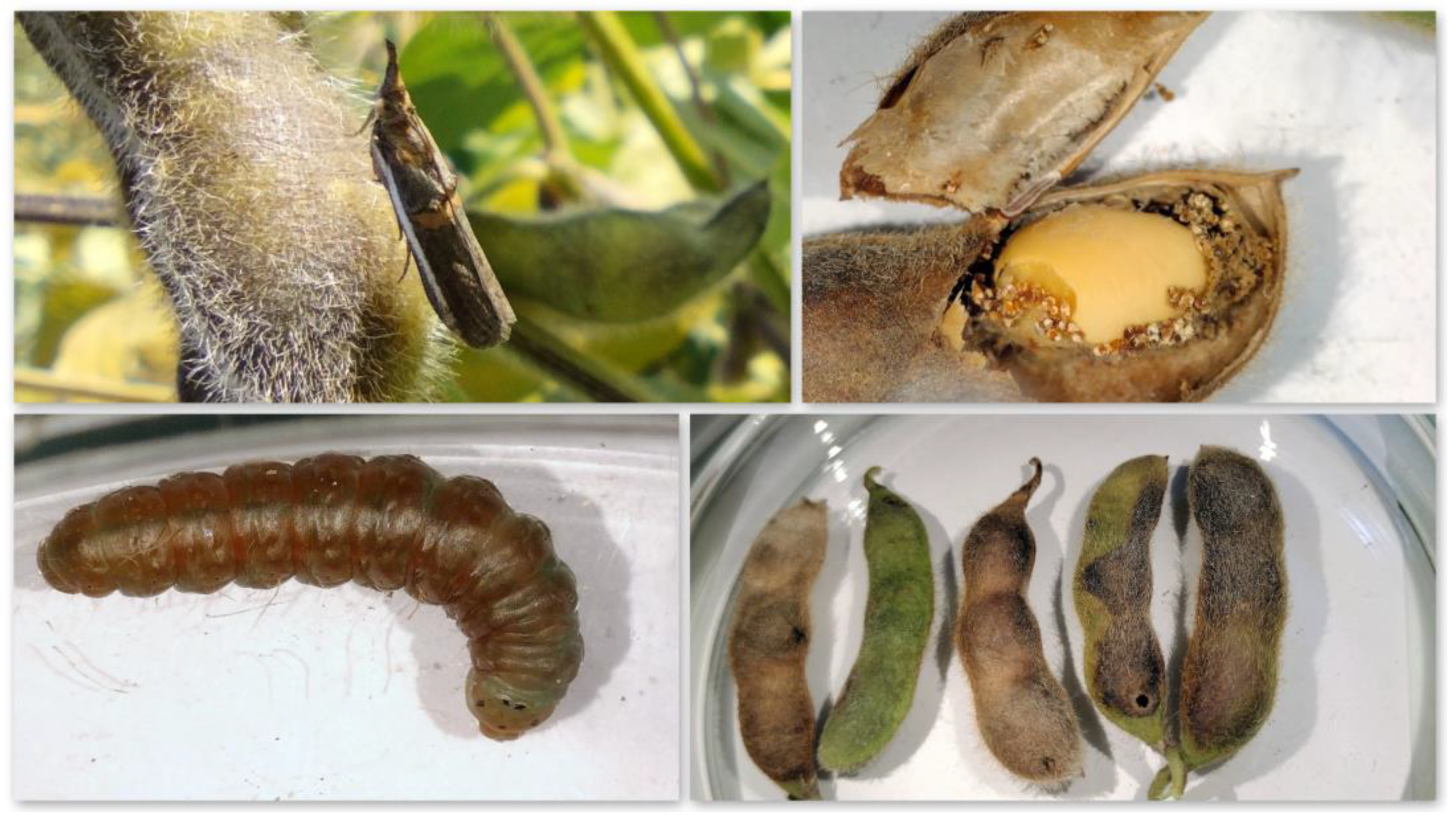
Adults E. zinckenella exhibit variability in ground coloration of their forewings, ranging from reddish-brown to purplish-grey, with a notable absence of darker hues. A prominent white costal streak is also a species-specific feature (Figure 2a). The antemedial transverse fascia displays a gradient of colors from orange-brown to orange-red, often exhibiting a golden iridescent sheen. In the folded wings of adult moths, the antemedial bands in the forewings appear as curved transverse bands across the wings. The average length of the forewing is measured at 8.7 ± 0.7 mm [12]. The forewings are comparatively longer and narrower than the hindwings, which are transparent and adorned with long hairs along their inner margins. Female moths are slightly smaller in size than their male counterparts. The abdomen of the male moth is narrower and features yellowish, irregular tufts of hair at the anal end. In contrast, the abdomen of the female moth is broader, bearing tufts of yellowish hairs of consistent length at the posterior end [13].
Based on DNA barcoding, the parasitoid species obtained from the soy beans was identified as Dolicogenidea appellator (Telenga), (Hymenoptera: Braconidae, Microgastrinae), as the obtained sequence matched resembled by 99.84% with the GenBank Accession number PP350056 that corresponds to D. appelator.
Even though D. appellator is distributed across the Cape Verde Islands, Cyprus, Egypt, Hungary, Mongolia, North China, Russia, Central Europe, and Turkey [16], this is the first official report of the species in Greece.
3.2. Description of the Damage
Externally, the affected lobes displayed a dark brown metachromatic coloration that indicated the underlying infestation, that in the majority of cases was coupled with a visible exit hole. Internally, there was a significant accumulation of larval feces, accompanied by the development of secondary fungal growth and damage to the seeds resulting from the larvae's feeding activity (Figure 2c, 2d).
The mean daily temperature recorded in the sampling region from May to September 2024 was 24.4 °C ± 0.3 SE, which was statistically significantly higher (t-test, p < 0.001) than the mean temperature for the same months in 2021–2023, which was 22.8 °C ± 0.2 SE. A similar trend was observed in the mean minimum temperatures, with values of 17.7 °C ± 0.3 SE in 2024 compared to 16.5 °C ± 0.2 SE in the previous years (p < 0.001). Additionally, the mean maximum temperatures also reflected this increase, measuring 31.4 °C ± 0.4 SE in 2024 versus 29.4 °C ± 0.3 SE in 2021–2023 (p < 0.001).
3.3. Estimation of the Damage Level
In the first field at Kalamonas, infestation levels were estimated to be approximately 15% of the total number of pods sampled, exhibiting an even distribution across the field. By comparison, the second field demonstrated a significantly lower infestation level of approximately 5%, with the damage distributed unevenly throughout the crop as it was predominantly limited on its periphery.
4. Discussion
This report documents the first official occurrence of E. zinckenella damage on soybean crops in Greece. Infestations were specifically identified in two fields located in a corn-producing area within the Regional Unit of Drama (Eastern Macedonia, Northeastern Greece) where soybeans are less commonly cultivated compared to corn. This finding underscores the need for further research to evaluate the potential impact of E. zinckenella on soybean yields, quality, as well as associated economic losses in the region.
Overall, the 2024 growing season was characterized by elevated temperatures and scarce irrigation water, something that had a profound impact on crop yield and productivity. The correlation between temperature and progression of infestations was particularly noteworthy. A comparative analysis of daily temperatures from May to September 2024 revealed a significant increase of 1.6 °C, 1.2 °C, and 2.0 °C in mean, minimum, and maximum temperatures, respectively, compared to the preceding three years (2021-2023). This temperature surge, coupled with drought, had a devastating effect on soybean crops, particularly during the critical seed-filling stage. Research has consistently shown that even minor temperature increases can disrupt soybean development, impairing photosynthesis and nutrient transport [17]. The synergistic effects of heat and drought stress have been found to be particularly detrimental to soybean yields and quality [18].
Furthermore, a highly significant positive correlation was observed between maximum temperature and the incidence of soybean pod borer infestations; conversely, an equally significant negative correlation was found with evening relative humidity [19]. Additionally, an inverse correlation has been noted between the incidence of E. zinckenella infestations in soybeans and the frequency of crop irrigation [11], suggesting that well-watered crops may be less susceptible to infestations. However, the interplay between these factors and pest incidence in the specific context of the 2024 growing season in the Regional Unit of Drama is not well understood.
While previous studies have indicated that the incidence of E. zinckenella may be influenced by factors such as soil type and irrigation frequency [11,9], and that soybean pod borer infestations may be more prevalent in dry years [9,10,6], the relationship between these factors and pest incidence in the Regional Unit of Drama during the 2024 growing season remains unclear due to the fact that this is the first report of the species in the region.. To that, further investigation is needed to elucidate the potential roles of elevated temperatures and water stress in contributing to the observed insect infestations in this specific context.
The average fecundity of female E. zinckenella moths is approximately 56.3 eggs [13]. In the context of soybean cultivation, female pests exhibit a behavior of moving between plants, laying multiple eggs during each visit [20]. Initially, eggs are whitish and oval-shaped; however, they undergo a color change to orange just prior to hatching [13]. The mean duration of the oviposition period is approximately 6.11 ± 0.72 days (± SE), while the egg incubation period lasts about 4.72 ± 0.02 days, at 25 °C. The larval stage, at a temperature of 25 °C, has an average duration of 10.59 ± 0.17 days [8]. Larval development consists of five distinct instars [8,7]. The first instar is yellowish with a shiny black head. The second instar is creamy to brown. The third instar has a yellow head with black spots on the prothorax. The fourth instar is pink with a yellowish head (Figure 2b). The total larval period averages 16.9 days. Freshly formed pupae are initially greenish, changing to brownish after 6-7 hours, and the pupal stage lasts approximately 13.4 days, during which six hook-shaped spines develop at the posterior end. Adult moths are greyish, with females being slightly smaller than males. Males have larger compound eyes and broader antennae with a distinct projection, while females lack this projection and have a wider abdomen with tufts of yellowish hairs. The complete life cycle spans approximately 40.9 days [13].
Larvae cause direct damage to seeds by feeding on them resulting in yield losses, while indirectly they even reduce the quality and marketability of infested crops [8]. The damage caused by the soybean pod borer also lead to a significant reduction in oil content, a critical determinant of soybean seed quality. The economic implications are substantial, with potential yield losses ranging from 70-80% to 90%, depending on the sowing period [6]. This pest is identified as one of the most severe threats to soybean production, as larvae destroy seeds during their development within the pods [7].
Lutytska et al. [6] found that the timing of soybean sowing significantly impacts the extent of damage caused by the soybean pod borer. Soybeans sown in late May were most susceptible to damage during the grain filling phase, while those sown in April had the lowest percentage of damage. However, even early-planted soybean crops can experience high infestation levels due to the erratic occurrence of E. zinckenella [9,10]. Moreover, early planting may not always be a viable option for farmers, such as in the Regional Unit of Drama, where soybean is cultivated as a secondary crop following winter cereals.
In this study, we document for the first time in Greece the occurrence of D. appellator as a parasitoid of E. zinckenella—a finding that represents the first reported record of this species as a natural enemy in the country, particularly noteworthy given the current lack of information regarding its distribution in Greece. Among the reported hosts of this parasitoid are Plutella xylostella (L.) (Lepidoptera: Plutellidae), Phthorimaea operculella (Zeller), P. absoluta (Meyrick), Scrobipalpa spp. (Lepidoptera: Gelechiidae), Cydia pomonella (L.), Sparganothis pilleriana (Denis & Schiffermüller) (Lepidoptera: Tortricidae), and E. zinckenella (Treitschke) (Lepidoptera: Phycitidae) [21,22].
Dolichogenidea appellator exhibits several biological traits that support its potential as a natural enemy in integrated pest management programs. Idriss et al. [23], who investigated D. appellator parasitizing P. absoluta under laboratory conditions in Sudan, reported that it exhibits a widespread distribution, a high prevalence compared to other natural enemies, and host-stage specificity. These traits underscore the potential for effective population establishment and application in new ecological contexts. In laboratory experiments, D. appellator maintained consistent developmental parameters—including similar offspring production, balanced sex ratios, and uniform egg-to-adult development—across optimal host stages despite its relatively short adult lifespan. Moreover, its type II survivavorship curve [23], which indicates a constant mortality rate [24] suggests that D. appellator can potentially adjust its parasitism strategies to alternative pest targets. Thus, evidence derived from studies on P. absoluta supports the potential of D. appellator as an effective natural enemy in eco-friendly biological management programs for the soybean pest, warranting further research to fully characterize its biological profile against E. zinckenella.
Our sampling efforts yielded only a small number of pupae, precluding a comprehensive assessment of its potential as a natural enemy in the region. Given the importance of D. appellator as a natural enemy [22], additional research is crucial to clarify its role in regulating the population density of E. zinckenella. Such investigations could provide valuable insights for developing effective biological control strategies and enhancing integrated pest management practices in Greece.
Controlling E. zinckenella with contact insecticides poses considerable challenges. Effective management requires diligent monitoring of the insect's phenological stages to accurately determine the hatching time of new larvae. The timing of chemical pesticide applications is critical; it must be meticulously coordinated to ensure that larvae receive a lethal dose before they penetrate the pods [10]. The larvae's feeding behavior, characterized by their presence within the pods under a closed canopy, significantly hampers the efficacy of insecticides, making it challenging to achieve sufficient exposure to the target pests [7]. Innovative solutions, such as enhanced nozzles and drop tube sprayers that allow for adjustable spray angles, hold promise for improving pod coverage. However, the accessibility of these advanced technologies remains a barrier for many farmers [10].
A substantial body of research has demonstrated that various soybean cultivars exhibit differential resistance to the soybean pod borer. Key factors contributing to this resistance include the structural toughness of the pod and antixenosis, which encompasses non-preference for oviposition and feeding. Etiella zinckenella shows lower fecundity, higher mortality rates, shorter oviposition periods, and increased developmental time and lifespan on non-susceptible soybean cultivars. To validate these findings and assess the potential of these cultivars for integration into comprehensive pest management strategies, further investigation is warranted [25,7,26, 27,28].
5. Conclusions
The present study provides the initial documentation of the damage caused by E. zinckenella to soybean crops in Greece, emphasizing the necessity for further investigation into its consequences for yield, quality, and economic losses. The strategic scheduling of crops and the management of irrigation are of paramount importance in minimizing the adverse impact of the soybean pod borer. Given the emergence of E. zinckenella as a threat to Greek soybean crops, increased surveillance and further study into its influence on soybean productivity are required. Moreover, the identification of D. appellator as a parasitoid of E. zinckenella offers promising potential for biological control strategies, warranting additional research into its role as an effective natural enemy. The complex relationship between climate change and pest dynamics underscores the necessity for integrated pest management and biological control techniques. A concerted effort among researchers, growers, and policymakers is imperative for the formulation of sustainable and resilient crop protection strategies.
Author Contributions
Investigation, K.B.S.; visualization, K.B.S.; species identification, D.N.A., and K.B.S; writing—original draft, K.B.S.; writing—review and editing E.R. and D.N.A.; supervision, E.R. All authors have read and agreed to the published version of the manuscript.
Funding
This research received no external funding.
Data Availability Statement
all data are included in the manuscript.
Acknowledgments
TThe authors would like to acknowledge Mrs Paraskevi Skarpa for her technical assistance during the preparation of the paper.
Conflicts of Interest
The authors declare no conflict of interest.
References
- Aitken, A.D. A Key to the Larvae of Some Species of Phycitinae (Lepidoptera, Pyralidae) Associated with Stored Products, and of Some Related Species. Bull. Entomol. Res. 1963, 54, 175–188. [Google Scholar] [CrossRef]
- Triplehorn, C.A.; Johnson, N.F.; Borror, D.J. Borror and DeLong’s Introduction to the Study of Insects; 7th ed.; Thomson, Brooks/Cole: Australia, 2005; ISBN 978-0-03-096835-8. [Google Scholar]
- Liu, C.; Yang, M.; Li, M.; Jin, Z.; Yang, N.; Yu, H.; Liu, W. Climate Change Facilitates the Potentially Suitable Habitats of the Invasive Crop Insect Ectomyelois Ceratoniae (Zeller). Atmosphere 2024, 15, 119. [Google Scholar] [CrossRef]
- Simoglou, K.B.; Topalidis, I.; Avtzis, D.N.; Kaltsidis, A.; Roditakis, E. Cryptoblabes gnidiella Millière (Pyralidae, Phycitinae): An Emerging Grapevine Pest in Greece. Insects 2025, 16, 63. [Google Scholar] [CrossRef]
- Simoglou, K.B.; Karataraki, A.; Roditakis, N.E.; Roditakis, E. Euzophera Bigella (Zeller) (Lepidoptera: Pyralidae) and Dasineura Oleae (F. Low) (Diptera: Cecidomyiidae): Emerging Olive Crop Pests in the Mediterranean? J. Pest. Sci. 2012, 85, 169–177. [Google Scholar] [CrossRef]
- Lutytska, N.V.; Stankevych, S.; Romanov, O.; Mikheev, V.G.; Balan, O. Harmfulness of pea pod borer (Etiella zinckenella Tr. 1832) in soybeans in the eastern Forest-Steppe of Ukraine. Ukr. J. Ecol. 2021, 11, 77–86. [Google Scholar] [CrossRef]
- Taphizadeh, R.; Talebi, A.A.; Fathipour, Y.; Khalghani, J. Effect of ten soybean cultivars on development and reproduction of lima bean pod borer, Etiella zinckenella (Lepidoptera: Pyralidae) under laboratory conditions. Appl. Ent. Phytopath. 2012, 79, 15–28. [Google Scholar] [CrossRef]
- Edmonds, R.P.; Borden, J.H.; Angerilli, N.P.D.; Rauf, A. A Comparison of the Developmental and Reproductive Biology of Two Soybean Pod Borers, Etiella spp. in Indonesia. Entomologia Exp Applicata 2000, 97, 137–147. [Google Scholar] [CrossRef]
- Van Den Berg, H.; Shepard, B.M. ; Nasikin Damage Incidence by Etiella Zinckenella in Soybean in East Java, Indonesia. International Journal of Pest Management 1998, 44, 153–159. [Google Scholar] [CrossRef]
- Van Den Berg, H.; Aziz, A.; Machrus, M. On-Farm Evaluation of Measures to Monitor and Control Soybean Pod-Borer Etiella Zinckenella in East Java, Indonesia. International Journal of Pest Management 2000, 46, 219–224. [Google Scholar] [CrossRef]
- Ballanger, Y. , Bernard, F., Segura, R., Lecomte, V., Duroueix, U. 2005. La pyrale des haricots (Etiella zinckenella Treitschke): Nouveau ravageur du soja en France. AFPP – 7e Conférence Internationale sur les Ravageurs en Agriculture, Montpellier; 26 et 27 Octobre 2005. Available at: https://www.cabidigitallibrary.org/doi/pdf/10.5555/20093018583.
- Naito, A.; Harnoto; Iqbal, A. ; Hattori, I. Notes on the Morphology and Distribution of Etiella Hobsoni (BUTLER), a New Soybean Podborer in Indonesia, with Special Reference to Comparisons with Etiella Zinckenella (Treitschke): Lepidoptera: Pyralidae. Appl. entomol. Zool. 1986, 21, 81–88. [Google Scholar] [CrossRef]
- Kumar, G.; Yadav, S.S. ; Manisha; Sindhu. Studies on Biology and Morphometrics of Etiella Zinckenella (Lepidoptera) on Lentil under Laboratory Conditions. IJPSS. [CrossRef]
- Folmer, O.; Black, M.; Hoeh, W.; Lutz, R.; Vrijenhoek, R. DNA primers for amplification of mitochondrial cytochrome c oxidase subunit I 273 from diverse Metazoan invertebrates. Mol. Mar. Biol. Biotechnol. 1994, 3, 294–299. [Google Scholar] [PubMed]
- Avtzis, D.N.; Markoudi, V.; Mizerakis, V.; Devalez, J.; Nakas, G.; Poulakakis, N.; Petanidou, T. The Aegean Archipelago as Cradle: Divergence of the Glaphyrid Genus Pygopleurus and Phylogeography of P. foina. Syst. Biodivers. 2021, 19, 346–358. [Google Scholar] [CrossRef]
- Inanç, F.; Beyarslan, A. A Study on Microgastrinae (Hymenoptera: Braconidae) Species in Gökçeada and Bozcaada. Turk. J. Zool. 2021, 25, Article–16. [Google Scholar]
- Zhang, L.; Zhu, L.; Yu, M.; Zhong, M. Warming Decreases Photosynthates and Yield of Soybean [Glycine max (L.) Merrill] in the North China Plain. The Crop Journal 2016, 4, 139–146. [Google Scholar] [CrossRef]
- Sehgal, A.; Sita, K.; Siddique, K.H.M.; Kumar, R.; Bhogireddy, S.; Varshney, R.K.; HanumanthaRao, B.; Nair, R.M.; Prasad, P.V.V.; Nayyar, H. Drought or/and Heat-Stress Effects on Seed Filling in Food Crops: Impacts on Functional Biochemistry, Seed Yields, and Nutritional Quality. Front. Plant Sci. 2018, 9, 1705. [Google Scholar] [CrossRef] [PubMed]
- Vinod, M.; Patil, R.H. Seasonal Incidence of Pulse Pod Borer Etiella zinckenella (Treitschke) on Soybean and Its Relation with Abiotic Factors. Environ. Ecol. 2016, 35(1), 161–164. [Google Scholar]
- Hattori, M. Oviposition Behavior of the Limabean Pod Borer, Etiella Zinckenella TREITSCHKE (Lepidoptera : Pyralidae) on the Soybean. Appl. Entomol. Zool. 1986, 21, 33–38. [Google Scholar] [CrossRef]
- Papp, J. 1988. A survey of the European species of Apanteles Forst. (Hymenoptera, Braconidae: Microgastrinae) XI. "Homologization" of the species-groups of Apanteles s. 1. with Mason's generic taxa. Checklist of genera. Parasitoid / host list 1. Annls. Hist.-Nat. Mus. Natn. Hung. 1988, 80, 145–175. [Google Scholar]
- Karut, K.; Karaca, M.M.; Döker, İ.; Kazak, C. Two Promising Larval Parasitoids, Bracon (Habrobracon) Didemie and Dolichogenidea appellator (Hymenoptera: Braconidae) for Biological Control of Tuta absoluta (Meyrick) (Lepidoptera: Gelechiidae). Egypt. J. Biol. Pest Control 2023, 33, 49. [Google Scholar] [CrossRef]
- Idriss, G.E.A.; Mohamed, S.A.; Khamis, F.; Du Plessis, H.; Ekesi, S. Biology and Performance of Two Indigenous Larval Parasitoids on Tuta Absoluta (Lepidoptera: Gelechiidae) in Sudan. Biocontrol Science and Technology 2018, 28, 614–628. [Google Scholar] [CrossRef]
- Schowalter, T.D. Insect Ecology: An Ecosystem Approach; Fifth edition.; Academic Press, an imprint of Elsevier: London San Diego, CA Cambridge, MA Oxford, 2022; ISBN 978-0-323-85673-7. [Google Scholar]
- Apriyanto, D.; Gunawan, E.; Sunardi, T. Resistance of Some Groundnut Cultivars to Soybean Pod Borer Etiella zinckenella Treit. (Lepidoptera: Pyralidae). J. Trop. Plant Pests Dis. 2008, 9, 1–7. [Google Scholar] [CrossRef]
- Bayu, M.S.Y.I.; Susanto, G.W.A.; Prayogo, Y.; Indiati, S.W. Antixenosis of Soybean Promising Lines and the Level of Resistance against Etiella Zinckenella, the Pod Borer. IOP Conf. Ser.: Earth Environ. Sci. 2021, 743, 012051. [Google Scholar] [CrossRef]
- Patu, B.A.; Sarjan, M. ; Tarmizi; Tantawizal The Relationship of the Morphological Characteristics of Some Varieties of Soybean on the Attack Itensity of the Pod Borer (Etiella zinckenella Treitschke) in Two Different Cultivation Techniques. IOP Conf. Ser.: Earth Environ. Sci. 2021, 913, 012013. [Google Scholar] [CrossRef]
- Patu, B.A.; Sarjan, M.; Tarmizi; Tantawizal. Comparison of the Number of Population and Attacks Intensity of the Pod Borer (Etiella Zinckenella) on Some Varieties of Soybean Crown with Two Cultivation Techniques in Dry Land. EJFOOD 2021, 3, 113–116. [Google Scholar] [CrossRef]
Figure 1.
Locations of soybean crops infested by Etiella zinckenella; Kalamonas; Agia Paraskevi, Drama, Greece. A, B: Infested crops.
Figure 1.
Locations of soybean crops infested by Etiella zinckenella; Kalamonas; Agia Paraskevi, Drama, Greece. A, B: Infested crops.
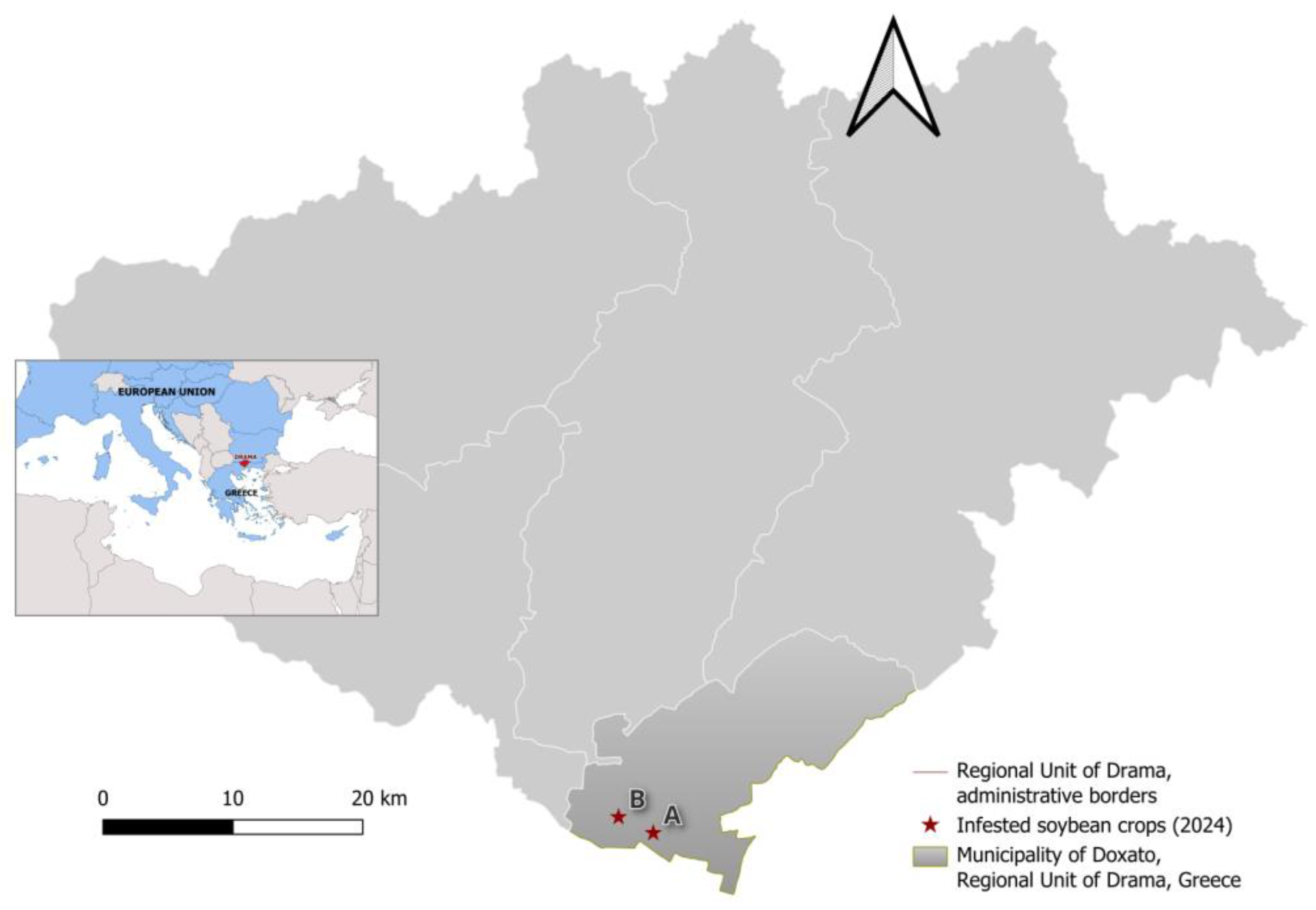
Figure 2.
(a) Etiella zinckenella adult on a soybean pod in the field; (b) Forth instar larva; (c) Infested soybean pods by Etiella zinckenella larvae; (d) Soybean pod section showing the accumulation of Etiella zinckenella larval excreta.
Figure 2.
(a) Etiella zinckenella adult on a soybean pod in the field; (b) Forth instar larva; (c) Infested soybean pods by Etiella zinckenella larvae; (d) Soybean pod section showing the accumulation of Etiella zinckenella larval excreta.
Disclaimer/Publisher’s Note: The statements, opinions and data contained in all publications are solely those of the individual author(s) and contributor(s) and not of MDPI and/or the editor(s). MDPI and/or the editor(s) disclaim responsibility for any injury to people or property resulting from any ideas, methods, instructions or products referred to in the content. |
© 2025 by the authors. Licensee MDPI, Basel, Switzerland. This article is an open access article distributed under the terms and conditions of the Creative Commons Attribution (CC BY) license (http://creativecommons.org/licenses/by/4.0/).
Copyright: This open access article is published under a Creative Commons CC BY 4.0 license, which permit the free download, distribution, and reuse, provided that the author and preprint are cited in any reuse.


