

Submitted:
08 June 2025
Posted:
10 June 2025
You are already at the latest version
Abstract
This study focuses on developing a conceptual framework for establishing mountain public agro-pomological parks (public orchards) through planting or replanting, as an alternative to afforestation or reforestation, with the aim of utilizing degraded lands-particularly abandoned pastures and hayfields. These public orchards should consist of fruit trees and shrubs that require minimal maintenance, considering the limited availability of personnel in Romania for such activities. Harvesting can involve public participation, transforming the orchards into a form of agrotourism, with the possibility of charging a minimal entrance fee.The research is grounded in several key aspects specific to contemporary mountain areas, forming the foundation of the conceptual framework proposed. These include a significant reduction in cattle and sheep populations, a decline in transhumance practices, and a decrease in organic natural fertilizers derived from animal resources, all of which contribute to the degradation of natural vegetation on pastures and hayfields. In this context, soil impoverishment and degradation occur, marked by a decline in organic matter content, reduced microbial biodiversity, and lower soil fertility.The depopulation of mountain areas leads to the neglect of lands-both publicly and privately owned-especially pastures and hayfields, exacerbating existing ecological and economic problems. Within this context, the study proposes a paradigm shift from traditional afforestation/reforestation practices to the planting or replanting of fruit trees and shrubs as a sustainable solution for mountain areas affected by the abandonment of these landscapes.The study also examines the bio-ecological benefits of replanting, including carbon capture and biodiversity restoration, along with agro-economic advantages such as the creation of clustering models based on shared characteristics or added-value chains. The article presents research from various regions around the world, demonstrating the positive impact of reforestation and replanting in terms of carbon storage, food security enhancement, and the reshaping of the rural mountain landscape.In terms of practical implementation, the study proposes an agro-economic model for the value chain associated with planting/replanting, including financial/material flows, strategic and operational planning, and the management of the production and distribution of saplings, seeds, and fruits. Furthermore, the research presents specific planting/replanting solutions for fruit trees and shrubs, including species such as berries and medicinal herbs, which can be cultivated at high altitudes-thus contributing to the sustainable development and utilization of high mountain regions.
Keywords:
value-added chain
; fruit trees and shrubs
; planting
; replanting
Introduction
This study focuses on creating a conceptual framework for establishing public mountain agro-fruit parks (public orchards) through planting/replanting as an alternative to afforestation/reforestation, aiming to valorize degraded lands, especially lost pastures and hayfields. Public orchards should consist of fruit trees and shrubs that require minimal care due to the lack of available personnel for such activities in Romania. Harvesting can be done by inviting the public to these mountain agro-fruit parks (a form of agritourism), with entry potentially requiring a minimal fee or none, depending on the context.
The research is based on several assumptions specific to current mountain areas, which provide the conceptual foundation for the proposed framework:
- Significant reductions in cattle and sheep numbers, implicitly leading to a decrease in transhumance and organic natural fertilizers derived from animal sources populating certain regions, resulting in considerable deterioration of natural vegetation in pastures and hayfields. In these conditions, soil impoverishment and degradation occur, evidenced by decreased organic matter content (soil compaction), reduced microbial biodiversity (soil’s ability to decompose plant residues declines), lowered soil fertility (loss of essential nutrients such as nitrogen, phosphorus, and potassium), erosion and structural degradation (exposure to wind and water erosion), decreased water retention capacity (drying and degradation of pastures), etc. (Rey R.)
- Depopulation of mountain areas leads to partial or total neglect of lands under private or public ownership. This phenomenon exacerbates the problems highlighted above. There is no foreseeable timely solution to prevent rapid degradation of the mountain areas, especially the pastures. (Rey R.)
- Reevaluation of how animals’ nutritional needs are met. More precisely, professional farmers currently feed animals with specific supplements calculated according to their individual needs rather than relying on hayfields or pastures. We are witnessing a transformation in animal feeding practices, where many livestock no longer require pastures or hayfields. Consequently, abandoned pastures and hayfields need an alternative purpose - they will no longer regenerate as such, given the lack of demand.
- Mountains act as true refuges for endemic species affected by uncontrolled human activities, while alpine meadows are exposed to the loss of traditional grazing practices. (Antonescu, 2018)
- Besides providing us with high-quality mountain products, water, and air, mountain ecosystems (which have resisted chemical alteration) also contribute to increasing community resilience in the face of social and environmental changes.
- Poor funding of farmers.
- Poorly subsidized agricultural prices.
Overall, there is an observable orientation of Romanian government policy towards the French model. France’s rural policy includes special programs aimed at revitalizing mountain agriculture and disadvantaged areas. Mountain agriculture in France, through its diverse activities, labor use, soil maintenance and conservation, landscape protection, and beautification, is considered a matter of general interest and a fundamental economic activity for life in mountain areas. Given the natural disadvantages of mountain farms, they require special support programs for economic activities, especially agriculture, such as dairy livestock farming and shepherding, through investment financing programs, consulting services, rural extension, and technical assistance, especially in mountain agritourism and silvotourism. (Otiman, 2004)
The authors believe that issues related to mountain pastures and hayfields will not be solved in financially disadvantaged mountain areas (such as the Romanian one) given that the same difficulties are encountered in richer mountain regions and have not been solved anywhere.
In this context, the authors propose a paradigm shift that may represent the most feasible short- and medium-term solution for certain mountain areas, namely public mountain orchards. Thus, a transition can be made from afforestation/reforestation to planting/replanting fruit trees and shrubs. More precisely, from sustainability ensured by animal resources to that guaranteed by plant resources. Certain pastures and hayfields that have become irreversibly wild, alongside some areas proposed for forest planting for forestry purposes, can represent the basis for plantations of fruit trees and shrubs compatible with the respective mountain environment.
Methodology
The proposed study concretizes a mixed methodology that combines theoretical research with an applied analysis of the ecological, agro-economic, and socio-cultural context of Romania’s mountain areas. The methodological approach aims to create a conceptual framework for the implementation and valorization of public orchards through the planting/replanting of fruit trees and shrubs on degraded or abandoned lands, with the purpose of replacing traditional afforestation/reforestation practices.
In the present work, the literature review was conducted by collecting and analyzing existing research on the impact of planting/replanting fruit trees and shrubs in mountain areas and other similar regions, with the goal of understanding global outcomes and extracting the most relevant practices for the Romanian context.
Results
At the practical level, several notable considerations have been observed that deserve to be highlighted in the development of the conceptual framework of the research related to the planting/replanting of fruit trees and shrubs. Among the most important considerations are bio-ecological issues-related to natural regeneration through planting/replanting-and agro-economic issues-such as the creation of clustering models based on common characteristics or patterns of added-value chains.
Bio-Ecological and Agro-Economic Benefits of Planting/Replanting
The natural regeneration of degraded or degrading soils to increase agricultural productivity is a pressing issue in mountain areas worldwide.
Brazilian researchers, following numerous applications, observed that carbon losses from deep mountain soil compensate for the rapid accumulation of carbon on the soil surface after reforestation/replanting. (Quartucci et al., 2023)
A 14-year study in Panama suggests that timber tree plots optimize carbon storage, while agroforestry systems improve food security and income, and enrichment planting supports richer biodiversity at a lower implementation cost. (Forgues et al., 2024)
In a study conducted on 150 reforested/replanted plots in China, carbon storage in biomass and soil was analyzed. Biomass carbon accumulated during the first 20 years after planting, while soil carbon sequestration accelerated after 20 years. Additionally, evergreen species had higher carbon density in both biomass and soil compared to deciduous species and economically important fruit tree species. Carbon capture in evergreen and deciduous species was greater than in economically valuable fruit tree species. However, the significant importance of economically valuable fruit tree species in the development of any degraded agricultural space is noted. (Wang et al., 2022)
Another study from South Korea shows that certain species are better suited for planting/replanting in mountain areas. The chemical composition of 86 plant species analyzed showed lignin content ranging from 12% to 39%, with an average of 25%. The species with the highest lignin content was Chaenomeles lagenaria (Japanese quince) at 39.37%. Hemicellulose content ranged between 18% and 52%, with the highest values in Thuja occidentalis (thuja) at 51.22%. Cellulose content ranged from 25% to 58%, with Diospyros kaki (Japanese persimmon) at 57.14% and Albizia julibrissin (Persian silk tree) at 53.02%. These species are economically interesting for human consumption, with the Persian silk tree also suitable for animal feed. Lignin was found at high levels in fruit tree groups and low in species not recommended for afforestation/planting. Species with higher lignin content had lower cellulose content. (Kim Hak-gon et al., 2024)
A US-based study shows that the greatest bio-ecological problems for American crops are pathogens, which has intensified virus analyses over the past five years. A recent example of bio-ecological and agro-economic impact is the double epidemic caused by Little Cherry Virus 2 (LChV2), the main agent responsible for the small fruit disease. To halt these effects, over 400 hectares of sweet cherry trees and nearly 300 hectares of other stone fruit trees were recently felled in the Pacific Northwest. Replanting will take virus protection into account. (Fuchs et al., 2021)
Reforestation/replanting of urban areas in Mexico City according to planting site characteristics reveals clustering based on certain common features. These researchers established clustering parameters to guide afforestation/planting efforts. (Vázquez et al., 2023)
In developed countries, emphasis is placed on urban nature (found in Europe, Australia, USA), with indisputable benefits for mountain areas. The most important dimension of urban nature is protected cultivated flora. Planting/replanting is carried out with a holistic approach to urban spaces to create/restore controlled flora. A common concept across European-derived civilizations is the promotion of native biodiversity with a focus on water-sensitive design, especially in mountain zones. (Ignatieva et al., 2023)
In Romania, traditional orchards play a significant role in biodiversity conservation. A study in the central region, Sibiu, noted some fruit orchards older than 100 years. This phenomenon exists throughout the Romanian mountain area, causing various productive uncertainties. In traditional mountain orchards, apples perform best, alongside walnuts, plums, cherries, and sour cherries. (Antofie et al., 2015)
Other research in Romania’s southeastern mountain areas focuses on apple and pear as sustainable crops for agricultural areas. Călina et al. (2022) propose an interesting solution for developing fruit crops through agrotourism.
This solution should be integrated into the national agricultural resilience plan. After planting/replanting with fruit trees and shrubs, the areas should be populated by individuals passionate about freely harvesting fruit from Romania’s public agro-fruit parks (public orchards).
Other planting/replanting solutions include berries and medicinal herbs (Vari et al., 2020). Among 37 species listed by the authors, the least demanding and most productive are sea buckthorn, rosehip, currant, raspberry, blackberry, hazel, and blueberry. The advantage of some of these is their ability to grow at high altitudes (over 1000 m), thus valorizing high-altitude mountain zones.
Agro-economic Scenario of Planting/Replanting
The agro-economic scenario for planting/replanting within the conceptual framework of creating public orchards was adapted following Mousavijad et al. (2022).
A formal framework for the value chain of planting/replanting fruit trees/shrubs can be implemented at the following levels:
- ∗
- financial/material flow
- ∗
- strategic
- ∗
- tactical
- ∗
- operational
The most important dimensions for proper development of the added-value chain regarding planting/replanting fruit trees and shrubs are:
- -
- Financial / Material Flow:
- ∗
- seedling production
- ∗
- seed treatment
- ∗
- land ownership-public/private
- ∗
- planting, growth, integrated pest management, reinforcement, lifting, storage, and shipment
- -
- Strategic (planning level):
- ∗
- production planning
- ∗
- seedling production planning
- ∗
- transport and storage planning
- -
- Tactical (planning level):
- ∗
- seedling allocation
- ∗
- seed allocation
- ∗
- delivery of forecasting analyses (planning)
- -
- Operational:
- ∗
- seedling production: seed supply, seedling production/improvement, seedling provision
- ∗
- seedling delivery: seedling storage, seedling transport
- ∗
-
plantation development: planting, maintenance, harvesting, replanting
- At tactical and strategic levels, seed and seedling management include:
- ∗
- seed allocation: biological parameters, ecological parameters, soil uncertainty
- ∗
- seedling production: nursery infrastructure, nursery capacity, soil uncertainty, equitable distribution
- ∗
-
seedling transport: distance between nursery and planting site, fractional load costs per vehicle, equitable distribution, distribution centers
- At the operational level:
- ∗
- seedling production: allocation of equipment and human/animal resources, production scheduling, delivery scheduling
- ∗
- seedling transport: distribution centers, vehicle type, waiting time, seedling size
The presented study, as a model within this scenario, reviews the literature on these aspects, noting that worldwide articles focus on: (1) allocation-public/private land, crop characteristics, seed preservation in cold weather; (2) production-land condition; (3) transport-product perishability; and (4) process integration-considering all processes and finding the optimal combination.
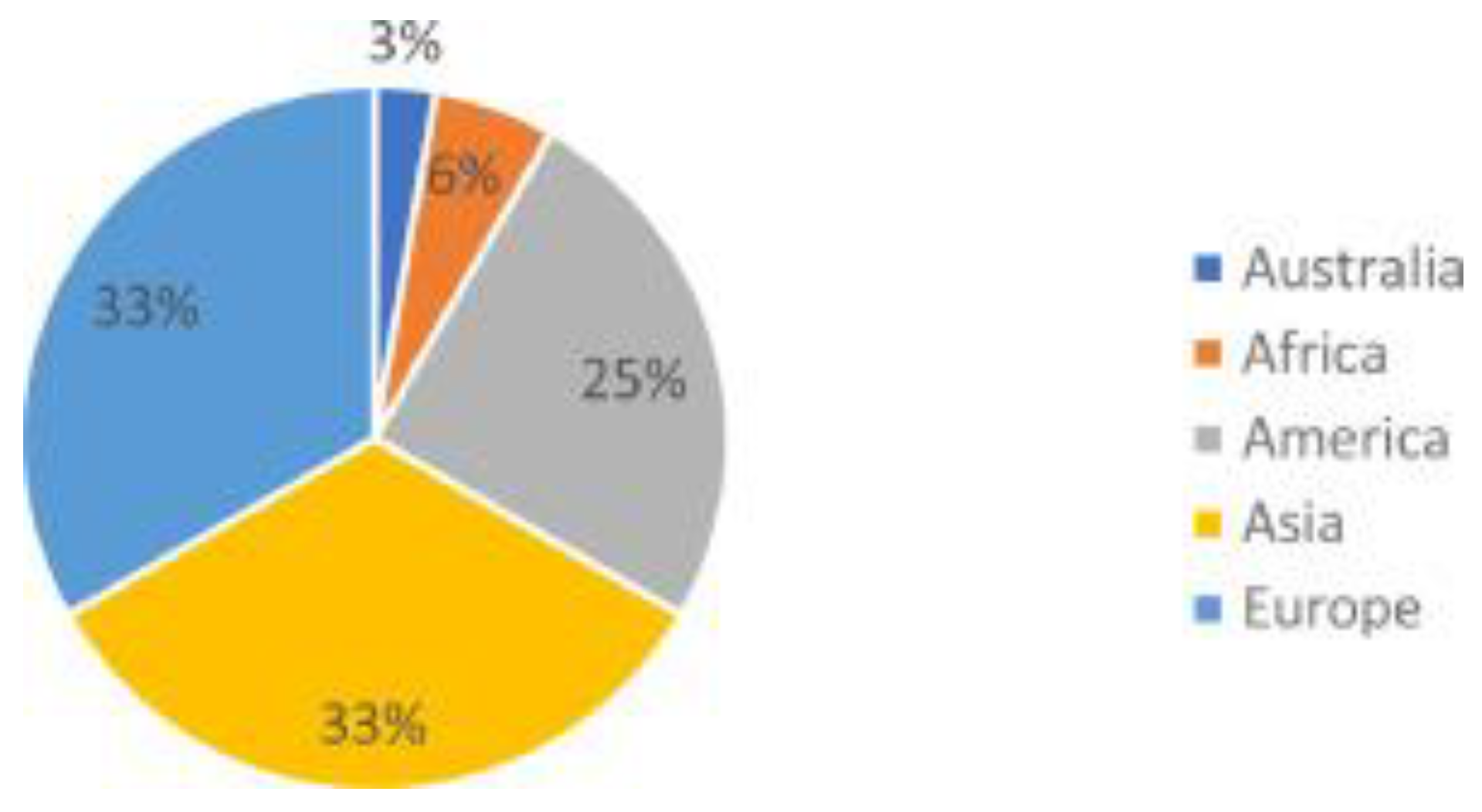
The continents most involved in global research on planting/replanting and afforestation/reforestation are Europe and Asia, followed by America (Figure 1). It can be inferred that these regions emphasize the importance of planting/replanting in ensuring the sustainability of agriculture, especially mountain agriculture.
Proposals
The authors propose several solutions regarding the creation of public mountain orchards, including:
- ∗conducting a case study (inventory) of Romanian mountain areas with pomological potential,
- ∗evaluating fruit tree and shrub species suitable for planting in the inventoried zones,
- ∗developing ecological impact studies,
- ∗carrying out investigations on the acceptability and involvement of the local community,
- ∗creating a standard agro-economic model specific to mountain planting/replanting,
- ∗designing a management and implementation plan.
To identify and analyze degraded lands or lands with pomological potential in Romanian mountain areas, data based on topography, climate, and ecology can be used. Tools such as cartography, GIS, direct observations, and others may be applied.
For selecting fruit tree and shrub species adapted to the environmental conditions of the respective mountain zones, applying structured questionnaires to Romanian mountain agronomy specialists could provide the most efficient response. Contextually, the authors propose for higher altitudes species like currants, raspberries, blackberries, blueberries, and medicinal herbs, while for lower altitudes species such as apple trees, walnuts, plums, pears, sea buckthorn, and fig trees are recommended.
Evaluating the bio-ecological impact of planting/replanting on soil regeneration, carbon sequestration, and biodiversity improvement in mountain areas can be performed by monitoring ecological indicators such as soil pH, organic matter content, microbial biodiversity, water retention, and soil fertility before and after the planting/replanting implementation.
To understand the acceptability of the local community’s participation in planting/replanting projects, local administrations can conduct opinion surveys-either structured or unstructured-with residents and potential beneficiaries of the fruits from the public orchards.
The agro-economic model of this initiative can incorporate cost-benefit analysis alongside the development of its social dimension. It should be noted that the main benefit of the public mountain orchards will be mountain agricultural tourism.
The plan for implementing the public mountain orchards can include stages of planting/replanting, orchard management, and fruit harvesting. The development of an integrated management plan may encompass short-, medium-, and long-term planning strategies, human resource management, logistical coordination of material flows, and infrastructure management.
Conclusion
This study proposes a paradigm shift in the utilization of degraded or abandoned mountain lands in Romania by replacing the traditional afforestation/reforestation actions with the planting/replanting of fruit trees and shrubs adapted to local conditions. This alternative can bring both bio-ecological benefits (soil regeneration, carbon sequestration, biodiversity) and agro-economic advantages (land valorization through agritourism, stimulation of the local rural economy).
In the context of declining livestock numbers, depopulation of mountain areas, and abandonment of pastures, the public orchard model offers a feasible short- and medium-term solution beneficial to the environment, local communities, and mountain agritourism. The public orchard, as an open or controlled-access space, can become a vector for sustainable development and ecological education.
The research results support the viability of an integrated agro-economic model covering the entire value chain-from species selection and seedling production to harvesting and community involvement. The essential recommendation is to conduct a national inventory of mountain areas with pomological potential and to initiate pilot programs to validate this approach in the field.
References
- Antofie, M. M. , Barbu, I., Sand, C. S., & Blaj, R. Traditional orchards in Romania: Case study Fântânele, Sibiu County. Genetic Resources and Crop Evolution 2016, 63, 1035–1048. [Google Scholar]
- Antonescu, D. (2018). Biodiversity of the natural mountains heritage–present challenges and sustainable perspectives.
- Apetrei, M. Considerations on the designation of mountain areas as pillars of support for society in the crisis generated by Coronavirus. Journal of Montology 2021, 14. [Google Scholar]
- Avadanei, V. , Surdu, I., & Avadanei, L. Relevant elements evolving in mountain tourism. Anuarul Institutului de Cercetari Economice" Gheorghe Zane"-Iasi 2019, 28, 133. [Google Scholar]
- Călina, J. , Călina, A., & Ciobanu, A. Identification of the best apple and pear tree varieties suitable to be grown in farms and agritourism households in the south-west area of Romania. Environmental Engineering & Management Journal (EEMJ) 2022, 21. [Google Scholar]
- Forgues, K. , Carignan, M. C., Marchena, B., Mancilla, L., Pacheco, C., Pacheco Ortega, E.,... & Potvin, C. Comparing carbon offsets and livelihood benefits in a long-term reforestation project: Agroforestry versus native timber versus enrichment planting. Ecological Solutions and Evidence 2024, 5, e12372. [Google Scholar]
- Fuchs, M. , Almeyda, C. V., Al Rwahnih, M., Atallah, S. S., Cieniewicz, E. J., Farrar, K.,... & Welliver, R. Economic studies reinforce efforts to safeguard specialty crops in the United States. Plant Disease 2021, 105, 14–26. [Google Scholar] [PubMed]
- Gliga, M. , Pacurar, I., & Clapa, D. The influence of the pedo–genetical cover upon the production capacity of the forestry stations from the Cusma Site. ProEnvironment Promediu 2012, 5. [Google Scholar]
- Gruia, R. , Bogdan, A. T., Rey, R., & Tobă, G. F. Integronic alimentation through whole natural food biodiversity, in relation with altitude gradation. Procedia Economics and Finance 2015, 22, 114–123. [Google Scholar]
- Ignatieva, M. , Dushkova, D., Martin, D. J., Mofrad, F., Stewart, K., & Hughes, M. From one to many natures: Integrating divergent urban nature visions to support nature-based solutions in Australia and Europe. Sustainability 2023, 15, 4640. [Google Scholar]
- Jujea, V. , Stoilov-Linu, V., Boboc, M., Popa, I., Nedelea, A., Crăciun, N., & Negrea, B. M. Are there any land use dynamics in the Upper Bistrița Basin, Eastern Carpathians, Romania, in the period 1990–2021? Diversity 2023, 15, 980. [Google Scholar]
- 김학곤, 용성현, 김도현, 박관빈, 차승아, 이지현. .. & 최명석. Evaluation of the chemical composition of woody plants, including tree species recommended for afforestation. 농업생명과학연구 2024, 58, 39–49. [Google Scholar]
- Kovacs, E. D. , Rusu, T., & Kovacs, M. H. Sustainable soil volatilome: Discrimination of land uses through GC-MS-identified volatile organic compounds. Separations 2025, 12, 92. [Google Scholar]
- Mousavijad, M. , LeBel, L., Lehoux, N., & Cloutier, C. Review of reforestation value chain planning and management: A conceptual framework. Trees, Forests and People 2022, 8, 100258. [Google Scholar]
- Otiman, P. , & Otiman, O. (2004). On some legislative aspects of managing and privatising land stock in Romania and France (A comparative study). Lucrări Ştiinţifice, Seria I, Vol. VI, USV Timișoara.
- Popescu, A. , Dinu, T. A., Stoian, E., Şerban, V., & Ciocan, H. N. Romania's mountain areas–present and future in their way to a sustainable development. Scientific Papers Series Management, Economic Engineering in Agriculture & Rural Development 2022, 22. [Google Scholar]
- Quartucci, F. , Gocke, M., Denich, M., de Moraes Gonçalves, J. L., & Amelung, W. Deep soil carbon loss offsets rapid aboveground carbon accumulation after reforestation. Forest Ecology and Management 2023, 548, 121403. [Google Scholar]
- Rey, R. (1984–2025). Lucrări și susțineri publice privind acțiuni aferente prevenirii/combaterii terenurilor agricole, pășunilor și fânețelor degradate/părăsite.
- Serrano-Notivoli, R. , Jevšenak, J., del Castillo, E. M., Čufar, K., Škrk-Dolar, N., Battipaglia, G., Popa, I.,... & de Luis, M. A single-tree approach to determine climate-growth patterns of European beech and their seasonality in the species southern distribution area. Agricultural and Forest Meteorology 2025, 371, 110644. [Google Scholar]
- Vári, Á. , Arany, I., Kalóczkai, Á., Kelemen, K., Papp, J., & Czúcz, B. Berries, greens, and medicinal herbs-Mapping and assessing wild plants as an ecosystem service in Transylvania (Romania). Journal of Ethnobiology and Ethnomedicine 2020, 16, 1–14. [Google Scholar]
- Vázquez, H. J. , & Juganaru, M. (2023, November). Mexico City's urban trees reforestation based on characteristics of plantation sites. In KDIR (pp. 437–444).
- Wang, J. , Delang, C. O., Hou, G., Gao, L., Yang, X., & Lu, X. Carbon sequestration in biomass and soil following reforestation: A case study of the Yangtze River Basin. Journal of Forestry Research 2022, 33, 1663–1690. [Google Scholar]
Figure 1.
Continental distribution of literature specific to planting/replanting and afforestation/reforestation (Mousavijad et al., 2022).
Figure 1.
Continental distribution of literature specific to planting/replanting and afforestation/reforestation (Mousavijad et al., 2022).
Disclaimer/Publisher’s Note: The statements, opinions and data contained in all publications are solely those of the individual author(s) and contributor(s) and not of MDPI and/or the editor(s). MDPI and/or the editor(s) disclaim responsibility for any injury to people or property resulting from any ideas, methods, instructions or products referred to in the content. |
© 2025 by the authors. Licensee MDPI, Basel, Switzerland. This article is an open access article distributed under the terms and conditions of the Creative Commons Attribution (CC BY) license (http://creativecommons.org/licenses/by/4.0/).
Copyright: This open access article is published under a Creative Commons CC BY 4.0 license, which permit the free download, distribution, and reuse, provided that the author and preprint are cited in any reuse.


