

Submitted:
07 August 2025
Posted:
07 August 2025
Read the latest preprint version here
Abstract
Galileo and the telescope revolutioned the concept of the Sun. The discovery of its rotation was possible with the continuous observation of the sunspots. The faculae and the maculae with umbra and penumbra become daily accessible to the new instruments, leaving the perfectly lucid disk only to the realm of symbolisms. Was this new view possible before the telescope? Technically the pinhole-cameras can show the largest sunspots, as well as the naked eyes under very particular conditions, but the observations were too scattered to produce any change in the Sun’s established concept. Synoptic observations of the largest sunspots of the cycle XXV made with naked eye, pinholes-camera and a telescope in camera obscura are presented and compared with the historical ones. The sunspots could have been discovered in Florence since 1475 with the pinhole-meridian line of S. Maria del Fiore: the Spörer minimum (1460-1550) of solar activity prevented it.
Keywords:
ancient egypt
; sun
; sunspots
; galileo galilei
; pinhole-meridian lines
; camera obscura
; eye optical resolution
; spörer minimum
1. Introduction: The Sun from an Ideal Disk to the First Telescopic Sights
The Sun appears as a bright disk, and its dazzling luminosity prevented, normally, observations of its surface. Since the antiquity, the Sun was worshipped as a god. The Egyptians (Section 2.) represented it either as a disk or as a sphere, with some elements suggesting direct observations of the corona and prominences during total eclipses. In Christianity (Section 3.) St. Francis of Assisi in 1225 created his Cantico di Frate Sole, where the Sun well represents God’s qualities. Galileo Galilei (Section 4.) with his telescope first recognized in 1611 sunspots as belonging to a rotating photosphere, proving the spherical nature of the Sun. The solar symbol was frequently used in the Catholic Church (Section 5.) appearing also in the coat of arms of the Jesuit pope Francis. The occasional observations of giant sunspots in the middle age (Section 6.) with naked eye or through pinholes in a camera obscura could have risen the question on the solar rotation before the telescope? The answer is suggested by the evolution of the largest sunspots of the XXV solar cycle observed by naked eyes (Section 7.) and with a camera obscura (Section 8.) in order to better understand the quality of the pre-telescopic observations. With the pinhole-meridian line of St. Maria degli Angeli in Rome the sunspots are visible (Section 9.), and the largest pinhole-meridian line, realized by Paolo Toscanelli in 1475 in the Dome of Florence, could have shown the largest sunspots, but the Sun was in the Spörer Minimum (1460-1550). The limb darkening (Section 10.) is another clue for the solar sphericity, but the pinhole introduces itself a limb darkening of the image. The invention of the telescope occurred just after the first map of the Moon drawn with the unaided eye (Section 11.) when the Sun restored its sunspots activity (Section 12.).
2. The Representation of the Sun in Ancient Egypt
The Sun is there, it has been always there, but only in the last four centuries, the question about its physical nature has become meaningful.
The solar mythology in Egypt is very complex, and its discussion would exceed largely the scope of this work. The representations of the solar disk or sphere are well known. In the Figure 1 the god falcon Ra-Haratki, is represented with the solar disk on top.
There is a physical correspondence between the traditional representation of the Sun in Egypt, and the phenomena visible during a total eclipse of the Sun. The uraeus, in particular, are the red prominences departing from the solar disk. The rays are straight as in modern geometrical optics, firstly accounted by the arab polymath Alhacen in 1028-1038 (Mark Smith 2010) while he was working in Egypt. In Figure 2 another colored example is from the Egyptian Museum of Turin.
The winged Sun include the wings (of the falcon Horus) and one or two cobra (uraeus): their position starting always from the solar limb, recall the prominences visible (without modern H-alpha filters) only during total eclipses. The wings fully stretched, recall the streamers, occurring during the minimum phases of the solar cycles (Figure 3).
The eclipse of 2009 was so long (5 m 42 s) that in the middle no prominences appeared, because the Moon was angularly wider than the Sun. The one of 2024 is captured at the moment of the diamond ring (occurring just before or just after totality, when the photosphere appears. Four prominences are well visible and in red color (belonging to the Chromosphere). These are the natural correspondences to the Uraeis.
Despite of the faint luminosity of the solar corona, the memory of this feature, along with the red prominences visible at the beginning and at the end of the totality, can be unforgettable for an observer. The red prominences at the start of the totality and toward the end attracted my sight during the total solar eclipse of 1999 in Riedering, Bayern, Germany. Since then I started to reconsider the Egyptian solar symbology.
A great prominence on 14 July 2025 offered (Figure 4) the possibility to see its extension out the solar disk, to explain the iconic appearances of the Uraeis.
The hypothesis of identifying the wings with the solar corona during eclipses is not a novelty: other scholars did it in the past (Belmonte and Lull 2023).3 Several total eclipses occurred on the Egypt along the millennia of its history, but the eclipses are completely under reported in the ancient Egypt, probably because they were considered as bad omens (Belmonte and Lull 2023). The hypothesis that an eclipse influenced Amenothep IV to change his name and the capital city in Egypt in his 4th year of reign: this eclipse was total in the place where the new capital Akhetaten was created (Belmonte and Lull 2023). The identification of the Uraei with the solar prominences visible during the totality is new. The Uraeus4 is the symbol of the goddess Wadget, a cobra who was considered as the patroness and protectress of Egypt. The colors and the representations of the figures of the solar disk (fig. 1, fig. 2 and fig. 3) in general, reflect symbolic models, possibly with a real observation made in the beginning and transmitted as an iconic tradition. Real observations did not improve these symbolic representations, even if the exception of the solar halo in the tomb of Meryre in Amarna, is an interesting reported case.5 Finally in the Egyptian representation of the Sun, there are no sunspots imaged.6
3. The Sun of Christianity
Christ is called the “Sun rising from on hig” (Luke 1:68-79), and to see the great brightness of the Sun eagle eyes are needed.7 This legend and the text of Revelation (4:6-8) is at the basis of representing St. John the Evangelist with an Eagle, because he was the author of the most theological gospel. His sight was able to penetrate the secrets of God, as the eagle can aim fixedly to the Sun. Examples of Christ-Sun are in Figure 5.
St. Francis of Assisi in 1225 composed the Cantico di Frate Sole expressing in poetry the representative role of God played by the Sun.
Laudato Si’ mi Signore per frate Sole
Lo quale è iorno et allumini noi per lui
Et ellu è bellu et radiante cum grande splendore
Di te porta significatione8
Among the Christian symbols, the Sun was used to represent Charity,9 Wisdom10 and Jesus (figure 4). Representing God with the Sun is based on the Psalm 18, 6 “In Sole posuit tabernaculum Suum” (In the Sun He posed his tent). The representations of the solar symbols are flat, both before and after the evidences of a spherical Sun, not only in painting and mosaics, but also in sculptures.
St. Bernardin of Siena (1380-1444), a Franciscan friar, created the symbol of the radiant Sun with the acronym IHS Iesus Hominum Salvator inscripted inside (Figure 6).
He used them to give benedictions with this table, after his preachings.11
The possibility that the twisted rays recall prominences seen during total eclipses has been inspected (Zawilski 2021). During the life of st. Bernardin there were two total eclipses occurring near him: 1386 and 1431. He could have observed them.12 The difference between thick twisted and thin linear rays can be only instrumental to the number of 12, symbol of fullness in the Bible, because so many prominences cannot be visible at once.
4. The Sun of Galileo and His Contemporaries: Planet or Star?
Galileo (1613) following the motion of the spots, interpreted them as located on the solar surface. Scheiner's orbiting planet or cloud interpretation dates from 1611 (the Apelles letters). In the Rosa Ursina (1630) he actually gave up that notion and even determined the Sun's rotational elements based on the spots, accepted to be on the solar surface or close to it. In the Borbonia Sidera (Tarde, 1620 see Figure 8), the spots were considered as moving stars.15 Jean Tarde (1561-1636) was a French prelate, historian and astronomer,16 who met personally Galileo in 1614.
Giordano Bruno18 (1548-1600) considered the stars as very far suns (Bruno, 1584), but his speculation did not pose on specific measures. A similar idea, supported by computations and observations was the one of Christiaan Huygens (1629-1695): the Dutch scientist Christian Huygens made an image of the Sun through a pinhole in a darkened room. He varied the size of the pinhole until the image seemed equal in brightness to an image of Sirius, the brightest star. Since the pinhole admitted 1/27,000 of the light of the Sun, Huygens concluded that Sirius was 27,000 times farther away than the Sun (it is actually 543,900 times farther away and substantially more luminous than the Sun, see Figure 9).19
From a physical point of view the Copernican hypothesis gave to the Sun21 the central role of the Universe, but in the view of Bruno the Sun become a star in the modern sense. Galileo, instead, when not dealing with “fixae” or fixed (stars), was still considering the possibility of the motion of stars. In this respect, the Earth orbiting around the Sun was a (moving) star (Galileo, Saggiatore, 1624). The Greek word for moving star is “planétes”. The difference with the other stars was only kinematic, while for Bruno started to be a physical difference: the stars were far suns. The clear difference between this view and the modern one required near three centuries to mature. Still at the end of XIX century, Camille Flammarion considered the possibility that the Sun could be inhabited (Astronomie Populaire, 1875) as all other planets.
5. The Sun and the Jesuits
The radiant Sun (figures 6-7) is the symbol characterizing the Company of Jesus, founded by St. Ignatius of Loyola in 1540. It has been also a main task of the scientific studies of the Company along the centuries.
The contemplation of the Nature is part of the spirituality of St. Ignatius,22 as Nature was created by the Word of God. A strong development of observational and theoretical studies occurred at the headquarter of Jesuits, the Collegio Romano. The astronomical tradition started with Christopher Clavius (1535-1612) continued spreading all over the World. Matteo Ricci (1552-1610), Giovanni Paolo Lembo (1570-1618), Orazio Grassi (1583-1654), Christoph Scheiner (1573-1650), Christoph Grienberger (1561-1636), Giovanni Battista Riccioli (1598-1671), Francesco Maria Grimaldi (1618-1663), Rudjer J. Boscovich (1711-1787) Francesco De Vico (1805-1848), Angelo Secchi (1818-1878) are part of a largely incomplete list, even limited to solar astronomy.
The idea that the sunspots were bodies extraneous to the nature of the Sun was functional to preserve the perfection of the celestial body used to represent the perfection of God. The first Jesuits who observed the sunspots were also willing to find a coherence with this paradigm.
No spot could be imagined in a divine symbol, and this has been a major concern in the early debate between scientists and theologians. The Jesuits, before accepting the Copernican system adopted the Tychonic system to preserve the agreement between the Scriptures and the physics of the Cosmos (Figure 10, the famous Sol ne movearis (Sun, stand thou still) of Joshua 10, 12), through father Scheiner, were oriented toward a spotless Sun, with opaque bodies orbiting it.
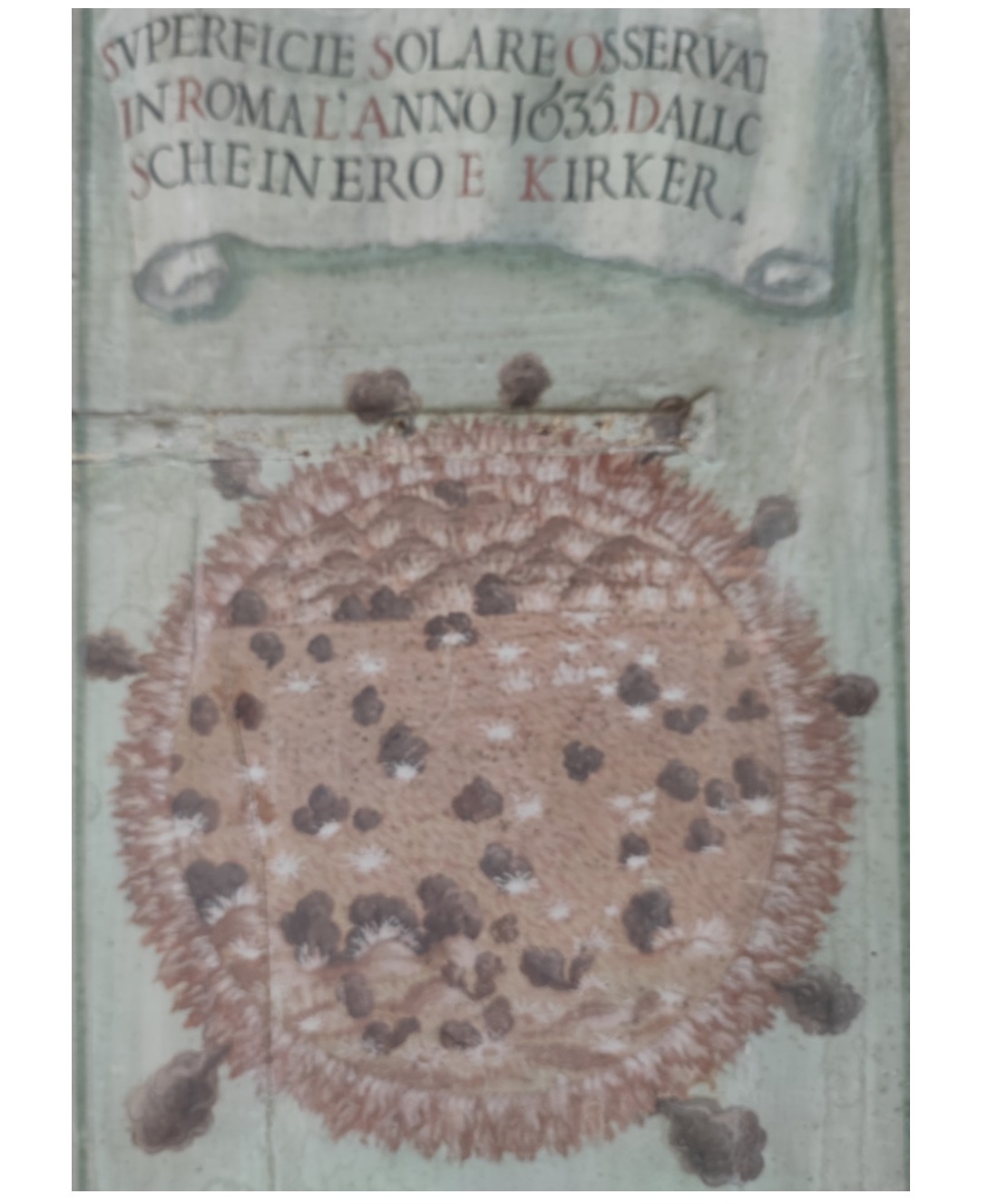
The representations of the Sun in Figure 8 and in Figure 11 (whose original is probably the image in figure 12, published by (Kircher 1665) are separated by 15 years at least: the solar activity appear very intense. Many spots in figure 8, and a volcanic activity with many clouds in Figure 11. It is relevant that this image of the Sun, among the scholars, as the Cardinal De Zelada, remained iconic up to the end of 18th century, for at least 163 year, notwithstanding the improvement of the optics during that century.
The interpretation given to the sunspots is of clouds of smoke ejected by volcanoes on the solar surface. On the solar limb there are flames that recall the spiculae, firstly described by father Angelo Secchi (1818-1878) only two centuries after Scheiner and Kircher. Secchi observed the Sun with a very good refractor of Merz, fully exploiting the achromatic doublet, patented in 1758 by John Dollond;24 the quality of the solar image seen by him was superior to the one of Scheiner and Kircher. About the plumes of smoke out of the limb, drawn by Kircher, they might include the memory of some observations of prominences made during total eclipses or some exceptional observation at sunset/sunrise. Secchi (1884)25 reported such an observation of Pietro Tacchini at sunset on the 8 August 1865 in the Mediterranean sea onboard a steam ship. The white spots are the faculae, that the artist reported all over the Sun, but in reality are visible only at the royal zones of the limb (±50° from the solar equator).
The original figure, copied on the wooden window, is the following Figure 12.
6. Naked Eye Sunspots Since the Middle Age
The solar activity and the solar rotation have been observed occasionally and reported in the medieval chronicles, but they have not been recognized as sunspots on a rotating photosphere. It is noteworthy that Einhard, in the Vita Karoli Magni27 mentioned a sunspot appeared for seven days in 813 AD.28 Another mention is in the Annales Regni Francorum (Royal Frankish Annals)29 for 17 march 807 AD, lasted eight days and interpreted as the planet Mercury passing in front of the Sun (Neuhäuser et al., 2024). Two big spots on the Sun were drawn by John of Worcester on 8 December 1128, and Averroes reported of two spots seen at the time of Ibn Mu’adh by Ibn Mu’adh’s nephew (Vaquero and Vasquez 2009).
Galileo himself was able to see a naked-eye sunspot in 1612. He added a postscript on the “Disegni della macchia grande solare, veduta con la semplice vista dal Sig. Galilei, e similmente mostrata a molti, nelli giorni 19, 20, 21 d’Agosto 1612” to say that while he was undertaking his observations, a sunspot appeared which was so large it could be seen with the naked eye between 19 and 21 August 1612; and this was shown to many people. This is included in his series of illustrations (Figure 13).
I repeated the experiment of the sunspot sight with the naked eye during the appearance of the sunspot AR 4079, one of the largest of the last decades (details in Section 7).31
The observations with naked eyes of sunspots through fog or atmospheric haze (Schaefer 1993) (Vaquero 2007) (Vaquero 2007b), though historically plausible, are not a scientifically reliable or safe method. Observing through smoked glasses was less safe than with modern mylar filter. The sunspots were observed by Galileo through its telescope at sunset or sunrise, but this method is also dangerous for the retina. There is no way to observe a sunspot on the Sun directly; only for a solar eclipse a very short glimpse (less than 0.1 s) may allow to see in the transient image left on the retina the lunar profile “biting” the Sun. In rare cases, as in Figure 14, the clouds allowed for some instants to see the eclipse directly but their disomogeneity would not permit to observe the sunspots.
The eclipse of Figure 12 was visible to the naked eye at 15.2% of eclipse through that cloud. The Moon profile was 294” inside the solar disk. A large sunspot has a lower contrast than the Moon’s profile on the Sun; the dimension of AR 4079 at its maximum reached about 150”x50” included the penumbra (as in Figure 15 and Figure 16).
The Sun is dazzling, and these experiments have been realized with great care, to avoid any damage on the retina. I want to stress the warming that, without protecting filters, staring for a minute at the Sun with naked eyes, may permanently damage the retina, where the Sun is focused, namely the macula lutea, the zone where the colors are detected.
7. Naked Eye Sunspots in 2025: Experiencing the Eye Resolution
A sunspot’s umbra is 104 times as intense as the atmospheric halo of the Sun, when the Sun is high over the horizon and the sky is clear.32
The luminosity of the photosphere can be reduced to 10-4 through a Density 4 mylar filter or, much better, through projection (Section 5).
The angular dimension of the sunspot has to be around 0.5’, the angular resolution of the eye in daylight, even if the eye is not in direct sunlight. The diameter of the pupil in such conditions is 3 mm, and the Rayleigh criterion gives about 33” of resolution, but a sunspot has to be bigger than that to emerge from the still bright photosphere. Moreover, to be distinguished, the sunspot has also to be distant from the limb, which is darker than the central part of the Sun. This explains why a big and steady sunspot on the Earthside photosphere for 14 days, is actually visible to the naked eye only for 8 days, as at the time of Charlemagne.33
We can say –experimentally with AR 4079 in May 2025- that the longitude of a great sunspot with respect to the central solar meridian has to be comprised within 60°E and 60°W to be enough separated from the darker limb. To get visible to the (alerted) naked eye the dimension of the umbra has to be larger than 1’ at the center of the disk. Its visibility, if the spot is stable, can last for 8 days. The sunspot at Charlemagne epoch had to be at least 3’ wide to be evident under the fog, homogenous thin clouds or at sunrise or sunset, when the Sun appears dimmer.
The present observations were made knowing that there was a big sunspot, while a true discovery has not to be alerted.
For these observation I used: mylar filter D4, grey filter 13%, a pinhole of 1.75 mm to compensate the eye defects and another orange filer, because the Sun was at 1.5 airmasses, and it was too bright to permit to see the sunspots on it without reducing the whole luminosity.
Consequently, the conditions of visibility of a sunspot to normal eyes without refractive defects are:
1. Dimension of the umbra larger than one arcminute;
2. Distance from the limb at least 3 arcminutes.
We have to remark that modern populations have significantly degraded eyesight, particularly in urban and East Asian contexts (Holden 2016). The use of the pinhole –always along with the Sun filter- reduces the effects of eye’s refractive defects in the direct sight.34
8. The Camera Obscura for Pinholes and Telescopes
These iconographic and historical premises describe the long period before the telescope’s invention, when the observations of sunspots were casual and not understood.
The architects in Florence obtained representations in perspective using a Camera Obscura (King, 2009) illuminated by a pinhole. The largest pinhole-meridian line to study the obliquity of the ecliptic and shift of the Julian calendar around the summer solstice was realized by Paolo Toscanelli in 1475 in the Dome of Florence.35 Ulugh Begh in Samarcand realized a great gnomon with solar projection in 1435, along with a stellar catalogue. Giacomo Della Porta (1590) described the principles of the Camera Obscura and Kepler 1571-1630 utilized them in astronomy (Kepler, 1604; Sigismondi and Fraschetti, 2001). The visibility of sunspots with a pinhole, at 2 meters of distance is possible for sunspots as small as 13” and 3’ from the limb. The pinhole can be 2 mm wide,36 and the camera does not require a perfect darkening.
Christoph Scheiner (1570-1654) used a parallactic machine to follow the projected solar image in the Camera Obscura (Scheiner, 1630) and he made the best drawings of his time (Secchi, 1884).
Here we use the Camera Obscura to assess the details observable and the physical phenomena that can be followed in the days after, in order to understand how that technique has contributed to increase the knowledge of the Sun.
Scheiner was the first to notice in 1612 that the Sun’s disc is brighter at the centre than at the edges, an effect we now call limb darkening. In a letter to his friend Federico Cesi in 1613, Galileo denied that the effect exists, although he may have changed his mind later (Engvold and Zirker 2016).
The sunpots and the limb darkening are clearly visible in the whole image of the Sun in figure 16.39 The further details of umbra and penumbra and the faculae are well visible. The images here presented are obtained in a camera obscura, with the telescope introducing the light, to reproduce the observations described by Christoph Scheiner (1573-1650) in the Rosa Ursina (Scheiner, 1630).
The projecting telescope, used in these experiments, has a 60 mm-doublet,40 and a prismatic mirror before the eyepiece, to deviate the light so that the Sun is projected on the wall, and not on the floor as Scheiner (1630) did. The observation on the wall, at 540 cm of distance, is very comfortable: there is enough time to detect the faculae and the tiniest sunspots. The estimate of R,41 the daily sunspot number, is always within a 10% range from the official averages.42 The intensity of the image, is about 3/1000 of the direct sunlight,43 and it is bright enough to show also the sky background within 1° of the field of view of the telescope.44
The faculae are visible in white light only near the limbs (Figure 17), to about 1/10 of the solar diameter, although Scheiner and Kircher represented them even at the center (figure 11 and figure 12).
Once the rotation of the Sun was established, the presence of the faculae at the center could have been imagined, while the explanation of their invisibility at the solar center requires the knowledge of modern atomic physics,45 as well as their increasing temperature with the quote above the photosphere (Smith 1963).
Variations in the luminosity of the faculae, with occasional white light flare (Figure 18), or with flares at the limb, are possible,46 even if their occurrences are documented only after the Carrington event (Carrington 1859) on a great sunspot, where the contrast is much larger.47 Scheiner and Kircher (Figure 11 and Figure 12), pictured many “light wells”, bright spots, they may have occasionally observed a flare in white light near the limb.
9. The Sunspots in the Churches
V. S. vedendo in chiesa da qualche vetro rotto e lontano cader il lume del Sole nel pavimento, vi accorra con un foglio bianco e disteso, che vi scorgerà sopra le macchie. [Galileo, Istoria e Dimostrazioni sopra le macchie solari, Lettera 2] If your Excellency see the light of the Sun falling on the floor of a church, through some broken glass, go there with a white and plain paper, and you will see the spots.
Already thousands years ago the Nature could have given the possibility to see the spots, even not sharply defined as through a telescope. Galileo in the same Letter mentioned above expressed this thesis. An accidental pinhole can be found in windows or through the leaves of a tree, as already described by the pseudo-Aristotle in the third book of the Problems (Aristotele 2002). The solar eclipses were seen also in this way during the partial phases, since the antiquity.
Nevertheless accidental pinholes through the leaves of the trees (Figure 19), or through the glasses of a church’s window, did not permit to anticipate the discovery of sunpots. While projection is physically valid, contrast and sharpness limitations likely made these occurrences ineffective for meaningful observation.
In 1475 Paolo Toscanelli realized a pinhole in the dome of St. Maria del Fiore, at 90 meters of height, to study the position of the giant solar image (1 meter) formed on the Northern nave of that Cathedral, the largest church in the World until the completion of St. Peter’s in Vatican (1612). The idea of Toscanelli anticipated, with a stable instrument, the consideration of Galileo of more than a century, but the sunspots were not observed.49
Another city which could have been hosted the discovery of the sunspots is Bologna. There Egnazio Danti (1536-1586) realized a great pinhole-meridian line in the Basilica of St. Petronio in 1577. Cassini reshaping in 1655 the same instrument and creating his Heliometer, fixed the pinhole width as 1/1000 of its height (Heilbron, 2001). Probably the same proportion was made by Danti, but he did not have time to use the instrument, because he was called in Rome for the Reformation of the Calendar (Gregorius XIII 1582) and for the decoration of the Gallery of the Maps, now part of the Vatican Museums by the Pope Gregorius XIII. The Pope created him bishop of Alatri. The last historical instrument that could have anticipated the discovery of the sunspots is the pinhole camera of the Torre dei Venti in Vatican made by Danti in 1580 (Sigismondi, 2014). The ratio pinhole-height for the meridian of the Tower of Winds is 14:5180 or 1/370 (Table 1).
The limit of fair visibility of the sunspots with a 1/1000 diameter/height of the pinhole is around 100 MH and it has been verified in Santa Maria degli Angeli50 and in San Petronio51 meridian lines.
The observations with pinhole instruments may have not been systematic, and the contrast of the sunspots observed with the pinholes is shallow, but it is enough for following them for some days, during the solar rotation. There existed at least three instruments in Italy where the sunpots could have been seen, before their discovery with the telescope.
The lack of observations of the sunspots in the end of 15th and during the 16th century is a consequence of the duration of the minimum of Spörer, with the Sun without big sunspots (1460-1550).
Finally it is noteworthy that Kepler observed two big sunpots in 1607 (Kepler 1609) with a pinhole camera, normally used to measure the magnitudes of solar eclipses: he drawn sunspots on May 18/28 and made verifications with naked eye (Hayakawa et al., 2024). He believed firstly to have seen Mercury on the Sun, but the conditions of visibility di not last enough to anticipate the discovery of sunspots, even of only a few years before Galileo.
The case of Kepler, known as a very keen observer, not because his sight but for his intelligence, that even after observing spots did not recognize them beyond accidents, is also significant. Even if the spots were there, the low resolution of the instrument and their rapid variability of their appearance did not help to recognize them.
10. Limb Darkening and Rotation: The Proofs of the Spherical Sun
The Sun by analogy with the Moon (Section 11.) was considered a sphere, but the observing proof could come either from the rotation of the sunspots, either from the limb darkening. There exists an instrumental limb darkening of the image, due to the geometrical optics of rays from a disk uniformly luminous through the pinhole-objective.
The solar disk presents a limb darkening, evident in the first regions near the limb, but this effect appear entangled with the instrumental limb darkening produced by a pinhole (Figure 20). Moreover when the pinhole is small the effects of geometrical optics are entangled with wave optics due to the diffraction occurring in a narrow opening.
Is it possible to distinguish the solar limb darkening from the pinhole limb darkening? The latter is dependent on the pinhole dimension, and it enlarges the geometrical image D¤=f·tan(θ¤) of the Sun by the width d of the pinhole itself.
Therefore the observed image is D==f·tan(θ¤)+d where f is the focal length of the pinhole (distance pinhole-image) d is the diameter of the pinhole, and θ¤ is the angular diameter of the Sun. The pinhole d<<D allows better measurements, below d/D<30.52
The Limb Darkening contrast in white light is shallow (~16%) (Rogerson 1959) and atmospheric seeing (turbulence) also reduces limb sharpness in historical projection systems.
The Limb Darkening of the Sun has to be observed with a telescope (Figure 21) able to show the required detail to disentangle it from the pinhole’s shadowing of geometrical optics, or from the diffraction spread of the solar limb through the tiny pinhole. The main characteristics of the solar Limb Darkening is its steeper rise to the inflection point with respect to the pinhole’s limb darkening which is shallower in dependence of the pinhole’s diameter.
The limb darkening without focusing optics (Figure 22, St. Maria degli Angeli pinhole meridian line) could not help to perceive the spherical nature of the Sun.
11. The Moon Was Already Spherical and with Spots
After considering the similar nature between the Sun and the fixed stars, we have to address its sphericity. The three dimensional representations in Egypt (Figure 1) show already a sphere, but the definitive proof arrived in 1610 with the telescope. The analogy with the Moon, also regarding its spots (Figure 23), could have contributed to the idea of a spherical Sun with spots, which is not evident by itself.
Antares 20x600 telescope, Xiao-Mi11 smartphone.
The motion of the terminator and its shape contributes to evidence the spherical nature of the Moon. The contrast of the moonspots is rather shallow, and their distance from the brighter limb introduces a problem of visibility.53
The presence of permanent spots is a characteristic of our natural satellite, they are known since the most antique ages but strangely the Moonspots did not have names until a few years before the invention of the telescope, when William Gilbert (1544-1603) physician to Queen Elizabeth I and the discoverer of terrestrial magnetism drafted the one reported in Figure 24.
The resolution at naked eye allowed understanding the permanent nature of the moonspots, while only the changing terminator showed the spherical nature of the Moon. The geocentric orbit, producing the lunar phases, compensates the absence of visible rotation: the lunar rotation is synchronized with the orbit 1:1. But the solar rotation was discovered by Galileo after the observation of the sunspots. The solar limb darkening helped to perceive the three-dimensionality of the Sun.
The telescope of Galileo gave immediately the boost to understand the nature of the Moon, thanks to the amount of details visible. The uncertainty of the ancient theories on the lunar spots (e.g. Dante in Divine Comedy, Paradise 255 or Gilbert with continents floating on a vaste ocean), do vanish at the first sight with the telescope, and the modern planetography as well as celestial mechanics started in a modern way.
12. Conclusions: The Right Instrument at the Right Moment
The Sun had always spots during the human history, but the possibility to see them did not coincide with the actual discovery, even if great pinhole’s meridian lines were operating since 1475 in Florence, 1577 in Bologna and 1580 in the Vatican.
It is reliable that the Spörer minimum of the solar activity (1460-1550) contributed with a long lasting “blank Sun” completely spotless or with small spots, without the largest groups that become achievable to the unaided and unbleached eye, as it occurred in AD 807 and 813 when occasional great spots were observed up to 8 consecutive days.
The solar activity over millennia has been reconstructed (Usoskin, 2023) through some proxies, because the observation of great sunspots is too scattered before the invention of the telescope. This paper may suggest an indirect proof that the recovery of the sunspots’ solar cycle after the Spörer minimum was rather smooth and, if not completely spotless, without very great sunspots, that would have been noticed through many pinhole-instruments.
The improvements of the technique in building pinhole cameras for observing the Sun did permit Kepler to observe the sunpots in 1607, but he did not recognized their solar nature because he did not continue these observations or because the spots rapidly evolved loosing umbra and gaining penumbra, that is not visible through a pinhole.56 After the invention of the telescope and the discovery of the sunpots, Kepler observed them through pinholes cameras (Sigismondi and Fraschetti, 2001), before having the possibility to use the telescope of Galileo.
The discovery of the sunspots occurred both with the telescope and after the end of the Spörer minimum. The theory of the instruments as trigger57 of a scientific revolution is confirmed in this work, but also the Nature’s conspiracy of a long-term solar activity minimum phase contributed to set the date to 1610 and not a century before. The cultural environment was not ready to accept a Sun with spots. The Dominican Tommaso Caccini in 1614 with the homily on “Viri Galilaei” accused Galileo58 to move the Earth around a spotted Sun. Caccini’s disposition was based on a symbolic idea of the Sun as representative of God (Section 1. and .), and it would not change quickly in any case. The same cultural environment, one century before Galileo, may not have been the decisive factor for the discovery of the sunspots. It was the lack of evidence: no sunspots since 1460 for the Spörer minimum, and the lower resolution of a giant pinhole camera, with respect to a telescope, these two concomitants factors prevented the discovery of the sunspots, not a fixed paradigm of thinking.
| 1 | Total Solar Eclipse 2009 image, Enewetak, Wide angle image of solar corona Authors: M. Durkmüller and P. Aniol. This eclipse was observed during the deepest solar minimum (720 days of blank Sun) occurred in 2009 – 2010. |
| 2 | [2] Photo made by the author at the 70/400 Solarmax Coronado H-alpha telescope of Asiago Astrophysical Observatory, Pennar Observing Station (ex- Schmidt dome); elaboration made by prof. Sabina Favore. |
| 3 | “According to Brewer (1991), it is not difficult to see the similarity between this image and that offered by the wings of the celestial god Behedety, spreading about the solar disc, one of the most frequent and undoubtedly most symbolically charged representations of the solar deity. Although quite speculative and impossible to prove, this hypothesis is quite suggestive.” Brian Brewer, Eclipses, Seattle, Wash. : Earth View, Souvenir ed., 2nd ed (1991). Quoted from (Belmonte and Lull 2023) pp. 517-518. |
| 4 | Uraeus Symbol - History And Meaning - Symbols Archive |
| 5 | (Belmonte and Lull 2023) page 195 fig. 4.2 from (Congdom 2000), Congdom L. O. (2000). A rare solar display depicted in the Tomb of Meryre at El Amarna. Amarna Letters, 4, 45–59. |
| 6 | The observing conditions at the level of the horizon, which in Egypt are usually poor owing to air-borne dust, could facilitate the observation of sunspots, especially when they were large during solar maximum, the atmosphere acted as a filter for their observation. In fact, it seems that it was the morning mist conditions in some valleys of ancient China that facilitated the first observations of sunspots with the naked eye that appear to be found in the 9th–8th century BC (referenced in the Chou Í or book of Changes of Zhou, a divinatory and oracular text). However, no Egyptian documents are known where these observations can be verified. (Belmonte and Lull 2023) p. 194-195. |
| 7 |
https://www.corpus.cam.ac.uk/articles/eagles-and-sun-medieval-bestiary-0 (visited 31 Juky 2025) Aquila dicitur ab acumine oculorum: the Eagle is known for the acuteness of sight, in the medieval tradition (Isidore of Sevilla, VII century AD). |
| 8 | Blessed be, Oh Lord for brother Sun/ which is the day and You illuminate us by him / and it is nice and radiant with great splendor / of You it brings signification |
| 9 | [9] E.g. in St. Francis of Paula. https://www.christianiconography.info/francisDiPaola.html
|
| 10 | E.g. in the tumb of the Pope Benedict XIV in St. Peter’s, a woman with a gilded Sun on the breast, St Peter's - Monument to Benedict XIV. |
| 11 | Original image reported in this website (wikipedia, visited 27 July 2025). |
| 12 |
http://www.solareclipses.pl/index2.php?Id=catalogue&Century=14 Bologna, 1 January 1386, In that year [1386], on the first day of January. […] and then there was an eclipse of the sun in such a way that one had to lit candles during meals in whole Bologna; http://www.solareclipses.pl/Sources/1386/1386_I_1_Bologna_1.pdf The second eclipse, 12 february 1431, was after the invention of the solar logo with YHS/HIS: http://www.solareclipses.pl/Sources/1431/1431_II_12_Foligno.pdf
|
| 13 | St. Bernardine of Siena - Saints & Angels - Catholic Online Painter: Benvenuto di Giovanni (this image was made in Siena in 1475) The acronym’s spelling become as today IHS, from YHS. |
| 14 | Coat of arms of Franciscus - Francisco (papa) - Wikipedia, la enciclopedia libre |
| 15 | Planet in Greek means “moving star”, that’s why the moving planets around the Sun were called “stars”. Also the Earth orbiting around the Sun become technically a star, and this was the debate of the times. |
| 16 | Jean Tarde - Wikipedia |
| 17 | Diagram of Sunspots from Borbonia Sidera - Jean Tarde - Wikipedia |
| 18 | Giordano Bruno - ORDINE DEI PREDICATORI |
| 19 | Chris Impey and P. Grey, E. Brogt, A. Baleisis on Teach Astronomy - Measuring Star Distances (consulted 12/5/2025) From the Earth to the stars in 1668 AD – e=mc2andallthat (consulted 12/5/2025) relying on M. Hoskin (1977). |
| 20 |
https://physicsteacher.blog/wp-content/uploads/2023/03/image-9.png (consulted 12/5/2025). |
| 21 | To a point very close to it. |
| 22 | MG XV Rome 2018 HR 2 Angelo Secchi and Astrophysics |
| 23 | Musei Vaticani Catalogo Online : Inventario : Sportello di finestra proveniente dall'appartamento del card. Zelad... [MV.44213.0.0] |
| 24 | John Dollond - Wikipedia |
| 25 | A. Secchi (manuscript dated 1870) Il Sole, Firenze (posthume edition 1884) reproduced in Gerbertus20.pdf p. 127-128. |
| 26 | A. Secchi expressed a judgment on this drawing in the text (c. 1870) Su di un antico disegno del sole dato dal P. Kircher: it belongs to the book of Kircher, Mundus Subterraneus (Amsterdam, 1665) p. 64. According to his deep experience in solar spectroscopy Secchi notes that the Sun is “devised” by Kircher and not “observed”as it is written in the title of that gravure. https://gate.unigre.it/mediawiki/index.php/Page:Su_di_un_antico_disegno_del_sole_dato_dal_P._Kircher.pdf/1 and https://gate.unigre.it/mediawiki/index.php/Page:Su_di_un_antico_disegno_del_sole_dato_dal_P._Kircher.pdf/2
|
| 27 | (Einhard 817) https://thelatinlibrary.com/ein.html#32 Chapter 32 et in sole macula quaedam atri coloris septem dierum spatio visa (transl. And in the sun, a certain spot of black color was seen over the course of seven days.) written circa 817-836 AD. |
| 1 | This episode was already quoted by Galileo (1613) in his first work dedicated to the sunspots. |
| 1 |
Nam et stella Mercurii XVI. Kal. Aprilis visa est in sole quasi parva macula, nigra tamen [“tamen” missing in MSS group E], paululum superius medio [D3, E: media] centro eiusdem sideris [B5, C3, E3, E6, E7: syderis], quae a nobis octo dies conspicitur. Sed quando primum intravit vel exivit, nubibus impedientibus [B1, B4, C1, D3: imped.]https://journals.sagepub.com/doi/10.1177/00218286241238731#fn5 translation: For on the 16th day before the Kalends of April, the star Mercury was seen in the sun as a small spot, black however, slightly above the middle of the center of that same star, which is visible to us for eight days. But when it first entered or exited, it was obscured by clouds.
|
| 1 | Galileo, Istoria e dimostrazioni sopra le macchie solari (1613), at the exhibit La Città del Sole, 16 nov 2023- 11 feb 2024, Palazzo Barberini, Roma. https://barberinicorsini.org/evento/la-citta-del-sole-arte-barocca-e-pensiero-scientifico-nella-roma-di-urbano-viii/ The three letters of Galileo, combined in the Istoria are here https://it.wikisource.org/wiki/Le_opere_di_Galileo_Galilei_-_Vol._V/Delle_macchie_solari/Istoria_e_dimostrazioni_intorno_alle_macchie_solari with all sunspots drawings. |
| 31 | With 1250 MH – Millionths of solar Hemisphere at maximum extent it ranges just out the list of the 25 largest sunspots appeared since 1996 https://www.spaceweatherlive.com/en/solar-activity/top-25-sunspot-regions.html . A list encompassing the maximum solar activity in the XX century is this https://solarwww.mtk.nao.ac.jp/en/bigspots.html (1892-2014). I have observed with naked eye also the sunspot AR 3780 in August 2024 https://www.spaceweatherlive.com/en/solar-activity/region/13780.html and AR 3784 https://spaceweather.com/images2024/12aug24/hmi1898.gif with 700 MH which realized a pair with AR3780 recalling the pair drawn by Jonh of Worcester on 8 December 1128, https://en.wikipedia.org/wiki/Sunspot_drawing. https://youtu.be/VHl1yX5aoMk (13 August 2024) AR 3848 https://www.spaceweatherlive.com/en/solar-activity/region/13848.html on 5 October 2024 https://youtube.com/shorts/AIDz9npxPy8 reached 980 MH and it was visible to the naked eye, with a mylar screen. |
| 32 | This has been verified observing the Sun with the spot AR4079 with a pinhole + filter (10-4 transmittance) with the right eye and the sky backround aournd the Sun without filters with the left eye: the darkened part of the filtered Sun was as luminous as the sky background. |
| 33 | AR 4079 https://www.spaceweatherlive.com/en/solar-activity/region/14079.html was seen with naked eye until 9 may 2025, and the days of visibility are 9 over 15, from 28 April to 12 May.[33] The same active region, after a whole solar rotation, at the beginning of June 2025 catalogued as AR4100, was less compact, with a smaller umbra, and it was no more visible to the naked eye. The same active region come again visible as AR 4100 on May 25 at the limb, and on May 27 it was already visible to a small pinhole camera (knowing that it was there) but never to the naked eye. https://www.spaceweatherlive.com/en/solar-activity/region/14100.html had its largest area of 440 MH with umbral dimension < 1’. Another relevant sunspot is the bigger one of AR 4087, 270 MH on May 16. The diameter of the umbra was 13”, while the penumbra get 36”. It is just below the limit of visibility with naked eye. https://www.spaceweatherlive.com/en/solar-activity/region/14087.html The distance from the limb on 16 May 2025 would have been enough to be visible to the naked eye, if larger. If the spot would have to be discovered, it should have been more evident. The umbra AR 4079 was 75” nearly 6 times larger than AR 4087, that permitted its observation with naked eye, in limiting conditions. |
| 34 | This idea was given to me by Leopold Halpern (1925-2006) in 2000. |
| 35 | Archivio dell’Opera del Duomo di Firenze. Quaderno Cassa, serie VIII-I-61, anno 1475, carta 2v MCCCCLXXV. Spese d’Opera: E adì detto [16 agosto, n.d.a.] lire cinque soldi quindici dati a Bartolomeo di Fruosino orafo, sono per il primo modello di bronzo di libbre 23 once 4, fatto per Lui a istanza di maestro Paolo Medicho per mettere in sulla lanterna, per mettere da lato di drento di chiesa per vedere il sole a certi dì dell’anno. Lire 5 soldi 15. Source: Lo Gnomone del Duomo di Firenze | Renzo Baldini (Baldini 2005) |
| 36 | Another confirmation comes from the sunspots on 30 May 2025, AR 4100 and AR 4099, both with umbrae of 20” and visible at 2.5 m of distance through the shades producing accidental pinholes. The best pinhole produces the fainter circular image. The accidental pinholes created by the leaves of a plane tree (Platanus Occidentalis) did not work for seeing the spots (figure 15). The experience leading to the 2002 article on American Journal of Physics (77) were made with different pinholes and with plane mirrors, without glass coating, to send the solar image at distances up to 20 m, with the vision of the sunspots. The experiences with pinholes presented here are intentionally less elaborated, to simulate the conditions for the discovery of sunspots by chance. |
| 37 | The intensity of the umbra of AR4079 (6 May) is 10/200, the penumbra is 120/200; 200 is the intensity of the photosphere around the spot in ADU, Analogue-Digital Units. The photographic camera used here is the XiaoMi-11, it doesn’t have an exceptional resolution but it reproduces well the eye’s logarithmic response to intensity. |
| 38 | The luminosity of the faculae versus the unperturbed surrounding photosphere is 185/155 in ADU. This is a good indication of the contrast observable with the naked eye in the camera obscura. |
| 39 | The limb darkening function ranges from 30 ADU (limb) to 190 ADU (inner part) and it is photographed from 1 m of distance. |
| 40 | The optical quality of the telescope is superior with respect to 1630, so we can indee see the details more easily. The doublet was not yet invented (by J. Dollond in 1758). To futher enhance the view I added a green photographic filter (wide band) before the objective lens. |
| 41 | R is from Rudolph Wolf and it is R=10G+N, with G the number of sunspots’ groups and N the number of sunspots. |
| 42 | This is an average over several observers, certified at SILSO, https://www.sidc.be/SILSO/datafiles
|
| 43 | The estimated value is given by squaring the ratio of the objective’s diameter to the image’s diameter (6/105)2=3.3·103
|
| 44 | I have seen clearly a bird fliyng on the line of sight, across the Sun, until it was a solar radius outside the photosphere, even if the solar limb appeared sharp. There is a remaining luminosity of the background below 29 ADU (there is a non linear correspondance with real intensity). |
| 45 | It is due to the absorption of photons by hydrogen atoms partially ionized in the solar atmosphere, Donald H. Menzel, Our Sun (Harvard, 1949), chapter 7, p. 205 in the Italian Edition Il Nostro Sole (Faenza, 1981). |
| 46 | This study has been conducted on C-class and M-class flares, in particular M3 on 26 May and M9 on 25 May 2025 erupted from AR 4098 and M1.4 on 26 May from AR 4100, the same spot as AR4079 after half a solar rotation in the solar far side. In the aforementioned flares of May there was not an optical counterpart visible in the camera obscura projection. The visible counterpart was seen with the M1.44 flare of 3 June 2025 13:03Z, observed clearly at M1 phase in Camera Obscura (fig. 18). The transient remained visibile for 10 minutes, among the two spots of AR 4105, then fading to the normal facular level; the bright facula is visible also in the satellite SDO images of 13:00Z (M1.32), and faded at 16:30Z (C1.16). |
| 47 | In figure 14 the sunspot’s umbra is 10 ADU over 200 ADU of the solar photosphere around it. |
| 48 | [48] This flare was visible in Camera Obscura as the brightest facula over one month of observations (May 2025) and its fading was also visible. https://youtube.com/shorts/zE76313vktU (Hα, 2 minutes after the X-ray peak) and https://youtu.be/yji21KUFwi8 (green filter wide band 23 minutes after the X-rays peak). Another example is the C2.2 flare at the solar limb on AR 4167 https://youtube.com/shorts/rts2mFntmX0?feature=share on 6 August 2025 at 14:25Z. |
| 49 | The possibility to see the sunspots with a lensless pinhole, started my interest in the meridian line of St. Maria degli Angeli in September 1999. The sunspot AR 8692 [https://www.spaceweatherlive.com/it/attivita-solare/regione/8692.html ] was there and it was possible to detect it as an enhancement of penumbra in the image projected on a white paper. At that time the pinhole was of irregular shape, about 4 cm x 2 cm. The image of the Sun was 30 cm x 20 cm, so the pinhole dimension was about 3’ wide, while the sunspot was only 25” wide at its maximum. To have a clear visibility of the sunspot its angular width should be comparable with the angular width of the pinhole at the position of the image. |
| 50 |
https://youtu.be/71J4ZWpZflw video recorded on the meridian line for the AR 4168, with 250 MH on 6 August 2025 https://www.spaceweatherlive.com/it/attivita-solare/regione/14168.html
|
| 51 |
https://youtube.com/shorts/sb7nn_QSE-g video recorded on 18 June 2025 with the AR 4114 (360 MH) and AR 4115 (110MH)https://www.spaceweatherlive.com/it/attivita-solare/regione/14114.html https://www.spaceweatherlive.com/it/attivita-solare/regione/14115.html
|
| 52 | In the case represented in figure 18 all parameters are known, and D¤=198.7 mm, d=25 mm, and the measured image is 225.6 mm wide. The difference between D and D¤ is 26.9 mm, just 1.9 mm more than the pinhole dimension. The solar effect is unnoticeable at this level of accuracy |
| 53 | E. g.: Mare Crysium, visible in fig. 20 at mid left, near the Western lunar limb, has a relative intensity (ADU) of 130/180 with respect to the lunar Terrae, brighter, around it. The limb is generally brighter than all Terrae. The distance between the Mare Crysium to limb is around 2’. The Moon and the Sun have approximately the same angular diameter, and the longitude of the center of Mare Crysium is 59° W. This feature is the smaller visible with the naked eye, using the pinhole and the grey Moon filter at 13% of transmission, to avoid to be bleached by the luminosity of the Moon, better to do in twilight with the sky still blue: it is at the limit of the resolving power of the eye, as the greatest sunspots that should be within ±60° of longitude from the central meridian (section 7.). Mare Crysium was reported also in the map of William Gilbert (1601), and named Britannia (figure. 21). |
| 54 | Moon map by William Gilbert, 1603 - Stock Image - C052/7224 - Science Photo Library |
| 55 | Dante’s Paradiso – Canto 2 - Dante's Divine Comedy |
| 56 | The sunspot AR 4100, already mentioned in the previous notes, at the third rotation has lost the large umbra, which is visible to the naked eye or through a pinhole, and splitted into a complex region with prevalence of penumbra, which is much less visible without a telescope. |
| 57 | (Galison 1997), quoted in (Dyson 2012). |
| 58 | CACCINI, Tommaso in "Dizionario Biografico" e (Ricci-Riccardi 1902). |
References
- (Aristotele 2002) Aristotele, Problemi, a cura di M.F. Ferrini, Aristotele Problemi Introduzione, traduzione, note e apparati, Milano: Bompiani Collana Testi a fronte, n. 62 (2002).
- (Baldini 2005) Baldini, Renzo Lo Gnomone del Duomo di Firenze | Renzo Baldini (2005) (Accessed 5 June 2025).
- (Bruno 1584) Bruno, Giordano, De L’Universo et infiniti mondi, Venezia 1584 available online DIALOGO TERZO - De l'Infinito, Universo e Mondi di: Giordano Bruno (accessed 5 June 2025).
- (Buil 2010) Buil, Christian (2010). iris-software.
- (Carrington 1859) Carrington, Richard, C. , Description of a Singular Appearance seen in the Sun on September 1, 1859, Monthly Notices of the Royal Astronomical Society, Vol. 20, p.13-15 (1859) Available online 1859MNRAS..20...13C (Accessed 5 June 2025).
- (Congdom 2000), Congdom L. O., A rare solar display depicted in the Tomb of Meryre at El Amarna. Amarna Letters, 4, 45–59, (2000).
- (Dante 1321) Dante, Divina Commedia, Paradiso canto 2 (1321). English version Dante’s Paradiso – Canto 2 - Dante's Divine Comedy (Accessed 5 June 2025).
- (Danti 1576) Danti, Egnatio, Usus et Tractatio Gnomoni Magni, Bononiae, (1576).
- (Dyson 2012) Dyson, Freeman J., Is Science Mostly Driven by Ideas or by Tools?, Science 388 1426 (2012) Available online dyson-science-ideas-or-tools.pdf (Accessed 5 June 2025).
- (Einhard 817) Eihnard, Vita Caroli Magni, 32 (c. 817-836) Available online https://thelatinlibrary.com/ein.html (Accessed 5 June 2025).
- (Engvold and Zirker 2016) Engvold, Oddbjørn ; Zirker, Jack B., The Parallel Worlds of Christoph Scheiner and Galileo Galilei, Journal for the History of Astronomy, Vol. 47, Issue 3, p.332-345 (2016). [CrossRef]
- (Flammarion 1880) Flammarion, Camille, Astronomie Populaire, Paris: C. Marpon et E. Flammarion Editeurs (1880).
- (Galilei 1613) Galilei, Galileo, Delle macchie solari / Istoria e dimostrazioni intorno alle macchie solari, Roma: presso Giacomo Mascardi (1613) Available online: Delle macchie solari/Istoria e dimostrazioni intorno alle macchie solari - Wikisource (accessed 5 June 2025).
- (Galilei 1623) Galilei, Galileo, Il Saggiatore, Roma: presso Giacomo Mascardi (1623) Available online: Il Saggiatore - Wikisource (accessed 5 June 2025).
- (Galison 1997) Galison, Peter L., Image and Logic, A Material Culture of Microphysics, University of Chicago Press (1997).
- (Gilbert 1605) Gilbert, William, De mundo nostro sublunari, British Library Royal Ms. 12 F. XI.
- (Gionti 2018) Gionti, Gabriele, The Scientific Legacy of Fr. Christopher Clavius, S.J. up to Fr. Angelo Secchi, S.J., XV Marcel Grossmann Meeting, Roma: Sapienza University 1-7 July 2018 (2018) Abstract available online MG15-HR2-Gionti (Accessed 5 June 2025).
- 18.(Gregorius XIII 1582) Gregorius Papa XIII, Inter Gravissimas, Bulla Pontificalis, Tuscolo, Villa Mondragone (1582) Inter Gravissimas (Accessed 5 June 2025).
- 19.(Hayakawa 2024) Hayakawa, Hisashi,Koji Murata,E. Thomas H. Teague, Sabrina Bechet,and Mitsuru Sôma, Analyses of Johannes Kepler’s Sunspot Drawings in 1607: A Revised Scenario for the Solar Cycles in the Early 17th Century, The Astrophysical Journal Letters, 970:L31 (2024). [CrossRef]
- (Heilbron 2001) Heilbron, John L., The Sun in the Church, Cathedrals as Solar Observatories, Boston: Harvard University Press (2001).
- (Holden 2016) Holden, Brien A., Timoty R. Fricke, David A. Wilson, et al., Global Prevalence of Myopia and High Myopia and Temporal Trends from 2000 through 2050, Ophthalmology 123(5):1036-42 (2016) Global Prevalence of Myopia and High Myopia and Temporal Trends from 2000 through 2050 - ScienceDirect (accessed 13 July 2025).
- (Hoskin 1977) Hoskin, Michael, The English Background to the Cosmology of Wright and Herschel. In: Yourgrau, W., Breck, A.D. (eds) Cosmology, History, and Theology. Springer: Boston, MA (1977).
- (Impey 2023) Impey, Chris, and P. Grey, E. Brogt, A. Baleisis, From the Earth to the stars in 1668 AD on Teach Astronomy - Measuring Star Distances (consulted 12 May 2025) From the Earth to the stars in 1668 AD – e=mc2andallthat (consulted 5 June 2025).
- (Kepler 1604) Kepler, Johannes, Ad Vitellionem Paralipomena, Frankfurt: apud C. Marnum et H. J. Aubri (1604).
- (Kepler 1609) Kepler, Johannes, Phaenomenon singulare seu Mercurius in Sole Lipisiae: Thomae Schureri (1609).
- (King 2009) King, Ross, La Cupola di Brunelleschi, Rizzoli: Milano (2009).
- (Kircher 1665) Kircher, Athanasius, Mundus Subterraneus, Amsterdam: Joannem Janssonium et Elizeum Weyerstratem (1665).
- (Mark Smith 2010) Mark Smith, A., Alhacen's Theory of Visual Perception: A Critical Edition, with English Translation and Commentary, of the First Three Books of Alhacen's De Aspectibus, the Medieval Latin Version of Ibn Al-Haytham's Kitab Al-Manazir, Volumes 1-2 (2010). A. Mark Smith - Alhacen On Refraction Volumes 1 and 2 : Free Download, Borrow, and Streaming : Internet Archive.
- (Menzel 1949) Menzel, Donald H. , Our Sun (Harvard, 1949), chapter 7, p. 205 in the Italian Edition Il Nostro Sole, Faenza: Faenza editrice (1981).
- (Neuhäuser 2024) Neuhäuser, Ralf and Dagmar L. Neuhäuser, Occultation records in the Royal Frankish Annals for A.D. 807: Knowledge transfer from Arabia to Frankia?, Journal for the History of Astronomy vol. 55 issue 3 (2024). [CrossRef]
- (Ricci-Riccardi 1902) Ricci-Riccardi, Antonio, Galileo Galilei e Fra Tommaso Caccini, il processo di Galileo nel 1616 e l'abiura segreta rivelata dalle carte Caccini, Firenze: Successori Le Monnier (1902).
- (Pumfrey 2011) Pumfrey, Stephen, The Selenographia of William Gilbert: His Pre-Telescopic Map of the Moon and His Discovery of Lunar Libration, Journal of History of Astronomy 42 (2011). [CrossRef]
- (Rogerson 1959) Rogerson, John B. Jr., The Solar Limb Intensity Profile Astrophysical Journal, vol. 130, p.985 (1959). 1959ApJ...130.985R.
- (Schaefer 1993) Schaefer, Bradely E., Visibility of Sunspots, The Astrophysical Journal 411, 909 (1993) Available online 1993ApJ...411..909S (Accessed 5 June 2025). [CrossRef]
- (Scheiner 1630) Scheiner, Christopher, Rosa Ursina, sive Sol ex admirando facularum et macularum suarum, Bracciano: Adrea Pheo (1630).
- (Secchi 1884) Secchi, Angelo, Il Sole, Firenze: Tipografia della Pia Casa di Patronato (1884) Available online https://www.icra.it/gerbertus/2023/Gerbertus20.pdf Accessed 5 June 2025.
- (Secchi 1870) Secchi, Angelo, Su di un antico disegno del sole dato dal P. Kircher, Pontificia Università Gregoriana 1870 (pdf online).
- pag. 1 and pag. 2 (Accessed 5 June 2025).
- (Sigismondi and Fraschetti 2001) Sigismondi, Costantino and Federico Fraschetti, Measuring the Solar diameter at Kepler’s time, The Observatory 121, 380 (2001) Available online 2001Obs...121..380S (Accessed 5 June 2025).
- (Sigismondi 2002) Sigismondi, Costantino, Measuring the angular solar diameter using two pinholes, American Journal of Physics 70 1157 (2002). [CrossRef]
- (Sigismondi 2014) Sigismondi, Costantino, La meridiana di Egnazio Danti nella Torre dei Venti in Vaticano: un'icona della riforma Gregoriana del calendario, Gerbertus 7, 81 (2014) available online La meridiana di Egnazio Danti nella Torre dei Venti in Vaticano (Accessed 5 June 2025).
- (Smith 1963) Henry J. Smith and Elske v. P. Smith, Solar Flares, Macmillan, New York; Collier-Macmillan, London. (1963).
- (Tarde 1620), Tarde, Jean, Borbonia sidera id est Planetae qui solis limina circumuolitant motu proprio ac regulari, falso hactenus ab helioscopis maculae Solis nuncupati, Paris: Joannem Gesselim (1620) Available online: Borbonia Sidera (pdf, google books).
- (Toscanelli 1475) Toscanelli, Paolo, Il passaggio del Sole dal più grande gnomone del mondo ; Astronomia in Cattedrale - Transito di Venere, 8 Giugno 2004 (Accessed 5 June 2025).
- (Usoskin 2023) Usoskin, Ilia. G., Living Review on Solar Physiscs 20, 2 (2023) Available online A history of solar activity over millennia | Living Reviews in Solar Physics (Accessed 5 June 2025).
- (Vaquero 2007) Vaquero, Josè Manuel, Historical sunspots observations: a review, Advances in Space Research, vol. 40, Issue 7, 929-941 (2007). [CrossRef]
- (Vaquero 2007b) Vaquero, Josè Manuel, Sunspots Observations by Theophrastus revisited, Journal of British Astronomical Association 117 346 (2007).
- (Vaquero and Vasquez 2009) Vaquero, Josè Manuel and M. Vasquez, The Sun Recorded Through History, Springer (2009). [CrossRef]
- (Zawilsky 2021) The Catalogue of The Historical Observations of Solar Eclipses from Europe and Middle East, The Catalogue of The Historical Observations of Solar Eclipses from Europe and Middle East (Accessed 27 July 2025).
Figure 1.
The cobra (uraeus) is present in the lower part of the solar disk (photo of the author).
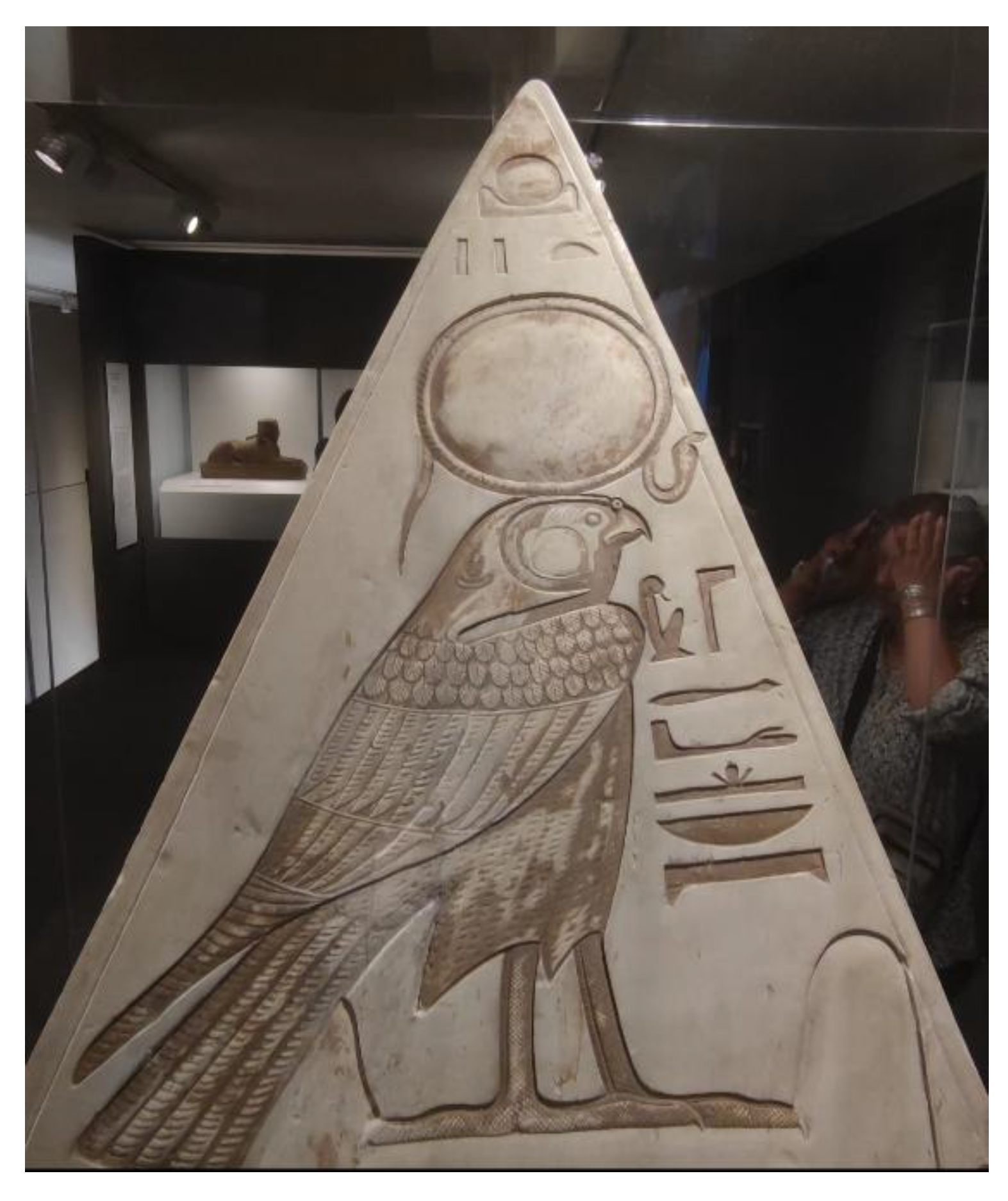
Figure 2.
The winged solar disk with two red uraei in a wooden stele. Museo Egizio, Torino C. 1568 (gift from Cairo Museum; photo of the author).
Figure 2.
The winged solar disk with two red uraei in a wooden stele. Museo Egizio, Torino C. 1568 (gift from Cairo Museum; photo of the author).
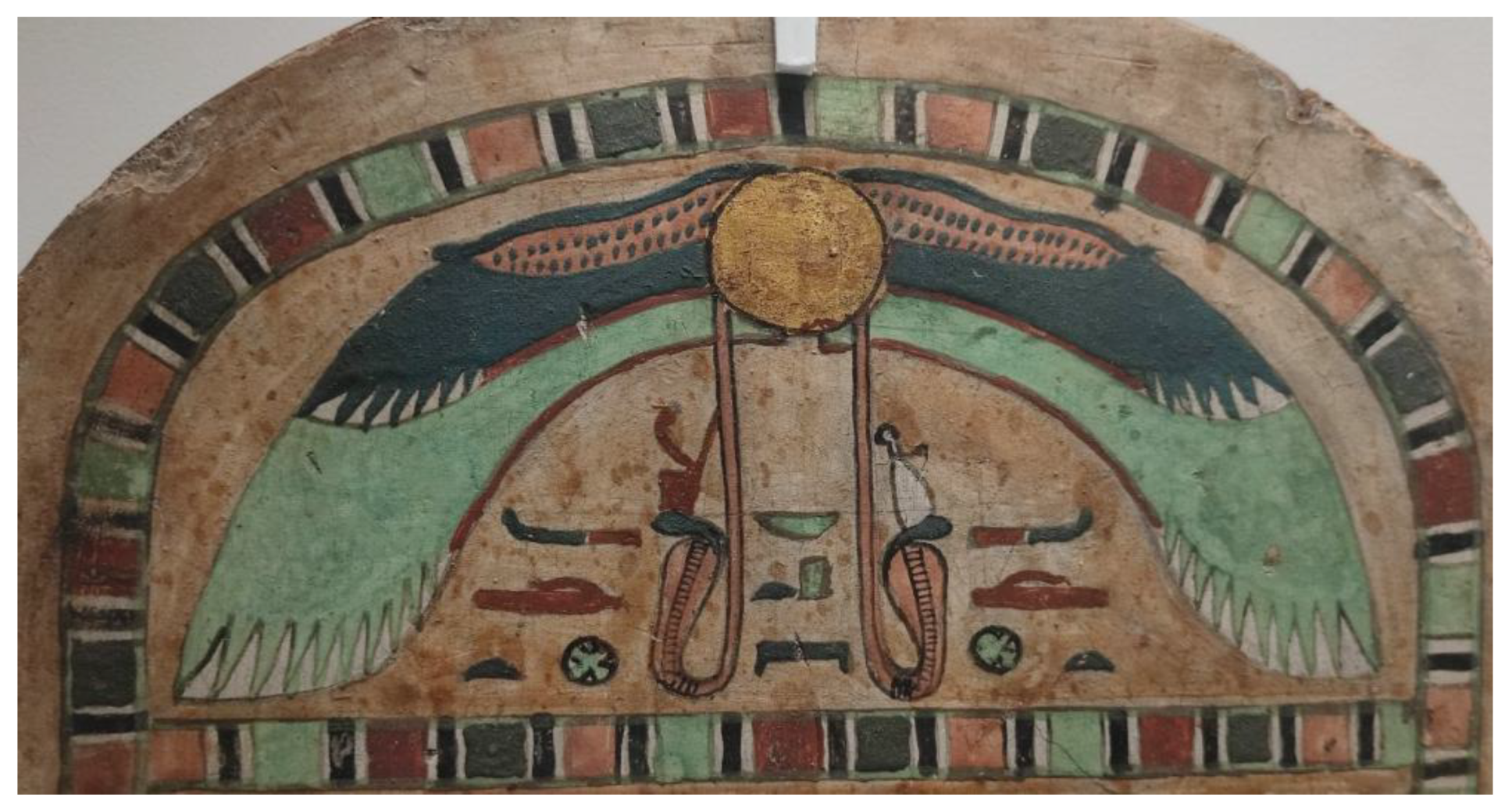
Figure 3.
The total eclipse of 22 July 2009 pictured at Enewetak Atoll, Marshall Islands,1 the total eclipse of 8 April 2024 in USA at the moment of prominences’ visibility, and a sketch of the winged Sun. Both photos are taken in white light; drawing of the author.
Figure 3.
The total eclipse of 22 July 2009 pictured at Enewetak Atoll, Marshall Islands,1 the total eclipse of 8 April 2024 in USA at the moment of prominences’ visibility, and a sketch of the winged Sun. Both photos are taken in white light; drawing of the author.
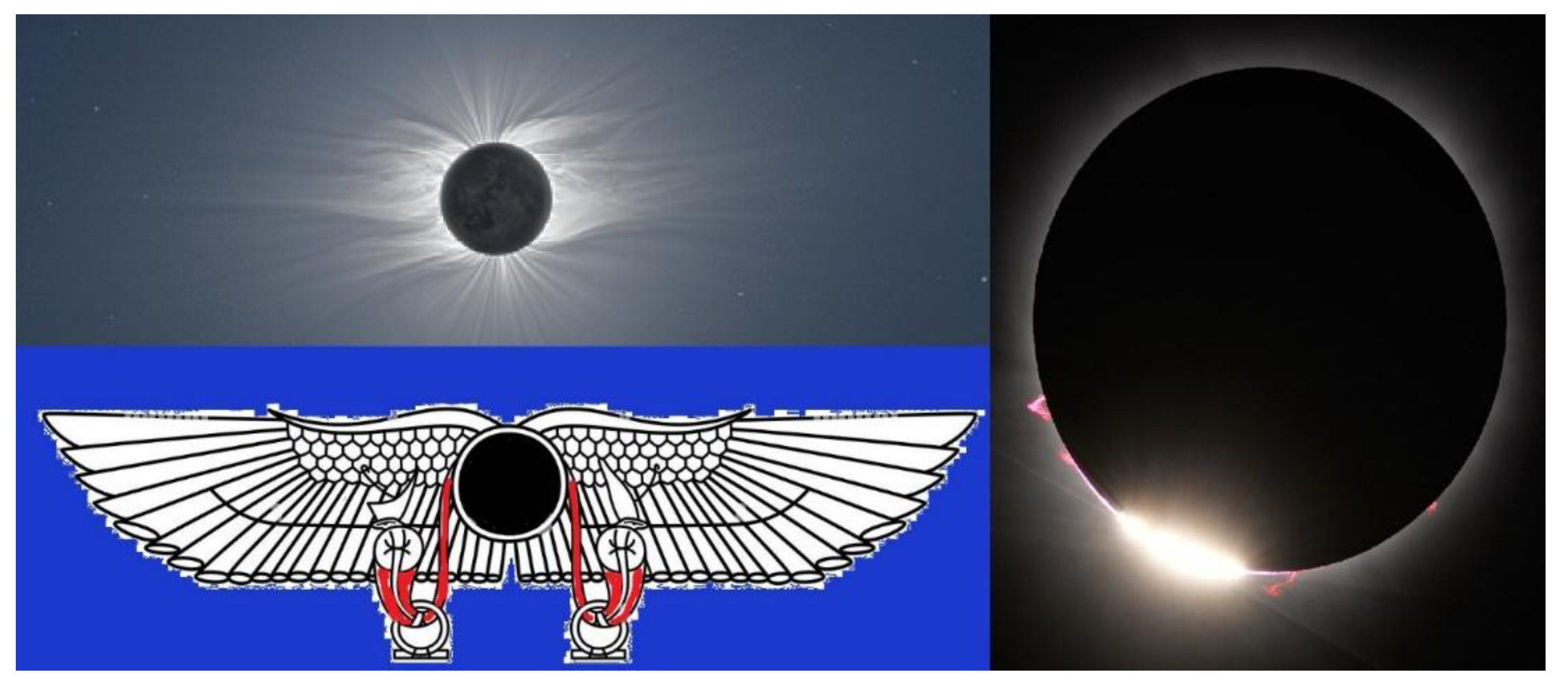
Figure 4.
The Sun on 14 July 2024 h 17, with a great prominence in the western (lower) limb.2 This prominence was enough long to explain the extension of the Uraeis (fig. 2).
Figure 4.
The Sun on 14 July 2024 h 17, with a great prominence in the western (lower) limb.2 This prominence was enough long to explain the extension of the Uraeis (fig. 2).
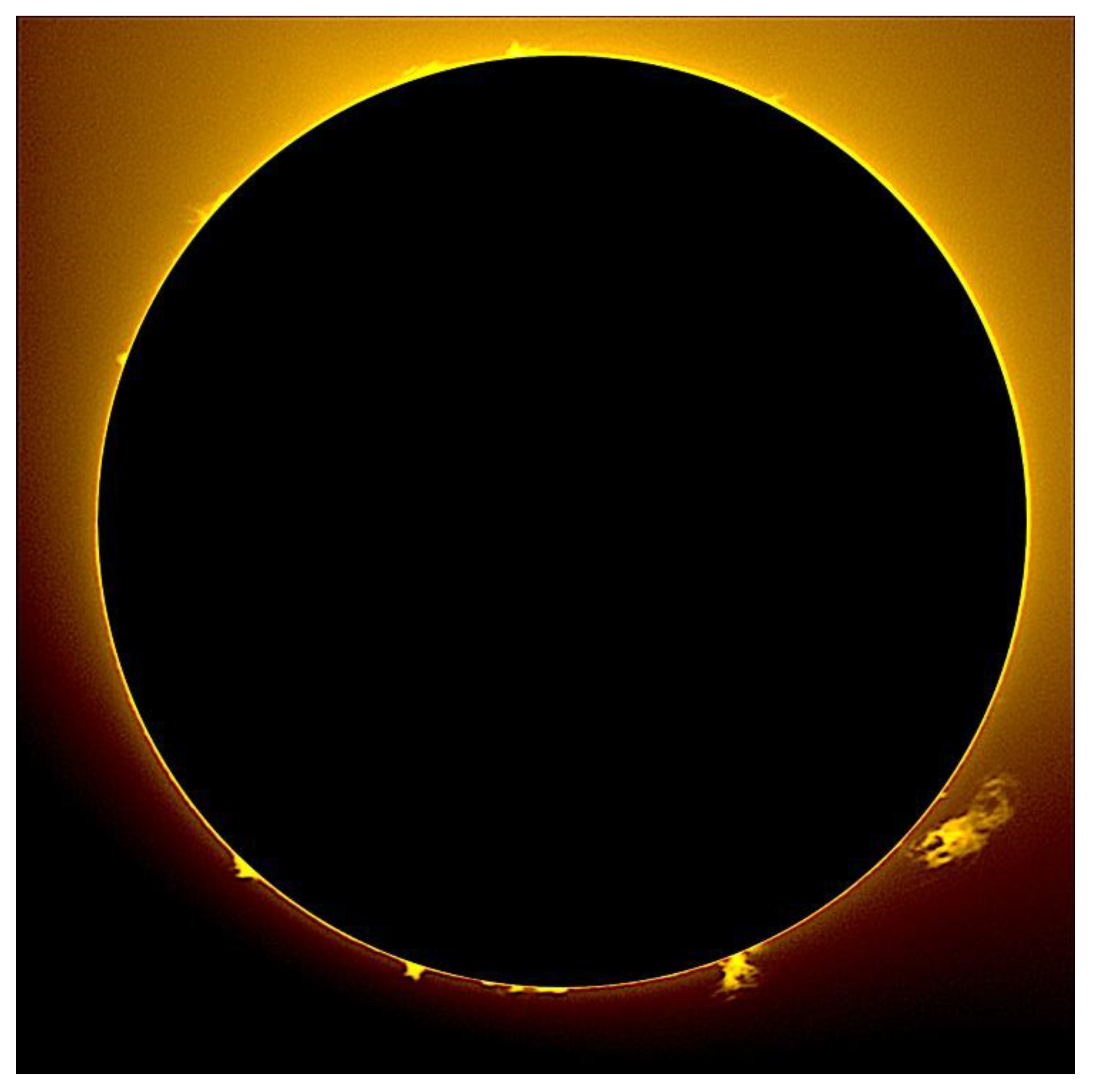
Figure 5.
Christus Helios in the Mausoleo dei Giuli, Vatican necropolis (III century) on the left. The image of Christ in the triumphal arch in the Basilica of St. Paul outside the walls, Rome (IV century- rebuilt in XIX century) on the right side; photos by the author.
Figure 5.
Christus Helios in the Mausoleo dei Giuli, Vatican necropolis (III century) on the left. The image of Christ in the triumphal arch in the Basilica of St. Paul outside the walls, Rome (IV century- rebuilt in XIX century) on the right side; photos by the author.
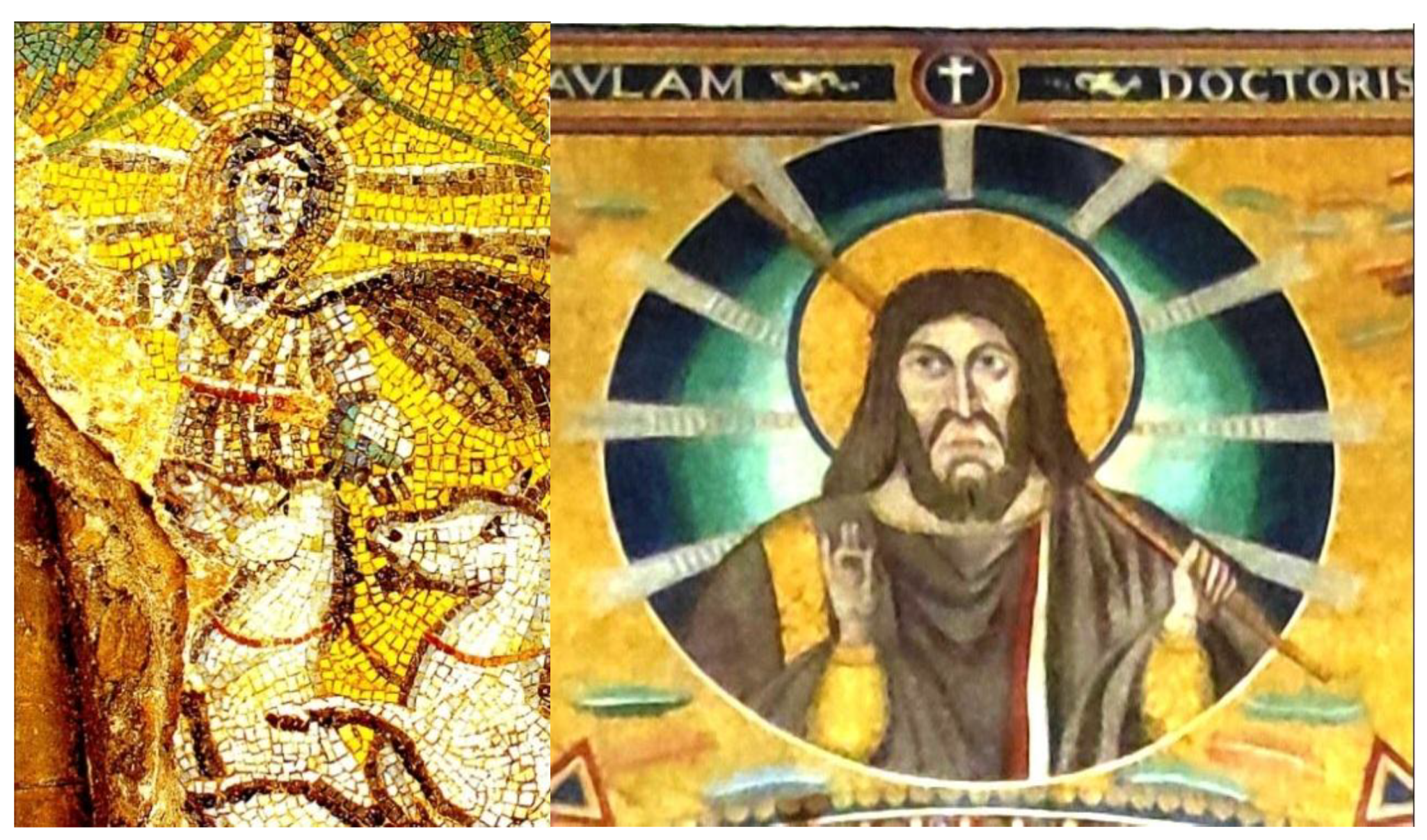
Figure 6.
Table of the Christogram YHS. Church of St. Francis in Prato (1424). There are 12 main twisted rays, as the biblical number of the apostoles, or the Israel’s tribes. In the frame it is reported the words (Philippians 2, 10) - In nomine Iesu omne genu flectatur, coelestium, terrestrium, et infernorum.
Figure 6.
Table of the Christogram YHS. Church of St. Francis in Prato (1424). There are 12 main twisted rays, as the biblical number of the apostoles, or the Israel’s tribes. In the frame it is reported the words (Philippians 2, 10) - In nomine Iesu omne genu flectatur, coelestium, terrestrium, et infernorum.
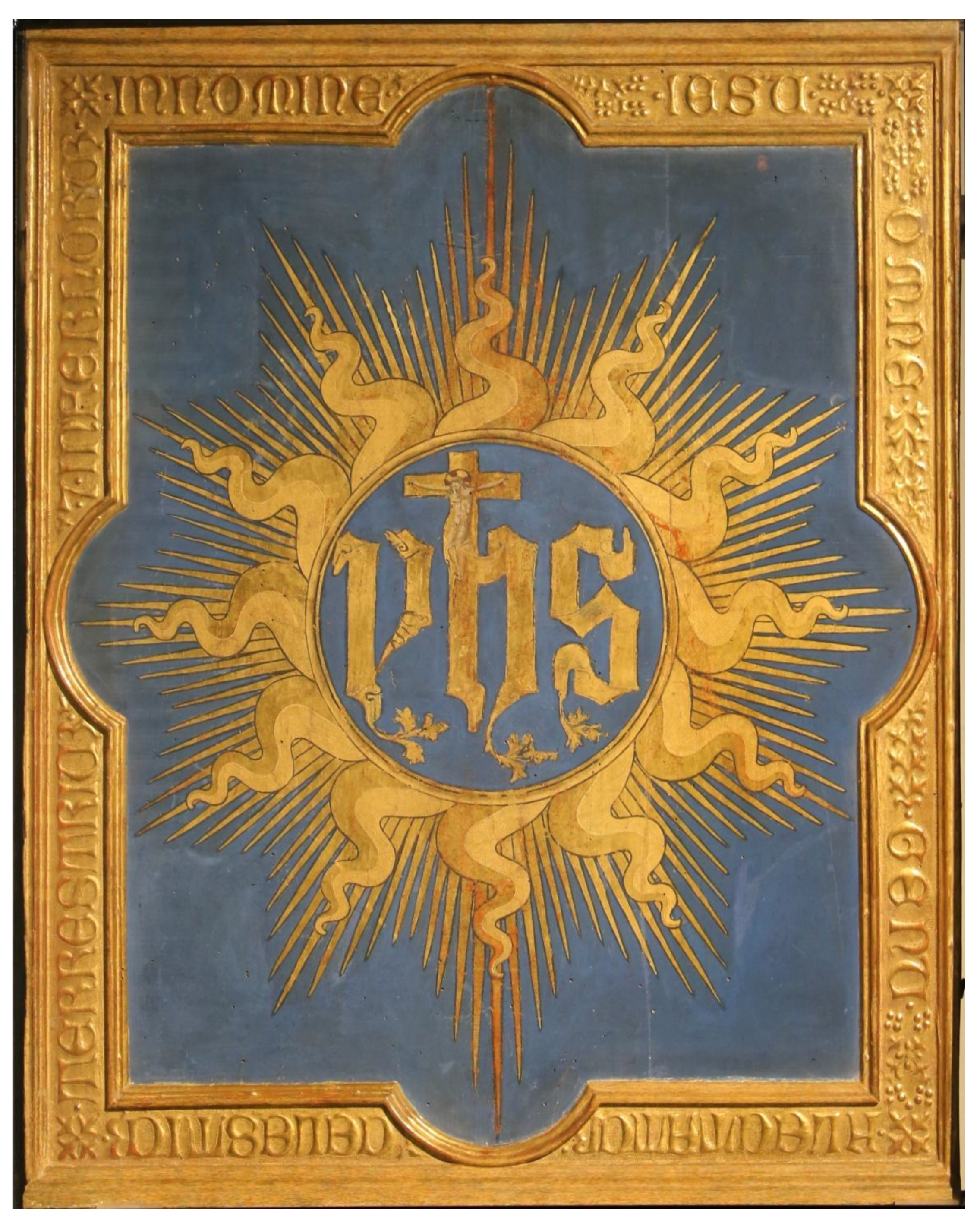
Figure 7.
The Sun with the acronym IHS, Iesus Hominum Salvator, created by St. Bernardin of Siena.13 This symbol was adopted by St. Ignatius of Loyola, founder of the Jesuits, with the addition of the cross and the nails; it is in the coat of arms of Pope Francis.14.
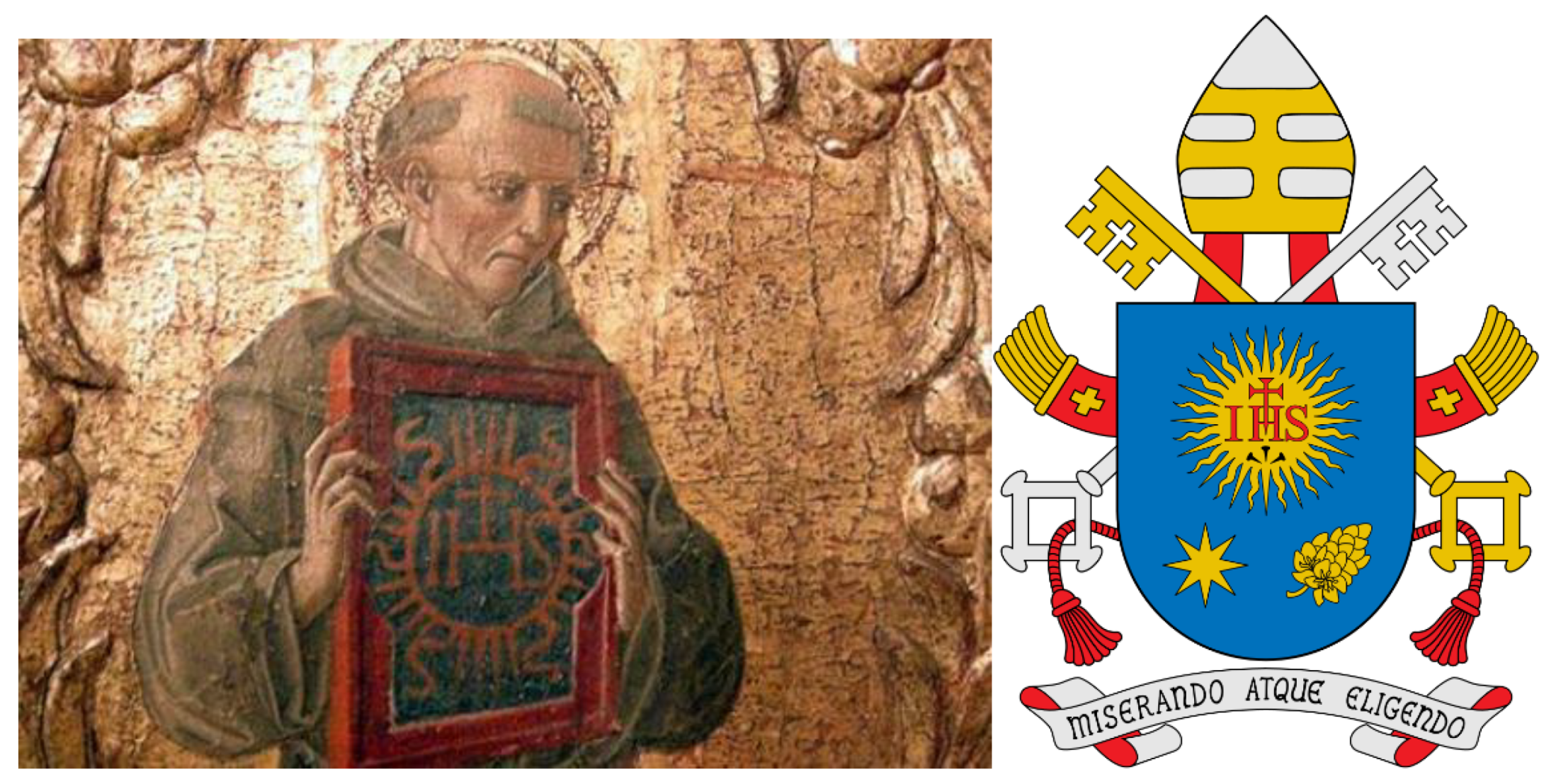
Figure 8.
Diagram of sunspots from Borbonia Sidera (Jean Tarde, 1620).17.
Figure 8.
Diagram of sunspots from Borbonia Sidera (Jean Tarde, 1620).17.
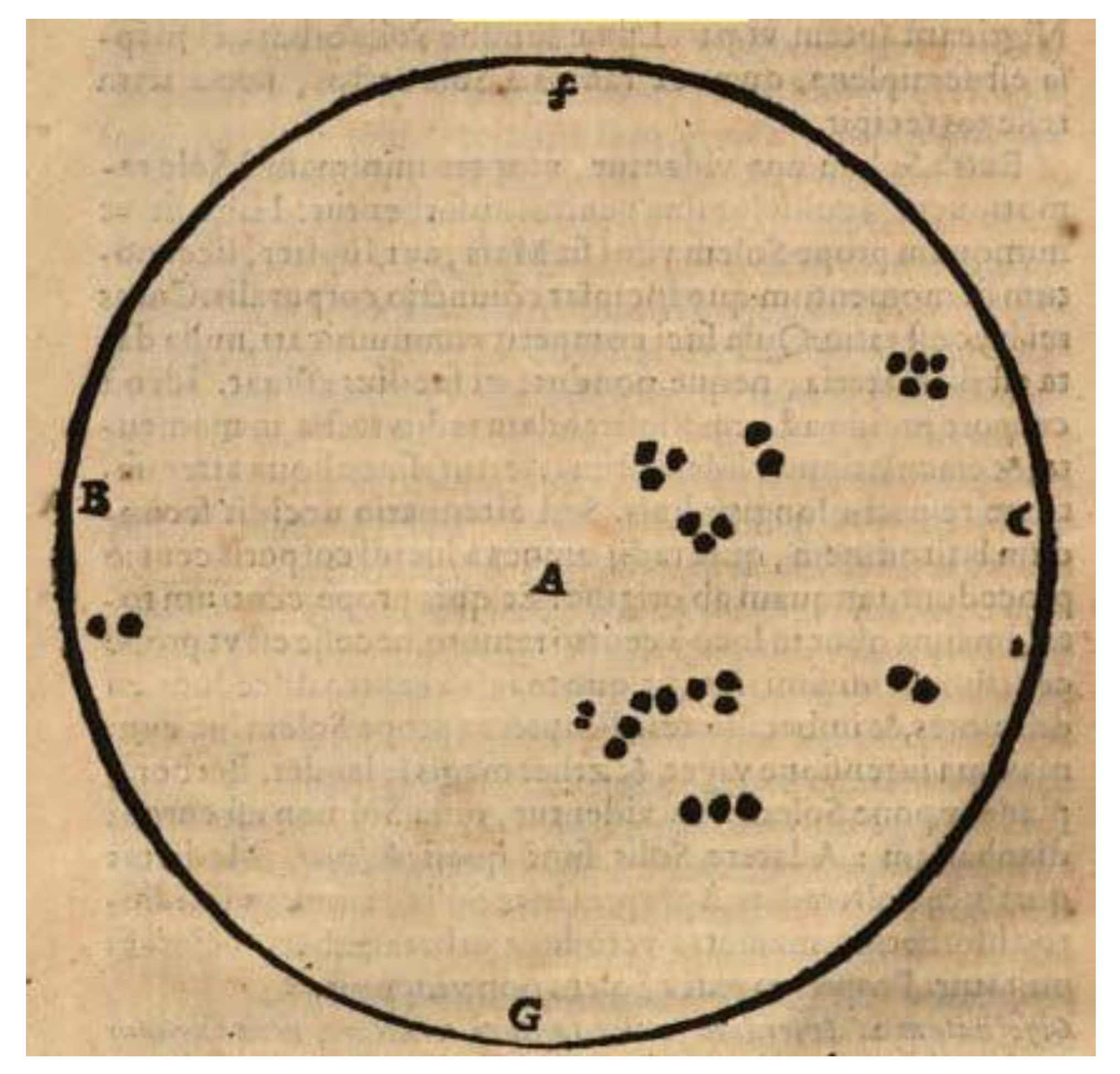
Figure 9.
The Scheme20 of the experiment of Huygens using a pinhole of focal 4 m.
Figure 9.
The Scheme20 of the experiment of Huygens using a pinhole of focal 4 m.
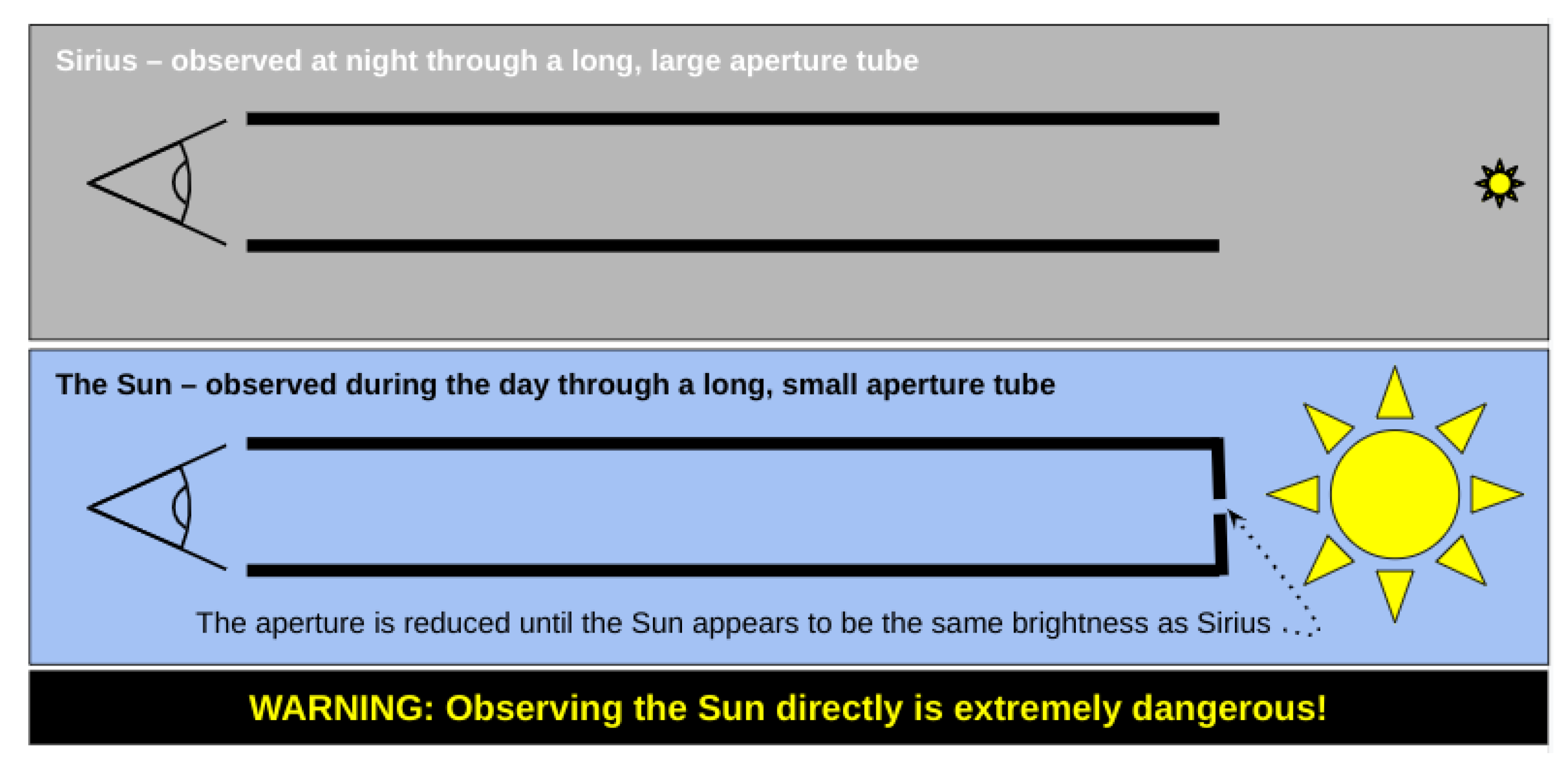
Figure 10.
“Move not, O Sun” Mosaic V century AD, St. Maria Maggiore, Rome. Author’s photo.
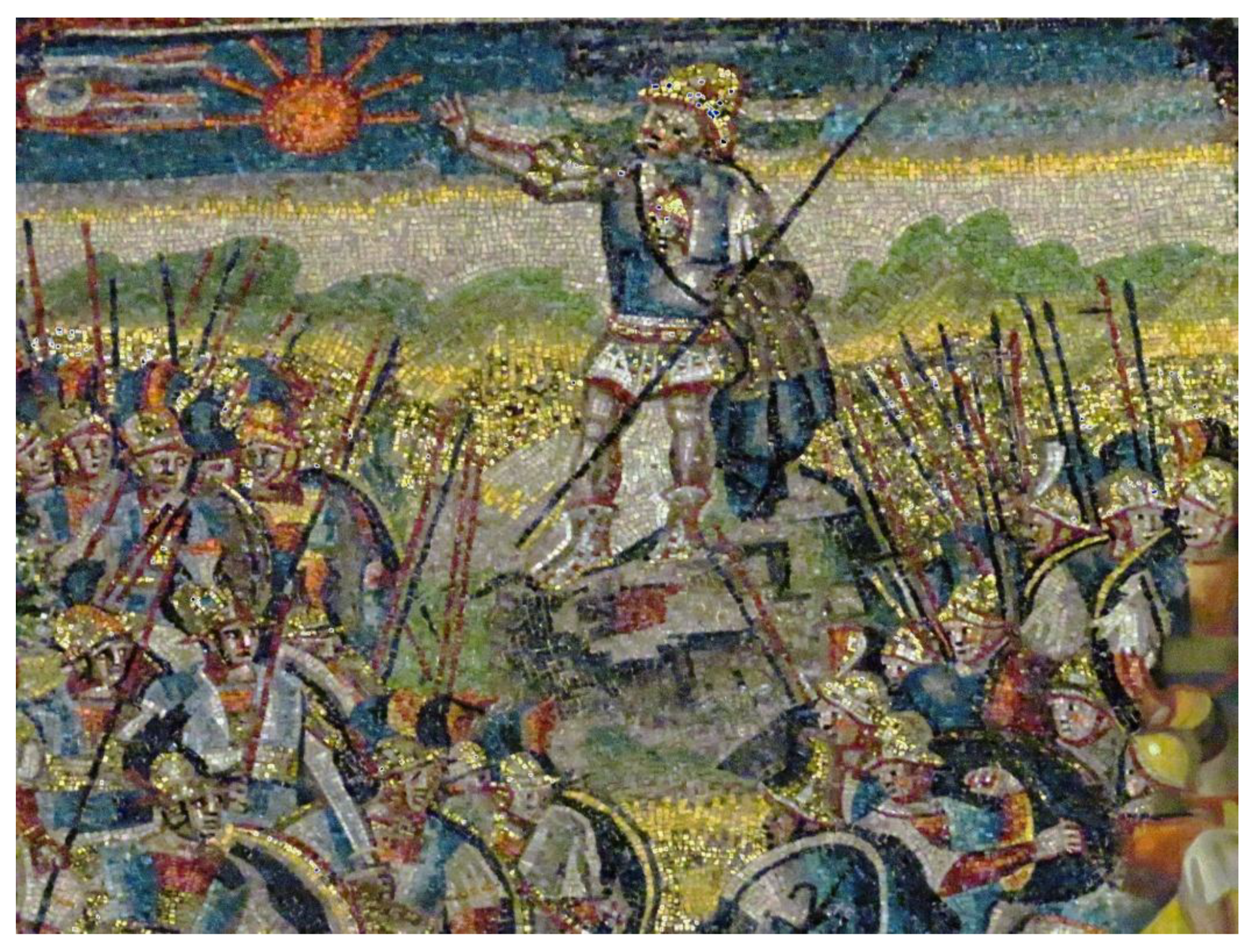
Figure 11.
The solar surface observed in Rome in 1635 by Christoph Scheiner and Athanasius Kircher, in the Hall of Meridian, Vatican Museums, Vatican. This is depicted on a wooden door created for the Cardinal Francesco Saverio De Zelada in 1798.23 Author’s photo.
Figure 11.
The solar surface observed in Rome in 1635 by Christoph Scheiner and Athanasius Kircher, in the Hall of Meridian, Vatican Museums, Vatican. This is depicted on a wooden door created for the Cardinal Francesco Saverio De Zelada in 1798.23 Author’s photo.
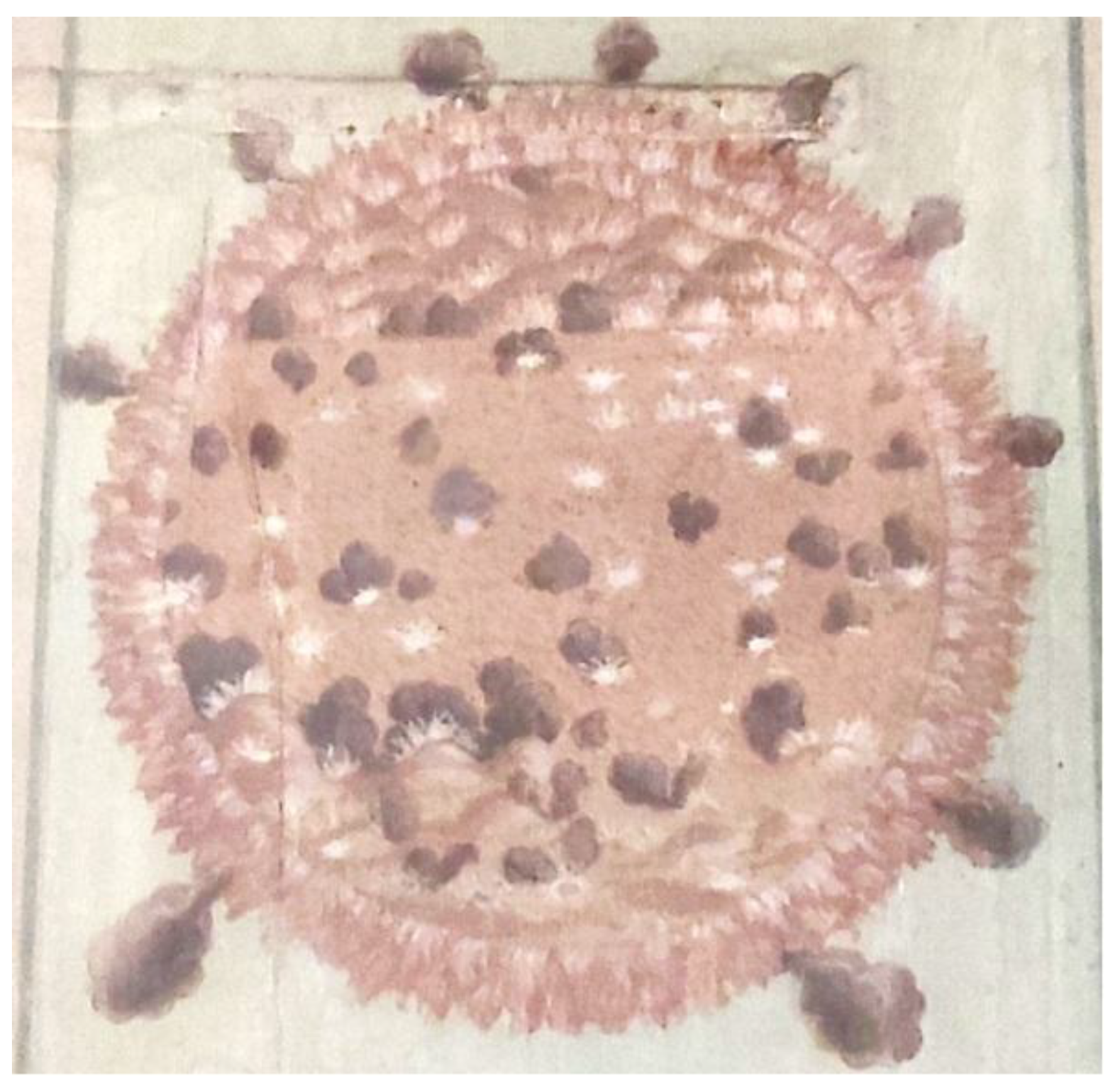
Figure 12.
Athanasius Kircher, Schema corporis solaris, with the zona torrida (called royal way of the sunspots by Christopher Scheiner), the spaces borealis and australis, the wells of light, the volcanoes with dark condensations. Obtained with the observations with father Scheiner in 1635.26 This has been the model for the paint on wood made in 1798 (Figure 9).
Figure 12.
Athanasius Kircher, Schema corporis solaris, with the zona torrida (called royal way of the sunspots by Christopher Scheiner), the spaces borealis and australis, the wells of light, the volcanoes with dark condensations. Obtained with the observations with father Scheiner in 1635.26 This has been the model for the paint on wood made in 1798 (Figure 9).
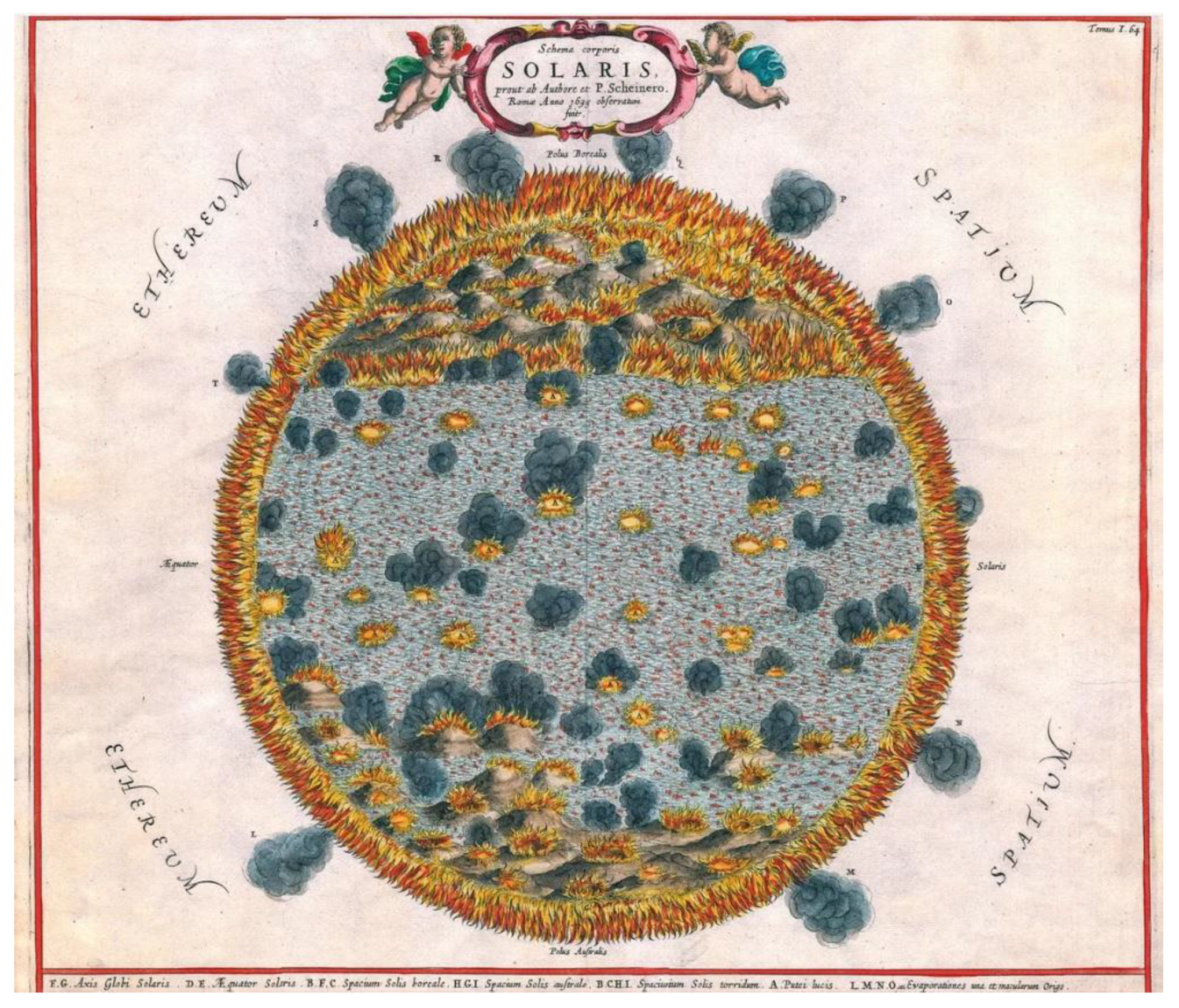
Figure 13.
The naked eye sunspot of Galileo seen on 19 and 20 August 1612.30 Author’s photo.
Figure 13.
The naked eye sunspot of Galileo seen on 19 and 20 August 1612.30 Author’s photo.
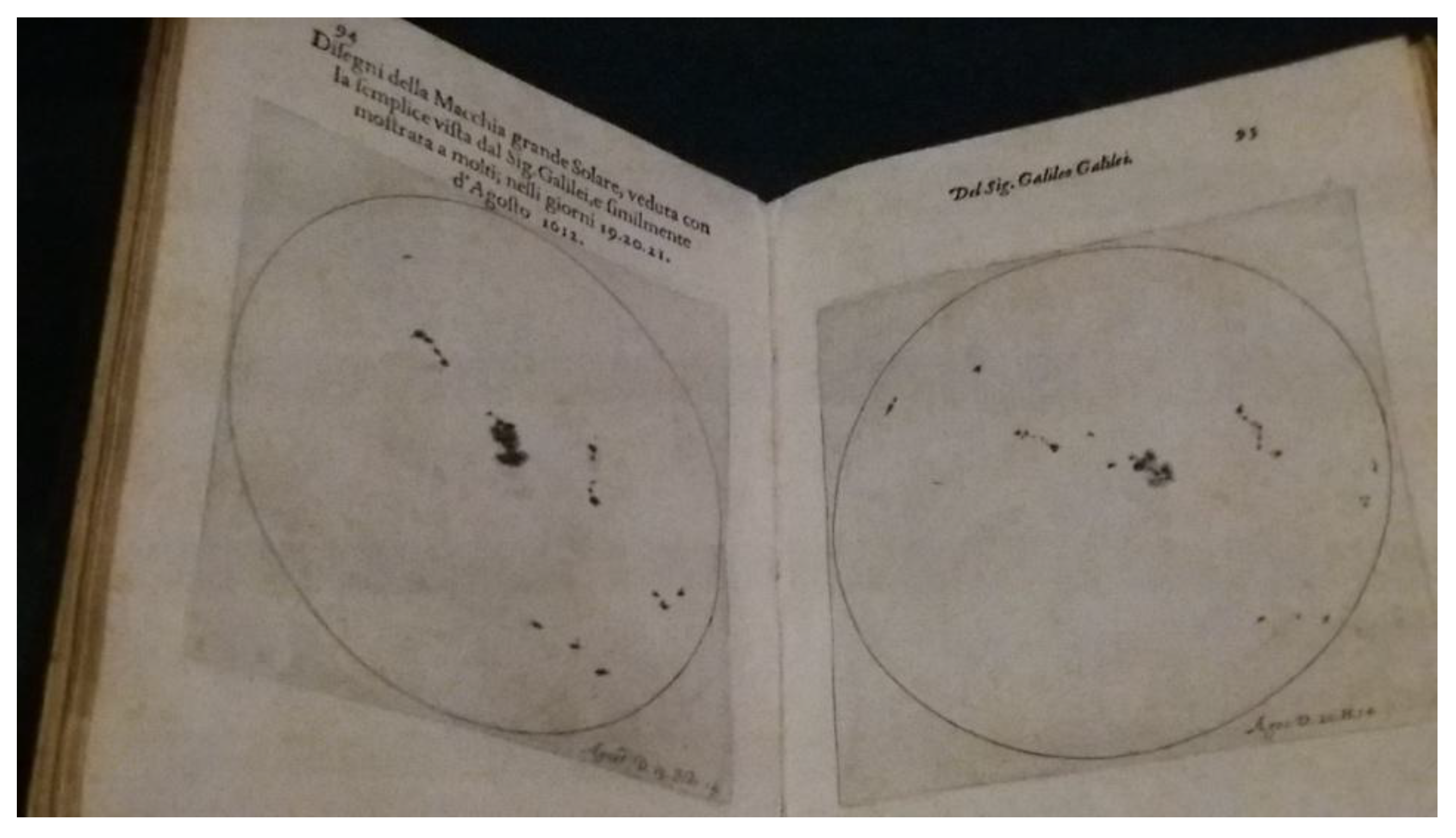
Figure 14.
The partial solar eclipse of 29 March 2025 at IRSOL, Locarno Switzerland. The eclipse reached 21% of magnitude 23 minutes before this photo. Author’s photo.
Figure 14.
The partial solar eclipse of 29 March 2025 at IRSOL, Locarno Switzerland. The eclipse reached 21% of magnitude 23 minutes before this photo. Author’s photo.
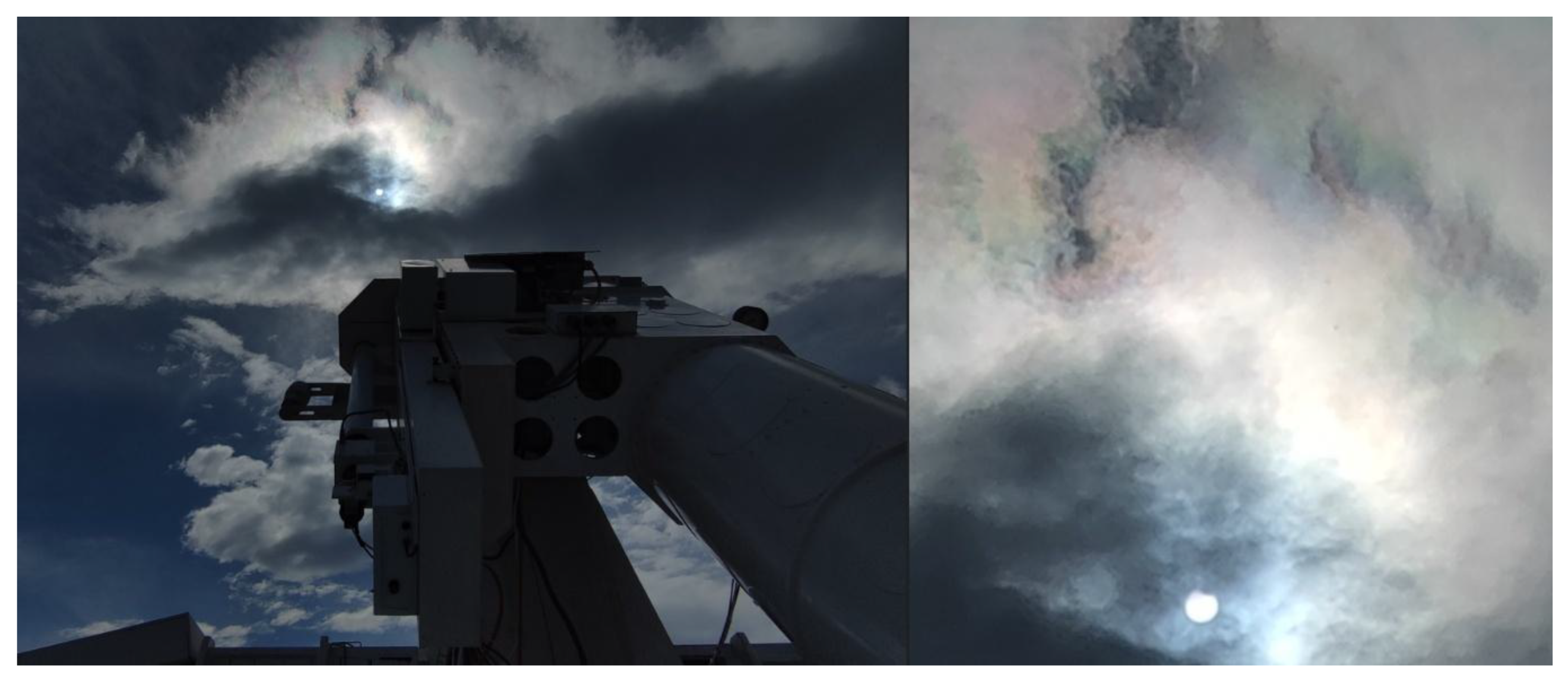
Figure 15.
The Sun with sunspots and limb darkening, as in the projection of the Sun on 9 May 2025 h 14:04 UT. The 105 cm wide image is projected in camera obscura by a telescope Antares 20x60 at 5.4 m. Author’s photo.
Figure 15.
The Sun with sunspots and limb darkening, as in the projection of the Sun on 9 May 2025 h 14:04 UT. The 105 cm wide image is projected in camera obscura by a telescope Antares 20x60 at 5.4 m. Author’s photo.
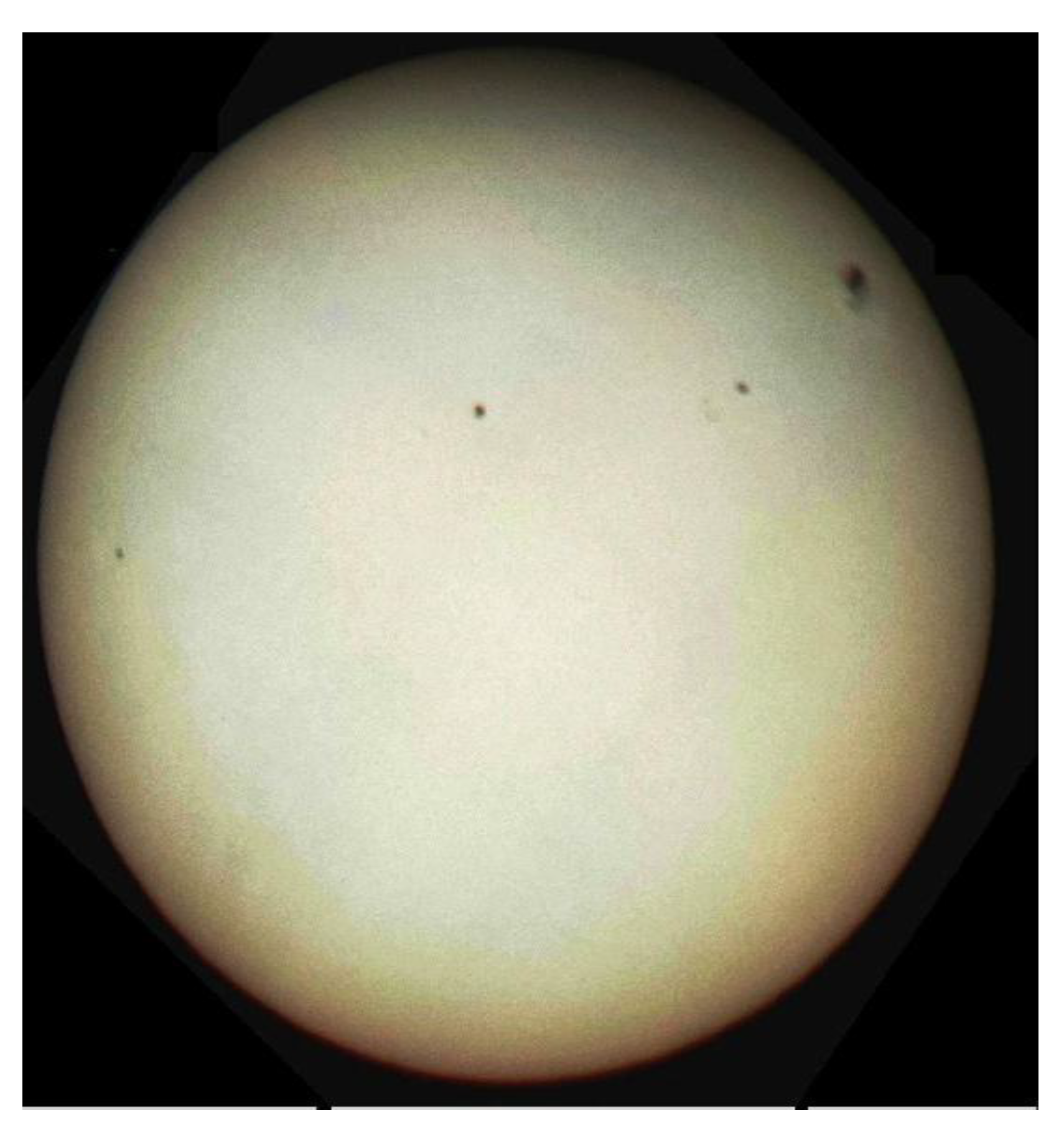
Figure 16.
The sunspot AR 4079 projected at 540 cm on 6 May 2025 while its area was 1250 MH - Millionths of solar Hemisphere.37 Author’s photo.
Figure 16.
The sunspot AR 4079 projected at 540 cm on 6 May 2025 while its area was 1250 MH - Millionths of solar Hemisphere.37 Author’s photo.
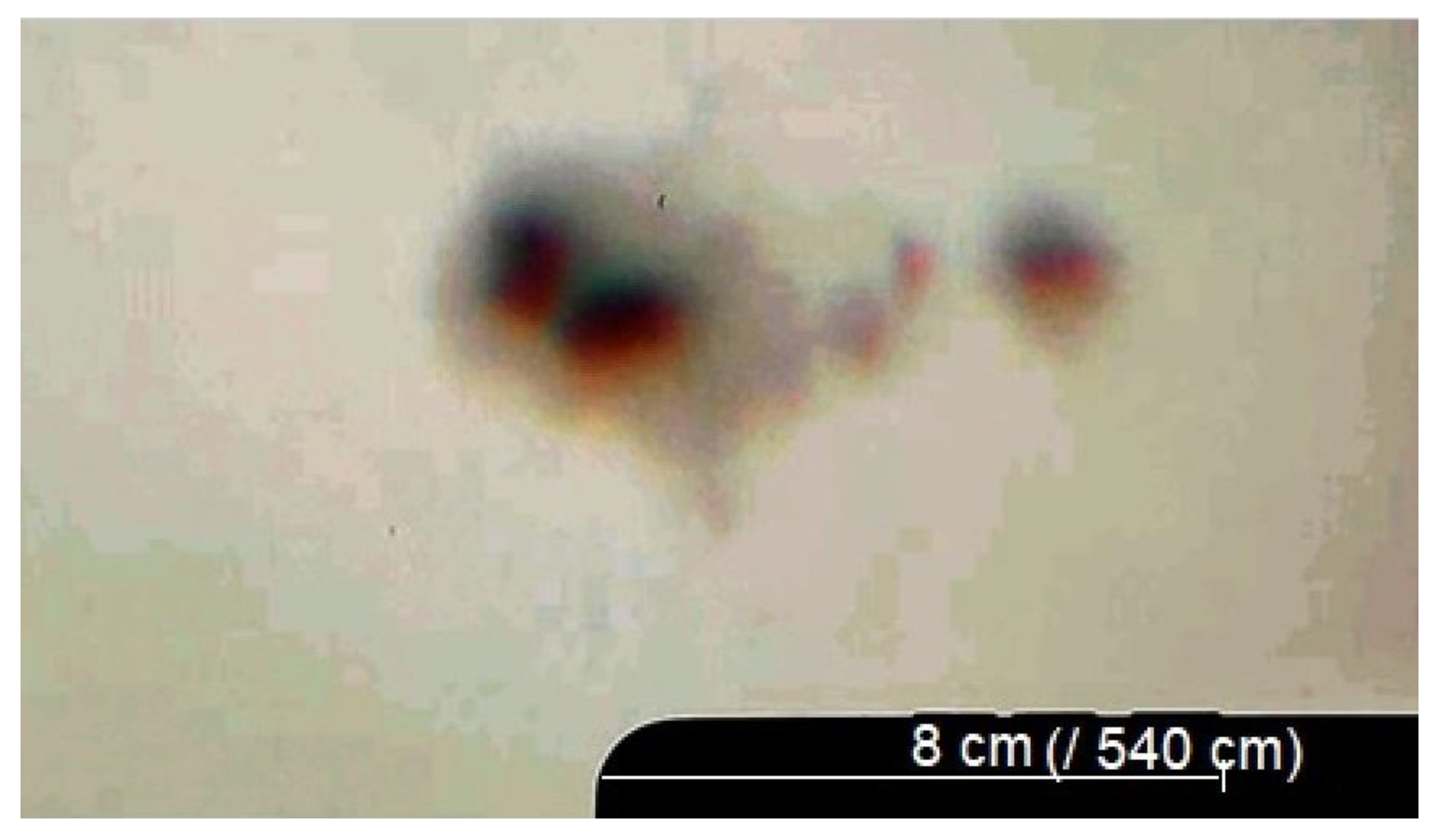
Figure 17.
Camera obscura projections: the brightest faculae (AR4081 and AR 4086 on 12 May 2025) have a shallower contrast38 than umbrae and penumbrae. Author’s photo.
Figure 17.
Camera obscura projections: the brightest faculae (AR4081 and AR 4086 on 12 May 2025) have a shallower contrast38 than umbrae and penumbrae. Author’s photo.
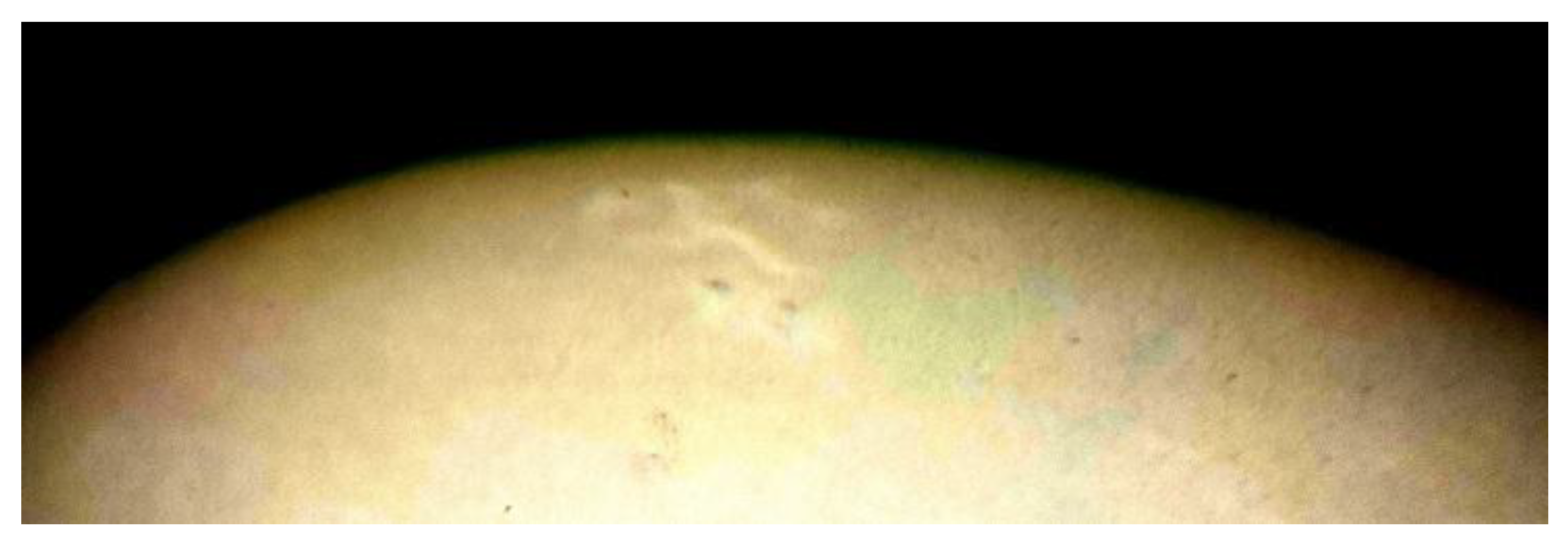
Figure 18.
The M1.44 flare on 3 June 2025 at 13Z on AR 4105 in H-alpha (grey-left Teide Observatory) and white light (orange-right SDO Satellite). The flare faded expanding out of the solar limb. The flare intensity in X-ray class is indicated.48.
Figure 18.
The M1.44 flare on 3 June 2025 at 13Z on AR 4105 in H-alpha (grey-left Teide Observatory) and white light (orange-right SDO Satellite). The flare faded expanding out of the solar limb. The flare intensity in X-ray class is indicated.48.
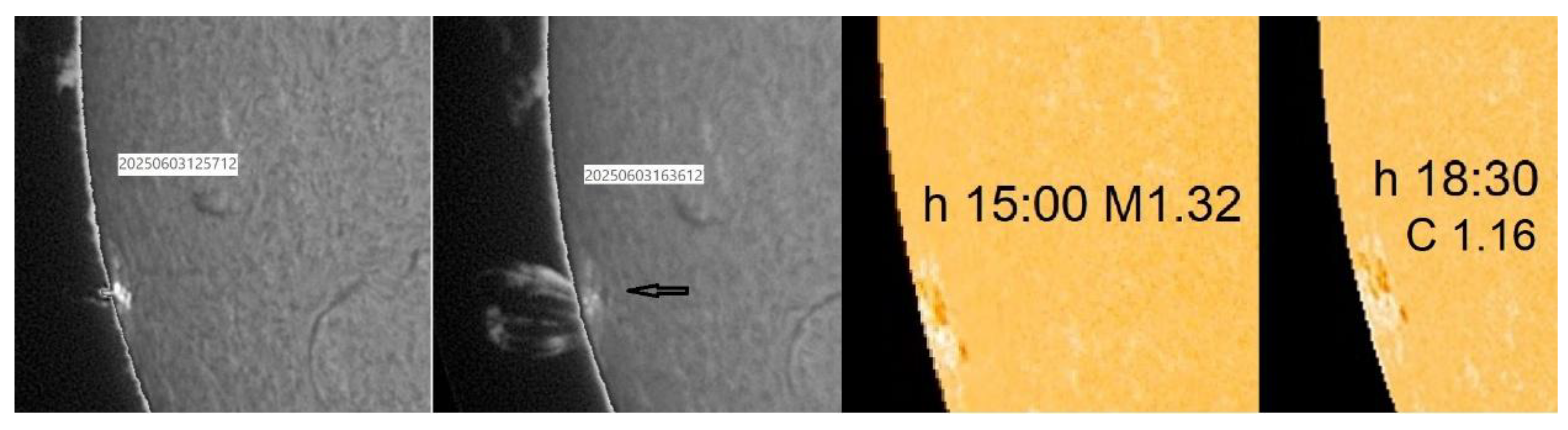
Figure 19.
Pinhole image through a plane tree (Platanus Occidentalis). The limb darkening is mainly due to the opening of the accidental pinhole’s aperture, evaluated to about 58 mm, convoluted with the solar limb darkening. From the limb to the maximum luminosity there are 24 pixels (370”), over a diameter of 123 pixels (300 mm, projected from about 30 m). Brightness profile obtained with IRIS software (Buil 2010).
Figure 19.
Pinhole image through a plane tree (Platanus Occidentalis). The limb darkening is mainly due to the opening of the accidental pinhole’s aperture, evaluated to about 58 mm, convoluted with the solar limb darkening. From the limb to the maximum luminosity there are 24 pixels (370”), over a diameter of 123 pixels (300 mm, projected from about 30 m). Brightness profile obtained with IRIS software (Buil 2010).
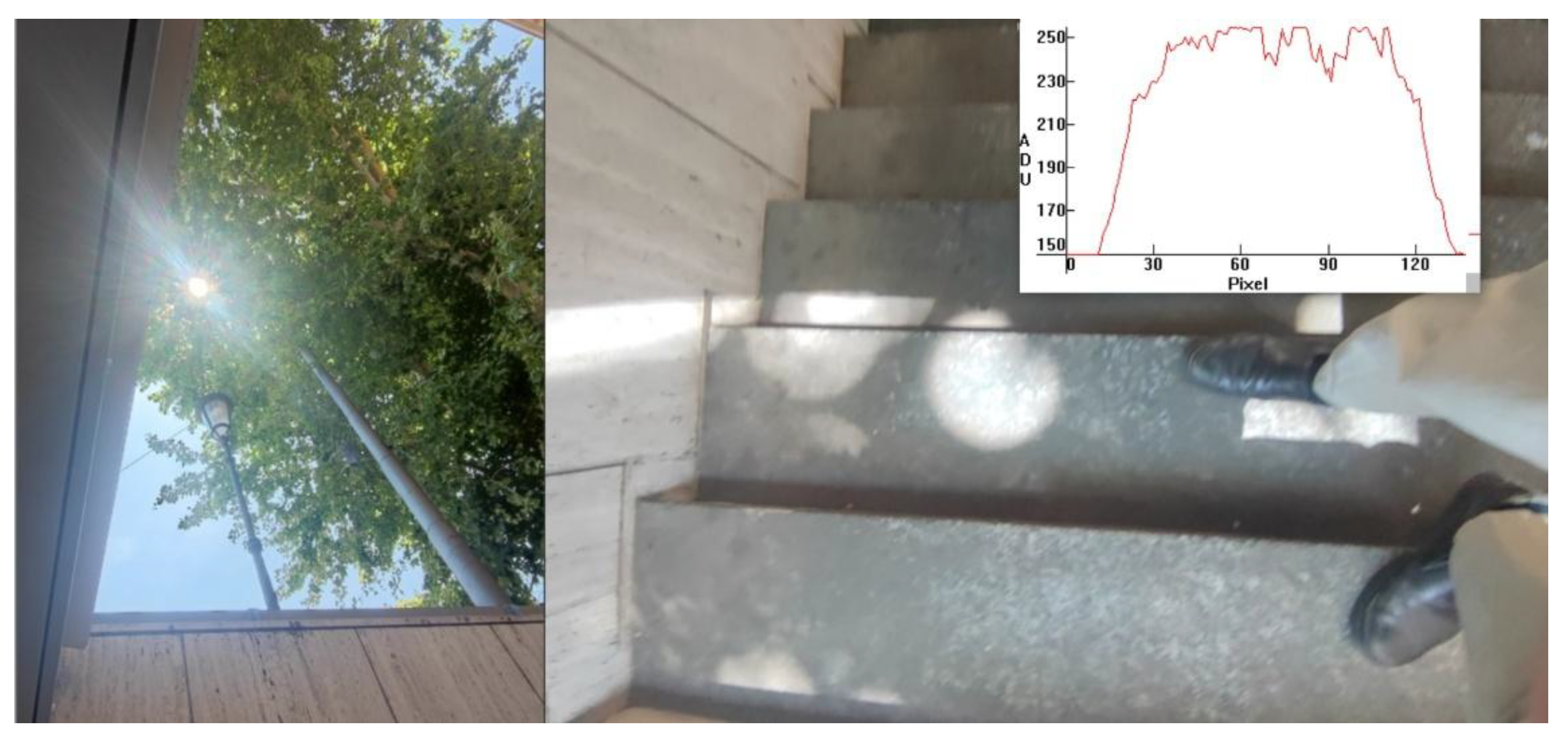
Figure 20.
The Sun at the Clementine Gnomon in St. Maria degli Angeli on 30 May 2025. The Limb Darkening is sharper than figure 15, because the pinhole is 25 mm wide. 22 pixel (333”) from limb to saturation over a diameter of 125 pixel (220 mm). Brightness profile obtained with IRIS software (Buil 2010).
Figure 20.
The Sun at the Clementine Gnomon in St. Maria degli Angeli on 30 May 2025. The Limb Darkening is sharper than figure 15, because the pinhole is 25 mm wide. 22 pixel (333”) from limb to saturation over a diameter of 125 pixel (220 mm). Brightness profile obtained with IRIS software (Buil 2010).
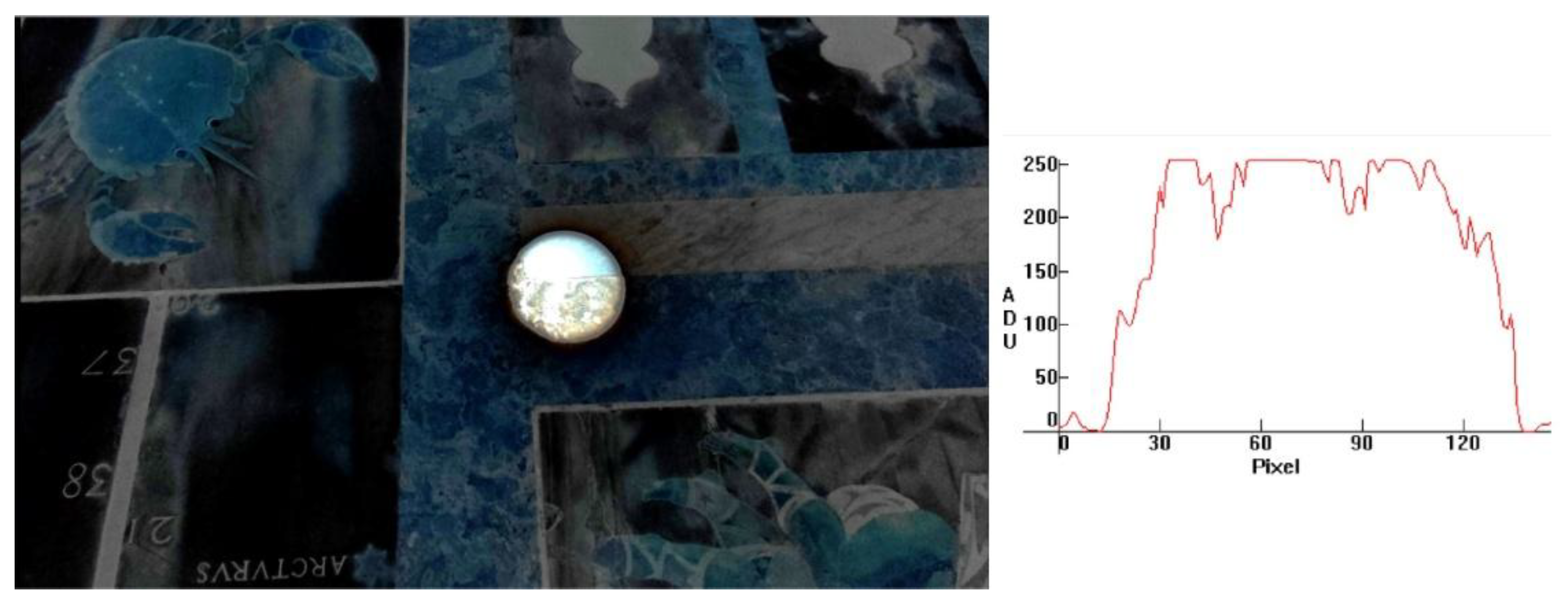
Figure 21.
the Limb Darkening Function (E-W) of the Sun on 31 May 2025 in Camera Obscura, through a 20x 60 mm refracting telescope. The image has 104 cm of diameter and it is projected at 540 cm of distance from the telescope. AR 4099 and 4100 are well visible. West is 45° to the right. Brightness profile obtained with IRIS software (Buil 2010).
Figure 21.
the Limb Darkening Function (E-W) of the Sun on 31 May 2025 in Camera Obscura, through a 20x 60 mm refracting telescope. The image has 104 cm of diameter and it is projected at 540 cm of distance from the telescope. AR 4099 and 4100 are well visible. West is 45° to the right. Brightness profile obtained with IRIS software (Buil 2010).
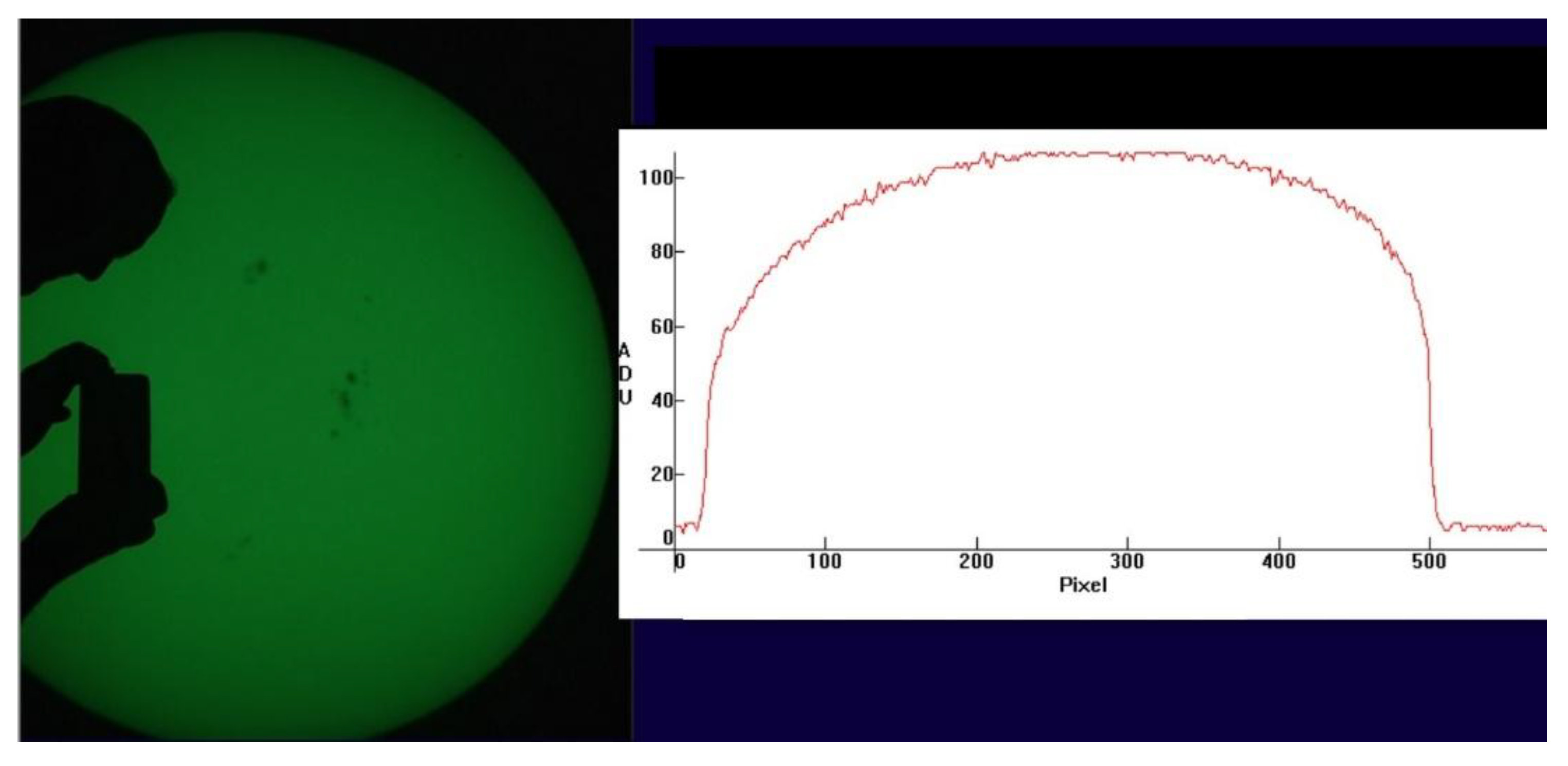
Figure 22.
The pinhole limb darkening at the Clementine Gnomon (31 May 2025 13:07:55 UT). The curve below in comparison is the solar limb darkening at the 60 mm refracting telescope (Fig. 19). The nearly linear rise of the upper curve is visible as a dimmer ring around the solar image.
Figure 22.
The pinhole limb darkening at the Clementine Gnomon (31 May 2025 13:07:55 UT). The curve below in comparison is the solar limb darkening at the 60 mm refracting telescope (Fig. 19). The nearly linear rise of the upper curve is visible as a dimmer ring around the solar image.
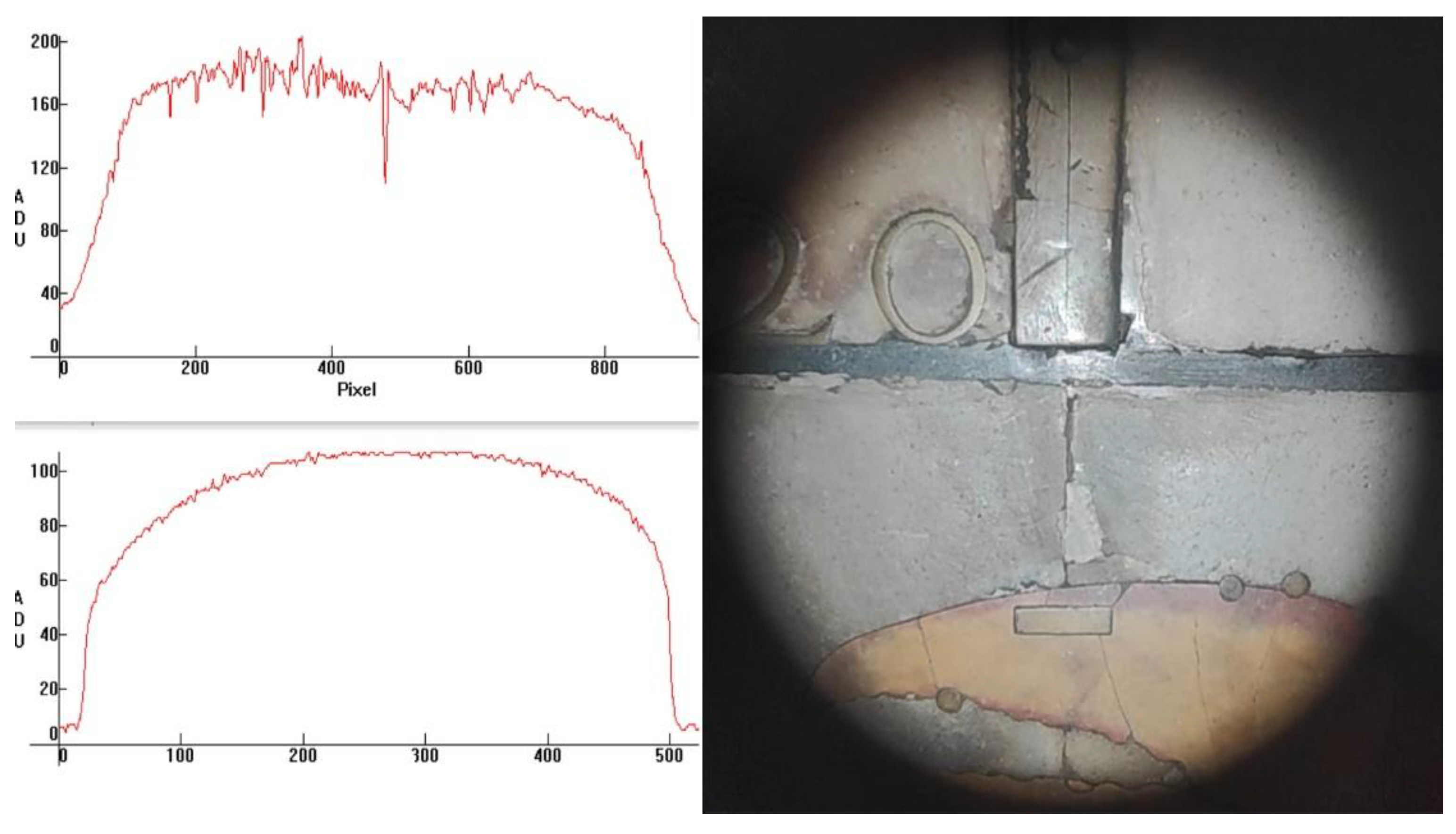
Figure 23.
The Moon on 5 and 8 May 2025 h 22 UTC. Photo by the author.
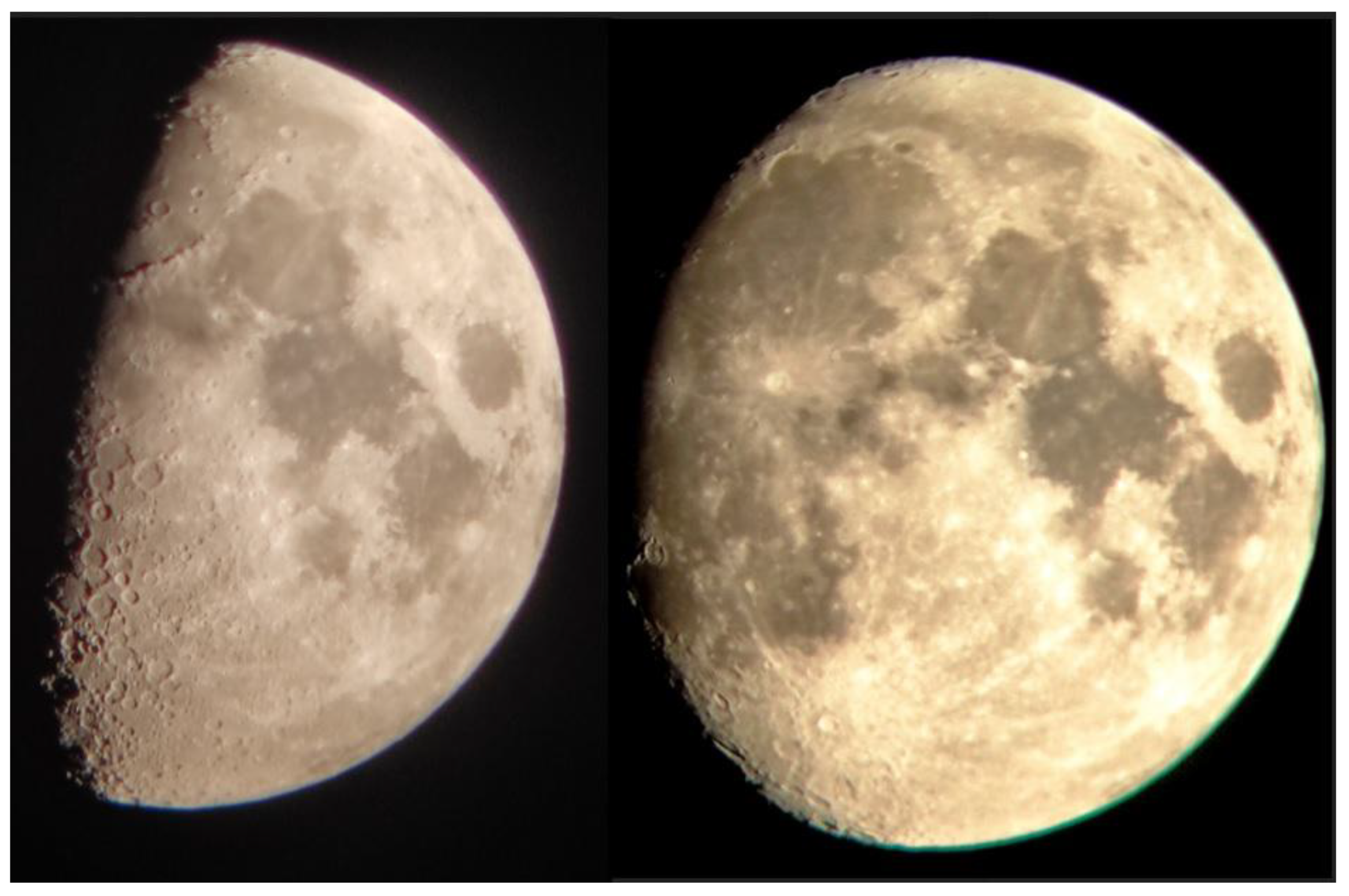
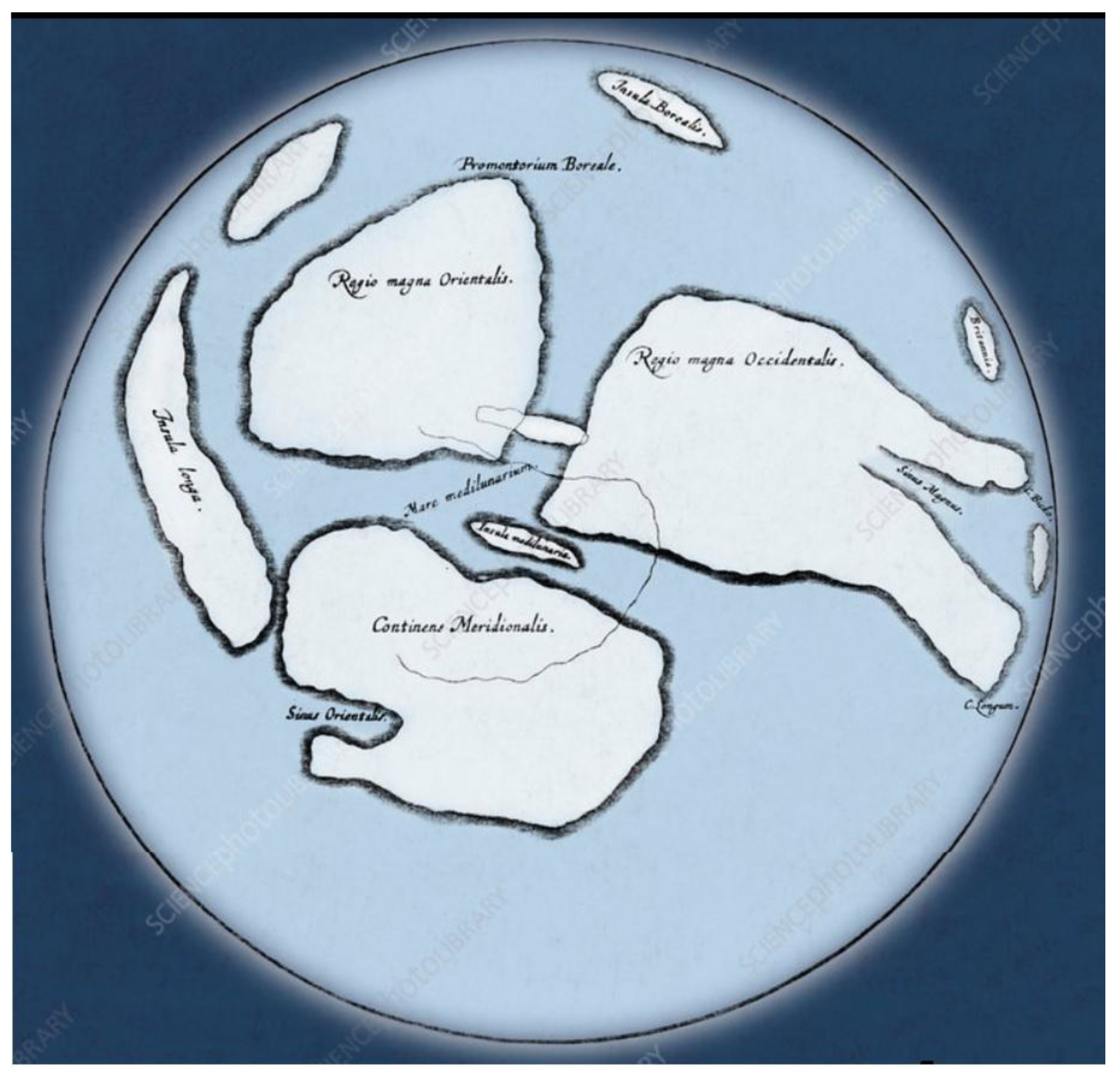

Table 1.
The pinholes meridian lines operating in the churches before the invention of the telescope were in Florence, Bologna (the one of Danti is no more existent, that’s why the visibility is hypothetical) and in Vatican. Their parameters are compared with the ones of St. Maria degli Angeli in 1999 and since 2002, after the restauration of the pinhole to its circular shape. In all cases the sunspots could have been visible.
Table 1.
The pinholes meridian lines operating in the churches before the invention of the telescope were in Florence, Bologna (the one of Danti is no more existent, that’s why the visibility is hypothetical) and in Vatican. Their parameters are compared with the ones of St. Maria degli Angeli in 1999 and since 2002, after the restauration of the pinhole to its circular shape. In all cases the sunspots could have been visible.
| Meridian line / date | Pinhole diameter/height | Visibility of the sunspots |
| S. Maria del Fiore (1475) | 50/90000 = 1/1800 | Yes, only in June-July |
| St. Petronio (Danti, 1577) | Not known | Probably Yes |
| Torre dei Venti (1580) | 14/5180 = 1/370 | Yes (>30” or 400 MH) |
| St. Petronio (Cassini, 1655) | 27/27000 = 1/1000 | Yes |
| St. Maria degli Angeli (1999) | 40/20353 = 1/500 | Yes (>25” or 300 MH) |
| St. Maria degli Angeli (2002) | 10-23/20353 = 1-2.3/2000 | Yes |
Disclaimer/Publisher’s Note: The statements, opinions and data contained in all publications are solely those of the individual author(s) and contributor(s) and not of MDPI and/or the editor(s). MDPI and/or the editor(s) disclaim responsibility for any injury to people or property resulting from any ideas, methods, instructions or products referred to in the content. |
© 2025 by the authors. Licensee MDPI, Basel, Switzerland. This article is an open access article distributed under the terms and conditions of the Creative Commons Attribution (CC BY) license (http://creativecommons.org/licenses/by/4.0/).
Copyright: This open access article is published under a Creative Commons CC BY 4.0 license, which permit the free download, distribution, and reuse, provided that the author and preprint are cited in any reuse.


