

Submitted:
24 May 2025
Posted:
26 May 2025
You are already at the latest version
Abstract
Although the beer fermentation traditionally is carried out with Saccharomyces, the increasing interest in innovative beers lead to the use of uncharacterized autochthonous starter cultures, spontaneous fermentation, or non-Saccharomyces starters, which leads to the production of distinctive and unusual products. Non-Saccharomyces yeasts are generally characterized by low fermentation yields and are more sensitive to ethanol stress, but they provide a distinctive aroma and flavor. The aim of this study was to investigate the sweet and hopped wort fermentation with 7 strains of active dry non-conventional yeasts of the Lachancea spp, Metschnikowia spp., Torulaspora spp. and a mixed culture of Saccharomyces cerevisiae and Torulaspora delbrueckii. One ale and one lager active dry yeast strains were used as a control strains. The extract consumption, ethanol production, degree of fermentation, pH drop, as well as the yeast secondary metabolites formed by the yeast (higher alcohols, esters and aldehydes) in sweet and hopped wort was investigated. The results indicated that all of the studied types of non-conventional yeasts were with serious potential for use in beer production in order to obtain new beer styles.
Keywords:
non-conventional yeast
; alcoholic fermentation
; beer
; metabolomics
; PCA
; correlation analysis
; fermentation kinetics
1. Introduction
Beer is one of the most consumed beverages worldwide. Interest in its production dates back to ancient times. Initially, it was brewed by spontaneous fermentation, due to the wort inoculation by microorganisms found in the air. With the rise in science and the evolution of microbiological research, beer was produced by a controlled fermentation with Saccharomyces yeast. Nowadays, the two main yeast types in brewing are Saccharomyces cerevisiae (ale yeast) and Saccharomyces pastorianus (lager yeast) [1,2]. However, the competitive market, combined with the increased interest of consumers for products with new taste and healthy benefits led to the study of the possibilities of using non-conventional yeasts for beer production [3,4]. Non-conventional yeasts represent a wide range of Saccharomyces and non-Saccharomyces yeasts, which initially were considered as detrimental for alcoholic beverages because they affected negatively their sensorial characteristics [5,6]. However, the combination between wort composition, non-conventional yeast strain selection and accurate fermentation control can result in a beer with desired sensory characteristic. Some of wort ingredients (mainly carbohydrates and amino acids) are used by yeast during fermentation for synthesis of new product and other (mainly aromatic compounds) can be biologically transformed. Some of the yeast metabolites such as sulfur compounds, organic and fatty acids, carbonyl compounds, higher alcohols and esters affect significantly beer flavor and aroma [7,8].
Various non-conventional yeasts such as Lachancea spp., Metschnikowia spp. and Torulaspora spp. have already been applied successfully in a laboratory scale in beer production [9,10,11]. Lachancea thermotolerans and Lachancea fermentati are good alternative to bacteria for the sour beer production due to their ability to produce lactic acid, ethanol and carbon dioxide from wort carbohydrates [12,13]. Usually, Lachancea yeast are used in mixed fermentations with Saccharomyces yeasts in order to achieve a rapid and natural decrease in the pH of the finished beer [14]. However, it has been found that not all strains of Lachancea termotolerans are capable of producing lactic acid, which explains the fact that this yeast continue to be the subject of research [12,13]. Although Metschnikowia yeast are used in commercial winemaking, there are few studies about their application in beer production. Metschnikowia pulcherrima shows β-D-glucosidase and cysteine-β-lyase activity, which result in wide range of flavor active metabolites in the final product. Moreover, the low alcohol tolerance of this yeast strain makes it suitable for the production of low-alcoholic beer [14,15]. Torulaspora delbrueckii is one of the most commonly used non-Saccharomyces yeasts in oenology, since these yeasts synthesize small amounts of undesirable compounds such as acetoin, acetaldehyde and acetic acid. Unlike the winemaking, the interest in Torulaspora delbrueckii emerged at a much later stage in the brewing industry. However, different Torulaspora delbrueckii strains were investigated in mixed fermentations or co-fermentations with Saccharomyces in order to produce beer with interesting flavor profiles [16].
The aim of this study was to make a preliminary screening to 8 non-conventional yeast (7 non-Saccharomyces and 1 mixed culture of Saccharomyces cerevisiae and Torulaspora delbrueckii) as compare them to 2 commercial brewer’s yeasts (1 lager and 1 ale yeast). The yeasts were tested in sweet and hopped wort in order to see the effect on wort composition on alcoholic fermentation and final product quality
2. Materials and Methods
2.1. Microorganisms
Ten yeast strains were used in this study – seven non-Saccharomyces, two Saccharomyces yeasts and one mixed culture of Saccharomyces cerevisiae and Torulaspora delbrueckii. (Table 1). The non-Saccharomyces yeasts were four strains of Lachancea thermotolerans, two strains of Torulaspora delbrueckii, and one strain of Metschnikowia pulcherrima. The Saccharomyces yeasts were Saccharomyces pastorianus (lager yeast) and Saccharomyces cerevisiae Safale US-05 (ale yeast). All the yeast used were active dry yeasts and they were re-hydrated according to the producers’s instructions before usage.
2.2. Wort Preparation
Two wort types (sweet and hopped) were used for the experiments. They were produced with 4.5 kg coarsely ground Pilsen malt (Best Malz, Haidelberg, Germany) and 20.25 L of water. Mashing was conducted in a Braumeister (Speidel, Ofterdingen, Germany) by using following mashing steps: 45 °C for 10 minutes, 52 °C for 20 minutes, 63 °C for 30 minutes, 72 °C for 20 minutes, and 78 °C for 5 minutes. The lautering was conducted in the same Braumeister and the wort obtained was divided into two equal parts. The first part was frozen at -18 °C. The second part was boiled in the same Braumeister for 60 minutes. Ten minutes after the start of the boiling bitter hop Magnum (α-bitter acids of 14.4 %) was added to obtain wort with 90 mg/L α-bitter acids. The hot trub was removed and hopped wort was stored at -18 °C before its use for the experiments. The parameters of sweet and hopped wort produced were shown in Table 2.
2.3. Fermentation
Fermentations were carried out in 330 mL glass bottles, equipped with airlock systems, filled with concentrated sulphuric acid. Bottles were filled with 200 mL of sweet and hopped wort, respectively. Bottles with wort was sterilized by the means of Koch steam sterilizer. One milliliter of suspension of pre-rehydrated yeast were added to the cooled wort. The bottles were placed in a thermostat FOC 200i (VELP Scientific, Usmate, Italy). Fermentation was carried out at 27° C under static conditions. The fermentation dynamic was monitored by daily measurement of the weight loss of the bottles due to the release of CO2. Fermentation finished when the difference in bottle weight between 2 consecutive days was below 0.1 g.
2.4. Analytical Procedures
2.4.1. Basic Wort and Beer Parameters
The analyses of basic wort and beer parameters (extract, alcohol, real degree of fermentation (RDF), and pH) were conducted according to the EBC methods of analysis [17]. Wort and beer extracts were measured by an Anton Paar DMA 35 density meter (Anton Paar, Graz, Austria). Alcohol content was also measured by the same density meter after simple distillation of the beer. The pH was determined by WTWinolab Ph7110 (Xylem analytics, Weiheim, Germany).
2.4.2. Secondary Metabolites Determination
Higher alcohols were measured by the p-dimethylaminobenzaldehyde method according to AOAC [18]. Ester concentration was determined by ester saponification with NaOH after simple distillation of the beer [19]. The aldehyde concentration was determined according to the bisulphite method after simple distillation of the beer [19].
2.5. Mathematical and Statistical Analysis
2.5.1. Fermentation Dynamic Calculations
The fermentation dynamic was monitored by measuring the weight of the fermentation bottles. The method allows a large number of samples to be monitored simultaneously, as they are placed under identical fermentation conditions, which eliminates the possibility of methodological errors. The differences in the bottles weight compared to the beginning of the fermentation was calculated by equation (1).
where: ΔMti is the difference between the initial bottle weight Min and the bottle weight at the moment of the measurement Mti.
The daily change of beer real extract during fermentation was calculated on the basis of the bottles weight loss ΔMti by the Equation (2):
where: RE0 – original wort extract; REf – beer real extract; Mf – bottle weight at the end of fermentation.
The daily change of the beer alcohol content was rated on the basis of the beer real extract change during fermentation by Equation (3):
where: b – coefficient of sugars conversion; ALCi – alcohol content of the sample; ALCf – alcohol content of beer at the end of fermentation.
The daily biomass accumulation was determined according to Parcunev et al. [20].
2.5.2. Determination of Kinetic Parameters of the Fermentation Processes
The kinetic parameters of each fermentation process was evaluated using standard models applied to biomass, substrate (wort real extract), and product (alcohol) concentration profiles collected during batch fermentations. The following parameters were calculated based on experimental data
- Specific Growth Rate (μ)
The specific growth rate (μ) was estimated from the linear portion of the natural logarithm of biomass concentration (lnX) versus time (t), according to the classical expression:
This parameter represents the rate of exponential biomass increase and was determined by linear regression over the exponential phase of growth.
- Biomass Yield on Substrate (Yx/s)
The biomass yield (Yxs) was calculated as the ratio between the net biomass formation (ΔX) and the amount of substrate consumed (ΔS) over the main growth period.
- Product Yield on Substrate (Yp/s) and Biomass (Yp/x)
These yield coefficients were used to describe the efficiency of ethanol production from sugar, and the specific productivity in relation to biomass growth.
- Specific Substrate Consumption Rate (qs) and Specific Product Formation Rate (qp)
The specific substrate consumption rate and specific product formation rate represent the rates of substrate uptake and product (ethanol) formation per unit of biomass, respectively.
- Volumetric Productivity (Qp)
Volumetric productivity was calculated as the slope of product concentration over time and provides an integrated measure of fermentation performance.
2.5.3. Principal Component Analysis (PCA)
To assess the multivariate structure and relationships among yeast strains based on both kinetic performance and aroma-active metabolites, a Principal Component Analysis (PCA) was performed. The dataset integrated parameters describing fermentation kinetics and volatile metabolite concentrations.
The PCA included the following kinetic parameters: specific growth rate (μ), biomass yield on substrate (Yxs), product yield on substrate (Yps), product yield on biomass (Ypx), specific substrate consumption rate (qs), specific product formation rate (qp), volumetric productivity (Qp), maximum specific growth rate (μmax), and substrate saturation constant (Ks). Additionally, the concentrations of esters, aldehydes, and higher alcohols (all in mg/L) were included as representative aroma-active metabolites.
Prior to PCA, all variables were standardized using z-score normalization to ensure comparability between parameters with different units and scales. Standardization was performed using the StandardScaler function from the scikit-learn library (Python).
The PCA was conducted using the PCA module from scikit-learn with two principal components retained. The first two components explained a cumulative variance of approximately 64.7%, with PC1 and PC2 accounting for 47.0% and 17.6% of the total variance, respectively.
Each fermentation was categorized by yeast strain and wort type (Sweet or Hopped), with special attention given to control strains (S. pastorianus and S. cerevisiae). The analysis aimed to reveal clustering patterns based on fermentation behavior and to assess the impact of wort type on strain positioning in PCA space.
The resulting PCA scores were plotted, with strain labels overlaid and color-coded by wort type (ochre for sweet wort, green for hopped wort). Marker shape indicated yeast type (circles for Saccharomyces controls and squares for non-Saccharomyces strains).
2.5.4. Correlation Analysis
To assess the relationship between fermentation kinetics and metabolite formation, a Pearson correlation analysis was performed between key kinetic parameters and three classes of aroma-active metabolites: esters, aldehydes, and higher alcohols. The kinetic parameters included: μ – specific growth rate (1/day); Qp – volumetric productivity (g/L/day); Yps – product yield from substrate (g/g). The metabolite concentrations (mg/L) were previously quantified for each fermentation, separately for sweet wort (SW) and hopped wort (HW) fermentations. All data were compiled into a structured matrix and normalized where appropriate. Pearson correlation coefficients were calculated using Python (SciPy library). The correlations were interpreted according to standard thresholds: weak (|r| < 0.3), moderate (0.3 ≤ |r| < 0.7), strong (|r| ≥ 0.7). The resulting coefficients were presented in a correlation matrix, enabling the identification of trends, such as the association between higher fermentation activity and increased ester formation, or the potential inverse relationship between aldehyde levels and process efficiency.
3. Results and Discussion
3.1. Basic Beer Parameters
The main parameters of beer produced from sweet and hopped wort are shown in Table 3. The sweet wort fermentation lasted different times depending on the strain used. Interestingly, the shortest fermentations in sweet wort showed 6 yeast strains, namely: S. pastorianus W34/70, T. delbrueckii PRELUDE, L. thermotolerans Ns-CHANCE, L. thermotolerans NEVEA, L. thermotolerans CONCERTO, and the mixed culture. The longest fermentation in sweet wort was with M. pulcherrima. However, the highest RDF showed M. pulcherrima and lager yeast. The lowest RDF was calculated for sweet wort fermentation with L. thermotolerans JAZZ. Although the fermentation temperature was more suitable for ale fermentation, the sweet wort fermentation with ale yeasts were slower and more incomplete than the ones with lager yeast.
As a whole, hop addition resulted in increased fermentation time for all the variants except M. pulcherrima, where both fermentations lasted 12 days. Hopped wort fermentations lasted between 6 days (L. thermotolerans PRELUDE) and 16 days (L. thermotolerans Ns-CHANCE). The highest RDF was calculated for L. thermotolerans Ns-CHANCE and the lowest one was calculated for L. thermotolerans NEVEA.
In all the samples, a decrease in pH was observed upon completion of the fermentation (Table 3). The main cause was the production of weak organic acids during the fermentation of the samples, which affected the final pH value. According to the literature, the pH limits for the final beer are from 4.3 to 4.6 [21]. pH of beers produced with non-conventional beers and hopped wort were in the range of 3.63 (L. thermotolerans Ns-CHANCE) and 4.86 (T. delbrueckii PRELUDE). Although L. thermotolerans can be used for the production of sour beers [13], the results in Table 3 showed that not all strains of L. thermotolerans are suitable for this beer type.
3.2. Secondary Metabolites
A great number of yeast by-products of the alcoholic fermentation deeply contribute to the final taste/aroma of beer [22]. Therefore, the knowledge of the synthesis and/or reduction of different groups of metabolites is essential for the selection of the proper yeast strain. The results for the content of esters, aldehydes, and higher alcohols in the beers produced with sweet and hopped wort are presented in Table 4.
Esters are formed during fermentation by the enzymatic condensation of alcohol and organic acid. They are the largest group of flavour-active compounds, which impart fruity flavours to beer. Esters generally have a low odor threshold and minor changes in their concentrations dramatically impact beer quality. Esters’ contribution to beer aroma strongly depends on the ratio between esters and higher alcohols. In lager beer, a 3–4:1 ratio of higher alcohols to esters is acceptable, while a higher ratio results in a dry taste and a less aromatic characteristic of the beer [23]. The highest ester concentrations were reported for the non-conventional yeast T. delbrueckii NSTD and L. thermotolerans NEVEA. Particularly notable were the results for L. thermotolerans NEVEA in hopped wort (200.96 mg/L) and T. delbrueckii NSTD in sweet wort (184.85 mg/L). The results for L. thermotolerans NEVEA were 1.5-times higher than the results for esters in hopped beer produced with lager strain and 2.8-times higher than the results for ale strain. Moreover, ester concentration in two of hopped beers produced with T. delbrueckii strains was approximately 1.3-times higher than lager strain and more than 2-times higher than the ale strain. This is another conformation to the fact that T. delbrueckii strains are considered good producers of esters, which is why they are proposed as cultures that can enrich the aroma of beer with fruity and floral notes [3]. Such high ester production is associated with an intense fruit and floral aroma profile sought in beer styles such as Saison, Specialty Ales and Fruited Sour Ales.
Acetaldehyde is a compound produced by yeast as a by-product of ethanol fermentation that, in low concentrations, gives beverages a pleasant aroma (green apple); however, higher concentrations of this aldehyde significantly degrade flavor (etheric, pungent aroma). Increased aldehyde content may be an indicator of incomplete fermentation or cellular stress, but some aldehydes contribute to the aroma profile at low concentrations [24]. The highest value was recorded for T. delbrueckii NS-TD in hopped wort (76.69 mg/L) and M. pulcherrima B-NATURE in sweet wort (32.29 mg/L). However, most strains maintained moderate levels (<20 mg/L) in hopped wort fermentation, which is suitable from an aromatic point of view.
Higher alcohols are formed by yeast during fermentation via the catabolic (Ehrlich) and the anabolic (amino acid metabolism) pathways and can be used as precursors for ester synthesis. Higher alcohols contribute to the alcoholic or solvent-like aroma of beer and produce a warm feeling in the mouth [25]. Amounts of higher alcohols higher than 300 mg/L can lead to a pungent smell and taste in beer, whereas optimal levels impart desirable characteristics. The optimum concentration of higher alcohols in 12.0 °P beers brewed via bottom fermentation is 70–120 mg/L [23]. The highest production of higher alcohols was observed for the beer produced with hopped wort and mixed yeast cultures, which were 1.7-fold higher than the lager strain and almost 2.5-fold higher than the lager strain. The lowest higher alcohols concentration was measured in beer, produced with L. thermotolerans JAZZ.
3.3. Comparative Assessment of the Fermentation Kinetics. Statistical Processing and PCA
To determine the fermentation kinetics, the fermentation dynamic was calculated as described in section 2.5.1. The data on the fermentation dynamics of M. pulcherrima B-NATURE on sweet and hopped wort is shown in Figure 1. The data on the other fermentations can be found in the supplementary file.
The kinetic parameters for each of the fermentation are presented in Table 5. The data in Table 5 showed that the specific growth rate μ was the highest for both lager and ale strain in sweet wort, due to the fact that these strains are typical beer strains and therefore, they grow best in wort. However, the specific growth rate of T. delbrueckii PRELUDE in sweet wort was comparable to the one of ale strain. Moreover, the highest specific growth rate in hopped wort was calculated for T. delbrueckii PRELUDE and it could explain the shortest fermentation time for this yeast strain (Table 1).
The yield coefficients (Yx/s, Yp/s, Yp/x), especially Yp/s, were quite variable compared to the lager and ale fermentations, which indicated different fermentation pathways, which was typical for non-Sacharomyces yeasts. Some of the non-conventional yeast used (e.g., Lachancea, Torulaspora) showed high yields of product per unit substrate, which indicated good adaptation to the wort as a substrate (Table 5, Table 6 and Table 7).
The values of specific substrate consumption rate (qS) and specific product accumulation rate (qP) of non-conventional yeast were significantly different than the Saccharomyces yeasts. In some cases, especially for qP, it was 20-30% higher than the control variants with Saccharomyces yeasts, and in some cases the parameter was up to 70% lower than the controls. This was due to the different adaptation of the cells to the wort, a substrate that was rather atypical for these yeast types (Table 5, Table 6 and Table 7).
The volumetric productivity Qp of most non-conventional yeast in hopped wort was lower than the lager yeast strain. Only T. delbrueckii PRELUDE showed 1.2 –fold higher volumetric productivity. However, when comparison was made with the ale strain, three non-conventional yeasts were with higher results – two T. delbrueckii strains and the mixed culture, which contained T. delbrueckii. This showed that T. delbrueckii strains had high potential for beer production, especially with good optimization of the fermentation process parameters (Table 6 and Table 7).
The results of the comparison of some of the kinetic parameters are presented in Figure 2. The data showed that part of the strains were distributed in a group that gave us a reason for searching for such a distribution by principal component analysis (PCA).
In order to comprehensively assess the fermentation characteristics and aromatic potential of the tested yeasts, a principal component analysis (PCA) was performed (Figure 3). As shown in Figure 3, PC1 (47.0 % variance explained) and PC2 (17.6% variance explained) effectively grouped the yeast based on kinetic parameters and secondary metabolites. These two PCs were important to distinguish tested yeast strains according to their technological properties. PCA revealed that yeast fermentations conducted in sweet wort exhibited more pronounced clustering compared to those in hopped wort, particularly among non-Saccharomyces strains. Most sweet wort samples were distributed along the positive range of PC1, suggesting comparable fermentation kinetics, likely reflecting similar sugar consumption rates and ethanol production across strains. Within this region, strains such as S. pastorianus Saflager W34/70, S. cerevisiae Safale US-05, T. delbrueckii PRELUDE, L. thermotolerans Ns-CHANCE, L. thermotolerans CONCERTO L. thermotolerans NEVEA, and mixed culture were grouped closely, indicating metabolic similarity in the absence of hop-derived stress. Vertical dispersion along PC2 (ranging from approximately –1 to +1) within this cluster may reflect subtle differences in secondary metabolite production, such as esters, higher alcohols, or aldehydes. Outliers such as M. pulcherrima B-NATURE and L. thermotolerans JAZZ, positioned on the negative side of PC1, may represent strains with slower fermentation kinetics or distinct metabolic pathways. Notably, control strains in sweet wort were located within the same PC1 range as the non-Saccharomyces cluster, suggesting that under non-hopped conditions, yeast strains displayed more uniform fermentation profiles. Collectively, these observations indicated that sweet wort promoted similar fermentation behavior in different yeast species, with strain-specific differences primarily manifesting in metabolite composition rather than fermentation efficiency.
In contrast to the patterns observed in sweet wort, yeast fermentations in hopped wort displayed a markedly broader distribution across the PCA space, particularly among non-Saccharomyces strains (Figure 3). This dispersion likely reflected the different sensitivity to hop-derived antimicrobial compounds, such as iso-alpha acids, which are known to disrupt yeast membrane integrity and suppress growth in susceptible strains [1]. Some strains, including L. thermotolerans JAZZ, T. delbrueckii NSTD, and M. pulcherrima B-NATURE, clustered in the lower quadrants, suggesting impaired fermentation or altered metabolite profiles under hop-induced stress. The ale and lager yeast strains in hopped wort were more tightly grouped and generally occupied central or upper-left positions, indicating more consistent behavior relative to the dispersed non-Saccharomyces group. Others, such as L. thermotolerans NEVEA and L. thermotolerans CONCERTO, which were positioned next to lager strain, possibly showed enhanced metabolic adaptation or increased production of flavor-active compounds such as esters or fusel alcohols. These findings highlighted the role of hops as a tool for the selection of yeast strains suitable for brewing fermentation.
PCA analysis demonstrated that:
- Some of the non-Sacharomyces yeasts have profiles similar to classic brewing strains.
- Others could be used as alternatives with distinctive aromatic capacity
- The type of wort (sweet or hopped) had a significant impact on the positioning in the component space, which should be taken into account in technological selection
An overall correlation analysis was performed to establish the relationship between the main kinetic parameters of the fermentation (specific growth rate – μ, volumetric productivity – Qp, and product yield from substrate – Yp/s) and the main secondary metabolites (esters, aldehydes, and higher alcohols). The values of the correlation coefficients (Pearson) are presented in the Table 8. The results showed a positive correlation between ester and higher alcohols concentration and kinetic parameters, suggesting that more intense fermentation activity resulted in enhanced higher alcohols and ester synthesis. The negative correlation between aldehydes and fermentation parameters indicated that better fermentation activity led to a reduction of aldehydes.
5. Conclusions
A comparative analysis of the possibilities of using non-conventional yeasts for beer production was conducted, and the data were compared with the fermentation carried out with two brewing strains – one lager and one ale. The data from the study showed that non-conventional yeasts had significant potential for application in beer fermentation. Strains from the genera Metschnikowia, Torulaspora, and Lachancea demonstrated a potential for production of fermentation metabolites, in some cases higher than those obtained with traditional brewing yeasts. Wort hopping had a clear impact on the yeast kinetics and the metabolites production, with suppression of μ and qs observed in certain strains. The obtained data confirm the possibility of targeted selection of strains and technological parameters with the aim of optimizing fermentation processes and developing innovative products with a sustainable nature.
Supplementary Materials
The following supporting information can be downloaded at the website of this paper posted on Preprints.org, Figure S1: Dynamics of fermentation with Saccharomyces and non-Saccharomyces yeasts.
Author Contributions
Conceptualization, G.K. and V.S.; methodology, V.S.; software, G.K.; validation, G.K., V.S. and R.D-K.; formal analysis, P.Z. and Y.G.; investigation, P.Z. and Y.G.; resources, G.K. and P.Z; data curation, P.Z., V.S and G.K; writing—original draft preparation, V.S, P.Z. and Y.G.; writing—review and editing, V.S., R.D.-K and G.K.; visualization, P.Z and Y.G.; supervision, G.K.; project administration, Y.G.; funding acquisition, Y.G., P.Z. and G.K. All authors have read and agreed to the published version of the manuscript.
Funding
The research is funded by the project “Non-conventional Types of Yeast for the Production of Innovative Beverages – Sustainable Technologies”, National Program “Young Scientists and Postdoctoral Students - 2”, Ministry of Education and Science, Republic of Bulgaria.
Data Availability Statement
The data presented in this study are available upon reasonable request from the corresponding author. Due to the ongoing nature of the broader research project and institutional data protection policies, the dataset is not yet publicly archived.
Acknowledgments
We would like to thank to Novonesis, Sermia Ltd., Enoekspert Ltd., Bevision Ltd. and Eno Pro Ltd. and for supplying us with active dry yeast, needed for our experiments.
Conflicts of Interest
The authors declare no conflicts of interest.
References
- Roselli, G.; Kerruish, D.; Crow, M.; Smart, K.; Powell, C. ; The two faces of microorganisms in traditional brewing and the implications for no-and low-alcohol beers. Front. Microbiol. 2024, 15, 1346724. [Google Scholar] [CrossRef] [PubMed]
- Lodolo, E. ; Kock, J,; Axcell, B,; Brooks M, The yeast Saccharomyces cerevisiae– the main character in beer brewing. FEMS Yeast Res. 2008, 8, 1018–1036. [Google Scholar] [CrossRef] [PubMed]
- Satora, P.; Pater, A. The Influence of Different Non-Conventional Yeasts on the Odour-Active Compounds of Produced Beers. Appl. Sci. 2023, 13, 2872. [Google Scholar] [CrossRef]
- Canonico, L,; Agarbati, A,; Comitini, F,; Ciani, M,; Unravelling the potential of non-conventional yeasts and recycled brewers spent grains (BSG) for non-alcoholic and low alcohol beer (NABLAB). Lwt. 2023, 190, 115528. [CrossRef]
- Gschaedler, A,; Contribution of non-conventional yeasts in alcoholic beverages. Current Opinion in Food Science. 2017, 13, 73–77. [CrossRef]
- Capece A, De Fusco D, Pietrafesa R, Siesto G, Romano P. Performance of Wild Non-Conventional Yeasts in Fermentation of Wort Based on Different Malt Extracts to Select Novel Starters for Low-Alcohol Beers. Applied Sciences. 2021; 11(2):801. [CrossRef]
- Capece, A,; Romaniello, R,; Siesto, G,; Romano, P,; Conventional and non-conventional yeasts in beer production. Ferment. 2018, 4(2), 38. [CrossRef]
- Budroni, M. ; Zara,; Ciani, M,; Comitini, F,; Saccharomyces and non-Saccharomyces starter yeasts. BREW Technology. 2017, 1, 81–100. [Google Scholar]
- Einfalt, D,; Barley-sorghum craft beer production with Saccharomyces cerevisiae, Torulaspora delbrueckii and Metschnikowia pulcherrima yeast strains. EurFood Res Technol. 2021, 247(2), 385–393. [CrossRef]
- Toh, D,; Chua, J,; Lu, Y,; Liu, S.; Evaluation of the potential of commercial non-Saccharomyces yeast strains of Torulaspora delbrueckii and Lachancea thermotolerans in beer fermentation. IJFST. 2020, 55(5), 2049-2059.
- Karaulli, J.; Xhaferaj, N,; Testa, B,; Letizia, F,; Kycyk, O,; Ruci, M,; Kongoli, R,; Lamce, F,; Lioha, I,; Sulaj, K,; Iorizzo, M,; Application of Saccharomyces cerevisiae 31 and Metschnikowia pulcherrima 62, isolated from Albanian vineyards, as new starters in the production of ale style beers. II-International Biological and Life Sciences Congress Biolic. Antalya, Turkey, on 30 October – 1 November, 2024, 410.
- Ellis, D,; Kerr, E,; Schenk, G,; Schulz, B,; Metabolomics of Non-Saccharomyces Yeasts in Fermented Beverages. Bev. 2022, 8(3), 41.
- Postigo, V,; Esteban, S,; Arroyo, T,; Lachancea thermotolerans, an innovative alternative for sour beer production. Bev. 2023, 9(1), 20.
- Fu, X,; Guo, L,; Li, Y,; Chen, X,; Song, Y,; Li, S,; Transcriptional Analysis of Mixed-Culture Fermentation of Lachancea Thermotolerans and Saccharomyces Cerevisiae for Natural Fruity Sour Beer. Ferment. 2024, 10(4), 180. [CrossRef]
- Karaulli, J,; Xhaferaj, N,; Coppola, F,; Testa, B,; Letizia, F,; Kyçyk, O.; Kongoli, R,; Ruci, M,; Lamce, F,; Sulaj, K,; Iorizzo, M,; Bioprospecting of Metschnikowia pulcherrima Strains, Isolated from a Vineyard Ecosystem, as Novel Starter Cultures for Craft Beer Production. Ferment. 2024, 10(10), 513.
- Canonico, L,; Agarbati, A,; Comitini, F,; Ciani, M,; Torulaspora delbrueckii in the brewing process: A new approach to enhance bioflavour and to reduce ethanol content. Food Microbiol. 2016, 56, 45–51. [CrossRef] [PubMed]
- EBC Analytica. Available online: https://brewup.eu/ebc-analytica/beer (accessed on 21 April 2025).
- Official Methods of Analysis of AOAC International (18 ed. AOAC International, 2007).
- Marinov, M. Practice for analysis and control of alcohol beverages and ethanol, Academic Publisher of UFT:Plovdiv, Bulgaria, 2010; pp 72-79.
- Parcunev, I.; Naydenova, V.; Kostov, G.; Yanakiev, Y.; Popova, Z.; Kaneva, M.; Ignatov, I. Modeling Of Alcohol Fermentation In Brewing—Some Practical Approaches. In Proceedings of the 26th European Conference on Modelling and Simulation, Shaping Reality through Simulation, Koblenz, Germany, 29 May–1 June 2012; Troitzsch, K.G., Moehring, M., Lotzmann, U., Eds.; European Council for Modeling and Simulation: Koblenz, Germany, 2012; pp. 434–440. [Google Scholar]
- Pyrovolou, K.; Tataridis, P.; Revelou, P.-K.; Strati, I.F.; Konteles, S.J.; Tarantilis, P.A.; Houhoula, D.; Batrinou, A. Fermentation of a Strong Dark Ale Hybrid Beer Enriched with Carob (Ceratonia siliqua L.) Syrup with Enhanced Polyphenol Profile. Appl. Sci. 2024, 14, 1199. [Google Scholar] [CrossRef]
- Shopska, V.; Dzhivoderova-Zarcheva, M.; Kostov, G. Continuous Primary Beer Fermentation with Yeast Immobilized in Alginate–Chitosan Microcapsules with a Liquid Core. Bev. 2024, 10, 87. [Google Scholar] [CrossRef]
- Nasuti, C.; Solieri, L. Yeast Bioflavoring in Beer: Complexity Decoded and Built up Again. Ferment. 2024, 10, 183. [Google Scholar] [CrossRef]
- Gasiński, A.; Kawa-Rygielska, J.; Mikulski, D.; Kłosowski, G.; Głowacki, A. Application of white grape pomace in the brewing technology and its impact on the concentration of esters and alcohols, physicochemical parameteres and antioxidative properties of the beer. Food Chem. 2022, 367, 130646. [Google Scholar] [CrossRef] [PubMed]
- Ferreira, I.M.; Guido, L.F. Impact of Wort Amino Acids on Beer Flavour: A Review. Ferment. 2018, 4, 23. [Google Scholar] [CrossRef]
Figure 1.
Fermentation dynamics of M. pulcheririma B-NATURE on sweet and hopped wort.
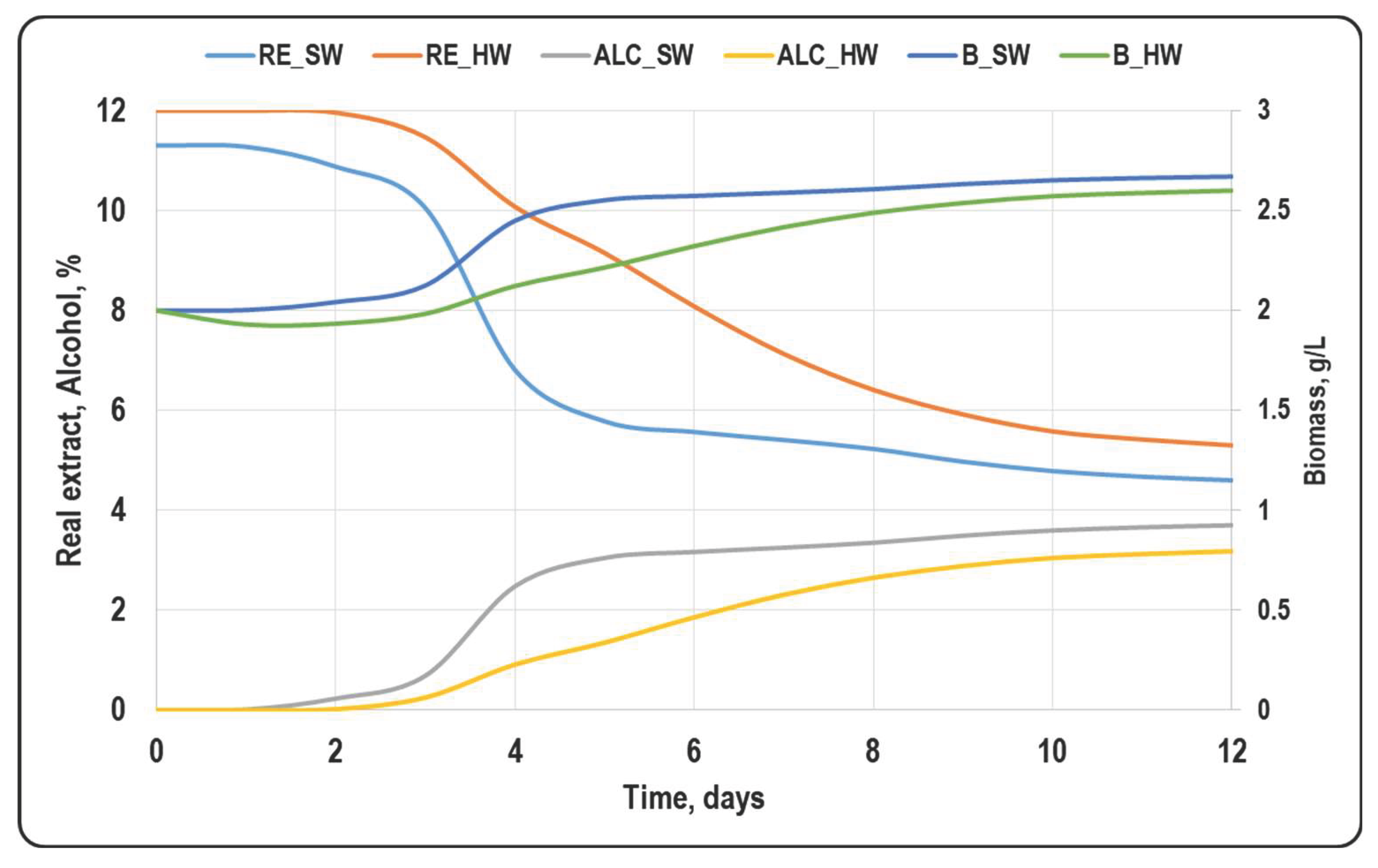
Figure 2.
Figure 2. Comparison of some of kinetic parameters in sweet and hopped wort.
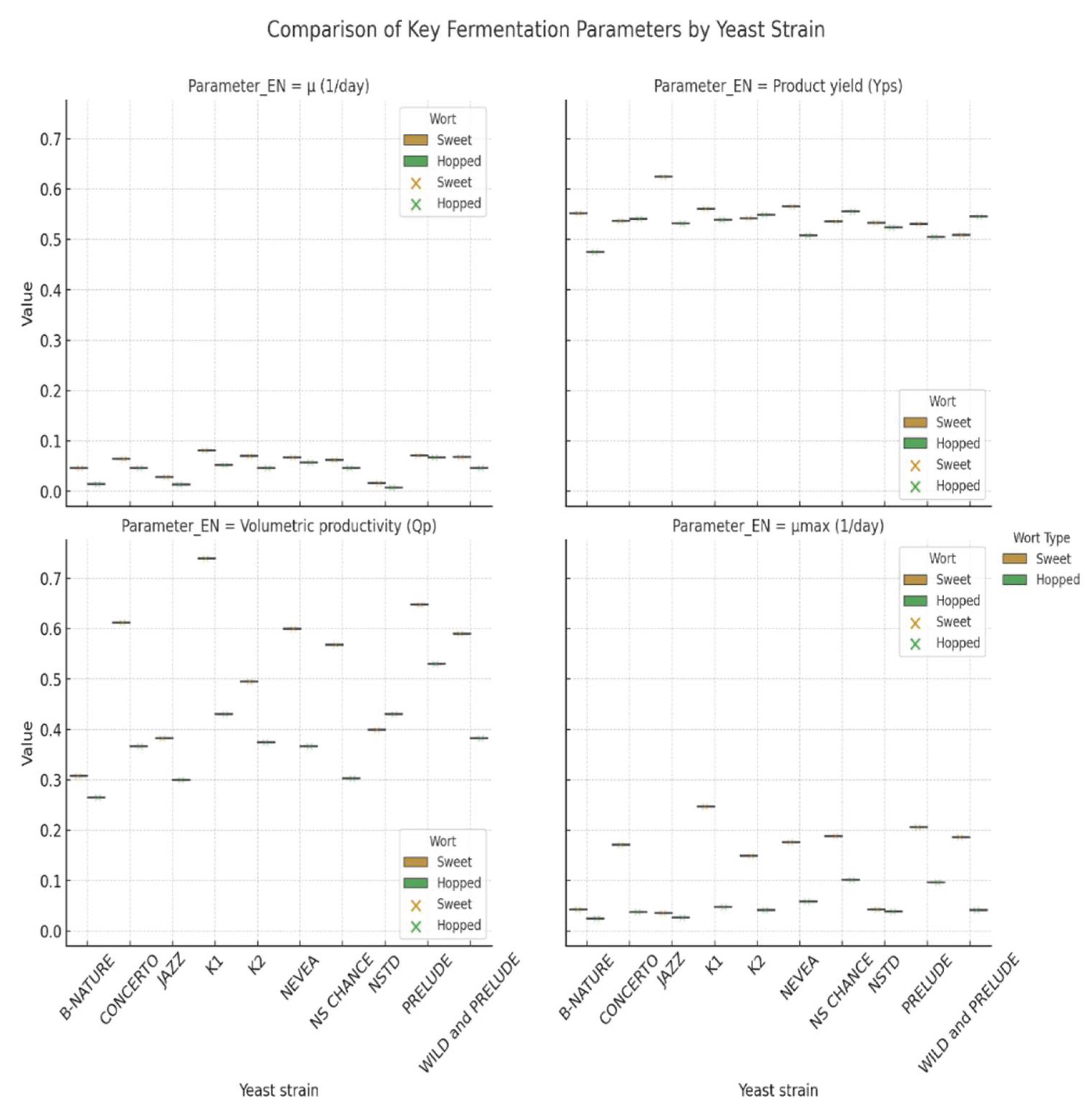
Figure 3.
Figure 3. Principal component analysis (PCA).
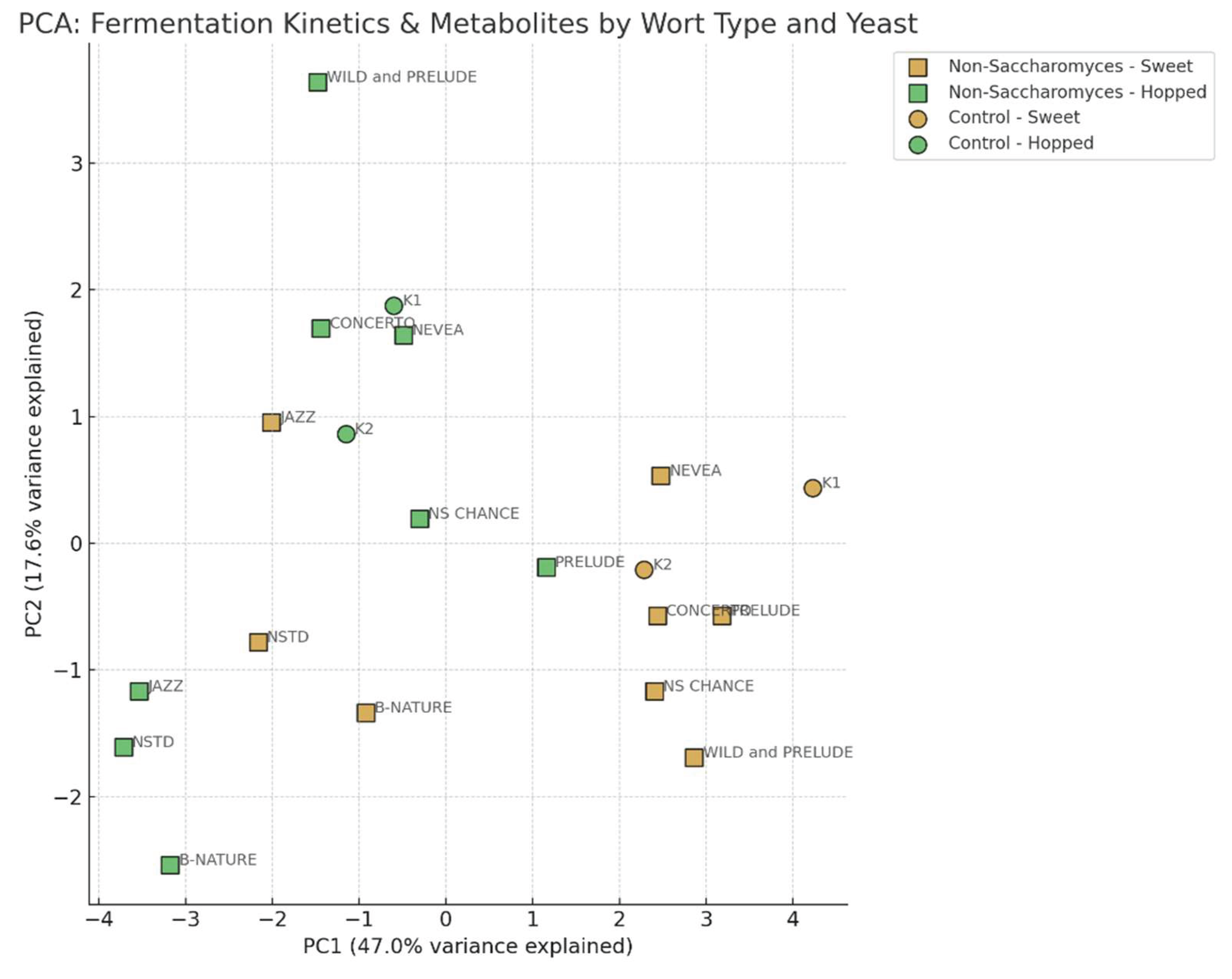

Table 1.
Yeast strains used for the experiments.
| Yeast strains | Manufacturer |
|---|---|
| Saccharomyces pastorianus Saflager W34/70 | Fermentis by Lesaffre, Lambersart, France |
| Saccharomyces cerevisiae Safale US-05 | Fermentis by Lesaffre, Lambersart, France |
| Torulaspora delbrueckii Viniferm NS-TD | Agrovin, Alcázar de San Juan, Spain |
| Torulaspora delbrueckii Viniflora PRELUDE | Novonesis, Bagsværd, Denmark |
| Metschnikowia pulcherrima EXELLENCE B-Nature BIOPROTECTION | Lamothe-Abiet, Bordeaux, France |
| Lachancea thermotolerans Viniferm Ns-CHANCE | Agrovin, Alcázar de San Juan, Spain |
| Lachancea thermotolerans JAZZ | Lamothe-Abiet, Bordeaux, France |
| Lachancea thermotolerans NEVEA | SAS Sofralab, Magenta, France |
|
Lachancea thermotolerans / formerly Klyuveromyces thermotolerans/ Viniflora CONCERTO |
Novonesis, Bagsværd, Denmark |
| Saccharomyces cerevisiae/Torulaspora delbrueckii Oenoferm Wild and Pure | ERBSLÖH Gaisenheim GmbH, Gaisenheim, Germany |
Table 2.
Sweet and hopped wort characteristics.
| Wort type | Initial extract, °P | pH |
|---|---|---|
| Sweet wort | 11.3±0.1 | 6.22±0.02 |
| Hopped wort | 12.0±0.1 | 6.06±0.01 |
Table 3.
Basic parameters of beer produced.
| Yeast strain | Wort type | Fermentation time, days |
Real extract, °P |
Alcohol, % w/w |
RDF, % |
pH |
|---|---|---|---|---|---|---|
| S. pastorianus Saflager W34/70 | Sweet wort | 5 | 4.7 | 3.70 | 59.80 | 4.75 |
| Hopped wort | 9 | 4.8 | 3.88 | 61.72 | 4.93 | |
| S. cerevisiae Safale US-05 | Sweet wort | 7 | 4.9 | 3.47 | 57.37 | 3.34 |
| Hopped wort | 12 | 3.8 | 4.42 | 68.83 | 4.46 | |
| T. delbrueckii NS-TD | Sweet wort | 8 | 5.3 | 3.12 | 54.06 | 3.50 |
| Hopped wort | 9 | 4.6 | 3.88 | 63.18 | 4.61 | |
| T. delbrueckii PRELUDE | Sweet wort | 5 | 5.2 | 3.06 | 54.93 | 4.70 |
| Hopped wort | 6 | 5.7 | 3.18 | 53.21 | 4.86 | |
| M. pulcherrima B-NATURE | Sweet wort | 12 | 4.6 | 3.70 | 60.69 | 3.70 |
| Hopped wort | 12 | 5.3 | 3.18 | 56.73 | 4.50 | |
|
L. thermotolerans Ns-CHANCE |
Sweet wort | 5 | 6.0 | 2.84 | 48.12 | 3.53 |
| Hopped wort | 16 | 3.3 | 3.30 | 73.45 | 3.63 | |
| L. thermotolerans JAZZ | Sweet wort | 8 | 6.4 | 3.06 | 43.95 | 4.04 |
| Hopped wort | 11 | 5.8 | 3.30 | 51.77 | 4.25 | |
| L. thermotolerans NEVEA | Sweet wort | 5 | 6.0 | 3.00 | 48.12 | 3.64 |
| Hopped wort | 9 | 5.5 | 3.30 | 47.02 | 3.93 | |
|
L. thermotolerans CONCERTO |
Sweet wort | 5 | 5.6 | 3.06 | 51.41 | 4.02 |
| Hopped wort | 9 | 5.9 | 3.30 | 52.59 | 4.50 | |
|
S. cerevisiae/T. delbrueckii WILD and PRELUDE |
Sweet wort | 5 | 5.5 | 2.95 | 53.17 | 3.88 |
| Hopped wort | 8 | 6.4 | 3.06 | 47.84 | 4.67 |
Table 4.
Secondary metabolites produced by yeast strains during fermentation of sweet and hopped wort.
Table 4.
Secondary metabolites produced by yeast strains during fermentation of sweet and hopped wort.
| Esters | Aldehydes | Higher alcohols | |||||
| SW | HW | SW | HW | SW | HW | ||
| S.pastorianus | Saflager W34/70 | 88.15 | 136.5 | 8.07 | 6.05 | 10.26 | 14.62 |
| S.cerevisiae | Safale US-05 | 88.15 | 72.03 | 12.11 | 8.07 | 9.7 | 9.95 |
| M.pulcherrima | B-NATURE | 72.03 | 72.03 | 32.29 | 8.07 | 3.53 | 2.39 |
| T.delbrueckii | NSTD | 184.85 | 168.73 | 10.09 | 76.69 | 11.09 | 8.19 |
| T.delbrueckii | PRELUDE | 168.73 | 72.03 | 10.09 | 10.09 | 4.91 | 4.03 |
| L. thermotolerans | CONCERTO | 104.27 | 120.38 | 26.24 | 12.11 | 11.59 | 12.98 |
| L.thermotolerans | NEVEA | 152.61 | 200.96 | 26.24 | 12.11 | 11.34 | 14.49 |
| L.thermotolerans | JAZZ | 152.62 | 72.03 | 10.09 | 16.15 | 4.92 | 1.76 |
| L.thermotolerans | NS CHANCE | 120.38 | 72.03 | 10.09 | 22.2 | 3.28 | 8.06 |
| S. cerevisiae/T. delbrueckii | WILD and PRELUDE | 72.03 | 184.84 | 26.23 | 8.07 | 8.82 | 24.32 |
SW- sweet wort; HW – hopped wort.
Table 5.
Kinetic parameters of fermentations with Saccharomyces and non-Saccharomyces yeast strains.
Table 5.
Kinetic parameters of fermentations with Saccharomyces and non-Saccharomyces yeast strains.
| μmax (day⁻¹) | Yx/s | Yp/s | Yp/x | qs | qp | Qp | |||||||||
| SW | HW | SW | HW | SW | HW | SW | HW | SW | HW | SW | HW | SW | HW | ||
| S.pastorianus | Saflager W34/70 | 0.081 | 0.053 | 0.100 | 0.090 | 0.561 | 0.539 | 5.606 | 5.969 | 0.809 | 0.583 | 0.453 | 0.314 | 0.740 | 0.431 |
| S.cerevisiae | Safale US-05 | 0.070 | 0.047 | 0.100 | 0.092 | 0.542 | 0.549 | 5.420 | 6.000 | 0.702 | 0.508 | 0.381 | 0.279 | 0.496 | 0.375 |
| M.pulcherrima | B-NATURE | 0.046 | 0.014 | 0.100 | 0.090 | 0.552 | 0.475 | 5.520 | 5.300 | 0.464 | 0.159 | 0.256 | 0.075 | 0.308 | 0.265 |
| T.delbrueckii | NSTD | 0.017 | 0.007 | 0.100 | 0.091 | 0.533 | 0.524 | 5.330 | 5.791 | 0.168 | 0.082 | 0.090 | 0.043 | 0.400 | 0.431 |
| T.delbrueckii | PRELUDE | 0.071 | 0.067 | 0.100 | 0.089 | 0.531 | 0.505 | 5.310 | 5.680 | 0.713 | 0.755 | 0.379 | 0.381 | 0.648 | 0.530 |
| L.thermotolerans | CONCERTO | 0.064 | 0.047 | 0.100 | 0.089 | 0.537 | 0.541 | 5.370 | 6.110 | 0.639 | 0.528 | 0.343 | 0.285 | 0.612 | 0.367 |
| L.thermotolerans | NEVEA | 0.067 | 0.057 | 0.100 | 0.089 | 0.566 | 0.508 | 5.660 | 5.690 | 0.668 | 0.641 | 0.378 | 0.325 | 0.600 | 0.367 |
| L.thermotolerans | JAZZ | 0.028 | 0.014 | 0.100 | 0.089 | 0.625 | 0.532 | 6.245 | 6.000 | 0.281 | 0.153 | 0.175 | 0.082 | 0.383 | 0.300 |
| L.thermotolerans | NS- CHANCE | 0.062 | 0.046 | 0.100 | 0.092 | 0.536 | 0.556 | 5.359 | 6.050 | 0.620 | 0.500 | 0.332 | 0.278 | 0.568 | 0.303 |
| S. cerevisiae/T. delbrueckii | WILD and PRELUDE | 0.069 | 0.046 | 0.100 | 0.088 | 0.509 | 0.546 | 5.086 | 6.245 | 0.685 | 0.526 | 0.349 | 0.287 | 0.590 | 0.383 |
SW- sweet wort; HW – hopped wort.
Table 6.
Comparison between kinetic parameters of non-Saccharomyces and lager yeast strains.
| μmax (day⁻¹) | Yp/s | qp | Qp | ||||||
|---|---|---|---|---|---|---|---|---|---|
| SW | HW | SW | HW | SW | HW | SW | HW | ||
| M. pulcherrima | B-NATURE | 0.574 | 0.271 | 0.985 | 0.881 | 0.565 | 0.240 | 0.416 | 0.615 |
| T. delbrueckii | NSTD | 0.208 | 0.141 | 0.950 | 0.973 | 0.198 | 0.137 | 0.541 | 1.000 |
| T. delbrueckii | PRELUDE | 0.882 | 1.274 | 0.947 | 0.937 | 0.836 | 1.212 | 0.876 | 1.229 |
| L. thermotolerans | CONCERTO | 0.790 | 0.887 | 0.958 | 1.004 | 0.757 | 0.907 | 0.827 | 0.851 |
| L.thermotolerans | NEVEA | 0.826 | 1.086 | 1.010 | 0.942 | 0.834 | 1.035 | 0.811 | 0.851 |
| L.thermotolerans | JAZZ | 0.347 | 0.258 | 1.114 | 0.988 | 0.387 | 0.259 | 0.517 | 0.696 |
| L. thermotolerans | NS CHANCE | 0.767 | 0.873 | 0.956 | 1.032 | 0.733 | 0.885 | 0.768 | 0.702 |
| S. cerevisiae/T. delbrueckii | WILD and PRELUDE | 0.848 | 0.873 | 0.907 | 1.014 | 0.769 | 0.914 | 0.797 | 0.887 |
Table 7.
Comparison between kinetic parameters of non-Saccharomyces and ale yeast strains.
| μmax (day⁻¹) | Yp/s | qp | Qp | ||||||
|---|---|---|---|---|---|---|---|---|---|
| SW | HW | SW | HW | SW | HW | SW | HW | ||
| M. pulcherrima | B-NATURE | 0.661 | 0.306 | 1.018 | 0.866 | 0.672 | 0.270 | 0.621 | 0.707 |
| T. delbrueckii | NSTD | 0.239 | 0.160 | 0.983 | 0.955 | 0.235 | 0.154 | 0.806 | 1.150 |
| T. delbrueckii | PRELUDE | 1.016 | 1.444 | 0.980 | 0.920 | 0.995 | 1.367 | 1.306 | 1.413 |
| L. thermotolerans | CONCERTO | 0.910 | 1.005 | 0.991 | 0.986 | 0.900 | 1.022 | 1.234 | 0.979 |
| L.thermotolerans | NEVEA | 0.951 | 1.231 | 1.044 | 0.925 | 0.992 | 1.167 | 1.210 | 0.978 |
| L.thermotolerans | JAZZ | 0.400 | 0.292 | 1.152 | 0.970 | 0.460 | 0.292 | 0.771 | 0.800 |
| L. thermotolerans | NS CHANCE | 0.884 | 0.989 | 0.989 | 1.014 | 0.872 | 0.997 | 1.145 | 0.807 |
| S. cerevisiae/T. delbrueckii | WILD and PRELUDE | 0.976 | 0.990 | 0.938 | 0.996 | 0.915 | 1.030 | 1.190 | 1.020 |
Table 8.
Overall correlation coefficients between kinetic parameters and secondary metabolites concentration.
Table 8.
Overall correlation coefficients between kinetic parameters and secondary metabolites concentration.
| Metabolites | μ | Qp | Yps |
| Esters | 0.55 | 0.62 | 0.48 |
| Aldehydes | -0.15 | -0.33 | -0.21 |
| Higher Alcohols | 0.44 | 0.38 | 0.35 |
Disclaimer/Publisher’s Note: The statements, opinions and data contained in all publications are solely those of the individual author(s) and contributor(s) and not of MDPI and/or the editor(s). MDPI and/or the editor(s) disclaim responsibility for any injury to people or property resulting from any ideas, methods, instructions or products referred to in the content. |
© 2025 by the authors. Licensee MDPI, Basel, Switzerland. This article is an open access article distributed under the terms and conditions of the Creative Commons Attribution (CC BY) license (http://creativecommons.org/licenses/by/4.0/).
Copyright: This open access article is published under a Creative Commons CC BY 4.0 license, which permit the free download, distribution, and reuse, provided that the author and preprint are cited in any reuse.


