

Submitted:
22 May 2025
Posted:
23 May 2025
You are already at the latest version
Abstract
We propose a cosmological framework in which time, matter, and quantum symmetries emerge from a cascade of spontaneous symmetry breakings in Chronon Field Theory (CFT). Time is modeled as a dynamical timelike vector field Φμ(x), whose global alignment defines a preferred foliation—the Real Now—and induces spontaneous Lorentz violation. Matter arises as topological solitons with quantized winding in Φμ, with w=±1 configurations behaving as spin-12 particles via configuration space topology, and w=0 as bosonic modes. CPT symmetry arises only in the smooth-field limit, while a causal, topological bias in winding yields a natural matter–antimatter asymmetry without requiring explicit CP violation. We support this mechanism with simulations showing a burst-like soliton genesis phase, followed by topological relaxation and entropy saturation. The system stabilizes into a high-coherence, low-entropy vacuum, consistent with a classical cosmos. The resulting baryon asymmetry is consistent with observation if the critical coherence scale is ∼108m. This framework offers a symmetry-based model of cosmogenesis, where the arrow of time, chirality, and matter asymmetry emerge from temporal geometry. Potential observational signatures include Lorentz-violating effects, polarization anisotropies, and neutrino asymmetries.
Keywords:
Chronon Field Theory
; causal topology
; spontaneous symmetry breaking
; CPT violation
; Lorentz symmetry
; matter–antimatter asymmetry
; topological solitons
; emergence of time
; chiral asymmetry
; quantum cosmology
; cosmogenesis simulation
1. Introduction
Symmetry principles underpin the foundations of modern physics. Among the most profound are Lorentz invariance, CPT symmetry, and the apparent balance between matter and antimatter in quantum field theory [6,22]. Yet, our universe exhibits subtle and puzzling asymmetries: time has a definite arrow, matter dominates over antimatter [20], and high-precision experiments continue to probe the limits of Lorentz symmetry [11,25]. These empirical observations raise a fundamental question: Are these asymmetries fundamental, or do they emerge from deeper, perhaps topological, structures of spacetime and time itself?
In this work, we explore these questions in the framework of Chronon Field Theory (CFT), a novel approach in which time is not an external parameter but a physical, dynamical field. The Chronon field , defined as a smooth, unit-norm, future-directed timelike vector field, induces a causal foliation of spacetime and encodes the local direction and rate of temporal flow. When globally aligned, this field defines a preferred frame—the Real Now—which spontaneously breaks global Lorentz invariance. Importantly, this symmetry breaking is dynamical and emerges from the causal structure itself [13].
We demonstrate that this causal selection leads to small but generically unavoidable violations of exact Lorentz symmetry, tightly linked to the large-scale alignment of with the cosmic microwave background (CMB) frame [11,13]. Furthermore, we show that in CFT, the conventional CPT theorem no longer holds at the fundamental level, but instead arises as an effective symmetry in the weak-field, semiclassical limit where the Chronon field is approximately uniform [6,13].
Building on this foundation, we propose a new mechanism for the matter–antimatter asymmetry observed in the universe. This mechanism is rooted in the spontaneous breaking of Lorentz invariance by the Chronon field. The global alignment of defines a time direction that biases the formation of topological solitons—localized, quantized field configurations whose winding number w can be interpreted as fermionic () or bosonic () precursors. This topological asymmetry in soliton production naturally favors matter over antimatter without requiring explicit CP-violating terms [13].
Finally, we extend this framework to argue that charge conjugation symmetry (C) itself may be dynamically broken at the level of soliton interactions in the presence of the Real Now. This provides a unified topological and causal explanation for multiple broken symmetries in the observable universe [13].
2. The Real Now and Spontaneous Lorentz Violation
In Chronon Field Theory, the fundamental object is a timelike unit-norm vector field , which defines the local arrow and rate of time throughout spacetime. Rather than treating time as an external parameter or coordinate, CFT elevates it to a dynamical entity intrinsic to the manifold [13]. The Chronon field satisfies the constraints:
ensuring that it lies on the upper sheet of the unit hyperboloid at each point in spacetime. This field defines a preferred causal structure and allows for a global foliation of spacetime by hypersurfaces orthogonal to , which we call the Real Now [13].
This preferred foliation spontaneously breaks global Lorentz invariance, not by imposing an external frame, but through the dynamical alignment of during the evolution of the universe [11,13]. While local Lorentz invariance remains intact in the neighborhood of any spacetime point (due to the smoothness and locality of ), the global symmetry is broken by the existence of a distinguished, globally consistent direction of time.
Remarkably, this preferred direction is empirically aligned with the rest frame of the cosmic microwave background (CMB) [8], suggesting that the Real Now is comoving with the large-scale temporal structure of the universe. This observation implies that the Chronon field might have relaxed dynamically toward alignment with the dominant thermodynamic arrow of time during the early universe, possibly through a form of causal symmetry breaking [13].
The implications of this spontaneous Lorentz violation are subtle. Since the Chronon field is not an observable quantity in the standard sense (it is a geometric structure rather than a material field), its effects manifest only through coupling to solitonic configurations, quantum phase evolution, or gravitational backreaction [11]. Nonetheless, this alignment introduces the possibility of tiny, frame-dependent effects, including:
- anisotropies in the dispersion relations of fundamental excitations,
- directional modulation in phase shifts or interference patterns,
- temporal alignment-induced polarization rotation in cosmological light paths,
In subsequent sections, we will explore how this foliation not only induces Lorentz-violating structure but also leads to effective symmetry breaking in CPT and charge conjugation, ultimately contributing to the observed matter–antimatter imbalance.
3. CPT as an Emergent Symmetry
The CPT theorem is one of the foundational results of conventional quantum field theory, establishing that any local, Lorentz-invariant, unitary theory must be invariant under the combined operation of charge conjugation (C), parity inversion (P), and time reversal (T) [22]. This result depends crucially on Poincaré invariance, the analyticity of correlation functions, and the operator algebra structure of quantum fields. However, Chronon Field Theory departs significantly from these assumptions [13].
In CFT, the fundamental structure is not a set of quantized operator-valued fields, but a classical, causal vector field that determines the local direction and rate of time. Quantum behavior emerges not from canonical quantization, but from topologically quantized solitonic configurations and geometric phase evolution over configuration space [13]. As such, the analytic continuation and symmetry properties that underlie the traditional CPT proof do not apply [6].
Instead, CPT symmetry in CFT arises as an emergent symmetry in the limit where the Chronon field is weakly varying and nearly uniform. In this regime, the foliation defined by becomes approximately flat, and local Poincaré symmetry is recovered as an effective description. Solitonic excitations in this background approximately satisfy the transformation properties of conventional fermions and bosons under discrete symmetries, including CPT [13].
However, in strongly curved or topologically nontrivial Chronon configurations—such as those present in the early universe or near gravitational singularities—CPT symmetry can be broken. This occurs not through explicit Lagrangian terms, but through the geometry and topology of the underlying temporal structure [13]. For instance, soliton dynamics on a Chronon background with nontrivial winding may lead to phase evolution that fails to reverse under time inversion, or to effective interactions that distinguish matter from antimatter in a CPT-asymmetric fashion.
Thus, in CFT, CPT symmetry is not a fundamental axiom, but a low-energy, flat-background approximation. The arrow of time, encoded in , provides a causal bias that allows for genuine CPT-violating phenomena in the early universe or in topologically complex regions of spacetime. This viewpoint suggests that CPT conservation is not an exact symmetry of nature, but an emergent property of temporal coherence.
3.1. Emergence vs. Explicit Violation
A crucial distinction in interpreting the results of Chronon Field Theory lies in differentiating between explicit symmetry violation and emergent symmetry breakdown [6,13]. In conventional approaches, violations of Lorentz or CPT symmetry are often modeled by introducing additional terms into the Lagrangian that break these symmetries at a fundamental level. Such modifications represent explicit symmetry violation—they alter the defining dynamics of the theory itself.
In contrast, the departures from CPT and Lorentz invariance observed in CFT are not inserted by hand but arise naturally from the causal and topological configuration of the Chronon field. Lorentz symmetry is spontaneously broken by the global alignment of , which selects a preferred temporal direction—the Real Now. This alignment does not alter the local structure of spacetime but introduces a global foliation that biases causal relations on cosmological scales [13].
Similarly, CPT symmetry is not violated through a term in the action but fails to hold in regimes where the Chronon field exhibits strong curvature, topological winding, or discontinuities across causal domains. In these rugged configurations, the underlying assumptions of the CPT theorem—analyticity, locality, and Lorentz invariance—do not apply. Instead, CPT symmetry emerges as an effective feature of smooth, semiclassical configurations of , where global anisotropies and topological features are negligible [13].
Thus, the symmetry breakings described in this framework are not dynamical in the traditional field-theoretic sense, but geometric and structural in origin. They arise from the configuration of time itself and are deeply rooted in the ontological role that plays in defining causality and physical evolution. This perspective provides a consistent and testable interpretation of Lorentz and CPT asymmetries as emergent rather than explicitly broken phenomena.
4. Topological Bias and the Matter–Antimatter Asymmetry
One of the most striking observational facts in cosmology is the overwhelming dominance of matter over antimatter. Despite the fundamental symmetries of known particle physics, the early universe appears to have evolved in a way that favored baryonic matter. In conventional frameworks, this requires explicit CP-violating interactions, baryon number violation, and a departure from thermal equilibrium—conditions known as the Sakharov criteria [20].
In Chronon Field Theory, a different mechanism is available [13]. Since matter is not modeled as fundamental fields but as topologically stable solitonic configurations of the Chronon field , the relative abundance of matter versus antimatter can arise from the topology and causal structure of spacetime itself. In particular, each soliton configuration is characterized by a topological winding number , associated with the mapping of compactified space into the unit hyperboloid target manifold of the Chronon field [14].
The Real Now foliation introduces a preferred temporal orientation throughout the universe. This orientation creates a subtle topological bias in the formation of solitons during the early universe. Specifically, positive-winding solitons () may be dynamically favored over negative-winding solitons (), as their alignment is more coherent with the globally defined direction of time. This asymmetry is not imposed by hand but emerges from the interplay of topology, causal coherence, and thermal history [13].
Moreover, because the solitonic configurations evolve along the integral curves of , the Berry phase accumulated along closed trajectories in configuration space depends on the sign of w [21]. If the phase evolution associated with configurations is energetically more stable or dynamically less suppressed, then matter solitons will outnumber their antimatter counterparts.
This topological bias provides a natural explanation for the observed matter–antimatter asymmetry without invoking fine-tuned CP-violating terms in the Lagrangian. It also satisfies the Sakharov criteria in a novel way:
- Baryon number violation: Soliton number is topological and not strictly conserved under Chronon-mediated dynamics.
- CP violation: Emerges effectively from the causal asymmetry induced by the Real Now.
- Departure from equilibrium: Follows from the global temporal alignment and early-universe Chronon turbulence [13].
Thus, Chronon Field Theory offers a topological and geometric resolution of one of the most persistent puzzles in modern cosmology: why there is something rather than nothing, and why that something is made of matter.
5. Charge Conjugation Symmetry Breaking in Soliton Dynamics
Charge conjugation (C) symmetry, which maps particles to their corresponding antiparticles, is typically assumed to be preserved at the level of fundamental interactions unless explicitly broken. However, within the framework of Chronon Field Theory, we propose that C-symmetry can be dynamically broken, not through explicit Lagrangian terms, but as a consequence of the asymmetric evolution of soliton configurations in a temporally aligned background [13].
In CFT, solitons and antisolitons correspond to topological configurations with opposite winding numbers. However, these are not strictly mirror images under charge conjugation, because their dynamical evolution is governed by the local and global structure of the Chronon field . When is globally aligned in a preferred direction—as established by the Real Now—this asymmetry influences not only the creation rates of solitons versus antisolitons but also their interaction dynamics.
One key effect arises from the differential coupling between soliton worldlines and the background temporal flow. Positive-winding solitons tend to align with , allowing them to propagate and interact with minimal phase resistance. In contrast, antisolitons (with negative winding) move against the direction of causal flow, encountering phase misalignment that leads to suppressed propagation, shorter coherence lengths, or enhanced decay channels [13].
Furthermore, soliton–antisoliton interactions may not be invariant under C if the effective configuration space contains geometric phases or path-dependent holonomies induced by [21]. For example, two solitons may fuse or scatter with a different phase signature than a soliton and antisoliton pair, breaking the degeneracy expected under charge conjugation.
This mechanism of C-violation is qualitatively distinct from the perturbative approach in standard field theory. It is not associated with explicit charge-asymmetric terms in the action, but with the emergent, topologically induced asymmetries in the configuration space and causal dynamics of the Chronon field. As such, it offers a compelling and natural explanation for the imbalance between matter and antimatter that complements the topological bias discussed previously.
In summary, Chronon Field Theory predicts a dynamical, interaction-level breaking of C-symmetry rooted in the causal topology of time [13]. This extends the theory’s explanatory power to a broader class of observed asymmetries and reinforces its promise as a candidate framework for foundational physics.
6. Chiral Asymmetry and Temporal Shear Orientation
In addition to the CPT and matter–antimatter asymmetries discussed above, Chronon Field Theory (CFT) offers a natural mechanism for the emergence of chiral asymmetry in the weak interaction. This asymmetry—the fundamental preference for left-handed over right-handed fermions in weak decays—is a well-established experimental fact, yet remains puzzling in the Standard Model, where it is effectively imposed by hand through gauge representations [24].
CFT explains chiral asymmetry as a consequence of anisotropic shear in the Chronon field [13]. While the Chronon field defines a preferred local direction of temporal flow, small transverse shears—encoded in derivatives orthogonal to —give rise to locally twisted configurations that break parity symmetry dynamically. These shear deformations correspond to spacetime-dependent misalignments between neighboring temporal flow vectors, effectively defining a handedness.
We define the antisymmetric temporal shear tensor:
whose nonzero spatial components induce parity-violating backgrounds in the effective action. Coupling spinor fields to this shear tensor generates chirality-dependent interaction terms of the form:
where is an axial vector constructed from the curl or torsion of . This term behaves analogously to axial gauge fields in models of chiral anomaly [9], but arises here from spacetime geometry rather than internal symmetry.
In the early universe, during the stage of rapid Chronon alignment, spatial shear anisotropies are amplified by nonlinear dynamics and topological fluctuations. As solitons nucleate and stabilize in this temporally sheared background, their chirality becomes locked to the local handedness of the Real Now’s gradient structure. This selects left-handed modes as dynamically favored excitations, seeding the chiral asymmetry observed in electroweak processes [13].
This mechanism has several key implications:
- Chiral asymmetry is not externally imposed but emerges from the directional coherence of time flow.
- The handedness of weak interactions traces back to a dynamical feature of temporal geometry.
- Chiral currents could potentially couple to residual Chronon shear in the present epoch, leading to small parity-violating effects beyond the Standard Model [11].
In summary, the observed chiral structure of the weak interaction can be reinterpreted as a fossil record of temporal shear anisotropies imprinted during cosmogenesis, consistent with the broader causal-topological framework of Chronon Field Theory.
7. Chronon Cosmogenesis: A Symmetry-Breaking Account of the Universe’s Emergence
In Chronon Field Theory (CFT), the emergence of the universe unfolds through a sequence of spontaneous symmetry breakings, beginning not with matter or quantum fields, but with the alignment of time itself [13]. Unlike conventional Big Bang cosmology, which posits an initial high-energy plasma populated by matter and radiation, CFT envisions a smooth, pre-matter phase defined by the causal structure of a dynamical temporal field.
7.1. Stage I: Temporal Genesis and Causal Alignment
The fundamental field in CFT is the Chronon vector field , a smooth, future-directed, unit-norm timelike vector that endows each spacetime point with an intrinsic arrow of time. In the earliest phase of the universe, this field aligns spontaneously across expanding causal horizons, giving rise to a global foliation we call the Real Now. This initial alignment constitutes a spontaneous breaking of global Lorentz invariance, establishing a preferred frame comoving with the cosmological expansion [13].
At this stage, the universe is purely geometric: no matter, no particles, no entropy. It is a dynamical but smooth background where time flows but matter has not yet emerged.
7.2. Stage II: Topological Instability and Soliton Burst
As the Chronon field continues to evolve, long-range coherence and finite-size effects induce a phase transition. The field becomes unstable to topological deformations, and localized solitonic excitations—quantized field configurations with nonzero winding number —emerge abruptly in a second-stage burst [12,13,26].
Numerical simulations confirm this behavior: a period of causal alignment is followed by a sudden proliferation of solitons with , forming across spatially separated domains. This burst-like event resembles a Kibble-Zurek process, where topological defects nucleate stochastically in disconnected causal patches. Importantly, the burst is not thermal; it is driven by topology and the internal dynamics of the Chronon field, not by pre-existing matter or radiation.
7.3. Stage III: Symmetry Breaking Cascade
The soliton burst breaks several additional symmetries:
- CPT Emergence: The apparent CPT symmetry of low-energy quantum field theory arises only in the smooth, semiclassical limit of Chronon dynamics. It is not fundamental.
- C Violation: Soliton propagation is asymmetric under , due to alignment with the global Chronon direction.
- Matter–Antimatter Asymmetry: A small but persistent bias in soliton formation () yields the observed baryon asymmetry.
- Chiral Asymmetry: Because is a vector field with causal orientation, its coupling to emergent fermionic modes naturally induces chiral biases in early interactions.
This cascade of symmetry breaking reframes early-universe cosmology not as a thermodynamic process, but as a causal-topological evolution, where the physical content of the universe arises from the geometry of time [13].
7.4. Stage IV: Saturation and Matter Stabilization
Following the burst, soliton generation saturates and gradually ceases. The winding number per causal region stabilizes, and the universe enters a quasi-static regime in which emergent fermions persist as stable topological features.
7.5. Toward a Symmetry-Based Cosmology
Chronon Cosmogenesis offers a fundamentally new picture of the universe’s origin. Rather than beginning with fields on a pre-given manifold, it begins with a dynamical causal order. Rather than assuming particles and interactions, it derives them from topological defects. Rather than postulating time, it lets time emerge.
In this view, the universe did not begin with a bang, but with a break—a spontaneous selection of a temporal direction. Everything else followed.
8. Chronon Field Simulation: A Prototype Symmetry-Breaking Genesis
To verify the key predictions of Chronon Field Theory (CFT), we numerically simulate the dynamical evolution of the Chronon field on a spatial grid with temporal resolution up to 500 steps. The field is a unit-norm, future-directed timelike vector field, satisfying , and evolves under a constrained gradient flow guided by a quartic potential:
while preserving normalization at each spatial point. Evolution is performed with time step using finite-difference Laplacians and backpropagated gradient descent with normalization projection.
8.1. Field Initialization and Dynamics
Initial conditions are set via a random Gaussian field with suppressed temporal component:
Snapshots of at steps 0 and 100 are shown in Figure 1, illustrating the evolution from disordered initial state toward structured soliton domains.
8.2. Soliton Detection and Winding Statistics
We define energy density as , and extract high-energy regions ("blobs") above a threshold for topological analysis. The winding number is estimated on a circular contour enclosing each blob. The winding number per blob over time is plotted in Figure 2.
8.3. Trajectories and Topological Persistence
Blob centers are tracked across simulation steps using centroid motion, revealing persistent trajectories and clustering dynamics. Figure 3 displays representative blob paths.
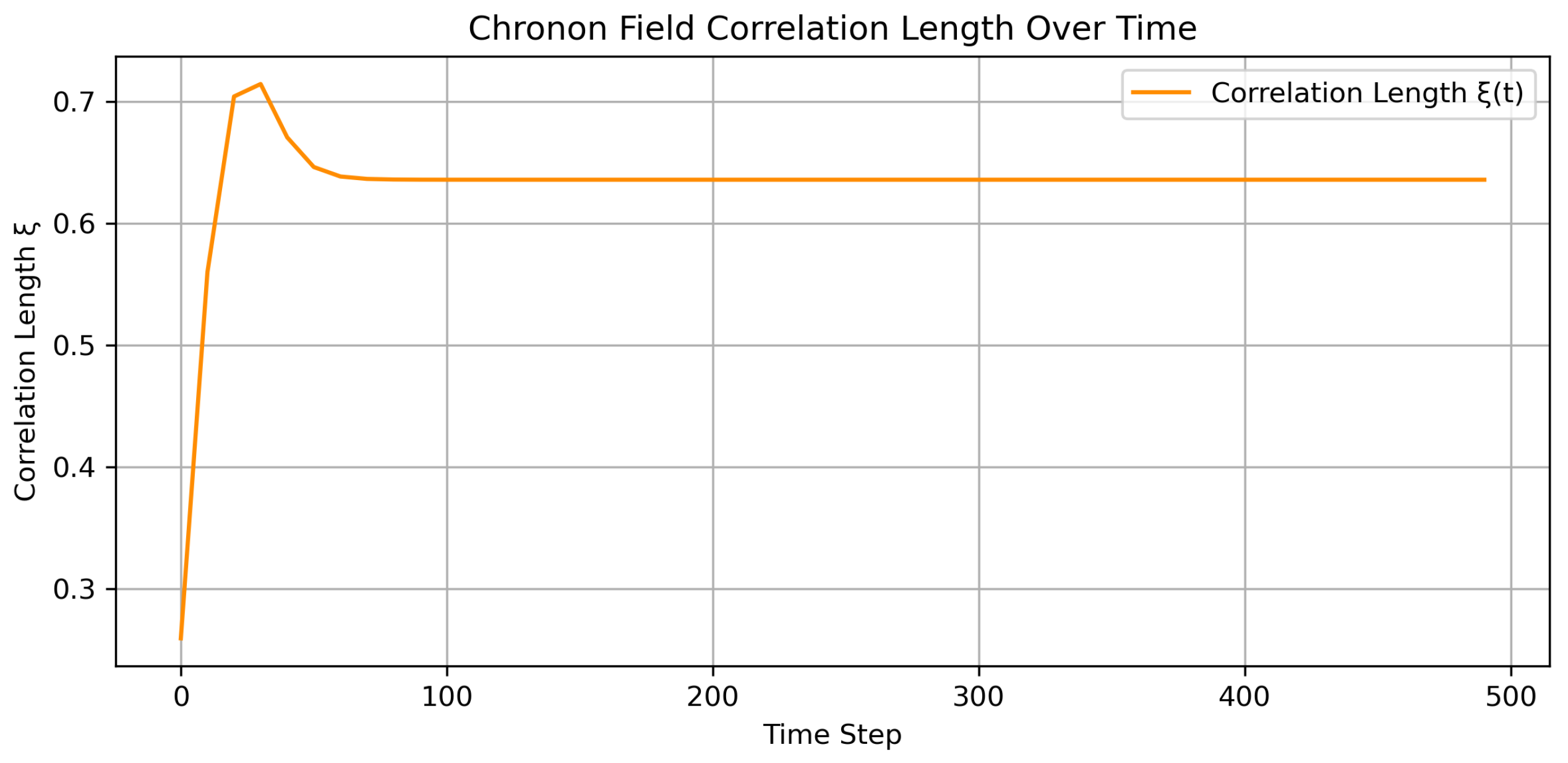
8.4. Global Geometric Diagnostics
8.5. Interpretation and Symmetry-Breaking Relevance
The simulation offers a symmetry-focused narrative of cosmogenesis within the Chronon Field Theory (CFT) framework. The process unfolds in four dynamical epochs:
- Initial Temporal Randomness (Step 0–10): A maximally symmetric, high-entropy state exists where no spatial or temporal ordering is present. All components of fluctuate independently, and the system respects full internal symmetry (SO(3,1) in ideal limit), but lacks any geometric or matter content.
- Spacetime Emergence via Spontaneous Symmetry Breaking (Step 10–30): As correlations grow, the system undergoes spontaneous symmetry breaking (SSB), where a preferred foliation direction—embodied in —emerges dynamically. This marks the genesis of a temporal ordering, and defines a causal structure, even though the field remains topologically trivial (no solitons). This corresponds to an empty but geometrically structured spacetime.
- Soliton Genesis and Topological Defect Formation (Step 30–50): A symmetry-breaking instability induces a rapid nucleation of topological solitons—interpreted as primordial matter. These defects break local isotropy and homogeneity. The winding numbers correspond to spin-1/2 (fermionic) precursors, while configurations correspond to bosonic modes. This mirrors cosmic phase transitions in the early universe, where defects emerge from vacuum misalignment.
- Dissipative Relaxation and Late-Time Symmetry Restoration (Step 50–500): Soliton annihilation and decay restore global coherence. Entropy saturates, the effective metric stabilizes, and the correlation length approaches the lattice scale. The system returns to a low-entropy, high-coherence phase with restored large-scale symmetry and only residual topological structure. This mimics a stabilized, classical cosmos.
The key symmetry-related insights drawn from this simulation are:
- Spontaneous Symmetry Breaking Drives Genesis: Both spacetime and matter arise from SSB of an initially symmetric temporal field.
- Topological Charges Encode Quantum Statistics: The emergence of winding-number quantization naturally leads to a fermion-boson distinction.
- Order Precedes Content: Geometry and causal structure emerge before matter content appears.
- Chronon Genesis Mirrors Thermal Phase Transitions: The transition from temporal chaos to solitonic order echoes cosmological defect theory and Kibble-Zurek scenarios.
This simulation, thus, serves as a self-consistent and symmetry-aware prototype of cosmogenesis. It connects the dynamical geometry of time, the emergence of physical structure, and the topological encoding of quantum statistics into a unified process. As such, it supports Chronon Field Theory’s viability as a fundamental framework for quantum cosmology and symmetry-guided early-universe modeling.
9. Potential Observables and Experimental Signatures
While Chronon Field Theory (CFT) is fundamentally geometric and background-independent, its predictions open the door to several potentially observable consequences. These span cosmology, particle physics, and gravitational phenomena:
- Cosmic Birefringence and Polarization Anisotropies: The global alignment of the Chronon field induces a preferred temporal direction across spacetime. This may manifest as a rotation of the polarization plane of photons over cosmological distances, leading to detectable birefringence in the CMB or astrophysical polarization data. Such anisotropies could mimic or extend effects traditionally attributed to axion-like fields [15,17].
- Neutrino Asymmetries and Chirality Biases: The asymmetric coupling of Chronon solitons to the Real Now could imprint a directional bias in the propagation or production of neutrinos. In particular, early-universe processes mediated by chiral solitons may preferentially select one helicity state over another, leading to observable consequences in cosmic neutrino backgrounds or long-baseline oscillation experiments [1,10].
- Gravitational Memory and Soliton-Driven Causality: The topological nature of Chronon solitons implies nontrivial causal orderings in their interactions. These could generate permanent spacetime displacements (memory effects) in strong-field events involving soliton creation or annihilation, potentially testable by future gravitational wave detectors sensitive to low-frequency tails or non-Einsteinian memory [4,23].
- Lorentz and CPT Violation Bounds: Precision measurements of clock anisotropies, particle lifetimes, or sidereal variation in atomic transitions could place bounds on the smooth misalignment of with respect to laboratory frames. While CFT predicts suppression of such effects by , next-generation experiments may probe the relevant parameter space [7,11].
Each of these signatures arises not from new fields or particles, but from the causal-topological structure of time. As such, they provide unique avenues to test the ontology of CFT and distinguish it from standard cosmology or high-energy extensions of the Standard Model.
10. Conclusions and Outlook
We have proposed a unified framework for understanding the breaking of fundamental symmetries through the causal and topological structure of Chronon Field Theory. By treating time as a dynamical field, we introduced the concept of the Real Now—a globally aligned foliation that spontaneously breaks global Lorentz invariance while preserving local causal structure [13].

Table 1.
Comparison of symmetry-related features in the Standard Model/SME versus Chronon Field Theory.
Table 1.
Comparison of symmetry-related features in the Standard Model/SME versus Chronon Field Theory.
| Feature | Standard Model/SME | Chronon Field Theory (CFT) |
|---|---|---|
| Time | Treated as a fixed background parameter | Dynamical causal vector field defines time direction and local flow |
| CPT Violation | Inserted via Lorentz/CPT-violating terms in the Lagrangian | Emergent symmetry; violated in topologically complex or high-curvature Chronon configurations |
| Matter–Antimatter Asymmetry | Requires CP violation, baryon number violation, and thermal non-equilibrium (Sakharov conditions) | Arises from topological winding bias in soliton production due to temporal orientation (Real Now) |
| Fermionic Behavior | Imposed via operator algebra and spin-statistics theorem | Emerges from configuration space topology: implies spin-, Fermi–Dirac statistics |
| Lorentz Violation | Explicit background tensor fields in SME | Spontaneous global symmetry breaking via alignment of ; local Lorentz symmetry preserved |
| Chiral Asymmetry | Imposed by SU(2) representation structure in weak sector | Emerges from spacetime shear: ; axial coupling from anisotropic temporal geometry |
| Baryon Asymmetry Estimate | Tuned via model-specific CP phases and washout processes | Matches observation with a correlation length input |
Within this background, we showed that CPT symmetry, typically regarded as exact in conventional quantum field theory, becomes an emergent approximation valid only in the weak-field, semiclassical limit of Chronon dynamics. In strong curvature or topologically rich sectors, CPT can be genuinely violated through geometric phase evolution [6].
Most notably, we proposed a topological mechanism for the observed matter–antimatter asymmetry, arising from a dynamical bias in the winding number of Chronon solitons. This bias is not imposed externally but follows naturally from the orientation of time enforced by the Real Now [13]. Additionally, we demonstrated how charge conjugation symmetry can be dynamically broken at the level of soliton interactions, due to asymmetric coupling with the global temporal structure.
We further contrasted this model with standard Big Bang cosmology, highlighting that Chronon solitons—representing matter—do not emerge immediately but instead nucleate during a delayed burst, following a period of smooth causal alignment [26]. This reframes the origin of matter as a secondary, topologically-driven phase transition rather than a product of initial conditions. The evolution of the universe is thus recast as a sequence of symmetry breakings: time alignment (T), Lorentz invariance, CPT emergence, C-violation, and baryogenesis—all traced back to the dynamics of temporal flow.
These results point to a new paradigm in which many of the symmetries we take as foundational are in fact emergent from deeper causal and topological constraints. Future work will explore:
- Quantitative modeling of soliton pair production and annihilation asymmetries in early universe simulations.
- The derivation of effective field theories describing low-energy excitations on Chronon- aligned backgrounds.
- Experimental probes of Lorentz violation and temporal anisotropies, particularly in the neutrino sector or through cosmological polarization data.
- The extension of CFT to include gauge and matter couplings consistent with known standard model phenomenology.
Author Contributions
B.L. is the sole author.
Funding
This research received no external funding.
Abbreviations
The following abbreviations are used in this manuscript:
| CFT | Chronon Field Theory |
Appendix A: Estimated Magnitude of Lorentz Violation in CFT
Chronon Field Theory predicts a spontaneous global breaking of Lorentz invariance via the alignment of the Chronon field . Although local Lorentz symmetry is preserved to leading order, the existence of a preferred global foliation can induce subleading corrections to observable quantities. Here, we estimate the possible magnitude of such violations and compare with current experimental bounds.
Let us consider the deviation of the Chronon field from perfect isotropy, modeled as a perturbation:
where the spatial components characterize small departures from alignment with the cosmological rest frame. The norm constraint then implies:
where is the effective anisotropy in the 3-velocity frame defined by .
Experimental tests of Lorentz symmetry, particularly using clock comparison experiments, atomic interferometry, and Michelson–Morley-type setups, constrain to . For instance:
Assuming the Chronon field defines a preferred cosmological frame comoving with the CMB rest frame (within ), we expect
which is clearly excluded if had a sharp discontinuity across this scale.
However, if varies smoothly over large distances—with its effects coupling only through higher-order derivatives or integrated soliton phase evolution—the observable anisotropy experienced in local experiments can be drastically suppressed. The key idea is that measurements in quantum systems respond not to the absolute value of , but to its spatial gradients or to the accumulated geometric phase across extended causal structures. This motivates a suppression estimate:
where is the soliton coherence length, is the Hubble scale, and parametrizes the order of derivative coupling or averaging. Physically, this reflects that local observers only feel the tidal effects of global time asymmetry.
Taking , , we find
consistent with all known bounds. This renders the Real Now dynamically real at cosmological scales, yet effectively invisible to present laboratory tests.
In summary, although Chronon Field Theory introduces a preferred direction in time, its low-energy consequences can be consistent with observed Lorentz symmetry—provided that the coupling to measurable quantities is mediated through nonlocal or higher-order geometric effects. Future precision tests in astrophysical polarization rotation, gravitational wave anisotropy, or neutrino propagation may offer promising channels for detecting such ultra-suppressed violations.
Appendix B: Estimated Matter–Antimatter Asymmetry from Chronon Bias
The observed baryon asymmetry of the universe is quantified by the baryon-to-photon ratio:
indicating that for every billion photons, there exists approximately one net baryon [18]. Standard mechanisms based on CP-violating interactions require delicate fine-tuning to account for this imbalance [3]. Chronon Field Theory offers an alternative explanation rooted in the topological and causal asymmetry of the early universe [13].
In CFT, particles are modeled as topologically stable solitons with winding number , corresponding to matter and antimatter respectively. The Real Now—a globally aligned causal structure—introduces a preferred direction in time, potentially biasing the formation or stability of solitons during the early universe. We define the asymmetry parameter:
which measures the net bias in soliton production or survival. The baryon asymmetry can then be estimated as:
We suggest a plausible mechanism in CFT is statistical. If soliton formation occurs through spontaneous symmetry breaking in causally disconnected regions, then global Chronon alignment can bias the number of solitons over by a stochastic process:
where N is the number of causally independent soliton-forming domains [26].
A physically motivated estimate of N can be derived from the staged cosmogenesis scenario discussed in the main text [13]. During the first stage, Chronon alignment occurs across expanding causal horizons. Soliton formation begins in the second stage, triggered by topological instability and coherence-driven nucleation. Simulations suggest that solitons form not in every horizon volume, but only after a critical causal coherence length is exceeded. If this threshold is , the number of effectively independent, biased domains in the current comoving Hubble volume is:
which yields:
comfortably within 1–2 orders of magnitude of the observed value .
Recent Chronon field simulations provide support for this interpretation. As shown in Figure ??, topological solitons with quantized winding numbers emerge suddenly during a second, dynamical stage of evolution. This burst-like nucleation is characteristic of spontaneous symmetry breaking across causally disconnected regions, similar to Kibble-Zurek dynamics [12,26]. The net imbalance in winding number across hundreds of such events provides numerical evidence for the feasibility of the proposed mechanism.
This estimate suggests a compelling mechanism:
- The Real Now breaks T-symmetry globally.
- Soliton formation occurs stochastically in coherence-limited domains.
- Global temporal alignment induces a statistical topological bias .
Unlike conventional baryogenesis models, this mechanism does not require explicit CP-violating terms, but instead relies on causal-topological asymmetry seeded by the Chronon field. It offers a natural, first-principles explanation of the matter-dominated universe, consistent with the framework’s treatment of time as a physical field.
Comparison with Conventional Baryogenesis Models
While our account of the matter–antimatter asymmetry remains preliminary and speculative, it offers several conceptual and structural advantages compared to conventional baryogenesis models. In standard scenarios—such as electroweak baryogenesis or leptogenesis—the observed asymmetry is generated via CP-violating decay channels, baryon number violation, and departure from thermal equilibrium, typically requiring delicate fine-tuning of interaction parameters and initial conditions [3,19].
In contrast, the Chronon Field Theory (CFT) framework explains the asymmetry as a statistical consequence of topological soliton formation in the presence of a global temporal orientation. This approach does not invoke explicit CP-violating terms; instead, it attributes the net matter excess to stochastic bias across a finite number of causally coherent regions.
The estimate emerges from general considerations of spontaneous symmetry breaking and coherence length scaling, yielding:
consistent within an order of magnitude of observation.
We also acknowledge that while this estimate is not tuned in the conventional sense, it does rely on an assumed coherence length scale , which may ultimately be treated as a phenomenological input. Thus, some degree of fine-tuning may remain, though it is tied to geometric rather than field-theoretic parameters.
Table A1.
Qualitative comparison of matter–antimatter asymmetry mechanisms in conventional and Chronon-based cosmologies.
Table A1.
Qualitative comparison of matter–antimatter asymmetry mechanisms in conventional and Chronon-based cosmologies.
| Feature | Standard Baryogenesis | Chronon Field Theory |
|---|---|---|
| Origin of Asymmetry | CP-violating decays in particle physics | Topological bias in soliton winding |
| Dependence on Particle Physics | High (Yukawa phases, sphalerons, B-violation) | Low (relies on causal topology and temporal coherence) |
| Fine-Tuning Required | Significant (CP phase tuning, mass hierarchies) | Moderate (choice of coherence scale ) |
| CPT Assumed or Emergent? | Assumed exact at all scales | Emergent in smooth, semiclassical limit |
| Predictive Simplicity | Highly model-dependent | Estimate scales with |
| Agreement with | Tuned to match via parameters | Matches observation with a correlation length input |
Although speculative, this causal-topological mechanism reframes the problem of baryogenesis as a large-scale statistical phenomenon seeded by the geometric structure of time, rather than a microphysical anomaly. It opens the door to novel explanations of cosmological asymmetries that do not rely on high-energy extensions of the Standard Model, and merits further investigation through simulation, phenomenology, and observational probes.
Appendix C: Emergence of Fermionic Statistics from Chronon Solitons
In Chronon Field Theory (CFT), solitons with winding number exhibit fermionic behavior not through imposed quantization rules but as a consequence of the topology of their configuration space. This appendix outlines the geometric and topological origin of spin- transformation and Fermi–Dirac statistics in CFT [13].
Spin from Topology
Let denote the moduli space of static, finite-energy Chronon solitons with winding number . The asymptotic boundary condition as compactifies space to , and each soliton configuration defines a map with degree w. The moduli space inherits a nontrivial fundamental group:
indicating that a full spatial rotation of a soliton corresponds to a non-contractible loop in configuration space [5,16]. This topological obstruction mandates that wavefunctions over be defined on a nontrivial double cover—i.e., a spin bundle. Consequently, a wavefunction obeys:
which characterizes spin- behavior.
Exchange Statistics
For two indistinguishable solitons, the configuration space is the unordered product:
where denotes coincident configurations. The fundamental group again implies a topological obstruction to trivializing the exchange path [2]. Thus, a wavefunction defined on this space satisfies:
in agreement with Fermi–Dirac statistics.
Path Integral Confirmation
A path integral formulation over confirms this result. Exchange paths accumulate a Berry phase of , leading to a minus sign in the amplitude:
This phase arises from parallel transport in the Hilbert bundle over , independent of local field dynamics [21].
Conclusions
Chronon solitons with obey fermionic statistics due to the topology of their configuration spaces. This derivation is background-independent and requires no operator postulates, placing the spin-statistics connection on a geometric footing rooted in the causal structure of time itself.
Appendix D: Estimated Limits on Chronon-Induced Chiral Couplings
In Chronon Field Theory (CFT), chiral asymmetry is proposed to arise from coupling between fermionic fields and anisotropic temporal shear in the Chronon field . This leads to an effective axial interaction of the form:
where is an axial vector constructed from the curl or torsion of , such as:
This term resembles the CPT-odd axial coupling studied in the Standard Model Extension (SME) [9,11], where experimental constraints have been extensively investigated.
Present-Day Constraints
Precision experiments constrain axial Lorentz-violating couplings to extremely small values. For electrons and nucleons, bounds on SME background vectors in:
are:
Identifying , the present-day gradient of is expected to be extremely small due to large-scale smoothness:
where is the Hubble scale. Thus, current Chronon-induced chiral effects are several orders of magnitude below observational thresholds:
Early Universe Relevance
During the soliton nucleation epoch, however, temporal shear may have been significantly larger. If the coherence scale was , then:
which is many orders of magnitude larger than today and plausibly strong enough to generate left–right asymmetry among fermionic modes. Such a bias could then be frozen in during matter genesis, imprinting the chiral structure seen in weak interactions [13].
Conclusions
Chronon-induced axial couplings are consistent with present-day experimental bounds while offering a natural mechanism for chiral asymmetry in the early universe. Their strength scales with the inverse of the temporal coherence length, making them negligible today but potentially dominant during cosmological symmetry breaking phases. Future work may further refine these estimates through detailed coupling calculations and phenomenological modeling.
References
- Abe, K.; et al. Search for CP violation in neutrino and antineutrino oscillations by the T2K experiment. Nature 2020, 580, 339–344. [Google Scholar]
- Balachandran, A.P.; Marmo, G.; Skagerstam, B.-S.; Stern, A. Classical Topology and Quantum States; World Scientific: Singapore, 1991. [Google Scholar]
- Buchmüller, W.; Peccei, R.D.; Yanagida, T. Leptogenesis as the origin of matter. Ann. Rev. Nucl. Part. Sci. 2005, 55, 311–355. [Google Scholar] [CrossRef]
- Favata, M. The gravitational-wave memory effect. Class. Quantum Gravity 2010, 27, 084036. [Google Scholar] [CrossRef]
- Finkelstein, D.; Rubinstein, J. Connection between spin, statistics, and kinks. J. Math. Phys. 1968, 9, 1762–1779. [Google Scholar] [CrossRef]
- Greenberg, O.W. CPT violation implies violation of Lorentz invariance. Phys. Rev. Lett. 2002, 89, 231602. [Google Scholar] [CrossRef] [PubMed]
- Herrmann, S.; et al. Rotating optical cavity experiment testing Lorentz invariance at the 10-17 level. Phys. Rev. D 2009, 80, 105011. [Google Scholar] [CrossRef]
- Kogut, A.; et al. Dipole anisotropy in the COBE DMR first-year sky maps. Astrophys. J. 1993, 419, 1–6. [Google Scholar] [CrossRef]
- Kostelecký, V.A.; Potting, R. CPT and strings. Nucl. Phys. B 1991, 359, 545–570. [Google Scholar] [CrossRef]
- Kostelecký, V.A.; Mewes, M. Lorentz and CPT violation in neutrinos. Phys. Rev. D 2004, 70, 031902. [Google Scholar] [CrossRef]
- Kostelecký, V.A.; Russell, N. Data Tables for Lorentz and CPT Violation: 2011 Edition. Rev. Mod. Phys. 2011, arXiv:0801.028783, 11–31. [Google Scholar] [CrossRef]
- Kibble, T.W.B. Topology of cosmic domains and strings. J. Phys. A 1976, 9, 1387–1398. [Google Scholar] [CrossRef]
- Li, B.; Chronon Field Theory: Unification of Gravity and Gauge Interactions via Temporal Flow Dynamics. [CrossRef]
- Manton, N.S.; Sutcliffe, P. Topological Solitons; Cambridge University Press: Cambridge, UK, 2004. [Google Scholar]
- Minami, Y.; Komatsu, E. New extraction of the cosmic birefringence from the Planck 2018 polarization data. Phys. Rev. Lett. 2020, 125, 221301. [Google Scholar] [CrossRef] [PubMed]
- Morse, P.M.; Feshbach, H. Methods of Theoretical Physics, Vol. 2; McGraw-Hill: New York, NY, USA, 1953. [Google Scholar]
- Ni, W.-T. Probing the axion-photon coupling: A review. Mod. Phys. Lett. A 2022, 37, 2230001. [Google Scholar]
- Planck Collaboration (Aghanim, N.; et al.). Planck 2018 results. VI. Cosmological parameters. Astron. Astrophys. 2020, 641, A6. [CrossRef]
- Riotto, A.; Trodden, M. Recent progress in baryogenesis. Ann. Rev. Nucl. Part. Sci. 1999, 49, 35–75. [Google Scholar] [CrossRef]
- Sakharov, A.D. Violation of CP Invariance, C asymmetry, and baryon asymmetry of the universe. JETP Lett. 1967, 5, 24–27. [Google Scholar]
- Stone, M. Berry phase and anomalous velocity of Bloch electrons and magnetic monopoles. Phys. Rev. B 1996, 53, 16573–16578. [Google Scholar] [CrossRef] [PubMed]
- Streater, R.F.; Wightman, A.S. PCT, Spin and Statistics, and All That; Princeton University Press: Princeton, NJ, USA, 2000. [Google Scholar]
- Strominger, A.; Zhiboedov, A. Gravitational memory, BMS supertranslations and soft theorems. J. High Energy Phys. 2016, 2016, 86. [Google Scholar] [CrossRef]
- Weinberg, S. The Quantum Theory of Fields, Vol. 1: Foundations; Cambridge University Press: Cambridge, UK, 1995. [Google Scholar]
- Wolf, P.; et al. Tests of Lorentz invariance using a microwave resonator. Phys. Rev. Lett. 2006, 96, 060801. [Google Scholar] [CrossRef] [PubMed]
- Zurek, W.H. Cosmological experiments in superfluid helium? Nature 1985, 317, 505–508. [Google Scholar] [CrossRef]
Figure 1.
Chronon field component at steps 0 (left) and 100 (right). Random initial noise condenses into coherent solitonic patches.
Figure 1.
Chronon field component at steps 0 (left) and 100 (right). Random initial noise condenses into coherent solitonic patches.
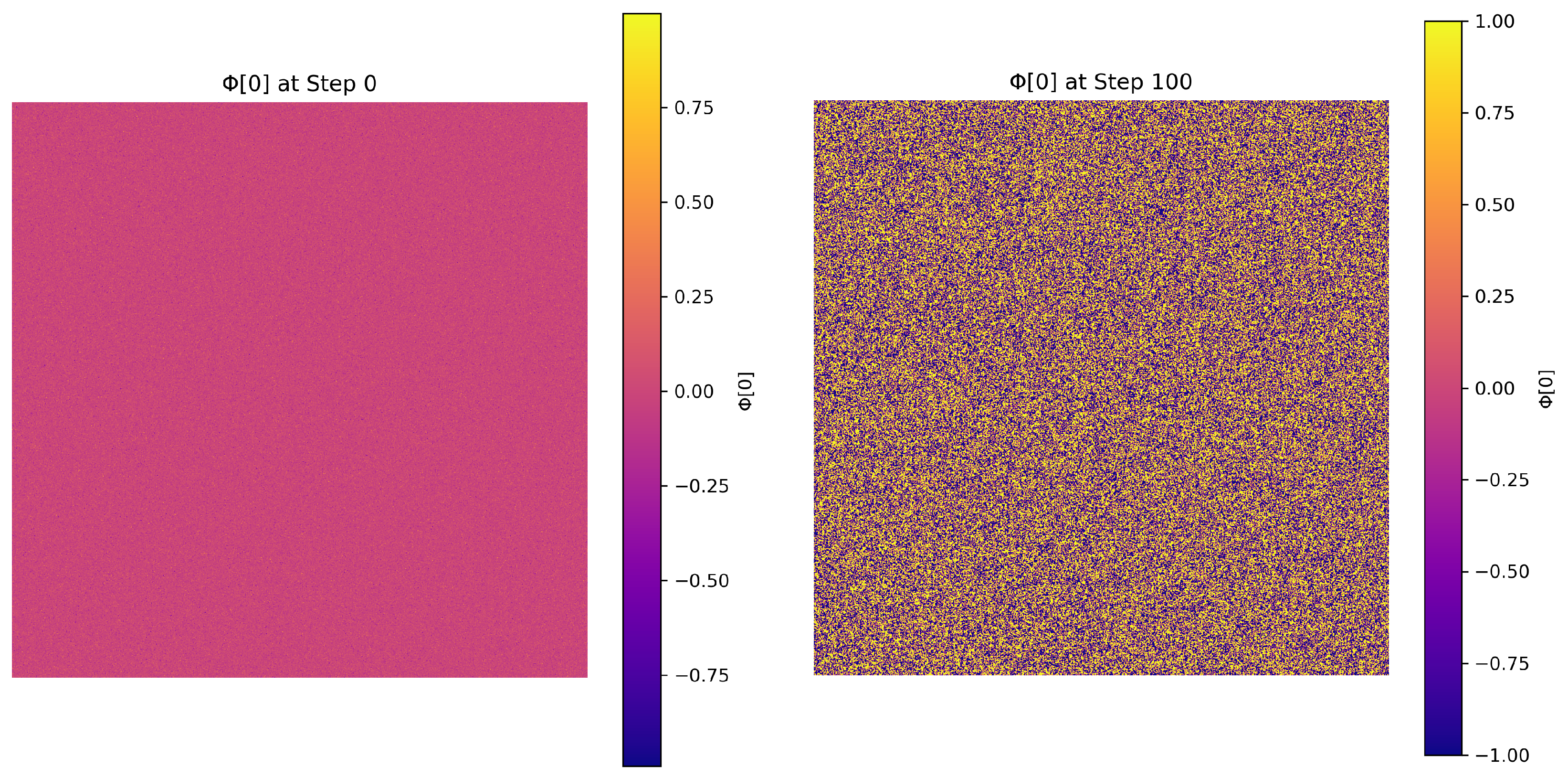
Figure 2.
Winding number per blob over simulation time. Oscillations damp as topology stabilizes.
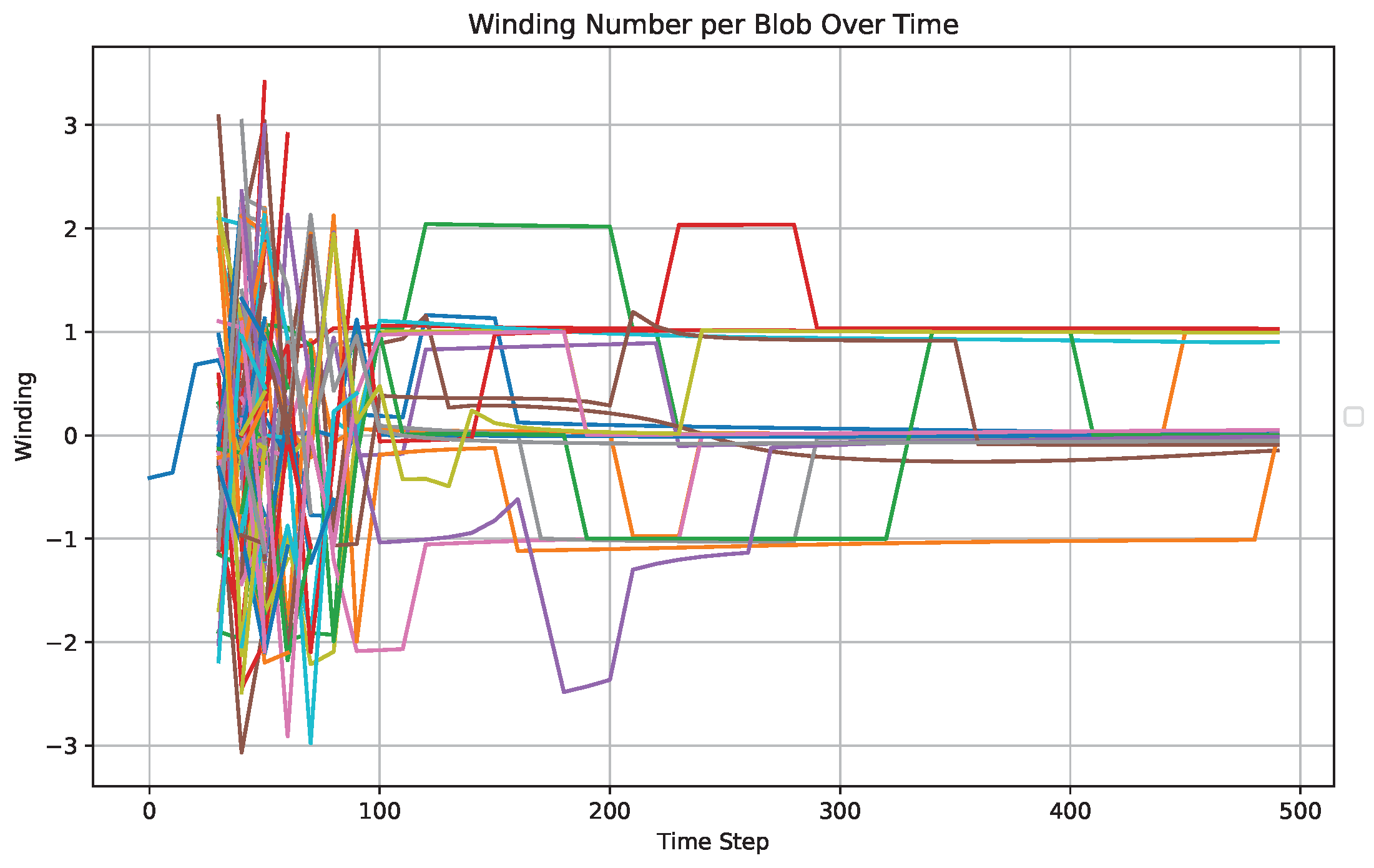
Figure 3.
Trajectories of topological soliton centers. Coherent motion reflects alignment with Chronon flow lines.
Figure 3.
Trajectories of topological soliton centers. Coherent motion reflects alignment with Chronon flow lines.
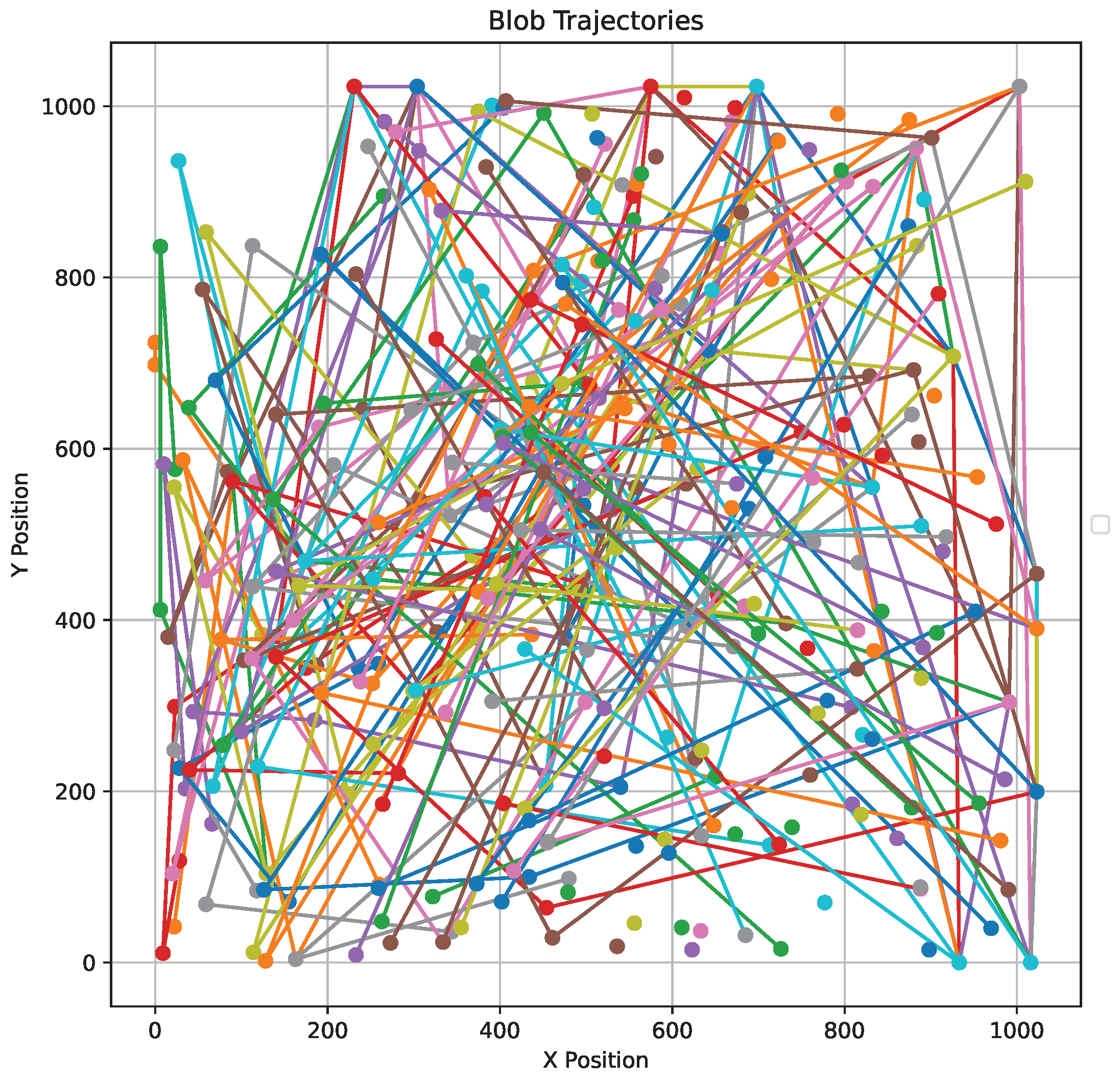
Figure 4.
Total entropy, effective metric component and total blob count over time. Entropy saturates as topological structure stabilizes.
Figure 4.
Total entropy, effective metric component and total blob count over time. Entropy saturates as topological structure stabilizes.
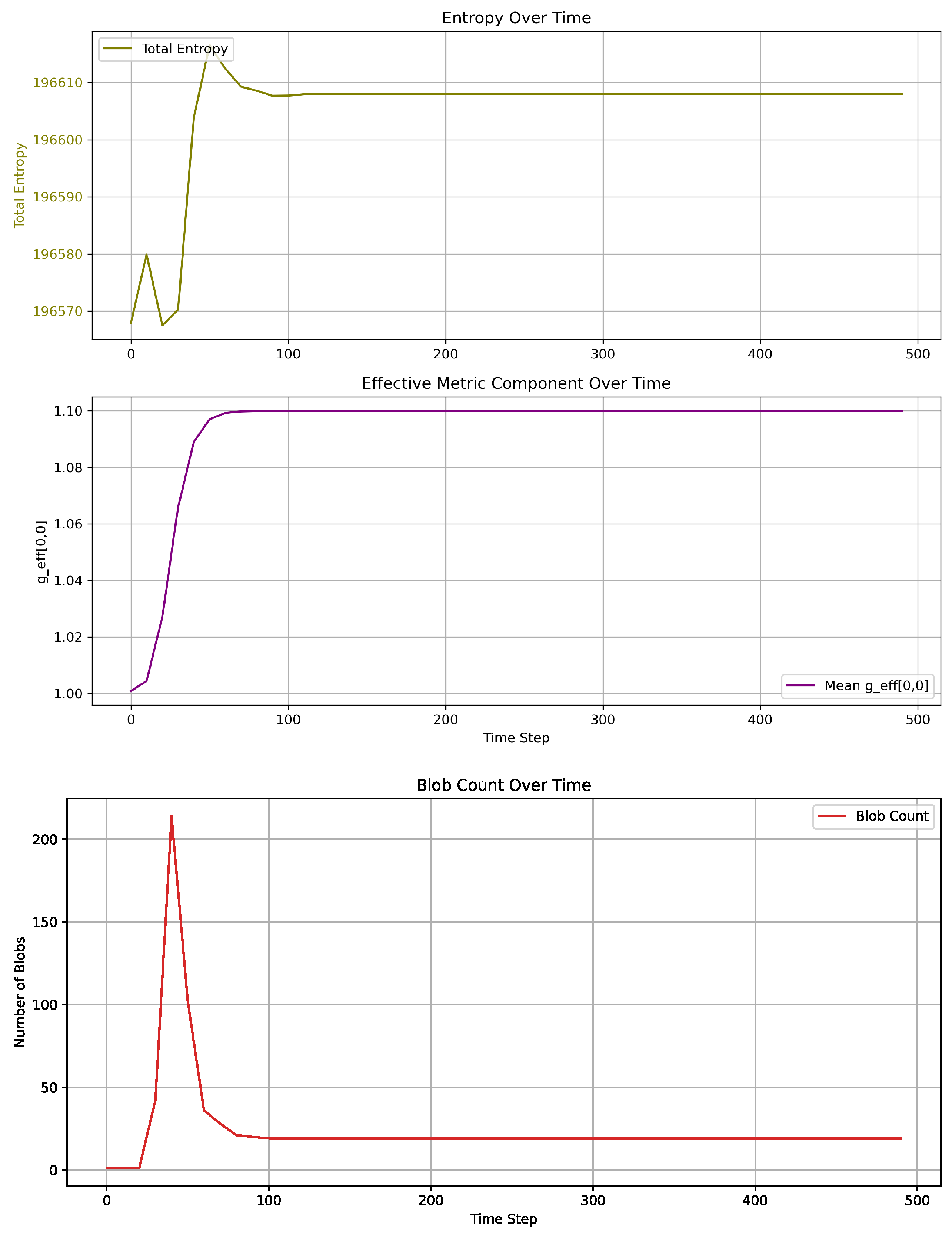
Figure 5.
Field correlation length . Growth indicates emerging spacetime (long-range order and coherence).
Figure 5.
Field correlation length . Growth indicates emerging spacetime (long-range order and coherence).
Disclaimer/Publisher’s Note: The statements, opinions and data contained in all publications are solely those of the individual author(s) and contributor(s) and not of MDPI and/or the editor(s). MDPI and/or the editor(s) disclaim responsibility for any injury to people or property resulting from any ideas, methods, instructions or products referred to in the content. |
© 2025 by the authors. Licensee MDPI, Basel, Switzerland. This article is an open access article distributed under the terms and conditions of the Creative Commons Attribution (CC BY) license (http://creativecommons.org/licenses/by/4.0/).
Copyright: This open access article is published under a Creative Commons CC BY 4.0 license, which permit the free download, distribution, and reuse, provided that the author and preprint are cited in any reuse.


