
Submitted:
14 May 2025
Posted:
15 May 2025
You are already at the latest version
Abstract
This study developed and validated a new multidimensional measure of connection to nature (CTN) - the DEEP Connection to Nature Scale. Addressing limitations of existing scales, the new scale attempts to emphasize self-integration with nature while capturing the three well-agreed upon aspects of connection to nature—cognitive, emotional, and behavioral. Using both exploratory and confirmatory factor analyses across a sample of 1152 and 657 adults, respectively, a four-factor structure was validated: (D)epth of identity, (E)motional connection, (E)xperiential connection, and (P)resence within nature. The scale demonstrated good internal consistency, convergent validity with existing CTN measures, and predictive validity for pro-environmental behavior (PEB) as well as a composite measure of well-being. Notably, the DEEP CTN Scale explained more variance in PEB (30%) compared to two widely used unidimensional measures. The Emotional and Presence dimensions emerged as the strongest unique predictors of PEB, while Depth and Presence positively predicted well-being. These relationships remained robust when controlling for relevant covariates. The multidimensional structure allows for more nuanced assessment of human-nature relationships and their outcomes. This psychometrically sound, theory-driven measure addresses key limitations of previous scales and provides a foundation for future CTN research across diverse populations. The DEEP CTN Scale offers researchers and practitioners a tool to better understand and cultivate meaningful connections with nature.
Keywords:
connection to nature
; pro-environmental behavior
; well-being
; environmental identity
; nature relatedness
; human-nature relations
; multidimensional scale
; psychological measurement
1. Introduction
We are currently in the mist of several human-created environmental crises. To name a few: global heating from increased greenhouse gases leading to increasing ocean levels from melting sea ice, increased likelihood of extreme weather events, mass species extinctions, destruction and degradation of earth’s rainforests, and mass dieback of coral reefs [1,2,3,4]. Despite growing concern for these environmental crises (Leiserowitz et al., 2024), researchers have sought to understand why actions addressing them are lacking. One proposed explanation is that humans are becoming more disconnected from the natural environment (e.g., referred to as “nature deficit disorder” [5] and “extinction of experience” [6]). With an increasing number of the earth’s population living in heavily industrialized societies, their daily connection with the ecosystem that sustains them is limited. As examples, food is delivered pre-packaged, grown in soil thousands of miles away; summer heats and winter chills have little impact on daily lives when climate-controlled conveniences keep homes and workplaces at a stable temperature year-round; a drought may result in a dead lawn, but the average American can still turn one of several taps in their home to access clean drinking water. In sum, there is growing evidence that humans have become more physically, emotionally, and cognitively disconnected from the natural world (see [7,8] for review).
Given that people’s growing disconnection with nature is likely to underlie their impassivity with respect to pro-environmental behaviors, there has been an effort by researchers to find ways to enhance people’s connection to nature (CTN) by exploring its correlates. As an example, studies have shown that greater CTN is associated with more exposure to nature (e.g., taking frequent walks in nature) and these correlational findings have inspired the development of interventions showing that encouraging people to take more nature walks increases CTN (see [9] and see [10] for a meta-analysis), with the hope that this then increases pro-environmental behaviors. As part of this endeavor to understand the relationship between CTN and pro-environmental behaviors, it is crucial to critically assess how CTN is defined and measured within the context of research studies. As such, the purpose of the current paper is to review what we see as the current limitations of current CTN measures and to present a newly validated scale, the DEEP Connection to Nature Scale, which we believe overcomes some of these limitations.
The first limitation concerns how the conception of CTN tends to get warped when researchers translate it into a measure. Specifically, one of the most agreed upon ways CTN has been conceptualized is in terms of the individual being integrated with the natural environment, using terms such as interconnectedness, a sense of we-ness, a fundamental sameness, feelings of oneness, or continuity with nature [11,12,13,14,15,16]. The idea of self-integration with nature is influenced heavily by early conservationists (e.g., Aldo Leopold) and ecological philosophers (e.g., Aerne Naess and Theodore Roszak) who called for the elimination of the human-nature binary. They argued that it is the perceived separateness of humans from nature that leads to decreased concern for, and protection of, nature. In fact, Leopold advocated extending moral consideration to non-human entities, critiquing the anthropocentric view that valued nature solely for human benefit [17]. The deep ecology movement furthered this philosophy, seeking to integrate humans into a holistic ecosystem view and rejecting the artificial separation of humans from nature in environmental sciences [18,19,20]. So important is the influence of these ecological philosophies that they are routinely cited in the introductory paragraph of papers that create and/or use CTN measures. Unfortunately, when researchers begin to develop CTN scales, the sense of self-integration with nature tends to get lost as many of the items on such measures couch “nature” as an external entity existing “out there”, separate from humanity. For example, “My ideal vacation spot would be a remote, wilderness area” positions nature as a separate entity from humans. To address this issue, the scale development of the current paper attempted to use items that capture the spirit of self-integration with nature, such as “I think about the ‘shared breath’ between myself and plants; I breathe in the oxygen released by plants, and plants use the carbon dioxide I exhale.”
A second limitation with current CTN scales concerns the controversy regarding whether CTN is multidimensional or not. In its conceptualization, CTN is widely acknowledged as having various aspects: 1) Cognitive–which includes beliefs, attitudes, motivations, and goals relating to nature; 2) Emotional–which taps into self-reported positive emotions that are often experienced within nature; and 3) Behavioral–which covers past and previous experiences in nature and the frequency those experiences take place (see [21] for review of these aspects). Despite this, historically, CTN scales have been created as unidimensional, with researchers developing scales that emphasize only one of these three dimensions. For example, the Connectedness to Nature Scale [14,22] and the Inclusion of Nature in the Self scale [16] focus on the cognitive component of CTN, while the Emotional Affinity with Nature scale [23] and the Love of Nature scale [24] focus on the emotional component of CTN. This inconsistency has sparked a debate amongst researchers as to whether CTN should be considered a unidimensional (e.g., [25]) vs. multidimensional construct (e.g., [26,27,28,29]) as well as what these dimensions should be.
The recommended statistical way to identify if CTN is composed of multiple dimensions is to conduct some sort of structural analysis, e.g., factor analysis (see [21,26] for discussion). Only two of the early CTN measures have reported multidimensional structures through factor analysis with differing factor structures: the Nature Relatedness scale (NR) [30] and the Environmental Identity scale (EID) [31] (see [32] for factor analysis). Both the NR and EID share dimensions that map onto the cognitive and behavioral aspects common in other CTN literature, while the EID also includes an emotional dimension. However, both scales contain items that map onto additional dimensions not traditionally related to CTN (and, as we return to in the Discussion, other researchers have noted other dimensions). The NR includes a dimension that represents one’s worldviews about the relationship between humans and nature. This has been described as a more abstract construct and distinct from CTN [16,33,34,35]. Specifically, while CTN represents how one views themself, as an individual, in relation to nature, human-nature worldviews include beliefs about humans in general. The EID had items that map onto a dimension labeled “environmentalism”, which tap into an individual's “moral code, an ideological commitment, or an identification with ecologists”. Interestingly, although the factor structures of both the NR and EID were once shown to be multi-dimensional, factor analyses applied to more recent revisions of those scales (aimed to improve clarity and conciseness) have shown them to be unidimensional (EID-revised [11]; NR-6 short form [15,36]).
Despite the NR-6 short form and EID-revised currently being used as unidimensional scales, there continues to be exploration into the multi-dimensionality of CTN. Of specific interest are two measures (the AIMES scale [28] and the CN-12 [27]) based on Ives and colleagues’ Human-Nature-Relations (HNR) framework [37]1. Both the AIMES and the CN-12 were created and validated using survey items and response data from a 2019 large-scale survey on residents’ values of nature [38], which was inspired by the HNR framework. Despite using this same dataset, these two measures consist of different factor structures, due to differing structural analysis approaches. The AIMES [28] used a confirmatory factor analysis (CFA), wherein they assigned items to one of five dimensions based on the HNR framework and confirmed a five-factor structure. As described above, this includes three dimensions which map on to the recognized aspects of CTN: 1) a cognitive dimension (which they labeled “identity”), 2) an emotional dimension (which they labeled “attachment); 3) a behavioral dimension (which they labeled “experiential”). As well as the additional two dimensions that reflect human-nature worldview components identified by Ives et al. [37], which they labeled “materialism” and “spirituality”. By contrast, the CN-12 [27] employed an exploratory factor analysis (EFA), which revealed a three-factor structure: 1) a cognitive dimension (which they labeled “identity”); 2) a behavioral dimension (which they labeled experience”); and 3) a dimension that taps into human-nature worldviews (which they labeled “philosophy”). This difference in analytical approaches between the AIMES and CN-12 studies highlights the ongoing debate in psychometrics about the roles of EFA and CFA in scale development and validation (see [39] for discussion). While each method has its strengths, some researchers argue that a combination of both approaches (data-driven discovery and theoretical confirmation) may provide a more comprehensive understanding of scale structure [40]. As such, in the current study, we adopted this integrated approach to create a new multidimensional scale—the DEEP CTN scale, with the ultimate goal of asking whether the degree to which different dimensions of the scale can successfully predict pro-environmental behavior (PEBs), which we turn to in the next section.
To date, several studies have shown a positive association between various scales of CTN and PEB, with several meta-analyses reporting moderate (r = .35 to .52) effect sizes [10,29,41,42]. Most of these studies measured PEBs using self-reported participation in PEBs and/or intentions to participate in PEBs. When instead, the outcome measure is observed behaviors (e.g., volunteering to participate in a river cleanup), smaller effect sizes are seen (r = .21 to .29 [29,41]). In addition, the majority of studies investigating the relationship between CTN and PEBs have used a unidimensional CTN scale, leaving open the question of whether certain dimensions of CTN may be more or less associated with PEBs. Determining the degree to which cognitive, emotional, and behavioral aspects of CTN (as described above) differentially impact PEB would allow the creation of interventions that target aspects of CTN most likely to increase PEB.
To our knowledge, only two studies have explored whether dimensions of CTN (from the EID and the CN-12, above) differentially predict self-reported participation in PEBs. A multiple (stepwise) regression using the four-dimensional structure of the EID revealed that the environmentalism dimension was the strongest predictor of PEB [32]. However, this is unsurprising given that their measure of PEB was self-reported behaviors (e.g., switching to green products and driving less frequently) and the items from the environmentalism dimension asked if engaging in PEB was important and morally good. Unfortunately, this paper did not report the results of the other dimensions in their model (i.e., cognitive, emotional, and behavioral dimensions), leaving one to conclude that these more conceptually derived aspects of CTN do not contribute to PEB. No multiple regression was used in the study investigating how the three dimensions of the CN-12 would predict PEB [27]. Instead, they presented the results of zero-order correlations across all variables and reported that the cognitive dimension (labeled “identity”) was the strongest predictor of PEB. To identify which dimension is the best predictor for PEB, interpretation of the unique variance of each dimension within a multiple regression is needed (see [43,44] for discussion).
The purpose of the current study was to develop and validate a multi-dimensional CTN scale that addresses the above-described limitations of the previous measures. Our approach focused on two key goals. First, we wanted to test if the three aspects of CTN referred to throughout the literature (cognitive, emotional and behavioral) exist as latent variables of CTN. To do this as thoroughly as possible, we collected items across a wide range of the currently available CTN scales, with a focus on scales that were theoretically grounded and addressed issues of self-report bias. We were careful to ensure sufficient items represented each of the three aspects of CTN, remove redundancy across items from various scales, and adapt items to be more generalizable across diverse populations. We then used both EFA and CFA to make sure that our scale was created using a data-driven approach given the inconsistency of multidimensional models of CTN while at the same time acknowledging Ives’ theoretically driven HNR framework [37].
Second, we wanted our new scale to be composed of items that captured the "human as integrated” with nature end of the human-nature relationship spectrum, specifically, being more of an embodied and/or spiritual lived experience. While this idea is fundamental to the concept of CTN, it is our opinion that this has gotten lost in the currently existing measures. To this end, we added several items (e.g., “I view nature as a mother who nurtures and cares for me”). In addition, while we included worldview items from previous scales, we were mainly interested in the items that align with philosophical/spiritual worldviews (e.g., “every part of nature is sacred”) rather than materialistic worldviews (e.g., “forests are valuable mostly because they produce wood products, jobs, and incomes for people”). We predicted that these philosophical/spiritual items might load onto a cognitive dimension given that previous cognitive CTN scales include mention of spirituality (e.g., NR-6 and CNS).
Over a series of four pilot studies, we developed the DEEP CTN Scale and explored its factor structure using both EFA and CFA. The pre-registered study presented in this paper confirms the factor structure identified in the pilot studies using an independent sample and further investigates the following additional forms of measurement validity for the DEEP CTN Scale: convergent validity (testing whether the measure is related to established measures of the same construct), predictive validity (testing whether the measure is predictive of a dependent variable in an expected way), incremental validity (testing whether the predictive value of the measure remains robust after accounting for covariates that are related to the measure). For point of comparison, all measurement validity analyses were also conducted with a different outcome measure, namely a composite score of psychological well-being (WB). This is of interest as there is a growing literature showing that CTN has a small to moderate relationship with WB [45,46,47].
2. Materials and Methods
2.1. Pilot–Developing the DEEP CTN Scale
The development of the DEEP CTN Scale was conducted in our lab over the past 2.5 years in multiple phases:
2.1.1. Phase 1: Item Creation
We initially considered conducting a large factor analysis using items from every CTN scale identified in an extensive search of the literature of all existing adult measures of CTN (similar to [25]). However, this approach would have been burdensome for participants as this would include over 350 items, many of which were extremely similar in wording. We ultimately used the AIMES scale [28] as a starting point, as it appeared to tap into the same aspects (cognitive, emotional, behavioral) as other CTN scales (as discussed in the Introduction). We supplemented the AIMES scale with the Disposition to Connect with Nature Scale [48] as it included more experiential aspects of CTN and because this scale was created to be less susceptible to self-report bias. The items from these two scales total 56 (AIMES = 16 items; Dispositional CTN = 40 items). Several items from each scale were removed due to redundancy. We reworded several items for generalizability (e.g., “It makes me miserable to see a hedgehog that was hit by a car” was reworded to: “It makes me upset to see an animal that was hit by a car”) and clarity (e.g., “If one of my plants dies, I reproach myself” was reworded to: “If one of my plants died, I would blame myself”). Any direct references to “connection to nature” were removed to avoid concerns about participants not fully understanding this concept (see Gould & Schultz, 2021 for discussion on this). This resulted in 43 items retained from previous measures (AIMES = 13 items; Dispositional CTN = 30 items)
We created seven new items designed to capture behavioral, embodied, and experiential relationships with nature (in line with the Disposition to Connect with Nature Scale [48]). This resulted in items that asked about conscious attendance to nature. We created five new items tapping into an integrated spiritual relationship with nature which could better reflect one’s individual lived experience instead of broader human-nature worldviews that describe beliefs about humans in general. We also adapted two items from the Ecospirituality Scale [49] which reflected this integrated spiritual relationship with nature. This resulted in a total of 58 items. See supplementary materials for details of item selection, adaptation, and creation.
2.1.2. Phase 2: Pilot Exploratory Factor Analysis
Exploratory Factor Analyses (EFAs) were conducted on three samples: two general population Prolific samples (N = 575, N = 577) and one student sample (N = 485), between November 2022 and April 2023. An EFA uses a data-driven approach to determine the multi-dimensional structure. Here, the number of factors is not fixed, no loadings are forced to be zero, and rotations are allowed to occur. This was conducted on the 58 items as detailed in Phase 1 above. As a first step in our EFA, we eliminated all items that failed to load greater than or equal to 0.40 onto any one factor and items that showed a cross-loading of greater than or equal to 0.20, This resulted in a total of 30 items to be included in the confirmatory factor analysis (CFA) (see Phase 3 below).
The results of the three EFAs are presented in supplementary materials. The results consistently revealed a four-factor structure as the best fitting model, which we named the following based on the representation of the items in each dimension and how they related to previously described aspects of CTN (see introduction):
- Depth of identity (deeply seeing the self as part of nature, which represents the cognitive component of CTN)
- Emotional connection (emotional desire to connect with and care for nature, which represents an emotional component of CTN)
- Experiential connection (spending and enjoying time in nature, which represents one aspect of the behavioral component of CTN)
- Presence within nature (engaging mindfully and consciously with nature, which represents a second aspect of the behavioral component of CTN)
2.1.3. Phase 3: Pilot Confirmatory Factor Analysis
The 30 items that were retained from the EFA were then analyzed in a CFA, wherein the above four dimensions from phase 2 were fixed (see below for full explanation of this analysis which we replicated in our pre-registered study). Using a student sample (N: 341), the analysis found that the proposed four-factor model was an adequate fit. It also showed that a hierarchical model had adequate fit. Further, both models fitted better than a unidimensional model with only one overall CTN dimension. These results were used to create the scale which we pre-registered to conduct the CFA and validation analyses described in this paper. See supplementary materials for full methods and results of these pilot studies.
2.2. Pre-Registered CFA and Validation
The hypotheses, study design, exclusion criteria, and analysis plan for this study were pre-registered at https://osf.io/5xbvp/.
2.2.1. Power Analysis
To ensure adequate sample size for this analysis we used a common rule of thumb of including 10-15 subjects per variable [50]. Because our analysis involves 30 items, we aimed to obtain usable data from 10 x 30 = 300 participants. We expected some attrition and removals during data cleaning (estimated to be about 5% based on pilot data), we therefore aimed to collect data from 315 participants. This number was very close to the sample size resulting from a separate analysis applied to the multiple linear regression analyses calculated for the predictive validity confirmatory analysis, with the following parameters: anticipated effect size f2 = 0.17 (based on pilot data and previous literature we anticipate a moderate effect size); statistical power = 0.8; up to seven predictor variables (plus 6 covariates) in the largest confirmatory model; and an alpha of 0.0125 (to account for a Bonferroni correction for conducting four models). This results in a sample size of 290 participants. We similarly estimated 5% attrition and removals during data cleaning resulting in us aiming to collect data from 305 participants. As our CFA required a larger sample size than the validity analyses, the total sample size required is determined by this analysis. Thus, we planned for a sample size of 315 participants.
2.2.2. Participants
Using the Prolific platform, 316 participants agreed to participate in a study on “attitudes and behaviors towards nature” in January 2023. One participant failed to pass sufficient attention checks (minimum required to pass was two out of three checks), as such their data was not analyzed. The final analysis consisted of 315 participants with ages ranging from 18 - 83 (M = 43.76, SD = 14.53). The sample included 182 women, 120 men, 3 trans women, 1 trans man, 8 non-binary, and 1 unreported. The racial make-up of the sample was 197 White, 59 Black, 23 Asian, 16 Hispanic/Latinx, 12 mixed race, 2 Middle Eastern, 1 Indigenous, and 5 unreported. The study was approved by the IRB committee at UCSD (#806617). All participants gave their informed consent before participating and were compensated at $9/h (approximately $2.18 for completing a 14.5-minute survey).
2.2.3. Materials & Procedure
The study was conducted entirely online and remotely (through the Prolific platform using Qualtrics surveys). Participants answered several questionnaires, which were used for validation of the scale (see below): 1) the newly developed 30-item DEEP CTN Scale, 2) the Connectedness to Nature Scale (CNS) [14], 3) the Environmental Identity Scale- Revised (EID-r) [11], 4) the Recurring Pro-Environmental Behavior Scale (RPEBs) [51], 5) Primals Inventory - Interconnected sub-scale [52] 6) Ryff Well-being scale [53], 7) PANAS positivity sub-scale [54], and the 8) Subjective Vitality Scale [55] (described in detail further below). Next, participants completed a demographics question block (e.g., political ideology, socio-economic status, and age). Last, participants were instructed to rate their effort and attention levels on the questionnaires, which were used to clean the data2. Participants were also asked to submit an open-ended definition of nature which was collected for a future exploratory qualitative study.
New 20-Item DEEP Connection to Nature Scale. The new DEEP Connection to Nature scale included 20 items developed from the EFA and pilot CFA studies (see above). Table 1 displays the full list of items with titles based on the factor loadings found in the pilot CFA. A long form 30-item version of this scale was initially created. As all results were similar for both the 30-item long form scale and the 20-item DEEP CTN Scale all results below are for the 20-item DEEP CTN Scale. All CFA results for the 30-item long form scale are included in supplementary materials.
Connectedness to Nature Scale. The CNS [14] is a 14-item unidimensional scale designed to measure the cognitive beliefs about how interconnected one’s self is to nature. It is measured on a Likert scale ranging from 1 (strongly disagree) to 5 (strongly agree). Cronbach’s alpha was 0.82. This scale was used for predictive validity.
Environmental Identity Scale revised. The EID-r [11] is a 14-item unidimensional scale designed to measure how interconnected one’s self is to nature. It is measured on a Likert scale ranging from 1 (not at all true of me) to 7 (completely true of me). Cronbach’s alpha was 0.93. This scale was used for predictive validity.
Pro-Environmental Behavior. The Recurring Pro-environmental Behavior scale (RPEBs) [51] asks people to report how often they engage in various pro-environmental behaviors. Modifications were made to clarify existing items (to view the scale used in this study, view supplementary materials). This scale includes 20 items measured on a Likert scale ranging from 1 (never) to 5 (always). Cronbach’s alpha was 0.79. This scale was used for predictive and incremental validity.
Well-being. A single measure of WB was created by combining scores from three established measures: 1) the Ryff Well-being Scale [53]; 2) the 10-item positive affect subscale of the PANAS [54]; and 3) the Subjective Vitality Scale [55]. Cronbach’s alpha for this combined measure was 0.86. This scale was used to explore the relationship between the new DEEP CTN Scale dimensions and WB.
Interconnected Beliefs. Beliefs that the world is interconnected were measured using the Interconnected subscale of the Primal Beliefs Inventory [52]. This was included as a covariate when measuring incremental validity as pilot data showed that this measure is correlated to both DEEP CTN Scale and PEB (See supplementary materials for full analysis of the pilot data). The Interconnected subscale consists of four items asking how connected or atomistic one believes the world to be (e.g., Most things are basically unconnected and independent from each other [reversed]). All items are measured on a Likert scale ranging from 1(strongly disagree) to 6(strongly agree). Cronbach’s alpha = (0.30)3.
Other Demographics. Previous reviews on individual difference predictors of PEB have found mixed evidence for age, gender, political ideology, and socio-economic status (SES) on PEB [29,42,56]. The Subjective Socio-economic Ladder [57] was used to measure SES. Participants mark where they believe they are on the ladder, with 10 representing people who are the best off, and 1 representing people who are the worst off. Political ideology was measured using the average of three items asking about overall political ideology, economic political ideology, and social political ideology measured on a Likert scale ranging from 1 (extremely liberal) - 4(middle of the road) - 7(extremely conservative). Cronbach’s alpha was 0.94. These items were used for incremental validity.
2.2.4 Data Analysis
Basic descriptive analyses reported on means, standard deviations, and frequencies of relevant variables. Normality, as assessed with visual inspection of histograms and tests of kurtosis and skewness, was verified and met for all variables of interest. The assumptions of all statistical tests were checked and met. The level of significance was set to 2.5% (p < 0.025) for all tests; however, we emphasized effect sizes rather than statistical significance since the latter is often misleading. Effect sizes were reported as the following: Pearson r values for bivariate correlations, with the rule of thumb that absolute values of 0.10 - 0.30 are weak effects, 0.30 - 0.50 are medium effects, and 0.50 and over are large effects; Standardized Beta for linear regressions, with the rule of thumb that values or 0.10–0.29 are weak effects, 0.30–0.49 are medium effects, and 0.50 and over are large effects. All regression models in this study use Type II sum of squares, which examine individual effects in light of all other model effects regardless of order. All data were analyzed using R (version 4.3.2).
CFA Analysis. The main goal of the CFA was to confirm the accuracy of the four-factor structure of the DEEP CTN Scale that emerged during pilot studies through EFA. Prior to conducting the CFA, we first calculated bivariate correlations amongst the DEEP CTN Scale dimensions. Based on the results of pilot studies and the expectation that the dimensions would be different enough to be separable dimensions (as would be revealed in the four-factor CFA models), yet similar enough to be associated via one superordinate CTN construct (as would be supported by a hierarchical CFA structure), weak to moderate positive correlations between all dimensions were predicted. We also assessed the internal consistency of the DEEP CTN Scale with Cronbach’s alpha statistics for each dimension. To verify the suitability of the data for CFA, the DEEP CTN Scale items were checked for univariate normality via extreme values for skewness (> |1.0|) and excess kurtosis (> |3.0|) and visual inspection of histograms [58]. The items were also checked for multivariate normality with Mardia’s multivariate skew and kurtosis tests [59]. A violation of multivariate normality was indicated by Mardia’s skewness and kurtosis tests, both being significant at p < .001. Since this multivariate normality assumption was not met in our sample, rather than conducting CFAs using the default maximum likelihood estimation, we instead used a maximum likelihood estimation with robust standard errors and a Satorra-Bentler scaled test statistic, which is less dependent on the assumption of normality [60]. However, normality is not considered a critical assumption for factor analysis [61]. Using the R-package lavaan [62], we employed a CFA on these items to test a four-factor solution. The number of factors was set to four and covariances were allowed between the factors.
We hypothesized that 1) the results of the CFA would confirm a multidimensional structure with four distinct dimensions (i.e., a four-factor solution without a superordinate CTN factor, which we refer to as the four-factor nonhierarchical model), and 2) in a four-factor hierarchical CFA, the factors would strongly load onto a superordinate CTN factor (i.e., a four-factor solution with a superordinate CTN factor, which we refer to as a hierarchical model). The finding of a hierarchical structure would suggest that the four dimensions are sufficiently interrelated to be considered part of one overarching CTN construct. The following indices, with suggested benchmarks by Hu and Bentler [63] and Brown [64], were evaluated collectively to provide an evaluation of how well each model fit the data: chi-square statistic (χ2; p > .05), root mean square error of approximation (RMSEA; < 0.06) with its 90% confidence interval (0.00 - 0.08), Tucker-Lewis fit index (TLI; > 0.90), and comparative fit index (CFI; > 0.95).
In addition to our two main models described above, we also tested a one-factor model containing only a total CTN score (which assumes that the DEEP CTN Scale has a unidimensional structure). We hypothesized that the one-factor model would provide the worst fit but had no a-priori hypothesis about which of the two other models (i.e., the four-factor nonhierarchical or hierarchical) would provide the best fit given range of dimensional structures found for CTN as described in the introduction. Note that determining the best-fitting factor structure of the DEEP CTN Scale affects the scoring guidelines of the measure. Specifically, a four-factor hierarchical would support the use of both dimensional scores and a total score. By contrast, a four-factor nonhierarchical model would support the use of individual dimensions but not a total score, and a one-factor model would support only the use of a total score. Model comparisons were conducted using an ANOVA comparison of model fit. Though we also reported the Akaike information criterion (AIC), where scores closer to 0 indicate a more parsimonious and better-fitting model.
Convergent Validity. We assessed convergent validity via bivariate correlations between the DEEP CTN Scale (including its dimensions) and two existing measures of CTN: The CNS [14] and the EID-r [11]. We expected that the total DEEP CTN Scale score would correlate moderately with both pre-existing measures. Further, we expected variability across the correlations between the DEEP CTN Scale dimensions and these pre-existing measures. Specifically, we predicted that the Depth dimension will strongly correlate with the CNS, while the other three dimensions will only weakly-moderately correlate. This is based on past research identifying the CNS as a unidimensional measure of nature connectedness which focuses on the cognitive aspect of connection to nature [14]. Additionally, we expected that the Experiential and Emotional dimensions of the DEEP CTN Scale will strongly correlate with the EID-r, while the other two dimensions will weakly (or not at all) correlate. This is based on previous research which identified multiple dimensions measuring enjoyment and appreciation of nature [32].
Predictive Validity. Here, we tested whether any (or all) of the dimensions of the DEEP CTN Scale predict PEB (in the form of the RPEBs). Bivariate correlations were used to assess the relationship between PEB and the dimensions of the DEEP CTN Scale. We expected there would be variability among the DEEP CTN Scale dimensions regarding the strength of their correlation to PEB. Additionally, (though not pre-registered) we conducted two multiple linear regressions, using PEB and WB as dependent variables and the DEEP CTN Scale dimensions were entered simultaneously as predictor variables. This allowed us to test the unique predictability of each dimension allowing us to identify which DEEP CTN Scale dimension best predicts PEB which we address by comparing the change in R2 across models. By including existing measures of CTN we can assess if the DEEP CTN Scale is adding predictive ability above and beyond these measures.
Incremental Validity. If predictive validity was supported, the next step was to test whether the strength of the relationship between the DEEP CTN Scale dimensions and PEB remained robust after accounting for covariates that are related to the measure and/or outcome variable (interconnected primal worldviews, political ideology, and age). Interconnected primal worldviews were included based on findings in pilot studies that suggested it shared variance with both PEB and one or more DEEP CTN Scale dimensions. Political ideology and age were included as covariates based on previous research suggesting they are moderate predictors of PEB [29,42,56]. There are two reasons to include covariates in a model. First, if a covariate is strongly correlated with PEB and weakly (or not) correlated with the DEEP CTN Scale dimensions, its inclusion in the model can reduce variance in PEB that would otherwise be unaccounted for, thereby enhancing the significant effects of the DEEP CTN Scale. Second, if a covariate is strongly correlated with both PEB as well as the DEEP CTN Scale dimensions, its inclusion in the model can potentially account for the relationship between DEEP CTN Scale dimensions and PEB. In this case, we would want to ensure that the relationship observed between the DEEP CTN Scale dimensions and PEB (in the original predictive validity analysis, above) was not entirely accounted for by this covariate. We confirmed whether each covariate had the potential to behave in either the first or second way by looking at bivariate relationships between the DEEP CTN Scale dimension scores, and the three covariates, and between the three covariates and PEB (separately).
Exploratory Analyses. We additionally ran the same analyses as above in Predictive and Incremental Validity with WB as the outcome variable. These results are exploratory as they were not pre-registered. Results for these exploratory findings are included below under both predictive and incremental sections for conciseness and ease of reading.
3. Results
3.1. CFA Analysis
Descriptive statistics and bivariate correlations for the DEEP CTN Scale dimensions are presented in Table 2. The means of all dimensions scores were approximately at the midpoint (4.00) of the scale (range M = 4.56 to 4.88). We found moderate to strong correlations (r’s(315) = 0.54 to 0.85, p’s < .001) between all dimensions. This suggests that the dimensions represent related but distinct constructs and supports the possibility of a hierarchical CFA solution. Internal consistency reliability scores indicated that all dimensions and the total of the DEEP CTN Scale demonstrated good internal consistency (Cronbach’s alphas ranging from 0.70 to 0.88).
Preliminary analyses showed that all 20 items of the DEEP CTN Scale were approximately normally distributed, as assessed by levels of skewness (range -0.10 to -1.00) and excess kurtosis (range 1.56 to 3.03), and visual inspection of histograms. A violation of multivariate normality was indicated by Mardia’s skewness and kurtosis tests; both being significant at p < .001. Since this multivariate normality assumption was not met in our sample, rather than conducting CFAs using the default maximum likelihood estimation, we instead used a maximum likelihood estimation with robust standard errors and a Satorra-Bentler scaled test statistic, which is less dependent on the assumption of normality.
The new DEEP CTN Scale showed adequate fit indices for the four-factor nonhierarchical and hierarchical models (RMSEA < .08; CFI/TLI > .90. The one-factor model failed to approach any acceptable model fit indices, suggesting that this model was a poor representation of the data. In terms of model comparisons, the following was found 1) the multi-dimensional models had a significantly improved fit compared to the unidimensional model (χ2 = 839.377(170), p = < .001), and 2) the four-factor model was a slightly better fit than the four-factor hierarchical model (χ2 = 450.122(166), p = .015) though not significantly different. These findings suggest the new DEEP CTN Scale is best described as a multi-dimensional construct and has improved fit over a single unidimensional model. See table 3 for all model fit statistics and model comparisons.
The results of this CFA revealed that all items significantly loaded onto their a-priori factors (p < 0.001) identified during pilot analysis (see above). Figure 1 shows the standardized estimates for each item regressed onto the four factors and a second-order CTN factor. Our results suggest that CTN, when measured with the DEEP CTN Scale, is best described as a multidimensional construct with four dimensions: Depth of Identity (cognitive), Emotional Connection (emotional), Experiential Connection (behavioral), and Presence within Nature (behavioral). The items in the Presence domain were originally created as ways to tap a deeper behavioral relationship with nature. That they separate into two distinct dimensions suggests that there is something fundamentally different about these two ways of interacting with nature behaviorally and serves to point out the importance of not flattening behavioral experiences into a single dimension.
3.2. Further Validation Analyses
3.2.1. Convergent Validity
Convergent validity was tested by investigating whether the DEEP CTN Scale is related to two established measures of connection to nature: the CNS (Mayer & Franz, 2004) and the EID-R (Clayton et al., 2021). Table 4 shows the zero-order Spearman correlations between the total score of the DEEP CTN Scale, each of the four DEEP CTN Scale dimensions, the CNS, and the EID-R. As predicted, there was a strong correlation between our new DEEP CTN Scale (total score) and existing measures (r = 0.72 and 0.78 for CNS and EID-R, respectively), providing good support for convergent validity. When looking at the individual dimensions of the DEEP CTN Scale, we found that the Depth dimension was most strongly related to CNS, whereas the Experiential dimension was most strongly related to the EID-r.
3.2.2. Predictive Validity
As a first step we asked whether any of the dimensions of the DEEP CTN Scale showed strong associations with PEB. Table 5 shows the zero-order Spearman correlations between the total score of the DEEP CTN Scale, each of the four DEEP CTN Scale dimensions, and PEB. We found moderate correlations between DEEP CTN Scale dimensions and PEB (r’s = 0.44 to 0.46, p’s < .001), providing good support for predictive validity. To investigate the unique contribution of each, all dimensions were included in the same model as part of our predictive validity analysis. As shown in Table 6 (left panel), the Emotional and Presence dimensions were significant predictors with small effect sizes (p’s < .01, std Beta = .17 to .21) explaining 8% of the variance in PEB each. While the Depth and Experiential dimensions did not predict PEB. Based on the model R2, these models show that overall, the DEEP CTN Scale accounts for 30% of variance in PEB. For comparison, we explored the predictive validity of two previous measures of connection to nature: CNS and EIDR. These measures accounted for 22% (CNS) and 19% (EIDR) of the variance in PEB, revealing that the DEEP CTN Scale can explain more variance in PEB (data not shown in Table 6).
Although not intended for testing predictive validity, the same analyses were run with WB as the outcome variable. Table 5 shows the zero-order Spearman correlations between the total score of the DEEP CTN Scale, each of the four DEEP CTN Scale dimensions, and WB. We found small to moderate correlations between DEEP CTN Scale dimensions and WB (r’s = 0.17 to 0.42, p’s < .001). As shown in Table 7 (left panel), all but one dimension (Experiential) were significant unique predictors of WB with small effect sizes (p’s < .01, std beta = -.15 to .23). Interestingly, when looking at the variance explained the Emotional dimension arose as a negative predictor of WB. The R2 shows that DEEP CTN Scale accounts for 24% of the variance in WB. By comparison CNS and EIDR accounted for 24% and 12% of the variance respectively, noting that whereas the CNS showed similar predictive ability for WB as the new DEEP CTN Scale, the EIDR underperformed.
3.2.3. Incremental Validity
Here, we asked whether the predictive validity of the dimensions seen in the above analysis remained robust when three covariates (i.e., interconnected primal worldviews, political ideology4, and age) were added to the model predicting PEB. These variables were found to be suitable as covariates as they correlated with both the main predictor variables (i.e., the DEEP CTN Scale dimensions) and the outcome variables (i.e., PEB and WB). Specifically, primal worldviews positively correlated with all DEEP CTN Scale dimensions scores (r’s(315) = 0.30 to 0.53, p’s < .001) as well as positively correlated with both PEB and WB (r’s(315) = 0.36 to 0.37, p’s <.001). Age positively correlated with three of the DEEP CTN Scale dimensions (Depth, Experiential, and Presence) (r’s(315) = 0.13 to 0.27, p’s < .05) as well as positively correlated with both PEB and WB (r’s(315) = 0.14 to 0.21, p’s <.05). Political ideology was included in analyses for WB as it negatively correlated with the Emotional dimension of the DEEP CTN Scale (r(315) = -0.14, p <.05) and positively correlated with WB (r(315) = 0.21, p <.001). (see supplementary materials for a table of these correlations)
To investigate the incremental validity the relevant covariates were added into the model predicting PEBS. As shown in Table 6 (right panel), the two dimensions (Emotional and Presence) of the DEEP CTN Scale that were predictive of PEBs (left panel) remained robust when primal worldviews and age were included in the model. Note that primal worldviews, but not age, continued to account for a significant amount of unique variance in PEB when included in the multiple regression model.
Although not intended for testing incremental validity, the same analyses were run with WB as the outcome variable. As shown in Table 7 (right panel), two of the three DEEP CTN Scale dimensions that were predictive of WB (Deep and Presence) remained robust when including primal worldviews, political ideology, and age. All covariates also remained significant predictors of WB in this larger model (although the effect of age became quite small).
4. Discussion
This paper introduces and validates the multi-dimensional 20-item DEEP CTN Scale, which addresses several limitations of previous scales. Specifically, the DEEP CTN Scale emphasizes the individual as integrated with nature, thus overcoming the human-nature binary where nature is often viewed as separate from humanity. This was an important step, as our review of extant measures revealed that while integration with nature was a predominant conceptual definition of CTN, it appeared to be incompletely represented in existing measures. The DEEP CTN Scale confirmed the existence of the three aspects of CTN that have been regularly cited as aspects of the construct. We observed a 1) The cognitive component, which we named Depth of identity because it represents a deeply held self-construct that includes nature and views the self as “one with nature”. We observed 2) an emotional component, which we named Emotional connection, which includes deep empathy towards nature which manifests in a need to care for nature. However, the behavioral aspect was found to be separated into two distinct dimensions: 3) Experiential connection, which represents the time an individual spends in nature and their enjoyment of time in nature; and 4) Presence within nature, which reflects habitual mindful and conscious engagement with nature. The new DEEP CTN scale showed good convergent validity with two widely used existing CTN measures (the Connectedness to Nature scale and the Environmental Identity scale revised version). It also showed good predictive validity for PEB, improving upon these two existing measures, while also remaining robust when included in a model with known covariates. Of note, a recent review raised concerns regarding the validation of CTN measures, including a lack of clarity regarding the construct definition of CTN and poor validation methods [21]. We believe this paper addresses many of these concerns as well as being amongst the first CTN measures to pre-register a thorough statistical plan for validation. In sum, our hypotheses were supported, providing psychometric validity to the new four-factor DEEP CTN Scale. For the remainder of the discussion, we address three important findings: 1) the behavioral aspect of CTN splitting into two distinct dimensions; and the differential predictability of the DEEP CTN Scale dimensions on 2) PEB; and 3) WB. We then end with a discussion of the limitations and strengths of the current research and make suggestions for future directions.
4.1. Dimensionality
One of the surprising findings of our EFA (later confirmed through CFA) was the emergence of two distinct behavior dimensions, which we named Experiential connection and Presence within nature, something previous scales have not observed. We note that all of the items in the presence dimension originated from the Dispositional Connect to Nature scale, whereas the items that constituted the Experiential dimension came from diverse scales (two items from the Dispositional Connection to Nature scale, two items from the AIMES scale, and one item from the Ecospirituality scale). Whereas we consider the Experiential dimension to be a preference for spending time in nature, we consider the Presence dimension to be a more deliberate, habitual, mindful engagement with nature. We do believe that the separation between the Presence and Experimental dimensions is an accurate representation of the latent structure of CTN as this pattern of findings replicated across three independent EFA studies (using both student and Prolific general population samples). That is, items now included in the Experiential dimension of the DEEP CTN Scale consistently loaded on the same factor with similar consistent findings for items now included on the Presence dimension. Further evidence that these are two distinct constructs is the correlation between the Experiential and Presence dimensions is only 0.58. This suggests that the dimensions are not so highly correlated as to suggest they represent the same (or very similar latent variable). This gave us the confidence to retain these items as two unique dimensions in the DEEP CTN Scale. However, our results showing that the Experiential domain failed to uniquely predict either PEB or WB suggest that using the behavioral component of CTN which captures a desire to interact with nature and the pleasure people feel from it may not be as useful as asking how mindfully present one is when engaging with nature. We recommend exploring the nuances of how people behaviorally engage with nature as the next steps to understanding this aspect of CTN, suggesting that mindful engagement may be a more useful component of CTN when developing interventions to increase both PEB and WB.
4.2. Predicting Pro-Environmental Behavior
The new DEEP CTN scale met the criteria of predictive validity, i.e., significantly predicting PEB. Moreover, the new scale was found to predict more variance (30%) in PEB than two existing CTN measures (22% and 19% for the CNS and EID-revised, respectively). In addition, the current study’s predictive validity analysis is the first, to our knowledge, to investigate the unique contribution of different factor analysis-qualified dimensions to PEBs. Here, we found that the Emotional and Presence dimensions of the DEEP CTN Scale were the strongest predictors of PEB (with the Experiential dimension not reaching significance). This finding has important implications for both research and practice in the field of environmental psychology and conservation. Under the assumption that disconnect from the natural environment is a driving force behind lack of environmental concern, the current results suggest that interventions might consider focusing on emotional connection to nature (Emotional dimension) and mindful engagement with the natural world (Presence dimension) as potentially key predictors of PEB.
This suggests that interventions aiming to increase PEB through CTN should focus on fostering these deeper, more engaged aspects of the human-nature relationship. It's not enough to simply be exposed to nature; there appears to be something critical about emotionally connecting with nature and being mindfully present in natural environments that more strongly predicts pro-environmental behavior. In terms of guidance for future research, this finding suggests that multidimensional measures of CTN, like the DEEP CTN Scale, may be more accurate at assessing which aspects of nature connection are being influenced by interventions and which are most strongly related to desired outcomes. Relatedly, when designing interventions, we recommend that rather than solely increasing nature exposure, programs should aim to cultivate emotional connections to nature and promote mindful presence during nature experiences. While previous studies have cited the pathway of nature exposure increasing CTN which then increases PEB (see [10] for a meta-analysis; see [65] for a specific example) these studies are unable to untangle the ways people are interacting with nature during these visits. As previously discussed, there appears to be a fundamental difference between simply being in and enjoying nature and habitually and deliberately engaging with nature mindfully. While the Experiential dimension, which captures one's motivation to spend time in nature, is an important aspect of CTN, it appears that simply being in or seeking out nature experiences may not be the most critical dimension in promoting PEB.
4.3. Predicting Well-Being
While not the focus of this paper, we explored the relationship between the DEEP CTN Scale and psychological well-being. Similar to results for PEB (above), dimensions of DEEP CTN varied in how they predicted WB. Notably, we found that the Emotional and Presence dimensions of the DEEP CTN Scale were significant predictors of WB, albeit in different directions. The Presence dimension showed a positive relationship with WB, which remained robust after controlling for interconnected worldviews, political ideology, and age. However, the Emotional dimension initially showed a negative relationship with WB, such that, if participants were more emotionally connected to nature, they were also more likely to have negative well-being.
Past reviews have concluded that there is an overall positive relationship between CTN and well-being, which vary in effect size depending on the CTN measure used [45,46,47]. However, these reviews do not disentangle how different dimensions of CTN may impact well-being differentially. When exploring research that closely aligns with the dimensions of DEEP CTN a more nuanced view appears. Specifically, research suggests that mindful engagement with nature can enhance psychological health [66,67,68]. However, other research suggests that CTN could actually hinder psychological well-being, given that connection to nature can lead to heightened awareness of current ecological crises, and in turn, “climate anxiety” [69,70]. Further, by incorporating the natural world in the self-construct, harm to the natural environment can be seen as harm to the self. Our results align with apparently contradictory findings by suggesting that different types of CTN will predict well-being in different ways: 1) the positive relationship between Presence and WB reinforces the growing body of evidence supporting nature-based mindfulness interventions and the potential benefits to well-being of cultivating present-moment awareness in natural settings [66,67,68]; 2) the negative relationship between Emotional and WB supports suggestions that individuals with a high emotional connection to nature may experience distress related to environmental degradation or feel a heightened sense of eco-anxiety, which could negatively impact their overall WB [71,72].
One last note is that, when we controlled for interrelated worldviews and political orientations, the relationship between Emotional dimension and WB no longer reached significance. This suggests that the negative association we initially observed may be explained by broader belief systems and ideological factors. It highlights the complex interplay between environmental attitudes, political beliefs, and WB, underscoring the need for nuanced approaches in this area of research. Overall, our findings call for more in-depth investigation into the mechanisms by which different aspects of CTN influence WB, particularly exploring potential mediators and moderators of these relationships. Future studies should aim to disentangle the complex relationships between CTN dimensions, worldviews, and WB.
4.4. Limitations
We acknowledge some limitations in the development of this measure. First, creating any measurement scale involves subjective decisions that may introduce bias. To mitigate this, we conducted an exploratory factor analysis rather than starting with a confirmatory approach. We also carefully collected items from a wide range of existing theoretically grounded CTN scales, ensured representation of previously identified CTN aspects, removed redundancy, and adapted items for broader applicability.
Secondly, our measure contains no reversed scored items. Initially, we included reversed items in our scale to mitigate potential response biases. However, these items consistently failed to load on any dimension across all three EFA pilot studies, leading to their exclusion. While this decision improved the psychometric properties of our scale, we acknowledge that the lack of reversed items could potentially introduce acquiescence bias. Future research could explore alternative methods to incorporate reversed items or investigate why they failed to load in our studies. Ultimately, we prioritized psychometric strength when selecting the final items, but we encourage researchers to explore alternative approaches.
Third, our samples were predominantly from WEIRD (Western, educated, industrialized, rich, democratic) populations. This limits cross-cultural validity and may fail to capture experiences driven by cultural differences. Validating the DEEP CTN Scale with more diverse populations globally is an important next step, as, while we attempted to make the language in the items inclusive to many nature-based experiences, it is unclear that we have succeeded in this aspect. Additionally, we focused on adult populations, as solidifying the CTN construct in adults was our priority before adapting for different age groups. We encourage exploring these dimensions across age groups in future studies as it has been shown that CTN does appear to shift across the lifespan [73,74].
Finally, it is important to note that the DEEP CTN Scale is designed as a trait measure, capturing relatively stable individual differences in connectedness to nature. We have not tested its sensitivity to short-term fluctuations or its utility as a state measure. Future research could explore whether the dimensions we've identified are applicable to state-level assessments of CTN, potentially leading to the development of complementary state and trait measures.
5. Future Directions and Conclusion
This paper has sought to address the definitional complexity around CTN within the literature, but it is also important to consider the way “nature” is defined as a lay term as this directly influences how people interpret any measure of CTN [75]. Qualitative research, such as structured interviews, could be helpful at understanding the various ways nature is conceptualized in the general public and how this interacts with the different dimensions of CTN identified in this paper. Moving forward, we see several key directions for further development and refinement of the DEEP CTN Scale. Cross-cultural validation is a critical next step, as is exploring the applicability of these dimensions to different age groups, particularly children and older adults. Longitudinal studies examining how CTN changes across the lifespan would be valuable for understanding the developmental trajectory of this construct and its composite dimensions.
Future research should also consider alternative conceptualizations of CTN beyond the three-dimensional framework we utilized (i.e., cognitive, emotional, & behavioral). Several measures have found support for multidimensional structures of varying complexity and conceptualizations [13,24,49,76,77]. These measures have approached CTN from an emotional perspective [24,76] or through sensory and cognitive experiences [77]. Some have also attempted to deconstruct the Western-centric view of the human-nature binary and take instruction from other ways of knowing (e.g., Indigenous practices and Buddhism) [13,49]. These alternative frameworks may provide opportunities to decompose existing dimensions into more nuanced categories or introduce non-Western perspectives that could enhance future iterations of CTN measurement.
While we believe the DEEP CTN Scale represents a significant advancement in the measurement of connectedness to nature, we view it as an important next step in the CTN measure literature upon which to build further rather than a final, definitive measure. We encourage researchers to adapt and refine this scale as our collective understanding of CTN evolves. The multi-dimensional structure we've identified provides a robust framework for future investigations, but we anticipate that ongoing research will continue to uncover nuances and potentially new aspects of CTN. In conclusion, the DEEP CTN Scale offers a psychometrically sound, theoretically grounded measure of connectedness to nature that addresses many limitations of previous scales. By providing a clear conceptual definition and a multi-dimensional assessment tool, we hope to facilitate more precise and comprehensive research on CTN and its relationships with pro-environmental behaviors and WB.
Supplementary Materials
The following supporting information can be downloaded at: https://osf.io/hjcdn, details of item selection, adaptation and creation; methods and results from pilot studies, confirmatory factor analysis of 30-item long form DEEP CTN scale; adaptations of the RPEBs; instructions for the DEEP CTN Scale; covariate correlation tables.
Author Contributions
Conceptualization, first author.; methodology, first author and second author; validation, first author and second author; formal analysis, first author; investigation, first author; writing—original draft preparation, first author; writing—review and editing, first author and second author; visualization, first author; supervision, second author; project administration, first author and second author. All authors have read and agreed to the published version of the manuscript.
Funding
This research received no external funding.
Institutional Review Board Statement
The study was conducted in accordance with the Declaration of Helsinki, and approved by the Institutional Review Board of University of California, San Diego (protocol code 806617, approved 04/07/2023).
Informed Consent Statement
Informed consent was obtained from all subjects involved in the study.
Data Availability Statement
The raw data supporting the conclusions of this article will be made available by the authors upon request.
Conflicts of Interest
The authors declare no conflicts of interest.
Abbreviations
The following abbreviations are used in this manuscript:
| CTN | Connection to nature |
| PEB | Pro-environmental Behavior |
| HNR | Human-nature relations |
| WB | Well-being |
| DEEP | Depth of identity, emotional connection, experiential connection, presence in nature CTN scale |
| NR | Nature relatedness scale [30] |
| EID | Environmental identity scale [31] |
| CNS | Connectedness with nature scale [14] |
| AIMES | Attachment, identity, materialism, experiential, spiritual CTN scale [28] |
| CN-12 | Connection with Nature 12 item scale [27] |
| RPEBs | Recurring pro-environmental behavior scale [51] |
| EFA | Exploratory factor analysis |
| CFA | Confirmatory factor analysis |
| RMSEA | Root mean square error |
| RMSR | Standardized root mean square residual |
| CFI | Comparative fit index |
| TLI | Tucker Lewis index |
| AIC | Akaike information criterion |
| 1 | The HNR framework identifies five ways in which humans can relate to nature ranging from shallow to deep connections, with the deeper connections being proposed as the most likely to lead to both individual and systemic change in pro-environmental behavior. Three of these five are able to be directly mapped onto the three CTN dimensions: Cognitive (attitudes and values), Emotional (various emotions relating to nature), and Behavioral (engaging in activities within nature), as these operate almost exclusively at the individual level. While two are more appropriately viewed as human-nature worldviews given they operate at a more societal level: Material (using nature to extract value for humans), and Philosophical (beliefs of what nature is in relation to humans). |
| 2 | This consists of a multiple-choice question asking participants to report their experience answering questions during the study. Participants can respond: 1) I read all instructions and questions carefully, and answered honestly to the best of my ability; 2) I went through this survey quickly, and may have missed a few instructions or skimmed questions, but I still answered honestly; 3) I read most of the instructions and questions, but I clicked some answers without fully reading them; or 4) I tried to finish this as quickly as possible and did not read most of the questions or instructions, or I did not answer honestly. Only participants who respond 1 or 2 are retained as attentive and honest participants. Participants are told that their responses to this question is completely anonymous and will not in any way affect their Prolific payment, but is used to improve the validity of data included in our analyses. |
| 3 | While the Cronbach’s alpha within this sample was low, the alpha in the original paper was 0.87 [52] and 0.73 in our pilot study |
| 4 | Political Ideology was scored on a 7-point Likert scale with 1 = Most Liberal and 7 = Most Conservative The mean political ideology was 3.11(1.7). There was a skew towards more liberal ideologies. |
References
- IPCC, 2022: Summary for Policymakers. In Climate Change 2022: Mitigation of Climate Change. Contribution of Working Group III to the Sixth Assessment Report of the Intergovernmental Panel on Climate Change; Shukla, P.R., Skea, J., Reisinger, A., Slade, R., Fradera, R., Pathak, M., Al Khourdajie, A., Belkacemi, M., van Diemen, R., Hasija, A., Lisboa, S., Luz, S., Malley, D., McCollum, D., Some, S., Vyas, P., Eds.; Cambridge University Press: Cambridge, UK and New York, NY, USA, 2022.
- Ceballos, G.; Ehrlich, P.R.; Raven, P.H. Vertebrates on the Brink as Indicators of Biological Annihilation and the Sixth Mass Extinction. Proceedings of the National Academy of Sciences 2020, 117, 13596–13602. [Google Scholar] [CrossRef]
- Zylstra, M.J.; Knight, A.T.; Esler, K.J.; Le Grange, L.L.L. Connectedness as a Core Conservation Concern: An Interdisciplinary Review of Theory and a Call for Practice. Springer Science Reviews 2014, 2, 119–143. [Google Scholar] [CrossRef]
- Virgen-Urcelay, A.; Donner, S.D. Increase in the Extent of Mass Coral Bleaching over the Past Half-Century, Based on an Updated Global Database. PLOS ONE 2023, 18, e0281719. [Google Scholar] [CrossRef] [PubMed]
- Louv, R. Last Child in the Woods: Saving Our Children from Nature-Deficit Disorder; Algonquin Books, 2005;
- Soga, M.; Gaston, K.; Yamaura, Y.; Kurisu, K.; Hanaki, K. Both Direct and Vicarious Experiences of Nature Affect Children’s Willingness to Conserve Biodiversity. IJERPH 2016, 13, 529. [Google Scholar] [CrossRef]
- Kesebir, S.; Kesebir, P. A Growing Disconnection From Nature Is Evident in Cultural Products. Perspect Psychol Sci 2017, 12, 258–269. [Google Scholar] [CrossRef] [PubMed]
- Soga, M.; Gaston, K.J. Do People Who Experience More Nature Act More to Protect It? A Meta-Analysis. Biological Conservation 2024, 289, 110417. [Google Scholar] [CrossRef]
- Mayer, F.S.; Frantz, C.M.; Bruehlman-Senecal, E.; Dolliver, K. Why Is Nature Beneficial? : The Role of Connectedness to Nature. Environment and Behavior 2009, 41, 607–643. [Google Scholar] [CrossRef]
- Barragan-Jason, G.; de Mazancourt, C.; Parmesan, C.; Singer, M.C.; Loreau, M. Human–Nature Connectedness as a Pathway to Sustainability: A Global Meta-analysis. CONSERVATION LETTERS 2021, 15. [Google Scholar] [CrossRef]
- Clayton, S.; Czellar, S.; Nartova-Bochaver, S.; Skibins, J.C.; Salazar, G.; Tseng, Y.-C.; Irkhin, B.; Monge-Rodriguez, F.S. Cross-Cultural Validation of A Revised Environmental Identity Scale. Sustainability 2021, 13, 2387. [Google Scholar] [CrossRef]
- Dutcher, D.D.; Finley, J.C.; Luloff, A.E.; Johnson, J.B. Connectivity with Nature as a Measure of Environmental Values. Environment and Behavior 2007, 39, 474–493. [Google Scholar] [CrossRef]
- Kurth, A.M.; Narvaez, D.; Kohn, R.; Bae, A. Indigenous Nature Connection: A 3-Week Intervention Increased Ecological Attachment. Ecopsychology 2020, 12, 101–117. [Google Scholar] [CrossRef]
- Mayer, F.S.; Frantz, C.M. The Connectedness to Nature Scale: A Measure of Individuals’ Feeling in Community with Nature. Journal of Environmental Psychology 2004, 24, 503–515. [Google Scholar] [CrossRef]
- Nisbet, E.K.; Zelenski, J.M. The NR-6: A New Brief Measure of Nature Relatedness. Front. Psychol. 2013, 4. [Google Scholar] [CrossRef]
- Schultz, W., P. The Structure of Environmental Concern: Concern for Self, Other People, and the Biosphere. Journal of Environmental Psychology 2001, 21, 327–339. [Google Scholar] [CrossRef]
- Leopold, A. The Land Ethic. In A Sand County Almanac; Oxford University Press, 1949; pp. 201–226.
- Naess, A. The Shallow and the Deep, Long-Range Ecology Movement. A Summary. Inquiry 1973, 95–100. [Google Scholar] [CrossRef]
- Theodore, R. The Voice of the Earth: An Exploration of Ecopsychology; Simon & Schuster: New York, 1992.
- Kurle, C.M.; Cadotte, M.W.; Seo, M.; Dooner, P.; Jones, H.P. Considering Humans as Integral Comonents of “Nature.” Ecological Solutions and Evidence 2023, 4, e12220. [CrossRef]
- Tiscareno-Osorno, X.; Demetriou, Y.; Marques, A.; Peralta, M.; Jorge, R.; MacIntyre, T.E.; MacIntyre, D.; Smith, S.; Sheffield, D.; Jones, M.V.; et al. Systematic Review of Explicit Instruments Measuring Nature Connectedness: What Do We Know and What Is Next? Environment and Behavior 2023, 00139165231212321. [Google Scholar] [CrossRef]
- Perrin, J.L.; Benassi, V.A. The Connectedness to Nature Scale: A Measure of Emotional Connection to Nature? Journal of Environmental Psychology 2009, 29, 434–440. [Google Scholar] [CrossRef]
- Kals, E.; Schumacher, D.; Montada, L. Emotional Affinity toward Nature as a Motivational Basis to Protect Nature. Environment and Behavior 1999, 31, 178–202. [Google Scholar] [CrossRef]
- Dong, X.; Liu, S.; Li, H.; Yang, Z.; Liang, S.; Deng, N. Love of Nature as a Mediator between Connectedness to Nature and Sustainable Consumption Behavior. Journal of Cleaner Production 2020, 242, 118451. [Google Scholar] [CrossRef]
- Tam, K.-P. Concepts and Measures Related to Connection to Nature: Similarities and Differences. Journal of Environmental Psychology 2013, 34, 64–78. [Google Scholar] [CrossRef]
- Balundė, A.; Jovarauskaitė, L.; Poškus, M.S. Exploring the Relationship Between Connectedness With Nature, Environmental Identity, and Environmental Self-Identity: A Systematic Review and Meta-Analysis. SAGE Open 2019, 9, 215824401984192. [Google Scholar] [CrossRef]
- Hatty, M.A.; Graham Smith, L.D.; Goodwin, D.; Tinoziva Mavondo, F. The CN-12: A Brief, Multidimensional Connection with Nature Instrument. Frontiers in Psychology 2020, 11. [Google Scholar] [CrossRef]
- Meis-Harris, J.; Borg, K.; Jorgensen, B.S. The Construct Validity of the Multidimensional AIMES Connection to Nature Scale: Measuring Human Relationships with Nature. Journal of Environmental Management 2021, 280. [Google Scholar] [CrossRef]
- Whitburn, J.; Linklater, W.; Abrahamse, W. Meta-analysis of Human Connection to Nature and Proenvironmental Behavior. Conservation Biology 2020, 34, 180–193. [Google Scholar] [CrossRef]
- Nisbet, E.K.; Zelenski, J.M.; Murphy, S.A. The Nature Relatedness Scale: Linking Individuals’ Connection with Nature to Environmental Concern and Behavior. Environment and Behavior 2009, 41, 715–740. [Google Scholar] [CrossRef]
- Clayton, S. Environmental Identity: A Conceptual and an Operational Definition. In Identity and the natural environment: The psychological significance of nature; MIT Press, 2003; pp. 45–65.
- Olivos, P.; Aragonés, J.-I. Psychometric Properties of the Environmental Identity Scale (EID). Psyecology 2011, 2, 65–74. [Google Scholar] [CrossRef]
- Schwartz, S.H. Universals in the Content and Structure of Values: Theoretical Advances and Empirical Tests in 20 Countries. In Advances in Experimental Social Psychology; Elsevier, 1992; Vol. 25, pp. 1–65 ISBN 978-0-12-015225-4.
- Schwartz, S.H. A Theory of Cultural Values and Some Implications for Work. Applied Psychology 1999, 48, 23–47. [Google Scholar] [CrossRef]
- Stern, P.C.; Dietz, T. The Value Basis of Environmental Concern. Journal of Social Issues 1994, 50, 65–84. [Google Scholar] [CrossRef]
- Chew, P.K.H. Psychometric Evaluation of Two Instruments to Assess Connection to Nature / Evaluación Psicométrica de Dos Instrumentos Que Miden La Conexión Con La Naturaleza. PsyEcology 2019, 10, 313–343. [Google Scholar] [CrossRef]
- Ives, C.D.; Abson, D.J.; von Wehrden, H.; Dorninger, C.; Klaniecki, K.; Fischer, J. Reconnecting with Nature for Sustainability. Sustain Sci 2018, 13, 1389–1397. [Google Scholar] [CrossRef]
- Meis-Harris, J.; Saeri, A.; Boulet, M.; Borg, K.; Faulkner, N.; Jorgensen, B. Victorians Value Nature – Survey Results; BehaviourWorks Australia, Monash University: Melbourne, Australia, 2019.
- Sellbom, M.; Tellegen, A. Factor Analysis in Psychological Assessment Research: Common Pitfalls and Recommendations. Psychological Assessment 2019, 31, 1428–1441. [Google Scholar] [CrossRef]
- Rosellini, A.J.; Brown, T.A. Developing and Validating Clinical Questionnaires. Annu. Rev. Clin. Psychol. 2021, 17, 55–81. [Google Scholar] [CrossRef] [PubMed]
- Mackay, C.M.L.; Schmitt, M.T. Do People Who Feel Connected to Nature Do More to Protect It? A Meta-Analysis. Journal of Environmental Psychology 2019, 65, 101323. [Google Scholar] [CrossRef]
- Vesely, S.; Masson, T.; Chokrai, P.; Becker, A.M.; Fritsche, I.; Klöckner, C.A.; Tiberio, L.; Carrus, G.; Panno, A. Climate Change Action as a Project of Identity: Eight Meta-Analyses. Global Environmental Change 2021, 70, 102322. [Google Scholar] [CrossRef]
- Nathans, L.L.; Oswald, F.L.; Nimon, K. Interpreting Multiple Linear Regression: A Guidebook of Variable Importance. Practical Assessment, Research, and Evaluation 2012, 17. [CrossRef]
- Tonidandel, S.; LeBreton, J.M. Relative Importance Analysis: A Useful Supplement to Regression Analysis. J Bus Psychol 2011, 26, 1–9. [Google Scholar] [CrossRef]
- Capaldi, C.A.; Dopko, R.L.; Zelenski, J.M. The Relationship between Nature Connectedness and Happiness: A Meta-Analysis. Front Psychol 2014, 5. [Google Scholar] [CrossRef] [PubMed]
- Kasap, E.Z.; Ağzıtemiz, F.; Ünal, G. Cognitive, Mental and Social Benefits of Interacting with Nature: A Systematic Review. Journal of Happiness and Health 2021, 1, 16–27. [Google Scholar]
- Pritchard, A.; Richardson, M.; Sheffield, D.; McEwan, K. The Relationship between Nature Connectedness and Eudaimonic Well-Being: A Meta-Analysis. J Happiness Stud 2020, 21, 1145–1167. [Google Scholar] [CrossRef]
- Brügger, A.; Kaiser, F.G.; Roczen, N. One for All?: Connectedness to Nature, Inclusion of Nature, Environmental Identity, and Implicit Association with Nature. European Psychologist 2011, 16, 324–333. [Google Scholar] [CrossRef]
- Suganthi, L. Ecospirituality: A Scale to Measure an Individual’s Reverential Respect for the Environment. Ecopsychology 2019, 11, 110–122. [Google Scholar] [CrossRef]
- Pett, M.; Lackey, N.; Sullivan, J. Making Sense of Factor Analysis; SAGE Publications, Inc.: 2455 Teller Road, Thousand Oaks California 91320 United States of America, 2003; ISBN 978-0-7619-1950-6. ISBN 978-0-7619-1950-6.
- Brick, C.; Sherman, D.K.; Kim, H.S. “Green to Be Seen” and “Brown to Keep down”: Visibility Moderates the Effect of Identity on pro-Environmental Behavior. Journal of Environmental Psychology 2017, 51, 226–238. [Google Scholar] [CrossRef]
- Clifton, J.D.W.; Baker, J.D.; Park, C.L.; Yaden, D.B.; Clifton, A.B.W.; Terni, P.; Miller, J.L.; Zeng, G.; Giorgi, S.; Schwartz, H.A.; et al. Primal World Beliefs. Psychological Assessment 2019, 31, 82–99. [Google Scholar] [CrossRef]
- Ryff, C.D.; Keyes, C.L.M. The Structure of Psychological Well-Being Revisited. Journal of Personality and Social Psychology 1995, 69, 719–727. [Google Scholar] [CrossRef]
- Watson, D.; Anna, L.; Tellegen, A. Development and Validation of Brief Measures of Positive and Negative Affect: The PANAS Scales. Journal of Personality and Social Psychology 1988, 54, 1063–1070. [Google Scholar] [CrossRef]
- Ryan, R.M.; Frederick, C. On Energy, Personality, and Health: Subjective Vitality as a Dynamic Reflection of Well-Being. Journal of Personality 1997, 65, 529–565. [Google Scholar] [CrossRef] [PubMed]
- Gifford, R. Environmental Psychology Matters. Annu. Rev. Psychol. 2014, 65, 541–579. [Google Scholar] [CrossRef] [PubMed]
- Adler, N.; Epel, E.S.; Catellazzo, G.; Ickovics, J.R. Relationship of Subjective and Objective Social Status with Psychological and Physiological Functioning: Preliminary Data in Healthy White Women. Health Psychology 2000, 19, 586–592. [Google Scholar] [CrossRef]
- Hair, J.F.; Hult, G.T.M.; Ringle, C.M.; Sarstedt, M. A Primer on Partial Least Squares Structural Equation Modeling (PLS-SEM); 3rd ed.; Sage, 2017.
- Mardia, K.V. Measures of Multivariate Skewness and Kurtosis with Applications. Biometrika 1970, 57, 519–530. [Google Scholar] [CrossRef]
- Li, C.-H. Confirmatory Factor Analysis with Ordinal Data: Comparing Robust Maximum Likelihood and Diagonally Weighted Least Squares. Behav Res 2016, 48, 936–949. [Google Scholar] [CrossRef]
- Garson, G.D. Assumptions and Limitations of Factor Analysis. In FActor Analysis and Dimension Reduction in R; Routledge, 2022; Vol. 1.
- Rosseel, Y. Lavaan: An R Package for Structural Equation Modeling. Journal of Statistical Software 2012.
- Hu, L.; Bentler, P.M. Cutoff Criteria for Fit Indexes in Covariance Structure Analysis: Conventional Criteria versus New Alternatives. Structural Equation Modeling: A Multidisciplinary Journal 1999, 6, 1–55. [CrossRef]
- Brown, T. Confirmatory Factor Analysis for Applied Research; 2nd ed.; The Guilford Press, 2015.
- Rickard, S.C.; White, M.P. Barefoot Walking, Nature Connectedness and Psychological Restoration: The Importance of Stimulating the Sense of Touch for Feeling Closer to the Natural World. Landscape Research 2021, 46, 975–991. [Google Scholar] [CrossRef]
- Nisbet, E.K.; Zelenski, J.M.; Grandpierre, Z. Mindfulness in Nature Enhances Connectedness and Mood. Ecopsychology 2019, 11, 81–91. [Google Scholar] [CrossRef]
- Passmore, H.-A.; Holder, M.D. Noticing Nature: Individual and Social Benefits of a Two-Week Intervention. The Journal of Positive Psychology 2017, 12, 537–546. [Google Scholar] [CrossRef]
- Richardson, M.; Hamlin, I.; Butler, C.W.; Thomas, R.; Hunt, A. Actively Noticing Nature (Not Just Time in Nature) Helps Promote Nature Connectedness. Ecopsychology 2022, 14, 8–16. [Google Scholar] [CrossRef]
- Doherty, T.J.; Clayton, S. The Psychological Impacts of Global Climate Change. American Psychologist 2011, 66, 265–276. [Google Scholar] [CrossRef]
- Albrecht, G.A. Negative Psychoterratic Emotions. In Earth Emotions; Cornell University Press, 2019.
- Clayton, S.; Karazsia, B.T. Development and Validation of a Measure of Climate Change Anxiety. Journal of Environmental Psychology 2020, 69, 101434. [Google Scholar] [CrossRef]
- Jalin, H.; Sapin, A.; Macherey, A.; Boudoukha, A.H.; Congard, A. Understanding Eco-Anxiety: Exploring Relationships with Environmental Trait Affects, Connectedness to Nature, Depression, Anxiety, and Media Exposure. Curr Psychol 2024, 43, 23455–23468. [Google Scholar] [CrossRef]
- Hughes, J.; Rogerson, M.; Barton, J.; Bragg, R. Age and Connection to Nature: When Is Engagement Critical? Frontiers in Ecology and the Environment 2019, 17, 265–269. [Google Scholar] [CrossRef]
- Reese, R.F.; Lewis, T.F.; Kothari, B.H. Nature Connection Changes throughout the Life Span: Generation and Sex-based Differences in Ecowellness. Adultspan Journal 2020, 19, 94–106. [Google Scholar] [CrossRef]
- Lindsay, D.; Wang, E. Analyzing Differences in the Definition of Nature.; Riverside, CA, 2023.
- Davis, J.L.; Le, B.; Coy, A.E. Building a Model of Commitment to the Natural Environment to Predict Ecological Behavior and Willingness to Sacrifice. Journal of Environmental Psychology 2011, 31, 257–265. [Google Scholar] [CrossRef]
- Reese, R.F.; Myers, J.E.; Lewis, T.F.; Willse, J.T. Construction and Initial Validation of the Reese EcoWellness Inventory. Int J Adv Counselling 2015, 37, 124–142. [Google Scholar] [CrossRef]
Figure 1.
Twenty-item DEEP CTN Scale four-factor hierarchical structure with standardized estimates.
Figure 1.
Twenty-item DEEP CTN Scale four-factor hierarchical structure with standardized estimates.
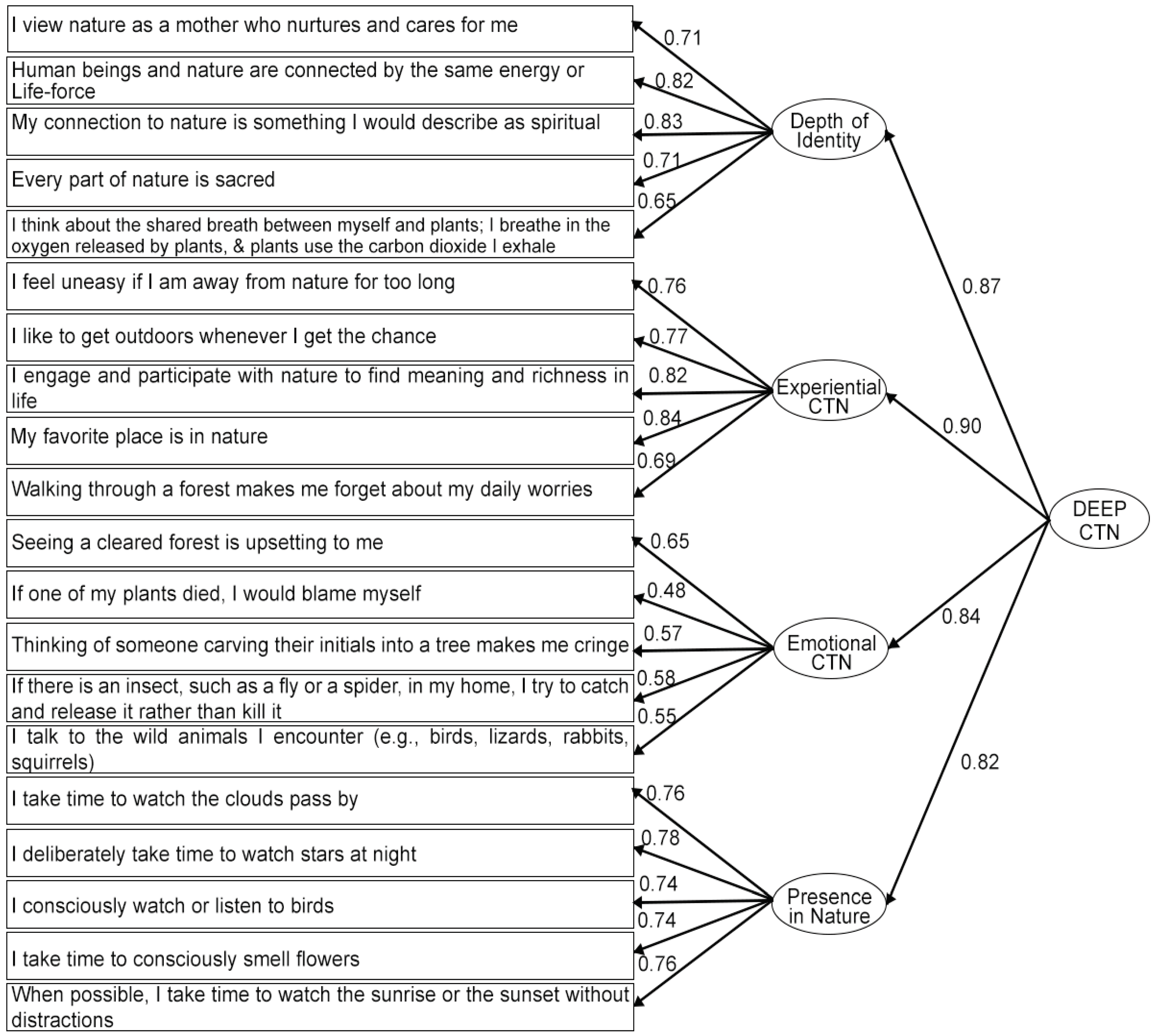

Table 1.
New 20-item DEEP Connection to Nature Scale.
| Item | Dimension |
|---|---|
| I view nature as a mother who nurtures and cares for me | Depth of Identity |
| Human beings and nature are connected by the same energy or Life-force | Depth of Identity |
| My connection to nature is something I would describe as spiritual | Depth of Identity |
| Every part of nature is sacred | Depth of Identity |
| I think about the shared breath between myself and plants; I breathe in the oxygen released by plants, and plants use the carbon dioxide I exhale | Depth of Identity |
| Seeing a cleared forest is upsetting to me | Emotional Connection |
| If one of my plants died, I would blame myself | Emotional Connection |
| Thinking of someone carving their initials into a tree makes me cringe | Emotional Connection |
| If there is an insect, such as a fly or a spider, in my home, I try to catch and release it rather than kill it | Emotional Connection |
| I talk to the wild animals I encounter (e.g., birds, lizards, rabbits, squirrels) | Emotional Connection |
| I like to get outdoors whenever I get the chance | Experiential Connection |
| I feel uneasy if I am away from nature for too long | Experiential Connection |
| I engage and participate with nature to find meaning and richness in life | Experiential Connection |
| My favorite place is in nature | Experiential Connection |
| Walking through a forest makes me forget about my daily worries | Experiential Connection |
| I take time to watch the clouds pass by | Presence within Nature |
| I deliberately take time to watch stars at night | Presence within Nature |
| I consciously watch or listen to birds | Presence within Nature |
| I take time to consciously smell flowers | Presence within Nature |
| When possible, I take time to watch the sunrise or the sunset without distractions | Presence within Nature |
Note: This table displays the full list of items for the new DEEP Connection to Nature scale. CFA confirmed a four-factor structure. The Cronbach’s alpha for each dimension was: Depth = 0.86, Experience = 0.88, Emotional = 0.70, and Presence 0.87 (see Results for details).
Table 2.
Descriptive Statistics, Internal Consistency, and Bivariate Correlations of the DEEP CTN Scale.
Table 2.
Descriptive Statistics, Internal Consistency, and Bivariate Correlations of the DEEP CTN Scale.
| Dimension | M (SD) | α | 1 | 2 | 3 | 4 |
|---|---|---|---|---|---|---|
| 1. Depth | 4.69 (1.46) | 0.86 | ||||
| 3. Emotional | 4.59 (1.34) | 0.70 | 0.54*** | |||
| 2. Experiential | 4.88 (1.44) | 0.88 | 0.70*** | 0.57*** | ||
| 4. Presence | 4.56 (1.37) | 0.87 | 0.61*** | 0.57*** | 0.58*** | |
| 5. Total | 4.68 (1.18) | 0.93 | 0.85*** | 0.80*** | 0.85*** | 0.81*** |
Note. M represents mean, SD represents standard deviation and α represents Cronbach’s alpha. All correlations had 315 degrees of freedom; *** p < .001.
Table 3.
Comparative Fit indices for each model.
| Model | χ² (df) | RMSEA (95% CI) | RMSR | TLI | CFI | AIC |
|---|---|---|---|---|---|---|
| 1-factor | 676.43 (170) | 0.11 (0.1 - 0.12) | 0.07 | 0.78 | 0.80 | 22,833.50 |
| 4-factor hierarchical | 358.4 (164) | 0.07 (0.06 - 0.08) | 0.05 | 0.91 | 0.93 | 22,446.42 |
| 4-factor | 366.6 (166) | 0.07 (0.06 - 0.08) | 0.05 | 0.91 | 0.92 | 22,452.24 |
Note: Chi-Square (χ²): Closer to 0 indicate better fit; Root mean square error (RMSEA): 0.01 = Excellent; 0.05 = Good; 0.08 = Mediocre; Standardized root mean square residual (RMSR): Closer to 0 indicate better fit; Tucker Lewis Index (TLI): Closer to 1 indicates better fit; Comparative fit index (CFI): Closer to 1 indicates better fit; Akaike’s Information Criterion (AIC): The lower the AIC, the more predictive.
Table 4.
Spearman correlations between DEEP CTN Scale dimensions and existing measures of Connection to Nature.
Table 4.
Spearman correlations between DEEP CTN Scale dimensions and existing measures of Connection to Nature.
| Total Score | Deep | Experiential | Emotional | Presence | |
|---|---|---|---|---|---|
| CNS | 0.72*** | 0.75*** | 0.62*** | 0.50*** | 0.53*** |
| EIDR | 0.78*** | 0.63*** | 0.81*** | 0.58*** | 0.55*** |
Note: CNS = Connectedness to Nature Scale; EID-r = Environmental Identity Scale - revised; *** p < 0.001.
Table 5.
Correlations between DEEP CTN Scale dimensions, PEB, and WB.
| Total Score | Deep | Emotional | Experiential | Presence | |
|---|---|---|---|---|---|
| PEB | 0.53*** | 0.44*** | 0.45*** | 0.44*** | 0.46*** |
| WB | 0.39*** | 0.42*** | 0.17** | 0.34*** | 0.39*** |
Note: PEB = Pro-environmental behavior; WB = Well-being; *** p < 0.001.
Table 6.
Linear regressions showing predictive and incremental validity of the new DEEP CTN Scale dimensions when predicting PEB.
Table 6.
Linear regressions showing predictive and incremental validity of the new DEEP CTN Scale dimensions when predicting PEB.
| Predictive Validity | Incremental Validity | |||||
|---|---|---|---|---|---|---|
| Variable | Partial R2 | p | std Beta (99% CI) | Partial R2 | p | std Beta (99% CI) |
| Deep | 0.07 | 0.05 | 0.14 (0 - 0.28) | 0.06 | 0.36 | 0.07 (-0.08 - 0.22) |
| Emotional | 0.08*** | 0.00 | 0.21 (0.08 - 0.34) | 0.08*** | 0.00 | 0.22 (0.1 - 0.35) |
| Experiential | 0.07 | 0.08 | 0.12 (-0.02 - 0.27) | 0.06 | 0.09 | 0.12 (-0.02 - 0.26) |
| Presence | 0.08** | 0.01 | 0.17 (0.04 - 0.31) | 0.07* | 0.04 | 0.14 (0.01 - 0.28) |
| Primal Worldviews | 0.04** | 0.01 | 0.14 (0.03 - 0.25) | |||
| Age | 0.01 | 0.17 | 0 (0 - 0.01) | |||
| Model R2 | 0.30 | 0.31 | ||||
Note: std Beta < 0.29 = small; std Beta < 0.49 = medium; std Beta > 0.50 = large.
Table 7.
Linear regressions showing exploratory findings of the new DEEP CTN Scale dimensions and covariates when predicting WB.
Table 7.
Linear regressions showing exploratory findings of the new DEEP CTN Scale dimensions and covariates when predicting WB.
| Predictive Validity | Incremental Validity | |||||
|---|---|---|---|---|---|---|
| Variable | Partial R2 | p | std Beta (99% CI) | Partial R2 | p | std Beta (99% CI) |
| Deep | 0.09*** | 0.00 | 0.22 (0.1 - 0.34) | 0.06* | 0.04 | 0.13 (0 - 0.25) |
| Emotional | 0.02** | 0.01 | -0.15 (-0.26 - -0.04) | 0.01 | 0.07 | -0.1 (-0.2 - 0.01) |
| Experiential | 0.05 | 0.11 | 0.10 (-0.02 - 0.22) | 0.04 | 0.27 | 0.07 (-0.05 - 0.18) |
| Presence | 0.08*** | 0.00 | 0.23 (0.11 - 0.34) | 0.07*** | 0.00 | 0.19 (0.08 - 0.3) |
| Worldviews | 0.07*** | 0.00 | 0.18 (0.09 - 0.27) | |||
| Politics | 0.04*** | 0.00 | 0.14 (0.06 - 0.22) | |||
| Age | 0.02* | 0.04 | 0.01 (0 - 0.01) | |||
| Model R2 | 0.24 | 0.31 | ||||
Note: std Beta < 0.29 = small; std Beta < 0.49 = medium; std Beta > 0.50 = large.
Disclaimer/Publisher’s Note: The statements, opinions and data contained in all publications are solely those of the individual author(s) and contributor(s) and not of MDPI and/or the editor(s). MDPI and/or the editor(s) disclaim responsibility for any injury to people or property resulting from any ideas, methods, instructions or products referred to in the content. |
© 2025 by the authors. Licensee MDPI, Basel, Switzerland. This article is an open access article distributed under the terms and conditions of the Creative Commons Attribution (CC BY) license (http://creativecommons.org/licenses/by/4.0/).
Copyright: This open access article is published under a Creative Commons CC BY 4.0 license, which permit the free download, distribution, and reuse, provided that the author and preprint are cited in any reuse.


