

Submitted:
09 May 2025
Posted:
09 May 2025
You are already at the latest version
Abstract
Diurnal butterflies (Papilionoidea), considered bioindicators of habitat conservation status, are one of the groups used to assess the impact of habitat management and improvement efforts in the Biological Station of Torretes (Ibi, Alicante, Spain). This area also houses the Botanical Garden of the University of Alicante. The study focused on the period from autumn 2022 to late spring 2023, comparing butterfly diversity and abundance data from the current study with historical data. Our results highlight that open spaces and the availability of trophic resources (nutritional plants) were key factors influencing the richness and abundance of Papilionoidea. The program for the creation and maintenance of new habitats at the Biological Station has increased spatial heterogeneity and the availability of trophic resources, which has led to a significant increase in the richness and abundance of diurnal butterflies in a short period. To support the conservation of Mediterranean ecosystems, entomofauna in general, and Papilionoidea in particular, are proposed as model groups for designing conservation projects based on traditional habitat management. These projects should promote spatial heterogeneity, include programs to enrich plant diversity, and be complemented by environmental education and outreach initiatives.
Keywords:
protected natural areas
; habitat management
; butterfly conservation
; entomological reserves
; Mediterranean ecosystems
1. Introduction
The extinction rate of insect species, both locally and globally, has risen significantly in recent decades, becoming a major scientific concern [1]. Highlighting this issue, the Manifesto of Iberian Entomologists emerged from the XX Iberian Congress of Entomology in June 2023, urging action to stop this decline and raise public awareness about the vital role of insects in ecosystems (https://www.entomologica.es/manifiesto-xx-congreso-iberico-de-entomologia). Lepidoptera is one of the most diverse and well-studied orders of insects, which has historically aroused both scientific and social interest [3]. The extensive knowledge available about their biology and diversity has fueled numerous studies in ecology, evolution, and conservation [4]. Their key ecological roles and sensitivity to environmental changes make them excellent bioindicators [2,3,4,5], which has strengthened their value as a "star group" for promoting biodiversity conservation and education programs [2]. Within Lepidoptera, the Papilionoidea have received special attention due to their captivating beauty, easy observation, and well-known taxonomy. This superfamily encompasses six families in Europe: Hesperiidae, Lycaenidae, Nymphalidae, Papilionidae, Pieridae, and Riodinidae [6,7]. Many representatives have been identified as crucial pollinators of natural ecosystems and agricultural crops [8] and bioindicators of environmental health [3,9,10].
The Iberian Peninsula, a biodiversity hotspot in Europe [11,12], boasts a rich mosaic of habitats shaped by a long history of human activity [12,13,14,15,16,17]. This high spatial heterogeneity contributes to the peninsula's remarkable butterfly diversity. Over 250 butterfly species have been recorded in Spain, rivalling the numbers found in Italy, Greece or Turkey [18,19]. Notably, 21 species are endemic to the Iberian Peninsula [1,20].
However, like many other insect groups, butterflies face numerous threats. Landscape alteration and fragmentation, agricultural intensification, infrastructure development and the introduction of invasive species all contribute to butterfly decline [1,7,17,21,22,23,24]. Climate change further exacerbates these threats, particularly in the Mediterranean region, where aridity is increasing, thus altering landscape functioning and displacing species to higher altitudes or towards more northern latitudes [23,25,26,27,28,29].
For this study, the Torretes Biological Station (Ibi, Alicante, Spain) was selected to assess how management diversification programs in protected Mediterranean natural areas may drive and enhance diversity patterns, using the Papilionoidea as a response group. Located in the municipality of Ibi and managed by the CIBIO Research Institute (Centro Iberoamericano de la Biodiversidad) of the University of Alicante, this natural area has become an important space for biodiversity conservation and environmental dissemination through a land stewardship agreement between the Ibi City Council and the CIBIO Institute. In view of its exceptional biodiversity, this enclave was recognized in 2019 as an Entomological Reserve by the Spanish Association of Entomology (https://www.entomologica.es/torretes). In addition, Torretes houses the University of Alicante Botanical Garden. All this is indicative of the uniqueness of this natural space.
The objectives of this study were: a) to assess diversity patterns (richness, ecological diversity and composition) of diurnal butterflies in Torretes, b) to identify temporal changes in the diurnal butterfly community of Torretes through comparisons with previous studies, and c) to propose specific actions to improve the management and conservation of Mediterranean habitats.
2. Materials and Methods
The study was conducted at the Torretes Biological Station (Spain), a former Mediterranean farm that has been transformed into a site for research, conservation and scientific outreach. The area covers 53 ha, 44 of which are forested areas and the remaining 9 are agricultural land. It is located in the north part of the province of Alicante, on the southern slope of the Carrascal de la Font Roja Natural Park, between 900 and 1100 m a.s.l. The climate is Mediterranean, with certain continental influence due to the altitude, characterized by cool winters with occasional frosts and short, warm summers. The average annual temperature of 14.8 ºC and average annual precipitation of 459.5 mm [30,31]. The station is located between the dry mesomediterranean and subhumid supramediterranean levels, with potential vegetation of Kermes oak (Quercus coccifera L.) and deciduous formations in the shadiest points.
For this study, the four types of habitats present at the Torretes Biological Station [32] were considered (Figure 1):
a) Gully. This habitat, characterized by significant depth and substantial vegetation cover, maintains higher humidity and a lower average morning temperature than the other habitats. It is dominated by a holm oak forest (Quercus rotundifolia Lam.) with scrub and scattered specimens of Aleppo pines (Pinus halepensis Mill.) and junipers (Juniperus oxycedrus L.). Two permanent water points along its course support edaphohygrophilous vegetation such as water lilies (Ninfea alba L.) and yellow iris (Iris pseudacorus L.).
b) Terrace system 1. This habitat is composed of old cultivation terraces of almond trees (Prunus dulcis D.A.Webb) and olive trees (Olea europaea L.) that are surrounded by typical Mediterranean scrublands with scattered holm oaks and a small patch of Aleppo pines. This terrace system is part of the Botanical Garden and houses an important collection of lilies (Iris spp.) and sages (Salvia spp.), as well as gymnosperms (firs, pines, cypresses, yews, cedars, sequoias, etc.). This open space is highly exposed to adverse environmental conditions, especially solar radiation and wind.
c) Terrace system 2. This heterogeneous terrace system includes several buildings, greenhouses and a complex system of plantations, which from its origin was designed to house important botanical collections, with emphasis on typically Mediterranean botanical groups such as Lamiaceae. This is an open space that presents two small ponds with aquatic and edaphohygrophilous plants. This habitat is the heart of the Botanical Garden, where most actions are carried out to promote plant biodiversity
d) Pine forest. This area is predominantly dominated by Aleppo pine but includes Mediterranean plant endemism such as Mariola sage (Salvia blancoana subsp. mariolensis Figuerola), the Alicante lavender (Thymus moroderi Pau ex Martínez) or the royal thyme (Dictamnus albus L.). Scattered patches of scrubs and some solitary holm oaks are also present.
Species surveys were conducted out according to the method of POLLARD & YATES [33], Transects ranging from 300 and 400 meters were established (Figure 1), with a sampling duration of 30 minutes per transect. Weather permitting, sampling occurred every 10 days over six months, from October 2022 to mid-May 2023, excluding January and February due to low temperatures and limited flight activity. Sampling was carried out on sunny days with minimal wind, between 8:30 AM and 12:00 PM solar time, a period of high activity for diurnal butterflies.
Three different sampling methods were employed to collect data: using an entomological net, photographing individuals, and conducting in situ identification. A total of 11 samplings events were conducted in each habitat.
For statistical analyses, individuals of the genus Pieris that could not be identified in flight to the species level were excluded (Table 1) to avoid potential biases in the analysis. Differences in diversity patterns among habitats (spatial variation) were analysed. Sampling coverage was estimated for each habitats (Ĉm) [34], which ranges from 0 (zero completeness) to 100% (maximum completeness). To assess spatial changes in diversity patterns, Hill numbers (qD) of orders 0D and 1D were used [35]. The 95% confidence intervals were used to compare qD values [36]. These analyses were performed using iNEXT v2 statistical software [37,38].
Finally, to analyse differences in species composition among habitats, a permutational multivariate analysis of variance (PERMANOVA) was conducted using the Bray-Curtis index and 999 permutations [39]. Multidimensional scaling (MDS) was employed to visualize the relative positions of samples based on their species composition similarity. Bootstrap procedures were used for this analysis and for plotting 95% confidence ellipses. Both PERMANOVA and MDS were performed using PRIMER v7 software [40].
3. Results
A total of 957 individuals were recorded, representing 41 species (Table 1). Lasiommata megera and Leptotes pirithous were the most abundant species, with a total of 83 and 82 individuals, respectively.
Sampling coverage (Ĉm) ranged from 0.95 to 0.99 in all habitats studied, indicating adequate sampling effort. Regarding species richness (0D), significant differences were only found between Ravine-Terrace2 and Pine forest-Terrace2 (Figure 2). In contrast, significant differences in ecological diversity (1D) were observed in all habitat’s combinations): Ravine-Terrace1, Ravine-Terrace2, Pine forest-Terrace1, Pine forest-Terrace2 and Terrace1-Terrace2, except in the case of Ravine-Pine forest (Figure 2).
PERMANOVA analysis revealed that all studied habitats exhibited statistically differences in species composition (Fpseudo = 2.88, df = 3, p < 0.001). No overlap between habitats or ellipses found in any case (Figure 3). This finding reflects a high level of complementarity among the studied habitats in terms of overall Papilionoid diversity.
4. Discussion
The Torretes Biological Station revealed a remarkable biodiversity of diurnal butterflies (41 species and 957 individuals) in the period studied between 2022 and 2023. This represents a significant increase in both diversity and abundance compared to a previous study conducted in 2004 using the same methodology and within the same habitats [43], in which recorded 32 species and 563 individuals. This relatively small natural protected area encompasses approximately 60% of the butterfly species known in the inland mountain ranges of the northern part of the Alicante province [41,42,43]. The richness and abundance of butterflies are strongly influenced by landscape heterogeneity and habitat diversity [45]. These factors provide essential shelter and food resources, including nutritious plants for caterpillars and nectar sources for adults [46,47]. At the Torretes Biological Station, recent habitat management and improvement initiatives, coupled with the establishment of the University of Alicante Botanical Garden, have significantly enhanced habitat diversity and plant richness. Management diversification of habitats inherently promoted greater availability of resources, which seem to benefit the overall biodiversity of butterflies in Torretes in the long term.
The highest values of species richness and ecological diversity were observed in the two assessed terraced systems. These managed habitats are characterized by heterogeneous and abundant trophic resources, and present extensive sunny areas (low vegetation cover) that are used by many butterfly species for thermoregulation [48,49]. In Terrace 2, the most diverse habitat, exhibit a notable presence of butterfly species such as Pontia daplidice, Colias crocea and Leptotes pirithous, which are known to prefer open and warm environments [50]. Moreover, the presence of water points and the high concentration of aromatic plant species within Terrace 2 could also be contributing to the observed diversity patterns [47,51].
In contrast, the gully and the pine forest habitats presented similar values of richness and ecological diversity. On the one hand, the gully presented a high number of individuals of certain specialist species (rarely found in the other habitats)), such as Pararge aegeria, Goneopteryx cleopatra and Anthocharis euphenoides, which are associated with more humid environments or the presence of water sources [41,52,53,54,55]. On the other hand, in the pine forest habitat, clearly more homogeneous and less suitable for butterflies [56], no remarkable species were found.
The observed continuous rise in both diversity and abundance of butterflies in less than a decade underscores the critical importance of proper management diversification strategies for natural areas [57]. Since the establishment of the Biological Station in 2003, a program of habitat restoration, management and diversification has been developed and progressively implemented. For instance, this strenuous effort resulted in the creation of the University of Alicante Botanical Garden in 2012 and the Entomological Reserve by the Spanish Association of Entomology in 2019. The management initiatives undertaken in this protected natural area have resulted in the improvement of habitats with multiple trophic resources, fostering biodiversity and transforming into a Reserve renowned for its high Mediterranean entomological diversity [33]. Our findings pave the way for the design of new educational programs featuring strategic itineraries with informative butterfly displays, incorporating information on their food plants and habitats. These programs have the potential to spark curiosity among visitors and raise societal awareness about the need to develop and implement insect conservation programs.
Author Contributions
Formal analysis, Javier Quinto, Elena Espin and Eduardo Galante; Funding acquisition, Eduardo Galante; Investigation, Javier Quinto, Elena Espin and Eduardo Galante; Methodology, Javier Quinto, Elena Espin and Eduardo Galante; Project administration, Eduardo Galante; Resources, Eduardo Galante; Supervision, Eduardo Galante; Writing – original draft, Javier Quinto, Elena Espin and Eduardo Galante; Writing – review & editing, Javier Quinto and Eduardo Galante.
Funding
This research was funded by the group Biodiversity and Biotechnology in Conservation Biology of the Research Institute CIBIO, University of Alicante.
Data Availability Statement
The raw data supporting the conclusions of this article will be made available by the authors on request.
Acknowledgments
We thank the staff of the Torretes Biological Station for facilitating the development of this research.
Conflicts of Interest
The authors declare no conflicts of interest.
References
- Aragón, P.; Sánchez-Fernández, D.; Hernando, C. Use of satellite images to characterize the spatio-temporal dynamics of primary productivity in hotspots of endemic Iberian butterflies. Ecological Indicators, 2019, 106, 105449. [Google Scholar] [CrossRef]
- Kellert, S.R. Values and Perceptions of Invertebrates. Conservation Biology 1993, 7(4): 845-855.
- Levente, S.; Ștefănescu R.; Cernea E. The butterflies of Romania/Fluturii de zi din România. Editorial Brasov County History Museum 2008, 305 pp.
- Boggs, C.L.; Watt W.B.; Ehrlich P.R. Butterflies. Ecology and evolution taking flight. Editorial University of Chicago Press, 2003, 739 pp.
- Thomas, J.A.; Clarke, R.T. Extinction rates and butterflies. Science 2004, 325: 80-83. [CrossRef]
- Nieukerken, Ej.; Kaila, L.; Kitching, I.J.; Kristensen, N.P.; Lees, D.C.; et al. Order Lepidoptera Linnaeus, 1758. In Animal biodiversity: An outline of higher-level classification and survey of taxonomic richness, Zhang, Z.-Q. Ed., Zootaxa, 2011, 3148, 212–221. [CrossRef]
- Numa, C.; Van Swaay C.; Wynhoff I.; Wiemers M.; Barrios V.; Allen D.; Sayer C.; López Munguira M.; Balletto E.; Benyamini D.; Beshkov S.; Bonelli S.; Caruana R.; Dapporto L.; Franeta F.; Garcia-Pereira P.; Karaçetin E.; Katbeh-Bader A.; Maes D.; Micevski N.; Miller R.; Monteiro E.,; Moulai R.; Nieto A.; Pamperis L.; Pe’er G.; Power A.; Šašić M.; Thompson K.; Tzirkalli E.; Verovnik R.; Warren M.; Welch H.. The status and distribution of Mediterranean butterflies. IUCN, Malaga, Spain. 2016, 32 pp.
- Ollerton, J.; Tarrant, S.; Winfree, R. How many flowering plants are pollinated by animals? Oikos 2011, 120, 321–326. [Google Scholar] [CrossRef]
- Pearson, D.L. Selecting indicator taxa for the quantitative assessment of biodiversity, Philosophical Transactions of the Royal Society of London. Series B,Biological Sciences, 1994, 345(1311): 75-79. [CrossRef]
- New, T.; Pyle R.M.; Thomas J.A.; Thomas C.D.; Hammond P.C. Butterfly conservation management. Annual Review of Entomology 1995, 40: 57-83.
- Blondel, J.; Aronson J. Biology and wildlife of the Mediterranean region. Oxford University Press, Oxford, 1999, 327 pp.
- Myers, N.; Mittermeier R.A.; Mittermeier, C.G.; Da Fonseca G.A.B.; Kent, J. Biodiversity hotspots for conservation priorities. Nature, 2000, 403: 853-858. [CrossRef]
- Lucio, J.V.; Gómez Limón J. Percepción de la diversidad paisajística. In La Diversidad Biológica de España, Pineda, F.; De Miguel J.; Casado M. Eds., Prentice Hall, Madrid 2002, 101-110.
- Galante, E. Diversité entomologique et activité agro-sylvo-pastorale. In Conservation de la biodiversité dans les paysages ruraux européens, Lumaret J.P.; Jaulin S.; Soldati F.; Pinault G.; Dupont P. Eds., UPV/CIBIO/PNR de la Narbonnaise en Méditerranée/OPIE-LR, Montpellier 2005, 185 pp.
- Galante, E.; Marcos-García M.A., El Bosque Mediterráneo. Los Invertebrados. In La Red española de Parques Nacionales, García-Canseco V.; Asensio B. Eds., Ministerio de Medio Ambiente, Madrid 2004, 272-282.
- Galante, E.; Marcos-García M.A. El bosque mediterráneo ibérico: un mundo manejado y cambiante. In Los insectos saproxílicos del Parque Nacional de Organismo Autónomo de Parques Nacionales, Micó, E.; Galante, E.; Marcos-García M.A., Eds., Ministerio de Agricultura, Alimentación y Medio Ambiente, Madrid. Cabañeros 2013, 12-32.
- Sundseth, K. Natura 2000 in the Mediterranean Region. Luxembourg, Directorate General for the Environment (European Commission) 2009, https://data.europa.eu/doi/10.2779/77695.
- Van Swaay, C.A.M.; Warren, M.S. Red Data book of European butterflies (Rhopalocera). Nature and Environment, 1999, 99, Council of Europe Publishing,Strasbourg, https://www.researchgate.net/publication/234022271.
- García-Barros, E.; Romo H.; Monteys V.; Munguira M.L.; Baixeras J.; Moreno A.V; Yela García J.L. Clase Insecta. Orden Lepidoptera. Revista IDE@-SEA 2015 65: 1-21.
- Asociación Zerynthia, Mariposas de España. Listado de especies de las mariposas de España. 2023, https://www.asociacion-zerynthia.org/especies.
- Galante, E. Los Insectos, esos pequeños seres imprescindibles para nuestra vida. In Bases técnicas para la conservación de los lepidópteros amenazados en España, Jubete, F. (Coord.); Barea-Azcón J.M; Escobés R.; Galante E.; Gómez-Calmaestra R.; Manceñido D.C-; Monasterio Y.; Mora A.; Munguira M.L.; Stefanescu C.; Tinaut A., Eds.; Asociación de Naturalistas Palentinos 2019, 15-25.
- Cardoso, P.; Barton, P.H.S.; Birkhofer, K.; Chichorro, F.; Deacon, C.H.; Fartmann, T.H.; Fukushima, C.S.; Gaigher, R.; Habel, J.C.; Hallmann, C.A.; Hill, M.J.; Hochkirch, A.; Kwak, M.L.; Mammola, S.T.; Noriega, J.A.; Orfinger, A.B.; Pedraza, F.; Pryke, J.S.; Roque, F.O.; Settele, J.; Simaika, J.; Pstork, N.E.; Suhling, F.; Vorster, C.; Samways, M.J. Scientists' warning to humanity on insect extinctions. Biological Conservation, 2020, 242, 108426. [Google Scholar] [CrossRef]
- Raven, P.H.; Wagner, D.L. Agricultural intensification and climate change are rapidly decreasing insect diversity. PNAS, 2020, 11(2). [CrossRef]
- Köthe, S.; Bakanov N.; Brühl C.A.; Eichler L.; Fickel T.; Gemeinholzer B.; Hörren T.; Jurewicz A.; Lux A.; Meinel G.; Mühlethaler R.; Schäffler L.; Scherber C.; Schneider F.D.; Sorg M.; Swenson S.J.; Terlau W.; Turck A.; Lehmann G.U.C. Recommendations for effective insect conservation in nature protected areas based on a transdisciplinary project in Germany. Environmental Sciences Europe, 2023, 35:102. [CrossRef]
- Parmesan, C.; Ryrholm N.; Stefanescu C.; Hill J.K.; Thomas Ch.D.; Descimon H.; Huntley B.R.; Kaila L.; Kullberg J.; Tammaru T.; Tennent W.J.; Thomas J.A.; Warren M., Poleward shifts in geographical ranges of butterfly species associated with regional warming. Nature 1999, 399, 579-583.
- Wilson, R.J.; Gutiérrez, D.; Gutiérrez, J.; Monserrat, V.J. An elevational shift in butterfly species richness and composition accompanying recent climate change. Global Change Biology, 2007, 13(9), 1873-1887. [CrossRef]
- Settele, J., Kudrna, O., Harpke, A.; Kühn, I.; Van Swaay, Ch.; Verovnik, R.; Warren, M.; Wiemers, M.; Hanspach, J. ; Hickler, T.H.; Kühn, E.; Van Halder, I. ; Veling, K.; Vliegenthart, A.; Wynhoff I.; Schweiger, O. Climatic Risk Atlas of European Butterflies. Pensift Publishers, Sofia. Bulgaria 2008, 172 pp. [CrossRef]
- Devictor, V.; Van Swaay C.; Brereton T.; Brotons L.; Chamberlain D.; Heliölä J.; Herrando S.; Julliard R.; Kuussaari M.; Lindström Å.; Reif J.; Roy D.B.; Schweiger O.; Settele J.; Stefanescu C.; Van Strien A.; Van Turnhout C.; Vermouzek Z.; Wallisdevries M.; Wynhoff I.; Frédéric J. Differences in the climate debts of birds and butterflies at a continental scale. Nature Climate Change 2012., 2, 121-124. [CrossRef]
- Rödder, D.; Schmitt,T.H., Gross, P., Ulrich, W.; Habel, J Ch. Climate change drives mountain butterfies towards the summits. Scientific Reports 2021, 11, 14382. [CrossRef]
- Sánchez, E.M.; Esteban, M.; Aniorte, N.; Ricarte, A.; Marcos-García, M.A. Diversidad de sírfidos (Dipteta: Syrphidae) de la Estación Biológica de Torretes (Alicante, España). Cuadernos de Biodiversidad 2017, 52(52), 38-45. [CrossRef]
- Dades climatològiques de Ibi Torretes/ Font Roja, Avamet, Asociación Valenciana de Meteorología, 2023, https://www.avamet.org/mx-clima.php?
- Ríos, S.; Martínez-Francés V.; Eslava A.; Poyatos R. Guía de la estación biológica. Jardín botánico de Torretes. Editorial Publicaciones de la Universidad de Alicante 2021, 61 pp.
- Pollard, E.; Yates T.J. Monitoring Butterflies for Ecology and Conservation: The British Butterfly Monitoring Scheme. Editorial Springer Science & Business Media 1993, 274 pp.
- Chao, A.; Jost L. Coverage-based rarefaction and extrapolation: standardizing samples by completeness rather than size. Ecology, 2012, 93(12): 2533-2547. [CrossRef]
- Jost, L.; González-Oreja A. Midiendo la diversidad biológica: más allá del índice de Shannon. Acta Zoologica Lilloana 2012, 56: 3-14.
- Cumming, G.; Fidler F.; Vaux D.L. Error bars in experimental biology, The Journal of Cell Biology, 2007, 177(1): 7-11. [CrossRef]
- Chao, A; Gotelli N.J.; Hsieh T.C.; Sander E.L.; Ma K.H.; Colwell R.K.; Ellison A.M. Rarefaction and extrapolation with Hill numbers: A framework for sampling and estimation in species diversity studies. Ecological Monographs, 2014, 84, 45-67. [CrossRef]
- Chao, A; Ma K.H.; Hsieh T.C. iNEXT Online: Software for Interpolation and Extrapolation of Species Diversity. Program and User’s Guide published 2016 http://chao.stat.nthu.edu.tw/wordpress/software_download/inextonline/.
- Bray, J.R.; Curtis, J.T. An Ordination of the Upland Forest Communities of Southern Wisconsin, Ecological Monographs, 1957, 27(4), 325-349. [CrossRef]
- Clarke, K.R.; Gorley R.N. PRIMER v7; PRIMER-E: Plymouth’. UK. 2015, https://www.primer-e.com/our-software/primer-version-7/.
- Robert, J.H.; Escarré, A.; García, T.; Martínez, P. Fauna Alicantina IV. Lepidópteros Ropalóceros, sus plantas nutricias y su distribución geográfica en la provincia de Alicante. Editorial Instituto de Estudios Alicantinos 1983, 435 pp.
- Viejo, J.L.; Llorente, J.J.; Martín, J.; Sánchez, C. Patrones de distribución de las mariposas de Alicante (Lepidoptera, Papilionoidea y Hesperoidea). Ecología 1994, 8, 453–458. [Google Scholar]
- García-Barros, E.; Munguira, M.L.; Martín Cano, J.; Romo Benito, H.; Garcia-Pereira, P.; Maravalhas, S. Atlas de las mariposas diurnas de la Península Ibérica e islas Baleares (Lepidoptera: Papilionoidea & Hesperioidea) Atlas of the butterflies of the Iberian Peninsula and Balearic Islands (Lepidoptera: Papilionoidea & Hesperioidea). MONOGRAFÍAS SEA 11, Sociedad Entomológica Aragonesa (SEA), Zaragoza 2004, 231 pp.
- Castaño, F.; Galante E. Mariposas diurnas (Lepidoptera) de la Estación Biológica de Torretes (Ibi, Alicante). Cuadernos de Biodiversidad, 2018, 55(55):, 41-53. [CrossRef]
- Atauri, J.A. , De Lucio J.V. The role of landscape structure in species richness distribution of birds, amphibians, reptiles and lepidopterans in Mediterranean landscapes. Landscape Ecology, 2001, 16, 147–159. [Google Scholar] [CrossRef]
- Curtis, R.J.; Brereton T.M; Dennis R.L.H.; Carbone C.; Isaac N.J.B., Butterfly abundance is determined by food availability and is mediated by species traits. Journal of Applied Ecology, 2015. 52(6): 1676-1684. [CrossRef]
- Wix, N.; Reich, M.; Schaarschmidt, F. Butterfly richness and abundance in flower strips and field margins: the role of local habitat quality and landscape context. Heliyon, 2019 5(5).
- Clench, H.K., Behavioral Thermoregulation in Butterflies. Ecology, 1966, 47(6),1021-1034. [CrossRef]
- Barranco, M.N. Factores que influyen en la diversidad y distribución de lepidópteros en el parque estatal Flor del bosque, Puebla, México. Tesis doctoral División de Ciencias Ambientales del Instituto Potosino de Investigación Científica y Tecnológica, A.C., México. 2016, 96 pp.
- Bellmann, H. Guía de las mariposas de Europa. Editorial Omega, 2017, 448 pp.
- Niell, L.E. Effects of environmental factors on butterfly species in an urban setting. Tesis doctoral University of Nevada, Reno 2007, 46 pp.
- Wiklund, C.; Persson, A. Fecundity and the relation of egg weight variation to offspring fitness in the speckled wood butterfly Pararge aegeria, or why don’t butterfly females lay more eggs? Oikos 40(1), 53–63. [CrossRef]
- Merckx, T.; Van Dyck H. Mate location behaviour of the butterfly Pararge aegeria in woodland and fragmented landscapes. Animal Behaviour 2005, 70(2): 411-416. [CrossRef]
- González, F. Mariposas diurnas del parque regional de Sierra Espuña. Editorial Consejería de Desarrollo Sostenible y Ordenación del Territorio 2008, 228 pp.
- Moreno-Benítez, J. M, Mariposas diurnas de la Gran Senda de Málaga | Fichas descriptivas. Editorial Diputación de Málaga / Equipo Gran Senda de Málaga 2017, 11 pp.
- Pérez, J.L.; Zeledón, F.O. Diversidad de lepidópteros diurnos: Papilionidae, Pieridae y Nymphalidae en 11 hábitats de la zona núcleo de la reserva natural El Tisey, Estelí, Nicaragua, 2013. Trabajo de graduación Universidad Nacional Agraria 2014, 88 pp.
- Dennis, R.L.H. A resource-based habitat view for conservation: butterflies in the British landscape. Wiley-Blackwell, Chichester, UK, 2010, 420 pp.
Figure 1.
Satellite image of the Torretes Biological Station taken from the National Geographic Information Centre (CNIG), in which the four transects made are delimited with QGIS. pink: Terrace 1; purple: Terrace 2; orange: Gully; blue: Pine forest.
Figure 1.
Satellite image of the Torretes Biological Station taken from the National Geographic Information Centre (CNIG), in which the four transects made are delimited with QGIS. pink: Terrace 1; purple: Terrace 2; orange: Gully; blue: Pine forest.
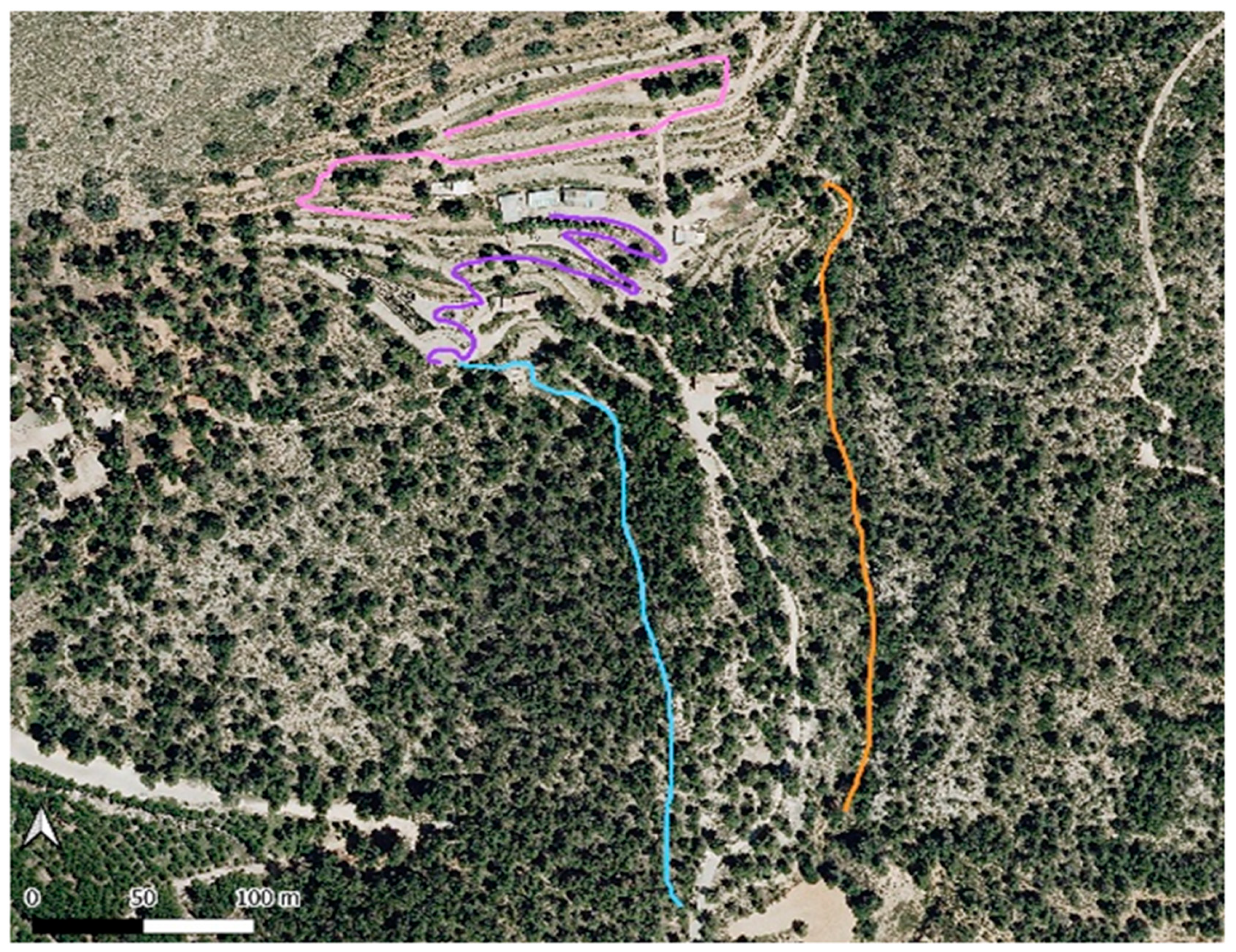
Figure 2.
Differences between habitats in species richness (0D) and ecological diversity (1D).
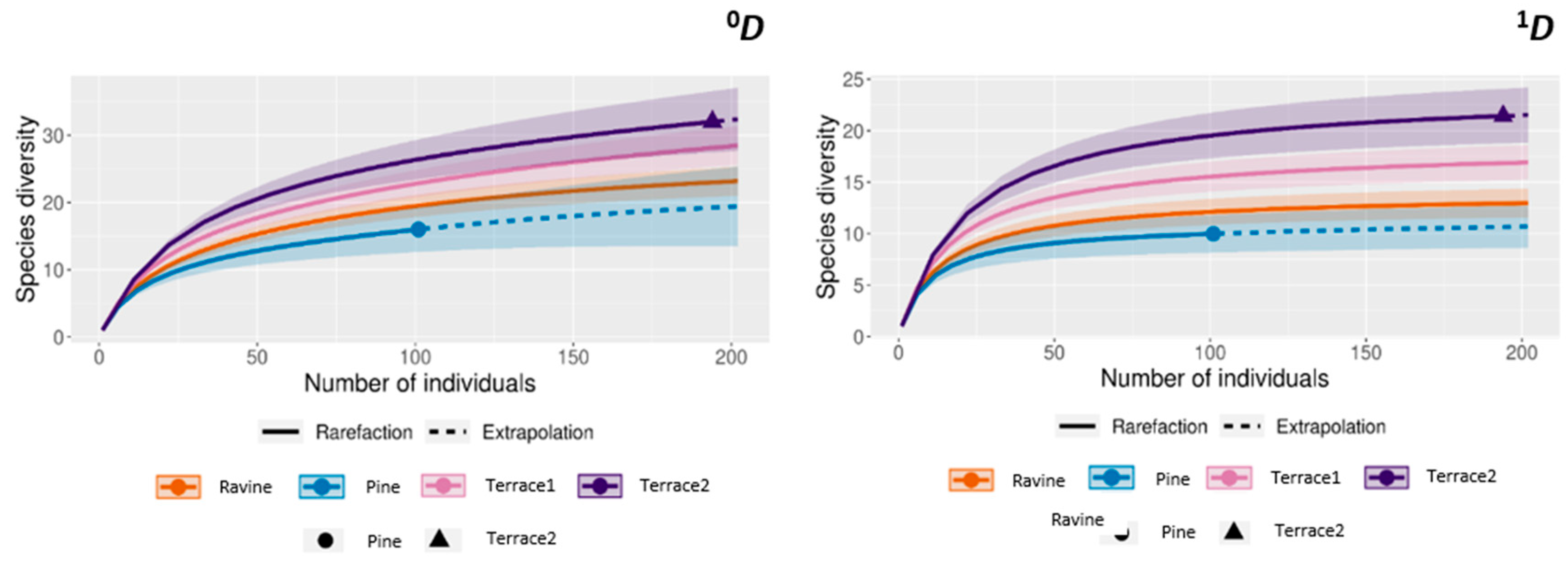
Figure 3.
MDS showing the differences in species composition among habitats.
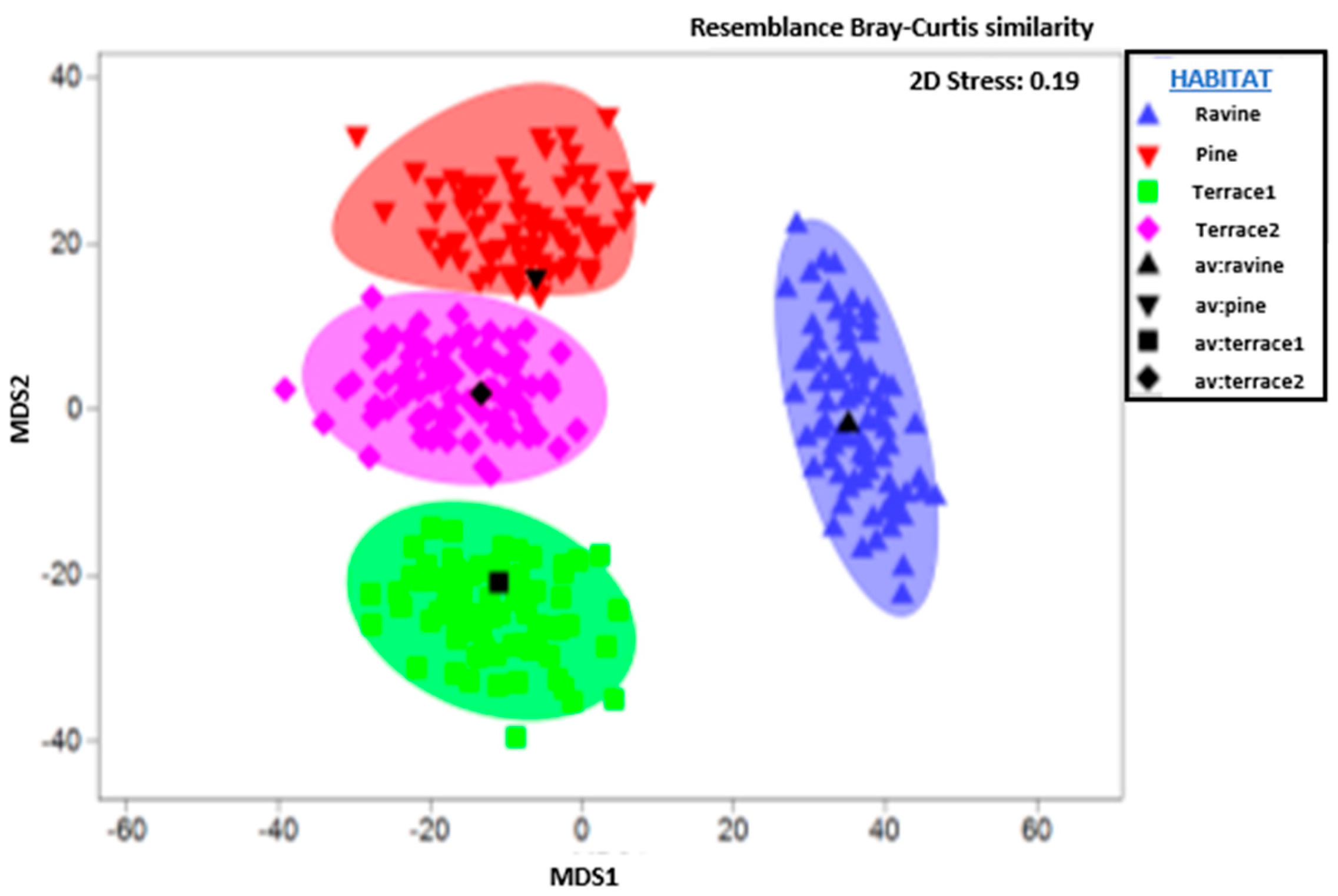

Table 1.
List of species and number of individuals recorded at the Torretes Biological Station in the study period. *Pieris sp. refers to the group of individuals recorded in flight of the species Pieris rapae and P. mannii, as these specimens could not be clearly identified.
Table 1.
List of species and number of individuals recorded at the Torretes Biological Station in the study period. *Pieris sp. refers to the group of individuals recorded in flight of the species Pieris rapae and P. mannii, as these specimens could not be clearly identified.
| Family | Species | Abundance |
|---|---|---|
| Hesperiidae | Carcharodus alceae (Esper, 1780) | 1 |
| Erynnis tages (Linnaeus, 1758) | 1 | |
| Muschampia proto (Ochsenheimer, 1808) | 4 | |
| Lycaenidae | Aricia cramera (Eschscholtz, 1821) | 6 |
| Callophrys rubi (Linnaeus, 1758) | 54 | |
| Celastrina argiolus (Linnaeus, 1758) | 2 | |
| Glaucopsyche alexis (Poda, 1761) | 4 | |
| Glaucopsyche melanops (Boisduval 1828) | 8 | |
| Lampides boeticus (Linnaeus, 1767) | 65 | |
| Leptotes pirithous (Linnaeus, 1767) | 82 | |
| Lycaena phlaeas (Linnaeus, 1761) | 1 | |
| Polyommatus bellargus (Rottemburg, 1775) | 3 | |
| Polyommatus icarus (Rottemburg, 1775) | 2 | |
| Pseudophilotes panoptes (Hübner, 1813) | 24 | |
| Satyrium spini (Denis y Schiffermüller, 1775) | 2 | |
| Nymphalidae | Hipparchia fidia (Linnaeus, 1767) | 7 |
| Hipparchia semele (Linnaeus, 1758) | 3 | |
| Hipparchia statilinus (Hufnagel, 1766) | 3 | |
| Lasiommata maera (Linnaeus, 1758) | 8 | |
| Lasiommata megera (Linnaeus, 1767) | 83 | |
| Maniola jurtina (Linnaeus, 1758) | 2 | |
| Melanargia ines (Hoffmannsegg, 1804) | 4 | |
| Melanargia occitanica (Esper, 1793) | 1 | |
| Melitaea deione (Geyer, 1832) | 6 | |
| Melitaea phoebe (Denis y Schiffermüller, 1775) | 27 | |
| Nymphalis polychloros (Linnaeus, 1758) | 3 | |
| Pararge aegeria (Linnaeus, 1758) | 73 | |
| Pyronia bathseba (Fabricius, 1793) | 70 | |
| Vanessa atalanta (Linnaeus, 1758) | 1 | |
| Vanessa cardui (Linnaeus, 1758) | 29 | |
| Papilionidae | Iphiclides feisthamelii (Duponchel, 1832) | 11 |
| Papilio machaon Linnaeus, 1758 | 8 | |
| Zerynthia rumina (Linnaeus, 1758) | 1 | |
| Pieridae | Anthocharis euphenoides Staudinger, 1869 | 42 |
| Colias croceus (Geoffroy, 1785) | 55 | |
| Gonepteryx cleopatra (Linnaeus, 1767) | 68 | |
| Leptidea sinapis (Linnaeus, 1758) | 7 | |
| Pieris brassicae (Linnaeus, 1758) | 32 | |
| Pieris mannii (Mayer, 1851) | 8 | |
| Pieris rapae (Linnaeus, 1758) | 16 | |
| *Pieris sp. Schrank, 1801 | 61 | |
| Pontia daplidice (Linnaeus, 1758) | 69 | |
| Total | 957 |
Disclaimer/Publisher’s Note: The statements, opinions and data contained in all publications are solely those of the individual author(s) and contributor(s) and not of MDPI and/or the editor(s). MDPI and/or the editor(s) disclaim responsibility for any injury to people or property resulting from any ideas, methods, instructions or products referred to in the content. |
© 2025 by the authors. Licensee MDPI, Basel, Switzerland. This article is an open access article distributed under the terms and conditions of the Creative Commons Attribution (CC BY) license (http://creativecommons.org/licenses/by/4.0/).
Copyright: This open access article is published under a Creative Commons CC BY 4.0 license, which permit the free download, distribution, and reuse, provided that the author and preprint are cited in any reuse.