

Submitted:
06 May 2025
Posted:
07 May 2025
You are already at the latest version
Abstract
The argan ecosystem (Argania spinosa) represents a vital agro-silvopastoral system, delivering ecological services and supporting rural livelihoods through high-value products such as oil, cosmetics, and pharmaceuticals. This study provides a comprehensive bibliometric analysis of 926 scientific publications to examine the evolution, structure, and gaps in argan-related research. Scientific production accelerated after 1996, during an industrial exploitation period, driven by the emergence of women’s cooperatives, international certifications, and national development programs. Morocco dominates the argan research landscape, benefiting from targeted policy support, international collaborations, and the species’ endemic status. Two major research aspects were identified: the valuation of argan oil, focusing on its chemical and therapeutic properties; and ecological restoration, encompassing genetic diversity, reforestation practices, and climate adaptation strategies. Despite these advancements, critical gaps remain in operational reforestation, assisted migration, post-plantation monitoring, and the integration of ecological modelling. Research remains skewed toward oil valuation, with insufficient attention to long-term forest sustainability under climate change. Future efforts should adopt a multidisciplinary framework that integrates genomics, nursery innovation, biotechnology, molecular genetics, digital monitoring tools, and socio-institutional governance. Research also should emphasize optimizing by-product use, enhancing climate resilience, and promoting gender-equitable, community-based forest management.
Keywords:
Argan tree
; bibliometric analysis
; climate change
; research needs
1. Introduction
Among North African countries, Morocco stands out for its exceptional diversity of endemic ecosystems [1,2,3,4]. The argan tree (Argania spinosa L. Skeels), a relict species endemic to southwest Morocco, is regarded as the only species of the Argania genus [5,6,7] and the sole representative of the tropical Sapotaceae family in North Africa [8,9]. Recent molecular phylogenetic analyses have placed Argania within the genus Sideroxylon (83 species), as S. spinosum L. [10]. Throughout this paper, we will continue to refer to argan tree by its older homotypic synonym Argania spinosa for the sake of simplicity.
In terms of its current Moroccan distribution, the range of argan tree extends from upstream of the Tensift River in the north, to the Drâa River in the south, together with surrounding areas including the southern slopes of the western High Atlas Mountains and the northern and southern slopes of the Anti-Atlas (Figure 1) [7,11]. Beyond this core region, relict populations of argan have been identified in isolated pockets in the upper end of “Grou” valley southeast of Rabat and, ultimately, in the eastern region of Morocco. Its presence is also reported in the northwestern foothills of the Béni-Snassen Protected Mountainous Area (Jbel Takermine) near the City of Oujda [5,12]. Argan is encountered sporadically in the coastal plain of Bou-Areg, where only a few remaining argan tree stands [13]. Along with its occurrence in the previously mentioned Moroccan locations, scattered stands of argan trees have been discovered and described for the first time since 1986 in west of Tindouf, as well as in certain plantations of this species around the cities of Mostaganem and Mascara (northwest coastal Algeria) [14,15].
Argan (from the Tashelhiyt or dialect Berber word of southwest Morocco) is a multi-purpose agroforestry species, which is exploited for its different parts and valued for the wide range of its high-demand products in national and international markets (cosmetic oil and pharmaceutical products). This versatility confers upon the argan tree significant importance on both socio-economic and ecological levels [7,17]. Yet, the management of Moroccan argan woodland ecosystems is very complex and requires a multi-dimensional approach [18,19].
Beyond its numerous benefits, argan oil is renowned for its exceptional nutritional properties. According to Prendergast et al. [20], it offers superior health benefits compared to olive oil. With prices exceeding 300 USD per liter, Moroccan argan oil is considered to be the most expensive food and cosmetic oil worldwide [17,21,22].
Extraction of argan oil from its kernels represents the most economically rewarding process in the harvesting and utilization of argan tree products. About four million liters of argan oil are extracted annually, making this industry a key sector in the Moroccan economy [23,24]. The extraction and commercialization of argan oil not only supports the income of many local populations, but has also been a fundamental pillar of life for the Berbers (Amazigh peoples) of southwest Morocco for centuries [21].
Argan woodland ecosystems support many endemic species and ecosystem services [25]. They cover about 8280 km2 in Morocco and have been designated by the United Nations Educational, Scientific and Cultural Organization (UNESCO) as a Biosphere Reserve since 1998 [21], given their inputs to maintaining ecological balance, soil fertility and combating desertification, supporting local socio-economic development and acting as a key driver in the fight against poverty and illiteracy. Furthermore, over-harvesting and the collection of fruit from this slow-growing, deeply rooted tree for various uses increases the risk of degrading the argan woodland, raising concerns about the long-term sustainability and resilience of this agro-sylvopastoral ecosystem [21,26,27]. These factors, in conjunction with the constraints of climate change, compromise the sustainability of argan trees, while interfering with their natural regeneration [27].
Despite numerous studies on the argan tree, synthesizing the research landscape remains challenging due to the fragmentary knowledge that has been accrued across various disciplines. Therefore, and as a complement to the pioneering work on the argan tree that was conducted by Kenny in 2007 [28] a bibliometric analysis was essential to map existing knowledge in a systematic manner, identify research gaps, and define clear research directions. Bibliometric analysis is an interdisciplinary science that represents an objective tool for identifying scientific production and research trends on a given subject [29]. It includes three approaches [30,31,32]. In the first approach, the evaluative technique focuses on three measures that are related to the academic impact of authors or articles: (i) influence metrics (e.g., number of citations); productivity index (e.g., number of publications); and hybrid metrics (e.g., h-index), which cover both influence and productivity [30,31]. The second approach, i.e., the relational technique, is employed to analyze the links between different units of information in a research field [33]. Simply put, it identifies collaborative networks between authors, articles, countries, institutions, journals, references and keywords [32,33]. The last approach, i.e., the review technique, is the classic approach. Here, researchers undertake systematic reviews that are based on the literature or meta-analyses [30,32]. According to Benomar et al., [33] and van Eck and Waltman [34], these bibliometric analyses can be used to evaluate three structures: (a) intellectual, which runs parallel to the evaluative technique, to identify the scientific influence of authors (local citation), countries and institutions; (b) social; and (c) conceptual. The latter are complementary to relational studies, which are used respectively to examine collaborative networks at different scales, thereby defining the main concepts and steering future research on the subject under study. These three structures can be plotted from two points of view: bibliometric performance indicators and scientific mapping [29,35]. The former can be used to determine the influence of authors, institutes and countries in the field of study, while the latter can be used to generate maps of collaboration networks and keyword co-occurrence.
Through an in-depth analysis of argan research that has been conducted over the last century, this article offers a better understanding of the developmental trends that have emerged in this field from 1897 to 2024, and can serve as a reference for future research. The objectives of this study include (1) tracking the dynamics of argan-related scientific production over time, (2) examining the three structures – intellectual, social and conceptual – by performing an argan-related bibliometric analysis, and (3) identifying knowledge gaps and future research opportunities.
2. Materials and Methods
2.1. Data Collection and Search Strategies
A bibliographic search was carried out using the Scopus database (covering the period 1897 to 2024) by applying a set of keywords. Scopus was chosen due to its extensive coverage of peer-reviewed literature and suitability for bibliometric analyses, although it might underrepresent publications in languages other than English. Search parameters included ‘Language = All’ and ‘Document Type = All document types’, in order to maximize the scope of the search on available documents that are related to Argania spinosa across various scales, encompassing the tree, forest, and ecosystem, which is widely recognized worldwide for its diverse value. The data that were retrieved from this search included a total of 934 varied documents prior to any filtering or screening process.
2.2. Analytical Methods
2.2.1. Bibliometric Approach And Analysis Tools Using the Bibliometrix Package in R
The database was exported and saved in Comma-Separated Values file format (CSV) [36]. As per Boutaqbout et al. [35], we have differentiated between performance analysis or scientific impact versus scientific mapping in this study. These two aspects have been scrutinized respectively through two programs that are specialized in bibliometric analysis: (i) based on the R version (4.4.1), R package Bibliometrix, which was adapted by Aria and Cuccurullo [37], was used to run statistical analyses of scientific performance, evaluating the temporal distribution of publications, the influence of authors, countries and sources, as well as analyzing the trend of emerging keywords that are associated with the argan tree; (ii) VOSviewer (https://www.vosviewer,com), which is bibliometric visualization software that generates network maps based on proximity index and statistically significant links, representing the relationships between authors, countries and keywords that were included in the database.
After loading the Scopus database in CSV file format into the R program, and to analyze the data in a hands-on manner, two R syntaxes were used to read and convert the data into data frames or metadata that contain several columns, each representing specific information such as authors, title, keywords, etc. The libraries used two R functions: readFiles and convert2df [37]. In a second step, to enhance the reliability of our bibliometric analysis, we applied data filtering using the package dplyr. This step enabled the exclusion of certain document categories, such as errata notes (n = 5) and short surveys (n = 8), thereby ensuring that the analysis focuses exclusively on substantial and original documents. The summary function [37], was then used to provide a descriptive analysis of the bibliographic database (Table 1). The collaboration index (CI) was calculated as Total authors of multi-authored articles/Total multi-authored articles.
This analysis includes a wide range of documents types, with scientific articles (n = 757) and reviews (n = 66) being the most prevalent, accounting for nearly 89% of the total number of publications (Table 1). According to Garza-Reyes [38], these sources are considered scientifically reliable, given that they undergo a peer-review process prior to publication. Furthermore, the analysis includes contributions from other types of publications, such as book, book chapter, conference paper, conference review, data paper, editorial, letter and note. Although some studies recommend the integration of the latter document types, their use remains dependent upon their contribution to the subject of study [39].
2.2.2. Analysis Using VOSviewer Software
To explore the research dynamics and knowledge structuring in our field of study, we conducted several bibliometric analyses using VOSviewer, following the methodology that was described by van Eck and Waltman [34]. Three approaches were employed to conduct these analyses: co-citation networks; co-authorship networks, and co-occurrence networks. The execution of these analyses generates network visualization maps. The analysis was conducted by applying the clustering technique based on modularity using the LingLog algorithm, an approach that was aimed at bringing similar nodes closer based on their similarity and co-occurrence together in the database, emphasizing distances of those that are less related, which helps us in better understanding the underlying structures of the data [33,40].
First, we examined social structure by building a co-citation network to visualize both the level of cooperation between authors and identify the most influential author community in the research field [33,35,41]. This analysis was performed based on the number of articles that were published, i.e., the number of local citations for each author in the argan tree field. A minimum threshold of ten articles that were published per author or citation was set during the creation of this network.
Social structure also was established using the co-authorship network at the country level to assess international cooperation in this research area [35,41]. Consistent with the previous analysis, a minimum threshold was set of 10 articles that were produced per country. The total strength of bibliographic links between countries was calculated. Here, total link strength (TLS) refers to the link strengths or number of connections of one node over other nodes, i.e., co-authorship links for a given researcher with other researchers.
The analysis of keywords constitutes the final analysis that was performed. The keywords that were examined are those used by the authors, denoted “Author Keywords,” consistent with other bibliometric research [33,35]. Two co-occurrence maps of author keywords were produced, reflecting (a) the number of occurrences or recurrences of a keyword in the articles, (b) the structure and trends of research areas that were already targeted by the scientific community, and (c) the identification of research gaps that are related to the argan tree [33,35,42].
In a dataset, the same keyword may appear in different forms, including various synonyms as well as singular and plural variations. For example, in our database, we find the terms argan/arganier/forêt d’argan/Argania spinosa/Argania spinosa (L.) Skeels/Argania spinosa L. to refer to the same plant and genus Argania. This semantic grouping of keywords has been applied to other terms, such as cosmetic and antioxidant activity, among others, to include a set of keywords carrying the same meaning within a single representative keyword. This aggregation of keywords was applied to certain concepts appearing in both plural and singular forms (e.g., essential oil/essential oils; argan shell/argan shells; fatty acid/fatty acids; antioxidant/antioxidants; vegetable oil/vegetable oils; argan nut shell/argan nut shells). A thesaurus file was therefore established to avoid common issues that may affect co-occurrence results, minimize biases, and ensure the reliability of the analysis.
We performed a set of analyses that were based on 15 data columns: ‘’Annual publication’’ and the top 10 ‘’most productive authors’’ ‘’most productive country’’ ‘’sources of publications.’’ Finally, we conducted an ‘’Emerging keyword trend’’ analysis to identify research gaps related to the argan tree.
3. Results and Discussion
3.1. Descriptive Statistics of the Database
Table 1 summarizes the main information that was gleaned from the 926 documents that were published in the Scopus database over the period from 1897 to 2024. We have included selective types.
3.2. Trends in Scientific Production
A book that was published specifically regarding the argan tree, Kenny [28] reported that the first writings concerning this species originate with Andalusian Arab travel writers and scholar dating as far back as the 12th century. Indeed, the pioneer was the physician and traveler Ibn Redouane. According to Ibn Albitar, another Andalusian scholar, Ibn Redouane was the first to have briefly described the argan tree, its fruits and its medicinal use (massage, treatment of the deaf, earaches, among others). For more details, the reader can refer to Kenny’s publication [28] and a book [43], which retraced the history of different publications on the argan tree according to four phases: 1219-1700; 1700-1900; 1900-1970; and 1970 until now. The publications during these four phases also evolved, according to the four main periods of exploitation of argan products and by-products: discovery period; subsistence exploitation period; commercial exploitation period; and industrial exploitation period.
The bibliometric analysis of research on the argan tree that was conducted in this study covers the period from 1897 to 2024. Yet, this timeframe presents highly heterogeneous dynamics. The years between 1897 and 1995 are notably marked by marginal scientific production, with only 25 articles published in total. This historical observation is corroborated by previous classifications of the evolution of argan-related knowledge and exploitation. To better highlight contemporary research trends and avoid distortions that are caused by low early publications, these earlier years were excluded from certain visualizations. Only years with at least five publications were retained, ensuring a clearer and more representative analysis of recent scientific developments. Figure 2 illustrates the evolution of annual publications that were focused on the argan tree over the past 28 years, from 1996 to 2024.
Annual publications exhibit a progressive increasing trend during the first period (1996–2021) associated with a greater development and industrial exploitation period based on specific knowledge (R2 = 0.80, p <0.001). While some fluctuations are observed, the overall increase remains robust. In contrast, the second period (2021–2024) shows an apparent decline; yet, this trend is not statistically significant (R2 = 0.80, p = 0.10), which was largely due to the small sample size. The first year of the first period (1996) marks the founding pillar of the network of argan oil production cooperatives in Morocco, i.e., the creation of the Amal cooperative [44,45]. This initiative is part of the Argan Tree Conservation and Development Project (PCDA), which was launched by the Deutsche Gesellschaft für Internationale Zusammenarbeit (GIZ: German Agency for International Cooperation) in 1995.
Thanks to efforts of GIZ, the Union of Argan Oil Women Cooperatives (UCFA), was established in 1999. Collaboration of GIZ with other international projects (OXFAM Québec, ENDA Maghreb) facilitated the organization and growth of the argan oil production sector. After GIZ, a second project, i.e., the “EU-ADS Argan Project” was launched, benefiting from an infusion of €12 million in funding from national and international donors [46]. Two years later, the argan sector began to seek various certifications, which played a key role in enhancing the value of this species and its diverse products. In this regard, the first certification that was obtained for the argan forest was its designation as a UNESCO biosphere reserve in 1998 [44,47]. As part of the implementation of the general label Arganeraie Biosphere Reserve (RBA), a constant increase in publications was observed, highlighting the growing scientific interest in argan tree research across various fields. This interest primarily focuses on its chemical, medicinal, and cosmetic properties, although some initiatives have also been undertaken to strengthen research on its regeneration and conservation.
The significant increase in scientific production on the argan tree between 2010 and 2021 results from a combination of numerous institutional, economic, scientific and environmental initiatives, notably the regular organization of the International Argan Tree Congress that was initiated in 2011, which was organized by the National Agency for the Development of Oasis Zones and the Argan Tree (ANDZOA) in partnership with the Ministry of Agriculture, Maritime Fisheries, Rural Development, and Water and Forests (MAPMDREF) and the National Institute of Agronomic Research (INRA) [48]. This period also coincides with the implementation of ambitious national policies, such as the Green Morocco Plan (PMV; 2008–2020) [49], which led to a substantial increase in public investments in the agricultural sector, reaching 81 billion dirhams (1 MAD = 0.095 €; 7.69 billion Euro), supported by twenty-one international financial institutions [50], which was followed by the creation of the ANDZOA in 2010. In addition to the first certification of the argan tree in 1998, a second certification occurred in 2014, with the inclusion of knowledge, skills, and practices that were related to the argan tree on the Representative List of the Intangible Cultural Heritage of Humanity [44,51]. Furthermore, the Food and Agriculture Organization (FAO), in 2018, recognized the traditional agro-sylvo-pastoral system that was based on the argan tree in the Aït Souab-Aït Mansour region as a Globally Important Agricultural Heritage System (GIAHS). This recognition highlighted this ancient form of agroforestry, which was based on the harmonious integration of the argan tree, pastoralism, and water management (Matfyia). To succeed the Green Morocco Plan, the launch of the Generation Green Strategy (SGV) in 2020 (2020–2030) marked an important turning point, emphasizing the integration of the argan tree at the heart of sustainable development strategies. This event fostered scientific collaborations, encouraged funding from national and international partners, and stimulated the interest of researchers and institutions in the argan tree sector.
In terms of funding, this period was marked by strengthened support for scientific research, the organization of International Argan Tree Congresses, planting projects, as well as the improvement of argan oil production and the valuation of its co-products, thanks to funding from both national organizations (MAPMDREF, ANDZOA, National Center for Scientific and Technical Research-CNRST, INRA, National Agency for Water and Forests-ANEF, Interprofessional Federation of the Argan Tree Sector-FIFARGANE, and universities) and international organizations (Global Environment Facility-GEF, FAO, United Nations Development Program-UNDP, European Union, World Bank, and bilateral cooperations). Following this step, an ambitious Program Contract worth 2.83 billion dirhams (MAD) was signed between the State and FIFARGANE, with a completion in 2020 [46]. Additionally, international cooperation was established between Morocco and Canada for the Economic Empowerment of Women in the Argan Sector in Morocco project (REFAM; 2012–2023), with a budget of 71.5 million dirhams [52].
The national and international recognition of the argan tree has contributed to increasing scientific interest in this endemic species, an interest that has been already amplified by the global economic valuation of argan oil. Indeed, the growing demand from Western markets, particularly those in Europe, for natural, ethical, and multifunctional ingredients has encouraged research and development investments that are aimed at better understanding, stabilizing, valuating, and certifying the properties of this oil, which has been validated in the fields of medicine, phytotherapy and cosmetics.
Several major French companies, such as L’Oréal, Yves Rocher and Pierre Fabre have incorporated argan oil into their skincare products due to its antioxidant and anti-aging properties [53]. This industrialization has stimulated an increase in scientific publications in various fields, particularly the physicochemistry of lipids and plant biotechnology. Research that has been conducted by Moroccan laboratories in collaboration with INRA focuses on the genetics of the argan tree, its domestication, and the nutritional effects of its bioactive compounds [46].
These events contributed to a turning point between the local argan market and its international market [44], with a surge in demand for their products and a sharp rise in prices. The argan oil market has experienced significant growth since the 1990s [22]. In 2023, the global argan oil market generated revenue amounting to 331.3 million US dollars (USD). This trend is expected to continue, with a forecasted growth rate of 11.4% per year between 2023 and 2030, highlighting the growing global demand for argan-based products [53].
Yet, during the last phase (2021–2024), a sharp decline in scientific production was noted in 2023, with fewer than five articles published. This sudden drop could reflect a delayed effect of the COVID-19 pandemic on research activities, project implementation, and publication delays, combined with other problems such as irregular rainfall and prolonged drought, which have affected the yield of harvested fruits from year to year [54,55]. In other words, the decrease in research work can be explained, in part, by the lack of funding and the cancellation of the International Argan Tree Congress during COVID.
3.3. Intellectual Structure
3.3.1. Performance Analysis of Top Ten Authors and Sources
The productivity of each author in the present analysis, which is related to the argan tree, is equal to 0.32 documents on average (Table 1). The most productive author in the argan tree-related research is Z. Charrouf from the Faculty of Science, Mohammed-V University – Rabat (Morocco) with 68 articles (Figure 3a), followed by D. Guillaume from Johns Hopkins University (United States) with 49 articles. These two authors work respectively in the fields of plant chemistry and phytochemistry. S. Ghaby (28 articles) from Ibn Zohr University – Agadir (Morocco) and H. Harhar (25 articles) from Mohammed V University - Rabat (Morocco), specialize in the study of the chemical composition and extraction techniques of argan oil. With a total of 23 articles, the research of A. El Mousadik on the argan tree began in 1996 with the theme “Genetic diversity,” and subsequently gave rise to other studies covering the research area of “Physiological and biochemical mechanisms of water stress tolerance in the argan tree”. The work of C. El Modafar (12 articles) focuses on antioxidant activity and the characterization of biochemical mechanisms of argan tolerance to water stress. With a total of 13 to 16 articles respectively, K. Alaoui and A. Ferradous, together with A. Filali-Maltouf and F. Msanda, have made significant contributions to scientific research on plantation establishment of the argan tree, the effects of environmental and morphological factors on the quality and yield of argan oil, and anti-inflammatory activity of argan tree products.
In Figure 3b, we emphasize the top ten sources with the highest scientific research productivity regarding the argan tree. Our data set comprised 571 sources, including all document types (Table 1). This can be regarded as a measure of the importance and relevance of the subject manner (i.e., argan) in the scientific community. Most of the research that is associated with the argan tree was published in the journal Natural Product Communications with 21 publications of various types (n = 18 articles; n = 2 Editorial; n = 1 Review) and in the journal Food Chemistry with 19 publications (all articles). In both sources, the predominant theme was related to argan oil, more specifically, to its chemical, biochemical, biotechnological and cosmetic properties. Unlike other sources (Figure 3b), the last two publications International Journal of Environmental Studies and Environmental Science and Pollution Research address more recent (> year 2018) topics that are related to the argan tree, such as innovative methods that have been developed for the valuation of argan by-products (pulp, argan nut shell, cake, …) that are converted into a sustainable and valuable material, i.e., biochar [56,57,58]. According to Bouqbis et al., in 2016 and 2017 [59,60], the application of argan-based biochar improves water and nutrient retention in soils, which stimulates plant growth. Yet, despite these agronomic benefits, there is currently no specific or well-developed market for argan-derived biochar in Morocco. Its applications remain primarily confined to research and local pilot projects. Yet, the stability of biochar physicochemical properties remains difficult to maintain due to the variability of the ingredients used and the effects on the significant increase in the cost price of the plant on an operational scale.
3.3.2. Analysis of Top Ten Productive Countries
The ten most productive countries in terms of argan-related scientific research are illustrated in Figure 4. Only country-affiliated articles have been included in this analysis. The logarithmic scale (log 10) was used to optimize the readability of the results, as the scientific production outputs are highly dispersed, ranging from 2 to almost 300. We have split the study timeline into four periods: p1 = 1897-1980; p2 = 1981-2000; p3 = 2001-2014; and p4 = 2015-2024. During the first period, France was in the only country that was publishing articles on the argan tree. Seven argan-related articles were published during p1, of which only three are affiliated with France [5,61,62]. While articles from [5,61], have concentrated respectively on the study of argan fruits and its natural domain, the one by [62] focused on the paleobotany of flora samples that were taken from the Oued Farès conglomerates in the Ougarta Mountains, to better understand the regional vegetation during the Ougartian period (300-250 ka BP; second part of the Middle Quaternary).
In the second period (1981-2000), after Moroccan argan forests became a UNESCO World Heritage Site in 1998, the Moroccan scientific community began to take an interest in argan-related research (n = 15 documents), due to its many demonstrated benefits in various fields of application [63]. As soon as the first cooperatives were set up in Morocco between 1994 and 1996 [44] recognition of the virtues of argan oil spread beyond the local market to international markets, leading to a brief period of international documentation with a collection of twenty-one articles (Figure 4). These originated from France, USA, Germany, Italy, China and Spain, thereby fostering important scientific contributions that would further explore the potential of Argania spinosa in various fields, namely, chemistry, phytogeography, economic value, biochemistry, cartography, ecology and conservation, genetic diversity, pharmacology and cosmetics.
From 2001 to 2014, the profile of argan oil associations in Morocco had grown considerably, reaching an impressive scale and scope from an Arganeraie Biosphere Reserve in 1998, to the Network of Associations of the Arganeraie Biosphere Reserve (RARBA) in 2002 [44]. Following the initiatives of creation of the Green Morocco Plan in 2000, the creation of ANDZOA since 2010, along with the launch of the International Argan Tree Congress in 2011, and the establishment of new argan-specific labels in 2008 and 2012 [49,64], contributed to attracting investments from both the private and public sectors at various scales. Moreover, the interest of Moroccan researchers (n = 134 documents) gained momentum, leading to increased international participation from France (n = 42), Spain (n = 22), Algeria (n = 18), USA (n = 13), Germany (n = 11), for China and Japan (n = 6), Italy (n = 3) and finally, or Turkey (n = 1).
The last study phase was from 2015-2024, with a gradual proliferation of argan-related research compared with previous years (n = 495 documents), peaking in 2021. There is a prevalence of documentation from Morocco, with a total of 284 scientific papers, compared with the other countries that were involved. The boom in this scientific dynamic is partly due to the second label that was awarded to the argan tree by UNESCO in 2014, which was associated with various other certifications and initiatives that the argan sector had experienced, such as the organization of the agro-sylvo-pastoral system (SIPAM) in the Aït Souab-Aït Mansour region by the FAO in 2018, although publications declined after the pandemic in the post-COVID-19 phase.
3.4. Social Structure
3.4.1. Analysis of Authors’ Collaborations
Figure 5 charts the scientific collaborations between authors working on argan. Twenty-eight authors finally met the criteria (ten articles per author); thus, twenty-eight nodes that were organized into four clusters formed the co-citation network. These clusters are organized according to research fields and collaborations between authors. The largest cluster in blue corresponds to Charrouf et al., the most prolific author group on argan-related topics. This cluster included seven authors with three different affiliations (Department of Chemistry and Phytochemistry): Z. Charrouf, H. Harhar, M. Hilali, B.E. Kartah. and H.E. Monfalouti are affiliated with Mohammed-V University (Rabat, Morocco); S. Gharby from Ibn Zohr University (Agadir, Morocco) and D. Guillaume from Johns Hopkins University (Baltimore, MD, USA). This group focuses on studies examining the chemical composition of argan oil, particularly its phenolic properties, as well as extraction processes. Z. Charrouf , one of the pioneers of the argan cooperative sector in Morocco [65], and D. Guillaume have collaborated on 42 articles that are related to the chemical composition of argan oil since they made their first contribution to argan research in 1996 [66]. Moreover, these authors have had recent collaborative work, illustrated by their latest publications [67,68]. S. Gharby and H. Harhar have jointly published a total of 21 papers in the field of argan oil chemistry, quality control and extraction processes. The authors of the red cluster are biologists (plant ecology, genetic diversity, population genetics and forestry). The affiliation of this cluster does not prevent individuals from working collaboratively on various argan-related areas of research through their partnerships with individuals in other clusters (Figure 5). The green cluster explores the many uses of argan products in cosmetics and medicine. The research work that is encompassed by the last cluster (yellow) reflects an interdisciplinary field of work encompassing phytotherapy, analytical chemistry, biochemistry and pharmacology.
The co-authors per document index in this study reached a value of 5.17, but the collaboration index (CI) was determined to be 3.38 (Table 1). These findings indicate that a wider range of disciplinary backgrounds of authors are involved in the argan tree industry. This is evidenced by the intersection of the different argan links and the multidisciplinary approach that was adopted by the authors in the study of this keystone plant [69].
3.4.2. Analysis of Country Collaborations
The study of collaborations between countries that are related to argan tree research provides valuable data on the interdependence between nations (Figure 6a). The analysis provides three collaborative clusters with deeper links, indicating a closer relationship between countries: (i) the blue cluster is represented by Morocco (North Africa), France, Germany (Europe), Canada (North America) and Japan (Asia), within which the most prolific teams were from institutions in Morocco and France. Morocco is the most fruitful country, developing a more complex network of collaborations with almost all countries (Figure 6a), which peaked in 2015 (Figure 6b), with a total link strength (TLS) equal to 354.
International collaborations in this field started to peak as early as 2011 in France, through collaborations with twelve countries (Figure 6b), with a total link strength (TLS) of 192 pass. Although Canada has had more intense publication activity, from 2012 onwards with a TLS = 28 before Germany, the latter nation has almost twice as many collaborations as Canada in terms of argan research, which culminated in 2013 with a TLS = 59. (ii) The red cluster is largely represented by Spain, Algeria and Italy. Spain was the country that was most engaged in collaboration, with a TLS = 86 with thirteen countries. Of this total, 42 links were with Morocco in early 2015 (Figure 6a and Figure 6b). (iii) The last cluster in green gained traction from 2016 onwards in argan-related scientific research, except for the USA, which not only has the highest number of publications, but also maintains good cooperative relations with fifteen countries, so they reached the peak of their collaborative work as early as 2012 (Figure 6a,b). Conversely, the number of average annual publications declined from 2020 onwards (orange colour) (Figure 6b), with a few countries publishing in that year (Saudi Arabia and Finland). This decline can be associated with effects of the COVID-19 pandemic. Overall, the results of the collaboration evaluation indicate that Morocco, France, Spain, Germany and Algeria, the prevailing countries in the three clusters, hold a leading position in argan research and have maintained good cooperative relations with other nations around the world. Furthermore, the analysis allowed for highlighting the importance of argan-related research among international scientists.
3.5. Conceptual Structure: Co-Occurrence Analysis
Eighty-eight keywords were identified that appeared at least four times. They were subsequently grouped into two clearly defined clusters based on the frequency of their co-occurrence in argan tree-related articles (Figure 7). The green cluster includes most keywords (fifty-one keywords); the main ones are: argan oil, antioxidant activity, fatty acid, phenolic compounds, oxidative stress and chemical composition. This cluster covers several aspects that were recorded between the years 2015 and 2022 (Figure 8), such as the chemical composition of argan oil and extraction techniques. A substantial amount of research points to the role of phenolic compounds in drought stress-tolerance mechanisms in the argan tree. Other work involves studies of the variation in chemical compounds (fatty acids and phenolic compounds) among different varieties of Argania spinosa and Mediterranean oils, and assessing their antioxidant properties on human health. The red cluster (thirty-seven keywords) is dominated by the following two keywords: Argania and Morocco. This cluster focused mainly on argan forest conservation and reforestation and climate change adaptation including (a) conservation initiatives, planting, genetic diversity and germination techniques; (b) valuation of the argan tree’s pharmaco-cosmetic potential; (c) studies on argan by-products (argan shell) in various environmental utilities (e.g., biochar utilities).
3.6. Scientific Advances and Remaining Gaps in Argan Tree Studies: Research Perspectives
3.6.1. Analysis of Research to Date
Argan-related keywords have evolved considerably and continuously over time (Figure 8). Terms with blue shading are associated with scientific research that was carried out on the argan tree before 2014 (average publication by year) (Figure 8). These keywords are predominantly from the red cluster in Figure 7, namely, phenology, desertification, conservation, genetic diversity, environment, reforestation, germination and seedlings. As of 2014, the most scrutinized topics relate to the valuation of commercialized argan products (oil, cosmetics and pharmaceuticals) (Figure 8). They are generally part of the green cluster in Figure 7.
The temporal evolution of keyword occurrence from 2014 to 2022 (Figure 9), reveals consistent growth across several thematic axes. Keywords such as “Argan oil”, “Antioxidant activity”, “Fatty acid”, “Drought”, “Cosmetic oil”, and “Medicinal plant” all show strong and statistically significant correlations with time (r ≥ 0.88, p < 0.01), indicating expanding scientific interest in both the biochemical and ecological dimensions of Argania spinosa. In contrast, “Restauration” and “Genetic diversity” display moderate correlations that are not statistically significant (p > 0.05), suggesting more stable or dispersed research attention over time. The results show that argan-related research initiatives are often skewed, since the analysis of key word occurrences focuses more on argan oil production and utility chains, marketing, and the professional organization of cooperatives. Conversely, other aspects that are related to the argan tree, such as conservation strategies, natural and artificial regeneration efforts, as well as studies on its ecology and ecophysiology, are less explored, particularly in relation to climate change adaptation strategies.
Morocco’s previous reforestation programs National Reforestation Plan-1970 (PNR) [70] and Reforestation Master Plan-1997 (PDR) [71], did not prioritize large-scale argan tree restoration and reforestation programs. As part of Morocco’s Forest Strategy (2020-2030) [70], emphasis was placed on the restoration and reforestation of agroforestry species, particularly the argan tree, especially with recurrent droughts of the last six years. This strategy emphasized the privatization of forest nurseries, knowledge transfer, and continued modernization of forest nurseries.
Despite these identified gaps in PNR, efforts have been made to introduce the argan tree outside its natural range, and implement assisted migration strategies towards areas that are deemed suitable based on future climate projections. In this context, the rise in argan oil prices, together with its economic and ecological properties, has sparked growing interest in introducing it to various countries outside its native range in Morocco. The introduction of argan has generated significant interest in several countries, such as Algeria, Tunisia, Egypt, Israel, Kuwait, Libya, semi-arid southeastern Spain, Mexico and Argentina [14,72,73]. Most of these studies have shown that the success of introducing this species outside its natural range depends on the compatibility of its ecological requirements with the conditions of the new areas. Furthermore, following these attempts at natural introduction of the argan tree within its original range, several studies have been conducted in favour of the assisted migration strategy for this species, as an effective response to climate change challenges
Modelling the future distribution of the argan tree in Morocco [23,74,75] or its potential growing area in other countries (e.g., Argentina) continues to explore climate change scenarios and suitable climate envelopes [72]. These studies in Morocco have shown a reduction in highly suitable areas for the argan tree under future climate projections, highlighting the need for research on suitable zones that would inevitably extend towards the northern part of the country due to the extension of arid and semi-arid climates towards the north, a phenomenon known as climate shift. To our knowledge, no study to date has implemented an operational action to move the argan provenances to areas that have been identified as having suitable future climatic conditions.
3.6.2. Research Gaps
The bibliometric analysis revealed a noticeable imbalance in the current research landscape surrounding the argan tree. While a substantial body of work has been dedicated to the valuation of argan oil and its biochemical and commercial properties, several critical themes at the operational scale remain under-explored. These knowledge gaps (Figure 10) highlight the need to shift future research towards a more holistic and multidisciplinary agenda that would better address ecological sustainability and climate resilience.
3.6.3. Future Research Perspectives
Building on the research gaps that have been identified, it is essential to project a forward-looking vision that guides future scientific efforts toward ensuring the sustainability of the argan tree in the face of emerging environmental and socio-economic challenges. Future research should adopt a multidisciplinary and integrated approach that combines ecological science, biotechnology, climate modelling, socio-economic analysis, and technological innovation. These research perspectives are classified into five research aspects.
Research axis 1: Understanding Ecosystem Dynamics for Effective Ecological Restoration: Future research should aim to operationalize ecological restoration through the development of regionally adapted protocols for argan plantation establishment. This includes optimizing nursery techniques, selecting site-specific provenances, and evaluating long-term field performance of reintroduced individuals. Monitoring and evaluation frameworks should be embedded in restoration efforts to assess ecological functionality, biodiversity recovery, and socio-economic outcomes.
The integration of digital technologies and remote sensing offers promising opportunities for precision monitoring of argan ecosystems. Satellite imagery, UAVs (drones), and geographic information systems (GIS) can be harnessed to track land-use changes, forest degradation, regeneration success, and environmental pressures in near real-time. These tools can also support the modelling of ecosystem services such as carbon sequestration and soil erosion control that is provided by argan landscapes.
Research axis 2: Genetic selection, biotechnology, techniques for multiplying genetic resources and producing high-quality morpho-physiological seedlings in nurseries:
There is a need to expand the application of molecular and genomic tools to support argan conservation and domestication efforts. Research should focus on the identification of genetic markers that are linked to drought tolerance, oil quality, and growth performance, enabling the selection of superior genotypes. Genomic-assisted selection, transcriptomics, and epigenetic studies could offer new avenues to enhance the resilience and productivity of the species under changing environmental conditions.
Research axis 3: Advancing research on climate-resilient argan ecosystems is an urgent priority.
Given the expected intensification of drought and the projected evidence northward shift of arid zones in Morocco, future studies must explore adaptive management strategies, including the use of predictive climate models to assess future habitat suitability and the feasibility of assisted migration. Identifying and establishing potential refugia that can continue to support viable argan populations under future climate conditions would be essential for long-term conservation planning.
Research axis 4: Heritage valorization, social changes and legal aspects:
Socio-economic and institutional research should be reinforced to strengthen the governance and sustainability of the argan value chain. Investigating the impact of cooperatives on forest health, assessing the effectiveness of land tenure systems, and exploring models of participatory forest management are key to enhancing local ownership and stewardship. Special attention should be paid to ensuring gender equity and the empowerment of women – key actors in argan-based economies.
Research axis 5: Enhancing the Economic Potential and Sustainable Commercialization of Argan Tree Products:
There is a significant opportunity to diversify the argan bio-economy through the valorization of by-products such as argan shells, pulp, and cake. Research into the circular use of these materials - e.g., for the production of biochar, animal feed, compost, or natural cosmetics can reduce waste, create new income streams, and support local innovation. Life-cycle assessments and value-chain studies will be necessary to evaluate the environmental and economic viability of such alternatives.
4. Conclusions
This study used a bibliometric analysis to assess scientific information dissemination and the dynamics of its intellectual structure, social structure and conceptual structure in argan tree-related research and to map collaborations between authors and countries. The results revealed that scientific research on the argan tree is mainly concentrated in Morocco. This can be attributed to the tree’s endemism in the country, which makes it more accessible for various scientific studies and assessments, as well as due to several certifications and efforts that have been made by Morocco in collaboration with financial support from various public and private sectors at both the national and international levels. The conceptual analysis showed that the emerging concepts of the argan tree value chain are associated with the valuation of its products in marketing to local and international markets (oil, cosmetics, pharmaceuticals, etc.).
At the same time, substantial efforts have been made to artificially reforest the argan tree within its native habitat, though these efforts remain incomplete and require adjustments to several key components of this sector. These shortcomings are numerous and include unfavourable climatic conditions for plantation growth, insufficient mastery of planting techniques, lack of post-plantation monitoring, and, in some cases, the interruption of international funding, particularly affecting sectors, such as the argan tree industry, which faced reduced financial support during the post-COVID period. In addition, the lack of research carried out on an operational scale, the transfer of research results to forest managers and decision-makers hinders the optimal use of available knowledge and the exchange of information between researchers, policymakers, and practitioners [76]. There is also a significant gap in studies regarding vulnerability to climate change, along with incomplete, imprecise, and unreliable data, and the absence of decision-support tools to anticipate climate risks.
Responsible and sustainable reforestation of the argan tree requires the complete modernization of nurseries and the preparation of planting sites, with the following main objectives: (i) the selection of highly productive argan genotypes through the identification of genetic markers that are linked to drought tolerance with (ii) a wide range of genetic varieties to adapt to planting sites under both current and future climate change challenges.
Ultimately, this study has identified the gaps in argan-related research and opens the way to new perspectives for investigating this tree species under climate change. One strategy for optimizing the resilience of argan forests is to intentionally move them to areas that will become adapted under climate change, which is the concept of assisted migration.
Author Contributions
Study design, RT, LB, MSL and Y.A; methodology, RT, LB and YA; formal analysis; RT and LB; resources, MSL and AE; data curation, MSL, RT, LB and YA; writing - original draft preparation, RT, SE, LB, MSL, EA, AZ and YA; writing - review and editing, RT, LB, MSL, EA, AZ and YA; visualization, LB, MSL, EA, AZ, HZ, PKD, SP and YA; supervision, YA, SP and M.S.L.; project administration, S.P. and Y.A.; funding acquisition, S.P., Y.A. and M.S.L. All authors have read and agreed to the published version of the manuscript.
Acknowledgments
The authors thank the Fonds de Recherche du Québec (FRQ) and the Centre National de Recherche Scientifique et Technique (CNRST) du Maroc for funding this study (Grant n°: 327244). The authors are grateful to the Editor and three anonymous reviewers for providing helpful comments, which allowed us to improve and enhance the content of our article. We would like to extend our deepest gratitude to Dr. W.F.J. Parsons for his invaluable contribution in editing the scientific text and for his meticulous work for English editing.
Data Availability Statement
Data related to the study are available upon request from the corresponding authors. The list of key terms and keywords used for the analysis can be found within the article or by contacting the corresponding authors directly.
Conflicts of Interest
The authors have no relevant financial or non-financial interests to disclose.
References
- Benabid, A.; Fennane, M. Connaissances Sur La Végétation Du Maroc : Phytogéorgrafie, Phytodociologie et Séries de Végétation. Lazaroa 1994, 4, 21–97. [Google Scholar]
- Benabid, A. Flore et Écosystèmes du Maroc : Évaluation et Préservation de la Biodiversité; Ibis Press: Paris, France; Kalila Wa Dimna: Rabat, Morocco, 2000; pp. 1–358. [Google Scholar]
- FAO. L’état Des Ressources Génétiques Mondiales : Rapport National. Le Royaume Du Maroc (Projet TCP/RAB/3303-BABY 2); Organisation des Nations Unies pour l’Alimentation et l’Agriculture: Rome, Italy, 2013. [Google Scholar]
- FAO. Plan Bleu État Des Forêts Méditerranéennes 2018. Organisation des Nations Unies pour l’alimentation et l’agriculture: Rome, 2020; ISBN 978-92-5-132095-2.
- Emberger, L. Le Domaine Naturel de L’arganier. Bull. Soc. Bot. de France 1925, 72, 740–774. [Google Scholar] [CrossRef]
- Emberger, L. Les Limites Naturelles Climatiques de l’arganier. Bull. Soc. Sci. Nat. Maroc 1925, 5, 84–97. [Google Scholar]
- M’Hirit, O.; Benzyane, M.; Benchekroun, F.; El Yousfi, S.M.; Bendaanoun, M. L’arganier: Une Espèce Fruitière-Forestière à Usages Multiples; Mardaga Press: Belgium, 1998. [Google Scholar]
- Msanda, F.; El Aboudi, A.; Peltier, J.P. Biodiversité et Biogéographie de l’arganeraie Marocaine. Cahiers Agricultures 2005, 14, 357–364. [Google Scholar]
- Aït Hamouda, T.; Bendou, S.; Abdoun, F. L’arganeraie Algérienne, Caractéristiques Écologiques et Structurales. In Proceedings of the International Congress on the Argan Tree, Agadir, Morocco, December 2013; pp. 9–11. [Google Scholar]
- Stride, G.; Nylinder, S.; Swenson, U. Revisiting the Biogeography of Sideroxylon (Sapotaceae) and an Evaluation of the Taxonomic Status of Argania and Spiniluma. Australian Systematic Botany 2014, 27, 104–118. [Google Scholar] [CrossRef]
- Peltier, J.-P. La végétation du bassin versant de l’Oued Sous (Maroc). PhD Thesis, Université Scientifique & Médicale de Grenoble, Grenoble, France, 8 October 1982. [Google Scholar]
- Tazi, M.R.; Berrichi, A.; Haloui, B. Esquisse Cartographique de l’aire de l’arganier Argania Spinosa (L.) Skeels Au Maroc Nord-Oriental. Bulletin of the Scientific Institute, Rabat, Life Sciences Section 2003, 25, 53–55. [Google Scholar]
- Faouzi, K.; Rharrabti, Y.; Boukroute, A.; H., M.; A., B. Cartographie de l’aire de Répartition de l’arganier (Argania Spinosa L. Skeels) Dans La Région Orientale Du Maroc Par Le GPS Combiné Au SIG. Nature & Technology/Nature & Technologie 2015, 12, 16–24. [Google Scholar]
- Baumer, M.; Zeraia, L. La plus Continentale Des Stations de l’arganier En Afrique Du Nord. Revue forestière française 1999, 51, 446–452. [Google Scholar] [CrossRef]
- Ould Safi, M.; Kechairi, R.; Benmahioul, B. Situation Sanitaire de l’arganeraie de Tindouf (Algérie) : Rôle Des Termites et Champignons Associés. Forêt méditerranéenne 2015, 36, 313–318. [Google Scholar]
- NFI National Agency for Water and Forests, Morocco. Map; 2018.
- Metougui, M.L.; Mokhtari, M.; Maughan, P.J.; Jellen, E.N.; Benlhabib, O. Morphological Variability, Heritability and Correlation Studies within an Argan Tree Population (Argania Spinosa (L.) Skeels) Preserved in Situ. Int. J. Agric. For 2017, 7, 42–51. [Google Scholar] [CrossRef]
- Benzyane, M.; Naggar, M.; Lahlou, B. L’aménagement Des Forêts Sud-Méditerranéennes : Quelle Approche ? Forêt méditerranéenne 2002, 23, 201–210. [Google Scholar]
- Naggar, M.; Mhirit, O. L’arganeraie : Un Parcours Typique Des Zones Arides et Semi-Arides Marocaines. Sciences & changements planétaires/Sécheresse 2006, 17, 314–317. [Google Scholar]
- Prendergast, H.D.; Walker, C. The Argan: Multipurpose Tree of Morocco. Curtis’s bot. mag 1992, 9, 75–85. [Google Scholar] [CrossRef]
- Lybbert, T.J.; Aboudrare, A.; Chaloud, D.; Magnan, N.; Nash, M. Booming Markets for Moroccan Argan Oil Appear to Benefit Some Rural Households While Threatening the Endemic Argan Forest. Proceedings of the National Academy of Sciences 2011, 108, 13963–13968. [Google Scholar] [CrossRef]
- Chakir, H. Argan Oil: A Niche Market in Finland: Market Potential, and Business Strategy; Theseus.fi: Finland, 2024; Available online: https://www.theseus.fi/handle/10024/871247 (accessed on 27 March 2025 ).
- Moukrim, S.; Lahssini, S.; Rhazi, M.; Alaoui, H.M.; Benabou, A.; Wahby, I.; El Madihi, M.; Arahou, M.; Rhazi, L. Climate Change Impacts on Potential Distribution of Multipurpose Agro-Forestry Species: Argania Spinosa (L.) Skeels as Case Study. Agrofor. Syst 2019, 93, 1209–1219. [Google Scholar] [CrossRef]
- Perry, W. Social Sustainability and the Argan Boom as Green Development in Morocco. World Development Perspectives 2020, 20, 100238. [Google Scholar] [CrossRef]
- Karmaoui, A. Ecosystem Services of the Argan Forest, the Current State and Trends. Advances in Research 2016, 8, 1–13. [Google Scholar] [CrossRef]
- FAO. Women’s Participation in National Forest Programmes: Formulation, Execution and Revision of National Forest Programmes (Technical Note); FAO: Rome, 1997. [Google Scholar]
- Lamhamedi, M.S.; Bakry, S.H.; Hamrouni, L. Mise En Application de Nouvelles Innovations Techniques, Technologiques et Biotechnologiques Pour La Restauration, La Domestication et l’intensification de La Culture de l’arganier. In Proceedings of the Actes du 3e Congrès International de l’Arganier; Agadir, Maroc; 2015; pp. 215–226. [Google Scholar]
- Kenny, L. Histoire de l’arganier. In Atlas de l’arganier et de l’arganeraie; Kenny, L. (Coord. ., Ed.; Éditions Institut Agronomique et Vétérinaire Hassan II: Rabat, Maroc, 2007; pp. 11–38. [Google Scholar]
- Elkhider, A.; Boukhal, I.Z. L’institutionnalisme : Analyse Bibliométrique. Revue Française d’Economie et de Gestion 2022, 3, 349–364. [Google Scholar]
- Hall, C.M. Publish and Perish? Bibliometric Analysis, Journal Ranking and the Assessment of Research Quality in Tourism. 2011, 32, 16–27. [Google Scholar] [CrossRef]
- Zupic, I.; Čater, T. Bibliometric Methods in Management and Organization. Organ Res Methods 2015, 18, 429–472. [Google Scholar] [CrossRef]
- Fabregat-Aibar, L.; Barberà-Mariné, M.; Terceño, G.; Pié, A.L. Bibliometric and Visualization Analysis of Socially Responsible Funds. 2019, 11, 2526. [Google Scholar] [CrossRef]
- Benomar, L.; Elferjani, R.; Hamilton, J.; O’Neill, G.A.; Echchakoui, S.; Bergeron, Y.; Lamara, M. Bibliometric Analysis of the Structure and Evolution of Research on Assisted Migration. Current Forestry Reports 2022, 8, 199–213. [Google Scholar] [CrossRef]
- van Eck, N.J.; Waltman, L. Visualizing Bibliometric Networks. In Measuring scholarly impact: Methods and practice; Ding, Y., Rousseau, R., Wolfram, D., Eds.; Springer, 2014; pp. 285–320. [CrossRef]
- Boutaqbout, Z.; Mounaim, L.; Louani, S. Digitization across Decades: A Bibliometric Analysis from 1988 to 2022. Journal of Information Sciences 2024, 23, 21–47. [Google Scholar] [CrossRef]
- Oliveira, O.; da Silva, F.; Juliani, F.; Ferreira, L.; Barbosa, L.; Nunhes, T. Bibliometric Method for Mapping the State-of-the-Art and Identifying Research Gaps and Trends in Literature: An Essential Instrument to Support the Development of Scientific Projects. In Scientometrics: Recent Advances; IntechOpen: Rijeka, Croatia, 2019; p. 13. ISBN 978-1-78984-713-0. [Google Scholar]
- Aria, M.; Cuccurullo, C. bibliometrix: An R-tool for comprehensive science mapping analysis. Journal of Informetrics 2017, 11, 959–975. [Google Scholar] [CrossRef]
- Garza-Reyes, J.A. Lean and green: A systematic review of the state of the art literature. Journal of Cleaner Production, 2015, 102, 18–2. [Google Scholar] [CrossRef]
- van Leeuwen, T.; Costas, R.; Calero-Medina, C.; Visser, M. The role of editorial material in bibliometric research performance assessments. Scientometrics, 2013, 95, 817–828. [Google Scholar] [CrossRef]
- Newman, M.E.J. Modularity and Community Structure in Networks. Proceedings of the National Academy of Sciences of the USA, 2006, 103, 8577–8582. [Google Scholar] [CrossRef]
- Gao, W.; Qiu, Q.; Yuan, C.; Shen, X.; Cao, F.; Wang, G.; Wang, G. Forestry big data: A review and bibliometric analysis. Forests, 2022, 13, 1549. [Google Scholar] [CrossRef]
- Ding, Y.; Chowdhury, G.G.; Foo, S. Bibliometric cartography of information retrieval research by using co-word analysis. Information Processing & Management, 2001, 37, 817–842. [Google Scholar]
- Kenny, L. (Coord.) Atlas de l’arganier et de l’arganeraie; Éditions Institut Agronomique et Vétérinaire Hassan II: Rabat, Maroc, 2007; p. 192. [Google Scholar]
- Charouf, Z. The Argan Tree: A Lever for Human Development in Rural Morocco. In Proceedings of the International Conference; Rabat, April 27-28, 2007; p. 5. [Google Scholar]
- Charrouf, Z.; Guillaume, D. Sustainable development in Northern Africa: the argan forest case. Sustainability, 2009, 1, 1012–1022, pp. 11. [Google Scholar] [CrossRef]
- Chakib, A. Rapport final de mission Projet de recherche filière argan. Programme Gouvernance des Entreprises et Organisations du Développement Durable, 2013; pp. 3-8.
- Aboutayeb, H. La réserve de biosphère de l’arganeraie: un nouvel Eco-territoire touristique au sud du Maroc [The Arganeraie Biosphere Reserve: A New Eco-Tourism Territory in Southern Morocco]. PASOS. Revista de Turismo y Patrimonio Cultural, 2014, 12, 915–922. [Google Scholar] [CrossRef]
- International Argan Tree Congress. Available online: https://www.congresarganier.com/ (accessed on 27 March 2025).
- Ibnezzyn, N.; Benabdellah, M.; Aitlhaj, A. Analyse SWOT de La Filière de l’arganier: Etat Des Lieux, Défis et Des Perspectives. Revue Marocaine des Sciences Agronomiques et Vétérinaires, 2022, 10, 287–291. [Google Scholar]
- Ministry of Agriculture, Maritime Fisheries, Rural Development, and Water and Forests. (MAPMDREF) Investments in Figures. Available online: https://www.agriculture.gov.ma/fr/investissements/en-chiffres (accessed on 27 March 2025).
- Michon, G.; Genin, D.; Romagny, B.; Alifriqui, M.; Auclair, L. Autour de l’arganier: Jusqu’où Peut-on “Faire Son Marché” Dans Les Savoirs Locaux? Autrepart, 2017, 81, 75–90. [Google Scholar] [CrossRef]
- ANDZOA. Bilan de la Coopération Internationale 2012–2023; Agence Nationale pour le Développement de la Zone Oasienne et de l’Arganier: 2024. Available online: https://andzoa.ma/bilan-cooperation-internationale-2012-2023/ (accessed on 27 March 2025).
- Grand View Research, Inc. Global Argan Oil Market Size & Trends Analysis Report, 2030. Available online: https://www.grandviewresearch.com/industry-analysis/argan-oil-market (accessed on 27 March 2025).
- Chakhchar, A.; Ben Salah, I.; El Kharrassi, Y.; Filali-Maltouf, A.; El Modafar, C.; Lamaoui, M. Agro-fruit-forest systems based on argan tree in Morocco: A review of recent results. Frontiers in Plant Science 2022, 12, 783615, pp. 13. [Google Scholar] [CrossRef]
- Skrimizea, Eirini Idbourrous, J.; Ljlil, S.; Beghi, R.; Davidovic, K.; Paul, A.; Parra, C. Défis à Relever Dans Les Coopératives Féminines d’arganier Du Sud-Ouest Marocain. Compte Rendu d’atelier. Alternatives Rurales 2024, 10, 1–16. [Google Scholar]
- Wang, J.; Wong, S. Preparation, Modification and Environmental Application of Biochar: A Review. Journal of Cleaner Production 2019, 227, 1002–1022. [Google Scholar] [CrossRef]
- Schmidt, H.-P.; Kammann, C.; Hagemann, N.; Leifield, J.; Butcheli, T.D.; Sánchez Monodero, M.A.; Cayuela, M. Biochar in Agriculture – A Systematic Review of 26 Global Meta-Analyses. Global Change Biology Energy 2021, 13, 1798–1730. [Google Scholar]
- Ayaz, M.; Fazienė, D.; Tilvikienė, V.; Akhtar, K.; Stulpinaitė, U.; Iqbal, R. Biochar Role in the Sustainability of Agriculture and Environment. Sustainability 2021, 13, 1330. [Google Scholar] [CrossRef]
- Bouqbis, L.; Daoud, S.; Koyro, H.W.; Kammann, C.I.; Ainlhout, L. F. Z. Harrouni, M.C. Biochar from Argan Shells: Production and Characterization International Journal of Recycling of Organic Waste in Agriculture, 2016, 5, 361–365. [Google Scholar] [CrossRef]
- Bouqbis, L.; Daoud, S.; Koyro, H.W.; Kammann, C.I.; Ainlhout, F. Z. Harrouni, M.C. Phytotoxic Effects of Argan Shell Biochar on Salad and Barley Germination. Agriculture & Natural Resources, 2017, 51, 247–252. [Google Scholar] [CrossRef]
- Cornu, M. Note Sur La Structure Des Fruits de l’argan Du Maroc (Argania Sideroxylon). Bulletin de la Société botanique de France 1897, 44, 181–187. [Google Scholar] [CrossRef]
- Beucher, F. Une Flore d’âge Ougartien (Seconde Partie Du Quaternaire Moyen) Dans Les Monts d’ougarta (Sahara Nord-Occidental). Review of Palaeobotany and Palynology 1967, 2, 291–300. [Google Scholar] [CrossRef]
- Ouallal, I.; Abbas, Y.; Ech-cheddadi, S.; Ouajdi, M.; Ouhadach, M.; El Yacoubi, H.; Kerdouh, B.; El Goumi, Y.; Rochdi, A. Diversité des champignons endomycorhiziens de l’arganier et potentiel mycorhizogène des sols rhizosphériques des arganeraies du Sud-Ouest marocain. Bois & Forêts Tropiques 2018, 73–86. [Google Scholar] [CrossRef]
- Afker, A.A.; Boujrouf, S. Paradigme de conciliation entre conservation et développement territorial durable : Leçons tirées de la deuxième évaluation décennale de la Réserve de biosphère de l’arganeraie. In Réserves de biosphère méditerranéennes : à l’interface entre gestion, éducation et recherches environnementales, 1st ed.; Barthes, A., Cibien, C., Romagny, B., Eds.; EduBiomed: Marseille, France, 2022; p. 136. [Google Scholar]
- Faouzi, H. Impact Des Coopératives Féminines Sur La Préservation et La Valorisation de l’arganeraie: Cas de La Coopérative Tafyoucht (Confédération Des Ait Baâmrane, Anti-Atlas, Maroc). Confins 2012, 14. [Google Scholar] [CrossRef]
- Oulad-Ali, A.; Kirchner, V.; Lobstein, A.; Weniger, B.; Anton, R.; Guillaume, D.; Charrouf, Z. Structure elucidation of three triterpene glycosides from the trunk of Argania spinosa. Journal of Natural Products, 1996, 59, 193–195. [Google Scholar] [CrossRef]
- Asbbane, A.; Bousaid, Z.; Guillaume, D.; El Harkaoui, S.; Matthäus, B.; Charrouf, Z.; Goh, K.W.; Srasom, N.; Bouayaha, A.; Gharby, S. Effects of physical refining process on quality and stability of argan oil (Argania Spinosa (L.) Skeels). Scientific Reports, 2024, 14. [Google Scholar] [CrossRef]
- Asbbane, A.; Ibourki, M.; Hallouch, O.; oubannin, S.; El Bokhari, A.; Bouyahya, A.; Goh, K.W.; Al Abdulmomen, W.; Ait Aabd, N.; Guillaume, D.; Charrouf, Z.; Gharby, S. A comparative evaluation of the physico- and bio-chemical characteristics and antioxidant activities of six Argan (Argania spinosa (L.) Skeels) varieties. Journal of Agriculture & Food Research, 2025, 19, 101. [Google Scholar] [CrossRef]
- Simenel, R.; Aumeeruddy-Thomas, Y. The Argan Agroecosystem. Local Meanings of Argan Tree and Bee Diversity within Man-Made Territories. In The Mediterranean Region Under Climate Change; Moatti, T.S. et J.-P., Ed.; A Scientific Update, 2019; pp. 543–550.
- Conseil Économique, Social et Environnemental (CESE). Les Écosystèmes Forestiers du Maroc: Risques, Défis et Opportunités [Online]; CESE: Rabat, Maroc, 2022; Section “En Matière de Reboisement”, p 27; Available online: https://www.cese.ma/media/2022/05/ASA-C4-042022-65-7232-fr.pdf (accessed on 14 April 2025).
- Administration des Eaux et Forêts et de la Conservation des Sols. Plan Directeur de Reboisement: Planifier Le Futur Pour Une Gestion Durable; Rabat, Maroc, 1997; pp. 128.
- Falasca, S. L.; Pitta-Alvarez, S.; Ulberich, A. The Potential Growing Areas for Argania spinosa (L.) Skeels (Sapotaceae) in Argentinean Drylands. International Journal of Agronomy 2018, 1–10. [Google Scholar] [CrossRef]
- Martínez-Gómez, P.; Patiño-García, M.; Devin, S.; et al. Mating system analysis of in situ and ex situ conserved Spanish argan [Argania spinosa (L.) Skeels] genotypes by using SSR markers. Discover Plants 2025, 2, 40, 1-18. [Google Scholar] [CrossRef]
- Sinsin, T. E.; Mounir, F.; El Aboudi, A. Comparative analysis of spatio-temporal dynamics in the plain and mountain argan ecosystems, Morocco. International Journal of Environmental Studies, 2020, 77, 565–580. [Google Scholar] [CrossRef]
- Hakam, O.; Ongoma, V.; Beniaich, A.; Meskour, B.; El Kadi, M. A.; Brouziyne, Y.; Baali, A. Assessment of the Impact of Climate Change on Argan Tree in the Mediterranean GIAHS Site, Morocco: Current and Future Distributions. Modeling Earth Systems & Environment 2024, 10, 1–16, 5529–5552. [Google Scholar] [CrossRef]
- Institut Royal des Études Stratégiques (IRES). L’avenir des Écosystèmes Forestiers Marocains dans un Contexte de Changement Climatique (Rapport de Synthèse), p 12 [Online]; IRES: Rabat, Maroc, 2024; Available at: https://www.ires.ma/sites/default/files/docs_publications/avenir-de-la-foret-marocain_rapport-de-synthese-ires.pdf (accessed on 14 April 2025). [Google Scholar]
Figure 1.
Distributional range of the argan tree (Argania spinosa L.) in Morocco. Source [16].
Figure 1.
Distributional range of the argan tree (Argania spinosa L.) in Morocco. Source [16].
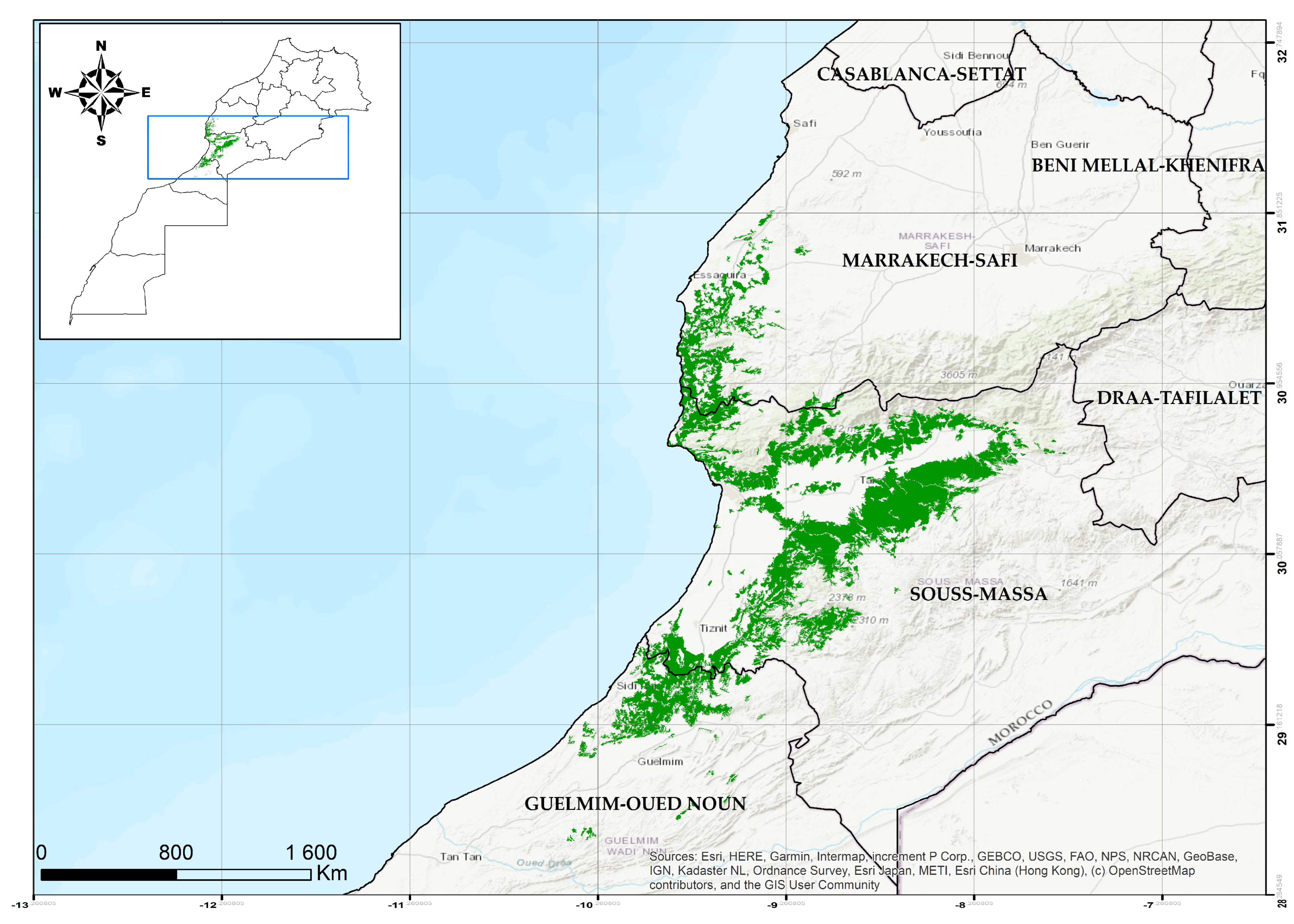
Figure 2.
Evolution of scientific productions in argan tree research.
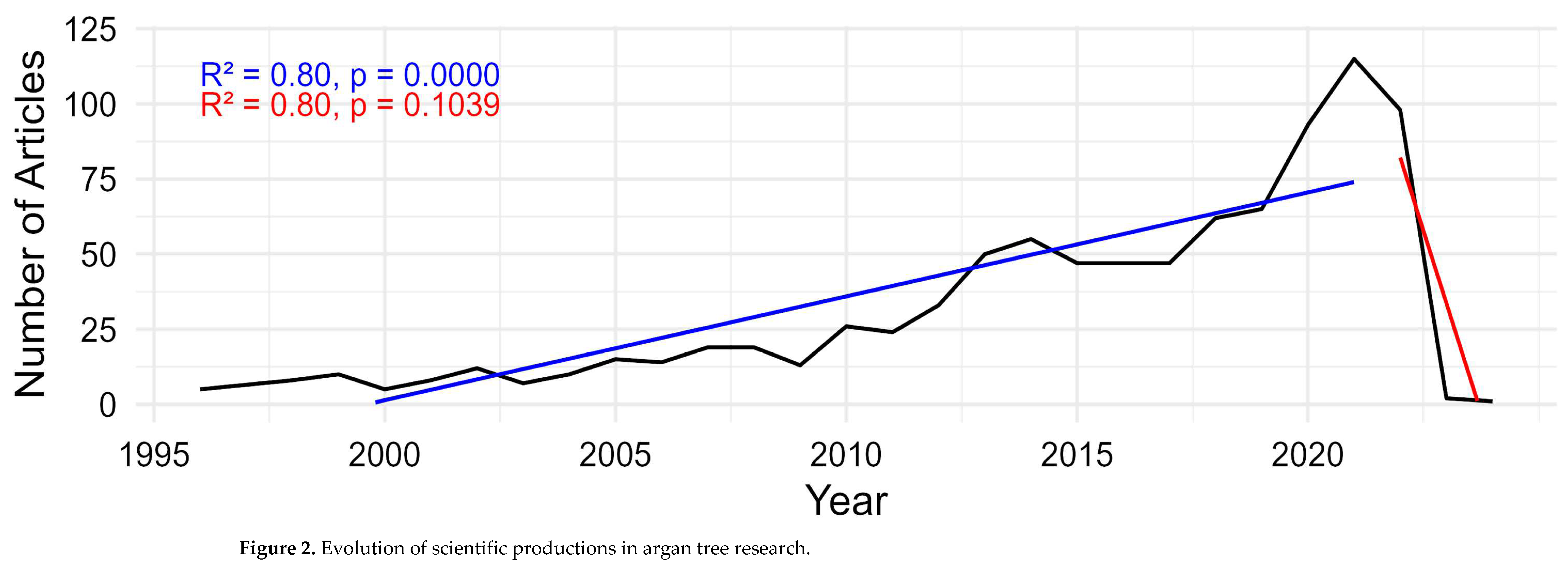
Figure 3.
The top 10 most productive authors (a) and journal sources (b) in argan tree–related research.
Figure 3.
The top 10 most productive authors (a) and journal sources (b) in argan tree–related research.
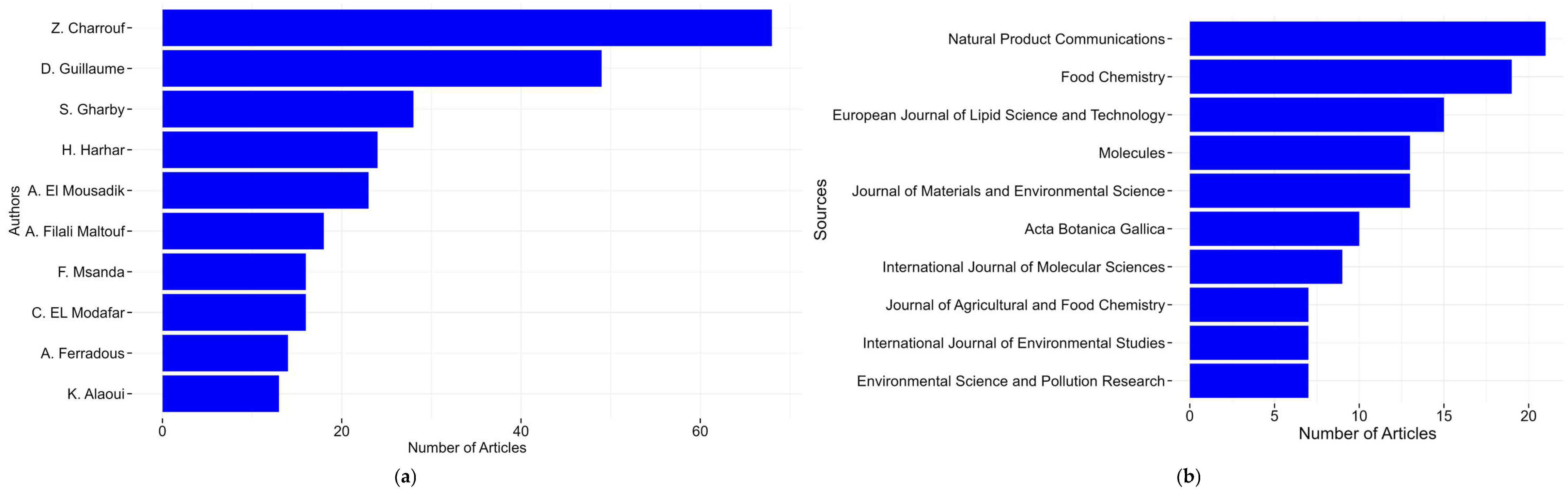
Figure 4.
The top 10 most productive countries across four time periods in Argania spinosa research, based on the corresponding author affiliations.
Figure 4.
The top 10 most productive countries across four time periods in Argania spinosa research, based on the corresponding author affiliations.
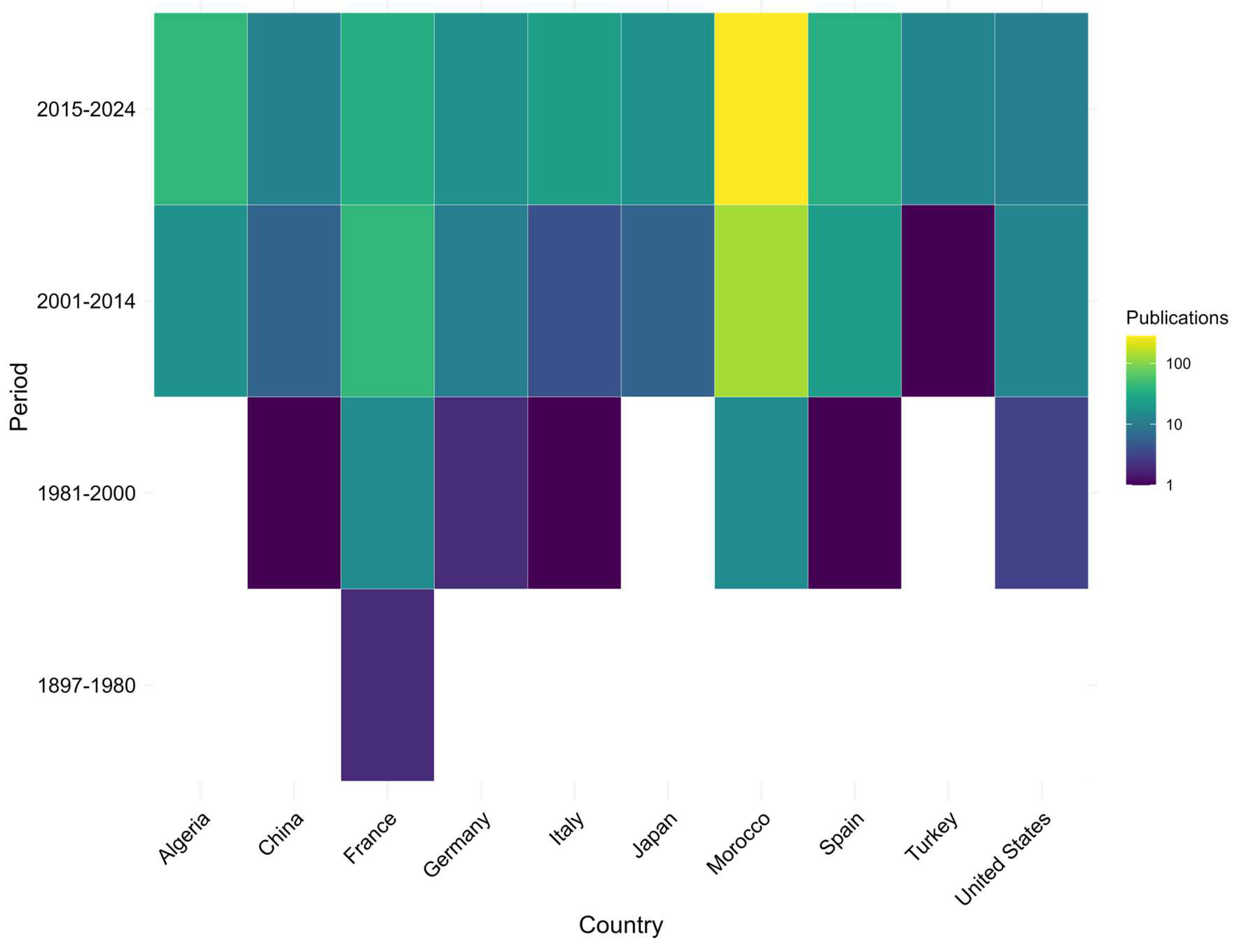
Figure 5.
Author co-citation network in argan tree–related research. Node size represents the number of citations that were received by each author. Shorter distances between nodes indicate stronger co-citation relationships.
Figure 5.
Author co-citation network in argan tree–related research. Node size represents the number of citations that were received by each author. Shorter distances between nodes indicate stronger co-citation relationships.
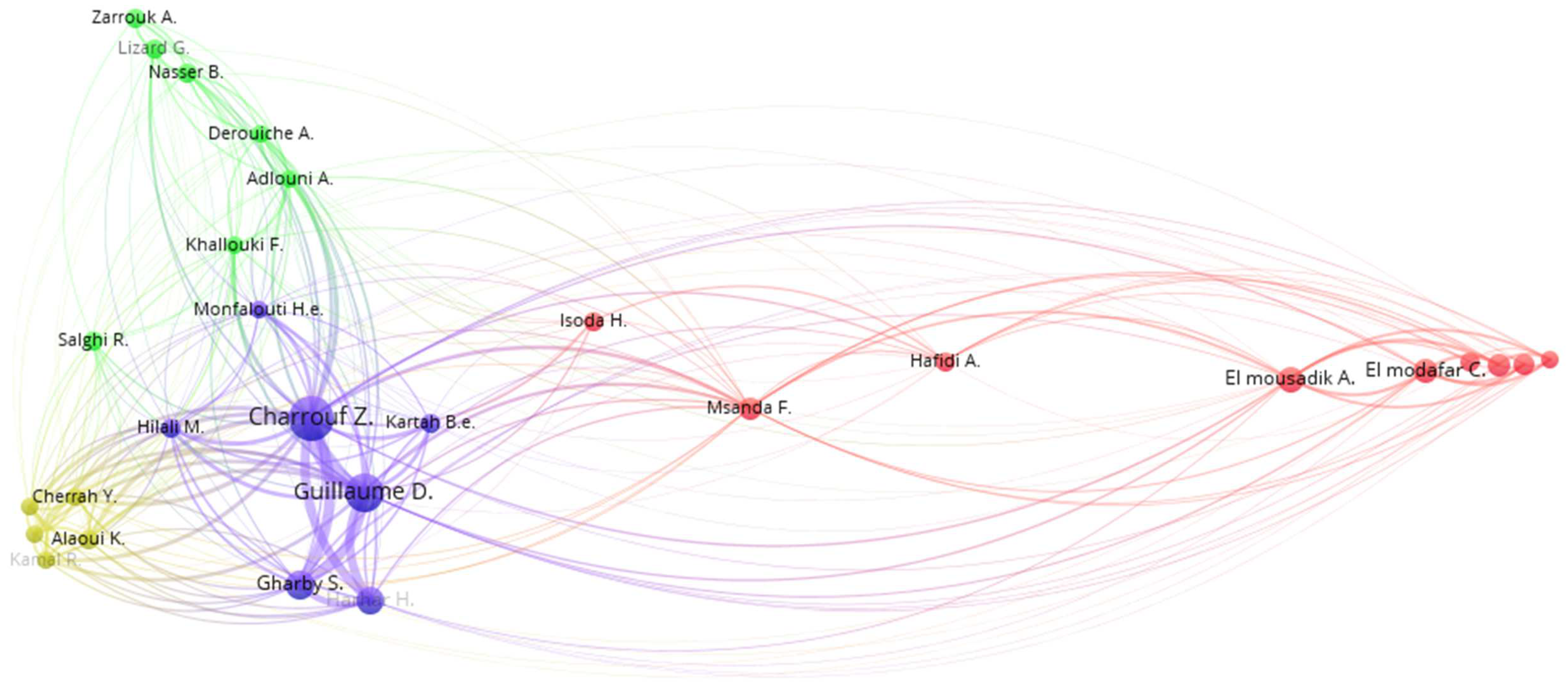
Figure 6.
(a) Network map of country collaborations in argan tree–related research based on corresponding author affiliations. (b) Time overlay visualization by publication year.
Figure 6.
(a) Network map of country collaborations in argan tree–related research based on corresponding author affiliations. (b) Time overlay visualization by publication year.
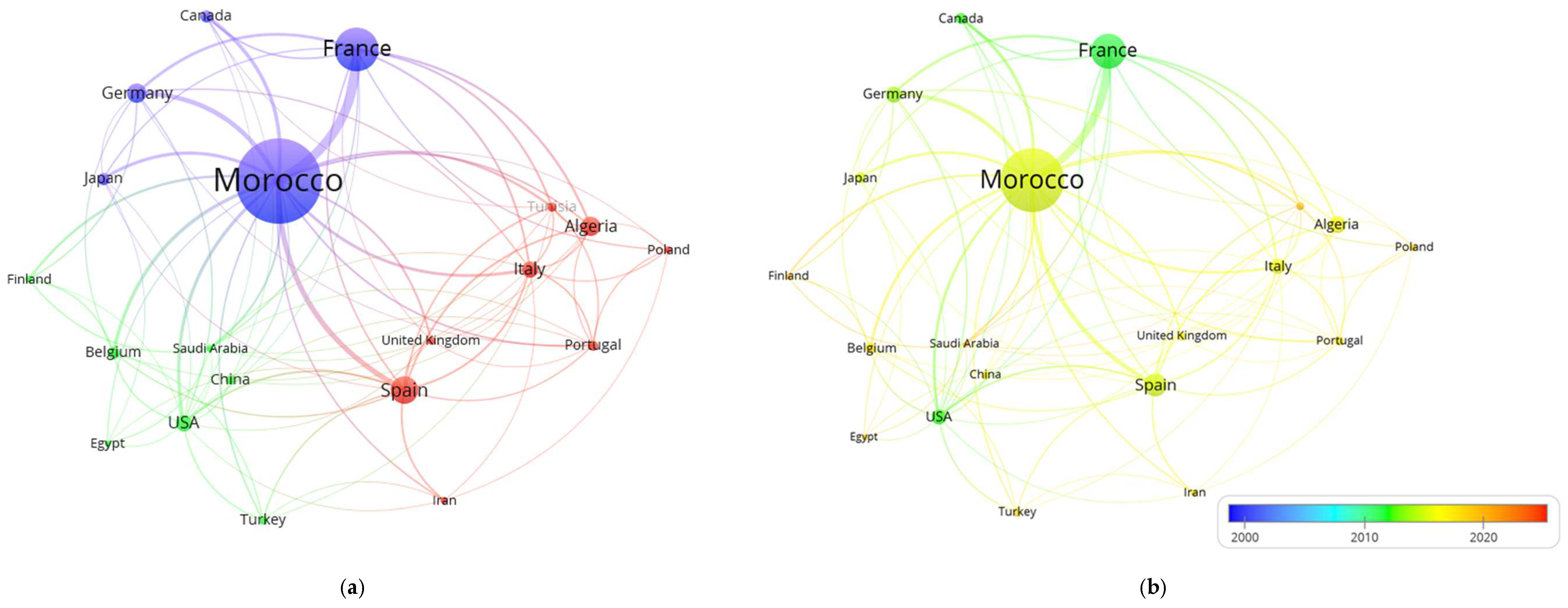
Figure 7.
Network map of author keyword co-occurrence in argan tree related- research. Each node represents a keyword, with its size indicating the frequency of occurrence. The thickness of the links between keywords reflects the frequency of their co-occurrence.
Figure 7.
Network map of author keyword co-occurrence in argan tree related- research. Each node represents a keyword, with its size indicating the frequency of occurrence. The thickness of the links between keywords reflects the frequency of their co-occurrence.
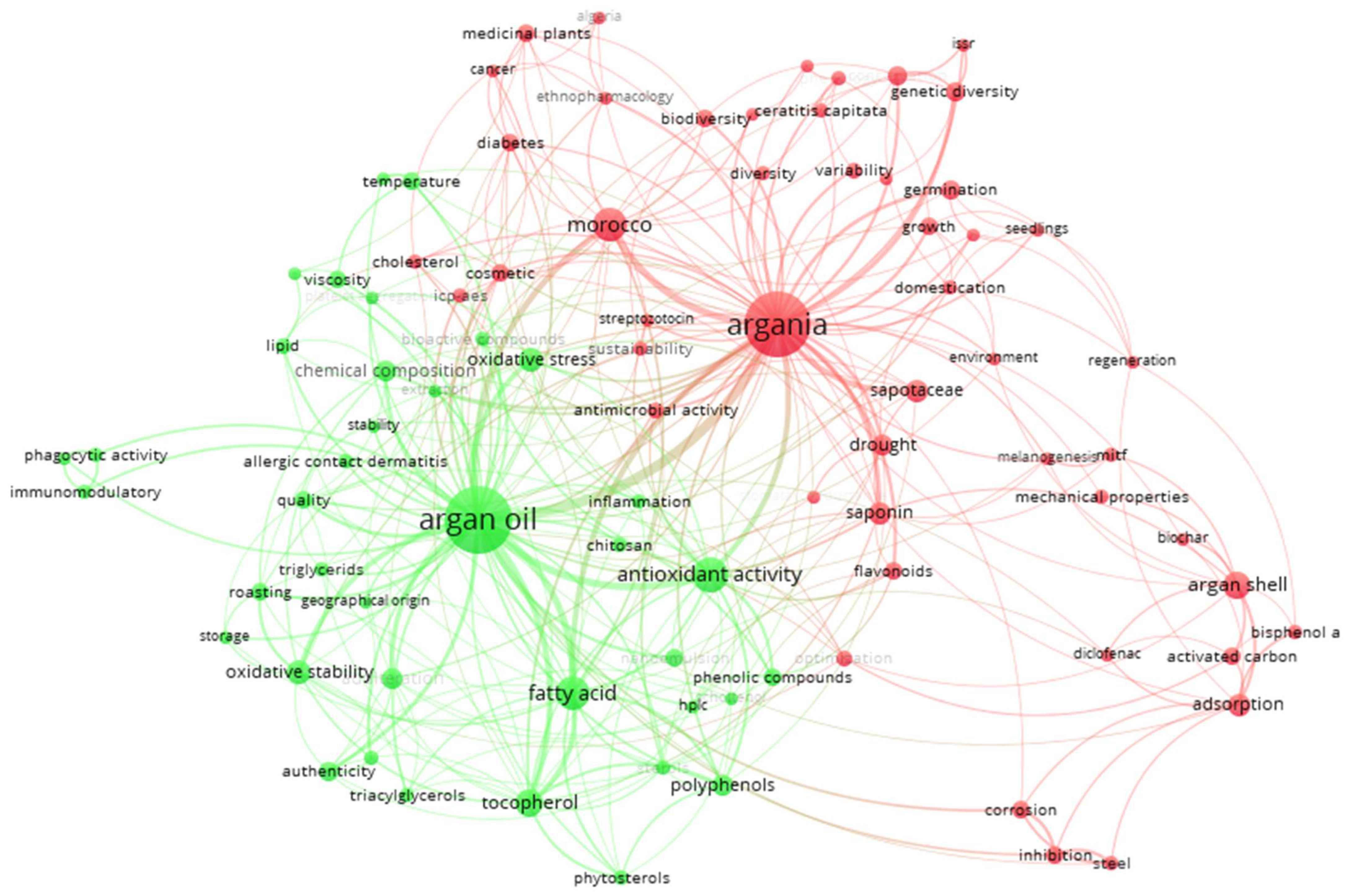
Figure 8.
Network map of author keyword co-occurrence in argan tree–related research, indexed by publication year.
Figure 8.
Network map of author keyword co-occurrence in argan tree–related research, indexed by publication year.
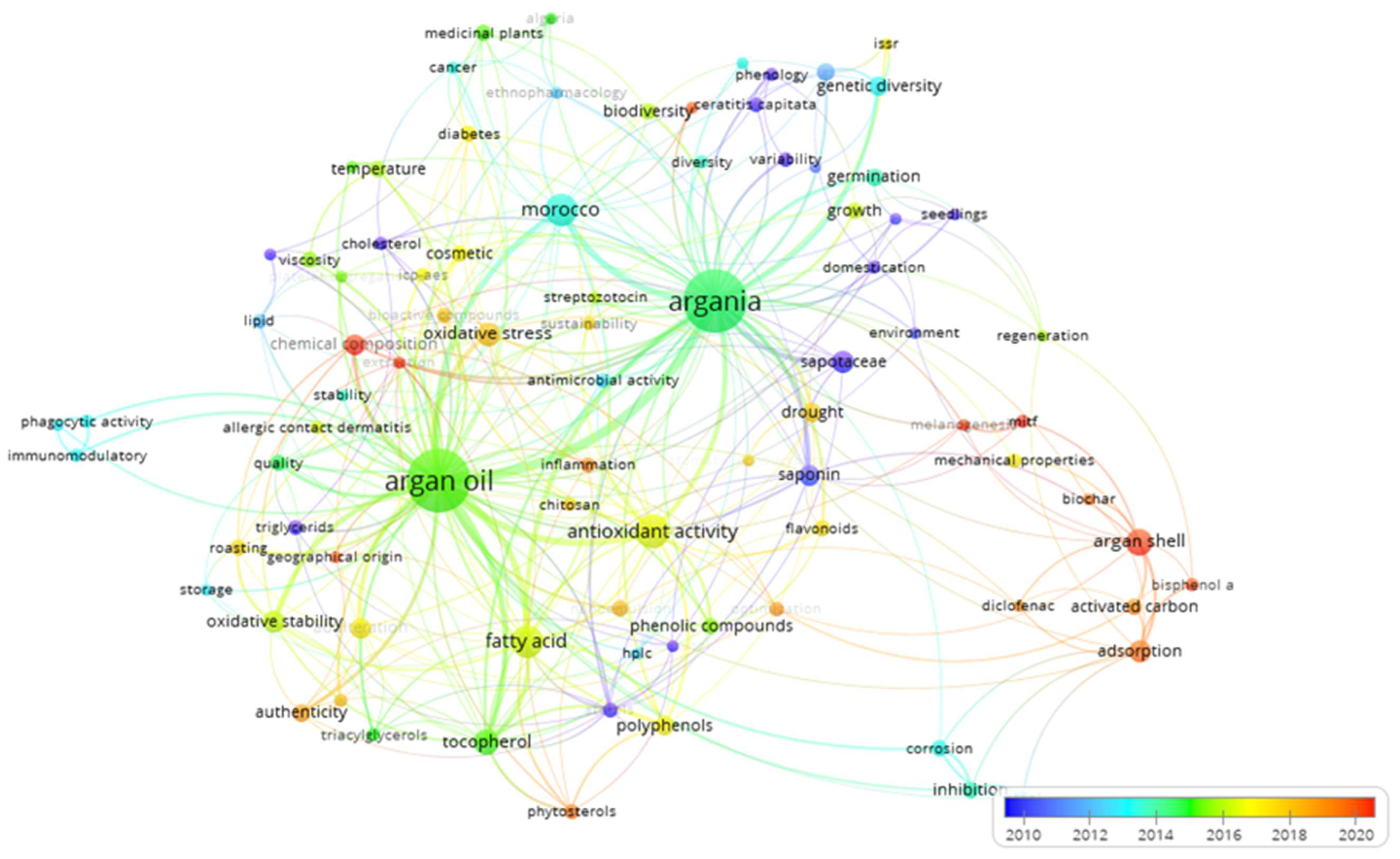
Figure 9.
Correlation between keyword occurrence and year (2014–2022). r: Pearson correlation; p: significance level (α = 0.05). Asterisks (*) indicate statistically significant correlations (p < 0.05).
Figure 9.
Correlation between keyword occurrence and year (2014–2022). r: Pearson correlation; p: significance level (α = 0.05). Asterisks (*) indicate statistically significant correlations (p < 0.05).
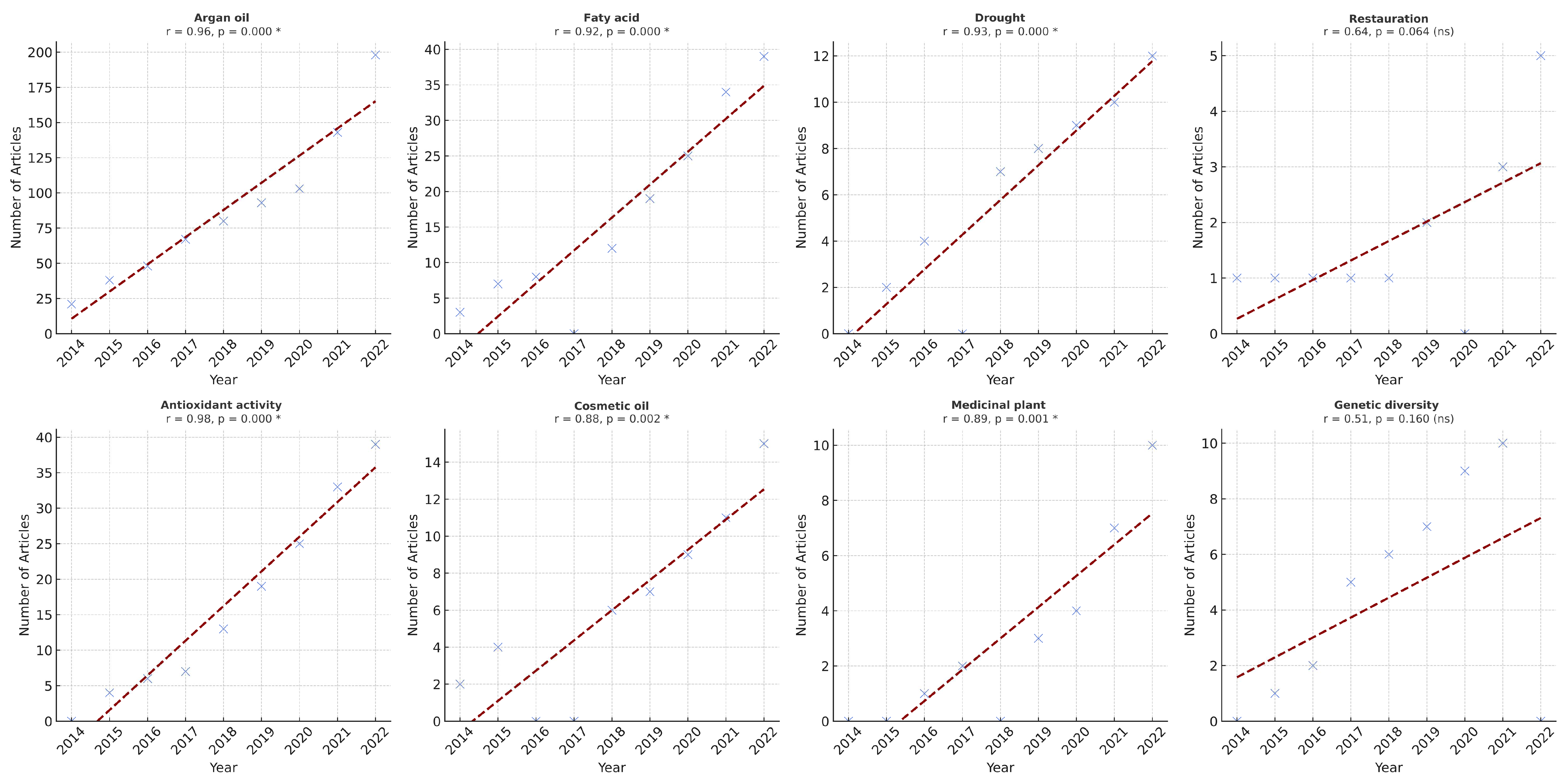
Figure 10.
Gaps in Argan Tree-Related Research.
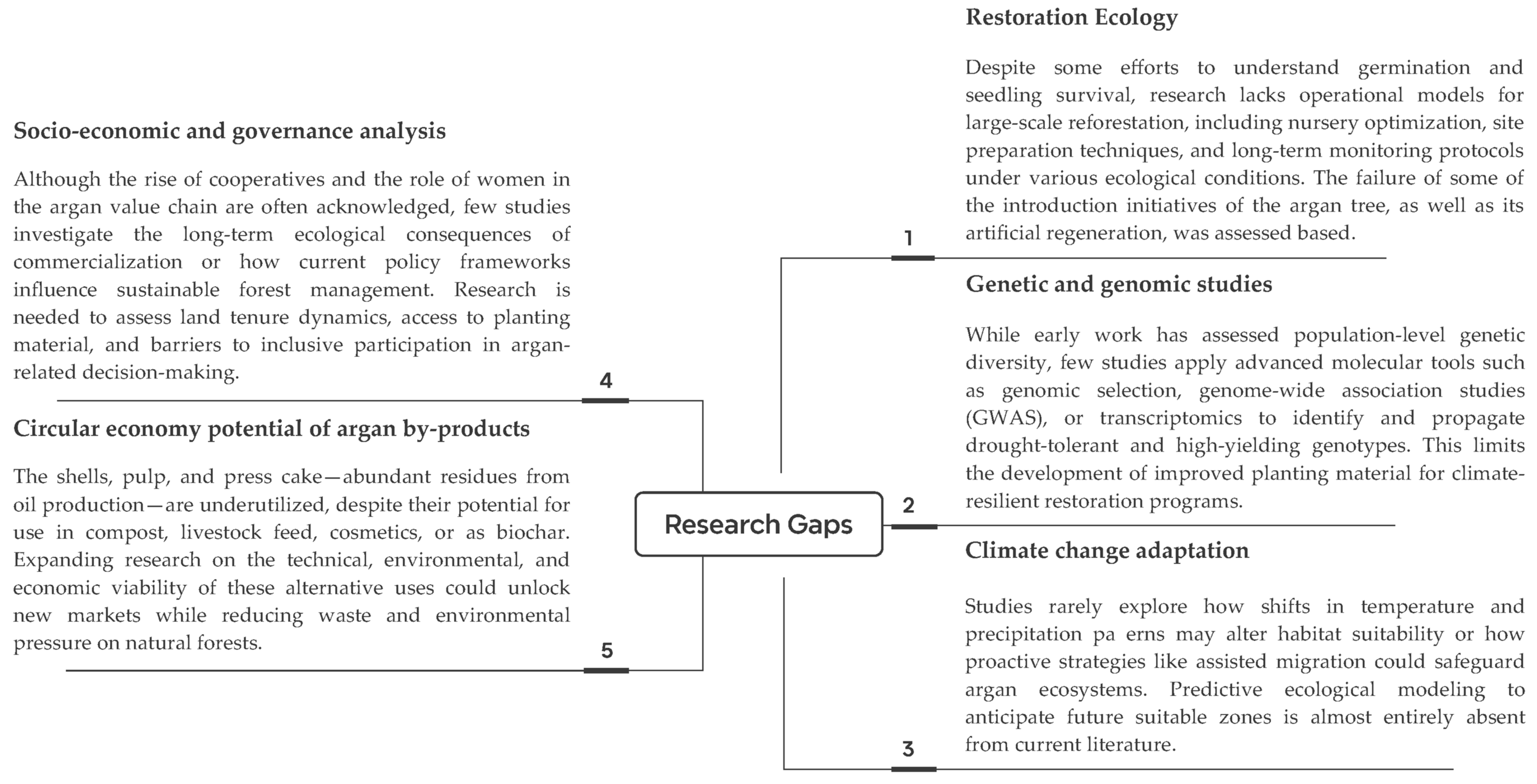

Table 1.
Descriptive statistics of the Scopus database.
| Description | Results |
| Documents | 926 |
| Sources (journals, books, etc.) | 571 |
| Period | 1897 to 2024 |
| Document content | |
| Keywords Plus ID | 6652 |
| Author’s Keywords Descriptors | 2509 |
| Average citations per documents | 18.86 |
| Authors | 2904 |
| Authors of single authored documents | 74 |
| Authors of multi authored documents | 2830 |
| Single-authored documents | 86 |
| Multi-authored documents | 840 |
| Documents per Author | 0.32 |
| Authors per Documents | 3.14 |
| Co-Authors per Documents | 5.17 |
| Collaboration Index (CI) | 3.38 |
| Documents types | |
| Articles | 757 |
| Book | 7 |
| Book Chapter | 31 |
| Conference paper | 44 |
| Conference review | 4 |
| Data paper | 2 |
| Editorial | 3 |
| Letter | 5 |
| Note | 7 |
| Review | 66 |
Disclaimer/Publisher’s Note: The statements, opinions and data contained in all publications are solely those of the individual author(s) and contributor(s) and not of MDPI and/or the editor(s). MDPI and/or the editor(s) disclaim responsibility for any injury to people or property resulting from any ideas, methods, instructions or products referred to in the content. |
© 2025 by the authors. Licensee MDPI, Basel, Switzerland. This article is an open access article distributed under the terms and conditions of the Creative Commons Attribution (CC BY) license (http://creativecommons.org/licenses/by/4.0/).
Copyright: This open access article is published under a Creative Commons CC BY 4.0 license, which permit the free download, distribution, and reuse, provided that the author and preprint are cited in any reuse.


