

Submitted:
06 July 2024
Posted:
08 July 2024
You are already at the latest version
Abstract
This work mapped the research chronology and conceptual trends on conservation agriculture-soil health-sustainable development goals nexus by analyzing data from related literature. This is the first-time different bibliometric methods such as VOSviewer, Flourish, as well as Bibliometrix and Biblioshiny models in RStudio were simultaneously used to investigate the research impacts and/or interactions between conservation agriculture (CA), soil health and sustainable development at global scale. On 20th February 2024, a search was launched on the web of science core collection using related search terms to extract relevant data. After the screening and elimination, the search produced 835 papers which were used in the bibliometric analysis. The revealed that USA (31%), India (27%), Australia (7%), England (6%), China (6%), Canada (5%), and other countries had below 5% of the published documents. Many of the papers covered zero hunger (38%), climate action (30%), life on land (26%), while other SDGs had relatively low coverage. The study found the adoption of no till, cover cropping, and organic amendments by the authors as the common CA practices. The hybrid bibliometric approach provided a clear roadmap in understanding the global research trajectory on CA-soil health and SDGs nexus, as well as the roles of countries, authors, institutions, publishing journals. This knowledge could support in championing future debates on CA potential for effective discussion and policies, especially in the developing countries where there have been low publications.
Keywords:
Bibliometric analysis
; no-till
; cover cropping
; thematic evolution
; conservation agriculture
1. Introduction
The recent changes in climate have a considerable impact on terrestrial habitats and global food production [1,2]. Thus, the serious consequences of climate change have become a bigger threat to food systems and agricultural productivity. As the need for food rises to keep up with the fast-growing population, this situation is expected to worsen in the coming generation. Nonetheless, this has heightened efforts to enhance food production, fiber intake, and energy consumption [3]. Extreme weather events are occurring more frequently and with greater intensity, temperatures are rising, the shift in meteorological precipitation patterns is altering, and ecosystem services and species are declining because of the severe effects of climate change [4]. Nwaogu et al. [3] reported that climate change is a serious environmental challenge that endangers environmental health and human well-being globally. Over the past few centuries, despite these negative effects, human activity has increased, intensifying these effects [5]. Many studies have shown the adverse impacts of these anthropogenic drivers and climate change on soil, environment, and food production chain [3,4,5,6]. Though, soils have the capacity to absorb these threats and still deliver their services by balancing between inputs and losses of nutrients, energy and matter [7]. But these pressures have greater force than the mechanisms that replenish soil, consequently leading to the degradation of the soil. Significant soil erosion and degradation are eventually caused by this terrestrial disturbance, which also results in a substantial loss of soil carbon and other essential services, making the soil infertile [8]. Considering the critical challenges of climate change, food insecurity amid growing population and threatening hunger, the nature-based agricultural system has become a promising succor for mankind, to restore the soil fertility, and salvage the environment [9].
Conservation agriculture (CA) has become one of the best farming practices. CA is a farming system that is based on the management of soil, water and biological resources through (i) minimum soil disturbances, (ii) permanent soil cover and (iii) used of organic amendments, (iv) crop diversification and rotation [10]. CA does not only support humans with food, but it has also been recommended as a means of enhancing soil functional ecosystem services. It improves the soils’ ability to hold water and recycle nutrients and supports the plants’ growth and agricultural productivity. CA also has the potential to protect and increase soil organic carbon stocks there by supporting resilience to climate change. Conservation agriculture methods focus on soil conservation practices including reduced tillage, cover cropping, organic amendments, and diversified farming. CA is an ideal climate-smart agriculture (CSA) and has the benefit of adoptability in any location, by any farmer, and at any scale with minimum input, and a high output. CA protects the soil and its microbial activities, maintains soil fertility and promotes long-term productivity [11]. It promotes SOC sequestration which consequently decreases greenhouse gas concentrations in the atmosphere Dash et al. [12], and reduces heavy use of farm machineries, agrochemicals, and irrigation [13].
Soil ecosystem services namely biomass production, nutrient cycling and enrichment, water balancing and cycling, carbon pool and balancing, protection of biodiversity, provision of recreation, storage of historical records and the provision of industrial raw materials for building and constructions are crucial for planetary health and human well-being. The acknowledgement that soil provides these functions and prompts these services has recently established the thought of soil being multifunctional [14]. In the past, soil’s ability to provide food, fiber and biomass for energy has been the key goal, but recently it has been known that sustainable management of soil comes with many other benefits, and that the services are interrelated to one another [14]. The adoption of CA helps to promote these soil ecosystem services, and these services are the pillars for the achievement of sustainable development goals (SDGs).
Intense campaigns have been made to increase the ability of agriculture to produce food and ensure food security since the 1996 World Food Summit. As a follow-up, in 2015, the Millennium Development Goals (MDGs) became established with the agenda to increase food production with human health and environmental sustainability. Having realized the potential of agriculture and soils for a better world, The United Nations 2030 Agenda for Sustainable Development (SDGs) lists 17 SDGs which have many links to the agricultural systems. These include zero hunger, no poverty, sustainable production and consumption, climate change, life on land, health and well-being, and others. Though CA is at the center of supporting soil functions and services vis-à-vis the achievement of the SDGs, yet there has not been much information on the roles of CA globally. There has been a dearth of knowledge about the research trajectory and development on the nexus between CA-soil functions and SDGs. The need for this knowledge is crucial for the wellbeing of the global economy, society, and environment considering the indispensable roles of CA in the provisions of soil services and SDGs. It in this context that this study aimed at mapping the research landscape on the impacts of CA on soil health and SDGs. In other words, mapping the trend in scientific literature on the interactions between CA, soil health and sustainable development. The study also identified the major CA practices adopted during the studies. Though there have been publications on the impacts of CA on soil, and SDGs but this is the first time, a study adopted a holistic approach in assessing the research structure on the association between CA, soil quality and sustainable development. The aim of this study is achieved by addressing the following research questions:
RQ1: What are the major conceptual areas and/or themes trending in the research on CA-soil-SDGs during the 32 years of study?
RQ2: What are the main CA practices in the research during the study period?
RQ3: Who are the leading authors, institutions, and countries for research on CA, and where are they collaborating and networking to strengthen the scientific knowledge discovery process?
RQ4: Which countries revealed the highest impacts in the research community on CA-sustainable development nexus?
RQ5: How is the research chronology on CA?
RQ6: Does research on CA relate to/or support SDGs?
2. Materials and Methods
Data Collection and Analysis
To compile data on the relationship between conservation agriculture, soil health and sustainable development, we searched for peer-reviewed literature published before 1 January 2024 using the web of science (WOS) core collection. Under ‘TOPIC’ we used the following keywords: (“conservat* agriculture” OR “conservat* farming” OR “no till*” OR “organic amendment” OR “organic manure” OR “cover crop*” OR “cover cropping system”) AND (“soil health” OR “soil quality”) AND (“sustainable development” OR “sustainable development goals”). Some specific criteria such as only papers published between 1991-2023, only published in English language, papers with well-defined relationship between CA, soil health and SDGs or the impacts of CA on soil health (quality) and SDGs were the key selection criteria as shown in Table 1. After the exclusion of some articles based on the criteria, our search produced 835 publications.
Before downloading the results, the record contents were adjusted to include the essential and relevant information including author, title, source, citation counts, abstract, keywords, affiliation, document type, research areas, published year, and cited references. Subsequently, the derived results were exported via the plain text and bibtext files. These were saved and applied in the bibliometric analysis using software such as VOSViewer, Bibliometrix, and Flourish. Further, analytical techniques and tools such as Microsoft Excel and Notepad were employed to further analyze the results and produce comparative tables, figures, frequencies, averages, and percentages. In the VOSViewer, Flourish, and biblioshiny of Bibliometrix RStudio various types of analysis including co-occurrences, bibliographic coupling, network analysis, overlay visualization, collaboration mapping and citations, as well as thematic evolution analysis were performed. Besides the bibliometric analysis, additional information on the major CA practices (CAps) discussed in the papers were also extracted by considering the years, authors, and the affiliate institutions. Further, based on the papers and information included in the dataset (Table 2), the following indicators were also determined: (i) Number of papers published per year, per institution, per journal, per author, and per country; (ii) Counts of papers published by authors from single country and from multiple country based on the affiliations of the authors; (iii) Total number of citations, per paper and journals, and total citation link strength by country; (iv) The ratio values for each country, and (iv) Number of papers that discussed the interactions between CA and SDGs, and the major SDGs. We also identified the major CA practices treated in the papers, the keywords and thematic areas during the entire study periods.
The objective of this paper is to appraise the research chronology and conceptual trends on CA-soil health-sustainable development nexus by reviewing related literatures, as well as identifying, mapping, and performing series of bibliometric and bibliographic analysis by applying scientometric analytical techniques. This is the first time different bibliometric tools such as VOSviewer, Flourish, as well as Bibliometrix and Biblioshiny models in RStudio were simultaneously used to analyze the interactions between CA, soil health, and sustainable development. Another novelty in the study was the attempt to identify the major CA practices based on authors and affiliate institutions over the years. The work will further support to close the gap in knowledge and understanding of soil health indicators by examining the influence of CA on the soil quality vis-à-vis soil ecosystem services at various scales.
3. Results
3.1. Research Data and the Chronological Publication Trend on the Research Topic
The summary of the analyzed data showed that 835 documents spanning between 1991 and 2023, had the annual scientific growth rate of 16.5% which involved 3,455 authors who used 2,525 keywords and had a 36% collaboration with international authors (Table 2). The research trend on the topic increased over time with the highest growth found in recent years (Figure 1). The trends could be categorized into three phases: phase I-foundation period (1991-2008), phase II: awareness growth (2009-2017), and phase III: full adoption (2018-2023). The highest number of publications were found during the full adoption research period, which also recorded the highest number of CA practices (viz: no till, organic amendments and cover cropping). The foundations and awareness period had a relatively low number of publications and CA practices relative to the last phase (i.e., phase III).
3.2. Global Spatio-Temporal Distributions and Collaboration Networks
The global collaboration in research on the topic covered 101 countries, though the publications and collaboration frequencies vary (Figure 2; Table A1). The top countries were USA (31%), India (27%), Australia (7%), England (6%), China (6%), Canada (5%), and other countries had below 5% of the published documents. The collaboration network analysis revealed three major clusters with USA and most European countries in one cluster, India, China, Australia and some other Asian countries in another cluster, whereas the green cluster had Brazil and most African countries (Figure 2a).
Belgium, Switzerland, and Romania had most of their papers published between 1991 and 2000. Australia, Sweden, Brazil, USA, Nigeria, and Ethiopia published more between 2001 and 2010, while India, Bangladesh, and China had primarily between 2011 and 2018. On the other hand, most papers published between 2019 to 2023 were dominated by authors from Egypt, Saudi Arabia, Poland, Morocco, Oman and Vietnam (Figure 2b). The results further revealed that these top countries have substantial research collaborations among themselves than they collaborate with other countries (Figure 3).
3.3. Authorship, Institutions, and Sources
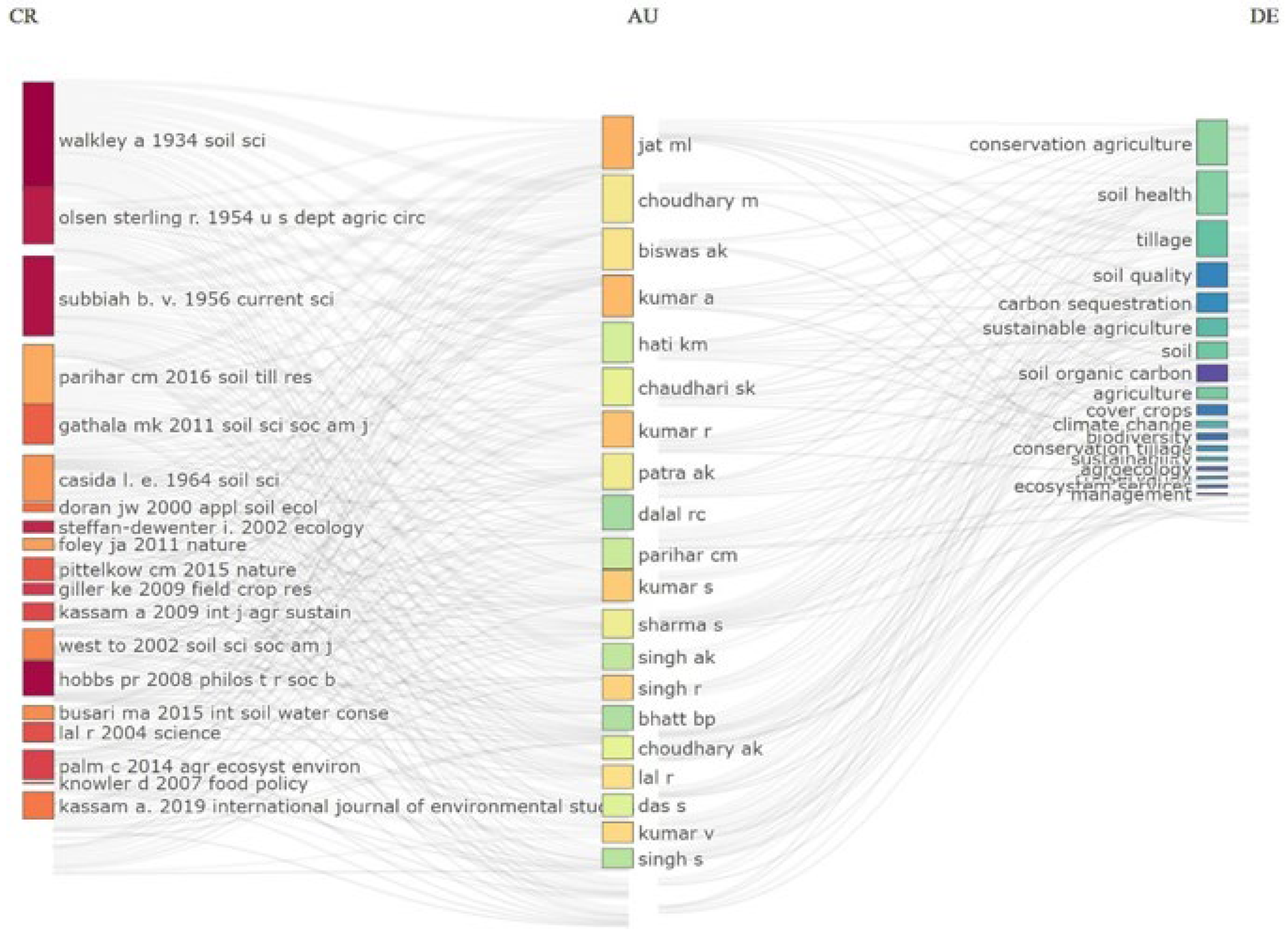
The result revealed that more than 75% of the authors who had the highest number of papers were from Indian based institutions especially Int Maize & Wheat Improvement Ctr CIMMYT and ICAR Indian Council of Agricultural Research (Figure 4a). No till, organic amendments, and cover cropping were the most CA practices covered by the authors. Further, 70% of the authors published with authors in institutions that are based in their countries than outside country institutions (Figure 4b). Jat M.L, Lal R., and Kumar V., were among the top authors who had the highest number of publications and citations (Table A2), and but only Jat M.L., was found to have used above 50% keywords (Figure A1).
The network visualization analysis of institutions established four clusters (green, blue, red, and yellow). The green and blue clusters connected mainly the institutions with the highest papers and citations, namely, CIMMYT and ICAR in their different divisions. Others were Queensland University, Ohio State University, and Punjab Agricultural University (Figure 5a). The red and yellow clusters linked the North American and European institutions such as the USDA ARS, Colorado State University, Agricultural and Agri-food, Canada, and the University of Montpellier. 2017-2020 marked the peak period for research growth in CA because a larger number of the institutions had their publications during this period (Figure 5b). Further, most of the institutions adopted no till, organic enhancement, and cover cropping as the common CA practices when compared with crop diversification and crop rotation (Figure 5c).
3.4. Conceptual/Thematic Areas and Keywords Network Analysis
The publication years on the research topic for most of the journals were after 1999 (Table 3). Soil and Tillage Research, and Sustainability had the highest number of publications (35 and 36), and citations which were 1537 and 1805 respectively. Network visualization analysis of the keywords showed four different clusters (green, red, blue and yellow) of the keywords (Figure 6a). The green cluster included CA, no till, crop rotation, organic amendments, crop diversification, use-efficiency, organic matter, soil carbon, and productivity. The red cluster consisted of sustainable agricultural management, biodiversity, organic agriculture, soil quality, slash and burn, soil liming, land use, as well as climate change and its resilience. The blue and yellow clusters had conservation tillage, cover cropping, crop residues, climate-smart agriculture (CSA), microbial biomass, as well as soil properties and soil health. Some of the key words showed higher frequency of usage in recent years than in 2-3 decades ago. For example, CA, cover crops, organic carbon, organic amendments, CSA, and use-efficiency were dominant in recent years, while crop diversification, soil quality, slash-burn system, and crop rotation tend to appear in the earlier years (Figure 6b).
Over time, the trend in the frequency of the terms (or topics) varied (Figure 7a). The terms use frequency was higher in the recent years especially between 2019 and 2022. Terms like CA and organic matter had higher frequencies. Though terms such as deforestation recorded low frequency but had longer years coverage (or usage) in the papers. The factorial analysis of the terms using multiple component analysis indicated that 47.42% were in the dimensional axis 1 including CA, no till, resources use-efficiency, organic carbon, residual management, microbial biomass, yields, and cropping systems (Figure 7b).
On the other hand, dimensional axis 2 showed 15.92% and had intensification, land use and conservation tillage. In addition to the network visualization and frequency analysis, the study included an evaluation on the thematic evolution of the keywords based on their usage interconnectivity and transitions over the research period (Figure 8). The authors used more keywords between 1991 and 2010, and fewer between 2011 and 2023 (Figure 8a). Similarly, the result from keywords plus revealed that more words were used between 2001 and 2010 compared to the later years (Figure 8b). In the first 10 years of the research, CA was absent in the authors’ keywords while deforestation, food security, and land were entirely missing during the 32 years of the study. In contrast, these words always appeared in keywords plus.
3.5. CA and SDGs Nexus
The study reiterated the strong association between CA and SDGs in the research landscape as well as in the socioeconomic and environmental programs in the society (Figure 9; Table 4). Many of the papers covered zero hunger (38%), climate action (30%), life on land (26%), while other SDGs had a relatively low usage (Figure 9a). Our study further observed that zero hunger, climate action, and life on land had higher number of papers in 1991 and 2023 when compared with other SDGs (Figure 9b). For example, in 1991 when compared with other SDGs, zero hunger, life on land, and climate action recorded as high as 13%, 26.4%, and 11% respectively out of the total number of papers. Similarly, in 2023 15.3%, 15.1%, and 11.2% were the percentages of papers that focused on zero hunger, life on land, and climate action respectively.
The study identified five major CA practices and their related benefits from the reviewed papers (Figure 10). Cover cropping was covered by 29% of the papers, organic amendments (23%), no till (19%), crop diversification (16%), and crop rotation (13%). These CA practices contribute to the achievement of most SDGs (Table 4). The benefits of cover cropping were low agrochemical inputs, nutrient cycling, improvement of soil aeration, weed control, conservation of soil moisture, support for climate change resilience, control of soil erosion and pests. Organic amendment supports in reducing the costs of buying fertilizers, increases crops production rates, helps to balance alkalinity, reduces pollution (air, water, and land), reduced the use of water, and maintains salt level. No till on the other hand helps to save time, energy and cost of ploughing or tilling the soil, supports microbial activities, increases soil biodiversity, and reduces the challenges associated with soil compaction. Crop diversification and rotation help in all times provision of food, support in climate change adaptation, reduction of greenhouse gases (GHGs) emissions and provision of jobs.
Table 4 shows CA practices (CAps) and their support for SDGs, and the implications on planetary health. The CAps have direct or indirect effects on the achievement of almost all the SDGs. It is important to mention that the listed SDGs in Table 4 are feasible especially when a good partnership (SDG 17) among the stakeholders are established.
4. Discussion
Bibliometric studies focused on the interpretation of data in existence in bibliographical databases. Ideally, the choice of a particular database has a great influence on the obtainable results [15]. In terms of web of science (WOS), there is an obvious dominance in the indexation of journals written in English language Mongeon and Paul-Hus [16], which makes it a popular scientific database for diverse studies on bibliometric research.
Phase I (that is, the foundation period) had the longest period which is consistent with reports in any newly adopted system Antle et al. [17], it had a very low number of CA practices (CAps) and published papers when compared with the full adoption period of CA. The rapid growth in the number of documents in recent years could be explained by several drivers such as population growth with higher food demand, technological advancement, increase in the number of researchers and research institutions, increase in research grants and funds, as well as implementation of more agricultural sustainable programs by governments and stakeholders [18,19]. Other reasons for lower papers in in the earlier phase (e.g.,1991-2008) might be because the SDGs were not formed as at then Amani et al. [20], thus intensive agendas for food production and environmental sustainability through agriculture were not available then.
The developed countries had the highest number of publications on CA than the developing countries because of availability of research institutions and funds which positioned them for more sustainable practices in the food production chain and environmental management [21]. This also has a link to the higher research collaboration in agriculture between USA and Europe [22]. According to Cakir and McHenry [23], the developed countries have world-class infrastructure, including cutting-edge technologies and research expertise in many fields especially agriculture.
Globally, India ranks second in agricultural production, and the sector provides 17–18% of the country’s annual GDP [24]. The international collaborations in the past decades led to the Green Revolution which was followed by Golden, White, and Blue Revolutions, together known as Rainbow Revolution. India consolidated upon this technology to promote its food production systems in various agri-institutes; for example, the Indian Council of Agricultural Research (ICAR) was metamorphosized into various research units that became well developed. The implementation of various agri-development agendas such as Rashtriya Krishi Vikas Yojana, national agriculture development program, pulses development program, national food security mission, and irrigation development program by the Indian government played substantial roles [25].
Regarding the authors who ranked highest in the number of papers and citations including Jat M.L., Lal R., Kumar S., and other Indian and USA based authors were popular with their growth in agricultural research especially in CA. For example, one of the papers by Lal [26] on “Restoring Soil Quality to Mitigate Soil Degradation” elaborated the potential of CA, and this paper had 820 citations. Another paper “Conservation agriculture for sustainable intensification in South Asia” by Jat et al. [27] also recorded a very high citation. Among other papers’ titles where these authors claimed their top positions were “Sustainable intensification of China’s agroecosystems by conservation agriculture; and Influence of conservation agriculture-based production systems on bacterial diversity and soil quality in rice-wheat-greengram cropping system in eastern Indo-Gangetic Plains of India” [28,29]. The adoption of no till, organic amendments, and cover cropping system especially by these authors were spectacular. This is because of the critical needs of these CA practices for the achievement of SDGs including planetary health and human well-being [4,10,12,27,28,29].
Our study observed that single country publication (SCP) was over 30% higher than the multiple country publication (MCP). This finding is contrary to the report by Carammia [30] where MCP was found to have increased by more than 100% over the SCP. This discrepancy in our results could be attributed to the differences in the research fields. In accord with our study, Ozdemir and Isik [31] reported higher SCP than MCP in an agricultural related study.
The position of these top institutions as found in this study could be related to their positions in world rating in the agricultural field. According to Edurank [32] and QS world university rankings [33], University of California, Davis ranked 2nd, Cornell University ranked 3rd, Ohio State University ranked 28th, Queensland university ranked 19th globally and 1st in Australia, Iowa State University 14th, University of Florida 20th, and University of Guelph 24th. Through the support from the government, ICAR and CIMMYT have been able to increase food production in India and globally. For example, in 2017, 98.5 million tons of wheat was harvested in India [34]. Increase in the adoption of no till, organic manure, and cover cropping systems contributed significantly to the growth of these institutions in the research landscape (10,12,27,28,29].
The publication years on CA for most of the journals were after 1999, and this could be explained by the adoption, awareness and full funding periods for CA programs which grew after 1999 [18,19,20]. Soil & Tillage Research and the journal of Sustainability were among the top journals because of their scope which strongly align with CA such as soil tillage and cropping systems.
Clustering of the specific related keywords such as no tillage, crop rotation, crop diversification, cover cropping, organic amendments, CSA, biodiversity, resources use-efficiency, productivity, soil microbial biomass, soil organic carbon, soil quality and health, and many others agreed with the strong links between these keywords and CA as were reported by many studies [11,35,36,37]. For example, a recent study in Bangladesh reiterated the interaction between CA and resources use-efficiency by establishing that CA contributed substantially to enhanced farm management leading to 9% increase in their productivity and resources use-efficiency [36]. Similarly, a study in the western Indo-Gangetic Plains reported the correlation between CA and soil organic carbon rise in the region [11]. Sharma et al. [35] also affirmed that CA practices improved soil health, water, flora, and fauna which consequently increased productivity. Other studies have revealed that CA practices involved no tillage, crop rotation, crop diversification, cover cropping, organic amendments which are synonymous with CSA [10,37,38].
Our result revealed that keywords plus had words (such as deforestation, land, and food security) that were missing in the authors words, and this could be because the keywords plus are representative indicators for the content and scientific concepts presented in articles and are able to capture article’s content with greater depth and variety [39,40]. On the other hand, authors’ keywords tend to be limited in depth as they consist of a list of terms that authors assume as the most suitable to represent the content of their paper [41].
In both definition, thematic and conceptual framework, as well as applications, CA has been strongly related to the achievement of SDGs by several studies globally [10,11,35,36,38]. It is also vital to mention that most of the papers on SDG 2, SDG 15, and SDG 13 focused on low-carbon agriculture and organic amendments to increase soil fertility and crop yields. Others on no-tillage to protect the soil and carbon stocks which in turn help in climate change mitigation. In addition, some other papers discussed the importance of cover cropping and crop diversification in supporting the microbial activities of fauna and flora, consequently promoting biodiversity and soil ecosystem services and functions. These thematic areas of CA and SDGs are key to achieving planetary health, human well-being with stable livelihoods, food security, and sustainable environment for our present and future society [3,4,5,6,9,10,38].
Globally, the adoption of no till, cover cropping, organic amendments, crop diversification, and crop rotation as the major CA practices has been reported in many studies [10,42]. A recent study in Planaltina, Distrito Federal of Brazil established that the introduction of cover crops contributed significantly in decreasing nitrogen fertilization in maize and promoting the crop yield [42,43,44,45]. In Iowa State of USA, Waring et al. [43] conservation agriculture improved soil properties for a decade or more. The role of crop diversification in controlling nematodes, environmental problems, and improving soil fertility and yields was affirmed in a recent work by Kozacki [44]. Similarly, crop rotation was observed to have increased food production, reduced net GHGs emissions and improved soil health at Luancheng County, in Hebei Province of China [45]. In contrast, Rocco et al. [46] observed that cover crops did not affect SOC stock especially in the topsoil, while no till improved soil structural stability at the experimental site in Viborg, Denmark. The non-effects on cover crop on SOC stocks might be attributed to other drivers such as soil types, climate, management systems at the Viborg experimental site.
5. Conclusions
The applied bibliometric approaches were effective in providing results that addressed the research questions and achieved the study objectives. The developed countries have world-class infrastructure, including cutting-edge technologies and research expertise in many fields especially agriculture, thus placing them above the developing countries in the research trend on CA.
The keywords and thematic areas including the CSA, soil organic carbon, microbial biomass, climate change resilience, resource use-efficiency, productivity and yields have vigorous relationships with CA which is evidence that the conceptual frameworks were appropriate for the articles and publications.
The adoption of no till, cover cropping, organic amendments, and crop rotation and diversification by the authors were the best CA practices. These enabled most of the papers to adequately relate to zero hunger (SDG 2), life on land (SDG 15), and climate action (SDG 13) which focused primarily on CA as a low-carbon agriculture and a nature-based solution to increase soil fertility, crop yields, and mitigate climate change.
In addition, there was a considerable increase in the number of publications on CA as it relates to soil health and SDGs in the last 6 years. This might be credited to many reasons including technological advancement, increase in the number of researchers and research institutions, increase in research grants and funds, implementation of more agricultural sustainable programs by governments and stakeholders, as well as increased discussion on global food security and climate changes resilience.
The hybrid scientometric approach provided a clear roadmap in understanding the global research trajectory on CA-soil health and SDGs nexus, as well as the roles of countries, authors, institutions, publishing journals. This knowledge might help in championing future debates on CA potential for effective discussion and policies, especially in the developing countries where there has been low of publications.
Author Contributions
Conceptualization, C.N., B.E.D., F.O., D.E., M.R.C. and I.P.A.; Methodology, C.N., O.A., C.C.I., J.N.O., U.O., C.A.A., and C.V.E.; Formal Analysis, C.N., V.O.W., S.I.A., M.B.T.K., C.O.D., and J.B.; Investigation, C.N., M.I.T., L.C., I.J.O., C.C.E., and P.S.U.E.; Data Curation, C.N., O.J.O., E.W., C.O., E.I.E., D.H.O., M.C.I., and M.R.C; Writing—Original Draft Preparation, C.N., B.E.D., F.O., D.E.; Writing—Review and Editing, All authors; Visualization, All authors. All authors have read and agreed to the published version of the manuscript.
Funding
We gratefully acknowledge the support of the RCGI—Research Centre for Greenhouse Gas Innovation, hosted by the University of São Paulo (USP) and sponsored by FAPESP—São Paulo Research Foundation (2014/50279-4 and 2020/15230-5) and Shell Brasil. Also acknowledged is the strategic importance of the support given by ANP (Brazil’s National Oil, Natural Gas and Biofuels Agency) through the R&D levy regulation. We also give thanks to the Center for Carbon Research in Tropical Agriculture (CCARBON) sponsored by FAPESP (process # 2021/10573-4). Chukwudi Nwaogu appreciates the FAPESP for the postdoc scholarships in Brazil and BEPE (2021/11757-1 and 2023/05122-9), and Cherubin M.R. thanks CNPq for his Research Productivity Fellowship (311787/2021-5).
Data Availability Statement
The raw data supporting the conclusions of this article will be made available by the authors on request.
Acknowledgments
The authors have no acknowledgement to make.
Conflicts of Interest
The authors declare no conflicts of interest.
Appendix A

Table A1.
Countries status and publications statistics on the research topic.
| Country | Cit | TLS | Freq (%) | Rv | Country | Cit | TLS | Freq (%) | Rv |
| Afghanistan | 137 | 1212 | 0.24 | 0.08 | Mali | 200 | 426 | 0.12 | 0.242 |
| Argentina | 27 | 2448 | 0.61 | 0.01 | Mexico | 1085 | 15449 | 2.67 | 0.06 |
| Australia | 3163 | 34179 | 7.2 | 0.07 | Morocco | 67 | 3613 | 0.72 | 0.014 |
| Austria | 1692 | 5656 | 0.97 | 0.26 | Mozambique | 9 | 1900 | 0.24 | 0.005 |
| Bangladesh | 702 | 19801 | 2.5 | 0.04 | Myanmar | 0 | 212 | 0.12 | 0 |
| Belgium | 471 | 4992 | 1.5 | 0.05 | Nepal | 168 | 4204 | 1.09 | 0.023 |
| Benin | 44 | 375 | 0.12 | 0.05 | Netherlands | 1996 | 10836 | 2.06 | 0.142 |
| Bolivia | 286 | 1142 | 0.49 | 0.09 | New Zealand | 114 | 671 | 0.36 | 0.046 |
| Brazil | 1724 | 6877 | 3 | 0.08 | Nicaragua | 44 | 421 | 0.12 | 0.053 |
| Brunei | 1 | 940 | 0.12 | 0 | Niger | 40 | 12 | 0.12 | 0.049 |
| Bulgaria | 4 | 0 | 0.12 | 0.01 | Nigeria | 647 | 4807 | 0.97 | 0.098 |
| Burkina Faso | 14 | 107 | 0.12 | 0.02 | Norway | 243 | 1313 | 0.48 | 0.074 |
| Cambodia | 106 | 3382 | 0.73 | 0.02 | Oman | 116 | 4999 | 0.97 | 0.018 |
| Cameroon | 0 | 273 | 0.12 | 0 | Pakistan | 337 | 13826 | 2.54 | 0.019 |
| Canada | 1809 | 14803 | 4.85 | 0.06 | China | 1564 | 21147 | 6.32 | 0.037 |
| C.A.R. | 0 | 273 | 0.12 | 0 | Peru | 272 | 1827 | 0.48 | 0.083 |
| Chile | 250 | 2039 | 0.73 | 0.05 | Philippines | 229 | 6235 | 0.85 | 0.04 |
| Colombia | 117 | 1997 | 0.61 | 0.03 | Poland | 281 | 4954 | 0.85 | 0.049 |
| Costa Rica | 401 | 700 | 0.24 | 0.24 | Portugal | 43 | 1142 | 0.48 | 0.013 |
| Cote Ivoire | 59 | 966 | 0.24 | 0.04 | Qatar | 18 | 86 | 0.24 | 0.011 |
| Croatia | 6 | 648 | 0.12 | 0.01 | Romania | 16 | 105 | 0.97 | 0.002 |
| Cuba | 4 | 195 | 0.12 | 0.01 | Russia | 25 | 3463 | 0.48 | 0.008 |
| Czech Rep. | 376 | 3331 | 0.61 | 0.09 | Rwanda | 28 | 516 | 0.12 | 0.034 |
| Congo DR | 48 | 1683 | 0.49 | 0.02 | Saudi Arabia | 247 | 9931 | 1.69 | 0.021 |
| Denmark | 315 | 4362 | 0.85 | 0.06 | Scotland | 2196 | 9632 | 1.82 | 0.178 |
| Ecuador | 17 | 442 | 0.24 | 0.01 | Serbia | 31 | 2621 | 0.48 | 0.009 |
| Egypt | 170 | 7652 | 1.33 | 0.02 | Slovakia | 101 | 1669 | 0.24 | 0.061 |
| England | 1679 | 22132 | 6.07 | 0.04 | Slovenia | 85 | 442 | 0.24 | 0.052 |
| Ethiopia | 818 | 9251 | 1.94 | 0.06 | South Africa | 690 | 13983 | 2.79 | 0.036 |
| Finland | 94 | 2843 | 0.49 | 0.03 | South Korea | 28 | 625 | 0.36 | 0.011 |
| France | 2608 | 18810 | 4.61 | 0.08 | Spain | 530 | 11358 | 2.18 | 0.036 |
| Germany | 2395 | 17960 | 4.12 | 0.09 | Sri Lanka | 3 | 150 | 0.24 | 0.002 |
| Ghana | 16 | 1429 | 0.49 | 0.01 | Sweden | 1854 | 8474 | 1.82 | 0.150 |
| Greece | 19 | 677 | 0.36 | 0.01 | Switzerland | 449 | 8601 | 2.06 | 0.032 |
| Guatemala | 21 | 306 | 0.12 | 0.03 | Syria | 9 | 494 | 0.24 | 0.005 |
| Haiti | 2 | 54 | 0.12 | 0 | Taiwan | 10 | 179 | 0.36 | 0.004 |
| Hungary | 154 | 3549 | 0.49 | 0.05 | Tajikistan | 23 | 79 | 0.12 | 0.028 |
| India | 5351 | 79915 | 26.94 | 0.03 | Tanzania | 458 | 2794 | 1.21 | 0.056 |
| Indonesia | 68 | 785 | 0.36 | 0.03 | Thailand | 75 | 895 | 0.48 | 0.028 |
| Iran | 44 | 663 | 0.61 | 0.01 | Tunisia | 4 | 844 | 0.12 | 0.005 |
| Iraq | 23 | 362 | 0.12 | 0.03 | Turkey | 134 | 704 | 0.24 | 0.081 |
| Ireland | 20 | 395 | 0.12 | 0.02 | Turkiye | 10 | 1811 | 0.36 | 0.004 |
| Israel | 91 | 236 | 0.12 | 0.11 | Ukraine | 0 | 0 | 0.12 | 0 |
| Italy | 1591 | 11088 | 3.64 | 0.06 | Uruguay | 17 | 308 | 0.24 | 0.01 |
| Japan | 350 | 1501 | 0.72 | 0.07 | USA | 9239 | 66757 | 31.31 | 0.043 |
| Jordan | 218 | 1381 | 0.24 | 0.13 | Uzbekistan | 0 | 151 | 0.12 | 0 |
| Kenya | 740 | 11657 | 2.54 | 0.04 | Vietnam | 69 | 1916 | 0.61 | 0.017 |
| Madagascar | 9 | 207 | 0.12 | 0.01 | Wales | 99 | 1051 | 0.36 | 0.04 |
| Malawi | 198 | 1388 | 0.61 | 0.05 | Zambia | 244 | 3220 | 0.72 | 0.049 |
| Malaysia | 75 | 1815 | 0.49 | 0.02 | Zimbabwe | 570 | 10346 | 1.69 | 0.049 |
Description of abbreviations: Cit = Number of citations, TLS=total length strength, Freq (%) = Publication occurrences, Rv = ratio value. Source: analyzed by authors using VOSviewer, Flourish, and Bibliometrix in Rstudio.
Table A2.
Top authors’ indices in the research on the topic.
| Element | h_index | g_index | m_index | TC | NP | PY_start |
|---|---|---|---|---|---|---|
| JAT ML | 14 | 18 | 0.875 | 1173 | 18 | 2009 |
| LAL R | 12 | 13 | 0.75 | 1462 | 13 | 2009 |
| KUMAR V | 11 | 13 | 0.688 | 1013 | 13 | 2009 |
| KUMAR A | 9 | 16 | 0.9 | 573 | 16 | 2015 |
| CHOUDHARY M | 8 | 11 | 1.143 | 454 | 11 | 2018 |
| CHOUDHARY AK | 7 | 9 | 1.4 | 171 | 9 | 2020 |
| JAT SL | 7 | 7 | 0.778 | 288 | 7 | 2016 |
| PARIHAR CM | 7 | 9 | 0.778 | 301 | 9 | 2016 |
| SHARMA S | 7 | 11 | 1.4 | 186 | 11 | 2020 |
| SINGH R | 7 | 14 | 0.636 | 224 | 14 | 2014 |
| CHAUDHARI SK | 6 | 9 | 0.857 | 198 | 9 | 2018 |
| DAS TK | 6 | 7 | 0.857 | 157 | 7 | 2018 |
| GATHALA MK | 6 | 6 | 0.375 | 580 | 6 | 2009 |
| HATI KM | 6 | 9 | 0.6 | 417 | 9 | 2015 |
| KUMAR S | 6 | 11 | 0.429 | 140 | 14 | 2011 |
| MALIK RK | 6 | 7 | 0.75 | 178 | 7 | 2017 |
| NATH CP | 6 | 7 | 0.857 | 176 | 7 | 2018 |
| PATRA AK | 6 | 11 | 0.75 | 186 | 11 | 2017 |
TC represents total number of citations; NP represents number of published papers; PY means publication year. Source: analyzed by authors using Bibliometrix in Rstudio.
Figure A1.
Three-field plot showing the links between authors, their keywords and cited references as analyzed using Bibliometrix in Rstudio. Description of abbreviations: CR, AU, and DE represented citated references, authors and authors’ keywords respectively. Source: analyzed by authors using Bibliometrix in Rstudio.
Figure A1.
Three-field plot showing the links between authors, their keywords and cited references as analyzed using Bibliometrix in Rstudio. Description of abbreviations: CR, AU, and DE represented citated references, authors and authors’ keywords respectively. Source: analyzed by authors using Bibliometrix in Rstudio.
References
- Lal, R.; Global food security and nexus thinking. J. Soil Water Conserv. 2016, 71,4 85A-90A. [CrossRef]
- Zhang, S.; Yu, Z.; Lin, J.; Zhu, B.; Responses of soil carbon decomposition to drying-rewetting cycles: a meta-analysis. Geoderma. 2019, 1 (361), 114069. [CrossRef]
- Nwaogu, C.; Oti, N.N.; Enaruvbe, G.O.; Cherubin, M.R. Crop-Livestock-Forest System as Nature-Based Solutions to Combating Climate Change and Achieving SDGs in Brazil. In Leal, W and Filho (eds.), Handbook of Nature-Based Solutions to Mitigation and Adaptation to Climate Change, 2023, 19, 1-30. [CrossRef]
- Tian, J.; Dungait, J.A.; Hou, R.; Deng, Y.; Hartley, I.P.; Yang, Y.; Kuzyakov, Y.; Zhang, F.; Cotrufo, M.F.; Zhou, J. Microbially mediated mechanisms underlie soil carbon accrual by conservation agriculture under decade-long warming. Nat. Commun. 2024, 815(1), 377. [CrossRef]
- Zhang, S.; Chen, Y.; Zhou, X.; Zhang, Y. Climate and human impact together drive changes in ecosystem multifunctionality in the drylands of China. Appl. Soil Ecol. 2024, 1(193),105163. [CrossRef]
- Wang, L.; Lu, P.; Feng, S.; Hamel, C.; Sun, D.; Siddique, K.H.; Gan, G.Y. Strategies to improve soil health by optimizing the plant–soil–microbe–anthropogenic activity nexus. Agric. Ecosyst. Environ. 2024, 1(359), 108750. [CrossRef]
- Amundson., R.; Berhe, A.A.; Hopmans, J.W.; Olson, C.; Sztein, A.E.; Sparks, D.L. Soil and human security in the 21st century. Science 2015, 348(6235), 1261071. [CrossRef]
- Mondal, A.; Khare, D.; Kundu, S. Impact assessment of climate change on future soil erosion and SOC loss. Nat. Hazards 2016, 82,1515-39. [CrossRef]
- Nwaogu, C.; Cherubin, M.R. Integrated agricultural systems: The 21st century nature-based solution for resolving the global FEEES challenges. Adv. Agron. 2024, 4,1-73. [CrossRef]
- Mhlanga, B.; Gama M, Museka R, Thierfelder C. Understanding the interactions of genotype with environment and management (G× E× M) to maize productivity in Conservation Agriculture systems of Malawi. Plos one 2024, 29,19 (4) . [CrossRef]
- Das, T.K.; Bhattacharyya, R.; Sharma, A.R.; Das, S.; Saad, A.A.; Pathak, H. Impacts of conservation agriculture on total soil organic carbon retention potential under an irrigated agro-ecosystem of the western Indo-Gangetic Plains. Eur. J. Agron. 2013, 1(51),34-42. [CrossRef]
- Dash.; P.K.; Bhattacharyya, P.; Roy, K.S.; Neogi, S.; Nayak, A.K. Environmental constraints’ sensitivity of soil organic carbon decomposition to temperature, management practices and climate change. Ecol indic. 2019, 1(107),105644. [CrossRef]
- Chatterjee, N.; Nair, P.R.; Chakraborty, S.; Nair, V.D. Changes in soil carbon stocks across the Forest-Agroforest-Agriculture/Pasture continuum in various agroecological regions: A meta-analysis. Agric. Ecosyst. Environ. 2018, 1(266), 55-67. [CrossRef]
- Kopittke, P.M.; Berhe, A.A.; Carrillo, Y.; Cavagnaro, T.R.; Chen, D.; Chen, Q.L.; Román Dobarco, M.; Dijkstra, F.A.; Field, D.J.; Grundy, M.J.; He, J.Z. Ensuring planetary survival: the centrality of organic carbon in balancing the multifunctional nature of soils. Crit. Rev. Environ. Sci. Technol. 2022, 52(23),4308-24. [CrossRef]
- Minasny, B.; Hartemink, A.E.; McBratney, A.; Jang, H.J. Citations and the h index of soil researchers and journals in the Web of Science, Scopus, and Google Scholar. PeerJ. 2013, 1, 1–16. [CrossRef]
- Mongeon, P.; Paul-Hus, A. The journal coverage of Web of Science and Scopus: a comparative analysis. Scientometrics 2016, 106,213-28. [CrossRef]
- Antle, J.M.; Jones, J.W.; Rosenzweig, C.E. Next generation agricultural system data, models and knowledge products: Introduction. Agric. Syst. 2017, 1(155),186-90. [CrossRef]
- Mekyassi, H.; Kızıldeniz, T. The role of nutrition-sensitive climate-smart agriculture in ensuring global food security. In BIO Web of Conferences. EDP Sciences. 2024, 85, 01055. [CrossRef]
- Rather, M.A.; Ahmad, I.; Shah, A.; Hajam, Y.A.; Amin, A.; Khursheed, S.; Ahmad, I.; Rasool, S. Exploring opportunities of Artificial Intelligence in aquaculture to meet increasing food demand. Food Chem. 2024, 19,101309. [CrossRef]
- Amani, B.; Ncube, C.B.; Rimmer, M. Introduction: ‘the people’s agenda’: a history of intellectual property and sustainable development. In The Elgar Companion to Intellectual Property and the Sustainable Development Goals. Edward Elgar Publishing. 2024, 20, 1-36. [CrossRef]
- Lovrić, M.; Lovrić, N.; Mavsar, R. Mapping forest-based bioeconomy research in Europe. For. Policy Econ. 2020, 1(110),101874. [CrossRef]
- Delate, K.; Canali, S.; Turnbull, R.; Tan, R.; Colombo, L. Participatory organic research in the USA and Italy: Across a continuum of farmer–researcher partnerships. Renew. Agric. Food Syst. 2017, 32(4), 331-48. [CrossRef]
- Cakir, M.; McHenry, M.P. International research collaborations in agriculture. Agricultural systems in the 21st century. Nova Science Publishers, Hauppauge, New York, USA.: In Cacioppo, L., (ed.) Environmental and Agricultural Research Summaries. Nova Science Publishers, Hauppauge, New York, USA. 2013,1, 31-48. http://researchrepository.murdoch.edu.au/22806/.
- Singh, R.B.; Mandal, B.; Sharma, S.K. International Partnership for Transformation of Agri-Food Systems. In: Bansal, K.C., Lakra, W.S., Pathak, H. (eds) Transformation of Agri-Food Systems. Springer, Singapore. 2024, 1, 45-61. [CrossRef]
- Gupta, N.; Kannan, E. Agricultural growth and crop diversification in India: a state-level analysis. J. Soc. Econ. Dev. 2024, 12,1-25. [CrossRef]
- Lal, R.; Restoring soil quality to mitigate soil degradation. Sustain. 2015, 13,7(5), 5875-95. [CrossRef]
- Jat., M.L.; Chakraborty, D.; Ladha, J.K.; Rana, D.S.; Gathala, M.K.; McDonald, A.; Gerard, B. Conservation agriculture for sustainable intensification in South Asia. Nat Sustain. 2020, 3 (4), 336-43. [CrossRef]
- Lal, R.; Sustainable intensification of China’s agroecosystems by conservation agriculture. Int. Soil Water Conserv. Res. 2018, 6(1),1-2. [CrossRef]
- Kumar.; R, Choudhary, J.S.; Naik, S.K.; Mondal, S.; Mishra, J.S.; Poonia, S.P.; Kumar, S.; Hans, H.; Kumar, S.; Das, A.; Kumar, V. Influence of conservation agriculture-based production systems on bacterial diversity and soil quality in rice-wheat-greengram cropping system in eastern Indo-Gangetic Plains of India. Front. Microbiol. 2023, 5(14), 1181317. [CrossRef]
- Carammia, M. A bibliometric analysis of the internationalisation of political science in Europe. Eur. Polit. Sci. 2022, 21(4), 564-95. [CrossRef]
- Ozdemir, M. G.; Isik, H. B. Bibliometric analysis of peer-reviewed literature on “climate change” and “agriculture”. In Conference Proceedings: Full Paper Series of MIRDEC 21th—Barcelona 2023 International Academic Conference on Economics, Business and Contemporary Discussions in Social Science. Barcelona, Spain. 2023, 66-84. https://www.mirdec.com/barca2023proceedings.
- Edurank, 2024. World Universities ranking for 2024. Available online: https://edurank.org/uni/ohio-state-university-main-campus/rankings/. (accessed on 11 June 2024).
- QS world university ranking, 2024. Available online: https://www.topuniversities.com/university-subject-rankings/agriculture-forestry?page=0. (accessed on 11 June 2024).
- Cimmyt country profile report 2024: www.cimmyt.org. (accessed on 11 June 2024).
- Sharma, J.; Mahajan, A.; Menia, M.; Kumar, D.; Bochalya, R.S.; Kumawat, S.N. Conservation Agriculture: A Long-term Approach towards Sustainability. Int. J. Environ. Clim. 2023, 12-13(10),150-65. [CrossRef]
- Paz, B.; Hailu, A.; Rola-Rubzen, M.F.; Rashid, M.M. Conservation agriculture-based sustainable intensification improves technical efficiency in Northern Bangladesh: The case of Rangpur. Aust. J. Agr. Resour. Ec. 2024, 68(1),125-45. [CrossRef]
- Ferdinand, M.S.; Baret, P.V. A method to account for diversity of practices in Conservation Agriculture. Agron. Sustain. Dev. 2024, 44(3),31. [CrossRef]
- Chisenga, M.E.; Mwamba, M.M.; Banda, F.; Lubasi, N.; Banda, K.; Hichilema, C.N.; Mubita, S.; Ngonga, M.; Muchanga, M. Understanding the Potential of Conservation Agriculture towards Improving Food Security and Sustainability of Natural Resources in Chongwe District of Lusaka. Asian J. Agric. Res. Hort. 2024, 18(11),32-43. [CrossRef]
- Zhang, J.; Yu, Q.; Zheng, F.; Long, C.; Lu, Z.; Duan, Z. Comparing keywords plus of WOS and author keywords: A case study of patient adherence research. J. Assoc. Inf. Sci. Technol. 2016, 67(4), 967-72. [CrossRef]
- Garfield, E. KeyWords Plus-ISI’s breakthrough retrieval method. 1. Expanding your searching power on current-contents on diskette. Current Cont. 1990, 6(32),5-9.
- Li, L.L.; Ding, G.; Feng, N.; Wang, M.H.; Ho, Y.S. Global stem cell research trend: Bibliometric analysis as a tool for mapping of trends from 1991 to 2006. Scientometrics 2009, 80(1),39-58. [CrossRef]
- Carvalho, A.M.D.; Ramos, M.L.G.; da Silva, V.G.; de Sousa, T.R.; Malaquias, J.V.; Ribeiro, F.P.; de Oliveira, A.D.; Marchão, R.L.; da Fonseca, A.C.P.; Dantas, R.D.A. Cover Crops Affect Soil Mineral Nitrogen and N Fertilizer Use Efficiency of Maize No-Tillage System in the Brazilian Cerrado. Land 2024,13(5), 693.
- Waring, E.R.; Pederson, C.; Lagzdins, A.; Clifford, C.; Helmers, M.J. Water and soil quality respond to no-tillage and cover crops differently through 10 years of implementation. Agric. Ecosyst. Environ. 2024, 360,108791. [CrossRef]
- Kozacki, D.; Soika, G.; Skwiercz, A.; Malusà, E. Microbial-Based Products and Soil Management Practices to Control Nematodes in Organic Horticultural Crops. In: Chaudhary, K.K., Meghvansi, M.K., Siddiqui, S. (eds) Sustainable Management of Nematodes in Agriculture, Vol.2: Role of Microbes-Assisted Strategies. Sustainability in Plant and Crop Protection, 2024, 19. Springer, Cham. [CrossRef]
- Yang, X.; Xiong, J.; Du, T.; Ju, X.; Gan, Y.; Li, S.; Xia, L.; Shen, Y.; Pacenka, S.; Steenhuis, T.S.; Siddique, K.H. Diversifying crop rotation increases food production, reduces net greenhouse gas emissions and improves soil health. Nat. Comm. 2024, 15(1),198. [CrossRef]
- Rocco, S.; Munkholm, L.J.; Jensen, J.L. Long-term soil quality and C stock effects of tillage and cover cropping in a conservation agriculture system. Soil Till. Res. 2024, 241,106129. [CrossRef]
Figure 1.
Publication chronological trend on the research topic between 1991 and 2023 (N=835). CAps represent major conservation agriculture practices based on the papers:1= No till, 2 = Organic amendments, 3 = Cover cropping, 4 = Crop diversification, and 5 = Crop rotation.
Figure 1.
Publication chronological trend on the research topic between 1991 and 2023 (N=835). CAps represent major conservation agriculture practices based on the papers:1= No till, 2 = Organic amendments, 3 = Cover cropping, 4 = Crop diversification, and 5 = Crop rotation.
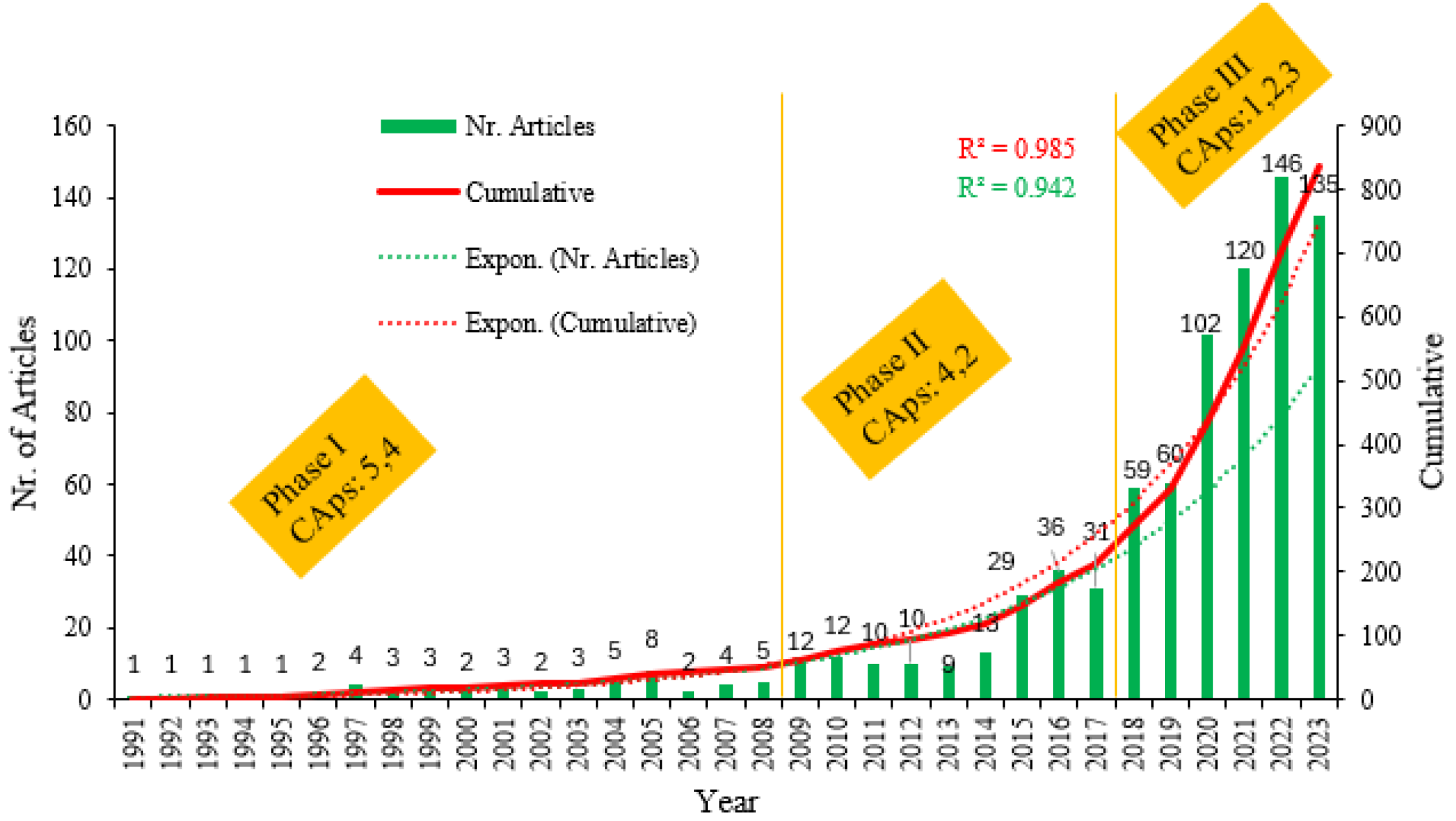
Figure 2.
Countries with at least 5 papers and more than 10 collaborations (a) network visualization analysis (b) chronological overlay visualization analysis. Source: analyzed by authors using VOSviewer.
Figure 2.
Countries with at least 5 papers and more than 10 collaborations (a) network visualization analysis (b) chronological overlay visualization analysis. Source: analyzed by authors using VOSviewer.
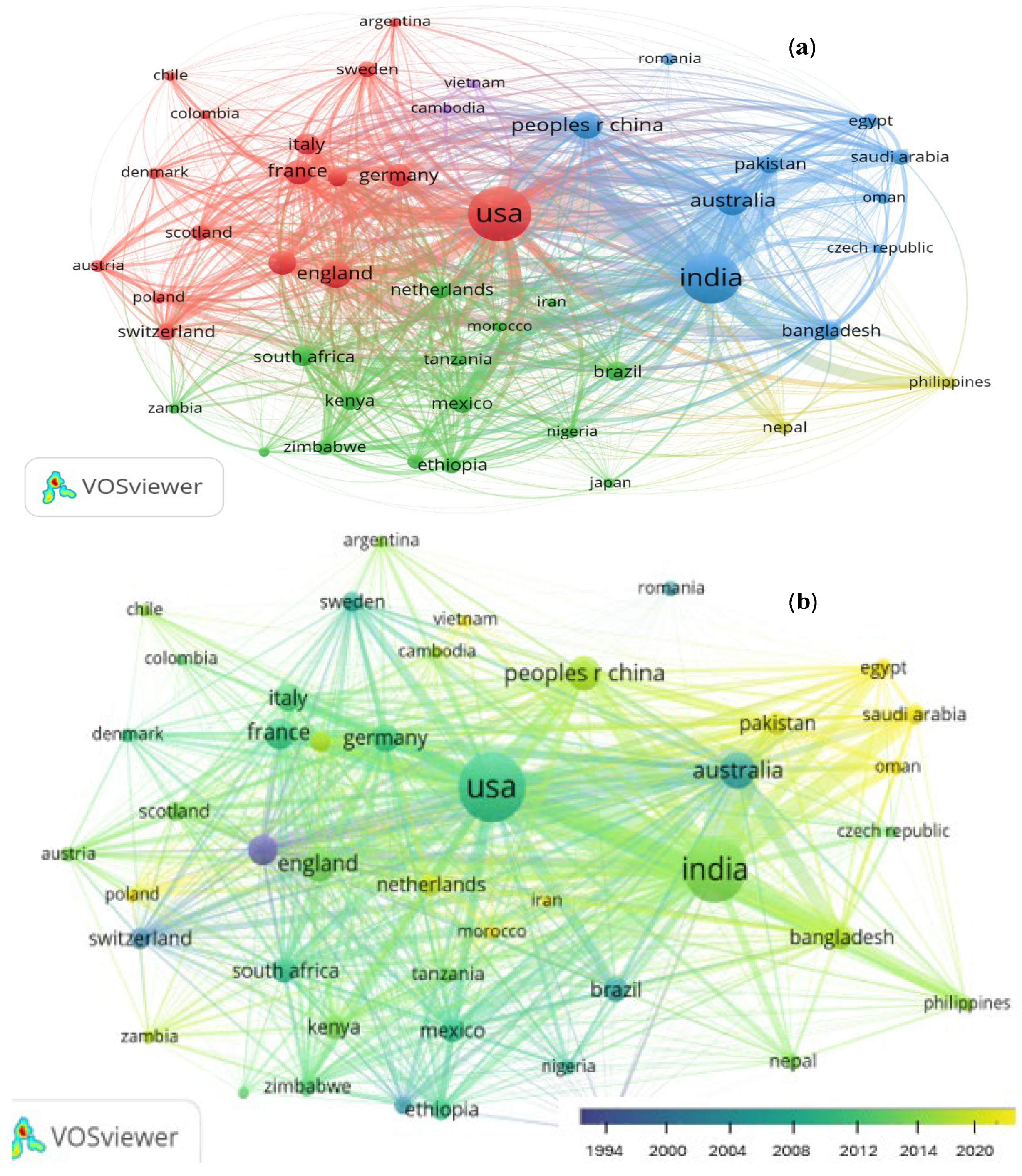
Figure 3.
(a) Global distribution of papers, (b) collaboration networks among the top countries. Where there is no link, is an indication that such countries have publications on the topic but have no collaborations outside their locality. This can be found in the countries that lie between Finland and Haiti in Figure 3b. Source: analyzed by authors using Flourish and Bibliometrix in Rstudio.
Figure 3.
(a) Global distribution of papers, (b) collaboration networks among the top countries. Where there is no link, is an indication that such countries have publications on the topic but have no collaborations outside their locality. This can be found in the countries that lie between Finland and Haiti in Figure 3b. Source: analyzed by authors using Flourish and Bibliometrix in Rstudio.
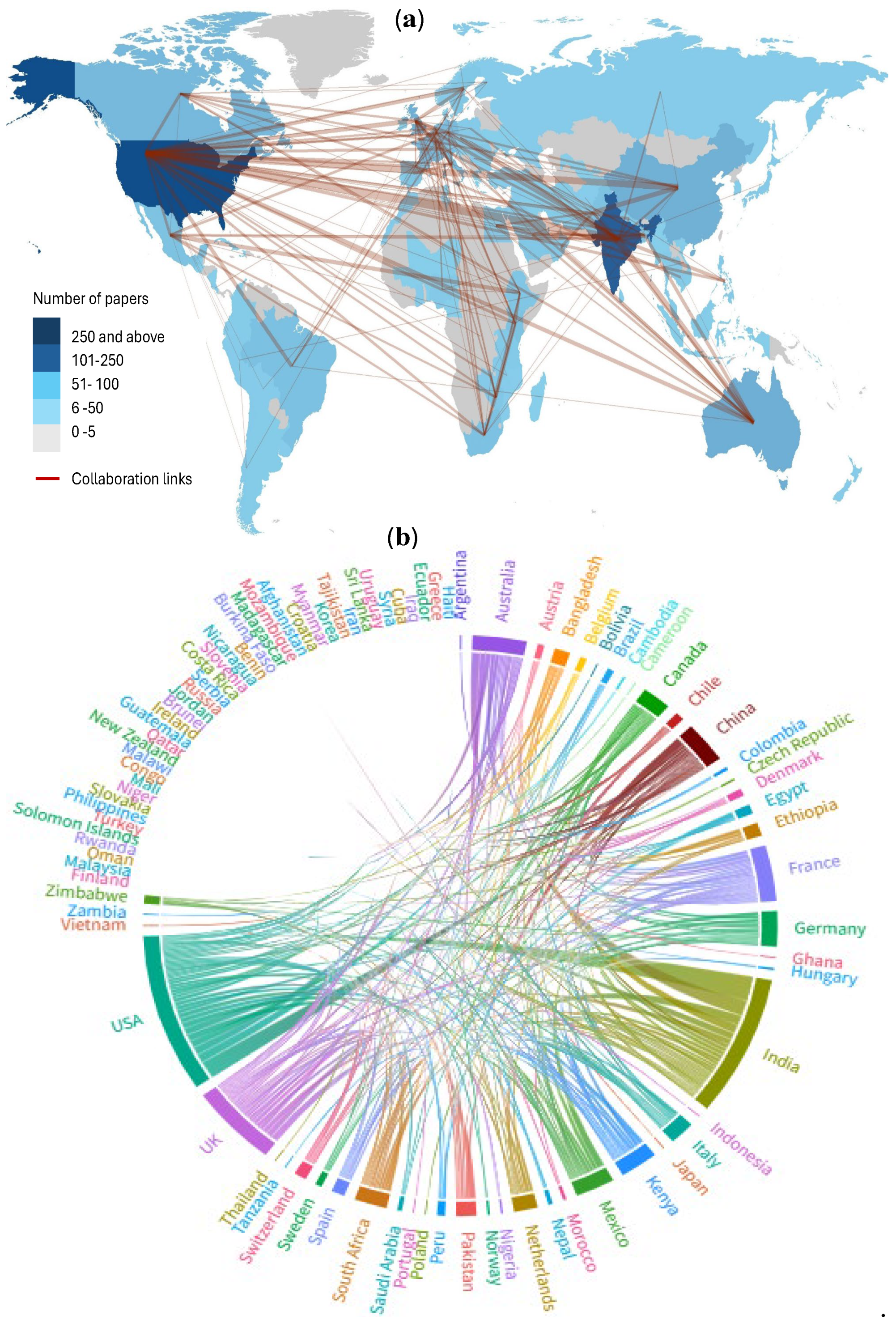
Figure 4.
(a) Most relevant authors who had the highest scientific contributions over time, (b) Author’s publications extent. CAps represent major conservation agriculture practices in each institution based on the affiliate authors’ work: 1= No till, 2 = Organic amendments, 3 = Cover cropping, 4 = Crop diversification, and 5 = Crop rotation. Source: analyzed by authors using Bibliometrix in Rstudio.
Figure 4.
(a) Most relevant authors who had the highest scientific contributions over time, (b) Author’s publications extent. CAps represent major conservation agriculture practices in each institution based on the affiliate authors’ work: 1= No till, 2 = Organic amendments, 3 = Cover cropping, 4 = Crop diversification, and 5 = Crop rotation. Source: analyzed by authors using Bibliometrix in Rstudio.
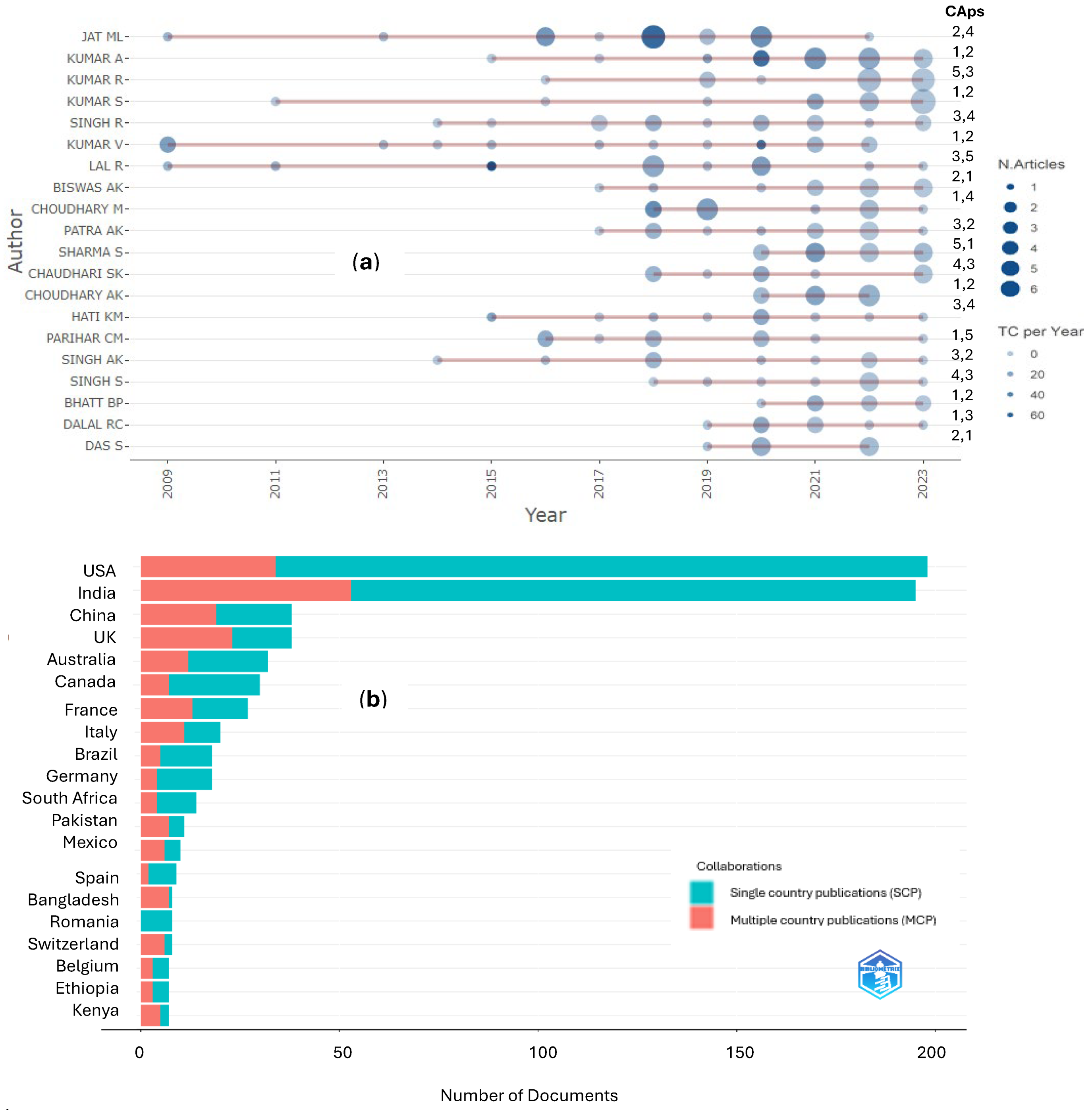
Figure 5.
Authors’ affiliate institutions (a) Network visualization analysis (b) Overlay analysis in time, (c) Most relevant affiliate institutions that had the highest scientific contributions. CAps represent major conservation agriculture practices in each institution based on the analysis from the papers: 1= No till, 2 = Organic amendments, 3 = Cover cropping, 4 = Crop diversification, and 5 = Crop rotation. Source: analyzed by authors using VOSviewer and Bibliometrix in Rstudio.
Figure 5.
Authors’ affiliate institutions (a) Network visualization analysis (b) Overlay analysis in time, (c) Most relevant affiliate institutions that had the highest scientific contributions. CAps represent major conservation agriculture practices in each institution based on the analysis from the papers: 1= No till, 2 = Organic amendments, 3 = Cover cropping, 4 = Crop diversification, and 5 = Crop rotation. Source: analyzed by authors using VOSviewer and Bibliometrix in Rstudio.
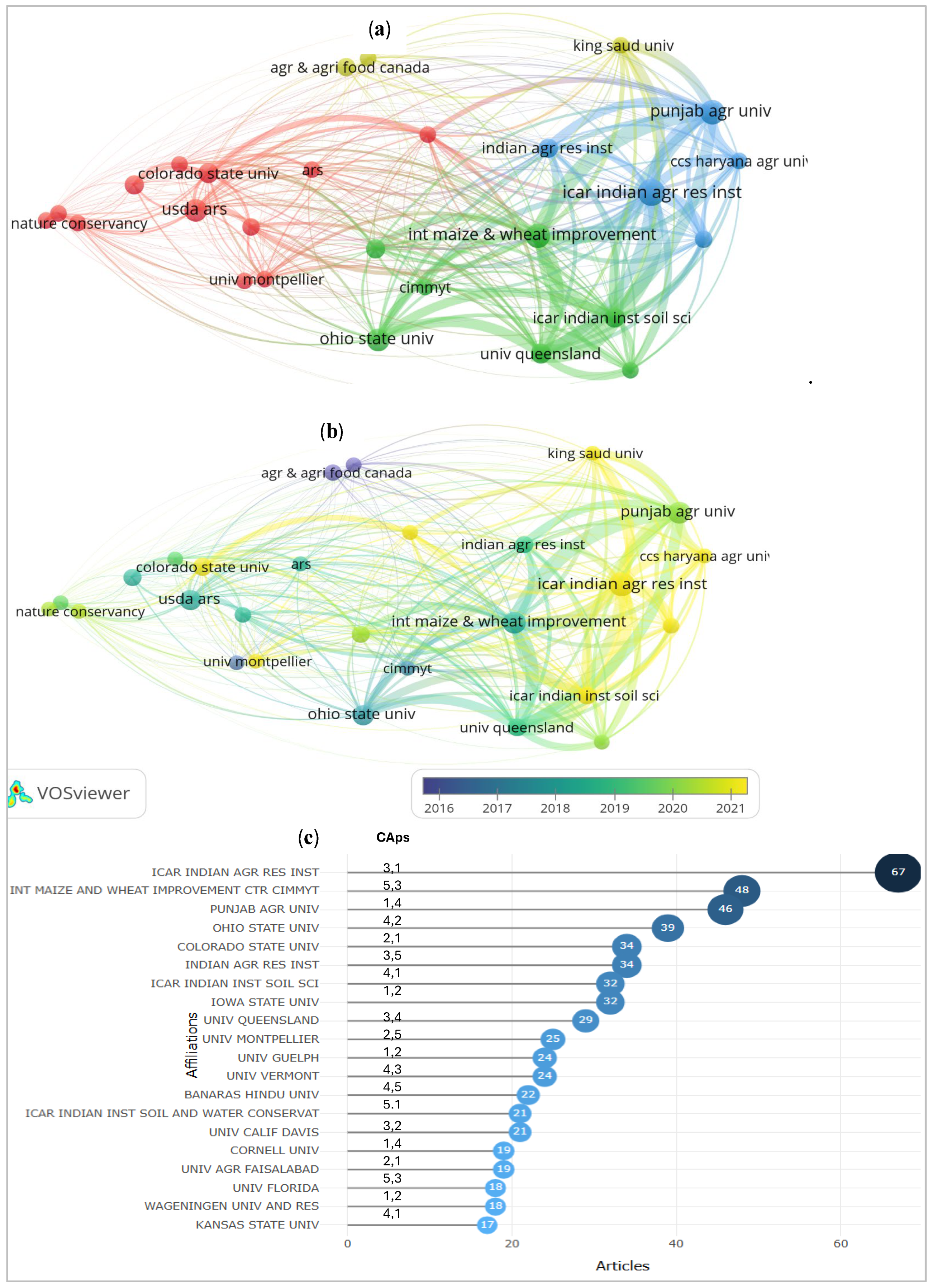
Figure 6.
Keywords (a) network visualization analysis, (b) overlay visualization analysis. Source: analyzed by authors using VOSviewer.
Figure 6.
Keywords (a) network visualization analysis, (b) overlay visualization analysis. Source: analyzed by authors using VOSviewer.
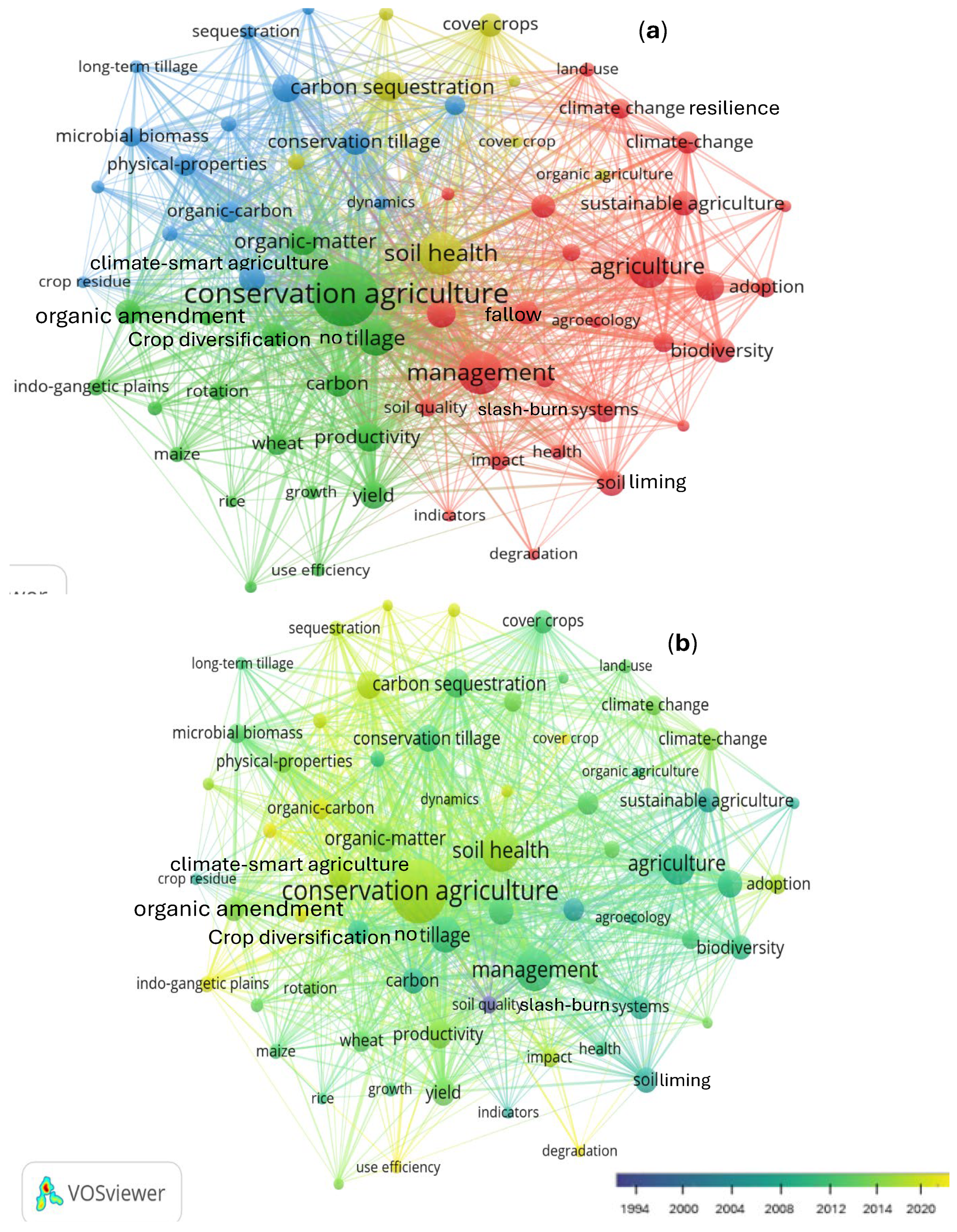
Figure 7.
(a) trend topics (b) factorial analysis of the trend topics using multiple component analysis. Source: analyzed by authors using Bibliometrix in Rstudio.
Figure 7.
(a) trend topics (b) factorial analysis of the trend topics using multiple component analysis. Source: analyzed by authors using Bibliometrix in Rstudio.
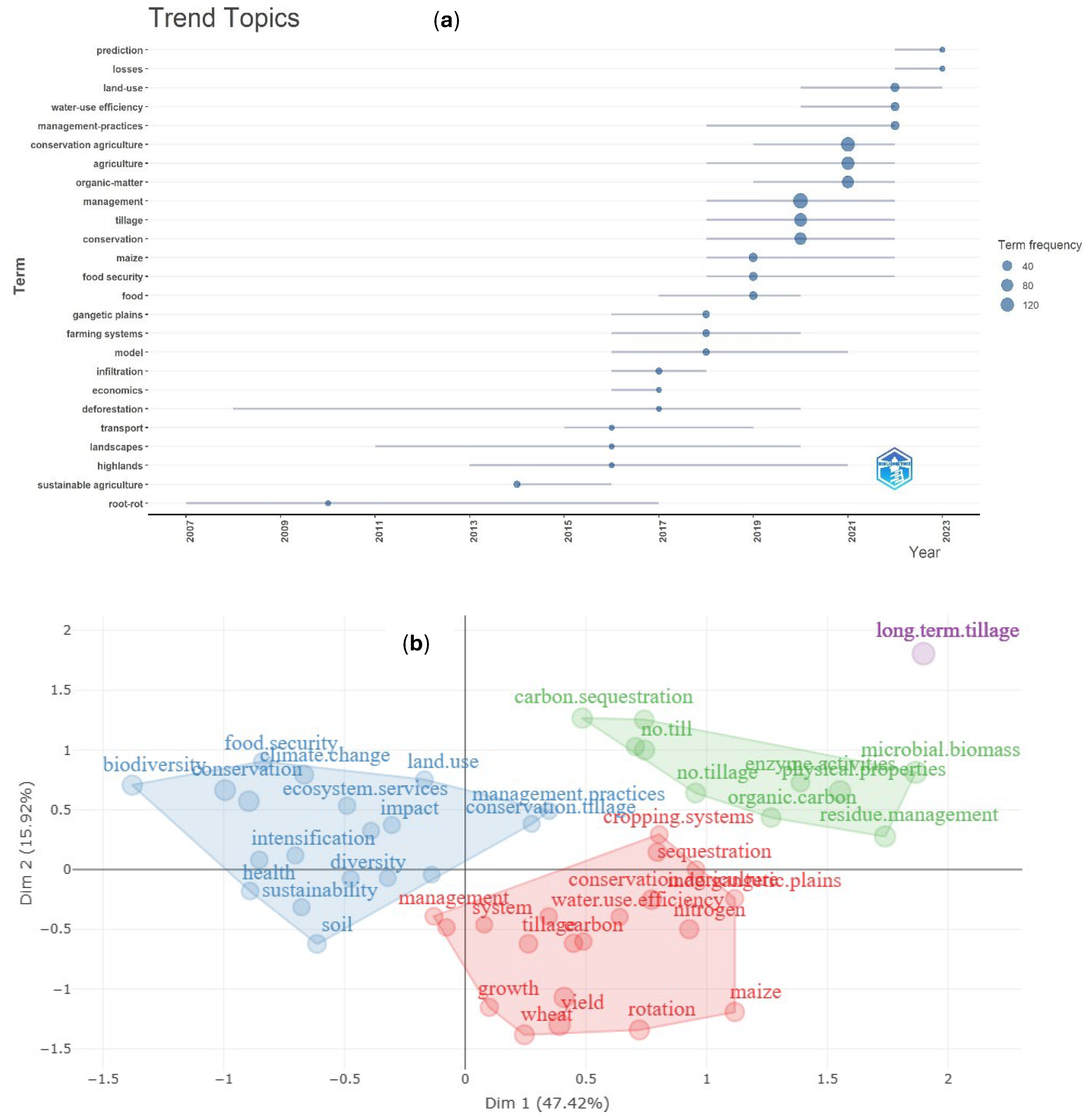
Figure 8.
Thematic evolution of (a) authors’ keywords, (b) keywords plus, on the research topic between 1991-2023. Source: analyzed by authors using Bibliometrix in Rstudio.
Figure 8.
Thematic evolution of (a) authors’ keywords, (b) keywords plus, on the research topic between 1991-2023. Source: analyzed by authors using Bibliometrix in Rstudio.
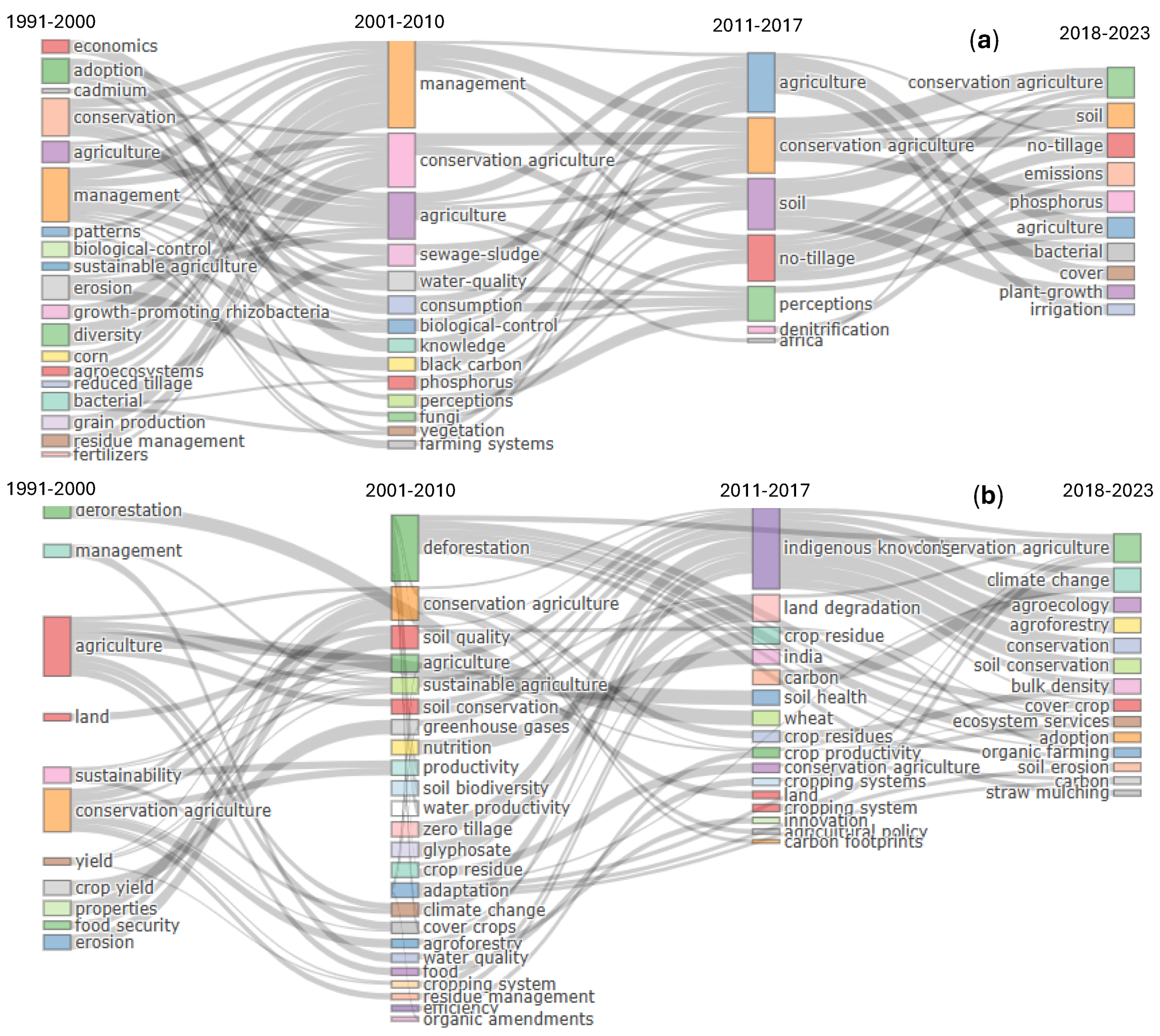
Figure 9.
(a)Proportion of the publications on CA that related or focused on SDGs, (b)comparative analysis of papers related to SDGs between 1991 and 2023. Source: analyzed by authors using Flourish software.
Figure 9.
(a)Proportion of the publications on CA that related or focused on SDGs, (b)comparative analysis of papers related to SDGs between 1991 and 2023. Source: analyzed by authors using Flourish software.
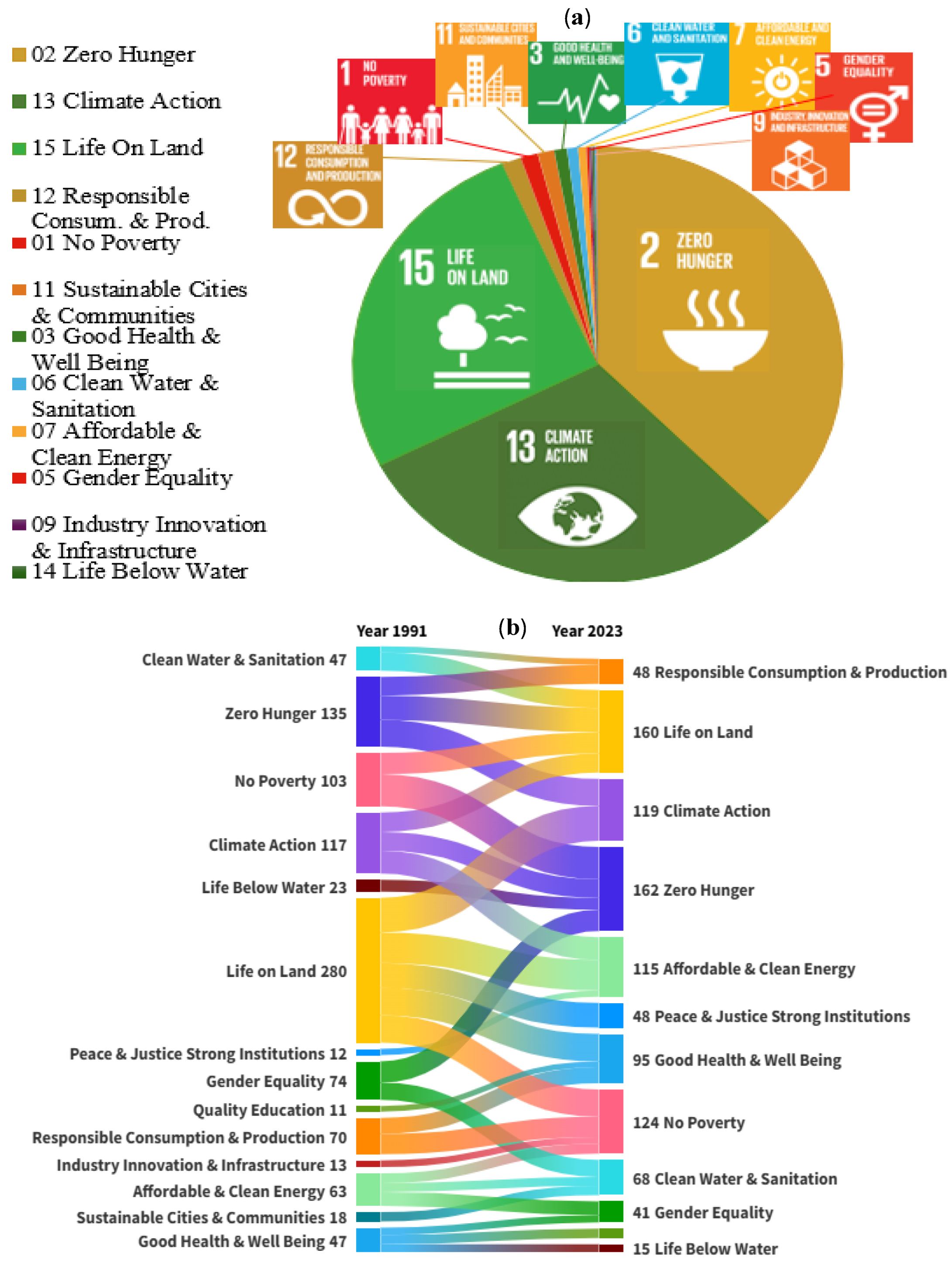
Figure 10.
Major conservation agriculture practices (CAps) and their benefits based on the research on CA between 1991 and 2023. Source: analyzed by authors using Flourish software.
Figure 10.
Major conservation agriculture practices (CAps) and their benefits based on the research on CA between 1991 and 2023. Source: analyzed by authors using Flourish software.
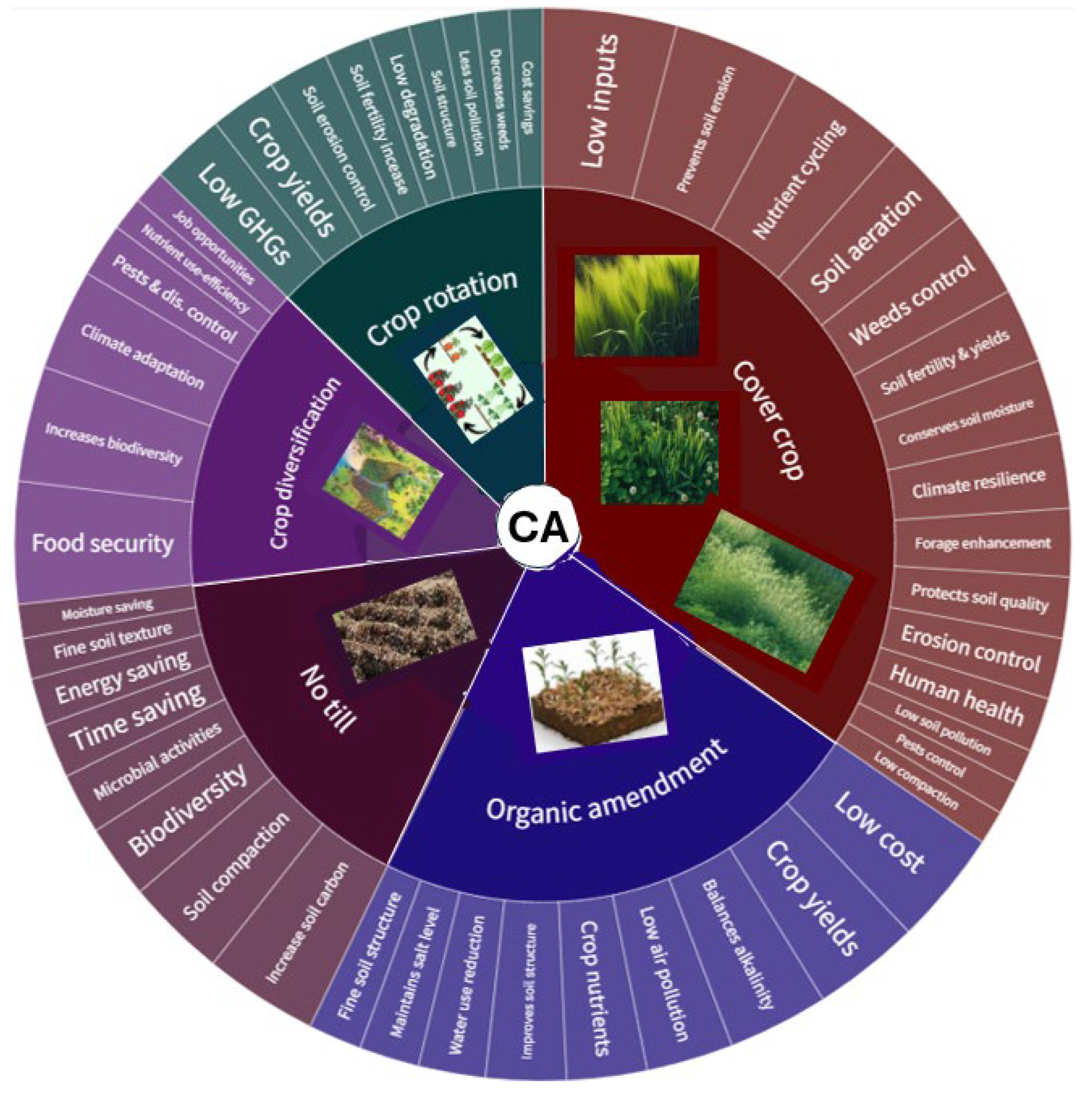
Table 1.
Eligibility criteria for the selection of reviewed literature.
| Inclusion criteria | Exclusion criteria |
|---|---|
| • Qualitative and quantitative analysis. | • Mere descriptive or theoretical. |
| • Proof of empirical study. | • No evidence of empirical research. |
| • Period: 1991–2023. | • Before 1991, and after 2023. |
| • English language. | • Other languages outside English. |
| • Articles that focused on either the impacts of CA on soil health (quality) and SDGs, or the nexus among them. | • Articles relating to issues outside the interactions between CA, soil health (quality) and SDGs. |
| • Research articles and review articles. | • Grey literatures: Proceeding Paper or Early Access or Editorial Material or Book Review or Correction or Letter or Meeting Abstract or Book Chapters. |
| • The words “conservation agriculture” or “conservation farming” and “soil health” or “soil quality”, and sustainable development or SDGs are found in the title, and/or abstract, and/or keywords, and conclusion. | • The words “conservation agriculture” or “conservation farming” and “soil health” or “soil quality”, and sustainable development or SDGs are found in only the keywords or conclusion. |
Table 2.
Description of the main information about the data used for the study.
| Description | Results |
|---|---|
| Timespan | 1991:2023 |
| Documents | 835 |
| Annual Growth Rate % | 16.54 |
| Document Average Age | 5.46 |
| Average citations per doc | 31.9 |
| References | 48,421 |
| DOCUMENT CONTENTS | |
| Keywords Plus (ID) | 2,140 |
| Author’s Keywords (DE) | 2,525 |
| AUTHORS | |
| Authors | 3,455 |
| Authors of single-authored docs | 41 |
| AUTHORS COLLABORATION | |
| Single-authored docs | 49 |
| Co-Authors per Doc | 5.34 |
| International co-authorships % | 33.66 |
| DOCUMENT TYPES | |
| Article | 637 |
| Review Article | 163 |
| Proceeding Paper | 29 |
| Book Chapters | 6 |
Table 3.
Most impactful journals in the research topic over time.
| Element | h_index | g_index | m_index | TC | NP | PY_start | IF |
|---|---|---|---|---|---|---|---|
| Soil & Tillage Research | 23 | 35 | 0.821 | 1537 | 35 | 1997 | 7.4 |
| Agriculture Ecosystems & Environment | 14 | 20 | 0.424 | 927 | 20 | 1992 | 6.6 |
| Agronomy for Sustainable Development | 12 | 18 | 0.75 | 1152 | 18 | 2009 | 7.3 |
| Science of the Total Environment | 12 | 15 | 1.2 | 710 | 15 | 2015 | 9.8 |
| Sustainability | 12 | 36 | 1.2 | 1803 | 36 | 2015 | 3.3 |
| Agronomy-Basel | 9 | 17 | 1.5 | 315 | 26 | 2019 | 3.9 |
| Agriculture-Basel | 8 | 12 | 0.667 | 165 | 14 | 2013 | 3.6 |
| Field Crops Research | 8 | 9 | 0.615 | 703 | 9 | 2012 | 5.8 |
| Geoderma | 8 | 10 | 0.333 | 359 | 10 | 2001 | 6.1 |
| Int J Agricultural Sustainability | 8 | 9 | 0.5 | 752 | 9 | 2009 | 3.4 |
| Journal of Soil & Water Conservation | 8 | 18 | 0.308 | 502 | 18 | 1999 | 3.2 |
| Indian Journal of Agricultural Sciences | 7 | 12 | 0.35 | 154 | 23 | 2005 | 0.3 |
| Renewable Agriculture & Food Systems | 7 | 11 | 0.412 | 392 | 11 | 2008 | 2.7 |
| Agricultural Systems | 6 | 7 | 0.6 | 490 | 7 | 2015 | 6.6 |
| Frontiers in Sustainable Food Systems | 6 | 14 | 1.2 | 214 | 18 | 2020 | 3.7 |
| Int Soil & Water Conservation Research | 6 | 6 | 0.545 | 557 | 6 | 2014 | 6.4 |
| Applied Soil Ecology | 5 | 9 | 0.278 | 332 | 9 | 2007 | 4.8 |
| Archives of Agronomy and Soil Science | 5 | 6 | 0.833 | 111 | 6 | 2019 | 2.4 |
| Current Science | 5 | 5 | 0.25 | 158 | 5 | 2005 | 1.1 |
| Journal of Environmental Management | 5 | 6 | 0.5 | 321 | 6 | 2015 | 8.7 |
| Land Degradation & Development | 5 | 9 | 0.208 | 90 | 9 | 2001 | 3.6 |
| Soil Science Society of America Journal | 5 | 6 | 0.417 | 201 | 6 | 2013 | 2.4 |
TC represents total number of citations; NP represents number of published papers; PY means publication year; IF represents the journal’s impact factor. Source: analyzed by authors using Bibliometrix in Rstudio.
Table 4.
CA practices (CAps), supported and/or achieved SDGs, and the implications.
| CAps | Benefits | Supported or achieved SDGs in order of relevance and as reported in the research | Implications and descriptions |
|---|---|---|---|
| No till | Increases soil carbon | SDG13, SDG2, SDG15, SDG3 | Increase in soil C promotes climate change resilience, reduces hunger by improving food production, and human health from a balanced diet and sustainable environment. |
| No till | Decreases soil compaction | SDG2, SDG15, SDG11, SDG3 | No tillage means decrease in soil compaction, consequently, improves soil health, food security, species richness, and human well-being. |
| No till | Time saving | SDG 8 | No till saves time, thus making the farmers to be more productive with more income, and decent farming system |
| No till | Energy saving | SDG12, SDG3 | No tillage saves energy (human and mechanical) which provides responsible production, and good health in a long run. |
| No till | Decreases moisture loss | SDG2, SDG15, SDG6 | Optimal moisture in the soil enhances soil quality, food production, biodiversity, and supports the purification of water. |
| No till | Increases microbial activities | SDG2, SDG15, | The role of soil microbes in nutrients enrichment is unquantifiable. This helps to increase crop yields, and species diversity. |
| No till | Increases biodiversity | SDG15, SDG3, | No till increases life on land by reducing severe threats on the below and above soil fauna and flora diversity. The abundance of these natural species rejuvenates health and well-being because man depends much on them. |
| No till | Retention of soil structure | SDG2, SDG15, SDG3, SDG13 | When the structure of soil is retained, it continues to deliver its functional services including provision of food by boosting crops, supports life on land by regulating the energy and matter, and mitigates climate change by C-sequestration and climate modification via healthy plants. |
| Organic amendment | Crop yields | SDG2, SDG3, SDG10, SDG16 | Organic amendment improves soil fertility which increases food security, especially in the poor countries where artificial fertilizers are expensive. Thus, more food is produced in these poor regions, and this might reduce their dependence on the developed countries. This will in turn establish peace among individuals and communities because “a well-fed man is a peaceful man, which a hungry man is an angry and warring man”. |
| Organic amendment | Maintains crop nutrients | SDG2, SDG3, SDG1, SDG15, SDG13, SDG4 | Increase in food productivity will lead to increase in income which could be associate with families’ sources of funds for their children and wards’ education |
| Organic amendment | Decreases water use | SDG6, SDG12, SDG5 | Use of natural manure supports water-use efficiency, which consequently sanitizes the ecosystem, and enhances responsible consumption and productivity. In some developing countries especially in Africa (arid regions of Nigeria precisely), the female members of the family are saddled with the task of fetching water for irrigation and domestic uses. So, reduction of water use in the farm by organic amendment automatically promotes gender equality because the females are reassigned to some other tasks that men do. |
| Organic amendment | Retains soil structure | SDG2, SDG15, SDG3 | Organic residues are natural supplements to plants and soil microorganisms which elevate food production, sustain life on land, increase CO2 sequestration, and provide a conducive environment with vitality. |
| Organic amendment | Improves soil structure | SDG2, SDG15, SDG3, SDG13 | Good soil structure is associated with balanced texture, bulk density and other soil properties. These promote food safety, regulate micro-climate, support biological diversity |
| Organic amendment | Decreases air pollution | SDG13, SDG3, SDG6, | Use of organic manure reduces not only land and water pollution but also air pollution thereby supporting climate change mitigation and provided planetary health as well as clean water and sanitation. |
| Organic amendment | Balances alkalinity | SDG2, SDG15, SDG6, SDG3 | Organic amendment optimizes soil pH, makes the alkalinity favorable for maximum crop yields. It also reduces acidification especially in the arid of wetlands which normalizes the climate extremes and promotes a health environment. |
| Organic amendment | Maintains salt level | SDG2, SDG15, SDG6, SDG3 | High or very low salt levels in the soil lead to poor production, increase climate change challenges, poor health, and polluted environment. All these are substantially corrected by the adoption of organic amendments. |
| Organic amendment | Decreases expenses | SDG1, SDG4, SDG10 | Organic amendment increases farmers income by reducing input. Thus, supporting the farmers in giving quality education to their households, which consequently reduces inequality. |
| Cover crop | Nutrient cycling | SDG2, SDG15, SDG3, SDG13, SDG1 | Improvement in food security, climate adaptation, health, water sanity, species diversity and habitat. |
| Cover crop | Decreases agrochemical inputs | SDG8, SDG15, SDG14, SDG6, SDG13 | More money for farmers, low pollution, lesser threats to biodiversity. |
| Cover crop | Decreases soil pollution | SDG8, SDG15, SDG14, SDG6, SDG13, SDG3 | With little of zero pollution economic growth is supported, biodiversity is preserved, no water pollution from agrochemicals, human health becomes assured. |
| Cover crop | Improves soil fertility & yields | SDG2, SDG10, SDG13, SDG3 | More food, lesser work for the women, micro-climate control, balanced nutrition. |
| Cover crop | Prevents soil erosion | SDG2, SDG9, SDG11, SDG13, SDG15 | Protection of infrastructural developments, cities became sustainable with more food and zero erosion. |
| Cover crop | Promotes soil aeration | SDG2, SDG9, SDG13, SDG15 | A well aerated soil is a fertile soil, high production, balanced C-cycle. |
| Cover crop | Conserves soil moisture | SDG2, SDG15, SDG6 | Richness in soil microorganisms, food safety, water purification. |
| Cover crop | Protects soil quality | SDG2, SDG3, SDG1,SDG15, SDG13 | Good soil texture, organic matter, increased crop yields |
| Cover crop | Safeguards human health | SDG3 | Cover cropping supports human health and well-being by enhancing food availability, and reducing pollution, soil erosion, and regulating land surface temperature |
| Cover crop | Improves climate resilience | SDG13, SDG15, SDG3 | Water budget is optimized, climate is regulated. |
| Cover crop | Pests control | SDG2, SDG15, SDG1 | Higher accessibility of food, biodiversity preserved, more money saved since pesticides are rarely used. |
| Cover crop | Weeds control | SDG2, SDG15, SDG1 | More food produced, more savings from zero weed control. |
| Cover crop | Forage enhancement | SDG2, SDG1, SDG15 | Livestock have more feed and fodder to produce more animal resources for man, Bees, and other fauna species increase in abundance. |
| Cover crop | Compaction management | SDG2, SDG15, SDG1, SDG11, SDG3 | Biodiversity richness, soil nutrient enhancement, |
| Crop rotation | Soil structure enhancement | SDG2, SDG15, SDG3, SDG13 | Cover crop supports plants and soil microorganisms which increases food production, preserves life on land, promotes C-stocks, and a good environment for human well-being. |
| Crop rotation | Soil fertility increase | SDG2, SDG3, SDG1, SDG15, SDG13 | Enhances food security, increases in income, supports family, children and wards’ education |
| Crop rotation | Decreases soil pollution | SDG2, SDG14, SDG12, | Low acidification |
| Crop rotation | Soil erosion management | SDG2, SDG9, SDG11, SDG13, SDG15 | Erosion and floods are minimized, increases crop yields, and sustainable communities. |
| Crop rotation | Decreases weeds | SDG2, SDG15, SDG1 | Weeds are controlled while biodiversity became promoted. |
| Crop rotation | Increases crop yields | SDG2, SDG3, SDG10, | Sustainable food supply, balanced diet and health. |
| Crop rotation | Cost savings | SDG1, SDG4, SDG10 | More money for educational pursuits, women enlightenment and emancipation |
| Crop rotation | Low degradation | SDG15, SDG6, SDG14, SDG3, SDG2 | Low or zero salinization, promotion of biodiversity and soil health |
| Crop rotation | Low greenhouse gases | SDG13, SDG3, SDG6, SDG15, SDG14 | Guarantees more food, water accessibility, species richness, and human health. |
| Crop diversification | Food security always | SDG2, SDG3, SDG16, | Food produced in all seasons, all time food accessibility reduces conflicts among households and communities. |
| Crop diversification | Climate change adaptation | SDG13, SDG15, SDG3, SDG2 | Different foods produced, taller crops sheds others |
| Crop diversification | Increases biodiversity | SDG15 | Supports life on land |
| Crop diversification | Pests & diseases control | SDG2, SDG15, SDG1 | More money saved, more food produced, climate modified |
| Crop diversification | Nutrient use-efficiency | SDG2, SDG13, SDG15 | Low external nutrient input. |
| Crop diversification | Increases Job opportunities | SDG1, SDG4, SDG10, SDG3 | Social stability, more money, better life and well-being, all genders have job, thus reducing dependent or gender inequality. |
| Crop diversification | Sustainable energy | SDG7, SDG15 | Use of resources (e.g., tree branches, farm animals) for sustainable energy |
Disclaimer/Publisher’s Note: The statements, opinions and data contained in all publications are solely those of the individual author(s) and contributor(s) and not of MDPI and/or the editor(s). MDPI and/or the editor(s) disclaim responsibility for any injury to people or property resulting from any ideas, methods, instructions or products referred to in the content. |
© 2024 by the authors. Licensee MDPI, Basel, Switzerland. This article is an open access article distributed under the terms and conditions of the Creative Commons Attribution (CC BY) license (http://creativecommons.org/licenses/by/4.0/).
Copyright: This open access article is published under a Creative Commons CC BY 4.0 license, which permit the free download, distribution, and reuse, provided that the author and preprint are cited in any reuse.


