

Submitted:
26 May 2025
Posted:
26 May 2025
Read the latest preprint version here
Abstract
This paper proposes a discrete spacetime framework based on the following key postulates:(i)Temporal Emergence: Time arises as discrete, entropy-driven transitions within a network of Space Elementary Quanta (SEQs). The universe evolves through state changes in this network, with entropy quantified via multiplicative energy distributions across space transformation structure matrix. (ii) Spatial Compression via SU(3): Local space compression is mediated by SU(3) gauge symmetry, implemented through 3D modulation and axis transformations while preserving spherical symmetry. This compression generates isotropic gravitational fields via the external stretching of space. (iii) Mass as Stored Gravitational Potential: The fundamental nature of mass corresponds to the storage of gravitational (spatial elastic) potential energy, resulting from SU(3)-mediated space compression. (iv) Time Dilation Mechanism: The framework offers a concrete explanation for relativistic time dilation—local compression or stretching of SEQs modulates their transformation frequency, directly connecting gravitational and kinematic effects to observed time dilation. (v) Testable Prediction: The model yields a falsifiable signature: a measurable asymmetry between positron and electron magnetic moments, arising from their opposite chiral coupling to the fixed-spin SEQ ground state. (vi) Higgs Field as Chiral Stabilizer: The Higgs field functions as a quantum chiral lock, enforcing symmetry-breaking constraints that stabilize SU(3)-mediated elastic energy storage in localized space.
Keywords:
Time-Entropy Mirroring
; Discrete Spacetime
; Thermodynamic Time Arrow
; Multiplicative Entropy
; Space elementary quanta(SEQ)
; Mass-Gravity Duality
; Higgs chiral lock
; QCD-Higgs Synergy
Introduction
Time manifests distinctly across physical theories: as geometric curvature in general relativity, a parameter in quantum field theory, and an emergent arrow in thermodynamics. This work synthesizes these perspectives through a discrete spacetime framework, where:
- Fundamental Structure: Space emerges from a dynamic network of Planck-scale Space Elementary Quanta (SEQs) – indivisible units whose elastic interactions and excitation states encode all physical phenomena.
- Time and Entropy: Global time arises from discrete, entropy-increasing transformations of the SEQ network, with local time dilation governed by modulation of SEQ state-transition frequencies .
-
Mass-Gravity Unification:
- (i)
- SU(3) color forces compress local SEQ networks, storing energy as spatial strain (mass) while inducing external spacetime stretching (gravity).
- (ii)
- The Higgs field stabilizes this compression via symmetry breaking, acting as a chiral "quantum lock" to prevent energy dissipation.
Roadmap:
→Basic set and space-time-entropy mapping(§1-§6)
→Phenomenological consistency and falsifiable predictions(§7-§8)
→Mass-Gravity-SU(3)-Higgs Nexus(§9-§11)
→Discussion, etc. (§12-§17)
1. Preparatory Assumptions
1.1 The universe is expanding
1.2 The universe operates under the Law of Energy Conservation and the Law of Entropy Increase.
1.3 The universe consists of Space Elementary Quanta (SEQ), discrete Planck-scale units, forming a topologically homeomorphic 3D structure (adjacency relations remain preserved while individual SEQ energy states may vary). Importantly, this polycrystalline structure necessarily contains primordial Periodic Topological Dislocation to ensure physical isotropy, yet maintains strict 3D topological homeomorphism as these defects are cosmologically frozen and adjacency-preserving since the birth of the universe. The distortion of light around black holes demonstrates that gravitational and electromagnetic field quanta are coupled, suggesting they originate from the same quantum field in different excited states—leading to the SEQ hypothesis. The spacing and tension between adjacent SEQ can be modulated by gravitational or equivalent gravitational fields.
1.4 All field quanta and elementary particles represent different energy excitation states of SEQ, expressible as 3D dynamic structural matrices of SEQ .
1.5 SEQ possess a ground state energy (e.g., ground-state spin or vibrational modes). If ground-state spin chirality is fixed, this may explain parity violation. The ground-state energy of SEQ could also account for the cosmological constant in General Relativity. This framework shows strong alignment with Loop Quantum Gravity theory.
1.6 Adjacent SEQs maintain a dynamic equilibrium spacing interconnected via spring-like bonds in their ground state. SEQs are fundamental, indivisible Planck-scale entities—their structure remains intact under any deformation or energy fluctuations.
The sub-Planckian regime governs the spatial elasticity of the network (including elastic potential storage and release), while quantized energy transfer occurs exclusively through interactions between SEQs. Within this framework:
- The spin degrees of freedom of SEQs and their elastic bonds remain decoupled, preserving independent dynamical regimes.
- Under perturbation, the system responds by modifying SEQ resonant frequencies while generating compressive/tensile forces.
- This response is nonlinear and asymmetric, enabling emergent behaviors (e.g., regional gradient variations).
- SEQs are stable, indivisible structures composed of sub-Planckian components. SEQs’ spin emerges from collective space transformations at the sub-Planck level. This ensures the spin degrees of freedom do not interfere with elastic deformations in the SEQ network. This architecture naturally protects spin dynamics from elastic disturbances.
- At the sub-Planckian scale, the elastic properties of the underlying substrate impose an upper bound on the spacing modulation and tension between adjacent SEQs. This fundamental limit ensures that extreme deformations (e.g., near black hole singularities) cannot disrupt the topological integrity of the SEQ network.
- In this model, the harmonic oscillation intervals of SEQ are integer multiples of Planck time(tₚ). Consequently, all dynamic processes—including elastic strain interactions, harmonic conduction, as well as scalar, spinor field transmissions and other energy conduction mode induced by rotational axis dynamics—are fundamentally constrained by the discrete Planck-time intervals. This property inherently ensures the model's consistency with the discrete-time hypothesis in quantum mechanics and quantum gravity theories.
1.7 If matter truly traversed space, it would require modification of spacetime's adjacency relations. Yet black holes—despite their extreme mass—preserve local spacetime topology (as evidenced by smooth light bending). This implies that apparent particle motion must instead represent propagating excitations of spacetime itself, consistent with GR. The speed of light (c) constitutes the maximum excitation propagation rate in space.
2. Time as a Counting Process of Spacetime Network Transformations
2.1 SEQ serve as the electromagnetic wave conducting medium. Matter with mass and its motion are waves in this medium. In this framework, nothing truly moves through space - light speed c is the maximum conduction speed c, preventing velocity stacking beyond c. All physical phenomena correspond to specific energy state configurations, establishing SEQ as the universal substrate.
2.2 The universe's composition: Energy conservation and quantization imply a finite number N of SEQ, each with M possible energy states,(where each energy state is an integer multiple of Planck’s constant h, ) allowing up to transformations. These M energy states form an algebraic system incorporating translational, spinning and rotational operations connecting to standard model. Energy conservation and entropy increase constraints reduce possible transformations significantly below .
2.3 Time definition:
2.3.1 Let J be the possible universe transformations (J <<).
2.3.2 The Planck time (tₚ) interval separates adjacent transformations as the minimal time unit.
2.3.3 Time's arrow follows entropy increase.
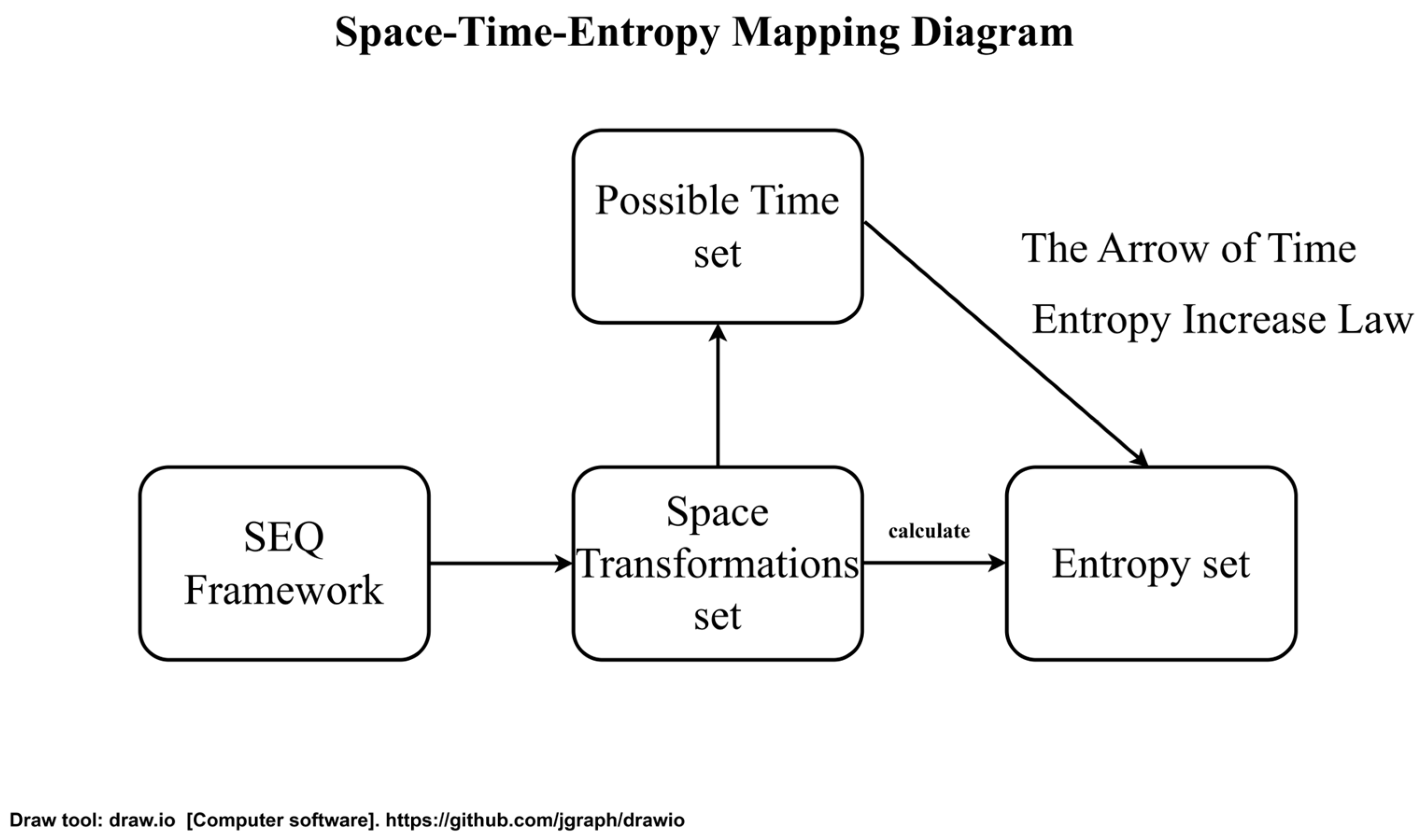
2.3.4 Transformations map non-bijectively to entropy values (k distinct values partition J transformations into K classes). Parallel transformations share the same entropy values, but only one can occur. The entropy set maps to possible time values - each moment corresponds to one universe transformation. Non-uniform entropy increase means only a subset of possible time values actually occur.
2.3.5 Each space transformation (state transition of the SEQ network) can be assigned a unique entropy value calculated via the multiplicative energy distribution across this space transformation’s matrix.
2.3.6 Finite transformations ensure discrete, limited time in this model.
(Note:this derivation is a speculative exploration within the discrete framework and does not imply reality.)
3. Definition and Analysis Formula of Entropy
In this definition of entropy, the entropy value of a closed system at a given moment (i.e., during a specific state transition) is calculated as the multiplicative product of the energy norms of all SEQs involved in that transition(that moment’s space transformation).
, When all are equal or differ only by Planck's
constant h
(Where refers to the energy carried by the ith SEQ during a single transformation of the closed system, where each energy state is an integer multiple of Planck’s constant h, =h, )
3.1 Energy transfer rules and triggering conditions:
Energy exchange occurs between adjacent SEQ (i,j) if and only if the following thermodynamic gradient exists:, Energy transfer occurs only in discrete quanta of Planck's constant h, → −h; →+h (Planck's constant:h)
3.2 Numerical Example: System States and Entropy Evolution

Table 1.
Simplified Entropy Increase Demonstration.
| System State | SEQ Energy Distribution =12 |
Entropy |
Remarks |
| Initial non-equilibrium state | [3, 1, 5, 3] | 45 | - |
| Intermediate state | [3, 1, 4, 4] | 48 | - |
| Final state | [3, 2, 3, 4] | 72 | Due to adjacent energy transfer with minimal quanta h, this system cannot reach maximum entropy in this case |
Note:The above analysis demonstrates that different entropy-increasing pathways exhibit distinct sequences of entropy variation.
3.3 Logarithmic Relation:
After logarithmic transformation, lnS aligns with the conventional Boltzmann entropy form, while the multiplicative formulation naturally suits discrete systems.
3.4 Proof of Spontaneous Entropy Increase
Spontaneity Theorem of entropy increase (Second Law of Thermodynamics):
For every possible energy transfer process, the total entropy change satisfies ΔS≥0.
Proof Outline: Let the pre-transfer states be =a, =b (ab+h);
The post-transfer entropy ratio is:
/=(a−h)(b+h)/ab=1+h(a−b−h)/ab1 (Planck's constant h)
3.5 Entropy increase manifests through macroscopic interactions level, atomic/molecular level, QED processes, and microscopic particle restructuring (matrix disintegration/reorganization, radiation).
3.6 The entropy formulation S proposed herein operates not only at the fundamental SEQ level, but also admits coarse-graining for arbitrary massive many-body systems. This universality originates from the energy-mass equivalence which allows the cumulative product to naturally encode multi-body interactions. Crucially, this formulation provides first-principles computational constraints for discrete simulations across all scales.
3.7 The definition conserves energy, has an entropy ceiling, ensures spontaneous increase, and logarithmically aligns with classical entropy.
At this point, a clear multiple mapping can be established:
One space transformationone entropy valueOne possible moment
Figure 1.
Space-Time-Entropy Mapping Diagram.
3.8 The Spontaneous Entropy Increase is Causality.
3.9 Why Analytic Entropy is Adopted: Within this model's framework, physical states at Planck-time scales exhibit deterministic characteristics. Although current experimental conditions cannot directly measure them, traditional statistical entropy can be reduced to analytic expressions at this scale. This perspective not only reveals the microscopic essence of statistical quantities but also provides a new analytic foundation for quantum thermodynamics—unifying macroscopic statistical behaviors with deterministic dynamics at the Planck scale.
4. Analysis of Action
The dimension of the action quantity is consistent with that of Planck constant, so the action quantity can be the number of units of quantum energy (Planck constant).
The total number of unit quantum conduction energy of a physical process involves two parameters, one is the number n of SEQ involved in the physical process wave conduction, and the other is the conduction timesof the ith SEQ involved in the conduction, in which the maximum number of conduction count of all single SEQ is less than or equal to times of local spatial transformations in this process. h is Planck constant. Then the action amount can also be written as
The law of the principle of least action reveals that the path selected by physics process is the path that the total amount of energy conduction involved SEQ is the least. It involves two parameters, as mentioned above. If the number of SEQ involved remains the same and the conduction times of each SEQ are the same, (1)Fermat's principle of the shortest time of optical path and (2)the principle of the steepest descent line can be directly derived, because in these two examples, the number of SEQ involved in the physical process and the rolling spherical rigid body in the steepest descent line remain the same, and the conduction times of each SEQ are also approximately the same, then time (the number of local space transformations) is the only variable for the calculation of action, so using time to divide the wave forms of different paths is equivalent to using action to divide the wave forms of different paths. Time here refers to the transformation times of local space. From this point of view, we can probably understand why the analysis of action amount proposed in different periods is different, but it can explain some phenomena.
5. Local Time, the Proper Time and Relative Time in Relativity
5.1 local time. As previously established, global time is defined by the transformations of the universe. This work introduces local time as an operational concept that: (1) provides correspondence with special relativistic time notions; and (2) enables precise specification of time scales for localized physical processes. Crucially, any measurable time parameter in physical calculations necessarily corresponds to transformations within a specific local space. This operational concept is designated as local time.
The local space scope must be unambiguously specified: either as the SEQ network along the physical process path or the connected region within the observer's light cone. This distinction mirrors the complementarity between Feynman's path-integral formulation and relativistic theory, avoiding conceptual confusion in prior works.
Local time: it can specify the time set corresponding to the transformations within a specific spatial range. In fact, from the perspective of this framework, the existing equations with t parameter in textbooks are actually the local time by default.
One example: the clock slowness effect in Relativity manifests as different transformation times in different local spaces.
Every local space transformation constitutes a part of the universal evolution. Global time progression () does not necessitate synchronous local transformations, the state matrix of a given local space may remain invariant despite cosmic-scale changes ( ≈ 0) when this local space undergoes no state transition.
5.2 The proper time in General Relativity is related to local transformations count of physics process entities. (Section 9.1,Section9.5.6 present the physical mechanism underlying proper time dilation in GR.)
5.3 Understanding on Lorentz-covariant rules in Special Relativity theory: The time perception of physical processes across distinct reference frames fundamentally corresponds to the observation of transformation counts. The observation time discrepancy between frames derives from the accumulated difference in their frame SEQ transformation counts. An observer measures another frame's time evolution through the differential transformation count ΔN, while he can’t perceive their own transformation count N0. The observed ΔN is fundamentally governed by the dynamic light-path difference between the observer's frame and the moving reference frame of the measured object. Under the principle of non-additivity of light speed (c-invariance), this formulation naturally derives Lorentz-covariant rules through counting operations.
- Key Distinction from GR Effects
While the mathematical derivation process aligns with standard special relativity textbooks—replacing continuous spacetime metrics with discrete counting operations—the physical interpretation differs substantially in conceptualization:
- SR Effects as Perceptual Phenomena
Time dilation and length contraction emerge purely as observer-dependent measurement consequences
Originate from information transmission constraints via discrete light-signal counting
- Contrast with GR Mechanisms
Gravitational time dilation involves actual deformation of the SEQ network's transformation frequency
Equivalence principle effects require space compression as well (see §9.5).
6. Basic Physical Quantities in This Framework
Time: the count of the transformations of universe or specific local space.
Length: the count of SEQ in adjacent space. The source of transformation is the change of energy state, and the minimal transformation is the adjacent energy transmission. For example, after of N transformations, the number of SEQ that the farthest conduction of gravitational wave passes through is also N. This example vividly shows the concept of the integration of time and space.
Energy: integer multiple of the minimum energy unit(the Planck constant).
Entropy: the cumulative multiplication of energy on the SEQ in a whole or a locally closed space.
Time, energy, length and entropy are dimensionless integers.
7. Phenomenological Consistency Checks
7.1. Why can't the Speed of Light Stack Up?
As established above(Refer to Section1), the speed of light (c) constitutes the maximum excitation propagation rate in space, wherein all observed motion fundamentally represents state transitions within SEQ network rather than physical traversal through space.
7.2. Uncertainty Relation and Wave-Particle Duality
The Uncertainty Principle naturally arises from wave propagation through discrete SEQ: precise position inherently limits determination of conduction speed (wave dynamics), and vice versa.
Wave-particle Duality. The wave nature is fundamental, while the particle nature emerges from the discreteness of spacetime itself.
7.3. Double-Slit Experiment
Explanation: Based on this framework, electron’s conducting in the space conforms some probability function, and really causes multi-path oscillating in space, and these oscillating can be accumulated. Electron excitation causes space oscillating both of the two slits at the sides of excitation source, The proposed framework predicts the emergence of interference fringes, as the electron excitation induces coherent oscillations across multiple SEQ conduction paths. Even in case of one-slit experiment, when the accumulated Wavelets cross the slit, slit’s Unsmooth edges may produce different paths and generate interference that could be observed if the sensor is sensitive enough and the slit edge’s form can meet the Coherent Condition.[1,2]
Note:While this framework strictly enforces time ordering along entropy increase, it currently does not provide an interpretation for delayed-choice experiments. This remains an open question requiring further development in this framework.
7.4. Non-Conservation of Parity
With the assumption above, if SEQ ground state spin chirality is fixed, that could be one possible explanation of the non conservation of parity.
Is dark matter potentially explained by high-density SEQ ground-state clusters under gravity? And is the ground state energy carried by the SEQ the so-called dark energy?
7.5. Conjecture on Muon Decay experiment [3]
Within this framework, accelerated muon motion induces local SEQ spacing variation, lowering local spacetime transformation frequency—manifesting as time dilation. Particle decay arises from the destabilization of their 3D structural matrices when interaction forces(EM/weak/strong) can no longer sustain equilibrium. Crucially, this destabilization exhibits transformation-frequency dependence, explaining observed variations in Muon Decay experiment.
8. Experiment to Verify or Falsify the Hypotheses Proposed
A prediction of a difference in the magnetic moments of the positron and electron
Given the isotropic nature of the electric field generated by electrons, this framework hypothesizes that electrons possess an Spatially Symmetric dynamic structure composed of SEQ. Under the SEQ framework, all charged microscopic particles including electrons and quarks possess 3D structures that preserve spherical symmetry in space.
If a statistically significant discrepancy is measured between the magnetic moment of the positron and that of the electron, it would strengthen the credibility of the hypothesis 1)the SEQ's chiral ground state and 2)the structured nature of electrons .This difference arises because the positron's structural matrix rotates with opposite chirality to the electron's, resulting in distinct coupling configurations with the SEQ's fixed-chirality ground-state spin. Based on this, it can be inferred that the magnetic moments of the positron and electron should exhibit a slight discrepancy.
9. Gravitational Interaction and General Relativity
9.1. Gravitational interaction is modeled as a translational action described by matrices that alter the equilibrium spacing between SEQ. SEQ are interconnected via spring-like bonds in their ground state(Refer to the basic setting in Section 1.6, page 2). Gravity modifies this spacing, creating tension with finite potential energy. This system behaves like a loaded spring: under gravitational fields, oscillation frequencies decrease, reducing local spacetime transformation rates and causing time dilation - matching general relativity's predictions while revealing its mechanism. Mass-generated gravity acts as a spherically divergent translation with inverse-square density, curving flat spacetime topologically to produce general relativistic metric changes.
Within this discrete framework, the singularity paradox of black holes is naturally resolved because the tension between SEQ has a upper limit.
Macroscopically, (1)It explains metric variations and gravitational time dilation predicted by general relativity, while remaining compatible with its continuity assumption, (2)The ground-state energy of SEQ can also give a depiction of the cosmological constant in general relativity. (3)At the cosmic edge, adjacent SEQ lack outward coordination sites, creating an expansion force toward the interior—a potential mechanism for cosmic expansion.
9.2 Consistent with general relativity, high-velocity or accelerated transformations of localized matter compress space, thereby inducing tensile stretching of surrounding space (equivalent gravitational effects). This process not only induces spacetime curvature but also modulates the conduction frequency of waves.
In relativity theory, equivalent gravitational fields from velocity/acceleration (1) share the same core mechanism as mass-generated gravity—local SEQ compression (reduced spacing) inducing spacetime stretching, but (2) exhibit vector-directional dependence (anisotropic compression) instead of spherical symmetry, and (3) reflect inertial-SEQ lattice coupling through their non-spherical divergence and preferred orientation alignment in quantum spacetime structure.
9.3 Detailed Correspondence with Newton's law of universal gravitation
"The number of SEQ on the surface of a mass source corresponds to the number of gravitational flux lines (i.e., the count of gravitational transmission paths). As the gravitational field diverges spherically, the density of these flux lines becomes inversely proportional to the surface area at any given radius, thus exhibiting an inverse-square relationship with distance. This result directly coincides with Newton's law of universal gravitation."
9.4 Correspondence with Newton's First Law—the Law of Inertia
In this framework, the compressed space at the front and the stretched space at the rear—both caused by the object's motion at Constant Velocity—are always the interfacial boundary between the matter wave and the surrounding SEQ. Beyond this boundary, there is no compression or stretching induced by the object's motion at Constant Velocity, only a shift in the harmonic vibration phase of the SEQ , the system reaches equilibrium at Constant Velocity.
The work input during acceleration establishes interfacial strain energy in the SEQ network, which then sustains uniform motion through elastic potential equilibration.
9.5 Understanding on General Relativity
9.5.1 Under gravitational and equivalent gravitational interactions, the dynamic deformation of 3D space structural matrix and variation in local SEQ density distribution corresponds to Metric field in General Relativity.
9.5.2 Minimum cumulative conduction count path adjustment along with the cumulative dynamic paths connecting every two-points with the minimal count of adjacent SEQ through spacetime distortion corresponds to geodesic path in general relativity. (Principle of least action)
9.5.3 Global topological homeomorphic transformation in SEQ framework corresponds to Diffeomorphism invariance in General Relativity.
9.5.4 The continuity assumption in general relativity, analogous to the continuum medium framework in fluid mechanics, constitutes a necessary and effective computational framework.
9.5.5 Black hole event horizon:
Inside the event horizon of a black hole, due to intense gravitational forces, the spacing between SEQ is compressed to its limit. This extreme compression approximately and locally halts: (1)Energy conduction (2) space transformations (3)Entropy increase step (Neglecting black hole accretion).
9.5.6 Gravitational and Kinematic Time Dilation
All factors that induce metric variation, including mass (gravity), velocity, and acceleration(equivalence principle), compress or stretch spacetime locally, thereby modulating the transformation frequency of related space. This frequency suppression constitutes the fundamental mechanism of time dilation.
10. Mass, Gravity, SU(3) and Higgs field in Quantum Field Theory
10.1 SU(3) as the Origin of Mass Derivation
10.1.1 General Relativity establishes that gravitational fields manifest as metric perturbations→spacetime curvature.
10.1.2 Mass must therefore induce localized spacetime distortion→creating the observed gravitational potential.
10.1.3 This implies mass itself represents a condensed form of spacetime deformation →self-consistent with stress-energy sourcing curvature.
10.1.4 Within hadrons, quark-gluon dynamics are governed by SU(3) color interactions→the dominant force compressing spatial quanta (SEQs).
10.1.5 Thus, SU(3)-mediated compression of SEQ networks → generates both quark confinement energy (mass) and external spacetime stretching (gravity).
10.1.6 Generalizing this mechanism→ equivalent effects (velocity/acceleration) anisotropically compress local space→inducing equivalent gravitational attraction via adjacent SEQ tension.
Note:The phase in SU(3):compression or stretching shift between SEQ.
10.2 U(1): Electromagnetic Interaction
10.3 SU(2): Adjustments of Rotational Axes,spin and encoding chirality in Charged Microscopic Particle Structural Matrices.Encoding Rotational chirality of Charged Microscopic Particle Structural Matrices as the Origin of Weak Interaction Symmetry Breaking. because the rotational Structural Matrices with different chirality have different coupling mode with the fixed chirality of SEQ's ground-state spin. Although SU(2) lacks a chirality modulation parameter, its definition as adjusting rotation axes and spin for charged particles with specific chirality intrinsically encodes chiral variables.
10.4 SU(3):
10.4.1 Imagine the 3D dynamic quasi-spherical matrix structure of quarks as a multi-layered and multi-axial rotational configuration. Due to the high-energy concentration within the structure, the SEQ within the structure remain in a dynamic equilibrium of compression or stretching, while the interactions between layers also maintain a dynamic equilibrium of compression or stretching.
10.4.2 Fractional quark charges emerge from stratified SEQ layers in proton/neutron matrices, with 2/3-charged quarks occupying twice the layers of 1/3-charged quarks. The multi-layered structure well explains the observed differences between high-energy(uniform angular distribution) and medium-energy regimes in electron-proton scattering experiments.
10.4.3 The color property of quarks corresponds to the long axis of their dynamic structural matrix, specifically the axis with the highest energy density distribution within the quark's structural configuration. The color neutrality of protons and neutrons corresponds to the global spatial symmetry, the isotropy of the electric field and structural stability exhibited by their spatial structural matrices.
10.4.4 Antiquarks correspond to the handedness reverse representation of structural matrix rotational transformation of their corresponding quarks.
10.4.5 The 8 generators of SU(3) correspond to 8 distinct interactions mediated by different gluons. Among them, the 6 non-diagonal matrices represent combinations of color exchange operations, stretching and compression phase transformations with phase variations(3*2); while the 2 diagonal matrices correspond to scaling transformations across the three color dimensions. These gluons and their 8 distinct interaction types operate within the interlayer regions of the multi-layered structural matrices of protons or neutrons.
The dynamic color exchange corresponding to the generators of SU(3) and the three-dimensional color distribution modulation are fundamentally linked to the translational action of gravity. Therefore, the color modulation and exchange interactions of SU(3) could constitute one of the origin of mass.
10.4.6 Gluons mediate compression and tensile stresses between quarks or interlayer SEQ. Gluons can be understood as a kind of quasi-structure of highly condensed SEQ, akin to a high-density array of springs.
10.4.7 Quark asymptotic freedom and color confinement originated from nonlinear variations in compression-tensile tensions among SEQ.
10.4.8 The three-quark point-like configuration inherently fails to achieve spatial symmetry, contradicting the observed spherical charge distribution of protons, whereas this hypothesis of a layered arrangement in a quasi-spherical structure of up and down quarks within the proton offers a more plausible explanation for the integer charge of the proton and the isotropic nature of the electric field as well.
10.5 How SU(3) Generators Mediate Mass Formation
They compress local space while performing 3D modulation, axis transformations, and compression-phase adjustments to ensure the compressed space remains approximately spherically symmetric. As a result, the gravitational field generated by mass (the stretching of external space due to local compression) is also spherically divergent, guaranteeing the isotropy of mass-induced gravity. The physical picture is now clear.
10.6 The essence of mass is the storage of gravitational (spatial elastic) potential energy under the interaction of SU(3) corresponding to the compression of space.
10.6.1 Dimensional analysis dictates that the relationship between mass and energy must satisfy [E]/[m][], with the proportionality coefficient determined by the fundamental constants of spacetime (the speed of light, c).
10.6.2 The compressed potential energy of mass in localized space is inherently mainly released as gravitational waves with radiation, which propagate at speed c , thus directly yielding E=m.
10.7 Complementary Role of the Higgs Field: Symmetry Breaking and "Locking" Mechanism:
10.7.1 The Higgs field plays a crucial yet subtle role in this framework by acting as a stabilizing "quantum chiral lock" that preserves the compression effects mediated by the SU(3) gluon field on the local SEQ network. While the SU(3) color force actively compresses the local space to generate mass-energy through spatial deformation, the Higgs mechanism serves to maintain this compressed configuration in a stable equilibrium state. This locking function is particularly vital for quark confinement, as it prevents the rapid dissipation of the gluon field's compressive energy that would otherwise lead to deconfinement. The Higgs field's symmetry-breaking properties thus complement the SU(3) compression mechanism by providing an additional interaction of stability to the mass-generating structure. In essence, if the SU(3) mediated compression is likened to a tensed spring storing potential energy, the Higgs field acts as the catch mechanism that keeps the spring compressed, ensuring the persistence of the mass effect. This dual mechanism - active compression by color forces and passive stabilization by the Higgs field - offers a more complete picture of mass generation that bridges quantum chromodynamics with electroweak theory while remaining consistent with the discrete spacetime framework proposed in the paper. The interplay between these mechanisms may also help explain why certain particles (like quarks) exhibit both confinement and mass properties, while others (like leptons) primarily acquire mass through Higgs interactions alone(like a preloaded torsional spring energy storage combined with a ratchet).
10.7.2 This dual mechanism—where the QCD color interaction-SU(3) acts as a compressive spring system, while the Higgs mechanism functions like a preloaded torsional spring combined with a ratchet (enabling unidirectional energy storage while preventing reversal)- provides a vivid mechanical analogy for how fundamental particles maintain their mass stability in the quantum spacetime fabric. Just as a ratchet's teeth enforce unidirectional motion through asymmetric geometry, the Higgs' chiral coupling to the SEQ ground state may similarly lock the gluon field's compressive energy in an metastable configuration.
10.7.3 Therefore, quark confinement may arise from the combined effects of the Higgs field's quantum chiral lock and the nonlinear response of spatial elasticity(QCD).
10.8 A fundamental duality emerges between the SU(3)-driven compression of matter at quantum scales and the emergent gravitational field: The mass of hadrons arises from intense color-force compaction within subnuclear volumes, whereas gravity manifests as the coherent stretching of the finite space elementary quanta (SEQ) fabric. This stark contrast in interaction ranges—from quark confinement to system-wide SEQ deformation—naturally explains the hierarchical strength difference between nuclear and gravitational forces.
10.9 In nuclear reactions, the release of kinetic energy primarily corresponds to the elastic potential energy-kinetic energy of the QCD dynamic spring array, while the breaking of the Higgs mechanism mainly releases stored Fermionic Spinor energy-akin to torsional spring energy storage in the form of radiation. This explains the energy type distribution in nuclear reactions and the radiative phenomena in QED.
A Hypothetical Qualitative Analysis:
In light-nuclei fusion reactions (e.g., D-T fusion), the simple nuclear structure and low mass of light nuclei result in a relatively minor contribution from the "spinor-twisted spacetime structure" (analogous to a torsion-spring energy storage mechanism) induced by Higgs field coupling. Consequently, the proportion of radiative energy release in total reaction energy remains notably small. In contrast, heavy nuclei (e.g., ²³⁵U) possess significantly higher nucleon number density, wherein the Higgs-mediated spinor distortion effects become more dominant. This leads to a markedly increased share of radiative energy release through β-decay chains during fission processes. The observed disparity may reflect enhanced synergy between Higgs field and QCD confinement potential in heavy nuclear structures.
11. Thoughts on the 3D Spatial Arrangement Matrix of Microscopic Particles
11.1 Spatial Arrangement Matrix Representation of Electrons:
To ensure the observed spherical symmetry of the electron’s electric field, its structure must comprise at least four or more SEQ in a 3D (possibly multi-layered) configuration. Additionally, the electron’s structural matrix may undergo rapid multi-axis rotation. Estimates based on electron mass suggest this matrix contains a large number of SEQ.
11.2 Representation of Electric Charge:
Electric charge may correspond to the intrinsic multi-layered, multi-axis rotational dynamics of the structural matrix governing microscopic particles. All electric charged microscopic particles are embedded with analogous substructures.
11.3 Fractional Charges of Quarks:
Fractional charges cannot exist in isolation but depend on SU(3)-mediated collective effects of quark confinement. The underlying mechanism suggests that when gluons between quarks disintegrate, the quarks must either likewise disintegrate or undergo reintegration.
11.4 Annihilation and Decay of Microscopic Particles:
The annihilation or decay of microscopic particles fundamentally arises from the disintegration or reintegration of their spatial structural arrangement matrices.
11.5 Scarcity of Positrons:
The intrinsic spin of an electron is essentially the orbital rotation of SEQ in the electron’s structure around the electron's center.
Positron scarcity emerges from their interaction with the fixed-chirality ground-state spin of SEQ, a mechanism that simultaneously explains parity violation.
12. Discussion
12.1 During the expansion of the universe, would the Planck constant have subtle changes?
12.2 Can a discrete differential geometry model, a spacetime nonlinear elastic coefficient function, and QCD simulations model be constructed to be compatible with this framework?
12.3 What would be the emergent physical picture and interaction topology of electromagnetism under the SEQ framework?
12.4 The next stage of this model could employ an algebra system to explore the closed transformations of M energy states on SEQs—encompassing (1) inter-SEQ translation effect (stress modulation), (2) spin, and (3) axial rotation—ultimately embedding this algebraic structure with the Standard Model.
12.5 Quark confinement and asymptotic freedom characterize the nonlinearity and asymmetry of spacetime’s elastic modulus at microscopic QCD scales. This behavior may extend to cosmic scales, potentially linking to variations in dark energy distribution density. QCD as an Intrinsic Property of Elastic Spacetime.
12.6 This framework suggests that the essence of QCD may ultimately reside in the elastic spacetime paradigm. Specifically, the non-perturbative features of quark confinement and asymptotic freedom could emerge from the topological connectivity patterns of adjacent SEQs - implying that studying Planck-scale SEQ adjacency configurations represents a fundamental pathway for deeper understanding of QCD dynamics beyond current effective field theories.
12.7 This framework is restricted to local interactions; non-local quantum entanglement falls outside its current scope.
13. Summary
13.1 While this framework currently lacks complete mathematical formalization due to its foundational nature, the proposed quantization of spacetime provides a compelling new paradigm for offering a novel perspective to understand cosmic structure, time evolution, and thermodynamic principles.
This speculative framework requires rigorous validation by professional physicists.
13.2 If a computer model of the universe is developed with this framework, the first and second laws of thermodynamics and Principle of least action would be the main factors to drive the simulation, treating entropy as a dynamical coordinate for spontaneous system evolution’s simulation. The mathematical simplicity of our model reflects a deeper truth: the universe itself operates on fundamental rules that generate complexity through iteration. If the nonlinear and asymmetric elastic modulus between SEQs is modeled, such a computer-based physical simulation could further embed General Relativity and QCD, evolving into a more comprehensive physical simulation framework.
For computational modeling of the Space Elementary Quantum (SEQ) network, three polycrystalline adjacency configurations could be considered as candidate lattice structures:
- Cubic
- Face-Centered Cubic (FCC)
- Hexagonal Close-Packed (HCP)
13.3 The analysis of entropy and action in the text operates at the Planck scale, where observable-level practical computability is unachievable, but this work provides a perspective to understand the concrete mechanisms of entropy and action from the Planck-scale.
13.4 This framework achieves a profound synthesis by embedding the Standard Model within Einstein’s elastic spacetime paradigm, revealing their unified geometric essence: (i) The SU(3) color symmetry corresponds physically to spherical compression modes of the spacetime quantum network, where gluon-mediated interactions preserve perfect 3D isotropy during local space compaction, while the resultant outward stretching generates the characteristic 1/r²gravitational field. (ii) The Higgs field operates as a chiral locking mechanism - its symmetry-breaking role emerges from how it pins compressed spacetime quanta to their deformation states, like a cosmic ratchet preventing elastic recoil. (iii) This framework proposes a hypothetical 3D multi-layered symmetric architecture for leptons: Different lepton generations manifest distinct charge and mass properties due to their varying layered configurations within the SEQ matrix. (iv) Dark matter and energy find natural explanations as topological defect vibrations and the ground-state tension of this crystalline spacetime fabric, respectively - no exotic particles required. Crucially, these phenomena all derive from a single principle: quantum spacetime compressible, defect-laden, yet topologically preserved nature.
13.5 In this framework, quantum superposition arises from the dynamic resonating, multi-layer, multi-axis rotation of a particle's internal SEQ structure—a high-dimensional phase space of possible configurations prior to measurement. The eigenstates correspond to metastable solutions of this system, determined by its intrinsic parameters: mass distribution (gravitational potential storage), electromagnetic coupling, chiral symmetry constraints (e.g., Higgs locking), and initial conditions. Measurement collapses the rotating structure into one of these allowed states.
Within this framework, all statistical quantities at the Planck time scale can be reduced to analytical determinants, and probabilistic functions are fully reducible to exact analytical formulations—reflecting the intrinsic determinism of Space Elementary Quantum (SEQ) dynamics. In other words, this model is fundamentally a Deterministic Framework operating at the Planck time scale, where all apparent randomness emerges from higher-level interactions of these discrete deterministic units.
Affirming the Planck time as the minimal temporal unit is equivalent to accepting deterministic dynamics at this scale, whereas insisting on probabilistic behavior beneath the Planck time inherently negates its status as the fundamental limit of temporal divisibility.
13.6 This work originates from a profound reflection on the nature of time. With no theory of time, definitions of physical processes would be fundamentally ambiguous.
14. Statement
While this framework provides a physical picture of discrete spacetime (SEQ network) and its interaction with QCD/Higgs fields, it currently does not include a fully formalized discrete generalization of Einstein's field equations. This is because constructing such a mathematical structure—while feasible—would require deep expertise in discrete differential geometry and lattice QCD simulations, areas where specialists could likely derive rigorous formulations far more efficiently than the author. The primary focus of this work is to establish the conceptual linkage between spacetime elasticity, SU(3) compression, and emergent gravity, leaving the formal discretization of GR as an open task for collaboration. Researchers with relevant expertise are warmly invited to develop this aspect further.
The interpretation of mass-gravity-color interactions in this paper is not my original creation. In fact, Einstein's elastic spacetime paradigm proposed a century ago had already elucidated this fundamental principle.
The above framework and its speculative explanation can be consistent with most known physical phenomena(can’t explain delayed-choice experiments), give another angle to understand physics process, but it just put forward a different analytical perspective, not a negation of the existing theory.
Some may critique this model appears overly mechanistic, but what we perceive as 'mechanical' might be self-organization’s extension of Planck level interaction rules.
The elastic spacetime paradigm, pioneered by Einstein's geometric intuition (Einstein, 1916)[4] has been profoundly developed by subsequent physicists through both theoretical refinements and experimental verification. The model proposed herein builds upon the elastic spacetime paradigm, reinterpreting its continuum-based foundations through a discrete quantum framework.
As is widely known, Einstein established General Relativity; Planck's discoveries ignited the discussion and development of quantum theory; and Dirac laid the foundational framework for Quantum Field Theory. Throughout this process, numerous esteemed physicists have developed and refined these frameworks.
Murray Gell-Mann; George Zweig; Harald Fritzsch; Heinrich Leutwyler; David Gross [5]; Frank Wilczek [5]; Hugh Politzer [6] These physicists studying the SU(3) strong interaction not only integrated algebraic structures with complex physical phenomena but also uncovered intricate phenomena such as quark confinement and asymptotic freedom. Their work has significantly advanced the understanding of the fundamental forces governing particle interactions. Anthony Zee [7] actually proposed the physical intuition of spring networks decades ago in his renowned textbook Quantum Field Theory in a Nutshell (2003). Jacobson, Theodore’ study [8] of thermodynamics has provided profound insights into The Einstein Equation . Gerard 't Hooft [9] has made groundbreaking advances in quantum gravity, advocating for deterministic, discrete structures underlying quantum mechanics and general relativity. Carlo Rovelli [10]and Lee Smolin [11] have made significant contributions through their development of loop quantum gravity in the realm of quantum gravity. Notably, the ground-state spin postulate of SEQ framework exhibits remarkable consistency with the fundamental assumptions of loop quantum gravity, particularly regarding the discrete quantum structure of spacetime. Rafael Sorkin [12] is renowned for his foundational work on causal set theory, which posits that spacetime is fundamentally discrete and described by a partially ordered set of events. Edward Witten [13] has made transformative contributions to string theory and quantum field theory. Michael Turner [14] is celebrated for his pioneering research in cosmology, especially his work on dark energy and the accelerating universe. Xiao-Gang Wen's [15] has made pioneering work on topological order and string-net condensation demonstrates. John Wheeler's [16] visionary concept of quantum foam-a fluctuating discrete spacetime at the Planck scale foundational supports to the framework. Fotini Markopoulou's [17] Quantum Graphity model describes spacetime as a dynamical quantum network. David Finkelstein,[18] a pioneer in discrete spacetime physics, proposed that time and space emerge from algebraic operations on fundamental quantum units, directly prefiguring modern quantum gravity models. Wayne C. Myrvold's [19] seminal work to the philosophical foundations of thermodynamics have significantly deepened our understanding of its role as a fundamental driver of the universe. Recently, I noticed that Perez Felipe Sergio's [20] might have earlier recognized how the compression of space by massive objects leads to external stretching. Ali H. Chamseddine, Viatcheslav Mukhanov [21] develop a discrete differential geometry framework, where spacetime curvature and connections emerge from elementary Planck-scale cells, bridging discrete and continuous spacetime. Dmitry Chelkak, Alexander Glazman, Stanislav Smirnov [22] developed a discrete version of the stress-energy tensor for lattice models, rigorously connecting it to continuum field theory. A precision measurement of the positron magnetic moment, currently underway by the Fan-Myers-Sukra-Gabrielse collaboration [23], could test two key hypotheses of the SEQ framework: (1) the fixed chirality of SEQ ground-state spin, and (2) the spatially symmetric SEQ structure of charged leptons as proposed herein. Manoelito M. de Souza [24] presents a rigorous theoretical framework for discrete scalar fields in spacetime. The diagrams in this work were created using the free online drawing tool provided by JGraph [25]
I recently discovered through search engines that Gudrun Kalmbach H.E. (2021) [26] and C. G. Sim (2021)[27] reported the relationship between gravity and color charge interactions in their respective papers before me, although our theoretical frameworks differ fundamentally. This work builds upon Wolfram’s foundational insight [28] that simple computational rules can give rise to complex emergent behavior. Usha Raut had pointed out the connection between QCD and gravity in the paper [30] in 2023.
Similar ideas may exist in earlier literature. I strive to properly cite the relevant prior work as I know them through ongoing research.
Funding
No funding was received
Conflict of Interest
No Conflict of interests to declare.
Appendix A
A.1 Speculative Diagram of Proton's Internal Structure with Quarks and Gluons
Figure A1.
Speculative Diagram of Proton's Internal Structure with Quarks and Gluons. Online Draw tool [25].
Figure A1.
Speculative Diagram of Proton's Internal Structure with Quarks and Gluons. Online Draw tool [25].

References
- Steeds, J.; Merli, P.G.; Pozzi, G.; Missiroli, G.; Tonomura, A. The double-slit experiment with single electrons. Phys. World 2003, 16, 20–21. [CrossRef]
- Rosa, R. The Merli–Missiroli–Pozzi Two-Slit Electron-Interference Experiment. Phys. Perspect. 2012, 14, 178–195. [CrossRef]
- Rossi, B.; Hall, D.B. Variation of the Rate of Decay of Mesotrons with Momentum. Phys. Rev. B 1941, 59, 223–228. [CrossRef]
- Einstein, A. Die Grundlage der allgemeinen Relativitätstheorie. Ann. der Phys. 1916, 354, 769–822. [CrossRef]
- Gross, D.J.; Wilczek, F. Ultraviolet Behavior of Non-Abelian Gauge Theories. Phys. Rev. Lett. 1973, 30, 1343–1346. [CrossRef]
- Politzer, H.D. Asymptotic freedom: An approach to strong interactions. Phys. Rep. 1974, 14, 129–180. [CrossRef]
- A. Zee, Quantum Field Theory in a Nutshell, Princeton University Press2003, ISBN: 9780691010199.
- Jacobson, T. Thermodynamics of Spacetime: The Einstein Equation of State. Phys. Rev. Lett. 1995, 75, 1260–1263. [CrossRef]
- Hooft, G.'. Quantum gravity as a dissipative deterministic system. Class. Quantum Gravity 1999, 16, 3263–3279. [CrossRef]
- Rovelli, C. (2004). Quantum Gravity.Cambridge University Press.ISBN: 978-0521715966.
- Smolin, L. (2001). Three Roads to Quantum Gravity.Basic Books.ISBN: 978-0465078363.
- Sorkin, R.D. (2005). Causal Sets: Discrete Gravity. BOOK CHAPTER published in Series of the Centro De Estudios Científicos. Springer, Boston, MA. [CrossRef]
- Witten, E. Topological quantum field theory. Commun. Math. Phys. 1988, 117, 353–386. [CrossRef]
- Turner, M.S.; White, M. CDM models with a smooth component. Phys. Rev. D 1997, 56, R4439–R4443. [CrossRef]
- Wen, X.-G. Quantum orders and symmetric spin liquids. Phys. Rev. B 2002, 65, 165113. [CrossRef]
- Wheeler, J.A. On the nature of quantum geometrodynamics. Ann. Phys. 1957, 2, 604–614. [CrossRef]
- Markopoulou, F.; Smolin, L. Disordered locality in loop quantum gravity states. Class. Quantum Gravity 2007, 24, 3813–3823. [CrossRef]
- Finkelstein, D. Space-Time Code. Phys. Rev. B 1969, 184, 1261–1271. [CrossRef]
- Myrvold, W.C. The Science of $${\Theta \Delta }^{\text{cs}}$$. Found. Phys. 2020, 50, 1219–1251. [CrossRef]
- Felipe, S.P. Superconducting Field Theory (Theory of Everything). J. Adv. Phys. 2023, 21, 63–72. [CrossRef]
- Chamseddine, A.H.; Mukhanov, V. Discrete gravity. J. High Energy Phys. 2021, 2021, 1–13. [CrossRef]
- Dmitry Chelkak | Alexander Glazman | Stanislav Smirnov (2016). Discrete stress-energy tensor in the loop O(n) model. [CrossRef]
- Fan, X.; Myers, T.G.; Sukra, B.A.D.; Gabrielse, G. Measurement of the Electron Magnetic Moment. Phys. Rev. Lett. 2023, 130, 071801. [CrossRef]
- Manoelito M. de Souza.(2018). Discrete fields, general relativity, other possible implications and experimental evidences. arXiv:hep-th/0103218. [CrossRef]
- JGraph. (2021). draw.io (Version 15.5.2) [Computer software]. https://github.com/jgraph/drawio.
- Kalmbach H.E., Gudrun. (2021). Gravity with Color Charges. Journal of Emerging Trends in Engineering and Applied Sciences (JETEAS) 11(5):183-189 (ISSN: 2141-7016) https://www.researchgate.net/publication/348602343_Gravity_with_Color_Charges.
- Sim, C.G. Gravitational Force is a Type of Physical Interaction between Gluon Fields: Molecular Motions of Gases. Phys. Sci. Int. J. 2021, 64–70. [CrossRef]
- Wolfram, S. . (2002). A new kind of science. Wolfram Media. https://www.wolframscience.com/nks/.
- Zou, Z. K. (2025). The Arrow of Time under The Mapping model between time set and entropy set. Zenodo. [CrossRef]
- Raut, U. A General Relativistic Approach for Non-Perturbative QCD. J. High Energy Physics, Gravit. Cosmol. 2023, 09, 917–940. [CrossRef]
Disclaimer/Publisher’s Note: The statements, opinions and data contained in all publications are solely those of the individual author(s) and contributor(s) and not of MDPI and/or the editor(s). MDPI and/or the editor(s) disclaim responsibility for any injury to people or property resulting from any ideas, methods, instructions or products referred to in the content. |
© 2025 by the authors. Licensee MDPI, Basel, Switzerland. This article is an open access article distributed under the terms and conditions of the Creative Commons Attribution (CC BY) license (http://creativecommons.org/licenses/by/4.0/).
Copyright: This open access article is published under a Creative Commons CC BY 4.0 license, which permit the free download, distribution, and reuse, provided that the author and preprint are cited in any reuse.


