

Submitted:
28 April 2025
Posted:
29 April 2025
You are already at the latest version
Abstract
Habitat degradation poses a critical threat to the Malabar slender loris (Loris lydekkerianus malabaricus), yet little is known about its microhabitat requirements in intact forest. In Aralam Wildlife Sanctuary, we combined nocturnal trail surveys (337 first-contact trees) with plotless sampling of 2,830 trees (86 species from 35 families) to characterize both vegetation structure and loris presence. Our results show that lorises occur almost exclusively in mildly degraded wet-evergreen and secondary moist-deciduous subcanopy, where understory trees and climber networks provide continuous pathways. Individuals are most often encountered at heights of 5–15 m—ascending into higher strata as the night progresses—reflecting a balance between foraging access and predator avoidance. Substrate analysis revealed strong preferences for twigs ≤ 1 cm (36.98 %) and small branches 2–5 cm in diameter, oriented obliquely to minimize energetic costs and maintain stability during slow, deliberate arboreal locomotion. Day-sleeping sites were overwhelmingly located within dense tangles of lianas on large-girth trees, where intertwined stems and thorny undergrowth offer concealment from both mammalian and avian predators. Vegetation surveys documented a near-equal mix of evergreen (50.6 %) and deciduous (49.4 %) species—including 26 endemics (18 restricted to the Western Ghats)—with Aporosa cardiosperma emerging as the most abundant riparian pioneer, suggesting both ecological resilience and potential simplification in fragmented patches. Complementing field observations, our recent habitat-suitability modelling in Aralam indicates that broad-scale climatic and anthropogenic factors—precipitation patterns, elevation, and proximity to roads—are the strongest predictors of loris occupancy, underscoring the interplay between landscape-level processes and microhabitat structure. Together, these findings highlight the imperative of multi-strata forest restoration—planting insect-hosting native trees, maintaining continuous canopy and climber networks, and integrating small “mini-forest” modules—to recreate the structural complexity vital for slender loris conservation and the broader resilience of Western Ghats biodiversity.
Keywords:
Malabar slender loris
; microhabitat selection
; arboreal locomotion
; sleep‐site concealment
; habitat restoration
; Western Ghats
; mini‐forest reforestation
; insect‐host tree species
1. Introduction
The examination of the use of space is central to many socio-ecological studies of nonhuman primates because the way the species use their habitats can influence their ability to survive and ultimately reproduce [1,2]. When faced with a choice of microhabitat types within a home range, some primates may prefer areas of intact, minimally disturbed primary or old secondary forest where there is well-developed canopy structure and where food resources are likely to be more abundant [3,4,5]. An important dimension of habitat use among primates is the degree of terrestriality and the use of forest strata [6,7]. From a socio-ecological perspective, forest strata use is primarily influenced by predation pressure [8], competition with sympatric species [9], and habitat structure and seasonality [10,11,12]. Disturbances can alter the ways in which species use their habitats. For example, Singh et al. [13] found a six-fold increase in time spent on the ground from 1990 to 2000 by lion-tailed macaques that inhabit a deteriorating rain forest fragment in the Western Ghats, India. Similarly, Mourthe et al. [14] found that among muriquis most terrestrial travel events, albeit in short duration, occurred in habitats subject to human disturbance.
One of the most important disturbances to primate habitats is habitat fragmentation [15], which can affect the richness and distribution of species, predator–prey interactions and habitat suitability [16,17,18]. Habitat fragmentation may also change the abiotic conditions of the surrounding landscape, which influences biotic interactions [19]. Since most forest fragments are small and largely unprotected, they also suffer habitat degradation [20]. Active conservation requires restoration of such degraded habitats. For improving the habitat quality in the degraded fragments, it is necessary to have information about a species’ use and preference of habitat in largely undisturbed conditions. There are still several species or subspecies of primates for which information about habitat use from their primary and relatively undisturbed habitats is still not available.
The Western Ghats of India are a global biodiversity hotspot but the wildlife habitats in these hills also face severe threats due to extensive forest fragmentation and high human population density [21]. Though large tracts of forests in these hills were brought under a “protected area network” for wildlife, the fragmented habitats require restoration. The study of habitat use by the animal species in protected areas would provide a base for the restoration of habitats in other areas. In this paper, we report the habitat structure and its use by the slender loris, a nocturnal primate of the Western Ghats.
The two species of slender lorises, the Red Slender Loris, Loris tardigradus Linnaeus, 1758 and the Grey Slender Loris, Loris lydekkerianus Cabrera, 1908, are found in India and Sri Lanka. Loris lydekkerianus is the most widespread among the two species [22]. Loris lydekkerianus malabaricus, commonly known as the Malabar slender loris, is endemic to South India, the other one being the Mysore slender loris, Loris lydekkerianus lydekkerianus [23,24]. In India, the slender loris is accorded the highest level of protection at the national level, under Schedule I, Part I of the Wildlife (Protection) Act, 1972 while internationally, IUCN lists the species as ‘Near Threatened’ as they are significantly declining because of widespread habitat loss and hunting through much of its range [25]. Forest fragmentation, hunting and trapping have reduced the existence of the species to pocket populations [25]. Conservation measures and sustainable long-term plans are lacking, despite there being an urgent requirement for their survival. The major stumbling block has been the lack of information on its habitat preferences in its natural habitat [25,26].
Loris l. malabaricus is distributed all along the western slopes of the Western Ghats towards south of the River Tapti [27]. They are observed to inhabit intact rainforests, rainforest scrub toward the hilltops, moist deciduous forests, degraded rainforests and cardamom plantations [28,29]. Slender Lorises are arboreal and hence, need contiguous canopy coverage for their daily activities [30,31,32,33]. They are forced to descend onto the ground only in highly fragmented habitats [26]. They are assumed to have very slow life history parameters and a low rate of reproduction due to their consumption of toxic insects [34]. Lorises employ obscure and noiseless movements, immobility, inconspicuous retreat or rapid flight upward as modes of defence [24].
The research done on the Loris l. malabaricus is very little and sporadic. We carried out the present study in Aralam Wildlife Sanctuary, a place known for high abundance of slender loris [35], to study the structure of the preferred habitat by the loris. This is particularly important since it has been predicted that the habitat suitable for the species will decrease up to 52% by 2070 [36]. In a recent study in Aralam [23], basal area, species richness of trees, branch lopping, and tree felling were found to be positive determinants of loris occupancy. We therefore expected lorises to prefer a mildly disturbed secondary forest. Although during activity, lorises were not largely observed in places with high climber cover [23], we expected places with tangled climbers as preferred sleeping sites because such places provide a good cover to hide. Since slender lorises do not jump, we expected them to prefer places with twigs and small branches for an easy arboreal locomotion. We also expected these preferred substrates to be more oblique than vertical or horizontal for easy movement by lorises.
2. Materials and Methods
2.1. Study Site
We conducted the present study in Aralam Wildlife Sanctuary in the south Indian state of Kerala (Figure 1). Spread over 55km2, the sanctuary is situated in the western slopes of the Western Ghats range. Lying between 11° 59’N and 11° 54’N and 75° 47’E and 75° 57’E, the elevation of the site varies from 50m to 1145m. The vegetation consists of moist deciduous forest, semi-evergreen forest, evergreen forest and plantations [23,37]. The temperature varies from 21° C to 40° C at the foothills and 8° C to 25° C at high altitudes, and the annual rainfall in the region is about 3000 mm [23,37]. A tribal settlement forms a fringe around the study site, with the Aralam Farm on one side and shares boundaries with three-townships/human habitation on the other. The Valapattanam river creates a natural boundary line on the township area side [23,37].
2.2. Observation of Slender Loris Habitat Use
We carried out behavioural observations of slender lorises over a period of two years from March 2014 to March 2016, for a total of 1560 hrs. Due to a lack of continuous visibility under the dense forest conditions, we recorded the behaviour of the animal at the time of the first contact following the method used by Charles-Dominique and Bearder [38], Gamage [31] and Nekaris [39,40].
We conducted the study between 19.00 hrs and 6.00 hrs on foot with a walking speed averaging 1 km/h [35,41]. We carefully scanned the trees to find lorises during the walks. We spotted the animal by its unique orange red tapetal reflection to light emitted by reduced intensity (~200 lumens) Petzel headlamps covered with red cellophane sheets. We marked the loris presence trees (trees in which lorises were spotted) using a broad satin ribbon.
On spotting a loris, we recorded the data pertaining to the age class of the individual (adult male, adult female, juvenile, or infant) ([42], the tree species the loris was spotted on, the height at which the loris was spotted and the tree height, the part of the tree used, clumped or single status of the tree, the size and the angular orientation (vertical, horizontal, oblique) of the substratum, and the behavioural activity of the loris. We also recorded the information on the presence or absence of climbers, species of climbers and the angle of orientation of the climbers [39,42]. We collected the feeding ecology data only when we spotted a loris feeding or foraging for food leading to the catching of prey and its consumption. The data included the tree species, the height at which we spotted the loris and the food item it was feeding on.
2.3. Vegetation Sampling
We employed plotless sampling technique [43] around 337 loris presence trees to ascertain the characteristics of the habitat used by the loris. We defined a tree as the one with a girth > 10cm. We divided the region around the loris presence tree into four quadrats by placing two sticks perpendicular to each other. In each quadrat, we measured the distance between the nearest tree (N) from the loris encountered tree (MP), and the nearest neighbour of the tree (NN) in the same direction. We collected all data within the area including the four quadrats [43,44]. This area is being referred to as a plot in our study.
For classification and nomenclature of trees, we followed Sasidharan [45,46]. Data related to tree density included species and family names, distance from the previous tree (MP-N) and to the nearest neighbour (N-NN), tree height measured with a range finder (Bushnell Medalist), and girth (circumference) of the trunk at breast height (CBH).
As lorises cannot jump beyond 0.3 m [47], continuity of arboreal substrate is important for the slender loris locomotion [40,44]. We defined the arboreal connectivity as the connectivity between one tree to another through intersection between leaves or branches (leaves connectivity) or with the help of climbers (climbers’ connectivity). We visually measured the percentage of arboreal connectivity (leaves connectivity and climbers’ connectivity) between the trees and the canopy cover using the Braun-Blanquet cover-abundance scale [44,48,49]. We examined the canopy strata of the trees based on the spread of their leaves and branches. We classified them as canopy, sub-canopy and bushes. We also observed lorises feeding off the ground (SDG per Obs.), hence we also measured the percentage of ground cover using Braun-Blanquet cover-abundance scale, relative density of saplings with CBH >10cm and herbaceous vegetation between MP-N and N-NN trees [44,48,49].
We recorded the presence or absence of climbers on each tree and the species of these climbers. Previous studies reported that Lorisiforms used dense tangles, or holes as their sleeping sites [50]. So, we identified the potential sleeping sites by looking for dense climbers’ tangles, densely tangled branches forming a nest or holes on trees inside the plot or next to the plot. We recorded the presence or absence of sleeping sites including climber tangles or branch tangles and tree holes, the tree species they were found on, and the name of the climbers they were associated with [44,51].
2.4. Data Analysis
We used the shortest distance between MP and N among the four quadrats to calculate the tree density using the T-square method [43,44]. The equation used was D = m2/(2.828 Σixi * Σizi ), where D is the tree density (trees/ha), m is the number of loris presence trees (MP), xi is the distance from MP to the closest neighbour (N), and zi is the distance to the nearest neighbour (NN). We also carried out a test of random distribution using the equation t = {Σi [xi2/ (xi2 + zi2/2] – m/2}. If t is greater than +1.96, the distribution is significantly regular than random distribution; if it was less than -1.96, it is significantly clumped [43,44]. CBH was divided by π to give the diameter at the breast height (DBH). We calculated the basal area of the trees using the equation CBH2/4π in m2/ha.
We used chi-square tests to compare leaves and climbers’ connectivity, frequency of lorises at various heights, the size of the substrates used by the lorises, orientation of substrates and climbers, and time spent by lorises at various places. We used Kruskal-Wallis Analysis of Variance test for temporal distribution at different time periods, and across seasons.
2.5. Ethical Note
The study was non-invasive and followed the guidelines of best practices for field Primatology from the International Primatological Society. The Principal Chief Conservator of Forests and Chief Wildlife Warden, Forest Headquarters, Vazhuthacaud, Thiruvananthapuram – 695014 (Permit No. WL10-17697/2012) approved the research protocol and adhered to the legal requirements to the Kerala Forest Department. The authors have no conflict of interest to declare.
3. Results
3.1. Habitat Structure
3.1.1. Tree Species
The 2830 trees recorded during the vegetation study represented 86 species belonging to 35 families, with 50.57% among them being evergreen trees and 49.43% being deciduous trees. Of these, 26 species were endemic to India among which 18 were endemic to the Western Ghats. Eight species were endemic to both India and Sri Lanka. The most abundant tree species recorded was Aporosa cardiosperma (n= 289; 10.21%). The list of floristic composition is presented in Table A1.
3.1.2. Density, Distribution, Height, Girth and Basal Area of Trees
The tree density in the study area was 1521.04 ± 94.73 trees/ha. The tree with the highest density was Dysoxylum malabaricum with 9855.26 trees/ha. The “t” value for the test of random distribution was greater than +1.96 for 3 tree species (+ 4.04 for dead trees, + 3.65 for Artocarpus hirsutus, and 2.03 for Gmelina arborea) suggesting a regular distribution, and the “t” value was lesser than -1.96 for 5 tree species viz., Terminalia crenulata (-2.07), Dalbergia lanceolaria subsp. paniculata (-2.48), Butea monosperma (-2.34), Shorea roxburghii (-2.25) and Lagerstroemia speciosa subsp. speciosa (-2.03), suggesting significant clumping. The “t” value of the remaining 45 tree species fell between -1.96 and +1.96. The collation of the results of the “t” tests of different trees suggests a random distribution of the trees in the loris habitat.
The average height of the trees in the study area was 11.36 ± 0.12 m (n=2813, range –0.30 to 67.96 m) with the largest tree being Aporosa cardiosperma with CBH of 220 cm. Only 3 species (0.85%) out of 86 species had an average height of < 5m viz., Terminalia catappa (3.33 ± 0.33 m), Ixora polyantha (4.99 ± 0.58 m) and Agrostistachys borneensis (5 ± 0.0 m). The average CBH was 51.71 ± 0.98 cm with a minimum of 10 cm and a maximum of 451 cm. The average DBH was 16.46 ± 0.31 cm. The average basal area was 430.41 ± 20.08 m2/ha (range 7.95 to 16186.13). The tree with the largest basal area was Actinodaphne maderaspatana. The average basal area of the three most common families was: 195.28 ± 19.47 m2/ha (n= 468; Phyllanthaceae), 856.62 ± 56.19 m2/ha (n= 260; Fabaceae), and 215.29 ± 32.80 m2/ha (n= 255; Dipterocarpaceae).
3.1.3. Canopy and Ground Cover
The study area had 40.70% of canopy trees species, 48.84% of subcanopy trees species and 10.47% of bushy trees species. We recorded the canopy cover and the ground cover between the nearest neighbour trees 317 times, using the Braun-Blanquet scale. The canopy cover was high (50-75%) in 43.63%, followed by moderate (25-50%) in 24.52%, and very high (>75%) in 22.29% of the plots. Only 8.92% and 0.64% of the plots recorded low (5-25%) and very low (<5%) canopy cover respectively. The ground cover was low (5-25%) in 50.79% of the plots, high (50-75%) in 22.40% of plots, moderate (25-50%) in 17.67%, very high (>75%) in 6.62% and very low (<5%) in 2.52% of the plots.
3.1.4. Climbers
We identified a total of 16 species of climbers belonging to 10 families in the study area. However, we spotted the lorises on only 8 species of climbers. Among them, we found the frequency of Gentum edule was found to be the highest (21.01%), followed by Acacia caesia (20.38%) (Table 1). The species richness of climbers ranged from 0 to 7 species in each plot. About 25.87% of the plots had 2 species of climbers, 23.66% had only 1 species, 19.56% and 19.24% of plots had 3 and 4 species of climbers respectively. About 7.57% of the plots had 5 species of climbers, 6 species had in 0.95 % of the plots, only one plot had 7 species of climbers, and 9 plots were devoid of climbers.
3.1.5. Climber and Leaf Connectivity
About 32.80% of the plots had climbers’ connectivity between <2 trees, 23.25% between 3-4 trees, 17.83% between 5-6 trees and 26.11% between 7-8 trees. About 46.50% of the plots had leaves’ connectivity between 7-8 trees, 35.35% between 5-6 trees, 12.10% between 3-4 trees and 6.05% between < 2 tress. The average climbers’ connectivity between trees was 4.09 ± 0.14 (range= 0-8) and the leaves’ connectivity was 5.94 ± 0.10 (range= 1-8). Relatively, the leaves connectivity between trees represented by percentages of connectivity (χ2 = 58.39 df = 3, p <0.001) was more than the climbers’ connectivity (χ2 = 6.21, df = 3, p = 0.102).
3.2. Habitat Use
3.2.1. Tree Use by Lorises
We collected a total of 337 data points from the opportunistic sampling i.e., the point at the moment of first visual contact. Out of the 86 species of trees present in the study area, the slender lorises used 51 species belonging to 28 families. They used Aporosa cardiosperma (13.38%, n=38) and Xylia xylocarpa (11.62%, n=33) the most, followed by Naringi crenulata (9.15%, n=26), Holigarna arnottiana (5.28%, n=15), Rotheca serrata (4.23%, n=12) and Terminalia paniculata (3.87%, n=11). We spotted lorises in the subcanopy tree species for 51.92% of our observation duration, followed by 36.54% on canopy tree species and 11.54% in bushes (χ2 = 3, df = 2, p = 0.22). The details on the tree species used by slender loris are summed up in Table A1. Slender lorises used trees with a mean height of 14.49 ± 0.44 m (n= 282, range 1.00- 35.05 m) and were spotted at an average height of 9.57± 0.49 m (n=337, range= 0.00 – 31.00 m). However, on height class analysis, the lorises mostly frequented trees of 10-15 m height class. We most frequently encountered lorises at <5m height class (48.96%) followed by 5-10 m height class (18.99%), and only on one occasion, above 30 m (Figure 2). The frequency of lorises at various heights varied significantly (χ2 = 131.58, df = 6, p <0.01) showing that they were mostly at a height between 5 and 15 m. We most often encountered the slender lorises on trees with a CBH between 30 to 60 cm, having an average basal area of 220.84 ± 50.49 m2/ha (n=91) (31.93%), followed by trees with CBH between 60-90 cm having an average basal area of 418.24 ± 102.84 m2/ha (n=57) (20%) (Figure 3).
The heights used by lorises during the three seasons did not differ (Kruskall-Wallis values H= 0.08, df= 2, p=0.96). However, we spotted lorises at greater heights as the night progressed (Kruskall -Wallis H= 17.3716, df= 3, p=0.01). The detection also decreased as the night progressed when the lorises ascended to greater heights. We sighted lorises more during early and mid-night than during late night and early dawn (χ2 = 88.34, df = 3, α = <0.01). Loris sightings were more during Summer and Monsoon than during Post-Monsoon (χ2 = 11.49, df = 2, p = 0.01) (Table 2).
3.2.2. Substrate Size and Orientation
Lorises (n=338) preferred twigs of ≤ 1 cm (36.98 %), small branches of 2- 5 cm (33.43%), medium sized branches of 6- 10 cm (13.02%), and the large branches > 10cm (16.57%) (χ2 = 22.89, df = 3, p <0.001). The orientation of these substrates (n=330) were horizontal (27.58%), oblique (50.00%) and vertical (22.42%) (χ2 = 19.35, df = 2, p <0.001).
3.2.3. Time Spent at Various Substrates
The lorises were sighted 42.55% of the time on climbers at a mean height of 9.83m ± 0.77, 2.56% on ground and 54.89% on trees (Figure 4). There was a significant association between the proportion of sightings on different substrates (χ2 = 72.81, df = 5, p <0.001), and nonsignificant for height at which the loris was spotted on different substrates (χ2 = 6, df = 5, p = 0.31). The loris preferred to perch on the regions of the trees associated with climbers (50.89%) rather than on trees without climbers (39.94%), and on climbers not associated with trees (9.17%) (χ2 = 42.11, df = 2, p <0.001).
3.2.4. Climbers Used by Lorises
Acacia caesia (33.59%), Gnetum edule (22.14%) and Aspidopterys canarensis (11.45%) were the three most important climbers used by the lorises. We most frequently found the lorises (52.94%) on climbers that were intertwined with 2 species, followed by single species (35.29%). The intertwine of more than 2 species of climbers were rare and we found lorises on them only 11.76% of the times (Table 3). The orientation of the climbers, where the slender lorises were encountered, was oblique (47.55%), horizontal (25.17%) and vertical (27.27%).
3.2.5. Vegetation used for sleeping and feeding
The sleeping sites (clumped climber tangles) were found in 87.70 % of the plots sampled (n=317) on 36 species of trees. We mostly found them on Xylia xylocarpa (15.08%) followed by Dillenia pentagyna (8.54%) (Table 4).
We spotted the slender lorises were spotted feeding on 23 instances during the study period. When spotted, were observed them feeding on insects or foraging for insects. They fed on insects at an average height of 4.79 ± 0.91 m. One or more climbers (52.17%) were found most often associated with the substrate trees. However, on 30.43% of the occasions, we spotted the lorises on climbers that lacked connectivity with trees. We spotted the lorises feeding on trees without climbers on only 4 occasions. We observed that all the climbers, with the exception of Acacia caesia, linked with either trees or other climbers. Slender lorises also used Acacia caesia to hold onto while feeding off the ground.
4. Discussion
4.1. Vegetation Composition and Tree Diversity
The habitat structure of the study area reflects the ecological complexity of the Western Ghats, a globally recognized biodiversity hotspot [21]. The high tree diversity (86 species from 35 families) and balanced evergreen-deciduous composition (50.57% vs. 49.43%) align with the region’s transitional climate and heterogeneous microhabitats [52]. The dominance of Aporosa cardiosperma (10.21%), a riparian-endemic species, underscores its adaptability to disturbance and ecological importance as a keystone resource for arboreal fauna, including lorises [53,54]. The significant proportion of endemic species (26 Indian endemics, 18 Western Ghats-specific) highlights the area’s evolutionary significance, mirroring patterns observed in other old-growth forests of the Western Ghats [55].
The tree density (1,521.04 ± 94.73 trees/ha) is consistent with tropical moist deciduous forests in the Western Ghats, which typically range from 1,200–1,800 trees/ha [56]. The regular distribution of Artocarpus hirsutus and Gmelina arborea suggests competitive exclusion or human-mediated spacing (e.g., selective logging), while clumping in Terminalia crenulata and Shorea roxburghii likely reflects dispersal limitations or microhabitat preferences [57]. The overall random distribution of trees aligns with mature forest dynamics, where stochastic processes dominate [58].
The average tree height and basal area indicate a moderately stratified forest with emergent Aporosa cardiosperma providing critical vertical niches for arboreal locomotion [28]. The dominance of Fabaceae in basal area reflects their role as nitrogen-fixing pioneers in secondary forests, while Dipterocarpaceae signify late-successional dominance [59]. The limited understory (<5 m height in only 0.85% of species) suggests dense canopy closure, reducing light penetration—a common trait in undisturbed Western Ghats forests [60].
4.2. Loris Habitat Preferences
In the study area, there was a random distribution of largely canopy and subcanopy trees. Relatively, leaves’ connectivity was more than climbers’ connectivity. Lorises were mostly found in the mildly degraded wet forest patches in the subcanopy trees. They usually occurred at a height of 5 to 15 m but climbed to higher parts of the trees as the night progressed. Lorises preferred twigs and small branches with oblique orientation, and slept in places with high density of tangled climbers. This vertical use pattern closely mirrors earlier work on Malabar slender lorises: Kumara et al. [28] found them predominantly occupying 5–20 m, with peak activity in the 5–15 m band. In Sri Lanka, 79 % of grey slender loris observations occurred below 15 m [22]. Field studies of red slender loris (L. tardigradus tardigradus) at the Kottawa Arboretum recorded an average perch height of 8.64 ± 5.00 m, with 79 % of sightings between 3.5–15 m [31]. Likewise, Nekaris and Jayewardene’s noted that most loris sightings occurred below 12 m, highlighting how later nocturnal ascents impede detection [61]. Recent phylogenetic and ecological analyses further suggest vertical niche partitioning between grey and red loris taxa, with grey subspecies often selecting higher perches—likely as a predator-avoidance tactic [62]. Altogether, these data underscore the importance of preserving multi-strata forest architecture—ensuring canopy connectivity from understorey to emergent layers—to maintain the full suite of microhabitats critical for nocturnal loris behavior and conservation.
The results showed that Aralam is characterized with a high percentage of understory tree species that provide good canopy continuity accompanied by climbers and branched leaves. As expected, we only found lorises in the degraded wet evergreen and secondary moist deciduous forests characterized by high diversity and density of tree species, with a girth class of 60-90 cm, and with a high basal area. It suggests that our study area has shown low past disturbance or minimal ongoing disturbance by humans (normally only firewood collection) [63]. Our results differ from the habitat studies on Loris tardigradus tardigradus and Loris l. nordicus in Sri Lanka, wherein Loris tardigradus tardigradus preferred highly disturbed human habitation or highly disturbed forests [31,44], and Loris l. nordicus, being a habitat specialist, was only found in undisturbed montane evergreen forests and mist forest [30,64] characterised with tall canopy and good connectivity.
4.3. Arboreal Locomotion and Substrate Use
The rarity of slender loris terrestrial locomotion observed in our study aligns with their anatomical and ecological adaptations. Slender lorises exhibit extreme specialization for slow, deliberate quadrupedal movement in arboreal environments, with anatomical constraints preventing leaping beyond 0.3 m [47]. This biomechanical limitation forces them to navigate canopy discontinuities by circumventing gaps rather than jumping, a behavior corroborated by biochemical studies of their limb morphology and muscle physiology. Their avoidance of terrestrial locomotion is further linked to predation risks and energy conservation strategies, as open ground exposes them to predators like snakes and raptors while disrupting their cryptic, slow-motion anti-predator tactics [27].
Slender lorises, primarily arboreal primates, exhibit ground descent in fragmented habitats where canopy connectivity is disrupted. This behavior aligns with observations in Sri Lanka, where populations in human-modified landscapes (e.g., agroforests, home gardens) show increased terrestrial movement due to sparse canopy cover. For example, a study in Java’s agroforest environments found that Javan slow lorises (Nycticebus javanicus) reduced ground use from 5.98 seconds/hour to 0.43 seconds/hour after artificial canopy bridges were installed, highlighting the critical role of arboreal connectivity in mitigating terrestrial risks [65]. Similarly, research in West Java’s urban areas revealed that slow lorises increased usage of urban zones during dry seasons (up to 54% of core areas) but still relied on natural bamboo patches (45–60% of home ranges) for foraging and movement, emphasizing their vulnerability in fragmented landscapes [66]. These findings corroborate earlier field studies in Kerala, India, where lorises were observed descending to the ground in degraded forests with low tree connectivity, a behavior linked to habitat fragmentation from logging and agriculture [26], where there was a lack of connectivity between trees.
In our study, slender lorises showed a pronounced preference for thin substrates, with twigs ≤1 cm accounting for 36.98 % and small branches (2–5 cm) for 33.43 % of observations. These narrow diameters allow lorises—whose limited leaping ability and specialized grasping anatomy favor precise grip—to maintain stability, particularly on near-vertical supports [28,67]. Early field observations by Petter and Hladik [68] similarly noted that lorises favor thin twigs within dense foliage both to conceal themselves from predators and to exploit prey on fine branches. Captive studies confirm these constraints: Subramoniam [69] reported that slender lorises avoid vertical supports >2.5 cm in diameter and cannot ascend smooth trunks ≥10 cm, underscoring the anatomical limits on substrate use even under managed conditions.
Lorises in our study also utilized obliquely oriented substrates for 50 % of locomotor activity—an orientation that balances energetic efficiency with access to arboreal resources. Wild surveys of Sri Lankan red slender lorises documented similar patterns, with inclined branches facilitating safe movement and predator avoidance [61,62]. Horizontal perches were reserved for longer-lasting behaviors such as feeding and resting, while vertical clinging was used sparingly for ascent and descent, due to its higher energetic cost [24,39]. Together, these findings highlight the need for multi-strata habitat designs—preserving a continuum of branch diameters and orientations—in both in situ conservation and captive husbandry to support the full behavioral repertoire and welfare of slender lorises.
Lorisiforms exhibit a diversified repertoire of sleep-site use, with most taxa regularly selecting dense tangles of vegetation, followed by tree holes and branch forks [50]. In our field plots, loris sleeping sites were detected in 87.70% of surveyed locations—substantially higher than the relatively sparse site densities reported for Malabar and red slender lorises [39,51,61]. Such sleep-site selection functions as a primary anti-predation strategy: individuals favor trees with interconnected canopy, thorny understory bushes, small nest-hole entrances, and dense liana tangles that minimize predator access and visual detection during vulnerable daytime rest [50,67,70]. We observed slender lorises predominantly using tangles of climbers on large-diameter trees as their diurnal refugia, reflecting a dependence on substrates offering both concealment and mechanical support [63,71,72]. Larger trees accumulate more extensive liana networks due to prolonged exposure and reduced anti-climber defenses, thereby creating optimal tangle habitats [71,72]. These patterns underscore the imperative to preserve multi-strata forest architecture—maintaining a continuous gradient of branch diameters and orientations from understorey vines to emergent crowns—to uphold the full suite of microhabitats critical for loris welfare and conservation both in situ and in managed settings.
Our study found slender lorises to feed exclusively on insects, consistent with wild observations showing that 96 % of feeding events comprised animal prey—62.9 % of which were ants and termites—with the remainder spanning nine insect orders [61]. Lorises foraged predominantly on tree species that harbor dense insect assemblages: Artocarpus hirsutus supports high densities of ants and mealybugs [73]; Garcinia gummi-gutta is a principal host for Blepharida-group flea beetles, especially Podontia congregata [74]; Lagerstroemia microcarpa attracts diverse nocturnal moths [61]; Calophyllum inophyllum bark shelters Cryphalus bark beetles [75] ; and Antidesma bunius hosts abundant hemipterans and ants [61]. By targeting ant–hemipteran mutualisms—where ants tend honeydew-producing Sternorrhyncha and Auchenorrhyncha insects—lorises exploit predictable prey aggregations as a refined foraging strategy [76]. These patterns underscore the imperative to preserve multi-strata forest architecture—maintaining a continuum of thin twigs, dense liana tangles, and complex bark substrates—to support the full suite of loris foraging behaviors and nutritional requirements [68].
5. Conclusions
Our study demonstrates that Malabar slender lorises exhibit finely tuned microhabitat preferences that optimize foraging efficiency and predator avoidance. These primates forage almost exclusively on insect prey—predominantly ants and termites—with their diet spanning nine insect orders, and they select twigs ≤1 cm and small branches (2–5 cm) for locomotion, exploiting oblique substrates that minimize energy expenditure while maintaining stability [24,50,61,63]. Diurnal refuge sites are overwhelmingly located in dense liana tangles, thorny undergrowth, and small nest holes, providing concealment from mammalian and avian predators through structural complexity [50,51,70]. These behavioral specializations underscore the critical role of multi-strata forest architecture—maintaining a mosaic of canopy, subcanopy, and understory elements—to sustain the full repertoire of loris ecological needs [39,68].
The Indian Institute of Science “mini-forest” experiment provides a compelling model for applying these insights to habitat restoration. On a 1.75 ha Deccan scrub plot planted with native Western Ghats evergreen species, structurally complex woodlands developed within 25 years, now supporting a thriving Mysore slender loris (L. l. lydekkerianus) population [77,78]. Beyond ex situ conservation value, this mini-forest functions as a high-performance carbon sink, lowers ambient temperatures by up to 2 °C, and has driven groundwater recharge—raising local water tables by nearly 190 ft—thereby contributing to climate resilience and hydrological stability [77]. To replicate these successes across the slender loris range, restoration initiatives should prioritize multi-strata plantings of insect-hosting trees (e.g., Artocarpus hirsutus, Garcinia gummi-gutta, Lagerstroemia microcarpa), integrate mini-forest modules in degraded and urban fringe landscapes, and embed long-term monitoring frameworks as recommended by global restoration guidelines [79]. Our recent MaxEnt-based habitat-suitability modelling in Aralam Wildlife Sanctuary identified precipitation of the warmest quarter, precipitation of the driest month, distance from roads, and elevation as the most influential predictors of Malabar slender loris (Loris lydekkerianus malabaricus) distribution, emphasizing that broad-scale climatic and anthropogenic variables—rather than local canopy connectivity measures—govern habitat suitability in this landscape [36]. Collectively, these findings validate multi-strata restoration approaches—integrating insect-hosting trees, dense climbers, and varied branch architectures—as scalable conservation strategies across the slender loris range.
Author Contributions
S.D.G. contributed to conceptualization, visualization, supervision, project administration, funding acquisition, investigation, resources, data curation, validation, formal analysis and manuscript writing—original draft preparation. J.J.E. was involved in conceptualization, validation, formal analysis, and Manuscript writing. M.C. contributed to visualization, resources and writing—review and editing. M.S. contributed to conceptualization, validation, writing—review and editing and supervision. All authors have read and agreed to the published version of the manuscript.
Funding
This research was supported by Women Scientist Scheme- A (WOS-A) fellowship under the Department of Science and Technology, Government of India (Grant No. SR/WOS-A/LS-89/2013) to Smitha D. Gnanaolivu.
Data Availability Statement
We will upload the data at Dryar repository and add the statement to that effect in the article.
Acknowledgments
We thank the Forest Department of Kerala for the permission to conduct the study. We also thank the officials of Aralam Wildlife Sanctuary, Kerala for their timely help and support in the field work, namely Madhoosudhan Sir (Range forest Officer), Sushant, Biju, Radhakrishna and Laxmana for spending long hours surveying and for keeping us safe from elephants . We thank Joseph Erinjery for his valuable suggestions and inputs. We thank all the volunteers who helped us collect data. Mewa Singh thanks Science and Engineering Research Board, Government of India for the award of SERB Distinguished Fellowship (Award number: SB/S9/YSCP/SERB-DF/2018(1).
Conflicts of Interest
The authors declare no conflicts of interest. The funders had no role in the design of the study; in the collection, analyses, or interpretation of data; in the writing of the manuscript; or in the decision to publish the results.
Appendix A

Table A1.
Floristic composition of the study area of Aralam Wildlife Sanctuary.
| Species | All Trees | Loris encountered | Average Height | Average DBH | Distribution | Tree Type | |
| Count | % | Tree (m) | Occupied (m) | (cm) | |||
| Aporosa cardiosperma | 289 | 13.38 | 9.29 ± 0.77 | 9.46 ± 1.36 | 12.77 ± 0.58 | India and Sri Lanka | Evergreen |
| Xylia xylocarpa | 226 | 11.62 | 19.02 ± 1.28 | 9.99 ± 1.41 | 29.5 ± 1.11 | Indo-Malesia | Deciduous |
| Naringi crenulata | 221 | 9.15 | 12.16 ± 1.13 | 7.74 ± 1.49 | 10.93 ± 6.46 | Indo-Malesia | Deciduous |
| Hopea parviflora | 145 | 2.46 | 11.7 ± 2.39 | 13.43 ± 4.56 | 11.93 ± 0.84 | Endemic to Western Ghats | Evergreen |
| Antides mabunius | 136 | 1.76 | 11.28 ± 2.24 | 14.93 ± 5.71 | 13.06 ± 0.91 | Indo-Malesia to Australia and South China | Evergreen |
| Gossypium herbaceum | 83 | - | 9.15 ± 5.07 | - | 10.78 ± 0.65 | India, Arab, Persia, Afghanistan, Turkey, North Africa, Spain, Ukraine, China | Evergreen |
| Actinodaphne maderaspatana | 82 | 2.46 | 8.62 ± 1.77 | 9.08 ± 2.84 | 15.5 ± 2.18 | Endemic to Western Ghats | Evergreen |
| Antiaris toxicaria | 71 | - | 17.29 ± 1.78 | - | 28.87 ± 1.79 | Paleotropics | Evergreen |
| Terminalia paniculata | 70 | 3.87 | 12.69 ± 1.87 | 8.73 ± 2.69 | 28.62 ± 2.91 | India | Deciduous |
| Schleichera oleosa | 63 | 2.82 | 22.14 ± 2.26 | 11.34 ± 2.91 | 18.3 ± 1.87 | Indo-Malesia | Deciduous |
| Chionanthus mala-elengi subsp. mala-elengi | 59 | 1.76 | 6.71 ± 0.67 | 8.41 ± 3.44 | 10.07 ± 0.48 | Endemic to Peninsular India | Evergreen |
| Xanthophyllum flavescens | 57 | 1.76 | 9.63 ± 1.23 | 11.2 ± 3.12 | 8.33 ± 0.51 | China to Indomalaysia | Deciduous |
| Strychnosnux-vomica | 55 | 0.35 | 21.95 | 9.14 | 7.47 ± 0.79 | Indo-Malesia | Deciduous |
| Chionanthus albidiflorus | 54 | - | 7.64 ± 3.95 | - | 8.83 ± 0.95 | Indo-Malesia | Evergreen |
| Dead Trees | 53 | 3.17 | 16.49 ± 1.69 | 8.41 ± 2.93 | 28.47 ± 1.98 | ||
| Polyalthia longifolia | 53 | 0.35 | 10.06 | 1 | 6.72 ± 0.71 | India and Sri Lanka | Evergreen |
| Stereospermum colais | 50 | 0.7 | 17.83 ± 7.17 | 13.5 ± 8.5 | 19.74 ± 1.66 | Indo-Malesia | Deciduous |
| Syzygium cumini | 50 | 0.7 | 19.2 ± 9.45 | 15 | 10.25 ± 0.99 | Indo-Malesia | Deciduous |
| Vateria indica | 49 | 1.06 | 16.97 ± 7.82 | 13.53 ± 8.67 | 16.98 ± 2.16 | Endemic to Western Ghats | Evergreen |
| Holigarna arnottiana | 47 | 5.28 | 17.43 ± 1.85 | 12.04 ± 2.71 | 25.85 ± 2.96 | Endemic to Western Ghats | Evergreen |
| Plumeria obtusa | 45 | 2.46 | 11.58 ± 1.91 | 5.84 ± 1.61 | 21.55 ± 3.73 | Central America, from Mexico to Panam | Deciduous |
| Sapindus trifoliatus | 44 | 1.41 | 14.86 ± 1.82 | 8.65 ± 3.87 | 13.41 ± 1.56 | South Asia | Deciduous |
| Artocarpus hirsutus | 43 | 3.52 | 21.82 ± 0.89 | 16.72 ± 3.71 | 29.53 ± 3.43 | Endemic to Western Ghats | Evergreen |
| Dillenia pentagyna | 40 | 2.11 | 27.13 ± 2.67 | 10.48 ± 4.81 | 51.41 ± 6.1 | China to Indo-Malesia | Deciduous |
| Baccaurea courtallensis | 39 | 0.35 | 8.53 | 2.74 | 7.19 ± 0.47 | Endemic to Peninsular India | Evergreen |
| Myristica beddomei | 38 | 2.82 | 12.03 ± 2.45 | 4.72 ± 2.95 | 12.81 ± 1.13 | Endemic to Peninsular India | Evergreen |
| Lagerstroemia speciosa subsp. Speciosa | 37 | 0.7 | 25.3 | 16.22 ± 13.79 | 22.07 ± 2.1 | S-China (Yunnan), India, | Evergreen |
| Shorea roxburghii | 36 | 0.7 | 7.01 | 4 ± 1 | 7.92 ± 1.16 | Indo-Malesia | Deciduous |
| Rotheca serrata | 33 | 4.23 | 10.24 ± 1.13 | 15.24 ± 3.21 | 12.26 ± 1.35 | Indo-Malesia | Deciduous |
| Drypetes venusta | 32 | 1.06 | 10.06 ± 2.14 | 13.45 ± 8.59 | 11.15 ± 1.68 | Endemic to Western Ghats | Deciduous |
| Buchanania axillaris | 30 | 2.11 | 13.56 ± 3.56 | 6.08 ± 2.45 | 13.75 ± 1.95 | India and Sri Lanka, Myanmar | Deciduous |
| Anacolosa densiflora | 26 | 0.7 | 12.04 ± 0.15 | 16.5 ± 13.5 | 17.95 ± 3.82 | India | Evergreen |
| Madhuca longifolia | 26 | 0.35 | 7.32 | 4.57 | 7.09 ± 0.69 | India and Myanmar | Deciduous |
| Lagerstroemia microcarpa | 25 | 0.35 | 22.56 | 18 | 28.01 ± 3.86 | Endemic to Western Ghats | Deciduous |
| Clausena anisata | 23 | 1.41 | 13.94 ± 0.89 | 9.93 ± 6.06 | 11.93 ± 1.53 | India, Nepal, Sri Lanka and Africa | Evergreen |
| Butea monosperma | 20 | 0.7 | 17.53 ± 1.68 | 6.1 ± 6.1 | 19.91 ± 4.79 | India, Sri Lanka and S.E.Asia. | Deciduous |
| Gmelina arborea | 20 | 0.7 | 17.53 ± 1.37 | 6.86 ± 2.29 | 22.47 ± 4.69 | Indo-Malesia | Deciduous |
| Terminalia bellirica | 19 | 0.7 | 22.1 ± 0.15 | 6 ± 4 | 40.94 ± 5.95 | Indo-Malesia | Deciduous |
| Vatica chinensis | 18 | - | 11.08 ± 5.59 | - | 12.41 ± 1.22 | India and Sri Lanka | Evergreen |
| Ixora polyantha | 17 | - | 4.99 ± 2.37 | - | 6.13 ± 0.35 | Endemic to Western Ghats | Evergreen |
| Tarenna monosperma | 17 | - | 6.71 ± 4.18 | - | 5.82 ± 0.59 | Endemic to Western Ghats | Evergreen |
| Lannea coromandelica | 15 | 1.41 | 19.66 ± 3.55 | 8.75 ± 3.45 | 31.64 ± 5.79 | Southern Asia | Deciduous |
| Litsea coriacea | 15 | 1.06 | 10.87 ± 1.93 | 15.5 ± 8.23 | 10.12 ± 2.03 | Endemic to Western Ghats | Evergreen |
| Knema attenuata | 14 | - | 12.21 ± 7.15 | - | 8.14 ± 0.85 | Endemic to Western Ghats | Deciduous |
| Melia azedarach | 14 | - | 5.70 ± 1.73 | - | 7.55 ± 0.89 | Paleotropics | Deciduous |
| Solanum erianthum | 12 | 0.35 | 8.23 | 5.5 | 8.73 ± 0.98 | South East Asia and North Australia | Deciduous |
| Vitex altissima | 12 | 0.35 | 22.25 | 30 | 30.58 ± 4.59 | India | Deciduous |
| Terminalia crenulata | 11 | 1.06 | 25.1 ± 0.81 | 11.38 ± 8.33 | 91.56 ± 6.59 | Indo-Malesia | Deciduous |
| Olea wightiana | 11 | 0.7 | 12.19 ± 3.96 | 10 ± 5 | 10.91 ± 2.07 | Endemic to Peninsular India | Deciduous |
| Alstonia scholaris | 10 | 0.35 | 7.62 | 10 | 9.2 ± 2.41 | South and South East Asia to Australia | Evergreen |
| Artocarpus gomezianus | 10 | 0.35 | 11.89 | 9.14 | 23.78 ± 4.22 | India and Sri Lanka | Deciduous |
| Cinnamomum keralaense | 9 | 0.35 | 9.14 | 20 | 11.74 ± 2.26 | Endemic to Western Ghats | Evergreen |
| Atalantia monophylla | 8 | - | 11.05 ± 1.70 | - | 15.24 ± 2.8 | Indo-Malesia | Deciduous |
| Memecylon umbellatum | 8 | - | 9.75 ± 2.96 | - | 11.09 ± 2.03 | India and Sri Lanka | Deciduous |
| Polyalthia fragrans | 8 | - | 4.23 ± 3.11 | - | 8.12 ± 1.93 | Endemic to Western Ghats | Evergreen |
| Erythrina stricta | 8 | 1.41 | 21.11 ± 4.17 | 6.69 ± 3.77 | 26.94 ± 3.71 | India, China, Nepal, Thailand and Vietnam | Deciduous |
| Scolopia crenata | 8 | 0.35 | 8.53 | 10 | 7.44 ± 0.76 | Indo-Malesia | Evergreen |
| Hopea ponga | 7 | - | 13.44 ± 9.11 | - | 14.23 ± 4.51 | Endemic to Western Ghats | Evergreen |
| Lepisanthes tetraphylla | 7 | - | 6.14 ± 2.14 | - | 5.5 ± 1.37 | Indo-Malesia and Africa | Evergreen |
| Sterculia villosa | 6 | - | 6.14 ± 2.14 | - | 9.97 ± 3.43 | South Asia and Myanmar | Deciduous |
| Dalbergia lanceolaria subsp. paniculata | 6 | 1.06 | 9.75 | 5.19 ± 2.62 | 12.47 ± 2.19 | India and Myanmar | Deciduous |
| Adina cordifolia | 5 | - | 15.02 ± 4.97 | - | 8.94 ± 1.23 | India, Myanmar, Sri Lanka and Indo-China | Deciduous |
| Agrostistachys borneensis | 5 | - | 5.00 ± 1.14 | - | 9.17 ± 0.23 | Indo-Malaya | Evergreen |
| Elaeocarpus serratus | 5 | - | 10.24 ± 6.81 | - | 16.81 ± 3.34 | India, Nepal, Malaysia | Evergreen |
| Neolamarckia cadamba | 5 | - | 8.47 ± 5.48 | - | 6.18 ± 1.48 | Asia, Pacific and Australia | Deciduous |
| Commiphora caudata | 5 | 0.7 | 21.18 ± 1.98 | 21.5 ± 6.5 | 21.84 ± 5.25 | India and Sri Lanka | Deciduous |
| Bridelia retusa | 4 | - | 5.87 ± 1.48 | - | 8.1 ± 1.12 | Indo-Malaya | Deciduous |
| Grewia tiliifolia Vahl | 4 | - | 15.62 ± 1.2 | - | 47.35 ± 13.13 | Tropical Africa, India to Indo-China | Deciduous |
| Wrightia arborea | 4 | - | 12.10 ± 2.9 | - | 27.06 ± 7.72 | Indo-Malesia | Deciduous |
| Cinnamomum malabatrum | 4 | 0.35 | 29.57 | 10 | 18.46 ± 6.24 | Endemic to Western Ghats | Evergreen |
| Sterculia balanghas | 4 | 0.35 | 10 | 10 | 5.33 ± 1.94 | South Asia and Myanmar | Deciduous |
| Plumeria rubra | 3 | - | 7.92 ± 2.60 | - | 4.35 ± 0.46 | Native of Tropical America; widely naturalised elsewhere in the tropics | Deciduous |
| Casearia ovata | 2 | - | 5.94 ± 1.07 | - | 22.76 ± 18.62 | India and Sri Lanka | Evergreen |
| Garcinia morella | 2 | - | 6.40 ± 0 | - | 6.37 ± 0 | Indo-Malesia | Evergreen |
| Mallotus nudiflorus | 2 | - | 13.16 ± 5.84 | - | 9.55 ± 1.91 | Indo-Malaya | Evergreen |
| Terminalia alata | 2 | - | 14.62 ± 1.2 | - | 6.05 ± 0.64 | India | Deciduous |
| Terminalia catappa | 2 | - | 3.33 ± 0.46 | - | 4.3 ± 0.16 | Indo-Malesia | Deciduous |
| Azadirachta indica | 1 | - | 16 | - | 21.65 | Indo-Malesia | Evergreen |
| Calophyllum inophyllum | 1 | - | - | 35.01 | Paleotropics | Evergreen | |
| Garcinia gummi-gutta | 1 | - | 5.49 | - | 3.18 | South India and Sri Lanka | Evergreen |
| Mangifera indica | 1 | - | 8.53 | - | 10.5 | Native to India and Burma. | Evergreen |
| Manilkara roxburghiana | 1 | - | 5.23 | - | 14.01 | Endemic to Western Ghats | Evergreen |
| Manilkara zapota | 1 | - | 8.23 | - | 53.16 | India and tropical America | Evergreen |
| Scleropyrum pentandrum | 1 | - | 11.28 | - | 6.37 | India and Sri Lanka | Evergreen |
| Spondia spinnata | 1 | - | 17.37 | - | 22.92 | Indo-Malesia | Deciduous |
| Dysoxylum malabaricum | 1 | 0.35 | 11.28 | 5 | 15.92 | Endemic to Western Ghats | Evergreen |
| Syzygium mundagam | 1 | 0.35 | 12.5 | 3.04 | 18.46 | Endemic to Western Ghats | Evergreen |
References
- Overdorff, D.J. Ecological correlates to social structure in two lemur species in Madagascar. Am J Phys Anthropol 1996, 100, 487–506. [Google Scholar] [CrossRef]
- Riley, E.P. Ranging patterns and habitat use of Sulawesi Tonkean macaques (Macaca tonkeana) in a human-modified habitat. Am J Primatol 2008, 70, 670–679. [Google Scholar] [CrossRef] [PubMed]
- Heiduck, S. The use of disturbed and undisturbed forest by masked titi monkeys Callicebus personatus melanochir is proportional to food availability. Oryx 2002, 36, 133–139. [Google Scholar] [CrossRef]
- Li, Y. The effect of forest clear-cutting on habitat use in Sichuan snub-nosed monkey (Rhinopithecus roxellana) in Shennongjia Nature Reserve, China. Primates 2004, 45, 69–72. [Google Scholar] [CrossRef]
- Campera, M.; Serra, V.; Balestri, M.; Barresi, M.; Ravaolahy, M.; Randriatafika, F.; Donati, G. Effects of habitat quality and seasonality on ranging patterns of collared brown lemur (Eulemur collaris) in littoral forest fragments. Int J Primatol 2014, 35, 957–975. [Google Scholar] [CrossRef]
- Eppley, T.M.; Hoeks, S.; Chapman, C.A.; Ganzhorn, J.U.; Hall, K.; Owen, M.A.; Adams, D.B.; Allgas, N.; Amato, K.R.; Andriamahaihavana, M.; et al. Factors influencing terrestriality in primates of the Americas and Madagascar. Proc Nat Ac Sci 2022, 119, e2121105119. [Google Scholar] [CrossRef] [PubMed]
- Estrada, G.R.; Marshall, A.J. Terrestriality across the primate order: A review and analysis of ground use in primates. Evol Anthropol 2024, 33, e22032. [Google Scholar] [CrossRef]
- McGraw, W.S.; Bshary, R. Association of terrestrial mangabeys (Cercocebus atys) with arboreal monkeys: experimental evidence for the effects of reduced ground predator pressure on habitat use. Int J Primatol 2002, 23, 311–325. [Google Scholar] [CrossRef]
- Thiel, S.; Tschapka, M.; Heymann, E.W.; Heer, K. Vertical stratification of seed-dispersing vertebrate communities and their interactions with plants in tropical forests. Biol Rev 2021, 96, 454–469. [Google Scholar] [CrossRef]
- Lu, S.; Lin, N.; Huang, A.; Tong, D.; Liang, Y.; Li, Y.; Lu, C. Feeding postures and substrate use of François’ langurs (Trachypithecus francoisi) in the limestone forest of Southwest China. Animals 2024, 14, 565. [Google Scholar] [CrossRef]
- Li, Y. Terrestriality and tree stratum use in a group of Sichuan snub-nosed monkeys. Primates 2007, 48, 197–207. [Google Scholar] [CrossRef]
- Porter, L.M.; Sterr, S.M.; Garber, P.A. Habitat use and ranging behavior of Callimico goeldii. Int J Primatol 2007, 28, 1035–1058. [Google Scholar] [CrossRef]
- Singh, M.; Kumara, H.N.; Ananda, K.M.; Sharma, A.K. Behavioral responses of lion-tailed macaques (Macaca silenus) to a changing habitat in a tropical rain forest fragment in Western Ghats, India. Folia Primatol 2001, 72, 278–291. [Google Scholar] [CrossRef] [PubMed]
- Mourthe, I.M.C.; Guedes, D.; Fidelis, J.; Boubli, J.P.; Mendes, S.L.; Strier, K.B. Ground use by northern muriquis. Am J Primatol 2007, 69, 706–712. [Google Scholar] [CrossRef]
- Marsh, L.K.; Chapman, C.A. Primates in Fragments: Complexity and Resilience. New York, Springer, 2013.
- Ramsay, M.S.; Mercado Malabet, F.; Klass, K.; Ahmed, T.; Muzaffar, S. Consequences of habitat loss and fragmentation for primate behavioral ecology. In Primates in anthropogenic landscapes: Exploring primate behavioural flexibility across human contexts, pp. 9-28. Cham: Springer International Publishing, 2023.
- Arroyo-Rodríguez, V.; Mandujano, S. Conceptualization and measurement of habitat fragmentation from the primates’ perspective. Int J Primatol 2009, 30, 497–514. [Google Scholar] [CrossRef]
- Tabarelli, M.; Gascon, C. Lessons from fragmentation research: improving management and policy guidelines for biodiversity conservation. Conserv Biol 2005, 19, 734–739. [Google Scholar] [CrossRef]
- Lienert, J. Habitat fragmentation effects on fitness of plant populations – a review. J Nat Conserv 2004, 12, 53–72. [Google Scholar] [CrossRef]
- Umapathy, G.; Kumar, A. Impacts of forest fragmentation on lion-tailed macaque and Nilgiri langur in Western Ghats, south India. In L. K. Marsh (Ed.), Primates in fragments: Ecology and conservation, pp. 163–189. New York: Kluwer Academic/Plenum Press, 2003.
- Myers, N.; Mittermeier, R.A.; Mittermeier, C.G.; da Fonseca, G.A.B.; Kent, J. Biodiversity hotspots for conservation priorities. Nature 2000, 403, 853–858. [Google Scholar] [CrossRef]
- Perera, M.; Sandun, J. A review of the distribution of Grey Slender Loris (Loris lydekkerianus) in Sri Lanka. Prim Conserv 2008, 23, 89–96. [Google Scholar] [CrossRef]
- Gnanaolivu, S.D.; Kumara, H.N.; Singh, M.; Sudarsanam, D. Ecological determinants of Malabar Slender Loris (Loris lydekkerianus malabaricus, Cabrera 1908) occupancy and abundance in Aralam Wildlife Sanctuary, Western Ghats, India. Int J Primatol 2020, 41, 511–524. [Google Scholar] [CrossRef]
- Schulze, H.; Meier, B. The subspecies of Loris tardigradus and their conservation status: A review. In L. Alterman, G. A. Doyle, & M. K. Izard (Eds.), Creatures of the dark: The nocturnal prosimians, pp. 193–210. New York: Plenum Press, 1995.
- Dittus, W.; Singh, M.; Gamage, S.N.; Kumara, H.N.; Kumar, A.; Nekaris, K.A.I. Loris lydekkerianus (amended version of 2020 assessment). The IUCN Red List of Threatened Species 2022: e.T44722A217741551. [CrossRef]
- Radhakrishna, S.; Singh, M. Social behaviour of the slender loris (Loris tardigradus lydekkerianus). Folia Primatol 2002, 73, 181–196. [Google Scholar] [CrossRef]
- Nekaris, K.; Bearder, S. The lorisiform primates of Asia and mainland Africa: Diversity shrouded in darkness. In C. J. Campbell, A. Fuentes, K. C. Mackinnon, M. Panger, & S. K. Bearder (Eds.), Primates in perspective, pp. 24–45. Oxford: Oxford University Press, 2007.
- Kumara, H.N.; Singh, M.; Kumar, S. Distribution, habitat correlates, and conservation of Loris lydekkerianus in Karnataka, India. Int J Primatol 2006, 27, 941–969. [Google Scholar] [CrossRef]
- Radhakrishna, S.; Kumara, H.N.; Sasi, R. Distribution patterns of slender loris subspecies (Loris lydekkerianus) in Kerala, Southern India. Int J Primatol 2011, 32, 1007–1019. [Google Scholar] [CrossRef]
- Gamage, S.N.; Padmalal, U.K.G.K.; Kotagama, S.W. Montane slender loris (Loris tardigradus nycticeboides) is a critically endangered primate that needs more conservation attention. J Dept Wildl Conserv 2014, 2, 77–83. [Google Scholar]
- Gamage, S.; Liyanage, W.; Weerakoon, D.; Gunwardena, A. Habitat quality and availability of the Sri Lanka red slender Loris Loris tardigradus tardigradus (Mammalia: Primates: Lorisidae) in the Kottawa Arboretum. J Threatened Taxa 2009, 1, 65–71. [Google Scholar] [CrossRef]
- Hettiarachchi, C.J.; Gamage, S.N.; Mahanayakage, C.A.; Padmalal, U.K.G.K.; Kotagama, S.W. Habitat suitability modelling for Montane Slender Loris in the Hakgala Strict Nature Reserve: A Geoinformatics approach. Wildlanka 2015, 3, 144–147. [Google Scholar]
- Singh, M.; Lindburg, D.G.; Udhayan, A.; Kumar, M.A.; Kumara, H.N. Status survey of slender loris Loris tardigradus lydekkerianus in Dindigul, Tamil Nadu, India. Oryx 1999, 33, 31–37. [Google Scholar] [CrossRef]
- Rasmussen, D.T.; Izard, M.K. Scaling of growth and life history traits relative to body size, brain size, and metabolic rate in lorises and galagos (Lorisidae, Primates). Am J Phys Anthropol 1988, 75, 357–367. [Google Scholar] [CrossRef]
- Sasi, R.; Kumara, H.N. Distribution and relative abundance of the slender loris Loris lydekkerianus in Southern Kerala, India. Prim Conserv 2014, 28, 165–170. [Google Scholar] [CrossRef]
- Gnanaolivu, S.D.; Erinjery, J.J.; Campera, M.; Singh, M. Distribution and habitat suitability of the Malabar Slender Loris (Lorislydekkerianus malabaricus) in the Aralam Wildlife Sanctuary, India. Land 2025, 14, 872. [Google Scholar] [CrossRef]
- Menon, A.R.R. Vegetation mapping and analysis of Aralam Wildlife Sanctuary using remote sensing techniques. KFRI Research Report 1999, 168. [Google Scholar]
- Charles-Dominique, P.; Bearder, S.K. Field studies of lorisoid behaviour: Methodological aspects. In G. A. Doyle & R. D. Martin (Eds.), The study of prosimian behaviour, pp. 567–629. New York: Academic Press, 1979.
- Nekaris, K.A. Foraging behaviour of the slender loris (Loris lydekkerianus lydekkerianus): Implications for theories of primate origins. J Hum Evol 2005, 49, 289–300. [Google Scholar] [CrossRef] [PubMed]
- Nekaris, K.A.I. Activity budget and positional behavior of the Mysore slender loris (Loris tardigradus lydekkarianus): Implications for “slow climbing” locomotion. Folia Primatol 2001, 72, 228–241. [Google Scholar] [CrossRef] [PubMed]
- Sterling, E.J.; Ramaroson, M.G. Rapid Assessment of the primate fauna of the eastern slopes of the Réserve Naturelle Intégrale d’Andringitra. Fieldiana: Zoology New Series 1996, 85, 293–303. [Google Scholar]
- Nekaris, K.A.I. Observations of mating, birthing and parental behaviour in three subspecies of Slender Loris (Loris tardigradus and Loris lydekkerianus) in India and Sri Lanka. Int J Primatol 2003, 74, 5–6. [Google Scholar] [CrossRef]
- Sutherland, W.J. Ecological Census Techniques. Cambridge: Cambridge University Press, 1996.
- Nekaris, K.A.I.; Liyanage, W.; Gamage, S. Influence of forest structure and composition on population density of the red slender loris Loris tardigradus tardigradus in Masmullah proposed forest reserve, Sri Lanka. Mammalia 2005, 69, 201–210. [Google Scholar] [CrossRef]
- Sasidharan, N. Illustrated manual on tree flora of Kerala supplemented with computer-aided identification. KFRI Research Report 2006, 282. [Google Scholar]
- Sasidharan, N. (Ed.). (2010). Forest Trees of Kerala, a checklist including exotics. KFRI Handbook No. 2.
- Sellers, W. A biomechanical investigation into the absence of leaping in the locomotor repertoire of the slender loris (Loris tardigradus). Folia Primatol 1996, 67, 1–14. [Google Scholar] [CrossRef]
- Braun-Blanquet, J. Pflanzensociologie: Grundzuge der Vegetationskunde, 3te aufl. Vienna: Springer- Verlag, 1964.
- Kent, M.; Coker, P. Vegetation Description and Analysis: A Practical Approach, pp. 167-169. New York: John Wiley and Sons, 1992.
- Svensson, M.S.; Nekaris, K.A.I.; Bearder, S.K.; Bettridge, C.; Butynski, T.; Cheyne, S.M.; Das, N.; de Jong, Y.; Luhrs, A.M.; Luncz, L.; et al. Sleep patterns, daytime predation and the evolution of diurnal sleep site selection in lorisiforms. Am J Phys Anthropol 2018, 166, 563–577. [Google Scholar] [CrossRef]
- Bearder, S.K.; Nekaris, K.A.I.; Buzzell, C.A. Dangers in the night: Are some nocturnal primates afraid of the dark? In L. E. Miller (Ed.) Eat or be Eaten: Predator sensitive foraging among primates, pp 21–43. Cambridge: Cambridge University Press, 2002.
- Pascal, J.P.; Ramesh, B.R.; Franceschi, D.D. Wet evergreen forest types of the southern Western Ghats, India. Trop Ecol 2004, 45, 281–292. [Google Scholar]
- Karuppusamy, S. Vegetation and Forest Types of the Western Ghats. In Biodiversity Hotspot of the Western Ghats and Sri Lanka, pp. 25-61. Apple Academic Press, 2024.
- Kumara, H.N.; Mahato, S.; Singh, M.; Molur, S.; Velankar, A.D. Mammalian diversity, distribution and potential key conservation areas in the Western Ghats. Cur Sci 2023, 124, 38. [Google Scholar] [CrossRef]
- Shigwan, B.K.; Kulkarni, A.; Smrithy, V.; Datar, M.N. An overview of tree ecology and forest studies in the Northern Western Ghats of India. iForest 2024, 17, 213. [Google Scholar] [CrossRef]
- Ganesh, T.; Ganesan, R.; Devy, M.S.; Davidar, P.; Bawa, K.S. Assessment of plant biodiversity at a mid elevation evergreen forest of Kalakad–Mundanthurai Tiger Reserve, Western Ghats, India. Cur Sci 1996, 71, 379–392. [Google Scholar]
- Murali, K.S.; Shankar, U.; Shaanker, R.U.; Ganeshaiah, K.N.; Bawa, K.S. Extraction of non-timber forest products in the forests of Biligiri Rangan Hills, India. 2. Impact of NTFP extraction on regeneration, population structure, and species composition. Economic Botany 1996, 252-269.
- Condit, R.; Ashton, P.S.; Baker, P.; Bunyavejchewin, S.; Gunatilleke, S.; Gunatilleke, N.; Hubbell, S.P.; Foster, R.B.; Itoh, A.; LaFrankie, J.V.; Lee, H.S. Spatial patterns in the distribution of tropical tree species. Science 2000, 288, 1414–1418. [Google Scholar] [CrossRef]
- Sundarapandian, S.M.; Swamy, P.S. Forest structure in the Western Ghats. Proc Indian Ac Sci 1999, 109, 517–529. [Google Scholar]
- Parthasarathy, N. Climber diversity in tropical forests. J Trop Ecol 1999, 15, 315–332. [Google Scholar]
- Nekaris, K.A.I.; Jayewardene, J. Survey of the slender loris (Primates, Lorisidae) in Sri Lanka. J Zool 2003, 259, 327–334. [Google Scholar]
- Gamage, S.; Marikar, F.; Groves, C.; Turner, C.; Padmalal, K.; Kotagama, S. Phylogenetic relationship among slender loris species (Primates, Lorisidae: Loris) in Sri Lanka based on mtDNA CO1 barcoding. Turkish J Zool 2019, 43, 609–616. [Google Scholar] [CrossRef]
- Mohandass, D.; Campbell, M.J.; Hughes, A.C.; Mammides, C.; Davidar, P. Edge disturbance drives liana abundance increase and alteration of liana–host tree interactions in tropical forest fragments. Ecol Evol 2017, 8, 4237–4251. [Google Scholar]
- Gamage, S.N.; Hettiarachchi, C.J.; Mahanayakage, C.A.; Padmalal, U.K.G.K.; Kotagama, S.W. Factors influencing site occupancy of Montane Slender Loris (Loris tardigradus nycticeboides) in Sri Lanka. Wildlanka 2015, 3, 68–73. [Google Scholar]
- Birot, H.; Campera, M.; Imron, M.A.; Nekaris, K.A.I. Artificial canopy bridges improve connectivity in fragmented landscapes: the case of Javan slow lorises in an agroforest environment. Am J Primatol 2020, 82, e23076. [Google Scholar] [CrossRef] [PubMed]
- Karimloo, L.; Campera, M.; Imron, M.A.; Rakholia, S.; Mehta, A.; Hedger, K.; Nekaris, K.A.I. Habitat Use, Terrestriality and Feeding Behaviour of Javan Slow Lorises in Urban Areas of a Multi-Use Landscape in Indonesia. Land 2023, 12, 1349. [Google Scholar] [CrossRef]
- Hladik, C.M.; Charles-Dominique, P.; Petter, J. Feeding strategies of five nocturnal prosimians in the dry forest of the west coast of Madagascar. In P. Charles-Dominique et al. (Eds.), Nocturnal Malagasy Primates, pp. 41–73. New York Academic Press, 1980.
- Petter, J.J.; Hladik, C.M. Observations on the home range and population density of Loris tardigradus in the forests of Ceylon. Mammalia 1970, 34, 394–409. [Google Scholar] [CrossRef]
- Subramoniam, S. Some observations on the habits of the slender loris (Loris tardigradus). J Bombay Nat Hist Soc 1957, 54, 387–398. [Google Scholar]
- Anderson, J.R. Sleep-related behavioural adaptations in free-ranging anthropoid primates. Sleep Med Rev 2000, 4, 355–373. [Google Scholar] [CrossRef]
- Clark, D.B.; Clark, D.A. Distribution and effects on tree growth of lianas and woody hemiepiphytes in a Costa Rican tropical wet forest. J Trop Ecol 1990, 6, 321–336. [Google Scholar] [CrossRef]
- Malizia, A.; Grau, H.R. Liana-host tree associations in a subtropical montane forest of north-western Argentina. J Trop Ecol 2006, 22, 331–339. [Google Scholar] [CrossRef]
- Deepthy, K.B.; Sunil, J.; Manoj, V.S.; Dhanya, M.K.; Maya, T.; Kuriakose, K.P.; Krishnaprasad, K.P. A new report of the myrmecophilous root mealy bug Xenococcus annandalei Silvestri (Rhizoecidae: Hemiptera)-a devastating pest. Entomon 2017, 42, 185–191. [Google Scholar]
- Prathapan, K.D.; Chaboo, C.S. Biology of Blepharida-group flea beetles with first notes on natural history of Podontia congregata Baly, 1865 an endemic flea beetle from southern India (Coleoptera, Chrysomelidae, Galerucinae, Alticini). ZooKeys 2011, 157, 95. [Google Scholar]
- Wainhouse, D.; Murphy, S.; Greig, B.; Webber, J.; Vielle, M. The role of the bark beetle Cryphalus trypanus in the transmission of the vascular wilt pathogen of takamaka (Calophyllum inophyllum) in the Seychelles. For Ecol Manag 1998, 108, 193–199. [Google Scholar] [CrossRef]
- Styrsky, J.D.; Eubanks, M.D. Ecological consequences of interactions between ants and honeydew-producing insects. Proc Royal Soc B 2007, 274, 151–164. [Google Scholar] [CrossRef]
- Sankara, R.K.; Bhat, H.R.; Kulkarni, V.A.; Ramachandra, T.V. Mini Forest - An experiment to evaluate the adaptability of Western Ghats species for afforestation. Environ Conserv J 2011, 121, 79–83. [Google Scholar]
- Ramachandra, T.V.; Setturu, B.; Rajan, K.S.; Subash Chandran, M.D. Modelling the forest transition in Central Western Ghats, India. Spatial Inf Res 2017, 25, 117–130. [Google Scholar] [CrossRef]
- Chazdon, R.L. Beyond deforestation: restoring forests and ecosystem services on degraded lands. Science 2008, 320, 1458–1460. [Google Scholar] [CrossRef]
Figure 1.
Map of Aralam Wildlife Sanctuary showing the occurrence of lorises.
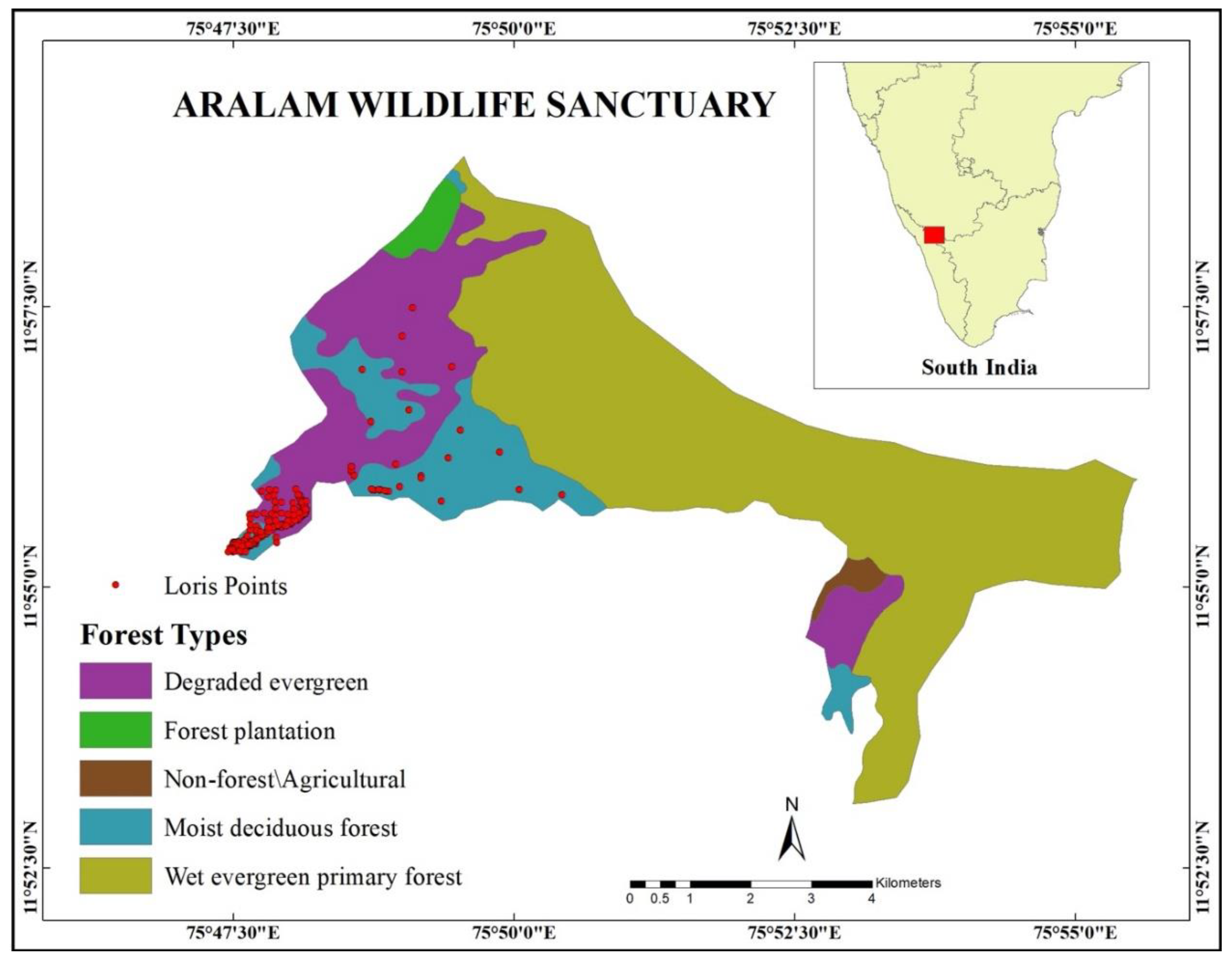
Figure 2.
Height-class analysis of loris presence trees and perching height of slender lorises.
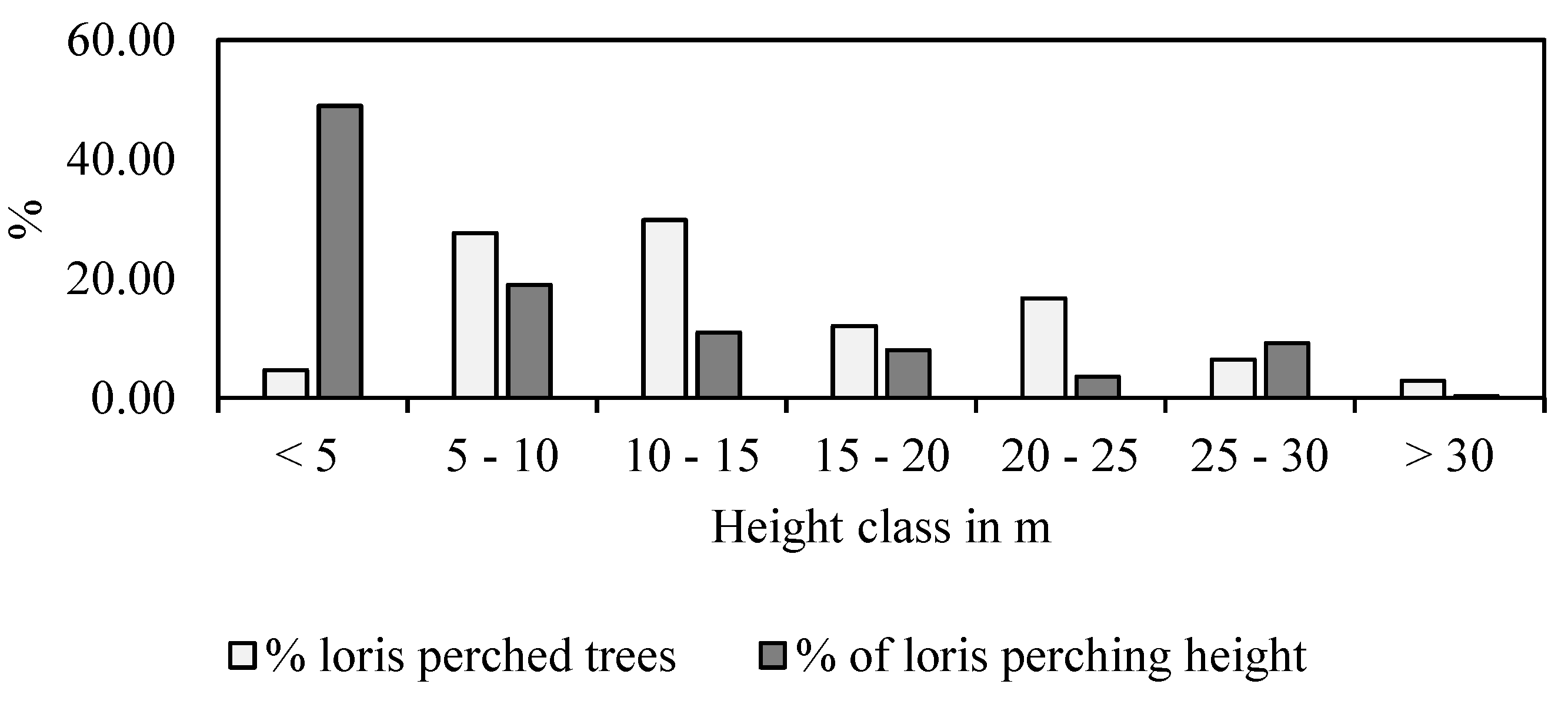
Figure 3.
Frequency of the slender loris on different trees of basal area class.
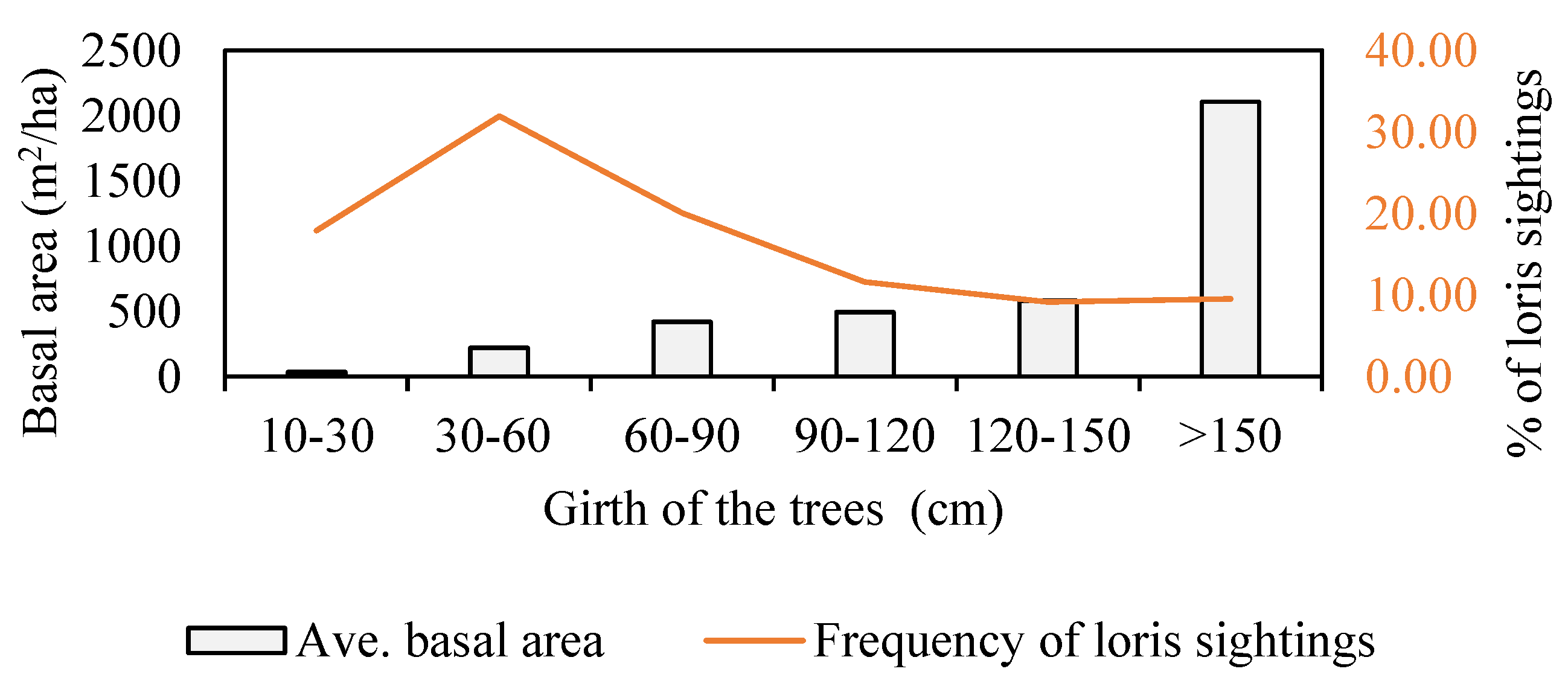
Figure 4.
Percentage of sightings of slender lorises on different substrates (orange line) and relative height where the lorises were found (grey bars).
Figure 4.
Percentage of sightings of slender lorises on different substrates (orange line) and relative height where the lorises were found (grey bars).
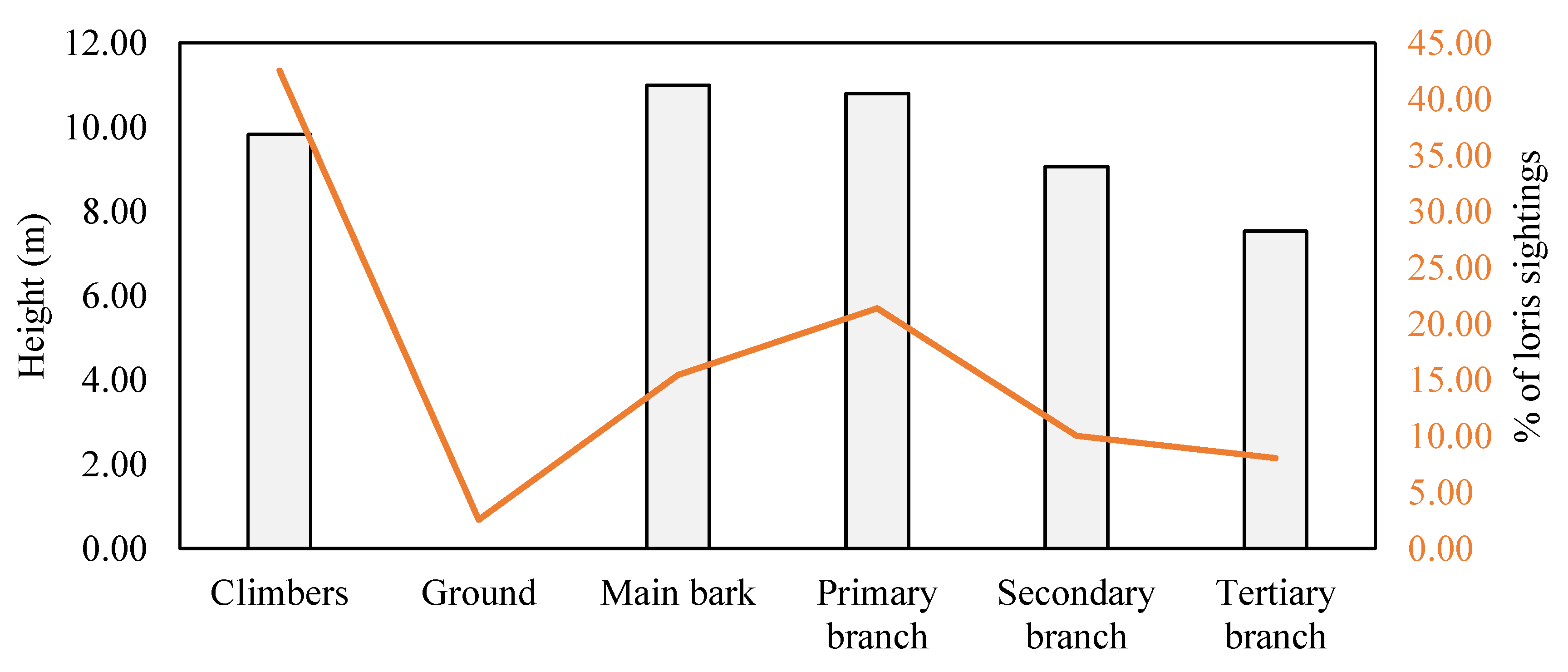
Table 1.
Composition of climbers in the study area at Aralam Wildlife Sanctuary.
| Scientific Name | Type | Distribution | % |
|---|---|---|---|
| Gnetum edule | Woody lianas | India | 22.16 |
| Acacia caesia | A prickly climbing shrub | Indo-Malesia | 21.50 |
| Calycopteris floribunda | Scandent climbing shrubs | Indo-Malesia | 11.75 |
| Piper sarmentosum | Perennial herb with creeping rhizomes | India and Malesia | 11.08 |
| Derris scandens | Woody lianas | Indo-Malesia | 9.75 |
| Aspidopterys canarensis | Woody lianas | Endemic to Western Ghats | 5.87 |
| Ipomoea marginata | Extensive twiners | Paleotropics | 3.60 |
| Cissus repens | Creepers | Indo-Malesia | 3.34 |
| Ventilago maderaspatana | Climbing shrubs | Indo-Malesia | 2.54 |
| Cissus latifolia | Climbing shrubs | India and Sri Lanka | 2.14 |
| Piper nigrum | Glabrous climbers, climbing shrub | India and Sri Lanka | 1.34 |
| Bauhinia scandens | Woody Lianas | Indo-Malesia | 1.20 |
| Argyreiaelliptica sp. | Twiners | India and Sri Lanka | 0.93 |
| Piper mullesua | Woody Lianas | India | 0.93 |
| Calamus travancoricus | Very slender climbing canes | Endemic to Western Ghats | 0.67 |
| Unidentified | 0.67 | ||
| Mimosa diplotricha | Rambling shrubs, exotic climber | Native of Tropical America; a weed in India | 0.53 |
Table 2.
Temporal distribution of the slender loris sightings in different seasons.
| Seasons/Time Duration | Height at Which the Loris Was Spotted (m) | Dry / Summer | S.W. Monsoon | Post Monsoon |
|---|---|---|---|---|
| February to May | June to November | December to January | ||
| Early night (19-22 hrs.) | Average | 7.35 ± 0.87 | 8.09 ± 1.26 | 7.58 ± 1.39 |
| Range | 30 - 0.0 | 30 - 1.21 | 30 - 0.6 | |
| n | 68 | 46 | 25 | |
| Mid night (22-01 hrs.) | Average | 11.36 ± 1.79 | 11.43 ± 1.66 | 8.35 ± 1.57 |
| Range | 31 - 0.0 | 30 - 0.0 | 25 - 0.0 | |
| n | 31 | 38 | 23 | |
| Late night (1-4 hrs.) | Average | 16.87 ± 2.82 | 11.17 ± 2.21 | 11.80 ± 1.81 |
| Range | 30 - 0.0 | 30 - 0.91 | 25 - 0.0 | |
| n | 16 | 22 | 19 | |
| Early dawn (4-6 hrs.) | Average | 16.22 ± 3.12 | 21 ± 4.58 | 11.42 ± 3.17 |
| Range | 28 - 2.13 | 30 - 10.00 | 30 - 2.00 | |
| n | 11 | 5 | 11 |
Table 3.
Climbers used by the slender lorises at Aralam Wildlife Sanctuary.
| Climbers the Loris Was Spotted on | Count | % |
|---|---|---|
| Acacia caesia | 44 | 33.59 |
| Gnetumedule sp. | 29 | 22.14 |
| Aspidopteryscanarensis sp. | 15 | 11.45 |
| Acacia caesia + Gnetumedule sp. | 11 | 8.40 |
| Acacia caesia + Calycopteris floribunda | 5 | 3.82 |
| Acacia caesia +Gnetumedule sp. + Aspidopteryscanarensis sp. | 4 | 3.05 |
| Calycopteris floribunda | 4 | 3.05 |
| Gnetumedule sp. + Aspidopteryscanarensis sp. | 4 | 3.05 |
| Acacia caesia + Aspidopteryscanarensis sp. | 3 | 2.29 |
| Derris scandens | 3 | 2.29 |
| Gnetumedule sp. + Calycopteris floribunda | 2 | 1.53 |
| Gnetumedule sp. + Derris scandens | 2 | 1.53 |
| Acacia caesia +Gnetumedule sp. + Aspidopteryscanarensis sp. | 1 | 0.76 |
| Derris scandens+ Calycopteris floribunda | 1 | 0.76 |
| Gnetumedule sp. + Cissusrepens sp. | 1 | 0.76 |
| Gnetumedule sp. + Piper sarmentosum | 1 | 0.76 |
| Ipomoea marginata | 1 | 0.76 |
Table 4.
Top ten trees with the sleeping sites of slender lorises.
| Scientific Name | % |
|---|---|
| Xylia xylocarpa | 15.08 |
| Dillenia pentagyna | 8.54 |
| Artocarpus hirsutus | 5.28 |
| Syzygium cumini | 5.03 |
| Holigarna arnottiana | 4.27 |
| Terminalia paniculata | 4.27 |
| Dead Tree | 4.02 |
| Terminalia bellirica | 4.02 |
| Aporosa cardiosperma | 3.77 |
Disclaimer/Publisher’s Note: The statements, opinions and data contained in all publications are solely those of the individual author(s) and contributor(s) and not of MDPI and/or the editor(s). MDPI and/or the editor(s) disclaim responsibility for any injury to people or property resulting from any ideas, methods, instructions or products referred to in the content. |
© 2025 by the authors. Licensee MDPI, Basel, Switzerland. This article is an open access article distributed under the terms and conditions of the Creative Commons Attribution (CC BY) license (http://creativecommons.org/licenses/by/4.0/).
Copyright: This open access article is published under a Creative Commons CC BY 4.0 license, which permit the free download, distribution, and reuse, provided that the author and preprint are cited in any reuse.


