

Submitted:
04 May 2025
Posted:
05 May 2025
You are already at the latest version
Abstract
This study explores the influence of relativistic rotational effects on black hole entropy. Specifically, we investigate how the event horizon geometry of Kerr black holes, modified by angular momentum, affects entropy relative to non-rotating Schwarzschild black holes. Using the Bekenstein–Hawking entropy framework and invoking a heuristic analogy to length contraction from special relativity, we propose that increasing angular momentum geometrically contracts the event horizon. This leads to a reduction in its surface area and associated entropy. This geometric thermodynamic relationship offers an intuitive lens to understand the interplay between rotation, gravity, and thermodynamics in black holes.
Keywords:
Length Contraction
; Entropy
; Schwarzschild
; Kerr
; Black Hole Thermodynamics
; Relativistic Geometry
1. Introduction
Length contraction, a consequence of special relativity, describes how objects moving at relativistic speeds appear shortened along their direction of motion. While originally formulated for linear motion, analogous contraction-like effects may conceptually extend to rotational motion in relativistic regimes such as Kerr black holes.
Rotating black holes are characterized by mass and angular momentum. The rotation significantly distorts spacetime near the event horizon, giving rise to phenomena like frame-dragging and the formation of an ergosphere. These modifications suggest that angular velocity might induce relativistic geometric effects, potentially influencing the thermodynamic properties of the black hole.
The Bekenstein–Hawking entropy relates entropy to the surface area of the event horizon. We hypothesize that relativistic rotation contracts the effective horizon geometry, reducing its area and thereby decreasing entropy. Though our contraction model is heuristic, it aligns qualitatively with observed geometric behavior in rotating spacetime metrics.
2. Theoretical Background
Schwarzschild Black Hole: For a non-rotating black hole of massThe event horizon radius is, and the surface area is:
Corresponding entropy:
A rotating black hole with mass and angular momentum, and the angular parameter can be defined as follows,
The outer horizon radius is:
The surface area of the event horizon is:
As (extremal limit), The horizon area shrinks.
3. Heuristic Contraction Analogy
Inspired by special relativity, we propose a contraction factor analogous to the Lorentz factor γ, applied heuristically to the rotating horizon. This yields an effective reduction in horizon area and, hence, in entropy. Though not formally derived from general relativity, this analogy offers an intuitive bridge between motion and geometry:
4. Comparison of Schwarzschild and Kerr Entropy
For equal mass M:
Schwarzschild entropy:
Kerr entropy:
,if .
5. Main Theoretical Claims
Claim I:
Kerr black hole entropy is reduced due to relativistic contraction induced by rotation.
Claim II:
For fixed mass, Schwarzschild black holes exhibit maximal entropy.
Claim III:
Horizon geometry is sensitive to angular momentum, shaping the entropy landscape.
These claims highlight the interdependence of motion, geometry, and thermodynamics.
6. Conclusion and Future Outlook
This study shows how rotational effects in Kerr black holes lead to reduced event horizon areas and, hence, reduced entropy. While our contraction analogy is heuristic, it conceptually mirrors the geometric evolution of rotating spacetimes.
Future research directions include:
- Numerical simulations of rotating black holes to visualize horizon deformation with spin.
- Quantum corrections to black hole entropy under high angular momentum.
- Entropy transport mechanisms involving the ergosphere and Penrose process.
- Exploring entanglement entropy perspectives linked to horizon geometry.
Figure 1.
Entropy vs. spin parameter .
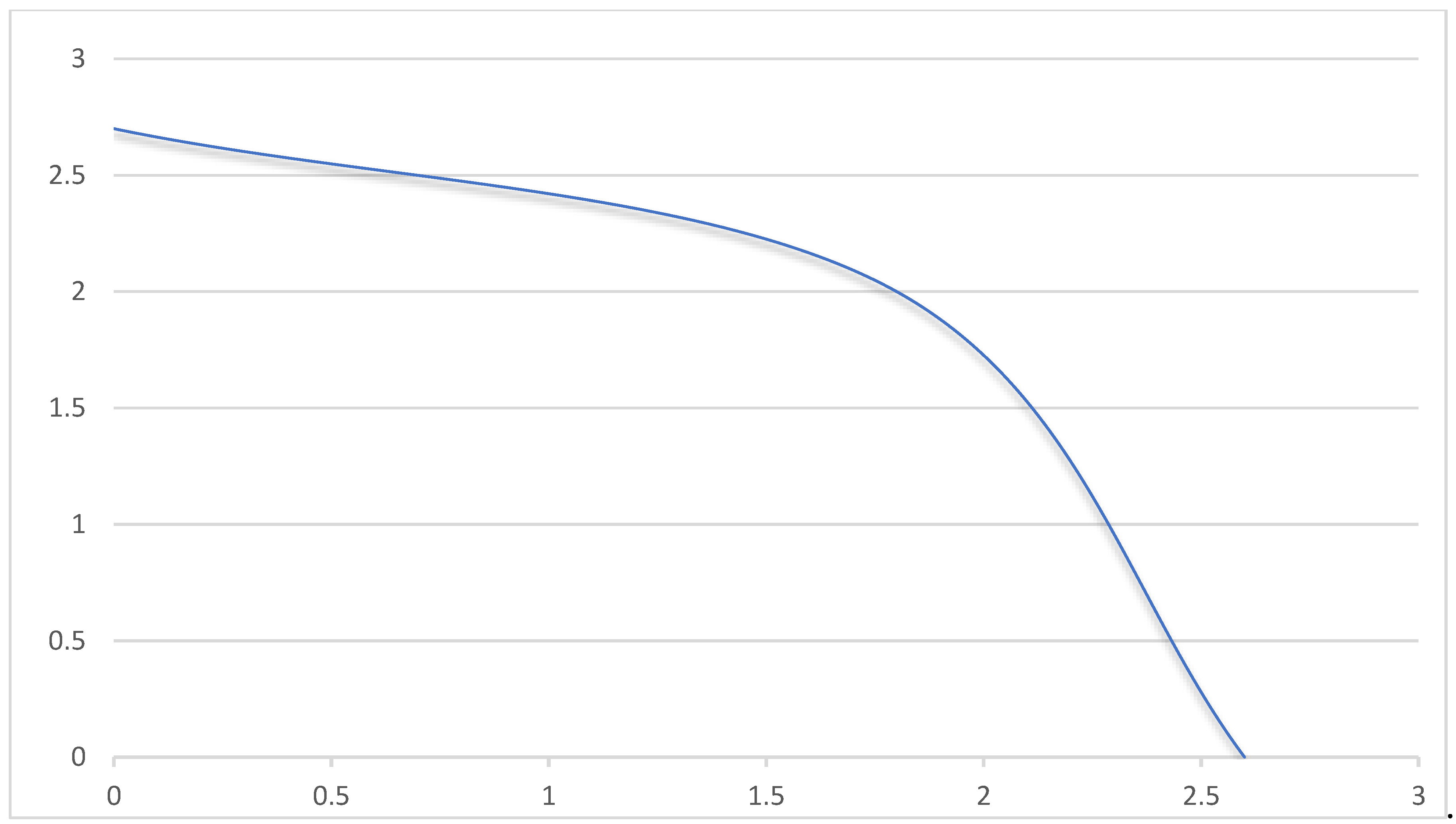
This plot illustrates the decrease in Kerr entropy as the spin parameter increases.
References
- Einstein, A. (1905). On the Electrodynamics of Moving Bodies.
- Farias, C. (2017). What is the Temperature of the Moving Body?
- Kunz, J. (2019). Introduction to Black Holes.
- Wald, R. (1994). Quantum Field Theory in Curved Spacetime and Black Hole Thermodynamics.
- Carroll, S. (2004). Spacetime and Geometry: An Introduction to General Relativity.
- Bardeen, J. , Carter, B., & Hawking, S. (1973). The Four Laws of Black Hole Mechanics.
- Jacobson, T. (1995). Thermodynamics of Spacetime: The Einstein Equation of State.
Disclaimer/Publisher’s Note: The statements, opinions and data contained in all publications are solely those of the individual author(s) and contributor(s) and not of MDPI and/or the editor(s). MDPI and/or the editor(s) disclaim responsibility for any injury to people or property resulting from any ideas, methods, instructions or products referred to in the content. |
© 2025 by the authors. Licensee MDPI, Basel, Switzerland. This article is an open access article distributed under the terms and conditions of the Creative Commons Attribution (CC BY) license (http://creativecommons.org/licenses/by/4.0/).
Copyright: This open access article is published under a Creative Commons CC BY 4.0 license, which permit the free download, distribution, and reuse, provided that the author and preprint are cited in any reuse.


