

Submitted:
23 April 2025
Posted:
24 April 2025
You are already at the latest version
Abstract
Real-time mining (RTM) has become increasingly significant in response to the growing need for sustainable mineral resource extraction, driven by global population growth and technological progress. This innovative approach addresses critical challenges such as declining ore grades, deeper and less accessible deposits, and rising energy costs by integrating advanced online grade monitoring, data analysis, and process optimization. By employing real-time grade control, dynamic mine planning, and production optimization, it enhances the efficiency of resource extraction while minimizing environmental and social impacts. Originally proposed about a decade ago, RTM has gained attention for its potential to revolutionize the industry. This review examines recent advancements in closed-loop concepts, emphasizing the integration of advanced sensors and data analytics to enable continuous monitoring and adaptive decision-making across the mining value chain. It highlights the role of online sensor technologies in providing high-resolution data for process optimization and evaluates various mining optimization techniques. The paper also explores data assimilation methods, such as Kalman filters and artificial intelligence (AI), showcasing their ability to continuously update models and reduce operational uncertainties. Ultimately, it proposes a comprehensive framework for adaptive, data-driven mining operations that promote sustainable development, enhance profitability, and improve decision-making capabilities.
Keywords:
sustainable resource extraction
; artificial intelligence
; Kalman filters
; advanced real-time sensors
; production optimization
; adaptive decision-making
; machine learning
1. Introduction
The global demand for mined resources has accelerated over the past decade, driven by population growth, technological advancements, and economic expansion. By 2050, the demand for metals is projected to rise substantially—aluminum by 215%, copper and nickel each by 140%, iron by 86%, zinc by 81%, and lead by 46% [1]. Metals such as copper, gold, zinc, and aluminum are essential for the renewable energy transition and achieving Net Zero targets due to their critical role in decarbonization technologies like wind turbines, solar panels, and electric vehicles [2,3].
This escalating demand intensifies pressure on the mining sector, which faces challenges like declining ore grades, deeper and more inaccessible deposits, and increasing energy costs. Moreover, mining activities often raise social and environmental concerns, leading to what is known as the "mineral resource dilemma". This dilemma highlights the tension between the necessity for mineral resources to support technological and societal advancement and the reluctance to endorse mining due to its adverse impacts [4,5]. Balancing these competing interests necessitates greater transparency and sustainable practices in mining operations. The industry must optimize resource extraction while minimizing environmental footprints to meet global demands without exacerbating ecological degradation.
Traditionally, the mining industry has followed a linear value chain comprising sequential steps from exploration to mine closure. The process begins with exploration, where data is collected to define the spatial extent, geometry, and geotechnical and hydrological conditions of potential sites using methods like remote sensing, geological mapping, geophysics, and drilling [6]. Resource modeling then creates a 3D orebody model, classifying ore, waste, and rock types to minimize ore loss and dilution [7,8,9]. Mine planning utilizes this data to design optimal extraction sequences, involving production control and planning to ensure consistent product quality through effective blending [10,11,12].
Despite its widespread use, this linear approach has significant drawbacks. It is often subjective, time-consuming, and prone to inconsistencies, especially in complex geological settings. Uncertainties in mineral deposits can lead to production deviations from expectations, as resource modeling relies on uncertain data, causing planning inaccuracies [13,14,15]. Furthermore, the traditional fragmented approach involves specialized experts working independently with minimal communication, resulting in delayed feedback and issues that surface only during operations. This lack of integration and real-time communication hinders prompt adaptation and leads to suboptimal decisions. Integrating advanced technologies and real-time data can enhance data integration and cross-phase communication, improving modeling and planning efficiency while reducing operational uncertainty [6].
To address these challenges, the concept of real-time mining (RTM) emerged about a decade ago [16,17]. RTM aims to optimize resource extraction and minimize environmental impacts through continuous monitoring and immediate data analysis. By employing real-time data from advanced sensors and analytics, RTM enhances process efficiency, maximizes mineral recovery, and facilitates immediate adjustments based on the latest information [18,19]. The core idea is to create a closed-loop management system where operational data feeds back into decision-making processes in real time, enabling dynamic optimization of extraction, processing, and overall efficiency. In general, key constituents of the RTM approach are advanced real-time sensors, optimization algorithms, and data assimilation. Continuous grade control becomes possible, allowing for accurate ore characterization and immediate responses to changes in ore quality [6].
Recent years have seen the emergence of megatrends that have the potential to transform the mining industry. Digital disruption, characterized by the integration of digital technologies into all aspects of operations, is reshaping traditional practices. Advanced online sensors, Internet of Things (IoT) devices, and data analytics methods such as artificial intelligence (AI) and geostatistics enable the collection and analysis of vast amounts of real-time data [20,21,22,23]. These innovations improve predictive maintenance, process optimization, and decision-making, enhancing efficiency, safety, and sustainability. AI-driven tools also support intelligent mining systems, enabling precise ore deposit modeling, real-time monitoring, geo-metallurgical modeling, and continuous grade control [7,24,25,26,27]. Collectively, these advancements improve resource utilization, reduce environmental impacts, and promote transparency in addressing the mineral resource dilemma.
Significant advances have been made in key constituents of the RTM approach over the past decade, particularly in sensor development and data analytics. Cutting-edge sensors provide near-continuous monitoring of critical indicators, such as ore grade and environmental contamination, enabling early risk detection and timely interventions [6,22,28,29,30,31,32]. Additionally, data analytics techniques—including AI, geostatistics, and Kalman filters—have enhanced data interpretation, facilitating real-time updates to grade control models, optimizing extraction processes, and reducing ore dilution [33,34,35,36].
Despite its potential, the full RTM concept remains largely theoretical, with limited practical implementation due to technological and operational barriers. Factors such as inadequate sensor designs for field applications, high initial costs, and the need to demonstrate practical utility have hindered widespread adoption. Integrating advanced sensors into the harsh and variable conditions of mining environments poses significant technical challenges that demand robust and durable designs [22]. The Technology Readiness Level (TRL) framework, which ranges from basic principles (TRL 1) to fully operational systems (TRL 9), highlights the substantial gap between research and application. To date, no operational mine has fully integrated RTM approaches, underscoring the low TRL status of these technologies. This status emphasizes the considerable development and testing required to advance key constituents of the RTM approach toward practical deployment.
Additionally, developing real-time data processing algorithms capable of handling the volume and complexity of mining data in operational settings is still underway [7,37]. The absence of pilot projects and field demonstrations means that mining companies are hesitant to invest in key constituents of the RTM approach without clear evidence of their practical benefits and return on investment. Elevating key constituents of the RTM approach to higher TRL levels through collaborative efforts between researchers, technology developers, and industry stakeholders is essential for bridging the gap between concept and practical application.
The primary objective of this review paper is to evaluate the advancements in key constituents of the RTM approach over the past decade, identify the barriers preventing their practical implementation, and propose strategies to bridge the gap between research and industry application. By analyzing existing literature and technological developments, this paper aims to provide insights into transitioning RTM from theoretical frameworks to practical, large-scale operations that meet global demands and optimize ore extraction processes.
The paper is organized as follows: Section 2 delves into the RTM concept in detail, exploring its principles and potential benefits. Section 3 discusses how sensor technologies are transforming mining operations. Section 4 examines mine planning and optimization techniques within the RTM context. Section 5 addresses data assimilation in closed-loop RTM management. Finally, Section 6 proposes strategies for bridging implementation gaps using advanced data analytics, including AI and machine learning (see Figure 1).
2. The RTM Concept
Over the past decade, the concept of RTM has emerged as a transformative approach in the mining industry, shifting from traditional discontinuous and intermittent monitoring systems to continuous process and quality management frameworks. RTM integrates a real-time feedback control loop that immediately links live data collected at the mining face, throughout material handling and processing, with an updatable sequential resource model (see Figure 2) [16,17,38]. This integration facilitates near-real-time optimization of long-term planning, short-term sequencing, and production control, providing critical insights to improve efficiency and reduce deviations from production targets.
A closed-loop mineral resource management (CLRM) system in RTM builds a model-based representation of the real system that is continuously updated as new data become available. It builds upon several core elements, as illustrated in the Figure 3. These are sensor networks for production monitoring, system models, optimization algorithms for decision support, and data assimilation for real-time model update. Together, these interconnected elements provide a comprehensive, data-driven approach to optimizing mining operations in real-time.
The "real system" in this context embodies the physical mining environment, which includes activities such as drilling, blasting, hauling, and processing that interact directly with the orebody. The effectiveness of these activities is influenced by control variables like equipment schedules and mine plans. The system is also influenced by inherent variability and uncertainty, which is depicted as "noise" in the figure.
Production monitoring involves sensors that collect real-time data during production. These sensors might measure ore grades, production rates, or equipment performance. Such monitoring can also include higher-level tasks, like interpreting geological information or assessing grade control sampling. This process provides essential feedback about ore characteristics such as grade and hardness. The concept of "noise" here refers to measurement uncertainties and discrepancies in material tracking. These models are developed and continuously updated using data such as exploration data, geological interpretation, geodesy data, and grade control data.
The system models—resource and grade control models—provide a mathematical or computational representation of the mining system. Resource models estimate the quantity and quality of mineral resources, while grade control models are focused on the quality of the ore being extracted. Due to the uncertainty inherent in subsurface geology, multiple models are typically created to provide estimates of mineral distribution and orebody characteristics and its uncertainty, using data like exploration results, geological assessments, and grade control measurements.
Within the closed-loop management system, optimization algorithms play a critical role in decision-making. These algorithms generate efficient mine plans and production control strategies, optimizing parameters like equipment schedules and production targets. Optimizers work on different planning horizons, from short-term tasks, like daily equipment scheduling, to long-term plans, such as designing pushbacks. The "blue loop" in the figure represents the continuous optimization process, where real-time data from production monitoring is used to refine mine planning and operations.
Data assimilation is the process of updating the system models to accurately reflect the performance of the real system. Through advanced data analytics, such as AI and geostatistics techniques, data assimilation reconciles discrepancies between model predictions and observed outcomes, thus enhancing model reliability. Whenever measured outputs deviate from model predictions, the model parameters are updated to reduce these discrepancies, thereby improving the predictive accuracy of the models. This process also helps manage the noise present in both control inputs and system outputs. The red loop in the figure represents this iterative updating of system models, which is informed by real-time production data.
The integration of these elements into a closed-loop mineral resource management system is designed to address uncertainties and improve operational outcomes. By combining real-time monitoring, system models, optimization algorithms, and data assimilation, the system ensures that physical operations are continuously observed, and the data gathered is used to enhance planning and operations. This closed-loop structure facilitates adaptive, data-driven decision-making, which leads to increased resource recovery, reduced waste, and minimized operational risks.
3. Transformation in Mining Operations Through Sensors
Sensor technologies have transformed the mining industry by offering deep insights into material properties, providing rich qualitative, quantitative, and semi-quantitative data across various dimensions like geochemistry, mineralogy, and texture [22]. By operating within specific electromagnetic spectrums, sensors offer unique chemical information that is critical for improving mining operations. Additionally, integrating technologies such as belt scales and geometrical sensors further optimizes process efficiency and ensures operational accuracy.
Sensors enhance efficiency and accuracy across different stages of mining. During exploration, sensors reduce costs by minimizing the need for extensive physical sampling and costly laboratory tests. With real-time data, decisions can be made more swiftly, expediting the exploration process. The high-resolution data from sensors helps precisely determine ore grades and other crucial factors, thereby defining resources with greater accuracy.
In the production and grade control stage, sensors monitor ore extraction in real-time, ensuring adherence to the production plan, minimizing deviations, and distinguishing accurately between ore and waste. This precision prevents costly errors such as processing waste or discarding valuable ore, leading to improved operational efficiency and reduced equipment downtime.
In pre-sorting or pre-upgrading of materials along the production process, sensors play a key role in eliminating waste and low-grade material before reaching the processing plant, thereby simplifying the subsequent processes and making them more energy- and cost-efficient. In the post-stockpile and pre-processing stages, sensors further refine the material by optimizing feed quality, which helps operators increase recovery rates and control costs.
During post-processing and quality control, sensors provide real-time feedback on product quality, allowing immediate adjustments to meet customer specifications. This enhances product value, reduces penalties for off-spec materials, and ensures customer satisfaction.
By integrating sensors at each stage, mining operations are optimized for precision, efficiency, and cost-effectiveness, ultimately improving both financial performance and product quality [21]. Table 1 highlights the different impacts of sensors on mining operations.
In contemporary mining operations, the adoption of advanced sensor technologies has resulted in a rich data ecosystem, enabling continuous process monitoring and optimization. One example is Measurement While Drilling (MWD), an online data recording technology used to optimize blast patterns based on geomechanical properties of rock masses [40,41]. MWD data facilitates the classification of rock benches by blastability, allowing targeted blast optimization that enhances Mine-to-Mill (M2M) efficiency [42,43]. This M2M optimization is a holistic, data-driven approach that integrates drilling, blasting, and downstream processing operations to maximize overall mining efficiency and productivity [44,45,46].
Another advanced technology is Prompt Gamma Neutron Activation Analysis (PGNAA), which serves as an elemental analyzer for real-time composition measurement of primary crushed material, significantly enhancing ore evaluation [47]. Fast neutrons from a source like Californium-252 interact with atomic nuclei in the mining medium, producing thermal neutrons that emit prompt gamma rays. The intensity and energy of these gamma rays are analyzed to determine the specific elements present, providing rapid, in-situ analysis that eliminates the need for physical sampling and reduces errors [48].
Additionally, several emerging sensor technologies—such as hyperspectral imaging, infrared technologies, Raman spectroscopy, Laser-Induced Breakdown Spectroscopy (LIBS), and light detection and ranging (LiDAR)—are transforming raw material characterization across broad spatial and temporal scales [49].
Raman spectroscopy is particularly effective for identifying mineral compositions by detecting vibrational modes of molecules. For instance, it reveals microstructural features of carbonaceous materials through identifying the D (disorder) and G (graphitic) bands, which relate to the degree of crystallinity. Raman spectroscopy is advantageous as it requires minimal sample preparation and enables in-line characterization of materials [50]. The use of Wide Area Illumination (WAI) probes enhances its accuracy in analyzing heterogeneous materials, making it suitable for industrial applications, including mineralogy [51].
LIBS is an advanced analytical technique used for the characterization of raw materials by providing elemental compositions based on plasma emission [52]. Similar to how hyperspectral sensors analyze a wide range of the electromagnetic spectrum for identifying minerals to generate a plasma from the surface of a sample. This plasma emits light at wavelengths unique to the elements within the sample, which are then collected and analyzed. The laser operates typically at 1064 nm, and the spectral range covered by LIBS usually spans the ultraviolet (UV) to visible regions, which includes most elements of the periodic table. LIBS is highly effective for rapid, in-situ identification of both major and trace elements in raw materials. For instance, LIBS is capable of detecting elements such as Si, Al, Fe, Ca, Na, and Mg, as well as trace elements like Li, which are difficult to detect using other portable instruments. The emitted light is collected and analyzed to provide real-time data that aids in material characterization. LIBS features several advantages, including the lack of sample preparation, making it particularly useful for field analysis and geological exploration. It also allows for micro-scale spatial analysis, depth profiling, and the detection of elements with low atomic numbers, which are key for understanding mineral compositions and geological histories [53].
In addition, LIBS provides the flexibility of working in challenging field environments due to its ability to operate in different atmospheric conditions, including open-path and stand-off configurations. These features enable it to characterize heterogeneous materials, such as geological samples and archaeological artifacts, by collecting elemental data from multiple spots on the surface and averaging them for comprehensive analysis [54].
Recent advancements in LIBS technology have enhanced its application in geology and mining, particularly for in-situ and real-time elemental analysis of raw materials. Innovations such as improved spectrometer designs and adaptive calibration techniques enable high-resolution characterization of heterogeneous geological samples and mineral ores. These developments address challenges like matrix effects and enhance LIBS’ accuracy and repeatability in harsh field conditions [55,56]. Furthermore, LIBS’s high-resolution capabilities facilitate the detection of elements, including rare earth elements and toxic components, in complex samples like mining waste, solidifying its role in raw material characterization and monitoring [31].
LiDAR is an active remote sensing technology used to characterize raw materials by providing detailed geometric and radiometric information through the use of laser pulses. LiDAR works by emitting laser pulses at different wavelengths and then detecting the reflected backscatter from target objects to obtain spatial information in the form of point clouds. It is capable of capturing 3D geometric information with high accuracy [57,58,59]. Multispectral LiDAR (MSL) systems combine both spectral and geometric data, which is particularly beneficial for characterizing complex materials in diverse conditions. MSL operates in multiple spectral channels, typically including visible to short-wave infrared (SWIR) wavelengths. These channels provide a combination of height and intensity data that enables precise classification of minerals and geological features based on their reflectance characteristics [60,61]. As illustrated in recent studies, MSL sensors can collect both spatial and spectral information, allowing for the efficient classification of rock surfaces and the identification of subtle mineral variations [62].
In addition to these advanced sensor technologies, several other sensors are widely used in mining, particularly in material characterization, resource evaluation, and decision-making throughout the value chain. RGB sensors are frequently used for color detection and qualitative analysis in mineralogical applications. These sensors capture visible light in three bands—red, green, and blue—and are particularly useful for recognizing minerals with distinct colors and textures, making them valuable for mineral mapping and fragmentation analysis [63,64].
Another important technology is Hyperspectral Imaging (VNIR/SWIR), which captures data across a wide range of the electromagnetic spectrum. VNIR (Visible-Near Infrared) covers the 0.4–1.0 µm range, and SWIR (Short-Wave Infrared) covers the 1.0–2.5 µm range. These sensors enable precise mineral identification and sorting based on their spectral signatures. Specifically, VNIR is effective in distinguishing sulfide minerals, while SWIR is useful for detecting carbonates, clays, and sulfates. In addition, Mid-Wave Infrared (MWIR) and Long-Wave Infrared (LWIR) sensors, operating in the 2.5–7.0 µm (MWIR) and 7.0–15 µm (LWIR) ranges respectively, are used for detecting and classifying minerals based on their reflectance or emission characteristics. LWIR is particularly effective for analyzing rock-forming minerals [65,66].
Electromagnetic and X-ray-based technologies, such as Dual Energy X-Ray Transmission (DE-XRT) and electromagnetic sensors, are also employed to detect mineral density and other physical properties [67]. These technologies are commonly used in pre-concentration processes to separate ore from waste, improving overall efficiency in mining operations [21,64]. The comparison of sensors can be seen in Table 2.
Despite their potential, continuous advancements in sensor robustness and data fusion are essential to address challenges like environmental interference and complex mineral compositions [21]. The convergence of advanced sensor technology and data analytics heralds a transformative shift in mining exploration and operational efficiency.
4. Mine Planning and Optimization
Mine planning is a comprehensive process that analyzes the economic conditions of mining operations using geological, structural, and mineralogical data collected during the exploration phase. The primary goal is to determine the optimal sequence for ore block extraction while accounting for blending and geometric constraints, with the objective of maximizing the net present value (NPV) of the operation. Effective mine planning is crucial to the performance of mining operations, as deviations from the planned schedule can significantly affect profitability. Typically, mine planning is divided into distinct phases: short-term and long-term planning. Each phase incorporates elements of production control and logistics, varying in detail and timeframe, but they are interdependent; plans for each phase must align with both immediate operational needs and overarching strategic objectives.
4.1. Long-Term Mine Planning: Strategic Production Scheduling and Ultimate Pit Definition
The aim of long-term mine planning is to establish an optimal production strategy for the entire lifespan of a mining operation. This involves analyzing extraction sequences and destination policies to optimize the operation’s economic value. A resource block model characterizes rock types and mineral grades, enabling the identification of ultimate pit limits (UPL) and the development of an open-pit production schedule (OPS) for the entire project duration [68,69].
Traditional deterministic methods, such as the Lerchs-Grossmann algorithm, are widely used for defining ultimate pit limits and establishing life-of-mine schedules [70]. However, these methods do not account for geological uncertainty, which can lead to suboptimal planning outcomes. To address this limitation, stochastic approaches have been developed. For example, Albor Consuegra and Dimitrakopoulos [71] utilized simulated annealing to enhance pit limit determination, resulting in a 17% larger pit and a 10% higher Net Present Value (NPV) compared to conventional methods. Another example includes the hybrid augmented Lagrangian relaxation method applied by Moosavi, et al. [72], which effectively solved large-scale long-term production scheduling problems, improving convergence speed and achieving better solutions compared to traditional linear methods.
4.2. Short-Term Mine Planning: Detailed Scheduling, Production Control, and RTM
Short-term mine planning focuses on developing a detailed production schedule covering a timeframe from several weeks to a few years. This level of planning involves equipment allocation, resource scheduling, and operational decisions to ensure production targets are met. It is operational in nature, optimizing detailed production sequences and allocating equipment such as trucks and shovels [12].
For example, Both and Dimitrakopoulos [73] presented a joint stochastic optimization model for short-term production scheduling and fleet management, simultaneously addressing uncertainties related to geological conditions, equipment performance, and operational logistics. Their method reduced shovel movement costs by 56% and improved truck allocation efficiency, demonstrating the value of integrated short-term planning approaches. Additionally, Mousavi, et al. [74] and Mousavi, et al. [75] compared metaheuristic algorithms—such as simulated annealing and Tabu search—for short-term open-pit block sequencing, demonstrating that hybrid approaches outperformed individual algorithms.
It is important to mention that the significance of short-term mine planning has increased due to its critical role in RTM operations. In RTM, dynamic adjustments are often required to deal with uncertainties inherent in mining activities, such as equipment breakdowns, geological variations, and market demand changes. The ability to adapt production schedules in real time ensures that the mine operates efficiently, minimizing production delays and optimizing resource utilization. Techniques like simulation-based optimization and metaheuristic approaches enable planners to adjust schedules dynamically, incorporating new data and real-time feedback from the mine site [6,76].
4.3. Stochastic and Deterministic Approaches in Mine Planning
Mine planning can generally employ both deterministic and stochastic approaches. Stochastic methods account for geological uncertainties, resulting in more robust solutions. For instance, Goodfellow and Dimitrakopoulos [77] presented a two-stage stochastic optimization framework for mining complexes that integrates material extraction, blending, and transportation, leading to enhanced production target achievement and increased NPV compared to conventional deterministic methods. Similarly, Lamghari, et al. [78] introduced a hybrid approach combining linear programming and variable neighborhood descent, which efficiently addressed the complexities of open-pit production scheduling, providing new best-known solutions for benchmark instances.
In contrast, traditional deterministic methods, such as the Lerchs-Grossmann algorithm, are foundational for defining ultimate pit limits and developing long-term schedules. However, they do not consider geological uncertainty, which can lead to suboptimal planning outcomes [70]. Recent approaches have also sought to combine deterministic and stochastic elements, such as the hybrid augmented Lagrangian relaxation combined with genetic algorithms, which has shown improved performance for large-scale long-term scheduling [72].
4.4. Optimization Approaches
Beyond traditional deterministic and stochastic methods, advanced optimization algorithms have been increasingly applied to mine planning to tackle complex, large-scale problems. Particle Swarm Optimization (PSO) and Evolutionary Strategies (ES) are examples of nature-inspired algorithms that mimic biological processes to explore the solution space efficiently [79,80]. These algorithms are particularly effective in handling multi-objective optimization problems where trade-offs between different objectives, such as cost, NPV, and environmental impact, must be balanced.
Reinforcement learning, as part of AI methods, has recently emerged as a promising approach in mine planning optimization. Reinforcement learning algorithms learn optimal policies through interactions with the environment, enabling adaptive and dynamic decision-making processes. Reinforcement learning has gained significant attention in recent years for mining optimization applications [81,82,83].
Hybrid approaches, which combine multiple optimization techniques, have also shown significant promise. For instance, the integration of Genetic Algorithms (GA) with Simulated Annealing (SA) leverages the global search capability of GA and the local search efficiency of SA, resulting in superior performance in finding optimal or near-optimal solutions [74]. Similarly, combining Linear Programming (LP) with Variable Neighborhood Descent (VND) [78] has proven effective in addressing the intricacies of open-pit production scheduling, yielding new best-known solutions for benchmark instances.
In the following section, we discuss recent advancements in mining optimization techniques, which are summarized in Table 3.
Mining optimization involves a complex interplay of data-driven decision-making processes aimed at maximizing economic returns while managing geological uncertainties and operational constraints. Short-term and long-term planning are interdependent phases that, when effectively synchronized, lead to significant improvements in production efficiency and economic value. By integrating mathematical, statistical, and AI-based optimization techniques, mining operations can address uncertainties, optimize resource allocation, and enhance profitability. The advancements presented demonstrate the critical role that innovative approaches play in achieving greater accuracy, reducing costs, and maximizing value in mining projects.
Building on these foundational concepts, RTM bridges short-term and long-term planning, offering substantial opportunities to revolutionize production control and logistics through continuous data collection and adaptive decision-making. By integrating advanced analytics, real-time adjustments, and AI-driven optimization, RTM refines resource allocation, reduces risks, and boosts profitability. Despite its considerable promise in enhancing both production control and logistics, gaps in current research indicate ample scope for further exploration and development of RTM in mining contexts.
5. Data Assimilation in Closed-Loop RTM Management
The closed-loop concept in RTM involves continuously updating resource models based on real-time data, integrating sensor measurements with predictive models to enhance decision-making and operational efficiency. Figure 4 presents a closed-loop workflow where sensor measurements from production monitoring are compared with model-based predictions to quantify discrepancies, thereby driving ongoing model updates. Data from exploration, geodesy, and grade control inform these models, accounting for ore deposit characteristics and the inherent uncertainties. Through continual iteration, sampling information and real-time sensor feedback align the estimated resource and grade control models with actual operational outcomes. The discrepancy quantification process ensures that any divergence from predictions is captured and integrated into subsequent model refinements. This adaptive feedback loop facilitates timely decision-making for mine production and planning, ultimately optimizing operational strategies. By assimilating up-to-date information at each iteration, the system maintains robust, data-driven resource management.
5.1. Methods for Updating Data Assimilation in RTM Concept
Over the past decade, model-updating methodologies have advanced considerably, evolving from traditional linear Kalman Filters to cutting-edge machine learning approaches such as reinforcement learning. This progression responds to the growing complexity and scale of RTM applications.
One of the most widely used techniques, the Kalman Filter, offers a simple yet effective way to handle linear systems and parameter estimation. Its key limitation, however, lies in its reliance on linear dynamics and Gaussian assumptions, making it less suitable for capturing highly non-linear relationships. Consequently, it performs best in scenarios where system updates are relatively moderate and largely linear in nature [33,93,94].
Another prevalent approach is the Ensemble Kalman Filter (EnKF), which accommodates moderate non-linearities and sequential data assimilation better than the classic Kalman Filter. Nevertheless, EnKF still depends on Gaussian assumptions, limiting its performance when variables deviate significantly from Gaussianity or when discontinuities are present. In complex or highly dynamic environments, hybridizing EnKF with other non-linear methods can improve its robustness and assimilation accuracy [30,95,96].
Most recently, reinforcement learning has emerged as a particularly promising strategy for RTM, thanks to its ability to adapt to complex, high-dimensional datasets and rapidly changing mining conditions [35,97]. Although it demands extensive training data and robust computational resources, its capacity for real-time, adaptive decision-making holds significant potential for optimizing operations in dynamic mining environments.
The diversity of data-assimilation approaches for RTM [34,35,76,98,99,100] illustrates a tension between simplicity and comprehensiveness. Although linear methods—such as the Kalman Filter [33,94]—have relatively low computational cost and can be easily implemented, they are typically effective only when the state-updating process remains close to linear. By contrast, EnKF-based approaches [30,95,101,102,103] and state of the art machine-learning methods such as reinforcement learning [34,35] are better suited to severe non-linearity and higher-dimensional problems. However, they demand significant computational resources and expertise. Thus, the all-important question is how much complexity (and hence computational overhead) can an RTM application stand and still reach its project goals. Some practitioners exist on a spectrum of trade-offs: simpler algorithms are often adequate in relatively stable or mildly non-Gaussian conditions (more examples can be found in Table 4) while more complex hybrid and, most especially, reinforcement-learning-based methods are likely to become increasingly important for sharp dynamic, non-linear, and high-dimensional mining challenges. The essential element for successful RTM is to find the sweet spot between computational tractability and accuracy within sense of the-RTM extent.
This methodological evolution is illustrated further in Table 4, as it begins with simple linear algorithms (Kalman Filter) and works its way up to state-of-the-art machine learning techniques (reinforcement learning). Easier approaches work well for linear or weakly non-Gaussian systems, while more complex algorithms can more effectively be applied to, dynamic, higher-dimensional, or non-linear problems—but at a corresponding ignition cost. Thus, the most suitable method usually involves a trade-off between computational efficiency and accurate enough outputs for sound decision-making in RTM.
5.2. Applications of Updating Data Assimilation in RTM Concept
Several studies have demonstrated the potential of closed-loop data assimilation for RTM. For instance, Benndorf [33] introduced a closed-loop framework employing sequential resource model updating via the Kalman filter. By using synthetic data (representing a fully known environment), this approach showcased significant improvements in prediction accuracy whenever sensor-derived data were assimilated. The mean squared error (MSE) between estimated and actual block values served as the primary evaluation metric, showing substantial reductions in uncertainty—even in scenarios that involved multiple extraction sites and blending.
The updating approach uses the Kalman filter to estimate unknown state parameters recursively, based on differences between predictions and observations. Let Z(x) represent a spatial random field with elements ,where ⅈ=1,…,n denotes the index of discrete extraction locations. The production matrix A describes the contribution of each mining block to the total production during a specific time interval. The relationship between the predicted resource model and sensor measurements can be expressed as (Eq. (1)):
where is the model-based prediction of extracted material for time intervals. Kalman filter updating can then be represented as (Eq. (2)):
where K is the Kalman gain matrix, determined by Eq. (3):
where represents the covariance of the prior model, while is the covariance of the measurement noise. The Kalman gain controls how much the observed differences (or innovations) between predicted and measured values influence the updated resource model. If the measurement noise is low and the prior model error is high, the Kalman gain increases, resulting in significant updates to the resource model.
Building upon this foundation, Yüksel, Thielemann, Wambeke and Benndorf [96] implemented a closed-loop concept for real-time resource model updating in the Garzweiler lignite mine, focusing on coal quality control. By continuously integrating online ash content measurements from the KOLA system into the model, they achieved up to a 70% reduction in model uncertainty. The EnKF gain determined the weight assigned to new sensor data versus the existing model, guiding the sequential updating process.
Extending this work, Yüksel, Benndorf, Lindig and Lohsträter [95] applied the closed-loop concept to a lignite mining case with multiple production benches. Online ash content measurements were taken using a radiometric sensor on the central conveyor belt, measuring blended material from multiple excavators. The forward simulation technique was used to associate sensor measurements with respective blocks, considering travel time from different excavators. Significant improvements were reported, with an average absolute error (AE) reduction of up to 73% using the updated model, where AE is defined as (Eq. (4)):
where represents the sensor measurements and are the updated model values. Significant improvements were reported, with an average error reduction of up to 73% when using the updated model compared to the prior model.
Furthermore, the study compared two approaches for generating prior models: one based on geostatistical simulation using drill hole data and the other based on a simplified short-term model, which introduced fluctuations around the company’s mining plan. The simplified approach offered comparable improvements in model predictions, demonstrating the practicality of using a less computationally intensive method for RTM applications. By reducing the computational burden, the short-term model approach facilitated easier operational implementation without the need for complex geostatistical simulations.
Moreover, Wambeke and Benndorf [32] expanded the closed-loop concept through the development of geostatistical models for grade control reconciliation, utilizing the EnKF to handle the complexities involved in large-scale mining operations. They developed a sequential estimation method for updating the grade control (GC) model in real time based on new sensor observations. The algorithm is designed to integrate blended observations from multiple extraction points, making it particularly useful in mining environments where material streams are combined before measurements are taken.
The forward simulation step is crucial for estimating the contribution of individual blocks to blended material streams. This allows for linking each measurement back to its constituent blocks, despite blending from different extraction locations. Unlike previous methods, their forward simulator does not require an analytical formulation of the observation model, enhancing practicality in complex mining scenarios.
Subsequently, Wambeke and Benndorf [30] analyzed the influence of system parameters such as measurement volume, blending ratios, and sensor precision on algorithm performance. Conducting 125 experiments, they explored how these factors affect the EnKF-based grade control model updating. The blending ratio defines the proportion of material in the blended measurement volume originating from different extraction zones, while the measurement volume represents the amount of material characterized by the sensor over a given time interval.
The updated GC model significantly improved the alignment of predicted versus actual production data. Specifically, the reduction in root-mean-square deviation (RMSE) between predicted and measured values was used to quantify improvements by Eq. (5):
where represents the true state, and is the expected value of the estimated block values at time t. By incorporating new sensor observations sequentially, the model progressively reduced uncertainty, resulting in improvements of up to 74% in some scenarios.
Lan, et al. [104] proposed a sequential ensemble-based optimal design (SEOD) method to enhance real-time parameter estimation in groundwater reactive transport models, which has direct parallels to closed-loop concepts in RTM. They employed the SEOD method in both one-dimensional and two-dimensional groundwater models to jointly estimate hydraulic conductivity and geochemical parameters. The results showed significant reductions in RMSE and ensemble spread, indicating the effectiveness of the method in reducing uncertainty and improving model predictions.
The SEOD method utilizes the EnKF to estimate both physical and geochemical parameters, continuously updating the system model based on optimal sensor data collection. This is similar to previous approaches in RTM, where sensor measurements and forward simulations are integrated to update resource models, aiming to reduce uncertainties in model predictions.
The closed-loop concept, as described in this study, involves an iterative process to refine the resource model in real-time by assimilating sensor-based observations. The SEOD framework addresses some of the inherent challenges in such systems, including the optimization of sensor placement to maximize information gain, using the Kullback-Leibler divergence (also known as relative entropy, RE) as a metric for determining the value of information obtained from measurements.
Mathematically, the SEOD framework is implemented through the following stages:
- Forecast Step: The EnKF-based SEOD begins with a forecast step, where the forward model G is used to propagate the current ensemble of state vectors x_(i,j)^a to the next time step (Eq. (6)):
- 2.
- Optimal Sampling Design: The SEOD framework aims to determine the optimal locations for collecting new measurements, which is achieved by maximizing the relative entropy (RE) between the prior and posterior distributions. For a Gaussian distribution, RE is given by Eq. (7):
- 3.
- Analysis Step: After determining the optimal sampling strategy, the analysis step is performed to assimilate the collected data and update the state vector by Eq. (9):
The SEOD method thus represents a dynamic approach to integrating measurement data for the purpose of parameter estimation. This approach shares similarities with RTM practices where data assimilation techniques like EnKF are used to refine geological models and optimize production processes. A critical difference, however, lies in the use of an optimal sampling strategy to enhance the quality of parameter estimation, leading to more efficient computational performance and better model accuracy compared to traditional methods.
Several studies addressed the limitations of the EnKF in handling non-Gaussian distributions and maintaining geological realism. Nejadi, et al. [105] incorporated the EnKF with Probability Field (P-Field) simulation to improve characterization of facies boundaries in reservoir models. Jafarpour and McLaughlin [102] combined the EnKF with the Discrete Cosine Transform (DCT) parameterization to reduce dimensionality and preserve geological features. Hu, Zhao, Liu, Scheepens and Bouchard [101] applied a closed-loop concept by combining multipoint simulation (MPS) with the EnKF for real-time reservoir history matching, maintaining geological consistency in facies models. Oliver and Chen [106] discussed data assimilation in truncated plurigaussian (TPG) models, addressing non-monotonic relationships between latent variables and facies types.
For preserving non-Gaussian geological features, Kumar and Srinivasan [98] introduced Indicator-Based Data Assimilation (InDA), preserving non-Gaussian characteristics of geological models during assimilation. Ma and Jafarpour [99] integrated soft data into MPS simulation for facies model calibration, improving consistency with training images and observed data.
Zhou, et al. [107] transformed the original state vector into a univariate Gaussian using the normal-score EnKF (NS-EnKF), preserving non-Gaussian distributions in the updated models, crucial for maintaining geological realism. This method is particularly useful in RTM, where maintaining the complex spatial features of geological formations, such as channels or facies boundaries, is essential for accurate model updates. The closed-loop approach presented in this study demonstrates how transforming state variables into Gaussian space can improve data assimilation in non-Gaussian contexts, ultimately enhancing the quality of real-time geological models and reducing uncertainty in decision-making processes.
In smaller-scale grade heterogeneity studies, Li, Sepúlveda, Xu and Dowd [94] presented a rapid updating method to predict grade heterogeneity at smaller scales using a Kalman filter framework, integrating production data for near real-time resource model downscaling. The method improved mining selectivity and ore recoverability by accurately predicting grade heterogeneity within larger mining blocks. The advantages of the proposed method include its ability to integrate different types of sensed data without requiring complex co-kriging or simulation techniques, as well as its computational efficiency.
Prior, Benndorf and Mueller [103] proposed a closed-loop framework for updating resource and grade control models in underground mining, integrating sensor-based information using the EnKF. The approach improved prediction accuracy for ore grade and vein thickness, even with sparse initial conditioning information.
Prior, Tolosana-Delgado, van den Boogaart and Benndorf [36] introduced a closed-loop updating framework for compositional geometallurgical variables, employing log-ratio transformations and flow anamorphosis to handle compositional data in the EnKF while preserving their relationships.
Machine learning approaches have also gained traction. Avalos, et al. [108] applied machine learning and deep learning techniques in RTM to forecast energy consumption in semi-autogenous grinding mills. By leveraging recurrent neural networks to model temporal dependencies, they achieved significant improvements in prediction accuracy, enabling dynamic energy management and operational efficiency in real-time settings. Ortiz, et al. [109] highlighted the integration of geometallurgical data and process models within a RTM framework to optimize the mining value chain. By addressing uncertainties through stochastic modeling, the study demonstrated enhanced mine designs and operational strategies for improved economic and environmental outcomes.
Kumar and Dimitrakopoulos [35] proposed a novel approach to updating geostatistically simulated models of mineral deposits in real-time using a reinforcement learning framework. They developed a self-learning algorithm based on the deep deterministic policy gradient (DDPG) reinforcement learning method, incorporating actor and critic agents. The purpose of this approach is to learn from incoming data collected during mining operations and to update the geostatistical models accordingly. This approach allows the model to account for high-order spatial statistics, enabling more accurate representation of the mineral deposits’ geological structure and grade distribution.
The proposed method applies reinforcement learning where the mining grid is sequentially visited in a random path. The environment provides the state for each grid node, which includes the properties of blocks, sensor data, conditioning data events, and other contextual information. The actor agent takes actions that predict updated properties for the grid nodes, and these predictions are evaluated by the critic agent. This setup allows for a dynamic model that learns and adjusts based on new incoming information.
Mathematically, the reward at each step is calculated to ensure that the updated properties align with both high-order spatial statistics and the incoming temporal sensor data. The actor-critic system is designed such that the state at time step is updated by incorporating new sensor data and conditioning events to maximize the reward function, which includes terms for spatial and temporal consistency.
Talesh Hosseini, Asghari, Benndorf and Emery [100] integrated the Discrete Wavelet Transform (DWT) with the EnKF to update and improve geological boundary definitions at the Golgohar Iron Ore Mine, significantly increasing boundary accuracy while maintaining consistency with production data.
Finally, de Carvalho and Dimitrakopoulos [34] presented an actor-critic reinforcement learning approach for short-term production planning and fleet management in mining complexes. By defining shovel and truck allocation policies adaptively, the model addressed operational constraints and uncertainties dynamically, resulting in a 47% improvement in cash flow compared to traditional fixed fleet assignments. The continuous update of orebody models based on sensor-collected data further emphasized the practical advantages of integrating RL for adaptive decision-making. The performance of these studies are shown in Table 5.
These studies demonstrate significant advancements in data assimilation methods within closed-loop RTM management. The integration of Kalman filters and their variants with innovative techniques like DCT, MPS, and reinforcement learning approaches has led to improved prediction accuracy, reduced uncertainty, and maintained geological realism. The table summarizes these advancements, highlighting the methods employed, case studies undertaken, and the results achieved. Collectively, these works emphasize the practical effectiveness of continuous model updating in modern mining practices, underscoring its value in enhancing operational decision-making and efficiency across diverse mining environments.
6. Bridging RTM Implementation Gaps with Advanced Data Analytics
Much progress has been made over the past decade; however, fully integrated RTM concepts remains largely unimplemented in practical, real-world settings. A key tool for assessing the maturity of RTM approaches is the TRL framework. Originally developed by NASA, TRL is a metric that ranges from basic principles observed—TRL 1—to fully operational systems—TRL 9. The framework has been adopted by the European Union and many industries to evaluate innovation across a wide range of sectors, linking technological development to funding and implementation milestones [110,111,112]. When applied to RTM components, this framework reveals a large gap between research and its practical application, demonstrating the need for strategic pathways to move these technologies toward higher TRLs.
In the context of RTM, the maturity levels of key components are as follows: the real system, comprising physical mining activities such as drilling, hauling, and processing, stands at TRL 7, reflecting successful prototype demonstration in operational environments but still requiring fully integrated automation and data workflows. Production monitoring, which involves advanced sensor networks that measure ore grades and equipment performance, is at TRL 8, with systems routinely deployed and thoroughly tested, though consistent data standardization remains a challenge. By contrast, system models (e.g., digital twins and resource models) currently reach only TRL 5, as they have been validated in relevant mining environments but are not yet fully operational on a large scale—largely because many mines operate with incomplete or inconsistent databases. Optimization algorithms, providing real-time decision support, stay at TRL 4, with most testing confined to laboratory or pilot-scale settings and lacking robust deployment in live production due to the need for specialized data scientists and IT infrastructure on-site. Data assimilation, which updates system models in near real time by blending sensor data and historical records, reaches TRL 6, having been demonstrated in pilot environments but not widely adopted for continuous industrial use. Taken together, these elements form an overall RTM system whose readiness is estimated at around TRL 6, owing primarily to challenges such as a lack of consistent geodata infrastructure, limited availability of geo data scientists in operations, and interoperability complexities that inhibit seamless integration across sensors, models, and algorithms (see Figure 5). Overcoming these hurdles—through standardized data protocols, expanded on-site analytics, and interdisciplinary collaboration—is critical to achieving TRL 8–9 and realizing a fully operational, field-proven RTM system.
To advance RTM components toward higher TRLs, strategic collaboration and targeted innovations are paramount. Advanced data analytics and AI are particularly indispensable in enhancing the adaptability, scalability, and operational efficiency of RTM. One foundational requirement involves the development of robust, field-ready sensors capable of withstanding the challenging conditions inherent to mining environments. Partnering with sensor manufacturers can accelerate this process. Moreover, leveraging machine learning—especially reinforcement learning—can bolster predictive capabilities while enabling real-time operational adjustments. These improvements are further supported by digital twins, which dynamically simulate and optimize mining processes.
Integrating AI into optimization algorithms offers real-time decision support by rapidly analyzing and assimilating large volumes of sensor data. Such integration not only expedites technological development but also ensures operational reliability through proactive equipment failure prevention and efficiency optimization. However, these gains hinge on establishing comprehensive material tracking systems and maintaining consistent geodatabases. The absence of such infrastructure, coupled with a lack of on-site geodata specialists, poses a significant bottleneck to effective RTM implementation.
Moving forward, RTM methodologies stand to benefit from hybrid models that merge AI with geostatistical techniques, thereby increasing both adaptability and precision. Advanced computational platforms, including cloud computing and parallel processing, can alleviate current computational bottlenecks. Additionally, the inclusion of diverse data sources—such as soft data and advanced sensor networks—promises to enhance model resolution and accuracy. By harnessing these advancements, RTM can solidify its role as a cornerstone of intelligent mining practices, driving efficient, adaptive, and data-driven resource management.
Advancing key constituents of the RTM approach requires coordinated efforts among researchers, technology developers, and industry stakeholders. Establishing pilot projects and field demonstrations will showcase practical benefits and return on investment, encouraging adoption. Economic incentives and funding mechanisms can offset initial costs, while standardizing protocols ensures compatibility and ease of integration. By leveraging advanced data analytics and AI, the mining industry can bridge the implementation gaps in RTM, advancing key components to higher TRLs. This progression will transform RTM from a theoretical concept into a practical, efficient, and sustainable operational system, effectively addressing the mineral resource dilemma and meeting global demands.
7. Conclusions
Real-time mining (RTM) is a novel paradigm for confronting the growing complexity and sustainability challenges of modern mining. RTM facilitates continuous monitoring, optimization, and control of the mining value chain by deploying advanced sensor technologies, data analytics, and adaptivity in decision systems. By promoting responsible mining practices in this way, this closed-loop system not only minimizes the environmental and social impacts of resource recovery but also, with the help of accompanying circular economic futures and efficient recycling technologies, promotes a new appreciation for and exploration of our planetary resources while making their extraction possible and responsible. Data assimilation in the form of artificial intelligence, Kalman filters, and similar techniques enables frequent updating of resource models to reduce uncertainties and enhance operational efficiencies.
This review presents significant development of sensor technologies and data-centric approaches as presented in different research works, while also acknowledging the potential for future research aimed at synchronizing theory with practical applications. Advancements in Technology Readiness Levels (TRLs) of RTM components necessitate improvements in sensor robustness, data fusion techniques, and adaptive control systems. Moreover, the innovation of field-worthy sensors, pilot project collaboration, advanced tracking systems, continuous geodatabases, and incorporation of leading AI models are significant to convert our practical large-scale applications. RTM is a critical enabler of data-driven, adaptive, and resilient mining operations that can respond to changing conditions on the fly. RTM has the potential to revolutionize the mining industry to be a more sustainable, tech-driven industry by eliminating ambiguities in production, resource recovery, and operation. This strategy facilitates the growing global demand for minerals in a way that reduces environmental and social impacts.
Author Contributions
Conceptualization, K.A. and J.B.; Methodology, K.A and J.B.; Validation, K.A. and J.B.; Formal Analysis, K.A and J.B.; Investigation, K.A.; Resources, J.B.; Data Curation, K.A.; Writing—Original Draft Preparation, K.A.; Writing—Review and Editing, K.A and J.B.; Visualization, K.A.; Supervision, J.B.; Project Administration, J.B.
Funding
This research received no external funding.
Conflicts of Interest
The authors declare no conflicts of interest.
Abbreviations
The following abbreviations are used in this manuscript:
| AE | Absolute Error |
| AI | Artificial Intelligence |
| CLRM | Closed-Loop Mineral Resource Management |
| DCT | Discrete Cosine Transform |
| DE-XRT | Dual Energy X-Ray Transmission |
| DDPG | Deep Deterministic Policy Gradient |
| EnKF | Ensemble Kalman Filter |
| GA | Genetic Algorithm |
| GC | Grade Control |
| InDA | Indicator-Based Data Assimilation |
| IoT | Internet of Things |
| LIBS | Laser-Induced Breakdown Spectroscopy |
| LiDAR | Light Detection and Ranging |
| LWIR | Long-Wave Infrared |
| M2M | Mine-to-Mill |
| MWD | Measurement While Drilling |
| MWIR | Mid-Wave Infrared |
| NS-EnKF | Normal-Score Ensemble Kalman Filter |
| NPV | Net Present Value |
| OPS | Open-Pit Production Schedule |
| P-Field | Probability Field (in EnKF/P-Field simulation) |
| PGNAA | Prompt Gamma Neutron Activation Analysis |
| PSO | Particle Swarm Optimization |
| RL | Reinforcement Learning |
| RMSE | Root-Mean-Square Error |
| RTM | Real-Time Mining |
| SEOD | Sequential Ensemble-Based Optimal Design |
| SWIR | Short-Wave Infrared |
| TPG | Truncated Plurigaussian |
| TRL | Technology Readiness Level |
| VNIR | Visible-Near Infrared |
| WAI | Wide Area Illumination |
References
- Watari, T.; Nansai, K.; Nakajima, K. Major metals demand, supply, and environmental impacts to 2100: A critical review. Resources, Conservation and Recycling 2021, 164, 105107. [Google Scholar] [CrossRef]
- ICA. Copper - The pathway to net zero; International Copper Association: 2023; p. 41.
- Pickens, N.; Joannides, E.; Laul, B. Red metal, green demand - Copper’s critical role in achieving net zero; 2022.
- Franken, G.; Schütte, P. Current trends in addressing environmental and social risks in mining and mineral supply chains by regulatory and voluntary approaches. Mineral Economics 2022, 35, 653–671. [Google Scholar] [CrossRef]
- Yu, H.; Zahidi, I.; Fai, C.M.; Liang, D.; Madsen, D.Ø. Elevating community well-being in mining areas: the proposal of the mining area sustainability index (MASI). Environmental Sciences Europe 2024, 36, 71. [Google Scholar] [CrossRef]
- Benndorf, J. Closed loop management in mineral resource extraction: turning online geo-data into mining intelligence; Springer Nature: 2020.
- Anvari, K.; Mousavi, A.; Sayadi, A.R.; Sellers, E.; Salmi, E.F. Automatic detection of rock boundaries using a hybrid recurrence quantification analysis and machine learning techniques. Bulletin of Engineering Geology and the Environment 2022, 81, 398. [Google Scholar] [CrossRef]
- Masoumi, I.; Kamali, G.; Asghari, O.; Emery, X. Assessing the impact of geologic contact dilution in ore/waste classification in the Gol-Gohar Iron Ore Mine, Southeastern Iran. Minerals 2020, 10, 336. [Google Scholar] [CrossRef]
- Aghahadi, M.H.; Jozanikohan, G.; Asghari, O.; Hosseini, S.T.; Emery, X.; Rezaei, M. Geochemical anomaly separation based on geology, geostatistics, compositional data and local singularity analyses: a case study from the Kuh Panj copper deposit, Iran. Applied Geochemistry 2024, 173, 106135. [Google Scholar] [CrossRef]
- Antje Matthäus, M.D. Peter Graham, Amilcar Soares. Real-time optimization of extraction and the logistic process in highly complex geological and selective mining settings; 2017. [CrossRef]
- Kumar, A. Artificial intelligence algorithms for real-time production planning with incoming new information in mining complexes; McGill University (Canada): 2020.
- Blom, M.; Pearce, A.R.; Stuckey, P.J. Short-term planning for open pit mines: a review. International Journal of Mining, Reclamation and Environment 2019, 33, 318–339. [Google Scholar] [CrossRef]
- Dominy, S.C.; Noppé, M.A.; Annels, A.E. Errors and uncertainty in mineral resource and ore reserve estimation: The importance of getting it right. Exploration and Mining Geology 2002, 11, 77–98. [Google Scholar] [CrossRef]
- Lindi, O.T.; Aladejare, A.E.; Ozoji, T.M.; Ranta, J.-P. Uncertainty Quantification in Mineral Resource Estimation. Natural Resources Research 2024, 1–24. [Google Scholar] [CrossRef]
- Ullah, G.W.; Nehring, M.; Kizil, M.; Knights, P. Environmental, Social, and Governance Considerations in Production Scheduling Optimisation for Sublevel Stoping Mining Operations: a Review of Relevant Works and Future Directions. Mining, Metallurgy & Exploration 2023, 40, 2167–2182. [Google Scholar] [CrossRef]
- Benndorf, J.; Buxton, M.; Nienhaus, K.; Rattmann, L.; Korre, A.; Soares, A.; deJong, A.; Jeannee, N.; Graham, P.; Gehlen, S. Real-time mining-Moving towards continuous process management in mineral resource extraction. In Proceedings of the 3rd international future mining conference, Sydney, Austalia; 2015; pp. 1–10. [Google Scholar]
- Buttgereit, D.; Bitzen, S.; Benndorf, J.; Buxton, M. Real-time mining: grade monitoring und control cockpit; Universitätsbibliothek der RWTH Aachen: 2016.
- Sánchez, F.; Hartlieb, P. Innovation in the mining industry: Technological trends and a case study of the challenges of disruptive innovation. Mining, Metallurgy & Exploration 2020, 37, 1385–1399. [Google Scholar] [CrossRef]
- Young, A.; Rogers, P. A review of digital transformation in mining. Mining, Metallurgy & Exploration 2019, 36, 683–699. [Google Scholar]
- Aznar-Sánchez, J.A.; Velasco-Muñoz, J.F.; Belmonte-Ureña, L.J.; Manzano-Agugliaro, F. Innovation and technology for sustainable mining activity: A worldwide research assessment. Journal of Cleaner Production 2019, 221, 38–54. [Google Scholar] [CrossRef]
- Buxton, M.; Benndorf, J. The use of sensor derived data in optimization along the Mine-Value-Chain. In Proceedings of the Proceedings of the 15th international ISM congress, Aachen, Germany; 2013; pp. 324–336. [Google Scholar]
- Desta, F. Sensing and data fusion opportunities for raw material characterisation in mining: Technology and data-driven approach. 2021. [Google Scholar] [CrossRef]
- Lessard, J.; de Bakker, J.; McHugh, L. Development of ore sorting and its impact on mineral processing economics. Minerals Engineering 2014, 65, 88–97. [Google Scholar] [CrossRef]
- Corrigan, C.C.; Ikonnikova, S.A. A review of the use of AI in the mining industry: Insights and ethical considerations for multi-objective optimization. The Extractive Industries and Society 2024, 17, 101440. [Google Scholar] [CrossRef]
- Jackson, J. Enabling short interval control using spatial dense geoscience info beyond grade. 2020. Available online: https://smi.uq.edu.au/event/session/6543.
- Anvari, K.; Mousavi, A.; Sayadi, A.R.; Afzal, P.; Sellers, E.; Salmi, E.F. A Hybrid Recurrence Analysis and Wavelet Transformation for Rock Boundary Identification. Available at SSRN: https://ssrn.com/abstract=5049654 (accessed on 14 December).
- Aghahadi, M.H.; Jozanikohan, G.; Asghari, O.; Anvari, K.; Hosseini, S.T. Spatial Clustering of Primary Geochemical Halos Using Unsupervised Machine Learning in Sari Gunay Gold Deposit, Iran. Mining, Metallurgy & Exploration 2024, 1–20. [Google Scholar] [CrossRef]
- Dalm, M. Sensor-based sorting opportunities for hydrothermal ore deposits: Raw material beneficiation in mining. 2018. [Google Scholar] [CrossRef]
- Guatame-Garcia, A.; Buxton, M. Framework for monitoring and control of the production of calcined kaolin. Minerals 2020, 10, 403. [Google Scholar] [CrossRef]
- Wambeke, T.; Benndorf, J. A study of the influence of measurement volume, blending ratios and sensor precision on real-time reconciliation of grade control models. Mathematical Geosciences 2018, 50, 801–826. [Google Scholar] [CrossRef]
- Benndorf, J.; Restrepo, D.A.; Merkel, N.; John, A.; Buxton, M.; Guatame-Garcia, A.; Dalm, M.; de Waard, B.; Flores, H.; Möllerherm, S. TRIM4Post-Mining: Transition Information Modelling for Attractive Post-Mining Landscapes—A Conceptual Framework. Mining 2022, 2, 248–277. [Google Scholar] [CrossRef]
- Wambeke, T.; Benndorf, J. A simulation-based geostatistical approach to real-time reconciliation of the grade control model. Mathematical Geosciences 2017, 49, 1–37. [Google Scholar] [CrossRef]
- Benndorf, J. Making use of online production data: sequential updating of mineral resource models. Mathematical Geosciences 2015, 47, 547–563. [Google Scholar] [CrossRef]
- de Carvalho, J.P.; Dimitrakopoulos, R. Integrating short-term stochastic production planning updating with mining fleet management in industrial mining complexes: an actor-critic reinforcement learning approach. Applied Intelligence 2023, 53, 23179–23202. [Google Scholar] [CrossRef]
- Kumar, A.; Dimitrakopoulos, R. Updating geostatistically simulated models of mineral deposits in real-time with incoming new information using actor-critic reinforcement learning. Computers & Geosciences 2022, 158, 104962. [Google Scholar] [CrossRef]
- Prior, Á.; Tolosana-Delgado, R.; van den Boogaart, K.G.; Benndorf, J. Resource model updating for compositional geometallurgical variables. Mathematical Geosciences 2021, 53, 945–968. [Google Scholar] [CrossRef]
- Bisschoff, R.; Grobbelaar, S. Evaluation of data-driven decision-making implementation in the mining industry. South African Journal of Industrial Engineering 2022, 33, 218–232. [Google Scholar] [CrossRef]
- Benndorf, J.; Buxton, M. A Special Issue on Geomathematics for Real-Time Mining. Mathematical Geosciences 2019, 51, 845–847. [Google Scholar] [CrossRef]
- Jansen, J.-D.; Douma, S.; Brouwer, D.R.; Van den Hof, P.; Bosgra, O.; Heemink, A. Closed-loop reservoir management. In Proceedings of the SPE Reservoir Simulation Conference? 2009; p. SPE-119098-MS. [Google Scholar] [CrossRef]
- Babaei Khorzoughi, M.; Hall, R.; Apel, D. Rock fracture density characterization using measurement while drilling (MWD) techniques. International Journal of Mining Science and Technology 2018. [CrossRef]
- Babaei Khorzoughi, M.; Hall, R. Processing of measurement while drilling data for rock mass characterization. International Journal of Mining Science and Technology 2016, 26, 989–994. [Google Scholar] [CrossRef]
- Sellers, E.J.; Salmi, E.F.; Usami, K.; Greyvensteyn, I.; Mousavi, A. Detailed Rock Mass Characterization – A Prerequisite for Successful Differential Blast Design. In Proceedings of the YSRM2019 - The 5th ISRM Young Scholars’ Symposium on Rock Mechanics and REIF2019 - International Symposium on Rock Engineering for Innovative Future - An ISRM Specialized Conference, Okinawa, Japan; 2019. [Google Scholar]
- Usami, K.; Salmi, E.F.; Sellers, E.J. Genetic Algorithm to Optimise Rock Fragmentation in Selective Blasting for Grade Engineering. In Proceedings of the The 26th International Mining Congress and Exhibition of Turkey, Belek, Antalya, Turkey; 2019; pp. 359–372. [Google Scholar]
- McKee, D. Understanding mine to mill: The Cooperative Research Centre for Optimising Resource Extraction, Brisbane, AU, 96 p. 2013.
- Salmi, E.; Mousavi, A.; Usami, K.; Sellers, E. Value chain optimization for grade engineering by mine-wide frag-mentation optimisation. In Rock fragmentation by blasting; Wang, X.G., Ed.; 2022. [Google Scholar]
- Salmi, E.F.; Sellers, E.J. A review of the methods to incorporate the geological and geotechnical characteristics of rock masses in blastability assessments for selective blast design. Engineering geology 2021, 281, 105970. [Google Scholar] [CrossRef]
- Kurth, H. Measuring ore quality using real-time on-belt elemental analysis—More than grade control. In Proceedings of the Proceedings of the International Mining Geology Conference, Hobart, Australia, 2017; pp. 20–22.
- Charbucinski, J.; Malos, J.; Rojc, A.; Smith, C. Prompt gamma neutron activation analysis method and instrumentation for copper grade estimation in large diameter blast holes. Applied Radiation and Isotopes 2003, 59, 197–203. [Google Scholar] [CrossRef]
- Clarkson, L.; Williams, D. Critical review of tailings dam monitoring best practice. International Journal of Mining, Reclamation and Environment 2020, 34, 119–148. [Google Scholar] [CrossRef]
- Jawhari, T.; Roid, A.; Casado, J. Raman spectroscopic characterization of some commercially available carbon black materials. Carbon 1995, 33, 1561–1565. [Google Scholar] [CrossRef]
- Lintvedt, T.A.; Andersen, P.V.; Afseth, N.K.; Wold, J.P. In-line Raman spectroscopy for characterization of an industrial poultry raw material stream. Talanta 2024, 266, 125079. [Google Scholar] [CrossRef] [PubMed]
- Dalm, M.; Sandtke, M. Geochemical mapping of drill core samples using a combined LIBS and XRF core scanning system. In Proceedings of the Proceedings of the Real-Time Mining Conference, Freiberg, Germany, 2019; pp. 26–27.
- Lawley, C.J.; Somers, A.M.; Kjarsgaard, B.A. Rapid geochemical imaging of rocks and minerals with handheld laser induced breakdown spectroscopy (LIBS). Journal of geochemical exploration 2021, 222, 106694. [Google Scholar] [CrossRef]
- Díaz Pace, D.M.; Gabriele, N.A.; Garcimuño, M.; D’Angelo, C.A.; Bertuccelli, G.; Bertuccelli, D. Analysis of minerals and rocks by laser-induced breakdown spectroscopy. Spectroscopy Letters 2011, 44, 399–411. [Google Scholar] [CrossRef]
- Guo, L.-B.; Zhang, D.; Sun, L.-X.; Yao, S.-C.; Zhang, L.; Wang, Z.-Z.; Wang, Q.-Q.; Ding, H.-B.; Lu, Y.; Hou, Z.-Y. Development in the application of laser-induced breakdown spectroscopy in recent years: A review. Frontiers of Physics 2021, 16, 1–25. [Google Scholar] [CrossRef]
- Palleschi, V. Laser-induced breakdown spectroscopy: principles of the technique and future trends. ChemTexts 2020, 6, 1–16. [Google Scholar] [CrossRef]
- Benndorf, J. Geomonitoring und Markscheidewesen als integrativer Teil des Umweltmanagements in der Rohstoff-und Energiebranche–zukünftige Aufgaben. Allgemeine Vermessungsnachrichten 2021, 7, 237–247. [Google Scholar]
- Andreas Gunke, S.J. Derivation of Mine from correlates ALS, TLS and RGB Data. In Proceedings of the In 19. Geokinematischer TU Bergakademie Freiberg, Department of Mine Surveying and Geodesy, Freiberg, Germany; 2018; pp. 79–86. [Google Scholar]
- Martienßen, T.; Geier, A.; Wand, R. Untersuchungen zur Entfernungsmessung terrestrischer Long-Range Laserscanner. 2016.
- Donner, R.; Rabel, M.; Scholl, I.; Ferrein, A.; Donner, M.; Geier, A.; John, A.; Köhler, C.; Varga, S. Die Extraktion bergbaulich relevanter Merkmale aus 3D-Punktwolken eines untertagetauglichen mobilen Multisensorsystems. 2019. [Google Scholar] [CrossRef]
- Köhler, C.; Donner, M.; Donner, R. Semantische Klassifizierung von 3D-Punktwolken. 2018. [Google Scholar]
- Chen, Y.; Jiang, C.; Hyyppä, J.; Qiu, S.; Wang, Z.; Tian, M.; Li, W.; Puttonen, E.; Zhou, H.; Feng, Z. Feasibility study of ore classification using active hyperspectral LiDAR. IEEE Geoscience and Remote Sensing Letters 2018, 15, 1785–1789. [Google Scholar] [CrossRef]
- Naseri, A.; Rezaei Nasab, A. Automatic identification of minerals in thin sections using image processing. Journal of Ambient Intelligence and Humanized Computing 2023, 14, 3369–3381. [Google Scholar] [CrossRef]
- Desta, F.; Buxton, M. Evaluation of sensor technologies for on-line raw material characterization in “Reiche Zeche” underground mine-outcomes of RTM implementation. In Proceedings of the 2019 REAL TIME MINING-Conference on Innovation on Raw Material Extraction; 2019; pp. 32–47. [Google Scholar]
- Riley, D.N.; Hecker, C.A. Mineral mapping with airborne hyperspectral thermal infrared remote sensing at Cuprite, Nevada, USA. In Thermal infrared remote sensing: sensors, methods, applications; Springer, 2013; pp. 495–514. [Google Scholar] [CrossRef]
- Prabhavathy, P.; Tripathy, B.; Venkatesan, M. Unsupervised learning method for mineral identification from hyperspectral data. In Proceedings of the Innovations in Bio-Inspired Computing and Applications: Proceedings of the 10th International Conference on Innovations in Bio-Inspired Computing and Applications (IBICA 2019) held in Gunupur, Odisha, India during December 16-18, 2019 10, 2021; pp. 148–160. [CrossRef]
- Neubert, K.; Wotruba, H. Investigations on the detectability of rare-earth minerals using dual-energy X-ray transmission sorting. Journal of Sustainable Metallurgy 2017, 3, 3–12. [Google Scholar] [CrossRef]
- Noriega, R.; Pourrahimian, Y. A systematic review of artificial intelligence and data-driven approaches in strategic open-pit mine planning. Resources Policy 2022, 77, 102727. [Google Scholar] [CrossRef]
- Whittle, D. Open-pit planning and design. SME mining engineering handbook 2011, 1, 877–901. [Google Scholar]
- Askari-Nasab, H.; Frimpong, S.; Szymanski, J. Modelling open pit dynamics using discrete simulation. International Journal of Mining, Reclamation and Environment 2007, 21, 35–49. [Google Scholar] [CrossRef]
- Albor Consuegra, F.; Dimitrakopoulos, R. Stochastic mine design optimisation based on simulated annealing: pit limits, production schedules, multiple orebody scenarios and sensitivity analysis. Mining Technology 2009, 118, 79–90. [Google Scholar] [CrossRef]
- Moosavi, E.; Gholamnejad, J.; Ataee-Pour, M.; Khorram, E. A hybrid augmented Lagrangian multiplier method for the open pit mines long-term production scheduling problem optimization. Journal of Mining Science 2014, 50, 1047–1060. [Google Scholar] [CrossRef]
- Both, C.; Dimitrakopoulos, R. Joint stochastic short-term production scheduling and fleet management optimization for mining complexes. Optimization and Engineering 2020, 21, 1717–1743. [Google Scholar] [CrossRef]
- Mousavi, A.; Kozan, E.; Liu, S.Q. Comparative analysis of three metaheuristics for short-term open pit block sequencing. Journal of Heuristics 2016, 22, 301–329. [Google Scholar] [CrossRef]
- Mousavi, A.; Kozan, E.; Liu, S.Q. Open-pit block sequencing optimization: A mathematical model and solution technique. Engineering Optimization 2016, 48, 1932–1950. [Google Scholar] [CrossRef]
- Benndorf, J.; Jansen, J.D. Recent developments in closed-loop approaches for real-time mining and petroleum extraction. Mathematical Geosciences 2017, 49, 277–306. [Google Scholar] [CrossRef]
- Goodfellow, R.; Dimitrakopoulos, R. Simultaneous stochastic optimization of mining complexes and mineral value chains. Mathematical Geosciences 2017, 49, 341–360. [Google Scholar] [CrossRef]
- Lamghari, A.; Dimitrakopoulos, R.; Ferland, J.A. A hybrid method based on linear programming and variable neighborhood descent for scheduling production in open-pit mines. Journal of Global Optimization 2015, 63, 555–582. [Google Scholar] [CrossRef]
- Guyaguler, B.; Horne, R.N.; Rogers, L.; Rosenzweig, J.J. Optimization of well placement in a Gulf of Mexico waterflooding project. SPE Reservoir Evaluation & Engineering 2002, 5, 229–236. [Google Scholar] [CrossRef]
- Yeten, B.; Durlofsky, L.J.; Aziz, K. Optimization of nonconventional well type, location, and trajectory. SPE Journal 2003, 8, 200–210. [Google Scholar] [CrossRef]
- Levinson, Z.; Dimitrakopoulos, R.; Keutchayan, J. Simultaneous stochastic optimization of an open-pit mining complex with preconcentration using reinforcement learning. Applied Soft Computing 2023, 138, 110180. [Google Scholar] [CrossRef]
- Noriega, R.; Boisvert, J. Optimization of underground mining production layouts considering geological uncertainty using deep reinforcement learning. Engineering Applications of Artificial Intelligence 2025, 139, 109493. [Google Scholar] [CrossRef]
- Noriega, R.; Pourrahimian, Y.; Askari-Nasab, H. Deep Reinforcement Learning based real-time open-pit mining truck dispatching system. Computers & Operations Research 2025, 173, 106815. [Google Scholar] [CrossRef]
- Pendharkar, P.C.; Rodger, J.A. Nonlinear programming and genetic search application for production scheduling in coal mines. Annals of Operations Research 2000, 95, 251–267. [Google Scholar] [CrossRef]
- Leite, A.; Dimitrakopoulos, R. Stochastic optimisation model for open pit mine planning: application and risk analysis at copper deposit. Mining Technology 2007, 116, 109–118. [Google Scholar] [CrossRef]
- Sayadi, A.R.; Fathianpour, N.; Mousavi, A.A. Open pit optimization in 3D using a new artificial neural network. Archives of Mining Sciences 2011, 56, 389–403. [Google Scholar] [CrossRef]
- Souza, M.J.; Coelho, I.M.; Ribas, S.; Santos, H.G.; Merschmann, L.H.d.C. A hybrid heuristic algorithm for the open-pit-mining operational planning problem. European Journal of Operational Research 2010, 207, 1041–1051. [Google Scholar] [CrossRef]
- Shishvan, M.S.; Benndorf, J. Simulation-based optimization approach for material dispatching in continuous mining systems. European Journal of Operational Research 2019, 275, 1108–1125. [Google Scholar] [CrossRef]
- Lamghari, A.; Dimitrakopoulos, R. Hyper-heuristic approaches for strategic mine planning under uncertainty. Computers & Operations Research 2020, 115, 104590. [Google Scholar] [CrossRef]
- LaRoche-Boisvert, M.; Dimitrakopoulos, R. An application of simultaneous stochastic optimization at a large open-pit gold mining complex under supply uncertainty. Minerals 2021, 11, 172. [Google Scholar] [CrossRef]
- Levinson, Z.; Dimitrakopoulos, R. Connecting planning horizons in mining complexes with reinforcement learning and stochastic programming. Resources Policy 2023, 86, 104136. [Google Scholar] [CrossRef]
- Levinson, Z.; Dimitrakopoulos, R. A reinforcement learning approach for selecting infill drilling locations considering long-term production planning in mining complexes with supply uncertainty. Mining Technology 2024, 25726668241244930. [Google Scholar] [CrossRef]
- Kalman, R.E. A new approach to linear filtering and prediction problems. 1960. [Google Scholar] [CrossRef]
- Li, Y.; Sepúlveda, E.; Xu, C.; Dowd, P. A rapid updating method to predict grade heterogeneity at smaller scales. Mathematical Geosciences 2021, 53, 1237–1260. [Google Scholar] [CrossRef]
- Yüksel, C.; Benndorf, J.; Lindig, M.; Lohsträter, O. Updating the coal quality parameters in multiple production benches based on combined material measurement: a full case study. International Journal of Coal Science & Technology 2017, 4, 159–171. [Google Scholar] [CrossRef]
- Yüksel, C.; Thielemann, T.; Wambeke, T.; Benndorf, J. Real-time resource model updating for improved coal quality control using online data. International Journal of Coal Geology 2016, 162, 61–73. [Google Scholar] [CrossRef]
- Avalos, S.; Ortiz, J.M. Multivariate Geostatistical Simulation and Deep Q-Learning to optimize mining decisions. Mathematical Geosciences 2023, 55, 673–692. [Google Scholar] [CrossRef]
- Kumar, D.; Srinivasan, S. Ensemble-based assimilation of nonlinearly related dynamic data in reservoir models exhibiting non-Gaussian characteristics. Mathematical geosciences 2019, 51, 75–107. [Google Scholar] [CrossRef]
- Ma, W.; Jafarpour, B. Integration of soft data into multiple-point statistical simulation: re-assessing the probability conditioning method for facies model calibration. Computational Geosciences 2019, 23, 683–703. [Google Scholar] [CrossRef]
- Talesh Hosseini, S.; Asghari, O.; Benndorf, J.; Emery, X. Real-time uncertain geological boundaries updating for improved block model quality control based on blast hole data: A case study for Golgohar iron ore mine in Southeastern Iran. Mathematical Geosciences 2023, 55, 541–562. [Google Scholar] [CrossRef]
- Hu, L.; Zhao, Y.; Liu, Y.; Scheepens, C.; Bouchard, A. Updating multipoint simulations using the ensemble Kalman filter. Computers & geosciences 2013, 51, 7–15. [Google Scholar] [CrossRef]
- Jafarpour, B.; McLaughlin, D.B. History matching with an ensemble Kalman filter and discrete cosine parameterization. Computational Geosciences 2008, 12, 227–244. [Google Scholar] [CrossRef]
- Prior, Á.; Benndorf, J.; Mueller, U. Resource and grade control model updating for underground mining production settings. Mathematical Geosciences 2021, 53, 757–779. [Google Scholar] [CrossRef]
- Lan, T.; Shi, X.; Jiang, B.; Sun, Y.; Wu, J. Joint inversion of physical and geochemical parameters in groundwater models by sequential ensemble-based optimal design. Stochastic Environmental Research and Risk Assessment 2018, 32, 1919–1937. [Google Scholar] [CrossRef]
- Nejadi, S.; Trivedi, J.; Leung, J.Y. Estimation of facies boundaries using categorical indicators with P-Field simulation and ensemble Kalman filter (EnKF). Natural Resources Research 2015, 24, 121–138. [Google Scholar] [CrossRef]
- Oliver, D.S.; Chen, Y. Data assimilation in truncated plurigaussian models: impact of the truncation map. Mathematical Geosciences 2018, 50, 867–893. [Google Scholar] [CrossRef]
- Zhou, H.; Gomez-Hernandez, J.J.; Franssen, H.-J.H.; Li, L. An approach to handling non-Gaussianity of parameters and state variables in ensemble Kalman filtering. Advances in Water Resources 2011, 34, 844–864. [Google Scholar] [CrossRef]
- Avalos, S.; Kracht, W.; Ortiz, J.M. Machine learning and deep learning methods in mining operations: A data-driven SAG mill energy consumption prediction application. Mining, Metallurgy & Exploration 2020, 37, 1197–1212. [Google Scholar] [CrossRef]
- Ortiz, J.M.; Avalos, S.; Riquelme, A.I.; Leuangthong, O.; Madani, N.; Frenzel, M. Uncertainty and value: optimising geometallurgical performance along the mining value chain. Elements 2023, 19, 377–383. [Google Scholar] [CrossRef]
- Clay, R.L.; Shneider, M.S.; Marburger, S.; Trucano, T.G. Modeling and simulation technology readiness levels; Sandia National Laboratories (SNL), Albuquerque, NM, and Livermore, CA …: 2006. [CrossRef]
- Héder, M. From NASA to EU: the evolution of the TRL scale in Public Sector Innovation. The Innovation Journal 2017, 22, 1–23. [Google Scholar]
- Manning, C.G. Technology Readiness Levels. Available online: https://www.nasa.gov/directorates/somd/space-communications-navigation-program/technology-readiness-levels/ (accessed on 21 November).
Figure 1.
Overview of the structure and objectives of the review paper.
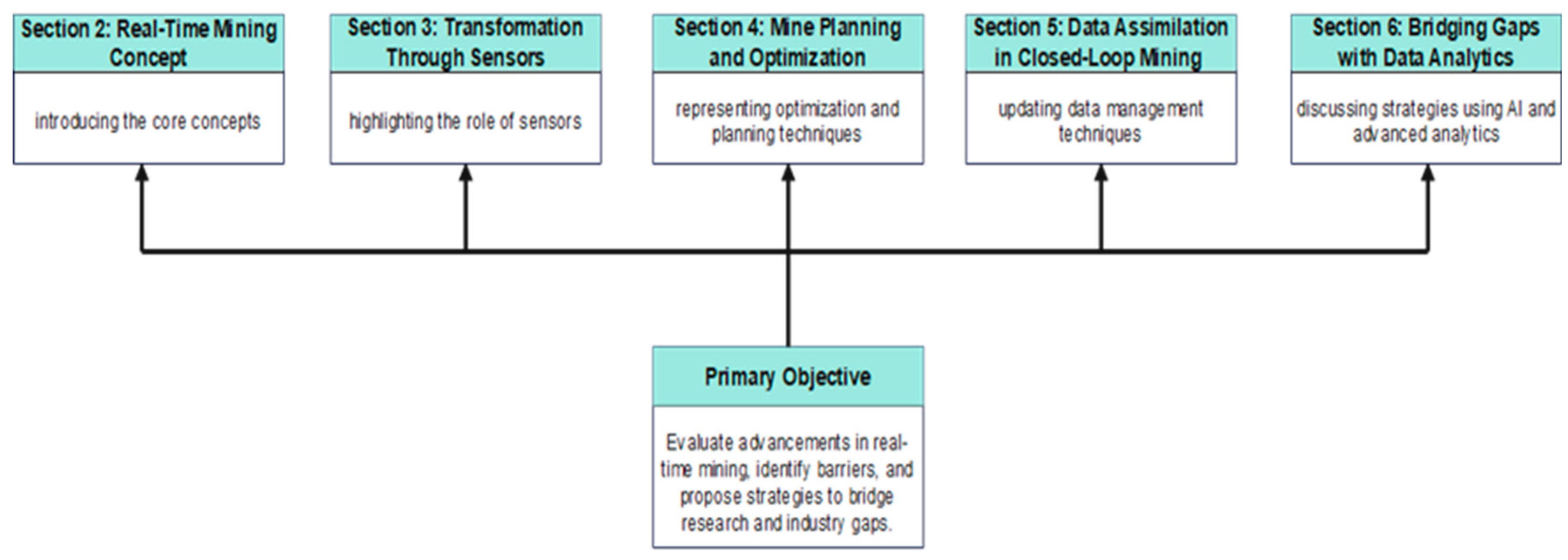
Figure 2.
The concept of closed-loop management in RTM.
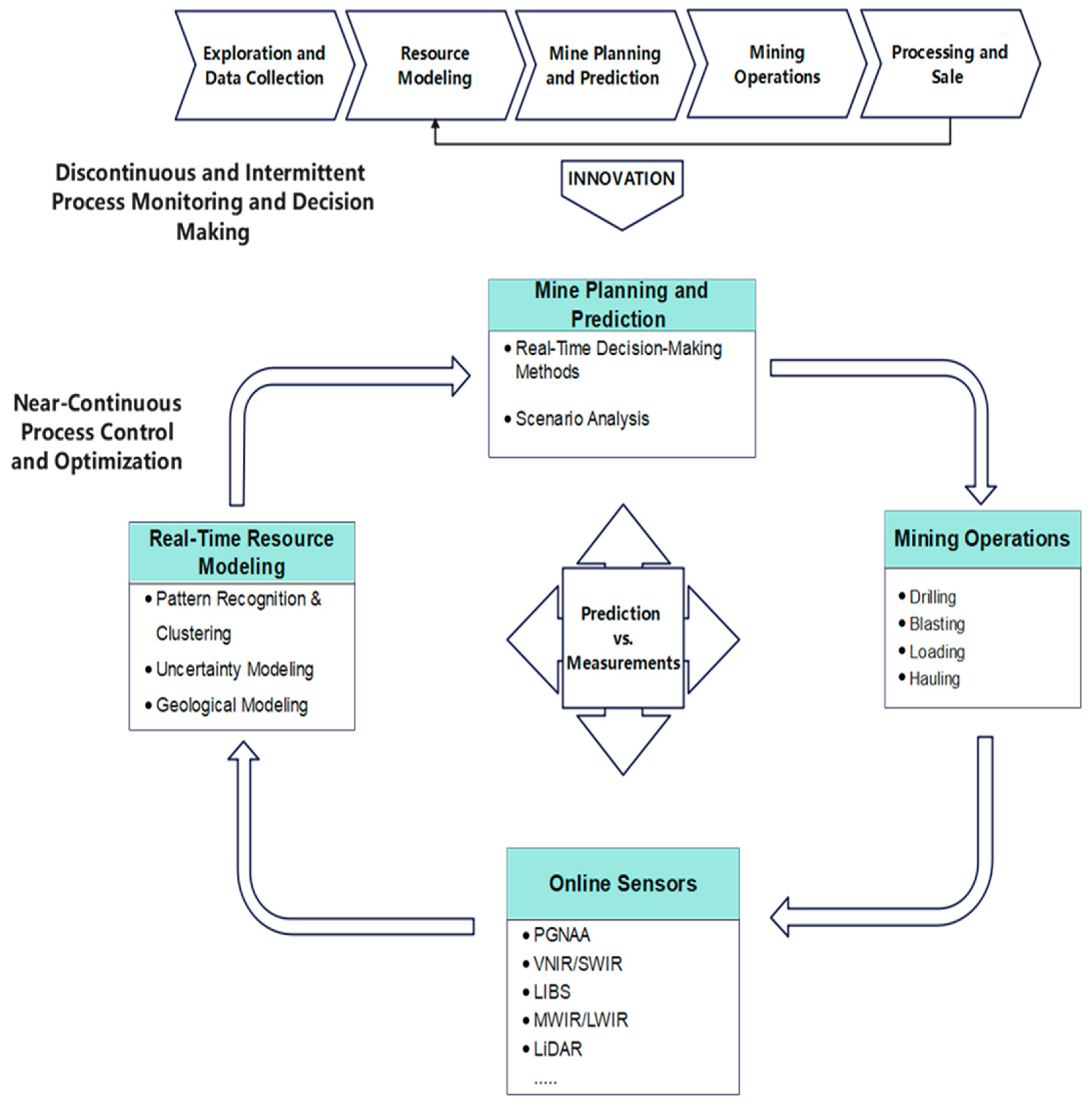
Figure 3.
Key parts of closed-loop management system (adapted from after Jansen, et al. [39]).
Figure 3.
Key parts of closed-loop management system (adapted from after Jansen, et al. [39]).
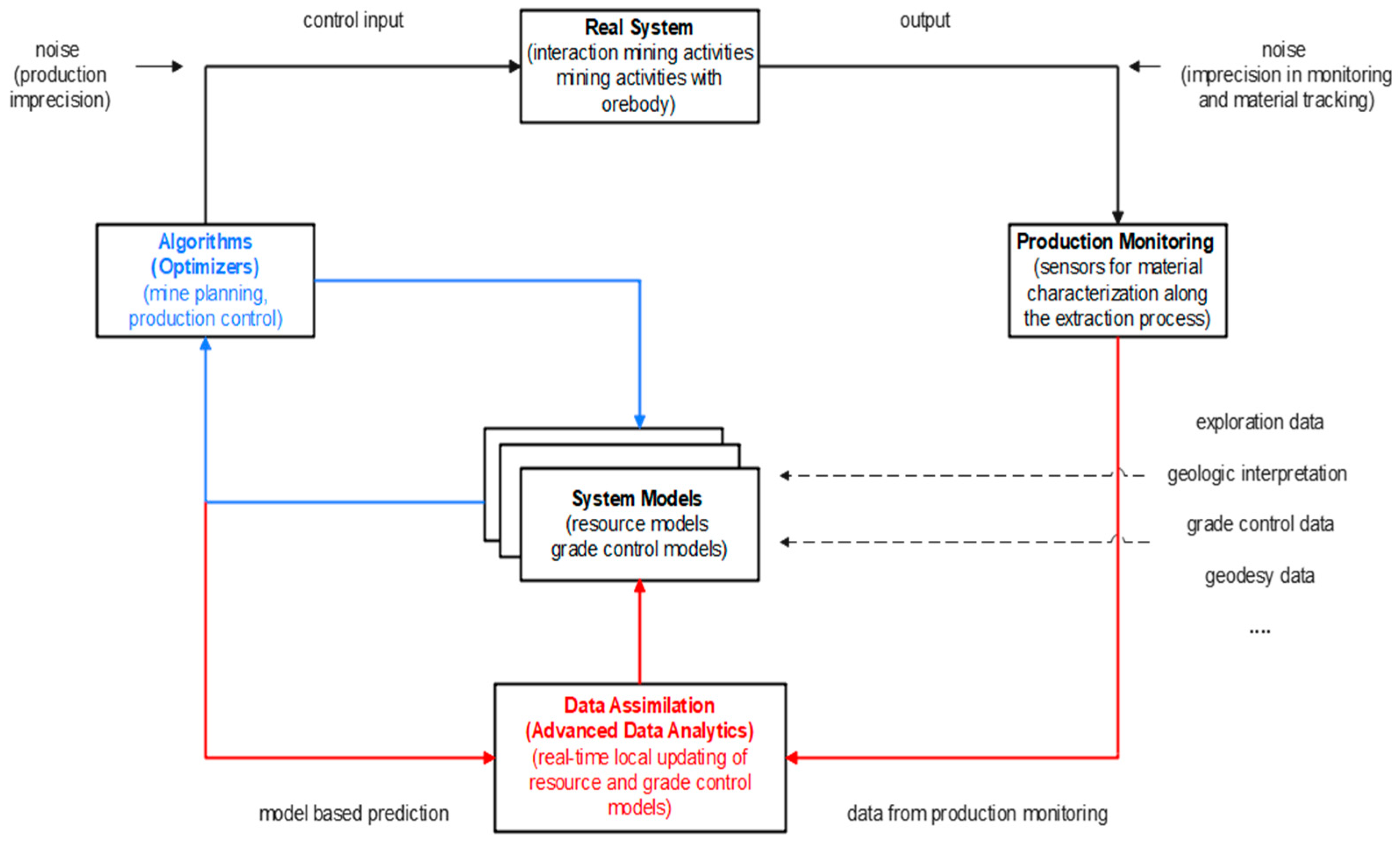
Figure 4.
Closed-loop workflow for real-time resource and grade control management in mining operations (adapted from after Benndorf [6]).
Figure 4.
Closed-loop workflow for real-time resource and grade control management in mining operations (adapted from after Benndorf [6]).
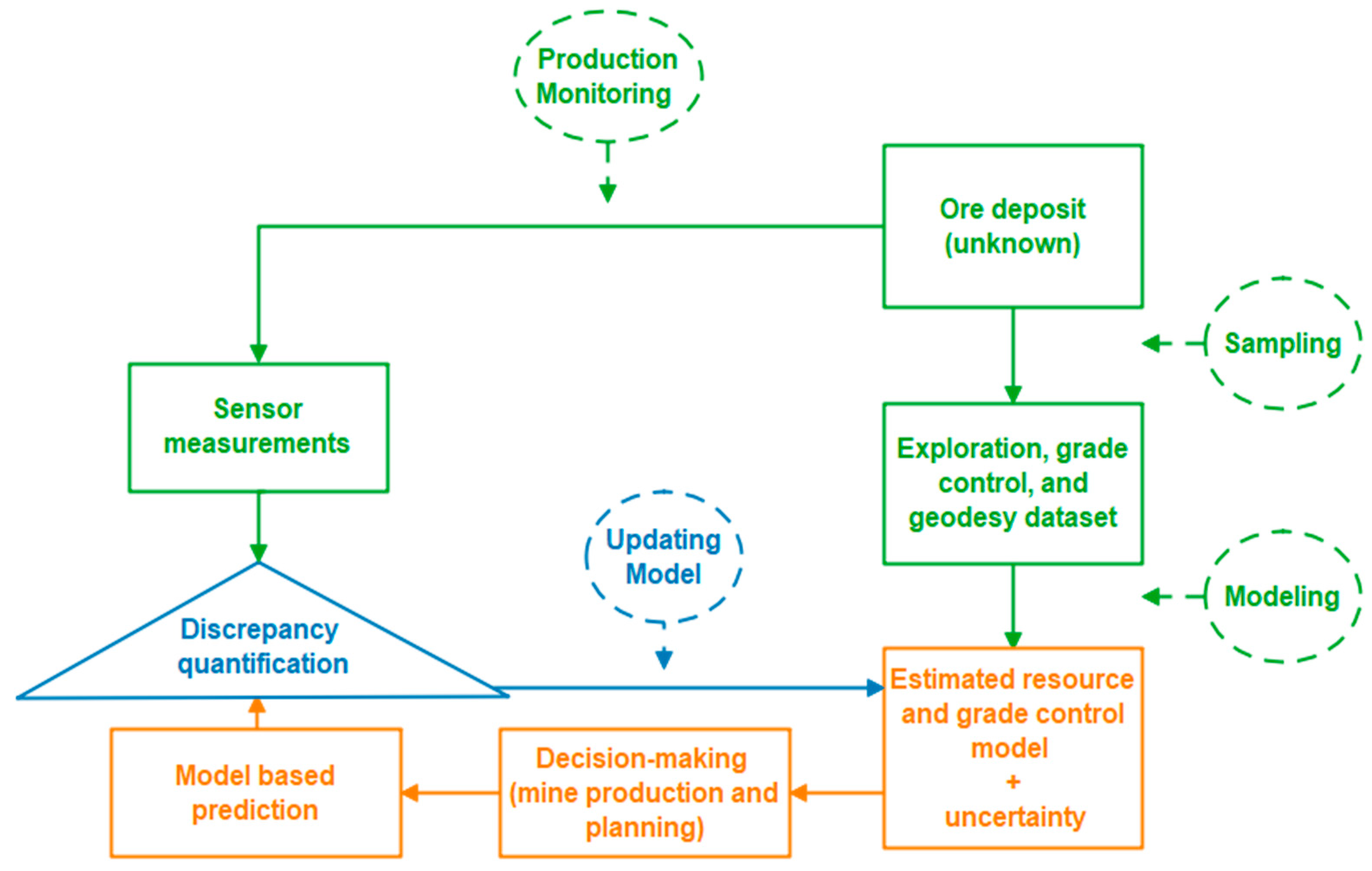
Figure 5.
TRLs for RTM: from research to full-scale implementation.
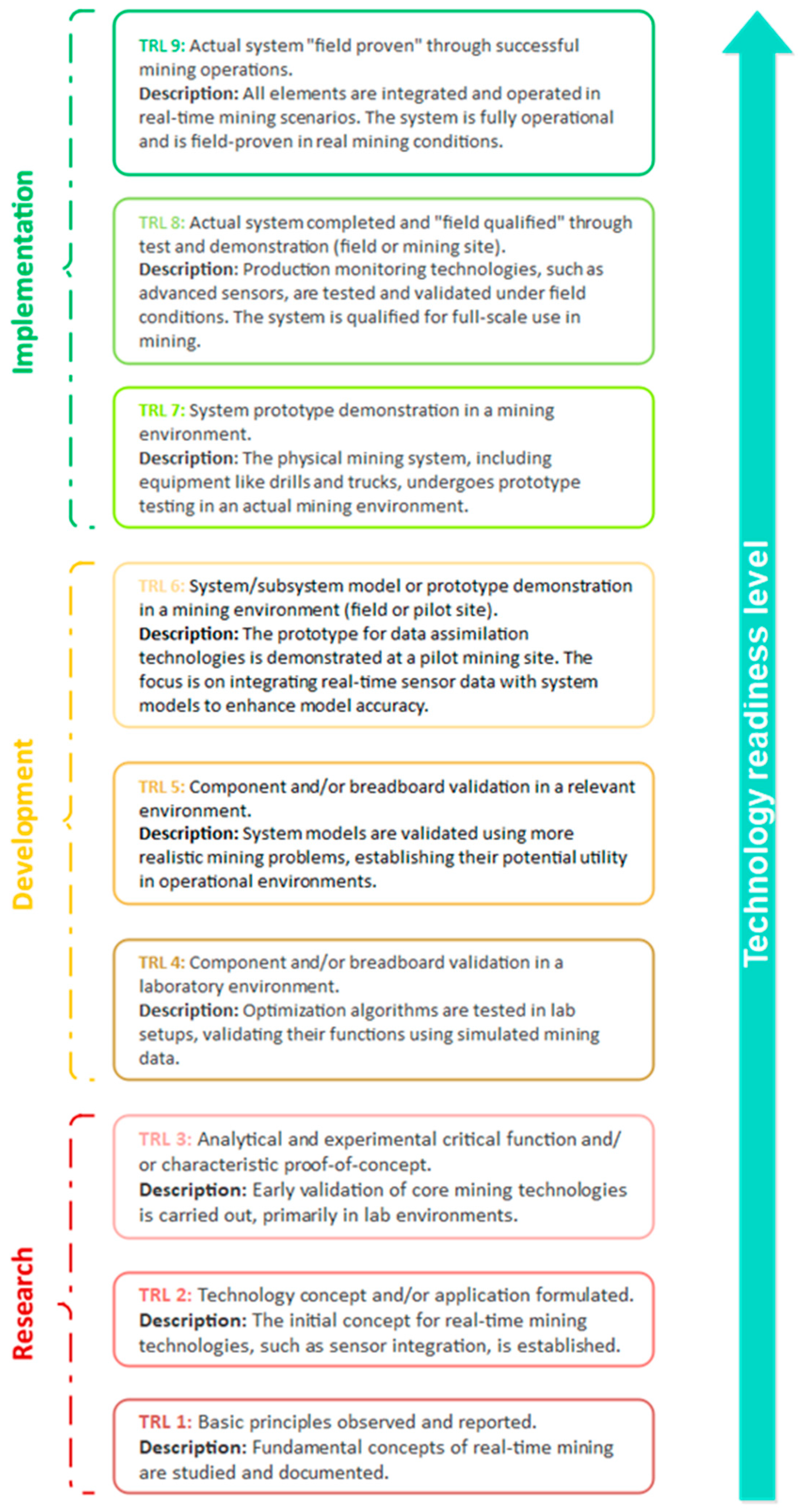

Table 1.
Effects of sensors in mining operations [21].
Table 1.
Effects of sensors in mining operations [21].
| Mine Stage | Sensor Effects | Advantages of Sensors |
|---|---|---|
| Exploration | Sensors replace physical sampling and provide real-time data for resource definition (e.g., grade, geometry). | - Reduce costs and time for sampling. - Provide immediate data for decision-making. - Eliminate extensive need for offline laboratory analysis. |
| Production & Grade Control | Sensors monitor ore grade and material properties at the face to influence real-time extraction decisions. | - Improve compliance with mining plans. - Reduce misclassification of ore and waste. - Optimize production sequencing and equipment allocation. |
| Pre-sorting/Pre-upgrading | Sensors sort material before crushing, controlling dispatch to specific destinations (e.g., waste or stockpile). | - Reduce material variability. - Increase product homogeneity. - Improve efficiency by removing waste early. |
| Post-stockpile & Pre-processing | Sensors further refine material by removing residual variability in grade and chemistry. | - Increase feed quality for processing plants. - Enhance process control. - Improve precision of material characteristics. |
| Post-processing & Quality Control | Sensors ensure final product quality by analyzing the material stream in real time. | - Maintain product specifications. - Provide immediate feedback for process adjustments. - Eliminate off-line quality control analysis. |
Table 2.
Strengths, weaknesses, and opportunities of material characterization sensors in mining.
| Sensor Technology | Application in Mining | Strengths | Weaknesses | Opportunities |
|---|---|---|---|---|
| Measurement While Drilling (MWD) | Blast optimization, rock mass blastability analysis | Provides real-time geomechanical data, enables M2M optimization |
Limited to drilling data, high setup cost | Enhanced bench characterization, integration with M2M systems |
| Prompt Gamma Neutron Activation Analysis (PGNAA) |
Elemental analysis of primary crushed ore | Real-time ore composition, high accuracy | Expensive, radiation safety concerns | In-situ metal grade estimation, reduced sampling errors |
| Hyperspectral Imaging (VNIR/SWIR) | Mineral identification, ore-waste discrimination |
High spectral resolution, rapid, non-contact | Sensitive to environmental conditions (dust, moisture) | Potential for in-situ sorting, dynamic technology |
| Mid-Wave Infrared (MWIR)/Long-Wave Infrared (LWIR) | Ore-waste discrimination, mineral classification | Effective for rock analysis, high classification rates | Limited instrument development, weak spectral features |
Automation potential, integration with chemometric tools |
| Raman Spectroscopy | Mineral identification | Detailed fingerprints, in-situ handheld instruments | Fluorescence interference, limited elemental correlation |
Real-time applications, expanded mineral libraries |
| Laser-Induced Breakdown Spectroscopy (LIBS) |
Raw material characterization, elemental analysis | No sample prep, effective for major/trace elements | Limited detection range, affected by environmental factors |
In-situ exploration, micro-scale spatial analysis |
| Light Detection and Ranging (LiDAR) | Raw material geometry, mineral mapping |
Provides 3D spatial data, operates in various conditions |
Limited spectral data, expensive equipment | Multispectral LiDAR for mineral classification |
| RGB Imaging | Mineral mapping, fragmentation analysis |
Portable, rapid data processing, non-destructive | Limited to surface characteristics, affected by dust | Enhanced imaging, ruggedized systems |
| Electromagnetic Sensors | Mineral density detection, ore-waste separation |
Effective for physical property measurement |
Affected by mineral mixture complexity | Improved accuracy, expanded detection range |
| Dual Energy X-Ray Transmission (DE-XRT) | Pre-concentration, ore-waste separation | Accurate density-based discrimination | Limited to specific mineral densities | Application in automated sorting processes |
Table 3.
Advancements in mining optimization techniques over time.
| Author(s) | Method | Case Study | Result | Advantages |
|---|---|---|---|---|
| Pendharkar and Rodger [84] | Nonlinear programming and genetic search | Coal mines (Illinois, Virginia, Pennsylvania) | Improved production scheduling under cost and geological constraints | Potential to enhance decision support for coal production and blending |
| Leite and Dimitrakopoulos [85] | Stochastic optimization, simulated annealing | Copper deposit | 26% increase in NPV | Efficient scheduling with risk analysis; reduced likelihood of production target deviations compared to conventional methods |
| Askari-Nasab, Frimpong and Szymanski [70] | Discrete stochastic simulation | Iron ore deposit | $422 million NPV vs $414 million (conventional) | Better optimization of pit limit using a stochastic production simulator, outperforming Lerchs-Grossmann algorithm |
| Albor Consuegra and Dimitrakopoulos [71] | Simulated annealing | Copper deposit | 17% larger pit limits, 10% higher NPV | Integration of uncertainty to derive optimal pit limits and production schedule improvements |
| Sayadi, et al. [86] | Artificial neural network | Esfordi phosphate mine (Iran) | Generated pit with higher profit under impurity constraints | Improved pit limit classification and profitability compared to Lerchs-Grossmann algorithm |
| Moosavi, Gholamnejad, Ataee-Pour and Khorram [72] | Hybrid augmented Lagrangian relaxation and genetic algorithm | Long-term production scheduling | Better feasible solutions than traditional linearization method | Effective for large-scale problems; faster convergence than standard methods |
| Souza, et al. [87] | Hybrid heuristic (GRASP and GVNS) | Open-pit mining operational planning | Near-optimal solutions (less than 1% gap) | Dynamic truck allocation, minimized number of trucks while meeting production goals; efficient computing time |
| Mousavi, Kozan and Liu [75] | Hybrid branch-and-bound and simulated annealing | Short-term open-pit block sequencing | Optimized extraction sequences over short intervals | Efficient in solving short-term sequencing under machine capacity and precedence constraints |
| Mousavi, Kozan and Liu [74] | Comparative analysis of metaheuristics | Short-term open-pit sequencing | Hybrid TS-SA was superior to SA and TS | Enhanced performance and feasibility for real-scale open-pit problems |
| Goodfellow and Dimitrakopoulos [77] | Two-stage stochastic mixed integer nonlinear programming | Mining complexes | Improved production targets and NPV compared to deterministic methods | Joint optimization of extraction, blending, processing, and transportation under uncertainty |
| Both and Dimitrakopoulos [73] | Stochastic mixed integer programming | Real-world mining complex | 56% reduction in shovel movement costs and 3.1% reduction in truck costs | Improved short-term production scheduling and fleet management by integrating shovel relocation, truck allocation, and uncertainty management |
| Shishvan and Benndorf [88] | Simulation-based optimization | Continuous mining system | Minimized idle time, improved material dispatching | Integrated deterministic optimization and stochastic simulation for adaptive material dispatching |
| Lamghari, Dimitrakopoulos and Ferland [78] | Hybrid method (linear programming and variable neighborhood descent) | Open-pit mine scheduling | New best-known solutions for benchmark instances | Efficient and superior in computational performance compared to recent literature methods |
| Lamghari and Dimitrakopoulos [89] | Hyper-heuristic with reinforcement learning and tabu search | Generic mining operations | Comparable or better results than state-of-the-art methods | Robust against problem-specific details, effective for complex scheduling involving multiple processing streams |
| LaRoche-Boisvert and Dimitrakopoulos [90] | Simultaneous stochastic optimization | Open-pit gold mining complex | Maximized NPV; SAG mill identified as bottleneck | Integrated production scheduling across three mines and stockpiles under supply uncertainty |
| Levinson and Dimitrakopoulos [91] | Stochastic programming and reinforcement learning |
Copper mining complex | Jointly optimized short- and long-term schedules | Reduced risk of misalignment across timescales, enhanced operational feasibility |
| Levinson and Dimitrakopoulos [92] | Reinforcement learning and stochastic optimization | Copper mining complex | Improved production schedule using infill drilling data | Reduced uncertainty in production schedule, optimized drilling location selection |
Table 4.
Strengths, weaknesses, and opportunities of RTM methods.
| Methodology | Strengths | Weaknesses | Opportunities |
|---|---|---|---|
| Kalman Filter | Simple and effective for linear systems; well-established methodology for parameter estimation | Assumes linearity and Gaussianity; struggles with non-linear relationships | Use in systems with predominantly linear relationships and smaller-scale updates |
| EnKF | Widely used for sequential data assimilation; handles non-linear problems reasonably well |
Limited by Gaussian assumptions; can fail with strongly non-Gaussian or discontinuous variables | Hybridize with other non-linear techniques for improved assimilation of complex datasets |
| Normal-Score EnKF | Addresses non-Gaussian characteristics by transforming variables into Gaussian distributions | Transformation may not ensure joint multi-Gaussianity; requires multiple transformations | Use in settings with moderate non-Gaussianity where the linear update assumption mostly holds |
| Indicator-Based Data Assimilation | Suitable for non-Gaussian relationships; effective for transforming model parameters | Limited in handling very complex relationships; covariance-based association may be insufficient |
Extend the approach to hybrid models using additional non-linear statistics |
| EnKF with Compositional Data | Suitable for geometallurgical variables; uses transformations to maintain compositional consistency |
Log-ratio transformations add complexity; requires careful handling of relationships between variables | Apply in compositional geoscience models where maintaining data consistency is crucial |
| MPS with EnKF | Maintains geological realism in facies models; handles complex spatial patterns effectively | Computationally expensive; requires careful calibration to maintain geological realism | Improve computational algorithms to allow for faster and more efficient assimilation in realistic models |
| MPS with Soft Data Integration | Enhances facies model calibration by incorporating soft data; maintains geological continuity |
Sensitive to initial conditions; computationally intensive | Utilize for integrating additional soft data in highly uncertain geological environments |
| EnKF with P-Field Simulation | Enhances facies modeling by incorporating probability maps; better integrates geological information | Requires additional assimilation steps; increased computational requirements | Useful for complex geological settings where standard EnKF struggles to reproduce accurate facies |
| EnKF with TPG Models | Assimilates data while maintaining facies realism; handles categorical variables through truncation maps |
Difficult to handle non-monotonic truncation maps; requires derivative adjustments for accurate data matching | Use in channel facies modeling where categorical boundaries are critical |
| EnKF with DCT | Helps reduce dimensionality and improves history matching for high-dimensional problems | Increases computational complexity; sensitive to non-Gaussian data distributions | Apply for history matching in high-dimensional geological models where data compression is critical |
| SEOD with EnKF | Provides optimized sampling strategies and enhances model parameter estimation | Time-consuming optimization; computational overhead when dealing with complex geological data |
Combine with simpler methods to balance accuracy and computational efficiency |
| EnKF with DWT | Helps reduce geological boundary uncertainty; enhances real-time data assimilation |
High computational requirement; depends on quality of initial realizations | Extend application for sensor-based geological boundary identification |
| Reinforcement Learning (DDPG) | Learns adaptively in complex environments; able to handle dynamic, high-dimensional datasets | Requires extensive training data; computationally intensive and relies on strong computational resources |
Apply in dynamic mining environments where adaptive decision-making is beneficial |
| Actor-Critic Reinforcement Learning | Learns adaptively in dynamic environments; can self-optimize based on incoming data | Computationally heavy; requires large datasets for effective learning | Use in industrial-scale mining for optimizing resource extraction and adaptive decision-making |
Table 5.
Summary of studies on closed-loop data assimilation.
| Author(s) | Method | Case Study | Result | Advantages |
|---|---|---|---|---|
| Jafarpour and McLaughlin [102] | EnKF with DCT | Synthetic Reservoirs | Reduced dimensionality, preserved geological realism | Reduced computational cost; better preservation of channel connectivity |
| Zhou, Gomez-Hernandez, Franssen and Li [107] | Normal-Score EnKF | Synthetic Bimodal Aquifer | Preserved non-Gaussian distributions, improved characterization | Preserved complex spatial features; enhanced quality of real-time geological models |
| Hu, Zhao, Liu, Scheepens and Bouchard [101] | MPS with EnKF | Fluvial Reservoir | Maintained geological consistency, effective history matching | Maintained geological features; effective in real-time history matching |
| Benndorf [33] | Kalman Filter | Synthetic Data | Reduced MSE, improved prediction accuracy | Improved decision-making by incorporating real-time sensor data; reduced uncertainty even with blending |
| Nejadi, Trivedi and Leung [105] | EnKF with P-Field Simulation | Reservoir Models | Improved facies boundary characterization | Preserves statistical properties; prevents overfitting; ensures ensemble diversity |
| Yüksel, Thielemann, Wambeke and Benndorf [96] | EnKF | Garzweiler Lignite Mine | Up to 70% reduction in model uncertainty | Direct incorporation of real-time measurements; better decision-making and quality control |
| Yüksel, Benndorf, Lindig and Lohsträter [95] | EnKF | Lignite Mining with Multiple Benches | Error reduction up to 73% | Practical and less computationally intensive; improved model predictions |
| Wambeke and Benndorf [32] | EnKF | Grade Control Reconciliation | Enhanced accuracy, practical for complex scenarios | Improved operational efficiency; reduced uncertainties; better resource extraction |
| Wambeke and Benndorf [30] | EnKF | Analysis of System Parameters | RMSE reduction up to 74%, improved model alignment | Mitigated discrepancies; enhanced production processes |
| Lan, Shi, Jiang, Sun and Wu [104] | SEOD with EnKF | Groundwater Models | Reduced uncertainty, improved predictions | Optimal sensor data collection; efficient computational performance; better model accuracy |
| Oliver and Chen [106] | EnKF with TPG Models | Synthetic Reservoir | Improved data match, reduced uncertainty | Handled nonlinearity and non-monotonic relationships; robust in complex geological environments |
| Kumar and Srinivasan [98] | Indicator-Based Data Assimilation | Synthetic Reservoir | Preserved non-Gaussian distributions, accurate spatial features | Overcomes EnKF limitations; maintains geological features; accurate in non-Gaussian contexts |
| Ma and Jafarpour [99] | MPS with Soft Data Integration | Facies Model Calibration | Improved consistency with training images and data | Maintains geological consistency; integrates soft data; effective framework |
| Li, Sepúlveda, Xu and Dowd [94] | Kalman Filter | Synthetic Dataset | Improved model accuracy, better mining selectivity | Integrates sensed data without complex methods; computational efficiency; practical for rapid decision-making |
| Prior, Benndorf and Mueller [103] | EnKF | Underground Mining (Reiche-Zeche) | Improved prediction accuracy for ore grade and vein thickness | Improved mining selectivity; effective even with sparse initial data |
| Prior, Tolosana-Delgado, van den Boogaart and Benndorf [36] | EnKF with Compositional Data | Bauxite Deposit | Accurate updates, preserved compositional characteristics | Reduced uncertainty; improved accuracy for decision-making |
| Kumar and Dimitrakopoulos [35] | Reinforcement Learning (DDPG) | Synthetic Dataset | Dynamic model updates, accounted for high-order statistics | Integrates new information dynamically; suitable for complex mining operations |
| Talesh Hosseini, Asghari, Benndorf and Emery [100] | EnKF with DWT | Golgohar Iron Ore Mine | Improved geological boundary accuracy, high compatibility | Enhances block model quality control; reduces spatial uncertainty; preserves statistical parameters |
| de Carvalho and Dimitrakopoulos [34] | Actor-Critic Reinforcement Learning | Copper Mining Complex | 47% improvement in cash flow | Dynamic fleet allocation and production scheduling based on real-time data. |
Disclaimer/Publisher’s Note: The statements, opinions and data contained in all publications are solely those of the individual author(s) and contributor(s) and not of MDPI and/or the editor(s). MDPI and/or the editor(s) disclaim responsibility for any injury to people or property resulting from any ideas, methods, instructions or products referred to in the content. |
© 2025 by the authors. Licensee MDPI, Basel, Switzerland. This article is an open access article distributed under the terms and conditions of the Creative Commons Attribution (CC BY) license (http://creativecommons.org/licenses/by/4.0/).
Copyright: This open access article is published under a Creative Commons CC BY 4.0 license, which permit the free download, distribution, and reuse, provided that the author and preprint are cited in any reuse.