

Submitted:
19 August 2024
Posted:
20 August 2024
You are already at the latest version
Abstract
The Mining Industry has changed significantly in recent decades with the introduction of advanced technologies such as Artificial Intelligence (AI) and Machine Learning (ML). These innovations contribute to the creation of expert systems that help in optimizing processes, increasing the safety and sustainability of operations. This article is a literature review of modern AI and ML methods and technologies used in the Mining Industry. Discusses various intelligent and expert systems used to improve productivity, reduce operating costs, improve occupational safety, environmental sustainability, machine automation, predictive analytics, quality monitoring and control, and inventory and logistics management. The advantages and disadvantages of different approaches are analyzed, as well as their potential impact on the future of the Mining Industry. The review highlights the importance of integrating AI and ML into mining processes to achieve more efficient and safer solutions.
Keywords:
Machine Learning
; Artificial Intelligence
; Mining Industry
; deep learning
; Internet of Things
; Predictive Analysis
; reinforcement learning
1. Introduction
Artificial Intelligence (AI) and Machine Learning (ML) are pivotal technologies transforming numerous sectors, mining included. AI encompasses the realm of computer science dedicated to creating systems capable of executing tasks traditionally requiring human intelligence, like speech recognition, decision-making, and problem-solving [1,2,3]. Machine Learning, a subset of AI, specifically concentrates on devising algorithms that enable computers to learn from data and enhance their performance over time.
The Mining Industry, as one of the oldest and most resource-intensive sectors, has always been in pursuit of new technologies capable of enhancing the efficiency and safety of mineral extraction. The application of AI and ML in mining opens up new possibilities for addressing many challenges faced by mining companies [4,5,6,7]. The use of Artificial Intelligence enables enhanced productivity, lower operational costs, improved workplace safety, and reduced environmental impact.
The use of ML algorithms makes it possible to optimize the processes of mining and processing of minerals. For instance, ML-based systems can analyze mining data in real time, suggest optimal routes for mining equipment, and predict the most efficient mining methods [8,9].
Predictive analytics based on ML improves the prediction of equipment breakdowns and plans its maintenance, which reduces the cost of repair and replacement of equipment. Such approach is especially important for large and expensive mining equipment [10].
AI and ML can analyze data from sensors and surveillance cameras to identify potentially dangerous situations and warn workers about possible accidents. For example, monitoring systems can monitor the condition of mines and predict collapses or methane emissions, which allows workers to be evacuated in a timely manner and precautions taken [11,12,13].
ML can also be used to monitor and manage environmental aspects of mining operations, such as air and water pollution control, waste management and land reclamation. It also reduces negative environmental impacts and comply with environmental regulations and standards.
Leading mining companies are deploying autonomous vehicles and AI-driven drilling rigs, reducing the risk to human life and increasing mining efficiency. ML algorithms are used to analyze large volumes of data collected from sensors and equipment to predict potential equipment failures and plan preventive maintenance [14,15,16]. AI systems help monitor the quality of extracted raw materials in real time, analyzing samples and predicting possible deviations from the standard. ML allows optimization of supply chains and inventory management, which reduces costs and increases operational efficiency [17,18,19,20].
The application of Artificial Intelligence and Machine Learning in the Mining Industry represents a significant step forward in the development of the industry (Figure 1).
These technologies not only increase productivity and reduce costs, but also significantly improve occupational safety and minimize negative environmental impacts. With increasing demands for efficiency and sustainability, mining companies using AI and ML gain competitive advantages and open up new opportunities for further growth and development.
2. Review Planning and Methodology
2.1. The Goal and Objectives of the Study
The main objective of this study is to provide a comprehensive review of the application of Artificial Intelligence (AI) and Machine Learning (ML) in the Mining Industry, with a focus on expert systems. To achieve this goal, the following tasks were set:
Q1: Identification of the main directions and applications of AI and ML in the Mining Industry.
Q2: Analysis of existing expert systems, their advantages and disadvantages.
Q3: Identification of promising technologies and methods for the further development and implementation of AI and ML in mining processes.
2.2. Formulation of Literature Selection Criteria
To conduct a qualitative literature review, the following selection criteria were identified:
- −
- Articles published in peer-reviewed journals and conferences.
- −
- Research conducted over the last 10 years to ensure data is up to date.
- −
- Works related to the use of AI and ML directly in the Mining Industry. Research containing empirical data, test results, and case studies of AI and ML.
2.3. Sources of Information Search
The following databases and resources were used to search for relevant literature: Scopus, Web of Science, IEEE Xplore, Google Scholar.
Moreover, scientific journals and conference proceedings devoted to the use of AI and ML in the Mining Industry were analyzed.
2.4. Literature Search and Selection Process
The literature search was conducted using keywords and phrases such as “Artificial Intelligence in mining”, “Machine Learning in Mining Industry”, “expert systems in mining”, “AI applications in mining”, “ML in mining processes” and others. All retrieved articles were pre-evaluated based on their abstracts and keywords to determine their relevance.
2.5. Data Analysis and Classification
All selected articles were analyzed and classified into the following categories:
Applications of AI and ML in various aspects of the Mining Industry (e.g. automation, predictive analytics, monitoring and quality control).
Types of expert systems and algorithms used (e.g. neural networks, deep learning methods, decision support systems).
Advantages and disadvantages of applying AI and ML in mining processes.
Practical examples of implementation and results of using expert systems in the Mining Industry.
2.6. Synthesis and Interpretation of Results
Based on the analysis and classification of data, a synthesis of key findings and trends was conducted. The most promising areas of application of AI and ML were identified, as well as the current problems and challenges that the Mining Industry faces when implementing these technologies.
2.7. Discussion and Formulation of Recommendations
The final part of the review discusses the obtained results, draws conclusions about the current state of application of AI and ML in the Mining Industry, and formulates recommendations for further research and practical implementation of expert systems. Particular attention is paid to the prospects for the development of technologies and their potential impact on the future of the Mining Industry.
3. Literature Review
This review analyzes the leading studies using Artificial Intelligence methods in the Mining Industry. Applications of Machine Learning, including regression analysis, clustering, and classification, to predict ore grade and optimize production processes are discussed. Convolutional neural networks, which are used to analyze rock samples, and recurrent neural networks, which are used for time series forecasting in the Mining Industry, are highlighted (Figure 2).
Each study is analyzed in terms of its advantages and disadvantages. Advantages include increased forecasting accuracy and improved resource management due to the ability to identify complex patterns and dependencies in data. However, disadvantages include difficulty in interpreting results, high computational requirements, and the need for large amounts of data to train models.
This review aims to provide a comprehensive overview of current advances in the application of Artificial Intelligence in the Mining Industry, highlight the potential and challenges of each of the reviewed techniques, and contribute to the further development of this important area of science and technology.
3.1. Classical Machine Learning Models
This paper uses Machine Learning to predict bolt failures in a mining environment. The advantages include the ability to analyze real data from underground mines. The authors applied different variations of the SVM model such as PCA-SVM and GTB-SVM to assess the failure risk of bolt supports in underground coal mines. The PCA-SVM model stands out and showed significant advantages over the other two approaches. By applying PCA-SVM, the authors were able to solve the problem of multicollinearity of features and select only the most important ones, as well as achieve an AUC Score of 0.85 on the training set and an AUC Score of 0.86 on the test set. The GTB model also reduced the number of features, but its AUC was 0.82 on the training set and 0.81 on the test set, indicating a significant loss of information after feature selection. The dataset used in the study includes both continuous data and discrete spatial data. In addition, the results showed that PCA, as a feature transformation method, allows for better extraction of complex data compared to the feature selection method. The authors also noted that their future work will be aimed at testing nonlinear feature transformation methods, such as autoencoders, as well as more complex datasets [21].
The authors of [22] considered premature failure of rock bolts in underground mines. It is becoming a major critical issue due to the complex mechanisms and multiple influencing factors, which makes laboratory predictions often unreliable. The study addresses this issue by using the categorical gradient boosting (Catboost) algorithm and SHapley Additive exPlanations (SHAP) to predict rock bolt failures with high accuracy and transparency. Using a dataset from an underground coal mine, the Catboost model demonstrated excellent prediction capabilities, with high AUC values and better performance than Random Forest. The SHAP analysis showed that "roadway length" is the main factor contributing to rock bolt failure, with increasing risks in roadways longer than 30 meters and in the presence of high-sulfur groundwater. Rock bolts younger than five years were found to be significantly less susceptible to failure. The study provides valuable insights into the complex relationships between rock bolt failures and various geotechnical and environmental variables, highlighting the importance of explainable Machine Learning to improve safety and reliability in underground mining. Thus, this study illuminates the complex relationships between rock bolt failures and the impact of geotechnical and environmental variables. The proposed approach has transparency and explainability, which can facilitate the implementation of explainable Machine Learning for rock bolt failure risk assessment in underground mines.
This review [23] presents the current state of the art in applying Machine Learning to stress corrosion cracking risk assessment. There are many forms of corrosion, some of which carry minor risks while others can lead to catastrophic failures of engineering materials. Stress corrosion cracking (SCC) is one of the most severe forms of corrosion that is very difficult to detect. It occurs due to crack growth in a corrosive environment and the simultaneous application of tensile stress to metals or alloys. Identifying and predicting the occurrence of SCC is one of the pressing challenges faced by corrosion scientists and engineers. With the advancement of technology and the fourth industrial revolution, more data is available than ever before. Using this data to solve real-world problems has attracted a lot of attention in recent years. The availability of such data allows Artificial Intelligence (AI) and Machine Learning (ML) to be used as cutting-edge technologies to solve complex problems and gain insights that are not normally possible. Machine Learning is particularly useful in corrosion prediction applications, allowing the use of corrosion-influencing data such as environmental parameters (temperature and humidity), process conditions (flow conditions, pH, flow temperature and pressure), material characteristics (material type, material thickness, process device dimensions), existing corrosion protection measures, and visual conditions. All of these data can be modeled using Machine Learning algorithms to predict stress corrosion cracking occurrence and risk assessment. This paper attempts to review the available research on the application of Machine Learning to SCC. It also presents the current advances in Machine Learning and SCC, identifies existing knowledge gaps, and outlines future research directions in the field of corrosion risk assessment using Machine Learning.
This study [24] aims to quickly and accurately predict gas explosions in coal mines using the real-time data collected by the intelligent mining system, including mine safety monitoring, personnel positioning and video surveillance. Initially, the coal mine accident prevention system is divided into subsystems considering accident contributing factors, surrounding conditions and vulnerable objects, which can establish an early warning index system for gas explosions. Then, a training data set is randomly selected from the known coal mine samples, which is analyzed and processed using Matlab software. Next, a learning model based on the random forest classification algorithm is built, which is optimized by the parameters Mtry and Ntree. As a result of comparing the built model with the support vector machine (SVM) classification model, specific coal mine cases are carried out to verify the applicability of the optimized gas explosion warning algorithm. The experimental results show that the optimized random forest model achieves 100% accuracy in predicting gas explosions in coal mines, while the accuracy of the SVM model is only 75%. The optimized model also shows lower model error and relative error, which proves its high performance in the early warning of coal mine gas explosions. The advantages of this approach include high prediction accuracy and reliability of the warning system, the ability to work in real time, and the use of multivariate data analysis to improve safety management in coal mines. However, the study has limitations, including the limited number of study samples and only focusing on the prevention of gas explosions, not covering other potential risks such as fires and geological disasters.
Mining activities cause negative changes in the environment, and such areas require continuous monitoring, which can be done using remote sensing data. The paper [25] examines the impact of underground coal mining in the Bogdanka mine in southeastern Poland. Spectral indices, satellite radar interferometry, GIS tools and Machine Learning algorithms were used. A spatial model was developed that determines the statistical significance of the influence of various factors on the emergence of wetlands. The results show that changes in the NDVI index, terrain elevation, groundwater level and surface deformation significantly affect the emergence of wetlands. The Machine Learning model based on the Random Forest algorithm effectively identified potential flood zones with an accuracy of 76%. GWR (geographically weighted regression) analysis allowed us to identify local anomalies in the influence of the selected factors on the formation of wetlands, which helped to understand the reasons for their formation. The use of Random Forest and GWR allowed us to obtain accurate and detailed data on the influence of various factors on the formation of wetlands. The study takes into account various parameters (optical, radar, geological, hydrological and meteorological data), which allows us to obtain a comprehensive understanding of the problem. The use of available remote sensing data makes the methodology accessible and cost-effective for widespread use. The model can sometimes incorrectly classify flood zones, which requires additional data filtering efforts. The accuracy of Machine Learning models is highly dependent on the quality and volume of available data, which may limit their use in some regions. To improve the accuracy of the model, it is necessary to use more accurate geological and hydrological data, as well as expand the model with additional variables, which can complicate the analysis process.
Coal and gas emissions are one of the major causes of fatalities in underground coal mines and pose a threat to coal-fired power generation worldwide. Currently, methods such as monitoring methane levels using sensors, conducting geophysical surveys to identify geological structures and emission-prone zones, and empirical modeling to predict emissions are used to prevent them. However, with the development of industry 4.0 technologies, many studies have been conducted on the application of Artificial Intelligence methods to predict emissions. The proposed models and their results vary significantly in the literature. This study [26] examines the application of Machine Learning (ML) to predict coal and gas emissions in underground mines using a mixed method. Most of the available literature focusing on the application of ML in predicting coal and gas emissions was reviewed in China. The results show that researchers proposed various ML models, mainly combining them with different optimization algorithms, including particle swarm analysis (PSO), genetic algorithm (GA), rough set theory (RS), and inverted fly optimization algorithm (IFOA) for emission forecasting. The number and type of input parameters for forecasting varied significantly, with initial gas velocity being the most significant parameter for gas emissions and coal seam depth being the most significant parameter for coal emissions. The training and testing datasets of the proposed ML models in the literature varied significantly, but were insufficient in most cases, which casts doubt on the reliability of some of the applied ML models. Future research should examine the impact of data size and input parameters on coal and gas emission forecasting. The advantages of applying Machine Learning methods to emission forecasting include the ability to handle large amounts of data and automatically improve models as new data becomes available, which improves the accuracy and reliability of forecasts. The disadvantages include the dependence on the quality and volume of input data, and the need for complex model tuning to obtain reliable results.
3.2. Deep Neural Networks
In [27], an intelligent identification and positioning method for steel belt anchor hole in underground coal mine was proposed based on the improved YOLOv5s model. The main advantages of this approach include the improved detection accuracy of anchor holes by using super-resolution (SR) methods to enhance image clarity and implementing the coordinate attention (CA) module into the YOLOv5s backbone network. This can effectively extract the characteristics of small target objects and improve the detection success rate. In addition, the SR-CA-YOLOv5s model achieves high average detection accuracy (96.8%) and is capable of real-time operation while maintaining a high processing speed (166.7 fps), which meets the requirements for responsiveness. However, the disadvantages of the model include a decrease in the frame rate of 18.5 fps and the need for high-performance computing to train and operate the model in an underground mine environment.
This paper [28] presents the results of a study on the application of artificial neural network (ANN) method to model the TBM advancement rate. The advancement rate of a tunnel boring machine (TBM) in rock conditions is a key parameter for the successful completion of a tunnel construction project. A database was created including the actual measured TBM advancement rates, uniaxial compressive strength of rock, distance between planes of weakness in rock mass, and rock quality index. The data were collected from three different TBM projects (Queens Water Tunnel, USA, Karaj-Tehran Water Supply Tunnel, Iran, and Gilgel Gibe II Hydroelectric Project, Ethiopia). A five-layer neural network with an architecture of three neurons in the input layer, 9, 7, and 3 neurons in the first, second, and third hidden layers respectively, and one neuron in the output layer was found to be optimal. The correlation coefficient determined for the advancement rate predicted by ANN was 0.94. The correlation coefficient of 0.94 indicates a high accuracy of TBM penetration rate predictions, which can significantly improve project planning and implementation. The model was trained on data from three different projects, which increases its applicability in different geological conditions. The study allowed us to determine the optimal structure of the neural network for this task, which improves its performance and reliability. As a drawback, we noted the dependence on data quality; the model requires high-quality and representative data for training, which can be difficult to provide. Tuning and optimizing the neural network parameters require significant computing resources and specialized knowledge. The model may be less effective when used on projects with geological conditions that are very different from those on which it was trained. Thus, the application of the artificial neural network method to TBM penetration rate modeling offers significant advantages in terms of accuracy and optimization, but requires taking into account the limitations associated with data quality and the complexity of model tuning.
In this paper [29], the prediction of rock-induced stress during pillar extraction is investigated using Machine Learning methods such as Random Forest and Multilayer Perceptron. The models take into account factors such as working depth (H), panel width/length (W/L), pillar width/work height (w/h), goaf length, and extraction area. The paper highlights the importance of operational parameters over geological parameters. The correlation coefficient for rock-induced stress in the cases discussed in the paper is 0.85 for Random Forest and 0.76 for Multilayer Perceptron, which shows the advantage of Random Forest model. The developed models predict the stress conditions of pillars. Despite many advantages, Machine Learning also has its drawbacks. Machine Learning models require training on historical data to obtain accurate predictions, and the accuracy of the model depends on the amount and reliability of this data. However, Machine Learning is limited to be applied only to specific areas, and additional training of the model is required to work with new data. In this study, only four panels of continuous miners are analyzed, considering the limitations of data collection and the limitations of a single coal mine. In the future, more panels and different geomining conditions can be considered to improve the model. Therefore, stress prediction in underground coal mines remains one of the most important challenges for mining engineers, despite automation, advanced tools, and numerical modeling methods.
Effective prediction of ground vibration caused by blasting in opencast mining plays an important role in reducing environmental complaints. In this paper [30], a novel hybrid evolutionary artificial neural network (ANN) optimized by genetic algorithm (GA) is proposed for peak particle velocity (PPV) prediction. The proposed GA-ANN model automatically selects the optimal ANN architecture including the number of neurons, activation functions, learning algorithm and the number of epochs. The data including maximum charge mass per delay, horizontal distance (HD), radial distance (RD) and a new modified radial distance (MRD) between the monitoring station and the blasting station were used to test the proposed approach in Sungun copper mine in Iran. The performance comparison of the GA-ANN model by statistical indicators shows its superiority over the empirical predictors and neuro-fuzzy inference system. An important result is that using MRD instead of traditional HD and RD distances improves the prediction accuracy. In summary, the results demonstrate the effectiveness of the proposed GA-ANN approach in finding the optimal ANN architecture for PPV forecasting. The advantages of using the new hybrid evolutionary artificial neural network (ANN) are: increased forecasting accuracy due to the use of MRD, optimization of the ANN architecture using GA provides higher model performance, and a systematic and automated approach to selecting ANN parameters. The disadvantages noted are: a large amount of data for training the model to achieve high accuracy, the model may be limited by the specificity of the application domain and not adapt to new conditions without additional training, a limited amount of data and tests may affect the generalization ability of the model and its applicability to other mining developments.
In [31], an attempt was made to estimate and predict blast-induced ground vibration and frequency using rock parameters, blast modeling, and explosive parameters using an artificial neural network (ANN). A three-layer, feed-forward, back-propagation neural network having 15 hidden neurons, 10 input parameters, and two output parameters was trained using 154 experimental and monitoring blast records from a major surface coal mine in India. Twenty new blast datasets were used to validate and compare peak particle velocity (PPV) and frequency using ANN and other predictors. To improve the confidence in the proposed method, the same datasets were used to predict PPV using established vibration predictors as well as multivariate regression analysis (MVRA). The results were compared based on the correlation and mean absolute error (MAE) between the monitored and predicted PPV and frequency values. The ANN results showed a very close match with the field data, indicating high accuracy compared to traditional predictors and MVRA. ANN can learn new patterns not previously presented in the training dataset and update its knowledge over time when new training data is added. As a disadvantage, it is noted that the development and tuning of ANN requires significant computational resources and specialized knowledge to optimize the network architecture. Although ANN takes into account more parameters than traditional predictors, it may still not take into account all possible influencing factors, which may limit the accuracy of forecasts in some cases.
This study [32] focuses on the application of Machine Learning techniques, namely Random Forest and Multilayer Perceptron, to predict mining induced stress conditions in Indian underground coal mines. The focus is on predicting the behavior of strata in mining zones where the cobblestone and pillar method is used. The study revealed that operational parameters such as working depth, panel width and length, pillar width and working height, corrugation length and mining area play a key role in the models built to predict mining induced stress. As opposed to geological factors, operational parameters were found to be more important for the accuracy of predictions. The developed models exhibited high correlation coefficient (R2) reaching 0.85 for Random Forest and 0.76 for Multilayer Perceptron, indicating their effectiveness in predicting pillar stress conditions under different operating conditions. These findings help managers to take proactive measures to minimize risks in the coal industry including developing emergency response plans. The study also found that Random Forest demonstrated higher accuracy compared to Multilayer Perceptron, although the latter showed a higher mean absolute error. In the context of underground coal mining, the application of such Machine Learning tools is innovative and can significantly improve the safety and efficiency of processes. Future research can be aimed at improving the models, as well as exploring other numerical methods such as finite element method and finite difference method, which will allow for more in-depth and accurate predictions of rock behavior under different operating conditions. Thus, although the use of AI and Machine Learning methods for structural health monitoring offers significant benefits, it is important to consider their limitations to develop effective and reliable damage detection systems.
This study [33] focuses on the use of explosives as a source of energy for breaking rock mass. Most of the blast energy is lost as earthquakes, noise, air bursts, and other factors. Earthquakes caused by blasts depend on many parameters such as rock mass composition, explosive characteristics, and blast design.
Prediction of blast-induced earthquakes using regression analysis methods is sometimes too conservative, which creates difficulties for efficient and safe mine operation. The scaled distance approach remains a reliable method for predicting vibrations, but there are other alternative approaches that show similar results with high correlation coefficient values.
Modern analysis and prediction tools such as Artificial Neural Networks (ANN) have proven to be an excellent method for vibration prediction, as confirmed by many researchers in their work. Another method used in the study is an ensemble learning method such as Random Forest, which builds multiple decision trees and shows good results in both classification and regression.
In this paper, an attempt was made to predict the maximum particle velocities in explosions at different distances using the Random Forest, ANN and scaled regression analysis methods. For each method, correlation coefficients were obtained using different initiation systems, which revealed that ANN demonstrates the highest values of correlation coefficients, showing the most accurate results among the three considered methods. Random Forest also showed good results, although lower than ANN, but higher than the scaled regression approaches.
The authors made the following useful conclusions:
- Among the three methods used to predict blast-induced vibrations, artificial neural networks (ANN) predicted the most accurate values with the highest correlation coefficients. This makes ANN the preferred tool for predicting blast-induced vibrations in mining.
- The highest correlation coefficient values for all three methods were achieved using the electronic initiation system. This demonstrates the accuracy of such a system, which contributes to a more accurate prediction of vibrations caused by explosions.
- Based on the conducted study, it can be concluded that it is recommended to use electronic detonators with the predictive ANN model to accurately predict the vibrations caused by blasts in controlled blasting operations to calculate the maximum charge in controlled blasting operations, instead of the Random Forest and scaled regression analysis methods. This can greatly help mine operators when conducting controlled blasting operations near populated areas.
The paper [34] explores the use of deep learning to identify surface coal mines using satellite imagery, treating it as a land use and land cover classification problem. Using convolutional neural networks (CNN) and pre-trained VGG, ResNet and DenseNet architectures, a dataset of 3500 “coal mine” images and 3000 “non-coal mine” images was prepared. The VGG model using transfer learning achieved the highest classification accuracy of 98% on the validation dataset. These results indicate high accuracy and the possibility of using the model to detect coal mines in different countries. The model showed 98% accuracy on the validation dataset and more than 95% on test images from other countries, which demonstrates its reliability. Using CNN can greatly simplify the process of monitoring and detecting coal mines compared to traditional methods. The model can be updated and improved with new data, allowing it to remain relevant and effective. I would like to note that the model is prone to false positives, which can lead to additional work to filter out incorrect data. The model may misclassify other types of mines, such as copper, which requires additional data preprocessing measures.
As the core of Artificial Intelligence, Machine Learning has significant advantages in multi-criteria intelligent evaluation and decision making. The level of sustainable development is of great importance for assessing the safety of coal mining enterprises. In this work [35], the BP neural network method is used to make decisions on the level of sustainable development and assess the safety of coal mining enterprises. Based on the analysis of methods for assessing the sustainable development of coal enterprises, a system of evaluation indices is created and a multilayer forward neural network is built based on the backpropagation algorithm. Based on the human-machine-environment-control system theory and taking the four individual elements and the entire coal mine system as the research object, a system analysis and research is carried out to evaluate and continuously improve the internal safety of mines.
The advantages of BP neural network are that it avoids the subjectivity and complex mathematics of traditional estimation methods, and can produce stable and accurate results even in the presence of some missing data and parameter drift. It provides scientific and theoretical guidance for decision-making on sustainable development of coal mining enterprises and has some research value. The disadvantages of the method are the dependence on the quality of the initial data and the need to fine-tune the model to achieve high accuracy.
Future research will focus on two aspects: optimizing the processing process of the proposed algorithm to further improve its accuracy and efficiency, and using big data technologies to analyze text data recorded in the production process of coal mines to improve the ability of predictive control of industrial safety risks. coal mines.
The goal of coal producers is to provide a sufficient volume of coal of the required quality with minimal costs for its extraction. Therefore, predicting energy characteristics is one of the most important tasks aimed at optimal use of the energy value of coal. The goal of the authors' work [36] is to identify, investigate, and evaluate the most influential Artificial Intelligence algorithms widely used in the mining community on a real-world coal quality prediction problem. The study was based on data obtained in laboratory conditions over a period of five years (2005-2010), including 33,256 coal samples from the Kreka Coal Mine company. It was aimed at building a prediction model based on the described data, which will be used to predict the quality class of unknown coal samples. As part of the work, four algorithms were identified: C4.5, kNN, Naive Bayes and multilayer perceptron (MLP).
The idea was to find the best model through the following steps: each of the algorithms is calibrated to determine suitable model partitioning techniques that maximize the performance of the algorithms, the importance of the input attributes is assessed, and finally the algorithms are compared on their performance. The final evaluation of the results identified MLP as the best forecasting method for this domain with an optimal structure for the input, hidden and output layers.
The predictive model for this domain achieved the optimal structure (14-24-7) for the input layer, hidden layer and output layer. The results show that this neural network can be an important tool for predicting coal quality. New knowledge can be a valuable aid in decision making and management of complex systems, ensuring product and production quality. For future work, it is planned to study the possibility of introducing the resulting predictive model into an online monitoring system of the actual values of the content of coal moving along the conveyor, which will provide information about the quality of coal in real time.
This study [37] highlights the critical vulnerability of coal mines due to insufficient air flow, which poses significant risks to safety and human resources. Therefore, continuous monitoring of air flow in underground mines is essential to detect potential disasters.
Various Artificial Intelligence methods are used to estimate nonlinear air flow parameters in mines, but often encounter problems such as local minima and low convergence speed.
This paper proposes a new algorithm that integrates adaptive neuro-fuzzy interface system (ANFIS) with genetic algorithm (GA) to predict energy consumption and air flow in underground mine ventilation systems. GA is used to automate the discovery and configuration of network architectures, reducing the need to manually configure optimal network design. As a comparison, two predictive benchmark models, particle swarm optimization (PSO) and Bayesian optimization (BO), are introduced to demonstrate the effectiveness of GA in identifying the best hyperparameters for ANFIS and ANN models.
Experimental analysis validates the proposed model against several baseline approaches using statistical parameters such as root mean square error (RMSE), mean absolute error (MAE), and coefficient of determination (R square). The results show that the proposed model outperforms the baseline models on these performance metrics.
Thus, this work advances ventilation and monitoring technologies in mines with the goal of improving operational reliability, improving safety and health conditions, reducing energy and operating costs, and increasing overall mine productivity.
This study also demonstrates a unique hybrid neuro-genetic system (ANFIS-GA) for optimizing model structures, which not only reduces computation time and cost, but also leverages the potential of GA to create more efficient model architectures.
3.3. Recurrent Neural Networks
The authors of [38] proposed a deep learning model based on Unified Manifold Approximation and Projection (UMAP) and Long Short-Term Memory (LSTM) methods to predict fire status in sealed zones of underground coal mines. This model protects the lives of miners by providing early warning of impending dangers. The proposed forecasting model graphically displays the fire status in the form of an Ellicott expansion plot. The performance of the proposed forecasting model is experimentally measured in comparison with existing Machine Learning models such as support vector machine (SVR) and autoregressive integrated moving average (ARIMA). It was found that the UMAP-LSTM model has the lowest root mean square error in forecasting the concentrations of gases O2, CO, CH4, CO2, H2, N2 and C2H4: 0.288, 0.006, 0.0995, 0.902, 0.238, 0.452 and 0.006, respectively, which indicates a higher efficiency of the proposed forecasting models. Fires in mines often lead to gas and coal dust explosions, which pose a danger to the lives of miners and complicate rescue efforts. Therefore, it is necessary to monitor the state of the gas mixture in sealed areas and study trends in the explosiveness of the gas mixture over time. Knowledge of future gas concentrations allows immediate action to be taken to eliminate the hazard.
This study [39] presents a deep neural network for predicting gas concentrations in sealed areas of underground coal mines using various IoT sensors installed in a metal gas chamber. Air is automatically drawn at preset intervals from the sealed area using a solenoid valve, suction pump and programmable microprocessor. Gas sensors monitor gas levels in a coal mine and transmit gas concentration information to a server room on the surface via a wireless network and cloud data storage. In this study, a forecasting model t-SNE_VAE_bi-LSTM is proposed, combining t-SNE, VAE and bi-LSTM networks. The t-SNE model method aims to minimize the dimensionality of recorded gas concentrations, the VAE layer reconstructs the internal characteristics of low-dimensional gas concentrations, and the Bi-LSTM layer predicts the gas concentrations of CH4, CO2, CO, O2 and H2. The advantages of the proposed t-SNE_VAE_bi-LSTM model for predicting gas concentrations in sealed areas of coal mines include high prediction accuracy, as evidenced by low mean square error (MSE) values compared to alternative ARIMA and CHAOS models. The model is able to effectively account for the complex relationships between the concentrations of various gases and time, which makes it more adaptive to changes in the mine environment. In addition, the use of t-SNE and VAE technologies can reduce data dimensionality and extract important features, which improves the overall performance of the model. However, the model also has disadvantages. In particular, the complexity of setting up and interpreting the results can be high due to the use of several complex algorithms (t-SNE, VAE, bi-LSTM) that require deep understanding and experience in Machine Learning and geology. In addition, the model requires significant computational resources and training time due to its deep architecture and the need to process large amounts of data.
Early diagnosis of cracks makes it possible to take timely measures to eliminate them and ensure the safety of personnel and equipment in open coal mines. Monitoring cracks in such sections is important for the safety of workers and the security of national resources. Digital twins (DTs) play a key role in crack detection in open-pit coal mines, providing continuous, real-time monitoring of mine and environmental conditions. Various sensors and Internet of Things (IoT) devices collect ground motion and stress data. Integrating this data into DT allows the identification and analysis of anomalies that may indicate crack formation or propagation. This work [40] proposes a deep neural network with dense connectivity and low weight embedded in DT for crack detection and predictive maintenance decision making by integrating historical data, real-time sensor data and predictive models.
The proposed DT system can predict the formation of cracks, which allows proactive measures to eliminate them. Comparing the performance of our network with other models showed that it outperforms all state-of-the-art deep neural networks in terms of accuracy, recall, overall accuracy, average accuracy, F1-measure, and kappa coefficient. Our network also performed better in terms of average accuracy and outperformed models such as U-Net and recurrent neural networks in terms of training and prediction time.
The benefits of the proposed system include a comprehensive approach to crack detection through the integration of real-time monitoring, predictive analytics, modeling, visualization and decision support. This allows mine operators to improve safety, optimize maintenance efforts and minimize risks associated with cracking and structural instability. Disadvantages of the system may include difficulty in setting up and the need for a large amount of data to ensure high accuracy and reliability of forecasts.
4. Development of AI and ML in the Mining Industry
For the further development and implementation of Artificial Intelligence (AI) and Machine Learning (ML) in mining processes, it is necessary to identify and master a number of promising technologies and methods. These technologies and methods can significantly improve the efficiency, safety and sustainability of mining operations.
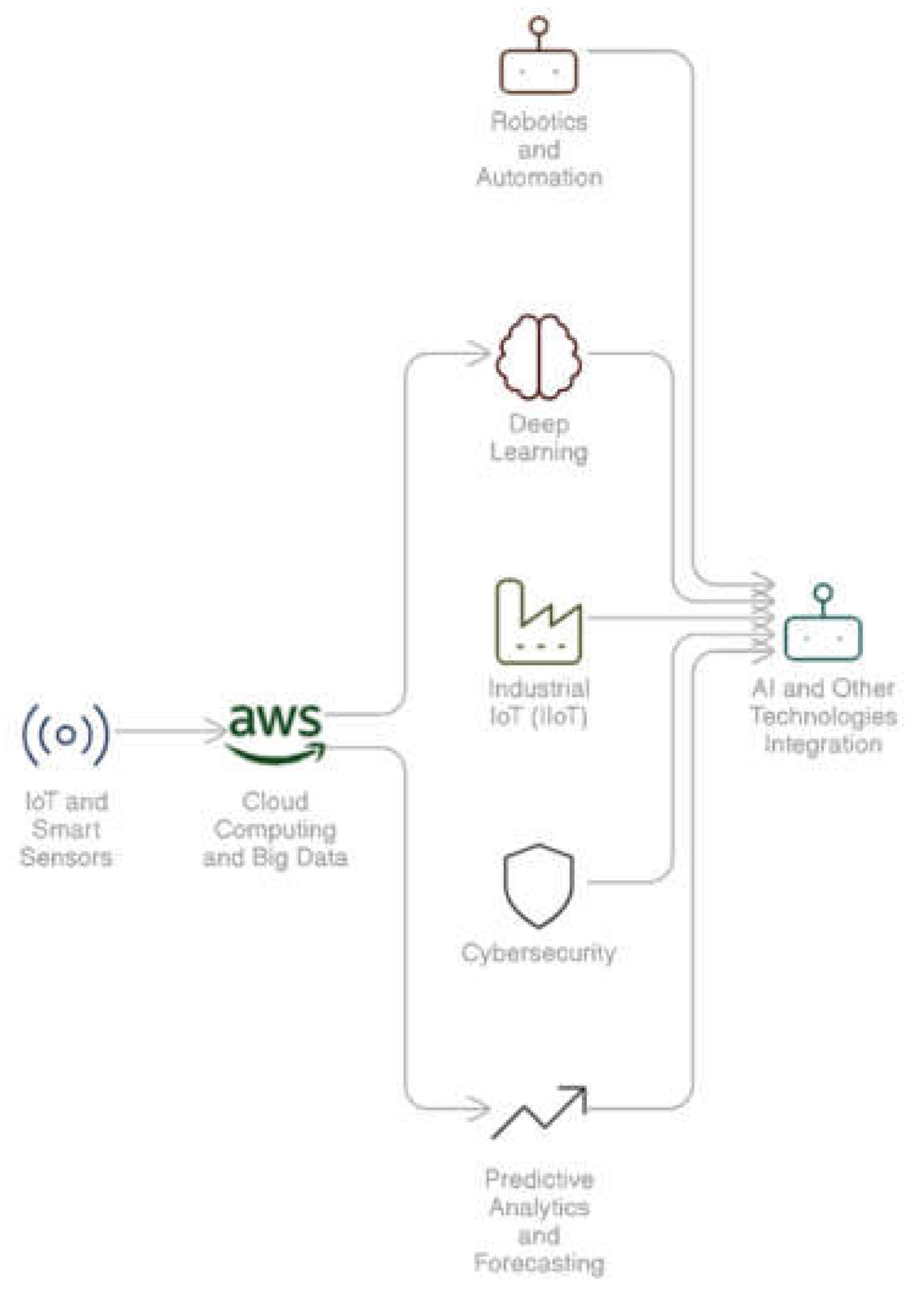
One of the key areas is the use of the Internet of Things (IoT) [41,42,43,44] and smart sensors to monitor various parameters of mining processes. Smart sensors can collect data on vibrations, temperature, pressure, gas content and other critical indicators. Integration of this data with AI and ML systems will allow you to quickly analyze the condition of equipment and infrastructure, predict possible breakdowns and take preventive measures (Figure 3).
Cloud technologies provide powerful resources for storing and processing large volumes of data that are collected using IoT devices and other sources [45,46,47]. Big data analysis using Machine Learning methods allows you to identify hidden patterns and trends, which helps optimize production processes, manage risks and reduce operating costs.
Augmented and virtual reality technologies can be used for personnel training, planning and modeling of mining operations [48,49,50,51]. With their help, you can create virtual simulations that allow you to train workers without risking their life and health, as well as plan complex operations taking into account all possible scenarios.
Robotization and automation of mining processes can significantly improve their efficiency and safety. Modern robotic systems are capable of performing complex tasks in conditions that are dangerous to humans. The introduction of autonomous robots and unmanned aerial vehicles (UAVs) [52,53,54] for exploration, drilling, transportation and other operations reduces the risk of human errors and increases productivity.
Deep learning methods show high efficiency in analyzing complex and heterogeneous data. The use of deep neural networks to analyze geological data, predict mineral content, and optimize mining and processing processes can significantly improve the results of mining operations.
The Industrial Internet of Things (IIoT) [55,56,57,58] combines all of the above technologies, creating a single ecosystem for managing production processes. IIoT allows the integration of data from various sensors and devices [59,60,61], providing centralized control and management of all aspects of mining operations.
As digital technology advances in the Mining Industry, the need for cybersecurity increases. Robust systems to protect data and infrastructure from cyberattacks are a key component for successful implementation of AI and ML. Developing and implementing advanced cybersecurity practices will protect critical data and ensure the smooth operation of all systems.
Using predictive analytics and Machine Learning-based forecasting techniques, you can predict potential problems and optimize production processes. This includes forecasting equipment wear and tear, inventory management, maintenance planning and other aspects that help reduce costs and improve efficiency.
Combining AI with other advanced technologies such as blockchain can provide additional transparency and security in supply chain and document management. Blockchain allows you to securely record and track all transactions and operations, which is especially important for logistics and inventory management in the Mining Industry.
Identifying and implementing these promising technologies and methods requires an integrated approach and close collaboration between research institutions, mining companies and technology developers. Investments in research and development, as well as education and training, will support the wider and more effective use of AI and ML in the Mining Industry. This, in turn, will lead to increased productivity, reduced costs, improved safety and sustainability of mining operations.
5. Problems of Artificial Intelligence Application in the Mining Industry and Future Research Directions
The application of Artificial Intelligence (AI) and Machine Learning (ML) in the Mining Industry has the potential to revolutionize operations by improving efficiency, safety, and productivity. However, the integration of these advanced technologies is not without its challenges. This section outlines the primary problems associated with AI and ML application in the Mining Industry and suggests future research directions to address these issues.
5.1. Problems of AI Application in the Mining Industry
One of the main challenges in applying AI and ML in the Mining Industry is the quality and availability of data. Mining operations generate vast amounts of data, but often this data is unstructured, incomplete, or noisy. Inconsistent data collection methods and the lack of standardized data formats can further complicate the analysis. High-quality, clean, and well-labeled data is essential for training accurate and reliable AI models.
Mining operations often rely on legacy systems that were not designed to be compatible with modern AI technologies. Integrating AI solutions with these existing systems can be complex and costly. There is a need for seamless integration methods that allow AI to work alongside traditional mining equipment and software without extensive modifications.
Implementing AI in mining requires specialized skills that are often lacking in the industry. There is a significant gap in the workforce's knowledge and expertise in AI and ML, which can hinder the adoption of these technologies. Training existing personnel and attracting new talent with the necessary skills is crucial for successful AI implementation.
The deployment of AI technologies involves a substantial initial investment in terms of both capital and resources. This includes costs associated with purchasing advanced hardware, developing custom AI solutions, and ongoing maintenance and support. For many mining companies, especially smaller ones, these costs can be prohibitive.
Mining operations are often targeted by cyber-attacks due to the valuable data and resources they handle. Implementing AI systems can introduce new security vulnerabilities, making it imperative to ensure robust cybersecurity measures. Additionally, the collection and analysis of data raise privacy concerns that need to be addressed to protect sensitive information.
The use of AI in mining raises regulatory and ethical questions. Compliance with local and international regulations governing data usage, environmental impact, and worker safety must be ensured. Furthermore, ethical considerations regarding the impact of AI on employment and the environment need to be carefully managed.
5.2. Future Research Directions
Future research should focus on developing advanced data processing techniques to handle unstructured and noisy data. This includes the creation of algorithms for data cleaning, normalization, and integration from multiple sources. Improved data processing will enhance the quality and reliability of AI models.
Establishing interoperability standards for AI systems in mining is essential for seamless integration with legacy systems. Research should aim to develop frameworks and protocols that facilitate the interoperability of AI technologies with existing mining infrastructure.
Research initiatives should explore effective methods for training and upskilling the mining workforce in AI and ML. This includes developing specialized training programs, online courses, and industry partnerships to bridge the skill gap and foster a culture of continuous learning.
Future research should focus on creating cost-effective AI solutions that can be adopted by mining companies of all sizes. This involves the development of scalable and modular AI systems that require lower upfront investment and offer flexible payment models such as AI-as-a-Service (AIaaS).
As AI systems become more integrated into mining operations, research should prioritize the development of advanced cybersecurity measures. This includes the creation of AI-driven security tools to detect and mitigate cyber threats in real-time, ensuring the protection of critical data and infrastructure.
Research should also address the ethical and regulatory challenges associated with AI in mining. This includes developing comprehensive guidelines and frameworks that ensure compliance with legal requirements and promote ethical AI usage, balancing technological advancement with societal impact.
Another promising area is reinforcement learning. For example, in [62], RL algorithms are used to optimize the operation of unmanned speed control of mining electric locomotives based on creep control on various vehicles, which allows increasing productivity and reducing energy costs.
The study [63] built a deep RL system for mineral prospectivity mapping using the example of gold prospectivity mapping in northwestern Hubei Province, China.
The ability of reinforcement learning models to adapt to different conditions during the learning process allows one to achieve better results in solving various problems and implement complex intelligent systems.
6. Discussion
In response to Objective Q1, the review highlights how Artificial Intelligence (AI) and Machine Learning (ML) can be effective tools for improving productivity and safety in the Mining Industry. Various studies have shown positive results when using AI and ML in areas such as predictive analytics, inventory monitoring and management, and machine automation. However, it is also important to recognize the limitations and challenges associated with the implementation of AI and ML in the Mining Industry.
For the second research question Q2, the article provides a comprehensive overview of the application of AI and ML in the Mining Industry. It discusses the use of these technologies to improve productivity, reduce operating costs, improve occupational safety, environmental sustainability, machine automation, quality monitoring and control, inventory management and logistics. The article highlights the potential benefits of implementing AI and ML in these areas, including increased efficiency, reduced costs and improved safety in mining operations.
Regarding the third research question Q3, the article illustrates the challenges and future directions of AI in the Mining Industry. In particular, this is the development of more advanced AI algorithms that can cope with complex operating scenarios in multi-agent systems. Additionally, the article highlights the need for further research to fully understand the potential benefits and limitations of AI and ML in the Mining Industry, establish best practices for their implementation, and explore promising opportunities for combining data and psychological approaches in managing and optimizing mining processes using AI.
7. Conclusions
While the application of Artificial Intelligence (AI) and Machine Learning (ML) in the Mining Industry offers numerous benefits, a number of challenges must be overcome to realize their full potential. One of the main problems is the quality and quantity of data. Effective training of AI and ML models requires large amounts of high-quality data, which is not always available in the Mining Industry. Additionally, data may be disparate and inconsistent, making integration and analysis difficult. In the future, it will be important to develop methods for collecting, cleaning and unifying data to ensure its reliability and completeness.
Another significant issue is the complexity of mining operations. AI and ML models must take into account many factors, such as geological conditions, equipment technical parameters and external influences such as weather conditions. This requires the development of more complex and adaptive algorithms that can cope with such complex and variable conditions.
Security and reliability are also key aspects to consider when introducing AI and ML into the Mining Industry. Any errors or failures in the operation of AI systems can lead to serious consequences, including accidents and losses. Therefore, the development of reliable and robust systems that can operate under conditions of uncertainty and provide a high degree of safety is required.
Ethical and legal issues also play an important role in the application of AI and ML in the Mining Industry. It is important to ensure compliance with all regulatory requirements and standards, and to consider the possible social and environmental impacts of using these technologies. This requires close collaboration between mining companies, regulators and society to develop ethical and legal frameworks for the use of AI and ML.
In addition, there is a need for training. The implementation of AI and ML requires the availability of qualified specialists who can develop, implement and maintain these systems. This requires investment in education and training, as well as the creation of vocational training programs.
By focusing on the identified challenges and following suggested future research directions, the Mining Industry can overcome these barriers and achieve sustainable and efficient operations. Further collaboration between researchers, engineers and AI specialists, as well as the sharing of knowledge and experience between different industries, can contribute to more effective application of AI and ML in the Mining Industry. It is also important to develop international cooperation to exchange best practices and innovative solutions to accelerate the adoption of these technologies and increase their effectiveness.
In conclusion, the future of AI and ML in the Mining Industry depends on overcoming current challenges and actively seeking new solutions. Research and development aimed at improving data quality, developing complex algorithms, ensuring security and reliability, compliance with ethical and legal standards, and training are key areas for the continued development and successful application of AI and ML in this industry.
Author Contributions
Conceptualization, N.M. and M.N.; methodology, A.K.; resources, A.T.; writing—original draft preparation, N.T.; writing—review and editing, A.K. and A.T.; supervision, N.T.; funding acquisition A.T. and A.K. All authors have read and agreed to the published version of the manuscript.
Funding
This research was carried out within the framework of grant funding for scientific and scientific-technical projects of the Republic of Kazakhstan for 2023-2025 No. AP19680292 «Development of the expert system for making decision of fixing and maintaining mine workings».
Data Availability Statement
We did not conduct data analysis or generate datasets as our focus remained theoretical. Relevant materials can be sourced from the references provided below.
Conflicts of Interest
The authors declare no conflicts of interest.
References
- E. Alpaydın, "Introduction to Machine Learning," Boston, Massachusetts, The MIT Press, 2020, p. 77.
- Brunette, E.S., Flemmer, R.C. and Flemmer, C.L. (2009) A Review of Artificial Intelligence. 2009 4th International Conference on Autonomous Robots and Agents, Wellington, 10-12 February 2009, 385-392. [CrossRef]
- Hossain, Rasel. A Short Review of Artificial Intelligence. Journal of Machine Learning and Soft Computing, 2022, 7, 8, pp. 48-55.
- Azimi Y, Khoshrou SH, Osanloo M, Prediction of blast induced ground vibration (BIGV) of quarry mining using hybrid genetic algorithm optimized artificial neural network. Measurement 147:106874, 2019. [CrossRef]
- Khandelwal M, Singh TN Prediction of blast-induced ground vibration using artificial neural network. Int J Rock Mech Min Sci 46(7), 2009, pp. 1214–1222. [CrossRef]
- Sayadi A, Monjezi M, Talebi N, Khandelwal M. A comparative study on the application of various artificial neural networks to simultaneous prediction of rock fragmentation and backbreak. J. Rock Mech. Geotech. Eng. 5(4), 2013, pp. 318–324. [CrossRef]
- Singh TN, Singh V. An intelligent approach to prediction and control ground vibration in mines. Geotech. Geol. Eng. 23(3), 2005, pp. 249–262. [CrossRef]
- Garcia-Flores, Rodolfo & Singh, Gaurav & Ernst, Andreas & Welgama, Palitha. Medium-term rail planning at Rio Tinto Iron Ore, Proceedings of the 19th International Congress on Modelling and Simulation (MODSIM 2011), 2011, pp.311-317.
- Jahanmiri, shirin & Noorian-Bidgoli, Majid. Land Subsidence Prediction in Coal Mining Using Machine Learning Models and Optimization Techniques, 2023. [CrossRef]
- Dayo-Olupona, Tobi & Genc, Bekir & Celik, Turgay & Bada, Samson. Adoptable approaches to predictive maintenance in Mining Industry: An overview. Resources Policy. 86. 104291. 2023. [CrossRef]
- Singh AK, Singh R, Maiti J, Kumar R, Mandal PK, Assessment of mining induced stress development over coal pillars during depillaring. Int J Rock Mech Min Sci 48(5), 2011, pp. 805–818.
- Sikora, Marek & Sikora, Beata. Application of Machine Learning for prediction a methane concentration in a coal-mine. Archives of Mining Sciences. 51, 2006, pp. 475-492.
- P, Harshitha. Coal Mine Disaster Prediction. International Journal of Engineering Research and. V9, 2020. [CrossRef]
- Jain, Gaurav & Pathak, Pranjal & Bhatawdekar, Ramesh & KAINTHOLA, Ashutosh & Srivastav, Abhishek. Evaluation of Machine Learning Models for Ore Grade Estimation. 2022. [CrossRef]
- Jafrasteh, B., Fathianpour, N. & Suárez, A. Comparison of Machine Learning methods for copper ore grade estimation. Comput Geosci 22, 2018, pp. 1371–1388.
- Akbari, A.D.; Osanloo, M.; Shirazi, M.A. Reserve estimation of an open pit mine under price uncertainty by real option approach. Min. Sci. Technol. 19, 2009, pp. 709–717.
- Kaplan U.E., Dagasan Y., Topal E., Mineral grade estimation using gradient boosting, International Journal of Mining, Reclamation and Environment 35(15), 2021, pp. 1-15.
- Jafrasteh, Bahram & Fathianpour, Nader & Suárez, A., Advanced Machine Learning Methods for Copper Ore Grade Estimation. 2016. [CrossRef]
- Zhang Y, Song S, You K, Zhang X, Wu C, Relevance vector machines using weighted expected squared distance for ore grade estimation with incomplete data. Int J Mach Learn Cybernet 8. 2017. [CrossRef]
- Mahboob, Muhammad & Celik, Turgay & Genc, Bekir. Review of Machine Learning-based Mineral Resource estimation. Journal of the Southern African Institute of Mining and Metallurgy. 122. 655. 2022. [CrossRef]
- Jiang, Peng & Craig, Peter & Crosky, Alan & Maghrebi, Mojtaba & Canbulat, Ismet & Saydam, Serkan. Risk assessment of failure of rock bolts in underground coal mines using support vector machines. Applied Stochastic Models in Business and Industry. 34. 2017. [CrossRef]
- Ibrahim, B.; Ahenkorah, I.; Ewusi, A. Explainable Risk Assessment of Rockbolts’ Failure in Underground Coal Mines Based on Categorical Gradient Boosting and SHapley Additive exPlanations (SHAP). Sustainability 14, 11843. 2022. [CrossRef]
- Alamri, Aeshah. Application of Machine Learning to stress corrosion cracking risk assessment. Egyptian Journal of Petroleum. 31, 2022, pp. 11-21. [CrossRef]
- Li, Hongxia & Zhang, Yiru & Yang, Wanli. Gas explosion early warning method in coal mines by intelligent mining system and multivariate data analysis. PLOS ONE. 18. e0293814. 2023. [CrossRef]
- Kopeć, Anna & Trybała, Paweł & Głąbicki, Dariusz & Buczyńska, Anna & Owczarz, Karolina & Bugajska-Jędraszek, Natalia & Kozińska, Patrycja & Hajnrych, Monika & Gattner, Agata. Application of Remote Sensing, GIS and Machine Learning with Geographically Weighted Regression in Assessing the Impact of Hard Coal Mining on the Natural Environment. Sustainability. 12. 2020. [CrossRef]
- Anani, Angelina & Adewuyi, Sefiu & Risso, Nathalie & Nyaaba, Wedam. Advancements in Machine Learning techniques for coal and gas outburst prediction in underground mines. International Journal of Coal Geology. 285. 104471. 2024. [CrossRef]
- ZHANG Fujing, WANG Hongwei, WANG Haoran, et al. Intelligent identification and positioning of steel belt anchor hole in coal mine roadway support[J]. Journal of Mine Automation,48(10), 76-81. 2022. [CrossRef]
- Gholamnejad, Javad & Tayarani, Narges. Application of artificial neural networks to the prediction of tunnel boring machine penetration rate. Mining Science and Technology (china). 20, 2010, pp. 727-733. [CrossRef]
- Vinay, L.S., Bhattacharjee, R.M., Ghosh, N. et al. Machine Learning approach for the prediction of mining-induced stress in underground mines to mitigate ground control disasters and accidents. Geomech. Geophys. Geo-energ. Geo-resour. 9, 159, 2023, . [CrossRef]
- Azimi, Yousef, et al. Prediction of Blast Induced Ground Vibration (BIGV) of Quarry Mining Using Hybrid Genetic Algorithm Optimized Artificial Neural Network. Dec. 2019, . [CrossRef]
- Khandelwal, Manoj & Singh, T.N. Prediction of blast-induced ground vibration using artificial neural network. International Journal of Rock Mechanics and Mining Sciences. 46, 2009, pp. 1214-1222. [CrossRef]
- Vinay, L.S., Bhattacharjee, R.M., Ghosh, N. et al. Machine Learning approach for the prediction of mining-induced stress in underground mines to mitigate ground control disasters and accidents. Geomech. Geophys. Geo-energ. Geo-resour. 9, 159, 2023, . [CrossRef]
- Garai, Dayamoy & Agrawal, Hemant & Mishra, Arvind & Kumar, Shankar. Influence of initiation system on blast-induced ground vibration using random forest algorithm, artificial neural network, and scaled distance analysis. 2018, pp. 418-426. [CrossRef]
- Madhuanand, Logambal & Sadavarte, Pankaj & Visschedijk, A.J.H. & Denier van der Gon, Hugo & Aben, I. & Osei, Frank. Deep convolutional neural networks for surface coal mines determination from sentinel-2 images. European Journal of Remote Sensing. 54, 2021, pp. 296-309. [CrossRef]
- Bai, Guangxing & Xu, Tianlong. Coal Mine Safety Evaluation Based on Machine Learning: A BP Neural Network Model. Computational Intelligence and Neuroscience, 2022, pp. 1-9. [CrossRef]
- Suljic, Mirza & Banjanovic-Mehmedovic, Lejla & Dzananovic, Izet. Determination of Coal Quality using Artificial Intelligence Algorithms. Journal of scientific and industrial research. 72, 2013, pp. 379-386.
- Semin M, Kormshchikov D. Application of Artificial Intelligence in mine ventilation: a brief review. Front Artif Intell. May 2;7:1402555. 2024. [CrossRef] [PubMed] [PubMed Central]
- Kumari, UMAP and LSTM based fire status and explosibility prediction for sealed-off area in underground coal mine, Process Saf. Environ., №146, 2024, p. 837.
- Dey, Prasanjit & Saurabh, K & Kumar, C & Pandit, Dewangshu & Chaulya, S. & Ray, Santosh & Prasad, G.M. & Mandal, S.K. t-SNE and Variational Auto-Encoder with a bi-LSTM Neural Network-Based Model for Prediction of Gas Concentration in a Sealed-Off Area of Underground Coal Mines. , 2021.
- Yu R, Yang X and Cheng K, Deep learning and IoT enabled digital twin framework for monitoring open-pit coal mines. Front. Energy Res. 11:1265111, 2023. [CrossRef]
- Gackowiec, Paulina & Podobińska-Staniec, Marta. IoT platforms for the Mining Industry: An Overview. Inżynieria Mineralna. 1. 2021. [CrossRef]
- Salam, Abdul. Internet of Things for Sustainable Mining. 2020. [CrossRef]
- Anastasova, Yordanka & Yanev, Nikolay. POSSIBLE APPLICATION OF INTERNET OF THINGS IN THE MINING INDUSTRY, BalkanMine Conference, 2015, pp. 2-3.
- Telukdarie, Arnesh & Sishi, Mike. Implementation of Industry 4.0 technologies in the Mining Industry - a case study. International Journal of Mining and Mineral Engineering. 11. 1. 2020. [CrossRef]
- Chaulya, S. & Prasad, G.M. Application of Cloud Computing Technology in Mining Industry. 2016. [CrossRef]
- Baftiu, Naim & Sofiu, Vehebi & Maloku, Betim. Cloud Computing System Application in the Mining Industry. 2022. [CrossRef]
- Wang, Kun. Practice of Cloud Computing in Coal Mine Safety Production. IOP Conference Series: Materials Science and Engineering. 750. 012160. 2020. [CrossRef]
- Vavenkov, М. VR/AR technologies and staff training for Mining Industry. Mining Science and Technology. 7, 2022, pp. 180-187. [CrossRef]
- Jacobs, Jónatan & Webber-Youngman, R.C.W. & van Wyk, Etienne. Potential Augmented Reality Applications in the Mining Industry. 2016. [CrossRef]
- Daling L. M., Khodaei S., Thurner S., et al. A decision matrix for implementing AR, 360° and VR experiences into mining engineering education. In: Stephanidis C., Antona M., Ntoa S. (eds.) Communications in Computer and Information Science. Communications in Computer and Information Science. Springer Science and Business Media Deutschland GmbH. 1420, 2021, pp. 225–232.
- Abdelrazeq A., Daling L., Suppes R., et al. A virtual reality educational tool in the context of mining engineering – the virtual reality mine. In: 13th International Technology, Education and Development Conference. Valencia, Spain. 11–13 March, 2019, pp. 8067–8073.
- Dang Tuyet, Minh & Nguyen Ba, Dung. Applications of UAVs in mine industry: A scoping review. Journal of Sustainable Mining. 22, 2023, pp. 128-145. [CrossRef]
- Rathore, N. Unlocking the potentiality of UAVs in Mining Industry and its Implications. International Journal of Innovative Research in Science, Engineering and Technology. 04, 2015, 852-855. [CrossRef]
- Kaushal, Hitanshu & Bhatnagar, Anupam. APPLICATION OF DRONES IN MINING INDUSTRY -RULES, GUIDELINES AND CASE STUDY. 9, 2022, p. 459.
- Munirathinam, Sathyan. Industry 4.0: Industrial Internet of Things (IIOT). 2020. [CrossRef]
- Zvarivadza, Tawanda & Onifade, Moshood & Dayo-Olupona, Tobi & Said, Khadija & Githiria, J. & Genc, Bekir & Celik, Turgay. On the impact of Industrial Internet of Things (IIoT) - mining sector perspectives. International Journal of Mining, Reclamation and Environment, 2024, pp. 1-39. [CrossRef]
- A. Aziz, O. Schelén, and U. Bodin, A study on industrial IoT for the Mining Industry: Synthesized architecture and open research directions, IoT 1 (2), 2020, pp. 529–550.
- Deshpande, Sujit & Jogdand, Rashmi. A Survey on Internet of Things (IoT), Industrial IoT (IIoT) and Industry 4.0. International Journal of Computer Applications. 175, 2020, pp. 20-27. [CrossRef]
- Moura, Ralf & De Landa Farias Ceotto, Luciana & Gonzalez, Alexandre. Industrial IoT and Advanced Analytics Framework: An Approach for the Mining Industry. 2018. [CrossRef]
- Cooper J., James A. Challenges for database management in the internet of things. (2009). IETE Tech. Rev. 26, 2009, pp. 320–329.
- Morales-Rodriguez, M., Rooke, S., Fuhr, P., Chen, P. Convergence and Commercial Momentum Drive the Industrial Internet of Things (IIoT) Evolution. ISA Tech Cyber-IIoT, 2017, pp. 1-12.
- Li, Ying & Zhu, Zhencai & Li, Xiaoqiang. Reinforcement Learning Based Speed Control with Creep Rate Constraints for Autonomous Driving of Mining Electric Locomotives. Applied Sciences. 14, 2024. [CrossRef]
- Zixian, Shi & Zuo, Renguang & Zhou, Bao. Deep Reinforcement Learning for Mineral Prospectivity Mapping. Mathematical Geosciences, 55, 2023, pp. 773-797. [CrossRef]
Figure 1.
Advantages and opportunities of using AI and ML in the Mining Industry.
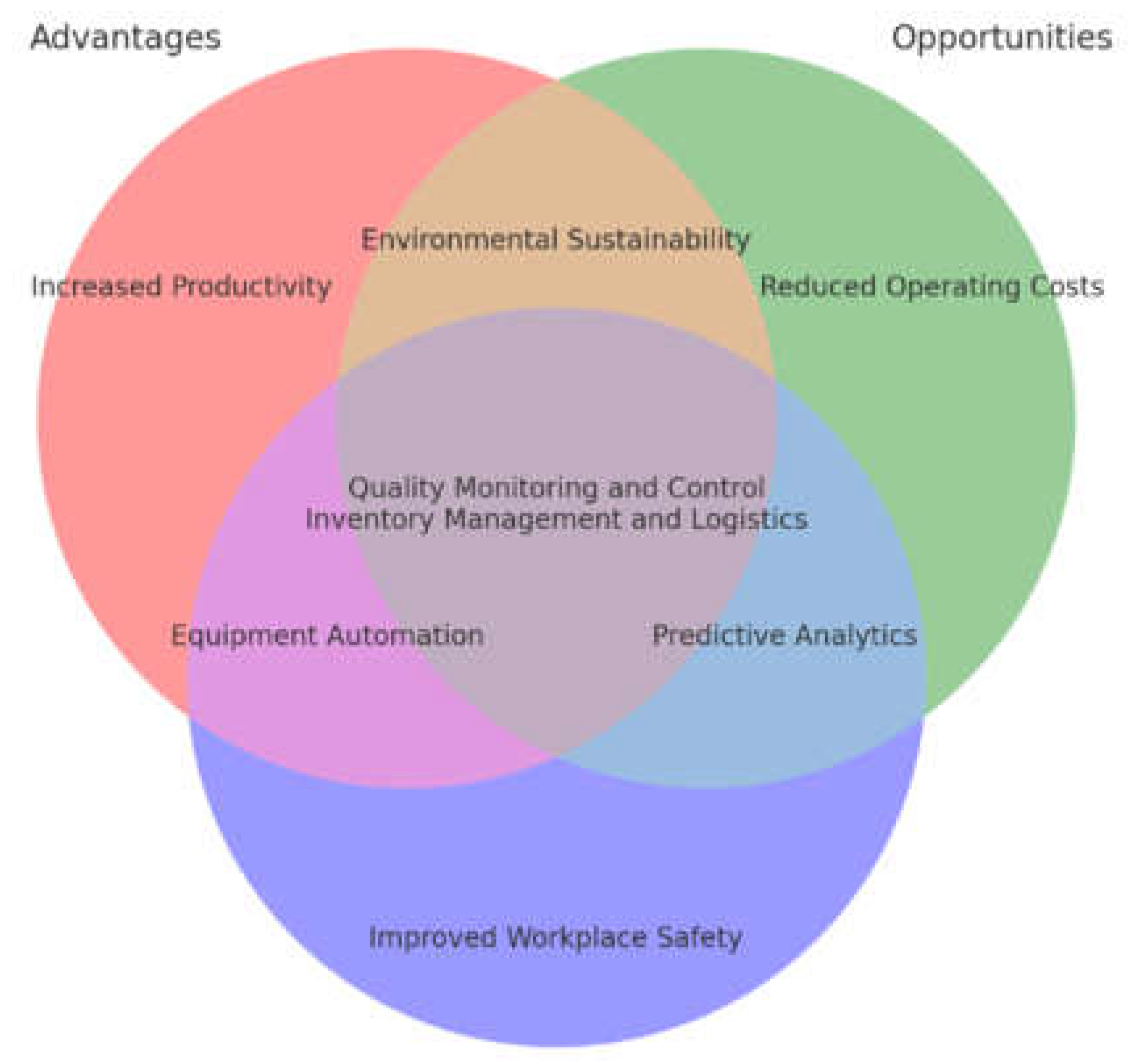
Figure 2.
Directions of Artificial Intelligence in mining.
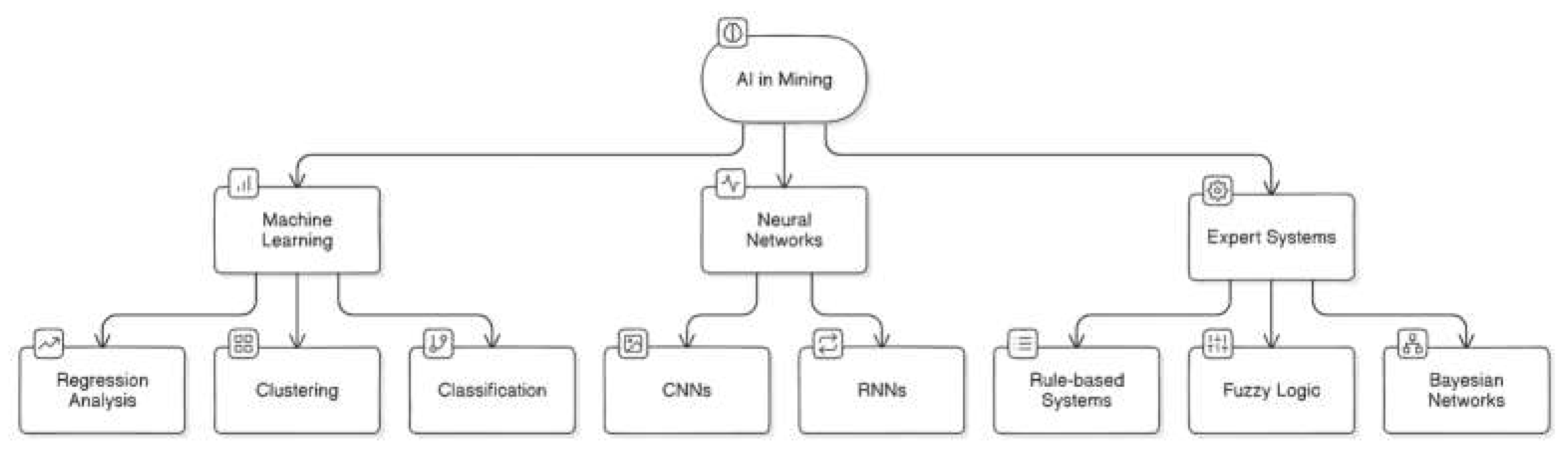
Figure 3.
Promising technologies and methods for the further development and implementation of AI and ML in the Mining Industry.
Figure 3.
Promising technologies and methods for the further development and implementation of AI and ML in the Mining Industry.
Disclaimer/Publisher’s Note: The statements, opinions and data contained in all publications are solely those of the individual author(s) and contributor(s) and not of MDPI and/or the editor(s). MDPI and/or the editor(s) disclaim responsibility for any injury to people or property resulting from any ideas, methods, instructions or products referred to in the content. |
© 2024 by the authors. Licensee MDPI, Basel, Switzerland. This article is an open access article distributed under the terms and conditions of the Creative Commons Attribution (CC BY) license (http://creativecommons.org/licenses/by/4.0/).
Copyright: This open access article is published under a Creative Commons CC BY 4.0 license, which permit the free download, distribution, and reuse, provided that the author and preprint are cited in any reuse.


