

Submitted:
23 April 2025
Posted:
24 April 2025
You are already at the latest version
Abstract
Climate scientists, systems theorists and policymakers increasingly suggest that global sustainability challenges stem from dysfunctional worldviews and values that drive individual and collective behaviors, undermining both human flourishing and planetary health. Recognizing that paradigmatic shifts in values and worldviews can arise from transformative experiences, this study employed Integral Inquiry in a mixed methods design to examine the relationship between such experiences and engagement with sustainability. A sample of 145 adults was recruited based on self-identification of having undergone a life-changing experience and demonstrated evidence of transformative growth and integration. Recruitment surveys gathered data on the practices participants used to integrate these experiences. In the qualitative phase, 73 participants completed an open-text survey detailing their perspectives on sustainability and their related practices and behaviors. Ten individuals from this subset were interviewed to explore the depth and dimensions of their engagement with sustainability. Using Constructivist Grounded Theory analysis, three key themes emerged: Intraconnection, Personal Equilibrium, and Defining Social Change. The central finding revealed that transformative experiences fostered a profound felt sense of intraconnection—a deep awareness of interconnectedness with all life. This awareness naturally clarified participants' values and beliefs, aligning their actions toward sustainability. Moreover, participants emphasized the importance of cultivating personal equilibrium—a state of inner balance and congruence in daily choices—as a foundation for meaningful social and environmental change. This study highlights the vital role transformative experiences play in bringing about more pro-ecological behavior, and it underscores the need for further research into how such experiences can be more readily integrated to support global sustainability efforts.
Keywords:
transformative experience
; sustainability
; social change
; inner-outer change
; interconnection
; universal values
1. Introduction
Escalating levels of human conflict, suffering and polarization have been attributed to a global polycrisis, a state which occurs when “multiple global systems become causally entangled in ways that significantly degrade humanity's prospects" [1] (p. 2). In response, climate scientists, systems theorists and policymakers increasingly suggest that global sustainability challenges stem from dysfunctional worldviews and values that drive individual and collective behaviors, undermining both human flourishing and planetary health [2]. Recognizing that paradigmatic shifts in values and worldviews can arise from transformative experiences, this study employs Integral Inquiry in a mixed methods design to examine the relationship between such experiences and engagement with sustainability.
Commonly recognized factors which degrade planetary health and human wellbeing include biosphere stressors, and social, political and economic conflicts [1,2,3,4]. Public awareness of these states of imbalance can be traced back more than 50 years to the publication of The Limits to Growth: A Report for the Club of Rome’s Project on the Predicament of Mankind which noted that the existing lack of effective solutions for systemic challenges was due to a failure to understand the nature and dynamics of interrelationships [5].
Providing a deeper perspective into the complexity of the global situation, McGilchrist [6] uses the term metacrisis to describe the underlying (interior psychological) structures which give rise to these interconnected crises. McGilchrist’s analysis of human cognition and motivation through the lens of hemisphere theory and the functioning of the bipartite (i.e. existing in two parts) human brain illuminates our current situation as the manifestation of a profoundly fragmented way of being. This insight points both to the depth and the nature of transformation that is needed, highlighting the central role the interior dimensions play in systems change.
Many voices support the emerging collective realization that the current materialist paradigm is unable to formulate the approaches needed to effectively address sustainability - understood as conditions which support flourishing for all life forms and the earth [7,8,9,10,11,12,13,14,15,16]. During an interview late in his life, Edgar Mitchell, the sixth man to walk on the moon and the founder of the Institute of Noetic Sciences (IONS), was asked a provocative question - why, if we have all this information, is it so difficult to move from awareness to implementation? Mitchell replied:
What makes it difficult is that the ego prefers to satisfy itself, rather than satisfy the greater good. That’s just the way we tend to be built, until we have a transformative experience… a change of mind, a change of heart that switches you from one way of looking at things to another. [17] (25:30)
Adopting Mitchell’s transpersonal perspective, this study explored transformative life experiences and the ways in which they change our perceptions and interactions with others and the larger world.
1.1. Definition of Concepts and Terms
Brief definitions are provided to clarify the use of common terms employed in this study, which can be understood or interpreted in a wide range of ways.
Factors
The word factor is being used to refer to something which influences the dynamics of an experience – contributing either a catalyzing or inhibiting effect – and identifies the variables of beliefs, behaviors, conditions, values, and previous experiences [18]. This study explored factors impacting both inner transformation and outer change as manifested by actions toward sustainability.
Sustainability
Within the lexicon of ecology, sustainable development is defined as meeting “the needs of the present without compromising the ability of future generations to meet their own needs” [19] (I.3.27). Combined with environmental (i.e. natural resources, biodiversity), and social wellbeing, these factors form a framework commonly known as the Three Pillars of Sustainability [20]. Clarifying that sustainability also encompasses human dimensions (i.e. inner and outer sustainability), researchers have acknowledged these environmental, social and economic challenges as “human relational crises that call for broader and deeper approaches” [21] (p. 19), [4,22,23,24]. Applying an interconnected, holistic and global perspective, the broad understanding of the concept of sustainability utilized for this study is factors which contribute to the flourishing of all life forms, including the Earth [9].
Social Change
At any moment in time an existing culture is a social construct representing the manifestation of the most prevalent beliefs and values, and may be understood as a complex natural system of its own, containing sub-cultures and existing alongside other systems [25,26,27]. Each member of a culture both contributes to and is influenced by this organic, perpetually shapeshifting system, in which one’s individual beliefs, behaviors and actions are modulated by social field affordances [28]; and in our global age most cultural fields are in profound ongoing interchange. However, within individualistically-oriented cultures we tend to perceive social change as a voluntary activity, employing the term activist to describe an individual who seeks to alter some aspect of the existing culture by engaging in activities pertaining to advancing social change. Topics that are widely identified with social change include climate change, social justice, civil rights, poverty reduction, animal rights, and improving healthcare services.
Transformation
Transformation is understood as a process of significant alteration in the fundamental qualities of a system [29,30]. Personal transformation is characterized by a profound change in the self which catalyzes shifts in values, beliefs, and behaviors [31]. This process has been referred to by Mezirow [32] as perspective transformation, and is more dynamically described by Schwartz [33] (p. 5) as a ‘radical reorganization’ of personal identity and life-purpose. Schlitz et al. [34] (p. 9) describe personal transformation as permanent changes toward the prosocial behaviors of being “more loving, kind, compassionate, altruistic, connected to others, and dedicated toward creating a more just, sustainable, and peaceful world for all”.
While change is not defined by movement in a positive direction, for the purposes of this study transformation will primarily be considered as a natural process of development toward a more holistic, prosocial, and interconnected state. And although personal transformation may be framed in terms of a religious conversion or a spiritual awakening, those aspects are not presumed within this study and the term is utilized here in a secular and neutral manner.
1.2 Literature Review: Inner and Outer Change
The phenomenon of inner transformation and outer change has been studied within the fields of psychology, anthropology, education, systems change, human development, religion, spirituality, sociology and interpersonal neurobiology [4,26,35,36,37,38]. Researchers have considered the role of community development workers, parents, political, religious, and corporate leaders, and teachers as agents of societal change.
Research into transformative learning, defined as the process of effecting change in an established frame of reference, has been conducted primarily through a rational, secular lens [10,32,39], and have not have considered transformation toward sustainability, nor the impacts of personal transformation on society as a whole [40]. Some researchers have considered the role of spirituality in the process of inner and outer change [12,41,42,43] and wisdom traditions readily identify a connection between personal growth, consciousness, and social action [44,45,46]. In his teachings on karma yoga, Walsh [47] provides a framework for inner development, personal practice and aligned engagement in service to the greater good.
Offering a model of the self which acknowledges connection beyond the confines of ego and physical form, the field of transpersonal psychology is well suited to the study of inner change. Many researchers [31,48,49,50,51] have explored personal transformation following non-ordinary experiences referred to as anomalous, mystical, transcendental and many other terms [52]. Durable changes in individual beliefs, values, and worldviews have been reported following near-death experiences [50,53,54], and across the full range of extraordinary experiences [55,56,57]. Personal transformation has also been studied within transpersonal psychology as awakening, defined as “a discrete shift in awareness, in which the consensual, apparently manifest reality of normal waking, adult sensory experience is perceived to derive from a singular unmanifest source in a seamless whole” [58 (p. 88),59]. While these experiences are considered to hold potential for both individual and collective transformation [51], research into whether there is any relationship between inner change and outer engagement with sustainability has not been extensively undertaken.
An interrelated field which considers both transpersonal aspects of experience and sustainability is ecopsychology, a term coined by cultural historian Theordore Roszak in the early 1990s [60]. A transdisciplinary hybrid of psychology and ecology, ecopsychology is based upon the principle that living in balance with nature is a foundational aspect of human emotional and spiritual well-being. Ecopsychology has focused upon establishing itself as a psychotherapeutic subset of western psychology, and disagreement exists within the discipline as to the inclusion of spiritual considerations [61]. Davis uses the term ambivalent to describe the relationship between transpersonal psychology and ecopsychology, and seeming to concur, Swan [62], one of the founders of the field of environmental psychology, notes that there is scant overlap in research which examines both transpersonal experiences and engagement with sustainability.
Considering research into the intersection of sustainability, system change, and climate action, Wamsler et al. [63] conducted a cross-disciplinary literature review spanning 2002 to 2020, seeking to understand how the relationship of internal and external change is currently understood and portrayed in the area of climate change. Echoing the Meadows et al. [5] assessment that effective solutions for systemic challenges must consider the nature and dynamics of interrelationships, Wamsler et al. [63] describe the climate and ecosystem of Earth and the human organism as entangled and interconnected complex natural systems. This relational perspective contrasts with the existing paradigm, in which complex issues such as sustainability and social change have been viewed as external phenomena requiring technical or policy interventions.
In systems theory, the personal factors which influence human behavior have been identified as internal dimensions – the collection of mental states which include individual values, beliefs, and worldviews [15,29,63]. This identification of the connection between internal dimensions and external work was modeled in the Three Spheres of Transformation structure developed by O’Brien and Sygna [29]. Conceptualized as three nested spheres or fields of change, identified as personal, political and practical as shown in Figure 1, the largest sphere represents the personal field of change. Here is where the deepest leverage point resides – within the internal dimensions identified as individual beliefs, values, worldviews, and paradigms.
The wedge piercing to the core of the nested spheres symbolizes the pathway to sustainable outcomes, and identifies the requirement that change or transformation at the personal level move into the second sphere of systems and structures in order to impact the practical core of collective behavior change.
Acknowledging the complexity and interconnection of factors involved in this gap between internal dimensions and external work, Wamsler et al. [63] expanded upon the nested spheres to develop a model for future research, policy and practice. Shown in Figure 2, it identifies both inner and outer factors which influence the process of external systems change, and represents facilitating factors as the initial element of the model. Empasis is placed upon supporting and catalyzing the progression of inner-outer change toward sustainability, while acknowledging that the central process within transformation focuses on inner dimensions [15].
The challenge identified by Wamsler et al. [63] is clearly delineated here:
Despite the extensive body of research on personal/adult development, the application of its findings to sustainability and climate change is in its early stages. This is hampering current progress. It is, therefore, essential to address current limitations, and bridge the gap between work that focuses on sustainability…and internal dimensions… This requires a comprehensive understanding of internal–external transformation toward sustainability, which is currently lacking. (p. 8)
Within this emerging field of inner-outer transformation research [42], a transdisciplinary approach is recommended, and here resides the currently underdeveloped praxis nexus of sustainability, personal transformation, outer change toward flourishing and transpersonal research. This research project attempted to address the gap by exploring the following research question:
Is there a relationship between a transformative life experience and engagement with activities focused upon sustainability?
The multifaceted processes of inner transformation and sustainability were explored through three sub-questions asking (a) what conditions support the integration of a personally transformative experience, (b) what conditions support active engagement toward sustainability, and (c) do these conditions relate, and if so - how?
2. Materials and Methods
2.1. Structure
The dynamics of both personal transformation and engagement with social change toward sustainability involve complex natural systems of human beliefs, values, motivations, and behaviors. Spanning the disciplines of systems change, environmental science, and the psycho-social disciplines which study human development and evolution, this inquiry was best served by a flexible and encompassing approach to research [64].
Integral Inquiry [18] acknowledges complexity and accommodates a pluralistic approach to both method and content. While functionally similar to mixed methods research as described by Tashakkori et al. [65], and sharing elements of the pragmatist worldview described by Creswell and Plano Clark [66], Integral Inquiry explicitly encompasses the transpersonal [67]. Identified as a transformative research approach [68,69], the structure of Integral Inquiry provides a broad framework to support the relational and transdisciplinary approach recommended by Ives et al. [42], O’Brien & Sygna [29] and Wamsler et al. [15,63].
Within the transpersonal scaffolding, holistic skills (e.g., intuitive, direct, and embodied ways of knowing) [68] are incorporated to enrich qualitative and quantitative approaches, as advocated by Mertens [69]. In addition to the flexible structure, this approach was selected because it acknowledges the researcher to be intrinsically embedded in and impacted by the study.
While utilizing a range of data sources and types, mixing methods also contributes to the development of a common language or lingua franca between fields of study, creating a bridge to support efforts towards greater transdisciplinary collaboration. The cultivation of cross-disciplinary and transdisciplinary connections specifically supports the interests of transpersonal psychology as the field seeks to facilitate change on a larger scale, and acknowledging the value of each approach can encourage movement beyond the dominant either/or culture of research – serving to enrich the range of methods for addressing important social problems [64,70,71].
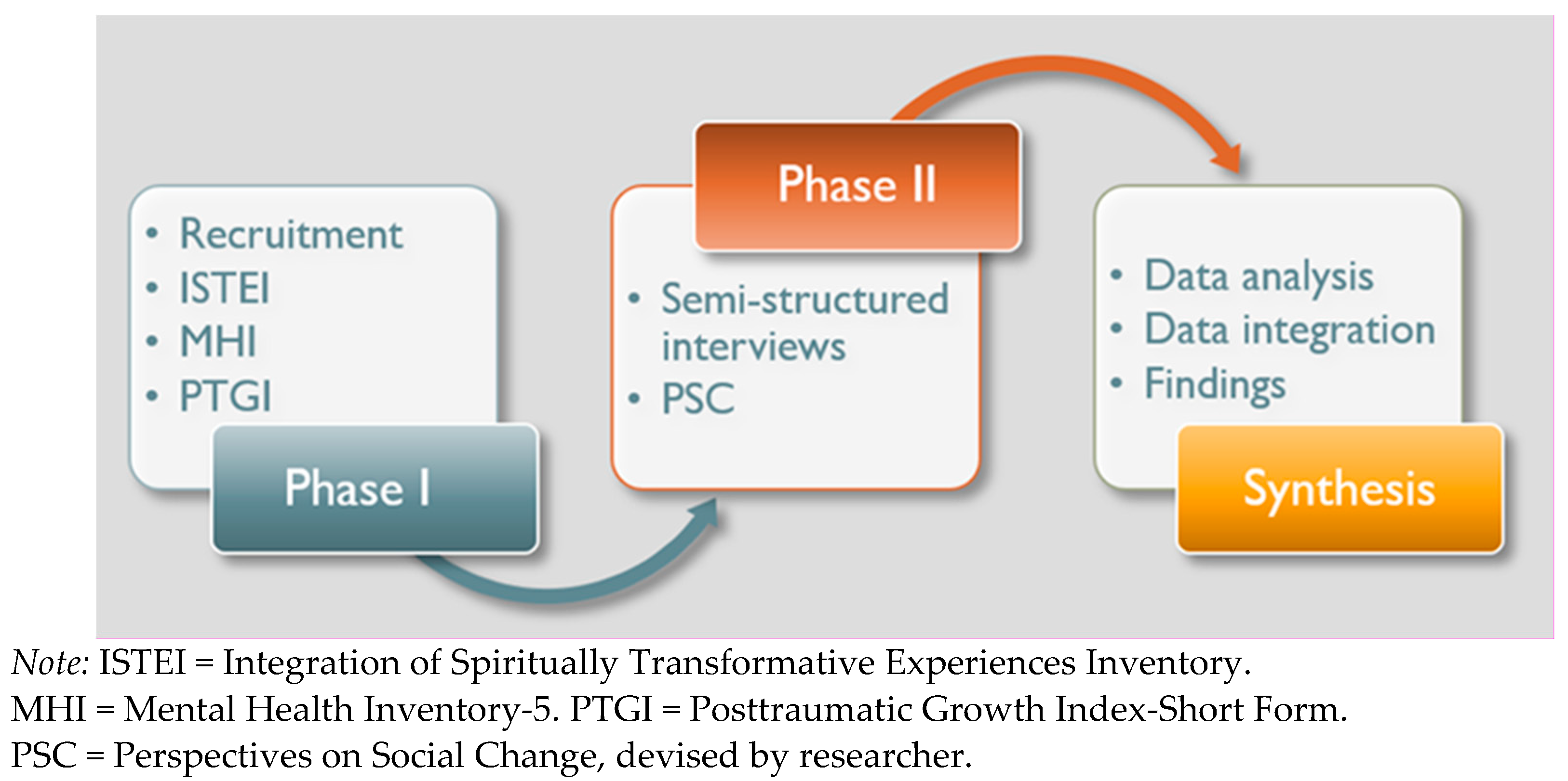
The study employed a two-phase explanatory sequential design as shown in Figure 3 [66]. Quantitative tools were employed to identify a suitable sample of participants with life-changing experiences, and to gather data on practices which supported the integration of their resulting inner transformation. In Phase II, engagement with action toward sustainability was explored by gathering qualitative data through a free-text survey and personal interviews.
2.2. Phase I: Quantitative
A Survey Design [72] was employed to gather a sample of English-speaking adults who self-identified as having integrated a transformative life-experience. Two standardized psychometric tools were utilized as screening criteria to provide objective measures of growth and integration. The ten-question Posttraumatic Growth Inventory – Short Form (PTGI-SF) [73] measures the degree of positive change following highly challenging life-experiences. Scoring utilizes a six-point Likert scale, and the minimum recommended score of >30 out of a possible 50 points was utilized to authenticate a transformative degree of change.
To identify sufficient integration (i.e. adequate levels of wellbeing and absence of pathological levels of anxiety or depression) the five-question Mental Health Inventory (MHI-5} [74] was employed. This simple tool is widely used as a global mental health index [75], and asks questions about mood during the past 30 days. Scoring utilizes a six-point Likert scale, and inclusion in the study required a score at or above the recommended cutoff of 65, a previously established measure of well-being with an absence of mood disorder [76,77].
To gather data on practices used during integration, permission was granted for the use of the Integration of Spiritually Transformative Experiences Inventory (ISTEI) [75]. The ISTEI is an America Psychological Association (APA) published survey instrument consisting of 84 questions, each identifying one practice, for example Question 18. I spent more time in nature, and Question 44. I found ways to express my inner experience through drawing or painting. Participants are asked to rate each practice on a five-point Likert scale where 0 = I didn’t try this practice and 5 = I wish I had the opportunity to have tried this. The interior range indicates how helpful the practice was in integrating personal change, where 1 = this practice was not at all and 4 = this practice was essential.
2.2.1. Participants, Ethics, Procedures, & Analysis
The first section of the online survey titled Integrating a Life-Changing Experience (ILCE) contained project information and participant criteria, and it addressed ethical concerns in relation to consent, confidentiality and safety, featuring relevant mental health resources. In accordance with the British Psychological Society’s (BPS) [78] ethical guidelines, project approval (Application #ATREP2301) was received from the Research Ethics Panel at Alef Trust, UK, a global higher education provider through which the study was conducted. Consent to participate was indicated by ticking the box “I agree to participate in this survey”. The body of the survey contained demographic questions, an open-text question about how long ago the life-changing experience occurred, and the three selected psychometric instruments.
Initial recruitment efforts employed criterion sampling [79] and were focused within Nurturing the Fields of Change (NFC), a global online community hosted by Alef Trust and supporting the efforts of change facilitators around the world. A gatekeeper agreement was executed [80] and the Call for Participants was posted online and distributed by email, as well as through the researchers’ personal and professional networks. Expanding recruitment efforts adopted a purposive sampling strategy [18], as the invitation to participate was extended to a variety of organizations involved in supporting those who experience transformative or life-changing events, as recommended by Jayawickreme et al. [81].
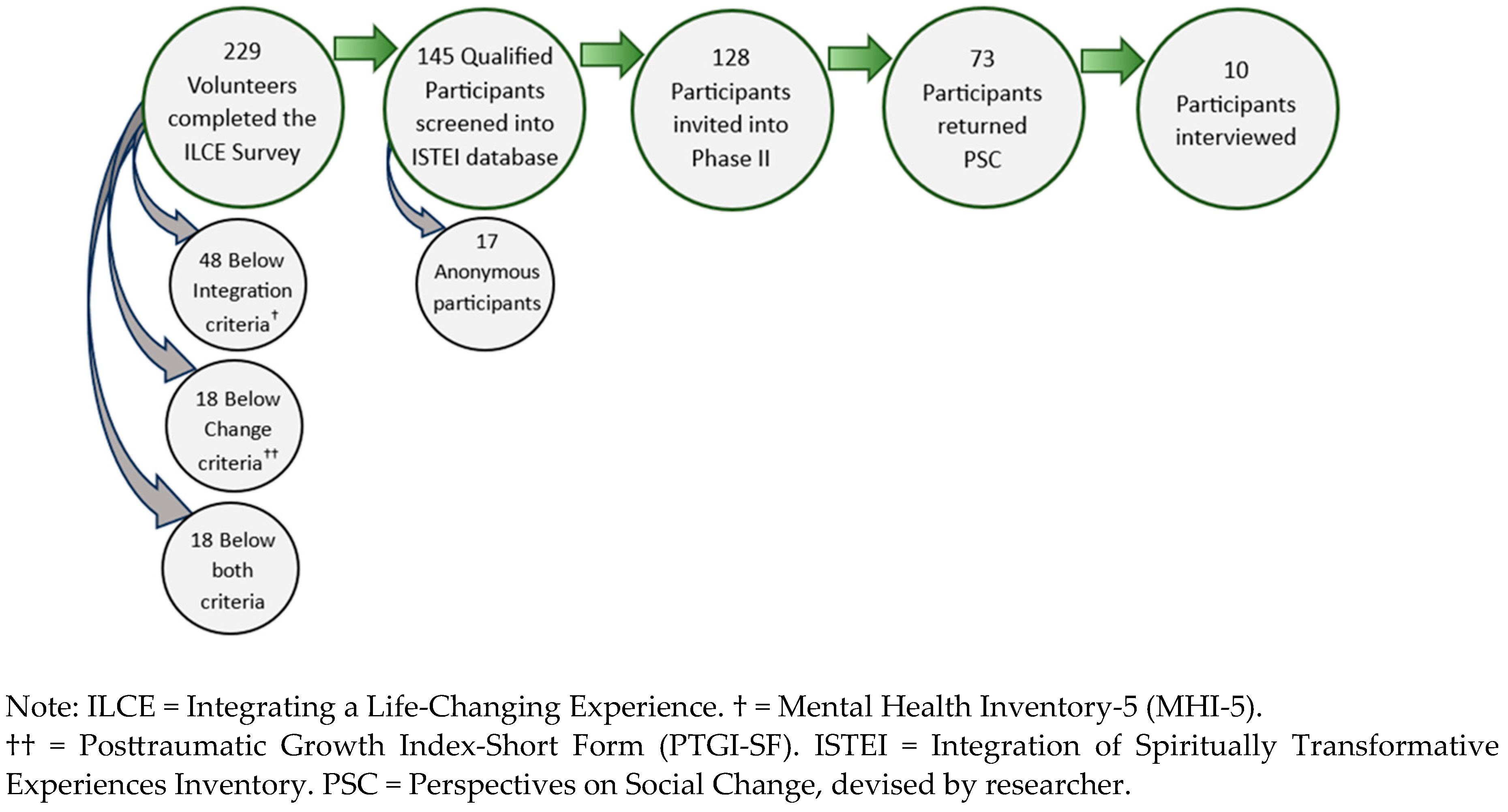
Survey responses were collected for 25 weeks from a total of 229 volunteers, and maintained in password-protected electronic storage to ensure confidentiality. An individual file was created for each response, holding manually calculated MHI-5 and PTGI-SF scores. Files for participants meeting cut-points for both MHI-5 and PTGI-ST scores were individually numbered, and the raw data for this final sample was collected in a “Screened In” file. 84 individuals (i.e., 37% of the initial volunteers) were screened out by the growth and integration criteria, and these raw data files were collected in a ‘screened out’ spreadsheet.
The final sample for Phase I contained 145 qualified participants; each having demonstrated a satisfactory degree of integration following an authenticated experience of personal transformation. Participants who provided contact information (n = 128) were invited into Phase II as illustrated in Figure 4. In addition to providing current age, participants were asked to identify how long ago their life-changing experience had occurred. During data cleaning and preparation, the interval between these two data points was calculated, generating the age at time of transformation, and Jamovi 2.2 software [82] was used to generate range, mean, and standard deviation of these time markers [83]. The selection of interview participants will be discussed in the Qualitative section below.
2.3. Phase II: Qualitative
Qualitative data was gathered through a brief online, researcher-created survey id - Perspectives on Social Change (PSC) – as well as through semi-structured interviews, and researcher memoing and reflection. The 128 participants invited into Phase II received an email message which included a link to the PSC. This qualitative tool was designed to shift participant focus from past transformational processes to current activities, and gather individual elicited documents [84] for consideration in identifying interview candidates. To ensure ongoing participant consent [85,86], the PSC was preceded by participant information materials outlining study details and ethical practices and consent was indicated by ticking the box “I am happy to continue my participation in this study”.
The PSC included seven questions. Question 2 asked “Are you currently interested in or involved with any area(s) of social change – i.e., activities geared toward greater flourishing for humanity and the earth?” For this question, participants were offered three choices, (a) No, neither interested nor engaged at this time (N/N), (b) Yes, interested but not engaged at this time (Y/N), and (c) Yes, interested and engaged at this time (Y/Y). Question #6 asked participants “In a few sentences, please reflect on factors which LIMIT your current level of engagement with social change activities,” and Question 7 asked about supportive factors. These questions encouraged reflection upon topics within the interview, while the text responses provided indications of personal awareness and ability to articulate insights.
The PSC was completed by 73 participants and responses were added to their individual portfolios. In a separate database, all anonymized PSC responses about current practices and limiting/ supportive factors were collected for review and consideration. Participant portfolios were sorted by category of self-identified engagement (i.e. N/N, Y/N, Y/Y) and objectives for the interview sample included gender balance, sociodemographic diversity, minimum of one year since transformative experience, current engagement with efforts toward sustainability, and the ability to clearly articulate experiences and insight.
Initial invitations to interview were extended to six participants from the Y/Y category via email, to which the Participant Information Sheet (PIS) and the Consent Form (CF) were attached. Ongoing analysis of PSC data hinted at unrepresented perspectives on social change within the Y/N and N/N groups, prompting the extension of four additional invitations for interviews, including two participants from the Y/N group, and one from the N/N group. Remote semi-structures interviews were conducted over a five-week span, guided with an Interview Protocol and recorded utilizing Zoom videoconferencing technology [79,87]. Each interview process concluded with reflective memoing and a follow-up email to the participant.
Recording files were placed into password-protected electronic storage to ensure ongoing confidentiality, and raw audio recordings were processed through Sonix.ai® transcription service to convert spoken word to rough-draft text. An anonymized and accurate transcript for each interview was created through word-by-word comparison of draft text with the full audio/video recording, an immersive process which ensured the accuracy of vocabulary and punctuation, and enhanced the document with notations to capture speech patterns, vocal inflection and non-verbal communication.
2.3.1. Analysis
An emergent design process was used for qualitative data analysis. The elicited documents generated by PSC responses primarily consisted of lists of practices and factors, with few full sentences. A thematic analysis approach [88] was applied to this fragmented material to consider three categories of the PSC data - (a) current personal practices, (b) factors which limited current engagement with social change activities, and (c) factors which supported active engagement with sustainability.
For the interview narratives, Constructivist Grounded Theory (CGT) [84,89] provided the greatest measure of philosophical and methodological congruence. Grounded theory (GT) encompasses a variety of methods that may be modified as necessary, complementing the Integral Inquiry frameworks. It is a useful approach for exploratory research and follows an inductive approach to theory development [90]. Constructivist grounded theory acknowledges subjectivity and the researcher’s presence in all aspect of data collection, analysis and interpretation [84].
Initial CGT analysis begins with line-by-line coding focused on the use of gerunds, verbs which are being used as nouns and are related to actions. Charmaz [84] identifies this practice as a heuristic device which brings the researcher into the data, supporting an emic or personal perspective and deepening the researcher’s role as an engaged participant. Focusing on actions and inactions, as well as the ways in which the individual uses words and silences, aids in identifying implicit meanings and actions.
Initial line-by-line coding was completed within the framework of Atlas.ti® software. The second stage of analysis (i.e. focused coding) involved refining and extracting the most significant codes for each interviewee into a central spreadsheet, and grouping those codes into categories. The five most frequently identified categories across all interviewees were collated into a spreadsheet for consideration.
The third approach to this qualitative data was the creation of a comprehensive narrative record for each participant, expanding on previous individual memoing. This re-constructing was an effort to assemble a coherent view of each individual process of transformation and level of current engagement with social change.
2.4. Integration
Theoretical coding was utilized to integrate the arc of participant experience with focused coding data, identifying areas of theoretical sufficiency [84]. Consideration of these foci in parallel with the PSC data on practices and supporting/limiting factors allowed nascent theory development, a fundamental objective of CGT [91]. A period of reflection was incorporated to allowed further insights to arise and inform the relationship between personal transformation and conditions which either limit or support ongoing engagement with movement toward sustainability.
Honoring the Integral Inquiry design of this study, validity has been considered through the characteristics of credibility, transferability, dependability, and confirmability [68,92]. Validity for quantitative elements was addressed through the use of standardized screening instruments, purposive sampling, receipt of permission to utilize the ISTEI, and initiation of a full audit trail. In qualitative efforts, credibility was strengthened by persistent observation utilizing multiple points of data gathering and interaction with participants, triangulation, and archiving of all data. Elicited documents created a background database of practice information and provided a mechanism for triangulating interviewee data. The detailing of methods and procedures, and the identification of researcher engagement and perspective toward reciprocation is offered to enhance the transferability of this study, and dependability and confirmability are reinforced by the full audit trail.
2.5. Figures, Tables and Schemes
3. Results
3.1. Quantitative
Phase I generated participant screening data and ISTEI survey data. For the purposes of this study the MHI-5 and PTGI-SF data were utilized solely to calculate individual criteria scores for screening purposes and have not been aggregated. Demographic data for the 145 participants who screened into the survey is displayed in Table 1, identifying a sample which is primarily Caucasian, well educated, skewing female, and drawn from modern western countries.
Descriptive age and time-related statistics (i.e., current age, time since experience, and age at time of experience) are shown in Table 2.
Of the 84 participants who screened out of the survey, 48 individuals (57%) demonstrated a transformative amount of change (i.e., PTGI-ST score satisfied inclusion criteria) but a measure of integration below the MHI-5 cut-point. Descriptive age and time related statistics for this sub-group are shown in Table 3.
A side-by-side comparison of median time-related age statistics for these two groups of participants is presented in Table 4. Jamovi 2.2 software [82] was used to perform an independent samples t-test utilizing Student’s t to analyze the differences between these two groups, and the nine-year difference in median age was demonstrated to be significant (p = 0.004). Utilizing the Mann-Whitney U test for the non-parametric time since experience element, the difference of slightly less than six years in integrative time was also found to be significant (p = 0.021).
The ISTEI database collected from the total sample of 145 qualified has been fully bracketed and archived for future analysis.
3.2. Qualitative
In Phase II, the qualitative Perspectives on Social Change (PSC) survey gathered data from 73 participants on (a) current personal practices and (b) factors which impact engagement with social change activities. Two cycles of thematic analysis [88] were applied to each of these collections to organize the data into categories. Table 5 displays the top nine categories of current personal practices, illustrating each with a small sample of the variety of activities, values and behaviors included within each category.
PSC participants made 173 mentions of items which limited their engagement with social change activities. Table 6 presents individual factors which illustrate the six categories encompassing the majority of these items.
Many of the limiting factors are self-explanatory, however the category of Group Dynamics is a bit more complex. Here participants identified a variety of structural and behavioral factors that had been encountered in groups focused upon social change, and that they did not wish to engage with. Avoidance of these factors had constricted their options to engage with a variety of groups focused upon sustainability.
Factors identified as supportive of engagement with social change encompassed 125 individual codes which were organized into the five categories listed in Table 7. Each of these categories contain an increasingly complex mix of factors, for example the category of Personal Equilibrium is composed of seven sub-categories, each holding a variety of individual practices.
Each of the ten invitations to interview was accepted, and interview times ranged from 40 – 90 minutes. A brief portrait of these participants is included in Table 8. One participant who did not directly respond to questions pertaining to sustainability was bracketed out, leaving a total of nine interviewees.
Three areas of theoretical sufficiency or primary theoretical codes [84] were developed through CGT analysis of the data gathered during participant interviews – Defining Social Change, Intraconnection, and the concept of Personal Equilibrium.
3.2.1. Defining Social Change
While the word sustainability has been defined within this study as conditions which support the flourishing of all life forms including the Earth, the term social change is utilized as “social change toward sustainability” or “social change activities focused upon sustainability” without further clarification. The first question of the interview protocol asked participants to speak about their interest and engagement with social change that contributes to the flourishing of all life forms on earth (i.e. sustainability).
Five interviewees (56%) identified engagement with social change prior to their transformative experience. Two were professionally employed in recognized sustainability areas (a) regenerative agriculture, and (b) the reduction of resource consumption and waste in clinical laboratory services, while another three held careers in mental health policy, corporate ethics, and social / community work – areas that are not commonly identified as pertaining to sustainability. Remaining participants were either employed in a position which did not consider the subject of sustainability, or were not working at that time.
Following their transformative experience, excepting Oliver who celebrated the one-year anniversary of his experience on the day of his interview, each interviewee had found their way into a career which aligned with their understanding of sustainability – contributing to the flourishing of all life forms. For some the change involved movement to a new field such as consciousness education for children and their parents, using art to promote the concept of plant intelligence, or introducing Inner Development Goals (IDGs) [93] as tools for corporate success.
Neil spoke about shifting from a successful corporate career into training and consulting:
[I now] work for a business that I co-own with a very small number of others, and … we have a very deliberate client process … we don't have a banned list, but we have a conversation that works out whether we're appropriate for them and they're appropriate for us. And we have … not taken on particular pieces of work where clients have wanted us to, to work for them, where they're not - their ultimate corporate purpose is not consistent with the change we want to see in the world, or the change we want to be for ourselves.
For Muriel, the transformative experience made her existing career in sustainability untenable:
It was after that experience that I ... I felt more, um, (pause) responsible, I guess would be the best way to put it … it took on a different significance and meaning for me ... to the point where I ended up leaving that organization because I felt like the impact in that space was never going to be enough for what needs to be done, and it needs to come back to each individual person and understanding their relationship with themselves and having that be right. Because when that is right, your relationship with everything else is in is in balance. And you don't have to keep telling people not to waste things or not to like, put toxic things into their bodies because you just feel it.
Others found a change in their approach to how they engaged with their existing social change efforts toward sustainability. These participants spoke about one of the focused codes within the process of defining social change - the difference between doing social change and being social change. Diane spoke about this shift in perspective around her career in mental health:
[I] thought I was … [involved in social change]. But it was very much coming from this logical, wounded healer space in me where I'd grown up kind of being a rescuer, um, for my - for my mother. Um, so I was, I was very much focused on, on the doing, um, aspect of it, rather than the kind of the being and it living through me. So it wasn't coming from this authentic place, it was coming from this wounded place in me. Um, and what I'm doing [now] actually is not too dissimilar, but it's just coming from a completely different place in me now. Like, it's somatic.
In describing the evolution of his career from Human Resource Management into corporate ethics, Lars noted that now “The focus of my work is creating safety … I'm sort of an external moral conscience for organizations. So for me, social change means a lot of that. How to build safe work environments, psychological safety, social safety - all of that”. He adds “Talking about sustainability and environmental awareness, we always look at organizations - of how they pollute our physical environment, but they pollute our social and psychological environment in a massive way, and we don't even talk about it“.
For the three individuals who initially self-identified as not currently engaged with social change (Y/N and N/N), participating in this research prompted reflection on their own definition of social change. Each began with the perspective that engagement with social change could be perceived through external observation, for example Emelia offered that “when I read social change and sustainability - what I see in my mind's eye is an activist. Somebody that is working … actively or is actively contributing … in their career or, uh, volunteering”. Other descriptions mentioned marching with picket signs or getting arrested during a protest event.
However, during the course of their interview each of these participants explained how they understood the foundational level of social change to be a process of personal growth and capacity building, allowing and supporting engagement with the larger world in a constructive and well-resourced way. Oliver illustrates his understanding of social change here –
Me waking up has had other people have experiences and things, and I think that spreads as well. So I think that is social change and it is important. But - I haven't reduced it to anything very specific like I'm going to protest Israel and Gaza situation. It’s not like that.
3.2.2. Intraconnection
For all participants, their transformative experience included an embodied understanding of intraconnection [35] (p. 53), a direct experience of “awareness without separation”. This intuitive knowing is more fully described as “the feeling of being …linked within a fabric of life – not a sense of a separate ‘me’ that is connected…but rather a sense of connectedness within a whole” [35] (p. 23). Describing this awareness as the vital element in flourishing, David expressed it this way:
Transformative experiences are helping us to move towards a greater awareness - the awareness that everything is one, everything is connected. And in my mind that is also a driving force for a form of activism. Because actually, to be active, because we are actually all one, you're only really helping yourself - if you see what I mean.
Speaking of her experience of intraconnection, Ana offered:
So the face I was, it was … 100% connection with … my soul and whatever goes on behind the body. And I … came to the conclusion that everything is connected and we're all connected, and it's all just like this one. After that … I really started to become more aware of … how you relate to people and everything or your environment or like to take care.
And here, Ibrahim described his intraconnected relationship with the natural world:
I've been asking myself, what am I made of? My skin is dust, yeah? It goes back to that. To have realized all of everything is one - I came from that. I'll go back there. So I belong there, I belong to nature. Everything around me looks like part of me now.
The embodied understanding of intraconnection was accompanied by an innate desire to be of service to others, which Oliver spoke about in this way:
When that shift happened… it almost felt like there was a guidebook built-in or something, some kind of intuition - a lot of that was an overwhelming feeling of "I need to serve others." It was just not about me.
This desire to be of service resulted in an orientation toward engagement with social change, and the natural process of being rather than doing social change was most frequently described in terms of doing your own work. Oliver expressed it in this way - “I think the most important thing you can do for this planet and everyone and everything on it, is to fully understand yourself. Your relationship with thought, and feeling. And everything…”
Emelia illustrated her process in this way:
I think where I found my [life] purpose is in the fact how I wanted to parent and I've been walking that road … from the time she was born, I have been actively changing myself so that I could be a different parent … moment to moment, day to day, month to month, year to year. All the time - learning - growing - learning - growing - learning - implementing. And then integrating, yeah, changing beliefs, but really integrating new beliefs. Letting go of old beliefs and then really, um ... really then walking the walk and not just, you know, have it as a nice theory - but really put it, putting it in practice.
The importance of tending to alignment of personal values and behaviors was frequently illustrated with examples of the ripple effect – the impact of personal behavior upon others and the world. Ibrahim shared how his personal shift eased a decade of tensions with his neighbors:
The beginning of last year … the internal change in me just made me happy. It told me, “no, you don't have to hold grudges with anyone” - yeah? I went greeting all of them around Christmas time.
We started sharing a little bit about the grudges we were holding … we said ‘there is no need to hold grudges around anyone’ - yeah? Because what I think about you is, is what expands in - what I think is telling what expands. So it's all in the in the - we are all energy ... because I learned that we are all energy. So if I have negative energy I'm going to meet negative energy. So after discussing, since then we are very good friends.
Neil spoke about the impacts of his IDG focused, social change training efforts as a bidirectional version of the ripple effect [24], creating an expanding, repeating pattern with potential to move from the personal to the larger world or vice-versa:
In addition to everything being about doing, thinking, feeling, being - we think that can be done at personal, relational, systemic and societal or global levels. And so sometimes we might be doing something that we think is going to be relational or systemic about the way they work together, but actually the transformation people start experiencing is something very personal, and it can work the opposite way around. I used to believe, but I don't anymore believe that you have to have the inner personal transformation first before the relational and before the systemic. We think actually, sometimes we can be doing something systemic, and while we're doing it, people start having personal experiences - the other way around.
3.2.3. Personal Equilibrium
The term Personal Equilibrium has been used to describe the dynamic process of maintaining personal balance in the presence of dissonance and tension between internal and external spheres of operation. The challenges of holding an awareness of intraconnection while functioning in an external world which considers the self as a separate and individual entity were illustrated by Muriel. Speaking about the disharmony and imbalance that prompted her to change careers, she shares:
It became difficult to then work in the field of sustainability, because people's understanding is – especially now with carbon – is very challenging for me because it's so reductionist. It's even more reductionist than waste. And it's so far removed from what is actually happening. And it allows for people to pretend that they're doing something when they're not. Yeah. So I still do some work, some sustainability consulting, but I try to do as little as possible. Every time I do have to go into that space, I'm always like, “Oh, you know, this isn't meaningful, right?”
As Muriel illustrates, bridging these two worldviews generates a measure of dissonance, and requires a process which was described by participants as navigating the path or the tightrope. Lars spoke about this career challenge:
You get into moral dilemmas. And at some point, I couldn't sort of unite that role with who I was, with my values. So I got into a conflict in the organization. And I had to stand for my principles - and then, yeah, then it ends. And I did that one more time in another organization … So then I decided to stop putting myself in a situation where I would get into that jam every time again. So I became a sort of almost by necessity, an independent.
He concluded by emphasizing “I keep my [career] independence there [because] it is absolutely necessary for my physical and mental health”.
Neil began to speak about navigating the financial tightrope with the observation “I would say we're probably 95% happy with the mix of work and the mix of clients we're doing it for at the moment”. Discussing the tensions in aligning business objectives with personal values, he continues:
It just makes everything easier… except paying the bills. So we have traded that moral hypocrisy and a lot of good easy money for a moral purity, and satisfying ourselves with a level of income that we think is still sustainable.
Ana, a self-employed artist and the youngest interviewee at age 29, expressed a loss of enthusiasm for engagement with social change activities:
I've been doing this for six years now … And it's always been my investigation, my concept - and of course you've got this sort of activist energy in a sense, like, "Hey, let's do something". There's a positive sort of feel to it, and yes, I've always had this sort of positive energy in that sense. Recently, it's a bit tiring, I guess I'd say - in a sense the ‘no change’ of it. Everyone's saying "We're f*cked with the climate crisis. You know, there's nothing we can [do], we're all [going to die] ..." It hasn't gotten to me in the past - I was more like, "Of course we can and this and make it ...", you know? And then recently … there was just a lot more information - it just, yeah, it just felt like really hard. Of course it's going to be something I'm going to continue to preach, but it just sometimes feels you're nadando en la contracorriente - you're swimming in the wrong direction - you know what I mean?
The process of cultivating and maintaining a state of personal equilibrium is a constant dynamic, and necessitates the use of a collection of personal practices. Each participant indicated the importance of their daily practices in restoring and stabilizing personal balance. The ten most frequently reported practices are presented in Table 9, while additional practices included ongoing learning about the self, psychological shadow work, expanding capacity for holding strong emotions, increasing the ability to hold paradox (i.e. both/and understandings), and finding language for self-expression as well as effective communication with others.
Diane offered this perspective:
The hardest part of … living conscious more consciously - is being aware of my actions and the impact that it's having on the earth. Um, but also kind of needing to be balanced with that, because I live in a human body, in society as it is at the moment. And we have to make money ... so it's also being more compassionate around how much I can do.
And it's like, I'm not here to save the world, it's fine. I'm here to do my tiny, minuscule part. And I think that that actually has been some - a kind of a huge relief for me … Recognizing, actually, no, it's fine - I'm just, I just have to save myself. And the more I save myself, I am that kind of particle of the universe. So, it's like, as long as I can do my best to … be that vehicle in as authentic, clean way as I can. That's kind of my main mission, really.
Illustration of this complex theoretical code concludes with Diane’s description of maintaining a balanced flow of personal care and engagement with the world at large. “It's this constant … feedback loop of like doing the inner work and then … seeing outside, and it's just constant … [an] infinity loop of like inner and outer”.
4. Discussion
This study aimed to explore engagement with social change toward sustainability following the occurrence of a life-changing or transformative experience. Qualitative findings have identified three areas of theoretical sufficiency for theory development about this process, (a) the concept of Intraconnection, (b) the process of Personal Equilibrium, and (c) Defining social change, and these findings are synthesized and discussed within the overarching topics of transformative experiences, personal equilibrium, and engagement with social change.
4.1. Intraconnection
It has been well-documented that a transformative life-experience can produce a change in worldview, accompanied by the discovery of a set of values and beliefs which may be new to the experiencer [55,56,57,94]. While the details of the transformative experience differed for each individual in this study, the universal element was the experience of intraconnection – the felt sense or intuitive knowing of existing as an integral element of a larger system [35]. This experience of being more than the separate self inhabiting the physical body caused a shift in worldview – from a sense of being separate, vulnerable, and possibly inadequate, to a paradoxical awareness of wholeness as a part of something larger.
The felt sense of unity and wholeness was identified as the vital element in an orientation toward sustainability, as it naturally supported a clarification of core values and produced an organic process of orientation to and engagement with activities which support flourishing for all life-forms. For many participants, this shift in values also generated internal conflict in areas where their established thought and behavior patterns no longer aligned with their personal beliefs. The tension and discomfort created by this dissonance led to changes in behaviors as illustrated by career changes for both Muriel and Neil. Within this small sample, participants also demonstrated this reorientation process through examples of conscious parenting, shifts from doing to being, and changes in interpersonal relating.
For each individual, this personal shift was accompanied by an awareness of an inner source of wisdom or guidance, an “inbuilt guidebook” to life as one participant described it. This inner guidance was structured around an awareness of being part of something greater than oneself, and embodying a consistently respectful and caring approach to self and all other life forms, including the Earth. Here we see the conjunction of sustainability with what wisdom traditions refer to as universal values [43,95], briefly outlined below in Table 10.
O’Brien et al. [95] posit that universal values are intrinsic characteristics which apply to human and non-human life, forming and informing the structural threads which inextricably entangle individuals, collectives and systems. In the daily practices reported by participants (Table 11), these concepts were expressed with phrases such as avoiding othering, practicing observer mind, aligning/harmonizing inner and outer worlds, self-compassion practice, positive social relationships, learning to tolerate strong emotions, and gratitude practice.
Considering universal values from an external and cognitive approach rather than felt-sense experience, Wamsler et al. [96] define and describe five categories of transformative qualities which can be cultivated to facilitate personal alignment with action toward sustainability. Three overarching concepts contain the categories, and are labeled emotional intelligence (i.e., the ability to experience, perceive, and regulation emotions) [97], compassion, and mindfulness. The individual qualities are identified as the capacity for personal awareness, connection with self and others, insight into self and others, purpose, and agency. Many of these terms are now familiar, having appeared throughout this study in interviews as well as the responses received to the Perspective on Social Change (PSC) survey.
4.2. Personal Equilibrium
A radical change in worldview can create an internal state of disturbance, disorganization and disintegration of preexisting mindsets (i.e. values and beliefs) that may require a period of adjustment and accommodation, a process commonly referred to as integration. Defining integration as the psycho-spiritual process of mentally, emotionally and functionally accommodating profound personal change, Brook [98] operationalizes the term as the capacity to function in personal relationships and social contexts. The process of integrating or accommodating profound personal change can take a considerable amount of time [31,50,51,98].
In the wake of their transformative experience, the participants in this study reported varying degrees of change. For many, the shift in ontology generated dissonance – an internal tension between their new understanding of reality and how they had previously understood and operated within the world. For some the changes were extreme, for several the changes represented a clarification or expansion of previous understanding, and in one case the shift was simply a refinement of current perspective.
For each participant, the personal practices previously discussed and summarized in Table 9 form the foundation for maintaining personal equilibrium. A measure of confidence in the value of this complex mix of balancing factors is provided by a side-by-side review of these data with personal practice and supportive factors data received from the 73 participants who responded to the PSC (see Table 5 and Table 7). This process of triangulation [99] provides an increased level of confidence that this collection of self-care practices forms a flexible and robust foundation for maintaining personal equilibrium during active engagement with movement toward sustainability.
The drive to harmonize inner and outer aspects of experience as described earlier, can be symbolically represented as a dynamic feedback loop (see Figure 5). The uninterrupted flow illustrated the process of inner change informing outer actions, and outer actions contributing experiences which catalyze ongoing inner change.
Within this study, attention was drawn to the process of integration by the statistically significant differences in time markers (i.e., current age and time since transformative experience) between screened-in (SI) participants and those who were screened out (SO) due to low MHI-5 scores. This finding bears a likeness to Brook’s [98] research which noted a statistically significant correspondence (p < 0.001) between respondents who chose the answer I have not yet integrated my STE with respondents who did not meet the cut-point of the MHI-5 test.
For participants who screened-in (SI) to the study, the median time since experience was 12.0 years (SD = +15.9), while those with scores below the established cut-points (SO) exhibited a median time of 6.25 years (SD = 12.0) post transformative experience. If we accept that an MHI-5 score below the inclusion criteria may be an indication of an active integration process, this contrast begins to illustrate the significant period of time needed to accommodate profound change, and raises questions about what might expedite the process of transformation.
4.3. Social Change
Within this small sample, each interviewee - even those who initially identified themselves as not engaged - was found to be personally involved with efforts to increase flourishing. These findings support a positive correlation between the experiences of personal transformation and active engagement with movement toward sustainability. However, there remains a lack of clarity around the meaning of the term social change.
In presenting her empirically based, interdisciplinary theory of social change and human development, Greenfield [100] notes that both cultural and developmental psychology have traditionally assumed that cultures are static rather than dynamic. With deep experience in studying sociodemographic change, she describes culture as a complex natural system arising from individual values and behaviors, which is in a constant state of evolution and change.
With this understanding, it becomes clear that one does not choose to engage with or avoid engaging with social change; we are all intrinsically and unavoidably embedded in the process of social change. Rather than a voluntary choice, engagement with social change is simply one aspect of being human. However, the research question asked participants to indicate whether they were or were not engaged with social change. Although care was taken to define transformative experiences, and the way in which sustainability was being understood, this fuzzy language around the concept of social change introduced a measure of confusion. Fortunately, participants consistently sought to clarify what the research question was really asking and contributed their individual understandings about the processes of human development and consciousness evolution. In this way they have made a contribution toward understanding the inextricable intertwining of factors which support flourishing and engagement with social change.
The understanding of engagement with sustainability following personal transformation which has emerged from this study has two elements – the initial need to re-establish personal equilibrium, followed by capacity building skills which support constructive engagement with the larger world. Once well-resourced, external engagement feeds the self-reflective equilibrium loop and provides opportunities to replicate that functional structure at relational, societal and systemic levels.
This organic replication of functional structure is what O’Brien et al. [11,95] refer to as social fractals:
“self-similar patterns that repeat themselves across a range of structures at different scales, extending from small social interactions to large national and international institutions. They can be generated by principles, values, ideas, initiatives, or endeavors that are designed with the same characteristics desired for the whole” [13] (p. 1452).
An additional pathway to engagement with sustainability involves exposure to outer factors which instigate an inner shift. This bidirectional characteristic of the ripple effect was observed by one study participant with involvement in social change training. This observation is mirrored in social field theory [28], which considers how individuals are intertwined with and influenced by outer factors which may invite or discourage the embodiment and expression of certain thoughts and behaviors. Given that social fields exert a powerful influence on individuals, future research is needed to deepen our understanding of how to create generative social fields which foster internal conditions conducive to personal transformation [11,15,30,63].
Participants were asked to speak about factors which limited their engagement with social change, and closely following the mention of insufficient self-care was the behavior identified as othering. Described by Mezirow [39] as the habit of mind of ethnocentrism, othering is the predisposition to regard those outside of one’s own group as inferior or undesirable in some way. This perspective is antithetical to the experience of intraconnection and was remarked upon in nearly every interview.
Othering (i.e., polarization, negativity, exclusion, separation) was spoken about in ways that Wade [38] describes as intolerance of intolerance, and presents as a factor which strongly discourages engagement with many structured efforts toward sustainability. One participant insightfully identified this behavior as the manifestation of unresolved individual and collective shadow material. Although polarization has been identified as a contributing factor to the increasing destruction and inequities in our world, current engagement with this evidence of humanity’s shadow material is relatively confined to circles of personal development, with a few projects in collective trauma healing forming notable exceptions [101,102,103]. In the most current guidance on programs which aim to nourish inner transformative qualities and capacities [15], mindfulness and compassion practices are frequently mentioned, but there are few references to addressing individual or collective trauma healing.
In another perspective on polarization, John Welwood coined the term spiritual bypass to describe the tendency to “sidestep or avoid unresolved emotional issues, psychological wounds, and unfinished developmental tasks” [104] (para. 1). In describing this inner wounding of the heart, he explains that personal healing is vital because our capacity to value ourselves forms the basis for valuing others.
A recommendation from this study would be that othering needs to be more widely acknowledged as a fundamental contributor to rising intolerance and destructive behavior, and that it needs to be addressed through relevant practices, policies and educational programming.
4.4. Strengths, Limitations and Future Research
Although diversity was sought in selecting participants, the data for this study has been provided primarily by a self-selected, well-educated, English speaking Caucasian population embedded in modern, western culture. Despite efforts at triangulation, it is not possible to correlate or substantiate reported personal practices and behavior patterns, therefor these findings should be treated with caution and conclusions may not be applicable across the wide range of traditions and cultures in our intraconnected world.
Further insight into how life-changing experiences feed a connection with sustainability would benefit from a full CGT study into the personal equilibrium dynamic. This process supports evolving degrees of engagement with social fractals focused toward sustainability, and connects inner work with enabling contextual factors (social field affordances [28]). An intervention-based study testing supportive integrative practices with individuals who did not meet the cut-points for MHI-5 screening may hold potential to contribute clinically useful information. An empirical evaluation of supportive practices and conducive contexts could provide insight into accelerating the process of integration after profound personal change, and may hold relevance for the topic of burnout in social change-makers.
5. Conclusions
The intention for this study was to make a contribution toward a more comprehensive understanding of internal-external transformation toward sustainability. The participants in this study have demonstrated that a transformative life-experience which instills a felt sense of intraconnection provides a fundamental clarification of internal values, and creates a state of vulnerability and inner plasticity that provides an opportunity for significant growth.
The values, beliefs and actions within the state of intraconnection are those which personify, embody, enable, and support sustainability and regenerative ways of being and doing. This alignment establishes that there is a relationship between personal transformation and movement toward sustainability, and represents that connection as a self-reflective, dynamic feedback loop. Our challenge as individuals and as the human collective is to utilize this insight to do our own small part. Tending to our personal equilibrium enables us to constructively participate in replicating similarly functional structures in communal dimensions (i.e., how we organize in social and structural terms). This said, we do well to hold in mind the bidirectional characteristics of social fields and how they modulate our individual action potential. When we engage with the external world in this balanced and well-resourced manner, we are optimizing the shift in collective beliefs and behaviors toward conditions which support the flourishing of all life forms including the Earth.
Author Contributions
Conceptualization, E.H. and J.B.; methodology, E.H. and J.B.; validation, E.H.; formal analysis, E.H.; investigation, E.H.; resources, E.H. and J.B.; data curation, E.H.; writing—original draft preparation, E.H.; writing—review and editing, E.H. and J. B.; visualization, E.H.; supervision, J.B.; project administration, E.H. Both authors have read and agreed to the published version of the manuscript.
Funding
This research received no external funding
Data Availability Statement
The raw data supporting the conclusions of this article will be made available by the corresponding author on request.
Conflicts of Interest
The authors declare no conflicts of interest.
References
- Lawrence, M.; Janzwood, S.; Homer-Dixon, T. What Is a Global Polycrisis? [Version 2.0. Discussion Paper 2022-4]. Cascade Institute. Available online: https://cascadeinstitute.org/technical-paper/what-is-a-globalpolycrisis/ (accessed on 1 February 2025).
- Zelenski, J.; Warber, S.; Robinson, J.; Logan, A.; Prescott, S. Nature Connection: Providing a Pathway from Personal to Planetary Health. Challenges 2023, 14, 16. [Google Scholar] [CrossRef]
- Macy, J.; Johnstone, C. Active Hope: How to Face the Mess We’re in without Going Crazy; New World Library: Novato, Calif, 2012; ISBN 978-1-57731-972-6. [Google Scholar]
- Shiva, V.; Shiva, K. Oneness vs the 1%: Shattering Illusions, Seeding Freedom; New Internationalist: Oxford, UK, 2019; ISBN 978-1-78026-513-1. [Google Scholar]
- Meadows, D.H.; Meadows, D.L.; Randers, J.; Behrens, W.W. The Limits to Growth; The Project on the Predicament of Mankind: Universe Books, 1972; ISBN 0-87663-165-0. Available online: https://1a0c26.p3cdn2.secureserver.net/wp-content/userfiles/Limits-to-Growth-digital-scan-version.pdf (accessed on 3 April 2025).
- A Revolution in Thought? - Dr. Iain McGilchrist; Darwin College Lecture Series; Darwin College, Cambridge University, 2024. Available online: https://www.youtube.com/watch?v=AuQ4Hi7YdgU (accessed on 1 February 2025).
- Archer, M.S. The Mess We Are in: How the Morphogenetic Approach Helps to Explain It. Journal of Critical Realism 2021, 20, 330–348. [Google Scholar] [CrossRef]
- Bateson, N. Symmathesy--a Word in Progress: Proposing a New Word That Refers to Living Systems. Proceedings of the 59th Annual Meeting of the ISSS - 2015 Berlin, Germany 2015, 1. Available online: https://journals.isss.org/index.php/proceedings59th/article/view/2720 (accessed on 3 April 2025).
- Bockler, J.; Hector, F. Nurturing the Fields of Change: An Inquiry into the Living Dynamics of Holistic Change Facilitation; Alef Trust, 2022. Available online: https://www.aleftrust.org/wp-content/uploads/2022/04/ALEF_CCP_REPORT_11_compressed.pdf (accessed on 1 February 2025).
- Elias, D.G. Educating Leaders for Social Transformation. Ed.D., Teachers College, Columbia University: United States -- New York, 1993. Available online: https://www.proquest.com/docview/304053501/abstract/CE17326E59E84D8EPQ/1 (accessed on 3 April 2025).
- O’Brien, K.L. Climate Change and Social Transformations: Is It Time for a Quantum Leap? WIREs Climate Change 2016, 7, 618–626. [Google Scholar] [CrossRef]
- O’Sullivan, E. Finding Our Way in the Great Work. Journal of Transformative Education 2008, 6, 27–32. [Google Scholar] [CrossRef]
- Sharma, M. Personal to Planetary Transformation. Kosmos Journal for Global Transformation 2007, 31–35. https://www.kosmosjournal.org/wp-content/article-pdfs/personal-to-planetary-transformation.pdf.
- Walsh, R. The World of Shamanism: New Views of an Ancient Tradition, 1st ed.; Llewellyn Publications: Woodbury, Minn, 2007; ISBN 978-0-7387-0575-0. [Google Scholar]
- Wamsler, C.; Osberg, G.; Janss, J.; Stephan, L. Revolutionising Sustainability Leadership and Education: Addressing the Human Dimension to Support Flourishing, Culture and System Transformation. Climatic Change 2023, 177, 4. [Google Scholar] [CrossRef]
- Weiss, C. Crisis and Grounds for Optimism. Available online: https://noetic.org/blog/crisis-and-grounds-for-optimism/ (accessed on 1 February 2025).
- Edgar Mitchell: An Astronaut’s Epiphany on Sustainability & Consciousness; Global Academy Media, 2015. Available online: https://vimeo.com/146463240 (accessed on 1 February 2025).
- Braud, W. Integral Inquiry: The Principles and Practices of an Inclusive and Integrated Research Approach. In Transforming self and others through research: transpersonal research methods and skills for the human sciences and humanities; Anderson, R., Braud, W., Eds.; Suny series in transpersonal and humanistic psychology; State University of New York Press: Albany, 2011; pp. 71–130. ISBN 978-1-4384-3672-2. [Google Scholar]
- Brundtland, G.H. Our Common Future; World Commission on Environment and Development, Ed.; Oxford paperbacks; Oxford University Press: Oxford ; New York, 1987; ISBN 978-0-19-282080-8. [Google Scholar]
- Purvis, B.; Mao, Y.; Robinson, D. Three Pillars of Sustainability: In Search of Conceptual Origins. Sustain Sci 2019, 14, 681–695. [Google Scholar] [CrossRef]
- Wamsler, C.; Bristow, J.; Cooper, K.; Steidle, G.; Taggart, S.; Sovold, L.; Bockler, J.; Oliver, T.H.; Legrand, T. Theoretical foundations report: Research and evidence for the potential of consciousness approaches and practices to unlock sustainability and systems transformation. Report written for the UNDP Conscious Food Systems Alliance (CoFSA), United Nations Development Programme UNDP; 2022; pp. 1–37. Available online: https://www.contemplative-sustainable-futures.com/_files/ugd/4cc31e_143f3bc24f2c43ad94316cd50fbb8e4a.pdf (accessed on 1 February 2025).
- Ecker, U.K.H.; Lewandowsky, S.; Cook, J.; Schmid, P.; Fazio, L.K.; Brashier, N.; Kendeou, P.; Vraga, E.K.; Amazeen, M.A. The Psychological Drivers of Misinformation Belief and Its Resistance to Correction. Nat Rev Psychol 2022, 1, 13–29. [Google Scholar] [CrossRef]
- Leichenko, R.; O’Brien, K. Climate and Society: Transforming the Future; Polity Press: Cambridge Medford, MA, 2019; ISBN 978-0-7456-8442-0. [Google Scholar]
- Toomey, A.H. Why Facts Don’t Change Minds: Insights from Cognitive Science for the Improved Communication of Conservation Research. Biological Conservation 2023, 278, 109886. [Google Scholar] [CrossRef]
- Greenfield, P.M. Social Change, Cultural Evolution, and Human Development. Current Opinion in Psychology 2016, 8, 84–92. [Google Scholar] [CrossRef]
- Archer, M.S. Being Human: The Problem of Agency; Cambridge University Press: Cambridge, United Kingdom, 2000; ISBN 978-0-511-15366-2. [Google Scholar]
- Meadows, D. (n.d.). Dancing with systems. The Academy for Systems Change. Available online: https://donellameadows.org/archives/dancing-with-systems/ (accessed on 1 February 2025).
- Pomeroy, E.; Herrmann, L. Social Fields: Knowing the Water We Swim In. The Journal of Applied Behavioral Science 2024, 60, 677–700. [Google Scholar] [CrossRef]
- O’Brien, K.; Sygna, L. Responding to Climate Change: The Three Spheres of Transformation. In Proceedings of the Proceedings of the Conference Transformation in a Changing Climate; University of Oslo: Oslo, Norway, June 19, 2013; pp. 16–23, ISBN 978-82-570-2000-2. [Google Scholar]
- Vieten, C.; Wahbeh, H.; Dakin, C. Models of Transformation; {Produced for the Fetzer Institute]. Institute of Noetic Sciences, 2016.
- Brown, S.V. The Exceptional Human Experience Process: A Preliminary Model with Exploratory Map. International Journal of Parapsychology 2000, 11, 69–111. Available online: http://hedevelopmentsociety.org/SuZpaper-v11n1bro.pdf (accessed on 1 February 2025).
- Mezirow, J. Perspective Transformation. Adult Education 1978, 28, 100–110. [Google Scholar] [CrossRef]
- Schwartz, A.J. The Nature of Spiritual Transformation: A Review of the Literature; 2000. Available online: https://metanexus.net/archive/spiritualtransformationresearch/research/pdf/STSRP-LiteratureReview2-7.PDF (accessed on 2 February 2025).
- Schlitz, M.; Vieten, C.; Amorok, T. Living Deeply: The Art & Science of Transformation in Everyday Life; New Harbinger Publications: Oakland, CA, 2007; ISBN 978-1-57224-533-4. [Google Scholar]
- Siegel, D.J. IntraConnected: MWe (Me + We) as the Integration of Self, Identity, and Belonging; Norton Series on Interpersonal Neurobiology Ser; W. W. Norton & Company, Incorporated: New York, 2022; ISBN 978-0-393-71169-1. [Google Scholar]
- Glassman, M.; Erdem, G.; Bartholomew, M. Action Research and Its History as an Adult Education Movement for Social Change. Adult Education Quarterly 2013, 63, 272–288. [Google Scholar] [CrossRef]
- Maton, K.I. Empowering Community Settings: Agents of Individual Development, Community Betterment, and Positive Social Change. American Journal of Community Psychology 2008, 41, 4–21. [Google Scholar] [CrossRef]
- Wade, J. Changes of Mind: A Holonomic Theory of the Evolution of Consciousness; SUNY Press, 1996; ISBN 978-0-7914-2849-8. [Google Scholar]
- Mezirow, J. Transformative Learning: Theory to Practice. New Dir Adult Contin Educ 1997, 1997, 5–12. [Google Scholar] [CrossRef]
- Gambrell, J. Beyond Personal Transformation: Engaging Students as Agents for Social Change. Journal of Multicultural Affairs 2017, 1, ISSN 2639-8346. Available online: https://scholarworks.sfasu.edu/jma/vol1/iss2/2 (accessed on 2 February 2025).
- Dirkx, J.M.; Mezirow, J.; Cranton, P. Musings and Reflections on the Meaning, Context, and Process of Transformative Learning: A Dialogue between John M. Dirkx and Jack Mezirow. Journal of Transformative Education 2006, 4, 123–139. [Google Scholar] [CrossRef]
- Ives, C.D.; Buys, C.; Ogunbode, C.; Palmer, M.; Rose, A.; Valerio, R. Activating Faith: Pro-Environmental Responses to a Christian Text on Sustainability. Sustain Sci 2023, 18, 877–890. [Google Scholar] [CrossRef]
- Kinnier, R.T.; Kernes, J.L.; Dautheribes, T.M. A Short List of Universal Moral Values. Counseling and Values 2000, 45, 4–16. [Google Scholar]
- Nicol, D. Subtle Activism: The Inner Dimension of Social and Planetary Transformation; State University of New York Press: Albany, 2015; ISBN 978-1-4384-5751-2. [Google Scholar]
- O’Dea, J. The Conscious Activist: Where Activism Meets Mysticism; Watkins: London, 2014; ISBN 978-1-78028-843-7. [Google Scholar]
- Tolle, E. A New Earth: Awakening to Your Life’s Purpose; 10th Anniversary Edition.; Penguin Books: New York, New York, 2016; ISBN 978-0-452-28996-3. [Google Scholar]
- Walsh, R. Karma Yoga and Awakening Service: Modern Approaches to an Ancient Practice. Journal of Transpersonal Research 2013, 5, 2–6. Available online: https://transpersonaljournal.com/en/component/edocman/jtr-all-root-en/cat-jtr-2013-5-1/cat-jtr-2013-5-1-theoretical-studies/jtr-2013-5-1-roger-walsh.html?Itemid=528 (accessed on 2 February 2025).
- Greyson, B. Persistence of Attitude Changes After Near-Death Experiences: Do They Fade Over Time? J Nerv Ment Dis 2022, 210, 692–696. [Google Scholar] [CrossRef]
- Grof, S. Revision and Re-Enchantment of Psychology: Legacy of Half a Century of Consciousness Research. Journal of Transpersonal Psychology 2012, 44, 137–163. [Google Scholar]
- Holden, J.M. After- math: Counting the Aftereffects of Potentially Spiritually Transformative Experiences. The Journal of Near-Death Studies 2012, 31, 65–78. [Google Scholar]
- White, R.A. The Amplification and Integration of Near-Death and Other Exceptional Human Experiences by the Larger Cultural Context: An Autobiographical Case. Journal of Near-Death Studies 1998, 16, 181–204. [Google Scholar] [CrossRef]
- Cardeña, E.; Lynn, S.J.; Krippner, S. The Psychology of Anomalous Experiences: A Rediscovery. Psychology of Consciousness: Theory, Research, and Practice 2017, 4, 4–22. [Google Scholar] [CrossRef]
- Greyson, B. Western Scientific Approaches to Near-Death Experiences. Humanities 2015, 4, 775–796. [Google Scholar] [CrossRef]
- Stout, Y.M. Six Major Challenges Faced by Near-Death Experiencers. Journal of Near-Death Studies 2006, 25, 49–62. [Google Scholar]
- C’de Baca, J.; Wilbourne, P. Quantum Change: Ten Years Later. J Clin Psychol 2004, 60, 531–541. [Google Scholar] [CrossRef]
- White, R. Exceptional Human Experience and the More We Are: Exceptional Human Experience and Identity. Exceptional Human Experiences 1994, 15, 1–13. [Google Scholar]
- Woollacott, M.; Shumway-Cook, A. Spiritual Awakening and Transformation in Scientists and Academics. EXPLORE 2023, 19, 319–329. [Google Scholar] [CrossRef]
- Wade, J. After Awakening, the Laundry: Is Nonduality a Spiritual Experience? International Journal of Transpersonal Studies 2018, 37, 88–115. [Google Scholar] [CrossRef]
- Williams, B.; Woollacott, M.H. Conceptual Cognition and Awakening: Insights from Non-Dual Śaivism and Neuroscience. Journal of Transpersonal Psychology 2021, 53, 119–139. [Google Scholar]
- Schroll, M.A. Wrestling with Arne Naess: A Chronicle of Ecopsychology’s Origins. The Trumpeter 2007, 23, 28–57. [Google Scholar]
- Davis, J.V. Ecopsychology, Transpersonal Psychology, and Nonduality. IJTS 2011, 30, 137–147. [Google Scholar]
- Swan, J.A. Transpersonal Psychology and the Ecological Conscience. Journal of Transpersonal Psychology 2010, 42, 2–25. [Google Scholar]
- Wamsler, C.; Osberg, G.; Osika, W.; Herndersson, H.; Mundaca, L. Linking Internal and External Transformation for Sustainability and Climate Action: Towards a New Research and Policy Agenda. Global Environmental Change 2021, 71, 102373. [Google Scholar] [CrossRef]
- Gorard, S. Research Design, as Independent of Methods. In SAGE Handbook of Mixed Methods in Social & Behavioral Research; Tashakkori, A., Teddlie, C., Eds.; SAGE Publications, Inc.: Thousand Oaks California, 2010; pp. 237–252. ISBN 978-1-4129-7266-6. [Google Scholar]
- Tashakkori, A.; Teddlie, C.; Sines, M.C. Utilizing Mixed Methods in Psychological Research. In Handbook of Psychology, Volume 2: Research methods in psychology; Weiner, I.B., Ed.; Handbook of Psychology; Wiley, 2012; Volume 2, pp. 428–450. ISBN 978-0-470-61904-9. [Google Scholar]
- Creswell, J.W.; Plano Clark, V.L. Designing and Conducting Mixed Methods Research, 2nd ed.; SAGE Publications: Los Angeles, 2011; ISBN 978-1-4129-7517-9. [Google Scholar]
- Walton, J. What Can the ‘Transpersonal’ Contribute to Transformative Research? International Journal for Transformative Research 2014, 1, 25–44. [Google Scholar] [CrossRef]
- Anderson, R.; Braud, W. Transforming Self and Others through Research: Transpersonal Research Methods and Skills for the Human Sciences and Humanities; Suny series in transpersonal and humanistic psychology; State University of New York Press: Albany, 2011; ISBN 978-1-4384-3672-2. [Google Scholar]
- Mertens, D.M. Transformative Research: Personal and Societal. International Journal for Transformative Research 2017, 4, 18–24. [Google Scholar] [CrossRef]
- Johnson, R.B.; Onwuegbuzie, A.J. Mixed Methods Research: A Research Paradigm Whose Time Has Come. Educational Researcher 2004, 33, 14–26. [Google Scholar] [CrossRef]
- 1. MacDonald, D.A.; Friedman, H.L. Quantitative Assessment of Transpersonal and Spiritual Constructs. In The Wiley-Blackwell Handbook of Transpersonal Psychology; Friedman, H.L., Hartelius, G., Eds.; Wiley, 2013; pp. 281–299 ISBN 978-1-119-96755-2.
- Creswell, J.W. Research Design: Qualitative, Quantitative, and Mixed Methods Approaches, 3rd ed.; Sage Publications: Thousand Oaks, Calif, 2009; ISBN 978-1-4129-6556-9. [Google Scholar]
- Cann, A.; Calhoun, L.G.; Tedeschi, R.G.; Taku, K.; Vishnevsky, T.; Triplett, K.N.; Danhauer, S.C. A Short Form of the Posttraumatic Growth Inventory. Anxiety, Stress & Coping 2010, 23, 127–137. [Google Scholar] [CrossRef]
- Berwick, D.M.; Murphy, J.M.; Goldman, P.A.; Ware, J.E.; Barsky, A., J.; Weinstein, M.C. Performance of a Five-Item Mental Health Screening Test. Medical Care 1991, 29, 169–176. [Google Scholar] [CrossRef]
- Brook, M.G. Struggles Reported Integrating Intense Spiritual Experiences: Results from a Survey Using the Integration of Spiritually Transformative Experiences Inventory. Psychology of Religion and Spirituality 2021, 13, 464–481. [Google Scholar] [CrossRef]
- Kelly, M.J.; Dunstan, F.D.; Lloyd, K.; Fone, D.L. Evaluating Cutpoints for the MHI-5 and MCS Using the GHQ-12: A Comparison of Five Different Methods. BMC Psychiatry 2008, 8, 1–9. [Google Scholar] [CrossRef]
- Rumpf, H.-J.; Meyer, C.; Hapke, U.; John, U. Screening for Mental Health: Validity of the MHI-5 Using DSM-IV Axis I Psychiatric Disorders as Gold Standard. Psychiatry Research 2001, 105, 243–253. [Google Scholar] [CrossRef]
- Oates, J.; Carpenter, D.; Fisher, M.; Goodson, S.; Hannah, B.; Kwiatkowski, R.; Prutton, K.; Reeves, D.; Wainwright, T. BPS Code of Human Research Ethics; British Psychological Society, 2021; ISBN 978-1-85433-792-4. Available online: https://explore.bps.org.uk/lookup/doi/10.53841/bpsrep.2021.inf180 (accessed on 3 April 2025).
- Creswell, J.W.; Poth, C.N. Qualitative Inquiry & Research Design: Choosing among Five Approaches, 4th ed.; SAGE Publications, Inc.: Los Angeles, 2018; ISBN 978-1-5063-3020-4. [Google Scholar]
- Andoh-Arthur, J. Gatekeepers in Qualitative Research. In Research Design for Qualitative Research; Atkinson, P., Delamont, S., Cernat, A., Sakshaug, J.W., Williams, R.A., Eds.; SAGE Publications Ltd: London, UK, 2019; ISBN 978-1-5264-2103-6. [Google Scholar]
- Jayawickreme, E.; Infurna, F.J.; Alajak, K.; Blackie, L.E.R.; Chopik, W.J.; Chung, J.M.; Dorfman, A.; Fleeson, W.; Forgeard, M.J.C.; Frazier, P.; et al. Post-Traumatic Growth as Positive Personality Change: Challenges, Opportunities, and Recommendations. Journal of Personality 2021, 89, 145–165. [Google Scholar] [CrossRef]
- The jamovi project. jamovi. (Version 2.3), 2022. Available online: https://www.jamovi.org (accessed on 2 February 2025).
- Navarro, D.J.; Foxcroft, D.R. Learning Statistics with Jamovi: A Tutorial for Psychology Students and Other Beginners (Version 0.75), 2022. [CrossRef]
- Charmaz, K. Constructing Grounded Theory; Introducing qualitative methods; 2nd edition.; Sage, 2014; ISBN 978-0-85702-913-3.
- Geldenhuys, H. Applied Ethics in Transpersonal and Humanistic Research. The Humanistic Psychologist 2019, 47, 112–135. [Google Scholar] [CrossRef]
- Guillemin, M.; Gillam, L. Ethics, Reflexivity, and “Ethically Important Moments” in Research. Qualitative Inquiry 2004, 10, 261–280. [Google Scholar] [CrossRef]
- Archibald, M.M.; Ambagtsheer, R.C.; Casey, M.G.; Lawless, M. Using Zoom Videoconferencing for Qualitative Data Collection: Perceptions and Experiences of Researchers and Participants. International Journal of Qualitative Methods 2019, 18, 160940691987459. [Google Scholar] [CrossRef]
- Braun, V.; Clarke, V. Using Thematic Analysis in Psychology. Qualitative Research in Psychology 2006, 3, 77–101. [Google Scholar] [CrossRef]
- Birks, M.; Mills, J. Grounded Theory: A Practical Guide; 3rd edition.; SAGE: Los Angeles London New Delhi Singapore Washington DC Melbourne, 2023; ISBN 978-1-5297-5928-0.
- Clarke, A.E.; Charmaz, K. Grounded Theory and Situational Analysis. In SAGE Research Methods Foundations; Atkinson, P., Delamont, S., Cernat, A., Sakshaug, J.W., Williams, R.A., Eds.; Qualitative Analysis; SAGE Publications Ltd, 2019 ISBN 978-1-5297-4740-9.
- Charmaz, K. Teaching Theory Construction with Initial Grounded Theory Tools: A Reflection on Lessons and Learning. Qual Health Res 2015, 25, 1610–1622. [Google Scholar] [CrossRef]
- Lincoln, Y.S.; Guba, E.G. But Is It Rigorous? Trustworthiness and Authenticity in Naturalistic Evaluation. New Directions for Program Evaluation 1986, 1986, 73–84. [Google Scholar] [CrossRef]
- Ankrah, D.; Bristow, J.; Hires, D.; Artem Henriksson, J. Inner Development Goals: From Inner Growth to Outer Change. Field Actions Science Reports. The journal of field actions 2023, 82–87. [Google Scholar]
- Spiritual Emergency: When Personal Transformation Becomes a Crisis; Grof, S., Grof, C., Eds.; A New consciousness reader; 1st ed.; Tarcher ; Distributed by St. Martin’s Press: Los Angeles : New York, 1989; ISBN 978-0-87477-538-9.
- O’Brien, K.; Carmona, R.; Gram-Hanssen, I.; Hochachka, G.; Sygna, L.; Rosenberg, M. Fractal Approaches to Scaling Transformations to Sustainability. Ambio 2023, 52, 1448–1461. [Google Scholar] [CrossRef] [PubMed]
- Wamsler, C.; Schäpke, N.; Fraude, C.; Stasiak, D.; Bruhn, T.; Lawrence, M.; Schroeder, H.; Mundaca, L. Enabling New Mindsets and Transformative Skills for Negotiating and Activating Climate Action: Lessons from UNFCCC Conferences of the Parties. Environmental Science & Policy 2020, 112, 227–235. [Google Scholar] [CrossRef]
- Salovey, P.; Woolery; Mayer, J.D. Emotional Intelligence: Conceptualization and Measurement. In Interpersonal Processes; Fletcher, G.J.O., Clark, M.S., Eds.; Blackwell Handbook of Social Psychology; Blackwell Publishers Ltd., 2001; Vol. 2, pp. 279–307, ISBN 0-631-21228-0.
- Brook, M.G. Recovering Balance after the Big Leap: Overcoming Challenges in Integrating Spiritually Transformative Experiences (STEs) (Publication No. 10600749). Doctoral, Sofia University, 2017.
- Hammersley, M. Troubles with Triangulation. In Advances in Mixed Methods Research; Bergman, M.M., Ed.; SAGE, 2008; pp. 22–36, ISBN 978-1-4129-4809-8.
- Greenfield, P.M. Social Change, Cultural Evolution, and Human Development. Current Opinion in Psychology 2016, 8, 84–92. [Google Scholar] [CrossRef]
- Calderon de la Barca, L.; Milligan, K.; Kania, J. Healing Systems. Stanford Social Innovation Review 2024. [Google Scholar] [CrossRef]
- Hübl, T.; Shridhare, L. ‘Tender Narrator’ Who Sees Beyond Time: A Framework for Trauma Integration and Healing. JASC 2022, 2, 9–27. [Google Scholar] [CrossRef]
- Wagner, A.; Strasser, J.; Schäpke, N. Overcoming Polarization in Crises: A Research Project on Trauma and Democracy with over 350 Citizens. Pocket Project e. V., Mehr Demokratie e. V. 2022, 87. [Google Scholar] [CrossRef]
- Fossella, T. Tricycle. Spring 2011, 20. Available online: https://tricycle.org/magazine/human-nature-buddha-nature/ (accessed on 2 February 2025).
Figure 1.
Three Spheres of Transformation.
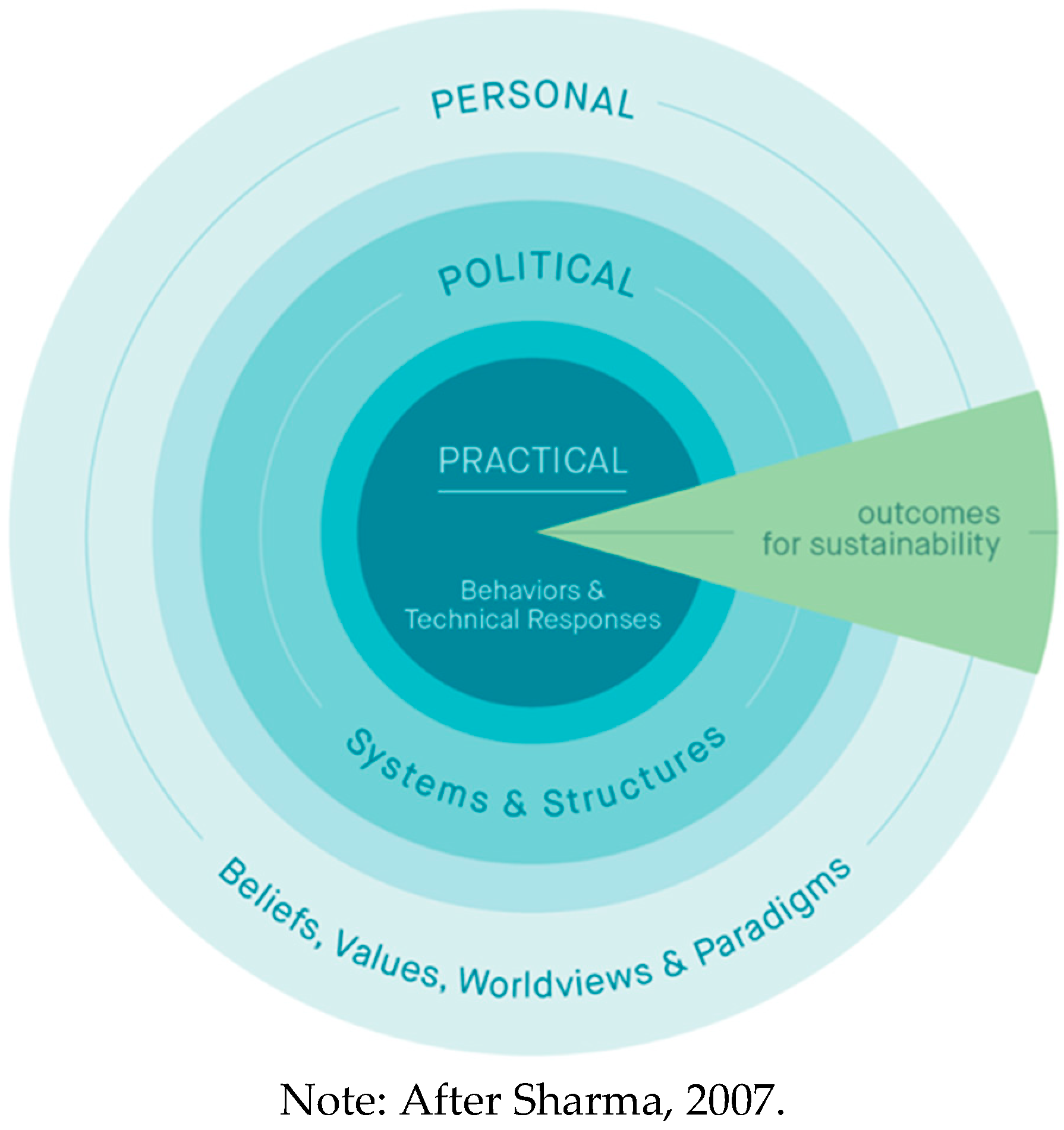
Figure 2.
Continuum of Individual, Collective and Systems Level Changes.
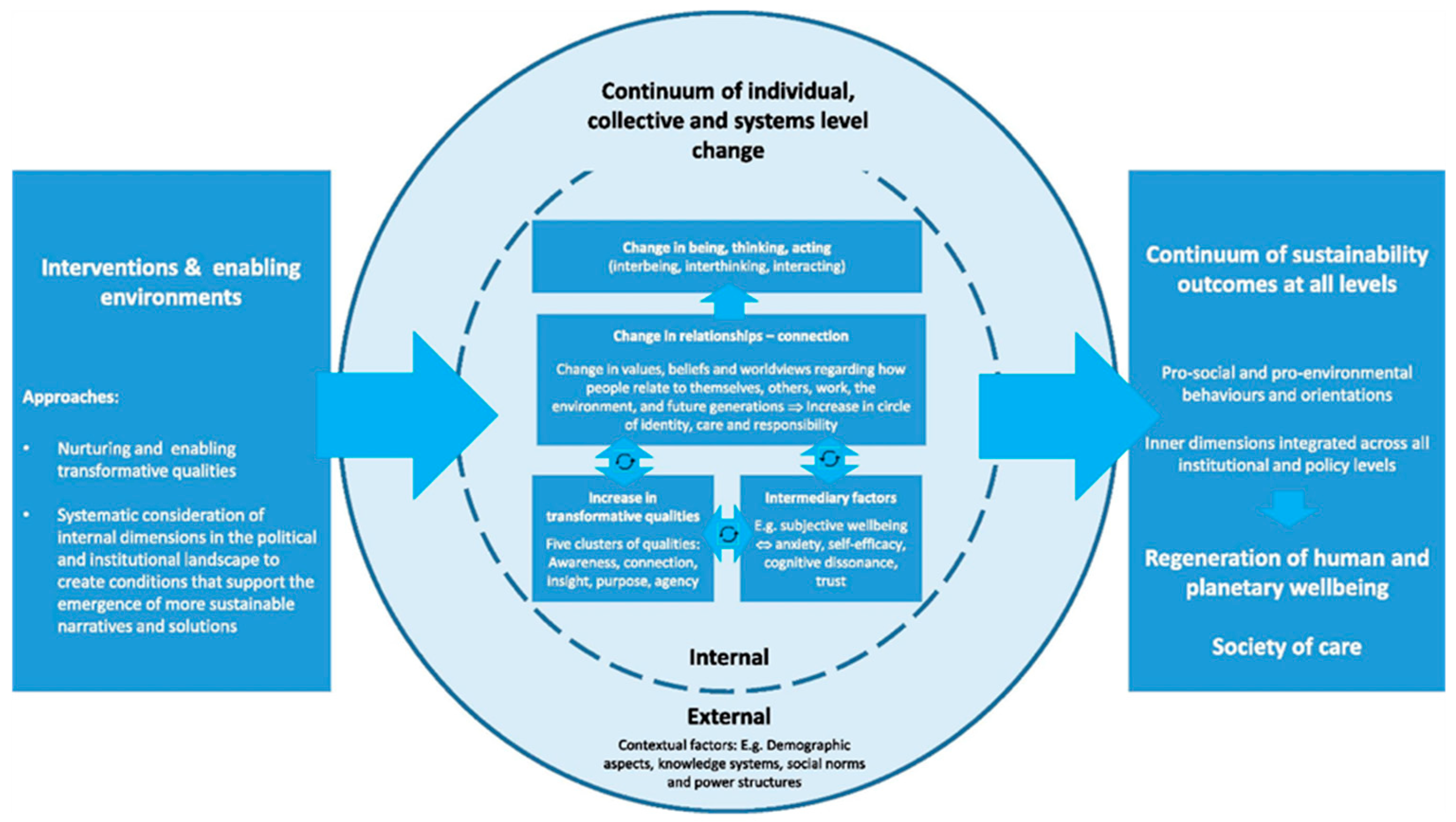
Figure 5.
Self-Reflective Infinity Loop of Equilibrium.
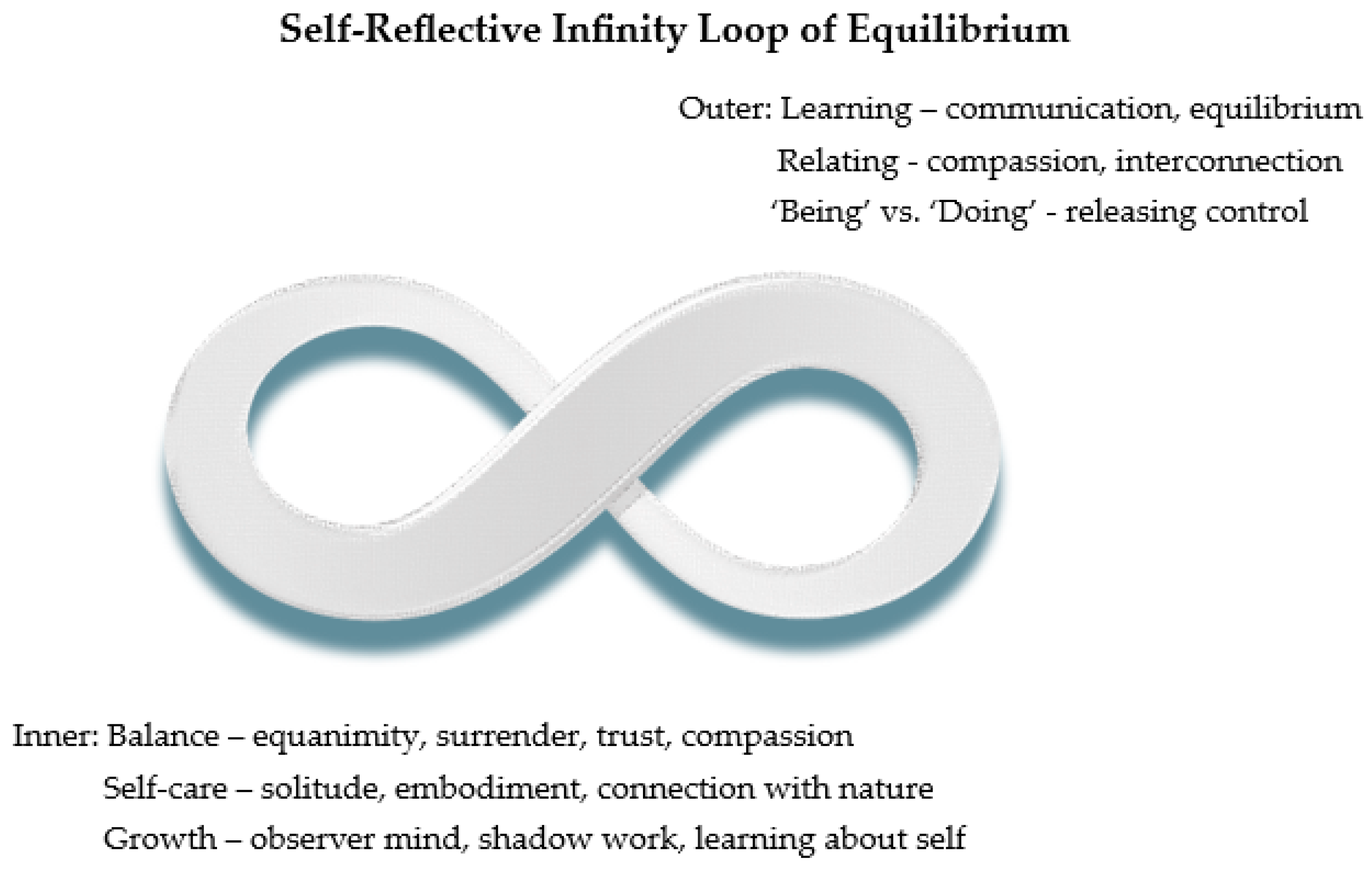

Table 1.
Demographic Highlights for ISTEI Survey Participants.
| Element | n | % |
| Gender | ||
| Female | 101 | 69.7 |
| Male | 42 | 28.9 |
| Transgender | 1 | 0.7 |
| Gender Fluid | 1 | 0.7 |
| Race | ||
| Caucasian / White | 120 | 82.7 |
| Other | 25 | 17.3 |
| Country/Region | ||
| United States | 55 | 37.8 |
| United Kingdom | 41 | 28.3 |
| Canada | 16 | 11.0 |
| Europe | 15 | 10.3 |
| Australia/New Zealand | 6 | 4.2 |
| Africa | 4 | 2.8 |
| South Asia | 4 | 2.8 |
| Other | 4 | 2.8 |
| Education | ||
| Bachelors | 44 | 30.3 |
| Masters | 32 | 22.0 |
| Some college, no degree | 23 | 15.9 |
| MD/PhD/JD | 22 | 15.2 |
| Trade school/Associates | 12 | 8.3 |
| H.S. diploma or equivalent | 11 | 7.6 |
| No H.S. diploma | 1 | 0.7 |
| Note: N = 145 |
Table 2.
Descriptive Age Statistics for Transformative Experiences – Screened into Survey.
| Current Age* |
Age at time of experience* |
Time since experience* |
|
| Median | 55 | 38 | 12 |
| Standard deviation | 13.9 | 14.6 | 15.9 |
| Minimum | 26 | 3 | 0.25 |
| Maximum | 93 | 76 | 65 |
| Shapiro-Wilk p | 0.347 | 0.707 | <.001 |
| Note. N = 145. * = in years. | |||
Table 3.
Descriptive Age Statistics for Transformative Experiences – Low MHI-5, Screened Out.
| Current Age* |
Age at time of experience* |
Time since experience* |
|
| Median | 45.5 | 37.0 | 6.25 |
| Standard deviation | 12.2 | 13.4 | 12.0 |
| Minimum | 22 | 5 | 1 |
| Maximum | 72 | 70 | 54 |
| Shapiro-Wilk p | 0.229 | 0.727 | <.001 |
| Note. N = 46, two of the 48 participants in this subset were excluded from this analysis due to ongoing transformative activities (i.e., no ‘time since experience’ parameter available). * = in years. | |||
Table 4.
Comparison of Median Age Statistics for Screened-in and Low MHI-5 Participants.
|
Median current age* |
Median age at time of experience* | Median time since experience* | |
| Screened in a | 55 | 38 | 12 |
| Low MHI-5 b | 45.5 | 37.0 | 6.25 |
| Delta | 9.5** | 1.0 | 5.75** |
|
Note. * = in years. an = 145. bn = 46. **p < .01 | |||
Table 5.
Most Frequently Reported Current Practices from PSC.
| Category | Individual Practices |
| Contemplative practices | Meditation, mindfulness, prayer, mantra, chanting, practicing observer mind |
| Self-discovery | Becoming an expert on myself, journaling, counseling, taking courses, reading, plant medicine |
| Self-care | Self-love, self-compassion, exercise, yoga, good food, quality sleep |
| Embodying values | Integrity, gratitude, compassion, discernment, authenticity |
| Time in nature | Being outside, gardening, wild swimming, walking, hiking |
| Personal environment | Solitude, calm, quiet, decreased sensory input, fresh air, clean, uncluttered |
| Connection | With peer-groups, like-minded people, intimate partner,supportive friend(s), community, family |
| Creative expression | Making art, making music, dancing, writing, creating poetry, cooking |
| Expanding awareness | Of subtle world, of intraconnection, of self, of causes of suffering |
Table 6.
Most Frequently Reported Limiting Factors from PSC.
| Category | Limiting Factors |
| Personal challenges | Getting started, need to do own work first, fear of judgement, fear of rejection, fear of failure, need for balance of work & personal life, need to maintain personal equilibrium, personal insecurity |
| Demands of Daily Life | Lack of time, family commitments, limits on energy, challenges of daily life, parenting commitments |
| Cultural Characteristics |
Prevalent illusion of separation, collective resistance to change, entrenched dominant belief system, discomfort of polarized atmosphere, predominant capitalist agenda |
| Financial Concerns | Personal financial concerns, insufficient pay for social change work, lack of funding sources for project work |
| Group Dynamics | Avoidance of othering, avoidance of organizations with patriarchal structures, avoidance of commercial aspirations, avoidance of polarization, hostility, & negativity, avoidance of questionable ethics |
| Personal Limitations |
Limited stamina, age limitations, health challenges, limited personal capacity, personal circumstances |
| Note. PSC = Perspective on Social Change survey, devised by researcher. | |
Table 7.
Most Frequently Reported Supportive Factors from PSC.
| Category | Supportive Factors |
| Supportive Elements | Shifting social landscape, reciprocal benefits from like-minded connections, being inspired by others, core beliefs, inner resilience |
| Personal Equilibrium | Sustaining personal practices, contemplative practice, maintaining preferred personal environment, ongoing skill development, creative expression, use of therapeutic approaches |
| Personal Perspective | Positive intentions to contribute, aligning life purpose with external efforts, awareness of personal agency, the nature of reality, and interconnection; embodiment of personal values, beliefs & understandings |
| Connection with Others | Like-minded community, spiritual community, social change community, peer support group, supportive relationship and/or friend, family connection |
| External Actions | Being of service, ethical career, ethical consumer choices, supporting wellbeing of others, social justice activities, philanthropic donations |
| Note. PSC = Perspective on Social Change survey, devised by researcher. | |
Table 8.
Interview Participant Characteristics.
| Pseudonym | Gender | Age | Ethnicity | Location | Education | Years since experience | Interest & engaged? |
| Ana | F | 29 | Caucasian | Spain | Masters | 10 | Y/Y |
| [Maya] a | [F] | [32] | [Asian] | [India] | [Masters] | [10] | [Y/Y] |
| Ibrahim | M | 42 | African | Kenya | Bachelors | 2 | Y/Y |
| Muriel | F | 42 | Caucasian | USA | Masters | 5 | Y/Y |
| Oliver | M | 43 | Caucasian | UK | Bachelors | 1 | N/N |
| Diane | F | 48 | Caucasian | UK | Masters | 12 | Y/Y |
| Neil | M | 54 | Caucasian | Europe | Adv. Degree | 7 | Y/Y |
| Emilia | F | 54 | Caucasian | Switzerland | Masters | 11 | Y/N |
| Lars | M | 58 | Caucasian | Netherlands | Masters | 28 | Y/N |
| David | M | 67 | Caucasian | UK | Bachelors | 8 | Y/Y |
| Note. a Data gathered from this participant has been bracketed out. | |||||||
Table 9.
Interview Participant’s Reported Daily Practices for Personal Equilibrium.
| Practice | Ana | Oli | Emi | Nei | Mul | Lar | Dia | Ibr | Dav |
| Avoiding othering | X | X | X | X | X | X | X | ||
| Meditation | X | X | X | X | X | X | |||
| Aligning/harmonizing inner & outer worlds | X | X | X | X | X | X | |||
| Time in nature | X | X | X | X | X | X | |||
| Reading on spirituality | X | X | X | X | X | ||||
| Creativity – writing | X | X | X | X | X | ||||
| Self-compassion practice | X | X | X | X | X | ||||
| Sufficient solitude | X | X | X | X | |||||
| Physical exercise / yoga | X | X | X | X | X | ||||
| Observer mind practice | X | X | X |
Table 10.
A Short List of Universal Values†.
| Category | Specific Values |
| Commitment to something greater than oneself |
|
| Self-respect – accompanied by humility, self-discipline, and acceptance of personal responsibility |
|
| Respect and care for others |
|
| Care for other living things and the environment | |
| Note. † Kinnier, R. T., Kernes, J. L., & Dautheribes, T. M. A Short List of Universal Moral Values. Counseling and Values 2000, 45, 4–16. | |
Disclaimer/Publisher’s Note: The statements, opinions and data contained in all publications are solely those of the individual author(s) and contributor(s) and not of MDPI and/or the editor(s). MDPI and/or the editor(s) disclaim responsibility for any injury to people or property resulting from any ideas, methods, instructions or products referred to in the content. |
© 2025 by the authors. Licensee MDPI, Basel, Switzerland. This article is an open access article distributed under the terms and conditions of the Creative Commons Attribution (CC BY) license (http://creativecommons.org/licenses/by/4.0/).
Copyright: This open access article is published under a Creative Commons CC BY 4.0 license, which permit the free download, distribution, and reuse, provided that the author and preprint are cited in any reuse.


