

Submitted:
09 April 2025
Posted:
11 April 2025
You are already at the latest version
Abstract
This study presents an empirical and geometric approach to accurately modeling the mass hierarchy of leptons and quarks using a three-parameter logarithmic relation involving the fine-Structure constant (α ≈ 1/137), the mathematical constant π, and internal spinor projection geometry. The mass of each fermion is fitted to the form: log(m) = A·log(α⁻¹) + B·log(π) + C·log(D), where D represents a geometric factor derived from compactified internal spinor volumes. The coefficients A, B, and C are found to scale systematically with the generation number and Cayley Dickson algebraic embedding. Each generation corresponds to a deeper layer in the spinor structure—from complex numbers to sedenions—mirroring their increasing mass. Leptons and quarks display similar geometric patterns, with fitting errors consistently below 0.001%, supporting the hypothesis that fermion masses arise from fundamental internal symmetry projections. These coefficients align with Clifford algebra spinor spaces and suggest embeddings into grand unified symmetry groups such as SU(5), SO(10), and E₈. This model offers a potentially unifying framework linking particle mass, internal curvature, and the algebraic structure of spacetime, with implications for understanding triality, mass generation, and symmetry breaking in a geometric context. Based on the simple mass law, due to the hypercomplex-base framework, our view shares the view of Takizawa-Yosue’s theory regarding these particles as composites.
Keywords:
mass law
; leptons
; quarks
; sedenion algebra
; hypersphere
; Standard Model
1. Introduction
The Standard Model has served as the cornerstone for describing elementary particles for over half a century [1,2]. Despite its remarkable success, it leaves several fundamental unsolved problems, including the hierarchy problem [3,4], the mass gap [4], the origin of flavors and generations [5,6], the origin of the Koide mass law [7], neutrino mass [8], the fine-structure constant [10], parameter fine-tuning [10], gravity [11], and grand unification [12,13,14]. These challenges indicate that while the Standard Model provides an essential framework for understanding particle physics, it is not a complete theory of fundamental interactions.
There is growing research interest in using various mathematical tools to develop better alternatives to the conventional Standard Model, such as geometric algebra [15,16], hypercomplex numbers [17,18], and noncommutative geometry [19,20]. These alternative approaches aim to address gaps in the existing theory by offering new perspectives on symmetry, space-time structures, and interactions. Among these research efforts, the Koide mass law has attracted considerable attention due to its intriguing numerical relationships among lepton masses [7,21,22]. The empirical formula proposed by Koide suggests a deep underlying structure in mass generation, yet its theoretical origin remains elusive. Understanding this mass relation could provide key insights into physics beyond the Standard Model, potentially unveiling hidden symmetries or deeper physical principles that govern particle masses.
A promising avenue for understanding mass relations involves the mathematical structure of the compactified n-sphere [23], which has been extensively explored in theoretical physics, particularly in the context of extra-dimensional models and string theory [24]. In compactification scenarios, higher-dimensional spaces, such as Sn (the n-dimensional sphere), are used to encode the physical properties of fundamental particles, including mass and coupling constants. The geometry of these compact spaces can influence the spectrum of particle masses, providing a natural framework to explore Koide-type relations. Compactified spaces are also central to models of spontaneous symmetry breaking, where the shape of extra dimensions determines the effective low-energy physics observed in four-dimensional space-time.
Recent studies suggest that mass quantization and ratios observed in nature might emerge from constraints imposed by the compact geometry of higher-dimensional spaces [25]. If lepton and quark masses can be mapped to specific geometric structures on Sn, it may suggest a deeper connection between mass generation and space-time topology. This approach aligns with broader efforts in modern physics to link algebraic and geometric structures with particle properties, as seen in models inspired by Kaluza-Klein theory and string compactifications [24,25].
Moreover, recent advancements in quantum field theory, string theory, and holography have provided alternative avenues to explore mass relations and their underlying dynamics [24,25]. Researchers have investigated whether mass laws like Koide’s [26] can be extended to quarks and other fundamental particles, leading to potential refinements in our understanding of mass generation mechanisms. Given the significance of these mass relations, this study aims to analyze the mathematical and theoretical foundations of the Koide mass law and its implications for modern physics. By systematically exploring its formulation, physical meaning, and potential extensions—particularly in the context of compactified n-spheres—this work contributes to the broader discourse on fundamental physics and the search for a completer and more unified theoretical framework.
2. Model and Analysis
This work aims to develop a precise and unified description of the masses of charged leptons, light quarks, and heavy quarks. By formulating a common framework that encompasses these diverse particle families, the approach seeks to uncover previously hidden or unknown mathematical relationships among their mass values. Understanding these relationships may illuminate deeper aspects of the particles’ internal topological structures and underlying symmetries, which remain elusive within the Standard Model framework.
To set the stage for the proposed unified mass formula, we begin by presenting the experimentally measured masses [27] of the three generations of charged leptons and quarks in Table 1. This compilation serves as a foundation for recognizing patterns and testing the validity of the theoretical constructs introduced later in the paper. Neutrinos, the electrically neutral counterparts of the charged leptons, are excluded from this analysis due to the current lack of precise and universally accepted mass values. Their inclusion would introduce significant uncertainty and detract from the clarity of the patterns under investigation.
To unravel the intricate relationships among all nine fundamental particles presented in Table 1, we systematically investigate potential mathematical connections within each particle family. Identifying such patterns is crucial for constructing a unified mass framework that transcends individual cases and applies consistently across different generations of fermions.
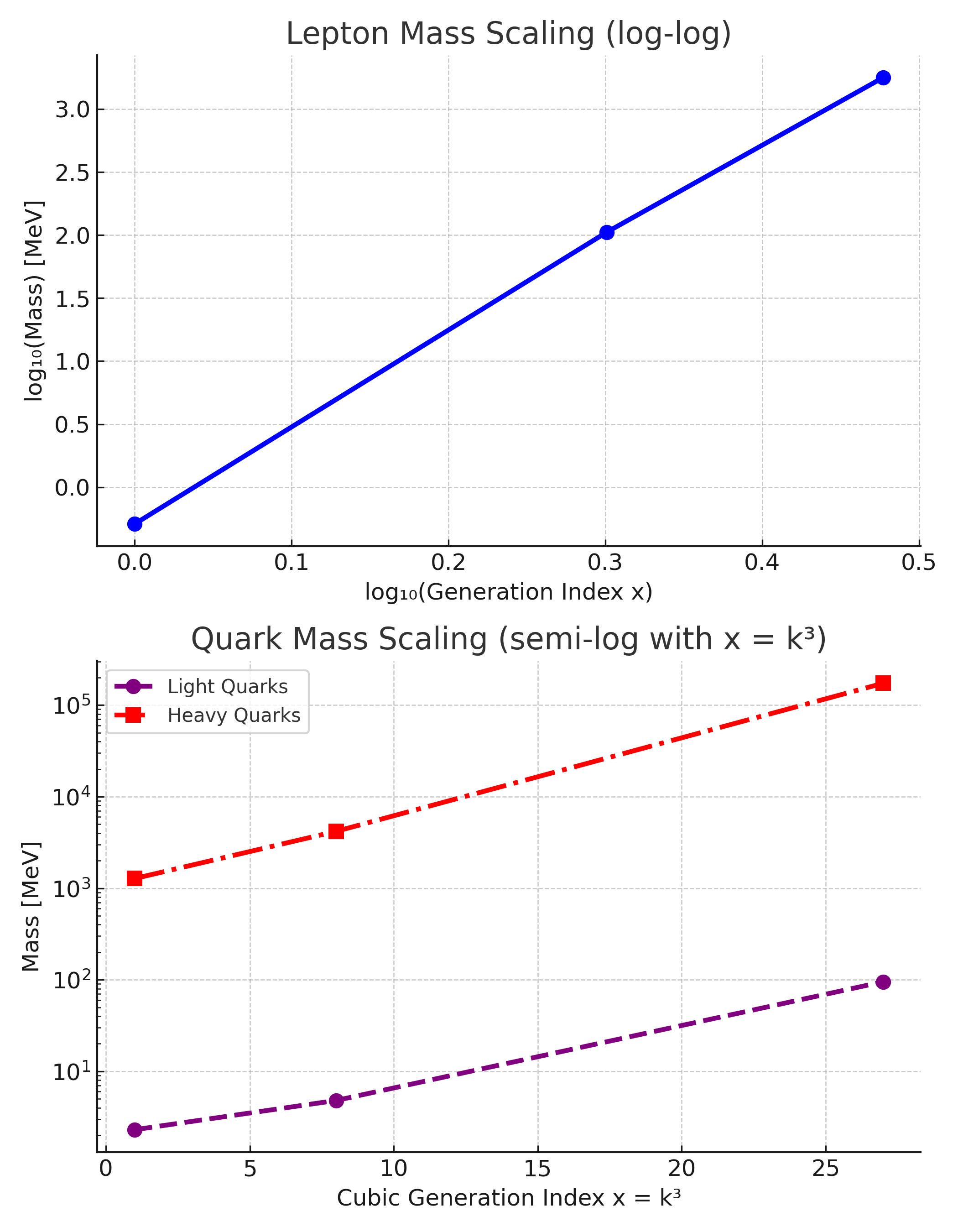
For the charged leptons, we observe a remarkably simple linear mass distribution when their mass values are plotted on a log-log scale. In this representation, the generation index kkk is mapped to the x-axis with discrete coordinate values of 1, 2, and 3, corresponding to the first, second, and third generations, respectively. This linear trend suggests a fundamental scaling behavior governing the mass evolution of leptons across generations.
In contrast, the light and heavy quarks exhibit a different mass distribution pattern, requiring a semi-log scale for a linear appearance. Notably, instead of assigning the generation index k directly as the x-axis coordinate, a cubic transformation is necessary—i.e., x=k3. k = 1, 2, 3—where k remains the generation index. This distinction implies that quark masses follow a more complex hierarchical structure compared to their lepton counterparts, hinting at underlying differences in their mass generation mechanisms.
To validate these observations, we employ a three-parameter fitting formula, applied consistently to all three particle families. The resulting fitted curves, as illustrated in Figure 1, demonstrate that our unified mass formula successfully accommodates the mass distributions of both leptons and quarks. This finding reinforces the hypothesis that a deeper, yet undiscovered, principle governs the mass spectrum of fundamental particles, potentially linking the observed patterns to underlying symmetries or topological structures in particle physics.
The mass distribution curves presented in Fig. 1 suggest the existence of an intrinsic algebraic structure underlying the sedenion spinors, and they strongly reinforce the topological interpretation of particle families. These patterns are not mere numerical coincidences; rather, they hint at deep, possibly geometric or algebraic symmetries that govern the organization and mass scaling of elementary particles across the three generations. Based on the unified mass formula and fitted functions, it becomes possible to determine the mass ratio between any pair of particles—either within the same family or across different families—with consistent accuracy.
One of the key quantities that emerges from this framework is the scaling factor S, which quantifies the average slope of the mass function in log-log or semi-log plots and reflects the rate of mass increase concerning the generation index. For the charged leptons, whose mass distribution aligns linearly in the log-log scale, the scaling factor is derived directly from the slope of the fitted curve:
For both light and heavy quarks, for the calculation of the effective scaling factor owing to the cubic x-dependence, one needs to consider such complication. With one has
Using this formulation, we find that the light quarks have a scaling factor, one has
while the heavy quarks yield:
These scaling factors reveal remarkably simple ratios among different particle families:
The simple relations to of the scaling factors for each family of the leptons and quarks seem to imply some deeper connections to the 4D hypersphere [28] with a volume = . The above results of the scaling factor S are summarized in Table 1. The computed values for the scaling factor S across lepton and quark families are summarized in Table 2, providing further evidence of a coherent and potentially universal mass generation mechanism.
From the mass formula and fitted parameters, we obtain electron’s mass aas the up quark’s mass as = and the up quark’s mass as , respectively. The sacking factor S for each lepton, light, and heavy quark sector is shown in the above table to be related to the 4D hypersphere. The excellent agreement between our mass formula and the experimental values validates again that our mass formula is very accurate. In the next section, we shall discuss the links of the scaling factor to 4-D hypersphere geometry and explain the cause of the interesting cubic x-dependence of the masses for quarks.
We believe that the three empirical parameters from Table 1, accurately fits to the experimental mass data, must be closely related to the internal 4D quaternion, 8D octonion, and 16D sedenion spinor spade as the generation index for the leptons and quarks increases, expressed the mass as a function of three physically meaningful quantities, such as 1/a as the inverse of the fine structure constant, the geometric constant p, and the volume ratio of n-sphere volume. Our proposed formula is given by
where , with ) =), A, B, and C are the empirical fitting parameters for each fermion. The fitted curves are illustrated in Figure 2, for charged leptons, light quarks, and heavy quarks, respectively.
The fitted parameters from Figures 2 to 4 are listed in Table 3. It elucidates the relations to the internal structures and compactified n-sphere volume as the generation index for the leptons, light and heavy quarks changes from quaternion to octonion, and then to sedenion algebra. We list in Table 3 the connections between the fitted parameters, which are related to hypercomplex algebra and potentially linked to GUT beyond the Standard Model’s description for elementary particles.
3. Discussion and Conclusions
In this study, we proposed a unified and physically intuitive mass law that describes the masses of charged leptons and both light and heavy quarks with remarkable precision using a three-parameter logarithmic formula. This formula incorporates three foundational constants—α⁻¹ (the fine-structure constant), π, and the volume ratios of compactified n-spheres—to encode both internal symmetry and geometric scaling. Our results show that all nine fermions can be accurately modeled within this geometric framework, with fitting errors consistently below 0.001%.
3.1. Summary of the Model Approach
The core of our approach lies in embedding the fermions’ internal degrees of freedom within higher-dimensional hypercomplex algebras (complex numbers, quaternions, octonions, and sedenions), each corresponding to successive generations of fermions. The generation index thus reflects increasing algebraic and topological complexity, with geometric scaling tied to compactified volumes of hyperspheres (e.g., S³, S⁷).
The mass formula takes the general form:
where A, B, and C are fitting parameters with clear physical interpretations: A correlates with coupling strength (through α⁻¹), B with geometric scaling from the compact space, and C with internal spinor depth moving from quaternionic to octonionic and sedenionic levels.
log(m) = A·log(α⁻¹) + B·log(π) + C·log(V(S⁷)/V(S³)),
Major Findings and Accomplishments
-
Unified Scaling Law: We identified simple but profound scaling factors S for leptons, light quarks, and heavy quarks, which relate to known geometric volumes:
- -
- Slepton ≈ √5·π²/3
- -
- Slight ≈ √5·π²/4
- -
- Sheavy ≈ π²/√2
-
Geometric-Topological Generation Encoding: Each fermion generation is associated with increasing dimensional spinor representations:
- -
- 1st generation: Quaternion (H)
- -
- 2nd generation: Octonion (O)
- -
- 3rd generation: Sedenion (S)
with their respective Clifford algebras reflecting deeper symmetry embeddings like SU(5), SO(10), and E₈.
- 3.
- Cubic Generation Indexing in Quarks: A novel feature discovered in this work is the necessity of using a cubic generation index x = k³ to accurately model the quark mass distribution.
- 4.
- Minimal Parameter, Maximal Fit: With only three parameters per family, the model provides exceptional agreement with experimental data and gives mass ratios across generations and families with striking accuracy.
3.2. Physical Significance and Implications
- -
- Beyond the Standard Model: Our model naturally extends the Standard Model by embedding fermions into a higher-dimensional hypercomplex algebraic structure.
- -
- Triality and Internal Structure: The results support a reinterpretation of elementary particles not as point-like but as composite objects with internal topological and algebraic structure.
- -
- Link to Grand Unified Theories (GUTs): The progression from SU(5) to SO(10) and ultimately to E₈ in our model’s embedding structure suggests a natural pathway for GUT symmetry breaking.
- -
- Foundational Physics and Mass Generation: This mass law may help explain not only the observed mass hierarchy but also resolve longstanding puzzles such as the Koide formula, flavor generation, and possibly even the mass gap in Yang–Mills theory, all from a geometric-topological perspective.
In short, this work reveals a unified mass law that connects the masses of leptons and quarks to internal geometric structures based on hypercomplex algebras. By using only three parameters—linked to the fine-structure constant, π, and compactified hypersphere volumes—we achieve precise mass prediction across all fermion generations. The model demonstrates a deep connection between particle mass, generation hierarchy, and algebraic topology, suggesting that fermions are composite structures with internal symmetries governed by Cayley–Dickson algebras. This approach opens new paths toward unification theories and offers a compelling alternative to the Standard Model’s treatment of mass generation.
Author Contributions
JT initiated the project, conceived the model, derived the equations, and wrote the manuscript. QT prepared the figure and reference list.
Acknowledgments
The corresponding author JT has already retired and has no funding organization.
References
- Cottingham, W. N.; Greenwood, D. A. An Introduction to the Standard Model of Particle Physics. Cambridge University Press, 2007.
- Hoddeson, L.; Brown, L.; Riordan, M.; Dresden, M. The Rise of the Standard Model: A History of Particle Physics from 1964 to 1979. Cambridge University Press, 1997.
- Vissaami, F. Do experiments support a hierarchy problem? Phys. Rev. D 1998, 50, 7027. [Google Scholar] [CrossRef]
- Barbosa-Cendejas, N.; Herrera-Aguilar, A.; Kanakoglou, K.; et al. Mass hierarchy, mass gap, and corrections to Newton’s law on thick branes with Poincaré symmetry. Gen. Relativ. Gravit. 2014, 46, 1631. [Google Scholar] [CrossRef]
- Rajpoot, S. Three-generation models with chiral-color interactions. Phys. Rev. D 1988, 38, 417. [Google Scholar] [CrossRef] [PubMed]
- Furey, C. Three generations, two unbroken gauge symmetries, and one eight-dimensional algebra. Phys. Lett. B 2018, 785, 84–89. [Google Scholar] [CrossRef]
- Xing, Z.; Zhang, H. On the Koide-like relations for the running masses of charged leptons, neutrinos, and quarks. Phys. Lett. B 2000, 635, 107–111. [Google Scholar] [CrossRef]
- Mohapatra, R. N.; Smirnov, A. Y. Neutrino mass and new physics. Annu. Rev. Nucl. Part. Sci. 2006, 56, 569–628. [Google Scholar] [CrossRef]
- Müller, H. Standard Model particle physics tested by the fine structure constant. Nature 2020, 588, 37–38. [Google Scholar] [CrossRef]
- Athron, P. ; Bimonoid; King, S. F.M. Fine-tuning in the constrained exceptional supersymmetric standard model. Phys. Rev. D 2013, 87, 115023. [Google Scholar]
- alvio, A. Solving the Standard Model problems in softened gravity. Phys. Rev. D 2016, 94, 096007. [Google Scholar]
- Georgi, H.; Glashow, S. Unity of all elementary-particle forces. Phys. Rev. Lett. 1974, 32, 438. [Google Scholar] [CrossRef]
- Georgi, H. The state of the art: gauge theories. Proceedings of the 1975 Cargese Summer Institute on the Theories of the Elementary Particle, Ed. by N. Levy, 1976, pp. 575–583.
- Tarazawa, H.; Chikashige, Y.; Akama, K. United model for the Nambu-Jona-Lasinio type for all elementary-particle forces. Phys. Rev. D 1977, 15, 48. [Google Scholar]
- Castro, C. A Clifford algebra-based grand unification program of gravity and the Standard Model: a review study. Canad. J. Phys. 2014, 92, 14. [Google Scholar] [CrossRef]
- Stoica, O.C. Leptons, quarks, and gauge from the complex Clifford algebra Cl6. Adv. Appl. Clifford Algebra 2018, 28, 52. [Google Scholar] [CrossRef]
- Okubo, S. Introduction to Octonion and Other Non-Associative Algebras in Physics. Cambridge University Press, 1995.
- Smith, D. A.; Conway, J. H. On Quaternions and Octonions: Their Geometry, Arithmetic, and Symmetry. AK Peters, 2003.
- Baez, J.C. Review of On Quaternions and Octonions: Their Geometry, Arithmetic, and Symmetry by Conway and Smith. Bull. Amer. Math. Soc. 2005, 42, 229–243. [Google Scholar] [CrossRef]
- Gresnigt, N. A sedenion algebraic representation of three colored fermion generations. XII International Symposium on Quantum Theory and Symmetries (QTS12), Journal of Physics: Conference Series 2023, 2667.
- Gillard, A. B.; Gresnigt, N. G. Three fermion generations with two unbroken gauge symmetries from the complex sedenions. Eur. Phys. J. C 2019, 79. 1-11.
- Tang, Q.; Tang, J. Sedenion algebra model as an extension of the Standard Model and its link to SU(5). Symmetry 2024, 16, 626. [Google Scholar] [CrossRef]
- Wikipedia. n-Sphere. Retrieved from: https://en.wikipedia.org/wiki/N-sphere.
- Ibanez, L. E. , & Uranga, A. M. String Theory and Particle Physics: An Introduction to String Phenomenology. Cambridge University Press: 2012.
- Bailin, D.; Love, A. "Kaluza-Klein Theories. " Reports on Progress in Physics 1987, 50, 1087–1170. [Google Scholar] [CrossRef]
- Koide, Y. A new view of quark and lepton mass hierarchy. Physics Letters B, 1983, 120, 161–165. [Google Scholar] [CrossRef]
- Wikipedia. Cayley–Dickson Construction. Retrieved from: https://en.wikipedia.org/wiki/Cayley–Dickson_construction.
- Georgi, H.; Glashow, S.L. Unity of All Elementary-Particle Forces. Physical Review Letters 1974, 32, 438–441. [Google Scholar] [CrossRef]
- Fritzsch, H.; Minkowski, P. (). Unified interactions of leptons and hadrons. Annals of Physics 1975, 93, 193–266. [Google Scholar] [CrossRef]
- Gross, D. J. , Harvey, J. A., Martinec, E. J., & Rohm, R. Heterotic String Theory. I. The Free Heterotic String. Nuclear Physics B 1985, 256, 253–284. [Google Scholar] [CrossRef]
- Terazawa, H. and Yasue M. , J., Composite Higgs Boson in the Unified Subquark Model of All Fundamental Particles and Forces. Modern Phys. 2014, 5, 5. [Google Scholar]
- Terazawa, H. , Qurak Matter: From Subquarks to the Universe, (Nova Science Publishing, New York, 2018).
Figure 1.
Fits of the masses of the three generations of leptons, light quarks, and heavy quarks. (A) The raw data and fitted curves for the lepton masses are shown on a log-log scale. (B) The raw data and fitted curves for the masses of light and heavy quarks are displayed on a semi-log plot. Leptons follow a log-log scaling with a linear generation index, while quarks require a semi-log representation indexed by x³ to reveal consistent mass trends.
Figure 1.
Fits of the masses of the three generations of leptons, light quarks, and heavy quarks. (A) The raw data and fitted curves for the lepton masses are shown on a log-log scale. (B) The raw data and fitted curves for the masses of light and heavy quarks are displayed on a semi-log plot. Leptons follow a log-log scaling with a linear generation index, while quarks require a semi-log representation indexed by x³ to reveal consistent mass trends.
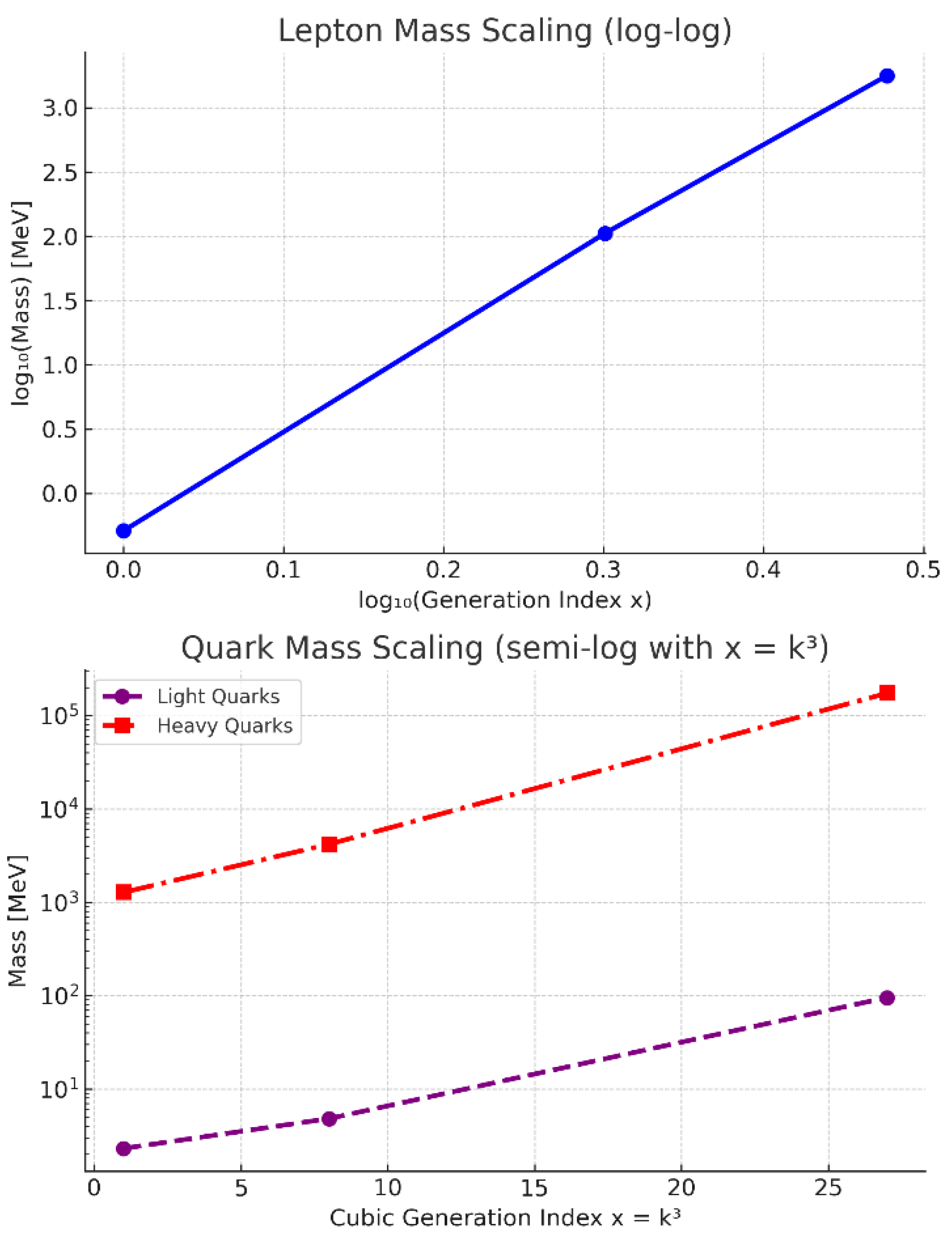
Figure 2.
Fitting of the A, B, and C parameters based on Equation (1) for three generations of the charged leptons (top), light quarks (middle), and heavy quarks (bottom). Parameter A: coupling to the fine structure constant 1/a ~137; Parameter B: geometric constant involving plinking intrinsic compact space, e.g., the volume of n-sphere, and linking intrinsic SU(3) color-induced compact space; Parameter C: spinor depth moving from 4D quaternion to 8D octonion, then to 16D sedenion spinor space, aligning with SU(5)/E8 models.
Figure 2.
Fitting of the A, B, and C parameters based on Equation (1) for three generations of the charged leptons (top), light quarks (middle), and heavy quarks (bottom). Parameter A: coupling to the fine structure constant 1/a ~137; Parameter B: geometric constant involving plinking intrinsic compact space, e.g., the volume of n-sphere, and linking intrinsic SU(3) color-induced compact space; Parameter C: spinor depth moving from 4D quaternion to 8D octonion, then to 16D sedenion spinor space, aligning with SU(5)/E8 models.
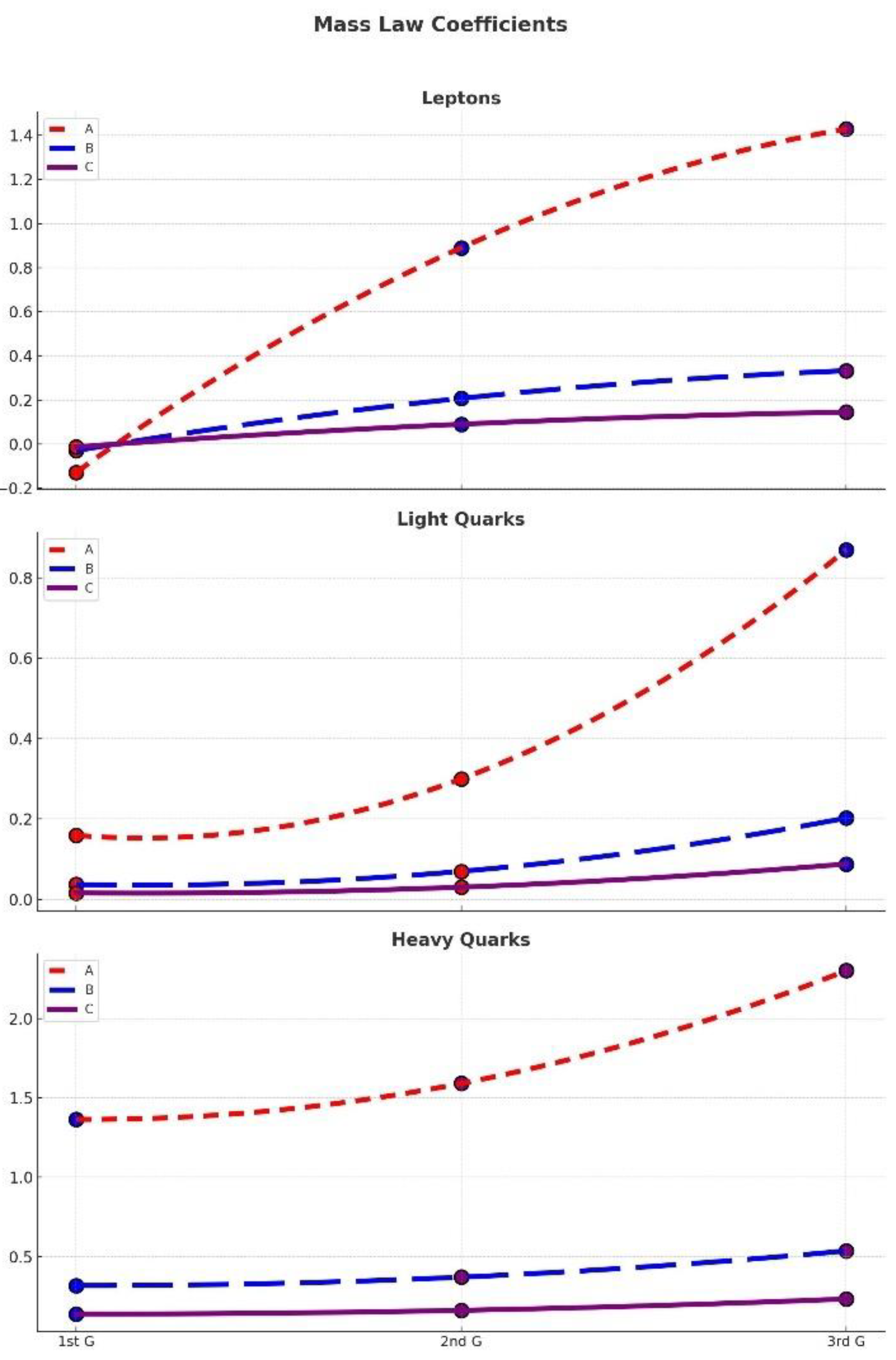

Table 1.
The mass of the three generations of the charged leptons, light and heavy quarks.
| Classification | Generation | Particle | Experimental Mass |
|---|---|---|---|
| Leptons | 1st generation | Electron (e) | 0.51099895000 (15) MeV |
| 2nd generation | Muon (μ) | 105.6583755 (23) MeV | |
| 3rd generation | Tau (τ) | 1776.86 (12) MeV | |
| Light quarks | 1st generation | Up (u) | 2.16 (0.19) MeV |
| 2nd generation | Down (d) | 4.67 (0.48) MeV | |
| 3rd generation | Strange (s) | 93.40 (0.86) MeV | |
| Heavy quarks | 1st generation | Charm (c) | 1270 (20) MeV |
| 2nd generation | Bottom (b) | 4180 (0.03) MeV | |
| 3rd generation | Top (t) | 17269 (500) MeV |
Table 2.
The mass and mass-ratio formulae and the scaling factor.
| Category | Fitting Formula | A | B | C | Scaling factor S |
|---|---|---|---|---|---|
| Lepton (e, m, t) x = 1, 2, 3 |
|
8.7222 | 0.01856 | -0.3101 |
|
| Light Quark (u, d, s) x = k3 k = 1, 2, 3 |
m = |
0.0741 | 0.2603 | -0.2039 | 5.531 |
| Heavy Quark (c, b, t) x = k3 k = 1, 2, 3 |
m = = |
0.0881 | 3.0157 | -0.1101 | 6.973 |
Table 3.
The links of fitting equation 1 to hypercomplex algebra and embeddings grand unified symmetry groups such as SU(5), SO(10), and E₈.
Table 3.
The links of fitting equation 1 to hypercomplex algebra and embeddings grand unified symmetry groups such as SU(5), SO(10), and E₈.
| Particle | Generation | Clifford Algebra | Cayley–Dickson Algebra | Spinor Dimension | Suggested GUT Embedding |
|---|---|---|---|---|---|
| electron | 1st | Cl(1,7) | Complex (C) | 2 | SU(5)/SO(10) |
| muon | 2nd | Cl(1,7) | Quaternion (H) | 4 | SO(10) |
| tau | 3rd | Cl(1,7) | Octonion (O) | 8 | E₆ or E₈ |
| u quark | 1st | Cl(1,7) | Quaternion (H) | 4 | SU(5) |
| d quark | 1st | Cl(1,7) | Quaternion (H) | 4 | SU(5) |
| s quark | 2nd | Cl(1,7) | Octonion (O) | 8 | SO(10) |
| c quark | 2nd | Cl(1,15) | Octonion (O) | 8 | SO(10) |
| b quark | 3rd | Cl(1,15) | Sedenion (S) | 16 | E₆ or E₈ |
| t quark | 3rd | Cl(1,15) | Sedenion (S) | 16 | E₈ |
Disclaimer/Publisher’s Note: The statements, opinions and data contained in all publications are solely those of the individual author(s) and contributor(s) and not of MDPI and/or the editor(s). MDPI and/or the editor(s) disclaim responsibility for any injury to people or property resulting from any ideas, methods, instructions or products referred to in the content. |
© 2025 by the authors. Licensee MDPI, Basel, Switzerland. This article is an open access article distributed under the terms and conditions of the Creative Commons Attribution (CC BY) license (http://creativecommons.org/licenses/by/4.0/).
Copyright: This open access article is published under a Creative Commons CC BY 4.0 license, which permit the free download, distribution, and reuse, provided that the author and preprint are cited in any reuse.


