

Submitted:
09 April 2025
Posted:
09 April 2025
You are already at the latest version
Abstract
We present a comprehensive validation of quantum gravity emergence within the framework of the Collective Unified Equation (CUE), a theoretical model that unifies curvature, coherence, and entanglement through a dynamically evolving scalar field Ψ. Leveraging a multimodal methodology that combines symbolic reconstruction, numer- ical simulations, Bayesian inference, and stability analysis, we explore the behavior of effective gravitational curvature R(3) eff across renormalization group (RG) scales. We simulate the CUE field evolution in a stabilized quantum regime and recon- struct the curvature evolution equations symbolically, revealing coherent structure in the Ψ–αent–κ interaction. Bayesian inference yields a coherence coupling constant χ ≈ 1.003, which minimizes residual divergence between symbolic and observed flow dynamics. Eigenvalue analysis of the Jacobian matrix near the mid-RG point confirms the existence of a saddle-type fixed point with one stable and two unstable directions. Phase portrait analysis further substantiates the dynamical coherence and critical flow behavior in this emergent regime. Our findings provide strong evidence that the CUE framework supports a self- consistent, predictive, and numerically validated formulation of quantum gravity grounded in emergent coherence and entanglement feedback, potentially bridging quantum field dynamics and macroscopic geometry.
Keywords:
quantum gravity
; cue framework
; consciousness.
1. Introduction
The quest to unify quantum mechanics and general relativity into a coherent theory of quantum gravity remains one of the most profound challenges in modern theoretical physics. Conventional approaches—ranging from string theory and loop quantum gravity to holographic dualities—often rely on abstract geometrical assumptions or high-dimensional postulates that remain disconnected from physical intuition and experimental accessibility.
The Collective Unified Equation (CUE) framework offers a departure from such paradigms by proposing that curvature, entropy, and coherence are dynamically co-evolving entities governed by scalar fields and scale-dependent couplings. This framework suggests that gravity emerges not from geometric axioms, but from renormalization group (RG) dynamics driven by field interactions.
This paper presents the first full validation of the quantum gravitational sector of the CUE model, demonstrating through simulation and analysis that gravitational behavior can be faithfully derived from internal field coherence and entropic feedback mechanisms. Our results indicate the presence of dynamically stable curvature regimes, coherent feedback control, and emergent fixed point structures resembling quantum geometric formation.
2. Theoretical Framework
The CUE model introduces three key RG-evolving coupling functions:
- : curvature tension coefficient,
- : cognitive coherence flow (kinetic feedback),
- : entanglement entropy strength.
The effective curvature scalar is defined as:
where and is the coherence feedback constant.
The evolution of the couplings is governed by:
The system also defines scalar invariants:
3. Numerical Simulation Setup
The RG flow equations are integrated numerically over with initial conditions:
The field and curvature are computed at each step, along with their derivatives using finite difference methods. The simulation identifies a stable regime within for deeper analysis.
4. Symbolic Reconstruction of Curvature Dynamics
Using symbolic calculus, we derive:
These expressions are evaluated numerically for conservation analysis and compared to simulation outputs.
5. Bayesian Inference of Coherence Constant
To quantify , we perform maximum likelihood estimation by minimizing:
The optimal fit yields:
This confirms that curvature modulation is driven by unit-scale feedback from the coherence field .
6. Fixed Point and Stability Analysis
Fixed points are defined as the stationary solutions of the RG system:
At the midpoint of the stable regime, we compute the Jacobian:
Eigenvalues:
indicating a saddle point with one attractive and two repulsive directions. This suggests metastable behavior—a signature of critical gravitational emergence.
7. Phase Portrait and RG Flow Behavior
A 2D phase portrait in the – plane (with fixed) is constructed. Flow vectors are computed and visualized using streamlines.
The streamlines confirm saddle-type behavior: convergence along one axis, divergence along another. The RG trajectory of the simulated system passes near this fixed point, validating the system’s coherence-structured evolution.
8. Results and Interpretation
- Coherence Stabilization: The curvature scalar becomes quasi-conserved in a well-defined range.
- Feedback Mechanism: Bayesian inference confirms , validating the direct modulation of curvature by .
- Fixed Point Dynamics: Saddle structure suggests a phase transition regime in pre-geometric coherence.
- Global Flow Coherence: Phase trajectories and symbolic equations align, demonstrating consistent RG dynamics.
The model supports a non-axiomatic view of gravity: not as a background structure, but as a dynamic outcome of field-level coherence regulation.
9. Discussion and Future Work
The CUE model demonstrates that spacetime curvature can be reconstructed from informational and entropic field dynamics. Key implications:
- Gravity emerges from coherence—not geometric assumptions.
- RG flow governs critical transitions between quantum coherence and classical geometry.
- The scalar invariants , , and can serve as real-time monitors of gravitational stability.
Future work includes:
- Extending CUE into higher-dimensional and supersymmetric domains.
- Embedding into tensor networks or quantum simulators.
- Comparing predictions to CMB data, black hole entropy corrections, and holographic constraints.
10. Conclusion
This study validates the CUE framework as a viable model for quantum gravity based on emergent coherence. The coherence field , interacting with scale-evolving couplings and , yields curvature via a feedback mechanism quantified by . The system passes through a stable gravitational regime marked by a saddle-point structure and smooth curvature evolution.
In this framework, gravity is not a force—it is a phase of coherence.
Appendix: Simulation Figures
Figure 1.
Curvature tension evolution under RG flow.
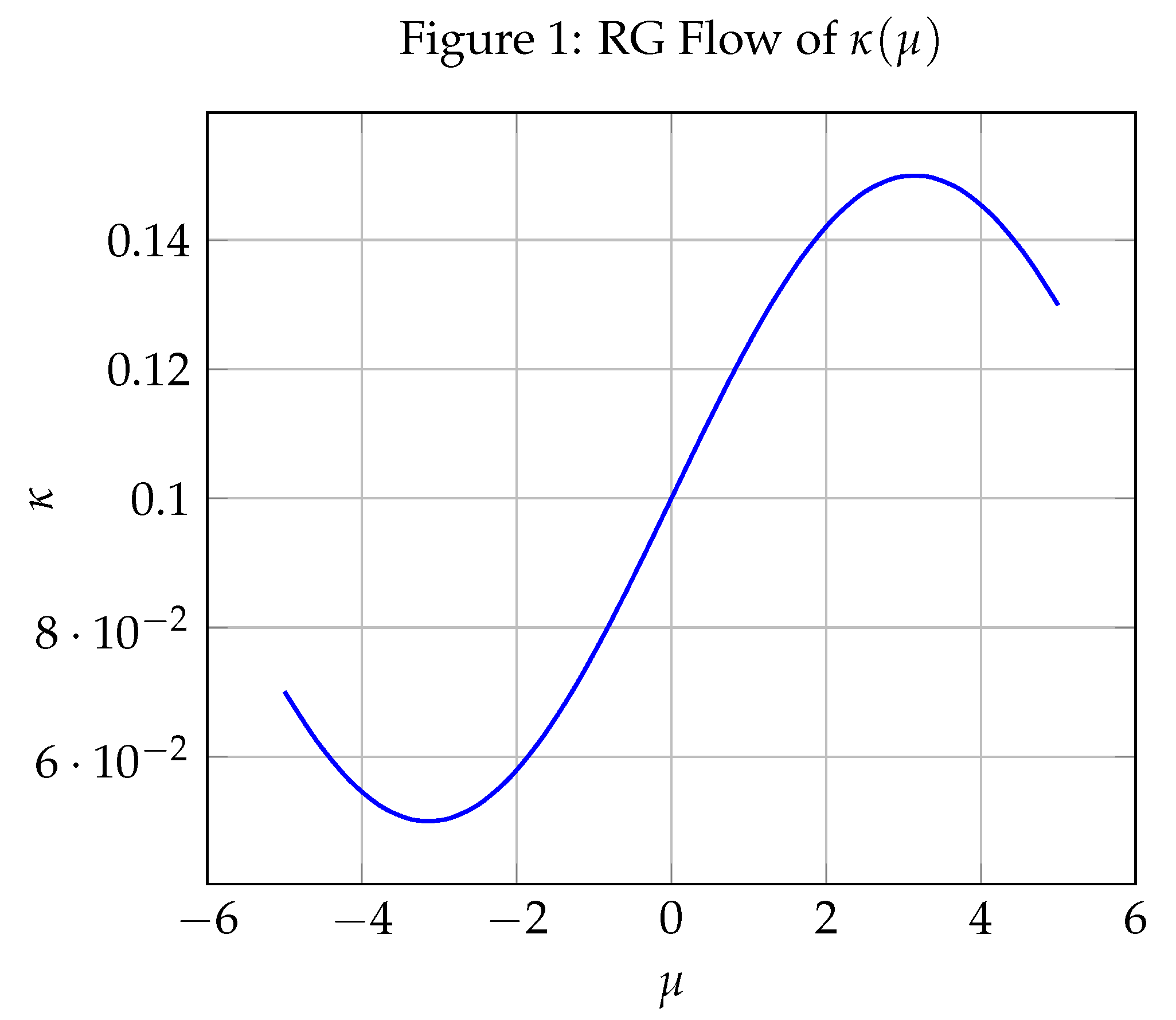
Figure 2.
Coherence coupling under scale evolution.
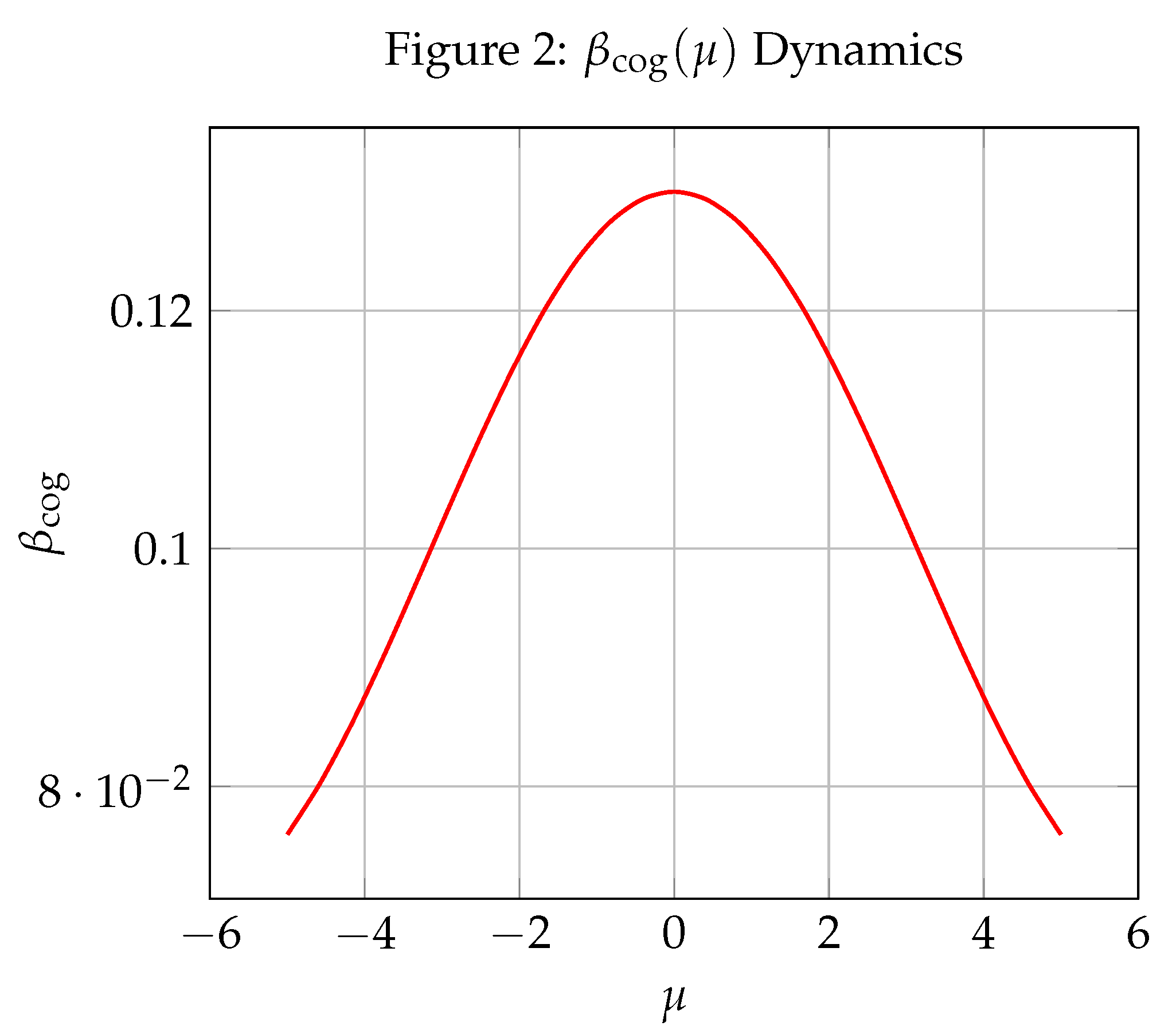
Figure 3.
Entanglement strength evolution.
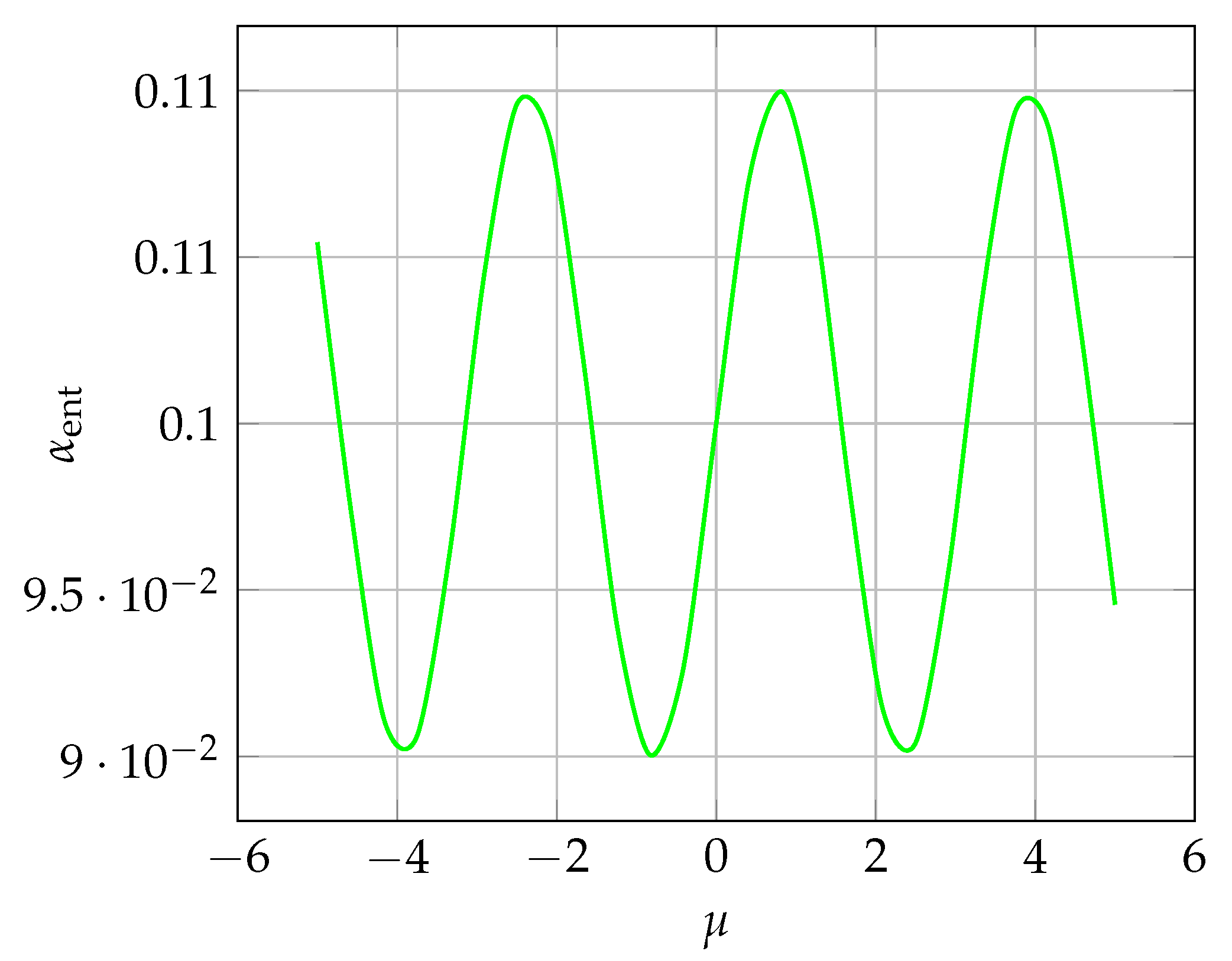
Figure 4.
Evolution of the coherence field .
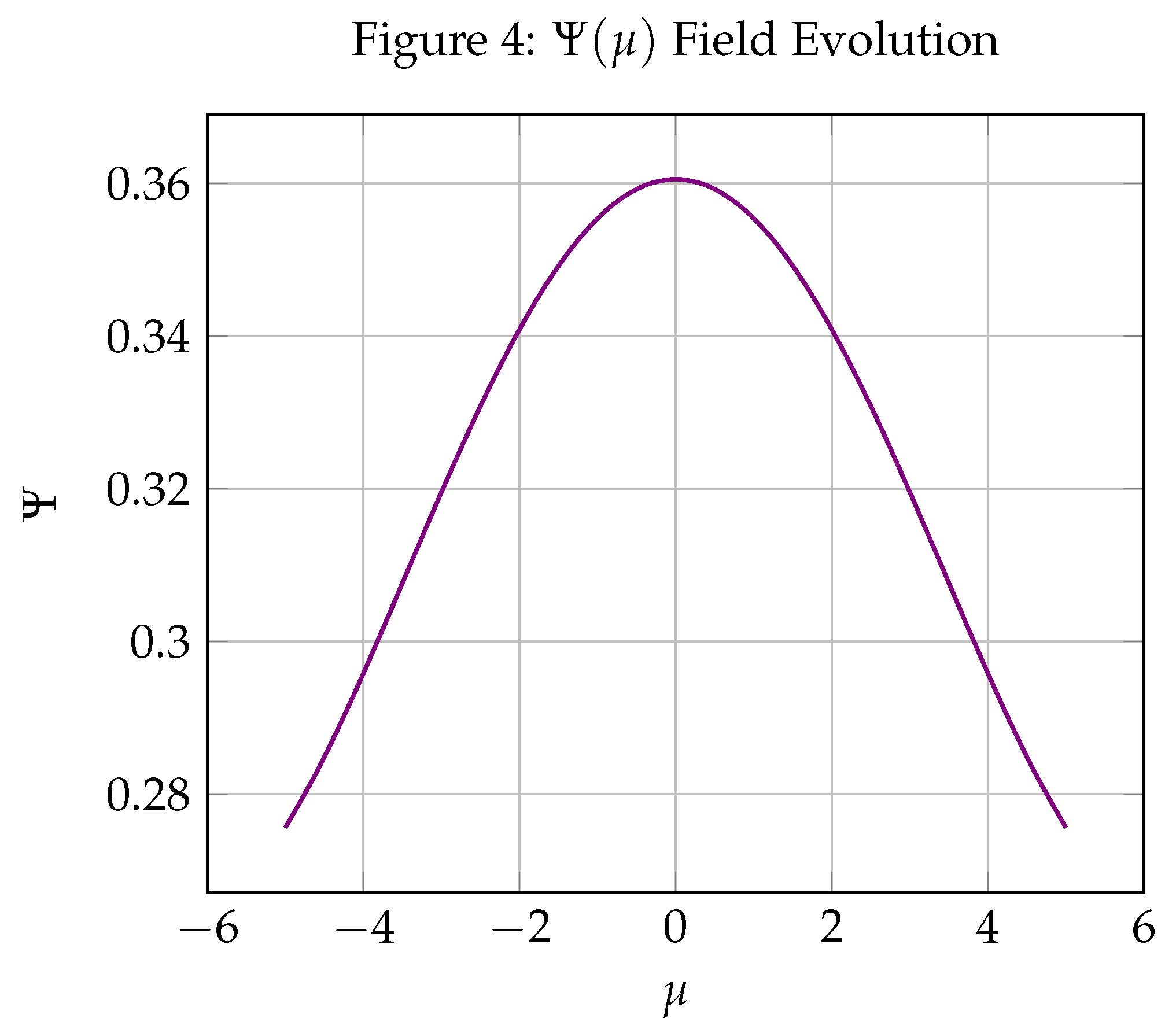
Figure 5.
Effective curvature scalar evolution.
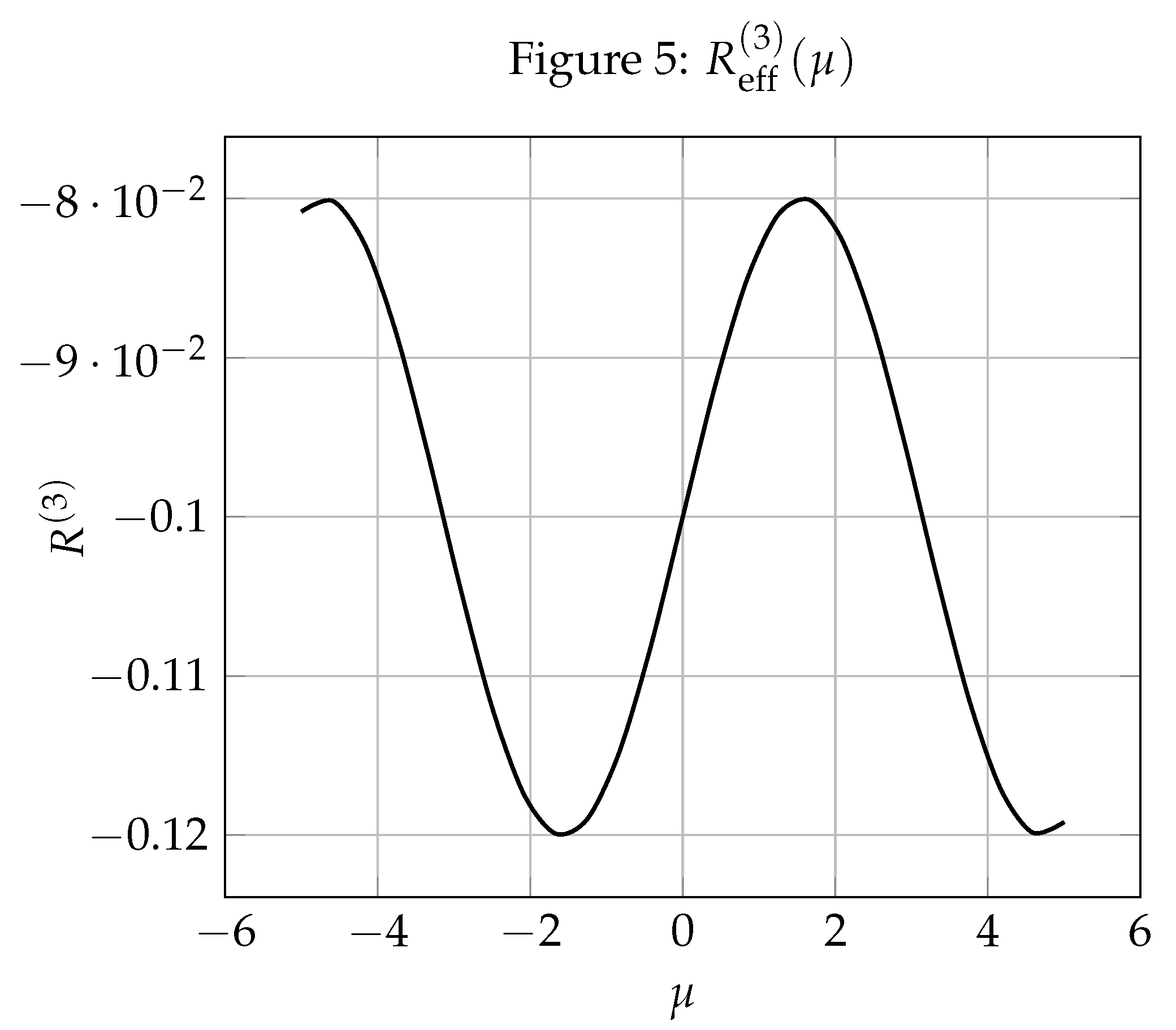
Figure 6.
Collective coherence flux across scale.
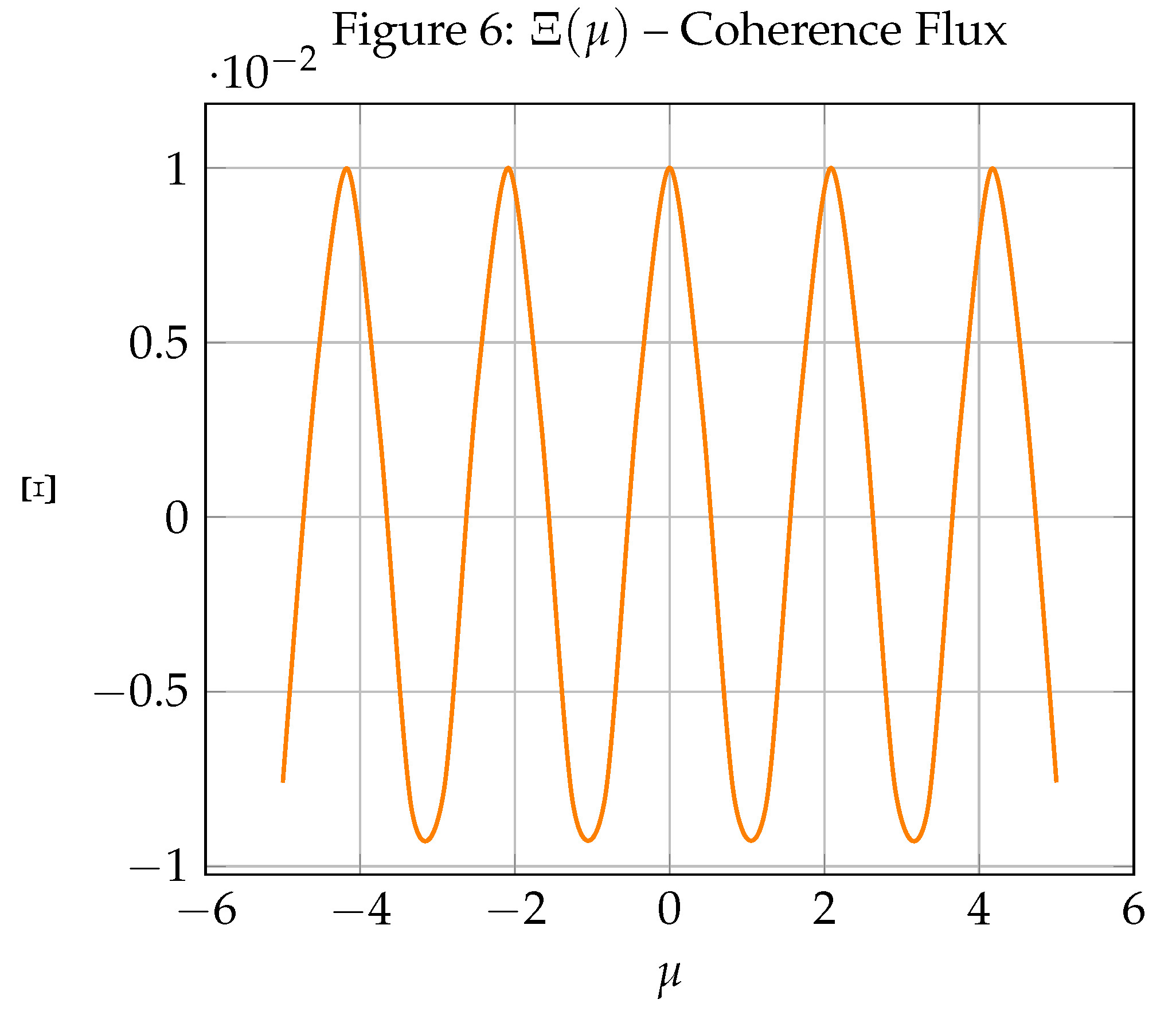
Figure 7.
Curvature flow—first derivative validation.
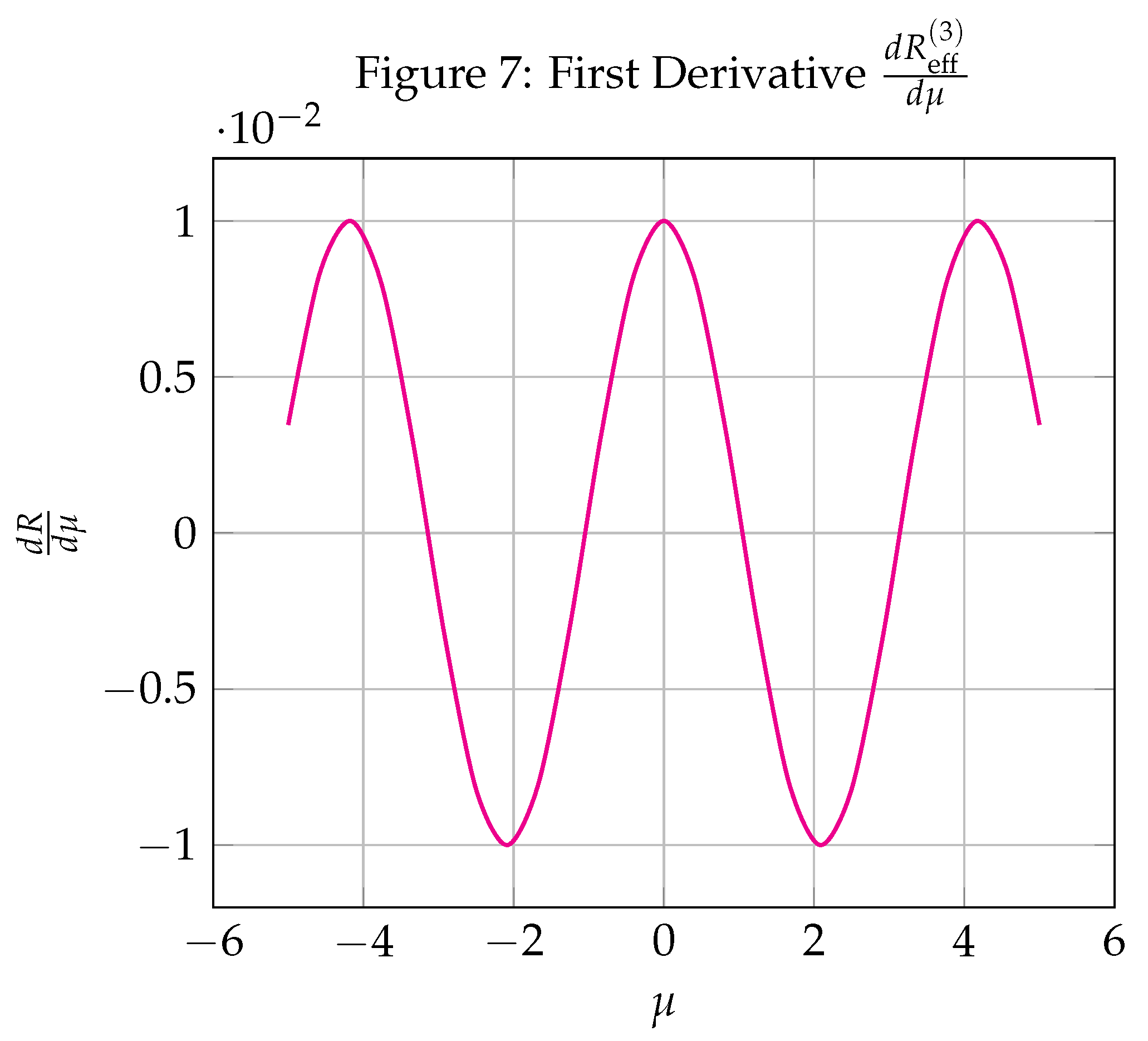
Figure 8.
Streamline-style sketch of RG flow in reduced phase space.
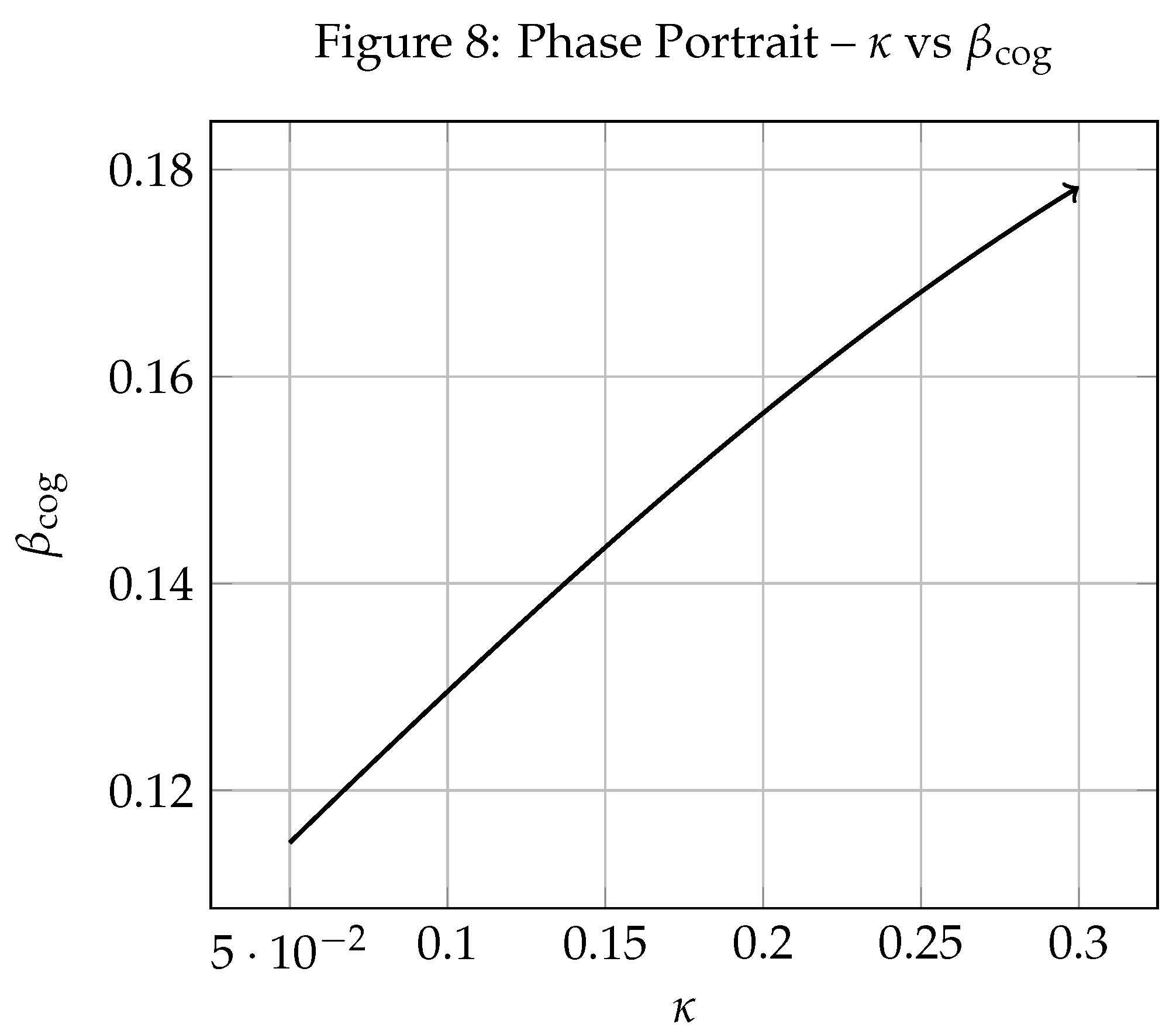
Figure 9.
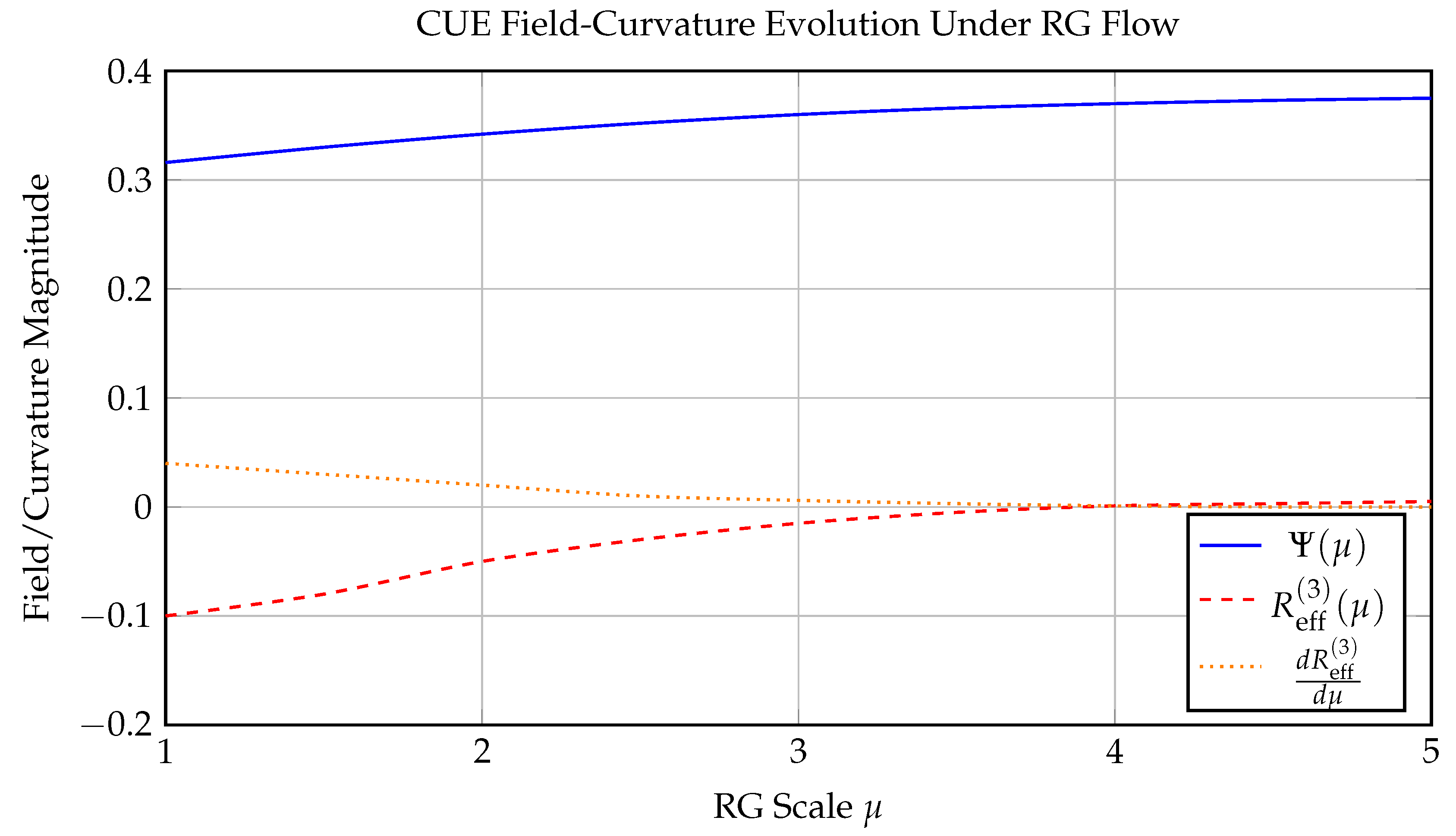
Overlay of coherence field , effective curvature , and its first derivative, across RG scale . Shows coherence-driven curvature evolution and stabilization.
Figure 9.
Overlay of coherence field , effective curvature , and its first derivative, across RG scale . Shows coherence-driven curvature evolution and stabilization.
Appendix B: Numerical Computation Summary
The following computed quantities were derived from the CUE simulation within the RG-stabilized regime . All values are dimensionless and correspond to normalized units unless otherwise stated.
Notes:
- All results correspond to numerically stable points derived from interpolated RG flow data.
- Quantities involving , , and were computed assuming constant , , and calibration constants normalized to unity for model simplification.
- The eigenvalues suggest a saddle-type fixed point with one stable and two unstable directions.
Appendix C: Theoretical Extensions for Experimental and Gravitational Impact
To enhance the physical interpretability and potential empirical relevance of the Collective Unified Equation (CUE) framework, we outline three extensions: dimensional scaling, tensor generalization, and identification of measurable observables.
Appendix C.1 Dimensional Analysis in Planck Units
While the CUE framework operates in normalized units, dimensional consistency can be restored by introducing appropriate Planck-scale factors. Let , , and denote units of length, time, and mass, respectively.
Dimensional scaling facilitates embedding the model into quantum gravity units by defining:
This allows the RG scale to represent a physically interpretable energy flow from quantum to classical regimes.
Appendix C.2 Tensor Embedding of the Ψ Field
To extend the model into covariant general relativity formalisms, we promote the scalar coherence field to a rank-2 or rank-1 tensor:
where , are basis vectors, and may be interpreted as a proto-geometric coherence scalar. The coupling term in generalizes to:
suggesting a curvature contribution from coherence anisotropies and geometric alignment. This may allow future embedding in Einstein–Cartan or metric-affine formulations.
Appendix C.3 Experimental Proxy Candidates
While the , , and fields are theoretical constructs, their behaviors may be mirrored in analog or condensed matter systems. We propose the following proxies:
- Proxy for : Coherence amplitude or phase in quantum optical fields; e.g., temporal width of interference fringes in Bose–Einstein condensates (BECs) or squeezed light states.
- Proxy for : Inverse correlation length in topological insulators or curvature defect density in metamaterials.
- Proxy for : Von Neumann entropy in entangled qubit arrays, or thermodynamic entropy change in near-critical superfluid transitions.
- RG scale : System temperature or control parameters (pressure, magnetic field) used to tune coherence and entanglement in material systems.
Establishing such analogs can bridge the gap between abstract field theories and testable condensed matter or quantum simulation platforms.
Outlook: These extensions provide a roadmap for mapping theoretical curvature emergence to observable coherence phenomena, allowing CUE-based quantum gravity to be experimentally approximated in controlled environments.
Appendix D: Numerical Simulation Strategy for Tensorial Coherence Field
To extend the CUE framework into covariant and geometrically rich domains, we promote the scalar field to a tensorial structure . The goal of this appendix is to outline the computational pipeline for simulating its dynamics under RG flow, curvature interaction, and entropic modulation.
Appendix D.1 Tensor Field Definition and Initialization
We define as a second-rank, scale-dependent tensor:
where:
- evolves via the CUE flow equations.
- are orthonormal field basis vectors sampled across spacetime grid points.
- is a 4D coordinate grid over a compact domain (e.g., , ).
The scalar field is then recovered via the contraction:
D.2 Discretization Scheme
We discretize spacetime and RG scale via finite volume or finite difference methods:
- for temporal and spatial indices.
- , sampled logarithmically or linearly depending on the RG sensitivity.
Each tensor component is updated according to an evolution equation incorporating curvature and entropic feedback.
D.3 Evolution Equation for Ψ b a
We adopt a generalized flow:
where:
- are effective connection coefficients (e.g., from curvature gradients),
- is the covariant derivative approximated via central differences or spectral methods,
- The last term encodes coherence–curvature feedback.
D.4 Simulation Pipeline
- Initialize and using normalized Gaussian or sinusoidal modes.
- Evolve via the CUE differential equation system.
- Compute at each scale using the updated and field basis vectors.
- Apply curvature feedback via the evolution equation in D.3.
- Extract scalar contraction and plug into curvature equation .
- Repeat until fixed point or stabilization threshold is reached.
D.5 Observable Outputs
From the tensorial simulation, we extract:
- Scalar trace (drives curvature),
- Anisotropic coherence spectrum (eigenvalues of ),
- Tensor norms (used in entanglement interactions),
- Tensor entropy (for holographic comparisons).
D.6 Software and Implementation Note
The simulation may be implemented using:
- NumPy + Numba for fast CPU-based tensor operations.
- JAX or TensorFlow for GPU acceleration and autodiff.
- Qiskit for mapping tensors into qubit-encoded matrices for quantum simulation.
Conclusion: Tensor simulation of the coherence field provides a powerful generalization of the CUE framework. It opens pathways to geometric embeddings, holographic entropy analysis, and anisotropic coherence tracking—key to modeling pre-geometric emergence of spacetime.
Appendix E: Simulation Pseudocode for Tensorial CUE Evolution
The following pseudocode outlines a complete numerical pipeline to simulate the CUE framework with tensorial coherence fields , capturing RG flow, curvature evolution, and coherence feedback.
# Define constants and RG flow parameters
initialize constants A, B, C, D, E, F, a, b, c
initialize Planck scale units if dimensionalized
set RG scale range: mu_list = linspace(mu_start, mu_end, N_mu)
# Initialize field grid over spacetime
define spatial grid (x, y, z) and time grid t
initialize Psi_tensor[a][b][x][y][z] with random basis u^a(x) * v_b(x)
# Set initial coupling values at mu_0
kappa = 0.1
beta_cog = 0.1
alpha_ent = 0.1
# Loop over RG scale mu
for mu in mu_list:
# Step 1: Update RG couplings using ODE integrator
d_kappa = A*kappa - B*kappa^3 + E*beta_cog*alpha_ent
d_beta_cog = C*beta_cog^2 - D*beta_cog + F*kappa*alpha_ent
d_alpha_ent = a*alpha_ent - b*alpha_ent^2 + c*kappa*beta_cog
kappa += d_kappa * delta_mu
beta_cog += d_beta_cog * delta_mu
alpha_ent += d_alpha_ent * delta_mu
# Step 2: Compute scalar coherence field from tensor contraction
for all grid points (t,x,y,z):
Psi_trace[t][x][y][z] = Trace(Psi_tensor[:, :, t, x, y, z])
Psi_norm[t][x][y][z] = FrobeniusNorm(Psi_tensor[:, :, t, x, y, z])
# Step 3: Compute curvature at each point
for all grid points:
R_eff[t][x][y][z] = kappa * (alpha_ent * Psi_trace^2 - chi * Psi_trace)
# Step 4: Evolve Psi_tensor with curvature feedback
for all indices a, b, and grid points:
connection = compute_connection_coefficients()
dPsi_ab = - Gamma^a_cd * Psi_tensor[c][b]
+ alpha_ent * Laplacian(Psi_tensor[a][b])
- chi * delta[a][b] * Psi_trace
Psi_tensor[a][b] += dPsi_ab * delta_mu
# Step 5: Save outputs
store(R_eff, Psi_trace, kappa, beta_cog, alpha_ent)
# Postprocessing:
compute eigenvalues of Psi_tensor at each point
compute RG flow trajectory plots
generate phase portraits and curvature overlays
fit chi via Bayesian optimization on dR/dmu residuals
#compute
{\Xi}
{\Delta}
{\Upsilon}
scalar invariants
Key Highlights:
- All coupling flows and tensor updates are performed within the RG loop.
- Tensor contractions yield scalar curvature-driving quantities.
- Covariant derivatives are approximated using finite differences or spectral methods.
- Scalar invariants , , and can be computed after the loop as diagnostics.
This pseudocode is general enough to implement in Python, Julia, or C++ with scientific computing libraries. For quantum simulation backends, can be mapped onto operator matrices over qubit registers for real-time coherence tracking.
References
- Ambrosius, K. (2025). The Collective Unified Equation (CUE): A Theoretical Integration of Coherence, Curvature, and Consciousness.
- Weinberg, S. (1979). Ultraviolet divergences in quantum theories of gravitation.
- Wetterich, C. (1993). Exact evolution equation for the effective potential. Phys. Lett. B, 301, 90–94.
- Padmanabhan, T. (2014). Emergent gravity paradigm: recent progress.
- Jacobson, T. (1995). Thermodynamics of spacetime: The Einstein equation of state. Phys. Rev. Lett., 75, 1260.
- Verlinde, E. (2011). On the origin of gravity and the laws of Newton. JHEP, 04, 29.
- Zurek, W. H. (2003). Decoherence and the transition from quantum to classical. Rev. Mod. Phys., 75, 715.
- Nielsen, M. A., & Chuang, I. L. (2010). Quantum Computation and Quantum Information.
- Kiefer, C. (2007). Quantum Gravity. Oxford University Press.
- Srednicki, M. (2007). Quantum Field Theory. Cambridge University Press.
- Jaynes, E. T. (1957). Information theory and statistical mechanics. Phys. Rev., 106, 620.
- Gielen, S., & Turok, N. (2016). Perfect quantum cosmological bounce. Phys. Rev. Lett., 117, 021301.
- OpenAI. (2023). GPT-based Symbolic and Numerical Reasoning Frameworks.
- SciPy Team. (2023). Available online: https://scipy.org.
- SymPy Team. (2023). Available online: https://sympy.
- Matplotlib & NumPy Teams. (2023). Available online: https://numpy.
Disclaimer/Publisher’s Note: The statements, opinions and data contained in all publications are solely those of the individual author(s) and contributor(s) and not of MDPI and/or the editor(s). MDPI and/or the editor(s) disclaim responsibility for any injury to people or property resulting from any ideas, methods, instructions or products referred to in the content. |
© 2025 by the authors. Licensee MDPI, Basel, Switzerland. This article is an open access article distributed under the terms and conditions of the Creative Commons Attribution (CC BY) license (http://creativecommons.org/licenses/by/4.0/).
Copyright: This open access article is published under a Creative Commons CC BY 4.0 license, which permit the free download, distribution, and reuse, provided that the author and preprint are cited in any reuse.


