

Submitted:
08 April 2025
Posted:
08 April 2025
You are already at the latest version
Abstract
To fully reveal impacts of agronomic managements on yield-nutrition relationships in maize kernels for micronutrient biofortification while enhancing yields simultaneously, effects of various soil fertilization and drone-based foliar spraying measures were studied. Maize yields and grain Zn concentrations were simultaneously increased by 12.4%-23.0% and 41.4%-110.1%, respectively, in the soil experiment. Soil improvements by the extra-addition of humic acid (HA), bio-organic (BO) and/or Ca-Mg-S-Si fertilizers into the calcareous soil tested increased maize grain Zn concentrations more than Zn alone, with an average increase of 4.7 mg/kg. The combination of soil amendments (HA, HA+BO, HA+BO+Ca-Mg-S-Si) and Zn not only improved maize grain Zn concentrations but also enhanced concentrations of other micro- and macronutrients, mainly including Fe, Mn, Cu, Ca and Na, and even P, K, Mg and B, achieving a co-biofortification of multi-nutritional elements, i.e., “killing many birds with one stone”. Maize grain yields were positively correlated with concentrations of Zn, Fe, Mn, Ca and Mg in the soil experiment. Foliar spraying of Zn, Fe and Se alone or a mixture of them increased maize yields and grain micronutrient concentrations simultaneously. Notably, the drone-based foliar spraying of a mixture of Zn, Fe and Se simultaneously enhanced maize grain yields from 11.5 to 13.9 t/ha by 20.9%, and concentrations of Zn from 18.2 to 28.9 mg/kg by 58.8%, of Fe from 20.4 to 27.5 mg/kg by 34.8% and of Se from 93.7 to 468.1 ug/kg (> the target biofortification value of 150 µg/kg), achieving a co-biofortification of multiple micronutrients. Therefore, a dual-benefit in maize grain yields and micronutrient nutrition could be effectively achieved by appropriate soil micronutrient fertilization and the drone-based foliar micronutrient spraying. These results provide a better understanding on the yield-nutrition relationship of maize and feasible manipulations to achieve a double-win in yield and nutrition rather than the dilution effect.
Keywords:
micronutrient
; dilution effect
; agronomic biofortification
; humic acid
; soil improvement
; foliar spraying
; drone technology
1. Introduction
Maize (Zea Mays L.) is popular as a major food source for both humans and animals, providing around 20% of the world’s calories and 15% of the world’s protein [1]. Facing the challenges of a limited arable land, and continuous population growth and economic development, a substantially increase in maize production is needed to address the increasing demand for food and feed [2,3]. In 2023, David Hula set the world record for the highest maize grain yield of 39.62 t/ha [4]. However, large yield gaps (the potential highest yield - the actual average yield) were observed in most maize planting areas of the world [5]. For example, the current record for the highest maize grain yield in China is 24.95 t/ha, while the average maize grain yield in 2023 of China is only 6.53 t/ha [6]. To achieve self-sufficient in maize production of China by 2030, a yield increase of 52% using current cropping areas was feasible with optimal crop-soil management (cultivar, plant density, fertilization, irrigation, and soil improvement) under future climate change scenarios [7].
Zinc (Zn), iron (Fe) and selenium (Se) are essential/beneficial micronutrients for crops, animals and humans [8,9,10]. However, concentrations of Zn, Fe and Se in maize grains are generally low, particularly in calcareous, alkaline and/or dryland soils with limited micronutrient bioavailability, thus can’t meet the daily nutrition requirements of animals/humans [11,12,13,14,15]. This may be one factor inducing malnutrition of micronutrients, i.e., hidden hunger, which affects the health status of more than one-third of the world population, particularly in developing countries with high proportions of cereal grains as staple foods [16,17,18,19]. Therefore, increasing efforts must be done to increase maize grain yields while simultaneously increase the inherent micronutrient concentrations to end food insecurity and malnutrition by 2030 [20,21].
Unfortunately, the negative correlations between maize grain yields or kernel weights and micronutrient concentrations (particularly for Zn and/or Fe) were frequently observed in previous studies [15,22,23,24]. Breeders have been attempting to develop the high-yielding maize cultivars, unintentionally, the increased content of carbohydrate in high-yielding genotypes may dilute the given concentrations of Zn and Fe in kernels, i.e., “dilution effect” [15,22,25]. Guo et al. [26] found the grain yield of maize increased with the cultivar release year, while the grain Zn concentration significantly decreased in the new-era high-yielding cultivars. Similar phenomena of the “dilution effect” were observed in wheat plants [18,27,28,29,30]. Therefore, the negative trade-off between kernel Zn and Fe concentrations and grain yields was an unavoidable dilemma and challenge for breeders to develop maize varieties with both high grain yield and high nutritional quality [15,31]. Actually, the “dilution effect” of yield-nutrition was paid more attention during breeding but rarely considered in agronomic management practices [15,32]. Whether agronomic management measures, e.g., fertilization and/or soil improvements, can effectively eliminate the negative trade-off between maize yield and grain micronutrient nutrition or not deserves to be noticed and valued.
Previous studies have shown that Zn application to soils can improve grain yields and Zn concentrations simultaneously, particularly in Zn-deficient calcareous soils (with high pH, and low soil organic matter and moisture), indicating a positive cross-talk between yield and grain micronutrient nutrition [33,34,35]. Notably, foliar spraying of Zn is much more effective and much more economically efficient (low dose) than soil application of Zn fertilizer in biofortification of maize grains with Zn [36]. In addition, foliar Zn spraying may also increase maize grain Fe concentrations to some extents, achieving “killing two birds with one stone” [13,36]. Furthermore, foliar spraying of a cocktail solution including Zn, Fe, Se and N effectively biofortified maize grains with these multiple elements simultaneously, without yield penalty [24]. Global meta-analysis and field studies on soil fertilization have demonstrated that moderately increasing nitrogen (N) application rates increases maize yields, and grain N and Zn/Fe concentrations, being termed the “N-Zn/Fe synergism”, but the “P-Zn antagonism” occurs in maize, in which grain Zn concentrations reduce with the increased application rates of phosphorus (P) fertilizer [37,38,39].
Therefore, appropriate applications of micronutrients via soil and foliar spraying in combination with optimal N and P fertilizers may achieve the dual goals of maize yield increase and grain micronutrient biofortification [39]. However, previous researches have mainly focused on the effects of a single element (Zn, Fe, Se, N, or P) or a single agronomic management measure/technology on maize yields and grain micronutrient nutrition, but less on their integration or interactions. In addition, most studies on foliar spraying of micronutrients were conducted using knapsack sprayers or small watering cans with low efficiency and high labor cost [13,24,36]. Thus, there is a clear separation between the experimental work/treatments and farmers’ management practices including the wide application of compound fertilizers, slow/controlled release fertilizers, organic/microbial fertilizers, soil improvement substances, e.g., humic acid (HA), water-fertilizer integration with drip irrigation technology, and modern agricultural drones.
In addition to the above-mentioned Zn, Fe, Se, N, and P, other nutrient elements, including potassium (K), calcium (Ca), magnesium (Mg), manganese (Mn), copper (Cu), boron (B), sodium (Na), and aluminum (Al), also play important roles in determining maize yields, grain nutritional quality and human/animal dietary nutrition [9,30,32,40,41,42]. However, studies on maize grain nutrition focus on less than 3 of these elements in most situations, but not on the whole suite. Consequently, changes of these macro- and micro-nutrients in maize grains, their cross-talks and relationships with maize yields, as affected by various agronomic management practices, are lack of systematic understanding.
In this study, we tried to improve the physico-chemical/biological properties of the calcareous alluvial soil investigated through the addition of Zn, humic acid, bio-organic fertilizer or Ca-Mg-sulfur (S)- silicon (Si) complex fertilizer in the soil fertilization experiment; we conducted drone-based foliar sprays containing different micronutrients (Zn, Fe, Se alone or a mixture of them), and investigated their impacts on (1) maize plant, ear and yield traits; (2) concentrations of grain micronutrients (Se, Zn, Fe, Mn, Cu); (3) concentrations of other nutrients (P, K, Ca, Mg, B, Na, Al) in maize grains; and (4) relationships among the above-mentioned agronomic and grain nutritional traits as affected by soil improvements or foliar sprays. These results would update our understanding on the yield-nutrition relationships among agronomic managements, maize yields and grain nutritional qualities, thus provide feasible solutions to achieve food/feed security (in quantity as well as quality) and biofortification of maize grains with micronutrients to alleviate malnutrition and benefit human/animal health.
2. Materials and Methods
2.1. Study Site
In 2023, the soil and foliar spraying experiments were conducted in Laoling City and Binzhou City, respectively. Both sites are located in northwest of Shandong Province, China. The area has cold and dry winter and spring, and a rainy and hot summer, representing a typical climate of continental and warm-temperate monsoon. The annual mean temperature is 13.1 °C, the annual frost-free period is 193-201 days, and the annual precipitation is 578.4 mm (with 70% during June-September). Detailed site information are shown in Table 1.
2.2. Experimental Design and Crop Management
For soil fertilization, there were 5 treatments with a single-factor randomized block design and 3 replicates. Detailed fertilization treatments were shown in Table 2. In these treatments (with an exception of the control), the ZnSO4·H2O, the humic acid (organic matter: 85%, Yantai Zhongde Group Co., Ltd., Yantai, China), the bio-organic fertilizer with an effective count of viable bacterial ≥ 200 million cfu/g and an organic matter content ≥ 60% (Shandong Jialifu Fertilizer Technology Co., Ltd., Chiping County, China), or the Ca-Mg-sulfur (S)-silicon (Si) complex fertilizer (CaO: 25.0%, MgO: 8.0%, S: 8.0%, SiO2: 10.0%, Zn: 0.7%, B: 0.5%, Mo: 0.05%, functional substance: 0.05%, Yantai Zhongde Group Co., Ltd., Yantai, China) was used as the basal fertilizer. These fertilizers were all evenly broadcasted in the soil surface and then plowed to a soil depth of 0-20 cm by rotary tillage prior to maize sowing. In addition, for all treatments, the controlled-release formulated fertilizer (N-P2O5-K2O: 28-5-7, Shandong Netlink Agricultural Technology Co., Ltd., Jinan, China) and maize (Zea mays L., cv. ‘Ludan 510’) seeds were sown together by a multifunctional planter, with a row distance of 0.65 m and a plant-plant distance of 0.22 m. Each treatment had a planting area of 700 m2 (7.0 m × 100.0 m).
For foliar spraying, 5 treatments with 3 replicates were conducted with a single-factor randomized block design. The five treatments were: (1) spraying of deionized water (CK); (2) spraying of ZnSO4·7H2O (4.0%, w/v); (3) spraying of FeSO4·7H2O (4.0%, w/v); (4) spraying of Na2SeO3 (0.2%, w/v); (5) spraying of ZnSO4·7H2O (4.0%, w/v), FeSO4·7H2O (4.0%, w/v) and Na2SeO3 (0.2%, w/v) in combination. All sprays contained TWEEN 20 (0.01%, v/v) as a surfactant. For each treatment, each time a dosage of 75 L/ha was sprayed to an area of 1320 m2 (44 m × 30 m) using an agricultural drone (DJI AGRAS T30, DJI Agriculture, Shenzhen, China). All treatments received four times of foliar spraying. The spraying was conducted for the first time at the maize stage of V12 on 9 August, and was repeated at maize stages of R1 (19 August), R2 (4 September) and R3 (20 September), respectively, at 10-16 day intervals. The maize cultivar ‘Zhenghuangnuo No.2’ was planted in this experiment with a row distance of 0.50 m and a plant-plant distance of 0.25 m, and all other agronomic managements (e.g., sowing, soil fertilization and irrigation) were the same for various foliar spraying treatments.
In addition, across the two experiments (soil fertilization and foliar spraying), the preceding crop was winter wheat (Triticum aestivum L.), and maize plants were sown around 25 June and harvested around 15 October, constituting a typical winter wheat-summer maize double cropping rotation system. All plots were properly managed, and no obvious abiotic (heat, drought, waterlogging, lodging, etc.) and biotic (disease, pests, weeds, etc.) stresses were observed during the growing season.
2.3. Plant Sampling and Nutrient Analysis
At maturity, two continuous/adjacent rows of maize with a length of 5.0 m in each plot were manually harvested to determine the grain yield of maize and another six above-ground maize plants of each plot were randomized sampled to determine other agronomic parameters (NKPE: number of kernels per ear, HGDW: hundred grain dry weight, GDWPE: grain dry weight per ear, TDWPP: total dry weight per plant, HI: harvest index, PH: plant height, EH: ear height, SD: stem diameter, ED: ear diameter, EL: ear length, BTL: bald tip length, and the ratio of BTL/EL).
After investigation of the agronomic traits, grain samples were rapidly washed with deionized water, oven-dried at 65 °C for 72 h, and then ground with a stainless-steel grinder. Ground sub-samples were digested with HNO3-H2O2 in a microwave accelerated reaction system (CEM Corp., Matthews, NC, USA). The concentrations of Zn, Fe, Mn, Cu, P, K, Ca, Mg, B, Na and Al in digested solutions were detected by inductively coupled plasma optical emission spectroscopy (ICP-OES, AvioTM 200, PerkinElmer, Waltham, MA, USA). The grain Se concentration was detected by the ICP Mass Spectrometer (ICP-MS, NexION® 1000, PerkinElmer, Waltham, MA, USA). Two blanks and a certified reference grain sample (IPE182, Wageningen University, the Netherlands) were included in each digestion batch to ensure the analytical quality.
2.4. Statistical Analysis
The data of each experiment was subjected to one-way analysis of variance (ANOVA) by The SAS System for Windows V8 (SAS Institute Inc., Cary, NC, USA) and means were compared at the probability level of 0.05 (p ≤ 0.05) using Fisher’s protected least significant difference (LSD). Pearson’s correlation analysis (correlation plot) and principal component analysis (PCA) were conducted by OriginPro 2021 (OriginLab Corp., Northampton, MA, USA).
3. Results
3.1. Maize Grain Yields and Plant Agronomic Traits
Plant height, ear height, bald tip length, and the ratio of bald tip length/ear length were all not significantly affected by soil fertilization (Table 3). The grain yields were increased from 11.3 t/ha in the control to 12.7~13.9 t/ha with Zn addition, with increases of and 12.4~23.0%. There were significant differences between the control treatment and the treatment of Zn+HA or Zn+HA+BO+Ca-Mg-S-Si. The harvest indexes were increased from 0.54 in the control to 0.56~0.59 with Zn addition. There were significant differences between the control treatment and the treatment of Zn or Zn+HA+BO. The control treatment had the lowest NKPE, HGDW, GDWPE, TDWPP, SD, ED, and EL, which were significantly lower than treatments with Zn addition in most situations, and the treatment of Zn+HA+BO+Ca-Mg-S-Si had the maximum values for these parameters. Values of HGDW, TDWPP, SD, ED, and EL were generally in the order of CK <. Zn <. Zn+HA <. Zn+HA+BO <. Zn+HA+BO+Ca-Mg-S-Si. Significant differences among various Zn addition treatments were only observed in the parameter of HGDW (Table 3).
The drone-based foliar spraying of micronutrient fertilizers significantly increased the grain yield from 11.5 t/ha in the control treatment to 13.2~13.9 t/ha by 14.8~20.9%, the HGDW from 30.3 to 31.2~33.3 g by 3.0~9.9%, the GDWPE from 178.3 to 192.7~203.5 g by 8.1~14.1%, the TDWPP from 339.2 to 361.7~381.9 g by 6.6~12.6%, and the SD from 28.9 to 30.2~32.0 mm by 4.5~10.7% (Table 3). The Zn-containing fertilizers (Zn, Zn+Fe+Se) always had higher values of these five parameters than treatments without Zn addition, i.e., treatments of Fe and Se alone. There were significant differences between treatments of Fe or Se and treatments with Zn addition (Zn alone or a mixture of Zn+Fe+Se) in HGDW, TDWPP and SD. Compared with control, treatments of Se and Zn+Fe+Se increased the ED significantly, and only the treatment of Zn alone increased the EL significantly (Table 3).
3.2. Nutrient Concentrations in Maize Grains
Soil fertilization with Zn addition significantly increased grain nutrient concentrations of Zn from 9.9 mg/kg in the control treatment to 14.0~20.8 mg/kg by 41.4~110.1%, of Fe from 16.8 to 20.4~23.7 mg/kg by 21.4~41.1%, of Mn from 2.4 to 2.84~3.9 mg/kg by 18.3~62.5%, of Cu from 1.4 to 3.3~3.5 mg/kg by 135.7~150.0%, of K from 3.6 to 4.4~4.5 g/kg by 22.2~25.5%, of Ca from 66.5 to 92.1~152.4 mg/kg by 38.5~129.2%, of Mg from 0.9 to 1.0~1.3 g/kg by 11.1~44.4%, and of Na from 3.0 to 8.6~15.2 mg/kg by 186.7~406.7%, with maximum values observed in the treatment of Zn+HA+BO+Ca-Mg-S-Si in most situations (Table 4). Among all these parameters, except for Mn and Mg, the treatment of Zn+HA or Zn+HA+BO had relatively higher values than the treatment of Zn alone. Compared with the control treatment, the grain P and B concentrations were significantly increased only by the treatment of Zn+HA+BO+Ca-Mg-S-Si. There were no significant differences in grain Al concentrations among different soil fertilization treatments (Table 4).
For the drone-based foliar spraying of micronutrients, the grain Se concentrations were dramatically increased from 93.7 µg/kg in the control treatment to 803.1 µg/kg by 757.1% in the treatment with Se alone and 468.1 µg/kg by 399.6% in the treatment with a mixture of Zn+Fe+Se (Table 4). Foliar spraying of Zn alone and a mixture of Zn+Fe+Se significantly increased the grain Zn concentrations from 18.2 mg/kg in the control to 31.2 mg/kg by 71.4% and 28.9 mg/kg by 58.8%, respectively. The grain Fe concentrations were significantly increased from 20.4 mg/kg to 23.9 mg/kg by 17.2% in the treatment with Zn alone, 30.3 mg/kg by 48.5% in the treatment with Fe alone, and 27.5 mg/kg by 34.8% in the treatment with a mixture of Zn+Fe+Se. Grain concentrations of Mn, Cu, Ca, Mg, B, and Al were all not significantly affected by different foliar spraying treatments. Compared to the control, the grain concentrations of P, K, and Na were significantly reduced by foliar spraying of Fe alone (Table 4).
3.3. Principle Component Analysis (PCA) of Maize Yield and Nutritional Traits as Affected by Soil and Foliar Treatments
The PCA demonstrated the data distribution as affected by different soil fertilization treatments (Figure 1a) and by different drone-based foliar spraying treatments (Figure 1b). It revealed a better visualization of the relationships and great variations present among all the yield and nutritional parameters of maize and among various treatments performed on maize (Figure 1). Two principal components accounted for 64.0% (PC1-51.0%, PC2-13.0%) of the total variance of all data from soil fertilization (Figure 1a), and 45.0% (PC1-27.6%, PC2-17.4%) of the total variance of all data from foliar spraying (Figure 1b). Clear separations in data distribution areas were observed among five soil fertilization treatments (Figure 1a), and among five foliar spraying treatments (Figure 1b).
3.4. Relationships among Maize Yield and Nutritional Traits as Affected by Soil and Foliar Treatments
Across all data of soil fertilization treatments, except for SD and GY or EL, and HI and HGDW, SD, ED, or EL, any two of the parameters including GY, NKPE, HGDW, GDWPE, TDWPP, HI, SD, ED, and EL were all positively correlated with each other (Figure 2a). No significant correlations were observed between parameters of PH, EH, BTL, or BTL/EL and other parameters. Except for P, B, and Al, grain nutrient concentrations of Zn, Fe, Mn, Cu, K, Ca, Mg, and Na were all positively correlated with maize yield traits including GY, NKPE, HGDW, GDWPE, TDWPP, SD, ED, and EL in most situations. Except for P, Na, and Al, grain nutrient concentrations of Zn, Fe, Mn, Cu, K, Ca, Mg, and B were all positively correlated with each other in most situations. There were no significantly negative correlations among all investigated parameters (Figure 2a).
Considering all data of the drone-based foliar spraying treatments, parameters of GY, HGDW, GDWPE, and TDWPP were all positively correlated with each other (Figure 2b). The GY was positively correlated with SD. SD, ED, and EL were all positively correlated with HGDW, GDWPE, and TDWPP (with an exception of ED with GDWPE). For Zn, it was positively correlated with HGDW, GDWPE, TDWPP, SD, and EL. The grain Cu concentration was positively correlated with NKPE. Na was negatively correlated with EL, and Al was negatively correlated with GDWPE, TDWPP and Zn. K was positively correlated with P. Mg was negatively correlated with Fe, but positively correlated with P and K (Figure 2b).
4. Discussion
The negative trade-off between maize grain yields and micronutrient concentrations (especially for Zn and Fe) is a giant challenge for breeders to develop biofortified maize varieties [15,22,23,24,25]. Chao et al. [14] identified a Zn transporter ZmYSL2, overexpression of which increased the kernel Zn concentration in maize by 31.6%. Yan et al. [15] identified a gene ZmNAC78, which could increase the Fe concentration in maize kernels while maintaining high yield. However, these genes still need to undergone a long breeding process to develop newly approved varieties, and need a large-scale production verification. Notably, our present study found appropriate soil micronutrient fertilization or foliar micronutrient spraying could effectively achieve a dual-benefit in maize yield and grain micronutrient nutrition rather than a “dilution effect”. For example, maize yields and grain Zn concentrations were simultaneously increased by 12.4%-23.0% and 41.4%-110.1%, respectively, in the soil fertilization experiment, and simultaneously increased by foliar Zn spraying by 18.3% and 71.4%, respectively (Table 3 and Table 4). Maize grain yields were positively correlated with grain concentrations of Zn, Fe, Mn, Ca and Mg in the soil fertilization experiment (p ≤ 0.05), and no significantly negative correlations were observed between grain yields and grain nutrient concentrations in both the soil fertilization and foliar spraying experiments (Figure 2). These results indicated appropriate agronomic management practices rather than the long-term breeding are prompt and feasible solutions to eliminate the negative trade-off of yield-nutrition.
Soil Zn addition may increase the crop yield more than 20%, especially when soil available Zn is low and deficient [43,44]. Wang et al. [36] found Zn application to soil did not improve grain yields of maize in rain-fed calcareous soil. High soil pH and low moisture may limit the availability of Zn and other micronutrients in calcareous soils [45]. Foliar micronutrient spraying may overcome these soil obstacles and improve resistance/tolerance to other abiotic/biotic stresses to effectively supplement the micronutrient demand of plant growth and also contribute to grain micronutrient biofortification [46,47]. This is in agreement with our current study showing a dual-benefit in increasing maize yields and grain micronutrient concentrations simultaneously, as affected by foliar spraying of Zn, Fe and Se alone or a mixture of these three (Table 3 and Table 4). Similarly, Mohsin et al. [48] found the combined or separated application of Zn as seed priming and foliar spraying increased yields and Zn concentrations in maize kernels simultaneously, and there were significantly positive correlations between yields and grain Zn concentrations across all treatments. Our study showed the yield increase was mainly attributed to the increased 100-grain weight, and there were significantly positive correlations between the HGDW and GY in both experiments (Table 3; Figure 2). In addition to Zn application, our study further showed that soil improvements by the addition of humic acid and/or bio-organic fertilizers into the calcareous soil tested increased maize grain Zn concentrations more than Zn alone, with an average increase of 4.7 mg/kg (Table 4). This may be attributed to the higher availability of Zn as a result of improved soil physio-chemical/biological properties caused by these organic matters [49,50,51].
Our previous investigations showed grain concentrations of Zn and Fe averaged 20.1 and 23.0 mg/kg, with the corresponding variable coefficients 10.3% and 23.0%, respectively, among 36 popularized maize varieties in Huanghuaihai Plain of China. However, only one variety had both higher Zn and Fe concentrations than the United States Department of Agriculture (USDA)-recommended 22.1 and 27.1 mg/kg, respectively, indicating an unavoidable challenge in biofortifying Zn and Fe concentrations simultaneously, and this challenge is supposed to be much more difficult than biofortifying only one of these two micronutrients through plant breeding [52]. Promisingly, our study found that the combination of soil amendments (HA, HA+BO, HA+BO+Ca-Mg-S-Si) and Zn not only improved maize grain Zn concentrations but also enhanced grain concentrations of other micro- and macro-nutrients mainly including Fe, Mn, Cu, Ca and Na, and even P, K, Mg and B, achieving a co-biofortification of multi-nutritional elements, i.e., “killing many birds with one stone” (Table 4). There were significantly positive correlations between any two of these above-mentioned nutrient elements in most situations (Figure 2a). Recently, Xu et al. [10] demonstrated that expressing a mutant allele of OAS-TL gene could biofortify multiple essential nutrients (especially sulphur, N, K, Zn and Se) while decrease the accumulation of arsenic in rice grains simultaneously, with little effect on grain yield and plant growth. Our study provides a new effective strategy through soil fertilization rather than the genetic engineering to biofortify multiple essential nutrients in maize grains while improving grain yields simultaneously.
In the present study, in addition to Zn biofortification, foliar Zn spraying also increased the maize grain Fe concentration significantly, achieving a dual-benefit, i.e., “killing two birds with one stone”, although the increase effect on Fe was lesser than on Zn (Table 4). The similar result was also reported in our previous study, in which maize grain Fe concentrations were positively correlated with Zn concentrations [13]. However, foliar Fe fertilization did not improve Zn concentrations in maize kernels. This result is in consistent with the finding of Chao et al. [14] that there is mechanistic divergence in the uploading of Zn and Fe into maize kernels via transporters. Here, grain Se concentrations were not affected by foliar spraying of Zn or Fe, and the foliar spraying of Se did not affect Zn or Fe concentrations in maize kernels, suggesting weak cross-talks between Se and Zn or Fe. Notably, foliar spraying of a mixture of Zn, Fe and Se significantly increased concentrations of these three elements in maize kernels simultaneously, providing another feasible solution rather than plant breeding or genetic engineering to achieve a co-biofortification of multiple micronutrients while improving maize grain yields simultaneously.
Most studies on micronutrient biofortification in maize grains through foliar spraying were implemented using small watering cans or knapsack sprayers, which would hinder the wide adoption by farmers in large areas due to the low work efficiency with high labor costs [13,24,36,53]. Our study innovated to implement the foliar micronutrient spraying on maize plants for grain micronutrient biofortification, i.e., using an agricultural drone (e.g., DJI AGRAS T30, DJI Agriculture, Shenzhen, China) with the suitable spraying dose of micronutrients, which could greatly enhance the work efficiency and achieve the same effect as the traditional foliar spraying method using small watering cans or knapsack sprayers. In the study of Xue et al. [24] using a small watering can, foliar spraying of a cocktail solution simultaneously increased the average grain concentrations of Zn from 13.8 to 22.1 mg/kg by 60.1%, of Fe from 17.2 to 22.1 mg/kg by 28.5%, and of Se from 21.4 to 413.5 µg/kg (> the target biofortification value of 150 µg/kg), without a yield penalty in maize. Comparably, the drone-based foliar spraying of a mixture of Zn, Fe and Se in our current study simultaneously improved maize grain yields from 11.5 to 13.9 t/ha by 20.9%, and concentrations of Zn from 18.2 to 28.9 mg/kg by 58.8%, of Fe from 20.4 to 27.5 mg/kg by 34.8% and of Se from 93.7 to 468.1 ug/kg (> the target biofortification value of 150 µg/kg).
Regarding soil fertilization and foliar spraying, only a mixture spraying of Zn, Fe and Se simultaneously increased maize grain Zn and Fe concentrations to meet the USDA-recommended values of 22.1 and 27.1 mg/kg, respectively; although the gran Se concentration achieved the well-known target biofortification value of 150 µg/kg in this treatment, grain Zn and Fe concentrations are still far below the target bioforification values of 33-38 mg/kg for Zn and 45-60 mg/kg for Fe recommended by the HarvestPlus program [15,24,54,55]. To narrow the gap to meet the target biofortification values of Zn and/or Fe, a comprehensive strategy combing foliar and soil fertilization is needed [18,30,56]. According to our current experimental treatments and results, here we propose an innovated practical integration way for simultaneously achieving maize yield increase and maximizing grain micronutrient (especially for Zn and Fe) concentrations in calcareous soils with high pH and low soil moisture and organic matter (Figure 3). This integration technology is in accordance with previous findings of “N-Zn/Fe synergism” and “P-Zn antagonism” [37,38,39], and the drone-based foliar spraying has great potential to efficiently biofortify multiple micronutrients (e.g., Zn, Fe, Se) simultaneously.
5. Conclusions
Our study demonstrated that a dual-benefit in maize yield and grain micronutrient nutrition rather than a “dilution effect” on micronutrients caused by yield increase could be effectively achieved by appropriate soil micronutrient fertilization or foliar micronutrient spraying. Soil improvements by the extra-addition of humic acid and/or bio-organic fertilizers into the calcareous soil investigated enhanced maize grain Zn concentrations more than Zn alone. Notably, the combination of soil amendments (HA, HA+BO, HA+BO+Ca-Mg-S-Si) and Zn not only enhanced maize grain Zn concentrations but also improved concentrations of other micro- and macro-nutrients, mainly including Fe, Mn, Cu, Ca and Na, and even P, K, Mg and B, achieving a co-biofortification of multi-nutritional elements, i.e., “killing many birds with one stone”. In addition to Zn biofortification, foliar Zn spraying improved the maize grain Fe concentration to some extent simultaneously, achieving a dual-benefit. However, foliar Fe fertilization did not enhance Zn concentrations in maize kernels. Grain Se concentrations were not affected by foliar spraying of Zn or Fe, and the foliar spraying of Se did not affect Zn or Fe concentrations in maize kernels, indicating weak cross-talks between Se and Zn or Fe. Promisingly, the drone-based foliar spraying of a mixture of Zn, Fe and Se, i.e., a micronutrient cocktail, significantly increased concentrations of these three elements in maize kernels simultaneously, providing another feasible solution rather than the above-mentioned integrated soil improvements to achieve a co-biofortification of multiple micronutrients while improving maize grain yields simultaneously. To minimize the gap to meet the target biofortification values of Zn and/or Fe, a comprehensive strategy combing foliar fertilization and soil improvements is needed. The drone-based foliar spraying technology has great potential to efficiently biofortify multiple micronutrients (e.g., Zn, Fe, Se) simultaneously, and should be further upgraded in the future.
Author Contributions
Conceptualization, Y.Z. and H.X.; formal analysis, Q.Z., L.M. and H.X.; investigation, Q.Z., F.W., X.Z. and Q.J.; writing, Q.Z. and H.X.; funding acquisition, H.X. All authors have read and agreed to the published version of the manuscript.
Funding
This work was supported by the National Key R&D Program of China (2023YFD1900600), and the Opening Project of Key Laboratory of Public Nutrition and Health, National Health Commission of the Peoples’ Republic of China (WLKFZ202318).
Institutional Review Board Statement
Not applicable.
Data Availability Statement
The data presented in this study are available on request from the corresponding author.
Acknowledgments
We thank the editor and anonymous reviewers for their valuable comments and suggestions.
Conflicts of Interest
The authors declare no conflicts of interest. The funders had no role in the design of the study; in the collection, analyses, or interpretation of data; in the writing of the manuscript; or in the decision to publish the results.
References
- Nuss, E.T.; Tanumihardjo, S.A. Maize: a paramount staple crop in the context of global nutrition. Compr. Rev. Food Sci. F. 2010, 9, 417–436. [Google Scholar] [CrossRef] [PubMed]
- Tilman, D.; Balzer, C.; Hill, J.; Befort, B.L. Global food demand and the sustainable intensification of agriculture. Proc. Natl. Acad. Sci. USA 2011, 108, 20260–20264. [Google Scholar] [CrossRef]
- Bodirsky, B.L.; Dietrich, J.P.; Martinelli, E.; Stenstad, A.; Pradhan, P.; Gabrysch, S.; Mishra, A.; Weindl, I.; Mouël, C.L.; Rolinski, S.; Baumstark, L.; Wang, X.; Waid, J.L.; Lotze-Campen, H.; Popp, A. The ongoing nutrition transition thwarts long-term targets for food security, public health and environmental protection. Sci. Rep. 2020, 10, 19778. [Google Scholar] [CrossRef]
- Spiegel, B.; Bausch, N.S.; Dinterman, C.; How David Hula grows 600-bushel-plus corn. SuccessfulFarming 2024, CROP NWES. Available online: https://www.agriculture.com/how-david-hula-grows-600-bushel-plus-corn-7526082#:~:text=David%20Hula%20is%20no%20stranger%20to (accessed on 8 October 2024).
- Gerber, J.S.; Ray, D.K.; Makowski, D.; Butler, E.E.; Mueller, N.D.; West, P.C.; Johnson, J.A.; Polasky, S.; Samberg, L.H.; Siebert, S.; Sloat, L. Global spatially explicit yield gap time trends reveal regions at risk of future crop yield stagnation. Nat. Food 2024, 5, 125–135. [Google Scholar] [CrossRef]
- National Bureau of Statistics. Available online: https://www.stats.gov.cn/sj/zxfb/202312/t20231211_1945417.html (accessed on 8 October 2024).
- Luo, N.; Meng, Q.; Feng, P.; Qu, Z.; Yu, Y.; Liu, D.L.; Müller, C.; Wang, P. China can be self-sufficient in maize production by 2030 with optimal crop management. Nat. Commun. 2023, 14, 2637. [Google Scholar] [CrossRef] [PubMed]
- Bailey, R.L.; West, K.P.; Black, R.E. The epidemiology of global micronutrient deficiencies. Ann. Nutr. Metab. 2015, 2, 22–33. [Google Scholar] [CrossRef] [PubMed]
- Rengel, Z.; Cakmak, I.; White, P.J. Marschner’s Mineral Nutrition of Plants, 4th ed.; Academic Press, Elsevier, 2023. [Google Scholar]
- Xu, X.; Sun, S.-K.; Gao, A.; Huang, X.-Y.; Wirtz, M.; Hell, R.; Zhao, F.-J. Biofortifying multiple micronutrients and decreasing arsenic accumulation in rice grain simultaneously by expressing a mutant allele of OAS-TL gene. New Phytol. 2024, 244, 2382–2395. [Google Scholar] [CrossRef]
- Wang, J.W.; Wang, Z.H.; Mao, H.; Zhao, H.B.; Huang, D.L. Increasing Se concentration in maize grain with soil- or foliar-applied selenite on the Loess Plateau in China. Field Crop. Res. 2013, 150, 83–90. [Google Scholar] [CrossRef]
- Moreno-Jiménez, E.; Plaza, C.; Saiz, H.; Manzano, R.; Flagmeier, M.; Maestre, F.T. Aridity and reduced soil micronutrient availability in global drylands. Nat. Sustain. 2019, 2, 371–377. [Google Scholar] [CrossRef]
- Xia, H.Y.; Kong, W.; Wang, L.; Xue, Y.; Liu, W.; Zhang, C.; Yang, S.; Li, C. Foliar Zn spraying simultaneously improved concentrations and bioavailability of Zn and Fe in maize grains irrespective of foliar sucrose supply. Agronomy 2019, 9, 386. [Google Scholar] [CrossRef]
- Chao, Z.-F.; Chen, Y.-Y.; Ji, C.; Wang, Y.-L.; Huang, X.; Zhang, C.-Y.; Yang, J.; Song, T.; Wu, J.-C.; Guo, L.-X.; Liu, C.-B.; Han, M.-L.; Wu, Y.-R.; Yan, J.; Chao, D.-Y. A genome-wide association study identifies a transporter for zinc uploading to maize kernels. EMBO rep. 2022, 24, e55542. [Google Scholar] [CrossRef] [PubMed]
- Yan, P.; Du, Q.; Chen, H.; Guo, Z.; Wang, Z.; Tang, J.; Li, W. Biofortification of iron content by regulating a NAC transcription factor in maize. Science 2023, 382, 1159–1165. [Google Scholar] [CrossRef] [PubMed]
- Welch, R.M.; Graham, R.D.; Cakmak, I. Linking Agricultural Production Practices to Improving Human Nutrition and Health. ICN2 Second International Conference on Nutrition better nutrition better lives, Rome, Italy, November 13-15, 2013. Available online: http://www.fao.org/3/a-as574e.pdf.
- Beal, T.; Massiot, E.; Arsenault, J.E.; Smith, M.R.; Hijmans, R.J. Global trends in dietary micronutrient supplies and estimated prevalence of inadequate intakes. PloS One 2017, 12, e0175554. [Google Scholar] [CrossRef]
- Cakmak, I.; Kutman, U.B. Agronomic biofortification of cereals with zinc: a review. Eur. J. Soil Sci. 2018, 69, 172–180. [Google Scholar] [CrossRef]
- Gashu, D.; Nalivata, P.C.; Amede, T.; Ander, E.L.; Bailey, E.H.; Botoman, L.; Chagumaira, C.; Gameda, S.; Haefele, S.M.; Hailu, K.; Joy, E.J.M.; Kalimbira, A.A.; Kumssa, D.B.; Lark, R.M.; Ligowe, I.S.; McGrath, S.P.; Milne, A.E.; Mossa, A.W.; Munthali, M.; Towett, E.K.; Walsh, M.G.; Wilson, L.; Young, S.D.; Broadley, M.R. The nutritional quality of cereals varies geospatially in Ethiopia and Malawi. Nature 2021, 594, 71–76. [Google Scholar] [CrossRef] [PubMed]
- Fears, R.; ter Meulen, V.; von Braun, J. Global food and nutrition security needs more and new science. Sci. Adv. 2019, 5, eaba2946. [Google Scholar] [CrossRef]
- FAO; IFAD; UNICEF; WFP; WHO. The State of Food Security and Nutrition in the World 2024 – Financing to end hunger, food insecurity and malnutrition in all its forms. Rome, Italy, 2024.
- Bänziger, M.; Long, J. The potential for increasing the iron and zinc density of maize through plant-breeding. Food Nutr. Bull. 2000, 21, 397–400. [Google Scholar] [CrossRef]
- Long, J.K.; Bänziger, M.; Smith, M.E. Diallel analysis of grain iron and zinc density in southern African-adapted maize inbreds. Crop Sci. 2004, 44, 2019–2016. [Google Scholar] [CrossRef]
- Xue, Y.-F.; Li, X.-J.; Yan, W.; Miao, Q.; Zhang, C.-Y.; Huang, M.; Sun, J.-B.; Qi, S.-J.; Ding, Z.-H.; Cui, Z.-L. Biofortification of different maize cultivars with zinc, iron and selenium by foliar fertilizer applications. Front. Plant Sci. 2023, 14, 1144514. [Google Scholar] [CrossRef]
- Brkić, I.; Šimić, D.; Zdunić, Z.; Jambrović, A.; Ledenčan, T.; Kovačević, V.; Kadar, I. Genotypic variability of micronutrient element concentrations in maize kernels. Cereal Res. Commun. 2004, 32, 107–112. [Google Scholar] [CrossRef]
- Guo, S.; Chen, Y.H.; Chen, X.C.; Chen, Y.L.; Yang, L.; Wang, L.F.; Qin, Y.S.; Li, M.S.; Chen, F.J.; Mi, G.H.; Gu, R.L.; Yuan, L.X. Grain mineral accumulation changes in Chinese maize cultivars released in different decades and the responses to nitrogen fertilizer. Front. Plant Sci. 2020, 10, 1662. [Google Scholar] [CrossRef] [PubMed]
- Shewry, P.R.; Pellny, T.K.; Lovegrove, A. Is modern wheat bad for health? Nat. Plants 2016, 2, 1–3. [Google Scholar] [CrossRef]
- Shewry, P.R.; Hassall, K.L.; Grausgruber, H.; Andersson, A.A.M.; Lampi, A.-M.; Piironen, V.; Rakszegi, M.; Ward, J.L.; Lovegrove, A. Do modern types of wheat have lower quality for human health? Nutr. Bull. 2020, 45, 362–373. [Google Scholar] [CrossRef] [PubMed]
- Xia, H.; Wang, L.; Qiao, Y.; Kong, W.; Xue, Y.; Wang, Z.; Kong, L.; Xue, Y.; Sizmur, T. Elucidating the source-sink relationships of zinc biofortification in wheat grains: a review. Food Energy Secur. 2020, 9, e243. [Google Scholar] [CrossRef]
- Xia, H.Y.; Li, X.J.; Qiao, Y.T.; Xue, Y.H.; Yan, W.; Ma, L.; Zhao, Q.Y.; Kong, L.A.; Xue, Y.F.; Cui, Z.L.; van der Werf, W. Dissecting the relationship between yield and mineral nutriome of wheat grains in double cropping as affected by preceding crops and nitrogen application. Field Crop. Res. 2023, 293, 108845. [Google Scholar] [CrossRef]
- Morris, C.E.; Sands, D.C. The breeder’s dilemma—yield or nutrition? Nat. Biotechnol. 2006, 24, 1078–1080. [Google Scholar] [CrossRef]
- Gao, X.; Zhao, Q.; Yuan, N.; Li, X.; Zhang, B.; Zhu, Y.; Kong, L.; Wang, Z.; Xia, H. Appropriate soil fertilization or drone-based foliar Zn spraying can simultaneously improve yield and micronutrient (particularly for Zn) nutritional quality of wheat grains. Agriculture 2024, 14, 1530. [Google Scholar] [CrossRef]
- Orabi, A.A.; Mashadi, H.; Abdallah, A.; Morsy, M. Effect of zinc and phosphorus on the grain yield of corn (Zea mays L.) grown on a calcareous soil. Plant Soil 1981, 63, 291–294. [Google Scholar] [CrossRef]
- Hossain, M.A.; Jahiruddin, M.; Islam, M.R.; Mian, M.H. The requirement of zinc for improvement of crop yield and mineral nutrition in the maize-mungbean-rice system. Plant Soil 2008, 306, 13–22. [Google Scholar] [CrossRef]
- Kanwal, S.; Rahmatullah, A.M.; Ahmad, R. Zinc partitioning in maize grain after soil fertilization with zinc sulfate. Int. J. Agric. Biol. 2010, 12, 299–302. [Google Scholar]
- Wang, J.W.; Mao, H.; Zhao, H.B.; Huang, D.L.; Wang, Z.H. Different increases in maize and wheat grain zinc concentrations caused by soil and foliar applications of zinc in Loess Plateau, China. Field Crop. Res. 2012, 135, 89–96. [Google Scholar] [CrossRef]
- Xue, Y.-F.; Yue, S.-C.; Liu, D.-Y.; Zhang, W.; Chen, X.-P.; Zou, C.-Q. Dynamic zinc accumulation and contributions of pre- and/or post-silking zinc uptake to grain zinc of maize as affected by nitrogen supply. Front. Plant Sci. 2019, 10, 1203. [Google Scholar] [CrossRef]
- Zhang, W.; Zhang, W.; Wang, X.; Liu, D.; Zou, C.; Chen, X. Quantitative evaluation of the grain zinc in cereal crops caused by phosphorus fertilization. A meta-analysis. Agron. Sustain. Dev. 2021, 41, 6. [Google Scholar] [CrossRef]
- Zhao, Q.; Cao, W.; Chen, X.; Stomph, T.J.; Zou, C. Global analysis of nitrogen fertilization effects on grain zinc and iron of major cereal crops. Glob. Food Secur. 2022, 33, 100631. [Google Scholar] [CrossRef]
- Yan, X.; Wu, P.; Ling, H.; Xu, G.; Xu, F.; Zhang, Q. Plant nutriomics in China: an overview. Ann. Bot. 2006, 98, 473–482. [Google Scholar] [CrossRef]
- Posma, J.M.; Garcia-Perez, I.; Frost, G.; Aljuraiban, G.S.; Chan, Q.; Van Horn, L.; Daviglus, M.; Stamler, J.; Holmes, E.; Elliott, P.; Nicholson, J.K. Nutriome–metabolome relationships provide insights into dietary intake and metabolism. Nat. Food 2020, 1, 426–436. [Google Scholar] [CrossRef] [PubMed]
- Xia, H.Y.; Li, X.J.; Qiao, Y.T.; Xue, Y.H.; Yan, W.; Xue, Y.F.; Cui, Z.L.; Silva, J.V.; van der Werf, W. Diversification of wheat-maize double cropping with legume intercrops improves nitrogen-use efficiency: Evidence at crop and cropping system levels. Field Crop. Res. 2024, 307, 109262. [Google Scholar] [CrossRef]
- Cakmak, I.; Kalayci, M.; Kaya, Y.; Torun, A.A.; Aydin, N.; Wang, Y.; Arisoy, Z.; Erdem, H.; Yazici, A.; Gokmen, O.; Ozturk, L.; Horst, W.J. Biofortification and localization of zinc in wheat grain. J. Agric. Food Chem. 2010, 58, 9092–9102. [Google Scholar] [CrossRef]
- Cakmak, I.; Pfeiffer, W.H.; McClafferty, B. Biofortification of durum wheat with zinc and iron. Cereal Chem. 2010, 87, 10–20. [Google Scholar] [CrossRef]
- Alloway, B.J. Soil factors associated with zinc deficiency in crops and humans. Environ. Geochem. Health 2009, 31, 537–548. [Google Scholar] [CrossRef]
- Cakmak, I. Role of zinc in protecting plant cells from reactive oxygen species. New Phytol. 2000, 146, 185–205. [Google Scholar] [CrossRef] [PubMed]
- Karim, M.R.; Zhang, Y.Q.; Zhao, R.R.; Chen, X.P.; Zhang, F.S.; Zou, C.Q. Alleviation of drought stress in winter wheat by late foliar application of zinc, boron, and manganese. J. Plant Nutr. Soil Sci. 2012, 175, 142–151. [Google Scholar] [CrossRef]
- Mohsin, A.U.; Ahmad, A.U.H.; Ullah, S. Influence of zinc application through seed treatment and foliar spray on growth, productivity and grain quality of hybrid maize. J. Anim. Plant Sci. 2014, 24, 1494–1503. [Google Scholar]
- Gao, C.; EI-Sawah, A.M.; Ali, D.F.I.; Alhaj Hamoud, Y.; Shaghaleh, H.; Sheteiwy, M.S. The integration of bio and organic fertilizers improve plant growth, grain yield, quality and metabolism of hybrid maize (Zea mays L.). Agronomy 2020, 10, 319. [Google Scholar] [CrossRef]
- Ampong, K.; Thilakaranthna, M.S.; Gorim, L.Y. Understanding the role of humic acids on crop performance and soil health. Front. Agron. 2022, 4, 848621. [Google Scholar] [CrossRef]
- Mahmoud Odah, M.; Makki Naser, K. Effect of humic acid and levels of zinc and boron on chemical behavior of zinc in calcareous soil. J. Environ. Earth Sci. 2024, 6, 143–155. [Google Scholar] [CrossRef]
- Xue, Y.-F.; Zhang, H.; Liu, K.-C.; Xia, H.-Y.; Gao, Y.-B.; Wang, Q.-C.; Wen, L.-Y.; Kong, W.-L.; Zhang, H.-H.; Fu, X.-Q.; Qi, S.-J.; Li, Z.-X. Analysis of major elements in grain of the popularized maize varieties in Huanghuaihai Plain. J. Maize Sci. 2017, 25, 56–62. (In Chinese) [Google Scholar]
- Jiang, X.; Qiao, Y.; Li, X.; Wang, L.; Xue, Y.; Xia, H. Effects of foliar spraying of excessive selenium on yields and contents of selenium and mineral elements of maize. J. Nuclear Agric. Sci. 2021, 35, 2841–2849. (In Chinese) [Google Scholar]
- Bouis, H.E.; Welch, R.M. Biofortification-a sustainable agricultural strategy for reducing micronutrient malnutrition in the global south. Crop Sci. 2010, 50, S20–S32. [Google Scholar] [CrossRef]
- Bouis, H.E.; Hotz, C.; McClafferty, B.; Meenakshi, J.V.; Pfeiffer, W.H. Biofortification: a new tool to reduce micronutrient malnutrition. Food Nutr. Bull. 2011, 32, S31–S40. [Google Scholar] [CrossRef]
- Stangoulis, J.C.R.; Knez, M. Biofortification of major crop plants with iron and zinc - achievements and future directions. Plant Soil 2022, 474, 57–76. [Google Scholar] [CrossRef]
Figure 1.
Principle component analysis (PCA) of effects of soil fertilization (a) and drone-based foliar spraying (b) on various measured parameters of maize plants. In panel (a), CK: control; Zn: ZnSO4·H2O; HA: humic acid; BO: bio-organic fertilizer; Ca-Mg-S-Si: calcium-magnesium-sulfur-silicon complex fertilizer. In panel (b), CK: spraying of deionized water; Zn: spraying of ZnSO4·7H2O; Fe: spraying of FeSO4·7H2O; Se: spraying of Na2SeO3; Zn+Fe+Se: spraying of a mixture of ZnSO4·7H2O, FeSO4·7H2O and Na2SeO3. The abbreviations of measured parameters are: grain yield (GY), number of kernels per ear (NKPE), hundred grain dry weight (HGDW), grain dry weight per ear (GDWPE), total dry weight per plant (TDWPP), harvest index (HI), plant height (PH), ear height (EH), stem diameter (SD), ear diameter (ED), ear length (EL), bald tip length (BTL), and concentrations of selenium (Se), zinc (Zn), iron (Fe), manganese (Mn), copper (Cu), phosphorus (P), potassium (K), calcium (Ca), magnesium (Mg), boron (B), sodium (Na), and aluminum (Al) in maize grains.
Figure 1.
Principle component analysis (PCA) of effects of soil fertilization (a) and drone-based foliar spraying (b) on various measured parameters of maize plants. In panel (a), CK: control; Zn: ZnSO4·H2O; HA: humic acid; BO: bio-organic fertilizer; Ca-Mg-S-Si: calcium-magnesium-sulfur-silicon complex fertilizer. In panel (b), CK: spraying of deionized water; Zn: spraying of ZnSO4·7H2O; Fe: spraying of FeSO4·7H2O; Se: spraying of Na2SeO3; Zn+Fe+Se: spraying of a mixture of ZnSO4·7H2O, FeSO4·7H2O and Na2SeO3. The abbreviations of measured parameters are: grain yield (GY), number of kernels per ear (NKPE), hundred grain dry weight (HGDW), grain dry weight per ear (GDWPE), total dry weight per plant (TDWPP), harvest index (HI), plant height (PH), ear height (EH), stem diameter (SD), ear diameter (ED), ear length (EL), bald tip length (BTL), and concentrations of selenium (Se), zinc (Zn), iron (Fe), manganese (Mn), copper (Cu), phosphorus (P), potassium (K), calcium (Ca), magnesium (Mg), boron (B), sodium (Na), and aluminum (Al) in maize grains.
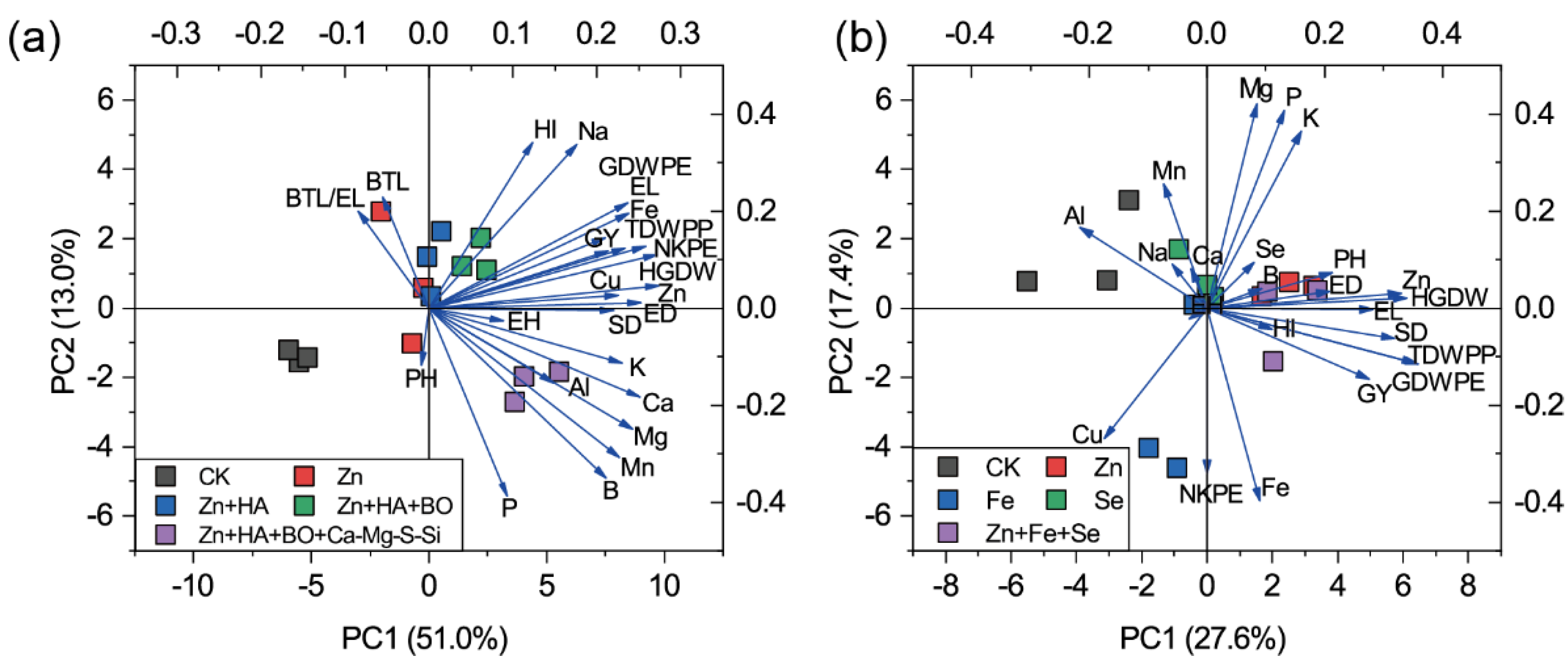
Figure 2.
Correlation plots representing correlations among measured plant, ear, yield and nutritional traits of maize across various soil fertilization treatments (a) and drone-based foliar spraying treatments (b). Positive and negative correlations are displayed in blue and red, respectively. The color legends on the right-hand side show correlation coefficients and corresponding colors. The intensity of the color is proportional to the correlation coefficient, and the ellipse size shows the range of scattered experimental data points. “*”, “**”, and “***” demonstrate significant correlations at p ≤ 0.05, 0.01 and 0.001, respectively. The abbreviations are: grain yield (GY), number of kernels per ear (NKPE), hundred grain dry weight (HGDW), grain dry weight per ear (GDWPE), total dry weight per plant (TDWPP), harvest index (HI), plant height (PH), ear height (EH), stem diameter (SD), ear diameter (ED), ear length (EL), bald tip length (BTL), and concentrations of selenium (Se), zinc (Zn), iron (Fe), manganese (Mn), copper (Cu), phosphorus (P), potassium (K), calcium (Ca), magnesium (Mg), boron (B), sodium (Na), and aluminum (Al) in maize grains.
Figure 2.
Correlation plots representing correlations among measured plant, ear, yield and nutritional traits of maize across various soil fertilization treatments (a) and drone-based foliar spraying treatments (b). Positive and negative correlations are displayed in blue and red, respectively. The color legends on the right-hand side show correlation coefficients and corresponding colors. The intensity of the color is proportional to the correlation coefficient, and the ellipse size shows the range of scattered experimental data points. “*”, “**”, and “***” demonstrate significant correlations at p ≤ 0.05, 0.01 and 0.001, respectively. The abbreviations are: grain yield (GY), number of kernels per ear (NKPE), hundred grain dry weight (HGDW), grain dry weight per ear (GDWPE), total dry weight per plant (TDWPP), harvest index (HI), plant height (PH), ear height (EH), stem diameter (SD), ear diameter (ED), ear length (EL), bald tip length (BTL), and concentrations of selenium (Se), zinc (Zn), iron (Fe), manganese (Mn), copper (Cu), phosphorus (P), potassium (K), calcium (Ca), magnesium (Mg), boron (B), sodium (Na), and aluminum (Al) in maize grains.
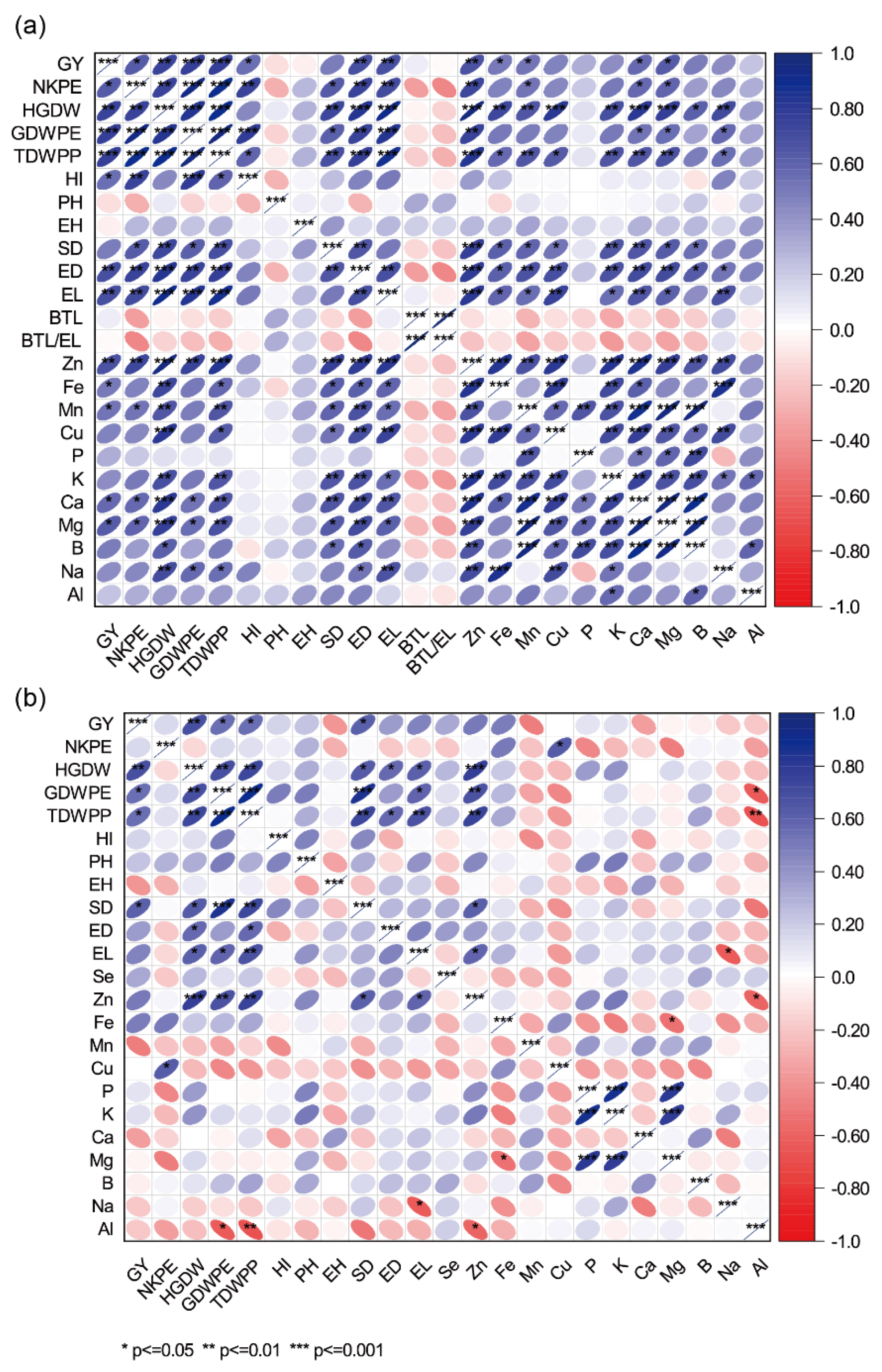
Figure 3.
A schematic diagram demonstrating integrative strategies for achieving maize yield increase and grain micronutrient biofortification simultaneously.
Figure 3.
A schematic diagram demonstrating integrative strategies for achieving maize yield increase and grain micronutrient biofortification simultaneously.
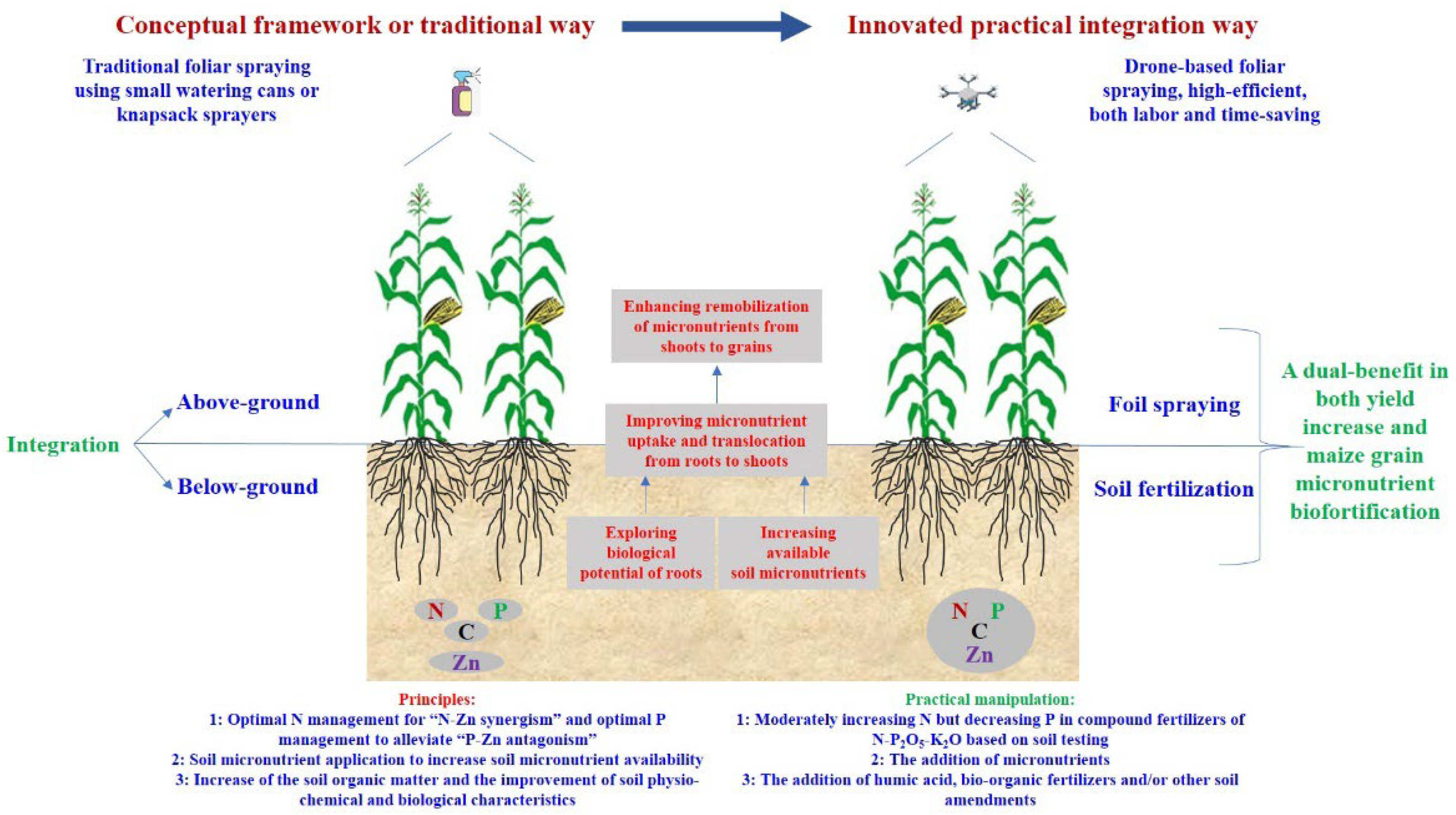

Table 1.
Detailed geographic coordinates and soil basal properties (0-20 cm) prior to maize planting.
Table 1.
Detailed geographic coordinates and soil basal properties (0-20 cm) prior to maize planting.
| Experimental Treatment | Site | Geographic Coordinates | Soil Type |
pH (2.5:1 Water: Soil Ratio) |
Organic Matter (g/kg) |
Total Nitrogen (g/kg) |
Olsen-P (mg/kg) |
Exchangeable K (mg/kg) |
DTPA-Extractable Zn (mg/kg) |
| Soil fertilization | Laoling | 117°0’E, 37°41’N | Calcareous alluvial soil | 8.5 | 13.7 | 1.2 | 29.1 | 133.5 | 0.8 |
| Foliar spraying | Binzhou | 117°50’E, 37°19’N | Calcareous alluvial soil | 8.4 | 15.5 | 1.1 | 21.8 | 108.7 | 0.7 |
Table 2.
Treatments of soil fertilization.
| Treatment | Fertilizer broadcast and rotary tillage (0-20 cm) prior to maize planting | Seed and fertilizer sown together |
| Control (CK) | Rotary tillage with no fertilizer | A controlled-release formulated fertilizer (N-P2O5-K2O: 28-5-7, 600 kg/ha) |
| Zn | ZnSO4·H2O (30 kg/ha) | A controlled-release formulated fertilizer (N-P2O5-K2O: 28-5-7, 600 kg/ha) |
| Zn+humic acid (Zn+HA) | ZnSO4·H2O (30 kg/ha) + humic acid (organic matter: 85%, 750 kg/ha) | A controlled-release formulated fertilizer (N-P2O5-K2O: 28-5-7, 600 kg/ha) |
| Zn+humic acid+bio-organic fertilizers (Zn+HA+BO) | ZnSO4·H2O (30 kg/ha) + humic acid (organic matter: 85%, 750 kg/ha) + a bio-organic fertilizer with an effective count of viable bacterial ≥ 200 million cfu/g and an organic matter content ≥ 60% (1500 kg/ha) | A controlled-release formulated fertilizer (N-P2O5-K2O: 28-5-7, 600 kg/ha) |
| Zn+humic acid+bio-organic+Ca-Mg-S-Si complex fertilizers (Zn+HA+BO+Ca-Mg-S-Si) | ZnSO4·H2O (30 kg/ha) + humic acid (organic matter: 85%, 750 kg/ha) + a bio-organic fertilizer with an effective count of viable bacterial ≥ 200 million cfu/g and an organic matter content ≥ 60% (1500 kg/ha) + a calcium (Ca)-magnesium (Mg)-sulfur (S)-silicon (Si) fertilizer (CaO: 25.0%, MgO: 8.0%, S: 8.0%, SiO2: 10.0%, Zn: 0.7%, B: 0.5%, Mo: 0.05%, functional sub-stance: 0.05%, 300 kg/ha) | A controlled-release formulated fertilizer (N-P2O5-K2O: 28-5-7, 600 kg/ha) |
Table 3.
Plant, ear and yield traits of maize as affected by soil fertilization and drone-based foliar spraying treatments.
Table 3.
Plant, ear and yield traits of maize as affected by soil fertilization and drone-based foliar spraying treatments.
| Experiment | Treatment | GY (t/ha) | NKPE | HGDW (g) | GDWPE (g) | TDWPP (g) | HI | PH (cm) | EH (cm) | SD (mm) | ED (mm) | EL (cm) | BTL (cm) | BTL/EL (%) |
| Soil fertilization |
CK | 11.3b 1 | 544.3b | 31.4d | 179.1b | 332.9b | 0.54b | 265.3a | 93.3a | 30.7b | 49.3b | 16.7b | 1.0a | 6.0a |
| Zn | 12.8ab | 629.7a | 34.2c | 239.8a | 405.2a | 0.59a | 264.2a | 96.8a | 32.2ab | 51.3a | 19.4a | 1.1a | 5.4a | |
| Zn+HA | 13.2a | 617.0a | 35.3b | 232.3a | 408.0a | 0.57ab | 262.0a | 97.7a | 32.2ab | 51.9a | 20.1a | 1.1a | 5.6a | |
| Zn+HA+BO | 12.7ab | 628.7a | 36.3ab | 236.5a | 408.5a | 0.58a | 264.2a | 97.0a | 33.1a | 52.4a | 20.1a | 0.9a | 4.4a | |
| Zn+HA+BO+Ca-Mg-S-Si | 13.9a | 636.7a | 37.0a | 239.1a | 423.7a | 0.56ab | 267.7a | 99.0a | 33.5a | 53.2a | 20.4a | 0.9a | 4.4a | |
| Drone-based foliar spraying |
CK | 11.5b | 602.0a | 30.3d | 178.3b | 339.2c | 0.53a | 248.2a | 110.7a | 28.9c | 50.5c | 16.6b | - | - |
| Zn | 13.6a | 589.7a | 33.3a | 203.5a | 376.3ab | 0.54a | 256.5a | 110.8a | 32.0a | 51.5bc | 17.8a | - | - | |
| Fe | 13.2a | 633.0a | 31.2c | 193.2a | 361.7b | 0.53a | 248.8a | 110.5a | 30.2b | 51.6bc | 17.4ab | - | - | |
| Se | 13.4a | 570.0a | 32.2b | 192.7a | 362.8b | 0.53a | 244.0a | 109.7a | 31.2ab | 52.4ab | 17.0ab | - | - | |
| Zn+Fe+Se | 13.9a | 629.3a | 33.1a | 200.6a | 381.9a | 0.53a | 255.0a | 109.2a | 31.5a | 53.7a | 17.3ab | - | - |
1 Values are means of three replicates. For soil fertilization, CK: control; Zn: ZnSO4·H2O; HA: humic acid; BO: bio-organic fertilizer; Ca-Mg-S-Si: calcium-magnesium-sulfur-silicon complex fertilizer. For foliar spraying, CK: spraying of deionized water; Zn: spraying of ZnSO4·7H2O; Fe: spraying of FeSO4·7H2O; Se: spraying of Na2SeO3; Zn+Fe+Se: spraying of a mixture of ZnSO4·7H2O, FeSO4·7H2O and Na2SeO3. GY: grain yield; NKPE: number of kernels per ear; HGDW: hundred grain dry weight; GDWPE: grain dry weight per ear; TDWPP: total dry weight per plant; HI: harvest index; PH: plant height; EH: ear height; SD: stem diameter; ED: ear diameter; EL: ear length; BTL: bald tip length. Values in each experiment followed by a same lowercase letter in the same column are not significantly different among treatments at p ≤ 0.05.
Table 4.
Nutrient concentrations of maize grains as affected by soil fertilization and drone-based foliar spraying treatments.
Table 4.
Nutrient concentrations of maize grains as affected by soil fertilization and drone-based foliar spraying treatments.
| Experiment | Treatment | Se (µg/kg) | Zn (mg/kg) | Fe (mg/kg) | Mn (mg/kg) | Cu (mg/kg) | P (g/kg) | K (g/kg) | Ca (mg/kg) | Mg (g/kg) | B (mg/kg) | Na (mg/kg) | Al (mg/kg) |
|---|---|---|---|---|---|---|---|---|---|---|---|---|---|
| Soil fertilization |
CK | - | 9.9c 1 | 16.8c | 2.4c | 1.4b | 2.5b | 3.6b | 66.5d | 0.9c | 1.1b | 3.0d | 5.8a |
| Zn | - | 14.0b | 16.9c | 2.9b | 1.4b | 2.4b | 3.8b | 77.1d | 1.0b | 1.2b | 5.9cd | 6.4a | |
| Zn+HA | - | 15.4b | 20.4b | 2.84b | 3.3a | 2.2b | 3.8b | 92.1c | 1.0b | 1.2b | 10.1b | 5.8a | |
| Zn+HA+BO | - | 20.0a | 23.7a | 2.78bc | 3.4a | 2.3b | 4.4a | 107.2b | 1.0b | 1.3b | 15.2a | 6.9a | |
| Zn+HA+BO+Ca-Mg-S-Si | - | 20.8a | 21.3b | 3.9a | 3.5a | 2.9a | 4.5a | 152.4a | 1.3a | 2.1a | 8.6bc | 7.6a | |
| Drone-based foliar spraying |
CK | 93.7c | 18.2b | 20.4c | 5.1a | 3.1a | 3.4a | 6.7a | 194.4a | 1.2a | 3.2a | 31.5a | 7.7a |
| Zn | 73.7c | 31.2a | 23.9b | 4.3a | 2.9a | 3.6a | 6.9a | 202.3a | 1.2a | 3.1a | 25.1ab | 6.5a | |
| Fe | 60.8c | 19.0b | 30.3a | 4.1a | 3.2a | 2.9b | 5.6b | 175.6a | 1.0a | 3.3a | 20.1b | 6.7a | |
| Se | 803.1a | 19.4b | 21.1bc | 4.1a | 2.9a | 3.3ab | 6.6a | 229.9a | 1.1a | 3.4a | 26.5ab | 7.8a | |
| Zn+Fe+Se | 468.1b | 28.9a | 27.5a | 4.4a | 3.1a | 3.5a | 7.0a | 146.4a | 1.1a | 3.4a | 29.1ab | 6.2a |
1 Values are means of three replicates. For soil fertilization, CK: control; Zn: ZnSO4·H2O; HA: humic acid; BO: bio-organic fertilizer; Ca-Mg-S-Si: calcium-magnesium-sulfur-silicon complex fertilizer. For foliar spraying, CK: spraying of deionized water; Zn: spraying of ZnSO4·7H2O; Fe: spraying of FeSO4·7H2O; Se: spraying of Na2SeO3; Zn+Fe+Se: spraying of a mixture of ZnSO4·7H2O, FeSO4·7H2O and Na2SeO3. Values in each experiment followed by a same lowercase letter in the same column are not significantly different among treatments at p ≤ 0.05.
Disclaimer/Publisher’s Note: The statements, opinions and data contained in all publications are solely those of the individual author(s) and contributor(s) and not of MDPI and/or the editor(s). MDPI and/or the editor(s) disclaim responsibility for any injury to people or property resulting from any ideas, methods, instructions or products referred to in the content. |
© 2025 by the authors. Licensee MDPI, Basel, Switzerland. This article is an open access article distributed under the terms and conditions of the Creative Commons Attribution (CC BY) license (https://creativecommons.org/licenses/by/4.0/).
Copyright: This open access article is published under a Creative Commons CC BY 4.0 license, which permit the free download, distribution, and reuse, provided that the author and preprint are cited in any reuse.


