

Submitted:
01 April 2025
Posted:
08 April 2025
You are already at the latest version
Abstract
This paper introduces a unifying geometric framework that models complex systems through conical and funneling structures. By applying this model across quantum mechanics, cosmology, biology, and information theory, we reveal that cones and funnels serve as functional, predictive, and organizing principles in natural systems. The framework demonstrates that compression, collapse, and convergence often follow a shared conical geometry. From black holes and protein folding to the collapse of quantum wave functions, this model offers a simplified and scalable structure for understanding how complexity condenses and flows. This paper aims to stimulate theoretical discussion and cross-domain investigation by reframing complexity through a geometric lens.
Keywords:
Conical Geometry
; Funnel Structures
; Complex Systems
; Quantum Mechanics
; Cosmology
; Information Theory
; Wave Function Collapse
; Entropy and Compression
1. Introduction
Complex systems—ranging from galaxy formation to cellular behavior—are often described using disparate models across disciplines. This paper introduces a unified geometric framework built on the notion that cones and funnels represent essential resolution shapes for gradients, information compression, and field behavior. Inspired by classical geometry and modern observations, this approach does not replace existing models but offers a supplemental lens that identifies recurring structures across scale a.
2. Core Framework
The Faulkner Conical Method posits that three principles underlie the utility of cones in natural systems:
- Directional Collapse: Systems moving from high complexity toward constraint resolve directionally into cones.
- Resolution Geometry: Funnels and cones act as natural intermediaries between fields of high entropy and localized identity.
- Conical Invariance: Across scale, conical forms appear in black holes, tornadoes, vision cones, quantum collapse, and cellular morphogenesis—not as coincidence, but as underlying structural invariants.
3. Cross-Disciplinary Evidence
3.1. Cosmology
Accretion disks and black holes form natural funnels of matter collapse. Space-time itself curves in a conical gradient around gravitational wells. These are not merely artistic representations—they reflect real topological structures.
3.2. Biology
Morphogenesis in plants and cellular budding frequently occur in spiral-cone patterns. Neural attention in humans is modeled by visual cones, and auditory localization often follows a narrowing field of detection.
3.3. Thermodynamics and Entropy
Entropy gradients often express through radial expansion or inward collapse—each following an implied conical path as matter or heat disperses from or resolves toward equilibrium.
3.4. Quantum Mechanics
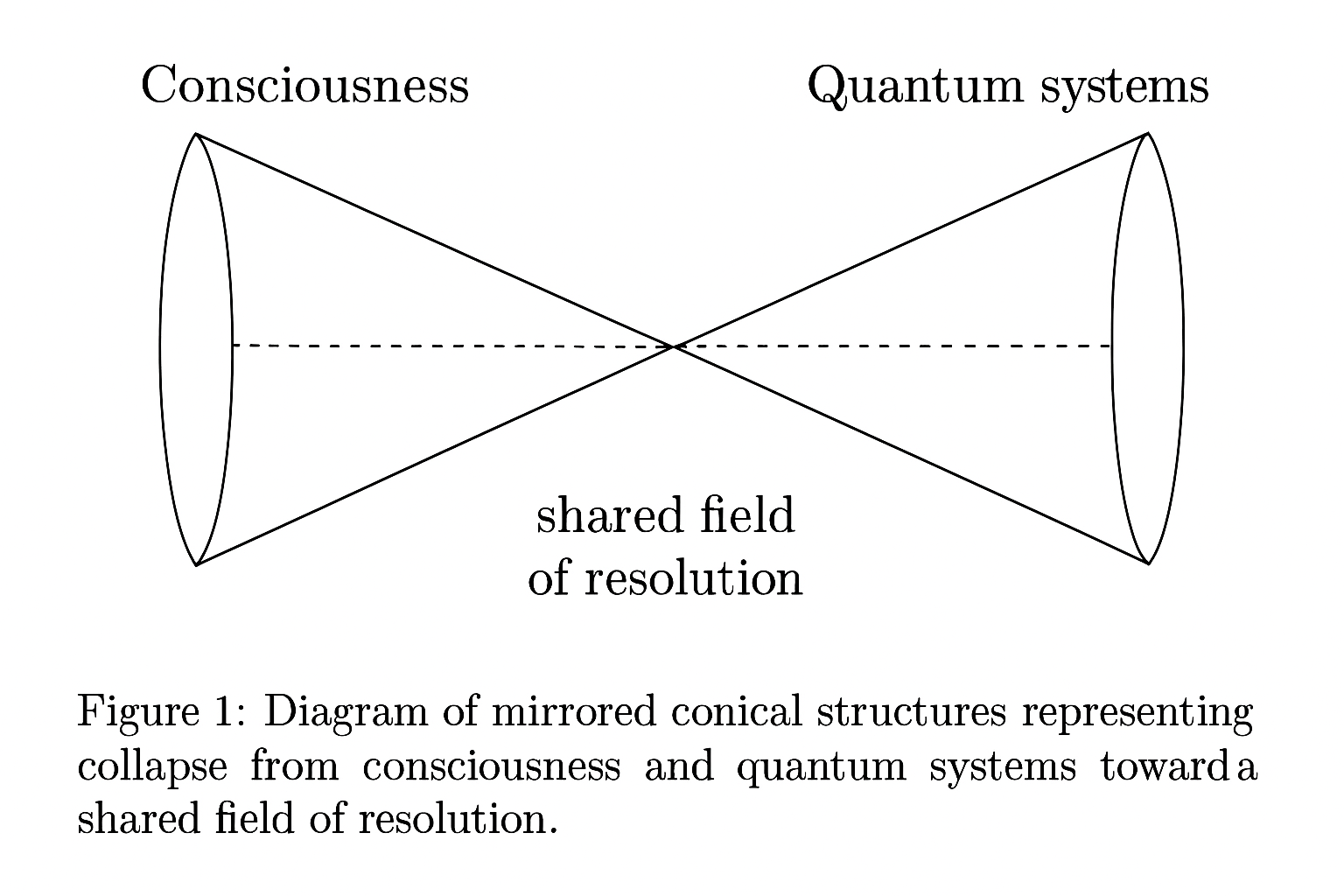
The measurement problem in quantum theory may be interpreted as a collapse into a conical funnel of resolution. Rather than wave function collapse being a drop-off, it may be geometrically directional—forming structured selection paths among entangled states.
4. Discussion
This framework provides not a single equation but a topological mapping tool—cones and funnels become reference shapes across diverse disciplines. The structure invites exploration into:
- Why complexity resolves into conical symmetry
- Whether collapse in quantum, physical, and cognitive systems shares a directional geometric identity
- If the mind’s perception structures emerge from conical filtering of environmental information
5. Conclusions
The Faulkner Conical Method is offered as a new geometric approach to understanding natural complexity. It does not claim to replace existing science but asks whether the commonality of conical forms across scale might reveal a missing universal structure behind collapse, motion, and identity formation. This proposal is intended to inspire further mathematical development and empirical testing.
References
- Penrose, R. Fashion, Faith, and Fantasy in the New Physics of the Universe; Princeton University Press, 2016. [Google Scholar]
- Thorne, K. Black Holes and Time Warps: Einstein’s Outrageous Legacy; W.W. Norton & Company, 1994. [Google Scholar]
- Kieffer, T. Quantum Gravity and the Functional Form of the Universe. Foundations of Physics 2009, 39, 123–137. [Google Scholar]
- Koch, C.; Hepp, K. Quantum mechanics in the brain. Nature 2006, 440, 611–612. [Google Scholar] [CrossRef] [PubMed]
Disclaimer/Publisher’s Note: The statements, opinions and data contained in all publications are solely those of the individual author(s) and contributor(s) and not of MDPI and/or the editor(s). MDPI and/or the editor(s) disclaim responsibility for any injury to people or property resulting from any ideas, methods, instructions or products referred to in the content. |
© 2025 by the authors. Licensee MDPI, Basel, Switzerland. This article is an open access article distributed under the terms and conditions of the Creative Commons Attribution (CC BY) license (http://creativecommons.org/licenses/by/4.0/).
Copyright: This open access article is published under a Creative Commons CC BY 4.0 license, which permit the free download, distribution, and reuse, provided that the author and preprint are cited in any reuse.


