

Submitted:
02 April 2025
Posted:
03 April 2025
You are already at the latest version
Abstract
The refurbishment of school buildings offers the opportunity to reduce energy consumption and carbon emissions, which positively influences the reduction of environmental impact. It is also important to remember to maintain or enhance the comfort of the users of such buildings. This paper presents a systematic review of the state of the art on current trends and low-carbon technical, operational and behavioural methods used in the refurbishment of school buildings in cool temperate climates. This subject matter is positioned at the interface of architecture and environmental engineering. This study identifies the most commonly used active and passive refurbishment methods, as well as the research gaps and problems of applied solutions, and demonstrates the most likely and cost-effective optimisation directions in existing schools.
Keywords:
literature review
; refurbishment
; low-emission schools
; energy-saving equipment and technologies
; zero-carbon building
; carbon neutrality
1. Introduction
The design of climate-neutral buildings has become a crucial direction for the construction sector over the past decade, mainly due to the desire to reduce the production of greenhouse gases, which is a fundamental civilisational challenge. Existing buildings in particular have a very high potential for implementing decarbonisation strategies, due to the elimination of some of the steps involved in erecting structural systems. The average contribution of embodied, operational and demolition-related CO2 emissions over the life cycle of a building is assumed to be, respectively, 24%, 75% and 1% [1]. Using the example of the European Union, it can be estimated that 85% of buildings were constructed before the year 2000, and 75% of them have poor energy performance [2]. This is particularly important in the public buildings sector due to the increasing costs of maintenance and upkeep of outdated buildings. In schools, the comfort of the occupants is another crucial aspect, with a particular focus on internal temperature and lighting to improve student productivity [3]. Maintaining balance between energy performance and comfort is crucial for proper refurbishment, but it is also highly demanding because multi-aspect simulation analysis is necessary. The impact of the different aspects can vary depending on the climate zone in which the building is designed [4]. For buildings in cool and cold temperate climates, the main aspect is to reduce heat loss and protect against cold. In warm and hot climates, the risk of overheating and increased indoor humidity are far more important. Each climate requires different decarbonisation strategies, which is why the review presented in this paper focuses on the cool temperate climate. We should also remember that apart from aspects of energy performance and user comfort, some buildings require greater attention to be paid to conservation and restoration matters. This is also linked to historical, cultural, artistic and societal benefits [5]. The literature review presented here does not include an analysis of the special needs of historic buildings and their impact on decarbonisation strategies.
2. Research Aim
The objective of this study was to analyse solutions that minimise the carbon footprint of school buildings that undergo refurbishment while accounting for their distinctive needs and user determinants. By restricting the query to the cool temperate climate, it was possible to narrow down the research area and to propose dedicated solutions for buildings located, for example, in Central Europe, which is characterised by a school building stock in dire need of refurbishment. A review of the literature identified the most effective interventions, divided into three main categories of intervention: technical, operational and behavioural [6], including both passive and active measures. Of course, national regulations and heritage conservation are not insignificant, but the following analysis does not take these criteria into account. The results of the analysis were intended to serve as the basis for recommendations to support an efficient and sustainable approach to refurbishing school buildings.
3. Materials and Methods
In research, the choice of an appropriate literature review method is crucial to correctly identify research gaps, particularly when dealing with interdisciplinary issues. Due to the broad scope of the subject matter under investigation, which includes issues from the disciplines of architectural engineering and environmental engineering, and the need to include different perspectives, the systematic literature review method was used. This method allows very large information sets from different scientific fields to be reviewed and allows the prioritisation of future research while ensuring the reliability and transparency of the process [7].
3.1. Building Intervention Categories
Building interventions can be divided into three main categories: technical, operational and behavioural, which are characterised by different challenges and possibilities.
Technical interventions based on the renovation, remodelling or refurbishment of a building are characterised by high cost but also contribute the most to lowering the final energy consumption. These can include the use of high-efficiency mechanical ventilation systems with heat recovery, modern energy-efficient pumps, fans, LED lighting or high-performance heat sources. However, the most popular solution is to improve the thermal insulation of the building envelope, which reduces heat loss in winter and limits overheating in summer. Technical interventions can also include the use of renewable energy sources and electric vehicle charging stations.
Operational interventions focus on adapting the management of the building and its various systems to best optimise energy performance and user comfort. The automation of temperature, lighting intensity or the functioning of hybrid ventilation are the most common examples of this type of intervention. However, these can also include water saving and storage systems, or simply regular maintenance and calibration of the systems to enhance their efficiency [8]. BEMS (Building Energy Management System) can be highly useful to control these elements, as can the Digital Twin, which gives a quick diagnosis of problem areas in the systems and the building as a whole [9].
The final category is behavioural interventions, which involve changing the habits of users, which can have a measurable effect in terms of energy savings at potentially low cost. Actions that can be taken in this regard include educational campaigns, incentive programmes and competitions concerning energy and water saving, which, especially for school pupils, can be great form of playing and fostering healthy competition. The main challenge is the required major effort of the school authorities and staff in organising such events.
Alternatively, another division of refurbishment interventions that is often used in the literature features passive and active measures. The two are complementary, but the balance between them depends largely on the local conditions of the building and the financial means of the institution. Passive strategies are based on the physical properties of the building and its surroundings, and the maximum reduction of energy losses without the need for advanced technology. These include improving the insulation and airtightness of the building, optimising glazing and solar gains, utilising thermal mass, natural ventilation and shading systems. Active solutions, on the other hand, mainly focus on the use of advanced equipment and automation of systems in the building. Good examples are the optimisation of HVAC systems, the use of energy-efficient appliances and lighting, building energy management systems (BEMS) and building automation. RES-related solutions should also be mentioned here.
3.2. Selection of Publications
The selection of research publications in the field of school refurbishment was carried out using the Scopus search engine, which is the world’s largest database with more than 90 million records. (https://blog.scopus.com/posts/scopus-now-includes-90-million-content-records Access: 07.02.2025) Keywords used in the first phase of the search include the following phrases: ‘school retrofit’, ‘school modernization’ ‘educational building upgrades’, ‘low-carbon refurbishment’, ‘sustainable school renovation’, ‘energy-efficient school’. The query was limited to the last 20 years, with a particular focus on articles published in the last five years, which account for the majority of the works cited. The review was carried out in December 2024. The search results yielded a total of 1,397 publications, but after an initial screening that included the removal of duplicates, an analysis of titles, keywords and abstracts, the number of publications was reduced to 336. The final stage involved evaluating the full texts for falsifiability, eliminating articles for sites in climates other than those discussed or for newly designed buildings or for a different type of site. The final result was to limit the review to 120 publications. Table 1 shows all case studies published in scientific articles and books, excluding conference publications and strictly technological issues. A total of 49 publications were listed for which the table specifies the geographical area, year of publication, type of analysis performed and subject matter. To classify the country of origin of a publication, the ISO Standard 3166 A-3 (“Country Codes on the Online Browsing Platform (OBP)”. International Organization for Standardization. Archived from the original on 17 June 2016. Retrieved 18 September 2018), which defines the country nomenclature using three letters, was used.
3.3. Publication Analysis
The charts below show various aspects of the publications selected and the quantitative characteristics of the set under analysis. An analysis of the 49 selected publications showed that research into school building refurbishment in cool temperate climates has intensified in recent years, which is undoubtedly linked to the global introduction of legislation on reducing emissions by the construction sector. (Figure 1a)
The subject matter discussed in the studies (Figure 1b) mainly focused on analysing energy consumption (35). Especially in the last few years, the number of studies on thermal comfort (15) and indoor air quality (9) has increased. The issues discussed least frequently, but which were observed to be gaining in importance and are expected to attract the attention of researchers in the coming years, are life-cycle assessment (6) and life-cycle cost (3).
Due to the climate criterion, which considerably limits the research area, it can be said that the majority of studies were carried out in European countries, followed by North America. (USA – 4, CAN – 2) and a few cases from Asia, mainly China (CHN – 3). (Figure 2a) In Europe, the UK lead the way (9) with highly extensive quantitative and qualitative analysis, aided by a well-documented and classified educational building stock. The second-most active European country was Italy (7), but due to the climatic aspect, only its northern part. Should a more broad spectrum of literature analysis be taken, Italian researchers would have been global leaders in term of the number of publications. Polish (6) researchers, in most cases, focused on energy retrofits and indoor air quality solutions, which is related, in the first case, to the limited financial capacity of Polish schools for possible refurbishment interventions and, in the second aspect, to the air pollution in Polish cities and its impact on student performance. A holistic approach to refurbishment and the formulation of dedicated scenarios is undoubtedly a research niche for the whole of Central and Eastern Europe. Here it is worth mentioning the efforts in Germany (3), Austria (3) and Denmark (2), which exemplify this approach. Interest in this subject in Europe is expected grow due to the very large number of school buildings built in the late 20th century, mainly after the Second World War, which require urgent refurbishment.
The articles analysed here were published in 24 different academic journals (Figure 2b), but almost 60% featured one publication each. On the other side of the scale are Energy and Buildings (8), Building and Environment (6), Energies (5) and the Journal of Building Engineering, all of which show a strong interest in the topics discussed. It is also a clear indication to authors who focus on the issue of school refurbishment that key articles are primarily published in journals associated with Elsevier and MDPI.
4. Results – Methods and Strategies for Intervention in Buildings
The results below provide a detailed breakdown of the refurbishment interventions applied and studied in the articles referenced (Table 1) and supplemented in the text by conference proceedings, which are also related to the topic, but were excluded from the main comparison table due to their low depth. In addition, the references were divided by Assessment Type. This will allow researchers who use this distinction to choose between calculated, calculated and measured, and solely measured data. Due to the narrowing of the research field to school buildings in cool temperate climates, some of the advanced solutions and technologies generally used in public buildings are not detailed here. This does not rule out testing such solutions in future studies. In the following compilation, the author also tried to list those alternatives that display potential for use in school facilities.
4.1. Building Envelope Refurbishment
Envelope refurbishment is one of the most frequent intervention in buildings and it is possible to enhance the thermal insulation of partitions by as much as 70%, which significantly improves a building’s energy performance. Insulating the roof with polyurethane (PUR) foam is one of the most effective methods of reducing heat loss [47]. Another key element is the walls, which in most cases are insulated with mineral wool, polystyrene or polyisocyanurate (PIR) panels. It should be noted here that mineral wool has beneficial fire protection properties, which in many countries is a decisive factor in choosing this material. In buildings that undergo refurbishment, especially those under the supervision of a heritage conservation officer, it is often necessary to use special internal insulation systems that do not lead to moisture condensation within the envelope element. When discussing building insulation methods, we should also mention modern insulation materials that are not featured in the articles referenced, but that are used in public and commercial buildings. These are solutions with very high thermal performance, but are used very rarely due to their high cost, difficulty of installation and durability. Vacuum insulation panels (VIP) or phase change materials (PCM) can be used where standard thick insulation is not possible [60]. For example, 2 cm of VIP is capable of replacing 20 cm of mineral wool. Aerogel has much greater economic potential, with the added advantage of being semi-transparent, providing new opportunities for better room insolation.
In many buildings, due to limited costs and a lack of adequate knowledge of building physics, only thermal refurbishment is used, without appropriate adjustments to mechanical or natural ventilation. Studies show that this frequently leads to a deterioration in occupant comfort related to air quality, temperature and humidity [61].
Thermal bridges in existing buildings are often very difficult or in many cases impossible to neutralise. However, due to the high heat losses, which in some cases can increase heating demand by 20%, designers should pay much more attention to minimising their impact on the building [62]. Of course, the spatial calculation of thermal bridges requires the use of sophisticated simulation software and appropriate skills. Project budgets often do not include such analyses, and local laws in many countries do not require them. This, in turn, is an indication that the awareness of designers and project owners should be raised in this regard[63].

Table 2.
Summary of building envelope refurbishment aspects.
| Building Element | Solution | Assessment Type - Refs | ||
| Calculated | Calculated, Measured | Measured | ||
| Walls | Mineral wool (15–25 cm) | [10,15,20,28,33,41,43,45,46,52,58] | [21,27,30,34,35,36,37,39,47] | [40] |
| Styrofoam (12–20 cm) | [11,22,48] | [37,53,54,55] | ||
| PIR insulation panels (10–15 cm) | [34] | [40] | ||
| Roof | Polyurethane (PUR) foam (20–30 cm) | [15,28,33,41,43,45,46,52,58] | [30,39,47,54] | |
| Mineral wool (15–25 cm) | [10,22,48] | [21,53,55] | ||
| Ground floor and foundation | XPS panels (10–15 cm) | [15,46,48] | [30,36,47,55] | |
| Thermal bridges | Elimination of thermal bridges | [28] | [30,35,36] | |
4.2. Improving a Building’s Airtightness
The airtightness of a building has been proven to significantly reduce heating and cooling energy demand. The use of appropriate sealing tapes, plasters and airtight installation of windows and doors is very important and it is one of the cheapest ways to improve energy efficiency. Vacuum and positive pressure tests are required when carrying out construction work. At the time of inspection, it is relatively easy to find problem areas that need to be sealed [64]. It should be mentioned that the sealing of the building must be closely linked to the provision of an adequate system of efficient mechanical ventilation and occupant comfort to avoid deterioration of indoor air quality and excessive humidity that causes mould.
4.3. Window and Door Refurbishment
School buildings require very good daylighting in classrooms. A minimum window-to-floor-area ration is a standard requirement. In Poland, for example, the minimum value is 12.5%, but for educational buildings recommendations are as high as 20–25% [65]. In this case, it is necessary to ensure adequate thermal insulation with triple-glazed windows, combined with an optimal choice of g-value (total solar energy transmission), ensuring a balance between thermal gains from solar radiation and the risk of overheating a room [66]. The appropriate choice of glazing parameters should be preceded by calculations and preferably by a dynamic simulation [67].
Table 4.
Summary of window and door refurbishment aspects.
| Solution | Assessment Type - Refs | ||
| Calculated | Calculated, Measured | Measured | |
| Triple-glazed windows with krypton/argon (U = 0.8–1.2 W/m²K) | [22,26,41,43,45,46,52] | [35,36,37,39,47,54,55] | [40] |
| Low-E windows with reflective coating | [26,52] | [36,47,55] | |
| Anti-draught doors, thermally and acoustically sealed | [46] | [47] | |
4.4. Retrofitting of HVAC Systems (Heating, Ventilation, Air Conditioning)
4.4.1. Heating and Cooling Retrofits
In a cool temperate climate, the key issue is to ensure that the building is correctly heated. In standard buildings, heating energy accounts for up to around 50% of the total energy demand, prompting the use of more efficient systems. Different locations have varying access to energy sources, some of which include natural gas or other fossil fuels, but electricity is an increasingly common medium. A study in Germany showed that the type of energy source can account for 34% of the difference in heating energy consumption [57]. Of course, the cost-effectiveness of different solutions is highly dependent on current market prices, which are directly linked to the geopolitical situation and are difficult to predict. Therefore, it is advised to use renewable energy sources that are available on site, which minimises the shock of possible price spikes. This solution is particularly recommended with all types of heat pumps, which, despite being three or four times more efficient than conventional systems, consume a lot of electricity. Ground source heat pumps with horizontal and vertical collectors make it possible to use soil temperature for both heating and cooling in a highly eco-friendly manner, but due to the area of land needed for the installations and the per-unit price, this solution is often not affordable for school facilities [56]. Regarding the types of heat emitters, it is still standard in refurbished schools to use under-window radiators to reduce the sensation of draught and radiated cold from windows. However, by replacing windows with their energy-efficient triple-glazed versions, this can be dispensed with in favour of more efficient low-temperature or air-source surface heating and cooling [34]. In each of the cases mentioned, smart control of the internal temperature adapted to the users’ preferences is a relatively budget-friendly and mandatory solution [30].
Various technologies related to passive heating and natural ventilation can be found in the literature, which did not appear in the articles under study, but are worth mentioning because of their favourable energy-related characteristics. The Trombe wall is a simple and effective solution for using solar energy to heat buildings. It consists of a high-mass accumulation wall (e.g., made of concrete or brick) and glazing that creates a greenhouse effect. During the day, the wall stores heat and at night it gradually releases it to the interior, stabilising the temperature and reducing energy consumption for heating [68]. Solar chimneys improve indoor air circulation by harnessing the heat of the sun. They consist of a vertical duct with glazing that is heated by the sun. Warm air rises upwards and is removed, creating a vacuum that draws in fresh air from outside. This system improves air quality, reduces humidity and reduces the need for air conditioning [69].
Table 5.
Summary of heating and cooling retrofit aspects.
| Solution | Assessment Type - Refs | ||
| Calculated | Calculated, Measured | Measured | |
| Air-to-air, air-to-water heat pumps (COP = 3.5–4.2) | [10,11,15,16,22,28,38,41,45,48,58] | [27,35,55] | [40] |
| Ground source heat pumps with horizontal or vertical collectors | [37,56] | [32] | |
| Condensing boilers, gas-powered (98% efficiency) | [48,52,57] | [27,36,37,56] | [40] |
| Biomass boilers with heat storage (3000–5000 l buffers) | [30] | ||
| Low-temperature surface heating and cooling | [15] | [34] | |
| Smart temperature controllers in every room | [28,38,41,43,46,48,58] | [25,30,34,36,37,42,50,53] | [32] |
4.4.2. Ventilation
Ventilation in a building plays an extremely important role in terms of ensuring occupant comfort and the indoor environment quality. Classrooms, due to their high density of people, are specifically very vulnerable to dynamic increases in carbon dioxide levels and temperature. A timely response to these changes is crucial, making the installation of sensors to monitor volatile organic compounds (VOCs) and measure temperature invaluable [70]. In educational buildings subjected to a refurbishment, the primary solution is to use natural ventilation due to its low operating costs and ease of application. However, it is mechanical ventilation that is often preferred due to its ability to take advantage of heat recovery and dynamic air mass flow management [49]. In many cases, the most optimal solution is hybrid ventilation, which, under favourable circumstances, is able to exploit the advantages of both strategies. However, the shared element here is the use of automation and real-time control [13].
Table 6.
Summary of ventilation aspects.
| Ventilation Type | Solution | Assessment Type - Refs | ||
| Calculated | Calculated, Measured | Measured | ||
| Mechanical | Installation of heat recovery systems (70–90% recovery) | [11,14,20,28,33,43,45,46,52,58] | [12,27,35,36,44,47,49,50,53,54] | [18,32] |
| Introduction of HEPA and carbon filters to improve air quality | [46] | [49] | ||
| Dynamic airflow management depending on the number of people | [14,46,48] | [25,49,50] | [32] | |
| CO₂, humidity, VOC sensors for automatic ventilation adjustment | [14,16,20,26,46] | [12,25,34,36,47,49,50,54] | [32] | |
| Natural | Optimisation of window placement and opening – determining the most effective ventilation patterns for classrooms | [20] | [13,21,44] | |
| Application of seasonal ventilation strategies – different ventilation strategies in summer and winter | [24] | [13,44] | ||
| Designing windows for natural ventilation (larger ventilation openings, opening top and bottom leaves) | [21] | |||
| Use of underground ventilation ducts with constant flow temperature | [24] | [12] | ||
| CO₂ monitoring in naturally ventilated classrooms | [24] | [44] | ||
| Hybrid | Automatic window control – opening and closing windows in response to CO₂ concentration and temperature | [20] | [12,13,27] | [18] |
| Integration of mechanical ventilation with natural ventilation | [13,27] | |||
4.5. Installation of Building Energy Management Systems (BEMS)
The installation of a BEMS is a key part of optimal building refurbishment due to the ability to control the current control and energy consumption of individual active systems. Furthermore, based on this data, problem areas can be quickly located and appropriate changes made [71]. It is worth mentioning here the potential use of the Internet of Things (IoT) for data collection and potentially sustainable energy management in classrooms. By using inexpensive microcontrollers and sensors to monitor environmental parameters that collect data and then transmit it over a Wi-Fi network, all parameters can be monitored in real time, very conveniently and quickly [72].
Table 7.
Summary of BEMS solutions.
| Solution | Assessment Type - Refs | ||
| Calculated | Calculated, Measured | Measured | |
| Central control of HVAC, heating and lighting | [11,28,31,43,46,48] | [30,34,35,37,47,50,54,55] | [32] |
| Remote monitoring of energy consumption and real-time data analysis | [11,19,28,52] | [35,50,56] | [18,32] |
| Automatic adjustment of energy consumption to the number of users | [31,43] | ||
| Integration of smart algorithms to optimise energy consumption | [20,31] | [30,55] | |
4.6. Lighting Retrofit
Educational buildings have a very high potential for savings through the wise use of daylight and artificial lighting. The primary form of intervention in this case is to replace the lighting fixtures with energy-efficient LEDs [73]. However, by combining this solution with the installation of occupancy sensors in secondary spaces such as corridors, toilets and ancillary rooms, or lighting control tailored to the students’ diurnal rhythm, very significant savings can be achieved. Studies have shown that these savings can be as high as 85%[74]. It is important to remember that retrofitting lighting is not only designed to reduce electricity consumption, but is an excellent opportunity to improve the visual comfort of students and teachers, which can significantly enhance the quality of learning in class and the level of student focus [75].
Table 8.
Summary of lighting retrofit aspects.
| Solution | Assessment Type - Refs | ||
| Calculated | Calculated, Measured | Measured | |
| Replacement of fluorescent lamps with LEDs with variable colour temperature (2700K–5000 K) | [16,19,22,31,45,52] | [23,39,42,50] | [32] |
| Installation of occupancy and daylight sensors | [16,19,31,45,52] | [39,50,54] | [32] |
| Lighting control tailored to pupils’ diurnal rhythm and required intensity | [16,19,43,48] | [23] | [32] |
| Analysis of the effect of lighting on pupils’ concentration (cortisol tests) | [42] | ||
4.7. Installation of Renewable Energy Source-Based Systems (RES)
Due to the mass use of electrically powered equipment in a building, integrated photovoltaic systems are well known and very attractive to the building sector[76]. They are a good solution for schools in particular, which operate mainly during daytime hours to maximise the use of the energy produced. If usage profiles are extended, energy storage facilities or the use of the municipal grid are needed. There are a number of photovoltaic panel technologies under development that differ in application and efficiency, such as PVT, BIPV or perovskites, which are still being extensively researched [77]. There is also the possibility of using wind energy, but the efficiency of small wind turbines is uncompetitive in comparison to photovoltaic cells.
4.8. Passive Cooling and Overheating Reduction Strategies
Undoubtedly, when we consider the inevitability of climate change, building overheating and the need for passive and active cooling strategies are significant problems. Envelope refurbishment combined with insufficient air circulation in natural ventilation leads to an increase in average indoor temperature, which significantly worsens learning quality. Studies show that this can reduce cognitive performance by up to 11.6–25.4%. However, this can be effectively counteracted by installing static or kinetic shading or blinds as shading elements, using highly reflective, light-coloured roof coatings or optimising night ventilation [15]. The use of green roofs can also reduce temperatures during hot days by up to 2–3 degrees [11]. However, we should remember that in areas with a higher heating demand, green roofs may perform worse on final energy consumption than conventional constructions [78]. Therefore, it is important to strike a balance between aspects related to energy consumption and indoor comfort.
Table 10.
Summary of passive cooling and overheating reduction strategies.
| Solution | Assessment Type - Refs | ||
| Calculated | Calculated, Measured | Measured | |
| Green roofs and facades – reducing ambient temperatures by 2–3 °C | [11,26] | ||
| Roofs with a high solar reflectance index (SRI) to reduce overheating | [15] | [21] | |
| Static and automatic roller blinds and sunblinds | [15,16,26] | [23,50] | [18] |
| Optimisation of night-time ventilation – automatic window opening | [15,26] | [23] | |
4.9. Optimisation of Room Layout and Indoor Environment Quality
When refurbishing a building, it is important to bear in mind not only energy performance, but also the potential to rearrange its indoor space. Interventions targeting the envelope that create new space for individual or small group learning spaces allows us to adapt the building to new teaching methods and contemporary education requirements. Optimising daylighting and allowing greater visual contact with nature, increases comfort and improves the well-being of students, ultimately enhancing their performance [49]. Improving acoustic comfort through soundproof windows, appropriate partitions between classrooms and the corridor and interior finishing materials also have a very significant impact on improving the quality of teaching spaces [49].
Table 11.
Summary of layout optimisation and IEQ aspects.
| Solution | Assessment Type - Refs | ||
| Calculated | Calculated, Measured | Measured | |
| Rearrangement of desks for better air circulation | [18] | ||
| Adaptation of classroom layout to teaching methods that facilitate cooperation | [47] | ||
| Improving acoustic insulation of building partitions to reduce noise in classrooms. | [47,49] | ||
4.10. Dynamic Modelling and Energy Performance Analysis
Dynamic simulations, when used professionally, are undoubtedly a key tool that legitimises the selection of refurbishment scenarios and should become a standard in conducting building audits prior to any intervention[79]. In addition, the application of Building Information Modelling (BIM) methodologies to existing buildings opens up a very wide range of possibilities in terms of precision, the inclusion of maintenance history and actual system performance, and subsequent use of this information for energy simulations or life cycle assessment (LCA) [80,81].
Table 12.
Summary of dynamic modelling aspects.
| Solution | Assessment Type - Refs | ||
| Calculated | Calculated, Measured | Measured | |
| Digital simulations in dynamic modelling programmes | [16,22,33,38] | [21,25,34] | |
| Testing of various refurbishment scenarios prior to implementation | [16,20,22,48] | [13,23,37] | [40] |
| Optimisation of refurbishment strategies to maximise savings | [16] | [34] | |
4.11. Building Life Cycle Analysis (LCA) and Carbon Footprint Assessment
A building’s life-cycle analysis is an increasingly important component of the decision-making process in building refurbishment [82]. This is due to the operational carbon and embodied carbon, the latter of which has the greatest impact during the enhancement of thermal parameters in building partitions. The results confirmed that the optimal solution in terms of costs also performs better in terms of environmental payback time. When assessing the payback time of a single intervention, lighting replacement and control automation has the least environmental impact and the quickest payback. Over the long term, attention should definitely be paid to renewable energy generation, which, even when the embedded footprint is taken into account, has a very high carbon footprint reduction [39]. It should be noted that deep refurbishment is not seen as an optimal solution in all countries. Due to the lack of national and local subsidies, it is often cheaper and less technically complicated to demolish an existing building and build a completely new one, which for obvious reasons contradicts the policy of lowering the embedded carbon footprint [83].
Table 13.
Summary of LCA aspects.
| Solution | Assessment Type - Refs | ||
| Calculated | Calculated, Measured | Measured | |
| Sustainable choice of low-CO₂ materials | [10] | [40] | |
| Optimisation of the balance between operational and embedded emissions | [10] | [39] | [40] |
| Analysis of the long-term environmental impact of refurbishment | [10,22] | [39] | [40] |
4.12. Financial Strategies and Analysis of Refurbishment Costs
Many school-owning local authorities, due to their poor financial situation, are forced to assess the cost-effectiveness of refurbishment interventions in a meticulous manner and make use of government subsidies [39,56]. The result of such analyses are bespoke strategies that can vary dramatically depending on priorities and circumstances [84]. A study by Italian researchers shows that, when it comes to schools without mechanical ventilation, the passive measure with the shortest payback time was improving the insulation performance of the building’s roof (9 years) and the replacement of active lighting with LEDs (15 years) [85].
Table 14.
Summary of financial aspects.
| Solution | Assessment Type - Refs | ||
| Calculated | Calculated, Measured | Measured | |
| Simple Payback Time analysis (SPBT) – 7 to 25 years | [38] | [25,30,37,39] | |
| Use of grants and financial support programmes | [48] | [56] | |
| Comparison of energy savings before and after a refurbishment | [25,39,44] | ||
5. Discussion
Given buildings’ immense impact on global greenhouse gas emissions, the natural direction under current regulations is to reduce their embedded and operational carbon footprint as much as possible. In the case of school buildings, this is all the more important as they are maintained with public funds and any savings can be allocated to another publicly useful project. Most research focuses on reducing energy consumption and many of the interventions studied can be standardised, showing the main trajectories a design team should follow. However, we should bear in mind that the design and technology criteria should not only relate to energy performance but also to a much broader spectrum of aspects, related to the individual needs of the building’s users, its location, comfort, historical and cultural context, accessibility to technology and which should be chosen in connection with the available financial resources. These elements contribute to the uniqueness of each project and lead to the conclusion that there is no single universal solution. National and local policy that sets out courses of action for many public bodies, and which varies in advancement from country to country, is critical. Thus, in some countries and regions, specific solutions may be favoured. Incentive and subsidy programmes can dramatically change the optics on the use of particular technical solutions, and shorten the payback period. In Poland, for example, these are mainly programmes related to envelope refurbishment and the use of renewable energy sources, which is visible in the public space, but looking at the broad spectrum of possible refurbishment interventions, it is not a very comprehensive approach. This variation also applies to the issue of decarbonisation itself, as each country has a different energy mix and emission coefficients, so a different approach might be taken in, for example, Canada (Canada is the world’s third-largest producer of hydroelectric power, which accounts for 62% to the nation’s total electricity generation. https://natural-resources.canada.ca/ Access: 15.02.2025), which sources most of its energy from hydroelectric power plants, and quite different in Eastern Europe where a significant proportion of energy still comes from coal-fired power plants. We can therefore conclude that the research field and determining current trends should be narrowed down to the regional context, to a country or province level. Nevertheless, a holistic approach is valid when assessing aspects related to building physics, which for most regions in the climate zone in question work in a similar way. At present, the most authoritative results can be obtained by using the methodologies of various certification schemes such as LEED, BREEAM or Passivhaus [86,87]. In particular, the EnerPhit certification system for retrofitted buildings developed by Passivhaus Institut provides a clear framework and criteria that result in a high-performance and comfortable building for the occupants. (https://passipedia.org/certification/enerphit Access: 15.02.2025) It is a certificate with a long-standing reputation and is confirmed by numerous measurement tests in buildings. However, the use of static and not dynamic simulations is its noticeable downside. Dynamic simulation allows us to make hourly estimates for every parameter and to assess every separate space in a building, which is crucial when assessing user comfort.
Another aspect is climate change, which affects the performance of any building, as well as the comfort of the occupants. In the context of simulations, they should not only be performed for current weather conditions, but also using future weather files that consider the projected climate changes that are likely to occur over the next few decades. This will make it possible to predict whether a building will adapt to new conditions and reduce the need for further costly refurbishment in the future.
The use of renewable energy sources can vary from location to location due to the varying number of sunny days in a year, wind strength, or geographical conditions. In addition, the mere location of a building in a compact urban area or open space is also important in terms of the possibility of sharing the energy produced in a so-called urban energy cluster. The impact of urban space on the thermal comfort of users, the occurrence of urban heat islands, the threat to acoustic comfort generated by traffic, the sheltering from the wind, which consequently affects the local microclimate and energy demand, cannot be overlooked here.
One question that designers, and – perhaps most importantly – project owners – need to ask themselves is the effect they would like to achieve and the investment they are willing to make. This question can be turned around and we can ask about possible strategies and savings that could be attained. Of course, it all depends on the complexity and size of the building intervention. However, sample measurements carried out on five refurbished schools in Germany showed that, with the right choice of interventions, a building energy demand reduction of more than 80% can be achieved [88]. For institutional project owners, this is a very interesting prospect and a significant incentive to incur more costs during refurbishment for subsequent gains for decades to come.
6. Conclusions
This literature review illustrates the very broad spectrum of the issue under study and demonstrates that the topic is socially relevant and therefore develops in a very dynamic way. Our time can be considered a breakthrough period, especially for developed countries, due to the limits and decarbonisation targets imposed on the whole economy and, above all, for the building sector[89]. This makes it necessary to update the state of research every few years. It is impossible to identify a single optimal strategy for refurbishing school buildings, but a few solutions that will work best in most cases. can be highlighted.
- Maximum use of renewable energy sources – this offers the greatest carbon footprint reduction, but is highly dependent on the location of the building and requires energy storage to be fully utilised;
- Upgrading to LED lighting – it is relatively easy to achieve savings this way and the payback time is short;
- Automation and metering – depending on the needs and available resources, it is possible to scale up this intervention, using sensors and automatic systems to regulate temperature, air flow and energy consumption. It not only optimises the performance of the systems, but most importantly ensures the comfort of all users;
- Improving energy performance through technical measures to increase the insulation and airtightness of the building – this is a key aspect to significantly reduce heat loss, but one that requires significant investment and ensuring a comfortable indoor air exchange;
- The use of heat pumps, preferably with horizontal or vertical collectors – this is the most efficient way to provide heat and cooling to a building;
- Hybrid ventilation and passive cooling – this utilises the key strengths of natural and mechanical ventilation with heat recovery, as well as elements to reduce the growing problem of building overheating;
- Dynamic simulations and energy audits – in order to select the best strategies before starting any construction activity, a series of tests should be carried out on a digital model using future weather conditions, taking into account LCA-related matters and the expected payback time.
The unifying element between all these issues is an integrated design approach that takes into account not only energy performance, but also comfort or the design quality of the building. This obligates the designers, especially architects, to include the issue’s interdisciplinarity as a key method to achieving success. In particular, all engineering activity should take place while accounting for current and future models of classroom management, taking into account the potential to meet pedagogical and educational requirements. Empirical studies on testing new technical and material solutions that can verify the approach to some design matters are still highly needed. This could also allow us to better understand and bridge the performance gap we often see between our energy models and actual measurements. Another aspect is a better understanding and application of LCA and LCC analyses, which involves considering a building over its entire life cycle. The modernisation of existing buildings is a unique opportunity to reduce the already high human impact on the environment, and schools are important in that, by their example, they can teach future generations to respect the environment and understand the phenomena within it.
Funding
This research received no external funding.
Conflicts of Interest
The authors declare no conflicts of interest.
Nomenclature
| BIM | Building Information Modeling | LCC | Life Cycle Costing |
| BEMS | Building Energy Management System | LED | Light Emitting Diode |
| BIPV | Building Integrated Photovoltaic | LEED | Leadership in Energy and Environmental Design |
| BREEAM | Building Research Establishment Environmental Assessment Method | PBT | Payback time |
| DA | Daylight Assessment | PCM | Phase Change Material |
| HVAC | Heating Ventilation and Air-Conditioning | PVT | Photovoltaic Thermal |
| IAQ | Indoor Air Quality | RES | Renewable Energy Source |
| IEQ | Indoor Environmental Quality | TC | Thermal Comfort |
| IoT | Internet of Things | VIP | Vacuum Insulation Panel |
| LCA | Life Cycle Assessment |
References
- Y. Schwartz, R. Raslan, and D. Mumovic, “The life cycle carbon footprint of refurbished and new buildings – A systematic review of case studies,” 2018, Elsevier Ltd. [CrossRef]
- P. Office of the European Union L- and L. Luxembourg, “DIRECTIVE (EU) 2024/1275 OF THE EUROPEAN PARLIAMENT AND OF THE COUNCIL of 24 April 2024 on the energy performance of buildings (recast) (Text with EEA relevance).” [Online]. Available: http://data.europa.eu/eli/dir/2024/1275/oj.
- E. Kükrer and N. Eskin, “Effect of design and operational strategies on thermal comfort and productivity in a multipurpose school building,” Journal of Building Engineering, vol. 44, Dec. 2021. [CrossRef]
- J. Schnieders, W. Feist, and L. Rongen, “Passive Houses for different climate zones,” Energy Build, vol. 105, pp. 71–87, Aug. 2015. [CrossRef]
- Loli and, C. Bertolin, “Towards zero-emission refurbishment of historic buildings: A literature review,” Buildings, vol. 8, no. 2, 2018. [CrossRef]
- N. Papadakis and D. Al Katsaprakakis, “A Review of Energy Efficiency Interventions in Public Buildings,” Sep. 01, 2023, Multidisciplinary Digital Publishing Institute (MDPI). [CrossRef]
- M. Petticrew and H. Roberts, “Systematic Reviews in the Social Sciences A PRACTICAL GUIDE.
- D. E. Ighravwe and S. A. Oke, “A multi-criteria decision-making framework for selecting a suitable maintenance strategy for public buildings using sustainability criteria,” Journal of Building Engineering, vol. 24, p. 100753, Jul. 2019. [CrossRef]
- L. C. Tagliabue, S. Maltese, F. R. Cecconi, A. L. C. Ciribini, and E. De Angelis, “BIM-based interoperable workflow for energy improvement of school buildings over the life cycle”.
- F. Grossi, H. Ge, R. Zmeureanu, and F. Baba, “Assessing the effectiveness of building retrofits in reducing GHG emissions: A Canadian school case study,” Journal of Building Engineering, vol. 91, Aug. 2024. [CrossRef]
- Y. Li, H. Chen, and P. Yu, “Green Campus Transformation in Smart City Development: A Study on Low-Carbon and Energy-Saving Design for the Renovation of School Buildings,” Smart Cities, vol. 7, no. 5, pp. 2940–2965, Oct. 2024. [CrossRef]
- S. Nehr, L. Baus, H. Çınar, I. Elsen, and T. Frauenrath, “Indoor environmental quality assessment in passively ventilated classrooms in Germany and estimation of ventilation energy losses,” Journal of Building Engineering, vol. 97, Nov. 2024. [CrossRef]
- K. Nowak-Dzieszko, M. Mijakowski, and J. Müller, “Simulating the Natural Seasonal Ventilation of a Classroom in Poland Based on Measurements of the CO2 Concentration,” Energies (Basel), vol. 17, no. 18, Sep. 2024. [CrossRef]
- Z. Kabbara, S. Jorens, O. Seuntjens, and I. Verhaert, “Simulation-based optimization method for retrofitting HVAC ductwork design,” Energy Build, vol. 307, Mar. 2024. [CrossRef]
- J. Dong, Y. Schwartz, I. Korolija, and D. Mumovic, “Unintended consequences of English school stock energy-efficient retrofit on cognitive performance of children under climate change,” Build Environ, vol. 249, Feb. 2024. [CrossRef]
- F. Karakas et al., “A Multi-Criteria decision analysis framework to determine the optimal combination of energy efficiency and indoor air quality schemes for English school classrooms,” Energy Build, vol. 295, Sep. 2023. [CrossRef]
- S. Vilčeková et al., “Assessment of indoor environmental quality and seasonal well-being of students in a combined historic technical school building in Slovakia,” Environ Monit Assess, vol. 195, no. 12, pp. 1–22, Dec. 2023. [CrossRef]
- M. G. Zapata-Lancaster, M. Ionas, O. Toyinbo, and T. A. Smith, “Carbon Dioxide Concentration Levels and Thermal Comfort in Primary School Classrooms: What Pupils and Teachers Do,” Sustainability (Switzerland), vol. 15, no. 6, Mar. 2023. [CrossRef]
- P. J. Dunn, A. S. Oyegoke, S. Ajayi, R. Palliyaguru, and G. Devkar, “Challenges and benefits of LED retrofit projects: a case of SALIX financed secondary school in the UK,” Journal of Engineering, Design and Technology, vol. 21, no. 6, pp. 1883–1900, Nov. 2023. [CrossRef]
- D. Grassie et al., “Dynamic modelling of indoor environmental conditions for future energy retrofit scenarios across the UK school building stock,” Journal of Building Engineering, vol. 63, Jan. 2023. [CrossRef]
- M. Shrestha and H. B. Rijal, “Investigation on Summer Thermal Comfort and Passive Thermal Improvements in Naturally Ventilated Nepalese School Buildings,” Energies 2023, Vol. 16, Page 1251, vol. 16, no. 3, p. 1251, Jan. 2023. [CrossRef]
- Y. Yang, Y. Lou, C. Payne, Y. Ye, and W. Zuo, “Long-term carbon intensity reduction potential of K-12 school buildings in the United States,” Energy Build, vol. 282, p. 112802, Mar. 2023. [CrossRef]
- F. M. Baba, H. Ge, R. Zmeureanu, and L. (Leon) Wang, “Optimizing overheating, lighting, and heating energy performances in Canadian school for climate change adaptation: Sensitivity analysis and multi-objective optimization methodology,” Build Environ, vol. 237, Jun. 2023. [CrossRef]
- T. Hayashi, J. Liu, T. Lin, K. Lan, and Y. Chen, “Air Quality and Thermal Environment of Primary School Classrooms with Sustainable Structures in Northern Shaanxi, China: A Numerical Study,” Sustainability 2022, Vol. 14, Page 12039, vol. 14, no. 19, p. 12039, Sep. 2022. [CrossRef]
- D. Al Assaad, A. Sengupta, and H. Breesch, “Demand-controlled ventilation in educational buildings: Energy efficient but is it resilient?,” Build Environ, vol. 226, p. 109778, Dec. 2022. [CrossRef]
- D. Grassie, Y. Schwartz, P. Symonds, I. Korolija, A. Mavrogianni, and D. Mumovic, “Energy retrofit and passive cooling: overheating and air quality in primary schools,” Buildings and Cities, vol. 3, no. 1, pp. 204–225, 2022. [CrossRef]
- M. Lazović, V. M. Turanjanin, B. S. Vučićević, M. P. Jovanović, and R. D. Jovanović, “INFLUENCE OF THE BUILDING ENERGY EFFICIENCY ON INDOOR AIR TEMPERATURE The Case of a Typical School Classroom in Serbia,” Thermal Science, vol. 26, no. 4, pp. 3605–3618, 2022. [CrossRef]
- D. Godoy-Shimizu, S. M. Hong, I. Korolija, Y. Schwartz, A. Mavrogianni, and D. Mumovic, “Pathways to improving the school stock of England towards net zero,” Buildings and Cities, vol. 3, no. 1, pp. 939–963, 2022. [CrossRef]
- Z. Bastian et al., “Retrofit with Passive House components,” Energy Effic, vol. 15, no. 1, pp. 1–44, Jan. 2022. [CrossRef]
- P. Michalak, K. Szczotka, and J. Szymiczek, “Energy effectiveness or economic profitability? A case study of thermal modernization of a school building,” Energies (Basel), vol. 14, no. 7, Apr. 2021. [CrossRef]
- A. Hassan and K. El-Rayes, “Optimizing the integration of renewable energy in existing buildings,” Energy Build, vol. 238, p. 110851, May 2021. [CrossRef]
- L. Harrelson, B. Watson, B. Turner, M. Ashrae, and A. West, “School Pushes IAQ, Energy-Efficiency Boundaries,” 2021. [Online]. Available: www.ashrae.org.
- N. Buyak, V. Deshko, and I. Bilous, “Сhanging Energy and Exergy Comfort Level after School Thermomodernization,” Rocznik Ochrona Srodowiska, vol. 23, pp. 458–469, Dec. 2021. [CrossRef]
- M. Jradi, “Dynamic energy modelling as an alternative approach for reducing performance gaps in retrofitted schools in Denmark,” Applied Sciences (Switzerland), vol. 10, no. 21, pp. 1–17, Nov. 2020. [CrossRef]
- G. Dall’O’ and L. Sarto, “Energy and environmental retrofit of existing school buildings: Potentials and limits in the large-scale planning,” Research for Development, pp. 317–326, 2020. [CrossRef]
- Zyczynska, Z. Suchorab, J. Kočí, and R. Černý, “Energy effects of retrofitting the educational facilities located in south-eastern Poland,” Energies (Basel), vol. 13, no. 10, May 2020. [CrossRef]
- F. Re Cecconi, L. C. Tagliabue, N. Moretti, E. De Angelis, A. G. Mainini, and S. Maltese, “Energy retrofit potential evaluation: The regione lombardia school building asset,” Research for Development, pp. 305–315, 2020. [CrossRef]
- Ling, H. Tong, J. Xing, and Y. Zhao, “Simulation and optimization of the operation strategy of ASHP heating system: A case study in Tianjin,” Energy Build, vol. 226, Nov. 2020. [CrossRef]
- F. Asdrubali, I. Ballarini, V. Corrado, L. Evangelisti, G. Grazieschi, and C. Guattari, “Energy and environmental payback times for an NZEB retrofit,” Build Environ, vol. 147, pp. 461–472, Jan. 2019. [CrossRef]
- M. Moncaster, F. N. Rasmussen, T. Malmqvist, A. Houlihan Wiberg, and H. Birgisdottir, “Widening understanding of low embodied impact buildings: Results and recommendations from 80 multi-national quantitative and qualitative case studies,” J Clean Prod, vol. 235, pp. 378–393, Oct. 2019. [CrossRef]
- U. Aigerim, T. Valeriya, and S. Artem, “A case study of energy modeling of a school building in Astana city (Kazakhstan),” in Green Energy and Technology, Springer Verlag, 2018, pp. 967–984. [CrossRef]
- N. Gentile, T. Goven, T. Laike, and K. Sjoberg, “A field study of fluorescent and LED classroom lighting,” Lighting Research and Technology, vol. 50, no. 4, pp. 631–650, Jun. 2018. [CrossRef]
- D. Österreicher, “A methodology for integrated refurbishment actions in school buildings,” Buildings, vol. 8, no. 3, Mar. 2018. [CrossRef]
- Heebøll, P. Wargocki, and J. Toftum, “Window and door opening behavior, carbon dioxide concentration, temperature, and energy use during the heating season in classrooms with different ventilation retrofits—ASHRAE RP1624,” Sci Technol Built Environ, vol. 24, no. 6, pp. 626–637, Jul. 2018. [CrossRef]
- G. Salvalai, L. E. Malighetti, L. Luchini, and S. Girola, “Analysis of different energy conservation strategies on existing school buildings in a Pre-Alpine Region,” Energy Build, vol. 145, pp. 92–106, Jun. 2017. [CrossRef]
- M. Hu, “ASSESSMENT OF EFFECTIVE ENERGY RETROFIT STRATEGIES AND RELATED IMPACT ON INDOOR ENVIRONMENTAL QUALITY A case study of an elementary school in the State of Maryland.
- P. Giordani, A. Righi, T. D. Mora, M. Frate, F. Peron, and P. Romagnoni, “Energetic and functional upgrading of school buildings,” in Mediterranean Green Buildings and Renewable Energy: Selected Papers from the World Renewable Energy Network’s Med Green Forum, Springer International Publishing, 2017, pp. 633–642. [CrossRef]
- I. García Kerdan, R. Raslan, and P. Ruyssevelt, “An exergy-based multi-objective optimisation model for energy retrofit strategies in non-domestic buildings,” Energy, vol. 117, pp. 506–522, Dec. 2016. [CrossRef]
- M. Verriele et al., “The MERMAID study: indoor and outdoor average pollutant concentrations in 10 low-energy school buildings in France,” Indoor Air, vol. 26, no. 5, pp. 702–713, Oct. 2016. [CrossRef]
- Y. Wang, J. Kuckelkorn, F. Y. Zhao, D. Liu, A. Kirschbaum, and J. L. Zhang, “Evaluation on classroom thermal comfort and energy performance of passive school building by optimizing HVAC control systems,” Build Environ, vol. 89, pp. 86–106, Jul. 2015. [CrossRef]
- X. Dequaire, “A multiple-case study of passive house retrofits of school buildings in Austria,” Nearly Zero Energy Building Refurbishment: A Multidisciplinary Approach, vol. 9781447155232, pp. 253–278, Aug. 2014. [CrossRef]
- Bull, A. Gupta, D. Mumovic, and J. Kimpian, “Life cycle cost and carbon footprint of energy efficient refurbishments to 20th century UK school buildings,” International Journal of Sustainable Built Environment, vol. 3, no. 1, pp. 1–17, 2014. [CrossRef]
- D. A. Krawczyk, “Theoretical and real effect of the school’s thermal modernization - A case study,” Energy Build, vol. 81, pp. 30–37, 2014. [CrossRef]
- G. Dall’O, E. Bruni, and A. Panza, “Improvement of the sustainability of existing school buildings according to the leadership in energy and environmental design (LEED)® protocol: A case study in Italy,” Energies (Basel), vol. 6, no. 12, pp. 6487–6507, 2013. [CrossRef]
- G. Dall’O and L. Sarto, “Potential and limits to improve energy efficiency in space heating in existing school buildings in northern Italy,” Energy Build, vol. 67, pp. 298–308, Dec. 2013. [CrossRef]
- Zimny and, K. Szczotka, “ECOLOGICAL HEATING SYSTEM OF A SCHOOL BUILDING. DESIGN, IMPLEMENTATION AND OPERATION,” Environment Protection Engineering, vol. 38, no. 2, 2012. [CrossRef]
- E. Beusker, C. Stoy, and S. N. Pollalis, “Estimation model and benchmarks for heating energy consumption of schools and sport facilities in Germany,” Build Environ, vol. 49, no. 1, pp. 324–335, Mar. 2012. [CrossRef]
- Sfakianaki et al., “Energy consumption variation due to different thermal comfort categorization introduced by European standard EN 15251 for new building design and major rehabilitations,” International Journal of Ventilation, vol. 10, no. 2, pp. 195–204, Sep. 2011. [CrossRef]
- Zimny and, P. Michalak, “Environment Protection Engineering THE WORK OF A HEATING SYSTEM WITH RENEWABLE ENERGY SOURCES (RES) IN SCHOOL BUILDING”.
- Y. M. Idris and M. Mae, “Anti-insulation mitigation by altering the envelope layers’ configuration,” Energy Build, vol. 141, pp. 186–204, Apr. 2017. [CrossRef]
- Lis and, N. Spodyniuk, “The quality of the microclimate in educational buildings subjected to thermal modernization”. [CrossRef]
- T. GHARE, “Factors affecting Thermal Bridges and their impact on Building Energy Performance,” 2024, Accessed: Feb. 13, 2025. [Online]. Available: https://www.politesi.polimi.it/handle/10589/227957.
- Boros, C. Tanasa, V. Stoian, and D. Dan, “Thermal studies of specific envelope solutions for an energy efficient building,” in Key Engineering Materials, Trans Tech Publications Ltd, 2015, pp. 192–197. [CrossRef]
- Prignon and, G. Van Moeseke, “Factors influencing airtightness and airtightness predictive models: A literature review,” Energy Build, vol. 146, pp. 87–97, Jul. 2017. [CrossRef]
- “Obwieszczenie Ministra Rozwoju i Technologii z dnia 15 kwietnia 2022 r. w sprawie ogłoszenia jednolitego tekstu rozporządzenia Ministra Infrastruktury w sprawie warunków technicznych, jakim powinny odpowiadać budynki i ich usytuowanie.” Accessed: Feb. 09, 2025. [Online]. Available: https://isap.sejm.gov.pl/isap.nsf/DocDetails.xsp?id=WDU20220001225.
- C. Mørck and A. J. Paulsen, “Energy saving technology screening within the EU-project ‘school of the Future,’” in Energy Procedia, Elsevier Ltd, 2014, pp. 1482–1492. [CrossRef]
- Pellegrino, S. Cammarano, and V. Savio, “Daylighting for Green schools: A resource for indoor quality and energy efficiency in educational environments,” in Energy Procedia, Elsevier Ltd, Nov. 2015, pp. 3162–3167. [CrossRef]
- D. O’connor, J. K. S. Calautit, and B. R. Hughes, “A review of heat recovery technology for passive ventilation applications,” Feb. 01, 2016, Elsevier Ltd. [CrossRef]
- Rabani, V. Kalantar, and M. Rabani, “Heat transfer analysis of a Trombe wall with a projecting channel design,” Energy, vol. 134, pp. 943–950, Sep. 2017. [CrossRef]
- G. M. Revel et al., “Cost-effective technologies to control indoor air quality and comfort in energy efficient building retrofitting,” Environ Eng Manag J, vol. 14, no. 7, pp. 1487–1494, 2015. [CrossRef]
- Morck, K. E. Thomsen, and B. E. Jorgensen, “School of the future: Deep energy renovation of the Hedegaards School in Denmark,” in Energy Procedia, Elsevier Ltd, Nov. 2015, pp. 3324–3329. [CrossRef]
- S. Katsoulis, I. Christakis, and G. Koulouras, “Energy-Efficient Data Acquisition and Control System using both LoRaWAN and Wi-Fi Communication for Smart Classrooms,” 2024 13th International Conference on Modern Circuits and Systems Technologies, MOCAST 2024 - Proceedings, 2024. [CrossRef]
- Piotr Pracki and Urszula Błaszczak, The issues of interior lighting on the example of an educational building adjustment to nZEB standard. IEEE, 2016.
- S. Akrasakis and A. G. Tsikalakis, “Corridor lighting retrofit based on occupancy and daylight sensors: implementation and energy savings compared to LED lighting,” Jul. 03, 2018, Taylor and Francis Ltd. [CrossRef]
- E. Deambrogio et al., “Increase Sustainability in Buildings Through Public Procurements: The PROLITE project for Lighting Retrofit in Schools,” in Energy Procedia, Elsevier Ltd, Mar. 2017, pp. 328–337. [CrossRef]
- J. Stewart, J. M. Counsell, and A. Al Kaykhan, “Design and specification of building integrated DC electricity networks,” FTC 2016 - Proceedings of Future Technologies Conference, pp. 1237–1240, Jan. 2017. [CrossRef]
- V Dambhare, B. Butey, and S. V Moharil, “Solar photovoltaic technology: A review of different types of solar cells and its future trends,” p. 12053, 2021. [CrossRef]
- Yousefi Pihani, M. M. Krol, and U. T. Khan, “Optimizing Green Roof Design Parameters and Their Effects on Thermal Performance Under Current and Future Climates in the City of Toronto,” Lecture Notes in Civil Engineering, vol. 239, pp. 583–596, 2023. [CrossRef]
- Mohelníková, M. Novotny, and P. Mocová, “Evaluation of school building energy performance and classroom indoor environment,” May 01, 2020, MDPI AG. [CrossRef]
- G. M. Di Giuda, V. Villa, and P. Piantanida, “BIM and energy efficient retrofitting in school buildings,” in Energy Procedia, Elsevier Ltd, Nov. 2015, pp. 1045–1050. [CrossRef]
- Al Bunni and, H. Shayesteh, “Refurbishment of UK school buildings: Challenges of improving energy performance using BIM,” in IOP Conference Series: Earth and Environmental Science, Institute of Physics Publishing, Aug. 2019. [CrossRef]
- R. K. Zimmermann, K. Kanafani, F. N. Rasmussen, C. Andersen, and H. Birgisdóttir, “LCA-Framework to evaluate circular economy strategies in existing buildings,” in IOP Conference Series: Earth and Environmental Science, IOP Publishing Ltd, Nov. 2020. [CrossRef]
- M. Oorschot, “A second life for school buildings by atelier PRO architects,” in IOP Conference Series: Earth and Environmental Science, Institute of Physics, 2022, p. 6DUMMY. [CrossRef]
- T. D. Mora, A. Righi, F. Peron, and P. Romagnoni, “Cost-Optimal measures for renovation of existing school buildings towards nZEB,” in Energy Procedia, Elsevier Ltd, 2017, pp. 288–302. [CrossRef]
- S. Ferrari and C. Romeo, “Retrofitting under protection constraints according to the nearly Zero Energy Building (nZEB) target: The case of an Italian cultural heritage’s school building.,” in Energy Procedia, Elsevier Ltd, 2017, pp. 495–505. [CrossRef]
- Baggio, C. Tinterri, T. D. Mora, A. Righi, F. Peron, and P. Romagnoni, “Sustainability of a Historical Building Renovation Design through the Application of LEED® Rating System,” in Energy Procedia, Elsevier Ltd, 2017, pp. 382–389. [CrossRef]
- Filippi and, E. Sirombo, “Green rating of existing school facilities,” in Energy Procedia, Elsevier Ltd, Nov. 2015, pp. 3156–3161. [CrossRef]
- J. Reiss, “Energy retrofitting of school buildings to achieve plus energy and 3-litre building standards,” in Energy Procedia, Elsevier Ltd, 2014, pp. 1503–1511. [CrossRef]
- EUROPEAN COMMISSION, “COMMUNICATION FROM THE COMMISSION TO THE EUROPEAN PARLIAMENT, THE COUNCIL, THE EUROPEAN ECONOMIC AND SOCIAL COMMITTEE AND THE COMMITTEE OF THE REGIONS ‘Fit for 55’: delivering the EU’s 2030 Climate Target on the way to climate neutrality,” Brussels, 2021. Accessed: Feb. 20, 2025. [Online]. Available: https://ec.europa.eu/clima/citizens/support_en.
Figure 1.
Publication statistics: (a) Number of publications per year; (b) Performance type.
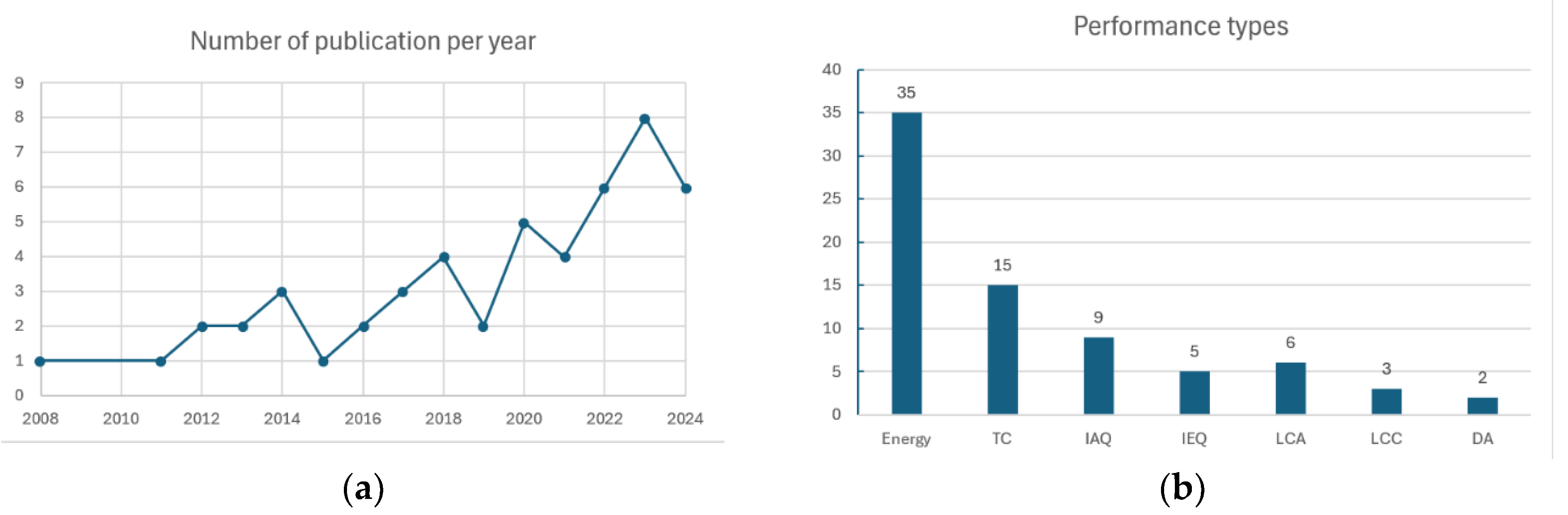
Figure 2.
Publication statistics: (a) Publications by country; (b) Journals with references related to the subject under analisis.
Figure 2.
Publication statistics: (a) Publications by country; (b) Journals with references related to the subject under analisis.
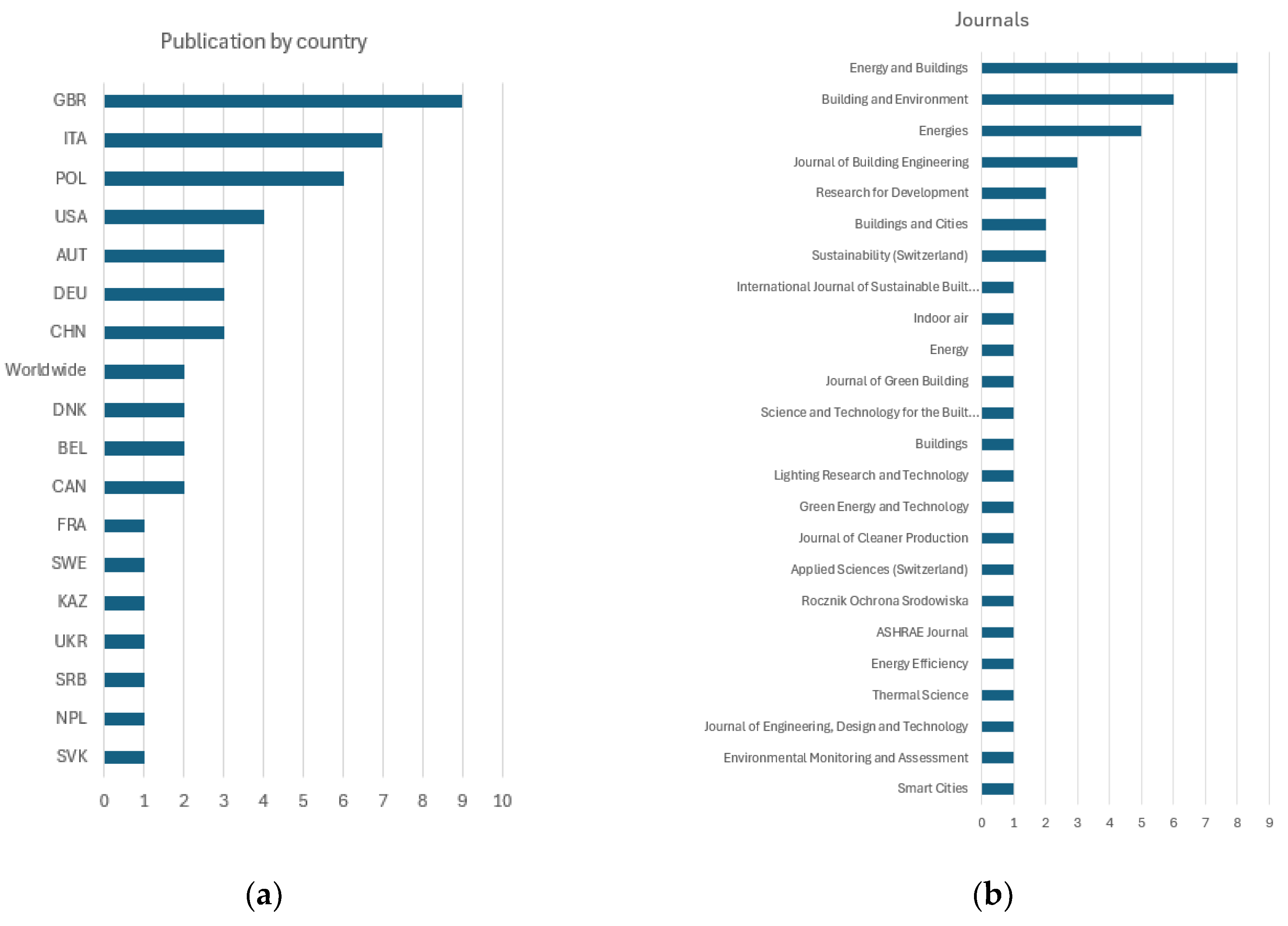
Table 1.
List of analysed references.
| Refs | Location | Year | Assessment | Performance | Journals |
| [10] [11] [12] [13] [14] [15] [16] [17] [18] [19] [20] [21] [22] [23] [24] [25] [26] [27] [28] [29] [30] [31] [32] [33] [34] [35] [36] [37] [38] [39] [40] [41] [42] [43] [44] [45] [46] [47] [48] [49] [50] [51] [52] [53] [54] [55] [56] [57] [58] [59] |
CAN - Montreal, Ottawa, Halifax CHN - Yezhai DEU - Würselen POL - Krakow BEL GBR GBR SVK - Košice GBR GBR GBR NPL - Kathmandu USA CAN - Montreal CHN - Yulin Ghent GBR SRB - Zaječar GBR AUT - Innsbruck POL - Trębowiec USA - Urbana USA - Arlington UKR - Kyiv DNK - Odense ITA - Lombardy POL ITA - Lombardy CHN - Tianjin ITA - Turin Worldwide KAZ SWE - Helsingborg AUT - Vienna DNK - Kopenhaga ITA - Lecco USA - Maryland ITA - Castelfranco Veneto GBR FRA - Alsace DEU - Munich AUT GBR - London POL - Białystok ITA - Lombardy ITA - Lombardy POL - Wielka Wieś DEU - Stuttgart Worldwide POL - Gródek nad Dunajcem |
2024 2024 2024 2024 2024 2024 2023 2023 2023 2023 2023 2023 2023 2023 2022 2022 2022 2022 2022 2022 2021 2021 2021 2021 2020 2020 2020 2020 2020 2019 2019 2018 2018 2018 2018 2017 2017 2017 2016 2016 2015 2014 2014 2014 2013 2013 2012 2012 2011 2008 |
Calculated Calculated Calculated, Measured Calculated, Measured Calculated Calculated Calculated Measured Measured Calculated Calculated Calculated, Measured Calculated Calculated, Measured Calculated Calculated, Measured Calculated Calculated, Measured Calculated Measured Calculated, Measured Calculated Measured Calculated Calculated, Measured Calculated, Measured Calculated, Measured Calculated, Measured Calculated Calculated, Measured Measured Calculated Calculated, Measured Calculated Calculated, Measured Calculated Calculated Calculated, Measured Calculated Calculated, Measured Calculated, Measured Calculated, Measured Calculated Calculated, Measured Calculated, Measured Calculated, Measured Calculated, Measured Calculated Calculated Calculated, Measured |
Energy, LCA Energy Energy, IAQ IAQ LCC IEQ IEQ IAQ IAQ, TC Energy, LCC IAQ, TC TC Energy, LCA Energy, TC IAQ, TC IAQ, TC IEQ TC Energy Energy, TC Energy Energy Energy, IAQ TC Energy Energy Energy Energy, LCA, TC Energy Energy, LCA LCA Energy, DA, TC Energy, DA Energy Energy, TC Energy, LCC Energy, TC Energy Energy IAQ Energy, TC Energy Energy, LCA Energy Energy, IEQ Energy, IEQ Energy Energy Energy, TC Energy |
Journal of Building Engineering Smart Cities Journal of Building Engineering Energies Energy and Buildings Building and Environment Energy and Buildings Environmental Monitoring and Assessment Sustainability (Switzerland) Journal of Engineering, Design and Technology Journal of Building Engineering Energies Energy and Buildings Building and Environment Sustainability (Switzerland) Building and Environment Buildings and Cities Thermal Science Buildings and Cities Energy Efficiency Energies Energy and Buildings ASHRAE Journal Rocznik Ochrona Środowiska Applied Sciences (Switzerland) Book chapter Energies Book chapter Energy and Buildings Building and Environment Journal of Cleaner Production Book chapter Lighting Research and Technology Buildings Science and Technology for the Built Environment Energy and Buildings Journal of Green Building Book chapter Energy Indoor air Building and Environment Book chapter International Journal of Sustainable Built Environment Energy and Buildings Energies Energy and Buildings Environment Protection Engineering Building and Environment International Journal of Ventilation Environment Protection Engineering |
Disclaimer/Publisher’s Note: The statements, opinions and data contained in all publications are solely those of the individual author(s) and contributor(s) and not of MDPI and/or the editor(s). MDPI and/or the editor(s) disclaim responsibility for any injury to people or property resulting from any ideas, methods, instructions or products referred to in the content. |
© 2025 by the authors. Licensee MDPI, Basel, Switzerland. This article is an open access article distributed under the terms and conditions of the Creative Commons Attribution (CC BY) license (http://creativecommons.org/licenses/by/4.0/).
Copyright: This open access article is published under a Creative Commons CC BY 4.0 license, which permit the free download, distribution, and reuse, provided that the author and preprint are cited in any reuse.


