

Submitted:
29 March 2025
Posted:
31 March 2025
You are already at the latest version
Abstract
Climate change (CC) is one of the most urgent challenges of our time. Research suggests that pro-environmental behaviors (PEB) are essential to address this crisis, encompassing sustainable consumption (e.g., recycling or saving energy) and active participation (e.g., protesting or donating). In this regard, young adults play a significant role as change agents. Considering previous literature affirming the importance of CC emotions on PEB, this study aims to analyze the mediating role of eco-worry and eco-anxiety in the relationship between two cognitive antecedents (general willingness to behave pro-environmentally and CC agency) and two types of PEB (sustainable consumption and active participation). To do so, we gathered a sample of 308 young adults aged 18 to 30 years. Results show that eco-worry mediates the relationships between both antecedents (willingness and CC agency) with both sustainable consumption and active participation. In contrast, eco-anxiety in young adults only mediates the relationship between CC agency and active participation. Our findings suggest that eco-worry plays a crucial role in promoting PEB more broadly, while eco-anxiety appears to be only relevant in influencing active participation. These results contrast with others observed in the adult population, so further studies are needed to confirm these findings.
Keywords:
climate change
; pro-environmental behavior
; eco-worry
; eco-anxiety
; sustainable consumption
; active participation
; young adults
; willingness
; agency
1. Introduction
The climate crisis is one of the most pressing issues of the 21st century [1,2]. It encompasses a variety of ecological crises, including climate change (CC), which have caused irreversible losses to our planet, leading to the transformation of ecosystems and the loss of biodiversity, as well as the warming of the atmosphere, oceans, and land. This has resulted in extreme climatic and meteorological events and is also affecting human mental and physical health, food and water security, the economy, and society as a whole [3], thus becoming a significant threat to the planet. There is widespread consensus that the cause of this crisis is human intervention and that its solution lies in the responsibility to adopt actions aimed at protecting the environment [4], such as circular economy behaviors that promote sustainability through the reduction, reuse, recycling, and recovery of resources [5].
To improve sustainability and address this crisis, the United Nations [6] recommends investing in young people and their education, as they play a fundamental role in environmental efforts [6]. Precisely, the concept of climate generation consists of individuals born between the 1990s and early 2000s, generally aged between 18 and 30 years old [7]. To determine the most effective way to invest in this valuable asset, it is to study this population and explore the cognitive and emotional pathways that lead to greater public and private engagement in environmental protection.
Previous research in this area has examined the various determinants of pro-environmental behavior (PEB) in the general adult population, including contextual, cultural, psychological, and emotional factors related to climate change (CC) [8,9,10,11]. Similarly, there is also literature on CC Psychology in children [12] and adolescents [13,14]. However, this specific population, young adults (18-30 years old), has not been thoroughly explored in terms of understanding how certain emotions and climate cognitions are related to PEB. Therefore, this study examines how private-sphere PEB (sustainable consumption) and public-sphere PEB (active participation) can be explained by a sense of CC agency and willingness to act pro-environmentally in a representative sample of young Spanish adults. Additionally, it explores how two similar yet distinct climate-related emotions, eco-anxiety and eco-worry, function as mediators.
1.1. Pro-Environmental Behavior: Sustainable Consumption and Active Participation
PEB has become an increasingly significant subject of academic research due to its importance in addressing CC [15]. PEB types are numerous and originate from diverse sources [16], ranging from private and individual efforts, such as reducing single-use plastic consumption, to higher-cost collective actions, including participating in demonstrations and protests [17].
Stern [17] distinguished two PEB categories based on their impact on the environment: private-sphere environmentalism, which includes actions that can lead to direct or immediate changes to the biosphere by changing individuals' consumption habits to more sustainable ones (e.g., waste reduction at home); and environmental activism and non-activist public-sphere behaviors, which involve actions that have a more indirect impact on the environment (e.g., joining groups, policy support, environmental citizenship). Stern [17] highlights the need for this distinction, arguing that different types of PEB have various causes: behaviors requiring more significant economic investment or that are more difficult to carry out depend more on contextual factors and personal capabilities, whereas attitudinal causes have more predictive value for behaviors not strongly constrained by context or individual capacities. Other authors have used similar categorizations to measure PEB [16,18,19]. In Spain, Stern's [17] categorization has been used in a sample of adults to identify profiles based on PEB, environmental attitudes, and goals [20]. This paper will make a distinction based on Stern's [17] proposal, differentiating between sustainable consumption (SC) (e.g., recycling, reducing electricity consumption, etc.) and active participation (AP) (e.g., protesting, contributing financially to environmental organizations, etc.).
Regarding the relationship between age and PEB, many researchers argue that older individuals exhibit higher levels of PEB [21,22]. In this sense, it has been observed that older adults engage in more sustainable behaviors than younger individuals [22], use less energy [23], recycle more, use fewer disposable items [24,25], eat less meat [24] and are more sustainable in their purchasing and car use habits [26]. However, adults tend to participate less in active behaviors such as joining environmental groups [27]. For its part, research suggests that PEB declines during adolescence [13], leading to many studies focusing on adolescents, while research on young adults has been largely neglected. Therefore, this PEB distinction is essential when differentiating between young adults, adolescents, and adults.
Cultural context, rather than just age, plays a crucial role in understanding the tendency to adopt actions aimed at protecting the environment. PEB studies in Spain often focus on the general population [28]. Some authors focus on adolescents and children [14], yet young adults in Spain represent a significant population that has been overlooked in the previous research. Regarding PEB habits of the general population in Spain, 92% of the general population recycles daily, and 80.2% reduce their consumption for environmental reasons. For young people, these percentages drop to 84% and 64.1%, respectively [29]. However, regarding AP, involvement is significantly lower. The proportion of young people in Spain who attend environmental protests is 18.1%, compared to 13.6% of the remaining adult population [29]. Meanwhile, Spanish adults are more likely to make donations and engage with environmental groups and organizations than young people [29]. In this regard, it is essential to highlight the significance of cultural context when studying age-related PEB differences, as certain contextual factors beyond the individual's control may interfere with PEB execution, such as income [10]. When the opportunity costs of engaging in PEB are low (e.g., having sufficient funds to adopt sustainable behaviors), young people are more likely to engage in PEB [30]. Additionally, young people face different problems and concerns depending on their cultural background. For example, the average age of emancipation in Spain is over 30 years, compared to 26.3 years in the European Union, a gap that widens as the years pass [31]. The principal concerns of young Spaniards are economic problems, followed by issues related to job quality, housing, unemployment, lack of opportunities, and education, among others, which may be prioritized over CC [32]. In this sense, adults rank the CC higher in their list of concerns (6th place) compared to young people (13th place) in Spain [32]. The specific challenges faced by the young Spanish population may be interfering with their willingness to engage in PEB, particularly those related to AP, which are more context dependent [17].
Another socio-demographic factor linked to PEB prediction is educational level, as individuals with higher education tend to have greater environmental awareness, strengthening their PEB [33]. Considering the increased access to higher education and the fact that the rate of young Spaniards pursuing higher education has risen from 41.45% to 52.15% in the last nine years [34], it is essential to note this educational shift when studying PEB and sustainability commitment in young adults.
To shed light on the forerunners of the PEB, other scholars have considered other psychological variables as potential predictors of PEB. Among them are the willingness to engage in such behavior [35,36,37], the CC agency [38], or the individual responsibility for CC [25]. Therefore, the following section will address these essential cognitive variables related to PEB.
1.2. General Willingness of Environmental Behavior and Climate Change Agency in Young Adults
When understanding the factors that drive individuals to engage in PEB, several studies have used the Theory of Planned Behavior (TPB) [39], focusing on behavioral willingness as an immediate antecedent of actual PEB ([35,36,40,41]. They often address topics related to waste management, green consumption, saving and conservation, and sustainable transportation [42]. Regarding the authors focusing on the young population, Han et al. [35] study waste reduction, and Aboelmaged [41] examines recycling. The connection between PEB and willingness has also been studied in a general Spanish sample regarding waste management behavior [43]. However, all these behaviors fall within SC and circular economy, whereas the literature that explores behavioral willingness as a PEB antecedent completely overlooks behaviors based on AP and more public actions.
Some scholars like Tobler et al. [19] have observed that people are more likely to engage in SC (e.g., consumption routines, recycling, saving energy, water, etc.) than in AP (e.g., electing environmentally committed politicians, donating, etc.). This aligns with TPB [39], which suggests that perceived control influences behavioral willingness [44]. AP, like activism, requires commitment, effort, and time, along with the collective organization that is often beyond an individual's control. Consequently, people are more willing to engage in actions related to SC than in AP behavior. In this sense, in Spain, 73% of the population reports a preference for sustainable products over non-environmentally friendly ones [45], but when it comes to AP behavior, the percentage of Spaniards who intend to participate in actions against the environmental crisis actively drops to 37.1% [46].
Regarding the link between the willingness to behave pro-environmentally and emotional aspects, previous literature has connected this intention to CC-related emotions [47]. In this sense, emotions play a significant role when combined with psychological processes to motivate PEB [48].
Another cognitive variable that has been studied in relation to PEB is CC agency [38,49,50]. Some authors, such as Toivonen [50], have defined CC agency as the perception of having the ability and capacity to bring about meaningful actions in response to CC. Often, the literature has reduced the concept of CC agency to individualistic constructs, such as CC self-efficacy, defined as an individual's belief in their capacity to take action to contribute to CC mitigation and/or adaptation [8]. However, Toivonen [50] advocates for a broader understanding of CC agency, considering the importance of collective discourses in shaping one's perception of one's capacity for action. In this paper, we consider it essential to take into account the concept of CC agency in this more comprehensive sense, considering both individual and collective efficacy [48,51], as well as the sense of responsibility for addressing CC, which is inherent in the feeling of being an agent of change in the climate crisis.
Feeling the agency to address CC is a crucial determinant of action in the fight against the climate crisis since the perceived lack of agency often constitutes a barrier to engaging in PEB [52]. Feeling the ability to face CC has been associated with PEB, both in terms of SC [53] and AP, such as pro-environmental political behavior [54]. In Spain, the relationship between the CC agency and PEB has not been studied. Hidalgo and Pisano [55] present a related approach in this regard, establishing the relationship between self-efficacy and the willingness to engage in PEB. The impact of self-efficacy on PEB has also been observed among young people [56,57]. However, there is a lack of literature properly exploring CC agency among young people, considering both collective aspects and the responsibility associated with this sense of capability. Examining climate change (CC) agency in young people is particularly relevant, as Skeirytė et al. [25] found that younger generations tend to assign greater responsibility for addressing CC to industrial sectors than older generations.
Additionally, previous literature has established an association between CC agency and various forms of climate distress, such as worry and eco-anxiety [38,58], in the sense that people with a high sense of CC agency demonstrate higher levels of climate distress [38]. Furthermore, Hanss and colleagues [48] suggest that repeatedly experiencing unpleasant emotions related to the climate crisis (including both eco-worry and eco-anxiety) leads individuals to develop strong convictions of being effective in the fight against CC.
Having analyzed the potential importance of cognitive variables such as the willingness of PEB and CC agency, we will now explore the role of emotional variables related to CC, such as eco-anxiety and eco-worry.
1.3. Eco-Worry and Eco-Anxiety: Two Ways of Feeling Climate Change
Several types of CC-related emotions have been studied as predictors of PEB by scholars such as Clayton [9], Pihkala [11], Marczak [59], Ojala [60], and Parmentier [61], among others. These CC-related emotions include anger, contempt, enthusiasm, powerlessness, guilt, isolation, anxiety, and sorrow [62], among many others. Two of the most widely studied emotions in research on PEB determinants are eco-worry [47,60,61,63] and eco-anxiety [18,64,65]. Both concepts are closely related [47,60,61,66] and encompass both cognitive and affective components; however, as we will see further, cognitive components play an even greater role in eco-worry [60].
On the one hand, eco-worry refers to the concern and stress arising from the current and imminent harm the planet is facing due to CC [60]. It is described as an emotion that simultaneously encompasses cognitive aspects, as it is considered an initial step in coping strategies to address the threat [60]. Eco-worry is particularly prevalent among children and young people [67]. A survey conducted by Ogunbode et al. [18] revealed that, among 32 countries, Spain had the highest proportion of people who reported being "very" or "extremely" worried about CC (77.6%). Nearly the entire sample surveyed by PlayGround and Osoigo Next [68], comprising over 9,000 young Spaniards, expressed their worry about the CC.
In this regard, some scholars have noted that worrying about CC is closely linked to PEB and serves as a mediator between CC perception and such behavior [61]. Research has shown this association regarding SC, such as personal energy-saving behaviors [63], as well as AP since individuals who are more worried about CC tend to participate more frequently in climate demonstrations [69]. In the Spanish context, a positive association has also been found between eco-worry and the general willingness to engage in PEB [47]. Indeed, research on a Spanish sample suggests that eco-worry is more effective than eco-anxiety in promoting both types of PEB, as it mediates between CC perception and willingness to engage in PEB while also linking life satisfaction to PEB willingness [47].
On the other hand, eco-anxiety is a relevant factor when studying young people, as they are the population most affected by this phenomenon [9]. It refers to experiencing complex mental and emotional states that arise from environmental conditions and awareness of them [70], involving persistent worry and fear about CC [71]. According to the El Futuro es Clima survey (The Future is Climate) [68], over 80% of Spanish youth aged 16 to 30 reported having experienced eco-anxiety at some point in their lives. However, despite being especially significant among young people, most studies on eco-anxiety focus primarily on adult populations [72].
Although eco-anxiety can be an emotion that, at high levels, may become pathological and paralyze PEB [73,74,75,76], other authors, such as Pihkala [11], have developed a line of work offering a practical sense of it. In this regard, eco-anxiety is proposed as a form of practical anxiety [11,77], considering this emotion as a precursor to increased PEB [64,65,66,78]. Examples include the use of this emotional state to encourage energy saving at home, motivating family and friends to adopt PEB, using public transportation instead of driving, and reducing food waste [18]. Generally, research does not distinguish between different types of PEB when examining its relationship with eco-anxiety, showing a significant association between eco-anxiety and both AP and SC behaviors [18]. Although this emotional state has been studied in children, adolescents, and adults, studies conducted on young adult samples are relatively rare, at least in Spain.
Despite the extensive link between eco-anxiety and eco-worry [60,61,66], their differential role remains unclear when influencing how psychological variables such as willingness to engage in PEB or feeling like an agent of change drive people actually to adopt different kinds of PEB. This is especially relevant for studying in young adults, given the limited literature on the subject, as well as their crucial role in addressing CC.
1.4. Objectives and Hypothesis
The aim of this study is to analyze the relationship between two crucial cognitive variables related to CC (i.e., the willingness of environmental behavior and the CC agency) and the public and private sphere PEB (i.e., sustainable consumption and active participation). Moreover, these relations will be analyzed through the possible mediating effect of two essential emotional states related to CC (i.e., eco-worry and eco-anxiety). According to this objective, the following hypotheses have been proposed regarding a population of young Spanish adults:
Hypothesis 1: The willingness to engage in pro-environmental behavior is positively associated with sustainable consumption (H1a), eco-worry (H1b), and eco-anxiety (H1c).
Hypothesis 2: Climate change agency is positively associated with sustainable consumption (H2a), active participation (H2b), eco-worry (H2c), and eco-anxiety (H2d).
Hypothesis 3: Eco-worry is positively associated with sustainable consumption (H3a) and active participation (H3b).
Hypothesis 4: Eco-anxiety is positively associated with sustainable consumption (H4a) and active participation (H4b).
Hypothesis 5: Eco-worry and eco-anxiety are positively associated with each other.
Hypothesis 6: Eco-worry significantly mediates the relationships between willingness to engage in pro-environmental behavior, sustainable consumption (H6a), and also with active participation (H6b).
Hypothesis 7: Eco-worry significantly mediates the relationship between climate change agency and sustainable consumption (H7a), as does active participation (H7b).
Hypothesis 8: Eco-anxiety significantly mediates the relationships between willingness to engage in pro-environmental behavior and sustainable consumption (H8a), as does active participation (H8b).
Hypothesis 9: Eco-anxiety significantly mediates the relationships between climate change agency and sustainable consumption (H9a) as well as active participation (H9b).
2. Materials and Methods
2.1. Sample
To test the previously stated hypotheses, a sample of 308 young adults aged 18 to 30 (M = 24.56, SD = 3.69) was recruited. This sample was drawn from a representative group of 1,912 Spanish individuals collected through a pooling research company with online panelists. This sample was representative in terms of gender, age, and place of residence. Participation in the study was voluntary, and data was saved and processed anonymously. All participants provided informed consent for their participation and the publication of their data. The data collection was approved by the Ethics Committee of [university anonymized] (protocol code 0407202327123, September 2023). Code and password-protected data are available at Open Science Framework: https://osf.io/6qn8y. The CC activists rate among young adults in the sample was 18.8%. Variables such as gender, income level, and education level are described in Table 1. Specifically, 51.9% were female, 47.4% were undergraduate students.
2.2. Measures
2.2.1. Control Variables
Educational level is measured using a single multiple-choice item with five categories: 1 = elementary school, 2 = high school, 3 = vocational training, 4 = bachelor's degree or university degree, 5 = master's or doctoral degree (Ph.D.).
Socioeconomic level is measured through a single multiple-choice item with eight categories based on individual monthly income, ranging from “no income” to “more than €10,001”.
2.2.2. Independent Variables
General Willingness for Environmental Behavior (GWEBS) [37] is a 4-item scale that assesses the general willingness to do, not to do (degrowth and reduced consumption), accept social restrictions, and ultimately “do your bit” for the environment. The items were “Assess the likelihood that you will incorporate new environmental actions into your daily life over the next year,” “Within my possibilities, I wish to do my bit to stop the environmental crisis,” “I am willing to voluntarily decrease (consume less matter and energy)” and “I am willing to accept the social restrictions that are necessary to improve the environmental situation” (The responses go from 1= strongly disagree to 5= strongly agree). Cronbach's alpha was α = .851.
Climate change agency (CC agency). We used 3 items to measure people’s belief about their ability, whether it is individual or collective, and responsibility to take meaningful actions that can contribute to mitigating or adapting CC (e.g., “I believe that my actions can have a beneficial influence on climate change”). The responses on the scale go from 1= strongly disagree, to 5= totally agree. Cronbach's alpha was α = .754. As these items were not previously validated as a scale, we performed a CFA to show evidence of construct validity [79] (χ2 = .015; df = 1, p = 0.903; RMSEA = 0 (0-.066); CFI = 1; TLI = 1).
2.2.3. Mediating Variables
Hogg Eco-anxiety Scale [64] is a 13-item scale that measures anxiety in response to the global environmental crisis. It focuses on enduring and non-pathological forms of anxiety at a high level of abstraction. A 6-month time frame is used in the instructions to ensure the stability of the measure saying “Over the last 6 months, how often have you been bothered by the following problems when thinking about climate change and other global environmental conditions (e.g., global warming, ecological degradation, resource depletion, species extinction, ozone hole, pollution of the oceans, deforestation)?”. Item examples include “worrying too much” (affective symptom), “Unable to stop thinking about past events related to climate change” (rumination), “difficulty working and/or studying” (behavioral symptom), and “feeling anxious about the impact of your behaviors on the earth” (negative emotionality). Participants rated all items on a 5-point scale, ranging from 1= not at all to 5= nearly daily. Cronbach's alpha was α = .954.
Eco-Worry Scale [61] is a 5-item scale that assesses the frequency and relative intensity of worrying thoughts related to environmental issues in general, including a specific item addressing apprehension about one’s impact on the planet (e.g., “I am concerned about the impact of my behaviors and lifestyle on the Earth.”, “Climate change makes me worry about my future and that of the people I care about” and “I worry about the environmental crisis more than other people”). Participants rated all items on a 5-point scale, ranging from 1= not at all to 5= extremely, except for item 1 (“How often do you have thoughts about environmental issues that concern you?”), which ranged from 1= never to 5= almost always. Cronbach's alpha was α = .867.
2.2.4. Outcomes Variables
Sustainable Consumption (SC) is measured using a 9-item custom scale that assesses PEB based on private sustainable consumption practices. Participants are asked to indicate how often they engage in the behaviors described in each item (e.g., “Sorting glass, cans, plastic, paper, etc., for recycling,” “Reducing plastic container usage,” “Choosing to save or reuse water for environmental reasons,” etc.). The scale was constructed for this study using items sourced from Centro de Investigaciones Sociológicas (Center for Sociological Research of Spain) study number 3391 [29]. The item selection was based on Stern's classification [17]. The response scale ranges from 1 = never to 5 = always. Cronbach's alpha was α = .801. To show evidence of construct validity, CFA was calculated because this scale was not previously validated (χ2 = 69.580; df = 26, p < 0.01; RMSEA = .074 (.053-.095); CFI = .98; TLI = .973).
Active Participation (AP) is measured using a 4-item custom scale that assesses PEB based on collective and active participation. Participants are asked to indicate how often they engage in the behaviors described in each item (e.g., “participating in environmental protests or demonstrations,” “Financially supporting environmental associations or NGOs,” etc.). The scale was constructed for this study using items sourced from Centro de Investigaciones Sociológicas (Center for Sociological Research of Spain) study number 3391 [29]. The item selection was also based on Stern's classification [17]. The response scale ranges from 1 = never to 5 = always. Cronbach's alpha was α = .861. Confirmatory factor analysis showed acceptable evidence of construct of validity since this scale was not previously validated (χ2 = .652; df = 1, p = .4195; RMSEA = 0 (0-.139); CFI = 1; TLI = 1).
2.3. Data Analysis
Our preliminary analyses included a descriptive analysis of sociodemographic characteristics and an analysis of the scores (means, standard deviations, skewness, kurtosis). Secondly, partial Pearson correlations were calculated. Correlations between 0 and 0.3 are weak, between 0.3 and 0.5 are moderate, between 0.5 and 0.7 are strong, and between 0.7 and 1 are very strong, either positive or negative [80].
Before testing our hypotheses, we performed the model of measurement employing a confirmatory factor analysis (CFA) to examine the distinctiveness of variables included in the model. Weighted Least Squares Mean and Variance adjusted (WLSMV) was chosen as the estimation method, considering the ordinal nature of the items of variables. We tested the fit of a six-factor model and examined whether it fitted the data better than a one-factor model (control variables were excluded) since the aim is to test a common method of variance [81].
The model's goodness of fit (CFA and path analysis) was tested by means of these indexes: χ2 that is sensitive to sample size so that the probability of rejecting a hypothesized model increases as sample size increases (e.g., [82]). The rule for accepting this index is (χ2/df) [83]. Browne & Cudeck [84] suggested that RMSEA greater than 0.10 would indicate a poor fit. The 90% confidence interval for each observed RMSEA was also reported. Finally, TLI and CFI values greater than .90 and .95 show an acceptable and excellent fit for the data, respectively [85].
A modeling rationale was applied to assess the differences between models and determine the model with the better fit. For instance, differences of less than 0.01 between TLI and CFI values (ΔTLI and ΔCFI) indicate negligible practical differences [86]. RMSEA values must be less than .015 to show negligible differences [87].
The hypotheses were tested using path analysis with Mplus 8.1 software [88]. Specifically, we chose maximum likelihood (ML) as the estimation method, considering the continuous nature of the variable and the asymmetry and kurtosis of the outcome variables. To estimate the statistical significance of the indirect effects, a CI of 95% was used. The effect was significant if the interval did not include zero. We employed BC bootstrap confidence interval (CI) methods to test indirect effects using a bootstrap sample size of 5,000 [89].
3. Results
The results of the CFA indicated that the theorized six-factor model provided a better fit to the data (χ2 = 2049.855; df = 650, p < .01; RMSEA = .084 (.08-.088); CFI = .92; TLI = .914), compared to the one-factor model, which showed poor fit (χ2 = 5032.862, df = 665, p < .01; RMSEA = .146 (.142-.150); CFI = .751; TLI = .737). The incremental goodness-of-fit indices (ΔCFI = .169; ΔTLI = .177) further suggest that the difference between the six-factor and one-factor models is substantial. These results support the measurement model of the constructs and confirm that the six-factor model better represents the structure of the data.
Descriptive statistics (means, standard deviations, skewness, kurtosis) and correlations between the variables included in the model are reported in Table 2. The skewness and kurtosis values are within acceptable ranges, indicating a normal distribution of data. The mean values for eco-anxiety (M = 2.564; SD = .928) and AP (M = 2.349; SD = .974) are notably low.
Considering correlations among variables,eco-worry showed substantial and highly significant correlations with GWEBS (r = .646; p < .01; 95% CI [.562, .719]), CC agency (r = .629; p < .01; 95% CI [.543, .704]), SC (r = .637; p < .01; 95% CI [.546, .717]), and AP (r = .544; p < .01; 95% CI [.463, .616]). In contrast, eco-anxiety only correlated strongly with AP (r = .588; p < .01; 95% CI [.505, .663]). GWEBS showed a strong correlation with SC (r = .638; p < .01; 95% CI [.561, .708]), while CC agency strongly correlated with both SC (r = .622; p < .01; 95% CI [.54, .693]) and AP (r = .505; p < .01; 95% CI [.418, .582]).
The proposed partial mediation model showed adequate fit to data (χ2 = 5.81; df = 5, p = .3251; RMSEA = .023 [0-.085]; CFI = .999; TLI = .995). Results showed that we provided a confidence interval (CI). This is evident in the standardized results shown in Figure 1. Relationship from GWEBS to SC (β = .242, p < .01; 95% CI [.102, .34]) and eco-worry (β = .394, p < .01; 95% CI [.225, .536]) were positive and statistically significant, supporting Hypothesis H1a and H1b, respectively. However, the path from GWEBS to eco-anxiety (β = .152, p > .05; 95% CI [-.009, .336]) was not significant, not supporting H1c. Hence, H1 was partially confirmed. Paths from CC agency to SC (β = .186, p < .05; 95% CI [.047, .297]), to AP (β = .192, p < .05; 95% CI [.093, .348]), to eco-worry (β = .316, p < .01; 95% CI [.153, .494]) and eco-anxiety (β = .256, p < .05; 95% CI [.097, .469]), were positive and statistically significant, Providing support for all the sub-hypotheses of Hypothesis 2 (H2a, H2b, H2c and H2d, respectively).
Note. Coefficients are standardized. Standard errors are in brackets. R2 represents the % of variance explained by the model for each endogenous variable. * p < .05 ; ** p < .01; GWEBS = General Willingness of Environmental Behavior; CC agency = Climate Change agency; SC = Sustainable Consumption; AP = Active Participation.
The paths from eco-worry to SC (β = .334, p < .01; 95% CI [.195, .419]) and AP (β = .243, p < .01; 95% CI [.156, .406]) were positive and statistically significant, supporting Hypothesis H3a and H3b, in the respective order. The path from eco-anxiety to SC (β = .042, p > .05; 95% CI [-.039, .112]) was not significant, not supporting H4a. However, the path from eco-anxiety to AP (β = .406, p < .01; 95% CI = [.318, .522]) was positive and statistically significant, supporting Hypothesis H4b. Additionally, eco-worry was positively and significantly related to eco-anxiety (B = 0.235, p < 0.01; 95% CI = [0.064, 0.193]), supporting Hypothesis 5.
Table 3 shows that some indirect effects were statistically significant, as indicated by the bootstrap confidence intervals for the estimated indirect effects, excluding the zero value at the 95% confidence interval. Hypothesis 8 was not supported, since the indirect effects of GWEBS to SC through eco-anxiety (B = .006; 95% BC CI = [-.004, .028]) and AP (B = .068; 95% BC CI = [-.002, .154]) through eco-anxiety were not significant. Neither the indirect effect of CC agency on SC through eco-anxiety was significant (B = .01; 95% BC CI = [-.008, .042]), and so Hypothesis H9a was not supported. The remaining Hypotheses regarding indirect effects (H6, H7, and H9b) were supported by the results.
4. Discussion
Emotions related to CC serve as a crucial lever in motivating young people to take action and engage in the fight against environmental challenges. At the same time, they can also become a source of inaction [73,74,75,76]. In this context, eco-worry and eco-anxiety have attracted the attention of numerous researchers within the current line of CC Psychology [18,47,63,64,65]. Since climate related cognitions and emotions could move to action, we have tested the mediating role of both eco-emotions (eco-worry and eco-anxiety) in the relationship between two cognitive antecedents (CC agency and willingness to act pro-environmentally) and two behavioral consequences (distinguishing between SC and AP) in a representative Spanish sample of young adults.
Briefly summarizing the results found in the model, we have observed that, on the one hand, willingness to engage in PEB directly affects SC and has an indirect effect when this relationship is mediated by eco-worry, but not when eco-anxiety serves as the mediator. The willingness of PEB does not have a direct effect on AP, but it does exert an indirect effect through eco-worry, but not through eco-anxiety. On the other hand, CC agency has a direct effect on SC, which we also find indirectly when eco-worry acts as a mediator, but not when eco-anxiety does. CC agency also has a direct effect on AP, which intensifies when eco-anxiety comes into play as a mediator, this being the highest indirect effect found in the model. Additionally, there is an indirect effect of the CC agency on AP when eco-worry becomes the mediator.
Although literature often closely links eco-worry and eco-anxiety [60,61,66], they are completely distinct reactions that lead people to act differently depending on the case. It is true that having the will to engage in PEB, as well as feeling like an agent of change to address the CC, are key factors for such behavior to actually occur. In this regard, it is important to analyze how experiencing a specific emotional or cognitive state can mediate these relationships. This being said, the proposed hypotheses will now be discussed individually in the subsequent sections.
As stated in Hypothesis 1, the willingness to engage in PEB was positively related to SC and has a direct effect on this type of PEB. These results are consistent with prior research since individuals are more likely to engage in PEB when it entails lower costs and a higher perceived sense of control, as is the case with SC [17,19]. However, it is worth noting that the association between these two variables is not particularly strong, which could be attributed to the characteristics of the sample. Specifically, as young adults, some of whom are students, participants may not yet have the financial stability necessary to undertake certain PEBs. Economic problems are the primary concern for young Spaniards [32], and these kinds of constraints often serve as barriers that hinder individuals from engaging in pro-environmental actions [10], which could have restricted this age group’s willingness to engage in PEB, such as recycling or buying ecological products, among others. A direct effect between the willingness of PEB and AP was not hypothesized since people are generally less inclined to engage in AP kind of actions, as they entail higher costs [19] and are less dependent on individual control [17]. Our results show that the willingness of PEB has a strong and highly significant correlation with SC, whereas it is weaker for AP. Notably, it appears that the willingness to act pro-environmentally among young Spaniards is enough for this population to engage in private sustainable actions, such as recycling. However, this willingness to take action for the environment is not enough to engage in behaviors that require higher costs and commitment, such as protesting against CC.
Remarkably, and in contrast to the willingness of PEB, CC agency is directly related to both forms of PEB, supporting our Hypothesis 2. CC agency refers to an individual's perception of having the capacity to address CC [38], and it has thus been associated with PEB [48,52]. However, CC agency refers not only to an individual level of personal self-efficacy in addressing CC [38] but also to the collective capacity to confront the crisis and drive change [51]. At the same time, it encompasses a sense of personal responsibility to take action to protect the planet, regardless of whether the actions are private and low-cost or participatory and organized. Contrary to the willingness of PEB, the CC agency carries a stronger sense of being an agent of change in the public sphere rather than exclusively in the private one, emphasizing its role in promoting youth involvement in active participation.
Therefore, the willingness to engage in PEB and CC agency are two cognitive constructs related to CC that differ in their relationship with various types of PEB among young people. The willingness of PEB, in turn, represents a behavioral intention that plays a crucial role in motivating young individuals to undertake private, low-impact, sustainable actions, such as recycling and reducing food waste. Conversely, the sense of capacity and responsibility to take action in the fight against CC is directly associated with SC and, simultaneously, with more active, organized, and high-impact forms of participation. Building upon this, the subsequent sections will discuss the role of two emotional variables in mediating the relationships outlined earlier: eco-worry and eco-anxiety.
Eco-worry is an emotion that involves concern and stress feelings about CC [60]. This emotion has been identified as a precursor to strategies for addressing CC, integrating both cognitive and emotional dimensions [60]. As previous literature has pointed out, eco-worry serves as an important mediating variable, having demonstrated significant relationships with the willingness of PEB [47], CC agency [38], as well as with SC [63] and AP [69], associations that have been tested through our hypotheses. In this regard, eco-worry has proven to be an excellent mediator linking the willingness to engage in PEB and both types of PEB in young adults, as outlined in Hypothesis 6. Moreover, as stated in Hypothesis 7, eco-worry also serves as an effective mediator in the relationships between CC agency and both types of PEB. Current research on eco-worry highlights the significant cognitive component of this emotion [60], which explains the strong correlations found between eco-worry and both the willingness of PEB and CC agency in the results. As mentioned earlier, the willingness of PEB has a direct effect on SC in young adults but is not impact on AP by itself. However, according to our findings, the willingness to engage in PEB may predict AP when this relationship is mediated by eco-worry. This is because eco-worry facilitates the relationship between them by acting as a mediator despite the limited connection between GWEBS and AP. This finding highlights the role of eco-worry, which can be considered a cornerstone that is both a cause and a consequence of pro-environmental cognitions and behavior in young adults, acting as a mediator across all the relationships proposed in the model of this study.
Eco-anxiety involves complex emotional states of fear related to CC [71]. This emotion has been linked to the willingness of PEB, the CC agency [38], and PEB in general terms [18,64,65,66,78]. Consistent with this, we have found that eco-anxiety in young adults is associated with CC agency and AP, as proposed in our hypotheses. However, we did not find the expected associations between eco-anxiety and the willingness of PEB and SC, respectively. Building on our findings, eco-anxiety only acts as a mediator in the relationship between CC agency and AP, as outlined in Hypothesis 9; moreover, the introduction of this emotion intensifies this relationship. Young people who perceive a sense of responsibility and the capacity to act may come to believe they are not doing enough, thereby triggering eco-anxiety, which, as observed in our results, is strongly associated with AP. For young Spaniards, it is crucial that both conditions— experiencing a certain level of eco-anxiety and perceiving themselves as agents of change —are present, as these are the key factors that truly motivate them to engage actively in the fight against climate change.
Up to this point, it is evident that in the context of young adults, eco-worry and eco-anxiety do not play the same role in influencing the relationship between different cognitive processes (the willingness of PEB and CC agency) and various types of PEB. While eco-worry mediates all the relationships proposed in this study, eco-anxiety only functions in the relationship between CC agency and AP. Nevertheless, literature frequently links these two emotions [60,61,66], as both involve forms of distress related to CC and its consequences. In line with this, our study hypothesized a positive relationship between eco-worry and eco-anxiety, which was found to be surprisingly weak, though significant. Therefore, these two emotions are not as closely related as typically assumed, which is consistent with their differential roles as mediators, as supported by the findings of this study.
Eco-worry has proven to be a more effective mediator overall due to its strong association with the willingness of PEB and CC agency, compared to eco-anxiety. In this regard, our findings reveal a strong and highly significant correlation between eco-worry and both variables, whereas eco-anxiety exhibits only moderate correlations with them. Given its substantial cognitive components [60], eco-worry is more closely aligned with these constructs, particularly with willingness, which addresses the intention at a cognitive level, not an emotional one, to contribute to the fight against CC. In contrast, eco-anxiety is a purely emotional variable that can become paralyzing [73,74,76], thus distancing itself from individual control. The willingness of PEB involves a conscious and active motivation to act, which requires a greater degree of control by the individual over their behavior. Therefore, the emotional and often paralyzing nature of eco-anxiety contrasts with the controlled action capacity that characterizes the willingness of PEB, which would explain the absence of a direct association between the two. Therefore, eco-worry appears to be a more effective mediator in the relationship between cognitive variables and PEB in broad and general terms.
However, eco-anxiety plays a crucial role when it comes to a more specific form of PEB, as it mediates and intensifies the relationship between CC agency and AP. This is the only relationship in our model in which eco-anxiety serves as a mediator, and at the same time, it exhibits the strongest indirect effect among all those observed. This suggests that eco-anxiety has its own distinct yet essential role in the context of PEB among young Spaniards, albeit not as broadly as eco-worry. This can be explained by the fact that, on the one hand, the CC agency is strongly associated with AP more than GWEBS, as it is more directly linked to engagement in the public sphere, as previously discussed. On the other hand, our findings indicate that, among young people, eco-anxiety has a stronger correlation with AP than with SC. It is worth noting that the explained variance of eco-anxiety is low, which can be attributed to both the generally low levels of this variable in the sample and the high variability in the responses. The same is true for AP. This is likely due to the characteristics of the sample, which has a small proportion of environmental activists, as discussed in more detail in the limitations section of the study.
Overall, our findings suggest that, on the one hand, eco-worry plays a crucial role in promoting PEB more broadly, encompassing various types of behavior. On the other hand, eco-anxiety, which has often been examined in the literature as a driver of PEB among young people, appears to be particularly relevant in influencing AP but not as much in the case of SC.
4.1. Theoretical and Practical Implications
As a theoretical implication, this study highlights the need for broader theoretical development to differentiate the role of various CC-related emotions and harness them to mitigate the ongoing crisis by encouraging young people to take action. It is essential to consider specific characteristics of the young population. They are the age group most emotionally affected by the climate crisis [9] while also being less engaged in SC behaviors than older generations [22], such as reducing electricity use [23], recycling [24,25], and reducing meat consumption [24]. However, young people more frequently participate in active behaviors, such as joining environmental groups [27]. In line with the findings of this study, this suggests that the greater emotional distress experienced by young people (such as eco-anxiety) may drive them to participate more actively in collective efforts. However, it might be more effective to foster emotions like eco-worry, which is strongly associated with both SC and AP, as observed in this study. At the same time, further research is needed to better understand the role of eco-anxiety, which appears to be closely linked to AP but can also have a paralyzing effect. Considering that different forms of climate distress play distinct roles in promoting PEB among young people, it is crucial to explore the most effective ways to motivate them to take action by strategically leveraging these emotional states depending on the type of PEB being addressed.
Moreover, this work emphasizes the need to differentiate between SC and AP behaviors, as their diverse nature influences the drivers and mechanisms that push individuals to engage in one type of behavior over another. Eco-anxiety becomes a key factor in promoting AP in young people, with CC agency playing a role. Meanwhile, eco-worry explains SC much better, especially when willingness is involved. Since literature often estimates PEB without distinguishing among different kinds of behavior, our findings highlight the importance of addressing different types of PEB separately, as proposed by Stern [17].
This study also presents a series of practical implications. Analyzing the mediating role of different emotional or cognitive states in the relationship between various kinds of PEB and the willingness to engage in environmental behavior or feeling like an agent of change allows for optimizing strategies to promote the adoption of sustainable practices among Spanish youth. For example, the tone used by the media when reporting on the CC can be crucial in fostering a state of eco-worry rather than eco-anxiety, thereby making the relationship between willingness, CC agency, and different types of PEB more effective. Similarly, the approach taken in CC education and the way environmental proposals are presented can be essential. Along the same lines, these findings can be used to improve public policies and awareness strategies, which foster a sense of mobilizing worry and engagement rather than paralysis. By tailoring messaging and initiatives to encourage eco-worry over eco-anxiety, policymakers and organizations can create environments where individuals, especially young people, feel motivated and capable of taking meaningful action toward sustainability.
4.2. Limitations
Some of the limitations of this study are related to a characteristic of the sample. A representative sample in terms of gender, age, and residence was used. However, the proportion of activists in the sample is 18.8%. This low proportion of activists likely explains the low levels of eco-anxiety, and AP observed in the sample. CC activists are the ones who most frequently engage in AP actions, which, as shown, are associated with higher levels of eco-anxiety [18]. According to the literature, eco-anxiety affects PEB when it is at moderately high levels [74], which was not the case here due to the small proportion of activists. Future studies should focus on activist populations, where eco-anxiety is likely to be higher and test how this impacts AP behaviors.
Likewise, it is essential to highlight that this is a sample with specific characteristics: young Spaniards aged between 18 and 30. This group faces a range of issues related to their age and culture, such as access to employment and housing, among many others that concern them far more than the CC [32]. Focusing on other, more immediate concerns may serve as a coping strategy for individuals to reduce their eco-anxiety, thus avoiding thinking about the CC. While studying this population is crucial, future research should consider testing these findings in a general population and examining the differences between young people and other age groups. Observing these differences could provide a broader understanding of how socio-economic and generational factors influence the adoption of PEB, whether of one type or another, and the emotional experiences that different age groups have regarding the CC.
Another limitation to consider in the development of this research lies in previous literature. There are plenty of studies that measure PEB globally by combining behaviors regardless of their characteristics, impact, or nature [66,74], rather than making a proper distinction based on behavior type, as suggested by Stern [17]. This makes it difficult to analyze the results of our study in light of other research. This limitation, in turn, represents one of the theoretical contributions of our research.
Finally, the common method of variance was tested by a measurement model (Podsakoff et al., 2003). Nevertheless, collecting data by self-reported questionnaire in a cross-sectional research could provoke shared variance in the variables due to the method of collecting data and impede the establishment of causal relationships. Hence, for future research, it must be longitudinal and use multiple methods to collect data.
5. Conclusions
Considering the long-term nature of the causes and consequences of CC, analyzing PEB, or the lack thereof, in relation to younger generations is essential. Given the limited research on CC Psychology in young adults, this study examines how cognitive and emotional factors relate to different types of PEB. In this regard, for a specific population of young Spanish adults, it is observed that while eco-worry stands out as a key driver of any kind of PEB, eco-anxiety plays a more specific role in encouraging AP in young adults. Overall, these results highlight the crucial role of emotions in motivating young people to take environmental action across various domains. Moreover, they highlight the need to distinguish between emotional influences. On the one hand, young adults' willingness to engage in PEB directly influences SC behaviors, but is insufficient to drive AP actions. Eco-worry also mediates the relationship between young people's perception of themselves as agents of change and any form of PEB. This underscores the significance of eco-worry in fostering sustained and committed youth engagement in climate action. On the other hand, eco-anxiety functions differently, lacking the cognitive component that characterizes eco-worry. Consequently, it does not show a relationship with the willingness to engage in PEB, nor does it mediate its link to behavioral outcomes. However, eco-anxiety emerges as a crucial mediator in the relationship between CC agency and engaging in participatory and collective actions among young people, representing the strongest indirect effect observed in the study. These findings suggest that, for young people to be truly motivated to take an active role in climate action, they must not only see themselves as change agents but also experience a certain level of eco-anxiety.
Author Contributions
Conceptualization, C.D.-S., L.L.-G., and M.L.V.; Methodology, L.L.-G., and F.L.; Software, L.L.-G., and F.L.; Validation, L.L.-G., M.L.V., and F.L.; Formal analysis, L.L.-G., and F.L.; Investigation, C.D.-S., M.L.V., and L.L.-G.; Resources, C.D.-S., and M.L.V.; Data curation, C.D.-S., and L.L.-G.; Writing—original draft preparation, L.L.-G.; Writing—review and editing, C.D.-S., M.L.V., and F.L.; Supervision, C.D.-S., and M.L.V. All authors have read and agreed to the published version of the manuscript.
Funding
Grant from the Foundation La Caixa under the project titled Benefits of Practical Eco-Anxiety: Psychological Predictors of Pro-Environmental Behavior, reference number FS23-2B192, received by principal researcher Cintia Díaz-Silveira (Ph.D.), from Universidad Rey Juan Carlos.
Institutional Review Board Statement
The study was conducted by the Declaration of Helsinki and approved by the Ethics Committee of Universidad Rey Juan Carlos.
Informed Consent Statement
Informed consent was obtained from all subjects involved in this study.
Data Availability Statement
Data can be requested from the correspondence author cintia.diazsilveirarjc.es.
Acknowledgments
In this section, you can acknowledge any support given that is not covered by the author contribution or funding sections. This may include administrative and technical support or donations in kind (e.g., materials used for experiments).
Conflicts of Interest
The authors declare no conflicts of interest.
Abbreviations
The following abbreviations are used in this manuscript:
| CC | Climate Change |
| PEB | Pro-Environmental Behavior |
| SC | Sustainable Consumption |
| AP | Active Participation |
| GWEBS | General Willingness of Environmental Behavior |
References
- United Nations (UN). WMO Global Annual to Decadal Climate Update (2024-2028); World Meteorological Organization, June 5, 2024. [Online] https://library.wmo.int/records/item/68910-wmo-global-annual-to-decadal-climate-update.
- World Health Organization (WHO). 77th World Health Assembly. Daily Update: May 31, 2024; WHO, 2024. [Online] https://apps.who.int/gb/ebwha/pdf_files/WHA77/A77_ACONF7-sp.pdf.
- Intergovernmental Panel on Climate Change (IPCC). Synthesis Report of the IPCC Sixth Assessment Report (AR6); IPCC, 2023. [Online] https://www.ipcc.ch/report/ar6/syr/downloads/report/IPCC_AR6_SYR_LongerReport.pdf.
- World Economic Forum. Global Risks Report 2025; World Economic Forum: Cologny, Switzerland, 2025. [Online] https://reports.weforum.org/docs/WEF_Global_Risks_Report_Press_Release_2025_ESP.pdf.
- Geissdoerfer, M.; Savaget, P.; Bocken, N. M. P.; Hultink, E. J. The Circular Economy – A New Sustainability Paradigm? J Clean Prod 2017, 143, 757–768. [CrossRef]
- United Nations (UN). Stockholm+50: A Healthy Planet for the Prosperity of All—Our Responsibility, Our Opportunity. Official Report, A/CONF.238/9; UN, August 1, 2022.
- Coppola, I. Eco-Anxiety in “the Climate Generation”: Is Action an Antidote?; Environmental Studies Electronic Thesis Collection, 2021; No. 71. [Online] https://scholarworks.uvm.edu/envstheses/71.
- Bradley, G. L.; Deshpande, S.; Paas, K. H. W. The Personal and the Social: Twin Contributors to Climate Action. J Environ Psychol 2024, 93. [Google Scholar] [CrossRef]
- Clayton, S. Climate Anxiety: Psychological Responses to Climate Change. J Anxiety Disord 2020, 74. [Google Scholar] [CrossRef] [PubMed]
- Gifford, R. The Dragons of Inaction: Psychological Barriers That Limit Climate Change Mitigation and Adaptation. American Psychologist 2011, 66(4), 290–302. [Google Scholar] [CrossRef]
- Pihkala, P. Anxiety and the Ecological Crisis: An Analysis of Eco-Anxiety and Climate Anxiety. Sustainability (Switzerland) 2020, 12(19). [Google Scholar] [CrossRef]
- Ojala, M. How Do Children, Adolescents, and Young Adults Relate to Climate Change? Implications for Developmental Psychology. European Journal of Developmental Psychology 2023, 20(6), 929–943. [Google Scholar] [CrossRef]
- Otto, S.; Evans, G. W.; Moon, M. J.; Kaiser, F. G. The Development of Children’s Environmental Attitude and Behavior. Global Environmental Change 2019, 58, 101947. [Google Scholar] [CrossRef]
- Torres, B.; Amérigo, M.; García, J. A. Evaluación de Una Intervención Proambiental En Escolares de Educación Primaria (10-13 Años) de Castilla-La Mancha (España). Revista Electrónica Educare 2021, 25(3), 1–16. [Google Scholar] [CrossRef]
- Goyal, S.; Goyal, P. The Evolution of Pro-environmental Behavior Research in Three Decades Using Bibliometric Analysis. Corp Soc Responsib Environ Manag 2024, 31(5), 4133–4153. [Google Scholar] [CrossRef]
- Oinonen, I.; Paloniemi, R. Understanding and Measuring Young People’s Sustainability Actions. J Environ Psychol 2023, 91. [Google Scholar] [CrossRef]
- Stern, P. C. Toward a Coherent Theory of Environmentally Significant Behavior. Journal of Social Issues 2000, 56(3), 407–424. [Google Scholar] [CrossRef]
- Ogunbode, C. A.; Doran, R.; Hanss, D.; Ojala, M.; Salmela-Aro, K.; van den Broek, K. L.; Bhullar, N.; Aquino, S. D.; Marot, T.; Schermer, J. A.; Wlodarczyk, A.; Lu, S.; Jiang, F.; Maran, D. A.; Yadav, R.; Ardi, R.; Chegeni, R.; Ghanbarian, E.; Zand, S.; Najafi, R.; Park, J.; Tsubakita, T.; Tan, C. S.; Chukwuorji, J. B. C.; Ojewumi, K. A.; Tahir, H.; Albzour, M.; Reyes, M. E. S.; Lins, S.; Enea, V.; Volkodav, T.; Sollar, T.; Navarro-Carrillo, G.; Torres-Marín, J.; Mbungu, W.; Ayanian, A. H.; Ghorayeb, J.; Onyutha, C.; Lomas, M. J.; Helmy, M.; Martínez-Buelvas, L.; Bayad, A.; Karasu, M. Climate Anxiety, Wellbeing and pro-Environmental Action: Correlates of Negative Emotional Responses to Climate Change in 32 Countries. J Environ Psychol 2022, 84. [CrossRef]
- Tobler, C.; Visschers, V. H. M.; Siegrist, M. Addressing Climate Change: Determinants of Consumers’ Willingness to Act and to Support Policy Measures. J Environ Psychol 2012, 32(3), 197–207. [Google Scholar] [CrossRef]
- García Martín, J. A. Análisis Del Perfil Proambiental de La Población Castellanomanchega; Ediciones parlamentarias [i.e. Cortes de Castilla-La Mancha], 2022.
- Krettenauer, T.; Lefebvre, J. P.; Goddeeris, H. Pro-Environmental Behaviour, Connectedness with Nature, and the Endorsement of pro-Environmental Norms in Youth: Longitudinal Relations. J Environ Psychol 2024, 94. [Google Scholar] [CrossRef]
- Wang, Y.; Hao, F.; Liu, Y. Pro-Environmental Behavior in an Aging World: Evidence from 31 Countries. Int J Environ Res Public Health 2021, 18(4), 1–13. [Google Scholar] [CrossRef]
- Moser, S.; Kleinhückelkotten, S. Good Intents, but Low Impacts: Diverging Importance of Motivational and Socioeconomic Determinants Explaining Pro-Environmental Behavior, Energy Use, and Carbon Footprint. Environ Behav 2018, 50(6), 626–656. [Google Scholar] [CrossRef]
- Ágoston, C.; Balázs, B.; Mónus, F.; Varga, A. Age Differences and Profiles in Pro-Environmental Behavior and Eco-Emotions. Int J Behav Dev 2024, 48(2), 132–144. [Google Scholar] [CrossRef]
- Skeirytė, A.; Krikštolaitis, R.; Liobikienė, G. The Differences of Climate Change Perception, Responsibility and Climate-Friendly Behavior among Generations and the Main Determinants of Youth’s Climate-Friendly Actions in the EU. J Environ Manage 2022, 323. [Google Scholar] [CrossRef]
- López-Mosquera, N.; Lera-López, F.; Sánchez, M. Key Factors to Explain Recycling, Car Use and Environmentally Responsible Purchase Behaviors: A Comparative Perspective. Resour Conserv Recycl 2015, 99, 29–39. [Google Scholar] [CrossRef]
- M. Wiernik, B.; S. Ones, D.; Dilchert, S. Age and Environmental Sustainability: A Meta-Analysis. Journal of Managerial Psychology 2013, 28(7/8), 826–856. [Google Scholar] [CrossRef]
- Pasca, L.; Poggio, L. Biased Perception of the Environmental Impact of Everyday Behaviors. J Soc Psychol 2023, 163(4), 515–521. [Google Scholar] [CrossRef]
- Centro de Investigaciones Sociológicas (CIS). Study No. 3391. Spanish General Social Survey 2023 (ESGE) / Environment (III); CIS, 2023a. [Online] https://www.cis.es/detalle-ficha-estudio?origen=estudio&idEstudio=14714.
- Kukkonen, N.; Lange, F.; Van den Bossche, C.; Krebs, R. Pro-Environmental Decisions Are Hampered by Their Opportunity Costs – Evidence from Effort-Based Decision-Making. December 12, 2024. [CrossRef]
- Eurostat. Adult Education and Training Participation Statistics - Updated Data for 2023; Eurostat, European Commission, 2024. [Online] https://ec.europa.eu/eurostat/web/products-eurostat-news/w/ddn-20240930-2.
- Centro de Investigaciones Sociológicas (CIS). Study No. 3423. October 2023 Barometer; CIS, 2023b. [Online] https://www.cis.es/documents/d/cis/es3423mar-pdf.
- Yang, R. Education And Environment-Friendly Behavior: The Mediating Role of Environmental Concern. Journal of Education, Humanities and Social Sciences 2024, 35, 482–492. [Google Scholar] [CrossRef]
- National Institute of Statistics (INE). CNED-2014. Education and Training Statistics. Eurostat. 3.9.2 Educational Level of the Adult Population by Age Groups. CNED-2014. Series 2014-2023; INE, 2023. [Online] https://www.ine.es/jaxiT3/Tabla.htm?t=12726.
- Han, H.; Yu, J.; Kim, W. Youth Travelers and Waste Reduction Behaviors While Traveling to Tourist Destinations. Journal of Travel and Tourism Marketing 2018, 35(9), 1119–1131. [Google Scholar] [CrossRef]
- Alzubaidi, H.; Slade, E. L.; Dwivedi, Y. K. Examining Antecedents of Consumers’ pro-Environmental Behaviours: TPB Extended with Materialism and Innovativeness. J Bus Res 2021, 122, 685–699. [Google Scholar] [CrossRef]
- Vecina, M. L.; Alonso-Ferres, M.; López-García, L.; Díaz-Silveira, C. Eco-Anxiety and Trust in Science in Spain: Two Paths to Connect Climate Change Perceptions and General Willingness for Environmental Behavior. Sustainability (Switzerland) 2024, 16(8). [Google Scholar] [CrossRef]
- Lawrance, E. L.; Jennings, N.; Kioupi, V.; Thompson, R.; Diffey, J.; Vercammen, A. Psychological Responses, Mental Health, and Sense of Agency for the Dual Challenges of Climate Change and the COVID-19 Pandemic in Young People in the UK: An Online Survey Study. Lancet Planet Health 2022, 6(9), e726–e738. [Google Scholar] [CrossRef]
- Ajzen, I. From Intentions to Actions: A Theory of Planned Behavior. In Action control: From cognition to behavior; Springer Berlin Heidelberg: Berlin, Heidelberg, 1985. [Google Scholar]
- Zulkepeli, L.; Fauzi, M. A.; Mohd Suki, N.; Ahmad, M. H.; Wider, W.; Rahamaddulla, S. R. Pro-Environmental Behavior and the Theory of Planned Behavior: A State of the Art Science Mapping. Management of Environmental Quality: An International Journal 2024. [CrossRef]
- Aboelmaged, M. E-Waste Recycling Behaviour: An Integration of Recycling Habits into the Theory of Planned Behaviour. J Clean Prod 2021, 278. [Google Scholar] [CrossRef]
- Si, H.; Shi, J. G.; Tang, D.; Wen, S.; Miao, W.; Duan, K. Application of the Theory of Planned Behavior in Environmental Science: A Comprehensive Bibliometric Analysis. Int J Environ Res Public Health 2019, 16(15). [Google Scholar] [CrossRef]
- Durán, M.; Alzate M Sabucedo, M. J. La Influencia de La Norma Personal y La Teoría de La Conducta Planificada En La Separación de Residuos. Medio Ambient. Comport. Hum 2009, 10(1y2), 27–39. [Google Scholar]
- Fishbein, M.; Ajzen, I. Belief, Attitude, Intention, and Behavior: An Introduction to Theory and Research. Reading, PA: Addison Wesley 1975.
- OCU (Organización de Consumidores y Usuarios). Informe de Consumo Sostenible; OCU: Madrid, Spain, 2019. [Online] https://www.ocu.org/organizacion/prensa/notas-de-prensa/2019/informeconsumosostenible070219.
- Triodos Bank. Implicación Activa de la Población Española Contra la Crisis Climática; Triodos Bank: Spain, 2024. [Online] https://www.triodos.es/es/notas-de-prensa/2024/implicacion-activa-poblacion-espanola-contra-crisis-climatica (accessed March 9, 2025).
- Vecina, M. L.; Alonso-Ferres, M.; Díaz-Silveira, C. Eco-Anxiety or Simply Eco-Worry? Incremental Validity Study in a Representative Spanish Sample. Front. Psychol. 2025, 17, accepted, in press.
- Hanss, D.; Doran, R.; Renkel, J. Evidence for Motivated Control? Climate Change Related Distress Is Positively Associated with Domain-Specific Self-Efficacy and Climate Action. https://credit.niso.org/.
- Jones, R. N. Incorporating Agency into Climate Change Risk Assessments. 2004.
- Toivonen, H. Themes of Climate Change Agency: A Qualitative Study on How People Construct Agency in Relation to Climate Change. Humanit Soc Sci Commun 2022, 9(1). [Google Scholar] [CrossRef]
- Chu, H.; Yang, J. Z. Risk or Efficacy? How Psychological Distance Influences Climate Change Engagement. Risk Analysis 2020, 40(4), 758–770. [Google Scholar] [CrossRef]
- Westcott, G. Attitudes to Climate Change in Some English Local Authorities: Varying Sense of Agency in Denial and Hope; 2019; pp 195–215. [CrossRef]
- van Valkengoed, A. M.; Perlaviciute, G.; Steg, L. From Believing in Climate Change to Adapting to Climate Change: The Role of Risk Perception and Efficacy Beliefs. Risk Analysis 2023. [CrossRef]
- Hart, P. S.; Feldman, L. The Influence of Climate Change Efficacy Messages and Efficacy Beliefs on Intended Political Participation. PLoS One 2016, 11(8). [Google Scholar] [CrossRef]
- Carmen Hidalgo, M.; Pisano, G. Predictores de La Percepción de Riesgo y Del Comportamiento Ante El Cambio Climático. Un Estudio Piloto. Psyecology 2010, 1(1), 105–112. [Google Scholar] [CrossRef]
- Sarrasin, O.; von Roten, F. C.; Butera, F. Who’s to Act? Perceptions of Intergenerational Obligation and Pro-Environmental Behaviours among Youth. Sustainability (Switzerland) 2022, 14 (3). [CrossRef]
- Shafiei, A.; Maleksaeidi, H. Pro-Environmental Behavior of University Students: Application of Protection Motivation Theory. Glob Ecol Conserv 2020, 22, e00908. [Google Scholar] [CrossRef]
- Jukes, S.; Fox, R.; Hills, D.; White, P. J.; Ferguson, J. P.; Kamath, A.; Logan, M.; Riley, K.; Rousell, D.; Wooltorton, S.; Whitehouse, H. Eco-Anxiety and a Desire for Hope: A Composite Article on the Impacts of Climate Change in Environmental Education. Australian Journal of Environmental Education 2024, 40(5), 811–830. [Google Scholar] [CrossRef]
- Marczak, M.; Wierzba, M.; Kossowski, B.; Marchewka, A.; Morote, R.; Klöckner, C. A. Emotional Responses to Climate Change in Norway and Ireland: A Validation of the Inventory of Climate Emotions (ICE) in Two European Countries and an Inspection of Its Nomological Span. Front Psychol 2024, 15, 1211272. [Google Scholar] [CrossRef]
- Ojala, M.; Cunsolo, A.; Ogunbode, C. A.; Middleton, J. Anxiety, Worry, and Grief in a Time of Environmental and Climate Crisis: A Narrative Review. Annu Rev Environ Resour 2021, 46(Volume 46, 2021), 35–58. [Google Scholar] [CrossRef]
- Parmentier, M. L.; Weiss, K.; Aroua, A.; Betry, C.; Rivière, M.; Navarro, O. The Influence of Environmental Crisis Perception and Trait Anxiety on the Level of Eco-Worry and Climate Anxiety. J Anxiety Disord 2024, 101, 102799. [Google Scholar] [CrossRef]
- Marczak, M.; Wierzba, M.; Zaremba, D.; Kulesza, M.; Szczypiński, J.; Kossowski, B.; Budziszewska, M.; Michałowski, J. M.; Klöckner, C. A.; Marchewka, A. Beyond Climate Anxiety: Development and Validation of the Inventory of Climate Emotions (ICE): A Measure of Multiple Emotions Experienced in Relation to Climate Change. Global Environmental Change 2023, 83. [Google Scholar] [CrossRef]
- Bouman, T.; Verschoor, M.; Albers, C. J.; Böhm, G.; Fisher, S. D.; Poortinga, W.; Whitmarsh, L.; Steg, L. When Worry about Climate Change Leads to Climate Action: How Values, Worry and Personal Responsibility Relate to Various Climate Actions. Global Environmental Change 2020, 62. [Google Scholar] [CrossRef]
- Hogg, T. L.; Stanley, S. K.; O’Brien, L. V.; Watsford, C. R.; Walker, I. Clarifying the Nature of the Association between Eco-Anxiety, Wellbeing and pro-Environmental Behaviour. J Environ Psychol 2024, 95. [Google Scholar] [CrossRef]
- Lutz, P. K.; Passmore, H.-A.; Howell, A. J.; Zelenski, J. M.; Yang, Y.; Richardson, M. The Continuum of Eco-Anxiety Responses: A Preliminary Investigation of Its Nomological Network. Collabra Psychol 2023, 9(1). [Google Scholar] [CrossRef]
- Verplanken, B.; Marks, E.; Dobromir, A. I. On the Nature of Eco-Anxiety: How Constructive or Unconstructive Is Habitual Worry about Global Warming? J Environ Psychol 2020, 72. [Google Scholar] [CrossRef]
- Hickman, C.; Marks, E.; Pihkala, P.; Clayton, S.; Lewandowski, R. E.; Mayall, E. E.; Wray, B.; Mellor, C.; van Susteren, L. Climate Anxiety in Children and Young People and Their Beliefs about Government Responses to Climate Change: A Global Survey. Lancet Planet Health 2021, 5(12), e863–e873. [Google Scholar] [CrossRef]
- Playground & Osoigo Next. The Future is Climate. Results Report; 2022. [Online] https://elfuturoesahora.org/survey-results.html.
- Noth, F.; Tonzer, L. Understanding Climate Activism: Who Participates in Climate Marches Such as “Fridays for Future” and What Can We Learn from It? Energy Res Soc Sci 2022, 84. [Google Scholar] [CrossRef]
- Pihkala, P. Eco-Anxiety, Tragedy, and Hope: Psychological and Spiritual Dimensions of Climate Change. Zygon 2018, 53(2), 545–569. [Google Scholar] [CrossRef]
- Passmore, H. A.; Lutz, P. K.; Howell, A. J. Eco-Anxiety: A Cascade of Fundamental Existential Anxieties. J. Constructivist Psychol. 2023, 36(2), 138–153. [Google Scholar] [CrossRef]
- Brophy, H.; Olson, J.; Paul, P. Eco-anxiety in Youth: An Integrative Literature Review. Int J Ment Health Nurs 2023, 32(3), 633–661. [Google Scholar] [CrossRef]
- Heeren, A.; Mouguiama-Daouda, C.; Contreras, A. On Climate Anxiety and the Threat It May Pose to Daily Life Functioning and Adaptation: A Study among European and African French-Speaking Participants. Clim Change 2022, 173 (1–2). [CrossRef]
- Innocenti, M.; Santarelli, G.; Lombardi, G. S.; Ciabini, L.; Zjalic, D.; Di Russo, M.; Cadeddu, C. How Can Climate Change Anxiety Induce Both Pro-Environmental Behaviours and Eco-Paralysis? The Mediating Role of General Self-Efficacy. Int J Environ Res Public Health 2023, 20(4). [Google Scholar] [CrossRef]
- Stanley, S. K.; Hogg, T. L.; Leviston, Z.; Walker, I. From Anger to Action: Differential Impacts of Eco-Anxiety, Eco-Depression, and Eco-Anger on Climate Action and Wellbeing. The Journal of Climate Change and Health 2021, 1, 100003. [Google Scholar] [CrossRef]
- Wullenkord, M. C.; Tröger, J.; Hamann, K. R. S.; Loy, L. S.; Reese, G. Anxiety and Climate Change: A Validation of the Climate Anxiety Scale in a German-Speaking Quota Sample and an Investigation of Psychological Correlates. Clim Change 2021, 168(3-4), 1–23. [Google Scholar] [CrossRef]
- Kurth, C.; Pihkala, P. Eco-Anxiety: What It Is and Why It Matters. Frontiers in Psychology. Frontiers Media S.A. September 23, 2022. [CrossRef]
- Leite, Â.; Lopes, D.; Pereira, L. Pro-Environmental Behavior and Climate Change Anxiety, Perception, Hope, and Despair According to Political Orientation. 2023. [CrossRef]
- AERA; APA; NCME. The Standards for Educational and Psychological Testing; American Educational Research Association: Washington, DC, 2014.
- Cohen, J. Statistical Power Analysis for the Behavioral Sciences, 2nd ed.; Lawrence Erlbaum Associates: Hillsdale, NJ, 1988.
- Podsakoff, P. M.; MacKenzie, S. B.; Lee, J.-Y.; Podsakoff, N. P. Common Method Biases in Behavioral Research: A Critical Review of the Literature and Recommended Remedies. J. Appl. Psychol. 2003, 88(5), 879–903. [Google Scholar] [CrossRef]
- Tanaka, J. S. Multifaceted Conceptions of Fit in Structural Equation Models. In Testing Structural Equation Models; Bollen, K. A., Long, J. S., Eds.; Sage: Newbury Park, CA, 1993; pp 10–39.
- Wheaton, B.; Muthén, B.; Alwin, D. F.; Summers, G. F. Assessing Reliability and Stability in Panel Models. In Sociological Methodology 1977; Heise, D. R., Ed.; Jossey-Bass: San Francisco, CA, 1977; pp 84–136.
- Browne, M. W.; Cudeck, R. Alternative Ways of Assessing Model Fit. In Testing Structural Equation Models; Bollen, K. A., Long, J. S., Eds.; Sage: Newbury Park, CA, 1993; pp 136–162.
- Marsh, H. W.; Hau, K. T.; Grayson, D. Goodness of Fit in Structural Equation Models. In Contemporary Psychometrics: A Festschrift for Roderick P. McDonald; Maydeu-Olivares, A., McArdle, J. J., Eds.; Lawrence Erlbaum Associates: Mahwah, NJ, 2005; pp 225–340dels.
- Cheung, G. W.; Rensvold, R. B. Evaluating Goodness-of-Fit Indexes for Testing Measurement Invariance. Struct. Equ. Model. 2002, 9, 233–255. [Google Scholar] [CrossRef]
- Chen, F. F. Sensitivity of Goodness of Fit Indexes to Lack of Measurement Invariance. Struct. Equ. Model. 2007, 14, 464–504. [Google Scholar] [CrossRef]
- Muthén, L. K.; Muthén, B. O. Mplus User’s Guide, 8.1 ed.; Muthén & Muthén: Los Angeles, CA, 2017.
- Preacher, K. J.; Rucker, D. D.; Hayes, A. F. Addressing Moderated Mediation Hypotheses: Theory, Methods, and Prescriptions. Multivar. Behav. Res. 2007, 42(1), 185–227. [Google Scholar] [CrossRef] [PubMed]
Figure 1.
Parameter estimates for the partial mediation model.
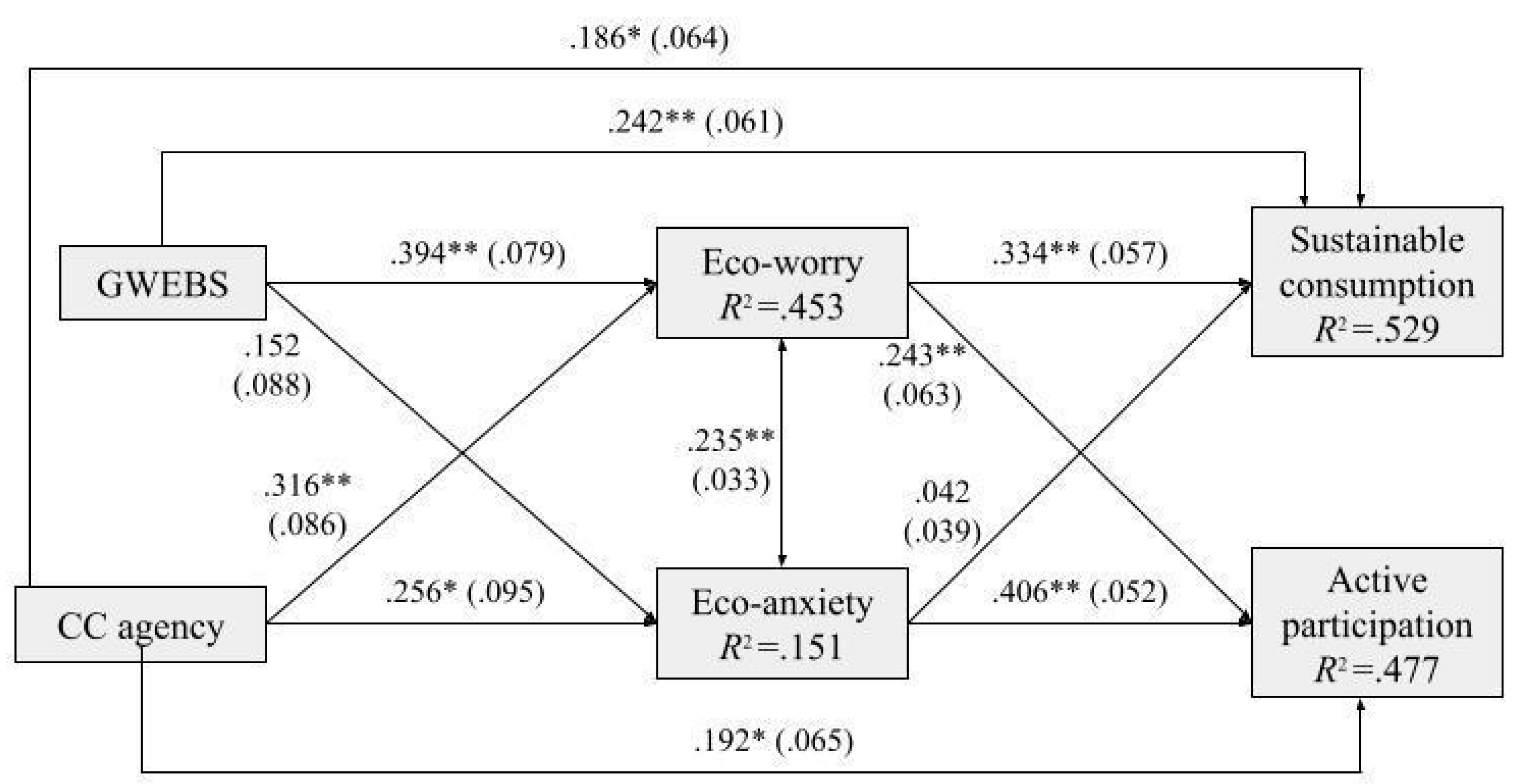

Table 1.
Sociodemographic Variables.
| Variable | n | (%) | |
| Gender | |||
| Female | 160 | (51.9) | |
| Male | 148 | (48.1) | |
| Educational level | |||
| Undergraduates students | 146 | (47.4) | |
| Bachelor's degree or university degree | 98 | (31.8) | |
| Master's or Ph. | 64 | (2.8) | |
| Socioeconomic level | |||
| I have no income | 89 | (28.9) | |
| €1,000 or less | 55 | (17.9) | |
| €1,001 - €2,000 | 113 | (36.7) | |
| €2,001 - €3,000 | 34 | (11) | |
| €3,001 - €4,000 | 11 | (3.6) | |
| More than €4,001 | 6 | (1.9) | |
Table 2.
Descriptive statistics and correlations among the study variables.
| Media (SD) | Sk | K | 1 | 2 | 3 | 4 | 5 | 6 | 7 | ||
| 1. Edu. level | 3.59 | (.972) | -.075 | -.891 | |||||||
| 2. Econom. level | 2.49 | (1.259) | .709 | .930 | .223** | ||||||
| 3. Eco-worry | 3.585 | (.852) | -.685 | .564 | .107 | .114* | |||||
| 4. Eco-anxiety | 2.574 | (.928) | -.076 | -.833 | .030 | .127* | .420** | ||||
| 5. GWEBS | 3.587 | (.879) | -.702 | .657 | .120* | .074 | .646** | .356** | |||
| 6. CC agency | 3.623 | (.835) | -.694 | .573 | .129* | .065 | .629** | .377** | .795** | ||
| 7. SC | 3.536 | (.787) | -.62 | .715 | .233** | .082 | .637** | .339** | .638** | .622** | |
| 8. AP | 2.349 | (.974) | .43 | -.606 | .114* | .167** | .544** | .588** | .470** | .505** | .556** |
Note. Sk = skewness; K = kurtosis, N = 308, * p < .05 (two-tailed); ** p < .01 (two-tailed); GWEBS = General Willingness of Environmental Behavior; CC agency = Climate Change agency; SC = Sustainable Consumption; AP = Active Participation.
Table 3.
BC Bootstrap confidence intervals for the indirect effects.
| Estimate | 95% CI | |||
| GWEBS → Eco-worry → SC | .118 | [.062, | .200] | |
| GWEBS → Eco-worry → AP | .106 | [.052, | .184] | |
| CC agency → Eco-worry → SC | .099 | [.044, | .177] | |
| CC agency → Eco-worry → AP | .089 | [.040, | .164] | |
| GWEBS → Eco-anxiety → SC | .006 | [-.004, | .028] | |
| GWEBS → Eco-anxiety → AP | .068 | [-.002, | .154] | |
| CC agency → Eco-anxiety → SC | .010 | [-.008, | .042] | |
| CC agency → Eco-anxiety → AP | .121 | [.045, | .207] | |
Note. n = 308. BC = bias-corrected; CI = confidence interval. Estimate = Unstandardized results; GWEBS = General Willingness of Environmental Behavior; CC agency = Climate Change agency; SC = Sustainable Consumption; AP = Active Participation.
Disclaimer/Publisher’s Note: The statements, opinions and data contained in all publications are solely those of the individual author(s) and contributor(s) and not of MDPI and/or the editor(s). MDPI and/or the editor(s) disclaim responsibility for any injury to people or property resulting from any ideas, methods, instructions or products referred to in the content. |
© 2025 by the authors. Licensee MDPI, Basel, Switzerland. This article is an open access article distributed under the terms and conditions of the Creative Commons Attribution (CC BY) license (http://creativecommons.org/licenses/by/4.0/).
Copyright: This open access article is published under a Creative Commons CC BY 4.0 license, which permit the free download, distribution, and reuse, provided that the author and preprint are cited in any reuse.


