

Submitted:
24 March 2025
Posted:
26 March 2025
You are already at the latest version
Abstract
Comprehensive genetic surveys of Lepidoptera are still largely lacking across most of the eastern Mediterranean. Consequently, there is a lack of modern, taxonomically validated checklists that meet current scientific standards. In this study, we analyze the butterfly and moth fauna of Crete (Greece) for the first time based on 3,110 DNA barcode sequences, primarily obtained from specimens based on our own sampling program. Building on this data and incorporating previously published records from print sources and online forums, we establish the first comprehensive checklist of the island’s fauna. In total, the occurrence of 1,230 species from 62 families is confirmed, with 725 of them genetically verified. Among them, 75 species appear to be island endemics. The checklist includes 125 newly recorded species for Crete validated by DNA barcoding (36 also new for Greece), along with 23 species confirmed solely through morphological study and another 16 only documented by photographs. Conversely, 212 previously reported species had to be removed as likely invalid. Furthermore, the 111 unidentified sequence clusters (BINs – Barcode Index Numbers) were documented, taxonomic uncertainties that will require future integrative resolution. The only taxonomic revision proposed in this study is the elevation of Holoscolia creticella Rebel, 1916 stat. nov. to full species status.
Keywords:
checklist
; crete
; DNA barcode
; endemism
; faunistics
; Lepidoptera
; taxonomy
1. Introduction
Crete, with an area of 8,261 km², is the largest Greek island, located in the eastern Mediterranean Sea, south of the mainland. Crete's topography is marked by mountainous landscapes with three notable mountain ranges exceeding 2,000 meters: Lefka Ori (White Mountains), Idi (Psiloritis), and Dikti. These ranges significantly impact the island's Mediterranean climate, creating varied precipitation levels across Crete. Aridity levels generally increase from west to east and from north to south across the island [1]. Annual precipitation varies from 240 mm in the south-eastern region to 2,000 mm in the White Mountains. The temperature typically drops 6°C per 1,000 m. Above 1,600 meters, precipitation is mostly snow, which accumulates from late October to May, sometimes extending to July in Lefka Ori [2]. Crete's high mountains, mainly composed of limestone, surround the main island. The coast also has 36 offshore islets, varying in geology and drier than the mainland.
The Cretan landscape is dominated by "phrygana" (sensu [3]), "maquis" (mainly Quercus coccifera) and intermediate mosaic formations, in addition to subalpine shrubs. Phrygana comprises spiny, aromatic shrubs with brief lifespans, superficial roots, limited palatability, and drought and grazing resilience. Examples include Calicotome villosa, Sarcopoterium spinosum, Thymus capitatus, and Genista acanthoclada. These shrubs are a consequence of woodland degradation due to grazing and burning [3]. Cypress, pine, and oak forests also exist, mainly on mountain cliffs ((Figure 1 and Figure 2). Lowland shrublands reach the alpine zones, confirming the weak zonation of Crete's vegetation [4]. Crete's unique orography and its long-standing isolation from the mainland, —during glacial maxima, the sea level was 200 meters lower than at present [5], yet Crete remained isolated from the Cyclades and Peloponnese, as the Cretan sea is much deeper [6]—have contributed to an impressive level of endemism. This is especially well-documented in vascular plants with 223 endemics, encompassing about 10% of the entire flora [7,8].
The first studies on the Lepidoptera fauna of Crete occurred in the mid-19th century [9,10]. However, intensive surveys were only conducted by Hans Rebel (1861–1940), culminating in 1916 with the first comprehensive faunal compilation and analysis, which identified 327 species [11]. It was already known at the time that this only represented a fraction of its actual species diversity. Eighty years later, the first modern catalog of European Lepidoptera, more than doubled the number of recorded species to 724 [12]. Since then, few comprehensive studies have focused explicitly on a broader spectrum of species from the island or on specific families [10,13,14,15,16]. Numerous scattered reports of additional or newly described species have gradually enriched the known species inventory [17,18,19,20,21,22,23,24,25]. Taking these supplementary findings into account, 972 species were reported to be present by Lepiforum [26].
Recently, macrophotography has played an increasingly important role in the collection of data on European Lepidoptera. The ‘Butterflies of Crete’ project (https://butterfliesofcrete.com/) was specifically developed for Crete from iNaturalist [142]. The site lists 45 butterfly species established on Crete, plus two regular immigrants (Vanessa cardui and Danaus chrysippus). The grid distribution maps for these species are quite convincing (e.g., https://butterfliesofcrete.com/family-nymphalidae/coenonympha-thyrsis/). One curious aspect is the list of 43 ‘missing butterflies of Crete’ (https://butterfliesofcrete.com/family-hesperiidae/missing-butterflies-of-crete/). These are species that were once reported by someone from Crete, but in the vast majority of cases, they can easily be explained by misidentifications or, in some instances, pure fantasy. However, the project also includes all other species of Lepidoptera [143]. As stated on the site: ‘Moths of Crete - Species - More than 1,300 moth species are found on the island of Crete, inhabiting a wide range of habitats. There are thought to be approximately 160,000 moth species worldwide, many of which have yet to be described.’ The possibility that some of these species may also occur on Crete is not mentioned. Furthermore, the list of the alleged 1,300 species is not provided anywhere. What is certain is that no validated or corrected list exists. There is, however, a photo list – though it's unclear whether it has been verified: ‘More photographs and detailed information on 600+ moth species on the island of Crete are available on the species pages; these are listed alphabetically (A-Z).’ If you follow the link, you’ll find 617 species of moths shown in photos (as of 21 March 2025), including 29 ‘new’ species discovered in February and March 2025 alone. The photo project associated with iNaturalist continues to grow rapidly. In general, the identifications here are correct – or at least, they seem to be. However, this photo-based project has a major limitation: much of the information remains speculative, and cryptic species will never be discovered in this way. Without DNA barcoding, the only Adela species on Crete would always be Adela paludicolella (and not Adela orientella). Similarly, Rivula tanitalis could continue to be misidentified as Rivula sericealis, a species that does not even exist on Crete. The project assumes that (at least almost) all species of Crete are known and that (almost) all species can be identified from photographs. Unfortunately – as shown here – neither assumption is entirely accurate. Nevertheless, this project has its merits and contributes to a better understanding of the Lepidoptera of Crete.
Despite the ongoing inventory of species on Crete, the assessment of genetic diversity through DNA barcoding has been restricted to selected species within the framework of broader studies, such as those on European butterflies, Gelechiidae, and Gracillariidae [27,28,29]. In recent years, however, molecular methods have also been applied to delineate cryptic species from Crete, including several newly described taxa [17,18,19,20,21,22,23,24,25]. Because the genetic assessment of Lepidoptera in the eastern Mediterranean—and for Crete in particular—is best described as highly fragmented, the primary goal of this study was to achieve the most comprehensive possible coverage of the island’s fauna through DNA barcoding [30]. The results serve as a basis for evaluating the uniqueness of the Cretan fauna and to facilitate the generation of an updated checklist.
2. Materials and Methods
2.1. DNA Barcoding
Our study encompasses all Lepidoptera specimens from Crete that were accessible to us including those from various external sources. However, it primarily relies on material collected by some of the authors - particularly Kai Berggren, Leif Aarvik and Peter Huemer - during recent, privately funded, and independent expeditions, some lasting for several weeks. The main goal was to achieve the most comprehensive molecular analysis of the Lepidoptera fauna. The sampling program was carried out in targeted but geographically and seasonally representative cycles. Furthermore, different collection methods were employed to capture the most species, notably light trapping during night and netting during the day and twilight. This approach, combined with the diverse taxonomic expertise of the specialists involved, allowed coverage of an unusually broad taxonomic spectrum from the island (Figure 3). The freshly collected material was, for the most part, immediately pinned, spread, and dried on site. In some cases, genital dissections were performed at a later stage [31]. The selection of specimens for DNA barcoding was primarily based on morphological criteria such as wing patterns and coloration, head characteristics, and occasionally after preliminary examination of genital morphology. In addition to our own samples, material from Walter Ruckdeschel's collection, who studied the island's fauna intensively for nearly two decades, was analyzed and partially sequenced [14,15].
Tissue samples (dried legs) from 1712 specimens from TLMF (Tyrolean Federal State Museums), provisionally identified to morphospecies, were prepared according to prescribed standards to obtain DNA barcode sequences of the mitochondrial COI gene (cytochrome c oxidase 1). The material was processed at the Canadian Centre for DNA Barcoding (CCDB, Centre for Biodiversity Genomics, University of Guelph) using a standard high-throughput protocol [32]. Additionally, 894 specimens from the Kai Berggren collection and 461 samples from the Zoological State Collection Munich were sequenced. Material of the Berggren collection was processed as part of the project Biodiversity Genomics Europe (BGE) at the University of Florence (Italy), where DNA was extracted using a non-destructive protocol. COI amplicons were generated through a single-step PCR using a combination of Folmer (LCO1490, HC02198; [33]) and Lep (LepF1, LepR1; [34]) primers, and sequencing was performed on a 8M ZMW SMRT cell on a PacBio Sequel IIe platform. Raw reads were demultiplexed using the Pacific Biosciences SMRT Link software. Consensus sequences were generated with the PacBio Amplicon Analysis (pbaa) tool. Primer trimming, translation and stop codon checking were performed using Geneious Prime 2024.0.1, while taxonomic validation was performed via BLAST (NCBI BLAST+ v2.14.0) against the NCBI nucleotide database [35].
Details including complete voucher data and images can be accessed in the public dataset "Lepidoptera of Crete" dx.doi.org/10.5883/DS-LEPICRET in the Barcode of Life Database (BOLD) [36]. The remarkably extensive taxonomic coverage of this barcode library is also largely due to the inclusion of sequences for groups, such as butterflies, Sesiidae, and some Microlepidoptera, which are already publicly available on BOLD.
All sequences were assigned to Barcode Index Numbers (BINs), an algorithm-based approach to delineate operational taxonomic units that provide a good proxy for species - which were automatically calculated for records in BOLD that are compliant with the DNA Barcode standard [37]. A few BINs included specimens belonging to more than one taxon because of BIN-sharing, misidentifications, or contaminations. identification was based on external morphology and in critical cases on genitalia morphology. In case of BINs attributed to a single Linnean name these were accepted as correct though potential misidentifications cannot be fully ruled out.
2.2. Checklist
The checklist for the Lepidoptera of Crete presented in this study is primarily based on knowledge already published online in Lepiforum and follows the systematics and nomenclature used therein [26]. We omit the listing of synonyms. In a further step, additional verified species from various sources were included:
- Genetically validated additional species (some morphologically examined)
- Unpublished, morphologically verified specimens from collections
Other species considered probable but not yet confirmed were included from the following sources:
However, the checklist does not contain species that are currently only identifiable to a genus level (Table S1). Finally, incorrect records, as well as unverified and unlikely records, mostly based only on photographs, were not included in the checklist.
3. Results
3.1. DNA Barcodes - General Overview
The sequence analysis of tissue samples from 3363 specimens generated 3110 DNA barcode sequences. Full DNA barcodes (658 bp) were recovered for 1792 specimens while another 1238 specimens produced a sequence ranging from 600-657 bp. Only 80 specimens had a sequence less than 600 bp. Mean intraspecific sequence divergence was 0.48% while congeneric species possessed an average of 8.88% divergence.
3.2. BINs Attributed to Linnaean Names
BOLD analytics assigned a species-level identification to 725 Linnaean names. 720 species were assigned to a species based on their BIN. Among these, members of 21 species were assigned to two BINs while members of five species were placed in three BINs. These 26 species show moderate genetic variability and merit further in-depth morphological analysis. For example, Gelechia senticetella may comprise 2–3 distinct species. Specimens of Maniola jurtina also exhibits considerable genetic diversity as they were assigned to three BINs, one of which matches Maniola telmessia (Zeller, 1847), a species known from the eastern Aegean.
These BINs belonged to 21 of the 24 superfamilies from Crete (Figure 4). The Pyraloidea, Gelechioidea, Noctuoidea, and Geometroidea not only have the highest species numbers but also show particularly good BIN coverage. Currently, no BINs are available for three species-poor superfamilies (Carposinoidea, Choreutoidea, Lasiocampoidea).
BIN-sharing was only detected in eight closely related species pairs for Agonopterix straminella/A. scopariella, Cnephasia genitalana/C. longana, Pelochrista caecimaculana/P. modicana, Dioryctria mendacella/D. pineae, Cadra delatinella/C. furcatella, Camptogramma bilineata/C. grisescens, Scopula decolor/S. imitaria, and Euxoa temera/E. distinguenda. Five species with shorter sequences did not qualify for a BIN assignment while no specimens of 476 species were available for analysis.
3.3. Unassigned BINs – Potential Cryptic Diversity
Another 111 BINs could not be assigned to a Linnaean species based on the reference sequences available in BOLD. 108 of these BINs could be assigned to a genus via BOLD, while three could only be assigned to a family (exclusively Tineidae). From this total, 75 are only known from Crete, whereas the other 36 BINs have been recorded elsewhere. Additionally, two distinct sequences restricted to Crete, which lack BINs, could not be assigned to any species (Table S1).
The BINs lacking a species assignment likely belong to already known but either insufficiently revised species complexes, or to groups which have seen little barcode analysis. This latter situation applies, for example, to the Autostichidae, which have few barcode records from Europe. A potentially larger number of unidentified BINs suggests previously unknown intraspecific divergences. This is likely to include some of the 24 species with a distance to their nearest neighbor of less than 2%. Conversely, 36 species show divergences of 4–11% from their closest relative in BOLD, where the largest proportion of additional and potentially even undescribed species is likely to be found.
The unassigned BINs are distributed very unevenly across major taxonomic groups (Figure 5). Among the 27 families with unknown BINs, the Gelechiidae are particularly well represented with 14 BINs, Pyralidae with 13 BINs, and Autostichidae with 11 BINs. Additionally, Pterophoridae, Tineidae, and Coleophoridae each contain more than five BINs lacking a species assignment. In seven predominantly species-poor families, only a single BIN that could not be classified at the species level was recorded. For all these taxa, extensive morphological studies are required to ultimately assign BINs to Linnaean names.
3.4. New Faunistic Records
3.4.1. New Records with Accompanying DNA BARCODES
A total of 125 species from 31 families represent first records for Crete based on barcode recovery and unequivocal assignment to a Linnaean taxon (Table 1). Some of these species were initially identified based on morphological characteristics and subsequently confirmed through DNA barcoding. Occasionally, records have already been reported in Lepiforum (e.g., Mondeguina mediterranella), while others have been published without reliable evidence (e.g., Elachista scirpi) [10]. Detailed information on the collection circumstances and sequences can be found in the dataset "Lepidoptera of Crete" at dx.doi.org/10.5883/DS-LEPICRET. For some of these species, there is additional unsequenced voucher material and, in some cases, photographs available on online platforms.
The list of new discoveries also includes 36 faunistically remarkable first records for Greece, including Ostrinia furnacalis and Agriphila bleszynskiella, even for Europe.
3.4.2. New Records Based on Morphology
Twenty-three species from 10 families are newly recorded from Crete based solely on morphological confirmation and were identified either phenotypically and/or through genitalia preparations.
| Coleophoridae |
|
Coleophora kroneella Fuchs, 1899 1♂ Chania Prov.; Rodopos, 2 km. N, 7. June 2023 K. Berggren & R. Voith leg., K. Berggren det. & coll., 2♂ Nopigia 9. June 2023 K. Berggren & R. Voith leg., K. Berggren det. & coll., gen. slide KBE 15693; 1♂ Rethymnon Prov.: Agios Vasilios, 1,5 km. NE, 10. June 2023 K. Berggren & R. Voith leg., K. Berggren det. & coll.; 2♂ Plakias 10. June 2023 K. Berggren & R. Voith leg., K. Berggren det. & coll. |
|
Coleophora nigridorsella Amsel, 1935 1♂ Chania Prov.: Kolymbari 30. May 2023 K. Berggren & R. Voith leg., K. Berggren det. & coll. |
|
Coleophora ptarmica Walsingham, 1910 1♂ Chania Prov.: Zounaki 30. May-13. June 2023 K. Berggren & R. Voith leg., K. Berggren det. & coll., gen. slide KBE 15675; 1♂ Rethymnon Prov.: Agios Vasilios, 1,5 km. NE, 4-7. September 2023 K. Berggren leg., det. & coll., gen. slide KBE 15670. Crambidae Phlyctaenomorpha sinuosalis (Le Cerf, [1910]) 4♂ Rethymnon Prov.: Plakias 10-17. September 2022, 1♀ 6. September 2023, 1♂ 7-14. September 2024 K. Berggren leg., det. & coll. Tegostoma comparalis (Hübner, 1796) 2♂,2♀ Chania Prov.: Chora Sfakion 14-24. August 2017 L. Aarvik leg. & det., NHMO coll. |
| Depressariidae |
|
Depressaria depressana (Fabricius, 1775) 2♀,1♂ Chania Prov.: Kolymbari 10-11. September 2019 K. Berggren leg., det. & coll., gen. slide ♂ KBE 15151l. |
| Erebidae |
|
Eublemma purpurina ([Denis & Schiffermüller], 1775) 1♂ Rethymnon Prov.: Agios Vasilios, 1,5 km NE, 4-7. September 2023 K. Berggren leg., det. & coll. |
|
Caryocolum mucronatella (Chrétien, 1900) 5♂,2♀ Chania Prov.: Anapoli 5. August-7. September 1991, sample FC 1839, Lymberakis leg., K. Berggren det., Natural History Museum Knossos coll., gen. slide. ♀ KBE 15366, K. Berggren coll. Lanceoptera panochra Janse, 1960 1♂ Chania Prov.: Chora Sfakion 14-24. August 2017, 1♀ 18-30. August 2019 L. Aarvik leg., O. Bidzilya det., NHMO coll. |
| Gracillariidae |
|
Phyllonorycter platani (Staudinger, 1870) 1 specimen Chania Prov.: Zounaki 30. May-13. June 2023 K. Berggren & R. Voith leg., K. Berggren det. & coll. |
|
Phyllonorycter sublautella (Stainton, 1869) 1 ♂ Rethymnon Prov.: Agios Vasilios, 1,5 km. NE, 13. September 2022 K. Berggren leg., det. & coll. |
|
Momphidae Mompha divisella Herrich-Schäffer, [1854] 1 ♂ Heraklion Prov.: Kofinas 16. July 1996 Hadjiicharalampous leg., sample FC 61, K. Berggren det., Natural History Museum Knossos coll., gen. slide KBE 15957, K. Berggren coll. Nepticulidae |
|
Stigmella muricatella (Klimesch, 1978) 11 specimens, collected in malaise-trap, Heraklion Prov.: Kofinas 16. July 1995, Hadjiicharalampous leg., Sample FC 61, K. Berggren det., Natural History Museum Knossos coll., 9♂ dissected, gen. slide KBE 15928, KBE 15932, KBE 15933, KBE 15940, KBE 15941, KBE 15958, KBE 15959, KBE 15960, KBE 15961, K. Berggren coll. |
| Noctuidae |
|
Mesapamea secalis (Linnaeus, 1758) 1♀ Chania Prov.: Chora Sfakion 8-18. August 2016 L. Aarvik leg. & det., gen. slide NHMO 4370, NHMO coll.; 1♂ Chania Prov.: Kedrodasos 500 m., 5. June 2023 K. Berggren & R. Voith leg., K. Berggren det. & coll., gen. slide KBE 16461; 1♂ Chania Prov.: Rodopos, 2 km. N, 7. June 2023 K. Berggren & R. Voith leg., gen. slide RVO 4157, R. Voith det. & coll.; 1♂ Heraklion Prov.: Faneromeni 18. May-6. July 2018 G. Bolanakis leg., sample FC 17733, Natural History Museum Knossos coll., gen. slide KBE 15359, K. Berggren coll. Nolidae Meganola kolbi (Daniel, 1935) 7♂,9♀ Rethymnon Prov.: Kastellos W 3. July-3. August 2019, sample FC 17758 G. Bolanakis leg., Natural History Museum Knossos coll., gen. slide ♂ KBE 15293, ♂ KBE 15326 K. Berggren coll. Meganola togatulalis ([Denis & Schiffermüller], 1775) 1♂ Chania Prov.: Rodopos, 2 km. N, 7. June 2023 K. Berggren & R. Voith leg., K. Berggren det. & coll. |
| Pyralidae |
|
Pyla fusca (Haworth, 1811) 1♀ Chania Prov.: Chora Sfakion 8-15. September 2012 L. Aarvik leg. & det., gen. slide NHMO 4545, NHMO coll. |
| Tineidae |
|
Nemapogon variatella (Clemens, 1859) 1♀ Chania Prov.: Kolymbari 9. September 2019 K. Berggren leg, det. & coll., gen. slide KBE 15152. |
| Tortricidae |
|
Aethes bilbaensis (Rössler, 1877) 4♂,1♀ Chania Prov.: Zounaki 30. May-13. June 2023 K. Berggren & R. Voith leg., K. Berggren det. & coll.; 1♂ Chania Prov.: Kolymbari 30. May-13. June 2023 K. Berggren & R. Voith leg., K. Berggren det. & coll. |
|
Cnephasia ecullyana Réal, 1951 2♂ Chania Prov.: Zounaki 30. May-13. June 2023 K. Berggren & R. Voith leg., K. Berggren det. & coll. |
|
Epinotia festivana (Hübner, [1799]) 2♂ Chania Prov.: Zounaki 30. May-13. June 2023 K. Berggren & R. Voith leg., K. Berggren det. & coll.; 1♂ Rethymnon Prov.: Agios Vasilios, 1,5 km. NE, 10. June 2023 K. Berggren & R. Voith leg., K. Berggren det. & coll. |
|
Notocelia mediterranea (Obraztsov, 1952) 1♂ Rethymnon Prov.: Agios Vasilios, 1,5 km. NE, 13. September 2022 K. Berggren leg., det. & coll. Rhyacionia buoliana ([Denis & Schiffermüller], 1775) 1♂ Chania Prov.: Sougia 4. June 2024 K. Berggren & R. Voith leg., K. Berggren det. & coll. |
3.4.3. Reliable New Records Based on Photographs
The presence of another 16 species in Crete is so far based solely on photographs (Table 2). Of course, it is always possible that apparently unmistakable species (e.g., Mimas tiliae, Noctua interjecta, Apocheima hispidaria) have their own island endemics. There is a nice photo sequence of Hemaris croatica visiting a flower, but since this conspicuous species has not been recorded elsewhere on Crete, it is probably a rare immigrant without a self-sustaining population. There is only a single caterpillar photo of Euproctis chrysorrhoea so it is unclear whether it is established on Crete. The Australian Crambidae Heliothela ophideresana was known from Africa and Iran, too, but not yet from Europe. A nice photo sequence from Crete is told to show this species [143] – a DNA barcode would help to be confirm this identification.
3.5. Revised and Updated Checklist
The revised checklist for the Lepidoptera of Crete is based on the taxonomy and nomenclature adopted by Lepiforum from various sources [26]. Important references to records are included, without claiming completeness, especially for genetically unverified species. The checklist currently includes 1,230 confirmed species belonging to 62 families (Table S2). However, it should be noted that a considerable number of taxa that have not been genetically examined may still pose taxonomic issues in the future.
Our list excludes 212 species previously reported from Crete. Of these, 54 species represent misidentifications, while 83 species remain uncertain—either because they are only documented through photos that do not allow reliable identification or because literature sources do not align with the species' known distribution patterns and material was not available to us. A special case involves 43 species that were previously listed as part of Crete’s fauna but for which no concrete evidence of occurrence exists [40]; most of these were likely included based on the assumption that they should be present. The same is the case for 32 species of butterflies, listed as “missing species” [142]. However, it is possible that a few of the excluded species may be present (Table S3).
If the 111 BINs that have not yet been identified to species level are included, the actual number of species could reach approximately 1,400. However, the verification of these taxa is reserved for future studies, some of which are already underway.
The only systematic-taxonomic change provided here concerns the status of a previously overlooked endemic species of Crete:
Holoscolia creticella Rebel, 1916 stat. nov.
In 1916, Rebel described Holoscolia majorella var. creticella from various localities on Crete. However, this regional variation has not yet been recognized as a valid species name [11,12,26]. In fact, the habitually differentiated taxon is also supported as a separate species by DNA barcodes, with a p-distance of 3.04% to the nearest neighbor H. majorella. Therefore, we elevate the variation to species rank (Figure 6).
4. Discussion
Crete has long been a focus of research on lepidopterans and is therefore considered both extensively studied and well-sampled. However, the assessment of genetic diversity has largely been neglected to date. Aside from a few recent descriptions, gene sequences—particularly DNA barcodes—have only been published or made publicly available for very few species-rich groups [27,28,29]. The barcode library assembled in this study provides records for more than half of the known fauna with 725 sequenced and reliably identifiable species (720 with BIN). Such a comprehensive genetic survey has not yet been recorded for any Mediterranean island.
The clearly insufficient taxonomic study of Crete's fauna is reflected, among other aspects, by the documentation of endemic and thus particularly significant species (Figure 7). Of the 75 known species, 40% have been described after 2000. Additional species, such as the recently discovered Leucochlaena labrys, suggest that more unrecognized endemics await taxonomic clarification [42]. Moreover, based on current knowledge, it is very likely that numerous other endemics are among the still unresolved species. The presence of more than 100 BINs which lack a species assignment is unusually high for a region considered well-researched. Certain families, such as Gelechiidae and Gracillariidae, include many unresolved species, considering an already largely complete European DNA barcoding library and the high number of unknown BINs [28,29]. Similarly, initial research suggests that even less diverse families, such as Cosmopterigidae, may contain three undescribed species within the genera Pyroderces, Sorhagenia, and Alloclita. Additionally, three species of the family Erebidae, represented by the genera Hypenodes and Orectis, require taxonomic revision in the former genus or are likely new to science in the latter genus. A similar situation applies to several representatives of Pyraloidea. However, all these taxa require comprehensive taxonomic analyses, including type studies. In other families with more unknown BINs, such as Autostichidae, Pterophoridae, Coleophoridae, Elachistidae, or Oecophoridae, the lack of reference sequences is likely responsible for the current classification deficits, even some new species may be involved.
Our study not only addresses a significant gap in the genetic documentation of biodiversity in Crete but also highlights the considerable gaps in knowledge of the island's fauna. The last comprehensive publication with a checklist included just over 700 species [12], while approximately 300 additional species records are reported in various online media. The present faunistic-taxonomic surveys significantly expanded knowledge of the fauna as it included 125 newly reported and genetically confirmed species, as well as 23 additional species solely based on morphology. More discoveries are certain as the areas above 1600 m have hardly been studied
At the same time, molecular verification of previously published taxa allowed for the correction of numerous misidentifications. Finally, 212 species, either officially published or shared in online forums, had to be eliminated as invalid or doubtful records. All these findings are considered for a completely revised and updated checklist of Crete's fauna.
Finally, even after a thorough revision of currently unresolved species, it is not yet possible to make a definitive assessment of the lepidopteran fauna of Crete. This will only become feasible through planned expansions of sequencing efforts to include the remaining species, which are highly likely to yield further surprises.
5. Conclusions
Genetically substantiated species inventories are currently lacking for all other major Mediterranean islands. However, the results from Crete demonstrate the need of prioritize such inventories, particularly on islands with high endemic potential. As evidenced in Crete, the sequence analysis of species whose taxonomic status seemed unequivocal, often reveals cryptic diversity and previously unrecognized endemism [15,16,17,22]. Therefore, the goal of faunistic surveys, particularly in the less explored Mediterranean islands, should involve the comprehensive analysis of all morphospecies using DNA barcodes, followed by the application of integrative taxonomic methods to further investigate taxa showing genetic divergence.
Supplementary Materials
The following supporting information can be downloaded at the website of this paper posted on Preprints.org, Table S1: Unidentified BINs; Table S2: Checklist of Lepidoptera from Crete; Table S3: Incorrect or doubtful species records.
Author Contributions
For research articles with several authors, a short paragraph specifying their individual contributions must be provided. The following statements should be used “Conceptualization, P.H., K.B., L.A. and E.R.; methodology, P.H..; validation, P.H., K.B., L.A., A.S., A.H. and E.R.; formal analysis, P.H., K.B., L.A. and E.R.; investigation, P.H., K.B., L.A., E.R and A.M.A.; resources, A.M.A., P.D.N.H..; data curation, P.H., K.B., L.A., A.S., A.H., E.R. and A.M.A.; writing—original draft preparation, P.H.; writing—review and editing, P.H., K.B., L.A., A.S., A.H., G.S, E.R. and P.D.N.H.; funding acquisition, A.H., A.S., P.D.N.H. All authors have read and agreed to the published version of the manuscript.
Funding
This research was partially funded by the Canada Foundation for Innovation, by Genome Canada through Ontario Genomics, by the Tri-Council’s New Frontiers in Research Fund, the Crocallis Foundation (W. Ruckdeschel), and Biodiversity Genomics Europe (Grant no.101059492) is funded by Horizon Europe under the Biodiversity, Circular Economy and Environment call (REA.B.3); co-funded by the Swiss State Secretariat for Education, Research and Innovation (SERI) under contract number 22.00173; and by the UK Research and Innovation under the Department for Business, Energy and Industrial Strategy’s Horizon Europe Guarantee Scheme.
Data Availability Statement
All 3110 COI sequences are available in the dataset “Lepidoptera of Crete” DS-LEPICRET on BOLD (dx.doi.org/10.5883/DS-LEPNCYPR) at https://www.boldsystems.org/ (accessed on 8 March 2025).
Acknowledgments
The authors are most grateful to the entire team at the Centre for Biodiversity Genomics (Guelph, Canada). For valuable assistance with materials, data, or technical support, we thank the following colleagues: Walter Ruckdeschel, Torbjørn Ekrem, Sónia Ferreira, Alessio Iannucci, Arild Johnsen, Egbert Friedrich, Reidar Voith, Wolfgang Wittland, Erik van Nieukerken, Marko Mutanen, Ole Karsholt, Jukka Tabell, Romed Unterasinger, Michael Thalinger. The Greece Ministry of the Environment is acknowledged for issuing necessary permits.
Conflicts of Interest
The authors declare no conflict of interest.
References
- Grove, A.T.; Rackham, O. Threatened landscapes in the Mediterranean: examples from Crete. Landsc. Urban Plan. 1993, 24, 279–292. [Google Scholar] [CrossRef]
- Rackham, O.; Moody, J.A. The Making of the Cretan Landscape; xvii + 237 pp; Manchester University Press: Manchester, UK, 1996. [Google Scholar]
- di Castri, F. Mediterranean–type shrublands of the world. di Castri, F.; Goodall, D.W., Ed.; Specht, R.L. (eds.), Mediterranean-type shrublands of the world ecosystems of the World II: Mediterranean-type Shrublands. Elsevier, Amsterdam, Netherlands, 1981; pp. 1–52. [Google Scholar]
- Vogiatzakis, I.; Rackham, O. Crete. Vogiatzakis, I.; Pungetti, G., Ed.; Mannion, A.M. (eds), Mediterranean Island Landscapes: Natural and Cultural Approaches. Springer, Dordrecht, Netherlands, Dordrecht 2008; pp. 245–270. [Google Scholar] [CrossRef]
- Beerli, P.; Hotz, H.; Uzzell, T. Geologically dated sea barriers calibrate a protein clock for Aegean water frogs. Evol. 1996, 50, 1676–1687. [Google Scholar] [CrossRef]
- Schule, W. Mammals, vegetation and the initial human settlement of the Mediterranean Islands – a palaeoecological approach. J. Biogeogr. 1993, 20, 399–412. [Google Scholar] [CrossRef]
- Muer, T.; Sauerbier, H.; Jahn, Ralf. Flora Cretica. A complete handbook of all flowering plants, lycopods and ferns occurring on the island of Crete and surrounding islets. Kleinsteuber Books, Karlsruhe, Germany, 2024; pp. 1–1254.
- Menteli, V.; Krigas, N.; Avramakis, M.; Turland, N.; Vokou, D. Endemic plants of Crete in electronic trade and wildlife tourism: current patterns and implications for conservation. J. Biol. Res. Thessaloniki 2019, 26, 10. [Google Scholar] [CrossRef]
- Leestmans, R. Histoire de l´éxploration lépidoptérique de l´ile de Crète (Insecta, Lepidoptera). Linneana Belg. 1988, 11, 389–413. [Google Scholar]
- Gozmány, L. The Lepidoptera of Greece and Cyprus. Fauna Graecia IX. Volume 1. Hellenic Zoological Society, Athens, 2012; pp. 1–409.
- Rebel, H. Die Lepidopterenfauna Kretas. Ann. K. K. Naturhist. Hofmus. 1916, 30, 66–172. [Google Scholar]
- Karsholt, O.; Razowksi, J. The Lepidoptera of Europe. A Distributional Checklist. Apollo Books, Stenstrup, Denmark, 1996; pp. 1–380.
- Bartsch, D.; Pühringer, F. Die Glasflügler Kretas (Lepidoptera: Sesiidae). Ent. Z., Stuttgart 2005, 115, 131–139. [Google Scholar]
- Ruckdeschel, W. Die Geometriden Kretas (Lepidoptera, Geometridae). NachrBl. bayer. Ent. 2007, 56, 2–12. [Google Scholar]
- Huemer, P. Beitrag zur Wicklerfauna Kretas aus Aufsammlungen von Dr. Walter Ruckdeschel (Lepidoptera, Tortricidae). NachrBl. bayer. Ent. 2016, 65, 2–12. [Google Scholar]
- Karsholt, O.; Huemer, P. Review of Gelechiidae (Lepidoptera) from Crete. Linzer biol. Beitr. 2017, 49, 159–190. [Google Scholar]
- Zlatkov, B.; Huemer, P. Remarkable confusion in some Western Palearctic Clepsis leads to a revised taxonomic concept (Lepidoptera, Tortricidae). ZooKeys 2019, 885, 51–87. [Google Scholar] [CrossRef] [PubMed]
- Zlatkov, B.; Huemer, P. Eucosma subvittana (Staudinger 1892) stat. rev., a Mediterranean species resurrected by DNA barcodes and morphology (Lepidoptera, Tortricidae). Zootaxa 2023, 5361, 451–462. [Google Scholar] [CrossRef]
- Basso, A.; Avtzis, D.; Burban, C.; Kerdelhué, C.; İpekdal, K.; Magnoux, E.; Rousselet, J.; Negrisolo, E.; Battisti, A. The pine processionary moth Thaumetopoea pityocampa (Notodontidae) species complex: a phylogeny-based revision. Arthropod Syst. Phylo. 2023, 81, 1031–1050. [Google Scholar] [CrossRef]
- Bidzilya, O.; Karsholt, O.; Šumpich, J. A revision of the genus Ivanauskiella (Lepidoptera: Gelechiidae). Acta. Entomol. Mus. Natl. Pragae 2023, 63, 135–164. [Google Scholar] [CrossRef]
- Bidzilya, O.V.; Huemer, P.; Karsholt, O. Thiotricha sumpichi sp. nov. – a new species of Thiotrichinae (Lepidoptera, Gelechiidae) from south-eastern Europe. ZooKeys 2023, 1173, 85–96. [Google Scholar] [CrossRef] [PubMed]
- Berggren, K.; Aarvik, L.; Karsholt, O.; Slagsvold, P. K.; Marthinsen, G. A new species of Brachmia Hübner (Lepidoptera, Gelechiidae) from South Europe. Norwegian J. Ent. 2023, 70, 34–41. [Google Scholar]
- Aarvik, L.; Berggren, K.; Marthinsen, G. Schiffermuelleria sempronas sp. n., a brilliant moth living in old olive trees in Crete (Lepidoptera, Oecophoridae). Norwegian J. Ent. 2023, 70, 47–54. [Google Scholar]
- Huemer, P. , Aarvik, L.; Berggren, K. A new species of Neurothaumasia Le Marchand (Lepidoptera, Tineidae) from Crete, Greece. Zootaxa 2023, 5318, 401–410. [Google Scholar] [CrossRef]
- Berggren, K.; Aarvik, L. Callima icterinella (Mann, 1867) comb. nov. (Lepidoptera, Oecophoridae), a complex consisting of seven species. Norwegian J. Ent. 2024, 71, 95–108. [Google Scholar]
- Lepiforum: Website zur Bestimmung von Schmetterlingen (Lepidoptera) und ihren Präimaginalstadien. http://www.lepiforum.eu/bh/downloads/2021-iii-20/Lepiforums-Europaliste_Schmetterlinge_Version_8.3_Stand_2021_03_20 (accessed on 26.12.2024).
- Dinca, V.; Dapporto, L.; Somervuo, P.; Vodă, R.; Cuvelier, S.; Gascoigne-Pees, M.; Huemer, P.; Mutanen, M.; Hebert, P.D.N.; Vila, R. High resolution DNA barcode library for European butterflies reveals continental patterns of mitochondrial genetic diversity. Comm. Biol. 2021, 4, 1–11. [Google Scholar] [CrossRef]
- Huemer, P.; Karsholt, O.; Aarvik, L.; Berggren, K.; Bidzilya, O.; Junnilainen, J.; Landry, J.-F.; Mutanen, M.; Nupponen, K.; Segerer, A.; Šumpich, J.; Wieser, C.; Wiesmair, B.; Hebert, P.D.N. DNA barcode library for European Gelechiidae (Lepidoptera) suggests greatly underestimated spe cies diversity. ZooKeys 2020, 921, 141–157. [Google Scholar] [CrossRef] [PubMed]
- Lopez-Vaamonde, C.; Kirichenko, N.; Cama, A.; Doorenweerd, C.; Godfray, H.C.J.; Guiguet, A.; Gomboc, S.; Huemer, P.; Landry, J.-F; Laštůvka, A.; Laštůvka. , Z.; Lee K.M.; Lees, D.C.; Mutanen, M.; Nieukerken E.J. van; Segerer, A.H.; Triberti, P.; Wieser, C.; Rougerie, R. Evaluating DNA barcoding for species identification and discovery in European gracillariid moths. Front. Ecol. Evol. 2021, 9, 626752. [Google Scholar] [CrossRef]
- Huemer, P.; Mutanen, M. An incomplete European barcode library has a strong impact on the identification success of Lepidoptera from Greece. Diversity 2022, 14, 118. [Google Scholar] [CrossRef]
- Tabell, J.; Siloaho, R.; Sippola, L. The Casebearer Moths (Coleophoridae) of Northern Europe - Genitalia. Tibiale Insect Equipment ltd, Helsinki, Finland, 2024; pp. 1–248.
- deWaard, J.R.; Ivanova, N.V.; Hajibabaei, M.; Hebert, P.D.N. Assembling DNA Barcodes: Analytical Protocols. Martin, C.C. (ed.), Methods in Molecular Biology: Environmental Genomics. Humana Press Inc., Totowa, USA, 2008; pp. 275–293.
- Folmer, O.; Black, M.; Hoeh, W.; Lutz, R.; Vrijenhoek, R. DNA primers for amplification of mitochondrial cytochrome c oxidase subunit I from diverse metazoan invertebrates. Mol. Mar. Biol. Biotechnol. 1994, 3, 294–299. [Google Scholar]
- Hebert, P.D.N.; Penton, E.H.; Burns, J.M.; Janzen, D.H.; Hallwachs, W. Ten species in one: DNA barcoding reveals cryptic species in the neotropical skipper butterfly Astraptes fulgerator. Proc. Natl. Acad. Sci. USA. 2004, 101, 14812–14817. [Google Scholar] [CrossRef]
- Camacho, C.; Coulouris, G.; Avagyan, V.; Ma, N.; Papadopoulos, J.; Bealer, K.; Madden, T.L. (2009). BLAST+: architecture and applications. BMC Bioinformatics 2009, 10, 421. [Google Scholar] [CrossRef]
- Ratnasingham, S.; Hebert, P.D.N. BOLD: The Barcode of Life Data System (www.barcodinglife.org). Mol. Ecol. Notes 2007, 7, 355–364. [Google Scholar] [CrossRef]
- Ratnasingham, S.; Hebert, P.D.N. A DNA-based registry for all animal species: The Barcode Index Number (BIN) System. PLoS ONE 2013, 8, e66213. [Google Scholar] [CrossRef]
- iNaturalist. Available online: https://www.inaturalist.org (accessed on 1 February 2025).
- Observation. Available online: https://www.observation.org (accessed on 1 February 2025).
- Karsholt, O.; van Nieukerken, E.J.; Lepidoptera, Moths. Fauna Europaea 2013, Version 2021.12. Available online: https://fauna-eu.org (accessed on 1 December 2021).
- Kumar, S.; Stecher, G.; Tamura, K. MEGA7: Molecular Evolutionary Genetics Analysis version 7.0 for bigger datasets. Mol. Biol. & Evol. 2016, 33, 1870–1874. [Google Scholar] [CrossRef]
- Sattin, L.; Fiumi, G.; Floriani, A.; Govi, G. Leucochlaena labrys, a new species from Crete, Greece (Lepidoptera: Noctuidae, Xyleninae, Episemini). Ecol. Montenegrina 2025, 81, 43–53. [Google Scholar] [CrossRef]
- Timossi, G.; Huemer, P. Timossi, G.; Huemer, P. Adela paludicolella Zeller, and Adela orientella Staudinger, Lepidoptera, Adelidae: two distinct species revealed by morphological analysis and DNA barcoding, 1850, 1870 sp. rev. Zootaxa 2025, (in press).
- Bidzilya, O.V.; Budashkin, Yu.I.; Gaedike, R. A revision of the Eudarcia glaseri-species group (Lepidoptera, Meesiidae) with description of two new species from Greece and Crimea. Zootaxa 2016, 4179, 547–560. [Google Scholar] [CrossRef] [PubMed]
- Gaedike, R. New West Palaearctic Meessiidae and Tineidae (Lepidoptera: Tineoidea). SHILAP Revta. lepid. 2019, 47, 75–86. [Google Scholar] [CrossRef]
- Gaedike, R. New species and new records of Palaearctic Meessiidae and Tineidae (Lepidoptera: Tineoidea). SHILAP Revta. lepid. 2021, 49, 627–639. [Google Scholar] [CrossRef]
- Arnscheid, W.R. Taleporia henderickxi sp. n., a new psychid species of the subfamily Taleporiinae from Crete (Lepidoptera, Psychidae). Nota lepid. 2016, 39, 93–100. [Google Scholar] [CrossRef]
- Sobczyk, T. Eochorica vardarica und Penestoglossa sutteri – Zwei neue Arten der Typhoniinae aus Südosteuropa (Lepidoptera: Psychidae). Ent. Z. 2013, 123, 19–24. [Google Scholar]
- Nel, J.; Nel, A. Contribution à la connaissance des Lépidoptères de l’île de Crète (Grèce) (Lepidoptera). Bull. Soc. ent. France 2003, 108, 277–282. [Google Scholar] [CrossRef]
- Gaedike, R. Microlepidoptera of Europe. Volume 7. Tineidae I (Dryadaulinae, Hapsiferinae, Euplocaminae, Scardiinae, Nemapogoninae and Meessiinae). Brill, Leiden & Boston, 2015; pp. 1–308.
- Gaedike, R. Microlepidoptera of Europe. Volume 9. Tineidae II (Myrmecozelinae, Perissomasticinae, Tineinae, Hieroxestinae, Teichobiinae and Stathmopolitinae). Brill, Leiden & Boston, 2019; pp. 1–248.
- Gaedike, R.; Sammut, P.; Seguna, A. Proterospastis orientalis Petersen, 1959, a species new to the lepidopterofauna of Malta, Greece and the whole of Europe (Lepidoptera: Tineidae, Tineinae). SHILAP Revta. lepid. 2011, 39, 37–38. [Google Scholar]
- Huemer, P.; van Nieukerken, E. Identity of some recently described Lepidoptera from France — re-assessed with DNA barcodes and morphology. Zootaxa 2021, 4941, 301–337. [Google Scholar] [CrossRef]
- Mey, W. Phyllobrostis minoica sp. n. from Crete (Greece) – an expected discovery (Lepidoptera, Yponomeutoidea, Lyonetiidae). Nota lepid. 2014, 37, 161–165. [Google Scholar] [CrossRef]
- Tokár, Z. Bucculatrix kaptarae sp. nov. (Lepidoptera: Bucculatricidae) from the mountains of western Crete. Entomologist's Gaz. 2017, 68, 99–102. [Google Scholar]
- Laštůvka, A.; Laštůvka, Z. Southern European Phyllonorycter species mining Quercus, with two new species (Lepidoptera: Gracillariidae). Acta Univ. Agric. et Silvic. Mendel. Brun. 2007, 55, 95–110. [Google Scholar] [CrossRef]
- Nel, J.; Peslier, S. Trois microlépidoptères nouveaux pour la Crète (Grèce) (Lepidoptera, Carposinidae et Pyralidae Phycitinae). Rev. Assoc. Roussillon Entomol. 2023, 32, 148–149. [Google Scholar]
- Scholz, A.; Jäckh, E. Taxonomie und Verbreitung der Westpalaearktischen Alucita-Arten (Lepidoptera: Alucitidae [Orneodidae]). Alexanor 1994, 18, 3–64. [Google Scholar]
- Fazekas, I.; Edmunds, H. New records of Alucitidae and Pterophoridae species from Crete (Lepidoptera). Lepid. hung. 2023, 19, 25–36. [Google Scholar] [CrossRef]
- Arenberger, E. Microlepidoptera Palaearctica. Zwölfter Band. Pterophoridae. 3. Teilband. Platyptiliinae: Platyptiliini: Stenoptilia. Goecke & Evers, Keltern, Deutschland, 2005; pp. 1–191.
- Gaedike, R. Two new species of the genus Epermenia Hübner, [1825] and some new distributional and taxonomic records (Lepidoptera: Epermeniidae). SHILAP Revta. lepid. 2022, 50, 755–765. [Google Scholar] [CrossRef]
- Gaedike, R. Die Genitalien der europäischen Epermeniidae (Lepidoptera:Epermeniidae). Beitr. Ent. 1966, 16, 633–692. [Google Scholar]
- Razowski, J. Neue und wenig bekannte palaearktische Wickler-Arten (Lepidoptera, Tortricidae). Z. Wien. Ent. Ges. 1959, 44, 81–87. [Google Scholar]
- Razowski, J. Descriptions of new Cnephasia Curtis (Tortricidae). Nota lepid. 1983, 6, 235–238. [Google Scholar]
- Pröse, H.; Sutter, R. Cydia marathonana sp. nov., eine neue Art der succedana-Gruppe aus Griechenland und Bemerkungen über Cydia trogodana Pröse, 1988 (Lepidoptera: Tortricidae). Ent. Z. 2003, 113, 168–169. [Google Scholar]
- Karisch, T.; Pinzari, M. Cydia molybdana (Constant, 1884): a valid species (Lepidoptera: Tortricidae: Olethreutinae). Beitr. Ent. 2010, 60, 463–470. [Google Scholar] [CrossRef]
- Gozmány, L. Holcopogonidae. Microlepidoptera Palaearctica. Volume 10. Holcopogonidae Goecke & Evers, Keltern, Deutschland, 2000; pp. 1–176 pp.
- Aarvik, L. Symmoca sparsella Joannis, 1891 (Gelechioidea, Autostichidae) new to Europe. Nota lepid. 2012, 35, 181–183. [Google Scholar]
- Gozmány, L.A. A new species of the genus Aprominta Gozm. from Crete (Lep. Symmocidae). Dtsch. Entomol. Z., N.F. 1964, 11(1-2), 11–12.
- Gozmány, L.A. Some new considerations on the generic group Symmoca Hbn. (Lep., Gelechiidae). Acta Zool. Acad. Sci. Hung. 1959, 5(1–2), 41–48.
- Gozmány, L.A. The description of some new Symmocoid taxa (Lepidoptera: Gelechiidae). Acta Zool. Acad. Sci. Hung. 1961, 7, 97–110. [Google Scholar]
- Gozmány, L.A. New Symmocid species (Lepidoptera) from the Mediterranean region. Acta Zool. Acad. Sci. Hung. 1997, 23, 87–97. [Google Scholar]
- Karsholt, O.; Lvovsky, A. A new species of the genus Herrichia Staudinger (Lepidoptera: Oecophoridae) from the Island of Crete. Entomol. Rec. J. Var. 2018, 130, 307–312. [Google Scholar]
- Rebel, H. Versammlung am 9. Februar 1917. Verh. K. K. zool.-bot. Ges. Wien 1917, 67, 45–55. [Google Scholar]
- Corley, M.F.V. axonomic notes on Portuguese Microlepidoptera I. Cacochroa rosetella Corley, sp. n. (Lepidoptera: Depressariidae, Cryptolechiinae). SHILAP Revta. lepid. 2018, 46, 75–79. [Google Scholar] [CrossRef]
- Buchner, P.; Corley, M.F.V. Agonopterix olusatri, a new species of Depressariidae (Lepidoptera) from the West Palaearctic region. Miscell. Papers (Centre for Entomological Studies Ankara) 2019, 196, 1–13. [Google Scholar]
- Buchner, P.; Corley, M.F.V. Microlepidoptera of Europe. Volume 10. Depressariidae. Brill, Leiden & Boston, 2025; pp. 1–624.
- Buchner, P. Redescription of Agonopterix selini (Heinemann, 1870) with description of Agonopterix lessini sp.n. and Agonopterix paraselini sp.n. (Lepidoptera, Gelechoidea). Gortania 2017, 38, 71–101. [Google Scholar]
- Corley, M.F.V. Five new species of microlepidoptera from Portugal. Entomol. Rec. J. Var. 2014, 126, 229–243. [Google Scholar]
- Huemer, P. DNA-based faunistics - exemplified by surveys of Lepidoptera in Greece. Entomol. Rec. J. Var. 2024, 136, 27–35. [Google Scholar]
- Huemer, P.; Karsholt, O. Microlepidoptera of Europe. Volume 3. Gelechiidae I. Apollo Books, Stenstrup, Denmark, 1999; pp. 1–356.
- Huemer, P.; Karsholt, O. Additions to the fauna of Gelechiidae (Gelechiinae: Teleiodini and Gelechiini) of Europe. Nota lepid. 2001, 24, 41–55. [Google Scholar]
- Koster, S.; Sinev, S.Yu. Microlepidoptera of Europe. Volume 5. Momphidae s. l. Apollo Books, Stenstrup, Denmark, 2003; pp. 1–387.
- Stübner, A. Taxonomische Revision der Coleophora frischella-Artengruppe (Coleophoridae). Nota lepid. 2007, 30, 121–172. [Google Scholar]
- Baldizzone, G. Records of the Lepidoptera of Greece based on the collections of G. Christensen and L. Gozmány: III, Coleophoridae. Contribuzioni alla conoscenza dei Coleophoridae, XXXII. Annls. Mus. Goulandris 1983, 6, 207–248. [Google Scholar]
- Baldizzone, G.; van der Wolf, H.W. Corrections of and additions to the Checklist of European Coleophoridae (Lepidoptera: Coleophoridae). SHILAP Revta. lepid. 2000, 28, 395–428. [Google Scholar]
- Baldizzone, G. Fauna d´Italia. Volume 53. Lepidoptera, Coleophoridae. Calderini, Bologna, Italy, 2019; pp. 1–907.
- Kaila, L. Notes on the genus Perittia of the West Palaearctic region with descriptions of three new species (Lepidoptera: Elachistidae). Zootaxa 2009, 2230, 16–28. [Google Scholar] [CrossRef]
- Kaila, L. A taxonomic revision of the Elachista bedellella (Sircom) complex (Lepidoptera: Elachistidae: Elachistinae). Zootaxa 2007, 1629, 1–25. [Google Scholar] [CrossRef]
- Traugott-Olsen, E. Three new Elachista–species & supplement to the description of the five n.sp. from Sierra Nevada. SHILAP Revta. lepid. 1985, 13, 169–174. [Google Scholar]
- Kaila, L. New Palearctic species of the Elachista bifasciella group (Lepidoptera: Gelechioidea, Elachistidae). SHILAP Revta. lepid. 2015, 43, 385–423. [Google Scholar]
- Parenti, U.; Varalda, P.G. Revision of European Elachistidae (Lepidoptera, Elachistidae). The genus Cosmiotes Clemens, 1860. Boll. Mus. Regionale. Sci. Nat. Torino 2003, 20, 347–370. [Google Scholar]
- Bengtsson, B.A. Microlepidoptera of Europe. Volume 2. Scythrididae. Apollo Books, Stenstrup, Denmark, 1997; pp. 1–301.
- Reisser, H. Weitere neue Heteroceren aus Kreta. Z. Wien. Ent. Ges. 1962, 47, 193–216. [Google Scholar]
- Rebel, H. Bericht der Sektion für Lepidopterologie. Versammlung am 4. Dezember 1903. Verh. K. K. zool.-bot. Ges. Wien 1904, 54, 1–4. [Google Scholar]
- Pamperis, L. The butterflies of Greece – An update of distribution Maps, Plates and Diagrams 3.3, in Map 3.4, in Chart 4.15 and in Chart 4.16. Editions Pamperis, Athens, Greece, 2022; pp. 1–245.
- Freyer, C.F. Neuere Beiträge zur Schmetterlingskunde mit Abbildungen nach der Natur. 5. Band. C.F. Freyer, Augsburg, Germany, 1842-1845; pp. 1–166, pls. 385–480. Augsburg.
- Slamka, F. Pyraloidea of Europe (Lepidoptera). Volume 1. Pyralinae, Galleriinae, Epipaschiinae, Cathariinae & Odontiinae. F. Slamka, Bratislava, Slovakia, 2006; pp. 1–138.
- Slamka, F. Pyraloidea of Europe (Lepidoptera). Volume 4. Phycitinae – Part 1. F. Slamka, Bratislava, Slovakia, 2019; pp. 1–432.
- Roesler, U. Phycitinen-Studien VI (Lepidoptera, Pyralidae). Ent. Z. 1969, 79, 149–154. [Google Scholar]
- Goater, B.; Nuss, M.; Speidel, W. Microlepidoptera of Europe. Volume 4. Pyraloidea I (Crambidae: Acentropinae, Evergestinae, Heliothelinae, Schoernobiinae, Scopariinae). Apollo Books, Stenstrup, Denmark, 2005; pp. 1–304.
- Leraut, P. Contribution à l'étude des Scopariinae 2. Onze nouveaux taxa (dont deux nouveaux genres) de la zone ouest-paléarctique (Lep. Crambidae). Alexanor 1982, 12, Supplement–1. [Google Scholar]
- Slamka, F. Pyraloidea of Europe (Lepidoptera). Volume 2. Crambinae & Schoenobiinae. F. Slamka, Bratislava, Slovakia, 2008; pp. 1–223.
- Slamka, F. Pyraloidea of Europe (Lepidoptera). Volume 3. Pyraustinae & Spilomelinae. F. Slamka, Bratislava, Slovakia, 2013; pp. 1–357.
- Mally, R.; Segerer, A.H.; Nuss, M. Udea ruckdescheli sp. n. from Crete and its phylogenetic relationships (Pyraloidea, Crambidae, Spilomelinae). Nota lepid. 2016, 39, 123–135. [Google Scholar] [CrossRef]
- Hausmann, A. The Geometrid Moths of Europe. Volume 1. Introduction. Archiearinae, Orthostixinae, Desmobathrinae, Alsophilinae, Geometrinae. Apollo Books: Stenstrup, Denmark, 2001; pp. 1–282.
- Skou, P.; Sihvonen, P. The Geometrid Moths of Europe. Volume 5. Subfamily Ennominae I. Brill, Leiden & Boston, 2015; 1–657.
- Müller, B.; Erlacher, S.; Hausmann, A.; Rajaei, H., Sihvonen, P.; Skou, P. (2019): The Geometrid Moths of Europe. Volume 6. Subfamily Ennominae II (Boarmiini, Gnophini, additions to previous volumes). Brill, Leiden & Boston, 2019; part 1: 1–562, part 2: 563–906.
- Reisser, H. Neue Heteroceren aus Kreta. Z. Wien. Ent. Ges. 1958, 43, 105–128. [Google Scholar]
- Hausmann, A. The Geometrid Moths of Europe. Volume 2. Sterrhinae. Apollo Books: Stenstrup, Denmark, 2004; pp. 1–600.
- Hausmann, A. Zweiter Beitrag zur Taxonomie und Systematik der Gattung Glossotrophia Prout. 1913. Mitt. Münchn. Ent. Ges. 1993, 83, 77–107. [Google Scholar]
- Reisser, H. Beiträge zur Kenntnis der Sterrhinae (Lep. Geom.) II. Codonia (Cosymbia) ariadne spec. nov. Z. Wien. EntVer. 1939, 23, 169–170. [Google Scholar]
- Hausmann, A.; Viidalepp, J. The Geometrid Moths of Europe. Volume 3. Larentiinae I. Apollo Books: Vester Skerninge, Denmark, 2012; pp. 1–743.
- Reisser, H. Anaitis cretica n. sp. (Lepidoptera: Geometridae). Z. ArbGem. Österr. Ent. 1974, 24, 133–139. [Google Scholar]
- Mironov, V. The Geometrid Moths of Europe. Volume 4. Larentiinae II (Perizomini and Eupitheciini). Apollo Books: Stenstrup, Denmark, 2003; pp. 1–464.
- Hacker, H. (1989): Die Noctuidae Griechenlands. Mit einer Übersicht über die Fauna des Balkanraumes. Herbipoliana 1989, 2, 1–589. [Google Scholar]
- Witt, Th.J.; Ronkay, L. [ed.] Noctuidae Europaeae. Volume 13. Lymantriinae and Arctiinae including phylogeny and check list of the quadrifid Noctuoidea of Europe. Entomological Press, Sorø, Denmark, 2011; pp. 1–448.
- Reisser, H. Ocneria eos sp. nov., eine neue Lymantriide aus Kreta (Vorläufige Beschreibung). NachrBl. Bayer. Ent. 1962, 11, 9–10. [Google Scholar]
- de Freina, J.J. Paidia minoica sp. n. von Kreta, eine neue Paidia für Europa. Beschreibung und Angaben zur Phänologie der Art (Lepidoptera: Arctiidae, Lithosiinae). Mitt. Münchn. Ent. Ges. 2006, 96, 21–27. [Google Scholar]
- Fibiger, M.; Ronkay, L.; Yela, J.L.; Zilli, A. Noctuidae Europaeae. Volume 12. Rivulinae, Boletobiinae, Hypenodinae, Araeopteroninae, Eublemminae, Herminiinae, Hypeninae, Phytometrinae, Euteliinae, and Micronoctuidae. Including supplement to volumes 1-11. Entomological Press, Sorø, Denmark, 2010; pp. 1–451, pls. 1–18.
- Goater, B.; Ronkay, L.; Fibiger, M. Noctuidae Europaeae. Volume 10. Catocalinae & Plusiinae. Entomological Press, Sorø, Denmark, 2003; pp. 1–452, pls. 1–16.
- Fibiger, M.; Ronkay, L.; Steiner, A.; Zilli, A. Noctuidae Europaeae. Volume 11. Pantheinae - Bryophilinae. Entomological Press, Sorø, Denmark, 2009; pp. 1–504.
- Pinker, R.; Reisser, H. Eine neue Allophyes aus Creta (Lep., Noctuidae). Z. ArbGem. Österr. Ent. 1978, 29, 92. [Google Scholar]
- Svendsen, P. & M. Fibiger, M. New endemic taxa from Crete: Cryphia omalosi, sp. n. and Chersotis larixia idai, subsp. n. (Noctuidae, Bryophilinae, Noctuinae). Esperiana 1998, 6, 469–471. [Google Scholar]
- Fibiger, M.; Hacker, H. Noctuidae Europaeae. Volume 9. Amphipyrinae, Condicinae, Eriopinae, Xyleninae (part). Entomological Press, Sorø, Denmark, 2007; pp. 1–410, 12 pls.
- Hacker, H. Revision of the genus Caradrina Ochsenheimer, 1816, with notes on other genera of the tribus Caradrini (Lepidoptera, Noctuidae). Esperiana 2004, 10, 7–690. [Google Scholar]
- Ronkay, L; Varga, Z. Neue Arten und Unterarten aus der Gattung Ammoconia Lederer, 1857 (Lepidoptera: Noctuidae). Acta Zool. Acad. Sci. Hung. 1984, 30, 481–491.
- Fibiger, M. Contribution to the knowledge of the Lepidoptera fauna of Greece. Noctuidae in Crete during November 1991 – with a description of one new species and three new subspecies (Lepidoptera, Noctuidae). Esperiana 1993, 3, 379–390. [Google Scholar]
- Herrich-Schäffer, G.A.W. Systematische Bearbeitung der Schmetterlinge von Europa, zugleich als Text, Revision und Supplement zu Jakob Hübner's Sammlung europäischer Schmetterlinge. Zweiter Band. Die Schwärmer, Spinner und Eulen. G.J. Manz, Regensburg, Germany, [1843-1855]; pp. 1-450, Index pp. 1–64, Hepialides pl. 1, Cossides pl. 1-2, Zygaenides pl. 1-16, Sesiides pl. 1-10, Sphingides pl. 1-4, Bombycides pl. 1-32, Noctuides pl. 1-124, Nycteolidae pl. 1.
- Ronkay, L.; Hacker, H. (1985): Episema gozmanyi sp. n. from Crete (Lepidoptera: Noctuidae). Nota lepid. 1985, 8, 69–76. [Google Scholar]
- Zilli, A.; Ronkay, L.; Fibiger, M. Noctuidae Europaeae. Volume 8. Apamaeini; Entomological Press: Sorø, Denmark, 2005; pp. 1–323. [Google Scholar]
- Hacker, H.; Ronkay, L.; Hreblay, M. Noctuidae Europaeae. Volume 4. Hadeninae I. Entomological Press, Sorø, Denmark, 2002; pp. 1–419.
- Fibiger, M. [ed.] Noctuidae Europaeae. Volume 1. Noctuinae I. Entomological Press, Sorø, Denmark, 1990; pp. 1–208, pls. 1-16.
- Fibiger, M. [ed.] Noctuidae Europaeae. Volume 3. Noctuinae III. Entomological Press, Sorø, Denmark, 1997; pp. 1–418.
- Rebel, H. Versammlung am 6. April 1906. Verh. K. K. zool.-bot. Ges. Wien 1917, 56, 232–243. [Google Scholar]
- Prozorov, A.M.; Prozorova, T.A.; Volkova, J.S.; Yakovlev, R.V.; Sitar, C.; Saldaitis, A.; Petrányi, G.; Revay, E; Müller, G. C. Notes on Pachypasa otus and the description of a new Iranian Pachypasa species (Lepidoptera, Lasiocampidae, Lasiocampinae, Lasiocampini). Ecol. Montenegrina 2022, 56, 14–27. [Google Scholar] [CrossRef]
- Danner, F.; Eitschberger, U.; Surholt, B. Die Schwärmer der westlichen Palaearktis. Bausteine zu einer Revision (Lepidoptera, Sphingidae). Herbipoliana 1998, 4, pp–1. [Google Scholar]
- Arnscheid, W.R.; Weidlich, M. Microlepidoptera of Europe. Volume 8. Psychidae. Brill, Leiden & Boston, 2017; pp. 1–423.
- Hofmann, A.F.; Tremewan, W.G. The Natural History of Burnet Moths (Zygaena Fabricius, 1775) (Lepidoptera: Zygaenidae). Proc. Mus. Witt Munich 6(3.1), i–xxvi, pp. 1–508, 6(3.2), pp. 509–1097. 2020. [Google Scholar]
- Petsopoulos, D.; Leblois, R.; Sauné, L.; İpekdal, K.; Aravanopoulos, F.A.; Kerdelhué, C.; Avtzis, D.N. Crossing the Mid-Aegean Trench: vicariant evolution of the Eastern pine processionary moth, Thaumetopoea wilkinsoni (Lepidoptera: Notodontidae), in Crete. Biol. J. Linn. Soc. 2018, 124, 228–236. [Google Scholar] [CrossRef]
- Butterflies of Crete. https://butterfliesofcrete.com/ (accessed on 01.03.2025).
- Moths of Crete. https://butterfliesofcrete.com/moths-of-crete/a-z-moth-families/ (accessed on 01.03.2025).
- Evans, W.H. A revision of the genus Tarucus (Lepidoptera: Lycaenidae) of Europe, North Africa and Asia. The Entomologist 1955, 88, 179–187. [Google Scholar]
- Karsholt, O.; Rutten, T. The genus Bryotropha Heinemann in the Western Palaearctic (Lepidoptera: Gelechiidae). Tijdschr. Ent. 2005, 148, 77–207. [Google Scholar] [CrossRef]
- Špatenka, K. Neue paläarktische Glasflügler-Arten (Lepidoptera: Sesiidae). Ent. Z. 2001, 111, 75–80. [Google Scholar]
- Gaedike, R.; Henderickx, H. A new species of Eudarcia subgenus Abchagleris and description of the hitherto unknown female of E. (A.) sutteri (Tineidae). Nota lepid. 1999, 22, 2–9. [Google Scholar]
- Hauser, E. Eine neue Schmetterlingsart aus Kreta: Peloponnesia haettenschwileri n. sp. (Lepidoptera: Psychidae). Ent. Z. 1996, 106, 58–67. [Google Scholar]
- Hauser, E. Ein neues Subgenus und eine neue Art aus Kreta: Reisseronia (Tsikalasia) malickyi (Lepidoptera: Psychidae). Ent. Z. 1996, 106, 433–439. [Google Scholar]
- Petersen, G. Beitrag zur Kenntnis der ostmediterranen Tineiden (Lepidoptera: Tineidae, exclus. Nemapogoninae). Acta ent. bohem. 1968, 65, 52–66. [Google Scholar]
- Deschka, G. Bucculatrix cretica sp. n. (Lepidoptera, Bucculatricidae). Linzer Biol. Beitr. 1991, 23, 527–531. [Google Scholar]
Figure 1.
Crete is characterized by mountain habitats (N Kapsodasos) (Photo P. Huemer).
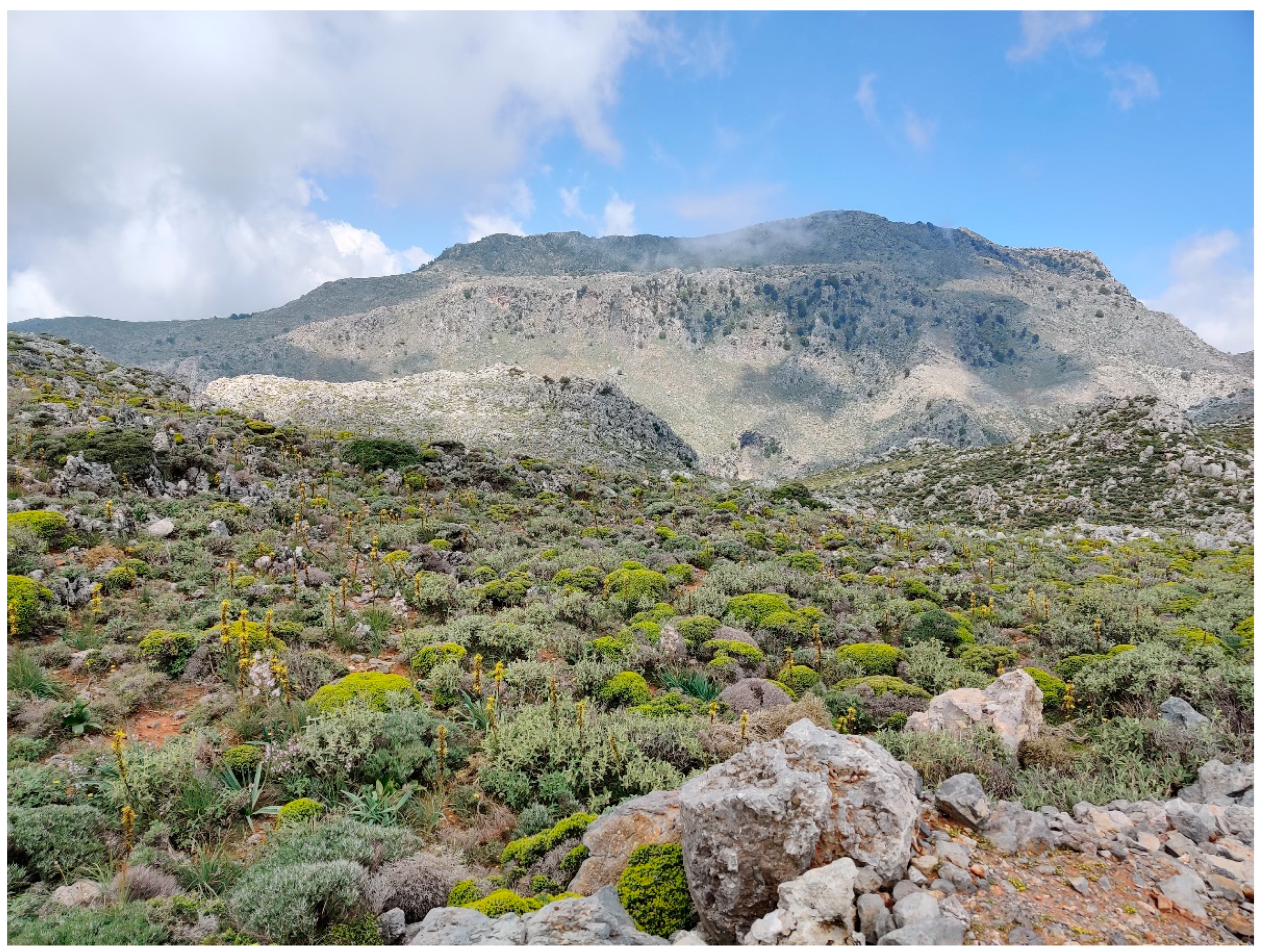
Figure 2.
Extensive forest habitats still occur in the steep gorges (entrance to Samaria) (Photo P. Huemer).
Figure 2.
Extensive forest habitats still occur in the steep gorges (entrance to Samaria) (Photo P. Huemer).
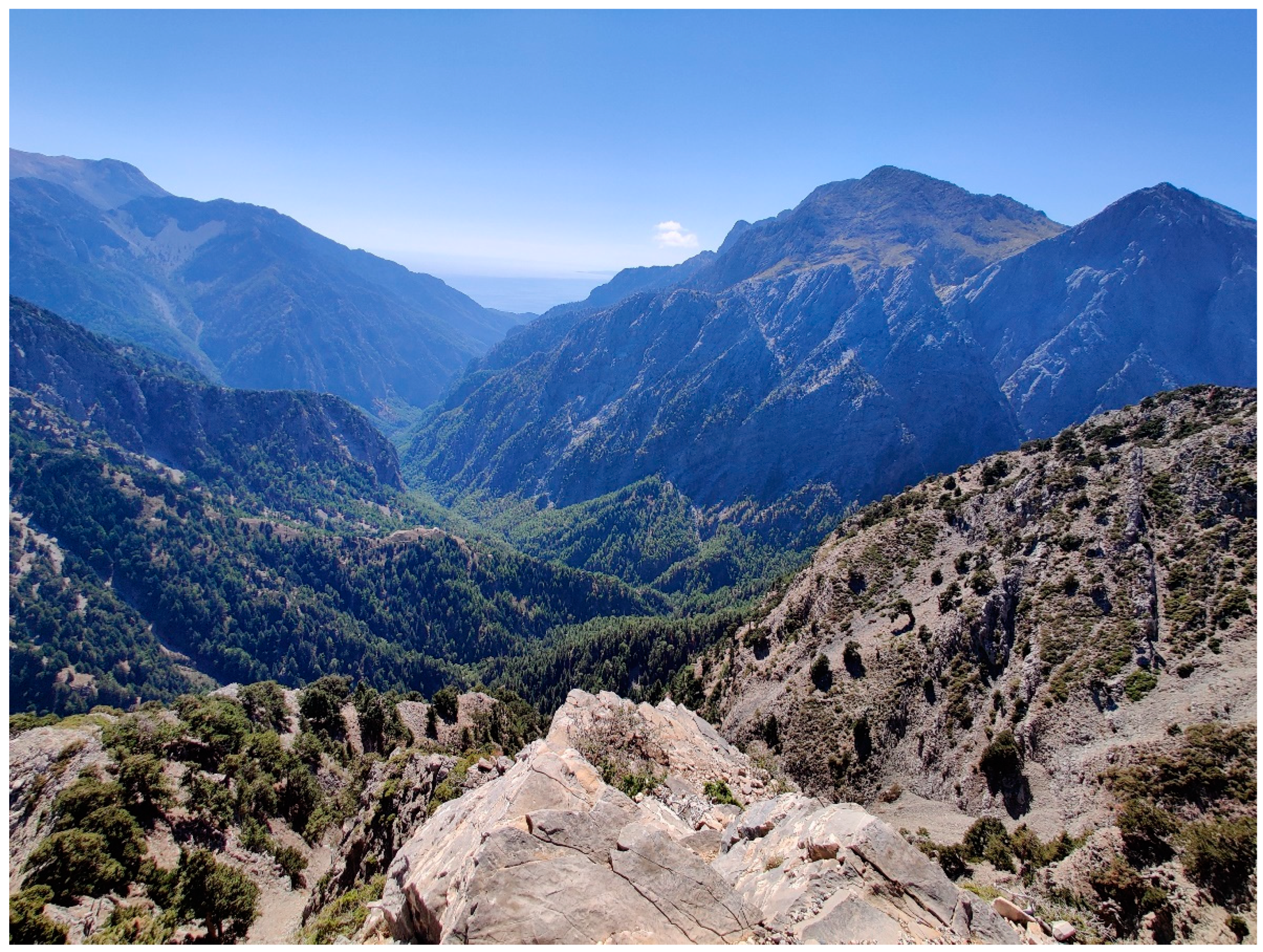
Figure 3.
Localities of DNA barcoded samples. OpenStreetMap: https://www.openstreetmap.org/copyright CC BY-SA; OpenTopo: https://opentopomap.org/about#verwendung CC BY-SA; SRTM: https://www.earthdata.nasa.gov/data/instruments/srtm Public domain.
Figure 3.
Localities of DNA barcoded samples. OpenStreetMap: https://www.openstreetmap.org/copyright CC BY-SA; OpenTopo: https://opentopomap.org/about#verwendung CC BY-SA; SRTM: https://www.earthdata.nasa.gov/data/instruments/srtm Public domain.
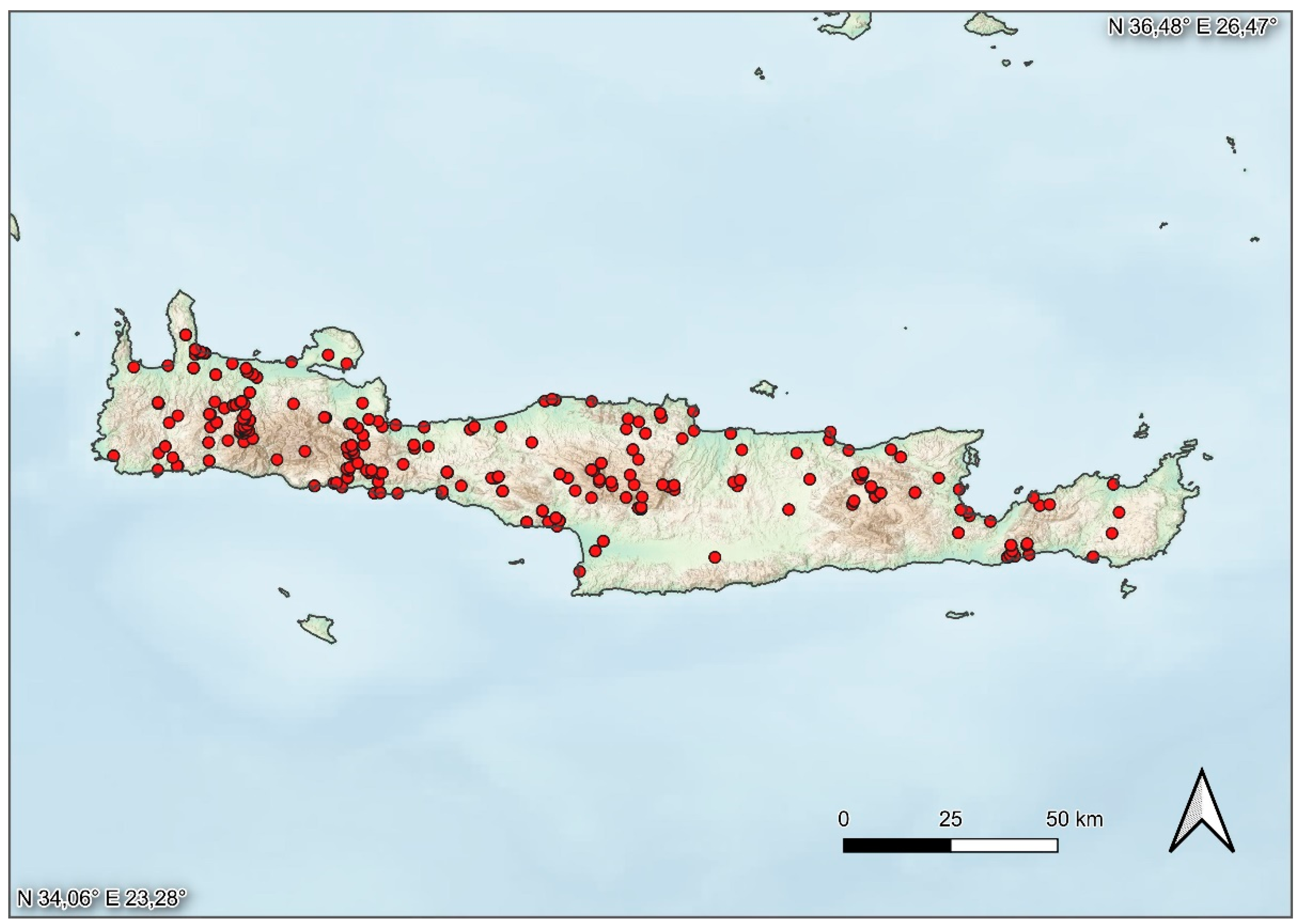
Figure 4.
Species numbers per superfamily with or without BIN from Crete.
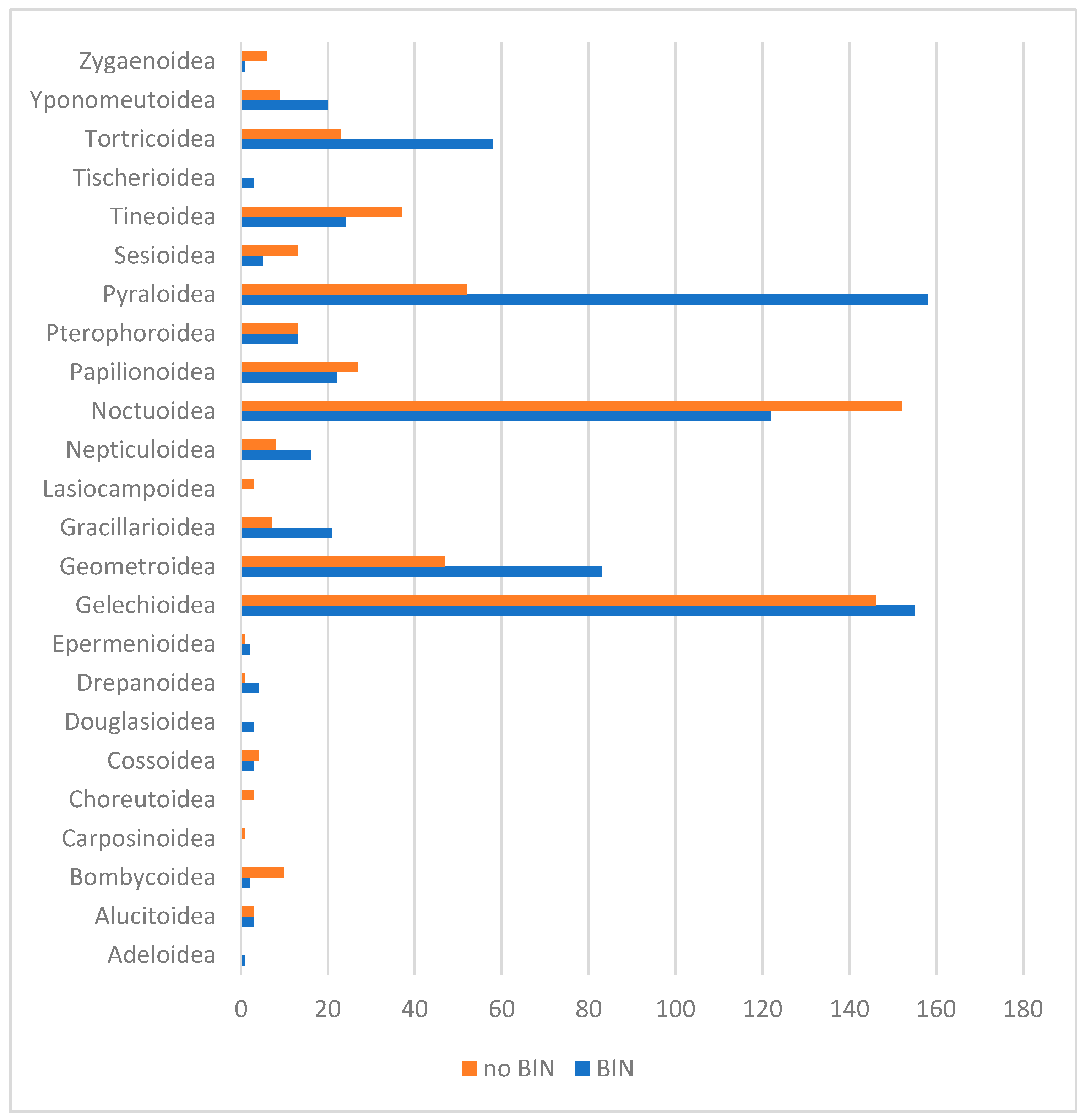
Figure 5.
Number of unassigned BIN´s per family.
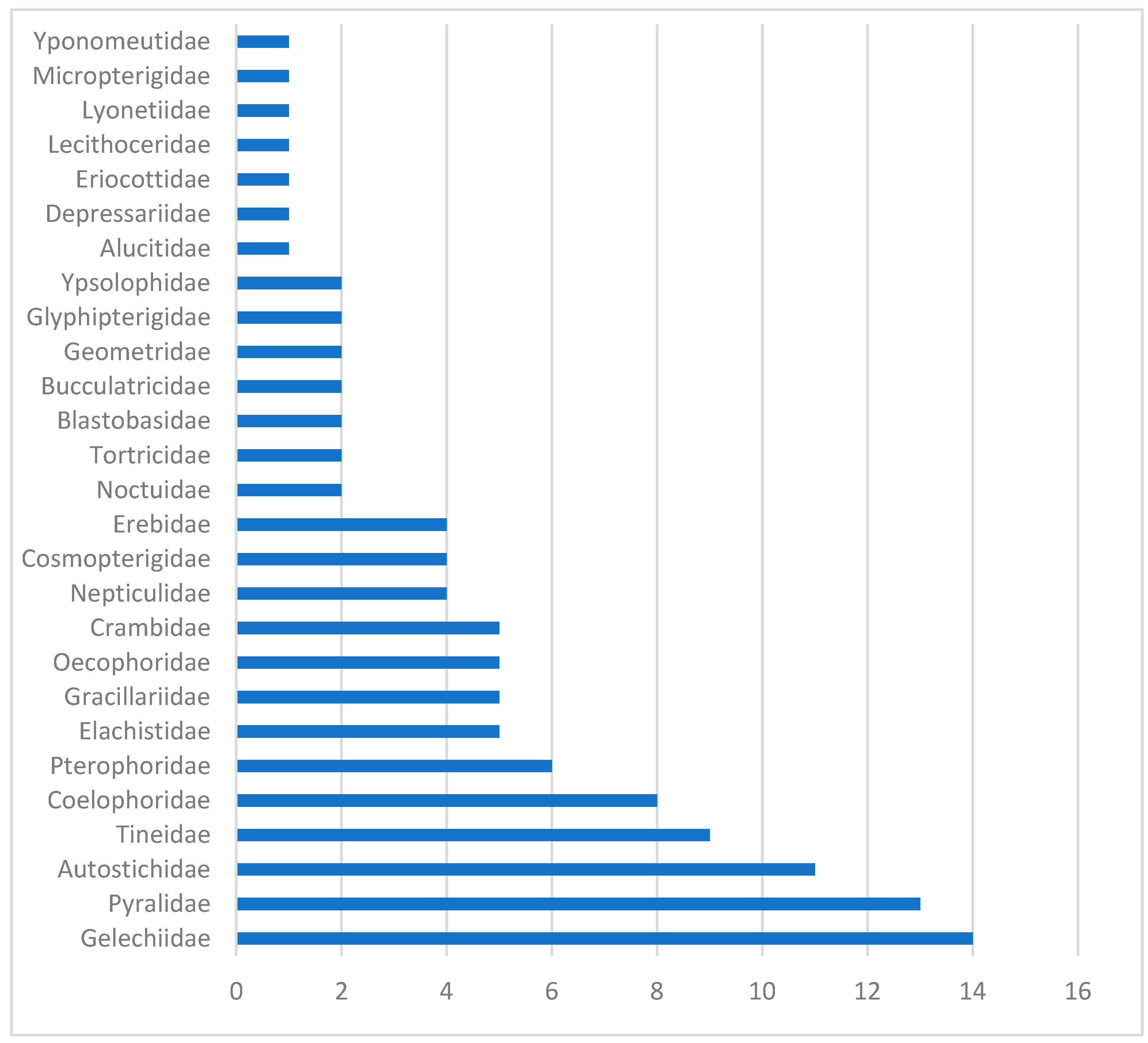
Figure 6.
Neighbor-Joining tree of Holoscolia spp. (Kimura 2-parameter, built with MEGA7 [41]; Source: public DNA barcode data from BOLD.
Figure 6.
Neighbor-Joining tree of Holoscolia spp. (Kimura 2-parameter, built with MEGA7 [41]; Source: public DNA barcode data from BOLD.
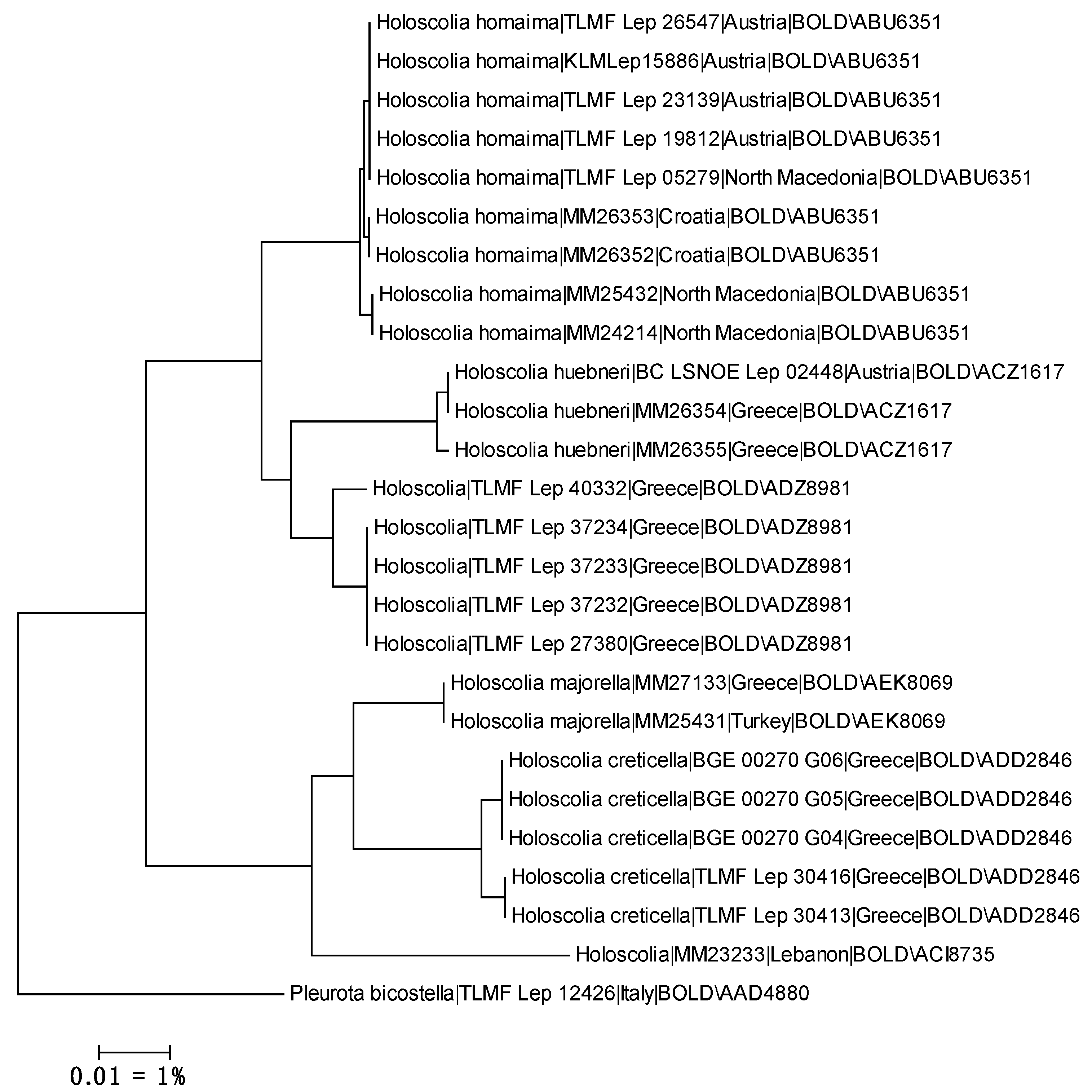
Figure 7.
Number of endemic species described per period.
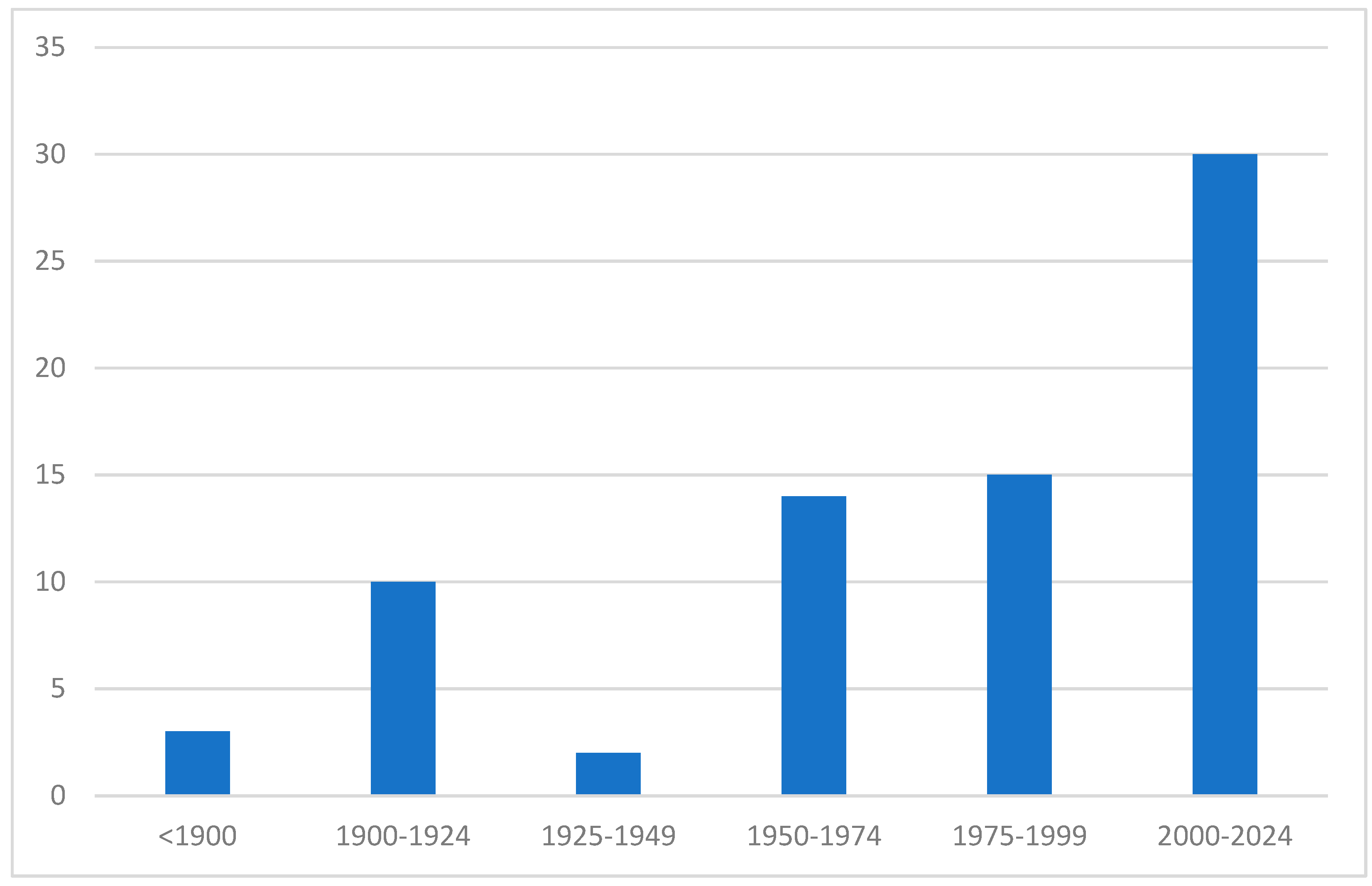

Table 1.
New faunistic records for Crete with DNA barcodes; *new record for Greece; **new record for Europe.
Table 1.
New faunistic records for Crete with DNA barcodes; *new record for Greece; **new record for Europe.
| Alucitidae | Nepticulidae |
|---|---|
| Alucita grammodactyla Zeller, 1841* | Stigmella basiguttella (Heinemann, 1862) |
| Autostichidae | Stigmella fasciata van Nieukerken & Johansson, 2003 |
| Tecmerium perplexus (Gozmány, 1957) | Trifurcula eurema (Tutt, 1899) |
| Bedelliidae | Noctuidae |
| Bedellia ehikella Szőcs, 1967 | Bryophila felina (Eversmann, 1852) |
| Blastobasidae | Caradrina kadenii Freyer, [1836] |
| Blastobasis glandulella (Riley, 1871)* | Nolidae |
| Bucculatricidae | Meganola kolbi (Daniel, 1935) |
| Bucculatrix bechsteinella (Bechstein & Scharfenberg, 1805)* | Nola subchlamydula Staudinger, 1870 |
| Bucculatrix phagnalella Walsingham, 1908* | Oecophoridae |
| Coleophoridae | Batia lunaris (Haworth, 1828) |
| Coleophora berbera Baldizzone, 1988* | Batia samosella Sutter, 2003 |
| Coleophora curictae Baldizzone, 2016* | Plutellidae |
| Coleophora deauratella Lienig & Zeller, 1846 | Rhigognostis annulatella (Curtis, 1832) |
| Coleophora nutantella Mühlig & Frey, 1857 | Pyralidae |
| Coleophora oriolella Zeller, 1849 | Acrobasis advenella (Zincken, 1818) |
| Coleophora variicornis Toll, 1952 | Acrobasis centunculella (Mann, 1859) |
| Cosmopterigidae | Acrobasis consociella (Hübner, [1813]) |
| Anatrachyntis badia (Hodges, 1962) | Acrobasis getuliella (Zerny, 1914)* |
| Crambidae | Acrobasis glaucella Staudinger, 1859 |
| Agriphila bleszynskiella Amsel, 1961** | Acrobasis marmorea (Haworth, 1811) |
| Cataclysta lemnata (Linnaeus, 1758) | Acrobasis obtusella (Hübner, 1796) |
| Euchromius ramburiellus (Duponchel, 1836) | Amphithrix sublineatella (Staudinger, 1859)* |
| Euchromius vinculellus (Zeller, 1847) | Coenochroa ablutella (Zeller, 1839) |
| Metasia carnealis (Treitschke, 1829) | Dioryctria mendacella (Staudinger, 1859) |
|
Pediasia contaminella (Hübner, 1796) Ostrinia furnacalis (Guenée, 1854)** |
Dioryctria pineae (Staudinger, 1859) Elegia atrifasciella Ragonot, 1887 |
| Depressariidae | Ephestia cypriusella Roesler, 1965 |
| Agonopterix nodiflorella (Millière, 1866) | Epischnia asteris Staudinger, 1870* |
| Agonopterix straminella (Staudinger, 1859) | Epischnia cretaciella Mann, 1869 |
| Depressaria bantiella (Rocci, 1934)* | Etiella zinckenella (Treitschke, 1832) |
| Depressaria discipunctella Herrich-Schäffer, [1854] | Euzophera bigella (Zeller, 1848) |
| Rosetea corfuella (Lvovsky, 2000) | Euzophera lunulella (Costa, [1836]) |
| Douglasiidae | Euzophera osseatella (Treitschke, 1832) |
| Tinagma ocnerostomella (Stainton, 1850) | Euzopherodes vapidella (Mann, 1857) |
| Drepanidae | Keradere tengstroemiella (Erschoff, 1874) |
| Cilix glaucata (Scopoli, 1763) | Melathrix coenulentella (Zeller, 1846)* |
| Elachistidae | Merulempista brucella (Staudinger, 1879) |
| Blastodacna atra (Haworth, 1828) | Merulempista turturella (Zeller, 1848)* |
| Elachista differens Parenti, 1978 | Morosaphycita cleopatrella (Ragonot, 1887)* |
| Elachista gleichenella (Fabricius, 1781) | Myelois ossicolor Ragonot, 1893* |
| Elachista pigerella (Herrich-Schäffer, [1854]) | Nyctegretis ruminella de la Harpe, 1860 |
| Elachista scirpi Stainton, 1887 | Pempelia brephiella (Staudinger, 1879)* |
| Perittia echiella (De Joannis, 1902)* | Phycita acericola Kuznetsov, 1960 |
| Epermeniidae | Phycita torrenti Agenjo, 1962 |
| Epermenia chaerophyllella (Goeze, 1783) | Phycitodes inquinatella (Ragonot, 1887) |
| Erebidae | Phycitodes lacteella (Rothschild, 1915) |
| Eilema muscula (Staudinger, 1899) | Phycitodes saxicola (Vaughan, 1870) |
| Gelechiidae | Psorosa mediterranella Amsel, 1953* |
| Anarsia leberonella Réal, 1994 | Pyralis kacheticalis (Christoph, 1893) |
| Aproaerema montanata (Gozmány, 1957)* | Rhodophaea formosa (Haworth, 1811)* |
| Aristotelia subdecurtella (Stainton, 1859) | Scythropiidae |
| Bryotropha figulella (Staudinger, 1859) | Scythropia crataegella (Linnaeus, 1767) |
| Carpatolechia decorella (Haworth, 1812) | Tineidae |
| Mondeguina mediterranella (Nel & Varenne, 2012)* | Nemapogon hungaricus Gozmány, 1960 |
| Monochroa hornigi (Staudinger, 1883)* | Opogona omoscopa (Meyrick, 1893)* |
| Oxypteryx immaculatella (Douglas, 1850)* | Tischeriidae |
| Parastenolechia nigrinotella (Zeller, 1847)* | Coptotriche angusticolella (Duponchel, [1843]) |
| Geometridae | Tortricidae |
| Chloroclysta siterata (Hufnagel, 1767) | Bactra lancealana (Hübner, [1799])* |
| Glyphipterigidae | Cnephasia genitalana Pierce & Metcalfe, 1915* |
| Acrolepiopsis vesperella (Zeller, 1850) | Cydia conicolana (Heylaerts, 1874)* |
| Orthotelia sparganella (Thunberg, 1788) | Cydia johanssoni Aarvik & Karsholt, 1993 |
| Gracillariidae | Cydia splendana (Hübner, [1799]) |
| Acrocercops brongniardella (Fabricius, 1798) | Epiblema cirsiana (Zeller, 1843)* |
| Acrocercops tacita Triberti, 2001 | Epiblema cnicicolana (Zeller, 1847)* |
| Aspilapteryx tringipennella (Zeller, 1839) | Notocelia cynosbatella (Linnaeus, 1758) |
| Calybites phasianipennella (Hübner, [1813]) | Pammene blockiana (Herrich-Schäffer, 1851)* |
| Parornix anguliferella (Zeller, 1847) | Pammene gallicolana (Lienig & Zeller, 1846) |
| Parornix tenella (Rebel, 1919)* | Pelochrista caecimaculana (Hübner, [1799])* |
| Phyllonorycter cephalariae (Lhomme, 1934) | Pelochrista modicana (Zeller, 1847) |
| Phyllonorycter corylifoliella (Hübner, 1796) | Phtheochroa ochralana (Chrétien, 1915) |
| Phyllonorycter distentella (Zeller, 1846)* | Zeiraphera isertana (Fabricius, 1794)* |
| Phyllonorycter triflorella (de Peyerimhoff, 1871) | Yponomeutidae |
| Triberta cistifoliella (Groschke, 1944) | Paradoxus osyridellus Millière, 1869 |
| Momphidae | Ypsolophidae |
| Mompha epilobiella ([Denis & Schiffermüller], 1775) | Ypsolopha alpella ([Denis & Schiffermüller], 1775) |
Table 2.
New faunistic records from Crete, solely based on photographs.
| Taxon | Family |
| Heliothela ophideresana (Walker, 1863) | Crambidae |
| Palepicorsia ustrinalis (Christoph, 1877) | Crambidae |
| Pyrausta purpuralis (Linnaeus, 1758) | Crambidae |
| Acantholipes regularis (Hübner, [1813]) | Erebidae |
| Euproctis chrysorrhoea (Linnaeus, 1758) | Erebidae |
| Apocheima hispidaria ([Denis & Schiffermüller], 1775) | Geometridae |
| Agrotis herzogi Rebel, 1911 | Noctuidae |
| Noctua interjecta Hübner, [1803] | Noctuidae |
| Aphomia cephalonica (Stainton, 1866) | Pyralidae |
| Denticera divisella (Duponchel, [1843]) | Pyralidae |
| Galleria mellonella (Linnaeus, 1758) | Pyralidae |
| Myelois circumvoluta (Geoffroy in Fourcroy, 1785) | Pyralidae |
| Hemaris croatica (Esper, 1800) | Sphingidae |
| Mimas tiliae (Linnaeus, 1758) | Sphingidae |
| Cochylimorpha langeana (Kalchberg, 1898) | Tortricidae |
| Zelleria hepariella Stainton, 1849 | Yponomeutidae |
Disclaimer/Publisher’s Note: The statements, opinions and data contained in all publications are solely those of the individual author(s) and contributor(s) and not of MDPI and/or the editor(s). MDPI and/or the editor(s) disclaim responsibility for any injury to people or property resulting from any ideas, methods, instructions or products referred to in the content. |
© 2025 by the authors. Licensee MDPI, Basel, Switzerland. This article is an open access article distributed under the terms and conditions of the Creative Commons Attribution (CC BY) license (http://creativecommons.org/licenses/by/4.0/).
Copyright: This open access article is published under a Creative Commons CC BY 4.0 license, which permit the free download, distribution, and reuse, provided that the author and preprint are cited in any reuse.


