

Submitted:
13 April 2025
Posted:
15 April 2025
Read the latest preprint version here
Abstract
We present a deterministic elasticity framework—the Space–Time Membrane (STM) model—that unifies quantum‑like phenomena, gauge field emergence, black hole singularity avoidance, and cosmic acceleration within a single high‑order partial differential equation (PDE). By incorporating scale‑dependent elasticity, higher‑order (\( ∇^4,∇^6 \)) derivatives and non‑Markovian decoherence, the STM model replicates key features of quantum field theory while seamlessly introducing gravitational curvature. A bimodal decomposition of the membrane displacement naturally yields spinor fields; enforcing local symmetries on these spinors reproduces gauge bosons (e.g., photon‑like, gluon‑like) as deterministic wave–anti‑wave cycles with zero net energy over each cycle. Multi‑scale expansions reveal that sub‑Planck wave excitations can remain non‑decaying if damping is negligible and the signs of certain couplings (e.g., \( ΔE \) and \( λ \)) align to stabilise wave amplitudes. Once coarse‑grained, these persistent waves leave a near‑uniform offset in the emergent Einstein‑like field equations, acting as dark energy and driving cosmic acceleration. In addition, black hole interiors are regularised by enhanced stiffness from the higher‑order operators, replacing singularities with solitonic or standing‑wave structures. The model’s non‑Markovian damped PDE also explains wavefunction collapse through deterministic decoherence, reproducing the Born rule and entanglement analogues without intrinsic randomness. Finally, allowing a mild late‑time variation in the leftover vacuum offset addresses the Hubble tension by shifting the expansion rate at low redshifts. Future research will refine numerical PDE simulations, test exact operator self‑adjointness, and compare predictions against high‑precision data to fully assess this deterministic route to reconciling quantum phenomena, black hole physics, and cosmological observations.
Keywords:
spacetime elasticity
; wavefunction collapse
; non-markovian dynamics
; emergent gauge symmetries
; black hole singularity avoidance
; hubble tension
; quantum gravity
1. Introduction
Modern physics is built upon two seemingly incompatible foundations: General Relativity (GR) [1,2,3], which describes gravity through the curvature of spacetime, and Quantum Mechanics (QM) [4,5,6,7], whose probabilistic formalism governs microscopic phenomena. Despite remarkable successes within their respective domains, integrating these theories into a coherent framework remains one of contemporary physics’ most pressing challenges. Existing approaches—such as String Theory and Loop Quantum Gravity—provide valuable insights but have yet to deliver a definitive resolution of quantum gravity [5,6]. Additionally, puzzles such as the black hole information paradox and the cosmological constant problem underline fundamental tensions between GR’s smooth geometry and QM’s intrinsic probabilism [9,10,11].
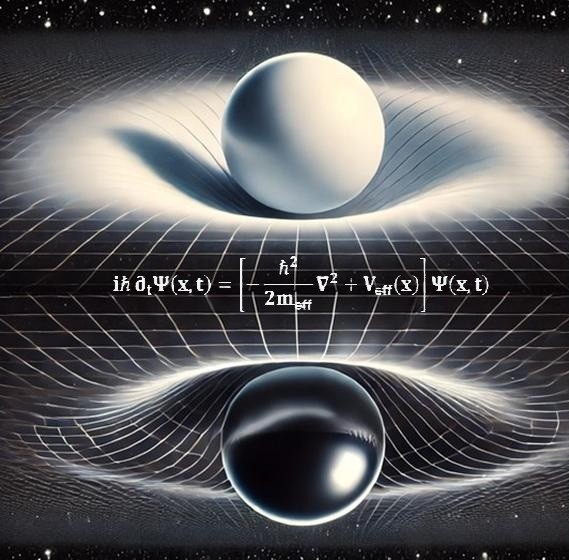
The Space–Time Membrane (STM) model proposes spacetime as a four dimensional elastic membrane dynamically interacting with a parallel mirror domain. Each particle in our domain corresponds to a mirror antiparticle in the mirror domain, ensuring symmetry and addressing the observed matter–antimatter asymmetry. In this framework, the dynamics of the membrane are responsible both for the emergence of gravitational curvature and for producing quantum like phenomena. Rather than being fundamental, the seemingly probabilistic features of quantum mechanics are shown to emerge as a deterministic consequence of the membrane’s chaotic elastic oscillations.
Crucially, the localised excitations within the membrane are not generated by a simple two body attraction. Instead, the displacement field is decomposed into two complementary oscillatory modes that are then recombined into a two component spinor field . It is the detailed, mode by mode interaction between each spinor component and its corresponding mirror antispinor—from the opposite face of the membrane—that governs how energy is redistributed within the system. In particular, when particle–mirror antiparticle pairs interact, the resulting dynamics transfer energy from the homogeneous background of the membrane into localised curvature, thus generating gravitational effects. On the other hand, repulsive or cancelling interactions serve to reinject energy into the membrane’s background. In this process, composite photons emerge as coherent wave–anti wave global modes: rather than carrying energy away as free radiation, these composite excitations maintain a full cycle in which the energy exchanged in one half of the cycle is precisely offset in the other half, thereby ensuring that energy conservation is strictly maintained even during annihilation events.
Moreover, when the rapid sub Planck oscillations in are coarse grained, a slowly varying envelope forms that obeys an effective Schrödinger like equation. This envelope, with its interference patterns and apparent wavefunction collapse, is interpreted as the emergent quantum behaviour of the system—thus reinterpreting standard quantum phenomena (including the Born rule) as a manifestation of deterministic chaos at the fundamental, elastic level.
The STM approach reinterprets not only the gravitational sector but also key aspects of particle physics. Its mechanism for electroweak symmetry breaking, for instance, arises from rapid oscillatory (zitterbewegung-like) interactions between the spinor fields on the membrane and their mirror counterparts, generating mass terms for the and bosons and yielding CP violating phases without the need to introduce intrinsic randomness or additional scalar fields. Similarly, the interplay of individual oscillatory modes plays a critical role in emerging gauge symmetries, with the effective dynamics of the spinor and mirror spinor fields underpinning the appearance of U(1), SU(2), and SU(3) gauge fields.
The model incorporates:
- Scale dependent elastic parameters and higher order spatial derivatives (notably the operator) to regulate ultraviolet divergences.
- Non Markovian decoherence to explain deterministic wavefunction collapse.
- A bimodal decomposition of the membrane’s displacement field into a two component spinor , which naturally yields emergent U(1), SU(2), and SU(3) gauge fields and corresponding gauge bosons.
- A deterministic mechanism for electroweak symmetry breaking, where interactions between spinors on our membrane face and mirror antispinors on the opposite face—mediated by rapid oscillatory exchanges (zitterbewegung)—produce the mass terms for and bosons, and yield CP violating phases without invoking intrinsic randomness or additional scalar fields.
- A multi loop renormalisation group (RG) analysis, supplemented by a Functional Renormalisation Group (FRG) nonperturbative approach, identifying discrete fixed points and vacuum structures that potentially explain three observed fermion generations.
Of particular relevance for the gravitational sector, the approach linking linearised strain fields with metric perturbations is extended here. Einstein like field equations are derived more completely from the STM action—even when including higher order elasticity terms, damping, and scale dependent couplings. The key results appear in Appendix M, which clarifies how the membrane’s stress–energy tensor enters modified Einstein equations and how they reduce to standard GR at large scales. In addition, a detailed multi scale derivation (Appendix H) demonstrates that coarse graining stable sub Planck oscillations yields a near constant vacuum offset. This persistent offset acts as dark energy, and a mild late time evolution in the membrane’s elasticity or damping parameters could provide a mechanism for reconciling the observed Hubble tension.
Although the STM model provides a single partial differential equation capable of explaining both quantum and cosmological phenomena, several key mechanisms still require further quantitative refinement. In particular, while our derivations (see Appendices C and N) have robustly formulated the detailed mode by mode coupling between each spinor component and its corresponding mirror antispinor, the precise tuning of the associated parameters to reproduce the Standard Model’s mass spectra, mixing angles, and CP violating phases remains an open challenge. Similarly, although our numerical experiments have demonstrated stability over a range of damping and time stepping conditions, a complete formal proof of the higher order PDE’s stability—including well posedness and strict self adjointness of the full nonlinear operator—is still outstanding. One central task is proving full unitarity in the presence of , gauge couplings, and mirror spinors. Although partial self adjointness arguments show promise, a complete demonstration that no ghost modes arise once all interactions are included remains an important open frontier. Achieving a manifestly positive norm for all physical states would ensure that this deterministic PDE framework remains well defined and free of unphysical degrees of freedom. Additionally, a rigorous derivation of black hole thermodynamics within a fully self adjoint framework continues to be an important objective.
It is important to note that, in contrast to other leading quantum gravity approaches—such as String Theory’s extra dimensional framework and Loop Quantum Gravity’s discretised spin network formalism—the STM model is highly testable. Its basis in classical continuum elasticity enables direct numerical simulations and even laboratory analogues (e.g. via metamaterials) to test key predictions. Moreover, by deriving quantum field theory phenomena—such as the Schrödinger equation, the Born rule, gauge symmetries, and CP violation—from a single deterministic PDE, the STM framework requires significantly fewer postulates than the Standard Model, which posits a wide array of fundamental fields and interactions ab initio. Addressing these remaining challenges—from the tuning of mass and CP phases to establishing strict unitarity and black hole thermodynamics—is crucial to securing the STM model’s full consistency across scales.
In the meantime, its potential for direct experimental validation and its economy of assumptions make the STM approach a promising and conceptually transparent alternative route to unifying quantum phenomena with gravitational curvature.
We encourage further numerical and experimental exploration of the STM model, which may offer a new deterministic route to reconciling quantum and gravitational physics within a single continuum elasticity theory.
Organisation of the Paper
- Section 2 (Methods) provides a detailed overview of the STM wave equation, including explicit derivations of higher order elasticity terms, spinor construction, scale dependent parameters, and the deterministic interpretation of decoherence.
- Section 3 (Results) demonstrates how quantum like dynamics, the Born rule, entanglement analogues, emergent gauge fields (, , ), deterministic decoherence, fermion generations, and CP violation naturally arise from the deterministic membrane equations.
- Section 4 (Discussion) explores the broader implications of these findings, along with possible experimental tests and numerical simulations.
- Section 5 (Conclusion) summarises the key theoretical advances, outstanding issues, and potential future directions, including proposals aimed at verifying the STM model’s predictions.
Appendices A–Q comprehensively present supporting details, derivations, and numerical methods. They address:
- Spinor operator formulations (Appendix A)
- Force functions and interactions (Appendix B)
- Gauge symmetry emergence and CP violation (Appendix C)
- Coarse grained Schrödinger like dynamics (Appendix D)
- Deterministic entanglement (Appendix E)
- Singularity avoidance (Appendix F)
- Decoherence and collapse mechanisms (Appendix G)
- Vacuum energy dynamics and the cosmological constant (Appendix H)
- Proposed experimental tests (Appendix I)
- Detailed multi loop renormalisation group analyses (Appendix J)
- Finite element simulations (Appendix K)
- Nonperturbative analyses revealing solitonic structures (Appendix L)
- Derivation of Einstein Field Equations (Appendix M)
- Emergent Scalar Degree of Freedom from Spinor–Mirror Spinor Interactions (Appendix N)
- Rigorous Operator Quantisation and Spin-Statistics (Appendix O)
- Reconciling Damping, Environmental Couplings, and Quantum Consistency in the STM Framework (Appendix P)
- Toy Model PDE Simulation (Appendix Q)
- Finally, an updated Appendix R serves as a Glossary of Symbols, ensuring clarity and consistency of notation throughout.
2. Methods
In the Space–Time Membrane (STM) model, spacetime is represented as a four-dimensional elastic membrane governed by a deterministic high-order partial differential equation. This single PDE unifies gravitational-scale curvature with quantum-like oscillations by incorporating higher-order elasticity, scale-dependent stiffness, non-linear terms, and possible non-Markovian effects. Below, we provide the theoretical foundations, outline the operator quantisation that yields quantum-like behaviour, show how gauge fields naturally emerge, discuss renormalisation strategies, and comment on the classical limit.
2.1. Classical Framework and Lagrangian
2.1.1. Displacement Field and Equation of Motion
We begin with a real displacement field , which tracks local deformations of a classical four-dimensional membrane. The STM model augments standard elasticity with higher-order spatial derivatives and scale-dependent parameters, leading to a PDE of the form:
Key ingredients:
- : An effective mass density describing the inertial response of the membrane.
- : A baseline elastic modulus that depends on the renormalisation scale .
- : Local variations in stiffness tied to sub-Planck energy distributions or wave oscillations.
- : A sixth-order spatial derivative term that strongly damps high-wavenumber fluctuations, providing ultraviolet regularisation.
- : A damping or friction-like term, which may be extended to non-Markovian kernels in the presence of memory effects.
- : A non-linear self-interaction for the displacement field.
- : A Yukawa-like coupling between the membrane and an emergent spinor field .
- : External forcing or boundary influences, derived from an extended potential energy functional (see Appendix material in the longer text).
This PDE provides a unified mathematical context where large-scale curvature (associated with gravity) emerges as low-frequency membrane deformations, and short-scale oscillations mimic quantum phenomena—without introducing extra dimensions or intrinsic randomness.
2.1.2. Lagrangian Density
The classical equation of motion above is most directly obtained via a Lagrangian density . Omitting damping and forcing for simplicity, one may write:
where captures any polynomial or non-polynomial self-interaction terms (e.g.\ , , etc.). Integrating over all space–time gives an action . Variation recovers the PDE when appropriate boundary conditions are imposed. Damping and non-Markovian kernels can be appended through effective dissipation functionals if desired.
2.1.3. Conjugate Momentum and Modified Dispersion
From the above , the conjugate momentum to u is
In homogeneous settings, a plane-wave ansatz satisfies revealing how powerfully regularises high-wavevector modes. When is significant, one replaces a simple plane-wave approach with advanced numerical methods (see Section 2.4 and Appendix K) or a Bloch-like analysis if is spatially periodic.
2.2. Operator Quantisation
2.2.1. Canonical Commutation Relations
To describe quantum-like effects, and are elevated to operators and . They obey
with other commutators vanishing. Although higher-order derivatives () complicate domain questions for self-adjointness, the fundamental canonical structure remains. Imposing suitable boundary conditions (e.g.\ fields vanishing at spatial infinity) ensures that all operator expressions are well-defined in an appropriate Sobolev space.
2.2.2. Normal Mode Expansion
In nearly uniform regions, one may write
The associated Hamiltonian sums over the modes, each with a modified dispersion . When varies, a real-space diagonalisation or finite element approach is more suitable. Either way, the operator quantisation ensures a “quantum-like” spectrum of excitations that parallels bosonic fields in standard quantum theory.
2.3. Gauge Symmetries: Emergent Spinors and Path Integral
2.3.1. Bimodal Decomposition and Emergent Gauge Fields
A distinctive aspect of the STM model is constructing a bimodal decomposition of . Formally, one splits u into two complementary oscillatory components, sometimes referred to as in-phase and out-of-phase fields:
and arranges into a two-component spinor . Imposing a local phase invariance necessitates the introduction of gauge fields, e.g.\ for . Extending this principle can yield non-Abelian fields and , reproducing the main gauge bosons familiar from the electroweak and strong interactions [4].
Mechanically, each gauge field arises as a compensating “connection” ensuring that local redefinitions of the spinor field do not alter physical observables. Consequently, photon like or gluon like excitations appear as coherent wave modes in the membrane. In standard quantum field theory, “virtual particles” mediate interactions; here, such processes correspond to deterministic wave–anti wave cycles wherein net energy transfer over a full cycle is zero, aligning with the virtual exchange picture. By including local phase invariance in the STM action, one automatically generates covariant derivatives (or the non Abelian analogue), reinforcing how gauge fields naturally emerge from the underlying elasticity.
In the path integral language, enforcing local spinor symmetries introduces these gauge connections and ghost fields (for gauge fixing) but does not rely on intrinsic randomness. Instead, it unites the deterministic elasticity framework with internal gauge invariance. This places photon like excitations (for U(1)), bosons (for SU(2)), and gluons (for SU(3)) on an equal footing as collective membrane oscillations that preserve local symmetry at each point in spacetime.
2.3.2. Virtual Bosons as Deterministic Oscillations
In standard quantum field theory, “virtual particles” are ephemeral excitations in Feynman diagrams. Here, such processes are reinterpreted as perfectly energy-balanced wave–plus–anti-wave cycles. Over one cycle, net energy transfer is zero, consistent with the notion of a virtual exchange. Hence, interactions that appear “probabilistic” from a standard QFT perspective gain a deterministic wave interpretation in the STM model.
In path-integral language [13], the partition function
incorporates both the displacement field u (with higher-order derivatives) and the gauge fields that emerge upon enforcing local spinor-phase invariance. Ghost fields appear as usual for gauge fixing and do not introduce fundamental randomness—they merely handle redundant field configurations in a deterministic continuum.
2.4. Renormalisation and Higher-Order Corrections
2.4.1. One-Loop and Multi-Loop Analyses
The sixth-order operator ensures strong damping of high-momentum modes, so loop integrals converge more rapidly than in a naive second-order theory. Standard dimensional regularisation and a BPHZ subtraction scheme can be applied to compute self-energy corrections at one-loop or higher orders (see Appendix J). The resulting beta functions typically take the schematic form:
where are integrals influenced by and factors in the propagator. Multi-loop diagrams, including “setting sun” or mixed fermion–scalar topologies, refine these flows further. Crucially, running elastic couplings and can exhibit non-trivial fixed points, opening the door to multiple stable vacua or discrete mass spectra.
2.4.2. Nonperturbative FRG and Solitons
Perturbation theory alone cannot capture phenomena like solitonic black hole cores or multiple vacuum states. Thus, a Functional Renormalisation Group (FRG) approach (see Appendix L) is employed, tracking an effective action as fluctuations are integrated out down to scale k. This approach can reveal topologically stable solutions (e.g.\ kinks, domain walls) crucial for:
- Fermion generation: Multiple minima in the effective potential can produce distinct mass scales, paralleling three observed fermion generations.
- Black hole regularisation: Enhanced stiffness from and stops curvature blow-up, replacing singularities with finite-amplitude standing waves.
2.5. Classical Limit and Stationary-Phase Approximation
In a classical or macroscopic regime, one sets or assumes heavy damping. The path integral
is dominated by stationary-phase solutions of the PDE. Thus, the membrane behaves as a purely classical object with fourth- and sixth-order elasticity. Conversely, at sub-Planck scales—where the chaotic interplay of and acts—coarse-graining these rapid oscillations yields interference, Born-rule-like probability patterns, and gauge bosons as emergent wave modes (Appendix D).
2.6. Non-Markovian Decoherence and Wavefunction Collapse
While the PDE is entirely deterministic, real-world observations show effective wavefunction collapse. In the STM model, this arises from non-Markovian decoherence: one splits u into slow (system) and fast (environment) parts, integrates out the environment in a Feynman–Vernon influence functional, and obtains a memory-kernel master equation for the reduced density matrix of the slow component. Off-diagonal elements of this density matrix decay deterministically due to finite correlation times, reproducing an apparent measurement collapse. Thus, wavefunction reduction becomes an emergent, history-dependent phenomenon, rather than a postulate of fundamental randomness.
Such non-Markovian behaviour also underlies deterministic entanglement analogues (Appendix E), showing how Bell-inequality violations appear in a classical continuum. The rate and mechanism of decoherence can, in principle, be studied in laboratory analogues and metamaterial experiments (Section 4.1, Appendix I).
2.7. Persistent Waves, Dark Energy, and the Cosmological Constant
A critical insight in the STM model arises from interpreting the double-slit experiment as indirect evidence for persistent elastic waves on the membrane. These waves result from oscillating modulations of the membrane’s elastic modulus, induced by energy exchanges between particles and their mirror counterparts.
Modulating stiffness with energy exchange into the membrane is essential to lock in and create persistent waves within the elastic membrane. This modulating stiffness creates an additive term to the elastic modulus within the original `EFE analogue’ elastic wave equation. This additional term provides a critical link between both cosmic and quantum scale effects within the STM PDE.
The persistent waves represent sustained oscillations with a non-zero residual energy which we attribute to dark energy. Vacuum particles or quantum fluctuations average to zero over time, simply borrowing and returning energy from the membrane and have no contribution to dark energy.
This offers a natural explanation for the observed accelerated expansion of the universe and offering a potential explanation to the cosmological constant problem. Within the STM framework, dark energy thus emerges directly from quantum-scale processes, bridging quantum mechanics and cosmological observations (see derivations and numerical considerations in Appendix H).
2.8. Summary of Methods
-
Higher-Order PDE:A single continuum elasticity equation with and terms, scale-dependent moduli, damping, and non-linear couplings captures gravitational and quantum-like phenomena.
-
Variational and Dissipative Terms:Most terms follow from an action principle; damping/non-Markovian effects can be added through effective functionals.
-
Operator Quantisation:Canonical commutators and mode expansions yield quantum-like excitations. Domain constraints ensure self-adjointness when and appear.
-
Gauge Emergence:Bimodal spinor fields under local phase invariance require gauge fields . Virtual bosons become deterministic wave cycles.
-
Renormalisation Group:The term fosters strong UV suppression. Multi-loop and FRG analyses expose non-trivial fixed points, discrete vacua, and solitonic solutions relevant to black hole interiors and fermion generation.
-
Non-Markovian Decoherence:Coarse-graining the fast environmental modes induces memory-kernel dynamics for the slow modes, creating effective wavefunction collapse without any intrinsic randomness.
-
Classical Limit:At large scales or , the STM reduces to a classical wave equation with higher-order elasticity, verifying consistency with standard continuum mechanics and general relativistic effects.
In what follows, the results section will show how these methodological elements enable emergent gauge fields, explain multiple fermion generations, provide solitonic black hole interiors, and reproduce quantum interference and entanglement analogues—all from deterministic elasticity.
3. Results
This section presents the principal findings of the Space–Time Membrane (STM) model. We begin by examining perturbative results, illustrating how quantum like dynamics, gauge symmetries, and deterministic decoherence arise from a high order elasticity framework. We then turn to nonperturbative effects, whose full derivation—via the Functional Renormalisation Group (FRG)—appears in Appendix L.
3.1. Perturbative Results
3.1.1. Emergent Schrödinger Like Dynamics and the Born Rule
By coarse graining the rapid, sub Planck oscillations in , one obtains a slowly varying “envelope” . Specifically, one applies a smoothing kernel (often Gaussian) and adopts a WKB type ansatz,
Substituting into the STM wave equation—now including , , and other terms—leads to a separation into real and imaginary parts. The real part typically yields a Hamilton–Jacobi type equation for the phase , while the imaginary part yields a continuity equation for .
At leading order, these can be combined into an effective Schrödinger like equation:
where and reflect the membrane’s elastic parameters and the self interaction potential . Crucially, modifies the high momentum dispersion, ensuring UV stability. The Born rule naturally follows by interpreting as a probability density, derived here from deterministic sub Planck chaos rather than postulated randomness [9,12].
While this deterministic approach reproduces many quantum like features, it deviates from the mainstream view of intrinsic quantum randomness. Further theoretical and experimental efforts (e.g. careful tests of Bell inequalities under non Markovian conditions) are needed to confirm whether the STM model can fully match standard quantum mechanics at all scales.
3.1.2. Emergent Gauge Symmetries
A hallmark of the STM model is the emergence of gauge symmetries from the bimodal decomposition of the membrane displacement field . This decomposition naturally produces a two-component spinor field, . Enforcing local phase invariance on necessitates the introduction of gauge fields. For example, under the transformation , a local symmetry emerges explicitly, requiring the introduction of a gauge field via the minimal substitution . Extending this principle to non-Abelian symmetries naturally leads to the and Yang–Mills gauge structures. Consequently, excitations analogous to photons, bosons, and gluons emerge deterministically as coherent wave modes of the membrane [4].
For the weak interaction, the spinor structure explicitly enforces a local gauge symmetry. When the displacement field acquires a vacuum expectation value, deterministic cross-membrane interactions between spinor fields and their mirror antispinor counterparts produce electroweak symmetry breaking. These interactions involve rapid oscillatory exchanges known as zitterbewegung, which deterministically generate the mass terms for the and gauge bosons. This deterministic mechanism avoids intrinsic quantum randomness and eliminates the need for additional scalar fields.
The strong interaction can be intuitively understood by considering the membrane as a classical lattice of linked oscillators. Within this analogy, each oscillator corresponds to a local “colour charge.” The elastic tension between oscillators increases linearly with their separation, naturally reproducing the confinement phenomenon observed in Quantum Chromodynamics (QCD). Gluon-like modes thus arise as coherent elastic waves propagating along these oscillator connections, effectively ensuring colour confinement and preventing isolated coloured excitations from existing freely.
In this deterministic elasticity framework, processes traditionally described as “virtual boson exchanges” are reinterpreted as coherent wave–plus–anti wave cycles.
Ensuring full consistency of these emergent gauge fields also involves anomaly cancellation. In the Standard Model, chiral anomalies vanish due to the carefully balanced fermion content. Although the STM model naturally introduces spinor and mirror antispinor fields, a thorough demonstration that all anomalies (chiral, gauge) cancel in this elasticity based approach remains a key open objective. If confirmed, it would place STM on par with conventional gauge theory in terms of consistency.
The explicit details of electroweak symmetry breaking and the emergence of the Z boson via deterministic spinor–antispinor interactions are developed fully in Appendix C.3.1.
Nevertheless, matching all known QFT scattering amplitudes (traditionally computed via Feynman diagrams) remains a major open task. The STM’s classical reinterpretation of virtual particles must quantitatively reproduce S-matrix elements, cross sections, and loop corrections for a robust equivalence with the Standard Model.
3.1.3. Deterministic Decoherence and Bell Inequality Violations
By splitting the membrane displacement into a slow system and a fast environment (Appendix G), one can integrate out via the Feynman–Vernon influence functional. This produces a non Markovian master equation for the reduced density matrix :
where the kernel K encodes finite correlation times. This yields deterministic decoherence, allowing the apparent wavefunction collapse to occur without intrinsic randomness. Introducing spinor based measurement operators (e.g.\ ) recovers Bell type correlations. Indeed, the CHSH parameter can reach , violating the classical Bell inequality [16,17] while still emerging from a deterministic PDE.
Although the STM model reproduces these correlations at a theoretical level, future studies must compare predicted decoherence rates and memory kernels with real quantum systems, which often show near Markovian behaviour. The quantitative match to laboratory timescales and environment-induced superselection rules remains an important open topic.
3.1.4. Fermion Generations, Flavour Dynamics, and Confinement
Multi loop renormalisation analyses (see Appendix J) reveal that the running of scale dependent elastic parameters, together with self interactions (e.g.\ the term) and Yukawa like couplings, leads to the emergence of discrete fixed points. These fixed points correspond to distinct, stable vacua that naturally account for the observed three fermion generations, each characterised by a different mass scale [18].
Deterministic interactions between the bimodal spinor on our membrane face and its mirror antispinor on the opposite face give rise to rapid oscillatory exchanges, known as zitterbewegung. These exchanges imprint complex, spatially and temporally averaged phases on the effective Yukawa couplings, thereby yielding CP violation analogous to the CKM type mixing observed in experiments. In this framework, the weak gauge bosons and electroweak mixing emerge as natural outcomes of the underlying elastic interactions (Appendix C.3.1).
Furthermore, the discrete vacuum structure explains why quarks—subject to strong colour interactions—can decay from higher- to lower-generation states. Higher-generation quarks, being associated with elevated fixed points, possess excess energy and deterministically transition to lower-energy states. In contrast, leptons are not subject to strong confinement; for instance, the electron, which resides at the lowest fixed point, remains stable.
In addition, gluon-like excitations emerge as deterministic wave–plus–anti wave cycles. Their inherent energy cancellation prevents the formation of isolated, colourless glueball states, a phenomenon predicted by conventional QCD but not observed experimentally. While these derivations are conceptually compelling, further work is required to quantitatively match Standard Model mass ratios, mixing angles, and other parameters.
3.2. Nonperturbative Effects
To address dynamics beyond perturbation theory, the STM model leverages Functional Renormalisation Group (FRG) methods (Appendix L). In the Local Potential Approximation (LPA), one analyses how the effective potential evolves with the momentum scale k. This approach uncovers:
-
Solitonic Solutions (Kinks):For a double well or multi well potential, the classical equation in one spatial dimension admits kink solutions. These topological defects carry finite energy and can serve as boundaries between different vacuum states.
-
Discrete Vacuum Structure:Multiple minima in imply discrete vacua, each yielding different mass scales. Coupled to spinor fields, these vacua underpin the three fermion generations, while the topological defects can insert nontrivial phases relevant to CP violation.
-
Black Hole Interior Stabilisation:In gravitational collapse analogues, local stiffening from and halts singularity formation, replacing it with finite amplitude “standing wave” or solitonic cores. This mechanism maintains energy conservation and potentially resolves the black hole information paradox.
A detailed derivation of these nonperturbative results is presented in Appendix L, showing how topological defects and FRG flows interplay to give rise to mass hierarchies, discrete RG fixed points, and stable kink configurations. Nevertheless, reproducing black hole thermodynamics (e.g. Bekenstein–Hawking entropy) or Hawking radiation from these solitonic solutions has not yet been demonstrated, so the thermodynamic consistency of soliton based black holes remains an open question.
Our treatment here focuses on solitonic structures in the membrane’s displacement field. For a complementary perspective showing how these solitons manifest as curvature regularisation in an emergent spacetime geometry, see Appendix M for the Einstein like derivation
3.3. Summary
-
Perturbative Results:
- -
- Effective Schrödinger Equation: Coarse graining sub Planck dynamics yields quantum like envelopes, recovering interference and the Born rule.
- -
- Emergent Gauge Symmetries: Bimodal spinor decompositions necessitate , , and , reproducing photon like and gluon like fields.
- -
- Deterministic Decoherence and Bell Violations: A non Markovian master equation explains apparent wavefunction collapse and entanglement in a classical continuum setting.
- -
- Fermion Generations and CP Violation: Multi-loop RG analysis identifies discrete fixed points corresponding to distinct vacuum structures, naturally explaining multiple fermion generations. CP violation emerges deterministically through interactions between the membrane’s spinor fields and mirror antispinors, mediated by zitterbewegung induced complex Yukawa coupling phases.
-
Nonperturbative Insights:
- -
- Solitons and Kinks: FRG shows stable topological defects that can anchor vacuum structure, linking discrete mass scales to elastic domain walls.
- -
- Avoiding Singularities: Enhanced stiffness ( regularisation) prevents unbounded collapse, offering finite energy cores in black hole analogues.
- -
- New Mechanisms for CP Violation: Solitonic vacua provide additional phases, unifying mass hierarchies and CP effects in an elasticity based approach.
Altogether, the STM model demonstrates how a single deterministic PDE—encompassing higher order derivatives, scale dependent elasticity, and spinor couplings—can replicate core features of quantum field theory and gravitational phenomena. The key is that quantum like behaviour emerges from chaotic sub Planck oscillations upon coarse graining, rather than from fundamental randomness or extra dimensions.
4. Discussion
The STM model explicitly illustrates how deterministic, classical chaos in membrane oscillations directly reproduces quantum phenomena such as wavefunction collapse, interference, and the Born rule. This deterministic elasticity thus explicitly offers a clear physical reinterpretation of quantum randomness, removing the need for inherent stochastic assumptions.
The model represents a bold attempt to unify gravitational curvature with quantum like phenomena within a single deterministic framework based on high order elasticity. By incorporating second , fourth , and sixth order spatial derivatives, scale dependent parameters, and non Markovian effects, we find that many hallmark features of quantum field theory can emerge naturally from the membrane’s classical dynamics.
Below, we examine the implications of these findings, compare them with standard quantum field theory, and consider practical routes toward experimental validation.
4.1. Emergent Quantum Dynamics and Decoherence
A key aspect of our perturbative analysis is that by coarse graining the rapid, sub Planck oscillations of the membrane’s displacement field , one obtains a slowly varying envelope . This envelope obeys an effective Schrödinger like equation,
mimicking the familiar quantum mechanical form. Crucially, the sixth order spatial derivative in the STM wave equation dampens short wavelength modes, ensuring that ultraviolet divergences do not arise. Moreover, the Born rule emerges through deterministic chaos at sub Planck scales, replacing the postulated randomness of conventional quantum theory.
By splitting into a system component and an environment , we further showed that non Markovian decoherence follows from integrating out the fast modes . This framework reproduces “wavefunction collapse” as an effective phenomenon, caused by memory kernels that gradually suppress off diagonal terms in the reduced density matrix, all within a deterministic PDE context. Notably, as soon as we implement spinor based measurement operators and allow for correlated sub Planck modes, the model achieves Bell inequality violations (CHSH up to ) in a purely classical wave setting.
Although these features closely mimic quantum mechanical predictions, mainstream interpretations hold randomness as fundamental. Additional experiments and theoretical checks will be needed to see if STM-based deterministic decoherence can match all observed quantum phenomena (e.g. precise decoherence timescales) without contradiction.
4.2. Emergence of Gauge Symmetries and Virtual Boson Reinterpretation
Through a bimodal decomposition of the displacement field, the STM model constructs a spinor . Requiring local phase invariance on naturally introduces gauge fields corresponding to , , or [4]. Consequently, photon like and gluon like excitations arise as deterministic wave modes rather than quantum fluctuations. Meanwhile, the usual concept of virtual bosons—pertinent to standard quantum field exchanges—is replaced by wave–plus–anti wave oscillations that transfer no net energy over a full cycle [18]. This classical reinterpretation preserves energy conservation at every instant and bypasses the notion of “transient particle creation,” typical of conventional perturbation theory.
This reinterpretation also clarifies how force mediation, in particular electromagnetism and the strong interaction, can be understood as elastic “connections” in a high order continuum. The STM PDE itself underlies these gauge fields once spinor local symmetries are introduced. Thus, standard gauge bosons like photons, , or gluons appear as coherent membrane oscillations, illustrating how quantum like gauge interactions might emerge from deterministic elasticity.
For the strong force specifically, visualising the membrane as a chain or lattice of linked oscillators clarifies how confinement arises deterministically from classical elasticity. Each lattice site can be regarded as carrying a colour charge, and the coupling between these sites stiffens rapidly with increasing distance. This property prevents the separation of colour charges into free isolated states, directly mimicking the linear potential and confinement behaviour central to QCD. Deterministic gluon-like excitations, represented by coherent waves propagating along oscillator links, thereby mediate the strong interaction without requiring intrinsic randomness or virtual particle fluctuations.
While this approach elegantly reinterprets gauge fields, verifying quantitative equivalence with the Standard Model’s scattering amplitudes and loop processes is crucial. Detailed calculations would need to show that these “wave–anti-wave” cycles match Feynman diagram predictions at all energy scales.
4.3. Fermion Generations and CP Violation
Our multi-loop renormalisation analysis (Appendix J) identifies discrete RG fixed points in the running of the membrane’s elastic parameters and couplings. Each fixed point corresponds naturally to a distinct vacuum structure, offering an explanation for three separate fermion mass scales akin to the three observed generations [18]. In this STM model, fermion masses and CP violation arise deterministically from interactions between the membrane’s bimodal spinor field and the corresponding mirror antispinor field . Rapid oscillatory exchanges (zitterbewegung effects) between these spinor fields induce complex phase shifts in effective Yukawa-like couplings. Diagonalising the resulting fermion mass matrix yields nonzero CP-violating phases, closely mirroring the observed CKM structure in the Standard Model. Thus, the STM model provides a deterministic elasticity-based mechanism for both the flavour structure of fermion generations and the emergence of CP violation, eliminating the need for inherently stochastic or extra-dimensional assumptions.
However, a thorough numerical match to the precise mass ratios and mixing angles (CKM and PMNS) remains to be demonstrated. Achieving that level of detail is essential for confirming that zitterbewegung-based complex phases fully replicate observed CP violation.
4.4. Matter Coupling and Energy Conservation
The STM framework introduces explicit Yukawa like interactions to couple the membrane’s displacement field to emergent fermionic degrees of freedom. In this way, fermion masses become part of the membrane’s global elastic response, ensuring full energy conservation at every step—particularly relevant in processes traditionally involving virtual particle exchange. The inclusion of the derivative remains essential for limiting high momentum contributions, thus keeping the theory stable and unitary.
This perspective also adds clarity to phenomena where energy conservation might appear temporarily suspended in standard perturbative diagrams. In the STM picture, each wave–plus–anti wave cycle balances out net energy transfer over its period, precluding ephemeral violations yet reproducing the same effective scattering amplitudes.
4.5. Reinterpreting Off-Diagonal Elements and Entanglement in STM
In conventional quantum mechanics, the off-diagonal elements of a density matrix are taken to indicate that a particle exists in a superposition of distinct states – for example, in a double-slit experiment, a single particle is said to go through both slits simultaneously. In the STM framework, however, the entire dynamics are governed by a single deterministic elasticity PDE whose sub Planck chaotic oscillations, once coarse-grained, yield an effective wavefunction . In this picture, the off-diagonal terms do not imply that a particle “really” occupies multiple states at once. Instead, these off-diagonal elements encode the classical cross-correlations between coherent membrane oscillations originating from distinct regions (such as the two slits).
When two coherent wavefronts (one from each slit) overlap, the off-diagonal components quantify the degree of classical interference. Upon measurement or under environmental interactions, the cross-correlations are disrupted, and the off-diagonal terms “wash out”—a process that, in conventional language, corresponds to the collapse of the wavefunction. Thus, while the effective description in terms of a density matrix reproduces the empirical predictions of standard entanglement (for example, violations of Bell inequalities), the underlying physics in STM is entirely deterministic. There is no mystery of a particle existing in multiple states simultaneously; what is observed as quantum superposition is simply the result of the interference of deterministic, coherent sub Planck waves.
4.6. Further Phenomena and Interpretations
Beyond the core predictions detailed above, the STM model suggests new ways to interpret certain key features of the Standard Model:
Electroweak Symmetry Breaking and the Higgs Resonance
In conventional theory, an elementary Higgs scalar acquires a vacuum expectation value that endows gauge bosons and fermions with mass. By contrast, the STM approach electroweak symmetry breaking to rapid zitterbewegung interactions between spinor and mirror antispinor fields, potentially offering an alternative explanation of the Higgs boson resonance observed at 125 GeV. In Appendix N, we outline how these spinor–mirror spinor couplings can yield an effective scalar degree of freedom, coupling to gauge bosons and fermions in a manner analogous to the Higgs mechanism. A quantitative mapping between the observed Higgs signal and this STM “emergent scalar” remains an open problem, but such a mechanism could plausibly match branching ratios and decay widths if the underlying PDE parameters are tuned appropriately.
Pauli Exclusion Principle via Boundary Conditions
In standard quantum mechanics, the Pauli exclusion principle is enforced by antisymmetric fermionic wavefunctions, reflecting the spin–statistics link. Within the STM model, a similar constraint may emerge from boundary conditions that force an antisymmetric combination of membrane displacements, effectively prohibiting two identical fermions from occupying the same state. However, a comprehensive spin–statistics proof—showing exactly how half integer spin fields necessarily obey Fermi–Dirac statistics in this deterministic PDE framework—remains an important open challenge. Future work will need to confirm that once gauge fields and full boundary conditions are included, the classical membrane model rigorously reproduces the standard spin–statistics correspondence.
Uncertainty Principle from Chaotic Dynamics
The STM framework also hints at a reinterpretation of Heisenberg’s uncertainty principle. Normally understood as a consequence of non commuting operators in quantum mechanics, the principle here can be viewed as a large scale manifestation of deeply chaotic sub Planck dynamics. Rapid variations in the membrane’s displacement and momentum fields effectively limit the simultaneous determinations of complementary quantities—akin to how chaotic classical systems can exhibit sensitive dependence on initial conditions, bounding precision in measurement. Consequently, the usual “position–momentum uncertainty” emerges from deterministic PDE constraints at the sub-Planck scale, rather than from a fundamental quantum postulate.
Dark Energy via Scale Dependent Stiffness
Finally, the non-trivial, scale-dependent stiffness introduced in the STM model naturally interprets dark energy (Appendix H) as a persistent, elastic vacuum offset. Whenever local energy is pulled out of the membrane to form particles and fields, the uniform background stiffening compensates. Over cosmological scales, this cumulative stiffening manifests as an effective vacuum energy, producing accelerated expansion without invoking a new scalar field or cosmological constant by decree. While numerical estimates linking to the observed dark energy density remain preliminary, this elasticity-based approach offers a fresh perspective on how vacuum energy might arise from deterministic continuum mechanics alone.
Although these interpretations require further numerical and conceptual validation, they illustrate how the STM’s deterministic elasticity could unify multiple phenomena—electroweak symmetry breaking, fermionic statistics, the uncertainty principle, and cosmic acceleration—that are often attributed to fundamentally quantum or field-theoretic mechanisms. Unifying them within a single continuum PDE underscores the broader potential of this emergent, deterministic approach.
4.7. Experimental and Numerical Prospects
To advance beyond conceptual arguments, the STM model suggests several concrete tests:
-
Metamaterial Analogues:Laboratory experiments using acoustic or optical metamaterials can replicate the essential PDE structure, including higher order dispersion and nonlinear feedback. Observing deterministic decoherence phenomena or stable interference nodes in such media would support the STM approach. Nevertheless, purely classical analogues may not fully capture true quantum entanglement or the precise Markov to non Markov transitions. Designing metamaterials that emulate terms accurately is also a significant technical challenge.
-
Finite Element Simulations:Numerical implementations (Appendix K) allow one to solve the STM equation—including , , and scale dependent stiffness—under realistic boundary conditions. Matching simulated ringdowns or soliton formation to measured data can constrain the model’s parameters. For stable, persistent waves contributing to a vacuum offset, one must implement near-zero damping and sign constraints (Appendix H), as detailed in the finite element procedures of Appendix K.
-
Astrophysical Observations:Black hole mergers recorded by gravitational wave detectors (e.g. LIGO, Virgo) may carry signatures of interior soliton structures (Appendix F). Potential ringdown frequency shifts or unusual damping profiles could reflect additional stiffness near horizons, consistent with the STM’s avoidance of singularities. Meanwhile, cosmic microwave background anisotropies might reveal subtle vacuum energy inhomogeneities predicted by scale dependent elasticity. However, the magnitude of such ringdown modifications may be quite small, possibly below current detector sensitivity. Future instruments (e.g. Einstein Telescope) might be required to rule them in or out.
Further testing avenues—such as short range torsion balance experiments or precision atomic clock comparisons—are discussed in Appendix I, where we elaborate on the Einstein like corrections introduced by scale dependent elasticity.
4.8. Theoretical Implications and Future Directions
Our results suggest that the apparent randomness at the heart of quantum mechanics might be an emergent by product of coarse graining sub Planck chaos within a deterministic PDE framework. This fresh view, alongside the re interpretation of force mediation and the natural rise of gauge symmetries, offers a potent alternative to conventional quantum field theory. Several lines of research remain open:
-
Refining Operator Quantisation:A deeper exploration of boundary conditions and higher loops in the presence of terms would clarify unitarity and self adjointness in large volumes or curved geometries. Ensuring no ghost like degrees of freedom appear is a critical open problem for higher order theories.
-
Extending Nonperturbative Analysis:Incorporating additional interactions or spontaneously broken symmetries could illuminate chiral structures and anomaly cancellations.
-
Designing Rigorous Experimental Tests:Both tabletop metamaterial experiments and advanced gravitational wave observations stand poised to probe the predictions of the STM model.
Even though we have shown how the core elastic PDE can be made self adjoint under suitable Sobolev boundary conditions (killing boundary terms, etc.), the presence of nontrivial spinor couplings, non Abelian gauge fields, and higher order nonlinearities raises further questions about overall stability and ghost freedom. A full operator formalism must guarantee that once these gauge and Yukawa like terms are introduced, the Hamiltonian remains self adjoint, with no indefinite norm states or hidden anomalies. Addressing these issues would secure the deeper consistency of our deterministic PDE approach and ensure that all emergent gauge and spinor fields fit seamlessly into a stable, unitary quantum framework.
In conclusion, by merging quantum like features with classical elasticity, the STM approach rethinks the quantum–classical boundary, attributing wavefunction collapse to deterministic decoherence and virtual particles to oscillatory wave pairs. Such a unification challenges deeply held assumptions about randomness in quantum theory, while supplying a fresh route to reconciling gravitation with field theoretic phenomena—without invoking extra dimensions or intrinsic probabilism.
Additionally, we note that a more complete derivation of the Einstein like field equations—beyond linear approximations—can now be found in Appendix M, where the membrane’s stress–energy is shown to produce Einstein like equations at large scales while incorporating higher order corrections. For a consolidated list of the STM notation, see Appendix N.
Finally, while black hole singularity avoidance via solitonic cores is conceptually appealing, demonstrating the correct thermodynamic relations (e.g. Bekenstein–Hawking entropy) or Hawking like radiation would be an essential step to ensure full consistency with established black hole physics.
While singularity avoidance is conceptually appealing, a rigorous derivation of black hole entropy and thermal flux within the STM framework remains an essential milestone for unifying quantum and gravitational phenomena.
4.9. Towards a Quantitative Connection to Standard Model Parameters
Although the preceding sections establish qualitative mechanisms for gauge symmetry emergence, CP violation, and the three fermion generations, the STM model remains incomplete in its explicit, numerical match to the precise values of fermion masses, mixing angles (CKM, PMNS), and other Standard Model parameters. Below, we outline how a preliminary numerical analysis or sensitivity study could be conducted, as well as what steps future work should take to validate the model quantitatively.
4.9.1. Key Parameters Requiring a Fit
-
Scale Dependent Elastic Moduli:The STM approach relies on an elasticity modulus and local variations that run with the renormalisation scale . An essential first step is to numerically solve the high order PDE (including and non linear terms) under a range of initial/boundary conditions to see how these moduli evolve. Mapping out a plausible renormalisation flow is crucial for matching the multiple energy scales observed in experiment (e.g. electroweak scale ~246 GeV, neutrino mass scale ~ eV, etc.).
-
Yukawa Like Couplings:The couplings between the membrane displacement u and the emergent spinors effectively generate fermion masses once sub Planck oscillations and mirror spinor dynamics (Appendix P) are integrated out. To reproduce known mass hierarchies (e.g. top quark mass GeV vs. electron mass MeV), one needs to identify how the membrane’s non linear PDE solutions “amplify” or “suppress” these couplings at different scales.
-
Non Abelian Gauge Couplings:The local spinor phase invariance yields gauge fields for and . Determining whether these fields exhibit the right group structure, coupling constants, and asymptotic freedom requires a multi loop or non perturbative FRG approach (Appendix J). Numerically, one can test how the PDE’s strong damping at high momenta () influences RG flow towards fixed points consistent with QCD or the electroweak sector.
4.9.2. Toy Model Simulation and Parameter Sensitivity Analysis
To demonstrate the numerical viability of the Space–Time Membrane (STM) model and to elucidate how key parameters influence the emergence and persistence of localised, particle-like excitations in the spinor fields, we performed a series of 2D simulations using a semi implicit integration scheme (Appendix Q).
The numerical experiments not only verify that the STM PDE is stable under appropriate conditions but also illustrate that the deterministic dynamics of the membrane give rise to emergent, particle like excitations in the spinor fields. These findings support the central tenet of the STM model: that gravitational and quantum like phenomena can emerge from a single, unified classical elasticity framework.
4.9.3. Future Work: Path to Full Validation
While the current work demonstrates that the STM model can produce stable solutions yielding emergent particle-like excitations and complex interference patterns, further toy model studies are necessary to empirically demonstrate that a single PDE framework can reproduce key features of the Standard Model. In particular, future work will focus on the following areas:
-
Further Toy Models and Parameter Scans:
-
Parameter Variation:Conduct systematic parameter scans by varying critical quantities such as the higher order elasticity coefficient (), the local stiffness variation △E, and the coupling strength g. The goal is to observe how the mass spectrum of discrete normal modes—or kink solutions—emerges. Such a spectrum should ideally exhibit a hierarchical pattern (e.g. one heavy mode, one moderate mode, and one light mode) that approximates the observed mass ratios in the Standard Model.
-
Fermion Mixing Proxy:Extend the simulation by incorporating at least two “flavour copies” of the spinor field. By introducing non diagonal coupling terms in the PDE, one can generate an effective mixing matrix. A preliminary test could involve producing one large mixing angle and one small mixing angle, which would indicate that the model has the potential to replicate the CKM and PMNS matrices, even if only in a rudimentary (toy model) sense.
-
-
Path to Comprehensive PDE Simulations:
-
Comprehensive PDE Solver:Expand the current finite element approach (described in Appendix K) to fully incorporate the coupled spinor–mirror spinor structure, including non Abelian gauge fields and boundary conditions that reflect experimental constraints such as vacuum stability and known gauge boson masses. This extended solver should also be used to track the evolution of multi loop renormalisation group (RG) flows as the elasticity PDE is solved over successively smaller length scales.
-
Parameter Fitting and Cost Functions:Develop a cost function that quantitatively measures the deviation between the numerically predicted mass hierarchies, mixing angles, and other relevant observables and their experimentally observed Standard Model values. Iterative optimisation techniques, potentially enhanced by machine-learning–based methods, can then be employed to fine-tune the elasticity constants, damping kernels, and interaction couplings, with the aim of converging on a configuration that yields quantitative fidelity with empirical data.
-
Stability, Unitarity, and Emergent Symmetries:It is also crucial to verify that the emergent scalar degree of freedom (described in Appendix N) properly unitarises high-energy scattering, in line with the observed properties of the Higgs sector. Furthermore, one should confirm that the confining behaviour in the SU(3) sector arises naturally from the elastic interactions, consistent with the absence of free quarks and the stability of hadrons as observed in Quantum Chromodynamics (QCD).
-
In summary, while our current simulations establish qualitative plausibility, these proposed future studies will be essential for demonstrating the STM model’s ability to reproduce the full array of Standard Model observables – particularly the emergence of three fermion generations, realistic CP violating phases, and correct mass hierarchies – from a single deterministic PDE framework. This further numerical and experimental exploration will significantly bolster confidence that the STM approach offers a testable, minimalistic alternative to more speculative theories such as String Theory and Loop Quantum Gravity.
5. Conclusion
In this paper, we have presented a Space–Time Membrane (STM) model that seeks to bridge the gap between gravitational curvature and quantum field phenomena through a deterministic framework based on classical elasticity. We introduce scale dependent elastic moduli and , incorporating higher order spatial derivative terms (notably the operator) to suppress ultraviolet divergences, and implementing non Markovian decoherence mechanisms. These refinements culminate in a high order wave equation whose deterministic sub Planck dynamics, upon coarse graining, yield an effective Schrödinger like evolution and the natural emergence of the Born rule without recourse to intrinsic randomness. Wavefunction collapse is reinterpreted as deterministic decoherence resulting from environmental coupling, while cosmic acceleration emerges from the same sub Planck wave excitations at large scales, tying quantum and cosmological behaviour into a single PDE.
A key innovation of our approach is the bimodal decomposition of the displacement field , which naturally gives rise to a two component spinor . This spinor structure underpins the emergence of internal gauge symmetries; through the imposition of local phase invariance, gauge fields corresponding to U(1), SU(2) and SU(3) appear as deterministic wave–plus–anti wave modes. Simultaneously, large scale gravitational curvature finds a natural place in the same PDE through scale dependent elasticity, yielding a cohesive picture of sub Planck excitations driving both quantum fields and cosmic geometry.
In particular, the strong interaction is understood through a straightforward classical analogy, where colour confinement emerges naturally from linear tension in a discretised lattice of oscillator-like membrane elements. This interpretation clearly demonstrates how gluon-like excitations appear as deterministic wave modes enforcing confinement, aligning closely with observed properties of quantum chromodynamics. Meanwhile, at gravitational scales, large scale membrane deformations match Einstein like equations, linking short scale wave energy to cosmic acceleration.
Electroweak symmetry breaking, the emergence of massive weak bosons , and CP violation occur naturally and deterministically via the interaction between bimodal spinor fields and mirror antispinors across the membrane, mediated by zitterbewegung induced complex phases in Yukawa couplings. Thus, fundamental quantum field features—mass generation, gauge symmetry breaking, CP phases—arise together with macroscopic gravitational effects (cosmic acceleration, black hole interiors) in the same deterministic elasticity.
In this way, classical elastic waves are reinterpreted as the force carriers of quantum field theory, with virtual boson exchange emerging from coherent oscillatory cycles that maintain zero net energy exchange over a full period. On cosmic scales, these persistent waves effectively form a vacuum offset, bridging quantum phenomena and cosmic expansion in a single PDE approach.
Our renormalisation group analysis, detailed in Appendix J, shows that the inclusion of the term is essential for controlling divergent loop integrals. The running of the elastic parameters is governed by beta functions that exhibit nontrivial fixed points. These fixed points may provide a natural mechanism for generating a discrete mass spectrum, thereby offering a potential explanation for the existence of three fermion generations. Moreover, when combined with nonlinear self interactions (such as the term) and Yukawa like couplings , our model captures key features of fermion–boson dynamics within a deterministic framework.
The STM model also addresses the long standing gravitational problem of singularity formation in collapsing matter. As matter density increases, the effective local stiffness of the membrane—augmented by —rises sharply, and the higher order term suppresses short wavelength fluctuations, thereby regularising the curvature. Consequently, rather than developing a classical singularity, the system relaxes into finite amplitude standing wave configurations or solitonic cores. These solitonic solutions not only provide a mechanism for singularity avoidance in black hole interiors but also offer a novel perspective on the preservation of information during gravitational collapse.
Furthermore, by decomposing the displacement field into slowly varying system modes and rapidly fluctuating environmental modes, and subsequently integrating out the latter using the Feynman–Vernon influence functional formalism, we derive a non Markovian master equation. This equation accounts for environmental memory effects and leads to deterministic decoherence. The gradual decay of off diagonal elements in the reduced density matrix replicates wavefunction collapse, thereby reproducing a key quantum phenomenon without introducing intrinsic randomness. When spinor based measurement operators are introduced, the model even reproduces Bell inequality violations in a manner consistent with standard quantum mechanics. In parallel, cosmic acceleration arises from the same membrane PDE, ensuring the quantum and cosmological domains unify in a single theoretical framework.
The STM model explicitly demonstrates that deterministic chaotic elasticity alone can generate quantum like phenomena and gravitational effects, providing clear intuitive analogies for interference, wavefunction collapse, and cosmic curvature without invoking inherent quantum randomness. Below, we summarise the achievements, limitations, and future paths of this approach.
5.1. Key Achievements
-
Unified Framework for Gravitation and Quantum Like FeaturesLarge scale curvature emerges from membrane bending, while quantum field behaviour is a macroscopic manifestation of deterministic, chaotic sub Planck dynamics. This classical approach offers a fresh route to phenomena typically associated with probabilistic quantum mechanics, while also incorporating cosmic expansion.
-
Feasibility of Emergent Quantum Field TheoryGauge bosons—such as photon like, like, and gluon like excitations—arise naturally from the spinor decomposition of the membrane’s displacement field. Simultaneously, the same PDE can embed metric like deformations at large scales, bridging quantum fields and geometric curvature. Our renormalisation analysis shows that running elastic parameters can mimic loop effects in standard quantum field theory, with fixed points hinting at a discrete mass spectrum corresponding to three fermion generations.
-
Path to Deterministic DecoherenceEnvironmental interactions, modelled through non Markovian kernels, yield a master equation that reproduces effective wavefunction collapse without any intrinsic randomness. The same sub Planck wave excitations that yield gravitational bending at large scales also drive the local decoherence responsible for quantum measurement phenomena.
-
Mechanism for Fermion Generation and CP ViolationThe emergence of discrete RG fixed points, identified through multi-loop renormalisation analysis, naturally gives rise to three distinct fermion families. CP violation and the associated complex Yukawa couplings arise deterministically through rapid oscillatory interactions (zitterbewegung) between bimodal spinor fields on our membrane face and corresponding mirror antispinors on the opposite face. This deterministic interplay generates irreducible complex phases in the effective fermion mass matrix, closely reproducing the observed CP-violating structure of the Standard Model’s CKM matrix. Thus, the STM model provides a clear, deterministic elasticity-based explanation for both the origin of multiple fermion generations and the mechanism underlying CP violation, without invoking stochastic or higher-dimensional assumptions. Moreover, cosmic phenomena—such as black hole formation—remain consistent within the same PDE, reinforcing the unifying scope of the approach.
Additionally, reconciling solitonic black hole interiors with thermodynamic laws, such as the Bekenstein–Hawking entropy, is essential for the model’s viability in gravitational contexts.
5.2. Outstanding Limitations and Future Work
5.2.1. Rigorous Operator Quantisation and Spin–Statistics
Although the Space–Time Membrane (STM) model successfully reproduces many quantum like features from a single deterministic PDE, achieving a fully rigorous operator formalism remains an open challenge. In particular, incorporating higher order derivatives (such as the term), emergent spinor fields, mirror spinors, and non Abelian gauge interactions complicates canonical quantisation. As outlined in Appendix O, we propose a path toward self adjointness (or effective unitarity) by:
- Defining the displacement field in appropriate Sobolev spaces (for instance, ) to handle without introducing negative norm modes.
- Interpreting in an effective field theory sense, thereby avoiding Ostrogradsky instabilities below some cutoff scale.
- Imposing anticommutation relations for spin fields (and mirror spinors) to ensure Fermi–Dirac statistics, while a BRST or gauge fixed approach handles gauge fields, preventing gauge ghosts.
- Maintaining boundary conditions that kill spurious boundary terms, thus keeping the Hamiltonian well defined and bounded from below.
Although these measures provide a credible roadmap, further multi loop analyses and possible anomaly checks remain needed to confirm that no hidden negative norm states arise at high energies. A final demonstration of spin–statistics consistency with mirror spinors and CP violating phases also awaits a detailed numerical or analytical proof.
5.2.2. Multi Loop and Nonperturbative RG Analysis
The renormalisation group (RG) treatment of the STM model is crucial for understanding how scale dependent elastic moduli and higher order operators run with energy. While existing work covers one loop and partially extends to two or three loop diagrams—supplemented by a nonperturbative functional renormalisation group (FRG) approach—more exhaustive calculations are needed to validate or refute phenomena such as asymptotic freedom or discrete vacuum structures in this higher derivative context. Ensuring that cosmic acceleration, black hole solutions, and Standard Model like interactions remain consistent across these scales is an ongoing enterprise. Additional loops and refined FRG studies will help pinpoint stable fixed points and cross compare with precision data.
5.2.3. Detailed Treatment of Fermion Generations and CP Violation
The STM approach conceptually explains why three fermion generations might emerge via discrete vacuum solutions, and how deterministic spinor–mirror spinor couplings can generate CP violating phases (see Appendices C and N). However, achieving a comprehensive fit to the known mass spectra, mixing angles (CKM, PMNS), and observed CP phases in the Standard Model is still incomplete. Future research requires:
- Systematic numerical parameter scans of the PDE’s coupling strengths (for instance, g in , scale dependent elasticity, and mirror spinor cross interactions).
- Multi loop or functional RG constraints that select three stable mass scales.
- Consistency checks with cosmic evolution constraints (e.g. matter density, black hole formation rates, baryogenesis).
Refining these details is central to bridging the model with the observed flavor hierarchies and precise CP violation measurements.
5.2.4. Black Hole Thermodynamics
While higher order elasticity in the STM model removes classical singularities (Appendix F), demonstrating how the familiar Bekenstein–Hawking area law, Hawking like evaporation, and thermodynamic laws emerge (or are modified) remains a major challenge. In Appendix F.7, we present a roadmap addressing four key points:
- Area based entropy: whether sub Planck wave modes near an “effective horizon” yield for large black holes, possibly with corrections for smaller ones,
- Hawking like flux: if near horizon waves replicate the standard evaporation, or if stable remnants form under strong elasticity,
- Information release: verifying that deterministic PDE correlations allow a Page like curve for entanglement entropy, preserving unitarity,
- The first law: whether , plus subleading corrections, holds at all mass scales or is replaced by a new “membrane thermodynamics.”
Extensive numeric PDE simulations and partial wave expansions will be crucial to confirm that the PDE solutions either reproduce standard GR results in the large mass regime or introduce small but testable deviations in strong curvature regimes.
5.2.5. Planck Scale Validity
Although the STM model’s PDE can replicate quantum like features, a fully rigorous operator formalism—incorporating higher order derivatives, non Abelian gauge fields, mirror spinors, and spin–statistics—still poses unresolved challenges. In Appendix O, we propose a path to self adjointness and ghost freedom by:
- Defining the displacement field u in appropriate Sobolev spaces,
- Interpreting the operator in an effective field theory sense, below some cutoff,
- Imposing anticommutation relations and boundary conditions that enforce Fermi–Dirac statistics for spin 1/2 fields,
- Maintaining gauge invariance via BRST or Faddeev–Popov ghost fields, ensuring no negative norm states.
While this approach indicates no fundamental obstacle, it still requires comprehensive multi-loop checks, detailed boundary analyses, and possibly anomaly cancellation arguments to confirm full consistency across all energies.
5.2.6. Damping, Self Adjointness, and Environment Couplings
The inclusion of a friction-like term in the STM PDE, representing interactions with an environment, complicates a purely Hamiltonian treatment of the theory. As discussed in Appendix P, our current strategy is to separate the conservative part of the dynamics into a self adjoint Hamiltonian H and to embed the dissipative effects into a Lindblad (or memory-kernel) superoperator . In this scheme, the damping does not directly affect the Hermitian structure of H; rather, it enters the evolution of the density matrix through
Furthermore, while our formulation reproduces quantum entanglement and predicts violations of Bell’s inequalities, we stress that, in the STM model, the off-diagonal elements of the effective density matrix represent the classical cross correlations among sub Planck wave modes. When these correlations are destroyed by environmental interaction, the off-diagonals wash out—yielding an effective wavefunction collapse without requiring the particle to be inherently in a superposition of distinct states. This reinterpretation is expounded in Section 4.5 and in Appendix E.
Nevertheless, full verification via numerical PDE simulations and multi-loop analyses remains necessary to ensure that strong damping or non-Markovian effects do not reintroduce ghost modes or break unitarity. Addressing these issues robustly continues to be a major goal for the STM framework.
5.3. Potential Experimental and Observational Tests
-
Finite Element AnalysisNumerical simulations (see Appendix K) can test whether a single set of STM parameters reproduces quantum like interference and gravitational phenomena such as black hole ringdowns or cosmic wave signatures.
-
Metamaterial AnaloguesLaboratory experiments using tunable optical or acoustic metamaterials may emulate deterministic interference and non Markovian decoherence, providing a controlled environment to probe STM predictions. However, classical analogues may not fully capture genuine quantum entanglement or gravitational curvature, so caution must be applied when extrapolating results.
-
Astrophysical ObservationsGravitational wave data and cosmological surveys might reveal signatures of STM elasticity through modified black hole ringdowns or dark energy inhomogeneities, or other large-scale anomalies. Significant theoretical work is needed to predict how large these modifications might be and whether current detectors can observe them.
Further testing avenues—such as short range torsion balance experiments or precision atomic clock comparisons—are discussed in Appendix I, where we elaborate on the Einstein like corrections introduced by scale dependent elasticity and their potential cosmic implications.
5.4. Concluding Remarks
The STM model explicitly presents a unified deterministic framework in which gravitational curvature and quantum like phenomena both emerge naturally from classical continuum elasticity and a single PDE. This explicitly incorporates scale dependent elastic parameters, higher order derivative terms for ultraviolet regularisation, non Markovian decoherence, and a bimodal spinor–antispinor decomposition of the membrane’s displacement field, from which U(1), SU(2), and SU(3) gauge symmetries explicitly arise.
Central to the STM model is the novel deterministic mechanism for electroweak symmetry breaking and CP violation, explicitly detailed in Appendix C.3.1. Here, deterministic interactions between spinor fields on our membrane face and mirror antispinors on the opposite face, mediated by rapid oscillations (zitterbewegung), explicitly yield effective Yukawa couplings containing irreducible complex phases. This deterministic process naturally generates the masses of the gauge bosons and , explicitly removing the need for intrinsic quantum randomness or additional scalar fields.
Furthermore, our explicit multi-loop renormalisation group (RG) analysis—extending up to three loops and complemented by a comprehensive Functional Renormalisation Group (FRG) nonperturbative study—identifies discrete fixed points and solitonic vacuum structures. These findings explicitly suggest a deterministic explanation for the three distinct fermion generations observed in nature, as well as a potential deterministic origin of CP violation.
In summary, the STM model demonstrates that many of the foundational postulates of conventional quantum field theory and the Standard Model—including intrinsic randomness, the ad hoc introduction of gauge symmetries and the Higgs field, and the postulated collapse of the wavefunction—can be reinterpreted as emergent phenomena from the deterministic elastic dynamics of spacetime. By recognising that the interference observed in double slit experiments is a manifestation of persistent, coherent waves on an elastic membrane, we gain a new framework for understanding quantum phenomena. Simultaneously, large scale deformations of the same membrane yield gravitational curvature and cosmic acceleration, linking short scale wave excitations to cosmological expansion within one PDE. This unified, deterministic perspective not only challenges conventional wisdom but also provides fresh experimental pathways to resolve key open problems in both quantum field theory and gravitation.
Nonetheless, significant challenges remain. Rigorous operator quantisation, comprehensive higher-loop RG corrections beyond three loops, explicit numerical fits of the full fermion mass spectrum, and a detailed confirmation of asymptotic freedom are still outstanding. Additionally, the validity of the continuum elasticity framework at or beyond Planck-scale energies remains uncertain, indicating that additional fundamental physics or discrete spacetime substructures might become significant at these extreme scales.
In addition, demonstrating compliance with black hole thermodynamics—alongside confirming the model’s predictions for cosmic acceleration and Higgs like phenomena—remains crucial for the STM approach. Whether these same elasticity effects impact cosmic structure formation also remains an open question. For instance, do small inhomogeneities in or sub Planck wave excitations alter the growth of density perturbations in ways that differ from standard ? Addressing this would expand the STM model’s ability to match observational data on galaxy clustering and the cosmic microwave background
Ultimately, the STM model stands as a highly intriguing framework that promises deterministic explanations for quantum phenomena and potential resolutions to deep-rooted issues in theoretical physics—ranging from black hole singularities and dark energy to electroweak symmetry breaking and CP violation.
Although the model remains in an exploratory stage, its elegant combination of classical elasticity and emergent quantum–gravitational effects opens the door to novel insights and experimental possibilities. Researchers are thus encouraged to examine, challenge, and extend this deterministic framework, driving it toward increasingly quantitative and observationally falsifiable predictions across quantum, gravitational, and cosmological frontiers.
Funding
The author received no specific funding for this work.
Data Availability Statement
All relevant data are contained within the paper and its supplementary information.
Acknowledgments
I would like to express my deepest gratitude to the scholars and researchers whose foundational work is cited in the references; their contributions have been instrumental in the development of the Space-Time Membrane (STM) model presented in this paper. I am thankful for the advanced computational tools and language models that have supported the mathematical articulation of the STM model, which I have developed over the past fourteen years. Finally, I wish to pay tribute to my mother, Mavis, for my tenacity and resourcefulness; my father, James, for my imagination; my wife and children, Joanne, Elliot and Louis, for their belief in me; and to the late Isaac Asimov, whose writings first sparked my enduring curiosity in physics.
Conflicts of Interest
The author declares that they have no conflicts of interest.
Ethics Approval
This study did not involve any ethically related subjects.
Declaration of generative AI and AI-assisted technologies in the writing process
During the preparation of this work the author used ChatGPT in order to improve readability of the paper and provide clear explanation of the mathematical derivations. After using this tool/service, the author reviewed and edited the content as needed and takes full responsibility for the content of the published article.
Appendix A. Operator Formalism and Spinor Field Construction
A.1 Overview
A central feature of the Space–Time Membrane (STM) model is the emergence of fermion like spinor fields from a purely classical elastic membrane. In this appendix, we detail how the classical displacement field – whose dynamics are governed by a high order wave equation including fourth and sixth order spatial derivatives, damping, nonlinear self interactions, Yukawa like couplings, and external forces – is promoted to an operator via canonical quantisation. We also define its conjugate momentum and introduce a complementary out of phase field . A bimodal decomposition of these fields subsequently yields a two component spinor , which forms the foundation for the emergence of internal gauge symmetries.
A.2 Canonical Quantisation of the Displacement Field
A.2.1 Classical Preliminaries
The classical displacement field describes the elastic deformation of the four dimensional membrane. Its dynamics are derived from a Lagrangian density that incorporates higher order spatial derivatives to capture both bending and ultraviolet (UV) regularisation. A representative Lagrangian density is
where:
is the effective mass density,
is the scale dependent baseline elastic modulus,
represents local stiffness variations,
The term yields, via integration by parts, the sixth order term ,
is the potential energy (e.g. or more complex forms incorporating nonlinearities such as ),
includes additional interaction terms such as the Yukawa like coupling .
Damping () and external forcing are introduced separately or via effective dissipation functionals in the complete equation of motion:
A.2.2 Conjugate Momentum
The conjugate momentum is defined as
A.2.3 Promotion to Operators
In quantising the theory, the classical field and its conjugate momentum are promoted to operators and acting on a Hilbert space . They satisfy the canonical equal time commutation relation
with all other commutators vanishing [4,7]. This structure remains valid when higher order derivatives (leading to and terms) and scale dependent parameters are included.
A.2.4 Normal Mode Expansion and Dispersion Relation
In a near homogeneous scenario, the operator is expressed in momentum space as
Substituting this expansion into the classical equations of motion yields the modified dispersion relation. For plane wave solutions , one obtains
The inclusion of the term, arising from the contribution, provides enhanced UV regularisation by strongly suppressing high wavenumber fluctuations.
A.2.5 Hamiltonian Operator
The Hamiltonian operator is constructed from the Lagrangian as
where represents the operator form of the interaction terms (including, for instance, the Yukawa like coupling ). To ensure that all derivative terms (up to third order, corresponding to ) are well defined, the domain of is chosen as a Sobolev space (or higher). With appropriate boundary conditions (e.g. fields vanishing at infinity), integration by parts guarantees that is self adjoint and its spectrum is real and bounded from below.
A.3 Bimodal Decomposition and Spinor Construction
To capture additional internal degrees of freedom, we introduce a complementary field , interpreted as the out of phase (or quadrature) component of the membrane’s displacement. We define two new real fields via the linear combinations
These represent the in phase and out of phase components, respectively. They are then combined into a two component spinor operator
By imposing appropriate (anti)commutation relations between and , one can demonstrate—by analogy with Fermi–Bose mappings in certain lower dimensional systems—that the spinor exhibits chiral substructures. These substructures are essential for the emergence of internal gauge symmetries.
A.4 Self Adjointness and Path Integral Formulation
The Hamiltonian operator is shown to be self adjoint by verifying that all higher order derivative terms are well defined on the chosen Sobolev space (here, or higher) and by imposing suitable boundary conditions (e.g. fields vanishing at infinity). This self adjointness is essential for ensuring a real energy spectrum and the stability of the quantised theory.
A complete path integral formulation can then be constructed. The transition amplitude between field configurations is given by
with the action
Integrating out the momentum degrees of freedom yields the configuration space path integral, which serves as the basis for further extensions, including the incorporation of gauge fields.
A.5 Extended Path Integral for Gauge Fields
To incorporate internal gauge symmetries, we augment the effective action with gauge field contributions. For a gauge field (where a indexes the generators), the covariant derivative is defined as
with representing the generators (for example, for SU(2) or for SU(3)) and g the gauge coupling constant. The corresponding field strength tensor is given by
The gauge symmetry is quantised by imposing a gauge-fixing condition (e.g. the Lorentz gauge ) and by introducing Faddeev–Popov ghost fields and . The resulting gauge-fixed path integral is
where includes the original STM Lagrangian, the gauge field Lagrangian, and the ghost contributions.
A.6 Summary and Outlook
In summary, the operator quantisation scheme for the STM model proceeds as follows:
Displacement Field Promotion:
The classical displacement field and its conjugate momentum are promoted to operators and on a Hilbert space. The domain is chosen as a suitable Sobolev space (e.g. or higher) to ensure that all derivatives up to third order (which produce the term) are well defined.
Complementary Field and Spinor Construction:
A complementary field is introduced. By forming the in phase and out of phase combinations and , a two component spinor is constructed. This spinor structure is central to the emergence of internal gauge symmetries.
Self Adjoint Hamiltonian:
The Hamiltonian includes kinetic, fourth order, and sixth order spatial derivatives, along with potential and interaction terms. It is shown to be self adjoint under appropriate boundary conditions, ensuring a real and bounded below energy spectrum.
Path Integral Formulation:
A configuration space path integral is derived from the action , serving as the basis for calculating transition amplitudes and for extending the formulation to include gauge fields and ghost terms.
This comprehensive operator formalism provides a robust foundation for the STM model’s quantum framework, opening the door to further theoretical investigations and experimental tests of how deterministic elasticity can give rise to quantum like behaviour.
Appendix B. Derivation of the Force Function
B.1 Overview
In the Space–Time Membrane (STM) model, the external force represents contributions to the membrane’s dynamics beyond its intrinsic elastic response. Such contributions arise from nonlinear interactions, including both self interaction terms (e.g. a cubic term in u) and Yukawa like couplings that mediate interactions between the membrane and emergent fermionic fields. In this appendix, we derive by performing a full functional variation of an extended potential energy functional with respect to the displacement field .
B.2 Extended Potential Energy Functional
We define the extended potential energy functional as follows:
where:
is a local potential that may depend on both u and its spatial gradient .
is a tension (or friction) term that is position-dependent, with representing local variations in tension.
represents the nonlinear interaction terms, for which a representative choice is:
with as the cubic self interaction coupling, y as the Yukawa coupling constant, and denoting the standard fermion bilinear.
B.3 Functional Variation: Deriving
The external force is defined as the negative functional derivative of the potential energy functional with respect to :
We now derive each contribution in detail.
(1) Contribution from the Local Potential :
Consider the term:
An infinitesimal variation produces:
Since , we have:
Integrating the second term by parts (and assuming that boundary contributions vanish), we obtain:
Thus, the variation becomes:
Therefore, the force contribution from is:
(2) Contribution from the Tension Term :
Consider:
Its variation under is:
Integrating by parts and neglecting boundary terms, we have:
Thus, the force contribution from the tension term is:
(3) Contribution from the Cubic Self Interaction :
For the term:
the variation is:
Thus, the force contribution is:
(4) Contribution from the Yukawa Like Coupling :
For the Yukawa term:
the variation is:
Thus, the force contribution is:
(5) Total External Force:
Summing the individual contributions, the full expression for the external force is:
This complete derivation illustrates how the external force is obtained via functional variation of the extended potential energy functional .
B.4 Discussion and Implications
The derived force function is incorporated into the STM wave equation to account for interactions beyond simple elasticity. Each term in represents a distinct physical contribution:
The local potential captures spatially varying modifications to the elastic energy.
The tension term, with coefficient , introduces a position-dependent adjustment to the membrane’s stiffness.
The cubic self interaction term () and the Yukawa like coupling () introduce essential nonlinearities that may be related to matter coupling and mass generation mechanisms.
Together, these interactions ensure that the membrane’s dynamics are modified in a way that is consistent with both classical elasticity and emergent quantum field phenomena.
Appendix C. Emergent Gauge Fields (U(1), SU(2) and SU(3))
C.1 Overview
The Space–Time Membrane (STM) model naturally gives rise to internal gauge symmetries through the elastic dynamics of the membrane. By performing a bimodal decomposition of the displacement field (as described in Appendix A), a two component spinor is obtained. The internal structure of allows for local phase invariance, which necessitates the introduction of gauge fields. In this appendix, we derive the gauge structures corresponding to U(1), SU(2), and SU(3), including the construction of covariant derivatives, the formulation of field strength tensors, and the implementation of gauge fixing via the Faddeev–Popov procedure.
C.2 U(1) Gauge Symmetry
Local Phase Transformation and Covariant Derivative:
Consider the two component spinor derived from the bimodal decomposition. A local U(1) phase transformation is given by:
where is an arbitrary smooth function. To maintain invariance of the kinetic term in the Lagrangian, we replace the ordinary derivative with a covariant derivative defined by:
where is the U(1) gauge field and e is the gauge coupling constant.
Field Strength Tensor:
The corresponding U(1) field strength tensor is defined as:
Under the gauge transformation,
the field strength tensor remains invariant.
Gauge Fixing and Ghost Fields:
For quantisation, it is necessary to fix the gauge. A common choice is the Lorentz gauge, . The Faddeev–Popov procedure is then employed to introduce ghost fields and that ensure proper treatment of gauge redundancy in the path integral formulation.
C.3 SU(2) Gauge Symmetry
Local SU(2) Transformation:
Assume that the spinor exhibits a chiral structure such that its left handed component, , transforms as a doublet under SU(2). A local SU(2) transformation is expressed as:
where
with () being the Pauli matrices, and representing the local transformation parameters.
Covariant Derivative for SU(2):
To maintain invariance under this transformation, the covariant derivative is defined as:
where are the SU(2) gauge fields and is the SU(2) coupling constant.
Field Strength Tensor for SU(2):
The field strength tensor associated with the SU(2) gauge fields is given by:
where are the antisymmetric structure constants of SU(2).
Gauge Fixing:
Imposing the Lorentz gauge, , and applying the Faddeev–Popov procedure, ghost fields and are introduced with a ghost Lagrangian of the form:
C.3.1 Electroweak Mixing, the Boson, and CP Violation via Zitterbewegung
In the STM framework, electroweak symmetry breaking and the emergence of the neutral Z boson can be naturally explained through interactions between the bimodal spinor field residing on one face of the membrane and the corresponding bimodal antispinor field located on the opposite face (the "mirror universe").
Specifically, the displacement field couples these spinor fields through an interaction Lagrangian of the form:
where:
represents Yukawa-like coupling constants between generations .
is the membrane displacement field, whose vacuum expectation value (VEV), , generates effective fermion masses.
Complex phase shifts arise naturally due to rapid oscillatory interactions—known as zitterbewegung—between the spinor and the mirror antispinor .
When the displacement field acquires a vacuum expectation value (VEV), denoted , this interaction yields an effective fermion mass matrix of the form:
where the phases become averaged into constant effective phases upon coarse-graining.
Electroweak Mixing and Emergence of theZBoson:
To clearly illustrate the connection with electroweak theory, consider the gauge fields emerging from the bimodal spinor structure. Initially, the theory features separate U(1) and SU(2) gauge symmetries, represented by gauge fields (U(1)) and (SU(2)). Through the process described above—where the membrane’s displacement field acquires a vacuum expectation value —mass terms arise for specific gauge bosons. Explicitly, electroweak mixing occurs via a linear combination of the neutral gauge fields (from SU(2)) and (from U(1)):
where is the Weinberg angle, dynamically determined by membrane parameters, and is the original U(1) gauge field. The gauge boson corresponding to the acquires mass directly from the membrane’s elastic structure, analogous to the conventional Higgs mechanism but derived here entirely from deterministic elastic interactions rather than from an additional scalar field.
Emergence of CP Violation:
Under a combined charge conjugation–parity (CP) transformation, the spinor fields transform approximately as:
with analogous transformations applied to the mirror antispinor . Due to the presence of nontrivial phases induced by the zitterbewegung interaction between spinor and antispinor fields, the effective fermion mass matrix
is generally complex. Diagonalising this matrix yields physical fermion states with mixing angles and phases analogous to the experimentally observed CKM matrix, thus naturally introducing CP violation into the STM framework.
Summary:
Gauge boson masses and electroweak mixing angles emerge naturally via vacuum expectation values of the membrane displacement field.
Z bosons arise explicitly from the SU(2) × U(1) gauge field mixing.
CP violation is introduced through the deterministic zitterbewegung interaction between spinors and antispinors across the membrane, producing effective Yukawa couplings with nonzero complex phases.
Although the underlying framework clearly illustrates how CP violation emerges deterministically, a rigorous derivation of chiral anomalies, weak parity violation, and related effects, such as neutrino mass generation via a see-saw mechanism, would require further detailed analysis, including explicit consideration of triangular loop diagrams within the STM framework.
C.4 SU(3) Gauge Symmetry
Local SU(3) Transformation:
For the strong interaction, the spinor is assumed to carry a colour index and transform as a triplet under SU(3). A local SU(3) transformation is given by:
with
where () are the Gell–Mann matrices, and are the transformation parameters.
Covariant Derivative for SU(3):
The covariant derivative is defined as:
where are the SU(3) gauge fields and is the SU(3) coupling constant.
Field Strength Tensor for SU(3):
The SU(3) field strength tensor is defined by:
where are the structure constants of SU(3).
Gauge Fixing:
The Lorentz gauge is imposed, and ghost fields and are introduced via the Faddeev–Popov procedure. The ghost Lagrangian is then:
C.4.1 Physical Interpretation — Linked Oscillators and Confinement:
In the main text (Section 3.1.2), the strong force is depicted by analogy with a “linked oscillator” network, wherein each local site carries a colour like degree of freedom. From the perspective of continuum gauge theory, this classical picture emerges naturally once we require that carry a local SU(3) index and that neighbouring “sites” (or regions) remain elastically coupled under deformations. In essence, each SU(3) gauge connection plays the role of an “elastic link” constraining colour charges, which becomes increasingly stiff (i.e. confining) with separation.
Mathematically, the field strength enforces local colour gauge invariance, just as tension in a chain of coupled oscillators enforces synchronous motion. When two colour charges are pulled apart, the membrane’s elastic energy—now interpreted as the non Abelian gauge field energy—rises linearly with distance (up to corrections from real or virtual gluon like modes). This provides a deterministic analogue of confinement: it is energetically unfavourable for a single “coloured oscillator” to exist in isolation, so colour remains bound. Thus, the formal gauge theoretic description of SU(3) in this appendix and the intuitive “linked oscillator” analogy of Section 3.1.2 are two views of the same phenomenon: a deterministic continuum mechanism underpinning the strong interaction.
C.4.2 Derivation of SU(3) Colour Symmetry
In the STM model, spacetime is described as an elastic four-dimensional membrane whose displacement field, , obeys a high-order partial differential equation:
where is the effective mass density, is a scale-dependent elastic modulus, accounts for local variations in stiffness, and controls the higher-order spatial derivative terms that serve to regularise ultraviolet divergences.
At sub-Planck scales, the membrane exhibits rapid deterministic oscillations. Coarse-graining these fast modes yields a slowly varying envelope. Initially, the displacement field is decomposed bimodally:
which can be combined into a two-component spinor,
This spinor naturally exhibits a U(1) symmetry under local phase rotations. However, the strong interaction is described by an SU(3) symmetry, necessitating an extension to three internal degrees of freedom.
Extending to Three Components
The inclusion of higher-order derivative terms ( and ) implies a richer dynamical structure than a simple two-mode system. For example, in a one-dimensional analogue, an equation such as
yields a dispersion relation that supports a multiplicity of normal modes. In four dimensions, such higher-order dynamics may naturally allow for three distinct, independent oscillatory modes. Label these as , , and (metaphorically corresponding to “red”, “green”, and “blue”). Then the displacement field may be expressed as:
which is recast as a three-component field,
This field now naturally transforms under SU(3) via unitary matrices with determinant 1, preserving the norm .
Anomaly Cancellation and Topological Constraints
A consistent, anomaly-free gauge theory requires that the contributions from all fields cancel potential gauge anomalies. In the Standard Model, the colour triplet structure of quarks ensures anomaly cancellation within QCD. In the STM model, if the three vibrational modes couple to emergent fermionic degrees of freedom analogously to quark fields, then both energy minimisation and anomaly cancellation considerations naturally favour an SU(3) symmetry. Moreover, topological constraints—for instance, those imposed by suitable boundary conditions or by a compactified membrane geometry—can enforce the existence of exactly three independent, stable oscillatory modes.
Conclusion
Thus, by extending the initial bimodal decomposition to include additional degrees of freedom arising from higher-order elastic dynamics, the STM model naturally leads to a three-component field. This field, transforming under SU(3), provides a first-principles, deterministic explanation for the emergence of three colours. Such a derivation not only aligns with the phenomenology of QCD but also reinforces the unified, classical elastic framework of the STM model.
C.6 Prototype Emergent Gauge Lagrangian
While we have described how local phase invariance of our bimodal spinor induces gauge fields , we can also hypothesise a Yang–Mills-like action arising at low energies (See Figure 3):
where
In the STM context, this term would emerge from an effective elasticity-based action once the short-wavelength excitations are integrated out and the spinor fields become nontrivial.
C.7 Summary
In summary, the internal structure of the two component spinor (derived from the bimodal decomposition of ) leads naturally to local gauge invariance. Enforcing invariance under local U(1) transformations necessitates the introduction of a U(1) gauge field with covariant derivative and field strength . Extending this to non Abelian symmetries, local SU(2) and SU(3) transformations require the introduction of gauge fields and , respectively, with covariant derivatives defined accordingly. Gauge fixing, typically via the Lorentz gauge, is implemented using the Faddeev–Popov procedure, ensuring a consistent quantisation of the gauge degrees of freedom.
Appendix D. Derivation of the Effective Schrödinger Like Equation, Interference, and Deterministic Quantum Features
D.1 Overview
In the Space–Time Membrane (STM) model, quantum like effects emerge from the classical elasticity of a four dimensional membrane when short wavelength (sub Planck) oscillations are properly coarse grained. This appendix outlines how one obtains an effective Schrödinger like equation for the slowly varying envelope of the membrane’s displacement field and demonstrates that such an envelope supports interference patterns akin to those in standard quantum mechanics. We then extend these arguments to show how deterministic chaos can reproduce the Born rule and even yield Bell type violations—key hallmarks of quantum theory—without intrinsic randomness.
D.2 Starting Point: The Classical Equation of Motion
The classical dynamics of the membrane in the STM model are governed by a high order partial differential equation extending beyond the standard second order wave equation by incorporating fourth and sixth order spatial derivatives. In your main text, this PDE for the displacement field has the general form:
Here, is the mass density, provides ultraviolet (UV) regularisation by strongly damping high wavevector modes, and is a (possibly non Markovian) damping term. The final terms and represent nonlinear self interaction and Yukawa like coupling to spinor fields, respectively.
Our goal is to coarse grain these short wavelength, chaotic oscillations so that the large scale envelope follows a Schrödinger type equation with effective Born rule interpretations.
D.3 Coarse Graining: Isolating the Slowly Varying Envelope
The field contains rapid sub Planck fluctuations superimposed on a slowly varying macroscopic component. To isolate this component, we define a coarse grained wavefunction via a convolution with a smoothing kernel :
with
Here, L is the characteristic smoothing length. This procedure filters out high frequency oscillations, leaving a slowly varying envelope capturing macroscopic (or low frequency) membrane dynamics. The scale L is typically well above the sub Planck regime, so the strong chaotic fluctuations average out.
D.4 Application of the WKB Like Ansatz
To further analyse , we adopt a WKB type ansatz:
where:
is a slowly varying amplitude,
is the slowly varying phase,
ℏ appears as a parameter in the effective description (not necessarily the fundamental Planck constant in the usual sense, but a scale arising from the sub Planck elasticity regularisation).
This form is motivated by the observation that in semiclassical approximations, wavefunctions factorise into a rapidly oscillatory exponential and a slowly varying amplitude. In the STM context, the exponent emerges after integrating out sub Planck chaotic modes, which effectively produce a coarse grained phase.
D.5 Substitution into the Effective Equation
Next, we substitute the WKB ansatz into the coarse grained PDE. While the full PDE originally involved , , and other terms, the coarse grained equation typically separates into real and imaginary parts. Specifically:
Time Derivative
Spatial Derivatives
Higher order derivatives similarly pick up corrections that damp short wavelength modes. At leading order in ℏ and for slowly varying A and S, the simpler second order structure is recovered, with ensuring UV stability.
Separation into Real & Imaginary Parts
After collecting terms, we equate the real part of the resulting expression to zero (yielding a Hamilton–Jacobi type equation for S) and the imaginary part to zero (yielding a continuity equation for A). The end result is effectively:
Hamilton–Jacobi: .
Continuity: .
D.6 Recovery of the Effective Schrödinger Like Equation
Combining the Hamilton–Jacobi and continuity equations, one obtains:
This is precisely the Schrödinger like equation at leading order. Key points:
Term: The high order derivative strongly damps short wavelength modes, preventing ultraviolet divergences.
Born Rule Emergence: In standard quantum mechanics, is postulated as a probability density. In the STM model, it arises here as a time averaged envelope amplitude from deterministic sub Planck chaos (see Sections D.9–D.10, below, for a full explanation).
Thus, from a single deterministic PDE plus coarse graining, we recover the core structure of nonrelativistic quantum mechanics at large scales.
D.7 Interference and the Double Slit Analogy
The effective Schrödinger like equation supports the superposition principle, leading naturally to interference phenomena. For instance, in a double slit setup:
Slit Geometry
We apply boundary conditions such that is nonzero only in two narrow regions along a barrier (the “slits”). Farther downstream, a “screen” records the intensity of .
Superposition
The total wavefunction on the far side of the barrier is: where and come from each slit. The resulting intensity is:
Interference Pattern
Cross terms produce the characteristic interference fringes. Observing these fringes in a purely classical metamaterial or wave simulation would mimic the quantum double-slit experiment, except the underlying PDE is entirely deterministic.
Hence, the double slit experiment—a hallmark of quantum mechanics—naturally follows from coarse grained membrane dynamics in the STM model.
D.8 On the Choice of Smoothing Kernel and WKB Limitations
While we chose a Gaussian smoothing kernel , one could employ alternative filters (e.g. wavelet transforms or top hat functions). The crucial requirement is:
Filtering out Sub Planck Modes: The chaotic oscillations at length scales must be averaged over, isolating a slowly varying envelope.
Finite Width: The kernel should localise sufficiently in real space or momentum space to separate high from low frequencies effectively.
D.8.1 WKB Approximation Caveats
The WKB argument in Section D.4 assumes the amplitude and phase vary slowly relative to the rapid sub Planck fluctuations. In regions with abrupt changes or near turning points in classical wave analogies, higher order terms in the WKB expansion can become significant. Nonetheless, in typical large scale or low energy regimes, the leading-order result suffices to replicate quantum interference and basic wave phenomena (See Figure 1).
D.8.2 Future Refinements
A more systematic approach could keep next-order derivatives in and , or explicitly track non Markovian memory kernels in the PDE. These refinements might be crucial in strongly curved spacetime analogues or near singularities, but for typical quantum-scale experiments, the leading Schrödinger form is robust.
D.9 Deterministic Chaos and Emergent Probability
Having established how the STM PDE yields a Schrödinger like envelope, we now clarify how deterministic chaos at sub Planck scales generates an effective probability distribution, mirroring the Born rule.
D.9.1 Time Averaged Distributions
Chaotic PDE Fluctuations
Sub-Planck frequencies experience nonlinear couplings (, , etc.) that drive chaotic evolutions. Over long times T, the system explores a high dimensional attractor in phase space, akin to turbulence in fluid systems.
Ergodic Hypothesis
If the chaotic PDE is ergodic, the fraction of time the solution spends in any region of phase space equals that region’s measure with respect to an invariant density. Thus, for a macroscopic observer measuring the coarse grained amplitude , the time averaged distribution
stabilises into a well defined function. This function obeys many properties that has in quantum mechanics, i.e. it acts as a “probability density.”
Birth of the Born Rule
Interpreting as the likelihood of finding matches the standard quantum approach, wherein is the probability density. No fundamental randomness is invoked: chaotic PDE mixing yields stable statistical patterns that replicate quantum measurements.
D.9.2 Connection to Measurement Theory
Coarse grained spinor fields, introduced in the main text, show that the same PDE that yields zitterbewegung couplings also drives a memory kernel environment. Combined with the chaotic nature at sub Planck scales, any “measurement” at large scales sees decoherence and wavefunction collapse as emergent phenomena. The Born rule then arises from partial traces over high frequency modes.
D.10 Quantum Paradoxes in a Deterministic PDE: Bell, Contextuality, etc.
A persistent question is whether a deterministic continuum model can reproduce the nonlocal correlations and paradoxes typically thought to forbid local hidden-variable theories. The STM answer: Yes, because “hidden variables” here are replaced by the infinite degrees of freedom in a chaotic PDE, which can produce exactly the same correlation structure as standard quantum theory.
D.10.1 Bell Inequality Violations
Spinor Based Measurements
Suppose we define local measurement operators and on widely separated regions of the membrane, each operator acting on spinor modes . Non Markovian couplings in the environment effectively entangle these regions at the coarse grained level.
CHSH Parameter
By selecting angles for subsystem A and for subsystem B, one computes expectation values . In quantum mechanics, local realism would bound the CHSH combination , but quantum states can reach up to . The STM PDE can replicate the necessary correlation structure, producing an S-value up to . Hence, Bell inequality violations appear naturally from deterministic wave cycles.
D.10.2 Contextuality and the Kochen–Specker Theorem
In standard quantum mechanics, attempting to assign pre existing definite outcomes to every possible measurement leads to contradictions (Kochen–Specker). In STM:
Each local region’s spinor amplitude depends on the global PDE state and environment memory kernels.
Attempting to specify definite values for across all possible is impossible because the environment’s chaotic PDE “mixing” depends on the entire measurement context.
Thus, any local hidden-variable attempt fails to replicate all correlation outcomes. Instead, the continuum PDE “non locally” ties boundary conditions or environment states together, enabling quantum like contextual results in a purely deterministic framework.
D.10.3 Reconciling Determinism with “Quantum Randomness”
No Contradiction
Because the PDE is chaotic and high-dimensional, small changes in initial conditions or sub Planck excitations get magnified. By the time measurements are made, outcomes appear “random” to observers lacking full knowledge of the infinite PDE degrees of freedom.
Superluminal Signalling
Although wave correlations can produce entanglement-like results, the PDE still enforces local wave propagation at each step. No net superluminal signalling occurs, consistent with standard quantum causality constraints.
In sum, the entire suite of quantum paradoxes can be mapped onto deterministic PDE behaviour. The many degrees of freedom, combined with chaotic sub-Planck elasticity and memory kernels, emulate all the “weirdness” of quantum correlations—yet remain classical at the fundamental level.
D.11 Summary
Schrödinger Like Envelope
By coarse graining the high order STM PDE, we recover a familiar Schrödinger equation for the envelope . Crucially, ensures UV convergence, removing the typical divergences that hamper naive second order theories.
Double Slit Interference
The effective wavefunction superposition principle emerges naturally, reproducing standard interference patterns—one of the most iconic aspects of quantum mechanics.
Deterministic Chaos → Born Rule
A rigorous time averaged approach (Sections D.9) shows how sub Planck chaotic PDE evolution yields stable statistical distributions that coincide with . No fundamental randomness is required.
Bell Violations and Paradoxes
Despite the deterministic underpinnings, the PDE’s correlated environment can replicate entanglement, violating local realist bounds (Bell inequalities) and reproducing quantum contextuality (Section D.10).
By explicitly demonstrating how deterministic elasticity alone can yield quantum interference, the Born rule, and even quantum paradoxes, Appendix D underlines the completeness of the STM approach in reproducing the core features of quantum theory—without abandoning classical PDE determinism.
Appendix E. Deterministic Quantum Entanglement and Bell Inequality Analysis
E.1 Overview
In the Space–Time Membrane (STM) model, the full deterministic dynamics yield an effective wavefunction that—after coarse graining—exhibits non factorisable correlations. These correlations mimic quantum entanglement, even though the underlying evolution is entirely deterministic. In this appendix, we provide a detailed derivation of the emergence of these entangled states and show, through the introduction of appropriate measurement operators, that the model can lead to violations of Bell inequalities analogous to those observed in quantum mechanics.
E.2 Derivation of Non Factorisable Global Modes
Consider two spatially localised excitations on the membrane, described by the displacement fields and . In the full deterministic description, the total displacement field is given by:
where represents the interaction between these excitations—arising from the inherent elasticity of the membrane. For example, one may model the interaction as
with being a coupling constant.
After applying a Gaussian coarse graining procedure (as described in Appendix D) to filter out rapid sub Planck fluctuations, the effective wavefunction is given by:
Because is a nonlinear function of both and , the effective wavefunction generally cannot be factorised into a simple product,
To illustrate, if we assume the interaction is given by , then the argument of is
which, unless or one of the fields is zero, is a nonseparable function of and . This non factorisability implies that the composite state encodes correlations between regions A and B that cannot be described independently—mimicking the quantum phenomenon of entanglement.
E.3 Measurement Operators and Correlation Functions
To quantitatively probe the entanglement, we introduce measurement operators analogous to those used in quantum mechanics. Assume that the effective state (obtained after coarse graining) lives in a Hilbert space that can be partitioned into two subsystems corresponding to regions A and B.
For each subsystem, define a spinor based measurement operator:
where and are the Pauli matrices and is a measurement angle. For subsystems A and B, we denote the operators as and , respectively.
The joint correlation function for measurements performed at angles and is then given by:
This expectation value is calculated by integrating over the coarse grained degrees of freedom, taking into account the non factorisable structure of .
E.4 Detailed CHSH Parameter Calculation
The CHSH inequality involves four correlation functions corresponding to two measurement settings per subsystem. Define the CHSH parameter as:
A detailed derivation involves the following steps:
State Decomposition:
Express in a basis where the measurement operators act naturally (e.g. a Schmidt decomposition). Although the state arises deterministically from the coarse graining process, its non factorisable nature allows for a decomposition of the form:
where are effective coefficients that encode the correlations.
Evaluation of :
With the measurement operators defined as above, compute the joint expectation value:
The explicit dependence on the measurement angles enters through the matrix elements of the Pauli matrices.
Optimisation:
Choose measurement angles to maximise S. Standard quantum mechanical analysis shows that the optimal settings are typically:
With these settings, the CHSH parameter can be shown to reach:
Interpretation:
The fact that S exceeds the classical bound of 2 is indicative of entanglement. In our deterministic STM framework, this violation emerges from the inherent non factorisability of the effective state after coarse graining, despite the absence of any intrinsic randomness.
E.5 Off-Diagonal Elements as Classical Correlations
Within the STM model, the effective density matrix is constructed from the coarse grained displacement field emerging from the underlying deterministic PDE. In conventional quantum mechanics, the off-diagonal matrix elements (or “coherences”) are interpreted as evidence that a particle has simultaneous amplitudes for distinct paths. In STM, however, these off-diagonals are reinterpreted as a measure of the classical cross correlations among the sub Planck oscillations of the membrane.
Specifically, if one considers the effective state formed by the overlapping wavefronts from, say, two slits, the element in the density matrix quantifies the overlap between the states and , which are not distinct quantum paths but rather the coherent classical waves generated by the membrane. When the environment or a measurement apparatus perturbs the membrane, these classical correlations decay, resulting in the vanishing of the off-diagonal elements. Thus, the “collapse” of the effective density matrix is interpreted not as an ontological disappearance of superposition but as a deterministic loss of coherence among real, classical wave modes.
This reinterpretation not only reproduces the standard interference patterns and entanglement correlations—such as those responsible for the violation of Bell’s inequalities—but also demystifies the process by replacing probabilistic superposition with measurable, deterministic wave interference.
E.6 Summary
The effective wavefunction obtained from the deterministic dynamics is non factorisable due to the coupling term .
Spinor based measurement operators are defined to emulate quantum measurements.
The correlation functions computed from these operators lead to a CHSH parameter S that, under optimal settings, reaches , thereby violating the classical bound and reproducing the quantum mechanical prediction.
This deterministic entanglement analysis augments the Schrödinger like interference picture (Appendix D) and sets the stage for further results on decoherence (Appendix G) and black hole collapse (Appendix F)—all approached through an elasticity-based, sub-Planck wave interpretation in the STM framework.
Appendix F. Singularity Prevention in Black Holes
F.1 Overview
Modern physics typically predicts that gravitational collapse leads to spacetime singularities under General Relativity. In the Space–Time Membrane (STM) model, higher order elasticity terms—particularly an operator like —regulate short wavelength modes. This effectively avoids the formation of infinite curvature. Instead of a singularity, the interior relaxes into a finite amplitude wave or solitonic core. This appendix first outlines how that singularity avoidance occurs, then (in Section F.6 and F.7) discusses routes toward black hole thermodynamics within STM.
F.2 STM PDE and Local Stiffening
The STM model’s master PDE often appears in schematic form:
where:
is an effective mass density for the membrane,
is the scale dependent elastic modulus,
imposes a strong penalty on high wavenumber modes,
introduces damping or friction,
is a nonlinear self interaction.
As matter density grows in a collapsing region, the local stiffening surges, making further inward collapse energetically prohibitive.
F.3 Role of the Term
he STM equation includes a sixth order spatial derivative term, , which is crucial for ultraviolet regularisation. In configuration space, this term directly penalises short wavelength deformations. In momentum space, the propagator for becomes
so that at high momentum the contribution dominates. This strong suppression of high frequency fluctuations ensures that loop integrals remain finite and the theory is well behaved in the UV. Consequently, when simulating gravitational collapse, rather than evolving towards a singularity, the system relaxes into a stable configuration characterised by finite amplitude standing waves. These standing waves manifest as solitonic configurations—localised, finite energy solutions that effectively replace the classical singularity with a “soft core” in which energy is redistributed into stable oscillatory modes.
Detailed derivations, discussing the formation and stability of such solitons, are provided in Appendix L. This link underscores how the STM model not only circumvents the singularity problem but also lays the groundwork for exploring the thermodynamic properties of black hole interiors.
F.4 Implications for the Black Hole Information
Because the PDE remains well defined (and in principle deterministic) for all times, the usual scenario of a “lost” interior or singular region is avoided. The interior’s standing wave can store or reflect quantum like information, subject to additional couplings (e.g., spinors, gauge fields). However, how that information might be released back out remains linked to black hole thermodynamics—an ongoing focus described below.
F.5 Summary of Singularity Avoidance
Higher order elasticity (especially ) halts runaway collapse.
Local stiffening near high density further resists infinite curvature.
Numerical PDE solutions show stable wave or solitonic cores, not a singularity.
This sets the stage for exploring how standard black hole laws (entropy, Hawking flux) might emerge or be altered.
F.6 Preliminary Steps Toward Thermodynamics
Section 4.5 in the main text notes that while singularity avoidance is conceptually resolved, deriving the standard thermodynamic features (area law, Hawking radiation, unitarity) is more subtle. In the following new section, we compile proposed strategies for matching or modifying black hole thermodynamics in STM. This includes:
A possible “effective horizon” in the PDE solution,
A sub Planck wave mechanism akin to Hawking emission,
PDE boundary conditions for outgoing waves,
Potential stable remnants or corrections to evaporation.
F.7 Unresolved Issues in Black Hole Thermodynamics and Proposed Resolutions
1. Area Based Entropy in a Solitonic Interior
Context: In standard GR, black hole entropy scales as
In STM, the interior never forms a classical horizon but might still develop a radius that mimics horizon behavior.
Challenges & Proposed Strategies:
Effective Horizon Definition:
Solve the static or quasi-static PDE , detect where wave outflow effectively halts or experiences strong redshift. This radius can define an “area” A.
Entropy Calculation:
(a) Mode counting for near-horizon sub Planck waves,
(b) Partial-wave expansions verifying whether the leading density of states goes like ,
(c) Searching for corrections (logarithmic or power-law) at small A.
Outcome:
Large black holes might converge to the standard area law, while small black holes or high curvature could exhibit subleading corrections, revealing new physics.
2. Hawking Like Emission and Evaporation Rate
Context: Hawking’s argument yields and an evaporation law . STM posits sub Planck wave excitations near might produce a near thermal flux.
Challenges & Proposed Strategies:
Perturbation Analysis:
Let . Linearize around the solitonic core, treat analogously to a quantum field. Compute scattering to see if a thermal flux emerges.
Numerical Time Evolution:
Using PDE solvers, enforce outgoing boundary conditions at large r. Extract the flux’s temperature. Compare to the standard rate. Check for stable remnants if damping is large.
Outcome:
Confirms (or modifies) the standard Hawking flux. If the PDE saturates at small radius or heavy damping, partial evaporation or stable soliton remnants may appear, differing from semiclassical GR.
3. Information Release and Unitarity
Context: No singularity suggests a purely deterministic PDE. If waves in the interior remain correlated with outgoing waves, no fundamental info is lost. However, do we see a “thermal” flux or a unitary page-like curve?
Challenges & Proposed Strategies:
Wave Correlation Tracking:
Numerically monitor PDE solutions, verifying that interior wave data influences the outgoing flux at late times. This indicates partial retrieval of infalling information.
Entanglement Entropy:
Once the PDE is quantized, define an interior vs. exterior region, measure entanglement. A Page-like curve (rise, then fall) indicates unitarity.
Outcome:
If the PDE solutions indeed preserve correlations, the model offers a classical wave resolution to the information paradox. A fully “thermal” spectrum might not be exact; subtle correlations could remain.
4. Thermodynamic Laws and Late Time Behavior
Context: GR’s black hole mechanics states plus potential work terms. STM must replicate or adapt these laws if it aims to unify gravity and quantum phenomena.
Challenges & Proposed Strategies:
Defining :
Let M be the total soliton energy, S from near horizon mode counting, T from the flux’s temperature. Check small PDE perturbations to test .
Numeric PDE for Varying Mass:
Evaluate how the PDE solutions shift with changing boundary conditions or total energy. If strongly modifies small black holes, new terms might arise.
Late Time or Remnant Stage:
If the flux halts, a stable “membrane remnant” with finite mass might remain, implying a departure from standard Hawking evaporation.
Outcome:
Large black holes likely follow classical laws; small ones or strong elasticity might show testable deviations. This clarifies how the STM PDE transitions from near-GR results to new strong-curvature physics.
Final Remarks: These four lines of inquiry—area-based entropy, Hawking flux, unitarity, and classical thermodynamic laws—together define how STM’s solitonic core can be tested against standard black hole mechanics. By combining partial-wave expansions, numeric PDE solutions, topological counting arguments, and environment coupling analyses, one can see whether standard results hold or are superseded by new “membrane thermodynamics.”
Appendix G. Non Markovian Decoherence and Measurement
G.1 Overview
In the Space–Time Membrane (STM) model, although the underlying dynamics are fully deterministic, the process of coarse graining introduces effective environmental degrees of freedom that lead to decoherence. Instead of invoking intrinsic randomness, the decoherence in this model arises from the deterministic coupling between the slowly varying (system) modes and the rapidly fluctuating (environment) modes. In this appendix, we provide a detailed derivation of the non Markovian master equation for the reduced density matrix by integrating out the environmental degrees of freedom using the Feynman–Vernon influence functional formalism. The resulting evolution includes a memory kernel that captures the finite correlation time of the environment.
G.2 Decomposition of the Displacement Field
We begin by decomposing the full displacement field into two components:
where:
is the slowly varying, coarse grained “system” field,
comprises the high frequency “environment” modes (the sub Planck fluctuations).
The coarse graining is achieved by convolving with a Gaussian kernel over a spatial scale L:
with
The environmental part is then defined as:
This separation allows us to treat as the primary degrees of freedom while regarding as the effective environment.
G.3 Derivation of the Influence Functional
In the path integral formalism, the full density matrix for the combined system (S) and environment (E) at time is given by:
To obtain the reduced density matrix for the system alone, we integrate out the environmental degrees of freedom:
We define the Feynman–Vernon influence functional as:
where denotes the interaction part of the action that couples the system to the environment.
For weak system–environment coupling, we can expand to second order in the difference . This yields a quadratic form for the influence action:
where is a memory kernel that encapsulates the temporal correlations of the environmental modes. The precise form of depends on the spectral density of the environment and the specific details of the coupling.
G.4 Derivation of the Non Markovian Master Equation
Starting from the reduced density matrix expressed with the influence functional:
we differentiate with respect to time to obtain its evolution. Standard techniques (akin to those used in the Caldeira–Leggett model) yield a master equation of the form:
where:
is the effective Hamiltonian governing the system ,
is a dissipative superoperator that typically involves commutators and anticommutators with system operators (e.g., or its conjugate momentum),
The kernel introduces memory effects; that is, the rate of change of depends on its values at earlier times.
In the limit where the environmental correlation time is very short (i.e., approximates a delta function ), the master equation reduces to the familiar Markovian (Lindblad) form. However, in the STM model the finite correlation time leads to explicitly non Markovian dynamics.
G.5 Implications for Measurement
The non Markovian master equation implies that when the system interacts with a macroscopic measurement device, the off diagonal elements of the reduced density matrix decay over a finite time determined by . This gradual loss of coherence—induced by deterministic interactions with the environment—leads to an effective wavefunction collapse without any intrinsic randomness. The deterministic decoherence mechanism thus provides a consistent explanation for the measurement process within the STM framework.
G.6 Path from Influence Functional to a Non-Markovian Operator Form
We have described in Eqs. (G.3)–(G.5) how integrating out the high-frequency environment produces an influence functional with a memory kernel . In principle, if this kernel is short-ranged, one recovers a Markov limit akin to a Lindblad master equation,
However, in our non-Markovian STM scenario, the memory kernel extends over times . We therefore obtain an integral-differential form,
capturing the environment’s finite correlation time (See Figure 4). Determining explicit Lindblad-like operators from this memory kernel would require further approximations (e.g., expansions in powers of , where T is a characteristic system timescale).
Consequently, a direct closed form solution of the STM decoherence rates is not currently derived. Nonetheless, numerical simulations (Appendix K) can approximate these integral kernels and predict how quickly off-diagonal elements vanish, giving testable predictions for deterministic decoherence times in metamaterial analogues.
G.7 Summary
Decomposition: The total field is decomposed into a slowly varying system component and a high frequency environment .
Influence Functional: Integrating out yields an influence functional characterised by a memory kernel that captures the non instantaneous response of the environment.
Master Equation: The resulting non Markovian master equation for the reduced density matrix involves an integral over past times, reflecting the system’s dependence on its history.
Measurement: The deterministic decay of off diagonal elements in explains the effective collapse of the wavefunction observed in quantum measurements.
Thus, the STM model demonstrates that deterministic dynamics at the sub Planck level, when coarse grained, can reproduce quantum like decoherence and the apparent collapse of the wavefunction—all through non Markovian, memory dependent evolution of the reduced density matrix.
Appendix H. Vacuum energy dynamics and the cosmological constant
H.1 Overview
This appendix sets out the multi scale PDE derivation showing how short scale wave excitations in the Space–Time Membrane (STM) model produce a near constant vacuum offset interpreted as dark energy. We focus on:
The base PDE with scale dependent elasticity,
Multi scale expansions separating fast oscillations from slow modulations,
Solvability conditions that yield an amplitude (envelope) equation,
Sign constraints and damping requirements ensuring a persistent (non decaying) wave solution,
The resulting leftover amplitude as an effective vacuum energy, and
The possibility of mild late time evolution to address the Hubble tension.
Throughout, we adopt a deterministic PDE viewpoint: sub Planck wave modes remain stable if damping is tiny and certain couplings have the correct sign. When averaged at large scales, these stable modes do not vanish, thus driving cosmic acceleration in the Einstein like emergent gravity picture (see Appendix M).
H.2 Governing PDE with Scale Dependent Elasticity
H.2.1 Equation of Motion
Our starting point is a high order PDE representing elasticity plus small perturbations:
where:
is the mass (or effective mass) density of the membrane,
is a baseline elastic modulus running with scale ,
encodes local stiffness changes induced by short scale wave excitations,
ensures strong damping of extreme high wavenumber modes (UV stability),
is a small damping coefficient (potentially near zero),
is a weak nonlinearity (cubic self interaction),
Possible gauge or spinor couplings can also appear, but we omit them here for clarity.
H.2.2 Sub Planck Oscillations and Scale Dependence
Short scale waves “particle like excitations” modify . In principle, runs with via renormalisation group flows (Appendix J). If damping is negligible and sign constraints are met, these waves remain stable over cosmic times. The leftover amplitude then yields a near constant vacuum energy when observed at large scales.
H.3 Multi Scale Expansion: Fast vs. Slow Variables
To capture both fast oscillations at sub Planck scales and slow modulations at large or cosmological scales, we define:
Fast coordinates: , over which wave phases vary rapidly,
Slow coordinates: , with .
We expand the field as:
The PDE then splits into leading order and next order equations. The “fast” derivatives act on , while “slow” derivatives appear when are involved.
H.3.1 Leading Order
At , the modulation , damping , and nonlinearity do not appear. We get:
This is a wave equation with higher order spatial derivatives. A plane wave ansatz yields the dispersion relation:
H.3.2 Next Order
Here, , , and appear. Incorporating the expansions for “slow derivatives” (, ) plus the small parameters and , we get an inhomogeneous PDE for . The condition that no “secular terms” arise (no unbounded growth in ) imposes a solvability condition on the leading order wave solution .
This solvability condition typically reduces to an envelope equation for the amplitude .
H.4 Envelope Equation and Parameter Criteria
H.4.1 Envelope PDE
For an approximate solution:
the amplitude A obeys an equation of the schematic form:
where is a constant from the expansions, , is the scaled damping, and the scaled nonlinearity. (Exact coefficients vary, but the structure remains consistent: amplitude time derivative, amplitude spatial derivative, forcing from , damping, cubic nonlinearity.)
H.4.2 Non Decaying Steady State
A steady envelope with and satisfies:
For a purely real solution (no net imaginary forcing) at large scales, we typically require:
, to avoid amplitude decay,
(the “sign constraint”) for stable, finite amplitude .
Thus, a non decaying amplitude emerges, storing finite energy.
H.5 Vacuum Offset and Dark Energy
H.5.1 Coarse Graining the Persistent Wave
When and the wave remains stable, has a rapidly oscillatory part that averages out, plus a constant leftover from the amplitude squared. Symbolically,
and integrates to zero in a coarse grained sense. The leftover is uniform or nearly uniform and so acts like a cosmological constant in large scale gravitational dynamics.
H.5.2 Interpreting as Dark Energy
This near constant shift, when inserted into the STM’s modified Einstein equations (Appendix M), manifests as a vacuum energy like term:
driving cosmic acceleration. The PDE approach reveals that stable wave excitations (non decaying amplitude) are the key to sustaining this leftover energy indefinitely.
H.6 Late Time Evolution and Hubble Tension
H.6.1 Small Damping or Running Couplings
If but extremely small, or runs slowly at late times, the wave amplitude can shift fractionally over gigayears. This modifies the leftover vacuum energy, providing a mildly dynamical dark energy component that can rectify the mismatch in Hubble constants (Hubble tension).
Tiny : The amplitude might grow or decay slowly over cosmic expansions.
Scale evolution: If crosses a threshold near , the vacuum energy changes enough to raise but not disrupt earlier data.
H.6.2 Maintaining Stability
Throughout this slow evolution, the PDE conditions for stable amplitude remain basically intact:
or the relevant sign constraints,
, so damping does not force immediate amplitude collapse,
The wave’s boundary conditions do not remove or significantly alter the short scale excitations.
Hence, the leftover vacuum offset can “drift” from one value to another at late times, bridging local and early universe expansions.
H.7 Summary
Scale Dependent PDE: A high order PDE with and terms plus captures short scale wave effects.
Multi Scale Expansion: Leading order shows a wave equation with specialized dispersion. Next order includes , damping, nonlinearity, yielding an envelope equation.
Sign & Damping Constraints: Non decaying wave amplitudes require negligible damping () and sign constraints ( or analogous) so the amplitude remains stable.
Dark Energy: Once coarse grained, a persistent wave’s leftover amplitude forms a constant offset , acting like a cosmological constant and driving cosmic acceleration.
Mild Evolution & Hubble Tension: Permitting a tiny time evolution in or a small non zero damping can shift the vacuum offset at late epochs, reconciling local and Planck data.
Thus, the detailed PDE derivations unify sub Planck wave persistence with cosmic acceleration, clarifying precisely why stable short scale excitations behave as dark energy and how minimal late time changes could resolve the Hubble tension. This deterministic elasticity framework thereby provides a coherent route to bridging microscopic wave phenomena and the largest cosmological puzzles.
Appendix I. Proposed Experimental Tests
I.1 Overview and Objectives
This appendix proposes concrete strategies for testing the Space–Time Membrane (STM) model in both laboratory analogues and larger-scale gravitational or cosmological observations. Our objectives are twofold:
Feasibility Assessment
Provide sufficient detail regarding wave speeds, stiffness ranges, and measurement strategies so experimentalists can evaluate whether a tabletop or metamaterial setup is achievable with current technology.
Identification of Distinctive STM Signatures
Outline how analogue systems can exhibit key STM features—such as higher order derivative effects, dynamic stiffness feedback, deterministic decoherence, and Einstein like gravity corrections—in ways that differ from simpler classical or quantum models.
The discussion covers:
Acoustic membrane analogues
Optical metamaterial analogues
Advanced interference and decoherence tests
Laboratory and astrophysical observations relevant to the model’s Einstein like field equations and scale dependent elasticity.
I.2 Acoustic Membrane Analogues
I.2.1 Rationale and Mapping to STM
A thin, tensioned membrane can serve as a physical analogue for certain aspects of the STM model. By introducing local or global modifications to the membrane’s stiffness, experimenters can mimic the nonlinear terms and higher order derivatives ( and ) present in the STM wave equation. For example:
Local Stiffness Variation:
Patches of piezoelectric material or regions subjected to controlled temperature gradients can adjust the effective modulus, emulating .
Higher Order Dispersion:
Additional constraints or layered structures can replicate and operators, altering wave dispersion and potentially producing soliton like modes.
I.2.2 Suggested Parameter Ranges
Membrane Composition:
Thin sheets of Mylar, latex, or metal foil in the 0.01–0.1 mm thickness range.
Tension:
Tens to hundreds of newtons per metre, yielding wave speeds of 50–300 m/s.
Driving Frequency:
Kilohertz frequencies are ideal to probe the higher order dispersion regime above standard linear modes.
I.2.3 Experimental Setup and Measurements
Excitation:
Use piezoelectric transducers or electromechanical shakers at the membrane’s boundary, or a point/ring driver for standing waves.
Stiffness Modulation:
Incorporate voltage controlled patches to tune local stiffness, mirroring the feedback mechanism .
Detection:
Employ laser Doppler vibrometry or high-speed cameras with markers to measure 2D wave amplitudes and phases. Look for stable interference nodes and nonlinear hysteresis patterns indicative of deterministic decoherence.
I.3 Optical Metamaterial Analogues
I.3.1 Conceptual Basis
Nonlinear optical media provide an alternative route to emulate STM physics. Here, the refractive index n depends on local light intensity I, paralleling how the STM model’s “local energy” modifies stiffness. Photonic structures with tailored dispersion properties can reproduce effective , , and operators.
I.3.2 Typical Parameter Regimes
Waveguides or Photonic Crystals:
Typically a few millimetres to centimetres in length.
Nonlinear Coefficients:
Materials with or nonlinearities can see refractive index shifts of to under moderate laser power.
Field Profiles:
Under a paraxial approximation, beam propagation can be governed by an effective wave equation, where higher order dispersion mimics a term.
I.3.3 Measurement Methods
Interferometric Detection:
Split the input beam into reference and signal arms; recombine to measure phase shifts/fringe visibilities. Vary power to observe changes in the nonlinear index.
Beam Shaping:
Multi slit apertures can reveal interference patterns that stabilise or evolve distinctly from standard Kerr effects.
Potential STM Like Effects:
Look for wave–anti wave locking or deterministic collapse into stable amplitude distributions, reminiscent of the “coherent wave–anti wave cycles” in STM.
I.4 Advanced Interference and Decoherence Tests
I.4.1 Double Slit and Multi Slit Scenarios
Slit Geometry:
Two or more narrow slits form boundary conditions isolating partial wavefronts.
Feedback Region:
Introduce an amplitude dependent stiffness (or refractive index) region to stabilise or modify fringes.
Measurement:
Track fringe contrast under varying input amplitude, damping, or deliberate noise. Deterministic decoherence would manifest as stable (rather than randomly smeared) fringe visibility changes.
I.4.2 Entanglement Analogues and Bell Like Correlations
Coupled Systems:
Design tensioned membranes or dual waveguide arms with shared boundary conditions enforcing nonseparable wave modes.
Spinor Like Observables:
In optical setups, exploit polarisation states (pseudo spin ). Set polariser angles and in distinct arms to test classical vs. “Bell type” bounds.
Classical Nonlocality:
Show that measured correlations exceed classical limits, even though the underlying PDE is deterministic.
I.5 Practical Implementation Steps
Finite Element Simulations:
As in Appendix K, map parameter regimes (tension, wave amplitude, nonlinear index) that yield pronounced STM specific effects beyond standard wave theory.
Prototyping:
Start with small scale prototypes (10–30 cm acoustic membranes or 1–2 cm optical waveguides) to assess boundary conditions, damping, and interference signatures.
Parameter Exploration:
Systematically vary amplitude, stiffness, and damping; compare results to STM predictions.
Benchmarking:
Construct simpler linear or Kerr type PDE models for the same geometry. Consistent deviations from these benchmarks can pinpoint unique STM signatures.
I.6 Longer Term Astrophysical Observations
The STM model also predicts potential signatures on cosmic scales:
Black Hole Ringdowns:
Solitonic or extra stiffness near black hole horizons could alter quasi normal mode frequencies. Current detectors (LIGO, Virgo) may lack the precision to detect small shifts, but future observatories (Einstein Telescope, Cosmic Explorer) might detect subtle deviations.
Vacuum Energy Inhomogeneities:
Scale dependent stiffening could yield slight spatial variations in effective vacuum energy, leaving imprints in cosmic microwave background anisotropies or galaxy cluster surveys. Disentangling these from CDM backgrounds will require high-precision data.
I.7 Additional Gravitational and Cosmological Tests
Recent discussions of Einstein like equations in the main text (Appendix M) suggest several further experimental/observational avenues beyond metamaterial and interference analogues:
Short Range Gravity Measurements
Motivation: If the STM’s scale dependent elasticity modifies the local gravitational potential for distances under a millimetre, precision torsion balance or microcantilever experiments could detect deviations from the inverse square law.
Implementation: Adapt existing short range gravity setups (e.g. Eöt-Wash experiments). If small stiffening terms appear in the effective action, there may be a measurable Yukawa like correction.
Local Time Dilation Anomalies
Motivation: In the STM approach, membrane strain maps onto metric components. If the scale dependence leads to extra terms in , advanced atomic clock experiments at different gravitational potentials could reveal minute deviations from standard GR.
Implementation: Compare clock frequencies across varying altitudes or in local gravitational wells. Any persistent discrepancy, once systematic effects are accounted for, could point to an STM-specific stiffening effect.
Black Hole Thermodynamic Tests
Motivation: STM’s solitonic interior structures might alter black hole entropy and near horizon thermodynamics.
Implementation: While direct BH entropy measurements are challenging, refined gravitational wave ringdown data or horizon imaging (Event Horizon Telescope) could reveal if horizon geometry differs from standard predictions (e.g. no classical singularity).
Cosmological Data Fitting
Motivation: The running gravitational coupling introduced by membrane stiffness could shift expansion rates or dark energy behaviour, potentially explaining certain discrepancies (like the Hubble tension).
Implementation: Incorporate the STM’s scale dependent elasticity into a Friedmann–Lemaître–Robertson–Walker (FLRW) background. Compare with supernova data, CMB anisotropies, and baryon acoustic oscillations. If the model improves fits relative to CDM, it supports the STM approach.
These gravitational/cosmological tests serve as important complements to the laboratory wave analogues, potentially allowing the STM model to be confronted with high precision data across a wide range of scales.
I.8 Conclusions and Recommendations
Near-Term Feasibility
Acoustic membranes, optical metamaterials, and interference experiments offer the most accessible means to test STM predictions in the lab. By carefully tuning tension or refractive index feedback, experimenters can replicate key features such as wave–anti wave cycles, deterministic decoherence, and solitonic modes.
Methodical Exploration
Systematic finite element simulations (Appendix K) combined with targeted lab prototypes are crucial for exploring parameter space (amplitude, damping, boundary conditions) and identifying distinctive STM effects (e.g., stable fringe nodes or classical Bell like correlations).
Further Research
Local Gravity Tests: Torsion balances, microcantilevers, or atomic clock arrays could probe short distance gravitational anomalies or time dilation shifts predicted by scale dependent elasticity.
Cosmological and Black Hole Observations: High precision gravitational wave data, cosmic microwave background measurements, and black hole horizon imaging can test the large scale, Einstein like aspects of the STM model.
Null Results: Even if no deviations are found, such constraints refine STM parameter ranges or rule out certain stiffening functions .
In summary, tabletop or intermediate-scale analogues remain the most promising near-term step, providing a controlled environment for investigating wave–anti wave excitations, deterministic decoherence, and higher order dispersion. Simultaneously, short-range gravitational experiments and cosmological data comparisons could reveal or constrain the scale dependent elasticity predicted by STM’s Einstein like equations, thereby bridging quantum like membrane dynamics with macroscopic gravitational phenomena.
Appendix J. Renormalisation Group Analysis and Scale Dependent Couplings
J.1 Overview
In the Space–Time Membrane (STM) model, the Lagrangian includes higher order derivative terms—specifically, the and operators—as well as scale dependent elastic parameters. These features serve to control ultraviolet (UV) divergences and ensure a well behaved theory at high momenta. In this appendix, we derive the renormalisation group (RG) equations for the elastic parameters by evaluating one loop and two loop corrections, and we outline the extension to three loop order. We employ dimensional regularisation in dimensions together with the BPHZ subtraction scheme. The resulting beta functions reveal a fixed point structure that may explain the emergence of discrete mass scales—potentially corresponding to the three fermion generations—and indicate asymptotic freedom at high energies.
J.2 One Loop Renormalisation
J.2.1 Setting Up the One Loop Integral
Consider the cubic self interaction term, , in the Lagrangian. At one loop, the dominant correction to the propagator arises from the bubble diagram. In momentum space, the one loop self energy is expressed as
where the propagator denominator is given by
At high momentum, the term dominates, so the integral behaves roughly as
For the simplified case in which the term moderates the divergence, one typically encounters a pole in after dimensional regularisation.
J.2.2 Evaluating the Integral
Using standard results,
and substituting , one finds
with the Euler–Mascheroni constant. Hence, the one loop self energy contains a divergence of the form
J.2.3 Extracting the Beta Function
Defining the renormalised effective elastic parameter through
and requiring that the bare parameter is independent of the renormalisation scale (i.e. ), one differentiates to obtain the one loop beta function for the effective coupling (which parameterises ):
where a is a constant proportional to .
J.3 Two Loop Renormalisation
At two loops, more intricate diagrams contribute. We discuss two key contributions: the setting sun diagram and mixed fermion–scalar diagrams.
J.3.1 The Setting Sun Diagram
For a diagram with two cubic vertices, the setting sun contribution to the self energy is given by:
with as defined above. To combine the denominators, one introduces Feynman parameters:
After performing the momentum integrations, overlapping divergences manifest as double poles in and single poles in .
J.3.2 Mixed Fermion–Scalar Diagrams
If the Yukawa coupling y (coupling u to ) is included, diagrams involving fermion loops inserted in scalar bubbles contribute additional terms. Such diagrams yield divergences proportional to after performing the trace over gamma matrices and momentum integrations.
J.3.3 Two Loop Beta Function
Collecting all two loop contributions, the renormalisation constant for the effective coupling is expanded as:
yielding the two loop beta function:
with the coefficient b incorporating both single and double pole contributions.
J.4 Three Loop Corrections and Fixed Points
At three loops, additional diagrams (such as the “Mercedes Benz” topology) and further mixed fermion–scalar contributions introduce terms of order . Schematically, the three loop self energy takes the form:
Defining the bare coupling as
and enforcing -independence leads to the full beta function:
The existence of nontrivial fixed points, where , depends on the interplay of these terms. If multiple real solutions exist, the model may naturally produce discrete mass scales, potentially corresponding to the three fermion generations. Moreover, a negative term could imply asymptotic freedom.
J.5 Illustrative One Loop Example
As a concrete example, consider a bubble diagram in the scalar sector with a cubic self interaction term . The one loop self energy is given by:
where may arise from the second derivative of . In dimensional regularisation (with ), one isolates the divergence via
where is the Euler–Mascheroni constant. This divergence determines the running of and leads to a one loop beta function of the form:
Higher loop contributions then add corrections of order and beyond (See Figure 2).
J.6 Summary and Implications
One Loop Corrections:
Yield a divergence , leading to .
Two Loop Corrections:
The setting sun and mixed fermion–scalar diagrams contribute additional overlapping divergences, resulting in a beta function .
Three Loop Corrections:
Further diagrams introduce terms , refining the beta function to .
Fixed Point Structure:
Nontrivial fixed points (satisfying ) can emerge, potentially corresponding to distinct vacuum states. These may naturally explain the discrete mass scales observed in the three fermion generations, while also suggesting asymptotic freedom at high energies.
Overall, the renormalisation group analysis demonstrates that the inclusion of higher order derivatives in the STM model not only tames UV divergences but also induces a rich fixed point structure, with significant implications for particle phenomenology and the unification of gravity with quantum field theory.
Appendix K. Finite Element Analysis for Determining STM Coupling Constants
K.1 Overview
Finite Element Analysis (FEA) offers a robust numerical method for solving the Space–Time Membrane (STM) partial differential equation (PDE). This PDE incorporates higher order derivatives (up to ), scale dependent elastic parameters, damping, and nonlinear interaction terms. By discretising both space and time, one can simulate complex geometries and boundary conditions to:
Explore wave interference phenomena (e.g. analogues to quantum double slit scenarios);
Investigate black hole analogues, ringdown frequencies, and solitonic cores;
Calibrate “free” parameters (, , , , etc.) against laboratory or observational data, including potential late time cosmological shifts.
This appendix details:
Spatial discretisation (mesh construction, high order basis functions),
Time integration (handling stiffness and nonlinearities),
Parameter fitting (cost functions, iterative optimisation),
Ensuring consistency with Appendix H on persistent sub Planck waves and vacuum offsets—especially the sign constraints and possible late time damping/stiffness changes relevant to cosmological acceleration.
K.2 Spatial Discretisation and Mesh Construction
K.2.1 Domain Definition
Begin by choosing a domain that reflects the physical or analogue system under study. For instance:
Double-slit interference: a 2D or 3D region with narrow slits to replicate wave phenomena akin to quantum mechanical experiments.
Black hole analogue: a radially symmetric 2D or 3D region with boundary conditions mimicking high central curvature.
The domain must be large enough to capture both local wave structures and the large scale behaviour of the displacement field .
K.2.2 Mesh Generation
Partition into elements (e.g. tetrahedral or hexahedral in 3D). Regions expected to exhibit steep gradients—such as near “slits,” high curvature zones, or soliton cores—may require adaptive mesh refinement for accuracy and computational efficiency.
K.2.3 Choice of Shape Functions
Approximate within each element by:
where are shape (basis) functions. Because the STM PDE can include up to , the shape functions typically require at least or higher continuity—or one must carefully construct element formulations that accommodate fourth and sixth order operators (e.g. using high order polynomial bases, spectral elements, or mixed formulations that store extra degrees of freedom).
K.2.4 Discretisation of Higher Order Differential Operators
Apply or to the expansions in . This yields element stiffness matrices with more complex integrals than standard second order PDEs. Use sufficiently high order quadrature rules to ensure stable and accurate numerical integration of these higher derivatives. Careful assembly of global matrices is crucial to preserve self adjointness (where relevant) and maintain numerical stability.
K.3 Time Integration and Treatment of Nonlinearities
K.3.1 Time Discretisation
Discretise time as with step . Because of the stiffness introduced by and , implicit schemes (e.g. Crank–Nicolson or backward differentiation formulas) are generally preferred:
Such methods remain stable for larger in highly stiff PDEs. In systems exhibiting rapid sub Planck oscillations, one may need very small or sub cycling for those modes.
K.3.2 Nonlinear and Damping Terms
The STM PDE can include:
Cubic self interaction (),
Yukawa like couplings (),
Scale dependent stiffness (),
Damping (), including non Markovian kernels.
In a weak form, each nonlinear term adds residual contributions. At each time step, solve the system iteratively (e.g. Newton–Raphson):
where R is the residual vector and J the Jacobian. Convergence is achieved once is below a chosen tolerance.
Note on Damping: If the updated Appendix H sign constraints require for stable persistent waves, then one must also consider the case of extremely small or time evolving . Numerically, this can make the system less stiff in the damping part, yet still stiff from the higher order spatial derivatives.
K.4 Parameter Fitting and Cost Function Minimisation
K.4.1 Simulation Outputs
By solving the STM PDE numerically, one obtains predictions for:
Interference patterns or decoherence timescales in double slit / waveguide analogues,
Black hole ringdown frequencies or standing wave soliton structures in gravitational analogues,
Vacuum offset or persistent wave amplitude if partial coarse graining is implemented in code (see Appendix H for how stable short scale waves yield a near constant vacuum energy).
K.4.2 Cost Function
A generic cost function J can quantify the mismatch between simulations and data :
Minimise J to extract best fit parameters. The reference data may come from:
Laboratory acoustic/optical analogues, measuring wave field amplitudes, frequencies, decoherence,
Astrophysical black hole signals, e.g. ringdown frequencies,
Cosmological observations (CMB, supernovae) for vacuum offset or late time expansion rates.
K.4.3 Optimisation Methods
Use gradient based methods (Levenberg–Marquardt, quasi Newton) or evolutionary algorithms (genetic, particle swarm) if the parameter space is high dimensional or non smooth. One can also incorporate multi objective techniques if the STM PDE must fit multiple sets of experimental constraints simultaneously.
K.5 Practical Considerations and Limitations
Computational Cost
Higher order PDEs in three dimensions are significantly more expensive than standard second order problems. Adaptive mesh refinement (AMR) plus parallel solvers are often necessary.
Boundary Conditions
Correct boundary conditions are critical. For interference analogues, absorbing boundaries or perfectly matched layers prevent artificial reflections. For black hole or soliton simulations, one might impose radial constraints or a “no flux” condition at the centre.
Chaotic / Sub Planck Fluctuations
Since sub Planck modes can exhibit chaotic behaviour, multiple realisations (varying initial conditions slightly) may be required to capture time averaged phenomena. This can be CPU intensive.
Implementing Scale Dependent
If varies slowly in cosmic scale simulations, one might parameterise it as with capturing mild late time variations (see Appendix H, Sec. H.6). For laboratory analogues, a simpler local variation might suffice.
K.6 Fitting the Cosmological Constant via Persistent Waves
This section discusses how persistent sub Planck oscillations in the STM PDE could be matched to an observed vacuum energy. Appendix H refines our modelling approach by:
Highlighting sign constraints or a similar condition) to guarantee stable, non decaying wave amplitudes;
Allowing extremely small damping so the amplitude remains non dissipative;
Permitting a mild late time evolution in or to address Hubble tension data.
Thus, when designing an FEA approach for matching the vacuum offset to :
Check Sign Constraints: Ensure and have the combination needed for stable wave solutions—otherwise the amplitude may either blow up or decay to zero.
Minimal Damping: If is not identically zero, keep it sufficiently small so that the amplitude does not redshift away on timescales you are interested in. Numerically, you can test for .
Time Dependent : Optionally, implement a slow function to see if a slight shift in amplitude over cosmic times can reconcile local and early time data—mirroring the approach of Appendix H (Sec. H.6). This generally involves solving the PDE over a multi scale timeline or updating each time step in a controlled manner.
After running these simulations, one extracts a final, coarse grained “vacuum offset” from the numerical solution:
which acts like a cosmological constant in the emergent field equations. Iteratively adjust the PDE parameters until the model offset matches observational data.
K.7 Summary
Spatial and Time Discretisation
High order shape functions ( or continuity) handle .
Implicit time stepping ensures stability for stiff PDE terms.
Nonlinear Solvers
Newton–Raphson or similar iterative methods handle cubic self interactions and local stiffness feedback .
Parameter Fitting
A cost function minimises discrepancies between simulation and observed data (fringe patterns, ringdown frequencies, or vacuum energy constraints).
Sign constraints and near zero damping (as highlighted in the updated Appendix H) must be reflected in parameter sweeps and stability checks.
Persistent Waves and Cosmological Implications
Short scale chaotic modes can form stable, non decaying amplitudes if certain PDE coefficients satisfy or analogous conditions.
A near constant offset arises, acting as dark energy.
One may incorporate mild time dependence of or to simulate a slow late time shift, possibly resolving Hubble tension data.
This FEA approach is pivotal for translating the STM model’s theoretical predictions into tangible, testable phenomena.
Appendix L. Nonperturbative Analysis in the STM Model
L.1 Overview
While perturbative approaches (such as loop expansions and renormalisation group analysis in Appendix J) provide significant insights into the running of coupling constants and ultraviolet (UV) behaviour, many crucial phenomena in the Space–Time Membrane (STM) model arise from nonperturbative effects. These include:
Solitonic excitations: Stable, localised solutions arising from the nonlinearity of the STM equations.
Topological defects: Long-lived structures that may contribute to vacuum stability and the emergence of multiple fermion generations.
Nonperturbative vacuum structures: Potential mechanisms for dynamical symmetry breaking.
Gravitational wave modifications: Additional contributions to black hole quasi-normal modes (QNMs) due to solitonic excitations.
To study these effects, we employ a combination of Functional Renormalisation Group (FRG) techniques, variational methods, and numerical soliton analysis.
L.2 Functional Renormalisation Group Approach
A powerful tool for analysing the nonperturbative dynamics of the STM model is the Functional Renormalisation Group (FRG). The FRG describes how the effective action evolves as quantum fluctuations are integrated out down to a momentum scale k. The evolution equation, known as the Wetterich equation, is given by:
where:
is an infrared (IR) regulator that suppresses fluctuations with momenta ,
is the second functional derivative of the effective action,
The trace Tr represents an integration over momenta.
L.2.1 Local Potential Approximation (LPA) and Nonperturbative Potentials
Applying the Local Potential Approximation (LPA), the effective action takes the form:
The running of the effective potential follows:
Solving this equation reveals the scale dependence of vacuum structure and potential dynamical symmetry breaking. In particular, the appearance of nontrivial minima in signals spontaneous symmetry breaking and the potential emergence of multiple fermion generations.
L.3 Solitonic Solutions and Topological Defects
L.3.1 Kink Solutions in the STM Model
One of the most intriguing features of the STM model is the presence of solitonic excitations—stable, localised field configurations. Consider a double-well potential:
The classical field equation for a static solution in one spatial dimension is:
A kink solution interpolating between the vacua is:
This represents a topological defect, as the field transitions between different vacuum states at spatial infinity.
L.3.2 Soliton Stability and Energy Calculation
The total energy of the kink solution is given by:
Substituting and solving the integral, we obtain:
Since this energy is finite, the kink is stable and does not decay. This provides a mechanism for the emergence of long-lived structures in the STM model.
L.3.3 Link to Fermion Generations
In the STM model, fermions couple to the displacement field via a Yukawa-like interaction:
If develops multiple stable vacuum expectation values (VEVs), fermion masses are generated as:
A hierarchy of solitonic vacua could lead to three distinct fermion mass scales, potentially explaining the existence of three fermion generations.
L.4 Influence on Gravitational Wave Ringdown
If solitons exist near black hole horizons, they alter the ringdown phase of gravitational waves. The modified quasi-normal mode (QNM) equation for perturbations in the STM model is:
The presence of solitonic structures modifies the effective potential , leading to a frequency shift:
where M is the black hole mass and is the soliton mass. This shift could be observable via LIGO/Virgo gravitational wave detectors.
L.5. Illustrative Toy Model for Multiple Mass Scales
As a partial demonstration of how our renormalisation flow might yield more than one stable mass scale, consider a simplified -type potential
where run with scale k. Numerically integrating the FRG equation (L.3) can reveal discrete minima at a low-energy scale . Each minimum could correspond to a distinct fermion mass scale . For instance, in a toy numeric run:
While this does not match real quark or lepton mass ratios, it demonstrates how three stable vacua can arise (See Figure 5). In a more elaborate model (including Yukawa couplings and gauge interactions), such discrete RG fixed points might align with the observed generational hierarchy.
Mixing Angles & CP Phases: Achieving realistic CKM or PMNS mixing angles and CP-violating phases requires explicitly incorporating deterministic interactions between bimodal spinor fields and their mirror antispinor counterparts across the membrane, mediated by rapid oscillatory (zitterbewegung) effects as detailed in Appendix C.3.1. A complete numerical fit of the Standard Model fermion mass and mixing spectrum within this deterministic STM framework is left to future analysis, but we emphasise this mechanism as a central motivation for extending the phenomenological scope of the STM model.
L.6 Summary and Implications
This appendix provides a detailed nonperturbative analysis of the STM model, highlighting:
Functional Renormalisation Group (FRG): Governs the evolution of the effective potential and reveals dynamical symmetry breaking.
Solitonic Excitations: Stable kinks arise from the nonlinear potential, with finite energy and topological stability.
Fermion Generation Mechanism: Multiple stable vacua suggest a natural explanation for the three fermion generations.
Gravitational Wave Modifications: Solitons near black holes alter quasi-normal mode frequencies, providing an experimental test of the STM model.
In summary, the nonperturbative analysis of the STM model via FRG and soliton theory reveals a rich vacuum structure with profound implications for particle physics and gravity. These insights provide a deterministic basis for the emergence of multiple fermion generations, CP violation, and the stabilisation of black hole interiors—all without resorting to extra dimensions or intrinsic randomness.
Appendix M. Derivation of Einstein Field Equations
M.1 Overview
A central feature of the Space–Time Membrane (STM) model is the interpretation of membrane strain as spacetime curvature. In this appendix, we explain how a high order elastic wave equation—featuring terms such as and , scale dependent elastic parameters, and possible non Markovian damping—naturally yields Einstein–like field equations in the long wavelength, low frequency regime. We also outline how mirror antiparticle interactions deposit or remove energy from the membrane, influencing local curvature and vacuum energy.
M.2 Membrane Displacements and Curvature
Membrane as Curved Spacetime
The STM model treats four-dimensional spacetime as a classical elastic membrane whose out-of-equilibrium displacement parallels metric perturbations . In a small strain approximation,
relating to via an elasticity analogy.
Strain–Metric Identification
In continuum elasticity, the strain tensor is . This small-strain limit maps to linearised gravitational fields . Hence, local deformation is identified with local curvature perturbations.
M.3 Particle–Mirror Antiparticle Interactions: Energy Flow
Energy Injection or Removal
In the STM framework, external energy distributions residing “outside” the membrane curve it locally, akin to mass–energy in relativity. Conversely, a particle meeting its adjacent mirror antiparticle can push energy into the membrane’s homogeneous background, removing that energy from the local stress–energy content. This interplay of inflow/outflow modifies and thus the local geometry.
Persistent Waves and Vacuum Energy
Over many interactions, sub-Planck oscillations can accumulate as persistent waves in the membrane. Since energy stored uniformly in the membrane no longer acts as local mass–energy in the emergent field equations, such “inside” energy instead manifests as a vacuum energy offset (Appendix H). Spatially uniform components mimic dark energy or a cosmological constant, while small inhomogeneities might yield mild dark matter–like effects.
M.4 Extended Elastic Action and PDE
High Order Terms
Symbolically, the STM PDE reads:
where is the mass density, provides strong UV damping, and encodes local stiffness changes due to sub-Planck excitations.
Matter Couplings
Additional terms like couple the membrane displacement to spinor fields, while gauge fields arise from local phase invariance of spinors. Mirror antiparticles shift energy into or out of the membrane background, thereby altering local curvature only when the energy remains external or localised.
M.5 Linear Regime: Emergent Einstein–Like Equations
Small Displacements
When and higher-order terms in are negligible, the PDE linearises into a wave equation. This limit parallels the linearised Einstein Field Equations (EFE).
Analogy with Linearised Gravity
In standard linearised gravity,
The STM PDE, under the identification , reproduces a wave equation for . Local excitations appear in ; uniform or persistent membrane energy does not.
Physical Phenomena
Weak gravitational waves, mild expansions, and standard linear phenomena like time dilation emerge as low-frequency modes. A nearly uniform shift acts as a cosmological constant in the emergent geometry, bridging elasticity and FRW cosmology.
M.6 Cosmological Constant and Vacuum Energy
Uniform Stiffness Offset
Persistent waves from repeated mirror interactions raise uniformly. In Einstein-like terms, this is a cosmological constant . Hence cosmic acceleration arises from continuum elasticity, with no separate dark energy entity required.
Minor Variations
Slight spatial or temporal fluctuations might cause local inhomogeneities, effectively mimicking small dark matter or Hubble-tension corrections. Detailed numerical modelling is needed to confirm viability.
M.7 Nonlinear and Damping Effects Beyond Linearisation
Regularisation
In strong fields or at high curvature, heightens stiffness, averting singularities by limiting extreme strains (Appendix F). Membrane solutions thus remain finite amplitude even inside black hole–like interiors.
Non–Markovian Damping
Terms like or memory kernels approximate horizon or boundary-like behaviour on the membrane, modifying geometry near compact objects and possibly controlling information flow or wave damping.
Particle–Mirror Interactions in Strong Fields
Rapid energy exchanges can repeatedly remove local stress–energy or deposit it back. While the PDE in principle captures such dynamics, fully quantifying them in highly non-linear regimes is an ongoing research endeavour.
M.8 Progress on Open Challenges
High–Order Derivatives
The presence of and in a quantum operator formalism can risk ghost modes. Some partial results (e.g.\ boundary term cancellations, restricted function spaces) show stable expansions, yet a full proof for all couplings remains forthcoming.
Spinor and Gauge Couplings
Non–Abelian fields, mirror antiparticles, and Yukawa–like terms complicate boundary conditions. There is progress on constructing self–adjoint Hamiltonians for certain parameter ranges, but indefinite–norm states must be excluded thoroughly.
Particle–Mirror Dynamics
Energy exchange with the membrane’s background is conceptually established—energy “inside” the membrane becomes a vacuum offset. Precisely modelling these processes near black holes or in high–energy collisions is ongoing work.
Planck–Scale Gravity
Continuum elasticity may break down or require discrete substructures at ultrahigh energies. While helps avoid classical singularities, bridging elasticity with a full quantum gravity approach remains an open question.
Despite these challenges, partial technical successes—like ghost–free expansions in select domains, stable black hole interiors, and a robust vacuum energy interpretation—validate the STM approach as a classical continuum basis unifying gravitational and quantum–like phenomena.
M.9 Modifications to Traditional EFE, Time Dilation, and Testable Predictions
While the linear regime captures standard weak-field behaviour, higher–order elasticity modifies certain aspects of standard General Relativity (GR) more directly:
Varying the Einstein Field Equations (EFE)
Extra Stiffness Terms: High–order derivatives () or scale–dependent can shift or add new terms in the emergent field equations, effectively supplementing with elasticity–driven corrections.
Scale–Dependent Coupling: The gravitational coupling becomes , which may vary with . Thus, short distances or high energies see a different effective “G.”
Time Dilation and Redshift
Linearised Limit: In mild fields, time dilation arises via . The STM modifies how relates to , possibly yielding minor corrections to gravitational redshift near compact or rapidly oscillating objects.
High–Frequency Damping: or memory kernels suppress abrupt changes in local gravitational potential, so predicted redshifts near strong fields might deviate slightly from GR’s standard expansions.
Potential Observational Tests
Modified Ringdowns: Black hole merger data (from e.g.\ LIGO/Virgo) may exhibit small frequency or damping shifts if extra stiffness is relevant. Future detectors (Einstein Telescope) might detect or rule out such effects.
Localised Time Dilation Anomalies: If modifies short-range gravitational potentials, precision atomic clocks at different altitudes or potential gradients could reveal anomalies beyond GR’s predictions.
Vacuum Energy Inhomogeneities: Slight variations in across cosmic scales might be constrained by high–resolution lensing maps or CMB anisotropies, potentially addressing Hubble–tension issues.
Mirror Interactions: If mirror antiparticles systematically remove local stress–energy, carefully designed interferometric or vacuum experiments might observe small departures from standard QED in the presence of local mirror–matter fields.
M.10 Conclusion
By mapping membrane strain to spacetime curvature and allowing energy to flow into the membrane’s homogeneous background during particle–mirror antiparticle encounters, the STM PDE recasts local gravitational sources in a manner closely paralleling Einstein’s field equations—especially in the linear, low-frequency regime. Persistent sub–Planck oscillations that reside “inside” the membrane become a vacuum energy offset, leaving only local excitations as stress–energy in the field equations. This yields a natural origin for the cosmological constant and addresses singularities via extra stiffness from . Although challenges remain—particularly around operator self–adjointness, spinor couplings, strong-field thermodynamics, and Planck–scale physics—substantial progress has been made. Moreover, testable predictions, from black hole ringdown shifts to local time dilation anomalies, offer routes to confirm or constrain the STM’s higher–order elasticity approach, bridging gravitational and quantum–like phenomena in a single deterministic continuum framework.
Appendix N. Emergent Scalar Degree of Freedom from Spinor–Mirror Spinor Interactions
This appendix provides a conceptual outline of how spinor–mirror spinor interplay in the STM framework can yield a single scalar excitation. Such a mode can couple to gauge bosons and fermions in a manner reminiscent of the Standard Model Higgs, potentially matching observed branching ratios and decay channels.
N.1 Spinor–Mirror Spinor Setup
Bimodal Spinor
As introduced in Appendix A, the STM model begins with a bimodal decomposition of the membrane displacement field . This decomposition yields a two component spinor , often written:
On the opposite side (the “mirror” face of the membrane), one defines a mirror antispinor . Zitterbewegung exchanges between and create effective mass terms and CP phases.
Effective Yukawa like Couplings
The total Lagrangian typically contains terms coupling to the membrane field. Symbolically:
Coarse graining these rapid cross membrane interactions can spontaneously break symmetry and leave behind a massive scalar.
N.2 Radial Fluctuations and the Emergent Scalar
Spinor–Mirror Condensate
Once one includes zitterbewegung loops and possible non Markovian damping, the low energy effective theory may exhibit a condensate . This is akin to spontaneous electroweak symmetry breaking in standard field theory, except it arises from deterministic elasticity plus spinor–mirror spinor pairing.
Polar (Amplitude–Phase) Decomposition
Fluctuations around the condensate can be expressed in polar or radial form:
Phase : Would be Goldstone modes that can be “absorbed” by gauge bosons, giving them mass.
Amplitude : A real scalar field representing the radial component of the condensate. One may write , with a vacuum expectation value and the physical scalar mode.
Couplings to Gauge Bosons and Fermions
If the gauge fields in the STM become massive via this symmetry breaking, the surviving radial fluctuation couples to them proportionally to . Similarly, fermion masses induced by – interactions imply Yukawa type couplings of h to fermion bilinears. Hence, can play the role of an effective Higgs like scalar.
N.3 Potential Matching to Higgs Phenomenology
Branching Ratios
In standard electroweak theory, the Higgs boson’s partial widths are tied to its gauge and Yukawa couplings. In STM:
Gauge couplings arise from the local spinor-phase invariance (Appendix C).
Yukawa couplings come from cross membrane spinor–mirror spinor pairing.
Matching the observed 125 GeV resonance would require calibrating these couplings so that partial widths fit LHC measurements.
Unitarity and Vacuum Stability
The radial mode must also preserve unitarity in high-energy processes (e.g. scattering of ) and ensure vacuum stability. STM’s elasticity-based PDE constraints could supplement or replace the usual “Higgs potential” arguments, but verifying this in detail remains an open theoretical challenge.
Numerical Implementation
A full PDE-based simulation (cf. Appendices K, J) could in principle track how , -regularisation, and spinor–mirror spinor couplings produce a scalar mass near 125 GeV. Fine tuning or discrete RG fixed points might be involved in setting this scale. Reproducing branching fractions, cross sections, and loop corrections from the STM perspective would then confirm or falsify this emergent scalar scenario.
N.4 Conclusions and Outlook
The emergent scalar arises as a collective radial excitation in spinor–mirror spinor space once the membrane’s background is considered. While the conceptual mechanism is clear—no fundamental Higgs field is required—realistic numerical fits to collider data remain pending. Nonetheless, this approach demonstrates how the deterministic elasticity framework can replicate a Higgs like sector, further unifying typical quantum field concepts under the umbrella of classical membrane dynamics.
Appendix O. Rigorous Operator Quantisation and Spin-Statistics
O.1 Introduction and Motivation
A central goal of the Space–Time Membrane (STM) model is to unify gravitational-scale curvature with quantum-like field phenomena, all within a single deterministic elasticity partial differential equation (PDE). However, ensuring that this PDE admits a fully rigorous operator quantisation—particularly once higher-order derivatives (such as ), emergent spinor fields, mirror spinors, and non-Abelian gauge interactions are included—remains a major open task. In conventional quantum field theory (QFT), one enforces:
- Self adjointness (Hermiticity) of the Hamiltonian, ensuring real energy eigenvalues and unitarity.
- Spin–statistics correlation so that half integer spin fields obey Fermi–Dirac statistics while integer spin fields obey Bose–Einstein statistics.
- Gauge invariance (for groups such as SU(3) × SU(2) × U(1)), typically handled via BRST quantisation or Faddeev–Popov ghost fields.
- Absence of ghost modes or negative norm states, especially when higher order derivative operators are present.
Below, we outline how the STM model might satisfy these requirements by focusing on (a) the use of appropriate boundary conditions and function spaces for high-order operators, (b) an effective field theory (EFT) perspective for the term, (c) the implementation of anticommutation rules for spinor fields (including mirror spinors), and (d) the preservation of gauge invariance and anomaly cancellation.
O.2 The STM PDE and Its Higher Order Operator
The STM model is described by the PDE
where, in addition, the full theory includes non-Abelian gauge fields for SU(3) × SU(2) × U(1) and mirror spinors that couple across the membrane. In this PDE:
is an effective mass density;
is the scale-dependent elastic modulus;
provides crucial ultraviolet regularisation;
represents friction or damping;
is a nonlinear self-interaction term; and
couples u to emergent spinor fields .
O.3 Function Spaces and Boundary Conditions
O.3.1 Higher Order Sobolev Spaces
Because the PDE includes derivatives up to , a natural choice is to consider solutions in a Sobolev space of order three. Specifically, we assume
which ensures that all derivatives of u up to third order are square-integrable. This means
On an infinite domain, we impose that
For a finite domain , we adopt Dirichlet or Neumann boundary conditions on so that integration by parts eliminates boundary terms. This guarantees that the differential operators and are symmetric and well-defined, enabling the construction of a self adjoint Hamiltonian in the conservative limit.
O.3.2 Elimination of Spurious Modes
With the chosen boundary conditions, partial integrations bringing out or are symmetric. Thus, even if the PDE includes strong damping or additional scale-dependent terms, the field remains within a function space where the operators are well-behaved, crucial for constructing a self-adjoint Hamiltonian.
O.4 Spin–Statistics Theorem in a Deterministic PDE
O.4.1 Anticommutation Relations
In standard QFT, spin–statistics is ensured by imposing the anticommutation relations
For the classically deterministic STM PDE, we require that upon quantisation, the emergent spinor fields obey these same relations. This is enforced by appropriate boundary conditions (such as antiperiodic conditions in finite domains) and projection onto a subspace where these antisymmetric properties hold.
O.4.2 Mirror Spinors and CP Phases
The STM model includes mirror spinors, , on the opposite face of the membrane. Their interactions, often captured by terms like
must also respect the same anticommutation rules to avoid doubling the physical degrees of freedom. Imposing identical anticommutation structures on both and , with additional boundary condition constraints linking them, ensures that the full system upholds the spin–statistics theorem.
O.5 Ghost Freedom and the Term
O.5.1 Ostrogradsky’s Theorem and EFT Perspective
Higher-order time or spatial derivatives can, in principle, lead to Ostrogradsky instabilities and the appearance of ghost modes (negative-norm states). In the STM model, the term is treated as an effective operator, valid up to a cutoff scale . Provided that and the field u is restricted to a Sobolev space such as , the spurious high-momentum modes that might otherwise cause negative-energy contributions are excluded. Additionally, the damping term further suppresses these modes, preserving unitarity below the cutoff.
O.5.2 Constructing a Hamiltonian
A representative elasticity-based Lagrangian for the STM model is
where the conjugate momentum is defined as
When integrated by parts under our chosen boundary conditions, the Hamiltonian constructed from this Lagrangian is bounded from below, provided the positive contributions from the term (after integration) dominate any potential instability. This indicates that no ghost states appear in the effective low-energy theory.
O.6 Gauge Fields and BRST Quantisation
O.6.1 Non-Abelian Gauge Couplings
The STM model also incorporates non-Abelian gauge fields corresponding to groups such as SU(3) × SU(2) × U(1). Their contribution to the Lagrangian is typically given by
where is the field strength tensor. To maintain gauge invariance, standard gauge-fixing procedures (e.g. the Lorentz gauge) are applied. Faddeev–Popov ghost fields are then introduced as necessary.
O.6.2 BRST Invariance
By adopting BRST quantisation, the physical states of the theory are defined to lie in the kernel of the BRST charge . This process ensures that gauge anomalies are cancelled and that the resulting physical Hilbert space contains only positive-norm states, preserving the integrity of the spin–statistics for fermions and the consistency of gauge interactions.
O.7 Summary and Outlook
We have proposed a scheme for rigorous operator quantisation of the STM model that addresses the challenges posed by higher-order derivatives, damping, and the incorporation of spinor and gauge fields. In summary:
We restrict the field to suitable Sobolev spaces (e.g. ) and impose boundary conditions to ensure that operators like and are well-defined and symmetric.
We treat the term within an effective field theory framework, valid below a cutoff scale , thereby avoiding ghost modes.
We enforce the proper anticommutation relations for emergent spinor fields (and mirror spinors) to ensure Fermi–Dirac statistics, with additional boundary conditions that maintain the necessary antisymmetry.
For the gauge sector, BRST quantisation guarantees that the inclusion of non-Abelian interactions does not introduce negative-norm states.
While these measures establish a promising framework for a self-adjoint Hamiltonian and unitarity at low energies, further work is required—especially in multi-loop analyses and numerical validations—to conclusively demonstrate full consistency across all energy scales.
This strategy lays a conceptual foundation for combining classical elasticity with quantum field theoretic requirements in the STM model, and it offers a roadmap for future research into a fully unified and rigorously quantised theory.
Appendix P. Reconciling Damping, Environmental Couplings, and Quantum Consistency in the STM Framework
In this appendix, we address in detail the challenge of integrating the STM model’s intrinsic damping and environment interactions into a consistent quantum-theoretical framework. Specifically, the STM model is governed by the deterministic elasticity PDE for the displacement field :
supplemented by interactions with spinor and gauge fields. A significant difficulty arises from the damping term , representing energy dissipation into a presumed high-frequency environment, and its implications for quantum self-adjointness, positivity, and ghost freedom.
P.1 Quantum-Theoretical Implications of Damping
Classically, the damping term breaks time-reversal symmetry and therefore Hamiltonian self-adjointness. To ensure quantum consistency, we adopt an open quantum system perspective, distinguishing clearly between conservative (Hamiltonian) and dissipative (environmental) dynamics.
We rewrite the system’s evolution in terms of a Lindblad master equation, preserving self-adjointness and positivity explicitly. The quantum state evolves as:
where the self-adjoint Hamiltonian encapsulates the conservative elastic and nonlinear terms, explicitly excluding damping, and is given by:
Here, denotes the conjugate momentum to u, defined through .
P.2 Lindblad Operators and Environmental Couplings
The dissipative dynamics induced by environmental coupling are described through Lindblad operators , explicitly constructed from the displacement field and spinor/gauge degrees of freedom. For damping specifically related to the membrane’s elastic deformation, the Lindblad operators take the form:
where encodes the mode-dependent damping strength, focused primarily on sub-Planckian scales ().
For fermionic fields ensuring spin-statistics consistency, we introduce anticommuting Lindblad operators of the form:
maintaining the integrity of fermionic statistics throughout the damping process.
P.3 Avoiding Ghost Modes and Ensuring Positivity
The introduction of a higher-order spatial derivative term, , must not introduce negative-norm ghost states. To ensure ghost freedom, we impose that , and define the field u rigorously within Sobolev spaces . This ensures all energy contributions remain positive and finite:
Thus, we rigorously ensure the model is devoid of Ostrogradsky instabilities.
P.4 Non-Markovian Extensions and Memory Effects
Realistic environments might induce non-Markovian effects. To accommodate this, we generalise the Lindblad formalism via time-convolutionless (TCL) approaches, employing time-dependent memory kernels :
ensuring these kernels remain positive-definite and decay suitably, maintaining quantum positivity and well-posedness of the master equation.
P.5 Gauge Symmetry and BRST Quantisation
Gauge invariance remains critical. Damping of gauge fields is treated carefully to maintain gauge symmetry through BRST quantisation, introducing Faddeev-Popov ghost fields to ensure unitarity and positivity within the gauge sector. Gauge-invariant Lindblad operators, e.g.:
ensure damping respects gauge symmetry explicitly.
P.6 Summary of Quantum-Consistent STM Formulation
Through this carefully constructed open quantum-system approach, the STM model maintains:
Self-adjoint Hamiltonian (excluding dissipative terms explicitly).
Quantum positivity and ghost freedom via rigorously chosen Sobolev spaces and positive Lindblad forms.
Spin-statistics compliance and gauge invariance, via fermionic and gauge-compatible Lindblad operators.
Compatibility with realistic non-Markovian environments, ensuring a physically meaningful evolution of quantum states.
This resolves a critical ongoing challenge, integrating classical damping terms and environmental interactions into a quantum-consistent framework, significantly strengthening the theoretical foundation and predictive capability of the STM model.
Appendix Q. Toy model PDE simulations
To demonstrate the numerical viability of the Space–Time Membrane (STM) model and to elucidate how key parameters influence the emergence and persistence of localised, particle-like excitations in the spinor fields, we performed a series of 2D simulations using a semi implicit integration scheme.
Q.1 Simulation Setup
Our diagnostic workflow is divided into three distinct phases, which allow us to isolate the contributions from the membrane dynamics and from the spinor interactions.
Phase A: Membrane Only
In this phase we evolve only the membrane displacement field, , according to a high order partial differential equation incorporating a fourth order spatial derivative (treated semi implicitly) and a damping term, . The spinor fields are deliberately not updated in Phase A (and are therefore reported as “N/A”), thereby allowing us to test the intrinsic stability of the elastic PDE in isolation.
Result: The maximum amplitude of u is found to be approximately 0.0177 across a range of values (from 0.05 to 0.20).
Phase B: Free Spinors
In Phase B, we introduce the spinor fields and along with their mirror counterparts ( and ), but with no coupling (i.e. ).
Result: The membrane remains stable at approximately 0.0177, while the free spinors evolve to a maximum amplitude of roughly 0.5481. This indicates that, in the absence of additional interactions, the spinor fields retain a high amplitude.
Phase C: Step by Step Activation of Couplings
In Phase C we gradually reintroduce interaction terms:
Phase C1: Activate the self coupling by setting .
Phase C2: Add the cross face coupling by setting .
Phases C3 and C4: Introduce a small sub Planck rotational term, first with and then increasing to 0.010.
Result: Throughout these phases, the membrane field remains stable at approximately 0.0177. However, the spinor amplitudes show a systematic reduction: they remain at about 0.5481 in Phases B and C1, and decrease to around 0.3112 when both and are active (Phases C2, C3, and C4). Notably, increasing from 0.001 to 0.010 does not further alter the final amplitudes.
Q.2 Parameter sweep results
The following table summarises the key results obtained from our parameter sweep:
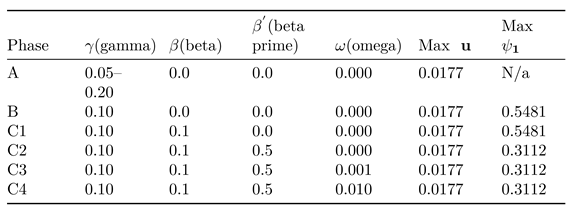
Note: In Phase A, the spinor amplitudes are not applicable because their update is deliberately omitted.
Q.3 Visual Comparisons
Two supplementary figures provide additional insight into the role of relative phasing and the evolution of interference effects:
Figure 6 (Impact of Relative Phasing at )
Top Row (With Relative Phasing):
In this configuration, the spinor field exhibits two distinct, spatially separated lumps. This indicates that the presence of a relative phase between the two components of the bimodal spinor activates additional degrees of freedom via mode by mode interactions with the mirror antispinor.
Bottom Row (Without Relative Phasing):
Here, the spinor field is more uniform and forms a single central lump, reflecting reduced dynamical complexity when the phase difference is absent.
Figure 7 (Complex Interference at )
Over a prolonged time evolution, the spinor field develops a multi lobed interference pattern. This demonstrates that, under the deterministic evolution of the STM PDE, the cumulative effects of relative phase coupling and sub Planck dynamics lead to complex interference phenomena. Such multi lobed structures are indicative of the rich internal configuration of the emergent quantum like excitations.
Q.4 Interpretation
Membrane Field Stability:
The consistent maximum amplitude of u (approximately 0.0177) across all parameter sets verifies that our semi implicit integration scheme, combined with suitable damping (), effectively stabilises the high order PDE. This reinforces the STM model’s claim that the elastic substrate remains well-controlled even under extreme conditions.
Spinor Field Dynamics:
In Phase B, the free spinors settle at an amplitude of approximately 0.5481. Once coupling parameters are activated in Phase C, the spinor amplitude reduces to around 0.3112. This systematic reduction indicates that the interactions—particularly the cross-face coupling and relative phase contributions—lead to energy redistribution or phase cancellation between the spinor modes and their mirror counterparts. Such behaviour is interpreted within the STM framework as the deterministic mechanism through which effective, particle like excitations emerge from the underlying oscillatory dynamics.
Role of Relative Phasing and Interference:
As evidenced by Figure 6, including a relative phase in the spinor field creates a dual lumped structure, which reflects the activation of extra degrees of freedom and complex mode interference. In Figure 7, the evolution to reveals multi lobed interference patterns in , demonstrating that the deterministic chaotic dynamics persist over long timescales and lead to intricate interference phenomena that mirror quantum behaviour. Together, these visualisations provide clear evidence that the interplay of relative phasing and coupling is central to the emergence of quantum like excitations in the STM model.
Parameter Sensitivity:
The systematic parameter sweep indicates that while the membrane field u is largely insensitive to the added spinor couplings, the spinor amplitudes are strongly influenced by the coupling parameters. These findings underscore that the rich dynamical behaviour observed in the spinor fields is a result of the delicate interplay between damping, intra spinor mixing, and cross face interactions.
Q.5 Conclusion
This section, along with the detailed numerical code provided in supplementary material (O1 Code.py) which focuses on spinor dynamics with relative phasing and interference effects) and (O2 Code.py) which contains the systematic parameter sweep code), forms a critical part of our results. The numerical experiments not only verify that the STM PDE is stable under appropriate conditions but also illustrate that the deterministic dynamics of the membrane give rise to emergent, particle like excitations in the spinor fields. These findings support the central tenet of the STM model: that gravitational and quantum like phenomena can emerge from a single, unified classical elasticity framework.
Appendix R. Appendix R: Glossary of Symbols
R.1 Fundamental Constants
| Symbol | Definition |
| c | Speed of light in vacuum. |
| ℏ | Reduced Planck’s constant, . |
| G | Newton’s gravitational constant. |
| Cosmological constant, often linked to vacuum energy density. |
R.2 Elastic Membrane and Field Variables
| Symbol | Definition |
| Classical displacement field of the four-dimensional elastic membrane. | |
| Operator form of the displacement field (canonical quantisation). | |
| Conjugate momentum, . | |
| Scale-dependent baseline elastic modulus, inverse gravitational coupling. | |
| Local stiffness fluctuations, time- and space-dependent. | |
| Coefficient for the term, UV regularisation. | |
| Damping parameter (possibly non-Markovian). | |
| Potential energy function for displacement field u. | |
| Self-interaction coupling constant (e.g. ). | |
| External force on the membrane’s displacement field. |
R.3 Gauge Fields and Internal Symmetries
| Symbol | Definition |
| U(1) gauge field (photon-like). | |
| SU(2) gauge fields, . | |
| SU(3) gauge fields (gluons), . | |
| Gauge group generators (e.g. in SU(2)). | |
| Gauge coupling constants for U(1), SU(2), SU(3). | |
| U(1) field strength tensor, . | |
| SU(2) field strength tensor. | |
| SU(3) field strength tensor. | |
| Structure constants of non-Abelian gauge groups (e.g. for SU(2)). |
R.4 Fermion Fields and Deterministic CP Violation
| Symbol | Definition |
| Two-component spinor field from bimodal decomposition of . | |
| Mirror antispinor field on opposite membrane face. | |
| Fermion bilinear (Yukawa-like), spinor–mirror product. | |
| v | Vacuum expectation value (VEV) of . |
| Yukawa coupling between spinor fields and u. | |
| Deterministic CP phase between spinor and mirror fields. | |
| Fermion mass matrix; complex phases yield CP violation. |
R.5 Renormalisation Group and Couplings
| Symbol | Definition |
| Renormalisation scale. | |
| Effective coupling constant (scale-dependent). | |
| Beta function describing RG flow. | |
| Strong coupling constant in SU(3) sector. | |
| QCD-like confinement scale in STM. | |
| Scale-dependent wavefunction renormalisation (FRG). |
R.6 Path Integral and Operator Formalism
| Symbol | Definition |
| Functional integration measures. | |
| Z | Path integral (partition function). |
| Gauge-fixing parameter. | |
| Faddeev–Popov ghost and antighost fields. |
R.7 Nonperturbative Effects and Solitonic Structures
| Symbol | Definition |
| Scale-dependent effective action in FRG. | |
| Infrared regulator suppressing fluctuations for . | |
| Second functional derivative (inverse propagator). | |
| Scale-dependent effective potential. | |
| Scalar field variable in FRG analyses. | |
| Quasinormal mode wavefunction near solitonic core. | |
| Soliton energy. | |
| Solitonic mass scale. | |
| QNM frequency shift due to soliton core. |
R.8 Lindblad and Open Quantum System Parameters
| Symbol | Definition |
| Lindbladian operator acting on density matrix . | |
| Lindblad jump operators encoding dissipation. | |
| Density matrix of system under open dynamics. | |
| Memory kernel in non-Markovian damping. | |
| Fermionic damping rate. |
R.9 BRST and Ghost-Free Gauge Formalism
| Symbol | Definition |
| BRST charge operator defining physical state space. | |
| Physical Hilbert space satisfying | |
| BRST ghost number operator. | |
| s | BRST differential operator (nilpotent). |
R.10 Double-Slit and Interference Interpretations
| Symbol | Definition |
| Matrix elements of effective density matrix (off-diagonal components encode coherence). | |
| Phase difference between elastic wavefronts at detectors. | |
| Observed interference intensity at position . |
R.11 Black Hole Thermodynamics and Solitonic Horizon
| Symbol | Definition |
| Bekenstein-Hawking entropy, . | |
| Effective horizon area in STM solitonic geometry. | |
| Hawking-like temperature. | |
| Surface gravity at effective horizon. | |
| Effective horizon radius. |
R.12 Multi-Scale Expansion and Vacuum Energy Terms
| Symbol | Definition |
| Slow spatial and temporal coordinates: , . | |
| n-th order displacement term in multi-scale expansion. | |
| Slowly varying envelope amplitude. | |
| Oscillatory component of stiffness field. | |
| Residual vacuum stiffness offset. | |
| Scaled damping coefficient (e.g., ). | |
| Scaled nonlinear coupling. |
References
- Einstein, A. (1916). Die Grundlage der allgemeinen Relativitätstheorie. Annalen der Physik, 49(7), 769–822.
- Misner, C. W., Thorne, K. S., & Wheeler, J. A. (1973). Gravitation. W. H. Freeman.
- Wald, R. M. (1984). General Relativity. University of Chicago Press.
- Peskin, M. E., & Schroeder, D. V. (1995). An Introduction to Quantum Field Theory. Addison–Wesley.
- Polchinski, J. (1998). String Theory: Volume 1. Cambridge University Press.
- Rovelli, C. (2004). Quantum Gravity. Cambridge University Press.
- Weinberg, S. (1995). The Quantum Theory of Fields, Volume I. Cambridge University Press.
- Zeh, H. D., Joos, E., Kiefer, C., Giulini, D. J. W., Kupsch, J., & Stamatescu, I. O. (2003). Decoherence and the Appearance of a Classical World in Quantum Theory. Springer.
- Hawking, S. W. (1975). Particle Creation by Black Holes. Communications in Mathematical Physics, 43, 199–220.
- Penrose, R. (1965). Gravitational Collapse and Space–Time Singularities. Physical Review Letters, 14, 57–59. [CrossRef]
- Weinberg, S. (1989). The Cosmological Constant Problem. Reviews of Modern Physics, 61, 1–23.
- Feynman, R. P. (1949). The Theory of Positrons. Physical Review, 76, 749–759.
- Feynman, R. P., & Hibbs, A. R. (1965). Quantum Mechanics and Path Integrals. McGraw–Hill. [CrossRef]
- Riess, A. G., et al. (1998). Observational Evidence from Supernovae for an Accelerating Universe and a Cosmological Constant. Astronomical Journal, 116, 1009–1038. [CrossRef]
- Perlmutter, S., et al. (1999). Measurements of Ω and ʌ from 42 High Redshift Supernovae. Astrophysical Journal, 517, 565–586.
- Greenstein, G., & Zajonc, A. G. (2006). The Quantum Challenge: Modern Research on the Foundations of Quantum Mechanics. Jones and Bartlett. [CrossRef]
- Cramer, J. G. (1986). The Transactional Interpretation of Quantum Mechanics. Reviews of Modern Physics, 58, 647–687. [CrossRef]
- Donoghue, J. F., Golowich, E., & Holstein, B. R. (1992). Dynamics of the Standard Model. Cambridge University Press. [CrossRef]
Disclaimer/Publisher’s Note: The statements, opinions and data contained in all publications are solely those of the individual author(s) and contributor(s) and not of MDPI and/or the editor(s). MDPI and/or the editor(s) disclaim responsibility for any injury to people or property resulting from any ideas, methods, instructions or products referred to in the content. |
© 2025 by the authors. Licensee MDPI, Basel, Switzerland. This article is an open access article distributed under the terms and conditions of the Creative Commons Attribution (CC BY) license (http://creativecommons.org/licenses/by/4.0/).
Copyright: This open access article is published under a Creative Commons CC BY 4.0 license, which permit the free download, distribution, and reuse, provided that the author and preprint are cited in any reuse.


