Preprint
Review

This version is not peer-reviewed.

Using Allen Brain Cell Atlas of the Human Brain to Gain Insights into the C-Terminal Binding Protein 1 (CTBP1)’s Potential Function

A peer-reviewed article of this preprint also exists.

Submitted:

07 March 2025

Posted:

09 March 2025

You are already at the latest version

Abstract

C-terminal binding proteins (CtBPs) dimerize and function predominantly as transcriptional corepressors by targeting various chromatin-modifying factors to promoter-bound repressors. Hypotonia, Ataxia, Developmental-Delay, and Tooth-Enamel Defects Syndrome (HADDTS) is a recently discovered neurodevelopmental disorder resulting from a heterozygous missense mutation in CTBP1. It is often associated with the early onset of profound cerebellar atrophy in patients. To understand CtBP1's role in brain function and the etiology of HADDTS, Allen Institute’s Allen Brain Cell (ABC) human brain atlas was used. Based on the ABC atlas, CTBP1 is highly expressed in the upper rhombic lip supercluster which gives rise to the majority of the cerebellar granule cells. The results correlate with the cerebellum related manifestations observed in HADDTS patients.

Keywords: 
;  ;  ;  

Role of CtBP

C-terminal binding proteins (CtBPs) play critical roles during early development and are highly conserved among vertebrates and invertebrates [1]. Vertebrate genomes encode two highly related proteins, CtBP1 and CtBP2. Differential splicing leads to the formation of four proteins (CtBP1 [CtBP1-L], CtBP3/BARS [CtBP1-S], CtBP2, and RIBEYE), and these are implicated both in transcriptional repression and intracellular trafficking [2,3].
CtBPs function predominantly as transcriptional corepressors by dimerizing and recruiting various chromatin-modifying factors to the promoter region of target gene [2]. CtBP2, which has a nuclear localization signal, can hetero/oligomerize with CtBP1 and other transcription factors [4,5]. The resulting complex is exported to the nucleus to carry out its role of transcriptional corepression. The presence of PXDLS- and RRT-binding motifs in CtBPs are crucial for the recruitment of the corepressor complex [1]. The CtBP corepressor complex mediates coordinated histone modifications by deacetylation and methylation of histone H3-lysine 9 (H3K9) and demethylation of histone H3-lysine 4 (H3K4) [6]. Even though CtBPs mainly function as corepressors, other evidence suggests they may function as coactivators [7].
CtBP1 and CtBP2 play overlapping and unique transcriptional roles during animal development [8]. Early animal studies on ctbp knockout (KO) mice have suggested the importance of CtBPs in neurogenesis. While ctbp1 KO mice are viable with reduced size and lifespan, the ctbp2 KO mutation results in embryonic lethality, primarily affecting neurogenesis and myogenic development [8]. Ctbp double KO mutants exhibit more severe developmental phenotypes than ctbp2 KO mutants, suggesting the importance of both ctbp1 and ctbp2 in neurogenesis [8]. In mice, CtBPs have been shown to be expressed in neural stem cells, progenitor cells, and neurons [8]. Specifically, CtBP2’s role has been indicated in proliferation, differentiation, and neuron maturation in the cortex [8,9].
CtBPs also function as pro-survival proteins in neurons [10,11]. CtBP downregulation leads to the derepressed expression of pro-apoptotic genes, resulting in apoptosis [12]. In an animal model for Alzheimer's disease, CtBP1 overexpression prevents the degeneration of hippocampal and cortical neurons, decreasing hippocampal and cortical neuron apoptosis and enhancing neuron activity [11]. Upregulation of CTBP1 has been shown to prevent dopaminergic cell death in the Parkinson's toxin-based disease model [10].

CtBP1 and HADDTS

Although several animal models have indicated CtBP's role in neurogenesis, proliferation, and differentiation, no direct link between CtBPs and neurological disorders has been suggested until recently [9,10,11,13,14,15]. HADDTS (hypotonia, ataxia, developmental-delay, and tooth-enamel defect syndrome) is a recently identified neurodevelopmental disorder that is linked to a de novo mutation in the CTBP1 gene [16,17]. Children heterozygous for the CTPB1 missense mutation ((c.1024C >T: p.R342W): (R343 (wild-type allele): W342 (mutant allele)) have exhibited HADDTS, along with cerebellar atrophy [16,17]. Thirteen patients identified thus far harbor a missense mutation, and one patient harbors a deletion mutation (c.1315_1316delCA) [18]. Both mutations are found in the protein-interacting domain of CTBP1 [16,19,20]. Interestingly, neither the CTBP1 homozygous mutation nor the CTBP2 mutation has been reported in humans, suggesting that these mutations may lead to perinatal or prenatal death [18].

ABC Atlas

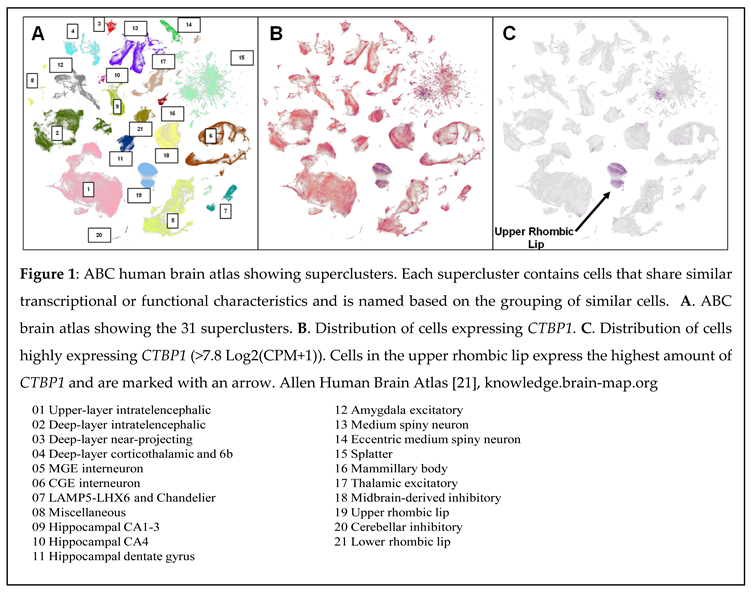
Allen Institute’s Allen Brain Center (ABC) Atlas tool was used, and the “Neurons” dataset, which includes gene expression data of human brains organized using the t-SNE statistical method (a distinct cluster of data point on a t-distributed stochastic neighbor embedding), was selected (http://www.brain-map.org [21]). Among the many cell properties within the atlas, this paper specifically focused on the anatomical division and supercluster properties. The ABC Atlas categorizes all cells into 13 anatomical divisions: cerebral cortex, hippocampus, amygdaloid complex, extended amygdala, basal nuclei, claustrum, basal forebrain, thalamus, hypothalamus, midbrain, cerebellum, pons, myelencephalon, and the spinal cord. The dataset also categorizes all cells into 31 superclusters, the broadest category, which further branches down to 461 clusters and 3313 subclusters hierarchically. Each supercluster contains cells that share similar general transcriptional or functional characteristics and is named based on the grouping of similar cells. Many superclusters, such as the upper rhombic lip, include cells localized to specific brain regions, giving insight into their developmental history. The gene expression levels of CTBP1 and CTBP2 were predominantly shown in one particular t-SNE island, which was found by setting the value of Log2(CPM+1) above 7.8. As each t-SNE island represents a supercluster, the upper rhombic lip predominantly contained cells highly expressing CTBP1 when compared to other superclusters. For the CtBP1-interacting protein coding genes (MECOM, RBBP8, KLF3, CTBP2, HDAC2, RCOR1, KDM1A, HDAC1, ZEB1, and ZNF1), all the cells expressing the gene of interest were enumerated from the URL supercluster and their respective anatomical regions.
The ABC human brain atlas was used to map the expression of CTBP1 and the expression of its binding partners [21,22,23]. CtBP2 was also mapped as it can dimerize/oligomerize with CtBP1 [4,5]. Based on the ABC atlas, CtBPs are expressed in all regions of the brain; however, the highest expression is found in the upper rhombic lip (URL), which is the posterior section of the developing metencephalon found in vertebrate embryos. During the development of the brain, the URL gives rise to all cerebellar granule cells [24]. During embryonic development, the metencephalon develops into the cerebellum and pons [25]. The high levels of CtBP expression in the URL and its related brain regions reveal why HADDTS patients exhibit ataxia, hypotonia, and cerebellar atrophy, and expression in other areas suggests the importance of the corepressor CtBP in brain development and function.

Upper Rhombic Lip

The highest CTBP1 gene expression is predominantly located in the upper rhombic lip (Log2(CPM+1) >7.8), which gives rise to the majority of the granule cells found in the cerebellum (Figure 1). The predominant relevance of the URL was underscored as HADDTS patients exhibit ataxia, hypotonia, and cerebellar atrophy. As CtBP1 can oligomerize with CtBP2 and both genes can function simultaneously, CTBP2 expression was found, which is also predominantly expressed in the URL (Log2(CPM+1) >7.8). Based on these results, this paper focused on the URL due to its relevance to HADDTS, which is caused by a heterozygous missense mutation in CTBP1[17].
Preprints 151586 i001

CtBP1-Interacting Proteins

Early neurodevelopment encompasses vital cellular processes such as neurogenesis, cell migration, differentiation, synaptogenesis, neuronal cell death, and synaptic rearrangement [11,25]. Neurodevelopment requires precise expression and orchestration of dynamic changes in gene expression to decide the fate of the developing cells. In a previously published paper, comparisons between the RNA-seq data of neurons derived from induced pluripotent stem cells of patients and normal donors revealed downregulation of gene networks involved in neurodevelopment, as well as synaptic adhesion [26].
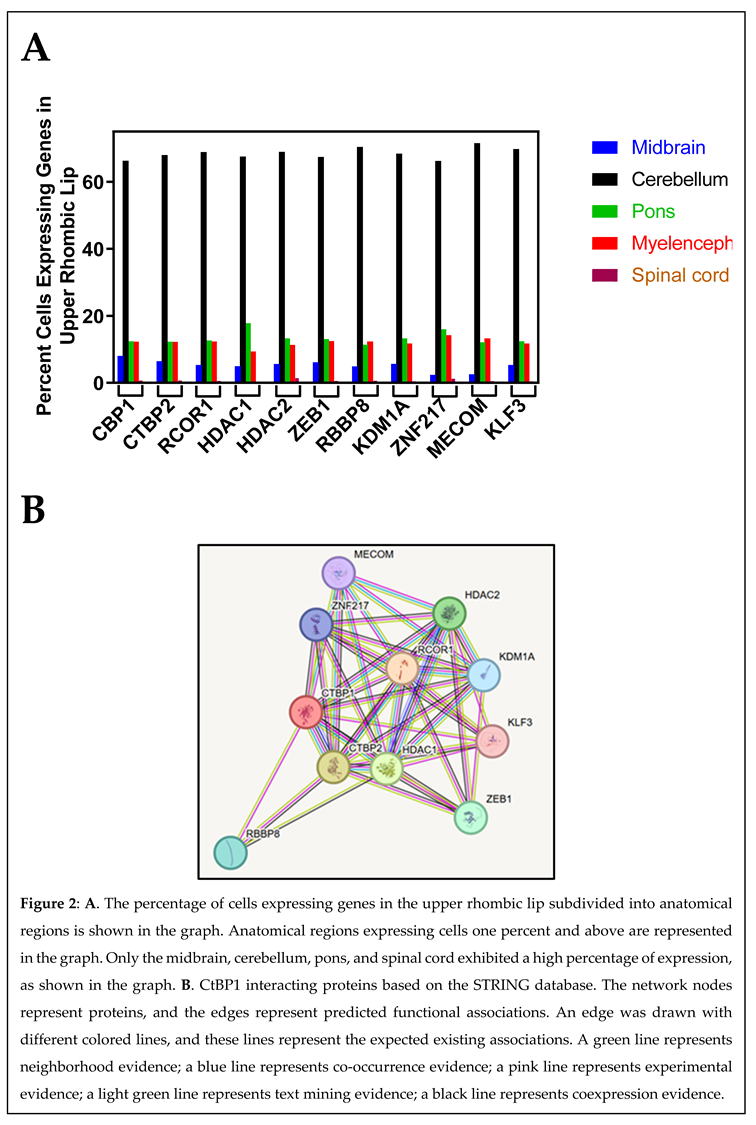
CtBP1, as a corepressor, interacts with chromatin-modifying enzymes and transcriptional factors and represses transcription.2 Most of the CtBP1 interacting proteins are characterized in cancer cells, and CtBP1 data on neurodevelopment is limited. Therefore, the STRING protein-protein interaction database was used to find 10 interacting proteins (Figure 2B). To find CtBP1-interacting proteins, the online database resource Search Tool was used for the Retrieval of Interacting Genes (STRING). STRING provides a uniquely comprehensive coverage and ease of access to experimental and predicted protein interactions [27]. CTBP1 was entered to display a graphical network of its interaction partners. Ten proteins that interact with CTBP1 were found, and their respective genes were chosen as candidates to assess their expression pattern in the URL.
Preprints 151586 i002
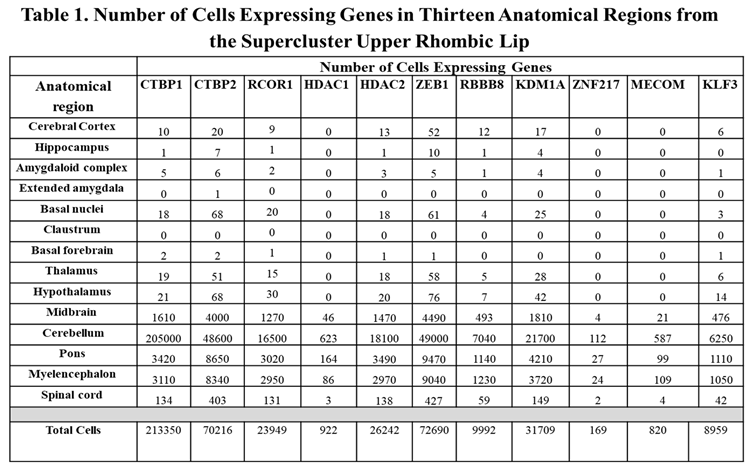
CtBP1’s association with these interacting proteins suggests that their expression should correlate with CTBP1 expression in the URL supercluster. Cells expressing CTBP1 and its interacting genes that encode proteins in the URL were categorized into 13 anatomical regions(Table 1 and Figure 2A). A total of 213,350 cells expressed CTBP1 in the URL, of which 96% are in the cerebellum; a total of 70,216 cells expressed CTBP2 in the URL, of which 69.2% are in the cerebellum. Even though most of the cells in the URL give rise to cerebellar cells, other brain region cells can also originate from the URL [24]. When the supercluster cells expressing genes are categorized into anatomical regions, the CtBP1 interacting protein-ding genes are highly expressed in the cerebellum and, to some extent, in the pons, myelencephalon, and midbrain (Table 1 and Figure 2B). In the cerebellum, the expression of CtBP1 corepressor binding protein-coding genes are as follows: MECOM (71.5%) > RBBP8 (70.4%) > KLF3(69.7%) > CTBP2 (69.2%) > HDAC2 (68.9%) > RCOR1 (68.8%) > KDM1A (68.4%) > HDAC1 (67.5%) > ZEB1 (67.4%) > ZNF217(66.2%). All ten genes are predominantly expressed in the URL and the cerebellum.
Preprints 151586 i003

CTBP2

CTBP2 is highly expressed in the supercluster URL, and 69.2% of the cells expressing CTBP2 are located in the cerebellum (Figure 2A). Even though CtBP1 and CtBP2 execute shared functions as transcription regulators, they often play distinct roles in cellular function [1]. It has been shown that C-terminal binding protein interacting protein (CtIP, also called retinoblastoma binding B binding protein 8 (RBBP8)) assembles CtBP1 and CtBP2 heterodimers, histone deacetylase 1 (HDAC1), and two subunits of the activating protein 1 transcription factor (AP1). This assembled repressor complex suppresses genes involved in DNA damage, such as MutL homolog 1 (MLH1), MutS homolog 3 (MSH3), breast cancer type 1 (BRCA1), and cyclin-dependent kinase inhibitor 1A (CDKN1A) by binding to their promoter region in the osteosarcoma [28]. This suggests that in certain instances, heterodimers formed by CTBP1 and CTBP2 play critical roles in regulating gene suppression [5,28]. The cerebellum is vulnerable to oxidative DNA damage due to its high level of oxidative metabolism [29,30]. DNA damage needs to be repaired to keep the neuron functional; otherwise, it can lead to neuron dysfunction and apoptotic cell death [29,30]. A defective DNA damage repair system can result in a multitude of human syndromes that feature pronounced neuropathology. Spinocerebellar ataxia is associated with axonal neuropathy (SCAN1), and ataxia is associated with oculomotor apraxia (AOA1) where defects occur in the single-strand break repair (SSBR) and exhibit ataxia linked to cerebellar degeneration and neuropathy [30]. A mouse model with inactivation of Xrcc1, a repair factor involved in DNA single-strand break, led to profound neuropathy characterized by loss of cerebellar interneuron [31]. Based on the high expression patterns of CTBP1 and CTBP2 in the URL, and especially in the cerebellum where high oxidative metabolism can lead to DNA damage, one could predict that CtBPs may play an important role in maintaining genomic integrity in the cerebellum

RCOR1

The Corepressor of the Repressor Element-1 Silencing Transcription (CoREST) protein is encoded by the RCOR1 gene. RCOR1 is highly expressed in the supercluster URL and 68.8% of the cells in the cerebellum express this gene (Figure 2). The RE1 silencing transcription factor (REST) cooperates with CoREST and silences neuron-specific genes in non-neuronal cells [32]. CoREST forms a multi-subunit complex with lysine-specific demethylase (LSD1) and modifies nucleosomes by deacetylation and demethylation, thereby repressing transcription [32]. Depending upon cell context, several core subunits have been identified with CoREST, which include LSD1, HDAC1, HDAC2, CtBP1, ZNF217, BHC80, and BRAF35. CoREST binds to the SIRT1-LSD1-CtBP1 complex and represses Notch target genes [33]. Notch signaling plays a critical role in neurodevelopment, mainly by regulating the balance of neural progenitor cells and their differentiation into neurons and glial cells [33].

HDAC1 and HDCA2

HDAC1 and HDAC2 (HDAC1/2) are highly related histone deacetylases that form the catalytic core of multiple co-repressor complexes. The PLDLS-binding cleft region in CtBP1 functions as the primary recruitment center for DNA-binding factors and the core and auxiliary enzymatic constituents of the CtBP1 corepressor complex, including HDAC1/2 and CoREST/LSD1. This shows that the functions of HDAC1/2 are extensively linked to the repression activity of CtBP1[28]. Both are highly expressed in the URL and the cerebellum; 67.5% of the cells expressing HDAC1 and 68.9% of the cells expressing HDAC2 are located in the cerebellum (Figure 2A).

ZEB1

In cancer metastasis, the epithelial-mesenchymal transition is regulated by Zinc-finger E-box binding homeobox 1 (ZEB1). ZEB1 binds to the promoter region and recruits CtBP1, thereby repressing gene expression [2]. The ZEB1 expression is highest in the pons, followed by the myelencephalon and the cerebellum (Table 1 & Figure 2). During cancer metastasis, ZEB1 forms a complex with CtBP1, which is transported to the nucleus and suppresses epithelial genes, resulting in cell migration, invasion, and tumor progression. Mutation in ZEB1 is associated with defective brain development [34]. Interactions between ZEB1 and CtBP2 in the mouse embryonic cerebral cortex are required for ZEB1 to elicit its effect on multipolar-to-bipolar transition, which is crucial for proper neural functioning during cortical development [34]. The ZEB1 protein level decreases during differentiation and is undetectable in neurons, suggesting that timed repression is critical in controlling the transition from the progenitor stage to the differentiated stage [34].

RBBP8

Retinoblastoma binding B binding protein 8 (RBBP8), also known as CtBP-interacting protein (CtIP), acts as an adaptor protein, thereby allowing the association of CtBP1 with another transcriptional factor. RBBP8 is highly expressed in the supercluster URL, and 70.4% of the cells in the cerebellum express this gene (Figure 2A). RBBP8 plays multiple roles apart from forming the transcriptional repression complex [28]. It is involved in initiating DNA-end resection of double-strand breaks (DSB) during homologous recombination, thereby maintaining genomic integrity It is also involved in damage checkpoint signaling and replication fork protection pathways [28]. As a multifunctional protein, RBBP8 may carry out other functions apart from being part of the transcriptional repression complex.

KLF3

The KLF (Krüppel-like factor) family of sequence-specific DNA-binding proteins binds GC-rich regions and related CAC sequences in the DNA [35]. KLF3 is one of 17 members of the KLF family. KLF3 is highly expressed in the supercluster URL, and 69.7% of the cells in the cerebellum express KFL3 (Figure 2A). KLF family members regulate cellular processes such as cell proliferation and differentiation, allowing for cell survival [35]. In KLF3, the N-terminal consensus motif, PVALS/T, is shown to interact with CtBPs and cause transcriptional suppression [35]. KLF 3 interacts with CtBP1 and regulates adipogenesis, erythropoiesis, and B cell development [35]. The expression of KLF3 in the URL suggests that it may be involved in neurodevelopment.

KDM1A

Lysine-specific histone demethylase 1A (LSD1), also known as lysine (K) specific demethylase 1A (KDM1A), is encoded by the KDM1A gene [36]. KDM1A is highly expressed in the supercluster URL, and 68.4% of the cells in the cerebellum express this gene (Figure 2A). KDM1A demethylates mono and dimethylated lysines, specifically histone 3 lysine 4 (H3K4me) [36]. KDM1A interacts with the orphan hormone receptor and regulates neural stem cell proliferation and differentiation [36]. This demethylase was first identified to be a part of the CtBP1 corepressor complex. KDM1A downregulates notch pathway genes, namely JAG2, ASMA12, PSEN2, HES6, TLE1, and CDKN1A, playing a critical role in neurogenesis [36,37].

MECOM

The MDS1 and EVI1 complex locus (MECOM), also known as ectopic virus integration site 1 protein homolog (EVI-1) or positive regulatory domain zinc finger protein 3 (PRDM3) gene, encodes a protein that can act as an oncoprotein and a transcriptional regulator [38]. It is highly expressed in the supercluster URL, and 71.5% of the cells in the cerebellum express this gene (Figure 2A). EVI1 interacts with other transcription factors in a context-dependent manner, regulates chromatin remodeling, and is involved in the differentiation of the nervous system and hematopoiesis. Overexpression of this oncogene, EVI1, has been associated with several types of cancers such as breast, lung, ovarian, and prostate cancer [38]. CtBP1 has been shown to interact with MECOM/EVI1 and repress growth factor beta signaling (TGF-beta) [39]. TGF-beta signaling plays an important role in both embryonic and adult signaling, providing tissue-specific control of differentiation, proliferation, and cell-specific or tissue-specific motility [39]. By interacting with CtBP1, MECOM represses target gene expression in stem cells and neurons.

ZNF217

Zinc finger 217 (ZNF217) codes for an oncogenic protein, and its expression is frequently amplified in tumors [40]. ZNF217 is highly expressed in the supercluster URL, and 66.2% of the cells in the cerebellum express this gene (Figure 2A). It is also found in the corepressor complex CtBP1-CoREST-HDAC and other repressor protein complexes [41]. ZNF217 is involved in the self-renewal and maintenance of stem cells and inhibits differentiation [42].

CtBP1-Interacting Proteins and the Upper Rhombic Lip

Brain development involves finely tuned transcriptional regulation of genes, and the expression of these genes in the appropriate time and space is critical [13]. Animal studies have provided evidence of the role of corepressor CtBP1 in neurodevelopment [8,11,13]. CtBP1 has been shown to have a dual function in neurons, acting as a transcriptional co-repressor in the nucleus and a regulator of membrane fission in the cytoplasm [3,7]. Recently, the establishment of the link between the CTBP1 missense mutation in heterozygous conditions and HADDTS suggested that CtBP1 could be an important corepressor during neurodevelopment [26]. Allen's ABC human brain atlas revealed that the URL is the predominant supercluster expressing CTBP1. As HADDTS patients exhibit hypotonia, ataxia, and cerebellum atrophy and the URL gives rise to the majority of the cerebellar granule cells, the paper focused on the URL supercluster and expression patterns in 13 anatomical regions were analyzed. CTBP1 and the associated proteins are highly expressed in the cerebellum, suggesting they play a critical role in cerebellar development and function. There may be other transcriptional factors and histone-modifying enzymes that may be part of the CtBP1 corepressor complex. As most of the URL gives rise to cerebellar granule cells, one can study the role of CtBP1 by understanding the development and function of these cells. Western blot and immunohistochemistry data from mice have recently shown that CtBP1 is expressed in the central nervous system throughout development [43]. At postnatal day 30, CtBP1 is expressed in the nucleus and cytoplasm of Purkinje cells, the nucleus of the granule cells, and cells in the molecular layer [43].
CtBP1 also functions as a metabolic sensor. In the presence of NADH, it dimerizes and functions as a transcriptional repressor [4]. CtBP1 binds with NADH and forms a dimer, which represses transcription [4]. Therefore, the form of CtBP1 as a monomer or dimer is dependent on the ratio of NADH/NAD+ [4].
HADDTS patients harbor a heterozygous mutation in CTBP1; the pathogenic allele will encode a mutant protein (m), and the wild-type allele will encode a normal functional monomeric protein (wt). Therefore, the functional dimeric form of the repressor complex can be composed of two monomeric mutant proteins (m-m), a mutant and a wild-type monomeric protein (m-wt), and two wild-type monomeric proteins (wt-wt). A transcriptome analysis of neurons derived from induced pluripotent cells of HADDTS patients revealed that the majority of the genes are downregulated [26]. One could hypothesize that CtBP dimers formed by mutant proteins alone (m-m) or a mutant and wild-type protein (m-wt) can dysregulate transcription, thereby affecting the cerebellum’s function. Studies suggest that apart from its role in motor function, the cerebellum can be linked to a range of cognitive and emotional functions [44,45].
Analysis of Allen’s ABC brain atlas data indicated that the greatest number of CTBP1 expressing cells were found in the upper rhombic lip supercluster, which was further categorized into 13 anatomical regions. CTBP1 and its associated partner proteins are highly expressed in the URL and the cerebellum, based on Allen’s ABC atlas. An immunohistochemistry study of the postnatal day 30 mouse cerebellum shows that CtBP1 is predominantly expressed in the nucleus of the granule cells [43]. As CTBP1 is highly expressed in the URL and in the mouse cerebellum [43], the CtBP1 plays a critical role in cerebellum development and function. The pathological symptoms in HADDTS patients could be due to the formation of m-m and wt-m dimeric protein and their effect(s) on CtBP1’s function [17].
Although CTBP1 is highly expressed in the cerebellum and can possibly lead to the phenotypic attributes in HADDTS patients, CtBP1 is also involved in other cellular pathways and functions besides transcriptional corepression. For instance, CtBP1 is involved in presynapsis by direct interaction with the active zone scaffolding proteins Bassoon and Piccolo [46]. Based on the neuronal activity requirement, CtBP1 can shuttle between the nucleus as a corepressor complex and to the cytoplasm for presynapsis [46]. CTBP1 expression is also widespread in other regions of the brain besides the cerebellum, implying that it is also involved in other cerebral functions. This review focused on understanding how HADDT syndrome is caused by the CTBP1 missense mutation in heterozygous conditions by using Allen’s ABC atlas [21]. The atlas identified expression levels of CTBP1 and its associated chromosomal modifying proteins in the brain regions. Based on this review, the highest expression of CTBP1 was localized to the cerebellum, and the mutation can cause dysfunction of CtBP1, specifically in the granule cells in the cerebellum. This finding allows future experiments to focus on understanding CtBP1’s role in cerebellar granule cells.

Notes

The authors declare no competing financial interest.

Author Contributions

SL analyzed the data from Allen’s ABC Atlas, and UE conceived and wrote the manuscript. All authors have given approval to the final version of the manuscript.

Acknowledgment

SL is supported by the DeNardo Education and Research Foundation. The authors thank Dr. R Heuertz for critically reading the paper.

References

  1. Chinnadurai, G. CtBP, an unconventional transcriptional corepressor in development and oncogenesis. Mol Cell 2002, 9, 213–224. [Google Scholar] [CrossRef] [PubMed]
  2. Chinnadurai, G. Transcriptional regulation by C-terminal binding proteins. The international journal of biochemistry & cell biology 2007, 39, 1593–1607. [Google Scholar] [CrossRef]
  3. Ivanova, D.; Imig, C.; Camacho, M.; Reinhold, A.; Guhathakurta, D.; Montenegro-Venegas, C.; Cousin, M. A.; Gundelfinger, E. D.; Rosenmund, C.; Cooper, B.; et al. CtBP1-Mediated Membrane Fission Contributes to Effective Recycling of Synaptic Vesicles. Cell Rep 2020, 30, 2444–2459. [Google Scholar] [CrossRef] [PubMed]
  4. Jaiswal, A.; Singh, R. CtBP: A global regulator of balancing acts and homeostases. Biochim Biophys Acta Rev Cancer 2023, 1878, 188886. [Google Scholar] [CrossRef]
  5. Li, J.; Wang, Y.; Wang, L.; Hao, D.; Li, P.; Su, M.; Zhao, Z.; Liu, T.; Tai, L.; Lu, J.; et al. Metabolic modulation of CtBP dimeric status impacts the repression of DNA damage repair genes and the platinum sensitivity of ovarian cancer. Int J Biol Sci 2023, 19, 2081–2096. [Google Scholar] [CrossRef] [PubMed]
  6. Shi, Y.; Sawada, J.; Sui, G.; Affar el, B.; Whetstine, J. R.; Lan, F.; Ogawa, H.; Luke, M. P.; Nakatani, Y. Coordinated histone modifications mediated by a CtBP co-repressor complex. Nature 2003, 422, 735–738. [Google Scholar] [CrossRef]
  7. Bhambhani, C.; Chang, J. L.; Akey, D. L.; Cadigan, K. M. The oligomeric state of CtBP determines its role as a transcriptional co-activator and co-repressor of Wingless targets. EMBO J 2011, 30, 2031–2043. [Google Scholar] [CrossRef]
  8. Hildebrand, J. D.; Soriano, P. Overlapping and unique roles for C-terminal binding protein 1 (CtBP1) and CtBP2 during mouse development. Mol Cell Biol 2002, 22, 5296–5307. [Google Scholar] [CrossRef]
  9. Karaca, E.; Li, X.; Lewicki, J.; Neofytou, C.; Guerout, N.; Barnabe-Heider, F.; Hermanson, O. The corepressor CtBP2 is required for proper development of the mouse cerebral cortex. Mol Cell Neurosci 2020, 104, 103481. [Google Scholar] [CrossRef]
  10. Saraiva, C.; Lopes-Nunes, J.; Esteves, M.; Santos, T.; Vale, A.; Cristovao, A. C.; Ferreira, R.; Bernardino, L. CtBP Neuroprotective Role in Toxin-Based Parkinson's Disease Models: From Expression Pattern to Dopaminergic Survival. Mol Neurobiol 2023, 60, 4246–4260. [Google Scholar] [CrossRef]
  11. Hu, K.; Li, Y.; Yu, H.; Hu, Y. CTBP1 Confers Protection for Hippocampal and Cortical Neurons in Rat Models of Alzheimer's Disease. Neuroimmunomodulation 2019, 26, 139–152. [Google Scholar] [CrossRef] [PubMed]
  12. Stankiewicz, T. R.; Schroeder, E. K.; Kelsey, N. A.; Bouchard, R. J.; Linseman, D. A. C-terminal binding proteins are essential pro-survival factors that undergo caspase-dependent downregulation during neuronal apoptosis. Mol Cell Neurosci 2013, 56, 322–332. [Google Scholar] [CrossRef] [PubMed]
  13. Hubler, D.; Rankovic, M.; Richter, K.; Lazarevic, V.; Altrock, W. D.; Fischer, K. D.; Gundelfinger, E. D.; Fejtova, A. Differential spatial expression and subcellular localization of CtBP family members in rodent brain. PloS one 2012, 7, e39710. [Google Scholar] [CrossRef]
  14. Li, H.; Zhang, C.; Yang, C.; Blevins, M.; Norris, D.; Zhao, R.; Huang, M. C-terminal binding proteins 1 and 2 in traumatic brain injury-induced inflammation and their inhibition as an approach for anti-inflammatory treatment. Int J Biol Sci 2020, 16, 1107–1120. [Google Scholar] [CrossRef]
  15. Liang, H.; Fekete, D. M.; Andrisani, O. M. CtBP2 downregulation during neural crest specification induces expression of Mitf and REST, resulting in melanocyte differentiation and sympathoadrenal lineage suppression. Mol Cell Biol 2011, 31, 955–970. [Google Scholar] [CrossRef]
  16. Beck, D. B.; Cho, M. T.; Millan, F.; Yates, C.; Hannibal, M.; O'Connor, B.; Shinawi, M.; Connolly, A. M.; Waggoner, D.; Halbach, S.; et al. A recurrent de novo CTBP1 mutation is associated with developmental delay, hypotonia, ataxia, and tooth enamel defects. Neurogenetics 2016, 17, 173–178. [Google Scholar] [CrossRef]
  17. Beck, D. B.; Subramanian, T.; Vijayalingam, S.; Ezekiel, U. R.; Donkervoort, S.; Yang, M. L.; Dubbs, H. A.; Ortiz-Gonzalez, X. R.; Lakhani, S.; Segal, D.; et al. A pathogenic CtBP1 missense mutation causes altered cofactor binding and transcriptional activity. Neurogenetics 2019, 20, 129–143. [Google Scholar] [CrossRef]
  18. Acosta-Baena, N.; Tejada-Moreno, J. A.; Arcos-Burgos, M.; Villegas-Lanau, C. A. CTBP1 and CTBP2 mutations underpinning neurological disorders: a systematic review. Neurogenetics 2022, 23, 231–240. [Google Scholar] [CrossRef]
  19. Sommerville, E. W.; Alston, C. L.; Pyle, A.; He, L.; Falkous, G.; Naismith, K.; Chinnery, P. F.; McFarland, R.; Taylor, R. W. De novo CTBP1 variant is associated with decreased mitochondrial respiratory chain activities. Neurol Genet 2017, 3, e187. [Google Scholar] [CrossRef]
  20. Beck, D. B.; Subramanian, T.; Vijayalingam, S.; Ezekiel, U. R.; Donkervoort, S.; Yang, M. L.; Dubbs, H. A.; Ortiz-Gonzalez, X. R.; Lakhani, S.; Segal, D.; et al. A pathogenic CtBP1 missense mutation causes altered cofactor binding and transcriptional activity. Neurogenetics 2019. [Google Scholar] [CrossRef]
  21. Zaldivar, A.; Krichmar, J. L. Allen Brain Atlas-Driven Visualizations: a web-based gene expression energy visualization tool. Front Neuroinform 2014, 8, 51. [Google Scholar] [CrossRef] [PubMed]
  22. Acevedo-Triana, C. A.; Leon, L. A.; Cardenas, F. P. Comparing the Expression of Genes Related to Serotonin (5-HT) in C57BL/6J Mice and Humans Based on Data Available at the Allen Mouse Brain Atlas and Allen Human Brain Atlas. Neurol Res Int 2017, 2017, 7138926. [Google Scholar] [CrossRef]
  23. Consalez, G. G.; Goldowitz, D.; Casoni, F.; Hawkes, R. Origins, Development, and Compartmentation of the Granule Cells of the Cerebellum. Front Neural Circuits 2020, 14, 611841. [Google Scholar] [CrossRef] [PubMed]
  24. Oishi, K.; Chotiyanonta, J.; Wu, D.; Miller, M. I.; Mori, S.; Oishi, K.; Pediatric Imaging, N.; Genetics, S. Developmental trajectories of the human embryologic brain regions. Neurosci Lett 2019, 708, 134342. [Google Scholar] [CrossRef] [PubMed]
  25. Siletti K, et al, Transcriptomic diversity of cell types across the adult human brain. Science 2023, 382, eadd7046. DOI:10.1126/science.add7046. [Dataset]. Available from https://assets.nemoarchive.org/dat- 5ie1mec.
  26. Vijayalingam, S.; Ezekiel, U. R.; Xu, F.; Subramanian, T.; Geerling, E.; Hoelscher, B.; San, K.; Ganapathy, A.; Pemberton, K.; Tycksen, E.; et al. Human iPSC-Derived Neuronal Cells From CTBP1-Mutated Patients Reveal Altered Expression of Neurodevelopmental Gene Networks. Frontiers in neuroscience 2020, 14, 562292. [Google Scholar] [CrossRef]
  27. Szklarczyk, D.; Kirsch, R.; Koutrouli, M.; Nastou, K.; Mehryary, F.; Hachilif, R.; Gable, A. L.; Fang, T.; Doncheva, N. T.; Pyysalo, S.; et al. The STRING database in 2023: protein-protein association networks and functional enrichment analyses for any sequenced genome of interest. Nucleic Acids Res 2023, 51, D638–D646. [Google Scholar] [CrossRef]
  28. Chen, X.; Zhang, Q.; Dang, X.; Fan, J.; Song, T.; Li, Z.; Duan, N.; Zhang, W. The CtIP-CtBP1/2-HDAC1-AP1 transcriptional complex is required for the transrepression of DNA damage modulators in the pathogenesis of osteosarcoma. Translational oncology 2022, 21, 101429. [Google Scholar] [CrossRef]
  29. Kulkarni, A.; Wilson, D. M. , 3rd. The involvement of DNA-damage and -repair defects in neurological dysfunction. Am J Hum Genet 2008, 82, 539–566. [Google Scholar] [CrossRef]
  30. Pakula, A.; Nagar, S. E.; Sumru Bayin, N.; Christensen, J. B.; Stephen, D. N.; Reid, A. J.; Koche, R.; Joyner, A. L. An increase in reactive oxygen species underlies neonatal cerebellum repair. bioRxiv 2024. [Google Scholar] [CrossRef]
  31. Lee, Y.; Katyal, S.; Li, Y.; El-Khamisy, S. F.; Russell, H. R.; Caldecott, K. W.; McKinnon, P. J. The genesis of cerebellar interneurons and the prevention of neural DNA damage require XRCC1. Nat Neurosci 2009, 12, 973–980. [Google Scholar] [CrossRef]
  32. Monestime, C. M.; Taibi, A.; Gates, K. P.; Jiang, K.; Sirotkin, H. I. CoRest1 regulates neurogenesis in a stage-dependent manner. Dev Dyn 2019, 248, 918–930. [Google Scholar] [CrossRef] [PubMed]
  33. Macinkovic, I.; Theofel, I.; Hundertmark, T.; Kovac, K.; Awe, S.; Lenz, J.; Forne, I.; Lamp, B.; Nist, A.; Imhof, A.; et al. Distinct CoREST complexes act in a cell-type-specific manner. Nucleic Acids Res 2019, 47, 11649–11666. [Google Scholar] [CrossRef]
  34. Wang, H.; Xiao, Z.; Zheng, J.; Wu, J.; Hu, X. L.; Yang, X.; Shen, Q. ZEB1 Represses Neural Differentiation and Cooperates with CTBP2 to Dynamically Regulate Cell Migration during Neocortex Development. Cell Rep 2019, 27, 2335–2353. [Google Scholar] [CrossRef] [PubMed]
  35. Moore, D. L.; Apara, A.; Goldberg, J. L. Kruppel-like transcription factors in the nervous system: novel players in neurite outgrowth and axon regeneration. Mol Cell Neurosci 2011, 47, 233–243. [Google Scholar] [CrossRef]
  36. Laurent, B.; Ruitu, L.; Murn, J.; Hempel, K.; Ferrao, R.; Xiang, Y.; Liu, S.; Garcia, B. A.; Wu, H.; Wu, F.; et al. A specific LSD1/KDM1A isoform regulates neuronal differentiation through H3K9 demethylation. Mol Cell 2015, 57, 957–970. [Google Scholar] [CrossRef]
  37. Katoh, M.; Katoh, M. Notch ligand, JAG1, is evolutionarily conserved target of canonical WNT signaling pathway in progenitor cells. International journal of molecular medicine 2006, 17, 681–685. [Google Scholar] [PubMed]
  38. Leszczynski, P.; Smiech, M.; Parvanov, E.; Watanabe, C.; Mizutani, K. I.; Taniguchi, H. Emerging Roles of PRDM Factors in Stem Cells and Neuronal System: Cofactor Dependent Regulation of PRDM3/16 and FOG1/2 (Novel PRDM Factors). Cells 2020, 9. [Google Scholar] [CrossRef]
  39. Izutsu, K.; Kurokawa, M.; Imai, Y.; Maki, K.; Mitani, K.; Hirai, H. The corepressor CtBP interacts with Evi-1 to repress transforming growth factor beta signaling. Blood 2001, 97, 2815–2822. [Google Scholar] [CrossRef]
  40. Quinlan, K. G.; Nardini, M.; Verger, A.; Francescato, P.; Yaswen, P.; Corda, D.; Bolognesi, M.; Crossley, M. Specific recognition of ZNF217 and other zinc finger proteins at a surface groove of C-terminal binding proteins. Mol Cell Biol 2006, 26, 8159–8172. [Google Scholar] [CrossRef]
  41. Banck, M. S.; Li, S.; Nishio, H.; Wang, C.; Beutler, A. S.; Walsh, M. J. The ZNF217 oncogene is a candidate organizer of repressive histone modifiers. Epigenetics : official journal of the DNA Methylation Society 2009, 4, 100–106. [Google Scholar] [CrossRef]
  42. Cohen, P. A.; Donini, C. F.; Nguyen, N. T.; Lincet, H.; Vendrell, J. A. The dark side of ZNF217, a key regulator of tumorigenesis with powerful biomarker value. Oncotarget 2015, 6, 41566–41581. [Google Scholar] [CrossRef] [PubMed]
  43. Hamada, N.; Matsuki, T.; Iwamoto, I.; Nishijo, T.; Noda, M.; Tabata, H.; Nakayama, A.; Nagata, K. I. Expression analyses of C-terminal-binding protein 1 (CtBP1) during mouse brain development. Dev Neurosci 2023. [Google Scholar] [CrossRef]
  44. Jacobi, H.; Faber, J.; Timmann, D.; Klockgether, T. Update cerebellum and cognition. J Neurol 2021, 268, 3921–3925. [Google Scholar] [CrossRef]
  45. Yuan, Q.; Li, H.; Du, B.; Dang, Q.; Chang, Q.; Zhang, Z.; Zhang, M.; Ding, G.; Lu, C.; Guo, T. The cerebellum and cognition: further evidence for its role in language control. Cereb Cortex 2022, 33, 35–49. [Google Scholar] [CrossRef]
  46. Ivanova D, Dirks A, Montenegro-Venegas C, Schöne C, Altrock WD, Marini C, Frischknecht R, Schanze D, Zenker M, Gundelfinger ED, Fejtova A. Synaptic activity controls localization and function of CtBP1 via binding to Bassoon and Piccolo. EMBO J. 2015, 34, 1056–77. [CrossRef]
Disclaimer/Publisher’s Note: The statements, opinions and data contained in all publications are solely those of the individual author(s) and contributor(s) and not of MDPI and/or the editor(s). MDPI and/or the editor(s) disclaim responsibility for any injury to people or property resulting from any ideas, methods, instructions or products referred to in the content.
Copyright: This open access article is published under a Creative Commons CC BY 4.0 license, which permit the free download, distribution, and reuse, provided that the author and preprint are cited in any reuse.
Prerpints.org logo

Preprints.org is a free preprint server supported by MDPI in Basel, Switzerland.

Subscribe

Disclaimer

Terms of Use

Privacy Policy

Privacy Settings

© 2025 MDPI (Basel, Switzerland) unless otherwise stated