
Submitted:
06 March 2025
Posted:
06 March 2025
You are already at the latest version
Abstract
In the process of acidizing operation, especially in ultra-high temperature wells, metal components such as wellbore tubing and surface equipment are severely corroded by acid fluids, leading to operational challenges in oilfield production. At present, the ad-dition of corrosion inhibitors is one of the most effective methods to mitigate metal corrosion. Pyridine residues, quinoline quaternary ammonium salts, aldehyde ketone amine condensates, acetylenic methyl ammonia and imidazoline corrosion inhibitors have been widely studied in the industry. Among them quaternary ammonium salts are widely used in oilfield production due to their excellent corrosion resistance, low toxicity and good water solubility. However, their limited heat resistance makes them unsuitable for ultra-deep exploration wells or scientific research wells. This study fo-cuses on N-heterocyclic quaternary ammonium salt-based corrosion inhibitors (alkyl quinolinium quaternary ammonium salts), which can withstand temperatures up to 200°C, meeting the requirements of ultra-high temperature wells.
Keywords:
ultra-high temperature
; corrosion inhibitor
; N heterocyclic quaternary ammonium salt
1. Introduction
Acidizing is an important measure to increase production of oil wells and injection of water wells, and has been widely used in petroleum industry. However, the acid used in acidizing process will cause serious corrosion to pipelines and equipment, and also cause potential damage to formations. In order to reduce acid corrosion and ensure the success of acidizing operation, the most economical and effective method is to add high efficiency acidizing corrosion inhibitor to acidizing fluid. In recent years, with the increasing demand of deep wells, ultra-deep wells and sulfur-bearing oil and gas fields, ultra-high temperature acidizing corrosion inhibitors are urgently needed to solve the corrosion problem in high temperature and acidic environment in oil and gas exploitation.
At present, the commonly used acidizing corrosion inhibitors mainly include quaternary ammonium salts, Mannich bases and imidazolines. Imidazoline corrosion inhibitors have excellent corrosion inhibition performance for medium carbon steel in hydrochloric acid, etc. Mannich base corrosion inhibitors have been paid much attention to as corrosion inhibitors suitable for concentrated hydrochloric acid medium under high temperature conditions due to their good corrosion inhibition performance. Mannich base is a class of corrosion inhibitors with excellent performance and is widely used as corrosion inhibitors for concentrated hydrochloric acid at high temperature in acidizing operations. However, these inhibitors are only effective for certain acids and are often less effective for other acid types.
With the increasing requirements for acid corrosion inhibitors, common acidizing corrosion inhibitors have the disadvantages of easy coking, stratification and unstable dissolution and dispersion at high temperature, which may cause further damage to the formation. Single Mannich alkali corrosion inhibitor is difficult to achieve ideal corrosion inhibition effect when used alone due to its molecular structure and other problems. At present, the research and development direction of acidizing corrosion inhibitors is to develop new, environmentally friendly, high temperature and concentrated acid resistant long-term corrosion inhibitor compound system; the high temperature acidizing corrosion inhibitors developed by relevant experts are mainly composed of multi-component corrosion inhibitors and synergists, especially amines, quaternary ammonium and alkynes compound corrosion inhibitors are widely used in order to achieve high performance and more extensive application range.
Based on the above knowledge, this paper evaluates the performance of quaternary ammonium salt corrosion inhibitors synthesized from different raw materials by optimizing the synthesis route, obtains the best corrosion inhibitor, and studies its corrosion inhibition mechanism. In order to solve the problem of corrosion inhibitor's solubility in acid, the proper solvent, dispersant and surfactant were selected. In order to further improve the performance of corrosion inhibitor, synergistic agent was compounded, and finally the ultra-high temperature corrosion inhibitor which could resist 200 °C was obtained.
2. Materials and Methods
2.1. Alkylpyridine quaternary ammonium salt was synthesized by alkylation reaction with alkylpyridine and benzyl chloride as raw materials. The main reaction is as follows:
Figure 1.
Reaction formula for synthesis of alkyl pyridine benzyl quaternary ammonium salts.

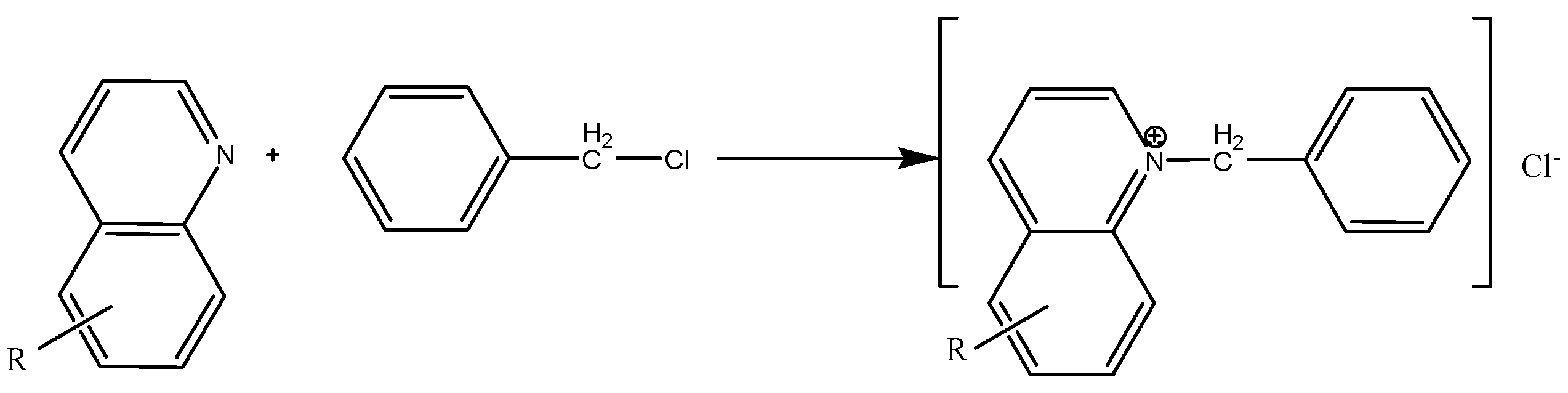
2.2 Alkylquinoline quaternary ammonium salt is synthesized by alkylation reaction with alkyl quinoline and benzyl chloride as raw materials. The main reaction is as follows:
Figure 2.
Reaction formula for synthesis of alkyl quinoline benzyl quaternary ammonium salts.
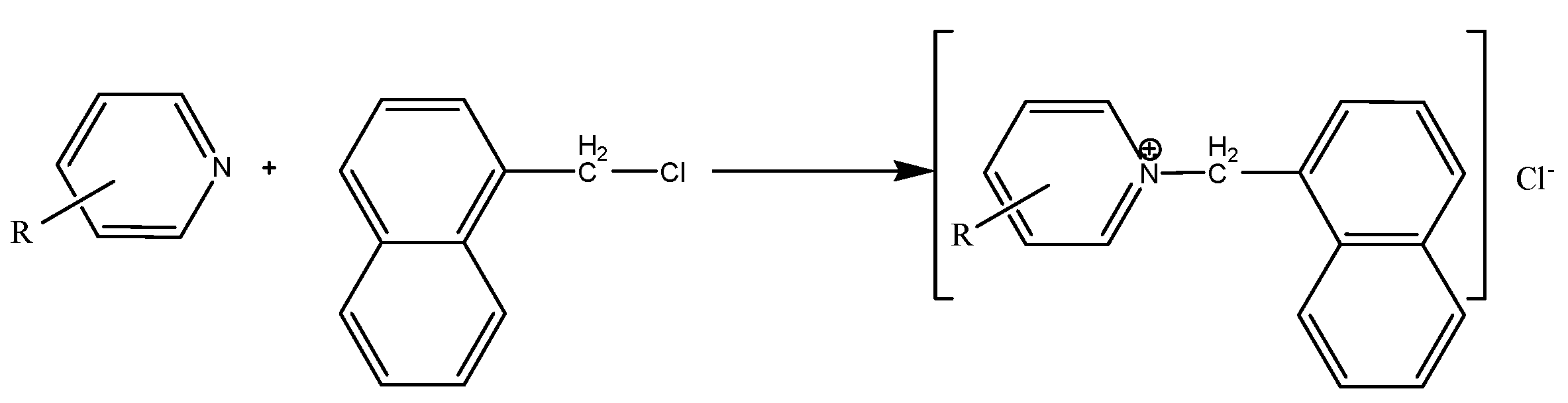
2.3 Alkylpyridine and chloromethyl naphthalene were used as raw materials to synthesize alkylpyridine quaternary ammonium salts. The main reactions are as follows:
Figure 3.
Reaction formula for synthesis of alkyl pyridine naphthylmethyl quaternary ammonium salts.
Figure 3.
Reaction formula for synthesis of alkyl pyridine naphthylmethyl quaternary ammonium salts.
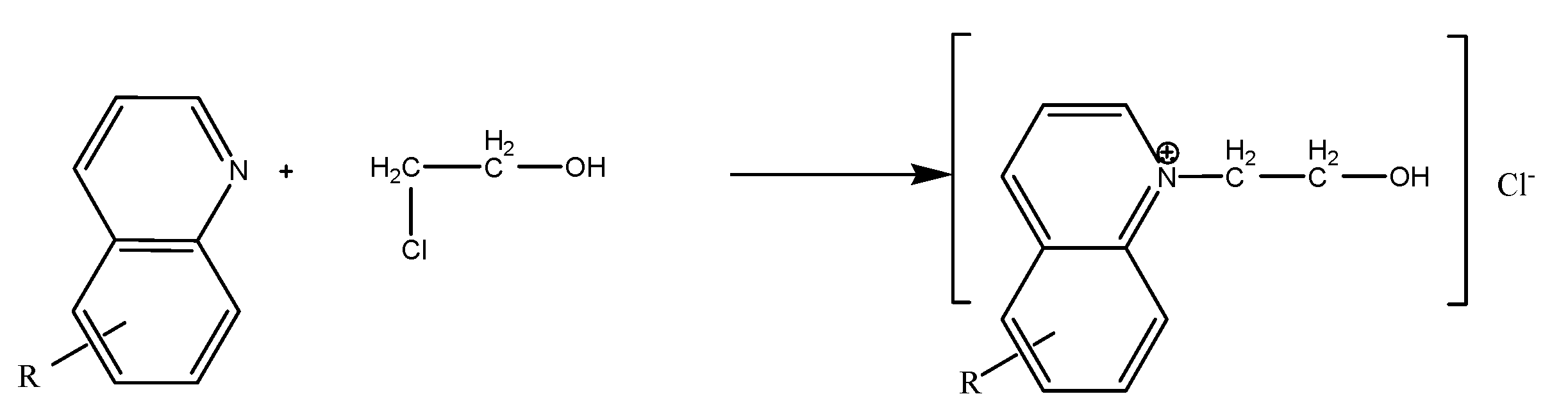
2.4 Alkyl quinoline quaternary ammonium salt is synthesized by alkylation reaction with alkyl quinoline and chlorohydrin as raw materials. The main reaction is as follows:
Figure 4.
Reaction formula for synthesis of alkyl quinoline hydroxyethyl quaternary ammonium salt.
3. Results and Discussion
3.1. Study on Corrosion Inhibition Mechanism of Alkyl Quinoline Quaternary Ammonium Salt
Figure 5 shows the polarization curves of N80 carbon steel at 90°C and 15%HCl after adding alkyl quinoline quaternary ammonium salt with varying concentrations [1,2,3,4,5,6,7,8,9]. The parameters obtained by fitting the polarization curves are shown in Table 1.
Figure 5.
Polarization curves of N80 carbon steel in 15% HCl with different concentrations of alkylquinoline quaternary ammonium salts at 90°C.
Figure 5.
Polarization curves of N80 carbon steel in 15% HCl with different concentrations of alkylquinoline quaternary ammonium salts at 90°C.
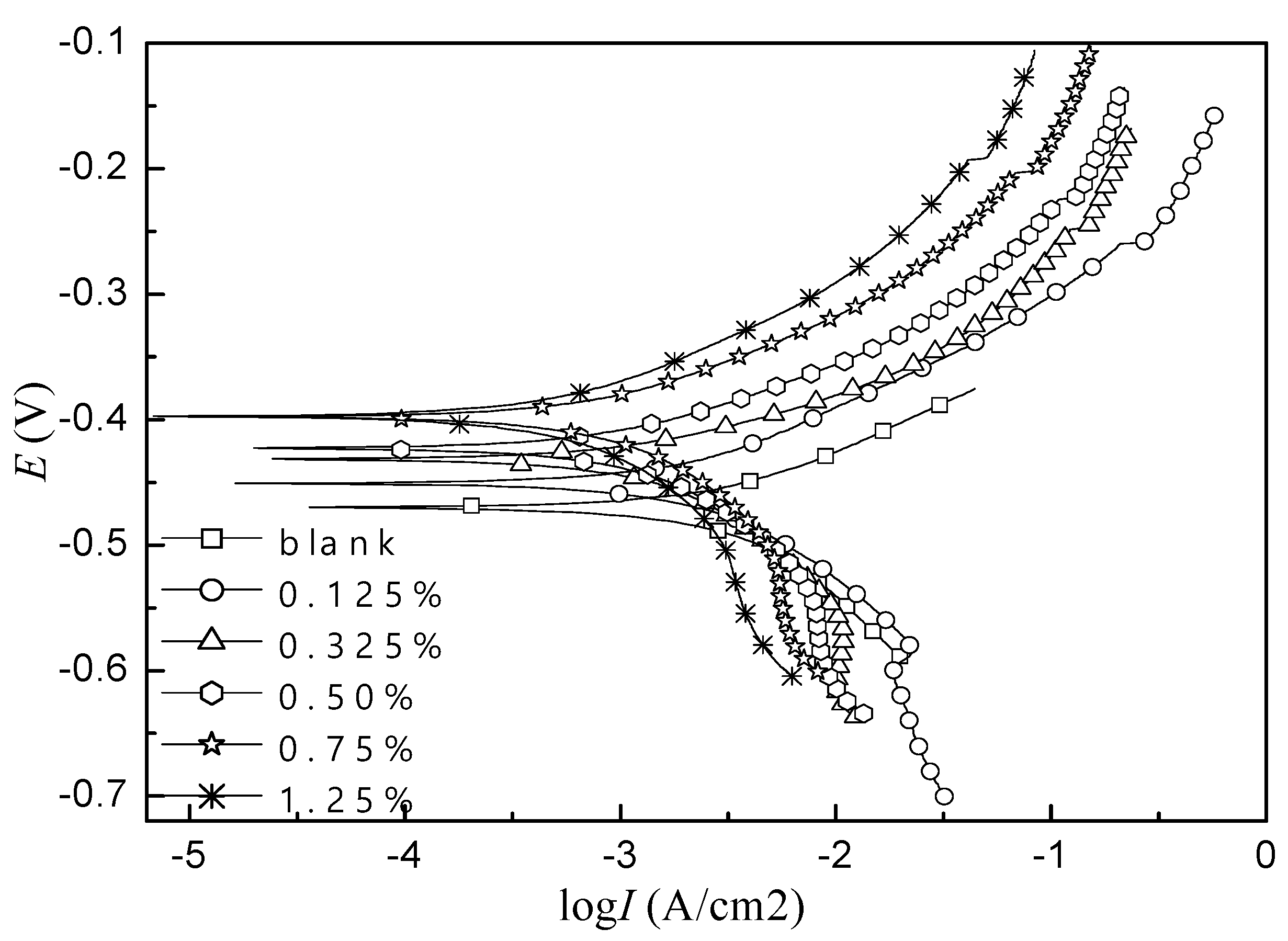
The potentiodynamic scanning results showed that although the inhibition result of alkyl quinoline quaternary ammonium salt was not as good as that of Mannich base quaternary ammonium salt under the same conditions, alkyl quinoline quaternary ammonium salt also had good inhibition effect in 90°C and 15%HCl, and the inhibition effect was more obvious with the increase of alkyl quinoline quaternary ammonium salt concentration. It was also found that the Self-corrosion potential of N80 steel increased with the addition of alkyl quinoline quaternary ammonium salt, which indicated that alkyl quinoline quaternary ammonium salt was a corrosion inhibitor mainly of anodic inhibition type.
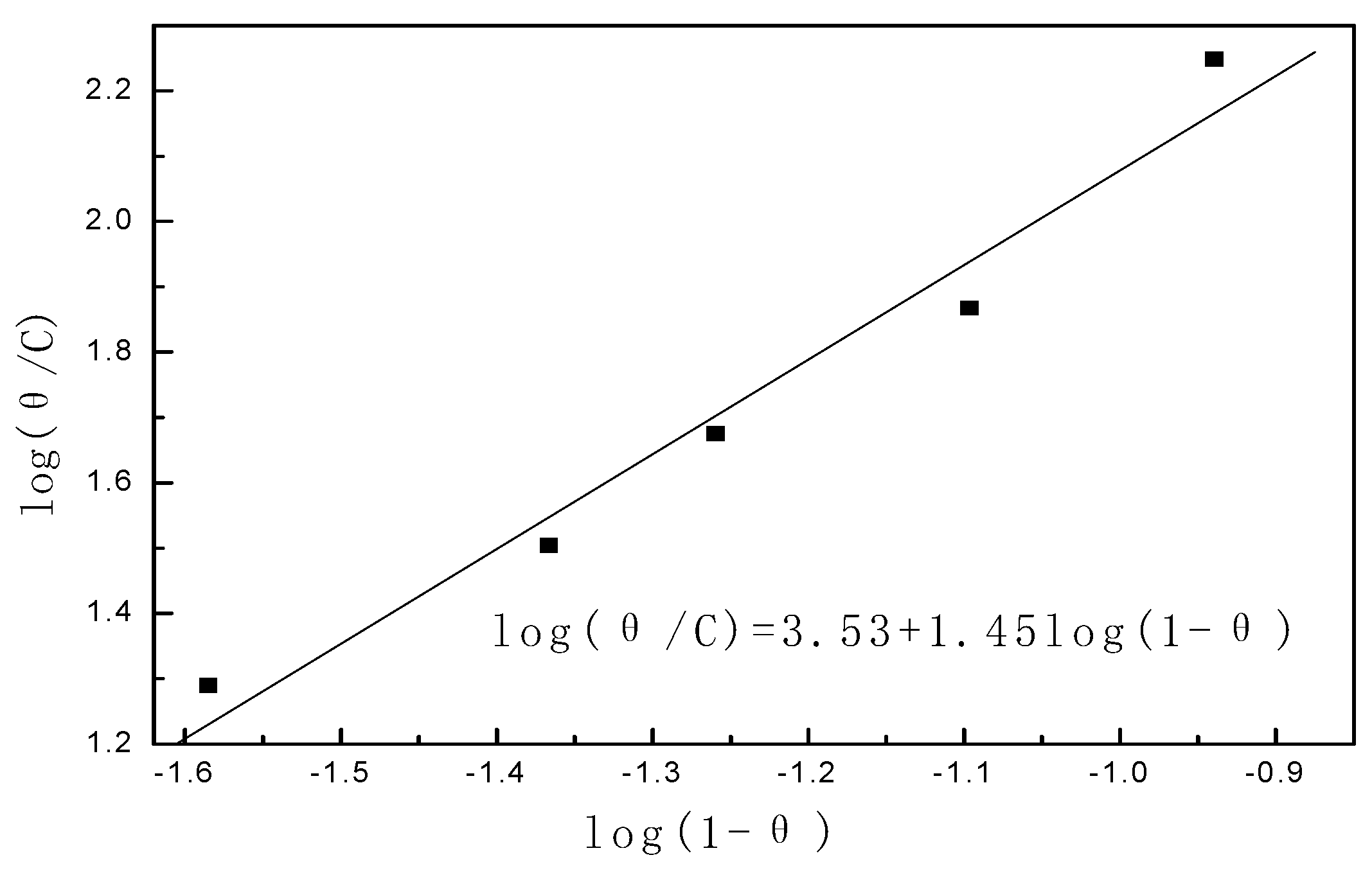
According to the Flory-Huggins isothermal equation, the adsorption isotherm fitting results are shown in Figure 6 [10,11,12,13,14,15,16], and the x value obtained is 1.45. The results show that the adsorption of quinoline quaternary ammonium salt on carbon steel surface is a single molecule adsorption film, and theoretically 1 quinoline quaternary ammonium salt molecule replaces 1.45 water molecules.
Figure 6.
Flory-Huggins adsorption isotherm of alkylquinoline quaternary ammonium salts on N80 carbon steel surface in hydrochloric acid solution.
Figure 6.
Flory-Huggins adsorption isotherm of alkylquinoline quaternary ammonium salts on N80 carbon steel surface in hydrochloric acid solution.
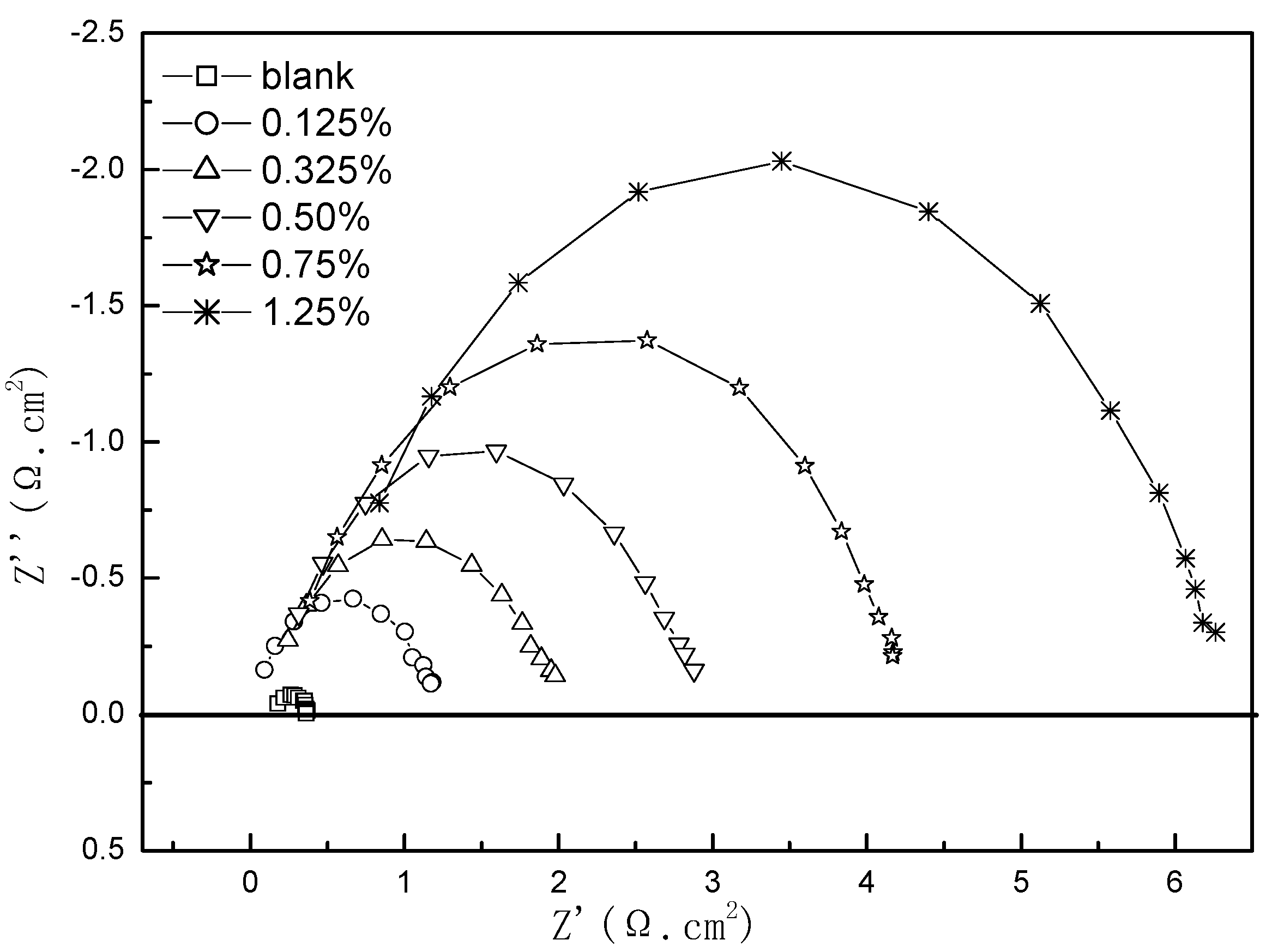
The following figure shows the AC impedance of N80 carbon steel after adding different concentrations of alkyl quinoline quaternary ammonium salt to 15%HCl at 90°C[17,18,19,20,21,22,23,24].
Figure 7.
AC impedance spectra of N80 carbon steel at 90°C in 15% HCl containing different concentrations of alkyl quinoline quaternary ammonium salts.
Figure 7.
AC impedance spectra of N80 carbon steel at 90°C in 15% HCl containing different concentrations of alkyl quinoline quaternary ammonium salts.
The AC impedance spectrum of this system is fitted using the equivalent circuit shown in the figure below [25,26,27].
Figure 8.
AC impedance spectrum equivalent circuit diagram.
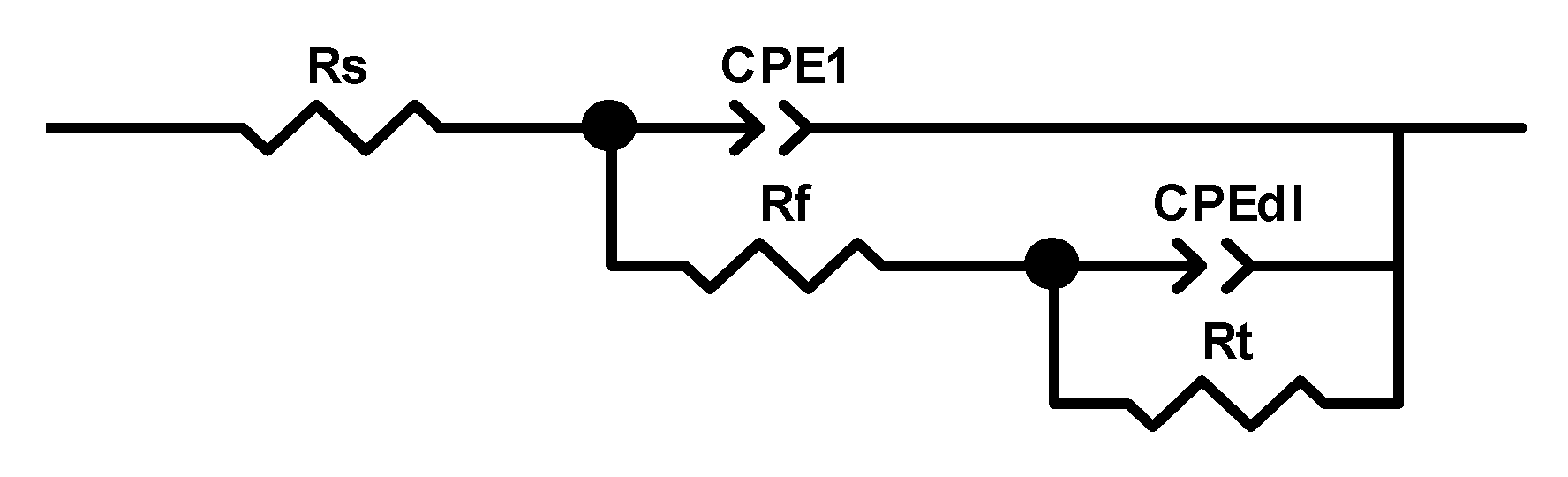
Rs, Rf, and Rt in the equivalent circuit of Figure 8 are solution resistance, film resistance, and charge transfer resistance, respectively. CPE1 and CPEdl are constant phase angle elements related to interface capacitance and electric double layer capacitance, respectively. See Table 2 for fitting results of each component.
AC impedance results show that film resistance and charge transfer resistance increase obviously after adding alkyl quinoline quaternary ammonium salt, especially charge transfer resistance Rt, which can reflect the level of corrosion difficulty. The larger the transfer resistance, the more difficult the corrosion is to proceed and the lower the corrosion rate [28,29,30,31,32,33,34]. AC impedance fitting results show that the charge transfer resistance of electrode increases significantly after adding alkyl quinoline quaternary ammonium salt, and the charge transfer resistance increases gradually with the increase of alkyl quinoline quaternary ammonium salt concentration, which further indicates that alkyl quinoline quaternary ammonium salt has obvious inhibition effect on corrosion of N80 carbon steel in hydrochloric acid solution, and the inhibition effect becomes more obvious with the increase of alkyl quinoline quaternary ammonium salt concentration.
Figure 9 (a) and (b) are polarization curves of N80 steel in 15%HCl solution and 15%HCl solution containing 0.05mol/L alkylquinoline quaternary ammonium salt at different temperatures respectively. See Table 3 for fitting results.
From the polarization curve test results, with the increase of temperature, the self-corrosion current continuously increases, thus it is inferred that the corrosion reaction may coincidence the Arrhenius equation [35,36,37,38,39,40,41,42], and its expression can be expressed as follows:
wherein, Icorr--corrosion current density value, A/cm2;
A --Arrhenius predigital factor, A/cm2;
Ea-activation energy of reaction process, J/mol.
The logarithm of the above formula was used to perform linear fitting with ln (Icorr) and 1/T values in the fitting results of polarization curves, and the slope and intercept of the fitted line were used to calculate the preexponential factor and reaction activation energy values [43,44,45,46,47].
Figure 10.
lnIcorr-1/T curves for N80 carbon steel in different solutions.
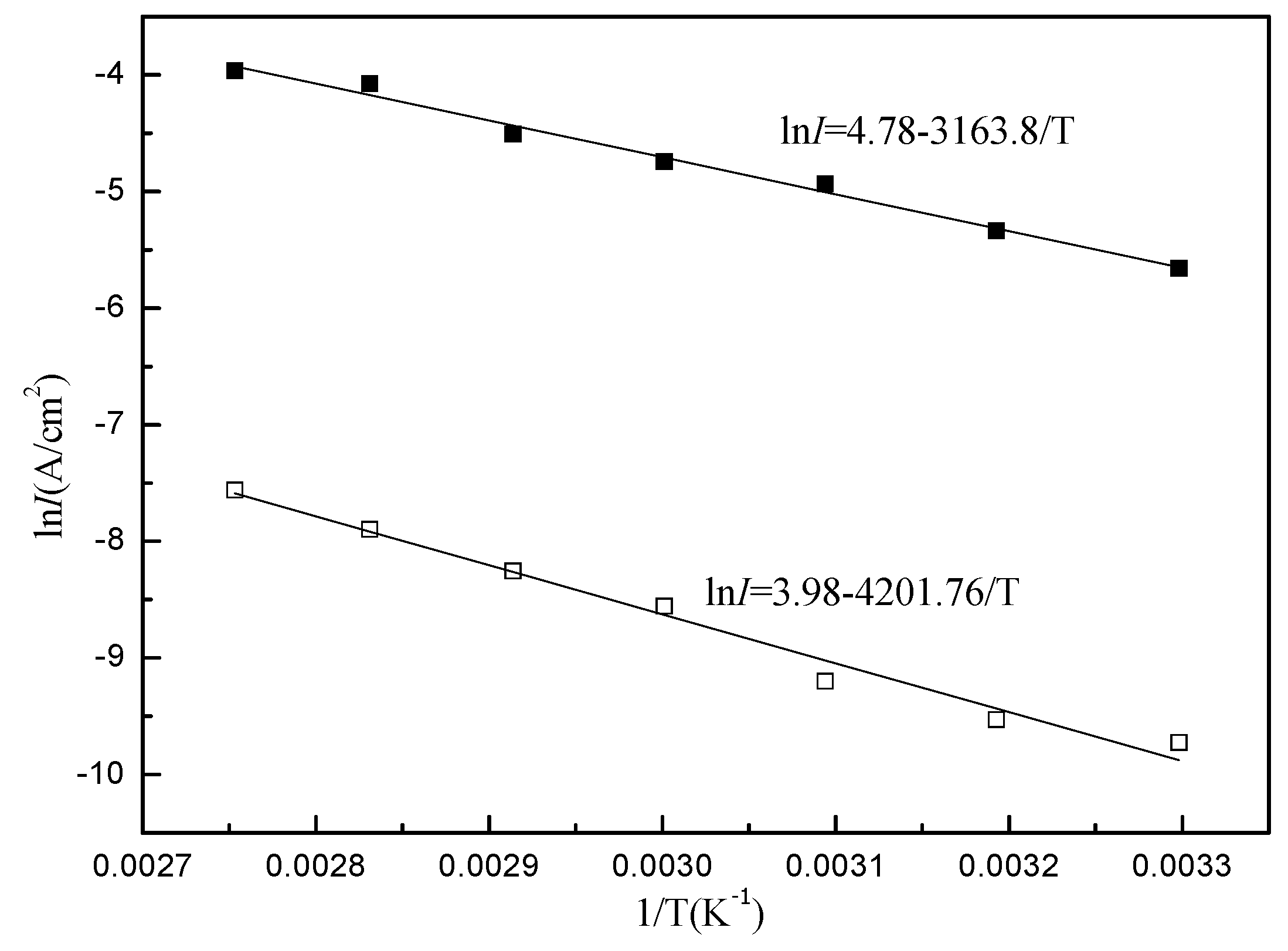
The preexponential factor and reaction activation energy in blank solution and solution added with corrosion inhibitor calculated by slope and intercept of fitting straight line are shown in Table 4 respectively.
3.2. Primary Screen of Quaternary Ammonium Salts Containing N Heterocyclic Rings
The quaternary ammonium salts obtained from the reaction of alkyl pyridine and chloromethyl naphthalene were eliminated due to their poor acid solubility. The quaternary ammonium salts obtained by reaction of alkyl pyridine with benzyl chloride, alkyl quinoline with benzyl chloride and alkyl quinoline with chloroethanol were preliminarily screened.
3.2.1. Evaluation of Corrosion Inhibition Performance of Quaternary Ammonium Salts Obtained by Reaction of Alkyl Pyridine and Benzyl Chloride at Low Temperature

Table 5.
Corrosion Inhibition Performance of Alkyl Pyridine Benzyl Quaternary Ammonium Salt.
|
Acid temperature (°C) |
Acid concentration (100%) |
Inhibitor concentration (%) |
Corrosion rate (g/m2 • h) |
| 60 | 15%HCl | 0.5 | 4.5 |
| 60 | 12%HCl+3%HF | 0.5 | 3.8 |
| 60 | multi-hydrogen acid | 0.5 | 2.9 |
| 90 | 15%HCl | 1 | 3.5 |
| 90 | 12%HCl+3%HF | 1 | 3.1 |
| 90 | multi-hydrogen acid | 1 | 2.7 |
3.2.2. Evaluation of Corrosion Inhibition Performance of Quaternary Ammonium Salts Obtained by Reaction of Alkyl Quinoline and Benzyl Chloride at Low Temperature
Table 6.
Corrosion Inhibition Performance of Alkyl Quinoline Benzyl Quaternary Ammonium Salt.
|
Acid temperature (°C) |
Acid concentration (100%) |
Inhibitor concentration (%) |
Corrosion rate (g/m2•h) |
| 60 | 15%HCl | 0.5 | 2.8 |
| 60 | 12%HCl+3%HF | 0.5 | 2.1 |
| 60 | multi-hydrogen acid | 0.5 | 1.5 |
| 90 | 15%HCl | 1 | 2.3 |
| 90 | 12%HCl+3%HF | 1 | 1.9 |
| 90 | multi-hydrogen acid | 1 | 1.2 |
3.2.3. Evaluation of Corrosion Inhibition Performance of Quaternary Ammonium Salts Obtained by Reaction of Alkyl Quinoline and Chloroethanol at Low Temperature
Table 7.
Corrosion Inhibition Performance of Alkyl Quinoline Hydroxyethyl Quaternary Ammonium Salt.
|
Acid temperature (°C) |
Acid concentration (100%) |
Inhibitor concentration (%) |
Corrosion rate (g/m2•h) |
| 60 | 15%HCl | 0.5 | 5.2 |
| 60 | 12%HCl+3%HF | 0.5 | 4.3 |
| 60 | multi-hydrogen acid | 0.5 | 4.1 |
| 90 | 15%HCl | 1 | 4.1 |
| 90 | 12%HCl+3%HF | 1 | 3.9 |
| 90 | multi-hydrogen acid | 1 | 3.3 |
From the above experiments, it can be found that quaternary ammonium salt obtained by reaction of alkyl quinoline and benzyl chloride has the best corrosion inhibition performance.
3.2.4. Evaluation of the Performance of Alkyl Quinoline Quaternary Ammonium Salts of Compound Propargyl Alcohol at High Temperature
Dimethylformamide, isopropanol and synergist propargyl alcohol were added to the synthesized alkyl quinoline quaternary ammonium salt to obtain high temperature acidification corrosion inhibitor. Corrosion inhibitors of different concentrations are added to different acid solutions at different temperatures, and the corrosion inhibition effect after compounding is evaluated in high pressure equipment. See Table 8 for more details.
The test results show that the corrosion inhibitor has a very good inhibition performance on multi-hydrogen acid, 15% HCl and mud acid when the temperature is up to 160°C.
3.2.5. Performance of Alkyl Quinoline Quaternary Ammonium Salt after Compounding Propargyl Alcohol and Cuprous Iodide at 180°C
Dimethylformamide, isopropanol and synergist propargyl alcohol are added to the synthesized quinoline quaternary ammonium salt to obtain inhibitor agent A, cuprous iodide is agent B, two formulations A、B are used to form ultra-high temperature acidification corrosion inhibitor, ultra-high temperature acidification corrosion inhibitor of different concentrations is added to different acid solutions at different temperatures, and the corrosion inhibition performance after compounding is evaluated in oil pressure equipment. See Table 9 for more details.
The experimental results show that alkyl quinoline quaternary ammonium salt mixed with propargyl alcohol and cuprous iodide has very good corrosion inhibition performance on polyhydrogen acid, 15% HCl and mud acid at 140-180°C.
At the same time, it was found that the quaternary ammonium salt of alkyl quinoline mixed with propargyl alcohol and cuprous iodide would precipitate after being placed in acid solution for a period of time. It is proposed to improve its dispersion performance by adding dispersant.
3.3. Improvement of Acid Solubility of Alkyl Quinoline Quaternary Ammonium Salts
Change dosage of dispersant and emulsifier in corrosion inhibitor, and select different emulsifier and dispersant to study the acid solubility change of quinoline quaternary ammonium salt, see Table 10 for more details.
The problem of poor acid solubility of corrosion inhibitor can be solved by adding dispersant and emulsifier reasonably.
3.3. Improved Temperature Resistance of Alkyl Quinoline Quaternary Ammonium Salt Corrosion Inhibitor
3.3.1. Corrosion Inhibition Performance at 160-190°C
The corrosion inhibition performance of alkyl quinoline quaternary ammonium salt with improved acid solubility after compounding propargyl alcohol and cuprous iodide is evaluated as shown in Table 11.
3.3.2. See Table 12 for Corrosion Inhibition Performance at 200°C
3.3.3. Corrosion Inhibition Performance at High Temperature in the Presence of Partial Hydrogen Sulfide
Part of sodium sulfide solid is added into the autoclave, so that sodium sulfide reacts with acid solution to produce hydrogen sulfide gas, and the corrosion inhibition performance of corrosion inhibitor in the presence of hydrogen sulfide is evaluated as shown in Table 13.
The test results show that the corrosion inhibitor has good corrosion resistance to hydrogen sulfide, and the corrosion inhibition performance will not be affected when hydrogen sulfide exists in the system.
3.3.4. Inhibitory Performance of Ultra-High Temperature Acidizing Corrosion Inhibitor Under Dynamic Condition
Figure 11.
Corrosion inhibitor evaluation device under high temperature dynamic conditions.
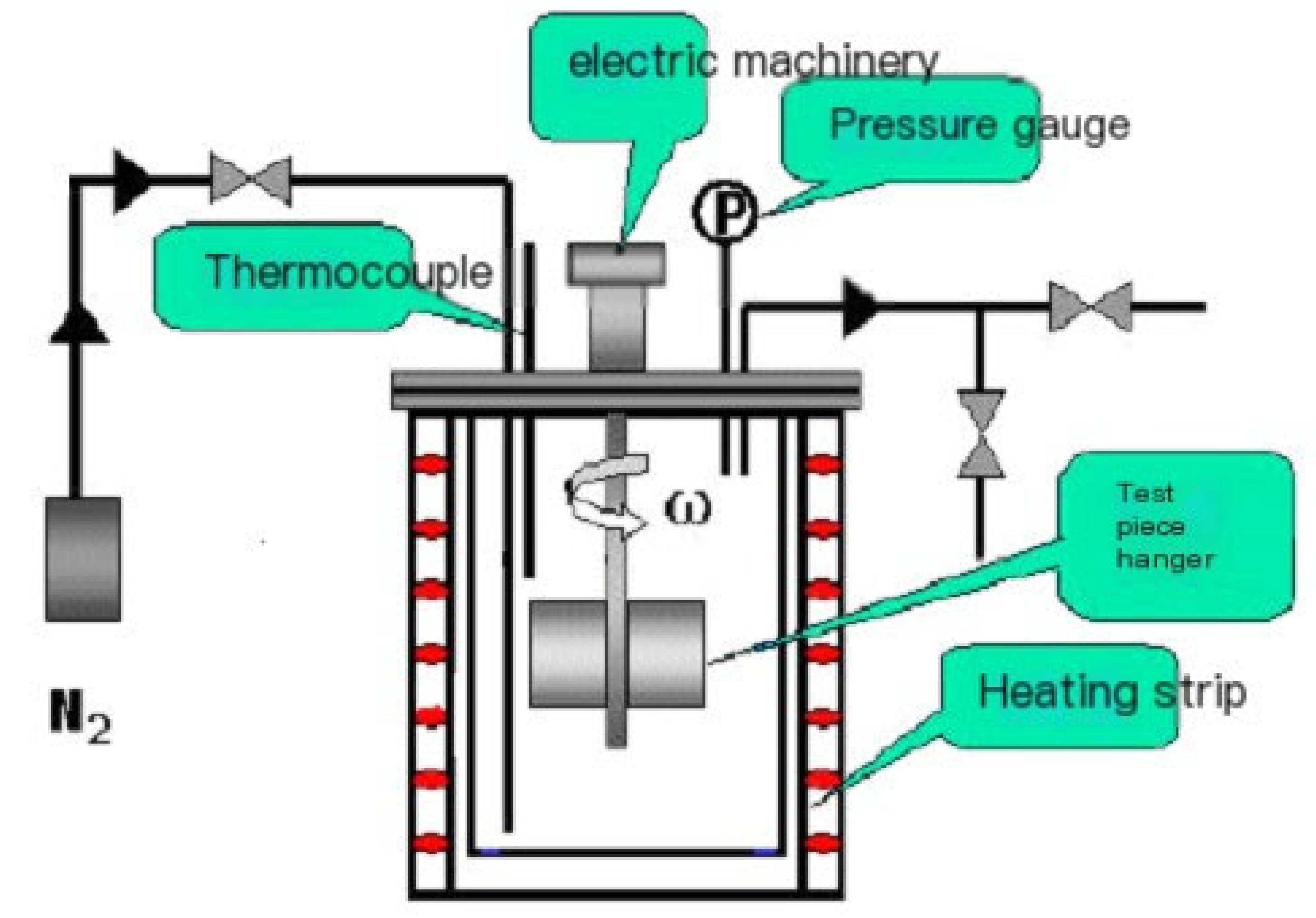
Table 14.
Corrosion Inhibition Performance of Quinoline Quaternary Ammonium Salt under High Temperature Dynamic Conditions.
Table 14.
Corrosion Inhibition Performance of Quinoline Quaternary Ammonium Salt under High Temperature Dynamic Conditions.
| Acid type | Inhibitor concentration | Dispersant concentration | Temperature (°c) |
Pressure (atmospheric pressure) |
Corrosion rateG/ (m2.h) | Remark |
| multi-hydrogen acid | 5.5% | 7% | 195 | 160 | 82. 4 | Slight blackening |
| 5.5% | 7% | 200 | 160 | 87. 8 | Slight blackening |
|
| 15%HCl | 5.5% | 7% | 195 | 160 | 98. 1 | Slight blackening |
| 5.5% | 7% | 200 | 160 | 99. 3 | Slight blackening |
|
| 12%HCl+ 3%HF |
5.5% | 7% | 195 | 160 | 89. 2 | Slight blackening |
| 5.5% | 7% | 200 | 160 | 93. 4 | Slight blackening |
Figure 12.
200°C, mud acid +5.5% corrosion inhibitor, N80 steel hanging for 4 hours.
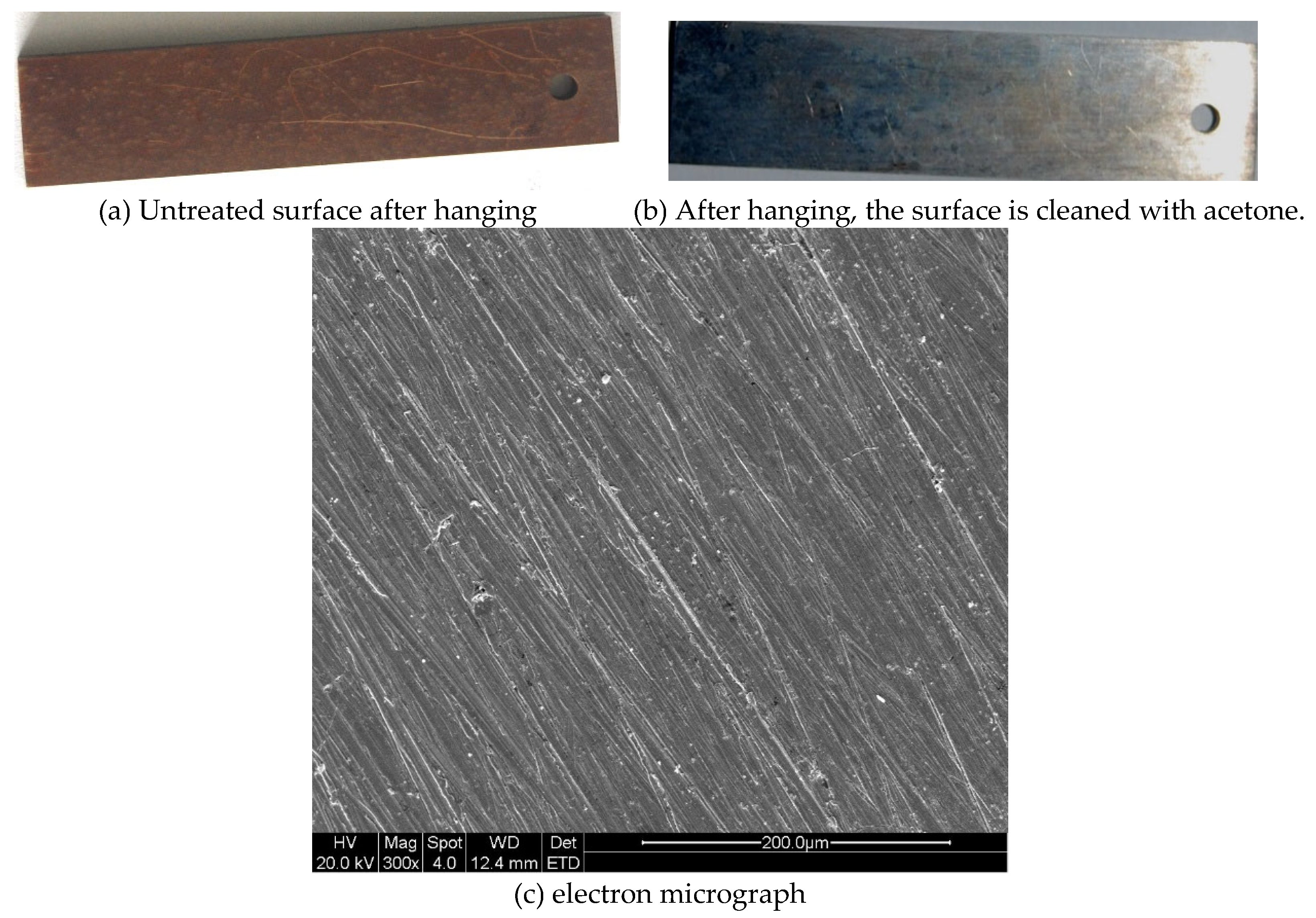
The test results show that the corrosion inhibitor still has good corrosion inhibition performance under dynamic condition.
4. Conclusions
(1) The potentiodynamic scanning results show that although under the same conditions, alkyl quinoline quaternary ammonium salt is a kind of corrosion inhibitor mainly of anodic inhibition type;
(2) AC impedance results show that alkyl quinoline quaternary ammonium salt has obvious inhibition effect on corrosion of N80 carbon steel in hydrochloric acid solution, and the inhibition effect becomes more obvious with the increase of alkyl quinoline quaternary ammonium salt concentration.
(3) The fitting results of polarization curves show that the preexponential factor of corrosion reaction decreases and the activation energy of corrosion reaction increases after adding alkyl quinoline quaternary ammonium salt, and finally the corrosion rate is inhibited.
(4) The experimental results show that the compound quaternary ammonium salt of alkyl quinoline has very good corrosion inhibition performance in polyhydrogen acid, 15%HCl and mud acid at 180 - 200 °C, and has good corrosion resistance to hydrogen sulfide when hydrogen sulfide exists in the system.
References
- XIE R, WEI Y, LUO K, et al. Effect of environmental factors on the corrosion behavior of CoCrNi and CoCrFeMnNi alloys in 3.5 wt% NaCl solution [J]. Journal of Materials Research and Technology, 2025, 35: 2994-3007.
- IRANPOUR M, BABAEI A, BAGHERZADEH M. Microwave and heat-assisted extracted Melilotus officinalis as a potential eco-friendly corrosion inhibitor for carbon steel in 0.5 M HCl solution [J]. Cleaner Chemical Engineering, 2025, 11.
- THIRUMALAIKUMARASAMY D, SHANMUGAM K, BALASUBRAMANIAN V. Comparison of the corrosion behaviour of AZ31B magnesium alloy under immersion test and potentiodynamic polarization test in NaCl solution [J]. Journal of Magnesium and Alloys, 2014, 2 (1) : 36-49.
- DE GROOT M T, VERMEULEN P. Advanced characterization of alkaline water electrolysis through electrochemical impedance spectroscopy and polarization curves [J]. Journal of Electroanalytical Chemistry, 2024, 974.
- WANG C-J, KUSDIYARTO P, LI Y-H. Potentiodynamic polarization analysis with various corrosion inhibitors on A508/IN-182/IN-52M/308L/316L welds [J]. Kuwait Journal of Science, 2024, 51 (2).
- ABUBAKR H M C, GHAITH M E, EL-SHERIF A A, EL-DEAB M S. Influence of metal ions on cysteine as a corrosion inhibitor for low carbon steel in sulfuric acid: Polarization, EIS, XPS, and DFT analysis [J]. International Journal of Electrochemical Science, 2024, 19 (7).
- AYODELE O O, BABALOLA B J, BORODE A O, et al. Effect of titanium diboride addition on the corrosion behaviour of sintered titanium composites in acidic and sodium chloride environments [J]. Materials Today Communications, 2025, 43.
- SHU X, WANG H, ZHAO J. Microstructures and corrosion behaviors under sodium chloride aqueous conditions of Co-free non-equiatomic Al0.32CrFeTi0.73 (Ni1.50-xMox) (x=0, 0.23) high entropy alloys [J]. Journal of Materials Research and Technology, 2024, 33: 834-44.
- CHIDIEBERE M A, ANADEBE V C, BARIK R C. Assessment of the inhibition performance of ZIF-8 on corrosion Mitigation of API 5L X65 steel in 3.5wt% NaCl: Experimental and theoretical insight [J]. Journal of Materials Research and Technology, 2024, 33: 2879-98.
- ALAMRI A H, RASHEEDA K, KAMAL S J, et al. Pyrimidine derivatives as efficient anticorrosive agents for acid corrosion of mild steel: Electrochemical and computational validation [J]. Arabian Journal of Chemistry, 2024, 17 (6).
- CHAUDHARY M Y, GUPTA M, BANSAL P, et al. Allyl triphenyl phosphonium bromide, an ionic liquid as an eco-friendly and green inhibitor for corrosion of aluminium in hydrochloric acid: Mechanistic insights and experimental validation [J]. Sustainable Chemistry for the Environment, 2025, 9.
- KOKALJ, A. On the use of the Langmuir and other adsorption isotherms in corrosion inhibition [J]. Corrosion Science, 2023, 217.
- ONUKWULI O D, NNANWUBE I A, OCHILI F O, OBIBUENYI J I. Assessing the efficiency of danacid as corrosion inhibitor for aluminium in HCl medium: Experimental, theoretical and optimization studies [J]. Heliyon, 2024, 10 (24).
- DOHARE P, QURAISHI M A, VERMA C, et al. Ultrasound induced green synthesis of pyrazolo-pyridines as novel corrosion inhibitors useful for industrial pickling process: Experimental and theoretical approach [J]. Results in Physics, 2019, 13.
- MU'AZU N D, HALADU S A, ALGHAMDI J M, et al. Inhibition of low carbon steel corrosion by a cationic gemini surfactant in 10wt.% H2SO4 and 15wt.% HCl under static condition and hydrodynamic flow [J]. South African Journal of Chemical Engineering, 2023, 43: 232-44.
- MUSTAFA A M, SAYYID F F, BETTI N, et al. Inhibition of mild steel corrosion in hydrochloric acid environment by 1-amino-2-mercapto-5- (4- (pyrrol-1-yl) phenyl) -1, 3, 4-triazole [J]. South African Journal of Chemical Engineering, 2022, 39: 42-51.
- P P K, G A, MISHMA J N C, et al. New benzisoxazole derivative: A potential corrosion inhibitor for mild steel in 0.5 M hydrochloric acid medium -insights from electrochemical and density functional theory studies [J]. Heliyon, 2023, 9 (10).
- BELKHEIRI A, DAHMANI K, MZIOUD K, et al. Assessment of 14- (4-nitrophenyl) -14H-dibenzo[a, j]xanthene as an effective organic corrosion inhibitor for mild steel in 1 M HCl: Electrochemical, theoretical, and surface analysis [J]. International Journal of Electrochemical Science, 2025, 20 (1).
- ABDULLAH K A, ALLOUSH F A, SALAME C. Investigation of the Monocrystalline Silicon Solar Cell Physical Behavior after Thermal Stress by AC Impedance Spectra [J]. Energy Procedia, 2014, 50: 30-40.
- CHEN X, WANG Z, YU S, LI G. Corrosion inhibition of carbon steel in NaCl solution Using a mixture of alkanol amine and calcium nitrite: Electrochemical and microscopic evaluation [J]. International Journal of Electrochemical Science, 2024, 19 (11).
- LAN W, CHEN Z, ZHANG X, et al. Corrosion resistance analysis of Al2O3-TiO2 composite ceramic coatings on carbon steel pipe surfaces [J]. Alexandria Engineering Journal, 2025, 110: 377-85.
- BELGHITI M E, BOUAZAMA S, ECHIHI S, et al. Understanding the adsorption of newly Benzylidene-aniline derivatives as a corrosion inhibitor for carbon steel in hydrochloric acid solution: Experimental, DFT and molecular dynamic simulation studies [J]. Arabian Journal of Chemistry, 2020, 13 (1) : 1499-519.
- KANNAN P, VARGHESE A, PALANISAMY K, ABOUSALEM A S. Probing the effect of newly synthesized phenyltrimethylammonium tetrachloroaluminate ionic liquid as an inhibitor for carbon steel corrosion [J]. Applied Surface Science Advances, 2021, 6.
- NAHLé A, SALIM R, EL HAJJAJI F, et al. Experimental and theoretical approach for novel imidazolium ionic liquids as Smart Corrosion inhibitors for mild steel in 1.0 M hydrochloric acid [J]. Arabian Journal of Chemistry, 2022, 15 (8).
- SHTEFAN V, KANUNNIKOVA N, ZUYOK V. Comparative evaluation of microstructure and electrochemical, high-temperature corrosion rates of titanium- and aluminum-modified black chromium coatings on AISI 304 stainless steel [J]. Surface and Coatings Technology, 2025, 497.
- JIANG H, WANG B, LIU J, et al. Corrosion inhibition of Q235 and X65 steels in CO2-saturated solution by 2-phenyl imidazoline [J]. Arabian Journal of Chemistry, 2023, 16 (6).
- WANG Y, YANG Z, HU H, et al. Indolizine quaternary ammonium salt inhibitors: The inhibition and anti-corrosion mechanism of new dimer derivatives from ethyl acetate quinolinium bromide and n-butyl quinolinium bromide [J]. Colloids and Surfaces A: Physicochemical and Engineering Aspects, 2022, 651.
- BELKHEIRI A, DAHMANI K, KHATTABI M, et al. Evaluation of 14- (p-tolyl) -14H-dibenzo[a, j]xanthene as a highly efficient organic corrosion inhibitor for mild steel in 1 M HCl: Electrochemical, theoretical, and surface characterization [J]. International Journal of Electrochemical Science, 2024, 19 (12).
- WU G, LI L, CHEN X, et al. The growth mechanism and corrosion resistance of laser-assisted plasma electrolytic oxidation (PEO) composite coating on AZ31B magnesium alloy [J]. Journal of Magnesium and Alloys, 2024.
- WAHBA R H, EL-SONBATI A Z, DIAB M A, et al. Electrochemical Corrosion Performance of N80 steel in Acidized 10% HCl medium using 4-methyl-1-Phenyl-3- (p-tolyldiazenyl) −2, 3-dihydro-1H-pyrrol-2-ol [J]. Heliyon, 2025, 11 (3).
- GONI L K M O, ALI S A, AL-MUALLEM H A, JAFAR MAZUMDER M A. Synthesis of a new quaternary ammonium salt for efficient inhibition of mild steel corrosion in 15 % HCl: Experimental and theoretical studies [J]. Heliyon, 2024, 10 (19).
- VASTAG G, FELHŐSI I, VRANEŠ M, SHABAN A. Impact of N-decyl-nicotineamide bromide on copper corrosion inhibition in acidic sulfate containing environment: Electrochemical and piezoelectrochemical insights [J]. Heliyon, 2024, 10 (22).
- MERINO E, CHANDRASEKAR A R, PAKSERESHT A, et al. Improved corrosion resistance of AZ31B Mg alloy by eco-friendly flash-PEO coatings [J]. Applied Surface Science Advances, 2024, 20.
- MUTLU I H, EMRE M C, KAYA A O. A comparison of the corrosion resistance of galvanized low steel with solgel method coated ZrO2, ZrO2+Polymer coating [J]. Kuwait Journal of Science, 2023, 50 (4) : 524-38.
- ARIBOU Z, OUAKKI M, EL HAJRI F, et al. Comprehensive assessment of the corrosion inhibition properties of quinazoline derivatives on mild steel in 1.0 M HCl solution: An electrochemical, surface analysis, and computational study [J]. International Journal of Electrochemical Science, 2024, 19 (11).
- CHEN S, FAN J, LEI T, et al. Effect of oxalic acid on the corrosion of 6063 aluminum alloy in ethylene glycol-water solution in presence of ammonium alcohol polyvinyl phosphate [J]. International Journal of Electrochemical Science, 2024, 19 (4).
- LIAO J, CHENG Z, ZHANG W, et al. Temperature sensitivity and transition kinetics of uniform corrosion of zirconium alloys in superheated steam [J]. Heliyon, 2024, 10 (12).
- SHAHI N, SHAH S K, SINGH S, et al. Comparison of dodecyl trimethyl ammonium bromide (DTAB) and cetylpyridinium chloride (CPC) as corrosion inhibitors for mild steel in sulphuric acid solution [J]. International Journal of Electrochemical Science, 2024, 19 (5).
- FAWZY A, ALDUAIJ O K, AL-BAHIR A, et al. A comparative study of pyridine and pyrimidine derivatives based formamidine for copper corrosion inhibition in nitric acid: Experimental and computational exploration [J]. International Journal of Electrochemical Science, 2024, 19 (1).
- ALTALHI A, A. Novel N-heterocyclic Schiff base based on Isatin derivative as a sustainable, eco-friendly, and highly efficiency corrosion inhibitor for carbon steel in sulfuric acid medium: Electrochemical and Computational investigation [J]. International Journal of Electrochemical Science, 2024, 19 (1).
- EL-HAITOUT B, SARDJONO R E, ES-SOUNNI B, et al. Electrochemical and quantum chemical investigation on the adsorption behavior of a schiff base and its metal complex for corrosion protection of mild steel in 15 wt% HCl solution [J]. Heliyon, 2024, 10 (23).
- SHAO H, YIN X, ZHANG K, et al. N-[2- (3-indolyl) ethyl]-cinnamamide synthesized from cinnamomum cassia presl and alkaloid tryptamine as green corrosion inhibitor for Q235 steel in acidic medium [J]. Journal of Materials Research and Technology, 2022, 20: 916-33.
- EMRAYED H F, AMRAGA E A, IBRAHIM D M, FOUDA A E-A S. Corrosion inhibition effect of Schiff base and its metal complexes with [Mn (II) and Cu (II) ] on carbon steel in hydrochloric acid solution: Experimental and surface studies [J]. International Journal of Electrochemical Science, 2025, 20 (1).
- EL-MORSY F E, ALAHMAR N M, ALHEBSHE N S, MADKHALI M M M. One-pot synthesis of Schiff base as an excellent corrosion inhibition for Inconel 800 alloy in sulfuric acid medium: Experimental, DFT calculation and spectroscopic inspections [J]. International Journal of Electrochemical Science, 2025, 20 (3).
- AL-GORAIR A S, AL-HABAL T, EL-SAYED R, et al. Investigations of non-ionic surfactants derived from triazoles and pyrroles as potent corrosion inhibitors for carbon steel in hydrochloric acid [J]. International Journal of Electrochemical Science, 2023, 18 (9).
- MATINE A, LIZOUL B, EL ALAOUI EL ABDALLAOUI H, et al. Investigation of 2-ethoxy-4- (oxiran-2-ylmethyl) phenol as a potentially effective anti-corrosion agent for C38 steel [J]. International Journal of Electrochemical Science, 2024, 19 (12).
- MOHSEN O A, FARAJ M W, DARWESH T M, et al. Indole derivatives efficacy and kinetics for inhibiting carbon steel corrosion in sulfuric acid media [J]. Results in Engineering, 2024, 23.
- BELKHEIRI A, DAHMANI K, MZIOUD K, et al. Advanced evaluation of novel quinoline derivatives for corrosion inhibition of mild steel in acidic environments: A comprehensive electrochemical, computational, and surface study [J]. International Journal of Electrochemical Science, 2024, 19 (10).
- PAN J, HE X, CAO K. Electrochemical and theoretical studies of two amino acid ionic liquids as corrosion inhibitors for mild steel in 3.5 wt% NaCl solution [J]. International Journal of Electrochemical Science, 2025, 20 (2).
- UDUNWA D I, ONUKWULI O D, MENKITI M C, et al. 1-Butyl-3-methylimidazolium methane sulfonate ionic liquid corrosion inhibitor for mild steel alloy: Experimental, optimization and theoretical studies [J]. Heliyon, 2023, 9 (7).
- XHANARI K, FARRUKU M, BERISHA A, et al. 2-Amino-6-methylbenzothiazole as corrosion inhibitor for low carbon steel in acidic solution: Experimental and theoretical studies [J]. Results in Chemistry, 2025, 13.
- BELKHEIRI A, DAHMANI K, ARIBOU Z, et al. In-depth study of a newly synthesized imidazole derivative as an eco-friendly corrosion inhibitor for mild steel in 1 M HCl: Theoretical, electrochemical, and surface analysis perspectives [J]. International Journal of Electrochemical Science, 2024, 19 (10).
Figure 9.
Polarization curves of N80 carbon steel at different temperatures (a) 15%HCl (b) 15%HCl containing 0.05mol/L alkylquinoline quaternary ammonium salt.
Figure 9.
Polarization curves of N80 carbon steel at different temperatures (a) 15%HCl (b) 15%HCl containing 0.05mol/L alkylquinoline quaternary ammonium salt.
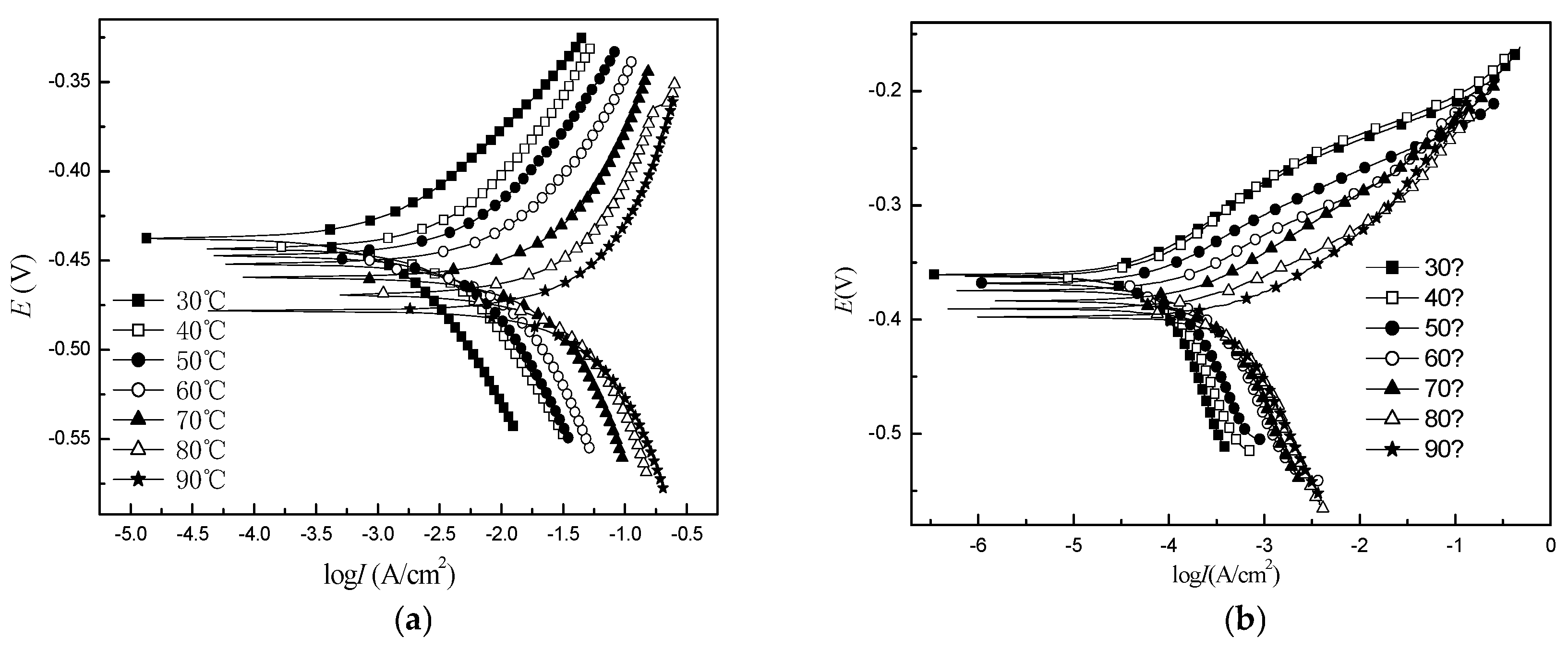
Table 1.
Polarization curve fitting results of N80 carbon steel at 90°C in 15% HCl containing different concentrations of alkyl quinoline quaternary ammonium salts.
Table 1.
Polarization curve fitting results of N80 carbon steel at 90°C in 15% HCl containing different concentrations of alkyl quinoline quaternary ammonium salts.
|
Concentration (mol/L) |
Corrosion potential (V) |
Anode Tafel Slope (mV) |
Cathode Tafel Slope (mV) |
corrosion current Density (A/cm2) |
inhibition efficiency (100%) |
| 0 | -0.47 | 79.0 | 84.0 | 2.0×10⁻² | -- |
| 0.0050 | -0.45 | 80.4 | 119.1 | 2.3×10⁻³ | 88.5 |
| 0.0125 | -0.43 | 60.3 | 125.4 | 1.6×10⁻³ | 92.0 |
| 0.0200 | -0.42 | 64.5 | 110.3 | 1.1×10⁻³ | 94.5 |
| 0.0300 | -0.40 | 65.9 | 106.4 | 8.6×10⁻⁴ | 95.7 |
| 0.0500 | -0.39 | 67.0 | 103.8 | 5.2×10⁻⁴ | 97.4 |
Table 2.
AC impedance spectrum fitting results of N80 carbon steel in hydrochloric acid solution containing different concentrations of alkyl quinoline quaternary ammonium salts.
Table 2.
AC impedance spectrum fitting results of N80 carbon steel in hydrochloric acid solution containing different concentrations of alkyl quinoline quaternary ammonium salts.
|
Concentration (mol/L) |
Rs (Ω.cm2) |
CPE1-T (F/cm2) |
CPE1-P |
Rf (Ω.cm2) |
CPE1-T (F/cm2) |
CPE1-P |
Rt (Ω.cm2) |
| 0 | 0.25 | 9.15e-4 | 0.98 | 0.16 | 7.25e-4 | 0.71 | 0.13 |
| 0.0050 | 0.18 | 1.52e-4 | 0.63 | 1.11 | 5.71e-5 | 0.83 | 1.12 |
| 0.0125 | 0.41 | 3.83e-4 | 0.62 | 1.54 | 1.45e-4 | 0.81 | 1.74 |
| 0.0200 | 0.29 | 2.9e-4 | 0.69 | 2.79 | 1.32e-4 | 0.83 | 2.58 |
| 0.0300 | 0.27 | 3.4e-4 | 0.73 | 4.25 | 2.2e-4 | 0.79 | 3.76 |
| 0.0500 | 0.30 | 4.12e-4 | 0.70 | 6.71 | 2.51e-4 | 0.79 | 5.65 |
Table 3.
Polarization curve fitting parameter results of N80 steel in different solutions at different temperatures.
Table 3.
Polarization curve fitting parameter results of N80 steel in different solutions at different temperatures.
|
Corrosion inhibitor concentration (mol/L) |
Temperature (K) |
Corrosion potential (mV) |
Anode Tafel Slope (mV) |
Cathode Tafel Slope (mV) |
Corrosion current Density (A/cm2) |
| 303.2 | -438.5 | 68.4 | 100.7 | 3.5×10⁻³ | |
| 313.2 | -443.4 | 75.0 | 89.2 | 4.8×10⁻³ | |
| 323.2 | -447.5 | 71.4 | 94.8 | 7.2×10⁻³ | |
| 0 | 333.2 | -452.2 | 73.3 | 91.6 | 8.7×10⁻³ |
| 343.2 | -459.1 | 75.8 | 88.0 | 1.1×10⁻² | |
| 353.2 | -469.1 | 80.0 | 83.0 | 1.7×10⁻² | |
| 363.2 | -477.9 | 80.3 | 82.6 | 1.9×10⁻² | |
| 303.2 | -360.7 | 62.5 | 116.9 | 5.98×10⁻⁵ | |
| 313.2 | -362.0 | 67.2 | 103.4 | 7.28×10⁻⁵ | |
| 323.2 | -368.1 | 62.1 | 118.3 | 1.01×10⁻⁴ | |
| 0.050 | 333.2 | -374.6 | 63.9 | 112.4 | 1.92×10⁻⁴ |
| 343.2 | -383.6 | 61.5 | 120.5 | 2.61×10⁻⁴ | |
| 353.2 | -390.5 | 51.8 | 189.9 | 3.72×10⁻⁴ | |
| 363.2 | 397.7 | 54.9 | 157.5 | 5.20×10⁻⁴ |
Table 4.
Pre-exponential factors of corrosion reaction of N80 steel in different solutions, i.e., reaction activation energy.
Table 4.
Pre-exponential factors of corrosion reaction of N80 steel in different solutions, i.e., reaction activation energy.
|
Concentration (mol/L) |
Pre-exponential factor A (A/cm2) |
Activation energy Ea (J/mol) |
| 0 | 4.78 | 2.6×10⁴ |
| 0.0056 | 3.98 | 3.5×10⁴ |
Table 8.
Corrosion Inhibition Performance of Alkyl Quinoline Quaternary Ammonium Salt Combined with Propargyl Alcohol.
Table 8.
Corrosion Inhibition Performance of Alkyl Quinoline Quaternary Ammonium Salt Combined with Propargyl Alcohol.
| Acid type | inhibitor concentration | temperature (°C) |
pressure (Atmospheric pressure) | corrosion rate g/ (m2 • h) |
Remark |
| multi-hydrogen acid | 2% | 120 | 160 | 7.5 | specimen brightness |
| 3% | 140 | 160 | 12.2 | specimen brightness | |
| 4% | 160 | 160 | 18.7 | specimen brightness | |
| 15%HCl | 2% | 120 | 160 | 12.8 | specimen brightness |
| 3% | 140 | 160 | 18.6 | specimen brightness | |
| 4% | 160 | 160 | 21.2 | specimen brightness | |
| 12%HCl+3%HF | 2% | 120 | 160 | 9.4 | specimen brightness |
| 3% | 140 | 160 | 14.3 | specimen brightness | |
| 4% | 160 | 160 | 17.2 | specimen brightness |
Table 9.
Corrosion Inhibition Performance of Alkyl Quinoline Quaternary Ammonium Salt Combined with Propargyl Alcohol and Cuprous Iodide.
Table 9.
Corrosion Inhibition Performance of Alkyl Quinoline Quaternary Ammonium Salt Combined with Propargyl Alcohol and Cuprous Iodide.
| Acid type | Inhibitor concentration | Temperature (°c) |
Pressure (atmospheric pressure) |
Corrosion rate G/ (m2 • h) |
Remark |
| multi-hydrogen acid | 3% | 140 | 160 | 10.6 | After alcohol and acetone wipe, the test piece is bright |
| 4% | 160 | 160 | 16.1 | ||
| 4.5% | 180 | 160 | 23.2 | ||
| 15%HCl | 3% | 140 | 160 | 15.4 | |
| 4% | 160 | 160 | 19.2 | ||
| 4.5% | 180 | 160 | 26.1 | ||
| 12%HCl+3%HF | 3% | 140 | 160 | 11.9 | |
| 4% | 160 | 160 | 17.8 | ||
| 4.5% | 180 | 160 | 24.7 |
Table 10.
Alkyl quinoline quaternary ammonium hydrochloride solubility.
| Acid liquor | Inhibitor concentration | Formula | Acid- solubility |
| multi-hydrogen acid | 5% | 30% quaternary ammonium salt +50% alcohol +20% OP-10 | precipitation |
| 30% quaternary ammonium salt +60% alcohol +10% peregal | precipitation | ||
| 30% quaternary ammonium salt +50% isopropyl alcohol +20% OP-10 | precipitation | ||
| 30% quaternary ammonium salt +60% isopropyl alcohol +10% peregal | homogeneous solution | ||
| 15%HCl | 5% | 30% quaternary ammonium salt +50% alcohol +20% OP-10 | precipitation |
| 30% quaternary ammonium salt +60% alcohol +10% peregal | precipitation | ||
| 30% quaternary ammonium salt +50% isopropyl alcohol +20% OP-10 | precipitation | ||
| 30% quaternary ammonium salt +60% isopropyl alcohol +10% peregal | homogeneous solution | ||
| mud acid | 5% | 30% quaternary ammonium salt +50% alcohol +20% OP-10 | precipitation |
| 30% quaternary ammonium salt +60% alcohol +10% peregal | precipitation | ||
| 30% quaternary ammonium salt +50% isopropyl alcohol +20% OP-10 | precipitation | ||
| 30% quaternary ammonium salt +60% isopropyl alcohol +10% peregal | homogeneous solution |
Table 11.
Corrosion Inhibition Performance of Alkyl Quinoline Quaternary Ammonium Mixed with Propargyl Alcohol and Cuprous Iodide after Improving Acid Solubility.
Table 11.
Corrosion Inhibition Performance of Alkyl Quinoline Quaternary Ammonium Mixed with Propargyl Alcohol and Cuprous Iodide after Improving Acid Solubility.
| Acid type | Inhibitor concentration | Dispersant concentration | Temperature (°c) |
Pressure (atmospheric pressure) |
Corrosion rate G/ (m2 • h) |
Remark |
| multi-hydrogen acid | 4% | 5% | 160 | 160 | 41.6 | specimen brightness |
| 4.5% | 5% | 180 | 160 | 62.8 | specimen brightness | |
| 5% | 5% | 190 | 160 | 76.2 | relatively bright | |
| 15%HCl | 4% | 5% | 160 | 160 | 59.1 | specimen brightness |
| 4.5% | 5% | 180 | 160 | 76.9 | relatively bright | |
| 5% | 5% | 190 | 160 | 83.7 | Slight blackening | |
| 12%HCl+ 3%HF |
4% | 5% | 160 | 160 | 48.6 | specimen brightness |
| 4.5% | 5% | 180 | 160 | 71.4 | relatively bright | |
| 5% | 5% | 190 | 160 | 79.4 | Slight blackening |
Table 12.
Corrosion Inhibition Performance of Alkyl Quinoline Quaternary Ammonium at Ultra-High Temperature.
Table 12.
Corrosion Inhibition Performance of Alkyl Quinoline Quaternary Ammonium at Ultra-High Temperature.
| Acid type | Inhibitor concentration | Dispersant concentration | Temperature (°c) |
Pressure (atmospheric pressure) | Corrosion rate G/ (m2• h) |
Remark |
| multi-hydrogen acid | 5.5% | 7% | 195 | 160 | 78.8 | Slight blackening |
| 5.5% | 7% | 200 | 160 | 82.1 | Slight blackening | |
| 15%HCl | 5.5% | 7% | 195 | 160 | 90.2 | Slight blackening |
| 5.5% | 7% | 200 | 160 | 94.5 | Slight blackening | |
| 12%HCl+ 3%HF |
5.5% | 7% | 195 | 160 | 84.2 | Slight blackening |
| 5.5% | 7% | 200 | 160 | 88.5 | Slight blackening |
Table 13.
Corrosion Inhibition Performance of Alkyl Quinoline Quaternary Ammonium in the Presence of Hydrogen Sulfide.
Table 13.
Corrosion Inhibition Performance of Alkyl Quinoline Quaternary Ammonium in the Presence of Hydrogen Sulfide.
| Acid type | Inhibitor concentration | Dispersant concentration | Temperature (°c) |
Pressure (atmospheric pressure) |
Corrosion rate G/ (m2 •h) |
Remark |
| multi-hydrogen acid | 5.5% | 7% | 195 | 160 | 79. 1 | Slight blackening |
| 5.5% | 7% | 200 | 160 | 82. 6 | Slight blackening | |
| 15%HCl | 5.5% | 7% | 195 | 160 | 93. 7 | Slight blackening |
| 5.5% | 7% | 200 | 160 | 96. 1 | Slight blackening | |
| 12%HCl+ 3%HF |
5.5% | 7% | 195 | 160 | 86. 7 | Slight blackening |
| 5.5% | 7% | 200 | 160 | 89. 1 | Slight blackening |
Disclaimer/Publisher’s Note: The statements, opinions and data contained in all publications are solely those of the individual author(s) and contributor(s) and not of MDPI and/or the editor(s). MDPI and/or the editor(s) disclaim responsibility for any injury to people or property resulting from any ideas, methods, instructions or products referred to in the content. |
© 2025 by the author. Licensee MDPI, Basel, Switzerland. This article is an open access article distributed under the terms and conditions of the Creative Commons Attribution (CC BY) license (https://creativecommons.org/licenses/by/4.0/).
Copyright: This open access article is published under a Creative Commons CC BY 4.0 license, which permit the free download, distribution, and reuse, provided that the author and preprint are cited in any reuse.