

Submitted:
01 March 2025
Posted:
03 March 2025
Read the latest preprint version here
Abstract
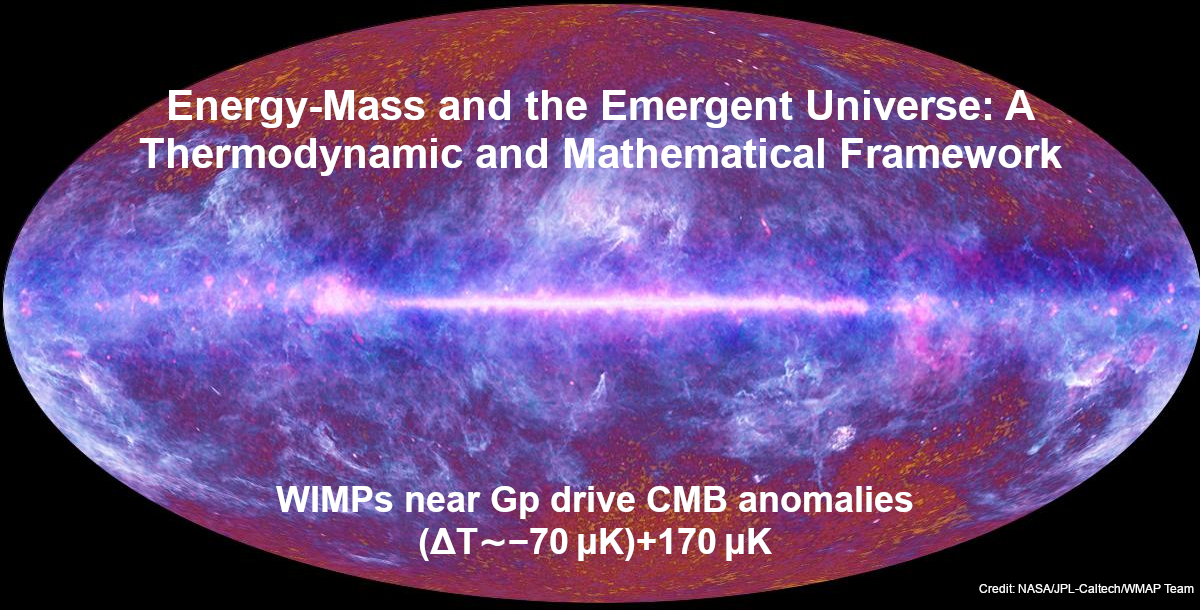
(1) Background: The accelerating universe’s mechanisms remain unresolved, prompting new cosmological frameworks beyond dark energy and static dark matter. (2) Methods: This paper redefines E=mc2 as E/m=d2/t2, introducing Energy-Mass, and derives its implications using Maxwell’s equations and the FLRW metric to model spacetime and expansion dynamics. (3) Results: A feedback loop drives variable, accelerating expansion as cold-mass, identified as Weakly Interacting Massive Particles (WIMPs; m2≈1.78×10⁻²⁵ kg), absorbs CMB energy near Gp, creating spacetime detectable as cold spots (ΔT∼−70μK, m3∼1039 kg) and hot spots (ΔT∼+170μK, m3∼1036 kg), approaching E=0 equilibrium. (4) Conclusions: This framework links Energy-Mass to quantum properties, offering a testable alternative to prevailing cosmological models.
Keywords:
Energy-Mass
; WIMPs
; CMB anomalies
; cosmic expansion
; feedback mechanism
; dark matter
; quantum cosmology
1. Introduction
The standard cosmological model describes an accelerating universe [1,2], yet the mechanisms remain debated. This paper builds upon a foundational framework first proposed by the author [12], redefining as , and introducing Energy-Mass where spacetime and quantum physics emerge with . Unlike static WIMPs probed by XENON1T with null results ([11]), this model posits dynamic injections detectable via cosmic microwave background (CMB) anomalies, bypassing underground constraints. A feedback loop accelerates expansion as cold-mass absorbs energy near an infinite state , detectable via CMB anomalies [4], offering alternatives to dark energy and dark matter. This framework integrates thermodynamics and quantum mechanics, extending prior concepts with new evidence and derivations.
2. Energy-Mass Framework
Einstein’s is reframed as:
defining Energy-Mass () and Space-Time (). When , ; when , spacetime exists, forming an expanding state.
3. The Infinite Universe
Since ( undefined) and is viable (, ), Energy-Mass indestructible ensures an infinite universe across forms.
4. Pre-Expansion Infinity: The Golden Point
Hubble’s expansion and infinity before expansion implies an origin at , denoted the Golden Point , where and momentum is absent. Cold-mass transitions to , yet remains immutable:
5. System Definition
Three states define the universe’s evolution:
5.1. State 1: Pre-Spacetime State
- Energy:
- Mass: (latent, pre-physical)
- Specific energy:
- Temperature:
- Spacetime: Absent (, no metric)
- Entropy: (single ordered state)
State 1, the Golden Point , exists pre-spacetime, with no volume or dynamics, rendering density () undefined; p=0 negates Pauli exclusion; Heisenberg’s is undefined without spacetime.
5.2. State 2: Cold-Mass
- Energy: (pre-injection)
- Mass: (single WIMP)
- Specific energy: (pre-injection)
- Temperature:
- Spacetime: Absent (pre-transition)
- Entropy: (single WIMP, pure state)
State 2 represents cold-mass as WIMPs translocating from before energy absorption.
6. Thermodynamic Evolution and Feedback Loop
Energy () near triggers WIMP injections from State 2 into State 3:
- WIMPs ([10]) tunnel from at , based on CMB photon density () and a hypothetical cross-section () [10], absorbing CMB energy (, ) near , creating spacetime () and forming cold spots (Figure 1, , , WIMPs) detectable as CMB anomalies. Tunneling may reflect quantum barrier penetration near a pre-spacetime boundary, a topic for future study.
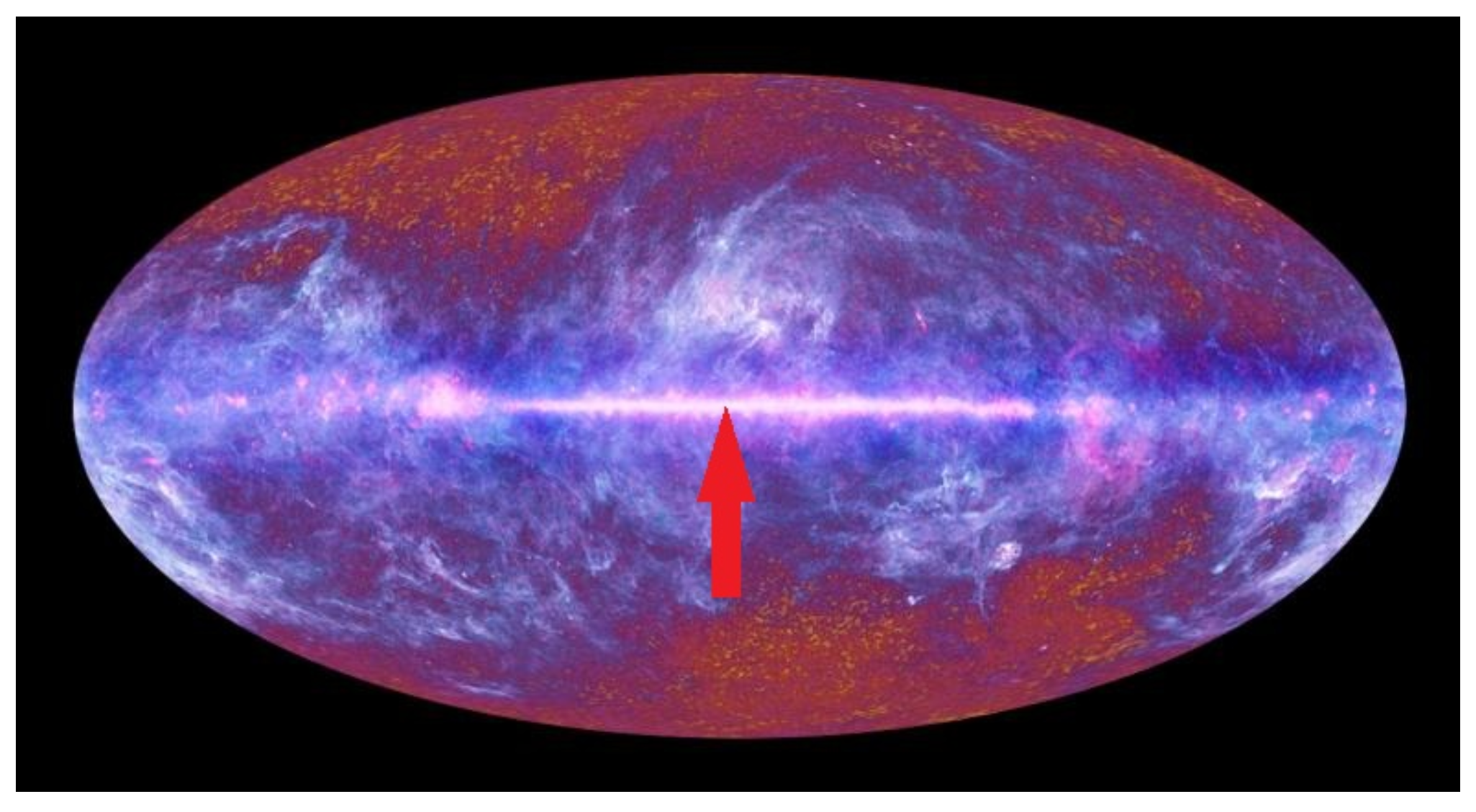
- WIMP annihilation releases energy near , forming hot spots (Figure 2, , , WIMPs), with CMB energy dominating over stellar contributions ().
- This increases , accelerating expansion over time.
Equilibrium () looms as grows.
Theorem 1
(Emergent Properties). When , spacetime and quantum properties emerge as derived from Maxwell’s equations, based on a framework first proposed by the author [12].
Proof.
Begin with Maxwell’s relation for the speed of light:
where c is the speed of light, is the permeability, and is the permittivity of free space. Squaring yields:
In the Energy-Mass framework, , so:
Multiply by m:
Spacetime emerges as:
Now, consider wave properties where (wavelength , frequency f):
Substitute into the framework:
Equate with Maxwell’s result:
Multiply by E:
Since :
Multiply through by :
For quantum mechanics, use Planck’s relation (where ):
Divide by f ():
Since :
With :
Multiply by :
This relates mass to frequency, implying quantum properties (e.g., wave-particle duality) emerge when . If , , suggesting within spacetime. However, conservation of energy holds as persists outside spacetime (e.g., pre-injection cold-mass), transitioning to upon entry, preserving total energy. □
7. Results and Discussion
The feedback loop drives expansion via WIMP injections, detectable as CMB anomalies (cold spots, , of CMB sky [9], Figure 1; hot spots, , , Figure 2) or redshift trends [6]. CMB supports cold spot scale [4,8], while hot spots reflect annihilation energy near , contrasting static dark matter halos [10]. These scales align with WMAP’s anomalies across 41,253 deg2[8]. Unlike traditional WIMPs forming halos post-recombination, these dynamically inject from , offering a testable alternative to dark energy [7].
8. Conclusions
Energy-Mass () drives expansion via a WIMP-based feedback loop, detectable via CMB anomalies, approaching equilibrium, contrasting dark matter theories.
Funding
This research received no external funding.
Data Availability Statement
The CMB data supporting this study’s figures (cold and hot spots) are openly available in the WMAP 5-year dataset [8] at NASA’s Lambda archive [https://lambda.gsfc.nasa.gov/product/map/dr3/skymaps_5yr.cfm]; the specific images are derived from [https://photojournal.jpl.nasa.gov/catalog/PIA13239]. Calculations (e.g., WIMP masses, injection rates) are detailed in the text.
Conflicts of Interest
The author declares no conflicts of interest.
Abbreviations
The following abbreviations are used in this manuscript:
| CMB | Cosmic Microwave Background |
| FLRW | Friedmann-Lemaître-Robertson-Walker |
| JPL | NASA’s Jet Propulsion Laboratory |
| MDPI | Multidisciplinary Digital Publishing Institute |
| NASA | National Aeronautics and Space Administration |
| WIMP | Weakly Interacting Massive Particle |
| WMAP | NASA’s Wilkinson Microwave Anisotropy Probe |
References
- Riess, A. G.; et al. Astron. J. 1998, 116, 1009–1038. [CrossRef]
- Perlmutter, S.; et al. Astrophys. J. 1999, 517, 565–586.
- Friedmann, A. Z. Phys. 1922, 10, 377–38.
- Planck Collaboration. Astron. Astrophys. 2020, 641, A6.
- Maxwell, J. C. Philos. Trans. R. Soc. Lond. 1865, 155, 459–512. [CrossRef]
- Riess, A. G.; et al. Astrophys. J. 2019, 876, 85. [CrossRef]
- Weinberg, S. Rev. Mod. Phys. 1989, 61, 1–23. [CrossRef]
- Hinshaw, G.; et al. Astrophys. J. Suppl. Ser. 2009, 180, 225–245. [CrossRef]
- Szapudi, I.; et al. Astrophys. J. Lett. 2014, 786, L2.
- Bertone, G.; Hooper, D.; Silk, J. Phys. Rep. 2005, 405, 279–390. [CrossRef]
- XENON Collaboration. Phys. Rev. Lett. 2018, 121, 111302. [CrossRef]
- Stringfellow, T. D. On Energy, Mass, Distance, Time, and the States of the Universe... Kindle Edition; Amazon Digital Services LLC. 2022. Available online: https://www.amazon.com/dp/B09RVQNNDY (accessed on 28 February 2025).
Figure 1.
CMB cold spot from WIMP injection (arrow), medium blue (, , size [9]) against . Credit: NASA/JPL-Caltech/WMAP Team.
Figure 1.
CMB cold spot from WIMP injection (arrow), medium blue (, , size [9]) against . Credit: NASA/JPL-Caltech/WMAP Team.
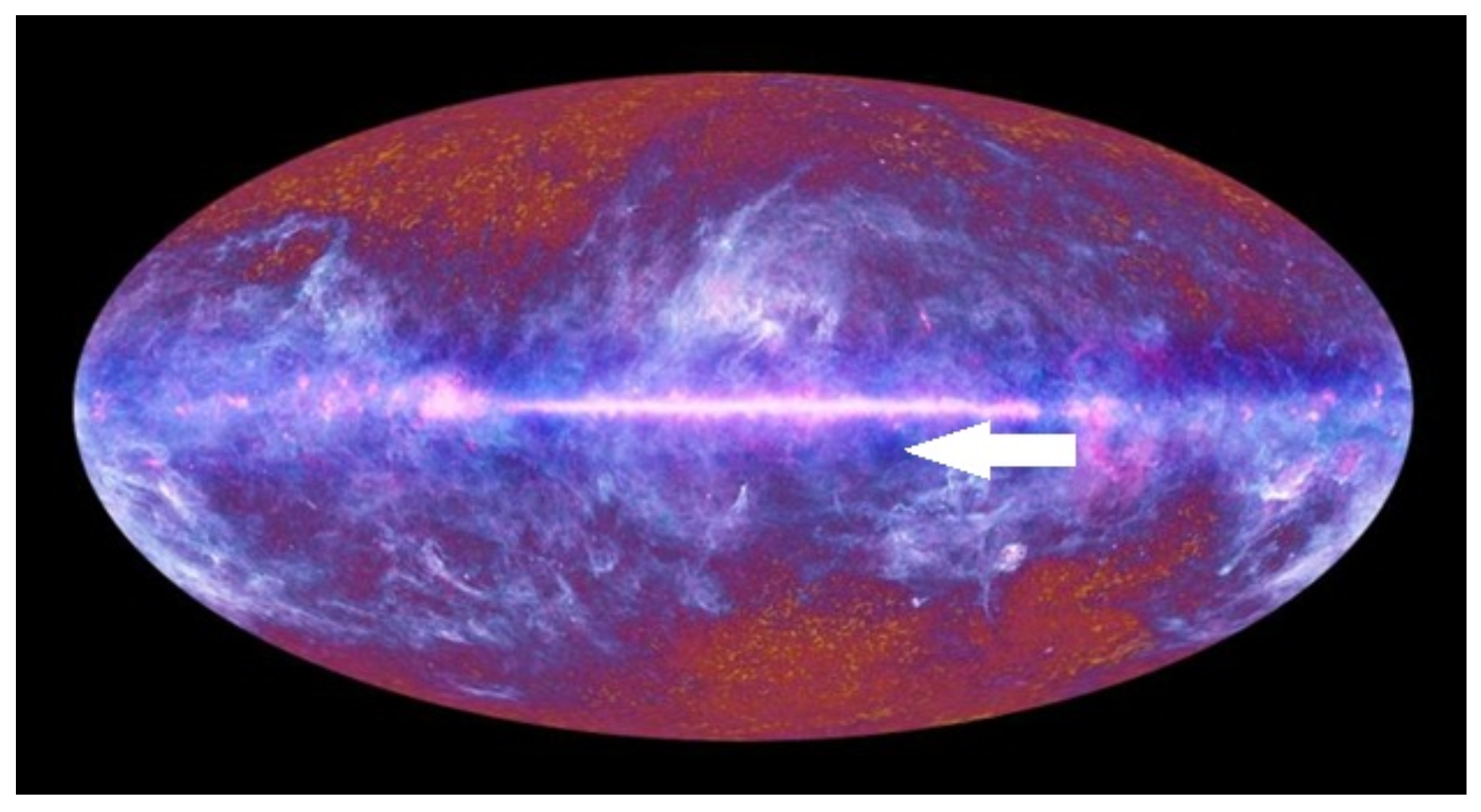
Figure 2.
CMB hot spot from WIMP annihilation (arrow), light purple (, , size ) against . Credit: NASA/JPL-Caltech/WMAP Team.
Figure 2.
CMB hot spot from WIMP annihilation (arrow), light purple (, , size ) against . Credit: NASA/JPL-Caltech/WMAP Team.
Disclaimer/Publisher’s Note: The statements, opinions and data contained in all publications are solely those of the individual author(s) and contributor(s) and not of MDPI and/or the editor(s). MDPI and/or the editor(s) disclaim responsibility for any injury to people or property resulting from any ideas, methods, instructions or products referred to in the content. |
© 2025 by the authors. Licensee MDPI, Basel, Switzerland. This article is an open access article distributed under the terms and conditions of the Creative Commons Attribution (CC BY) license (http://creativecommons.org/licenses/by/4.0/).
Copyright: This open access article is published under a Creative Commons CC BY 4.0 license, which permit the free download, distribution, and reuse, provided that the author and preprint are cited in any reuse.


