

Submitted:
07 August 2025
Posted:
08 August 2025
You are already at the latest version
Abstract
Hate speech and hate crime with racist, religious and misogynist motives is well-known, but hate speech and related crimes have increased in climate politics in the last years. Right-wing populist politicians denying climate change, use hate speech and hate crime systematically and strategically as a tactic to polarise climate politics, mobilise ingroup followers, and delegitimise and silence outgroup advocates of strong climate policy. In political science, such tactics are labelled nasty rhetoric. Crime victim discourse, considering the perspectives of victims, is gaining prominence in debates in criminology because it can affect rationales for punishment, equality before the law, and other safeguards such as building victim resilience. Focusing on Swedish politics, this paper adds to such debates by exploring and theorising how politically motivated and systematic acts of hate speech and hate crime – nasty rhetoric – affect victims among climate scientists, climate activists and climate journalists. Based on secondary data from written and audio-visual media, combined with stories of more than 50 victims, this paper finds that targets are victimised in different ways, with different emotional and behavioural responses. Scientists and journalists are victimised from nasty rhetoric as persons for what they do professionally. They report angst, insecurity, fear of crime, and fear of being followed, making them withdraw from public debate, change their research subject or change job. In comparison, climate activists are victimised for their political opinions and actions undertaken outside work. Contrary to previous research findings, climate activists desensitise the content of hate speech and do not fear hate speech targeting them directly. They are more afraid of climate change. They are also scared from the message effect of nasty rhetoric, legitimising collective hate speech, and contributing to a growing culture of silence that makes people in general afraid to raise their voice. The culture of silence has made employers afraid, and they discriminate employees engaged in climate change. Climate activists are also victimised from hard state repression in the form of economic and legal sanctions for raising their voices and criticising the government. Hard repression makes some activists choose to revert from civil disobedience, to less confrontative actions. But radical activists react with anger and are considered to become ‘radicalised’ by leading politicians, who want them prosecuted for terrorism. The crime victim discourse is immature and largely influenced by leading politicians in power who deny, attack, and reverse the victim and offender roles, claiming that victims of nasty rhetoric are the real criminals, and that the ‘good people’ are the real victims. In all, the results broaden the analysis of consequences of nasty rhetoric beyond politicians as targets, and show the importance of analysing crime victim discourses to avoid lumping victims together in public and policy debates on how to curb hate speech and hate crime. Knowledge about impacts on different groups of victims is also important for reciprocation of victims. The results also provide new insights to criminology and victimology by showing the links between green crime and hate crime, and thus between victims of green crime and nasty rhetoric.
Keywords:
behaviour
; climate policy
; emotions
; far-right populism
; green crime
; hate crime
; hate speech
; nasty politics
; resilience
; radicalisation
; victimisation
1. Introduction
Populists around the world disseminate conspiracy theories and lies about the state of society. They also use coarse, rude, and disrespectful language, with insults, hatred, accusations, allegations, denigration and threats, and in rare cases violence, in their political rhetoric. The aim is to negatively stereotype, stigmatise, delegitimise, dehumanise and eliminate their opponents, physically, socially or symbolically (Moffitt & Tormey, 2013; Moffitt, 2016; Lührmann et al., 2020; Jämte & Ellefsen, 2020; Mudde, 2021; Zeitzoff, 2023). Far-right populists’ strategic use of such hate speech for political reasons of is well-known in policy domains such as migration, immigration and identity policy related to ethnicity, religion, gender and sexual orientation (see e.g. Matsuda, 1993; Lillian, 2007; Yılmaz, 2012; Richardson-Self, 2018; Lutz, 2019; Mason-Bish & Duggan, 2019; Hagerlid, 2020; Peters, 2020; Olivas Osuna, 2021; Weeks & Allen, 2023; Ardin, 2024; Askanius et al., 2024; Svatoňová & Doerr, 2024). For instance, members of the Jewish diaspora, the Muslim community, and the LGBTQ+ communities in EU countries are victimised by online hate speech on an almost daily basis (Berecz & Devinat, 2017).
1.1. Hate Speech in Climate Politics
Recent studies have found that hate speech is now used systematically to polarise society and groups of people also based on political preferences in climate politics (von Malmborg, 2024a, 2025). Climate denying politicians – some denying the existence of climate change or that it is anthropogenically induced, others denying its consequences (Hobson & Niemeyer, 2012) – are downplaying climate policy, both nationally and internationally, calling it a threat to economic growth and people’s freedom and way of life (Marquardt et al., 2022; White, 2023). In Europe, far-right populist parties are waging a ‘culture war’ to make climate policy radically less ambitious and eventually scrap it (Buzogány & Mohamad-Klotzbach, 2022; Cunningham et al., 2024; Weise & Camut, 2025). Advocates of strong climate policy, and journalists reporting about it, are described by right-wing populists as an ‘enemy’ to the nation, destroying life of the good and pure ‘people’ (von Malmborg, 2025). In social science, climate change is considered a super-wicked problem. Climate policy appears at the intersection of science, economics, politics, and human behaviour, where emotions and ideological, ethical, and religious beliefs and worldviews are ever present in public discourse and policymaking (Hulme, 2009; Goodman & Morton, 2014; Incropera, 2015; Grundmann, 2016; Crowley & Head, 2017; Hornsey, 2021). Given the rise in powers of far-right populist parties and an ongoing autocratisation around the world (V-Dem Institute, 2024, 2025), this polarisation may have negative consequences for climate governance. Climate change needs pluralistic rather than dualistic, divisive approaches to democracy to be governed (Incropera, 2015; Lindvall & Karlsson, 2023; von Malmborg, 2024a).
Research on derogative language and hate speech in climate politics has focused mainly on hate campaigns towards specific targets, e.g., climate activists and climate journalists, and its presence in social media. Previous studies show that power dynamics often circle climate policy and female politicians simultaneously (e.g. Miller & Bloomfield, 2022). Combining climate denial, misogyny and sexism, Donald J. Trump, Jose Bolsonaro and many other male politicians directed and instigated hate and treats towards Greta Thunberg, the figurehead of the climate justice movements (Andersson, 2021; Park et al., 2021; Vowles & Hultman, 2021a; White, 2021; Arce-García et al., 2023; Mede & Schroeder, 2024; Wahlström & Uba, 2024). Hate speech of climate deniers is also targeting climate journalists, aiming to discredit individual journalists and newspapers, but also to undermine the deliberative function of online user fora (Björkenfeldt & Gustafsson, 2023; Schulz-Tomančok & Woschnagg, 2024).
Hate speech is increasingly found online in social media, where perpetrators of such cyberhate can be anonymous (Castaño-Pulgarín et al., 2015; Oltmann et al., 2020; Tom Tong, 2025). Social media has also reshaped the media landscape in fundamental ways that brings about novel avenues in the discursive climate to provide support for positions and actions of a certain group or movement (Wahlström et al., 2021). As for climate policy related cyberhate, Anderson and Huntington (2017) found that while instances of incivility were low overall in Twitter discussions on climate politics, such rhetoric was mainly used by right-wing people. The climate justice movement has been particularly targeted by hate speech in social media, often in combination with misogyny (Agius et al., 2021; Andersson, 2021; White, 2021; Arce-García et al., 2023).
Some studies have analysed the use of insults and accusations to frame contesting, polarised views on climate policy in the political rhetoric of advocates and deniers of climate change more broadly (e.g. Knight & Greenberg, 2011; Eubanks, 2015; Sharman & Howarth, 2017; Bsumek et al. 2019; Nordensvärd & Ketola, 2022; Pandey, 2024). Research on systematic use of hate speech in the framing and formulation of climate politics in specific polities is sparse. Analysing agency in the radical transformation of Swedish climate policy since 2022, von Malmborg (2024a) identified systematic acts of hate speech by leading right-wing politicians, targeting advocates of strong climate policy. Later, von Malmborg (2025) showed and explained how and why hate speech is used systematically by the prime minister and cabinet ministers, and their far-right populist supporters, as a tactic to delegitimise and dehumanise oppositional politicians in the parliament, as well as climate scientists, climate activists, and climate journalists. The purpose was to make them silent. They also use hate speech as a tactic to mobilise followers to expand hate speech on pro-climate advocates.
Reviewing the scientific literature on hate speech related to climate change and climate policy, there is little knowledge about the use and harms of hate speech as a political strategy and tactics in climate politics and governance. Analysing partisan leaders’ strategic and systematic acts of hate speech and other hateful and threatening acts for political purposes, targeting political opponents, scholars of political science refer to the concepts of nasty politics and nasty rhetoric as broad analytical concepts. Nasty politics was coined by Zeitzoff (2023, p. 6) as “a set of tactics that politicians can use to insult, accuse, denigrate, threaten and in rare cases physically harm their domestic opponents”. Nasty rhetoric, central to nasty politics, is characterised by divisive and contentious rhetoric with insults and threats containing elements of hatred and aggression that entrenches polarisation and ‘us vs. them’ narratives, designed to denigrate, deprecate, delegitimise, dehumanise and hurt their target(s) to make them silent (Kalmoe et al., 2018). According to Zeitzoff (2023), nasty rhetoric covers hate speech as well as hate crime (Whillock & Slayden, 1995; Chetty & Alathur, 2018; Castaño-Pulgarín et al., 2021; Vergani et al., 2024), but also other kinds of ‘hateful’ actions.
As hate speech and hate crime are well-known concepts in criminology and victimology, as well as the public debate, it may seem unnecessary to invent new concepts. But analysing systematic hate speech and hate crime as an integrated tactic in political processes such as agenda-setting, policy formulation and policy implementation, adds political and ideological perspectives to the understandings of hate speech and hate crime as provided in other disciplines, e.g. sociology, psychology, criminology, victimology and communication studies. Analysing nasty rhetoric puts hate speech in relation to other tactics and tools of politics and governance, e.g. political advocacy, state budgeting, and governance of state authorities and state-owned companies. Hate speech is one tool in the toolbox used by politicians to silence political opponents. To exemplify, climate scientists can be silenced by accusations of being biased and too emotional (hate speech), budgetary cuts to climate science, and/or policies restricting scientists’ freedom of expression. A more comprehensive analysis of different tools used to silence critics to the degradation of Swedish climate policy is provided by von Malmborg (2024a). But to comprehensively understand nasty rhetoric, one must draw on research and theory on hate speech and hate crime (cf. Zeitzoff, 2023; von Malmborg, 2025). This is particularly the case when analysing harms on victims of nasty rhetoric. So far, research on victims of nasty rhetoric has focused on politicians (cf. Zeiftzoff, 2023). But in the case of climate politics, victims are also found among scientists, activists and journalists (von Malmborg, 2025).
As a political scientist, the outset of this paper is to analyse harms and victims of nasty rhetoric. Such acts include the use of hate speech and hate crime, as defined below, in a strategic whole. Describing different acts of nasty rhetoric, I will refer to them as hate speech unless they are acts of physical, economic or legal violence. The relations between hate speech, hate crime and nasty rhetoric are further elaborated in section 2.
In this paper, I refer to hate crime as “a crime motivated by prejudice and discrimination that stirs up a group of like-minded people to target victims because of their membership of a social group, religion or race” (Peters, 2020, p. 2326). In comparison, there is a spectrum of definitions of hate speech, reflecting the jurisprudence in different polities (Assimakopoulos et al., 2017; Paz et al., 2020; Hietanen & Eddebo, 2022). A certain kind of hateful, hate-filled, hate-fuelled or hate-inciting language may be considered illegal and thus a crime in one country or region, but not in another one (Sheppard et al., 2021). The myriads of legal characterisations of hate speech differ in terms of (i) whether they are grounded in what has been, what is, or what could be treated as hate speech within a body of law, and (ii) the levels of generality at which they operate. To better understand how best to respond to hate speech, via bodies of law and legal regimes and/or through a range of extra-legal measures such as counter-speech and education, philosopher Alexander Brown (2017, p. 422) suggests that we should pay serious attention to the fact that hate speech is not merely a legal concept, but “also an ordinary concept that is (a) used by people who are not legal professionals or writers about the law, and (b) has a panoply of uses not only within bodies of law and legal systems but also within a range of other social, cultural, political and economic domains”. Denouncing the idea that the term hate speech is univocal or has a single meaning, he claims that the term hate speech is doubly figurative or metaphorical, i.e. it is systematically ambiguous between its attributional and relational metaphors, describing (i) speech or other expressive conduct, (ii) concerning groups or classes of persons, (iii) connected with negative emotions, feelings or attitudes towards that group or persons (Brown, 2017). In a similar vein, Sponholz (2018, p. 51, my translation) describes hate speech as “the deliberate and often intentional degradation of people through messages that call for, justify and/or trivialise violence based on a category”, e.g. ethnic group, religion, gender, sexual orientation or political preference (Castaño-Pulgarín et al., 2021). Due to the perpetrators’ (perceived) prejudicial motives, hate speech is a form of ‘group-related misanthropy’ (Zick et al., 2008).
1.2. Aim of the Paper
Adding to the understanding of nasty rhetoric as a phenomenon in climate politics and politics in general, this paper qualitatively explores and theorises how nasty rhetoric harm the people targeted – the victims –emotionally and behaviourally.
Besides contributing to theory on nasty rhetoric, the paper contributes to the development of the discourse on victims of nasty rhetoric (in climate politics). Crime victim discourse, meaning “the historically, socially, and culturally specific assumptions, expectations, attitudes, and ways of talking (and thinking) about crime victims that exist in society at a given time” (Hansen Löfstrand, 2009, p. 121), is gaining greater prominence in political and public debates in areas such as racist, religious and misogynist hate speech and hate crime because it can affect traditional legal principles such as rationales for punishment, equality before the law, and other legal safeguards (Hansen Löfstrand, 2009; Tham et al., 2011; Atak, 2022; Glad et al., 2024; Ilse & Hagerlid, 2024). The traditional presentation of victims as essentially powerless and passive is recognised by victimologists as potentially damaging (Green & Pemberton, 2017). Given that nasty rhetoric in Swedish climate politics is found to be part of a strategy for radical change of policy and governance (von Malmborg, 2024a), understanding the crime victim discourse is important also in the field of climate politics, a new area of hate speech and hate crime.
Understanding the discourse on victims and victimhood, allowing victims to speak for themselves and not reproducing stereotypes, can provide important knowledge to deal with nasty rhetoric in this area (cf. Schwöbel-Patel, 2018). As stated by Mari Matsuda (1989) in her seminal paper on the voices of victims, “the victims’ experience reminds us that the harm of racist hate messages is a real harm to real people”. Understanding the impacts of nasty rhetoric on victims is crucial not only for the well-being of individuals but also on a social level (cf. Dreißigacker et al., 2024). A more nuanced understanding of the harms on different groups of victims can help identifying groups with lower resilience and thus disproportionately affected by nasty rhetoric, and develop targeted interventions and policies that aim to protect the rights and well-being of all victims. Addressing the following research questions, the overall aim of the paper is to contribute to better understanding of the harms of nasty rhetoric, in which individuals and groups of individuals are victims to be acknowledged and reciprocated from criminological and victimological perspectives:
- How are different target groups and people victimised by nasty rhetoric? Are there differences in target group victimisation?
- How do victims of nasty rhetoric react emotionally and behaviourally? Are there differences in emotional and behavioural reactions among different target groups?
- How resilient are different groups of victims?
The paper uses recent developments in Swedish climate politics as a case. This case is illuminating for scholars, policymakers and civil society beyond Sweden. Sweden has long since been considered an international role model in climate politics, advocating high ambitions in global and EU climate governance as well as nationally (Matti et al., 2021; Widerberg et al., 2024). Sweden has also been considered a bastion of strong liberal democracy since the end of World War II (Boese et al., 2022; Silander, 2024). In the nexus of climate politics and democracy, Sweden has also seen the rise of strong social movements advocating ambitious climate policy, particularly with Greta Thunberg and Fridays for Future (de Moor et al., 2020). But Sweden has lost this position since the enter into force of a right-wing government in 2022, supported or even dictated by a far-right populist nativist party (Silander, 2024; Vowles et al., 2024; von Malmborg, 2024a, 2025; Malm et al., 2025). Analysing harms to victims of nasty rhetoric in a country that until recently experienced large societal consensus and policy leadership on climate politics, including a strong role of social movements, provides important knowledge for expanding the understanding not only about nasty rhetoric and the harms on victims of far-right hate speech and hate crime, but also about the resilience of different groups of victims, and the current victim discourse. Perhaps the most important contribution to criminology and victimology, the study identifies and analyses the connection between green crime and hate crime. Potential victims of climate change use their agency to protest against the lack of political actions, for which they are targeted and victimised by hate speech and hate crime in different forms. Such multiple victimisation is rather unusual.
The paper is outlined as follows. Section 2 presents the theory of nasty rhetoric and its relation to hate speech and hate crime, while section 3 presents theories and findings from the literature on victimisation and harms of nasty rhetoric and related areas of scholarship such as hate speech, hate crime, green criminology and victimology. In all, this section presents the analytical framework for the study. Section 4 presents the method and material used to analyse nasty rhetoric in the case of Swedish climate politics. Section 5 presents the case study context, while section 6 presents the empirical results. Section 7 discusses the results, and section 8 finally draws conclusions and presents areas for future research.
2. Nasty Rhetoric – Systematic Acts of Hate Speech and Hate Crime to Eliminate Political Opponents
As mentioned, nasty rhetoric is a divisive and contentious form of political rhetoric that includes insults, accusations and threats, including elements of hatred and aggression. It is a tactic used by politicians to entrench polarisation and ‘us vs. them’ narratives between an ingroups and an outgroup, with the purpose denigrate, deprecate, delegitimise, dehumanise and hurt their target(s) to make them silent. Zeitzoff (2023) has proposed a typology of nasty rhetoric (Table 1), to which I have added economic and judicial violence, e.g. sanctions, dismissal, fines, imprisonment etcetera. The latter are increasingly used against climate justice activists in Europe (Berglund et al., 2024).
The table also presents the respective levels of aggression. In contrast to hate speech, nasty rhetoric includes not only language, but different kinds of violence. Thus, it covers ‘rhetorical’ actions other than hate speech, just like hate crime can include both language and physical or other forms of violent actions. To further clarify the concept of nasty rhetoric in relation to other concepts used in studies of hate speech and different forms of state repression, i.e. soft and hard repression (Earl, 2006, 2011), the latter are included in Table 1. Soft repression includes non-violent means such as silencing activists or marginalising oppositional ideas, e.g. through ridicule, stigma, or silencing (Ferree, 2004), i.e. hate speech. Hard repression involves legal and/or economic force and coercion to control or crush oppositional action (Earl, 2006).
As described by Zeitzoff (2023), nasty rhetoric works holistically, where different types and expressions of nasty rhetoric do not happen in isolation, but tend to happen together but not necessarily sequentially, with more threatening and aggressive rhetoric happening alongside less aggressive rhetoric. Some expressions of nasty rhetoric may be explicit (e.g. accusing a journalist of being biased), while others may be more subtle and concealed (e.g. refusal of a politician to give interviews to certain journalists). In other words, more overt forms of hateful, hate-filled, hate-fuelled or hate-inciting acts can go hand in hand with implicit, veiled and subtle expressive conducts which at a first glance may seem to be rational or normal, and link up to more overt acts, but also somewhat hide and disguise (cf. McIntosh, 2020). Similarly, discursive studies of hate speech recognise that “explicitness cannot be the only determining criterion in the identification of hate speech” (Assimakopoulos, 2020, p. 179). As there are different types of nasty rhetoric acts, suggestions have been made to differentiate ‘hard’ hate speech from ‘soft’ hate speech (Serafis & Assimakopopulos, 2024), Since nasty politics and nasty rhetoric are umbrella concepts used in political science, scholarly understanding of the phenomena would inevitably draw on studies of hate speech and hate crime in other disciplines, e.g. to identify and explain motives, consequences and causalities.
Hate is a composite feeling, comprising elements of anger, contempt, and disgust (Sternberg & Sternberg, 2008; Martínez et al., 2022a). It can be described as a strong, intense, enduring, and destructive emotional experience which aims to harm or eliminate its targets physically, socially, or symbolically (Opotow & McClelland, 2007; Fischer et al., 2018). Social psychology research on hate finds a causal relationship between hate and aggression in terms of aggressive tendencies and hurting behaviour experienced towards specific individuals and entire outgroups (Martínez et al., 2022b). What starts with different expressions of hate (insults and accusations) soon escalates to different forms of threats (intimidations and incitements), one more aggressive than the other, and further to psychological, economic, legal or physical violence.
Deprecation, i.e. insults and accusations to make claims about action, may be a precursor to more targeted violent rhetoric and action, and act as a provocation and incitement to addressees and bystanders as much as emotional sentiments that wound the targets of a speech, text, picture or video. As stated by Klemperer (2002, p. 15), “words can be like tiny doses of arsenic: they are swallowed unnoticed, appear to have no effect, and then after a little time the toxic reaction sets in after all”, which has also been described as the banality of evil (Arendt, 1971). As for violence, “speech can and does inspire crime” (Cohen-Almagor et al., 2018, p. 38; Schweppe & Perry, 2021). As stated by 2021 Nobel Peace Prize laureate, Maria Ressa: “Online violence does not stay online. Online violence leads to real world violence”.3 There is a strong link between dehumanising online hate speech and violence in European far-right movements (Müller & Schwarz, 2020; Wahlström et al., 2021). Some even considered hate speech a type of ‘terrorism’ or trigger event of ‘terrorism’, aiming to instill fear in a targeted populace (Chetty & Alathur, 2018; Piazza, 2020). In the event of nasty rhetoric instigated by politicians in power, we can speak of ‘state terrorism’ (Zeitzoff, 2023).
As for nasty politics and rhetoric as a precursor of political violence, Piazza (2020) analysed terrorism and hate speech data for about 150 countries globally in the period 2000–2017. He found that hate speech by political figures boosts domestic terrorism, defined as “the deliberate, premeditated use of violence, or the threat of violence, by non-state actors that is politically motivated and is intended to influence a wider audience beyond individuals affected directly by the attack” (Piazza, 2020, note 1). Such domestic terrorism is mediated through increased political polarisation caused by political hate speech (cf. Klein, 2020). Donald J. Trump is a well-known user of nasty rhetoric targeting several groups in society, promoting hatred and violence (McIntosh, 2020; Valcore et al., 2023), for which he has been called “insulter in chief” (Vargiu et al., 2024). He is not the only world leader accused of publicly denigrating people beyond politicians for their racial, ethnic or religious identities, or for their political opinions (Piazza, 2020), but he actively incited violent riots at the storming of Capitolium on 6 January 2021 (Zeitzoff, 2023), and he violates numerous democratic norms such as legitimacy and accountability in delivery and content of his speeches (e.g., Jamieson & Taussig, 2017; Ross & Rivers, 2020).
2.1. Nasty Rhetoric and Far-Right Populism
Far-right populist parties have increased their votes in every election to national parliaments in Europe since the 1980s, and processes of autocratisation lead more and more states away from liberal democracy (Mudde, 2004, 2021; V-Dem Institute, 2024, 2025). Recently, far-right populist “insulter in chief” Donald J. Trump was elected to President of the USA a second time (Vargiu et al., 2024). To reach their political aims, populists disseminate conspiracy theories and lies about the state of society, and they use coarse, rude, and disrespectful language including hatred and threats in their political rhetoric to silence their opponents (Moffitt & Tormey, 2013; Moffitt, 2016; Lührmann et al., 2020; Mudde, 2021; Zeitzoff, 2023; Törnberg & Chueri, 2025). Entrenching an ‘us vs. them’ narrative, populists, be they left or right, refer to a homogeneous ‘pure people’ as an ingroup, as a counterpoint to the ‘corrupt elite’, the outgroup. This draws on poststructuralist theories of hegemonic discourses, that every concept, all meaning-making, is defined in a process of constitutive antagonism (Laclau & Mouffe, 1985). To Laclau and Mouffe, antagonism refers to all possible meanings of a concept that are excluded when one meaning become hegemonic. Both the ‘inside’ and the ‘outside’ are constituted simultaneously and they are dependent on each other. But given that there are always several contingent meanings, their configurations are arbitrary and the result of given historical power configuration. Aiming towards a radical democracy theory, addressing the gaps of liberal and deliberative democracy theory, the works of Mouffe (e.g. 2000, 2005a) are important for socialist strategy to use populist discourse (Mouffe, 2013). However, it has also influenced the European far-right populists in developing their strategies of the culture war on the hegemonic ‘left-liberal conspiracy’. As claimed by Mouffe (2005b), the far-right use populism to shape a hegemonic discourse based on identity and culture, not on class.
Far-right populist rhetoric, narratives and discourse is based on emotional appeals to the homogenous clean and ‘good people’ and the exclusion of the ‘corrupt elite’, who are routinely blamed and scapegoated for perceived grievances and social ills (Aalberg & de Vreese, 2016 Hunger & Paxton, 2022). Narratives of ‘disaster’ or ‘anxiety’ are important for the success of far-right populists (Kinnvall & Svensson, 2022). These refer to a fantasy of a constant crisis, rather than an actual one of the nation – a crisis caused by long-term mismanagement by an innately malicious and ‘corrupt elite’ (Kinnvall & Svensson, 2022; Ketola & Odmalm, 2023; Abraham, 2024). Far-right populist leaders portray themselves as the saviour of the nation and the ‘people’, while the ‘elite’ should be punished for their crimes against the ‘people’ (Mudde, 2004, 2017). While sometimes talking the language of the ‘people’, populists are not responsive to popular will. Their ideology is based on a unitary and non-pluralist vision of society’s public interest, and they themselves are rightful interpreters of what is in the public interest – a putative will of the ‘people’ (Arato & Cohen, 2017; Caramani, 2017; Mudde, 2017), systematically presenting misinformation (Törnberg & Chueri, 2025). They act on their own will and invite their audience to identify with them (White, 2023).
The populist worldview moralises a Manichean political confrontation, framing the opponents as intrinsically immoral and evil individuals who should be removed from society (Abts & Rummens, 2007). This channels emotions of hate towards the outgroup, which has the motivational goal of eliminating its targets on the basis of their dispositional evil attributions (Sternberg & Sternberg, 2008; Fischer et al., 2018; van Doorn, 2018). Martínez et al. (2023) have found that a populist worldview might fuel feelings of hate over time, rather than the reverse. In a similar vein, Dellagiacoma et al. (2024) report that people adhering to right-wing authoritarianism are significantly more likely to produce online hate than people with a social liberal orientation. These findings highlight that once people adopt far-right populist attitudes, they might enter in a downward spiral of increasing negative emotions toward their targets, escalating over time into strong feelings of hate. The concept of hate includes low levels of control and high levels of obstacles (Fischer et al., 2018). A sense of powerlessness is fed by the appraisal that hate targets are dangerous and evil, which make populist people join in online hate speech campaigns where they can feel social belonging and get attention (Walther, 2025).
2.2. Nasty Rhetoric and Emotions
Based on the work of Mouffe (2013), Chang (2019) and Olson (2020) show that nasty rhetoric is not only about what is conveyed explicitly by use of language. Political sentiments are often emotional and affective, determined by viscerally experienced sentiments and a physically imagined sense of rightness or wrongness. As such, hate speech, be it stand-alone or systematically used in nasty politics, is not restricted to speech acts or the written language, as suggested by Castaño-Pulgarín et al. (2021), but encompasses all sorts of messaging, e.g., image-based communication with photos, pictures and videos (Bleiker, 2018). Some politicians, such as Donald J. Trump, also use gesture to ridicule and caricature his political opponents (Goldstein et al., 2020). Political persuaders, particularly populists, use demagogic language or images and sometimes the absence of language, e.g. rejection to take interviews with certain journalists, and exclusion or ejection of certain groups from public meetings, to affect emotions, perceptions of knowledge, belief, value, and action (see e.g. Mendoza-Denton, 2020; Strömbäck et al., 2022; Shah, 2024). The sometimes ‘silent’ act of excluding some people or groups from a meeting is hardly seen as hate speech, but can be seen as strong insult or accusation in nasty politics emotionally affecting the target (von Malmborg, 2025).
Because nasty rhetoric is designed to invoke emotions, both among followers and targets, it aligns with notions of persuasion that stress emotions as an equally or often more important part of rhetoric as logic and facts, and credibility respectively (Olson, 2020). Populist rhetoric operates in a world where it is not required for “every statement be logically defensible” (McBath & Fisher, 1969, p. 17). Populist rhetoric can thus be rather incoherent (Slotta, 2020) and purposefully using vague concepts (Fridlund, 2025).
Populism is based on emotional appeals to the ‘people’ as the ingroup, anti-elitism, and the exclusion of outgroups who are routinely blamed and scapegoated for perceived grievances and social ills (Aalberg & de Vreese, 2016). Emotional rhetoric is central in reproduction of structural power and power relations between ‘us’ and ‘them’, and key in a Foucauldian sense of emotional governance (Durnová, 2018) Emotional governance includes techniques of surveillance, control, and manipulation for leaders to govern emotions through cultural and institutional processes, paying attention to collective emotions as patterns of relationships and belonging (Kinnvall & Svensson, 2022). It “affords individuals with a sense of what is regarded as appropriate and inappropriate behaviour and the circumstances in which certain emotions (e.g. fear, hatred, and contempt) become acceptable” (Crawford, 2014, p. 536).
3. Victimisation and Harm of Nasty Rhetoric
Focusing on politicians’ use of nasty rhetoric against political opponents, Zeitzoff (2023) and other political scientists have analysed only the impacts of nasty rhetoric on politics and democracy, not on people as victims. Nasty rhetoric feeds political intolerance, defined as the support or willingness to denounce basic democratic values and the equal rights of people belonging to a defined outgroup in a particular society (Oates & Gibson, 2006). This is considered one of the most problematic phenomena in democratic societies.
But prior to affecting politics and democracy, nasty rhetoric – aiming to silence people in the outgroup and mobilise more followers and offenders in the ingroup by demonising and dehumanising the outgroup – does something to people, emotionally, cognitively, normatively and behaviourally (Cassese, 2021; Wahlström et al., 2021; Abuín-Vences et al., 2023; Renström et al., 2023). Hence, to understand the impacts of nasty rhetoric on politics and democracy, it is important to analyse impacts on the primary victims in the outgroup, the emotions it provokes, how individuals perceive this type of messages, and how their behaviour is affected. Since the theory of nasty rhetoric lack these perspectives, valuable insights can be learned from multidisciplinary research on harmful impacts and victimisation of hate speech and hate crime, including cyberhate (see e.g. Boeckmann & Turpin-Petrosino, 2002; Leets, 2002; Chakraborti, 2017; Walklate, 2017; Chetty & Alathur, 2018; Roseman et al., 2018; Castaño-Pulgarín et al., 2021; Farrell & Lockwood, 2023; Vergani et al., 2024).
3.1. Victimisation
While hate crime is illegal by definition, some but not all types of hate speech are considered illegal acts in many polities (see e.g. Tsesis, 2009; Brudholm & Johansen, 2018; European Commission, 2021; Sheppard et al., 2021). To the extent that hate speech is considered illegal, it is also a hate crime. Nevertheless, targets of nasty rhetoric can be considered victims from a criminological and more particularly a victimological perspective. Nasty rhetoric not only violates the victims’ personal freedom and fundamental right to dignity and equality, but also the free formation of opinions and, by extension, our democracy (Matsuda, 1989; Ilse & Hagerlid, 2024).
3.1.1. The Ideal Victim
Theory of victimology has traditionally considered the importance of intent, and the moral and ethical corollaries of the experience of injustice (Green & Pemberton, 2017). Almost two decades prior to victimology became a discipline on its own, Christie (1986) made the concept of an ‘ideal victim’ popular. It is an analytical concept to study the use and reification of stereotypes suggesting that some persons or categories of individuals more readily than others are given the complete and legitimate status of being a victim when hit by a crime. An “ideal victim is (i) weak and vulnerable, (ii) carrying out a respectable project, (iii) in a place no one can blame her for, (iv) abused by a bad and strong offender, and (v) abused by an unknown offender, with no relation to the victim. In addition, the victim must (vi) “be weak enough not to become a threat to other important interests” to establish the identity as an ideal victim (Christie, 1986, p. 21). Victims and offenders are interdependent. “Ideal victims need – and create – ideal offenders” (Christie, 1986, p. 25), “The more ideal a victim is, the more ideal becomes the offender. The more ideal the offender, the more ideal is the victim” (p. 25). The notion of an ‘ideal victim’ has been criticised, e.g. with regard to domestic violence or international criminal law, and thus made victimology recognise that the decision regarding what is and is not a ‘crime’ and how ‘victims’ and ‘victimhood’ are conceptualised often reflects political power and interests (Duggan, 2018; Schwöbel-Patel, 2018). Bosma et al. (2018) expands on Christie’s ‘ideal victim’ by addressing not only the characteristics of the victim and the victim–offender relationship, but also on victim’s sense of threat and subsequent coping, and society’s interests and values at the time of victimisation.
Sometimes perpetrators deflect blame and responsibility (Gruber, 2023). Feminist criminology has found that such victim blaming is a common domestic violence targeting women (e.g. Harsey & Freyd, 2020; Harsey et al., 2024). The concept of DARVO (Deny, Attack, Reverse Victim and Offender roles) has been developed to describe how perpetrators of interpersonal violence question the victim when confronted for their abusive behaviour (Freyd, 1997). When used, a perpetrator denies or minimises the harms of any wrongdoing, attacks the victim’s credibility, and reverses victim and offender roles such that the perpetrator assumes a victimised position and declares the victim to be the true perpetrator.
3.1.2. Culture and Victims
The views on and definitions of victims in society are culturally dependent, and recent developments have made mass media focus more on, and criminal and legal processes factor in, the interests of victims (Mythen & McGowand, 2017). Victims are emerging to play a more important role in the politics and practice of criminal justice, as an intellectual topic in their own right and as a significant source of change within criminology (Rock, 2017). Influenced by insights from feminist victimology, policy-making is often driven by victims and victim groups (Rock, 2017; Walklate, 2017), heralding the ‘revolt of the client’ (Haug & Sussman, 1969). Politicisation of the victim in society has made the concept of resilience more prominent in political, media and policy circles. The impact of crime, the victimisation, is now considered a balance between the severity of injury and the level of resilience, where the latter is a resource to help cope with harm, as well as a “form of agency that reminds that the victims of crime should not be assumed or treated as passive, subordinate or powerless” (Green & Pemberton, 2017, p. 61). Cultural victimisation is of particular importance in this study since far-right populists are waging a culture war on the ‘left-liberal conspiracy’ and ambitious climate policy. Climate scientists, journalists and activists are victimised on cultural grounds.
3.1.3. Green Criminology and Victims in Climate Politics
Analysing the victims of nasty rhetoric in Swedish climate politics, a certain strand of critical criminology may be of interest – green criminology. On an abstract level, green criminology refers to the study of harms against humanity, the environment and nonhuman species committed both powerful institutions and organisations as well as ordinary people (Beirne & South, 2013; Brisman & South, 2013; South, 2014; Nobles, 2019). It thus addresses violations of environmental morality, environmental ethics, animal rights, rights of nature and eco-justice. With focus on sustainable development, social justice is also part of green criminology (Benton, 2007). A particular kind of environmental crime, often related to climate change, is ecocide (South, 2014; White, 2018). It refers to unlawful or wanton acts, committed with the knowledge that they are likely to cause widespread, long-term and severe damage to the natural environment (Proedrou & Pournara, 2025). With climate change, focus has changed from single companies to large multilateral corporations and even nation states as offenders of environmental crimes (Brisman & South, 2013; Ruggiero & South, 2013; Kramer, 2014; White, 2011, 2018).
From a victimology perspective, climate change raises several challenges, e.g. identifying potential victims (Cao & Wyatt, 2016; White, 2018). The impacts on ecosystems are vast and global. So are impacts on humanity and societies. Many victims are ‘invisble’ or unable to speak of their suffering (Spapens 2014). This is obvious for nonhuman species and ecosystems, but also for vulnerable groups of humans, e.g. poor countries, lower classes, indigenous people, women and children (White, 2018). Their vulnerability increases since these groups are often discriminated in policy processes, where they are unheard in public consultations on new environmental legislation, and their perspectives on victimhood are neglected (von Malmborg, 2024a). In this sense, victims of climate change can be seen as ‘imagined victims’, in whose name the more abstract justifications (such as deterrence or upholding the rule of law) are justified (Walklate, 2007; Schwöbel-Patel, 2018).
Advocacy for combating climate change has also led to a merger of environmental justice and social justice into what is labelled climate justice (Schlosberg & Collins, 2014; Sloan & Schmitz, 2025). Environmental movements, traditionally ‘speaking’ for the environment in policy and social-legal processes, have been complemented with new climate justice movements, e.g. Fridays for Future (FFF) and Extinction Rebellion (XR), sometimes engaging also in human rights issues (Cassegård & Thörn, 2017). As explored by Vegh Weis and White (2020), climate justice activists, speaking on behalf of others as much as for themselves in relation to a fear for an escalating climate emergency, clearly show that some victims can take an active role. In close relation, climate change criminology “emphasises the role of criminologists as public intellectuals and political activists, and the necessity that there be stewards and guardians of the future” (White, 2018, p. 139).
Climate policy addresses (i) climate change mitigation through reducing greenhouse gas (GHG) emission, (ii) climate change adaptation to avoid effects of future climate change events such as flooding, droughts and wildfires, and (iii) loss and damage from previous and current climate change events. With climate justice, green criminology and victimology should address harms and victims related to all sides of climate change. As addressed by Davies (2014, 2018) and particularly von Malmborg (2024a, 2024b), the climate justice discourse broadens the perspective on victimisation beyond harms of climate change itself. Policies or measures to mitigate climate change may have negative social or economic impacts on vulnerable groups of people in a local community, a region, a country or globally. An illustrative example is that countries in the Global South were not included in the consultation on new EU legislation to decarbonise international shipping, despite the fact that companies and employees in the Global South were found to be hit the hardest economically according the impact assessment of the European Commission (von Malmborg, 2024b). This highlights the importance of integrating cultural criminology with green or rather climate change criminology and vice versa, addressing topics such as (a) the contestation of space, transgression, and resistance; (b) the way(s) in which crime is constructed and represented by the media; and (c) patterns of constructed consumerism. (cf. Brisman & South, 2013; Brisman, 2014).
This also touches upon the relevance of analysing the politics of climate change and climate policy, and the harm caused by the state–corporation nexus setting the rules of the market and to what extent climate change shall prevented. As climate change criminology pioneer, Rob White puts it, “[t]o address corporate harm, then, requires a political understanding of class power and a rejection of formally legal criteria in assessing criminality and harm. As such, it implies conflict over definitions of conduct and activity, over legitimacy of knowledge claims, and over the role and use of state instruments and citizen participation in putting limits on corporate activity” (White, 2018, p. 97). As analysed by von Malmborg (2024a, 2025), the use of nasty rhetoric in contemporary Swedish climate politics is very much part of the conflict over definitions of conduct, legitimacy of knowledge claims and citizen participation in the public policy debates. The harms addressed in this paper are not the harms of climate policies or climate change, but the harms caused by hate speech and hate crime used by leading state representatives and their supporters in the policy processes to avoid policies that prevent climate change.
That states have a legal responsibility and obligations to reduce climate change stands clear from a recent advisory opinion by the International Court of Justice (ICJ) in response to a request by the General Assembly of the UN (Resolution 77/276). ICJ (2025, p. 2), concludes that:
Customary international law sets forth obligations for States to ensure the protection of the climate system and other parts of the environment from anthropogenic greenhouse gas emissions. These obligations include the following:(a) States have a duty to prevent significant harm to the environment by acting with due diligence and to use all means at their disposal to prevent activities carried out within their jurisdiction or control from causing significant harm to the climate system and other parts of the environment, in accordance with their common but differentiated responsibilities and respective capabilities;(b) States have a duty to co-operate with each other in good faith to prevent significant harm to the climate system and other parts of the environment, which requires sustained and continuous forms of co-operation by States when taking measures to prevent such harm.
For states that, by their acts or omissions, cause significant harm to the climate system, the environment, states and/or peoples and individuals, including future generations, there are legal consequences. Applying the well-established rules on State responsibility under customary international law. ICJ (2025, p. 3) concludes that:
A breach by a State of any obligations [in relation to climate change mitigation] constitutes an internationally wrongful act entailing the responsibility of that State. The responsible State is under a continuing duty to perform the obligation breached. The legal consequences resulting from the commission of an internationally wrongful act may include the obligations of:(a) cessation of the wrongful actions or omissions, if they are continuing;(b) providing assurances and guarantees of non-repetition of wrongful actions or omissions, if circumstances so require; and(c) full reparation to injured States in the form of restitution, compensation and satisfaction, provided that the general conditions of the law of State responsibility are met, including that a sufficiently direct and certain causal nexus can be shown between the wrongful act and injury.
It should be stressed that, according to ICJ, failure of a state to take appropriate action to protect the climate system from GHG emissions, does not only include emitting GHGs per se, but also upholding policies that facilitate GHG emissions, e.g. finance of fossil fuel production, subsidies for fossil fuel consumption, the granting of fossil fuel exploration licences or the provision of fossil fuel subsidies.
3.2. Emotional and Cognitive Impacts
Theory on political communication proposes that emotional and cognitive effects provoked by hateful messages will not depend so much on the content of the message as on the ideological affiliation of the receiver with that of the sender (Crawford & Brandt, 2020). This makes great sense in politics of Manichean polarisation, where hate speech is used to mobilise ingroup followers and dehumanise outgroup members. Emotions influence cognitive processing, which varies depending on which emotions are elicited by a certain stimulus (Izard, 2010). Emotional and cognitive responses to hate speech seem to differ depending on ideological adherence of the audience. Abuín-Vences et al. (2022) found that more negative emotions are detected in progressive audiences when the hate speech is contrary to their ideology, while conservatives show less negative emotion in all cases. This is a consequence of normative pressure and outgroup cognitive biases.
Nasty rhetoric evokes different feelings, and harms the outgroup targets emotionally (Chang, 2019; Olson, 2020). Previous studies have reported that victims of nasty rhetoric react emotionally with fear, unrest, discomfort, resentment, feelings of vulnerability, frustration, angst and sometimes anger (Lazarus, 1991; Calvert, 1997; Lang et al., 2000; Stephan et al., 2009; Wagner & Morisi, 2019; Cowan & Hodge, 2022; Renström et al., 2023; Glad et al., 2024). Anger is often seen as a prototypical protest emotion, posited as a necessary catalysing force that moves a person into action after being targeted by perceived wrongdoings (Cantrell, 2019). Fear and angst, in turn, evoke psychic trauma and feelings of distrust, suspicion and insecurity (Hagerlid, 2020; Allwood et al., 2022; Glad et al., 2024). Dreißigacker et al. (2024) reports that victims of online hate speech exhibit a more pronounced feeling of insecurity outside the Internet, while victims of other forms of cybercrime do not differ in this regard from non-victims. Victims of offline hate speech did not show the same sense of insecurity, indicating that insecurity rise from the uncontrollable spread of hatred on the Internet reaching its victims even in protected private spheres.
Recent research provides evidence that exposure to hate speech can predict posttraumatic stress disorder and depression symptoms (Wachs et al., 2022; Wypych & Bilewicz, 2024). Both effects were mediated by acculturation stress and were significant after controlling for experienced discrimination.
3.3. Behavioural Impacts
Emotions are important to personal and political behaviour because they are modes of relating to the environment: states of readiness for engaging, or not engaging, in interaction with that environment (Frijda & Mesquita, 1994; Keltner et al., 2014). Emotions are likely to influence action tendencies because they inform an individual about a situation and prepare the body for a certain course of action (Frijda, 1986). Hence, emotions can influence physiological behaviour, such as basic fighting or fleeing (Izard, 2010). When targeted with hate speech and threats post-terror, survivors of the terrorist attack on Utøya island, Norway, not only reacted emotionally, but also behaviourally by withdrawing socially and politically (Glad et al., 2024). More recent studies have explained how emotions play an important mediating role in the associations between threat and behaviour (Martínez et al., 2022b, 2023).
People react to threats in different ways depending on the nature of the threat. Threats to worldviews, values and identity, i.e. symbolic threats (Stephan & Stephan, 2017), predicts hatred which in turn predicts aggressive tendencies and hurting behaviour (Martínez et al., 2022b). In comparison, threats to safety, goals or resources, i.e. realistic threats (Stephan & Stephan, 2017), also give rise to strong negative emotions, but rather anger and dislike than hate and disgust (cf. Martínez et al., 2022b). Anger predicts tendencies of wanting to change or restore the (unjust) situation (Halperin et al., 2011; Fischer et al., 2018; van Doorn, 2018). If we consider a person or a group to be malicious, we hate them, but if we consider them to act maliciously, we get angry. We can forgive someone acting maliciously if they change behaviour (Halperin et al., 2011, 2012; Fischer et al., 2018; van Doorn, 2018). In all, psychological research on hate and anger, and the respective behavioural tendencies from these emotions, finds that hate is a destructive force, aiming to eliminate an interpersonal or outgroup target, while anger is a constructive force, aiming at restoring or changing the situation and the target, either through coercion aimed at the anger-eliciting perpetrator, or more prosocial behaviours focused on the victim (Halperin et al., 2011, 2012; van Doorn et al., 2014; Martínez et al., 2022a). The stronger emotional reactions to symbolic threats, facilitating hate and aggression, may be explained by the strong emotionality with which people endorse values, moral convictions and worldviews (Skitka et al., 2005; Pretus et al., 2022).
Exposure to derogatory language can lead to political radicalisation and deteriorates intergroup relations. The increased presence of hate speech in one’s environment creates a sense of a descriptive norm that allows outgroup derogation, which leads to polarisation and the erosion of existing anti-discriminatory norms (Bilewicz & Soral, 2020). Moreover, it seems that preexisting attitudes towards an outgroup is strengthened by hate speech, indicating that hate speech can increase polarisation in society (Schäfer et al., 2022). Renström et al. (2023) found that individuals reacting to threats with hate or more aggressive emotions, are more prone to affective polarisation and intergroup differentiation with increased reliance on stereotypes. Bilewicz and Soral argue that through basic psychological dynamics, societies become more accepting of derogatory language and less accepting of religious, ethnic, sexual and political minorities groups.
In addition, frequent and repetitive exposure to hate speech delivered by people having ideas aligned with your own reduces people’s ability to recognise the offensive character of such language (Bilewicz & Soral, 2020). Through a process of ‘desensitisation’, where individuals gradually learn to ignore these messages, empathy is replaced by intergroup contempt as a dominant response to others (Soral et al., 2018). After desensitisation, people in the ingroup are less sensitive to hate speech and more prejudiced towards the outgroup than their counterparts in the control condition (Soral et al., 2018). This aligns with analyses of hate speech in communication studies, illustrating a reinforcement of racist attitudes and disparate treatment of minorities that occurs with the repetitive use of hate speech (Calvert, 1997).
Neuropsychiatric research finds a relationship of human aggression to traumatic central nervous system injury and neurobiology (Dunbar, 2017, 2022). Neuroimaging of traumatised individuals, particularly people that have developed post-traumatic stress disorder, show abnormalities in brain function, structure and biochemistry in the fear-learning system of prefrontal cortex, hippocampus and amygdala (Andrewes & Jenkins, 2019; Harnett et al., 2020), with physical changes in prefrontal cortex and amygdala leading to difficulties in regulating social emotional action.
But Salmela and von Scheve (2018) suggest that behavioural impacts in the spectrum of desensitisation and radicalisation differ between political-ideological groups. Referring to partially different emotional opportunity structures and distinct political strategies at exploiting these structures, they suggest that right-wing populism is characterised by repressed shame that transforms fear and insecurity into resentment and hatred against perceived ‘enemies’ of the precarious self (Salmela & von Scheve, 2018). Left-wing populism, in turn, associates more with acknowledged shame that allows individuals to self-identify as aggrieved and humiliated by civil libertarian and neoliberal policies and their advocates. The latter type of shame holds emancipatory potential as it allows individuals to establish bonds with others who feel the same, whereas repressors remain in their shame or seek bonds from repression-mediated defensive hatred.
4. Method and Materials
4.1. A Qualitative Case Study
This paper analyses the nature of nasty rhetoric, with a focus on the victims’ experiences of harms. The research is undertaken as a qualitative case study of contemporary climate politics in Sweden. This case is chosen for several reasons. Increasing media coverage of the use of toxic language in the public climate debate in newspapers, magazines and radio programmes indicates that it is a growing concern in Sweden and Swedish public policy. More importantly, as a case study to provide insights and knowledge of relevance for an international audience, Sweden is currently undergoing several changes in politics and governance noticed also by scholars internationally. Sweden has until recently been considered:
- a stronghold of liberal democracy since World War II, able to develop and maintain a green and equitable welfare state, but is now showing signs of autocratisation and the end of Swedish exceptionalism regarding far-right populism (e.g. Rydgren & van der Meiden, 2019; Rothstein, 2023; Silander, 2024; V-Dem Institute, 2024, 2025),
- an international role model in climate policy and governance, but is currently implementing new policies increasing GHG emissions (Matti et al., 2021; Widerberg et al., 2024), and
- the home of strong social movements advocating ambitious climate policy, particularly with Greta Thunberg and Fridays for Future (de Moor et al., 2020), which are now increasingly criticised and threatened (Berglund et al., 2024).
But the change of government in autumn 2022 has made the face of Sweden as a role model crack. Sweden is undergoing a process of far-right autocratisation, Swedish climate policy is denounced, and Greta Thunberg has gone from pet peeve to pariah and ‘activist’ equal to ‘terrorist’. Related to all these changes we find nasty rhetoric – politically motivate hate speech and hate crime to silence opponents (von Malmborg, 2025).
As discussed in section 2.3, there are many studies of victimisation and emotional and behavioural harm of hate speech, but none of nasty rhetoric. Most of these are quantitative, giving a rather soulless understanding of nasty rhetoric, which in essence is emotional. The aim of this paper is not to quantitatively analyse how many male, female and non-binary climate scientists, activists and journalists that have been targeted by nasty rhetoric, or how many that reacted in different ways (cf. Hagerlid, 2020).
To add a more human and emotional dimension, I follow the tack of Matsuda (1989) and Glad et al. (2024) and analyse emotional and behavioural effects of hate speech qualitatively, giving room to self-reported testimonies of victims. The paper analyses the harm of nasty rhetoric targeting three main groups of victims from early 2022 and onwards, as identified in previous studies of nasty rhetoric in Swedish climate politics (von Malmborg, 2025):
- Climate scientists: academic researchers from multiple disciplines studying the causes and effects of global warming, those developing technologies to mitigate and adapt to climate change, as well as those studying responses, actions, policies and measures (including political, economic, technological, discursive, social and behavioural) taken or potentially taken by politicians, business leaders, economists, public organisations, social organisations and people to mitigate and adapt to climate change.
- Climate activists: people who, organised in social climate movements or unorganised, engage in strenuous and and/or risky activities to advocating urgent action to mitigate and adapt to the climate change emergency (cf. Martiskainen et al., 2020; Kirsop-Taylor et al., 2023). They have realised they have to do something to stop climate change, and they see themselves as spokespersons speaking on behalf of potential victims of climate change like themselves but also for those who do not have a voice, particularly children. In that sense, they evolve from victims-to-be to activists in the here-and-now (cf. Vegh Weis & White, 2020). Climate activists included in this study use different strategies, tactics, forums and media to advocate exogenous change of the state and industry, from writing and speaking, via legal demonstrations to disruptive civil disobedience and illegal but non-violent action (cf. Berglund & Schmidt, 2020; Berglund, 2025). Climate activists in this study are all confrontational. Many of them refer to the anthropogenically induced climate change and the resulting climate emergency as ecocide, i.e. unlawful or wanton acts, committed with the knowledge that they are likely to cause widespread, long-term and severe damage to the natural environment (Proedrou & Pournara, 2025).
- Climate journalists: journalists that report on climate change, climate science, climate action and climate politics in news media such as television, radio, podcasts, newspapers, magazines, blogs, books and/or social media.
Nasty rhetoric is not only directed towards specific individuals, the immediate victims, but extends to the entire outgroup of people and organisations advocating more ambitious climate policy (von Malmborg, 2025). It includes soft repression with techniques of surveillance, control, and manipulation to govern emotions in society, providing individuals with a sense of what is regarded as appropriate and inappropriate behaviour (Crawford, 2014). Like hate speech and hate crime, nasty rhetoric targeting climate scientists, climate activists and climate journalists is likely to have message effects that target people and society in general negatively (cf. Bell & Perry, 2014; Hagerlid, 2020; Marwick, 2025; Ilse & Hagerlid, 2024). In Sweden, hate crimes are considered message crimes, with a motive to target more than just the immediate victim. Hate and threats are directed broadly towards people or groups of people to prevent them from participating in the public debate if the express opinions that conflict with those of the perpetrator. Previous research found that message effects are affecting climate change engaged civil servants, i.e., non-political staff working in the Government Offices of Sweden, state agencies under the government, or in regional and local authorities (von Malmborg, 2025).
The analysis is qualitative, exploring, illustrating and interpreting how victims are self-reportedly affected emotionally and behaviourally by nasty rhetoric, and how this affects democracy. The latter since it is brought up by several victims themselves. Being aware of the critique of assessing emotions elicited by political speech based on self-reports, which address emotions produced implicitly at a pre-conscious level and thus often unreliable (Smith, 2020), I consider self-reported emotional effects accurate for the purpose of this study. The paper explores types of experiences and reactions; it does not explain causal relationships. Following the perspectives of Avi Brisman on theory of green-cultural criminology, and of Anna Durnová on understanding emotions in politics, the analysis aims at interpreting and giving meaning to nasty rhetoric and the consequences thereof (Brisman & South, 20213; Brisman, 2014; Durnová, 2018).
4.2. Materials
The analysis of emotional and behavioural effects in the case draws on mixed method materials. It uses secondary written and audio-visual data from newspapers, magazines, blogs, radio, podcasts etcetera describing the use and effects of hate speech (see list in Annex A). News articles, essays, editorials and op-eds in newspapers, magazines and blogs were identified through Boolesk searches during April 2024, December 2024 and July 2025 in Retriever Mediearkivet4, the largest media archive in the Nordic countries. Searches were made using different terms in Swedish, translations of which are presented in Table 2, in combination with ‘climate’, such as climate AND hate, climate AND threats, climate AND crime, and climate AND victim. I also analysed programmes in radio discussing hate speech, hate crime and increasing legal repression of climate activists, searching webpages of state-owned and privately owned national television and radio using the search terms ‘climate politics’ and ‘climate activism’. As for blogs, videos (YouTube) and social media, posts on the largest pro-climate, civil libertarian and far-right extremist accounts from January 2022 to July 2025 were screened and analysed.
Secondary sources reporting or commenting use and harmful effects of nasty rhetoric in climate politics were found in left, green, social democrat, liberal, conservative and far-right extremist media. In total, 133 editorials, op-eds, news articles, blogs, podcasts, social media posts, videos, television and radio programmes were identified, showing, reporting or discussing acts of and responses to nasty rhetoric in Swedish climate politics between June 2021 and July 2025 (Table 3).
I collected additional data on emotional and behavioural responses of victims of hate speech and hate crime during preparation of a written appeal to end hate speech and hate crime in political and public debates. The appeal was signed by 74 scientists, journalists and writers who provided personal testimonies of hate speech victimisation, and published in Sweden’s largest newspaper Dagens Nyheter in autumn 2024.5
To follow up these short testimonies, I interviewed seven climate scientists, four of which also being climate activists, three climate journalist and 19 climate activists (not being scientists) about their experiences of hate speech and hate crime victimisation (Table 4). These 29 interviews were made from August 2024 to July 2025. Ten people were interviewed in person, while 19 were interviewed in two group interviews. One group interview was made with scientist activists; another one was made with core group activists during a workshop discussing how the climate justice movement can develop to get more impact. Interviewees were asked about their experiences of hate speech and different kinds of threats, the emotional impacts thereof, how they reacted behaviourally, what further impacts of hate speech they see, and what kind of support they have got before and/or after being victimised. They were also asked why they engaged in the climate debate, and how they perceive the current right-wing government’s policies.
The activists interviewed (both scientists and non-scientists) includes a spokesperson for Restore Wetlands (RW)6, founders of Extinction Rebellion Sweden (XR)7, and Scientist Rebellion Sweden (SR)s, members of Mothers Rebellion (MR) and Fathers Rebellion (FR), , and founders of Take Back Future (TBF)8. Several activists interviewed are members of more than one organisation or take part in actions organised by another group. Four of the activists are full-time activists, on leave from their ordinary jobs, with expenses covered by crowdfunding. The different climate movements have different views on the best strategy for exogenous social change, but they are all confrontative rather than collaborative when it comes to change, they argue for disruptive rather than incremental change. All but MR and FR use civil disobedience in their activism, and can be considered radical (cf. Kirsop-Taylor et al., 2023; Berglund, 2025; Köhler et al., 2025). RW, formed in 2022, is the most radical movement and acts as a so-called radical flank organisation (Simpson et al., 2022), using the full playbook of modern disruptive tactics: blocking major motorways, trespassing airports, jumping on stage at major live TV events such as talent and entertainment shows, disruptions at sporting events, throwing soup at high profile paintings, and engaging in guerilla wetland restoration attempts (Rogers et al., 2025). Formed in 2018, XR with subgroups are doing street marches and actions at public agencies, sit-ins with singing, and providing info material on climate change. TBF was formed in 2023 as a breakout group from XR, and collaborate with Greta Thunberg and FFF in blocking oil harbours. In addition, both TBF and FFF use their right as shareholder to raise issue of climate action at annual group meetings of large Swedish corporations. MR was formed in 2022 and has deliberatively chosen another strategy than RW, XR, SR, TBF and FFF. Their actions are peaceful and calm, and they avoid creating disturbances that could get people angry. They usually sit down with signs in town squares or by a building with prior authorisation by police, singing, playing classical music and reading poetry during the actions. Inspired by MR, FR was initiated by fathers some years later.
4.3. Data Analysis
In this written, visual and audio-visual material, different emotional and behavioural responses to insults, hate, threats and different sorts of violence (economic, legal, physical, psychological) were identified and coded in relation to a typology developed from previous research on effects of hate speech and hate crime in neurobiology, psychology, sociology, victimology and political science, outlined in section 2.3 (Table 5). The analysis is qualitative and interpretive.
In addition, emotional and behavioural harms were coded related to the professional roles of victims, if they were victimised as people doing their job or as people showing political stance in their free time, as private persons. Describing potential differences in victimisation, behaviour and resilience on these grounds is important as a basis for providing support to victims. To understand the cultural influence on victimisation, secondary data from media is also used to analyse on a meta-level how the crimes and victims of nasty rhetoric in climate politics are constructed in media and thus how the (cf. Brisman & South, 2013; Brisman, 2014).
5. The Case of Nasty Rhetoric in Swedish Climate Politics
Providing a context for the study, this section presents a short summary of the use of nasty rhetoric in Swedish climate policy. Key to the development, the far-right nativist populist party Sweden Democrats (SD) has grown steadily and increased their votes in every election to the Swedish parliament (Riksdag) – from 1.4 % in 2002 to 20.5 % in 2022. In 2022, SD, for the first time ever, became the second largest party in the elections, after the Social Democrats (S). This progress made SD gain formal powers in the Riksdag, holding the chairs in the committees of justice, labour market, foreign affairs and industry, and having direct influence over the government in most policy areas.
5.1. A Far-Right Populist Takeover
Bargaining on who was to form a government for the 2022–2026 term resulted in the Tidö Agreement (Tidö parties, 2022) between SD and a liberal-conservative troika of the Moderates (M), the Christian Democrats (KD) and the Liberals (L). According to the agreement, SD supports the Tidö government, on the condition that SD will take part in decisions in six policy areas to undergo a rapid paradigm shift: climate and energy, crime, economic growth and household economy, education, migration and integration, and public health, of which crime, migration, and climate change are deemed the most important (Rothstein, 2023). SD holds no seats in the cabinet but has political staff in the Prime Minister’s Office within the Government Offices of Sweden. In that sense, SD holds tangible powers but is not accountable for the government’s decisions. In all, the Tidö quartet holds majority with 176 of 349 seats in the Riksdag, while the opposition, consisting of S, the Centre Party (C), the Green Party (MP), and the Left Party (V), holds 173 seats.
When formed in 1988, SD was extremist and violent, rooted in neo-fascism. With the election of current party leader Jimmie Åkesson in 2005, SD tried to distance itself from its neo-fascist past and show a more respectable façade to gain legitimacy (Rydgren & van der Meiden, 2019; Widfeldt, 2023). SD, however, has continued to combine populism, anti-pluralism and authoritarianism with nativism – the longing for a homogenous nation state – and propose populist and illiberal policies in many areas, primarily migration but also social, justice and environmental policy (Hellström, 2023). SD hails Victor Orbán’s Hungary, the worst example of autocratisation and democratic backsliding in the world (Meléndez & Rovira Kaltwasser, 2021; Mudde, 2021; Boese et al., 2022; Silander, 2024; V-Dem Institute, 2024), as a role model of democratic governance. SD “employ[s] virtue ethical justification strategies, positioning themselves as morally superior to other parties” (Vahter & Jakobson, 2023, p. 1). They assign essentialist value to their key political concepts, a stance that sharply contrasts with the moral composition of the rest of the political spectrum adhering to liberal or deliberative perspectives on democracy.
Accusing Swedish established media of belonging to a “left-liberal conspiracy”, SD and other nationalist far-right groups in Sweden built their own ecosystem of digital media news sites, blogs, video channels, and anonymous troll accounts in social media, which does not have to relate to the rules of press ethics (Vowles & Hultman, 2021b).9 Thus, they have been able to bring about novel means of direct interaction among people, and create discursive opportunity for their propaganda to gain visibility, reactions (resonance) and popular legitimacy for their thoughts and activities in the public sphere (cf. Koopmans and Olzak, 2004; Caiani & Kröll, 2015; Wahlström et al., 2021). Normalising knowledge resistance, manipulation, and nasty rhetoric is central to their strategy of structural policy entrepreneurship to change Swedish politics and governance (von Malmborg, 2024a).
5.2. From Climate Policy Role Model to International Scapegoat
In 2017, the Swedish Riksdag adopted, with support of all parties but SD, a new climate policy framework, including:
- A Climate Act with a legally binding target that Sweden should have net-zero GHG emissions by 2045, as well as interim targets;
- A requirement in the Climate Act for the government to present to the Riksdag a Climate Action Plan (CAP) with policies and measures to reach the targets, at the latest the calendar year after national elections; and
- Establishment of the Swedish Climate Policy Council (SCPC), an independent and interdisciplinary body of climate scientists, to evaluate the alignment of the government’s policies with the 2045 climate target.
Sweden’s domestic GHG emissions in total decreased by approximately 37% from 1990 to 2022 and a decoupling of emissions and economic growth began in 1992, when Sweden introduced carbon dioxide taxation as the second country in the world. This long-term trend of emissions reductions made a U-turn when the Tidö government supported by SD entered office. GHG emissions rose by 7 % between 2023 and 2024, as a direct consequence of Tidö climate policy.10
With the Tidö Agreement, SD forced the government to advocate a radical change of Swedish climate policy and governance. SD has long since been vocal as a climate change denier (Jylhä et al., 2020; Vihma et al., 2021). SD is culturally and cognitively motivated by conflicting ‘evil’ beliefs of previous governments for decades, both S-led and M-led. Like other European far-right populist parties, SD is waging a ‘culture war’ on climate change to abort national and European climate targets and climate policies, including the Swedish Climate Act and the European Green Deal (Hultman et al., 2019; Buzogány & Mohamad-Klotzbach, 2022; Marquardt et al., 2022; Cunningham et al., 2024; Förell & Fischer, 2025). Climate policy was purposefully included in the Tidö Agreement by SD, opening a window of opportunity for SD to dictate and veto the government’s climate policy. Based on a combination of anti-establishment rhetoric, knowledge resistance and emotional communication of doubt, industrial/breadwinner masculinities and ethnonationalism, SD in close collaboration with the Tidö government, advocates less ambitious or even aborting climate policies (Hultman et al., 2019; Vowles & Hultman, 2021a; Ekberg & Pressfeldt, 2022; Vowles et al., 2024; Malm et al., 2025). They look back to a great national past during the oil-fuelled record years of the 1950s and 60s, when men had lifelong jobs in industry and sole access to society’s positions of power. Bargaining on finalising the Tidö CAP in 2023, SD reluctantly accepts the national 2045 target, but managed to reduce overall climate policy ambitions by deleting short- and medium-term targets and actions important for reaching long-term targets. The Tidö quartet focuses entirely on emission reductions by 2045, ignoring climate science saying that reducing every ton of GHG emitted from now to 2045 is what counts (Lahn, 2021).
Tidö climate policy can be characterised as anti-climate action with increased GHG emissions. The radical shift was initially welcomed by the Confederation of Swedish Enterprise (CSE) and its libertarian thinktank Timbro, but heavily criticised domestically11 by the political opposition, climate scientists, economists, government authorities, the environmental and social justice movement, business associations other than CSE, citizens and editorial writers in leading national newspapers, for its lack of short- and medium-term domestic action, manipulation of information, and a large focus on new nuclear power and climate compensation in other countries (Ergon et al., 2025). CSE and Timbro have changed opinion in mid-2025, now being critical towards the Tidö government for stalling a green industrial transformation in Sweden.12 SCPC (2024) and Swedish Environmental Protection Agency (2024) claimed that Tidö policies lead to increases of annual GHG emissions, corresponding to more than 10 % of Sweden’s total annual emissions, and that the CAP will not suffice for Sweden to reach the target on climate neutrality by 2045, nor Sweden’s responsibilities in relation to EU’s 2030 climate target.
Tidö climate policy has been criticised also internationally, claiming that Sweden is losing its role as climate policy frontrunner and risk dragging the EU down with it.13 Due to Tidö climate policies, Sweden dropped from number one to number eleven between 2021 and 2024 in the Climate Change Performance Index (Burck et al., 2024). The European Commission has rejected Sweden’s application for SEK 40 billion funding from the EU Recovery Fund because Sweden will meet neither national nor EU climate targets for 2030.14 In March 2025, OECD (2025) mentioned in its review of Sweden’s environmental policies that “recent policy shifts, particularly in the transport sector, have put into question Sweden’s ability to meet EU and domestic climate targets, with emissions projected to increase”.
Summarising the extensive critique towards Tidö climate policy, the lead editorial in Sweden’s largest newspaper, Dagens Nyheter, stated in mid-June 2025 that:15
It is obvious that the government’s policy is not an accident. It is a deliberate climate fiasco.
5.3. Use of Nasty Rhetoric in Swedish Climate Politics
In a previous study, von Malmborg (2025) analysed in-depth the acts of nasty rhetoric widely used by party leaders and cabinet ministers, including the prime minister to target oppositional politicians, climate scientists, climate activists and climate journalists. These groups (i) provide scientific knowledge on climate change and climate policy, (ii) provide alternative policy proposals, (iii) criticise Tidö climate policy, and/or (iv) report about climate change and climate policy in media. Nasty rhetoric is also used by neoliberal, civil libertarian, and far-right influencers and climate deniers, applauding the weakening of Swedish climate policy.
That high-level politicians in the government and the Riksdag utter insults, accusations, intimidations, and incitements towards climate scientists, journalists and particularly activists can be considered an important reason for the increase in hate speech from other climate sceptics and right-wing supporters (von Malmborg, 2025). Nasty rhetoric has become habitualised, collectivised and normalised (cf. Soral et al., 2018; Szanto, 2018; Bilewicz & Soral, 2020; Peters, 2020) when the prime minister and other cabinet ministers, and people with leading positions in the Riksdag use it, calling the climate justice movement “totalitarian”, “security threats”, “terrorists”, “saboteurs” and “a threat to Swedish climate governance and Swedish democracy”, that should be “sent to prison” and “executed”. In addition, they accuse climate science of being “just an opinion”. Green politicians are “strawmen” that should be “killed”, and female climate journalists are a “left pack” and “moron hags” that “will be raped”. Insults, accusations, intimidations and incitements are made openly, mainly in social media from official accounts of ministers and other politicians. Intimidations targeting climate activists are also made in national radio, on the streets, and in political debates in the Riksdag.
Swedish politicians rarely humiliate or denigrate other politicians in person, but other political parties. Compared to American politics, Swedish politics is more swayed on parties than the persona and charisma of a politician. Swedish voters vote for parties, not people, although voters can prioritise a particular person in a party they vote for. It is rather far-right extremist followers that target politicians in person. Except for the hate on Greta Thunberg, the same holds true for nasty rhetoric of politicians targeting climate activists or scientists. It is primarily the organisations, not the persons, who are targeted (von Malmborg, 2025). In contrast, hate and threats sent by anonymous offenders are often targeting individual climate activists, scientists, journalists and other outgroup members, orchestrated by SD and far-right extremist Alternative for Sweden (AfS),16 who display names, photos, addresses and phone numbers of the ‘enemies’ in far-right extremist web forums, i.e. doxxing17. Hate speech in Swedish climate politics has instigated some acts of physical violence, but also to increased hard, legal and economic state repression of climate activists, violating their human rights. In spring 2022, XR reported that five masked people attacked a climate action, and that one activist had been assaulted, following infiltration and doxxing organised by AfS.18
Since 2020, 310 climate activists have been prosecuted in Swedish district courts for different crimes related to civil disobedience, some of them several times.19 Of these, 200 persons were convicted and fined, or given suspended sentences. In 2022, the legal policy spokespersons for SD and M, now chair of the industry committee in the Riksdag and minister of migration respectively, accused climate activists performing roadblocks at demonstrations of being “saboteurs”, and that they should be charged for “sabotage” instead of “disobedience to law enforcement”.20 This change was later supported by the current minister of justice (M), saying that “the actions of climate activists must be seen as sabotage” so that they can be “sentenced to prison”.21 In 2022, without change of legislation, prosecutors around Sweden suddenly began to charge climate activists performing roadblocks at demonstrations for sabotage. Between summers 2022 and 2023, 25 persons were convicted of sabotage, some of which were sentenced to prison. They were later acquitted in a Court of Appeal.22 To seek legal prejudice, the state prosecutor brought the case to the Supreme Court, who ruled in July 2025 that roadblocks at climate demonstrations are not to be seen as sabotage in view of the Swedish anti-sabotage law. The law entered into force during World War II to criminalise large-scale sabotage of critical infrastructure, e.g. destruction of railways or bridges.23 In response, SD’s new spokesperson on legal policy immediately announced that the anti-sabotage law should be revised during 2025, to clarify that roadblocks can be seen as sabotage.24 He also proclaimed that climate activists arrested at roadblocks more than once should be imprisoned indefinitely.25
In 2024, a person engaged in Mothers Rebellion (MR) was dismissed from her job at the Swedish Energy Agency due to accusations and intimidations of her predecessor, right-wing and far-right media, and the minister for civil defence, that she was a threat to Swedish national security. In 2023, a scientist engaged in Scientist Rebellion (SR) was arrested for alleged sabotage at an airport. The action took place outside the airport and the scientist activist held a banner. The court case, which includes several lies from the Head of Communications of the national airport company, is still ongoing in August 2025, but the activist got her application for Swedish citizenship rejected in January 2025 on the grounds that: 26
Since you are suspected of crime, you have shown that you do not meet the requirements of an honest way of life. ‘An honest way of life’ – adopting ‘Swedish morals’ – is a key concept in SD’s and the Tidö government’s immigration policy. It is so important that the government has initiated an inquiry on ‘Swedish values’ to pinpoint what are the values of the ‘good people’.
6. Emotional and Behavioural Effects on Victims
Nasty rhetoric is not a new phenomenon in Swedish politics, but it has shifted from targeting politicians to also targeting scientists, activists and journalists. In the 1970s and 80s, the hatred of then-prime minister Olof Palme (S) was prominent. In 2015–2022, a main target of far-right nasty rhetoric was the former leader of the Centre Party (C) and minister for business, Annie Lööf. She stood up for socio-liberal green values and a humane migration politics, and criticised the turn to nasty rhetoric in Swedish politics. For this, she was called “Sharia-Annie” and was accused of being a “traitor to Sweden” that should be “brought to the neo-Nazi court and executed”.27 In 2022, it was revealed by the police that a far-right extremist was plotting to kill her. After years of steadfast resistance against the haters; “They shouldn’t fucking win” (to use her own words); fear and anxiety – “crying herself to sleep” – made her fed up with politics, and Lööf resigned as party leader and from other political assignments shortly after the elections in 2022.28
The use of nasty rhetoric in climate policy follows years of increasingly toxic language in Swedish politics and social media, where “small nasty words and the intertextual nets of which they are part have already fundamentally changed Sweden” (Milani, 2020, p. 9; italics in original text). Journalists are among the victims, but the manifestation of a more widespread hate speech cannot only be blamed on politicians. It has been facilitated by Swedish media and mainstream political formations circulating and normalising toxic language in covert and mundane ways (Milani, 2020). Instead of approaching political debates as fora to develop politics and policy, media and politicians have together made political debates into televised competition shows, with commentators in the studio, and newspaper reporting about ‘who won the debate’, with language becoming more and more nasty (cf. Freedman, 2018).
6.1. Climate Scientists
In 2023, more than 50 % of climate and environment scientists at Swedish universities reported in a survey by Sweden’s largest newspaper Dagens Nyheter that they sensed decreasing public trust in science over the last five years.29 Over a quarter state that they had been attacked by those around them because of their research or how they have spoken in the media. Many have experienced a stream of voices harassing, intimidating, heckling, stalking, and even threatening them for being climate scientists. The offenders are mainly individuals in business, politics and the general public, but occasionally also from civil society and colleagues in academia. Since then, climate science has been accused by leading right-wing and far-right politicians and other Swedish climate sceptics of being “just an opinion”, with climate scientists serving a “left-liberal conspiracy” (von Malmborg, 2025). Over a third of the respondents to the survey spontaneously brought up that they believed Swedish right-wing politicians ignore or question climate and environmental science, that they are knowledge resistant. A professor in environmental science testified that “there is an arrogance towards science, not least among politicians who want to attract voters”.30 Several researchers expressed concern about reduced funding for environmental and climate science, as their expertise is perceived as superfluous. Another professor said:
The development is becoming increasingly threatening. And when you also manage to move the debate in the Riksdag from “what to do about climate change” to “is there climate change” – then you yourself become conspiratorial. Is this some kind of plan? It’s scary.
Nasty rhetoric attacks on Swedish climate scientists are made to delegitimise individual researchers, but also to cast doubts on universities, the scientific community and the role of science in providing knowledge for citizens, businesses, public authorities and politicians to make informed decisions. An associate professor in environmental science testified about death threats and threats about being fired from university: [S3]
As an environmental researcher, I have been exposed from various directions. After a wolf debate, I was informed that I live with two red dots on my chest. And in the climate debate over the past ten years, I have received threats that both one and the other measures will be taken to get me rid of my job, in a couple of cases in the last five years also uttered or hinted at by politicians.
After being attacked by hate speech, many researchers perceive a continued risk of being followed or chased and withdraw from research in areas that have become politically charged. Those who continue to conduct research in such areas withdraw from communicating their research results to the public. Especially researchers in their early career self-censor and avoid presenting their results to the public. A Swedish professor of climate policy explained how hatred and threats affected him [S1]:
I’ve received hate and threats for long. Being criticised in substance is part of being a researcher, that is what brings science forward. But being criticised in person, often related to conspiracy theories, is detrimental. Once, haters threatened to send a death squad to the university. The hatred and threats drain me of energy and to avoid it, I refrain from participating in the public discussion on climate policy.
All researchers interviewed mentioned that being criticised in substance is part of being a researcher, but being criticised, hated and threatened in person, for being a climate scientist, creates doubt about one’s role as researcher and the role of universities. “Why should we exist if no one cares about us? Why, then, should we be financed by taxpayers’ money?”31 One interviewee explained [S2]:
It’s one thing if someone criticises your selection or method. It can be answered by showing raw data or analyses. Attacks that are directed at you as a person cannot be responded to without abandoning your role as a researcher. And this is something that has become more common. When we published a study in a scientific journal a few years ago that questions Swedish industry practice, several representatives of the industry questioned, among other things, that the paper had not been reviewed for longer than eleven days by the journal. For me, it crosses a red line when high-ranking people in industry and politics, but also colleagues in academia, question the entire validity of the scientific process and academia.
Scientists who have been threatened sought support from colleagues or the universities’ security departments. But experience shows that they receive limited help. Most are offered technical support to avoid getting more hateful and threatening e-mails, but they are not offered other measures to increase personal safety, e.g., related to the risk of being followed or chased. A scientist threatened with death was advised to “run in zig zag if approached by armed people” [S1]. Some universities, or rather university departments with many people doing climate science, have initiated workshops among colleagues on how to deal with knowledge resistance and hatred:32
Should one engage in online discussions with science deniers so as not to let them run wild with their messages – or does it affect your credibility as a scientist if you ‘lower’ yourself to the level of trolls?
Some climate scientists were more offended and felt anger from the insults about climate science being “just an opinion”. Few climate scientists were invited to the government’s national climate meeting in June 2023, and those who were invited were not allowed to speak. In response, they insulted the government, calling the government’s climate meeting a “joke”, a “play for the galleries”, and a “spectacle”, in order to delegitimise it.33
6.2. Climate Activists
All climate activists interviewed mentioned that fear and anxiety for the climate emergency described by climate science – that the human era on the earth may end – combined with anger about the lack of action in society, made them engage and become climate activists. Following the footsteps of Greta Thunberg and Fridays for Future (FFF), they realised they have to do something and see themselves speaking on behalf of potential victims of climate change, including themselves, but also for those who do not have a voice, particularly children. The founder of Mother Rebellion (MR) explained: “We are worried about our children’s future and show our despair in a silent roar”.34
Drawing on climate science, climate activists raise concerns and shape opinions about the “climate emergency”, calling upon politicians and business leaders to “tell the truth”, and “act now” to “end fossil fuels” (von Malmborg, 2024c). Increasingly critical to the hegemonic norm of neoliberal economics and economic growth, these activists are angry and fight for the sake of the climate, human rights of current and future generations – climate justice (von Malmborg, 2025). As in other countries, Swedish climate activists use different peaceful protests and civil disobedience, to criticise and raise opinions about the government’s, and companies’ lack of action to reduce GHG emissions, thus contributing to climate change crimes and ecocide (Berglund & Schmidt, 2020).
For this, using their democratic right to demonstrate and raise their voices and protest against the state and companies who violate their responsibilities regarding climate change (cf. ICJ, 2025), they have become victims of nasty rhetoric, from hate speech to hate crime and state repression. Climate activist organisations and individuals are the main targets of Tidö nasty climate politics (von Malmborg, 2025). Thay are hated, partly for what they do, but mainly for conflicting political preferences on climate policy and economic policy, representing the ’evil’ that will destroy Sweden and the Swedish (von Malmborg, 2024a, 2025). Instead of taking the science-based arguments of activists seriously, inviting them to policy discussions, the prime minister and cabinet ministers and their supporters insult climate activists of being “irrelevant” and “hippies estranged from the world”, accuse them of being “climate extremists”, “totalitarian terrorists”, “saboteurs” and “a threat to democracy”, and present intimidations and calls for them to be “sent to prison” and “executed”. A few activists have been assaulted, some have been fired or replaced in their jobs, and many more have been prosecuted and sentenced to fines or prison.
For more than a decade, Swedish governments have taken measures to intensify the counteracting of both left and right “violence-affirming extremism” (Jämte & Ellefsen, 2020, p. 384). Measures taken include both ‘soft’ and ‘hard’ repression. As identified, both soft and hard repression is used by the Tidö parties also to control and counteract non-violent climate activists. In combination, soft and hard repression by the state is very much the essence of nasty politics and nasty rhetoric (cf. Earl, 2011, 2013). Thus, climate activists are victimised from different acts of nasty rhetoric. To differentiate, soft repression through hate speech leads to what can be labelled primary or first-order victimisation from nasty rhetoric. More aggressive and violent forms of nasty rhetoric, particularly hard economic and legal repression, leads to secondary or second-order victimisation from nasty rhetoric.
6.2.1. Primary Victimisation
All activists interviewed but three belong to the hard core of different organisations, planning different climate actions. They mentioned that they have balanced pros and cons of radical climate activism, taking part in civil disobedience actions. They have all deemed it worth taking the risk of being fined or imprisoned. The other three have chosen more peaceful forms of actions, without civil disobedience, e.g., singing sit-ins with MR and FR that have been authorised by the policy in advance. No matter what actions they have taken part in, all stated that they take some offense to hate and threats, but they also claim to have learned over the years that hate speech is not targeting them as individuals, at least not insults and accusations. They find nasty rhetoric part of a larger, orchestrated attempt to polarise and break down society and democracy, and ensure economic growth and male privileges. One activist said that insults and accusations are seen as “background noise”, and that they do not see themselves as victims [A2]: “We don’t want to be martyrs”.
Very few activists in MR have been personally attacked with hate speech. One of the founders of MR said that there may have been some by-passers muttering at actions, but more usually people are stopping by “crying a bit”:35
We sit with our signs and try to show our feelings about the climate and the future. We try to reach into people’s hearts and touch them emotionally. We notice that something is happening between us and those who pass by. Older men, often talked about as an obstacle to change, often stop by our sit-ins and are noticeably moved. Sometimes teenage boys have come up and say: ‘Can we sit with you for a while?’ Sit here, we say. It’s a very low threshold in.
The activists interviewed feel supported by other activists. They train how to support each other before, during and after an action, and discuss how to react and behave if targeted by hate speech or repression. They also support each other economically if needed. This seem to be different from the early actions and demonstrations organised by FFF some five years ago, which rallied thousands of participants. A young female climate activist who was intimidated by SD politicians and SD supporters at a large climate demonstration, and then online, described how the hatred affected her:36
They never said who they were but wanted to ask a few questions. I had no idea that they had evil intent. It was very naïve. They had put on clown music and cut the interview so that I appeared stupid and ignorant. I felt extremely humiliated. The video had over 2 000 comments and the tone was very harsh and mocking. From fear that far-right extremists would start harassing me, I didn’t dare to respond to the comments.
Quite few activists, usually with known identity, have been targeted with more severe hate speech [A2]:
I’ve received many death threats and threats of physical violence, both me and my family. The threats to the family are much, much worse. I have also been beaten. In the moment of incitement, I get completely cold. Silent and passive. Afterwards, I can be very sad and disappointed that people can be so cruel. These events have made me more careful when I move around town so as not to be knocked down by someone who recognises me. I’ve also become more afraid that staff and people around a climate action will act violently towards me or my friends.
Some activists have stepped back from civil disobedience protests, e.g., roadblocks or disturbing television shows, to less confrontative actions, e.g., song sit-ins or street walks. They changed from RW to XR or MR. Some have withdrawn, and remain silent after being subjected to hate and threats. One of the activists said that he stepped back when his family became worried about his safety [A1]. But the more radical activists have been strengthened in their conviction about climate activism. To them, the fight for a just climate transition is so important that they largely ignore negative emotional reactions from hate speech. With a sense of despair about the climate inaction and hate speech of the current government, they rather get angry and want to make things change. They want to make perpetrators understand that they are wrong on climate change, and that they are the real threat to democracy trying to silence climate activists. A member of MR mentioned that rather than scaring her, hate speech makes her provoked:37
When politicians throw around concepts such as terrorism and totalitarian forces, I see it as a scare tactic. I'm provoked instead. As a white, well-educated woman, Im quite privileged, so I have a responsibility. Both for my children, but also to not just back down.
A full-time radical activist mentioned, and others confirmed [A2]:
We in the small group of radical activists in Restore Wetlands and parts of Extinction Rebellion are strengthened in our conviction and what is required when we have serious allegations about sabotage and terrorism directed at us.
Hate speech with accusations and intimidations about activists being “saboteurs”, “totalitarian”, “terrorists”, and “a threat to Swedish democracy”, has turned the struggle of climate activists into a struggle for the climate, for democracy, and for human rights. It is a struggle for human survival. This is evident also with the actions of Greta Thunberg, calling for Israel to end the genocide in Gaza, which has resulted in accusations of Thunberg being “leftish nazi” or “girl-Hitler”, portrayed with a Hitler type moustache.38 She, like many other climate activists, find the root causes of the climate emergency as well Israel’s war-crimes, and the reasons for inaction of the EU and the Swedish government on both issues, to be colonialism, capitalism, and white supremacy. The discussion on deepening and developing democracy has become a central part of the climate justice movement.
When the climate minister cancelled a meeting because an attendant, a retired man in his 70s, was engaged in XR, and the prime minister claimed that XR is “a threat to Swedish democracy and just pretend to care for the climate”, spokespersons for Greenpeace and XR responded in social media and newspapers:39
Greenpeace: “We need to talk about democracy, Ulf Kristersson.”
XR: “It’s really, really bad that the prime minister accuses XR of being a security threat instead of taking the climate threat seriously.”
Spokespersons for TBF were both sad and angry about the prime minister’s statement. In a press release, they clarified:
“We are a totally peaceful movement. When the prime minister lied about his own policies during his open after-works, we felt a need to protest in the way we could. The fact that the prime minister is now portraying peaceful children and young people as a security threat is undemocratic.
6.2.2. Secondary Victimisation
Activists from all organisations, each with a different niche and role in the larger movement, mentioned that politicians and other nasty rhetoric perpetrators are often lumping climate activists together. The climate justice movement in general is alleged for roadblocks and other disruptive actions, performed by a few. As a consequence, climate activists get scared by the prime minister’s accusations about MR, XR and other groups being “totalitarian” and “anti-democratic”. Not of the content targeting them as individuals, but of the message effect to people in society that it is perfectly normal and legitimate to use nasty rhetoric – to lie, to hate, to threat and to repress all climate activists. And to skew the meaning of concepts of a liberal democracy. The lack of fear in person, and the rather angry reaction of climate activists targeted by hate speech was encapsulated by a female activist that got fired from a national agency because of her engagement in MR [A3]. This is a form of hard repression and secondary victimisation. She was sad and disgraced, but mainly because she was very loyal to her employer and thought she had maybe done something that could hurt the agency. In this case, exposure to collective and coordinated online hate speech targeting her personally started after having been fired, when right-wing and far-right newspapers wrote about the case taking the side of the person who initially harassed her and got her fired.40 Things shifted when a climate journalists at Sweden’s largest newspaper changed narrative, from the alleged criminal act to that of the victim.41 But she says she was not angry with the people that started the hate campaign that got her fired, she is angry and scared of the ongoing autocratisation in Sweden. The activist told me [A3]:
When the campaign started, of course, it felt terrible, and I thought at first that it was me who had done something wrong, so then I didn’t feel well. I really liked the Energy Agency and was absolutely horrified that I might have done something that damaged the agency’s reputation, which I absolutely did not want. But then I saw how it was all staged and understood that it wasn’t my fault. After all this, I also very quickly got an assignment, so I got over the bad feeling. This is of course a very serious story. The serious thing is that it shows that society is heading in an undemocratic direction, and that this is part of a tougher climate that affects a lot of people, and also our climate transition work.
The perceived threat to democracy from nasty rhetoric of leading politicians is a recurring issue in the stories of climate activists. In the early 2020s, radical activists were prosecuted and fined for disobedience to law enforcement, but leading politicians in SD and M, hating climate activists and civil disobedience, started to accuse them of sabotage and most lately terrorism. The number of lawsuits regarding sabotage have also increased. Quite many climate activists have been sentenced to fines or prison for their activism.
With expanding hard repression and the secondary victimisation of climate activists, many of the activists seem to be more harmed by lawsuits than hate speech. After a previous infiltration of XR by far-right extremists, measures of precaution such as encrypted communication, have been taken to avoid physical violence. Core group activists are also more cautious to avoid surveillance and potential legal repression due to prosecutions for sabotage, bearing in mind that climate activists in the UK have been sentenced to prison for planning a climate action. They have learned, desensitised, not to be touched emotionally by online hate and threats, at least not negatively. However, police interventions and lawsuits following climate actions, with face-to-face threats from officers of the judicial system, lead to some emotional reactions among climate activists. A leading activist who has served once in prison told [A2]:
The police and prosecutors are often biased in the conflicts we find ourselves in. Reports of environmental crimes, assault, perjury (staff from fossil fuel companies who outright lie in court) are not considered or are immediately dropped. On site, at an action, the police usually have a preconceived idea that we are the ones who are breaking the law. Knowledge of international law and governing conventions is very inadequate.
Activists that have been prosecuted, often feel worried about penalties, potential imprisonment and its further economical and professional implications. Will they get a new job if fired? Later, they worry more about practical things such as how things will go at work and with the family while they are on trial and whether they will be sentenced to prison. A full-time activist told he has had constant threats of imprisonment since 2020, which is detrimental [A2]:
You never know if and when you’re going to end up in prison. It’s a constant worry and it makes it difficult for me and my family to make longer plans. To avoid this stress, we chose not to appeal the prison sentence and instead serve out the time.
Some also expressed a sense of surrealism and schizophrenia leading to mental and physical illness. A climate activist who is member of several climate justice organisations, and who has participated in numerous climate actions resulting in prosecution and sentencing on more than one occasion, stated [SA2]:
Sometimes the present feels extremely surreal. I alternate between correcting exams and discussing, with both the father of my youngest and my boss, upcoming (one week) absence due to climate lawsuit. At the same time as the planet alternately burns up, sometimes drowns. Difficult to navigate.
Those who are prosecuted have the help of each other and dedicated lawyers, but some defend themselves in court. What they have in common is that they consider their actions to be done in self-defence, given the ongoing climate emergency and the illegal lack of action by the state. They claim that they have got an objective assessment in court. They have won many judgments on the most serious charges, such as sabotage and gross unlawful trespassing. But the courts consistently duck in dealing with the issue of emergency law and necessary self-defence. Not even the rulings justify why the right of necessity should not be applicable. This may change with the new advice from ICJ.
Through the message effect, increasing use of hard repression has made people much more cautious about demonstrating and taking part in climate actions. It has become difficult to get people to join completely legal demonstrations/actions. While MR attracts plenty of new activists, counting to about 9 000 in total and present in 40 cities and towns in Sweden, RW and XR attract few new activists. But for the small group of radical activists in RW and parts of XR, it is the other way around. They continue their actions according to plan. Radical activists convicted of crimes take their punishment, usually fines, sometimes imprisonment, but they are not deterred. As mentioned, they have balanced pros and cons of activism and the risk of being imprisoned. They often go directly from the court to a new climate action. One example is Greta Thunberg, who has been prosecuted and sentenced to fines several times. Another example is a group of activists sentenced to prison for arbitrary action and vandalism at a peat bog by a district court in early July 2025. Less than a week later they were back at the bog working to restore it.42 An activist in RW tells, with support of radical activists from XR and SR as well as an academic activist analysing the effects of different climate actions [A2, SA2–4]:
We know that our methods work because we measure and analyse the effects. We can also see that petitions and permitted demonstrations have less and less effect, both regarding media space and being able to influence decision-makers. The fact that we in Restore Wetlands have had such a great impact on restoring wetlands and that there is a proposal to ban peat mining on the government’s table shows that we are successful. You have to disturb to be heard and we disturb just enough for it to have an effect.
A young female activist engaged full time in RW mentioned that she initially was critical and upset of those who sat on highways and airports to demonstrate. After contacting media about an action at a destroyed peat bog, she realised that radical activism is what it takes to achieve change. Media’s response was that they were interested only if people got arrested. Swedish state television responded in a similar way, that they were interested in reporting from an action organised by MR in Stockholm, dressing the Riksdag building with a 4.5 km long red scarf, only if there were people arrested. As a consequence, she and many others will continue with disruptive actions, no matter if it makes them terrorists:43
I will continue regardless of what repression there will be. I have long been willing to take prison sentences because I know that we have to act on climate justice and democracy. The current situation must change.
The defence lawyer of climate activists in the court case on sabotage, which they won in the Supreme Court, agreed with the activists:44
It is by disturbing that you are seen, heard and get your message out. The rhetoric and acts of far-right populists in power, that there must be no disturbance, is actually to circumscribe the freedom of demonstrations. A demonstration that does not disturb, be seen and heard is not a demonstration. The court case is about democracy, and the threat to it.
The ruling by the Supreme Court in July 2025, that the roadblock performed in August 2022 was not an act of sabotage, is perceived by activists and their defence lawyer as a victory for democracy.45
Experiences of hate speech and hard repression have prompted all climate justice organisations but RW to discuss whether to rethink the climate justice movement’s strategies and tactics. They have initiated a series of workshops on how to develop the climate justice movement. One activist told [A1]:
I feel insecure about our way of acting; do we dare to rethink or not? But if you look at climate research, what we do is insufficient.
One way forward that is discussed is to combine civil disobedience and peaceful, yet confrontational actions, with more collaborative activities, like joining with other organisations, labour unions and companies to present concrete policy proposals – to become policy entrepreneurs (cf. von Malmborg, 2024a, 2024c). But not all activist organisations want to be institutionalised and part of society’s formal organisational structure, which would force them to take responsibility according to a liberal democratic and neoliberal market-oriented understanding (Thörn & Svenberg, 2016). They fight against the system and see a need for revolution.
Reacting with anger, climate activists and their organisations are sometimes responding to hate speech with insults and accusations themselves – with a humorous twist. Adhering to norms of deliberative democracy, praising rhetoric with fact-based, good arguments, hate and threats have little or no place in the repertoire of climate activists. Previous research portraits climate activists as ‘radically kind’ that use humour in digital activism to transform democracy (Pickard et al., 2020; Sloam et al., 2022; Chiew et al., 2024). For instance, Greta Thunberg turned the insults of then Brazilian president José Bolsonaro and then US president Donald J Trump into humour, adding the Portuguese word “pirralha” (Eng. brat) and “A very happy young girl looking forward to a bright and wonderful future” to her X/Twitter profile (Vowles & Hultman, 2021a; White, 2021). This humorous transformation of ‘hate speech’ was evident in Greta Thunberg’s insulting response to an attempt to insult and intimidation by a leading SD politician outside the entrance of the Riksdag –laughter, followed by a retort that the politicians was a loser. 46 In a similar vein, Greenpeace and FFF organised a demonstration outside the government’s national climate meeting in June 2023 when they were not invited. Inviting people to a demonstration outside the “climate meeting with civil society organisations”, they insulted the government in a subtle way, with quotation marks insinuating that the meeting was not a legitimate climate meeting and that civil society organisations were not properly represented.47
6.3. Science Activists
Many climate scientists have asked themselves how they can spread awareness about climate science results when political decision-makers are ignoring warnings published in scientific journals, magazines and newspapers. Some have turned to climate science activism and have joined Scientists Rebellion (SR) Such activism by scientists has been perceived as political and strongly opposed by the Tidö parties, and thus accused of double wrongdoing – being climate scientists and climate activists. Scientist activists were accused of being a “security threat” by the climate minister, and of “undermining public trust in science” by then minister of education and research. But such activism is based on scientific knowledge and well in line with the so-called ‘third duty’ of scientists and universities according to the Swedish law (1992:1434, 2 §) on higher education, implying that:
The task of higher education institutions must include collaborating with the surrounding society for mutual exchange and working to ensure that the knowledge and expertise available at higher education benefits society.
A Swedish climate science activist has received plenty of anonymous hate messages on Twitter/X, but also insults and accusations in e-mails and letters signed by climate deniers and others feeling threatened by her research. She says that she mostly neglects anonymous insults, , but accusations made by people from industry and lobby organisations, in what she perceives as a slander campaign, about her being disloyal to the university and not credible as a scientist, hurt emotionally and leave a feeling of unease about doing a bad job and possibilities to keep her job at university. Contrary to several of her non-activist colleagues being accused by the same persons, she has decided not to become silent. She continues conducting research and participating in climate actions, but she has become more careful about what she says in social media, and more restrictive with which actions to take part in. She has also chosen to confront the worst perpetrators, convinced that she and climate science are right. But this, she says, takes a lot of energy and time from other things, both private and professional. She has received a lot of positive feedback from colleagues and other activists for her resistance. A good sign is that she was appointed associate professor after the interview for this study was made. She is supported by her superior, but she adds [SA1]:
It would be much easier if more scientists and activists dared to take a stance, or at least support others in public. That they agree that the public debate climate is heading in the wrong direction, that you must obey in advance, saying only what some people think is the right thing to say.
Another scientist activist, an EU citizen, who was arrested after a climate protest, recently had her application for Swedish citizenship rejected. In custody, the police forced her to strip naked and spread her buttocks while she bent forward. “I found it hard to believe what I’ve been exposed to. It feels surreal”, she lamented.48 Like for other climate activists, it is the secondary victimisation, being discriminated by the state because of her political views, that threatens her the most:49
It’s frightening, it can result in imprisonment for two years. Risking prison for holding a banner during a demonstration, I would never have thought that was possible in Sweden. I chose to express my opinion for something that I believe is important for improving society. Because of that, I am ultimately denied the right to vote. That does not go together with democracy. There is a strong right to protest in a democracy.
6.4. Civil Servants
The activist who got fired for her engagement with MR initially thought that the message effect of her case would make people more afraid to get involved in climate activism. But the aftermath of her case made her change opinion. When the narrative on her case was changed by a journalist at Dagens Nyheter, the Green Party and the Left Party reported the minister of civil defence to the Riksdag’s Constitutional Committee for ministerial rule. A trade union for state employees, ST, took the case to the Chancellor of Justice, and later to the District Court, arguing that the state had violated her fundamental rights as a citizen. In addition, the UN rapporteur on rights of environmental organisations under the Aarhus Convention wrote a letter to the Swedish government, stating that he was deeply concerned with the actions of the minister of civil defence (Forst, 2024a). The activist mentioned [A3]:
It’s sick that this could have happened from the start. But I think I’m a winner somewhere, and if it makes people becoming less afraid, if it becomes more difficult to repress or dismiss people who engage in activism from employment, then this has contributed to something good. We have shown that if you fire people who are committed to the climate issue without reason, then you will be in the newspaper. Even the UN steps in and writes the world’s finest letter. Such strong words! The UN’s letter was to all of us. Not just for me. I’ve come out of this stronger. And now I feel that there has been a point to everything. We have managed to turn a hate campaign into something positive.
But this turned out to be wrong. It has been the other way around. Due to the message effect of nasty rhetoric, more civil servants feel anxious about getting involved in the climate debate, of saying what they think. A culture of silence has spread. The fact is that many state employees testify about widespread fear and a culture of silence, and that the climate issue is polarised and difficult to discuss after the case with the activist that got fired.50 A civil servant in a municipality states:51
We feel that we have to hide, because we are fighting for our children and grandchildren to have a planet that can safely be lived on. That’s the general mood right now.
The hunt for climate activist employees in state agencies has not been limited to the Swedish Energy Agency. In mid-2023, SR performed an action at the entrance of the Public Health Agency of Sweden (PHAS), calling on the agency to address climate change as a public health issue. According to the World Health Organisation (WHO, 2021), climate change is the greatest threat to human health. When officials at PHAS tried to raise the issue, they were called activists by their superiors, who also told them that they had behaved inappropriately and violated the state’s values—the rules that government officials must follow. “We were being silenced”, said one employee.52
The hate and threats targeting the climate activist that got dismissed from her employment, and the silencing of employees at PHAS, were preceded by leading Tidö members of the Riksdag claiming that non-political staff in the Government Offices of Sweden and national agencies are activists, working in state agencies only to drive their private agendas.53 It has later been found that leaders in SD keep black list of people they want to dismiss from the Government Offices for having wrong opinions.54 This is similar to, but far behind the Trump administration’s Project 2025, to reshape the federal government of the United States and consolidate executive power in favour of far-right extremist policies.55
Policy officers, managers and directors-general in state agencies are reacting emotionally to the message effect of nasty rhetoric. People sit crosswise and slow down the clean energy transition because they become suspicious and afraid of doing wrong. After the civil defence minister’s outburst and demand that ‘this should not happen again’, the Swedish Energy Agency has rearranged its recruitment routines with additional question batteries. In other agencies, staff perceived as activistic have been replaced in their job. As witnessed by the activist that got fired, agencies are tightening the seat belt for other climate engaged people and people sympathetic with civil disobedience who seek security-classified positions [A3]:
If you show climate commitment, there will be tougher tests and controls, which does not make it easier for the agency to find qualified aspirants. And, if you show an understanding that people are protesting something through peaceful civil disobedience, you will not pass a security clearance.
A recent study from a Swedish labour union shows that civil servants in state agencies have become more silent, and the situation has worsened since 2021 (ST, 2021; TCO, 2025). Civil servants are afraid of criticising the workplace or telling their opinion openly, and if they do or if they act as whistle-blowers, they are afraid of the consequences.56 The fear of some kind of repression from their superiors have made more than 60 civil servants in 18 state agencies, regions and municipalities, many of which have key roles in developing and implementing climate policy, to form a secret climate network.57 An employee of a state agency working with climate policy and member of the secret network explained:58
I work at a government agency that really works with environmental and climate issues. Every employee and manager know how bad the situation is with climate change. Still, we downplay the external information about how serious it is. There is an anxiety about the political situation—we are giving in before anyone has even demanded it.
6.5. Climate Journalists
Independent media plays an important role in raising awareness in societies, which is why the first actions of autocrats are often directed against established media (Laebens & Lührmann, 2021). As mentioned, SD and other nationalist right-wing groups built their own ecosystem of digital media to avoid rules of press ethics (Vowles & Hultman, 2021b). In addition, the Tidö parties have reduced financing of and changed policies for public service to make it more liable to Tidö whims (Gustavsson, 2024). Tidö parties, the far-right movement, and other climate sceptics have accused climate journalists in established media to belong to a “left-liberal conspiracy censoring the climate debate” and being “climate alarmist propaganda centres”.
Swedish journalists described how their news articles on climate issues often generate storms of criticism, angry phone calls and e-mails to editors, and sometimes even threats of legal proceedings. A long-time female climate journalist described how the hate and threats had affected her, emotionally and behaviourally [J1]:
While working as a climate journalist, I have been in a storm of hatred, threats and insults. Lies about my person and alleged political affiliation have been glued to me. My feeling of powerlessness has been paralysing at times. I have, to use an old-fashioned word, felt dishonoured. Therefore, I have now resigned as a journalist.
Journalists in public service television and radio have experienced an increase of insults and incitement since 2019, when financing of Swedish public service changed from a license fee to taxation. Swedish public service television’s first climate journalist explained [J1]:
Since 2019, I’ve got several e-mails saying ‘Damn you, I pay your salary and will make sure you’re fired’.
Journalists are found to be one the most vulnerable targets groups of cyberhate in Sweden (Svensson et al., 2021). One journalist revealed emotional reactions to the hate and threats received:59
I remember laughing at the first threat that came. It was so banal, such blatant lies. There were five individuals/organisations that over a period of nine months wrote ‘articles’ with lies, several a day. Each article was followed by threats and harassment from their followers. The phone rang non-stop, e-mails were filled up, all social media accounts were sabotaged. It wasn’t really the content that tired me, but the amount... After a couple of months, a death threat came that was so cold and uncomfortably worded that I was really scared, and after that it was hard to stop being afraid. As if something had shifted inside.
Industry lobbyists have put in place a system of particularly attacking new, young reporters, in order to scare them to silence:60
People call straight to them and say “you don’t understand anything”. If you’re not confident in your role and about climate change, then you might doubt yourself.
Many journalists who were severely threatened perceived heightened risks of being followed or chased. They sought support from the security departments of media houses, but also from the police or security services. As one journalist stated:61
I have camera surveillance outside the door, security door and security glass. Have a note in my wallet with a direct number to a security company, contact to Swedish Security Service. Constant information to relatives what you are doing and encouragement to everyone to be attentive. Life has changed completely. I’m very rarely scared – but I’m damn pissed off! Angry because the whole society has slowly adapted to a new norm where this form of everyday terror has been accepted. And angry for the ineptitude that has spread all the way up to the highest decision-makers.
A widespread culture of silence and self-censorship has taken hold also in media. In a recent survey by the Swedish Union of Journalists, as many as 39 % state that they engage in self-censorship to avoid hate and threats, and 48 % respond that they have adapted their reporting for the same reason.62 Regarding the culture of silence, some climate journalists consider that the worst pressure comes from the editorial offices in established media houses, not as hatred and threats from outside. Reporters are questioned or silenced because they are seen as too “engaged” by their editors.63 This comes after years when climate journalists have been accused of ‘activism’, a concept that have got an increasingly negative connotation with the spread of hate speech targeting climate activists. A heavily targeted Swedish climate journalist claims that [J2]:
The reason why anti-climate advocates like to throw the ‘activist’ stamp on a journalist who investigates large companies and the system is because climate policy is potentially subversive. The UN says that we must have rapid change in every sector. Of course, it is dangerous for everyone who wants business-as-usual and for many who are in positions of power. There is a huge interest in criminalising activism.
Either the reporters silence themselves, or an editor does. Most often, it happens in secret, by certain articles never being written, a reporter being moved from a certain job or the position being withdrawn. However, not all climate journalists being targeted with hate speech are silenced. Two Swedish climate journalists recently wrote a book on how to develop climate journalism (Röstlund & Urisman Otto, 2025). Their starting point is the mission of journalism, as formulated by the International Federation of Journalists (IFJ), that the first duty of a journalist is “respect to the facts and for the right of the public to truth”.64 But despite that IFJ has adopted a charter stating that journalists have a special responsibility to promote facts about climate change and its effects, the opposite often happens (Blagojev et al., 2025). Research reports with alarming results are ignored, climate-related weather events or conflicts are not put into context, protests and manifestations are suspected. Because you don't want to be an alarmist.
They argue that mainstream media has betrayed readers, listeners and viewers on the climate crisis. Even the editorial offices that claim to invest in climate crisis coverage are claimed to be helplessly behind when it comes to portraying the situation we are in. One of them mentioned [J3]:
Compared to media coverage of the Covid-19 pandemic, when a lot of news was given a pandemic angle and the feeling of emergency that we had to change our way of life was present in the newspapers, climate events are presented as news among others.
According to Röstlund and Urisman Otto (2025), news media must be better at describing the convergent scientific ‘truth’ about climate change. If scientists say that we are destroying the very systems that are required for the existence of humankind, then you have to take some kind of starting point there. While climate sceptics and right-wing populists use insults, accusations, lies and threats to silence media coverage of climate change and climate policy, engaged climate journalists claim that media “provides people with a skewed picture of reality that contributes to legitimising the dramatic and systematic destruction of our life-sustaining systems” [J3]. Claiming to be engaged and activistic but not activists, they urge climate journalism to portray and make people aware that the human species has never ever lived at global average temperatures more than 2 °C above preindustrial levels and that humankind with the climate crisis is heading on its way out of the life corridor [J2, J3]. Both of them have been accused by their editors to be too engaged, why both of them quit their jobs. They cannot stand cheating and betraying people.
7. Analysis and Discussion
Nasty rhetoric is not empty words: it is emotional. Political sentiments in nasty rhetoric appeal to emotions, aiming at persuading ingroup people to join the weird kind of sport of hating and threatening ‘enemies of the nation’, and at dehumanising and hurting outgroup people emotionally, psychologically and eventually physically, economically or through legal avenues (von Malmborg, 2025). Nasty rhetoric does something to people being hit. Results of this qualitative study of nasty rhetoric based on conflicting political opinions identify some similarities but also differences in emotional and behavioural effects on the different groups of victims: (i) climate scientists, (ii) climate activists, (iii) the hybrid group of scientist activists, (iv) civil servants, and (v) climate journalists. Aware of differences between different groups of victims, Figure 1 summarises the real impacts of nasty rhetoric in climate politics on real people, i.e. the victimisation of people, further discussed in section 7.1.
Victimisation is a balance between the types and severity of harms and the resources available to cope with harms (Green & Pemberton, 2017). Victimisation is also dependent on culture and victim discourses in society (Brisman, 2014; Mythen & McGowand, 2017). Thus, this section also analyses the resilience of the different (groups of) victims (section 7.2) and the current discourse in Sweden on victims of nasty rhetoric in climate politics (section 7.3).
7.1. Nasty Rhetoric Impacts on Victims
7.1.1. Fear and Angst Make Scientist and Journalist Victims Withdraw
Non-activist climate scientists and climate journalists are targeted directly by hate speech as individuals for what they do professionally, for being climate scientists and climate journalists. Beyond insults and accusations, they reported sexual harassment, intimidations and threats of losing their jobs, of being repositioned at work, of physical violence, and of death threats. As victims, they reacted with fear and anxiety of violent crime, and a perceived risk of being followed or chased. This leads to feelings of personal insecurity, angst, exhaustion, and sometimes anger. Some scientists and journalists also came to doubt themselves and their professional role.
To cope with mental stress, both scientists and journalists reported withdrawal from the public debate or changing their research area, or changing job. Many scientists and some journalists self-censored and silenced. They withdrew, socially and politically. But some got angry, took the bull by the horns, and tried to win the battle with better arguments, assuming that their perpetrators take part in a deliberative discussion and listen to good arguments (cf. von Malmborg, 2025). Some scientists and journalists even hit back with insults and accusations, as well as science-based facts, that offenders in the Tidö government, individual ministers or industry representatives are wicked and naked like the emperor. That Tidö climate policy as well as hate and threats towards scientists and journalists are based on fantasies. All journalists interviewed have quit their job, not primarily from receiving hateful messages, but for experiencing lack of support from their superiors to be serious in their coverage of climate change and climate policy.
Except for work-related fears, the emotional and behavioural responses of climate scientists and climate journalists are similar to those reported in Swedish research on hate speech and hate crime victimisation based on misogynist or racist motives (Hagerlid, 2021; Atak, 2022; Ilse & Hagerlid, 2024). Compared to LGBTQ+ victims, climate scientist and climate journalist victims seem to have higher resilience and ability to process negative emotions. While climate scientists and journalists feel reduced fear of crime after self-censoring and withdrawing from the public debate, LGBTQ+ victims self-censoring and withdrawing by concealment of sexual orientation may reduce risks of further victimisation, but feel negative impacts on the overall health through feelings of lack of authenticity and personhood (Ilse & Hagerlid, 2024). This indicates that social and political withdrawal is a plausible coping strategy for victims of hate speech and hate crime based on antagonistic political preferences, but not for victims of more explicit identity-related hate speech and hate crime. Hate speech and hate crime targeting scientists and journalists may impact their identity as professionals, but not their personal identity and personhood.
7.1.2. Desensitisation, Anger and ‘Radicalisation’
Compared to non-activist climate scientists and climate journalists, climate activists and scientist activists interviewed were targeted with hate speech for their political preferences and their actions outside their professional occupations. As victims of hate speech, they are mainly targeted as a group, less so as individuals. Two exceptions are Greta Thunberg, who has experienced plenty of hatred and threats from climate deniers and misogynists, and a non-anonymous activist being spokesperson for RW. Both are known to the public, which makes it easier for haters to hate them as individuals.
Victimised as a group, climate activists and scientist activists seem to spur each other to learn individually and collectively to ignore insults, accusations, intimidations and incitements. They seem to undergo a process of desensitisation (cf. Soral et al., 2018), becoming less sensitive to hate speech (soft repression) in person. They also become more prejudiced toward haters and perpetrators of soft repression, finding nasty rhetoric to be part of a larger strategy orchestrated by (far) right-wing politicians to polarise and break down society and democracy.
This is an unexpected finding. Desensitisation in the outgroup following hate speech from the ingroup has not been reported in the literature. Previous research shows that it is members of the ingroup, the group emitting hateful and threatening messages, who desensitise (Calvert, 1997; Soral et al., 2018; Bilewicz & Soral, 2020).. Because climate activists are seldom targeted by hate speech in person, but as a group, it is easier for them to ignore hate speech. Another explanation to the desensitisation among climate activists, often left-wing, could be related to previous research findings that left- and right-wing people have partially different emotional opportunity structures, and distinct political strategies at exploiting these structures. Left-wing people are often associated with ‘acknowledged shame’, while right-wing people are characterised by ‘repressed shame’ (Salmela & von Scheve, 2018). Acknowledged shame holds emancipatory potential, allowing individuals to establish social bonds with others who feel the same. In comparison, repressed shame transforms fear and insecurity into resentment and hatred against perceived ‘enemies’, where repressors seek social bonds from repression-mediated defensive anger and hatred. The outgroup desensitisation among climate activists also aligns with theory on political communication, proposing that emotional effects provoked by hateful messages will not depend so much on the content of the message as on the ideological affiliation of the receiver (victim) with that of the sender (perpetrator) (Crawford & Brandt, 2020; Abuín-Vences et al., 2022). The messages sent are antidemocratic, while the receivers are pro-democratic.
Climate activists, particularly the core group activists, are found to be more afraid and anxious about the climate emergency itself, and the anger that politicians and business leaders are not acting appropriately fast and ambitious given the severe situation. Instead of being silenced by nasty rhetoric, they get angrier with the perpetrators and continue their climate actions over and over again. They do not turn violent but intensify legal demonstrations or civil disobedience actions to pursue their science-based argumentation for strong climate policy and degrowth. Contrary to hate, anger does not spur aggression and violence, but a will to change the ‘enemy’ (Martínez et al, 2022a, 2022b). For instance, radical activists in RW announced and performed a series of actions at Swedish airports during April 2025, e.g., trespassing security objects and flying drones, to highlight the need to end extraction of peat,65 leading to several activists being arrested. Other activists from RW, being sentenced to prison for arbitrary action and vandalism at a peat bog by a district court in early July 2025 immediately went back to restore the bog, and when the police arrived at the bog they announced:66
Come to Grimsås! Borås police station has limited cells. Let’s fill them all! Because we are doing the right things and Neova is a fossil emitter that is going out of our country.
Some people were arrested and held in custody for some days. When released, they went back to the peat bog again to finalise their “work”, restoring the wetland. RW claim themselves that they have not been radicalised, that they are just doing what they have always done and planned as a radical movement. I agree, from a criminological point of view. But in the eyes of SD and others who declare RW a criminal ‘enemy’, both soft and hard repression of climate activists backfire. Repression can make the subjects of repression more radical, or it can trigger movement mobilisation (cf. della Porta, 2013; Lindekilde, 2014). SD does not know the strategies, planning, tactics and campaigns of RW and other activist movements. They see more intense actions, why in their view, RW and other groups are ‘radicalised’. The anger of climate activists being targeted with soft and hard repression could be perceived as a rejection of the constructed rule in society that “subordinates are not entitled to express anger toward superiors” (Flam, 2005; Cantrell, 2019, p. 52). Climate activists, challenging the status quo, are ‘re-appropriating’ anger through their actions, which itself is a threat to SD and the Tidö government. In response to the ‘re-appropriation’ of anger and ‘radicalisation’ of radical climate activists, SD proposed that climate activists shall be prosecuted for terrorism and that the Swedish anti-terror legislation should be revised to include climate activism as an action of terrorism. Similarly, SD responded to the ruling of the Supreme Court that Swedish anti-sabotage legislation should be revised. All to make certain that climate activists will be imprisoned, perhaps indefinitely.
Regarding a potential ‘radicalisation’ of some climate activists, I’m aware, as mentioned, that they are not radicalised from a criminological point of view. But if an activist or group of activists are ‘radicalised’ is not only up to them to decide, but also to their enemies. The meaning of words and concepts are developed in discursive dialectics. This dialectic takes place in an ongoing culture war on climate politics initiated by far-right populists, which is one battlefield in a larger far-right populist culture war to form a new hegemonic discourse on ‘political governance’, away from a liberal rule-based discourse towards an autocratic and totalitarian discourse (cf. Mouffe, 2013). Like the political and social meaning of ‘activist’ is changing due to this culture war (von Malmborg, 2025), the social and political meaning of ‘radical’ and ‘radicalisation’ is changing. SD holds tangible and formal powers in Sweden, and can with short notice turn climate activists into saboteurs and terrorists by some pen strokes in the anti-sabotage and anti-terrorist laws, while climate activists have not changed their actions.
Besides RW, MR has organised more than 300 actions since their start in 2022. Other, more peaceful and thought-provoking actions were made by XR with arts performances at the Tesla showroom in Stockholm67, and at an arts exhibition at the Swedish Academy of Arts where a piece of art itself together with a speech by an activist called for climate action68.
Another kind of ‘radicalisation’ and re-appropriation of anger can be interpreted from stories of two climate journalists at Sweden’s largest newspaper, who both argue that mainstream media has betrayed readers, listeners and viewers on the climate crisis. The subsequent silencing of them, due to their ‘engagement’, made them write a book on how climate journalism ought to be done to make a difference and be true (Röstlund & Urisman Otto, 2025). Then they resigned to be able to act according to their beliefs. To be an engaged journalist is synonymous to being a radical journalist.
Backfiring of both hard and soft repression was found in a study of effects of repression by Swedish authorities towards the left-wing ‘violence-affirming extremist’ movement in Sweden (Jämte & Ellefsen, 2020). In their case, backfiring took the form of confirmation, where the labelling of the movement as ‘violent’ created an aura of radicalness that facilitated contacts between radicals and increased distrust of institutional politics (cf. Peterson & Wahlström 2015). Being stereotypically labelled, the organisations radicalised by attracting more activists, particularly radical activists. But as mentioned, the radical climate activists have had difficulties attracting more members. It is rather MR, who does not engage in civil disobedience, that attract more members. Climate activists are outspokenly non-violent, and do not want to attract ‘violence-affirming extremist’.
7.1.3. Surreal Exhaustion and Anxiety from Secondary Victimisation
Some activists react with fear of crime and harassment from secondary victimisation and choose to revert to less confrontative actions. An uncertainty factor for climate activists to change their behaviour is that politicians and other haters do not see any difference between the very heterogeneous group of climate justice organisations. All are lumped together. MR has been accused of actions undertaken by RW. Backing down from civil disobedience in RW, XR or SR to less confrontative actions with prior authorisation from the police in MR or FR makes no difference to the perpetrators, and there is a risk that one will continue to be exposed to hatred and threats.
Climate activists who continue with civil disobedience, despite being prosecuted and sometimes sentenced, experience surrealistic emotions, and mental and physical exhaustion, because they find it difficult to combine job, family, court trials and climate actions while the Earth is burning and flooding at the same time. Activists involved in court cases mention anxiety from not knowing when to go to court next time, if they will be sentenced and to what sentence. They also recount hateful and threatening behaviour of individual police officers. The latter resembles experiences of legal estrangement among racist hate crime victims in Sweden (Atak, 2022).
7.1.4. A Culture of Silence
The nasty rhetoric used by leading politicians and followers has a normative message effect. It intends to scare people in general from participating in a public and democratic debate on climate policy, to refrain from be engaged, ‘activistic’ and expressing opinions not in line with the Tidö policies. If people obey, they will not the subject to nasty rhetoric in person.
In line with the intentions of the perpetrators, a widespread culture of silence and self-censorship has taken hold. People give in before anyone has explicitly demanded it. Less so among climate activists, more among worried citizens not becoming activists, climate scientists and particularly civil servants and climate journalists. For the latter two groups of victims, the results show that the threats often come from within their organisations, the directors-general, directors or editors, who are also afraid and anxious of potential consequences and supposedly trying to balance ‘engaged’ employees and what they would perceive as reputational risk to a public agency or a media house. The superiors are afraid and anxious from the message effect and fear what could happen to them and the organisation if employees are considered ‘activists’. As discussed by von Malmborg (2025), the discourse and the meaning of ‘activist’ has changed considerably in only a few years, with increasingly negative connotations. As a consequence, research, analyses or news articles that would present new findings or new perspectives on how to deal with climate changes are not written, presented or published. Another consequence is that good employees go underground to form secret networks or leave, and that it becomes difficult to hire new good employees.
7.2. Resilience of Victims
Politicisation of the victim in society has made the concept of resilience more prominent in political, media and policy circles. The impact of crime, the victimisation, is now considered a balance between the severity of injury and the level of resilience, where the latter is a resource to help cope with harm, as well as a “form of agency that reminds that the victims of crime should not be assumed or treated as passive, subordinate or powerless” (Green & Pemberton, 2017, p. 61).
As for resilience of hate speech victims in climate politics, a distinction should be made between people victimised in their profession and people victimised as civilians. Employees could and should get support from their employers, which is not the case for civilians. The results indicate that employers provide very different kinds of support. Scientists described that they get limited help from security offices once they have been attacked, mainly to prevent further attacks they get support to block more hate messages on their profession e-mail account. One university department, with many victims, has initiated workshops with group discussions on how to deal with hate speech.
Among journalists, which is a vulnerable group targeted since long, there is better preparedness and routines as for how to deal with hate speech. Quite often, the Swedish Security Services are engaged. But as mentioned by journalists, this is the case only in the largest media houses, and with focus on physical safety rather than mental well-being. A climate journalist with long experience from the field mentioned that she wanted to report hate speech to the police, but that her superiors advised her not to. Other studies have shown that both scientists and journalists are primarily targeted at work, and that measures must be taken both at work place level and societal level (Oksanen et al., 2022; Björkenfeldt, 2024; Brax, 2024). As claimed by Björkenfeld (2024), efforts to safeguard resilience among journalists are largely misdirected, with a heavy focus on criminal law rather than on building a resilient work environment. But building a resilient work environment for climate journalists seems to be difficult since the greatest threat to them comes from their editors. The European Media Pluralism Monitor found in its latest report that journalists reporting on highly sensitive topics, e.g. climate change and democracy, are at risk of severe harassment (Blagojev et al., 2025). These risks are intensified by the poor working conditions of journalists. In most EU countries, the profession is becoming more precarious, journalists are paid poorly and have access to weak social security schemes (Blagojev et al., 2025). This increases their vulnerability to threats.
Climate activists working as civil servants and science activists are also targeted by their superiors or by colleagues, but not for what they do professionally. They refer to networks of colleagues and fellow activists being crucial for their resilience. As found, superiors are being scared of the nasty rhetoric message effect and contribute to silencing or even dismissing employees. In one case, an activist that got dismissed from her employment got support from her labour union. They notified the Swedish Energy Agency to the Chancellor of Justice, and later to the District Court, where they sued the Swedish state for violating her fundamental rights as a human and citizen. In addition, the UN rapporteur on rights of environmental organisations under the Aarhus Convention got involved in the case. The court case is still ongoing, and the Swedish government refrained to comment the letter from the UN with reference to the court case.
As mentioned, surveys by labour unions have showed that a culture of silence has grown in Swedish state agencies. In such climate, labour unions can have an important role in supporting climate activists that are members and victimised directly as well as indirectly. In the case mentioned, the labour union ST decided to sue the state since the case is principally important from a legal perspective. With the current situation, ST argues:69
There may be a loophole in the Swedish constitution implying that a state employee cannot have his or her freedom of expression violated by the state. This opens for the state to arbitrarily get rid of employees based on who sits in the Swedish government at the moment. This creates uncertainty among our members and is a major departure from the system we have, where employees are assessed based on their knowledge and skills.
ST received a lot of questions about the case from its members. In response, they organised a webinar with about 400 participants to explain what security classification means and sorted out issues linked to security classification, freedom of expression and freedom of association.70 In addition, the support their members with legal analyses on being an activist employed by the state, which are also provided to the public in reports, podcasts and op-ed.71
Finally, climate activists not employed at state agencies or universities are found to be largely desensitised from hate speech. It is a “background noise” to live with, and they hardly see themselves as victims since they do not want to become martyrs. When they decided to become activists, they weighed in risks of soft and particularly hard legal repression such as fines or imprisonment. Nevertheless, those who feel victimised are supported by their network of fellow activists to cope with harms of nasty rhetoric. From discussions among activists, they have come to consider themselves more victimised by the climate emergency than hate speech. Those who want to turn into fulltime activists are supported economically for loss of income through crowdfunding in the movements. The same holds true for those being dismissed from work. As victims of hard repression, prosecuted for criminal acts related to civil disobedience, they have help of dedicated lawyers. In addition, the non-profit association Rosamålet72 helps activists by analysing court cases and advocating changes to legislation.
Acts of nasty rhetoric, from insults to hard repression, could be classified as hate crime and/or democracy crime in Sweden, depending on the motive of the perpetrator and who is the victim. Some acts of hard repression can also be considered strategic lawsuits against public participation (SLAPPs), which were criminalised in the EU with the adoption in April 2024 of the Anti-SLAPP Directive.73 This directive shall protect civil society organisations (including climate justice organisations), scientists and journalists from manifestly unfounded claims or abusive court proceedings when they participate in public policy discussions. None of the persons interviewed have reported such acts to the police, and there is no statistics on hate crime related to political opinion. The Swedish National Council for Crime Prevention focuses on racist and LGBTQ+ hate crime.74 Speaking of democracy related crime as a criminal act in Sweden, the legislation considers only politicians, artists and journalists as victims. But Victim Support Sweden75 takes a broader approach and provides advice and other kinds of support to anyone being offended and silenced, e.g.:
- with conversations when you are worried and need someone to talk to,
- with information about the legal process and whether you want support in the event of a trial,
- when contacting the authorities and providing information about compensation and damages, and
- offering support to relatives and witnesses.
In all, the resilience of victims of nasty rhetoric in Swedish climate policy depends very much on support from other victims, Victim Support Sweden, and labour unions such as ST. Some employers seem to reduce the resilience, when managers are contributing themselves to hatred, threats and sometimes violence.
7.3. Nasty Rhetoric and Crime Victim Discourse
Due to its harms on people, society and democracy, political leaders on different levels as well as journalists, artists and scientists have called for an end to hate speech and hate crime in society and politics (e.g. Tsesis, 2009; Brudholm & Johansen, 2018; European Commission, 2021).
Nasty rhetoric not only violates the victims’ fundamental right to dignity and equality, their freedom of expression, but also the free formation of opinion and, by extension, our liberal democracy. Legislation restricting freedom of speech to curb hate speech has risen in liberal democracies since the 1960s (Bleich, 2011). Consequently, legislation has been adopted around the world that criminalises hate speech and implicitly nasty rhetoric into hate crime. In most cases, such legislation focuses on racist, religious, gender or identity-related hate speech and hate crime, but in some cases, hate speech and hate crime based on differences in ethics and political opinion, criminalising also threats to democracy (Bleich, 2011; Howard, 2017; Alkiviadou, 2018; Mchangama and Alkiviadou, 2021).
There is no explicit ban on hate speech in Sweden, but toxic language is criminalised. It is defined as “acts of communication that are prohibited by law, such as incitement to racial hatred, defamation or assault on a public official, but can also to some extent include cases of derogatory address, violation of privacy or disrespect” (Swedish Police Authority, 2022, p. 16). Swedish legislation related to nasty rhetoric is included in a wider framework of democracy-threatening crimes, which includes (i) hate crimes, (ii) democracy crimes, (iv) violent extremism, and (iv) influence crimes, all characterised by the offender’s motive to cause harm to democratic values (Swedish Police Authority, 2022). Several acts of nasty rhetoric in Swedish climate politics can be considered illegal, particularly hate speech targeting politicians and journalists, which are considered vulnerable to democracy crimes. An individual hate crime can be seen as part of a structural attempt to violate the fundamental values of democracy and the principles of human rights. Acts of democracy threatening crimes are also made in terms of physical violence, and according to this study and claimed by labour union ST, as illegitimate judicial and economic state repression of climate activists since it violates their human rights.
7.3.1. Media Portrayal of Victims
As argued by Nordic scholars of victimology, crime victim discourse is gaining greater prominence in political and public debates on hate speech and hate crime, and implicitly nasty rhetoric, since it can affect traditional legal principles such as rationales for punishment, equality before the law, and other legal safeguards (Hansen Löfstrand, 2009; Tham et al., 2011; Atak, 2022; Glad et al., 2024; Ilse & Hagerlid, 2024).
Nasty rhetoric in Swedish climate politics has been discussed implicitly in media since summer 2022, but mainly in relation to democracy harms. News articles, op-eds and radio programmes initially focussed on the increase of hard repression of climate activists, being prosecuted for sabotage instead of disobedience of law enforcement. When victims were mentioned, nasty rhetoric was referred to as a violation of people’s dignity as human beings or their right to expression, framed as a serious threat to liberal democracy (cf. Forst, 2024b). In the discourse of liberal, leftish and green media, the individual victims were secondary to harm on the democratic system. In conservative and far-right media, the focus was on climate activists as criminals, e.g. saboteurs, terrorists, totalitarians, and enemies to the nation, not as victims of nasty rhetoric. To conservative, and particularly far-right media, nasty rhetoric is not a crime – it is freedom of speech. Swedish libertarian thinktank Timbro claimed in 2021 that “climate alarmist” activists and scientists are “religious doomsday prophets”, that cause more harm to the world than GHG emissions and climate change.76
The first time an individual victim was addressed in media was after the dismissal of an activist from her employment with the Swedish Energy Agency in spring 2024. The case was initiated by allegations in right-wing media that she was a potential criminal and a threat to Swedish security. She was employed as national gas coordinator, a key role for security of energy supply in Sweden. She had also expressed sympathy with MR. The narrative of the perpetrators dominated media coverage for some weeks, but took a turn when a climate journalist in Sweden’s largest newspaper portrayed her as a victimised person in a long article, letting the activist speak and provide her narrative.77 Due to support from her labour union, reporting the Swedish state to the Chancellor of Justice and the District Court, as well as strong support from the UN Rapporteur on environmental organisations’ rights under the Aarhus Convention (Forts, 2024b), the case sparked enormous coverage in Swedish and international media. But, as in the case of state repression of climate activists as saboteurs, the main narrative was still the harm on democracy, with society as the victim, not the harms on the person. Forst (2024b, p. 11) expresses well the impact of nasty rhetoric and nasty politics targeting climate activists in a report on state repression of climate activists:
By categorising environmental activism as a potential terrorist threat, by limiting freedom of expression and by criminalising certain forms of protests and protesters, these legislative and policy changes contribute to the shrinking of the civic space and seriously threaten the vitality of democratic societies.
Another case of individual victimisation of a climate activist, portraying the person rather than the group being repressed and hated, is found in a book written by a radical activist in RW, who was sentenced to prison and served his time (Bergendahl, 2025). However, he claims that he does not see himself as a victim of nasty rhetoric because he does not want to be a martyr. Rather than seeing themselves as victims in person, the radical activists see society and democracy as victims of nasty rhetoric. But to them, the main victims are all those suffering from climate change, the climate emergency and ecocide: the victims of climate change crime.
Another group of victims of nasty rhetoric is climate scientists. The very same climate journalist that portrayed an activist being dismissed from her job, wrote a series of articles in spring 2023 about hate and threats targeting climate scientists. Not mentioning the word victim, different scientists implicitly saw themselves as victims, and the narrative was that of individual victims – how they were affected by hate speech in person and how they tried to cope with it. But once again, the further implications for society and democracy were also highlighted.
7.3.2. Victims Acknowledging Victimhood
Very few persons interviewed consider themselves to be victims of nasty rhetoric. Taking the harm of nasty rhetoric on democracy as the point of departure, but acknowledging that real people are the ones that are targeted and victimised by real threats at first (cf. Matsuda, 1989), 74 scientists, journalists and writers in Sweden, some of which are climate scientists and climate journalists, made an appeal in Sweden’s largest newspaper that Swedish politicians and other actors in the public policy debate should take measures to end hate speech.78 To show that real people are harmed on route to harm democracy, the appeal included 25 testimonies embodying the emotions and vulnerabilities of the victims of nasty rhetoric. Many victims had been threatened to silence but chose to raise their voices again, in company with others, to stand the grounds for liberal democracy. They spoke also in sympathy with, not for, those who continue to stay silent, those who do not dare to speak of fear to be hated and threatened again, and eventually physically, economically or legally harmed.
7.3.3. DARVO: Far-Right Populist Reversal of Offender and Victim Roles
The victim discourse is culturally dependent and influenced also by perpetrators (Mythen & McGowand, 2017). Acts of hate speech and hate crime in climate politics are systematically used by leading right-wing politicians currently with governing powers, who can propose and decide on legislation, to harm and silence their political opponents. They motivate coordinated acts of nasty rhetoric at different levels of aggression by referring to the evil of their opponents who are ‘destroying Sweden’. Nasty rhetoric is used to punish their enemies, people and organisations in the outgroup. This can be interpreted as an act of DARVO (cf. Freyd, 1997; Harsey & Freyd, 2020), where perpetrators deny or minimise the harms of any wrongdoing and attack the victim’s credibility, and reverses victim and offender roles such that the perpetrator assumes a victimised position and declares the victim to be the true perpetrator. Climate scientists, climate activists and climate journalists that analyse and describe the severity of climate change and using different fora and means of communication, being critical of the government and calling for stronger climate action to reduce or avoid climate change victimisation, are denounced as evil enemies to the nation. The leading politicians and some industry players, doing criminal acts in two stages – first by implementing policies that increase GHG emissions (climate change crime according to ICJ), second by trying to silence their critics (violating their human rights) – act to delegitimise the critics and reverse the victim and offender roles. The Tidö parties assume a position as spokespersons for the victimised ‘people’ and declare that pro-climate advocates are the true perpetrators.
When the prime minister and other ministers accuse climate activists for being a “security threat” and “threat to Swedish democracy”, they use DARVO and manipulate people to believe that activists are really a threat to Sweden’s security. However, assessment of security threats and constitutional protection is the task of the Swedish Security Service, not politicians in the government and/or the Riksdag. The operational mission of the Swedish Security Services is to:79
prevent terrorism and other ideologically motivated crimes that pose a security threat or that threaten our basic democratic functions, regardless of whether the underlying causes are religious or political. It can be about people, groups and organisations that encourage or use violence, threats and harassment to change society.
Given this order of things, it is important that the activist who got dismissed from her employment with Swedish Energy Agency for being a threat to Swedish security, was assessed by the Swedish Security Services prior to her employment. The assessment found that she was not a threat to Swedish security. This seems like another case of politicisation of non-political issues, thus autocratisation, in which leading populistic politicians and their supporters illegally overrule decisions by independent authorities.
The limited focus on individual people as victims of nasty rhetoric in Swedish climate politics can also be attributed to the victims not meeting the stereotypical standards of an ‘ideal victim’, also linked to DARVO. An ‘ideal victim’ is (i) weak and vulnerable, (ii) carrying out a respectable project, (iii) in a place no one can blame her for, (iv) abused by a bad and strong offender, (v) abused by an unknown offender, with no relation to the victim, (vi) weak enough not to become a threat to other important interests (Christie, 1986). Journalists are found to be vulnerable to hate crime and democracy crime in Sweden, but they are usually not weak. Nor are activists and scientists. Many of them are well-educated and have rather strong positions in society. All groups of victims analysed in this paper are carrying out non-respectable projects according to the perpetrators of nasty rhetoric, who deflect blame and responsibility and reverse the roles of victims and offenders. Reversing the roles, the Tidö parties and their followers are not seen as bad and strong, but responsible saviours of the nation. In the manipulative political rhetoric of the Tidö parties, climate scientists, activists and journalists are part of the corrupt ‘elite’ that should be punished for their ‘crimes’, whilst the pure and ‘good people’ are weak and the true victims. The notion of an ‘ideal victim’ has been criticised with regard to domestic violence (e.g. Duggan, 2018), but also international criminal law (Schwöbel-Patel, 2018). It is suggested that it can also be criticised in relation to victimisation from nasty rhetoric, where leading (right-wing populist) politicians systematically use hate speech and hate crime to silence political opponents, violating their human rights. Decisions regarding what is and what is not a ‘crime’, and how ‘victims’ and ‘victimhood’ are conceptualised reflects political power and interests. Bosma et al. (2018) expands on Christie’s ‘ideal victim’ by addressing not only the characteristics of the victim and the victim–offender relationship, but also on victim’s sense of threat and subsequent coping, and society’s interests and values at the time of victimisation.
DARVO is significant also in the public debate on proliferating hate speech and hate crime in Sweden. The self-positioning of libertarians, right-wing and far-right populists as morally superior (cf. Vahter & Jakobson, 2023), made them immediately attack the appeal by 74 victims of hate speech and hate crime. Neoliberal, libertarian and far-right political influencers, some editorial writers, claimed that the victims appeal, not the use of hate speech, is the real threat to democracy. A far-right extremist newspaper claimed that the signatories are “hypocritical democracy-hating journalists”.80 Worth noting, two of the critics have secret addresses due death threats and should know what the appeal is about. Desensitisation has made them ignorant, and symptomatically, they belittled and ridiculed the appeal and its signatories with insults and accusations, not substantial criticism. They responded to the call for an end of hate speech and hate crime – with more hate speech. A well-known Swedish libertarian influencer commented that the appeal is a “loudly quivering pejorative [written by] puffed-up prima donnas who perceive their lost privilege of problem framing as a threat to democracy”.81 He and other critics claimed that insults and accusations are not a threat to democracy and that you must be able to tolerate gross insults if you want to participate in the public debate, that insults and accusations are neither threatening nor illegal. This view is either ignorant or deliberate, since an insult can potentially be considered a hate crime according to Swedish law (von Malmborg, 2024d). Neoliberals and libertarians, but also far-right extremists, criticising the appeal claimed that any restriction of hate speech is a restriction of the fundamental human right of freedom of expression, provided for in, e.g., Article 10 of the European Convention on Human Rights. This is a common argument of hate speakers (cf. Yong, 2011; Howard, 2019). They claim that it is essential to the legitimacy of democracy that citizens could choose to embrace inegalitarian principles and policies (cf. Howard, 2019). Free speech and democracy are justified by the fundamental value of autonomy. But the reasoning of libertarian critics of restricting hate speech is flawed. They proclaim their freedom of speech and expression whilst neglecting that hate speech restricts the freedom of speech and expression of victims of hate speech. Freedom to libertarians and far-right extremists seem not to be based on John Stuart Mill’s classical harm-based liberal moral principle (1859, p. 13):
That principle is, that the sole end for which mankind is warranted, individually or collectively, in interfering with the liberty of action of any of their number, is self-protection. That the only purpose for which power can be rightfully exercised over any member of a civilised community, against his will, is to prevent harm to others.
As part of the ongoing culture war on a ‘left-liberal conspiracy’, developing and establishing a new hegemonic discourse (cf. Mouffe, 2005a, 2013), the meaning of freedom is also changing. Analysing the psychological roots of the climate crisis, psychoanalyst Sally Weintrobe (2021) argue that wealthy people in wealthy countries are stuck in a state of exceptionalism, i.e. a specific psychological state in late capitalism, with a tight link between libertarians and far-right populists (Klein, 2024), and where people seize to compromise. If reality or conspiratory fiction in any way challenges that perception, it is the threatening challenge that needs to be denied. Therefore, individuals or groups who tell difficult, challenging things – such as climate activist, climate scientist or climate journalists speaking of a climate emergency and need for urgent action, as well as victims of hate speech calling for an end to hate speech – needs to be ostracised. This tight link between so-called liberals, libertarians and far-right populists has been described as a doppelganger by Naomi Klein (2024, p. 12); “the fascist clown state that is the ever-present twin of liberal Western democracies, perpetually threatening to engulf it in its fires of selective belonging and ferocious despising”. Nations and culture flip to their sinister doubles – from democratic to authoritarian, secular to theocratic, and pluralist to fascistic.
The step-back of Annie Lööf from politics led to a short hiatus in criticism of the widespread use of nasty rhetoric in Sweden. But it has been brought back into politics when oppositional partisans realise the ongoing demounting of Swedish democracy. Oppositional party leader Magdalena Andersson (S), former prime minister, sharply criticised the government for its totalitarian tendencies:82
Instead of a traditional government, we have a right-wing regime led by Sweden Democrats. A regime that uses its position of power to threaten and silence critical voices. /…/ The SD led government destroys what makes Sweden Swedish.
In response, she was accused of being totalitarian herself, wanting to limit the constitutional freedom of speech. But Swedish prime minister Kristersson is well aware of the negative consequences of silencing people, and what is currently happening due to nasty rhetoric, as well as criminal gangs, silencing people:
The development is really dangerous. If clear boundaries are not set early, there are no boundaries at all.83
He also underlines that what moves boundaries are the unpleasant and increasingly drastic consequences for those who speak out – that it creates fear. But he himself is afraid of criticising SD party leader Åkesson – the man who can bring down the prime minister at any time and show who is in charge. In a speech to the ‘nation’, Åkesson commented the SD troll accounts and their frequent use of misinformation (claimed to be satire), hate and threats, also targeting the Tidö government:84
To you in the Elite – politicians, campaign journalists, activists: Do you know? We are not ashamed! It is not us who have destroyed Sweden... It is you who are to blame for it.
7.3.4. Victims and Victimisation in a System of Criminal Acts
Before drawing conclusions in next section, it is worth reflecting on the relation between victims of hate speech and hate crime in climate politics, and victims of climate change. As discussed earlier in this paper, climate justice activists became activists in response to inappropriate action of governments and companies in dealing with climate change. They felt they have to do something. With the current situation being described as a climate emergency (IPCC, 2023), and the Swedish Tidö parties adopting policies that increase instead of decrease GHG emissions, the number of peaceful as well as disruptive climate actions have increased. Climate activists see themselves and their children, but also people all over the world and their societies, as potential victims of environmental crime, climate change crime and ecocide (Davies, 2014, 2018; White, 2018). They are potential victims using their agency to take action. The same holds for climate scientists, providing more knowledge about climate change, its effects on different scales, how it can be mitigated and how societies can adapt to climate change events. As analysed, they are also victims of nasty rhetoric used by perpetrators who want them silenced. This harms them as individual people, their movements and in the end, society and democracy. Thus, climate politics include criminal acts that imply victimisation of different kind, at different levels and different time horizons.
This leads us to the question of which crime(s) are most malicious and harmful. This is not easily answered, the perspectives are many. But to climate activists and most climate scientists, climate change is the most serious threat to humanity and ecosystems. The World Health Organisation considers climate change a global ‘threat multiplier’ (WHO, 2023). It increases vulnerability to food insecurity and human illness/disease, undermines development and stability, increases the risk of domestic and international conflict, and contributes to statelessness due to loss of land, rights, and security. Some climate scholars argue that we are on the brink of an irreversible climate disaster with potential collapse of humankind and societies (e.g. Peñuelas & Nogué, 2023; Ripple et al., 2024). In comparison, victimisation of individual activists and scientists may seem paltry. Radical climate activists claim that they do not consider themselves as victims. They do not want to be martyrs. Their position on victimisation can also be seen in relation to that of ‘ideal victims’ in the ‘attention economy’ associated with neo-liberal capitalism (cf. Schwöbel-Patel, 2018), which is just as much about attraction as it is about distraction. As there is a politics of grabbing peoples’ attention for certain victims, Schwöbel-Patel argues that there is also a politics of distraction from victims of structural violence at play. The increased attention to some victims renders other victims invisible. Climate activists refrain from seeing themselves as victim of nasty rhetoric to avoid making victims of climate change less visible.
But, hate speech and hate crime, i.e. nasty rhetoric, have negative, potentially detrimental effects on democracy. They are democracy crimes. As mentioned in the introduction, climate change is considered a super-wicked problem in need of pluralistic rather than dualistic, divisive approaches to democracy to be governed (Hulme, 2009; Incropera, 2015; Lindvall & Karlsson, 2023; von Malmborg, 2024a). The negative impacts of nasty rhetoric on pluralistic, liberal and deliberative democracy may inhibit the just transition to halt climate change. Without liberal/deliberative democracy, there may be no climate justice. Which crime is then most malicious? As analysed by Schwöbel-Patel (2018), an attention-grabbing version of reality portrayed with the vulnerable and weak, dependent and grotesque victim of climate change could be seen as a form of distraction. Worryingly, it may blind the individual citizen–consumer to other social injustices, such as the demounting of democracy and violations of human rights, which cannot be addressed by invoking an ‘ideal victim’ for the purposes of prosecution and perhaps reparation. As argued above, victims of nasty rhetoric are not ‘ideal victims’. Emotions achieved through ‘recruiting’ spectators to the climate crisis, can prevent the questioning of unequal social structures causing other pressing harms.
Some evidence for this argument is given by the limited media coverage and public discussions when the Tidö government took a serious step towards autocratisation in early June 2025, presenting a bill to the Riksdag proposing a change to the Swedish constitution. Tidö parties suggested transferring power from the Riksdag to the government in times of crises, also letting the government decide what is a crisis. One parliamentarian and two editorials in the largest newspapers of Sweden were critical.85 The proposal includes no mechanisms from stopping the government to abuse the law, e.g. to use the military against antagonistic protesters, e.g. climate activists or pro-Palestinian demonstrators, as done by President Trump in California. At the time, public and political discussions in Sweden mainly focused on the current situation and the latest turns in the US and the atrocities of Israel in Gaza. A lot of people in Sweden react negatively to, and protest autocratisation in the US, but are blind to autocratisation in Sweden.
7.3.5. Developing the Victim Discourse
The current discourse on victims of nasty rhetoric in climate politics is still in its infancy. Despite being truly targeted and harmed by hate speech and sometimes hate crime, few victims consider themselves to be victims in person. Or at least, few are described as victims in person in media. The main focus lies on nasty rhetoric targeting real people as a threat to democracy as an institution, and of people and ecosystems hit by climate change events. Or that the victims are in fact criminals. As a new area of crime, victimisation from nasty rhetoric in climate policy seem to go “unrecognized and unacknowledged, not only by the larger society, but even by the victims themselves” (Best, 1999, p. 109). Except for the 74 victims who wrote an appeal, scattered across different subject areas, there is no real crime victim movement related to nasty politics in climate politics.
Media and journalism have an important role for how the discourse on crime and victimisation is constructed (Brisman & South, 2014; Mythen & McGowand, 2017). In their recent book on critical climate journalism, Röstlund and Urisman Otto (2025) argue that established media must be better to describe that climate action and climate activism is about safeguarding the existence of humankind. That democracy is dependent on activism, but also on journalism that keeps close to the converging scientific truth about climate change – that the human species has never ever lived at global average temperatures more than 2 °C above preindustrial levels and thus that humankind is heading on its way out of the life corridor (Ripple et al., 2024). Touching upon the roles of climate science, climate scientists and climate activists, as well as climate journalists, one of them claims that critical climate journalism must portray climate activists as protectors of the planet [J2]:
We must listen to what they say, not to the narrative portraying climate activists as dangerous criminals. Even if laws are being tightened in almost all countries now and activists are repressed and thrown in prison, we must be critical of the system and not just relate to the law. We must also relate to what is actually scientifically dangerous and what is not.
I agree with Röstlund and Urisman Otto (2025), that mainstream media for long has not been truly honest to readers, listeners and viewers on the climate crisis and the conflicts in climate politics. But mainstream media has also failed to cover the threats to Swedish democracy. Established media should be better at describing what happens in society, with our democracy and human rights, based on journalism that keeps close to the converging scientific knowledge about far-right populism, autocratisation, hate speech, hate crime and nasty rhetoric. Journalists and media should be critical of the system, and not just relate to the law, to truly serve its role as the third power – scrutinising those with political and economic power. Both Röstlund and Urisman Otto have recently left their employments as climate journalists at the Swedish newspaper that, thanks to them and their engagement, has provided most, and the most elaborate, coverage of the climate crisis and climate activists. They were also the ones who started to write about nasty rhetoric targeting climate scientists. Despite its legacy in climate journalism, this newspaper betrays its readers, Röstlund and Urisman Otto claim. If Swedish mainstream media – “being stuck in old tracks and giving the appearance of business as usual even though the whole world has reached a tipping point” (italics in original text)86 – will be able to develop the discourse on crimes and victims of climate politics when it silences engaged journalists remains to see. As claimed by IFJ, “weaknesses of the regulatory and self-regulatory systems in many countries do not prevent potential interest groups from interfering in the work of newsrooms”.87 IFJ also calls on the journalistic community “to work on strengthening its standards and has to be on the lookout for new models of funding and innovations in reaching audiences and conducting quality journalism”.88 High expectations are thus placed on GAD (meaning ‘the one who is committed and serious’ in Arabic, جاد), a new Swedish newspaper established in 2025 to challenge mainstream media. Based on critical and engaged journalism, GAD aims at providing a more truthful account of the state of the world and what happens in society, both in Sweden and abroad. GAD will see one of the two engaged climate journalists as its Editorial Director.
As found in this study, almost every victim to nasty rhetoric denies, or simply fails to cognitively understand, that they are victims. From these premises, there is a need for support workers such as Victim Support Sweden to reach out and make people victimised realise that they indeed are victims and thus in need of help in the form of support. An important part of the support work is therefore the necessity “to teach individuals to recognize, acknowledge, and address their own victimization” (Best, 1999, p. 111; see also Hansen Löfstrand, 2009).
8. Conclusions
This paper aims at further the understanding of nasty rhetoric, i.e. the strategic and systematic use of hate speech and hate crime to silence political opponents, with particular focus on the harms on people victimised. The paper uses nasty rhetoric in Swedish climate politics as a case, chosen because of a simultaneous demounting of Swedish democracy and Swedish climate policy following a far-right turn in Sweden since 2022.
Three main groups of victims are identified: climate scientists, climate activists and climate journalist. Two subgroups are also identified: scientists acting as climate activists, and climate activists working as civil servants. They are all targeted by leading right-wing and far-right politicians and their followers because of their pro-climate stance and critique of the governments climate policy, or because they are reporting about it in media (Figure 2A,B).
Similar to victims of hate speech and hate crime in the Swedish LGBTQ+ community, another outgroup identified by ideological or ethical differences to the perpetrators, climate scientists’ and journalists’ feelings of being reduced to a negative stereotype, receiving insults, accusations, harassment, incitements of physical and economic violence, have resulted in fear and anxiety of violent crime, and a perceived risk of being followed or chased (cf. Ilse & Hagerlid, 2024; Figure 2C). In contrast to LGBTQ+ victims, having a reduced ability to process negative emotions due to experiencing other traumatic life events parallel to hate speech and hate crime victimisation, victims in climate politics seem to maintain this ability. Their resilience is higher. Climate scientists and journalists feel lower fear of crime when self-censoring and withdrawing from the public debate. In comparison, withdrawal by concealment of sexual orientation may reduce risks of further victimisation, but has negative impacts on the overall health of the victims through feelings of lack of authenticity and self-censorship that reduces the sense of personhood (Ilse & Hagerlid, 2024). This indicates that withdrawal is a plausible coping strategy for victims of hate speech and hate crime based on different political positions, but not for victims of identity-related hate speech and hate crime. Radical climate activists, including scientist activists, are found to desensitise hate speech targeting them as individuals. To them, unambitious climate policy with increasing GHG emissions, resulting in more climate change, is a more severe crime. As a response, the hit back with continuing climate actions (Figure 2D). They are more emotionally harmed from hard repression, being dismissed from employment and sentenced to fines or imprisonment (Figure 2E). But they continue their climate actions, re-appropriating anger as with more hard repression in a vicious circle. Yet, they do not consider themselves as victims – they do not want to be martyrs. This is somewhat similar to reactions of activists in ‘violence-affirming extremist’ movements (cf. Earl, 2013; Jämte & Ellefsen, 2020).
Following the normative message effect of nasty rhetoric, scaring people and organisations from being engaged and participate in a public and democratic debate on climate policy (Figure 2F), scientists, civil servants and journalists are also targeted by colleagues and superiors at work (Figure 2G). If people refrain from be engaged, ‘activistic’ and expressing opinions not in line with the Tidö policies, they will not the subject to nasty rhetoric in person. A culture of silence has grown in universities, public agencies and media houses, blaming employees who are engaged.
Many of the acts of hate speech in Swedish climate politics analysed by von Malmborg (2025) and in this paper are potentially criminal according to Swedish legislation, either as hate crime or democracy crime targeting real people. The perpetrators could be legally reported and investigated for crime. But for this to happen, those who are victimised by nasty rhetoric have to see themselves as victims of nasty rhetoric. Except for the activist being dismissed, no case of hate speech or hate crime in Swedish climate politics have been reported to the police or filed in a court. The discourse on victims and victimhood from nasty rhetoric in climate politics is currently not mature enough for this to happen.
The media discourse focus in democracy as the main victim, not the people and organisations targeted. Two engaged climate journalists began to write about individual victims of nasty rhetoric, but they were silenced by their editors. Mainstream media seems to be afraid and anxious of being engaged, to be accused of ‘activism’. As a consequence, voices of victims are silenced. The discourse is also influenced by powerful perpetrators employing DARVO, blaming climate scientists, climate activists, civil servants and climate journalists for being the real criminals, threatening Swedish citizens way of living, and use this as an excuse to perform their (criminal) acts of nasty rhetoric.
The results provide new knowledge about victims of nasty rhetoric other than politicians, thus contributing to theory of nasty politics and political rhetoric. Furthermore, the results show the importance of listening to the victims’ voices, to avoid lumping victims together in public and policy debates on climate policy, as well as debates on how to curb hate speech and hate crime. Such knowledge is also important for how to reciprocate and take care of victims. Different groups of victims are victimised differently to similar hate speech and hate crime. Their resilience differs. The paper addresses not only the characteristics of the victim and the victim–offender relationship, but also victims’ sense of threat and subsequent coping, and society’s interests and values at the time of victimisation (cf. Bosma et al., 2018). The study did not analyse different effects related to victims’ gender, but previous research shows that climate scepticism is often combined with antifeminism and misogyny in hate speech (Vowles & Hultman, 2021a; White, 2021). Female climate journalists are targeted more than male climate journalists (von Malmborg, 2025).
Adding not only cultural but also feminist criminology to the analysis of victims of nasty rhetoric in climate politics provides novel perspectives to green criminology and climate change criminology and related victimology. The study shows the interlinkages between victims of climate change crime and victims of hate crime. Victims of climate change crime who use their agency to protest become victimised for their protesting, both with soft and hard repression. Such multiple victimisation is rather unusual and understudied. As for future research, effects of nasty rhetoric on climate scientists, climate journalists and climate activists should be studied in different geographies and jurisdictions, and related to gender. Future research should also analyse the combined effects on democracy that follow nasty rhetoric targeting these groups of victims. Moreover, there is a need for more research on victims of nasty rhetoric in other policy domains, as well as if and how nasty rhetoric can be restricted by the judicial system in place, by educational and other preventative measures, or if new policies and legislation are needed. In doing so, research should consider the objectives of invoking victimhood discursively may lie in different interpretations of achieving justice for victims (Schwöbel-Patel, 2018). Seeing justice done for the harm caused may lie in (i) psychological benefits of overcoming trauma, (ii) material benefits of receiving reparations, (iii) gaining information to understand responsibility, or (iv) broader societal functions of advancing efforts of post-conflict transformation. Research should also consider how the victim narrative is shaped. Speaking on behalf of victims has symbolic rather than practical benefits, while speaking in sympathy with victims has more practical than symbolic benefits.
References
- Aalberg, T. & De Vreese, C. (2016) Introduction: Comprehending populist political communication, In: Populist Political Communication in Europe, Aalberg, T., Esser, F., Reinemann, C., De Vreese, C. & Stromback, J. (eds.), London: Routledge; 3-11.
- Abraham, A. (2024). Hating an outgroup is to render their stories a fiction: A BLINCS model hypothesis and commentary, Imagination, Cognition and Personality, 0(0). [CrossRef]
- Abts, K. & Rummens, S. (2007) Populism versus democracy, Political Studies, 55(2), 405-424. [CrossRef]
- Abuín-Vences, N., Cuesta-Cambra, U., Niño-González, J.I. & Bengochea-González, C. (2022) Hate speech analysis as a function of ideology: Emotional and cognitive effects, Comunicar: Media Education Research Journal, 30(71), 35-45. [CrossRef]
- Agius, C., Bergman Rosamond, A. & Kinnvall, C. (2021) Populism, ontological insecurity and gendered nationalism: Masculinity, climate denial and Covid-19, Politics, Religion & Ideology, 21(4), 432-450. [CrossRef]
- Allwood, M., Ghafoori, B., Salgado, C., Slobodin, O., Kreither, J., Waelde, L.C., Larrondo, P. & Ramos, N. (2022) Identity-based hate and violence as trauma: Current research, clinical implications, and advocacy in a globally connected world, Journal of Traumatic Stress, 35(2), 349-361. [CrossRef]
- Alkiviadou, N. (2018) The legal regulation of hate speech: The international and European frameworks, Politička Misao: Croatian Political Science Review¸55(4), 203-229. https://www.ceeol.com/search/article-detail?id=748798.
- Anderson, A.A. & Huntington, H.E. (2017) Social media, science, and attack discourse: How twitter discussions of climate change use sarcasm and incivility, Science Communication, 39(5), 598-620. [CrossRef]
- Andersson, M. (2021) The climate of climate change: Impoliteness as a hallmark of homophily in YouTube comment threads on Greta Thunberg’s environmental activism, Journal of Pragmatics, 178, 93-107. [CrossRef]
- Andrewes, D.G. & Jenkins, L.M. (2019) The role of the amygdala and the ventromedial prefrontal cortex in emotional regulation: Implications for post-traumatic stress disorder, Neuropsychology Review, 29, 220-243. [CrossRef]
- Arato, A. & Cohen, J.L. (2017) Civil society, populism and religion, Constellations, 24(3), 283-295. [CrossRef]
- Arce-García, S., Díaz-Campo, J. & Cambroneo-Saiz, B. (2023) Online hate speech and emotions on Twitter: a case study of Greta Thunberg at the UN Climate Change Conference COP25 in 2019, Social Network Analysis and Mining, 13, 48. [CrossRef]
- Ardin, A. (2024) Stämplad som demokratiextremist, Stockholm: Forum. https://www.diva-portal.org/smash/get/diva2:1915084/FULLTEXT01.pdf.
- Arendt, H. (1971) Thinking and moral considerations: A lecture, Social Research, 38(3), 417-446. https://www.jstor.org/stable/40970069.
- Askanius, T., Brock, M., Kaun, A. & Larsson, A.O. (2024) ‘Time to abandon Swedish women’: Discursive connections between misogyny and white supremacy in Sweden, International Journal of Communication, 18, 5046-5064. https://ijoc.org/index.php/ijoc/article/view/16808/4840.
- Assimakopoulos, S. (2020) Incitement to discriminatory hatred, illocution and perlocution, Pragmatics and Society, 11(2), 177-195. [CrossRef]
- Assimakopoulos, S., Baider, F. H. & Millar, S. (2017) Online Hate Speech in the European Union, Heidelberg: Springer.
- Atak, K. (2022) Racist victimization, legal estrangement and resentful reliance on the police in Sweden, Social & Legal Studies, 31(2), 238-260. [CrossRef]
- Beirne, P. & South, N. (2007) Introduction: Approaching green criminology, In: Issues in Green Criminology, Beirne, P. & South, N., (eds.), London: Routhledge; xiii-xxii.
- Bell, J.G. & Perry, B. (2014) Outside looking in: The community impacts of anti-lesbian, gay, and bisexual hate crime, Journal of Homosexuality, 62(1), 98-120. [CrossRef]
- Benton, T. (2007) Ecology, community and justice: The meaning of green, In: Issues in Green Criminology, Beirne, P. & South, N., (eds.), London: Routhledge; 3-30.
- Berecz, T. & Devinat, C. (2017) Relevance of cyberhate in Europe and current topics that shape online hate speech, International Network Against Cyber Hate (INACH). Available online: https://www.inach.net/wp-content/uploads/FV-Relevance_of_Cyber_Hate_in_Europe_and_Current_Topics_that_Shape_Online_Hate_Speech.pdf.
- Bergendahl, P. (2025) I Fängelse för Klimatet, Stockholm: BoD.
- Berglund, O. (2025) Disruptive protest, civil disobedience & direct action, Politics, 45(2), 239-257. [CrossRef]
- Berglund, O. & Schmidt, D. (2020) Extinction Rebellion and Climate Change Activism: Breaking the Law to Change the World, London: Palgrave Macmillan. [CrossRef]
- Berglund, O., Brotto, T.F., Pantazis, C., Rossdale, C. & Cavalcanti, R.P. (2024) Criminalisation and Repression of Climate and Environmental Protest, Bristol: University of Bristol. https://bpb-eu-w2.wpmucdn.com/blogs.bristol.ac.uk/dist/f/1182/files/2024/12/Criminalisation-and-Repression-of-Climate-and-Environmental-Protests.pdf.
- Best, J. (1999) Random Violence: How we Talk about New Crimes and New Victims, Los Angeles, CA: University of California Press.
- Bilewicz, M. & Soral, W. (2020) Hate speech epidemic. The dynamic effects of derogatory language on intergroup relations and political radicalization, Political Psychology, 41(S1), 3-33, . [CrossRef]
- Björkenfeldt, O. (2024) Online Harassment Against Journalists, Dissertation Sociology of Law, Lund, SE: Lund University. https://portal.research.lu.se/en/publications/online-harassment-against-journalists-a-socio-legal-and-working-l.
- Björkenfeldt, O. & Gustafsson, L. (2023) Impoliteness and morality as instruments of destructive informal social control in online harassment targeting Swedish journalists, Language & Communication, 93, 172-187. [CrossRef]
- Blagojev, T., Bleyer-Simon, K., Brogi, E., Carlini, R., Da Costa, D., Borges, L., Kermer, J., Nenadić, I., Palmer, M., Parcu, P.L., Reviglio, U., Trevisan, M. & Verza, S. (2025) Monitoring Media Pluralism in the European Union, San Domenico di Fiesole, IT: European University Institute. https://cadmus.eui.eu/server/api/core/bitstreams/6f582946-bb17-49fc-ab81-9a4b79b4d0ce/content.
- Bleich, E. (2011) The rise of hate speech and hate crime laws in liberal democracies, Journal of Ethnic and Migration Studies, 37(6), 917-934. [CrossRef]
- Bleiker, R. (2018) Visual Global Politics, Oxford: Routledge.
- Boeckmann, R.J. & Turpin-Petrosino, C. (2002) Understanding the harm of hate crime, Journal of Social Issues, 58(2), 207-225. [CrossRef]
- Boese, V.A., Lundstedt, M., Morrison, K., Sato, Y. & Lindberg, S.I. (2022) State of the world 2021: Autocratization changing its nature? Democratization, 29(6), 983-1013. [CrossRef]
- Bosma, A., Mulder, E. & Pemberton, A. (2018) The ideal victim through other(s’) eyes, In: Revisiting the “Ideal Victim”: Developments in Critical Victimology, Duggan, M. (ed.), Bristol: Bristol University Press; 27-42.
- Brax, D. (2024) Utsatthet vid svenska universitet och högskolor: En undersökning om trakasserier, hot och våld mot forskare och lärare, Gothenburg, SE: Gothenburg University, Swedish National Secretariat for Gender Research. https://www.gu.se/sites/default/files/2024-12/utsatthet-svenska-hogskolor-universitet-tg.pdf.
- Brisman, A. (2014) Of theory and meaning in green criminology, International Journal for Crime, Justice and Social Democracy, 3(2), 21-34. https://search.informit.org/doi/10.3316/agispt.20142519.
- Brisman, A., & South, N. (2013). A green-cultural criminology: An exploratory outline, Crime, Media, Culture, 9(2), 115-135. [CrossRef]
- Brown, A. (2017) What is hate speech? Part 1: The Myth of Hate, Law and Philosophy, 36, 419-468. [CrossRef]
- Brudholm, T. & Johansen, B.S. (2018) Hate, Politics, Law: Critical Perspectives on Combating Hate, Oxford: Oxford University Press.
- Bsumek, P.K., Schwarze, S., Peeples, J. & Schneider, J. (2019) Strategic gestures in Bill McKibben’s climate change rhetoric, Frontiers in Communication, 4, 40. [CrossRef]
- Burck, J., Uhlich, T., Bals, C., Höhne, N., Nascimento, L., Wong, J., Beaucamp, L., Weinreich, L. & Ruf, L. (2024) Climate Change Performance Index 2025, Bonn: Germanwatch, NewClimate Institute & Climate Action Network. https://ccpi.org/download/climate-change-performance-index-2025/.
- Buzogány, A. & Mohamad-Klotzbach, C. (2022) Environmental populism, In: Oswald, M. (ed.), The Palgrave Handbook of Populism, Cham, CH: Palgrave Macmillan; 321–340.
- Calvert, C. (1997) Hate speech and its harms: A communication theory perspective, Journal of Communication, 47(1), 4-19. [CrossRef]
- Cantrell, D.J. (2019) Love, anger, and social change, Drexel Law Review, 12, 47-92. https://scholar.law.colorado.edu/faculty-articles/1259.
- Cao, A.N. & Wyatt, T. (2016) The conceptual compatibility between green criminology and human security: A proposed interdisciplinary framework for examinations into green victimisation, Critical Criminology, 24, 413-430. [CrossRef]
- Caramani, D. (2017) Will vs. reason: The populist and technocratic forms of political representation and their critique to party government, American Political Science Review, 111(01), 54-67. [CrossRef]
- Cassegård, C. & Thörn, H. (2017) Climate justice, equity and movement mobilization, In: Climate Action in a Globalizing World, Cassegård, C., Soneryd, L., Thörn, H. & Wettergren, Å. (eds.), London: Routledge; 33-56.
- Cassese, E.C. (2021) Partisan dehumanization in American politics, Political Behavior, 43, 29-50. [CrossRef]
- Castaño-Pulgarín, S.A., Suárez-Betancur, N., Tilano Vega, L.M. & Herrera López, H.M. (2021) Internet, social media and online hate speech. Systematic review, Aggression and Violent Behavior, 58, 101608. [CrossRef]
- Chakraborti, N. (2017) Victims of hate crime, In: Handbook of Victims and Victimology, 2nd ed., Walklate, S. (ed.), London: Routledge; 139-154.
- Chang, W.L. (2019) The impact of emotion: A blended model to estimate influence on social media, Information Systems Frontiers, 21, 1137-1151. [CrossRef]
- Chetty, N. & Alathur, S. (2018) Hate speech review in the context of online social networks, Aggression and Violent Behavior, 40, 108-118. [CrossRef]
- Chiew, S., Mayes, E., Maiava, N., Villafaña, D. & Abhayawickrama, N. (2024) Funny climate activism? A collaborative storied analysis of young climate advocates’ digital activisms, Global Studies of Childhood, 14, early view. [CrossRef]
- Christie, N. (1986) The ideal victim, In: From Crime Policy to Victim Policy, Fattah, E.A. (ed.), London: Palgrave Macmillan; 17-30.
- Cohen-Almagor, R. (2018) Taking North American white supremacist groups seriously: The scope and challenge of hate speech on the internet, International Journal for Crime, Justice, and Social Democracy, 7(2), 38-57. [CrossRef]
- Cowan, G. & Hodge, C. (1996) Judgments of hate speech: The effects of target group, publicness, and behavioral responses of the target, Journal of Applied Social Psychology, 26(4), 355-374. [CrossRef]
- Crawford, N.C. (2014) Institutionalizing passion in world politics: Fear and empathy, International Theory, 6(3), 535-557. [CrossRef]
- Crawford, J.T. & Brandt, M.J. (2020) Ideological (A)symmetries in prejudice and intergroup bias, Current Opinion in Behavioral Sciences, 34, 40-45. [CrossRef]
- Crowley, K. & Head, B.W. (2017) The enduring challenge of ‘wicked problems’: revisiting Rittel and Webber, Policy Sciences 50, 53-547. [CrossRef]
- Cunningham, K., Hix, S., Dennison, S. & Laermont, I. (2024) A Sharp Right Turn: A Forecast for the 2024 European Parliament Elections, Berlin: European Council on Foreign Relations. https://ecfr.eu/publication/a-sharp-right-turn-a-forecast-for-the-2024-european-parliament-elections/.
- Davies, P.A. (2014) Green crime and victimization: Tensions between social and environmental justice, Theoretical Criminology, 18(3), 300-316. [CrossRef]
- Davies, P. (2018). Environmental crime, victimisation, and the ideal victim, In: Revisiting the “Ideal Victim”: Developments in Critical Victimology, Duggan, M., (ed.), Bristol: Bristol University Press; 175-192.
- Dellagiacoma, L., Geschke, D. & Rothmund, T. (2024) Ideological attitudes predicting online hate speech: the differential effects of right-wing authoritarianism and social dominance orientation, Frontiers in Social Psychology, 2, early view. [CrossRef]
- della Porta, D. (2013) Clandestine Political Violence, New York: Cambridge University Press.
- de Moor, J., De Vydt, M., Uba, K. & Wahlström, M. (2020) New kids on the block: Taking stock of the recent cycle of climate activism, Social Movement Studies, 20, 619-625. [CrossRef]
- Dreißigacker, A., Müller, P., Isenhardt, A. & Schemmel, J. (2024) Online hate speech victimization: consequences for victims’ feelings of insecurity, Crime Science, 13, 4. https://doi.org/10.1186/s40163-024-00204-y Duggan, M. (2018) Introduction, In Revisiting the “Ideal Victim”: Developments in Critical Victimology, Duggan, M., (ed.), Bristol: Bristol University Press; 1-10.
- Dunbar, E. (2006) Race, gender, and sexual orientation in hate crime victimization: Identity politics or identity risk? Violence and Victims, 21(3), 323-337. [CrossRef]
- Dunbar, E.W. (2017) Employing a criterion-based strategy to assess the bias component of hate crime perpetration: Its utility for offender risk assessment and intervention, In: Dunbar, E.W., Blanco, A., Crèvecoeur-MacPhail, D.A., Munthe, C., Fingerle, M. & Brax, D. (eds.), The Psychology of Hate Crime as Domestic Terrorism: U.S. and Global Issues, Praeger: Santa Barbara, CA; 43-102.
- Dunbar, E.W. (2022) The neuroscience of hate and bias ideology: A brain-behavior approach to bias aggression, In: Dunbar, E.W. (ed.), Indoctrination to Hate: Recruitment Techniques of Hate Groups and How to Stop Them, Praeger: Santa Barbara, CA; 176-216.
- Durnová, A. (2018) Understanding emotions in policy studies through Foucault and Deleuze, Politics and Governance, 6(4), 95-102. [CrossRef]
- Earl, J. (2006) Introduction: Repression and the social control of protest, Mobilization: An International Quarterly, 11(2), 129-143.
- Earl, J. (2011) Political repression: Iron fists, velvet gloves, and diffuse control, Annual Review of Sociology, 37, 261-284.
- Earl, J. (2013) Repression and social movements, In: The Wiley-Blackwell Encyclopedia of Social and Political Movements, Snow, D.A., della Porta, D., Klandermans, B. & McAdam, D. (eds.), Malden: Blackwell Publishing; 1083-1089.
- Ekberg, K. & Pressfeldt, V. (2022) A road to denial: Climate change and neoliberal thought in Sweden, 1988–2000, Contemporary European History, 31(4), 627-644. [CrossRef]
- Ergon, J., Hildingsson, R. & Karlsson, M. (2025) Exploring a green Swedish model: Coinciding and contradictory interests on a just climate transformation in Sweden, Ambio 54, 1237-1249. [CrossRef]
- Eubanks, P. (2015) The Troubled Rhetoric and Communication of Climate Change: The Argumentative Situation, London: Routledge.
- European Commission (2021) A more inclusive and protective Europe: extending the list of EU crimes to hate speech and hate crime, Brussels. https://eur-lex.europa.eu/resource.html?uri=cellar:4d768741-58d3-11ec-91ac-01aa75ed71a1.0002.02/DOC_1&format=PDF.
- Farrell, A. & Lockwood, S. (2023) Addressing hate crime in the 21st Century: Trends, threats, and opportunities for intervention, Annual Review of Criminology, 6, 107-130. [CrossRef]
- Ferree, M.M. (2004) Soft repression: Ridicule, stigma, and silencing in gender-based movements, In: Authority in Contention, Myers, D.J. & Cress, D.M. (eds.), Bingley, UK: Emerald; 85-101.
- Fischer, A., Halperin, E., Canetti, D. & Jasini, A. (2018) Why we hate, Emotion Review, 10(4), 309-320. [CrossRef]
- Flam, H. (2005) Emotions’ map, Emotions and Social Movements, Flam, H. & King, D. (eds.), London: Routledge; 19-40.
- Förell, N. & Fischer, A. (2025) Climate backlash and policy dismantling: How discursive mechanisms legitimised radical shifts in Swedish climate policy, Environmental Policy and Governance, 35(4), 615-630. [CrossRef]
- Forst, M. (2024a) Letter from the UN Special Rapporteur on environmental defenders under the Aarhus Convention to the Swedish Government, ACSR/C/2024/39 (Sweden), 16 August 2024, https://unece.org/sites/default/files/2025-02/ACSR_C_2024_Sweden_to_HE_MFA_from_Aarhus_SR_EnvDefenders_complaint_16.08.2024_redacted.pdf.
- Forst, M. (2024b) State repression of environmental protest and civil disobedience: a major threat to human rights and democracy, Position Paper by UN Special Rapporteur on Environmental Defenders under the Aarhus Convention, February 2024, Geneva: United Nations Economic Commission for Europe. https://unece.org/sites/default/files/2024-02/UNSR_EnvDefenders_Aarhus_Position_Paper_Civil_Disobedience_EN.pdf.
- Freyd, J.J. (1997) Violations of power, adaptive blindness and betrayal trauma theory, Feminism & Psychology, 7(1), 22-32. [CrossRef]
- Fridlund, P. (2025) Populism as idea, Statsvetenskaplig Tidskrift, 127(1), 127-148. https://journals.lub.lu.se/st/article/view/27914.
- Frijda, N.H. (1986) The Emotions, Cambridge, UK: Cambridge University Press.
- Frijda, N.H. & Mesquita, B. (1994) The social roles and functions of emotions, In: Kitayama, S. & Markus, H.R. (eds.), Emotion and Culture: Empirical studies of mutual influence, Washington, DC American Psychological Association; 51-87. [CrossRef]
- Glad, K.A., Dyb, G., Hellevik, P., Michelsen, H. & Øien Stensland, S. (2023) “I wish you had died on Utøya”: Terrorist attack survivors’ personal experiences with hate speech and threats, Terrorism and Political Violence, 36(6), 834-850. [CrossRef]
- Goldstein, D.M., Hall, K. & Ingram, M.B. (2020) Trump’s comedic gesture as political weapon, In: Language in the Trump Era: Scandals and Emergencies, McIntosh, J. & Mendoza-Denton, N. (eds.), Cambridge, UK: Cambridge University Press; 97-123.
- Goodman, J. & Morton, T. (2014) Climate crisis and the limits of liberal democracy? Germany, Australia and India compared, In: Democarcy & Crisis, Isakhan, B. & Slaughter, S. (eds.), London: Palgrave Macmillan; 229-252.
- Green, S. & Pemberton, A. (2017) The impact of crime, In: Handbook of Victims and Victimology, 2nd ed., Walklate, S. (ed.), London: Routledge; 61-86.
- Gruber, A. (2003) Victim wrongs: The case for a general criminal defense based on wrongful victim behavior in an era of victims’ rights, Temple Law Review, 76, 645. https://scholar.law.colorado.edu/faculty-articles/523.
- Grundmann, R. (2016) Climate change as a wicked social problem, Nature Geoscience, 9, 562-563. [CrossRef]
- Gustavsson, P. (2024) Angreppet – så urholkar Tidöregeringen vår demokrati, Lund, SE: Arkiv förlag.
- Hagerlid, M. (2020) Swedish women’s experiences of misogynistic hate crimes: The impact of victimization on fear of crime, Feminist Criminology, 16(4), 504-525. [CrossRef]
- Halperin, E., Russell, A., Dweck, C. & Gross, J.J. (2011) Anger, hatred, and the quest for peace: Anger can be constructive in the absence of hatred, Journal of Conflict Resolution, 55(2), 274-291. [CrossRef]
- Halperin, E., Cannetti, D. & Kimhi, S. (2012) In love with hatred: Rethinking the role hatred plays in shaping political behavior, Journal of Applied Social Psychology, 42(9), 2231-2256. [CrossRef]
- Hansen Löfstrand, C. (2009) Understanding victim support as crime prevention work: The construction of young victims and villains in the dominant crime victim discourse in Sweden, Journal of Scandinavian Studies in Criminology and Crime Prevention, 10(2), 120-143. [CrossRef]
- Harnett, N.G., Goodman, A.M. & Knight, D.C. (2020) PTSD-related neuroimaging abnormalities in brain function, structure, and biochemistry, Experimental Neurology, 330, 113331. [CrossRef]
- Harsey, S. & Freyd, J.J. (2020) Deny, attack, and reverse victim and offender (DARVO): What is the influence on perceived perpetrator and victim credibility?, Journal of Aggression, Maltreatment & Trauma, 29:8, 897-916, . [CrossRef]
- Harsey, S.J., Adams-Clark, A.A., Freyd, J.J. (2024) Associations between defensive victim-blaming responses (DARVO), rape myth acceptance, and sexual harassment, PLoS ONE, 19(12), e0313642. [CrossRef]
- Haug, M.R. & Sussman, M.B. (1969) Professional autonomy and the revolt of the client, Social Problems, 17(2), 153-161. [CrossRef]
- Hellström, A. (2023) The populist divide in far-right political discourse in Sweden: Anti-immigration claims in the Swedish socially conservative online newspaper Samtiden from 2016 to 2022, Societies, 13(5), 108. [CrossRef]
- Hietanen, M. & Eddebo, J. (2022) Towards a definition of hate speech: With a focus on online contexts, Journal of Communication Inquiry, 47(4), 440-458. [CrossRef]
- (2017) Freedom of Expression and Religious Hate Speech in Europe, London: Routledge. [CrossRef]
- Hobson, K. & Niemeyer, S. (2012) “What sceptics believe”: The effects of information and deliberation on climate change scepticism, Public Understanding of Science, 22(4), 396-412. [CrossRef]
- Hornsey, M.J. (2021) The role of worldviews in shaping how people appraise climate change, Current Opinion in Behavioral Science, 42, 36-41. [CrossRef]
- Howard, J.W. (2019) Free speech and hate speech, Annual Review of Political Science, 22, 93-109. [CrossRef]
- Hultman, M., Björk, A. & Viinikka, T. (2019) The far right and climate change denial, In: The Far Right and the Environment: Politics, Discourse and Communication, Forchtner, B. (ed.), London: Routledge; 121-136.
- Hulme, M. (2009) Why We Disagree About Climate Change, Cambridge, UK: Cambridge University Press.
- Hunger, S. & Paxton, F. (2022) What’s in a Buzzword? A systematic review of the state of populism research in political science, Political Science Research and Methods, 10(3), 617-633. [CrossRef]
- ICJ (2025) Obligations of States in respect of Climate Change, Press release, 2025/36, The Hague: International Court of Justice. https://www.icj-cij.org/sites/default/files/case-related/187/187-20250723-pre-01-00-en.pdf.
- Ilse, P.B. & Hagerlid, M. (2024) ‘My trust in strangers has disappeared completely’: How hate crime, perceived risk, and the concealment of sexual orientation affect fear of crime among Swedish LGBTQ students, International Review of Victimology, 31(1), 39-58. [CrossRef]
- Incropera, F.P. (2015) Climate Change: A Wicked Problem. Complexity and uncertainty at the intersection of science, economics, politics, and human behavior, New York: Cambridge University Press.
- IPCC (2023) Climate Change 2023: Synthesis Report, Geneva: Intergovernmental Panel on Climate Change. [CrossRef]
- Izard, C.E. (2010) More meanings and more questions for the term “emotion”, Emotion Review, 2(4), 383-385. [CrossRef]
- Jämte, J. & Ellefsen, R. (2020) The consequences of soft repression, Mobilization: An International Journal, 25(3), 383-404. [CrossRef]
- Jylhä, K.M., Strimling, P. & Rydgren, J. (2020) Climate change denial among radical right-wing supporters, Sustainability, 12(23), 10226. [CrossRef]
- Kalmoe, N. P., Gubler, J. R. & Wood, D. A. (2017) Toward conflict or compromise? How violent metaphors polarize partisan issue attitudes, Political Communication, 35(3), 333–352. [CrossRef]
- Keltner, K., Oatley, K. & Jenkins, J. M. (2014) Understanding Emotions, 3rd ed., London: Wiley.
- Ketola, M. & Odmalm, P. (2023) The end of the world is always better in theory: The strained relationship between populist radical right parties and the state-of-crisis narrative, In: Political Communication and Performative Leadership, Lacatus, C., Meibauer, G. & Löfflmann, G. (Eds.), London: Palgrave Macmillan; 163-177.
- Kinnvall, C. & Svensson, T. (2022) Exploring the populist ‘mind’: Anxiety, fantasy, and everyday populism, The British Journal of Politics and International Relations, 24(3), 526-542. [CrossRef]
- Kirsop-Taylor, N., Russel, D. & Jensen, A. (2023) A typology of the climate activist, Humanities and Social Science Communications, 10, 896. [CrossRef]
- Klein, E. (2020) Why We’re Polarized, Avid Reader Press: New York.
- Klein, N. (2024) Doppelganger: A Trip into the Mirror World, Toronto: Penguin Random House.
- Klemperer, V. (2002) The Language of the Third Reich: LTI, Lingua Tertii Imperii: A Philologist’s Notebook, London, Continuum.
- Knight, G. & Greenberg, J. (2011) Talk of the enemy: Adversarial framing and climate change discourse, Social Movement Studies, 10(4), 323-340. [CrossRef]
- Köhler, J.K., Geiger, S.J., Gellrich, A., Münsch, M., White, M.P. & Pahl, S. (2025) Reasonable or radical? First-order, second-order, and meta-stereotypes of different climate activists among the German public and climate activists, Journal of Environmental Psychology, 104, 102594. [CrossRef]
- Kramer, R. (2014) Climate change: A state-corporate crime perspective, In: Environmental Crime and its Victims, Spapens, T., White, R. & Kluin, M., (eds.), London: Routledge; 21-37.
- Laclau, E. & Mouffe, C. (1985) Hegemony and Socialist Strategy: Towards a Radical Democratic Politics, London: Verso.
- Laebens, M.G. & Lührmann, A. (2021) What halts democratic erosion? The changing role of accountability, Democratization, 28(5), 908-928. [CrossRef]
- Lahn, B. (2021) Changing climate change: The carbon budget and the modifying-work of the IPCC, Social Studies of Science, 51(1), 3-27. [CrossRef]
- Lang, P.J., Davis, M., & Öhman, A. (2000) Fear and anxiety: Animal models and human cognitive psychophysiology, Journal of Affective Disorders, 61(3), 137-159. [CrossRef]
- Lazarus, R.S. (1991) Emotion and Adaptation, Oxford, UK: Oxford University Press.
- Leets, L. (2002) Experiencing hate speech: Perceptions and responses to anti-semitism and antigay speech, Journal of Social Issues, 58(2), 341-361. [CrossRef]
- Lillian, D.L. (2007) A thorn by any other name: Sexist discourse as hate speech, Discourse & Society, 18(6), 719-740. [CrossRef]
- Lindekilde, L. (2014) A typology of backfire mechanisms, In: Dynamics of Political Violence: A Process-Oriented Perspective on Radicalization and the Escalation of Political Conflict, Bosi, L., Demetriou, C. & Malthaner, S. (eds.), Farnham, UK: Ashgate; 51-69.
- Lindvall, D. & Karlsson, M. (2023) Exploring the democracy–climate nexus: A review of correlations between democracy and climate policy performance, Climate Policy, 24, 87-103. [CrossRef]
- Lührmann, A., Gastaldi, L., Hirndorf, D. & Lindberg, S.I. (2020) Defending Democracy Against Illiberal Challengers: A Resource Guide, Gothenburg: V-Democracy Institute/University of Gothenburg. https://www.v-dem.net/documents/21/resource_guide.pdf.
- Lutz, P. (2019) Variation in policy success: radical right populism and migration policy, West European Politics, 42(3), 517-544. [CrossRef]
- Lynch, M.J. & Long, M.A. (2022) Green criminology: Capitalism, green crime and justice, and environmental destruction, Annual Review of Criminology, 5, 255-276. [CrossRef]
- Malm, A., Ekberg, K., Englund, C., Grønkjær, J.T., Charlier, M., Medin, O. & Holgersen, S. (2025) Green national paradox? How the far right turned Sweden from a (reputed) pioneer of climate mitigation to an obstructor, Political Geography, 122, 103390. [CrossRef]
- Marquardt, J., Oliveira, C. & Lederer, M. (2022) Same, same but different? How democratically elected right-wing populists shape climate change policymaking, Environmental Politics, 31(5), 777-800. [CrossRef]
- Martínez, C.A., van Prooijen, J.-W. & Van Lange, P.A.M. (2022a) Hate: Toward understanding its distinctive features across interpersonal and intergroup targets, Emotion, 22(1), 46.63. [CrossRef]
- Martínez, C.A., van Prooijen, J.-W. & Van Lange, P.A.M. (2022b) A threat-based hate model: How symbolic and realistic threats underlie hate and aggression, Journal of Experimental Social Psychology, 103, 104393. [CrossRef]
- Martínez, C.A., van Prooijen, J.-W. & Van Lange, P.A.M. (2023) The hateful people: Populist attitudes predict interpersonal and intergroup hate, Social Psychological and Personality Science, 14(6), 698-707. [CrossRef]
- Martiskainen, M., Axon, S., Sovacool, B.K., Sareen, S., Del Rio, D.F. & Axon, K. (2020) Contextualizing climate justice activism: Knowledge, emotions, motivations, and actions among climate strikers in six cities, Global Environmental Change, 65, 102180. [CrossRef]
- Marwick, A.E. (2021) Morally motivated networked harassment as normative reinforcement, Social Media + Society, 7(2), 20563051211021378. [CrossRef]
- Mason-Bish, H. & Duggan, M. (2019) ‘Some men deeply hate women, and express that hatred freely’: Examining victims’ experiences and perceptions of gendered hate crime, International Review of Victimology, 26(1), 112-134. [CrossRef]
- Matsuda, M.J. (1989) Public response to racist speech: Considering the victim’s story’, Michigan Law Review, 87, 2320-2381. [CrossRef]
- Matsuda, M.J. (1993) Words That Wound: Critical Race Theory, Assaultive Speech, and the First Amendment, Boulder, CO: Westview Press.
- Matti, S., Petersson, C. & Söderberg, C. (2021) The Swedish climate policy framework as a means for climate policy integration: an assessment, Climate Policy, 21(9), 1146-1158. [CrossRef]
- McBath, J.H. & Fisher, W.R. (1969) Persuasion in presidential campaign communication, Quarterly Journal of Speech, 55(1), 17-25. [CrossRef]
- McIntosh, J. (2020) Introduction: The Trump era as a linguistic emergency, In: Language in the Trump Era: Scandals and Emergencies, McIntosh, J. & Mendoza-Denton, N. (eds.), Cambridge, UK: Cambridge University Press; 1-44.
- Mchangama, J. & Alkiviadou, N. (2021) Hate speech and the European Court of Human Rights: Whatever happened to the right to offend, shock or disturb? Human Rights Law Review, 21(4), 1008-1042. [CrossRef]
- Mede, N.G. & Schroeder, R. (2024) The “Greta Effect” on social media: A systematic review of research on Thunberg’s impact on digital climate change communication, Environmental Communication, 18(6), 801-818. [CrossRef]
- Meléndez, C. & Rovira Kaltwasser, C. (2021) Negative partisanship towards the populist radical right and democratic resilience in Europe, Democratization, 28(5), 949-969. [CrossRef]
- Mendoza-Denton, N. (2020) “Ask the gays”: How to use language to fragment and redefine the public sphere, In: Language in the Trump Era: Scandals and Emergencies, McIntosh, J. & Mendoza-Denton, N. (eds.), Cambridge, UK: Cambridge University Press; 47-51.
- Miller, C.O. & Bloomfield, E.F. (2022) “You can’t be what you can’t see”: Analyzing Alexandria Ocasio-Cortez’s environmental rhetoric, Journal of Contemporary Rhetoric, 12(1), 1-16. http://contemporaryrhetoric.com/wp-content/uploads/2022/06/Miller_Bloomfield_12_1_1.pdf.
- Moffit, B. (2016) The Global Rise of Populism: Performance, Political Style, and Representation, Stanford, CA: Stanford University Press.
- Moffitt, B. & Tormey, S. (2013) Rethinking populism: Politics, mediatisation and political style, Political Studies, 62(2), 381-397. [CrossRef]
- Mouffe, C. (2000) The Democratic Paradox, London: Verso.
- Mouffe, C. (2005a) On The Political, London: Routledge.
- Mouffe, C. (2005b) The ‘end of politics’ and the challenge of right-wing populism, In: Populism and the Mirror of Democracy, Panizza, F. (ed.), London: Verso; 50-71.
- Mouffe, C. (2013) Agonistics: Thinking the World Politically, London: Verso.
- Mudde, C. (2004) The populist Zeitgeist, Government and Opposition, 39(4), 541-563. [CrossRef]
- Mudde, C. (2017) Populism: An ideational approach, In: The Oxford Handbook of Populism, Rovira Kaltwasser, C., Taggart, P., Ochoa Espejo, P. & Ostiguy, P. (eds), Oxford: Oxford University Press; 27-47.
- Mudde, C. (2021) Populism in Europe: An illiberal democratic response to undemocratic liberalism, Government and Opposition, 56(4), 577-597. [CrossRef]
- Müller, K. & Schwarz, C. (2020) Fanning the flames of hate: social media and hate crime, Journal of the European Economic Association, 19(4), 2131-2167. [CrossRef]
- Mythen, G. & McGowand, W. (2017) Cultural victimology revisited: Synergies of risk, fear and resilience, In: Handbook of Victims and Victimology, 2nd ed., Walklate, S. (ed.), London: Routledge; 381-395.
- Nobles, M.R. (2019) Environmental and green crime, In: Handbook on Crime and Deviance, 2nd ed., Krohn, M.D., Hendrix, N., Penly Hall, G. & Lizotte, A.J. (eds.), Cham: Springer; 591-601.
- Nordensvärd, J. & Ketola, M. (2022) Populism as an act of storytelling: analyzing the climate change narratives of Donald Trump and Greta Thunberg as populist truth-tellers, Environmental Politics, 31(5), 861-882. [CrossRef]
- Oates, S. & Gibson, R.K. (2006) The Internet, civil society and democracy: A comparative perspective, In: The Internet and Politics: Citizens, Voters and Activists, Oates, S., Owen, D. & Gibson, R.K. (eds.), Abingdon: Routledge; 1-16.
- OECD (2025) OECD Environmental Performance Reviews: Sweden 2025, Paris: Organisation for Economic Cooperation and Development. [CrossRef]
- Oksanen, A., Celuch, M., Latikka, R., Oksa, R. & Savela, N. (2022) Hate and harassment in academia: the rising concern of the online environment, Higher Education, 84(3), 541-567. [CrossRef]
- Olivas Osuna, J.J. (2021) From chasing populists to deconstructing populism: A new multidimensional approach to understanding and comparing populism, European Journal of Political Research, 60(4), 829-853. [CrossRef]
- Olson, G. (2020) Love and hate online: Affective politics in the era of Trump, In: Violence and Trolling on Social Media: History, Affect, and Effects of Online Vitriol, Polak, S. & Trottier, D. (eds.), Amsterdam, NL: Amsterdam University Press; 153-178. [CrossRef]
- Oltmann, S.M., Cooper, T.B. & Proferes, N. (2020) How Twitter’s affordances empower dissent and information dissemination: An exploratory study of the rogue and alt government agency Twitter accounts, Government Information Quarterly, 37(3), 101475. [CrossRef]
- Opotow, S. & McClelland, S.I. (2007) The intensification of hating: A theory, Social Justice Research, 20(1), 68-97. [CrossRef]
- Pandey, S. (2024) A comparative rhetorical analysis of Trump and Biden’s climate change speeches: Framing strategies in politics, Journal of Technical Writing and Communication, early view. [CrossRef]
- Park, C., Liu, Q. & Kaye, B.K. (2021) Analysis of ageism, sexism, and ableism in user comments on YouTube videos about climate activist Greta Thunberg, Social Media + Society, 7(3), 205630512110360. [CrossRef]
- Paz, M.A., Montero-Díaz, J. & Moreno-Delgado, A. (2020) Hate speech: A systematized review, SAGE Open, 10(4). [CrossRef]
- Peñuelas, J. & Nogué, S. (2023) Catastrophic climate change and the collapse of human societies, National Science Review, 10(6), nwad082. [CrossRef]
- Peters, M.A. (2020) Limiting the capacity for hate: Hate speech, hate groups and the philosophy of hate, Educational Philosophy and Theory, 54(14), 2325–2330. [CrossRef]
- Peterson, A. & Wahlström, M, (2015) Repression: The governance of domestic dissent, In: The Oxford Handbook of Social Movements, della Porta, D. & Diani, M. (eds.), Oxford: Oxford University Press; 634-652.
- Piazza, J. A. (2020) Politician hate speech and domestic terrorism, International Interactions, 46(3), 431-453. [CrossRef]
- Pickard, S., Bowman, B. & Arya, D. (2020) “We are radical in our kindness”: The political socialisation, motivations, demands and protest actions of young environmental activists in Britain, Youth and Globalization, 2(2), 251-280. [CrossRef]
- Pretus, C., Ray, J.L., Granot, Y., Cunningham, W.A., Van Bavel, J.J. (2022) The psychology of hate: Moral concerns differentiate hate from dislike, European Journal of Social Psychology, 53(2), 336-353. [CrossRef]
- Proedrou, F. & Pournara, M. (2024) Exploring representations of climate change as ecocide: implications for climate policy, Climate Policy, 25(2), 269-282. [CrossRef]
- Renström, E.A, Bäck, H. & Carroll, R. (2023) Threats, emotions, and affective polarization, Political Psychology, 44(6), 1337-1366. [CrossRef]
- Richardson-Self, L. (2018) Woman-hating: On misogyny, sexism, and hate speech, Hypatia, 33(2), 256-272. doi:10.1111/hypa.12398.
- Ripple, W.J., Wolf, C., Gregg, J.W., Rockström, J., Mann, M.E., Oreskes, N., Lenton, T.M., Rahmstorf, S., Newsome, T.M., Xu, C., Svenning, J.C., Cardoso Pereira, C., Law, B.E. & Crowther, T.W. (2024) The 2024 state of the climate report: Perilous times on planet Earth, BioScience, 74(12), 812-824. [CrossRef]
- Rock, P. (2018) Theoretical perspectives on victimisation, In: Handbook of Victims and Victimology, 2nd ed., Walklate, S. (ed.), London: Routledge; 31-59.
- Rogers, C., Ostarek, M., Nadel, S. & Kenward, B. (2025) What was the impact of the Swedish Restore Wetland campaign? London: Social Change Lab. https://www.socialchangelab.org/restore-wetlands-campaign.
- Roseman, I.J. & Steele, A.K. (2018) Concluding commentary: Schadenfreude, Gluckschmerz, jealousy, and hate – What (and when, and why) are the emotions? Emotion Review, 10(4), 327-340. [CrossRef]
- Röstlund, L. & Urisman Otto, A. (2025) Att Låta Världen Få Veta: Handbok i Klimatjournalistik, Stockholm, SE: Mondial.
- Rothstein, B. (2023) The shadow of the Swedish right, Journal of Democracy, 34(1), 36-49. [CrossRef]
- Ruggiero, V. &, South, N. (2013) Green criminology and crimes of the economy: Theory, research and praxis, Critical Criminology, 21, 359-373. [CrossRef]
- Rydgren, J. & van der Meiden, S. (2019) The radical right and the end of Swedish exceptionalism, European Political Science, 18, 439-455. [CrossRef]
- SCPC (2024) Klimatpolitiska rådets rapport 2024, Stockholm: Swedish Climate Policy Council. https://www.klimatpolitiskaradet.se/wp-content/uploads/2024/03/klimatpolitiskaradetsrapport2024.pdf.
- Salmela, M., & von Scheve, C. (2018) Emotional dynamics of right- and left-wing political populism, Humanity & Society, 42(4), 434-454. [CrossRef]
- Sharman, A. & Howarth, C. (2017) Climate stories: Why do climate scientists and sceptical voices participate in the climate debate? Public Understanding of Science, 26(7), 826-842. [CrossRef]
- Schäfer, S., Sülflow, M. & Reiners, L. (2022) Hate speech as an indicator for the state of the society: Effects of hateful user comments on perceived social dynamics, Journal of Media Psychology, 34(1), 3-15. [CrossRef]
- Schlosberg, D. & Collins, L.B. (2014) From environmental to climate justice: Climate change and the discourse of environmental justice, WIREs Climate Change, 5, 359-374. [CrossRef]
- Schulz-Tomančok, A. & Woschnagg, F. (2024) Credibility at stake. A comparative analysis of different hate speech comments on journalistic credibility and support on climate protection measures, Cogent Social Sciences, 10(1), early view. https://doi.org/10.1080/23311886.2024.2367092 Schweppe, J. & Perry, B. (2021) A continuum of hate: Delimiting the field of hate studies, Crime, Law and Social Change, 77, 503-528. [CrossRef]
- Schwöbel-Patel, C. (2018) The ‘ideal’ victim of international criminal law, The European Journal of International Law, 29(3), 703-724. [CrossRef]
- Serafis, D. & Assimakopoulos, S. (2024) Zooming in on the study of soft hate speech: an introduction to this special issue, Critical Discourse Studies, early view, 1-7. [CrossRef]
- Shah, T.M. (2024) Emotions in politics: A review of contemporary perspectives and trends, International Political Science Abstracts, 74(1), 1-14. [CrossRef]
- Sheppard, K.G., Lawshe, N.L., & McDevitt, J. (2021) Hate crimes in a cross-cultural context, In: Oxford Research Encyclopedia of Criminology and Criminal Justice., Pontell, H.N. (ed.), Oxford: Oxford University Press. [CrossRef]
- Silander, D. (2024) Problems in Paradise? Changes and Challenges to Swedish Democracy, Leeds, UK: Emerald.
- Simpson, B., Willer, R. & Feinberg, M. (2022) Radical flanks of social movements can increase support for moderate factions, PNAS Nexus, 1(3), pgac110. [CrossRef]
- Skitka, L.J., Bauman, C.W. & Sargis, E.G. (2005) Moral conviction: Another contributor to attitude strength or something more? Journal of Personality and Social Psychology, 88(6), 895-917. [CrossRef]
- Sloam, J., Pickard, S. & Henn, M. (2022) Young people and environmental activism: The transformation of democratic politics’, Journal of Youth Studies, 25(6), 683-691. [CrossRef]
- Sloan, L.M., Schmitz, C.L. (2025) Environmental and climate justice: Protecting human and ecological rights, Journal of Human Rights and Social Work, early view. [CrossRef]
- Slotta, J. (2020) The significance of Trump’s incoherence, In: Language in the Trump Era: Scandals and Emergencies, McIntosh, J. & Mendoza-Denton, N. (eds.), Cambridge, UK: Cambridge University Press; 52-62.
- Soral, W., Bilewicz, M., & Winiewski, M. (2018) Exposure to hate speech increases prejudice through desensitization, Aggressive Behavior, 44, 136-146. [CrossRef]
- South, N. (2014) Green criminology: Reflections, connections, horizons, International Journal for Crime, Justice and Social Democracy, 3(2), 5-20. https://search.informit.org/doi/abs/10.3316/informit.270196734841610.
- Smith, R. (2020) The three-process model of implicit and explicit emotion, In: Lane, R.D. & Nadel, L. (eds.), Neuroscience Enduring Change, Oxford: Oxford Academic; 25-55. https://doi.org/10.1093/oso/9780190881511.003.0003 Spapens, T. (2014) Invisible victims: The problems of policing environmental crime, In: Environmental crime and its victims: Perspectives within green criminology, Spapens, T., White, R. & Kluin, M., (eds.), London: Routledge; 221-236).
- Sponholz, L. (2018) Hate Speech in den Massenmedien: Theoretische Grundlagen und empirische Umsetzung, Wiesbaden: Springer.
- ST (2021) Tyst Stat, Stockholm: Fackförbundet ST. https://editorial.st.org/sites/default/files/2022-06/tyst_stat_en_rapport_om_den_hotade_oppenheten_i_statlig_forvaltning.pdf.
- Stephan, W.G. & Stephan, C.W. (2017) Intergroup threats, In: Sibley, C.G. & Barlow, F.K. (eds.), The Cambridge Handbook of the Psychology of Prejudice, Cambridge: Cambridge University Press; 131-148. [CrossRef]
- Stephan, W.G., Ybarra, O. & Morrison, K. (2009) Intergroup threat theory, In: Handbook of Prejudice, Stereotyping, and Discrimination, Nelson, T. (ed.), Mahwah, NJ: Lawrence Erlbaum Associates; 43-60.
- Sternberg, R.J. & Sternberg, K. (2008) The Nature of Hate, Cambridge: Cambridge University Press.
- Strömbäck, J., Wikforss, Å., Glüer, K., Lindholm, T. & Oscarsson, H. (2022) Knowledge Resistance in High-Choice Information Environments, New York, NY: Routledge.
- Svatoňová, E., & Doerr, N. (2024) How anti-gender and gendered imagery translate the Great Replacement conspiracy theory in online far-right platforms, European Journal of Politics and Gender, 7(1), 83-101. [CrossRef]
- Swedish Environmental Protection Agency (2024) Naturvårdsverkets underlag till regeringens klimatredovisning 2024, Stockholm. https://www.naturvardsverket.se/49732a/globalassets/amnen/klimat/klimatredovisning/naturvardsverkets-underlag-till-regeringens-klimatredovisning-2024.pdf.
- Swedish Police Authority (2022) Hatbrott och andra brott som hotar demokratin, Stockholm. https://polisen.se/contentassets/1aef051c07884399bc909999a11d6a90/rapport-hatbrott-och-andra-brott-som-hotar-demokratin---delredovisning-1.pdf/.
- TCO (2025) Tyst Förvaltning, Stockholm: Tjänstemännens Centralorganisation. https://tco.se/media/kpclvdtf/tco_rapport_tyst-fo-rvaltning.pdf.
- Tham, H., Rönneling, A. & Rytterbro, L.L. (2011) The emergence of the crime victim: Sweden in a Scandinavian context, Journal of Crime and Justice, 40, 555-610. [CrossRef]
- Thörn, H. & Svenberg, S. (2016) ‘We feel the responsibility that you shirk’: Movement institutionalization, the politics of responsibility and the case of the Swedish environmental movement, Social Movement Studies, 15(6), 593-609. [CrossRef]
- Tidö Parties (2022) Tidöavtalet: En överenskommelse för Sverige (Tidö Agreement: An agreement for Sweden), 14 October 2022, Tidö, SE: Moderaterna, Kristdemokraterna, Liberalerna, Sverigedemokraterna. https://www.liberalerna.se/wp-content/uploads/tidoavtalet-overenskommelse-for-sverige-slutlig.pdf.
- Tom Tong, S. (2025) Foundations, definitions and, directions in online hate research, In: Social Processes of Online Hate, Walther, J.B. & Rice, R.E. (eds.), Oxon: Routledge; 37-72s.
- Törnberg, P. & Chueri, J. (2025) When do parties lie? Misinformation and radical-right populism across 26 countries, The International Journal of Press/Politics, early view. [CrossRef]
- Tsesis, A. (2009) Dignity and speech: The regulation of hate speech in a democracy, Wake Forest Law Review, 44, 497. https://papers.ssrn.com/sol3/Delivery.cfm?abstractid=1402908.
- V-Dem Institute (2024) Democracy Winning and Losing at the Ballot: Democracy Report 2024, Gothenburg, SE: University of Gothenburg. https://v-dem.net/documents/43/v-dem_dr2024_lowres.pdf.
- V-Dem Institute (2025) Democracy Report 2025: 25 Years of Autocratization – Democracy Trumped? Gothenburg, SE: University of Gothenburg. https://v-dem.net/documents/61/v-dem-dr__2025_lowres_v2.pdf.
- Vahter, M. & Jakobson, M.L. (2023) The moral rhetoric of populist radical right: The case of the Sweden Democrats, Journal of Political Ideologies, early view. [CrossRef]
- van Doorn, J. (2018). Anger, feelings of revenge, and hate, Emotion Review, 10(4), 321-322. [CrossRef]
- van Doorn, J., Zeelenberg, M. & Breugelmans, S.M. (2014) Anger and prosocial behavior, Emotion Review, 6(3), 261-268. [CrossRef]
- Vargiu, C., Nai., A. & Valli, C. (2024) Uncivil yet persuasive? Testing the persuasiveness of political incivility and the moderating role of populist attitudes and personality traits, Political Psychology, early view. [CrossRef]
- Vegh Weis, V. & White, R. (2020) Environmental victims and climate change activists, In: Victimology: Research, Policy and Activism, Tapley, J. & Davies, P., (eds), Cham: Palgrave Macmillan; 301-319.
- Vergani, M., Perry, B., Freilich, J., Chermark, S., Scrivens, R, Link, R., Kleinsman, D., Betts, J. & Iqbal, M. (2024) Mapping the scientific knowledge and approaches to defining and measuring hate crime, hate speech, and hate incidents: A systematic review, Campbell Systematic Reviews, 20(2), e1397. [CrossRef]
- Vihma, A., Reischl, G. & Andersen, A.N. (2021) A climate backlash: Comparing populist parties’ climate policies in Denmark, Finland, and Sweden, The Journal of Environment & Development, 30(3), 219-239. [CrossRef]
- Vowles, K. & Hultman, M. (2021a) Dead white men vs. Greta Thunberg: Nationalism, misogyny, and climate change denial in Swedish far-right digital media, Australian Feminist Studies, 36(110), 414-431. [CrossRef]
- Vowles, K. & Hultman, M. (2021b) Scare-quoting climate: The rapid rise of climate denial in the Swedish far-right media ecosystem, Nordic Journal of Media Studies, 3(1), 79-95. [CrossRef]
- Vowles, K., Ekberg, K. & Hultman, M. (2024) Climate obstruction in Sweden, In: Climate Obstruction across Europe, Brulle, R.J., Roberts, T. & Spencer, M.C. (eds.), Oxford: Oxford University Press; 109-135.
- von Malmborg, F. (2024a) Strategies and impacts of policy entrepreneurs: Ideology, democracy, and the quest for a just transition to climate neutrality, Sustainability, 16(12), 5272. [CrossRef]
- von Malmborg, F. (2024b) Tapping the conversation on the meaning of decarbonization: Discourses and discursive agency in EU politics on low-carbon fuels for maritime shipping, Sustainability, 16(13), 5589. [CrossRef]
- von Malmborg, F. (2024c) Vem tar ansvar för klimaträttvisan? Dagens ETC, 26 August 2024. https://www.etc.se/debatt/vem-tar-ansvar-foer-klimatraettvisan.
- von Malmborg, F. (2024d) Hat och hot hör ihop i politisk retorik, Magasinet Konkret, 28 October 2024. https://magasinetkonkret.se/hat-och-hot-hor-ihop-i-politisk-retorik/.
- von Malmborg, F. (2025) Weird sporting with double edged swords: Understanding nasty rhetoric in Swedish climate politics, Humanities and Social Science Communications. [CrossRef]
- Wachs, S. Gámez-Guadix, M. & Wright, M.F. (2022) Online hate speech victimization and depressive symptoms among adolescents: The protective role of resilience, Cyberpsychology, Behavior, and Social Networking, 25(7). [CrossRef]
- Wagner, M. & Morisi, D. (2019) Anxiety, fear and political decision making, Oxford Research Encyclopedias Online: Politics. [CrossRef]
- Wahlström, M. & Uba, K. (2024) Political icon and role model: Dimensions of the perceived ‘Greta effect’ among climate activists as aspects of contemporary social movement leadership, Acta Sociologica, 67(3), 301-316. [CrossRef]
- Wahlström, M., Törnberg, A. & Ekbrand, H. (2021) Dynamics of violent and dehumanizing rhetoric in far-right social media, New Media & Society, 23(11), 3290-3311. [CrossRef]
- Walklate, S. (2017) Introduction and overview, In: Handbook of Victims and Victimology, 2nd ed., Walklate, S. (ed.), London: Routledge; 1-8.
- Walther, J.B. (2025) Making a case for a social processes approach to online hate, In: Social Processes of Online Hate, Walther, J.B. & Rice, R.E. (eds.), Oxon: Routledge; 9-36.
- Weeks, A.C. & Allen, P. (2023) Backlash against “identity politics”: far right success and mainstream party attention to identity groups, Politics, Groups, and Identities, 11(5), 935-953. [CrossRef]
- Weintrobe, S. (2021) Psychological Roots of the Climate Crisis: Neoliberal Exceptionalism and the Culture of Uncare, New York: Bloomsbury Academic.
- Weise, Z. & Camut, N. (2025) Let’s kill the Green Deal together, far-right leader urges EU’s conservatives, Politico, 27 January 2025. https://www.politico.eu/article/lets-kill-eu-green-deal-together-france-far-right-leader-tells-center-right-jordan-bardella/.
- Whillock, R.K. & Slayden, D. (1995) Hate Speech, Thousand Oaks, CA: Sage.
- White, R. (2011) Transnational Environmental Crime: Toward an Eco-Global Criminology, Abingdon: Routledge.
- White, R. (2018) Climate Change Criminology, Bristol: Bristol University Press.
- White, M. (2021) Greta Thunberg is ‘giving a face’ to climate activism: Confronting anti-feminist, anti-environmentalist, and ableist memes, Australian Feminist Studies, 36(110), 396-413. [CrossRef]
- White, J. (2023) What Makes Climate a Populist Issue? Grantham Research Institute on Climate Change and the Environment Working Paper 401, London: London School of Economics and Political Science. https://www.lse.ac.uk/granthaminstitute/wp-content/uploads/2023/09/working-paper-401-White.pdf.
- WHO (2021) COP26 special report on climate change and health: the health argument for climate action, Geneva: World Health Organisation. https://www.who.int/publications/i/item/9789241514972.
- WHO (2023) Climate Change, Geneva: World Health Organisation. https://www.who.int/news-room/fact-sheets/detail/climate-change-and-health.
- Widerberg, O., Bäckstrand, K., Marquardt, J. & Nasiritousi, N. (2024) Sweden’s emissions and climate policy in an international context, In: The Politics and Governance of Decarbonization: The Interplay between State and Non-State Actors in Sweden, Bäckstrand, K., Marquardt, J., Nasiritousi, N. & Widerberg, O. (eds.), Cambridge, UK: Cambridge University Press; 41-62.
- Widfeldt, A. (2023) The far-right Sweden, In: The Routledge Handbook of Far-Right Extremism in Europe, Kondor, K. & Littler, M. (eds.), London: Routledge; 193-206.
- Wypych, M. & Bilewicz, M. (2024) Psychological toll of hate speech: The role of acculturation stress in the effects of exposure to ethnic slurs on mental health among Ukrainian immigrants in Poland, Cultural Diversity & Ethnic Minority Psychology, 30(1), 35-44. [CrossRef]
- Yılmaz, F. (2012) Right-wing hegemony and immigration: How the populist far-right achieved hegemony through the immigration debate in Europe, Current Sociology, 60(3), 368-381. [CrossRef]
- Yong, C. (2011) Does freedom of speech include hate speech? Res Publica, 17, 385-403. [CrossRef]
- Zeitzoff, T. (2023) Nasty Politics: The Logic of Insults, Threats and Incitement, Oxford: Oxford University Press.
- Zick, A., Wolf, C., Küpper, B., Davidov, E., Schmidt, P. & Heitmeyer, W. (2008) The syndrome of group-focused enmity: The interrelation of prejudices tested with multiple cross-sectional and panel data, Journal of Social Issues, 64(2), 363-383. [CrossRef]
Figure 1.
Harms of nasty rhetoric.
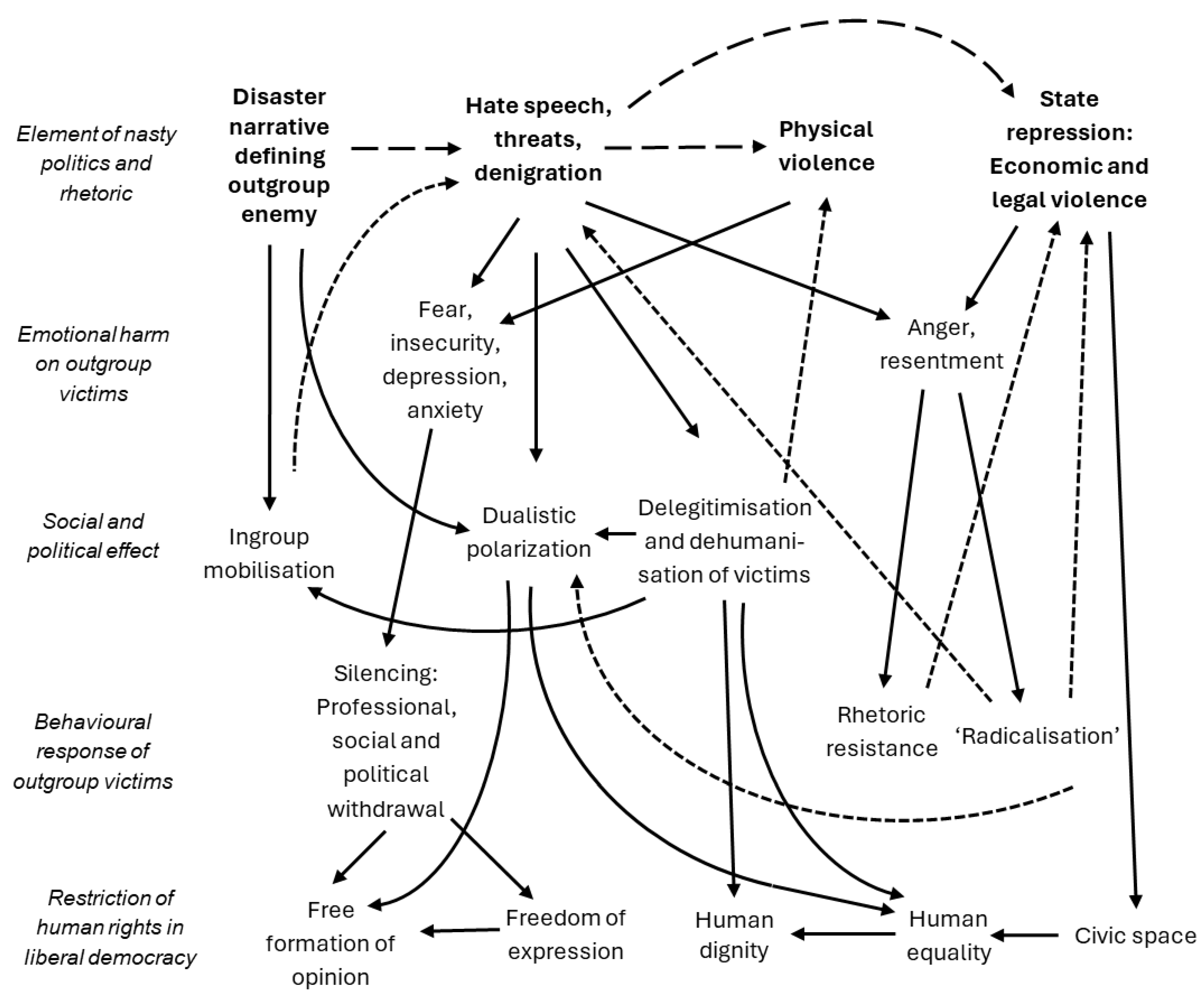
Figure 2.
Use and harms of nasty rhetoric in Swedish climate politics.
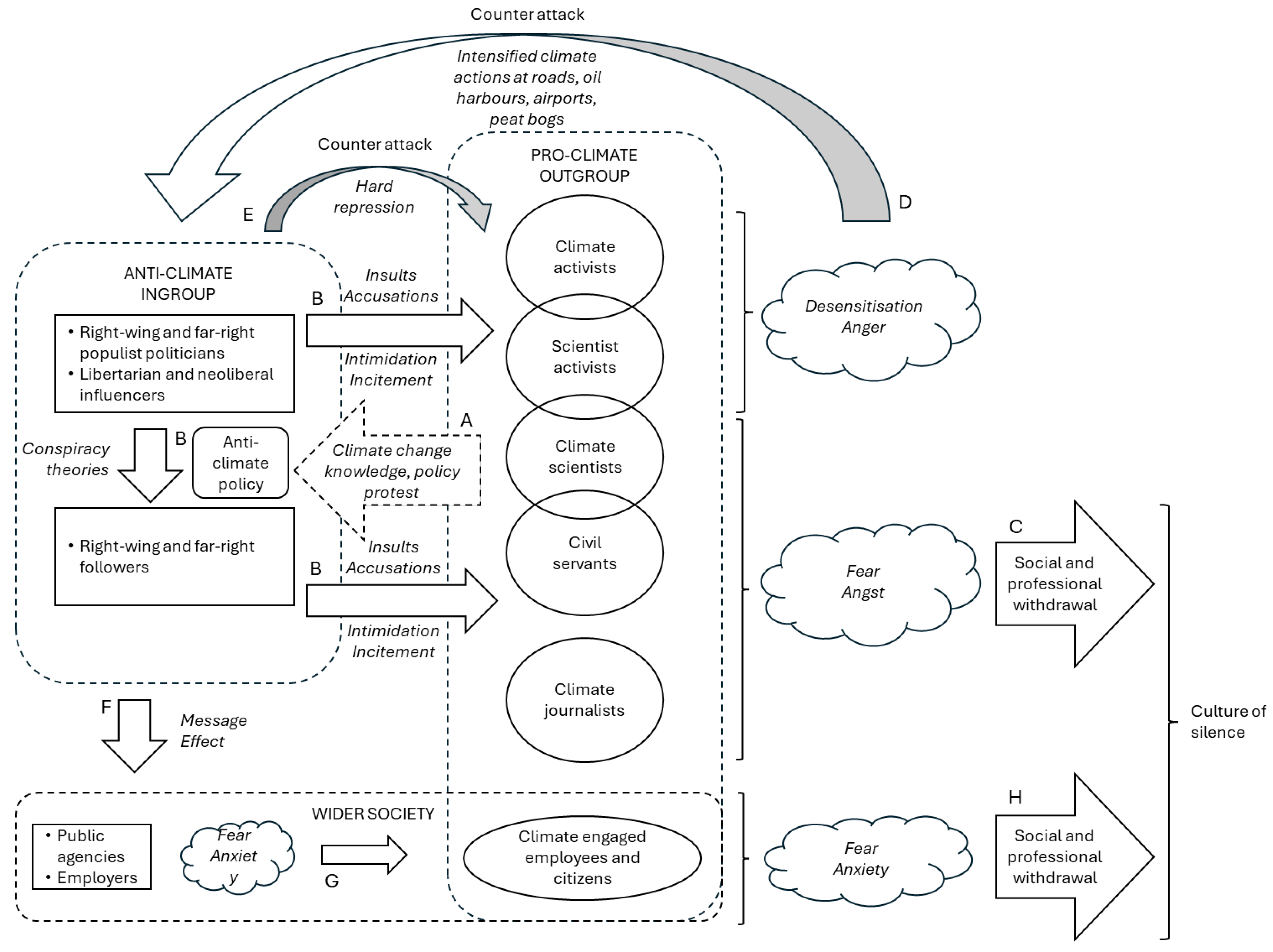

Table 1.
Typology of nasty rhetoric.
| Type of nasty rhetoric, hate speech/crime | Type of repression | Description | Level of aggression |
|---|---|---|---|
| Insults | Soft | Name-calling, including ridicule, hyperbole and caricature, that influences how people make judgement and interpret situations. Could sometimes include dehumanising and enmity rhetoric. | Hate |
| Accusations | Soft | Blaming opponents of doing something illegal or shady, or promulgating conspiracy theories about opponents, e.g. through hyperbole, caricature, exclusion or ejection. | Hate |
| Intimidations | Hard | Veiled threats advocating economic or legal action against an opponent, e.g., that they should get fired, be investigated or sent to prison. | Threat (psychological violence) |
| Incitements | Hard | The most aggressive type of rhetoric includes people threatening or encouraging sometimes fatal violence against opponents. If the statement is followed, which happens, it implies physical harm to, or in the worst case, death of opponents. | Threat (psychological violence) |
| Sanctions (repression) | Hard | Denunciation, detention, fines, imprisonment | Economic or legal violence |
| Physical violence | Hard | Assault, beating, rape, murder. | Physical violence |
Table 2.
Search terms for articles, editorials and op-eds.
| Activist | Crime | Emotion | Polarisation | Scientist |
| Aggression | Dehumanise | Fear | Politics | Silence |
| Anger | Democracy | Hate | Prison | Terrorist |
| Antidemocratic | Depression | Insecurity | Repression | Threat |
| Anxiety | Disappear | Journalist | Research | Violence |
Table 3.
Sources of secondary data.
| Type of media | Media source | No. of sources |
|---|---|---|
| Newspapers and magazines | Sub total | 107 |
| Aftonbladet (independent social democrat) | 16 | |
| Aktuell Hållbarhet (independent, green business) | 1 | |
| Altinget (independent) | 2 | |
| Arbetet (independent social democrat) | 1 | |
| Arbetsvärlden (labour union journal) | 1 | |
| Dagens Arena (independent progressive newspaper) | 2 | |
| Dagens ETC (independent left) | 12 | |
| Dagens Nyheter (independent liberal) | 37 | |
| Expressen (independent liberal) | 5 | |
| Fokus (independent right-wing) | 3 | |
| Fria Tider (far-right populist) | 1 | |
| Frihetsnytt (far-right populist) | 1 | |
| GöteborgsPosten (independent liberal) | 3 | |
| Läget (independent newspaper, published by students in journalism at Stockholm university) | 1 | |
| Landets Fria Tidning (independent green) | 1 | |
| Magasinet Konkret (independent liberal democratic) | 4 | |
| Publikt (journal of labour union for state employees) | 2 | |
| Riks (semi-independent far-right (SD)) | 1 | |
| Samnytt (independent far-right populist) | 1 | |
| SN Södermanlands Nyheter (independent social liberal) | 1 | |
| Svenska Dagbladet (independent conservative) | 10 | |
| Sveriges Natur (magazine of the Swedish Society for Nature Conservation) | 1 | |
| Tidningen Global (independent green liberal) | 1 | |
| Tidningen Syre (independent green liberal) | 10 | |
| Blogs | Sub total | 7 |
| Anna from the Swedish Energy Agency (personal) | 1* | |
| IFJ Blog (International Federation of Journalists) | 1 | |
| Klimataktion (climate activist) | 1 | |
| Motargument (independent green-left) | 1 | |
| Smedjan (independent libertarian, Timbro) | 1 | |
| Supermiljöbloggen (independent green deliberative) | 2 | |
| Podcasts | Sub-total | 4 |
| Statshemligheter (Podcast of ST, labour union for civil servants in the state) | 2 | |
| Två klimatpsykologer möter (Podcast by two professional climate psychologists) | 1 | |
| Yttrandefrihetspodden (Podcast on liberal democracy freedom of expression, Swedish PEN) | 1 | |
| Social media | Facebook, Instagram, Facebook, YouTube | 6 |
| National television |
Sub total Sveriges Television (public service) |
7 4 |
| TV4 (private) | 3 | |
| National radio | Sveriges Radio (public service): | 2 |
| All media | Sum total | 133 |
* This blog describes the hate and threats and reactions of a climate activist that lost her job due to her activism. It contains several sections describing the process. It also links all articles in Swedish and international press about the case.
Table 4.
Interviewees.
| Victim group | Code | Role | Gender | Cross-group membership | Type of interview | Interview period |
|---|---|---|---|---|---|---|
| Scientists | S1 | Professor climate policy | Male | - | Personal | Dec 2024 |
| S2 | Professor climate science | Male | . | Personal | June 2025 | |
| S3 | Assoc. professor environmental science | Male | - | Personal | Dec 2024 | |
| SA1 | Assoc. professor sustainability | Female | MR, SR | Personal | Jan 2025 | |
| SA2 | PhD psychology | Female | MR, SR, RW | Group | Nov 2024 | |
| SA3 | PhD psychology | Male | XR, SR | Group | Nov 2024 | |
| SA4 | PhD psychology | Male | XR | Group | Nov 2024 | |
| Journalists | J1 | Climate journalist, 20 years in the field | Female | - | Personal | Aug 2024 |
| J2 | Climate journalist, 3 years in the field | Female | - | Personal | June 2025 | |
| J3 | Climate journalist, 6 years in the field | Female | - | Personal | July 2025 | |
| Activists | A1 | Member of XR | Male | RW | Personal | Feb 2025 |
| A2 | Member of RW | Male | - | Personal | June 2025 | |
| A3 | Member of MR | Female | - | Personal | Mar 2025 | |
| A4–A19 | 16 members of XR, MR, FR, SR, RW, TBF | Female, male, non-binary | XR, MR, FR, SR, RW, TBF | Group | Jan 2025 |
Table 5.
Typology of victim responses to nasty rhetoric.
| Type of effect | Response |
|---|---|
| Emotional | Anger Anxiety Fear Frustration Hate Insecurity Resentment Self-hate Shame Vulnerability Worry |
| Cognitive | Confidence Desensitisation |
| Psychological | Angst Depression PTSD |
| Behavioural | Counterattack Resilience Resistance Robustness Self-policing, self-control Withdrawal (scientific, social, political) |
Based on Matsuda (1989), Lazarus (1991), Matsuda (1993), Frijda & Mesquita (1994), Calvert (1997), Lang et al. (2000), Stephan et al. (2009), Izard (2010), Keltner et al. (2014), Green & Pemberton (2017), Wagner & Morisi (2019), Jämte & Ellefsen (2020), Allwood et al. (2022), Cowan & Hodge (2022), Wachs et al. (2022), Renström et al. (2023), Dreißigacker et al. (2024), and Glad et al. (2024).
Disclaimer/Publisher’s Note: The statements, opinions and data contained in all publications are solely those of the individual author(s) and contributor(s) and not of MDPI and/or the editor(s). MDPI and/or the editor(s) disclaim responsibility for any injury to people or property resulting from any ideas, methods, instructions or products referred to in the content. |
© 2025 by the authors. Licensee MDPI, Basel, Switzerland. This article is an open access article distributed under the terms and conditions of the Creative Commons Attribution (CC BY) license (http://creativecommons.org/licenses/by/4.0/).
Copyright: This open access article is published under a Creative Commons CC BY 4.0 license, which permit the free download, distribution, and reuse, provided that the author and preprint are cited in any reuse.


