

Submitted:
21 February 2025
Posted:
24 February 2025
You are already at the latest version
Abstract
We proposed a moderation of transformational leadership based on the theoretical underpinning of Meyer, Becker, and Vandenberghe to address why the relationship between organizational commitment and employee efficiency varies. A sample of 163 junior sailors in the Sri Lanka Navy responded to a survey. The findings reported that the affective and normative commitment of junior sailors was positively associated with their work efficiency. However, the study did not report a significant relationship between senior sailors’ transformational leadership and junior sailors’ work efficiency and a moderating effect of the relationship between junior sailors’ organizational commitment and work efficiency. Given the significant roles of both affective and normative components of commitment, the study provides valuable insights into how to increase the work efficiency of junior sailors in the Navy. The absence of a moderating role of transformational leadership between junior sailors’ commitment and work efficiency reflects the context-specific nature of transformational leadership.
Keywords:
organizational commitment
; transformational leadership
; efficiency
; Sri Lanka
; junior sailors
; Navy
1. Introduction
In the current highly volatile work environment, retention of employees by building their commitment is a key challenge faced by managers. Therefore, there is continuous research attention on finding ways of building employee commitment. Committed employees are emotionally attached to the organization they work for and are willing to work for a longer future period (Uddin et al., 2019), and they contribute to higher performance (Baron & Chou, 2016) as well as a greater level of effectiveness and efficiency (Bartuseviciene and Sakalyte, 2013). The past literature generally indicates that commitment has a significant positive effect on employees’ rewards, turnover, efficiency, and performance (Behziun, Abdolazimi and Sahranavard, 2016; Nwankwo, Orga, and Abel,2019; Tett and Meyer 1993; Barber et al.,1999). In line with this argument, the scholars who conduct research on commitment claim that the affective and normative components of commitment positively relate to employee efficiency whereas continuance commitment negatively relates to employee efficiency (Giedrė & Auksė, 2013; Salman, Pourmehdi, and Hamidi, 2014). In contrast, some scholars have found that the relationships between job commitment, work efficiency, and performance are not significant (Mowday et al.,1982; Mthieu and Zajac, 1990). For example, some studies report that continuance commitment does not have a significant relationship with employee efficiency (Rumaizah et al.,2021, Mowday et al.,1982; Mthieu and Zajac, 1990). As some of the meta-analyses report, the reason for these mixed results is due to the existence of unexplained variance in this relationship (e.g., Jaramillo, Mulki, & Marshall, 2005; Mathieu & Zajac, 1990; Sungu, Weng, & Xu, 2019; Wright & Bonett, 2002) which suggests the presence of moderating variables. Consequently, scholars have called for empirical studies to identify the factors that regulate the relationship between organizational commitment and job performance (e.g., Meyer, Becker, & Vandenberghe, 2004; Sungu, Weng, & Xu, 2019; Wright & Bonett, 2002). Thus, the current study is conducted to respond to the demand for studies that enhance our understanding of under what conditions organizational commitment is strongly related to employee efficiency.
According to Meyer et al. (2004), one major reason for the heterogeneous nature of the relationship between organizational commitment and job performance is the effect of contextual factors. For example, leadership can be considered an important contextual factor in the workplace that strongly influences employees’ organizational behaviours (Bass & Riggio, 2006). Leadership is the ability of an individual or group of individuals to influence and guide the team or other members of the organization and make them work in a defined direction. The concept of leadership is considered one of the highly studied but less understood topics in organizational research (Bennis, 2019). Over the past years, a variety of leadership styles has been identified and studied, which mainly includes great man theory, traits theory, situational theories, behavioural theories, process theories, transformational theories, and transactional leadership theories out of which researchers have highly emphasized the transactional and transformational leadership styles (Ahmed, Allah and Irfanullah, 2016; Kariyawasam, 2020). Transformational leadership models are considered the most interesting leadership style and frequently researched leadership model among present-day scholars (Lowe and Gardner,2000; Dinh et al. 2014). Transformational leaders influence change the followers individually and collectively; encourage innovation and creativity, facilitate learning, and create inspiring a vision for the future (Mostafa, Claudine, and Carmen, 2015). Previous research suggests that transformational leadership has a significant positive impact on many employee level outcomes such as work performance (Khan, Rehmat & Butt 2020), organizational citizenship behviour & retention (Tian atel.,2020), organizational culture & organizational vision (Gathungu, Iravo & Namusonge, 2015) and work engagement (Hayati, Charkhabi & Naami, 2014). By developing and testing a theoretical model that explains transformational leadership as a moderator of the relationship between organizational commitment and employee efficiency, we contribute to the literature in four ways.
First, employees concurrently demonstrate multiple commitments. Thus, it is theoretically important to understand their interactions in influencing employee behavior (Cohen, 2003). The current study responds to the demand for studies exploring how multiple commitments influence employee behavior (e.g., Alqudah, Carballo-Penela, & Ruzo-Sanmartín, 2022; Cohen & Freund, 2005; Kim & Mueller, 2011; Sungu, Weng & XU, 2019). We bring an argument that employees with high commitment are more likely to motivate and perform better with their belief of high-performance leads to receiving support and resources for developing their careers. Thus, the current study enriches the commitment theory by hypothesizing that the different components of organizational commitment more strongly relate to work efficiency.
Second, we argue that transformational leadership as a contextual factor is important for explaining the heterogeneous nature of the commitment–efficiency relationshiTransformational leaders behave towards identifying their followers’ needs and providing support and resources for their followers to accomplish their goals (Bass, 1985; Bass & Riggio, 2006). Employees are likely to perceive a favourable and supportive work environment when transformational leadership is high and they exhibit high job performance (e.g., Piccolo & Colquitt, 2006). Consequently, we posit that organizational commitment will be more strongly related to employee efficiency under high transformational leadership.
Third, a contextual gap in the extant literature is filled by conducting this research in a developing country. That is, many researchers have defined leadership in different ways according to the context, culture, rules, laws, complexities, psychological context, and situations (Amabile et al.,2004; Shahin & Wright, 2004; Zheng, Wu, Xie, & Li, 2019). For instance, based on a study of Egyptian Investment Banks, Shahin & Wright (2004) revealed that the transformational and transactional leadership theories which were developed in the West are to be modified when they apply in other cultures. These variations do not allow us to generalize the findings of leadership studies to a particular country context which demands country-specific leadership studies.
Finally, prior studies reveal that transformational leadership promotes the relationship between human resource practices and employee behaviour (Marwa, Namusonge and Kilika, 2019) and the relationship between employee commitment and performance (Marwa, Namusonge and Kilika, 2019). A study conducted by Jansen, George, Bosch, & Volberda, (2008) found that the executive directors’ transformational leadership moderates the relationship between the senior teams’ commitment to the shared vision and the senior team’s effectiveness (Jansen, George, Bosch, & Volberda, 2008). In contrast to these findings, some research studies (e.g., Rafia, Sudiro & Sunaryo, 2020) found that transformational leadership doesn’t have a significant impact on organizational functions such as employee performance. Therefore, further investigation of the contingent nature of transformational leadership is required to understand how it translates through different demographic groups (Bass and Riggio, 2006). One of the less investigated demographic areas in transformational leadership is the hierarchical level of leaders (Avolio and Bass, 1991; Ivey and Kline, 2010). In general, the leadership hierarchy of military organizations operates more frequently under an authoritarian style of leadership (Waddle, 1994; Turner & Lloyd-Walker, 2008; Warne, 2000). Therefore, leaders in the defense environment tend to have an autocratic leadership style who direct the progress of the followers to do the work and accomplish the mission (Waddle, 1994). However, more traditional leadership responsibilities such as maintaining order and discipline are no longer adequate for accomplishing the goals of military organizations (Scoppio, 2009). Therefore, prior studies claim that transformational leadership better supports the success of military organizations (Nissinen, Dormantaite, & Dungveckis, 2022; Robbinson, Mckenna, & Rooney; 2022).
The existing studies on military leadership reveal that transformational leadership exists at all levels but, the frequency of those behaviors is different at different leader levels. (Bass et al., 2003; Bass, 1985; Kane and Tremble, 2000). Therefore, our study makes a significant contribution by responding to the demand for exploring transformational leadership to understand how it translates through different demographic groups (Bass and Riggio, 2006). Our study sample is from military leaders as one of the less investigated demographic groups (Avolio and Bass, 1991; Ivey and Kline, 2010). The existence of transformational leadership within Sri Lankan defense forces is highlighted by many studies (Bass, 1997; Jayawardana, 2020) which motivated us to conduct our study with junior sailors of the Sri Lanka Navy. In sum, by developing a model in the premise of theory (see Figure 1), this study explains the relationship between organizational commitment and employee efficiency.
2. Literature Review and Hypotheses
2.1. Work Efficiency
In the current competitive environment employers focus on the increase of their employees’ efficiency and productivity by supporting them to enhance their skills and competencies (Dwivedi, Chaturvedi, & Kishore Vashist, 2020; Dissanayake et al., 2022; Apostu et al., 2022; Hysa, 2014; Panait et al., 2022; Foote & Hysa, 2022). Therefore, employers force their employees to work more efficiently by saving time and shaping the way they work as per the sophisticated technology (Holland and Bardoel, 2016). Effectiveness and efficiency are considered as the key performance indicators in organizations (Moozas, 2006; Low, 2000; Iddagoda et al., 2021). There are different conceptualizations of efficiency in different contexts (Rutgers and van der Meer, 2010). For instance, efficiency is categorized as business efficiency, operational efficiency, cost efficiency and employee efficiency (Pinprayong and Siengthai, 2012). Similarly, Bartusevicienė & Sakalytė (2013) and Chavan (2009) have explained work efficiency as how optimally the input is used for the output whereas Taylor (1992) explains the efficiency as completing the task well and timely manner. Johansson & Lofgren (1996) and Rainey (1997) have identified the efficiency as the production made by minimum cost while maintaining the product quality. According to Chavan (2009) efficiency is the utilization of available resources in an optimum manner to achieve the determined objectives. Present day work efficiency is the trade-off between pay and required results and best utilization of resources (Rutgers and van der Meer, 2010). The public sector, efficiency of employees differs from the private sector due to unique characteristics such as ownership and profit orientation. Therefore, apart from technical efficiency of input output ratio, the public sector efficiency has been defined as good administration (Frederickson, Smith, 2003).
2.2. Organizational Commitment and Employee Efficiency
Organizational commitment has been defined by Mowday, Steers & Porter (1979) as the individual strength of understanding and contribution to the organization. It is also defined by Nijhof, De Jong and Beukhof (1998) as the willingness to continue with the organization whilst agreeing with and supporting organizational values. Further, level of commitment differs from person to person based on perception and loyalty and it is decided the level of engagement in goal accomplishment to the organization (Allen & Meyer, 1996). According to Wombacher and Felfe (2017), organizational commitment is a basic component in analyzing and clarifying the employee’s behaviours in their organization. Furthermore, committed employees increase job desire (Allen & Meyer, 1990; Mowday et al., 1979; Tuna et al., 2016), job satisfaction, and engagement (Toor & Ofori, 2009; Tuna et al., 2011). Committed employees are key stakeholders in achieving organizational aims and objectives (Tuna et al., 2011) and enhance the effectiveness as well as efficiency (Singh and Gupta, 2015).
A three-dimensional model has been developed by Allen and Meyer (1990) which has been utilized by many researchers for contemporary commitment-related studies (Tuna et al., 2016, Abdullah, 2011; Karim & Noor, 2006; Alam, 2014). As per Allen and Mayer (1990) the organizational commitment comprises three components including affective commitment, normative commitment, and continuance commitment. Affective commitment means employees’ emotional bond with the organization and enjoyment of living with the organization. Continuous commitment denotes the encouragement of employees to remain in the same organization due to the fear of losing the existing comfort. Normative commitment is a result of the obligation to the organization and employee interest in the job, and loyalty to the firm. It has been proven that a significant relationship exists between employee commitment and employee efficiency (Nwankwo, Orga and Abel, 2019; Walker Information Inc., 2000; Tett and Meyer, 1993; Barber et al., 1999). Moreover, Behziun, Abdolazimi and Sahranavard (2016) revealed that there are significant relationships between all three dimensions of affective commitment, normative commitment, continuance commitment, and efficiency of the employees. Linked to this argument, some scholars claim that the affective and normative components of commitment positively relate to employee efficiency whereas continuance commitment negatively relates to employee efficiency (Giedrė & Auksė, 2013; Salman, Pourmehdi, and Hamidi, 2014).
Hypothesis-1: There is a significant positive relationship between junior sailors’ (a) affective commitment, (b) normative commitment, and efficiency, whereas (c) a significant negative relationship exists between junior sailors’ continuous commitment and their efficiency.
2.3. Transformational Leadership and Employee Efficiency
As suggested by Meyer et al. (2004), contextual factors affect the relationship between organizational commitment and job performance as such leadership can be considered an important contextual factor in the workplace that strongly influences employees’ organizational behaviours (Bass & Riggio, 2006). Therefore, among many contextual factors affecting employee efficiency and productivity, effective leadership plays an integral role (Turner and Muller, 2005). Transformational leadership is a positive significant influencer of employee performance (Al-Amin, 2017; Buil, Martínez, & Matute,2019), employee efficiency (Dwivedi, Chaturvedi & Vashist, 2020, Khan et al., 2014), and enable them to deliver outstanding outcomes.
Hypothesis-2: Transformational leadership of the senior sailors has a significant positive effect on junior sailors’ work efficiency.
2.4. Moderating Effect of Transformational Leadership on Employee Commitment and Efficiency
Transformational leaders inspire, empower, and stimulate followers to go beyond their normal level of performance (Bass, 1985; Bass & Riggio, 2006; Wang & Rode, 2010; Yukl, 1999). Bass (1999) claimed that transformational leadership shifts “the follower beyond immediate self-interest through idealized influence (charisma), inspiration, intellectual stimulation, or individualized consideration” (11). Transformational leadership plays an important role in determining employee job performance (Dvir, Eden, Avolio, & Shamir, 2002) and, consequently, is regarded as an important context for examining the effect of organizational commitment on job performance (Meyer et al., 2004).
Previous studies suggest that transformational leadership enhances the relationship between HRM practices and employee behaviour. (Marwa, Namusonge & Kilika, 2019). Moreover, committed employees demonstrate higher performance when they are led by transformational leaders (Marwa, Namusonge, and Kilika, 2019). This claim is valid even for higher levels in the organizational hierarchy. For example, Jansen, George, Bosch, & Volberda, (2008) revealed that the commitment to the organization’s shared vision by the senior team positively impacts their team’s effectiveness when the executive director demonstrates transformational leadership.
Transformational leadership encourages followers to go beyond their short-term interests and focus more on best interest of the organization and their long-term professional development (Bass & Riggio, 2006; Sungu, Weng, & Xu, 2019). Consequently, employees will perceive a more enabling work environment under high transformational leadership as compared to low transformational leadership.
In the current study, we argue that transformational leadership leads highly committed employees to exhibit high job efficiency. Employees with low organizational commitment, however, have little motivation to exert effort for the good of the organization (Wright & Bonett, 2002). Therefore, high transformational leadership is less likely to influence their job performance. We, therefore, suggest that the relationship between organizational commitment and employee efficiency will be stronger under high as compared with low transformational leadership.
Hypothesis-3: Senior sailors’ transformational leadership moderates the relationship between junior sailors (A) Affective Commitment, (B) Normative Commitment, and (C) Continuance Commitment and efficiency such that the relationship is stronger when the transformational leadership is high.
3. Methodology
3.1. Data Collection and Participants
The population of this study was 690 junior sailors who work in the writer branch of the Sri Lanka Navy out of which a random sample of 250 respondents were selected. This sample was greater than the acceptable sample size under the 5% margin of error (Krejcie and Morgan, 1970). However, only 163 junior sailors responded resulting 65.2% of response rate. The study employed several previously published measures after the appropriate minor modifications to align with the opinions of the junior sailors in the Sri Lanka Navy. All survey items had response options ranging from (1) to (5), representing ‘strongly disagree’ (1) to ‘strongly agree’ (5). Structured questionnaires were translated into Sinhalese and distributed through the internal mailmen. The internal telephone line was also used to provide essential guidance on completing the survey. The constructs were evaluated prior to the testing of the hypothesized structural model to ensure discriminant validity between the three variables in the model.
3.2. Measures
Transformational leadership was operationalized as inspirational motivation, intellectual stimulation, idealized influence, and individualized consideration (Bass & Avoli (1990) and was measured by the scale adapted by the well-known Bass and Avolio (1990) multifactor transformational leadership questionnaire. Sample scale items are: “My Senior sailors always discuss with me the values and beliefs of the Sri Lanka Navy” and “Senior sailors are always talking optimistically about the future.” More recent studies have also used this scale to measure transformational leadership (e.g., Coleman & Donoher, 2022; Hollingsworth, Sun, Hinojosa, & De la Garza,2022; Labrague & Obeidat, 2022). Participants indicated the frequency with which their superiors initiated the four main components that define transformational leadership: idealized influence (6 items), inspirational motivation (3 items), individualized consideration (4 items), and intellectual stimulation (3 items).
Organizational commitment was operationalized with Allen and Meyer’s (1990) three-dimensional model of organizational commitment which include affective commitment, normative commitment, and continuous commitment. The affective commitment was measured using four items from Meyer and Allen’s (1990) affective commitment scale. Sample items are, “I like to spend the rest of my career in Sri Lanka Navy” and “I feel a strong sense of belonging to this organization. The normative commitment was measured using three items from Meyer and Allen’s (1990) normative commitment scale, which identifies a moral responsibility to stay. Some of the sample items are, “I don’t feel to leave from Sri Lanka Navy” and “I am very much loyal to this organization”. Continuance commitment was measured with the four-item continuance commitment scale designed by Meyer and Allen (1990). Sample scale items are, “My life would be disrupted too much if I leave from Sri Lanka Navy” and “I stay in Sri Lanka Navy due to availability of few or no alternatives.” These commitment scales have been applied by many researchers around the globe for their studies and required reliability and validity have been proven (Abdullah, 2011; Heidari, HoseinPour, Ardebili, & Yoosefee, 2022; Hysa & Rehman, 2019; Karim & Noor, 2006; Love & Stemer, 2022).
Work efficiency is defined in this research as the optimal usage of time, resources, and personal skills of employees for better outcomes in terms of expected work quantity and quality (Sori,2013) and the efficiency questionnaire developed by the same author was applied for measuring work efficiency. Recent studies (Dwivedi, Chaturvedi & Vashist, 2020; Millar, 2006) have also used this efficiency scale to measure employee efficiency. Participants indicated the frequency with which their perceptions of their own efficiency with four main components that define work efficiency: quantity of work (4 items), quality of work (4 items), punctuality (4 items), resource usage (5 items), and personal skills (3 items). Sample scale items are, “I always try to complete assigned daily workload” and “I always try to take optimum utilization of resources in my office.”
4. Data Analysis and Results
The demographic data indicates that 83.44% of the sample were male respondents and only 16.56% of were female respondents. Most of the respondents, 67.48% were aged between 26 to 35 whereas 10.43% were aged between 18 to 25 years. Out of the participants, 22.09% were who were in the age range of 36 to 45 years old. In terms of the tenure of the junior sailors, only 1.23% of sample served more than 21 years while 5.52% of the sample served between 16 to 20 years in Sri Lanka Navy. Junior sailors with 11 to 15 years of service were 50.92% and only 11.66% had 1 to 5 years of service.
The main aim of this research is to investigate the moderating role of senior sailors’ leadership on the relationship of junior sailors’ affective commitment, continuance commitment, and normative commitment with work efficiency in the writer branch of the Sri Lanka Navy. To analyze the collected data, Structural Equation Modelling (SEM) technique along with partial Least Square (PLS) was applied using smart PLS 4.0 software. A two-step approach was used to evaluate the data set namely measurement model analysis and structural model analysis. The measurement model evaluates parameter measurement such as reliability and validity of the data set and the structural model evaluates the conceptual relationship or correlations between the parameters among the variable. If the measurement model is not reliable and valid, structural model could be inaccurate (Hair et al., 2017). This study had the second order reflective construct, and two stages approach was applied for the analysis as Lower Order Construct (LOC) and Higher Order Construct (HOC). LOC measurement model was built to evaluate the reliability and validity of the data set and due to reliability and validity issues indicators RU 2 and RU 4 were deleted from the model. Then the scores obtained from the LOC measurement model used as manifest variables for HOC model.
Figure 2 illustrates the HOC measurement model and factor loading. Model validity and reliability were tested using internal consistency reliability, individual indicator reliability, convergent validity, and discriminant validity.
Internal consistency of the construct is measured through composite reliability (CR). It emphasizes the degree of individual indicators representing the latent construct. If the CR is greater than 0.7 is the accepted range and if it is closer to 0.9 indicated the higher internal consistency. As per Table 1, all the CR values are greater than 0.7 and it indicates the model is satisfying the required internal consistency reliability. On the other hand, Cronbach’s alpha value should be greater than 0.7 to satisfy the internal consistency. Table 1 exhibits the Cronbash’s alpha of HOC model and required conditions were satisfied except NC. However, composite reliability for the NC is greater than 0.70. Therefore, a higher level of internal consistency reliability has achieved for all the dimensions of the LOC construct.
Individual indicator reliability indicates through the outer loading estimates, and it should be greater than 0.70 (Hair et al., 2011). However, Henseler et al. (2009) & Hair et al. (2017) has argued that if the individual item reliability is greater than 0.5 and other measures are in sufficient standard, indicators should not be deleted. As per Figure 1 and Table 2 all the factor loadings were greater than 0.50 and satisfied the individual item reliability.
Convergent validity was measured through the Average Variance Extracted (AVE) and it is explained by the number of variances that indicator of reflective construct converges with each other. If the AVE is greater than 0.50, it is accepted as sufficient level of convergent validity (Hair, Ringle, et al., 2011). As per Table 1 all AVE values are greater than 0.50 except continuance commitment. However, Allen & Meyers’ (1990) validated three-dimensional model was used by the researcher for this study and therefore the indicator was retained.
Discriminant validity is explained as the distinction of the constructs each other in the model. Discriminant validity is measured through Fornell–Larcker criterion, cross loading and HTMT of measurement model of the LOC (Hair et al.,2014). If the square root of each construct’s AVE should be greater than its correlations with any other construct, discriminant validity is satisfied (Hair et al.,2014). The Fornell-Larcker criterion of the model is represented in Table 3 and all the values under the diagonal is lower than its diagonal values. Therefore, it can be concluded that the required rate of discriminant variability of the data has been satisfied by the model.
When an indicator’s outer loading onto its associated construct is greater than any of its cross-loading onto other constructs, the discriminant validity is established (Fornell & Larcker, 1981). Table 4 shows the cross-loading of the model, and it confirmed the sufficient level of discriminant validity.
HTMT values indicate the true correlation between two perfectly reliable latent variables, when the HTMT values are greater than 0.90 is considered as lack of discriminant validity. (Henseler, Ringle, & Sarstedt, 2015). Corresponding HTMT estimations are represented in Table 5. The HOC model satisfied the required Heterotrait - monotrait Ratio.
In a structural model, the indicators are expected to free from a highly correlated state called multicollinearity (Jarvis et al., 2003). Multicollinearity can lead to their bias estimation of weights and statistical significance (Hair et al., 2017). As per Table 6 all the VIF values are less than 5 and therefore, Multicollinearity effect does not exist with the model (Hair et al., 2011).
The structural model was constructed to evaluate the relationships between variables after the HOC model confirmed the reliability and validity. To evaluate the structural model, the significance and relevance of the structural model relationship and coefficient of determination were examined. As per Table 7, R2 value of this model is 0.645 and it explained that 64.5% of the variance of work efficiency by the AC, CC, and NC of the junior sailors and transformational leadership of senior sailors in the writer branch of the Sri Lanka Navy.
This study is aimed to assess the moderation impact of the senior sailors’ transformational leadership upon the relationship between junior sailors’ affective commitment, continuance commitment and normative commitment with work efficiency in writer branch in SLN. Corresponding path coefficient results of this model is illustrated as Figure 3 and Table 8.
As per the Figure 2 and Table 8, the relationship between affective commitment and work efficiency is significant at the 0.05 of significance level and corresponding Beta value is 0.337 (B = 0.337; P = 0.000). Further, the relationship between normative commitment (NC) and work efficiency of the population is significant at the 0.05 significant level and beta value is 0.439 (B = 0.439; P = 0.000). Therefore, it is indicated that a medium level of significant positive relationships exists between both affective commitment (AC) and normative commitment (CC) with the work efficiency. However, the relationship between continuance commitment (CC) and work efficiency is not significant under the 0.05 significant level (B = -0.072; P = 0.241). On the other hand, it is found that there is no significant impact of the senior sailors’ transformational leadership on the junior sailors’ work efficiency (B = 0.096; P = 0.263).
The moderation impact of senior sailors’ transformational leadership on the relationship between junior sailors’ affective commitment, continuance commitment and normative commitment with work efficiency was evaluated. However, it is found that the moderation impact of senior sailors’ transformational leadership on the relationship between affective commitment, continuance commitment and normative commitment with junior sailor’s work efficiency were not significant under 5% of significance level for all the three relationships. Therefore, it can be concluded that there is no significant moderating impact of senior sailors’ transformational leadership on the relationship between junior sailors’ affective commitment, continuance commitment and normative commitment with junior sailors’ work efficiency.
5. Discussion
Previous studies suggest that the three components of commitment (Allen & Mayer, 1990) have significant positive relationships with employee efficiency (Behziun et al., 2016; Giedrė & Auksė, 2013; Nwankwo, Orga and Abel, 2019; Salman et al., 2014; Walker Information Inc., 2000; Tett and Meyer, 1993; Barber et al., 1999). However, the current research supports these findings only for affective and normative commitment. Therefore, the study did not report a significant relationship between continuance commitment and employee efficiency. This outcome is contrary to the previous study findings which state that the continuance commitment improves the organizational effectiveness of the employees (Salman, Pourmehdi, and Hamidi, 2014; Giedrė & Auksė 2013; Mowday et al.,1982; Mthieu and Zajac, 1990). Contrary to previous studies (Dwivedi, Chaturvedi & Vashist, 2020, Khan et al., 2014) the current study does not report a significant relationship between transformational leadership and employee efficiency. This outcome may be because the leadership hierarchy of military organizations operates more frequently under an authoritarian style of leadership (Waddle, 1994; Turner & Lloyd-Walker, 2008; Warne, 2000).
A positive significant moderation effect of transformational leadership on the relationship between organizational culture and employee effectiveness was found in a study conducted by Ayeman and Mohi-Adden (2019). The research conducted by Bellibaş et al. (2021) suggests that transformational leadership plays a significant moderating effect on the association between human capital and organizational innovations. Therefore, many of the organizational functions are energized by the leaders’ transformational style. In contrast to prior studies, this research found that transformational leadership is not a factor that enhances the relationships of affective commitment, continuance commitment, and normative commitment with work efficiency.
5.1. Theoretical Implications
The findings of the study contribute to the literature in three ways. First, as supported by the study, the affective and normative components of commitment positively influence employee efficiency. These outcomes enrich Allen and Mayer’s (1990) three-component model of commitment and advance our understanding of the interactions of different commitment components with employee efficiency. Second, the absence of a moderating effect of transformational leadership between employee commitment and efficiency supports the claim that transformational leadership is a contextual factor. Therefore, transformational leadership is dependent on the culture, rules, laws, complexities, psychological context, and situations (Amabile et al.,2004; Shahin & Wright, 2004; Zheng, Wu, Xie, & Li, 2019). Finally, the study validated Bass and Avolio’s (1990) transformational leadership questionnaire, Allen, and Meyer’s (1990) questionnaire of the three-dimensional model of organizational commitment, and the efficiency questionnaire developed by Sori (2013) in a non-western context.
5.2. Practical Implications
Our findings could benefit the practice in two ways. First, the weak relationships between affective commitment, normative commitment, and employee efficiency suggest that the Sri Lanka Navy should take measures to build the commitment of junior sailors. Highly committed employees are less likely to leave their employer and more likely to demonstrate higher performance (Tett & Meyer, 1993). Sri Lanka Navy could implement various types of practices such as providing support, rewarding employees fairly, and creating procedural justice to enhance the junior sailors’ affective attachment. In terms of support, caring about the employee’s well-being and treating them fairly, considering the employee’s goals and values, helping when employees need a favor or have a problem and forgiving mistakes are some of the practices that can be proposed. Procedural justice can be assured by communicating decisions transparently, getting employee involvement in making important decisions, and listening to the employee’s voices. Sri Lanka Navy should revisit the existing reward system and should implement programs to recognize junior sailors’ contributions with financial and non-financial rewards. They should also provide opportunities for advancement. Senior sailors should show their concern for the junior sailors and their wellbeing. Finally, the absence of a significant effect of transformational leadership on junior sailors, efficiency may be because of the dominance of authoritative leadership in the Sri Lanka Navy. Therefore, leadership training programs should be offered to senior sailors for developing their leadership skills. The current study would also benefit non-military organizations by signaling the significance of enhancing employee affective and normative commitment to boost employee work efficiency. Therefore, previously mentioned commitment enhancing practices should be implemented toward the employees.
6. Conclusions, Limitations and Directions for Future Research
Employee commitment and the transformational leadership (Becker, et al., 1996; Buil, Martínez, & Matute, 2019; Nugroho et al., 2020) of an organization leads to higher performance of its employees. The current study found that the junior sailors in Sri Lanka Navy who are with affective and normative commitment demonstrate a high level of efficiency. However, with the introduction of transformational leadership as a moderator the study did not report a significant effect of junior sailors’ commitment on their work efficiency. This evidence can be further used to understand how organizational commitment leads to enhancing employee work efficiency.
As limitations and directions for future research, it can be stated that this study is conducted based on the junior sailors in the Navy which is an environment with a highly bureaucratic structure where the employees are controlled with strict rules and regulations. Therefore, responses may not be honest opinions of the respondents. Therefore, future research studies should focus on multiple sources of information such as interviews and focus group discussions. The findings cannot be generalized to the entire Navy since the study is based only on junior sailors. Therefore, future studies should select a sample with all the employee categories for enhancing the generalizability of findings to the Navy. A qualitative study could be conducted to explore the reasons for the outcomes of the current study. It has been observed in previous studies that very little or no such research has been conducted in defence forces. Thus, the same study could be replicated in other defense forces such as Army and the Airforce in Sri Lanka and internationally.
References
- Abdul Karim, N. H. and Mohammd Noor, N. H. N. Evaluating the Psychometric Properties of Allen and Meyer’s Organizational Commitment Scale: A Cross-Cultural Application among Malaysian Academic Librarians, Malaysian Journal of Library & amp; Information Science 2017, 11, 89–101.
- Abdullah, A. Evaluation of Allen and Meyer Organizational Commitment Scale: A Cross-Cultural Application in Pakistan. Journal of Education and Vocational Research 2011, 1, 80–86. [CrossRef]
- Ahmed, K., Allah, N. and Irfanullah, K. ‘Leadership theories and styles: A literature review’, Journal of Resources Development and Management 2016, 16, 1–7.
- Alam, A. (2014) ‘Evaluation of Allen and Meyer’ s Organizational Commitment Scale: A Cross- Cultural Application in Pakistan.
- Al-Amin, M. Transformational leadership and employee performance mediating effect of employee engagement. North South Business Review 2017, 7, 28–40.
- Allen, N. J., & Meyer, J. Affective, continuance, and normative commitment to the organization: An examination of construct validity. Journal of Vocational Behavior 1996, 49, 252–276. [CrossRef]
- Alqudah, I.H., Carballo-Penela, A. and Ruzo-Sanmartín, E. High-performance human resource management practices and readiness for change: An integrative model including affective commitment, employees’ performance, and the moderating role of hierarchy culture. European Research on Management and Business Economics 2022, 28, p.100177. [CrossRef]
- Amabile, T. M., Schatzel, E. A., Moneta, G. B., & Kramer, S. J. Leader behaviors and the work environment for creativity: Perceived leader support. The Leadership Quarterly 2004, 15 , 5–32. [CrossRef]
- Apostu, S. A., Mukli, L., Panait, M., Gigauri, I., & Hysa, E. Economic growth through the lenses of education, entrepreneurship, and innovation. Administrative Sciences 2022, 12, 74. [CrossRef]
- Avolio, B. J. &. B. B. M., 1993. Cross Generations: A Full Range Leadership Development. Binghamton, NY: Centre for Leadership Studies, Binghamton skillsity.
- Avolio, B. J. and Bass, B. M. ‘Multifactor Leadership Questionnaire’, Mlq 2004, 29.
- Avolio, B.J., Bass, B.M. and Jung, D.I. “Re-examining the components of transformational and transactional leadership using the multifactor leadership”, Journal of Occupational and Organizational Psychology 1999, 72, 441–462. [CrossRef]
- Barber L, Hayday S, Bevan S From people to profits, IES Report 1999, 355.
- Baron, R.M. and Kenny, D.A. The moderator–mediator variable distinction in social psychological research: Conceptual, strategic, and statistical considerations. Journal of personality and social psychology 1986, 51, 1173.
- Barron, K., & Chou, S. Y. Developing normative commitment as a consequence of receiving help: The moderated mediating roles of team-member exchange and individualism/collectivism—A multi-level model. Journal of Management Sciences 2016, 3, 141–158. [CrossRef]
- Bass, B. M. Does the transactional–transformational leadership paradigm transcend organizational and national boundaries? American psychologist 1997, 52, p.130.
- Bass, B.M. & Avolio, B.J. (Eds.). Improving organizational effectiveness through transformational leadershiThousand Oaks, CA: Sage Publications. 1994.
- Bass, B.M. Two decades of research and development in transformational leadershiEuropean journal of work and organizational psychology 1999, 8, 9–32.
- Becker, T. E., Billings, R. S., Eveleth, D. M., & Gilbert, N. L. Foci and bases of employee commitment: Implications for job performance. Academy of management journal 1996, 39, 464–482. [CrossRef]
- Behziun, H., Abdolazimi, J. and Sahranavard, A. ‘Relationship between Organizational Commitment and efficiency of employees’, Asian Journal of Research in Social Sciences and Humanities 2016, 6, 676.
- Bennis, W. 2009, On Becoming a Leader, Basic Books, New York.
- Buil, I., Martínez, E., & Matute, J. Transformational leadership and employee performance: The role of identification, engagement and proactive personality. International journal of hospitality management 2019, 77, 64–75.
- Chavan M. The balanced scorecard: a new challenge. Journal of Management Development 2009, 28, 393–406.
- Coleman, R. A., & Donoher, W. J. Looking Beyond the Dyad: How Transformational Leadership Affects Leader–Member Exchange Quality and Outcomes. Journal of Leadership Studies 2022, 15, 6–17.
- Dinha JE, Lord RG, Gardner WL, Meuser JD, Liden RC and Hu J ‘Leadership theory and research in the new millennium: Current theoretical trends and changing perspectives’, Leadership Quarterly 2014, 25, 36–62.
- Dissanayake, H., Iddagoda, A., & Popescu, C. Entrepreneurial education at universities: A bibliometric analysis. Administrative Sciences 2022, 12, 185.
- Dwivedi, P., Chaturvedi, V. and Vashist, J.K., . Transformational leadership and employee efficiency: knowledge sharing as mediator. Benchmarking: An International Journal 2020, 27, 1571–1590.
- Esen, M., Bellibas, M.S. and Gumus, S., The evolution of leadership research in higher education for two decades (1995-2014): A bibliometric and content analysis. International Journal of Leadership in Education 2020, 23, 259–273.
- Faisal Habtoosh, A. and Al-Qutop, M.-A. Y. ‘The Moderating Effect of Transformational Leadership on the Relationship between Organizational Culture and Organizational Effectiveness: An Empirical Study in Food Companies Listed at the Amman Stock Exchange-Jordan’, International Journal of Business and Management 2019, 14, 157.
- Foote, R., & Hysa, E. (2022). Improving operational–developmental connections: creating positive “butterfly effects” in universities. In Governance and Management in Higher Education (57-70). Emerald Publishing Limited.
- Fornell, C., & Larcker, D. F. (1981). Structural Equation Models with Unobservable Variables and Measurement Error: Algebra and Statistics.
- Frederickson, H. G., & Smith, K. B. (2003). The public administration theory primer.Boulder, CO: Westview.
- Gathungu, E. W. M., Iravo, M. A. and Namusonge, G. S. (2015) ‘Transformational Leadership and Employee Commitment: Empirical Review Transformational Leadership and Employee ’ s Commitment: Empirical Review.
- Giedrė, G. J., Auksė, E. ‘Employees’ Organizational Commitment: Its Negative Aspects for Organizations’, Science Direct 2013, 140, 558–564.
- Gilbert, & Sukanebari, E. ‘Continuance Commitment and Organisational Performance of Manufacturing Firms in Port Harcourt, Nigeria’. International Journal of Innovative Social Sciences & Humanities Research 2020, 8, 80–91.
- Gillet, N., Morin, A. J., & Blais, A. R. (2022). A Multilevel Person-Centered Perspective on the Role of Job Demands and Resources for Employees’ Job Engagement and Burnout Profiles. Group & Organization Management.
- Habtoosh, A. F., & Al-Qutop, M. A. Y. The Moderating Effect of Transformational Leadership on the Relationship between Organizational Culture and Organizational Effectiveness: An Empirical Study in Food Companies Listed at the Amman Stock Exchange-Jordan. International Journal of Business and Management 2019, 14, 157–170.
- Hair, J. F., Ringle, C. M., & Sarstedt, M. (2011). PLS-SEM: Indeed a silver.
- Haryanto, B., Suprapti, A. R., Taufik, A., & Maminirina Fenitra, R. Moderating role of transformational leadership in the relationship between work conflict and employee performance. Cogent Business & Management 2022, 9.
- Hayati, D., Charkhabi, M. & Naami, A, The relationship between transformational leadership and work engagement in governmental hospitals nurses: a survey study. SpringerPlus 2014, 3, 25.
- Heidari, M., HoseinPour, M. A., Ardebili, M., & Yoosefee, S. The association of the spiritual health and psychological well-being of teachers with their organizational commitment. BMC psychology 2022, 10, 1–7.
- Henseler, J. F., Ringle, C. M., & Sarstedt, M. A new criterion for assessing discriminant validity in variance-based structural equation modeling. Journal of the Academy of Marketing Science 2015, 43, 115–135.
- Henseler, J., Ringle, C.H., & Sinkovics, R.R. The use of partial least squares path modeling in international marketing. New Challenges to International Marketing Advances in International Marketing 2009, 20, 277–319.
- Holland, and Bardoel, A. “The impact of technology on work in the twenty-first century: exploring the smart and dark side”, International Journal of Human Resource Management 2016, 27, 2579–2581.
- Hollingsworth, T., Sun, Y., Hinojosa, B., & De la Garza, B. Transformational Leadership During COVID–19: Does Leadership Style Impact Leader Holistic Wellbeing. J. Educ. Soc. Dev 2022, 6, 7–18.
- Hysa, E. Defining a 21st century education: Case study of development and growth course. Mediterranean Journal of Social Sciences 2014, 5, 41–46.
- Hysa, E., & Rehman, U. N. Assessing the teaching quality of economics programme: instructor course evaluations. Интeгpaция oбpaзoвaния 2019, 23, 556–567.
- Iddagoda, A., Hysa, E., Bulińska-Stangrecka, H., & Manta, O. Green work-life balance and greenwashing the construct of work-life balance: Myth and reality. Energies 2021, 14, 4556.
- Indrayanto, A., Burgess, J., & Dayaram, K. (2014). A case study of transformational leadership and para-police performance in Indonesia. Policing: An International Journal of Police Strategies & Management.
- Jansen, J. J. P., Van Den Bosch, F. A. J. and Volberda, H. W. ‘Exploratory innovation, exploitative innovation, and performance: effects of organizational antecedents and environmental moderators’. Management Science 2006, 52, 1661–74.
- Jarvis, C. B., MacKenzie, S. B., & Podsakoff, M. A critical review of construct indicators and measurement model misspecification in marketing and consumer research. Journal of Consumer Research 2003, 30, 199–218.
- Jayawardane, T. V. (2020). Role of defence forces of Sri Lanka during the covid-19 outbreak for nations branding.
- Johansson, O., & Lofgren, K. G. (1996). Economic efficiency. In A. Kuper & J. Kuper (Eds.), The social science encyclopedia, 2nd ed., 217. New York, NY: Routledge.
- Kariyawasam, S. T. (2020) ‘The Role of Transformational Leadership in Knowledge Management: A Study at Nugegoda Police Division’.
- Khan, H., Rehmat, M., Butt, T.H. Impact of transformational leadership on work performance, burnout and social loafing: a mediation model. Futur Bus J 2020, 6, 40.
- Khan, M.I., Awan, U., Yasir, M., Mohamad, N.A.B., Shah, S.H.A., Qureshi, M.I. and Zaman, K. “Transformational leadership, emotional intelligence and organizational commitment: Pakistan’s services sector”, Argumenta Oeconomica 2014, 33, 67–92.
- Krejcie, R.V., & Morgan, D.W., (1970). Determining Sample Size for Research Activities. Educational and Psychological Measurement.
- Labrague, L. J., & Obeidat, A. A. Transformational leadership as a mediator between work–family conflict, nurse-reported patient safety outcomes, and job engagement. Journal of Nursing Scholarship 2022, 54, 493–500.
- Love, K. G., & Stemer, A. Commitment to the university as defined by the Allen and Meyer Model: Student-athlete versus nonstudent-athlete differences. Journal of College Student Retention: Research, Theory & Practice 2022, 23, 799–814.
- Low J., The value creation index, Journal of Intellectual Capital 2000, 1, 252–262,.
- Lowe, KB & Gardner, WL ’Ten years of the leadership quarterly: Contributions and challenges for the future’, The Leadership Quarterly 2000, 11, 459–514.
- Marwa, M. S., Namusonge, M. J. and Kilika, J. M. ‘The Moderating Effect of Leadership Styles in the Relationship between Employee Commitment and Performance of Commercial Banks in Kenya’, The International Journal of Business & Management 2019, 7, 188–199.
- Mathieu, J. E., & Zajac, D. M. A review and meta-analysis of antecedents, correlates, and consequences of organizational commitment. Psychological Bulletin 1990, 108, 171–194.
- Meyer, J. P., & Allen, N. J. A three-component conceptualization of organizational commitment. Human Resource Management Review 1991, 1, 61.
- Meyer, J. P., Stanley, D. J., Herscovitch, L., & Topolnytsky, L. Affective, continuance, and normative commitment to the organization: A meta-analysis of antecedents, correlates, and consequences. Journal of Vocational Behavior 2002, 61, 20–52.
- Millar, C. C. J. M., Chen, S., and Waller, L. Leadership, knowledge, and people in knowledge-intensive organisations: implications for HRM theory and practice. Int. J. Hum. Res. Manag. 2017, 28, 261–275.
- Mondy,T. &Premeaux,M. (2000). Human Resource Management, First Edition, Longman publishers.
- Mostafa, G., Claudine, S. and Carmen, R. ‘The Emerging Role of Transformational Leadership’, The Journal of Developing Areas 2015, 49, 459–467. Available at: https://muse.jhu.edu/article/586774.
- Mowday, R. T., Steers, R. M., & Porter, L. W. The measurement of organizational commitment. Journal of Vocational Behavior 1979, 14, 224–247.
- Mowday, R., Porter, L., & Steers, R. (1982). The Psychology of Commitment, Absenteeism and Turnover. New York, NY: Academy Press. Moynihan,.
- Narváez, C. H. P., Vélez, A. F. J., Fernández, R. C., & Téllez, O. F. (2020). Multilevel military leadership model: correlation between the levels and styles of military leadership using MLQ in the Ecuadorian armed forces. In Developments and advances in defense and security 161-170). Springer, Singapore.
- Nijhof, W. J., de Jong, M. J., & Beukhof, G. Employee commitment in changing organizations: an exploration. Journal of European Industrial Training 1998, 22, 243–248.
- Nissinen, V., Dormantaitė, A., & Dungveckis, L. Transformational leadership in military education: Lithuanian case study. Vadybos mokslas ir studijos-kaimo verslų ir jų infrastruktūros plėtrai 2022, 44, 103–116.
- Nugroho, Y. A., Asbari, M., Purwanto, A., Basuki, S., Sudiyono, R. N., Fikri, M. A. A., ... & Xavir, Y. Transformational leadership and employees’ performances: The mediating role of motivation and work environment. EduPsyCouns: Journal of Education, Psychology and Counseling 2020, 2, 438–460.
- Nwankwo, S. N. P., Orga, J. I. and Abel, U. F. ‘Effects of Employee Commitment on Organizational Performance (A study of Innoson Technical and Industrial Company Ltd.)’, International Journal of Management, Social Sciences, Peace and Conflict Studies (IJMSSPCS) 2019, 2, 105–112.
- Panait, M., Hysa, E., Petrescu, M. G., & Fu, H. (2022). Universities–Players in the Race for Sustainable Development. In Higher Education for Sustainable Development Goals (23-42). River Publishers.
- Pinprayong B. and Siengtai S. Restructuring for organizational efficiency in the banking sector in Thailand: a case study of siam commercial bank. Far East Journal of Psychology and Business. 2012, 3, 29–42.
- Puga, C. H., Suárez, P., Ramos, V., Abad, I., & Jimenez, A. F. (2020, May). Situational Awareness of Leadership in Ecuador and Its Applicability in the Multilevel Military Leadership Model. In International Conference of Research Applied to Defense and Security, 305-315. Springer, Singapore.
- Rafia, R. Sudiro, A & Sunaryo ‘The effect of transformational leadership on employee performance mediated by job satisfaction and employee engagement’, International Journal of Business, Economics and Law 2020, 21, 119–125.
- Rainey, H. G. Understanding & managing public organization. San Francisco, CA: Jossey-Bass. 1997.
- Rutgers, M. R. and van der Meer, H. ‘The origins and restriction of efficiency in public administration: Regaining efficiency as the core value of public administration’, Administration and Society 2010, 42, 755–779.
- Salman, M., Pourmehdi, K., & Hamidi, N. ‘Examine the relationship between organizational commitment effectiveness and employee efficiency of Gazvin agricultural organization’, International Journal of Research In Social Sciences 2014, 4, 131–147.
- Scoppio, G. (2009). Diversity best practices in military organizations in Canada, Australia, the United Kingdom, and the United States.
- Scott, T. J. (2022). Preferred Leadership Style, Cognitive Operator Competencies, and Senior Leader Competencies Exhibited by United States Marine Corps Special Operations Officers: A Quantitative Non-experimental Study, Doctoral dissertation, Marshall University.
- Shahin, A. I., & Wright, L. (2004). Leadership in the context of culture: An Egyptian perspective. Leadership & Organization Development Journal.
- Singh, A., & Gupta, B. Job involvement, organizational commitment, professional commitment, and team commitment. Benchmarking: An International Journal 2015, 22, 1192–1211.
- Sori, L. ‘Study of Relationship between Emotional Intelligence and Efficiency in Organizations’, Kuwait Chapter of Arabian Journal of Business and Management Review 2014, 3, 1–30.
- Sungu, L.J., Weng, Q. and Xu, X., Organizational commitment and job performance: Examining the moderating roles of occupational commitment and transformational leadershiInternational Journal of Selection and Assessment 2019, 27, 280–290.
- Tett, R. P., and Meyer, J. Job satisfaction, organizational commitment, turnover intention, and turnover: path analyses based on meta-analytic findings. Personnel Psychology 1993, 46, 259–293.
- Tian, H. et al. ‘The Impact of Transformational Leadership on Employee Retention: Mediation and Moderation Through Organizational Citizenship Behavior and Communication’, Frontiers in Psychology 2020, 11, 1–11.
- Toor, S. R., & Ofori, G. Ethical leadership: Examining the relationships with full range leadership model, employee outcomes, and organizational culture. Journal of Business Ethics 2009, 90, 533–547.
- Tuna, M., Ghazzawi, I., Tuna, A. A., & Catir, O. Transformational leadership and organizational commitment: The case of Turkey’s hospitality industry. SAM Advanced Management Journal 2011, 76, 10–25.
- Turner, J.R. and Muller, R. “The project manager’s leadership style as a success factor on projects: a literature review”, Project Management Journal 2005, 36, 49–61.
- Turner, R., & Lloyd, Walker, B. (2008). Emotional intelligence (EI) capabilities training: can it develop EI in project teams? International Journal of Managing Projects in Business.
- Uddin, M. A., Mahmood, M., & Fan, L. Why individual employee engagement matters for team performance? Mediating effects of employee commitment and organizational citizenship behaviour. Team Performance Management: An International Journal 2019, 25, 47–68.
- Warne, L. “Understanding organisational learning in military headquarters: findings from a pilot study”, Australasian Journal of Information Systems 2000, 7, 79–87.
- Wombacher, J.C., & Felfe, J. Dual commitment in the organization: Effects of the interplay of team and organizational commitment on employee citizenship behavior, efficacy beliefs, and turnover intentions. Journal of Vocational Behavior 2017, 102, 1–14.
- Zhao, H. and Li, C., A computerized approach to understanding leadership research. The Leadership Quarterly 2019, 30, 396–416.
- Zheng W., Yang B., McLean G. Linking organizational culture, structure, strategy, and organizational effectiveness: Mediating role of knowledge management. Journal of Business Research 2010, 63, 763–771.
Figure 1.
The Proposed Theoretical Model. Source: Compiled by authors.
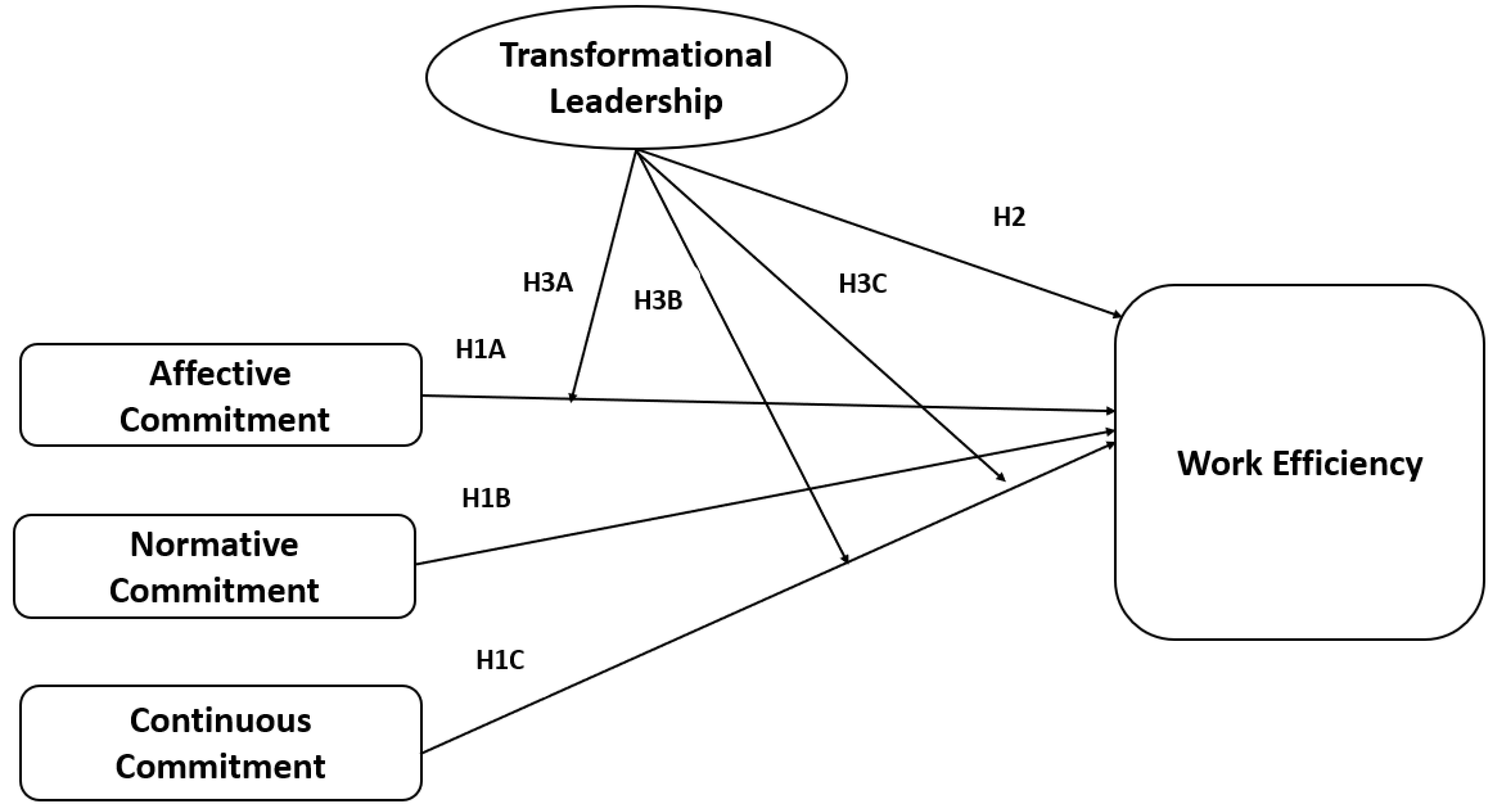
Figure 2.
HOC measurement model. Source: Survey Data.
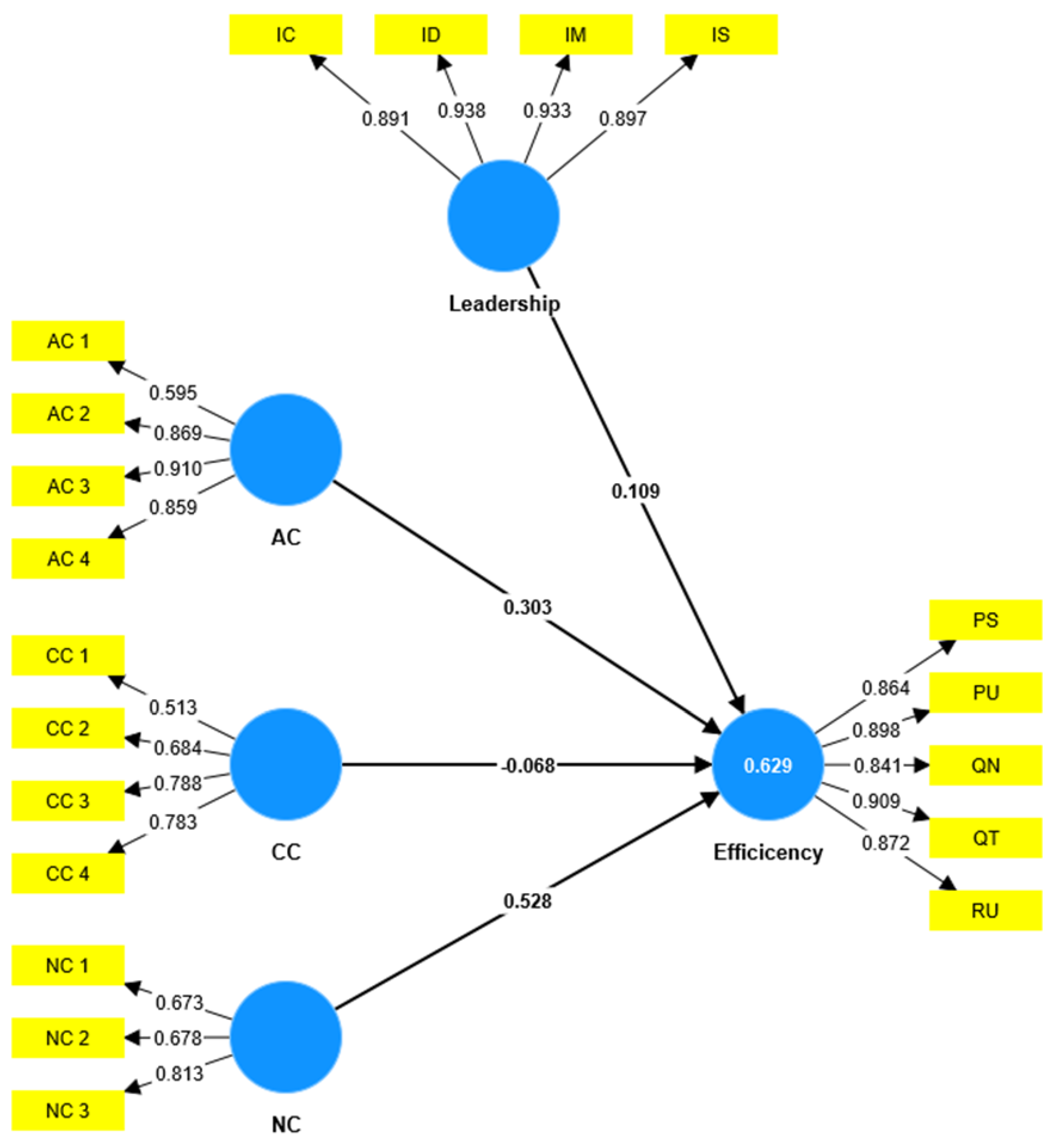
Figure 3.
Structural model (HOC). Source: Survey Data.
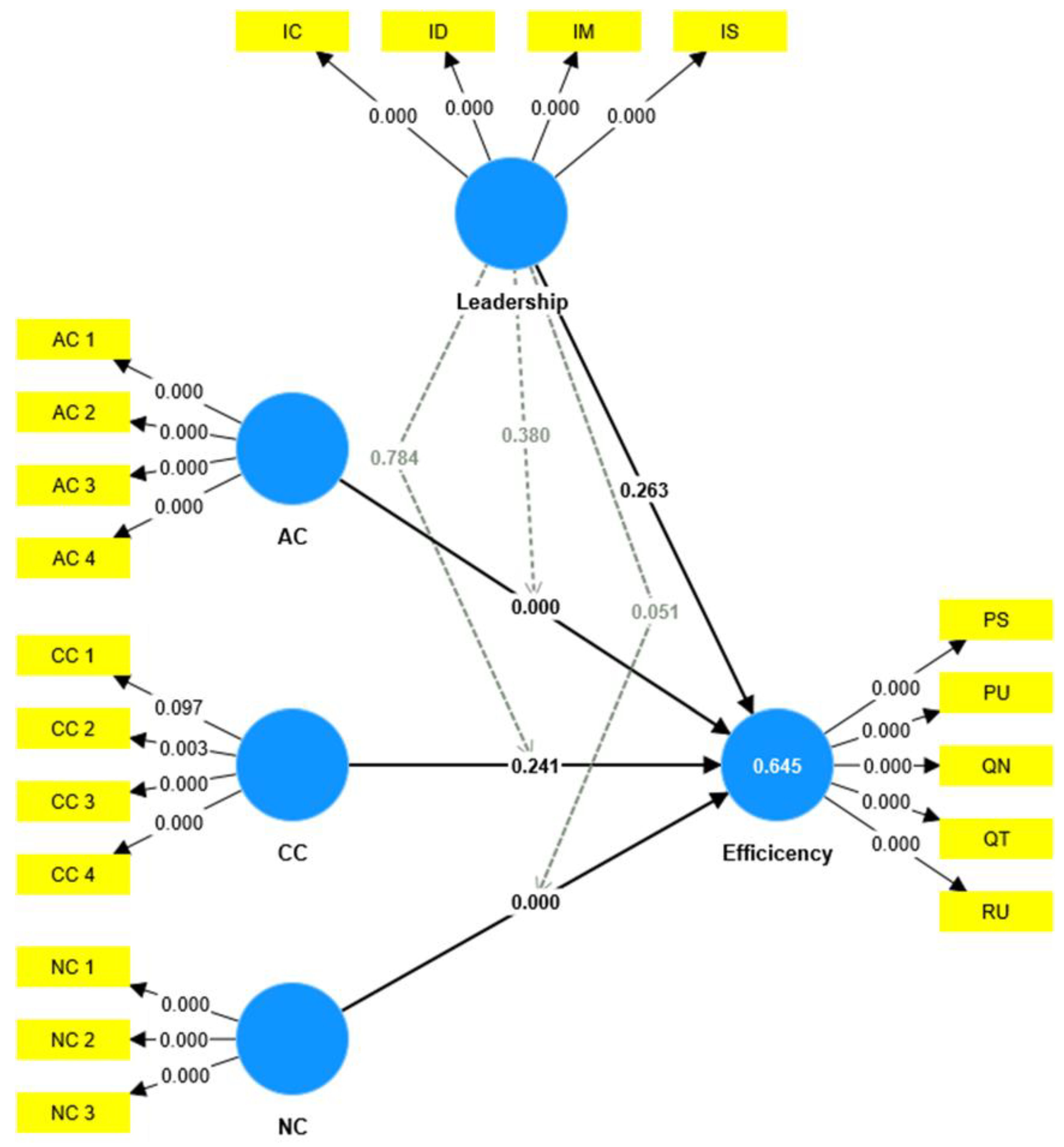

Table 1.
Internal Consistency Reliability.
| Description | Cronbach’s alpha | Composite reliability (rho_c) | Average variance extracted (AVE) |
| AC | 0.826 | 0.888 | 0.669 |
| CC | 0.712 | 0.790 | 0.491 |
| NC | 0.593 | 0.767 | 0.525 |
| Efficiency | 0.925 | 0.943 | 0.770 |
| Leadership | 0.936 | 0.954 | 0.837 |
Source: Primary Data.
Table 2.
Outer Loading Matrix.
| AC | CC | NC | Leadership | Efficiency | |
| AC 1 | 0.595 | ||||
| AC 2 | 0.869 | ||||
| AC 3 | 0.910 | ||||
| AC 4 | 0.859 | ||||
| CC 1 | 0.513 | ||||
| CC 2 | 0.684 | ||||
| CC 3 | 0.788 | ||||
| CC 4 | 0.783 | ||||
| NC 1 | 0.673 | ||||
| NC 2 | 0.678 | ||||
| NC 3 | 0.813 | ||||
| IC | 0.891 | ||||
| ID | 0.938 | ||||
| IM | 0.933 | ||||
| IS | 0.897 | ||||
| PS | 0.864 | ||||
| PU | 0.898 | ||||
| QN | 0.841 | ||||
| QT | 0.909 | ||||
| RU | 0.872 |
Table 3.
Fornell–Larcker criterion.
| AC | CC | Efficiency | Leadership | NC | |
| AC | 0.818 | ||||
| CC | 0.351 | 0.701 | |||
| Efficiency | 0.650 | 0.242 | 0.877 | ||
| Leadership | 0.627 | 0.274 | 0.555 | 0.915 | |
| NC | 0.575 | 0.331 | 0.736 | 0.520 | 0.724 |
Sources: Primary Data.
Table 4.
Cross-Loadings.
| AC | CC | NC | Efficiency | Leadership | |
| AC 1 | 0.595 | 0.327 | 0.357 | 0.405 | 0.299 |
| AC 2 | 0.869 | 0.263 | 0.462 | 0.550 | 0.549 |
| AC 3 | 0.910 | 0.264 | 0.577 | 0.587 | 0.613 |
| AC 4 | 0.859 | 0.315 | 0.464 | 0.566 | 0.543 |
| CC 1 | 0.092 | 0.513 | 0.101 | 0.019 | 0.170 |
| CC 2 | 0.414 | 0.684 | 0.175 | 0.184 | 0.279 |
| CC 3 | 0.213 | 0.788 | 0.335 | 0.225 | 0.203 |
| CC 4 | 0.083 | 0.783 | 0.186 | 0.084 | 0.045 |
| NC 1 | 0.218 | 0.218 | 0.673 | 0.395 | 0.255 |
| NC 2 | 0.461 | 0.413 | 0.678 | 0.363 | 0.334 |
| NC 3 | 0.525 | 0.176 | 0.813 | 0.722 | 0.485 |
| PS | 0.558 | 0.209 | 0.597 | 0.864 | 0.451 |
| PU | 0.536 | 0.208 | 0.646 | 0.898 | 0.481 |
| QN | 0.643 | 0.271 | 0.662 | 0.841 | 0.567 |
| QT | 0.576 | 0.189 | 0.710 | 0.909 | 0.460 |
| RU | 0.532 | 0.181 | 0.601 | 0.872 | 0.466 |
| IC | 0.556 | 0.220 | 0.426 | 0.411 | 0.891 |
| ID | 0.613 | 0.273 | 0.509 | 0.568 | 0.938 |
| IM | 0.625 | 0.273 | 0.566 | 0.562 | 0.933 |
| IS | 0.483 | 0.226 | 0.376 | 0.458 | 0.897 |
Source: Primary Data.
Table 5.
Heterotrait - monotrait Ratio (HTMT).
| AC | CC | Efficiency | Leadership | NC | |
| AC | |||||
| CC | 0.381 | ||||
| Efficiency | 0.742 | 0.222 | |||
| Leadership | 0.698 | 0.291 | 0.585 | ||
| NC | 0.769 | 0.497 | 0.893 | 0.638 |
Table 6.
VIF values HOC.
| AC 1 | AC 2 | AC 3 | AC 4 | CC 1 | CC 2 | CC 3 | CC 4 | IC | ID | IM | IS | NC 1 | NC 2 | NC 3 | PS | PU | QN | QT | RU | |
| VIF | 1.279 | 2.283 | 3.093 | 2.643 | 1.499 | 1.397 | 1.452 | 2.007 | 3.3 | 4.71 | 4.521 | 3.34 | 1.396 | 1.416 | 1.074 | 2.838 | 3.515 | 2.428 | 3.68 | 2.975 |
Source: Survey Data.
Table 7.
Coefficient of Determination (R2) Table.
| Original sample (O) | Sample mean (M) | Standard deviation (STDEV) | T statistics (|O/STDEV|) | P values | |
| Efficiency | 0.645 | 0.667 | 0.069 | 9.334 | 0.000 |
Source: Survey Data.
Table 8.
Path Coefficient Analysis.
| Original sample (O) | Sample mean (M) | Standard Deviation (STDEV) | T statistics (O/STDEV) | P values | |
| AC -> Efficiency | 0.337 | 0.346 | 0.083 | 4.066 | 0.000 |
| CC -> Efficiency | -0.072 | -0.057 | 0.061 | 1.173 | 0.241 |
| NC -> Efficiency | 0.439 | 0.430 | 0.070 | 6.245 | 0.000 |
| Leadership -> Efficiency | 0.096 | 0.094 | 0.085 | 1.121 | 0.263 |
| Leadership x AC -> Efficiency | 0.064 | 0.053 | 0.072 | 0.879 | 0.380 |
| Leadership x CC -> Efficiency | -0.020 | -0.007 | 0.072 | 0.275 | 0.784 |
| Leadership x NC -> Efficiency | -0.111 | -0.110 | 0.057 | 1.957 | 0.051 |
Disclaimer/Publisher’s Note: The statements, opinions and data contained in all publications are solely those of the individual author(s) and contributor(s) and not of MDPI and/or the editor(s). MDPI and/or the editor(s) disclaim responsibility for any injury to people or property resulting from any ideas, methods, instructions or products referred to in the content. |
© 2025 by the authors. Licensee MDPI, Basel, Switzerland. This article is an open access article distributed under the terms and conditions of the Creative Commons Attribution (CC BY) license (http://creativecommons.org/licenses/by/4.0/).
Copyright: This open access article is published under a Creative Commons CC BY 4.0 license, which permit the free download, distribution, and reuse, provided that the author and preprint are cited in any reuse.