

Submitted:
13 November 2023
Posted:
14 November 2023
You are already at the latest version
Abstract
Combining the Job Demands-Resourses model and the Work Adjustment theory, this research aims to create a theoretical model that considers Leader-Member Exchange (LMX) and Work Adjustment as protective factors, capable of reducing job exhaustion and turnover intention. A convenience sample of 257 Italian employees filled an online self-report questionnaire. A sequential mediation model was tested, which showed that the relationship between LMX and turnover intention is mediated by Work Adjustment and Job Exhaustion. The results show that the higher the LMX, the higher the work adjustment of the workers and the less they will perceive job exhaustion and, consequently, intent to leave the organisation. With a view to primary prevention, the aim was to investigate possible protective factors at work and the risk factors to look out for in order to move in the direction of preventing a malaise phenomenon before it develops with the aim of promoting wellbeing in organisations.
Keywords:
job exhaustion
; primary prevention
; leader-member exchange theory
; job demands-resourses model
; work adjustment theory
; turnover intention
; job satisfaction
1. Introduction
The New Normal brought and still brings with it countless changes in the world of work: some were already underway, others were accelerated by the Covid-19 pandemic. All of this with not a few repercussions on workers and their wellbeing at work [1,2]. On this horizon, therefore, there is a need to understand which aspects affect the health of people in organisations, not only by adopting an epidemiological approach, but also by identifying protective factors, with a view to primary prevention. For this very reason, therefore, this research will focus both on two specific psychosocial risks at work, such as professional exhaustion and turnover intention, but also on possible protective factors in the professional sphere: a social factor, specifically, the relational exchange between leaders and members of the organisation and Work Adjustment, namely the mutual relationship between the individual and his or her work environment [3,4].
It is also important to focus on work adjustment in the current post-pandemic context, the New Normal, which has imposed or allowed workers to experience new work modalities, more or less personalised. We have to think, in our research, about the variety and multifaceted character of such work modes (totally in-person or remote) that have had an impact on workers, on their relationship with their leader and, consequently, on their way of finding a work adjustment that was appropriate for them [1].
All these concepts will be explored in more detail in the following paragraphs and, moreover, they will be related to two important theories of Work Psychology, the Job Demands-Resources (JD-R) model [5] and the Work Adjustment theory [3,4], which analyse and intersect these issues.
1.1. Leadership style as a protective factor against turnover intentions
Some theories, in the scientific literature, have focused primarily on leader behaviour and the effects this behaviour has on employee attitudes, motivation and team performance [6,7], treating leadership as a unidirectional interaction [8,9,10].
The theory that supports our work, LMX: Leader-Member-Exchange [11], aims to define the quality of the relationship between the leader and a member of the organisation or a team, assuming that this relationship is dyadic and of mutual exchange that can develop and consolidate over time [12,13]. It must be emphasised, however, that leaders establish different quality relationships with their employees and this is due to factors of personality, personal compatibility and the competence and reliability that the subordinate demonstrates [14].
As we emphasised earlier, it is even more important not only to study the type of relationship one creates with one's leader, but also under what conditions it is established and consolidated over time. For example, thinking of the different work modalities and, specifically, when the person is in hybrid mode, the LMX must have certain characteristics: there must be a continuous exchange that allows the worker to feel supported, but not controlled; that allows him/her to feel that there is a bond, albeit at a distance, that makes him/her feel less of a sense of isolation and still belonging to the company [15]. It is important, therefore, that the leader makes himself/herself feel present and forges a good quality relationship with his/her employees.
In this regard, a number of studies [16,17,18] have shown that employees who perceive a high quality LMX relationship with their leader experience greater empowerment, a greater sense of connectedness to their work, and, as a result, work harder and achieve more desirable organisational results. Furthermore, a high and continuous exchange between leader and organisation member is associated with higher job performance and satisfaction [19], high organisational commitment [20], frequent organisational citizenship behaviour [21], as well as lower employee turnover intention [22,23].
Organisational members, therefore, who perceive a low quality of LMX will tend to attribute negative characteristics to their work and report high levels of turnover intention because they feel that they are not sufficiently recognised and valued by their leader as if the latter keeps them outside the organisation [24,25].
Different motivations may lead the employees to leave or not to leave their organisation, but the level and quality of exchange they manage to establish between themselves and their leader can act as 'affective forces' in turnover intention [26,27]. Thus, a high quality LMX relationship can be considered a protective factor, an affective force that decreases turnover intention [28,29].
Therefore, our first hypothesis is:
Hypothesis 1.
LMX is negatively associated with turnover intention.
1.2. Job Demands-Resourses model in relation to LMX theory
Job-Demands-Resources is a model that incorporates many possible working conditions and focuses on negative and positive indicators of employee wellbeing [5]. In particular, so-called job stress or job strain would be the outcome of an alteration of the balance between the job demands to which employees are exposed and the resources available to them [5].
More precisely, when we speak of job demands we refer to all physical, psychological, social and organisational aspects that require not only a physical, but also a psychological commitment of both a cognitive and emotional nature. Such demands are not necessarily negative, since they can, on the contrary, stimulate and motivate people in the performance of their work tasks [30]. However, they can become high stress factors under conditions in which the person perceives an imbalance between the demands of the work environment and the resources at his or her disposal [5,31].
In addition, when the employee is faced with high work demands and must, therefore, make a greater effort to achieve his or her goals [32], he or she may experience negative psychological consequences, such as job exhaustion, which is the main dimension of the components of burnout [33,34] and is associated with negative outcomes such as decreased work performance [35,36], absenteeism [37], reduced psycho-physical wellbeing [38] and turnover intention [39].
Job-Resourses include, on the other hand, all those physical, psychological, social and organisational aspects of the work environment that are functional to the achievement of specific work objectives, that reduce work demands and the associated psychological and physiological costs and that act as drivers of personal growth and development as well as work learning [40].
Referring to this model [5], a possible Job Resource for the employee can be the good quality of the relationship and exchanges with one's leader to cope with multiple job demands. This relationship, as described in the previous paragraph, is called LMX or Leader-Member-Exchange [11] and can become a protective factor to turnover intention, but not only: the higher the quality of the leader-member exchange, the lower the employee's job exhaustion and, consequently, the lower the turnover intention [40].
In conclusion, as some studies highlight, managerial support seems to play a key role in employee wellbeing and performance [41,42] because it reduces job exhaustion and leads to lower intention to leave the company [43,44].
Job exhaustion, however, is positively related to turnover intention [45,46]. Thus, since the exchange between leaders and members of the organisation (LMX) can act as a protective factor [42], it would consequently reduce both job exhaustion and turnover intention [40]. According to previous descriptions, job exhaustion is positively associated with turnover intention, so we might expect that the reduction of exhaustion due to a good quality of the leader-member relationship is a mechanism that could explain the relationship between LMX and turnover intention [21,22,40].
In line with the findings in the literature, the second hypothesis of our study is as follows:
Hypothesis 2.
The negative relationship between LMX and turnover is mediated by job exhaustion.
1.3. Work Adjustment Theory in relation to LMX Theory
The theory of Work Adjustment [3,4] is based on the concept of correspondence between the individual and his or her work environment, implying a harmonious and complementary relationship between them, in which the individual sees in that environment a good fit and a good correspondence with his or her needs and, likewise, the work environment responds with specific rewards (salary, prestige, interpersonal relationships between bosses and colleagues) to the individual's fit and his or her commitment to achieving specific work requirements [47,48]. When they perceive that their requirements are mutually fulfilled, then the individual and the work environment are defined as corresponding [3,4,49]. For a genuine work adjustment to take place, it is necessary for this process of individual-work-environment correspondence to be continuous and dynamic so that it is achieved and maintained over time. From these concepts of correspondence and adjustment, two others develop: satisfiability and satisfaction [3,4,49]. If the individual fulfils the requirements of his or her work environment, i.e. succeeds in having a good work adjustment, then he or she will be defined as a satisfactory worker. In addition, if the work environment "adjusts" to the individual, responding to his/her demands and needs, then we will have a satisfied worker [3,4,49].
To summarise, satisfiability and satisfaction are two outcomes of work adjustment and can be defined as two indicators of the degree of success an individual has achieved in managing the correspondence between him/herself and his/her environment and that, in turn, the work environment has achieved with respect to his/her worker.
Thus, according to the Work Adjustment theory, a worker who feels a better adjustment, hence an achieved correspondence, between himself/herself and his/her work environment, will report higher levels of job satisfaction, seeing a reciprocity of expectations, needs and rewards and this has been reported by multiple studies in the scientific literature [49,50,51].
When we refer work adjustment, we are not only focusing on the better correspondence between oneself and one's work environment, understood as the organisation itself, but also to the adjustment to one's work mode. This is because, in the New Normal, the worker had to find a way to better adjust to new and different work modes that were either imposed on him/her by the organisation or, at best, negotiated with his/her manager. The ability to adjust to one's job or mode inevitably has an effect on turnover intention [47,48]
In fact, the concept of work adjustment is also negatively related to that of turnover. If, as described above, an "adjusted" worker is also a worker who is satisfied with his/her job and his/her environment because he/she finds it to be a good person-environment-fit [49], then he/she will report lower turnover intention than another worker who is less "adjusted" and, therefore, less satisfied [52,53].
In a working environment, however, there are not only factors internal to the individual such as perception of having a good fit with one's professional environment, satisfaction and turnover intention, but also environmental or, better defined, relational factors. The exchange between the leader and his or her co-workers, in fact, can be defined as an environmental factor, as it is not the responsibility of the individual alone, but of a duality [11,12]. Going back to LMX theory, the higher the quality of the leader-member exchange, the greater the levels of trust, support and mutual influence. All of these constructs are nothing more than the correspondence between worker and work environment, characteristic of Work Adjustment theory [3,4,49]. A study by Liu et al. [54] shows that having a quality interaction with one's leader, a good communicative exchange, satisfying rewards for achieving goals and expectations, consolidates the exchange relationship and is a mutual adjustment resource [54,55].
Furthermore, this research shows how LMX creates a fertile or sterile ground for the worker to find his or her own work adjustment: if there is a high relational quality exchange between leader and organisation member, work engagement levels will increase, thus limiting turnover intention [54,55,56,57]. Therefore, LMX is an environmental factor positively related to work adjustment.
From this analysis of the existing literature, we formulate our third hypothesis:
Hypothesis 3.
The negative relationship between LMX and turnover is mediated by Work Adjustment
1.4. The relationship between LMX and turnover mediated by Work Adjustment and Work Exhaustion
In this section, all the constructs presented above will be related: LMX, Work, Adjustment, job exhaustion and turnover intention.
The model that we will present below is conceived from a primary prevention perspective, i.e. it aims to show which are the possible protective factors in the work environment and which are the risk factors to be taken into account in order to move in the direction of preventing a phenomenon of malaise before it develops with the aim of promoting wellbeing in organisations.
After an analysis of the scientific literature, it emerges how LMX and work adjustment can act as protective factors in the workplace [28,29].
Specifically, it is the quality of the exchange between leader and member (LMX) that allows workers to perceive that there is a mutual and functional interaction between themselves and their environment and, therefore, increases their level of person-environment-fit [49]. This will lead to a greater work adjustment on the part of the worker who will perceive an achieved, but continuous correspondence between self and one's work environment [49,50,51]. In this regard, we can consider Work Adjustment not only the outcome of LMX, but like it, a protective factor in the work environment.
Thus, the more a worker has a quality exchange with his/her leader, the better job adjustment he/she will find and the more satisfied he/she will be [49,50]. Numerous studies, moreover, have shown that a good adjustment, since it produces job satisfaction, will decrease job exhaustion [51].
We also know that job exhaustion is positively associated with turnover intention [44,45]: a worker who perceives support will find a good adjustment and this will lead to a decrease in job exhaustion which, in turn, will decrease turnover intention [55,56,57].
As a result of the above, Hypothesis 4 which is at the heart of our model is as follows:
Hypothesis 4.
The relationship between LMX and turnover is sequentially mediated by Work Adjustment and job exhaustion.
2. Research Method
2.1. Participants and procedure
Of the 311 Italian voluntary participants, a final sample of 257 participants who entirely completed the questionnaire was retained for analysis. Among them 147, 57.2% were male and 110, 42.8% were female, aged between 22 and 66 years (M = 46.09; SD = 12.46), 136, 52.9% of them having kids. The majority of them had a high school degree (98, 38.1%); the remaining part had a Master’s degree (89, 34.6%); a Bachelor’s degree (32, 12.5%); a Master (31, 12.1%) and a PhD degree (7, 2.7%). Participants were from different occupational sectors, industry (52, 20,2%), commerce (44, 17.1%), education and research (30, 11.7%), remaining participants came from other different sectors (health; banking, assurance and finance; public administration; communications and IT etc.). The majority of them worked in the private sector (187, 72.8%), full time (224, 82.2%) and had an open-ended contract (192, 74.7%). Among them the majority worked full onsite (174, 67.7%) and the remaining participants worked in a hybrid mode (83, 32.3%), with the most of them teleworking two days per week (36, 14%). Concerning procedure, participants were recruited on a voluntary basis using convenience sampling. Data were collected anonymously through an online survey, and the participants could interrupt their participation at any moment.
2.2. Measures
Leader-member exchange (LMX) was assessed through the five items scale from Graen and Uhl-Bien’s measure [58], which had already been used in previous studies in Italy [59]. An example of an LMX item was “My manager tells me if he/she is satisfied with my work.” The items were measured with a five-point frequency scale ranging from “Never” (1) to “Always” (5). Cronbach’s α in this study was .91.
Work adjustment was considered from the angle of adjustment to the specific work mode experienced by the worker. It was assessed through an adaptation of the five items scale from van Zoonen et al. [60], used to measure adjustment to remote working. The term “remote” was replaced with “my work mode”, that could be onsite or hybrid. An example of an item was “My work mode allows me to do my job better than I could have done in any other mode.” The items were measured with a five-point scale ranging from “Strongly disagree” (1) to “Strongly agree” (5). Cronbach’s α in this study was .86.
Job exhaustion was assessed through the five items scale from the Maslach Burnout Inventory-General Survey [61,62] which had already been used in previous Italian studies [63]. An example of an item was “I feel emotionally drained from my work” The scale of job exhaustion was composed of five items on a seven-point frequency scale ranging from “Never” (1) to “Always” (7). “I feel emotionally drained by my work” was a job exhaustion item present on the scale. Cronbach’s α in this study was .92.
Turnover intention was assessed through the five items scale from Bertrand’s measure [64]. An example of an item was “If nothing would prevent me from leaving my position, I would do so.” The items were measured with a four-point frequency scale ranging from “Strongly disagree” (1) to “Strongly agree” (5). Cronbach’s α in this study was .91.
Socio-professional characteristics such as gender (0=male, 1=female), age and work mode (0=fully onsite, 1=hybrid) were considered as control variables.
Items from the original scales, that had never been used in Italian, were adapted and translated into Italian following the translation/back translation technique [65].
2.3. Data analyses
Data analyses were performed in several steps. Firstly, using IBM Spss Statistics version 25, descriptive statistics (mean, standard deviation), α reliabilities (Cronbach’s α) for each scale and correlations between variables (Pearson’s r) were computed. Secondly, confirmatory factor analysis (CFA) was performed through MPLUS8 [66]. Goodness-of-fit for the model was evaluated using the χ2 value, the comparative fit index (CFI), the Tucker-Lewis index (TLI), the root means square error of approximation (RMSEA), and the standardised root mean square residual (SRMR). In general, models with fit indices of >0.92 and an RMSEA of <0.08 indicate a fair fit between the model and the data [67]. To address the common method variance issue, we performed the Harman’s single-factor test [68] using confirmatory factor analysis. Results indicated that one single factor could not account for the variance in the data (χ2 (170) = 1394.76, p < 0.001, RMSEA = .16, CFI = .59, TLI = .54, SRMR = .15) and therefore the threat of common method bias is unlikely. Finally, the serial mediation was tested using model 6 in SPSS PROCESS macro version 4.2.
2.4. Results
Means, standard deviations, correlations and Cronbach’s α are reported in Table 1. Correlations showed that LMX presented a high positive relationship with work adjustment (r =.45) and a negative relationship with job exhaustion (r =-.38) and turnover intention (r =-.41). Work adjustment was negatively correlated with job exhaustion (r =-.36) and turnover intention (r =-.40). Furthermore, job exhaustion presented a high positive relationship with turnover intention (r =.77). Concerning correlations between control variables and the variables of the study, gender showed a slightly positive correlation with turnover intention, thus indicating that women reported higher intention to quit their job than men. The work mode (onsite or hybrid) was positively associated with LMX and work adjustment, thus people working in hybrid modes reported higher levels of leader-member exchange and work adjustment.
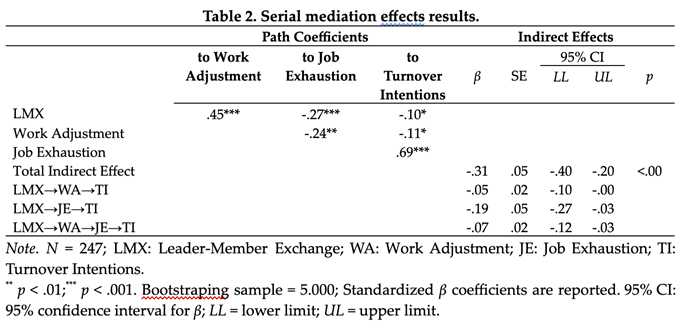
The estimated model for turnover intention presented good fit indices: (χ2 (164) = 341.92, p < 0.001, RMSEA = .07, CFI = .94, TLI = .93, SRMR = .05). The explained variance was 20% for work adjustment; 19% for job exhaustion; and 61% for turnover intention. The estimated indirect effects are shown in Table 2. More specifically, LMX has a positive impact on work adjustment, thus increasing it and a negative impact on job exhaustion and turnover intention, thus reducing them. Work adjustment has a direct negative impact on turnover intention, thus increasing them. Furthermore, job exhaustion has a direct positive impact on turnover intention. For the indirect effects (Table 2), LMX decreases turnover intention through work adjustment; furthermore, LMX decreases turnover intention by decreasing job exhaustion; finally, LMX decreases turnover intention through the serial mediation of both work adjustment and job exhaustion.
4. Discussion
The aim of this study is to understand whether a quality relational exchange with one's leader or LMX [11], leads the worker to a better work adjustment and, consequently, to less job exhaustion and lower turnover intention, taking the Job Demands-Resources model [5] and the Work Adjustment Theory [3,4] as reference lenses.
Correlational analysis allowed us to highlight the links between the study variables.
Based on a literature review, we hypothesised that a good LMX level is negatively associated with turnover intention (Hypothesis 1). The results of the regressions show that the higher the quality of the exchange between leader and organisation member, the lower the turnover intention, confirming our first hypothesis. Moreover, numerous studies point in this direction. In fact, a research by Ahmed et al. [69] shows how a positive exchange relationship with one's manager makes the worker perceive that he/she is also supported in terms of organisational support [70]. This will lead to an increased commitment to the job and to the organisation they belong to and, consequently, a lower intention to leave the company because it is perceived as being attentive to the individual's needs [71]. This confirms that the quality of the exchange between leader and organisation member acts as a protective factor to turnover intention [26,28].
Job Demands-Resources [5] was the reference model to formulate Hypothesis 2, in which we argue that the negative relationship between LMX and turnover intention is mediated by Job Exhaustion (Hypothesis 2), i.e., the main dimension of Burnout. When, in fact, the worker feels that there is an imbalance between job demands and the resources he or she can bring to bear, levels of job exhaustion increase [72].
Conversely, however, perceiving a good exchange relationship with one's leader (LMX) decreases job exhaustion and, consequently, turnover intention [41,42,43,44]. From our results, hypothesis 2 is also confirmed.
The relationship with one's leader acts as a real 'antidote' to work stress and exhaustion [73] because this exchange becomes social and emotional support for coping with a stressful or particularly demanding work environment in terms of tasks and objectives [74]. Some research also shows that quality relational exchanges with one's leader lead to more and better communication at work, formal and informal rewards, and ease in achieving results [75].
When, in fact, employees in a high-quality LMX relationship are continuously supported, they will feel effective and satisfied in their work and, consequently, the positive effects of this relationship will be reflected in the employees' commitment to the organisation and their willingness to continue to be part of it [76].
In addition, we wanted to test another hypothesis, based on the Work Adjustment theory [3,4]. We investigated whether the negative relationship between LMX and turnover intention was mediated by work adjustment (Hypothesis 3) and, again, the hypothesis was confirmed by the results.
In the previous paragraphs, the concept of work adjustment was defined as a concept of correspondence between the individual and his or her work environment, which implies a harmonious and complementary relationship between them, in which the individual sees in that environment a good fit and a good correspondence with his or her needs and, likewise, the work environment responds with specific rewards [3,4].
We hypothesised, however, that it is the quality exchange with one's leader that increases the degree of adjustment between the worker and his or her environment and that this consequently leads to lower turnover intention [56,57,58,59]. Besides the agreement with the results, the scientific literature also goes in this direction. Some studies have focused on the importance of creating a good working climate and satisfying relationships with one's leader [76] in order to find a better working adjustment [77]. This will lead the worker to feel that he/she has established a trusting relationship with his/her leader and that he/she can "move" in the work environment with a certain independence [78], which will lead to a better correspondence of expectations and needs with his/her work environment [49,50] and to other numerous outcomes: job satisfaction, commitment to the company, involvement and organisational citizenship behaviour [79]. Moreover, a person who feels a mutual exchange between him/herself and his/her leader will be able to find a better work adjustment and this will result in greater adherence to the organisation's goals, beliefs and values [80]. Consequently, a worker who has found such a correspondence between himself/herself and his/her organisation will be less inclined to leave it [81].
Based on the scientific literature showing relationships between LMX, Work Adjustment, job exhaustion and turnover intention, we tested a model according to which the relationship between LMX and turnover is sequentially mediated by Work Adjustment and job exhaustion (Hypothesis 4). The results confirm our assumptions. Firstly, the exchange between leader and organisation member can, as explained in the previous paragraphs, be considered a protective factor, but only if this interaction is of good quality [28,29]. This support and continuous exchange allow the worker to find his or her own way of working and to build a greater organisational connection, i.e. the perception of being central, important, visible and involved in the organisational reality: this is an important promoter of work adjustment [82]. A better adjustment will create in workers a secure work base in terms of satisfaction, motivation, sense of self-efficacy and belonging [83], which will lead them to feel able to cope with the demands of the work environment, despite being stressful, but without reaching exhaustion, and this will consequently induce them to remain in a work environment that gives awards, that enhances and involves them positively [84].
Limitations
This study has several limitations. Firstly, its cross-sectional design limits the possibility to infer the direction of the relationships tested. Additional studies including those with temporal designs, longitudinal or diary, could be useful to verify further our results. Secondly, the convenience sampling method could generate sample bias since participants are not chosen for their randomness and representativeness of a population, therefore it limits the possibility to generalise our results. Another limitation regards the data collection that was self-reported which implies the risk of common method-bias. Future studies should overcome this limitation by including other types of measurement, like data collected from other sources in the organisations (e.g., colleagues, leaders, etc.) or objective data.
Additionally, among the dimensions of burnout in this study we focused only on job exhaustion, as it is considered its core dimension. However, it could be of interest to broaden the model we tested to the other dimensions of burnout. As well, since this study investigates work adjustment in the New Normal, it should be noted that to different ways of working (onsite, remote, hybrid mode) it could correspond different needs and therefore different levels of work adjustment, which as a protective factor could result even more important when workers are confronted to remote type of working mode, as it is the case of LMX.
5. Conclusions and practical implications
Despite its limitations, this study has important implications, both at the level of scientific research and at the practical level for companies.
The contribution the study wants to propose with respect to existing research is to connect relational variables to individual ones: specifically, LMX purely contemplates a mutually dyadic interaction, while work adjustment, exhaustion and intention to leave the company all reside in the individual's experiences and behaviour.
Furthermore, we propose two protective factors, namely leader-member exchange and work adjustment, although we regard the former as antecedent to the latter.
Although, much research has focused on all the constructs we have considered, this appears to be the first study to relate them in a sequential mediation model by positing work adjustment and job exhaustion as mediators between LMX and turnover intention. In fact, other studies show either a direct relationship model, such as LMX being negatively associated with turnover intention [21,22,26,28] or a model with only one mediator: those who propose, for example, that the relationship between LMX and turnover is mediated by job exhaustion [21,22,41] or work adjustment [54,55,56,57].
In addition, we focused on the construct of work adjustment by referring back to its initial theorisation [3,4], but set in the New Normal period, and this constitutes a novelty compared to the research that has dealt with it: in fact, we wanted to investigate the work adjustment that an individual may be able to achieve in a historical period studded with multiple changes in the world of organisations [85].
Our results lead us to question the importance of finding one's own work adjustment during the New Normal and to understand the importance, for a worker, of creating a high-quality exchange with one's leader and of keeping this interaction alive over time: variables that promote a good work adjustment.
We have also dwelt, however, on the possible negative effects related to work: an excessive demand for work, a high mental load and a perception of not having sufficient resources, leads to job exhaustion [32,33,35] as well as to intention to leave the company [38]. The study that we have proposed has, in addition, the objective of understanding what are the protective and risk factors connected to living in the workplace precisely from the point of view of primary prevention, going in the direction of preventing malaise before it develops and, therefore, of understanding what are the best working conditions to promote wellbeing in organisations.
It is important that a good exchange relationship is created and maintained over time between leader and member of the organisation so that the latter can feel seen and considered not only as a professional, but also as a person [86].
Attention to the quality of the relationship with one's employees, therefore, can be a decisive factor in leading the person to decide whether or not to leave one's company, and this makes one realise how important it is for managers to focus also on relational aspects and not only on productivity and performance [13]. In this respect, companies could invest in effective prevention and monitoring systems, e.g., by taking concrete care of their employees' health: providing medical care, supporting training on psychophysical wellbeing and health management in the company [87]. Understanding and taking into account the needs of their employees will enable them to 'fit in' better in their working environment, to develop a greater fit with their organisation and to be less likely to leave the company [81]. As the New Normal has brought with it new ways of working, it is necessary for organisations to be concerned about them and focus on the impact they have on workers and their well-being. In fact, some modalities may be more or less suitable for the worker, who may find a better or lesser work adjustment in them. Sometimes, in fact, such arrangements are imposed on the worker rather than being discussed with him/her without taking into account his/her needs and preferences, and this has an inevitable impact on his/her productivity, performance and health at work, even making him/her decide to leave the company.
In this regard, employee turnover has become a critical issue in today's organisations. It is necessary, therefore, for companies to be aware of and monitor all possible causes of drop-out behaviour. A review of the literature reveals a number of causes related to turnover: low organisational commitment to the employee, lower job satisfaction and perceived organisational support, lack of attention and support from the leader, tense organisational climate, few benefits and opportunities for employees and perceived unfair organisational justice [88]. All these elements must be taken into account by companies to ensure that they can retain their employees, especially those who make a significant contribution to the organisation not only in terms of performance, but also in terms of the climate and relationships they manage to create.
Let us remember, in conclusion, that the bond between organisation and members is a reciprocal relationship: if employees perceive that the organisation cares about them and values them, they will 'repay' it with loyalty to stay [89].
Author Contributions
Conceptualization, S.P., M.G and A.-M.V.; methodology, M.G.; software, M.G.; validation, M.G., formal analysis, M.G; investigation, S.P., M.G. and A.-M.V.; resources, S.P.; data curation, M.G.; writing—original draft preparation, S.P. and M.G.; writing—review and editing, S.P., M.G. and A.-M.V.; supervision, M.G and A.-M.V..; funding acquisition, A.-M.V. All authors have read and agreed to the published version of the manuscript.
Funding
This research received no external funding.
Institutional Review Board Statement
The study was conducted in accordance with the Declaration of Helsinki.
Informed Consent Statement
Informed consent was obtained from all subjects involved in the study.
Data Availability Statement
Data are available on request from sara.petrilli@unicatt.it.
Acknowledgments
All persons included in this section have consented to the acknowledgement.
Conflicts of Interest
The authors declare no conflict of interest.
References
- Giunchi, M.; Peña-Jimenez, M.; Petrilli, S. Work-Family Boundaries in the Digital Age: A Study in France on Technological Intrusion, Work-Family Conflict, and Stress. Med. Lav 2023, 114(4), e2023039. [CrossRef]
- Giunchi, M., & Vonthron, A. M. La relation entre l’usage professionnel des technologies numériques et l’addiction au travail médiatisée par les demandes psychologiques au travail: quelles différences entre les hommes et les femmes?. Psychol. du Trav. Organ. 2023. [CrossRef]
- Dawis, R. V.; England, G. W.; Lofquist, L. H. A theory of work adjustment. Industrial Relations Center, 1964; University of Minnesota: Minneapolis, MN.
- Dawis, R. V.; England, G. W.; Lofquist, L. H. A theory of work adjustment (a revision). Bulletin 1968 , 47(23). University of Minnesota: Minnesota Studies in Vocational Rehabilitation.
- Bakker, A. B.; Demerouti, E. The job demands-resources model: State of the art. J. Manag. Psychol. 2007, 22(3), 309–328. [CrossRef]
- Al-Malki, M.; Juan, W. Leadership styles and job performance: A literature review. Int. J. Res. Mark 2018, 3(3), 40-49. [CrossRef]
- Padauleng, A. W.; Sidin, A. I.; Ansariadi, A. The relationship between leadership style and nurse’s work motivation with the implementation of patient safety culture in hospital, Bone regency. Enferm. Clin. 2020, 30, 161–164. [CrossRef]
- Amernic, J.; Craig, R.; Tourish, D. The charismatic leader as pedagogue, physician, architect, commander, and saint: Five master metaphors in Jack Welch’s letters to stock-holders of General Electric. Hum. Relat. 2007, 60, 1839-1872.
- Tourish, D. Challenging the transformational agenda: Leadership theory in transition?. Manag. Commun. Q. 2008, 21(4), 522-528. [CrossRef]
- Megawaty, M.; Hamdat, A.; Aida, N. Examining linkage leadership style, employee commitment, work motivation, work climate on satisfaction and performance. Hum. Resour. Manage. 2022, 2(1), 01-14. [CrossRef]
- Dansereau Jr, F.; Cashman, J.; Graen, G. Instrumentality theory and equity theory as complementary approaches in predicting the relationship of leadership and turnover among managers. J. Organ. Behav. and Hum. Perform. 1973, 10(2), 184-200. [CrossRef]
- Dansereau Jr, F.; Graen, G.; Haga, W. J. A vertical dyad linkage approach to leadership within formal organizations: A longitudinal investigation of the role making process. J. Organ. Behav. and Hum. Perform. 1975, 13(1), 46-78. [CrossRef]
- Graen, G.; Cashman, J. F. A role-making model of leadership in formal organizations: A developmental approach. Front. in Leadership 1975, 143(165), 86-96. [CrossRef]
- Kim, B. P.; Lee, G.; Carlson, K. D. An examination of the nature of the relationship between Leader-Member-Exchange (LMX) and turnover intent at different organizational levels. Int. J. Hosp. Manag. 2010, 29(4), 591-597. [CrossRef]
- Kyriakidou, O.; Vassilopoulou, J.; Groutsis, D. Flexible Working Arrangements, Ostracism and Inequality: The Role of LMX and Servant Leadership. Kucukaltan, B. (Ed.) Contemporary Approaches in Equality, Diversity and Inclusion: Strategic and Technological Perspectives. International Perspectives on Equality, Diversity and Inclusion 2023, Vol. 9, Emerald Publishing Limited, Bingley, pp. 171-192. [CrossRef]
- Gerstner, C. R.; Day, D. V. Meta-Analytic review of leader–member exchange theory: Correlates and construct issues. J. Appl. Psychol. 1997, 82(6), 827-844. [CrossRef]
- Kim, B.; George, R. T. The relationship between leader-member exchange (LMX) and psychological empowerment: A quick casual restaurant employee correlation study. J. Hosp. Tour. Res. 2005, 29(4), 468-483. [CrossRef]
- Ilies, R.; Nahrgang, J. D.; Morgeson, F. P. Leader-member exchange and citizenship behaviors: a meta-analysis. J. Appl. Psychol. 2007, 92(1), 269-277. [CrossRef]
- Dunegan, K. J.; Uhl-Bien, M.; Duchon, D. LMX and Subordinate Performance: The Moderating Effects of Task Characteristics. J. Bus. Psychol. 2002, 17(2), 275-285. [CrossRef]
- Dienesch, R. M.; Liden, R. C. Leader-member exchange model of leadership: A critique and further development. Acad. Manage. Rev. 1986, 11(3), 618-634. [CrossRef]
- Deluga, R. J. Supervisor trust building, leader-member exchange and organizational citizenship behaviour. J. Occup. Organ. Psychol 1994, 67(4), 315-326. [CrossRef]
- Griffeth, R. W.; Hom, P. W.; Gaertner, S. A meta-analysis of antecedents and correlates of employee turnover: Update, moderator tests, and research implications for the next millennium. J. Manage. 2000, 26(3), 463-488. [CrossRef]
- Harris, K. J.; Kacmar, K. M.; Witt, L. A. An examination of the curvilinear relationship between leader–member exchange and intent to turnover. J. Organ. Behav. 2005, 26(4), 363-378. [CrossRef]
- Morrow, P. C.; Suzuki, Y.; Crum, M. R.; Ruben, R.; Pautsch, G. The role of leader-member exchange in high turnover work environments. J. Manag. Psychol. 2005 , 20(8), 681-694. [CrossRef]
- Tangirala, S.; Green, S. G.; Ramanujam, R. In the shadow of the boss's boss: Effects of supervisors' upward exchange relationships on employees. J. Appl. Psychol. 2007, 92(2), 309-320. [CrossRef]
- Maertz Jr, C. P.; Griffeth, R. W. Eight motivational forces and voluntary turnover: A theoretical synthesis with implications for research. J. Manage. 2004, 30(5), 667-683. [CrossRef]
- Tyler, T. R.; Blader, S. L. The group engagement model: Procedural justice, social identity, and cooperative behavior. J. Pers. Soc. Psychol. 2003, 7(4), 349-361. [CrossRef]
- Bauer, T. N.; Erdogan, B.; Liden, R. C.; Wayne, S. J. A longitudinal study of the moderating role of extraversion: Leader-member exchange, performance, and turnover during new executive development. J. Appl. Psychol. 2006, 91(2), 298-310. [CrossRef]
- Ballinger, G. A.; Lehman, D. W.; Schoorman, F. D. Leader–member exchange and turnover before and after succession events. J. Organ. Behav. and Hum. Perform. 2010, 113(1), 25-36. [CrossRef]
- Meijman, T.F.; Mulder, G. Psychological aspects of workload, in Drenth, P.J.,Thierry, H. and de Wolff, C.J. (Eds), Handbook of Work and Organizational Psychology,2nd ed.,Erlbaum, Hove, 1998. pp. 5-33.
- Schaufeli, W. B. Applying the job demands-resources model. A ‘how to’ guide to measuring and tackling work engagement and burnout. Organ. Dyn. 2017, 2(46), 120-132. [CrossRef]
- Schaufeli, W. B.; Taris, T. W. A critical review of the Job Demands-Resources Model: Implications for improving work and health. In Bridging occupational, organizational and public health. Bauer, G., Hammig, O, Eds.; Springer: Dordrecht, Netherlands, 2014; pp. 43-68.
- Giunchi, M.; Emanuel, F.; Chambel, M. J.; Ghislieri, C. Job insecurity, workload and job exhaustion in temporary agency workers (TAWs) Gender differences. Career Dev. Int. 2016, 21(1), 3–18. [CrossRef]
- Maslach, C.; Leiter, M. P. Early Predictors of Job Burnout and Engagement. J. Appl. Psychol. 2008, 93(3), 498-512. [CrossRef]
- Ochoa, P. Impact of Burnout on Organizational Outcomes, the Influence of Legal Demands: The Case of Ecuadorian Physicians. Front. Psychol. 2018, 9, 662-662. [CrossRef]
- Swider, B. W.; Zimmerman, R. D. Born to burnout: a meta-analytic path model of personality, job burnout, and work outcomes. J. Vocat. Behav. 2010. 76, 487–506. [CrossRef]
- Salama, W.; Abdou, A.H.; Mohamed, S.A.K.; Shehata, H.S. Impact of Work Stress and Job Burnout on Turnover Intention among Hotel Employees. Int. J. Environ. Res. Public Health 2022, 19, 9724-. [CrossRef]
- Rehder, K.; Adair, K. C.; Sexton, J. B. The science of health care worker burnout: Assessing and improving health care worker well-being. Arch. Pathol. Lab. Med. 2021, 145(9), 1095-1109. [CrossRef]
- Van Bogaert, P.; Clarke, S.; Willems, R.; Mondelaers, M. Nurse practice environment, workload, burnout, job outcomes, and quality of care in psychiatric hospitals: a structural equation model approach. J. Adv. Nurs 2013. 69, 1515–1524. [CrossRef]
- Schaufeli, W. B.; Bakker, A. B. Job demands, job resources, and their relationship with burnout and engagement: A multi-sample study. J Organ. Behav. 2004, 25(3), 293–315. [CrossRef]
- LaMontagne, A. D.; Keegel, T.; Shann, C.; D'Souza, R. An integrated approach to workplace mental health: an Australian feasibility study. Int. J. Ment. Health Promot. 2014, 16(4), 205-215. [CrossRef]
- Petrie, K.; Gayed, A.; Bryan, B. T.; Deady, M.; Madan, I.; Savic, A. The importance of manager support for the mental health and well-being of ambulance personnel. PLoS ONE 2018, 13(5), e0197802. [CrossRef]
- Song, N. C.; Lee, H. S.; Lee, K. E. The Factors (Job Burnout, Job Engagement, the Workplace Safety) Influencing Employees' Job Satisfaction in School Food Service Operations. KJCN 2007, 12(5), 606-616. [CrossRef]
- Steffens, N. K.; Haslam, S. A.; Kerschreiter, R.; Schuh, S. C.; van Dick, R. (2014). Leaders enhance group members' work engagement and reduce their burnout by crafting social identity. Ger. J. Hum. Resour. Manag. 2014, 28(1-2), 173-194. [CrossRef]
- Cho, Y. J.; Song, H. J. Determinants of turnover intention of social workers: Effects of emotional labor and organizational trust. Public. Pers. Manage. 2017, 46(1), 41–65. [CrossRef]
- Fukui, S.; Wu, W.; Salyers, M. P. Impact of Supervisory Support on Turnover Intention: The Mediating Role of Burnout and Job Satisfaction in a Longitudinal Study. Adm. Policy Ment. Health 2019 , 46(4), 488-497. [CrossRef]
- Tinsley, H. F. Special Issue on the Theory of Work Adjustment. J. Vocat. Behav. 1993, 43(1), 1-4. [CrossRef]
- Dawis, R. V.; Lofquist, L. H. A psychological theory of work adjustment: An individual difference model and its applications. Minneapolis: University of Minnesota. Borman, WC, Ilgen, DR, & Klimoski, RJ (2003). Handbook of Psychology, 12, 1984, pp. 132-133.
- Eggerth, D. E. From Theory of Work Adjustment to Person–Environment Correspondence Counseling: Vocational Psychology as Positive Psychology. J. Career Assess. 2008, 16(1), 60-74. [CrossRef]
- Wang, X.; Sangalang, P. J. Work adjustment and job satisfaction of Filipino immigrant employees in Canada. Revue canadienne des sciences de l'administration 2005, 22(3), 243-254. [CrossRef]
- Na-Nan, K.; Pukkeeree, P. Influence of job characteristics and job satisfaction effect work adjustment for entering labor market of new graduates in Thailand. Int. J. Bus. Soc. 2013, 4(2), 95-103.
- Amarneh, S.; Raza, A.; Matloob, S.; Alharbi, R. K.; Abbasi, M. A. The Influence of Person-Environment Fit on the Turnover Intention of Nurses in Jordan: The Moderating Effect of Psychological Empowerment. J. Res. Nurs. 2021, 6688603. [CrossRef]
- Chen, X.; Ran, L.; Zhang, Y.; Yang, J.; Yao, H.; Zhu, S.; Tan, X. Moderating role of job satisfaction on turnover intention and burnout among workers in primary care institutions: a cross-sectional study. BMC Public Health 2019, 19(1), 1526-1526. [CrossRef]
- Liu, H.; Song, Z.; Xu, Y.; Li, J. Exploring Explanatory Mechanisms of Adjustment-Specific Resources Underlying the Relationship between Leader–Member Exchange and Work Engagement: A Lens of Conservation of Resources Theory. Sustainability 2023, 15(2), 1-20. [CrossRef]
- Song, Z.; Chathoth, P. K.; Chon, K. (2012). Measuring employees’ assimilation-specific adjustment. Ann. Tour. Res. 2021 , 39(4), 1968-1994. [CrossRef]
- Saks, A.M.; Gruman, J.A. Socialization resources theory and newcomers’ work engagement: A new pathway to newcomer socialization. Career Dev. Int. 2018, 23, 12–32. [CrossRef]
- Kantabutra, S.; Ketprapakorn, N. Toward a theory of corporate sustainability: A theoretical integration and exploration. J. Clean. Prod. 2020, 270, 122292. [CrossRef]
- Graen, G. B.; Uhl-Bien, M. Relationship-based approach to leadership: Development of leader-member exchange (LMX) theory of leadership over 25 years: Applying a multi-level multi-domain perspective. Leadersh. Q. 1995, 6(2), 219–247. [CrossRef]
- Mariani, M.G.; Curcuruto, M.; Matic, M.; Sciacovelli, P.; Toderi, S. Can Leader–Member Exchange Contribute to Safety Performance in An Italian Warehouse? Front. Psychol. 2017, 8, 729–738.
- van Zoonen, W.; Sivunen, A.; Blomqvist, K.; Olsson, T.; Ropponen, A.; Henttonen, K.; Vartiainen, M. Factors influencing adjustment to remote work: Employees’ initial responses to the COVID-19 pandemic. Int. J. Environ. Res. Public Health 2021, 18(13), 6966. [CrossRef]
- C. Maslach, S.E. Jackson, & M.P Leiter (Eds.), Maslach Burnout Inventory.Manual (3rd ed., pp. 19-26). Palo Alto, CA: Consulting Psychologists Press.
- Taris, T. W.; Schreurs, P. J. G.; Schaufeli, W. B. Construct validity of the Maslach Burnout Inventory-General Survey: A two-sample examination of its factor structure and correlates. Work & Stress 1999, 13(3), 223–237. [CrossRef]
- Borrelli, I.; Santoro, P.E.; Fiorilli, C. A new tool to evaluate burnout: the Italian version of the BAT for Italian healthcare workers. BMC Public Health 2022 22, 474. [CrossRef]
- Bertrand F.; Peters S.; Pérée F.; Hansez I. Facteurs d’insatisfaction incitant au départ et intention de quitter le travail: analyse comparative des groupes d’âges [Factors of dissatisfaction encouraging resignation and intention to resign: a comparative analysis of age groups]. Trav. Hum 2010, 73, 213–237. [CrossRef]
- Behling, O.; Law, K.S. Translating Questionnaires and Other Research Instruments: Problems and Solutions; Sage Publications: Thousand Oaks, CA, USA, 2000.
- Muthén, L. K.; Muthén, B. O. 1998–2012. Mplus user’s guide (version 7). Los Angeles: Muthen & Muthen. Los Angeles, CA.
- Yuan, K. H.; Chan, W.; Marcoulides, G. A.; Bentler, P. M. Assessing structural equation models by equivalence testing with adjusted fit indexes. Structural Equation Modeling: J. Multidiscip. Res. 2016, 23(3), 319-330.
- Podsakoff, P. M.; MacKenzie, S. B.; Lee, J. Y.; Podsakoff, N. P. Common method biases in behavioral research: a critical review of the literature and recommended remedies. J Appl Psycho 2003, 88(5), 879. [CrossRef]
- Ahmed, I.; Ismail, W. K. W.; Amin, S. M.; Ramzan, M. Influence of relationship of POS, LMX and organizational commitment on turnover intention. Organ. Dev. J. 2013, 31(1), 55-68.
- Stinglhamber, F.; Vandenberghe, C. Organizations and supervisors as sources of support and targets of commitment: A longitudinal study. J. Organ. Behav. 2003, 24(3), 251-270. [CrossRef]
- Chen, J.; Eldridge, D. The missing link in newcomer adjustment: The role of perceived organizational support and leader-member exchange. Int. J. Organ. Anal. 2011 , 19(1), 71-88. [CrossRef]
- Adil, M. S.; Baig, M. Impact of job demands-resources model on burnout and employee's well-being: Evidence from the pharmaceutical organisations of Karachi. IIMB Manag. Rev. 2018, 30(2), 119-133. [CrossRef]
- Joo, B. K. Organizational commitment for knowledge workers: The roles of perceived organizational learning culture, leader–member exchange quality, and turnover intention. Hum. Resour. Dev. Q. 2010, 21(1), 69-85. [CrossRef]
- Balasundaram, S.; Sathiyaseelan, A. Relationship based leadership: The development of leader member exchange theory. RJSSM 2016, 5(11), 165-171. [CrossRef]
- Kang, J. Relationship among leader-member exchange (LMX), burnout and career turnover intention in social workers using SEM. Journal of the Korea Academia-Industrial Cooperation Society 2013, 14(8), 3739-3747. [CrossRef]
- Ashforth, B. E.; Sluss, D. M.; Harrison, S. H. Socialization in organizational contexts. Organ. Psychol. Rev. 2007 22, 1-70. [CrossRef]
- Liu, H.; Song, Z.; Xu, Y.; Xu, X. A.; Li, J. Exploring Explanatory Mechanisms of Adjustment-Specific Resources Underlying the Relationship between Leader–Member Exchange and Work Engagement: A Lens of Conservation of Resources Theory. Sustainability 2023, 15(2), 1561. [CrossRef]
- Luksyte, A.; Bauer, T. N.; Debus, M. E.; Erdogan, B.; Wu, C. H. Perceived overqualification and collectivism orientation: Implications for work and nonwork outcomes. J. Manage. 2022, 48(2), 319–349. [CrossRef]
- Zhao, H.; Zhou, Q.; He, P.; Jiang, C. How and when does socially responsible HRM affect employees’ organizational citizenship behaviors toward the environment? J. Bus. Ethics 2021, 169(2), 371–385. [CrossRef]
- Boon, C.; Biron, M. Temporal issues in person–organization fit, person–job fit and turnover: The role of leader–member exchange. Hum. Relat. 2016, 69(12), 2177–2200. [CrossRef]
- Jia, J.; Wu, F.; Liu, M.; Tang, G.; Cai, Y.; Jia, H. How leader-member exchange influences person-organization fit: a social exchange perspective. Asian Bus. Manag. 2023, 22(2), 792-827. [CrossRef]
- Raghuram, S.; Garud, R.; Wiesenfeld, B.; Gupta, V. Factors contributing to virtual work adjustment. J. Manage. 2001, 27(3), 383-405. [CrossRef]
- Bakker, A.; van Veldhoven, M. J. P. M.; Xanthopoulou, D. Beyond the demand-control model: Thriving on high job demands and resources. J. Pers. Psychol. 2010, 9(1), 3-16. [CrossRef]
- Gordon, H. J.; Demerouti, E.; Le Blanc, P. M.; Bakker, A. B., Bipp, T.; Verhagen, M. A. Individual job redesign: Job crafting interventions in healthcare. J. Vocat. Behav. 2018, 104, 98-114. [CrossRef]
- Ripamonti, S. C.; Galuppo, L.; Petrilli, S., Dentali, S.; Zuffo, R. G. Care ethics management and redesign organization in the new normal. Front.Psychol. 2021, 12, 747617. [CrossRef]
- Wiles, J. Employees seek personal value and purpose at work. Be prepared to deliver. Gartner. Com. Retrieved January 2022, 13.
- Huang, I. C.; Du, P. L.; Wu, L. F.; Achyldurdyyeva, J.; Wu, L. C.; Lin, C. S. Leader–member exchange, employee turnover intention and presenteeism: the mediating role of perceived organizational support. Leadersh. Organ. Dev. J. 2021, 42(2), 249-264. [CrossRef]
- Falkenburg, K.; Schyns, B. Work satisfaction, organizational commitment and withdrawal behaviours. Manag. Res. News 2007, 30(10), 708-723. [CrossRef]
- Alkahtani, A. H. Investigating factors that influence employees' turnover intention: A review of existing empirical works. Int. J. Bus. Manag. 2015, 10(12), 152. [CrossRef]

Table 1.
Means, standard deviations, Cronbach’s α and correlations.
| M | SD | 1. | 2. | 3. | 4. | 5. | 6. | 7. | |
|---|---|---|---|---|---|---|---|---|---|
| 1. Gender | - | - | - | ||||||
| 2. Age | 46.09 | 12.46 | -.21*** | - | |||||
| 3. Work Mode | - | - | .03 | -.16* | - | ||||
| 4. LMX | 3.32 | .90 | -.01 | .07 | .19** | (.91) | |||
| 5. Work Adjustment | 3.54 | .87 | -.08 | .06 | .28*** | .45*** | (.86) | ||
| 6. Job Exhaustion | 3.38 | 1.50 | .08 | -.08 | -.05 | -.38*** | -.36*** | (.92) | |
| 7. Turnover Intention | 2.11 | .77 | .14* | -.05 | -.07 | -.41*** | -.40*** | .77*** | (.91) |
Note. N = 247; *p < .05; **p < .01; ***p < .001. M = mean; SD = standard deviation; values in brackets are internal consistency coefficients (Cronbach’s α).
Disclaimer/Publisher’s Note: The statements, opinions and data contained in all publications are solely those of the individual author(s) and contributor(s) and not of MDPI and/or the editor(s). MDPI and/or the editor(s) disclaim responsibility for any injury to people or property resulting from any ideas, methods, instructions or products referred to in the content. |
© 2023 by the authors. Licensee MDPI, Basel, Switzerland. This article is an open access article distributed under the terms and conditions of the Creative Commons Attribution (CC BY) license (http://creativecommons.org/licenses/by/4.0/).
Copyright: This open access article is published under a Creative Commons CC BY 4.0 license, which permit the free download, distribution, and reuse, provided that the author and preprint are cited in any reuse.


