

Submitted:
29 November 2023
Posted:
30 November 2023
You are already at the latest version
Preprints on COVID-19 and SARS-CoV-2
Abstract
This study delves into the dynamics of relational energy (RE) within organizational context, examining some of its antecedents and decedents. Specifically, it investigates the influence of psychological capital (PsyCap) and humor on RE, and subsequently, the latter’s impact on job performance (JB) mediated by job engagement (JE). A research model based on structural equation modelling carried out with 481 employees in private service industries demonstrates several key relationships. It reveals that both PsyCap and affiliative humor positively affect RE, while aggressive humor exerts a negative influence. Furthermore, RE shows positive association with JE and JP, with JE serving as a mediator. To the authors’ knowledge, this is the first study to present an integrated model encompassing this exact combination of influencers and consequences of RE as well as to be investigated within Western Balkans cultural context. Therefore, it represents a novel approach. Additionally, the research addresses crucial questions regarding the existence and strategic significance of RE within organizational interactions. The findings offer valuable insights for organizations seeking to enhance employee engagement, performance, and wellbeing – even during health crises such as COVID-19 – by fostering RE. The study advances the understanding of RE in organizational settings and provides a foundation for future research in this domain.
Keywords:
relational energy
; humor
; psychological capital
; positive leadership
; management
; organizational behavior
; human resource management
; interpersonal communication
; performance
; COVID-19
1. Introduction
Positive human energy is endorsed as a source of high-quality relationships, which in turn, foster individual and organizational excellence [1]. Relational energy is “a heightened level of psychological resourcefulness generated from interpersonal interactions that enhances one’s capacity to do work” [2] (p.37) and is claimed to be synonymous with positive energy within human interactions [3].
The essential objective of this work is to determine ways of enhancing relational energy, deriving from a dyadic interaction, and its associated benefits within organizational life. This aim is embarked upon through establishing the correlation of PsyCap and humor with relational energy, i.e. the former are postulated as impactors of the latter. In addition, the impact of relational energy on job engagement and job performance is examined based on Owens et al. [2].
The correlation is theoretically reasoned building upon positive organizational scholarship (POS), positive organizational behavior (POB), social contagion theory, interaction ritual theory, and conservation of resources theory. Following the main objective, this study aims to answer the following three research questions:
- Is there a presence of relational energy within the interpersonal communication between employees of a unit or organization?
- Are there substantial benefits from relational energy that deems it of strategic importance for organization’s management to consider?
- Are there means available for enhancing relational energy and its associated benefits in organizational settings?
The study responds simultaneously to the first and second research questions by examining the influence of relational energy on both job engagement and job performance. Establishing potential correlations among relational energy, job engagement, and job performance tends to confirm the existence of relational energy (research question 1) and its significant paybacks that deserve consideration from organization’s management (research question 2). Finally, the study will explore the role of PsyCap and humor as potential tools for amplifying the gains derived from relational energy within a team, unit, or organization (research question 3).
The current study firstly provides a brief theoretical background in support of the proposed model. A broader elaboration of the theoretical illumination supporting the suggested model is to be found in Braha [4,5]. Then, it elaborates the empirical method. Consequently, the study tests the argued model and discusses the obtained findings. Finally, the paper concludes by suggesting its contributions, limitations, and recommendations for future research.
2. Literature review and research hypotheses
2.1. Relational energy
Positive deviance within work context is chiefly studied by POS and POB, both originating from positive psychology [6]. The basic idea of positive deviance is how to move from good or normality to excellence. Examples outside of work settings include health conditions of an athlete and intelligence level of a genius, while within organizational settings it includes exceptional performance of an employee [3]. This research attempts to synergize constructs from both disciplines, POS and POB, so as to boost relational energy and its associated benefits.
Unlike physical, mental, and emotional energies that exhaust when used, relational energy increases the more it is utilized [3,7]. Research on relational energy builds upon the studies of energizers and de-energizers [8,9]. However, these earlier studies do not explicitly address the concept of relational energy as explored in the current research. McDaniel [10] takes the initial step in developing and conceptually defining relational energy. She makes a distinction between emotional energy and relational energy, with the latter being identified as a resource-based process of exchange. Furthermore, her empirical investigation shows that organizational members are aware of and can easily discuss the dynamics of energy in the workplace, with culture seemingly playing a minimal role in how relational energy functions within an organization. Accordingly, the author suggests that relational energy might be regarded as a universal phenomenon. McDaniel’s [10] scale aimed to measure the exchange of relational energy from the energy giver’s perspective. However, Owens et al. [2] argue that understanding the perception of the energy recipient is essential for a comprehensive grasp of the energizing process. Subsequently, they pioneer the receiver-centric perspective on relational energy by establishing and validating a 5-item scale for measuring it. In developing this construct, they draw upon three scientific theories: interaction ritual theory, conservation of resources theory, and social contagion theory. Through their theoretical and empirical analysis, the authors differentiate the notion of relational energy from related constructs of social support, relational identification, productive energy, emotional energy, and leader-member exchange (LMX), thereby instituting it as a psychometrically reliable, valid, and robust concept. As a result, the field of relational energy within the broader realm of human and organizational energy studies could be considered as being still in its developing stage.
2.2. Relational energy and psychological capital
Several scholars suggest that psychological capital (PsyCap) goes beyond human and social capital since it enables people to progress from the actual self to the potential self/collective selves [11,12]. PsyCap appears to positively affect several dimensions such as life satisfaction [13], employee basic need satisfaction [14], innovation [15], creativity [16], organizational citizenship, job performance, psychological wellbeing, and organizational commitment [17] as well as reduce turnover [18], anxiety, and cynicism [17]. Moreover, increased levels of PsyCap seem significantly beneficial in COVID-19 lockdown working conditions [19,20,21,22,23,24,25].
The correlation of PsyCap with relational energy is illustrated by PsyCap related qualities that energizers have as compared to de-energizers. Energizers transmit hope to those they interact with, see realistic new possibilities [9], stand optimistic [26], and follow through [3]. Conversely, de-energizers appear often critical [3] and focus on obstacles [9]. In addition, people higher on PsyCap show a higher relational energy state and a contagious influence since they boost others’ optimism and hope [19] and bring positivity into their private and workplace social relationships [27]. In view of that, building upon contagion theory and interaction ritual theory, and drawing from PsyCap features found at energizers, it is argued that people higher in PsyCap tend to energize more, i.e. generate higher relational energy.
Hypothesis 1:
There is significant impact of PsyCap on relational energy.
2.3. Relational energy and humor
Humor is also found to produce valuable physical, social, and organizational effects. Examples of such positive impacts are related to, for instance, blood pressure [28], stress [29], effectiveness [30,31], innovation [32,33], trust [34], burnout, work withdrawal [35], persistent behavior [36], job satisfaction, organizational pride, affective commitment [37], engagement [38], social cohesion [32], creativity communication, enthusiasm, and brightened and more enduring workplace [39]. Humor too seems to be helpful for employees and organizations during the COVID-19 setbacks and aftermaths [40,41,42].
The association of humor with relational energy made in the current research is interpreted by that people high on positive humor are expected to display a higher relational energy state. Humor is also studied by psychology outlook [6] and POS [43]. Greater utilization of positive humor positively reflects on passing interaction [43], social relationships [44], high-quality connections [1], positive energy among user and receiver of humor [3,9], improved communication [39], reduced tension [45], social cohesion, solidarity, and rapport [32]. Furthermore, Cheng and Wang [36] argue that humor can produce amusement, a particular type of positive emotion, and can help people replenish work-related resources. Recently, Simione and Gnagnarella [46] found that humor enhances positive emotional states. On the other hand, positive emotions are very frequently revealed in relational energy [10]. Considering relational energy increases the more it is used and diminishes in de-energizing interpersonal communication, and that humor, as per above explanations, can create positive emotions and positive energy, the work-related resources referred by Cheng and Wang [36] can be argued to include relational energy as well. On this basis, building upon interaction rituals theory and conservation of resources theory, and referring to the construct of positive emotions, it is suggested that people who utilize more positive humor tend to energize more.
Imperative emphasizing, not all humor types represent pleasant interactions. To demonstrate that, the research bases on the humor styles of Martin et al. [47], i.e. self-defeating, self-enhancing, affiliative, and aggressive, and the associated Humor Styles Questionnaire (HSQ). Numerous studies offer evidence that adaptive humor styles (affiliated and self-enhancing) of HSQ are positively associated with psychological wellbeing, facilitating relationships, and reducing interpersonal conflicts, whereas maladaptive humor styles (self-defeating and aggressive) of HSQ show a negative correlation [48]. Building upon this logic, the former are considered positive humor and are expected to be positively related to relational energy, whereas the latter are considered negative humor and are expected to be negatively related to relational energy.
Hypothesis 2:
There is significant impact of humor on relational energy.
2.4. Relational energy as a source for employee and organizational wellbeing and performance
Having identified two atescedents of relational energy, it is crucial showing also employee and organizational benefits deriving from it. After all, the level of relational energy without organizational repercussions, though probably valuable in personal relationships, seems not a relevant cause to be considered within organizational and management research. POS’s credibility depends partly on its capability to show that organizational positivity is correlated with organizational performance, otherwise organizations most likely will not allocate resources for purposes of developing and applying positive practices [43]. Hence, the current study’s second part turns to the benefits of relational energy for organizations by focusing on the effect of relational energy on job performance through the mediating role of job engagement.
Besides their own, energizers seem to also progress the performance of others who are linked to them or interact with them [3,7,26]. Human energy is socially contagious [2,3,8,10,49], while organizational energy is augmented from individual energies and fuels readiness to change, innovation, and productivity [50]. As such, positive energy infected from one person to another results in healthy work relationships among people of a team, unit, or organization that lead to improvements in individual and organizational thriving [51], mental sharpness, fast learning, memory, post-surgery recovery, depression, sickness, discomfort [52], immune, cardiovascular, and hormonal system [53] performance, engagement [1,2,8,9], creativity, motivation, uplifting, elevation, vitality [3,7,26], and knowledge transfer [54]. Very importantly, high-quality connections originated from positive energy generate further positive energy within the interpersonal communication, resulting so into a powerful virtuous cycle of energy-HQC generation and transmission [1]. Notably, positive outcomes derive not as much from what people gain from those relationships, but merely what they invest in them [55,56,57].
Relational energy is found to produce manifolds direct or mediating positive outcomes such as job engagement, job performance [2,58,59,60], work passion transmission [61], interpersonal citizenship [62], high quality mentoring relationship [63], deep acting [64], customer service engagement behavior [65], relationship quality [66], perceived relational climate [67], and reduction of work-family conflict aftermaths [68]. In addition, relational energy can moderate the disadvantageous effect of emotional labor and improving so cognitive flexibility [69] as well as moderate the detrimental influence of digital connectivity during COVID-19 lockdowns [70].
The reasoning of Owens et al.’s [2] association of relational energy with job performance is to be found in earlier works [8,50] showing energizers significantly impacting performance. Likewise, the mediating role of job engagement to job performance is also visible in previous research [71,72]. Later researches were also carried out which specifically investigate the effect of relational energy on job engagement and/or job performance [58,59,60,68,70], the majority of them utilizing the instrument developed by Owens et al. [2].
In summary, organizations are unlikely to prioritize the development of relational energy unless they anticipate tangible benefits such as enhanced employee performance, engagement, or wellbeing. Considering the supporting evidence for positive effects of relational energy and energizing relationships, it is worthwhile for organizations to focus on fostering and sustaining this positive energy among their employees, teams, units, and throughout the organization.
Drawing from the above, the following 3 hypotheses are postulated.
Hypothesis 3:
There is significant impact of relational energy on job engagement.
Hypothesis 4:
There is significant impact of relational energy on job performance.
Hypothesis 5:
There is significant impact of job engagement on job performance.
Hypothesis 6:
There is a significant mediating role of job engagement in the impact of relational energy on job performance.
3. Research method
3.1. Research model
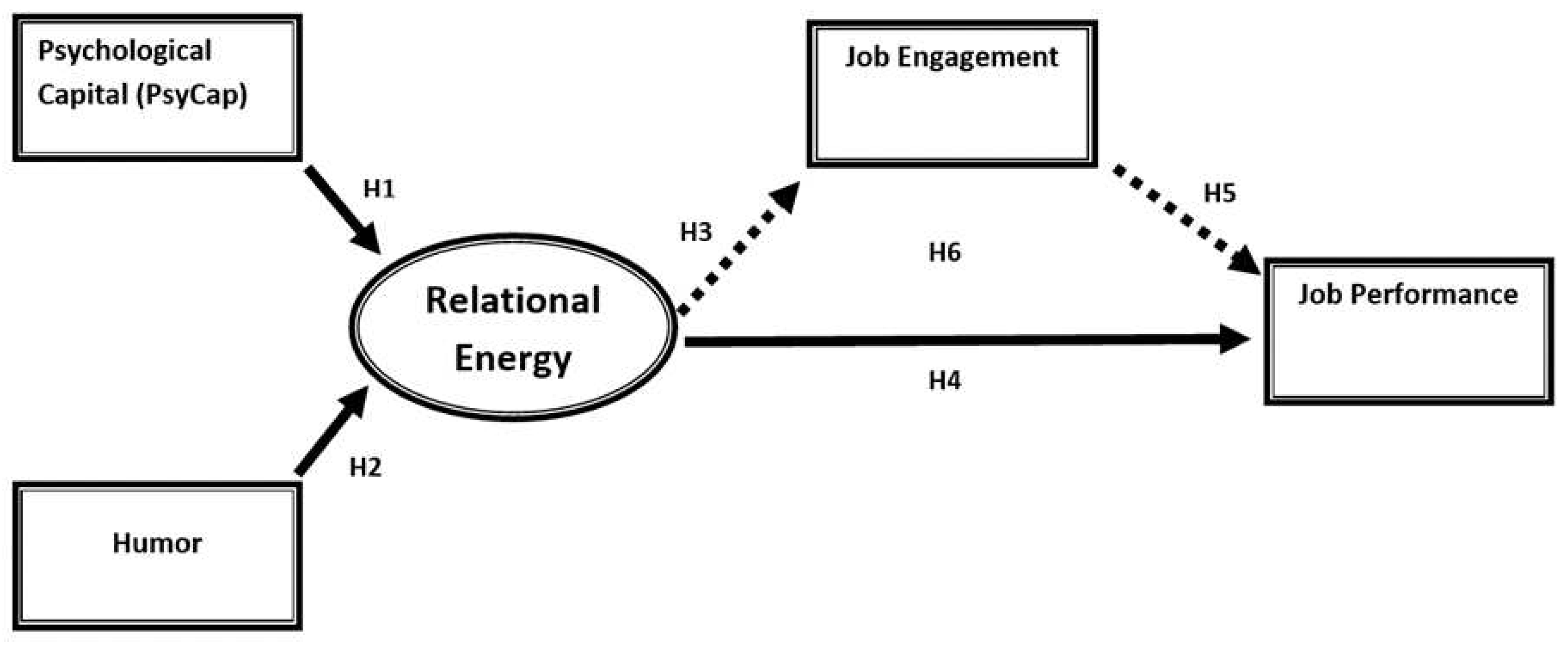
This research analyzes relational energy from two different perspectives; what affects it and what impact does it have on organizational life, by suggesting an integrated model of some antecedents and descendants of relational energy. The utilized model consists of two main parts with relational energy being the center of it. The first part of the model explores PsyCap and humor as drivers of relational energy, while the second part investigates the effect of relational energy on job performance and job engagement, with job engagement being the mediator of the RE-JP relationship.
Bearing in mind all the above discussed, the model is postulated as following.
Figure 1.
Correlation of relational energy with PsyCap, humor, job engagement, and job performance.
3.2. Research sample and measurement instruments
The sample consists of private sector service companies headquartered in the region of Prishtina, Kosova where data collection was conducted during the period 2017-2018. Service industries are usually characterized with people working together and every so often some are placed in the same office premises. From the Kosovo Agency of Statistics [73] company size classification—micro (0-9 employees), small (10-49 employees), medium (50-249 employees), and large companies (250+ employees)—the latter two types were chosen. Considering relational energy is measured by assessing co-workers, micro and small companies were excluded in order to avoid biasness since they merely consist of family or friends entering into business together who had been knowing each other for many years. In contrast, medium and large companies represent more diversity in terms of staff. These were considered suitable circumstances for measuring relational energy more objectively. Besides, Luthans & Youssef-Morgan [12] determine that PsyCap is more robust with outcomes in service sector. Service industries were included as per Kosovo Agency of Statistics [74] categorization of economic activities which is rooted on ISIC Rev.4 [75] and NACE Rev.2 [76], namely from category G to S.
Initially, respondents were asked to assess the relational energy, PsyCap, and humor of a co-worker at the same hierarchal level with whom they had worked closely for a duration not shorter than 3 months. Subsequently, they were also asked to rate their own job engagement and job performance.
Relational energy was measured through the 5 items scale developed and validated by Owens et al. [2]. PsyCap was measured through the 12 items scale developed and validated by Luthans et al. [77] and Avey et al. [11] from the original 24-item PsyCap Questionnaire (PSQ) developed and validated by Luthans et al. [78]. The peer-rating version was obtained from Mind Garden1. Humor was measured through the Humor Scales Questionnaire (HSQ) developed and validated by Martin et al. [47]. A short version of 20 items (from the original 32 items) and a peer rating version of the original scale were sent through e-mail from R. A. Martin himself by request of current study’s first author. For purposes of this study, the peer-rating short version was developed by the author. Job engagement was measured through a self-rating scale with 9 items developed and validated by Schaufeli et al. [79]. Finally, job performance was assessed by a combination of two self-rating scales. The first scale uses 13 out of 18 items (contextual performance and task performance, excluding counterproductive work behavior) developed by Koopmans et al. [80] and validated by Koopmans et al. [81]. The second scale was adapted from Hwang [82] who makes use of the 4-item scale of Tsui et al. [83] with two added items (6 items in total). This scale evaluates performance from the standpoint of its quality, quantity and efficiency. All instruments are in English. In order to adjust respondents’ native language, all items were translated into Albanian by the first author in consultation with other researchers.
4. Results
4.1. Analytical approach
All submitted questionnaires were checked for their completeness and the quality of data. Out of 549 completed questionnaires 481 were proved to be valid and the overall response rate was 87%. The threshold of 2% was used for missing responses and removing questionnaires from the data set.
Structural Equation Modeling was considered appropriate, while Partial Least Square Structural Equation Modeling (PLS-SEM) with SmartPLS3 was employed to examine the research model. A sample of more than 200 respondents is needed to validate the effectiveness of Structural Equation Modelling [84]. According to this criterion, our study meets the validity related to sample requirements.
Internal consistency and reliability analysis for LIKERT scale variables was performed using Cronbach’s Alpha coefficient. According to Nunnally [85], the variables in each scale have high degree of reliability and are positively related to each other if the Chronbach’s Alpha is at least 0.7.
After achievement of internal consistency and reliability, convergent and discriminant validity were aimed through Confirmatory Factor Analysis (CFA). Assessment of convergent validity was tested with Composite Reliability (CR) and the Average Variance Extracted (AVE). The acceptable level values for the latent constructs is CFA > 0.7, CR > 0.7, and AVE> 0.5 [86]. As a result, items with loading factor less than 0.7 were excluded from the model. All 5 items for the RE had the loading factor greater than 0.7, therefore all of them were included in the model. As per the other constructs, the total number of items included in the model is 7 for PsyCap, 3 for affiliated humor, 3 for self-enhancing humor, 3 for aggressive humor, 2 for self-defeating humor, 7 for job engagement, and 4 for job performance. Discriminant validity was tested with Heterotrait-Monotrait (HTMT) matrix, the value of which should be below 0.90 [86,87].
After the CFA analysis, the research model was assessed by calculating the sum of variance on relational energy to job performance explained by psychological capital, affiliated humor, self-enhancing humor, aggressive humor, self-defeating humor, and job engagement. Standardized Root Mean Square Residual (SRMR) was utilized to achieve model fit, whereby the values below 0.1 are acceptable for model validation [87,88]. Mediation effect of job engagement between relational energy and job performance was estimated as suggested by Baron & Kenny [89]. The level of mediation effect was assessed with the variance accounted for (VAF), whereby a value higher than 80% indicates full mediation; a value in the range of interval 20-80% indicates partial mediation, and the value smaller than 20% shows that there is no mediation effect [90].
Lastly, the exploratory model of antecedents and descendants of relational energy was also controlled for demographic factors (age, gender, tenure, position, etc.). None of the demographics used as control variables appeared to be significant.
4.2. Descriptive statistics, reliability, validity, model fit, and hypotheses testing
Based on the results presented in Table 1, it can be seen that relational energy has the highest mean, while aggressive humor the lowest. Whereas, standard deviation is highest at self-defeating humor and lowest at job performance.
Table 2 presents correlation coefficients between the constructs included in the model. According to the obtained results, affiliated humor, self-enhancing and self-defeating humor are statistically significant positively correlated with each other, while physiological capital is positively and statistically significant correlated to affiliated humor and self-enhancing humor.
Each construct in the model has Cronbach’s Alpha greater than the minimum threshold 0.7, as presented in Table 3, which is considered to be reliable according to Nunnally [85]. The construct of affiliated humor (0.964) and relational energy (0.927) have the highest value of Cronbach’s Alpha.
As per the confirmatory factor analysis, the indicator loadings in Table 4 show good indicator reliability, as all loadings are larger than the threshold. Composite reliability for each construct is higher than 0.7 and the AVE values are all above 0.5.
The model also appears to be valid in terms of discriminant validity as all values of the HTMT matrix for the latent constructs are below the threshold of 0.90.

Table 5.
Heterotrait-Monotrait matrix of the constructs.
| PC | AFH | SEH | AGH | SDH | RE | JE | |
|---|---|---|---|---|---|---|---|
| FH | 0.319 | ||||||
| SEH | 0.421 | 0.497 | |||||
| AGH | 0.539 | 0.322 | 0.485 | ||||
| SDH | 0.037 | 0.211 | 0.141 | 0.150 | |||
| RE | 0.608 | 0.351 | 0.500 | 0.470 | 0.096 | ||
| JE | 0.330 | 0.125 | 0.178 | 0.253 | 0.079 | 0.308 | |
| JP | 0.300 | 0.289 | 0.229 | 0.126 | 0.064 | 0.233 | 0.496 |
Significant evidence was obtained for the Baron & Kenny’s [89] conditions to be met. Findings show that relational energy seems to significantly affect job performance, relational energy appears to significantly impact job engagement (the mediator) too, and relational energy and job engagement are significantly influencing job performance.
Figure 2 shows the relationship of the independent variable predicting the dependent variable. Psychological capital results with strong and positive impact on relational energy (βPC-RE=0.405; t=8.617; p=0.000), confirming hypothesis 1. Affiliated humor is positively related to relational energy, but the result does not appear statistically significant (βAFFH-RE=0.076; t=1.658; p=0.097). Self-defeating humor is also positively correlated to relational energy, but this correlation too does not seem statistically significant (βSDH-RE=0.041; t=1.068; p=0.286). These two results do not provide sufficient evidence in support of hypothesis 2. However, self-enhancing humor results positively related and statistically impacting relational energy (βSEH-RE=0.220; t=5.086; p=0.000), whereas, aggressive humor, on the other hand, is found statistically significant and negatively impacting relational energy (βAGH-RE=-0.101; t=2.374; p=0.018). These results provide sufficient evidence in support of hypothesis 2. Relational energy appears to positively impact job performance (βRE-JE=0.206; t=4.626; p=0.000), providing so evidence in support of hypothesis 4.
Figure 3 shows the relationship of the independent variable predicting the mediator. Psychological capital results with strong and positive impact on relational energy (βPC-RE=0.405; t=8.617; p=0.000), confirming hypothesis 1. Affiliated humor is positively related to relational energy, but the result does not appear statistically significant (βAFFH-RE=0.076; t=1.658; p=0.097). Self-defeating humor is also positively correlated to relational energy, but this correlation too does not seem statistically significant (βSDH-RE=0.041; t=1.068; p=0.286). These two results do not provide sufficient evidence in support of hypothesis 2. However, self-enhancing humor results positively related and statistically impacting relational energy (βSEH-RE=0.221; t=5.086; p=0.000), whereas, aggressive humor, on the other hand, is found statistically significant and negatively impacting relational energy (βAGH-RE=-0.101; t=2.374; p=0.018). These results provide sufficient evidence in support of hypothesis 2. Relational energy appears to positively impact job engagement (βRE-JE=0.282; t=6.705; p=0.000), providing so evidence in support of hypothesis 3.
Figure 4 shows the relationship of the independent variable predicting the independent variable through the mediator. Psychological capital results with strong and positive impact on relational energy (βPC-RE=0.405; t=8.617; p=0.000), confirming hypothesis 1. Affiliated humor is positively related to relational energy, but the result does not appear statistically significant (βAFFH-RE=0.076; t=1.658; p=0.097). Self-defeating humor is also positively correlated to relational energy, but this correlation too does not seem statistically significant (βSDH-RE=0.041; t=1.068; p=0.286). These two results do not provide sufficient evidence in support of hypothesis 2. However, self-enhancing humor results positively related and statistically impacting relational energy (βSEH-RE=0.220; t=5.086; p=0.000), whereas, aggressive humor, on the other hand, is found statistically significant and negatively impacting relational energy (βAGH-RE=-0.101; t=2.374; p=0.018). These results provide sufficient evidence in support of hypothesis 2. Relational energy appears to positively impact job performance (βRE-JP=0.092; t=2.125; p=0.034) and job engagement (βRE-JE=0.282; t=6.705; p=0.000), providing so evidence in support of hypotheses 3 and 4 respectively. Finally, the results show job engagement having a significant mediating influence of relation energy’s impact on job performance (βRE-JE-JP=0.110; t=4.583; p=0.000), confirming hypothesis 6.
Once confirmation of the mediating role of job engagement was obtained, the strength of this mediation was examined. The results are displayed in the Table 6.
Following Hair et al.’s [87] recommendation, the computed value of the current model indicates that job engagement serves as a full mediator in the correlation between relational energy and job performance.
Considering all the results obtained from this research, the below table illustrates a comprehensive summary of all the hypotheses that were tested.
Table 7.
Summary of hypotheses testing.
| Hypothesis | Confirmed/rejected |
|---|---|
| 1: There is significant impact of PsyCap on relational energy. | Confirmed |
| 2: There is significant impact of humor on relational energy. | Partially confirmed by aggressive and self-enhancing humor |
| 3: There is significant impact of relational energy on job engagement. | Confirmed |
| 4: There is significant impact of relational energy on job performance. | Confirmed |
| 5: There is significant impact of job engagement on job performance. | Confirmed |
| 6: There is a significant mediating role of job engagement in the impact of relational energy on job performance. | Confirmed |
5. Discussion
The conducted research finds empirical support for all relationships analyzed with exception of affiliative and self-defeating humor. Employees with higher levels of PsyCap tend to energize their colleagues more. Even though, to the authors’ knowledge, it is the first time this exact correlation has been tested, still associations with related works can be made. PsyCap-related features and a contagious effect are found at energizers; following through [3] being optimistic [26], creating hope to others (followers) [9], positively affecting private and workplace social relationships [27], creating positive emotions [91], and increased followers’ optimism and hope [19]. On the other hand, de-energizers appear to be frequently critical [3] and see primarily roadblocks [9]. These examples can explain the resulted support for hypothesis 1.
Humor’s influence on relational energy was partly supported, namely only self-enhancing and aggressive humor styles resulted statistically significant. Accordingly, those who utilize more self-enhancing humor tend to energize others more, whereas people using aggressive humor tend to de-energize others, i.e. diminish the relational energy. Humor’s reliability problem could be associated with potential biased responses as a result of questions’ order in the instrument or the chance that reversed items—present only within the humor scale—were not completely understood. To recall, humor is the only variable which contains reverse items.
Some emerging research relates humor with relational energy, where the latter serves as a mediator. For instance, Yang et al. [92] find that leader humor positively impacts employee creativity through the mediating role of relational energy; Cheng et al. [93] find that leader humor is positively associated with customer-oriented organizational citizenship behavior, while relational energy mediates this influence; and Zhang et al. [94] find leader humor impacting employee bootlegging through the influence of relational energy. On the other hand, Huang et al. [95] show the negative correlation of employee humor with leader abusive supervision through the role of leader relational energy.
Same as with PsyCap, affiliations with other works can also be made. Positive humor creates high-quality connections [1], both horizontally and vertically [43], facilitates social relationships [44], raises positivity among user and receiver of humor [96], creates the positive emotion of amusement [36], enhances employee well-being through positive affect [97], is able to reload work-related depleted resources [36], improves communication, increases creativity and enthusiasm, brightening the workplace, and sometimes making it more enduring [39], advances solidarity and social cohesion, building rapport and emphasizing collegiality [32] and reduces tension [45]. While positive (adaptive) humor (affiliated and self-enhancing) positively influences psychological wellbeing, facilitation of relationships, reduction of interpersonal conflicts, negative (maladaptive) humor (self-defeating and aggressive), on the other hand, does the opposite [48]. People dominated by self-enhancing and affiliative humor seem to experience less hopelessness and stress related to corona pandemics; consequently, they engage in more protective behaviors, whereas those led by self-defeating and aggressive humor experience the opposite [40]. Comparably, self-enhancing and affiliative humor positively influence emotional labor, while self-defeating and aggressive humor show a negative impact [98]. Affiliative humor results to be negatively correlated with intercultural communication apprehension [99] and attachment anxiety [100] since it since it seems to produce a sense of security in interpersonal communication. Further, Yaprak et al. [101] observed negative correlations between aggressive humor and challenge and self-commitment (2 sub-dimensions of the Psychological Hardiness Scale), while they found positive associations of both self-enhancing humor and affiliative humor with the Psychological Hardiness Scale and the Oxford Happiness Questionnaire Short Form. This positive/negative outcome of different humor styles could illuminate the impact found on relational energy from self-enhancing and aggressive humor respectively. As expected, a positive influence was also founded at affiliative humor; though, this association appeared statistically insignificant. Whereas, the positive effect of self-defeating humor is not in line with the abovementioned explanation; however, this correlation resulted statistically insignificant too. Such correlations can be argued to be in line with the partial supporting evidence for hypothesis 2.
Relational energy resulted with positive impact on job engagement and job performance, and job engagement positively correlates to job performance. Thus, results show a positive correlation of relational energy on job performance through the mediating role of job engagement, in line with findings by Owens et al. [2]. Results provide significant evidence for hypotheses 3 to 6 to be accepted. Related works find mediating influence of amplified follower relational energy in the leader humility-follower task performance correlation [60] and mediating role of relational energy in the spiritual leadership-employee job performance correlation [58]. Amah & Sese [59] show relational energy enhancing job engagement which is mediated by employee voice and perception of organizational support. Further, Halbesleben & Wheeler [71] and Rich et al. [72] find the mediating role of job engagement on job performance. Other similar results exist, though not applying the scale developed by Owens et al. [2]. Team energy is found positively linked to team success [9] and energizers positively related with team and organizational performance [7]. Numerous scholars [2,3,8,10,49], argue people’s energy to be contagious and, depending whether it is positive or negative, it can positively or adversely impact various dimensions of others’ performance. Ultimately, Chadee et al. [70] demonstrate the benefits of relational energy also during the COVID-19 lockdowns. The latter showed adverse consequences of digital connectivity on work behavior due to self-control exhaustion, which in turn, ends up with work disengagement. Relational energy appears to moderate this detrimental influence of digital connectivity.
6. Conclusions
Human energy appears socially contagious and a source of individual and organizational excellence and thriving. Organizational energy represents augmented synergy generated from individual human energies’ exchanges within a particular team, unit, or organization. As such, it has multifold positive outcomes in terms of interpersonal communication, employee wellbeing, and individual and organizational performance. As a distinct manifestation of human energy, relational energy is considered to increase by use. Additionally, based on this study’s findings, it is also considered to be boosted further by positive humor and PsyCap. Hence, a virtuous cycle of relational energy-high-quality connections is created, i.e. the former develops the latter which, in turn, develop further the former and so on. Many other positive effects of relational energy at work were presented throughout the paper.
6.1. Contributions and implications
This study’s postulated model originates from a combination of positivity streams in organizational studies. It makes multifaceted contributions to the field of relational energy, humor, psychological capital, interpersonal communication, fostering healthy work relationships, and extents to the broader domains of management and organizational studies.
- By testing two antecedents, humor and PsyCap, the study targets relational energy’s further development in organizational context. These two constructs facilitate management’s understanding on how to create, keep, and nurture relational energy within their teams, units, or organization so as to achieve its associated benefits discussed above, particularly, so as to serve in augmentation of organizational outcomes such as job engagement and job performance by the proposed integrated model covering all these 5 variables.
- The advantages of these new grasps not necessarily have to be applied only in an organized way. People individually can experience enhanced relational energy by intensifying, on every possible occasion, interactions with those that energize and show signs of positive humor and/or PsyCap as well as by minimalizing the opposite. Furthermore, they can choose to grow their healthy relationships at work by increasing their own relational energy through investments in their PsyCap and positive humor levels.
- This research raises awareness about greater effectiveness and efficiency of organization’s investment (e.g. training, coaching etc.) in increasing positive humor and/or PsyCap. Besides their associated individual and organizational outcomes, due to advancement of employees’ PsyCap and/or humor levels, those investments will probably also lead to greater relational energy among teams and units; thus, further benefits from the same investment. Relatedly, organizations can invest in training employees on how to intensify relational energy, including the two antecedents utilized in this work.
- The proposed model appears important in coping with COVID-19 setbacks within organizations. Considering the emerging findings that all these three variables improve COVID-19 related organizational challenges, this particular combination might add up to those results. Furthermore, these insights show the advantages of individual or combined interventions in relational energy, humor, and PsyCap that management can take in order to deal not only with recent corona pandemic aftermaths, but also with prospective later epidemics, pandemics, or other health crises.
- The paper shifts concentration from leaders being chief generators of relational energy to each employee potentially embracing that function. The current research pioneers the investigation of relational energy in coworker interpersonal communication rather than in a leader-member one.
- The analysis also extends existing focus of relational energy’s direct, mediating, or moderating role on certain beneficial outcomes to how relational energy can otherwise be further and differently boosted, above and beyond leadership style and leader behaviors and actions, so that its impact of those outcomes multiplies. Nonetheless, the emerging and yet understudied world of relational energy (and human energy in general) at work is recognized and the importance of exploring new descendants is highly regarded; the current study sheds light on the urge for simultaneous supplementary research on its antecedents too.
- Relational energy is measured from the receiver’s perspective, as per Owens’ et al. [2] instrument, what is considered better representing it as opposed to energy sender’s angle for this approach explains more soundly how the energizing process operates.
- To the authors’ knowledge, no other works before have determined this exact correlation among all the variables of the current model.
- Contribution is made in intensifying the connection between POS and POB since a combination of variables from both streams are investigated.
- To the authors’ knowledge, it is the first time this field is researched in Kosova or Western Balkans region.
- Taking into account all the above, organization and management literature is progressed by the current work, specifically related to human and organizational energy, positivity, humor, interpersonal communication, social and psychological capital, job engagement, individual and organizational performance, employee wellbeing, healthy work relationships, and motivation.
6.2. Limitations and recommendations fur future research
Regardless its significant contributions, this work inevitably bears a number of limitations that can represent avenues for future research.
- The focus on private service sector only, although including numerous industries within, might miss other important features of interpersonal communication between coworkers in other sectors. Hence, the study may be limited in its generalizability. Other areas, for example public sector or manufacturing, could be potential for future research that should generalize beyond this work.
- The concentration on the Prishtina district might be too small for concluding representatively for other cultures and geographies. Irrespective of McDaniel’s [10] findings of no significant cultural differences related to relational energy and that it can be seen as a universal phenomenon, Weng et al. [61] find a stronger crossover of work passion to followers from Anglo cultures than to those from Confucian culture, a relationship that is mediated by relational energy. Moreover, there are other variables that can be more culturally sensitive, such as humor. Therefore, future research that might use the current study’s model can examine it in samples representing other cultures or parts of the world.
- In order to achieve model fit, some items needed to be removed from the original scales, especially in the humor case which had several reverse items. One explanation could be that the reading culture in the sample region is as such that people prefer short and simple reading. Future research should take this into consideration when designing the questionnaire if they are to carry out research with the same model in cultures with such or similar reading habits. Alternatively, higher-qualified respondents, such as academicians for example, can be targeted in order to ensure greater understanding of the questions. Otherwise, in order to shorten the questionnaire and increase the probability of greater focus from the respondents in similar cases, the first and the second half of the model could be examined in separate researches.
- There might be a likelihood for endogeneity in the sense that, for instance, receivers of relational energy can, in turn, experience growth in their positive humor and PsyCap levels too. As such, future research can replicate the current model by conducting more meticulous methodological design.
- Relational energy can be transmitted from different sources, i.e. coworkers, supervisors, followers, family, friends and so on. This study’s focus was on coworkers, while many earlier studies investigate merely the leader-follower dyadic interaction. It is advisable for further works to enlarge the relational energy transmission base by a combination of both coworkers and leaders as suppliers of relational energy.
- Taking into account this is a cross-sectional research, future research shall expand to longitudinal data in order to advance the understanding in abundance of interactions in a nomological network [67].
- None of the many control variables resulted significantly correlated with the latent ones. The reason behind might be that the demographics included do not define the “pepping up” between two people or that other determining control variables are unseen. This could be replicated in the future through reformulation and/or reorganization of some or all current research’s control variables, inclusion of new ones, or both—reformulation/reorganization and addition.
- Albeit there is evidence that the self-assessment scales of job performance and job engagement are not subjective when respondents are assured on no identity disclosure [105]—as it is the case in the current study—and that there is no significant difference between self-assessment and other-assessment of performance [17]; still, they might fail to capture some objectivity as compared to performance appraisals by supervisor/organization. Prospect studies could increase this accuracy by employing actual performance data such as at Owens et al. [2].
This is a pioneering examination of the developed model. Hence, there is a whole unexplored area to inspect new evidence on the model’s validity and the proposed relationships.
Author Contributions
Conceptualization, M.B.; methodology, M.B. and A.H.T.; software, M.B. and A.H.T.; validation, M.B. and A.H.T.; formal analysis, M.B. and A.H.T.; investigation, M.B.; resources, M.B..; data curation, M.B. and A.H.T.; writing—original draft preparation, M.B.; writing—review and editing, M.B.; visualization, M.B.; supervision, A.H.T.; project administration, M.B. and A.H.T. All authors have read and agreed to the published version of the manuscript.
Funding
This research received no external funding.
Institutional Review Board Statement
Not applicable.
Informed Consent Statement
Not applicable.
Data Availability Statement
Available on request.
Conflicts of Interest
The authors declare no conflict of interest.
| 1 |
References
- Dutton, J.E. Energize Your Workplace: How to Create and Sustain High-Quality Connections at Work; Jossey-Bass: San Fransisco, 2003;
- Owens, B.P.; Baker, W.E.; Sumpter, D.M.; Cameron, K. Relational Energy at Work: Implications for Job Engagement and Job Performance. J Appl Psychol 2016, 101, 35–49. [CrossRef]
- Cameron, K.S. Practicing Positive Leadership: Tools and Techniques That Create Extraordinary Results; Berrett-Koehler Publishers, Inc: San Fransisco, 2013;
- Braha, M. Effect of Psychological Capital and Humor on Relational Energy and Its Impact on Job Engagement and Job Performance (682342).. s.l.:[Doctoral Dissertation, Istanbul Commerce University: Istanbul, 2021.
- Braha, M. Fueling Relational Energy? Proposing PsyCap and Humor as Potential Antescendents. J. int. trade logist. law. 2021, 7, 44–52.
- Seligman, M.; Csikszentmihalyi, M. Positive Psychology: An Introduction. Am Psychol 2000, 41, 5–14. [CrossRef]
- Cameron, K.S. Positively Energizing Leadership: Virtuous Actions and Relationships That Create High Performance; Berrett-Koehler Publishers, Inc, 2021;
- Baker, W.; Cross, R.; Wooten, M. Positive Organizational Network Analysis and Energizing Relationships. In Positive organizational scholarship: Foundations of a new discipline.; 2003; pp. 328–342.
- Cross, R.; Baker, W.; Parker, A. What Creates Energy in Organizations? MIT Sloan Manag. Rev. 2003, 44, 51–56.
- McDaniel, D.M. Energy at Work: A Multinational, Crosssituational Investigation of Relational Energy, University of California, Irvine, 2011.
- Avey, J.B.; Avolio, B.J.; Luthans, F. Experimentally Analyzing the Impact of Leader Positivity on Follower Positivity and Performance. Leadersh. Q. 2011, 22, 282–294. [CrossRef]
- Luthans, F.; Youssef-Morgan, C.M. Psychological Capital: An Evidence-Based Positive Approach. Annu. Rev. Organ. Psychol. 2017, 4, 339–366. [CrossRef]
- Bockorny, K.; Youssef-Morgan, C.M. Entrepreneurs’ courage, psychological capital, and life satisfaction. Front. Psychol. 2019, 10, 789. [CrossRef]
- Elbers., A.; Kolominski, S.; Aledo, P.S.B. Coping with Dark Leadership: Examination of the Impact of Psychological Capital on the Relationship between Dark Leaders and Employees’ Basic Need Satisfaction in the Workplace. Adm. Sci. 2023, 13, 96. [CrossRef]
- Novitasari, D.; Siswanto, E.; Purwanto, A.; Fahmi, K. Authentic Leadership and Innovation: What Is the Role of Psychological Capital? Int. J. Soc. Manag. Stud. 2020, 1, 1–21.
- Yu, X.; Li, D.; Tsai, C.H.; Wang, C. The Role of Psychological Capital in Employee Creativity. Career Dev. Int. 2019, 1362–0436. [CrossRef]
- Avey, J.B.; Reichard, R.J.; Luthans, F.; Mhatre, K.H. Meta-analysis of the Impact of Positive Psychological Capital on Employee Attitudes, Behaviors, and Performance. Hum. Resour. Dev. Q. 2011, 22, 127–152. [CrossRef]
- Siu, O.L.; Cheung, F.; Lui, S. Linking Positive Emotions to Work Well-Being and Turnover Intention among Hong Kong Police Officers: The Role of Psychological Capital. J. Happiness Stud. 2015, 16, 367–380. [CrossRef]
- Pathak, D.; Joshi, G. Impact of Psychological Capital and Life Satisfaction on Organizational Resilience during COVID-19: Indian Tourism Insights. Curr. Issues Tour. 2020, 1–18. [CrossRef]
- Alat, P.; Das, S.S.; Arora, A.; Jha, A.K. Mental Health during COVID-19 Lockdown in India: Role of Psychological Capital and Internal Locus of Control. Curr Psychol 2023, 42, 1923–1935. [CrossRef]
- Daraba, D.; Wirawan, H.; Salam, R.; Faisal, M. Working from Home during the Corona Pandemic: Investigating the Role of Authentic Leadership, Psychological Capital, and Gender on Employee Performance. Cogent Bus. Manag. 2021, 8, 1885573. [CrossRef]
- Harahsheh, A.A.; Houssien, A.M.A.; Alshurideh, M.T.; Mohammad, A. The Effect of Transformational Leadership on Achieving Effective Decisions in the Presence of Psychological Capital as an Intermediate Variable in Private Jordanian Universities in Light of the Corona Pandemic. In The Effect of Coronavirus Disease (covid-19) on Business Intelligence. Studies in Systems, Decision and Control; Alshurideh, M., Hassanien, A.E., Masa’deh, R., Eds.; Springer: Cham, 2021. [CrossRef]
- Maykrantz, S.A.; Langlinais, L.A.; Houghton, J.D.; Neck, C.P. Self-Leadership and Psychological Capital as Key Cognitive Resources for Shaping Health-Protective Behaviors during the COVID-19 Pandemic. Adm. Sci. 2021, 11. [CrossRef]
- Turliuc, M.N.; Candel, O.S. The Relationship between Psychological Capital and Mental Health during the Covid-19 Pandemic: A Longitudinal Mediation Model. J. Health Psychol. 2021. [CrossRef]
- Zyberaj, J.; Bakaç, C. Insecure yet Resourceful: Psychological Capital Mitigates the Negative Effects of Employees’ Career Insecurity on Their Career Satisfaction. Behav. Sci. 2022, 12, 473. [CrossRef]
- Cameron, K.S. Positive Leadership: Strategies for Extraordinary Performance; Berrett-Koehler Publishers, Inc: San Fransisco, 2012;
- Story, J.S.P.; Youseff, C.M.; Luthans, F.; Barbuto, J.E.; Bovaird, J. Contagion Effect of Global Leaders’ Positive Psychological Capital on Followers: Does Distance and Quality of Relationship Matter? Int. J. Hum. Resour. Manag. 2013, 24, 2534–2553. [CrossRef]
- Martin, R.A.; Kuiper, N.A.; Olinger, L.J.; Dance, K.A. Humor, Coping with Stress and Psychological Well-Being. Humor 1993, 6, 89–104.
- Martin, R.A.; Lefcourt, H.M. Sense of Humor as a Moderator of the Relation between Stressors and Moods. J Pers Soc Psychol 1983, 45, 1313–1334.
- Gostik, A.; Christopher, S. The Levity Effect: Why It Pays to Lighten Up; John Wiley & Sons: New Jersey, 2008;
- Romero, E.; Pescosolido, A. Humor and Group Effectiveness. Hum. Relat. 2008, 61, 395–418. [CrossRef]
- Holmes, J.; Marra, M. Humor and Leadership Style. Humor 2006, 19, 119–138. [CrossRef]
- Johari, A.B.; Wahat, N.W.A.; Zaremohzzabieh, Z. Innovative Work Behavior among Teachers in Malaysia: The Effects of Teamwork, Principal Support, and Humor. Asian J. Univ. Educ. 2021, 17. [CrossRef]
- Lynch, O.H. Humorous Communication: Finding a Place for Humor in Communication Research. Commun Theory 2002, 12, 423–445. [CrossRef]
- Mesmer-Magnus, J.; Glew, D.J.; Viswesvaran, C. A Meta-Analysis of Positive Humor in the Workplace. J. Manag. Psychol. 2012, 27, 155–190. [CrossRef]
- Cheng, D.; Wang, L. Examining the Energizing Effects of Humor: The Influence of Humor on Persistence Behavior. J Bus Psychol 2014, 30, 759–772. [CrossRef]
- Mesmer-Magnus, J.; Guidice, R.; Andrews, M.; Oechslin, R. The effects of supervisor humour on employee attitudes. J. Manag. Dev. 2018, 37, 697–710. [CrossRef]
- Guenter, H. How Adaptive and Maladaptive Humor Influence Well-Being at Work: A Diary Study. Humor 2013, 26, 573–594. [CrossRef]
- Sathyanarayana, K. The Power of Humor at the Workplace; India: SAGE Publications, 2007;
- Andrew, R.O.; Thomas, E.F. Humor Styles Predict Emotional and Behavioral Responses to COVID-19. Humor 2021, 34, 177–199. [CrossRef]
- Canestrari, C. Coronavirus Disease Stress among Italian Healthcare Workers: The Role of Coping Humor. Front. Psychol. 2021, 11, 3962. [CrossRef]
- Hu, L.; Ye, L.; Guo, M.; Liu, Y. The Impact of Leader Humor on Employee Creativity during the COVID-19 Period: The Roles of Perceived Workload and Occupational Coping Self-Efficacy. Behav. Sci. 2023, 13, 303. [CrossRef]
- Cooper, C.D.; Sosik, J.J. The Laughter Advantage: Cultivating High-Quality Connections and Workplace Outcomes through Humor. In The Oxford Handbook of Positive Organizational Scholarship; Cameron, K.S., Spreitzer, G.M., Eds.; Oxford University Press, 2012; pp. 474–489. [CrossRef]
- Cooper, C.D. Elucidating the Bonds of Workplace Humor: A Relational Process Model. Hum. Relat. 2008, 61, 1087–1115. [CrossRef]
- Duncan, W.J.; Smeltzer, L.R.; Leap, T.L. Humor and Work: Applications of Joking Behavior to Management. J Manage 1990, 16, 255–278. [CrossRef]
- Simione, L.; Gnagnarella, C. Humor Coping Reduces the Positive Relationship between Avoidance Coping Strategies and Perceived Stress: A Moderation Analysis. Behav. Sci. 2023, 13, 179. [CrossRef]
- Martin, R.A.; Puhlik-Doris, P.; Larsen, G.; Gray, J.; Weir, K. Individual Differences in Uses of Humor and Their Relation to Psychological Well-Being: Development of the Humor Styles Questionnaire. J Res Pers 2003, 37, 48–75. [CrossRef]
- Kuiper, N.A. Humor styles questionnaire. In Encyclopedia of Personality and Individual Differences; Zeigler-Hill, V., Shackelford, T., Eds.; Springer, 2020; pp. 2087–2090.
- Spreitzer, G.M.; Lam, C.F.; Quinn, R.W. Human Energy in Organizations: Implications for POS from Six Interdisciplinary Streams. In The Oxford Handbook of Positive Organizational Scholarship; Cameron, K.S., Spreitzer, G.M., Eds.; Oxford University Press, 2012; pp. 155–167. [CrossRef]
- Bruch, H.; Kunz, J.J. Organisational Energy as the Engine of Success: Managing Energy Effectively with Strategic HR Development. In Strategic human resource development: A journey in eight stages; Meifert, M.T., Ed.; Springer, 2013; pp. 329–338. [CrossRef]
- Fritz, C.; Lam, C.F.; Spreitzer, G.M. It’s the Little Things That Matter: An Examination of Knowledge Workers’ Energy Management. Acad Manag Perspect 2011, 25, 28–39.
- Seppälä, E.; Cameron, K.S. Proof That Positive Work Cultures Are More Productive. Harv. Bus. Rev. 2015, 12, 44–50.
- Heaphy, E.D.; Dutton, J.E. Positive Social Interactions and the Human Body at Work: Linking Organizations and Physiology. Acad Manage Rev 2008, 33, 137–162. [CrossRef]
- Casciaro, T.; Lobo, M.S. When Competence Is Irrelevant: The Role of Interpersonal Affect in Task-Related Ties. Adm. Sci. Q. 2008, 53, 655–684. [CrossRef]
- Brown, S.L.; Nesse, R.M.; Vinokur, A.D.; Smith, D.M. Providing Social Support May Be Better than Receiving It: Results from a Prospective Study. Psychol. Sci. 2003, 14, 320–327. [CrossRef]
- Brown, S.L.; Brown, R.M. Selective Investment Theory: Recasting the Functional Significance of Close Relationships. Psychol. Inq. 2006, 17, 1–19. [CrossRef]
- Grant, A.M.; Dutton, J.E.; Russo, B.D. Giving commitment: Employee support programs and the prosocial sensemaking process. Acad Manage J 2008, 51, 898–918. [CrossRef]
- Yang, F.; Liu, J.; Wang, Z.; Zhang, Y. Feeling Energized: A Multilevel Model of Spiritual Leadership, Leader Integrity, Relational Energy, and Job Performance. J. Bus. Ethics 2017, 1–15. [CrossRef]
- Amah, O.E.; Sese, E. Relational energy and employee engagement: Role of employee voice and organisational support. Indian J. Ind. Relat. 2018, 53, 475–487.
- Wang, L.; Owens, B.P.; Li, J.; Shi, L. Exploring the Affective Impact, Boundary Conditions, and Antecedents of Leader Humility. Am Psychol Assoc 2018, 103, 1019–1038. [CrossRef]
- Weng, Q.; Butt, H.P.; Almeida, S.; Ahmed, B.; Obaid, A.; Burhan, M.; Tariq, H. Where Energy Flows, Passion Grows: Testing a Moderated Mediation Model of Work Passion through a Cross-Cultural Lens. Curr Psychol 2020, 1–15. [CrossRef]
- Xiao, J.; Mao, J.; Quan, J.; Qing, T. Workplace Friendship Facilitates Employee Interpersonal Citizenship. Front. Psychol. 2020, 11. [CrossRef]
- Amah, O.E. Leadership Styles and Relational Energy in High Quality Mentoring Relationship. Indian J. Ind. Relat. 2017, 53, 59–71.
- Wang, Z.; Xie, Y. Authentic Leadership and Employees’ Emotional Labour in the Hospitality Industry. Int. J. Contemp. Hosp. Manag. 2020, 32, 797–814. [CrossRef]
- Liang, H.Y.; Chu, C.Y.; Lin, J.S.C. Engaging Customers with Employees in Service Encounters: Linking Employee and Customer Service Engagement Behaviors through Relational Energy and Interaction Cohesion. J. Serv. Manag. 2020, 31, 1071–1105.
- Liebhart, U.; Faullant, R. Relational Energy as a Booster for High Quality Relationships in Mentoring.; European Academy of Management: Valencia, 2014.
- Boyatzis, R.E.; Rochford, K. Rlational Climate in the Workplace: Dimensions, Measurement, and Validation. Front. Psychol. 2020, 11. [CrossRef]
- Amah, O.E. Employee Engagement and Work-Family Conflict Relationship: The Role of Personal and Organizational Resources. S. Afr. J. Labour Relat. 2016, 40, 118–138.
- Baruah, R.; Reddy, K.J. Implication of Emotional Labor, Cognitive Flexibility, and Relational Energy among Cabin Crew: A Review. Indian J. Occup. Environ. Med. 2018, 22, 2–4. [CrossRef]
- Chadee, D.; Ren, S.; Tang, G. Is Digital Technology the Magic Bullet for Performing Work at Home? Lessons Learned for Post COVID-19 Recovery in Hospitality Management. Int. J. Hosp. Manag. 2021, 92. [CrossRef]
- Halbesleben, J.R.; Wheeler, A.R. The Relative Roles of Engagement and Embeddedness in Predicting Job Performance and Intention to Leave. Work Stress 2008, 22, 242–256. [CrossRef]
- Rich, B.L.; Lepine, J.A.; Crawford, E.R. Job Engagement: Antecedents and Effects on Job Performance. Acad Manage J 2010, 53, 617–635. [CrossRef]
- Agjencia e Statistikave të Kosovës Repertori statistikor mbi ndërmarrjet në Kosovë TM4 2016; Agjencia e Statistikave të Kosovës: Prishtina, 2016;
- Agjencia e Statistikave të Kosovës Klasifikimi i veprimtarive ekonomike - NACE Rev.2; Agjencia e Statistikave të Kosovës: Prishtina, 2014;
- United Nations International Standard Industrial Classification of All Economic Activities - Rev. 4; United Nations, 2008;
- Eurostat Statistical Classification of Economic Activities in the European Community - NACE Rev.2; Office for Official Publications of the European Communities: Luxembourg, 2008;
- Luthans, F.; Avey, J.; Clapp-Smith, R.; Li, W. More Evidence on the Value of Chinese Workers’ Psychological Capital: A Potentially Unlimited Competitive Resource? Management Department Faculty Publications 2008, 133.
- Luthans, F.; Youssef, C.; Avolio, B. Psychological Capital: Developing the Human Edge; Oxford University Press, 2007;
- Schaufeli, W.B.; Bakker, A.B.; Salanova, M. The Measurement of Work Engagement with a Short Questionnaire: A Cross-National Study. Educ Psychol Meas 2006, 66, 701–716. [CrossRef]
- Koopmans, L.; Bernaards, C.M.; Hildebrandt, V.H.; van Buuren, S.; van der Beek, A.J.; de Vet, H.C. Development of an individual work performance questionnaire. Int. J. Product. Perform. Manag. 2014, 62, 6–28.
- Koopmans, L.; Bernaards, C.M.; Hildebrandt, V.H.; de Vet, H.C.; van der Beek, A.J. Construct validity of the individual work performance questionnaire. J Occup Environ Med 2014, 56, 331–337. [CrossRef]
- Hwang, S.O. The Relationships among Perceived Effectiveness of Network-Building Training Approaches, Extent of Advice Networks, and Perceived Individual Job Performance among Employees in a Semiconductor Manufacturing Company in Korea. Doctoral dissertation, The Ohio State University, 2010.
- Tsui, A.S.; Pearce, J.L.; Porter, L.W.; Tripoli, A.M. Alternative Approaches to the Employee-Organization Relationship: Does Investment in Employees Pay Off? Acad Manage J 1997, 40, 1089–1121. [CrossRef]
- Kline, R. Principles and Practice of Structural Equation Modeling; 4th ed.; Gulford Press: New York, 2016;
- Nunnally, J.C. Psychometric Theory; 2nd ed.; McGraw-Hill: New York, 1978;
- Hair, J.F.; Hult, G.T.M.; Ringle, C.M.; Sarstedt, M.; Thiele, K.O. Mirror, Mirror on the Wall: A Comparative Evaluation of Composite-Based Structural Equation Modeling Methods. J. Acad. Mark. Sci. 2017, 45, 616–632. [CrossRef]
- Henseler, J.; Dijkstra, T.K.; Sarstedt, M.; Ringle, C.M.; Diamantopoulos, A.; Straub, D.W.; Ketchen, D.J.; Hair, J.F.; Tomas, G.; Hult, M.; et al. Common Beliefs and Reality about PLS: Comments on Rönkkö and Evermann (2013). Organ. Res. Methods 2014, 17, 182–209. [CrossRef]
- Hu, L.T.; Bentler, P.M. Cutoff Criteria for Fit Indexes in Covariance Structure Analysis: Conventional Criteria versus New Alternatives. Struct Equ Modeling 1999, 6, 1–55. [CrossRef]
- Baron, R.M.; Kenny, D.A. The Moderator-Mediator Variable Distinction in Social Psychological Research: Conceptual, Strategic, and Statistical Considerations. J Pers Soc Psychol 1986, 51, 1173–1182.
- Hair, J.F.; Sarstedt, M.; Hopkins, L.; Kuppelwieser, V.G. Partial Least Squares Structural Equation Modeling (PLS-SEM): An Emerging Tool in Business Research. Eur. Bus. Rev. 2014, 26, 106–121.
- Avey, J.B.; Wernsing, T.S.; Luthans, F. Can Positive Employees Help Positive Organizational Change? Impact of Psychological Capital and Emotions on Relevant Attitudes and Behaviors. J Appl Behav Sci 2008, 44, 48–70. [CrossRef]
- Yang, C.; Yang, F.; Ding, C. Linking Leader Humor to Employee Creativity: The Roles of Relational Energy and Traditionality. J. Manag. Psychol. 2021, 36, 548–561. [CrossRef]
- Cheng, B.; Dong, Y.; Kong, Y.; Shaalan, A.; Tourky, M. When and How Does Leader Humor Promote Customer-Oriented Organizational Citizenship Behavior in Hotel Employees? Tour. Manag. 2023, 96. [CrossRef]
- Zhang, L.; Qin, G.; Jiang, P. Linking Leader Humor to Employee Bootlegging: A Resource-Based Perspective. J Bus Psychol 2023, 1–12. [CrossRef]
- Huang, M.; Ju, D.; Yam, K.C.; Liu, S.; Qin, X.; Tian, G. Employee Humor Can Shield Them from Abusive Supervision. J. Bus. Ethics 2023, 186, 407–424. [CrossRef]
- Cann, A.; Zapata, C.L.; Davis, H.B. Positive and Negative Styles of Humor in Communication: Evidence for the Importance of Considering Both Styles. Commun. Q. 2009, 57, 452–468. [CrossRef]
- Silva, A.J.; Caetano, A.; Lopes, R.R. Humor Daily Events and Well-Being: The Role of Gelotophobia and Psychological Work Climate. In The Science of Emotional Intelligence; Taukeni, S.G., Ed.; 2021.
- Liao, Y.H.; Luo, S.Y.; Tsai, M.H.; Chen, H.C. An Exploration of the Relationships between Elementary School Teachers’ Humor Styles and Their Emotional Labor. Teach Teach Educ 2020, 87, 102950. [CrossRef]
- Miczo, N.; Welter, R.E. Aggressive and Affiliative Humor: Relationships to Aspects of Intercultural Communication. J. Intercult. Commun. Res. 2006, 35, 61–77. [CrossRef]
- Miczo, N.; Averbeck, J.M.; Mariani, T. Affiliative and Aggressive Humor, Attachment Dimensions, and Interaction Goals. Commun. Stud. 2009, 60, 443–459. [CrossRef]
- Yaprak, P.; Güçlü, M.; Durhan, T.A. The Happiness, Hardiness, and Humor Styles of Students with a Bachelor’s Degree in Sport Sciences. Behav. Sci. 2018, 8, 82. [CrossRef]
- Cullen-Lester, K.L.; Leroy, H.; Gerbasi, A.; Nishii, L. Energy’s Role in the Extraversion (Dis) Advantage: How Energy Ties and Task Conflict Help Clarify the Relationship between Extraversion and Proactive Performance. J. Organ. Behav. 2018, 37, 1003–1022. [CrossRef]
- Bozgeyikli, H. Big Five Personality Traits as the Predictor of Teachers’ Organizational Psychological Capital. J. educ. pract. 2017, 8, 125–135.
- Dewal, K.; Kumar, S. He Mediating Role of Psychological Capital in the Relationship between Big Five Personality Traits and Psychological Well-Being: A Study of Indian Entrepreneurs. Indian J. Posit. Psychol. 2017, 8, 500–506.
- Tho, N.D.; Phong, N.D.; Quan, T.H.M. Marketers’ Psychological Capital and Performance. Asia-Pac. J. Bus. Adm. 2014, 6, 36–48. [CrossRef]
Figure 2.
Independent variable (RE) predicting dependent variable (JP).
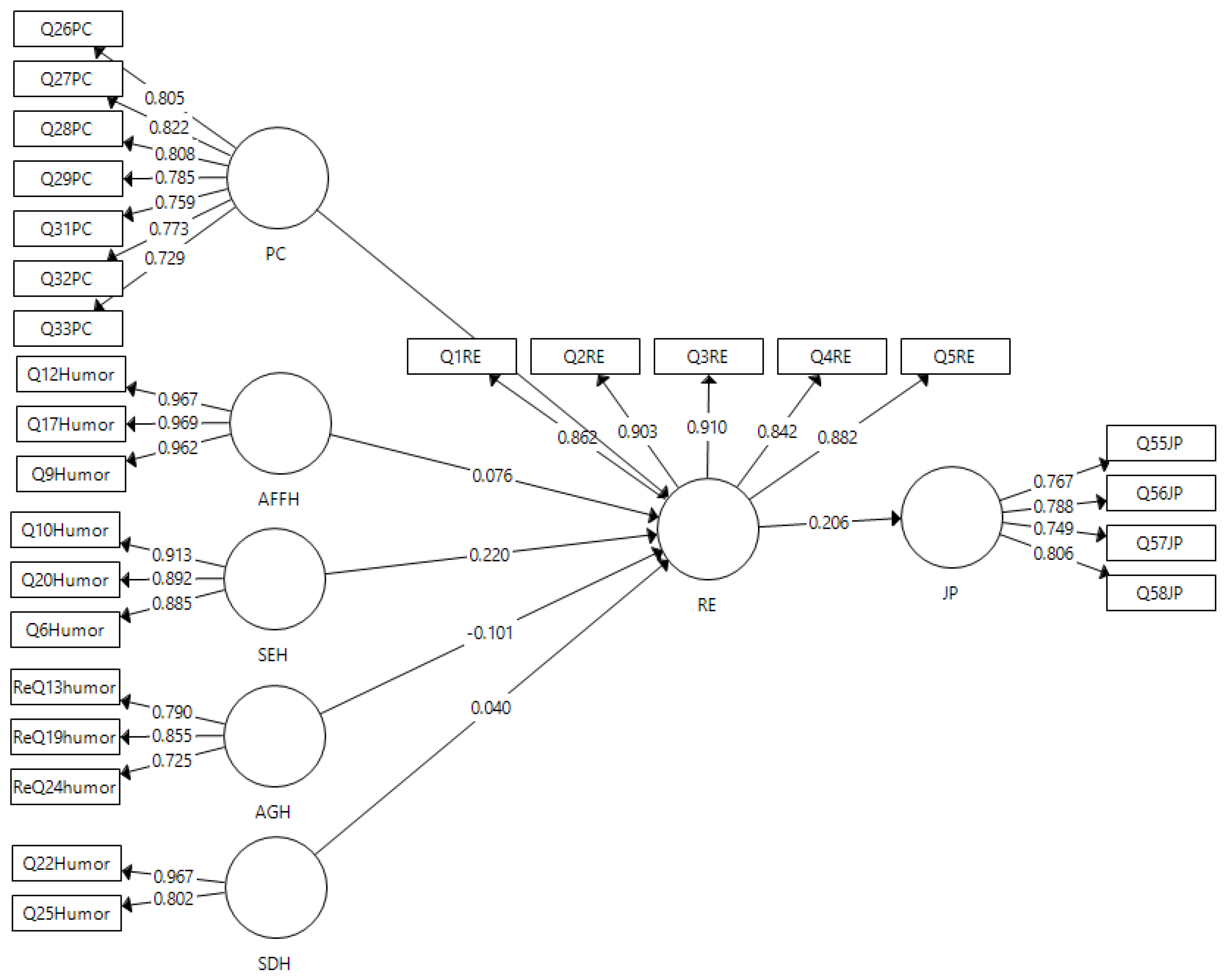
Figure 3.
Independent variable (RE) predicting mediator (JE).
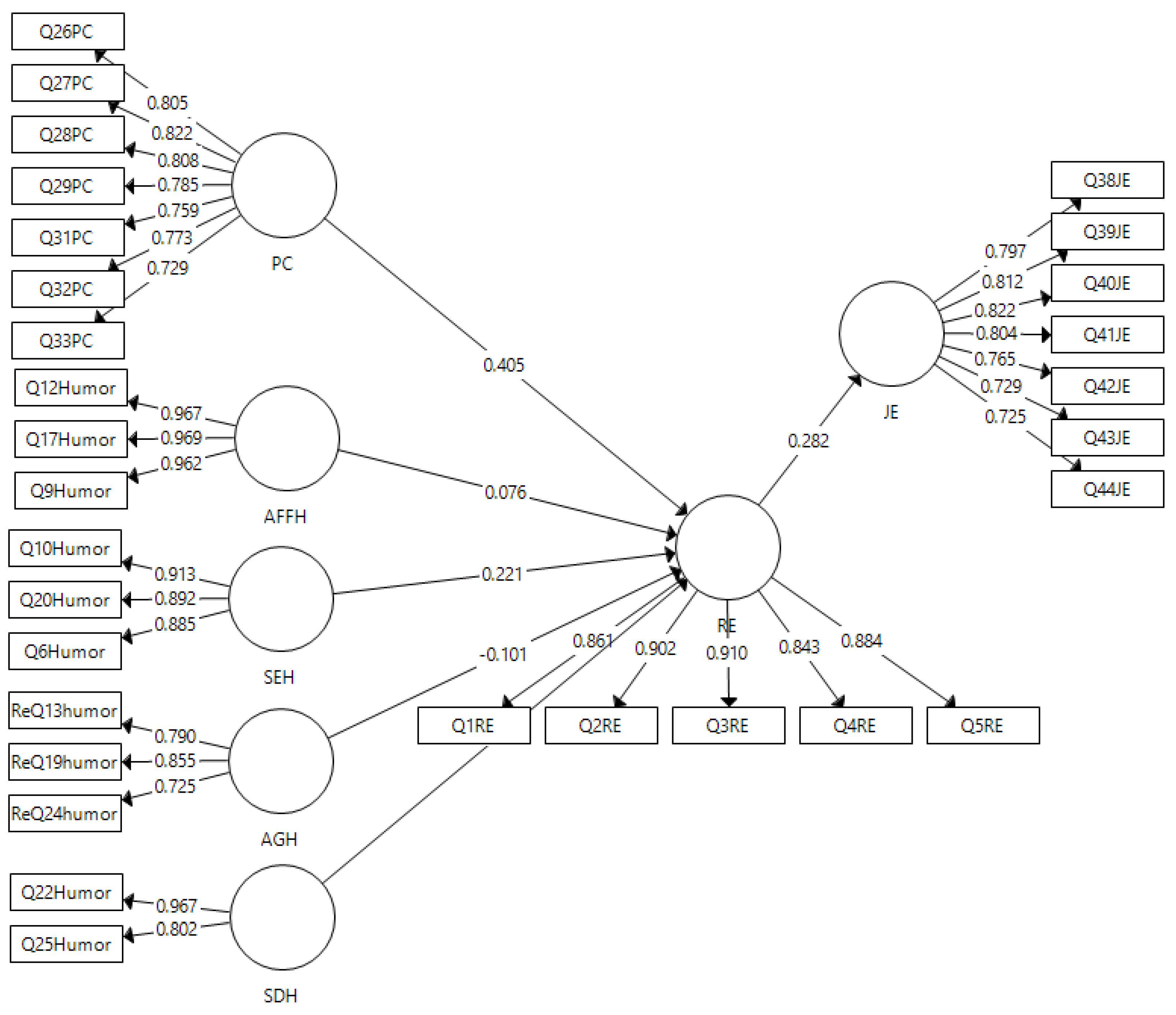
Figure 4.
Final model.
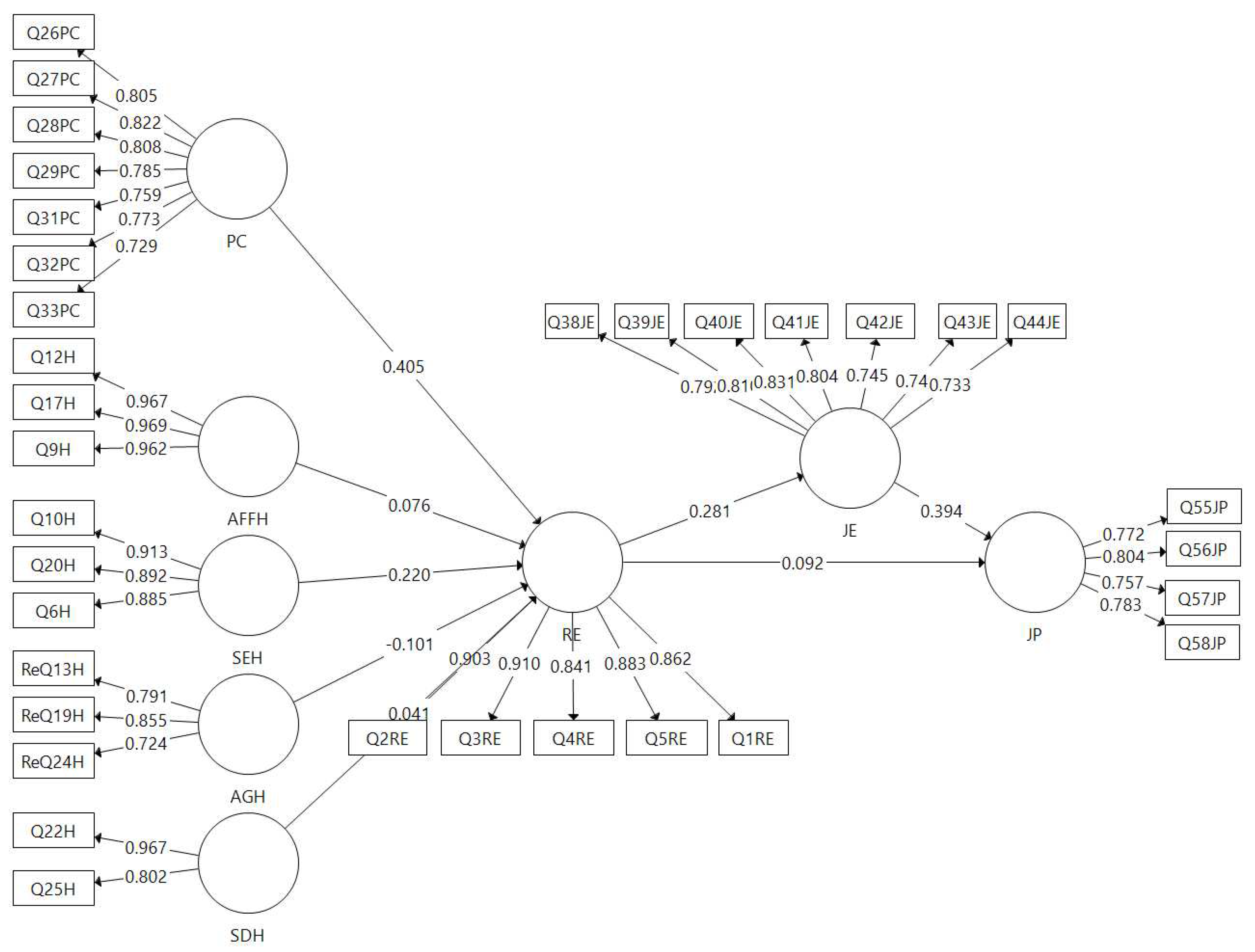
Table 1.
Mean and standard deviation of the constructs.
| Construct | Mean | Standard deviation |
|---|---|---|
| Psychological Capital | 4.89 | 0.88 |
| Affiliated humor | 5.17 | 1.41 |
| Self-enhancing humor | 4.89 | 1.32 |
| Aggressive humor | 3.12 | 1.46 |
| Self-defeating humor | 3.72 | 1.66 |
| Relational energy | 5.30 | 1.22 |
| Job engagement | 5.02 | 0.84 |
| Job performance | 4.27 | 0.63 |
| n(481) |
Table 2.
Correlation matrix of the constructs.
| PC | AFH | SEH | AGH | SDH | RE | JE | JP | ||
|---|---|---|---|---|---|---|---|---|---|
| PC | Pearson Correlation | 1 | |||||||
| Sig. (2-tailed) | |||||||||
| AFH | Pearson Correlation | .291** | 1 | ||||||
| Sig. (2-tailed) | .000 | ||||||||
| SEH | Pearson Correlation | .371** | .458** | 1 | |||||
| Sig. (2-tailed) | .000 | .000 | |||||||
| AGH | Pearson Correlation | -.424** | -.268** | -.380** | 1 | ||||
| Sig. (2-tailed) | .000 | .000 | .000 | ||||||
| SDH | Pearson Correlation | .004 | .179** | .121** | -.001 | 1 | |||
| Sig. (2-tailed) | .931 | .000 | .008 | .974 | |||||
| RE | Pearson Correlation | .551** | .332** | .452** | -.378** | .080 | 1 | ||
| Sig. (2-tailed) | .000 | .000 | .000 | .000 | .080 | ||||
| JE | Pearson Correlation | .300** | .116* | .157** | -.199** | .063 | .282** | 1 | |
| Sig. (2-tailed) | .000 | .011 | .001 | .000 | .167 | .000 | |||
| JP | Pearson Correlation | .249** | .258** | .188** | -.085 | .025 | .194** | .411** | 1 |
| Sig. (2-tailed) | .000 | .000 | .000 | .063 | .592 | .000 | .000 |
**Correlation is significant at the 0.01 level (2-tailed). *Correlation is significant at the 0.05 level (2-tailed).
Table 3.
Reliability analysis of the constructs.
| Construct | No. of items | Cronbach α |
|---|---|---|
| Psychological Capital | 7 | 0.895 |
| Affiliated humor | 3 | 0.964 |
| Self-enhancing humor | 3 | 0.879 |
| Aggressive humor | 3 | 0.700 |
| Self-defeating humor | 2 | 0.768 |
| Relational energy | 5 | 0.927 |
| Job engagement | 7 | 0.892 |
| Job performance | 4 | 0.785 |
Table 4.
Convergent validity.
| Construct | CR | AVE |
|---|---|---|
| Psychological Capital | 0.917 | 0.614 |
| Affiliated humor | 0.977 | 0.933 |
| Self-enhancing humor | 0.925 | 0.805 |
| Aggressive humor | 0.834 | 0.627 |
| Self-defeating humor | 0.881 | 0.789 |
| Relational energy | 0.945 | 0.775 |
| Job engagement | 0.916 | 0.608 |
| Job performance | 0.861 | 0.607 |
Table 6.
Mediation effect.
| Effects | Path | Path coefficient | Indirect effect | Total effect | VAF | t-value | p-value |
|---|---|---|---|---|---|---|---|
| Mediator | RE→JE | 0.281 | Not applicable | ||||
| JE→JP | 0.394 | Not applicable | |||||
| RE→JP | 0.092 | 0.110 | 0.203 | 54.18% | 4.583 | 0.000 |
Notes: Variance accounted for (VAF) = indirect effect/total effect * 100 = (0.110/0.203)*100 = 54.18%; t-value = indirect effect/standard deviation = 0.110/0.024 = 4.583.
Disclaimer/Publisher’s Note: The statements, opinions and data contained in all publications are solely those of the individual author(s) and contributor(s) and not of MDPI and/or the editor(s). MDPI and/or the editor(s) disclaim responsibility for any injury to people or property resulting from any ideas, methods, instructions or products referred to in the content. |
© 2023 by the authors. Licensee MDPI, Basel, Switzerland. This article is an open access article distributed under the terms and conditions of the Creative Commons Attribution (CC BY) license (http://creativecommons.org/licenses/by/4.0/).
Copyright: This open access article is published under a Creative Commons CC BY 4.0 license, which permit the free download, distribution, and reuse, provided that the author and preprint are cited in any reuse.


