

Submitted:
28 May 2024
Posted:
29 May 2024
You are already at the latest version
Abstract
The study aims to evaluate the impact of organizational culture on labor efficiency at foreign-invested logistics service enterprises that are on its ways towards business sustainability. The authors develop theoretical basis on organizational culture and explore factors that contribute to organizational culture and labor efficiency; from which 03 research hypotheses are proposed. Primary data are collected from logistics businesses through questionnaires; multiple linear regresion model is used to analyze the influence of organiational culture on labor effeciency at foreign-invested logistics enterprises. Research results indicate 05 factors of organizational culture contribute positive impact on employee productivity, including employees’ trust, company ideals, leadership styles and authority division, business philosophy and mission, people’s relationship with naturual environment. Based on the research results, proposed recommendations are suggested for improving labor efficiency at foreign-invested logistics service enterprises in a sustainable way.
Keywords:
culture
; organization
; efficiency
; labor
; business
; service
; logistics
; foreign investment
; sustainability
1. Introduction
Schein [1] said that“a pattern of basic assumptions that the group learned as it solved its problems of external adaptation and internal integration, that has worked well enough to be considered valid and, therefore, to be taught to new members as the correct way to perceive, think and feel in relation to those problems”. Organizational culture is a significant determinant of organization success, it is a tool that strongly influences employee behavior and labor performance [2,3]. Organization culture does not only determine employees behavior and attitudes, but also aids in creating and strengthening customer service culture [4,5]. By improving quality of delivery service and enhancing service levels to ensure customers satisfaction, it is believed to be much cost -effective than regaining lost customers or attracting new ones. Enhancing customer service effectively can contribute significantly to organizational efficiency as well as customers and employee satisfaction [6,7].
However, many Vietnamese bussinesses are not fully aware of the importance and the notable role of organizational culture towards sustainable development and bussiness’s success. Organizational culture is often built fragmentarily, lack of systematic standards despite the fact the logistics is a critical piece of supply chains. According to data from the Ministry of Planning and Investment, Vietnam has more than 30 thousand businesses operating in logistics field, of which 89% are domestic businesses but only account for 30% of the market share, the rest belong to foreign businesses. There are about 25 world’s leading forwarding corporations providing services in Vietnam, contributing significantly to total domestic product GDP.
In the current context, foreign-invested logistics service enterprises focus on competitive strategies through service quality, price, transit duration, green development,etc.[8 ,9] Besides, enterprises put effort in building organizational culture by enhancing labor productivity, competitiveness and sustainable development, ensuring balance of economic efficiency, social equity and environment friendly. Compared to domestic enterprises, foreign-invested ones differ in terms of global perspective, nationality diversed workforce, culture and history, adaption flexibility toward global business environemnt, multicultural leadership styles, etc. From a sustainability perspective, foreign-invested logistics enterprises attend to improve key management practices in customer service field, taking into account the most effective issure to achive great service management performance [10,11].
Result collected from previous researches mainly focus on the evaluation of current state of organizational culture rather than using quatitative analysis for analyzing factors that impact on the various elements of organizational culture; some researches merely use secondary data to explore organizational culture. Therefore, the authors conduct the study “The impact of organizational culture on labor efficiency: A case study at foreign-invested logistics service enterprises approaching sustainability developement” to evaluate the influence of factors constituting organizational culture to labor efficiency in a sustainable way at foreign capital logistics service enterpries. From that, a proposed recommendation on building organizational culture is suggested to strengthen labor efficiency at foreign-invested logistics service enterprises in a sustainable manner.
2. Literature Review
2.1. Literature Review on Organizational Culture
Culture is one of the important factors contribute to the success of each organization or business [4,13] aids in creating unity in the awareness and actions of an organization, building team synergy and linking organization’s members at the same time. To make an oustanding position in the marketplace, businesses do not only be strong in financial, human and technological resources but also require to possess an appropriate organizational culture. A number of domestic and foreign studies have defined organizational culture in a numerous way. Schein [1,14] defined organizational culture as a set of normative values that solves issues related to external adaptio n versus internal integration; new employees are behaviorly educated and well awared of the common values, employees are unamious in awareness and showing great care about organizational values”.
In addition, several other empirical studies suggested that organizational culture is a powerful tool that influence employees’ behavior and ỉmprove performance [2]. Profound understanding business’s organizational culture is an important factor that assist employees in dealing effectively with customers, colleagues as well as other relationships; adjusting actions and behaviors accordingly to suit business’s common goals. Research by Cameron and Quinn [14] highlighted that organizational culture includes a set of complex, overlap and ambigous elements.
Most concepts regarding to organizational culture share common characteristics in terms of values, beliefs, relationships and behaviors. Schein [1] declared organizational culture includes three distinct levels of artifacts, values and basic assumptions. In particular, artifacts include any tangible elements, expressed through architecture, costumes and layout. The declared value presents the criteria or set of standards that business use to evaluate operations, quality of products/ services, people, actions. The core of organizational culture refers to basic assumption that people within bussiness must comply with, including basic elements that determine how business operates, interact and create relationships with customers and social communities[4]. Moreover, Uttal’s [15] suggested that organizational culture is a system of shared values and beliefs that interact with the organizational structure and control systems to create behavioral standards. Or corporate culture is a complex system including the development of an enterprise together with its values and beliefs that are felt [16]. Organizational culture reflects core values, beliefs of the organization, which promote leadership and human resource management by exemplary behavior with employees [17,18]. According to Forehand and Von Gilmer [19], organizational culture is a set of characteristics that describe and distinguish one organization versus the others.
Other empirical studies on organizational culture have shown that organizational culture is the values and behaviors that contribute to the success of the business and that this organizational culture will be shared among new employees [5]. Loyal employees often have tendency to explore about the business through corporate culture, thus organizational culture is a powerful tool to create stability and sustainability of the business [20]. Once organizational culture is popularized and applied consistenly, less conflicts occur and more positive interactions happen as a result. Therefore, evaluating and building organizational culture is indeed absolutely crucial in the success of one bussiness.
Although the concept of organizational culture is defined differently by various researchers, they can be understood as a set of values, beliefs and behaviors that are shared by each member in the enterprise [11]. Organizational culture includes every cultural values that are being formed throughout the existence and development of the business, which then turn out to be values, perspective, customs and traditions ingrained in business’s operations. This set of culture governs relationships, thoughts and behaviors of every members of the business in order to pursue and achieve business’s common goals.
2.2. Elements Constituing Organizational Culture
O'Reilly et al. [21] and Schein [1] suggested organizational culture is made up of three components of artefacts, values and assumptions. In particular, artefacts are the most obvious feature of culture, they refers to facilities, behavioral standards. They are tangible representations of culture. Core values include business philosophy, mission statement whereas assumptions are common conceptual components such as corporate nature, ethical standards [1]. The three elements contributing organizational culture are specifically as follows:
To begin with, tangible structural elements are the most visible aspects of organizational culture. This element includes behavioral norms such as language and slogans; physical structures such as architecture, construction, products, and equipment [6]. In more detail, language and slogans, logos, uniforms, employee cards,etc are the characteristics of corporate brand identity, distinguishing one company to the others, demonstrating the company’s professionalism and reputation to customers [22]. Research by Samovar and Porter [23] suggests that attaching meaning to symbols is considered to be the origin of written language. In addition, physical structure including architecture, products, machinery, and equipment are important elements constituing organizational culture. The dynamic relationship between organization and its environment was highlighted by Kast and Rosenzweig [24]. Construction architecture or corporate infrastructure including offices, factories, campuses,etc.that are formed since the business formation time, closly linked to the development process together with the history of the business. This is the working environment of the employees, the space for interacting with customers and a home for each and every single employees. Besides, the product of a business are the output (physical or virtual) that serve a customers’ needs or wants, generating revenue and profits for the business; a marketing strategy is developed accordingly based on the product characteristics. Machinery and equipment refers to tools, devices that are essential for producing a product and for conducting business operations efficiently.
Second layer of Schein’s model refers to core values which represent the principles, ideas and behaviors that are promoted and interacted throughout the business, including business’s operating principles, creating relationship with customers and social communities [1]. This second layer is also articulated in statements (leadership style, division of power) and core values (business philosophy, mission and vision). Organizational knowledge is an important element constituting corporate culture, it is the process that people demonstrating qualifications and skills through business management activities and production practices; truth of belief [25]. Organization knowledge includes knowledge from leaders, employees which are inherited and accumulated through practical production and business activities. This composes significant impact on business performance. Leadership style and division of power are crucial factors that make up organizational culture. Leadership style holds a significant tole in coordinating all business activities, inspriting and transforming positive energy act as a powerful tool for motivating and facilitating employees to strive to organizations’ success [26]. Division of power is the division of decision making based on hierarchy within the organization. The higher authority the subordinates holds, the greater the degree of power dispersion is.
The last layer is conceptual factors, representing the core of the organization’s culture and shape employees’ thinkings and behaviors. They are ideals, beliefs, corporate nature and ethical standards. Ideals are motivations and values that shape people to sympathize, share and perceive in a specific phenomena [1,27] Common ideals of business once are connected to individual’s own ideals support the business to achieve greater success. Belief is the awareness of an individual in perceiving right and wrong whereas trust is consciously formed and evaluated through actions, words, achievements of the business. Trust regulates employee’s behavior and engage people rigidly [28]. The fact is any business’s nature is greatly affected by surrounding environments. Each business possesses divese methods for connecting people and environment, such as mastery, harmony and obedience [29]. Besides, ethical standards are individual’s or organization’s conception of moral values. National culture holds critical value in shaping organizational culture. It is essential for business to develop clear ethical standards as the direction for employees’ behavior to follow.[30]
2.3. Employee Performance
Employee performace is the ability of an employee in achieving individual or organizational goals by allocating various resources effectively [31]. Employee performance means how well they fulfill their duties and desired results, it should be expressed through factors of work quality, customers retention, employees commitment together with attitude towards colleagues and customers. These factors are presented specifically as follows:
- -
- Work quality or service quality: This is an important factor to measure employee performace. Some empirical studies on this factor, [32] define work quality or service quality are the differences between expectations versus actual results. Similarly, service quality is the customers’ assessment about the outstanding features of a product/service based on actual experiences [33]
- -
- Ability in retaining customers: the ability to uphold customers is key factor in evaluating employee performance since customers play important role in generating business’s revenue, profits and maintaining business performace. Great employees achievement refer to the one who is skillful in persuading, retaining loyal customers and increasing potential customers at the same time. [34]
- -
- Employee commitment to the business: Employee commitment is an emotional attachment and involvement with a business. They demonstrate responsibilities and desire to contribute to the overall development of the business. Commitment provides employees a sense of responsibility, obligation and attachment to the business [35]
- -
- Employee attitude towards colleagues and customers: apart from the abovementioned factors, employees attitude towards colleagues and customers play a crucial atribute in evaluating employee performace [36]. It is one of the prior factor affecting customer engagement with a business’s services; the professionalism and dedication of employees aid in developing customer satisfaction in term of service quality. In addition, employee’s attitude toward colleagues equal to gentle, friendly and respectful relationships with working partners would create positive working environment, hence enhancing work quality which improve business reputation as a consequence.
2.4. Fundamental for Research Hypothesis
Research by Deal and Kennedy [2] claimed that a strong and normative culture in an organization is greatly beneficial in improving labor efficiency, increasing productivity and hence contributing to better goal achievement. Organizational culture is considered an influencial element in achieving business’s success, including the idea of sustainability [6]. Specifically, the relationship between cultural components and labor efficiency is as follows:
- The relationship between elements of artefacts and labor efficiency:
Tangible structual elements of an enterprise include language, slogans, construction architecture, products, machinery, equipment,etc. These elements are formed in association with the estabishment process of a business, hence effecting directly to employees’ thoughts, awareness, beliefs and values. Language and slogan of a business differentiate one versus the others. They demonstrate business’s professionalism and reputation to customers which raises awareness as well as adjusts behavior between employees and customers [37] Construction architecture and other machinery not only show physical resources of a business but also act as a workplace and communication space for both employees and customers. Besides, product or service quality attract customers and improve employees’ working evaluation. Therefore, the authors propose first research hypothesis as follows:
Hypothesis 1:
Artefacts factors of a business have positive impact on labor efficiency.
The relationship between elements of espoused values and labor efficiency:
Espoused values include statements and core values. Statements refer to corporate knowledge, leadership style, division of power. These are intangible attributes that influence employees who have attached with the company for a long period time. They act as a foundation for creating trust that promote employee’s loyalty, desire for contribution and long term commitment to the business. Similarly, core values are expressed through business philosophy and mission which impact significantly on employee’s productivity. Employees set clear and straightforward dỉrection with their work, develop working goals and behaviors toward customers and colleagues. Therefore, the authors suggest second hypothesis as follows:
Hypothesis 2:
Espoused Values factors have positive impact on labor efficiency.
- The relationship between assumption and labor efficiency:
Assumption include ideals, beliefs, corporate culture and ethical standards. Ideals and beliefs are remarkable motivation in shaping employee’s working contribution for achieving individual target and business’s common goals. The nature of any business is the basis for each employee to adjust their behavior towards surrounding environment as well as relationships with customers and colleagues [29]. Ethical standards are orientation for employee to develop appropriate behavior, increase productivity which resulting effectively to employees’ working efficiency. For that reason, the authors propose third research hypothsis as follows:
Hypothesis 3:
Assumptions factors have positive impact on labor efficiency.
From the abovementioned discussions, a theoretical research model is developed:
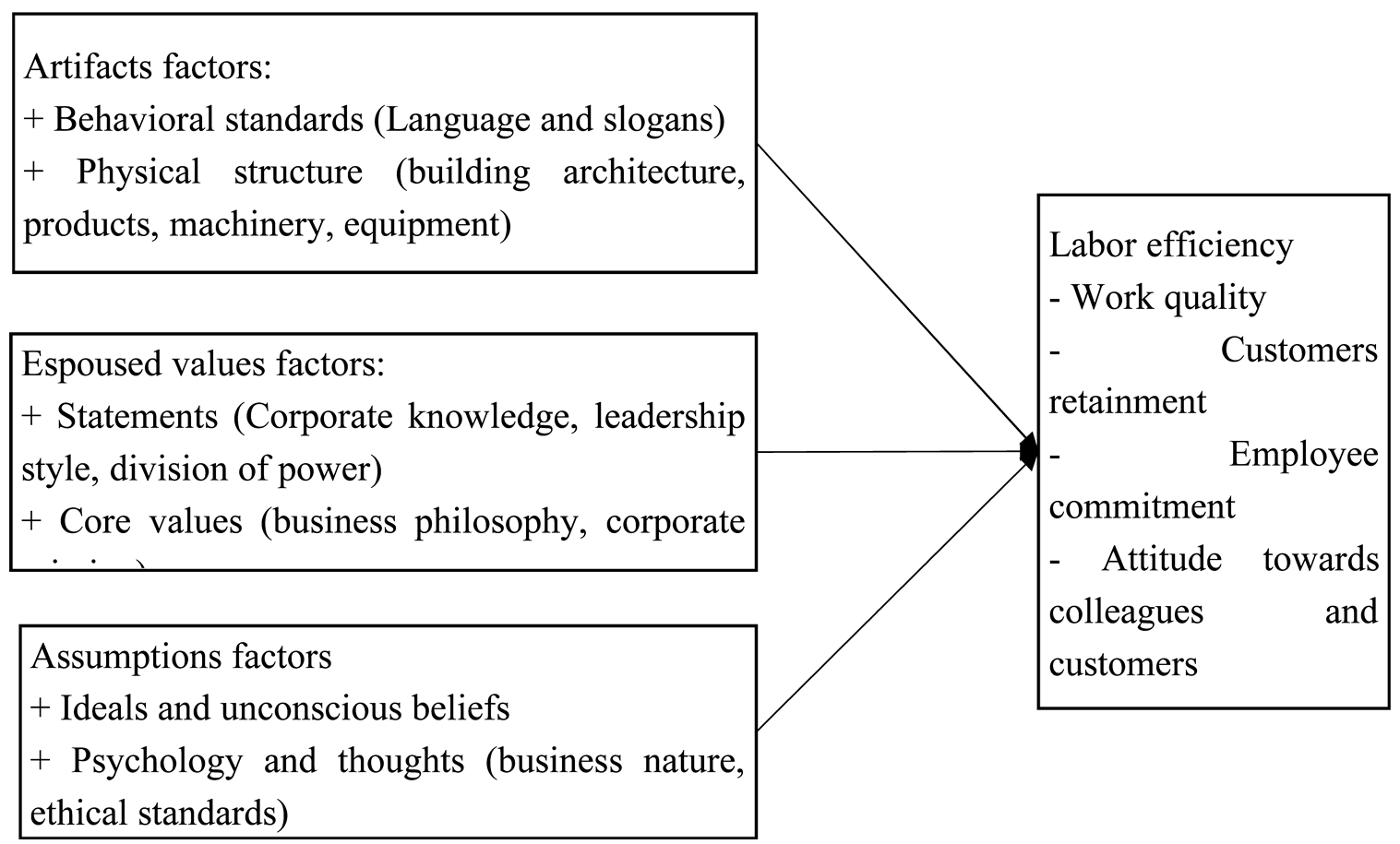
(Source: summarised by the authors of this paper).
3. Materials and Methods:
Implementation process:
The authors collect secondary data to conduct research and analyze current situation of foreign-invested logistics service enterprises as well as theoretical basis of organizational culture factors that effect on labor efficiency at foreign-invested logistics service enterprises. Secondary information is gathered through reliable reports and documents on organizational culture of foreign – invested businesses operating in logistics service. In addition, the authors search for relevant dât in other sources such as newspapers, the Internet, books and related dissertations. Secondary data is a set of complex inputs that are derived from various sources, hence the authors have systematically arranged them into logical group of information. Specifically, irrelevant information are eliminated whereas appropriate ones are filtered out into detailed and specific groups. The authors conduct following steps to collect secondary data:
- -
- Determing data required for the investigation. The authors select information that are necessary for the research, avoiding extraneous and inappropriate ones.
- -
- Collecting secondary data from logistics businesses’ internal sources such as company’s history, brochures, revenue reports, etc which are reliable and useful source of data.
- -
- Identifying secondary data collected from external sources in large archives, including newspapers, Internet, books, dissertations. Copied information are hand-copied or taken as photos then compiled and rearranged into a notebook to keep on track.
- -
- Detailed value analysis of secondary data: after collecting all information from secondary sources, the authors review data accuracy by compare and contrast similar information from various sources. In case discrepancy occurs, further research is conducted for verification.
In order to acquire sufficient data for analysis, the authors proceed to collect primary data by distributing questionnaire survey at foreign-invested logistics service businesses that are operating in Vietnam.
Sampling method is used for 162 foreign-invested logistics service businesses were interviewed directly or indirectly (via email, phone, online questionnaire of Google form). Designed questionnaire comprises 3 parts, in which part 1 is general information about the business; part 2 includes 10 questions addressing organizational culture factors affecting labor efficiency and 4 questions relating to factors measuring labor efficiency usinh 5-level Likert scale (from 1 to 5); part 3 is business assessment on current organizational culture and labor efficiency. According to Stevens (2002) and Habing (2003), a factor that is considered as trustworthy if it posesses 3 or more measurement variables. To ensure the validity and content of each scale, preliminary interviews with expertise and knowledgable experts were carried out, followed by an assessment of the model appropriateness. From there, the scale was adjusted and supplemented to satisfy the research context.
For questionnaire design, the following steps were applied:
- -
- Determining the objective of designing questionnaires is to collect employees’ evaluation in various companies on specific factors of organizational culture and their self-assessment on work sustainability; thereby drawing conclusions about the influences of organizational culture on labor efficiency in a sustainable way.
- -
- The authors determine the question types used for the survey which is ticking or circling. Survey layout and question arrangement are developed in a logical and concise way.
- -
- Defining method for forming questions effectively. Questions are easy to address without any hidden meaning. Answer types are mostly multiple answer options.
- -
- Investigating list: request for a list of employees from the Vietnam General Statistics Office, Vietnam Logistics Service Business Association, Vietnam Logistics Human Resources Association. Questionnaires are then sent to employees via emails. Responses are sent back via email automatically once done.
Data analysis method:
From the above literature review, a regression model was built with 10 independent variables in order to address the influence of organizational cultural factors on labour efficiency at Vietnamese logistics service enterprises with foregn investment capital. Specifically as follow:
Y = a0 + a1X1 + a2X2 + a3X3 + a4X4 + a5X5 + a6X6 + a7X7 + a8X8+ a9X9+ a10X10+ ε
Whereas:
- Y: Evaluate labor efficiency of foreign-invested logistics enterprises in Vietnam;
- a0, a1, ..., a10: coefficients to find;
- X1, X2..., X10: elements that constitute the organizational culture of foreign-invested logistics enterprises in Vietnam;
- ε: standard error.
After data collection, the authors synthesizes and combines information, screen for abnormal values, encode data for subsequent regression analysis.

Table 2.
Test independent and dependent variables.
| No. | Variable | Symbol | Cronbach’s Alpha | Kaiser-Meyer-Olkin | Sig. | Value of first pillar (%) |
|---|---|---|---|---|---|---|
| 1 | Language and slogan | NNKH | ,965 | ,808 | ,000 | 90,695 |
| 2 | Construction architecture | KTXD | ,842 | ,716 | ,000 | 76,313 |
| 3 | Equipment, products, machinery | TTBS | ,956 | ,783 | ,000 | 88,979 |
| 4 | Knowledge of business | TTDN | ,821 | ,720 | ,000 | 73,718 |
| 5 | Leadership style and division of power | PCLD | ,846 | ,801 | ,000 | 68,476 |
| 6 | Business philosophy and bmission | TLKD | ,792 | ,731 | ,000 | 61,694 |
| 7 | Company ideal | LTDN | ,933 | ,725 | ,000 | 83,458 |
| 8 | Employee trust and belief | NTNV | ,913 | ,804 | ,000 | 79,576 |
| 9 | People’s relationship with natural environment | TCDN | ,924 | ,730 | ,000 | 87,439 |
| 10 | Ethical standards | CMDD | ,760 | ,703 | ,000 | 58,833 |
(Sources: Results of the survey).
4. Results and Discussion
Regression results and multicollinearity test are presented in the below table. The dependent variable is labor efficiency of foreign-invested logistics service enterprises in Vietnam whereas the independent ones are elements constituting organizational culture that affect work effeiciency of foreign-invested logistics enterprises. The F-statistic of the model is 43,130 with p value (Sig.) = 0.000 which indicates the appropiateness of the model and collected data.
The adjusted R-Squared value reached 0,724 which show the independent variables throughout the model explained 72,4% of the variation in the dependent variable. Results of multicollinearity analysis of the model show that VIF values are all less than 4, which indicate this phenomenon does not exist in the regression model. These results confimed the reliability of regression model.
| Model Summaryb | |||||||||||
| Model | R | R Square | Adjusted R Square | Std. Error of the Estimate | Durbin-Watson | ||||||
| 1 | .861a | ,741 | ,724 | ,52582073 | 2,011 | ||||||
| a. Predictors: (Constant), CMDD, LTDN, NNKH, KTXD, TLKD, TCDN, TTBS, TTDN, NTNV, PCLD | |||||||||||
| b. Dependent Variable: KQLD | |||||||||||
| ANOVAa | |||||||||||
| Model | Sum of Squares | df | Mean Square | F | Sig. | ||||||
| 1 | Regression | 119,250 | 10 | 11,925 | 43,130 | .000b | |||||
| Residual | 41,750 | 151 | ,276 | ||||||||
| Total | 161,000 | 161 | |||||||||
(Sources: Results of the survey).
In addition, the ANOVA table demonstrates a statistically significant differences between groups, hypothesis H0: There is no significant difference among various factors contituting organizational culture. Results show value Sig. = 0.000 <0.05, thereby H0 is rejected. Therefore, there is a statistically significant difference in labor efficiency of Vietnamese foreign-invested logistics businesses among various factors contributing organizational culture.
Table 3.
Regression results.
| Unstandardized coefficient | t | Sig. | Multicollinearity statistics | |||
| B | Standard error | Tolerance | VIF | |||
| (Constant) | -6,452E-17 | ,041 | ,000 | 1,000 | ||
| NNKH | -,003 | ,042 | -,072 | ,942 | ,953 | 1,049 |
| KTXD | ,047 | ,043 | 1,084 | ,280 | ,920 | 1,087 |
| TTBS | ,002 | ,048 | ,041 | ,967 | ,736 | 1,358 |
| TTDN | ,012 | ,048 | ,240 | ,810 | ,745 | 1,342 |
| PCLD | ,214 | ,058 | 3,670 | ,000*** | ,504 | 1,983 |
| TLKD | ,119 | ,044 | 2,715 | ,007** | ,888 | 1,126 |
| LTDN | ,373 | ,055 | 6,739 | ,000*** | ,559 | 1,788 |
| NTNV | ,399 | ,057 | 7,026 | ,000*** | ,531 | 1,882 |
| TCDN | ,085 | ,043 | 1,977 | ,050* | ,938 | 1,066 |
| CMDD | -,055 | ,044 | -1,255 | ,211 | ,907 | 1,103 |
(Sources: Results of the survey). * statistically significant with p < 0,05; ** statistically significant with p < 0,01; *** statistically significant with p < 0,001.
Regarding to results of regression model on the influence of organizational cultural factors on labor efficiency at foreign-invested logistics service enterprises in a sustainable approach, there are 10 independent variables which are correspondent to 03 organizational culture components in the model. Among which, there are 05 statistically significant variables with significance levels from 1% to 10% that effect greatly on the labor efficiency at foreign-invested logistics service enterprises whereas the remaining 05 variables do not have any noticeable impact. The variable Employee Trust (NTNV) has the strongest impact, followed correspondingly by Company Ideals (LTDN), Leadership Style and Division of Power (PCLD), Business Philosophy and Business Mission Business (TLKD), People's relationship with natural environment (TCDN). The remaining variables that are not statistically significant include: Language and slogans (NNKH), Construction architecture (KTXD), Equipment, Products, machinery (TTBS), Business knowledge (TTDN ), Ethical standards (CMDD). The level of impact for these variables is specifically analyzed as follows:
- -
- Regression results demonstrate independent variable PCLD (leadership styles and division of power) have an impact on labor efficiency within foreign-invested logistics enterprises in Vietnam at 95% (B=0,214; Sig. = 0 ,000). This result is consistent with literature economic theory and other privious reseaches. Therefore, factors from Leadership style and division of power generate positive influence on labor efficiency in Vietnamese foreign – invested logistics service enterprises. A standard leadership style and appropriate division of power within a business promote labor productivity in an effective way.
- -
- In reality, leadership style is one of the element of organizational culture that plays a particularly critical role in coordinating the entire activitíe within a business. Leadership style inspires work, transmits energy to employees and acts as a prerequisite for creating organizational culture. Leadership style posses profound effect on labor performance and business success (Mind Tools, 2000). Several empirical studies show that inappropriate leadership styles decrease 48% working effort and 38% working quality, which negatively impact on the labor efficiency of the business. Besides, a set of appropriate and specific division of power enables logistics service businesses to make decisions at ease. Decision making is made in the host country based on the hierarchy of power division, instead of spending time consulting parent company. This enables employees to solve problems sufficiently, time saving and productivity achievement effectively in the logistics process.
One of the current situation relating to foreign-invested logistics businesses should be mentioned is DHL, a world’s leading corporation in logistics industry, specializing in international transportation and delivery services. It was founded by Adrian Dalsey, Larry Hillblom and Robert Lynn in 1969. Creative and pioneering leadership style together with an appropriate division of power have helped DHL to improve labor efficiency and develop rapidly in a sustainable direction in the world in general and in Vietnam in particular.
- -
- Regression results indicate the independent variable of TLKD (Business philosophy and mission) has positive impact on labor efficiency at Vietnamese foreign-invested logistics businesses at 95% (B = 0,119; Sig. = 0,007). The result is consistent with previously mentioned researches in the Literature review. Therefore, factors from Business philosophy and mission have significant positive effect on labor efficiency in foreign-invested logistics enterprises. This implies that business philosophy and mission are profound thoughts that orient employees and all activities throughout the business; they are guidelines for all actions, aiming for high productivity and optimal efficiency in sustainable production. Business philosophy and mission are crucial elements constituting organizational culture, they act as the keys in enhancing labor efficiency and business success[38]. Business philosophy and mission are common ideology that all employees aim for, which are rigid and intransigent despite internal fluctuations, thus create sustainable development for the business.
According to Bussiness Association Vietnam logistics (VLA), foreign companies account for 80% of Vietnam’s logistics market. Many large logistics corporations in the world invest capital in Vietnam, providing a full range from international transportation services to domestic transportation with wide international network and modern IT systems. Most businesses develop their philosophy based on cooperation, creativity, interation, friendliness and sustainability[39]. Business philosophy with the aim at close coorperation, shared benefits, customers oriented, mutual development,etc. serves as an important foundation to help each employee plan for their work and career, improve labor efficiency, create widespread logistics network and added value for sustainable development. Green logistics is the mission that foreign-invested logistics businesses are aiming for, activities such as using electric vehicles, solar energy, biological packaging,etc. are applied to reduce carbon emissions, thus promoting sustainable development. This current situation confirms factors regarding to business philosophy and mission indeed have strong positive impact on labor efficiency for foreign-invested logistics businesses in a sustainable approach.
- -
- Regression results show the independent variable LTDN ( Business ideals) has positive impact on the performance of employees at Vietnamese foreign-invested logistics businesses at the statistical 95% (B=0.373; Sig. = 0.000). The impact of this variable on labor efficiency is remarable with the regression coefficient (B = 0 ,373). The result is consistent with previous researches which means a proper company’s ideal will boost up individual’s working spirir and enhance employee committment with the organization, thereby promoting labor productivity.
It happens in reality that business’s ideal is a driving force that help employees share, understand, engage and sympathize with all situations and events [1,34]. Factors regarding to company’s ideal are not only crucial element constituting organizational culture but also create strong impact on employees and labor efficiency, especially at logistics businesses. Once the business ideal is well-connected with employees’ ideal, it enables employees to confidently demonstrate their professional capacity and talent, improving labor productivity and achieving business service effectively. Current situation of organizational culture factors on labor efficiency at Vietnam foreign-invested logistics enterprises often possess modern facilities, dynamic working environment, professional working style, mutual cooperation and respect, constant development and aiming for global-oriented. These ideally elements encourage employee to contribute strively towards business’s goals. Foreign-invested logistics businesses have tendency in increasing capital and broaden technology investment, expanding market share to support the connecitivty of society economic development, which creating high and stable source of income for employees, attacting long-term commitment of skillful labors, thus improve productivity and promote sustanability.
- -
- Regression results show that independent variable NTNV (Employees trust) does have an impact on employee efficiency at Vietnamese foreign-invested logistics businesses at 95% (B=0,399; Sig. =0,000). The regression coefficient expressed that employee trust is one of the strongest factor affecting labor efficiency. The result is consistent with various researches. Employee trust is a key element that constitutes organizational culture which has direct propotion with labor efficiency, creating business success, especially at foreign-invested logistics services which is diverse in personnel, culture and global strategic thoughts.
Employee trust is formed from employee’s conciousness about righteousness and ethical standards. The rules of organizational culture are crucial foundation for regulating employee behavior and strengthening trust, connecting people tightly [28], thereby improving work quality and labor productivity. In addition, employee trust in the business assists to promote work innovation and creativity, enhance employee loyalty. For Vietnamese foreign-invested logistics service enterprises, employee trust enhance working motivation, resolve orders conflict or other related arise issues. The entire logistics process with customers and employees are built on common responsibility in a constructive spirit [40]. Furthermore, employees can share information and take advantage to support each other at various service stages, helping orders to be shipped faster at highest efficiency.
Several researches demonstrated that high employee trust create productive and high commitment at work; new employees are strongly associated thanks to the support and coorporation process among employees [41]. An empirical survey results by [42] illustrates businesses that own high employee trust are considered trustworthy by 75% surveyed respondents. Current situation shows that foreign – invested logistics enterprises with strategic thinking, global perspective, great remuneration can promote employee attachment, improve labor efficiency, enhance business productivity, thus support business sustainability.
- -
- Regression result illustrates the independent variable TCDN (People relationship with natural environment) has an positive impact on labor efficiency at Vietnamese foreign-invested logistics businesses at the statistical threshold of 95% (B=0.085; Sig. = 0.000). The higher the people relationship with natural environment is, the better the labor effciency as a result. Connectivity methods between business and environment such as mastery, harmoney, obedience [29] creates strong influence on labor efficiency. In physical existence, people relationship with natural environment and corporate social responsibility have positive effect on human capital and employee behaviors, thereby promote labor efficiency and business development in a sustainable way. FDI enterprises in general and Vietnam foreign-invested logistics enterprises in particular are raising awareness and aiming at environmental responsibility via green FDI flows of capital, which result in promoting labor efficiency and ensuring sustainable development.
It is obvious that foreign-invested logistics businesses in Vietnam are on their way to implement green management for employees to comply with environmental regulations [43]. This indeed is a driving factor in improving service efficiency and determining competitive advantages of businesses, especially in the context of a knowledge economy and green intellegence that drive competitive advantage towards sustainable development. Nowadays, green logistics trend and improving efficiency associated with environmental protection have become the orientation for numerous Vietnamese foreign-invested logistics enterprises. Specifically, some taken actions should be mentioned such as the use of recycled or biodegrable materials packages, fuel-efficient means of transportation, renewable enerfy, strict transportation assessment, etc.
Furthermore, the research results draw a conclusion that some independent variables are not statistically significant, including Human Resources Language and Slogans, Construction Architecture, Construction Economy, Equipment, Products, Machinery (TTBS), Knowledge corporate knowledge (TTDN), Ethical standards (CMDD). The results reveal a fact that in the economic and social context in Vietnam, these factors have not signìicantly influence labor efficiency at Vietnam foreign-invested logistics service enterprises.
5. Recommendations:
By analyzing linear regression model, it is visible that there are 05 out of 10 factors which are Employee Trust (NTNV), Company Ideals. Company (LTDN), Leadership Style and Division of Power (PCLD), Business Philosophy and Corporate Mission (TLKD), People's relationship with natural environment (TCDN) have significant positive impact on labor efficiency at foreign-invested logistics enterprises in Vietnam. Some recommendations are proposed to elevate employee productivity in a sustainable way, as follows:
- -
- Develop a culture of employee trust: Foreign-invested logistics service enterprises are often diverse in terms of personnel, nationality and employee culture, thus special attention needs to be paid into creating and developing a culture of trust. First of, businesses are required to define clear logistics service business goals that each employee is clear about. This helps effectively in guiding the whole team to be consistent and coordinate smoothly towards a common connective spirit throughout the business. Secondly, it is vital for logistics service businesses to create appropriate remuneration policies, ensuring stable and sustainbale income for every workers in the host country as well as in the foreign country. Employees contributions at work should be recognized and appraised for strengthening trust and improve motivation. Moreoever, organization can foster open discussion and communication to improve collaboration and engagement between people within the same organization. Training and fostering professional expertise, soft skilled as well as behavioral culture among employees should be held regularly.
- -
- Build leadership and management style: A standard leadership and management style should be create to coordinate all activities within an enterprise. Business leaders and managers must identify and set appropriate ethical standards. A suggested motto set for employees can be improving work quality and efficiency, communicating friendly and supportive with customers in the host country associated with cultural characteristics, help and encourage other collegues. Besides, leaders must be equipped with professional qualifications and ethical qualities with thorough perceive on the importance of organizational culture, especially in multinational logistics service company. Leaders’ responsibility must be highlighted; decisions must be clear, powerful and appropriate based on hierachy within various stages of the logistics process. Leadership methods should be developed properly to be flexible with differences in multicutural and cross-border coorperation.
- -
- Demonstrate business’s ideal: Foreign-invested logistics enterprises design their images through visual symbols and facilitíe, impresive office architecture, logos and slogans,etc. to be outstanding and remarkable once they are approached by customers or employees.
- -
- Building inspring business philosophy and corporate mission. Foreign-invested logistics service enterprises should take into account human and uniqueness factors when creating business philosophy to mark positive impression on customers and partners. Business philosophy must evoke the cohesion of all employees, small strength of employees can assemble greate power for the business as a whole; each employee acts as an important key in each stage of the logistics activities, creating great quality of the entire ordering process. Furthermore, variety in leadership styles, development orientation, business strategy and organizational culture should be emphasized and analyzed to best suit the customers’ tastes at the host country.
- -
- Establish organizational culture associated with environmental and social responsibility, aiming for sustainable development. Foreign-invested logistics enterprises should focus on building strategies and solutions towards the trends of “greening” or “ greening logistis”, putting effort into implementing environmnr responsibility.
6. Conclusions
In today’s society, organizational culture plays a remarkable benefit in promoting labor efficiency at foreign-invested logistics enterprises in a sustainable manner. Through the process of collecting, processing and synthesizing data with the help of regression model, this research identifies and evaluates factors that contributing significant impact on organizational culture. The 05 factors of Employee Trust, Company Ideals, Leadership Style and Division of Power, Business Philosophy and Corporate Mission, People's relationship with natural environment pose positive influence on employee productivity. Employee trust has the strongest positive impact among the abovedmentioned of 5 factors.
Apart from the obtained results from the research model, this article has a worthy contribution to the theoretical basis on elements constituing organizational culture towards labor efficiency. Determining a research model with 10 independent variables divided into 03 components contributes to the direction for future research on similar research topics.
Regarding to practical contribution and recommendation implications, the research has practical significance that reflect and evaluate components that make up organizational culture on labor efficiency at foreign-invested logistics enterprises. Research results act as fundamentals for proposing solutions to enhance labor efficiency in a sustainable approach. There are 05 groups of recommendations based on the significant positive impact of the analyzed factors. Several recommendations are pointed out, including Develop a culture of employee trust, Build leadership and management style, Demonstrate business’s ideal, Building inspring business philosophy and corporate mission and Establish organizational culture associated with environmental and social responsibility, aiming for sustainable development.
Besides the achievement of the research, the study still has some limitations such as the differences in enterprise size, labor qualification in various logistics activities (from warehousing, loading and unloading, delivery to import-export services). This results to the inconsistent and fragmentation of data level. Moreoever, due to time and data limitations, there are other various factors relating to organizational culture that affect labor efficiency at foreign-invested logistics enterprises have not been critically analyzed in this article. Further studies should take these limitations into considerations for deeper investigation.
| Collinearity Diagnosticsa | ||||||||||||||
| Model | Eigenvalue | Condition Index | Variance Proportions | |||||||||||
| (Constant) | NNKH | KTXD | TTBS | TTDN | PCLD | TLKD | LTDN | NTNV | TCDN | CMDD | ||||
| 1 | 1 | 2,473 | 1,000 | ,00 | ,00 | ,02 | ,04 | ,03 | ,05 | ,00 | ,05 | ,06 | ,00 | ,00 |
| 2 | 1,412 | 1,323 | ,00 | ,07 | ,09 | ,07 | ,08 | ,03 | ,00 | ,02 | ,00 | ,08 | ,12 | |
| 3 | 1,266 | 1,398 | ,00 | ,08 | ,00 | ,03 | ,11 | ,01 | ,24 | ,01 | ,01 | ,04 | ,13 | |
| 4 | 1,124 | 1,483 | ,00 | ,17 | ,00 | ,03 | ,02 | ,02 | ,23 | ,02 | ,00 | ,25 | ,05 | |
| 5 | 1,000 | 1,573 | 1,00 | ,00 | ,00 | ,00 | ,00 | ,00 | ,00 | ,00 | ,00 | ,00 | ,00 | |
| 6 | ,923 | 1,636 | ,00 | ,20 | ,40 | ,00 | ,02 | ,00 | ,02 | ,00 | ,01 | ,15 | ,18 | |
| 7 | ,808 | 1,749 | ,00 | ,45 | ,43 | ,03 | ,03 | ,00 | ,00 | ,00 | ,00 | ,19 | ,00 | |
| 8 | ,718 | 1,856 | ,00 | ,00 | ,05 | ,22 | ,00 | ,01 | ,25 | ,00 | ,00 | ,23 | ,42 | |
| 9 | ,515 | 2,191 | ,00 | ,01 | ,00 | ,50 | ,70 | ,00 | ,17 | ,00 | ,00 | ,04 | ,07 | |
| 10 | ,426 | 2,409 | ,00 | ,02 | ,00 | ,01 | ,01 | ,02 | ,04 | ,70 | ,51 | ,00 | ,01 | |
| 11 | ,334 | 2,719 | ,00 | ,00 | ,02 | ,07 | ,02 | ,85 | ,04 | ,20 | ,39 | ,00 | ,02 | |
(Sources: Results of the survey).
| Residuals Statisticsa | |||||
| Minimum | Maximum | Mean | Std. Deviation | N | |
| Predicted Value | -1,6668369 | 1,5750592 | ,0000000 | ,86063098 | 162 |
| Residual | -1,31977975 | 1,20669103 | ,00000000 | ,50922913 | 162 |
| Std. Predicted Value | -1,937 | 1,830 | ,000 | 1,000 | 162 |
| Std. Residual | -2,510 | 2,295 | ,000 | ,968 | 162 |
| a. Dependent Variable: KQLD (Sources: Results of the survey). | |||||
| Total Variance Explained | |||||||||
| Component | Initial Eigenvalues | Extraction Sums of Squared Loadings | Rotation Sums of Squared Loadings | ||||||
| Total | % of Variance | Cumulative % | Total | % of Variance | Cumulative % | Total | % of Variance | Cumulative % | |
| 1 | 7,663 | 20,712 | 20,712 | 7,663 | 20,712 | 20,712 | 3,774 | 10,199 | 10,199 |
| 2 | 4,162 | 11,248 | 31,960 | 4,162 | 11,248 | 31,960 | 3,704 | 10,011 | 20,210 |
| 3 | 3,775 | 10,203 | 42,164 | 3,775 | 10,203 | 42,164 | 3,443 | 9,306 | 29,516 |
| 4 | 2,982 | 8,060 | 50,224 | 2,982 | 8,060 | 50,224 | 3,380 | 9,134 | 38,650 |
| 5 | 2,611 | 7,058 | 57,282 | 2,611 | 7,058 | 57,282 | 2,746 | 7,423 | 46,073 |
| 6 | 2,079 | 5,618 | 62,899 | 2,079 | 5,618 | 62,899 | 2,699 | 7,293 | 53,366 |
| 7 | 1,939 | 5,242 | 68,141 | 1,939 | 5,242 | 68,141 | 2,551 | 6,893 | 60,260 |
| 8 | 1,541 | 4,165 | 72,306 | 1,541 | 4,165 | 72,306 | 2,419 | 6,539 | 66,798 |
| 9 | 1,419 | 3,834 | 76,140 | 1,419 | 3,834 | 76,140 | 2,325 | 6,284 | 73,082 |
| 10 | 1,073 | 2,900 | 79,040 | 1,073 | 2,900 | 79,040 | 2,204 | 5,958 | 79,040 |
| 11 | ,771 | 2,084 | 81,124 | ||||||
| 12 | ,693 | 1,872 | 82,997 | ||||||
| 13 | ,595 | 1,608 | 84,605 | ||||||
| 14 | ,553 | 1,495 | 86,100 | ||||||
| 15 | ,526 | 1,421 | 87,521 | ||||||
| 16 | ,450 | 1,217 | 88,738 | ||||||
| 17 | ,425 | 1,148 | 89,886 | ||||||
| 18 | ,403 | 1,090 | 90,975 | ||||||
| 19 | ,360 | ,972 | 91,948 | ||||||
| 20 | ,321 | ,868 | 92,816 | ||||||
| 21 | ,306 | ,827 | 93,643 | ||||||
| 22 | ,283 | ,765 | 94,407 | ||||||
| 23 | ,277 | ,749 | 95,156 | ||||||
| 24 | ,249 | ,673 | 95,829 | ||||||
| 25 | ,237 | ,641 | 96,470 | ||||||
| 26 | ,217 | ,587 | 97,058 | ||||||
| 27 | ,193 | ,523 | 97,581 | ||||||
| 28 | ,182 | ,493 | 98,074 | ||||||
| 29 | ,146 | ,394 | 98,468 | ||||||
| 30 | ,137 | ,371 | 98,840 | ||||||
| 31 | ,105 | ,285 | 99,124 | ||||||
| 32 | ,098 | ,264 | 99,389 | ||||||
| 33 | ,077 | ,207 | 99,596 | ||||||
| 34 | ,057 | ,154 | 99,750 | ||||||
| 35 | ,045 | ,122 | 99,872 | ||||||
| 36 | ,035 | ,094 | 99,966 | ||||||
| 37 | ,013 | ,034 | 100,000 | ||||||
| Extraction Method: Principal Component Analysis. | |||||||||
(Sources: Results of the survey).
| Component Transformation Matrix | ||||||||||
| Component | 1 | 2 | 3 | 4 | 5 | 6 | 7 | 8 | 9 | 10 |
| 1 | -,413 | ,030 | ,518 | ,546 | ,438 | ,047 | ,015 | -,011 | ,153 | ,212 |
| 2 | ,347 | -,721 | ,139 | ,114 | ,203 | ,344 | -,017 | ,294 | -,230 | -,170 |
| 3 | ,593 | ,504 | ,307 | ,104 | ,283 | -,159 | -,145 | ,011 | -,126 | -,383 |
| 4 | ,021 | ,164 | ,114 | -,220 | ,101 | -,086 | ,780 | ,516 | -,058 | ,128 |
| 5 | -,112 | ,411 | -,105 | -,076 | -,006 | ,812 | -,197 | ,312 | ,080 | -,022 |
| 6 | ,256 | -,131 | -,082 | -,068 | ,131 | -,072 | -,037 | ,147 | ,928 | -,021 |
| 7 | ,380 | ,030 | -,025 | ,061 | ,066 | ,392 | ,416 | -,644 | ,048 | ,319 |
| 8 | ,158 | ,101 | -,684 | ,580 | ,183 | -,129 | ,008 | ,224 | -,114 | ,217 |
| 9 | ,300 | ,026 | ,250 | -,160 | -,129 | -,099 | -,368 | ,219 | -,090 | ,777 |
| 10 | ,140 | ,031 | ,237 | ,504 | -,777 | ,049 | ,147 | ,125 | ,121 | -,102 |
| Extraction Method: Principal Component Analysis. Rotation Method: Varimax with Kaiser Normalization. | ||||||||||
References
- Schein, E.H. Organizational Culture and Leadership. Jossey-Bass 1992, 418.
- Deal, T.E.; Kennedy, A.A. Jl Strong Cultures : The Rites and Rituals of Corporate Life; Addison Wesley Publishing Company, 1982, 3–19.
- Salehipour, A.; Ah mand, A. The Impact of Organizational Culture and Performance Work System on Employees’ Performance. International Business Research 2018, 11, 199. [Google Scholar] [CrossRef]
- Denison, D.R.; Mishra, A.K. Toward a Theory of Organizational Culture and Effectiveness. Organization Science 1995, 6, 204–223. [Google Scholar] [CrossRef]
- Schein, E.H. Organizational Culture. American Psychologist 1990, 45, 109–119. [Google Scholar] [CrossRef]
- Metz, D.; Ilieş, L.; Nistor, R.L. The Impact of Organizational Culture on Customer Service Effectiveness from a Sustainability Perspective. Sustainability 2020, 12, 6240. [Google Scholar] [CrossRef]
- Barney, J.B. Firm Resources and Sustained Competitive Advantage. Journal of Management 1991, 17, 99–120. [Google Scholar] [CrossRef]
- Hung, Y.C.; Su, T.C.; Lou, K.R. Impact of Organizational Culture on Individual Work Performance with National Culture of Cross-Strait Enterprises as a Moderator. Sustainability 2022, 14, 6897. [Google Scholar] [CrossRef]
- Hung, Y.C.; Su, T.C.; Lou, K.R. Impact of Organizational Culture on Individual Work Performance with National Culture of Cross-Strait Enterprises as a Moderator. Sustainability 2022, 14, 6897. [Google Scholar] [CrossRef]
- Bagshaw, K.B. Logistics Management From Firms’ Performance Perspective. International Journal of Supply Chain and Logistics 2017, 1. [Google Scholar] [CrossRef]
- Osei, M.; Papadopoulos, T.; … A. A.-J. of P. and; 2023, undefined. Improving Sustainable Supply Chain Performance through Organisational Culture: A Competing Values Framework Approach. Elsevier.
- Xuan, T.T.H.; Hao, N.Đ.; Phuc, N.T. Organizational Culture Of Enterprises In Thua Thien Hue Province With Denison Model. Hue University Journal of Science: Economics and Development 2019, 128. [Google Scholar] [CrossRef]
- Gálvez, A.; Tirado, F.; Martínez, M.J. Work–Life Balance, Organizations and Social Sustainability: Analyzing Female Telework in Spain. Sustainability 2020, 12, 3567. [Google Scholar] [CrossRef]
- Young, A.C. pdf. Young’s Model of Organizational Culture. Open Journal of Business and Management 2023, 11, 3125–3134. [Google Scholar] [CrossRef]
- Uttal, B., 1983. The corporate culture vultures.... - Google Scholar. https://scholar.google.com/scholar?hl=en&as_sdt=0%2C5&q=Uttal%2C+B.%2C+1983.+The+corporate+culture+vultures.+Fortune+Magazine&btnG=.
- Magsi, H.B.; Ong, T.S.; Ho, J.A.; Hassan, A.F.S. Organizational Culture and Environmental Performance. Sustainability (Switzerland) 2018, 10. [Google Scholar] [CrossRef]
- Denison, D.R.; Mishra, A.K. Toward a Theory of Organizational Culture and Effectiveness. Organization Science 1995, 6, 204–223. [Google Scholar] [CrossRef]
- Marcoulides, G.A.; Heck, R.H. Organizational Culture and Performance: Proposing and Testing a Model. Organization Science 1993, 4, 209–225. [Google Scholar] [CrossRef]
- Forehand, G.A.; Von Haller, G. Environmental Variation in Studies of Organizational Behavior. Psychological Bulletin 1964, 62, 361–382. [Google Scholar] [CrossRef]
- Schein, E.H. Culture: The Missing Concept in Organization Studies. Administrative Science Quarterly 1996, 41, 229–240. [Google Scholar] [CrossRef]
- O’Reilly, C.A.; Chatman, J.; Caldwell, D.F. PEOPLE AND ORGANIZATIONAL CULTURE: A PROFILE COMPARISON APPROACH TO ASSESSING PERSON-ORGANIZATION FIT. Academy of Management Journal 1991, 34, 487–516. [Google Scholar] [CrossRef]
- Bansal, P. From Issues to Actions: The Importance of Individual Concerns and Organizational Values in Responding to Natural Environmental Issues. Organization Science 2003, 14, 510–527. [Google Scholar] [CrossRef]
- Samovar, L.A.; Porter, R.E. Intercultural Communication : A Reader. 1997, 467.
- Kast, F.E.; Rosenzweig, J.E. Organization and Management : A Systems and Contingency Approach. 1985, 720.
- Nonaka, I.; Takeuchi, H. Knowledge-Creating Company. Knowledge-Creating Company 1995, No. December 1991, 3–19.
- Alvesson, M. Understanding Organisational Culture, Sage publication, 2013.
- Pham Van, K.; Tran Thi Thu, H.; Trang Pham, T.; Nguyen, K.H.; Thao Vu, P. Application of Low-Carbon Measures in Logistics Service Providers in Vietnam: A Comparative Study between Domestic and Foreign-Invested Companies. Sustainability (Switzerland) 2023, 15. [Google Scholar] [CrossRef]
- Dess, G.G.; Davis, P.S. Porter’s (1980) Generic Strategies as Determinants of Strategic Group Membership and Organizational Performance. Academy of Management Journal 1984, 27, 467–488. [Google Scholar] [CrossRef]
- Kluckhohn, F. Rockwood.; Strodtbeck, F.L. Variations in Value Orientations. 1973, 437.
- Norizzati Binti Bahsri; Aznira Binti Zakaria. SYSTEMATIC LITERATURE REVIEW ON THE JOB SATISFACTION OF EMPLOYEES IN THE LOGISTICS INDUSTRY. International Journal of Industrial Management 2023, 17, 1–6. [Google Scholar] [CrossRef]
- Daft, R.L. Organization Theory and Design. 2007, 620.
- Piwowar-Sulej, K. Pro-Environmental Organizational Culture: Its Essence and a Concept for Its Operationalization. Sustainability (Switzerland) 2020, 12. [Google Scholar] [CrossRef]
- Yanney, J.P. Business Strategy and Leadership Style: Impact on Organizational Performance in the Manufacturing Sector of Ghana. American Journal of Industrial and Business Management 2014, 4, 767–775. [Google Scholar] [CrossRef]
- Salem, H.; Almerri, H. Investigating The Impact of Organizational Culture on Employee Retention: Moderating Role of Employee Engagement. Online) Journal of System and Management Sciences 2023, 13, 488–507. [Google Scholar] [CrossRef]
- JOHN, P. MEYER and NATALIEJ. ALLEN. A three-component conceptualization of organizational commitment. ScienceDirect, 1991. [Google Scholar] [CrossRef]
- Qasim, S.; Ahmed, W.; Frooghi, R. Influence of Employees’ Beliefs and Values on Shaping Green Work Culture for Boosting Firm’s Environmental Performance. International Journal of Ethics and Systems 2023. [Google Scholar] [CrossRef]
- Iqbal, Q.; Piwowar-Sulej, K.; Kallmuenzer, A. Sustainable Development through Frugal Innovation: The Role of Leadership, Entrepreneurial Bricolage and Knowledge Diversity. Review of Managerial Science 2024. [Google Scholar] [CrossRef]
- Atatsi, E.A.; Stoffers, J.; Kil, A. Factors Affecting Employee Performance: A Systematic Literature Review. Journal of Advances in Management Research 2019, 16, 329–351. [Google Scholar] [CrossRef]
- Magsi, H.B.; Ong, T.S.; Ho, J.A.; Hassan, A.F.S. Organizational Culture and Environmental Performance. Sustainability (Switzerland) 2018, 10. [Google Scholar] [CrossRef]
- Metz, D.; Ilieş, L.; Nistor, R.L. The Impact of Organizational Culture on Customer Service Effectiveness from a Sustainability Perspective. Sustainability 2020, 12, 6240. [Google Scholar] [CrossRef]
- Denison, D.R.; Mishra, A.K. Toward a Theory of Organizational Culture and Effectiveness. Organization Science 1995, 6, 204–223. [Google Scholar] [CrossRef]
- Sarpong, S.A.; Akom, M.S.; Kusi-Owusu, E.; Ofosua-Adjei, I.; Lee, Y. The Role of Commitment in the Relationship between Components of Organizational Culture and Intention to Stay. Sustainability (Switzerland) 2021, 13. [Google Scholar] [CrossRef]
- In Brands we trust, Edelman Trust Barometer | Edelman 2019.
- Thu Ha, ThS. B. T. Development of Logistics Vietnam Services: Situation and Solutions. INTERNATIONAL JOURNAL OF MULTIDISCIPLINARY RESEARCH AND ANALYSIS 2023, 6. [Google Scholar] [CrossRef]
Disclaimer/Publisher’s Note: The statements, opinions and data contained in all publications are solely those of the individual author(s) and contributor(s) and not of MDPI and/or the editor(s). MDPI and/or the editor(s) disclaim responsibility for any injury to people or property resulting from any ideas, methods, instructions or products referred to in the content. |
© 2024 by the authors. Licensee MDPI, Basel, Switzerland. This article is an open access article distributed under the terms and conditions of the Creative Commons Attribution (CC BY) license (http://creativecommons.org/licenses/by/4.0/).
Copyright: This open access article is published under a Creative Commons CC BY 4.0 license, which permit the free download, distribution, and reuse, provided that the author and preprint are cited in any reuse.


