

Submitted:
20 March 2025
Posted:
21 March 2025
Read the latest preprint version here
Abstract
Growing power of far-right parties in Sweden and other European countries has led to a more divisive politics on climate change. A far-right populist nativist party is currently holding tangible powers, dictating the ambitions, content and process of Swedish climate politics. In less than two years, Swedish climate politics have turned into an antidemocratic politics with increasing greenhouse gas emissions. This paper analyses the increasingly divisive nature of Swedish climate politics, with focus on the use of hateful and threatening rhetoric – nasty rhetoric. Based on empirical data from 114 newspapers, magazines, radio, television and social media, as well as insights from research in neurobiology, psychology, sociology and political science, this paper explores and explains the use and nature of nasty rhetoric, using contemporary Swedish climate politics as a case study. It is found that leading (far) right-wing politicians portray climate science as “a point of view”, green politicians as “strawmen” that should be “killed”, female climate journalists as “left pack” and “moron hags” that “will be raped”, and the climate justice movement as “totalitarian terrorists” and “a threat to Swedish democracy” that should be “sent to prison” and “executed”. Nasty rhetoric is used not only by anonymous trolls in social media, but openly by the prime minister, cabinet ministers and leading parliamentarians educated in libertarianism or affiliated with the far-right populist party. Their use of nasty rhetoric can be described as a double-edged sword, aiming to silence the opponents to the current paradigm shift in Swedish climate policy, but also for mobilising followers through conspiracy theories of symbolic threats and expand the weird sport of nasty rhetoric. People persuaded to follow and continue using nasty rhetoric are influenced by social processes but also determined by dark personality traits. The opposition is also using hateful rhetoric, but of a less aggressive nature, to reveal far-right populist climate policy and politicians as a naked emperor.
Keywords:
climate politics
; democracy
; far‐right populism
; hate
; libertarianism
; nasty politics
; threats
1. Introduction
Far-right populist parties have increased their votes in every election to national parliaments in Europe since the 1980s and autocratisation is increasing (Mudde, 2004, 2021; V-Dem Institute, 2024). Recently, far-right populist “insulter in chief” Donald Trump (Vargiu et al., 2024) was inaugurated as President of the USA a second time. To reach their political aims, populists disseminate conspiracy theories about the state of society and use uncivil rhetoric with coarse, rude, and disrespectful language including hatred and threats (Moffitt & Tormey, 2013; Moffitt, 2016; Lührmann et al., 2020; Mudde, 2021; Zeitzoff, 2023).
Analysing the agency of policy entrepreneurs in Swedish climate policymaking, von Malmborg (2024a) identified systematic use of hate and threats rhetoric towards different opponents in the political rhetoric of the (far) right-wing government and its supporters. It is not only a tactic of the anonymous far-right movement but also of leading politicians to use uncivil hate and threats rhetoric, i.e. ‘nasty rhetoric’ (Zeitzoff, 2023), to delegitimise and dehumanise climate activists, climate scientists and climate journalists (von Malmborg, 2024b, 2024c). A leading Swedish newspaper recently described Swedish climate politics as “a musty rant with accusations of betrayal, sin and devil pacts” (Article in independent conservative newspaper Svenska Dagbladet, 21 December 2023, https://www.svd.se/a/3EneLP/torehammar-svek-och-djavulspakter-i-klimatpolitiken).
Given the democratic decline and divisiveness of climate politics, a wicked problem that needs pluralistic approaches to democracy to be governed (Goodman & Morton, 2014; Lindvall & Karlsson, 2023), this paper explores and explains the use and nature of nasty rhetoric with Swedish climate politics as a case.
The paper is outlined as follows. Section 2 presents the theory of nasty politics and rhetoric, including previous research on its use in climate politics and the research questions analysed in this paper. Section 3 presents the method and material used to analyse nasty rhetoric in the case of Swedish climate politics, including the context of the case study. Section 4 and Section 5 present and analyse results of the empirical case study, while section 6 interprets and reflects upon the case study results in relation to recent research findings about perpetrators and followers in hate crime from perspectives of political science, sociology, social psychology, individual psychology and neurobiology, presenting a more generalised interpretation of the nature of nasty rhetoric. Section 7 draws conclusions and presents actions to take. Questions about implications on Swedish democracy are analysed elsewhere (von Malmborg, 2025).
2. Research and Theory on Nasty Rhetoric
Zeitzoff (2023, p. 6) coined nasty politics as “a set of tactics that politicians can use to insult, accuse, denigrate, threaten and in rare cases physically harm their domestic opponents”. Nasty rhetoric, central to nasty politics, is characterised by divisive and contentious rhetoric with insults and threats containing elements of hatred and aggression that entrenches polarisation and ‘us’ vs. ‘them’ narratives, designed to denigrate, deprecate, delegitimise, dehumanise and hurt their target(s) to make them silent (Kalmoe et al., 2018). Zeitzoff (2023) has proposed a typology of nasty rhetoric, to which I have added economic and legal violence, e.g. repression, increasingly used against climate justice activists in Europe (Table 1).
Social psychology research on hate, described as a strong, intense, enduring, and destructive emotional experience intended to harm or eliminate its targets physically, socially, or symbolically (Fischer et al., 2018; Martínez et al., 2022a; Opotow & McClelland, 2007), finds a causal relationship between hate and aggression in terms of aggressive tendencies and hurting behaviour experienced towards specific individuals and entire out-groups (Martínez et al., 2022b). What starts with different expressions of hate (insults and accusations) soon escalates to different forms of threats (intimidations and incitements), one more aggressive than the other.
2.1. Nasty Rhetoric and Far-Right Populism
Narratives of ‘disaster’ or ‘anxiety’ are important for the success of far-right populists (Kinnvall & Svensson, 2022). These refer to a fictional fantasy of a constant crisis, rather than an actual crisis of the nation, caused by long-term mismanagement by a corrupt ‘elite’ (Kinnvall & Svensson, 2022; Ketola & Odmalm, 2023; Abraham, 2024). Populism is based on emotional appeals to the ‘people’ and the exclusion of the ‘elite’, who are routinely blamed and scapegoated for perceived grievances and social ills (Aalberg & de Vreese, 2016). Entrenching an ‘us’ vs. ‘them’ narrative, far-right populists refer to a homogeneous ‘people’ as an ingroup, as a counterpoint to the ‘elite’, the outgroup. Populists portray themselves as the saviour of the nation and the ‘people’, and the ‘elite’ should be punished for their crimes against the ‘people’. While sometimes talking the language of the ‘people’, populists are not responsive to popular will. Their ideology is based on a unitary and non-pluralist vision of society’s public interest, and they themselves are rightful interpreters of what is in the public interest – a putative will of the ‘people’ (Bitonti, 2017; Caramani, 2017). They act on their own will and invite their audience to identify with them (White, 2023).
Emotions are central in nasty rhetoric, thus in the structural and affective changes that underlie populist mobilisation and the polarisation of everyday insecurities in general (Kinnvall & Svensson, 2022). Emotional rhetoric is central in reproduction of structural power and power relations between ‘us’ and ‘them’ as it “affords individuals with a sense of what is regarded as appropriate and inappropriate behaviour” (Crawford, 2014, p. 536) and pays attention to collective emotions as patterns of relationships and belonging (Kinnvall & Svensson, 2022).
2.2. Nasty Rhetoric in Climate Politics
Donald Trump is a well-known user of nasty rhetoric, promoting hatred and violence (Valcore et al., 2023). He is not the only world leader accused of publicly denigrating people based on their racial, ethnic or religious backgrounds (Piazza, 2020), but he violates numerous democratic norms in delivery and content of his speeches (e.g., Jamieson & Taussig, 2017; Ross & Rivers, 2020). Use of nasty rhetoric and strategic agency of far-right populists is well-known in policy domains such as migration and identity policy (Yılmaz, 2012; Lutz, 2019; Weeks & Allen, 2023; Svatoňová & Doerr, 2024) and is now used also in the climate policy domain (von Malmborg, 2024a).
Then President Donald Trump openly called newly elected congress woman Alexandria Ocasio-Cortez, initiator of the US Green New Deal, a “nasty woman” and said that many of the newly elected congress women should “go back to their countries” (Miller & Bloomfield, 2022). This shows the power dynamics circling not only female politicians but also climate policy. Combining climate denial and anti-feminism, Donald Trump and many other male politicians also directed and instigated hate and treats towards Greta Thunberg, the figurehead number one of the climate justice movements (Andersson, 2021; Vowles & Hultman, 2021a; White, 2022; Arce-García et al., 2023).
Polarising rhetoric used to frame contesting views of political advocates and deniers of climate change have been studied extensively (e.g. Eubanks, 2015; Sharman & Howarth, 2017; Bsumek et al. 2019; Nordensvärd & Ketola, 2022; Pandey, 2024), but research on nasty rhetoric in climate politics is sparse. Knight and Greenberg (2011) analysed adversarial framing for discrediting reputation of Canadian social movement/counter-movement relations. Both sides discredited their opponents based on combinations of practices, moral character, competence and qualifications, social associations, and real versus apparent motivations.
Nasty rhetoric is often found in social media, particularly X/Twitter, Facebook and TikTok, where perpetrators can be anonymous (Oltmann et al., 2020; Tom Tong, 2025). Anderson and Huntington (2017) found that while instances of incivility were low overall in Twitter discussions on climate politics, such rhetoric was mainly used by right-leaning people. The climate justice movement has been particularly targeted by hate in social media, often related to gender (Agius et al., 2021; Andersson, 2021; White, 2022; Arce-García et al., 2023). Uncivil hate of climate sceptic far-right people is also targeting climate journalists, aiming to discredit individual journalists and newspapers but also to undermine the deliberative function of online user forums (Björkenfeldt & Gustafsson, 2023; Schulz-Tomančok & Woschnagg, 2024).
Research on nasty rhetoric in climate politics has mainly the focused on its presence in social media, the combination of climate-denialism and anti-feminism, and hate campaigns towards specific groups of targets, such as the climate justice movement and journalists. Less is known about the use and nature of nasty rhetoric as strategy and tactics in radically changing national climate policy and politics. This paper explores and explains the use nasty rhetoric with Swedish climate politics as a case. The aim is to contribute to better understanding of the general nature of nasty rhetoric, addressing the following research questions:
- Who uses nasty rhetoric, in what forms and in which forums?
- Is there a difference in level of aggression depending on who is using nasty rhetoric?
- What makes people use nasty rhetoric in the first instance?
- What makes people follow suit and expand the use nasty rhetoric?
3. Method and Materials
3.1. Qualitative Case Study
This paper analyses the nature of nasty rhetoric, with a focus on climate politics. I will address questions like: Who is using it and in which forums? Why is it used? What does it mean? Is there a difference in types of hate and threat and forums used between different groups of users?
The research is undertaken as a qualitative case study of Sweden, chosen since the use of nasty rhetoric has sky-rocketed in only a few years, linked to a recent far-right turn of Swedish politics entrenching a populistic ‘us’ vs. ‘them’ polarisation of Swedish climate politics (von Malmborg, 2024a). The paper analyses the use of nasty rhetoric by politicians and their supporters from all quarters, climate advocates and climate sceptics, as found in written texts, photos and audio-visual material. The study focuses primarily on the use of nasty rhetoric from early 2022 and onwards, when it became a topic in Swedish media.
To interpret the nature of nasty rhetoric, empirical results are reflected upon in light of recent insights from research on hate speech and hate crime in neurobiology, psychology, sociology and political science.
3.1.1. A Far-Right Populist Takeover
Sweden has been considered a bastion of strong liberal democracy since the end of World War II, able to develop and maintain a green and equitable welfare state (Boese et al., 2022; Silander, 2024). However, the 2022 elections to the Swedish parliament (Riksdag) marks a shift. Then, far-right nativist populist Sweden Democrats (SD) won 20.5 % of the votes and 73 out of 349 seats, becoming the second largest party in the Riksdag after the Social Democrats (S). This progress made SD gain formal powers in the Riksdag, holding the chairs in the committees of justice, labor market, foreign affairs and industry, and having direct influence over the government in most policy areas. Bargaining on who was to form a government for the 2022–2026 term resulted in the Tidö Agreement (Tidö parties, 2022) between SD and a liberal-conservative troika of the Moderates (M), the Christian Democrats (KD) and the Liberals (L). SD supports the Tidö government, under the condition that SD takes part in decisions in six policy areas to undergo a rapid paradigm shift: climate and energy, criminality, economic growth and household economy, education, migration and integration, and public health, of which criminality, migration and climate change are deemed the most important (Rothstein, 2023). SD holds no seats in the cabinet but has political staff in the PM’s Office within the Government Offices of Sweden. In that sense, SD holds tangible powers but is not accountable for the government’s decisions. In all, the Tidö quartet holds majority with 176 of 349 seats in the Riksdag, while the opposition, consisting of S, the Center Party (C), the Green Party (MP), and the Left Party (V), holds 173 seats.
When formed in 1988, SD was extremist and violent rooted in neo-fascism, but with the election of current party leader Jimmie Åkesson in 2005, SD tried to distance itself from its neo-fascist past and show a more respectable façade to gain legitimacy (Rydgren & van der Meiden, 2016; Widfeldt, 2023). However, SD has continued to combine populism, anti-pluralism and authoritarianism with nativism – the longing for a homogenous nation state – and propose populist and illiberal policies in many areas, primarily migration but also social, justice and environmental policy (Hellström, 2023). SD hails Victor Orbán’s Hungary, the worst example of autocratisation in the world (Meléndez & Rovira Kaltwasser, 2021; Mudde, 2021; Boese et al., 2022; Silander, 2024; V-Dem Institute, 2024), as a role model of democratic governance. Due to the success of SD, Sweden is currently one of the strongholds of far-right populists in the EU (Widfeldt, 2023). To understand SD political agency, they “sacralize their core ideas and predominantly employ virtue ethical justification strategies, positioning themselves as morally superior to other parties” (Vahter & Jakobson, 2023, p. 1). They assign essentialist value to their key political concepts, a stance that sharply contrasts with the moral composition of the rest of the political spectrum adhering to liberal or deliberative perspectives on democracy.
Reviewing the Tidö government’s first years in power, Civil Rights Defenders (CRD, 2023), United Nations Association of Sweden (UNAS, 2023) and Gustavsson (2024) identifies several signs of autocratisation in Sweden and reasons for concern related to the strong influence of SD on the government. Such concerns have been raised also by democracy scholars (Rothstein, 2023; Silander, 2024; V-Dem Institute, 2024; von Malmborg, 2024a).
3.1.2. From Climate Policy Role Model to International Scapegoat
Sweden used to be considered an international role model in climate policy (Matti et al., 2021), advocating high ambitions in global and EU climate governance as well as nationally. In 2017, the Swedish Riksdag adopted with support of all parties but SD a new climate policy framework, including:
- A target that Sweden should have net-zero emissions of greenhouse gases (GHGs) by 2045;
- A Climate Act, stating among other things that the government shall present to the Riksdag a Climate Action Plan (CAP) with policies and measures to reach the targets, at the latest the calendar year after national elections; and
- Establishment of the Swedish Climate Policy Council (SCPC), an independent and interdisciplinary body of climate scientists, to evaluate the alignment of the government’s policies with the 2045 climate target.
Sweden’s GHG emissions in total decreased by approximately 37% from 1990 to 2022 and a decoupling of emissions and economic growth began in 1992, when Sweden introduced carbon dioxide taxation. This long-term trend of emissions reductions made a U-turn when the Tidö government supported by SD entered office. They advocated a radical change of Swedish climate policy and governance. SD has long since been vocal as a climate change denier (Jylhä et al., 2020; Vihma et al., 2021), wanting to abort national climate targets and climate policies. SD is culturally and cognitively motivated by conflicting ‘evil’ beliefs of previous governments for decades, both S-led and M-led. Like other European far-right populist parties, SD is mobilising a ‘cultural war’ on climate change, making climate policy less ambitious (Buzogány & Mohamad-Klotzbach, 2022; Marquardt et al., 2022; Cunningham et al., 2024). Climate policy was purposefully included in the Tidö Agreement by SD, opening a window of opportunity for SD to dictate and veto the government’s climate policy. Bargaining on finalising the Tidö CAP in 2023, SD now accepts the 2045 target but managed to reduce overall climate policy ambitions by deleting short- and medium-term targets and actions important for reaching long-term targets. The Tidö quartet focuses entirely on emission reductions by 2045, ignoring climate science saying that reducing every ton of GHG emitted from now to 2045 is what counts (Lahn, 2021).
Tidö climate policy can be characterised as anti-climate action with increased GHG emissions. The CAP was welcomed by the Confederation of Swedish Enterprise (CSE) and its libertarian thinktank Timbro, but heavily criticised domestically by the political opposition, climate scientists, economists, government authorities, the environmental and social justice movement, business associations other than CSE, citizens and editorial writers in leading national newspapers, for its lack of short- and medium-term domestic action, manipulation of information, and a large focus on new nuclear power and climate compensation in other countries.1 SCPC (2024) and Swedish Environmental Protection Agency (2024) claimed that Tidö policies lead to increases of annual GHG emissions, corresponding to more than 10 % of Sweden’s total annual emissions, and that the CAP will not suffice for Sweden to reach the target on climate neutrality by 2045, nor Sweden’s responsibilities in relation to EU’s 2030 climate target.
In critique of Tidö climate policy, three out of four parties in the Riksdag opposition (C, MP and V) tabled a motion of non-confidence, calling for the setting aside of climate minister Romina Pourmokhtari (L) for failing to deliver policies that reduce GHG emissions. The critique towards Pourmokhtari also refers to the fact that she herself promised to resign if Sweden does not meet Swedish and EU climate targets – which it will not. In addition, more than 1 350 critical L-politicians from local and regional levels demanded the resignation of Pourmokhtari because she and L gave way to SD’s influence over the CAP, implying crossing several red lines of L’s party program and ideology. However, when the Riksdag voted, the critics did not gather enough support to set Pourmokhtari aside.
Besides domestic criticism, Tidö climate policies were criticised also internationally, claiming that Sweden is losing its role as climate policy frontrunner and risk dragging the EU down with it.2 Due to the Tidö climate policies, Sweden dropped from number one to number eleven between 2021 and 2024 in the Climate Change Performance Index (Burck et al., 2024). The European Commission has rejected Sweden’s application for SEK 40 billion funding from the EU Recovery Fund since Sweden will meet neither national nor EU climate targets for 2030.3 In March 2025, the international Organization for Economic Cooperation and Development mentioned in its review of Sweden’s environmental policies that “recent policy shifts, particularly in the transport sector, have put into question Sweden’s ability to meet EU and domestic climate targets, with emissions projected to increase” (OECD, 2025).
3.2. Materials
Despite social media being an important forum for nasty rhetoric due to its wide reach and possibility of anonymity (Benkler et al., 2018; Olson, 2020; Agius et al., 2021; Tom Tong, 2025), posts on social media platforms such as X/Twitter, Facebook or TikTok are not systematically analysed. This choice was made deliberatively because of the anonymity problem. The study does not particularly want to identify which kinds of insults, accusations etcetera that are used, but which persons and organizations that send them. It was recently revealed by Swedish news media that SD’s communications office, inspired by Donald Trump and directed by party leader Åkesson, runs a ‘troll factory’. Using anonymous ‘troll accounts’ in social media, SD has deliberately and systematically spread misinformation and conspiracy theories to shape opinion, manipulate voters and incite outgroups by spreading insults, hate and threats.4 Åkesson has shamelessly confirmed that SD use and will continue to use ‘troll accounts’, particularly on TikTok, to avoid getting public accounts reported and closed due to their frequent use of hate and threats.
Data on the use of nasty rhetoric in different forums were collected using qualitative text analysis of secondary written and audio-visual material from official policy documents, political debates, newspapers, magasines, blogs, television, radio etcetera (Annex A).
To identify relevant political debates, I screened all debates in the Riksdag archive from January 2022 to August 2024. I found one party leader debate and twelve interpellation debates, where members of the Riksdag debate with the responsible minister. These are video recorded and transcribed and available at the Riksdag webpage. In all, 13 debates on climate policy and related issues were held from November 2022 to May 2024. In addition, two party leader debates and one debate of top candidates for the 2024 EU elections sent in Swedish public service television and radio were found.
News articles, essays, editorials and op-eds in newspapers, magasines and blogs were identified through Boolesk searches during April–August 2024 in Retriever Mediearkivet5, the largest media archive in the Nordic countries covering more than 1 000 newspapers, magasines etcetera. Searches were made using the terms presented in Table 2 in different combinations. Some terms, like antidemocratic, sabotage/saboteur and terrorism/terrorists, were included since such accusations on climate activists were widely discussed in national media in early 2024. I also screened programmes in television, radio and podcasts, searching webpages of state-owned and privately owned national television and radio using the search terms ‘climate politics’ and ‘climate activism’.
As for newspapers, magasines and blogs, editorials, op-eds and articles commenting Tidö nasty climate politics in were found in left, green, social democrat, liberal, conservative and far-right media. In total, 98 editorials, op-eds, news articles, blogs, social media posts, TV programs, and radio programs were identified, showing, reporting or discussing the use of nasty rhetoric in Swedish climate politics between January 2022 and August 2024.
Nasty rhetoric is usually emotional and affective, but emotions are not always contained in the written or spoken language itself, but they can be triggered by it and be used to anticipate a phenomenon (Chang, 2019; Olson, 2020). Nasty rhetoric can also be expressed visually (Bleiker, 2018), where far-right populism deploys a range of visual images to portray its ideas, such as Pepe the Frog memes (Bedford, 2017). In attacking climate activists, far-right populists also use memes of Greta Thunberg showing emotions to distinguish ‘rational men’ from ‘emotional women’ (White, 2022). Thus, subtle expressions of nasty rhetoric, e.g. refusal to give interviews, photos and videos of rhetorical actions were also identified.
In these 114 pieces of written, visual and audio-visual material, different expressions of insults, uncivil hate and threats were identified and coded in relation to the typology of nasty rhetoric suggested by Zeitzoff (2023). Each expression was also coded with reference to sender, partisanship (or organizational belonging if not a politician) of the sender, position in the party/organization of the sender, target, if it was a firsthand expression or a response to a previous accusation or threat, and finally forum used for communication. Coded data is provided in Annex B.
Regarding research ethics, name of individual persons uttering insults, accusations etcetera are stated if they themselves, as official, politically elected or appointed persons, have chosen to use nasty rhetoric in public and are identified in publicly available media. Since nasty rhetoric is not only used by anonymous trolls it matters who said what and who did what, especially if uttered by political leaders. Think of the research on nasty rhetoric of Donald Trump: What message would it convey if it didn’t mention his name? However, some scholars may have chosen to anonymise the senders.
4. Exploring Nasty Rhetoric in Swedish Climate Politics
This section presents illustrative examples of nasty rhetoric used by politicians from the Tidö parties and their climate sceptic, libertarian or far-right extremist supporters, all advocating demounting Swedish climate policies, as well as by oppositional politicians, climate scientists, climate journalists and activists in climate movement organizations, all opposing the Tidö climate policies. A full account of insults, accusations, intimidations etcetera is presented in Annex B.
As for target groups identified, climate scientists refers to academic researchers studying the causes and effects of global warming, those developing technologies to mitigate and adapt to climate change, as well as those studying responses, actions, policies and measures (including political, economic, technological, social and behavioural) taken or that could or should be taken by politicians, business leaders, economists, public organisations, social organisations and people to mitigate and adapt to climate change. Climate activists refers to people who, organised in climate movements or unorganised, participate in the public debate advocating a need for urgent action to mitigate and adapt to climate change. Climate journalists include journalists that report on climate change, climate science, climate action and climate politics in news media.
4.1. Nasty rhetoric of the Tidö Parties and Climate Sceptics
4.1.1. Insults
Insults are the mildest type of nasty rhetoric. Insults of climate scientists, journalists, activists and oppositional politicians are made outspoken by the PM and cabinet ministers, party leaders, press secretaries and climate policy spokespersons in political debates, press conferences and social media. Insults are also made by Timbro and in editorials in far-right media.
A telling insult for the mode of Swedish climate politics was made SD party leader Jimmie Åkesson in the first Riksdag party leader debate after the Tidö government entered office, claiming that the previous S-MP government as well as C and V are “emotional” on climate policy, “not basing it on facts”, and that everything is about the “children and what children think”.6 In a similar vein, PM Ulf Kristersson (M), rhetorically insulted the previous S-MP government and its climate policy, claiming that S and MP’s “symbol politics is now replaced by things that have a real effect”.7
In preparing its CAP, the Tidö government organized a national climate meeting in mid-June 2023, and a series of ‘open afterwork meetings’ in different cities to collect views and suggestions for the CAP. But in breach of the Tidö agreement, saying that civil society should be included in consultations on climate policy, climate scientists and the environmental and climate justice movement, e.g. Greenpeace, Fridays for Future (FFF) and Extinction Rebellion (XR)8, were not invited. According to the government, their voices and opinions were “not relevant”. In a similar vein, prime minister Kristersson and the climate policy spokesperson of SD, Martin Kinnunen, dismissed the scientifically based critique of the CAP presented by the SCPC as “just an opinion”, which the Tidö government did not need to care about.
With the CAP, the ‘green’ right considered they have won big. The “extreme environmentalism” advocated by MP – the “political arm of the climate justice movement” – they campaigned against is unhooked.9 Far-right media refers to climate activists as “leftish activists” and “muppets”10 and libertarian think tank Timbro published an essay claiming “climate alarmists” are “religious doomsday prophets” that cause more harm to the world than GHG emissions.11
Climate journalists have increasingly received insults in social media and by e-mail. Insults are targeted at both male and female journalists, but female journalists seem to receive more hateful and aggressive insults, e.g. “left pack”, “crypto environmentalist”, “motherfucker” and “moron hag”.12
4.1.2. Accusations
The second level of nasty rhetoric includes accusing opponents of doing something illegal or shady, or conspiracy theories that they are controlling the economy or politics (Radnitz, 2021). Accusations have mainly been directed towards public service media, scientists and climate activists.
In mid 2010s, Swedish climate denialists and the far-right movement accused established media of “censoring the climate debate” and being “climate alarmist propaganda centres”. Similarly, the radical right accused established media of belonging to the “left-liberal conspiracy”.13
As part of the campaign for the national elections in 2022, SD’s climate policy spokesperson Kinnunen and social policy spokesperson Clara Aranda accused the environmental movement, climate activists, MP and C for being “infantile” and using a rhetoric that “scares children and young people to climate anxiety”.14
In October 2023, climate minister Pourmokhtari (L) cancelled a meeting where the cement industry would launch its roadmap for fossil free competitiveness due to an alleged ‘security risk’ posed by the fact that one of the notified participants was a retired engineer and member of Scientist Rebellion, a subgroup of XR.15
At the same time Swedish prime minister Kristersson’s (M) accused in his official Instagram account XR for being “totalitarian” and “poses a threat to Swedish democratic political processes”.16 Shortly after, two members of the Riksdag representing M accused XR and other climate activists on social media of being “terrorists”.17 Both the prime minister and climate minister Pourmokhtari continued to accuse XR and its subgroup Mother Rebellion of “pretending to care for the climate and just want to destroy the democratic discussion in an illegal way”.18
A special group of scientists accused of acting wrong are those who turned to climate activism in Scientist Rebellion when right-wing and far-right politicians constantly ignore climate science warnings published in scientific journals, magazines and newspapers. They were accused of being a “security threat” by the climate minister and “to undermine public trust in science” by then minister of education and research Mats Persson (L).
4.1.3. Intimidations
The third level of nasty rhetoric advocates economic and/or legal action against an opponent, e.g., that they should be fired, be investigated or sent to prison. Intimidations are mainly directed to climate activists, suggesting stronger state repression, but also towards climate scientists and journalists.
The Tidö parties were critical towards the critique on their CAP. In most cases it stopped at insults and accusations. SD’s climate policy spokesperson thought that the report from SCPC contained “little of value for climate policy” and questioned the existence of SCPC and threatened to revise their mandate.19
In 2022, Tobias Andersson (SD) and Johan Forsell (M), then spokesperson on legal policy issues now minister of migration, accused climate activists performing traffic blockades at demonstrations of being “saboteurs”, and that they should be charged for “sabotage” instead of “disobedience to law enforcement”.20 This change was later supported by current minister of justice Gunnar Strömmer (M), saying that the actions of climate activists must be seen as sabotage so that they can be “sentenced to prison”.21 In 2022, without any change of legislation, prosecutors around Sweden started to charge climate activists for sabotage and several activists were sentenced to prison by district courts but were later acquitted in the Court of Appeal. Several climate activists felt that this change in the judicial system was an act of political commission.22
In spring 2024, the intimidation towards climate activists was further accentuated when the chair of the Riksdag industry committee, Tobias Andersson (SD), deliberately walked across a banner of climate activists, including Greta Thunberg, demonstrating and blocking the entrance to the Riksdag (Figure 1). The situation was filmed and posted on an SD-related YouTube channel,23 showing how Andersson redirects his steps in an act of showing power, that he owns her, when identifying Greta Thunberg.
Climate scientists and public service journalists are often intimidated with threats of getting fired since they are often paid by taxpayers’ money. Journalists scrutinising the actions of the far-right movement related to climate activists are also seriously harassed, starting with insults but rapidly expanding to accusations or intimidations. An SD-related media person attacked a male journalist in an interview, where part of the interview was posted on social media and set in motion a hate drive:24
“You are a showman, an idiot, a dishonest person, a political activist. There is no reason for me to be serious with you. The only way I can treat you is to fool around. I will post this conversation just so you know.”
4.1.4. Incitements
Incitement is the most threatening kind of nasty rhetoric, likely to provoke actual physical violence. It includes threats encouraging or facilitating physical violence against opponents, which if the statement is followed would imply physical harm to opponents.
In spring 2022, some months before national elections in Sweden, far-right extremists media site Exakt24, linked to far-right extremist party Alternative for Sweden (AfS) and SD, started a hanging out campaign against climate activists, or climate extremists as they called them. Activists in XR are particularly targeted. In chat rooms filled with followers with Nazi symbols and Nazi rhetoric about race traitors, some of them members of the neo-Nazi Nordic Resistance Movement (NMR), followers are encouraged to infiltrate and seek accommodation with activists in XR.25 Mastermind behind the campaign, a well-known extremist journalist with ties to AfS and the Swedish white power movement, has posted photos, names, addresses and phone numbers of climate activists on far-right extremist websites as an incitement for further harassment and physical violence.
In a video on Instagram, former member of the Riksdag Jan Emanuel Johansson, who started a new far-right populist party ahead of the 2024 EU elections, appears next to what is supposed to represent a dead person wrapped in a black garbage bag, with a sign tied around the body: “I regret that I voted for the Green Party last election”. 26
An SD-related media profile, also engaged with far-right extremist Exakt24 posted openly on his X/Twitter account that “I am a little sceptical that the state should execute people. But when it comes to [activists in] @vatmarker [Återställ Våtmarker (Eng. Restore Wetlands)], I am willing to make an exception to my principles”.27
4.1.5. Physical Violence
Shortly after an online campaign against XR in spring 2022, XR reported that five masked people attacked a climate action, and that one activist had been assaulted. About an hour after the attack, the far-right extremist that organized the campaign appeared at the spot with video camera and studio light but did not get any interviews. “They weren’t so talkative last night when I came by with a studio light and everything...”, he wrote in his Telegram channel. In a later post, he questioned that the attack on XR really took place but added that he distances himself from the event “if it is true”.
Another act of physical violence was experienced in late April 2024, when five masked members of a neo-Nazi fight club attacked a political meeting in Gubbängen, a suburb south of Stockholm, organised by V and MP on how to deal with the nasty politics of the far-right movement and its implications for democracy.28
4.2. Nasty Rhetoric of the Opposition and Climate Advocates
The data reveals that the political opposition, climate scientists and activists as well as journalists are also using nasty rhetoric, in response to how they perceive of Tidö climate policy. A significant difference is that climate advocates only use insults and accusations of a rather mild kind.
4.2.1. Insults
Insults of oppositional politicians, climate activists, scientists and journalists are mainly targeting the government as a collective, SD and individual ministers, in particular the PM and the climate minister.
In the first Riksdag party leader debate after the Tidö government entered office, then party leader of MP Per Bolund called the PM a “provoking naked liar”, for his claim that the S-MP government decided to decommission four nuclear power plants, when in fact it was the owners that took the decision since the plants were old, not safe and unprofitable, based on policies that also M and KD approved.29
As mentioned, the government purposefully discriminated climate justice organisations and climate scientists from participating in the national climate meeting in June 2023. As a response Greenpeace and FFF organised a demonstration outside the meeting. Together with 14 other environmental organisations, they also wrote an op-ed. Climate scientists also wrote op-eds in leading newspapers before and after the meeting. While the former were rather subtle in insulting the government, inviting people to an action outside the ”climate meeting” which included “civil society organisations”, with quotation marks insinuating that the meeting was not a real climate meeting and that civil society organisations were not properly represented,30 the latter were more explicit, calling the government’s climate meeting a “joke”, a “play for the galleries” and a “spectacle”.31
The opposition was critical to the CAP. The S climate policy spokesperson, Anna-Caren Sätherberg, called the Tidö parties’ CAP “a napkin sketch and a broken promise”.32 Member of the Riksdag, Jytte Guteland (S), a former Member of the European Parliament, claimed that climate minister Pourmokhtari is “standing in front of an empty shop window.”33
With the almost exclusive focus of the Tidö parties on nuclear power to mitigate climate change, critical journalists have asked energy minister Ebba Busch (KD) about the reasons for the government to suddenly shift and suggest state funding of new nuclear power plants. The answer given, ‘that it is a natural law’, did not please the journalists, why a politics journalist of Dagens Nyheter, claimed that the lure of nuclear power is “an erogenous zone to the government”.34 Also critical to the exclusive focus on new nuclear power, Tony Haddou (V) claimed that minister Busch is in some kind of “nuclear Tourette’s state of mind”.35
4.2.2. Accusations
While all climate advocates insulted the government and individual Tidö politicians, mainly oppositional politicians and some groups of scientists used accusations. Most harsh in accusing the Tidö parties and individual ministers was Märta Stenevi, former party leader of MP. Debating the Tidö climate policy in the Rikdsag, she accused the climate minister of being:
a minister in an extremely weak puppet government that could only take office after a comprehensive agreement was made with the right-wing extremists in SD, /…/ We are debating with a liberal climate minister who runs SD’s climate policy.
Guteland (S) questioned the attitude of the climate minister, constantly referring to herself as a liberal minister in a right-wing government in which SD has no ministers, that:36
In politics the motto ‘I can do it myself’ works very poorly. In politics, it’s about creating trust and making sure that you get joint decisions and can make them together with others – not least in Sweden’s Riksdag, this is completely decisive. Therefore, this superhero attitude is not satisfactory. /…/ The climate minister stands very alone in an uncomfortable situation because the support that exists for this government rests on a climate sceptic party.
In its critique of the CAP and previous climate policy decisions of the Tidö parties, the Swedish Finance Policy Council (SFPC, 2024, p. 15) was rather outspoken for being a national authority, accusing the Tidö parties of (author’s highlight in italics):
Lacking a coherent and comprehensible strategy to reach both the Swedish and the EU’s climate targets by 2030. /…/ We conclude that the government’s CAP does not provide clear and concrete information about how the climate targets are to be reached; it rests on hopes that future actions will lead to the achievement of the targets.
The Swedish Climate Policy Council (SCPC, 2024, p. 8) was even more outspoken in their critique and accusations (author’s highlight in italics):
The Tidö parties provides a misleading picture of the action plan’s expected contribution to achieving the goal. The claim that the action plan leads ‘all the way to net zero’ is factually flawed.
5. Analysis
Nasty rhetoric is not a new phenomenon in Swedish politics. In the 1970s and 80s, the hatred of then PM Olof Palme (S) was prominent. In the early 1970s, one could hear and read rumours that Palme was a “drug addict”, a “Russian spy”, a “manic liar” and a “communist”. In the 1980s, hatred of Palme increased sharply, demonising him as a “double nature”; a “deformed and dangerous person with demonic traits”.37 It is not yet clear who murdered Palme and why in February 1986, but there were many far-fetched conspiracy theories and hateful attacks against Palme at this time. Between 2015 and 2022, a main target of far-right hate and threats was the former leader of the Centre Party and minister for business, Annie Lööf.38 She stood up for socio-liberal green values, a humane migration politics and criticised the turn to nasty rhetoric in Swedish politics. For this, she was called “Sharia-Annie” and was accused of being a “traitor to Sweden” that should be “brought to the neo-Nazi court and executed”. In 2022, it was revealed that Lööf should have been killed by a far-right extremist. After years of steadfast resistance against the haters, anxiety and fear made her fed up with politics, and Lööf resigned as party leader and from other political assignments.39
Data from the Swedish National Council for Crime Prevention (BRÅ) shows that about one third of politically elected representatives at local, regional and national level were targeted by hate and threats during the election year 2022, mainly via social media (BRÅ, 2023a). Almost 70 % of these were exposed more than once. Women and young people and representatives of MP are targeted more often than others. In most cases the perpetrators were anonymous, but if identifiable, they were usually angry middle-aged men often related to the far-right (extremist) movement. In addition to C and MP politicians as targets, hate and threats targeting climate scientists, climate journalists and particularly climate activists have increased since the Covid-19 pandemic. Several people active in the climate debate testify that hatred and threats have increased even more since the national elections in 2022. Hate crimes related to climate change is not yet a category in Swedish statistics and hate crime surveys (BRÅ, 2023b).
5.1. How Is Nasty Rhetoric Used?
5.1.1. Both Sides in the ‘Cultural War’ Use Nasty Rhetoric
The results reveal that nasty rhetoric is used by members of all parties in the Riksdag but C. Former party leader of C, Annie Lööf, herself a target of far-right hate and threats from 2015 to 2022 (when she resigned due to the threats), stood firm in criticising the use of nasty rhetoric in Swedish politics. Emma Wiesner (C), top candidate in the 2024 EU elections, was the only politician in the final debate in Swedish television that did not use nasty rhetoric. Nasty rhetoric is widely used by party leaders and government ministers, including the PM. It is also used by neoliberal, libertarian and far-right influencers and climate sceptics, applauding the weakening of Swedish climate policy. The political opposition in the Riksdag, and to a lesser extent scientists and activists as well as critical journalists, all advocating stronger climate policy based on climate science, also use it but in less aggressive forms. While Tidö parties and climate sceptics use all types of nasty rhetoric, from insults to incitements and physical violence, oppositional politicians and climate advocates only use insults and accusations.
That high-level politicians in the government and the Riksdag utter insults, accusations and intimidations towards journalists, scientists and activists can be considered an important reason for the increase in threats. Nasty rhetoric has become normalised when the PM and other cabinet ministers and people with leading positions in the Riksdag use it, calling the climate justice movement “totalitarian”, “security threats”, “terrorists”, “saboteurs” and “a threat to Swedish climate governance and Swedish democracy” that should be “sent to prison”. Insults, accusations, intimidations and incitements are made openly, mainly in social media from official accounts of ministers and other politicians. Intimidations targeting climate activists are also made in national radio, on the streets, and in political debates in the Riksdag.
Politicians rarely humiliate or denigrate other politicians in person, but other political parties. Swedish politics is not as person fixated as, for example, American politics. It is rather far-right extremist persons that target politicians in person. Except for the hate on Greta Thunberg, the same holds true for nasty rhetoric of politicians targeting climate activists or scientists. It is primarily the organizations, not the persons, who are targeted. Some exceptions in politicians’ rhetoric are the accusations of (i) former MP party leader Bolund calling the PM a “provoking naked liar”, (ii) former MP party leader Stenevi calling SD party leader Åkesson a “Nazi” and the climate minister a “week minister in a puppet government”, and (iii) S spokesperson Guteland criticising the climate minister for her “superhero attitude”. Hate and threats sent by anonymous offenders are often targeting individual climate activists, scientists, journalists and other outgroups, orchestrated by SD and AfS, who display names, photos, addresses and phone numbers of the ‘enemies’ in far-right extremist web forums.
Nasty rhetoric is an outspoken tactic of SD to entrench the ‘us’ vs. ‘them’ and the ‘people vs. elite’ narratives. But it has turned out that SD also uses nasty rhetoric through its anonymous troll accounts on social media targeting ministers of M, KD and L for being part of The Cry. The insults and accusations towards cabinet ministers were condemned by the political opposition and criticised by PM Ulf Kristersson (M), who required an excuse and that posts on social media smearing the government were deleted, but he did not criticise the widespread use of nasty rhetoric in general – he uses it himself. In a statement after the revealing of SD’s troll factory, party leader Åkesson continued to claim that SD represents the ‘people’ and replied: “To you in the Cry...we are not ashamed. It is not us who have destroyed Sweden... It is you who are to blame for it”.
5.1.2. A ‘Left’–‘Right’ Divide in the Use of Nasty Rhetoric
People from different quarters use nasty rhetoric differently and with different purposes. While Tidö politicians, neoliberals, libertarians, far-right movements and climate sceptics use nasty rhetoric to delegitimise and threaten their enemies to silence, insults and accusations from climate advocates target the government as a collective or the PM and Pourmokhtari directly to delegitimise them in affective response to what they consider to be inferior climate policy in substance and process. They also insult and accuse the PM and the climate minister for lack of leadership. Being climate minister, Pourmokhtari is bound to take the hit, although everyone understands that she is only a “liberal minister in SD’s puppet government”.
Climate activist organizations and individuals are the main target of nasty rhetoric of Tidö parties and its supporters. But they are also using it themselves, with a humoristic twist. Adhering to norms of deliberative democracy, sacralising the good argument, hate and threats have little or no place in the repertoire of climate activists. On the contrary, climate activists use civil disobedience, are ‘radically kind’ and use humour in digital activism to transform democracy (Pickard et al., 2020; Sloam et al., 2022; Chiew et al., 2024). For in-stance, Greta Thunberg turned insults of then Brazilian president José Bolsonaro and then US president Donald Trump into humour, adding the Portuguese word “pirralha” (Eng. brat) and “A very happy young girl looking forward to a bright and wonderful future” to her X/Twitter profile (Vowles & Hultman, 2021a; White, 2022). The humoristic turn to ‘nasty’ rhetoric was also evident in Greta Thunberg’s insulting response to Tobias Andersson’s (SD) intimidation outside the entrance of the Riksdag – a laughter, saying that he is a looser – and the subtle insults related to the governments “climate meeting” with “civil society organizations”.
Another difference between insults and accusations of Tidö parties, the far-right movement and Timbro compared to the opposition, scientists and activists is that the former are grasped from thin air, based on emotions, while the latter are based on sub-stance and facts. Insults and accusations of the latter are used to enhance the good argument. The PM and the climate minister accused climate activists of being a threat to Swedish democracy, but without factual grounds, only emotions. When S party leader Andersson accused SD of being a threat to democracy, and MP leader Stenevi accused Pourmokhtari of being minister in a “puppet government”, these accusations have concrete bearing on results and conclusions from democracy research (e.g. Silander, 2024; V-Dem Institute, 2024; von Malmborg, 2024b, 2024c). They were not slurs, but well-substantiated accusations. It is ironically symptomatic that SD party leader Åkesson, basing his entire politics and rhetoric on emotional governance, accuses the former S–MP government’s climate policy to be based on emotions, not on facts, while Tidö climate policy is based on false hope and putative will of the people.
These differences in nasty rhetoric used by right-wing and left-wing politicians can be ascribed to different emotions among right-wing and left-wing populists. Referring to partially different emotional opportunity structures and distinct political strategies at exploiting these structures, Salmela and von Scheve (2018) suggest that right-wing populism is characterised by repressed shame that transforms fear and insecurity into anger, resentment, and hatred against perceived ‘enemies’ of the precarious self. Left-wing populism, in turn, associates more with acknowledged shame that allows individuals to self-identify as aggrieved and humiliated by libertarian and neoliberal policies and their advocates. The latter type of shame holds emancipatory potential as it allows individuals to establish bonds with others who feel the same, whereas repressors remain in their shame or seek bonds from repression-mediated defensive anger and hatred.
5.2. Why Is Nasty Rhetoric Used?
The causes and motives of using nasty rhetoric can be found on different levels (Zeitzoff, 2023; Nai & Maier, 2024; Walther & Rice, 2025). This section dwells on macro-level, institutional and ideological motives addressing the real or fictional threats experienced by offenders in the case of Swedish climate politics. Meso- and micro-level causes based on insights from sociology, psychology and neurobiology are dwelled upon in section 6.
5.2.1. Silencing System Critics
Obviously, the highest representatives of Tidö parties as well as CSE and Timbro regard strong climate policy, requiring green economic and industrial transition, and climate activists as threats. Climate activists formulate system criticism based on climate science calling for a just transition (Evans & Phelan, 2016; Wang & Lo, 2021; Fischer et al., 2024). Tidö parties’ response is to demonise and delegitimise non-violent climate activists as “a threat to democracy”, “totalitarian forces” or simply “terrorists” to be “sent to prison” and “executed”. Such accusations, intimidations and incitements are not a matter of isolated occasions, and it cannot be considered innocent mistakes. The words come from the highest-ranking politicians, including the PM, whose rhetoric agitates that climate activists really are a threat to democracy.
But when Nazis attacked participants in an antifascist meeting in a Stockholm suburb with fist fights and spray cans, the same politicians were not as sharp in their words. Contrary to the political opposition, Tidö leaders did not take the words Nazi or far-right extremists in their mouths. The PM did not mention the perpetrators at all but spoke sweepingly about how “an attack on a democratic meeting is an attack on our entire democracy”. When another Nazi attack targeting the premises of V occurred in late summer 2024, neither the PM nor any other minister commented the hate crime. They were silent. The situation was similar when it was revealed that SD party leader Åkesson invited the president of a criminal MC gang to his wedding in 2024. The PM didn’t dare to criticise him, even though the PM as well as Åkesson have stated that the actions of criminal gangs in Sweden can be equated with terrorism.
How come that we have a political climate in Sweden where Tidö politicians talk of climate activists as if they were Nazis, but not about Nazis as... Nazis? Actions of civil disobedience are not threatening our democracy. The only threat that the climate justice movement pose is to expose the failures of the Tidö and previous governments to embark on the just transition journey, and to form opinion for what possibly scares politicians and transition averted business more than appearing bad: a critique that the current neoliberal economic and liberal political systems must change fundamentally.
That Greta Thunberg has gone from pet peeve to pariah among Tidö parties, CSE and Timbro and other climate sceptics from 2018 to 2020 is no coincidence. The change follows a sharpening of the climate justice activists’ message – economic degrowth (Heikkurinen, 2021). It is about the realisation that the whole economic system of today is wrongly inverted (Bailey et al., 2011; Davidson, 2012). An insight transformed into a critique of the neoliberal economic system and its focus on free markets and economic growth (Euler, 2019; Khmara & Kronenberg, 2020). In addition, a critique of the hegemonic liberal democratic system with its increasing focus on restricted and competitive participation where it pays off to invest large in lobbying, as opposed to a more deliberative and inclusive ecological democracy (Pickering et al., 2020; von Malmborg, 2024a). Degrowth and a resulting perceived intrusion upon their dominant status in society is what right-wing and far-right politicians painting a threatening picture of climate activists are afraid of. Instead of answering the degrowth narrative with good arguments in a public debate, Tidö politicians use nasty rhetoric to silence the outgroup.
A similar fear of system critique, Olof Palme’s attacks on neoliberal economics and neo-liberal political philosophy as threats to the welfare state in the 1970s and 80s, and former C-party leader Annie Lööf’s socio-liberal views on migration policy, made Swedish right-wing and far-right politicians in M and KD and later on SD and AfS and their supporters paint pictures that Palme and Lööf stood for something evil. For this, they should be punished – silenced.
5.2.2. Libertarians and Far-Right Populists in Tandem
The fear of degrowth and attacks on the neoliberal economic system is also why libertarian thinktanks such as Atlas Network and Timbro have orchestrated lobbying in Sweden and world-wide40, financed by the oil and gas industry, to initiate climate denying movements and cast doubt on climate science and climate policy, influence politicians, and attack climate activists (Ekberg & Pressfeldt, 2022; Walker, 2023). The current Swedish PM and current minister of justice, both from M, worked at Timbro when the campaigning started. The former CEO of Timbro, responsible for nasty rhetoric towards climate activists and journalists, was recently appointed Swedish minister of development aid and trade. Eight other Tidö ministers, including the climate minister, were educated at the Sture Academy, Timbro’s cutting-edge education in libertarian ideology, politics and opinion formation.
Timbro also approached SD to make them take on a sceptical position on climate change and climate policy. Initially championing environmentalism, being an important ingredient in ‘blood and soil’ narratives of social-nationalists, SD and other far-right populist parties began to deny climate change a decade or two ago. Based on a combination of anti-establishment rhetoric, knowledge resistance and emotional communication of doubt, industrial/breadwinner masculinities and ethnonationalism, SD is mobilising a ‘culture war’ on strong climate policies (Hultman et al., 2019; Jylhä et al., 2020; Agius et al., 2021; Vihma et al., 2021; Vowles & Hultman, 2021a). They look back to a great national past during the oil-fueled record years of the 1950s and 60s, when men had lifelong jobs in industry and sole access to society’s positions of power. It is mainly white older men that support SD and are climate sceptics (Vowles & Hultman, 2021a).
Accusing Swedish established media of being “climate alarmist propaganda centres” belonging to a “left-liberal conspiracy”, SD and other nationalist right-wing groups built their own ecosystem of digital media news sites, blogs, video channels and anonymous troll accounts in social media, which did not have to relate to the rules of press ethics (Vowles & Hultman, 2021b). Normalising knowledge resistance and using nasty rhetoric were central to their strategy of structural policy entrepreneurship (von Malmborg, 2024a). And the tie between Tidö ministers and climate denying SD is tighter and stronger than the Tidö Agreement. At the centre is Timbro and CSE, two of few organizations that welcomed Tidö low-ambition climate policies. Tidö climate governance, including nasty rhetoric, adheres not only to populism, but also libertarian neoliberalism. Many strategies and actions of far-right populists around the world ascend from libertarian philosophy and neoliberal economics and the ‘There is no Alternative’ narratives used to support it (Goldwag, 2017; Séville, 2017).
Timbro had a significant role also in the hate and threats targeting Olof Palme. In 1984, they published the book “Who is Olof Palme?” (Östergren, 1984), the most elaborate and offensive attack on Palme as a person and politician.
5.2.3. The Emperor’s New Clothes
Contrary to nasty rhetoric of Tidö parties and the far-right movement, nasty, or rather uncivil rhetoric of the political opposition, climate activists and scientists do not aim to silence their opponents. But it aims to delegitimise and demonise opponents to rally supporters. They value pluralism and freedom of speech. Like Kamala Harris and Tim Walz were calling Donald Trump and J.D. Wance “weird” in the 2024 US Presidential campaign, former party leaders of MP, Per Bolund and Märta Stenevi show with their accusations and the eye of a child that the PM and climate minister are “naked emperors” – that the Tidö quartet lacks credible political reforms, no visions of building a climate neutral society. Tidö’s response to the climate emergency is “Tourette-like tirades” about new nuclear power at upfront costs of about USD 30–60 billion and USD 1 000 in annual nuclear taxation per Swedish household. The ‘nasty’ rhetoric of Bolund and Stenevi, an everyday call to laugh at the Emperor’s new clothes, can arouse broad popular engagement. This is indicated by the results of the 2024 EU elections, were Swedish left-wing and green parties more than doubled their votes compared to the national elections in 2022, collecting almost 25 % of the votes in total. SD dropped from 20.5% in the national elections to 13 % in the EU elections, for the first time ever getting reduced support in a nationwide election. The main reason for the success of the red–green parties and decline of SD was the high interest in climate policy among the voters, ranking it as a top three issue in the elections (von Malmborg, 2024a).
6. Understanding the Broader Nature of Nasty Rhetoric
This section analyses the nature of nasty rhetoric from a more general perspective. What role does it play, and how come it expands and continues? Giving an account of the ebb and flow of nasty rhetoric, I will look into the meso- and micro-level causes of nasty rhetoric drawing from neurobiological, psychological and sociological research on hate speech and hate crime.
6.1. Nasty Rhetoric as a Double-Edged Sword
Political science research tell that some politicians use nasty rhetoric (i) to grab media attention and attention of targeted groups (Ballard et al., 2022), (ii) to be persuasive and strike an emotional chord and solidify ingroup members (Schulz et al., 2020; Dimant, 2023), and (iii) pave the way for democratic breakdown by silencing opponents or ‘enemies’(Levitsky & Ziblatt, 2018; Zeitzoff, 2023). Section 5 showed that right-wing politicians wanted to silence their ‘enemies’ in the ‘cultural war’ on climate change, as one tactic in an overall attempt to demount Swedish democracy (cf. von Malmborg, 2024a). The use of nasty rhetoric of the PM and other leading politicians legitimised more people to use it, thus, to continue and expand its use.
From this, nasty rhetoric can be seen as a double-edged sword, used by political leaders and front-row warriors to cut emotional wounds in the outgroup ‘enemies’, while at the same time sabring open the bottle of potential ingroup supporters and followers to intensify and expand the hate and threats towards the outgroup (cf. Chen, 2017; Munger, 2017; Walther, 2025). Recent research in political psychology indicates that, compared to mainstream politicians, populist politicians score higher on Dark Triad personality traits, i.e. Machiavellianism, narcissism, and psychopathy (Visser et al., 2017; Nai & Maier, 2018, 2024; Nai & Martínez i Coma, 2019), and that they are more inclined to engage nasty rhetoric. Machiavellian individuals are cynical, manipulative and lack morals. Typical narcissists are exhibitionists who are arrogant, exploitative and entitled, with oversized egos; at the same time, their self-esteem is vulnerable, and they are highly sensitive to criticism. Finally, non-pathological psychopathy features low levels of empathy, conscientiousness and anxiety, along with high levels of impulsivity and thrill-seeking behaviour (Paulhus & Williams, 2002; Furnham et al., 2013).
When used by leading politicians, including the PM, nasty rhetoric is normalised and legitimised. Demonising and delegitimising rhetoric on climate activists as criminals (saboteurs and anti-democratic terrorists), climate journalists as a left-liberal conspiracy and climate scientists as opinion leaders, all symbolically blamed and scapegoated for perceived grievances and social ills, i.e. a threat to the ‘people’ and their worldview, gives rise to emotions of hate and threat offenders such as vindictiveness, disgust and hate, and calls for retribution and execution (Wahlström et al., 2021; Martínez et al., 2022a; Pretus et al., 2022). Similar findings have been reported in studies of hate crime in the US, where defensive hate crime offenders react to a perceived intrusion upon their dominant status in society, e.g. fear of lost status or economic distress (McDevitt et al., 2002).
According to social psychology research, symbolic threats, i.e. threats to worldviews, values and identity (Stephan & Stephan, 2017), predicts hatred which in turn predicts aggressive tendencies and hurting behaviour (Martínez et al., 2022b). In comparison, realistic threats, i.e. threats to safety, goals or resources, give rise to anger and dislike which makes the offender wanting to change the target, not hurt it (cf. Martínez et al., 2022b). Thus, hate is a destructive force, while anger is a constructive force (Martínez et al., 2022a). The stronger emotional reactions to symbolic threats, facilitating hate and aggression, may be explained by the strong emotionality with which people endorse values, moral convictions and worldviews (Skitka et al., 2005; Pretus et al., 2022). Furthermore, compared to realistic threats, symbolic threats may be experienced as stable in time based on negative and non-malleable dispositional attributions towards the in-group targets (e.g. Hutcherson & Gross, 2011), eliciting proportional enduring hate feelings with the prospective function of keeping individuals prepared to keep hating for longer periods (cf. Roseman & Steele, 2018).
This explains the focus of the Swedish far-right and right-wing populist politicians and policy professionals to portray climate scientists, climate activists, the political opposition and climate journalists as a ‘symbolic’ and cultural threat to Sweden, and what they perceive as Swedish. The nasty rhetoric and the conspiracy theories provoke hatred among followers, not anger. In addition, they dehumanise and demonise the outgroup. Political leaders’ legitimation of more aggressive hate and violent actions by appealing to higher loyalties is complemented by a “denial of injury by framing violence as ‘educational’ and denial of the victim through dehumanisation or by framing violence as ‘just retribution’” (Wahlström et al., 2021, p. 3307). Nasty politics with denigrating and deprecating rhetoric is a powerful tactic of particularly populist politicians, often with Dark Triad psychopathological personality traits (Visser et al., 2017; Nai & Maier, 2018, 2024; Nai & Martínez i Coma, 2019), to persuade followers to expanding and aggravating nasty rhetoric and violent actions to silence the opponents (Anastasio et al., 2021; Valcore et al., 2023; Zeitzoff, 2023). Deprecation, i.e. insults and accusations to make claims about action, may be a precursor to more targeted violent rhetoric and action, and act as a provocation and incitement to addressees and bystanders as much as emotional sentiments that wound the targets of a speech, text, picture or video. As for violence, “speech can and does inspire crime” (Cohen-Almagor et al., 2018, p. 38; Schweppe & Perry, 2021). As mentioned by Valcore et al. (2023, p. 251), “deprecation is a perlocutionary message and permission to hate not because of some characteristic of the hated other, but for what has presumably been done by the hated other to the safe, clean, Arcadian, white world the speaker cherishes”.
6.2. Nasty Rhetoric as a Weird Sport
While Dark Triad personality traits explain the ignition of nasty rhetoric in a specific policy area or polity (Visser et al., 2017; Nai & Maier, 2018, 2024; Nai & Martínez i Coma, 2019), sociologists argue that the expansion and continuation of hate and threats rhetoric by followers cannot be fully explained by pathological personality traits. The production and propagation of hate messages on social media are not individual acts, not uncorrelated, not disorganised, but part of various social processes and systems (Walther, 2025). It is found that the motive for nasty rhetoric is not only to do emotional harm to the targets or to mobilise fellow offenders. Mobilised followers spread hate and threats in social media for reasons of social gratification, such as (Walther, 2025):
- acquiring social approval to fit in,
- getting attention and admiration to sustain social support, and
- entertaining each other and sharing in the fun of disparaging other people.
Cheng et al. (2017) found that you don’t have to be evil to become a troll and post denigrating, deprecating or dehumanising messages on social media. They found two triggers that can turn anyone into an online troll: being in a really bad mood and seeing other people posting hostile messages. When legitimised by evil political leaders, the darkness of denigration and deprecation seep into the mainstream and become habitually collectivised (, and because the opportunity to participate in a collective that allows people to feel good about themselves by being superior to others can, for many, be almost too good to resist. Being exposed to hate speech not targeting yourself reduces people’s ability to recognise the offensive character of such language (Bilewicz & Soral, 2020). Through a process of desensitisation, empathy is replaced by intergroup contempt as a dominant response to others. The greater the desensitisation of the individual towards hate speech, the greater the persuasive capacity of the message and the prejudice towards the group targeted by hatred. In short, the individual becomes desensitised, normalises hate speech, and transforms it into resentment, increasing prejudice and violence towards the subjects of hate (Soral et al., 2018).
Szanto (2018) also stresses the collectivisation in habitualisation of hatred. Drawing on classical phenomenology, recent social-scientific research and analytic philosophy of emotions, he argues that affective intentionality of hatred (Szanto, 2018):
- has an indeterminate affective focus leading to a collectivisation of the targets,
- is short of a determinate affective focus, where haters derive the extreme affective powers of the attitude not in reaction to any specific features or actions of the targets or from some phenomenological properties of the attitude but, rather, from the commitment to the attitude itself, and
- involves a certain negative social dialectic, robustly reinforcing itself and becomes entrenched as a shared habitus in a commitment to hate with others.
This aligns with analyses of hate speech effects using the ritual model of communication, illustrating a reinforcement of racist attitudes and disparate treatment of minorities that occurs with the repetitive use of hate speech (Calvert, 1997).
This behaviour has been described as a weird manner of sport (Walther & Rice, 2025) that requires no training or ability, with masses of cheering spectators who applaud the players with likes, hearts, upvotes, retweets, cross-platform links, and fans, many of whom join the players on the field as well. But what types of people engage in such weird sport for fun?
While sociologists attribute social processes as a basis for people to join the weird sport of nasty rhetoric, psychologists stress the need to understand and address the risk of epigenetic expression of outgroup hate and violence as a socially mediated phenomena related to culture and ideology, as well as a phenomenon caused by psychopathological and neurobiological factors in the perpetration of hate violence by individuals and groups (Dunbar, 2022a). The latter involves the sequencing of specific brain-behaviour processes that mobilise aggressive urges and direct these impulses against specific individuals, groups or institutions.
Pathological worry is one of the factors that can induce emotional problems, problems of an interpersonal nature, and social-relational problems (Lyubomirsky & Nolen-Hoeksema, 1995; Macatee et al. 2015; Ruscio et al., 2015; Di Maggio et al., 2017). Pace et al. (2018) found that pathological worry in adolescence is a positive predictor of hating, with cognitive distortions as a mediator, confirming previous research exploring potential pathways that could link pathological worry to the expression of aggression (Brosschot & Thayer, 2004; Zappulla et al., 2014; Lievaart et al., 2017). The hate shown by adolescents on- and offline could be considered a form of compensation for one’s own anguish and frustration derived from pathological worry. Pace et al. (2018) suggest that the social-cognitive aspect is predominant, as well as directly connected to the phenomenon of haters, and particularly to distortions that lead adolescents to think of the worst in a variety of circumstances, attributing hostile intentions to others and interpreting situations in the worst possible way.
Psychopathological factors do influence followers in nasty rhetoric (Nai et al., 2023). Different persuasive strategies work on different personalities, and persuasive appeals that are tailored to one’s personality are more effective (Hirsh et al., 2012). Dark traits are particularly associated with populism (Galais & Rico, 2021; Pruysers, 2021; Hofstetter & Filsinger, 2024). In opposition to widespread intuitions about the character of populists, Galais & Rico (2021) found that in a Spanish context, narcissism is positively associated with support for populism. On the contrary, studies by Vargiu et al. (2024) with focus on American and Swiss contexts, and by Hofstetter and Filsinger (2024), with focus on France, Germany, Italy, Switzerland, Spain, and the United Kingdom, found support for psychopathy rather than Machiavellianism and narcissism predicting populist attitudes and individuals being more inclined to be persuaded by incivility in political messages. Overall, these findings highlight the political relevance of cultural and individual differences rooted in personality traits (Blais et al., 2021).
A recent study by Isom and Hubbard (2024) suggests that Dark Triad traits may predispose whites to certain beliefs and perceptions. In particular, they suggest an association between these personality components and trust in conservative media, which is known to increase whites’ feelings of habitus angst (Isom et al., 2021) and increase political divides (Klein, 2020). Such personality traits may also increase the likelihood of feeling various forms of angst, lending insight into differences between white people with these perceptions. Findings of Isom and Hubbard (2024) also suggest that the pre-dispositional influence Dark Triad traits may play in the intricate associations between habitus angst (such as white victim ideology), far-right extremist beliefs, media, orthodox norms (such as patriarchal gender normative beliefs), and negative outcomes, including online aggressive behaviours. The current results suggest dark triad traits play a substantial, though varied, role within these complex relationships.
Neuropsychiatric research finds a relationship of human aggression to traumatic central nervous system injury and neurobiology (Dunbar, 2017, 2022b). Neuroimaging of traumatised individuals, particularly people that have developed post-traumatic stress disorder, show abnormalities in brain function, structure and biochemistry in the fear learning system of prefrontal cortex, hippocampus and amygdala (Andrewes & Jenkins, 2019; Harnett et al., 2020), with physical changes in prefrontal cortex and amygdala leading to difficulties in regulating social emotional action. Similarly, Pluta et al. (2023), using whole-brain and region of interest analysis, found that exposure to derogatory language attenuates the brain response to someone else’s pain in the right temporal parietal junction (rTPJ). Given that rTPJ is associated with processes relevant to perspective-taking, its reduced activity is related to a decreased propensity to take the psychological perspective of others.
In summary, people following leaders in nasty rhetoric, continuing and expanding its use are influenced by social processes related to culture and ideology, as well as psychopathological and neurobiological factors (Dunbar, 2022a). Ideologically, Dellagiacoma et al. (2024) has found that people adhering to right-wing authoritarianism are more likely to produce online hate than people with a more social liberal orientation. Neuroanatomy and neurotransmission of biochemical agents in the expression of hate affects dysregulation and ascription to a bias ideology with an impact on social cognition and social bonding of perpetrators. Dunbar (2022a) describes four archetypes of followers in hate and violence:
- Willing followers, with minimal ideology and low arousal who join haters for self-affirmation,
- Calculated believers, marked by strong ideological motives and low-affect dysregulation,
- Labile bigots, who are affect-dysregulated perpetrators of violence with low ideological motives, and
- Violent extremists, including high-ideological offenders with high affect dysregulation and impulsive neurobiological status.
A reanalysis of data on 555 reported hate crime cases in the US found that 49 % were conducted by willing followers, 34 % by calculated offenders, 8 % by labile bigots and 9 % by hate extremists (Dunbar, 2022a). The first two categories included more people that had prior hate activity. All groups used verbal hate, while particularly violent extremists used violent infraction.
7. Concluding Remarks
Perceiving a threat to the current economic system and the economic growth paradigm, with fear of fictional and symbolic economic distress and losing societal status and identity, libertarian and neoliberal thinktanks, liberal-conservative and far-right populist politicians in Sweden use nasty rhetoric as a double-edged sword. They use insults, accusations, intimidations and incitements to demonise, delegitimise, emotionally hurt and silence political opponents in their outgroup – the ‘enemies’ of the nation. They also use such nasty rhetoric to instigate hate in the ingroup and mobilise more offenders in a weird kind of sport related to a ‘cultural war’ on climate politics, ultimately leading to physical violence. Climate science is described as “just an opinion”, green politicians as “strawmen” that should be “killed”, female climate journalists as “left pack” and “moron hags” that “will be raped”, and climate activists as “totalitarian terrorists” and “a threat to democracy” that should be “sent to prison” and “executed”. Studies on followers in hate crime indicate that half of them join haters repeatedly for self-affirmation, while the other half are marked by high ideological motives and/or psychopathological and neurobiological factors leading to difficulties in regulating social emotional action.
The political opposition, climate scientists, climate journalists and climate activists also use nasty rhetoric, but of a less aggressive form – only insults and accusations – targeting the government and individual minister, aiming to reveal that Tidö climate politics is a flaw and a naked emperor. Referring to real threats, they instigate anger in their ingroup and a will to change, not silence, Tidö supporters.
In September 2024, 74 scientists, journalists and writers in Sweden made an appeal in Sweden’s largest newspaper that Swedish opinion leaders, including the Tidö government and the Riksdag, must take measures to end nasty rhetoric due its detrimental effects on democracy.41 The appeal includes 25 emotional testimonies embodying the emotions and vulnerabilities of the victims of nasty rhetoric. Many of those were threatened to silence but chose to raise their voices again in company of others, to stand the grounds for liberal democracy. They spoke also for those who continue to stay silent, who don’t dare to speak of fear to be hated and threatened again.
Significant for the political climate in Sweden and the self-positioning of libertarians, neoliberals and far-right populists as morally superior, this call was immediately attacked by right-wing influencers, including a libertarian YouTuber. Manipulating his 50K followers on Facebook, he claimed that the signatories are “inflated prima donnas” performing a “Princess and the Pea coterie” being sad and calling for political action to restrict freedom of speech because “some insults made them loose their privilege of interpretation”.42 In his post, he ignored the testimonies of incitement, threats of assault and death. The call for an end to nasty rhetoric was not about privilege of interpretation, but about the dignity as human beings and more importantly about safeguarding basic norms and institutions in a liberal, pluralistic democracy. Nasty rhetoric is a serious threat to liberal democracy.
Funding
This research was funded by the Swedish Energy Agency (Grant No. P2022-00877).
Acknowledgements
The author is grateful to participants in the CEFORCED seminar on right-wing climate politics at University of Gothenburg, Sweden, 5 November 2024, for valuable comments on previous drafts of the paper.
Appendix A. Data Sources
Appendix B. Data on Nasty Rhetoric in Swedish Climate Politics

Table B1.
Insults made by (far) right-wing politicians and supporters.
| Sender | Channel | Target | Rhetoric | Context |
|---|---|---|---|---|
| Party leader Jimmie Åkesson (SD) | Party leader debate in Swedish Riksdag | S, MP | “Your climate climate policy is emotional, not based on facts; It’s all about the children.” | Commenting previous governments’ climate policy |
| Climate minister Romina Pourmokhtari (L) | Invitation to national climate meeting | Extinction rebellion, Fridays for Future, Greenpeace | The climate movement is “irrelevant” | The Tidö government promised to have a dialogue with business, public authorities, academia and civil society in preparing the CAP, but the climate movement and climate scientists were deliberatively discriminated and not invited. |
| PM Ulf Kristersson (M) | Press conference on CAP | S, MP | “Symbol politics is now replaced by things that have a real effect” | Commenting previous governments’ climate policy |
| Climate minister Pourmokhtari (L) | Press conference on CAP | Journalists | ”Quiz questions” | Response to journalists asking about short- and medium-term actions |
| PM Kristersson (M), climate policy spokesperson Martin Kinnunen (SD) | Press conference on CAP | Climate scientists | Climate science is “just an opinion” | Response to critique of SCPC and climate scientists on the CAP |
| Climate minister Pourmokhtari (L) | Climate policy debate in Swedish Riksdag | S, C, MP, V | “You are strawmen, claiming that we abolish climate laws and targets” | Commenting allegations of the opposition about a leaked document from the Tidö parties’ climate strategy investigator, published the day after the debate# |
| Press secretary of climate minister | Personal X/Twitter account | Climate scientist, public service radio | Incredibly negative feature about climate policy on Swedish Radio today where ‘environmental debater’ N.N. got a lot of space | Commenting a in Swedish public service radio feature on the Tidö climate policy where a climate scientist presented his opinion |
| Nyheter Idag, Fria Tider (far-right online media) | News articles | Climate activists | “Leftish activists”; “muppets” | Commenting climate activist roadblocks |
| Timbro | Timbro online magazine Smedjan | Climate activists | “Climate alarmists”; “religious doomsday prophets” | Commenting climate activist roadblocks |
# In his report to the government, presented 18 October 2023, Prof. Hassler suggested that Swedish climate targets should be reviewed and revised, which the opposition interpreted as abolishment. https://www.regeringen.se/contentassets/0b09ab52d60b4f8f8212acc1b71fbbb8/sveriges-klimatstrategi---46-forslag-for-klimatomstallning-i-ljuset-av-fit-for-55.pdf
Table B2.
Accusations made by (far) right-wing politicians and supporters.
| Sender | Channel | Target | Rhetoric | Context |
|---|---|---|---|---|
| Stockholm initiative (climate denying scientists) | Op-ed in newspaper | Established media | “Censoring the climate debate; climate alarmist propaganda centres.” | Traditional media reporting on climate change |
| SD | Far-right media | Established media | “Left-liberal conspiracy” | Media reporting on climate change |
| Mattias Karlsson (SD), member of the Riksdag, lead ideologist of SD | Interview in Swedish Newspaper Expressen | UN Secretary General Antonio Guterres | “He lacks grounding in science when he says that humanity is headed for climate hell.” | Climate speech by UN Secretary General Antonio Guterres |
| Tobias Andersson (SD), member of the Riksdag, then legal policy spokes-person | Infiltration, humiliating videos on far-right social media | Climate activists | “Hippies estranged from the world” | Infiltration and confrontation at climate demonstration organized by Fridays for Future |
| Far-right journalist tied to AfS, SD and the Swedish white power movement | Far-right extremist media site Exakt24 | Climate activists, particularly in XR | “Climate extremists” | Campaign for the national elections in 2022 |
| Martin Kinnunen (SD, climate policy spokesperson), Clara Aranda (SD, social policy spokesperson) | Interview in newspaper | Climate movement, MP and C | “Infantile rhetoric that scares children and young people to climate anxiety.” | Campaign for the national elections in 2022 |
| Climate minister Pourmokhtari (L) | Press release | Climate activists, XR, Scientist Rebellion | XR is a “security risk”. | Pourmokhtari cancelled participation in the launch of an industry roadmap for fossil free competitiveness since one of the notified participants was a retired engineer and member of Scientist Rebellion |
| Climate minister Pourmokhtari (L) | Communication with journalists | Climate journalists | Long-term refusal to be interviewed by journalists, restricting and delegitimizing journalists from doing their job to scrutinize the Tidö parties’ climate policies. | Response to critique of the Tidö parties’ climate policy |
| PM Kristersson (M) | Climate activists, XR | XR is “totalitarian” and “poses a threat to Swedish democratic political processes”. | Members of Mother Rebellion sang at an open after work meeting organized by the government | |
| PM Kristersson (M) | Climate activists, XR, Mother Rebellion | They “pretend to care about the climate but destroy the opportunities for a constructive conversation about climate policy. It's really, really bad.” | Follow-up on actions of civil disobediance | |
| Fredrik Kärrholm (M) and Jan Ericson (M), members of the Riksdag | X/Twitter | Climate activists, XR | “Terrorists” | Comment to accusations of PM Kristersson regarding Extinction Rebellion |
| Svenska Dagbladet (independent conservative newspaper) | Editorial | MP | Represents “extreme environ-mentalism”. Is “the political arm of the climate justice movement”. | Commenting the Tidö government’s CAP |
| Gustav Boëthius, former gas supply coordinator at Swedish Energy Agency | Interview in Fokus | New gas supply coordinator at Swedish Energy Agency, privately active in Mother Rebellion | She is a huge risk to national security and also to other countries | Indignation over being fired from Swedish Energy Agency due to misconduct |
Table B3.
Intimidations made by (far) right-wing politicians and supporters.
| Sender | Channel | Target | Rhetoric | Context |
|---|---|---|---|---|
| Tobias Andersson (SD), chair of the Riksdag’s industry committee, Johan Forsell (M), minister of migration | Debates in the Riksdag, interviews in newspapers | Climate activists performing roadblocks at demonstrations | Climate activists are “saboteurs” to be “charged with sabotage, not disobedience to law enforcement”. | Response to climate activist roadblocks |
| Justice minister Gunnar Strömmer (M) | Interviews in newspapers, debates in the Riksdag | Climate activists performing roadblocks at demonstrations | “Climate activists should be sentenced to long periods in prison.” | Response to climate activist roadblocks |
| Martin Kinnunen (SD), climate policy spokesperson | Press conference on SCPC annual report | Climate scientists, SCPC | “I will make sure your mandate is revised.” | Response to critique of SCPC and climate scientists on the Tidö parties’s climate policy |
| Gustav Boëthius, former gas supply coordinator at Swedish Energy Agency | Text messages | New gas supply coordinator at Swedish Energy Agency, privately in Mother Rebellion | Do as I say, or you will be fired. I know people in the government. | Indignation over being fired from Swedish Energy Agency due to misconduct |
| Civil defence minister Carl-Oskar Bohlin (M) | X/Twitter | Climate activist engaged in Mother Rebellion | Important that measures are taken to ensure that something like this never happens again | Response to news articles on climate activist working at Swedish Energy Agency, after calling the Director General of the Agency |
| Minister of education and research Mats Persson (L) | Interview in public service television | Climate scientists | “Scientists' climate activism undermines public trust in science.” | Comment on climate actions of Scientist Rebellion |
| Anonymous far-right climate deniers | Climate journalists | “Damn you, I pay your salary and will make sure you’re fired.” | Critique towards public service reports on climate change |
Table B4.
Incitements made by (far) right-wing politicians and supporters.
| Sender | Channel | Target | Rhetoric | Context |
|---|---|---|---|---|
| Roger Sahlström, SD-linked media profile engaged with far-right extremist Exakt24 | X/Twitter | Climate activists, Återställ våtmarker (Eng. Restore wetlands) | “I am a little sceptical that the state should execute people. But when it comes to @vatmarker, I am willing to make an exception to my principles.” | Commenting climate activist roadblocks, attacks on paintings at museums and attacks on tv shows |
| Jan-Emanuel Johansson, far-right populist influencer, former member of the Riksdag for (S) | Instagram reel | MP | Video showing what represents a dead person wrapped in a black garbage bag, with a sign tied around the body: “I regret that I voted for the Green Party last election”.# | Campaign for the national elections in 2022 |
| Far-right journalist tied to AfS, SD and the Swedish white power movement | Far-right extremist media site Exakt24 | Climate activists, particularly in XR | Campaign with Nazi symbols and Nazi rhetoric to encourage far-right extremists, including members of the neo-Nazi NMR, to infiltrate and seek accommodation with activists in XR. | Facilitation of hunting down members of XR |
| Far-right journalist tied to AfS, SD and the Swedish white power movement | Telegram and far-right extremist media site Exakt24 | Climate scientists, climate activists, climate journalists | Posting of photos, names, addresses, phone numbers and e-mail addresses. | Facilitation of hunting down enemies |
| Anonymous far-right extremists | Exakt24, Telegram | Climate journalist | “His mother is from Norway, have not examined her. But the daddy is an imported vote cattle from Chile. The Social Democrats picked up thousands of communists in the 70s to secure the election win.” | Including family members in threat campaigns |
| Anonymous right-wing climate deniers | Female climate journalists | “You will be raped!” | Critique towards established media reports on climate change |
Table B5.
Insults made by left-liberal and green politicians, climate scientists, journalists and the climate justice movement.
Table B5.
Insults made by left-liberal and green politicians, climate scientists, journalists and the climate justice movement.
| Sender | Channel | Target | Rhetoric | Context |
|---|---|---|---|---|
| Anna-Caren Sätherberg (S), climate policy spokesperson | Riksdag debate on climate policy, with focus on the CAP | Climate minister Pourmokhtari (L) | The CAP is a “napkin sketch and a broken promise”. | Critique of the Tidö parties’ CAP |
| Jytte Guteland (S) member of the Riksdag, former member of the European Parliament | Riksdag debate on climate policy, with focus on the CAP | Climate minister Pourmokhtari (L) | “The climate minister is rhetorically skilled and eager to get into debates but right now it is very obvious to the Swedish people, journalists and politicians in this chamber that the climate minister is standing in front of an empty shop window.” | Critique of the Tidö parties’ CAP |
| Greenpeace, FFF | Op-ed in newspaper, invitation to demonstration# | Tidö government | Demonstration outside the national “climate meeting” with “civil society organizations”.‡ | Response to not being invited to the government’s national climate meeting |
| Climate scientists | Op-eds in newspapers | Tidö government | The government’s climate meeting was a “joke”, a “play for the galleries” and a “spectacle”. | Response to not being invited to the government’s national climate meeting |
| Tomas Ramberg, politics journalist at Dagens Nyheter | Commentary in newspaper | Industry and energy minister Ebba Busch (KD, the government | The lure of nuclear power is an erogenous zone to the government.t | Critique of minister Busch’s claim that the reason for the government to provide state finance to new nuclear power is ‘a law of physics’ |
#https://www.greenpeace.org/sweden/pressmeddelanden/klimat/pressinbjudan-demonstration-utanfor-regeringens-klimatmote-16-juni/ ‡ Quotation marks insinuate that the meeting was not a real climate meeting and that civil society organizations were not properly represented.
Table B6.
Accusations made by left-liberal and green politicians, climate scientists, journalists and the climate justice movement.
Table B6.
Accusations made by left-liberal and green politicians, climate scientists, journalists and the climate justice movement.
| Sender | Channel | Target | Rhetoric | Context |
|---|---|---|---|---|
| Märta Stenevi (MP), former party leader | Party leader debate in Swedish public service television | Jimmie Åkesson (SD), party leader | “You are a Nazi.” | Run-up to national elections in 2022 |
| Per Bolund (MP), former party leader | Party leader debate in the Riksdag | PM Kristersson (M) | “Provoking naked liar” | Response to accusation of the PM that the S-MP government decided to decommission four nuclear power plants |
| Andrea Andersson Tay (V), member of the Riksdag | Climate policy debate in the Riksdag | Climate minister Pourmokhtari (L) | “You let climate policy cover the bubbling frustration over society’s injustices.” | Critique of Tidö parties’ climate policy |
| Tony Haddou (V), member of the Riksdag | Climate policy debate in the Riksdag | (M) and (KD) | “M and KD deny the need for strong climate policy: The finance minister (M) shrugs; ‘It’s no big deal if Sweden misses the climate targets. If we don’t do it, we don’t do it’. KD have been mostly happy to move money from rail to road and are in some kind of ‘nuclear Tourette’s state of mind’.” | Critique of Tidö parties’ climate policy |
| Märta Stenevi (MP), former party leader | Climate policy debate in the Riksdag | Climate minister Pourmokhtari (L) | “You are a minister in an extremely weak ‘puppet government’ that could only take office after a comprehensive agreement was made with the right-wing extremists in SD, /…/ We are debating with a liberal climate minister who runs SD’s climate policy.” | Critique of Tidö parties’ climate policy and climate minister Pourmokhtari |
| Märta Stenevi (MP), former party leader | Climate policy debate in the Riksdag | PM Kristersson (M) | “This ‘puppet government’ does not understand the urgency of containing global warming. It is clueless at best and cynical at worst – you increase emissions today and hope that someone else will solve the situation in the future.” | Critique of the PM’s ambition to “calmly sit down with researchers, industry and various bodies to ‘chisel out the policy that will take us to the finish line’” |
| Daniel Vencu Velasquez Castro (S), member of the Riksdag | Riksdag debate on the government’s policy for a green transition | Industry and energy minister Ebba Busch (KD) | What does it mean for the green transition when the government is controlled by SD, who do not want any change?” | Critique of the weak puppet government |
| Anna-Caren Sätherberg (S), climate policy spokesperson | Riksdag debate on climate policy | (L) and climate minister Pourmokhtari (L) | “You are ambiguous. You said: ‘No, SD are not involved.’ Then your party leader, minister for education Johan Pehrson (L) said that ‘SD must be involved in designing the CAP to the highest degree’. Is there a crack in the Liberals? | Critique of the process for preparing the CAP |
| Elin Söderberg (MP), climate policy spokesperson | Riksdag debate on climate policy | Climate minister Pourmokhtari (L) | The government seems to “abdicate on the CAP and present it as a government letter rather than a government bill, which sidesteps the Riksdag”. | Critique of the process for preparing the CAP |
| Jytte Guteland (S) member of the Riksdag, former member of the European Parliament | Riksdag debate on climate policy | Climate minister Pourmokhtari (L) | “The government communicates with the opposition through media rather than personal meetings. I represent the largest party in the Riksdag – it is not far-fetched to think that we could be one of these parties. Yet we have seen no such contacts. Then one begins to think about whether this rhetoric is a way to divert thoughts from the lack of concreteness in climate policy.” | Critique of the process for preparing the CAP, referring to the PM’s claim that the government should seek broad support for the CAP from many parties |
| Jytte Guteland (S) member of the Riksdag, former member of the European Parliament | Riksdag debate on climate policy | Climate minister Pourmokhtari (L) | “In politics the motto ‘I can do it myself’ works very poorly. In politics, it’s about creating trust and making sure that you get joint decisions and can make them together with others – not least in Sweden’s Riksdag, this is completely decisive. Therefore, this superhero attitude of yours is not satisfactory. The climate minister stands very alone in an uncomfortable situation.” | Critique of the climate minister constantly referring to herself as ‘a liberal minister in a right-wing government in which SD has no ministers’ |
| Economics scholars in SFPC | Annual report to the government 2024 (SFPC, 2024, p. 15) | Tidö parties | “The CAP does not provide clear and concrete information about how the climate targets are to be reached; it rests on hopes that future actions will lead to the achievement of the targets.” | Critique of the Tidö parties’ climate policies |
| Climate scientists in SCPC | Annual report to the government 2024 (SCPC, 2024, p. 8) | Tidö parties | “The Tidö parties provide a misleading picture of the action plan’s expected contribution to achieving the goal. The claim that the action plan leads ‘all the way to net zero’ is factually flawed.” | Critique of the Tidö parties’ climate policies |
References
- Aalberg, T.; De Vreese, C. Aalberg, T., Esser, F., Reinemann, C., De Vreese, C., Stromback, J., Eds.; Introduction: Comprehending populist political communication, In: Populist Political Communication in Europe; Routledge, 2016; pp. 3–11. [Google Scholar]
- Abraham, A. Hating an outgroup is to render their stories a fiction: A BLINCS model hypothesis and commentary. Imagination, Cognition and Personality 2024. [Google Scholar] [CrossRef]
- Agius, C.; Bergman Rosamond, A.; Kinnvall, C. Populism, ontological insecurity and gendered nationalism: Masculinity, climate denial and Covid-19. Politics, Religion & Ideology 2021, 21(4), 432–450. [Google Scholar] [CrossRef]
- Anastasio, N.; Perliger, A.; Shortland, N. How emotional traits and practices lead to support in acts of political violence. Studies in Conflict & Terrorism 2021, 46(10), 1912–1932. [Google Scholar] [CrossRef]
- Anderson, A.A.; Huntington, H.E. Social media, science, and attack discourse: How twitter discussions of climate change use sarcasm and incivility. Science Communication 2017, 39(5), 598–620. [Google Scholar] [CrossRef]
- Andersson, M. The climate of climate change: Impoliteness as a hallmark of homophily in YouTube comment threads on Greta Thunberg’s environmental activism. Journal of Pragmatics 2021, 178, 93–107. [Google Scholar] [CrossRef]
- Andrewes, D.G.; Jenkins, L.M. The role of the amygdala and the ventromedial prefrontal cortex in emotional regulation: Implications for post-traumatic stress disorder. Neuropsychology Review 2019, 29, 220–243. [Google Scholar] [CrossRef]
- Arce-García, S.; Díaz-Campo, J.; Cambroneo-Saiz, B. Online hate speech and emotions on Twitter: a case study of Greta Thunberg at the UN Climate Change Conference COP25 in 2019. Social Network Analysis and Mining; 2023; 13, p. 48. [Google Scholar] [CrossRef]
- Bailey, I.; Gouldson, A.; Newell, P. Ecological modernisation and the governance of carbon: A critical analysis. Antipode 2011, 43(3), 682–703. [Google Scholar] [CrossRef]
- Ballard, P.J.; Hoyt, L.T.; Yazdani, N.; Kornbluh, M.; Cohen, A.K.; Davis, A.L.; Hagan, M.J. Election-related sociopolitical stress and coping among college students in the United States. Journal of American College Health 2022, early view, 1–11. [Google Scholar] [CrossRef]
- Bedford, K. Pepe the Frog and the rise of alternative-right memes, The Point Magazine. 2017. Available online: http://www.thepointmagazine.com.au/post.php?s=2017-04-26-pepe-the-frog-and-the-rise-of-alternative-right-memes.
- Benkler, Y.; Faris, R.; Roberts, H. Network Propaganda: Manipulation, Disinformation and Radicalization in American Politics; Oxford University Press, 2018. [Google Scholar]
- Berglund, O.; Schmidt, D. Extinction Rebellion and Climate Change Activism: Breaking the Law to Change the World; Palgrave Macmillan, 2020. [Google Scholar] [CrossRef]
- Bilewicz, M.; Soral, W. Hate speech epidemic. The dynamic effects of derogatory language on intergroup relations and political radicalization. Political Psychology 2020, 41(S1), 3–33. [Google Scholar] [CrossRef]
- Bitonti, A. Bitonti, A., Harris, P., Eds.; The role of lobbying in modern democracy: A theoretical framework, In: Lobbying in Europe: Public Affairs and the Lobbying Industry in 28 EU Countries; Palgrave Macmillan, 2017; pp. 17–30. [Google Scholar]
- Bjereld, U. SD:s hat påverkar public service framtid, Magasinet Konkret. 2024. Available online: https://magasinetkonkret.se/sds-hat-paverkar-public-service-framtid/.
- Björkenfeldt, O.; Gustafsson, L. Impoliteness and morality as instruments of destructive informal social control in online harassment targeting Swedish journalists. Language & Communication 2023, 93, 172–187. [Google Scholar] [CrossRef]
- Blais, J.; Chen, P.G.; Pruysers, S. Editorial: Political psychology: The role of personality in politics. Frontiers in Political Science 2021, 3, 89. [Google Scholar] [CrossRef]
- Bleiker, R. Visual Global Politics; Routledge, 2018. [Google Scholar]
- Boese, V.A.; Lundstedt, M.; Morrison, K.; Sato, Y.; Lindberg, S.I. State of the world 2021: Autocratization changing its nature? Democratization 2022, 29(6), 983–1013. [Google Scholar] [CrossRef]
- BRÅ. Politikernas trygghetsundersökning 2023: Förtroendevaldas utsatthet och oro för trakasserier, hot och våld under valåret 2022, Report 2023:14, Stockholm: The Swedish National Council for Crime Prevention. 2023a. Available online: https://bra.se/publikationer/arkiv/publikationer/2023-11-09-politikernas-trygghetsundersokning-2023.html.
- BRÅ (2023b) Hate crimes reported to the police in 2022, Report 2023:16, Stockholm: The Swedish National Council for Crime Prevention. Available online: https://bra.se/bra-in-english/home/publications/archive/publications/2023-12-14-hate-crimes-reported-to-the-police-in-2022.html.
- Brosschot, J.F.; Thayer, J.F. Nyklícek, I., Temoshok, L., Vingerhoets, A., Eds.; Worry, perseverative thinking and health. In Emotional Expression and Health: Advances in Theory, Assessment and Clinical Applications; Routledge, 2004; pp. 99–114. [Google Scholar]
- Bsumek, P.K.; Schwarze, S.; Peeples, J.; Schneider, J. Strategic gestures in Bill McKibben’s climate change rhetoric. Frontiers in Communication 2019, 4, 40. [Google Scholar] [CrossRef]
- Burck, J.; Uhlich, T.; Bals, C.; Höhne, N.; Nascimento, L.; Wong, J.; Beaucamp, L.; Weinreich, L.; Ruf, L. Climate Change Performance Index 2025, Bonn: Germanwatch, NewClimate Institute & Climate Action Network. 2024. Available online: https://ccpi.org/download/climate-change-performance-index-2025/.
- Buzogány, A.; Mohamad-Klotzbach, C. Oswald, M., Ed.; Environmental populism. In The Palgrave Handbook of Populism; Palgrave Macmillan, 2022; pp. 321–340. [Google Scholar]
- Calvert, C. Hate speech and its harms: A communication theory perspective. Journal of Communication 1997, 47(1), 4–19. [Google Scholar] [CrossRef]
- Caramani, D. Will vs. reason: The populist and technocratic forms of political representation and their critique to party government. American Political Science Review 2017, 111(01), 54–67. [Google Scholar] [CrossRef]
- Cassese, E.C. Partisan dehumanization in American politics. Political Behavior 2021, 43, 29–50. [Google Scholar] [CrossRef]
- Chen, G.M. Online Incivility and Public Debate: Nasty Talk; Springer, 2017. [Google Scholar]
- Cheng, J.; Bernstein, M.; Danescu-Niculescu-Mizil, C.; Leskovec, J. Anyone can become a troll: Causes of trolling behavior in online discussions. In Proceedings of the 2017 ACM conference on computer supported cooperative work and social computing; 2017; pp. 1217–1230. [Google Scholar] [CrossRef]
- Chiew, S.; Mayes, E.; Maiava, N.; Villafaña, D.; Abhayawickrama, N. Funny climate activism? A collaborative storied analysis of young climate advocates’ digital activisms. Global Studies of Childhood 2024, 14, early view. [Google Scholar] [CrossRef]
- Cohen-Almagor, R. Taking North American white supremacist groups seriously: The scope and challenge of hate speech on the internet. International Journal for Crime, Justice, and Social Democracy 2018, 7(2), 38–57. [Google Scholar] [CrossRef]
- Cowan, G.; Hodge, C. Judgments of hate speech: The effects of target group, publicness, and behavioral responses of the target. Journal of Applied Social Psychology 1996, 26(4), 355–374. [Google Scholar] [CrossRef]
- Crawford, N.C. Institutionalizing passion in world politics: Fear and empathy. International Theory 2014, 6(3), 535–557. [Google Scholar] [CrossRef]
- CRD. Ett år med Tidöavtalet: Det är helheten som oroar (One year with the Tidö Agreement: It is the overall pattern that worries), Stockholm: Civil Rights Defenders Sweden. 2023. Available online: https://crd.org/wp-content/uploads/2023/12/Civil-Rights-Defenders-granskning-Ett-ar-med-Tido.pdf.
- Cunningham, K.; Hix, S.; Dennison, S.; Laermont, I. A Sharp Right Turn: A Forecast for the 2024 European Parliament Elections, Berlin: European Council on Foreign Relations. 2024. Available online: https://ecfr.eu/publication/a-sharp-right-turn-a-forecast-for-the-2024-european-parliament-elections/.
- Dahl, R.A. On Democracy; Yale University Press, 1998. [Google Scholar]
- Davidson, S. The insuperable imperative: A critique of the ecologically modernizing. Capitalism Nature Socialism 2012, 23(2), 31–50. [Google Scholar] [CrossRef]
- Dellagiacoma, L.; Geschke, D.; Rothmund, T. Ideological attitudes predicting online hate speech: the differential effects of right-wing authoritarianism and social dominance orientation. Frontiers in Social Psychology 2024, 2, early view. [Google Scholar] [CrossRef]
- Di Maggio, R.; Zappulla, C.; Pace, U.; Izard, C.E. Adopting the emotions course in the Italian context: A pilot study to test effects on social-emotional competence in preschool children. Child Indicators Research 2017, 10, 571–590. [Google Scholar] [CrossRef]
- Dimant, E. Hate Trump’s love: The impact of political polarization on social preferences. Management Science 2023, 70(1), 1–31. [Google Scholar] [CrossRef]
- Dunbar, E.W. Dunbar, E.W., Blanco, A., Crèvecoeur-MacPhail, D.A., Munthe, C., Fingerle, M., Brax, D., Eds.; Employing a criterion-based strategy to assess the bias component of hate crime perpetration: Its utility for offender risk assessment and intervention. In The Psychology of Hate Crime as Domestic Terrorism: U.S. and Global Issues; Praeger, 2017; pp. 43–102. [Google Scholar]
- Dunbar, E.W. Dunbar, E.W., Ed.; Hate, ideology, and intergroup violence: Bias motivation and membership in a multicultural world. In Indoctrination to Hate: Recruitment Techniques of Hate Groups and How to Stop Them; Praeger, 2022a; pp. 28–216. [Google Scholar]
- Dunbar, E.W. Dunbar, E.W., Ed.; The neuroscience of hate and bias ideology: A brain-behavior approach to bias aggression. In Indoctrination to Hate: Recruitment Techniques of Hate Groups and How to Stop Them; Praeger, 2022b; pp. 176–216. [Google Scholar]
- Ekberg, K.; Pressfeldt, V. A road to denial: Climate change and neoliberal thought in Sweden, 1988–2000. Contemporary European History 2022, 31(4), 627–644. [Google Scholar] [CrossRef]
- Eubanks, P. The Troubled Rhetoric and Communication of Climate Change: The Argumentative Situation; Routledge, 2015. [Google Scholar]
- Euler, J. The commons: A social form that allows for degrowth and sustainability. Capitalism Nature Socialism 2018, 30(2), 158–175. [Google Scholar] [CrossRef]
- Evans, G.; Phelan, L. Transition to a post-carbon society: Linking environmental justice and just transition discourses. Energy Policy 2016, 99, 329–339. [Google Scholar] [CrossRef]
- Fischer, A.; Joosse, S.; Strandell, J.; Söderberg, N.; Johansson, K.; Boonstra, W.J. How justice shapes transition governance–a discourse analysis of Swedish policy debates. Journal of Environmental Planning and Management 2024, 67(9), 1998–2016. [Google Scholar] [CrossRef]
- Forst, M. State repression of environmental protest and civil disobedience: a major threat to human rights and democracy, Position Paper by UN Special Rapporteur on Environmental Defenders under the Aarhus Convention, February 2024, Geneva: United Nations Economic Commission for Europe. 2024. Available online: https://unece.org/sites/default/files/2024-02/UNSR_EnvDefenders_Aarhus_Position_Paper_Civil_Disobedience_EN.pdf.
- Furnham, A.; Richards, S.C.; Paulhus, D.L. The dark triad of personality: a 10 Year review. Social and Personality Psychology Compass 2013, 7(3), 199–216. [Google Scholar] [CrossRef]
- Galais, C.; Rico, G. An unjustified bad reputation? The Dark Triad and support for populism. Electoral Studies 2021, 72, 102357. [Google Scholar] [CrossRef]
- Goldwag, A. Leeson, R., Ed.; Accelerating the climate of hate: The Austrian school of economics, Hayek, and ‘The New Hate’, In: Hayek. A Collaborative Biography; Palgrave Macmillan, 2017; pp. 175–189. [Google Scholar]
- Goodman, J.; Morton, T. Isakhan, B., Slaughter, S., Eds.; Climate crisis and the limits of liberal democracy? Germany, Australia and India compared, In: Democarcy & Crisis; Palgrave Macmillan, 2014; pp. 229–252. [Google Scholar]
- Gustavsson, P. Angreppet – så urholkar Tidöregeringen vår demokrati; Arkiv förlag, 2024. [Google Scholar]
- Gutmann, A.; Thompson, D. Democracy and Disagreement; Belknap Press, 1996. [Google Scholar]
- Harnett, N.G.; Goodman, A.M.; Knight, D.C. PTSD-related neuroimaging abnormalities in brain function, structure, and biochemistry. Experimental Neurology 2020, 330, 113331. [Google Scholar] [CrossRef]
- Heikkurinen, P. The nature of degrowth: Theorising the core of nature for the degrowth movement. Environmental Values 2021, 30(3), 367–385. [Google Scholar] [CrossRef]
- Hellström, A. The populist divide in far-right political discourse in Sweden: Anti-immigration claims in the Swedish socially conservative online newspaper Samtiden from 2016 to 2022. Societies 2023, 13(5), 108. [Google Scholar] [CrossRef]
- Henderson, L.; Black, A. Splitting the world open: Writing stories of mourning and loss. Qualitative Inquiry 2017, 24(4), 260–269. [Google Scholar] [CrossRef]
- Hirsh, J.B.; Kang, S.K.; Bodenhausen, G.V. Personalized persuasion: Tailoring persuasive appeals to recipients’ personality traits. Psychological Science 2012, 23(6), 578–581. [Google Scholar] [CrossRef] [PubMed]
- Hofstetter, N.; Filsinger, M. A justified bad reputation after all? Dark personality traits and populist attitudes in comparative perspective. Electoral Studies 2024, 87, 102728. [Google Scholar] [CrossRef]
- Hultman, M.; Björk, A.; Viinikka, T. Forchtner, B., Ed.; The far right and climate change denial, In The Far Right and the Environment: Politics, Discourse and Communication; Routledge, 2019; pp. 121–136. [Google Scholar]
- Hutcherson, C.A.; Gross, J.J. The moral emotions: A social-functionalist account of anger, disgust, and contempt. Journal of Personality and Social Psychology 2011, 100(4), 719–737. [Google Scholar] [CrossRef]
- Isom, D.A.; Hubbard, K. White “victim” ideology and online aggression: A look at gender, extremism, and the dark triad. Crime & Delinquency 2024. [Google Scholar] [CrossRef]
- Isom, D.A.; Boehme, H.M.; Mikell, T.C.; Chicoine, S.; Renner, M. Status threat, social concerns, and conservative media: A Look at white America and the alt-right. Societies 2021, 11(72), 1–20. [Google Scholar] [CrossRef]
- Jamieson, K.H.; Taussig, D. Disruption, demonization, deliverance, and norm destruction: The rhetorical signature of Donald J. Trump. Political Science Quarterly 2017, 132(4), 619–650. [Google Scholar] [CrossRef]
- Jylhä, K.M.; Strimling, P.; Rydgren, J. Climate change denial among radical right-wing supporters. Sustainability 2020, 12(23), 10226. [Google Scholar] [CrossRef]
- Kalmoe, N. P.; Gubler, J. R.; Wood, D. A. Toward conflict or compromise? How violent metaphors polarize partisan issue attitudes. Political Communication 2017, 35(3), 333–352. [Google Scholar] [CrossRef]
- Kets de Vries, M.F.R. How Leaders Get the Worst Out of People: The Threat of Hate-Based Populism. INSEAD Working Paper No. 2020/60/EFE 2020. Available at. [Google Scholar] [CrossRef]
- Klein, E. Why We’re Polarized; Avid Reader Press, 2020. [Google Scholar]
- Ketola, M.; Odmalm, P. Lacatus, C., Meibauer, G., Löfflmann, G., Eds.; The end of the world is always better in theory: The strained relationship between populist radical right parties and the state-of-crisis narrative. In Political Communication and Performative Leadership; Palgrave Macmillan, 2023; pp. 163–177. [Google Scholar]
- Khmara, Y.; Kronenberg, J. Degrowth in the context of sustainability transitions: In search of a common ground. Journal of Cleaner Production 2020, 267, 122072. [Google Scholar] [CrossRef]
- Kinnvall, C.; Svensson, T. Exploring the populist ‘mind’: Anxiety, fantasy, and everyday populism. The British Journal of Politics and International Relations 2022, 24(3), 526–542. [Google Scholar] [CrossRef]
- Knight, G.; Greenberg, J. Talk of the enemy: Adversarial framing and climate change discourse. Social Movement Studies 2011, 10(4), 323–340. [Google Scholar] [CrossRef]
- Laebens, M.G.; Lührmann, A. What halts democratic erosion? The changing role of accountability. Democratization 2021, 28(5), 908–928. [Google Scholar] [CrossRef]
- Lago, I.; Coma, I. Challenge or consent? Understanding losers’ reactions in mass elections. Government & Opposition 2017, 52(3), 412–436. [Google Scholar] [CrossRef]
- Lahn, B. Changing climate change: The carbon budget and the modifying-work of the IPCC. Social Studies of Science 2021, 51(1), 3–27. [Google Scholar] [CrossRef]
- Lazarus, R.S. Emotion and Adaptation; Oxford University Press, 1991. [Google Scholar]
- Levitsky, S.; Ziblatt, D. How Democracies Die; Crown, 2018. [Google Scholar]
- Lievaart, M.; Huijding, J.; van der Veen, F.M.; Hovens, J.E.; Franken, I.H.A. The impact of angry rumination on anger-primed cognitive control. Journal of Behavior Therapy and Experimental Psychiatry 2017, 54, 135–142. [Google Scholar] [CrossRef]
- Lindvall, D.; Karlsson, M. Exploring the democracy–climate nexus: A review of correlations between democracy and climate policy performance. Climate Policy 2023, 24, 87–103. [Google Scholar] [CrossRef]
- Lührmann, A.; Gastaldi, L.; Hirndorf, D.; Lindberg, S.I. Defending Democracy Against Illiberal Challengers: A Resource Guide; V-Democracy Institute/University of Gothenburg, 2020; Available online: https://www.v-dem.net/documents/21/resource_guide.pdf.
- Lutz, P. Variation in policy success: radical right populism and migration policy. West European Politics 2019, 42(3), 517–544. [Google Scholar] [CrossRef]
- Lyubomirsky, S.; Nolen-Hoeksema, S. Effects of self-focused rumination on negative thinking and interpersonal problem solving. Journal of Personality and Social Psychology 1995, 69, 176–190. Available online: https://psycnet.apa.org/buy/1995-40577-001. [CrossRef] [PubMed]
- Macatee, R.J.; Capron, D.W.; Guthrie, W.; Schmidt, N.B.; Cougle, J.R. Distress tolerance and pathological worry: Tests of incremental and prospective relationships. Behavior Therapy 2015, 46(4), 449–462. [Google Scholar] [CrossRef]
- Marquardt, J.; Oliveira, C.; Lederer, M. Same, same but different? How democratically elected right-wing populists shape climate change policymaking. Environmental Politics 2022, 31(5), 777–800. [Google Scholar] [CrossRef]
- Martínez, C.A.; van Prooijen, J.-W.; Van Lange, P.A.M. Hate: Toward understanding its distinctive features across interpersonal and intergroup targets. Emotion 2022a, 22(1), 46.63. [Google Scholar] [CrossRef] [PubMed]
- Martínez, C.A.; van Prooijen, J.-W.; Van Lange, P.A.M. A threat-based hate model: How symbolic and realistic threats underlie hate and aggression. Journal of Experimental Social Psychology 2022b, 103, 104393. [Google Scholar] [CrossRef]
- Marwick, A.E. Morally motivated networked harassment as normative reinforcement. Social Media+Society 2021, 7(2), 20563051211021378. [Google Scholar] [CrossRef]
- Matti, S.; Petersson, C.; Söderberg, C. The Swedish climate policy framework as a means for climate policy integration: an assessment. Climate Policy 2021, 21(9), 1146–1158. [Google Scholar] [CrossRef]
- McDevitt, J.; Levin, J.; Bennett, S. Hate crime offenders: An expanded typology. Journal of Social Issues 2002, 58, 303–317. [Google Scholar] [CrossRef]
- Meléndez, C.; Rovira Kaltwasser, C. Negative partisanship towards the populist radical right and democratic resilience in Europe. Democratization 2021, 28(5), 949–969. [Google Scholar] [CrossRef]
- Merkel, W.; Lührmann, A. Resilience of democracies: responses to illiberal and authoritarian challenges. Democratization 2021, 28(5), 869–884. [Google Scholar] [CrossRef]
- Miller, C.O.; Bloomfield, E.F. “You can’t be what you can’t see”: Analyzing Alexandria Ocasio-Cortez’s environmental rhetoric. Journal of Contemporary Rhetoric 2022, 12(1), 1–16. Available online: http://contemporaryrhetoric.com/wp-content/uploads/2022/06/Miller_Bloomfield_12_1_1.pdf.
- Moffit, B. The Global Rise of Populism: Performance, Political Style, and Representation; Stanford University Press; Stanford, CA, 2016. [Google Scholar]
- Moffitt, B.; Tormey, S. Rethinking populism: Politics, mediatisation and political style. Political Studies 2013, 62(2), 381–397. [Google Scholar] [CrossRef]
- Mudde, C. The populist Zeitgeist. Government and Opposition 2004, 39(4), 541–563. [Google Scholar] [CrossRef]
- Mudde, C. Populism in Europe: An illiberal democratic response to undemocratic liberalism. Government and Opposition 2021, 56(4), 577–597. [Google Scholar] [CrossRef]
- Munger, K. Tweetment effects on the tweeted: Experimentally reducing racist harassment. Political Behavior 2017, 39(3), 3. [Google Scholar] [CrossRef]
- Nai, A.; Maier, J. Perceived personality and campaign style of Hillary Clinton and Donald Trump. Personality and Individual Difference 2018, 121, 80–83. [Google Scholar] [CrossRef]
- Nai, A.; Maier, J. Dark Politics: The Personality of Politicians and the Future of Democracy; Oxford University Press; Oxford, 2024. [Google Scholar]
- Nai, A.; Martínez i Coma, F. The personality of populists: provocateurs, charismatic leaders, or drunken dinner guests? West European Politics 2019, 42(7), 1337–1367. [Google Scholar] [CrossRef]
- Nai, A.; Schemeil, Y.; Valli, C. A persuadable type? Personality traits, dissonant information, and political persuasion. International Journal of Communication 2023, 17, 22. Available online: https://ijoc.org/index.php/ijoc/article/view/1918.
- Nordensvärd, J.; Ketola, M. Populism as an act of storytelling: analyzing the climate change narratives of Donald Trump and Greta Thunberg as populist truth-tellers. Environmental Politics 2022, 31(5), 861–882. [Google Scholar] [CrossRef]
- OECD (2025) OECD Environmental Performance Reviews: Sweden 2025; OECD Publishing; Paris. [CrossRef]
- Olson, G. Polak, S., Trottier, D., Eds.; Love and hate online: Affective politics in the era of Trump, In: Violence and Trolling on Social Media: History, Affect, and Effects of Online Vitriol; Amsterdam University Press; Amsterdam, NL, 2020; pp. 153–178. [Google Scholar] [CrossRef]
- Oltmann, S.M.; Cooper, T.B.; Proferes, N. How Twitter’s affordances empower dissent and information dissemination: An exploratory study of the rogue and alt government agency Twitter accounts. Government Information Quarterly 2020, 37(3), 101475. [Google Scholar] [CrossRef]
- Opotow, S.; McClelland, S.I. The intensification of hating: A theory. Social Justice Research 2007, 20(1), 68–97. [Google Scholar] [CrossRef]
- Östergren, B. Vem är Olof Palme? Ett politiskt porträtt; Timbro, 1984. [Google Scholar]
- Pace, U.; Passanisi, A.; D’Urso, G. Emotional and cognitive correlates of hating among adolescents: An exploratory study. Journal of Adolescence 2018a, 68, 159–164. [Google Scholar] [CrossRef] [PubMed]
- Page, T. Vulnerable writing as a feminist methodological practice. Feminist Review 2017, 115(1), 13–29. [Google Scholar] [CrossRef]
- Pandey, S. A comparative rhetorical analysis of Trump and Biden’s climate change speeches: Framing strategies in politics. Journal of Technical Writing and Communication, early view 2024. [Google Scholar] [CrossRef]
- Paulhus, D.L.; Williams, K.M. The dark triad of personality: narcissism, machiavellianism, and psychopathy. Journal of Research in Personality 2002, 36(6), 556–563. [Google Scholar] [CrossRef]
- Piazza, J.A. (2020b) When politicians use hate speech political violence increases, The Conversation. 28 September 2020. Available online: https://theconversation.com/when-politicians-use-hate-speech-political-violence-increases-146640.
- Pickard, S.; Bowman, B.; Arya, D. “We are radical in our kindness”: The political socialisation, motivations, demands and protest actions of young environmental activists in Britain. Youth and Globalization 2020, 2(2), 251–280. [Google Scholar] [CrossRef]
- Pickering, J.; Bäckstrand, K.; Schlosberg, D. Between environmental and ecological democracy: Theory and practice at the democracy-environment nexus. Journal of Environmental Policy & Planning 2020, 22(1), 1–15. [Google Scholar] [CrossRef]
- Plath, S. Letters Home; Faber and Faber, 1986. [Google Scholar]
- Pluta, A.; Mazurek, J.; Wojciechowski, J.; Wolak, T.; Soral, W.; Bilewicz, M. Exposure to hate speech deteriorates neurocognitive mechanisms of the ability to understand others’ pain. Scientific Reports 2023, 13, 4127. [Google Scholar] [CrossRef]
- Pretus, C.; Ray, J.L.; Granot, Y.; Cunningham, W.A.; Van Bavel, J.J. The psychology of hate: Moral concerns differentiate hate from dislike. European Journal of Social Psychology 2022, 53(2), 336–353. [Google Scholar] [CrossRef]
- Radnitz, S. Revealing Schemes: The Politics of Conspiracy in Russia and the post-Soviet Region; Oxford University Press; Oxford, 2021. [Google Scholar]
- Renström, E.A; Bäck, H.; Carroll, R. Threats, emotions, and affective polarization. Political Psychology 2023, 44(6), 1337–1366. [Google Scholar] [CrossRef]
- Roseman, I.J.; Steele, A.K. Concluding commentary: Schadenfreude, Gluckschmerz, jealousy, and hate–What (and when, and why) are the emotions? Emotion Review 2018, 10(4), 327–340. [Google Scholar] [CrossRef]
- Ross, A.S.; Rivers, D.J. Donald Trump, legitimisation and a new political rhetoric. World Englishes 2020, 39, 623–637. [Google Scholar] [CrossRef]
- Rothstein, B. The shadow of the Swedish right. Journal of Democracy 2023, 34(1), 36–49. [Google Scholar] [CrossRef]
- Ruscio, A. M.; Gentes, E. L.; Jones, J. D.; Hallion, L. S.; Coleman, E. S.; Swendsen, J. Rumination predicts heightened responding to stressful life events in major depressive disorder and generalized anxiety disorder. Journal of Abnormal Psychology 2015, 124(1), 17–26. [Google Scholar] [CrossRef]
- Rydgren, J.; van der Meiden, S. Sweden, Now a Country Like All the Others? The Radical Right and the End of Swedish Exceptionalism (Sociology Working Paper Series 25); Stockholm: Stockholm University, Department of Sociology, 2016; Available online: https://su.figshare.com/ndownloader/files/26487815.
- SCPC. Klimatpolitiska rådets rapport 2024, Stockholm: Swedish Climate Policy Council. 2024. Available online: https://www.klimatpolitiskaradet.se/wp-content/uploads/2024/03/klimatpolitiskaradetsrapport2024.pdf.
- SFPC (2024) Finanspolitiska rådets rapport 2024, Stockholm: Swedish Finance Policy Council. Available online: https://www.fpr.se/download/18.2d63770418f379d56435cd1/1714722716776/Svensk%20finanspolitik%202024.pdf.
- Salmela, M.; von Scheve, C. Emotional dynamics of right-and left-wing political populism. Humanity & Society 2018, 42(4), 434–454. [Google Scholar] [CrossRef]
- Samuels, R. Understanding the psychopathology of political ideologies. Psychoanalysis, Culture & Society 2023, 28, 315–323. [Google Scholar] [CrossRef]
- Sato, Y.; Lundstedt, M.; Morrison, K.; Boese, V.; Lindberg, S. Institutional Order in Episodes of Autocratization (V-Dem Working Paper 133) 2022. [CrossRef]
- Sharman, A.; Howarth, C. Climate stories: Why do climate scientists and sceptical voices participate in the climate debate? Public Understanding of Science 2017, 26(7), 826–842. [Google Scholar] [CrossRef]
- Schulz, A.; Wirth, W.; Müller, P. We are the people and you are fake news: A social identity approach to populist citizens’ false consensus and hostile media perceptions. Communication Research 2020, 47(2), 201–226. [Google Scholar] [CrossRef]
- Schulz-Tomančok, A.; Woschnagg, F. Credibility at stake. A comparative analysis of different hate speech comments on journalistic credibility and support on climate protection measures. Cogent Social Sciences 2024, 10(1), early view. [Google Scholar] [CrossRef]
- Schweppe, J.; Perry, B. A continuum of hate: Delimiting the field of hate studies. Crime, Law and Social Change 2021, 77, 503–528. [Google Scholar] [CrossRef]
- Séville, A. ‘There is no Alternative’: Politik zwischen Demokratie und Sachzwang; Campus Verlag; Frankfurt am Main, Germany, 2017. [Google Scholar]
- Silander, D. Problems in Paradise? Changes and Challenges to Swedish Democracy; Emerald; Leeds, UK, 2024. [Google Scholar]
- Skitka, L.J.; Bauman, C.W.; Sargis, E.G. Moral conviction: Another contributor to attitude strength or something more? Journal of Personality and Social Psychology 2005, 88(6), 895–917. [Google Scholar] [CrossRef] [PubMed]
- Sloam, J.; Pickard, S.; Henn, M. Young people and environmental activism: The transformation of democratic politics’. Journal of Youth Studies 2022, 25(6), 683–691. [Google Scholar] [CrossRef]
- Soral, W.; Bilewicz, M.; Winiewski, M. Exposure to hate speech increases prejudice through desensitization. Aggressive Behavior 2018, 44(2), 136–146. [Google Scholar] [CrossRef]
- Strömbäck, J.; Wikforss, Å.; Glüer, K.; Lindholm, T.; Oscarsson, H. Knowledge Resistance in High-Choice Information Environments; Routledge; New York, NY, 2022. [Google Scholar]
- Svatoňová, E.; Doerr, N. How anti-gender and gendered imagery translate the Great Replacement conspiracy theory in online far-right platforms. European Journal of Politics and Gender 2024, 7(1), 83–101. [Google Scholar] [CrossRef]
- Swedish Environmental Protection Agency. Naturvårdsverkets underlag till regeringens klimatredovisning 2024; Swedish Environmental Protection Agency, 2024; Available online: https://www.naturvardsverket.se/49732a/globalassets/amnen/klimat/klimatredovisning/naturvardsverkets-underlag-till-regeringens-klimatredovisning-2024.pdf.
- Szanto, T. In hate we trust: The collectivization and habitualization of hatred. Phenomenology and the Cognitive Sciences 2020, 19, 453–480. [Google Scholar] [CrossRef]
- Tidö Parties. Tidöavtalet: En överenskommelse för Sverige(Tidö Agreement: An agreement for Sweden), 14 October 2022; Moderaterna, Kristdemokraterna, Liberalerna, Sverigedemokraterna, 14 October 2022; Available online: https://www.liberalerna.se/wp-content/uploads/tidoavtalet-overenskommelse-for-sverige-slutlig.pdf.
- Tom Tong, S. Walther, J.B., Rice, R.E., Eds.; Foundations, definitions and, directions in online hate research, In: Social Processes of Online Hate; Oxon: Routledge, 2025; pp. 37–72s. [Google Scholar]
- UNAS. Varningslampor blinkar för demokratin i Sverige, Stockholm: United Nations Association of Sweden. 2023. Available online: https://fn.se/aktuellt/varldshorisont/varningslampor-blinkar-for-demokratin-i-sverige/.
- V-Dem Institute (2024) Democracy Winning and Losing at the Ballot: Democracy Report 2024, Gothenburg, SE: University of Gothenburg. Available online: https://v-dem.net/documents/43/v-dem_dr2024_lowres.pdf.
- Vachhani, S.J. Rethinking the politics of writing differently through écriture feminine. Management Learning 2019, 50(1), 11–23. [Google Scholar] [CrossRef]
- Vahter, M.; Jakobson, M.L. The moral rhetoric of populist radical right: The case of the Sweden Democrats. Journal of Political Ideologies 2023, preprint. [Google Scholar] [CrossRef]
- Valcore, J.; Asquith, N.L.; Rodgers, J. “We’re led by stupid people”: Exploring Trump’s use of denigrating and deprecating speech to promote hatred and violence. Crime, Law and Social Change 2023, 80, 237–256. [Google Scholar] [CrossRef]
- Vargiu, C.; Nai., A.; Valli, C. Uncivil yet persuasive? Testing the persuasiveness of political incivility and the moderating role of populist attitudes and personality traits. Political Psychology, early view 2024. [Google Scholar] [CrossRef]
- Vihma, A.; Reischl, G.; Andersen, A.N. A climate backlash: Comparing populist parties’ climate policies in Denmark, Finland, and Sweden. The Journal of Environment & Development 2021, 30(3), 219–239. [Google Scholar] [CrossRef]
- Visser, B.A.; Book, A.S.; Volk, A.A. Is Hillary dishonest and Donald narcissistic? A HEXACO analysis of the presidential candidates' public personas. Personality and Individual Difference 2017, 106, 281–286. [Google Scholar] [CrossRef]
- Vowles, K.; Hultman, M. Dead white men vs. Greta Thunberg: Nationalism, misogyny, and climate change denial in Swedish far-right digital media. Australian Feminist Studies 2021a, 36(110), 414–431. [Google Scholar] [CrossRef]
- Vowles, K.; Hultman, M. Scare-quoting climate: The rapid rise of climate denial in the Swedish far-right media ecosystem. Nordic Journal of Media Studies 2021b, 3(1), 79–95. [Google Scholar] [CrossRef]
- von Malmborg, F. Strategies and impacts of policy entrepreneurs: Ideology, democracy, and the quest for a just transition to climate neutrality. Sustainability 2024a, 16(12), 5272. [Google Scholar] [CrossRef]
- von Malmborg, F. Tidöpolitiken hotar både klimatet och demokratin, Syre. 2024b. Available online: https://tidningensyre.se/2024/06-april-2024/tidopolitiken-hotar-bade-klimatet-och-demokratin/.
- von Malmborg, F. Regeringens klimatpolitik är populistisk, Magasinet Konkret. 2024c. Available online: https://magasinetkonkret.se/regeringens-klimatpolitik-ar-populistisk/.
- von Malmborg, F. Emotional governance and nasty rhetoric in climate politics. European Policy Analysis submitted. 2025. [Google Scholar]
- Wahlström, M.; Törnberg, A.; Ekbrand, H. Dynamics of violent and dehumanizing rhetoric in far-right social media. New Media & Society 2021, 23(11), 3290–3311. [Google Scholar] [CrossRef]
- Wang, X.; Lo, K. Just transition: A conceptual review. Energy Research & Social Science 2021, 82, 102291. [Google Scholar] [CrossRef]
- Walker, J. Silencing the Voice: The fossil-fuelled Atlas Network’s campaign against constitutional recognition of indigenous Australia. Cosmopolitan Civil Society 2023, 15(2), 105–125. [Google Scholar] [CrossRef]
- Walther, J.B. Walther, J.B., Rice, R.E., Eds.; Making a case for a social processes approach to online hate, In: Social Processes of Online Hate; Oxon: Routledge, 2025; pp. 9–36. [Google Scholar]
- Walther, J.B.; Rice, R.E. Walther, J.B., Rice, R.E., Eds.; Introduction to Social Processes of Online Hate, In: Social Processes of Online Hate; Oxon: Routledge, 2025; pp. 1–8. [Google Scholar]
- Weeks, A.C.; Allen, P. Backlash against “identity politics”: far right success and mainstream party attention to identity groups. Politics, Groups, and Identities 2023, 11(5), 935–953. [Google Scholar] [CrossRef]
- White, M. Greta Thunberg is ‘giving a face’ to climate activism: Confronting anti-feminist, anti-environmentalist, and ableist memes. Australian Feminist Studies 2022, 36(110), 396–413. [Google Scholar] [CrossRef]
- White, J. What Makes Climate a Populist Issue? Grantham Research Institute on Climate Change and the Environment Working Paper 401, London: London School of Economics and Political Science. 2023. Available online: https://www.lse.ac.uk/granthaminstitute/wp-content/uploads/2023/09/working-paper-401-White.pdf.
- Widfeldt, A. Kondor, K., Littler, M., Eds.; The far-right Sweden, In: The Routledge Handbook of Far-Right Extremism in Europe; Routledge, 2023; pp. 193–206. [Google Scholar]
- Wikforss, Å. Därför demokrati. Om kunskapen och folkstyret; Fri Tanke, 2021. [Google Scholar]
- Yılmaz, F. Right-wing hegemony and immigration: How the populist far-right achieved hegemony through the immigration debate in Europe. Current Sociology 2012, 60(3), 368–381. [Google Scholar] [CrossRef]
- Zappulla, C.; Pace, U.; Cascio, V.L.; Guzzo, G.; Huebner, E.S. Factor structure and convergent validity of the long and abbreviated versions of the Multidimensional Students' Life Satisfaction Scale in an Italian sample. Social Indicators Research 2014, 118, 57–69. [Google Scholar] [CrossRef]
- Zeitzoff, T. Nasty Politics: The Logic of Insults, Threats and Incitement; Oxford University Press; Oxford, 2023. [Google Scholar]
Figure 1.
Tobias Andersson (SD) intimidating Greta Thunberg and other climate activists at the entrance to the Swedish Riksdag.
Figure 1.
Tobias Andersson (SD) intimidating Greta Thunberg and other climate activists at the entrance to the Swedish Riksdag.
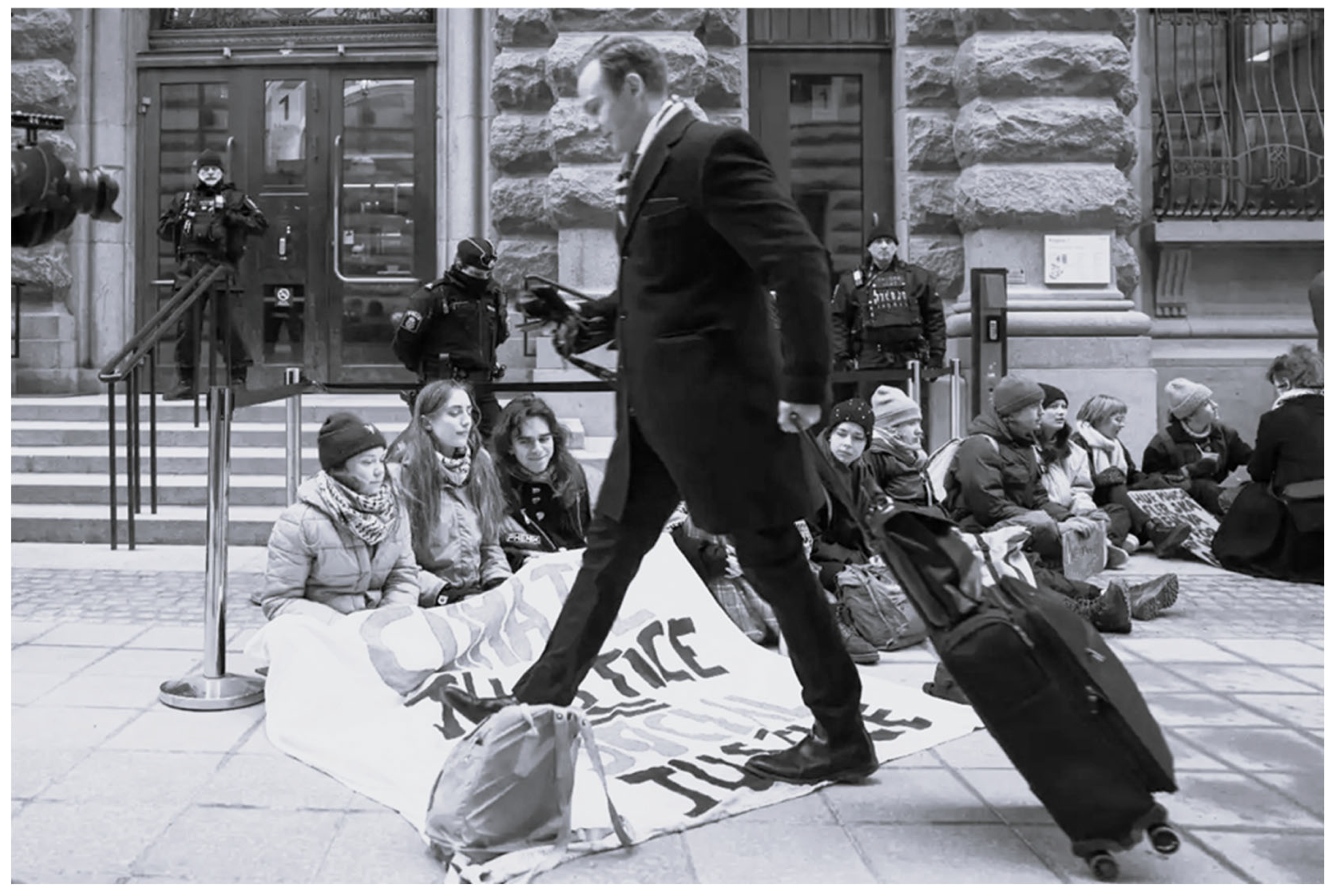
Table 1.
Typology of nasty rhetoric.
| Type of nasty rhetoric | Description | Level of aggression |
|---|---|---|
| Insults | Name-calling that influences how people make judgement and interpret situations and could sometimes include dehumanizing and enmity rhetoric. | Hate |
| Accusations | Blaming opponents of doing something illegal or shady, or promulgating conspiracy theories about opponents. | Hate |
| Intimidations | Veiled threats advocating economic or legal action against an opponent, e.g., that they should get fired, be investigated or sent to prison. | Threat |
| Incitements | The most aggressive rhetoric includes people threatening or encouraging sometimes fatal violence against opponents. If the statement is followed, which happens, it implies physical harm to, or in the worst case, death of opponents. | Threat |
| Economic or legal violence (repression) | Denunciation, detention | Violence |
| Physical violence | Assault, beating, rape, murder. | Violence |
Modified from Zeitzoff (2023).
Table 2.
Search terms for articles, editorials and op-eds.
| Accuse/accusation | Delegitimate/ delegitimise |
Hate | Nazi | Terrorist |
| Activism/-t | Democracy/ democratic |
Journalism/-t | Populism/populist | The Cry # |
| Aggression/ aggressive |
Demon/demonize | Legitimacy/ legitimate |
Repression/ repressive |
Threat |
| Antidemocratic | Elite/elitism | Liar | Roadblock | Violence/violent |
| Climate | Far-right | Liberal | Saboteur/sabotage |
# The Cry, in Swedish “Klägget”, is foul language for the “elite”, used by populists as well as advocates of deliberative democracy, see e.g. www.klagget.nu
Disclaimer/Publisher’s Note: The statements, opinions and data contained in all publications are solely those of the individual author(s) and contributor(s) and not of MDPI and/or the editor(s). MDPI and/or the editor(s) disclaim responsibility for any injury to people or property resulting from any ideas, methods, instructions or products referred to in the content. |
© 2025 by the authors. Licensee MDPI, Basel, Switzerland. This article is an open access article distributed under the terms and conditions of the Creative Commons Attribution (CC BY) license (http://creativecommons.org/licenses/by/4.0/).
Copyright: This open access article is published under a Creative Commons CC BY 4.0 license, which permit the free download, distribution, and reuse, provided that the author and preprint are cited in any reuse.


