

Submitted:
23 March 2025
Posted:
25 March 2025
Read the latest preprint version here
Abstract
Alena Tensor is a recently discovered class of energy-momentum tensors that proposes a general equivalence of the curved path and the geodesic for the analyzed spacetimes which allows the analysis of physical systems in curvilinear, classical and quantum descriptions. In this paper it was shown that Alena Tensor gives decomposition of energy-momentum tensor of the electromagnetic field using two null-vectors. The discovery of the connection of the Alena Tensor with the Killing tensor shows that the energy-momentum tensor of matter can be expressed in terms of the Killing tensor. In this picture, it is not matter that imposes symmetry, but rather the geometric symmetries, encoded in the Killing tensor, determine the way spacetime curves and how matter can be distributed in it. In other words, it is geometry and its hidden symmetry that are the source of matter's structure. It was also shown, that Alena Tensor approach naturally leads to the existence of gravitational waves. The calculated Weyl tensor allows the analysis of purely geometric aspects of curvature, Petrov-type classification, and tracking of gravitational waves independently of the matter sources. The obtained generalized metric also allows for further analysis of metrics for curved spacetimes Petrov type D (and degenerated ones) with effective cosmological constant. A certain simplification of the analysis of gravitational waves has also been proposed, which may help both in their analysis and in the proof of the validity of the Alena Tensor. The article has been supplemented with the Alena Tensor equations with a positive value of the electromagnetic field tensor invariant (related to cosmological constant) which may help in further analysis of this approach.
Keywords:
Alena Tensor
; gravitational waves
; general relativity
; electromagnetism
1. Introduction
Gravitational waves are a well-understood and researched issue [1], and it seems that the area of this research will develop dynamically both in theoretical understanding [2] and methods of waves detection [3,4]. The existence of gravitational waves is the key argument for the correctness of the General Relativity, and for this reason it is also a good tool for verifying the correctness of alternative to GR theories [5,6,7] and the theories of quantum gravity [8].
Alena Tensor is at the beginning of its research journey. It is a recently discovered class of energy-momentum tensors that allows for equivalent description and analysis of physical systems in flat spacetime (with fields and forces) and in curved spacetime (using Einstein Field Equations) proposing the overall equivalence of the curved path and the geodesic. In this method it is assumed that the metric tensor is not a feature of spacetime, but only a method of its mathematical description. In previous publications [9,10,11] it was already shown that this approach allows for a unified description of a physical system (curvilinear, classical and quantum) ensuring compliance with GR and QM results. Due to this property, the Alena Tensor seems to be a useful tool for studying unification problems, quantum gravity and many other applications in physics.
Many researchers try to reproduce the GR equations in flat spacetime or vice versa [12,13] or include electromagnetism in GR, connecting the spacetime geometry with electromagnetism [14,15,16,17,18,19,20,21]. There are known such approaches on the basis of differential geometry [22,23,23], based on field equations [24,25] as well as promising analyses of spinor fields [26] or helpful approximations for a weak field [27]. For this reason, the Alena Tensor should be viewed as another theory requiring theoretical and experimental verification, and it seems worth checking whether the this approach ensures the existence of gravitational waves and what their interpretation is.
In this paper it will be analyzed the possibility of describing gravitational waves using the Alena Tensor. Due to the fact that research on this approach is a relatively young field, to facilitate the analysis of the article, the next section summarizes the results obtained so far and introduces the necessary notation. Although at the first moment the paradigm shift proposed by this approach may seem incomprehensible, the author hopes that the reader will resist the temptation to burn this article and trust the scientific method, which encourages us to calculate and check everything based on the correctness of the results obtained.
2. Short Introduction to Alena Tensor
The following chapter briefly explains the conclusions from the previous publications on Alena Tensor. The author uses the metric signature (+,-,-,-) which provides a positive value of the electromagnetic field tensor invariant. In previous publications it was treated as negative (reversal of the order of terms in the energy-momentum tensor of the electromagnetic field). The following equations remove this inconvenience while maintaining the correctness of the obtained results.
2.1. Transforming a Curved Path into a Geodesic
To understand the Alena Tensor, it is easiest to recreate the reasoning that led to its creation [10] using the example of the electromagnetic field. One may consider the energy-momentum tensor in flat spacetime for a physical system with an electromagnetic field in the following form
where is energy-momentum tensor for a physical system, is density of matter, is four-velocity, is relative permeability, is energy-momentum tensor for the electromagnetic field.
The density of four-forces acting in a physical system can be considered as a four-divergence. One may therefore denote the four-force densities occurring in the system:
- is the density of the total four-force acting on matter
- are forces due to the field, where
- is the density of the electromagnetic four-force
- was shown in [9] as related to the presence of gravity in the system.
One may assume that the forces balance, which will provide a vanishing four-divergence of the energy-momentum tensor for the entire system
It may be noticed, that if one wanted to use for a curvilinear description, which would describe the same physical system but curvilinearly, then in curved spacetime the forces due to the field can be replaced with help of Christoffel symbols of the second kind. This means, that the entire field term can simply disappear from the equation in curved spacetime, because instead of a field and the forces associated with it, there will be corresponding curvature.
This would mean, that in curved spacetime . As shown in [10], a minor amendment to continuum mechanics provides this property. Assuming as rest mass density and one gets mass density taking into account motion and Lorentz contraction of the volume and provides
One may thus generalize making the following substitution
where is electromagnetic field strength tensor, is vacuum magnetic permeability, is metric tensor with the help of which the spacetime is considered, and
- is invariant of the electromagnetic field tensor,
- is trace of ,
- is a metric tensor of a spacetime for which vanishes.
Tensor may be calculated in flat spacetime as and may be treated as fixed, since the value of is independent of the adopted for analysis. In this way one obtains a generalized description of the tensor , which has the following properties:
- in flat spacetime is the usual, classical energy-momentum tensor of the electromagnetic field
- its trace vanishes in any spacetime, regardless of the considered metric tensor
- in spacetime for which the entire tensor vanishes
- which is expected property of the metric tensor (it was already shown in [10] that indeed is a metric tensor)
In the above manner one obtains the Alena Tensor in form of
with the yet unknown for which in curved spacetime () the energy-momentum tensor of the field vanishes.
The reasoning carried out above for electromagnetism is universal and allows to consider the Alena Tensor also for energy-momentum tensors associated with other fields. This leads to obtaining an energy-momentum tensor for the system that can be considered both in flat spacetime and in curved spacetime.
2.2. Connection with Continuum Mechanics, GR and QFT/QM
To make the Alena Tensor consistent with Continuum Mechanics in flat spacetime, it is enough to adopt the substitution where p is the negative pressure in the system and it is equal to where c is the speed of light in a vacuum. Such substitution yields
where is the metric tensor of flat Minkowski spacetime. Introducing deviatoric stress tensor one obtains relativistic equivalence of Cauchy momentum equation (convective form) in which only appears as a body force
The above substitution also provides a connection to General Relativity in curved spacetime. For this purpose, one may introduce the following tensors, which can be analyzed in both flat and curved spacetime
Above allows to rewrite Alena Tensor as
Analyzing the above equation in curved spacetime (), one obtains simplifications
thus above can be interpreted as the main equation of General Relativity up to the constant where and can be interpreted in curved spacetime, respectively, as Einstein curvature tensor and Ricci tensor both with an accuracy of constant.
Analyzing the tensor in flat spacetime () one can also see that it is related to the non-body forces seen in the description of the Cauchy momentum equation
which means that in the Alena Tensor analysis method gravity is not a body force, and as shown in [9] in above
- is the density of the radiation reaction four-force
- is density of the four-force related to gravity, where
- is related to the effective potential in the system with gravity.
It can be calculated that vanishes in two cases:
- - which turns out to be the case of free fall
- which occurs in the case of circular orbits
Neglecting the electromagnetic force and the radiation reaction force, using the above equation one can reproduce the motion of bodies in the effective potential obtained from the solutions of General Relativity. Such a description has already been done for the Schwarzschild metric [9] for
where is a certain constant. The solutions obtained in this way enforce the existence of gravitational waves due to time-varying (except for free fall and circular orbits).
In the above description, gravity itself is not a force, because the above description is based on an effective potential. However, one can see a similarity to Newton’s classical equations for the stationary case with a stationary observer, for which can be approximated by Newton’s gravitational force with the opposite sign. Thus for stationary observer represents a force that must exist to keep a stationary observer suspended above the source of gravity in fixed place.
The description of gravity obtained in this way is surprisingly consistent with current knowledge, despite the fact that gravity itself in this description is not a force, and the force is not a body force.
The Alena Tensor constructed in presented way according to [9,11] may be simplified in flat spacetime to
which allows its analysis in classical field theory and quantum theories. Obtained canonical four-momentum provides and
where is four-momentum, is pressure-volume work, and where and are in fact two gauges of electromagnetic four-potential. In above is responsible for the force associated with gravity and radiation reaction force. It was also shown that canonical four-momentum may be expressed as
where due to its property , seems to be some description of rotation or spin, and where describes the transport of energy due to the field.
The quantum picture obtained from the Alena Tensor [9,11] for the system with electromagnetic field leads to the conclusion that gravity and the radiation reaction force have always been present in Quantum Mechanics and Quantum Field Theory. This conclusion follows from the fact that the quantum equations obtained from the Alena Tensor for the system with electromagnetic field [9] are actually the three main quantum equations currently used:
-
simplified Dirac equation for QED:
- Klein-Gordon equation,
- equivalent of the Schrödinger equation:
where and are two gauges of electromagnetic four-potential, and where the last equation in the limit of small energies (Lorentz factor ) turns into the classical Schrödinger equation considered for charged particles.
The above results make the Alena Tensor a useful tool for the analysis of physical systems with fields, allowing modeling phenomena in flat spacetime, curved spacetime, and in the quantum image.
3. Results
One may consider a flat spacetime with an electromagnetic field, described in a way provided by Alena Tensor using notation introduced in Section 2. Completing the definition of the first invariant of the electromagnetic field tensor , one may define the second invariant by electric and magnetic fields as
It can then be seen, after some transformations, that
Therefore the corresponding metric tensor for curved spacetime and its trace (mentioned in introduction) calculated in flat spacetime are
The above simplifies further for , but the key conclusion is that the trace is invariant.
Based on the above, one may reverse the reasoning presented in introduction and consider the field as a manifestation of a propagating perturbation of the curvature of spacetime (which in flat spacetime is just interpreted as a field). For this purpose, one may define a certain perturbation of the metric tensor that describes the deviation from flat spacetime, and also define its trace h as
The stress-energy tensor of the electromagnetic field in flat spacetime can be thus represented as follows
As one can see in the above, considering gravitational waves in the Alena Tensor is natural and does not require classical linearization. Traces h and are invariants, thus and condition can be reduced to Maxwell’s equations in vacuum. This would mean that gravitational waves in Alena Tensor approach are de facto a propagating disturbance of the energy-momentum tensor for the field (in the case analyzed, the electromagnetic field energy-momentum tensor).
Denoting the pressure amplitude and one obtains
which shows that the energy-momentum tensor of the field may be also interpreted as propagating vacuum pressure waves with tensor amplitude.
To provide an analysis of the above equation for gravitational waves and the analysis of the resulting classes of metrics, a representation using null-vectors will be useful. Therefore, in the next few steps it will be shown that Alena Tensor allows representing the energy-momentum tensor of the electromagnetic field with the use of two null-vectors.
At first step one may recall equation (15) and define new four-vector as
Since it is know from previous publications, that and , therefore (15) and (22) also yield . This property therefore allows to represent four-velocity using two null-vectors and as follows
thus
Next, one may define auxiliary parameter as
and subtract the linear combination of and from both sides
Next, one may recall from [9] coefficients related to the electromagnetic field
- relative permeability
- volume magnetic susceptibility
- relative permittivity
- electric susceptibility
and notice, that one obtains Alena Tensor as
where electromagnetic stress-energy tensor is equal to
and where actually simplifies, as shown in introduction, to
Since it is known from existing literature [28], that invariants of electromagnetic stress-energy tensor are
therefore from (28) one obtains simplifications
and by defining a useful variable one gets
Finally, defining as below, referring to (18)
then calculating with the use of from (14)
and expressing as before in introduction, one gets
Since the variables and are merely auxiliary variables and can be expressed in terms of and the invariants (with help of , and )
this means that further, in-depth analysis of the system is possible. However, further modeling and simplifying the description of the electromagnetic field or searching for elementary particles that provide stable solutions requires a separate article (probably several articles).
From the perspective of describing gravitational waves, other elements of the description are crucial, which will be discussed next. To simplify the analysis, one may first normalize four-vectors and as follows
where was introduced to avoid confusion related to the previously defined perturbation . One may now rewrite the electromagnetic field tensor from (28) to obtain (after few calculations using previously derived relationships) its following representation
As shown in [9] element is responsible for electric field energy caried by light, where was shown as describing energy density of magnetic moment and was linked to charged matter in motion. The element is a new term and part of quations related to this term may be expressed as with help of (35) as
Since does not actually carry energy but only momentum, it can be associated with some description of spin field effects by analogy to (23) or, more hypothetically, to polarization of gravitational waves. Finally, substituting (38) into (20) using (35) one gets
As can be seen in the above result, the described system is Petrov type D [29], although to be sure, the Weyl tensor should be calculated. This does not seem possible for the general case (without auxiliary assumptions about symmetries), but one could simplify the obtained description considerably, based on the following observation. One may notice, that the normalized Alena Tensor obtained in (27) has a structure corresponding to the expected structure of the Killing tensor. By denoting the Killing tensor as , using (27) and assuming the hypothesis that
one may see several confirmations that, indeed, it should be Killing tensor.
As shown previously, , which means that null vectors have global significance for spacetime geometry, thus Killing tensor schould have a strong connection with propagation along null vectors (it is not a random symmetry, but a deep feature of spacetime) and this means the existence of special wave surfaces, e.g. electromagnetic waves and/or gravitational radiation. This would be a clear indication that spacetime belongs to the Petrov D class and is associated with wave propagation solutions.
It is clear, that and after few calculations using derived metric and previously derived dependencies (reducing everything to the function) one also gets, that . It is in fact known from the Alena Tensor equation in curved spacetime given in the introduction, thus it confirms previous result and shows that energy density is a function of the metric. But it also means, that energy (energy density) is not something external to geometry in Alena Tensor approach, but it is defined by the geometry of spacetime itself. This is a result in the spirit of General Relativity, but it goes even deeper: metric depends on , but at the same time depends on the metric because it is a trace in this metric. The system itself defines its own energy through the structure of the field, which is similar to the idea of self-consistent field [30] - where the field and the source are inseparable, or emergent gravity [31] - where energy, gravity and geometry arise from a common structure, or induced geometry [32] - where energy comes from deformation of space-time itself, as e.g. in Sakharov’s theory [33]. It is impossible to “decree” energy in Alena Tensor, it must be calculated from geometry and the system works as a closed causal cycle.
Moreover, one may also calculate, that where such a dependence of on the trace is a key property for null space and suggests that describes isometries related to null wave propagation, similar to pp-wave [34] and Robinson-Trautman solutions [35], what is actually expected in considered approach based on electromagnetic stress-energy tensor and result (40). This would also mean that the Killing tensor is directly related to the energy distribution in spacetime as expected, similar to other GR solutions (eg. Kerr solution), and lead to a rather groundbreaking but also expected result in the context of the discussed approach, that the Killing tensor directly determines the Einstein tensor in main GR equation.
Since is simply the Alena Tensor divided by , it has vanishing four-divergence. Combined with the above reasoning, one can assume with great probability that it is indeed the Killing tensor and
Assuming that this is indeed the case, since the Weyl tensor is defined as the part of the Riemann tensor that does not depend on the Ricci tensor, this implies that since Killing tensor determines the Einstein tensor, and the Einstein tensor determines the Ricci tensor, then one could calculate the Weyl tensor by extracting the part of the curvature that does not contain the Ricci tensor. One may expect that the Weyl tensor calculated in this way should depend on the matter density, the cosmological constant and the null vectors, which would mean that the spacetime geometry is strongly related to the energy of the electromagnetic field, exactly as seen in the obtained equations. This would also mean that the Christoffel symbols can be expressed as a function of the Killing and Einstein tensors, and the Riemann tensor can be written directly as a function of the Ricci and Killing tensors.
Following all the above arguments and results, one may conclude, that normalized Alena Tensor is in fact the Killing tensor and rewriting for simplicity the obtained metric as,
and also assuming for simplicity of analysis null-vectors as and one obtains the Weyl tensor. Table below contains representative components of the Weyl tensor as functions of angle , taking into account the conclusion from the introduction that the cosmological constant . The disappearance of selected components indicates a transition to Petrov D type or conformity (O type). For simplicity, it was denoted:

Table 1.
Component values of the Weyl tensor as functions of the angle.
| Component | Value |
From the above table, it can be concluded that for or , the terms from or are zeroed and selective propagation in specific directions occurs. When A=B or C=0, many terms may cancel. Petrov type D appears when terms and are nonzero. Type O appears when all terms are zeroed (for certain relations between ).
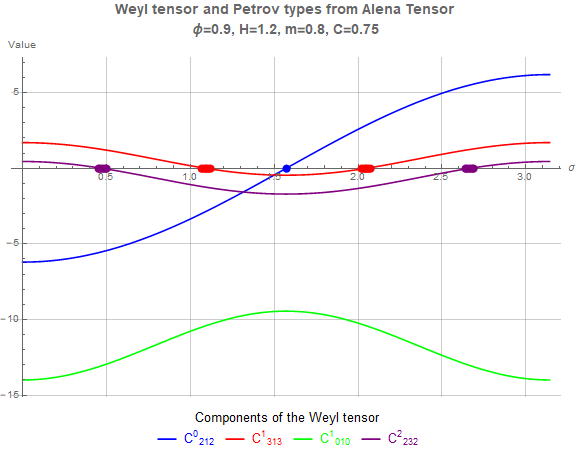
Since, according to previous results, the components of the metric can be expressed in terms of the constants , and the variable angle , it is also possible to analyze the system using these input data. The graphic below shows the behavior of the Weyl tensor as a function of angle for normalized parameters.
Figure 1.
Graph of Weyl tensors as a function of angle
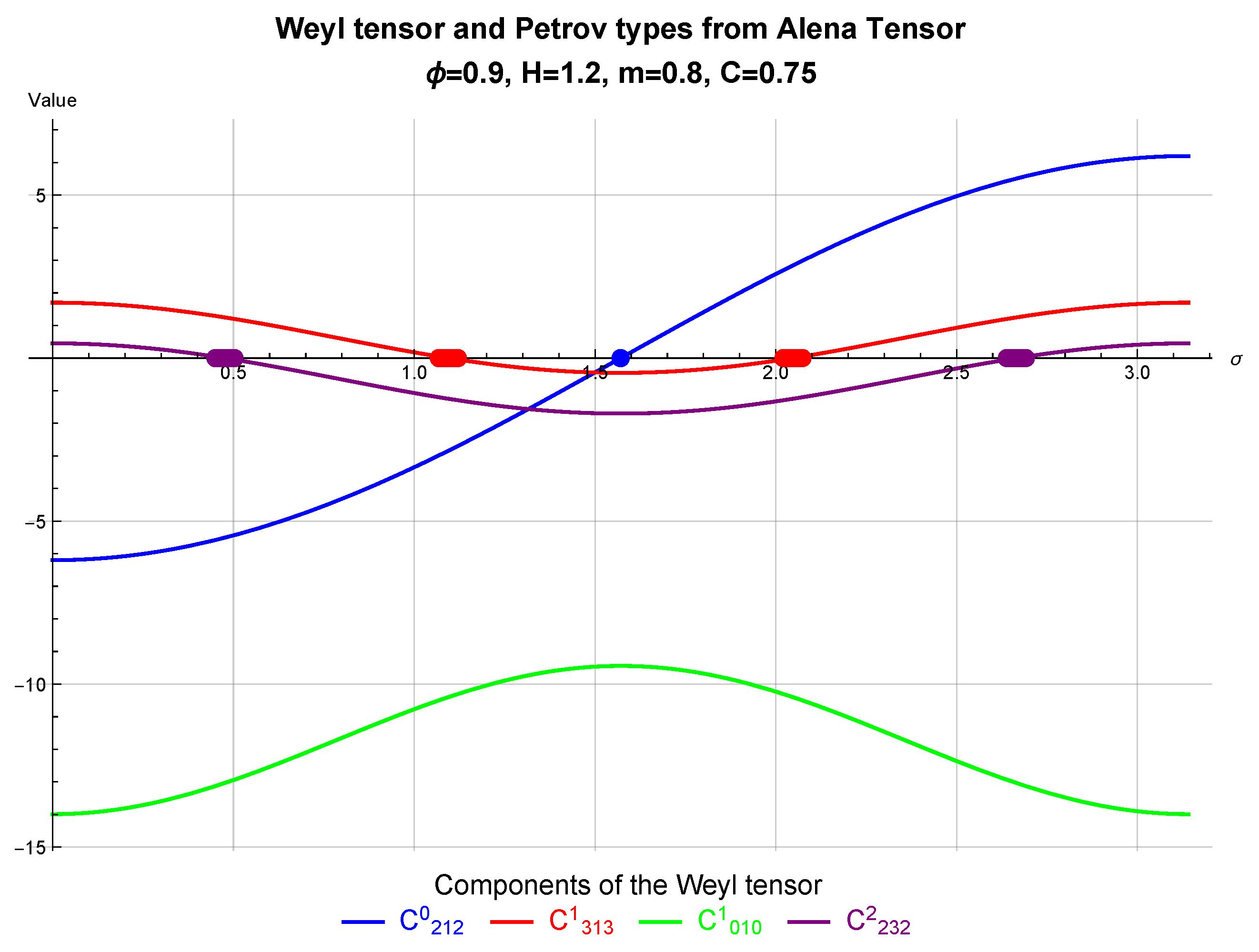
The angles and must in fact be related by the geometry of spacetime, but revealing this relationship is too large a topic and deserves a separate article.
It is also worth noting that the obtained metric term can in principle be interpreted as a vacuum energy contribution (effective cosmological constant) as in [36,37] playing the role of a metric scaling factor, as e.g. described in [38] which allows to conclude about the value of the second invariant of the electromagnetic field.
Additionally, one may invoke the scalar field associated with the presence of matter, where . It is known from 2.2 that is responsible for the presence of sources and in their absence . Therefore, interpreting whole as the wave amplitude tensor one would get representation which would also allow to search for as a certain wave function.
This approach allows for two simplifications related to the analysis of gravitational waves. Considering the force responsible for effects related to gravity as shown in (12) and extracting the acceleration from it, one gets
since according amendment from [10] .
As shown in [9], is directly related to the effective potential in gravitational systems which can be calculated from the GR equations. This would allow searching for propagating changes of the effective potential itself () similarly as was postulated in [39]. It would significantly simplify both the calculations and perhaps the methods of detecting gravitational waves.
The second potential simplification results from the possibility of analyzing only the Poynting four-vector as which might also help simplify the calculations and look for experimental proof of correctness for the Alena Tensor approach.
4. Conclusion and Discussion
As shown in the above article, the Alena Tensor ensures the existence of gravitational waves and allows their physical interpretation. The obtained decomposition of the electromagnetic field stress-energy tensor (40) allows for further analysis of metrics for curved spacetime and the possibility of describing gravitational waves. It also seems reasonable to search for a description of elementary particles that will provide relatively stable solutions to the obtained equations, perhaps also taking into account new approaches, such as those proposed in [40].
It remains an open question whether the Alena Tensor is a correct way to describe physical systems, but this paper shows that it exhibits many properties that are expected from such a description, including the existence of gravitational waves. The connection between Alena Tensor and the Killing tensor obtained in this paper reveals a deep, nonlinear connection between the matter distribution and the geometry and symmetries of spacetime. These results show that the matter distribution is not arbitrary, but precisely tuned to the geometry and hidden symmetries of spacetime, which allows for their further analysis in the language of Killing tensors and conformal Weyl curvature.
5. Statements
All data that support the findings of this study are included within the article (and any supplementary files).
During the preparation of this work the author did not use generative AI or AI-assisted technologies.
Author did not receive support from any organization for the submitted work.
Author have no relevant financial or non-financial interests to disclose.
References
- Bailes, M.; Berger, B.K.; Brady, P.; Branchesi, M.; Danzmann, K.; Evans, M.; Holley-Bockelmann, K.; Iyer, B.; Kajita, T.; Katsanevas, S.; et al. Gravitational-wave physics and astronomy in the 2020s and 2030s. Nature Reviews Physics 2021, 3, 344–366. [Google Scholar] [CrossRef]
- Schutz, B.F. Gravitational wave astronomy. Classical and Quantum Gravity 1999, 16, A131. [Google Scholar] [CrossRef]
- Grant, A.M.; Nichols, D.A. Outlook for detecting the gravitational-wave displacement and spin memory effects with current and future gravitational-wave detectors. Physical Review D 2023, 107, 064056. [Google Scholar] [CrossRef]
- Borhanian, S.; Sathyaprakash, B. Listening to the universe with next generation ground-based gravitational-wave detectors. Physical Review D 2024, 110, 083040. [Google Scholar] [CrossRef]
- Milgrom, M. Gravitational waves in bimetric MOND. Physical Review D 2014, 89, 024027. [Google Scholar] [CrossRef]
- Tahura, S.; Nichols, D.A.; Yagi, K. Gravitational-wave memory effects in Brans-Dicke theory: Waveforms and effects in the post-Newtonian approximation. Physical Review D 2021, 104, 104010. [Google Scholar] [CrossRef]
- Matos, I.S.; Calvão, M.O.; Waga, I. Gravitational wave propagation in f (R) models: New parametrizations and observational constraints. Physical Review D 2021, 103, 104059. [Google Scholar] [CrossRef]
- Shapiro, I.L.; Pelinson, A.M.; de O. Salles, F. Gravitational waves and perspectives for quantum gravity. Modern Physics Letters A 2014, 29, 1430034. [Google Scholar] [CrossRef]
- Ogonowski, P.; Skindzier, P. Alena Tensor in unification applications. Physica Scripta 2024, 100, 015018. [Google Scholar] [CrossRef]
- Ogonowski, P. Proposed method of combining continuum mechanics with Einstein Field Equations. International Journal of Modern Physics D 2023, 2350010, 15. [Google Scholar] [CrossRef]
- Ogonowski, P. Developed method: interactions and their quantum picture. Frontiers in Physics 2023, 11, 1264925. [Google Scholar] [CrossRef]
- Logunov, A.; Mestvirishvili, M. Hilbert’s causality principle and equations of general relativity exclude the possibility of black hole formation. Theoretical and Mathematical Physics 2012, 170, 413. [Google Scholar] [CrossRef]
- Friedman, Y. Superposition principle in relativistic gravity. Physica Scripta 2024, 99, 105045. [Google Scholar] [CrossRef]
- Poplawski, N.J. Geometrical formulation of classical electromagnetism. arXiv 2008, arXiv:0802.4453. [Google Scholar]
- Chang, Y.F. Unification of gravitational and electromagnetic fields in Riemannian geometry. arXiv 2009, arXiv:0901.0201. [Google Scholar]
- Chernitskii, A.A. On unification of gravitation and electromagnetism in the framework of a general-relativistic approach. arXiv 2009, arXiv:0907.2114. [Google Scholar] [CrossRef]
- Kholmetskii, A.; Missevitch, O.; Yarman, T. Generalized electromagnetic energy-momentum tensor and scalar curvature of space at the location of charged particle. arXiv 2009, arXiv:1111.2500. [Google Scholar]
- Novello, M.; Falciano, F.; Goulart, E. Electromagnetic Geometry. arXiv 2011, arXiv:1111.2631. [Google Scholar]
- de Araujo Duarte, C. The classical geometrization of the electromagnetism. International Journal of Geometric Methods in Modern Physics 2015, 12, 1560022. [Google Scholar] [CrossRef]
- Hojman, S.A. Geometrical unification of gravitation and electromagnetism. The European Physical Journal Plus 2019, 134, 526. [Google Scholar] [CrossRef]
- Woodside, R. Space-time curvature of classical electromagnetism. arXiv 2004, arXiv:gr-qc/0410043. [Google Scholar]
- Bray, H.; Hamm, B.; Hirsch, S.; Wheeler, J.; Zhang, Y. Flatly foliated relativity. arXiv 2019, arXiv:1911.00967. [Google Scholar] [CrossRef]
- Jafari, N. Evolution of the concept of the curvature in the momentum space. arXiv 2024, arXiv:2404.08553. [Google Scholar]
- Kaur, L.; Wazwaz, A.M. Similarity solutions of field equations with an electromagnetic stress tensor as source. Rom. Rep. Phys 2018, 70, 1–12. [Google Scholar]
- MacKay, R.; Rourke, C. Natural observer fields and redshift. J Cosmology 2011, 15, 6079–6099. [Google Scholar]
- Ahmadi, N.; Nouri-Zonoz, M. Massive spinor fields in flat spacetimes with nontrivial topology. Physical Review D—Particles, Fields, Gravitation, and Cosmology 2005, 71, 104012. [Google Scholar] [CrossRef]
- Waluk, P.; Jezierski, J. Gauge-invariant description of weak gravitational field on a spherically symmetric background with cosmological constant. Classical and Quantum Gravity 2019, 36, 215006. [Google Scholar] [CrossRef]
- Anghinoni, B.; Flizikowski, G.; Malacarne, L.C.; Partanen, M.; Bialkowski, S.; Astrath, N.G.C. On the formulations of the electromagnetic stress–energy tensor. Annals of Physics 2022, 443, 169004. [Google Scholar] [CrossRef]
- Hall, G. Wave Surface Symmetry and Petrov Types in General Relativity. Symmetry 2024, 16, 230. [Google Scholar] [CrossRef]
- Ignat’ev, Y.G. The self-consistent field method and the macroscopic universe consisting of a fluid and black holes. Gravitation and Cosmology 2019, 25, 354–361. [Google Scholar] [CrossRef]
- Padmanabhan, T. Emergent gravity paradigm: recent progress. Modern Physics Letters A 2015, 30, 1540007. [Google Scholar] [CrossRef]
- Eichhorn, A.; Surya, S.; Versteegen, F. Induced spatial geometry from causal structure. Classical and Quantum Gravity 2019, 36, 105005. [Google Scholar] [CrossRef]
- Sakharov, A.D. Vacuum quantum fluctuations in curved space and the theory of gravitation. General Relativity and Gravitation 2000, 32, 365–367. [Google Scholar] [CrossRef]
- Sämann, C.; Steinbauer, R.; Švarc, R. Completeness of general pp-wave spacetimes and their impulsive limit. Classical and Quantum Gravity 2016, 33, 215006. [Google Scholar] [CrossRef]
- Davidson, W. Robinson–Trautman solutions to Einstein’s equations. General Relativity and Gravitation 2017, 49, 1–4. [Google Scholar] [CrossRef]
- Wang, Q. Reformulation of the cosmological constant problem. Physical Review Letters 2020, 125, 051301. [Google Scholar] [CrossRef]
- Gueorguiev, V.G.; Maeder, A. Revisiting the Cosmological Constant Problem within Quantum Cosmology. Universe 2020, 6, 108. [Google Scholar] [CrossRef]
- Marsh, A. Defining geometric gauge theory to accommodate particles, continua, and fields. Journal of Mathematical Physics 2024, 65. [Google Scholar] [CrossRef]
- Domènech, G. Scalar induced gravitational waves review. Universe 2021, 7, 398. [Google Scholar] [CrossRef]
- Rakitzis, T.P. Spatial wavefunctions of spin. Physica Scripta 2023. [Google Scholar] [CrossRef]
Disclaimer/Publisher’s Note: The statements, opinions and data contained in all publications are solely those of the individual author(s) and contributor(s) and not of MDPI and/or the editor(s). MDPI and/or the editor(s) disclaim responsibility for any injury to people or property resulting from any ideas, methods, instructions or products referred to in the content. |
© 2025 by the authors. Licensee MDPI, Basel, Switzerland. This article is an open access article distributed under the terms and conditions of the Creative Commons Attribution (CC BY) license (http://creativecommons.org/licenses/by/4.0/).
Copyright: This open access article is published under a Creative Commons CC BY 4.0 license, which permit the free download, distribution, and reuse, provided that the author and preprint are cited in any reuse.


