

Submitted:
03 February 2025
Posted:
04 February 2025
You are already at the latest version
Abstract
The extraction processes for medicinal plants, particularly the distillation of aromatic plants, generate significant quantities of by-products, consisting of fibrous biomass and hydrosols. These by-products pose challenges for disposal and recovery. Consequently, it is imperative to make the entire, highly energy-intensive process more sustainable by valorizing all derivatives.
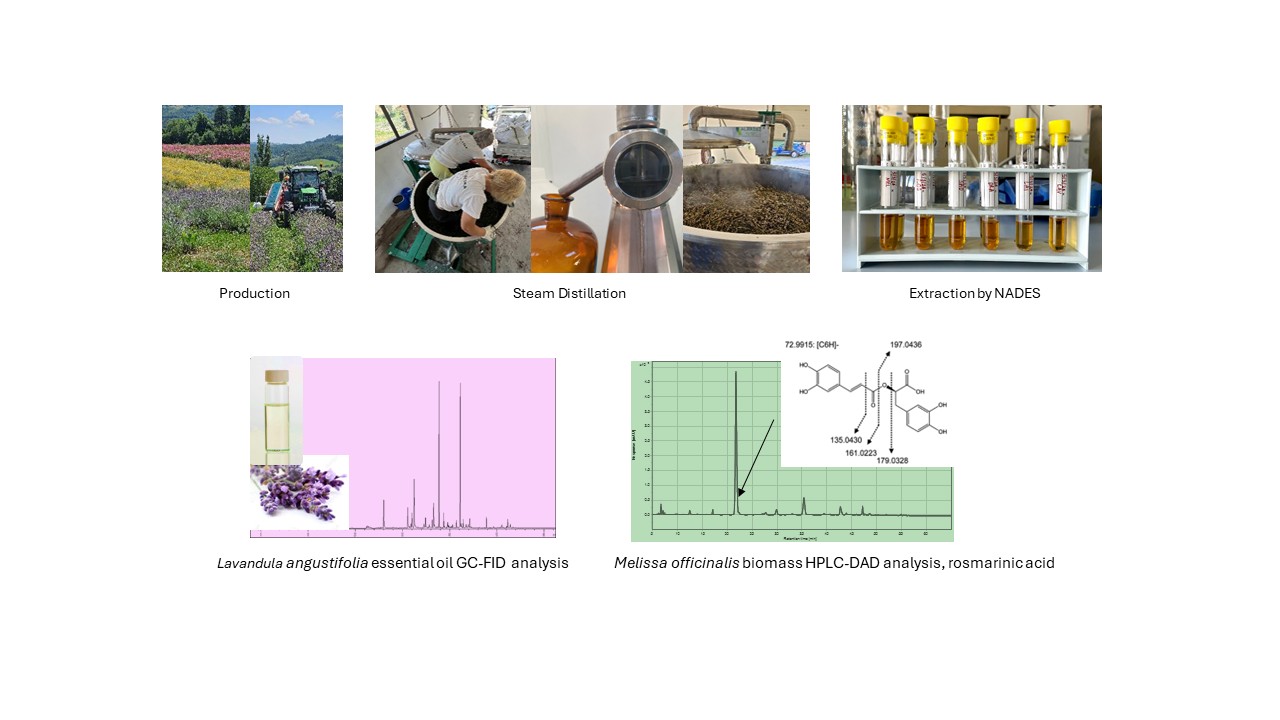
This study aims to recover bioactive compounds, particularly polyphenols, from these biomasses. Polyphenols represent a large class of compounds known for their biological activities. Artemisia dracunculus, Echinacea purpurea, Helichrysum italicum (from the Asteraceae family), and Lavandula angustifolia, Lavandula x intermedia, Melissa officinalis, Salvia officinalis, Salvia sclarea, and Salvia rosmarinus (from the Lamiaceae family) were subjected to steam distillation. The essential oils obtained were characterized using gas chromatography, and the residual biomasses were processed with innovative extraction methods.
The study investigated the use of natural deep eutectic solvents (NADES) for extracting polyphenols from the residual biomasses. Comparisons were made between the extracts obtained using NADES and those obtained using ethanol, a traditional solvent commonly employed for such purposes. The chemical characterization of the extracted compounds was performed using advanced analytical techniques, including HPLC-DAD and UHPLC-HRMS.
The application of NADES demonstrated superior extraction efficiency for biomasses from both the Asteraceae and Lamiaceae families. Additionally, NADES exhibited several environmentally friendly characteristics, enhancing their sustainability profile. For these reasons, NADES present a viable alternative system for the recovery of bioactive compounds and could be used to formulate new products for the food, pharmaceutical, and cosmetic industries.
Keywords:
NADES
; Lamiaceae
; Asteraceae
; distillation
; biomass
; essential oils
; HPLC-DAD
; UHPLC-HRMS
; GC-FID
; GC-MS
; polyphenols
1. Introduction
Aromatic plants have always been used in the therapeutic field due to the abundance of bioactive compounds contained in essential oil (EO). Currently, aromatic plants find employment in the pharmaceutic, cosmetic, food, and agriculture industries [1]. The main bioactive compounds in aromatic plants are terpenes and terpenoids, constituents of EOs, known for their antiseptic activity, medicinal properties, and fragrance. They are used as antimicrobial agents [2,3], analgesics [4], sedatives [5,6], anti-inflammatories [7], spasmolytics, local anesthetics, and as anti-cancer agents [8,9,10]. The EOs, as described by European Pharmacopeia, are volatile mixtures of odorous compounds, usually of complex composition, obtained from a botanically defined herbal drug by steam distillation, dry distillation, or a suitable mechanical process without heating, from roots, leaves, flowers, and fruit peels of aromatic plants. The extraction processes of the EOs from aromatic plants by means of industrial technique generate significant quantities of by-products, consisting of fibrous biomass and hydrosols [11]. Therefore, valorizing these wastes is extremely important to make the production of EOs more environmentally sustainable.
Currently, the exhausted biomasses are mainly employed for producing biofuel; however, these agri-food wastes can be exploited for more noble purposes being rich in bioactive compounds, such as polyphenols [12,13]. Polyphenols are a large class of chemical compounds that include phenolic acids, flavonoids, anthocyanins, proanthocyanins, and stilbenes with marked health benefits. Several studies have recently demonstrated the countless potentialities of polyphenols as therapeutic agents and food preservatives due to their anti-inflammatory, antimicrobial, antioxidant, and enzyme-inhibitory activities [14].
These compounds are usually extracted via conventional methods that employ inflammable, toxic, and contaminant organic solvents. In recent years, the research effort focused on the development of more sustainable strategies by using green technologies with higher process performances and solvents with a lower environmental impact. In this context, Natural Deep Eutectic Solvents (NADES) have been proposed as safe and environmentally friendly alternatives to classic solvents. The NADES rapidly showed potential in green chemistry due to their low cost, recyclability, biodegradability, biocompatibility, and non-toxicity. The NADES are eutectic mixtures composed of a hydrogen bond acceptor (HBA) and a hydrogen bond donor (HBD) that create a dense bend network due to hydrogen bonding and van der Waals interactions [[15]. Therefore, NADES blends are capable of efficiently solubilizing lipophilic compounds and protecting thermolabile compounds. The efficiency and significance of NADES as solvents are attributed to the fact that these mixtures are inside cells. Indeed, when combined in appropriate ratios, mixtures of numerous primary metabolites can form natural deep eutectic solvents. The presence of NADESs inside cells is crucial because many macromolecules, such as DNA, proteins, and polysaccharides, which are poorly soluble in aqueous phase, can dissolve within these mixtures. Eutectic bends high solubilizing capacity is related to their molecular structure and wide polarity range. NADES can also play an important role in safeguarding organisms from harsh conditions, such as drought and cold [16]. In the last years, several studies have successfully demonstrated the potentiality of NADES in extracting polyphenols from aromatic plants. Specifically, polyphenol-rich extracts were obtained from different plants [17,18,19,20]. The employment of NADES in the recovery of bioactive compounds of aromatic plant by-products has not been considered so far. Furthermore, since NADES are totally biocompatible and non-toxic for humans, animals and the environment, it is important to further investigate their formulation in foods and feeds enriched with polyphenols and other bioactive compounds.
In this regard, the NADES were considered for the extraction of polyphenolic compounds from the biomasses of several Lamiaceae and Asteraceae plants widely distributed and cropped in the North of Italy for their characteristic aroma and therapeutic properties. Specifically, Artemisia dracunculus L. (ART), Echinacea purpurea (L.) Moench (ECHI), Helichrysum italicum (Roth) G. Don (HEL), Lavandula angustifolia Mill. (LAV), Lavandula x intermedia Emeric ex Loisel (LAI), Melissa officinalis L. (MEL), Salvia officinalis L. (SAO), Salvia rosmarinus Spenn. (ROS), and Salvia sclarea L. (SAS) were selected.
Different NADES formulations were prepared, and their extraction capability was compared to that of ethanol, a commonly extractive organic solvent to develop a sustainable extraction procedure for the recovery of bioactive compounds from oil-exhausted biomasses derived from the distillation of aromatic plants.
The chemical characterization of the EOs was made using gas-chromatography coupled with a mass spectrometer (GC-MS) and flame ionization (FID) detectors. The extraction capacity of NADES compared to traditional solvents was studied by Ultrahigh-Performance Liquid Chromatography–High-Resolution Mass Spectrometry (UHPLC-HRMS) to determine the polyphenolic composition, and High-Performance Liquid Chromatography with Diode Array Detection (HPLC-DAD) to quantify the characteristic active components of the plants belonging to the Asteraceae and Lamiaceae families.
2. Results
2.1. Chemical Characterization of the EOs
The chemical characterization of the EOs obtained from the aerial parts of the aromatic plants was performed using GC–MS and GC-FID analysis. Table 1 summarizes the relative peak areas of each component, elution order, and comparison between experimental (exp) and literature (lit) LRI values.
The EOs belonging to the Lamiaceae family displayed a high content of oxygenated monoterpenes among which alcohols, aldehydes, ketones, and esters depending on the genus. Lavandula x intermedia and Lavandula angustifolia were mainly characterized by linalool (20.19% and 35.19% respectively) and its ester linalyl acetate (36.63% and 34.01% respectively). Also, both the EOs contained 1,8-cineole, cis-β-ocimene, trans-β-ocimene, fenchol, camphor, borneol, terpinen-4-ol, lavandulyl-acetate, β-caryophyllene and β-caryophyllene-oxide in characteristic and specific quantities that indicate a different biosynthetic pathway of the two species [21]. Melissa officinalis was characterized by high concentrations of aldehydes (citronellal 9.43%, geranial 12.74%, and neral 6.49) and caryophyllene derivatives as β-caryophyllene (17.08%) and caryophyllene-oxide (20.64%) [22].
The EO of Salvia rosmarinus showed a pinene chemotype due to the high concentration of the hydrocarbon monoterpene (α-pinene 38,79%) according to [23]. Significant percentages of 1,8-cineole (18.55%) and verbenone (6.04%) were detected in agreement with the literature [24].
Finally, the sage EOs displayed an extremely different chemical composition. Specifically, Salvia officinalis was represented by 38% of hydrocarbon monoterpenes, and the ketones camphor and α- and β-thujone which accounted for almost 38% of the total composition. Conversely, Salvia sclarea exhibited a chemical composition close to that of Lavandula angustifolia, being mainly characterized by linalool (15.87%) and its ester linalyl acetate (70.96%) [25].
Regarding the EOs extracted from the aerial parts of the Asteraceae plants as indicated by GC–MS characterization and GC-FID quantification, ART EO consisted of high amount of the phenylpropanoid estragol (65.15%) confirming the results of previous investigations [26]. Moreover, this oil was also characterized by monoterpene hydrocarbons, such as cis-ß-ocimene (11.50%), trans-ß-ocimene (15.70%). In ECHI EO, α-pinene, β-pinene, myrcene, and p-cymene were the most concentrated monoterpenes accounting for 15.76 % of the total composition. Conversely, germacrene D was the most abundant hydrocarbon sesquiterpene representing 66.43% of the total composition [27]. Concerning HEL EO, the most concentrated compounds were α-pinene, ar-curcumene, italidione II, limonene, β-caryophyllene, italicene, and α-selinene [28].
2.2. Optimization of NADES Extraction
The oil-exhausted aerial parts biomasses were extracted via ultrasonication using EtOH 70%, as conventional solvent, and the NADES formulations. Ultrasound-assisted extraction is considered an environmentally friendly methodology due to the shorter processing time and higher extraction yield compared to dynamic maceration, one of the most employed extraction techniques [30]. The higher recovery of polyphenol is ascribable to the cavitation phenomenon, which induces the formation, growth, and collapse of cavitation bubbles. The cavitation bubbles promote the disruption of the cell walls of the plant material and increase the contact area with the solvent, resulting in a fast release of bioactive compounds. NADES formulations were prepared selecting ChCl as the HBA. ChCl is one of the most popular natural HBA due to its affordability, biodegradability, safety, and health-beneficial effects. Also, the European directive 70/524/EEC8 authorized the employment of ChCl in feeds as an additive without time limitation [31]. ChCl was proposed in combination with several organic acids, among which lactic and citric acids, to extract polyphenols from foods and aromatic plants [32,33,34,35,36]. Lactic and citric acids were selected among the other organic acids for their low toxicity and low costs. Moreover, NADES formulations composed of these organic acids have been reported to efficiently extract polyphenols due to the polarity of the resulting eutectic solvent [37,38] . Since the ultrasonic variables have a strong impact on the extraction performances of NADES, temperature and time of extraction were kept fixed to evaluate only the contribution of the chemical composition of eutectic solvents [30]. The molarity of ChCl and the amount of water were kept fixed and their ratio with lactic and citric acids was varied to modulate to some extent the NADES properties, such as polarity and extraction affinity.
The extraction performance of NADES formulations and EtOH was investigated by HPLC-DAD determining the concentration of the most representative phenolic acid. To evaluate which NADES mixture has the highest extraction capacity, the reference samples used were ECHI and MEL for the Asteraceae and Lamiaceae families respectively. Specifically, chicoric acid and rosmarinic acid contents within the various were considered, accordingly with the literature [39] (Figure 1).
Overall, the weakest NADES was CCA12 followed by CCA11. In the case of MEL, these eutectic formulations were less efficacious than EtOH in extracting rosmarinic acid. In the case of ECHI, EtOH achieved the lowest recovery. The extraction of chicoric acid with ChCl and lactic acid at the molar ratio 1:1 was significantly higher than that obtained with EtOH or the other NADES formulation (P < .05). The same results were obtained for the rosmarinic acid in MEL (P < .05). The variation of the ratio of lactic acid with the HBA did not significantly affect the extraction of rosmarinic acid in MEL; conversely, in the case of ECHI a significant difference was highlighted (P < .05). The greater extractive capacity of lactic acid compared to citric acid has already been reported in the literature on different natural matrices [40,41,42]. These differences might be related to various factors affecting the extraction capacity, such as viscosity, polarity, pH, and the number of hydrogen bond acceptor and donator groups. Lactic acid and citric acid differ in the number of carboxylic groups and the physical state. Citric acid is a powder. Therefore, the presence of high concentrations of citric acid increases the viscosity of the resulting NADES. Moreover, viscosity is strictly correlated to the number of carboxylic acid functional groups. Thus, the higher viscosity of citric-based NADES than lactic-based NADES could have impaired the extractive performance. The high viscosity of NADES has been reported to hinder the extractive efficiency [43] and decrease the mass transfer and diffusivity of compounds. The number of functional groups also affects the pH of the solvent in addition to the viscosity. Overall, acidic conditions are preferable for the extraction of polyphenols, as these compounds remain in their non-dissociated form at low pH. However, highly acidic NADES with a pH close to 0, such as ChCl/citric acid, may hinder the interaction of phenols. These factors could also explain why, in our study, the NADES with a 1:1 molar ratio of ChCl to lactic acid exhibited slightly greater extractive strength [44].
2.3. Analysis of Optimized NADES and EtOH Extracts
All the biomasses were extracted using the NADES formulation containing lactic acid at a 1:1 molar ratio with ChCl, as it provided the highest recovery of the most characteristic polyphenols. The EtOH and NADES extracts were qualitatively analyzed by UHPLC-HRMS to identify all metabolites.
The polyphenolic profile of the extracts was characterized by the presence of compounds from the phenolic acid and flavonoid classes. Overall, the NADES extracts contained a greater number of metabolites than the EtOH extracts, due to the higher extractive power of the eutectic solvent, as shown in Table 2. Additionally, the Lamiaceae biomasses exhibited a greater diversity of metabolites compared to the Asteraceae biomasses.
The phenolic acids were represented by hydroxycinnamic acid derivatives except for the protocatechuic acid hexose (2), a dihydroxybenzoic acid. The hydroxycinnamic class was constituted by esters of caffeic, coumaric, and ferulic acids or their derivatives. Compounds 1, 2, 3, 4, 5, 8, 9, 16, 17, 18, 22, 24, 26, 27, 28, 31, 32, 33, 34, 35, and 36 were identified as caffeic acid derivatives due to the presence of the characteristic fragment ions at m/z 179.034, 161.023, and 135.044. Specifically, the parent ion 1 at m/z 197.045 was assigned to the hydration product of caffeic acid, danshensu (3,4-dihydroxyphenyl lactic acid), due to the loss of the hydroxylic group (18 Da). Metabolites 4 (and 9) and 5 (and 8) were recognized as caffeoylquinic acid and caffeoyl hexose respectively. The fragments ions of the caffeic acid were generated by the neutral loss of the quinic acid (‒ 191 Da) and the hexose (‒ 162 Da) moieties. Similarly, compound 3 was identified as caftaric acid (caffeoyltartaric acid) because of the neutral loss of 132 Da ascribable to the tartaric acid moiety. All the other caffeic acid derivatives were the product of the condensation of caffeic acid with one or more other phenolic acids. The most abundant derivative in the extracts of Lamiaceae biomasses was the rosmarinic acid. The peaks 24 and 22 were assigned to rosmarinic acid and its hexoside. Rosmarinic acid was characterized by the precursor ion at m/z 359.076 that yielded the daughter ions at m/z 197.044 and 179.034 that correspond to the deprotonated danshensu and caffeic acid respectively. The hexoside at m/z 521.034 underwent the loss of hexose moiety (‒ 162 Da) and generated the characteristic fragments of the rosmarinic acid. Compounds 30, 32, 33, 36, and 37 were recognized as salvianolic acids, other characteristic metabolites of Lamiaceae generated from the condensation of hydroxycinnamic acids. Metabolite 37 was found the product of the condensation of two rosmarinic acids. The differences within these metabolites are the ratios between danshensu and caffeic acid [62]. Caffeic acid was also found condensed with a coumarin in peaks 34 and 35.
The parent ions 16 and 18 at m/z 539.119 and 597.125 were assigned to yunnaneic acid D and F respectively. From the precursor ion 16, a neutral loss of caffeic acid yielded the fragment at m/z 359.077 (rosmarinic acid). Yunnaneic acid was putatively identified for the presence of the characteristic fragmentation ions at m/z 311.093, 197.045, 179.034, and 135.044 [44]. Chicoric acid (dicaffeoyltartaric acid) was assigned to peak 17 at m/z 473.069 that yielded the fragment peak at m/z 311.041 (‒ 162 Da, caffeoyl moiety) corresponding to the deprotonated caftaric acid. Similarly, metabolite 27 was recognized as dicaffeoylquinic acid due to the neutral loss of a caffeoyl moiety which yielded the fragment at m/z 353.087, the deprotonated form of caffeoylquinic acid. Compound 28 was recognized as coumaroyl-caffeoylquinic acid because of the neutral loss of the coumaroyl moiety (‒ 146 Da) that produced the deprotonated caffeoylquinic acid at m/z 353.088. Similarly, metabolite 31 at m/z 529.135 was identified as caffeoyl-feruloylquinic acid due to the neutral loss of a caffeoyl moiety (‒ 162 Da). The generated fragment at m/z 367.103 was the deprotonated form of feruloylquinic acid. This latter ion was found as precursor ion in peak 10. The compound was tentatively recognized due to the typical daughter peaks of ferulic acid at m/z 193.049, 149.059, and 134.036. Also, compound 11 was identified as ferulic acid derivative. The parent ion at m/z 355.103 yielded the characteristic fragments of ferulic acid because of the loss of the hexoside (‒ 162 Da). Similarly, compound 7 was tentatively identified as coumaroyl hexose due to the presence of the characteristic fragment ions of coumaric acid at m/z 163.039, 119. 049, and 93.033. Finally, the parent ion 6 at m/z 337.093 was assigned to coumaroylquinic acid because of the additional presence of the peak at m/z 191.055 related to the deprotonated form of quinic acid (loss of coumaroyl moiety, ‒ 146 Da).
Regarding the flavonoid class, derivatives of quercetin, kaempferol/luteolin, myricetin, and apigenin were present. Metabolites 14 and 15 were recognized as quercetin glucuronide and quercetin hexose because of the presence of quercetin fragment ions at m/z 301.035, 300.027, 271.024, and 255.029 generated from the loss of glucuronic acid and hexose moiety (‒ 176 Da and ‒ 162 Da respectively). The peak at m/z 609.146 (19) was assigned to rutin (quercetin rutinoside) due to the neutral loss of rutinoside moiety (‒ 308 Da).
Kaempferol/luteolin derivatives (12, 20, 21, and 23) were identified for the characteristic fragment peaks of the aglycone at m/z 285.040, 255.029, 227.034. The parent ions at m/z 637.105 (12), 447.093 (20), 461.073 (21), and 593.151 (23) were recognized for the neutral loss of two consecutive glucuronic acid moieties (‒ 176 Da), hexose (‒ 162 Da), one glucuronic moiety (‒ 176 Da), and rutinoside moiety (‒ 308 Da), respectively.
Myricetin hexose was assigned to the parent ion 13 at m/z 479.083 because of the fragment peaks at m/z 317.030 (loss of the hexose, ‒ 162 Da) and 271.025.
Apigenin hexose and glucuronide (25 and 26) were identified for the aglycone characteristic daughter ions at m/z 269.045, 117.033 generated from the loss of and hexose (‒ 162 Da) and a glucuronic moiety (‒ 176 Da) respectively.
Finally, metabolites 40 and 41 were found in ROS and SAO biomasses and were identified as phenolic diterpenes, with a fragmentation pattern consistent with the literature [62]. Conversely, micropyrone (39) and arzanol (42) was tentatively identified in according to Kramberger et al. only in HEL biomass as they are among the most characteristic metabolites of this plant [66].
From the qualitative analysis, rosmarinic acid was the most abundant phenolic acid in all Lamiaceae biomasses. Besides, polyphenolic profiles of DRA and HEL [69,70,71,72] were mostly represented by dicaffeoylquinic acid as reported by other authors also in different species of the genus [73,74].
Figure 2.
Amount of the most characteristic polyphenols extracted with EtOH and NADES CLA11 in all biomasses. * rosmarinic acid; § dicaffeoylquinicacid; # chicoric acid.
Figure 2.
Amount of the most characteristic polyphenols extracted with EtOH and NADES CLA11 in all biomasses. * rosmarinic acid; § dicaffeoylquinicacid; # chicoric acid.
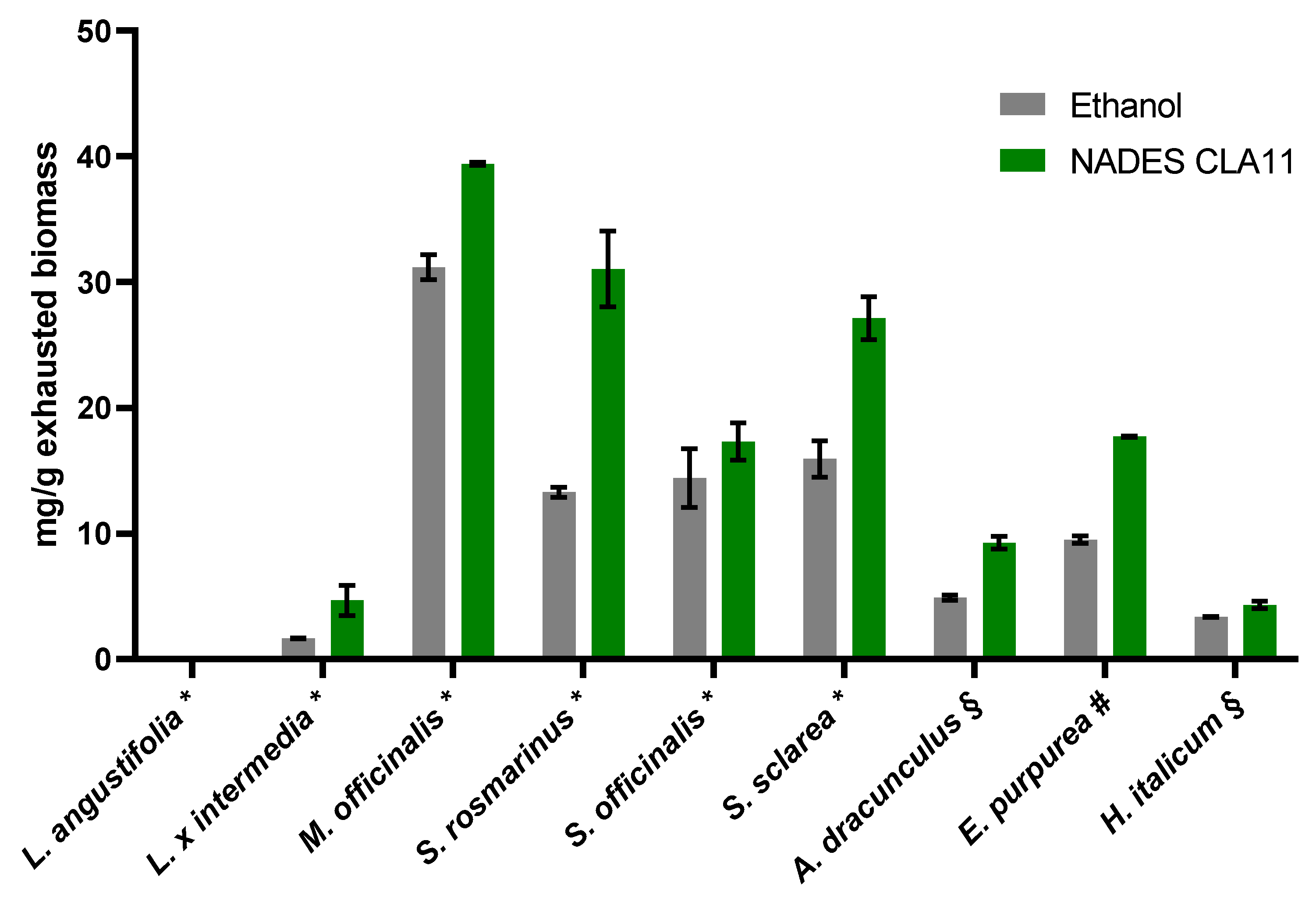
The concentration of the target polyphenols was higher in all NADES extracts compared to the EtOH extracts, confirming the preliminary results on ECHI and MEL during the screening of the NADES formulations. In the case of LAV biomass, rosmarinic acid was not detected in both extracts, confirming the TPC results. The detection of some polyphenols in this biomass via UHPLC-HRMS is ascribable to the high sensitivity of the analytical method. The differences in the extractive performances of EtOH and NADES were not pronounced across all biomasses. However, the concentration of phenols in NADES extracts of LAI, ROS, SAS, DRA, and ECHI was significantly higher (P < .05) and nearly twice that of the EtOH extracts. In contrast, for SAO and HEL, the differences in polyphenol abundance were not significant, suggesting that NADES may not efficiently penetrate the plant material or solubilize the metabolites of interest.
In general, the greater recovery suggested that the polarity of NADES closely aligns with that of the phenolic compounds in the plant biomasses, influencing their capability to dissolve the metabolites. The enhanced extraction capacity of NADESs is attributed to the high number of hydrogen bonds between the polyphenols and the components of the mixtures. Therefore, the high solubility of these bioactive compounds within NADESs is primarily due to the stabilization resulting from the intermolecular interactions they form with the NADES bends [16,75].
3. Materials and Methods
3.1. Chemicals and Sample Materials
Chicoric acid and C8–C40 n-alkanes mixture were provided from Sigma-aldrich (Milan, Italy). Lactic and citric acid were purchased from Carlo Erba (Milan, Italy). Choline chloride (ChCl) was obtained from Tokyo Chemical Industry (Tokyo, Japan). Cynarine was obtained from LGC (North York, Canada), while caftaric acid from Dr EHRENSTORFER (Augusta, Germany). Acetonitrile (ACN), acetic acid (HAc), formic acid, n-hexane (Hex), and ethanol (EtOH) were of LC–MS purity grade (Sigma-Aldrich, Milan, Italy).
The aerial parts of Artemisia dracunculus (ART), Salvia rosmarinus (ROS), and Lavandula x intermedia (LAI) were provided by Giardino delle Erbe “Rinaldi Ceroni”, Casola Valsenio (Ravenna, Italy) 6JJF+8H, Echinacea purpurea (ECHI), Helichrysum italicum (ELI), Lavandula angustifolia (LAV), Melissa officinalis (MEL), Salvia officinalis (SAO), and Salvia sclarea (SAS) were provided by “La Bendessa” farm, Roncoscaglia, Sestola (Modena, Italy) 6PRX+59. All plants were hand-picked at full maturation during summer 2023.
3.2. Steam Distillation
The steam distillation of ART, ROS, and LAI was performed using an industrial apparatus equipped with a 250 L boiler (Albrigi Luigi s.r.l., Stallavena, VR, Italy) by Giardino delle Erbe “Rinaldi Ceroni”, Casola Valsenio (Ravenna, Italy) farm. The steam distillation of ECHI, HEL, LAV, MEL, SAO, and SAS were performed using an industrial apparatus equipped with a 1500 L boiler (Albrigi Luigi s.r.l., Stallavena, VR, Italy) by the “Officine aromatiche del Frignano” with a 1500 L boiler (Albrigi). Briefly, aerial parts were steam distilled for 1 h and the EO was collected in a Florentine flask and stored at room temperature in an amber glass bottle until the analysis. The oil-exhausted biomass of each plant was collected, air-dried, and stored at room temperature.
3.3. Chemical Characterization of the EOs
The obtained EOs were analyzed by GC to qualitatively and quantitatively determine their chemical composition.
3.3.1. GC-MS Analysis
Analyses were performed on a 7890A gas chromatograph coupled with a 5975C net-work mass spectrometer (GC-MS) (Agilent Technologies, Milan, Italy). Compounds were separated on an Agilent Technologies HP-5 MS cross-linked poly-5% diphenyl–95% dimethyl polysiloxane (30 m × 0.25 mm i.d., 0.25 μm film thickness) capillary column. The column temperature was initially set at 45 °C, then increased at a rate of 2 °C/min up to 100 °C, then raised to 250 °C at a rate of 5 °C/min and finally held for 5 min. The injection volume was 0.1 μL, with a split ratio 1:20. Helium was used as the carrier gas, at a flow rate of 0.7 mL/min. The injector, transfer line, and ion-source temperature were 250, 280, and 230 °C, respectively. MS detection was performed with electron ionization at 70 eV, operating in the full-scan acquisition mode in the m/z range 40-400. The EOs were diluted 1:20 (v/v) with n-hexane before GC-MS analysis.
3.3.2. GC-FID Analysis
Chromatographic characterization of EOs was performed on a 7820 gas chromatograph (Agilent Technologies, Milan, Italy) with a flame ionization detector (FID). EOs and the mixture of aliphatic hydrocarbons (C8–C40) were diluted 1:20 (v/v) with Hex before GC-FID analysis. Helium was used as carrier gas at a flow rate of 1 mL/min. The injector and detector temperatures were set at 250 and 300 °C, respectively. EO components were separated on an Agilent Technologies HP-5 crosslinked poly-5% diphenyl–95% dimethylsiloxane (30 m x 0.32 mm i.d., 0.25 μm film thickness) capillary column. The column temperature was initially set at 45 °C, then increased at a rate of 2 °C/min up to 100 °C, then raised to 250 °C at a rate of 5 °C/min, and finally maintained for 5 min. The injection volume was 1 μL, with a split ratio 1:20.
Compounds were identified by comparing the retention times of the chromatographic peaks with those of authentic reference standards run under the same conditions and by comparing the linear retention indices (LRIs) relative to C8–C40 n-alkanes obtained on the HP-5 column under the above-mentioned conditions with the literature. Peak enrichment by co-injection with authentic reference compounds was also carried out. A comparison of the MS-fragmentation pattern of the target analytes with those of pure components was performed, by using the National Institute of Standards and Technology mass-spectral database.
The relative percentage of individual components was expressed as the peak area percentage relative to the total peak area obtained from GC-FID analysis. Semi-quantitative data were calculated as the mean of two analyses.
The data acquisition and processing were performed using the OpenLab CDS C.01.04 (Agilent Technologies, Santa Clara, CA) software.
3.4. Preparation of NADES Mixtures
ChCl was selected as the HBA while lactic acid, citric acid, and urea were tested as HBD. The preparation of the NADES formulations was performed according to Bakirtzi et al. [32]. Briefly, a fixed amount of ChCl was mixed with the HBDs at different molar ratios as reported in Table 3. The mixtures were heated under stirring at 50 °C until a transparent and homogeneous liquid was obtained. Afterwards, 20% (v/v) of water was added to the mixtures to reduce the viscosity of the NADES.
3.5. Oil-Exhausted Biomass Extraction
The exhausted biomasses obtained from the steam distillation were grounded and extracted with both EtOH, as conventional solvent, and different NADES mixtures.
3.5.1. Ethanolic Extraction
Approximately 250 mg of each sample was extracted by ultrasonication with 40 mL of 70% EtOH at room temperature for 15 min. The sample was then centrifuged at 3200 rpm for 5 min, and the supernatant was filtered through paper. The biomass was further extracted with 40 mL, followed by 20 mL of the same solvent, under the same conditions. Finally, the filtrates were combined in a 100 mL volumetric flask, and the solution was stored at -4 °C until analysis. All extractions were performed in triplicate.
3.5.2. NADES Extraction
The NADES extraction was carried out according to Bakirtzi et al. [32]. Briefly, 500 mg of each sample was extracted with 25 mL of NADES under ultrasonication for 90 min at 80 °C. The sample was then vacuum-filtered through paper, and the filtrate was diluted with Milli-Q water in a 50 mL volumetric flask.
3.6. Characterization of Biomass Extracts
The EtOH extracts and the optimized NADES extracts of ART, ECHI, HEL, LAV, LAI, MEL, SAO, ROS, and SAS were analyzed by UHPLC-HRMS to determine the polyphenolic composition. Subsequently, the most characteristic compounds were quantified using HPLC-DAD.
3.6.1. UHPLC-HRMS Analysis
The analyses were performed on a Thermo Scientific (Waltham, MA, USA) UHPLC Ultimate 3000, equipped with a binary pump, a vacuum degasser, a thermostated autosampler, a thermostated column compartment, and a Q-Exactive Orbitrap mass spectrometer, with a heated electrospray ionization (HESI) source. An Ascentis Express C18 column (100 mm × 2.1 mm I.D., 3 µm, Supelco, Milan, Italy) was used. The mobile phase was composed of (A) 0.1% HCOOH in water and (B) 0.1% HCOOH in ACN, and the gradient elution was set as follows: 0-2 min, 2% B; 2-20 min, 35% B; 20-25 min, 98% B; 25-35 min, 2%. The flow rate was set at 0.4 mL/min and the injection volume was 10 μL. The column temperature was 25 °C.
MS acquisition was performed in negative ionization mode. The source parameters were set as follows: sheath gas (N2) 45, auxiliary gas (N2) 25, sweep gas (N2) 2, auxiliary gas temperature 290 °C, and electrospray voltage 3.80 kV (+) and 3.40 kV (−). A data-dependent acquisition strategy was used to acquire both Full MS and higher energy collisional dissociation (HCD) fragmentation spectra. Mass analyzer acquisition parameters were set as follows: Full MS scan range 100<m/z<100 at 35000 full width half maximum (FWHM) resolving power with an automatic gain control (AGC) target set at 1 × 10⁶ ions with 200 ms maximum injection time; Top 2 HCD fragmentation spectra of most abundant precursor ions were acquired at 17500FWHM resolving power using an isolation window of 1.0 m/z and stepped normalized collision energy (NCE) at 20, 30 and 50.
3.6.2. HPLC-DAD Analysis
Chromatographic analyses were performed using the Agilent 1260 Infinity II instrument (Agilent Technologies), which includes a quaternary pump (Quaternary Pump 1260), an autosampler (Vialsampler 1260), and a UV/DAD detector (Diode Array WR 1260). Chromatograms were recorded and analyzed using the Agilent Open Lab CDS Version 2.6 software (Agilent Technologies). Chromatographic separation was conducted using two previously developed and validated methods, one for the ECHI samples and the other one for the remaining samples. For both methods, the flow rare was set at 1 mL/min and the injection volume was 10 µL. Before injection, all samples were filtered through a 0.2 µm PTFE (polytetrafluoroethylene) filter and then poured into the vials. All the analyses were carried out in duplicate.
For the ECHI samples, the mobile phase was composed of (A) 0.1% HCOOH in water and (B) ACN, and the gradient elution was set as follows: 0 min, 15% B; 0-10 min, 30% B; 10-18 min, 65% B; 18-25, 80% B; 25-30 min, 90% B. The total run time was 32 min ad the equilibration time was 5 min.
For all the other samples, the mobile phase was composed of (A) 0.3% HAc in water and (B) ACN, and the gradient was set as follows: 0 min, 17% B; 0-35 min, 23% B; 35-52 min, 49% B.
4. Conclusions
The extraction processes of medicinal plants pose significant sustainability challenges, mostly related to the disposal and recovery of the generated biomasses. Indeed, quite often, these biomasses are unused despite containing a high number of bioactive compounds. Among these, the main ones are polyphenols, a big class of compounds widely studied worldwide due to their numerous biological activities, including antioxidants, anti-inflammatory, and antimicrobial properties.
This study has provided an overview of the method to recover these biomasses using natural deep eutectic mixture solvents, known as NADES. Through advanced analytical techniques like GC-FID, GC-MS, HPLC-DAD, and UHPLC-HRMS, the research has shown that NADES offer a higher extraction capacity compared to conventional organic solvents, such as EtOH. Moreover, NADES exhibit several environmentally friendly characteristics that enhance their sustainability profile, one of them being their biodegradability, reducing their impact on the environment. Additionally, unlike EtOH, NADES are biocompatible and non-toxic, making them safe for biological systems and minimizing risks to human health, animal health, and the environment. For these reasons, NADES could be used for extracting bioactive compounds from biomass for applications in the pharmaceutical, cosmetic, and food industries. Furthermore, their demonstrated antimicrobial activity further expands their potential applications.
Finally, other tests will be conducted to investigate the potential recovery of polyphenols extracted from NADES and the recycling of the eutectic solvent itself, with the purpose of making the process more sustainable.
Looking ahead, future research should continue to explore NADES in the context of sustainability. Further investigations should focus on their environmental impact throughout their lifecycle and their potential to support circular economy principles. Additionally, it is essential to evaluate potential formulations containing NADES extracts from aromatic plant biomasses for applications in the pharmaceutical, nutraceutical, and cosmetic industries.
Author Contributions
Conceptualization, Davide Bertelli and Stefania Benvenuti; Data curation, Eleonora Truzzi, Davide Bertelli, Benedetta Catellani, Danial Darvishi Jazi and Stefania Benvenuti; Funding acquisition, Stefania Benvenuti; Investigation, Eleonora Truzzi, Benedetta Catellani, Danial Darvishi Jazi and Stefania Benvenuti; Methodology, Eleonora Truzzi, Benedetta Catellani, Danial Darvishi Jazi and Stefania Benvenuti; Project administration, Stefania Benvenuti; Resources, Stefania Benvenuti; Supervision, Eleonora Truzzi and Stefania Benvenuti; Validation, Eleonora Truzzi, Davide Bertelli and Stefania Benvenuti; Writing – original draft, Eleonora Truzzi, Danial Darvishi Jazi and Stefania Benvenuti; Writing – review & editing, Eleonora Truzzi, Davide Bertelli and Stefania Benvenuti. All authors have read and agreed to the published version of the manuscript.
Funding
This study was supported by “UNIMORE FAR 2023. ACTIDILLA: ACTtive molecules from DIstiLLAtion aromatic plants by-products” project, Department of Life Sciences, University of Modena and Reggio Emilia. CUP E93C23000350005TF.
Institutional Review Board Statement
Not applicable.
Acknowledgments
Authors wish to thanks Giardino delle Erbe “Rinaldi Ceroni”, Casola Valsenio (Ravenna, Italy), and “La Bendessa” farm, Roncoscaglia, Sestola (Modena, Italy) for providing the aerial parts of the plants. Additionally, the authors extend their gratitude to Giardino delle Erbe “Rinaldi Ceroni” and “Officine Aromatiche del Frignano” for their support in the distillation process.
Conflicts of Interest
The authors declare no conflicts of interest.
Abbreviations
The following abbreviations are used in this manuscript:
| EO | Essential oil |
| NADES | Natural Deep Eutectic Solvents |
| HBA | Hydrogen bond acceptor |
| HBD | Hydrogen bond donator |
| ART | Artemisia dracunculus |
| ECHI | Echinacea purpurea |
| HEL | Helichrysum italicum |
| LAV | Lavandula angustifolia |
| LAI | Lavandula x intermedia |
| MEL | Melissa officinalis |
| SAO | Salvia officinalis |
| ROS | Salvia rosmarinus |
| SAS | Salvia sclarea |
| GC | Gas chromatography |
| UHPLC-HRMS | Ultrahigh-Performance Liquid Chromatography–High-Resolution Mass Spectrometry |
| HPLC-DAD | High-Performance Liquid Chromatography with Diode Array Detection |
| LRI | Linear retention index |
| EtOH | Ethanol |
| Hex | hexane |
| ChCl | Choline chloride |
References
- Fierascu, R.C.; Fierascu, I.; Baroi, A.M.; Ortan, A. Selected Aspects Related to Medicinal and Aromatic Plants as Alternative Sources of Bioactive Compounds. Int J Mol Sci 2021, 22, 1521. [Google Scholar] [CrossRef]
- Sobhy, M.; Abdelkarim, E.A.; Hussein, M.A.; Aziz, T.; Al-Asmari, F.; Alabbosh, K.F.; Cui, H.; Lin, L. Essential Oils as Antibacterials against Multidrug-Resistant Foodborne Pathogens: Mechanisms, Recent Advances, and Legal Considerations. Food Biosci 2025, 64. [Google Scholar] [CrossRef]
- Maggio, F.; Rossi, C.; Serio, A.; Chaves-Lopez, C.; Casaccia, M.; Paparella, A. Anti-Biofilm Mechanisms of Action of Essential Oils by Targeting Genes Involved in Quorum Sensing, Motility, Adhesion, and Virulence: A Review. Int J Food Microbiol 2025, 426. [Google Scholar] [CrossRef]
- Chavda, V.; Balar, P.; Apostolopoulos, V. A Review on Essential Oils: A Potential Tonic for Mental Wellbeing in the Aging Population? Maturitas 2025, 192. [Google Scholar] [CrossRef] [PubMed]
- Chavda, V.; Balar, P.; Apostolopoulos, V. A Review on Essential Oils: A Potential Tonic for Mental Wellbeing in the Aging Population? Maturitas 2025, 192. [Google Scholar] [CrossRef]
- Elmi, A.; Correa, F.; Ventrella, D.; Scozzoli, M.; Vannetti, N.I.; Govoni, N.; Truzzi, E.; Belperio, S.; Trevisi, P.; Bacci, M.L.; et al. Can Environmental Nebulization of Lavender Essential Oil (L. Angustifolia) Improve Welfare and Modulate Nasal Microbiota of Growing Pigs? Res Vet Sci 2024, 171. [Google Scholar] [CrossRef] [PubMed]
- Stojanović, N.M.; Ranđelović, P.J.; Simonović, M.; Radić, M.; Todorović, S.; Corrigan, M.; Harkin, A.; Boylan, F. Essential Oil Constituents as Anti-Inflammatory and Neuroprotective Agents: An Insight through Microglia Modulation. Int. J. Mol. Sci. 2024, 2024, 5168. [Google Scholar] [CrossRef]
- de Sousa, D.P.; Damasceno, R.O.S.; Amorati, R.; Elshabrawy, H.A.; de Castro, R.D.; Bezerra, D.P.; Nunes, V.R. V.; Gomes, R.C.; Lima, T.C. Essential Oils: Chemistry and Pharmacological Activities. Biomolecules 2023, 13. [Google Scholar] [CrossRef]
- Do Nascimento, L.D.; de Moraes, A.A.B.; da Costa, K.S.; Galúcio, J.M.P.; Taube, P.S.; Costa, C.M.L.; Cruz, J.N.; de Andrade, E.H.; de Faria, L.J.G. Bioactive Natural Compounds and Antioxidant Activity of Essential Oils from Spice Plants: New Findings and Potential Applications. Biomolecules 2020, 10, 1–37. [Google Scholar] [CrossRef]
- Rout, S.; Tambe, S.; Deshmukh, R.K.; Mali, S.; Cruz, J.; Srivastav, P.P.; Amin, P.D.; Gaikwad, K.K.; de Andrade, E.H.; de Oliveira, M.S. Recent Trends in the Application of Essential Oils: The next Generation of Food Preservation and Food Packaging. Trends Food Sci Technol 2022, 129, 421–439. [Google Scholar] [CrossRef]
- Truzzi, E.; Benvenuti, S.; Bertelli, D.; Francia, E.; Ronga, D. Effects of Biostimulants on the Chemical Composition of Essential Oil and Hydrosol of Lavandin (Lavandula x Intermedia Emeric Ex Loisel.) Cultivated in Tuscan-Emilian Apennines. Molecules 2021, 26. [Google Scholar] [CrossRef]
- Truzzi, E.; Chaouch, M.A.; Rossi, G.; Tagliazucchi, L.; Bertelli, D.; Benvenuti, S. Characterization and Valorization of the Agricultural Waste Obtained from Lavandula Steam Distillation for Its Reuse in the Food and Pharmaceutical Fields. Molecules 2022, 27. [Google Scholar] [CrossRef] [PubMed]
- Ahmad, T.; Esposito, F.; Cirillo, T. Valorization of Agro-Food by-Products: Advancing Sustainability and Sustainable Development Goals 2030 through Functional Compounds Recovery. Food Biosci 2024, 62. [Google Scholar] [CrossRef]
- Luo, J.; Luo, J.; Sheng, Z.; Fang, Z.; Fu, Y.; Wang, N.; Yang, B.; Xu, B. Latest Research Progress on Anti-Microbial Effects, Mechanisms of Action, and Product Developments of Dietary Flavonoids: A Systematic Literature Review. Trends Food Sci Technol 2025, 156. [Google Scholar] [CrossRef]
- Pereira, T.C.; Souza, V.P.; Padilha, A.P.F.; Duarte, F.A.; Flores, E.M. Trends and Perspectives on the Ultrasound-Assisted Extraction of Bioactive Compounds Using Natural Deep Eutectic Solvents. Curr Opin Chem Eng 2025, 47. [Google Scholar] [CrossRef]
- Dai, Y.; Varypataki, E.M.; Golovina, E.A.; Jiskoot, W.; Witkamp, G.J.; Choi, Y.H.; Verpoorte, R. Natural Deep Eutectic Solvents in Plants and Plant Cells: In Vitro Evidence for Their Possible Functions. Adv Bot Res 2021, 97, 159–184. [Google Scholar] [CrossRef]
- Koraqi, H.; Yüksel Aydar, A.; Pandiselvam, R.; Qazimi, B.; Khalid, W.; Trajkovska Petkoska, A.; Çesko, C.; Ramniwas, S.; Mohammed Basheeruddin Asdaq, S.; Rustagi, S. Optimization of Extraction Condition to Improve Blackthorn (Prunus Spinosa L.) Polyphenols, Anthocyanins and Antioxidant Activity by Natural Deep Eutectic Solvent (NADES) Using the Simplex Lattice Mixture Design Method. Microchemical Journal 2024, 200, 110497. [Google Scholar] [CrossRef]
- Milošević, S.; Bebek Markovinović, A.; Teslić, N.; Mišan, A.; Pojić, M.; Brčić Karačonji, I.; Jurica, K.; Lasić, D.; Putnik, P.; Bursać Kovačević, D.; et al. Use of Natural Deep Eutectic Solvent (NADES) as a Green Extraction of Antioxidant Polyphenols from Strawberry Tree Fruit (Arbutus Unedo L.): An Optimization Study. Microchemical Journal 2024, 200, 110284. [Google Scholar] [CrossRef]
- Uka, D.; Kukrić, T.; Krstonošić, V.; Jović, B.; Kordić, B.; Pavlović, K.; Popović, B.M. NADES Systems Comprising Choline Chloride and Polyphenols: Physicochemical Characterization, Antioxidant and Antimicrobial Activities. J Mol Liq 2024, 410, 125683. [Google Scholar] [CrossRef]
- Mir-Cerdà, A.; Granados, M.; Saurina, J.; Sentellas, S. Olive Tree Leaves as a Great Source of Phenolic Compounds: Comprehensive Profiling of NaDES Extracts. Food Chem 2024, 456, 140042. [Google Scholar] [CrossRef]
- Gonçalves, S.; Romano, A. In Vitro Culture of Lavenders (Lavandula Spp.) and the Production of Secondary Metabolites. Biotechnol Adv 2013, 31, 166–174. [Google Scholar] [CrossRef]
- Kittler, J.; Krüger, H.; Ulrich, D.; Zeiger, B.; Schütze, W.; Böttcher, C.; Krähmer, A.; Gudi, G.; Kästner, U.; Heuberger, H.; et al. Content and Composition of Essential Oil and Content of Rosmarinic Acid in Lemon Balm and Balm Genotypes (Melissa Officinalis). Genet Resour Crop Evol 2018, 65, 1517–1527. [Google Scholar] [CrossRef]
- Shankar, A.; Ali, A.; Abdullah, H.M.; Balaji, J.; Kaur, J.; Saeed, F.; Wasiq, M.; Imran, A.; Jibraeel, H.; Raheem, M.S.; et al. Nutritional Composition, Phytochemical Profile, Therapeutic Potentials, and Food Applications of Rosemary: A Comprehensive Review. Journal of Food Composition and Analysis 2024, 135, 106688. [Google Scholar] [CrossRef]
- Truzzi, E.; Durante, C.; Bertelli, D.; Catellani, B.; Pellacani, S.; Benvenuti, S. Rapid Classification and Recognition Method of the Species and Chemotypes of Essential Oils by ATR-FTIR Spectroscopy Coupled with Chemometrics. Molecules 2022, 27, 5618. [Google Scholar] [CrossRef] [PubMed]
- Ben Akacha, B.; Ben Hsouna, A.; Generalić Mekinić, I.; Ben Belgacem, A.; Ben Saad, R.; Mnif, W.; Kačániová, M.; Garzoli, S. Salvia Officinalis L. and Salvia Sclarea Essential Oils: Chemical Composition, Biological Activities and Preservative Effects against Listeria Monocytogenes Inoculated into Minced Beef Meat. Plants 2023, 12, 3385. [Google Scholar] [CrossRef] [PubMed]
- Kordali, S.; Kotan, R.; Mavi, A.; Cakir, A.; Ala, A.; Yildirim, A. Determination of the Chemical Composition and Antioxidant Activity of the Essential Oil of Artemisia Dracunculus and of the Antifungal and Antibacterial Activities of Turkish Artemisia Absinthium, A. Dracunculus, Artemisia Santonicum, and Artemisia Spicigera Essential Oils. J Agric Food Chem 2005, 53, 9452–9458. [Google Scholar] [CrossRef]
- Dosoky, N.S.; Kirpotina, L.N.; Schepetkin, I.A.; Khlebnikov, A.I.; Lisonbee, B.L.; Black, J.L.; Woolf, H.; Thurgood, T.L.; Graf, B.L.; Satyal, P.; et al. Volatile Composition, Antimicrobial Activity, and In Vitro Innate Immunomodulatory Activity of Echinacea Purpurea (L.) Moench Essential Oils. Molecules 2023, 28, 7330. [Google Scholar] [CrossRef]
- Leonardi, M.; Giovanelli, S.; Ambryszewska, K.E.; Ruffoni, B.; Cervelli, C.; Pistelli, L.; Flamini, G.; Pistelli, L. Essential Oil Composition of Six Helichrysum Species Grown in Italy. Biochem Syst Ecol 2018, 79, 15–20. [Google Scholar] [CrossRef]
- Available online: https://www.nist.gov/.
- Soukaina, K.; Safa, Z.; Soukaina, H.; Hicham, C.; Bouchra, C. Choline Chloride-Based Deep Eutectic Solvents (NADES): Potential Use as Green Extraction Media for Polyphenols from Mentha Pulegium, Antioxidant Activity, and Antifungal Activity. Microchemical Journal 2024, 199, 110174. [Google Scholar] [CrossRef]
- No L Official Journal of the European Communities 14.12.70 Articles 43.
- Bakirtzi, C.; Triantafyllidou, K.; Makris, D.P. Novel Lactic Acid-Based Natural Deep Eutectic Solvents: Efficiency in the Ultrasound-Assisted Extraction of Antioxidant Polyphenols from Common Native Greek Medicinal Plants. J Appl Res Med Aromat Plants 2016, 3, 120–127. [Google Scholar] [CrossRef]
- Guo, N.; Ping-Kou; Jiang, Y.W.; Wang, L.T.; Niu, L.J.; Liu, Z.M.; Fu, Y.J. Natural Deep Eutectic Solvents Couple with Integrative Extraction Technique as an Effective Approach for Mulberry Anthocyanin Extraction. Food Chem 2019, 296, 78–85. [Google Scholar] [CrossRef] [PubMed]
- Silva, D.T. da; Pauletto, R.; Cavalheiro, S.d.S.; Bochi, V.C.; Rodrigues, E.; Weber, J.; Silva, C.d.B.d.; Morisso, F.D.P.; Barcia, M.T.; Emanuelli, T. Natural Deep Eutectic Solvents as a Biocompatible Tool for the Extraction of Blueberry Anthocyanins. Journal of Food Composition and Analysis 2020, 89, 103470. [Google Scholar] [CrossRef]
- Kovač, M.J.; Pavić, V.; Huđ, A.; Cindrić, I.; Molnar, M. Determination of Suitable Macroporous Resins and Desorbents for Carnosol and Carnosic Acid from Deep Eutectic Solvent Sage (Salvia Officinalis) Extract with Assessment of Antiradical and Antibacterial Activity. Antioxidants 2021, 10, 556. [Google Scholar] [CrossRef]
- Georgantzi, C.; Lioliou, A.-E.; Paterakis, N.; Makris, D. Combination of Lactic Acid-Based Deep Eutectic Solvents (DES) with β-Cyclodextrin: Performance Screening Using Ultrasound-Assisted Extraction of Polyphenols from Selected Native Greek Medicinal Plants. Agronomy 2017, 7, 54. [Google Scholar] [CrossRef]
- Zannou, O.; Pashazadeh, H.; Galanakis, C.M.; Alamri, A.S.; Koca, I. Carboxylic Acid-Based Deep Eutectic Solvents Combined with Innovative Extraction Techniques for Greener Extraction of Phenolic Compounds from Sumac (Rhus Coriaria L.). J Appl Res Med Aromat Plants 2022, 30, 100380. [Google Scholar] [CrossRef]
- Cvjetko Bubalo, M.; Ćurko, N.; Tomašević, M.; Kovačević Ganić, K.; Radojcic Redovnikovic, I. Green Extraction of Grape Skin Phenolics by Using Deep Eutectic Solvents. Food Chem 2016, 200, 159–166. [Google Scholar] [CrossRef]
- Stini, E.; Tsimogiannis, D.; Oreopoulou, V. The Valorisation of Melissa Officinalis Distillation By-Products for the Production of Polyphenol-Rich Formulations. Molecules 2024, 29, 377. [Google Scholar] [CrossRef]
- Bajkacz, S.; Adamek, J. Development of a Method Based on Natural Deep Eutectic Solvents for Extraction of Flavonoids from Food Samples. Food Anal Methods 2018, 11, 1330–1344. [Google Scholar] [CrossRef]
- Soukaina, K.; Safa, Z.; Soukaina, H.; Hicham, C.; Bouchra, C. Choline Chloride-Based Deep Eutectic Solvents (NADES): Potential Use as Green Extraction Media for Polyphenols from Mentha Pulegium, Antioxidant Activity, and Antifungal Activity. Microchemical Journal 2024, 199, 110174. [Google Scholar] [CrossRef]
- Siamandoura, P.; Tzia, C. Comparative Study of Novel Methods for Olive Leaf Phenolic Compound Extraction Using NADES as Solvents. Molecules 2023, 28, 353. [Google Scholar] [CrossRef]
- Puma-Isuiza, G.; García-Chacón, J.M.; Osorio, C.; Betalleluz-Pallardel, I.; Chue, J.; Inga, M. Extraction of Phenolic Compounds from Lucuma (Pouteria Lucuma) Seeds with Natural Deep Eutectic Solvents: Modelling Using Response Surface Methodology and Artificial Neural Networks. Front Sustain Food Syst 2024, 8. [Google Scholar] [CrossRef]
- del Mar Contreras, M.; Algieri, F.; Rodriguez-Nogales, A.; Gálvez, J.; Segura-Carretero, A. Phytochemical Profiling of Anti-Inflammatory Lavandula Extracts via RP–HPLC–DAD–QTOF–MS and –MS/MS: Assessment of Their Qualitative and Quantitative Differences. Electrophoresis 2018, 39, 1284–1293. [Google Scholar] [CrossRef]
- Kramberger, K.; Barlič-Maganja, D.; Bandelj, D.; Baruca Arbeiter, A.; Peeters, K.; Miklavčič Višnjevec, A.; Jenko Pražnikar, Z. HPLC-DAD-ESI-QTOF-MS Determination of Bioactive Compounds and Antioxidant Activity Comparison of the Hydroalcoholic and Water Extracts from Two Helichrysum Italicum Species. Metabolites 2020, 10, 403. [Google Scholar] [CrossRef] [PubMed]
- Lee, J.; Scagel, C.F. Chicoric Acid Found in Basil (Ocimum Basilicum L.) Leaves. Food Chem 2009, 115, 650–656. [Google Scholar] [CrossRef]
- Vallverdú-Queralt, A.; Jáuregui, O.; Di Lecce, G.; Andrés-Lacueva, C.; Lamuela-Raventós, R.M. Screening of the Polyphenol Content of Tomato-Based Products through Accurate-Mass Spectrometry (HPLC–ESI-QTOF). Food Chem 2011, 129, 877–883. [Google Scholar] [CrossRef] [PubMed]
- Ruan, J.; Yan, J.; Zheng, D.; Sun, F.; Wang, J.; Han, L.; Zhang, Y.; Wang, T. Comprehensive Chemical Profiling in the Ethanol Extract of Pluchea Indica Aerial Parts by Liquid Chromatography/Mass Spectrometry Analysis of Its Silica Gel Column Chromatography Fractions. Molecules 2019, 24, 2784. [Google Scholar] [CrossRef]
- Truzzi, E.; Chaouch, M.A.; Rossi, G.; Tagliazucchi, L.; Bertelli, D.; Benvenuti, S. Characterization and Valorization of the Agricultural Waste Obtained from Lavandula Steam Distillation for Its Reuse in the Food and Pharmaceutical Fields. Molecules 2022, 27, 1613. [Google Scholar] [CrossRef]
- Souhila, T.; Fatma Zohra, B.; Tahar, H.S. Identification and Quantification of Phenolic Compounds of Artemisia Herba-Alba at Three Harvest Time by HPLC–ESI–Q-TOF–MS. Int J Food Prop 2019, 22, 843–852. [Google Scholar] [CrossRef]
- Piccolella, S.; Crescente, G.; Volpe, M.G.; Paolucci, M.; Pacifico, S. UHPLC-HR-MS/MS-Guided Recovery of Bioactive Flavonol Compounds from Greco Di Tufo Vine Leaves. Molecules 2019, 24, 3630. [Google Scholar] [CrossRef]
- Gravina, C.; Formato, M.; Piccolella, S.; Fiorentino, M.; Stinca, A.; Pacifico, S.; Esposito, A. Lavandula Austroapennina (Lamiaceae): Getting Insights into Bioactive Polyphenols of a Rare Italian Endemic Vascular Plant. Int J Mol Sci 2023, 24, 8038. [Google Scholar] [CrossRef]
- Ferrare, K.; Bidel, L.P.R.; Awwad, A.; Poucheret, P.; Cazals, G.; Lazennec, F.; Azay-Milhau, J.; Tournier, M.; Lajoix, A.D.; Tousch, D. Increase in Insulin Sensitivity by the Association of Chicoric Acid and Chlorogenic Acid Contained in a Natural Chicoric Acid Extract (NCRAE) of Chicory (Cichorium Intybus L.) for an Antidiabetic Effect. J Ethnopharmacol 2018, 215, 241–248. [Google Scholar] [CrossRef] [PubMed]
- del Mar Contreras, M.; Algieri, F.; Rodriguez-Nogales, A.; Gálvez, J.; Segura-Carretero, A. Phytochemical Profiling of Anti-Inflammatory Lavandula Extracts via RP–HPLC–DAD–QTOF–MS and –MS/MS: Assessment of Their Qualitative and Quantitative Differences. Electrophoresis 2018, 39, 1284–1293. [Google Scholar] [CrossRef]
- Zhang, W.; Han, F.; He, J.; Duan, C. HPLC-DAD-ESI-MS/MS Analysis and Antioxidant Activities of Nonanthocyanin Phenolics in Mulberry (Morus Alba L.). J Food Sci 2008, 73. [Google Scholar] [CrossRef] [PubMed]
- Zimmermann, B.F.; Walch, S.G.; Tinzoh, L.N.; Stühlinger, W.; Lachenmeier, D.W. Rapid UHPLC Determination of Polyphenols in Aqueous Infusions of Salvia Officinalis L. (Sage Tea). Journal of Chromatography B 2011, 879, 2459–2464. [Google Scholar] [CrossRef]
- Lopes, C.L.; Pereira, E.; Soković, M.; Carvalho, A.M.; Barata, A.M.; Lopes, V.; Rocha, F.; Calhelha, R.C.; Barros, L.; Ferreira, I.C.F.R. Phenolic Composition and Bioactivity of Lavandula Pedunculata (Mill.) Cav. Samples from Different Geographical Origin. Molecules 2018, 23, 1037. [Google Scholar] [CrossRef] [PubMed]
- Romo Vaquero, M.; García Villalba, R.; Larrosa, M.; Yáñez-Gascón, M.J.; Fromentin, E.; Flanagan, J.; Roller, M.; Tomás-Barberán, F.A.; Espín, J.C.; García-Conesa, M.T. Bioavailability of the Major Bioactive Diterpenoids in a Rosemary Extract: Metabolic Profile in the Intestine, Liver, Plasma, and Brain of Zucker Rats. Mol Nutr Food Res 2013, 57, 1834–1846. [Google Scholar] [CrossRef]
- Truzzi, E.; Marchetti, L.; Gibertini, G.; Benvenuti, S.; Cappellozza, S.; Giovannini, D.; Saviane, A.; Sirri, S.; Pinetti, D.; Assirelli, A.; et al. Phytochemical and Functional Characterization of Cultivated Varieties of Morus Alba L. Fruits Grown in Italy. Food Chem 2024, 431, 137113. [Google Scholar] [CrossRef]
- Sharma, Y.; Velamuri, R.; Fagan, J.; Schaefer, J. Full-Spectrum Analysis of Bioactive Compounds in Rosemary (Rosmarinus Officinalis L.) as Influenced by Different Extraction Methods. Molecules 2020, 25, 4599. [Google Scholar] [CrossRef]
- Ruan, J.; Yan, J.; Zheng, D.; Sun, F.; Wang, J.; Han, L.; Zhang, Y.; Wang, T. Comprehensive Chemical Profiling in the Ethanol Extract of Pluchea Indica Aerial Parts by Liquid Chromatography/Mass Spectrometry Analysis of Its Silica Gel Column Chromatography Fractions. Molecules 2019, 24, 2784. [Google Scholar] [CrossRef]
- Celano, R.; Piccinelli, A.L.; Pagano, I.; Roscigno, G.; Campone, L.; De Falco, E.; Russo, M.; Rastrelli, L. Oil Distillation Wastewaters from Aromatic Herbs as New Natural Source of Antioxidant Compounds. Food Research International 2017, 99, 298–307. [Google Scholar] [CrossRef]
- Lech, K.; Witkoś, K.; Jarosz, M. HPLC-UV-ESI MS/MS Identification of the Color Constituents of Sawwort (Serratula Tinctoria L.) Euroanalysis XVII. Anal Bioanal Chem 2014, 406, 3703–3708. [Google Scholar] [CrossRef]
- Cvetkovikj, I.; Stefkov, G.; Acevska, J.; Stanoeva, J.P.; Karapandzova, M.; Stefova, M.; Dimitrovska, A.; Kulevanova, S. Polyphenolic Characterization and Chromatographic Methods for Fast Assessment of Culinary Salvia Species from South East Europe. J Chromatogr A 2013, 1282, 38–45. [Google Scholar] [CrossRef] [PubMed]
- Villalva, M.; Santoyo, S.; Salas-Pérez, L.; Siles-Sánchez, M.d.l.N.; Rodríguez García-Risco, M.; Fornari, T.; Reglero, G.; Jaime, L. Sustainable Extraction Techniques for Obtaining Antioxidant and Anti-Inflammatory Compounds from the Lamiaceae and Asteraceae Species. Foods 2021, 10, 2067. [Google Scholar] [CrossRef]
- Kramberger, K.; Barlič-Maganja, D.; Bandelj, D.; Baruca Arbeiter, A.; Peeters, K.; Miklavčič Višnjevec, A.; Jenko Pražnikar, Z. HPLC-DAD-ESI-QTOF-MS Determination of Bioactive Compounds and Antioxidant Activity Comparison of the Hydroalcoholic and Water Extracts from Two Helichrysum Italicum Species. Metabolites 2020, 10, 403. [Google Scholar] [CrossRef] [PubMed]
- Peixoto, J.A.B.; Álvarez-Rivera, G.; Alves, R.C.; Costa, A.S.G.; Machado, S.; Cifuentes, A.; Ibáñez, E.; Oliveira, M.B.P.P. Comprehensive Phenolic and Free Amino Acid Analysis of Rosemary Infusions: Influence on the Antioxidant Potential. Antioxidants 2021, 10, 500. [Google Scholar] [CrossRef]
- Castañeta, G.; Cifuentes, N.; Sepulveda, B.; Bárcenas-Pérez, D.; Cheel, J.; Areche, C. Untargeted Metabolomics by Using UHPLC–ESI–MS/MS of an Extract Obtained with Ethyl Lactate Green Solvent from Salvia Rosmarinus. Separations 2022, 9, 327. [Google Scholar] [CrossRef]
- Gonçalves, S.; Moreira, E.; Grosso, C.; Andrade, P.B.; Valentão, P.; Romano, A. Phenolic Profile, Antioxidant Activity and Enzyme Inhibitory Activities of Extracts from Aromatic Plants Used in Mediterranean Diet. J Food Sci Technol 2017, 54, 219–227. [Google Scholar] [CrossRef]
- Gouveia, S.; Castilho, P.C. Helichrysum Monizii Lowe: Phenolic Composition and Antioxidant Potential. Phytochemical Analysis 2012, 23, 72–83. [Google Scholar] [CrossRef]
- Barroso, M.R.; Barros, L.; Dueñas, M.; Carvalho, A.M.; Santos-Buelga, C.; Fernandes, I.P.; Barreiro, M.F.; Ferreira, I.C.F.R. Exploring the Antioxidant Potential of Helichrysum Stoechas (L.) Moench Phenolic Compounds for Cosmetic Applications: Chemical Characterization, Microencapsulation and Incorporation into a Moisturizer. Ind Crops Prod 2014, 53, 330–336. [Google Scholar] [CrossRef]
- Gevrenova, R.; Kostadinova, I.; Stefanova, A.; Balabanova, V.; Zengin, G.; Zheleva-Dimitrova, D.; Momekov, G. Phytochemical Profiling, Antioxidant and Cognitive-Enhancing Effect of Helichrysum Italicum Ssp. Italicum (Roth) G. Don (Asteraceae). Plants 2023, 12, 2755. [Google Scholar] [CrossRef]
- Negri, S.; Pietrolucci, F.; Andreatta, S.; Chinyere Njoku, R.; Antunes Silva Nogueira Ramos, C.; Crimi, M.; Commisso, M.; Guzzo, F.; Avesani, L. Bioprospecting of Artemisia Genus: From Artemisinin to Other Potentially Bioactive Compounds. Sci Rep 2024, 14. [Google Scholar] [CrossRef] [PubMed]
- Carnat, A.; Heitz, A.; Fraisse, D.; Carnat, A.P.; Lamaison, J.L. Major Dicaffeoylquinic Acids from Artemisia Vulgaris. Fitoterapia 2000, 71, 587–589. [Google Scholar] [CrossRef] [PubMed]
- Usmani, Z.; Sharma, M.; Tripathi, M.; Lukk, T.; Karpichev, Y.; Gathergood, N.; Singh, B.N.; Thakur, V.K.; Tabatabaei, M.; Gupta, V.K. Biobased Natural Deep Eutectic System as Versatile Solvents: Structure, Interaction and Advanced Applications. Science of The Total Environment 2023, 881, 163002. [Google Scholar] [CrossRef] [PubMed]
Figure 1.
Amount of chicoric and rosmarinic acids extracted with ethanol and NADES formulations in Echinacea purpurea and Melissa officinalis biomasses.
Figure 1.
Amount of chicoric and rosmarinic acids extracted with ethanol and NADES formulations in Echinacea purpurea and Melissa officinalis biomasses.
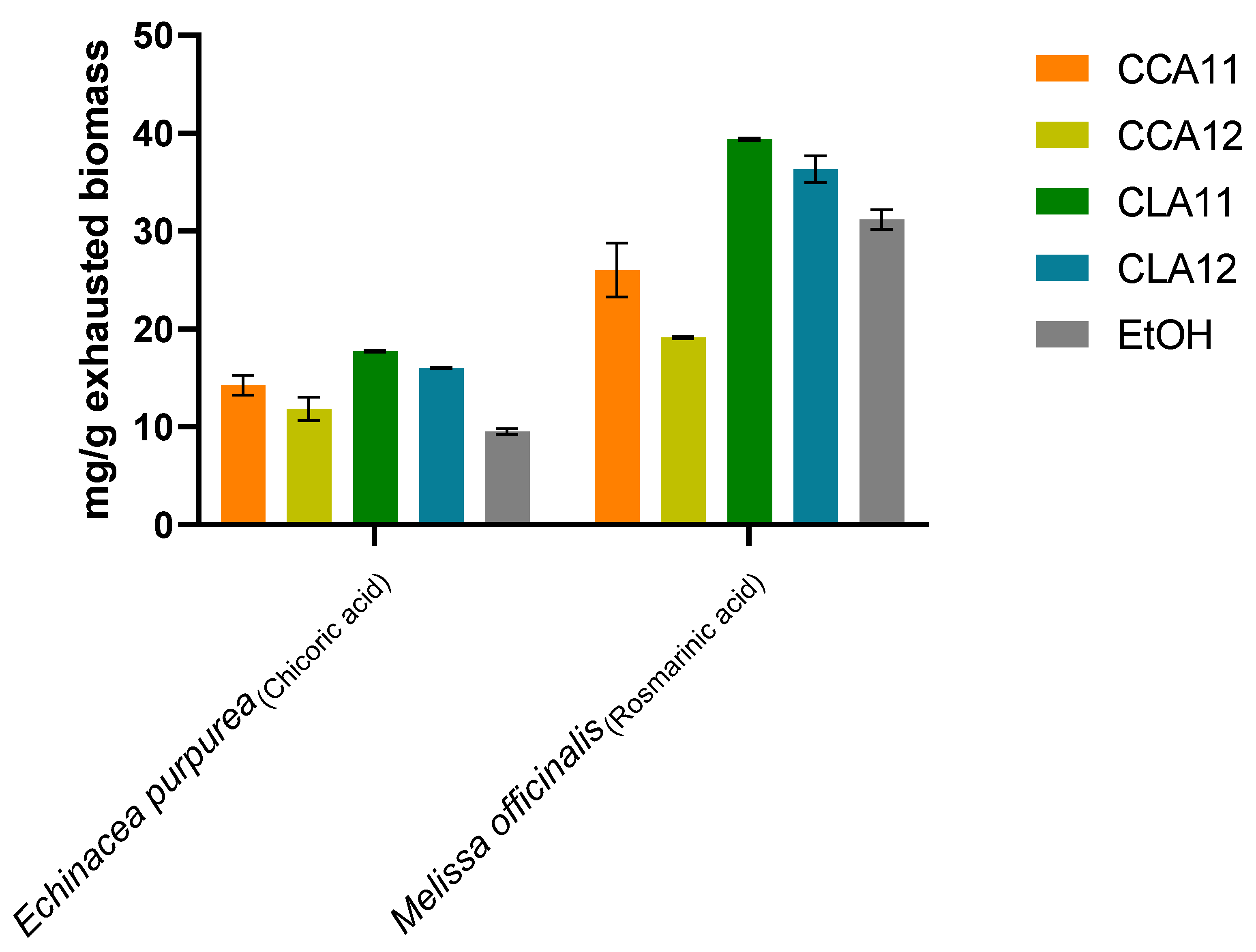

Table 1.
Chemical composition of the essential oils obtained by steam distillation from Lavandula x intermedia (LAI), Lavandula angustifolia (LAV), Melissa officinalis (MEL), Salvia rosmarinus (ROS), Salvia officinalis (SAO), and Salvia sclarea (SAS), Artemisia dracunculus (ART), Echinacea purpurea (ECHI), and Helichrysum italicum (HEL).
Table 1.
Chemical composition of the essential oils obtained by steam distillation from Lavandula x intermedia (LAI), Lavandula angustifolia (LAV), Melissa officinalis (MEL), Salvia rosmarinus (ROS), Salvia officinalis (SAO), and Salvia sclarea (SAS), Artemisia dracunculus (ART), Echinacea purpurea (ECHI), and Helichrysum italicum (HEL).
| Compound | LRI exp | LRI lit | LAI | LAV | MEL | ROS | SAO | SAS | ART | ECHI | HEL |
|---|---|---|---|---|---|---|---|---|---|---|---|
| α-thujene | 928 | 928 | - | - | - | 0.25 | 0.19 | - | - | - | - |
| α-pinene | 935 | 936 | 0.28 | 0.60 | 0.18 | 38.79 | 3.84 | - | 1.53 | 5.56 | 24.53 |
| Camphene | 943 | 950 | 0.49 | 0.18 | - | 5.37 | 6.29 | - | 0.13 | 0.17 | 0.99 |
| Sabinene | 969 | 973 | 0.25 | 0.42 | - | 2.58 | 4.39 | - | - | - | 0.15 |
| β-pinene | 971 | 975 | - | 0.15 | 1.05 | - | 0.12 | - | 0.17 | 1.33 | 1.07 |
| Octanone | 988 | 985 | 0.61 | 0.43 | - | 0.62 | - | - | - | - | 0.17 |
| Myrcene | 989 | 992 | 0.97 | 1.21 | 0.54 | 2.55 | 2.00 | 1.40 | 0.15 | 7.98 | - |
| α-phellandrene | 1001 | 1005 | - | - | - | 0.30 | - | - | - | 0.76 | - |
| δ-3-carene | 1007 | 1010 | 0.12 | 0.48 | - | - | - | - | - | - | - |
| α-terpinene | 1017 | 1017 | 0.41 | 0.18 | - | 0.56 | - | - | - | - | 0.24 |
| p-cymene | 1024 | 1026 | 0.67 | 0.29 | 0.16 | 0.40 | 0.40 | 0.23 | - | 0.89 | 0.29 |
| Limonene | 1029 | 1030 | 0.43 | 1.07 | - | - | 21.42 | - | 3.63 | - | 7.77 |
| 1,8-cineole | 1031 | 1032 | 6.16 | 1.62 | - | 18.55 | - | - | - | - | 0.76 |
| cis-β-ocimene | 1037 | 1039 | 0.49 | 3.04 | - | - | - | 0.37 | 11.50 | - | - |
| trans-β-ocimene | 1049 | 1049 | 0.26 | 4.04 | - | - | - | 0.63 | 15.70 | - | 0.32 |
| γ-terpinene | 1058 | 1061 | 0.11 | 0.13 | - | 1.12 | - | - | - | - | 0.71 |
| Terpinolene | 1085 | 1088 | - | - | - | 0.91 | 0.11 | 0.11 | - | - | 0.21 |
| Linalool | 1098 | 1102 | 20.19 | 35.19 | 0.61 | 1.82 | 0.15 | 15.87 | - | - | 0.87 |
| α-thujone | 1104 | 1101 | - | - | - | - | 10.70 | - | - | - | - |
| 6-camphenol | 1105 | 1106 | 0.73 | - | 0.21 | 0.26 | - | - | - | - | - |
| α-fenchol | 1114 | 1116 | 2.22 | 1.04 | 0.25 | - | - | - | - | - | - |
| β-thujone | 1115 | 1112 | - | - | - | - | 5.70 | - | - | - | - |
| Trans-rose oxide | 1126 | 1128 | 0.20 | - | - | 0.31 | - | - | 0.24 | - | - |
| Camphor | 1144 | 1145 | 3.52 | 0.35 | - | 3.83 | 22.41 | - | - | - | - |
| Nerol oxide | 1153 | 1148 | - | - | - | - | - | - | - | - | 0.72 |
| Citronellal | 1155 | 1157 | - | - | 9.43 | 0.17 | - | - | - | - | - |
| Menthone | 1157 | 1155 | - | - | 0.22 | 1.97 | - | - | - | - | - |
| Borneol | 1166 | 1168 | 1.80 | 1.32 | - | 3.79 | 1.62 | - | - | - | - |
| Lavandulol | 1169 | 1172 | 0.25 | - | - | 0.78 | - | - | - | - | - |
| Terpinen-4-ol | 1175 | 1181 | 1.01 | 5.59 | - | 0.78 | 0.43 | - | - | - | 0.31 |
| p-cymen-8-ol | 1188 | 1185 | 0.24 | - | 0.76 | - | 0.19 | - | - | - | - |
| α-terpineol | 1189 | 1193 | 0.34 | 0.64 | - | 1.03 | - | 2.09 | - | - | 0.35 |
| Myrtenal | 1194 | 1195 | 0.31 | 0.15 | - | 0.29 | - | - | - | - | - |
| Estragole | 1200 | 1195 | - | 65.15 | |||||||
| Verbenone | 1207 | 1204 | 6.04 | ||||||||
| Nerol | 1230 | 1232 | - | - | 0.18 | - | - | 0.19 | - | - | 1.04 |
| Citronellol | 1233 | 1233 | - | - | 0.18 | - | - | 0.15 | - | - | - |
| Neral | 1245 | 1245 | 0.15 | - | 6.49 | - | - | - | - | - | - |
| Piperitone | 1255 | 1252 | 0.13 | - | 0.50 | 1.23 | - | - | - | - | - |
| Linalyl acetate | 1264 | 1259 | 38.63 | 34.01 | 0.30 | - | - | 70.96 | - | - | - |
| Geraniol | 1267 | 1267 | 0.15 | - | 2.02 | - | - | - | - | - | - |
| Geranial | 1274 | 1269 | - | - | 12.74 | - | - | - | - | - | - |
| Bornyl acetate | 1288 | 1288 | 0.32 | 0.80 | 0.33 | 1.32 | 1.50 | - | 0.11 | - | - |
| Lavandulyl acetate | 1294 | 1290 | 3.13 | - | - | - | - | - | - | - | - |
| δ-elemene | 1338 | 1337 | 0.73 | - | 0.24 | - | - | - | - | 0.27 | - |
| Neryl acetate | 1367 | 1368 | 0.21 | 0.29 | - | - | - | 0.73 | - | - | 1.54 |
| α-copaene | 1377 | 1376 | 0.29 | - | 0.69 | - | 0.11 | 0.36 | - | 0.24 | 1.31 |
| Geranyl acetate | 1385 | 1386 | - | - | 3.50 | - | - | 1.43 | - | - | - |
| β-bourbonene | 1389 | 1384 | - | - | 0.41 | - | 0.11 | 0.20 | - | - | - |
| β-cubebene | 1392 | unknown | 0.44 | 0.67 | 0.39 | - | - | - | - | 0.94 | - |
| β-elemene | 1395 | 1390 | 0.20 | - | - | - | - | 0.14 | - | - | - |
| Italicene | 1404 | 1409 | - | - | - | - | - | - | - | - | 2.65 |
| Cis-α-bergamotene | 1416 | 1415 | - | - | - | - | - | - | - | - | 0.86 |
| β-caryophyllene | 1420 | 1420 | 1.97 | 3.30 | 17.08 | 2.46 | 4.62 | 0.99 | 0.23 | 2.50 | 3.49 |
| α-humulene | 1431 | 1433 | - | 0.34 | 1.93 | - | - | - | - | 0.65 | - |
| Trans-α-bergamotene | 1440 | 1436 | 0.12 | 0.26 | - | - | 1.80 | - | - | - | - |
| Neryl propanoate | 1455 | 1452 | - | - | - | - | - | - | - | - | 2.47 |
| β-farnesene | 1456 | 1457 | 1.20 | - | 0.15 | - | - | - | - | 1.13 | 0.31 |
| alloaromadendrene | 1464 | 1466 | - | - | - | 0.34 | 0.23 | - | - | - | - |
| γ-curcumene | 1478 | 1480 | - | - | - | - | - | - | - | - | 2.01 |
| ar-curcumene | 1483 | 1484 | 0.37 | 0.43 | - | - | 0.15 | - | 0.38 | - | 9.85 |
| β-selinene | 1485 | 1489 | - | - | - | - | - | - | 0.25 | - | 2.41 |
| Germacrene D | 1488 | 1481 | - | - | 1.10 | - | 0.12 | 2.83 | - | 66.43 | - |
| Italidione II | 1491 | 1493 | - | - | - | - | - | - | - | - | 9.55 |
| α-selinene | 1499 | 1496 | - | - | - | - | 0.75 | 0.56 | - | 1.86 | 6.38 |
| β-bisabolene | 1510 | 1511 | - | - | - | - | - | - | - | - | 0.26 |
| β-curcumene | 1513 | 1513 | - | - | - | - | - | - | - | - | 0.37 |
| γ-cadinene | 1522 | 1524 | 0.12 | - | 0.41 | - | - | - | - | - | 0.14 |
| δ-cadinene | 1526 | 1523 | 0.69 | 0.24 | 0.19 | - | 0.28 | - | - | 1.31 | 0.11 |
| Nerolidol | 1559 | 1563 | - | - | 0.97 | - | - | - | - | - | - |
| Spathulenol | 1580 | 1577 | - | - | - | - | 0.76 | - | - | 0.57 | - |
| Italidione III | 1583 | 1583 | - | - | - | - | - | - | - | - | 0.96 |
| Caryophyllene oxide | 1590 | 1589 | 2.35 | 0.23 | 20.64 | 0.14 | 0.96 | 0.13 | - | 1.65 | - |
| TOTAL | 93.64 | 98.71 | 94.04 | 99.53 | 92.00 | 99.37 | 99.54 | 96.82 | 87.01 |
Experimental retention indices and literature retention indices (HP-5 column) according to NIST [29].
Table 2.
Chemical composition of waste distillation biomasses extracted by EtOH 70% or CLA11 by UHPLC-HRMS.
Table 2.
Chemical composition of waste distillation biomasses extracted by EtOH 70% or CLA11 by UHPLC-HRMS.
| No | Rt (min) | Molecule | (M-H) (m/z) | Error (ppm) | Fragments (m/z) | Formula | Molecular weight (g/mol) | Extract | Reference | ||
|---|---|---|---|---|---|---|---|---|---|---|---|
| EtOH | NADES | ||||||||||
| 1 | 2.52 | Danshensu | 197.0449 | 0.70 | 179.0342, 135.0441, 123.0440, 72.9918 | C9H10O5 | 198.052824 | LAI LAV MEL ROS SAO SAS ART ECHI HEL |
+ + + + + + - - - |
+ + + + + + - - - |
[44] |
| 2 | 2.6 | Protocatechuic acid hexose | 315.0723 | -2.19 | 153.0184, 152.0106, 109.0282, 108.0205 | C13H16O9 | 316.079435 | LAI LAV MEL ROS SAO SAS ART ECHI HEL |
+ + + + + + + + - |
+ + + + + + + + - |
[45] |
| 3 | 3.16 | Caftaric acid | 311.0408 | -1.58 | 179.0342, 149.0082, 135.0441 | C13H12O9 | 312.048135 | LAI LAV MEL ROS SAO SAS ART ECHI HEL |
+ - - - - - - + - |
+ - - - - - - + - |
[46] |
| 4 | 3.79 | Caffeoylquinic acid isomer I | 353.0876 | -0.96 | 191.0554, 179.0342, 135.0441 | C16H18O9 | 354.095085 | LAI LAV MEL ROS SAO SAS ART ECHI HEL |
- - - + + - + - + |
- - - + + - + - + |
[45] |
| 5 | 4.34 | Caffeoyl hexose isomer I | 341.0878 | -1.58 | 179.0342, 161.0235, 135.0442 | C15H18O9 | 342.095085 | LAI LAV MEL ROS SAO SAS ART ECHI HEL |
- - + + + - - - - |
+ - + + + - + + - |
[47] |
| 6 | 4.79 | Coumaroyl quinic acid | 337.0931396 | -2.36 | 191.0555, 163.0392, 119.0490, 93.0333 | C16H18O8 | 338.100170 | LAI LAV MEL ROS SAO SAS ART ECHI HEL |
- - - - - - + - + |
- - - - - - + - + |
[48] |
| 7 | 5.01 | Coumaroyl hexose | 325.0929 | -1.71 | 183.0114, 163.0392, 119.0492, 93.0333 | C15H18O8 | 326.100170 | LAI LAV MEL ROS SAO SAS ART ECHI HEL |
+ + + + - - + - + |
+ + + + + - + - + |
[49] |
| 8 | 5.35 | Caffeoyl hexose isomer II | 341.0877 | -1.29 | 179.0342, 161.0235, 135.0441 | C15H18O9 | 342.095085 | LAI LAV MEL ROS SAO SAS ART ECHI HEL |
- - + + + - - - - |
+ - + + + - + + - |
[47] |
| 9 | 5.66 | Caffeoylquinic acid isomer II | 353.0876 | -0.96 | 191.0554, 179.0342, 135.0441 | C16H18O9 | 354.095085 | LAI LAV MEL ROS SAO SAS ART ECHI HEL |
- - - + + - + - + |
- - - + + - + - + |
[45] |
| 10 | 6.42 | Feruloylquinic acid | 367.1031 | -0.52 | 193.0499, 149.0598, 134.0363 | C17H20O9 | 368.110735 | LAI LAV MEL ROS SAO SAS ART ECHI HEL |
- - - - - - + - - |
- - - - - - + - - |
[50] |
| 11 | 6.48 | Feruloyl hexose | 355.1035 | -1.66 | 193.0499, 149.0598, 134.0362, 119.0339 | C16H20O9 | 356.110735 | LAI LAV MEL ROS SAO SAS ART ECHI HEL |
+ + - + + - + - - |
+ + - + + - + - - |
[49] |
| 12 | 8.92 | Luteolin /kaempferol diglucuronide | 637.1053 | -1.89 | 461.0721, 285.0405, 255.0298, 227.0349 |
0 | 638.111920 | LAI LAV MEL ROS SAO SAS ART ECHI HEL |
- - - - + - - - - |
+ + - - + - - - - |
[49] |
| 13 | 9.32 | Myricetin hexose | 479.0837 | -2.36 | 317.0305, 271.0250 | C21H20O13 | 480.090395 | LAI LAV MEL ROS SAO SAS ART ECHI HEL |
- - - - - - - - + |
- - - - - - - - + |
[50] |
| 14 | 9.63 | Quercetin glucuronide | 477.0680 | 2.63 | 301.0359, 300.0286, 271.02567, 255.0287 |
C21H18O13 | 478.074745 | LAI LAV MEL ROS SAO SAS ART ECHI HEL |
- - - - + - - - - |
- - - - + - - - - |
[51] |
| 15 | 9.68 | Quercetin hexose | 463.0888 | -2.47 | 301.0359, 300.02719, 271.02567, 255.02921 | C21H20O12 | 464.095480 | LAI LAV MEL ROS SAO SAS ART ECHI HEL |
- - - + - - - - + |
- - - + - - - - + |
[45] |
| 16 | 9.78 | Yunnaneic acid D | 539.1196 | -1.20 | 359.0777, 297.0771, 197.0452, 179.0342, 161.0236, 135.0441 |
C27H24O12 | 540.126780 | LAI LAV MEL ROS SAO SAS ART ECHI HEL |
+ - + + - - - - - |
+ + + + - - - - - |
[52] |
| 17 | 9.86 | Chicoric acid | 473.0692 | 5.93 | 311.0411, 293.0308, 179.0343, 149.0082 | C22H18O12 | 474.079830 | LAI LAV MEL ROS SAO SAS ART ECHI HEL |
- - + - - - - + - |
- - + - - - - + - |
[53] |
| 18 | 10.02 | Yunnaneic acid F | 597.1254 | -1.62 | 311.0930, 197.0449, 179.0342, 135.0441 | C29H26O14 | 598.132260 | LAI LAV MEL ROS SAO SAS ART ECHI HEL |
- - - + + - - - - |
+ - - + + - - - - |
[54] |
| 19 | 10.51 | Rutin | 609.1468 | -2.03 | 300.0278, 271.0251, 255.0301 | C27H30O16 | 610.153390 | LAI LAV MEL ROS SAO SAS ART ECHI HEL |
- - - + - - + + - |
+ - - + - + + + - |
[55] |
| 20 | 10.74 | Luteolin /kaempferol hexose | 447.0939 | -2.60 | 285.0405, 255.0298, 227.0349 |
C21H20O15 | 448.100564 | LAI LAV MEL ROS SAO SAS ART ECHI HEL |
- - - - + + - - + |
- - - - + + - - + |
[56] |
| 21 | 10.90 | Luteolin /kaempferol glucuronide | 461.0731 | -2.37 | 285.0405, 255.0298, 227.0349 |
C21H18O12 | 462.079830 | LAI LAV MEL ROS SAO SAS ART ECHI HEL |
+ + - + + + - - - |
+ + + + + + - - - |
[49] |
| 22 | 11.06 | Rosmarinic acid hexose | 521.1304 | -1.69 | 359.0766, 197.0449, 179.0342, 161.0236, 135.0440 | 0 | 521.129520 | LAI LAV MEL ROS SAO SAS ART ECHI HEL |
- - + + + - - - - |
- - + + + - - - - |
[55,57,58] |
| 23 | 11.81 | Luteolin /kaempferol rutinose | 593.15184 | 1.09 | 285.04041, 255.02995, 227.03470, | C27H30O15 | 594.15912 | LAI LAV MEL ROS SAO SAS ART ECHI HEL |
- - - - + - + - + |
- - - + + - + - + |
[59] |
| 24 | 11.92 | Rosmarinic acid | 359.0776 | -2.52 | 197.0449, 179.0344, 161.0235, 135.0441 | C18H16O8 | 360.084520 | LAI LAV MEL ROS SAO SAS ART ECHI HEL |
+ + + + + + - - - |
+ + + + + + + - - |
[60] |
| 25 | 12.09 | Apigenin hexose | 431.0988 | -2.37 | 269.0454, 117.0332 | C21H20O10 | 432.105649 | LAI LAV MEL ROS SAO SAS ART ECHI HEL |
+ + - - - + - - - |
+ + + - - + - - - |
[56] |
| 26 | 12.30 | Apigenin glucuronide | 445.0782 | -2.49 | 269.0457, 117.0334 | C21H18O11 | 446.084915 | LAI LAV MEL ROS SAO SAS ART ECHI HEL |
- - - - - + - - - |
- - - - + + - - - |
[54] |
| 27 | 12.43 | Dicaffeoyl quinic acid | 515.14105 | 0.73 | 353.08780, 191.05553, 179.03413, 135.04416 | C25H24O12 | 516.147900 | LAI LAV MEL ROS SAO SAS ART ECHI HEL |
- - - - - - + - + |
- - - - - - + - + |
[59] |
| 28 | 12.72 | Coumaroyl-caffeoylquinic acid | 499.1250 | -1.92 | 353.0886, 337.0932, 191.0555, 173.0447 | C25H24O11 | 500.131865 | LAI LAV MEL ROS SAO SAS ART ECHI HEL |
- - - - - - + - - |
- - - - - - + - - |
[61] |
| 29 | 12.86 | Methylluteolin-O-glucuronide (Kaempferide glucuronide) | 475.0888 | -2.41 | 299.0561, 284.0327 | C22H20O12 | 476.095480 | LAI LAV MEL ROS SAO SAS ART ECHI HEL |
- - - + + + - - - |
- - - + + + - - - |
[62,63] |
| 30 | 12.89 | Salvianolic acid K | 555.1122 | 3.01 | 359.0778, 179.0341, 161.0235, 135.0441 | C27H24O13 | 556.121695 | LAI LAV MEL ROS SAO SAS ART ECHI HEL |
- - + - + + - - - |
+ - + + + + - - - |
[62] |
| 31 | 13.28 | Caffeoyl-feruloylquinic acid | 529.1356 | -1.88 | 367.1036, 179.0340, 161.0236, 135.0442 | C26H26O12 | 530.142430 | LAI LAV MEL ROS SAO SAS ART ECHI HEL |
- - - - - - + - - |
- - - - - - + - - |
[61] |
| 32 | 13.47 | Salvianolic acid H (lithospermic acid) | 537.1042 | -1.67 | 359.0777. 295.0613. 179.0334. 161.0234. 135.0441 | C27H22O12 | 538.111130 | LAI LAV MEL ROS SAO SAS ART ECHI HEL |
- - - - + + - - - |
- - + + + + - - - |
[64] |
| 33 | 15.30 | Salvianolic acid A | 493.1140 | -1.06 | 295.0613, 197.0451, 179.0343, 135.0442 | C26H22O10 | 494.121300 | LAI LAV MEL ROS SAO SAS ART ECHI HEL |
+ - - + + - - - - |
+ - + + + + - - - |
[44] |
| 34 | 15.33 | Sagecoumarin isomer I | 535.0882 | -1.02 | 359.0775, 197.0443, 179.0341, 177.0186, 161.0234, 135.0443 | C27H20O12 | 536.095480 | LAI LAV MEL ROS SAO SAS ART ECHI HEL |
- - + - + - - - - |
- - + - + + - - - |
[65] |
| 35 | 16.03 | Sagecoumarin isomer II | 535.0882 | -1.02 | 359.0775, 197.0443, 179.0341, 177.0186, 161.0234, 135.0443 | C27H20O12 | 536.095480 | LAI LAV MEL ROS SAO SAS ART ECHI HEL |
- - + - + - - - - |
- - + - + + - - - |
[62] |
| 36 | 16.21 | Salvianolic acid C | 491.0989 | -2.14 | 311.0566, 265.05, 179.0360, 135.0442 | C26 H20 O10 | 492.105649 | LAI LAV MEL ROS SAO SAS ART ECHI HEL |
- - + + - - - - - |
+ - + + - + - - - |
[44] |
| 37 | 12.13 | Salvianolic acid B | 717.1473 | -2.42 | 519.0939, 339.051 161.023, 135.0444 | C36H30O16 | 718.153390 | LAI LAV MEL ROS SAO SAS ART ECHI HEL |
+ - + - + + - - - |
+ - + - + + - - - |
[52] |
| 38 | 12.31 | Sagerinic acid | 719.1624 | 1.64 | 359.0776, 197.0449, 179.0342, 161.0235 | C36H32O16 | 720.169040 | LAI LAV MEL ROS SAO SAS ART ECHI HEL |
+ - + + + + - - - |
+ - + + + + - - - |
[62] |
| 39 | 15.83 | Micropyrone | 251.1289 | 2.39 | 207.1385, 151.1118, 113.0960 | C14H20O4 | 252.136160 | LAI LAV MEL ROS SAO SAS ART ECHI HEL |
- - - - - - - - + |
- - - - - - - - + |
[66] |
| 40 | 22.70 | Rosmadial (safficinolide) | 343.1552 | -1.75 | 299.16509 | C20 H24 O5 | 344.162375 | LAI LAV MEL ROS SAO SAS ART ECHI HEL |
- - - + + - - - - |
- - - + + - - - - |
[67] |
| 41 | 22.88 | Carnosol | 329.1758 | -1.60 | 285.1862 | C20H26O4 | 330.183110 | LAI LAV MEL ROS SAO SAS ART ECHI HEL |
- - - + + - - - - |
- - - + + - + - - |
[60,68] |
| 42 | 23.52 | Arzanol | 401.1609 | -2.17 | 247.0976, 235.0974, 191.1071, 166.0263, 153.0548, 109.0647 | C22H26O7 | 402.167855 | LAI LAV MEL ROS SAO SAS ART ECHI HEL |
- - - - - - - - + |
- - - - - - - - + |
[66] |
Table 3.
NADES formulations prepared.
| Name | Eutectic mixture | Molar ratio |
|---|---|---|
| CCA11 | Choline chloride : Citric acid | 1 : 1 |
| CCA12 | Choline chloride : Citric acid | 1 : 2 |
| CLA11 | Choline chloride : Lactic acid | 1 : 1 |
| CLA12 | Choline chloride : Lactic acid | 1 : 2 |
Disclaimer/Publisher’s Note: The statements, opinions and data contained in all publications are solely those of the individual author(s) and contributor(s) and not of MDPI and/or the editor(s). MDPI and/or the editor(s) disclaim responsibility for any injury to people or property resulting from any ideas, methods, instructions or products referred to in the content. |
© 2025 by the authors. Licensee MDPI, Basel, Switzerland. This article is an open access article distributed under the terms and conditions of the Creative Commons Attribution (CC BY) license (http://creativecommons.org/licenses/by/4.0/).
Copyright: This open access article is published under a Creative Commons CC BY 4.0 license, which permit the free download, distribution, and reuse, provided that the author and preprint are cited in any reuse.


