1. Introduction
Often overlooked, soil is a vital natural, finite and living resource essential in almost ecosystems. It has complex processes and can be seen as an ecosystem itself (Joyalata Laishram et al., 2012). It supplies a medium to mitigate pollutants and is a habitat for microorganisms and biota (Schoonover & Crim, 2015). This biodiversity supports soil functions, ecosystem goods and services. Thus, maintaining soil biodiversity is essential to protect these functions. Soil degradation reduces or eliminates soil functions and affects ecosystem services, vital for human well-being. Minimizing or eliminating soil degradation is essential to maintain the services provided and is more cost-effective than rehabilitation (FAO, 2015). Soil value is often ignored until soil quality is degraded and the provision of services declines (Schoonover & Crim, 2015). Soil provides food, biomass, fibres, raw materials and manages water, carbon and nutrient cycles, being the biggest terrestrial carbon storage. Healthy soils are essential for mitigation and adaption of climate change, absorbing water and reducing the risks of floods and droughts, and so are in line with long term climate, biodiversity and economic European Union objectives (European Commission, 2021). EU Green Deal is a growth policy to create a fair, prosperous society with a resource-efficient economy featuring with no net greenhouse gas emissions by 2050. Protecting nature and enhancing human health are crucial for achieving these goals (EC, 2021).
In a world perspective, The Global Soil Partnership Action Framework 2022-2030 (GSP) aims to enhance and preserve the world´s soils health of at least 50 percent by 2030. Its mission is to promote better governance of soil resources to ensure food security and support essential ecosystem service, involving, for that purpose, all stakeholders, including politicians, scientists, and the public, which is vital for effective soil governance. In these contexts, increasing awareness and education about soils is necessary to fulfil the GSP’s mission (FAO, 2022). The 2030 Agenda for Sustainable Development has the Goal 15: “Protect, restore and promote sustainable use of terrestrial ecosystems, sustainably manage forests, combat desertification, and halt and reverse land degradation and halt biodiversity loss” with the target 15.3 “By 2030, combat desertification, restore degraded land and soil, including land affected by desertification, drought and floods, and strive to achieve a land degradation-neutral world” (UN, 2015).
The aim of this study is to carry out a critical analysis of Portuguese and European Union soil legislation, based on the information available in the SoiLEX database. It is a subject that scientific literature has not yet adequately explored, thus this study proposes to verify the contributions of that legislation to the soil, regarding soils threats that are referred at SoiLEX database. It is aimed also to carry out a SWOT analysis for Portuguese and European soil legislation available in the SoilLEX database.
This research has more 5 sections:
Section 2: A scientific literature review covering the topics: soil degradation, soil threats, soil functions, soil governance, soil protection.
Section 3: The methodology applied, where the critical analysis of the Portuguese and European soil legislation is described, based on the information available in the SoiLEX database.
Section 4: The results, where it´s done the description of the Portuguese and European soil legislation analysis, and a SWOT critical analysis.
2. Literature Review
Soils are a non-renewable resource that provide essential environmental, social, and economic functions (Blum, 2005), which must be protected (TSSP, 2006). Soils produce and provide us with biomass, food, raw materials, besides help to filter, buffer and transform substances between the atmosphere, the ground water and plant cover. Affecting, in this way, the water cycle, gas exchange (Blum, 2005), nutrients cycle and carbon sequestration (TSSP, 2006; Kibblewhite, Miko & Montanarella, 2012). It serves as a platform for human activities, landscape, as an archive of heritage, and plays a central role as a habitat and gene pool (TSSP, 2006). Soils are vital for biodiversity, holding more species than all above-ground life combined (Blum, 2005). For the transition to a sustainable bioeconomy, it is essential to ensure the provision of ecosystem services, such as regulatory, cultural and supporting services for soil governance. Soil governance influences soil use, addressing the needs and interests of current and future generations for long-term soil health (Juerges & Hansjürgens, 2018). Soils are critical for sustainable land use, namely in the current days where humanity faces global challenges like food security, climate change, water scarcity, and biodiversity loss (Bouma et al., 2012; Blum, 2004). The growing need for biomass in a sustainable bioeconomy may encourage short-term soil management, potentially harming soil quality over the long term (Juerges & Hansjürgens, 2018). There are processes that contribute to soil degradation such as: erosion, flooding, salinization, chemical, physical and biological deterioration (Hannam & Boer, 2004). In this perspective, soil faces many threats like erosion, loss of organic matter, contamination, sealing, compaction, biodiversity decline, salinization, floods, and landslides (TSSP, 2006). Decisions about acceptable levels of soil degradation are social and political. These decisions depend on precaution applied, ranging from strict conservation, where degradation don´t exceed natural soil regeneration, to situations where avoiding degradation is seen with too high economic costs (Kibblewhite, Miko & Montanarella, 2012). Prevention and remediation of soil degradation is addressed indirectly through EU policies Directives. (Posthumus et al., 2011). The EU's large-scale assessment on soil pollution shows that current policies fail to prevent pollution in soils (Vieira et al, 2024). Soil degradation and varying Member State responses lead to unequal conditions for market competitors due to differing soil protection laws (European Commission, 2021). Soil degradation has transnational matters like erosion, chemical contamination, and international markets. When directives address soil functions individually, they often overlook soil's multifunctionality (Glæsner, Helming & De Vries, 2014).
The principal functions of soil should greatly influence the creation of legal frameworks, although there are many domestic laws referencing to individual soil functions (Hannam & Boer, 2004; Vrebos et al., 2017). In the EU, soil functions are affected by various policies and laws. This leads to significant differences in how soil functions are impacted in different areas. Some functions are directly addressed by specific policies, while others may be affected indirectly, based on the policy and the region or local where it applies. Also, soil receives some protection from indirect consequences of other European legislation, like those on industrial emissions and water framework (Good agricultural and environmental conditions-GAEC, Common Agricultural Policy-CAP), and bioeconomy strategies, but lacks specific soil targets or limits (Vrebos et al., 2017; Helming et al., 2018). As well, Prager et al. (2011) on his study showed that most policy measures aimed at broader goals rather than soil conservation but still impacted farm soil management. Many do not directly target soil conservation, so their effectiveness is judged by other environmental goals like water quality or biodiversity.
Glæsner, Helming & De Vries (2014) appraised the need for a new distinct legislation on soil conservation that examines existing policies to see if they protect against soil threats and enhance soil functions in the context of major societal challenges. Nineteen legislative policies and two communications concerning soil, from European Community were studied by these authors and revealed gaps and overlaps in how existing policies address soil threats and functions. Each soil threat is tightly connected to a soil function, meaning that all threats must be tackled to maintain soil functions. Transposing from soil threats to soil functions emphasizes soil's importance for society giving reasons for the policy activity. It is suggested that soil protection should concentrate on functions, while targets should focus on threats (Glæsner, Helming & De Vries, 2014). Adopting soil ecosystem services in policy making, helps the assessment of natural resources and environmental strategies. Decision makers can evaluate effects on the environment and human well-being, leading to better policies and programs for society and the environment. (Adhikari & Hartemink, 2016).
The Europe Community is increasingly emphasising the importance of soil protection in strategic terms, but there is still not to date an EU soil-specific legislation (Paleari, 2017). Soil has undergone various sector related policy measures in the Union, but a dedicated soil protection policy is still developing. The European Commission sees soil protection as a key issue that must be included in all environmental and agricultural policies. Current legislation is fragmented and does not adequately address threats like soil compaction and erosion (Heuser, 2022). This disjointed governance structure mirrors complex soil management issues (Juerges & Hansjürgens, 2018).
Castelo-Grande et al. (2018) refers that Portugal urgently needs a soil framework to address legislative gaps and align with other member states. Portugal introduced its first Soil Law in 1970 (Decree-Law No 576/70) to address urban land availability issues. Joining the European Economic Community in 1986 greatly advanced Portugal's environmental policies, enhancing existing legislation.
In Portugal, legislation which directly regulates soil threats are focused on the improvement of soil fertility in agriculture, in reducing erosion, and preventing pollution. Soils are mainly harmed by pesticide contamination. The Law on the Use of Sewage Sludge from 2009 and the Law on Distribution, Sale and Application of Plant Protection Products for Professional Use and the Manual of Agricultural Good Practices, consists of soil and water conservation (Ronchi et al., 2019).
Rodrigues et al. (2009) suggested creating a national strategy for managing contaminated land. This should fit into a wider soil protection policy in Portugal, addressing threats like soil erosion and organic matter loss.
In 2023 a new soil European directive was proposed, after the rejection in 2014, of the former soil directive proposal from 2006 by five countries. (Germany, France, The Netherlands, the United Kingdom and Austria). Member States proceed on their own implementing sectorial policies and strategies due to the absence of a common European framework (Ronchi et al., 2019). Those five countries that have blocked the soil proposal Directive, have national legislation on soil regarding degradation and contamination that are stricter than the proposed from the European directive proposal (Stankovics, Tóth & Tóth, 2018). As stated at the EXPLANATORY MEMORANDUM of the new soil directive proposal (2023):”” Current EU and national policies have made positive contributions to improving soil health. But they do not tackle all the drivers of soil degradation and therefore significant gaps remain” (European Commission, 2023).
Soil management is sustainable when the support, provision, regulatory and cultural services it offers are maintained or improved, without harming soil functions or biodiversity (FAO, 2015). Effective soil protection should prevent harmful land use and management. The best of land and soil services should be identified and right land use and management promoted (Kibblewhite, Miko & Montanarella, 2012.). Sustainability relies on managing soil's limited resources (Blum, 2005). When soil functions are treated individually in different policies, it can be lost the soil´s multifunctionality. But those policies should directly deal with soil threats and functions to promote sustainable soil management practices (Glæsner, Helming & De Vries, 2014).
Effective Sustainable Soil Management (SSM) includes features such as minimal soil erosion, intact soil structure, adequate surface cover, stable soil organic matter, appropriate nutrient availability, low salinization, efficient water storage, harmless contaminant levels, a soil biodiversity that supports various biological functions, optimized resource inputs, and reduced soil sealing (FAO, 2017). The current unsustainable land use worsens soil biodiversity due to climate change (Leal Filho et al., 2023). The ability to cope with climate change relies on soil organic matter, fertility, water management, and erosion resistance, as well as carbon farming practices (EC, 2023). Well-managed soils that retain carbon and promote nutrient cycling are essential for resilience on productions structures (Leal Filho et al., 2023). Farmers need new governance mechanisms to manage short-term economic subjects and improve long-term soil quality (Helming et al., 2018). Agricultural extension has a crucial role in informing farmers about the benefits of specific practices and issues like soil erosion, fertility, yield, pollution, and flood risk (Posthumus & Morris, 2010). Concerns about sustainable land development and management include risk mitigation, biodiversity preservation, and ecosystem service maintenance. (Martinho et al, 2024)
3. Methodology
From the SoilLEX database (FAO, 2025a), a critical analysis of Portuguese and European legislation was carried out, regarding soil protection and prevention of its degradation. This platform allows to search legislation by country or by keyword related to soil and have a classification system that helps identify the importance of documents in relation to keywords, legislation, essence and year (FAO, 2025b). The legal instruments on the platform database were collected from FAOLEX and EU Sol Wiki is managed by the Global Soil Partnership within Water and Soil FAO division (FAO, 2025a).
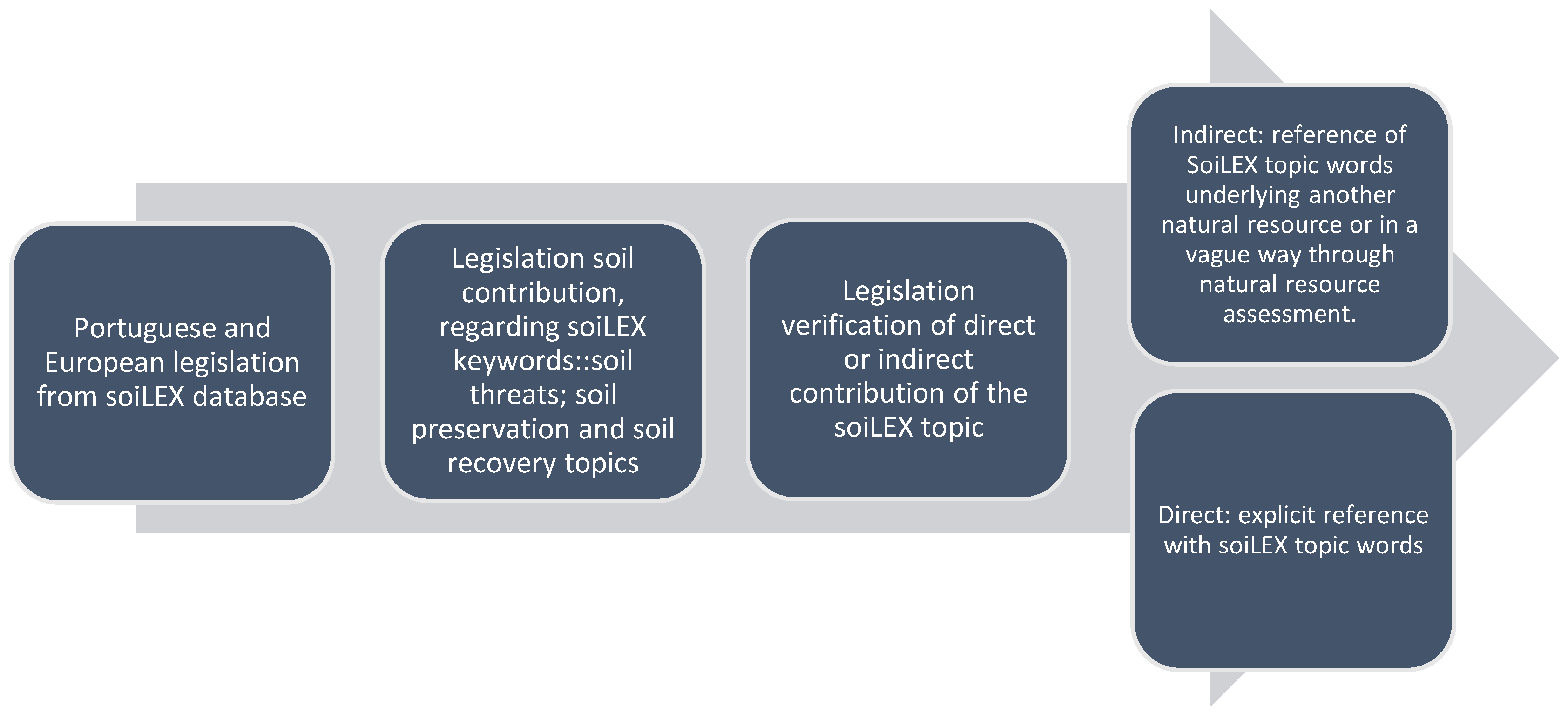
These legislative acts were then analysed, verifying the contributions that this legislation had towards the soil, in respect with SoiLEX soil keywords which are soil threats topics and soil preservation (conservation, quality and monitoring) topics and also soil recovery topic. Then, a SWOT analysis was carried out, which verified the strengths, weaknesses, opportunities and threats of this Portuguese legislation and European legislation listed in the SoiLEX database.
In the Portuguese legislation and European legislation analysis, it was verified whether the legislation's contributions to the SoiLEX topic were referred to directly or indirectly. It was stipulated that the form would be direct, if there was an explicit reference with the words of the soiLEX topic or for example, when it was written “soil protection”, it was considered a direct reference to soil conservation. As well for the words “soil contamination” for the topic “soil pollution”. The reference in an indirect way, would be when the SoiLEX topic was referred to underlying another natural resource threat or referred to in a vague way through natural resource assessments. This stipulation was adapted from the methodology of Paleari (2017).
4. Results
4.1. Critical Analysis of Portuguese and European Legislation Listed in the SoiLEX Database
The research on the SoiLEX database (FAO, 2025a), on Portuguese legislation relating to soil, gave rise to the following number of SoiLEX legislation acts list (
Table 1):
In the Portuguese legislation listed by the SoiLEX database (FAO, 2025a), regarding the topic "soil conservation" of the 17 legislative acts listed (
Table 2,
Table 3,
Table 4), 11 do not make direct reference to the topic” soil conservation” and 6 legislative acts do so directly. For the topic “soil quality”, (
Table 20,
Table 21,
Table 22,
Table 23), 16 legislative acts do not make direct reference to the topic and only one, the decree law no. 10/2010, makes a vague reference to soil quality. For the topic of "soil erosion " (
Table 6,
Table 7) of the 7 legislative acts listed by the Soilex database, 4 of them make direct reference to soil erosion and 3 do so indirectly through other soil threats or the approval of the “Code of Good Agricultural Practices”, which makes implicit the prevention of soil erosion. Of the 10 legislative acts listed by the SoiLEX database for the topic of soil pollution (
Table 14,
Table 15,
Table 16,
Table 17), 7 make a direct contribution to this topic and 3 legislative acts refer indirectly to the “Soil Pollution” topic. The topic of “soil biodiversity loss” (
Table 12,
Table 13) has only 1 legislative act with a direct contribution, being the Resolution of the Council of Ministers No. 55/2018. The remaining 7 legislative acts related to this topic make an indirect reference to the topic. The legislation listed at SoiLEX database contributes indirectly to the topic of "soil sealing" (
Table 9,
Table 10) in 6 legislative acts and only one in which it makes direct reference, this being the Decree Law No. 166/2008. In the topic of “waterlogging” (
Table 18,
Table 19), there are 4 legislative acts listed at SoiLEX, in which they make direct reference and two that make indirect reference. It should be noted that of the legislation listed for the topic of soil compaction (Table17), there is no direct contribution to this topic, but only indirectly in 3 legislative acts.
In the topic “Soil Restoration” (
Table 11), there are two legislative acts referring to this topic, one being Decree Law No. 10/2010 which addresses it directly and Decree Law No. 183/2009 which contributes indirectly. However, the Council of Ministers Resolution 78/2014 addresses the recovery of affected areas, and this legislative act was not included in this topic at SoiLEX database list.
In the topic "Soil organic carbon loss" (
Table 8) there are two legislative acts from the SoiLEX database list which refer to this topic. These is Decree Law No. 235/97 which contributes indirectly and the Council of Ministers Resolution No. 6-B/2015 which directly contributes to this topic.
The Ministers Resolution Council No. 6-B/2015 vaguely refers to the threat of soil salinization, although this topic "Salinization" does not appear for this in the SoiLEX database list for the country of Portugal.
Table 2.
SoiLEX Soil Conservation Topic of Portuguese legislation.
Table 2.
SoiLEX Soil Conservation Topic of Portuguese legislation.
| Legislative document identification |
Topic |
Main contributions to specific soil contexts |
| Decree-Law 235/97 |
SC |
A Code of Good Agricultural Practices will be approved to protect against pollution by nitrates from agricultural sources. |
| Law 58/2005 |
SC |
The river basin management plan ensures the implementation of specific measures to prevent and control pollution from activities, such as reducing emissions to air, water and soil |
| Decree law 86/2002 |
SC |
IHERA is responsible for preparing preliminary studies and projects for soil defence and conservation. |
| Decree Law 115/2010 |
SC |
The preliminary assessment of flood risks must include elements such as maps of the hydrographic region, indicating topographic data and the impact of soil with its current use; |
| Decree Law 178/2006 |
SC |
The main objective is to avoid and reduce the production of waste and its harmful impact, protecting human health and the environment (water, air, soil, fauna and flora.) |
Table 3.
SoiLEX Soil Conservation Topic of Portuguese legislation (Cont.).
Table 3.
SoiLEX Soil Conservation Topic of Portuguese legislation (Cont.).
| Legislative document identification |
Topic |
Main contributions to specific soil contexts |
| Decree law 86/2010 |
SC |
|
| Decree Law 276/2009 |
SC |
Establishes quality requirements for sludge and soils. Specific restrictions and procedures are applied to ensure the safe application of sludge to land. |
| Decree Law 142/2008 |
SC |
A protected landscape seeks to preserve natural and cultural values, emphasizing local identity and compatible measures for landscape patterns and ecological processes, |
| Decree Law 199/2015 |
SC |
The National Agricultural Reserve (RAN) is an instrument that makes agricultural land available to farmers, promoting family farming, the settlement of the population in agricultural activities and the improvement of the landscape. |
| Decree 15/2015 |
SC |
Soil classification represents a territorial planning decision that determines the basic use of land, distinguishing between rustic and urban land. |
| Law 31/2014 |
SC |
Public soil policy aims to preserve soil quality and support environmental, economic, and cultural functions. The State, autonomous regions and local authorities must plan for sustainable soil use and prevent degradation. |
| NATIONAL ACTION PLAN |
SC |
The use of plant protection products can contaminate surface and groundwater, affecting biodiversity, including auxiliary organisms and bees. |
Table 4.
SoiLEX Soil Conservation Topic of Portuguese legislation (Cont.).
Table 4.
SoiLEX Soil Conservation Topic of Portuguese legislation (Cont.).
| Legislative document identification |
Topic |
Main contributions to specific soil contexts |
|
Ccouncil of Ministers Resolution78/2014
|
SC |
The PANCD's objectives are included in policies instruments to combat desertification and guide land management and conservation. The strategic goal is to create global benefits and improve connections with climate change and biodiversity efforts, focusing on protecting and conserving soil. |
| Decree-Law 151-B/2013 |
SC |
The Environmental Impact Assessment aims to identify and evaluate the significant environmental impacts of a project, also considering its alternatives and environmental viability. This includes effects on territory, soil, water, air and climate, taking climate change into account. |
| Decree-Law 127/2013 |
SC |
Establishes standards for controlling industrial emissions to protect the environment. The technical assessment seeks to prevent air, water and soil pollution |
| Law 26/2013 |
SC |
Decision-making and application of plant protection products must prioritize non-chemical methods and good phytosanitary practices The objective is to adopt practices and products that are safer for human health and the environment. |
| Decree-Law 232/2007 |
SC |
Plans and programs in various sectors subject to environmental assessment. |
Table 5.
SoiLEX Soil Monitoring Topic of Portuguese legislation.
Table 5.
SoiLEX Soil Monitoring Topic of Portuguese legislation.
| Legislative document identification |
Topic |
Main contributions to specific soil contexts |
| Decree Law 276/2009 |
SM |
Establishes quality requirements for sludge and soils, with verifiable analyses to ensure compliance with defined limit values. |
Table 6.
SoiLEX Soil Erosion Topic of Portuguese legislation.
Table 6.
SoiLEX Soil Erosion Topic of Portuguese legislation.
| Legislative document identification |
Topic |
Main contributions to specific soil contexts |
| Decree law 166/2008 (REN)/Decree Law 124/2019 |
SE |
REN aims to protect natural resources. Prevents the degradation of areas of infiltration and recharge of aquifers and risks of sea flooding, floods, soil water erosion and mass movements on slopes, contributing to sustainability and adaptability to climate change, and the safety of people and properties. |
| Ccouncil of Ministers Resolution 6-B/2015 (ENF |
SE |
Control and recover degraded areas, encouraging and supporting the environmental restoration of sites affected by fires, erosion, salinization and invasion of exotic species. Increase the resilience of ecosystems through soil and water conservation. |
| Ccouncil of Ministers Resolution 78/2014 |
SE |
The strategic and specific objectives of the PANCD are integrated into policy measures and instruments to combat desertification with the specific objective, to control and recover degraded areas, as action line to encourage and support the restoration and environmental and landscape requalification of affected areas, namely: eroded, salinized and other degraded areas, |
Table 7.
SoiLEX Soil Erosion Topic of Portuguese legislation (Cont.).
Table 7.
SoiLEX Soil Erosion Topic of Portuguese legislation (Cont.).
| Legislative document identification |
Topic |
Main contributions to specific soil contexts |
| Council of Ministers Resolution 55/2018 |
SE |
Deepen the contribution of agriculture and forestry to the conservation of nature and biodiversity; reduce soil loss associated with inappropriate use and ensure the strengthening the integration of nature conservation and biodiversity in terrestrial and maritime spatial planning instruments. |
| Decree Law 115/2010 |
SE |
Flood risk management plans must consider soil and water management, spatial planning and land use. |
| Decree Law 235/97 |
SE |
A Code of Good Agricultural Practices will be approved to protect against pollution by nitrates from agricultural sources. |
| Law 58/2005 |
SE |
Some of the conservation and rehabilitation measures for the hydrographic network and riverside areas include prevention and protection against the effects of water-based erosion and correction of the effects of erosion, transport and deposition of sediments, particularly at the level of torrential correction; |
Table 8.
SoiLEX Soil Organic Carbon Loss and Nutrient Imbalance Topic of Portuguese Legislation.
Table 8.
SoiLEX Soil Organic Carbon Loss and Nutrient Imbalance Topic of Portuguese Legislation.
| Legislative document identification |
Topic |
Main contributions to specific soil contexts |
| Decree-Law 235/97 |
SOCL |
A Code of Good Agricultural Practices will be approved to protect against pollution by nitrates from agricultural sources. |
| Council of Ministers Resolution 6-B/2015 (ENF) |
SOCL |
The environmental services of the forest space include soil protection, conservation of water resources, carbon sequestration, landscape protection, maintenance of biodiversity and recreation. |
| Decree-Law 235/97 |
NI |
Climatic conditions and rainfall and irrigation; Land use and agricultural practices, including crop rotation systems, should be based on a balance between the predictable nitrogen needs of crops; and the supply of nitrogen to crops from soil and fertilizers |
Table 9.
SoiLEX Soil SealingTopic of Portuguese Legislation.
Table 9.
SoiLEX Soil SealingTopic of Portuguese Legislation.
| Legislative document identification |
Topic |
Main contributions to specific soil contexts |
| Decree 15/2015 |
SS |
Soil classification represents a territorial planning decision that determines the basic use of land, distinguishing between rustic and urban land. |
| Decree Law 199/2015 |
SS |
Non-agricultural use of RAN lands is only permitted if it does not harm the established objectives and there is no viable alternative outside the RAN, with preference given to lands and soils with less suitability. |
| Decree Law 80/2015 |
SS |
Intermunicipal or municipal plans establish parameters for land occupation, protection of natural resources, compatibility of functions and urban development, aiming at the well-being of populations and distribution of economic activities. |
| Decree Law 86/2002 |
SS |
HERA is responsible for preparing preliminary studies and projects for soil defence and conservation. |
Table 10.
SoiLEX Soil SealingTopic of Portuguese Legislation (Cont.).
Table 10.
SoiLEX Soil SealingTopic of Portuguese Legislation (Cont.).
| Legislative document identification |
Topic |
Main contributions to specific soil contexts |
| Law 31/2014 |
SS |
Territorial management aims to implement land policy, territorial planning and urban planning, ensuring the preservation of soils with potential for various activities, so that the allocation of these lands for other uses must be restricted and justified. |
| Decree law 140/99 |
SS |
If there are no specific planning instruments or they do not guarantee conservation, the licensing of acts or activities must depend on a favourable opinion from the ICN |
| Decree law 166/2008 (REN) |
SS |
REN aims to protect natural resources, such as water and soil, as well as coastal biophysical and terrestrial hydrological systems. Uses and actions can be carried out on the beds and banks of watercourses that do not compromise the continuity of the water cycle, hydraulic and hydrological functionality, land drainage, river erosion control, flood prevention, preventing the reduction flow section and avoiding soil sealing, conservation of natural habitats and hydrological-biological interactions between surface and underground waters. |
Table 11.
SoiLEX Soil Restoration Topic of Portuguese legislation.
Table 11.
SoiLEX Soil Restoration Topic of Portuguese legislation.
| Legislative document identification |
Topic |
Main contributions to specific soil contexts |
| Decree Law 183/2009 |
SR |
Establishes technical requirements for location, emission control, soil and water protection, stability, equipment and support facilities and infrastructure, closure of landfills and landscape integration. |
| Decree Law 10 /2010 |
SR |
A waste management plan must be drawn up, it should take sustainable development into account, to reduce impacts on the landscape and ensuring the physical stability of the waste. The plan must aim to reduce the production and hazardousness of waste, including the replacement or reuse of topsoil after the closure of the waste facility. |
Table 12.
SoiLEX Soil Biodiversity LossTopic of Portuguese Legislation.
Table 12.
SoiLEX Soil Biodiversity LossTopic of Portuguese Legislation.
| Legislative document identification |
Topic |
Main contributions to specific soil contexts |
| Decree law 140/99 |
SBL |
Territorial planning instruments must include measures to ensure the conservation of habitats and species in areas designated for this purpose. |
| Law 19/2004 |
SBL |
Soil and subsoil management aims to preserve their usability and fulfil environmental, biological, economic, social, scientific and cultural functions. |
| Decree Law 142/2008 |
SBL |
The classification of a protected area aims to grant it a legal protection status appropriate to the maintenance of biodiversity and ecosystem services and geological heritage, as well as the enhancement of the landscape. |
| Council of Ministers Resolution 55/2018 |
SBL |
Public policies in the field of agriculture must consider soil conservation and the impact on biodiversity. The study of soil biodiversity and it´s monitoring deserves to be highlighted, which is essential for the sustainability of functions, processes and services provided by ecosystems. |
| Decree lawn 147/2008 |
SBL |
This decree-law covers environmental damage and imminent threats resulting from economic activities, whether public or private, profitable or not, designated as occupational activities |
Table 13.
SoiLEX Soil Biodiversity LossTopic of Portuguese Legislation (cont).
Table 13.
SoiLEX Soil Biodiversity LossTopic of Portuguese Legislation (cont).
| Legislative document identification |
Topic |
Main contributions to specific soil contexts |
| Decree-Law 232/2007 |
SBL |
Plans and programs in various sectors are subject to environmental assessment, The responsible entity prepares an environmental report that must consider the positive and negative effects in the short, medium and long term, including aspects such as biodiversity, human health, fauna, flora, soil, water, atmosphere, climate, cultural heritage and landscape. |
| Council of Ministers Resolution 6 -B/2015 (ENF) |
SBL |
The environmental services of the forest space include soil protection, conservation of water resources, carbon sequestration, landscape protection, maintenance of biodiversity and recreation |
| Decree Law 151-B/2013 |
SBL |
The Environmental Impact Assessment aims to identify and evaluate the significant environmental impacts of a project. It is important to consider the environmental sensitivity of the areas affected by the project and the quality and availability of natural resources, such as soil, water, subsoil and biodiversity. |
Table 14.
SoiLEX Soil Pollution Topic of Portuguese Legislation.
Table 14.
SoiLEX Soil Pollution Topic of Portuguese Legislation.
| Legislative document identification |
Topic |
Main contributions to specific soil contexts |
| Decree law 183/2009 |
SP |
Avoid or reduce pollution of surface and underground water, soil, atmosphere, and global impacts such as the greenhouse effect the design of a landfill must ensure the prevention of air, soil and water pollution. Measures must be taken to prevent pollution of soils and groundwater and surface waters by waste and leachate. |
| Decree Law 276/2009 |
SP |
It is essential to store sludge properly to avoid contaminating soil and groundwater. It is necessary to respect the limit values for heavy metals and the annual amount of heavy metals introduced into the soil. |
| Decree law 86/2010 |
SP |
|
| Decree law 147/2008 |
SP |
Contaminants must be eliminated or controlled, so that the contaminated soil no longer poses risks to human health, based on a risk assessment considering the characteristics of the soil and substances present and their possibility of dispersion. |
Table 15.
SoiLEX Soil Pollution Topic of Portuguese Legislation.
Table 15.
SoiLEX Soil Pollution Topic of Portuguese Legislation.
| Legislative document identification |
Topic |
Main contributions to specific soil contexts |
| Decree law 178/2006 |
SP |
Covers collection, transport, storage, treatment, recovery, disposal of waste and soil decontamination. It is prohibited to abandon waste, incinerate it at sea, inject it into the soil or dispose of it in unauthorized places. |
| Decree-law 127/2013 |
SP |
The technical assessment seeks to prevent air, water and soil pollution, as well as the production of waste, through integrated measures. Incineration sites must adopt precautions to avoid environmental pollution (air, soil, surface and groundwater) and risks to human health. |
| Law 26/2013 |
SP |
Safety requirements that must be met when handling and preparing mixtures and cleaning equipment for applying plant protection products on agricultural and forestry farms, in land application companies and in authorized entities to avoid contamination of the soil, groundwater or surface waters of the surrounding area |
Table 16.
SoiLEX Soil Pollution Topic of Portuguese Legislation.
Table 16.
SoiLEX Soil Pollution Topic of Portuguese Legislation.
| Legislative document identification |
Topic |
Main contributions to specific soil contexts |
| Decree-Law 10 /2010 |
SP |
Extraction waste must be managed in a way that protects human health and the environment, avoiding soil contamination and air and water pollution. |
| NATIONAL ACTION PLAN |
SP |
The objective: To promote the good status of surface water and groundwater bodies and the protection of water intended for human consumption has the measure that aims to reduce contamination levels of surface and underground water, promoting good practices in relation to the storage, handling, application and management of chemical waste and good practices and management of soil and vegetation cover. |
| Decree-Law 235/97 |
SP |
A Code of Good Agricultural Practices will be approved to protect against pollution by nitrates from agricultural sources. |
Table 17.
SoiLEX Soil CompactationTopic of Portuguese Legislation.
Table 17.
SoiLEX Soil CompactationTopic of Portuguese Legislation.
| Legislative document identification |
Topic |
Main contributions to specific soil contexts |
| Decree 15/2015 |
SCOM |
Soil classification distinguishes between rustic and urban land. Urban land corresponds to what is totally or partially urbanized or built and, as such, affection in territorial plan for urbanization or construction |
| Decree Law 80/2015 |
SCOM |
Intermunicipal or municipal plans establish parameters for land occupation, protection of natural resources, compatibility of functions and urban development, aiming at the well-being of populations and distribution of economic activities. |
| Law 19/2014 |
SCOM |
Soil and subsoil management aims to preserve their usability and fulfill environmental, biological, economic, social, scientific and cultural functions. This is done through measures that limit the impact of human activities, prevent contamination and degradation, promote recovery and combat desertification to improve quality of life and rural development. |
Table 18.
SoiLEX Waterlogging Topic of Portuguese Legislation.
Table 18.
SoiLEX Waterlogging Topic of Portuguese Legislation.
| Legislative document identification |
Topic |
Main contributions to specific soil contexts |
| Decree Law 115/2010 |
W |
The preliminary assessment of flood risks must include elements such as maps of the hydrographic region, indicating topographic data and the impact of soil with its current use; Flood risk management plans must consider soil and water management, spatial planning and land use. Furthermore, they can promote sustainable land use practices, improved water infiltration and retention, and controlled flooding of areas in the event of flooding. |
| Law 58/2005 |
W |
A set of measures is established for the systematic protection and valorisation of water resources, complementary to those contained in river basin management plans, such as prevention and protection against the risks of floods, droughts, serious pollution accidents and rupture of hydraulic infrastructures. |
| Law 19/2014 |
W |
Sustainable use is promoted, safeguarding the ecological balance of resources, and considering the social, environmental and economic values of water, and reducing the impacts of floods and droughts with efficient planning and management. |
Table 19.
SoiLEX waterlogging Topic of Portuguese Legislation.
Table 19.
SoiLEX waterlogging Topic of Portuguese Legislation.
| Legislative document identification |
Topic |
Main contributions to specific soil contexts |
| Law 31/2014 |
W |
Territorial management aims to implement land policy, territorial planning and urban planning, ensuring the preservation of soils with potential for various activities. |
| Decree Law 166/2008 (REN) |
W |
REN aims to protect natural resources. Prevents the degradation of areas of infiltration and recharge of aquifers and risks of sea flooding, floods, soil water erosion and mass movements on slopes, contributing to sustainability and adaptability to climate change, and the safety of people and properties. |
| Decree Law 86/2002 |
W |
HERA is responsible for preparing preliminary studies and projects for soil defence and conservation. |
Table 20.
SoiLEX Soil QualityTopic of Portuguese Legislation.
Table 20.
SoiLEX Soil QualityTopic of Portuguese Legislation.
| Legislative document identification |
Topic |
Main contributions to specific soil contexts |
| Decree Law 151-B/2013, de 31 de outubro |
SQ |
The Environmental Impact Assessment aims to identify and evaluate the significant environmental impacts of a project, also considering its alternatives and environmental viability. It is important to consider the environmental sensitivity of the areas affected by the project and the quality and availability of natural resources, such as soil, water, subsoil and biodiversity. |
| Decree Law 232/2007 |
SQ |
Plans and programs in various sectors are subject to environmental assessment. |
| Ccouncil of Ministers Resolution 78/2014 |
SQ |
PANCD are integrated into policy measures and instruments to combat desertification, within the scope of territorial planning and management work, and in the definition of national programs and strategies for conservation and land use, rural development, conservation nature, water resources and development cooperation. |
| Decree Law 140/99 |
SQ |
Territorial planning instruments must include measures to ensure the conservation of habitats and species in areas designated for this purpose |
Table 21.
SoiLEX Soil QualityTopic of Portuguese Legislation.
Table 21.
SoiLEX Soil QualityTopic of Portuguese Legislation.
| Legislative document identification |
Topic |
Main contributions to specific soil contexts |
| Decree Lawi 183/2009 |
SQ |
The design of a landfill and measures must ensure the prevention of air, soil, groundwater and surface water pollution by waste and leachate. |
| Decree Law 80/2015 |
SQ |
Intermunicipal or municipal plans establish parameters for land occupation, protection of natural resources, compatibility of functions and urban development, aiming at the well-being of populations and distribution of economic activities. |
| Decree law 86/2010 |
SQ |
|
| Decree law 178/2006 |
SQ |
Covers waste management, including soil decontamination. The main objective is to avoid and reduce the production of waste and i protect the environment (water, air, soil, fauna and flora) and human health. |
| Decree law 127/2013 |
SQ |
Before starting activities with dangerous substances, a report must be submitted to APA, I. P evaluating soil and groundwater contamination. |
Table 22.
SoiLEX Soil QualityTopic of Portuguese Legislation (Cont.).
Table 22.
SoiLEX Soil QualityTopic of Portuguese Legislation (Cont.).
| Legislative document identification |
Topic |
Main contributions to specific soil contexts |
| Law 26/2013 |
SQ |
Decision-making and application of plant protection products must prioritize non-chemical methods and good phytosanitary practices for human health and the environment. |
| Decree Law 10 /2010 |
SQ |
The amount of the financial guarantee is determined by the licensing entity, based on: applicable environmental standards and objectives, including the physical stability of the waste facility, minimum quality standards for soil and water resources and maximum release rates of contaminants; |
| NATIONAL ACTION PLAN |
SQ |
Protecting the environment and ensuring its sustainability involves actions to prevent water contamination by chemical products and protect biodiversity, promoting sustainable practices and more effective regulations. |
| Decree Law 199/2015 |
SQ |
Any action that harms the potential for carrying out agricultural activities on the soil of the National Agricultural Reserve (RAN) is prohibited, including subdivisions and urbanization works, deposits of waste, or microorganisms that can alter and deteriorate soil characteristics, excessive use of sludge, interventions that cause soil degradation. |
Table 23.
SoiLEX Soil QualityTopic of Portuguese Legislation (cont.).
Table 23.
SoiLEX Soil QualityTopic of Portuguese Legislation (cont.).
| Legislative document identification |
Topic |
Main contributions to specific soil contexts |
| Decree Law 147/2008 |
SQ |
This decree-law covers environmental damage and imminent threats resulting from economic activities, whether public or private, profitable or not, designated as occupational activities. |
| Decree Law 142/2008 |
SQ |
A serious environmental offense happens when soil changes occur, apart from National Forest Defence activities against fires, or when waste or domestic water is released into the environment without proper treatment. |
| Decree-Law 235/97 |
SQ |
Proper soil management and fertilization plans are essential to preventing water pollution. |
| Ccouncil of Ministers Resolution 55/2018 |
SQ |
Deepen agriculture and forestry's role in nature and biodiversity conservation. Reduce soil loss and strengthen nature and biodiversity conservation in planning instruments. |
Table 24.
-Direct Reference of SoiLEX Topics at Portuguese Legislation.
Table 24.
-Direct Reference of SoiLEX Topics at Portuguese Legislation.
| SoiLEX TOPIC |
Direct reference at Portuguese Legislation |
| Soil Quality |
Decree-Law 151-B/2013, de 31 de outubro |
| Soil Qualtiy |
Decree-law 10 /2010 |
| Soil Monitoring |
Decree Law 276/2009 |
| Soil Erosion |
Decree Law 166/ 2008(REN) |
| Soil Erosion |
Council of Ministers Resolution 6- B/2015 |
| Soil Erosion |
Council of Ministers Resolution 78/2014 |
| Soil Erosion |
Law nº 58/2005 |
| Soil organic carbon loss |
Council of Ministers Resolution 6- B/2015 |
| Nutrient imbalance |
Decree Law 235/97 |
| Soil Sealing |
Decree Law 166/2008 |
| Soil Biod Loss |
Council of Ministers Resolution 55/2018 |
| Soil Pollution |
Decree Law 183/2009 |
| Soil Pollution |
Decree Law 276/2009 |
| Soil Pollution |
Decree Law 147/2008 |
| Soil Pollution |
Decree Law 178/2006 |
| Soil Pollution |
Decree Law 127/2013 |
| Soil Pollution |
Law 26/2013 |
| Soil Pollution |
Decree Law 10/2010 |
| Water logging |
Decree Law nº115/2010 |
| Water logging |
Law 58/2005 |
| Water logging |
Law 19/2014 |
| Water logging |
Decree Law 166/2008 (REN) |
| Soil conservation |
Decree Law 178/2006 |
| Soil conservation |
Decree law 86/2002 |
| Soil conservation |
Decree Law 276/2009 |
| Soil conservation |
Decree Law 15/2015 |
| Soil conservation |
Law 31/2014 |
| Soil conservation |
Council of Ministers Resolution 78/2014 |
| Soil restoration |
Decree-law 10 /2010 |
Table 25.
-Indirect Reference of SoiLEX Topics at Portuguese Legislation.
Table 25.
-Indirect Reference of SoiLEX Topics at Portuguese Legislation.
| SoiLEX TOPIC |
Indirect reference at Portuguese Legislation |
| Soil erosion |
Council Resolution Ministers nº 55/2018 |
| Soil erosion |
Decree Law nº115/2010 |
| Soil erosion |
Decree Law nº235/97 |
| Soil organic carbon loss |
Decree Law 235/97 |
| Soil Sealing |
Decree Law 15/2015 |
| Soil Sealing |
Decree Law 199/2015 |
| Soil Sealing |
Decree law 80/2015 |
| Soil Sealing |
Decree Law 86/2002 |
| Soil Sealing |
Law 31/2014 |
| Soil Sealing |
Decree Law 140/99 |
| Soil biodiversity Loss |
Decree Law 140/199 |
| Soil biodiversity Loss |
Law 19/2014 |
| Soil biodiversity Loss |
Decree Law 142/2008 |
| Soil biodiversity Loss |
Decree Law 147/2008 |
| Soil biodiversity Loss |
Decree Law 232/2007 |
| Soil biodiversity Loss |
Council Resolution Ministers 6-B/2015 |
| Soil biodiversity Loss |
Decree Law151- B/2013 |
| Soil Pollution |
Decree Law 86/2010 |
| Soil Pollution |
National Action Plan |
| Soil Pollution |
Decree Law 235/97 |
| Soil Compaction |
Decree Law 15/2015 |
| Soil Compaction |
Decree law 80/2015 |
| Soil Compaction |
Law 19/2014 |
| Waterlogging |
Law 31/2014 |
| Waterlogging |
Decree Law 86/2002 |
| Soil Conservation |
Decree Law 235/97 |
| Soil Conservation |
Law 58/2005 |
| Soil Conservation |
Decree Law 115/2010 |
| Soil Conservation |
Decree Law 86/2010 |
| Soil Conservation |
Decree La 142/2008 |
| Soil Conservation |
Decree Law 199/2015 |
| Soil Conservation |
Law 26/2013 |
| Soil Conservation |
Decree Law 232/2007 |
| Soil Conservation |
Decree Law 151- B/2013 |
| Soil Conservation |
Decree Law127/2013 |
| Soil Conservation |
National Action Plan |
| Soil quality |
Council Ministers Resolution 78/2014 |
| Soil quality |
Decree Lawn 232/2007 |
| Soil quality |
Decree Law 140/99 |
| Soil quality |
Decree Law 183/2009 |
| Soil quality |
Decree Law 80/2015 |
| Soil quality |
Decree law 86/2010 |
| SoiLEX TOPIC |
Indirect reference at Portuguese Legislation |
| Soil quality |
Decree law 178/2006 |
| Soil quality |
Decree Law n.º 127/2013 |
| Soil quality |
Law nº 26/2013 |
| Soil quality |
Decree Law nº 10 /2010 |
| Soil quality |
NATIONAL ACTION PLAN |
| Soil quality |
Decree-Law N.o 235/97 of 3 September |
| Soil quality |
Council Resolution Ministers No 55/2018 |
| Soil Qualtiy |
Decree law nº199/2015 |
| Soil Qualtiy |
Decree law nº147/2008 |
| Soil Qualtiy |
Decree Law nº 142/2008 |
| Soil Restoration |
Decree Law No183/2009 |
The research on the SoiLEX database (FAO, 2025a), on European legislation relating to soil, gave rise to the following SoiLEX database legislation acts list (
Table 26):
Table 26.
-SoiLEX Topics legislation list.
Table 26.
-SoiLEX Topics legislation list.
| EU Legislative Acts |
SoiLEX Topic |
| 8 |
Soil Conservation |
| 5 |
Soil Restoration |
| 1 |
Soil Quality |
| 2 |
Soil Monitoring |
| 2 |
Soil Erosion |
| 4 |
Soil Organic Carbon Loss |
| 1 |
Nutrient imbalance |
| 2 |
Soil Sealing |
| 1 |
Soil Biodiversity Loss |
| 16 |
Soil Pollution |
| 5 |
Waterlogging |
The SoiLEX topic of “waterlogging is mentioned in 5 legislative acts, being mentioned directly in 2 legislative acts and in the other 3, there is no direct reference.
The topic of "soil pollution" has 7 legislative instruments in which there is a direct reference to this topic and in the other 9 legislative acts, it’s an indirect the reference to the topic “Soil pollution”. About the SoiLEX topic of "Soil Conservation", from 8 legislative instruments listed, only 2 make direct reference to the topic.
In the topic of “Soil Erosion” and “Soil Monitoring”, there are two legislative instruments in which the topic is directly referred on it.
The topics of “Soil Quality”, “Soil Biodiversity Loss” and “Nutrient Imbalance”, only have 1 legislative act listed with those SoiLEX topics and in which the reference to the topic is indirect.
The topic of "Soil Organic Carbon Loss" has 4 legislative acts with direct reference to it. The topic of “Soil Restoration” has a total of 5 legislative acts, of which four of them make direct reference to the topic and one does so indirectly.
The topic of “Soil Sealing” has two legislative acts from the SoiLEX list, one making direct reference and the other an indirect reference.
Table 27.
SoiLEX Soil Biodiversity LossTopic of European Legislation.
Table 27.
SoiLEX Soil Biodiversity LossTopic of European Legislation.
| Legislative document identification |
Tópic |
Main contributions to specific soil contexts |
| Regulation (EU) No. 1300/2013 |
SBL |
The Cohesion Fund shall support investment priorities such as preserving and protecting the environment and promoting resource efficiency by protecting and restoring biodiversity and soil and promoting ecosystem services, including through Natura 2000, and green infrastructure; |
Table 28.
SoiLEX Nutrient Imbalance of European Legislation.
Table 28.
SoiLEX Nutrient Imbalance of European Legislation.
| Legislative document identification |
Tópic |
Main contributions to specific soil contexts |
| Regulation (EU) 2019/1009 (Fertiliser Regulation ) |
NI |
At ANNEX I -Product Function Categories (PFCs) of EU fertilising products-REQUIREMENTS RELATED TO PFCS, contains the nutrients percentage of the fertilisers and the contaminants limits values. |
Table 29.
SoiLEX Soil ConservationTopic of EuropeanLegislation.
Table 29.
SoiLEX Soil ConservationTopic of EuropeanLegislation.
| Legislative document identification |
Tópic |
Main contributions to specific soil contexts |
| Annexes to the proposal for a Directive of the European Parliament and of the Council on Soil Monitoring and Resilience (Soil Monitoring Law) Date |
SC |
SUSTAINABLE SOIL MANAGEMENT PRINCIPLES |
| Council Directive 92/43/EEC Habitat Directive |
SC |
Member States should work on their land-use planning and development policies to enhance the ecological coherence of the Natura 2000 network. |
| Decision No. 1386/2013/EU of the European Parliament and of the Council on a General Union Environment Action Programme to 2020 ‘Living well, within the limits of our planet’. |
SC |
Priority objective 1 of the 7th EAP: focuses on protecting, conserving, and enhancing the Union’s natural capital, which includes biodiversity and ecosystems that provide essential goods and services, from fertile soil and multi-functional forests to productive land and seas, from good quality fresh water and clean air to pollination and climate regulation and protection against natural disasters. |
| Directive 2001/42/EC Strategic Environmental Assessment Directive |
SC |
Where an environmental assessment is needed, an environmental report must be created. The report should consider current knowledge, the plan’s details, its decision-making stage, and relevant environmental information from other levels of decision-making or legislation regarding biodiversity, population, human health, and fauna, flora, soil, water, air, climatic factors, material assets, cultural heritage including architectural and archaeological heritage, landscape and the interrelationship between the above factors; |
| Directive 2011/92 UEEnvironmental Impact Assessment Directive |
SC |
The environmental impact assessment will identify and evaluate the main direct and indirect effects of a project on people, health, biodiversity, land,soil, water, air, climate, cultural heritage, and landscapes |
LULUCF Decision European Union Decision No. 529/2013/EU
|
SC |
Member States should ensure operators monitor and manage these facilities to prevent water and soil pollution and identify any harmful effects on health or the environment. |
| Proposal for a Directive of the European Parliament and of the Council on Soil Monitoring and Resilience (Soil Monitoring Law) Da |
SC |
This proposal supports soil managers until sustainable soil management and healthy deliver therir benefits.This policy requires farmers to meet certain mandatory environmental and climate conditions to receive CAP income support. These include soil management practices to protect soil health |
| Regulation (EU) No. 1293/2013 of the European Parliament and of the Council on the establishment of a Programme for the Environment and Climate Action (LIFE) |
SC |
At Thematic priorities for Resource Efficiency, including soil and forests, and green and circular economy: activities for the implementation of the Roadmap for a Resource-Efficient Europe and of the 7th Environment Action Programme in particular activities for the Soil Thematic Strategy with special emphasis on mitigation and compensation of soil sealing, and improved land use; |
Table 30.
SoiLEX Soil Erosion Topic of European Legislation.
Table 30.
SoiLEX Soil Erosion Topic of European Legislation.
| Legislative document identification |
Tópic |
Main contributions to specific soil contexts |
| Regulation (EU) No. 1305/2013 |
SE |
Payments should still be given to forest holders who offer eco-friendly or climate-friendly forest conservation by enhancing biodiversity, protecting valuable forest ecosystems, and improving climate change mitigation and adaptation potential, and reinforce the protective value of forests with respect to soil erosion, maintenance of water resources and natural hazards. |
| Regulation (EU) No. 1306/2013 |
SE |
At ANNEX II -RULES ON CROSS-COMPLIANCE PURSUANT TO ARTICLE 93-Rules on cross-compliance, where SMR: Statutory management requirement and GAEC: Standards for good agricultural and environmental condition of land, when Area: Environment, climate change, good agricultural condition of land and the Main Issue Soil and carbon stock, there are Requirements and standards GAEC 4 Minimum soil cover GAEC 5 Minimum land management reflecting site-specific conditions to limit erosion GAEC 6 Maintenance of soil organic matter level through appropriate practices including ban on burning arable stubble, except for plant health reasons |
Table 31.
SoiLEX Soil Organic Carbon Loss Topic of European Legislation.
Table 31.
SoiLEX Soil Organic Carbon Loss Topic of European Legislation.
| Legislative document identification |
Tópic |
Main contributions to specific soil contexts |
| CCS Directive SOCL |
SOCL |
Exposure assessment considers environmental characteristics, human population activities, and potential CO2 leak behaviour. Effects assessment will focus on the sensitivity of species, communities, or habitats related to potential leakage events identified earlier. It will consider the impact of high CO2 levels in various environments, including soil and marine habitats, and evaluate the effects of other substances in leaking CO2 streams. |
LULUCF Decision European Union Decision No. 529/2013/EU
|
SOCL |
Member States must include any change in carbon stock from various carbon pools such as: a) above-ground biomass; (b) below-ground biomass; (c) litter; d) dead wood; e) soil organic carbon; (f) harvested wood products., in their accounts. |
| Regulation (EU) No. 1305/2013 |
SOCL |
The goals of rural development support the Europe 2020 strategy through six Union priorities, promoting resource efficiency in agriculture, food, and forestry for a low carbon economy. Focus areas include fostering carbon conservation and sequestration in agriculture and forestry. |
| Regulation (EU) No. 1306/2013 |
SOCL |
Climate change mitigation and adaptation: Information for farmers on investing in "climate-proofing" their farms, using Union funds, adapting farmland to climate changes, enhancing resilience to floods and droughts, and improving soil carbon levels. |
Table 32.
SoiLEX Soil Pollution Topic of European Legislation.
Table 32.
SoiLEX Soil Pollution Topic of European Legislation.
| Legislative document identification |
Tópic |
Main contributions to specific soil contexts |
| Council Directive 1999/31/EC on the landfill of waste. |
SP |
A landfill must be located and built to prevent pollution of soil, groundwater, and surface water, and to efficiently collect leachate when needed. |
| Directive 2004/35/CE (Environmental Liability Directive ) |
SP |
The remediation of land damage requires measures to remove, control, contain, or reduce contaminants. The goal is to ensure that contaminated land doesn't pose significant risks to human health based on its current or approved future use. Risk assessments will evaluate the soil's characteristics, harmful substances' concentration, and relevant land use regulations at the time of damage. (ANNEX II ) |
| Regulation (EU) 2019/1009(Fertiliser Regulation ) |
SP |
At ANNEX I -Product Function Categories (PFCs) of EU fertilising products-REQUIREMENTS RELATED TO PFCS, it contains the nutrients percentage of the fertilisers and the contaminants limits values |
| DIRECTIVE 2006/118/EC(Groundwater Directive ) |
SP |
To prevent or limit pollutants from entering groundwater, as stated in Directive 2000/60/EC, Member States must follow a program of measures. They can exempt certain pollutants from these measures if it is deemed technically impossible to control them without increasing risks to health or the environment or disproportionately costly measures to remove quantities of pollutants from, or otherwise control their percolation in, contaminated ground or subsoil; |
| Directive 2010/75/EU (Industrial Emissions Directive ) |
SP |
Permits should be approved after consulting relevant authorities responsible for environmental laws, including quality standards. Measures must protect soil, groundwater, surface water, and water catchment areas for human use, as This includes managing waste, regular maintenance, and monitoring for hazardous substances. |
| Directive DIRECTIVE 2006/21/EC (Waste Management Extractive Industries) |
SP |
Waste facilities for extractive industries must meet strict requirements for location, management, control, closure, and environmental protection, particularly to prevent groundwater pollution from leachate |
REGULATION (EU) 2017/852 Mercury Regulation
|
SP |
The Convention demands that Parties create strategies to identify and assess mercury-contaminated sites. EU directives Directive 2010/75/EU requires industrial operators to tackle soil contamination and Directive 2000/60/EC requires Member States bodies to address soil contamination where it adversely affects the status of a water body. |
| DIRECTIVE (EU) 2016/2284 (National Emission Ceilings Directive ) |
SP |
It concerns air pollution.Member States must create a national advisory code of good agricultural practice to manage ammonia emissions, based on the UNECE Framework Code from 2014. |
| DIRECTIVE (91/676/EEC) (Nitrates Directive ) |
SP |
To protect human health, living resources, and aquatic ecosystems, it is necessary to reduce water pollution from nitrates in agriculture and prevent further pollution. A code of good agricultural practice aim to reduce pollution from nitrates, considering regional conditions. |
DIRECTIVE 2009/128/EC (Pesticides Directive)
|
SP |
Member States shall ensure that measures are in place to protect the aquatic environment and drinking water supplies from pesticides. These measures must align with Directive 2000/60/EC and Regulation (EC) No 1107/2009. Mitigation measures should reduce off-site pollution from spray drift, drain-flow, and runoff. |
Table 33.
SoiLEX Soil Pollution Topic of European Legislation (cont.).
Table 33.
SoiLEX Soil Pollution Topic of European Legislation (cont.).
| Legislative document identification |
Topic |
Main contributions to specific soil contexts |
| Regulation (EU) No. 1300/2013 |
SP |
The Cohesion Fund shall support investment priorities such as preserving and protecting the environment and promoting resource efficiency by protecting and restoring biodiversity and soil and promoting ecosystem services, including through Natura 2000, and green infrastructure; |
| Regulation (EU) No. 1301/2013 |
SP |
The ERDF shall support investment priorities that focus It will also promote innovative technologies for better environmental protection, resource efficiency, in the waste sector, water sector and with regard to soil, and reducing air pollution |
| Regulation (EU) No. 305/2011 |
SP |
The construction works must minimize negative impacts on environmental quality and climate throughout their life cycle, including during construction and demolition, such as a result of the release of dangerous substances into ground water, marine waters, surface waters or soil; |
| Directive (86/278/EEC (Sewage Sludge Directive) |
SP |
Member States must prohibit sludge use when heavy metal levels in the soil exceed their established limits. Member States must regulate sludge usage to prevent heavy metal accumulation from exceeding these limits. |
| DIRECTIVE 2008/98/EC ( Waste Framework Directive ) |
SP |
Member States must take necessary actions to manage waste safely. This includes protecting human health and the environment by avoiding risks to water, air, soil, plants, animals, noise, odours, and special places. |
| DIRECTIVE 2000/60/EC ( Water Framework Directive ) |
SP |
River basin management plans shall cover the following elements: A summary of pressures and impacts of human activity on surface water and groundwater, including point and diffuse source pollution estimations including a summary of land use |
Table 34.
SoiLEX Soil Sealing Topic of European Legislation.
Table 34.
SoiLEX Soil Sealing Topic of European Legislation.
| Identificação do documento legislativo |
Tópic |
Principais contributos para os contextos específicos do solo |
| Environmental Impact Assessment Directive |
SS |
The environmental impact assessment will identify and evaluate the main direct and indirect effects of a project on people, health, biodiversity, land,soil, water, air, climate, cultural heritage, and landscapes |
| Directive 2007/60EC (Floods Directive) |
SS |
Human activities, such as growing settlements and economic assets in floodplains, along with reduced natural water retention from land use and climate change, raise the risk and impact of flooding. |
Table 35.
SoiLEX Soil QualityTopic of European Legislation.
Table 35.
SoiLEX Soil QualityTopic of European Legislation.
| Legislative document identification |
Tópic |
Main contributions to specific soil contexts |
| Annexes to the proposal for a Directive of the European Parliament and of the Council on Soil Monitoring and Resilience |
SQ |
At Annexes I: SOIL DESCRIPTORS, CRITERIA FOR HEALTHY SOIL CONDITION, AND LAND TAKE AND SOIL SEALING INDICATORS Part A: Discusses soil descriptors and criteria for healthy soil set at the Union level, focusing on salinization, soil erosion, loss of soil organic carbon, and subsoil compaction. Part B: Discusses soil descriptors and criteria for healthy soil set at Member States level, highlighting excess nutrient content, soil contamination, and reduced water retention capacity. Part C: Lists soil descriptors without criteria, addressing excess nutrient content, loss of soil biodiversity, and topsoil compaction. Part D: Covers indicators for land take and soil sealing as aspects of soil degradation. |
Table 36.
SoiLEX Soil Restoration Topic of European Legislation.
Table 36.
SoiLEX Soil Restoration Topic of European Legislation.
| Legislative document identification |
Tópic |
Main contributions to specific soil contexts |
| Annexes to the proposal for a Directive of the European Parliament and of the Council on Soil Monitoring and Resilience |
SR |
|
| Directive 2004/35/CE (Environmental Liability Directive ) |
SR |
The remediation of land damage requires measures to remove, control, contain, or reduce contaminants. The goal is to ensure that contaminated land doesn't pose significant risks to human health based on its current or approved future use. Risk assessments will evaluate the soil's characteristics, harmful substances' concentration, and relevant land use regulations at the time of damage. |
Proposal for a Directive of the European Parliament and of the Council on Soil Monitoring and Resilience
|
SR |
Regeneration restores degraded soils to a healthy state. Member States must consider the soil health assessment results and adjust regeneration measures to fit the specific soil's characteristics and local conditions. Sustainable soil management and regeneration of soils is economically wise and can enhance land value in the Union. |
| Regulation (EU) No. 1300/2013 |
SR |
The Cohesion Fund shall support investment priorities such as preserving and protecting the environment and promoting resource efficiency by protecting and restoring biodiversity and soil and promoting ecosystem services, including through Natura 2000, and green infrastructure; |
| Regulation (EU) No. 1301/2013 |
SR |
The ERDF shall support investment priorities that focus on protecting and restoring biodiversity and soil, promoting ecosystem services, and green infrastructure. |
Table 37.
SoiLEX Soil Monitoring Topic of European Legislation.
Table 37.
SoiLEX Soil Monitoring Topic of European Legislation.
| Legislative document identification |
Tópic |
Main contributions to specific soil contexts |
| DIRECTIVE 2007/2/EC (INSPIRE Directive ) |
SM |
Soils and subsoil characterised according to depth, texture, structure and content of particles and organic material, stoniness, erosion, where appropriate mean slope and anticipated water storage capacity |
| Proposal for a Directive of the European Parliament and of the Council on Soil Monitoring and Resilience (Soil Monitoring Law) Da |
SM |
Measures are needed to monitor soil health, to manage soils sustainably,to address contaminated sites,to achieve healthy soils by 2050 so that Union´s objectives are met on climate, biodiversity, to prevent droughts and natural disasters, to protect human health and food security.In the first stage, the focus will be on establishing a soil monitoring framework and assessing soil conditions across the EU. |
Table 38.
SoiLEX Waterlogging Topic of European Legislation.
Table 38.
SoiLEX Waterlogging Topic of European Legislation.
| Legislative document identification |
Tópic |
Main contributions to specific soil contexts |
| Council Directive 1999/31/EC on the landfill of waste. |
W |
A landfill must be located and built to prevent pollution of soil, groundwater, and surface water, and to efficiently collect leachate when needed. |
| Regulation (EU) 2019/1009)( Fertiliser Regulation) |
W |
|
| Directive 2007/60EC( Floods Directive) |
(W |
A preliminary flood risk assessment shall be conducted to evaluate potential risks. |
| Industrial Emissions Directive Directive 2010/75/EU |
W |
Permits should be approved after consulting relevant authorities responsible for environmental laws, including quality standards. Measures must protect soil, groundwater, surface water, and water catchment areas for human use. |
| DIRECTIVE 2000/60/EC (Water Framework Directive ) |
W |
Member States must identify groundwater bodies considering their effects on: (i) surface water and ecosystems (ii) water regulation and flood protection (iii) human development.Review of the impact of changes in groundwater levels. |
Table 39.
– Direct reference at European Legislation to the SoiLEX topic.
Table 39.
– Direct reference at European Legislation to the SoiLEX topic.
| SoiLEX Topic |
Direct reference at European Legislation |
| Waterlogging |
Water Framework Directive DIRECTIVE 2000/60/EC |
| Waterlogging |
Floods Directive Directive 2007/60EC |
| Soil Sealing |
Environmental Impact Assessment Directive |
| Soil Restoration |
Environmental Liability Directive Directive |
| Soil Restoration |
Proposal for a Directive on Soil Monitoring and Resilience |
| Soil Restoration |
Regulation (EU) No. 1300/2013 |
| Soil Restoration |
Regulation (EU) No. 1301/2013 |
| Soil Pollution |
Council Directive 1999/31/EC |
| Soil Pollution |
Environmental Liability Directive |
| Soil Pollution |
DIRECTIVE 2006/118/EC |
| Soil Pollution |
Directive DIRECTIVE 2006/21/EC |
| Soil Pollution |
Industrial Emissions Directive |
| Soil Pollution |
REGULATION (EU) 2017/852 |
| Soil Pollution |
Regulation (EU) No. 1301/2013 |
| Soil Organic Carbon Loss |
CCS Directive |
| Soil Organic Carbon Loss |
LULUCF Decision European |
| Soil Organic Carbon Loss |
Regulation (EU) No. 1305/2013 |
| Soil Organic Carbon Loss |
Regulation (EU) No. 1306/2013 |
| Soil Monitoring |
INSPIRE Directive |
| Soil Monitoring |
Proposal for a Directive on Soil Monitoring and Resilience |
| Soil Erosion |
Regulation (EU) No. 1305/2013 |
| Soil Erosion |
Regulation (EU) No. 1306/2013 |
| Soil Conservation |
Decision No. 1386/2013/EU |
| Soil Conservation |
Proposal for a Directive on Soil Monitoring |
Table 40.
Indirect reference at European Legislation.
Table 40.
Indirect reference at European Legislation.
| SoiLEX TOPIC |
Indirect reference at European Legislation |
| Waterlogging |
Council Directive 1999/31/EC |
| Waterlogging |
Fertiliser Regulation Regulation |
| Waterlogging |
Industrial Emissions Directive |
| Soil Sealing |
Floods Directive |
| Soil Restoration |
Annexes to the proposal for a Directive on Soil Monitoring |
| Soil Pollution |
Fertiliser Regulation Regulation |
| Soil Pollution |
National Emission Ceilings Directive |
| Soil Pollution |
Pesticides Directive |
| Soil Pollution |
Regulation (EU) No. 1300/2013 |
| Soil Pollution |
Waste Framework Directive |
| Soil Pollution |
Water Framework Directive |
| Soil Pollution |
Nitrates Directive |
| Soil Pollution |
Regulation (EU) No. 305/2011 |
| Soil Pollution |
Sewage Sludge Directive |
| Soil Conservation |
Habitat Directive |
| Soil Conservation |
LULUCF Decision |
| Soil Conservation |
Annexes to the proposal for a Directiveon Soil Monitoring |
| Soil Conservation |
Strategic Environmental Assessment Directive |
| Soil Conservation |
Environmental Impact Assessment Directive |
| Soil Conservation |
Regulation (EU) No. 1293/2013 |
| Soil Quality |
Annexes to the proposal for a Directive on Soil Monitoring |
| Soil Biodiversity Loss |
Regulation (EU) No. 1300/2013 |
| Nutriente Imbalance |
Fertiliser Regulation |
4.2. SWOT Analysis
4.2.1. A SWOT Analysis Was Made Considering the SoiLEX Database Portuguese Legislation
Strengths
There are 81 legislative acts, 29 of which make direct reference to the SoiLEX topic in question
There are 7 legislative acts that refer to soil pollution directly and 3 that do so indirectly
There are 4 legislative acts that make direct reference to soil erosion and 3 legislative acts that do so indirectly
There are more direct references in legislative acts to the topic of waterlogging (4) than indirect references (2)
in terms of soil conservation and soil quality, these are soilex topics that are referred indirectly in many legislative acts
Weaknesses
There are 52 legislative acts that do not make direct reference to the SoiLEX topic in question, or do so in a very vague way
There is an act that makes no reference to any of the topic in question
There are 11 legislative acts that refer to soil conservation indirectly and 6 that do so directly
There are 15 legislative acts that make indirect reference to soil quality and 2 legislative acts that do so directly
There are more legislative acts (6) with indirect reference to soil sealing and only one legislative act that does so directly
There are 7 legislative acts with indirect reference to the loss of soil biodiversity and only one legislative act that does so directly
There are 3 legislative acts with indirect reference to the topic “Soil Compaction” and no legislative act that makes direct reference
There are few references in legislative acts to the topic “Soil Organic Carbon Loss” (one direct and one indirect)
There is only one direct reference in the legislative acts to the SoiLEX topics of nutrient balance and soil monitoring
Opportunities:
Regarding the topic of soil biodiversity, with only one SoiLEX legislative act referring to the topic, it is an opportunity to be concerned about including this topic in future soil legislative acts
The topic of SoiLEX soil compaction should be included in legislation more directly, as it is related to several threats to the soil
Soil waterlogging is addressed in many legislative acts indirectly, there will be an opportunity for this to be included directly in legislation
These SoiLEX topics of organic carbon loss, soil nutrient imbalance, soil monitoring and soil restoration, salinisation, and acidification of the soil can be included in a direct way at Portuguese soil legislation.
Threats
Portuguese legislation has more legislative acts dealing with the issues of soil pollution, flooding and soil erosion than the other SoiLEX topics, so there is a lack of a direct reference in the other SoiLEX topics
There is little legislation covering the SoiLEX topics of organic carbon loss, soil nutrient imbalance, soil monitoring and soil restoration.
There is no reference to the soiLEX topics like soil acidification and soil salinisation in Portuguese legislation
4.2.2. A SWOT Analysis Was Made Considering Soilex Database European Legislation
Strengths
There are 47 legislative acts on the list, 24 of which make direct reference to the SoiLEX topic in question
There are 2 legislative acts that refer directly to “Soil Conservation” the SoiLEX topic directly and 6 that do so indirectly
There are 4 legislative acts that refer directly to “Organic Carbon soil Loss” the SoiLEX topic
There are 2 legislative acts that refer directly to the topics “Soil Monitoring”, and Soil Erosion “the SoiLEX topic
There are 4 legislative acts that refers directly to the topic “Soil Restoration” and one which refers indirectly to the topic.
Weaknesses
There are 23 legislative acts that do not make direct reference to the SoiLEX topic in question, or do so in a very vague way
There are 7 legislative acts that refer directly to “Soil Pollution” SoilLEX Topic directly and 9 that do so indirectly
There is 1 legislative act that refers directly and 1 indirectly to the topic “Soil Sealing “
There are 3 legislative acts that refer to the SoiLEX topic waterlogging indirectly and two in a direct way.
There is 1 legislative act that refers indirectly to the SoiLEX topic “Soil Sealing, “Soil Restoration”, “Soil Quality” and “Nutrient Imbalance”
There is only one legislative act that refers to the topic “Soil Biodiversity Loss”, and so in a indirectly way.
There isn´t any legislative act that refers direct or indirectly to soil salinisation, soil acidification and soil compaction
Threats
Opportunities
Formulate legislation in which the protection of soil biodiversity loss is evident
References to SoiLEX topics that are presented indirectly may become more explicit and direct in future European legislative acts
Formulate legislation related with the following SoiLEX topics: as soil salinization, acidification and soil compaction.
5. Discussion
In the list of Portuguese legislation affected by SoiLEX topics (FAO, 2025a), there are soil threats such as soil erosion, soil organic carbon Loss, soil biodiversity loss, soil sealing, soil Compaction, waterlogging and also soil quality, soil monitoring, soil restoration and soil conservation. In the Portuguese legislation from the SoiLEX database (FAO, 2025a), 52 in 81 legislative acts indirectly refer to those topics, which means more than half of those acts are referred in an implicit or vague manner.
The topics "soil pollution", "waterlogging" and "soil erosion" are the ones that are most directly referred at the legislation. Those are soil threats that have been safeguarded in Portuguese legislation for a long time ago. In relation to "Soil Organic Carbon Loss", this topic is little referred to either directly or indirectly. The topic "Soil Biodiversity Loss" is becoming increasingly prominent because of the importance for increasing organic matter, carbon sequestration. Maintaining soil biodiversity is essential to protect these soil functions (FAO, 2015), and this was directly mentioned in the Resolution of the Council of Ministers No. 55/2018 (
Table 12) and indirectly in several legislative acts (7) (
Table 13) but not specifically as soil biodiversity. The topics “Soil Conservation” and “Soil Quality” are allude to indirectly in many legislative acts, because of being underlying on these acts. Considering the topic "Soil conservation", it is indirectly bring up on Decree Law 235/97 (
Table 2) as it refers to the approval of the "Code of Good Agricultural Practices" which indirectly promotes soil conservation and also on the following documents: Law 58/2005 (
Table 2) and Decree Law 127/2013 (
Table 4) through soil pollution prevention measures; on Decree Law 115/2010 (
Table 2) through soil impacts assessments in preliminary assessment of floods; in Law 142/2008 (
Table 3) which adopt measures to maintain or recover landscape patterns and ecological processes; in Decree Law 199/2015 (
Table 3),which refers to the sustainability of agricultural activity and preservation of natural resources; as well as Law 26/2013 (
Table 4) considered the adoption of practices and products that are safer for human health and the environment. Furthermore, Decree Law 232/2007 (
Table 4) mentions an assessment of possible effects on the environment, including the soil. The National Action Plan (
Table 3), by preventing water contamination by chemical products, also promote sustainable land use.
In the topic Soil Quality, it is referred to indirectly at Council Minister Resolution 78/2014 (
Table 20), with policy measures for conservation of land use and the remaining protecting the environment or avoiding soil threats.
The decree law 86/2010 does not make any direct reference to the SoiLEX topics, but indirectly and only due to the purpose of the legislative act, as this decree concerns the inspection of application equipment. The contribution to this topic is made implicitly, as the equipment, if not calibrated, will not apply the product properly, which will contribute to soil pollution. In this list of Portuguese legislation from the SoiLEX database, there is no legislation that makes direct reference to the topic “Soil Compaction”, which is a Soil threat which affect soil biodiversity, and structure of the soil, which are important for the incorporation of organic matter and water retention of the soils. Those SoiLEX topics of “Soil Organic Carbon Loss” “Nutrient Imbalance”, “Soil Monitoring” and “Soil Restoration”, “Soil Salinisation”, and “Soil Acidification” can be included in a direct way at Portuguese soil legislation. There is no reference at Portuguese legislation to the SoiLEX topics for soil acidification and soil salinisation but only cited in a vague way at Minister Resolution Council. 6-B/2015.
Portugal's Law No 31/2014 focuses on public policy about soils and land use forgetting the importance of the soil as crucial resource (Castelo Grande, 2018), even though the last soil Decree Law 117/2024 which is a special reclassification regime for urban land and that will increase the soil sealing threat in Portugal.
Concerning the European legislation at SoiLEX database, the topic “Soil pollution”(
Table 32,
Table 33), in the same way as Portuguese legislation, is one of the most frequently mentioned on legislation, but in this case the indirect form is the one that predominates. There is 1 legislative act that mentions indirectly to the SoiLEX topics “Soil Sealing,” (
Table 34) “Soil Restoration” (
Table 36), “Soil Quality” (
Table 35) and “Nutrient Imbalance” and the topic “Soil Biodiversity Loss”(
Table 27) (Glaesner, 2014). There isn´t any legislative act that refers direct or indirectly to soil salinisation, soil acidification and soil compaction (Glaesner et al., 2014); Ronchi et al., 2019); Heuser, 2022). Of the 47 European legislative acts, 24 directly mention the topics of the SoiLEX database. It is though important to formulate European legislation in which the protection of soil biodiversity loss and salinization is evident.
It is being missed to make the subject of soil protection more evident and enlightening to the community, to be a way of raising awareness of soil protection and conservation. It is important to become this theme addressed and taught clearly, in all sectors of activity and even at community level, in schools, universities, or in the media, in a transversal way. In this way, the entire community understands the importance of soil for people well-being.
6. Conclusion
From this critical analysis of Portuguese and European legislation, considering the topics in the SoiLEX database, it was found that these were addressed directly and indirectly, and that some soil threats were not addressed either directly or indirectly by legislation, such as soil salinisation, soil acidification and soil compaction in European legislation. In Portuguese legislation, the SoiLEX topic of soil compaction was only addressed indirectly and salinisation in a vague way, not even having been flagged by the SoiLEX database. It is therefore important that these topics to be addressed in legislation and directly. It is also noted that soil legislation is fragmented across the various legislative acts of different sectors. Many SoiLEX topics were addressed indirectly, and it is necessary for them to be addressed more clearly and explicitly in the new legislative act, so that soil protection becomes a subject in which everyone is aware of the importance of this resource. Rural extension is important to transmit this knowledge to farmers, and it is important to transmit sustainable agricultural practices and ecological principles. It is fundamental also to transmit this knowledge of soil protection and the importance of soil, at schools, from kindergarten to university, so that with everyone's contribution we can achieve climate neutrality by 2050.
Acknowledgments
This work was developed under the Science4Policy 2023 (S4P-23): annual science for policy project call, an initiative by PlanAPP – Competence Centre for Planning, Policy and Foresight in Public Administration in partnership with the Foundation for Science and Technology, financed by Portugal’s Recovery and Resilience Plan.
References
- Adhikari, K.; Hartemink, A.E. Linking soils to ecosystem services—A global review. Geoderma 2016, 262, 101–111. [Google Scholar] [CrossRef]
- Blum, W.E. Functions of soil for society and the environment. Rev. Environ. Sci. Bio/Technol. 2005, 4, 75–79. [Google Scholar] [CrossRef]
- Blum, W.E.; Swaran, H. Soils for sustaining global food production. J. Food Sci. 2004, 69, crh37–crh42. [Google Scholar] [CrossRef]
- Bouma, J.; Broll, G.; Crane, T.A.; Dewitte, O.; Gardi, C.; Schulte, R.P.; Towers, W. Soil information in support of policy making and awareness raising. Curr. Opin. Environ. Sustain. 2012, 4, 552–558. [Google Scholar] [CrossRef]
- Castelo-Grande, T.; Augusto, P.A.; Fiúza, A.; Barbosa, D. Strengths and weaknesses of European soil legislations: The case study of Portugal. Environ. Sci. Policy 2018, 79, 66–93. [Google Scholar] [CrossRef]
- Decreto-Lei117/2024. Available online: https://diariodarepublica.pt/dr/detalhe/decreto-lei/117-2024-901535572 (accessed on 23 January 2015).
- European Commission COMMUNICATION FROM THE COMMISSION TO THE EUROPEAN PARLIAMENT, THE EUROPEAN COUNCIL, THE COUNCIL, THE EUROPEAN ECONOMIC AND SOCIAL COMMITTEE AND THE COMMITTEE OF THE REGIONS The European Green Deal. 2019.
- European Commission. Proposal for a Directive of the European Parliament and of the Council on Soil Monitoring and Resilience (Soil Monitoring Law). COM, 2023; 416. [Google Scholar]
- European Commission. EU Soil Strategy for 2030 Reaping the Benefits of Healthy Soils for People, Food, Nature and Climate. 2021. [Google Scholar]
- Food and Agricultural Organization of the United Nations (FAO). Revised World Soil Charter. 2015; 2015. [Google Scholar]
- FAO. Voluntary guidelines for sustainable soil management. Food and Agriculture Organization of the United Nations. Rome, Italy, 2017; 26. [Google Scholar]
- Food and Agricultural Organization of the United Nations (FAO). The Global Soil Partnership Action Framework 2022-2030 (GSP). 2022. [Google Scholar]
- Food and Agricultural Organization of the United Nations, (FAO) (2025b)- FAO SOILS PORTAL consulted in 21/01/2025 Country/Territory Profiles | FAO SOILS PORTAL | Food and Agriculture Organization of the United Nations.
- Food and Agricultural Organization of the United Nations, (FAO) (2025a)- FAO SOILS PORTAL consulted 5 SoiLEX | FAO SOILS PORTAL | Food and Agriculture Organization of the United Nations.
- Glæsner, N.; Helming, K.; De Vries, W. Do Current European Policies Prevent Soil Threats and Support Soil Functions? Sustainability 2014, 6, 9538–9563. [Google Scholar] [CrossRef]
- Hannam, I.; Boer, B. Drafting legislation for sustainable soils: a guide (No. 52). IUCN. 2004. [Google Scholar]
- Heuser, I. Soil governance in current European Union law and in the European green Deal. Soil Secur. 2022, 6, 100053. [Google Scholar] [CrossRef]
- Helming, K.; Daedlow, K.; Hansjürgens, B.; Koellner, T. Assessment and Governance of Sustainable Soil Management. Sustainability 2018, 10, 4432. [Google Scholar] [CrossRef]
- Joyalata Laishram, J.L.; Saxena, K.G.; Maikhuri, R.K.; Rao, K.S. Soil quality and soil health: a review. 2012. [Google Scholar]
- Juerges, N.; Hansjürgens, B. Soil governance in the transition towards a sustainable bioeconomy – A review. J. Clean. Prod. 2018, 170, 1628–1639. [Google Scholar] [CrossRef]
- Kibblewhite, M.G.; Miko, L.; Montanarella, L. Legal frameworks for soil protection: current development and technical information requirements. Curr. Opin. Environ. Sustain. 2012, 4, 573–577. [Google Scholar] [CrossRef]
- Filho, W.L.; Nagy, G.J.; Setti, A.F.F.; Sharifi, A.; Donkor, F.K.; Batista, K.; Djekic, I. Handling the impacts of climate change on soil biodiversity. Sci. Total. Environ. 2023, 869, 161671. [Google Scholar] [CrossRef] [PubMed]
- Martinho, V.J.P.D.; Ferreira, A.J.D.; Cunha, C.; Pereira, J.L.d.S.; Sánchez-Carreira, M.d.C.; Castanheira, N.L.; Ramos, T.B. Soil legislation and policies: Bibliometric analysis, systematic review and quantitative approaches with an emphasis on the specific cases of the European Union and Portugal. Heliyon 2024, 10, e34307. [Google Scholar] [CrossRef] [PubMed]
- Paleari, S. Is the European Union protecting soil? A critical analysis of Community environmental policy and law. Land Use Policy 2017, 64, 163–173. [Google Scholar] [CrossRef]
- Posthumus, H.; Morris, J. Implications of CAP reform for land management and runoff control in England and Wales. Land Use Policy 2010, 27, 42–50. [Google Scholar] [CrossRef]
- Posthumus, H.; Deeks, L.K.; Fenn, I.; Rickson, R.J. Soil conservation in two English catchments: Linking soil management with policies. Land Degrad. Dev. 2011, 22, 97–110. [Google Scholar] [CrossRef]
- Prager, K.; Schuler, J.; Helming, K.; Zander, P.; Ratinger, T.; Hagedorn, K. Soil degradation, farming practices, institutions and policy responses: An analytical framework. Land Degrad. Dev. 2011, 22, 32–46. [Google Scholar] [CrossRef]
- Ronchi, S.; Salata, S.; Arcidiacono, A.; Piroli, E.; Montanarella, L. Policy instruments for soil protection among the EU member states: A comparative analysis. Land Use Policy 2019, 82, 763–780. [Google Scholar] [CrossRef]
- Rodrigues, S.M.; Pereira, M.E.; da Silva, E.F.; Hursthouse, A.S.; Duarte, A.C. A review of regulatory decisions for environmental protection: Part II—The case-study of contaminated land management in Portugal. Environ. Int. 2009, 35, 214–225. [Google Scholar] [CrossRef]
- UN. Transforming our world: the 2030 Agenda for Sustainable Development. 2015. [Google Scholar]
- Schoonover, J.E.; Crim, J.F. An Introduction to Soil Concepts and the Role of Soils in Watershed Management. J. Contemp. Water Res. Educ. 2015, 154, 21–47. [Google Scholar] [CrossRef]
- Stankovics, P.; Tóth, G.; Tóth, Z. Identifying Gaps between the Legislative Tools of Soil Protection in the EU Member States for a Common European Soil Protection Legislation. Sustainability 2018, 10, 2886. [Google Scholar] [CrossRef]
- Vieira, D.C.S.; Yunta, F.; Baragaño, D.; Evrard, O.; Reiff, T.; Silva, V.; de la Torre, A.; Zhang, C.; Panagos, P.; Jones, A.; et al. Soil pollution in the European Union–An outlook. Environ. Sci. Policy 2024, 161, 103876. [Google Scholar] [CrossRef]
- Vrebos, D.; Bampa, F.; Creamer, R.E.; Gardi, C.; Ghaley, B.B.; Jones, A.; Rutgers, M.; Sandén, T.; Staes, J.; Meire, P. The Impact of Policy Instruments on Soil Multifunctionality in the European Union. Sustainability 2017, 9, 407. [Google Scholar] [CrossRef]
Table 1.
SoiLEX Topics database Portuguese legislation acts list.
Table 1.
SoiLEX Topics database Portuguese legislation acts list.
| Portuguese Legislative Act |
SoiLEX Topic |
| 17 |
Soil Conservation |
| 2 |
Soil Restoration |
| 17 |
Soil Quality |
| 1 |
Soil Monitoring |
| 7 |
Soil Erosion |
| 2 |
Soil Organic Carbon Loss |
| 1 |
Nutrient imbalance |
| 7 |
Soil Sealing |
| 8 |
Soil Biodiversity Loss |
| 10 |
Soil Pollution |
| 3 |
Soil Compaction |
| 6 |
Waterlogging |
|
Disclaimer/Publisher’s Note: The statements, opinions and data contained in all publications are solely those of the individual author(s) and contributor(s) and not of MDPI and/or the editor(s). MDPI and/or the editor(s) disclaim responsibility for any injury to people or property resulting from any ideas, methods, instructions or products referred to in the content. |
© 2025 by the authors. Licensee MDPI, Basel, Switzerland. This article is an open access article distributed under the terms and conditions of the Creative Commons Attribution (CC BY) license (http://creativecommons.org/licenses/by/4.0/).