
Preprint
Article

This version is not peer-reviewed.

Histochemical and Immunohistochemical Evaluation of the Effects of a Low Input Diet on Different Chicken Breeds

A peer-reviewed article of this preprint also exists.

Submitted:

02 February 2025

Posted:

03 February 2025

You are already at the latest version

Abstract

Reducing the environmental impact of poultry farming aligns with the European Green Deal’s goal of climate neutrality and sustainable food production. Local chicken breeds and low-input diets are promising strategies to achieve this. This study evaluated the effects of the diet (standard vs. low-input, formulated with reduced soybean meal in favour of local ingredients) on gut health in fast-growing chickens (Ross 308), local breeds (Bionda Piemontese. BP; Robusta Maculata, RM), and their crosses with Sasso (SA) hens (BP×SA, RM×SA). Histological samples from the jejunum were collected at slaughter (47 days for Ross 308, 105 days for others). Jejunal morphology was assessed focusing on villi height, crypt depth, goblet cell density, and immune markers (CD3+ and CD45+ cells). Local breeds, particularly RM, exhibited superior villus height-to-crypt depth ratios, related to better nutrient absorption compared to fast-growing genotypes. Ross chickens had higher goblet cell densities, reflecting greater sensitivity to environmental stress. The low-input diet reduced villi height and villus-to-crypt ratio but tended to increase CD3+ cell density. These effects may be ascribed to the replacement of soybean with fava beans and its antinutritional factors. These findings highlight the resilience of local breeds to dietary changes, supporting their suitability for alternative poultry production systems.

Keywords: 
;  ;  ;  

1. Introduction

The environmental impact of human activities is a significant concern and the European Union has prioritized its reduction, by drawing up a list of initiatives and measures within the European Green Deal [1]. Achieving a climate-neutral Europe includes multiple goals, among them a transition to sustainable food production [1,2]. An initiative that concerns animal husbandry and production is the "From Farm to Fork Strategy”, which outlines plans to establish fair, healthy, and environmentally sustainable food systems. Additionally, preserving and, where possible, restoring biodiversity is a central objective [2]. Agricultural activities, including meat production, are essential to meet the needs of the world’s growing population [3,4] and therefore must be carefully evaluated for their impact [2]. Poultry production plays a key role in meeting the demand for food; the request for poultry meat and eggs is expected to double in the coming decades due to their advantageous nutritional properties, efficiency and costs [5]. Poultry meat and eggs do in fact provide a high-quality protein source and are the most affordable protein source among livestock meats [6]. In terms of sustainability, poultry farming is widely recognized as the most efficient and sustainable compared to other animal production systems [7]. Although poultry farming has a relatively low environmental impact, its sustainability can and should be improved, especially given the high demand for these products [8]. Poultry industry is using fast-growing broiler chicken genotypes that perform well in terms of feed intake, feed efficiency, and growth rate. However, some welfare issues have emerged, including increased incidence of diseases [9] and reduced adaptability to environmental challenges, such as heat stress, and alternative farming systems [10]. While local and more rustic breeds exhibit lower growth rates, they adapt better to environmental changes and require less intensive management than fast-growing chickens [11]. Additionally, more rustic chicken breeds or different crossbreeding strategies allow the use of low-input, locally sourced diets that may not be suitable for fast-growing commercial poultry lines [10,12]. Low-input diets are typically formulated with local vegetables and legumes, which help to reduce environmental impact and do not possess the high energy content of industrial formulations [13]. In line with the goals of the European Green Deal, reducing the environmental impact of poultry farming through low-input diets and alternative chicken breeds is a promising approach. Local breeds tend to be more resilient and contribute to biodiversity [14], and crossbreeding could offer a solution to produce chickens [15,16]. Some studies show that, in terms of performance and carcass weight, local chicken breeds are less sensitive to alternative diets [16]. The aim of this study is to analyse the responses of a commercial fast-growing genotype, local breeds, and the crosses of local breeds with a medium-growth commercial strain to a low-impact diet, with a particular focus on the effects on gut morphology and gut inflammatory responses across the different genotypes. The results of this trial could provide further valuable insights into which genotypes are more resilient.
This study is part of a larger trial and the results of growth curve dynamics have already been published in a previous work [17].

2. Materials and Methods

2.1. Animals, Facilities, and Experimental Design

The study was approved by the Ethical Committee for Animal Experimentation (Organismo Preposto al Benessere degli Animali, OPBA) of the University of Padova, Italy (Prot. N. 15481, approved on 01/02/2021). All animals were handled according to the principles stated in the EC Directive 2010/63/EU regarding the protection of animals used for experimental and other scientific purposes. The research staff involved in animal handling were animal specialists (PhD or MS in Animal Science) and veterinary practitioners.
The trial was conducted in the experimental poultry house facilities of the University of Padova (Italy). In the whole trial [17] two pens per genotype/sex/diet were used; in details, Ross (51 females and 51 males), Bionda Piemontese (BP; 37 and 39), Robusta Maculata (RM; 25 and 47), BP×Sasso (49 and 48), and RM×Sasso (47 and 47) were housed in 40 pens (441 chickens). From 20 days of age until slaughtering (47 days for Ross and 105 days for other genotypes), half of the pens for each genotype were fed a normal diet (Standard Diet: metabolizable energy, ME 3,348 kcal/kg; crude protein, CP 18.5%) and half a low input diet (Low-input Diet: ME 3,084 kcal/kg; CP 16.7%). In the low input diet, imported GMO-soybean meal was partly replaced by local ingredients, i.e., faba bean (Vicia faba, var minor) and GMO-free organic soybean meal. Further details about diets and the other recordings are given in Menchetti et al. [17].

2.2. Sampling of Jejunum Tissues and Histological and Immunohistochemistry Analyses

Two days before commercial slaughtering, 6 male animals per genotype per experimental diet were used to sample jejunum mucosa. A sample (about 2 cm in length) was dissected from the jejunum, halfway between the end of the duodenal loop and the Merckel’s diverticulum [18]. The samples were washed with phosphate-buffered saline (PBS). Samples (about 1 cm) were fixed in paraformaldehyde (diluted in 0,1M PBS, pH 7,4) for 48 hours, dehydrated and embedded in paraffin, before being submitted for immunohistochemical and histological examinations.
From each sample, 4 serial sections of 4 μm were cut and placed on four slides each one used for different staining, i.e. hematoxylin/eosin; Alcian blu (pH 2.5)-PAS; for immunohistochemical analysis (two slides). The images were acquired with Aperio LV1 (Leica Biosystems Italia, Buccinasco, Italy). The sections stained with hematoxylin/eosin were used for morphometric evaluation, measuring the length of villi and the depth of the associated crypts, using image analysis software Aperio ImageScope (Leica Biosystems Italia). For each animal, 20 villi and 20 crypts were measured as described in Hampson (1986) [19]. The goblet cells positive to Alcian blue-PAS were counted on 10 villi per animal along 300 μm of the villus length. Automated immunohistochemistry was performed on the Discovery ULTRA system (Ventana Medical Systems Inc., Tucson, AZ, USA). Briefly, sections mounted onto superfrost plus slides, were deparaffinized in aqueous-based detergent solution (Discovery Wash, Ventana Medical Systems Inc., Tucson, AZ, USA), and subjected to heat-induced antigen retrieval (pH 8.4) for 40 min. The CD45 primary antibody (polyclonal, SouthernBiotech, Homewood, AL, USA, code 8270-01) at 1:40 dilution and the CD3 antibody (monoclonal, Agilent Dako, Santa Clara, CA, USA, code A0452) at 1:100 dilution, were applied to detect CD45+ intraepithelial leukocytes and CD3+ intraepithelial T-cells in the jejunal mucosa. After detection, sections were counterstained with Mayer’s hematoxylin (Hematoxylin II, Ventana Medical Systems Inc., Tucson, AZ, USA) and mounted with Eukitt (Kaltek, Padua, Italy). Using a reference rectangle with the short side at 100 μm, intraepithelial leukocytes were counted and represented as the density of CD45+ and CD3+ cells (expressed as cells/10,000 μm2). The count was performed with 10 different areas per animal. The analysis was performed by two independent observers using ImageJ [20].

2.3. Statistical Analysis

Data from morphological analysis and density of CD45+ and CD3+ cells were submitted to ANOVA with genotype, diet, and interactions as main effects, by using the PROC GLM procedure of SAS (Statistical Analysis System, SAS Institute Inc., Cary, NC, USA.). Mean differences that were p ≤ 0.05 were considered statistically significant.

3. Results

Gut Morphology and Immuno-Histochemical Analyses

In the morphology analysis, significant differences were observed among genotypes at jejunum (Table 1). The longest villi were recorded in RM chickens (1316 µm, significantly exceeding those of Ross (1028 µm), BP (963 µm), BP×SA (1016 µm) (p < 0.001). The villi length in RM×SA chickens (1167 µm) was comparable to RM chickens of the other genotypes. Crypts were significantly deeper in Ross chickens (136.4 µm) compared to the other genotypes, which ranged from 88.2 to 106.4 µm (p < 0.001). Regarding the villus-to-crypt ratio, RM chickens displayed the highest ratio (14.75) compared with RM×SA (11.19), BP (11.08), and BP×SA (10.47), which were similar among them, while Ross chickens had the lowest ratio (7.80) (p <0.001). Additionally, goblet cell density (shown in Figure 1A,B) varied significantly among the genotypes (p < 0.001) (Table 1) where Ross chickens exhibited the highest density (21.6) compared to all the other genotypes. The densities of goblet cells in BP (19.2), BPxSA (19.4), RM (17.7), and RM×SA (17.9) were comparable to each other.
Dietary treatment also significantly influenced intestinal morphology (Table 1). Chickens fed the low-input diet exhibited a reduction in villi height (1179 µm vs. 1049 µm; p = 0.05) and in villi height/crypt depth ratio (11.7 vs. 10.4; p < 0.05) compared to those receiving the standard diet. Additionally, the former chickens also showed a tendency to increase the density of CD3+ cells compared to chickens fed the standard diet (3092 vs. 3447 cells/µm²; p < 0.10) (Figure 1C,D). No variations were observed in CD45+ cell density between genotypes or diets (Figure 1E,F). The interaction between genotypes and diet (Table 2) showed no significant differences.

4. Discussion

This study provides results concerning the impact of genotype and diet on chicken gut morphology and intestinal immune response. Taller villi, as found in RM chickens, are generally associated with increased enzymatic activity and enhanced nutrient absorption, owing to the larger surface area available for digestion [21]. Concerning crypt depth, deeper crypts, as observed in Ross chickens, are typically associated with increased cellular turnover and proliferation [22] which may reflect the fast growth rate of Ross chickens. Regarding the villus-to-crypt ratio, the highest value found in RM chickens may indicate a more favourable balance between absorptive surface area and cellular turnover in their gut [23]. The lowest ratio in Ross, BP and BP×SA chickens could indicate lower absorption capacity in favour of increased mucin secretion [23]. Previous study reported that, within the same genotype, the height of villi and the ratio villi/crypts increase with age and live weight of chickens [24,25]. On the other hand, in our study, the observed changes in gut traits cannot be fully attributed to animal age (which differed between Ross and local breeds/crosses but was consistent within the latter) or live weight (which varied across the five genotypes) [17]. Although these factors may contribute to the differences among genotypes, further research is necessary to clarify their specific roles.
Additionally, an increased number of goblet cells, the highest in Ross chickens, which secrete protective mucus, can be considered a defence mechanism against environmental and dietary challenges [22,26]. Mucus production traps and neutralizes bacteria while providing niches for beneficial microbiota, contributing to gut health under stressful conditions [27,28]. This defence mechanism may be more pronounced in Ross chickens due to their sensitivity to environmental and dietary stressors. Furthermore, the growth curve results presented in previous research on the same animals [17] align with the findings of this study regarding gut morphology and intestinal immune response analysis.
Dietary input also had a significant impact on intestinal morphology. The deeper crypts found in chickens fed the low-input diet suggest increased tissue turnover, which could reflect an adaptive response to inflammation or dietary antinutritional factors (ANFs) [19,29]. Interestingly, the trend towards increased density of CD3+ cells in chickens fed the low input diet may reflect a heightened local immune response, triggered by ANFs likely present in the low input diet [19].
Overall, the results suggest that RM chickens demonstrate greater resilience to dietary changes, exhibiting higher villus-to-crypt ratios and overall gut health. In contrast, fast-growing genotypes like Ross are optimized for high performance but may be less adaptable to low-input diets, as reflected in their intestinal morphology and immune responses. Although BP chickens are a slow-growing genotype and exhibit comparable crypt depth and goblet cell density to RM, for other parameters, such as villus height and villus-to-crypt ratio, they show a gut profile similar to Ross. As a result, BP chickens do not exhibit the same level of resilience to dietary changes as RM chickens. These findings highlight the complexity of the genotype-diet interaction and underscore the need for a nuanced approach to developing sustainable poultry farming systems that prioritize both productivity and welfare.

5. Conclusions

The current study analysed the differences on gut morphology and inflammatory pattern in different genotypes and the effects of low-input diet on these parameters. While RM chickens demonstrated greater resilience to dietary changes compared to the fast-growing commercial genotype, not all local chicken breeds exhibited the same level of resilience. These findings highlight the potential of specific local breeds, such as RM, for sustainable poultry farming, particularly in systems designed to minimize environmental impact through the use of low-input diets. The results also emphasize the need for further research to explore the specific dietary components that affect gut health. Understanding the interactions between genotype, diet, and intestinal health would permit to refine poultry farming practices to balance productivity, environmental sustainability, and animal welfare.

Author Contributions

Conceptualization, GX, Marco Birolo (M.B.1), G.R. and C.B.; formal analysis, A.T., F.B., M.V.; investigation, E.F, Martina Bortoletti (M.B.2), D.B. A.T., M.V.; resources, C.B., A.T., G.X., M.B.1, G.R.; writing—original draft preparation E.F., M.B.2, C.B.; writing—review and editing, G.R., A.T., D.B.; visualization, E.F., M.B.2, F.B.; supervision, G.R., C.B., A.T..; project administration, M.B.1, G.X..; funding acquisition, M.B.1, G.X. All authors have read and agreed to the published version of the manuscript.

Funding

The present study was funded by PRIN: “Use of Local Chicken Breeds in Alternative Production Chain: Welfare, Quality and Sustainability” (Prot. 2017S229WC).

Data Availability Statement

The data presented in this study are available upon request from the corresponding author.

Acknowledgments

The authors wish to thank Erica Melchiotti and Carlo Poltronieri for their technical assistance.

Conflicts of Interest

The authors declare no conflicts of interest.

References

  1. The European Green Deal. Available online: https://commission.europa.eu/strategy-and-policy/priorities-2019-2024/european-green-deal_en" \t "_new (accessed on 31 October 2024).
  2. Fetting, C. The European Green Deal. ESDN Report, December 2020; ESDN Office: Vienna, Austria, 2020. [Google Scholar]
  3. United Nations, Department of Economic and Social Affairs, Population Division. World Population Prospects 2022: Ten Key Messages. Available online: https://www.un.org/development/desa/pd/sites/www.un.org.development.desa.pd/files/undesa_pd_2022_wpp_key-messages.pdf (accessed on 02 November 2024).
  4. Boland, M.J.; Rae, A.N.; Vereijken, J.M.; Meuwissen, M.P.; Fischer, A.R.; Van Boekel, M.A.; Rutherfurd, S.M.; Gruppen, H.; Moughan, P.J.; Hendriks, W.H. The future supply of animal-derived protein for human consumption. Trends Food Sci. Technol. 2012, 29, 62–73. [Google Scholar] [CrossRef]
  5. Franzo, G.; Legnardi, M.; Faustini, G.; Tucciarone, C.M.; Cecchinato, M. When Everything Becomes Bigger: Big Data for Big Poultry Production. Animals 2022, 13, 1804. [Google Scholar] [CrossRef] [PubMed]
  6. Farrell, D. The Role of Poultry in Human Nutrition. In Poultry Development Review; Food and Agriculture Organization: Rome, Italy, 2013; pp. 2–9. [Google Scholar]
  7. Tallentire, C.W.; Leinonen, I.; Kyriazakis, I. Artificial selection for improved energy efficiency is reaching its limits in broiler chickens. Sci. Rep. 2018, 8, 19231. [Google Scholar] [CrossRef] [PubMed]
  8. Himu, H.; Raihan, A. A review of the effects of intensive poultry production on the environment and human health. Int. J. Vet. Res. 2023, 3, 55–106. [Google Scholar] [CrossRef]
  9. Bennett, C.E.; Thomas, R.; Williams, M.; Zalasiewicz, J.; Edgeworth, M.; Miller, H.; Coles, B.; Foster, A.; Burton, E.J.; Marume, U. The broiler chicken as a signal of a human-reconfigured biosphere. R. Soc. Open Sci. 2018, 5, 180325. [Google Scholar] [CrossRef]
  10. EFSA AHAW Panel (EFSA Panel on Animal Health and Welfare); Nielsen, S. S.; Alvarez, J.; Bicout, D.J.; et al. Welfare of broilers on farm. EFSA J. 2023, 21, e07788. [Google Scholar] [CrossRef]
  11. Cartoni Mancinelli, A.; Mattioli, S.; Menchetti, L.; Dal Bosco, A.; Ciarelli, C.; Guarino Amato, M.; Castellini, C. The Assessment of a Multifactorial Score for the Adaptability Evaluation of Six Poultry Genotypes to the Organic System. Animals 2021, 11, 2992. [Google Scholar] [CrossRef]
  12. Nguyen, T.T.H.; Bouvarel, I.; Ponchant, P.; Van Der Werf, H.M.G. Using Environmental Constraints to Formulate Low-Impact Poultry Feeds. J. Clean. Prod. 2012, 28, 215–224. [Google Scholar] [CrossRef]
  13. Fiorilla, E.; Birolo, M.; Ala, U.; Xiccato, G.; Trocino, A.; Schiavone, A.; Mugnai, C. Productive performances of slow-growing chicken breeds and their crosses with a commercial strain in conventional and free-range farming systems. Animals 2023, 13, 2540. [Google Scholar] [CrossRef]
  14. González Ariza, A.; Arando Arbulu, A.; Navas Gonzalez, F.J.; Nogales Baena, S.; Delgado Bermejo, J.V.; Camacho Vallejo, M.E. The Study of Growth and Performance in Local Chicken Breeds and Varieties: A Review of Methods and Scientific Transference. Animals 2021, 11, 2492. [Google Scholar] [CrossRef]
  15. Cartoni Mancinelli, A.; Menchetti, L.; Birolo, M.; Bittante, G.; Chiattelli, D.; Castellini, C. Crossbreeding to improve local chicken breeds: Predicting growth performance of the crosses using the Gompertz model and estimated heterosis. Poult. Sci. 2023, 102, 102783. [Google Scholar] [CrossRef] [PubMed]
  16. Perella, F.; Mugnai, C.; Dal Bosco, A.; Sirri, F.; Cestola, E.; Castellini, C. Faba bean (Vicia faba var. minor) as a protein source for organic chickens: performance and carcass characteristics. It. J. Anim. Sci. 2009, 8, 575–584. [Google Scholar] [CrossRef]
  17. Menchetti, L.; Birolo, M.; Mugnai, C.; Cartoni Mancinelli, A.; Xiccato, G.; Trocino, A.; Castellini, C. Effect of genotype and nutritional and environmental challenges on growth curve dynamics of broiler chickens. Poult. Sci. 2024, 103, 104095. [Google Scholar] [CrossRef] [PubMed]
  18. Wang, X.; Farnell, Y.Z.; Peebles, E.D.; Kiess, A.S.; Wamsley, K.G.S.; Zhai, W. Effects of prebiotics, probiotics, and their combination on growth performance, small intestine morphology, and resident Lactobacillus of male broilers. Poult. Sci. 2016, 95, 1332–1340. [Google Scholar] [CrossRef]
  19. Hampson, D.J. Alterations in piglet small intestinal structure at weaning. Res. Vet. Sci. 1986, 40, 32–40. [Google Scholar] [CrossRef]
  20. Rueden, C.T.; Schindelin, J.; Hiner, M.C.; De Zonia, B.E.; Walter, A.E.; Arena, E.T.; Eliceiri, K.W. ImageJ2: ImageJ for the next generation of scientific image data. BMC Bioinformatics 2017, 18, 529. [Google Scholar] [CrossRef]
  21. Gao, J.; Zhang, H.; Yu, S.; Wu, S.; Yoon, I.; Quigley, J.; Gao, Y.; Qi, G. Effects of Yeast Culture in Broiler Diets on Performance and Immunomodulatory Functions. Poult. Sci. 2008, 87, 1377–1384. [Google Scholar] [CrossRef]
  22. Reisinger, N.; Ganner, A.; Masching, S.; Schatzmayr, G.; Applegate, T.J. Efficacy of a yeast derivative on broiler performance, intestinal morphology and blood profile. Livest. Sci. 2012, 143, 195–200. [Google Scholar] [CrossRef]
  23. Nguyen, D.T.N.; Le, N.H.; Pham, V.V.; Eva, P.; Alberto, F.; Le, H.T. Relationship between the ratio of villous height:crypt depth and gut bacteria counts as well as production parameters in broiler chickens. J. Agric. Dev. 2021, 20, 1–10. [Google Scholar] [CrossRef]
  24. Huerta, A.; Trocino, A.; Birolo, M.; Pascual, A.; Bordignon, F.; Radaelli, G.; Bortoletti, M.; Xiccato, G. Growth performance and gut response of broiler chickens fed diets supplemented with grape (Vitis vinifera L.) seed extract. Ital J Anim Sci 2022, 21, 990–999. [Google Scholar] [CrossRef]
  25. Pascual, A.; Pauletto, M. : Trocino, A.; Birolo, M.; Dacasto, M.; Giantin, M.; Bordignon, F.; Ballarin, C.; Bortoletti, M.; Pillan, G.; Xiccato, G. Effect of the dietary supplementation with extracts of chestnut wood and grape pomace on performance and jejunum response in female and male broiler chickens at different ages. J Animal Sci Biotechnol 2022, 13, 102. [Google Scholar] [CrossRef]
  26. Alizadeh, M.; Rodriguez-Lecompte, J.; Rogiewicz, A.; Patterson, R.; Slominski, B. Effect of yeast-derived products and distillers dried grains with solubles (DDGS) on growth performance, gut morphology, and gene expression of pattern recognition receptors and cytokines in broiler chickens. Poult. Sci. 2016, 95, 507–517. [Google Scholar] [CrossRef] [PubMed]
  27. Singh, P.K.; Parsek, M.R.; Greenberg, E.P.; Welsh, M.J. A component of innate immunity prevents bacterial biofilm development. Nature 2002, 417, 552–555. [Google Scholar] [CrossRef] [PubMed]
  28. Sheehan, J.K.; Kesimer, M.; Pickles, R. Innate immunity and mucus structure and function. In Innate Immunity to Pulmonary Infection: Novartis Foundation Symposium 279; John Wiley & Sons, Ltd.: Chichester, UK, 2006; pp. 155–169. [Google Scholar] [CrossRef]
  29. Yason, C.V.; Summers, B.A.; Schat, K.A. Pathogenesis of rotavirus infection in various age groups of chickens and turkeys: Pathology. Am. J. Vet. Res. 1987, 6, 927–938. [Google Scholar] [CrossRef]
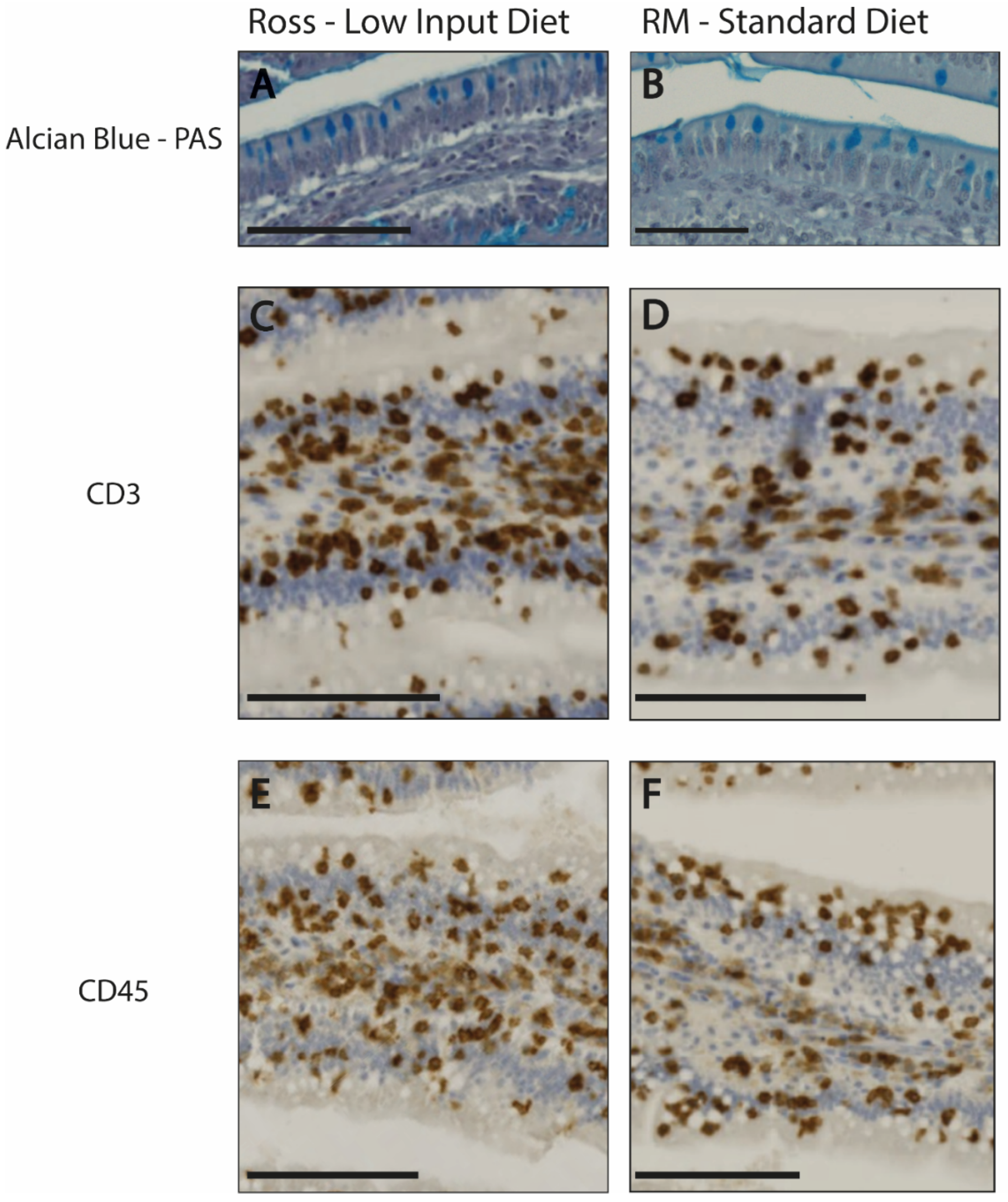
Figure 1. Representative light micrographs of jejunum sections from chickens fed either a low-input diet (Ross, panels A, C, E) or a standard diet (RM, panels B, D, F). Panel A and B show Alcian Blue-PAS stained jejunal sections from Ross chickens at 47 days of age and RM chickens at 105 days of age, respectively. Panels C and D show immunohistochemical staining for CD3+ cells; panels E and F show CD45+ cells, both in jejunal sections from chickens fed the respective diets. Scale bars: A, C, D, E, F = 100 μm, B = 50 μm.
Preprints 148037 g001
Table 1. Effect of genotype, diets and interaction on jejunum morphology and gut inflammatory pattern in broiler.
Chickens, no. Villi length, μm Crypts depth, μm Villus/crypt ratio Goblet cells, no. CD3+, cells/10,000 μm2 CD45+, cells/10,000 μm2
BP 12 963A 88.2A 11.08AB 19.2A 2943 3121
BP×SA 12 1016A 98.8A 10.47AB 19.4A 3678 3302
RM 12 1316B 90.5A 14.75C 17.7A 3257 3023
RM×SA 12 1167AB 106.4A 11.19B 17.9A 3296 3192
Ross 12 1028A 136.4B 7.80A 21.6B 3176 3291
Standard 30 1147 102.6 11.7 18.9 3092 3198
Low input 30 1049 105.6 10.4 19.5 3447 3174
P value (G) <0.001 <0.001 <0.001 <0.001 0.280 0.806
P value (D) 0.046 0.529 0.039 0.172 0.095 0.888
P value (GxD) 0.189 0.190 0.163 0.280 0.369 0.368
RMSE 187 18.6 2.33 1.51 807 635
Means with different superscript letter are statistically different. RMSE: root mean square error.
Disclaimer/Publisher’s Note: The statements, opinions and data contained in all publications are solely those of the individual author(s) and contributor(s) and not of MDPI and/or the editor(s). MDPI and/or the editor(s) disclaim responsibility for any injury to people or property resulting from any ideas, methods, instructions or products referred to in the content.
Copyright: This open access article is published under a Creative Commons CC BY 4.0 license, which permit the free download, distribution, and reuse, provided that the author and preprint are cited in any reuse.
Prerpints.org logo

Preprints.org is a free preprint server supported by MDPI in Basel, Switzerland.

Subscribe

Disclaimer

Terms of Use

Privacy Policy

Privacy Settings

© 2025 MDPI (Basel, Switzerland) unless otherwise stated
