

Submitted:
29 January 2025
Posted:
03 February 2025
You are already at the latest version
Abstract
During slavery, music has often been used as a tool to convey secret messages. Songs of enslaved Africans have been documented extensively for the US, but less so for other plantation societies in the Americas. Here we discuss two versions of a work song known by some Maroon rice farmers in Suriname and French Guiana. While the cryptic lyrics are about mamoo going away to return next year or mamoo being killed and buried, these songs communicate that rice was being harvested or sown. They probably originated on a plantation in Suriname, where the enslaved secretly grew rice in their own food plots to plan their escape or to exchange with runaways hiding behind plantations. The use of using at least two different African terms for rice (mamoo and saka) reflects their ingenuity to communicate with each other in spite of linguistic differences and also indicates knowledge about rice that predated their transatlantic voyage, which confirms the African agency in rice cultivation in the Americas. Ancient songs about Maroon agriculture remain largely undocumented and are in danger of getting lost, but reveal an unwritten history of slavery and the successful struggle of the Maroons for freedom.
Keywords:
French Guiana
; Okanisi Maroons
; rice
; work songs
Introduction
During slavery, music has often been used as a tool to convey secret messages. To avoid bringing themselves in danger, enslaved Africans have used songs with coded language and ambiguous symbolisms to protest against bonded labour, encourage rebellion, and express their desire for freedom. Singing songs with veiled meanings enabled them to communicate in front of the plantation owners without being punished.[1] Many of these Afro-American songs, also known as spirituals, were also sung during field labour to keep the rhythm of the work or as distraction.[2]
Just after slavery ended in the United States, abolitionists started the documentation of slave songs among the Gullah people of the Sea Islands in South Carolina and Georgia.[3] These efforts were continued, among others, by John Wesley Work and Lydia Parrish.[4] One Gullah song, documented in 1932 by linguist Lorenzo Dow Turner, appeared to be sung in the Mende language, spoken in Sierra Leone, from where some of the ancestors of the current Gullah people were shipped to the Americas.[5] These Mende-speaking people were among those enslaved Africans sought after in the 18th century, as they had rice-growing skills needed to establish and maintain rice fields in the coastal swamps of South Carolina and Georgia.[6] By the middle of the nineteenth century in the Sea Islands, each plantation had its particular songs for processing rice, some of which had retained African elements.[7] Work songs about rice cultivation and processing from other plantation societies in the Americas, however, have hardly been documented.
In this paper, we discuss two versions of a work song sung by Maroon rice farmers in Suriname and French Guiana, which also contain some African words. Maroons are the descendants of enslaved Africans who escaped the coastal plantations of Suriname in the 17th and 18th centuries and built communities in the forested interior of Suriname and French Guiana. For centuries, they have been self-sufficient in food provision due to their traditional agriculture, largely based on seeds and cuttings taken along during their flight to freedom.[8] Rice is a cultural keystone crop for the Maroons, being a major staple food, with many cultivated varieties bearing a myriad of local names, but also playing a role in funeral and mourning ceremonies, and narratives about the ancestors.[9] Cultural keystone species are so embedded in people’s cultural traditions that they often appear in traditional songs.[10] Music can therefore be viewed as rich domains of biocultural knowledge, but the role of songs in transferring social, historical and ecological knowledge is still vastly understudied.[11]
Most of the Africans who arrived in Suriname came from oral cultures. Since the enslaved were not allowed to learn how to read and write, an extremely rich culture of creolized oral literature developed both on the plantations and in the Maroon communities.[12] Afro-Surinamese folklore, proverbs and songs have been extensively documented for the coastal Creole population.[13] For the Saamaka, the largest Maroon group in the interior, anthropologists Richard and Sally Price documented many traditional songs, stories and riddles during funeral wakes, but most of them could not be translated, as they were largely in (a combination of) African languages.[14] Hardly any of these songs were about rice (or agriculture in general), and just a few of them are available online as (untranslated) sound clips.[15] The ethnomusicology of the smaller Aluku Maroon group has been studied extensively, and online videos are available, but hardly any songs were translated or analysed.[16] For the Okanisi, the second largest Maroon group in Suriname, hardly any traditional songs have been documented.[17] In contrast, modern Maroon music is widely available as video clips on YouTube and Social Media, of which some Aluku artists are translated in French.[18]
During our recent ethnobotanical surveys on Maroon rice cultivation, we wondered whether there still existed work songs sung during the harvest or processing of this crop. Here we present two versions of such a song, one sang during the planting and the other during the harvest of rice. We explain who sings them, at what time, and discuss their hidden meaning and where and when they could have originated.
Methods
During 2021 and 2022, we interviewed 80 Maroon farmers (37 Okanisi, 31 Saamaka, seven Matawai and five Paamakka, almost all women) in Suriname and French Guiana. We obtained prior informed consent from each farmer before the interview and were granted permission for this research by the traditional Maroon authorities. Although our interviews focused on rice varieties and people’s motivations for rice cultivation, we also asked whether farmers sang special songs during the rice harvest. When they mentioned a specific rice song, we asked whether we could record or videotape it, and asked for its meaning. We transcribed and translated these songs, if possible, with the singers, and discussed our interpretation of the words and their meaning again with other Maroon rice farmers. By doing this during fieldwork, the singers had control over how the songs were presented and disseminated.[19]
Afterwards, we asked Maroon women to sing them on camera and uploaded the videos on YouTube. Later, Maroon informants sent us videos of dancing, singing and chatting women during the rice harvest. As we did not have their consent, we could not publish these videos online, although some had already been uploaded by Maroons themselves. We also studied those videos for evidence of special rice songs. We consulted literature on rice cultivation in Africa and the Americas during the transatlantic slave trade to trace African words in these songs that we could not translate at first.[20] We also searched in the literature and audiovisual material on slave songs in the US to search for songs that resembled the ones we documented in Suriname and French Guiana.[21] We did the same for the sources of rice songs in Africa.[22]
Results
During our first interview, on 22 August 2021, in Tapoeripa, Brokopondo district, Okanisi rice farmers Norma Aseri and Ie Bodoe told us they sang the following song on the last day of the last rice harvest, if they had ‘won the work’, i.e. finished the task of cutting all panicles.
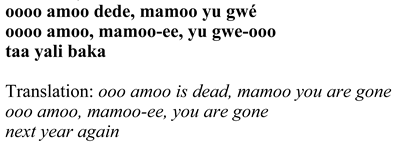
Apart from the term (m) amoo, the lyrics were in Okanisi, an Eastern Maroon Creole that is largely derived from English, Dutch, and the African Gbe and Akan language groups, and is similar to Sranantongo, currently spoken as a lingua franca in Suriname.[23] The phrase that (m) amoo was dead and gone referred to the end of the rice harvest, while the last phrase referred that the following year, during the next rice harvest, they would meet (m) amoo again. It seemed that ma Amoo or ma moo was a collective noun for rice, but the two ladies could not explain what or who was meant by it. Some weeks later, former rice farmer Edith Adjako from St. Laurent, French Guiana, recognized this song and sang it in front of a camera.[24]
Later that month, we continued our fieldwork with Okanisi women around Diitabiki, Tapanahoni River. Rice farmer Lena van Dijk knew another version of this song, which had the typical call-and-response form of Afro-American spirituals. It was not sung during the harvest of rice, but during the planting of the crop.
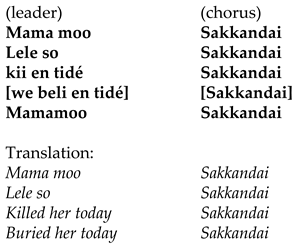
While Lena was the only one who sang the phrase lele so, several other women in the same area knew the song without this phrase, but added the phrase we beli en tidé. In her recorded interview, Lena said: ‘all rice is called amoo’, although she sang the words ‘Mama Moo’, which can be translated as either a female name or ‘mother rice’. Lena did not translate the rest of the song. Emelina Amalia, a rice farmer from Godo Olo, an hour by boat upstream along the Tapanahoni River, sang the song in a slightly different order but explained that it was sung when women were sowing the last rice. A hole was dug, the women would throw the last remaining seeds in it, and close it firmly with their hoes. Then they would dance around this spot and sing ‘Mamoo’. Emelina translated the phrases: ‘We killed her today’ meant that they finished the work; while ‘we buried her today’ referred that they covered the rice seeds with soil. Ten of the 12 women we interviewed in the upper Tapanahoni area knew about this song.
The Okanisi rice farmers in the Cottica area did not sing traditional rice songs during the sowing or harvesting but sang Christian songs they learned in the church or ‘ordinary YouTube songs’, often accompanied by their mobile phones. However, some of them said they ‘heard about mamoo’. Rynia Misidjan from Peto Hill told us that her mother, when the rice was almost harvested, would say: ‘Bring some water, Mamoo is weak.’ When all rice was cut and nothing were left, she said: ‘Ma Moo is dead’. Exactly the same story was told by Lene Keeswijk, a farmer from the same village. Karmen Monimofo from St Laurent du Maroni, French Guiana, did not dare to sing the song for us, but confirmed that Ma Moo was a woman’s name, and sakkandai just meant ‘rice’.
On 25 March 2022, rice farmer Lucia Pasoe, from New Libi, lower Marowijne River, French Guiana knew the call-and-response version of the song. Lucia had never been to school. ‘Your provision field is your school’, she explained. She learned several traditional Maroon songs from her grandmother, whom she helped farm. Lucia did not want to be videotaped, but gave us the most detailed explanation on the use and meaning of the song so far: ‘After sowing the rice, you cover the seeds with soil, using your hoe. When you have sown and covered almost all your seed stock, you take the remaining rice seeds. Then you make a hole in the ground, throw in a handful the last seeds, and close it with soil. Later, you will see that there is a very big tuft of rice plants growing on that spot, and then you know that this is where they buried Ma Moo. This is the last activity, after this the work is finished, and then you sing the song Ma Moo-asakkandai.’
When we asked Lucia who Ma Moo was, and whether her name could be interpreted as ‘mother rice’, she said: ‘No, she is not the rice mother, this is a story of our ancestors! Ma Moo is Ba Anansi’s lazy wife! This song is an Anansi story, it is meant as something funny!’ Lucia referred to the popular folktales about Anansi the trickster spider, which originated in Ghana and is popular all over the West Indies, including Suriname.[25] Our translator (and former rice farmer) Edith Adjako later added:
Our ancestors often spoke in riddles. In this way other people did not know about what they were talking. Ma Moo is not a real person. This song can be a secret language: they [the ancestors] had planted rice in secrecy. Maybe the slave master did not know they had done this. In this way, they could let other people know that they had planted rice.
On a later occasion, Edith added: Edith Adjako explained:
Stories about the early runaways and their smart way to escape slavery often are told as riddles, to prevent that outsiders understand how they did it. What if slavery times would come again, how could they ever escape if they already have told all their secrets?[26]
On 6 April 2022, Rebecca Alimeti from Portal, Lower Marowijne River, French Guiana, was willing to sing this version of the song on camera.[27]
In 2022, we also did fieldwork in several Saamaka Maroon communities, but none of the 31 rice farmers we interviewed knew the ‘mamoo sakkandai’ song. The women said they had no special rice songs, but sang ‘normal songs’ during the harvest, such as the traditional Saamaka seketi, which are accompanied by clapping of the hands, and mostly sung during celebrations, ceremonies or commemorations.[28] Other farmers said that singing was not practiced in Christian Maroon villages. None of the Matawai and Paamaka Maroons who were interviewed in 2022 knew the song either.
In 2024, however, a video was sent to us by Albertina Adjako, regional farmers coordinator in Brokopondo and collaborator in this project. She had filmed two Saamaka women chatting with each other while cutting rice panicles in their rice fields. Suddenly, one said: ‘We should make sure we’ll finish tonight.’ The second answered: ‘Yes, Mamoo will die.’ The first responded: ‘Yes, right here’, after which the second said ‘Now we are free, we finished harvesting’. The first woman concluded: ‘This thing almost killed us’, referring to the arduous labour. This video provided evidence that the cryptic expressions about the killing and death of Mamoo is not strictly limited to Okanisi Maroons.
Discussion
Interpretation of the Songs
To obtain an adequate translation of a song is often a very difficult matter. […] Words are often slightly modified […] and a further complication is that the singer is himself very commonly unable to give a meaning. The singer, if he does not frankly admit he does not know the meaning, will give a version, while one of the audiences will say something quite different.
This lamentation of the British colonial officer Frederick William Hugh Migeod sounded familiar to us when we tried to translate and understand the meaning of the two versions of the Maroon rice song.[29] Only after interviewing more than a dozen Maroon women, the meaning of the rice song became clear to us.
In Okanisi, Ma Moo can in principle be translated as ‘mother Moo’ or ‘Mrs. Moo’. Many Maroon rice names are named after women and contain the term ‘Ma’, such as Ma Baka, Ma Alena, Ma Ayengena and Ma Bosu.[30] Some of these female names we traced back to women who escaped slavery in the late 17th and early 18th century, and allegedly braided rice grains in their hair before their flight to freedom. The rice varieties carrying their names are said to be the descendants of the seeds that these women took along.[31] Although most Maroons agree that ‘rice is a woman’, the Okanisi farmers who knew the song denied that Ma Moo had been a living person.[32]
In Sierra Leone, mba and mbei are general terms for rice in the Mende language, an ethnic group from which many people were captured and transported to the Americas.[33] Some Mende people or persons speaking other, linguistically related Mande languages also ended up in Suriname, as words from this language group appear in Surinamese Creole languages for plants and for groups of people.[34]
In Benin, moo is a name for rice in the Dendi language.[35] The similar term omo is used in the unrelated Fante and Ga languages in the neighbouring country Ghana and belongs to the same widespread linguistic root for rice[36]. Ma Moo could thus probably have derived from two separate (related?) West African terms for rice. However, it is also possible that the word has its origin in the terms malo, maro, or ma(a)no, general names for rice in many different languages along the West African Rice Coast, which stretches from Senegal to Liberia, where rice and rice cultivation are indigenous.[37] This linguistic evidence supports the pre-European cultivation of (African) rice in West Africa, as the terms malo, maro, mano, etc. predate the Portuguese-derived words associated with Asian rice. The word malo for rice has also been preserved in the Gullah language in the US Sea islands.[38]
Near old Portuguese and Spanish trading posts, the word saka is a general word for rice in Ghana, Ivory Coast, and in several other unrelated languages along the western African coast.[39] The root of the word is probably the Portuguese verb sacudir, meaning ‘to shake up’ or ‘winnowing rice’, used as a contact word by slave traders buying rice as bulk food for the trans-Atlantic voyage.[40] The word saka has also been preserved in the Gullah language, in the verb that means ‘to scatter’.[41] In the modern Aucan and Saramaccan Maroon languages, the related term tjaka has a similar meaning: ‘something small that is spread out in many directions’. In the historic Saamaka language, the word sakkuli meant to ‘thresh, to shake off the grains’, which was also said to derive from the Portuguese sacudir.[42] Although only one Maroon farmer told us that the term saka meant ‘rice in general’, the word was not used to indicate rice. However, saka or tjaka often appearred as part of vernacular names for Maroon rice varieties, such as agbosotjaka, tjaka Ma Jaa, haga saka, tjaka tanda mujee (Saamaka rice), atjakati (Matawai) and among the Okanisi Afantisaka, lebi saka, and baaka tee saka.[43] While the origin of saka seems straightforward, we could not translate or trace the suffix -ndai (in sakkandai).
The phrase lele so, sung by only one Maroon farmer, we were unable to translate. The Lele is a small, rice-growing ethnic group in Guinea Conakry that also belong to the Mande language cluster.[44] However, we have no indication that the term lele refers to those people. In Suriname, the wife of Anansi the spider is often named Ma Akuba, and although she has many other names in West Africa and the Caribbean, Ma Moo has not yet been reported as one of them.[45]
Apart from the plantation provision fields, established to produce food for the slave owners and their workforce, enslaved Africans in Suriname were often allowed to have their personal food plot, on which they could grow crops during off-hours, unsupervised by plantation overseers.[46] It was on these so-called ‘botanical gardens of the dispossessed’ that the enslaved grew a variety of different food plants, including species of African origin, such as sesame, okra and plantains.[47] Their remote food plots were also a place where the enslaved secretly met runaways who were hiding behind plantations and exchanged food with them.[48] This type of ‘escape agriculture’ also served as buffer food stock when an escape was planned.[49]
It is in this context where the two Maroon rice songs have probably originated. The secret message that rice had been sown or harvested was communicated through a song that appeared to be about a burial, thereby deceiving the plantation owner. The use of using two (or three) different African terms for rice reflects the cultural diversity on the plantation, and the ingenuity of the enslaved to communicate despite linguistic differences. Riddles and coded language are used here to inform others about the state of the rice fields. Given the secret meaning of the two songs, it is unlikely that the song was composed after marronnage, as the Maroons could cultivate rice in all openness. It seems almost certain that the songs were created on a (single?) plantation, from which the runaways later joined the Okanisi Maroons. This may be the reason that the songs are known only by a few (mostly Okanisi) women.
We have not found similar rice songs, or songs using the same terms for rice in the literature for the US, the Caribbean or West Africa. Parrish reported several rice songs in Georgia, but they were mainly about threshing and winnowing.[50] Herskovits and Herskovits documented one Surinamese song about rice but it is completely different.[51] Several rice songs were said to be known among the Mende people in Sierra Leone and Liberia, but few examples are published and the sound clips of rice planting and harvesting songs recorded online (https://www.sierraleoneheritage.org) did not resemble our songs either.[52] For African rice farmers, we assume there was little reason to be secretive about farming or use coded words or different languages for their crop.
African Agency in Rice Cultivation
The knowledge and agency of enslaved Africans in rice cultivation in the Americas has long been downplayed.[53] According to Peter H. Wood: ‘Parrish is one of the few writers to have hinted that African people may have known what to do with rice seeds in Carolina’.[54] The presence of rice in Suriname before the 1730s was contested, as Dutch slave traders had no access to the West African Rice Coast.[55] Recent archival research, however, shows that rice was already present in Suriname in 1688 and around 1690 it was grown as a food crop on plantations.[56] The crop probably entered the country by means of English ships, the illegal slave trade or via Brazil with Jewish planters evicted by the Portuguese.[57] These recent findings corroborate Maroon oral accounts that their ancestors escaped around 1690 with rice.[58] The African terms for rice indicate that some of the enslaved had knowledge about rice that predated their transatlantic voyage.
The stories of oral societies, passed from generation to generation, should not be seen as merely folklore, but as scientific records.[59] Fixed oral texts, such as songs and proverbs, often preserve features of earlier stages which have disappeared in the modern language.[60] This is also the case in the two Maroon songs we documented, as the African rice terms saka and mamoo are no longer used in modern Maroon languages, but only appear in songs and names for rice varieties. Traditional songs carry forward biocultural knowledge, yet the role of music in transmitting ethnobiological information needs further study. These songs and the associated knowledge are under increasing threat because few contexts exist for their continued performance as they face competition from new musical genres, such as modern music and gospel.[61] This is also the case in French Guiana, where some Maroon youngsters are ashamed of the culture and language of their elders.[62]
Just like on the rice plantations in the US, work songs sung during the threshing and milling of rice probably existed among the Maroons, but we did not hear any of them. Work songs are typically among the first musical traditions to fade as labour-saving machines are introduced in farmer’s communities.[63] Many of the larger Maroon villages now have diesel-powered rice mills. The fact that few rice farmers in Suriname and French Guiana knew these rice songs suggests that this knowledge has almost disappeared. Although these songs face competition from modern (recorded) Maroon music, documenting these songs and making them available employing online sound clips and music videos also helps to preserve and raise awareness about this cultural heritage. Songs, stories and riddles have been a long-term tradition among the Maroons and Creole populations, not only in tales about the ancestors but also in medicinal and ritual plant uses[64], but are now threatened with extinction.[65] Further efforts to document, translate and analyse these oral texts will probably reveal more unwritten history of slavery and resistance.
Conclusions
The rice songs we discussed in this paper may be several centuries old, as they were sung during slavery to convey the secret message that rice had been planted or harvested, without the knowledge of the plantation owners. This secret agriculture may have taken place in hidden provision fields, planted with rice (and other crops) to serve as food source during an escape from slavery planned at a later moment. These songs probably originated at a plantation from which the ancestors of the Okanisi Maroons escaped, although a few Saamaka are aware of (parts) of the text. The phrases about burying mamoo refer to covering rice seeds with soil, those about killing mamoo to the end of the tiring job, and those about Mamoo leaving until next year refer to the rice harvest the following season. The presence of at least two (mamoo, saka) and possibly three terms (ma, moo, saka) for rice in several African languages, illustrates the exchange of knowledge on rice cultivation between women of different linguistic and geographic backgrounds. The knowledge of such ancient songs about Maroon agriculture is scattered, largely undocumented or untranslated, and in danger of getting lost. The preservation and analysis of these songs contribute to the understanding of the role of Africans in rice cultivation in the Americas and reveal an unwritten history of slavery and the successful struggle of the Maroons for freedom.
Funding
This work was supported by Nederlandse Organisatie voor Wetenschappelijk Onderzoek: [Grant Number OCENW.KLEIN.419].
Disclosure Statement
No potential conflict of interest was reported by the author(s).
Acknowledgements
We are grateful to all Maroon farmers we interviewed for sharing their songs with us. Granmans Bono Velanti, Albert Aboikoni and Lesley Valentijn permitted us to do the research and supported the documentation of traditional knowledge in this field.
References
- Konrad S. Bayer, ‘Slave songs: Codes of resistance’, Kinki University English Journal 6 (2010):109-24; Miles M. Fisher, Negro slave songs in the United States (New York: Carol Publishing Group, 1953); Erik Nielson, ‘Go in De Wilderness: Evading the “eyes of others” in the slave songs’. Western Journal of Black Studies 2011, 35, 106–117.
- John, W. In Work; Folk song of the American Negro. Fisk University Press: Nashville, 1915. [Google Scholar]
- Allen, W.F.; Ware, C.P. Lucy McKim Garisson. In Slave songs of the United States; A. Simpson & Co.: New York, 1867. [Google Scholar]
- Work, Folk Song; Lydia Parrish, Slave songs of the Georgia Sea Islands (New York: Creative Age Press, Inc., 1942).
- Turner, L.D. Africanisms in the Gullah dialect (Chicago: University of Chicago Press, 1949); Jane Collings, ‘The language you cry in: Story of a Mende song’. The Oral History Review 2001, 28, 115–118. [Google Scholar]
- Daniel, C. Littlefield, Rice and slaves: Ethnicity and the slave trade in Colonial South Carolina (Champaign: University of Illinois Press, 1981); Judith A. Carney, Black Rice: The African origins of rice cultivation in the Americas (Cambridge: Harvard University Press, 2001).
- Parrish, Slave Songs, 235; Peter H. Wood, Black Majority: Negroes in colonial South Carolina from 1670 through the Stono Rebellion (New York: W.W. Norton & Company, 1974).
- Richard Price, ‘Subsistence on the plantation periphery: Crops, cooking, and labour among eighteenth century Suriname Maroons’, Slavery & Abolition 12, no. 1 (1991):107–27; Tinde van Andel, Amber van der Velden, and Minke Reijers, ‘The ‘Botanical Gardens of the Dispossessed’ revisited: Richness and significance of Old World crops grown by Suriname Maroons’, Genetic Resources and Crop Evolution 63 (2016): 695-710.
- For local names, see Nicholaas M. Pinas, Marieke van de Loosdrecht, Harro Maat, Tinde van Andel, ‘Vernacular names of traditional rice varieties reveal the unique history of Maroons in Suriname and French Guiana’, Economic Botany 77, no. 2 (2023): 117-34; for funeral and mourning rituals, see Gabriela Ising, Traditional Maroon rice dishes in Suriname and French Guiana: its documentation and role in Maroon culture (MSc diss., Wageningen University, 2022); Nicholaas M. Pinas, John Jackson, N. André Mosis, and Tinde van Andel, ‘The mystery of black rice: Food, medicinal, and spiritual uses of Oryza glaberrima by Maroon communities in Suriname and French Guiana’, Human Ecology 52, no. 4 (2024): 823-36; for ancestor narratives, see Tinde van Andel, Harro Maat, and Nicholaas M. Pinas, ‘Maroon women in Suriname and French Guiana: Rice, slavery, memory’. Slavery & Abolition 2024, 45, 187–211.
- Garibaldi, A.; Turner, N. ‘Cultural keystone species: implications for ecological conservation and restoration’. Ecology and Society 2004, 9, 1–18. [Google Scholar]
- Curran, G.; Barwick, L.; Turpin, M.; Walsh, F.; Laughren, M. Georgia Curran, Linda Barwick, Myfany Turpin, Fiona Walsh, and Mary Laughren, ‘Central Australian Aboriginal songs and biocultural knowledge: Evidence from women’s ceremonies relating to edible seeds’. Journal of Ethnobiology 2023, 39, 354–370. [Google Scholar]
- Jaques Arends, Language and slavery: A social and linguistic history of the Suriname Creoles (Philadelphia: John Benjamins Publishing Company, 2017).
- Melvin, J. Herskovits and Frances S. Herskovits, Suriname folk-lore (New York: Columbia University Press, 1936); Jan Voorhoeve and Ursy Lichtveld, Creole Drum: An anthology of Creole literature in Surinam (New Haven: Yale University Press, 1975); Henri J.M. Stephen, Winti liederen: Religieuze gezangen in de winticultuur (Schoonhoven: Perfect Service, 2003).
- Richard Price and Sally Price, Two evenings in Saramaka (Chicago: University of Chicago Press, 1991).
- For an example, see Folkway Records, Music from Saramaka: A Dynamic Afro-American Tradition (Washington DC: Smithsonian Institution, 1977).
- For an overview of Aluku traditional music, see Kenneth Bilby, ‘Music in Aluku life, yesterday and today’, in Understanding America, the essential contribution of Afro-American music, ed. F. Palacios Mateos (Quito: Centro de Publications PUCE, 2022), 44-63.
- Arends, Language and Slavery, 287, 298.
- Rickman G-Crew, Modo Awasa. G-Crew Music, 2016. Available on YouTube. https://www.youtube.com/watch?v=nctfY3_QLUY (accessed on 16 January 2025).
- Curran; et al. ‘Central Australian Aboriginal songs’.
- Wood, Black majority; Carney, Black rice; Edda L. Fields-Black, Deep roots: Rice farmers in West Africa and the African Diaspora (Bloomington: Indiana University Press, 2008).
- Allen; et al. Slave songs; Work, Folk song, Parrish, Slave songs.
- Migeod, W.H. ‘Africa, West: Sierra Leone. Mende songs, preliminary note’. Man 1916, 112, 184–191. Available online: https://www.sierraleoneheritage.org/ (accessed on 6 January 2025).
- Margot Van den Berg, ‘Ningretongo and Bakratongo: Race/ethnicity and language variation in 18th century Suriname’. Revue Belge de Philologie et d'Histoire 2013, 91, 735–761.
- Video of Edith Adjako from St. Laurent du Maroni, French Guiana, singing the ‘harvest version’ of the song on camera. Available online: https://www.youtube.com/shorts/0Wt4zg6JlHk (accessed on 6 January 2025).
- For the Caribbean, see Emily Zobel Marshall, ‘Anansi, Eshu, and Legba: Slave resistance and the West African trickster’, in Human bondage in the cultural contact zone: Transdisciplinary perspectives on slavery and its discourses, ed. G. Mackenthun (New York: Waxmann, 2010): 171-86; for Suriname, see Herskovits and Herskovits, Suriname folk-lore; Price and Price, Two evenings. Two evenings.
- Van Andel; et al. ‘Maroon women’.
- Video of Rebecca Alimeti from Portal Island, French Guiana, singing the ‘sowing version’ of the song. Available online: https://www.youtube.com/shorts/sXX_QxdXBDo (accessed on 7 January 2025).
- Michiel van Kempen, ‘Ancestors and migrants: On tradition and reflection in Surinamese singing, storytelling and writing’. Journal of West Indian Literature 2004, 12, 31–51.
- Migeod, ‘Mende songs’, 184.
- Pinas; et al. ‘Vernacular names’, 127.
- Van Andel; et al. ‘Maroon women’.
- Pinas; et al. ‘Vernacular names’, 126.
- Migeod, ‘Mende songs’, 188; Paul Richards, Coping with hunger: Hazard and experiment in an African rice-farming system (London: Routledge, 1986), 168.
- For Mende words for plants in Surinamese Creole, see Tinde van Andel, Charlotte van ‘t Klooster, Diana Quiroz, Alexandra Towns, Sofie Ruysschaert, and Margot van den Berg, ‘Local plant names reveal that enslaved Africans recognized substantial parts of the New World flora’, Proceedings of the National Academy of Sciences 2014, 111, E5346-53. For Mende words in Surinamese Creole for certain groups of people, see van den Berg, ‘Ningretongo and Bakratongo’, 741.
- Simone de Souza, Flore du Bénin, Tome 3: Nom des plantes dans les langues nationales Beninoises (Cotonou: Imprimerie Tunde, 2008), 305, 559.
- Roger Blench, Archaeology, languages, and the African past (Lanham: Alta Mira Press, 2006): 219.
- Fields-Black, Deep Roots; Roland Portères, ‘Les noms des riz en République de Guinée’, Journal d'Agriculture Tropicale et de Botanique Appliquée 1965, 12, 369-402; Blench, Archaeology, 219.
- Turner, Africanisms, 128; Blench, Archaeology.
- Béla Teeken, African Rice (Oryza glaberrima) cultivation in the Togo Hills: Ecological and socio-cultural cues in farmer seed selection and development (PhD diss., Wageningen University, 2015); Firmin Ahoua, ‘The phonology-syntax interface in Avikam’, Legon Journal of the Humanities 20 (2009): 123-149; Leo Wiener, Africa and the discovery of America (Philadelphia: Innes & Sons, 1920).
- Wiener, Africa, 236.
- Turner, Africanisms, 153.
- Hugo Schuchardt, ‘Die sprache der Saramakkaneger in Surinam’. Verhandelingen der Koninklijke Akademie van Wetenschappen Amsterdam, 1914; 14, 100.
- Pinas, ‘Vernacular names’.
- The Joshua project, Lele in Guinea (Colorado Springs, 2025). https://joshuaproject.net/people_groups/print/19001/GV; Harald Hammarström, Robert Forkel, Martin Haspelmath, and Sebastian Bank, Glottolog 5.1 (Leipzig: Max Planck Institute for Evolutionary Anthropology, 2024). Available online: https://glottolog.org/resource/languoid/id/lele1266 (accessed on 7 January 2025).
- About Ma Akuba in Suriname, see Herskovits and Herskovits, Suriname folk-lore; for other names of Anansi’s wife in the Caribbean. see https://en.wikipedia.org/wiki/Anansi (accessed on 7 January 2025).
- Maat, H.; Pinas, N.M.; van Andel, T. The role of crop diversity in escape agriculture; rice cultivation among Maroon communities in Suriname. Plants, People, Planet 2024, 6, 1142–1149. [Google Scholar] [CrossRef]
- Judith, A. Carney and Richard N. Rosomoff, In the shadow of slavery: Africa’s botanical legacy in the Atlantic world (Berkeley: University of California Press, 2009).
- Lenoir, J.D. The Paramacca Maroons: A study in religious acculturation (PhD diss., New School for Social Research, 1973); Nizaar Makdoembaks, Coffij Makka Makka en het verzet van de Kwinti: Een eeuw overlevingsstrijd van onderduikers in Suriname (Utrecht: de Woordenwinkel, 2023).
- Maat; et al. ‘Escape agriculture’; Thiëmo Heilbron, Botanical relics of the plantations of Suriname (MSc diss., Universiteit van Amsterdam, 2012).
- Parrish, Slave songs.
- Herskovits and Herskovits, Suriname folk-lore, 407; this song is about a pig that eats fallen rice grains.
- Lester P. Monts, ‘Music clusteral relationships in a Liberian-Sierra Leonean Region: A preliminary analysis’, Journal of African Studies 9, no. 3 (1982): 101-115. According to Monts, rice songs are mainly in the Vai and Mende language, but he does not provide any examples. Gordon Innes, ‘The function of the song in Mende Folktales’, in Sierra Leone Language Review, ed. D. Dalby (New York: Routledge, 1965); Migeod, Mende songs. The few songs documented by Innes and Migeod did not resemble the songs we documented in any way.
- Carney, Black Rice.
- Wood, Black majority, 59.
- Eltis, D.; Morgan, P.; Richardson, D. Agency and Diaspora in Atlantic history: Reassessing the African contribution to rice cultivation in the Americas. American Historical Review 2007, 112, 1329–1358. [Google Scholar] [CrossRef]
- Elfrink, T.; van de Hoef, M.J.J.; van Montfort, J.; Bruins, A.L.; van Andel, T. Rice cultivation and the struggle for subsistence in early colonial Suriname (1668–1702). New West Indian Guide 2024, 98, 306–329. [Google Scholar] [CrossRef]
- Van de Loosdrecht, M.; Pinas, N.M.; Awie, J.T.; Becker, F.; Maat, H.; van Velzen, R.; van Andel, T.; Schranz, M.E. Maroon rice genomic diversity reflects 350 years of colonial history. Molecular Biology and Evolution 2024, 41, msae204. [Google Scholar] [CrossRef]
- Van Andel; et al. ‘Maroon women’.
- Patrick Nunn, ‘Memories within myth’. American Scientist 2023, 11, 360.
- Arends, Language and slavery, 277.
- Curran; et al. ‘Central Australian Aboriginal songs’.
- Bilby, ‘Music in Aluku Life’, 46.
- Bilby, ‘Music in Aluku Life’, 54.
- Van Andel; et al. ‘Maroon women’; Pinas et al, ‘Mystery of black rice’.
- Arends, Language and slavery, Bilby, ‘Music in Aluku Life’.
Disclaimer/Publisher’s Note: The statements, opinions and data contained in all publications are solely those of the individual author(s) and contributor(s) and not of MDPI and/or the editor(s). MDPI and/or the editor(s) disclaim responsibility for any injury to people or property resulting from any ideas, methods, instructions or products referred to in the content. |
© 2025 by the authors. Licensee MDPI, Basel, Switzerland. This article is an open access article distributed under the terms and conditions of the Creative Commons Attribution (CC BY) license (http://creativecommons.org/licenses/by/4.0/).
Copyright: This open access article is published under a Creative Commons CC BY 4.0 license, which permit the free download, distribution, and reuse, provided that the author and preprint are cited in any reuse.


