

Submitted:
30 September 2025
Posted:
01 October 2025
You are already at the latest version
Abstract
Managed and wild bees contribute not only to ecological functions and agricultural productivity, but also to a wide range of cultural ecosystem services (CES) structuring human livelihoods and that remain largely overlooked in pollinator research, policy and conservation. This article examines the multifaceted CES provided by wild bees, with particular attention to the spiritual, medicinal, and traditional knowledge-based dimensions associated with Afrotropical stingless bees. We argue that systematic recognition and documentation of these cultural roles are critical to advancing more inclusive and effective conservation frameworks. Drawing on examples from sub-Saharan Africa, we demonstrate how CES simultaneously support biodiversity objectives and strengthen community resilience, and we propose future research and policy directions aimed at embedding these cultural values more comprehensively within conservation strategies.
Keywords:
Meliponini
; ecosystem services
; biodiversity conservation
Socio-Cultural Dimensions as a Blind Spot in Pollinator Conservation
Across the globe, wild bee assemblages are undergoing profound transformations due to human activities. While some species, often habitat specialists or those with narrow ecological niches, are reported to experience range contractions and declines [1,2,3,4]. Others, particularly generalist species adapted to intensively human-modified landscapes, seem to persist or even expand their distribution even in the face of global changes [4,5,6,7]. Pollinator decline is far from being a uniform phenomenon, and it is indeed better viewed as a complex and mosaic process involving both biodiversity loss and more subtle community restructuring to varying degrees in time and space driven by land-use change, pesticide exposure, urbanization, and climate change [8,9,10]. These dynamics are often accompanied by the erosion of functional and phylogenetic diversity [11,12,13], as well as the homogenization of bee faunas across regions (e.g. [14]), with cascading consequences for plant–pollinator interactions and ecosystem functioning [15,16,17].
In response, pollinator conservation agendas have primarily focused on the ecological (or biophysical) contributions of bees, especially in relation to crop pollination and food security [18,19,20]. Yet amidst this emphasis on instrumental values, several dimensions remain critically overlooked at the interface of bee-human ecosystems (see e.g. [21]), among which their non-material cultural significance to human livelihoods [22]. This striking imbalance in how we approach bees and their relationship with the environment as well as society is what the Intergovernmental Science-Policy Platform on Biodiversity and Ecosystem Services (IPBES) has described as a broader “values crisis” [23]. Indeed, decades of research show that dominant conservation frameworks prioritized a narrow subset of nature’s values, at the expense of relational, spiritual, and identity-based connections to nature [24,25]. However, many Indigenous and local contexts challenge purely utilitarian worldviews and also call for more inclusive conservation approaches [26,27].
Many managed and wild bees, particularly eusocial species like stingless bees (Apidae: Meliponini), are embedded in traditional ecological knowledge systems, spiritual practices, and local worldviews, including in the Afrotropical region which have received less attention so far than on other continents [28,29]. Their hive products, nesting behavior, and ecological presence carry symbolic, ritual, and medicinal importance that transcends the logic of provisioning services and resource extraction, and research in sub-Saharan Africa is increasingly uncovering and documenting the socio-cultural roles of these bees [21,30,31,32].
Here, we argue that cultural ecosystem services (CES) deserve far greater attention in pollinator research and conservation, with the relatively little-known Afrotropical stingless bees providing an insightful example. First, we define CES and outline how they apply specifically to bees, illustrated by stingless bee knowledge systems, symbolic traditions, and emerging practices like bee tourism/meliponitourism. Second, we examine why CES remain critically underrepresented in pollinator studies and conservation frameworks, despite their central role in shaping human–nature relationships. Finally, we propose concrete ways to better integrate CES into pollinator conservation, highlighting opportunities for biocultural approaches that combine biodiversity protection with the recognition of cultural heritage and identity. Through this perspective, we call for a broader, more inclusive vision of pollinator conservation that recognises not only ecological and economic values, but also the diverse cultural, emotional, and everyday connections that people experience with bees.
Understanding Cultural Ecosystem Services (CES) in Relation to Bees
Cultural Ecosystem Services (CES) are one of the four major categories of ecosystem services defined in the Millennium Ecosystem Assessment (2005), representing the non-material benefits that people derive from ecosystems and their surrounding environment [33]. These services encompass a broad range of human–nature interactions, including spiritual, symbolic, aesthetic, educational, recreational, and identity-based connections.
The underrepresentation of CES in ecosystems services research and conservation policy seems partly due to conceptual ambiguity: as noted by Daniel et al. (2012), the boundaries between services, benefits, values, and human activities are indeed often blurred [34]. Authors further highlight the tendency in the literature to conflate values with services, hampering clear assessments [35,36]. Yet, despite these challenges, CES are increasingly recognized as vital components of biocultural diversity, shaping people’s emotional, ethical, and identity-based ties to the environment [37,38,39].
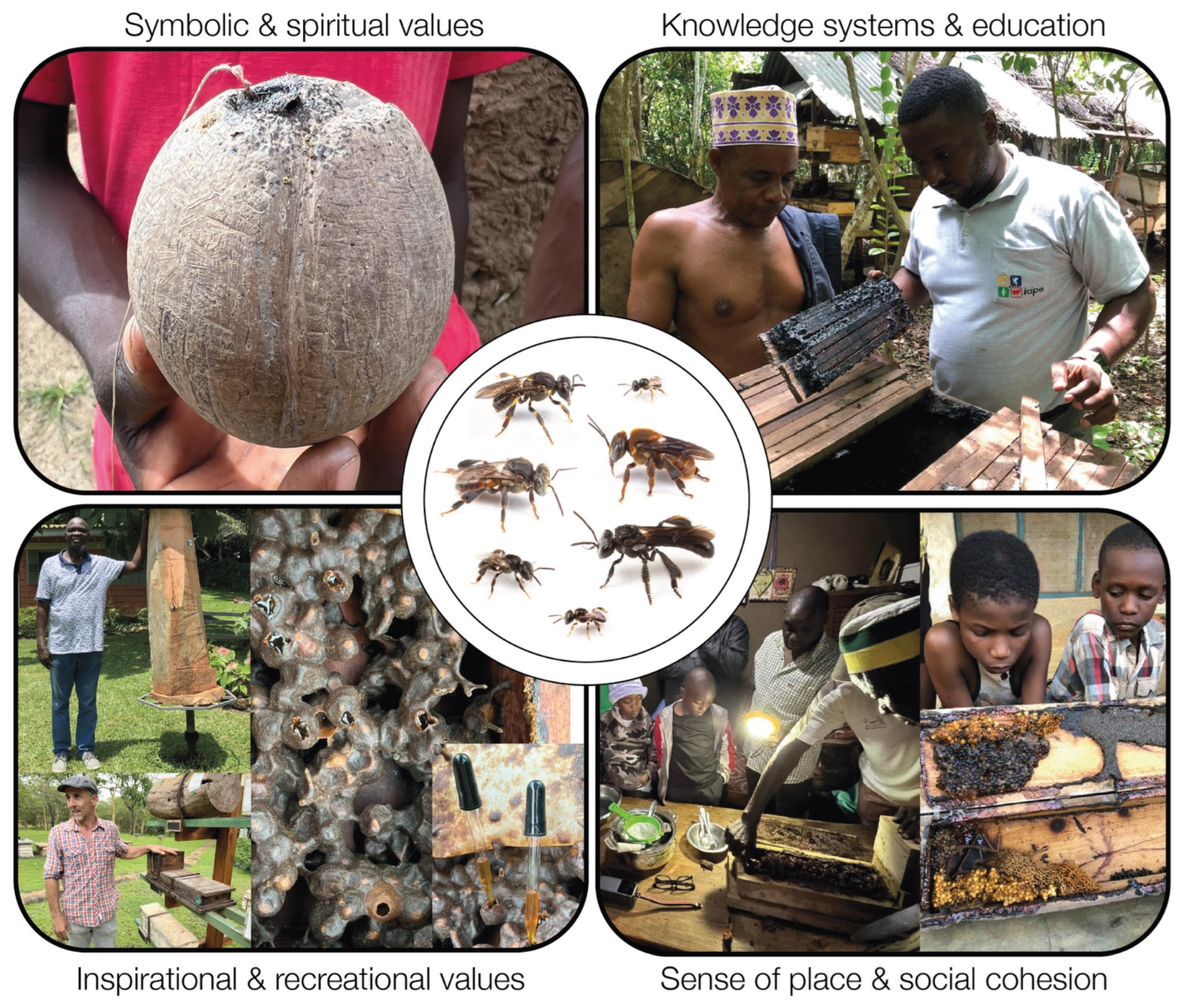
To illustrate the diversity of CES, we drew examples from the context of Afrotropical stingless bees and meliponiculture, as this group seems particularly well suited to show how CES manifest through at least four broad domains (adapted from [39,40]) (Figure 1):
- Symbolic and spiritual values, including bees in myths, taboos, rituals, or healing traditions remain the least documented among the cultural ecosystem services. Yet, recent ethnographic studies suggest deep symbolic and spiritual embedding of bees in cosmologies, healing practices, and belief systems [32,41,42,43];
- Knowledge systems and education, where traditional ecological knowledge is transmitted via stingless bee tracking, honey collection techniques, or habitat recognition. These structured knowledge transfers often involve intergenerational and experiential learning which contributed to transmit and preserve biocultural knowledge [44,45], including complex ecological or cultural knowledge (e.g. bee ecology, taxonomy, tracking techniques, or habitat indicators), with important links to poverty alleviation [46], and associated impacts on cultural identity and environmental protection. In addition to ecological or cultural knowledge, formal and informal educational programs and the general public are increasingly recognizing the importance of bees, despite the fact that most people interviewed so far are apparently still unable to discern bees from non-bees (e.g. [47,48,49]). Nevertheless, recent studies also show that general knowledge about bee biology, behavior (including nesting sites and foraging ecology) and diversity is associated with stronger pro-pollinator attitudes and environmental concern among the public [50]. The audience typically targeted by these activities are community members, students, or practitioners (but not tourists; see below). Although more studies are required on this specific dimension of CES, practitioners estimate that the relationship with learners is usually longer-lasting;
- Inspirational and recreational values, as bees increasingly inspire eco-tourism (e.g. “apitourism” or “meliponitourism”, introducing visitors and travelers to bees and the honey they produce), artistic representations, biodiversity photography, and sensory experiences anchored in “slow tourism” and contributing to the local tourism-associated value chain (see e.g. [51,52,53,54,55,56]). Emotional responses toward bees (ranging from admiration to aversion) also mediate human engagement and are shaped by both direct experience and knowledge, as highlighted in psychological studies [50] and references therein. Here, the primary purpose is largely experiential and recreational in intent, and visitors (mostly tourists) engage with stingless bee farms (meliponaria) not primarily to be formally educated, but to enjoy the sensory, aesthetic, and cultural experience such as tasting honey, observing bees, taking photos, enjoying nature, and participating in slow/local tourism practices. In essence, these activities are similar to visiting a vineyard. The information transmitted during meliponitourism is usually informal, experiential, or introductory. Some level of learning takes place during these visits, but learning is not the main goal, nor is it delivered through structured pedagogical frameworks as would be expected in more education-focused activities (see above).
- Sense of place, cultural heritage, and social cohesion represent important dimensions through which bees contribute to emotional attachment to landscapes, place-based identities, and communal practices [57]. Meliponiculture often becomes a family or community activity, reinforcing socio-cultural bonds across generations through gatherings during times of honey harvesting, colony management and meliponaries construction. Stingless bees also contribute to more intimately associating the local environment to highly praised non-timber forest products such as stingless bee honey. Such attachments are not the hallmark of forest habitats or forest margins, but they can also be observed in urban or peri-urban contexts (e.g. through (peri-)urban beekeeping initiatives) where individuals report valuing bees as part of their local environment, reinforcing biocultural connections [50], although these dimensions remains hitherto underexplored and ill-documented for stingless bees in the Afrotropics.
Beyond these conceptual categories, it is important to note that formal instruments such as geographical indications (GI) and honey quality standards can be regarded as important yet poorly activated institutional levers for the recognition of CES in the case of Afrotropical stingless bees. By linking local knowledge, specific landscapes, but also distinctive meliponiculture practices and product properties, GIs could actively contribute to cultural valorization, preservation of Traditional Ecological Knowledge and biocultural conservation; as such, GIs have the potential to embed honey within a collective history and cultural landscape, thereby reinforcing identity and community cohesion.
Toward a Better Integration of CES in Afrotropical Stingless Bee Research and Conservation
Despite a growing recognition of their importance, Cultural Ecosystem Services (CES) associated with stingless bees remain largely overlooked in contemporary research. Here we propose a non-exhaustive set of key factors that may account for this underrepresentation:
1. Difficulty in Categorization and Quantification
Any researcher who previously engaged in CES characterisation will argue that the diversity, the spatio-temporal patterns and the associated drivers of CES are inherently complex, intangible, and context-specific. The partitioning of CES associated with Afrotropical stingless bees proposed above echoes the recent literature on the topic, but some of these boundaries blur in practice: for example, meliponitourism can serve as a bridge between recreation and education, while the ritual use of stingless bee honey in healing ceremonies may simultaneously reflect symbolic, spiritual, and medicinal knowledge systems transmitted through oral tradition and practices.
The lack of clear boundaries between services, values, and benefits [34,35] has long made Cultural Ecosystem Services (CES) difficult to categorize, standardize, or quantify across sociocultural and ecological settings [58]. This stands in contrast with provisioning and regulating services such as crop pollination, which can more readily be modeled, mapped, and monetized using ecological and economic metrics [59,60]. The non-material, intangible and context-dependent nature of CES illustrated in Figure 1 poses challenges for their integration into conventional conservation planning. However, recent developments offer promising pathways. Emerging frameworks (Héger et al., in preparation) propose novel, hierarchical classification systems specifically tailored to non-food uses of stingless bee honey, grounded in ethnographic evidence and traditional ecological knowledge (TEK). These approaches would allow not only to document CES more rigorously, but also to render them more visible and actionable in policy, education, and decision-making. By combining creative and innovative qualitative and semi-quantitative methods (including participatory mapping, local typologies, and spatial modeling) these tools will likely help bridge disciplinary divides while supporting more inclusive and culturally sensitive conservation strategies. Their application across the Afrotropics and other regions of the world could help reposition CES as essential, rather than marginal, components of biocultural resilience, using a wider range of bee species, genera and tribes that more intimately interact with human societies.
A promising avenue lies in exploring how the legal and economic recognition of unique bee products, for example through geographical indications or quality standards structured to protect collective rights which are currently being developed for stingless bee honeys in the Afrotropical region, can contribute to making CES more visible and actionable. Such legal instruments do not only serve to structure value chains or secure market access but they also contribute to safeguard intangible heritage, recognize traditional know-how, and strengthen cultural identities associated with bees and their products.
2. Disciplinary Silos and Methodological Constraints
Conventional pollinator research has historically been grounded in the natural sciences, focusing on taxonomic inventories, foraging ecology, plant–pollinator networks, and pollination services in agricultural and semi-natural ecosystems. While this work is essential to understanding ecological functions and biodiversity dynamics, it often remains disconnected from the methods, epistemologies, and insights of the social sciences, humanities, or traditional ecological knowledge systems. As a result, relational, symbolic, or identity-based human–bee interactions that are central to the concept of Cultural Ecosystem Services (CES) are frequently underexplored or dismissed as anecdotal, unquantifiable, or outside the formal scope of biodiversity research.
Here we call researchers to break away from this disciplinary compartmentalization that hinders a more holistic understanding of human–pollinator relationships. For instance, ethnographic and participatory approaches that could reveal insiders’ perspectives on bees, honey, and landscape management that are rarely integrated into ecological or biodiversity-oriented studies [61]. Similarly, some of the categories we highlighted above (Figure 1) related to “spiritual value,” “cultural identity,” or “heritage” are rarely accommodated within standard conservation assessments or ecosystem service valuation frameworks (e.g. [62]). To date, when social science components are indeed included, they are often reduced to knowledge–attitude–practice (KAP) surveys or awareness campaigns related to health issues ([63] and references therein), they still seem to fail to capture deeper affective, symbolic, or historical dimensions of CES (see e.g. the review by McElwee et al. 2022 on CES in the Global South [64]).
Furthermore, research funding structures, journal scopes, and institutional training programs often reinforce these silos by privileging narrowly defined scientific outputs and metrics of impact. This limits opportunities for interdisciplinary collaboration through training and research programmes, co-designed studies, and the integration of local knowledge holders as active partners in research and conservation planning. In the context of stingless bees in the Afrotropics, ignoring CES may not only perpetuate epistemic injustice but also result in conservation strategies that fail to resonate with or benefit local communities. Consequently, bridging these divides requires deliberate efforts to foster methodological innovation and knowledge pluralism. Transdisciplinary, agroecological research frameworks, participatory action research, and culturally embedded valuation tools offer promising avenues to document and mobilize CES. This approach would be essential to appreciate bees not only as ecological agents, but also as cultural mediators that can thus broaden the relevance, legitimacy, and impact of pollinator conservation across diverse socio-cultural contexts.
Conclusions and Perspectives
The increasing recognition of CES offers a promising opportunity to reframe pollinator conservation in ways that are more inclusive, relational, and grounded in local realities. Although CES have historically remained peripheral in both research and policy, such omission has become largely untenable, particularly (but not only) in relation to wild bees and stingless bees in the Afrotropics. As the cultural, symbolic, and knowledge-based dimensions of human–bee interactions continue to erode under the pressures of land use change, climate disruption, globalisation and social transformation, the capacity of communities to maintain resilient, meaningful, and sustainable relationships to their environments.
To advance the meaningful integration of CES into bee-related research, outreach, and conservation planning, we propose several key avenues of action: (i) expanding ethno-entomological and biocultural research, (ii) fostering inter- and transdisciplinary approaches that bridge the natural and social sciences and address the inherent complexity of CES with local actors, while enhancing both the legitimacy and applicability of findings, (iii) leveraging CES for education, communication, and environmental engagement, including protection of natural resources and pollinators by mobilizing narratives, photographs, and traditional knowledge through schools, museums, storytelling initiatives, visual media and environmental outreach campaigns, (iv) integrating CES into policy and conservation frameworks to better recognise the cultural significance of bees, to justify the protection of habitats beyond their agricultural utility, to promote biocultural landscape conservation, and support policies that legitimise indigenous and local knowledge systems. Finally, (v) considering economic and cultural valorization instruments, such as geographical indications or honey quality standards, as integral vectors of CES have a considerable yet currently underexploited potential to reinforce the cultural recognition of bees and their products, while paving the way for biocultural approaches to conservation and sustainable development.
Bees and Afrotropical stingless bees in particular stand at the intersection between biodiversity, cultural continuity, community well-being, and socio-environmental resilience. They are also ecologically diverse, culturally esteemed, yet increasingly threatened, and as such, they offer a compelling and timely case for expanding the scope of conservation beyond material benefits toward more holistic, inclusive, and locally grounded frameworks. Such an approach is essential to fully appreciate the under-documented and complex relationships that connect humans and bees, and that shape the landscapes targeted for conservation.
Acknowledgements
NJV received financial support from ULB via a sabbatical grant (February-August, 2024) and from the Fonds National pour la Recherche Scientifique (FRS-FNRS, Belgium) through a travel grant to Tanzania (June-August, 2024) and a Projet de Recherches (PDR) project entitled “Ecology and Evolution of Afrotropical Stingless Bees”. NJV conducted his research in Tanzania hosted by A. Pauly and N. E. Kilimba at the Entomology Lab of the Tanzania Wildlife Research Institute (TAWIRI) for their common project “Tanzanian Invertebrates, A Virtual National Reference Collection” (Costech Research Permits CST00000294-2023 and CST00000305-2024-2024-00535 and CST00000305-2024-2025-00905). NJV is grateful to O. Ihsane (Université libre de Bruxelles, Belgium) and A. Pauly (TAWIRI) for their collaboration during field surveys in Tanzania in 2024. MH and NJV also acknowledge the support of the Fonds National de la Recherche Scientifique (F.R.S-FNRS) through a Mobility Funding and a Research Fellow fellowship delivered to MH (2022-2026). We also warmly thank stingless bee farmers in Unguja (Zanzibar) and Pemba Island (Tanzania) for welcoming us at their facilities. MAM received a cooperation scholarship from the Université libre de Bruxelles (ULB) through the 2024 Marie-Soleil Frère Prize awarded to the Agroecology Lab, as well as from ENABEL, the Belgian Agency for International Cooperation, during his MSc thesis in the Kahuzi-Biega mountain range of DRCongo. AR received financial support by the AGRIFO project (“Appui à la Gestion durable et à la RestauratIon des FOurrés xérophiles du sud-ouest de Madagascar”), funded by the Académie pour la Recherche et l’Enseignement Supérieur (ARES, Belgium). KN and all co-authors gratefully acknowledge the financial support for this research by the following organizations and agencies: Fund International Agricultural Research (FIA)/German Federal Ministry for Economic Cooperation and Development (BMZ), Germany (grant number: 81298560); European Union grant under the ESSA project (Earth Observation and Environmental Sensing for climate-smart sustainable agro-pastoral Ecosystem Transformation in East Africa) (FOOD/2020/418-132), the Swedish International Development Cooperation Agency (SIDA); the Swiss Agency for Development and Cooperation (SDC); the Australian Centre for International Agricultural Research (ACIAR); the Government of Norway; the German Federal Ministry for Economic Cooperation and Development (BMZ); and the Government of the Republic of Kenya. We warmly thank the Department of Forestry and Non-Renewable Natural Resources (DFNR) of Zanzibar for facilitating this data collection. We are also grateful to the stingless bee farmers in Zanzibar Kakamega and Taita Taveta counties (Kenya) for facilitating this recherche in their facilities under the technical support by icipe. The views expressed herein do not necessarily reflect the official opinion of the donors.
References
- Biesmeijer, J.; Roberts, S.; Reemer, M.; Ohlemüller, R.; Edwards, M.; Peeters, T.; Schaffers, A.P.; Potts, S.; Kleukers, R.; Thomas, C.; et al. Parallel Declines in Pollinators and Insect-Pollinated Plants in Britain and the Netherlands. Science (New York, N.Y.) 2006, 313, 351–354. [CrossRef]
- LeBuhn, G.; Vargas Luna, J. Pollinator Decline: What Do We Know about the Drivers of Solitary Bee Declines? Current Opinion in Insect Science 2021, 46, 106–111. [CrossRef]
- Lobo Raiol, R.; Gastauer, M.; Campbell, A.; Borges, R.; Awade, M.; Giannini, T. Specialist Bee Species Are Larger and Less Phylogenetically Distinct Than Generalists in Tropical Plant–Bee Interaction Networks. Frontiers in Ecology and Evolution 2021, 9, 699649. [CrossRef]
- Nieto, A.; Roberts, S.P.M.; Kemp, J.; Rasmont, P.; Kuhlmann, M., García Criado, M.,; Biesmeijer, J.C., Bogusch, P., Dathe, H.H., De la Rúa, P., De Meulemeester, T., Dehon,; M., Dewulf, A., Ortiz-Sánchez, F.J., Lhomme, P., Pauly, A., Potts, S.G., Praz, C., Quaranta,; M., Radchenko, V.G., Scheuchl, E., Smit, J., Straka, J., Terzo, M., Tomozii, B., Window, J.; and Michez, D. European Red List of Bees.; IUCN (International Union for Conservation of Nature).; Publications Office of the European Union: Luxembourg, 2014;
- Kammerer, M.; Goslee, S.; Douglas, M.; Tooker, J.; Grozinger, C. Wild Bees as Winners and Losers: Relative Impacts of Landscape Composition, Quality, and Climate. Global Change Biology 2021, 27, 1250–1265. [CrossRef]
- Jakab-Dóra, A.J.; Tóth, M.; Szarukán, I.; Szanyi, S.; Józan, Z.; Sárospataki, M.; Nagy, A. Long-Term Changes in the Composition and Distribution of the Hungarian Bumble Bee Fauna (Hymenoptera, Apidae, Bombus). Journal of Hymenoptera Research 2023, 96, 207–237. [CrossRef]
- Vertommen, W.; Vanormelingen, P.; D’Haeseleer, J.; Wood, T.; Baugnée, J.-Y.; De Blanck, T.; De Rycke, S.; Deschepper, C.; Devalez, J.; Feys, S.; et al. New and Confirmed Wild Bee Species (Hymenoptera: Apoidea: Apiformes) for the Fauna of Belgium, with Notes on the Rediscovery of Regionally Extinct Species. Belgian Journal of Entomology 2024, 149, 1–63.
- Wagner, D.L.; Grames, E.M.; Forister, M.L.; Berenbaum, M.R.; Stopak, D. Insect Decline in the Anthropocene: Death by a Thousand Cuts. Proceedings of the National Academy of Sciences 2021, 118, e2023989118. [CrossRef]
- Brunet, J.; Fragoso, F.P. What Are the Main Reasons for the Worldwide Decline in Pollinator Populations? CABI Reviews 2024, 19. [CrossRef]
- Moldoveanu, O.C.; Maggioni, M.; Dani, F.R. Environmental Ameliorations and Politics in Support of Pollinators. Experiences from Europe: A Review. Journal of Environmental Management 2024, 362, 121219. [CrossRef]
- Vereecken, N.J. A Phylogenetic Approach to Conservation Prioritization for Europe’s Bumblebees (Hymenoptera: Apidae: Bombus). Biological Conservation 2017, 206, 21–30. [CrossRef]
- Ferrari, A.; Polidori, C. How City Traits Affect Taxonomic and Functional Diversity of Urban Wild Bee Communities: Insights from a Worldwide Analysis. Apidologie 2022, 53. [CrossRef]
- Balzan, M.V.; De Santis, L.; Sentil, A.; Michez, D. Drivers of Wild Bee Abundance and Diversity in Social-Ecological Landscapes. Global Ecology and Conservation 2025, 62, e03765. [CrossRef]
- Harrison, T.; Gibbs, J.; Winfree, R. Phylogenetic Homogenization of Bee Communities across Ecoregions. Global Ecology and Biogeography 2018, 27. [CrossRef]
- Oliveira, J.B.B.S.; Oliveira, H.F.M.; Dáttilo, W.; Paolucci, L.N. Anthropogenic Impacts on Plant-Pollinator Networks of Tropical Forests: Implications for Pollinators Coextinction. Biodivers Conserv 2025, 34, 335–354. [CrossRef]
- Chattopadhyay, A.; Samadder, A.; Mukhopadhyay, S.; Bhattacharya, S.; Lai, Y.-C. Understanding Pesticide-Induced Tipping in Plant-Pollinator Networks across Geographical Scales: Prioritizing Richness and Modularity over Nestedness. Phys. Rev. E 2025, 111, 014407. [CrossRef]
- Martén-Rodríguez, S.; Cristobal-Pérez, E.J.; de Santiago-Hernández, M.H.; Huerta-Ramos, G.; Clemente-Martínez, L.; Krupnick, G.; Taylor, O.; Lopezaraiza-Mikel, M.; Balvino-Olvera, F.J.; Sentíes-Aguilar, E.M.; et al. Untangling the Complexity of Climate Change Effects on Plant Reproductive Traits and Pollinators: A Systematic Global Synthesis. Global Change Biology 2025, 31, e70081. [CrossRef]
- Potts, S.G.; Biesmeijer, J.C.; Kremen, C.; Neumann, P.; Schweiger, O.; Kunin, W.E. Global Pollinator Declines: Trends, Impacts and Drivers. Trends Ecol Evol 2010, 25, 345–353. [CrossRef]
- Kleijn, D.; Winfree, R.; Bartomeus, I.; Carvalheiro, L.G.; Henry, M.; Isaacs, R.; Klein, A.-M.; Kremen, C.; M’Gonigle, L.K.; Rader, R.; et al. Delivery of Crop Pollination Services Is an Insufficient Argument for Wild Pollinator Conservation. Nat Commun 2015, 6, 7414. [CrossRef]
- Devkota, K.; Ferreira, A.B.; Timberlake, T.P.; dos Santos, C.F. The Impact of Pollinator Decline on Global Protein Production: Implications for Livestock and Plant-Based Products. Global Ecology and Conservation 2024, 50, e02815. [CrossRef]
- Matias, D.M.S.; Leventon, J.; Rau, A.-L.; Borgemeister, C.; von Wehrden, H. A Review of Ecosystem Service Benefits from Wild Bees across Social Contexts. Ambio 2017, 46, 456–467. [CrossRef]
- Reyes-González, A.; Camou-Guerrero, A.; del-Val, E.; Ramírez, M.I.; Porter-Bolland, L. Biocultural Diversity Loss: The Decline of Native Stingless Bees (Apidae: Meliponini) and Local Ecological Knowledge in Michoacán, Western México. Hum Ecol 2020, 48, 411–422. [CrossRef]
- IPBES Summary for Policymakers of the Methodological Assessment of the Diverse Values and Valuation of Nature of the Intergovernmental Science-Policy Platform on Biodiversity and Ecosystem Services (IPBES); IPBES secretariat: Bonn, Germany, 2022;
- Gómez-Baggethun, E.; de Groot, R.; Lomas, P.L.; Montes, C. The History of Ecosystem Services in Economic Theory and Practice: From Early Notions to Markets and Payment Schemes. Ecological Economics 2010, 69, 1209–1218. [CrossRef]
- Braat, L.C.; de Groot, R. The Ecosystem Services Agenda:Bridging the Worlds of Natural Science and Economics, Conservation and Development, and Public and Private Policy. Ecosystem Services 2012, 1, 4–15. [CrossRef]
- Garnett, S.T.; Burgess, N.D.; Fa, J.E.; Fernández-Llamazares, Á.; Molnár, Z.; Robinson, C.J.; Watson, J.E.M.; Zander, K.K.; Austin, B.; Brondizio, E.S.; et al. A Spatial Overview of the Global Importance of Indigenous Lands for Conservation. Nat Sustain 2018, 1, 369–374. [CrossRef]
- Duffus, N.E.; Christie, C.R.; Morimoto, J. Insect Cultural Services: How Insects Have Changed Our Lives and How Can We Do Better for Them. Insects 2021, 12, 377. [CrossRef]
- Grüter, C. Stingless Bees: Their Behaviour, Ecology and Evolution; Fascinating Life Sciences; Springer: Cham, 2020; ISBN 978-3-030-60089-1.
- Noiset, P.; Héger, M.; Salmon, C.; Kwapong, P.; Combey, R.; Thevan, K.; Warrit, N.; Rojas-Oropeza, M.; Cabirol, N.; Zaragoza-Trello, C.; et al. Ecological and Evolutionary Drivers of Stingless Bee Honey Variation at the Global Scale. Science of The Total Environment 2025, 969, 178945. [CrossRef]
- Kidane, A.A.; Tegegne, F.M.; Tack, A.J.M. Indigenous Knowledge of Ground-Nesting Stingless Bees in Southwestern Ethiopia. Int J Trop Insect Sci 2021, 41, 2617–2626. [CrossRef]
- Kiprono, S.J.; Mengich, G.; Kosgei, J.; Mutai, C.; Kimoloi, S. Ethnomedicinal Uses of Stingless Bee Honey among Native Communities of Baringo County, Kenya. Scientific African 2022, 17, e01297. [CrossRef]
- Héger, M.; Noiset, P.; Nkoba, K.; Vereecken, N.J. Traditional Ecological Knowledge and Non-Food Uses of Stingless Bee Honey in Kenya’s Last Pocket of Tropical Rainforest. J Ethnobiology Ethnomedicine 2023, 19, 42. [CrossRef]
- Ecosystems and Human Well-Being: Synthesis; Millennium Ecosystem Assessment (Program), Ed.; Island Press: Washington, DC, 2005; ISBN 978-1-59726-040-4.
- Daniel, T.C.; Muhar, A.; Arnberger, A.; Aznar, O.; Boyd, J.W.; Chan, K.M.A.; Costanza, R.; Elmqvist, T.; Flint, C.G.; Gobster, P.H.; et al. Contributions of Cultural Services to the Ecosystem Services Agenda. Proc Natl Acad Sci U S A 2012, 109, 8812–8819. [CrossRef]
- Chan, L.; Kirsop, B.; Arunachalam, S. Towards Open and Equitable Access to Research and Knowledge for Development. PLOS Medicine 2011, 8, e1001016. [CrossRef]
- Chan, K.M.A.; Satterfield, T.; Goldstein, J. Rethinking Ecosystem Services to Better Address and Navigate Cultural Values. Ecological Economics 2012, 74, 8–18. [CrossRef]
- Plieninger, T.; Dijks, S.; Oteros-Rozas, E.; Bieling, C. Assessing, Mapping, and Quantifying Cultural Ecosystem Services at Community Level. Land Use Policy 2013, 33, 118–129. [CrossRef]
- Tengberg, A.; Fredholm, S.; Eliasson, I.; Knez, I.; Saltzman, K.; Wetterberg, O. Cultural Ecosystem Services Provided by Landscapes: Assessment of Heritage Values and Identity. Ecosystem Services 2012, 2, 14–26. [CrossRef]
- Gould, R.; Satterfield, T.; Leong, K.; Fisk, J. The Generations of Cultural Ecosystem Services Research. Conservation Biology 2025. [CrossRef]
- Fish, R.; Church, A.; Winter, M. Conceptualising Cultural Ecosystem Services: A Novel Framework for Research and Critical Engagement. Ecosystem Services 2016, 21, 208–217. [CrossRef]
- dos Santos, G.M.; Antonini, Y. The Traditional Knowledge on Stingless Bees (Apidae: Meliponina) Used by the Enawene-Nawe Tribe in Western Brazil. Journal of Ethnobiology and Ethnomedicine 2008, 4, 19. [CrossRef]
- Flores, F.F.; Hilgert, N.I.; Lupo, L.C. Melliferous Insects and the Uses Assigned to Their Products in the Northern Yungas of Salta, Argentina. Journal of Ethnobiology and Ethnomedicine 2018, 14, 27. [CrossRef]
- Gyeltshen, T.; Bhatta, C.P.; Gurung, T.; Dorji, P.; Tenzin, J. Ethno-Medicinal Uses and Cultural Importance of Stingless Bees and Their Hive Products in Several Ethnic Communities of Bhutan. Journal of Ethnobiology and Ethnomedicine 2024, 20, 42. [CrossRef]
- Aldasoro Maya, E.M.; Rodríguez Robles, U.; Martínez Gutiérrez, M.; Mutul, G.; Avilez López, T.; Morales, H.; Ferguson, B.; Rivas, J. Stingless Bee Keeping: Biocultural Conservation and Agroecological Education. Frontiers in Sustainable Food Systems 2023, 6. [CrossRef]
- Ruiz-Mallén, I.; Morsello, C.; Reyes-García, V.; De Faria, R.B.M. Children’s Use of Time and Traditional Ecological Learning. A Case Study in Two Amazonian Indigenous Societies. Learning and Individual Differences 2013, 27, 213–222. [CrossRef]
- Abdullah, A.; Khan, S. Traditional Ecological Knowledge Sustains Due to Poverty and Lack of Choices Rather than Thinking about the Environment. Journal of Ethnobiology and Ethnomedicine 2023, 19. [CrossRef]
- Wilson, J.S.; Forister, M.L.; Carril, O.M. Interest Exceeds Understanding in Public Support of Bee Conservation. Frontiers in Ecology and the Environment 2017, 15, 460–466. [CrossRef]
- Burns, K.L.W.; Fitzpatrick, Ú.; Stanley, D.A. Public Perceptions of Ireland’s Pollinators: A Case for More Inclusive Pollinator Conservation Initiatives. Journal for Nature Conservation 2021, 61, 125999. [CrossRef]
- Elisante, F.; Ndakidemi, P.A.; Arnold, S.E.J.; Belmain, S.R.; Gurr, G.M.; Darbyshire, I.; Xie, G.; Tumbo, J.; Stevenson, P.C. Enhancing Knowledge among Smallholders on Pollinators and Supporting Field Margins for Sustainable Food Security. Journal of Rural Studies 2019, 70, 75–86. [CrossRef]
- Burke, J.; Corrigan, S. Bee Well: A Positive Psychological Impact of a pro-Environmental Intervention on Beekeepers’ and Their Families’ Wellbeing. Front Psychol 2024, 15, 1354408. [CrossRef]
- Fusté-Forné, F.; Jamal, T. Slow Food Tourism: An Ethical Microtrend for the Anthropocene. JTF 2020, 6, 227–232. [CrossRef]
- Cesur, E. A Creative Approach in Creative Tourism: Apitourism. In Tourism studies and social; University Press: St. Kliment Ohridski, 2021; pp. 75–91.
- Šuligoj, M. Origins and Development of Apitherapy and Apitourism. Journal of Apicultural Research 2021, 60, 369–374. [CrossRef]
- Topal, E.; Adamchuk, L.; Negri, I.; Kösoğlu, M.; Papa, G.; Dârjan, M.S.; Cornea-Cipcigan, M.; Mărgăoan, R. Traces of Honeybees, Api-Tourism and Beekeeping: From Past to Present. Sustainability 2021, 13, 11659. [CrossRef]
- Izquierdo-Gascón, M.; Rubio-Gil, Á. Theoretical Approach to Api-Tourism Routes as a Paradigm of Sustainable and Regenerative Rural Development. Journal of Apicultural Research 2023, 62, 751–766. [CrossRef]
- Fusté-Forné, F.; Noguer-Juncà, E.; Crespi-Vallbona, M. Bee Tourism: Apiculture and Sustainable Development in Rural Areas. Journal of Apicultural Research 2025, 0, 1–12. [CrossRef]
- Delgado, Y.; Maya, E.M.; Rosset, P.; Morales, H.; Vides, E. Meliponiculturas Contemporáneas En Nicaragua: Desafíos y Oportunidades Desde La Agroecología. La Calera 2024, 24. [CrossRef]
- Gould, R.; Satterfield, T. Critiques of Cultural Ecosystem Services, and Ways Forward That Minimize Them. In; 2025; pp. 13–25 ISBN 978-1-00-341489-6.
- Satz, D.; Gould, R.K.; Chan, K.M.A.; Guerry, A.; Norton, B.; Satterfield, T.; Halpern, B.S.; Levine, J.; Woodside, U.; Hannahs, N.; et al. The Challenges of Incorporating Cultural Ecosystem Services into Environmental Assessment. AMBIO 2013, 42, 675–684. [CrossRef]
- Gregory, R.; Halteman, P.; Kaechele, N.; Satterfield, T. Methods for Assessing Social and Cultural Losses. Science 2023, 381, 478–481. [CrossRef]
- Mujere, N.; Chanza, N.; Muromo, T.; Guurwa, R.; Kutseza, N.; Mutiringindi, E. Indigenous Ways of Predicting Agricultural Droughts in Zimbabwe. In Socio-Ecological Systems and Decoloniality: Convergence of Indigenous and Western Knowledge; Pullanikkatil, D., Hughes, K., Eds.; Springer International Publishing: Cham, 2022; pp. 51–72 ISBN 978-3-031-15097-5.
- Cheng, X. A Review of Empirical Studies of Cultural Ecosystem Services in National Parks: Current Status and Future Research. Land 2023, 12, 1912. [CrossRef]
- Zarei, F.; Dehghani, A.; Ratansiri, A.; Ghaffari, M.; Raina, S.K.; Halimi, A.; Rakhshanderou, S.; Ismael, S.A.; Amiri, P.; Aminafshar, A.; et al. ChecKAP: A Checklist for Reporting a Knowledge, Attitude, and Practice (KAP) Study. Asian Pacific Journal of Cancer Prevention 2024, 25, 2573–2577. [CrossRef]
- McElwee, P.; He, J.; Hsu, M. Challenges to Understanding and Managing Cultural Ecosystem Services in the Global South. Ecology and Society 2022, 27. [CrossRef]
Figure 1.
Wild bees contribute to a wide range of cultural ecosystem services (CES) that are essential to the well-being, identity, and resilience of human societies. These services can be grouped into four main categories illustrated here with different examples focused on Afrotropical stingless bees (Apidae: Meliponini). Top left. Symbolic and spiritual values: a colony of Hypotrigona sp. established in an empty coconut shell hung at the main (entrance) door of traditional houses in Pemba Island (Zanzibar, Tanzania) carries symbolic and sacred meanings linked to spiritual protection; Top right. Knowledge systems and education: icipe scientist (right) training a local stingless beekeeper (left) in Unguja (Zanzibar, Tanzania) on honey harvesting, colony division and hive management among other aspects of knowledge integrated into formal and informal environmental education; Bottom left. Inspirational and recreational values: ecotourism such as meliponitourism in Ghana (International Stingless Bee Center) and Tanzania (BEEtopia) invite visitors to engage in the aesthetic, sensory and emotional experience of observing stingless bees and tasting their honey, inspiring artistic expression, biodiversity photography and other activities in the process; Bottom right. Sense of place and social cohesion: stingless beekeepers in Kakamega Forest (Kenya) and Unguja (Zanzibar, Tanzania) engage in activities that foster strong place-based identities, reinforce cultural landscapes as well as cultural heritage, while supporting social cohesion and inter-generational transmission of knowledge through shared practices, orally transmitted knowledge and traditions, and collective management of bee resources. All photos by NJ Vereecken.
Figure 1.
Wild bees contribute to a wide range of cultural ecosystem services (CES) that are essential to the well-being, identity, and resilience of human societies. These services can be grouped into four main categories illustrated here with different examples focused on Afrotropical stingless bees (Apidae: Meliponini). Top left. Symbolic and spiritual values: a colony of Hypotrigona sp. established in an empty coconut shell hung at the main (entrance) door of traditional houses in Pemba Island (Zanzibar, Tanzania) carries symbolic and sacred meanings linked to spiritual protection; Top right. Knowledge systems and education: icipe scientist (right) training a local stingless beekeeper (left) in Unguja (Zanzibar, Tanzania) on honey harvesting, colony division and hive management among other aspects of knowledge integrated into formal and informal environmental education; Bottom left. Inspirational and recreational values: ecotourism such as meliponitourism in Ghana (International Stingless Bee Center) and Tanzania (BEEtopia) invite visitors to engage in the aesthetic, sensory and emotional experience of observing stingless bees and tasting their honey, inspiring artistic expression, biodiversity photography and other activities in the process; Bottom right. Sense of place and social cohesion: stingless beekeepers in Kakamega Forest (Kenya) and Unguja (Zanzibar, Tanzania) engage in activities that foster strong place-based identities, reinforce cultural landscapes as well as cultural heritage, while supporting social cohesion and inter-generational transmission of knowledge through shared practices, orally transmitted knowledge and traditions, and collective management of bee resources. All photos by NJ Vereecken.
Disclaimer/Publisher’s Note: The statements, opinions and data contained in all publications are solely those of the individual author(s) and contributor(s) and not of MDPI and/or the editor(s). MDPI and/or the editor(s) disclaim responsibility for any injury to people or property resulting from any ideas, methods, instructions or products referred to in the content. |
© 2025 by the authors. Licensee MDPI, Basel, Switzerland. This article is an open access article distributed under the terms and conditions of the Creative Commons Attribution (CC BY) license (http://creativecommons.org/licenses/by/4.0/).
Copyright: This open access article is published under a Creative Commons CC BY 4.0 license, which permit the free download, distribution, and reuse, provided that the author and preprint are cited in any reuse.


