

Submitted:
29 January 2025
Posted:
30 January 2025
You are already at the latest version
Abstract
Our objective was to create a specific profile focusing on the characteristics of a possible optimal beneficiary of a newly developed program that is meant to increase the social inclusion and the participation in social life of older adults. The profile was built based on a quantitative and qualitative analysis that identified the extent to which participants (65+ from Bucharest) had the ability to improve their self-awareness competence through yoga classes adapted to their needs. The quantitative analysis (50 subjects) identified the level of impairment of the participants’ quality of life; it also measured their willingness to participate in a yoga program based on their pathologies at a mental and/or somatic level. To identify the participants needs and impediments, the Clinical Assessment Scales for the Elderly (CASE-SF) and the Quality-of-Life Assessment Questionnaire (WHOQOL-BREF) were used. The qualitative analysis included organizing four focus-groups (17 subjects), aiming to identify the reasons for participating in a yoga program. The results showed that a diagnosed somatic impairment was correlated with an increased in their willingness to participate in yoga classes while an affective-cognitive pathology was associated with a decreased willingness to participate in such a program. The profile provides answers related to the specifics of the beneficiary based on their motivation, limits, and personality traits.
Keywords:
optimal beneficiary profile
; yoga classes
; older people
; quality of life
1. Introduction
1.1. Context
The global aging population comes with a series of challenges regarding the quality of life of long-lived older people. Factors that are beneficial to active aging and maintain a functional capacity facilitate health and peaceful living during the last part of life are the essential in geriatric care. Because the polypharmacy approach has its own limits and increases risks of adverse reactions, mind-body medicine like yoga and meditation could be a way to achieve balance between mind, body, and spirit. Yoga practices are known for the positive effects they have on various parameters of psychological functioning. Yoga, a physical and mental activity starting from the body, has benefits for mental and physical health as well as the spiritual one.
A 3-months long complex yoga-based intervention conducted on a Hungarian community sample revealed the positive impact on many aspects of healthy psychological functioning. The intervention reduced participants' perceived stress and negative affectivity, improved spirituality, and various aspects of interoceptive awareness, but did not impact positive affectivity and life satisfaction [1].
Emotions are integral to the human experience, shaping our perceptions, decisions, and overall wellbeing. A cognitive process known as interoception plays a crucial role in interpreting and regulating our emotions – it enables us to tune into our internal states, decode signals, and ultimately take charge of our wellbeing. Interoception or the capacity of self-awareness refers to the ability to sense and interpret internal bodily signals, including sensations from our organs, muscles, and skin. It involves perceiving and integrating information from within our bodies, creating a comprehensive representation of our physiological state. Interception tells us when we are tired, stressed, or happy. Evidence is built from different disciplines with regards to impairment of interoceptive ability and mental health conditions suggesting that interoceptive ability is ”a transdiagnostic process and is impaired in emotional disorders” [2] and ”conversely associated with good mental health and increased empathy and emotional regulation” [3]. Self-awareness is not a fixed trait but a skill that can be developed and refined over time. Practices such as meditation, body scans, and journaling can enhance interoception abilities by fostering present-moment awareness and deepening the mind-body connection. Yoga is a practice which can promote this ability, by focusing attention on bodily sensations. As a result, there has been an increased interest in interventions that focus on interoceptive ability through yoga interventions.
The "Increasing the quality of life of older people with fewer opportunities in Bucharest and Rome" Erasmus + project aims to develop the competence of self-awareness of one's body, breathing, emotions, feelings, and thoughts to increase social inclusion and participation in social life through a yoga program adapted to the needs of older adults. Our main motivation for developing this project is the analysis of the situation of the older adults whom we consider as Adult Learners. The aim of the project is to increase one’s competence to be more aware of their body (i.e., sensations, joints, different body parts and movements), of their breathing, of their emotions, feelings, and mind.
Yoga, as science and as art of a conscious life involves a special focus on these aspects. This is because increased self-awareness leads to increased self-care, self-compassion, curiosity, openness to other-directed relationships and interactions through increased participation in learning activities and in social life. Evidence also comes from a complex meta-analysis conducted by Eurich (2018) showing that self-awareness, as a key human competence is associated with increased relationship satisfaction as well as elevated social and personal control and happiness, while having a negative relationship with anxiety, stress, and depression [4].
Our project’s main objective is to further the scientific knowledge on the effects of yoga on the competence of self-awareness and to achieve significant improvements of the practice with older adults. Moreover, the effectiveness of the program can lead to more inclusiveness of older adults within the local communities, which in their turn can get integrated in the wider European communities.
Aging is a lifelong process, and many chronic diseases and geriatric syndromes are influenced by lifestyle factors [5]. Another aim of our project is to underline the benefits of integrating education in geriatrics and lifestyle medicine to not only improve competency of health professions learners in each area, but also so that learners can promote healthy aging in the clinical care of their future patients.
Achieving the general objective leads to the creation of a profile of the optimal beneficiary through quantitative and qualitative analysis considering the participation in the yoga course adapted to the needs of older people with reduced possibilities.
An optimal beneficiary profile refers to the representation of a specific target group within a specific intervention program. Building a profile is based on getting to know real people and helps you get a better understanding of who will benefit from the program. It can be used to make key design and functionality decisions during the design process or to make recommendations for future programs. Beneficiary profiling is also useful when a clear prediction of how beneficiaries will contact and engage with the program is needed.
The profile includes the motivations, barriers and, in a particular way, the ”essence” of what a person is [6]. The profile of the optimal beneficiary is one of the most understandable deliverables which can be used to improve beneficiaries experience and enhance design of targeted interventions.
Because ageing in current society is gradually increasing, it is of great significance to study services designed for the elderly and to explore the theoretical system of elderly services design. We approached the profile of an optimal beneficiary from an intersectionality point of view. Intersectionality explores the ways that multiple disadvantaged statuses interact with each other to create challenges and to limit the power of the individual. Older people manifest a high degree of intersectionality and have fewer opportunities to learn due to associated comorbidities, to a usually low income, to loneliness (widowed, single, or divorced), and isolation.
A study conducted on a community in southern Georgia use intersectionality to better understand the challenges of having the combined statuses of being an older adult, living in an isolated area and having limited financial resources. Results demonstrate that the multiplicative and intersecting statuses of the study population create challenges in many areas. The challenges of these intersectional statuses limit access to services in ways that each individual status did not, thereby compounding challenges [7]. The evidence of such a complex profile makes sure that everyone keeps focus on the beneficiary and helps the stakeholders to support learning and understanding of intersectionality.
It is important to explain the factors influencing special service design for the elderly [8]. Myriad studies and design research were conducted in this area which was largely based on qualitative research methods. This posted an empirical challenge in the validation of the profiles created. We proposed a qualitative-quantitative validation method focused on three main attributes of the beneficiaries: user goals, behaviours, and attitudes.
1.2. Purpose and Objectives
The purpose in creating a profile of the optimal beneficiary ias important to communicate what the user experience was to stakeholders, colleagues, delivery partners and anyone else involved. It was also particularly useful in helping us create realistic beneficiary’s journeys, who told the story of how they would come in to contact with and engage with our programme.
The idea of identifying a profile of the optimal beneficiary arose also as a result of the task of creating a yoga course adapted to the needs of the beneficiaries of the project - older people. In order to design a suitable material, it was noted the need to know as deeply as possible the typology of the beneficiary who will benefit the most from this program. Added to this aspect is the innovation of the proposal that comes, at least for Bucharest, with a different way of intervention for an age group characterized by a higher potential of rigidity for the new. Regarding yoga, Romanian population still holds stereotypical beliefs so that understanding both the negative and positive beliefs older people have related to such a course was a first aim ofn the project.
The general objective of this research was to create a specific profile od the characteristics of an optimal beneficiary of a newly developed program targeting an increase in the social inclusion and in the participation in social life of older adults.
2. Method
2.1. Participants
In total, 50 subjects hospitalized at ”Ana Aslan” National Institute of Gerontology and Geriatrics (NIGG) - Central Headquarters (Bucharest), completed the Questionnaire for the Assessment of the Quality of Life (WHOQOL-BREF), the Clinical Assessment Scales for the Elderly (CASE-SF) and answered the question related to the availability to participate in a specific yoga program.
Data set: N = 50; from the point of view of income level, 10% had a pension <300 euros, 46% had a pension between 301 and 400 euros, 44% had a pension >400 euros; in terms of social status, 74% were widows/widowers, 6% were single/separated, 20% were divorced.
The selection criteria of the study participants were as follows:
2.2. Inclusion Criteria
A. Demographic variable:
- Adults over 65 years old;
- Living in underserved areas of Bucharest;
- Low incomes (pensions under 3000 Lei/month).
B. Social variable:
- Loneliness (widower, single, divorced);
- Physical deficiencies such as: arthrosis, rheumatism, reduced mobility;
- Mental dysfunctions such as: anxiety, depression, fear of aging, impaired cognitive abilities.
The selection process respected the inclusion criteria mentioned in the project: people 65+ with a low financial income from underserved areas of Bucharest who also associate a somatic and/or mental pathology. Information regarding the medical condition was completed from the patient's Observation Sheet respecting the right to confidentiality and having their consent. The selection of participants according to the demographic variable regarding the less served areas of Bucharest was carried out respecting the map of public transport network in Bucharest.
2.3. Measures
- WHOQoL – World Health Organization Quality-of-Life Scale (WHOQOL-BREF)
WHOQOL-BREF is a 26-item questionnaire that assesses physical, psychological, social, and environmental health-related quality of life [9,10,11]. It is commonly used to measure the quality of life of both healthy samples as well as of different patient groups. The questionnaire is available in several languages and has a version translated into Romanian, having the World Health Organization’s approval for use in this research project.
The WHOQOL-Bref questionnaire assesses the quality of life in four general domains, with scores between 0-100. Domain scores are scaled in a positive direction, only 3 items are reversed. Items Q3, Q4, Q26 are recoded, and this transforms negatively framed questions to positively framed questions. The biggest score represents a high level of quality of life [12,13].
- CASE-SF - Clinical Assessmenr Scales for the Elderly
This battery of tests is a tool intended to assist the clinical psychologist in the diagnosis of a variety of clinical disorders [14]. The research team of ”Ana Aslan” NIGG holds a license to use this tool.
Only the study relevant subscales of the CASE-SF clinical inventory were selected, which were:
- Anxiety - items asses a generalized feeling of anxiety and irrational and nonspecific fears, including observable and subjective symptoms and states of worry;
- Depression - the items asses signs of a depressive mood (dysthymia, sadness, fatigue, melancholy) and some cognitive symptoms associated with major depressive episodes;
- Somatization - items assess concern about one's own health, physical symptoms not fully explained by existing medical problems and a significant number of physical complaints;
- Fear of aging - items assess a feeling of unease about old age and worry about the aging process and its effects on oneself and one's family;
- Cognitive competence - items assess defective thought processes commonly associated with large cognitive deficits in areas such as attention, memory, reasoning and logical thinking.
- Subjective reports
- Received diagnosis of somatic/physical illness;
- Received diagnosis of mental illness;
- Perceived impairment of one’s quality of life.
- Willingness to participate in the yoga course
Participants’ willingness to take part in a yoga course was measured with one 5-point Likert scale item asking whether they would like to participate in such a course or not. Higher scores indicated a higher willingness to join the course.
- Focus groups
In order to respect the dynamics of the groups of beneficiaries, the selection included 10 people who had no contact with yoga and 7 people who practice or had practiced yoga. Two focus groups were organized at ”Ana Aslan” NIGG, the other two focus groups at GNSPY headquarters, our partner in this Erasmus project. For participation, the same selection criteria were followed, the Informed Consent agreement and a Consent agreement for the audio recording of the focus group sessions were signed.
The first focus group and the third one took place at the ”Ana Aslan” headquarters and consisted on the voluntary participation of six, respectively four participants of patients admitted to the clinic. The recruitment respected the inclusion criteria provided in the Erasmus application, and the participants were not familiar with the concept and had not participated in any yoga session. Discussions with each focus group were about 50 minutes.
The second and fourth focus groups took place at the GNSPY headquarters and consisted on voluntary participation of three, respectively four participants, among the partner's trainees. The recruitment respected the inclusion criteria provided in the Erasmus application, but the participants were familiar with the concept of yoga, being senior practitioners. The duration of focus groups was about 1 hour, respectively 30 minutes.
The selection respected as a relevant criterion the extent to which the participants were (in the case of participants practicing yoga) or were not (in the case of participants from ”Ana Aslan” NIGG) familiar with the concept of yoga and what it entails. To this were added the inclusion criteria provided in the project: people 65+, with reduced opportunities in terms of financial income, health damage, loneliness and isolation.
2.4. Procedure
For the quantitative analysis, after signing the consent form and filling in the recruitment form by each participant, the battery of tests was administered.
2.5. Design and Analysis
- Focus Group Design
1) Introduction and Welcome
- Ethics and confidentiality;
- Purpose and theme presentation;
- The story of the name;
- Group rules.
2) Introduction Questions
Ob. The debate initiation and participants familiarization with the dynamics of the
interaction.
- When did you first hear about yoga?
- Where did you find out and/or from whom?
- What is the message that you received?
3) Key Questions
Ob. Identification of participants opinion about yoga.
- What do you know about yoga now?
- How familiar is the concept of yoga in your personal, family, social environment?
- What do you think yoga is for?
Ob. Determination of the usefulness level of a yoga program for increasing and promoting well-being and inclusion stimulation.
- Do you think that a sustained program of yoga lessons could bring a benefit in your life now?
- What benefits are you thinking of?
Ob. Identification of reasons why participants would or would not follow a yoga program.
- What are the reasons why you chose to participate or not to participate in this
program further?
- What do you think there are the reasons why other people would not participate?
- Focus group analysis
The objective of organizing these focus groups was to analysze the motivation to participate in a yoga program and the extent to which it aligns with the goals of the project. Existing stereotypes related to yoga were also identified and probed.
Conducting the qualitative analysis followed the pattern of identifying themes and related motifs, a pattern that has become popular over the past ten years in research. It illustrates patterns by which ideas are subordinated to a general concept and by which analytical observations are thus organized. The theme expresses something meaningful about the information obtained and tells a story. Starting from these characteristics, the structure of the focus groups followed a certain logic to identify some central themes and the reasons included.
3. Results
Identification of a profile for the optimal beneficiary was necessary as a result of the task of creating a Syllabus of 12 yoga lessons adapted to the needs of the target group - older people with reduced possibilities. In order to prepare an adapted material, the need to know as deeply as possible the typology of the beneficiary who will benefit the most from this program was observed.
3.1. Quantitative Analysis
The objective of the quantitative analysis consisted of identifying the presence of an affective-cognitive and/or somatic pathology, and the level of impact on the quality of life and measuring the probability that the presence of a pathology at a mental and/or somatic level is associated with a high willingness to participate in a specific yoga program.
β coefficient, t value, and level of statistical significance obtained from the regression model between study predictors and willingness to participate in yoga classes (F (7, 42) = 1.33, p = .261, model explaining 18% from variability in willingness to join the yoga course).

Table 1.
Regression model between study predictors and willingness to participate in yoga classes.
| M | SD | β | t | p | |
| Age | 73,06 | 5,63 | -,07 | -1,66 | ,105 |
| Anxiety CASE-SF | 38,42 | 10,75 | -,04 | -1,42 | ,164 |
| Depression CASE-SF | 40,86 | 9,88 | -,05 | -1,13 | ,267 |
| Somatization CASE-SF | 38,86 | 9,10 | -,02 | -,36 | ,720 |
| Fear of Aging CASE-SF | 41,21 | 13,36 | ,06 | 1,58 | ,122 |
| Cognition CASE-SF | 44,90 | 13,28 | -,05 | -1,21 | ,232 |
| WHOQOL-BREF | 99,32 | 15,38 | -,04 | -1,92 | ,061 |
β coefficient, t value and level of statistical significance obtained from the regression model between physical and mental diagnoses as predictors and willingness to participate in yoga classes as outcome (F (2, 47) = 5.44, p = ,007, the model explaining 19% of the variability in willingness to go to yoga).
Table 2.
Regression model between physical and mental diagnoses as predictors and willingness to participate in yoga classes as outcome.
Table 2.
Regression model between physical and mental diagnoses as predictors and willingness to participate in yoga classes as outcome.
| M | SD | β | t | p | |
| Physical diagnosis | 0,12 | 0,33 | 1,65 | 2,73 | ,009 |
| Mental diagnosis | 0,78 | 0,42 | -1,12 | -2,36 | ,023 |
3.2. Qualitative Analysis
As we showed earlier, a thematic analysis was conducted based on the transcripts of the four focus groups. Following the qualitative analysis, five dominant themes were identified, which in turn include a series of related motifs. They provide a valuable window into how subjects perceive and relate to yoga.
- 1)
- The Health theme includes a series of leit-motifs on three significant levels, namely physical, cognitive and social.
On a physical level subjects associate the idea of yoga with benefits in the sense of acquiring extra energy, protection against diseases and performing movement, slow movement adapted to the needs of the older people. Motifs with a negative role refer to the existence of a severe pathology with a disabling role. At the cognitive level, the idea of obtaining an improvement in mnesic and prosexic functions was identified. At for the social level, the reasons are related to the opportunity for interaction and the inclusion of older people in groups.
- 2)
- The Information theme contains a series of reasons regarding the roles that information had when potential beneficiaries chose to participate. These roles are both reinforcing willingness to participate and especially blocking.
As a positive impact, the thematic motifs centres around the idea that yoga includes varied and different forms, some of which are adapted to the dynamics of an older person and the support of participation from family and/or friends in this endeavour. As a blocking role, the information held is related to the sexualization of the concept of yoga and, as a consequence, to the presence of stereotypes and prejudices.
- 3)
- The Flexibility theme includes the reasons related to certain personality traits with the role of increasing the willingness to participate or cancel this openness.
Thematic motifs that positively impact the willingness to participate in yoga classess refer to traits such as openness to new, curiosity, not caring what others say, and putting yourself first. Traits that negatively impact include resistance to change, convenience and reluctance to new [15].
- 4)
- The Organization and Distribution of Resources theme includes the thematic reasons with a rather negative role on openness to participation.
Within this theme, responsibility and roles in the extended family, a certain dynamic of personal life, limited financial resources and reduced accessibility, both physical and spatial, were identified as general reasons that impact the willingness to participate in yoga classess. How a person is defined and how they relate to their roles lead to a certain identity and can have both a positive and a negative impact.
- 5)
- The theme of Identity refers to those leit-motifs that describe certain attitudes and behaviour arising from personal history.
Also here the adaptive mechanisms developed are included, those that have a positive or interfering role with the willingness to participate in yoga lessons.
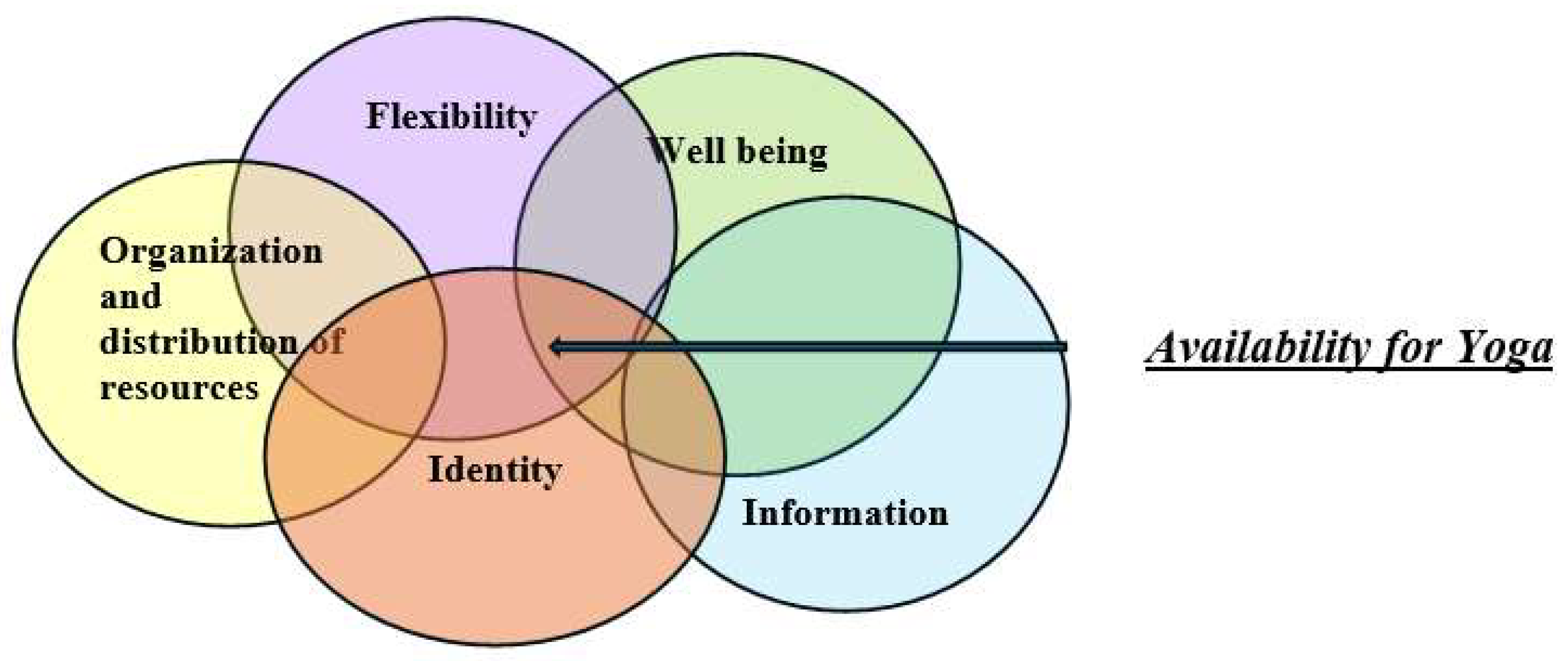
Figure 1.
Graphical visualisation of dominant themes.
The desire for knowledge and development, as well as for belonging, the presence of resilience resources to contain trauma, the need for a paradigm shift constitute those identity traits that associate a positive imprint. Strong religious beliefs may conflict with the tendency to participate or even limit access.
The visual translation of these themes provides the image of reciprocal connections that support and reinforce their role in relation to willingness to participate in yoga lessons.
Health motivation is associated with the behaviour of being informed and concerned about health status at all levels. Reasons related to health become an obstacle only in the presence of severe somatic conditions. The information people have about yoga acts as both an enabler and a constraint. Given that this theme is related to that of health and flexibility, the role of information is one of strengthening people’s willingness and availability to get involved in yoga classes. The presence of distorted and incomplete information associated with reduced flexibility has a limiting role. Personality traits connected with mental flexibility lead to an increase in interest in yoga. Rigidity towards present roles and the existing organization of life, together with convenience and reluctance to new limit and people’s willingness to participate in yoga classes.
Depending on the way we defined the themes and especially the theme of identity, the qualitative analysis reveals that a certain identity structure characterized by mental flexibility, openness to correct information and health motivation on all important levels leads to an increase in the willingness to attend sessions of yoga.
The reasons related to the five themes identified following the qualitative analysis outline a series of barriers that limit participation in yoga. The limitations discovered following the qualitative analysis converge with those described in the specialized literature.
According to a 2020 study of 37 pre-frail and frail older people at a medical centre to examine their beliefs about yoga and identify barriers to participation, the main barriers to practicing yoga were perceived difficulty of yoga practice, lack of motivation and fear of injury [16].
A dissertation published in 2013 which aimed to explore the modalities, motivations, barriers and experiences of 452 yoga session participants in two age groups: 40-55 years and 55+ years and to detect potential differences identified a number of interesting aspects. Both age groups end up practicing yoga in similar ways; through outreach, reading yoga books, and having a friend or family member suggest yoga. Exploring the motivations for practicing yoga revealed differences between the two age groups, middle-aged subjects are motivated by stress and anxiety reduction, weight loss and increased muscle strength. Older people were motivated by physical health issues to prevent osteoporosis, improve flexibility and social health, to increase social interactions. The barriers identified in the case of subjects 55+ were related to costs and accessibility [17].
A 2011 study that sought to assess the self-reported perceptions and effects of yoga in 12 older adults identified the perceived benefits as improved gait and balance, decreased pain, decreased need for medication and reduced stress, improved sleep, relief of anxiety and depression, increased mobility, increased self-awareness, and a greater sense of peace. Limitations to participation that emerged included subjects' daily obligations, accessibility, and the interference of religious beliefs. These hindered subjects' ability to fully participate [18].
The information obtained from the qualitative and quantitative analysis helped to shape a portrait of the older person who would benefit most from a specific yoga course. The profile answers questions related to the specifics of the person from the point of view of motivations, limitations and personal traits and the way in which they correlate with the objectives of the project and with the particularities of yoga practice.
4. Discussion and Conclusions
4.1. Structure
1). The extent to which the goals of the older person are associated with the goals of the project:
A specific problem that older people face is related to loneliness and the presence of feelings of isolation and loneliness. The first EU-wide survey on loneliness, EU-LS 2022 has found that, on average, 13% of respondents say they have felt lonely most or all of the time during the past four weeks, while 35% have reported feeling lonely at least part of that time. The incidence of these feelings differs from one country to another, being higher for countries in the South and East Europe compared to those in the Nnorth or West. Respondents from Romania and Italy are at a moderate level [19].
In Romania, according to a national study carried out by Kantar Romania in 2021 regarding the loneliness index, 1 in 4 elderly people in the urban environment, over 450,000, face a high degree of loneliness, and 36% feel a medium degree. 32% feel marginalized and live in continuous isolation [20].
Feelings of loneliness are associated with impaired of physical and mental capacities. The results show that individuals who feel lonely most or all the time are three times more likely to rate their health as poor. Single people are also more likely to be depressed and tend to engage more in unhealthy behaviours such as addictions [19].
Depending on the identified problem of loneliness and its consequences, the general objective of our project has been to increase inclusion and participation in social life and measure to combat it.
One of the most important themes that emerged during the focus group is related to health, to social health and the need for constant social interactions.
"Being several people we communicate, it's different than sitting alone and thinking, you communicate, one says one thing, one says another..." "Socialization, yoga sessions open your horizons a bit and you socialize better... And the brain, you still have contact with one, with another. If you stay locked in a room being old, not having contact with so-and-so, you don't talk to anyone anymore..." "I felt that I entered a community. So it was a matter of emotional compatibility, so I say that the spiritual part also worked a lot for me..." "An inclusion in a community that has maintained and developed beautifully and even supports me in times of trouble…" "Me because I have a tumultuous life, I have friends, I have children, I have children who take special care of me, my life is not static, not "oh, is someone calling me?", it seems to me that it would be the same with socializing…"
This condition of loneliness is important when it is not associated with the presence of mental disorders such as anxiety, depression and cognitive impairment. The results of the quantitative analysis indicate that the present psychological dysfunctions act as a barrier in terms of participation in yoga lessons.
Depending on the identified problem and the objective of the project, the optimal beneficiary is a lonely and isolated person with limited social interactions who does not show mental disorders such as anxiety, depression, cognitive disorder.
2) The way in which the older person's motivations are associated with the specific elements of the project, namely the development of the competence of awareness of one's own body, breathing, emotions and thoughts through techniques adapted from yoga in order to increase the quality of life.
The presence and education of this competence aims at the ability to introspect, to effectively manage time and information, to collaborate with others in a constructive manner and to remain resilient. Thus, an increase in the quality of life is achieved by developing the ability to lead a self-aware and future-oriented life, to contain complexity and uncertainty, to learn to learn and to maintain physical and mental health. Quality of life assessment refers to how a person evaluates their life. It represents a broad, reflective assessment that the person makes of his life.
According to Eurostat Overall life satisfaction by age group, 2022 in most EU Member States the 16-29 age group indicated a higher life satisfaction compared to the 65+ group. The difference between the two age groups is higher in the case of Romania compared to Italy, but not great - 1.0 points versus 0.6 points [21].
The qualitative analysis emphasises the importance older people participating in the focus groups give to increasing their quality of life. This leitmotif is found in the four central themes and in the perception of both categories of participants: yoga practitioners and people who have never participated.
"It relaxes the mind, the body, and at our age I think it's very good..." "And for mind, because the body has aged, the mind has also aged, you no longer think like you did when you were young, you used to think seven, now one and you remember after I don't know how long and for memory more would be..." "For the benefit of the memory, I'm sure that the meditations there helped a lot the memory, any meditation helps a lot the memory..." "I think it's good for the health, it balances the psyche and it's also a pleasure after all..."
"I noticed that I felt better, I wasn't so dizzy anymore, I didn't trust my legs anymore, they were shaking. Now these symptoms have started to disappear..." "I think that during these years, it was what balanced me and supported me because I needed something like that and so it was, not only physical, that I always liked to move, so I enjoyed what I did of..." "I was going to work mentally, to understand something from this life that basically we all have, a search and there was also another family..." "I learned a lot from yoga to be observant, to observe yourself, so that was essential in life. There were some life criteria that guided me later..." "It gave me a balance here and this attention to myself and to those around me helped me a lot..." "For me it meant a great awareness, the very first time I realized that I need to be aware of some things both physically and psychologically. Social really meant that too, an inclusion in a community that has maintained and developed beautifully and even supports the times when I'm in trouble..." "I would get up in the morning, do my yoga routine, and suddenly I was a different person. I had energy, I had how to say, power and mental".
Depending on the motivations that older people show and the importance of increasing the quality of life, the optimal beneficiary is a person who presents an impairment of the quality of life and is oriented towards improving it. The impairment of the quality of life at the somatic level correlates with an increased willingness to participate in yoga lessons compared to the psychic impairment which acts, rather, as a barrier.
3) Identifying the general attitude about yoga by exploring existing stereotypes:
While globalization makes it possible for different parts of the world to share traditions and cultures, yoga has not simply been shared, but has undergone several changes to be assimilated into the Western world. Yoga was not and is not popular in countries with a deeply Christian history. Academic studies which have explored how contemporary practices often deviate from traditional intentions influenced by cultural and media dynamics recall a sexualization of yoga in Europe and the United States. Limited or exclusionary media representations may discourage individuals who do not fit the representative models of yoga in terms of gender, age, race, or body type [22]. There is also the idea that yoga classes are pricey, there is a need for specific equipment etc.
Exploring existing stereotypes in the case of people 65+ is important to identify the barriers that could intervene in the manifestation of a willingness to participate in yoga. The qualitative analysis indicates the possibility that a series of specific stereotypes and prejudices associated with the theme "Information". The reasons that constitute barriers and that belong to this theme are related to the belief that yoga involves a series of complex physical movements with a high degree of difficulty that are difficult for older people to access. Aspects related to limited financial resources were also mentioned, the subjects associating the idea of yoga with high costs.
"I don't know if my health would allow me. I have problems: with my heart, with my gland, with my liver, if I make ten steps faster, my blood pressure goes up. And then I don't know if I could participate in any classes..." "I might not be able to do certain things and that's the only reason that would stop me..." "I've talked to some people who consider themselves too old, so 72-year-olds who already think they're no longer capable, to do something..." "There are also financial aspects that would impact..." "The lack of correct information. That is, when they see that there are only ads with sexy girls, without... and they don't see people moving either a little more... "
The existence of some general prejudices regarding yoga in Romania that have their origins in the highly publicized criminal case from the 2000s have also impacted the way in which are subjects perceived yoga [23].
"About yoga, I was left with a bitter taste, why, I received the information that this Mr. Bivolaru was recruiting young people, raping them, forcing them to be there, this was the message I received..." "I remembered that I was talking with a colleague about yoga and the first thing she said was "oh, I'm not going, because it seems like I'm having group sex!". Speaking of Bivolaru. So the world was left with a negative perception..." "If they hear about Bivolaru and you say you do yoga, the world can say - who knows what he did over there, that's why he went - Romanian mentality!... "I heard about yoga when there was that conversation with... Guru, what does he call it..." "In the area where I live, there was Bivolaru, in a tall house with one floor, there were always blinds shot, all the time, people said at the beginning it was prostitution, people said they were making some sexy videos, but no one knew what was going on there..." "I first heard from my children about it, they had a teacher who went at this classes, he liked it, went..."
Depending on the presence of stereotypes and prejudices at the collective and personal mental level, the optimal beneficiary is considered to be the person who formed a perception and belief about yoga based on correct, undistorted information or who received reinforcing information about yoga from over time from other sources: family, friends, books. Also, an optimal beneficiary is a person who has verified his present stereotypes through an informed verification and who has not overgeneralized a negative event.
4) Identifying the degree of mental flexibility, openness and availability to new things:
Mental flexibility adds important elements to understanding how a healthy, self-managing person function in the uncertain, unpredictable world around them, where novelty and change are the norm rather than the exception. Psychological flexibility spans a wide range of human abilities from adapting to various situational demands; checking stereotypes or behavioural registers when these strategies compromise personal or social functioning; maintaining balance between important areas of life, being aware and showing availability [24].
The motifs for "Flexibility" and "Identity" indicate the importance of some personality traits and some psychological constructs that may increase people’s availability to get involved in yoga classes [25]. The presence of these features is important because in relation to the novelty and stereotyping of the concept of yoga for the elderly population, some of them can act as obstacles. A series of reasons such as "convenience", "reluctance to new" in the case of the theme "Flexibility" and elements of identity spirituality in the theme "Identity" are included here.
"It's a matter of laziness and fear to start something..." "For me, for example, it's a necessity. For us, the necessity is in the family, we live in a group, with the grandparents, so basically you allocate your time in what you are actually attracted and of course you feel good too, I mean each of us has this job of doing something for others...I didn't have this and I turned to yoga.. ." "There are some habits, I made my schedule, I drink my coffee, I have to go to the toilet and only after that do I start my schedule at a certain time. So it's those habits we get into that we don't want to get out of..." "I didn't agree with yoga because I personally have a slightly different body than the majority. I have some stuff that doesn't fit the standard. And I focused on religious thinking..." "I am going to parallel and to the church and coming and in yoga, I think I found the meaning more on the other side, and here I found support and balance..."
Depending on the existence of some personality traits with the role of manifesting and strengthening an availability, the optimal beneficiary is a person who presents a moderate-high degree of mental flexibility:
- person is present: "If we dwell on the past or focus on the future, we focus on things that are out of our control, but also if we react, then we may not act or make decisions based on our values, beliefs, and goals”;
- person shows availability: Flexibility requires people to be open to new experiences and perspectives;
- person show acceptance: Flexible people are able to accept what they feel, acknowledge their emotions, and look for ways to create meaning and grow.
4.2. Profile of the Optimal Beneficiary
The captured features are as follows:
1) Socio-demographic characteristics
- A single person: divorced, widower, single;
- A person with physical dysfunctions: arthrosis, rheumatism, impaired mobility;
- A person who does not have mental disorders such as anxiety, depression, moderate-major cognitive impairment;
- A person from the urban environment from insufficiently served peripheral areas;
- Older people: over 65 years.
2) Psychological characteristics
- A person who has an impaired quality of life and/or wishes to increase it;
- A person who has formed a perception and belief about yoga based on correct, undistorted information;
- A person who has received strengthening information about yoga over time from adjacent sources: family, friends, teachers;
- A person who checked his existing stereotypes through an informed check and who did not overgeneralize a negative event;
- A person who presents moderate mental flexibility;
- A person who shows openness to new things;
- A person who focuses on the present;
- A person with a spiritual identity that does oppose to yoga practices.
Authors’ contributions
Conceptualization: D.C.B. and R.D.; Methodology: D.C.B. and R.D; Investigation: D.C.B., I.G., A.R., A.E.S. and, P.S.; Analysis: D.C.B. and A.E.S.; Writing, original draft: D.C.B., and R.D.; Writing, review and editing: D.C.B., R.D., I.G., A.R., A.E.S., P.S; Project administration: R.D.; All authors have read and agreed to the published version of the manuscript.
Data Availability
The dataset used and analysed during the current study is available from the corresponding author on reasonable request.
Ethics approval and consent to participate
Approval was obtained from the Scientific Council of the National Institute of Gerontology and Geriatrics "Ana Aslan", it has the Advisory Opinion of the Ethical Council and the Opinion of Research Ethics Commission of N.I.G.G. "Ana Aslan" no. 178 of 23.11.2023. The procedures used in this study adhere to the tenets of the Declaration of Helsinki. All ethical, integrity and confidentiality criteria are respected, respecting all patients’ rights. Informed consent was obtained from all individual participants included in the study.
Consent for publication
Not applicable.
Acknowledgments
The research presented in this paper is supported by the ERASMUS+ Project 2023-1-RO01-KA210-ADU-000164010 „Increasing the quality of life for older people with reduced possibilities in Bucharest and Rome - QuoL65+” (funded by European Commission). The authors would like to thank the support by the partner GNSPY.
Conflicts of Interest
The authors declare no conflict of interest. The funders had no role in the design of the study; in the collection, analyses, or interpretation of data; in the writing of the manuscript; nor in the decision to publish the results.
Abbreviations
| CASE-SF | Clinical Assessment Scales for the Elderly |
| GNSPY | Grupul National de Studiu si Practica Yoga |
| NIGG | National Institute of Gerontology and Geriatrics |
| QoL | Quality of Life |
| WHO | World Health Organization |
| WHOQOL-BREF | World Health Organization Quality of Life Questionnaire - Short Form |
References
- Koncz, A.; Nagy, E.; Csala, B.; Körmendi, J.; Gál, V.; Suhaj, C.; Selmeci, C.; Bogdán, Á.S.; Boros, S.; Köteles, F. The effects of a complex yoga-based intervention on healthy psychological functioning. Front Psychol. 2023, 14, 1120992. [Google Scholar] [CrossRef] [PubMed] [PubMed Central]
- Khalsa, S.S.; Rudrauf, D.; Feinstein, J.S.; Tranel, D. The pathways of interoceptive awareness. NatNeurosci 2009, 12, 1494–1496. [Google Scholar] [CrossRef] [PubMed] [PubMed Central]
- Bornemann, B.; Herbert, B.M.; Mehling, W.E.; Singer, T. Differential changes in self-reported aspects of interoceptive awareness through 3 months of contemplative training. Front Psychol 2015, 5, 1504. [Google Scholar] [CrossRef] [PubMed] [PubMed Central]
- Eurich, T. What self-awareness really is (and how to cultivate it). Harvard Business Review 2018, 4, 1–9. [Google Scholar]
- Pintas, S.; Loewenthal, J.V. Integrating Geriatrics and Lifestyle Medicine: Paving the Path to Healthy Aging. Am J Lifestyle Med. 2024, 15598276241282986. [Google Scholar] [CrossRef] [PubMed] [PubMed Central]
- Pruitt, J.; Adlin, T. The Persona Lifecycle: Keeping People in Mind Throughout Product Design; Morgan Kaufmann, 2006; ISBN 0–12–566251–3. [Google Scholar]
- Cohen, A. The Challenges of Intersectionality in the Lives of Older Adults Living in Rural Areas with Limited Financial Resources. Gerontol Geriatr Med. 2021, 7, 23337214211009363. [Google Scholar] [CrossRef] [PubMed]
- Mustaquim, M.M. A Study of Universal Design in Everyday Life of Elderly Adults. Procedia Computer Science 2015, 67, 57–66. [Google Scholar] [CrossRef]
- Spinsante, S.; Strazza, A.; Dobre, C.; Bajenaru, L.; Mavromoustakis, C.X.; Batalla, J.M.; Krawiec, P.; Georgescu, G.; Molan, G.; Gonzalez-Velez, H.; Herghelegiu, A.M.; Prada, G.I.; Draghici, R. Integrated Consumer Technologies for Older Adults' Quality of Life Improvement: the vINCI Project. In Proceedings of the 2019 IEEE 23rd International Symposium on Consumer Technologies (ISCT), Ancona, Italy; 2019; pp. 273–278. [Google Scholar] [CrossRef]
- Băjenaru, L.; Marinescu, I.A.; Dobre, C.; Drăghici, R.; Herghelegiu, A.M.; Rusu, A. Identifying the needs of older people for personalized assistive solutions in Romanian healthcare system. Studies in Informatics and Control 2020, 29, 363–372. [Google Scholar] [CrossRef]
- von Steinbüchel, N.; Lischetzke, T.; Gurny, M.; Eid, M. Assessing quality of life in older people: psychometric properties of the WHOQOL-BREF. Eur J Ageing 2006, 3, 116–122. [Google Scholar] [CrossRef] [PubMed] [PubMed Central]
- Drăghici, R.; Rusu, A.; Prada, G.I.; Herghelegiu, A.M.; Bajenaru, L.; Dobre, C.; Mavromoustakis, C.X.; Spinsante, S.; Batalla, J.M.; Gonzalez-Velez, H. Acceptability of Digital Quality of Life Questionnaire Corroborated with Data from Tracking Devices. In Proceedings of the 2019 IEEE 24th International Workshop on Computer Aided Modeling and Design of Communication Links and Networks (CAMAD), Limassol, Cyprus; 2019; pp. 1–6. [Google Scholar] [CrossRef]
- Băjenaru, L.; Marinescu, I.A.; Tomescu, M.; Drăghici, R. Assessing elderly satisfaction in using smart assisted living technologies: VINCI case study. Romanian Journal of Information Technology and Automatic Control 2022, 32, 19–32. [Google Scholar] [CrossRef]
- Reynolds, C.R.; Bigler, E.D. CASE™-SF Clinical Assessment Scales for the Elderly™ Short Form. Available online: https://www.parinc.com/products/CASE-SF.
- Kashdan, T.B.; Rottenberg, J. Psychological flexibility as a fundamental aspect of health. Clin Psychol Rev. 2010, 30, 865–878. [Google Scholar] [CrossRef] [PubMed] [PubMed Central]
- Perkins, R.; Dassel, K.; Felsted, K.F.; Towsley, G.; Edelman, L. Yoga for seniors: understanding their beliefs and barriers to participation. Educational Gerontology 2020, 46, 382–392. [Google Scholar] [CrossRef]
- Wertman, A. An Exploration into Pathways, Motivations, Barriers and Experiences of Yoga among Middle-aged and Older Adult, Gerontology Thesis 2013. Available online: https://summit.sfu.ca/person/34989.
- Patel, N.K.; Akkihebbalu, S.; Espinoza, S.E.; Chiodo, L.K. Perceptions of a Community-Based Yoga Intervention for Older Adults. Activities, Adaptation & Aging 2011, 35, 151–163. [Google Scholar] [CrossRef]
- Schnepf, S.V.; d’Hombres, B.; Mauri, C. Loneliness in Europe. Determinants, Risks and Interventions; Springer Nature Switzerland, 2024; pp. 7–9. [Google Scholar]
- Source of data: Kantar Romania. Studiul „Explorarea si masurarea singuratatii la persoanele varstnice din Romania”, Asociatia, Niciodata Singur – Prietenii Varstnicilor”, 27 sept. – 12 oct. 2021.
- Source of data: Eurostat. Overall life satisfaction by sex, age and educational attainmen. [CrossRef]
- Razmjou, E.; Freeman, H.; Vladagina, N.F.; Brems, C. Popular Media Images of Yoga: Limiting Perceived Access to a Beneficial Practice. Media Psychology Review 2017, 11. [Google Scholar]
- Šorytė, R. The Swedish Asylum Case of Gregorian Bivolaru, 2005. The Journal of CESNUR 2022, 6, 62–74. [Google Scholar]
- Kashdan, T.B.; Rottenberg, J. Psychological flexibility as a fundamental aspect of health. Clin Psychol Rev. 2010, 30, 865–878. [Google Scholar] [CrossRef] [PubMed] [PubMed Central]
- Park, C.L.; Finkelstein-Fox, L.; Groessl, E.J.; Elwy, A.R.; Lee, S.Y. Exploring how different types of yoga change psychological resources and emotional well-being across a single session. Complementary Therapies in Medicine 2020, 49, 102354. [Google Scholar] [CrossRef]
Disclaimer/Publisher’s Note: The statements, opinions and data contained in all publications are solely those of the individual author(s) and contributor(s) and not of MDPI and/or the editor(s). MDPI and/or the editor(s) disclaim responsibility for any injury to people or property resulting from any ideas, methods, instructions or products referred to in the content. |
© 2025 by the authors. Licensee MDPI, Basel, Switzerland. This article is an open access article distributed under the terms and conditions of the Creative Commons Attribution (CC BY) license (http://creativecommons.org/licenses/by/4.0/).
Copyright: This open access article is published under a Creative Commons CC BY 4.0 license, which permit the free download, distribution, and reuse, provided that the author and preprint are cited in any reuse.


