

Submitted:
22 January 2025
Posted:
22 January 2025
You are already at the latest version
Abstract
Linum mulleri is an endemic taxon of southwestern Sardinia (Italy), categorised as Endangered (EN) on the IUCN Red List and included in Annexes II and IV of the Habitats Directive (92/43/EEC) as priority species for conservation. This study investigated the germination ecophysiology of L. mulleri and the possible presence of dormancy by using 7000 seeds, providing useful information for conservation strategies. The germination response of fresh seeds was evaluated under different temperatures, photoperiods, pre-treatments [cold stratification (C); warm stratification (W); W+C; C+W+C; dry after ripening (DAR)], and different gibberellic acid (GA3) concentrations. L. mulleri germinates under controlled conditions, particularly at 15 and 20°C, while germination percentages (FGP) never exceeded 5% at 5 and 30°C. C and C+W+C induced secondary dormancy, delaying germination, whereas W, DAR and GA3 stimulate it. Light and dark incubation showed no significant differences in FGP. W, DAR and 250 mg/L GA3 effectively overcame physiological dormancy (PD), expanding the germination temperature range to below 10 and above 25°C. These responses suggested type 3 non-deep PD, as germination temperatures extended from moderate to both low and high temperatures. Analyzing 7000 seeds provided crucial information into dormancy and germination strategies, supporting both ex situ and in situ conservation efforts.
Keywords:
Linum
; endemic plant
; seed germination
; dormancy
; pre-treatment
1. Introduction
Seed germination is a delicate event which determines the establishment of a plant, contributing to the persistence of the population [1]. Seed germination requirements are species-specific and they are also influenced by various factors such as temperature, humidity, and light [2]. In seasonal climates and wet soils, temperature is usually the main environmental factor influencing seed germination [3], and each species has a temperature range within which germination can occur [4]. Sometimes it may behave differently depending on whether the temperature is constant or alternating [5,6,7]. Whether germination under a wide range of conditions occurs more than four weeks, more probably the seeds have dormancy. Five main classes of seed dormancy are recognized, and, among them, Physiological Dormancy (PD) is the most worldwide common form [8]. PD seeds have a physiological inhibiting mechanism in the embryo that prevents radicle emergence [8,9] and, according to the conditions required to break it and promote germination, they are distinguished into three levels: non-deep (divided in types one to six depending on the temperature range of dormancy-break), intermediate and deep [10].
Linum L. is the most well-known among the 22 genus belonging to the Linaceae family, it is distributed in temperate regions, primarily in the northern hemisphere, although 14 species are known in the Cape Region of South Africa and a similar species in New Zealand [11]. It is estimated that there are about 230 species belonging to the Linum genus [12,13,14]. One of the distribution centres of the Linum genus is the Mediterranean area, with 75 species, along with India, where it likely originated in the northwestern region, then spreading to Ethiopia, the Fertile Crescent, and Russia [11,15]. In Italy, the Linum genus is represented by 27 taxa [16], among them 10 are native to Sardinia and only Linum mulleri Moris is reported as endemic of the island [17]. The species belonging to this genus mainly grow on rocks or well-drained limestone or sandy soils [11,15] and are divided into five subsections: Linum L., Dasylinum (Planch.) Juz., Syllinum Griseb., Cathartolinum Griseb., and Linastrum (Planch.) Bentham [18]. Linum species are annual or perennial herbs, generally erect with hard bark; the flowers can be blue, red, yellow, or white, borne on axillary or terminal racemes [15]. The genus has some economic relevance as it is cultivated for the production of seed oil and fibres, particularly with the species L. usitatissimum L. (common flax) [19]. Some studies have been conducted on the germination ecophysiology of Linum seeds, primarily focused on L. usitatissimum, whose seeds do not exhibit dormancy [20,21,22], while literature data on other Linum species appear to be scarce. It has generally been shown that Linum seeds can exhibit dormancy, and germination requires a period of cold stratification or post-maturation immediately after dispersal. For example, seeds of L. perenne L. were able to break dormancy after a period of cold stratification [23], L. radiola L. seeds required an after-ripening period [24], L. olympicum Boiss. was able to germinate both in light and dark conditions, with GA3 and/or cold stratification [25], while L. catharticum L. seeds are light-dependent and require a period of cold treatment [26,27].
In this work, we focused our attention on studying the germination ecophysiology of Linum mulleri Moris, an exclusively endemic plant of southwestern Sardinia, particularly in the Iglesiente biogeographic subsector. This taxon is in an unfavourable conservation status due to the fragility of the habitat in which it grows, the small size, and the isolation of its populations. Additionally, the environmental restoration activities of abandoned mining sites pose a further risk to some areas within the range of L. mulleri [28]. The high risk of extinction has led to L. mulleri being listed as Endangered (EN) on the IUCN Red List [29]. The taxon has been included in Annex II and IV of the Habitats Directive (92/43/EEC) as a priority species for conservation. Linum mulleri is included among the species studied in the LIFE SEEDFORCE—LIFE20 NAT/IT/001468 (Using SEED banks to restore and reinFORCE the endangered native plants of Italy) project, which aims to improve the conservation status of 29 plants species listed in Annex II of the Habitats Directive (92/43/EEC).
Plant conservation requires a thorough understanding of the plant life cycle, for these reasons, determining the germination characteristics of the seeds of these species under study is essential to contribute to this purpose. Currently, to our knowledge, there is no information available in the literature regarding the ecophysiology of germination of L. mulleri. Based on existing literature for the genus Linum [24,25,26,27], we hypothesized that the seeds of L. mulleri might also exhibit dormancy. To explore this hypothesis, the objectives of this study were: (I) evaluate the germination response of seeds to different temperatures and photoperiods, (II) evaluate the germination response of seeds to different pre-treatments (warm and/or cold stratification, dry after ripened), and (III) investigate the germination response of seeds to different concentrations of gibberellic acid (GA3). To purpose these objectives, controlled laboratory experiments were conducted; understanding the germination behaviour, whether dormancy is present and, if so, determining its class and type, are useful for implementing more effective management and conservation measures for this species.
2. Results
2.1. Germination DURING PRE-TREATMENT
During the pre-treatments of W, C, W+C, and C+W+C, germination occurred. According to GLM results, the type of pre-treatment applied showed statistically significant (p < 0.05) in seed germination. Seeds exposed to W and W+C recorded germination percentage that reached up to 59% (W up to 58.72% and W+C up to 59.14%). In both pre-treatments, germination occurred during the first 90 days; in the case of W+C, during W cycle the germination reached 60%, while after 90 days (i.e. during the C cycle) the increase was very limited, bringing the final germination (after 180 days) to 60.75% (Figure 1). Seeds under C recorded a very low germination percentage, even below 1% (0.14%); whereas seeds subjected to C+W+C recorded germination percentages of 0% for the first 90 days (first C cycle), from the 90th to the 180th day the percentage reached 6.87% (W cycle), while the final germination percentage (after 270 days, second C cycle) was 11.14% (Figure 1).
2.2. Effect of Photoperiod, Treatment and Pre-Treatments on Seed Germination
The incubation temperature (T), the treatment and pre-treatment (Tr), and the interaction of these two factors (T * Tr) had a significant effect on FGP (p < 0.001) (Table 1).
The post-hoc analysis indicated that there were no statistically significant differences in the germination response of seeds incubated in dark conditions compared to all other treatment and pre-treatments applied (Table 3). The W and DAR were statistically significantly different in FGP compared to C and C+W+C, while W+C was statistically significantly different only compared to DAR (Table 2). The incubation seeds under CTR conditions, however, reveal statistical differences compared to C+W+C (Table 2).
At a temperature of 5°C, the highest FGP (5%) was achieved in seeds that had previously undergone a W+C period; for all other treatment and pre-treatments, the FGP was equal to or slightly above 0% (Figure 2). At 10°C, the W recorded the highest FGP (89.3%), while seeds previously incubated at C showed low germination capacity, not exceeding 5%, along with seeds that underwent W+C (around 5%). Seeds incubated in light and dark achieved FGP of 40.62% and 33.37%, respectively. The DAR had an FGP of 58.65% (Figure 2). At 15 and 20°C, the highest germination percentages were recorded, with FGP exceeding 40%, regardless of the treatment or pre-treatment considered. The lowest FGP (42.23%) was recorded for seeds that had previously undergone to C+W+C at 15°C. The highest FGP (95.82%) was recorded for seeds that had previously undergone DAR and were then incubated at 20°C. At 25°C, the highest FGP was recorded for seeds that had previously undergone to DAR, with a percentage of 61.82%, while the lowest FGP was recorded for seeds that had previously undergone the C+W+C (12.25%) (Figure 2). At 30°C, as at 5°C, the FGPs were consistently low, with percentages not exceeding 35%, regardless of the treatment and pre-treatment considered (Figure 2). The alternating temperature of 25/10°C for seeds incubated in light recorded a FGP of 80.57%, while, as also seen at other temperatures, seeds previously incubated at C+W+C treatment had a lower FGP compared to all other treatment and pre-treatments (1.2%) (Figure 2).
2.3. Effect of Gibberellic Acid (GA3) on Seed Germination
The concentration (Co), the incubation temperature (T), and the interaction of these two factors (Co * T) showed significant effect on FGP (p < 0.001) (Table 3).
At temperatures of 15, 20, and 25/10°C, the concentrations behave in the same way, recording germination percentages above 60% (Figure 3). At the temperature of 10°C, the concentration of 0 mg/L of GA3 recorded the lowest germination percentage (40.6%), while other concentrations were always above 50%, in particular, the concentration of 250 mg/L of GA3 recorded FGP of 92.39%, 500 mg/L of GA3 recorded FGP of 87.65%, and 1000 mg/L of GA3 recorded FGP of 57.59% (Figure 3). The temperatures of 5 and 30°C resulted in lower FGP. In particular, the FGP at 5°C reached 54.4% at a concentration of 250 mg/L of GA3, while at a concentration of 0 mg/L of GA3, FGP did not exceed 2%. At 30°C, again, the concentration of 0 mg/L of GA3 recorded the lowest FGP (22.3%), while 250 mg/L of GA3 recorded the highest FGP (66.67%) (Figure 3).
2.4. Rate and Widening of Germination Temperature
The seeds treated with CTR, W and DAR reached T50 in less time compared to the other pre-treatments (C, W+C and C+W+C) at all tested temperature (Table 4). At temperatures of 15 and 20°C, a notable lower T50 values were recorded compared to the other temperatures and pre-treatments tested. At 15°C, W showed the fastest germination (T50 = 5 days) compared to CTR and DAR (T50 = 9 ± 1 and 8 ± 1, respectively). At 20°C, DAR was the fastest with T50 of 8 ± 2 days, compared to 8 ± 4 for CTR and 14 ± 16 days for W. Even at 10°C, W and DAR achieved 50% of germination, a result not achieved with the other pre-treatments and treatments applied to the seeds. The values obtained were 7 ± 2 for W and 12 ± 1 days for DAR (Table 4).
Regarding the GA3 treatment, the 250 mg/L concentration recorded the lowest T50 values at all tested temperatures compared to the other concentrations. The only exception occurred at 10°C, where 500 mg/L concentration showed a T50 of 15 ± 1 compared to 16 ± 1 days for the 250 mg/L concentration (Table 4).
Figure 4 shows the correlation among germination percentages and incubation temperatures, considering the treatments and pre-treatments for which germination equal to or greater than 50% were observed (CTR, DAR, W, and 250 mg/L of GA3), using a Gaussian curve. The results highlighted, in these treatments, an extension of the temperatures at which 50% germination could be achieved. In CTR, temperatures extended from a minimum of approximately 12°C up to a maximum of 26°C. In the DAR pre-treatment, the range expands from about 11°C to 27°C, while in the W pre-treatment, the range extends from about 8 °C to 25.5 °C. Seeds sown with 250 mg/L of GA3 showed the greatest extension of temperature range, with a range from approximately a minimum of 5°C to a maximum of 32°C.
3. Materials and Methods
3.1. Study Species
Linum mulleri is a perennial suffrutescent plant, which flowers between May and June and bears fruit between June and July. The fruit is a capsula globose, and seeds are elliptical, flat [28]. L. mulleri is a Sardinian endemic that grows only in the Iglesiente biogeographic subsector, distributed in only three main localities: Miniere di San Giovanni di Bindua, Miniere di Monteponi and Monte Marganai [45]. It is a xerophilous species that grows in glareicolous and garrigue environments, on poor or embryonic soils and in the cracks of rock walls, it is found mainly on metamorphic substrates, on limestones and mining dumps characterized by high concentrations of heavy metals, and sometimes it behaves like a pioneer species, colonizing mine tailings landfills [28]. It is a characteristic taxon of the Polygalo sardoae-Linetum mulleri community, rich in endemics and found near mines on steep rocky slopes composed of Paleozoic metalliferous limestones [46].
3.2. Seed Lot Collection and Preparation
Fruits and seeds were collected during the time of natural dispersal in late June 2022 from Miniere di San Giovanni di Bindua locality (39.306746° N, 8.489168° E), municipality of Iglesias. The collected seed lot was stored at controlled conditions (20°C and 40% relative humidity) for two weeks at Sardinian Germplasm Bank (BG-SAR) of the University of Cagliari before the germination tests [47]. Seeds were cleaned manually with the removal by hand all foreign matter.
3.3. Controlled Laboratory Experiments
3.3.1. Germinations Tests
The tests were conducted using 7,000 seeds. The collection of such a large quantity of seeds was possible thanks to the remarkable capacity of the plant to produce them, which generates thousands of seeds every year. Such abundance allows us to collect from 10 to 30% of available mature seeds without compromising the natural population as suggested by Bacchetta et al. [48,49], ensuring at the same time the long-term conservation of different seed lots at the Sardinian Germplasm Bank (BG-SAR) of the University of Cagliari [47]. This approach ensures that our experiments were conducted in a sustainable way, minimising any negative impact on the natural population and the conservation of the species. To investigate the ecophysiology of germination of L. mulleri four replicates of 25 seeds were sown on the surface of 1% agar water in 60 mm diameter plastic Petri dishes incubated in growth chambers (Sanyo MLR-351/350; SANYO Electric, Osaka, Japan) with white fluorescent lamps (FL40SS.W/37 70–10 µmol m-2 s-1, Sanyo, Osaka, Japan), at constant (5, 10, 15, 20, 25 and 30°C) and alternating temperatures (25/10°C), in light (12 h light/12 h dark) conditions (hereafter Control, CTR). In the alternating temperature regime, the 12 h light period coincided with the elevated temperature period. Furthermore, the following pre-treatments were applied: (i) cold stratification (C); (ii) warm stratification (W); (iii) warm stratification followed by cold stratification (W+C); (iv) cold stratification followed by warm stratification and another cold stratification periods (C+W+C); (v) dry after ripened (DAR) (see details in Table 5). After which the seeds from each pre-treatment were incubated in the light (12 h light/12 h dark) at the temperature regimes mentioned above.
In order to evaluate the effect of photoperiod on seed germination, four replicates of 25 seeds each were incubated in growth chambers at constant (5, 10, 15, 20, 25, 30°C) and alternating temperatures (25/10°C) in total darkness (0 h light/24 h dark) by wrapping dishes in two aluminium foils (Table 5).
Germination, defined as visible radicle emergence (>1 mm), was recorded three times per week. At the end of the germination tests (for a maximum of 120 days), when no additional germination had occurred for two weeks, a cut test was carried out to determine the firmness of the remaining seeds and the number of empty seeds; firm seeds were considered to be viable. All germination experiments were conducted starting at the same time in the laboratories of BG-SAR.
3.3.2. Effect of Gibberellic Acid (GA3) on Seed Germination
In order to determinate the effect of GA3 on seed germination, four replicates of 25 seeds were sown in 60 mm Plastic Petri dishes with 1% agar water substrate and GA3 at different concentration (0, 250, 500 and 1000 mg/L GA3) (Table 5) and incubated in the light (12 h light/12 h dark) , at constants (5, 10, 15, 20, 25 and 30°C) and under an alternating (25/10°C) temperatures regime. At the end of the test, the firmness of the remaining seeds was determined as previously detailed.
3.4. Data Analysis
The final germination percentage (FGP) was calculated as the mean of the four replicates (± SD) on the basis of the total number of filled seeds (empty seeds were excluded). Additionally, the germination rate (T50) was calculated as the time in days required to reach 50% of germination. Generalised Linear Models (GLMs) were applied to (i) evaluate the effect of pre-treatments, photoperiod and temperature on the FGP, (ii) comparison of germination rate and assess the effect of pre-treatment on T50, (iii) evaluate the effect GA3 on the FGP. Significant differences were then analysed with a post-hoc pairwise comparison t-test (with Bonferroni adjustment). The GLMs with a logit link function and quasi-binomial error structure was used to analyse germination percentages, while a log link function and quasi-Poisson error structure was used for analysing T50. The F-tests with an empirical scale parameter instead of chi-squared on the subsequent Analysis of Variance (ANOVA) were used to overcome the residual over dispersion [50]. All statistical analyses were performed using R v. 3.0.3 [51].
4. Discussion
This study is the first to investigate the ecophysiology of germination in Linum mulleri and demonstrates that this taxon is able to produce seeds capable of germinating under controlled conditions, in particular at 15 and 20°C without any treatments. The germination observed during pre-treatments, as in the W, C, W+C, and C+W+C phases, is attributed principally to the effect of high incubation temperature (i.e., 25°C). In fact, FGP achieved during moist warm stratification “W” and warm followed by cold stratification “W+C”, with over 50% in both pre-treatments, differed by FPG obtained during cold stratification “C” and with the pre-treatments starting with a cold stratification “C+W+C” (less than 1% in both pre-treatments). The incubation temperature of seeds is a factor that significantly influences the germination phase, either inhibiting or promoting the physiological processes involved in radicle emergence [30,31]. Incubation temperature also significantly influenced seed germination after the application of treatments and pre-treatments, both in light and dark conditions. The lowest germination percentage, but the highest percentage of ungerminated and viable seeds, was recorded at 5°C and 30°C. This limitation in seed germination at too high or too low temperatures could represent an ecological advantage, as germination is prevented under unfavourable climatic conditions, allowing germination to commence when temperatures are milder [2,32]. Low germination percentage and rates were also observed in seeds that underwent a cold stratification process before being incubated at other incubation temperatures. In many species, cold and moist conditions act as a mechanism to delay seed germination until the end of winter when more favourable conditions arise [33,34]. C and C+W+C in seeds of L. mulleri seems to impose a secondary dormancy, delaying seed germination even at low temperatures after these cycles of pre-treatments, respect to W and DAR that stimulate germination also at lower temperatures. This response could be a sign of the presence of physiological dormancy “PD” [2]. This behaviour provides an ecological advantage for seeds, allowing germination to be completed at milder temperatures [2,6]. The highest FGP (more than 60%) was recorded at temperatures of 15 and 20°C. In a Mediterranean climate, such as the one where L. mulleri grows, it is common for seed germination to occur at temperatures between 15 and 20°C. This characteristic is identified as the "Mediterranean germination syndrome" [35,36], which ensures complete germination during early spring, or autumn rainy season, and avoids exposure of young plants to summer drought (e.g., [35,36,37,38,39]). The ability to germinate even at the alternating temperature of 25/10°C, both in treated and untreated seeds, might indicate that germination may occurs also in the superficial soil layers, where the influence of alternating temperatures is greater [5,40]. This suggests that this taxon grows in climatic areas with large differences in day and night temperatures. These results are consistent with several studies reporting a positive effect of fluctuating temperature regimes on seed germination percentage (e.g., [6,7,31,41]) and can partly explain the germination niche of a species, and thus its habitat requirements and distribution [7]. Contrary to what is reported in the literature for some Linum species [24,26,27], L. mulleri does not depend strictly on light for seed germination, as seed incubation in light or dark conditions showed no significant differences in FGP. The ability of L. mulleri seeds to germinate both in light and darkness and at alternating temperatures highlights their great adaptability to different environmental conditions.
It is known that GA3 stimulates germination, especially in species that exhibit dormancy [42,43]. For example, in L. olympicum [25], GA3 at different concentrations (250, 500 and 1000 mg/L) was used as a substitute for cold stratification, proving particularly effective in breaking dormancy at a concentration of 1000 mg/L. In our study, GA3 stimulated seed germination by widening the temperature range. At the temperature of 5°C, the 0 mg/L GA3 concentration recorded a percentage of less than 2%, while at the 250 mg/L GA3 it reached as high as 54.4%. The same occurred at the temperature of 30°C. Our study, in comparison to the existing literature (see [25]), highlights how different concentrations of GA3 have different effects on germination and consequently underscores the importance of always testing different concentrations.
Based on the results obtained it is possible affirm that GA3, with a preference for a concentration of 250 mg/L, is capable of breaking a form of PD in seeds of L. mulleri, expanding the range of temperatures at which this species is able to germinate, both for temperatures below 10°C and for those above 25°C. Freshly matured seeds with non-deep PD either can germinate over only a very narrow range of temperatures or cannot germinate at any temperature [2], and in the presence of non-deep PD, it is possible to break dormancy using warm or cold stratification, or by using GA3 [8,44]. The W, DAR and GA3 treatments in seeds of L. mulleri have proven to be effective in break dormancy also at lower and higher temperatures and consequently in widening the temperature range of germination, especially when the temperature drops below 15 and 20°C. Accordingly, the seeds of L. mulleri have a non-deep PD. In agreement with our results, L. radiola [24] requires an after-ripening period of 30°C for 28 days to break dormancy; in contrast, many authors have reported in the literature the positive effect of cold stratification on breaking seeds dormancy in other species belonging to the genus Linum (see [23,25,26,27]). Furthermore, since the temperature range at which L. mulleri seeds can germinate has widened from medium to both low and high temperatures, the seeds exhibit a type 3 non-deep PD [8].
5. Conclusions
The data presented in this study provide useful information for both ex situ and in situ conservation of this threatened and European protected species. Testing 7000 seeds may help to understand the dormancy type, in fact, this study allowed to detect that seeds of Linum mulleri have a type three non-deep PD and that this species showed the typical Mediterranean germination syndrome considering that the highest germination percentages were recorded at temperatures of 15°C and 20°C. Additionally, it was detected that W, DAR and GA3 (in particular concentration of 250 mg/L) stimulated the germination at lower (5 and 10°C) and higher (25 and 30°C) temperatures. Information on its seed germination strategies is critical for optimizing the timing of and determining the success of in situ conservation efforts, such as translocation and environmental recovery. As other studies have shown (e.g., [52,53,54]), knowing how to germinate the seeds is vital for developing effective procedures and protocols for promoting ex situ conservation for rare and threatened species.
Author Contributions
Conceptualization, L.D., M.P., L.P., A.C-L. and G.B.; methodology, L.D., M.P., L.P., A.C-L. and G.B.; software, L.D. and M.P.; validation, L.D., M.P., L.P., A.C-L. and G.B.; formal analysis, L.D. and M.P.; investigation, L.D., M.P., L.P., A.C-L. and G.B.; resources, L.D., M.P., L.P., A.C-L. and G.B.; data curation, L.D. and M.P.; writing—original draft preparation, L.D. and M.P.; writing—review and editing, L.D., M.P., L.P., A.C-L. and G.B.; visualization, L.D. and M.P.; supervision, M.P., L.P., A.C-L. and G.B.; project administration, G.B.; funding acquisition, G.B. All authors have read and agreed to the published version of the manuscript.
Funding
This research was partially funded by LIFE SEEDFORCE—LIFE20 NAT/IT/001468, Using SEED banks to restore and reinFORCE the endangered native plants of Italy.
Data Availability Statement
The raw data supporting the conclusions of this article will be made available by the authors on request.
Acknowledgments
We thank Maria Enrica Boi for her help during seed collection.
Conflicts of Interest
The authors declare no conflicts of interest. The funders had no role in the design of the study; in the collection, analyses, or interpretation of data; in the writing of the manuscript; or in the decision to publish the results.
References
- Cochrane, J.A. Thermal requirements underpinning germination allude to risk of species decline from climate warming. Plants 2020, 9, 796. [Google Scholar] [CrossRef]
- Baskin, C.C.; Baskin, J.M. Seeds: ecology, biogeography and evolution of dormancy and germination; 2nd ed.; Academic Press: San Diego, CA, USA, 2014. [Google Scholar]
- Fenner, M.; Thompson, K. The ecology of seeds; Cambridge University Press., 2005; ISBN 9780511614101.
- Bewley, J.; Black, M.; Halmer, P. The encyclopedia of seeds: science, technology and uses. 2006.
- Probert, R.J. The role of temperature in the regulation of seed dormancy and germination. In Seeds: the ecology of regeneration in plant communities; Fenner, M., Ed.; CAB International, Wallingford: UK, 2000. [Google Scholar]
- Picciau, R.; Porceddu, M.; Bacchetta, G. Can alternating temperature, moist chilling, and gibberellin interchangeably promote the completion of germination in clematis vitalba seeds? Botany 2017, 95. [Google Scholar] [CrossRef]
- Liu, K.; Baskin, J.M.; Baskin, C.C.; Bu, H.; Du, G.; Ma, M. Effect of Diurnal Fluctuating versus Constant Temperatures on Germination of 445 Species from the Eastern Tibet Plateau. PLoS One 2013, 8, e69364. [Google Scholar] [CrossRef] [PubMed]
- Baskin, J.M.; Baskin, C.C. A classification system for seed dormancy. Seed Sci. Res. 2004, 14, 1–16. [Google Scholar] [CrossRef]
- Nikolaeva, M. Factors controlling the seed dormancy pattern. 1977.
- Baskin, C.C.; Baskin, J.M. Mimicking the natural thermal environments experienced by seeds to break physiological dormancy to enhance seed testing and seedling production. Seed Sci. Technol. 2022, 50, 21–29. [Google Scholar] [CrossRef]
- Strange, K.; Rix, M. Linum doerfleri: Linaceae. 2007.
- Rogers, C.M. The systematics of Linum sect. Linopsis (Linaceae). Plant Syst. Evol. 1982, 140, 225–234. [Google Scholar] [CrossRef]
- Diederichsen, A.; Richards, K. Cultivated flax and the genus linum L.: Taxonomy and germplasm conservation. Flax Genus Linum. [CrossRef]
- Mabberley, D. Mabberley’s Plant-book: a portable dictionary of plants, their classifications and uses. 2008.
- Tutin, T.G.; Heywood, V.H.; Burges, N.A.; Moore, D.M.; Valentine, D.H.; Walters, S.M.; Webb, D.A. Flora Europaea; University Press: Cambridge, UK, 1968. [Google Scholar]
- Bartolucci, F.; Peruzzi, L.; Galasso, G.; Alessandrini, A.; Ardenghi, N.M.G.; Bacchetta, G.; Banfi, E.; Barberis, G.; Bernardo, L.; Bouvet, D.; et al. A second update to the checklist of the vascular flora native to Italy. Plant Biosyst. - An Int. J. Deal. with all Asp. Plant Biol. 2024, 158, 219–296. [Google Scholar] [CrossRef]
- Fois, M.; Farris, E.; Calvia, G.; Campus, G.; Fenu, G.; Porceddu, M.; Bacchetta, G. The Endemic Vascular Flora of Sardinia: A Dynamic Checklist with an Overview of Biogeography and Conservation Status. Plants 2022, 11, 601. [Google Scholar] [CrossRef]
- Simpson, B.B.; Linder, C.R.; Mauseth, J.D.; Jansen, R.K.; Hillis, D.; Mcdill, J.R.; Dissertation, M.A. Molecular phylogenetic studies in the Linaceae and Linum, with implications for their systematics and historical biogeography. 2009.
- Lee Pengilly, N. Traditional food and medicinal uses of flaxseed. Flax Genus Linum 2003, 252–267. [Google Scholar] [CrossRef]
- Saeidi, G. Genetic variation and heritability for germination, seed vigour and field emergence in brown and yellow-seeded genotypes of flax. 2008.
- Stefanello, R.; Viana, B.B.; Das Neves, L.A.S. Germination and vigor of linseed seeds under different conditions of light, temperature and water stress. Semin. Agrar. 2017, 38, 1161–1168. [Google Scholar] [CrossRef]
- Kurt, O. A predictive model for the effects of temperature on the germination period of flax seeds (Linum usitatissimum L.). Turkish J. Agric. For. 2012, 36, 654–658. [Google Scholar] [CrossRef]
- Meyer, S.E.; Kitchen, S.G. Life history variation in blue flax ( L inum perenne : Linaceae): seed germination phenology. Am. J. Bot. 1994, 81, 528–535. [Google Scholar] [CrossRef]
- Carta, A.; Bedini, G.; Müller, J. V.; Probert, R.J. Comparative seed dormancy and germination of eight annual species of ephemeral wetland vegetation in a Mediterranean climate. Plant Ecol. 2013, 214, 339–349. [Google Scholar] [CrossRef]
- Kırmızı, S.; Güleryüz, G.; Arslan, H. Effects of pretreatments on seed dormancy and germination in endemic Uludağ flax (Linum olympicum Boiss.) (Linaceae). Hortic. Environ. Biotechnol. 2018, 59, 629–635. [Google Scholar] [CrossRef]
- Pons, T.L. Dormancy, Germination and Mortality of Seeds in a Chalk-Grassland Flora. J. Ecol. 1991, 79, 765. [Google Scholar] [CrossRef]
- MILBERG, P. Germination ecology of the grassland biennial Linum catharticum. Acta Bot. Neerl. 1994, 43, 261–269. [Google Scholar] [CrossRef]
- Fenu, G.; Cogoni, D.; Casti, M.; Bacchetta, G. Schede per una Lista Rossa della Flora vascolare e crittogamica Italiana: Linum muelleri Moris. Inf. Bot. Ital. 2012, 44, 405–474. [Google Scholar]
- Orsenigo, S.; Montagnani, C.; Fenu, G.; Gargano, D.; Peruzzi, L.; Abeli, T.; Alessandrini, A.; Bacchetta, G.; Bartolucci, F.; Bovio, M.; et al. Red Listing plants under full national responsibility: Extinction risk and threats in the vascular flora endemic to Italy. Biol. Conserv. 2018, 224, 213–222. [Google Scholar] [CrossRef]
- Porceddu, M.; Mattana, E.; Pritchard, H.W.; Bacchetta, G. Dissecting seed dormancy and germination in Aquilegia barbaricina, through thermal kinetics of embryo growth. Plant Biol. 2017, 19. [Google Scholar] [CrossRef]
- Santo, A.; Dessì, L.; Ucchesu, M.; Bou Dagher Kharrat, M.; Charbel Sakr, R.; Accogli, R.A.; Buhagiar, J.; Kyratzis, A.; Fournaraki, C.; Bacchetta, G. Seed germination ecology and salt stress response in eight Mediterranean populations of Sarcopoterium spinosum (L.) Spach. Plant Species Biol. 2019, 34, 110–121. [Google Scholar] [CrossRef]
- Cavieres, L.A.; Arroyo, M.T.K. Seed germination response to cold stratification period and thermal regime in Phacelia secunda (Hydrophyllaceae): Altitudinal variation in the mediterranean Andes of central Chile. Plant Ecol. 2000, 149, 1–8. [Google Scholar] [CrossRef]
- Mattana, E.; Pritchard, H.W.; Porceddu, M.; Stuppy, W.H.; Bacchetta, G. Interchangeable effects of gibberellic acid and temperature on embryo growth, seed germination and epicotyl emergence in Ribes multiflorum ssp. sandalioticum (Grossulariaceae). Plant Biol. 2012, 14. [Google Scholar] [CrossRef] [PubMed]
- Bewley, J.D.; Bradford, K.J.; Hilhorst, H.W.M.; Nonogaki, H. Seeds: physiology of development and germination. 2013.
- Thanos, C.A.; Kadis, C.C.; Skarou, F. Ecophysiology of germination in the aromatic plants thyme, savory and oregano (Labiatae). Seed Sci. Res. 1995, 5, 161–170. [Google Scholar] [CrossRef]
- Kadis, C.; Georghiou, K. Seed dispersal and germination behavior of three threatened endemic labiates of Cyprus. Plant Species Biol. 2010, 25, 77–84. [Google Scholar] [CrossRef]
- Doussi, M.A.; Thanos, C.A. Ecophysiology of seed germination in Mediterranean geophytes. 1. Muscari spp. Seed Sci. Res. 2002, 12, 193–201. [Google Scholar] [CrossRef]
- Galmés, J.; Medrano, H.; Flexas, J. Germination capacity and temperature dependence in Mediterranean species of the Balearic Islands. For. Syst. 2006, 15, 88–95. [Google Scholar] [CrossRef]
- Luna, B.; Pérez, B.; Torres, I.; Moreno, J.M. Effects of incubation temperature on seed germination of mediterranean plants with different geographical distribution ranges. Folia Geobot. 2012, 47, 17–27. [Google Scholar] [CrossRef]
- Grime, J.P.; Thompson, K. An apparatus for measurement of the effect of amplitude of temperature fluctuation upon the germination of seeds. Ann. Bot. 1976, 40, 795–799. [Google Scholar] [CrossRef]
- Schütz, W.; Rave, G. The effect of cold stratification and light on the seed germination of temperate sedges (Carex) from various habitats and implications for regenerative strategies. Plant Ecol. 1999, 144, 215–230. [Google Scholar] [CrossRef]
- Da Silva, E.A.A.; Toorop, P.E.; Nijsse, J.; Bewley, J.D.; Hilhorst, H.W.M. Exogenous gibberellins inhibit coffee (Coffea arabica cv. Rubi) seed germination and cause cell death in the embryo. J. Exp. Bot. 2005, 56, 1029–1038. [Google Scholar] [CrossRef]
- Porceddu, M.; Mattana, E.; Pritchard, H.W.; Bacchetta, G. Sequential temperature control of multi-phasic dormancy release and germination of Paeonia corsica seeds. J. Plant Ecol. 2016, 9. [Google Scholar] [CrossRef]
- Finch-Savage, W.E.; Leubner-Metzger, G. Seed dormancy and the control of germination. New Phytol. 2006, 171, 501–523. [Google Scholar] [CrossRef] [PubMed]
- Pignatti, S.; Menegoni, P.; Giacanelli, V. Liste rosse e blu della flora italiana; Agenzia Nazionale per la Protezione dell’Ambiente: Roma, 2001. [Google Scholar]
- Angiolini, C.; Bacchetta, G.; Brullo, S.; Casti, M.; Giusso Del Galdo, G.; Guarino, R. The vegetation of mining dumps in SW-Sardinia. Feddes Repert. 2005, 116, 243–276. [Google Scholar] [CrossRef]
- Porceddu, M.; Santo, A.; Orrù, M.; Meloni, F.; Ucchesu, M.; Picciau, R.; Sarigu, M.; Cuena Lombrana, A.; Podda, L.; Sau, S.; et al. Seed conservation actions for the preservation of plant diversity: the case of the Sardinian Germplasm Bank (BG-SAR). Plant Sociol. 2017, 54, 111–117. [Google Scholar]
- Bacchetta, G.; Bueno Sanchez, A.; Fenu, G.; Jiménez Alfaro, B.; Mattana, E.; Piotto, B.; Virevaire, M. Conservación ex situ de plantas silvestres. Principado de Asturias. 2008. [Google Scholar]
- Bacchetta, G.; Belletti, P.; Brullo, S.; Cagelli, L.; Carasso, V.; Casas, J.L.; Cervelli, C.; Escribà, M.C.; Fenu, G.; Gorian, F. Manuale per la raccolta, studio, conservazione e gestione ex situ del germoplasma.; APAT, 2006; Vol. 37;
- Crawley, M.J. 2012.
- R Development Core Team R: a language and environment for statistical computing; R Foundation for Statistical Computing: Vienna, Austria, 2013.
- Cuena-Lombraña, A.; Porceddu, M.; Dettori, C.A.; Bacchetta, G. Predicting the consequences of global warming on Gentiana lutea germination at the edge of its distributional and ecological range. PeerJ 2020, 2020, e8894. [Google Scholar] [CrossRef] [PubMed]
- Cuena Lombraña, A.; Dessì, L.; Podda, L.; Fois, M.; Luna, B.; Porceddu, M.; Bacchetta, G. The Effect of Heat Shock on Seed Dormancy Release and Germination in Two Rare and Endangered Astragalus L. Species (Fabaceae). Plants 2024, Vol. 13, Page 484 2024, 13, 484. [Google Scholar] [CrossRef]
- Porceddu, M.; Fenu, G.; Bacchetta, G. New findings on seed ecology of Ribes sardoum: can it provide a new opportunity to prevent the extinction of a threatened plant species? Syst. Biodivers. 2017, 15. [Google Scholar] [CrossRef]
Figure 1.
Germination trends during pre-treatments. I, II, and III correspond to the three applied pretreatment cycles on Linum mulleri seeds, with I = 90 days for W and C, II = 180 days for W+C, and III = 270 days for C+W+C. Data are the mean of four replicates (±SD). The GLMs were carried out on the germination, and values with the same letter are not statistically different at p > 0.05 by post hoc pairwise t-test comparisons.
Figure 1.
Germination trends during pre-treatments. I, II, and III correspond to the three applied pretreatment cycles on Linum mulleri seeds, with I = 90 days for W and C, II = 180 days for W+C, and III = 270 days for C+W+C. Data are the mean of four replicates (±SD). The GLMs were carried out on the germination, and values with the same letter are not statistically different at p > 0.05 by post hoc pairwise t-test comparisons.
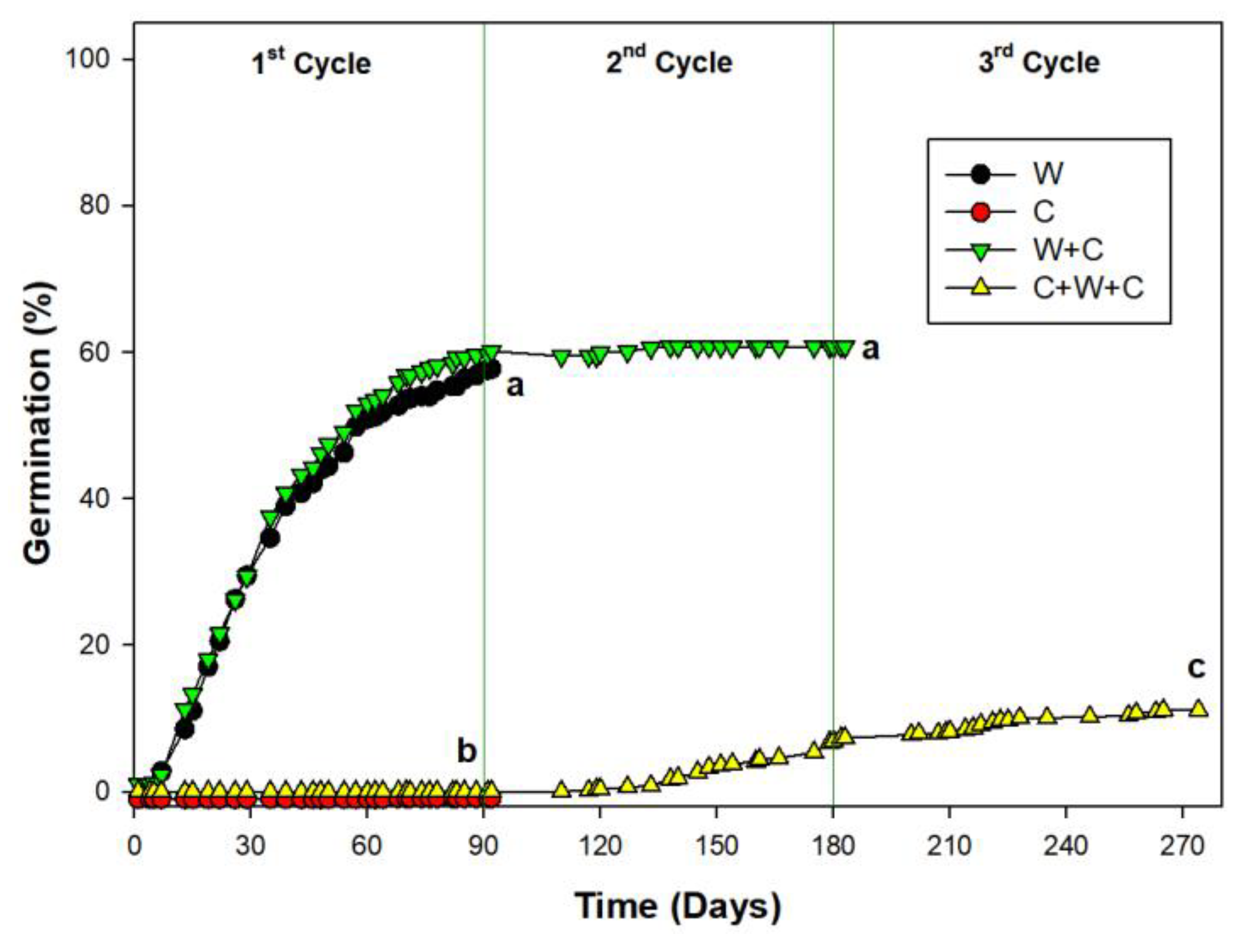
Figure 2.
Final Germination Percentage (FGP) of Linum mulleri seeds under different treatment and pre-treatment (CTR, C, W, W+C, C+W+C, DAR and Dark) and incubated at constant (5, 10, 15, 20, 25, 30°C) and alternating (25/10°C) temperatures. Data are the mean of four replicates (±SD). GLMs were carried out on the germination, and values with the same letter are not statistically different at p > 0.05 by post hoc pairwise t-test comparisons.
Figure 2.
Final Germination Percentage (FGP) of Linum mulleri seeds under different treatment and pre-treatment (CTR, C, W, W+C, C+W+C, DAR and Dark) and incubated at constant (5, 10, 15, 20, 25, 30°C) and alternating (25/10°C) temperatures. Data are the mean of four replicates (±SD). GLMs were carried out on the germination, and values with the same letter are not statistically different at p > 0.05 by post hoc pairwise t-test comparisons.
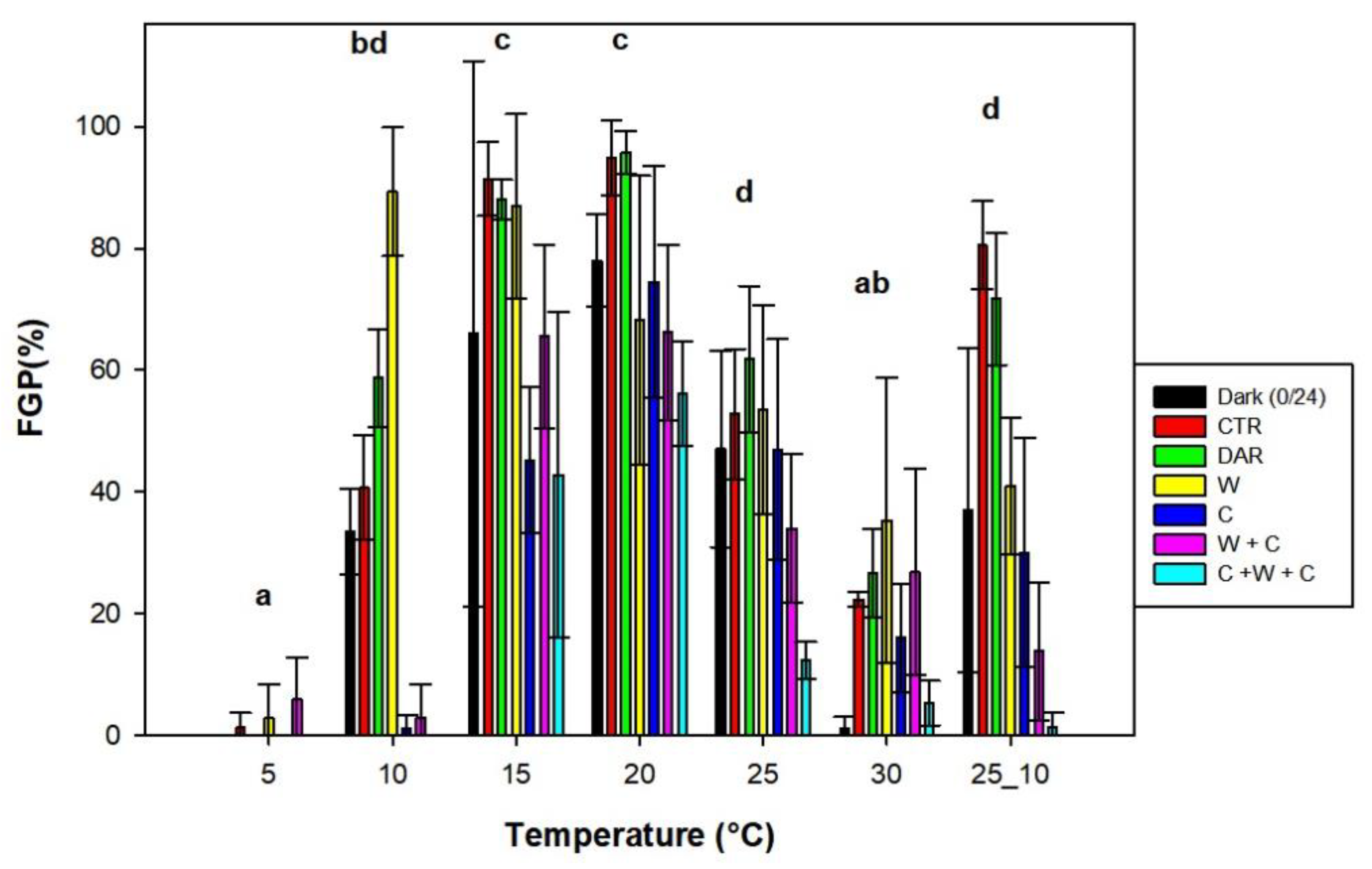
Figure 3.
Effect of different concentration of GA3 (0, 250, 500, 1000 mg/L) on seed germination of Linum mulleri incubated at constant (5, 10, 15, 20, 25 and 30°C) and alternating (25/10°C) temperatures. The data represent the mean of four replicates (±SD). Values with the same letter are not statistically different at p > 0.05 by post hoc pairwise t-test comparisons.
Figure 3.
Effect of different concentration of GA3 (0, 250, 500, 1000 mg/L) on seed germination of Linum mulleri incubated at constant (5, 10, 15, 20, 25 and 30°C) and alternating (25/10°C) temperatures. The data represent the mean of four replicates (±SD). Values with the same letter are not statistically different at p > 0.05 by post hoc pairwise t-test comparisons.
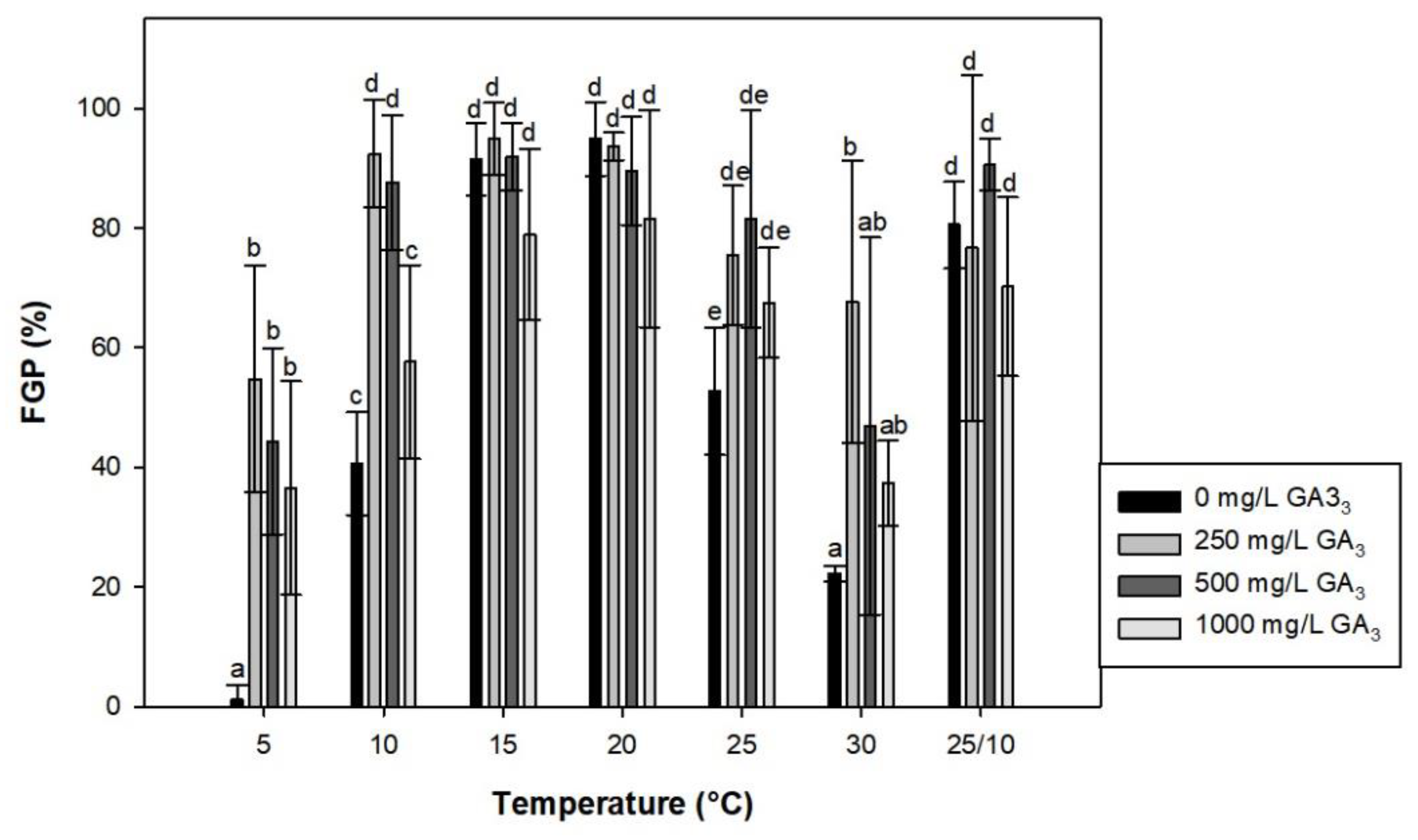
Figure 4.
Gaussian curves representing the effect of CTR, W, DAR and 250 mg/L of GA3 on the germination dynamics of Linum mulleri seeds. Points correspond to actual data and solid lines indicate the fitted lines from gaussian regressions. Vertical dotted lines indicate the minimum temperature at which 50% germination can be achieved in the different treatments. The data represent the mean of four replicates.
Figure 4.
Gaussian curves representing the effect of CTR, W, DAR and 250 mg/L of GA3 on the germination dynamics of Linum mulleri seeds. Points correspond to actual data and solid lines indicate the fitted lines from gaussian regressions. Vertical dotted lines indicate the minimum temperature at which 50% germination can be achieved in the different treatments. The data represent the mean of four replicates.
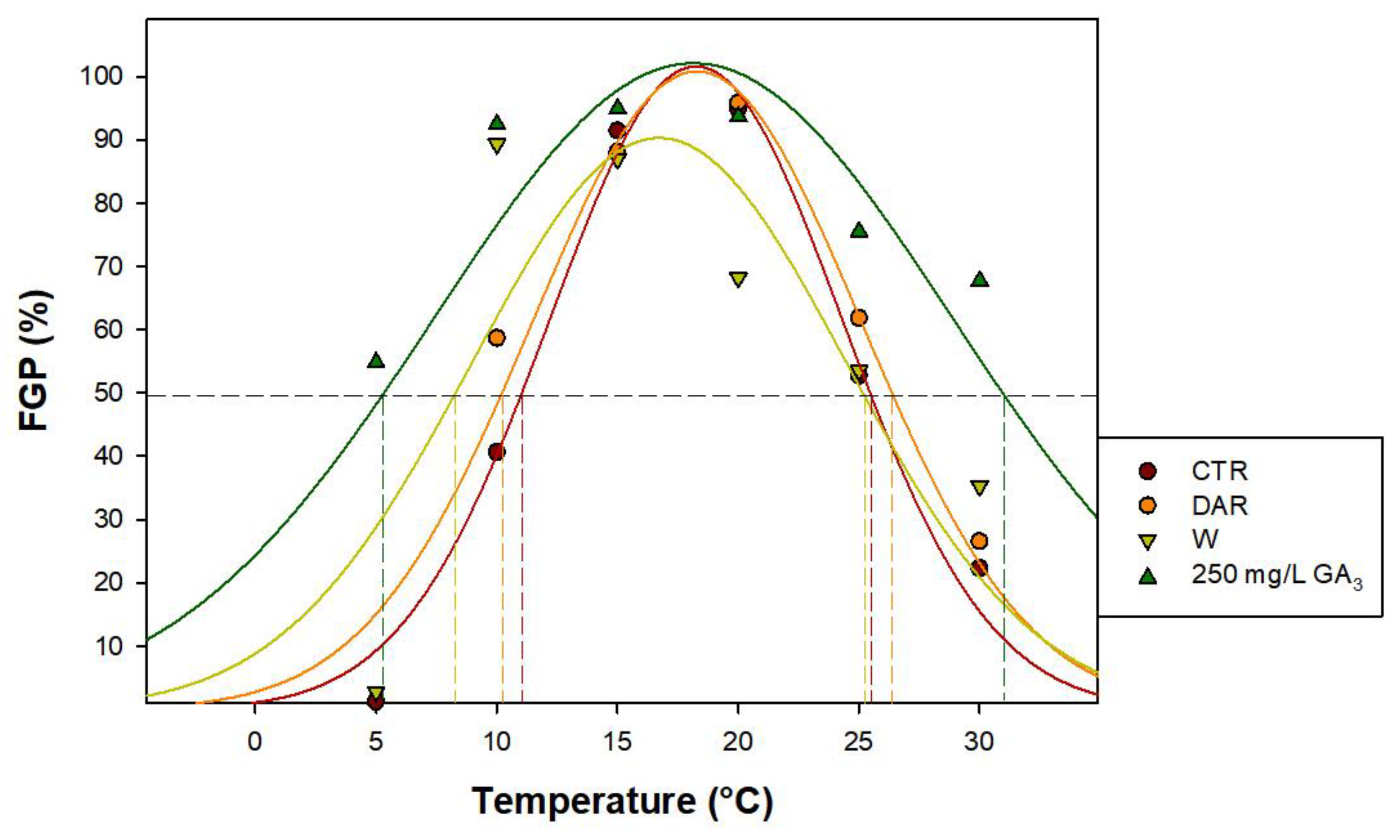

Table 1.
GLM results of Final Germination Percentage (FGP) in Linum mulleri seeds depending on the following factors: Treatment and Pre-Treatment (CTR, C, W, W+C, C+W+C, DAR, Dark), incubation Temperature (5, 10, 15, 20, 25, 30 and 25/10°C), and their interactions (Tr * T).
Table 1.
GLM results of Final Germination Percentage (FGP) in Linum mulleri seeds depending on the following factors: Treatment and Pre-Treatment (CTR, C, W, W+C, C+W+C, DAR, Dark), incubation Temperature (5, 10, 15, 20, 25, 30 and 25/10°C), and their interactions (Tr * T).
| Df | Sum Sq | Mean Sq | F | pvalue | |
|
Treatment and Pre-Treatment (Tr) |
6 | 4.026 | 0.6711 | 36.916 | < 0.001 *** |
| Temperature (T) | 6 | 11.714 | 1.952 | 107.399 | < 0.001 *** |
| Tr * T | 36 | 3.243 | 0.090 | 4.956 | < 0.001 *** |
Table 2.
Pairwise comparisons on different treatment applied. Pairwise comparisons using t-test with pooled statistical differences for final germination percentage for the treatment and pre-treatments (CTR, C, W, W+C, C+W+C, DAR, Dark) applied in Linum mulleri seeds.
Table 2.
Pairwise comparisons on different treatment applied. Pairwise comparisons using t-test with pooled statistical differences for final germination percentage for the treatment and pre-treatments (CTR, C, W, W+C, C+W+C, DAR, Dark) applied in Linum mulleri seeds.
| C | C+W+C | CTR | DAR | Dark | W | |
| C+W+C | 1 | |||||
| CTR | 0.069 | < 0.001 *** | ||||
| DAR | < 0.05 * | < 0.001 *** | 1 | |||
| Dark | 1 | 0.253 | 0.737 | 0.317 | ||
| W | < 0.05 * | < 0.001 *** | 1 | 1 | 0.974 | |
| W+C | 1 | 1 | 0.074 | < 0.05 * | 1 | 0.106 |
Table 3.
GLM results of Final Germination Percentage (FGP) in Linum mulleri seeds depending on the following factors: Concentration (0, 250, 500, 1000 mg/L of GA3), incubation Temperature (5, 10, 15, 20, 25, 30 and 25/10°C), and their interactions (Co * T).
Table 3.
GLM results of Final Germination Percentage (FGP) in Linum mulleri seeds depending on the following factors: Concentration (0, 250, 500, 1000 mg/L of GA3), incubation Temperature (5, 10, 15, 20, 25, 30 and 25/10°C), and their interactions (Co * T).
| Df | Sum Sq | Mean Sq | F | pvalue | |
| Concentration (Co) | 3 | 1.154 | 0.384 | 19.127 | < 0.001 *** |
| Temperature (T) | 6 | 4.498 | 0.749 | 37.275 | < 0.001 *** |
| Co * T | 18 | 1.037 | 0.057 | 2.866 | < 0.001 *** |
Table 4.
The germination rate (T50) expressed in days across each tested temperature of all treatment and pre-treatments (CTR, W, C, W+C, C+W+C, DAR, 250, 500, 1000 mg/L of GA3) where 50% of germination has been achieved.
Table 4.
The germination rate (T50) expressed in days across each tested temperature of all treatment and pre-treatments (CTR, W, C, W+C, C+W+C, DAR, 250, 500, 1000 mg/L of GA3) where 50% of germination has been achieved.
| Treatment | Temperature | ||||||
| 5 | 10 | 15 | 20 | 25 | 30 | 25/10 | |
| CTR | - | - | 9±1 | 8±4 | 56±44 | - | 37±5 |
| W | - | 7±2 | 5±0 | 14±16 | 100±21 | 117±3 | - |
| C | - | - | - | 55±14 | 125±71 | - | - |
| W+C | - | - | 72±42 | 63±5 | - | - | - |
| C+W+C | - | - | 31±2 | 60±8 | - | - | - |
| DAR | - | 12±1 | 8±1 | 8±2 | 42±12 | - | 30±9 |
| GA3 250 mg/L | - | 16±1 | 8±1 | 6±0 | 15±5 | 32±6 | 14±3 |
| GA3 500 mg/L | 65±24 | 15±1 | 9±1 | 8±2 | 19±5 | 36±1 | 17±1 |
| GA3 1000 mg/L | - | 16±2 | 11±1 | 8±1 | 16±2 | - | 18±11 |
Table 5.
Experimental designed for Linum mulleri. After the C, W, W+C, C+W+C, DAR pre-treatments, the seeds were incubated at all tested temperature (5, 10, 15, 20, 25, 30°C and 25/10°C).
Table 5.
Experimental designed for Linum mulleri. After the C, W, W+C, C+W+C, DAR pre-treatments, the seeds were incubated at all tested temperature (5, 10, 15, 20, 25, 30°C and 25/10°C).
| Treatment and pre-treatment | Description |
| CTR | Light condition (12 h light/12 h dark) and incubation at all tested temperature |
| C | 3 months at 5°C |
| W | 3 months at 25°C |
| W+C | 3 months at 25°C, followed by 3 months at 5°C |
| C+W+C | 3 months at 5°C, followed by 3 months at 25°C, followed by 3 months at 5°C |
| DAR | 3 months at 25°C inside a sealed glass container with colour-changing silica gel at a ratio seed/silica gel of 1:1 which ensure the dry condition |
| 0/24 | 24 hours of dark condition and incubation at all tested temperature |
| GA3 | 0, 250, 500, 1000 mg/L GA3 in germination medium and incubation at all tested temperature |
Disclaimer/Publisher’s Note: The statements, opinions and data contained in all publications are solely those of the individual author(s) and contributor(s) and not of MDPI and/or the editor(s). MDPI and/or the editor(s) disclaim responsibility for any injury to people or property resulting from any ideas, methods, instructions or products referred to in the content. |
© 2025 by the authors. Licensee MDPI, Basel, Switzerland. This article is an open access article distributed under the terms and conditions of the Creative Commons Attribution (CC BY) license (https://creativecommons.org/licenses/by/4.0/).
Copyright: This open access article is published under a Creative Commons CC BY 4.0 license, which permit the free download, distribution, and reuse, provided that the author and preprint are cited in any reuse.