
Submitted:
21 January 2025
Posted:
22 January 2025
Read the latest preprint version here
Abstract
The competition for desalination is currently underway. A mere decade ago, nations within the Maghreb region and, rather unexpectedly, European countries, were fortunate enough to evade humanity's primary adversary: drought. However, the unpredictable nature of climate change has since altered this reality. Consequently, an increasing number of countries are contemplating the serious prospect of utilizing desalination to fulfill their potable water requirements from the seas and oceans bordering their coastlines. Regrettably, research and experience have indicated that highly saline water presents a significant threat to marine ecosystems. This scholarly investigation aims to contribute to the discovery of a solution that will enable the continuation of seawater desalination without inflicting harm on the marine flora and fauna, and this work can be considered as a prototype that need to be studied closely, because the results are here and undeniable, plus this is all what we going to need more and more in near future, namely water and energy.
Keywords:
1. Introduction
2. Shedding Light on the Matter: A Clear Exposition of the Problem
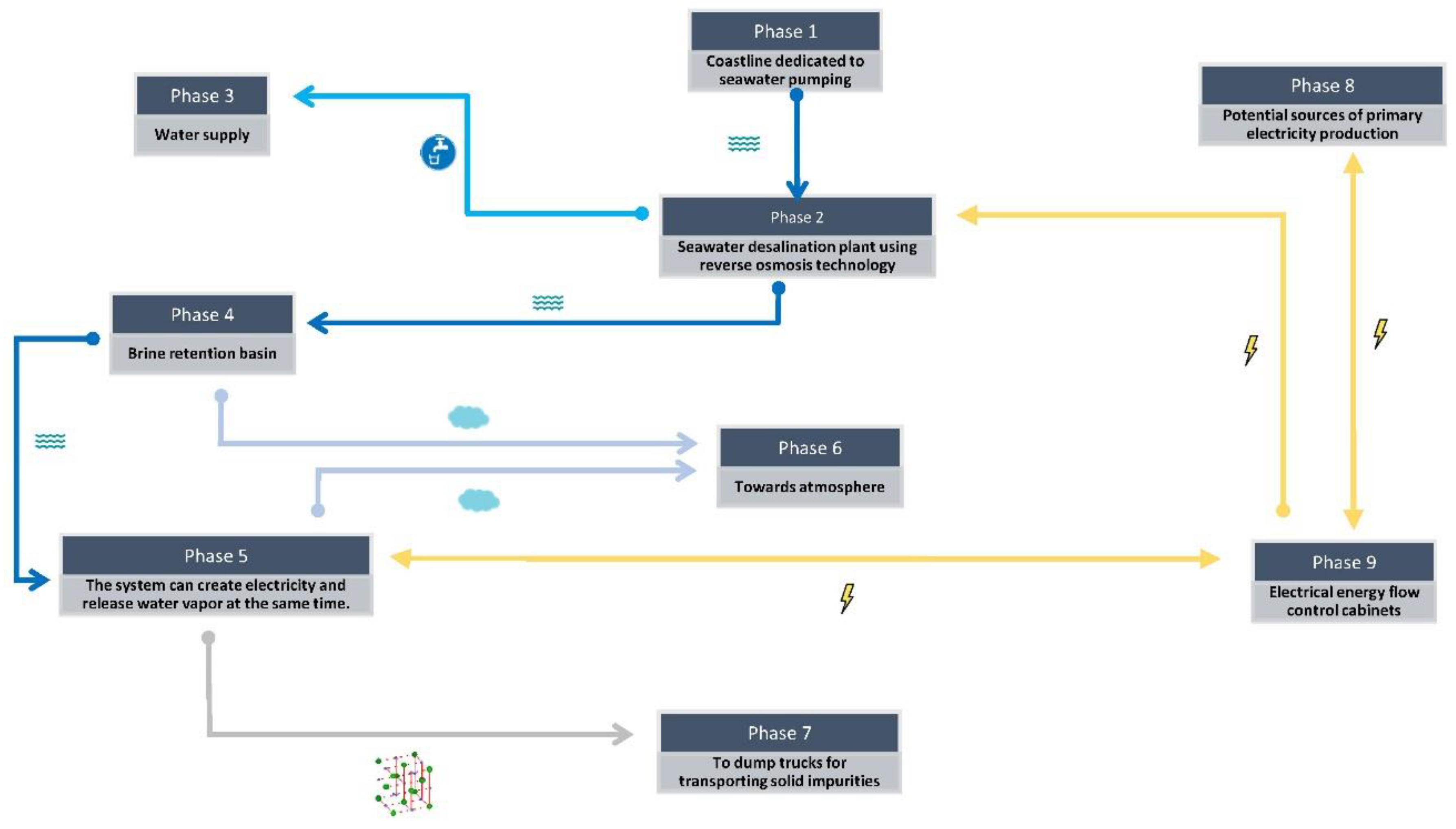
3. Fundamental Principle Guiding the Promised Valorization Process

 |
Filtered water flow |
 |
Unfiltered water flow |
 |
Solid impurities, mainly sea salt |
 |
Flow of electrical energy |
 |
Steam flow |
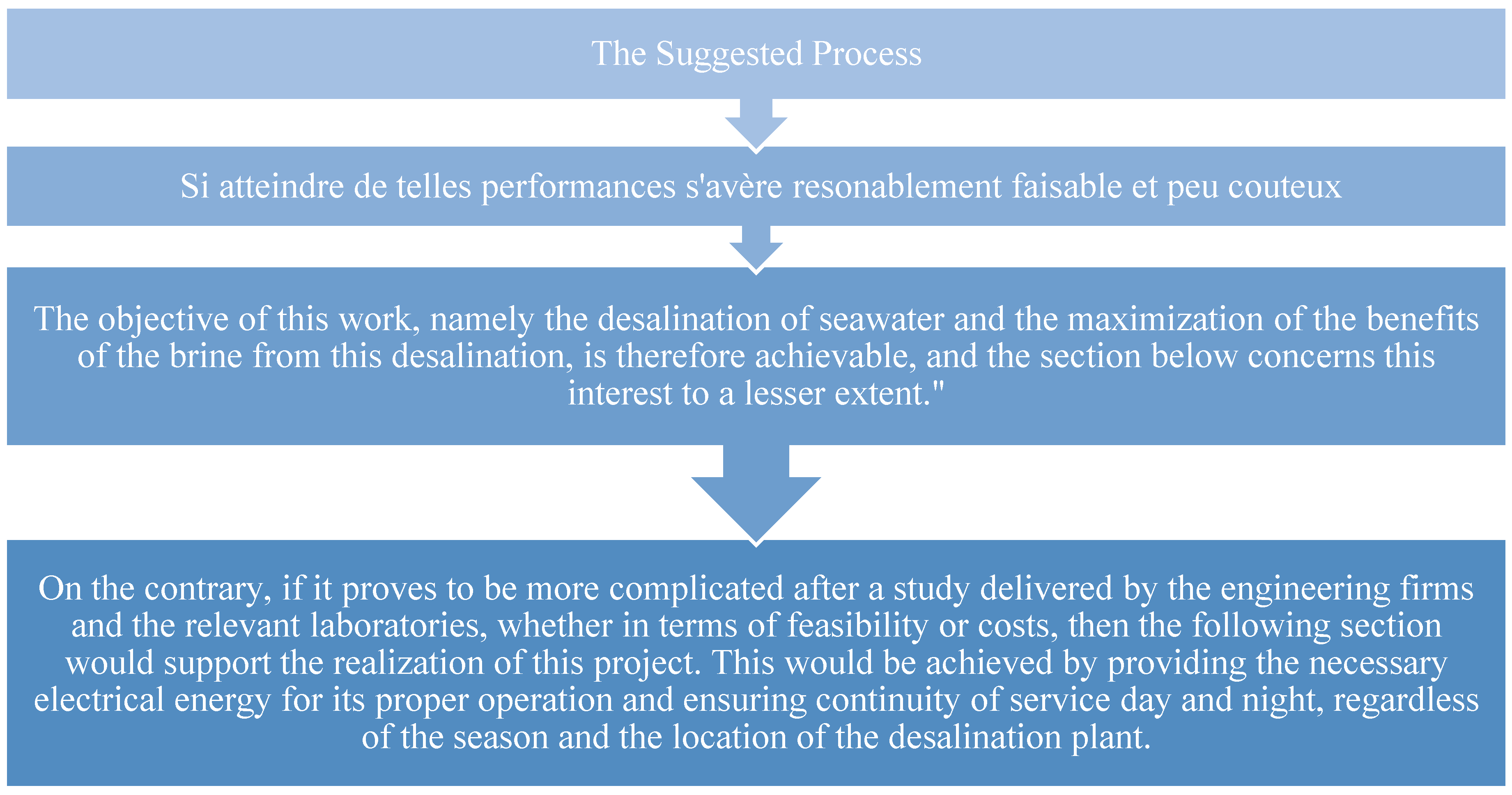
4. Situational Analysis and Identification of Paramount Challenges to Surmount
5. Investigation of the Multifaceted Dimensions (Technical, Ecological, and Economic) Subsequent to the Deployment of Such a Solution for a Real-World Scenario
- ✓
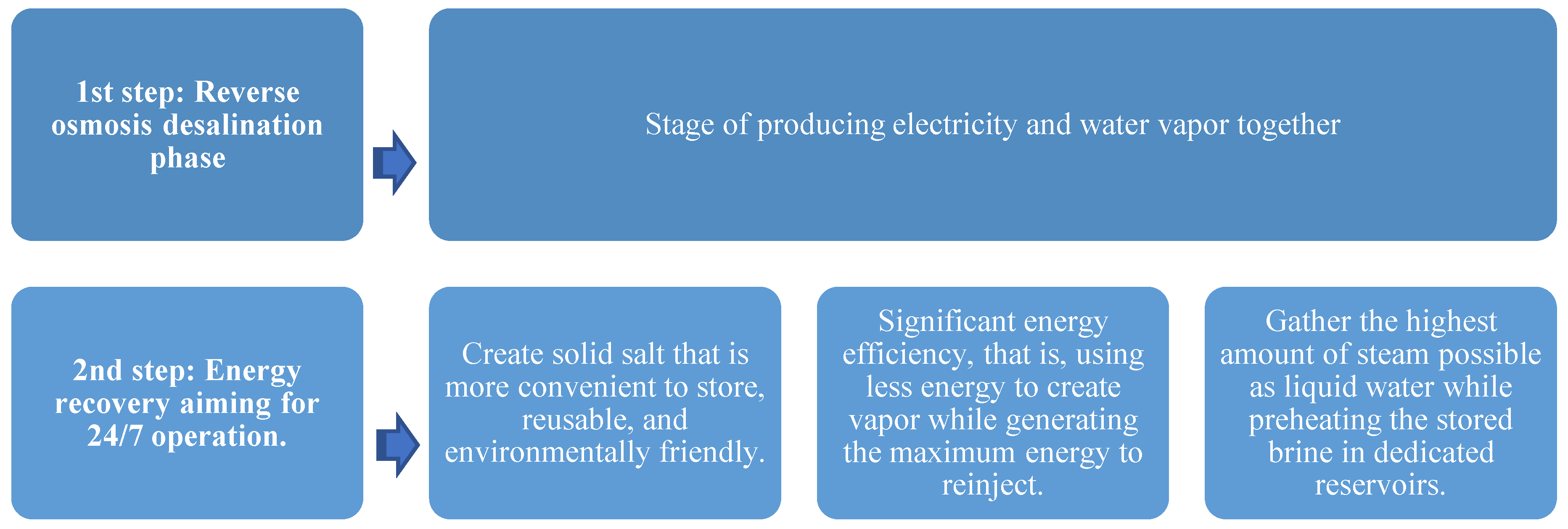
- At 20°C and standard atmospheric pressure, it takes roughly 0.65 kWh of electricity to evaporate a liter of water.
- ✓
- The energy demand to reach this temperature target could be substantially reduced if the project leverages deep geothermal energy. This approach would involve maintaining moderate temperatures and employing appropriate materials, as it requires managing water with a high salinity content.
- ✓
- Alternatively, it is estimated that approximately 2 liters of water are required to produce 1 kWh of electricity using turbines specifically designed for this purpose [14].
- ✓
-
By employing well-designed heat exchangers that involve steam from the thermal power plant and brine from the desalination plant [15], it is possible to:
- ▪
- On the one hand, it is possible to significantly increase the treated water from 50% using reverse osmosis to theoretically more than 90% by recovering the steam at the turbine outlet.
- ▪
- In addition, by incorporating the heat exchangers into the system as suggested in the study, it is possible to produce water at a much higher temperature than the ambient temperature. In fact, depending on the efficiency of the exchangers, this water could reach temperatures close to 70°C, and as a result significantly decrease the energy required for its evaporation.
- ✓
- Regarding the residual sea salt, it is used in various domains, including culinary, food preservation, cosmetics, health, industrial, agricultural, water treatment, and de-icing. It enhances the flavor of dishes, inhibits the growth of bacteria, exfoliates and softens the skin, improves circulation, and reduces inflammation. It is also used in the production of chemicals, textiles, and paper, as a natural fertilizer, and for water treatment and de-icing. This amount of salt is not insignificant, as it is 35 g/L.
- ✓
- Beyond the undeniable advantages of such an approach in tackling the challenges faced by the agricultural sector, particularly those related to drought, these initiatives can also contribute to combating global warming in multiple ways. Firstly, by implementing extensive afforestation efforts, these projects can help absorb CO2 from the atmosphere. Tree species such as Eucalyptus and Oaks are particularly effective carbon sinks, capable of storing up to 50 tons of carbon per hectare per year. Moreover, forests play a crucial role in mitigating the greenhouse effect, a phenomenon that has been extensively studied and documented by scientists. Forests emit significantly less infrared radiation compared to bare soil. In fact, implementing widespread afforestation can reduce infrared radiation emissions from 500 W/m² to a mere 200 W/m².
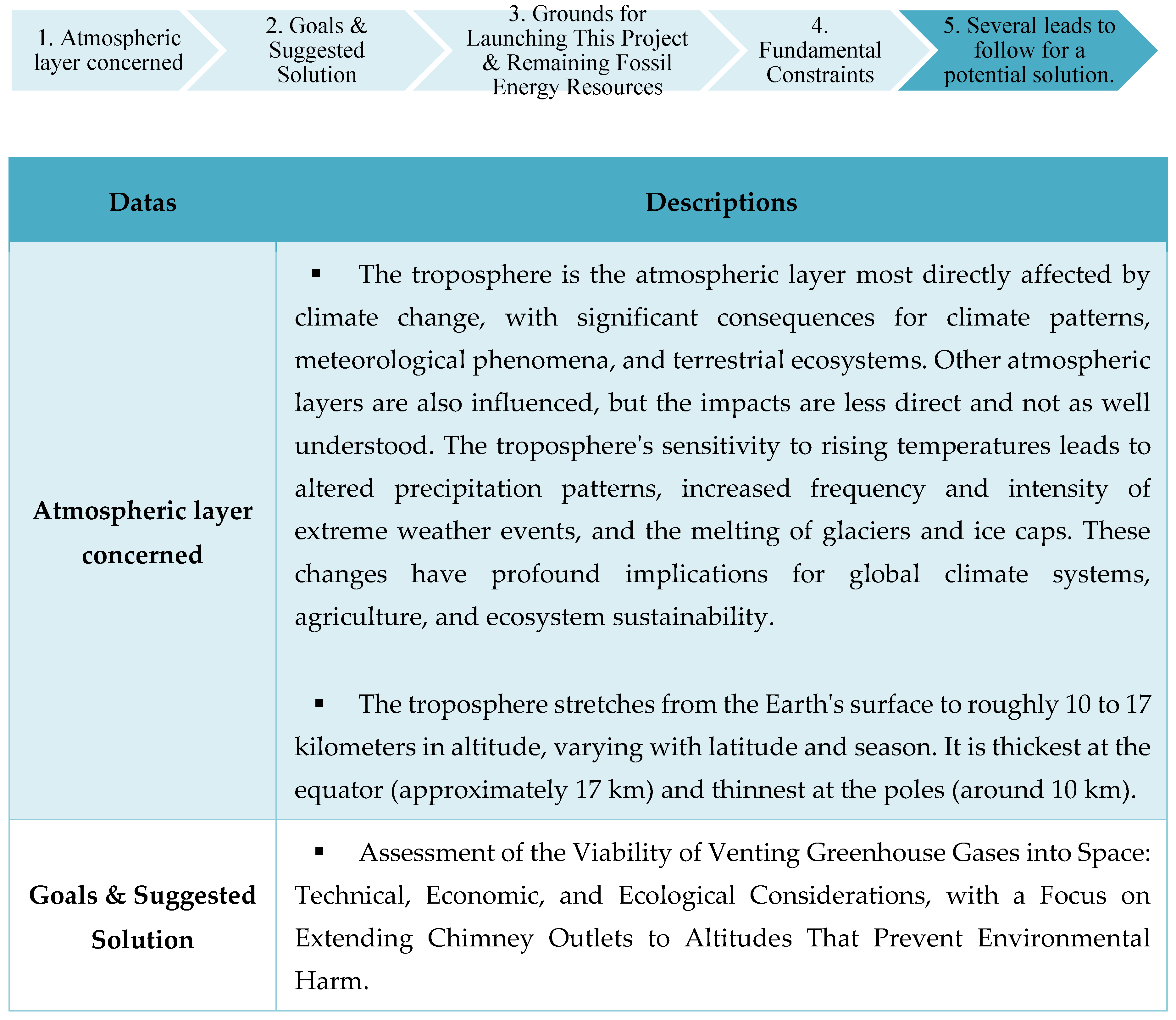
6. Boost the Prospects of Success for This Concept
- ❖
- Proposed Mechanism by the Present Study in This Regard:
7. Conclusions
Author Contributions
Funding
Institutional Review Board Statement
Informed Consent Statement
Data Availability Statement
Conflicts of Interest
References
- G. Daoust and J. Selby, “Climate change and migration: A review and new framework for analysis,” WIREs Climate Change, Apr. 2024. [CrossRef]
- Y. Turhan, “The hydro-political dilemma in Africa water geopolitics: The case of the Nile river basin,” African Security Review, vol. 30, no. 1, pp. 66–85, Jan. 2021. [CrossRef]
- N. Mancosu, R. Snyder, G. Kyriakakis, and D. Spano, “Water Scarcity and Future Challenges for Food Production,” Water (Basel), vol. 7, no. 3, pp. 975–992, Mar. 2015. [CrossRef]
- F. Dolan, J. Lamontagne, R. Link, M. Hejazi, P. Reed, and J. Edmonds, “Evaluating the economic impact of water scarcity in a changing world,” Nat Commun, vol. 12, no. 1, p. 1915, Mar. 2021. [CrossRef]
- W. Zhuang, “Eco-environmental impact of inter-basin water transfer projects: a review,” Environmental Science and Pollution Research, vol. 23, no. 13, pp. 12867–12879, Jul. 2016. [CrossRef]
- A. D. Mukasa, E. Mutambatsere, Y. Arvanitis, and T. Triki, “Wind energy in sub-Saharan Africa: Financial and political causes for the sector’s under-development,” Energy Res Soc Sci, vol. 5, pp. 90–104, Jan. 2015. [CrossRef]
- P. G. Youssef, R. K. AL-Dadah, and S. M. Mahmoud, “Comparative Analysis of Desalination Technologies,” Energy Procedia, vol. 61, pp. 2604–2607, 2014. [CrossRef]
- N. P. B. Tan, P. M. L. Ucab, G. C. Dadol, L. M. Jabile, I. N. Talili, and M. T. I. Cabaraban, “A review of desalination technologies and its impact in the Philippines,” Desalination, vol. 534, p. 115805, Jul. 2022. [CrossRef]
- K. Elsaid, M. Kamil, E. T. Sayed, M. A. Abdelkareem, T. Wilberforce, and A. Olabi, “Environmental impact of desalination technologies: A review,” Science of The Total Environment, vol. 748, p. 141528, Dec. 2020. [CrossRef]
- L. F. Greenlee, D. F. Lawler, B. D. Freeman, B. Marrot, and P. Moulin, “Reverse osmosis desalination: Water sources, technology, and today’s challenges,” Water Res, vol. 43, no. 9, pp. 2317–2348, May 2009. [CrossRef]
- Abd-Elaty, A. E. L. Shahawy, S. Santoro, E. Curcio, and S. Straface, “Effects of groundwater abstraction and desalination brine deep injection on a coastal aquifer,” Science of The Total Environment, vol. 795, p. 148928, Nov. 2021. [CrossRef]
- D. Kalma, T. R. McVicar, and M. F. McCabe, “Estimating Land Surface Evaporation: A Review of Methods Using Remotely Sensed Surface Temperature Data,” Surv Geophys, vol. 29, no. 4–5, pp. 421–469, Oct. 2008. [CrossRef]
- E. Savelli, M. Rusca, H. Cloke, and G. Di Baldassarre, “Drought and society: Scientific progress, blind spots, and future prospects,” WIREs Climate Change, vol. 13, no. 3, May 2022. [CrossRef]
- Mohamed, A. Khalil, and J. Wang, “Modeling and Control of Supercritical and Ultra-Supercritical Power Plants: A Review,” Energies (Basel), vol. 13, no. 11, p. 2935, Jun. 2020. [CrossRef]
- Q. Li, G. Flamant, X. Yuan, P. Neveu, and L. Luo, “Compact heat exchangers: A review and future applications for a new generation of high temperature solar receivers,” Renewable and Sustainable Energy Reviews, vol. 15, no. 9, pp. 4855–4875, Dec. 2011. [CrossRef]
- B. S. Mapani, R. N. Shikangalah, and A. L. Mwetulundila, “A review on water security and management under climate change conditions, Windhoek, Namibia,” Journal of African Earth Sciences, vol. 197, p. 104749, Jan. 2023. [CrossRef]
| Desalination technology | Energy consumption (kWh/m³) | Brine to drinking water ratio (Average) |
|---|---|---|
| Multi-stage flash (MSF) | 8 to 12 | 57% |
| Multi-effect distillation (MED) | 4 to 8 | 67% |
| Reverse osmosis (RO) | 3 to 6 | 50% |
Disclaimer/Publisher’s Note: The statements, opinions and data contained in all publications are solely those of the individual author(s) and contributor(s) and not of MDPI and/or the editor(s). MDPI and/or the editor(s) disclaim responsibility for any injury to people or property resulting from any ideas, methods, instructions or products referred to in the content. |
© 2025 by the authors. Licensee MDPI, Basel, Switzerland. This article is an open access article distributed under the terms and conditions of the Creative Commons Attribution (CC BY) license (https://creativecommons.org/licenses/by/4.0/).