

Submitted:
25 September 2025
Posted:
26 September 2025
You are already at the latest version
Abstract
Construction of new seawater reverse osmosis desalination (SWRO) plants in state of California (USA) requires environmental permits containing rather strict conditions. The California Ocean Plan requires the use of subsurface intake systems (SSIs) unless they are deemed to be not feasible. The Governor of California requested that the State Water Resources Control Board (State Board) study the issue of accelerating the desalination plant permitting process and making it more efficient. The State Board formed an independent scientific Panel to study the issue of SSI feasibility and to submit a report. The Panel recommendations included: the feasibility assessment (FA) for SSIs should be streamlined for completion within a maximum of three years, and this requirement should be added to the Ocean Plan; applicants need to perform a financial feasibility study before pursuing SSI capacities exceeding 38,000 m3/d (10 MGD) for wells or 100,000 m3/d (25 MGD) for galleries because project financing may be denied for such larger capacity systems; the mitigation options for each site-SSI combination be in the screening process should be addressed by both the project proponent and regulatory agencies as early as practicable in the overall permitting process; and the impacts of SSIs on local aquifers and associated wetlands systems must be assessed during the analyses conducted during the FA and during post-construction monitoring. The Panel further concluded that the design and evaluation of SSI-site combinations are highly site-specific, involving technically complex issues, which require both the applicant and the reviewing state agencies to have the expertise to design and review the applications. Economic feasibility must consider cost to the consumer and the engineering risk that can preclude project financing. Projected capacities exceeding the above noted limits may not by financed due to risks of failure or could require government guarantees to lenders. The current permitting system in California is likely to preclude construction of large seawater desalination facilities that can provide another source of potable water for coastal communities in California during severe droughts.
Keywords:
seawater desalination
; california
; subsurface intakes
; economics
; potable water supply
; feasibility
; permitting
1. Introduction
Southern and central California is a semi-arid region with limited natural water supplies [1,2]. A large portion of the water infrastructure that allowed the rapid and sustained growth of California was initially developed and funded by the federal government and came in the form of dams and surface water conveyance systems (aqueducts) both internal to California and from external river basins [1,3]. Extraction and infrastructure have impacted environmental and social systems, with potential for conflict. Groundwater is also an integral part of the water-supply system, particularly for agricultural irrigation in the Central Valley, where overuse has resulted in substantial land subsidence and damage to the aquifer systems [4,5,6].
California is subject to extreme climate events, such as floods and droughts, which have presented challenges to successful management of water supplies for the state [7,8,9,10]. Hanak et al. [3] summarized the water management situation as follows, “For more than 30 years, California has struggled to manage its water effectively. Numerous factors have contributed to this struggle, including changes in the value that society places on ecosystems, growing urbanization, declining state and federal financial and technical support, a shifting climate, and outdated water management systems. All these factors make water scarcity and increasing flood risk a part of life in California, now and for the indefinite future.” An adequate supply of water is a “essential factor” that maintains the viability of the economy [11,12,13], highlighting the issues of water cost and the value of sustainable water supplies [14].
Severe droughts have impacted California five times since 1906 [10]. Since California, particularly southern California, is dependent on conveyance of surface water from the Colorado River and from northern California, whenever a drought impacts all the primary water source areas, the situation becomes a “perfect drought” [10]. The most recent drought occurred between 2012 and 2015, exposing a potential disaster in the water-supply for southern California [15,16]. Water levels in the primary reservoirs dropped to extremely low levels and water use reductions were mandated. Severe economic impacts would have occurred if the drought had continued for another 6 to 12 months.
While the three-year duration of the drought had serious impacts, multi-year droughts” in the southwestern United States are not new. Prolonged droughts have been documented during the “medieval climate anomaly” between AD 800 and 1,350 [17,18,19,20] and droughts exceeding nine years occurred in the 12th century [10]. A climatic reconstruction of southern California between the 9th and 14th centuries showed severe declines in precipitation [21]. Many of these droughts were so severe that they caused structural changes in populations in the southwestern United States, including enhanced conflicts between population centers and abandonment of dwellings [7]. These drought periods were much greater in duration and intensity compared to any modern drought experienced in recent times in the region [7]. As our planet enters a period of severe climate change, the severity of major flooding and duration of drought events will likely increase [22,23].
Beyond water imports, there are alternative solutions to provide continuous supplies of freshwater to California. For coastal cities, large-capacity seawater desalination facilities could be used to meet the demands during severe droughts of extended duration. Other solutions include large-scale water reuse projects (primarily direct potable reuse), storm water capture and storage, and major conservation plans. Some researchers believe that demand management can resolve a significant portion of the water-supply problem [24,25]. While reduction in demand (conservation) is an important aspect in water management, the “hard” water use minimum must be met to avoid major economic impacts and temporary abandonment of population centers. One such crisis occurred in the City of Atlanta, when the Lake Lanier Reservoir nearly dried up in 2007, leaving only 35 days of supply left before it began to refill [26]. Without water, a major city like Atlanta would have had to shut down in part or fully, thereby creating a major economic disaster.
Desalination offers continuous supply and critical security, independent of other sources with origins external to the area where water is used. Only one current large-capacity seawater desalination plant (> 94635 m3/d or 25 MGD) is currently operated in southern California: the Carlsbad Desalination Plant located near San Diego [27,28]. The capacity (i.e., produced water) of this plant is about 190,000 m3/d (50 MGD). This drought-proof facility produces about 10% of the required water supply for the San Diego County Water Authority. The facility was constructed in a private-public partnership including a 30-years purchase agreement. It was developed by Poseidon Water and is currently owned and operated by Channelside Water Resources, an Aberdeen Company.
While the construction of new large-capacity seawater desalination plants is a viable solution to drought-proofing southern California, there has been considerable public opposition to seawater desalination in California [27]. Arguments have been made that the cost of seawater desalination is too high [27], the energy consumption is unacceptable [28,29,30], and the environmental impacts are unacceptable [27,31,32,33]. However, there are mitigative measures that can be applied to address each of the environmental concerns that impact seawater desalination [34,35,36]. Renewable energy can be used to power facilities using either stand-alone systems with battery backup or adding renewable energy systems to the primary grid. The entrainment and impingement issues can be mitigated by using restocking strategies for critical fish species and concentrate discharge can be mitigated by using sophisticated diffuser systems [37,38].
Other semi-arid areas of the world have addressed the environmental issues associated with seawater desalination and turned to the use of this technology to provide stability to their water supplies. For example, seawater desalination plants in Australia are used for primary supply of municipal water (Perth, Melbourne), supplemental supply on an as-needed basis (Gold Coast) and as emergency supply sources during extreme droughts (Sydney) or seasonal use (Adelaide) [39,40,41]. Seawater desalination plants have essentially drought-proofed key areas of Australia, therefore assuring continued economic growth and maintaining the existing population.
It has been suggested that few, if any new, large-capacity seawater desalination plants will be constructed and operated in California based on the onerous environmental permitting process [42,43]. The denial of a permit to design and construct a 190,000 m3/d (50 MGD) seawater desalination plant at Huntington Beach, after extensive study and review, is an example of the permitting issue [44,45]. One of the most contentious issues was the requirement of the 2019 California Ocean Plan that mandates the use of subsurface intake systems (SSIs) for all seawater desalination plants in the state to avoid the environmental issue of entrapment and impingement [46]. This requirement has created a level of permitting and financing uncertainty interwoven with unknown possible impacts of SSIs to coastal freshwater aquifers and wetlands, requiring specialized expertise in several technical fields to allow evaluation of feasibility.
The Governor of California has included seawater desalination facilities as a viable option for new water sources in the proposed water supply plan for California [47,48] and articulated a policy of accelerating the permitting process for water projects given uncertainties related to meeting California’s future water supply needs. The State Water Resources Control Board (State Board) was tasked by the Governor with preparing an amendment to the Water Quality Control Plan for the Ocean Waters of California (Ocean Plan) that would guide permit applicants in evaluating the feasibility of SSIs.
Currently, the Ocean Plan 2019 [46] does not provide extensive criteria or guidance on the scientific and technical studies necessary to assess the feasibility of an SSI. The State Board determined that an independent Panel of experts could provide guidance to desalination permit applicants on conducting feasibility assessments (FAs) for SSI, and that the information compiled could be used to inform possible future amendments to the Ocean Plan 2019 [46]. Details on the formation and operation of the Panel and the final report are included in the Supplemental Materials.
2. Materials and Methods
2.1. California Coastal Plan and Seawater Desalination Permitting
The basic intake requirements for the design and construction of seawater reverse osmosis facilities in California Ocean Plan are promulgated in the California Water Code section 13142.5(b), which states that.
For each new or expanded coastal powerplant or other industrial installation using seawater for cooling, heating, or industrial processing, the best available site, design, technology, and mitigation measures feasible shall be used to minimize the intake and mortality of all forms of marine life.
This requirement to minimize harm to marine life is expanded upon in Section M. “Implementation Provisions for Desalination Facilities,” subsections 2.b, c and d of the 2019 Ocean Plan. Subpart b requires a demonstration to the local Regional Water Quality Control Board (Regional Board) whether subsurface intakes are feasible for a project and that the proposed facility site is the best feasible site available to minimize marine intake and mortality of all forms of marine life. The applicant (i.e., owner or operator of the desalination facility) must “evaluate a reasonable range of nearby sites, including sites that would likely support subsurface intakes”. Subpart c similarly requires that the proposed facility design is the best available to minimize harm to marine life. Subpart d requires a demonstration to a Regional Board that the proposed technology is the best available technology to minimize marine intake and mortality of all forms of marine life. For approval of a surface intake, a Regional Board must agree that SSIs are not feasible. Subpart d includes some technical requirements for surface intakes (e.g., screen slot size and entrance velocity).
The California Environmental Quality Act (CEQA), adopted in 1969, defines feasible as “capable of being accomplished in a successful manner within a reasonable period of time, taking into account economic, environmental, social, and technological factors” (Section 21061.1). This is the same definition of “feasible” adopted for use in the Ocean Plan 2019. The Ocean Plan also identified additional factors to be considered in the feasibility evaluation of SSI. Specifically, the Ocean Plan [46] states that
The regional water board shall consider the following factors in determining feasibility of subsurface intakes:
- geotechnical data, hydrogeology, benthic topography, oceanographic conditions, presence of sensitive habitats,
- presence of sensitive species, energy use for the entire facility;
- design constraints (engineering, constructability), and
- project life cycle cost.
The Ocean Plan (2019) states that if an SSI is deemed to be financially infeasible, another intake type can be used. However, it cites the requirement for a life-cycle cost assessment by raising the issue of economic viability as follows:
“Subsurface intakes shall not be determined to be economically infeasible solely because subsurface intakes may be more expensive than surface intakes. Subsurface intakes may be determined to be economically infeasible if the additional costs or lost profitability associated with subsurface intakes, as compared to surface intakes, would render the desalination facility not economically viable.”
2.2. Formation of a Panel to Evaluate Feasibility of Using Subsurface Intake Designs
The terms of reference provided the direction to the Panel on how to assess SSIs in terms of feasibility. Guidance to the Panel was framed within a series of questions:
- How should a proposed desalination permit applicant complete this analysis? (e.g., what is the process to be followed consistent with the terms in the Ocean Plan 2019, Chapter III, Section M?)
- What modeling is necessary for determining SSI feasibility? (e.g., what groundwater modeling will be needed to assess potential impacts to aquifers near the site for a given SSI and/or to SSI support design requirements [e.g., well spacing and numbers, infiltration rate and gallery size]?)
- What components of a geophysical survey (including lithologic data) are needed to determine SSI feasibility?
- What key characteristics should be considered for the known SSI technology types? What are known information gaps in SSI technologies?
- What criteria should be used to determine whether additional data collection is necessary? (e.g., what level of accuracy is needed to define key system design parameters that determine feasibility?)
- What metrics and criteria should be used to evaluate test-well data for subsurface feasibility? (e.g., how do test well data inform the need for and range of parameters to be used in groundwater modeling?)
- What readily available data can be used to evaluate a reasonable range of sites? (e.g., what should a project proponent search for to define a range of sites that will provide the desired water quantity and also will likely support an SSI?)
- What is a reasonable shelf life for various data types? (e.g., which type of data is likely variable over time requiring regular characterization?)
These specific questions were addressed within the context of a proposed methodology that provides a framework that permit applicants could follow to conduct an SSI FA consistent with the Ocean Plan 2019, Chapter III, section M [46] in a time efficient manner. While the Panel had a narrow focus—to provide technical guidance to project applicants and the State Board for conducting FAs for SSIs, it should be recognized that the intake option is just one technical component of a desalination facility and that all components are significantly interrelated.
2.3. Panel Approach to Determining Feasibility
The Panel developed a methodology for determining the feasibility of using SSIs and evaluating SSI options as summarized in a decision-tree diagram (Figure 1). The sequential process would allow a project proponent to conduct an FA in six stages, with each stage requiring frequent interactions with the applicable Regional Board. The intent of this sequence is to ensure that project-specific Regional Board concerns be identified at the start of each stage and can be timely and efficiently addressed.
Stages 1 through 3 are essentially a screening process to determine which SSI-site combination with a specified intake capacity should proceed to the next stage. As noted in the Panel report and based on the recent report to streamline the permitting process for water supply projects [47,48], some permit approvals will precede the initiation of the FA, during which time several key project attributes will be presented to regulatory agencies in a conceptual project proposal, and in particular an agreed-upon intake capacity. Any project proponent interested in making a request for a permit would need to complete these initial studies before initiating the overall permitting process. The intent of this proposed stepwise methodology is to minimize the applicant’s risk of having to restart the review of multiple new site-SSI combinations. A critical step in this process is the agreement by the stakeholders regarding the need to construct a desalination facility and to specify the associated capacity.
Stages 1 through 3 are largely desktop investigations involving minimal field investigations. The transition to Stages 4 and 5, which would require Regional Board guidance, involves the consideration of the need for and collection of additional data needed to complete the FA. Stages 4 and 5 may include additional field studies or final pilot tests at an appropriate scale. Details on the types of technical data needed, sources of that data and appropriate methods for collecting the field data, performing modeling, or conducting pilot studies are compiled in Section 4 of the Panel Report, including technical data needed to assess factors related to the environmental, social, and economic assessment of feasibility, as identified in the Ocean Plan 2019 [46].
Stage 6 of the proposed methodology consists of analysis and documentation of data collected to complete the FA. The applicant would then meet with the Regional Board to agree on the contents of the final report presenting the outcome of the assessment and, following submittal and approval of the final report, proceed to the next phase of the overall permitting process. The Panel recognized that this methodology would require substantial involvement of Regional Board staff, and that provision of interim guidance will be an essential component of a timely and successful permit application.
3. Results of the Panel Analysis
3.1. Subsurface Intake Systems Used for Seawater Desalination Plants
SSIs can be divided into two types: those that use extraction wells and those that use trenches and galleries [35,36]. The type of intake that is most appropriate for a given system capacity and location is highly dependent upon site-specific hydrogeological and environmental conditions. The optimal system type for a specific location will be able to reliably provide the required flow of seawater of a suitable quality, have lower total costs (construction and operational) than other SSI options, and will not cause adverse environmental impacts during construction or operation that cannot be mitigated. Detailed summaries of the main SSI system types most commonly used worldwide are presented in the Panel Final Report [49] and summarized in Table 1.
3.2. General Feasibility Factors Considered by the Panel
The Panel developed a series of feasibility factors to determine whether SSIs can be used at any given location based on the desired capacity of the desalination facility and the local site geologic conditions. The key aspects for screening site-technology combinations to determine feasibility include the following with more details provided in Table 2:
- • Technological: The project site and SSI combination should be capable of reliably providing the desired volume of desalinated water, sufficiently resilient against natural hazards such as sea level rise, capable of construction, and should have no deleterious impacts on local aquifers or wetlands.
- • Environmental: Construction of the SSI system should not result in unacceptable impacts to sensitive habitats and species within the zone of influence of the SSI footprint, including the indirect impacts that might result in damage to coastal freshwater aquifer dependent habitat and associated species and must avoid location near Marine Protected Areas (MPA) and State Water Quality Protection Areas (SWQPAs).
- • Economic: Capital and life cycle costs should be within a range that allows for likely available financing of the project. Typically, capital costs for SSIs are higher than open ocean intakes but these costs can be offset by lower operating costs and potential in other costs (e.g., disposal of treatment plant residuals). These benefits of SSI use would be incorporated into the life cycle cost analysis.
- • Social: Water supply affordability is the chief issue of social impact concern. Any incremental life cycle costs associated with SSIs (relative to other intake options) should not result in an undue economic burden on communities.
3.3. Policy Recommendations
The Panel provided the following recommendations on issues that will impact the ability of an applicant to obtain a permit for a desalination plant within a reasonable time frame. More detailed support information is contained in the Panel’s final report [49]. These recommendations recognize the stated desire by the State to expand options for communities on the California coast to include seawater desalination plants as part of their long-term water management plans to meet future demand for potable water sources [47,48]:
- Obtaining a permit from the Regional Water Boards for a desalination project in California requires a project proponent to complete multiple tasks before receiving a Regional Water Board Water Code section 13142.5(b) determination under Chapter III.M.2.a.(1) of the Ocean Plan. The completion of these tasks may take several years. Thus, the Panel recommends that the evaluation of SSIs be streamlined for completion within a maximum of three years. Given that preceding tasks will constrain the intake capacity, site, and applicable SSI combinations to be evaluated in the FA step, this recommended duration should be achievable absent the need for scaled pilot tests with the assumption that regional boards will have sufficient resources to provide interim guidance at identified transition points with the six proposed stages of the FA process (See Figure 1).
- Life cycle costs and thus unit prices for water delivered by a desalination plant will likely be higher than costs for other sources of water supply based on the experience of Panel members. In some cases, life cycle costs comparing open intakes with SSI may be lower due to lower pretreatment costs prior to membrane treatment (i.e., reverse osmosis) and other factors. However, the use of a SSI may increase overall life cycle costs and uncertainty, given their relatively limited application at a scale above 38,000 m3/d (10 MGD) of produced water and associated financial risk. These economic consequences may pose significant challenges to obtain financing for desalination facilities with hydraulic capacities exceeding this scale. One option that could be considered by the State is to provide some form of financial instrument that would mitigate the financial risks associated with early adopters using SSIs at scales larger than 38,000 m3/d.
- Recent policies from several agencies addressing environmental justice concerns over water rates require that any permit applicant must conduct an affordability assessment to evaluate the impacts of incremental increases in costs on low-income ratepayers. This will need to be considered in any future amendments to the Ocean Plan.
- Given the potential for subsurface connectivity between coastal wetlands or coastal freshwater aquifers and SSI source waters, the Panel recommends that this concern receive careful consideration both during the analyses conducted in the FA and during post-construction monitoring of source-water salinity. Regular reporting on source-water salinity should be required in any plant operating plan if there is a risk of impacts inferred from groundwater modeling studies of the site-SSI combination.
4. Discussion
4.1. Difficulties Obtaining Environmental Permits for Construction of Desalination Plants in California
There is one large-scale seawater desalination plant operating in California, which has a capacity of about 190,000 m3/d (50 MGD). However, an application to build a similar capacity plant for Huntington Beach was denied after nearly ten years in the permitting process. Environmental permits for other smaller capacity facilities have been bogged down in the regulatory process for nearly a decade.
As noted, the Ocean Plan [46] requires the use of SSIs unless determined not to feasible. This requirement has added a significant obstacle to obtaining a permit for building another high-capacity SWRO plant (97,000 m3/d) in California. In our opinion the likelihood of successful permitting of another high-capacity facility is low based on the current Ocean Plan requirements. There are two major issues that project developers must overcome. First, the scope, cost, and duration of the permitting process have become major issues that dissuade many potential applicants from considering seawater desalination in their portfolio of water-supply solutions. Second, regulators seem to underestimate that cost is a major issue in the design, construction, and operation of SWRO plants which controls the ability to obtain project funding. Perhaps the most significant cost issue that limits the ability to obtain project financing is engineering risk. The maximum existing demonstrated capacity for SSIs is 38,000 m3/d for wells and 98,500 m3/d for a seabed gallery [35,36]. When a pre-construction financing assessment is performed, the engineering team assesses all components of a system and highlights any component that has a capacity greater than some “normal” range of proven values. When a project proposes an SSI capacity that exceeds the world’s largest capacity system, project financing can be denied without special guarantees. Therefore, this issue will likely limit the use of SSIs in California desalination plants to those with lower capacities.
Environmental concerns with impingement and entrainment on marine organisms led to a policy decision to pursue sub-surface intakes in all cases without an assessment of the impact of sub-surface intakes (e.g., the significant likelihood that SSI implemented on sandy coasts will impact coastal aquifers and/or wetlands). However, possible mitigation methods for impacts caused by impingement and entrainment using a surface intake system were not considered. Given that the requirement of SSIs appears to have curtailed development of seawater desalination in California, the Governor’s memorandum demands a more holistic view of the components of a desalination facility and the role of desalination in providing long term security and resiliency for water supply in coastal communities.
4.2. Seawater Desalination: Water Sustainability and Resilience in California
Water-supply utilities and other water users worldwide are currently reassessing their reliance on surface-water and groundwater supplies to ascertain their sustainability and resilience during extreme climatic conditions [50,51,52,53]. MacDonald [54] concluded that climate change requires technical innovations, policy changes, and market-based solutions to meet future water supply demands. He concluded “Meeting 21st-century sustainability challenges in the Southwest will also require planning, cooperation, and integration that surpass 20th-century efforts in terms of geographic scope, jurisdictional breadth, multisectoral engagement, and the length of planning timelines.” In a detailed analysis of the issue of water management adaptation to climate change in California, Tanaka et at. [55] concluded “Even in the dry scenario, southern California cannot seek additional water imports. Population growth, conveyance limits on imports, and high economic values lead to high levels of wastewater reuse and lesser, but substantial, use of seawater desalination.”
Another important issue of water management in California is the issue of resiliency based on future policy changes external to California and other internal environmental hazards. One very important source of water for California is the Colorado River, which is one of the most overallocated rivers in the world [56,57,58,59]. The potential impact for reallocation of the water rights in the Colorado River is an issue that cannot be ignored by water managers in California [60].
Another potential internal issue that could create a water supply emergency in southern California is the issue of earthquake damage to the aqueduct system that is so critical to the freshwater supply [61]. Desalination plants would be located near the coast where the largest concentration of water users exist. This potential water source would be available even during drought or following earthquake damage to the regional system, similar to the Australian experience with seawater desalination [40,41]. Therefore, seawater desalination should be considered as a key part of a portfolio of options to address the resilience of water supply options for all coastal communities that will be endangered by severe droughts and who lack access to alternative water sources. This option should not be eliminated from consideration by an impractical regulatory process addressing the SSI requirements.
5. Conclusions
Intakes are only one component of any SWRO facility. Any intake type must be reliable in any set of weather or environmental conditions to provide the desired amount of raw water to allow continuous SWRO plant operation. The seawater water quality from the SSI must be consistent and not variable enough to necessitate a change in the treatment process (i.e., increases in dissolved iron, manganese, or organic matter).
SSIs have been used in small to intermediate capacity SWRO facilities for decades and have been shown to operate at lower costs compared to conventional open-ocean intakes. They also operate using less chemical input and with lower residuals disposal. However, SSIs for very large capacity plants can raise the capital costs by two hundred percent in some cases. The issue of engineering risk is the most difficult barrier to overcome when using an SSI for SWRO plants with capacity exceeding 37,850 m3/d (10 MGD) in California and other locations. Worldwide no SSI has been used to feed any large capacity SWRO plants in the last decade.
To allow for large-capacity SWRO plants to be developed in California to provide needed water security and resiliency to global climate change, external water policy changes, and earthquakes, the regulatory process needs to be streamlined. Without a flexible and adaptable permitting process, the answer to the title of our paper is a definite negative: seawater desalination will not play an important role in future water supply for California. When the need for desalinated water is identified in a community and consistent with applicable water planning documents, the regulatory process should allow SWRO plants to be permitted and constructed in a timely manner while ensuring that environmental impacts are minimized (i.e., alternatives are considered). Limitation of the permitting process duration to three years for SSI feasibility determination would be a good start. State financial guarantees for larger scale facilities using SSIs would mitigate the issue of engineering risk. The issue of water-supply resiliency should be a factor in the assessment of the feasibility of construction of seawater desalination plants near coastal cities in California.
Supplementary Materials
The following supporting information can be downloaded at the website of this paper posted on Preprints.org.
Author Contributions
T.M.M., M.C.K., R.G.M., J.C., J.R.S., and J.L.L. were Panel members and contributed to all aspects of the paper. J.Ch. was a technical editor and contributor.
Funding
Funding for this project has been provided in full or in part by the United States Environmental Protection Agency and the State Water Resources Control Board under the Federal Water Quality Management Planning Program (Clean Water Act section 205[j]).
Data availability
All data used in the preparation of this paper is contained in the text or is presented in the Supplemental Materials (full committee report with attached statement of the State Board).
Acknowledgements
The authors thank Scott T. McCreary, Robert H. Twiss, and Debbie Schechter of Concur, Inc. who organized the committee and constructed the technical report which is summarized in our paper. Leslie Moulton-Post was a member of the committee that chose not to participate in this paper.
Conflicts of Interest
The authors declare that they have no competing financial interests or personal relationships that could have appeared to influence the work reported in the paper.
References
- Reisner, M. Cadillac Desert: The American West and Its Disappearing Water. Penguin Books, New York, 1986.
- Carle, D. An introduction to water in California. University of California Press, Berkley, CA, 2004.
- Hanak, E.; Lund, J.; Dinar, A.; Gray, B.; Howitt, R.; Mount, J.; Moyle, P.; Thompson, B. Managing California’s Water: From Conflict to Reconciliation. Public Policy Institute of California, San Francisco, CA, 2011.
- Poland, J.F.; Lofgren, B.E.; Ireland, R.L.; Pugh, R.G. Land subsidence in the San Joaquin Valley, California, as of 1972. U.S. Geological Survey Professional Paper 437-H, 78 pp., 1975. http://pubs.er.usgs.gov/publication/pp437H.
- Bean, R.T. Pioneering field study of hydro compaction in the San Joaquin Valley, In Land Subsidence ― Case Studies and Current Research; Borchers, J.W., Ed.; Proceedings of the Dr. Joseph F. Poland Symposium on Land Subsidence, Association of Engineering Geologists Special Publication 8, 1998, 37-44.
- Smith, R.G.; Majumdar, S. 2020. Groundwater storage loss associated with land subsidence in western United States mapped using machine learning. Water Resourc. Res. 2020, 56 (7), e2019WR026621.
- MacDonald, G.M. Severe and sustained drought in southern California and the West: Present conditions and insights from the past on causes and impacts. Quaternary International 2007, 11, 173-174. [CrossRef]
- MacDonald, G.M.; Kremenetski, V.; Hidalgo, H.C. Southern California and the perfect drought: Simultaneous prolonged drought in southern California and the Sacramento and Colorado River systems. Quaternary International 2008, 188(1), 11-23.
- MacDonald, G.M.; Rian, S.; Hidalgo, H.C. Southern California and “The Perfect Drought”. In Colorado River Basin Climate. California Department of Water Resources. Sacramento, California, 2008.
- Woodhouse, C.A.; Meko, D.M.; Bigio, E.R. A long view of southern California water supply. J. Am. Water Res. Assoc. 2020, 4, 212-229.
- Gleick, P.H. Safeguarding our water - making every drop count. Sci. Am. 2001, 284(2), 40-45.
- Perry C. Accounting for water; stocks, flows, and values. In Inclusive wealth report 2012 measuring progress toward sustainability, Edited by UNU-IHPD and UNEP, pp. 215–230, Cambridge University Press, Cambridge, 2012. https://europa.eu/capacity4d ev/file/11228/download?token=hF31YA_j.
- Badiuzzaman, P.; McLaughlin, E.; McCauley, D. Substituting freshwater: Can ocean desalination and water recycling capacities substitute for groundwater depletion in California. J. Environ. Manage. 2017, 201, 123-135.
- Heokstra, A.Y. The Water Footprint of Modern Consumer Society. Routledge, Taylor & Francis Group, Boca Raton, FL, USA, 2020.
- Griffin, D.; Anchukaitis, K.J. How Unusual is the 2012–2014 California Drought?. Geophys. Res. Letters 2014, 41(24), 9017–9023. [CrossRef]
- Lund, J.; Medellin-Azuara, J.; Durand, J.; Stone, K. Lessons from California’s 2012–2016 drought. J. Water Resour. Plan. Manage. 2018, 144, 2012–2016. [CrossRef]
- Stine, S. Extreme and persistent drought in California and Patagonia during medieval time. Nature 1994, 369, 546-549.
- Jones, T.L.; Brown, G.; Raab, L.M.; McVicar, J.; Spaulding, G.; Kennett, D.J.; York, A.; Walker, P.L. Environmental imperatives reconsidered: Demographic crisis in western North America during the Medieval Climate Anomality. Current Anthropology 1999, 40, 137-156.
- Jones, T.L. Late Holocene cultural complexity along the California coast. In Catalysts to Complexity: Late Holocene Societies of the California Coast. Erlandson, T.M.; Jones, J.L., Eds. Cotsen Institute of Archaeology, UCLA, Los Angeles, CA, pp. 1-12, 2002.
- Case, R.A.; MacDonald, G.M. Tree ring reconstruction of streamflow for three Canadian Prairie rivers. J. Am . Water Res. Assoc. 2003, 39, 703-716.
- Kennett, D.J.; Kennett, J.P. Competitive and cooperative responses to climate instability in southern California. Am. Antiquity 2000, 65, 379-393.
- Arnell, N.W.; Gosling, S.N. The impacts of climate change on river flood risk at the global scale. Climatic Change 2016, 134, 387–401. [CrossRef]
- Mukherjee, S.; Mishra, A.; Trenberth, K.E. Climate change and drought: a Perspective on drought indices. Curr. Clim. Change Rep. 2018, 4, 145–163. [CrossRef]
- Gleick, P.H.; Haasz, D.; Henges-Jeck, C.; Srinivasan, V.; Wolff, G.; Cushing, K.K.; Mann, A. Waste Not, Want Not: The Potential for Urban Water Conservation in California. Pacific Institute for Studies in Development, Environment, and Security, Oakland, CA, 2003.
- Gleick, P.H.; Cooley, H.; Groves, D. California Water 2030: An Efficient Future. Pacific Institute for Studies in Development, Environment, and Security, Oakland, CA, 2005.
- Missimer, T.M.; Danser, P.A.; Amy, G.L.; Pankratz, T. Analysis of a water crisis: The metropolitan Atlanta, Georgia Regional water supply conflict. Water Policy 2014, 16, 669-689. [CrossRef]
- Weinberg, K.; Yamada, R.; Callahan, N.V.; Bianes, V.; Chamberlain, D.; Suydam, T.; Raton, G. Integrating desalinated seawater with existing supplies and delivery systems. J. Am. Water Works Assoc. 2014, 106(2), 58-63.
- McFarland, P.H. Water industry veteran pivotal in fate of milestone desalination plant. Engin. News-Record 2016, 275(19), 34.
- Cooley, H.; Gleick, P.H.; Wolff, G. Desalination, with a Grain of Salt: A California Perspective. Pacific Institute for Studies in Development, Environmental, and Security, Oakland, CA, USA, 100 pp., 2006.
- Cooley, H.; Heberger, M. Key issues in seawater desalination in California: Energy and greenhouse gas emissions. Pacific Institute for Studies in Development, Environmental, and Security, Oakland, CA, USA, 2013.
- Miller, S.; Shemer, H.; Semlat, R. Energy and environmental issues in desalination. Desalination 2015, 316, 2-8.
- Heihsel, M.; Lenzen, M.; Malik, A.; Geschke, A. The carbon footprint of desalination, Desalination 2019, 454, 71-81.
- Lattemann, S.; Höpner, T. Environmental impact and impact assessment of seawater desalination. Desalination 2008, 220, 1-15.
- Cooley, H.; Ajam, N.; Heberger, M. Key Issues in Seawater Desalination in California: Marine Impacts. Pacific Institute for Studies in Development, Environmental, and Security, Oakland, CA, USA, 2013.
- California Water Boards. Desalination Facilities Intakes, Brine Discharges, and the Incorporation of Other Non-substantive Changes. Environmental Protection Agency, Sacramento, CA, USA, 2014.
- Shahabi, M.P.; McHugh, A.; Anda, M.; Goen, H. Environmental life cycle assessment of seawater reverse osmosis desalination plant powered by renewable energy. Renew. Energy 2012, 67, 53-58.
- Missimer, T. M.; Maliva, R.G. Environmental issues in seawater RO desalination: Intakes and outfalls. Desalination 2017, 434, 198-215. [CrossRef]
- Missimer, T.M.; Jones, B.; Maliva, R.G. Intakes and Outfalls for Seawater Reverse Osmosis Desalination Facilities: Innovations and Environmental Impacts. Springer, Dordecht, The Netherlands, 2015.
- Roberts, P.J.W.; Ferrier, A.; Daviero, G.J. Mixing in inclined dense jets. J. Hydraul. Eng. Div. Am. Soc. Civil Eng. 1997, 123(8), 693-699.
- Roberts, P.J.W. Near field dynamics of concentrate discharges and diffuser design. In Intakes and Outfalls for Seawater Reverse Osmosis Desalination Facilities: Innovations and Environmental Impacts; Missimer, T.M.; Jones, B.; Maliva, R.G., Eds. Springer, Dordecht, The Netherlands, pp. 369-396, 2015.
- El Saliby, J.; Okour, Y.; Shon, H.K.; Kandasamy, J.; Kim, I.S. Desalination plants in Australia, review and facts. Desalination 2009, 247, 1-13.
- Palmer, N. Changing perception of the value of urban water in Australia following investment in seawater desalination. Desal. Water Treat. 2012, 43, 298-307. [CrossRef]
- Crisp, G. P. Desalination and water reuse-sustainably drought proofing Australia. Desal. Water Treat. 2021, 42(1-3), 323-332.
- Denson, T. Desalination and California’s Water Problem: The Viability of the Desalination Industry Through the Lens of California’s New Desalination Rules and Development. Georgetown Law Center, Washington, D.C., 2016. https://gielr.wordpress.com/wp-content/uploads/2017/01/zsk00416000713.pdf.
- Missimer, T.M. The California Ocean Plan: Does it eliminate the development of large-capacity SWRO plants in California? Proceedings, American Membrane Technology Association/American Water Works Association, 2016 Membrane Technology Conference & Exposition, San Antonio, Texas, Feb. 1-5, 2016.
- Bittner, R.; Kavanaugh, M.; Feeney, M.; Maliva, R.G.; Missimer, T.M. Technical feasibility of subsurface intake designs for the proposed Poseidon water desalination facility at Huntington Beach, California. Independent Scientific Advisory Panel, California Coastal Commission and Poseidon Resources (Surfside) LLC Final Report, 2014.
- Bittner, R.; Clements, J.; Dale, L.; Lee, S.; Kavanaugh, M.; Missimer, T.M. Phase 2 report: Feasibility of subsurface intake designs for the proposed Poseidon water desalination facility at Huntington Beach, California. Independent Scientific Advisory Panel, California Coastal Commission and Poseidon Resources (Surfside) LLC Final Report, 2015.
- California Environmental Protection Agency (Ocean Plan). California Ocean Plan. State Water Resources Control Board, 1001 I Street, Sacramento, CA, USA, 2019.
- State of California. California’s Water Supply Strategy: Adapting to a Hotter, Drier Climate. 2022. Online at: https://resources.ca.gov/-/media/CNRA-Website/files/initiatives/water-resilience/CA-water-supply-strategy.pdf.
- California Department of Water Resources. California Water Plan Update, 2023. Online at : https://water.ca.gov/Programs/California-Water-Plan/Update-2023.
- Clements, J.; Kavanaugh, M.C.; Largier, J.L.; Maliva, R.G.; Missimer, T.M.; L. Moulton-Post, L.; Stokes-Draut, J.R. Final desalination subsurface intake panel report. Prepared by the Subsurface Intake Expert Panel and Facilitated and convened by Concur, Inc., 2024.
- United Nations Educational, Scientific and Cultural Organization (UNESCO). Water and climate change. The United Nations World Water Development Report 2020. UNESCO, Paris, France. Online: https://repository.unescap.org/server/api/core/bitstreams/f2446069-c3a0-42bf-bc88-3e655ff3b2e1/content.
- Yang, Y.C.E.; Son, K.; Hung, F.; Tidwell, V. Impact of climate change on adaptive management decisions in the face of water scarcity. J. Hydrology 2020, 588, 125015. [CrossRef]
- Salehi, M. Global water shortage and potable water safety; Today’s concern and tomorrow’s crisis. Environ. Int. 2022, 158, 106936. [CrossRef]
- Rosa, L.; Sangiorgio, M. Global water gaps under future warming levels. Nature Communications, 2025, 16, 1192. [CrossRef]
- MacDonald, G.M. Water, climate change, and sustainability in the southwest. PNAS 2020, 107(50), 21,256-21,262. [CrossRef]
- Tanaka, S.K.; Zhu, T.; Lund, J.R.; Howitt, R.E.; Jenkins, M.W.; Pulido, M.A.; Tauber, M.; R.S. Ritzema, I.C. Ferreira. Climate warming and water management adaptation for California, Climatic Change 2006, 76, 361-387. [CrossRef]
- Wheeler, K.G.; Udall, B.; Wang, J.; EKuhn, E.; Salehabadi, H.; Schmidt, J.C.. What will it take to stabilize the Colorado River? Science 2022, 377, 373–375.
- Richter, B.D.; Lambhir, G.; Marston, L.; Dhakal, S.; Sangha, L.S.; Rushforth, R.R.; Wei, D.; Ruddell, B.L.; Davis, K.F.; Hernandez-Cruz, A.; Sandoval-Solis, S.; Schmidt, J.C. New water accounting reveals why the Colorado River no longer reaches the sea. Commun. Earth Environ. 2024, 5, 134.
- Overpeck, J.; Udall, J.B. Climate change and the aridification of North America. Proc. Natl Acad. Sci. USA 2020, 117, 11856–11858.
- Udall, B.; Overpeck, J. The twenty-first century Colorado River hot drought and implications for the future. Water Resour. Res. 2017, 53, 2404–2418.
- Womble, P.; Gorelick, S.M.; Thompson, Jr., B.H.; Hernandez-Suarez, J.S. A strategic environmental water rights market for Colorado River allocation. Nature Sus. 2025, 8, 925-935. [CrossRef]
- Davis, C.A. Los Angles water supply impacts from a M7.8 San Andres Earthquake scenario. AQUA – Water Infrastructure Systems, Ecosystems, and Society, 2010, 59(6,7), 408. [CrossRef]
Figure 1.
Conceptual decision tree for conducting an SSI feasibility assessment.
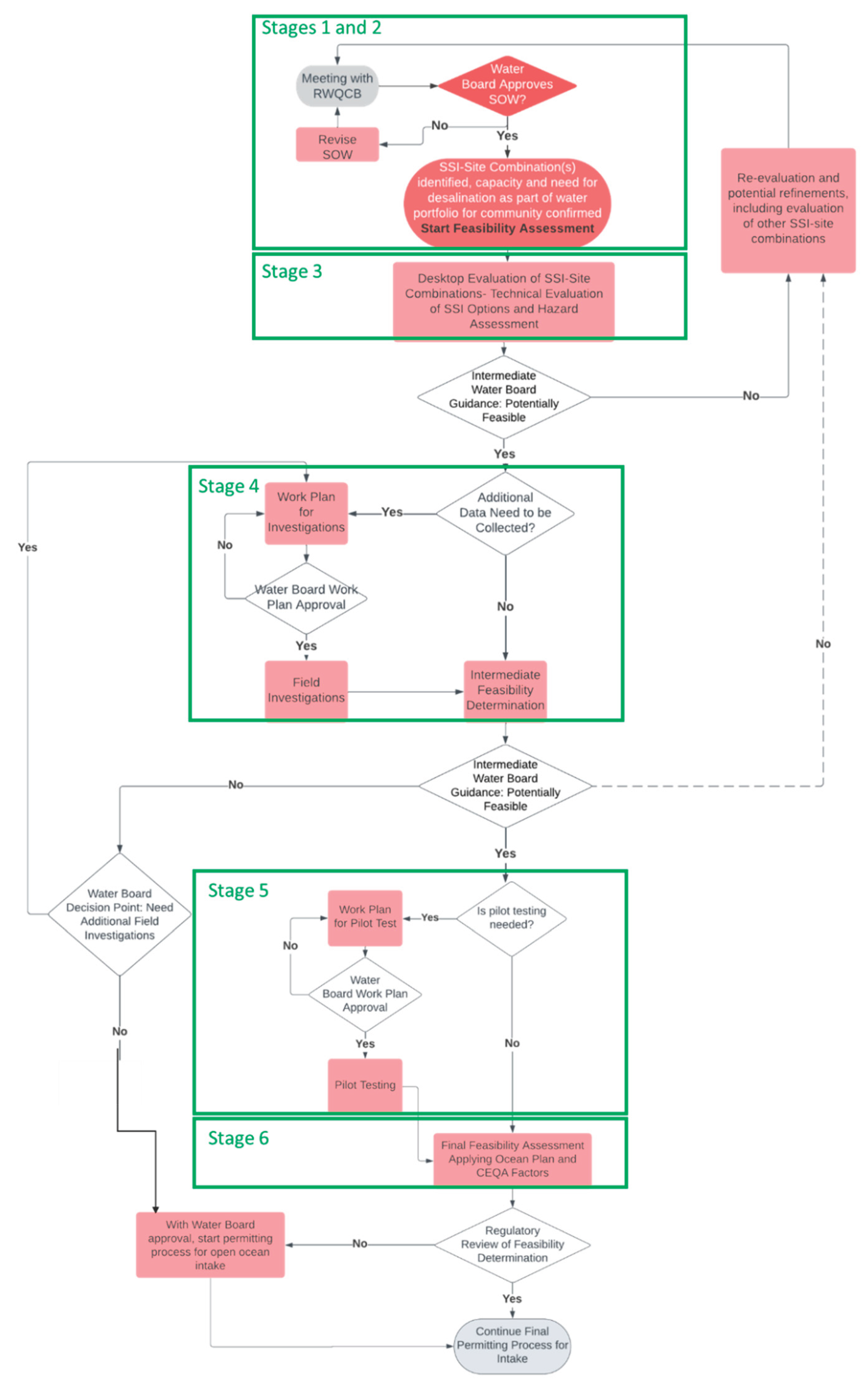

Table 1.
Summary of subsurface intake types.
| Intake Type | Description |
| Beach wells | Shallow vertical wells producing from beach or shallow rock deposits |
| Horizontal or Ranney collector well | A large diameter caisson from which lateral perforated spokes are advanced out from the caisson toward or under a proximate water body |
| Slant or angle wells | Wells drilled at an angle from the shore under an adjacent water body to induce downward flow in the well through the overlying sediments. |
| Horizontal wells | Shallowly buried screens fanning out beneath the seafloor installed by directional drilling from the shore. |
| Beach (surf zone) galleries | A slow sand filter that is constructed beneath the intertidal zone of the beach. |
| Seabed galleries or seabed infiltration galleries | A slow sand filter that is constructed beneath the subtidal zone. |
| Tunnel intakes |
Tunnel constructed underlying the beach area with a series of collectors, commonly drilled upward into the overlying aquifer |
Table 2.
General feasibility factors.
| Factor Type | Feasibility Consideration |
|---|---|
| TECHNOLOGICAL | |
| Constructability | The site-SSI combination should be capable of providing the desired volume (capacity) of desalinated water. It must be physically possible to construct the system in the vicinity of the treatment plant. Physical conditions at the site should be stable enough so that the system could operate reasonably consistently over its planned lifetime (typically 30 years). Ability to obtain permits associated with the SSI from other agencies in a reasonable time (e.g., land use permits). |
| Reliability | The raw water must be of suitable quality, which is herein assumed to be similar to local seawater that has not undergone rock-fluid interactions that are averse to treatment processes (e.g., iron or manganese concentration increases). Ability of the intake to function and ability to access for O & M performance. Ability to rehabilitate the intake, for example to address clogging using known and proven technologies. |
| Risk of system failure | Owner of the system should have confidence that the SSI system will meet all design goals before committing to construction of a full-scale intake system and treatment plant. Pilot testing of the intake system should be conducted, if necessary. The system should not be vulnerable to adverse geological or human processes including sediment erosion and deposition and spills of chemicals that would affect the treatment process. Practical and affordable options should be available to maintain and repair the system if required. |
| ENVIRONMENTAL | SSI implementation (e.g., sitting, construction, maintenance) should avoid to the maximum extent feasible, the disturbance of sensitive habitats and native species, and ensure that the intake structures are not located within an MPA or SWPA. Specific environmental factors for feasibility in the Ocean Plan include sensitive habitats, sensitive species, and indirect effects, such as the SSI withdrawal of groundwater from a coastal freshwater aquifer or aquifer-dependent sensitive habitat (wetlands) and/or associated sensitive species that have a significant impact. |
| SOCIAL | Water affordability |
| ECONOMIC | Construction and operation (life cycle costs) costs for a given intake type should be competitive with other intake types and not be so high as to render a desalination project not economically viable. The perceived project engineering risk should be low enough that financing can be obtained (based on use of the technology at other comparable locations and at similar design capacities). Additional incremental life cycle costs associated with SSIs (relative to surface intakes or other water supply alternatives) should not cause an undue economic burden for low-income households in the form of significant increases in the cost of basic water services. Any additional incremental costs should also not result in delayed investments necessary to meet regulatory requirements that protect public health. The contractor market should be competitive with multiple potential bidders for projects. An SSI should not be significantly more energy intensive (i.e., have a greater carbon footprint) than other intake options based on annual energy use assessments. |
Disclaimer/Publisher’s Note: The statements, opinions and data contained in all publications are solely those of the individual author(s) and contributor(s) and not of MDPI and/or the editor(s). MDPI and/or the editor(s) disclaim responsibility for any injury to people or property resulting from any ideas, methods, instructions or products referred to in the content. |
© 2025 by the authors. Licensee MDPI, Basel, Switzerland. This article is an open access article distributed under the terms and conditions of the Creative Commons Attribution (CC BY) license (http://creativecommons.org/licenses/by/4.0/).
Copyright: This open access article is published under a Creative Commons CC BY 4.0 license, which permit the free download, distribution, and reuse, provided that the author and preprint are cited in any reuse.


