Preprint
Essay

This version is not peer-reviewed.

Effect of Curing Temperature on Crack Resistance of Low-Heat Portland Cement Hydraulic Lining Concrete

A peer-reviewed article of this preprint also exists.

Submitted:

13 January 2025

Posted:

13 January 2025

You are already at the latest version

Abstract

In this paper, standard maintenance and simulated field actual temperature maintenance are carried out. The compressive strength, splitting tensile strength, axial tensile strength, elastic modulus and its growth rate were tested. It is found that temperature has a great influence on the mechanical properties of concrete. Among them, temperature has the greatest influence on splitting tensile strength. The numerical difference of this test is within the acceptable range. It shows that the research in the laboratory has a good reference significance for the actual situation in the field. Based on the N-S maturity formula, F-P equivalent age formula and D-L equivalent age formula proposed by maturity theory, the maturity indexes under two curing conditions are calculated. The development law between strength and maturity is studied by fitting logarithmic function, exponential function and hyperbolic function with fitting software. It is concluded that the strength of low heat Portland cement concrete increases with the increase of maturity under quasi environmental curing and standard curing. The fitting accuracy of hyperbolic function in F-P equivalent age and D-L equivalent age is the highest. XRD was used to analyse the phase of low heat cement. Hydration products and microstructure of low heat cement with 25 % fly ash were analysed by SEM. Energy spectrum analysis of element content. The results showed:The late low heat cement cementitious system has a certain amount of Ca(OH)2. Good compactness, Ensure the later strength development of concrete. It has micro-expansion effect, It has good effect on long-term crack resistance of hydraulic lining structure.

Keywords: 
;  ;  ;  ;  

Introduction

The development of China's water conservancy industry has led to progress in areas such as hydraulic lining structures, Among them, the research of water conveyance tunnel has been paid more and more attention. This kind of project often has a large transportation volume. Long haul distance, Therefore, the structure itself has high requirements for durability and crack resistance. In order to improve the crack resistance of concrete, In addition to strengthening construction supervision and process improvement, More importantly, starting from raw materials. Low heat Portland cement has low early strength and high late strength. Low hydration heat, Less heat release, The advantages of slow temperature rise inside concrete[11]. It has its uniqueness in concrete crack resistance.
At present, many scholars have conducted research and demonstration. Chen Gaixin[2], The comparison of the performance tests of medium and low heat concrete shows that low heat cement can be safely used in dam structure. Panli[3], Through the coordinated control test of temperature field and deformation field, it is shown that low heat cement can inhibit the temperature crack of mass concrete. L.Wang [4], The mechanical properties, long-term hydration heat, drying shrinkage and crack resistance of concrete were investigated by dam concrete with low heat silicate mixed with fly ash. Concrete strength index is a key factor in crack resistance of concrete structures. It is also the core technical parameter of engineering quality assurance. Li Xiangyu [5], It shows that the increase of concrete compressive strength will make the size effect of axial tensile, splitting and bending more obvious. Binbin Zhou [6], Based on the study of masonry cracks, a mechanical model for strength prediction is constructed. Mustapha Jamaa Garba [7], The effect of long-term strength loss on the safety and stability of concrete structures and the change of microstructure were studied. The effect of curing temperature on strength is also crucial. Guan Bin [8], The influence mechanism of curing temperature on the thermal conductivity of low heat cement concrete was studied. A prediction model of thermal conductivity considering temperature effect is established. Shen Xin [9], The influence mechanism of temperature on low heat cement was studied by simulating the real environment. The low early strength of low heat cement is also its concern in engineering application. However, we can verify the very early age strength of low heat concrete by maturity method, Ensure the applicability in the project, The strength development can also be predicted, Provide theoretical support for practical engineering applications. Nurse [10] and Saul [11], The proposed maturity function and equivalent age function. After many scholars' research and improvement, Freiesleben Hansen [12] and Pedersen [13], The equivalent age maturity calculation model based on Arrhenius theory is proposed(hereinafter referred to as F-P equivalent age formula). It is the most accurate and widely used. China has also studied this aspect for many years. DL/5144-2015《Hydraulic concrete construction specification》[14], The corresponding equivalent age calculation formula (hereinafter referred to as D-L equivalent age formula) is given. Dai Jinpeng [15], Through standard curing and negative temperature curing test, Calculate the maturity and fit the three fitting functions with the compressive strength. Zhong Yuehui [16], The relationship between early age maturity and strength of low heat cement concrete was studied. At present, the application of maturity in low heat cement is mostly very early age.
This test will pass the standard maintenance of the first 30 days and the actual temperature maintenance of the construction site, Subsequently, the same maintenance is carried out, Explore the mechanical properties of low-heat Portland cement concrete under the same water-binder ratio, The relationship between strength and maturity, The accurate model is determined and analysed by fitting function. Provide data support for engineering site construction. The low heat cement mixed with 25 % fly ash was studied by microscopic test, Further explain the change law of mechanical properties.

1. Experiment

1.1. Raw Materials and Mix Proportion

1.1.1. Raw Material

The raw material used in this test is 42.5 low heat Portland cement (hereinafter referred to as low heat cement), number is LHC. Class F Grade I fly ash. Secondary natural sand, small stone, medium stone. Standard superplasticizer, air entraining agent. The solid content of water reducer is 15.48 %, The solid content of air-entraining agent is 58.5 %. Cement testing is as follows Table 1Table 2. The coarse aggregate is broken pebbles,The fine aggregate is natural sand. Aggregate test results are shown in Table 3.

1.1.2. Mix Proportion

This test is based on the absolute volume method in SL/T352-2020《 Hydraulic Concrete Test Procedures》. The indoor laboratory optimizes the allocation of C9035 secondary distribution pumping concrete, Control the slump at 180~220mm. The gas content is controlled at 4.0%~5.0%. Fluidity and cohesion are better. Low heat Portland cement concrete is numbered DRH. As shown in Table 4.

1.1.3. Test Scheme

This test passed standard curing (20°C), The quasi-environmental temperature box maintains the specimen according to the actual temperature on site. The standard curing specimen number is DRH-I. The specimen number of quasi-environmental maintenance is DRH-II. The first 30 days of age were cured at different temperatures, The same standard maintenance is carried out in the later 60 days. The curing temperature is shown in Figure 1. Seven age tests of compressive strength, elastic modulus, splitting tensile strength and axial tensile strength were carried out by DRH. Through N-S maturity calculation formula, F-P equivalent age calculation formula and D-L equivalent age calculation formula, three maturity calculation functions are obtained. Three fitting functions of exponential function, logarithmic function and hyperbolic function are fitted. Determine the most accurate fitting relationship between maturity and strength, Verify the relationship between strength and maturity. The macroscopic failure mechanism was further explained by XRD, SEM and other microscopic means.

2. Experiment Results and Analysis

2.1. Test Result

2.1.1. Compressive Strength

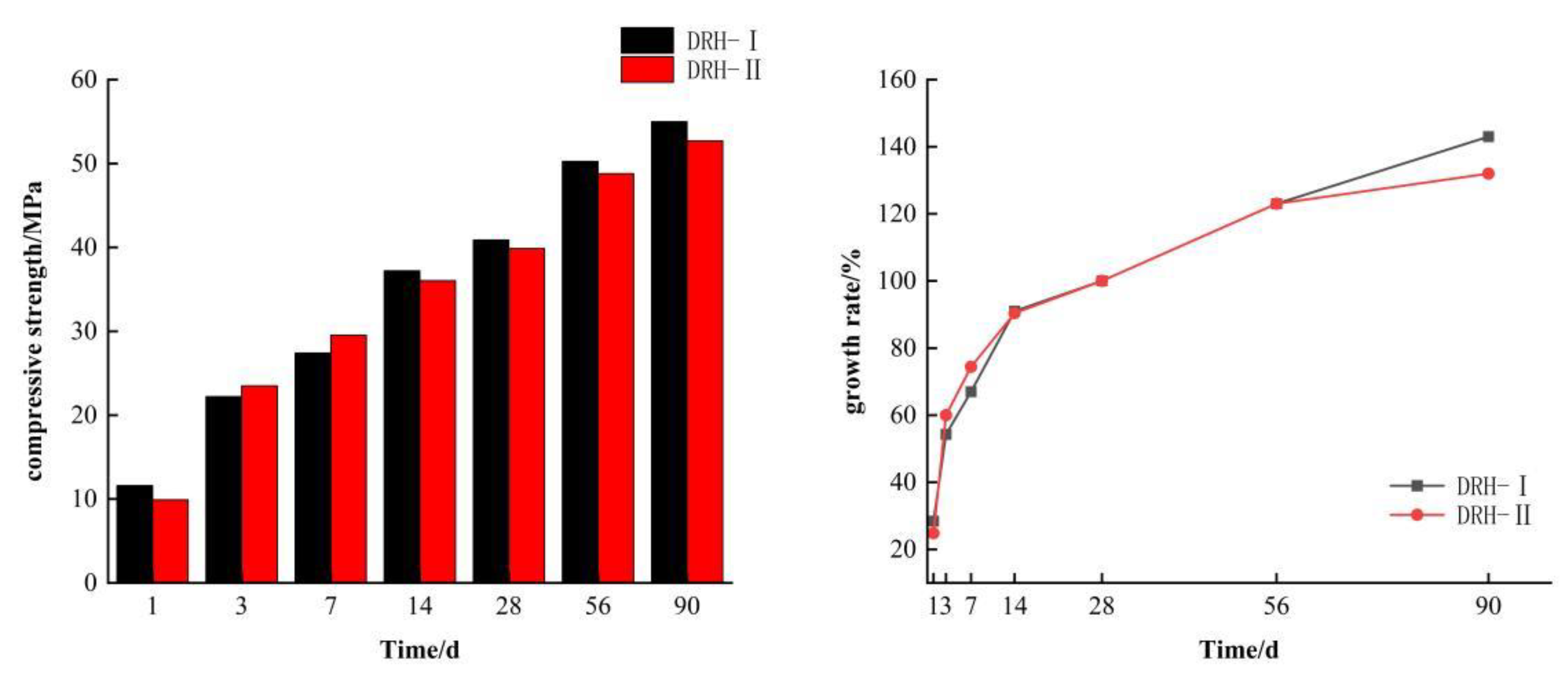
Two maintenance methods, The compressive strength of concrete meets the design requirements. Figure 2 shows the compressive strength of concrete with two curing methods on the left side. The simulated temperature is lower than the standard temperature before 1 day of curing temperature. So DRH-II is 1.7 MPa lower than DRH-I. As the temperature of the quasi-environmental maintenance box rises. At the age of 3d and 7d, DRH-II was 1.3MPa and 2.1MPa higher than DRH-I, respectively. With the decrease of temperature, The intensity value of DRH-II is lower than that of DRH-I. Later curing at the same temperature, The difference between the two strength values is small. The right side of Fig.2 is the growth rate of compressive strength. Based on 28d, DRH-II was 3.6% lower than DRH-I at 1d age. At 3d and 7d ages, DRH-II was 5.7% and 7.1% higher than DRH-I, respectively. The growth rate is roughly the same when curing at the same temperature in the later period. At 90 days of age, DRH-II was 11% lower than DRH-I. On the whole, the strength development and strength growth rate change with the increase and decrease of temperature. It can also be concluded that the early strength growth of DRH is better than the experimental value. It is beneficial to crack resistance of concrete at early age.

2.1.2. Elastic Modulus

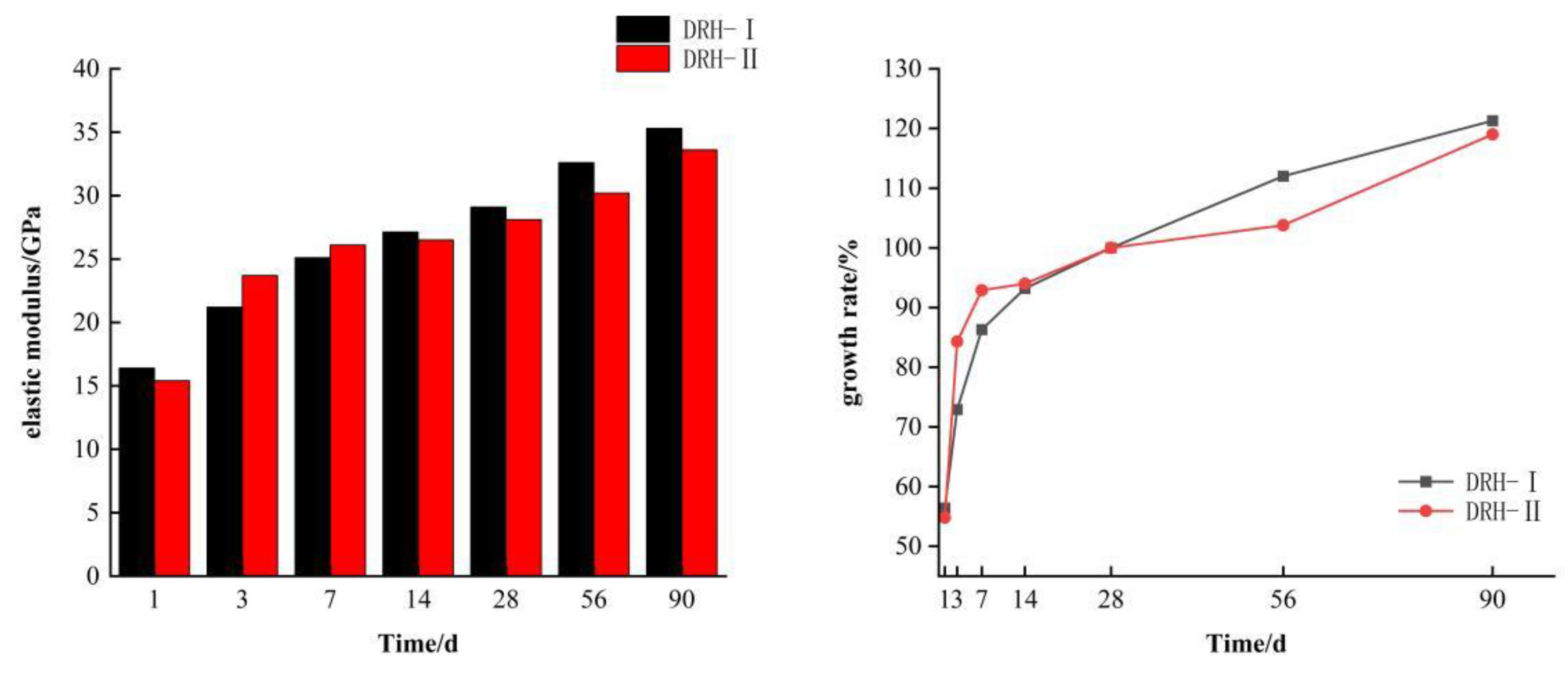
Elastic modulus is also an important index in the mechanical properties of concrete. This test is maintained by two curing temperature methods. The corresponding elastic modulus of concrete and its growth rate are obtained Figure 3. The left side is the elastic modulus of concrete. Basically the same as the development of compressive strength. Among them, 3d、7d age,DRH-II is 2.5GPa and 1GPa higher than DRH-I, respectively. On the right side is the growth rate of elastic modulus of concrete. Taking 28d age as the reference value. Among them, 3d、7d age,The growth rate of DRH-II was 11.4% and 6.6% higher than that of DRH-I, respectively. As the temperature decreases, the growth rate also decreases. The growth rate of DRH-II is still lower than that of DRH-I when cured at the same temperature. At the age of 90 days, the difference between the two is 2.3%. Combined with the compressive strength,It is found that the temperature change has an effect on the compressive index of concrete mechanical properties.

2.1.3. Splitting Tension

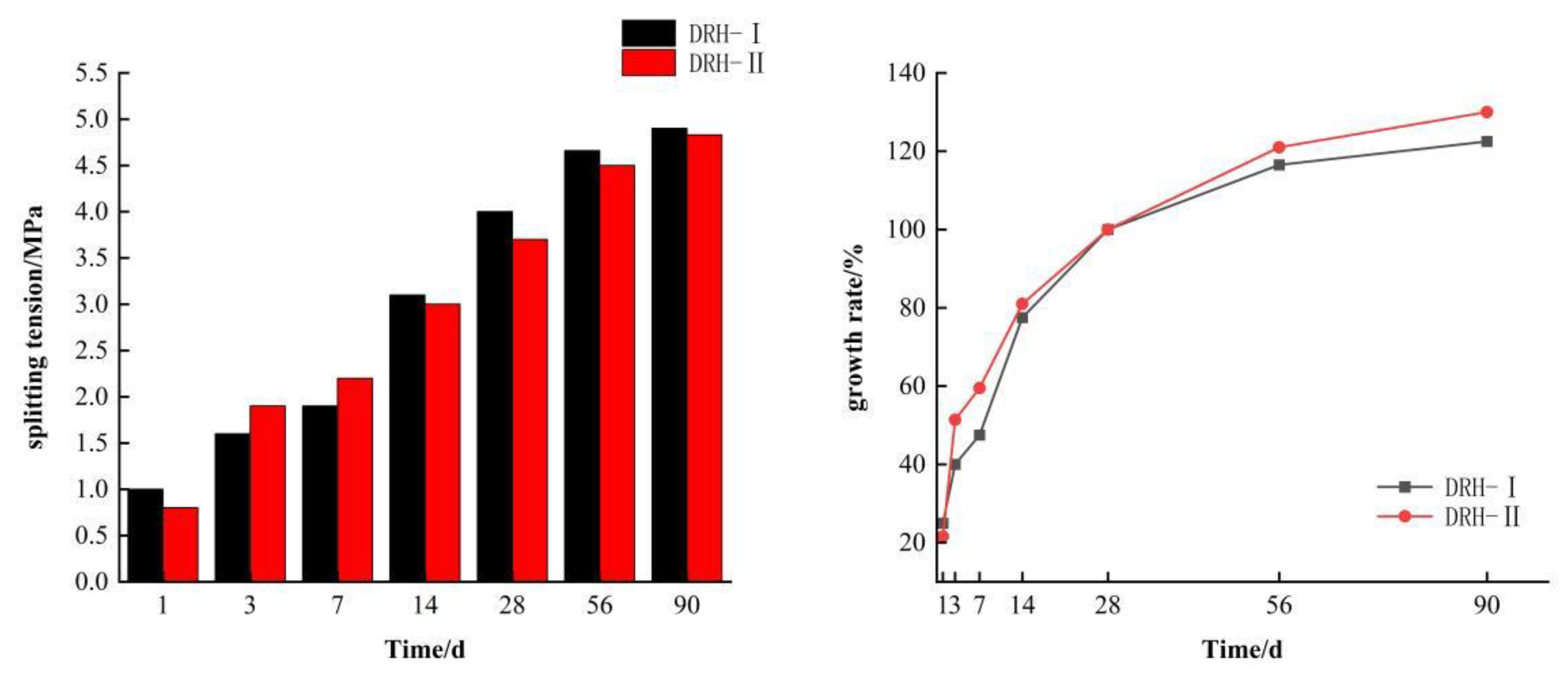
Splitting tensile strength is also one of the crack resistance indexes of concrete. The left side of Figure 4 is the splitting tensile data value. The simulated temperature is high at 3d and 7d ages. The strength of DRH-II is 0.3MPa and 0.3MPa higher than that of DRH-I. The overall strength increases and decreases with the rise and fall of temperature. The right side of Fig.4 is the growth rate of splitting tensile strength. Taking 28d age as the reference value. The early growth rate is basically the same as the compressive growth rate. The growth rate of DRH-II was 11.4%, 12% and 3.5% higher than that of DRH-I at 3d, 7d and 14 d. But although the later stage is the same temperature maintenance, But the growth rate of DRH-II is still higher than that of DRH-I. This is because relative to the simulated temperature of 28d. The temperature rose relatively in the later period. This reflects that the splitting tensile is more sensitive to temperature changes.

2.1.4. Axial Tensile Strength

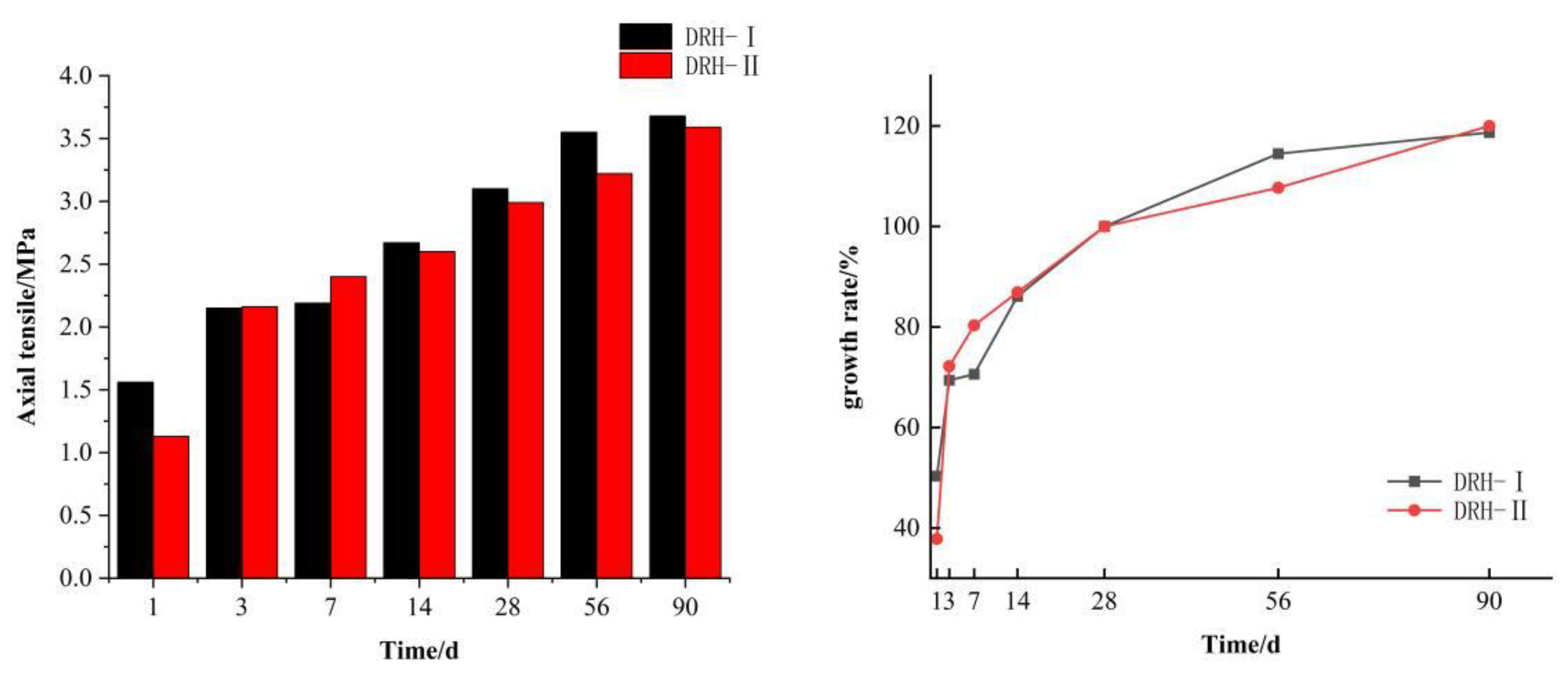
The axial tensile strength of concrete is very important to the crack resistance of concrete. The left side of Figure 5 is the axial tensile strength of concrete. The strength of DRH-II was 0.1MPa and 0.21MPa higher than that of DRH-I at 3d and 7d ages. On the right side is the growth rate of axial tensile strength of concrete. The age of 28d is the reference value. The growth rate of DRH-II was 2.8% and 9.7% higher than that of DRH-I at 3d and 7d. In the later period, the growth rate decreased due to the decrease of temperature. But at the age of 90d, The growth rate of DRH-II was 1.3% higher than that of DRH-I. Combined with splitting tensile strength, It shows that the temperature change is more sensitive to the tensile strength of concrete.

2.2. Maturity Theoretical Analysis

Combined with the above, we can conclude that the increase of curing temperature will increase the strength of concrete. To further analyze the relationship between curing temperature and strength.Next, we will use three maturity calculation formulas to calculate the maturity index. And through the exponential function, logarithmic function, hyperbolic function three kinds of function fitting. The highest precision is selected to represent the relationship between maturity and strength development.

2.2.1. Maturity Indicator

Maturity means that the strength growth of concrete is the result of the combined influence of temperature and time. And the strength is a function of the product of temperature and time.
N-S maturity calculation formula [17]:
M = 0 t ( T T 0 ) t
M——Maturity,℃ ·d;T——Actual temperature of concrete,℃;T0——Reference temperature(-10℃); t ——Curing age,d;
P equivalent age [18]:
T e = 0 t e x p [ E R ( 1 273 + T c 1 273 + T ) ] t
Te——Equivalent age,d;E——Activation energy,J/mol(T≥20℃,E=33500J/mol;T<20℃,E=33500+1470(20-T)J/mol));R——Gas constant(8.3144j/(mol·K));Tc——Reference temperature(20℃);T——Actual temperature of concrete,℃; t ——Time interval,d.
L equivalent age [19]:
t = α T t T
T——Equivalent age,d; α T ——The temperature is the equivalent coefficient of T; t T ——Duration of temperature T,h.
Check the specification can be obtained at 20 °C, The D-L equivalent coefficient is 1.0. The rest also has the specification to know.(1)-(3), The maturity index at different curing temperatures can be calculated. The calculation results of maturity index are as follows: Table 5. The F-P equivalent age and D-L equivalent age are the same in standard curing. Curing according to on-site temperature, The equivalent age calculated by the F-P equivalent age calculation model and the D-L equivalent age calculation model is relatively close.

2.2.2. The Relationship Between Maturity and Strength

After the maturity value is obtained, the maturity-strength relationship fitting equation can be determined. The exponential, logarithmic and hyperbolic curves were used to fit the compressive strength, splitting tensile strength, axial tensile strength and maturity respectively.
Exponential function, Freiesleben and Pedersen [20], It is found that there is a relationship between hydration heat and maturity between maturity and strength:
S = S e ( τ M ) a
S——Concrete strength,MPa;M——Maturity,(℃.h) or h; S ——Final strength of concrete,MPa; τ ——Temporal characteristic parameters,(℃.h) or h;a——Shape factor.
Logarithmic function, Plowman [21], It is proposed based on the linear relationship between strength and maturity:
S = a + b l o g ( M )
S——Concrete strength,MPa;M——Maturity,(℃.h) or h;a, b are obtained by function fitting.
Hyperbolic function,Kee [22],It is found that the relationship between maturity and strength can also be expressed by hyperbola:
S = M m M + n
S——Concrete strength,MPa;M——Maturity,(℃.h) or h;m,n are obtained by function fitting.

2.2.3. The Establishment and Analysis of Function Model

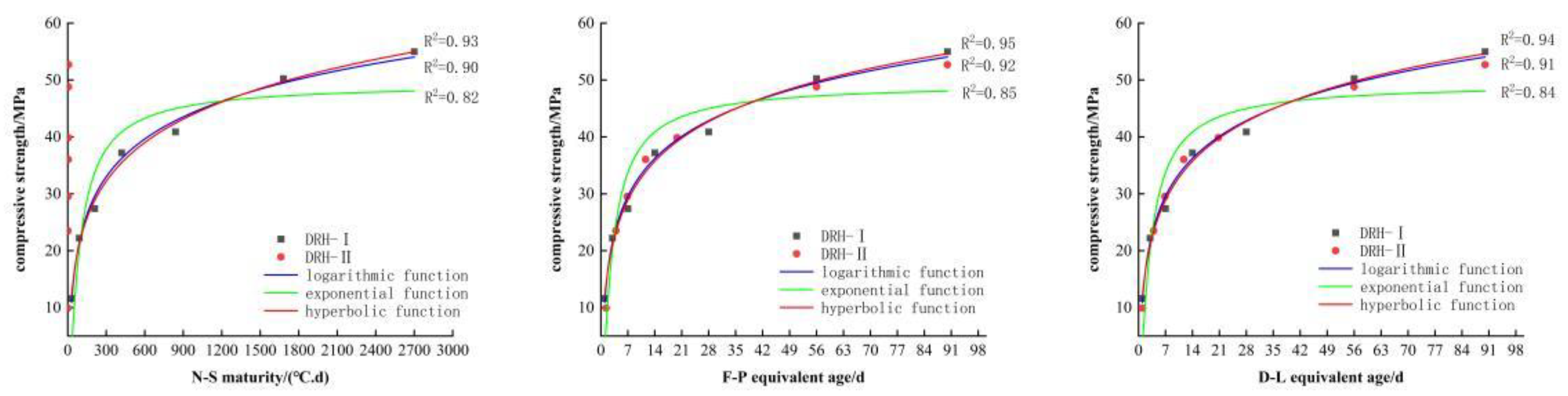
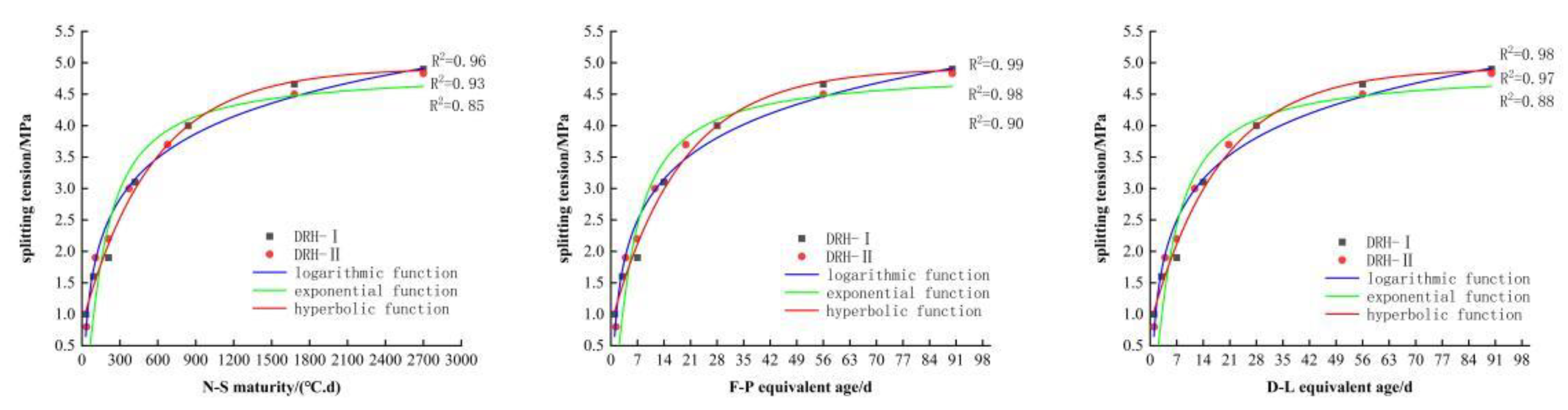
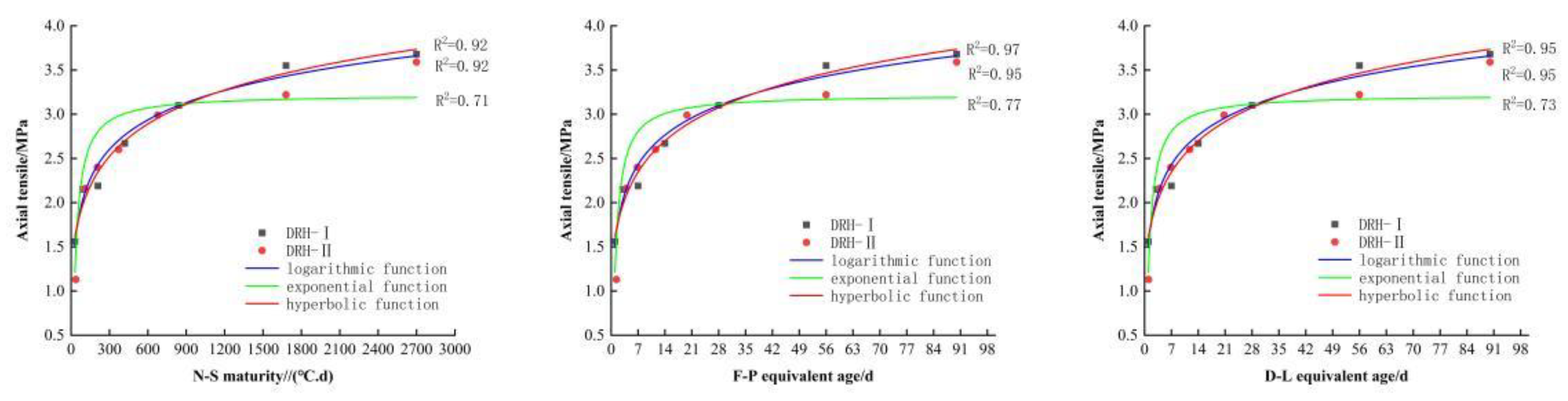
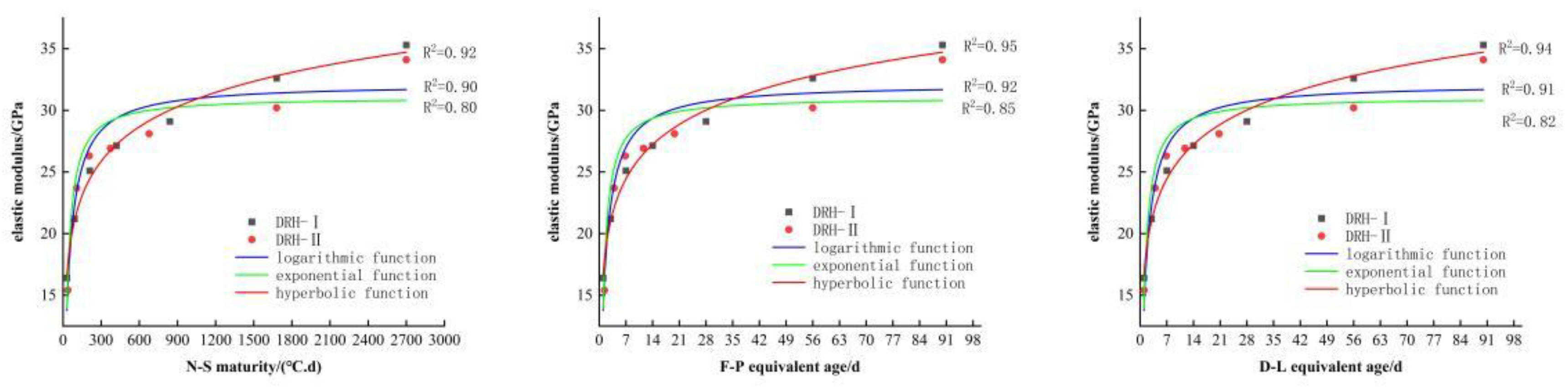
Using fitting software, (4)-(6), The relationship curve between compressive strength and maturity of low heat Portland cement concrete can be obtained, Figure 6. Relationship curve between splitting tensile strength and maturity, Figure 7. Relationship curve between axial tensile strength and maturity, Figure 8. Relationship curve between elastic modulus and maturity, Figure 9. Overall, The compressive strength, splitting tensile strength, axial tensile strength and elastic modulus of DRH-I and DRH-II increase with the increase of maturity index. The fitting curves obtained by the three fitting methods of F-P equivalent age and D-L equivalent age are roughly consistent. It shows that both can accurately predict the development law of concrete strength.
The hyperbolic function and logarithmic function in the fitting relationship between maturity and strength development can be well fitted. The correlation coefficients of hyperbolic function in the relationship between compressive strength and maturity index are 0.93, 0.95 and 0.94. The correlation coefficients of logarithmic function are 0.90, 0.92 and 0.91 respectively. The fitting correlation coefficients of splitting tensile strength and maturity hyperbolic function are 0.96, 0.99 and 0.98 respectively. The correlation coefficients of logarithmic function are 0.93, 0.98 and 0.97. The correlation coefficients of axial tensile and maturity hyperbolic curves are 0.92, 0.97 and 0.95, respectively. The correlation coefficients of logarithmic function are 0.92, 0.95 and 0.95. The fitting coefficients of elastic modulus and maturity hyperbolic curve are 0.92, 0.95 and 0.94 respectively. The correlation coefficient of logarithmic function is 0.9, 0.92, 0.91. The correlation coefficient of exponential function fitting is below 0.90. Effect is not good.The fitting effect of hyperbola is the best,Logarithmic function fitting followed. Therefore, the hyperbolic function fitting model is the most accurate. It can be seen from the relationship between the four indexes of concrete mechanical properties and maturity, The fitting relationship between splitting tensile strength and maturity is the best. Combined with the variable temperature curing test can be concluded that, The splitting tensile strength is most affected by temperature change.Therefore. In practice, the influence of splitting tensile on concrete should be considered more.

2.3. Microscopic Test

This microscopic test selected 0.36 water-binder ratio. The curing age is 7d, 28d and 90d. X-ray diffraction ( XRD ), scanning electron microscopy ( SEM ) and energy spectrum analysis methods were used to analyze the cementitious system of low heat cement with 25% fly ash. The microstructure, hydration products and long-term Ca(OH)2 content of low-heat cement were analyzed.

2.3.1. X-Ray Diffraction Analysis

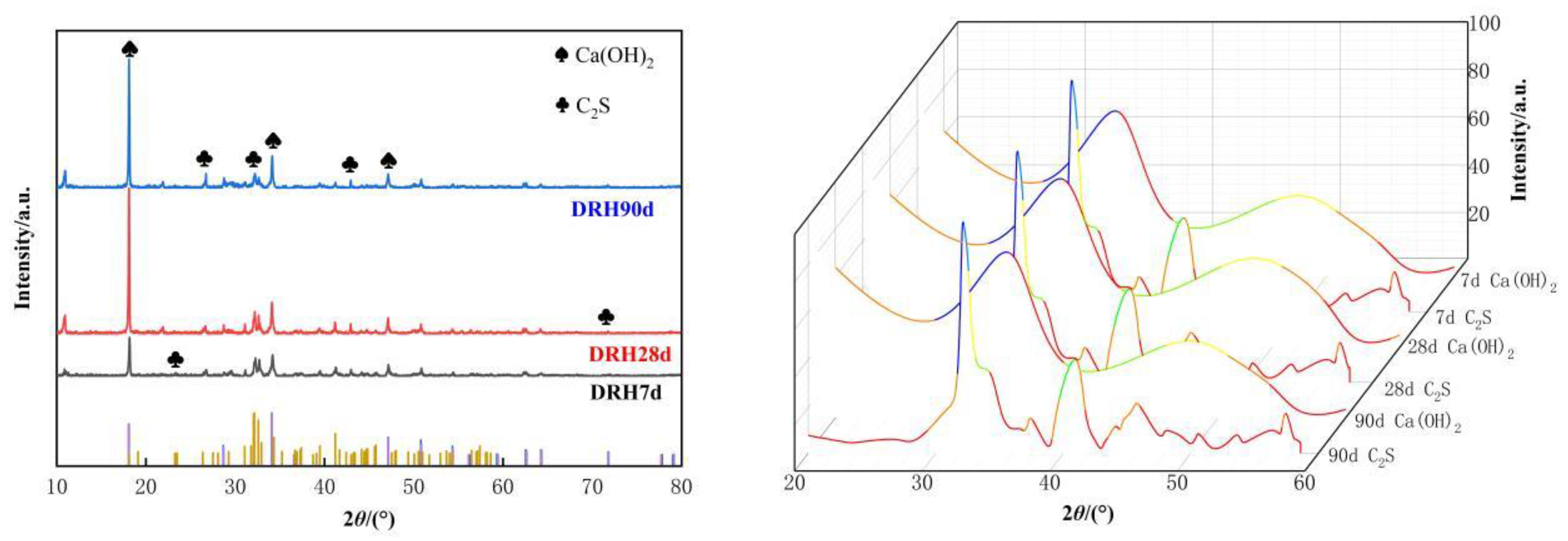
The phase analysis of low heat cement at different curing ages was carried out by XRD. The Ca(OH)2 in hydration products and C2S in low heat cement were investigated. The XRD pattern was drawn in the range of 2θ angle 10-80°. As shown in Figure 10. On the left side is the XRD spectrum of 7d, 28d, 90d low heat cement. The right side is the main Ca(OH)2 and C2S characterization diagram of the characteristic peaks in the left XRD spectrum. The C2S diffraction peaks were found near 25°and 45°by long-age hydration. The diffraction peaks of Ca(OH)2 were found near 20°and 32°. C2S is the main support point for the high strength of low heat cement in the later stage. Ca(OH)2 also plays a role in filling pores in cement. To make the low heat concrete structure more compact,Ensure the later strength development, It is beneficial to the long-term crack resistance of lining structure.

2.3.2. Scanning Electron Microscope

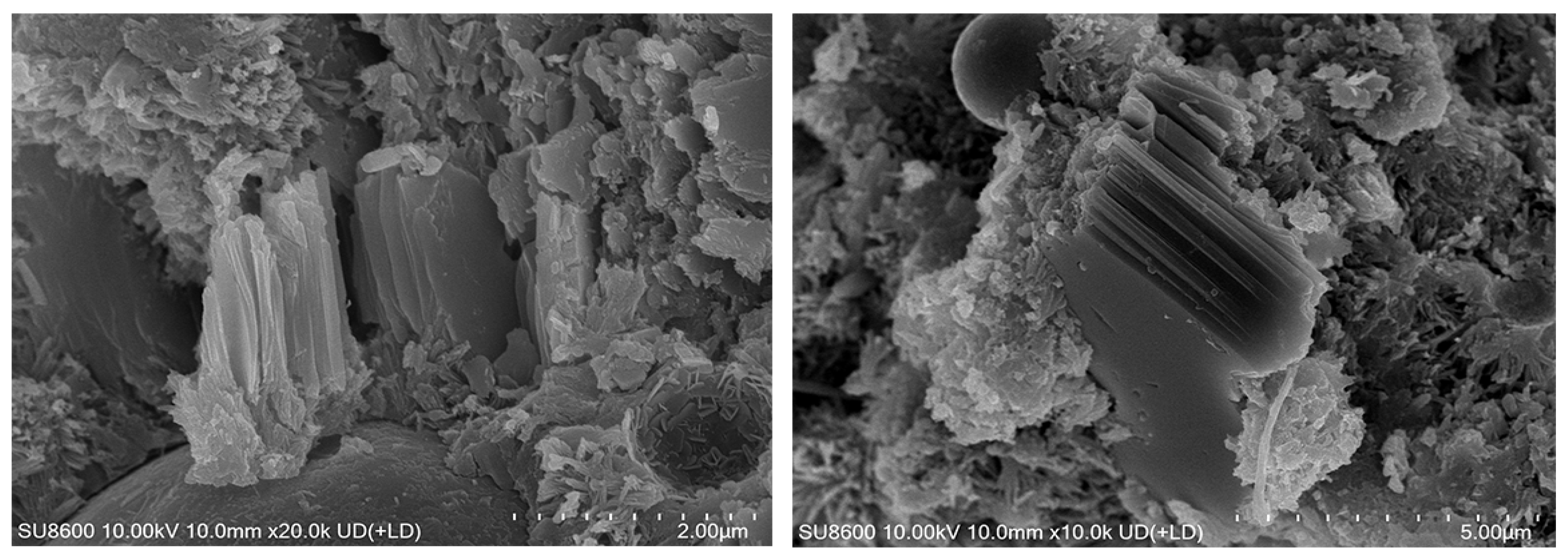
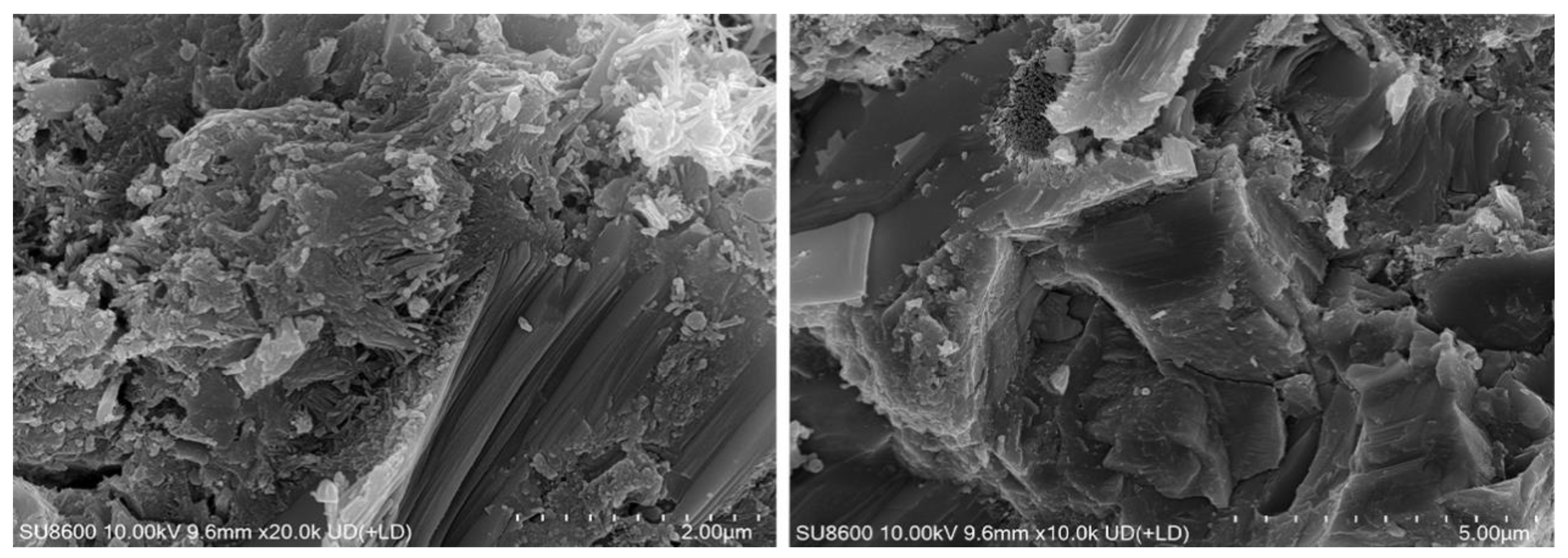
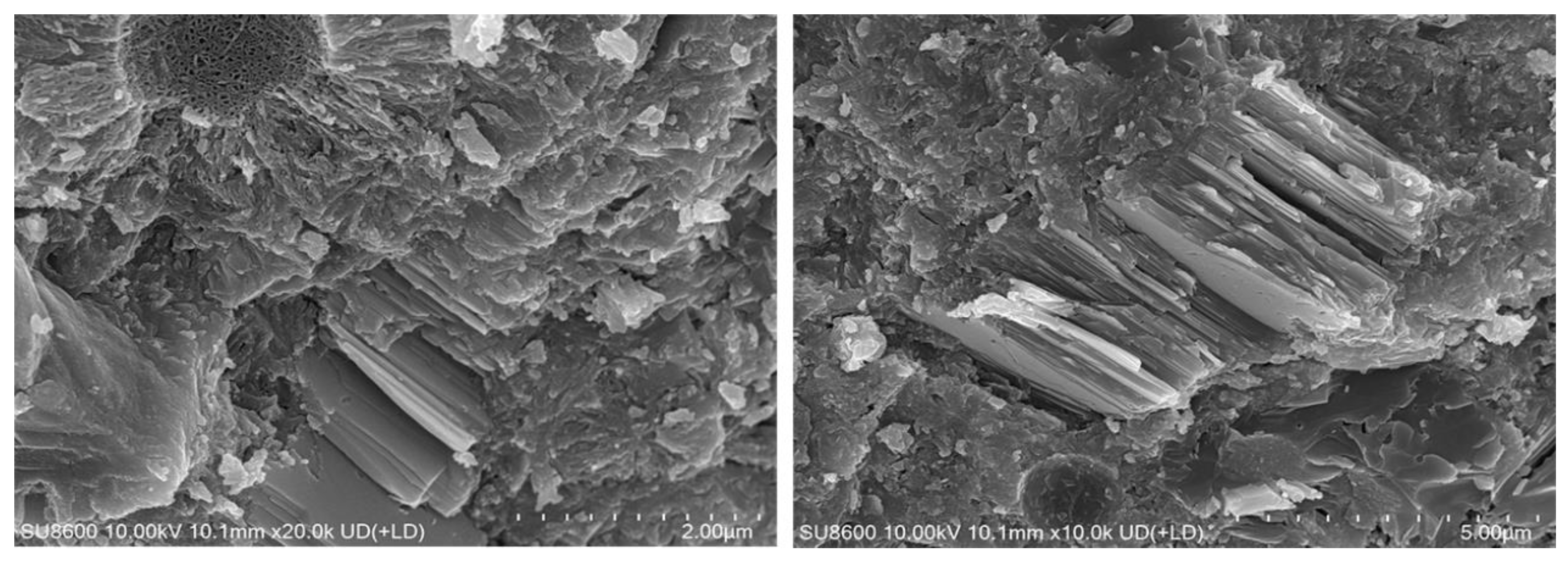
The microstructure characteristics and distribution of hydration products of low-heat cement at different curing ages were analyzed by scanning electron microscopy. The results are shown in Figure 11, Figure 12 and Figure 13. It is found that Ca(OH)2 in low heat cement is mostly stacked in flakes. Good compactness,From the early stage to the later stage, It is surrounded by C-S-H gel. With low heat cement high content of C2S,Later with the hydration reaction, The more the C-S-H gel develops, the more it develops. Can fill the pores, It can make the concrete structure more stable. A considerable amount of Ca(OH)2 is retained. Ensure the later strength development, It plays an important role in crack resistance of concrete.

2.3.3. Energy Spectrum Analysis

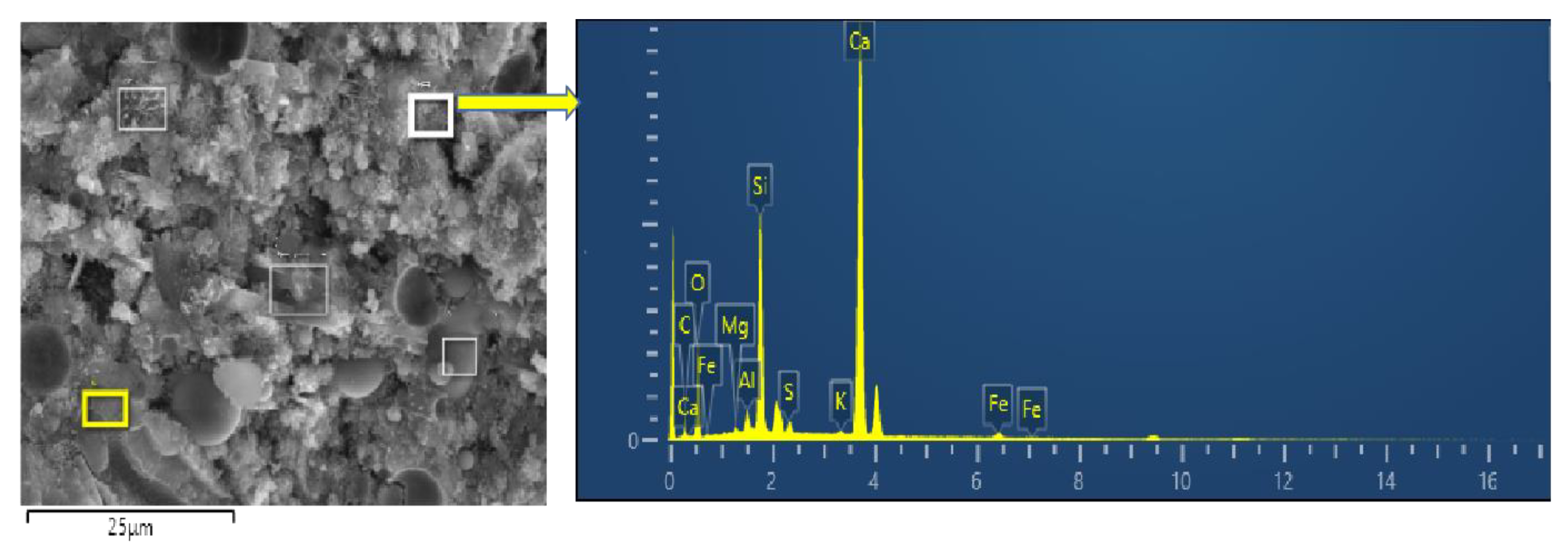
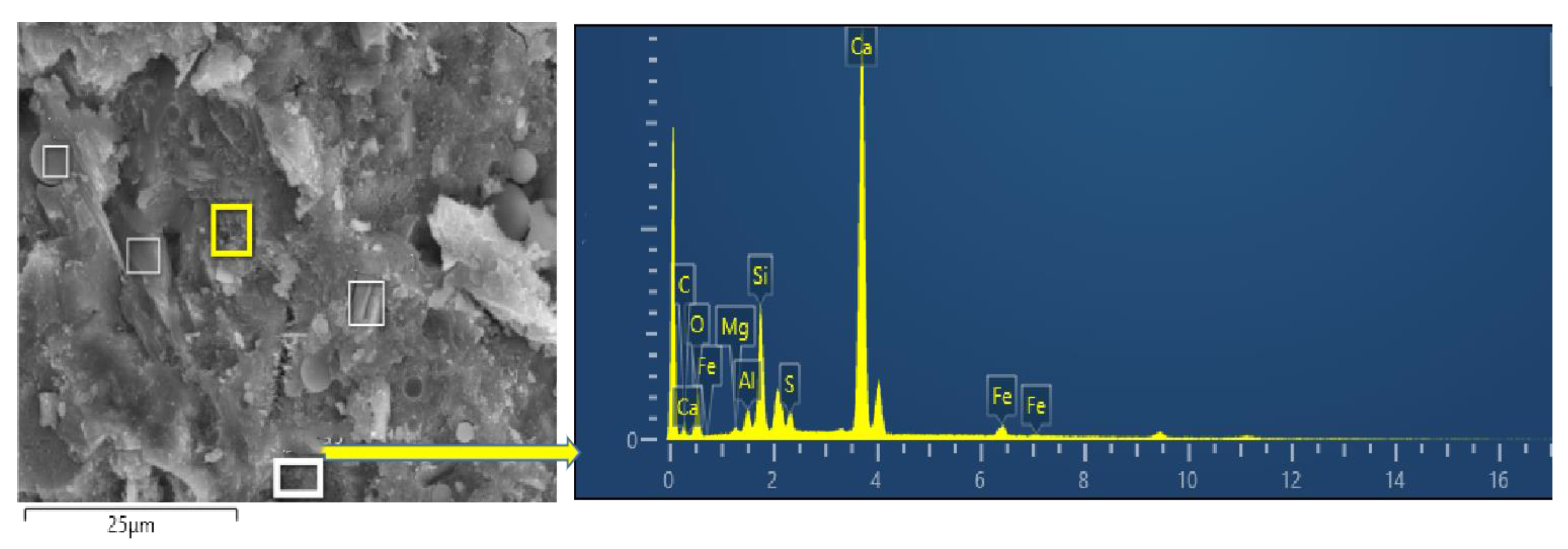
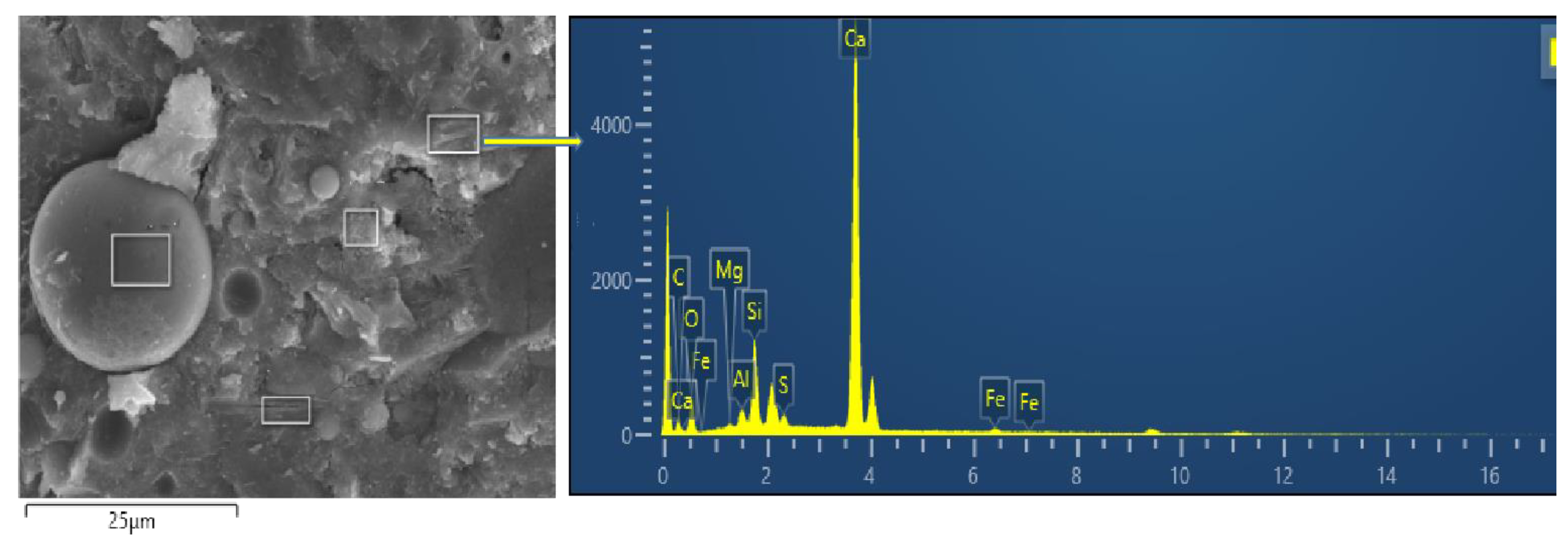
The cementitious system of low-heat cement with 25% fly ash at different curing ages was tested by energy spectrum analysis(EDS). As shown in Figure 14, Figure 15 and Figure 16. It was found that the mass percentage of Ca element was 37.95%——50.45%. The atomic percentage is 20.66%——29.9%. The mass percentage of Si element is 7.05%——11.34%. The atomic percentage is 5.96%——8.81%. C-S-H gel can be formed in the long-term hydration process. The concrete structure is more compact, Ensure late strength. There is still a certain amount of Mg element in 90d, Generating MgO, It has a slight expansion effect on concrete. Inhibitory contraction,Improve the durability of concrete.

3. Conclusions

  • This experiment found that temperature has an effect on the mechanical properties of concrete. The compressive strength, splitting tensile strength, axial tensile strength, elastic modulus and its growth rate of standard curing and quasi-environmental curing increase with the increase of temperature. The temperature decreases and decreases. The temperature change has the greatest influence on the splitting tensile strength of concrete.
  • This test found that the difference of concrete performance change is within the acceptable range. It shows that the research done by the laboratory has a strong reference significance for the actual situation on the spot.
  • The hyperbolic fitting function based on F-P equivalent age and D-L equivalent age can well predict the development law between maturity and strength. Strength increases with the increase of maturity.
  • Microscopic experiments show that there is a large amount of C-S-H gel in the later stage of low heat cement. Compact structure, And has the effect of micro expansion, It is beneficial to the development of mechanical properties of low heat cement concrete in the later stage.

Fund project

Research project of Xinjiang Water Conservancy Development Investment ( Group ) Co., Ltd.(EQ094/FY077、QBT067/FY28、EQ098/FY079、QBT087/FY36).

References

  1. Feifei, L.; Haibo, J.; Pengfei, X.; et al. Study on temperature control and crack prevention of lining structure of high geothermal hydraulic tunnel based on concrete hydration heat effect. Tunn. Constr. (Engl. Chin.) 2024, 44, 1262–1273. [Google Scholar]
  2. Chen, G.; Liu, Y.; Ji, G.; et al. Study on the application of low heat Portland cement in hydraulic concrete. Water Conserv. Hydropower Technol. (Engl. Chin.) 2021, 52, 191–200. [Google Scholar]
  3. Pan, L.; Xu, W.; Liang, Z.; et al. Research on anti-cracking technology of mass concrete for main pier cap of Changtai Yangtze River Bridge. Bridge Constr. 2024, 54, 8–14. [Google Scholar]
  4. Wang, L.; Yang, H.; Zhou, S.; et al. Mechanical properties, long-term hydration heat, shinkage behavior and crack resistance of dam concrete designed with low heat Portland (LHP) cement and fly ash. Constr. Build. Mater. 2018, 187, 1073–1091. [Google Scholar] [CrossRef]
  5. Li, X.; Huang, X.; Xu, F.; et al. The correlation of basic mechanical indexes of C20 ~ C120 concrete[J/OL]. China Civ. Eng. J. 2024, 1–14. [Google Scholar]
  6. Zhou, B.; Gu, L.; Wu, Y.R.; et al. A deformability-based mechanical model for predicting shear strength of FRP-strengthened RC beams failed in concrete cover separation. Eng. Fract. Mech. 2024, 311, 110537. [Google Scholar] [CrossRef]
  7. Garba, J.M.; Tian, Y.; Shalaby, Y.; et al. Effects of liquid accelerators on long-term mechanical strength development and microstructural changes of wet-mixed shotcrete. J. Build. Eng. 2024, 97, 110926. [Google Scholar] [CrossRef]
  8. Guan, B.; Lu, X.; Chen, B. Effect of curing temperature on thermal conductivity of low heat cement concrete at early age. Yangtze River 2023, 54, 222–229. [Google Scholar]
  9. Shen, X. Study on the performance of low heat Portland cement in simulated harsh environment of plateau. China Research Institute of Building Materials Science, 2023.
  10. Ai, D.; Chen, C.; Zhu, H. Monitoring of compressive strength gain in mass concrete using embedded piezoelectric transducers. Struct. Des. Tall Spec. Build. 2024, 33, e2162. [Google Scholar] [CrossRef]
  11. Kim, S.; Jung, D.; Kim, Y.J.; et al. Study on Early Age Concrete’s Compressive Strengths in Unmanaged Curing Condition Using IoT-Based Maturity Monitoring. Buildings 2024, 14. [Google Scholar] [CrossRef]
  12. Sun, B.; Dominicus, R.; Dong, E.; et al. Predicting the strength development of 3D printed concrete considering the synergistic effect of curing temperature and humidity: From perspective of modified maturity model. Constr. Build. Mater. 2024, 427. [Google Scholar] [CrossRef]
  13. Hailu, B.T.; Safat, D.A.; Mohammad, S.U.A.; et al. Maturity method to estimate early age concrete strength in cold weather: Alternative activation energy calibration. Aust. J. Civ. Eng. 2024, 22, 1–12. [Google Scholar]
  14. National energy board. Code for construction of hydraulic concrete: DL/T 5144-2015. Beijing: China electric power press, 2015.
  15. Dai, J.; Wang, Q.; Qu, S.; et al. Strength prediction model of low temperature curing concrete based on maturity theory. J. Mater. Sci. Eng. 2018, 36, 263–267. [Google Scholar]
  16. Zhong, Y.; Wu, L.; Liu, C.; et al. Early age strength test and maturity analysis of low heat cement concrete. Yangtze River 2021, 52, 186–192. [Google Scholar]
  17. Luo, Q.; Xing, F.; Han, N.; et al. Prediction of early strength of concrete by simplified weight maturity method. Concrete 2010, 39–42. [Google Scholar]
  18. Liu, Z.; Hu, Y.; Wu, K.; et al. Study on the development characteristics of early age fracture properties of low heat cement concrete. Yangtze River 2022, 53, 175–181. [Google Scholar]
  19. Zhao, M. Prediction of very early age strength of concrete based on maturity method. He Fei: Hefei University of technology, 2021.
  20. Hetmanczyk, P.M. A Method to Evaluate the Maturity Level of Robotization of Production Processes in the Context of Digital Transformation—Polish Case Study. Appl. Sci. 2024, 14, 5401. [Google Scholar] [CrossRef]
  21. Hee-Bok, C.; Gwang-Hee, K.; Kyung-In, K. Predicting the Strength of Recycled Aggregate Concrete—Predicting the strength of artificial neural networks and maturity method. J. Archit. Inst. Korea Struct. Constr. 2005, 21, 49–55. [Google Scholar]
  22. Kim, T.; Rens, L.K. Concrete Maturity Method Using Variable Temperature Curing for Normal and High-Strength Concrete. I: Experimental Study. J. Mater. Civ. Eng. 2008, 20, 727–734. [Google Scholar] [CrossRef]
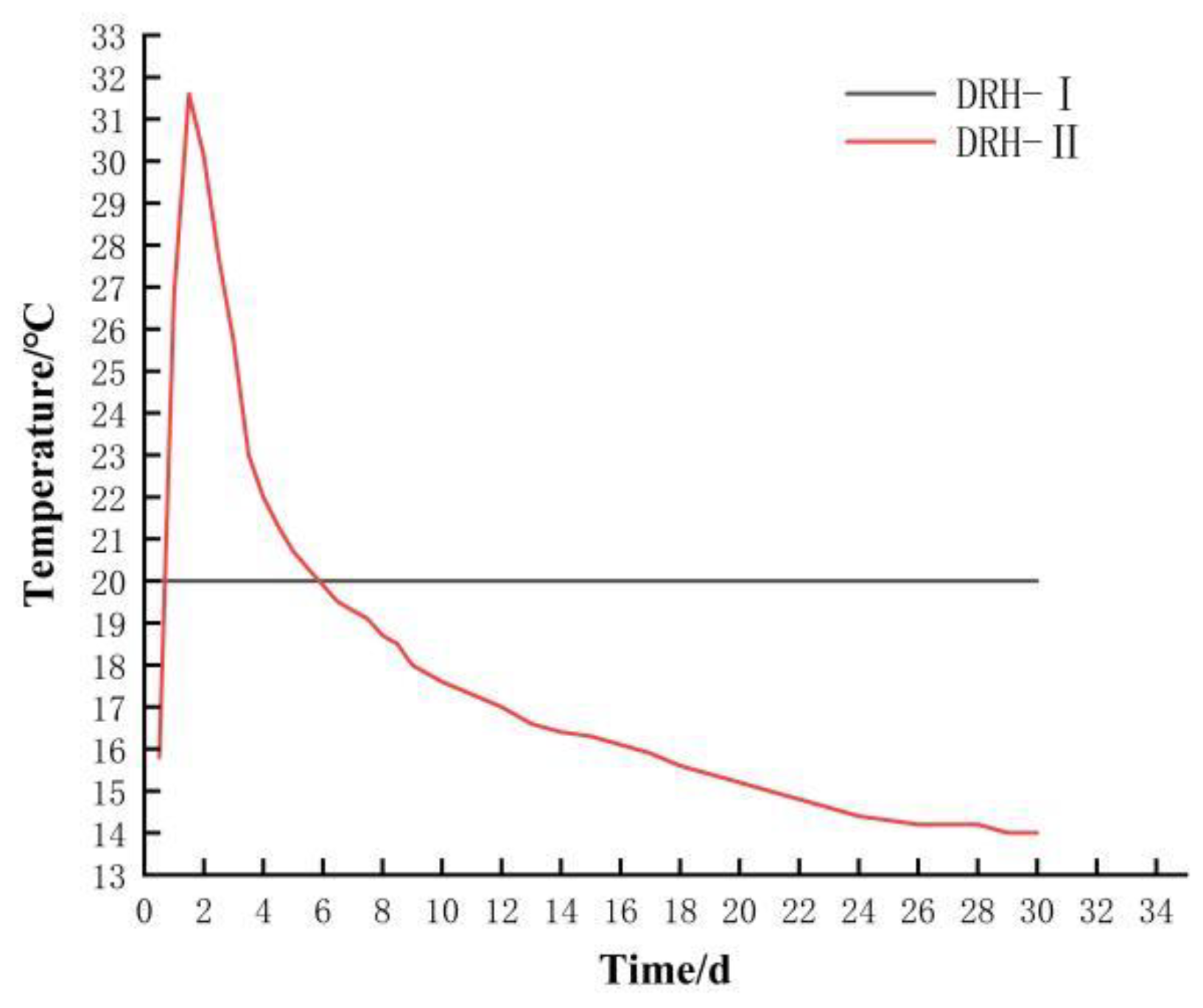
Figure 1. Curing temperature diagram.
Preprints 146023 g001
Figure 2. Compressive strength and growth rate.
Preprints 146023 g002
Figure 3. Elastic modulus and growth rate.
Preprints 146023 g003
Figure 4. Splitting tensile and growth rate.
Preprints 146023 g004
Figure 5. Axial tensile and growth rate.
Preprints 146023 g005
Figure 6. Relationship between compressive strength and maturity index.
Preprints 146023 g006
Figure 7. Relationship between splitting tensile strength and maturity.
Preprints 146023 g007
Figure 8. Relationship between axial tensile strength and maturity index.
Preprints 146023 g008
Figure 9. Relationship between elastic modulus and maturity index.
Preprints 146023 g009
Figure 10. XRD spectrum and hydration products of low heat cement.
Preprints 146023 g010
Figure 11. Hydration products of low heat cement with 25 % fly ash system(7d).
Preprints 146023 g011
Figure 12. Hydration products of low heat cement with 25 % fly ash system(28d).
Preprints 146023 g012
Figure 13. Hydration products of low heat cement with 25 % fly ash system(90d).
Preprints 146023 g013
Figure 14. Energy spectrum and element content(7d).
Preprints 146023 g014
Figure 15. Energy spectrum and element content(28d).
Preprints 146023 g015
Figure 16. Energy spectrum and element content(90d).
Preprints 146023 g016
Table 1. Detection of chemical composition of cement/%.
cement CaO SiO2 Al2O3 MgO Fe2O3 SO3 F-CaO Loss K2O Na2O R2O
LHC 59.8 23.04 4.42 3.2 4.30 2.52 0.84 1.09 0.56 0.26 0.63
Table 2. Testing of physical properties of cement.
cement specific surface area/m2.kg-1 Density/g.cm-3 normal consistency/% setting time/min hydration heat/kj.kg-1 compressive strength/MPa break off strength/MPa
initial set final set 3d 7d 3d 7d 28d 90d 3d 7d 28d 90d
LHC 317.6 3.23 27.7 216 291 188 220 17.4 30.3 51.3 67.4 3.9 5.0 7.0 8.2
Table 3. Aggregate performance testing.
aggregate coarse aggregate fine aggregate
grain size/mm 20-40 5-20 ≤5
Dry apparent density of saturated surface/kg/m3 2680 2650 2630
water absorption at saturated surface-dry basis/kg/m3 0.42 0.63 0.80
soil content/% 0.5 0.2 1.4
fineness modulus - - 2.8
Table 4. proportioning of concrete.
numbering water-binder ratio Flyash/% Admixture/% amount/kg.m-3
water reducing admixture air entraining agent water cement flyash sand pebble nakaishi
DRH 0.36 25 1 0.006 140 291.7 97.2 771.6 566.8 469
Table 5. Maturity index calculation results.
DRH-Ⅰ DRH-Ⅱ
Time/d 1 3 7 14 28 56 90 1 3 7 14 28 56 90
Temperature/℃ 20 26.8 25.7 19.5 16.6 14.2 20 20
N-S/(℃.d) 30 90 210 420 840 1680 2700 36.8 107.1 206.5 372.4 677.4 1680 2700
F-P/d 1 3 7 14 28 56 90 1.366 3.9 6.834 11.629 19.763 56 90
D-L/d 1 3 7 14 28 56 90 1.04 3.93 6.86 11.76 20.72 56 90
Disclaimer/Publisher’s Note: The statements, opinions and data contained in all publications are solely those of the individual author(s) and contributor(s) and not of MDPI and/or the editor(s). MDPI and/or the editor(s) disclaim responsibility for any injury to people or property resulting from any ideas, methods, instructions or products referred to in the content.
Copyright: This open access article is published under a Creative Commons CC BY 4.0 license, which permit the free download, distribution, and reuse, provided that the author and preprint are cited in any reuse.
Prerpints.org logo

Preprints.org is a free preprint server supported by MDPI in Basel, Switzerland.

Subscribe

Disclaimer

Terms of Use

Privacy Policy

Privacy Settings

© 2025 MDPI (Basel, Switzerland) unless otherwise stated